Intelligent User
Interfaces
ICS2208
Dr Vanessa Camiller
i

Department of AI,
 

University of Malta
Topic 10: IoT for Smart
Environments
‱ History & evolution of IoT


‱ Characteristics of IoT


‱ Projects & case studies


‱ User-centric approaches & issues to IoT
2
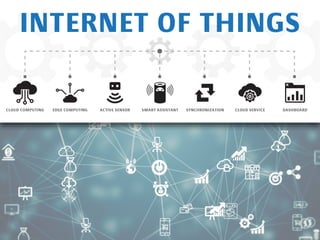
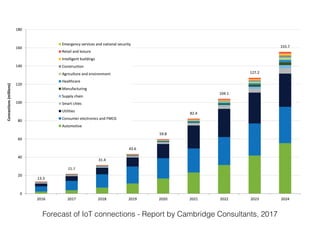
Forecast of IoT connections - Report by Cambridge Consultants, 2017
History & Evolution of IoT
‱ Internet of Things, Embedded Internet, Ubiquitous
Computing, Pervasive Computing, Ambient
Intelligence 
 same but different?


‱ IoT, first report published in 2005 at a World
Summit in Tunis


‱ Three important initial functions highlighted:
tracking, sensing and decision-making
History & Evolution of IoT
‱ 2005-2008: communication, network, interconnect,
physical & virtual objects, things, identities,
computation;


‱ 2009-2011: infrastructure, information, data,
services, captures, sense, physical & virtual,
communication, interoperability, seamless
integration, seamless communication, processes,
autonomously, controlled remotely;
History & Evolution of IoT
‱ 2012-2014: object identification, network
connectivity, human, interaction, smart, bringing
people, process, data and things together,
connected, improve quality;


‱ 2015-2017: commercial, products, insights,
analyse, big data, smart, safer, efficient;
IoT Characteristics
[Early Days]


‱ Convergence – any ‘thing’, any device


‱ Computation – anytime, always on


‱ Collection – any data, any service


‱ Communication – any path, any network


‱ Connectivity – any place, any where
IoT Characteristics
‱ Entity-based concept (physical and virtual objects)


‱ Distributed execution (design and processing)


‱ Interactions (machine and users)


‱ Distributed data (storage and portability)


‱ Scalability (infrastructure)


‱ Abstraction (rapid prototyping)


‱ Availability (networks)


‱ Fault tolerance (user-friendliness)


‱ Event-based (modular architecture)


‱ Works in real time (speed and performance)
IoT Characteristics
[Modern Days]


‱ devices (including physical or virtual, power, processing)


‱ data capture (including sensing and data exchange)


‱ communications (including network connectivity, protocols,
authentication and encryption)


‱ analysis (including big data analytics, AI and machine learning)


‱ information (including insightful forecasts and predictions)


‱ value (including operational efficiency, improvement in
performance)
IoT Characteristics
[Generalised]


‱ Sensing (S)


‱ Processing (P)


‱ Connectivity (C)


‱ Context-Awareness (CA)


‱ Internet (I)


‱ Internet Controlled (IC)


‱ Mobile Controlled (MC)


‱ Intelligence, self-configuring, self-monitoring (Int)
Case Study Examples
Plant-Dorm - Towards Embedded Internet System Applications


‱ Developed in 2003.


‱Challenges met:


‱ Lack of standards (reducing availability of off-the-shelf components)


‱ Lack of primitive tools (increasing the need to design everything from the
bottom up)


‱ Limited scalability


‱ Limited economies of scale (making system more expensive)


‱ Lack of crowd based communities (reducing the level of support available)
Case Study Examples
The Smart Alarm Clock


‱ Developed in 2013.


‱Challenges met:


‱Choosing the best Internet-of-Things platform for the application from the
myriad offering available.


‱Choosing the development tools for rapid prototyping (somewhat linked to the
choice of platform)


‱Choosing the crowd to be part of (this can be a balance between support from
large crowds and innovation from newer products with less users)


‱Provision of some user customisation (a trend that had grown since the earlier
pDorm product)
Case Study Examples
BREAL - A blended reality approach to the Internet of Things


‱ Developed in 2015-2017


‱Challenges met:


‱Devising computational paradigms and mechanisms to enable
Internet-of-Things devices to become smart-objects


‱Creating visual representations and simulations of Internet-of-
Things objects


‱Maintaining real-time synchronisation between the real and virtual
Internet-of-Things objects (test were conducted between countries
separated by many thousands of miles).
User-centric Approach to
IoT
‱ End-user programming


‱ Tangible interfaces


‱ Pervasive Interactive Programming
User-centric Approach to
IoT
‱ Technology Acceptance & Adoption


‱ Privacy & Trust issues


‱ Ethics


‱ Diffusion research


‱ Complexity
Future Directions
‱ IoT architectures


‱ AI Paradigms


‱ End-user programming


‱ Privacy & acceptance


‱ C o m m e r c i a l i s i n g
research work


‱ Smart homes


‱ Robotics


‱ Mixed Reality


‱ Edge computing

ICS2208 Lecture10

  • 1.
    Intelligent User Interfaces ICS2208 Dr VanessaCamiller i Department of AI, University of Malta
  • 2.
    Topic 10: IoTfor Smart Environments ‱ History & evolution of IoT ‱ Characteristics of IoT ‱ Projects & case studies ‱ User-centric approaches & issues to IoT 2
  • 4.
    Forecast of IoTconnections - Report by Cambridge Consultants, 2017
  • 5.
    History & Evolutionof IoT ‱ Internet of Things, Embedded Internet, Ubiquitous Computing, Pervasive Computing, Ambient Intelligence 
 same but different? ‱ IoT, first report published in 2005 at a World Summit in Tunis ‱ Three important initial functions highlighted: tracking, sensing and decision-making
  • 6.
    History & Evolutionof IoT ‱ 2005-2008: communication, network, interconnect, physical & virtual objects, things, identities, computation; ‱ 2009-2011: infrastructure, information, data, services, captures, sense, physical & virtual, communication, interoperability, seamless integration, seamless communication, processes, autonomously, controlled remotely;
  • 7.
    History & Evolutionof IoT ‱ 2012-2014: object identification, network connectivity, human, interaction, smart, bringing people, process, data and things together, connected, improve quality; ‱ 2015-2017: commercial, products, insights, analyse, big data, smart, safer, efficient;
  • 8.
    IoT Characteristics [Early Days] ‱Convergence – any ‘thing’, any device ‱ Computation – anytime, always on ‱ Collection – any data, any service ‱ Communication – any path, any network ‱ Connectivity – any place, any where
  • 9.
    IoT Characteristics ‱ Entity-basedconcept (physical and virtual objects) ‱ Distributed execution (design and processing) ‱ Interactions (machine and users) ‱ Distributed data (storage and portability) ‱ Scalability (infrastructure) ‱ Abstraction (rapid prototyping) ‱ Availability (networks) ‱ Fault tolerance (user-friendliness) ‱ Event-based (modular architecture) ‱ Works in real time (speed and performance)
  • 10.
    IoT Characteristics [Modern Days] ‱devices (including physical or virtual, power, processing) ‱ data capture (including sensing and data exchange) ‱ communications (including network connectivity, protocols, authentication and encryption) ‱ analysis (including big data analytics, AI and machine learning) ‱ information (including insightful forecasts and predictions) ‱ value (including operational efficiency, improvement in performance)
  • 11.
    IoT Characteristics [Generalised] ‱ Sensing(S) ‱ Processing (P) ‱ Connectivity (C) ‱ Context-Awareness (CA) ‱ Internet (I) ‱ Internet Controlled (IC) ‱ Mobile Controlled (MC) ‱ Intelligence, self-configuring, self-monitoring (Int)
  • 12.
    Case Study Examples Plant-Dorm- Towards Embedded Internet System Applications ‱ Developed in 2003. ‱Challenges met: ‱ Lack of standards (reducing availability of off-the-shelf components) ‱ Lack of primitive tools (increasing the need to design everything from the bottom up) ‱ Limited scalability ‱ Limited economies of scale (making system more expensive) ‱ Lack of crowd based communities (reducing the level of support available)
  • 13.
    Case Study Examples TheSmart Alarm Clock ‱ Developed in 2013. ‱Challenges met: ‱Choosing the best Internet-of-Things platform for the application from the myriad offering available. ‱Choosing the development tools for rapid prototyping (somewhat linked to the choice of platform) ‱Choosing the crowd to be part of (this can be a balance between support from large crowds and innovation from newer products with less users) ‱Provision of some user customisation (a trend that had grown since the earlier pDorm product)
  • 14.
    Case Study Examples BREAL- A blended reality approach to the Internet of Things ‱ Developed in 2015-2017 ‱Challenges met: ‱Devising computational paradigms and mechanisms to enable Internet-of-Things devices to become smart-objects ‱Creating visual representations and simulations of Internet-of- Things objects ‱Maintaining real-time synchronisation between the real and virtual Internet-of-Things objects (test were conducted between countries separated by many thousands of miles).
  • 15.
    User-centric Approach to IoT ‱End-user programming ‱ Tangible interfaces ‱ Pervasive Interactive Programming
  • 16.
    User-centric Approach to IoT ‱Technology Acceptance & Adoption ‱ Privacy & Trust issues ‱ Ethics ‱ Diffusion research ‱ Complexity
  • 17.
    Future Directions ‱ IoTarchitectures ‱ AI Paradigms ‱ End-user programming ‱ Privacy & acceptance ‱ C o m m e r c i a l i s i n g research work ‱ Smart homes ‱ Robotics ‱ Mixed Reality ‱ Edge computing