M A RT I N C LO O N A N A N D J O H N
W I L L I A M S O N
5 T H S E P T E M B E R 2 0 1 2
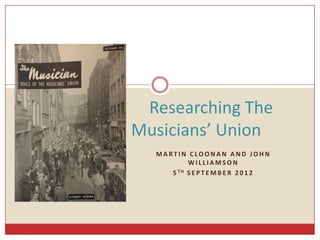
Researching The
Musicians’ Union
Outline
 Context
 Perceptions of the MU
 About the Project
 Why it is important
Context
 Amalgamated Musicians’ Union formed in
Manchester, 1893
 Merger with London Orchestral Union of Professional
Musicians in 1921
 31 482 members (2011).
Enemies of the Union
 “You are invited to attend a meeting in Manchester on 7th
May 1893 to discuss forming a Union for orchestral
players. The Union that we require is a protection Union.
One that will protect us from amateurs, protect us from
unscrupulous employers, and protect us from ourselves.
[J.B.Williams, 1893]
Perceptions
 London Orchestral Association: “organised tyranny which
is the curse of modern trades unionism in this country”
(1894)
 William Boosey, PRS: “these gentlemen who are the
spoilt darlings of the musical profession” (1922)
 McKay: “the ban did sterling work over two decades in
keeping professional British jazz and dance music white.”
 “Virtually every one of the music’s practitioners, nearly all
of whom were black, were kept out of Britain by an
overwhelmingly white organisation, the Musicians Union”
(2005)
Perceptions
 Oliver: “the ‘ban’ was as inflexibly applied as it was
stupidly imposed.” (1980)
 Frith: “the MU has always been out of touch with the
particular needs of rock musicians.” (1978)
 Street: “as each innovation appears to threaten jobs, the
MU has resisted each one in turn, first opposing multi-
track recording, then mellotrons and finally synthesisers
and drum machines. While inspired by a desire to protect
members, the MU’s policy appears as merely
reactionary.” (1985)
Perceptions
 Sweeting: “a left-wing, doctrinaire organisation as
secretive and tight-lipped as the KGB.” (2001)
 Mendick: “the glorious unreconstructed ways of the
Musicians’ Union . .you have a scenario that would make
Arthur Scargill weep with nostalgia.” (2001)
 Lawson: “it is a massive black mark on a Union that has
done so much for grassroots music. You’re effectively
crapping on the best music discovery, fan-
generating, culture-sharing, life-benefitting ecosphere
that musicians in the world have ever experienced.”
(2010)
About the Project
 Extension of previous work on music industries, generally
and
 Live music industry AHRC project –
 Importance of pre-1955 music industries
 Importance of MU in these agreements
 Primary source: Musicians’ Union archive @ University of
Stirling:
 Minutes and agreements
 Publications
 Correspondence
Importance
 3 main areas:
 trade union
 working as a musician
 the music industries
Importance / Trade Union
 Lack of dispassionate analysis from both inside and
outside the union
 No detailed history of the Union
 Footnote in the history of Trade Unionism – but
 Involvement in TUC and its leadership
 Unique contemporary nature of the Union
Importance / Working Musicians
 Debates around what constitutes a musician and who can
become a member
 Craft Union vs. General Union?
 Problems of acceptance of part-time/ semi-professional
members
Importance / Music industries
 Union missing from most accounts of British music
industries
 MU at the centre of agreements underpinning
relationships between employers and musicians – for
example:
 MU rates for live performance
 BBC / ITV/ Broadcasting agreements
 PPL / public performance
 Lobbying with other industry organisations on copyright related
claims
Conclusions
 Need for history of Musicians’ Union of interest beyond
labour relations / Union members
 MU as a lens for understanding the music industries and
how these have changed – specifically with regard to:
 Organisation of workers in the music industries
 Payments / how creative work has been rewarded
Conclusions
 Caves (2000): “ The basic forces driving the organisation
of workers in creative activities”
 Hesmondhalgh (2007): “how has creative work been
rewarded in the complex professional era?”
 Need to understand why it acted the way it did, when it
did.
IASPM UK and Ireland, September 2012

IASPM UK and Ireland, September 2012

  • 1.
    M A RTI N C LO O N A N A N D J O H N W I L L I A M S O N 5 T H S E P T E M B E R 2 0 1 2 Researching The Musicians’ Union
  • 2.
    Outline  Context  Perceptionsof the MU  About the Project  Why it is important
  • 3.
    Context  Amalgamated Musicians’Union formed in Manchester, 1893  Merger with London Orchestral Union of Professional Musicians in 1921  31 482 members (2011).
  • 4.
    Enemies of theUnion  “You are invited to attend a meeting in Manchester on 7th May 1893 to discuss forming a Union for orchestral players. The Union that we require is a protection Union. One that will protect us from amateurs, protect us from unscrupulous employers, and protect us from ourselves. [J.B.Williams, 1893]
  • 5.
    Perceptions  London OrchestralAssociation: “organised tyranny which is the curse of modern trades unionism in this country” (1894)  William Boosey, PRS: “these gentlemen who are the spoilt darlings of the musical profession” (1922)  McKay: “the ban did sterling work over two decades in keeping professional British jazz and dance music white.”  “Virtually every one of the music’s practitioners, nearly all of whom were black, were kept out of Britain by an overwhelmingly white organisation, the Musicians Union” (2005)
  • 6.
    Perceptions  Oliver: “the‘ban’ was as inflexibly applied as it was stupidly imposed.” (1980)  Frith: “the MU has always been out of touch with the particular needs of rock musicians.” (1978)  Street: “as each innovation appears to threaten jobs, the MU has resisted each one in turn, first opposing multi- track recording, then mellotrons and finally synthesisers and drum machines. While inspired by a desire to protect members, the MU’s policy appears as merely reactionary.” (1985)
  • 7.
    Perceptions  Sweeting: “aleft-wing, doctrinaire organisation as secretive and tight-lipped as the KGB.” (2001)  Mendick: “the glorious unreconstructed ways of the Musicians’ Union . .you have a scenario that would make Arthur Scargill weep with nostalgia.” (2001)  Lawson: “it is a massive black mark on a Union that has done so much for grassroots music. You’re effectively crapping on the best music discovery, fan- generating, culture-sharing, life-benefitting ecosphere that musicians in the world have ever experienced.” (2010)
  • 8.
    About the Project Extension of previous work on music industries, generally and  Live music industry AHRC project –  Importance of pre-1955 music industries  Importance of MU in these agreements  Primary source: Musicians’ Union archive @ University of Stirling:  Minutes and agreements  Publications  Correspondence
  • 9.
    Importance  3 mainareas:  trade union  working as a musician  the music industries
  • 10.
    Importance / TradeUnion  Lack of dispassionate analysis from both inside and outside the union  No detailed history of the Union  Footnote in the history of Trade Unionism – but  Involvement in TUC and its leadership  Unique contemporary nature of the Union
  • 11.
    Importance / WorkingMusicians  Debates around what constitutes a musician and who can become a member  Craft Union vs. General Union?  Problems of acceptance of part-time/ semi-professional members
  • 12.
    Importance / Musicindustries  Union missing from most accounts of British music industries  MU at the centre of agreements underpinning relationships between employers and musicians – for example:  MU rates for live performance  BBC / ITV/ Broadcasting agreements  PPL / public performance  Lobbying with other industry organisations on copyright related claims
  • 13.
    Conclusions  Need forhistory of Musicians’ Union of interest beyond labour relations / Union members  MU as a lens for understanding the music industries and how these have changed – specifically with regard to:  Organisation of workers in the music industries  Payments / how creative work has been rewarded
  • 14.
    Conclusions  Caves (2000):“ The basic forces driving the organisation of workers in creative activities”  Hesmondhalgh (2007): “how has creative work been rewarded in the complex professional era?”  Need to understand why it acted the way it did, when it did.