I2C bus
Inter Integrated circuit bus
Written By:- Rishu
History
• When connecting multiple devices to a microcontroller, the
address and data lines of each device were conventionally
connected individually. This would take up precious pins on
the microcontroller, result in a lot of traces on the PCB, and
require more components to connect everything together.
This made these systems expensive to produce and
susceptible to interference and noise.
• To solve this problem, Philips developed Inter-IC bus, or I2C,
in the 1980s. I2C is a low-bandwidth, short distance protocol
for on board communications. All devices are connected
through two wires: serial data (SDA) and serial clock (SCL).
Overview
 Used for moving data simply and quickly from one
device to another
 Serial Interface
 Synchronous
 Bidirectional
Overview
 I2C is a Synchronous protocol
 The data is clocked along with a clock signal(SCL).
 The clock signal controls when data is changed and when it
should be read.
 Since I2C is synchronous, the clock rate can vary, unlike
asynchronous (RS-232 style) communications.
Overview
 I2C is a Master-Slave protocol
 The Master device controls the clock (SCL).
 The slave devices may hold the clock low to prevent data
transfer.
 No data is transferred unless a clock signal is present.
 All slaves are controlled by the master clock
Overview
 I2C is a Bidirectional protocol
 Data is sent either direction on the serial data line (SDA)
by the master or slave.
Overview
 I2C is a Serial Interface of only two signals:
 SDA Serial Data
This line transfers data to or from the master.
 SCL Serial Clock
This controls when data is sent and when it is read.
The master controls SCK.
Features
I2C has many important features worth mentioning
• It supports multiple data speeds:
- standard (100 kbps)
- fast (400 kbps)
- high speed (3.4 Mbps) communications.
• Built in collision detection
• 7 bit or 10-bit unique Addressing
• Multi-master support (arbitration)
• Data broadcast (general call).
• two-wired bus
• data transfers: serial, 8-bit oriented, bi-directional
• master/slave relationships with multi-master option (arbitration)
• master can operate as transmitter or receiver
• device count limit: max. capacitance 400 pF
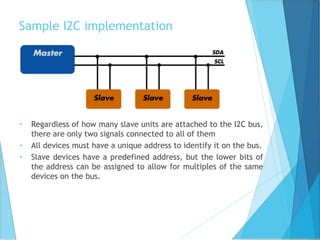
Sample I2C implementation
• Regardless of how many slave units are attached to the I2C bus,
there are only two signals connected to all of them
• All devices must have a unique address to identify it on the bus.
• Slave devices have a predefined address, but the lower bits of
the address can be assigned to allow for multiples of the same
devices on the bus.
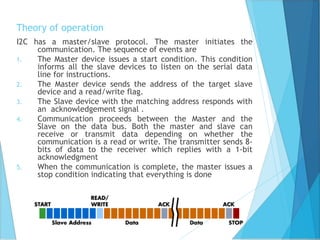
Theory of operation
I2C has a master/slave protocol. The master initiates the
communication. The sequence of events are
1. The Master device issues a start condition. This condition
informs all the slave devices to listen on the serial data
line for instructions.
2. The Master device sends the address of the target slave
device and a read/write flag.
3. The Slave device with the matching address responds with
an acknowledgement signal .
4. Communication proceeds between the Master and the
Slave on the data bus. Both the master and slave can
receive or transmit data depending on whether the
communication is a read or write. The transmitter sends 8-
bits of data to the receiver which replies with a 1-bit
acknowledgment
5. When the communication is complete, the master issues a
stop condition indicating that everything is done
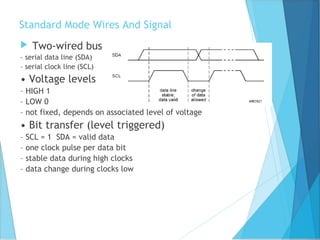
Standard Mode Wires And Signal
 Two-wired bus
– serial data line (SDA)
– serial clock line (SCL)
• Voltage levels
– HIGH 1
– LOW 0
– not fixed, depends on associated level of voltage
• Bit transfer (level triggered)
– SCL = 1 SDA = valid data
– one clock pulse per data bit
– stable data during high clocks
– data change during clocks low
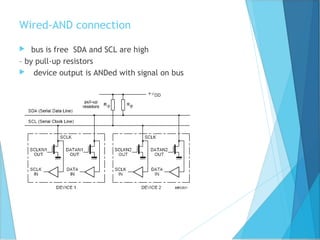
Wired-AND connection
 bus is free SDA and SCL are high
– by pull-up resistors
 device output is ANDed with signal on bus
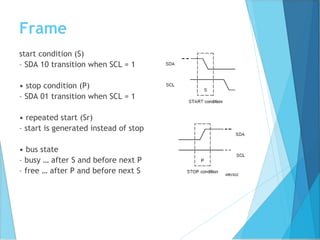
Frame
start condition (S)
– SDA 10 transition when SCL = 1
• stop condition (P)
– SDA 01 transition when SCL = 1
• repeated start (Sr)
– start is generated instead of stop
• bus state
– busy … after S and before next P
– free … after P and before next S
Masters and Slaves
• Master device
– controls the SCL
– starts and stops data transfer
– controls addressing of other devices
• Slave device
– device addressed by master
• Transmitter/Receiver
– master or slave
– master-transmitter sends data to slave-recevier
– master-receiver requires data from slave-transmitter
Data Transfer
data bits are transferred after start condition
• transmission is byte oriented
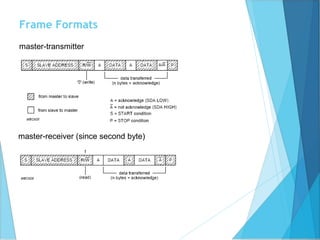
• byte = 8 bits + one acknowledge bit
• most significant bit (MSB) first
• slave address is also datum
– first byte transferred
– during the first byte transfer:
master is transmitter
addressed slave is receiver
– next bytes: depends on the last bit in address byte
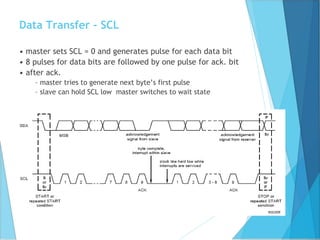
Data Transfer - SCL
• master sets SCL = 0 and generates pulse for each data bit
• 8 pulses for data bits are followed by one pulse for ack. bit
• after ack.
– master tries to generate next byte’s first pulse
– slave can hold SCL low master switches to wait state
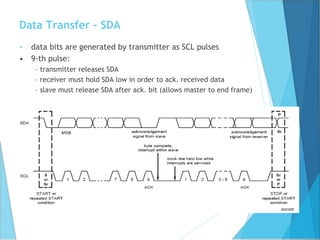
Data Transfer - SDA
• data bits are generated by transmitter as SCL pulses
• 9-th pulse:
– transmitter releases SDA
– receiver must hold SDA low in order to ack. received data
– slave must release SDA after ack. bit (allows master to end frame)
Multiple Masters
 More bus controllers can be connected
 Several masters can start frame at once
 Synchronization needed on SCL
 Arbitration needed on SDA
 Using wired-AND connection to SCL/SDA
Addressing by 7 bits
• the first byte transmitted by master:
– 7 bits: address
– 1 bit: direction (R/W)
0 … master writes data (W), becomes transmitter
1 … master reads data (R), becomes receiver
• data transfer terminated by stop condition
• master may generate repeated start and address another device
• each device listens to address
– address matches its own device switches state according to R/W bit
• address = fixed part + programmable part
– fixed part assigned by I2C committee
Frame Formats
master-transmitter
master-receiver (since second byte)
Benefits and Drawbacks
• Only two wires are required
• I2C is well suited for boards with many devices connected on
the bus.
• Reduce the cost and complexity of the circuit as additional
devices are added to the system.
• Due to the presence of only two wires, there is additional
complexity in handling the overhead of addressing and
acknowledgments .
• This can be inefficient in simple configurations and a direct-
link interface such as SPI might be preferred.

I2C Protocol

  • 1.
    I2C bus Inter Integratedcircuit bus Written By:- Rishu
  • 2.
    History • When connectingmultiple devices to a microcontroller, the address and data lines of each device were conventionally connected individually. This would take up precious pins on the microcontroller, result in a lot of traces on the PCB, and require more components to connect everything together. This made these systems expensive to produce and susceptible to interference and noise. • To solve this problem, Philips developed Inter-IC bus, or I2C, in the 1980s. I2C is a low-bandwidth, short distance protocol for on board communications. All devices are connected through two wires: serial data (SDA) and serial clock (SCL).
  • 3.
    Overview  Used formoving data simply and quickly from one device to another  Serial Interface  Synchronous  Bidirectional
  • 4.
    Overview  I2C isa Synchronous protocol  The data is clocked along with a clock signal(SCL).  The clock signal controls when data is changed and when it should be read.  Since I2C is synchronous, the clock rate can vary, unlike asynchronous (RS-232 style) communications.
  • 5.
    Overview  I2C isa Master-Slave protocol  The Master device controls the clock (SCL).  The slave devices may hold the clock low to prevent data transfer.  No data is transferred unless a clock signal is present.  All slaves are controlled by the master clock
  • 6.
    Overview  I2C isa Bidirectional protocol  Data is sent either direction on the serial data line (SDA) by the master or slave.
  • 7.
    Overview  I2C isa Serial Interface of only two signals:  SDA Serial Data This line transfers data to or from the master.  SCL Serial Clock This controls when data is sent and when it is read. The master controls SCK.
  • 8.
    Features I2C has manyimportant features worth mentioning • It supports multiple data speeds: - standard (100 kbps) - fast (400 kbps) - high speed (3.4 Mbps) communications. • Built in collision detection • 7 bit or 10-bit unique Addressing • Multi-master support (arbitration) • Data broadcast (general call). • two-wired bus • data transfers: serial, 8-bit oriented, bi-directional • master/slave relationships with multi-master option (arbitration) • master can operate as transmitter or receiver • device count limit: max. capacitance 400 pF
  • 9.
    Sample I2C implementation •Regardless of how many slave units are attached to the I2C bus, there are only two signals connected to all of them • All devices must have a unique address to identify it on the bus. • Slave devices have a predefined address, but the lower bits of the address can be assigned to allow for multiples of the same devices on the bus.
  • 10.
    Theory of operation I2Chas a master/slave protocol. The master initiates the communication. The sequence of events are 1. The Master device issues a start condition. This condition informs all the slave devices to listen on the serial data line for instructions. 2. The Master device sends the address of the target slave device and a read/write flag. 3. The Slave device with the matching address responds with an acknowledgement signal . 4. Communication proceeds between the Master and the Slave on the data bus. Both the master and slave can receive or transmit data depending on whether the communication is a read or write. The transmitter sends 8- bits of data to the receiver which replies with a 1-bit acknowledgment 5. When the communication is complete, the master issues a stop condition indicating that everything is done
  • 11.
    Standard Mode WiresAnd Signal  Two-wired bus – serial data line (SDA) – serial clock line (SCL) • Voltage levels – HIGH 1 – LOW 0 – not fixed, depends on associated level of voltage • Bit transfer (level triggered) – SCL = 1 SDA = valid data – one clock pulse per data bit – stable data during high clocks – data change during clocks low
  • 12.
    Wired-AND connection  busis free SDA and SCL are high – by pull-up resistors  device output is ANDed with signal on bus
  • 13.
    Frame start condition (S) –SDA 10 transition when SCL = 1 • stop condition (P) – SDA 01 transition when SCL = 1 • repeated start (Sr) – start is generated instead of stop • bus state – busy … after S and before next P – free … after P and before next S
  • 14.
    Masters and Slaves •Master device – controls the SCL – starts and stops data transfer – controls addressing of other devices • Slave device – device addressed by master • Transmitter/Receiver – master or slave – master-transmitter sends data to slave-recevier – master-receiver requires data from slave-transmitter
  • 15.
    Data Transfer data bitsare transferred after start condition • transmission is byte oriented • byte = 8 bits + one acknowledge bit • most significant bit (MSB) first • slave address is also datum – first byte transferred – during the first byte transfer: master is transmitter addressed slave is receiver – next bytes: depends on the last bit in address byte
  • 16.
    Data Transfer -SCL • master sets SCL = 0 and generates pulse for each data bit • 8 pulses for data bits are followed by one pulse for ack. bit • after ack. – master tries to generate next byte’s first pulse – slave can hold SCL low master switches to wait state
  • 17.
    Data Transfer -SDA • data bits are generated by transmitter as SCL pulses • 9-th pulse: – transmitter releases SDA – receiver must hold SDA low in order to ack. received data – slave must release SDA after ack. bit (allows master to end frame)
  • 18.
    Multiple Masters  Morebus controllers can be connected  Several masters can start frame at once  Synchronization needed on SCL  Arbitration needed on SDA  Using wired-AND connection to SCL/SDA
  • 19.
    Addressing by 7bits • the first byte transmitted by master: – 7 bits: address – 1 bit: direction (R/W) 0 … master writes data (W), becomes transmitter 1 … master reads data (R), becomes receiver • data transfer terminated by stop condition • master may generate repeated start and address another device • each device listens to address – address matches its own device switches state according to R/W bit • address = fixed part + programmable part – fixed part assigned by I2C committee
  • 20.
  • 21.
    Benefits and Drawbacks •Only two wires are required • I2C is well suited for boards with many devices connected on the bus. • Reduce the cost and complexity of the circuit as additional devices are added to the system. • Due to the presence of only two wires, there is additional complexity in handling the overhead of addressing and acknowledgments . • This can be inefficient in simple configurations and a direct- link interface such as SPI might be preferred.