MARK4210, 2014 Spring, L1/L2
[Class #4]
Situational Analysis
MARK4210: Strategic Marketing
2014 Spring, Section L1/L2
2
MARK4210, 2014 Spring, L1/L2
Overview
 Effective marketing strategies are based on solid
understanding of internal and marketing
environments
 Frameworks to collect & analyze information:
• 5 C’s Analysis
• Porter’s Five Forces Analysis
• Other Analysis Tools
 Information organized, prioritized and synthesized
via SWOT Analysis
Source: Marketing Analysis Toolkit: Situation Analysis, Steenburgh & Avery, Harvard Business School, February 4, 2010.
3
MARK4210, 2014 Spring, L1/L2
5 C’s Analysis
 Allows managers to understand themselves,
customers, external players and forces that affect
business
• Customers
• Company
• Competitors
• Context (Climate)
• Collaborators/Complementers
Source: Marketing Analysis Toolkit: Situation Analysis, Steenburgh & Avery, Harvard Business School, February 4, 2010.
4
MARK4210, 2014 Spring, L1/L2
5 C’s: Customers – Needs Analysis
 Understanding the physical, functional, symbolic,
emotional and social needs the products fulfills for
consumers
• Includes both rational and irrational needs
• As well as subconscious or unconscious needs
 Analyze direct and indirect product benefits to
assess which attributes are important to consumers
 Distribution of consumer needs/preferences
provides important input into segmentation and
targeting decisions
Source: Marketing Analysis Toolkit: Situation Analysis, Steenburgh & Avery, Harvard Business School, February 4, 2010.
5
MARK4210, 2014 Spring, L1/L2
5 C’s: Customers – Types of
Customer Benefits/Values
 Economic
• Concerns financial aspects such as price and credit terms
• Price is often primary purchase driver, but, prices can be higher
by providing more functional benefits that lower overall costs
 Functional
• Products and services that provide benefits and values that meet
basic expectations and serve specific functions; utility
• Physical and tangible
 Psychological
• Typically satisfy status, affiliation, reassurance, risk and security
needs – both individually and socially
• Generally transcends functional benefits and appear higher in
the benefit/value ladder
Source: Capon’s Marketing Framework, Capon, Wessex Publishing, 2009
6
MARK4210, 2014 Spring, L1/L2
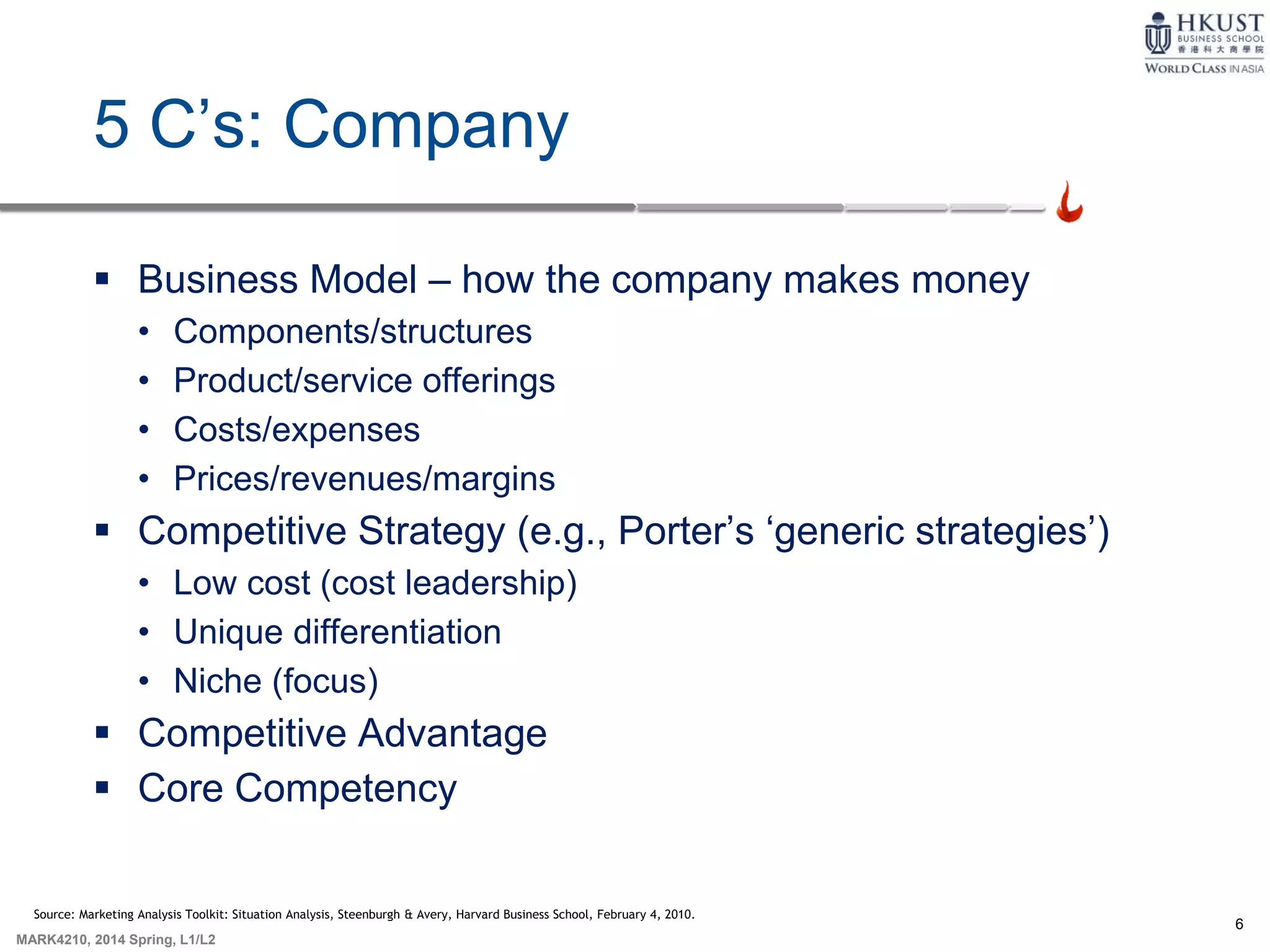
5 C’s: Company
 Business Model – how the company makes money
• Components/structures
• Product/service offerings
• Costs/expenses
• Prices/revenues/margins
 Competitive Strategy (e.g., Porter’s ‘generic strategies’)
• Low cost (cost leadership)
• Unique differentiation
• Niche (focus)
 Competitive Advantage
 Core Competency
Source: Marketing Analysis Toolkit: Situation Analysis, Steenburgh & Avery, Harvard Business School, February 4, 2010.
7
MARK4210, 2014 Spring, L1/L2
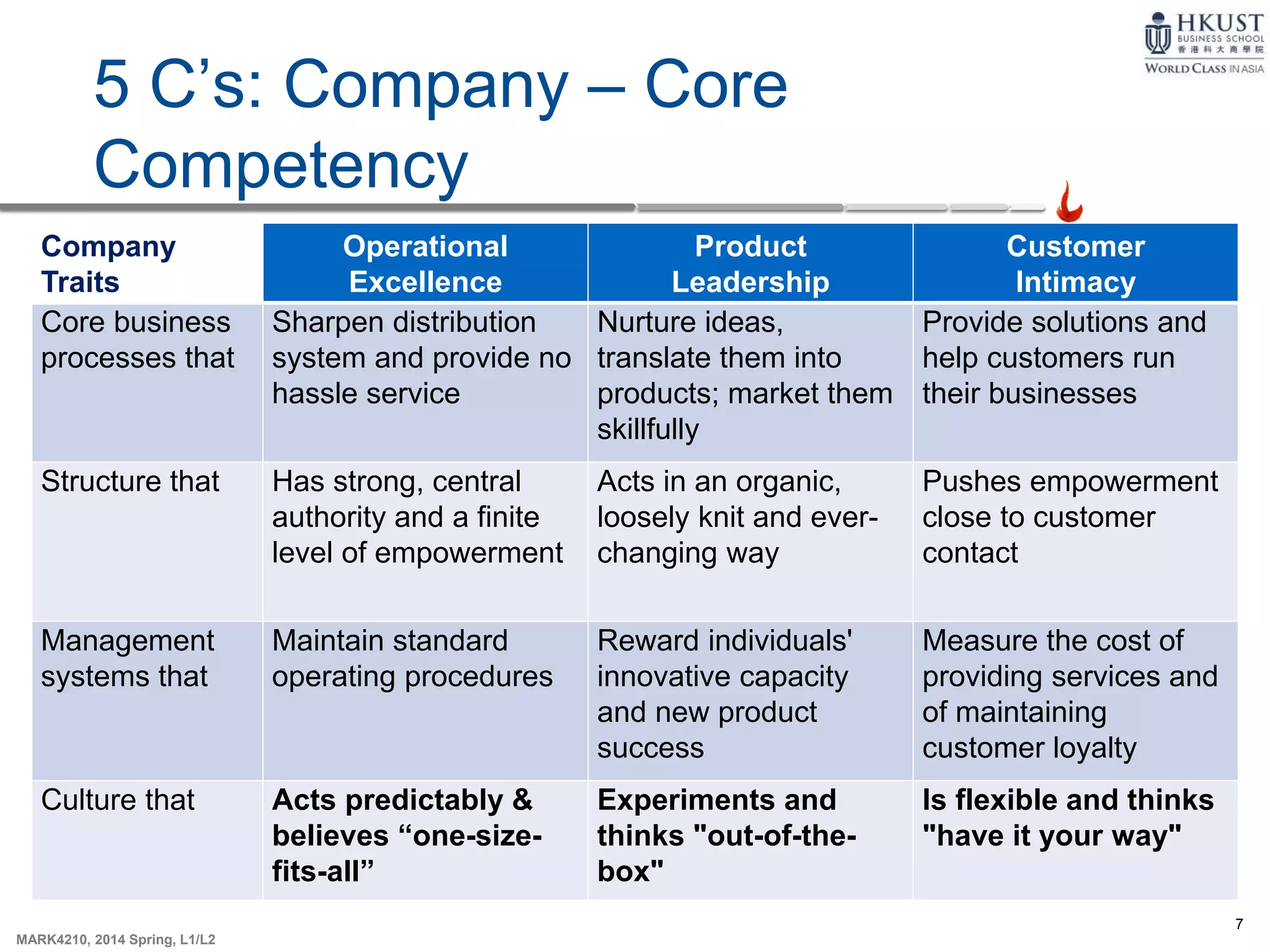
5 C’s: Company – Core
Competency
Company
Traits
Operational
Excellence
Product
Leadership
Customer
Intimacy
Core business
processes that
Sharpen distribution
system and provide no
hassle service
Nurture ideas,
translate them into
products; market them
skillfully
Provide solutions and
help customers run
their businesses
Structure that Has strong, central
authority and a finite
level of empowerment
Acts in an organic,
loosely knit and ever-
changing way
Pushes empowerment
close to customer
contact
Management
systems that
Maintain standard
operating procedures
Reward individuals'
innovative capacity
and new product
success
Measure the cost of
providing services and
of maintaining
customer loyalty
Culture that Acts predictably &
believes “one-size-
fits-all”
Experiments and
thinks "out-of-the-
box"
Is flexible and thinks
"have it your way"
8
MARK4210, 2014 Spring, L1/L2
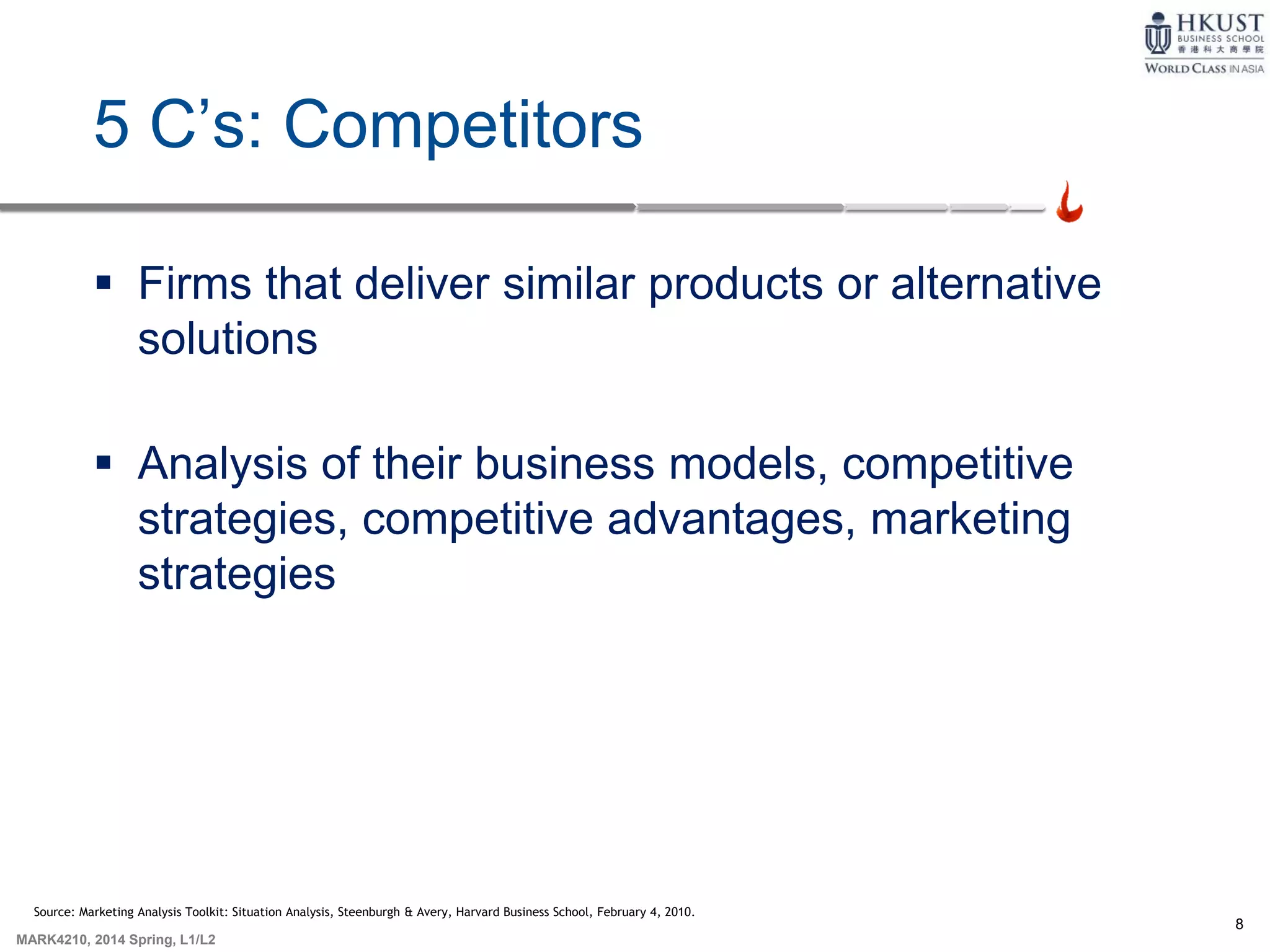
5 C’s: Competitors
 Firms that deliver similar products or alternative
solutions
 Analysis of their business models, competitive
strategies, competitive advantages, marketing
strategies
Source: Marketing Analysis Toolkit: Situation Analysis, Steenburgh & Avery, Harvard Business School, February 4, 2010.
9
MARK4210, 2014 Spring, L1/L2
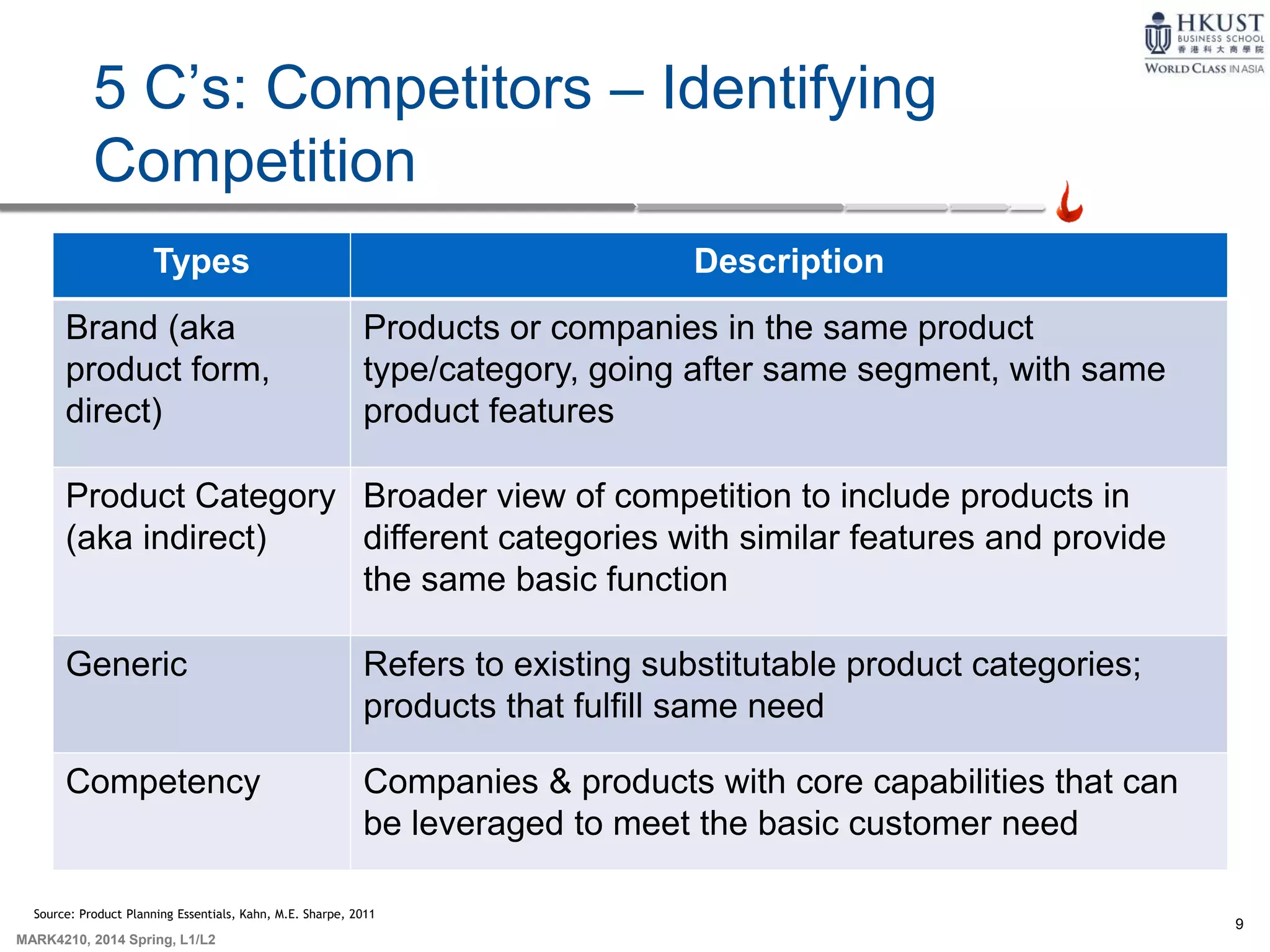
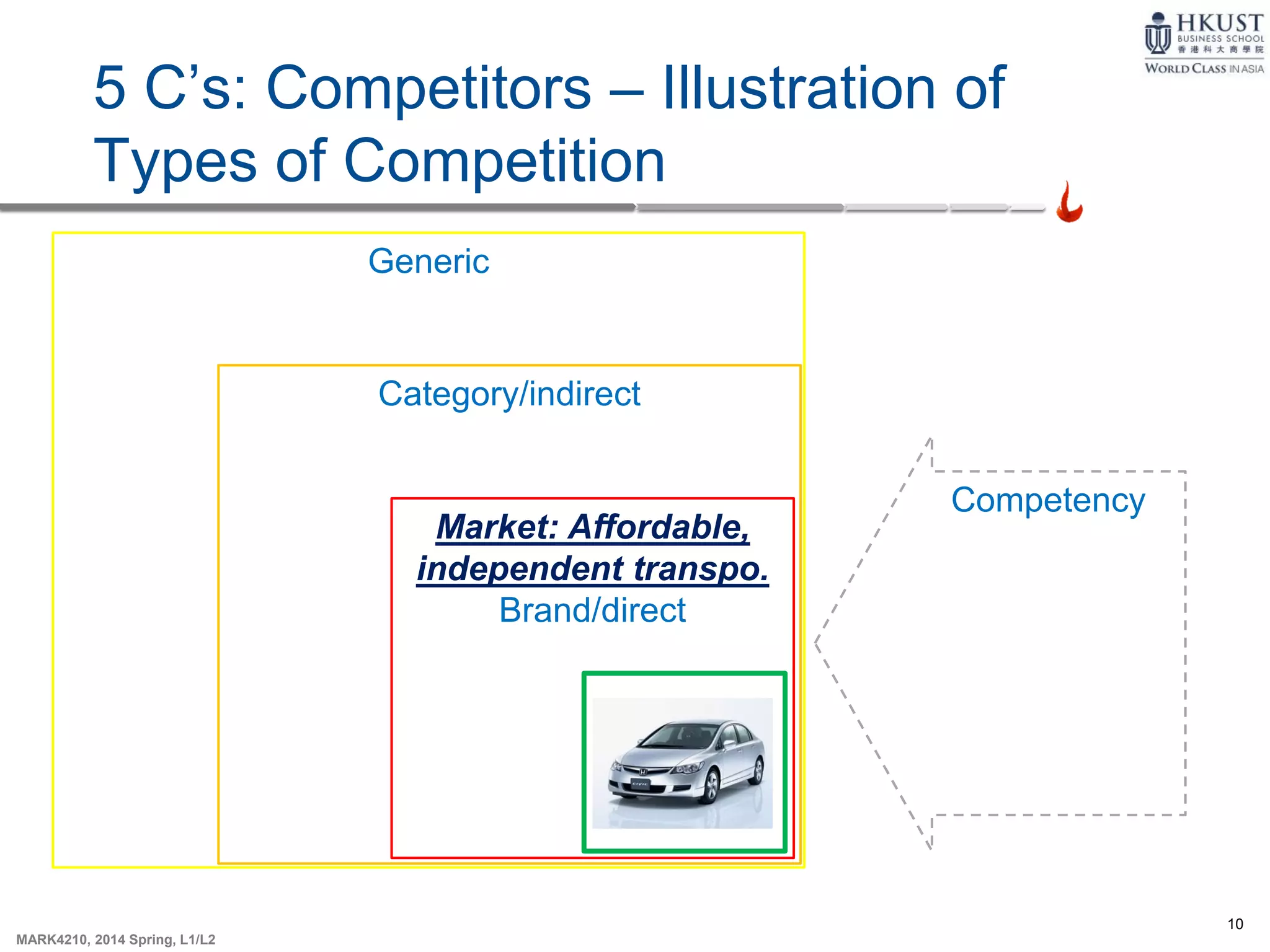
5 C’s: Competitors – Identifying
Competition
Source: Product Planning Essentials, Kahn, M.E. Sharpe, 2011
Types Description
Brand (aka
product form,
direct)
Products or companies in the same product
type/category, going after same segment, with same
product features
Product Category
(aka indirect)
Broader view of competition to include products in
different categories with similar features and provide
the same basic function
Generic Refers to existing substitutable product categories;
products that fulfill same need
Competency Companies & products with core capabilities that can
be leveraged to meet the basic customer need
10
MARK4210, 2014 Spring, L1/L2
5 C’s: Competitors – Illustration of
Types of Competition
Competency
Generic
Category/indirect
Market: Affordable,
independent transpo.
Brand/direct
11
MARK4210, 2014 Spring, L1/L2
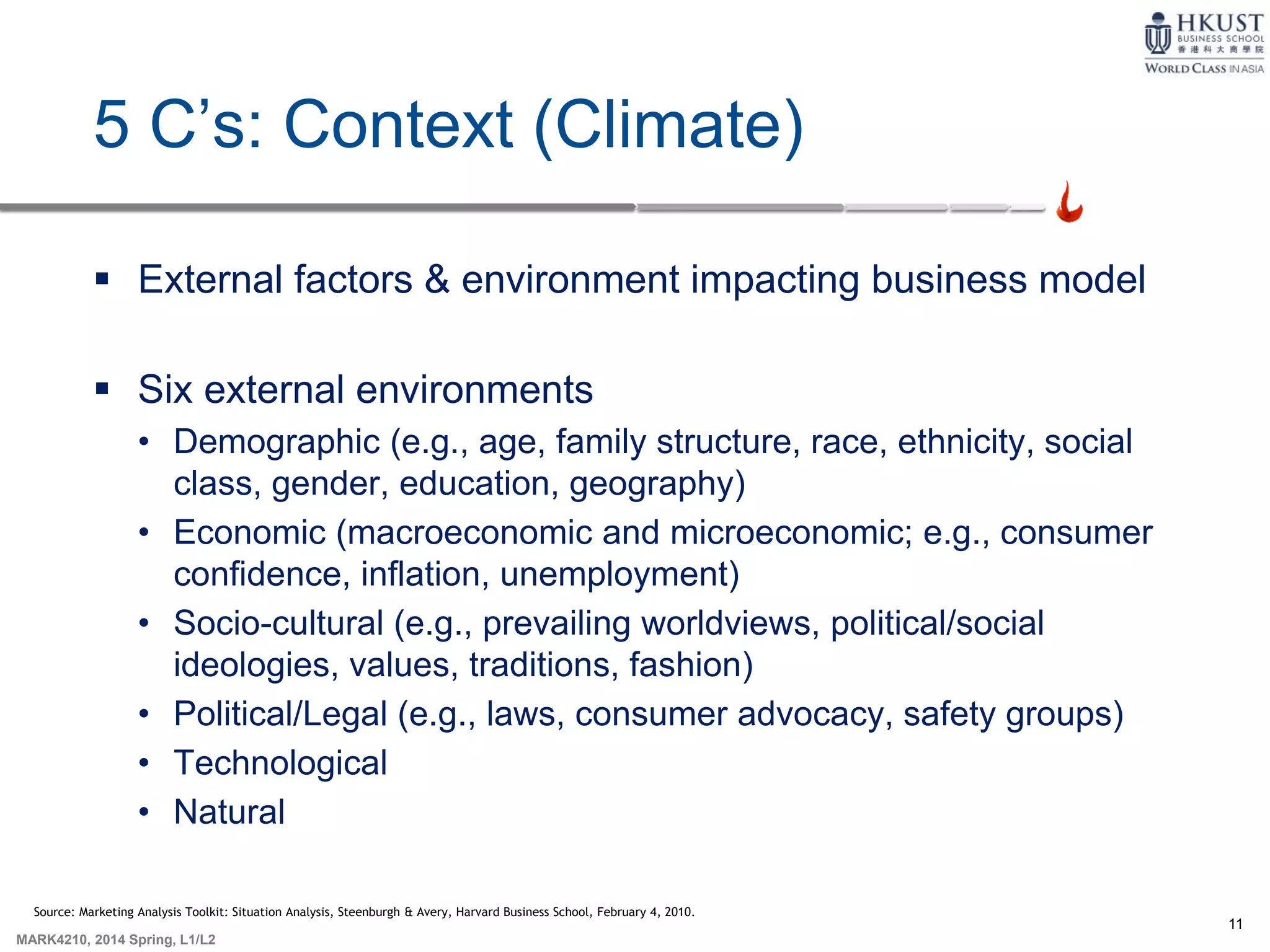
5 C’s: Context (Climate)
 External factors & environment impacting business model
 Six external environments
• Demographic (e.g., age, family structure, race, ethnicity, social
class, gender, education, geography)
• Economic (macroeconomic and microeconomic; e.g., consumer
confidence, inflation, unemployment)
• Socio-cultural (e.g., prevailing worldviews, political/social
ideologies, values, traditions, fashion)
• Political/Legal (e.g., laws, consumer advocacy, safety groups)
• Technological
• Natural
Source: Marketing Analysis Toolkit: Situation Analysis, Steenburgh & Avery, Harvard Business School, February 4, 2010.
12
MARK4210, 2014 Spring, L1/L2
5 C’s: Collaborators &
Complementers
 Collaborators help the firm market products; include
suppliers, distributors, retailers, key influencers
 Complementers benefit from firms selling products;
includes complementary product firms
Source: Marketing Analysis Toolkit: Situation Analysis, Steenburgh & Avery, Harvard Business School, February 4, 2010.
13
MARK4210, 2014 Spring, L1/L2
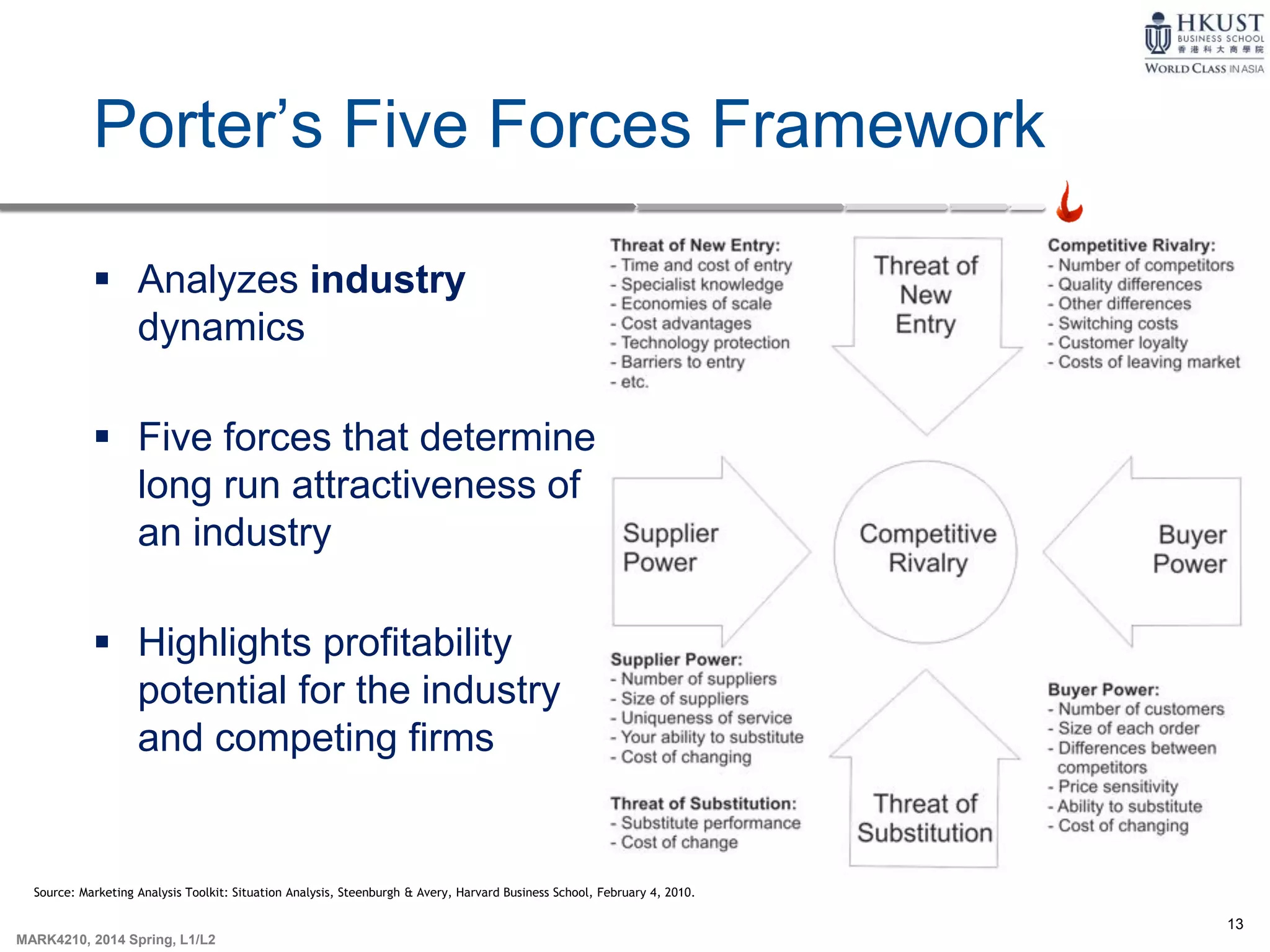
Porter’s Five Forces Framework
 Analyzes industry
dynamics
 Five forces that determine
long run attractiveness of
an industry
 Highlights profitability
potential for the industry
and competing firms
Source: Marketing Analysis Toolkit: Situation Analysis, Steenburgh & Avery, Harvard Business School, February 4, 2010.
14
MARK4210, 2014 Spring, L1/L2
Other Analysis Tools
 Scenario Planning
 Market Structure Analysis
 Timeline Cause & Effect Analysis
15
MARK4210, 2014 Spring, L1/L2
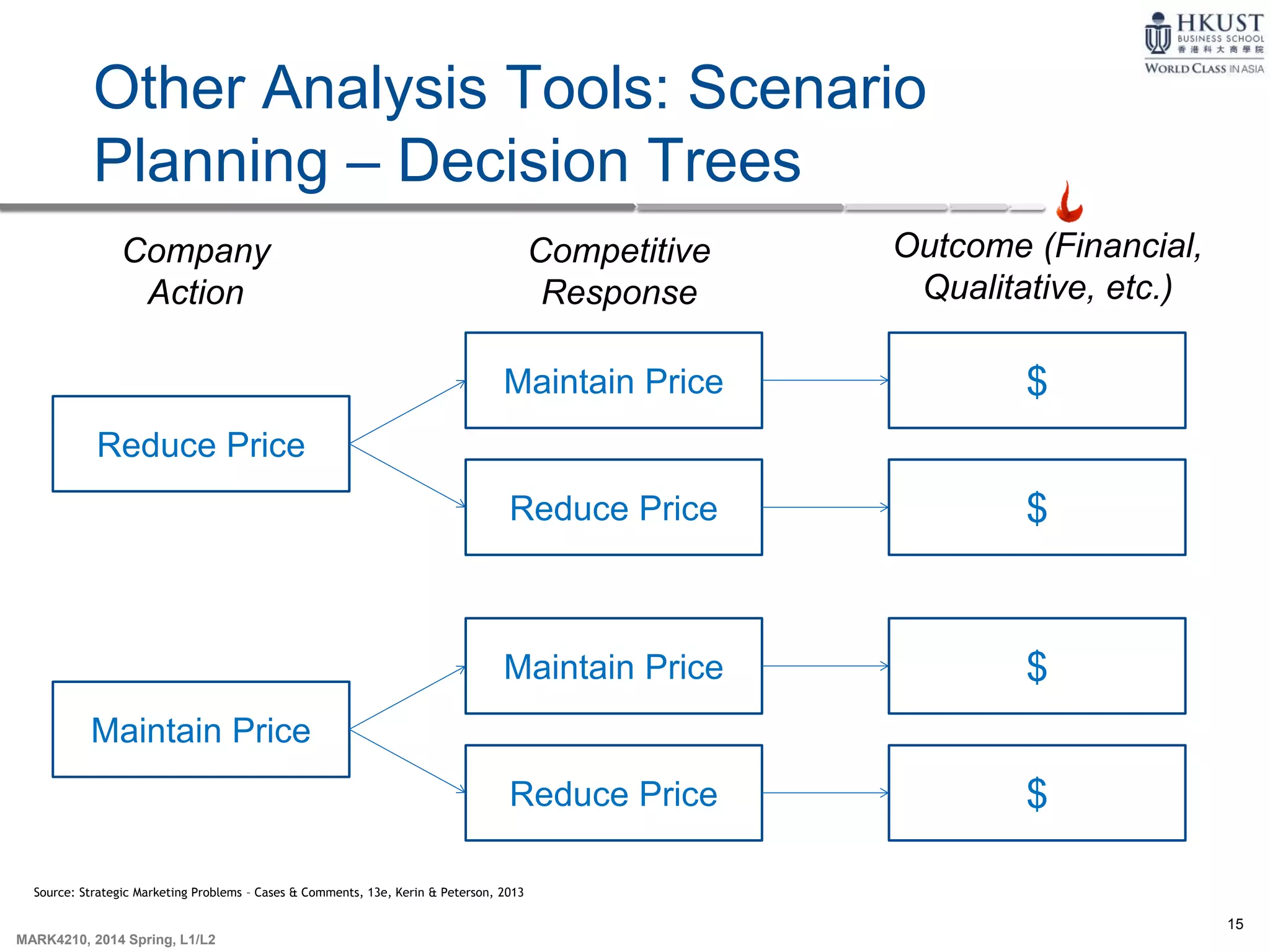
Other Analysis Tools: Scenario
Planning – Decision Trees
Reduce Price
Reduce Price
Maintain Price $
$
Maintain Price
Reduce Price
Maintain Price $
$
Company
Action
Competitive
Response
Outcome (Financial,
Qualitative, etc.)
Source: Strategic Marketing Problems – Cases & Comments, 13e, Kerin & Peterson, 2013
16
MARK4210, 2014 Spring, L1/L2
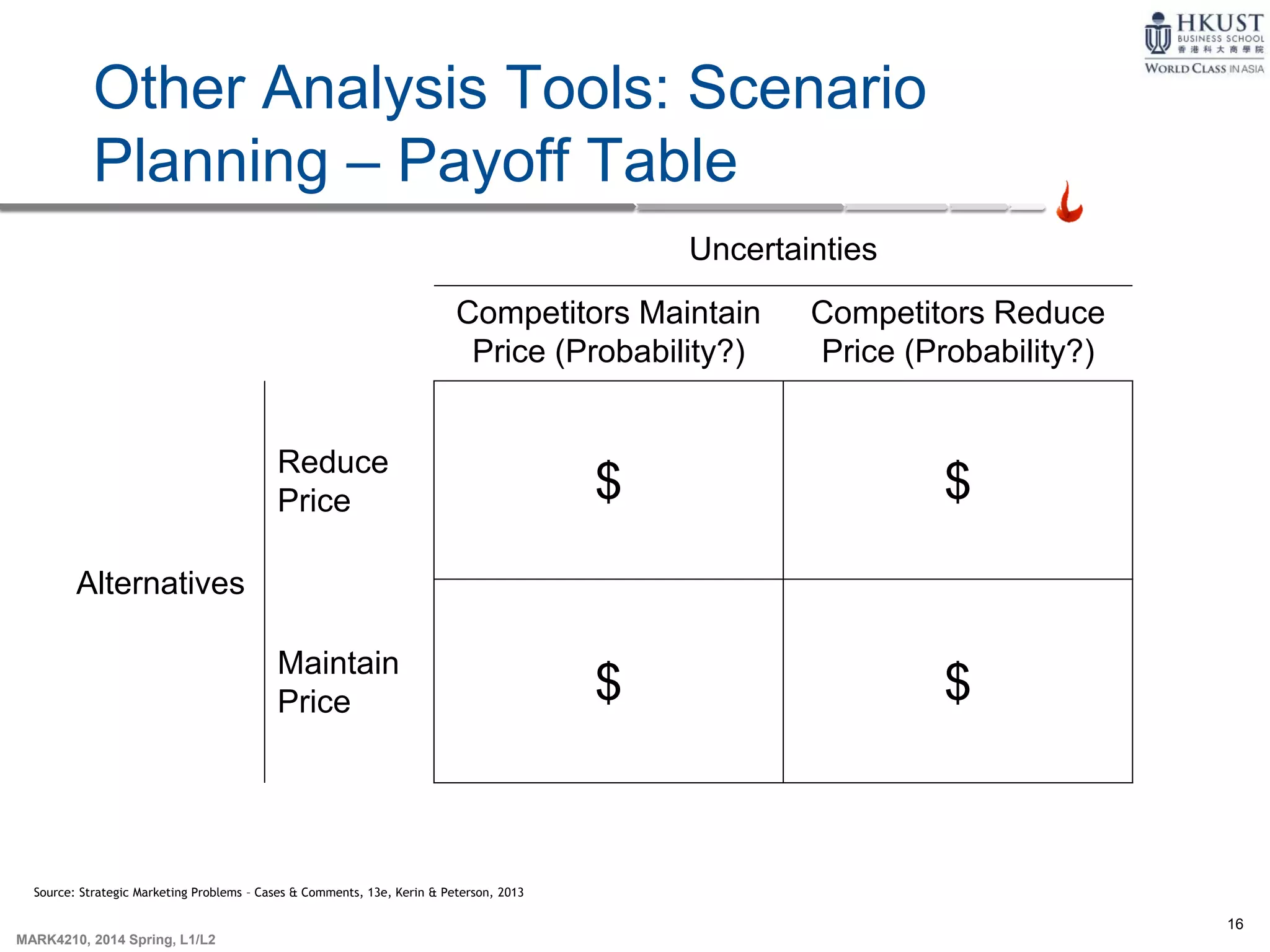
Other Analysis Tools: Scenario
Planning – Payoff Table
Uncertainties
Competitors Maintain
Price (Probability?)
Competitors Reduce
Price (Probability?)
Alternatives
Reduce
Price $ $
Maintain
Price $ $
Source: Strategic Marketing Problems – Cases & Comments, 13e, Kerin & Peterson, 2013
17
MARK4210, 2014 Spring, L1/L2
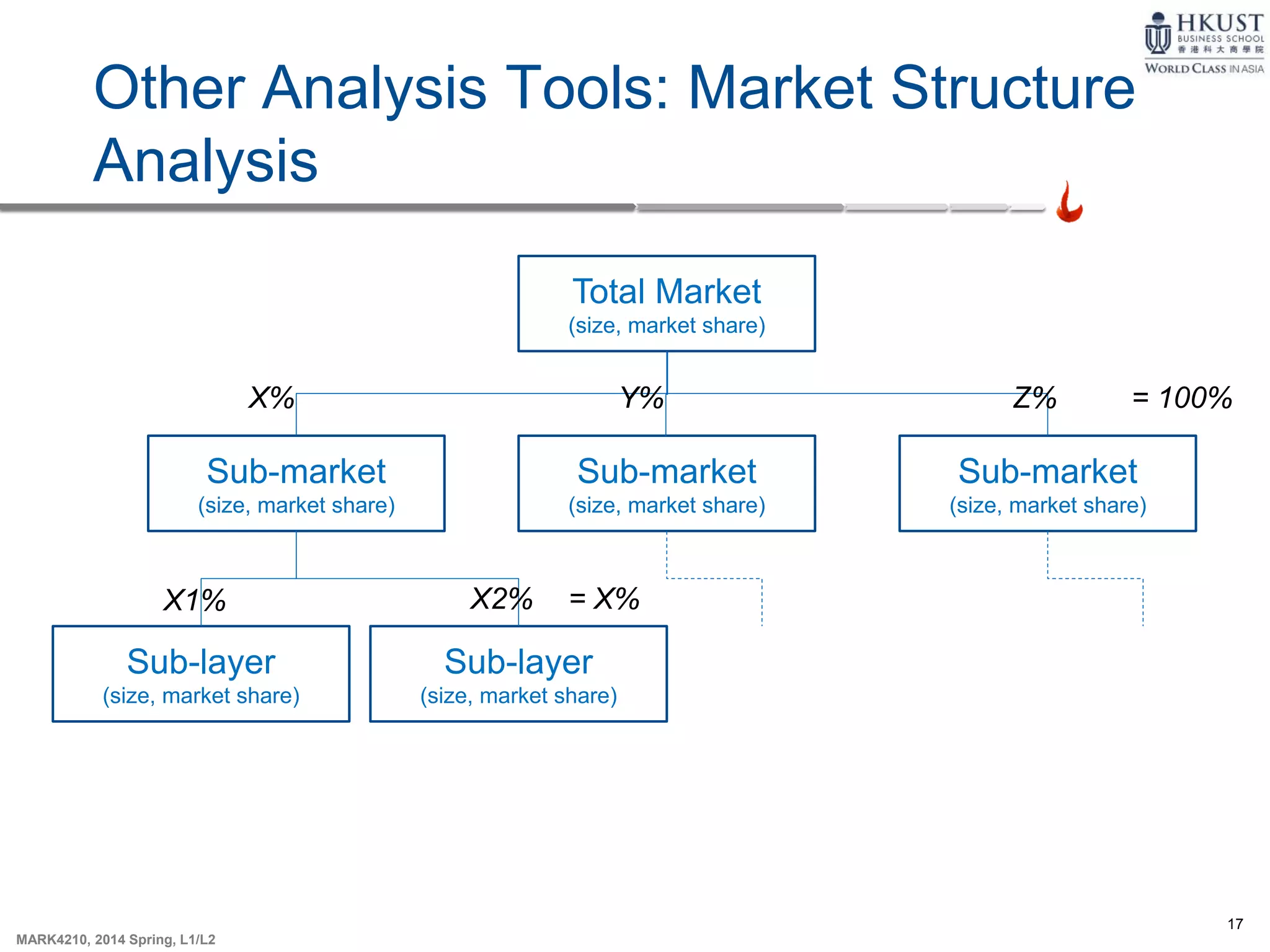
Other Analysis Tools: Market Structure
Analysis
Total Market
(size, market share)
Sub-market
(size, market share)
Sub-market
(size, market share)
Sub-market
(size, market share)
Sub-layer
(size, market share)
Sub-layer
(size, market share)
X% Y% Z% = 100%
X1% X2% = X%
18
MARK4210, 2014 Spring, L1/L2
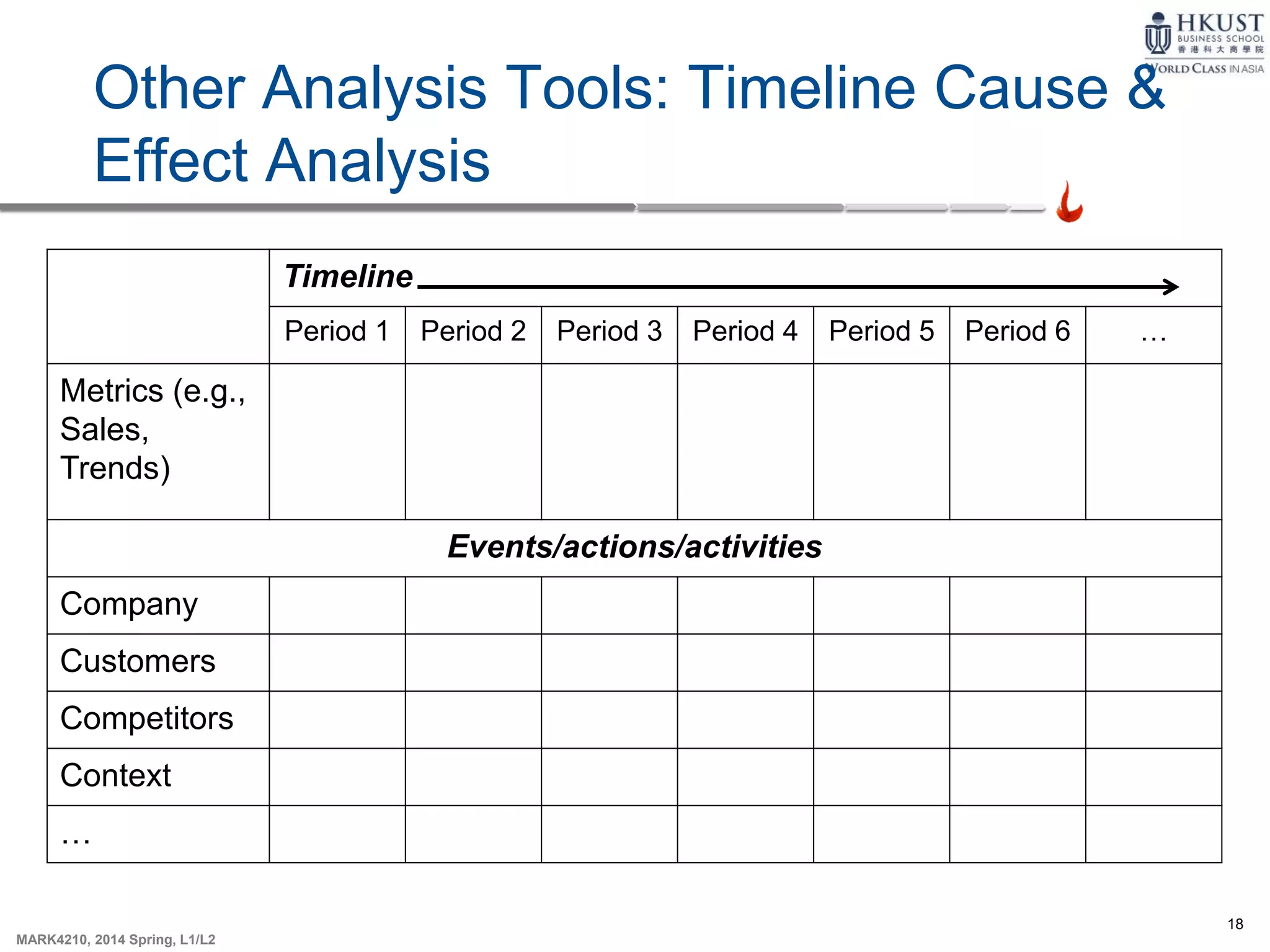
Other Analysis Tools: Timeline Cause &
Effect Analysis
Timeline
Period 1 Period 2 Period 3 Period 4 Period 5 Period 6 …
Metrics (e.g.,
Sales,
Trends)
Events/actions/activities
Company
Customers
Competitors
Context
…
19
MARK4210, 2014 Spring, L1/L2
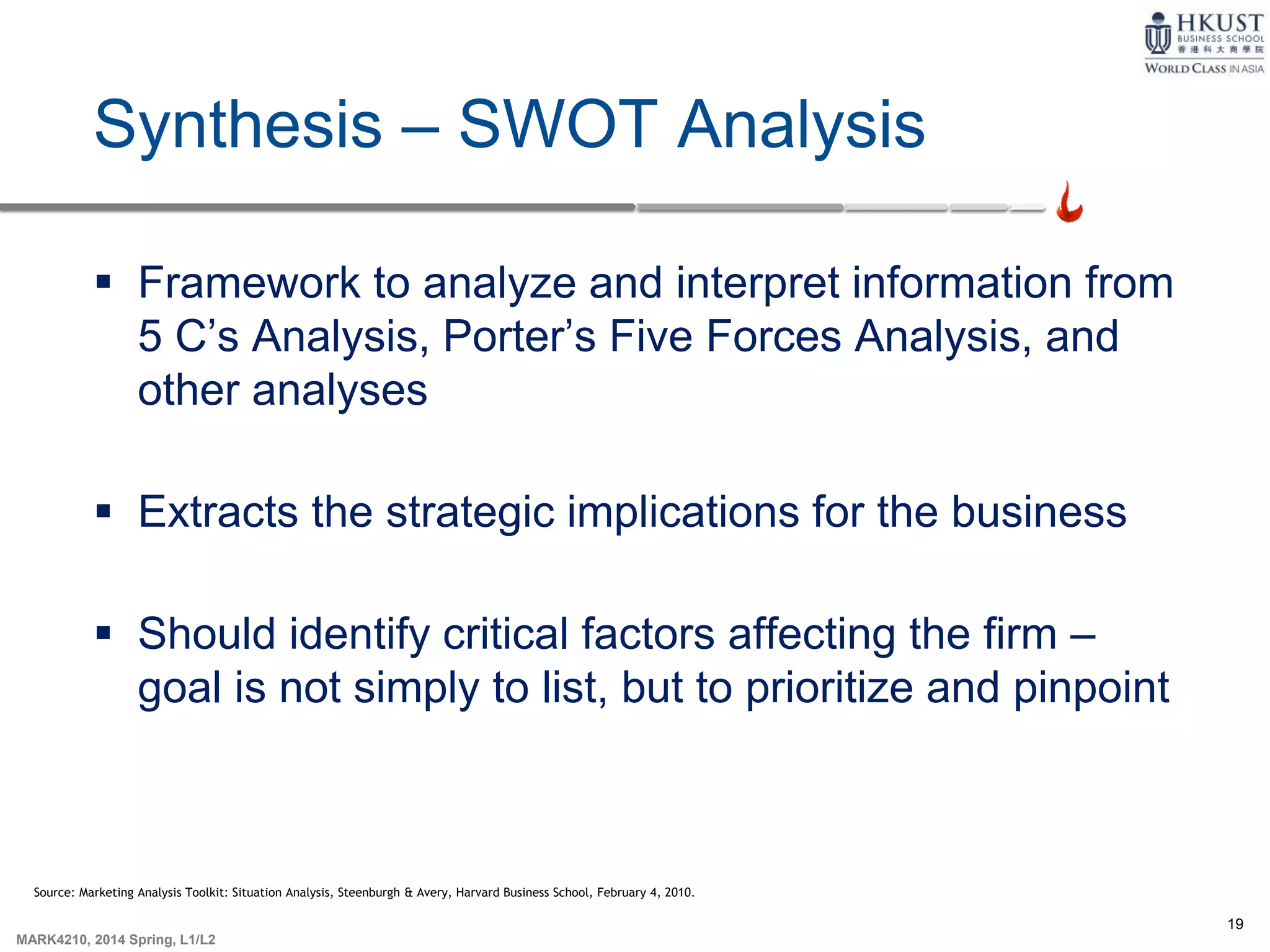
Synthesis – SWOT Analysis
 Framework to analyze and interpret information from
5 C’s Analysis, Porter’s Five Forces Analysis, and
other analyses
 Extracts the strategic implications for the business
 Should identify critical factors affecting the firm –
goal is not simply to list, but to prioritize and pinpoint
Source: Marketing Analysis Toolkit: Situation Analysis, Steenburgh & Avery, Harvard Business School, February 4, 2010.
20
MARK4210, 2014 Spring, L1/L2
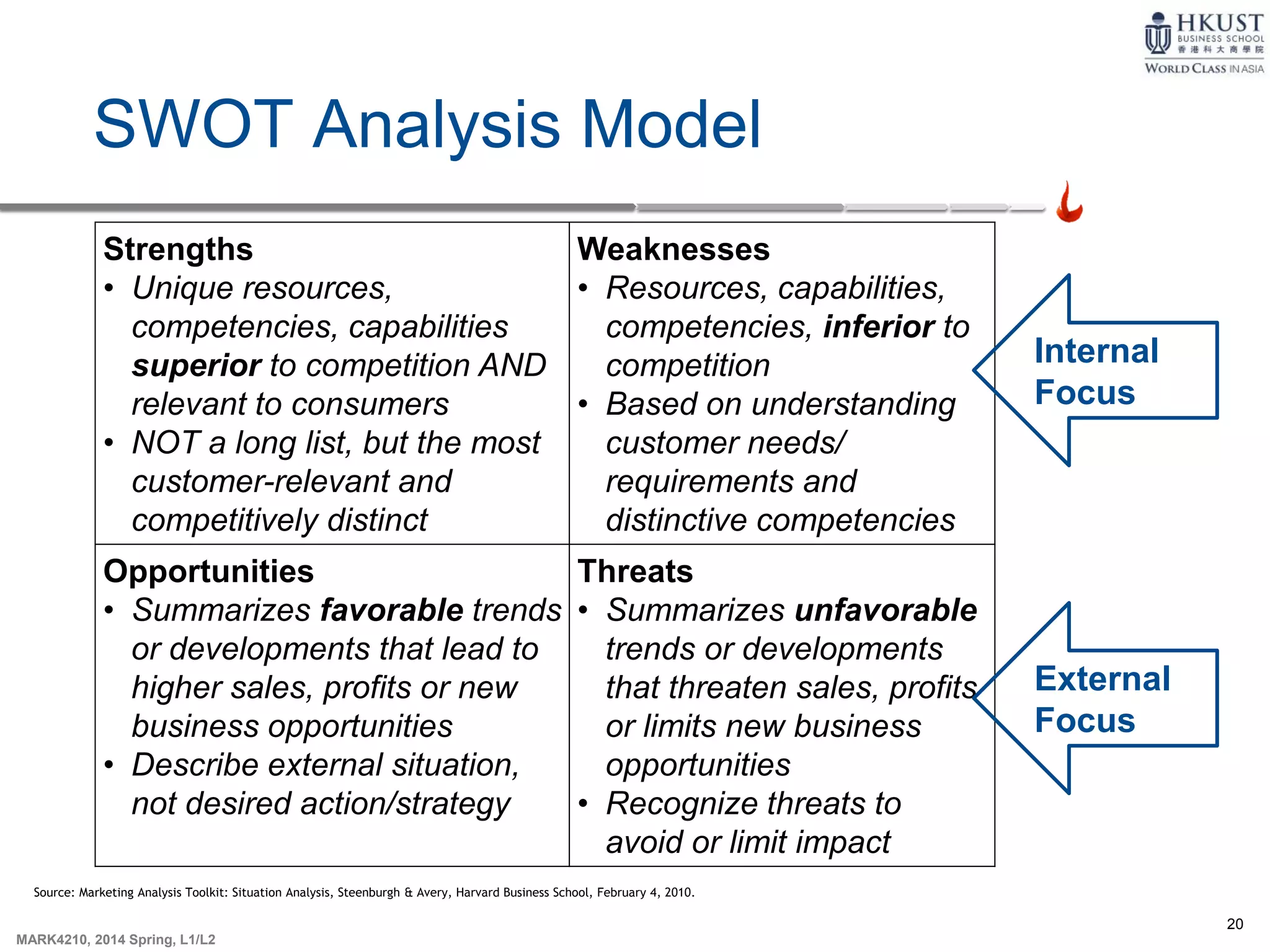
SWOT Analysis Model
Strengths
• Unique resources,
competencies, capabilities
superior to competition AND
relevant to consumers
• NOT a long list, but the most
customer-relevant and
competitively distinct
Weaknesses
• Resources, capabilities,
competencies, inferior to
competition
• Based on understanding
customer needs/
requirements and
distinctive competencies
Opportunities
• Summarizes favorable trends
or developments that lead to
higher sales, profits or new
business opportunities
• Describe external situation,
not desired action/strategy
Threats
• Summarizes unfavorable
trends or developments
that threaten sales, profits
or limits new business
opportunities
• Recognize threats to
avoid or limit impact
Internal
Focus
External
Focus
Source: Marketing Analysis Toolkit: Situation Analysis, Steenburgh & Avery, Harvard Business School, February 4, 2010.
21
MARK4210, 2014 Spring, L1/L2
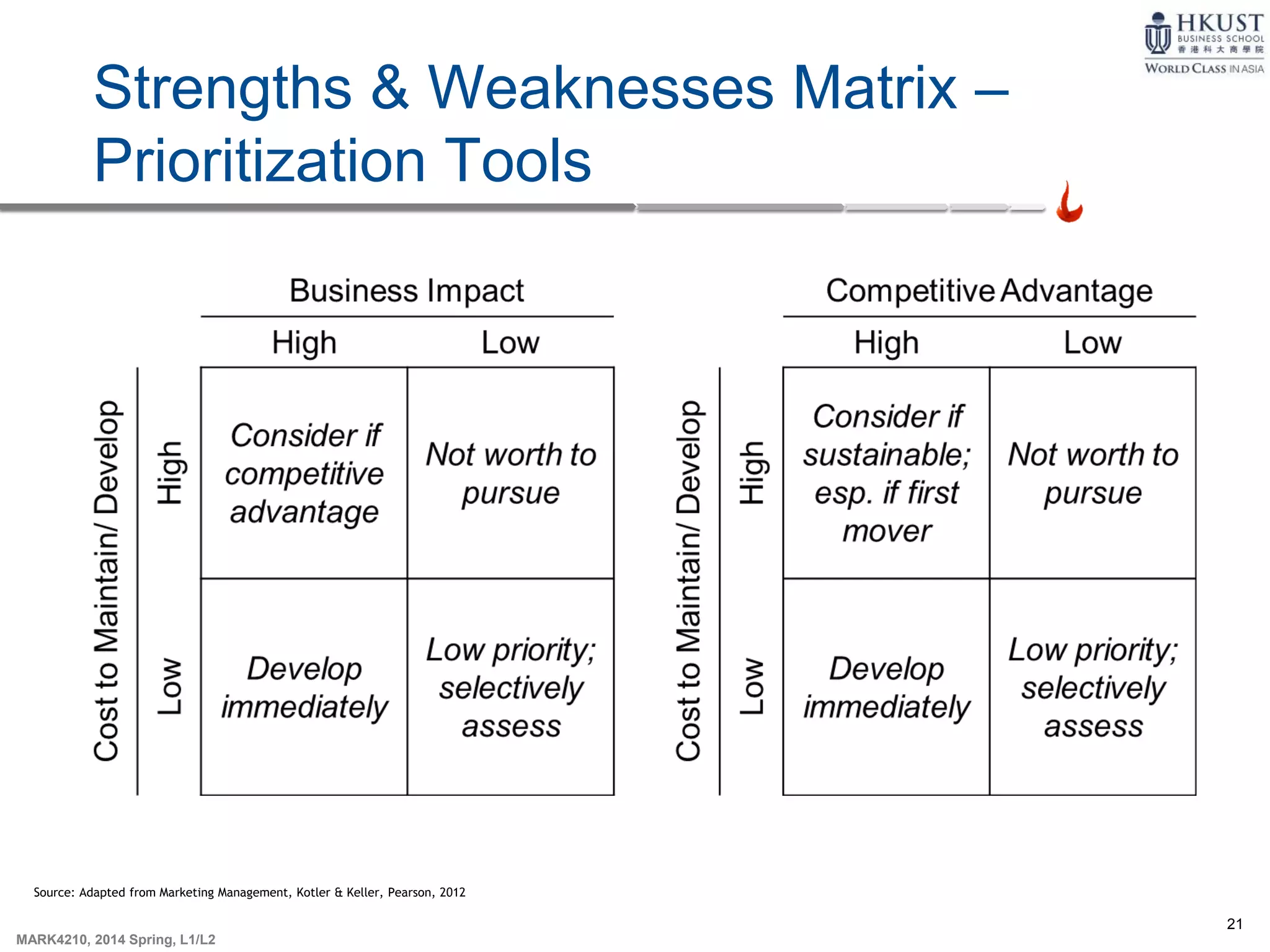
Strengths & Weaknesses Matrix –
Prioritization Tools
Source: Adapted from Marketing Management, Kotler & Keller, Pearson, 2012
22
MARK4210, 2014 Spring, L1/L2
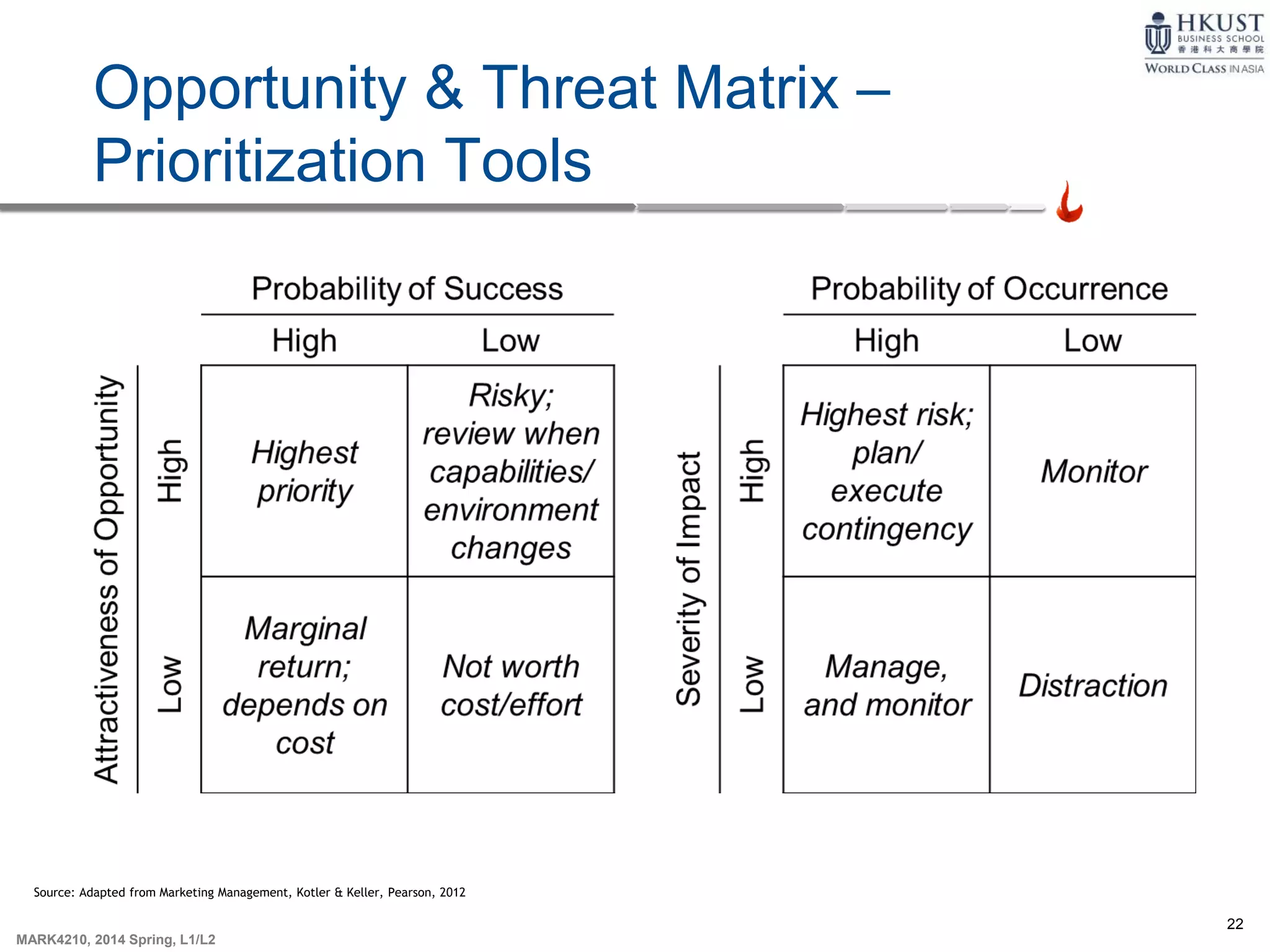
Opportunity & Threat Matrix –
Prioritization Tools
Source: Adapted from Marketing Management, Kotler & Keller, Pearson, 2012
MARK4210, 2014 Spring, L1/L2
In-class Case Study
IN-CLASS DISCUSSION ONLY, NOT FOR CIRCULATION, TAKE NOTES AS NECESSARY
24
MARK4210, 2014 Spring, L1/L2
What customer benefits does
McDonald’s provide? Why?
Customer Benefits
IN-CLASS DISCUSSION ONLY, NOT FOR CIRCULATION, TAKE NOTES AS NECESSARY
25
MARK4210, 2014 Spring, L1/L2
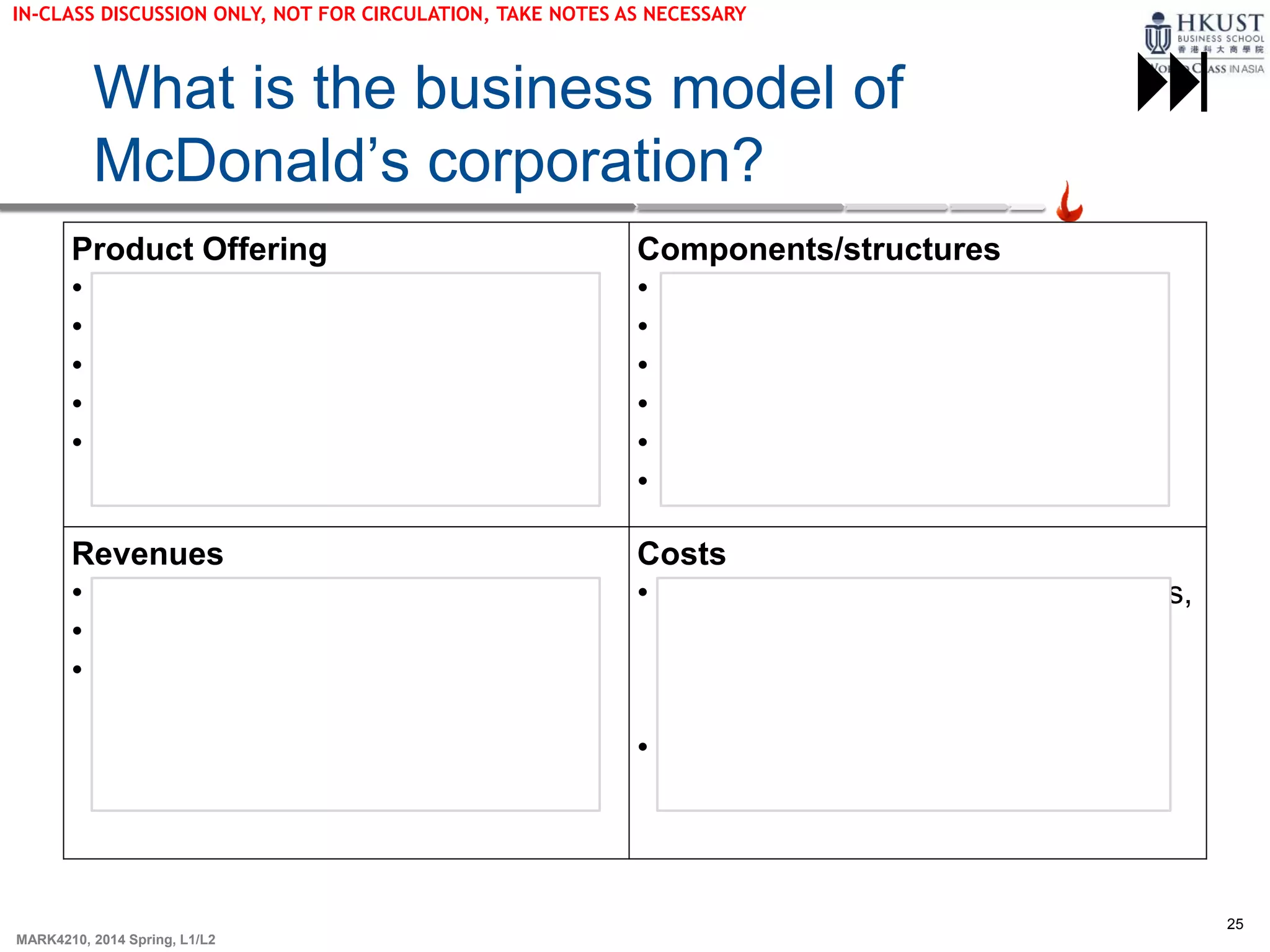
What is the business model of
McDonald’s corporation?
Product Offering
• Fast food
• Consistent quality
• Affordable
• Accessible locations
• Clean (safe)
Components/structures
• Franchisees
• Suppliers
• Management
• Training
• Quality Control
• R&D
Revenues
• Franchise fees (% of sales)
• Marketing fees (% of sales)
• Rental fees (from franchisee
locations, McDonald’s owns/leased
the location; usually % of sales)
Costs
• No direct purchase of food/materials,
but organizes supply of
food/materials to restaurants via
approved third parties
• Structural costs

IN-CLASS DISCUSSION ONLY, NOT FOR CIRCULATION, TAKE NOTES AS NECESSARY
26
MARK4210, 2014 Spring, L1/L2
What are the competitive advantages of
McDonald’s? Why?
IN-CLASS DISCUSSION ONLY, NOT FOR CIRCULATION, TAKE NOTES AS NECESSARY
27
MARK4210, 2014 Spring, L1/L2
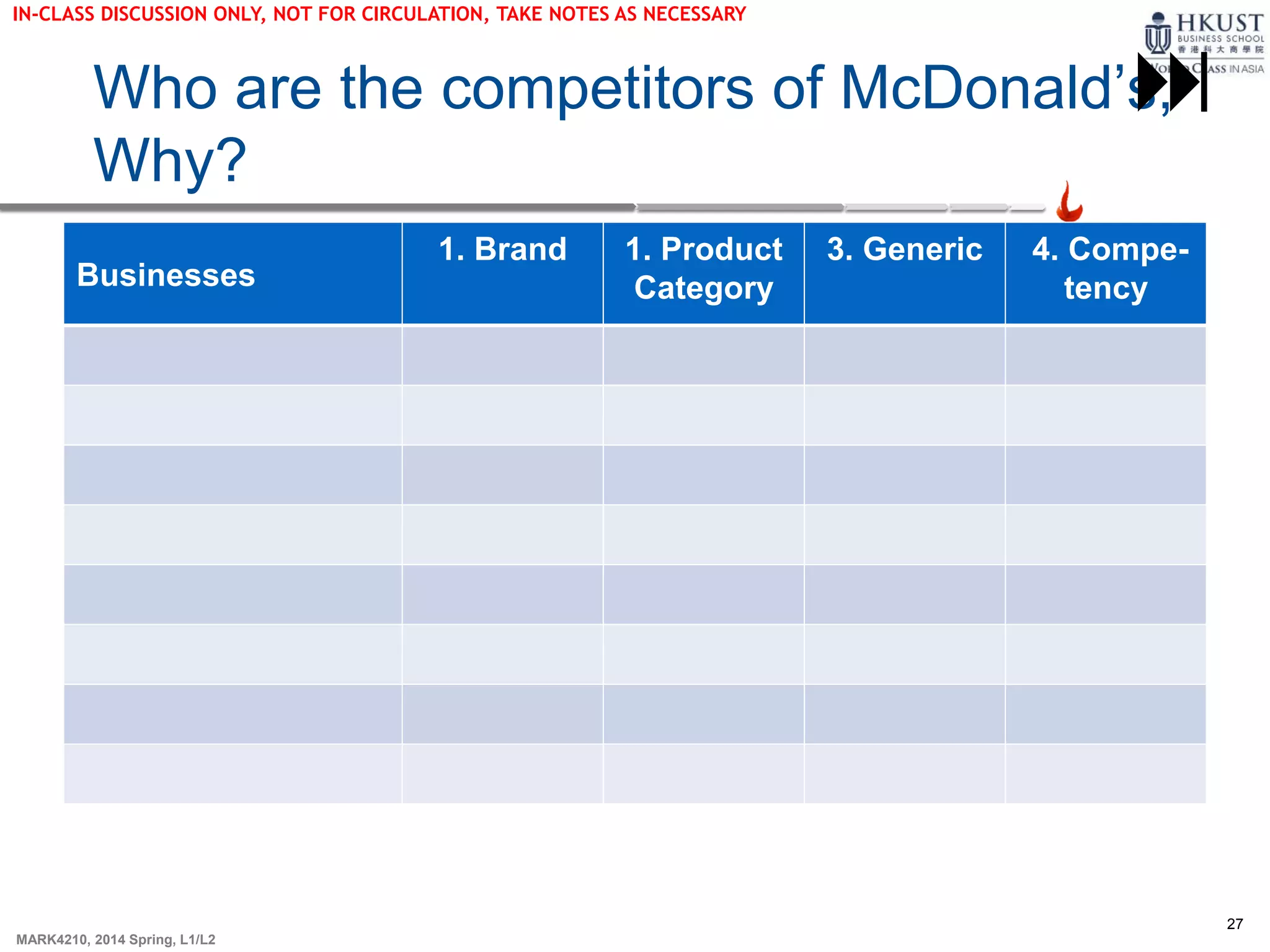
Who are the competitors of McDonald’s,
Why?
Businesses
1. Brand 1. Product
Category
3. Generic 4. Compe-
tency

IN-CLASS DISCUSSION ONLY, NOT FOR CIRCULATION, TAKE NOTES AS NECESSARY
28
MARK4210, 2014 Spring, L1/L2
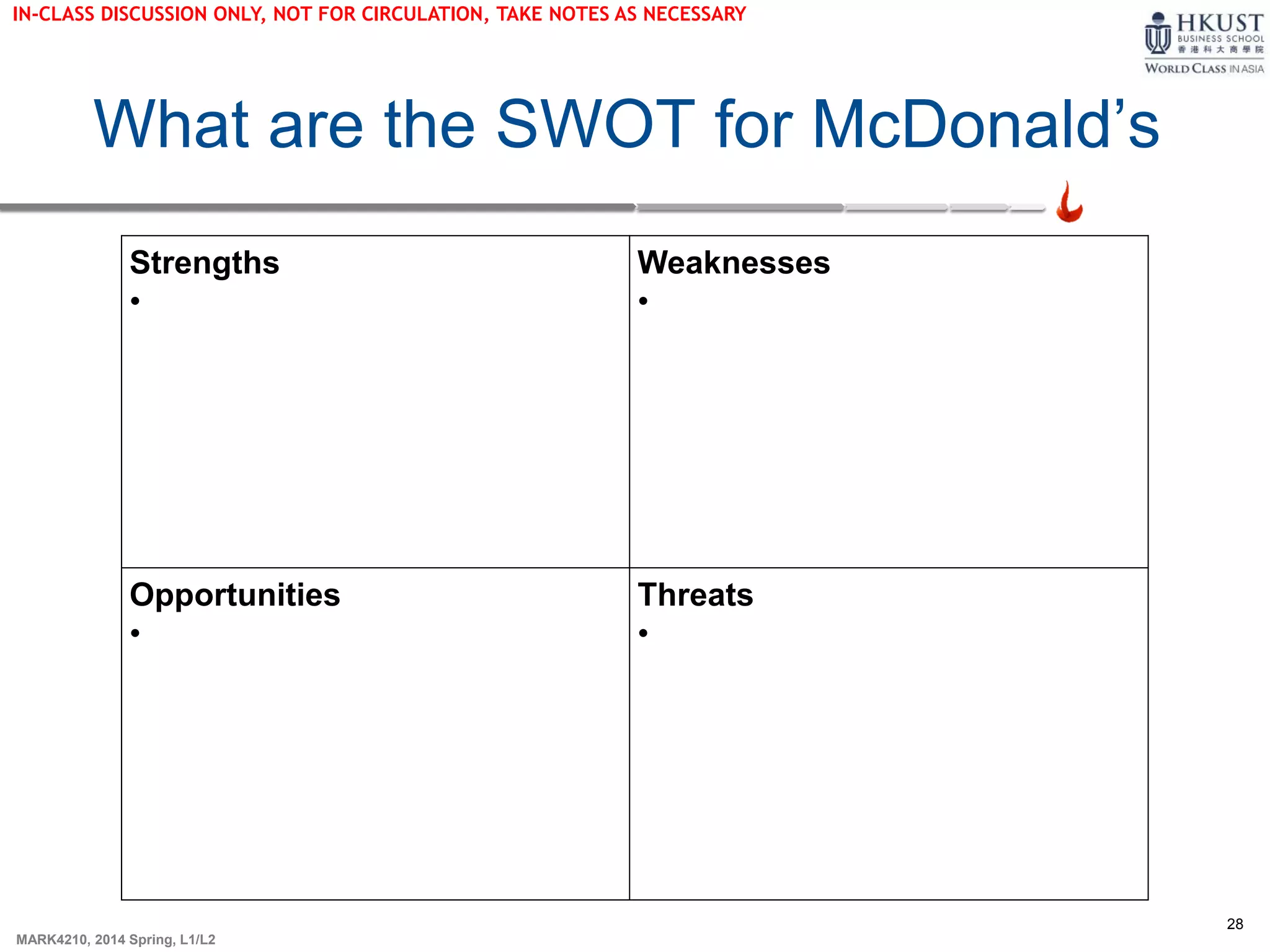
What are the SWOT for McDonald’s
Strengths
•
Weaknesses
•
Opportunities
•
Threats
•
IN-CLASS DISCUSSION ONLY, NOT FOR CIRCULATION, TAKE NOTES AS NECESSARY

situational analysis(4210)

  • 1.
    MARK4210, 2014 Spring,L1/L2 [Class #4] Situational Analysis MARK4210: Strategic Marketing 2014 Spring, Section L1/L2
  • 2.
    2 MARK4210, 2014 Spring,L1/L2 Overview  Effective marketing strategies are based on solid understanding of internal and marketing environments  Frameworks to collect & analyze information: • 5 C’s Analysis • Porter’s Five Forces Analysis • Other Analysis Tools  Information organized, prioritized and synthesized via SWOT Analysis Source: Marketing Analysis Toolkit: Situation Analysis, Steenburgh & Avery, Harvard Business School, February 4, 2010.
  • 3.
    3 MARK4210, 2014 Spring,L1/L2 5 C’s Analysis  Allows managers to understand themselves, customers, external players and forces that affect business • Customers • Company • Competitors • Context (Climate) • Collaborators/Complementers Source: Marketing Analysis Toolkit: Situation Analysis, Steenburgh & Avery, Harvard Business School, February 4, 2010.
  • 4.
    4 MARK4210, 2014 Spring,L1/L2 5 C’s: Customers – Needs Analysis  Understanding the physical, functional, symbolic, emotional and social needs the products fulfills for consumers • Includes both rational and irrational needs • As well as subconscious or unconscious needs  Analyze direct and indirect product benefits to assess which attributes are important to consumers  Distribution of consumer needs/preferences provides important input into segmentation and targeting decisions Source: Marketing Analysis Toolkit: Situation Analysis, Steenburgh & Avery, Harvard Business School, February 4, 2010.
  • 5.
    5 MARK4210, 2014 Spring,L1/L2 5 C’s: Customers – Types of Customer Benefits/Values  Economic • Concerns financial aspects such as price and credit terms • Price is often primary purchase driver, but, prices can be higher by providing more functional benefits that lower overall costs  Functional • Products and services that provide benefits and values that meet basic expectations and serve specific functions; utility • Physical and tangible  Psychological • Typically satisfy status, affiliation, reassurance, risk and security needs – both individually and socially • Generally transcends functional benefits and appear higher in the benefit/value ladder Source: Capon’s Marketing Framework, Capon, Wessex Publishing, 2009
  • 6.
    6 MARK4210, 2014 Spring,L1/L2 5 C’s: Company  Business Model – how the company makes money • Components/structures • Product/service offerings • Costs/expenses • Prices/revenues/margins  Competitive Strategy (e.g., Porter’s ‘generic strategies’) • Low cost (cost leadership) • Unique differentiation • Niche (focus)  Competitive Advantage  Core Competency Source: Marketing Analysis Toolkit: Situation Analysis, Steenburgh & Avery, Harvard Business School, February 4, 2010.
  • 7.
    7 MARK4210, 2014 Spring,L1/L2 5 C’s: Company – Core Competency Company Traits Operational Excellence Product Leadership Customer Intimacy Core business processes that Sharpen distribution system and provide no hassle service Nurture ideas, translate them into products; market them skillfully Provide solutions and help customers run their businesses Structure that Has strong, central authority and a finite level of empowerment Acts in an organic, loosely knit and ever- changing way Pushes empowerment close to customer contact Management systems that Maintain standard operating procedures Reward individuals' innovative capacity and new product success Measure the cost of providing services and of maintaining customer loyalty Culture that Acts predictably & believes “one-size- fits-all” Experiments and thinks "out-of-the- box" Is flexible and thinks "have it your way"
  • 8.
    8 MARK4210, 2014 Spring,L1/L2 5 C’s: Competitors  Firms that deliver similar products or alternative solutions  Analysis of their business models, competitive strategies, competitive advantages, marketing strategies Source: Marketing Analysis Toolkit: Situation Analysis, Steenburgh & Avery, Harvard Business School, February 4, 2010.
  • 9.
    9 MARK4210, 2014 Spring,L1/L2 5 C’s: Competitors – Identifying Competition Source: Product Planning Essentials, Kahn, M.E. Sharpe, 2011 Types Description Brand (aka product form, direct) Products or companies in the same product type/category, going after same segment, with same product features Product Category (aka indirect) Broader view of competition to include products in different categories with similar features and provide the same basic function Generic Refers to existing substitutable product categories; products that fulfill same need Competency Companies & products with core capabilities that can be leveraged to meet the basic customer need
  • 10.
    10 MARK4210, 2014 Spring,L1/L2 5 C’s: Competitors – Illustration of Types of Competition Competency Generic Category/indirect Market: Affordable, independent transpo. Brand/direct
  • 11.
    11 MARK4210, 2014 Spring,L1/L2 5 C’s: Context (Climate)  External factors & environment impacting business model  Six external environments • Demographic (e.g., age, family structure, race, ethnicity, social class, gender, education, geography) • Economic (macroeconomic and microeconomic; e.g., consumer confidence, inflation, unemployment) • Socio-cultural (e.g., prevailing worldviews, political/social ideologies, values, traditions, fashion) • Political/Legal (e.g., laws, consumer advocacy, safety groups) • Technological • Natural Source: Marketing Analysis Toolkit: Situation Analysis, Steenburgh & Avery, Harvard Business School, February 4, 2010.
  • 12.
    12 MARK4210, 2014 Spring,L1/L2 5 C’s: Collaborators & Complementers  Collaborators help the firm market products; include suppliers, distributors, retailers, key influencers  Complementers benefit from firms selling products; includes complementary product firms Source: Marketing Analysis Toolkit: Situation Analysis, Steenburgh & Avery, Harvard Business School, February 4, 2010.
  • 13.
    13 MARK4210, 2014 Spring,L1/L2 Porter’s Five Forces Framework  Analyzes industry dynamics  Five forces that determine long run attractiveness of an industry  Highlights profitability potential for the industry and competing firms Source: Marketing Analysis Toolkit: Situation Analysis, Steenburgh & Avery, Harvard Business School, February 4, 2010.
  • 14.
    14 MARK4210, 2014 Spring,L1/L2 Other Analysis Tools  Scenario Planning  Market Structure Analysis  Timeline Cause & Effect Analysis
  • 15.
    15 MARK4210, 2014 Spring,L1/L2 Other Analysis Tools: Scenario Planning – Decision Trees Reduce Price Reduce Price Maintain Price $ $ Maintain Price Reduce Price Maintain Price $ $ Company Action Competitive Response Outcome (Financial, Qualitative, etc.) Source: Strategic Marketing Problems – Cases & Comments, 13e, Kerin & Peterson, 2013
  • 16.
    16 MARK4210, 2014 Spring,L1/L2 Other Analysis Tools: Scenario Planning – Payoff Table Uncertainties Competitors Maintain Price (Probability?) Competitors Reduce Price (Probability?) Alternatives Reduce Price $ $ Maintain Price $ $ Source: Strategic Marketing Problems – Cases & Comments, 13e, Kerin & Peterson, 2013
  • 17.
    17 MARK4210, 2014 Spring,L1/L2 Other Analysis Tools: Market Structure Analysis Total Market (size, market share) Sub-market (size, market share) Sub-market (size, market share) Sub-market (size, market share) Sub-layer (size, market share) Sub-layer (size, market share) X% Y% Z% = 100% X1% X2% = X%
  • 18.
    18 MARK4210, 2014 Spring,L1/L2 Other Analysis Tools: Timeline Cause & Effect Analysis Timeline Period 1 Period 2 Period 3 Period 4 Period 5 Period 6 … Metrics (e.g., Sales, Trends) Events/actions/activities Company Customers Competitors Context …
  • 19.
    19 MARK4210, 2014 Spring,L1/L2 Synthesis – SWOT Analysis  Framework to analyze and interpret information from 5 C’s Analysis, Porter’s Five Forces Analysis, and other analyses  Extracts the strategic implications for the business  Should identify critical factors affecting the firm – goal is not simply to list, but to prioritize and pinpoint Source: Marketing Analysis Toolkit: Situation Analysis, Steenburgh & Avery, Harvard Business School, February 4, 2010.
  • 20.
    20 MARK4210, 2014 Spring,L1/L2 SWOT Analysis Model Strengths • Unique resources, competencies, capabilities superior to competition AND relevant to consumers • NOT a long list, but the most customer-relevant and competitively distinct Weaknesses • Resources, capabilities, competencies, inferior to competition • Based on understanding customer needs/ requirements and distinctive competencies Opportunities • Summarizes favorable trends or developments that lead to higher sales, profits or new business opportunities • Describe external situation, not desired action/strategy Threats • Summarizes unfavorable trends or developments that threaten sales, profits or limits new business opportunities • Recognize threats to avoid or limit impact Internal Focus External Focus Source: Marketing Analysis Toolkit: Situation Analysis, Steenburgh & Avery, Harvard Business School, February 4, 2010.
  • 21.
    21 MARK4210, 2014 Spring,L1/L2 Strengths & Weaknesses Matrix – Prioritization Tools Source: Adapted from Marketing Management, Kotler & Keller, Pearson, 2012
  • 22.
    22 MARK4210, 2014 Spring,L1/L2 Opportunity & Threat Matrix – Prioritization Tools Source: Adapted from Marketing Management, Kotler & Keller, Pearson, 2012
  • 23.
    MARK4210, 2014 Spring,L1/L2 In-class Case Study IN-CLASS DISCUSSION ONLY, NOT FOR CIRCULATION, TAKE NOTES AS NECESSARY
  • 24.
    24 MARK4210, 2014 Spring,L1/L2 What customer benefits does McDonald’s provide? Why? Customer Benefits IN-CLASS DISCUSSION ONLY, NOT FOR CIRCULATION, TAKE NOTES AS NECESSARY
  • 25.
    25 MARK4210, 2014 Spring,L1/L2 What is the business model of McDonald’s corporation? Product Offering • Fast food • Consistent quality • Affordable • Accessible locations • Clean (safe) Components/structures • Franchisees • Suppliers • Management • Training • Quality Control • R&D Revenues • Franchise fees (% of sales) • Marketing fees (% of sales) • Rental fees (from franchisee locations, McDonald’s owns/leased the location; usually % of sales) Costs • No direct purchase of food/materials, but organizes supply of food/materials to restaurants via approved third parties • Structural costs  IN-CLASS DISCUSSION ONLY, NOT FOR CIRCULATION, TAKE NOTES AS NECESSARY
  • 26.
    26 MARK4210, 2014 Spring,L1/L2 What are the competitive advantages of McDonald’s? Why? IN-CLASS DISCUSSION ONLY, NOT FOR CIRCULATION, TAKE NOTES AS NECESSARY
  • 27.
    27 MARK4210, 2014 Spring,L1/L2 Who are the competitors of McDonald’s, Why? Businesses 1. Brand 1. Product Category 3. Generic 4. Compe- tency  IN-CLASS DISCUSSION ONLY, NOT FOR CIRCULATION, TAKE NOTES AS NECESSARY
  • 28.
    28 MARK4210, 2014 Spring,L1/L2 What are the SWOT for McDonald’s Strengths • Weaknesses • Opportunities • Threats • IN-CLASS DISCUSSION ONLY, NOT FOR CIRCULATION, TAKE NOTES AS NECESSARY