I am not sure why people forward emails, maybe they think that the recipient doesn’t know the
information, or would like to know more information, or maybe just to stay in touch. Like businesses
really, if they are not in our face we will forget about them (far from the eye, is far from the heart as
they say). However since I moved back to Dubai, I didn’t have enough time to check all the forwards, so I
created a folder on my outlook that is called "forwards from friends" ingenious really:) and I only go
there when I have some time to spare which is really rare, with my phone ringing all the time, and the
300-400 business emails that I have to reply to, and the shopping with the kids, and for the house, and
the social agenda that doesn’t end. Sometimes when I am returning home at night I get worried that I
will have an accident, as my head spins and my eyes closes, I wonder why am I doing this, but I only
remember at the end of the day when I am fully tired. Anyway, so in those rare moments when I have
time I do check your forwards friends, please don’t be upset with me.

And when I like what they send, I will post it here for you all to see too (when you have the time, that is)
A preamble for this post
Three years I was still a member of the Dubai ladies club. It was my favourite place on this earth. The
beach was always empty, and I would either be swimming in it, or just lying on those long bed-like-chairs
reading a book or just meditating. In those moments many things cross my mind, so I thought of a novel,
(I always wanted to write something but didn’t know what it was) the novel involved the sea, and the
life inside it, with a mix of people going there and solving the sea lives problems. Of course I never came
around to writing it, one day I will, I promise, it will be the next better-than-harry potter book, and you
will all receive a copy signed by me.

So whenever I receive forwards on sea life I reminisce on my novel, and that is why I am posting this
post:

These are the images shot for an underwater film created using
revolutionary technology. The film took four years to shoot and
costing a staggering £45 million to produce. But it's easy to see why:
500 hours of unedited film were shot using remote-controlled mini
helicopters, divers, hydrodynamic cameras dragged behind boats and
top speeds, and carefully tied poles.

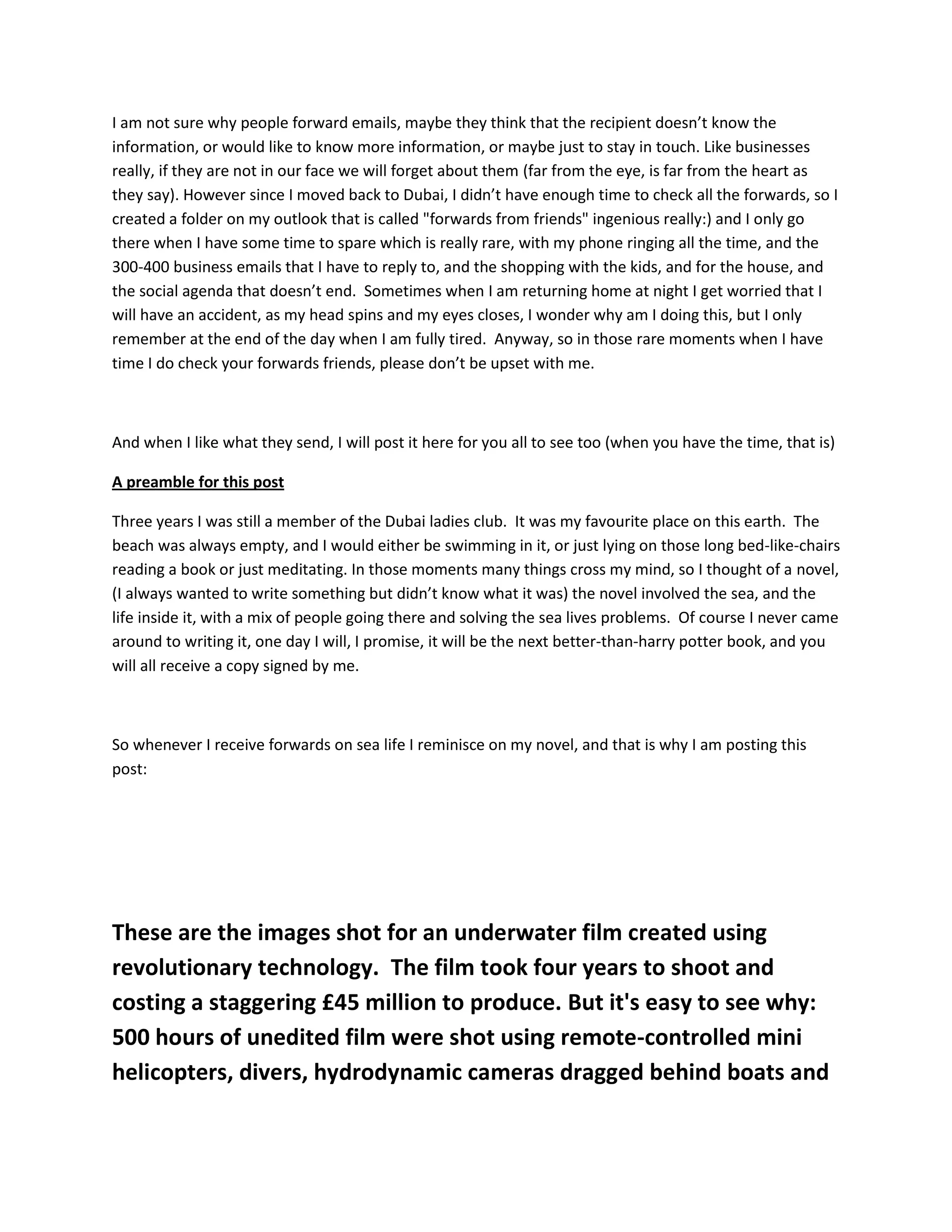
Just going for a little flight: A long-beaked dolphin is caught on camera
by a mini helicopter as it leaps from the water in an unspecified
location in one of the images from the film

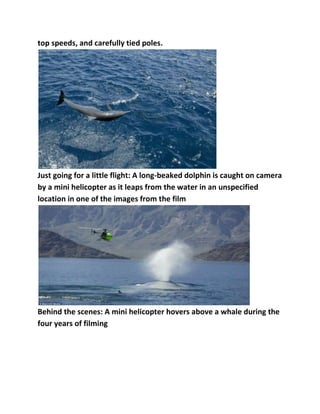
Behind the scenes: A mini helicopter hovers above a whale during the
four years of filming
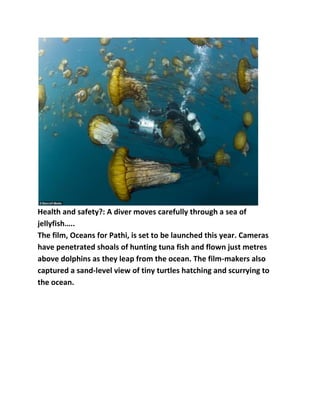
Health and safety?: A diver moves carefully through a sea of
jellyfish…..
The film, Oceans for Pathi, is set to be launched this year. Cameras
have penetrated shoals of hunting tuna fish and flown just metres
above dolphins as they leap from the ocean. The film-makers also
captured a sand-level view of tiny turtles hatching and scurrying to
the ocean.
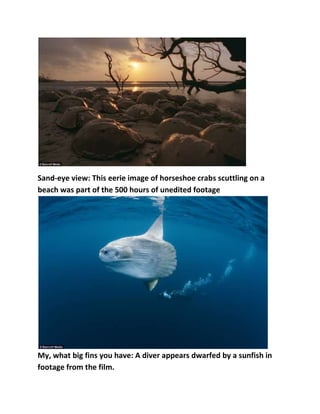
Sand-eye view: This eerie image of horseshoe crabs scuttling on a
beach was part of the 500 hours of unedited footage

My, what big fins you have: A diver appears dwarfed by a sunfish in
footage from the film.
It took two years of planning before 15 cameramen could even begin
filming Oceans for Pathi, which will be out on general release on 27
January 2010. The crew filmed in 50 locations across the world and
captured 80 species of fish, dolphins, whales, squid, lizards, crabs and
turtles. The secret to the production is its revolutionary filming carried
out in a bid to get within the ocean's most intimate events.

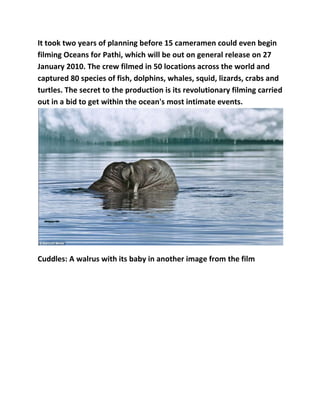
Cuddles: A walrus with its baby in another image from the film
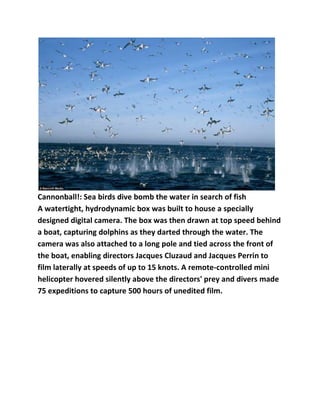
Cannonball!: Sea birds dive bomb the water in search of fish
A watertight, hydrodynamic box was built to house a specially
designed digital camera. The box was then drawn at top speed behind
a boat, capturing dolphins as they darted through the water. The
camera was also attached to a long pole and tied across the front of
the boat, enabling directors Jacques Cluzaud and Jacques Perrin to
film laterally at speeds of up to 15 knots. A remote-controlled mini
helicopter hovered silently above the directors' prey and divers made
75 expeditions to capture 500 hours of unedited film.
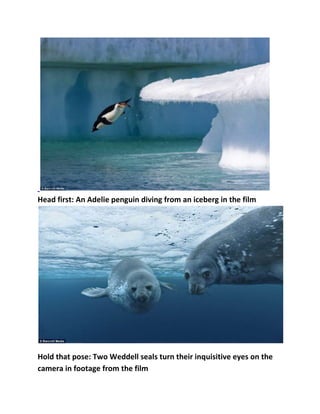
Head first: An Adelie penguin diving from an iceberg in the film

Hold that pose: Two Weddell seals turn their inquisitive eyes on the
camera in footage from the film
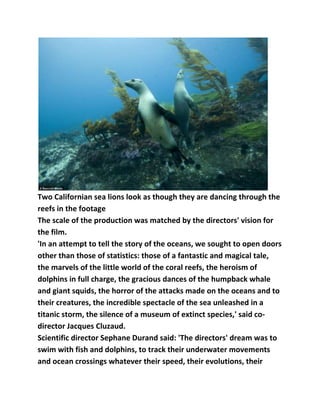
Two Californian sea lions look as though they are dancing through the
reefs in the footage
The scale of the production was matched by the directors' vision for
the film.
'In an attempt to tell the story of the oceans, we sought to open doors
other than those of statistics: those of a fantastic and magical tale,
the marvels of the little world of the coral reefs, the heroism of
dolphins in full charge, the gracious dances of the humpback whale
and giant squids, the horror of the attacks made on the oceans and to
their creatures, the incredible spectacle of the sea unleashed in a
titanic storm, the silence of a museum of extinct species,' said codirector Jacques Cluzaud.
Scientific director Sephane Durand said: 'The directors' dream was to
swim with fish and dolphins, to track their underwater movements
and ocean crossings whatever their speed, their evolutions, their
acrobatics.'

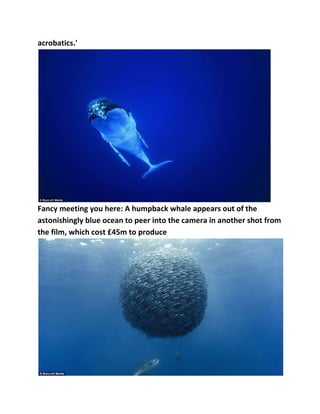
Fancy meeting you here: A humpback whale appears out of the
astonishingly blue ocean to peer into the camera in another shot from
the film, which cost £45m to produce
As the world turns: A ball of horse mackerel in a scene from the film

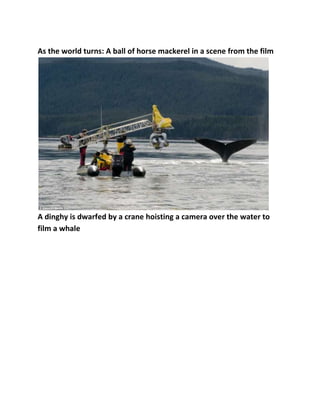
A dinghy is dwarfed by a crane hoisting a camera over the water to
film a whale

I am not sure why people forward emails

  • 1.
    I am notsure why people forward emails, maybe they think that the recipient doesn’t know the information, or would like to know more information, or maybe just to stay in touch. Like businesses really, if they are not in our face we will forget about them (far from the eye, is far from the heart as they say). However since I moved back to Dubai, I didn’t have enough time to check all the forwards, so I created a folder on my outlook that is called "forwards from friends" ingenious really:) and I only go there when I have some time to spare which is really rare, with my phone ringing all the time, and the 300-400 business emails that I have to reply to, and the shopping with the kids, and for the house, and the social agenda that doesn’t end. Sometimes when I am returning home at night I get worried that I will have an accident, as my head spins and my eyes closes, I wonder why am I doing this, but I only remember at the end of the day when I am fully tired. Anyway, so in those rare moments when I have time I do check your forwards friends, please don’t be upset with me. And when I like what they send, I will post it here for you all to see too (when you have the time, that is) A preamble for this post Three years I was still a member of the Dubai ladies club. It was my favourite place on this earth. The beach was always empty, and I would either be swimming in it, or just lying on those long bed-like-chairs reading a book or just meditating. In those moments many things cross my mind, so I thought of a novel, (I always wanted to write something but didn’t know what it was) the novel involved the sea, and the life inside it, with a mix of people going there and solving the sea lives problems. Of course I never came around to writing it, one day I will, I promise, it will be the next better-than-harry potter book, and you will all receive a copy signed by me. So whenever I receive forwards on sea life I reminisce on my novel, and that is why I am posting this post: These are the images shot for an underwater film created using revolutionary technology. The film took four years to shoot and costing a staggering £45 million to produce. But it's easy to see why: 500 hours of unedited film were shot using remote-controlled mini helicopters, divers, hydrodynamic cameras dragged behind boats and
  • 2.
    top speeds, andcarefully tied poles. Just going for a little flight: A long-beaked dolphin is caught on camera by a mini helicopter as it leaps from the water in an unspecified location in one of the images from the film Behind the scenes: A mini helicopter hovers above a whale during the four years of filming
  • 3.
    Health and safety?:A diver moves carefully through a sea of jellyfish….. The film, Oceans for Pathi, is set to be launched this year. Cameras have penetrated shoals of hunting tuna fish and flown just metres above dolphins as they leap from the ocean. The film-makers also captured a sand-level view of tiny turtles hatching and scurrying to the ocean.
  • 4.
    Sand-eye view: Thiseerie image of horseshoe crabs scuttling on a beach was part of the 500 hours of unedited footage My, what big fins you have: A diver appears dwarfed by a sunfish in footage from the film.
  • 5.
    It took twoyears of planning before 15 cameramen could even begin filming Oceans for Pathi, which will be out on general release on 27 January 2010. The crew filmed in 50 locations across the world and captured 80 species of fish, dolphins, whales, squid, lizards, crabs and turtles. The secret to the production is its revolutionary filming carried out in a bid to get within the ocean's most intimate events. Cuddles: A walrus with its baby in another image from the film
  • 6.
    Cannonball!: Sea birdsdive bomb the water in search of fish A watertight, hydrodynamic box was built to house a specially designed digital camera. The box was then drawn at top speed behind a boat, capturing dolphins as they darted through the water. The camera was also attached to a long pole and tied across the front of the boat, enabling directors Jacques Cluzaud and Jacques Perrin to film laterally at speeds of up to 15 knots. A remote-controlled mini helicopter hovered silently above the directors' prey and divers made 75 expeditions to capture 500 hours of unedited film.
  • 7.
    Head first: AnAdelie penguin diving from an iceberg in the film Hold that pose: Two Weddell seals turn their inquisitive eyes on the camera in footage from the film
  • 8.
    Two Californian sealions look as though they are dancing through the reefs in the footage The scale of the production was matched by the directors' vision for the film. 'In an attempt to tell the story of the oceans, we sought to open doors other than those of statistics: those of a fantastic and magical tale, the marvels of the little world of the coral reefs, the heroism of dolphins in full charge, the gracious dances of the humpback whale and giant squids, the horror of the attacks made on the oceans and to their creatures, the incredible spectacle of the sea unleashed in a titanic storm, the silence of a museum of extinct species,' said codirector Jacques Cluzaud. Scientific director Sephane Durand said: 'The directors' dream was to swim with fish and dolphins, to track their underwater movements and ocean crossings whatever their speed, their evolutions, their
  • 9.
    acrobatics.' Fancy meeting youhere: A humpback whale appears out of the astonishingly blue ocean to peer into the camera in another shot from the film, which cost £45m to produce
  • 10.
    As the worldturns: A ball of horse mackerel in a scene from the film A dinghy is dwarfed by a crane hoisting a camera over the water to film a whale