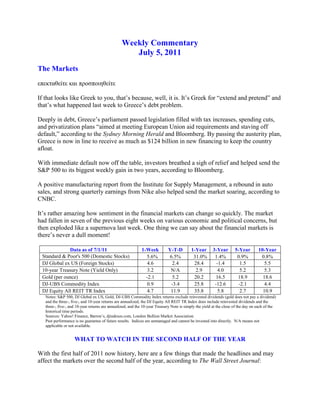
Weekly Commentary<br />July 5, 2011<br />The Markets<br />επεκταθείτε και προσποιηθείτε<br />If that looks like Greek to you, that’s because, well, it is. It’s Greek for “extend and pretend” and that’s what happened last week to Greece’s debt problem.<br />Deeply in debt, Greece’s parliament passed legislation filled with tax increases, spending cuts, and privatization plans “aimed at meeting European Union aid requirements and staving off default,” according to the Sydney Morning Herald and Bloomberg. By passing the austerity plan, Greece is now in line to receive as much as $124 billion in new financing to keep the country afloat. <br />With immediate default now off the table, investors breathed a sigh of relief and helped send the S&P 500 to its biggest weekly gain in two years, according to Bloomberg.<br />A positive manufacturing report from the Institute for Supply Management, a rebound in auto sales, and strong quarterly earnings from Nike also helped send the market soaring, according to CNBC.<br />It’s rather amazing how sentiment in the financial markets can change so quickly. The market had fallen in seven of the previous eight weeks on various economic and political concerns, but then exploded like a supernova last week. One thing we can say about the financial markets is there’s never a dull moment!  <br />Data as of 7/1/111-WeekY-T-D1-Year3-Year5-Year10-YearStandard & Poor's 500 (Domestic Stocks)   5.6%6.5%  31.0%1.4%0.9%0.8%DJ Global ex US (Foreign Stocks)4.62.428.4-1.41.55.510-year Treasury Note (Yield Only)3.2N/A2.94.05.25.3Gold (per ounce) -2.15.220.216.518.918.6DJ-UBS Commodity Index0.9-3.425.8-12.6-2.14.4DJ Equity All REIT TR Index4.711.935.85.82.710.9<br />Notes: S&P 500, DJ Global ex US, Gold, DJ-UBS Commodity Index returns exclude reinvested dividends (gold does not pay a dividend) and the three-, five-, and 10-year returns are annualized; the DJ Equity All REIT TR Index does include reinvested dividends and the three-, five-, and 10-year returns are annualized; and the 10-year Treasury Note is simply the yield at the close of the day on each of the historical time periods.<br />Sources: Yahoo! Finance, Barron’s, djindexes.com, London Bullion Market Association.<br />Past performance is no guarantee of future results.  Indices are unmanaged and cannot be invested into directly.  N/A means not applicable or not available.<br />WHAT TO WATCH IN THE SECOND HALF OF THE YEAR<br />With the first half of 2011 now history, here are a few things that made the headlines and may affect the markets over the second half of the year, according to The Wall Street Journal:<br />The Dow Jones Industrial Average had a volatile six months, but managed to end June on a high note and finish the first half of the year up 7.2%. What to Watch: The end of quantitative easing, ongoing European sovereign-debt issues, and the U.S. budget battle could keep investors on edge over the summer. In addition, any signs that the current “soft patch” in the economy could turn into a new recession would not be received well by investors.<br />Various commodities took a price hit the past couple months including crude oil, wheat, corn, copper, and silver. Yet, by historical standards, many commodity prices are still very high and causing discomfort to consumers around the world.
What to Watch: China, India, and Brazil are a major source of commodity demand and they are trying to rein in price inflation by slowing their economy. How successfully they manage this may determine the future demand for commodities and, by extension, impact inflationary pressure.
The initial public offering of internet stars LinkedIn and Pandora stirred talk of a new internet bubble. LinkedIn, for example, doubled in price on its opening day.

Hyre Weekly Commentary

  • 1.
    Weekly Commentary<br />July5, 2011<br />The Markets<br />επεκταθείτε και προσποιηθείτε<br />If that looks like Greek to you, that’s because, well, it is. It’s Greek for “extend and pretend” and that’s what happened last week to Greece’s debt problem.<br />Deeply in debt, Greece’s parliament passed legislation filled with tax increases, spending cuts, and privatization plans “aimed at meeting European Union aid requirements and staving off default,” according to the Sydney Morning Herald and Bloomberg. By passing the austerity plan, Greece is now in line to receive as much as $124 billion in new financing to keep the country afloat. <br />With immediate default now off the table, investors breathed a sigh of relief and helped send the S&P 500 to its biggest weekly gain in two years, according to Bloomberg.<br />A positive manufacturing report from the Institute for Supply Management, a rebound in auto sales, and strong quarterly earnings from Nike also helped send the market soaring, according to CNBC.<br />It’s rather amazing how sentiment in the financial markets can change so quickly. The market had fallen in seven of the previous eight weeks on various economic and political concerns, but then exploded like a supernova last week. One thing we can say about the financial markets is there’s never a dull moment! <br />Data as of 7/1/111-WeekY-T-D1-Year3-Year5-Year10-YearStandard & Poor's 500 (Domestic Stocks) 5.6%6.5% 31.0%1.4%0.9%0.8%DJ Global ex US (Foreign Stocks)4.62.428.4-1.41.55.510-year Treasury Note (Yield Only)3.2N/A2.94.05.25.3Gold (per ounce) -2.15.220.216.518.918.6DJ-UBS Commodity Index0.9-3.425.8-12.6-2.14.4DJ Equity All REIT TR Index4.711.935.85.82.710.9<br />Notes: S&P 500, DJ Global ex US, Gold, DJ-UBS Commodity Index returns exclude reinvested dividends (gold does not pay a dividend) and the three-, five-, and 10-year returns are annualized; the DJ Equity All REIT TR Index does include reinvested dividends and the three-, five-, and 10-year returns are annualized; and the 10-year Treasury Note is simply the yield at the close of the day on each of the historical time periods.<br />Sources: Yahoo! Finance, Barron’s, djindexes.com, London Bullion Market Association.<br />Past performance is no guarantee of future results. Indices are unmanaged and cannot be invested into directly. N/A means not applicable or not available.<br />WHAT TO WATCH IN THE SECOND HALF OF THE YEAR<br />With the first half of 2011 now history, here are a few things that made the headlines and may affect the markets over the second half of the year, according to The Wall Street Journal:<br />The Dow Jones Industrial Average had a volatile six months, but managed to end June on a high note and finish the first half of the year up 7.2%. What to Watch: The end of quantitative easing, ongoing European sovereign-debt issues, and the U.S. budget battle could keep investors on edge over the summer. In addition, any signs that the current “soft patch” in the economy could turn into a new recession would not be received well by investors.<br />Various commodities took a price hit the past couple months including crude oil, wheat, corn, copper, and silver. Yet, by historical standards, many commodity prices are still very high and causing discomfort to consumers around the world.
  • 2.
    What to Watch:China, India, and Brazil are a major source of commodity demand and they are trying to rein in price inflation by slowing their economy. How successfully they manage this may determine the future demand for commodities and, by extension, impact inflationary pressure.
  • 3.
    The initial publicoffering of internet stars LinkedIn and Pandora stirred talk of a new internet bubble. LinkedIn, for example, doubled in price on its opening day.