HYPOTHESIS TESTING
Hypothesis testing was introduced by Ronald Fisher, Jerzy Neyman, Karl Pearson and Pearson’s
son, Egon Pearson.
Hypothesis testing is a statistical method that is used in making statistical decisions using
experimental data.
Hypothesis Testing is basically an assumption that we make about the population parameter.
Hypotheses provide the following benefits:
They determine the focus and direction for a research effort.
Their development forces the researcher to clearly state the purpose of the research activity.
They determine what variables will not be considered in a study, as well as those that will be
considered.
They require the researcher to have an operational definition of the variables of interest.
 Null hypothesis: Null hypothesis is a statistical hypothesis that assumes that the observation is due to a chance
factor. Null hypothesis is denoted by; H0: μ1 = μ2, which shows that there is no difference between the two population
means.
 Alternative hypothesis: Contrary to the null hypothesis, the alternative hypothesis shows that observations are the result
of a real effect.
 Level of significance: Refers to the degree of significance in which we accept or reject the null-hypothesis. 100%
accuracy is not possible for accepting or rejecting a hypothesis, so we therefore select a level of significance that is
usually 5%.
 Type I error: When we reject the null hypothesis, although that hypothesis was true. Type I error is denoted by
alpha. In hypothesis testing, the normal curve that shows the critical region is called the alpha region.
 Type II errors: When we accept the null hypothesis but it is false. Type II errors are denoted by beta. In Hypothesis
testing, the normal curve that shows the acceptance region is called the beta region.
 Power: Usually known as the probability of correctly accepting the null hypothesis. 1-beta is called power of the
analysis.
 One-tailed test: When the given statistical hypothesis is one value like H0: μ1 = μ2, it is called the one-tailed test.
 Two-tailed test: When the given statistics hypothesis assumes a less than or greater than value, it is called the two-tailed
test.
FIVE STEPS IN HYPOTHESIS TESTING
Specify the Null Hypothesis
Specify the Alternative Hypothesis
Set the Significance Level (a)
Calculate the Test Statistic and Corresponding P-Value
Drawing a Conclusion
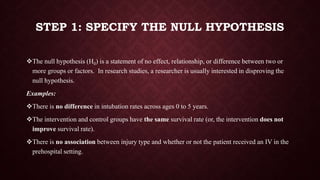
STEP 1: SPECIFY THE NULL HYPOTHESIS
The null hypothesis (H0) is a statement of no effect, relationship, or difference between two or
more groups or factors. In research studies, a researcher is usually interested in disproving the
null hypothesis.
Examples:
There is no difference in intubation rates across ages 0 to 5 years.
The intervention and control groups have the same survival rate (or, the intervention does not
improve survival rate).
There is no association between injury type and whether or not the patient received an IV in the
prehospital setting.
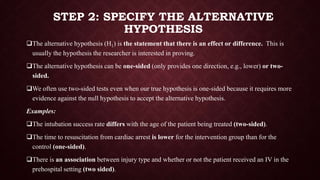
STEP 2: SPECIFY THE ALTERNATIVE
HYPOTHESIS
The alternative hypothesis (H1) is the statement that there is an effect or difference. This is
usually the hypothesis the researcher is interested in proving.
The alternative hypothesis can be one-sided (only provides one direction, e.g., lower) or two-
sided.
We often use two-sided tests even when our true hypothesis is one-sided because it requires more
evidence against the null hypothesis to accept the alternative hypothesis.
Examples:
The intubation success rate differs with the age of the patient being treated (two-sided).
The time to resuscitation from cardiac arrest is lower for the intervention group than for the
control (one-sided).
There is an association between injury type and whether or not the patient received an IV in the
prehospital setting (two sided).
STEP 3: SET THE SIGNIFICANCE LEVEL
The significance level (denoted by the Greek letter alpha) is generally set at 0.05.
This means that there is a 5% chance that you will accept your alternative hypothesis when
your null hypothesis is actually true.
The smaller the significance level, the greater the burden of proof needed to reject the null
hypothesis, or in other words, to support the alternative hypothesis.
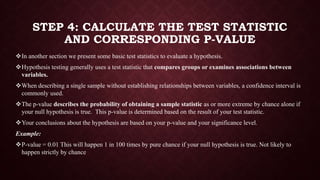
STEP 4: CALCULATE THE TEST STATISTIC
AND CORRESPONDING P-VALUE
In another section we present some basic test statistics to evaluate a hypothesis.
Hypothesis testing generally uses a test statistic that compares groups or examines associations between
variables.
When describing a single sample without establishing relationships between variables, a confidence interval is
commonly used.
The p-value describes the probability of obtaining a sample statistic as or more extreme by chance alone if
your null hypothesis is true. This p-value is determined based on the result of your test statistic.
Your conclusions about the hypothesis are based on your p-value and your significance level.
Example:
P-value = 0.01 This will happen 1 in 100 times by pure chance if your null hypothesis is true. Not likely to
happen strictly by chance
STEP 5: DRAWING A CONCLUSION
P-value <= significance level=> Reject your null hypothesis in favor of your alternative
hypothesis. Your result is statistically significant.
P-value > significance level => Fail to reject your null hypothesis. Your result is not statistically
significant.

Example:
H0: There is no difference in survival between the intervention and control group.
H1: There is a difference in survival between the intervention and control group.
CONCLUSION
Fail to reject the null hypothesis.
The difference in survival between the intervention and control group was not statistically
significant.
There was no significant increase in survival for the intervention group compared to control
(p=0.20).
Hypothesis testing

Hypothesis testing

  • 1.
  • 2.
    Hypothesis testing wasintroduced by Ronald Fisher, Jerzy Neyman, Karl Pearson and Pearson’s son, Egon Pearson. Hypothesis testing is a statistical method that is used in making statistical decisions using experimental data. Hypothesis Testing is basically an assumption that we make about the population parameter. Hypotheses provide the following benefits: They determine the focus and direction for a research effort. Their development forces the researcher to clearly state the purpose of the research activity. They determine what variables will not be considered in a study, as well as those that will be considered. They require the researcher to have an operational definition of the variables of interest.
  • 3.
     Null hypothesis:Null hypothesis is a statistical hypothesis that assumes that the observation is due to a chance factor. Null hypothesis is denoted by; H0: μ1 = μ2, which shows that there is no difference between the two population means.  Alternative hypothesis: Contrary to the null hypothesis, the alternative hypothesis shows that observations are the result of a real effect.  Level of significance: Refers to the degree of significance in which we accept or reject the null-hypothesis. 100% accuracy is not possible for accepting or rejecting a hypothesis, so we therefore select a level of significance that is usually 5%.  Type I error: When we reject the null hypothesis, although that hypothesis was true. Type I error is denoted by alpha. In hypothesis testing, the normal curve that shows the critical region is called the alpha region.  Type II errors: When we accept the null hypothesis but it is false. Type II errors are denoted by beta. In Hypothesis testing, the normal curve that shows the acceptance region is called the beta region.  Power: Usually known as the probability of correctly accepting the null hypothesis. 1-beta is called power of the analysis.  One-tailed test: When the given statistical hypothesis is one value like H0: μ1 = μ2, it is called the one-tailed test.  Two-tailed test: When the given statistics hypothesis assumes a less than or greater than value, it is called the two-tailed test.
  • 5.
    FIVE STEPS INHYPOTHESIS TESTING Specify the Null Hypothesis Specify the Alternative Hypothesis Set the Significance Level (a) Calculate the Test Statistic and Corresponding P-Value Drawing a Conclusion
  • 6.
    STEP 1: SPECIFYTHE NULL HYPOTHESIS The null hypothesis (H0) is a statement of no effect, relationship, or difference between two or more groups or factors. In research studies, a researcher is usually interested in disproving the null hypothesis. Examples: There is no difference in intubation rates across ages 0 to 5 years. The intervention and control groups have the same survival rate (or, the intervention does not improve survival rate). There is no association between injury type and whether or not the patient received an IV in the prehospital setting.
  • 7.
    STEP 2: SPECIFYTHE ALTERNATIVE HYPOTHESIS The alternative hypothesis (H1) is the statement that there is an effect or difference. This is usually the hypothesis the researcher is interested in proving. The alternative hypothesis can be one-sided (only provides one direction, e.g., lower) or two- sided. We often use two-sided tests even when our true hypothesis is one-sided because it requires more evidence against the null hypothesis to accept the alternative hypothesis. Examples: The intubation success rate differs with the age of the patient being treated (two-sided). The time to resuscitation from cardiac arrest is lower for the intervention group than for the control (one-sided). There is an association between injury type and whether or not the patient received an IV in the prehospital setting (two sided).
  • 8.
    STEP 3: SETTHE SIGNIFICANCE LEVEL The significance level (denoted by the Greek letter alpha) is generally set at 0.05. This means that there is a 5% chance that you will accept your alternative hypothesis when your null hypothesis is actually true. The smaller the significance level, the greater the burden of proof needed to reject the null hypothesis, or in other words, to support the alternative hypothesis.
  • 9.
    STEP 4: CALCULATETHE TEST STATISTIC AND CORRESPONDING P-VALUE In another section we present some basic test statistics to evaluate a hypothesis. Hypothesis testing generally uses a test statistic that compares groups or examines associations between variables. When describing a single sample without establishing relationships between variables, a confidence interval is commonly used. The p-value describes the probability of obtaining a sample statistic as or more extreme by chance alone if your null hypothesis is true. This p-value is determined based on the result of your test statistic. Your conclusions about the hypothesis are based on your p-value and your significance level. Example: P-value = 0.01 This will happen 1 in 100 times by pure chance if your null hypothesis is true. Not likely to happen strictly by chance
  • 10.
    STEP 5: DRAWINGA CONCLUSION P-value <= significance level=> Reject your null hypothesis in favor of your alternative hypothesis. Your result is statistically significant. P-value > significance level => Fail to reject your null hypothesis. Your result is not statistically significant. Example: H0: There is no difference in survival between the intervention and control group. H1: There is a difference in survival between the intervention and control group.

  • 11.
    CONCLUSION Fail to rejectthe null hypothesis. The difference in survival between the intervention and control group was not statistically significant. There was no significant increase in survival for the intervention group compared to control (p=0.20).