HYPERLEDGER
 Hyperledger is not a blockchain but a project
initiated by Linux Foundation to advance
blockchain technology
 There are four categories of projects under
Hyperledger
1)Distributed ledgers
2)Libraries
3)Tools
4)Domain specific
Distributed Ledger Projects
 Fabric
 Sawtooth
 Indy
 Iroha
 Besu
2)Libraries
 Aries
 Transact
 Ursa
 AnonCreds Project
Tools
 Cello
 Caliper
 Composer
 Explorer
Domain-Specific
 Grid
REFERENCE ARCHITECTURE
 Identity services manages identities of entities,
participants and ledger objects such as assets
and smart-contracts.
 Policy services manages access control, privacy,
consortium rules, consensus rules, etc.
 Blockchain and Transaction layer have many
modules which help in maintaining the
Blockchain state
 P2P protocol module provides different
mechanisms which are compatible with
present internet architecture to carryout peer
to peer functionalities like bidirectional
streaming,flow control and connects one peer
to another
 Distributed ledger is present in this layer
which provides for maintaining the state of
the blockchain,processing and validation of
transactions,maintaining the objects of the
ledgers
 Consensus module is to run the consensus
mechanisms to validate transactions in the
network.
 Finally, we have the smart contracts layer,
which provides chaincode services in
Hyperledger and makes use of secure
container technology to host smart contracts.
 Hyperledger fabric follows an approach where peers
validate transactions submitted by the end-user.
 The validated transaction is submitted to the
orderer; the orderer would further validate the
order, especially to avoid double-spending.
 Orderer orders transactions for a block and approves
the block creation, following which peers on the
blockchain are notified via gossip protocol.
 All peers validate the order and make a new block
in the chain
MULTIVERSION
Components of Hyperledger Fabric
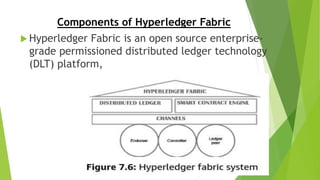
 Hyperledger Fabric is an open source enterprise-
grade permissioned distributed ledger technology
(DLT) platform,
 Fabric is the first distributed ledger platform
to support smart contracts authored in
general-purpose programming languages such
as Java, Go and Node.js, rather than
constrained domain-specific languages (DSL).
 The Fabric platform is also permissioned,
meaning that, unlike with a public
permissionless network, the participants are
known to each other,
 Hyperledger, being a permissioned ledger
system, is used to authenticate a node by
using a mechanism called Membership Service
Provider.
 [First is identity, that provides authorization,
identification, and authentication services under
membership services.
 It defines which CA is trusted to define members in
the network
 It not only defines who can be on the network but
also defines their roles and sets access privileges to
each member of the network so as to who can
access what inside the network.]

HYPERLEDGER FABRIC.pptx

  • 1.
  • 2.
     Hyperledger isnot a blockchain but a project initiated by Linux Foundation to advance blockchain technology  There are four categories of projects under Hyperledger 1)Distributed ledgers 2)Libraries 3)Tools 4)Domain specific
  • 3.
    Distributed Ledger Projects Fabric  Sawtooth  Indy  Iroha  Besu
  • 4.
    2)Libraries  Aries  Transact Ursa  AnonCreds Project
  • 5.
    Tools  Cello  Caliper Composer  Explorer Domain-Specific  Grid
  • 6.
  • 8.
     Identity servicesmanages identities of entities, participants and ledger objects such as assets and smart-contracts.  Policy services manages access control, privacy, consortium rules, consensus rules, etc.  Blockchain and Transaction layer have many modules which help in maintaining the Blockchain state
  • 9.
     P2P protocolmodule provides different mechanisms which are compatible with present internet architecture to carryout peer to peer functionalities like bidirectional streaming,flow control and connects one peer to another  Distributed ledger is present in this layer which provides for maintaining the state of the blockchain,processing and validation of transactions,maintaining the objects of the ledgers
  • 10.
     Consensus moduleis to run the consensus mechanisms to validate transactions in the network.  Finally, we have the smart contracts layer, which provides chaincode services in Hyperledger and makes use of secure container technology to host smart contracts.
  • 11.
     Hyperledger fabricfollows an approach where peers validate transactions submitted by the end-user.  The validated transaction is submitted to the orderer; the orderer would further validate the order, especially to avoid double-spending.  Orderer orders transactions for a block and approves the block creation, following which peers on the blockchain are notified via gossip protocol.  All peers validate the order and make a new block in the chain
  • 12.
  • 13.
    Components of HyperledgerFabric  Hyperledger Fabric is an open source enterprise- grade permissioned distributed ledger technology (DLT) platform,
  • 14.
     Fabric isthe first distributed ledger platform to support smart contracts authored in general-purpose programming languages such as Java, Go and Node.js, rather than constrained domain-specific languages (DSL).  The Fabric platform is also permissioned, meaning that, unlike with a public permissionless network, the participants are known to each other,
  • 15.
     Hyperledger, beinga permissioned ledger system, is used to authenticate a node by using a mechanism called Membership Service Provider.
  • 16.
     [First isidentity, that provides authorization, identification, and authentication services under membership services.  It defines which CA is trusted to define members in the network  It not only defines who can be on the network but also defines their roles and sets access privileges to each member of the network so as to who can access what inside the network.]