• Hyperemesis gravidarumis severe nausea and vomiting during
pregnancy that results in dehydration, weight loss, and ketosis.
Diagnosis is clinical and by measurement of urine ketones, serum
electrolytes, and renal function.
• Treatment is with temporary suspension of oral intake and with IV
fluids, antiemetics if needed, and vitamin and electrolyte repletion.
3.
• Pregnancy frequentlycauses nausea and vomiting; the cause appears
to be rapidly increasing levels of estrogens or the beta subunit of
human chorionic gonadotropin (beta-hCG).
• Vomiting usually develops at about 5 weeks gestation, peaks at about
9 weeks, and disappears by about 16 or 18 weeks. It is often called
morning sickness, but it can occur any time of day.
• Women with normal nausea and vomiting during pregnancy usually
continue to gain weight and do not become dehydrated.
4.
• Hyperemesis gravidarumis an extreme form of normal nausea and vomiting during pregnancy.
It can be distinguished because it causes the following:
• Weight loss (> 5% of weight)
• Dehydration
• Ketosis
• Electrolyte abnormalities (in many women)
• As dehydration progresses, it can cause tachycardia and hypotension.
5.
• Hyperemesis gravidarummay cause mild, transient hyperthyroidism.
Hyperemesis gravidarum that persists past 16 to 18 weeks is
uncommon but may seriously damage the liver, causing severe
centrilobular necrosis or widespread fatty degeneration, and may
cause Wernicke encephalopathy or esophageal rupture.
6.
Diagnosis of HyperemesisGravidarum
• sometimes serial weight measurements
• Urine ketones
• Serum electrolytes and renal function tests
• Clinicians suspect hyperemesis gravidarum based on symptoms (eg, onset, duration, and frequency of
vomiting; exacerbating and relieving factors; type and amount of emesis). Serial weight measurements
can support the diagnosis.
• If hyperemesis gravidarum is suspected, urine ketones, thyroid-stimulating hormone, serum electrolytes,
blood urea nitrogen (BUN), creatinine, aspartate aminotransferase (AST), alanine aminotransferase (ALT),
magnesium, and phosphorus are measured. Obstetric ultrasonography should be done to rule out
hydatidiform mole and check for multiple gestation.
7.
Treatment of HyperemesisGravidarum
Temporary suspension of oral intake, followed by gradual resumption
Fluids, thiamin, multivitamins, and electrolytes as needed
Antiemetics if needed
Rarely, total parenteral nutrition
At first, patients are given nothing by mouth.
Initial treatment is IV fluid resuscitation, beginning with 2 L of Ringer's lactate infused over 3 hours to
maintain a urine output of > 100 mL/hour (1).
If dextrose is given, thiamin 100 mg should be given IV first, to prevent Wernicke encephalopathy. This
dose of thiamin should be given daily for 3 days.
8.
• Subsequent fluidrequirements vary with patient response but may be
as much as 1 L every 4 hours or so for up to 3 days.
• Electrolyte deficiencies are treated; potassium, magnesium, and
phosphorus are replaced as needed. Care must be taken not to correct
low plasma sodium levels too quickly because too rapid correction can
cause osmotic demyelination syndrome.
• Vomiting that persists after initial fluid and electrolyte replacement is
treated with antiemetics and other medications taken as needed:
9.
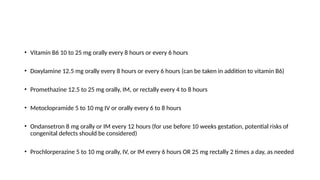
• Vitamin B610 to 25 mg orally every 8 hours or every 6 hours
• Doxylamine 12.5 mg orally every 8 hours or every 6 hours (can be taken in addition to vitamin B6)
• Promethazine 12.5 to 25 mg orally, IM, or rectally every 4 to 8 hours
• Metoclopramide 5 to 10 mg IV or orally every 6 to 8 hours
• Ondansetron 8 mg orally or IM every 12 hours (for use before 10 weeks gestation, potential risks of
congenital defects should be considered)
• Prochlorperazine 5 to 10 mg orally, IV, or IM every 6 hours OR 25 mg rectally 2 times a day, as needed
10.
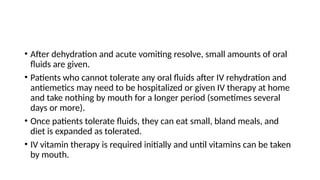
• After dehydrationand acute vomiting resolve, small amounts of oral
fluids are given.
• Patients who cannot tolerate any oral fluids after IV rehydration and
antiemetics may need to be hospitalized or given IV therapy at home
and take nothing by mouth for a longer period (sometimes several
days or more).
• Once patients tolerate fluids, they can eat small, bland meals, and
diet is expanded as tolerated.
• IV vitamin therapy is required initially and until vitamins can be taken
by mouth.
11.
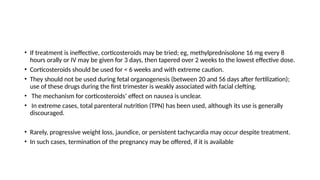
• If treatmentis ineffective, corticosteroids may be tried; eg, methylprednisolone 16 mg every 8
hours orally or IV may be given for 3 days, then tapered over 2 weeks to the lowest effective dose.
• Corticosteroids should be used for < 6 weeks and with extreme caution.
• They should not be used during fetal organogenesis (between 20 and 56 days after fertilization);
use of these drugs during the first trimester is weakly associated with facial clefting.
• The mechanism for corticosteroids’ effect on nausea is unclear.
• In extreme cases, total parenteral nutrition (TPN) has been used, although its use is generally
discouraged.
• Rarely, progressive weight loss, jaundice, or persistent tachycardia may occur despite treatment.
• In such cases, termination of the pregnancy may be offered, if it is available