January 26th, 2022
Hypercalcaemia
Ghanim Bajo
Halder Jamal
Aims
• Calcium homeostasis
• De
fi
nition of Hypercalcaemia
• Aetiology
• Clinical features
• Diagnosis
• Treatment
Physiology Calcium is required for:
• Bone mineralization.
• Stabilize the resting membrane potential.
• Coagulation cascade.
• As a cofactor for many enzymes.
• Exocytosis.
• Muscle contraction.
• Neural transmission.
• As a second messenger for intracellular signaling.
• Fertilization, Di
ff
erentiation, Cell division, Apoptosis……
The signals are:
• a decreased Ca+2,
an increased PO4-3, or
a reduced Vit. D level
Homeostasis
Hypercalcaemia
• Normal serum calcium 8.8 – 10.4 mg/dL.
• Hypercalcemia is an elevated serum calcium level of any etiology.
• It is a common disorder a
ff
ecting ∼1 in 1000.
• Mild: 10.5 – 12 mg/dL
• Moderate: 12 – 14 mg/dL
• Severe = Hypercalcemic crisis: > 14 mg/dL
Aetiology
• Primary hyperparathyroidism
• Malignancy
• Drugs (Thiazide diuretics, Lithium, Vitamin A & D)
• Familial benign (hypocalciuric) hypercalcaemia (FHH)
• Thyrotoxicosis
• Hypoadrenalism
• Phaeochromocytoma
• Acromegaly
• Granulomatous disease (Sarcoidosis, TB)
• Tertiary hyperparathyroidism
Clinical features
• Asymptomatic (found during routing testing)
• Muscle weakness, tiredness and fatigue.
• Anorexia and nausea.
• Thirst and polyuria.
• Hypertension & Headaches.
• Bony pain & fractures.
• Renal stones & Nephrocalcinosis.
• Abdominal pain from constipation, peptic ulceration or, rarely, acute pancreatitis.
• Palpitations through cardiac arrhythmias.
• Corneal calci
fi
cation.
• Confusion and mood disturbance. Convulsions and coma if severe.
Vague
Bones
Stones
Thrones
Groans
Moans
Diagnosis
• History (of drugs, malignancy)
• Serum Calcium & Phosphate
• 24-h urinary Ca+2
• Serum PTH
• Renal imaging (calci
fi
cations, stones & CKD)
• DEXA scan (bone mineralization)
• Bone X-Ray (characteristic features)
• Neck U/S, sestamibi parathyroid scan, CT or MRI of parathyroids
(adenoma or hyperplasia).
• Serum ACE & chest X-Ray (Sarcoidosis)
• Serum 25 hydroxycalciferol (Vitamin D toxicity)
• Nephrocalcinosis in untreated
hyperparathyroidism
• Adenoma of the lower right parathyroid
gland (arrow) by sestamibi parathyroid
scan.
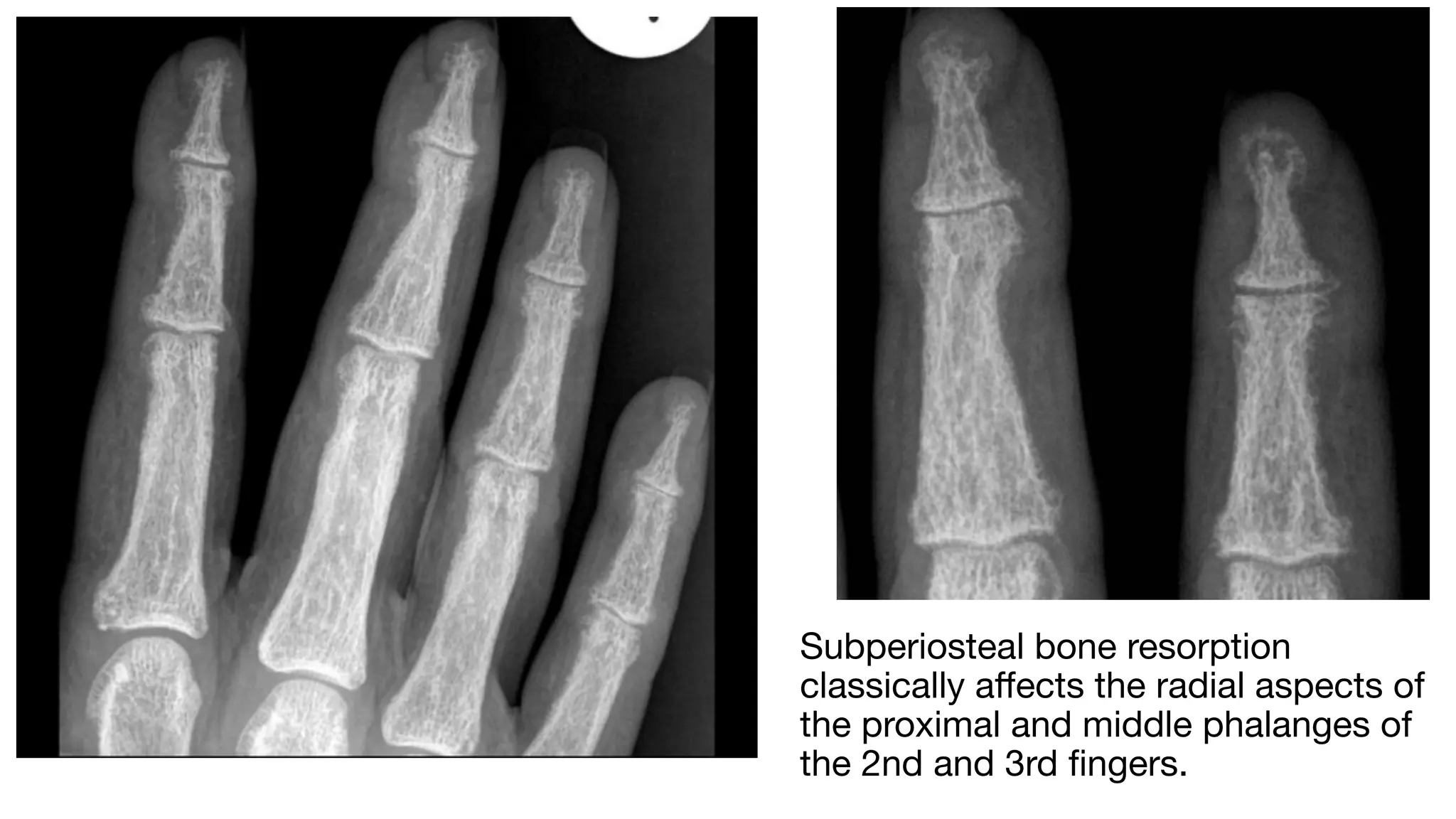
Subperiosteal bone resorption
classically a
ff
ects the radial aspects of
the proximal and middle phalanges of
the 2nd and 3rd
fi
ngers.
Suspicion of malignancy?
• Hypercalcaemia is a late manifestation of cancer, that’s either due to PTHrP or
bony metastasis or erosions, so most patients are already diagnosed with cancer
by the time they have developed Hypercalcaemia, we need to think of underlying
malignancy in cases of hypercalcemia of unknown cause.
• PTHrP (rarely assayed)
• Chest X-Ray (lung cancer)
• DRE & Serum PSA (prostate cancer)
• Mammogram (breast cancer)
• Thyroid ultrasound (thyroid cancer)
• Bone scintigraphy (Bone scan for metastatic cancer)
• CT & PET scans
• Serum electrophoresis and urinary Bence‐Jones proteins (multiple myeloma)
Treatment
Hypercalcemic crisis & symptomatic moderates hypercalcemia:
• Intravenous rehydration.
• Bisphosphonate (pamidronate or zoledronate).
• Steroids if vitamin D toxicity or haematological malignancy.
• Calcitonin & dietary calcium restriction.
• Loop diuretics may be of limited value.
• Desunomab, a human monoclonal antibody, which inhibits RANKL and
prevents osteoclast development.
Stable Hypercalcaemia:
• Treatment of the underlying cause.
• In primary hyperparathyroidism, indications for parathyroidectomy are:
• Symptomatic patients.
• Renal involvement (nephrocalcinosis, stones, elevated urinary calcium,
reduced eGFR to less than 60),
• Bone involvement (pain, fracture, osteopenia, osteoporosis).
• Age < 50 years irrespective of symptoms if otherwise
fi
t.
• More severe hypercalcaemia (> 11.4mg/dL) with clearly elevated PTH
(likely to be larger adenoma).
if no indications for surgery, treat the patients conservatively:
• Correction of vitamin D de
fi
ciency (which exacerbates bone disease).
• Cinacalcet, which activates the CaSR and so reduce PTH secretion.
• Bisphosphonate therapy to improve bone mineral density.
• Desunomab prevents bone resorption.
Resources
1. Essential Endocrinology and Diabetes, 7th edition.
2. Davidson's Principles and Practice of Medicine, 23rd edition.
3. Medscape, https://emedicine.medscape.com/article/240681-overview.
4. Guyton and Hall Textbook of Medical Physiology, 13th edition.
Hypercalcemia.pdf

Hypercalcemia.pdf

  • 1.
  • 2.
    Aims • Calcium homeostasis •De fi nition of Hypercalcaemia • Aetiology • Clinical features • Diagnosis • Treatment
  • 3.
    Physiology Calcium isrequired for: • Bone mineralization. • Stabilize the resting membrane potential. • Coagulation cascade. • As a cofactor for many enzymes. • Exocytosis. • Muscle contraction. • Neural transmission. • As a second messenger for intracellular signaling. • Fertilization, Di ff erentiation, Cell division, Apoptosis……
  • 4.
    The signals are: •a decreased Ca+2, an increased PO4-3, or a reduced Vit. D level Homeostasis
  • 6.
    Hypercalcaemia • Normal serumcalcium 8.8 – 10.4 mg/dL. • Hypercalcemia is an elevated serum calcium level of any etiology. • It is a common disorder a ff ecting ∼1 in 1000. • Mild: 10.5 – 12 mg/dL • Moderate: 12 – 14 mg/dL • Severe = Hypercalcemic crisis: > 14 mg/dL
  • 7.
    Aetiology • Primary hyperparathyroidism •Malignancy • Drugs (Thiazide diuretics, Lithium, Vitamin A & D) • Familial benign (hypocalciuric) hypercalcaemia (FHH) • Thyrotoxicosis • Hypoadrenalism • Phaeochromocytoma • Acromegaly • Granulomatous disease (Sarcoidosis, TB) • Tertiary hyperparathyroidism
  • 8.
    Clinical features • Asymptomatic(found during routing testing) • Muscle weakness, tiredness and fatigue. • Anorexia and nausea. • Thirst and polyuria. • Hypertension & Headaches. • Bony pain & fractures. • Renal stones & Nephrocalcinosis. • Abdominal pain from constipation, peptic ulceration or, rarely, acute pancreatitis. • Palpitations through cardiac arrhythmias. • Corneal calci fi cation. • Confusion and mood disturbance. Convulsions and coma if severe. Vague Bones Stones Thrones Groans Moans
  • 9.
    Diagnosis • History (ofdrugs, malignancy) • Serum Calcium & Phosphate • 24-h urinary Ca+2 • Serum PTH • Renal imaging (calci fi cations, stones & CKD) • DEXA scan (bone mineralization) • Bone X-Ray (characteristic features) • Neck U/S, sestamibi parathyroid scan, CT or MRI of parathyroids (adenoma or hyperplasia). • Serum ACE & chest X-Ray (Sarcoidosis) • Serum 25 hydroxycalciferol (Vitamin D toxicity)
  • 10.
    • Nephrocalcinosis inuntreated hyperparathyroidism • Adenoma of the lower right parathyroid gland (arrow) by sestamibi parathyroid scan.
  • 11.
    Subperiosteal bone resorption classicallya ff ects the radial aspects of the proximal and middle phalanges of the 2nd and 3rd fi ngers.
  • 12.
    Suspicion of malignancy? •Hypercalcaemia is a late manifestation of cancer, that’s either due to PTHrP or bony metastasis or erosions, so most patients are already diagnosed with cancer by the time they have developed Hypercalcaemia, we need to think of underlying malignancy in cases of hypercalcemia of unknown cause. • PTHrP (rarely assayed) • Chest X-Ray (lung cancer) • DRE & Serum PSA (prostate cancer) • Mammogram (breast cancer) • Thyroid ultrasound (thyroid cancer) • Bone scintigraphy (Bone scan for metastatic cancer) • CT & PET scans • Serum electrophoresis and urinary Bence‐Jones proteins (multiple myeloma)
  • 13.
    Treatment Hypercalcemic crisis &symptomatic moderates hypercalcemia: • Intravenous rehydration. • Bisphosphonate (pamidronate or zoledronate). • Steroids if vitamin D toxicity or haematological malignancy. • Calcitonin & dietary calcium restriction. • Loop diuretics may be of limited value. • Desunomab, a human monoclonal antibody, which inhibits RANKL and prevents osteoclast development.
  • 14.
    Stable Hypercalcaemia: • Treatmentof the underlying cause. • In primary hyperparathyroidism, indications for parathyroidectomy are: • Symptomatic patients. • Renal involvement (nephrocalcinosis, stones, elevated urinary calcium, reduced eGFR to less than 60), • Bone involvement (pain, fracture, osteopenia, osteoporosis). • Age < 50 years irrespective of symptoms if otherwise fi t. • More severe hypercalcaemia (> 11.4mg/dL) with clearly elevated PTH (likely to be larger adenoma).
  • 15.
    if no indicationsfor surgery, treat the patients conservatively: • Correction of vitamin D de fi ciency (which exacerbates bone disease). • Cinacalcet, which activates the CaSR and so reduce PTH secretion. • Bisphosphonate therapy to improve bone mineral density. • Desunomab prevents bone resorption.
  • 16.
    Resources 1. Essential Endocrinologyand Diabetes, 7th edition. 2. Davidson's Principles and Practice of Medicine, 23rd edition. 3. Medscape, https://emedicine.medscape.com/article/240681-overview. 4. Guyton and Hall Textbook of Medical Physiology, 13th edition.