FORM AND CONSTRUCTION WITH HYPERBOLIC PARABOLOIDAL SHELLS
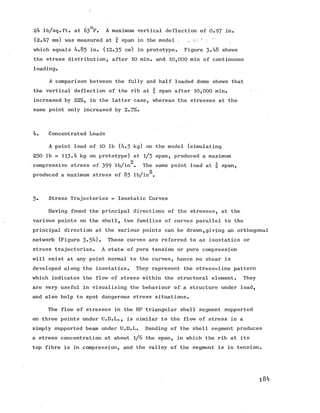
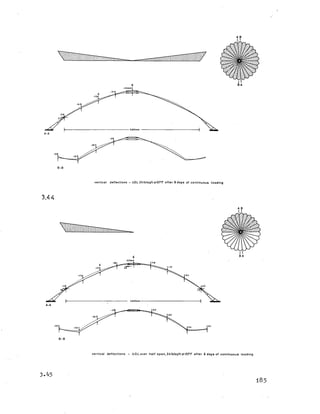
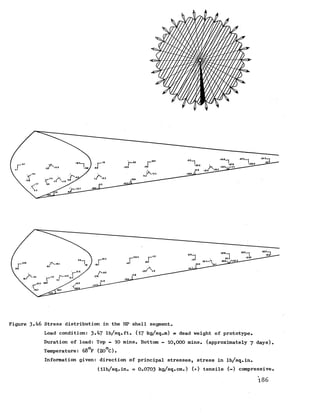
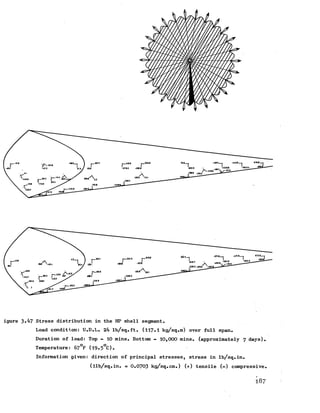
IN PLASTICS
A thesis submitted for the Degree of MASTER OF PHILOSOPHY
in the Department of Civil Engineering
UNIVERSITY OF SURREY
by
JOHN ZERNING (B.Sc.)(Industrial Design)
June 1970
ProQuest Number: 10803749
All rights reserved
INFORMATION TO ALL USERS
The quality of this reproduction is dependent upon the quality of the copy submitted.
In the unlikely event that the author did not send a com plete manuscript
and there are missing pages, these will be noted. Also, if material had to be removed,
a note will indicate the deletion.
uest
ProQuest 10803749
Published by ProQuest LLC(2018). Copyright of the Dissertation is held by the Author.
All rights reserved.
This work is protected against unauthorized copying under Title 17, United States Code
Microform Edition © ProQuest LLC.
ProQuest LLC.
789 East Eisenhower Parkway
P.O. Box 1346
Ann Arbor, Ml 48106- 1346
S U M M A R Y
The research described has been undertaken in an attempt to give
an answer to questions often asked: Can glass fibre reinforced
plastics be used as a structural material? Can a structure in GRP
compete with conventional materials?
The relatively high cost of moulds needed for plastic structures
prevents many projects from ever leaving the drawing board. In
order to overcome this drawback a special "cocooning" technique was
developed which provides low cost moulds for highly warped anticlastic
surfaces. Moulds were produced by this process for the manufacture
of the GRP elements used in the experimental work. It is due to the
successful development of the process in the course of the research
that the investigation was able to deal with an extensive number of
configurations.
The research work is presented in three main parts:
(a) An outline of the material characteristics, with particular
reference to polyester resin reinforced with chopped strand mat.
.(b) An extensive study of the morphology of hyperbolic paraboloid
surfaces, illustrated with the aid of numerous models and drawings.
(c) An experimental method of analysis for a scalloped dome, made
as a single skin GRP laminate.
In order to study in more detail the behaviour of hyperbolic
paraboloid shells in GRP a large model was constructed. The model
had a clear span of 4 metres (13-123 ft.) and consisted of 26
hyperbolic paraboloid segments having an average shell thickness of
3 millimetres (0.1l8 in.). Gravity loads were hung from 1,352 points
to simulate various types of live loading. Strain measurements were
taken by means of electric resistance strain gauges.
The tests on the scalloped dome demonstrated its great rigidity
against buckling and showed that it is possible to build structures
of this type with an average thickness of shell to span ratio of
1:1,500.
2
A C K N O W L E D G E M E N T S
I am particularly indebted to Professor Z.S. Makowski for
his great enthusiasm towards this work which was carried out under
his direction and supervision.
Sincere thanks are extended to the technical staff of the
Civil Engineering Department, and in particular to Mr. M. Robertson
and Mr. C. Tidy for their help in building the various models.
Gratitude is also due to the technical staff of the Visual
Aids Department for their pains in producing photographs under
difficult conditions.
I am greatly indebted to a number of colleagues and
friends for their suggestions and help with this thesis, and in
particular to Professor E. Spira, Professor V.J. Meyers,
Mr. J. Butterworth and Mr. R.M. Davies.
Finally I would like to thank Shell International Chemical
Company Limited for financing this research project and for
awarding me a research scholarship which enabled this investigation
to be carried out.
•3
CONTENTS
List of Figures, 8
Foreward, 12
PART ONE Glass Fibre Reinforced Plastics as a Structural Material,
Introduction, 15
1.1 Materials and Moulding Methods, 17
Reinforcement, 17
Chopped Strand Mat, 18
Rovings, 18
Woven Cloth, 18
Resins, 20
Polyesters, 20
Fillers and Pigments, 20
Moulding Methods, 21
Contact Moulding, 21
Hand Lay Up, 21
Spray Up Moulding, 22
1.2 Engineering Properties of Laminates, 23
Directional Properties, 23
Shop Practice, 23
Environment, 24
Long Term Loading - Creep, 25
Factor of Safety, 25
Behaviour of Laminates, 26
Stress-Strain Relationships, 27
Final Remarks, 27
References on Glass Fibre Reinforced Plastics, 30
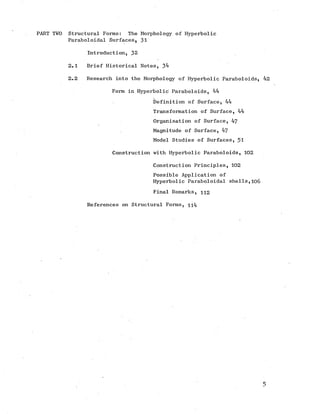
PART TWO Structural Forms: The Morphology of Hyperbolic
Paraboloidal Surfaces, 31
Introduction, 32
2.1 Brief Historical Notes, 34
2.2 Research into the Morphology of Hyperbolic Paraboloids, 42
Form in Hyperbolic Paraboloids, 44
Definition of Surface, 44
Transformation of Surface, 44
Organisation of Surface, 47
Magnitude of Surface, 47
Model Studies of Surfaces, 51
Construction with Hyperbolic Paraboloids, 102
Construction Principles, 102
Possible Application of
Hyperbolic Paraboloidal shells,106
Final Remarks, 112
References on Structural Forms, n 4
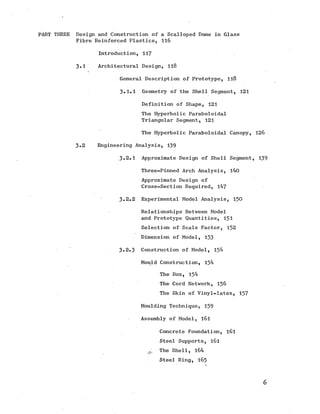
PART THREE Design and Construction of a Scalloped Dome in Glass
Fibre Reinforced Plastics, 116
Introduction, 117
3-1 Architectural Design, 118
General Description of Prototype, 118
3.1.1 Geometry of the Shell Segment, 121
Definition of Shape, 121
The Hyperbolic Paraboloidal
Triangular Segment, 121
The Hyperbolic Paraboloidal Canopy, 126
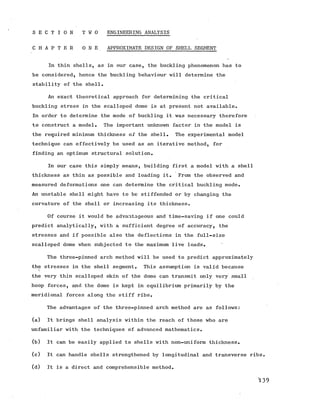
3.2 Engineering Analysis, 139
3.2.1 Approximate Design of Shell Segment, 139
Three-Pinned Arch Analysis, 140
Approximate Design of
Cross-Section Required, 147
3*2.2 Experimental Model Analysis, 150
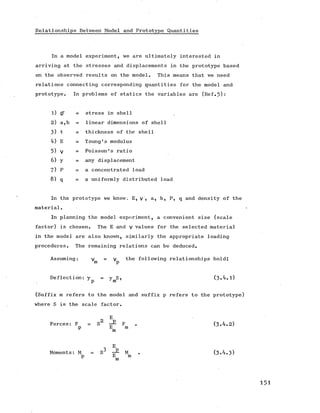
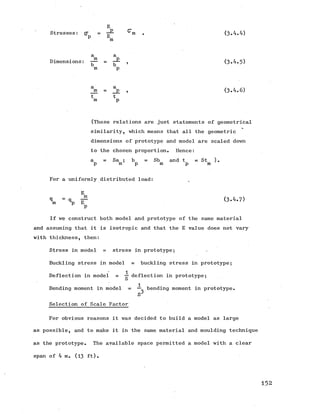
Relationships Between Model
and Prototype Quantities, 151
Selection of Scale Factor, 152
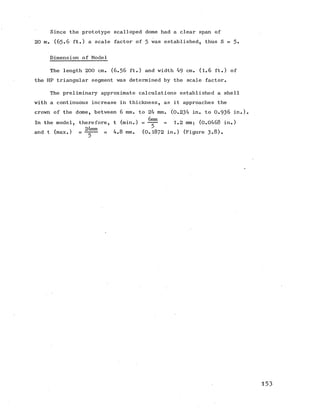
Dimension of Model, 153
3.2.3 Construction of Model, 154
Mould Construction, 154
The Box, 154
The Cord Network, 156
The Skin of Vinyl-latex, 157
Moulding Technique, 159
Assembly of Model, l6l
Concrete Foundation, l6 l
Steel Supports, l6 l
0. The Shell, 164
Steel Ring, 165
6
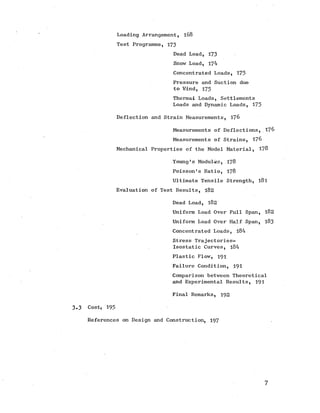
Loading Arrangement, l68
Test Programme, 173
Dead Load, 173
Snow Load, 174
Concentrated Loads, 175
Pressure and Suction due
to Wind, 175
Thermal Loads, Settlements
Loads and Dynamic Loads, 175
Deflection and Strain Measurements, 176
Measurements of Deflections, 176
Measurements of Strains, 176
Mechanical Properties of the Model Material, 178
Young’s Modulus, 178
Poisson's Ratio, 178
Ultimate Tensile Strength, l8 l
Evaluation of Test Results, 182
Dead Load, 182
Uniform Load Over Full Span, 182
Uniform Load Over Half Span, 183
Concentrated Loads, 184
Stress Trajectories-
Isostatic Curves, l84
Plastic Flow, 191
Failure Condition, 191
Comparison between Theoretical
and Experimental Results, 191
Final Remarks, 192
3.3 Cost, 195
References on Design and Construction, 197
7
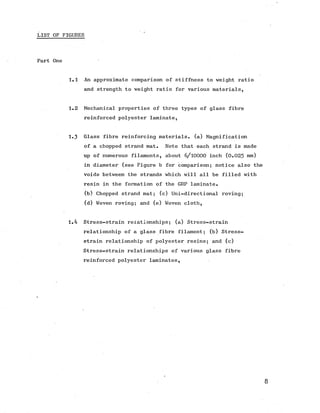
LIST OF FIGURES
Part One
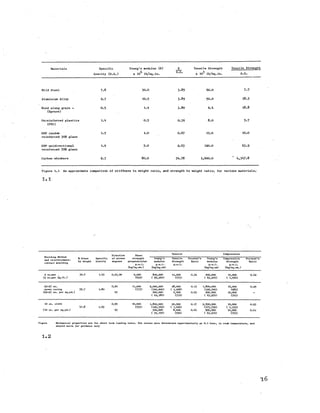
1.1 An approximate comparison of stiffness to weight ratio
and strength to weight ratio for various materials,
1.2 Mechanical properties of three types of glass fibre
reinforced polyester laminate,
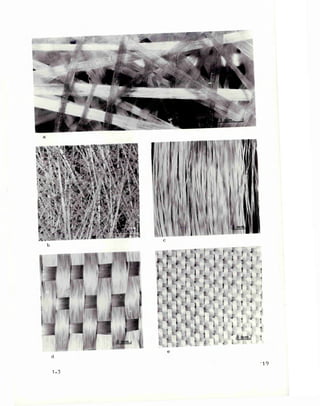
1.3 Glass fibre reinforcing materials, (a) Magnification
of a chopped strand mat. Note that each strand is made
up of numerous filaments, about 6/10000 inch (0 .0 2 5 nun)
in diameter (see Figure b for comparison; notice also the
voids between the strands which will all be filled with
resin in the formation of the GRP laminate.
(b) Chopped strand mat; (c) Uni-directional roving;
(d) Woven roving; and (e) Woven cloth,
1.4 Stress-strain relationships; (a) Stress-strain
relationship of a glass fibre filament; (b) Stress-
strain relationship of polyester resins; and (c)
Stress-strain relationships of various glass fibre
reinforced polyester laminates,
8
Part Two
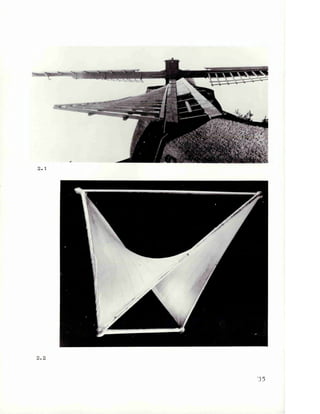
2.1 Framework of a windmill sail; an early application
of a "hyperbolic paraboloidal" construction,
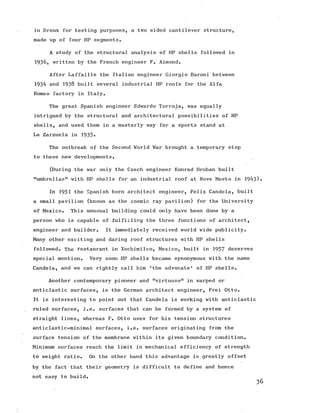
2.2 A hyperbolic paraboloid (HP) stressed skin space frame,
2.3 Part of a double layer diagonal barrel vault formed
from four HP units,
I
2.4 A flat doublelayer grid fromed from twenty HP units,
2.5 An element of a spherical doublelayer grid formed
U
from fcjfr HP units,
2.6 An umbrella formed from eight HP units,
2.7 Geometry of a HP surface,
2.8-2.11 Transformations of HP surfaces,
2.12-2.15 Organisation of HP surfaces,
2.16-2.19 The macro, infra and micro modular units with reference
to a particular complex geometrical configuration,
2.20-2.43 Structural systems using HP surfaces,
2.44-2.68 HP segments with various perimeters,
2.69-2.80 Construction principles for HP surfaces,
2.81-2.91 Structural forms with HP segments,
9
Part Three
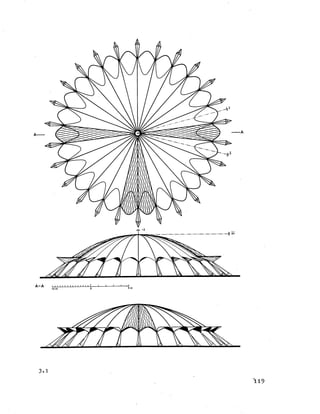
3*1 Scalloped dome, plan, elevation and section,
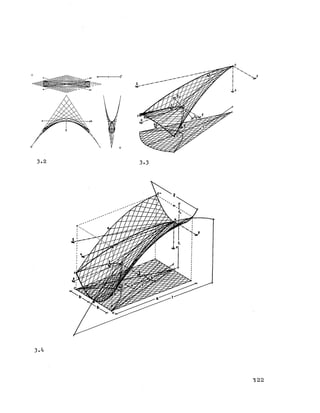
3.2-3-4 Geometry of a meridional HP shell segment,
3-5 Transformation of co-ordinates,
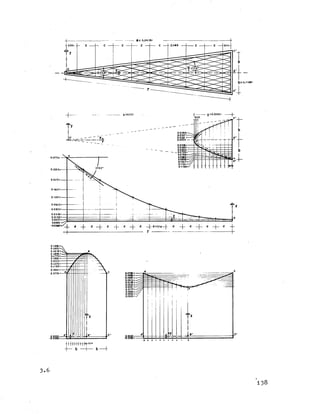
3-6 Contour lines for the triangular HP segment,
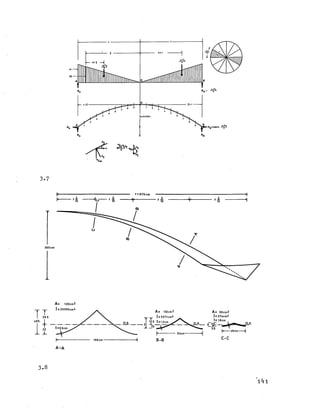
3»7 Free-body diagram of a meridional rib,
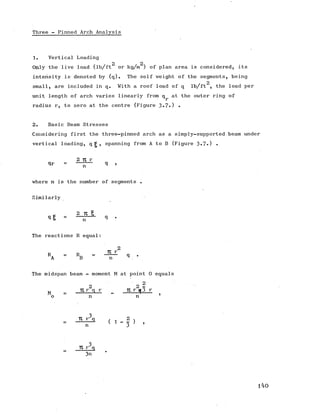
3*8 Three sections of a meridional HP shell,
3-9 Table for calculating the approximate stress in a
meridional rib,
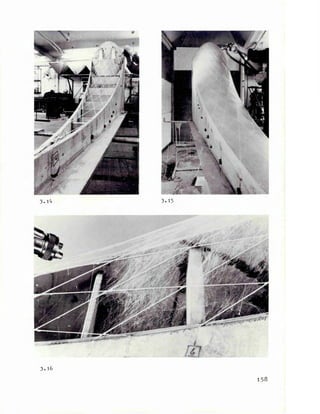
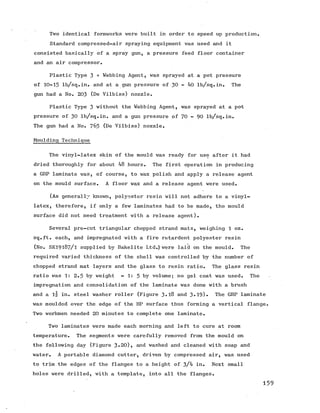
3.10-3.16 Mould construction: The timber framework; the
cord network and the spraying of the vinyl-latex,
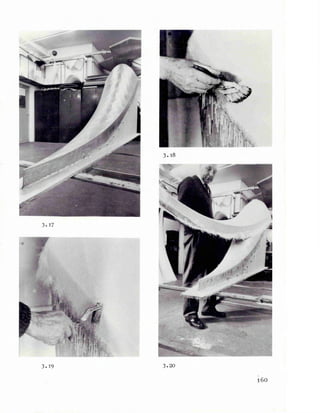
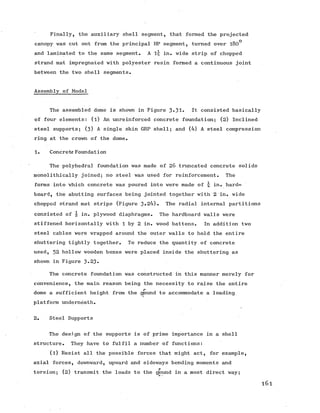
3.17-3*20 Moulding technique - hand lay up,
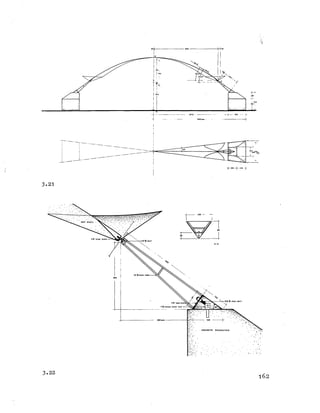
3.21/3.22 Section and detail through assembled model,
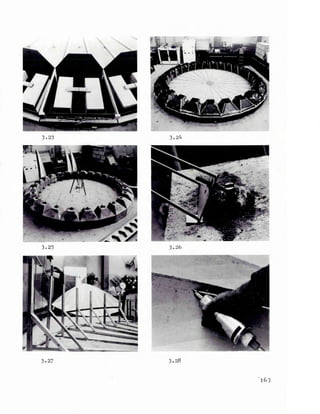
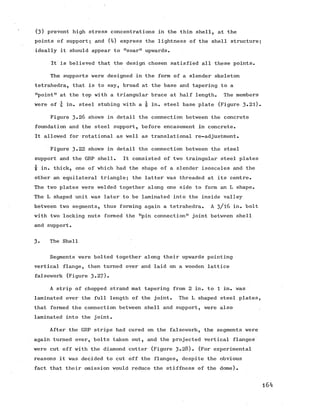
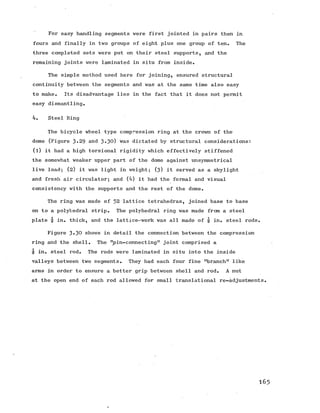
3.23-3.28 Assembly of model,
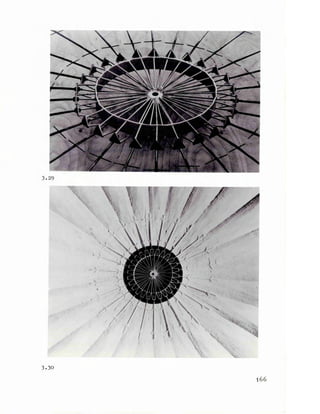
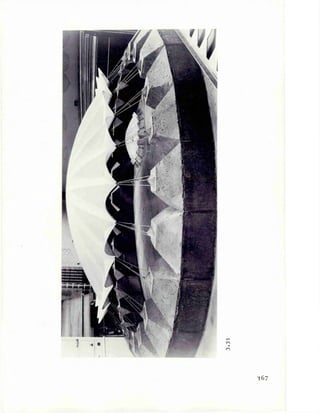
3.29/3.30 Steel ring at crown of dome,
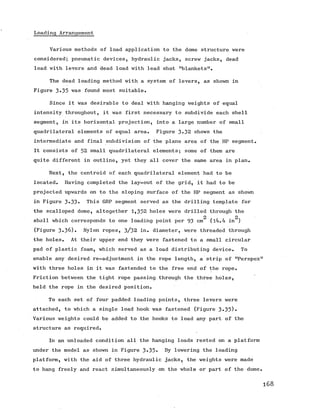
3.31 General view of model,
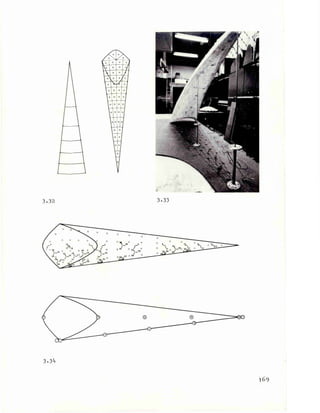
3.32/3.33 Subdivision of the HP segment into 52 quadrilateral
elements,
3.34 Position of electrical resistance strain gauges and
dial gauges on the HP shell segment,
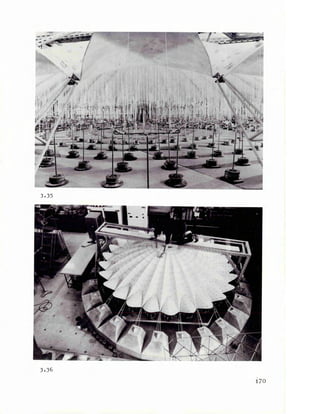
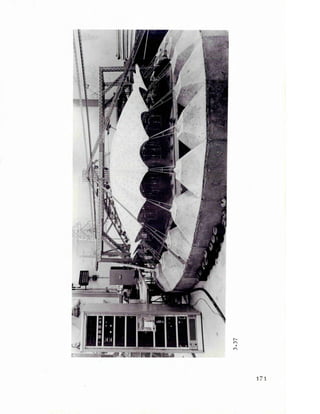
3.33/3.36 Interior and exterior view of model showing the
loading arrangement,
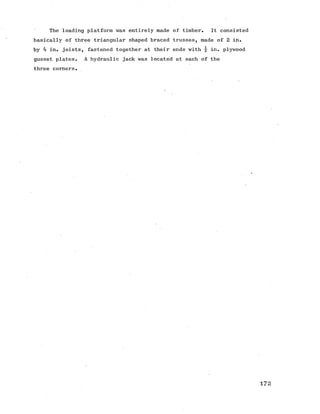
3.37 General view of model with the strain measuring equipment,
10
3-38 Apparent Young's modulus for the model material
expressed as a function of time,
<e
3-39 Computer output for the electrical resistance
strain gauge rosettes,
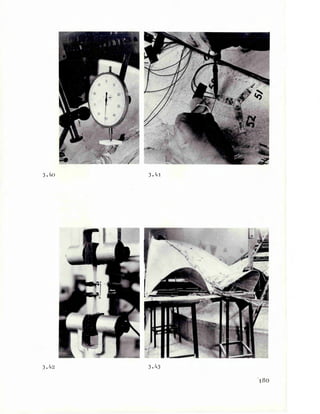
3-40 Dial gauge for measuring vertical deflections,
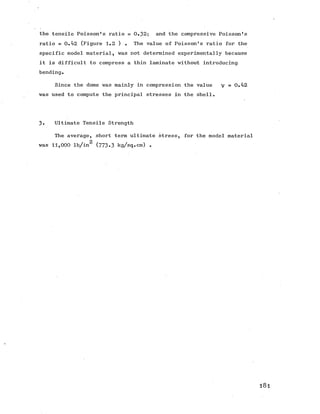
3.41 Wiring of an electrical resistance strain gauge
rosette,
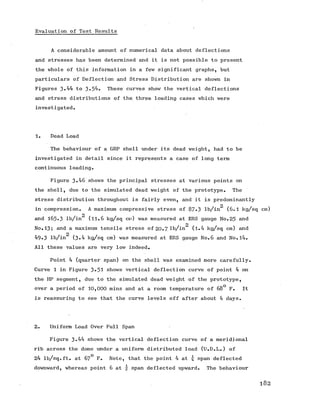
3*42 Strain gauge extensometer clamped to the specimen,
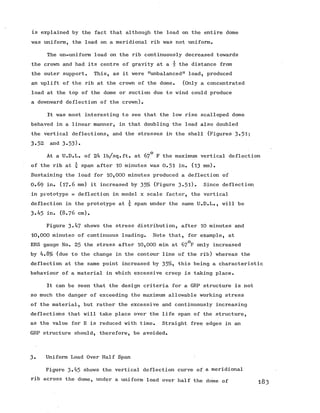
3-43 Model on to which the "dummy” electrical resistance
strain gauges were fixed,
3-44/3.43 Vertical deflections through a meridional rib under
symmetrical and unsymmetrical loading,
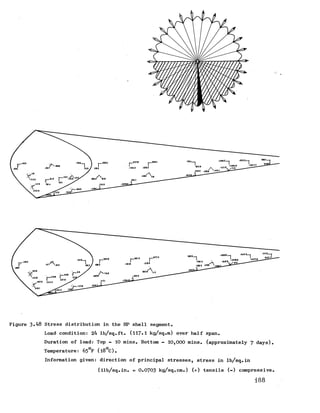
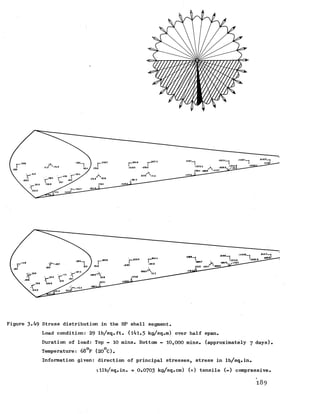
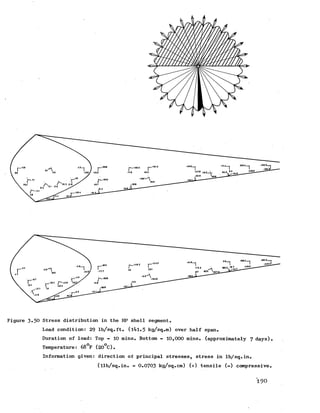
3.46-3*50 Magnitude and direction of principal stresses in
a HP segment under different loadings,
3.51 Curves of deflection versus time at constant stress
under different loadings,
3.52 Curves of strain versus time at constant stress
under different loadings,
3.53 Curves of stress versus time at constant stress
under different loadings,
3.54 Stress trajectories in a HP segment, with
scalloped dome uniformly loaded,
F O R E W O R D
In this thesis an attempt is made to cover simultaneously
three problems: structural form, construction technique and
experimental model analysis.
There can be no doubt that the amalgamation of these three
disciplines (usually attributed to three quite separate professions,
architecture, building and engineering produces a most fruitful
starting point for exploring the rich potentialities of plastics.
The material science of plastics and the science of structural
analysis are generally treated as highly mathematical subjects.
The point of view taken here is that much useful work can be
performed by experiment, intuition and engineering common sense.
It is hoped that the many models and experiments produced in
course of this research and described in the following pages will
not only be a rich stimulus and help to architects, engineers and
builders in formulating new structural ideas but will also indicate
directions for further research.
The thesis deals with the structural application of glass
reinforced polyester resins which are otherwise known as 'GRP*.
In order to clarify the whole concept of their use it is
necessary to mention the kind of applications that there are
altogether.
Four basic alternatives exist in the adoption of a building
material, whether non-metallic or metallic:
(1) As a prime structural element. This case is one where the
building material is put to "work” 100%; and the principal stresses
are carried by the material. In referring to a structural or load-
bearing application of GRP consideration will be given to the
situation where the principal load carrying element and the cladding
element become one.
(2) As a secondary structural element. Here the building material
has merely a cladding function, and forms a "skin” over a reticulated
construction. The loads are carried by the reticulated structure,
which is usually made of another material, and the cladding has only
to perform a secondary load-carrying function.
(3) As a contributing structural element. Here the building
material is used as an aid for forming another material, for example,
using timber or plastics as a formwork for a concrete shell.
(4) As a composite integral structural element, that is to say,
combining materials of different characteristics into one structural
member. For example, GRP is in itself a composite material made of
resin and glass fibres, hence a sandwich construction of GRP skins and
a plastic foam core can be looked upon as a compound composite
integral structural element.
At present the most common application of GRP is as a secondary
structural element. However, the unique characteristics of GRP, see
Figure 1.1 are not fully exploited in this application.
For reasons of structural economy GRP represents the most
practical plastics material for prime structural elements. This
conclusion is by no means new and for the last l4 years a number of
progressive engineers and architects all over the world have
experimented in this direction.
Research in the structural application of plastics is still in
its infancy and so understandably it is subject to a considerable
amount of controversy.
In this thesis a personal and intuitive interpretation is given to
the whole problem of structural’application of GRP. Time, with its
constant challenge for practical and useful solutions, will show
whether the approach taken here is capable of continued growth and
development and whether it has an objective character.
13
PART ONE GLASS FIBRE REINFORCED PLASTICS AS A STRUCTURAL MATERIAL
- their properties
Introduction
"It is precisely in the balance of
one factor against another that the
material engineer finds his challenge
and his satisfaction".
This quotation by Cyril Stanley Smith expresses the real
nature of the problem so often faced that there is no "ideal"
building material.
Glass fibre reinforced plastics, as its name implies, is a
composite material. The principle behind a composite material is
this: two different materials, one for example superior in tension and
the other superior in compression are joined to function together,
forming an integral new material which has the advantages of both.
Probably one of the oldest man-made composite materials in
building is a strawbrick, used by the Egyptians well over 4,000 years
ago. The most up-to-date composite product is a boron fibre laminate.
Other common composite materials that can be used structurally are,
papier-mache, plaster of paris reinforced with flax or asbestos fibres,
Ferro-cemento, and, of course, reinforced concrete. The family of
composite materials is large and increases every year. From the results
already achieved it is not difficult to predict that the real
"breakthrough" in the science of strong materials can only be made by
developing composite materials.
A very versatile and relatively inexpensive composite material
is glass fibre reinforced plastics. It consists of glass fibres
embeded in a matrix, which is usually a thermosetting resin.
Before going into detail about its use it is interesting to
compare the mechanical properties of GRP with other materials.
Figure 1.1 gives an approximate comparison of strength to weight ratio,
viz. tensile strength/specific gravity and stiffness to weight ratio,
viz. Young's modulus/specific gravity of various materials. This
shows that GRP is a good deal stronger than steel for its weight
but it is not nearly as stiff as wood. 15
Materials Specific Young's modulus (E) E Tensile Strength Tensile Strength
Gravity (S.G.) x 10^ lb/sq.in. S.G. x ^3 n,/sq.in. S.G.
Mild Steel 7-8 30.0 3.85 6 0 .0 7.7
Aluminium Alloy 2.7 10.5 3.89 5 0 .0 18.5
Wood along grain -
(Spruce)
0.5 1.9 3 .8 0 9.4 1 8 .8
Unreinforced plastics
(PVC)
1.4 0.5 0 .3 6 8.0 5.7
GRP random
reinforced 30% glass
1.5 1.0 0 .6 7 1 5 .0 10.0
GRP unidirectional
reinforced 70% glass
1.9 5.0 2 .6 3 120.0 6 3 .2
Carbon whiskers 2.3 8 0 .0 34.78 1,000.0 4 ,3 4 7 .8
Figure 1.1 An approximate comparison of stiffness to weight ratio, and strength to weight ratio; for various materials.'
1.1
Moulding Method
and reinforcement:
contact moulding
Direction Shear
Tensile Compressive
% Glass
by weight
Specific
Gravity
of stress
degrees
strength
perpendicular
p.s.i.
(kg/sq.cm.)
Young's
modulus
p.s.i.
(kg/sq.cm)
Tensile
Strength
p.s.i.
Poisson's
Ratio
Young%s
modulus
p.s.i.
(kg/sq.cm)
Compressive
Strength
p.s.i.
(kg/sq.cm.)
Poisson's
Ratio
2 02.mat ^
(2 oz.per sq.ft.)
30.7 1.45 0,45,90 9,000
(632)
800,000
( 56,240)
11,000
(773)
0.32 900,000
( 63,270)
15,000
( 1,054)
0.42
25-27 OZ. 0,90 11,000 2,000,000 28,000 0.13 1,800,000 14,000
woven roving 55-7 1.80 (773) (140,600) ( 1,968) (126,540) (984)
(25-27 O Z. per sq.yd.) 45 600,000 5,400 0.45 900,000 10,000
( 42,180) (379) ( 63,270) (703)
cloth 0,90 10,000 1,800,000 20,000 0.17 2,500,000 19,000
47.8 1.63 (703) (126,540) ( 1,406) (175,750) ( 1,335)
per sq.yd.) 45 500,000 8,400 0.44 900,000 10,000
( 35,150) (590) ( 63,270) (703)
Figure Mechanical properties are for short term loading tests. The values were determined experimentally at 0.1 hour, in room temperature, and
should serve for guidance only
1.2
16
C H A P T E R O N E MATERIALS AND MOULDING METHODS
R E I N F O R C E M E N T
In the course of manufacture glass fibres are made in a
continuous process by feeding glass marbles into an electrically
heated platinum crucible with a perforated base through which
the molten glass drips. Fibre filaments are drawn off on to a
revolving drum and then spun. Depending on the speed of draw the
diameter of an individual filament can vary between 0 .0 0 0 2 0 -
0.00100 in. (0.005-0.025 mm.) A freshly-drawn filament can
develop a tensile strength as high as 5 0 0 ,0 0 0 p.s.i.
(35,255 kg/sq.cm.) (This value begins to approach the theoretical
strength of glass). When dealing with a bundle of filaments,
however, this tensile strength cannot be obtained, one of the reasons
being that the mechanical connection between filaments in the
bundle does not permit the material to develop its full strength.
A bundle of about 204 such fine filaments are spun and
comprise one strand (Figure 1.3 .a) and this elemental strand forms
the basis for various types of glass fibre reinforcing materials.
The glass commonly used to make the fibres is known as ME n glass;
it has a low alkali content, high chemical stability and good
moisture resistance. The glass fibre reinforcements used for large
size construction are: (l) Chopped strand mat; (2) Woven cloth;
and (3 ) undirectional roving.
The manufactured product of glass fibre in combination with resin
is commonly referred to as a laminate. Laminates usually contain
20 - 60 per cent by weight of glass. The strength of a laminate
depends primarily on the amount of glass content, since the modulus
of elasticity of nE n glass (10.6 x 10^ p.s.i.) is approximately 20
times higher than that of polyester resin (0 .5 x 10^ p.s.i.).
The moulding process will also affect the strength of a
laminate.
Chopped Strand Mat
A mat consists of chopped strands of glass fibres, 1 to inch
long, randomly deposited to form a layer. The layers of chopped
strands are held loosely together by a high solubility resin
binder (Figure 1.3.a. and 1.3»b.). There are three standard
thicknesses of mats weighing 1, l|- and 2 oz/sq.ft.
The advantages of mat reinforcements are: low cost, equal
physical properties in all directions, good interlaminar bond, and
they can be formed into complex surfaces.
The disadvantages of mat reinforcements are: laminate thickness
cannot be controlled accurately in contact moulding. A mat laminate
has a lower glass content than cloth or roving laminates which
results in a lower modulus of elasticity for equal thickness.
Laminates made with chopped strand mat in hand lay up contact
moulding are most suitable for the large shells suggested in
this thesis.
Rovings
Rovings consist of straight bundles of continuous strands.
Rovings can be used individually by laying them on the mould in the
desired direction as shown in Figure 1.3.c. Rovings are usually
woven into heavy coarse fabrics (Figure 1.3«d.). Woven roving
reinforcement is more expensive than mat reinforcement.
The advantages of woven roving reinforcement are: a high glass
content is possible, it has high directional strength and modulus
of elasticity, and it has an extraordinarily high resistance to
impact.
The disadvantages of woven roving reinforcement are: woven
rovings are difficult to impregnate with resin, can entrap air
bubbles and form voids, they can also cause resin rich areas
between individual rovings which become subject to cracking and
interlaminar failure. The heavy coarse weave becomes difficult to
mould over sharp and strongly curved surfaces.
Woven Cloth
Cloth is woven from strands of glass fibres (Figure 1.3-e.).
A range of weaves is available, including plain weave, satin weave
w $ w ®
d
1.3
'19
and undirectional weave. Cloth is one of the most expensive
type of reinforcement, but where consistency of high performance
and structural efficiency in terms of strength to weight is
required the high cost can be justified.
R E S I N S
The resins commonly used in glass fibre laminates are
thermosetting types, that is to say, once cured they cannot be
remoulded. They include polyesters, epoxies, phenolics and
melamines. Polyesters because of their cost advantage and
versatility are most widely used.
Polyesters
The polyester resins suitable for use for laminates are
referred to as unsaturated rigid polyester resins. This means
that they are capable of being cured from a liquid to a solid
state when subjected to the proper conditions. In their natural'
state they resemble a syrup-like liquid. With the addition of
ak>oi*t Z-'/e b y t y G i y h t o f c a ~ t 11
about 2% by weight of accelerator/, the cross linking or poly­
merisation process can then take place. This curing of the resin
can take place at room temperature without the application of
external heat. During the curing process heat is evolved and some
shrinkage develops.
Fillers and Pigments
Fillers and pigments can be added to the moulding resin in
order to reduce shrinkage, lower material cost, impart colour and
improve the surface finish. Of particular importance are the
additives that produce self-extinguishing resins and resins that have
class 1 and 0 surface flame spread.
(The classification 0 - 4 refers to the extent to which a flame will
travel along the surface of material subjected to radiant heat as
outlined in British Standard 476. Class 0 denotes a superior
resistance to class 4).
M O U L D I N G M E T H O D S
The moulding methods can be grouped into two: contact moulding
and machine moulding. Most of the machine moulding techniques require
two matched moulds, male and female, whereas contact moulding requires
only one open mould, male or female.
There are several methods of producing glass fibre reinforced
laminates by machine processes: 1. Bag moulding; 2. Autoclave
moulding; 3- Flexible plunger moulding; 4. Matched-die moulding;
5. Vacuum injection moulding; 6 . Hot press moulding; 7- Cold press
moulding; 8 . Centrifugal moulding; 9« Filament winding; 10. Continuous
extrusion; and 11. Continuous laminating.
Each one of these methods has distinct advantages and
disadvantages. They will not be discussed here in detail, mainly
because none of them is suitable for the production of large prototype
shell constructions. Furthermore all these processes have been well
documented elsewhere (Ref.2).
The moulding process most widely used in large shell construction
is the contact method.
Contact Moulding
Contact moulding is usually used for relatively short runs, and
it is the one method that takes full advantage of the two unique
characteristics of polyester resin, viz. that it can be cured without
heat and without pressure. The contact moulding method can be
advantageously combined with the cocooning technique developed by the
author (Ref. 3 and 4).
There are two methods of making a contact mould:
1. Hand lay up; and 2. Spray up moulding
1. Hand Lay Up
Resin impregnated fibre glass reinforcement to the required
thickness are laid on an open mould (male or female) as shown in
Figures 3«l8 and 3-19 and allowed to cure at room temperature.
(See also page 159)
2. Spray Up Moulding
The resin impregnated fibre glass reinforcement is sprayed
on to the open mould with a special spray gun, which has a twin
nozzle and a glass roving chopper. The resin is divided into
two parts, one of which is catalysed and the other accelerated.
The two streams of resin spray converge near the surface of the
mould together with the stream of glass fibres ejected by the
glass roving chopper.
Spraying reduces labour costs if a large enough continuous
production is possible. On the other hand great skill and care
is needed to control the thickness of the laminate.
C H A P T E R - . T W O ENGINEERING PROPERTIES OF LAMINATES
Basic engineering properties of reinforced laminates, such as,
specific gravity, strength, moduli, Poisson’s ratio, resistance
to impact, etc., are primarily dependent upon: (l) type of
reinforcement; (2 ) direction of reinforcement; (3 ) type of resin;
(4) method of moulding; (5) shop practice; (6) exposure to
environmental conditions; and (7) long term loading.
Due to these various factors it is not possible to give a
theoretical and general data for the exact properties of laminates.
For design purposes the physical properties have to be determined
experimentally.
Directional Properties
The important characteristics of different types of glass
reinforcement is the variation of their physical properties
with direction. A chopped strand mat reinforcement throughout is
considered as isotropic, that is to say, its physical properties
are essentially the same in all directions. Woven cloth and
roving reinforcements are orthotropic, i.e. their physical properties
are not the same in all directions. Maximum strength is developed in
the warp direction and minimum strength at 45° to it. Figure 1.2
gives the mechanical properties of three types of laminates (Ref.5).
Shop Practice
It is important to realise that GRP is essentially a craftsman
material, which does not produce the best results with hurried and
unskilled labour. The physical and mechanical properties of a
laminate can be considerably reduced by fabrication defects such
as voids, wrinkles, delamination, resin dryness or richness, crazing
and foreign inclusions. An excessively rapid curing process and
appreciable curing shrinkage can also greatly weaken the laminate.
However, with good shop practice that exhibits cleanliness and the
habit of conscientious care during the moulding process most of
these defects can be minimised.
Environment
Glass fibre reinforced plastics can be adversely affected by
unfavourable environmental conditions, like extended periods of
water immersion and exposure to extreme weathering conditions.
Laminates with lower fibre glass content have higher percentage
of strength retention when subjected to extended periods of water
immersion. Tests on mat-polyester laminates immersed in water
for one year have strength retention of approximately 80% for most
of the mechanical properties.
Coating the laminate with a pigmented gel coat (i.e. a resin
rich area on the laminate prevents glass fibres from coming
too near to the surface liable to be attacked) satisfactorily
resists the adverse affects of exposure to normal environmental
conditions.
Exposure to direct sunlight over a period of years will also
reduce the mechanical properties of a laminate. The ultra-violet
rays contained in the sunlight, which are the chief cause of
weather deterioration, can be screened out with a highly reflective
protective coating, incorporated in the gel coat. Up to now,
little reliable data is available on the adverse effect of exposure
to ultra-violet rays on a laminate over a period of many years.
Exposure to temperature change during the cycle of day and
night, will of course affect the dimensions of a laminate.
Plastics are particularly sensitive to thermal changes, and
thermoplastics even more than thermosetting plastics. The linear
coefficient of expansion of a polyester-mat laminate is about
—6
18 x 10 per degree F. (which is about 3 times higher than the
coefficient of expansion of steel). On the other hand, one should
remember that the relatively low modulus of elasticity of GRP -
which even decreases at moderately elevated temperatures - will
prevent the development of high stresses in the laminate due to
thermal change. Nevertheless, the effects of changes in dimensions
due to thermal expansion and contraction can be equivalent to large
loads, which may be particularly dangerous because they are invisible.
The design details of connectors and supports in a GRP structure
therefore demand particular attention.
Long Term Loading - Creep
Creep is a plastic flow or long term deformation associated
with the normally elastic range of the material. Creep in a
fibre glass reinforced laminate, under constant stress depends
on time and temperature, and is mainly due to the viscous flow
of the resin. Creep will therefore reduce the strength properties
of a laminate. Different reinforcements will exhibit different
creep characteristics. For example, cloth laminates have lower
creep characteristics than mat or woven roving laminates. The
creep characteristics impose a severe limitation on the safe long
term design load for a GRP structure.
Due to creep instantaneous test results cannot be expected
to define the behaviour of a GRP laminate. Values of Young's
modulus and ultimate stress used for design must be values at the
time equivalent to the expected duration of load on the structure.
The time dependent Young's modulus is generally referred to as
the apparent modulus, which is equal to: applied stress/observed
strain, as a function of time and temperature.
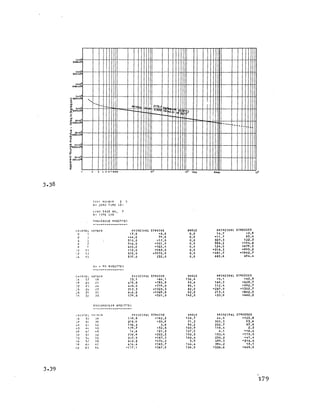
Figure 3-38 shows the apparent Young's modulus in tension for
rro
a polyester-mat laminate as a function of time at 66 F. and at a
stress level of 2,500 p.s.i. The curve was obtained experimentally
by using a strain gauge extensometer clamped to the speciment as
shown in Figure 3-^2.
In the shell roof structures suggested in this thesis, long
term continuous loading can only be caused by the dead weight of the
structure, which in turn produces very low stresses in the laminate.
Live loads such as snow or pressures and suctions due to wind, have
the nature of periodic loadings which are not ‘ cumulative and,
therefore, will not cause an appreciable increase in the stress level
over a long period of time.
Factor of Safety
Factor of safety (F.S.) is defined as the ratio of the ultimate
strength of the material to the allowable working stress.
< For structural materials like steel, concrete, aluminum,
masonry and timber, the allowable working stress is specified by
codes or by recognised sources of information. For GRP no code
is yet established, and the final selection of a factor of safety,
becomes entirely the responsibility of the designer. (it will
always be the designer's responsibility even when there is a code).
Experiments have shown that in general a safe working stress
level for a continuously loaded structure should be approximately
20 to 30% of the short term ultimate stress.
For GRP structures the following factors of safety should be
considered as general guidance:
Static loads of short term duration
F.S. = 2 minimum
Static loads of prolonged duration
F.S. = 4 minimum
Cyclic loads
F.S. = 4 minimum
Repeated loads producing a reversal of stresses and fatigue
F.S. = 6 minimum
Severe impact loads
F.S. = 10 minimum
Behaviour of Laminates
The simplified structural theory, for a GRP laminate, as used
today by the practising engineer, is based on two assumptions.
1. That glass fibre and resin are firmly bound together and act
as an integral body which undergo equal strains under all loading
conditions.
2. The material is considered to be elastic and obey's Hooke's
Law, which states that the stress is directly proportional to the
strain and the relationship is represented by a straight line.
26
Furthermore it is assumed that the material will return to its ,
original shape when the load is removed.
Thus:
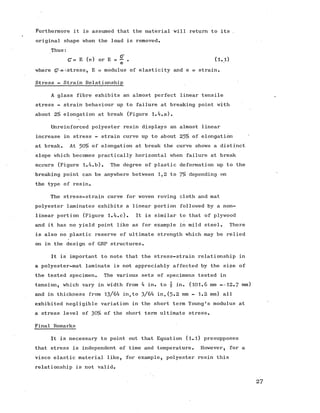
(7 = E (e) or E = - . (l.l)
e
where (7-;='.stress, E = modulus of elasticity and e = strain.
Stress - Strain Relationship
A glass fibre exhibits an almost perfect linear tensile
stress - strain behaviour up to failure at breaking point with
about 2% elongation at break (Figure 1.4.a).
Unreinforced polyester resin displays an almost linear
increase in stress - strain curve up to about 25% of elongation '
at break. At 50% of elongation at break the curve shows a distinct
slope which becomes practically horizontal when failure at break
occurs (Figure 1.4.b). The degree of plastic deformation up to the
breaking point can be anywhere between 1,2 to 7% depending on
the type of resin.
The stress-strain curve for woven roving cloth and mat
polyester laminates exhibits a linear portion followed by a non­
linear portion (Figure 1.4.c). It is similar to that of plywood
and it has no yield point like as for example in mild steel. There
is also no plastic reserve of ultimate strength which may be relied
on in the design of GRP structures.
It is important to note that the stress-strain relationship in
a polyester-mat laminate is not appreciably affected by the size of
the tested specimen. The various sets of specimens tested in
tension, which vary in width from 4 in. to  in. (101.6 mm --12.7 mm)
and in thickness from 13/64 in.to 3/64 in,(5-2 mm - 1.2 mm) all
exhibited negligible variation in the short term Young's modulus at
a stress level of 30% of the short term ultimate stress.
Final Remarks
It is necessary to point out that Equation (l.l) presupposes
that stress is independent of time and temperature. However, for a
visco elastic material like, for example, polyester resin this
relationship is not valid.
27
stress-lb/sq.in(kg/sq.cm)stress-Ib/sq.in(kg/sq.cm)
213,000
(15,000)
3,520
(600]
7,100
(500)
142,000
(10,0 0 0 )
5,680
(400)
£ 4,260
H (300)
cr
in
cn
JSC
'T ' 2,840
.E (200)
cr
(/i
JQ
. 1.420
U) (100)
U)
o
p o ly e s te r r<?sinsass fib 0|i dig.71,000
(5,000)
2 30 4 0 2-00-5 1-51-0
s t r a i n % s t r a i n 0/#
85,200
(6,000)
G R P - r o v i n g
71,000
(5,000)
56,800
(4,000)
GRP- clo th42,600
(3,000)
u G R P - c h o p p e d s t r a n d s
14,200
(1,000)
0 2 3 4
s t r a i n %
1.4
a
On the other hand the incorporation of time and temperature
in the stress-strain relationship will result in a very complex
analytical treatment. For practical design problems this
laborious mathematical treatment is seldom justifiable. In
practice the problem is simply solved by increasing the factor
of "ignorance" viz. factor of safety.
REFERENCES
On Glass Fibre Reinforced Plastics
1. Gordon, J.E., "The New Science of Strong Materials",
Penguin, 1968.
2. Benjamin, B.S., "Structural Design with Plastics",
Van Nostrand Reinhold Company, 1969.
3. Zeraing, John, "Das Kokon - Spritzverfahren und seine
c
Anwendung im Ausstellungsbau", DeutsJhe Bauzeitung, Mai 1964.
4. Zerning, John, "Das Glass - Polyesterharz - Spritzverfahren und
seine Anwendung im Leichtbau", Deutsche Bauzeitung, Oktober 1965-
5. Gibbs & Cox Inc., "Marine Design Manual for Fibreglass
Reinforced Plastics", McGraw - Hill Book Company, i9 60.
6 . Scott Bader & Co. Ltd., "Polyester Handbook", Wollaston,
Wellingborough, Northamptonshire, 1967*
7 . Ogorkiewicz, R.M., (Editor), "Engineering Properties of
Thermoplastics", Wiley - Interscience, 1970.
PART TWO STRUCTURAL FORMS: THE MORPHOLOGY OF HYPERBOLIC
PARABOLOIDAL SURFACES
or how to learn from Nature
31
Introduction
"Each material has its own message to
the creative artist'1.
This quotation by Frank Lloyd Wright expresses concisely the
point that materials are not all suitable for use in the same way.
The problematic structural application of GRP in building can
perhaps be tackled best if attention is concentrated upon light
weight single skin roof structures of moderate size, since in this
application one can make good use of the high strength to weight ratio
of the material and also the ease to which it can be formed into
complex shapes. Furthermore the fire hazard for a roof structure
is minimised.
Which roof shapes are most suitable for GRP?
Essentially GRP is a sheet like material of high strength, but
‘ low stiffness. The material is costly and therefore has to be used
very efficiently.
An ideal application is that of doubly curved shell structures
in which the material is stressed in its own plane and bending stresses
are almost completely eliminated. Doubly curved shells are non-
developable and can be grouped in to two large families: (l) Synclastic
and (2) Anticlastic.
Synclastic surfaces are referred to as having a positive Gaussian
curvature, that is to say, planes passing at right angles to its
surface have downward curvatures. A dome is a typical example of a
synclastic shell.
Anticlastic surfaces are referred to as having a negative Gaussian
curvature. Two planes passing at right angles through the principal
curvature have one downward and one upward curvature. A saddle
surface is a typical example of an anticlastic surface.
An anticlastic shell even in a single skin construction can
effectively counteract buckling to which a material such as GRP wi
low modulus of elasticity is very susceptible. From the large
family of anticlastic surfaces, hyperbolic paraboloids have the
particular advantage that they can be generated by two systems of
straight lines, and hence are easy to build.
C H A P T E R O N E BRIEF HISTORICAL NOTES
Experience gained from hyperbolic paraboloid shell structures
built in reinforced concrete, steel, aluminium and timber can
fruitfully inspire the new field of structural plastics. A brief
general review on the history of hyperbolic paraboloids is, therefore,
of interest.
One of the earliest, large size, applications of "hyperbolic
paraboloidal" surfaces was in the sails of windmills. The large
windmill sails in Europe were wooden frames covered with sail cloth.
First they had flat inclined planes, later they were built with a
twist, like an aeroplane propellor (Figure 2.1). Their size from
tip to tip was over 71 It. (21.64 m). The sail was made of straight
wooden beams, and since it was a warped surface, it is according
to our definition, a hyperbolic paraboloid. This type of
construction could not have been improved in principle and remained
unchanged for many centuries; and it was only replaced by another
source of energy - electricity. In these forms there was perfect
unity between contemporary timber technology and function (i.e. a
body that will produce maximum thrust due to the wind force). Indeed
the warped surface was the "natural" solution to the problem.
Mathematicians found an interest in hyperbolic - paraboloids,
(abbreviated HP), only since the seventeenth century.
It is impossible to say who built the first HP to enclose
space, but the credit is usually given to Antonio Gaudi the Spanish
architect-engineer and builder in stone, who favoured the geometry
of HP surfaces, and used them first in 1909* For the still unfinished
La Sagrada Familia Church in Barcelona, he planned to use HP surfaces
for the vaults and walls of the nave. Gaudi saw in HP surfaces a
symbolic meaning as well as a suitable structural form.
In the search for new and suitable shell structures in
reinforced concrete and in trying to enclose space with a minimum
of material, Bernard Laffaille, a French engineer, was perhaps the first
to understand the structural potentials of HP shells. In 1933 he built
3^
2.1
2.2
'35
in Dreux for testing purposes, a two sided cantilever structure,
made up of four HP segments.
A study of the structural analysis of HP shells followed in
1936, written by the French engineer F. Aimond.
After Laffaille the Italian engineer Giorgio Baroni between
1934 and 1938 built several industrial HP roofs for the Alfa
Romeo factory in Italy.
The great Spanish engineer Edwardo Torroja, was equally
intrigued by the structural and architectural possibilities of HP
shells, and used them in a masterly way for a sports stand at
La Zarzuela in 1935*
The outbreak of the Second World War brought a temporary stop
to these new developments.
(During the war only the Czech engineer Konrad Hruban built
"umbrellas" with HP shells for an industrial roof at Nove Mesto in 1943).
In 1951 the Spanish born architect engineer, Felix Candela, built
a small pavilion (known as the cosmic ray pavilion) for the University
of Mexico. This unusual building could only have been done by a
person who is capable of fulfilling the three functions of architect,
engineer and builder. It immediately received world wide publicity.
Many other exciting and daring roof structures with HP shells
followed. The restaurant in Xochimilco, Mexico, built in 1957 deserves
special mention. Very soon HP shells became synonymous with the name
Candela, and we can rightly call him 'the advocate' of HP shells.
Another contemporary pioneer and "virtuoso” in warped or
anticlastic surfaces, is the German architect engineer, Frei Otto.
It is interesting to point out that Candela is working with anticlastic
ruled surfaces, i.e. surfaces that can be formed by a system of
straight lines, whereas F. Otto uses for his tension structures
anticlastic-minimal surfaces, i.e. surfaces originating from the
surface tension of the membrane within its given boundary condition.
Minimum surfaces reach the limit in mechanical efficiency of strength
to weight ratio. On the other hand this advantage is greatly offset
by the fact that their geometry is difficult to define and hence
not easy to build.
An equally important contributor to the rapid development of HP
structures is the French engineer, Rene Sarger, who worked for many
years with Laffaille. Sarger worked mainly as a consulting engineer
and helped to materialize many ideas with HP surfaces.
HP shells did not remain only the domain of engineers; some of
the most prominent architects, Le Corbusier, Eero Saarinen,
Marcel Breuer, Kenzo Tange, Matthew Nowicki, and R. Rainer
incorporated them in some of their buildings. They have mastered the
rich and plastic tectonic potentials (i.e. the unity between form,
construction and material) and produced a powerful and significant
modern architecture.
Today, if an attempt were made to write an extensive bibliography
on HP surfaces, it would probably fill a few hundred pages.
The ever increasing interest and popularity of HP shells is
largely due to the following reasons: they have pleasing expressive
and dynamic forms, they are relatively easy to build, they are very
efficient in their strength to weight ratio, and the geometry of the
surface can be defined easily. On the other hand because of their
rich plasticity, they exert a powerful influence on the surroundings
and thus are difficult to integrate in the general design scheme.
For a long time reinforced concrete was the only accepted
building material for HP shells. Yet this monopoly position of
reinforced concrete is by no means justified. Other structural
materials like timber, aluminium and steel have also been successfully
used to build HP shells. Reinforced plastics, due to their lightness,
mouldability, freedom from corrosion, durability and variability in
colour and surface texture, form a specially suitable material for
the construction of HP surfaces.
One of the earliest applications of plastics was in the HP
umbrellas used for the American exhibition pavilion in Moscow in 1959*
The whole structure, roof and columns were made in single skin
GRP laminate. The architect was George Nelson and the consulting
engineer Albert Dietz.
A similar single skin HP umbrella system was used in 1961 to
cover the roofs for the markets in Ivres and Fresnes in France. An all
plastic HP vault roof was built in 1968 to cover swimming pools in
Lincoln, England and a similar one in Aberdeen Scotland. They were
both designed by John Vest Design Group Ltd.
Finally these brief historical notes are incomplete without
mentioning the recent developments of the HP stressed skin
space grids.
The principle behind the HP stressed skin space grid is this:
the two high points of the HP surface are interconnected with a
strut, similarly another strut is used to join the two low points
thus forming a tetrahedral unit with a pre-stressed skin inside
as shown in Figure 2.2. Units of this kind can be used to form a new
group of structures: a combination of space-frames and shells.
Generally the space frame is made of steel and the shell is in
aluminium or single-skin GRP. This principle was first applied in
1957 by Buckminster Fuller for an aluminium dome in Honolulu. HP
stressed skin space grids are very suitable for prefabrication and
mass production, can be quickly erected and are possible to
dismantle; they are very light in weight and have a high reserve
of strength. Stressed skin space grids are particularly suitable
for mobile structures. Some of the main disadvantages are in the
complexity of the connector details and in the difficulty to make the
many water-proof joints between the surfaces.
Full size experiments with HP stressed skin space grids in GRP
were performed in U.S.A. (Texas) in I9 6 I by Structural Plastics Ltd.
Their system consisted of HP shells in GRP 4 by 4 ft. (1.22 by
1 .2 2 m) squarein plan, interconnected diagonally at their high and
low points to form a tetrahedral unit. The units were arranged to
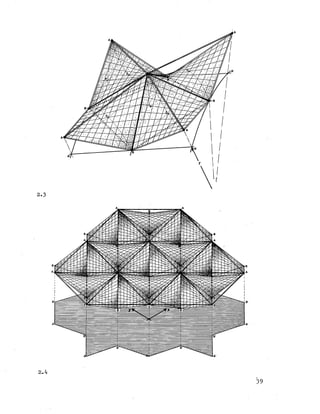
obtain a double layer diagonal barrel vault. Figure 2.3 shows four
such identical units, all the points A7and B touch a cylindrical surface.
A slightly different arrangement based on the same principle has
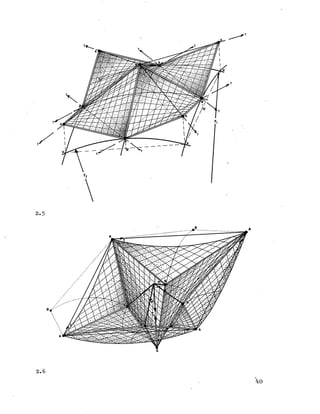
been developed by the French architect M. Chaperot in 1964. In this •
system six HP shells in GRP, and rhomboidal in plan, measuring
diagonally 7 (23 ft.) and 4 m (13 ft.) with a height of 2 m (6 .5 6 ft.),
are joined together along their edges, thus forming a flat double layer
threeway grid at one side and an hexagonal grid at the other side.
38
2.3
2.4
3 9
2.5
2.6
40
An assembly of 20 such HP units is shown in Figure 2.4 all the points
marked B lie on a flat plane. This system was applied by Chaperot
for a market cover in Lezoux and a garage in d'Arcueil France.
In Czechoslovakia the State Building Research Station in
Prague evolved in 1967 an even more sophisticated system. It
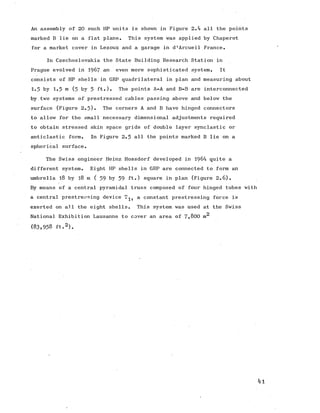
consists of HP shells in GRP quadrilateral in plan and measuring about
1*5 by 1.5 m (5 by 5 ft.). The points A-A and B-B are interconnected
by two systems of prestressed cables passing above and below the
surface (Figure 2.5)- The corners A and B have hinged connectors
to allow for the small necessary dimensional adjustments required
to obtain stressed skin space grids of double layer synclastic or
anticlastic form. In Figure 2.5 all the points marked B lie on a
spherical surface.
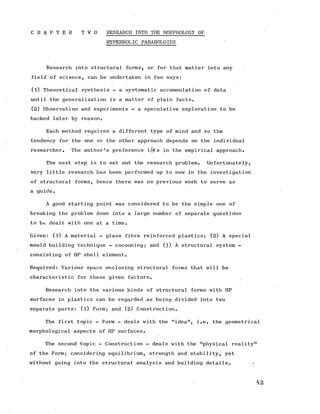
The Swiss engineer Heinz Hossdorf developed in 1964 quite a
different system. Eight HP shells in GRP are connected to form an
umbrella 18 by 18 m ( 59 by 59 ft.) square in plan (Figure 2.6).
By means of a central pyramidal truss composed of four hinged tubes with
a central prestressing device T^? a constant prestressing force is
exerted on all the eight shells. This system was used at the Swiss
National Exhibition Lausanne to cover an area of 7,800 m2
(83,958 ft.2).
4l
C H A P T E R T W O RESEARCH INTO THE MORPHOLOGY OF
HYPERBOLIC PARABOLOIDS
Research into structural forms, or for that matter into any
field of science, can be undertaken in two ways:
(1) Theoretical synthesis - a systematic accummulation of data
until the generalization is a matter of plain facts.
(2) Observation and experiments - a speculative exploration to be
backed later by reason.
Each method requires a different type of mind and so the
tendency for the one or the other approach depends on the individual
researcher. The author's preference l/fis in the empirical approach.
The next step is to set out the research problem. Unfortunately,
very little research has been performed up to now in the investigation
of structural forms, hence there was no previous work to serve as
a guide.
A good starting point was considered to be the simple one of
breaking the problem downinto a large number ofseparate questions
to be dealt with one at atime.
Given: (l) A material - glass fibre reinforced plastics; (2) A special
mould building technique - cocooning; and (3 ) A structural system -
consisting of HP shell element.
Required: Various space enclosing structural forms that will be
characteristic for these given factors.
Research into the various kinds of structural forms with HP
surfaces in plastics can be regarded as being divided into two
separate parts: (l) Form; and (2) Construction.
The first topic - Form - deals with the "idea", i.e. the geometrical
morphological aspects of HP surfaces.
The second topic - Construction - deals with the "physical reality"
of the Form; considering equilibrium, strength and stability, yet
without going into the structural analysis and building details.
42
It is possible to deal here only with general systems and
concepts of structural forms. In the final design process, Form and
Construction cannot be treated independently of each other. It
is the task of the creative designer to synthesize these two elements
to form one inseparable whole.
FORM IN HYPERBOLIC PARABOLOIDS
Definition of Surface
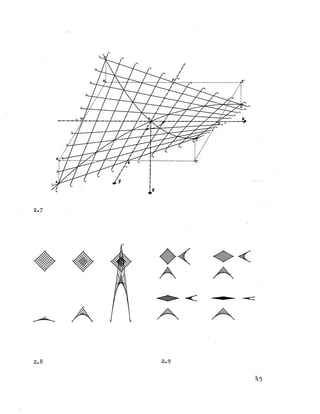
A HP surface can be defined as a translation surface. It is
generated by translating a principal parabola GOC (generator) with
an upward curvature upon a downward parabola AOE (directrix)
(Figure 2.7)- A HP surface can also be interpreted as a doubly
ruled surface. Two systems of straight lines intersect the non­
parallel lines ABC-GFE and AHG-CDE called directrices. The directrices
are parallel to the plane XOZ and YOZ (director plane). Plane
sections, i.e. contour lines parallel to the Z axis, will be
parabolic curving positively or negatively depending on the direction
of the section. Sections parallel or oblique to the XY plane
give hyperbolas.
Transformation of Surface
The geometry of a HP surface can be 'transformed' in four
basic ways:
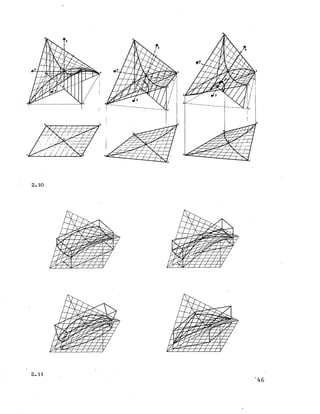
1. By changing the slope of the directrix one can vary the
curvature or twist of the surface and hence change the rise to span
ratio of the principal parabolas (Figure 2-8).
2. By varying the angle between the director plane one can get a HP
surface with two different principal parabolas (Figure 2.9)•
3. By tilting the Z axis with respect to a plane of reference one can
obtain HP surfaces with various quadrilateral and triangular
planes (Figure 2.10).
4. By cutting various segments from a standard HP surface one can
obtain HP segments with different perimeters (Figure 2.11).
2.7
45
2 . 1 1
*46
Organisation of Surfaces
HP surfaces, or for that matter, any geometrical configuration,
can be organized according to two different concepts:
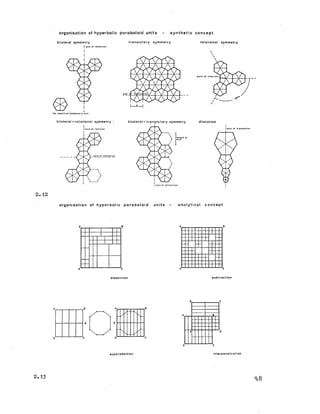
1. According to the synthetic concept, this is a process of adding
So
and putting together separate elements^/as to form a whole. Orderly
arrangements can be executed, for example, following the basic laws of
symmetry (Figure 2.12).
2. According to the analytic concept, this is the inverse of the
previous concept. Here a given whole is resolved into small elements
in order to be able to 'fit* them into HP elements. Four examples
are shown in Figure 2.13-
In the organization process it is sometimes difficult to
s
separate the two concepts of analysis and synthe/is and say which one
came first into one's mind.
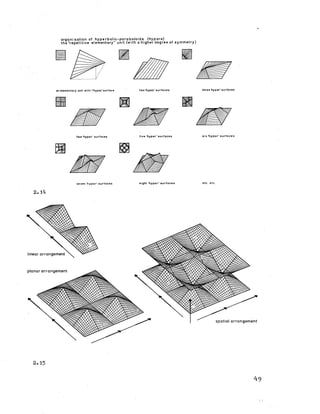
The repetitive HP units can be identical or similar or quite
different from each other. The repetitive unit can consist of a
single element or be a compound element (Figure 2.14).
Arrays can be executed in one-dimension (linear), two-
dimension (planar) or three-dimension (spatial) (Figure 2.15)»
An arrangement can be of a limited or infinite nature. It can
be made of regular or irregular HP elements and can be compact
or loose.
Magnitude of Surface
Considerable difficulties arise if one tries to describe the
complex geometry of certain shapes suggested here, for example, the one
shown in Figure 2.16.
It is convenient therefore analogous to other scientific
disciplines, to distinguish between three concepts.
1. The macro modular unit-the prime structural form. It can be a
single isolated or compound form. For example, the macro modular
unit in Figure 2.16 is a synclastic paraboloid of revolution (Figure 2.
2. The infra modular unit-the repetitive element from which the
prime structural form is made. It is generally the prefabricated
element. For example, the infra modular unit in Figure 2.16 is a
compound unit composed of two HP segments (Figure 2.18).
organisation of hyperbolic paraboloid units - synthetic concept
bilateral symmetry
of refle ction
t r a n s l a t o r y sy m m e try ro ta tio n a l symmetry
the unit
point of
bilateral + ro ta tio n a l symmetry
!
i ax is of r o ta ti o n
b ila t e r a l* t r a n s l a t o r y symmetry d ila ta tio n
of tr a n s l a ti o n
2.12
o r g a n i s a t i o n of h y p e r b o l i c p a r a b o l o i d u n i t s - a n a l y t i c a l c o n c e p t
s ubt r a c t i o n
♦
C
s u p e r p o s itio n in t e r p e n e t r a t i o n
2.13 '48
organi sation of hyperbolic-pctraboloids (hypars)
t he"repetitive elementary" unit (with a higher degree of symmetry)
an elementary unit with 1hypar'surface
four‘hy par’ surfaces
seven 'h y p a r 's u rf a c e s
2.14
linear arrangement
planar arrangement
two hypar' surfa ces three tiypar’ surfaces
five 'hypar' surfa ce s six "hypar' s u r fa c e s
eight 'hypar' s u r fa c e s
spatial arrangem ent
4 9
m a c ro -m o d u la r unit
a x is of re v o lu tio n
paralle]s_____
g e n e ra trix =
m e rid ia n
2.l6 2.17
m ic ro -m o d u la r u n it
infra-m oduiar unit
H
axis of revolution
meridian
2.18 2.19
'50
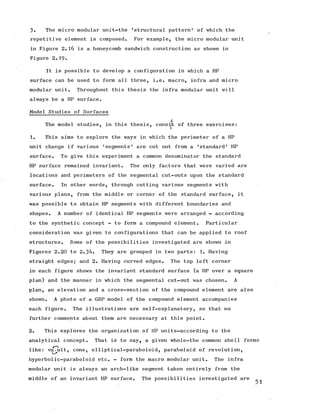
3» The micro modular unit-the 'structural pattern1 of which the
repetitive element is composed. For example, the micro modular unit
in Figure 2.16 is a honeycomb sandwich construction as shown in
Figure 2.19-
It is possible to develop a configuration in which a HP
surface can be used to form all three, i.e. macro, infra and micro
modular unit. Throughout this thesis the infra modular unit will
always be a HP surface.
Model Studies of Surfaces
s
The model studies, in this thesis, consist of three exercises:
1. This aims to explore the ways in which the perimeter of a HP
unit change if various 'segments' are cut out from a 'standard' HP
surface. To give this experiment a common denominator the standard
HP surface remained invariant. The only factors that were varied are
locations and perimeters of the segmental cut-outs upon the standard
surface. In other words, through cutting various segments with
various plans, from the middle or corner of the standard surface, it
was possible to obtain HP segments with different boundaries and
shapes. A number of identical HP segments were arranged - according
to the synthetic concept - to form a compound element. Particular,
consideration was given to configurations that can be applied to roof
structures. Some of the possibilities investigated are shown in
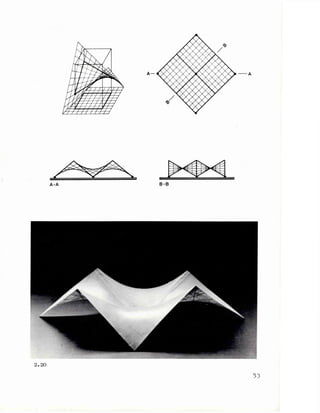
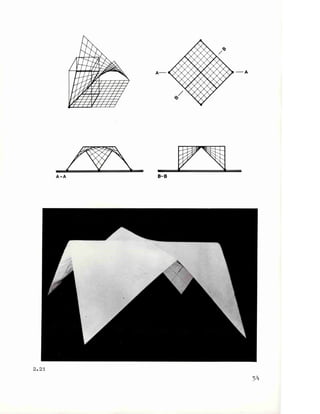
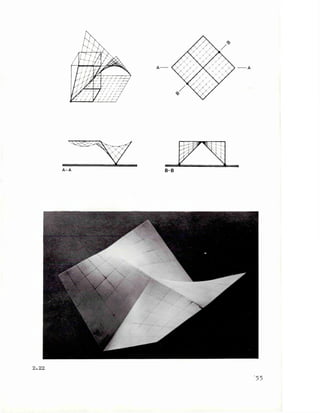
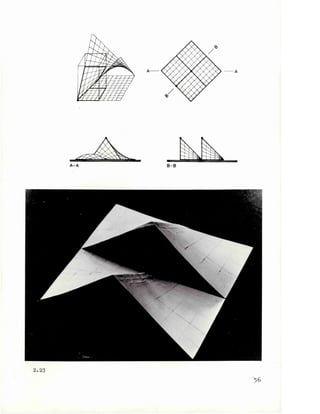
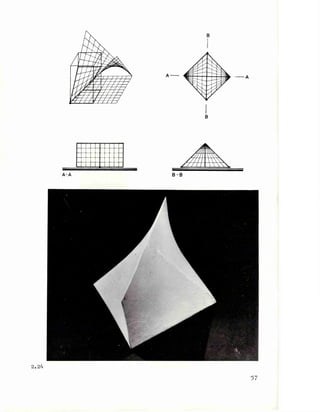
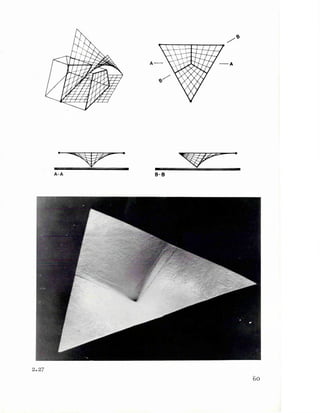
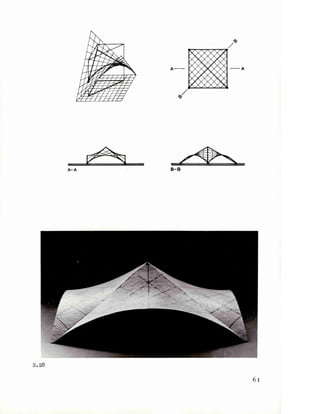
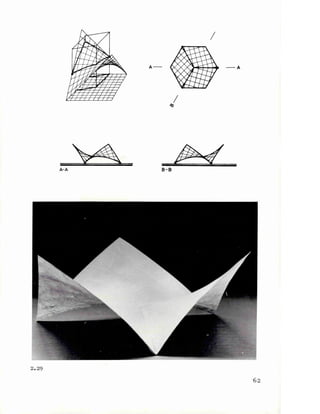
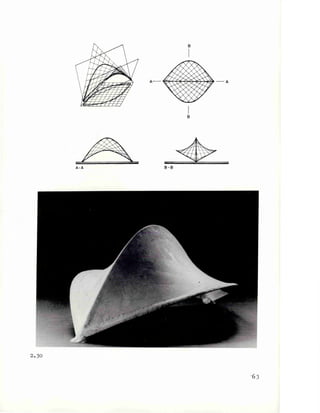
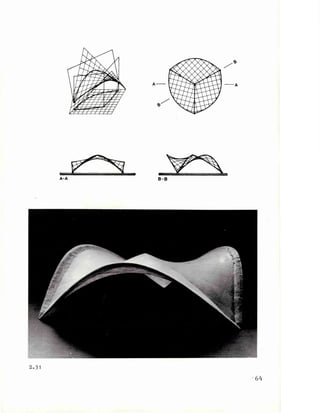
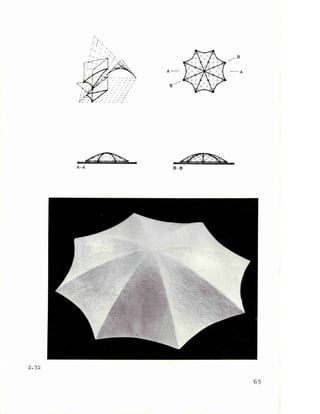
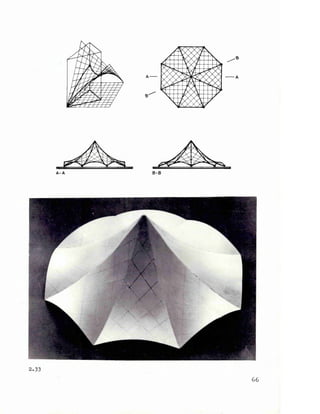
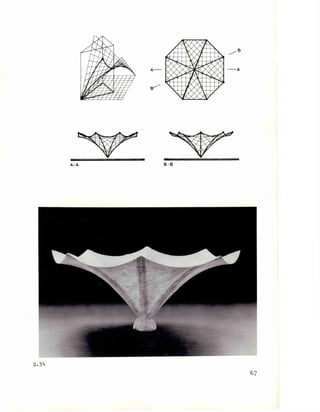
Figures 2.20 to 2.3^- They are grouped in two parts: 1. Having
straight edges; and 2. Having curved edges. The top left corner
in each figure shows the invariant standard surface (a HP over a square
plan) and the manner in which the segmental cut-out was chosen. A
plan, an elevation and a cross-section of the compound element are also
shown. A photo of a GRP model of the compound element accompanies
each figure. The illustrations are self-explanatory, so that no
further comments about them are necessary at this point.
2. This explores the organization of HP units-according to the
analytical concept. That is to say, a given whole-the common shell forms
like: vajult, cone, elliptical-paraboloid, paraboloid of revolution,
hyperbolic-paraboloid etc. - form the macro modular unit. The infra
modular unit is always an arch-like segment taken entirely from the
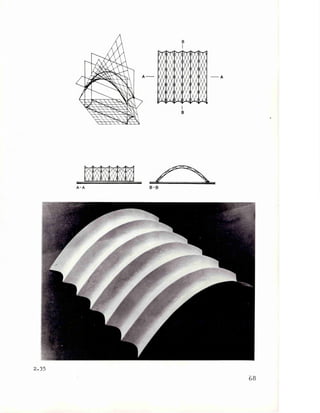
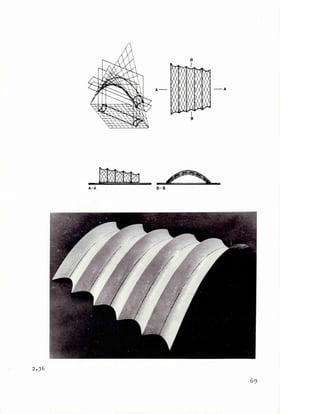
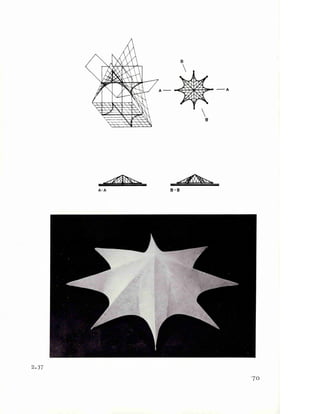
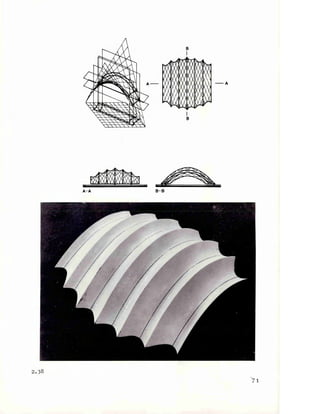
middle of an invariant HP surface. The possibilities investigated are
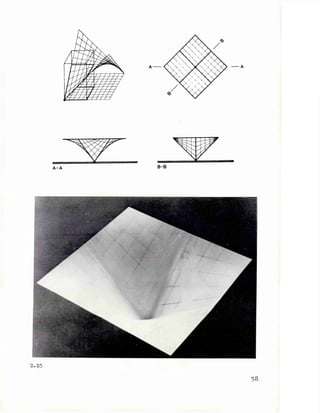
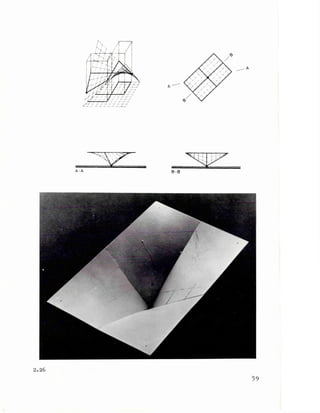
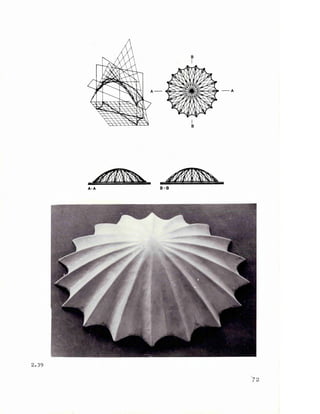
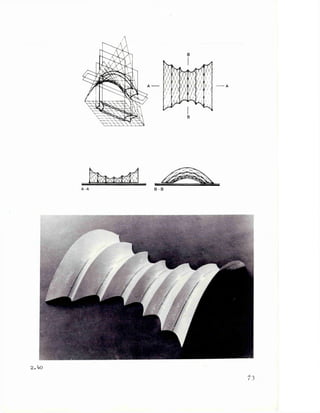
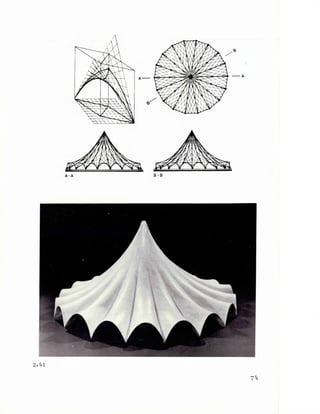
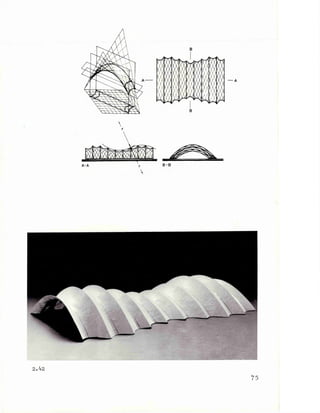
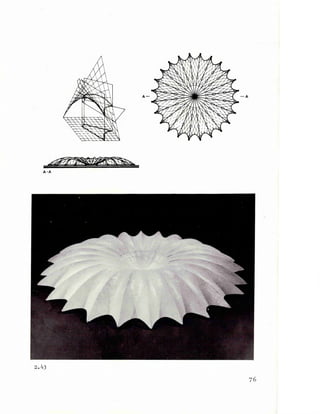
shown in Figures 2.35 to 2.43. The top left corner in each figure
shows the. invariant standard surface (a HP over a rhombic plan) and
the manner in which the segmental cut-out was chosen. A plan, an
elevation and a cross-section of the macro modular unit is also
shown. A photo of a GRP model of the same unit accompanies each figure.
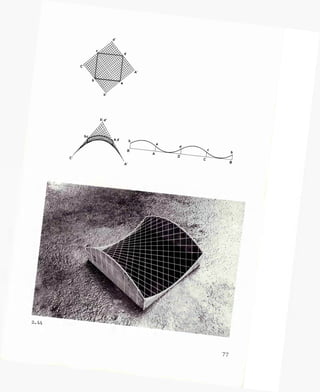
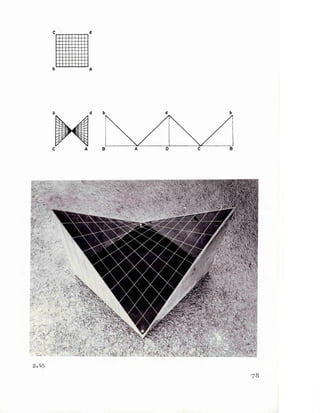
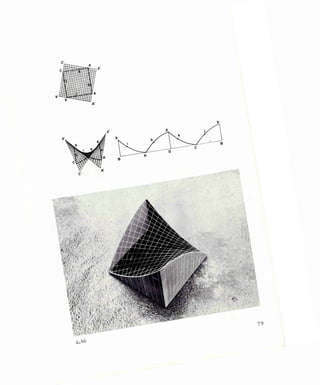
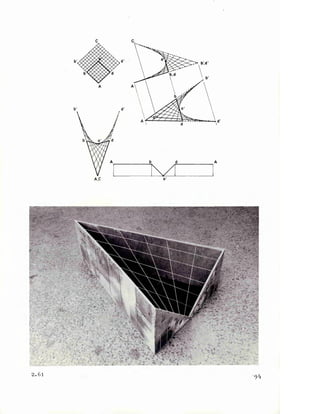
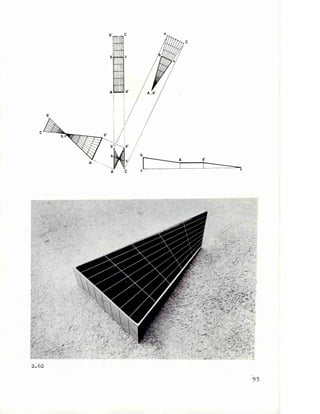
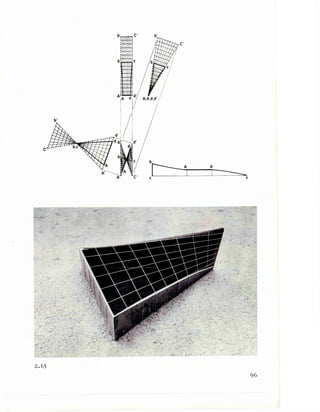
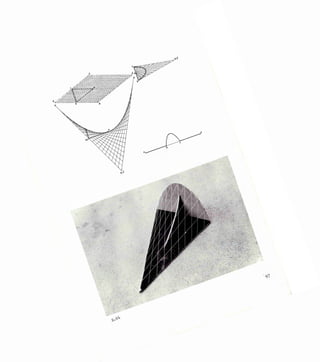
3. In this experiment the procedure was reversed. The invariant
factor was the plan of the segmental cut-out (a square and an
isosceles triangle) and the variable was the so called 'standard'
surface. In this way it was possible to vary the contour lines of
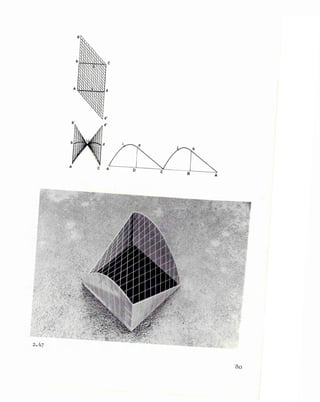
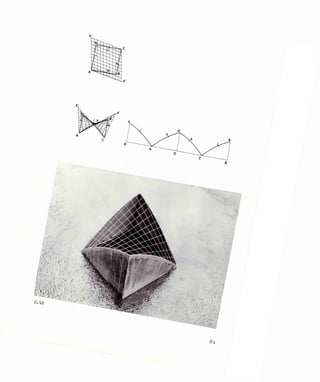
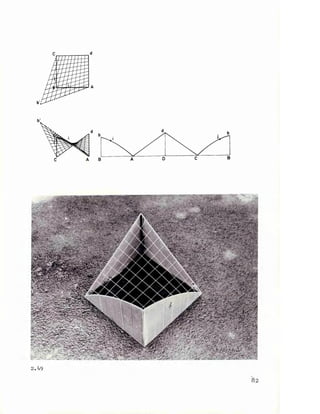
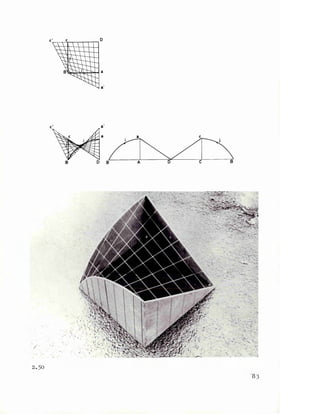
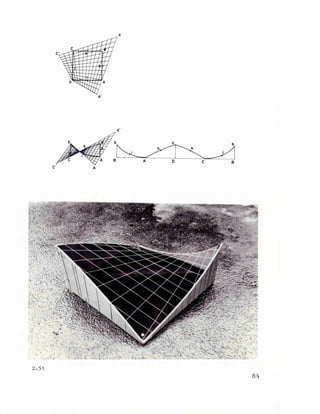
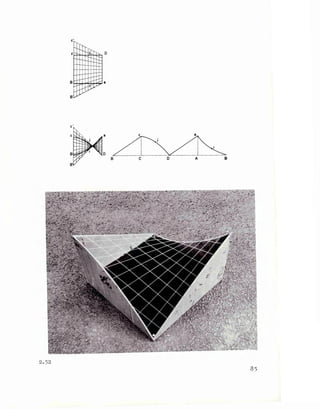
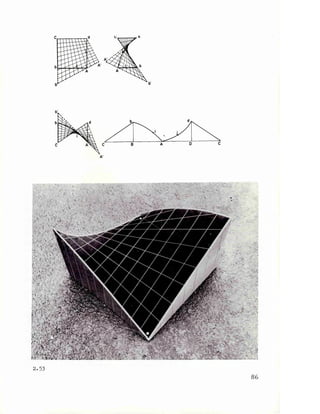
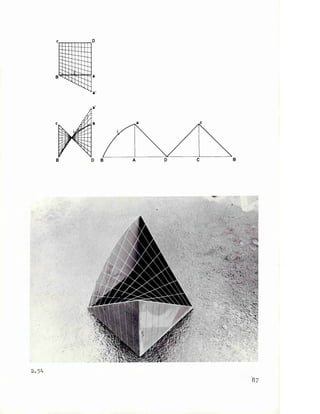
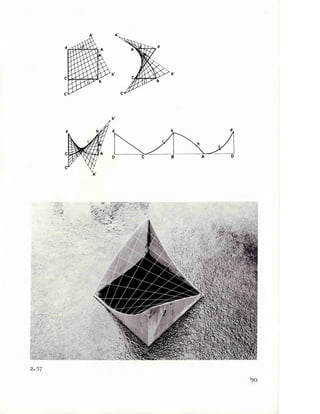
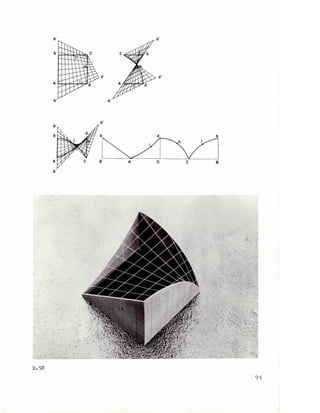
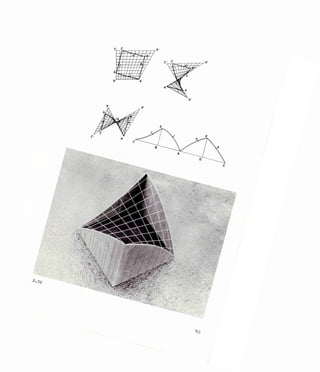
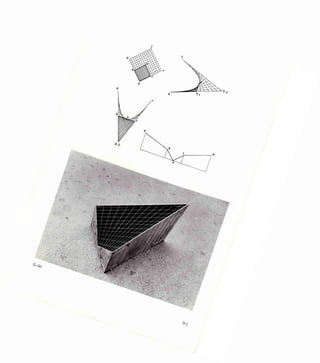
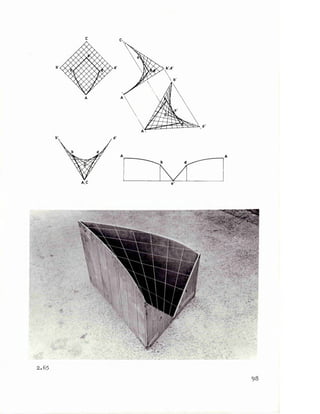
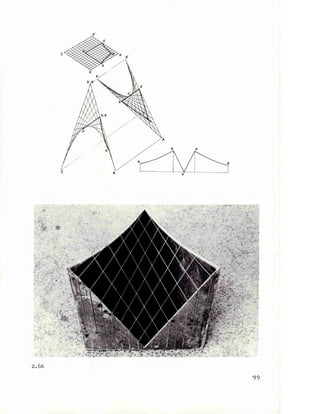
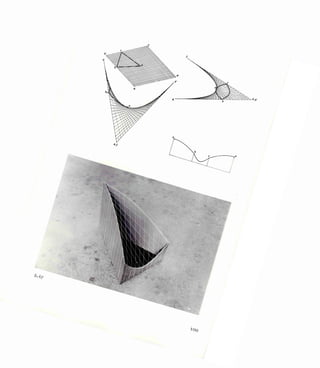
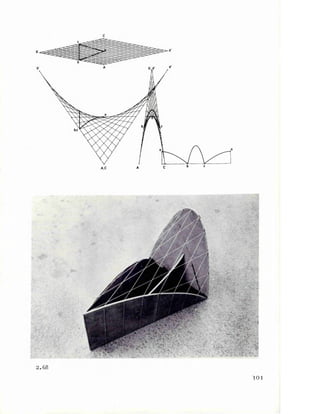
the segmental cut-out edges. Figures 2.44 to 2.59 show the
segmental cut-outs having a square plan, and Figures 2.60 to 2.68
show the segments with an isosceles triangular plan. The left side
of each figure shows the plan and elevations of the variable
standard surface (a HP over a quadrilateral plan) and the manner in
which the segmental cut-out was chosen. A photo of a string model
of the segmental cut-out, accompanies each figure. The vertical
planes of the model, in their development, are shown on the lower
right of the figure. Again, the illustrations are self-explanatory,
so that no further comments about them are necessary at this point.
52
A-A B-B
2.20
‘53
2.22
'55
2.23
56
2.24
31
A
2.25
58
.
A-A B-B
2.26
'59
2.27
'6o
A-A B-B
2.28
6 l
62
B
B
B-BA-A
2.30
63
2.31
6k
A-A B-B
2.32
■65
66
A-A B-B
2.34
67
B
2.35
'68
2.36
69
2.37
'70
2.38
71
2.39
72
A
A-A B-B
2.40
73
2.41
74
2.42
75
2.43
76
ii-./V:'it- . . * «
‘77
0 c BB A
#J>.;k?p
' ' ' < y - ’ X
-.. ^ ,.Vv
-■^'vv»
> 7 f
§
2.45
•78
iI l f i n n K r ^
wsh'ifW
A
b'
d
'80
6'
4
b'
C
a
8
-8i
b
AC
2.49
82
c
c
J k
2.50
83
d'
C1 A'
2.51
84
D
a
2.52
85
b‘
A'
2.53
66
; M S
> //» ■
2.54
87
c
b
b1
d’
CDB ACAC
M
88
c
b
d‘
b
C
2.56
89
V
m m’v
2.57
90
b'
b
A
A’ A'
b'
b
A B A D C B
A"
91
'92
-V*
§3
b'.d
A.C o’
2.61
9^
c
b.c
2.62
95
2.63
96
'98
2.66
•99
:?-riXh.:
3.cr
^Oq
c
2.68
101
CONSTRUCTION WITH HYPERBOLIC PARABOLOIDS
Construction Principles
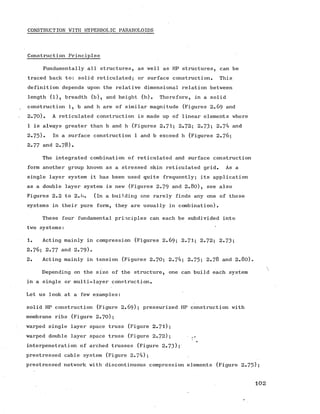
Fundamentally all structures, as well as HP structures, can be
traced back to: solid reticulated; or surface construction. This
definition depends upon the relative dimensional relation between
length (l), breadth (b), and height (h). Therefore, in a solid
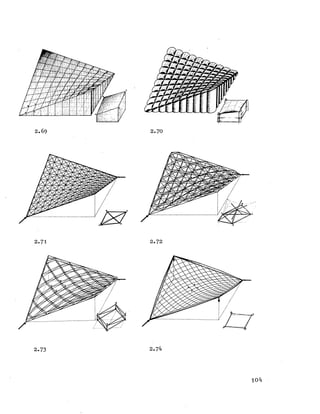
construction 1, b and h are of similar magnitude (Figures 2.69 and
2.70). A reticulated construction is made up of linear elements where
1 is always greater than b and h (Figures 2.71; 2.72; 2.73; 2.74 and
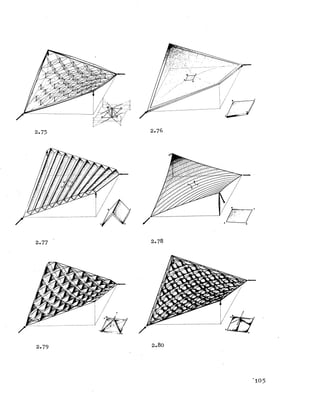
2.75)• In a surface construction 1 and b exceed h (Figures 2 .7 6 ;
2.77 and 2.78).
The integrated combination of reticulated and surface construction
form another group known as a stressed skin reticulated grid. As a
single layer system it has been used quite frequently; its application
as a double layer system is new (Figures 2.79 and 2.80), see also
Figures 2.2 to 2.6. (in a building one rarely finds any one of these
systems in their pure form, they are usually in combination).
These four fundamental principles can each be subdivided into
two systems:
1. Acting mainly in compression (Figures 2.69; 2.71; 2.72; 2.73;
2 .7 6 ; 2.77 and 2.79).
2. Acting mainly in tension (Figures 2.70; 2.74; 2.75; 2 .7 8 and 2.80).

Depending on the size of the structure, one can build each system
in a single or multi-layer construction.
Let us look at a few examples:
solid HP construction (Figure 2 .69); pressurized HP construction with
membrane ribs (Figure 2.70);
warped single layer space truss (Figure 2.71);
warped double layer space truss (Figure 2.72); .f
interpenetration of arched trusses (Figure 2-73);
prestressed cable system (Figure 2.74);
prestressed network with discontinuous compression elements (Figure 2.75)5
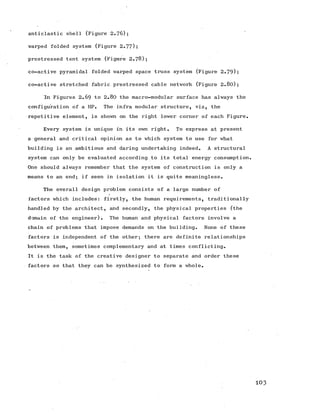
1 0 2
anticlastic shell (Figure 2.76);
warped folded system (Figure 2.77);
prestressed tent system (Figure 2.78);
co-active pyramidal folded warped space truss system (Figure 2.79);
co-active stretched fabric prestressed cable network (Figure 2.80);
In Figures 2.69 to 2.80 the macro-modular surface has always the
configuration of a HP. The infra modular structure, viz, the
repetitive element, is shown on the right lower corner of each Figure.
Every system is unique in its own right. To express at present
a general and critical opinion as to which system to use for what
building is an ambitious and daring undertaking indeed. A structural
system can only be evaluated according to its total energy consumption.
One should always remember that the system of construction is only a
means to an end; if seen in isolation it is quite meaningless.
The overall design problem consists of a large number of
factors which includes: firstly, the human requirements, traditionally
handled by the architect, and secondly, the physical properties (the
domain of the engineer). The human and physical factors involve a
chain of problems that impose demands on the building. None of these
factors is independent of the other; there are definite relationships
between them, sometimes complementary and at times conflicting.
It is the task of the creative designer to separate and order these
factors so that they can be synthesized to form a whole.
103
2.69 2.70
2.71 2.72
2.73 2.74
104
2.75 2.76
2.77 2.78
2.79 2.80
'105
Possible Application Of Hyperbolic Paraboloid Shells
Structural forms in principle have not changed through the ages.
The macro-modular units like vaults, domes and 'umbrellas’, are
amongst the oldest structural forms. New materials with their
technological development have merely changed the infra modular
and micro modular unit, which in turn has enabled larger spans
to be built and reduction in weight.
Basically new are the large cantilever and saddle-shaped
structures which are made possible by building materials that can
resist high tension, compression and shear. Today, with the ever-
increasing trend towards prefabrication, the infra modular unit gains
particular significance and consequently gives the structural form a
specific formal expression.
HP surfaces if seen as a single isolated configuration, have a
strong 'individuality' and are generally difficult to integrate in a
general design scheme. By using a HP surface as an 'elementary
repetitive unit, viz. infra modular unit, its unique plasticity is
'neutralized' and made to fit practically, any imaginable enclosure.
‘A few examples shall illustrate this point.
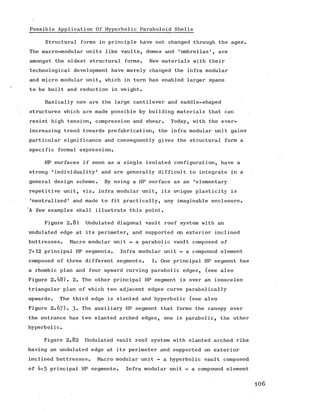
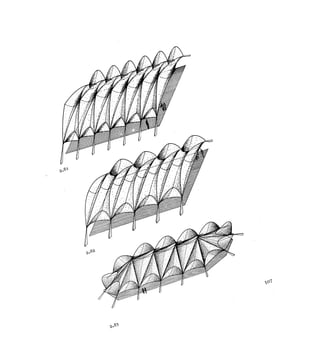
Figure 2.81 Undulated diagonal vault roof system with an
undulated edge at its perimeter, and supported on exterior inclined
buttresses. Macro modular unit - a parabolic vault composed of
7+12 principal HP segments. Infra modular unit - a compound element
composed of three different segments. 1. One principal HP segment has
a rhombic plan and four upward curving parabolic edges, (see also
Figure 2.48). 2. The other principal HP segment is over an isosceles
triangular plan of which two adjacent edges curve parabolically
upwards. The third edge is slanted and hyperbolic (see also
Figure 2 .67). 3- The auxiliary HP segment that forms the canopy over
the entrance has two slanted arched edges, one is parabolic, the other
hyperbolic.
Figure 2.82 Undulated vault roof system with slanted arched ribs
having an undulated edge at its perimeter and supported on exterior
inclined buttresses. Macro modular unit - a hyperbolic vault composed
of 4+5 principal HP segments. Infra modular unit - a compound element
106
composed of three different segments. 1. One principal HP segment
has an "orange peel" like plan and two slanted hyperbolic edges,
(see also Figure 2.30). 2. The other principal HP segment has a
"bottle neck" like plan of which the two opposite long edges are
slanted and hyperbolic. The two short edges are also slanted and
hyperbolic. 3« The auxiliary HP segment is similar to the one
in Figure 2.81.
Figure 2.83 Single-folded scalloped roof system with half
d
cone-shaped ends having an ur^ulated edge at its perimeter, and
supported on exterior inclined buttresses. Macro modular unit - a
single folded system composed of 14 principal HP segments. The
transverse ends are intersected by two half-cone segments composed
each of three principal HP units. Infra modular unit - a compound
element composed of two different segments. 1. The principal HP
segment is over an isosceles triangular plan of which two adjacent
edges are straight and the third edge is slanted and hyperbolic,
(see also Figure 2.64). 2. The auxiliary HP segment is similar to the
one in Figure 2.81.
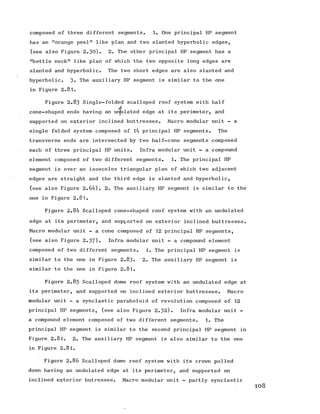
Figure 2.84 Scalloped cone-shaped roof system with an undulated
edge at its perimeter, and supported on exterior inclined buttresses.
Macro modular unit - a cone composed of 12 principal HP segments,
(see also Figure 2.37). Infra modular unit - a compound element
composed of two different segments. 1. The principal HP segment is
similar to the one in Figure 2.83. 2. The auxiliary HP segment is
similar to the one in Figure 2.81.
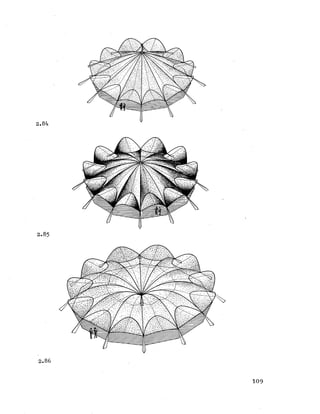
Figure 2.85 Scalloped dome roof system with an undulated edge at
its perimeter, and supported on inclined exterior buttresses. Macro
modular unit - a synclastic paraboloid of revolution composed of 12
principal HP segments, (see also Figure 2.32). Infra modular unit -
a compound element composed of twodifferent segments. 1. The
principal HP segment is similar to the second principal HP segment in
Figure 2.81. 2. The auxiliary HP segment is also similar to the one
in Figure 2.81.
Figure 2.86 Scalloped dome roof system with its crown pulled
down having an undulated edge at its perimeter, and supported on
inclined exterior butresses. Macro modular unit - partly synclastic
2 . 8 6
109
and partly anticlastic paraboloid of revolution composed of 12
principal segments, (see also Figure 2.43). Infra modular unit - a
compound unit composed of two different segments. 1. The principal
HP segment is over an isosceles triangular plan of which two
adjacent edges arch parabolically upwards. The third edge is slanted
and hyperbolic. 2. The auxiliary HP segment is similar to the one
in Figure 2.81.
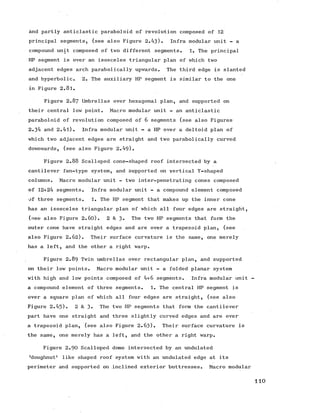
Figure 2.87 Umbrellas over hexagonal plan, and supported on
their central low point. Macro modular unit - an anticlastic
paraboloid of revolution composed of 6 segments (see also Figures
2.34 and 2.4l). Infra modular unit - a HP over a deltoid plan of
which two adjacent edges are straight and two parabolically curved
downwards, (see also Figure 2.49).
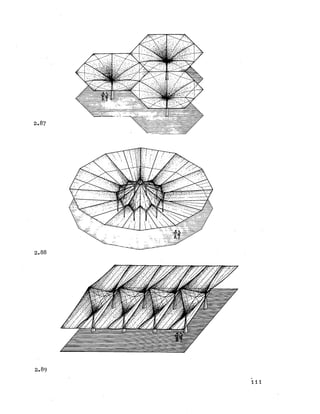
Figure 2.88 Scalloped cone-shaped roof intersected by a
cantilever fan-type system, and supported on vertical Y-shaped
columns. Macro modular unit - two inter-penetrating cones composed
of 12+24 segments. Infra modular unit - a compound element composed
of three segments. 1. The HP segment that makes up the inner cone
has an isosceles triangular plan of which all four edges are straight,
(see also Figure 2.60). 2 & 3- The two HP segments that form the
outer cone have straight edges and are over a trapezoid plan, (see
also Figure 2.62). Their surface curvature is the same, one merely
has a left, and the other a right warp.
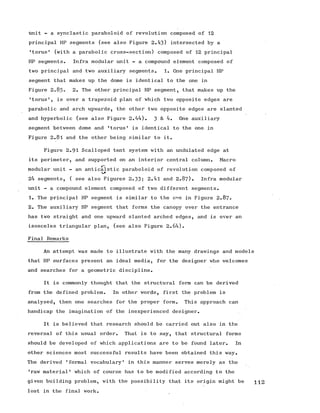
Figure 2.89 Twin umbrellas over rectangular plan, and supported
on their low points. Macro modular unit - a folded planar system
with high and low points composed of 4+6 segments. Infra modular unit -
a compound element of three segments. 1. The central HP segment is
over a square plan of which all four edges are straight, (see also
Figure 2.45). 2 & 3» The two HP segments that form the cantilever
part have one straight and three slightly curved edges and are over
a trapezoid plan, (see also Figure 2.63). Their surface curvature is
the same, one merely has a left, and the other a right warp.
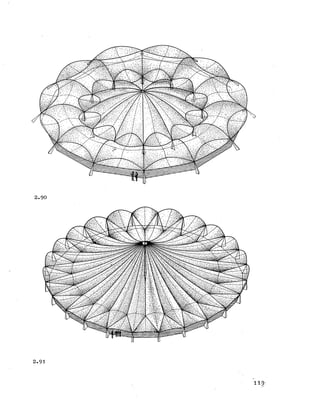
Figure 2.90 Scalloped dome intersected by an undulated
’doughnut’ like shaped roof system with an undulated edge at its
perimeter and supported on inclined exterior buttresses. Macro modular
110
2.87
2.89
ill
tinit - a synclastic paraboloid of revolution composed of 12
principal HP segments (see also Figure 2.43) intersected by a
•torus' (with a parabolic cross-section) composed of 12 principal
HP segments. Infra modular unit - a compound element composed of
two principal and two auxiliary segments. 1. One principal HP
segment that makes up the dome is identical to the one in
Figure 2.85® 2. The other principal HP segment, that makes up the
'torus', is over a trapezoid plan of which two opposite edges are
parabolic and arch upwards, the other two opposite edges are slanted
and hyperbolic (see also Figure 2.44). 3 & 4. One auxiliary
segment between dome and 'torus' is identical to the one in
Figure 2.81 and the other being similar to it.
Figure 2.91 Scalloped tent system with an undulated edge at
its perimeter, and supported on an interior central column. Macro
P
modular unit - an anticalstic paraboloid of revolution composed of
24 segments, ( see also Figures 2.33; 2.4l and 2 .8 7 ). Infra modular
unit - a compound element composed of two different segments.
1. The principal HP segment is similar to the one in Figure 2 .8 7 .
2. The auxiliary HP segment that forms the canopy over the entrance
has two straight and one upward slanted arched edges, and is over an
isosceles triangular plan, (see also Figure 2.64).
Final Remarks
An attempt was made to illustrate with the many drawings and models
that HP surfaces present an ideal media, for the designer who welcomes
and searches for a geometric discipline.
It is commonly thought that the structural form can be derived
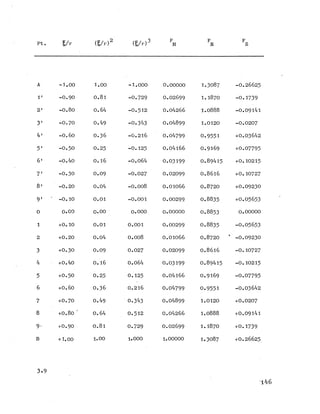
from the defined problem. In other words, first the problem is
analysed, then one searches for the proper form. This approach can
handicap the imagination of the inexperienced designer.
It is believed that research should be carried out also in the
reversal of this usual order. That is to say, that structural forms
should be developed of which applications are to be found later. In
other sciences most successful results have been obtained this way.
The derived 'formal vocabulary' in this manner serves merely as the
'raw material' which of course has to be modified according to the
given building problem, with the possibility that its origin might be 112
lost in the final work.
2 .9 0
2.91
113-
REFERENCES
On Structural Forms
1. Joedicke Jurgen, "Schalenbau", Karl Kramer Verlag Stuttgart, 1962.
2. Faber Colin, "Candela: The Shell Builder", Reinhold
Publishing Corporation, 1963.
3. Roland Con^rad, "Frei Otto - Spannweiten", Verlag Ullstein GMBH, 1965-
4. Exhibition Catalogue, Paris April 1963, "structures Nouvelles
en Architecture".
5. Catalano Eduardo F. "Estructuras de Superficies Alabeadas",
Editorial Univesitaria de Buenos Aires, 1962.
6. Burt Michael, "Spatial Arrangement and Polyhedra with Curved
Surfaces and their Architectural Applications",
Technion, Haifa - Israel, 1966.
7. Heger F.J. Chambers R.E. and Dietz A.G.H., "On the Use of Plastics
and Other Composite Materials for Shell Roof Structures", Proceedings
World Conference on Shell Structures Oct. 1962 San Francisco, California.
8. Makowski Z.S. and Zerning J., "Engineering Design Concepts as Applied
to Civil Engineering in Plastics Shell Roof Structures", Conference
on Engineering Design and Performance Testing, Plastics
Institute, Oct. 1968 Manchester.
9. Beveridge W.I.B., "The Art of Scientific Investigation",
Heinemann Educational Books Ltd. London, 1950.
10. Haberli Walter,"Beton Konstruktion und Form", verlag
Stocker-Schmid Dietikon - Zurich, 1966.
11. Catalano Eduardo, "Two Warped Surfaces", Student Publications of
the School of Design, North Carolina State College,
114Volume 5 number 1.
12. Weyl Hermann, "Symmetry", Princeton University Press,
Princeton, New Jersey, 1952.
13. Wolf K.L. and Wolf R., "Symmetrie", Bohlau-Verlag Miinster/Kdln, 1956.
14. Gross Roland, "Symmetrie", Zeitschrift DBZ 6/ 1966.
U-
13. Kuhn Walter, "Plastische und Raumliche Symmetrien", iysstellung
im Kunstgewerbe H.useum, Zurich, 1968.
16. Klee Paul, "The Thinking Eye", Lund Humphries, London, 1961.
17« Hart Franz, "Kunst and Technik der Wdlbung", Verlag Georg D.W.
Callwey, Miinchen, 1963.
18. Torroja E., "Logik der Form", Verlag Georg D.W. Callwey, Munchen, 1961.
19. Siegel Curt, "Strukturformen", Verlag Georg D.W. Callwey,
Munchen, i9 6 0 .
20. Engel Heinrich, "Structure Systems", Deutsche Verlags -
Anstalt, Stuttgart, 1967*
21. Bennett J.D., "Hyperbolic Paraboloids", Reinforced Concrete
Association, London, 1961.
22. Angerer Fred, "Surface Structures in Building", Alec Tiranti,
London, 1961.
23. Esquillan N. and Saillard Y., (Editors) "Hanging Roofs",
North-Holland Publishing Company - Amsterdam, 1963.
24. Ramaswamy G.S., "Design and Construction of Concrete Shell Roofs",
McGraw-Hill Company, 1968.
115
P A R T T H R E E DESIGN AND CONSTRUCTION OF A SCALLOPED DOME IN
GLASS FIBRE REINFORCED PLASTICS
- requirements for the determination of size
l l 6
Introduction
"In order to invent a structure and to give
it exact proportions, one must follow both
the intuitive and mathematical path11
(Pier Luigi Nervi)
The objective in construction with relatively expensive materials
must be to obtain "the most with the least". In other words, to
enclose a given volume with a structure that will use least possible
material. This aim is as old as mankind and is the ultimate goal of
modern technology.
The solution to this problem, at least so far, cannot be found
even with the aid of a computer.
The designer must first speculate intuitively and then test the
hypothesis by an experiment.
A e $ c r i ' hc
An attempt is made here to introduce a method of research that
will assist in the achievement of optimum design, without the
disadvantage of facing the complex and lengthy processes of structural
analysis with the highly mathematical treatment usually associated
with such work.
It is hoped that the approach suggested will free the imagination
of the designer and encourage him to design and build new and
structurally efficient systems, regardless as to whether an analytical
method of design is currently available.
The design and construction of any structure, as well as the
prototype under investigation, involves three main problems:
(l) Architectural design; (2) Engineering analysis; and (3 ) construction
techniques. — .
In this research the engineering analysis constitutes the
principal problem and will have to be dealt here in three parts:
(l) Approximate design of shell segment; (2 ) Construction of a model;
and (3 ) Experimental analysis of the model.
117
SECTION ONE ARCHITECTURAL DESIGN
General Description of Prototype
While any one of the structural forms illustrated in part two
of the thesis be made the subject for a more detailed investigation,
the scalloped dome (Figures 2.32 2.39 and 2 .8 5 ) was chosen for the
prototype for three reasons. Firstly, a dome, being one of the
oldest structural forms known to man, has a very high degree of
structural efficiency. It is a composite "closed system", in which
rigidity is obtained by a combined action of all its parts, thus the
composite assembly is stronger than each of its individual parts.
Secondly, the configuration of a dome will make the large deflections
that are inevitable in using a material like GRP appear less noticeable.
Finally, it was considered that the elemental shape introduced provided
considerable structural advantages in comparison with conventional
dome systems. The disadvantage of a dome is, of course, its circular
floor plan, which is not always easy to integrate in a general
design scheme.
The scalloped small rise dome in Figure 3*1 which illustrates
the general shape of the assembly consists of a number of meridional
HP shell segments (n),in which longitudinal as well as transverse
cross-sections are parabolic (Figure 3*2). All segments in plan are
isosceles triangles. The cross-section depth decreases continuously
towards the top of the dome, and since the thickness (t) is small
compared with the depth of segment, the structure can be considered
"hinged" at the crown. Therefore the ribs of two diametrically opposite
segments (Figure 3-l) constitute a three-hinged arch, the number of
’three-hinged1 arches being n/2 .
The shell segments supported at (n) ’points’ are connected to
a corresponding number of inclined exterior buttresses. The torsional
rigidity of the shell segment is very small, so that hoop forces cannot
be transmitted horizontally across the dome. The triangular HP shell
segments (due to their three-hinged arch analogy) have also the
advantage of being insensitive to differential settlements of their
abutments and also to changes in their contour lines due to thermal
expansion and contraction.
118
A—A ■iiiiiiiiiiiii-iJ l-
15 »t o
3.1
’119
The rigidity of the thin free edges between the inclined supports
can be substantially increased by the inter-penetration of an
auxiliary shell segments which form canopies as shown in Figure 3-3*
This modification of the principal triangular segment is achieved by
cutting away a lower slice of the principal segment by means of an
inclined plane passing through the points ACF as illustrated in
Figure 3»^- This lower slice is then rotated through l80° and
connected again to the principal segment. A gapless fit is possible
after rotation because the surface has an axis of symmetry in its
axis of rotation.
The units are moulded with integral vertical flanges, which
can be bolted together to form the scalloped dome.
1 2 0
C H A P T E R O N E GEOMETRY OF THE SHELL SEGMENT
Definition of Shape
The first step in designing this scalloped dome is of course
to define its geometry mathematically. Since the configuration is
rather novel a more detailed treatment of its complex geometry
follows.
The surface of the shell segment is generated by translating a
principal parabola (2) with upward curvature, parallel to itself,
over another principal parabola (l) with downward curvature Figure
The parabola BO is called the directrix and the parabola AC is called
the generator. We thus obtain an anticlastic surface of translation,
and since both generator and directrix are parabolas, a hyperbolic
paraboloid (HP) is formed. The HP surface is over a rectangular plan,
and its perimeter is formed by the principal parabolas.
In the design of the scalloped small rise dome:
f
^ r- „ 2
0.5 ? and — = 1 .
See Figure 3«(t» ^ "" ... ........ ^ "
The Hyperbolic Paraboloid Triangular Segment
The scalloped dome consists of a series of meridional elements.
Each meridional element is a HP segment over an isosceles triangular
plan. The triangular segment is obtained by cutting the rectangular
HP surface with two intersecting vertical planes passing through the
points AA ’OO' and CC ’OO' as shown in Figure 3»^»
The horizontal projection of the space curve AO or CO on the XY
plane is the radius (r) of the dome. It is therefore convenient to
6
3.2 3.3
JC"
3.4
122
express all the dimensions in terms of r:
r cos
r s m
a
2 ’
a
2 *
In the prefabricated dome n = 26.
The angle of the triangular segment, in its projection on the
XY plane is:
a = ^ = 13.768° or | = 6.884° ,
hence:
tan ^ = 0 .1 1 9 8 6 ,
r cos - = 0.99279 r 1
r sin - = O . H 986 r
If r = 10 metre (32.8 ft.) then each segment will have a width
of 2.4 m. (7*874 ft.); a size that can be easily transported on
standard vehicles.
1. The Skewed Straight-line Generators.
A HP surface is also a doubly ruled surface, that is to say, it can be
generated by two systems of straight lines (generators) that intersect
each other. Each set of straight lines lies parallel to a vertical
plane, called the directrix plane. The two directrix planes form an
1 2 3
Arbitrary angle between them. Since f / f ; / 90°--
1 eL
Thus an oblique HP surface is obtained.
To define the HP surface a Cartesian co-ordinate system X,Y,Z,
is used where the Z axis is perpendicular to the XY plane, the angle
o
between the X and Y axes is 90 , and where the origin of the
co-ordinate system is in the middle of the surface at point 0.
The general equation for a HP surface is:
z = h 4 - f 2 4 • (3 .D
a b
2. The Angle U) Between the Directrix planes.
By inspecting Figure 3-^t it'can be seen that the directrix plane must
lie in the GOZ plane. The location of point G on the principal
parabola is not known. The straight line generator 0G is at right
angles to the Z axis, and thusat the point G, Z = 0.
Theobsicissa of the point G,denoted by x can thus be found
G
by using equation (3*1) and setting Z = 0 .
2 2
XG y
° = fl ~2 “ f2 "~2 ’
a b
Since at point x , b = y , the equation becomes:
G
2
xr
0 = fl "a - f2 *
a
Solving for x
G
£2
fl
124
Substituting numerical values
*Q = 0.99279 r K §:“ 9?6 :99279 "V ) ’
0.488 r
Since ^ is the angle between OX and the straight line generator,
+ w b 0-11986 . ,tan - _ - _ 0 ^488 _ 0.2456 ,
G
| - 13.8°
3- Equation of the Surface.
Substituting numerical values equation (3-1) becomes:
2 2 2 2
0 .5 *_ . 3~ 3 _
a b 0 .9 9 2 9 r 0 .1 1 9 8 6 r ,
j; (0.5036x2 - 8.3431 y2 ) . (3.1.1)
4. Locus of the Space-Curves CO and AO.
The space-curve CO or AO form the perimeter of the triangular HP
segment. Denote its projection on the XY plane with £ thus:
x a a£ ------- 5 x - £ cos — ; y = x tan —
* cos 0_ b 2 ’ J 2
2
Substituting these values in equation (3.1.1)
125
2E
z — cos2 § [o.5 0 3 6 - 8.3434 (0 .119862)] ,
2
I
= 0.377 ■ — .
Note that the space curve CO is a parabola with a lower rise than
the principal parabola (l) (Figure 3-4 ).
5. Check:
If g = r, then the above equation becomes simply
z = 0.377 r .
By inspection
Thus:
z = 0.4969 r - 0.1199 r = 0.377 r .
The Hyperbolic Paraboloid Canopy
1. Delimitation of Curve AFC
Let J3 =20^ be the angle between the intersecting plane AFC and
the XYplane (Figure 3-5 (2).) the projection of the curveAFC, on
the ZX plane, is a straight line, hence:
z = x tan p + (f^ - *2 ^ “ a tan 3 ’
which can also be written as:
z = (f^ - f ) - (a - x) tan p . (3 .1.2 )
126
Substituting equation (3.1.2) in (3-1) gives the general formula
for the curve AFC in its horizontal projection on the XY plane,
■which reads:
(fa - f2) - (a - x) tan p “ ■ fi % “
2 b2
(3.1.3)
Substituting numerical values:
0 .3 7 6 5 r - (0 .9 9 2 8 r - x) tan p = - (0 .5 0 3 6 x2 - 8.3431 y2) .
2. Location of the Point F.
At point F on the curve AFC, y = 0. Thus substituting the value of y
into equation (3 .1.3 ) gives:
0 .3 7 6 5 r - 0 .9 9 2 8 r tanp + x tan p = ^ 0 .5 3 6 x2 ,
which can also be written as:
0 .5 0 3 6 x2 - 0.3640 x r = [0.3765 « 0 .9 9 2 8 (0.3640)] r2
Solving for x:
2 0.3640
x - —— r x =
0 .5 0 3 6
0.3765 - 0 .9 9 2 8 (0.3640)
0.5036
x2 - 0 .7 2 2 8 r x = 0.030024 r2 ,
= 0.3614 r + j 0 .1 3 0 6 + 0.030024 r ,
= (0.3614 ± 0.4007) r ,
= 0 .7 6 2 2 r.
3. Calculation of the z Ordinate of the Point F.
127
Substituting for x_ in the general equation (3.1.2):
F
z = 0 .3 7 6 5 r - [0 .9 9 2 8 (0.3640)] r + 0.364 x ,
= 0.0151 r + 0.364 x ,
Zp = 0.0151 r + [0.364 (0.7622 r )] ,
= 0.2925 r .
4. Locus of the Space Curve AFC.
To calculate the locus of the curve AFC in its horizontal projection
on the XY plane, equation (3.1.3) is used.
Substituting numerical values:
0.3765 r2 - [0 .9 9 2 8 (0.364 r2) ] + 0.364 m r2
= 0.5036 m2 r2 - 8.341 y2
(where m = x/r a dimensionless quantity)
Solving for y ;
2 1
0 .5 0 3 6 m2 - 0.364 m - [0 .3 7 6 5 - 0 .9 9 2 8 (0.364)]y
8 .3 4 3 1
y
2
0.364 m - 0 .01512)
With this equation the projection of the curve AFC on the XY plane can
be plotted as shown in Figure 3-6 .
5. The z Ordinates of the Space-Curve AFC.
Having found the XY co-ordinates for the space curve AFC its z
ordinates can be calculated by using equation (3-1.2) .
Substituting numerical values:
z = O .3765 r - [0 .9 9 2 8 (0.3640)] r + m 0.3640 .
With this equation the curve AFC projected on the ZY plane can be
plotted as shown in Figure 3*6 . •
6. Equation of the Canopy Surface.
Three operations are necessary in order to obtain the surface equation
of the projected canopy (Figure 3*5). 1. Translation along the X axis.
2. Rotation about the Y axis through 20^. 3- Rotation about the
X axis through 180^ (reversal) .
7. Translation of Co-ordinate System X,Y,Z.
The point F is taken as the new origin of co-ordinates.
Translating the original co-ordinate system (X,Y,Z) to the new
co-ordinate system (X,Y,Z) with its origin at point F gives:
z = z ,
F ’
X X
(3-1.4)
y y
Thus:
z z + z.
F
X X + X.
F
Since x = O .7622 r, and z = 0.2926 r .
r r
Substituting these quantities in equation (3.1.2) gives:
z + 0 .2 9 2 6 r = ~ [x + 0 .7 6 2 2 r2 ( 0.5036) - 8.341 y2 ] ,
129
- _ 0 .5 0 3 6 x2 + 0 .5 0 3 6 2 (0 .7 6 2 2 x r) + 0 .76222 (0 .5 0 3 6 r2)
z =
8.4315' - 0 .2 9 2 6 r ,
The equation of the hyperbolic paraboloid surface in the (X,Y,Z)
co-ordinates can thus be written as:
0 .5 0 3 6 x2 « 8.341 y2
Z = + 0.7677 X - --------------------- (3 .1.5 )
8 . Rotation of X,Y,Z Co-ordinates about the Y Axis.
o
Angle of rotation p = 20 . The new co-ordinate system after
rotation will be denoted by x Y Z • According to vector analysis
(Figure 3 .5 (4).). P P P
x = x ■ cos p - z p sin p
z = x sin p + z p cos p
y = y
(3 .1.6 )
Hence:
X
z = -x
P
cos p + z s m
in ps m z cos
(3.1.6.1)
Since: Sin p = Sin 20 = 0.342 ,
Cos p = Cos 20° = 0.940 ,
Substituting these quantities in equation (3.1*5) gives:
x 0.342 + z 0.940 = 5°-- (x 0.940 - z 0.342)2 +
P P P P
+ 0 .7 6 7 7 (0.940 X - z 0.342) -
p p
-2
8 .3 4 3 1 y i3
“ 1
1 3 0
which can also be written as:
-2
0.342 x + 0.940 z = 0.4430 ^-6 - ------- 8--- ^-- 3
p P r r
-2
z
^58l_JS + 0.7216 5
8.3431 y2
- 0.2626 Z
P
The equation of the hyperbolic paraboloid surface in
P "
!
fi .
X Y Z co-ordinates is:
P P Pr - 2 - 2 - 2
z _ x y
- 0.0589 ------ - 0.4450 P- + 3 .3 4 3 1 - P - +
r r r
ft z
0 .3 2 3 8 P + 1.2026 Z p - 0 .3 7 9 6 x = 0 . (3.1.7)
9. Rotation of the Surface about X axis through 180 (reversal)
In the new co-ordinate system after reversal
p ’
x _ and y remain unchanged.
P P
(3 .1 .8 )
Hence the equation of the canopy surface is:
=2 -2 -2
z x y
O.O589 — + 0.445 — — - 8.341-------2.
X z
p p
- 0 .3 2 3 8 -- ----- - 1.2026 z + 0 .3 7 9 6 x = 0
P r
(3.1.9)
1 3 1
10. Location of Point B (reversal)
To find the point B (rev.) on the tilted parabolic free edge
as shown in Figures 3-3 and 3-5(2) in X,Y,Z co-ordinates requires
the following three steps.
(1) Translation:
B = ° ’
x = 0 .2 3 0 6 r .
B
Substituting these quantities in equation (3-1-5)
zB = [0 .5 0 3 6 (0 .23062) + 0.7677 (0 .2306)] r,
= (0 .0 2 6 8 + 0 .1770) r ,
0 .2 0 3 8 r .
(2) Rotation 20°:
Using equation(3.1.6.l)
£ = 0 .2 3 0 6 (0.946) r + 0 .2 0 3 8 (0.342) r ,
p B
= (0 .2 1 6 8 + 0 .0700) r ,
= 0 .2 8 6 8 r .
z = - 0 .2 3 0 6 (0.342) r + 0 .2 0 3 8 (0.940) r ,
P B
= (-O.O789 + 0 .1916) r ,
= 0.1127 r .
1 3 2
(3) Rotation 180°:
For the point B (rev.)
x = 0.2865 r ,
z = - 0.1127 r .
P
Substituting these values in equation (3.1.6):
xD = [0 .2 8 6 5 (0.940) +0.1127 (0.342) 1 r ,
B ■*
= (0.2693 + 0.03854) r ,
0.30784 r .
z = [0 .2 8 6 5 (0.342)-(0.1127) 0.940 ] r ,
B 1 J
= ( 0.09798 - 0.1059 ) r ,
= -0 .0 0 7 9 6 r .
11. The Free Edge Curve A B (rev.) C
Similarly, to determine the equation of the tiltedparabolic free
edge in X ^ Z ^co-ordinates requires the following three steps.
(1) Translation:
Using equation (3.1.1) and substituting x =a = 0.9928 r;
z = [ 0 .5 0 3 6 (0 .99282) r2 - 8.3431 y2 ] ,
2
= - 8.341 ^ + 0.4964 r .
(2) Rotation 20°
Since z = z + 0.2926 r ?
y = y •
Hence the above equation in the X Y Z co-ordinates becomes:
2
z 8.341 - + 0 .2 0 3 8 r .
r
(3) Rotation 180^ :
The equation of the curve in i Y Z co-ordinates according to
P P Pequation (3-1.6) becomes:
2
x 0.342 + z 0.940 = - 8.341 £ + 0 .2 0 3 8 r ,
P P
and:
_2
z „ = - 0.3640 X - 8 .8 7 5 6 — P + 0.2168 r .
P P
The equation of the space curve in X Y Z co-ordinates according
P P Pto equation (3.1.8) becomes:
2,
z = + 0.364 x „ + 8 .8 7 5 6 — P- 0 .2 1 6 8 r. (3 .1.10)
P P
12. Check:
Substituting in equation (3.1.10) the ordinate of point B (rev.) which
is known. The equation of the space curve AB (rev) C in X Y Z
co-ordinates using equation (3.1.10) and (3.1.6.1) gives:
- x 0.342 + z 0.940 = 0.364 (x 0.940 + z 0.342) +
-2
+ 8 .8 7 5 6 - - 0 .2 1 6 8 r ,
which can also be rewritten as
134
■ z [ 0.940 - 0.364 (0.342)] = X [0 .3 4 2 + 0.364 (0.940)] .+
2
+ 8 .8 7 5 6 ~ - 0 .2 1 6 8 r ,
2
z (0.8155) = x (0.684) + 8 .8 7 5 6 - - 0 .2 1 6 8 r ,
r
2
z ■= x 0.83875+ 10.8836^ - 0 .2 6 5 8 r . (3.1.11)
If x 0.30784 r ,
z = 0 .2 5 8 2 r - 0 .2 6 5 8 r = - 0 .0 0 7 6 r ,
which corresponds closely enough to the previously calculated
z = - 0 .0 0 7 9 6 r .
13. Equation of the Space Curve AB (rev) C Projected on the XY Plane.
The vertical projection of the space curve AB (rev) C gives a straight
line which passes through the points AC - B (rev) as shown in
Figure 3.5.(5) •
(z - z^) = tany (x - x^) . (3.1.12)
Since
y = - 50° tan Y (-50°) = - 1.1918 ,
 = + 0.0839 r ,
x^ = 0.2306 r .
Hence
z = - 1.1918 x + 1.1918 (0.2306)r + 0.0839 r. (3 .1.13)
Using equation (3.1.11) and (3-1.13) one unknown can be eliminated
135
“2
O .83875 x + IO.8 8 3 6 ^ - O .2658 r =
- 1.1918 x + 1.1918 (0 .2306) r + 0 .0 8 3 9 r ,
y2 = - 0.18657 x r + 0.0574 r2 . (3.1.14)
Translating equation (3.1.14) to the co-ordinates X' Y ’
Figure 3-5»(3) If x = x* + 0.2306 r
y'2 = - 0.18657 x» r + 0.014377 r2 . (3 .1.15)
136
0 .9 9 2 8 r
-ox
0 .2926r
0.3 7 7 Or
sr—
0.119 9 r
0.2 3 06r
■0.0839r
0.11 2 7 r
0.2038r
0.119 9r
0.11 2 7r
_ L 1
0 .2 3 06 r
------------- 0.3078r
(rev.)
Y=50
A,C
t* Xi = 0. 230Gr — H
X
0.1199 r
->X
(rev.)
0.119 9 r
A
3 . 5
1 3 7
-------a= 0.99 28r
0*0167 r-
0*0000 -
- X
00000-
-OOMOr- - f - d=r/io —|—
-f- b — f—
0*3765r
0*3660r-
3.6
138
S E C T I O N T W O ENGINEERING ANALYSIS
C H A P T E R O N E APPROXIMATE DESIGN OF SHELL SEGMENT
In thin shells, as in our case, the buckling phenomenon has to
be considered, hence the buckling behaviour will determine the
stability of the shell.
An exact theoretical approach for determining the critical
buckling stress in the scalloped dome is at present not available.
In order to determine the mode of buckling it was necessary therefore
to construct a model. The important unknown factor in the model is
the required minimum thickness of the shell. The experimental model
technique can effectively be used as an iterative method, for
finding an optimum structural solution.
In our case this simply means, building first a model with a shell
thickness as thin as possible and loading it. From the observed and
measured deformations one can determine the critical buckling mode.
An unstable shell might have to be stiffended or by changing the
curvature of the shell or increasing its thickness.
Of course it would be advantageous and time-saving if one could
predict analytically, with a sufficient degree of accuracy, the
stresses and if possible also the deflections in the full-size
scalloped dome when subjected to the maximum live loads.
The three-pinned arch method will be used to predict approximately
the stresses in the shell segment. This assumption is valid because
the very thin scalloped skin of the dome can transmit only very small
hoop forces, and the dome is kept in equilibrium primarily by the
meridional forces along the stiff ribs.
The advantages of the three-pinned arch method are as follows:
(a) It brings shell analysis within the reach of those who are
unfamiliar with the techniques of advanced mathematics.
(b) It can be easily applied to shells with non-uniform thickness.
(c) It can handle shells strengthened by longitudinal and transverse ribs.
(d) It is a direct and comprehensible method.
‘1 3 9
Three - Pinned Arch Analysis
1. Vertical Loading
2 2
Only the live load (lb/ft or kg/m ) of plan area is considered, its
intensity is denoted by (q). The self weight of the segments, being
small, are included in q. With a roof load of q lb/ft , the load per
unit length of arch varies linearly from q^ at the outer ring of
radius r, to zero at the centre (Figure 3-7») •
2. Basic Beam Stresses
Considering first the three-pinned arch as a simply-supported beam under
vertical loading, q Jjj* spanning from A to B (Figure 3»7») •
2 TX r
qr = q ,
where n is the number of segments .
Similarly
_ 2 Tl g
9 6 = — 9
The reactions R equal:
2
RA - RB = - ^ r 9
The midspan beam - moment M at point 0 equals
M
o n nn
3
11 r q
n
3
II r q
2 2 |Tl r q3 r
3n
140
3-7
(-IE
N,
r=975em
■4o—
A = 12 0 c m 2
I 26.5
48.5 I
I T20
_L
n.x.
t= 0 .6 c m
168cm
A-A
A = 132cm2
1 = 52 7 1 c m 4
A = 9 0 c m 2
1= 3 7 4 c m 4
t = 1.8 cm
95cm
B-B C-C
3-i
The bending moment at any point with abscissa ^ is:
_ j A ( g) _ j t A ( a r +v . J t £ a ( h ) ,
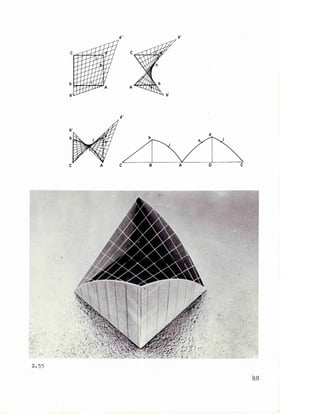
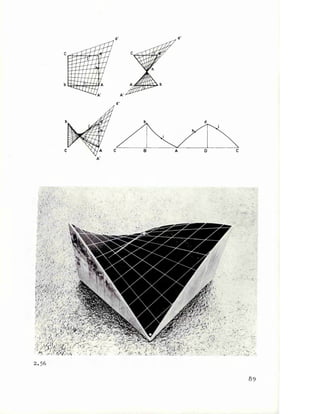
P n n 3 n 3
(r + g _ 2 r _ g ) _ J£l_a ( i g )
n = 3 n 3 *
•j 'j
TCr q _ Ttl q
n3 n3 ’
( r 3 " S 3 ) ,
_ 3 e 3
( i T A - > •3n r3
( + to the right of 0 ; - to the left of 0 )
The shearing force S at any point with abscissa £ is:
s - 2 2 gq (I )S P - + n K 2 ' '
K2
r TX 5 q+
n
3. Arch Stresses
Horizontal thrust:
The thrust H is obtained by equating to zero the moments about 0 , i.e,
I M = 0 ,
o 1
which can also be written as
M H (f ) .
o o
142
Hence:
H
M
o
f ’
which is equal to:
H
-r 271 r q
3 (0.3765) n
0.8853
2
TCr q
n
The bending moment at any point with abscissa ^ is
M M k - H (f - z) ,
f (b.b.r
(suffices (b.b.) denotes basic beam )
which equals:
M (1 + ) - 0.8853 - rn ^ 0.3765 r (1 - ) *
Tt r3 q
n
(1 ) - 0.8853 (0.3756) (1 - — - )
Tlr"1 q 1
n 3
which can also be written as:
M
TC r3 q
n M
(3-2.1)
Where F,, is a dimensionless factor (Figure 3-9)
M
l zi 3
4. Axial Forces
N = + S sin <p + H cos ip , (Figure 3-7.) ;
§ s (b.b.)
N (+) = compression,
N (-) = tension,
where:
tan ip
d z
d = 2 (0.3765 2 ) = 0.753 2 ,
cos ip
I1 + tan m w
1 + 0 .3 6 7 £
2 ’
sin ip =
tan tp
1 + tan *p
0.753 r
il + 0.567 ~
r
so that:
N = +
2
11 £ q
n
0.753 r
1 + 0.567
+ 0.8853
U r 2 c
n
2
TC r q
n
0.8853 - 0.7530 r
1 + 0.567
1 + 0.567 ~
r
144
which can also be written as:
N
2
ft r q
n N
(3-2.2)
where F is a dimensionless factor (Figure 3-9)
N
5. Shearing Forces
S s= S Cos q) - H sin q) ,
» £ (b.b.)
so that
1 + 0.567
- O .8853
Tl r2 q
n
0.7530 r
1 + 0.567
w 2
Tl r g
n
- s+ —
1 + O .567
which can also be written as:
Tl r2 q
n S ’
(3-2.3)
where F is a dimensionless factor (Figure 3-9) -
*S>
P t. E /r ( g / r ) 2 ( g / r ) 3
F
M
F
N
F
S
A
i
e
o
o
1 .0 0 - 1 .0 0 0 0 .0 0 0 0 0 1.3087 -0 .2 6 6 2 5
l 1 -0 .9 0 0 . 8 l - 0 .7 2 9 0.0269 9 1.1870 -0 .1 7 3 9
2 * - 0 .8 0 0 .6 4 - 0 .5 1 2 0 .0 4 2 6 6 1.0888 -0 .0 9 1 4 1
3 ' - 0 .7 0 0 .4 9 - 0 .3 4 3 0.0489 9 1.0120 -0 .0 2 0 7
4* - 0 .6 0 0 .3 6 - 0 .2 1 6 0.0 4 7 9 9 0 .9 5 5 1 + 0.036 42
5 ' -0 .5 0 0 .2 5 - 0 .1 2 5 0 .0 4 1 6 6 0 .9 1 6 9 +0.07795
6 ' -0 .4 0 0 .1 6 -0 .0 6 4 0 .0319 9 0 .8 9 4 1 5 + 0.10215
7 ' - 0 .3 0 0 .0 9 - 0 .0 2 7 0.0209 9 0 .8 6 1 6 +0.1 0 7 2 7
8 '
«
o•
DO
O
0 .0 4 - 0 .0 0 8 0 .0 1 0 6 6 0 .8 7 2 0 + 0.0 9 2 3 0
9 ' ‘
1
o•
o
0 .0 1 -0 .0 0 1 0 .0029 9 0 .8 8 3 5 +0.05653
0 o .o o 0 .0 0 0 .0 0 0 0.0 0 0 0 0 0.8 8 5 3 0 . 0 0 0 0 0
1 + 0 .1 0 0 .0 1 0 .0 0 1 0 .0029 9 0 .8 8 3 5 - 0.0565 3
2 + 0 .2 0 0 .0 4 0 .0 0 8 0 .0 1 0 6 6 0 .8 7 2 0 * - 0 .0 9 2 3 0
3 +0 .3 0 0 .0 9 0 .0 2 7 0 .0209 9 0 .8 6 1 6 - 0 .1 0 7 2 7
4 + 0 .4 0 0 .1 6 0 .0 6 4 0.0319 9 0 .8 9 4 1 5 - 0 .1 0 2 1 5
5 +0 .5 0 0 .2 5 0 .1 2 5 0 .0 4 1 6 6 0 .9 1 6 9 - 0 .0 7 7 9 5
6 +0 .6 0 0 .3 6 0 .2 1 6 0.0479 9 0 .9 5 5 1 -0 .0 3 6 4 2
7 +0 .7 0 0 .4 9 0.343 0.0 4 8 9 9 1.0120 + 0.020 7
8 +0 .8 0 ' 0 .6 4 0 .5 1 2 0 .0 4 2 6 6 1.0888 + 0.091 41
9- +0 .9 0 0 .8 1 0 .7 2 9 0.0 2 6 9 9 1.1870 + 0.173 9
B + 1.00 1.00 1.000 1 . 0 0 0 0 0 1.3087 + 0.266 25
3 - 9
' 1 4 6
Approximate Design of Cross-Section Required
The geometrical relationships described in Figure define
the cross-section of the arch segment. The vertical cross-sectional
depth f varies continuously from maximum, where f = O.II986 r to
minimum where f = o. The arch segment was sliced into three
sections as shown in Figure 3*8. The minimum thickness of the shell
must now be calculated.
1. Position of Neutral Axis
The arch segment, even under its own dead weight, will produce
a state of stress defined as bending. That is to say, the bending
stresses vary linearly from a maximum compressive value at the top
fibre to a maximum tensile value at the bottom fibre. The axis
passing through the points where there is no bending stress is
called the neutral axis.
The determination of the neutral axis for the various cross
sections in Figure 3*8 was done by a graphical treatment using the
link-polygon method.
2. Moment of Inertia about Neutral Axis
The bending stiffness of a cross sectional shape is gauged by a
quantity called its moment of inertia, (second moment of area) usually
denoted as (i).
The approximate I for the various cross sections was found
geometrically using the full scale drawing of the respective cross
section in the model. The same drawing that served to find the
neutral axis was also used to compute I.
3. Check for Bending Moment
Vertical loading uniformly distributed over full span.
The bending moment (M)for the various cross sections can be
calculated using equation (3 .2 .1) hence:
The bending stress f at top of cross section (compression)
1 I
The bending stress f at bottom of cross section (tension)
- M h 2
2 “ ~ T ~
For example: r = 1,000 cm.; n = 26;
2
intensity of load q = 15 lb/sq.ft (0 .0 0 7 3 2 kg/cm );
F^ (max.) at section A - A = 0.04899 (Figure 3*9 point 7);
and where h^ and h„are the distances from the neutralaxis
1 2
to the top and bottom fibre of the cross section;
4
and I at section A - A = 26,306 cm (Figure 3*8).
Substituting these quantities in the above equations:
M (A - A) = ^ ,'53° kg/cm #
^ , 43,330 kg/cm2 (2 8 .5 cm) , 2 trr„ . 
f , * =--- 1------------r---------- = 47 kg/cm (667 p.s.1 .).
1 ' 26 ;3 0 6 cm
f2 (A - A) = 43,330 kg/cm (2Q cm) = 33 kg/cm2 (468 p.s.i.).
26,306 cm^
4. Check on Axial Thrust
The compressive stress(C)due to axial thrust is:
_ axial thrust_____________
(section) cross-section of area of segment .
The axial thrust for the section(A - A)can be calculated using
equation (3.2.2),
hence:
C (A - A) = 893 kg = 7.45 kg/cm2 (105.8 p.s.i.).
120 cm2
148
5. Minimum Thickness for Structural Stability
The maximum stress at section A - A due to the bending moment and
2 2 » 2
the axial thrust is therefore: 47 kg/cm + 7-45 kg/cm = 54.45 kg/cm
(773 p.s.i.).
Assuming an allowable working stress = 2,400 p.s.i.
2
(168 kg/cm ) (l/5 of short term ultimate stress), then the maximum
stress is well within the allowable limit.
Figure 3-8 shows the various values for t, in order to obtain
an arch segment of "constant bending strength", viz. segment with
approximately equal stress levels, at extreme fibres, at all the
cross sections.
1 4 9
C H A P T E R T W O EXPERIMENTAL MODEL ANALYSIS
Generally, there are two approaches available for studying
the behaviour of a structure: (l) Analytical analysis; and
(2) Experimental analysis.
The analytical approach is based on the idealization of a
physical problem expressed in pure mathematical terms, to which an
appropriate generalized theory was found; one really deals here
with a "mathematical model".
Alternatively, the experimental analysis makes use of a
"physical model".
Each approach has its merits and limitations. An experimental
method will be advantageous when dealing with novel shapes and complex
boundary conditions, which are not easily expressed analytically.
In most countries, nowadays, the results of a model analysis can
be offered in lieu of a theoretical calculation.
The model technique, which is very old (Michelangelo used it to
visualise the forces in the dome of St. Peter's in Rome) has recently
become a powerful tool for the engineer due mainly to the
development of modern electronic equipment and the refinement of the
electrical resistance strain-gauge.
The experimental analysis involves three technical problems:
(l) Construction of a model; (2) Loading arrangement for the model;
and (3 ) Measurement of deformations, evaluation of measurements and
their interpretation for the actual prototype structure.
1 5 0
Relationships Between Model and Prototype Quantities
In a model experiment, we are ultimately interested in
arriving at the stresses and displacements in the prototype based
on the observed results on the model. This means that we need
relations connecting corresponding quantities for the model and
prototype. In problems of statics the variables are (Ref.5):
1) 0* = stress in shell
2) a,b = linear dimensions of shell
3) t = thickness of the shell
4) E = Young's modulus
5) V = Poisson's ratio
6) y any displacement
7) p = a concentrated load
8) q = a uniformly distributed load
In the prototype we know. E, y , a, b, P, q and density of the
material.
In planning the model experiment, a convenient size (scale
factor) is chosen. TheE and v values for the selected material
in the model are also known, similarly the appropriateloading
procedures. The remaining relations can be deduced.
Assuming: y^ = y^ the following relationships hold:
Deflection: y = y S, (3*4.1)
;p Jm ’
(Suffix m refers to the model and suffix p refers to the prototype)
where S is the scale factor.
E
Forces: F = S ■— F . (3*4.2)
p E m
m
1 E
Moments: M = S M (3*4.3)
p E m
E
Stresses: (j* = rr" . (3.4.4)
P ™
m
a a
Dimensions: , (3.4.5)
D D
m p
am = ap , (3.4.6)
t t
m p
(These relations are just statements of geometrical
similarity, which means that all the geometric
dimensions of prototype and model are scaled down
to the chosen proportion. Hence:
a = Sa ; b = Sb and t «= St ).
p m p m p m
For a uniformly distributed load:
E
<1 “ q — (3 -4.7)m p E
P
If we construct both model and prototype of the same material
and assuming that it is isotropic and that the E value does not vary
with thickness, then:
Stress in model = stress in prototype; /
Buckling stress in model = buckling stress in prototype;
1
Deflection m model = — deflection m prototype;
1
Bending moment in model = — bending moment in prototype.
S3
Selection of Scale Factor
For obvious reasons it was decided to build a model as large
as possible, and to make it in the same material and moulding technique
as the prototype. The available space permitted a model with a clear
span of 4 m. (13 ft).
152
Since the prototype scalloped dome had a clear span of
20 m. (6 5 .6 ft.) a scale factor of 5 was established, thus S =
Dimension of Model
The length 200 cm. (6 .5 6 ft.) and width 49 cm. (1.6 ft.) of
the HP triangular segment was determined by the scale factor.
The preliminary approximate calculations established a shell
with a continuous increase in thickness, as it approaches the
crown of the dome, between 6 mm. to 24 mm. (0.234 in. to 0 .9 3 6 in.).
In the model, therefore, t (min.) = = 1.2 mm; (0.0468 in.)
and t (max.) = — = 4.8 mm. (0.1872 in.) (Figure 3-8).
5
153
CHAPTER THREE CONSTRUCTION OF MODEL
Mould Construction
The master (mould) for the production of large size GRP shells,
by contact moulding (hand lay up technique) is generally made with
plaster applied over a timber framework. This technique is far from
satisfactory, as the construction of the mould is complicated and
expensive. To replace this inadequate method the author has developed
a special technique known as cocooning which provides the profile
required for highly warped HP surfaces at low cost. In this technique
a sprayable quick-drying vinyl latex is applied to form initially a
"cobweb" which can bridge sizeable gaps up to 60 cm. (l.9 7 ft) wide
over any reticulated network as shown in Figure 3»l6. After completing
the spraying process a continuous seamless leather-like skin exists
over the sprayed area. During the drying process, the latex of
the "cobweb" shrinks, forming a prestressed membrane with "minimum”
surface (Figure 3'17)» GRP laiminates can be produced from the skin
covering the area without any difficulty to form a single element or,
alternatively,a more robust GRP mould can be produced first.
A brief description will show how a mould can be made. A mould
produced by this process consists basically of three elements:
(l) A large box made of plywood; (2) A course network of nylon cords;
and (3) A skin of vinyl-latex.
1. The Box
The three sides and base illustrated in Figure 3-10 are made of
4" plywood sheets. (The "box" for the elements of the prototype
structure, will not be made in plywood as a lattice timber framework
construction is more practical and economical).
The calculations set out in Chapter One were used to determine the
exact contour lines for the panels. Figure 3»6 shows the dimensionless
values for the various points on the curves. To obtain a numerical
value the values merely had to be multipled by (r) the radius of the
scalloped dome model - 200 cm. (6 .5 6 ft).
15^
3.10 3.11
3.12
Figure 3.10 shows the panels before assembly. Note the
parallel line grid on the triangular base plate. These lines are
the horizontal projections of the HP straight line generators;
and will be referred to again later.
The assembly of the various panels is shown in Figure 3-H-
Additional ply panels and a number of battens were built inside
the mould in order to stiffen the sides in their transverse
direction. The inner curved wall is made of l/l6 in. plywood. Its
purpose was to aid in locating the segmental shell cut-out that
formed the projected canopy. All the wooden components were glued
together with epoxy resin.
2. The Cord Network
Having completed the woodwork, the next step, was to locate
the positions of the straight line generators on the curved ply
edges. If the edges of the HP segment had been straight, any
arbitrary division of the edge into equal distances would have
determined the locations of the generators. With a curved edge the
procedure is more involved.
The locations of the straight line generators on a curved edge
can be found mathematically or graphically. Here the graphical
method was used. As already mentioned, the horizontal projection
of all the straight line generators were marked on the base plate
of the mould and it was then simply a matter of transferring them to the
curved edge. Only the points of intersection between the straight
line generators and the outer face of the boundaryplane of the
mould were required for constructing the network. For this purpose
a large L square was used as shown in Figure 3-12.
It was desirable that the cord network should be stretched over
the sides of the mould panels flush with its surface. This was
achieved by using a flexible cord that could bend sharply across
the plywood edge.
Nylon cords were found most suitable. Figure 3-13 shows the
prestressing device - a lever - and the fixing scheme for the cord.
156
The fastening device consisted of a l/4 in. steel bolt & nut
and a fibre washer. The bolt had a fine hole just below its head.
While prestressing, the cord could pass freely through the bolt.
When the desired prestressing level was reached the nut was
tightened; friction between panel and washer held the cord in its
prestressed position.
3. The Skin of Vinyl-latex
With the whole of the network completed, (Figure 3»l4) the
spraying process that forms the skin can begin. Before spraying with
vinly latex, all the parts that will be in contact with the skin
were coated with a special adhesive (R.M.193)•*
A mixture of three parts of !tkoonkoten Plastic Type 3?* and one
part "Webbing Agent"* was sprayed on the network. This coat bridged
all the open meshes of the net forming a tissue-like surface as shown
in Figure 3«15» At this stage the tissue was rather weak and
quite brittle.
A number of separate coatings of Plastic Type 3 without the
Webbing Agent were then sprayed over the tissue forming a seamless
leather-like skin to a thickness of 30 mils (0 .7 6 mm).
While the sprayed-on plastic skin dried on the mould it shrank
in all directions forming a prestressed membrane with "minimum"
surface (Figure 3»1?)« Note the diamond-like pattern on the surface
which was the result of the skin shrinkage between the skewed cords,
which thus formed numerous minimum surfaces for their particular
boundary conditions. The overall shrinking effect was so significant
that it deformed the cord network. Initially all the cords followed
straight lines, but after the skin was sprayed on they became catenaries.
Therefore, strictly speaking one is no longer dealing here with a true
HP surface.
* (All the materials for the spraying technique were supplied by
R.A. Brand & Co. Ltd., and in addition to adhesive R.M.193
the trade names of the other products were: "koonkote" Plastic
type 3; and a "Webbing Agent")
3.14 3.15
3.16
158
Two identical formworks were built in order to speed up production.
Standard compressed-air spraying equipment was used and it
consisted basically of a spray gun, a pressure feed floor container
and an air compressor.
Plastic Type 3 + Webbing Agent, was sprayed at a pot pressure
of 10-15 lb/sq.in. and at a gun pressure of 30 - 40 lb/sq.in. The
gun had a No. 203 (He Vilbiss) nozzle.
Plastic Type 3 without the Webbing Agent, was sprayed at a pot
pressure of 30 lb/sq.in. and a gun pressure of 70 - 90 lb/sq.in.
Thegun had a No. 765 (De Vilbiss) nozzle.
Moulding Technique
The vinyl-latex skin of the mould was ready for use after it had
dried thoroughly for about 48 hours. The first operation in producing
a GRP laminate was, of course, to wax polish and apply a release agent
on the mould surface. A floor wax and a release agent were used.
(As generally known, polyester resin will not adhere to a vinyl-
latex, therefore, if only a few laminates had to be made, the mould
surface did not need treatment with a release agent).
Several pre-cut triangular chopped strand mats, weighing 1 oz.
sq.ft. each, and impregnated with a fire retardent polyester resin
(No. SK19187/1 supplied by Bakelite Ltd.) were laid on the mould. The
required varied thickness of the shell was controlled by the number of
chopped strand mat layers and the glass to resin ratio. The glass resin
ratio was 1: 2.5 by weight = 1: 5 by volume; no gel coat was used. The
impregnation and consolidation of the laminate was done with a brush
and a in. steel washer roller (Figure 3«l8 and 3»19)» The GRP laminate
was moulded over the edge of the HP surface thus forming a vertical flange.
Two workmen needed 20 minutes to complete one laminate.
Two laminates were made each morning and left to cure at room
temperature. The segments were carefully removed from the mould on
the following day (Figure 3»20), and washed and cleaned with soap and
water. A portable diamond cutter, driven by compressed air, was used
to trim the edges of the flanges to a height of 3/4 in. Next small
holes were drilled, with a template, into all the flanges.
159
3.19 3.20
160
Finally, the auxiliary shell segment, that formed the projected
canopy was cut out from the principal HP segment, turned over l80°
and laminated to the same segment, A lr in. wide strip of chopped
strand mat impregnated with polyester resin formed a continuous joint
between the two shell segments.
Assembly of Model
The assembled dome is shown in Figure 3*31* It consisted basically
of four elements: (l) An unreinforced concrete foundation; (2) Inclined
steel supports; (3) A single skin GRP shell; and (4) A steel compression
ring at the crown of the dome.
1. Concrete Foundation
The polyhedral foundation was made of 26 truncated concrete solids
monolithically joined; no steel was used for reinforcement. The
forms into which concrete was poured into were made of -jj in. hard-
board, the abutting surfaces being jointed together with 2 in. wide
chopped strand mat strips (Figure 3-24). The radial internal partitions
consisted of  in. plywood diaphragms. The hardboard walls were
stiffened horizontally with 1 by 2 in. wood battens. In addition two
steel cables were -wrapped around the outer walls to hold the entire
shuttering tightly together. To reduce the quantity of concrete
used, 32 hollow wooden boxes were placed inside the shuttering as
shown in Figure 3*23.
The concrete foundation was constructed in this manner merely for
convenience, the main reason being the necessity to raise the entire
dome a sufficient height from the ground to accommodate a loading
platform underneath.
2. Steel Supports
The design of the supports is of prime importance in a shell
structure. They have to fulfil a number of functions:
(l) Resist all the possible forces that might act, for example,
axial forces, downward, upward and sideways bending moments and
torsion; (2) transmit the loads to the ground in a most direct way;
l6l
------------------ i« i ------------------
-t- SIO t-
4
I
3-21
t / f > bell
3-22
162
3.23 3.24
3-25 3.26
3.27 3.28
163
(3) prevent high stress concentrations in the thin shell, at the
points of support; and (4) express the lightness of the shell structure
ideally it should appear to "soar11 upwards.
It is believed that the design chosen satisfied all these points.
The supports were designed in the form of a slender skeleton
tetrahedra, that is to say, broad at the base and tapering to a
"point11 at the top with a triangular brace at half length. The members
were of £ in. steel stubing with a % in. steel base plate (Figure 3-2l)
Figure 3-26 shows in detail the connection between the concrete
foundation and the steel support, before encasement in concrete.
It allowed for rotational as well as translational re-adjustment.
Figure 3*22 shows in detail the connection between the steel
support and the GRP shell. It consisted of two traingular steel plates
•g- in. thick, one of which had the shape of a slender isosceles and the
other an equilateral triangle; the latter was threaded at its centre.
The two plates were welded together along one side to form an L shape.
The L shaped unit was later to be laminated into the inside valley
between two segments, thus forming again a tetrahedra. A 3/l6 in - bolt
with two locking nuts formed the "pin connection" joint between shell
and support.
3. The Shell
Segments were bolted together along their upwards pointing
vertical flange, then turned over and laid on a wooden lattice
falsework (Figure 3-27)-
A strip of chopped strand mat tapering from 2 in. to 1 in. was
laminated over the full length of the joint. The L shaped steel plates
that formed the connection between shell and support, were also
laminated into the joint.
After the GRP strips had cured on the falsework, the segments were
again turned over, bolts taken out, and the projected vertical flanges'
were cut off with the diamond cutter (Figure 3-28). (For experimental
reasons it was decided to cut off the flanges, despite the obvious
fact that their omission would reduce the stiffness of the dome).
For easy handling segments were first jointed in pairs then in
fours and finally in two groups of eight plus one group of ten. The
three completed sets were put on their steel supports, and the
remaining joints were laminated in situ from inside.
The simple method used here for joining, ensured structural
continuity between the segments and was at the same time also easy
to make. Its disadvantage lies in the fact that it does not permit
easy dismantling.
4. Steel Ring
The bicycle wheel type compression ring at the crown of the
dome (Figure 3-29 and 3-30) was dictated by structural considerations:
(l) it had a high torsional rigidity which effectively stiffened
the somewhat weaker upper part of the dome against unsymmetrical
live load; (2) it was light in weight; (3) it served as a skylight
and fresh air circulator; and (4) it had the formal and visual
consistency with the supports and the rest of the dome.
The ring was made of 52 lattice tetrahedras, joined base to base
on to a polyhedral strip. The polyhedral ring was made from a steel
*1 1
plate "8 in. thick, and the lattice-work was all made of q in. steel rods.
Figure 3-30 shows in detail the connection between the compression
ring and the shell. The "pin-connecting” joint comprised a
"8 in. steel rod. The rods were laminated in situ into the inside
valleys between two segments. They had each four fine "branch" like
arms in order to ensure a better grip between shell and rod. A nut
at the open end of each rod allowed for small translational re-adjustments.
165
3-30
166
'167
Loading Arrangement
Various methods of load application to the dome structure were
considered; pneumatic devices, hydraulic jacks, screw jacks, dead
load with levers and dead load with lead shot "blankets”.
The dead loading method with a system of levers, as shown in
Figure 3«35 was found most suitable.
Since it was desirable to deal with hanging weights of equal
intensity throughout, it was first necessary to subdivide each shell
segment, in its horizontal projection, into a large number of small
quadrilateral elements of equal area. Figure 3-32 shows the
intermediate and final subdivision of the plane area of the HP segment.
It consists of 52 small quadrilateral elements; some of them are
quite different in outline, yet they all cover the same area in plan.
Next, the centroid of each quadrilateral element had to be
located. Having completed the lay-out of the grid, it had to be
projected upwards on to the sloping surface of the HP segment as shown
in Figure 3»33« This GRP segment served as the drilling template for
the scalloped dome, altogether 1 ,3 5 2 holes were drilled through the
2 2
shell which corresponds to one loading point per 93 cm (l4.4 in )
(Figure 3*36). Nylon ropes, 3/32 in. diameter, were threaded through
the holes. At their upper end they were fastened to a small circular
pad of plastic foam, which served as a load distributing device. To
enable any desired re-adjustment in the rope length, a strip of nPerspex
with three holes in it was fastended to the free end of the rope.
Friction between the tight rope passing through the three holes,
held the rope in the desired position.
To each set of four padded loading points, three levers were
attached, to which a single load hook was fastened (Figure 3*35)•
Various weights could be added to the hooks to load any part of the
structure as required.
In an unloaded condition all the hanging loads rested on a platform
under the model as shown in Figure 3*35- By lowering the loading
platform, with the aid of three hydraulic jacks, the weights were made
to hang freely and react simultaneously on the whole or part of the dome
3.32 3-33
s i /
3.34
169
3.35
3.36
170
171
The loading platform was entirely made of timber. It consisted
basically of three triangular shaped braced trusses, made of 2 in.
by 4 in. joists, fastened together at their ends with  in. plywood
gusset plates. A hydraulic jack was located at each of the
three corners.
Test Programme
Roofs must be designed to support in addition to their own
dead weight; (l) A live load, commonly due to snow; (2) Concentrated
loads due to special equipment and occasional maintenance work;
(3) Pressures and suctions due to wind; (4) Thermal loads due to the
expansion and contraction of the building material; (5) Settlement
loads due to uneven settlement of the supports; and (6) Dynamic
loads, for example due to impact load, resonant load and
earthquake motion.
1. Dead Load
The dead weight of one completed segment of the testing model is;
2
2 kg. and its projected plan area is 0.48 m . This corresponds to
4.2 kg/m^ (0 .8 6 lb/sq.ft).
The dead weight of prototype and model are related by the scale
3
factor, i.e: ¥ = ¥ (S ), (see page )-where the dead weiqht of
p m 7
the whole model ¥ with 26 segments is
m
¥m = 2 kg (2 6 ) = 32 kg.
The dead weight of the prototype in which the scale factor
S = 5 will be:
¥ = 52 kg (5^) = 6 ,5 0 0 kg. (l4,300 lb.).
P
The dead weight of the shell varies per unit area of sloping
shell but in order to simplify the calculation it was assumed capable
of representation as a uniform load per unit area of horizontal shell
projection. In a GRP shell where the dead weight per unit area is only
about l/ 6 of the live load, this simplication is not likely to cause
any appreciable error in the test experiments.
In order to simulate a uniformly distributed load between model
and prototype the relationship in equation (3*4.7) is used:
E
m
V “ % E" ,
P
Since model and prototype are made of the same material this simplifies to
173
In order to simulate the stress condition in the prototype, the
dead weight of the model must first be subtracted from the dead
weight of the prototype.
The dead weight of the prototype is:
p 2 2
4.2 kg/m (5 ) = 21 kg/ m (4.3 lb/ft. ) and subtracting from
it the dead weight of the model this gives:
2 2 2
21 kg/m - 4.2 kg/m = 16 .8 kg/m which multiplied by the
area of the model then gives:
[l6.8 kg/m^ (0.48 m^ )]2 6 = 211 kg.
Having 1,248 loading points on the dome (not considering the 104 points
on the small cantilevering portion of the canopies), the resulting
load on each point is:
211 kg _ _
17548 " °-169 k9‘
Since each loading hook is connected to four points, the load per
hook on the model which will simulate the dead weight of the prototype
will have to be:
0.169 kg (4) = O .6 7 8 kg.
2. Snow Load
The requirements of British Standard Code of Practice 3* Ch.5
for roofs of limited access, allow for 2 ft. of snow, 15 lb/sq.ft.
(73.24 kg/sq .m.) on plan. That is to say, auniform load per unit
area of horizontal shell projection. A minimum additional factor of
safety of 1.5 was agreed upon with the local District Surveyor for
the town where the prototype is to be erected and the design loading
thus works out to be 22^ lb/sq.ft (110 kg/sq.m.). (This factor of
safety is in addition to the normal factor of safety used in
the design).
To simulate the stress condition as in the prototype, due to the
maximum required snow load, the model required the application of a
load intensity of 110 kg/sq.m. Since the area of the model was .
12.57 sq.m., the total load on the model was 1,3^3 kg., distributed
1 7 4
on 1,248 points, gives 1.108 kg. per point, or 4.432 kg. per
loading hook.
Two loading cases were investigated: (l) A full span load i.e.
a uniform load over all the 26 segments; and (2) A half span load,
i.e. a uniform load over 13 segments.
3. Concentrated Loads
A concentrated load of minimum 200 lb (90.8 kg.) on any3 in.sq.
(32.25 sq.cm) had to be allowed for according to B.S.C.P.3 Ch. 5-
Its simulation in the model with a scale factor of 5 using equation
(3-4.2) is:
P = 200 lb / 5 ^ = 8 lb . (3-63 kg.) on any 0 .2 in s q . ( l. 2 9 sq/cm
m
4. Pressures and Suctions due to Wind
A wind load is obviously a dynamic load and a complex phenomenon.
To simplify the design procedure it is usually simulated by an
"equivalent, static load".
/
5- Thermal Loads, Settlement Loads and Dynamic Loads
Although the thermal expansion and contraction of GRP is high,
it will not build up high stresses in the scalloped dome. Since one
of the characteristic geometric features is its ability to "breathe".
In other words, each HP segment is not restrained from expanding and
contracting in its longitudinal as well as transverse direction.
Possible uneven settlement of the supports will not induce high
stresses in the scalloped dome since two diametrically opposite HP
segments reproduce a "three-pinned" arch which is statically
determinate and hence insensitive to differential settlement of its
abutments.
The dynamic loads can be exceptionally dangerous if ignored.
Their mathematical treatment is involved and beyond the scope of
this research. However, with a dome of moderate dimensions, predictabl
dynamic loads will not endanger the safety of the structure.
Deflection and Strain Measurements
Having applied the required forces, the next procedure was
to measure the deformation on the model.
1. Measurements of Deflections
The vertical and horizontal deflections were measured with a
mechanical device, using dial gauges. Dial gauges are by far the
most convenient device for measuring small displacements up to 2 in.
on a model made of relatively non-flexible material subjected to *
"static" loading.
Figure 3»3^ shows the position of the 11 dial gauges on the
segment. Gauges No. 1 and 7 were positioned to measure horizontal
displacements and the rest of the gauges vertical displacements.
They were mounted on an independent framework (Figure 3»36). The
2 in. range plungers rested on perpendicular 1 in. by 1 in. plates
of "Perspex" glued to the shell surface (Figure 3,hO) •
2. Measurements of Strains
Stress, the quantity of prime interest, since it determines the
safety of the structure, cannot be measured directly. However, it
may be determined indirectly through the relationship between stress
and strain; the latter being measured.
Strain is the change of length per unit cf length of an element
in tension or compression, it is thus a dimensionless quantity, and
quite a number of mechanical, optical and electrical instruments exist
which permit measurement.
Electrical resistance strain gauges are most suitable for measuring
strain in GRP laminates. Standard linear gauges (Teddington Aircraft
Controls Ltd, Type SE/a/5) were used. Three such gauges were arranged
to form delta and rectangular rosettes (Figure 3-^l) • The paper
1 7 6
backing of the gauges was bonded to the GRP surface with MDurofixn ;
the bond proved satisfactory throughout all the tests. Figure 3*34
shows the position of the 64 gauges on the shell segment. The
symmetry in the structure made the bonding of gauges elsewhere un­
necessary. Gauges were only mounted on the outer surface of the
shell, hence only membrane strains could be measured. The shell
segment with the necessary ndummy gauges" is shown in Figure 3-43-
The gauges were connected to an electronic data logger, (Figure 3-37)»
which punched the strain readings on paper tape. The principal strains,
their directions, as well as the principal stresses were computed by
an ICL 1905F computer. A typical computer-printed output is shown in
Figure 3-39*
1 7 7
Mechanical Properties of the Model Material
To interpret the strain readings from the test model and to
convert them into stresses, it is necessary to know: (l) the value
of Young's modulus; and (2) Poisson's ratio for the material of the
model.
1. Young's Modulus
For design purposes, a chopped strand laminate is assumed to
have the same Young's modulus (E) in tension and compression.
For long term loading, the values for E will change with time
and temperature (see also page 25 )• It is practically impossible
to determine the time-temperature dependent E value (apparent modulus)
for a GRP laminate analytically. Figure 3-42 shows how the values
for the apparent modulus were evaluated. A strain gauge extensometer
was clamped to a  in. specimen. The specimen was subjected to a
continuous constant stress of 2 ,5 0 0 lb/in (23% of the short term
ultimate stress) for a period of 10,000 mins (6 days, 22 hours and
30 mins) and at a room temperature of 66° F.(19° C.). The various
values for the apparent modulus are shown in Figure 3-38. It was
surprising to find that the short term E value was 1.15 x 10^ ,
whereas the long term E value (after 10,000 mins at 66° F.) was only
0.88 x 10⁶ ; a change of 23% • The time dependent E value was of
course considered in computing the principal stresses in the shell.
2. Poisson's Ratio
(1) The value for Poisson's ratio is determined by the ratio:
lateral strain / longitudinal strain.
(2) Generally, the Poisson's ratio is not so sensitive to time
effects.
(3) In GRP Poisson's ratio (v) in tension is not the same as in
compression. For a chopped strand laminate made in contact moulding,
178
0.6x10®
tO3 IDay 6 Days
3.38
T A p r N U t ' B F P 2 5
N>J 2 E R 0 T I M E LOG
LOAD CASE NO. 7
NO TIME LOG
TWO-GAUGE ROSETTES
CHANNEL number PRINCIPAL STRAINS ANGLE PRINCIPAL STRESSES
0 1 17.0 -8.0 0.0 14.7 -0.9
2 J -44.0 79,0 0.0 -11.7 65.4
4 310.0 -17,0 0,0 327.3 122.3
A 7 7ft4. 0 -501.0 0.0 598,2 -194.6
A 460.0 -822.0 0.0 124.0 -679.5
in 11 112.0 -968,0 0.0 -318.3 -995,2
1 ?. 1i 385.0 -1978.0 0.0 -481.7 -1962.7
t 4 13
43 - 90 ROSETTES
537.0 232.0 0.0 685.6 494,4
CHANNEL H U M B E R PRINCIPAL STRAINS ANGLE PRINCIPAL STRESSES
;a 17 18 23.1 -6ft. 1 136,6 -5.1 -60,9
19 20 21 485.8 -785.8 83,6 168.3 -628.7
??. 23 24 406. 0 -719.0 84.1 112.4 -592.7
,.’5 2ft 27 292.3 -1328.3 82,0 -287.0 -1302.7
(Ift 29 3 0 646.8 -1069.8 82,2 213.4 -862.5
31 32 33
E Q U I A N G U L A R ROSE
179.0
TTES
-501.0 142,0 -33.9 -460.2
C HAN N E L NU MB ER P R I N C I P A L STRAINS ANGLE PRINCIPAL STRESSES
;;a 33 36 108.8 -162.2 158,7 44. 0 -125.8
37 3ft 39 298.9 -38.9 71 .3 305.3 93.6
AO 41 42 186.3 3.0 90.2 202.7 87.8
AS 4<- 45 179.7 -52.4 100.8 116.4 2.3
Aft 47 48 14.6 -21.3 127,5 6.1 -16.4
SO 51 32 226.9 -202.2 100,5 153.4 -115.5
S3 5a 55 307.5 -167.5 160,4 256.2 -41 ,4
Sft 57 3E 662.2 -476.2 5.9 499.5 -214.0
so 6 0 61 434.4 -165.7 144.4 394.2 18.1
02 63 64 -157.1 -367.5 136.5 -336.6 -468,5
3 - 3 9
1 7 9
3 .4o 3.41
3.42 3.43
l8o
the tensile Poisson's ratio = 0.32; and the compressive Poisson's
ratio = 0.42 (Figure 1.2 ) . The value of Poisson's ratio for the
specific model material, was not determined experimentally because
it is difficult to compress a thin laminate without introducing
bending.
Since the dome was mainly in compression the value v = 0 . 4 2
was used to compute the principal stresses in the shell.
3. Ultimate Tensile Strength
The average, short term ultimate stress, for the model material
2
was 11,000 lb/in (773*3 kg/sq.cm) .
l 8 l
Evaluation of Test Results
A considerable amount of numerical data about deflections
and stresses has been determined and it is not possible to present
the whole of this information in a few significant graphs, but
particulars of Deflection and Stress Distribution are shown in
Figures 3*44 to 3*54. These curves show the vertical deflections
and stress distributions of the three loading cases which were
investigated.
1. Dead Load
The behaviour of a GRP shell under its dead weight, had to be
investigated in detail since it represents a case of long term
continuous loading.
Figure 3*46 shows the principal stresses at various points on
the shell, due to the simulated dead weight of the prototype. The
stress distribution throughout is fairly even, and it is predominantly
2
in compression. A maximum compressive stress of 87-3 lb/in (6.1 kg/sq cm)
2
and 165.3 lb/in (11.6 kg/sq cm) was measured at ERS gauge No.25 and
2
No.13; and a maximum tensile stress of 20.7. lb/in (1.4 kg/sq cm) and
2
49.3 lb/in (3-4 kg/sq cm) was measured at ERS gauge No.6 and No.l4.
All these values are very low indeed.
Point 4 (quarter span) on the shell was examined more carefully.
Curve 1 in Figure 3*51 shows vertical deflection curve of point 4 on
the HP segment, due to the simulated dead weight of the prototype,
over a period of 10,000 mins and at a room temperature of 68° F. It
is reassuring to see that the curve levels off after about 4 days.
2. Uniform Load Over Full Span
Figure 3*44 shows the vertical deflection curve of a meridional
rib across the dome under a uniform distributed load (U.D.L.) of
24 lb/sq.ft. at 67° F. Note, that the point 4 at £ span deflected
downward, whereas point 6 at 2 span deflected upward. The behaviour
182
is explained by the fact that although the load on the entire dome
was uniform, the load on a meridional rib was not uniform.
The un-uniform load on the rib continuously decreased towards
the crown and had its centre of gravity at a 5 the distance from
the outer support. This, as it were ’’unbalanced” load, produced
an uplift of the rib at the crown of the dome. (Only a concentrated
load at the top of the dome or suction due to wind could produce
a downward deflection of the crown).
It was most interesting to see that the low rise scalloped dome
behaved in a linear manner, in that doubling the load also doubled
the vertical deflections, and the stresses in the shell (Figures 3»51;
3 .5 2 and 3-53).
At a U.D.L. of 24 lb/sq.ft. at 67° F the maximum vertical deflection
of the rib at 4 span after 10 minutes was 0 .5 1 in. (13 mm).
Sustaining the load for 10,000 minutes produced a deflection of
O .6 9 in. (17.6 mm) it increased by 35% (Figure 3«5l)« Since deflection
in prototype = deflection in model x scale factor, the vertical
deflection in the prototype at £ span under the same U.D.L., will be
3.45 in. (8 .7 6 cm).
Figure 3*47 shows the stress distribution, after 10 minutes and
10,000 minutes of continuous loading. Note that, for example, at
ERS gauge No. 25 the stress after 10,000 min at 67°F only increased
by 4.8% (due to the change in the contour line of the rib) whereas the
deflection at the same point increased by 35%? this being a characteristic
behaviour of a material in which excessive creep is taking place.
It can be seen that the design criteria for a GRP structure is not
so much the danger of exceeding the maximum allowable working stress
of the material, but rather the excessive and continuously increasing
deflections that will take place over the life span of the structure,
as the value for E is reduced with time. Straight free edges in an
GRP structure should, therefore, be avoided.
3. Uniform Load Over Half Span
Figure 3*45 shows the vertical deflection curve of a meridional
rib across the dome, under a uniform load over half the dome of
24 lb/sq.ft. at 63°F. A maximum vertical deflection of 0.97 in.
(2.47 mm) was measured at % span in the model .. : .
which equals 4.83 in. (12.35 cm) in prototype. Figure 3-48 shows
the stress distribution, after 10 min. and 10,000 min of continuous
loading.
A comparison between the fully and half loaded dome shows that
the vertical deflection of the rib at £ span after 10,000 min.
increased by 22%, in the latter case, whereas the stresses at the
same point only increased by 2.7%*
4. Concentrated Loads
A point load of 10 lb (4.3 kg) on the model (simulating
230 lb = 113.4 kg on prototype) at l/ 3 span, produced a maximum
2
compressive stress of 399 lb/in . The same point load at  span,
2
produced a maximum stress of 85 lb/in .
3* Stress Trajectories - Isostatic Curves
Having found the principal directions of the stresses, at the
various points on the shell, two families of curves parallel tothe
principal direction at the various points can be drawn,giving an orthogonal
network (Figure 3«54). These curves are referred to as isostatics or
stress trajectories. A state of pure tension or pure compression
will exist at any point normal to the curves, hence no shear is
developed along the isostatics. They represent the stress-line pattern
which indicates the flow of stress within the structural element. They
are very useful in visualising the behaviour of a structure under load,
and also help to spot dangerous stress situations.
The flow of stresses in the HP triangular shell segment supported
on three points under U.D.L., is similar to the flow of stress in a
simply supported beam under U.D.L. Bending of the shell segment produces
a stress concentration at about l/ 6 the span, in which the rib at its
top fibre is in compression, and the valley of the segment is in tension.
184
A-A
B -B
3.4-4
v e rtic a l deflections - U.DL.2Alb/sq.ft.al67*F a fte r 6 days of c o n tin u o u s lo ad in g
B -B
A-A
v e rtic a l d e fle c tio n s - U.D.L.over h a lf sp an , 24lb/sq.ft.at 63*F a fte r 6 days of c o n tin u o u s lo a d in g
3.45
185
Figure 3*^6 Stress distribution in the HP shell segment.
Load condition: 3*^7 lb/sq.ft. (17 kg/sq.m) * dead weight of prototype.
Duration of load: Top - 10 mins. Bottom - 10,000 mins. (approximately 7 days).
Temperature: 68°F (20°C).
Information given: direction of principal stresses, stress in lb/sq.in.
(llb/sq.in. = 0.0703 kg/sq.cm.) (+) tensile (-) compressive.
186
.A
C l
igure 3*47 Stress distribution in the HP shell segment.
Load condition: U.D.L. 24 lb/sq.ft. (117-1 kg/sq.m) over full span.
Duration of load: Top - 10 mins. Bottom - 10,000 mins. (approximately 7 days).
Temperature: 67°F (l9.5°C).
Information given: direction of principal stresses, stress in lb/sq.in.
(llb/sq.in. = 0.0703 kg/sq.cm.) (+) tensile (-) compressive.
1 8 7
•2017.7
Figure 3-48 Stress distribution in the HP shell segment.
Load condition: 24 lb/sq.ft. (117.1 kg/sq.m) over half span.
Duration of load: Top - 10 mins. Bottom - 10,000 mins. (approximately 7 days).
Temperature: 65°F (l8°C).
Information given: direction of principal stresses, stress in lb/sq.in
(llb/sq.in. = 0.0703 kg/sq.cm.) (+) tensile (-) compressive.
188
Figure 3-49 Stress distribution in the HP shell segment.
Load condition: 29 lb/sq.ft. (l4l.5 kg/sq.m) over half span.
Duration of load: Top - 10 mins. Bottom - 10,000 mins. (approximately 7 days).
Temperature: 68°F (20°C).
Information given: direction of principal stresses, stress in lb/sq.in.
vllb/sq.in. = 0.0703 kg/sq.cm) (+) tensile (-) compressive.
189
Figure 3«50 Stress distribution in the HP shell segment.
Load condition: 29 lb/sq.ft. (l4l.5 kg/sq.m) over half span.
Duration of load: Top - 10 mins. Bottom - 10,000 mins. (approximately 7 days).
Temperature: 68°F (20°C).
Information given: direction of principal stresses, stress in lb/sq.in.
(llb/sq.in. = 0.0703 kg/sq.cm) (+) tensile (-) compressive.
1 9 0
6. Plastic Flow
Figures 3*^6 to 3-50 show the considerable stress redistribution
that took place in the GRP scalloped dome as it was subjected to
continuous loading. This redistribution of stresses is due to the
"plastic flow" of the material. The less brittle a material is the
more it will be susceptible to plastic flow.
Plastic flow eliminates stress concentrations. It increases the
safety of the overall structure and contributes to its reserve of
strength. It can be seen that the lack of stiffness in GRP can also
be an advantage.
7. Failure Condition
The lack of sufficient weights for loading prevented the testing
of the entire model to failure. The various loading tests were all
carried out within the short term elastic range of the model, that is
to say, once the load was removed the model returned to its original
position.
The unit on which the guages were mounted and two adjacent segments
were loaded with a uniform load up to 48 lb/sq.ft. (234.24 kg/sq.m) when
signs of instability occurred. A maximum deflection of 1.57 in. (39*87 mm)
2
and a maximum stress of 310^ lb/in (218 kg/sq.cm) at t; span
was measured.
The "weak" area of the scalloped dome was found to be along the
rib at about f- the span from the support. Here the moment of inertia of
the cross-section was not sufficient, due to its shallow undulation,
to resist the bending moment and the axial thrust caused by the live
load. The downward vertical deflection at this point increased
continuously due to creep. It is considered that a live load of
48 lb/sq.ft. would eventually induce the rib to collapse inwards.
8. Comparison between Theoretical and Experimental Results
At a uniform load of 24 lb/sq.ft. (117*1 kg/sq.m) over full span,
the approximate calculations using the three-pinn arch analogy, gave for
example: at the top fibre of cross-section A-A (l/6 span), a compressive
stress of 1127*6 lb/in (79*2 kg/sq.cm), and a tensile stress of 191
o
834.6 lb/in (5 8 .6 kg/sq.cm) at the bottom of fibre.
The stresses obtained experimentally, using electric resistance
2
strain gauges No. 25 and 5 6 , gave a stress of 1229*6 lb/in
2
(86.4 kg/sq.cm) compression, and 449.9 lb/in (3 1 .6 kg/sq.cm) tension.
At other cross sections, as for example near the crown, a close
correlation between three-pinned arch analogy and the experiment could
not be obtained.
Final Remarks
The various tests demonstrated the great stiffness and the high
resistance against buckling of the scalloped dome made of HP segments.
It was possible to establish a relationship between the free span
of the dome and the necessary minimum shell thickness. An average shell
thickness (t) to the span ration (l) of 1:1500 was thought to be
possible. (t/l of an average chicken egg is 1:100). In a dome with
2
a diameter of 20 m. the dead weight of the shell will be only 4.33 lb/ft
(21 kg/sq.m.). Despite the very thin shell the scalloped dome
is not susceptible to the phenomenon of Msnap-throughM buckling, and
due to its plastic flow it has a high reserve of strength. The
structure also demonstrated its efficiency from the material side,
by the fact that a stress level of 3000 lb/in (210.9 kg/sq.cm)
compression in the skin was reached, without the occurrence of
buckling. If we assume that the ultimate safe working stress in a
chopped strand polyester laminate to be 2 ,5 0 0 lb/in (175*75 kg/sq.cm)
then we have here a structure in which the material is put' 100%
to work.
1 9 2
d eflectio n curves for p o in t4 (q u a rte r span) under UD.L.
24.0
91.7
ve 4
66.8
13.7
18*C
I 0300
.5 (7.62]
ma>
■C
u
C 0200
,21.5‘ C
71*F8.6
i
in
c
o
20’C
ad we
17 kg/sq.ti
3.471b. ’sq.ft. ght
1Day 6 Days
duration of load - minutes
3.51
strain curves for electrical resistance strain gaugeNo.25( 1/6 span)underU.D.L.
(0.27.) 2,000
67*F
(0.17.) 1,000
63’ F
41.! kc /s 21.5'C
ght
ID ay 6Days
duration of load minutes
3-52
193
stress-Ib/sq.in.(kg/sq.cm.)
stress curves for electrical resistance strain gauge No.25( 1/6 span)underUD.L.
1.500
(105.4:
1,400
1,100
(77.3;
1.000
curve 3,
117.1
VrO
kg
ttr
's
scFt
l
tr
a
3
19.5*C
67*P
cc ve 4—
91.7
«r6
Kg
Hr
Is
'st
q-
|H
rr
t:
a
a
17*C
63*F - —
66.8 kgIs qn a 18*C
..
cL ve 3. 13./ 1b. 's it t. a 65*F • _ _
cu ve 2. 8.6 lb' s<
4-
If t. a
Ii.O v
71*F
c u ve 1.
17 k
3.47
y/i
lb.
4-
S(!•*t. =d ad we Ight a t 18 ■F
1 2 3 4 5 6 7 8
duration of load -
910
minutes
io2 102 1Day 105
3.5 3
3.54
9k
S E C T I 0 N T H R E E COST
The dead weight per sq.ft. of the 20 m. (65.6ft.) prototype
scalloped dome is:
Weight of dome 14,300 lb . ^ ,
— ---------------t V — ---- -- -^p-----7 , = ^-23 lb/sq.ft. (2 0 .6 kg/sq
Plan area covered by dome 3i37o sq.ft.
If the glass to resin ratio is 1:2.5 than the laminate contains:
!t‘3 X . ill = 1 .2 lb/sq.ft. glass,
3-5
and
4.23 lb/sq.ft (2.5) 0 ,, /
^ ---- -— =^' = 3 .0 3 lb/sq.ft. resin.
3-5
Based on a calculation that polyester resin (flame retardant)
mix = 2/8d per lb., and chopped strand mat nE M glass 2 oz./sq.ft.
= 4/- per lb., than the basic material cost per sq.ft. covered
area is: 4/l0d + 8/ld = 12/lld.
The cost of the finished manufactured laminate could not be
included, since it was found to vary up to 100% with different
fabricators.
It should also be remembered that the material cost per sq. ft.
of laminate is directly related to the free span of the structure.
The ratio, cost per sq. ft. of covered area to the free span of the
dome, varies linearly for moderate spans and thus increasing or
decreasing the magnitude of the dome will also affect the cost of the
material per sq. ft. in the same ratio. Consequently with a relatively
expensive material as GRP, the question of dimensions gains particular
economic significance.
Economy is, of course, fundamentally important in present-day
KeW -todays . 0
structures. However, the cost of a structure^/is usually about 6 % T*7 )0 /0
of the entire cost of the building. Hence, even substantial reductions
in the cost of the structure only amount to small savings of the total
building costs.
It is believed therefore, that the argument that GRP is too
expensive for building is not such a real objection. 'j
Generally plastics have in their favour, over conventional
building materials a number of characteristic points.
The cost of a material can normally be identified in
three stages:
1. Production of the raw material;
2. Conversion, i.e. purification of the raw material; and
3- Manufacture.
In plastics it is possible to combine the second and third stage
in one, since plastics are usually delivered in a monomer state to
be polymerized in the same operation that yields the end product.
The general price trend for most conventional structural materials,
like steel or timber, for example, has been upwards, whereas the
price of the common plastics materials is decreasing. Plastics are
therefore becoming correspondingly more competitive. One of the
contributory factors is that the output of plastics has been
increasing at 10-15% per annum resulting in more rational manufacturing
processes, and this in turn is helping to lower the price.
The predominant position held by GRP in the manufacture of small
boat hulls suggests that the ever increasing demand for light weight
or mobile structures, this material has an opportunity of securing
a similar monopoly position.
It might be said that in order to have more structures in GRP
the main hurdle to be overcome is not so much a physical one but
may well be an idealogical one the inertia of the potential
client who is slow to accept change. It is hoped that this research
will have contributed a little towards a change by illustrating another
type of construction and another method of manufacture.
1 9 6
REFERENCES
Design and Construction
1. Howard H.S. Jr., "structure: an Architect’s Approach”,
McGraw-Hill Book Company, 1966.
2. Salvadori, Mario and Helle, Robert, "Structure in Architecture
Prentice-Hall, Inc., 1963#
3 . Salvadori, Mario and Levy, Matthys, "Structural Design in
Architecture",
Prentice-Hall, Inc. 1967*
4. Hossdorf, Heinz, "Eine Programmgesteuerte, Vollautomatishche
Modellmess - und Datenauswertungsanlage",
Schweizerische Bauzeitung, Sept. 1965*
5. Preece B.W. and Davies J.D., "Models for Structural Concrete",
CR Books Limited, London, 1964.
6. Cowan H.J., and Muncey, R.W., "Models in Architecture",
Elsevier Publishing Company, 1968.
7. McCurrich L.H., "Reinforced Plastic Applied to Building
Structures in particular to a Toroidal Shell Roof for
Prefabrication in Epoxy or Phenolic Laminates",
M.Sc. Thesis Dept, of Civil Engineering,
University of Southampton, 1965-
8. Hendry A .¥., "Elements of Experimental Stress Analysis",
Pergamon Press, 1964.
9 . Davies R.M. (Editor), "Space Structures",
Blackwell Scientific Publications, 1967*

Hyperboloid construction

  • 1.
    FORM AND CONSTRUCTIONWITH HYPERBOLIC PARABOLOIDAL SHELLS IN PLASTICS A thesis submitted for the Degree of MASTER OF PHILOSOPHY in the Department of Civil Engineering UNIVERSITY OF SURREY by JOHN ZERNING (B.Sc.)(Industrial Design) June 1970
  • 2.
    ProQuest Number: 10803749 Allrights reserved INFORMATION TO ALL USERS The quality of this reproduction is dependent upon the quality of the copy submitted. In the unlikely event that the author did not send a com plete manuscript and there are missing pages, these will be noted. Also, if material had to be removed, a note will indicate the deletion. uest ProQuest 10803749 Published by ProQuest LLC(2018). Copyright of the Dissertation is held by the Author. All rights reserved. This work is protected against unauthorized copying under Title 17, United States Code Microform Edition © ProQuest LLC. ProQuest LLC. 789 East Eisenhower Parkway P.O. Box 1346 Ann Arbor, Ml 48106- 1346
  • 3.
    S U MM A R Y The research described has been undertaken in an attempt to give an answer to questions often asked: Can glass fibre reinforced plastics be used as a structural material? Can a structure in GRP compete with conventional materials? The relatively high cost of moulds needed for plastic structures prevents many projects from ever leaving the drawing board. In order to overcome this drawback a special "cocooning" technique was developed which provides low cost moulds for highly warped anticlastic surfaces. Moulds were produced by this process for the manufacture of the GRP elements used in the experimental work. It is due to the successful development of the process in the course of the research that the investigation was able to deal with an extensive number of configurations. The research work is presented in three main parts: (a) An outline of the material characteristics, with particular reference to polyester resin reinforced with chopped strand mat. .(b) An extensive study of the morphology of hyperbolic paraboloid surfaces, illustrated with the aid of numerous models and drawings. (c) An experimental method of analysis for a scalloped dome, made as a single skin GRP laminate. In order to study in more detail the behaviour of hyperbolic paraboloid shells in GRP a large model was constructed. The model had a clear span of 4 metres (13-123 ft.) and consisted of 26 hyperbolic paraboloid segments having an average shell thickness of 3 millimetres (0.1l8 in.). Gravity loads were hung from 1,352 points to simulate various types of live loading. Strain measurements were taken by means of electric resistance strain gauges. The tests on the scalloped dome demonstrated its great rigidity against buckling and showed that it is possible to build structures of this type with an average thickness of shell to span ratio of 1:1,500. 2
  • 4.
    A C KN O W L E D G E M E N T S I am particularly indebted to Professor Z.S. Makowski for his great enthusiasm towards this work which was carried out under his direction and supervision. Sincere thanks are extended to the technical staff of the Civil Engineering Department, and in particular to Mr. M. Robertson and Mr. C. Tidy for their help in building the various models. Gratitude is also due to the technical staff of the Visual Aids Department for their pains in producing photographs under difficult conditions. I am greatly indebted to a number of colleagues and friends for their suggestions and help with this thesis, and in particular to Professor E. Spira, Professor V.J. Meyers, Mr. J. Butterworth and Mr. R.M. Davies. Finally I would like to thank Shell International Chemical Company Limited for financing this research project and for awarding me a research scholarship which enabled this investigation to be carried out. •3
  • 5.
    CONTENTS List of Figures,8 Foreward, 12 PART ONE Glass Fibre Reinforced Plastics as a Structural Material, Introduction, 15 1.1 Materials and Moulding Methods, 17 Reinforcement, 17 Chopped Strand Mat, 18 Rovings, 18 Woven Cloth, 18 Resins, 20 Polyesters, 20 Fillers and Pigments, 20 Moulding Methods, 21 Contact Moulding, 21 Hand Lay Up, 21 Spray Up Moulding, 22 1.2 Engineering Properties of Laminates, 23 Directional Properties, 23 Shop Practice, 23 Environment, 24 Long Term Loading - Creep, 25 Factor of Safety, 25 Behaviour of Laminates, 26 Stress-Strain Relationships, 27 Final Remarks, 27 References on Glass Fibre Reinforced Plastics, 30
  • 6.
    PART TWO StructuralForms: The Morphology of Hyperbolic Paraboloidal Surfaces, 31 Introduction, 32 2.1 Brief Historical Notes, 34 2.2 Research into the Morphology of Hyperbolic Paraboloids, 42 Form in Hyperbolic Paraboloids, 44 Definition of Surface, 44 Transformation of Surface, 44 Organisation of Surface, 47 Magnitude of Surface, 47 Model Studies of Surfaces, 51 Construction with Hyperbolic Paraboloids, 102 Construction Principles, 102 Possible Application of Hyperbolic Paraboloidal shells,106 Final Remarks, 112 References on Structural Forms, n 4
  • 7.
    PART THREE Designand Construction of a Scalloped Dome in Glass Fibre Reinforced Plastics, 116 Introduction, 117 3-1 Architectural Design, 118 General Description of Prototype, 118 3.1.1 Geometry of the Shell Segment, 121 Definition of Shape, 121 The Hyperbolic Paraboloidal Triangular Segment, 121 The Hyperbolic Paraboloidal Canopy, 126 3.2 Engineering Analysis, 139 3.2.1 Approximate Design of Shell Segment, 139 Three-Pinned Arch Analysis, 140 Approximate Design of Cross-Section Required, 147 3*2.2 Experimental Model Analysis, 150 Relationships Between Model and Prototype Quantities, 151 Selection of Scale Factor, 152 Dimension of Model, 153 3.2.3 Construction of Model, 154 Mould Construction, 154 The Box, 154 The Cord Network, 156 The Skin of Vinyl-latex, 157 Moulding Technique, 159 Assembly of Model, l6l Concrete Foundation, l6 l Steel Supports, l6 l 0. The Shell, 164 Steel Ring, 165 6
  • 8.
    Loading Arrangement, l68 TestProgramme, 173 Dead Load, 173 Snow Load, 174 Concentrated Loads, 175 Pressure and Suction due to Wind, 175 Thermal Loads, Settlements Loads and Dynamic Loads, 175 Deflection and Strain Measurements, 176 Measurements of Deflections, 176 Measurements of Strains, 176 Mechanical Properties of the Model Material, 178 Young’s Modulus, 178 Poisson's Ratio, 178 Ultimate Tensile Strength, l8 l Evaluation of Test Results, 182 Dead Load, 182 Uniform Load Over Full Span, 182 Uniform Load Over Half Span, 183 Concentrated Loads, 184 Stress Trajectories- Isostatic Curves, l84 Plastic Flow, 191 Failure Condition, 191 Comparison between Theoretical and Experimental Results, 191 Final Remarks, 192 3.3 Cost, 195 References on Design and Construction, 197 7
  • 9.
    LIST OF FIGURES PartOne 1.1 An approximate comparison of stiffness to weight ratio and strength to weight ratio for various materials, 1.2 Mechanical properties of three types of glass fibre reinforced polyester laminate, 1.3 Glass fibre reinforcing materials, (a) Magnification of a chopped strand mat. Note that each strand is made up of numerous filaments, about 6/10000 inch (0 .0 2 5 nun) in diameter (see Figure b for comparison; notice also the voids between the strands which will all be filled with resin in the formation of the GRP laminate. (b) Chopped strand mat; (c) Uni-directional roving; (d) Woven roving; and (e) Woven cloth, 1.4 Stress-strain relationships; (a) Stress-strain relationship of a glass fibre filament; (b) Stress- strain relationship of polyester resins; and (c) Stress-strain relationships of various glass fibre reinforced polyester laminates, 8
  • 10.
    Part Two 2.1 Frameworkof a windmill sail; an early application of a "hyperbolic paraboloidal" construction, 2.2 A hyperbolic paraboloid (HP) stressed skin space frame, 2.3 Part of a double layer diagonal barrel vault formed from four HP units, I 2.4 A flat doublelayer grid fromed from twenty HP units, 2.5 An element of a spherical doublelayer grid formed U from fcjfr HP units, 2.6 An umbrella formed from eight HP units, 2.7 Geometry of a HP surface, 2.8-2.11 Transformations of HP surfaces, 2.12-2.15 Organisation of HP surfaces, 2.16-2.19 The macro, infra and micro modular units with reference to a particular complex geometrical configuration, 2.20-2.43 Structural systems using HP surfaces, 2.44-2.68 HP segments with various perimeters, 2.69-2.80 Construction principles for HP surfaces, 2.81-2.91 Structural forms with HP segments, 9
  • 11.
    Part Three 3*1 Scallopeddome, plan, elevation and section, 3.2-3-4 Geometry of a meridional HP shell segment, 3-5 Transformation of co-ordinates, 3-6 Contour lines for the triangular HP segment, 3»7 Free-body diagram of a meridional rib, 3*8 Three sections of a meridional HP shell, 3-9 Table for calculating the approximate stress in a meridional rib, 3.10-3.16 Mould construction: The timber framework; the cord network and the spraying of the vinyl-latex, 3.17-3*20 Moulding technique - hand lay up, 3.21/3.22 Section and detail through assembled model, 3.23-3.28 Assembly of model, 3.29/3.30 Steel ring at crown of dome, 3.31 General view of model, 3.32/3.33 Subdivision of the HP segment into 52 quadrilateral elements, 3.34 Position of electrical resistance strain gauges and dial gauges on the HP shell segment, 3.33/3.36 Interior and exterior view of model showing the loading arrangement, 3.37 General view of model with the strain measuring equipment, 10
  • 12.
    3-38 Apparent Young'smodulus for the model material expressed as a function of time, <e 3-39 Computer output for the electrical resistance strain gauge rosettes, 3-40 Dial gauge for measuring vertical deflections, 3.41 Wiring of an electrical resistance strain gauge rosette, 3*42 Strain gauge extensometer clamped to the specimen, 3-43 Model on to which the "dummy” electrical resistance strain gauges were fixed, 3-44/3.43 Vertical deflections through a meridional rib under symmetrical and unsymmetrical loading, 3.46-3*50 Magnitude and direction of principal stresses in a HP segment under different loadings, 3.51 Curves of deflection versus time at constant stress under different loadings, 3.52 Curves of strain versus time at constant stress under different loadings, 3.53 Curves of stress versus time at constant stress under different loadings, 3.54 Stress trajectories in a HP segment, with scalloped dome uniformly loaded,
  • 13.
    F O RE W O R D In this thesis an attempt is made to cover simultaneously three problems: structural form, construction technique and experimental model analysis. There can be no doubt that the amalgamation of these three disciplines (usually attributed to three quite separate professions, architecture, building and engineering produces a most fruitful starting point for exploring the rich potentialities of plastics. The material science of plastics and the science of structural analysis are generally treated as highly mathematical subjects. The point of view taken here is that much useful work can be performed by experiment, intuition and engineering common sense. It is hoped that the many models and experiments produced in course of this research and described in the following pages will not only be a rich stimulus and help to architects, engineers and builders in formulating new structural ideas but will also indicate directions for further research. The thesis deals with the structural application of glass reinforced polyester resins which are otherwise known as 'GRP*. In order to clarify the whole concept of their use it is necessary to mention the kind of applications that there are altogether. Four basic alternatives exist in the adoption of a building material, whether non-metallic or metallic: (1) As a prime structural element. This case is one where the building material is put to "work” 100%; and the principal stresses are carried by the material. In referring to a structural or load- bearing application of GRP consideration will be given to the situation where the principal load carrying element and the cladding element become one. (2) As a secondary structural element. Here the building material has merely a cladding function, and forms a "skin” over a reticulated construction. The loads are carried by the reticulated structure,
  • 14.
    which is usuallymade of another material, and the cladding has only to perform a secondary load-carrying function. (3) As a contributing structural element. Here the building material is used as an aid for forming another material, for example, using timber or plastics as a formwork for a concrete shell. (4) As a composite integral structural element, that is to say, combining materials of different characteristics into one structural member. For example, GRP is in itself a composite material made of resin and glass fibres, hence a sandwich construction of GRP skins and a plastic foam core can be looked upon as a compound composite integral structural element. At present the most common application of GRP is as a secondary structural element. However, the unique characteristics of GRP, see Figure 1.1 are not fully exploited in this application. For reasons of structural economy GRP represents the most practical plastics material for prime structural elements. This conclusion is by no means new and for the last l4 years a number of progressive engineers and architects all over the world have experimented in this direction. Research in the structural application of plastics is still in its infancy and so understandably it is subject to a considerable amount of controversy. In this thesis a personal and intuitive interpretation is given to the whole problem of structural’application of GRP. Time, with its constant challenge for practical and useful solutions, will show whether the approach taken here is capable of continued growth and development and whether it has an objective character. 13
  • 15.
    PART ONE GLASSFIBRE REINFORCED PLASTICS AS A STRUCTURAL MATERIAL - their properties
  • 16.
    Introduction "It is preciselyin the balance of one factor against another that the material engineer finds his challenge and his satisfaction". This quotation by Cyril Stanley Smith expresses the real nature of the problem so often faced that there is no "ideal" building material. Glass fibre reinforced plastics, as its name implies, is a composite material. The principle behind a composite material is this: two different materials, one for example superior in tension and the other superior in compression are joined to function together, forming an integral new material which has the advantages of both. Probably one of the oldest man-made composite materials in building is a strawbrick, used by the Egyptians well over 4,000 years ago. The most up-to-date composite product is a boron fibre laminate. Other common composite materials that can be used structurally are, papier-mache, plaster of paris reinforced with flax or asbestos fibres, Ferro-cemento, and, of course, reinforced concrete. The family of composite materials is large and increases every year. From the results already achieved it is not difficult to predict that the real "breakthrough" in the science of strong materials can only be made by developing composite materials. A very versatile and relatively inexpensive composite material is glass fibre reinforced plastics. It consists of glass fibres embeded in a matrix, which is usually a thermosetting resin. Before going into detail about its use it is interesting to compare the mechanical properties of GRP with other materials. Figure 1.1 gives an approximate comparison of strength to weight ratio, viz. tensile strength/specific gravity and stiffness to weight ratio, viz. Young's modulus/specific gravity of various materials. This shows that GRP is a good deal stronger than steel for its weight but it is not nearly as stiff as wood. 15
  • 17.
    Materials Specific Young'smodulus (E) E Tensile Strength Tensile Strength Gravity (S.G.) x 10^ lb/sq.in. S.G. x ^3 n,/sq.in. S.G. Mild Steel 7-8 30.0 3.85 6 0 .0 7.7 Aluminium Alloy 2.7 10.5 3.89 5 0 .0 18.5 Wood along grain - (Spruce) 0.5 1.9 3 .8 0 9.4 1 8 .8 Unreinforced plastics (PVC) 1.4 0.5 0 .3 6 8.0 5.7 GRP random reinforced 30% glass 1.5 1.0 0 .6 7 1 5 .0 10.0 GRP unidirectional reinforced 70% glass 1.9 5.0 2 .6 3 120.0 6 3 .2 Carbon whiskers 2.3 8 0 .0 34.78 1,000.0 4 ,3 4 7 .8 Figure 1.1 An approximate comparison of stiffness to weight ratio, and strength to weight ratio; for various materials.' 1.1 Moulding Method and reinforcement: contact moulding Direction Shear Tensile Compressive % Glass by weight Specific Gravity of stress degrees strength perpendicular p.s.i. (kg/sq.cm.) Young's modulus p.s.i. (kg/sq.cm) Tensile Strength p.s.i. Poisson's Ratio Young%s modulus p.s.i. (kg/sq.cm) Compressive Strength p.s.i. (kg/sq.cm.) Poisson's Ratio 2 02.mat ^ (2 oz.per sq.ft.) 30.7 1.45 0,45,90 9,000 (632) 800,000 ( 56,240) 11,000 (773) 0.32 900,000 ( 63,270) 15,000 ( 1,054) 0.42 25-27 OZ. 0,90 11,000 2,000,000 28,000 0.13 1,800,000 14,000 woven roving 55-7 1.80 (773) (140,600) ( 1,968) (126,540) (984) (25-27 O Z. per sq.yd.) 45 600,000 5,400 0.45 900,000 10,000 ( 42,180) (379) ( 63,270) (703) cloth 0,90 10,000 1,800,000 20,000 0.17 2,500,000 19,000 47.8 1.63 (703) (126,540) ( 1,406) (175,750) ( 1,335) per sq.yd.) 45 500,000 8,400 0.44 900,000 10,000 ( 35,150) (590) ( 63,270) (703) Figure Mechanical properties are for short term loading tests. The values were determined experimentally at 0.1 hour, in room temperature, and should serve for guidance only 1.2 16
  • 18.
    C H AP T E R O N E MATERIALS AND MOULDING METHODS R E I N F O R C E M E N T In the course of manufacture glass fibres are made in a continuous process by feeding glass marbles into an electrically heated platinum crucible with a perforated base through which the molten glass drips. Fibre filaments are drawn off on to a revolving drum and then spun. Depending on the speed of draw the diameter of an individual filament can vary between 0 .0 0 0 2 0 - 0.00100 in. (0.005-0.025 mm.) A freshly-drawn filament can develop a tensile strength as high as 5 0 0 ,0 0 0 p.s.i. (35,255 kg/sq.cm.) (This value begins to approach the theoretical strength of glass). When dealing with a bundle of filaments, however, this tensile strength cannot be obtained, one of the reasons being that the mechanical connection between filaments in the bundle does not permit the material to develop its full strength. A bundle of about 204 such fine filaments are spun and comprise one strand (Figure 1.3 .a) and this elemental strand forms the basis for various types of glass fibre reinforcing materials. The glass commonly used to make the fibres is known as ME n glass; it has a low alkali content, high chemical stability and good moisture resistance. The glass fibre reinforcements used for large size construction are: (l) Chopped strand mat; (2) Woven cloth; and (3 ) undirectional roving. The manufactured product of glass fibre in combination with resin is commonly referred to as a laminate. Laminates usually contain 20 - 60 per cent by weight of glass. The strength of a laminate depends primarily on the amount of glass content, since the modulus of elasticity of nE n glass (10.6 x 10^ p.s.i.) is approximately 20 times higher than that of polyester resin (0 .5 x 10^ p.s.i.). The moulding process will also affect the strength of a laminate.
  • 19.
    Chopped Strand Mat Amat consists of chopped strands of glass fibres, 1 to inch long, randomly deposited to form a layer. The layers of chopped strands are held loosely together by a high solubility resin binder (Figure 1.3.a. and 1.3»b.). There are three standard thicknesses of mats weighing 1, l|- and 2 oz/sq.ft. The advantages of mat reinforcements are: low cost, equal physical properties in all directions, good interlaminar bond, and they can be formed into complex surfaces. The disadvantages of mat reinforcements are: laminate thickness cannot be controlled accurately in contact moulding. A mat laminate has a lower glass content than cloth or roving laminates which results in a lower modulus of elasticity for equal thickness. Laminates made with chopped strand mat in hand lay up contact moulding are most suitable for the large shells suggested in this thesis. Rovings Rovings consist of straight bundles of continuous strands. Rovings can be used individually by laying them on the mould in the desired direction as shown in Figure 1.3.c. Rovings are usually woven into heavy coarse fabrics (Figure 1.3«d.). Woven roving reinforcement is more expensive than mat reinforcement. The advantages of woven roving reinforcement are: a high glass content is possible, it has high directional strength and modulus of elasticity, and it has an extraordinarily high resistance to impact. The disadvantages of woven roving reinforcement are: woven rovings are difficult to impregnate with resin, can entrap air bubbles and form voids, they can also cause resin rich areas between individual rovings which become subject to cracking and interlaminar failure. The heavy coarse weave becomes difficult to mould over sharp and strongly curved surfaces. Woven Cloth Cloth is woven from strands of glass fibres (Figure 1.3-e.). A range of weaves is available, including plain weave, satin weave
  • 20.
    w $ w® d 1.3 '19
  • 21.
    and undirectional weave.Cloth is one of the most expensive type of reinforcement, but where consistency of high performance and structural efficiency in terms of strength to weight is required the high cost can be justified. R E S I N S The resins commonly used in glass fibre laminates are thermosetting types, that is to say, once cured they cannot be remoulded. They include polyesters, epoxies, phenolics and melamines. Polyesters because of their cost advantage and versatility are most widely used. Polyesters The polyester resins suitable for use for laminates are referred to as unsaturated rigid polyester resins. This means that they are capable of being cured from a liquid to a solid state when subjected to the proper conditions. In their natural' state they resemble a syrup-like liquid. With the addition of ak>oi*t Z-'/e b y t y G i y h t o f c a ~ t 11 about 2% by weight of accelerator/, the cross linking or poly­ merisation process can then take place. This curing of the resin can take place at room temperature without the application of external heat. During the curing process heat is evolved and some shrinkage develops. Fillers and Pigments Fillers and pigments can be added to the moulding resin in order to reduce shrinkage, lower material cost, impart colour and improve the surface finish. Of particular importance are the additives that produce self-extinguishing resins and resins that have class 1 and 0 surface flame spread. (The classification 0 - 4 refers to the extent to which a flame will travel along the surface of material subjected to radiant heat as outlined in British Standard 476. Class 0 denotes a superior resistance to class 4).
  • 22.
    M O UL D I N G M E T H O D S The moulding methods can be grouped into two: contact moulding and machine moulding. Most of the machine moulding techniques require two matched moulds, male and female, whereas contact moulding requires only one open mould, male or female. There are several methods of producing glass fibre reinforced laminates by machine processes: 1. Bag moulding; 2. Autoclave moulding; 3- Flexible plunger moulding; 4. Matched-die moulding; 5. Vacuum injection moulding; 6 . Hot press moulding; 7- Cold press moulding; 8 . Centrifugal moulding; 9« Filament winding; 10. Continuous extrusion; and 11. Continuous laminating. Each one of these methods has distinct advantages and disadvantages. They will not be discussed here in detail, mainly because none of them is suitable for the production of large prototype shell constructions. Furthermore all these processes have been well documented elsewhere (Ref.2). The moulding process most widely used in large shell construction is the contact method. Contact Moulding Contact moulding is usually used for relatively short runs, and it is the one method that takes full advantage of the two unique characteristics of polyester resin, viz. that it can be cured without heat and without pressure. The contact moulding method can be advantageously combined with the cocooning technique developed by the author (Ref. 3 and 4). There are two methods of making a contact mould: 1. Hand lay up; and 2. Spray up moulding 1. Hand Lay Up Resin impregnated fibre glass reinforcement to the required thickness are laid on an open mould (male or female) as shown in Figures 3«l8 and 3-19 and allowed to cure at room temperature. (See also page 159)
  • 23.
    2. Spray UpMoulding The resin impregnated fibre glass reinforcement is sprayed on to the open mould with a special spray gun, which has a twin nozzle and a glass roving chopper. The resin is divided into two parts, one of which is catalysed and the other accelerated. The two streams of resin spray converge near the surface of the mould together with the stream of glass fibres ejected by the glass roving chopper. Spraying reduces labour costs if a large enough continuous production is possible. On the other hand great skill and care is needed to control the thickness of the laminate.
  • 24.
    C H AP T E R - . T W O ENGINEERING PROPERTIES OF LAMINATES Basic engineering properties of reinforced laminates, such as, specific gravity, strength, moduli, Poisson’s ratio, resistance to impact, etc., are primarily dependent upon: (l) type of reinforcement; (2 ) direction of reinforcement; (3 ) type of resin; (4) method of moulding; (5) shop practice; (6) exposure to environmental conditions; and (7) long term loading. Due to these various factors it is not possible to give a theoretical and general data for the exact properties of laminates. For design purposes the physical properties have to be determined experimentally. Directional Properties The important characteristics of different types of glass reinforcement is the variation of their physical properties with direction. A chopped strand mat reinforcement throughout is considered as isotropic, that is to say, its physical properties are essentially the same in all directions. Woven cloth and roving reinforcements are orthotropic, i.e. their physical properties are not the same in all directions. Maximum strength is developed in the warp direction and minimum strength at 45° to it. Figure 1.2 gives the mechanical properties of three types of laminates (Ref.5). Shop Practice It is important to realise that GRP is essentially a craftsman material, which does not produce the best results with hurried and unskilled labour. The physical and mechanical properties of a laminate can be considerably reduced by fabrication defects such as voids, wrinkles, delamination, resin dryness or richness, crazing and foreign inclusions. An excessively rapid curing process and appreciable curing shrinkage can also greatly weaken the laminate. However, with good shop practice that exhibits cleanliness and the habit of conscientious care during the moulding process most of these defects can be minimised.
  • 25.
    Environment Glass fibre reinforcedplastics can be adversely affected by unfavourable environmental conditions, like extended periods of water immersion and exposure to extreme weathering conditions. Laminates with lower fibre glass content have higher percentage of strength retention when subjected to extended periods of water immersion. Tests on mat-polyester laminates immersed in water for one year have strength retention of approximately 80% for most of the mechanical properties. Coating the laminate with a pigmented gel coat (i.e. a resin rich area on the laminate prevents glass fibres from coming too near to the surface liable to be attacked) satisfactorily resists the adverse affects of exposure to normal environmental conditions. Exposure to direct sunlight over a period of years will also reduce the mechanical properties of a laminate. The ultra-violet rays contained in the sunlight, which are the chief cause of weather deterioration, can be screened out with a highly reflective protective coating, incorporated in the gel coat. Up to now, little reliable data is available on the adverse effect of exposure to ultra-violet rays on a laminate over a period of many years. Exposure to temperature change during the cycle of day and night, will of course affect the dimensions of a laminate. Plastics are particularly sensitive to thermal changes, and thermoplastics even more than thermosetting plastics. The linear coefficient of expansion of a polyester-mat laminate is about —6 18 x 10 per degree F. (which is about 3 times higher than the coefficient of expansion of steel). On the other hand, one should remember that the relatively low modulus of elasticity of GRP - which even decreases at moderately elevated temperatures - will prevent the development of high stresses in the laminate due to thermal change. Nevertheless, the effects of changes in dimensions due to thermal expansion and contraction can be equivalent to large loads, which may be particularly dangerous because they are invisible. The design details of connectors and supports in a GRP structure therefore demand particular attention.
  • 26.
    Long Term Loading- Creep Creep is a plastic flow or long term deformation associated with the normally elastic range of the material. Creep in a fibre glass reinforced laminate, under constant stress depends on time and temperature, and is mainly due to the viscous flow of the resin. Creep will therefore reduce the strength properties of a laminate. Different reinforcements will exhibit different creep characteristics. For example, cloth laminates have lower creep characteristics than mat or woven roving laminates. The creep characteristics impose a severe limitation on the safe long term design load for a GRP structure. Due to creep instantaneous test results cannot be expected to define the behaviour of a GRP laminate. Values of Young's modulus and ultimate stress used for design must be values at the time equivalent to the expected duration of load on the structure. The time dependent Young's modulus is generally referred to as the apparent modulus, which is equal to: applied stress/observed strain, as a function of time and temperature. Figure 3-38 shows the apparent Young's modulus in tension for rro a polyester-mat laminate as a function of time at 66 F. and at a stress level of 2,500 p.s.i. The curve was obtained experimentally by using a strain gauge extensometer clamped to the speciment as shown in Figure 3-^2. In the shell roof structures suggested in this thesis, long term continuous loading can only be caused by the dead weight of the structure, which in turn produces very low stresses in the laminate. Live loads such as snow or pressures and suctions due to wind, have the nature of periodic loadings which are not ‘ cumulative and, therefore, will not cause an appreciable increase in the stress level over a long period of time. Factor of Safety Factor of safety (F.S.) is defined as the ratio of the ultimate strength of the material to the allowable working stress.
  • 27.
    < For structuralmaterials like steel, concrete, aluminum, masonry and timber, the allowable working stress is specified by codes or by recognised sources of information. For GRP no code is yet established, and the final selection of a factor of safety, becomes entirely the responsibility of the designer. (it will always be the designer's responsibility even when there is a code). Experiments have shown that in general a safe working stress level for a continuously loaded structure should be approximately 20 to 30% of the short term ultimate stress. For GRP structures the following factors of safety should be considered as general guidance: Static loads of short term duration F.S. = 2 minimum Static loads of prolonged duration F.S. = 4 minimum Cyclic loads F.S. = 4 minimum Repeated loads producing a reversal of stresses and fatigue F.S. = 6 minimum Severe impact loads F.S. = 10 minimum Behaviour of Laminates The simplified structural theory, for a GRP laminate, as used today by the practising engineer, is based on two assumptions. 1. That glass fibre and resin are firmly bound together and act as an integral body which undergo equal strains under all loading conditions. 2. The material is considered to be elastic and obey's Hooke's Law, which states that the stress is directly proportional to the strain and the relationship is represented by a straight line. 26
  • 28.
    Furthermore it isassumed that the material will return to its , original shape when the load is removed. Thus: (7 = E (e) or E = - . (l.l) e where (7-;='.stress, E = modulus of elasticity and e = strain. Stress - Strain Relationship A glass fibre exhibits an almost perfect linear tensile stress - strain behaviour up to failure at breaking point with about 2% elongation at break (Figure 1.4.a). Unreinforced polyester resin displays an almost linear increase in stress - strain curve up to about 25% of elongation ' at break. At 50% of elongation at break the curve shows a distinct slope which becomes practically horizontal when failure at break occurs (Figure 1.4.b). The degree of plastic deformation up to the breaking point can be anywhere between 1,2 to 7% depending on the type of resin. The stress-strain curve for woven roving cloth and mat polyester laminates exhibits a linear portion followed by a non­ linear portion (Figure 1.4.c). It is similar to that of plywood and it has no yield point like as for example in mild steel. There is also no plastic reserve of ultimate strength which may be relied on in the design of GRP structures. It is important to note that the stress-strain relationship in a polyester-mat laminate is not appreciably affected by the size of the tested specimen. The various sets of specimens tested in tension, which vary in width from 4 in. to in. (101.6 mm --12.7 mm) and in thickness from 13/64 in.to 3/64 in,(5-2 mm - 1.2 mm) all exhibited negligible variation in the short term Young's modulus at a stress level of 30% of the short term ultimate stress. Final Remarks It is necessary to point out that Equation (l.l) presupposes that stress is independent of time and temperature. However, for a visco elastic material like, for example, polyester resin this relationship is not valid. 27
  • 29.
    stress-lb/sq.in(kg/sq.cm)stress-Ib/sq.in(kg/sq.cm) 213,000 (15,000) 3,520 (600] 7,100 (500) 142,000 (10,0 0 0) 5,680 (400) £ 4,260 H (300) cr in cn JSC 'T ' 2,840 .E (200) cr (/i JQ . 1.420 U) (100) U) o p o ly e s te r r<?sinsass fib 0|i dig.71,000 (5,000) 2 30 4 0 2-00-5 1-51-0 s t r a i n % s t r a i n 0/# 85,200 (6,000) G R P - r o v i n g 71,000 (5,000) 56,800 (4,000) GRP- clo th42,600 (3,000) u G R P - c h o p p e d s t r a n d s 14,200 (1,000) 0 2 3 4 s t r a i n % 1.4
  • 30.
    a On the otherhand the incorporation of time and temperature in the stress-strain relationship will result in a very complex analytical treatment. For practical design problems this laborious mathematical treatment is seldom justifiable. In practice the problem is simply solved by increasing the factor of "ignorance" viz. factor of safety.
  • 31.
    REFERENCES On Glass FibreReinforced Plastics 1. Gordon, J.E., "The New Science of Strong Materials", Penguin, 1968. 2. Benjamin, B.S., "Structural Design with Plastics", Van Nostrand Reinhold Company, 1969. 3. Zeraing, John, "Das Kokon - Spritzverfahren und seine c Anwendung im Ausstellungsbau", DeutsJhe Bauzeitung, Mai 1964. 4. Zerning, John, "Das Glass - Polyesterharz - Spritzverfahren und seine Anwendung im Leichtbau", Deutsche Bauzeitung, Oktober 1965- 5. Gibbs & Cox Inc., "Marine Design Manual for Fibreglass Reinforced Plastics", McGraw - Hill Book Company, i9 60. 6 . Scott Bader & Co. Ltd., "Polyester Handbook", Wollaston, Wellingborough, Northamptonshire, 1967* 7 . Ogorkiewicz, R.M., (Editor), "Engineering Properties of Thermoplastics", Wiley - Interscience, 1970.
  • 32.
    PART TWO STRUCTURALFORMS: THE MORPHOLOGY OF HYPERBOLIC PARABOLOIDAL SURFACES or how to learn from Nature 31
  • 33.
    Introduction "Each material hasits own message to the creative artist'1. This quotation by Frank Lloyd Wright expresses concisely the point that materials are not all suitable for use in the same way. The problematic structural application of GRP in building can perhaps be tackled best if attention is concentrated upon light weight single skin roof structures of moderate size, since in this application one can make good use of the high strength to weight ratio of the material and also the ease to which it can be formed into complex shapes. Furthermore the fire hazard for a roof structure is minimised. Which roof shapes are most suitable for GRP? Essentially GRP is a sheet like material of high strength, but ‘ low stiffness. The material is costly and therefore has to be used very efficiently. An ideal application is that of doubly curved shell structures in which the material is stressed in its own plane and bending stresses are almost completely eliminated. Doubly curved shells are non- developable and can be grouped in to two large families: (l) Synclastic and (2) Anticlastic. Synclastic surfaces are referred to as having a positive Gaussian curvature, that is to say, planes passing at right angles to its surface have downward curvatures. A dome is a typical example of a synclastic shell. Anticlastic surfaces are referred to as having a negative Gaussian curvature. Two planes passing at right angles through the principal curvature have one downward and one upward curvature. A saddle surface is a typical example of an anticlastic surface.
  • 34.
    An anticlastic shelleven in a single skin construction can effectively counteract buckling to which a material such as GRP wi low modulus of elasticity is very susceptible. From the large family of anticlastic surfaces, hyperbolic paraboloids have the particular advantage that they can be generated by two systems of straight lines, and hence are easy to build.
  • 35.
    C H AP T E R O N E BRIEF HISTORICAL NOTES Experience gained from hyperbolic paraboloid shell structures built in reinforced concrete, steel, aluminium and timber can fruitfully inspire the new field of structural plastics. A brief general review on the history of hyperbolic paraboloids is, therefore, of interest. One of the earliest, large size, applications of "hyperbolic paraboloidal" surfaces was in the sails of windmills. The large windmill sails in Europe were wooden frames covered with sail cloth. First they had flat inclined planes, later they were built with a twist, like an aeroplane propellor (Figure 2.1). Their size from tip to tip was over 71 It. (21.64 m). The sail was made of straight wooden beams, and since it was a warped surface, it is according to our definition, a hyperbolic paraboloid. This type of construction could not have been improved in principle and remained unchanged for many centuries; and it was only replaced by another source of energy - electricity. In these forms there was perfect unity between contemporary timber technology and function (i.e. a body that will produce maximum thrust due to the wind force). Indeed the warped surface was the "natural" solution to the problem. Mathematicians found an interest in hyperbolic - paraboloids, (abbreviated HP), only since the seventeenth century. It is impossible to say who built the first HP to enclose space, but the credit is usually given to Antonio Gaudi the Spanish architect-engineer and builder in stone, who favoured the geometry of HP surfaces, and used them first in 1909* For the still unfinished La Sagrada Familia Church in Barcelona, he planned to use HP surfaces for the vaults and walls of the nave. Gaudi saw in HP surfaces a symbolic meaning as well as a suitable structural form. In the search for new and suitable shell structures in reinforced concrete and in trying to enclose space with a minimum of material, Bernard Laffaille, a French engineer, was perhaps the first to understand the structural potentials of HP shells. In 1933 he built 3^
  • 36.
  • 37.
    in Dreux fortesting purposes, a two sided cantilever structure, made up of four HP segments. A study of the structural analysis of HP shells followed in 1936, written by the French engineer F. Aimond. After Laffaille the Italian engineer Giorgio Baroni between 1934 and 1938 built several industrial HP roofs for the Alfa Romeo factory in Italy. The great Spanish engineer Edwardo Torroja, was equally intrigued by the structural and architectural possibilities of HP shells, and used them in a masterly way for a sports stand at La Zarzuela in 1935* The outbreak of the Second World War brought a temporary stop to these new developments. (During the war only the Czech engineer Konrad Hruban built "umbrellas" with HP shells for an industrial roof at Nove Mesto in 1943). In 1951 the Spanish born architect engineer, Felix Candela, built a small pavilion (known as the cosmic ray pavilion) for the University of Mexico. This unusual building could only have been done by a person who is capable of fulfilling the three functions of architect, engineer and builder. It immediately received world wide publicity. Many other exciting and daring roof structures with HP shells followed. The restaurant in Xochimilco, Mexico, built in 1957 deserves special mention. Very soon HP shells became synonymous with the name Candela, and we can rightly call him 'the advocate' of HP shells. Another contemporary pioneer and "virtuoso” in warped or anticlastic surfaces, is the German architect engineer, Frei Otto. It is interesting to point out that Candela is working with anticlastic ruled surfaces, i.e. surfaces that can be formed by a system of straight lines, whereas F. Otto uses for his tension structures anticlastic-minimal surfaces, i.e. surfaces originating from the surface tension of the membrane within its given boundary condition. Minimum surfaces reach the limit in mechanical efficiency of strength to weight ratio. On the other hand this advantage is greatly offset by the fact that their geometry is difficult to define and hence not easy to build.
  • 38.
    An equally importantcontributor to the rapid development of HP structures is the French engineer, Rene Sarger, who worked for many years with Laffaille. Sarger worked mainly as a consulting engineer and helped to materialize many ideas with HP surfaces. HP shells did not remain only the domain of engineers; some of the most prominent architects, Le Corbusier, Eero Saarinen, Marcel Breuer, Kenzo Tange, Matthew Nowicki, and R. Rainer incorporated them in some of their buildings. They have mastered the rich and plastic tectonic potentials (i.e. the unity between form, construction and material) and produced a powerful and significant modern architecture. Today, if an attempt were made to write an extensive bibliography on HP surfaces, it would probably fill a few hundred pages. The ever increasing interest and popularity of HP shells is largely due to the following reasons: they have pleasing expressive and dynamic forms, they are relatively easy to build, they are very efficient in their strength to weight ratio, and the geometry of the surface can be defined easily. On the other hand because of their rich plasticity, they exert a powerful influence on the surroundings and thus are difficult to integrate in the general design scheme. For a long time reinforced concrete was the only accepted building material for HP shells. Yet this monopoly position of reinforced concrete is by no means justified. Other structural materials like timber, aluminium and steel have also been successfully used to build HP shells. Reinforced plastics, due to their lightness, mouldability, freedom from corrosion, durability and variability in colour and surface texture, form a specially suitable material for the construction of HP surfaces. One of the earliest applications of plastics was in the HP umbrellas used for the American exhibition pavilion in Moscow in 1959* The whole structure, roof and columns were made in single skin GRP laminate. The architect was George Nelson and the consulting engineer Albert Dietz. A similar single skin HP umbrella system was used in 1961 to cover the roofs for the markets in Ivres and Fresnes in France. An all
  • 39.
    plastic HP vaultroof was built in 1968 to cover swimming pools in Lincoln, England and a similar one in Aberdeen Scotland. They were both designed by John Vest Design Group Ltd. Finally these brief historical notes are incomplete without mentioning the recent developments of the HP stressed skin space grids. The principle behind the HP stressed skin space grid is this: the two high points of the HP surface are interconnected with a strut, similarly another strut is used to join the two low points thus forming a tetrahedral unit with a pre-stressed skin inside as shown in Figure 2.2. Units of this kind can be used to form a new group of structures: a combination of space-frames and shells. Generally the space frame is made of steel and the shell is in aluminium or single-skin GRP. This principle was first applied in 1957 by Buckminster Fuller for an aluminium dome in Honolulu. HP stressed skin space grids are very suitable for prefabrication and mass production, can be quickly erected and are possible to dismantle; they are very light in weight and have a high reserve of strength. Stressed skin space grids are particularly suitable for mobile structures. Some of the main disadvantages are in the complexity of the connector details and in the difficulty to make the many water-proof joints between the surfaces. Full size experiments with HP stressed skin space grids in GRP were performed in U.S.A. (Texas) in I9 6 I by Structural Plastics Ltd. Their system consisted of HP shells in GRP 4 by 4 ft. (1.22 by 1 .2 2 m) squarein plan, interconnected diagonally at their high and low points to form a tetrahedral unit. The units were arranged to obtain a double layer diagonal barrel vault. Figure 2.3 shows four such identical units, all the points A7and B touch a cylindrical surface. A slightly different arrangement based on the same principle has been developed by the French architect M. Chaperot in 1964. In this • system six HP shells in GRP, and rhomboidal in plan, measuring diagonally 7 (23 ft.) and 4 m (13 ft.) with a height of 2 m (6 .5 6 ft.), are joined together along their edges, thus forming a flat double layer threeway grid at one side and an hexagonal grid at the other side. 38
  • 40.
  • 41.
  • 42.
    An assembly of20 such HP units is shown in Figure 2.4 all the points marked B lie on a flat plane. This system was applied by Chaperot for a market cover in Lezoux and a garage in d'Arcueil France. In Czechoslovakia the State Building Research Station in Prague evolved in 1967 an even more sophisticated system. It consists of HP shells in GRP quadrilateral in plan and measuring about 1*5 by 1.5 m (5 by 5 ft.). The points A-A and B-B are interconnected by two systems of prestressed cables passing above and below the surface (Figure 2.5)- The corners A and B have hinged connectors to allow for the small necessary dimensional adjustments required to obtain stressed skin space grids of double layer synclastic or anticlastic form. In Figure 2.5 all the points marked B lie on a spherical surface. The Swiss engineer Heinz Hossdorf developed in 1964 quite a different system. Eight HP shells in GRP are connected to form an umbrella 18 by 18 m ( 59 by 59 ft.) square in plan (Figure 2.6). By means of a central pyramidal truss composed of four hinged tubes with a central prestressing device T^? a constant prestressing force is exerted on all the eight shells. This system was used at the Swiss National Exhibition Lausanne to cover an area of 7,800 m2 (83,958 ft.2). 4l
  • 43.
    C H AP T E R T W O RESEARCH INTO THE MORPHOLOGY OF HYPERBOLIC PARABOLOIDS Research into structural forms, or for that matter into any field of science, can be undertaken in two ways: (1) Theoretical synthesis - a systematic accummulation of data until the generalization is a matter of plain facts. (2) Observation and experiments - a speculative exploration to be backed later by reason. Each method requires a different type of mind and so the tendency for the one or the other approach depends on the individual researcher. The author's preference l/fis in the empirical approach. The next step is to set out the research problem. Unfortunately, very little research has been performed up to now in the investigation of structural forms, hence there was no previous work to serve as a guide. A good starting point was considered to be the simple one of breaking the problem downinto a large number ofseparate questions to be dealt with one at atime. Given: (l) A material - glass fibre reinforced plastics; (2) A special mould building technique - cocooning; and (3 ) A structural system - consisting of HP shell element. Required: Various space enclosing structural forms that will be characteristic for these given factors. Research into the various kinds of structural forms with HP surfaces in plastics can be regarded as being divided into two separate parts: (l) Form; and (2) Construction. The first topic - Form - deals with the "idea", i.e. the geometrical morphological aspects of HP surfaces. The second topic - Construction - deals with the "physical reality" of the Form; considering equilibrium, strength and stability, yet without going into the structural analysis and building details. 42
  • 44.
    It is possibleto deal here only with general systems and concepts of structural forms. In the final design process, Form and Construction cannot be treated independently of each other. It is the task of the creative designer to synthesize these two elements to form one inseparable whole.
  • 45.
    FORM IN HYPERBOLICPARABOLOIDS Definition of Surface A HP surface can be defined as a translation surface. It is generated by translating a principal parabola GOC (generator) with an upward curvature upon a downward parabola AOE (directrix) (Figure 2.7)- A HP surface can also be interpreted as a doubly ruled surface. Two systems of straight lines intersect the non­ parallel lines ABC-GFE and AHG-CDE called directrices. The directrices are parallel to the plane XOZ and YOZ (director plane). Plane sections, i.e. contour lines parallel to the Z axis, will be parabolic curving positively or negatively depending on the direction of the section. Sections parallel or oblique to the XY plane give hyperbolas. Transformation of Surface The geometry of a HP surface can be 'transformed' in four basic ways: 1. By changing the slope of the directrix one can vary the curvature or twist of the surface and hence change the rise to span ratio of the principal parabolas (Figure 2-8). 2. By varying the angle between the director plane one can get a HP surface with two different principal parabolas (Figure 2.9)• 3. By tilting the Z axis with respect to a plane of reference one can obtain HP surfaces with various quadrilateral and triangular planes (Figure 2.10). 4. By cutting various segments from a standard HP surface one can obtain HP segments with different perimeters (Figure 2.11).
  • 46.
  • 47.
    2 . 11 *46
  • 48.
    Organisation of Surfaces HPsurfaces, or for that matter, any geometrical configuration, can be organized according to two different concepts: 1. According to the synthetic concept, this is a process of adding So and putting together separate elements^/as to form a whole. Orderly arrangements can be executed, for example, following the basic laws of symmetry (Figure 2.12). 2. According to the analytic concept, this is the inverse of the previous concept. Here a given whole is resolved into small elements in order to be able to 'fit* them into HP elements. Four examples are shown in Figure 2.13- In the organization process it is sometimes difficult to s separate the two concepts of analysis and synthe/is and say which one came first into one's mind. The repetitive HP units can be identical or similar or quite different from each other. The repetitive unit can consist of a single element or be a compound element (Figure 2.14). Arrays can be executed in one-dimension (linear), two- dimension (planar) or three-dimension (spatial) (Figure 2.15)» An arrangement can be of a limited or infinite nature. It can be made of regular or irregular HP elements and can be compact or loose. Magnitude of Surface Considerable difficulties arise if one tries to describe the complex geometry of certain shapes suggested here, for example, the one shown in Figure 2.16. It is convenient therefore analogous to other scientific disciplines, to distinguish between three concepts. 1. The macro modular unit-the prime structural form. It can be a single isolated or compound form. For example, the macro modular unit in Figure 2.16 is a synclastic paraboloid of revolution (Figure 2. 2. The infra modular unit-the repetitive element from which the prime structural form is made. It is generally the prefabricated element. For example, the infra modular unit in Figure 2.16 is a compound unit composed of two HP segments (Figure 2.18).
  • 49.
    organisation of hyperbolicparaboloid units - synthetic concept bilateral symmetry of refle ction t r a n s l a t o r y sy m m e try ro ta tio n a l symmetry the unit point of bilateral + ro ta tio n a l symmetry ! i ax is of r o ta ti o n b ila t e r a l* t r a n s l a t o r y symmetry d ila ta tio n of tr a n s l a ti o n 2.12 o r g a n i s a t i o n of h y p e r b o l i c p a r a b o l o i d u n i t s - a n a l y t i c a l c o n c e p t s ubt r a c t i o n ♦ C s u p e r p o s itio n in t e r p e n e t r a t i o n 2.13 '48
  • 50.
    organi sation ofhyperbolic-pctraboloids (hypars) t he"repetitive elementary" unit (with a higher degree of symmetry) an elementary unit with 1hypar'surface four‘hy par’ surfaces seven 'h y p a r 's u rf a c e s 2.14 linear arrangement planar arrangement two hypar' surfa ces three tiypar’ surfaces five 'hypar' surfa ce s six "hypar' s u r fa c e s eight 'hypar' s u r fa c e s spatial arrangem ent 4 9
  • 51.
    m a cro -m o d u la r unit a x is of re v o lu tio n paralle]s_____ g e n e ra trix = m e rid ia n 2.l6 2.17 m ic ro -m o d u la r u n it infra-m oduiar unit H axis of revolution meridian 2.18 2.19 '50
  • 52.
    3» The micromodular unit-the 'structural pattern1 of which the repetitive element is composed. For example, the micro modular unit in Figure 2.16 is a honeycomb sandwich construction as shown in Figure 2.19- It is possible to develop a configuration in which a HP surface can be used to form all three, i.e. macro, infra and micro modular unit. Throughout this thesis the infra modular unit will always be a HP surface. Model Studies of Surfaces s The model studies, in this thesis, consist of three exercises: 1. This aims to explore the ways in which the perimeter of a HP unit change if various 'segments' are cut out from a 'standard' HP surface. To give this experiment a common denominator the standard HP surface remained invariant. The only factors that were varied are locations and perimeters of the segmental cut-outs upon the standard surface. In other words, through cutting various segments with various plans, from the middle or corner of the standard surface, it was possible to obtain HP segments with different boundaries and shapes. A number of identical HP segments were arranged - according to the synthetic concept - to form a compound element. Particular, consideration was given to configurations that can be applied to roof structures. Some of the possibilities investigated are shown in Figures 2.20 to 2.3^- They are grouped in two parts: 1. Having straight edges; and 2. Having curved edges. The top left corner in each figure shows the invariant standard surface (a HP over a square plan) and the manner in which the segmental cut-out was chosen. A plan, an elevation and a cross-section of the compound element are also shown. A photo of a GRP model of the compound element accompanies each figure. The illustrations are self-explanatory, so that no further comments about them are necessary at this point. 2. This explores the organization of HP units-according to the analytical concept. That is to say, a given whole-the common shell forms like: vajult, cone, elliptical-paraboloid, paraboloid of revolution, hyperbolic-paraboloid etc. - form the macro modular unit. The infra modular unit is always an arch-like segment taken entirely from the middle of an invariant HP surface. The possibilities investigated are
  • 53.
    shown in Figures2.35 to 2.43. The top left corner in each figure shows the. invariant standard surface (a HP over a rhombic plan) and the manner in which the segmental cut-out was chosen. A plan, an elevation and a cross-section of the macro modular unit is also shown. A photo of a GRP model of the same unit accompanies each figure. 3. In this experiment the procedure was reversed. The invariant factor was the plan of the segmental cut-out (a square and an isosceles triangle) and the variable was the so called 'standard' surface. In this way it was possible to vary the contour lines of the segmental cut-out edges. Figures 2.44 to 2.59 show the segmental cut-outs having a square plan, and Figures 2.60 to 2.68 show the segments with an isosceles triangular plan. The left side of each figure shows the plan and elevations of the variable standard surface (a HP over a quadrilateral plan) and the manner in which the segmental cut-out was chosen. A photo of a string model of the segmental cut-out, accompanies each figure. The vertical planes of the model, in their development, are shown on the lower right of the figure. Again, the illustrations are self-explanatory, so that no further comments about them are necessary at this point. 52
  • 54.
  • 56.
  • 57.
  • 58.
  • 59.
  • 60.
  • 61.
  • 62.
  • 63.
  • 64.
  • 65.
  • 66.
  • 67.
  • 68.
  • 69.
  • 70.
  • 71.
  • 72.
  • 73.
  • 74.
  • 75.
  • 76.
  • 77.
  • 78.
    ii-./V:'it- . .* « ‘77
  • 79.
    0 c BBA #J>.;k?p ' ' ' < y - ’ X -.. ^ ,.Vv -■^'vv» > 7 f § 2.45 •78
  • 80.
    iI l fi n n K r ^ wsh'ifW
  • 81.
  • 82.
  • 83.
  • 84.
  • 85.
  • 86.
  • 87.
  • 88.
    ; M S >//» ■ 2.54 87
  • 89.
  • 90.
  • 91.
  • 92.
  • 93.
  • 94.
  • 95.
  • 96.
  • 97.
  • 99.
  • 100.
  • 101.
  • 102.
  • 103.
    CONSTRUCTION WITH HYPERBOLICPARABOLOIDS Construction Principles Fundamentally all structures, as well as HP structures, can be traced back to: solid reticulated; or surface construction. This definition depends upon the relative dimensional relation between length (l), breadth (b), and height (h). Therefore, in a solid construction 1, b and h are of similar magnitude (Figures 2.69 and 2.70). A reticulated construction is made up of linear elements where 1 is always greater than b and h (Figures 2.71; 2.72; 2.73; 2.74 and 2.75)• In a surface construction 1 and b exceed h (Figures 2 .7 6 ; 2.77 and 2.78). The integrated combination of reticulated and surface construction form another group known as a stressed skin reticulated grid. As a single layer system it has been used quite frequently; its application as a double layer system is new (Figures 2.79 and 2.80), see also Figures 2.2 to 2.6. (in a building one rarely finds any one of these systems in their pure form, they are usually in combination). These four fundamental principles can each be subdivided into two systems: 1. Acting mainly in compression (Figures 2.69; 2.71; 2.72; 2.73; 2 .7 6 ; 2.77 and 2.79). 2. Acting mainly in tension (Figures 2.70; 2.74; 2.75; 2 .7 8 and 2.80). Depending on the size of the structure, one can build each system in a single or multi-layer construction. Let us look at a few examples: solid HP construction (Figure 2 .69); pressurized HP construction with membrane ribs (Figure 2.70); warped single layer space truss (Figure 2.71); warped double layer space truss (Figure 2.72); .f interpenetration of arched trusses (Figure 2-73); prestressed cable system (Figure 2.74); prestressed network with discontinuous compression elements (Figure 2.75)5 1 0 2
  • 104.
    anticlastic shell (Figure2.76); warped folded system (Figure 2.77); prestressed tent system (Figure 2.78); co-active pyramidal folded warped space truss system (Figure 2.79); co-active stretched fabric prestressed cable network (Figure 2.80); In Figures 2.69 to 2.80 the macro-modular surface has always the configuration of a HP. The infra modular structure, viz, the repetitive element, is shown on the right lower corner of each Figure. Every system is unique in its own right. To express at present a general and critical opinion as to which system to use for what building is an ambitious and daring undertaking indeed. A structural system can only be evaluated according to its total energy consumption. One should always remember that the system of construction is only a means to an end; if seen in isolation it is quite meaningless. The overall design problem consists of a large number of factors which includes: firstly, the human requirements, traditionally handled by the architect, and secondly, the physical properties (the domain of the engineer). The human and physical factors involve a chain of problems that impose demands on the building. None of these factors is independent of the other; there are definite relationships between them, sometimes complementary and at times conflicting. It is the task of the creative designer to separate and order these factors so that they can be synthesized to form a whole. 103
  • 105.
  • 106.
  • 107.
    Possible Application OfHyperbolic Paraboloid Shells Structural forms in principle have not changed through the ages. The macro-modular units like vaults, domes and 'umbrellas’, are amongst the oldest structural forms. New materials with their technological development have merely changed the infra modular and micro modular unit, which in turn has enabled larger spans to be built and reduction in weight. Basically new are the large cantilever and saddle-shaped structures which are made possible by building materials that can resist high tension, compression and shear. Today, with the ever- increasing trend towards prefabrication, the infra modular unit gains particular significance and consequently gives the structural form a specific formal expression. HP surfaces if seen as a single isolated configuration, have a strong 'individuality' and are generally difficult to integrate in a general design scheme. By using a HP surface as an 'elementary repetitive unit, viz. infra modular unit, its unique plasticity is 'neutralized' and made to fit practically, any imaginable enclosure. ‘A few examples shall illustrate this point. Figure 2.81 Undulated diagonal vault roof system with an undulated edge at its perimeter, and supported on exterior inclined buttresses. Macro modular unit - a parabolic vault composed of 7+12 principal HP segments. Infra modular unit - a compound element composed of three different segments. 1. One principal HP segment has a rhombic plan and four upward curving parabolic edges, (see also Figure 2.48). 2. The other principal HP segment is over an isosceles triangular plan of which two adjacent edges curve parabolically upwards. The third edge is slanted and hyperbolic (see also Figure 2 .67). 3- The auxiliary HP segment that forms the canopy over the entrance has two slanted arched edges, one is parabolic, the other hyperbolic. Figure 2.82 Undulated vault roof system with slanted arched ribs having an undulated edge at its perimeter and supported on exterior inclined buttresses. Macro modular unit - a hyperbolic vault composed of 4+5 principal HP segments. Infra modular unit - a compound element 106
  • 109.
    composed of threedifferent segments. 1. One principal HP segment has an "orange peel" like plan and two slanted hyperbolic edges, (see also Figure 2.30). 2. The other principal HP segment has a "bottle neck" like plan of which the two opposite long edges are slanted and hyperbolic. The two short edges are also slanted and hyperbolic. 3« The auxiliary HP segment is similar to the one in Figure 2.81. Figure 2.83 Single-folded scalloped roof system with half d cone-shaped ends having an ur^ulated edge at its perimeter, and supported on exterior inclined buttresses. Macro modular unit - a single folded system composed of 14 principal HP segments. The transverse ends are intersected by two half-cone segments composed each of three principal HP units. Infra modular unit - a compound element composed of two different segments. 1. The principal HP segment is over an isosceles triangular plan of which two adjacent edges are straight and the third edge is slanted and hyperbolic, (see also Figure 2.64). 2. The auxiliary HP segment is similar to the one in Figure 2.81. Figure 2.84 Scalloped cone-shaped roof system with an undulated edge at its perimeter, and supported on exterior inclined buttresses. Macro modular unit - a cone composed of 12 principal HP segments, (see also Figure 2.37). Infra modular unit - a compound element composed of two different segments. 1. The principal HP segment is similar to the one in Figure 2.83. 2. The auxiliary HP segment is similar to the one in Figure 2.81. Figure 2.85 Scalloped dome roof system with an undulated edge at its perimeter, and supported on inclined exterior buttresses. Macro modular unit - a synclastic paraboloid of revolution composed of 12 principal HP segments, (see also Figure 2.32). Infra modular unit - a compound element composed of twodifferent segments. 1. The principal HP segment is similar to the second principal HP segment in Figure 2.81. 2. The auxiliary HP segment is also similar to the one in Figure 2.81. Figure 2.86 Scalloped dome roof system with its crown pulled down having an undulated edge at its perimeter, and supported on inclined exterior butresses. Macro modular unit - partly synclastic
  • 110.
    2 . 86 109
  • 111.
    and partly anticlasticparaboloid of revolution composed of 12 principal segments, (see also Figure 2.43). Infra modular unit - a compound unit composed of two different segments. 1. The principal HP segment is over an isosceles triangular plan of which two adjacent edges arch parabolically upwards. The third edge is slanted and hyperbolic. 2. The auxiliary HP segment is similar to the one in Figure 2.81. Figure 2.87 Umbrellas over hexagonal plan, and supported on their central low point. Macro modular unit - an anticlastic paraboloid of revolution composed of 6 segments (see also Figures 2.34 and 2.4l). Infra modular unit - a HP over a deltoid plan of which two adjacent edges are straight and two parabolically curved downwards, (see also Figure 2.49). Figure 2.88 Scalloped cone-shaped roof intersected by a cantilever fan-type system, and supported on vertical Y-shaped columns. Macro modular unit - two inter-penetrating cones composed of 12+24 segments. Infra modular unit - a compound element composed of three segments. 1. The HP segment that makes up the inner cone has an isosceles triangular plan of which all four edges are straight, (see also Figure 2.60). 2 & 3- The two HP segments that form the outer cone have straight edges and are over a trapezoid plan, (see also Figure 2.62). Their surface curvature is the same, one merely has a left, and the other a right warp. Figure 2.89 Twin umbrellas over rectangular plan, and supported on their low points. Macro modular unit - a folded planar system with high and low points composed of 4+6 segments. Infra modular unit - a compound element of three segments. 1. The central HP segment is over a square plan of which all four edges are straight, (see also Figure 2.45). 2 & 3» The two HP segments that form the cantilever part have one straight and three slightly curved edges and are over a trapezoid plan, (see also Figure 2.63). Their surface curvature is the same, one merely has a left, and the other a right warp. Figure 2.90 Scalloped dome intersected by an undulated ’doughnut’ like shaped roof system with an undulated edge at its perimeter and supported on inclined exterior buttresses. Macro modular 110
  • 112.
  • 113.
    tinit - asynclastic paraboloid of revolution composed of 12 principal HP segments (see also Figure 2.43) intersected by a •torus' (with a parabolic cross-section) composed of 12 principal HP segments. Infra modular unit - a compound element composed of two principal and two auxiliary segments. 1. One principal HP segment that makes up the dome is identical to the one in Figure 2.85® 2. The other principal HP segment, that makes up the 'torus', is over a trapezoid plan of which two opposite edges are parabolic and arch upwards, the other two opposite edges are slanted and hyperbolic (see also Figure 2.44). 3 & 4. One auxiliary segment between dome and 'torus' is identical to the one in Figure 2.81 and the other being similar to it. Figure 2.91 Scalloped tent system with an undulated edge at its perimeter, and supported on an interior central column. Macro P modular unit - an anticalstic paraboloid of revolution composed of 24 segments, ( see also Figures 2.33; 2.4l and 2 .8 7 ). Infra modular unit - a compound element composed of two different segments. 1. The principal HP segment is similar to the one in Figure 2 .8 7 . 2. The auxiliary HP segment that forms the canopy over the entrance has two straight and one upward slanted arched edges, and is over an isosceles triangular plan, (see also Figure 2.64). Final Remarks An attempt was made to illustrate with the many drawings and models that HP surfaces present an ideal media, for the designer who welcomes and searches for a geometric discipline. It is commonly thought that the structural form can be derived from the defined problem. In other words, first the problem is analysed, then one searches for the proper form. This approach can handicap the imagination of the inexperienced designer. It is believed that research should be carried out also in the reversal of this usual order. That is to say, that structural forms should be developed of which applications are to be found later. In other sciences most successful results have been obtained this way. The derived 'formal vocabulary' in this manner serves merely as the 'raw material' which of course has to be modified according to the given building problem, with the possibility that its origin might be 112 lost in the final work.
  • 114.
  • 115.
    REFERENCES On Structural Forms 1.Joedicke Jurgen, "Schalenbau", Karl Kramer Verlag Stuttgart, 1962. 2. Faber Colin, "Candela: The Shell Builder", Reinhold Publishing Corporation, 1963. 3. Roland Con^rad, "Frei Otto - Spannweiten", Verlag Ullstein GMBH, 1965- 4. Exhibition Catalogue, Paris April 1963, "structures Nouvelles en Architecture". 5. Catalano Eduardo F. "Estructuras de Superficies Alabeadas", Editorial Univesitaria de Buenos Aires, 1962. 6. Burt Michael, "Spatial Arrangement and Polyhedra with Curved Surfaces and their Architectural Applications", Technion, Haifa - Israel, 1966. 7. Heger F.J. Chambers R.E. and Dietz A.G.H., "On the Use of Plastics and Other Composite Materials for Shell Roof Structures", Proceedings World Conference on Shell Structures Oct. 1962 San Francisco, California. 8. Makowski Z.S. and Zerning J., "Engineering Design Concepts as Applied to Civil Engineering in Plastics Shell Roof Structures", Conference on Engineering Design and Performance Testing, Plastics Institute, Oct. 1968 Manchester. 9. Beveridge W.I.B., "The Art of Scientific Investigation", Heinemann Educational Books Ltd. London, 1950. 10. Haberli Walter,"Beton Konstruktion und Form", verlag Stocker-Schmid Dietikon - Zurich, 1966. 11. Catalano Eduardo, "Two Warped Surfaces", Student Publications of the School of Design, North Carolina State College, 114Volume 5 number 1.
  • 116.
    12. Weyl Hermann,"Symmetry", Princeton University Press, Princeton, New Jersey, 1952. 13. Wolf K.L. and Wolf R., "Symmetrie", Bohlau-Verlag Miinster/Kdln, 1956. 14. Gross Roland, "Symmetrie", Zeitschrift DBZ 6/ 1966. U- 13. Kuhn Walter, "Plastische und Raumliche Symmetrien", iysstellung im Kunstgewerbe H.useum, Zurich, 1968. 16. Klee Paul, "The Thinking Eye", Lund Humphries, London, 1961. 17« Hart Franz, "Kunst and Technik der Wdlbung", Verlag Georg D.W. Callwey, Miinchen, 1963. 18. Torroja E., "Logik der Form", Verlag Georg D.W. Callwey, Munchen, 1961. 19. Siegel Curt, "Strukturformen", Verlag Georg D.W. Callwey, Munchen, i9 6 0 . 20. Engel Heinrich, "Structure Systems", Deutsche Verlags - Anstalt, Stuttgart, 1967* 21. Bennett J.D., "Hyperbolic Paraboloids", Reinforced Concrete Association, London, 1961. 22. Angerer Fred, "Surface Structures in Building", Alec Tiranti, London, 1961. 23. Esquillan N. and Saillard Y., (Editors) "Hanging Roofs", North-Holland Publishing Company - Amsterdam, 1963. 24. Ramaswamy G.S., "Design and Construction of Concrete Shell Roofs", McGraw-Hill Company, 1968. 115
  • 117.
    P A RT T H R E E DESIGN AND CONSTRUCTION OF A SCALLOPED DOME IN GLASS FIBRE REINFORCED PLASTICS - requirements for the determination of size l l 6
  • 118.
    Introduction "In order toinvent a structure and to give it exact proportions, one must follow both the intuitive and mathematical path11 (Pier Luigi Nervi) The objective in construction with relatively expensive materials must be to obtain "the most with the least". In other words, to enclose a given volume with a structure that will use least possible material. This aim is as old as mankind and is the ultimate goal of modern technology. The solution to this problem, at least so far, cannot be found even with the aid of a computer. The designer must first speculate intuitively and then test the hypothesis by an experiment. A e $ c r i ' hc An attempt is made here to introduce a method of research that will assist in the achievement of optimum design, without the disadvantage of facing the complex and lengthy processes of structural analysis with the highly mathematical treatment usually associated with such work. It is hoped that the approach suggested will free the imagination of the designer and encourage him to design and build new and structurally efficient systems, regardless as to whether an analytical method of design is currently available. The design and construction of any structure, as well as the prototype under investigation, involves three main problems: (l) Architectural design; (2) Engineering analysis; and (3 ) construction techniques. — . In this research the engineering analysis constitutes the principal problem and will have to be dealt here in three parts: (l) Approximate design of shell segment; (2 ) Construction of a model; and (3 ) Experimental analysis of the model. 117
  • 119.
    SECTION ONE ARCHITECTURALDESIGN General Description of Prototype While any one of the structural forms illustrated in part two of the thesis be made the subject for a more detailed investigation, the scalloped dome (Figures 2.32 2.39 and 2 .8 5 ) was chosen for the prototype for three reasons. Firstly, a dome, being one of the oldest structural forms known to man, has a very high degree of structural efficiency. It is a composite "closed system", in which rigidity is obtained by a combined action of all its parts, thus the composite assembly is stronger than each of its individual parts. Secondly, the configuration of a dome will make the large deflections that are inevitable in using a material like GRP appear less noticeable. Finally, it was considered that the elemental shape introduced provided considerable structural advantages in comparison with conventional dome systems. The disadvantage of a dome is, of course, its circular floor plan, which is not always easy to integrate in a general design scheme. The scalloped small rise dome in Figure 3*1 which illustrates the general shape of the assembly consists of a number of meridional HP shell segments (n),in which longitudinal as well as transverse cross-sections are parabolic (Figure 3*2). All segments in plan are isosceles triangles. The cross-section depth decreases continuously towards the top of the dome, and since the thickness (t) is small compared with the depth of segment, the structure can be considered "hinged" at the crown. Therefore the ribs of two diametrically opposite segments (Figure 3-l) constitute a three-hinged arch, the number of ’three-hinged1 arches being n/2 . The shell segments supported at (n) ’points’ are connected to a corresponding number of inclined exterior buttresses. The torsional rigidity of the shell segment is very small, so that hoop forces cannot be transmitted horizontally across the dome. The triangular HP shell segments (due to their three-hinged arch analogy) have also the advantage of being insensitive to differential settlements of their abutments and also to changes in their contour lines due to thermal expansion and contraction. 118
  • 120.
  • 121.
    The rigidity ofthe thin free edges between the inclined supports can be substantially increased by the inter-penetration of an auxiliary shell segments which form canopies as shown in Figure 3-3* This modification of the principal triangular segment is achieved by cutting away a lower slice of the principal segment by means of an inclined plane passing through the points ACF as illustrated in Figure 3»^- This lower slice is then rotated through l80° and connected again to the principal segment. A gapless fit is possible after rotation because the surface has an axis of symmetry in its axis of rotation. The units are moulded with integral vertical flanges, which can be bolted together to form the scalloped dome. 1 2 0
  • 122.
    C H AP T E R O N E GEOMETRY OF THE SHELL SEGMENT Definition of Shape The first step in designing this scalloped dome is of course to define its geometry mathematically. Since the configuration is rather novel a more detailed treatment of its complex geometry follows. The surface of the shell segment is generated by translating a principal parabola (2) with upward curvature, parallel to itself, over another principal parabola (l) with downward curvature Figure The parabola BO is called the directrix and the parabola AC is called the generator. We thus obtain an anticlastic surface of translation, and since both generator and directrix are parabolas, a hyperbolic paraboloid (HP) is formed. The HP surface is over a rectangular plan, and its perimeter is formed by the principal parabolas. In the design of the scalloped small rise dome: f ^ r- „ 2 0.5 ? and — = 1 . See Figure 3«(t» ^ "" ... ........ ^ " The Hyperbolic Paraboloid Triangular Segment The scalloped dome consists of a series of meridional elements. Each meridional element is a HP segment over an isosceles triangular plan. The triangular segment is obtained by cutting the rectangular HP surface with two intersecting vertical planes passing through the points AA ’OO' and CC ’OO' as shown in Figure 3»^» The horizontal projection of the space curve AO or CO on the XY plane is the radius (r) of the dome. It is therefore convenient to
  • 123.
  • 124.
    express all thedimensions in terms of r: r cos r s m a 2 ’ a 2 * In the prefabricated dome n = 26. The angle of the triangular segment, in its projection on the XY plane is: a = ^ = 13.768° or | = 6.884° , hence: tan ^ = 0 .1 1 9 8 6 , r cos - = 0.99279 r 1 r sin - = O . H 986 r If r = 10 metre (32.8 ft.) then each segment will have a width of 2.4 m. (7*874 ft.); a size that can be easily transported on standard vehicles. 1. The Skewed Straight-line Generators. A HP surface is also a doubly ruled surface, that is to say, it can be generated by two systems of straight lines (generators) that intersect each other. Each set of straight lines lies parallel to a vertical plane, called the directrix plane. The two directrix planes form an 1 2 3
  • 125.
    Arbitrary angle betweenthem. Since f / f ; / 90°-- 1 eL Thus an oblique HP surface is obtained. To define the HP surface a Cartesian co-ordinate system X,Y,Z, is used where the Z axis is perpendicular to the XY plane, the angle o between the X and Y axes is 90 , and where the origin of the co-ordinate system is in the middle of the surface at point 0. The general equation for a HP surface is: z = h 4 - f 2 4 • (3 .D a b 2. The Angle U) Between the Directrix planes. By inspecting Figure 3-^t it'can be seen that the directrix plane must lie in the GOZ plane. The location of point G on the principal parabola is not known. The straight line generator 0G is at right angles to the Z axis, and thusat the point G, Z = 0. Theobsicissa of the point G,denoted by x can thus be found G by using equation (3*1) and setting Z = 0 . 2 2 XG y ° = fl ~2 “ f2 "~2 ’ a b Since at point x , b = y , the equation becomes: G 2 xr 0 = fl "a - f2 * a Solving for x G £2 fl 124
  • 126.
    Substituting numerical values *Q= 0.99279 r K §:“ 9?6 :99279 "V ) ’ 0.488 r Since ^ is the angle between OX and the straight line generator, + w b 0-11986 . ,tan - _ - _ 0 ^488 _ 0.2456 , G | - 13.8° 3- Equation of the Surface. Substituting numerical values equation (3-1) becomes: 2 2 2 2 0 .5 *_ . 3~ 3 _ a b 0 .9 9 2 9 r 0 .1 1 9 8 6 r , j; (0.5036x2 - 8.3431 y2 ) . (3.1.1) 4. Locus of the Space-Curves CO and AO. The space-curve CO or AO form the perimeter of the triangular HP segment. Denote its projection on the XY plane with £ thus: x a a£ ------- 5 x - £ cos — ; y = x tan — * cos 0_ b 2 ’ J 2 2 Substituting these values in equation (3.1.1) 125
  • 127.
    2E z — cos2§ [o.5 0 3 6 - 8.3434 (0 .119862)] , 2 I = 0.377 ■ — . Note that the space curve CO is a parabola with a lower rise than the principal parabola (l) (Figure 3-4 ). 5. Check: If g = r, then the above equation becomes simply z = 0.377 r . By inspection Thus: z = 0.4969 r - 0.1199 r = 0.377 r . The Hyperbolic Paraboloid Canopy 1. Delimitation of Curve AFC Let J3 =20^ be the angle between the intersecting plane AFC and the XYplane (Figure 3-5 (2).) the projection of the curveAFC, on the ZX plane, is a straight line, hence: z = x tan p + (f^ - *2 ^ “ a tan 3 ’ which can also be written as: z = (f^ - f ) - (a - x) tan p . (3 .1.2 ) 126
  • 128.
    Substituting equation (3.1.2)in (3-1) gives the general formula for the curve AFC in its horizontal projection on the XY plane, ■which reads: (fa - f2) - (a - x) tan p “ ■ fi % “ 2 b2 (3.1.3) Substituting numerical values: 0 .3 7 6 5 r - (0 .9 9 2 8 r - x) tan p = - (0 .5 0 3 6 x2 - 8.3431 y2) . 2. Location of the Point F. At point F on the curve AFC, y = 0. Thus substituting the value of y into equation (3 .1.3 ) gives: 0 .3 7 6 5 r - 0 .9 9 2 8 r tanp + x tan p = ^ 0 .5 3 6 x2 , which can also be written as: 0 .5 0 3 6 x2 - 0.3640 x r = [0.3765 « 0 .9 9 2 8 (0.3640)] r2 Solving for x: 2 0.3640 x - —— r x = 0 .5 0 3 6 0.3765 - 0 .9 9 2 8 (0.3640) 0.5036 x2 - 0 .7 2 2 8 r x = 0.030024 r2 , = 0.3614 r + j 0 .1 3 0 6 + 0.030024 r , = (0.3614 ± 0.4007) r , = 0 .7 6 2 2 r. 3. Calculation of the z Ordinate of the Point F. 127
  • 129.
    Substituting for x_in the general equation (3.1.2): F z = 0 .3 7 6 5 r - [0 .9 9 2 8 (0.3640)] r + 0.364 x , = 0.0151 r + 0.364 x , Zp = 0.0151 r + [0.364 (0.7622 r )] , = 0.2925 r . 4. Locus of the Space Curve AFC. To calculate the locus of the curve AFC in its horizontal projection on the XY plane, equation (3.1.3) is used. Substituting numerical values: 0.3765 r2 - [0 .9 9 2 8 (0.364 r2) ] + 0.364 m r2 = 0.5036 m2 r2 - 8.341 y2 (where m = x/r a dimensionless quantity) Solving for y ; 2 1 0 .5 0 3 6 m2 - 0.364 m - [0 .3 7 6 5 - 0 .9 9 2 8 (0.364)]y 8 .3 4 3 1 y 2 0.364 m - 0 .01512) With this equation the projection of the curve AFC on the XY plane can be plotted as shown in Figure 3-6 . 5. The z Ordinates of the Space-Curve AFC. Having found the XY co-ordinates for the space curve AFC its z ordinates can be calculated by using equation (3-1.2) .
  • 130.
    Substituting numerical values: z= O .3765 r - [0 .9 9 2 8 (0.3640)] r + m 0.3640 . With this equation the curve AFC projected on the ZY plane can be plotted as shown in Figure 3*6 . • 6. Equation of the Canopy Surface. Three operations are necessary in order to obtain the surface equation of the projected canopy (Figure 3*5). 1. Translation along the X axis. 2. Rotation about the Y axis through 20^. 3- Rotation about the X axis through 180^ (reversal) . 7. Translation of Co-ordinate System X,Y,Z. The point F is taken as the new origin of co-ordinates. Translating the original co-ordinate system (X,Y,Z) to the new co-ordinate system (X,Y,Z) with its origin at point F gives: z = z , F ’ X X (3-1.4) y y Thus: z z + z. F X X + X. F Since x = O .7622 r, and z = 0.2926 r . r r Substituting these quantities in equation (3.1.2) gives: z + 0 .2 9 2 6 r = ~ [x + 0 .7 6 2 2 r2 ( 0.5036) - 8.341 y2 ] , 129
  • 131.
    - _ 0.5 0 3 6 x2 + 0 .5 0 3 6 2 (0 .7 6 2 2 x r) + 0 .76222 (0 .5 0 3 6 r2) z = 8.4315' - 0 .2 9 2 6 r , The equation of the hyperbolic paraboloid surface in the (X,Y,Z) co-ordinates can thus be written as: 0 .5 0 3 6 x2 « 8.341 y2 Z = + 0.7677 X - --------------------- (3 .1.5 ) 8 . Rotation of X,Y,Z Co-ordinates about the Y Axis. o Angle of rotation p = 20 . The new co-ordinate system after rotation will be denoted by x Y Z • According to vector analysis (Figure 3 .5 (4).). P P P x = x ■ cos p - z p sin p z = x sin p + z p cos p y = y (3 .1.6 ) Hence: X z = -x P cos p + z s m in ps m z cos (3.1.6.1) Since: Sin p = Sin 20 = 0.342 , Cos p = Cos 20° = 0.940 , Substituting these quantities in equation (3.1*5) gives: x 0.342 + z 0.940 = 5°-- (x 0.940 - z 0.342)2 + P P P P + 0 .7 6 7 7 (0.940 X - z 0.342) - p p -2 8 .3 4 3 1 y i3 “ 1 1 3 0
  • 132.
    which can alsobe written as: -2 0.342 x + 0.940 z = 0.4430 ^-6 - ------- 8--- ^-- 3 p P r r -2 z ^58l_JS + 0.7216 5 8.3431 y2 - 0.2626 Z P The equation of the hyperbolic paraboloid surface in P " ! fi . X Y Z co-ordinates is: P P Pr - 2 - 2 - 2 z _ x y - 0.0589 ------ - 0.4450 P- + 3 .3 4 3 1 - P - + r r r ft z 0 .3 2 3 8 P + 1.2026 Z p - 0 .3 7 9 6 x = 0 . (3.1.7) 9. Rotation of the Surface about X axis through 180 (reversal) In the new co-ordinate system after reversal p ’ x _ and y remain unchanged. P P (3 .1 .8 ) Hence the equation of the canopy surface is: =2 -2 -2 z x y O.O589 — + 0.445 — — - 8.341-------2. X z p p - 0 .3 2 3 8 -- ----- - 1.2026 z + 0 .3 7 9 6 x = 0 P r (3.1.9) 1 3 1
  • 133.
    10. Location ofPoint B (reversal) To find the point B (rev.) on the tilted parabolic free edge as shown in Figures 3-3 and 3-5(2) in X,Y,Z co-ordinates requires the following three steps. (1) Translation: B = ° ’ x = 0 .2 3 0 6 r . B Substituting these quantities in equation (3-1-5) zB = [0 .5 0 3 6 (0 .23062) + 0.7677 (0 .2306)] r, = (0 .0 2 6 8 + 0 .1770) r , 0 .2 0 3 8 r . (2) Rotation 20°: Using equation(3.1.6.l) £ = 0 .2 3 0 6 (0.946) r + 0 .2 0 3 8 (0.342) r , p B = (0 .2 1 6 8 + 0 .0700) r , = 0 .2 8 6 8 r . z = - 0 .2 3 0 6 (0.342) r + 0 .2 0 3 8 (0.940) r , P B = (-O.O789 + 0 .1916) r , = 0.1127 r . 1 3 2
  • 134.
    (3) Rotation 180°: Forthe point B (rev.) x = 0.2865 r , z = - 0.1127 r . P Substituting these values in equation (3.1.6): xD = [0 .2 8 6 5 (0.940) +0.1127 (0.342) 1 r , B ■* = (0.2693 + 0.03854) r , 0.30784 r . z = [0 .2 8 6 5 (0.342)-(0.1127) 0.940 ] r , B 1 J = ( 0.09798 - 0.1059 ) r , = -0 .0 0 7 9 6 r . 11. The Free Edge Curve A B (rev.) C Similarly, to determine the equation of the tiltedparabolic free edge in X ^ Z ^co-ordinates requires the following three steps. (1) Translation: Using equation (3.1.1) and substituting x =a = 0.9928 r; z = [ 0 .5 0 3 6 (0 .99282) r2 - 8.3431 y2 ] , 2 = - 8.341 ^ + 0.4964 r .
  • 135.
    (2) Rotation 20° Sincez = z + 0.2926 r ? y = y • Hence the above equation in the X Y Z co-ordinates becomes: 2 z 8.341 - + 0 .2 0 3 8 r . r (3) Rotation 180^ : The equation of the curve in i Y Z co-ordinates according to P P Pequation (3-1.6) becomes: 2 x 0.342 + z 0.940 = - 8.341 £ + 0 .2 0 3 8 r , P P and: _2 z „ = - 0.3640 X - 8 .8 7 5 6 — P + 0.2168 r . P P The equation of the space curve in X Y Z co-ordinates according P P Pto equation (3.1.8) becomes: 2, z = + 0.364 x „ + 8 .8 7 5 6 — P- 0 .2 1 6 8 r. (3 .1.10) P P 12. Check: Substituting in equation (3.1.10) the ordinate of point B (rev.) which is known. The equation of the space curve AB (rev) C in X Y Z co-ordinates using equation (3.1.10) and (3.1.6.1) gives: - x 0.342 + z 0.940 = 0.364 (x 0.940 + z 0.342) + -2 + 8 .8 7 5 6 - - 0 .2 1 6 8 r , which can also be rewritten as 134
  • 136.
    ■ z [0.940 - 0.364 (0.342)] = X [0 .3 4 2 + 0.364 (0.940)] .+ 2 + 8 .8 7 5 6 ~ - 0 .2 1 6 8 r , 2 z (0.8155) = x (0.684) + 8 .8 7 5 6 - - 0 .2 1 6 8 r , r 2 z ■= x 0.83875+ 10.8836^ - 0 .2 6 5 8 r . (3.1.11) If x 0.30784 r , z = 0 .2 5 8 2 r - 0 .2 6 5 8 r = - 0 .0 0 7 6 r , which corresponds closely enough to the previously calculated z = - 0 .0 0 7 9 6 r . 13. Equation of the Space Curve AB (rev) C Projected on the XY Plane. The vertical projection of the space curve AB (rev) C gives a straight line which passes through the points AC - B (rev) as shown in Figure 3.5.(5) • (z - z^) = tany (x - x^) . (3.1.12) Since y = - 50° tan Y (-50°) = - 1.1918 , = + 0.0839 r , x^ = 0.2306 r . Hence z = - 1.1918 x + 1.1918 (0.2306)r + 0.0839 r. (3 .1.13) Using equation (3.1.11) and (3-1.13) one unknown can be eliminated 135
  • 137.
    “2 O .83875 x+ IO.8 8 3 6 ^ - O .2658 r = - 1.1918 x + 1.1918 (0 .2306) r + 0 .0 8 3 9 r , y2 = - 0.18657 x r + 0.0574 r2 . (3.1.14) Translating equation (3.1.14) to the co-ordinates X' Y ’ Figure 3-5»(3) If x = x* + 0.2306 r y'2 = - 0.18657 x» r + 0.014377 r2 . (3 .1.15) 136
  • 138.
    0 .9 92 8 r -ox 0 .2926r 0.3 7 7 Or sr— 0.119 9 r 0.2 3 06r ■0.0839r 0.11 2 7 r 0.2038r 0.119 9r 0.11 2 7r _ L 1 0 .2 3 06 r ------------- 0.3078r (rev.) Y=50 A,C t* Xi = 0. 230Gr — H X 0.1199 r ->X (rev.) 0.119 9 r A 3 . 5 1 3 7
  • 139.
    -------a= 0.99 28r 0*0167r- 0*0000 - - X 00000- -OOMOr- - f - d=r/io —|— -f- b — f— 0*3765r 0*3660r- 3.6 138
  • 140.
    S E CT I O N T W O ENGINEERING ANALYSIS C H A P T E R O N E APPROXIMATE DESIGN OF SHELL SEGMENT In thin shells, as in our case, the buckling phenomenon has to be considered, hence the buckling behaviour will determine the stability of the shell. An exact theoretical approach for determining the critical buckling stress in the scalloped dome is at present not available. In order to determine the mode of buckling it was necessary therefore to construct a model. The important unknown factor in the model is the required minimum thickness of the shell. The experimental model technique can effectively be used as an iterative method, for finding an optimum structural solution. In our case this simply means, building first a model with a shell thickness as thin as possible and loading it. From the observed and measured deformations one can determine the critical buckling mode. An unstable shell might have to be stiffended or by changing the curvature of the shell or increasing its thickness. Of course it would be advantageous and time-saving if one could predict analytically, with a sufficient degree of accuracy, the stresses and if possible also the deflections in the full-size scalloped dome when subjected to the maximum live loads. The three-pinned arch method will be used to predict approximately the stresses in the shell segment. This assumption is valid because the very thin scalloped skin of the dome can transmit only very small hoop forces, and the dome is kept in equilibrium primarily by the meridional forces along the stiff ribs. The advantages of the three-pinned arch method are as follows: (a) It brings shell analysis within the reach of those who are unfamiliar with the techniques of advanced mathematics. (b) It can be easily applied to shells with non-uniform thickness. (c) It can handle shells strengthened by longitudinal and transverse ribs. (d) It is a direct and comprehensible method. ‘1 3 9
  • 141.
    Three - PinnedArch Analysis 1. Vertical Loading 2 2 Only the live load (lb/ft or kg/m ) of plan area is considered, its intensity is denoted by (q). The self weight of the segments, being small, are included in q. With a roof load of q lb/ft , the load per unit length of arch varies linearly from q^ at the outer ring of radius r, to zero at the centre (Figure 3-7») • 2. Basic Beam Stresses Considering first the three-pinned arch as a simply-supported beam under vertical loading, q Jjj* spanning from A to B (Figure 3»7») • 2 TX r qr = q , where n is the number of segments . Similarly _ 2 Tl g 9 6 = — 9 The reactions R equal: 2 RA - RB = - ^ r 9 The midspan beam - moment M at point 0 equals M o n nn 3 11 r q n 3 II r q 2 2 |Tl r q3 r 3n 140
  • 142.
    3-7 (-IE N, r=975em ■4o— A = 120 c m 2 I 26.5 48.5 I I T20 _L n.x. t= 0 .6 c m 168cm A-A A = 132cm2 1 = 52 7 1 c m 4 A = 9 0 c m 2 1= 3 7 4 c m 4 t = 1.8 cm 95cm B-B C-C 3-i
  • 143.
    The bending momentat any point with abscissa ^ is: _ j A ( g) _ j t A ( a r +v . J t £ a ( h ) , P n n 3 n 3 (r + g _ 2 r _ g ) _ J£l_a ( i g ) n = 3 n 3 * •j 'j TCr q _ Ttl q n3 n3 ’ ( r 3 " S 3 ) , _ 3 e 3 ( i T A - > •3n r3 ( + to the right of 0 ; - to the left of 0 ) The shearing force S at any point with abscissa £ is: s - 2 2 gq (I )S P - + n K 2 ' ' K2 r TX 5 q+ n 3. Arch Stresses Horizontal thrust: The thrust H is obtained by equating to zero the moments about 0 , i.e, I M = 0 , o 1 which can also be written as M H (f ) . o o 142
  • 144.
    Hence: H M o f ’ which isequal to: H -r 271 r q 3 (0.3765) n 0.8853 2 TCr q n The bending moment at any point with abscissa ^ is M M k - H (f - z) , f (b.b.r (suffices (b.b.) denotes basic beam ) which equals: M (1 + ) - 0.8853 - rn ^ 0.3765 r (1 - ) * Tt r3 q n (1 ) - 0.8853 (0.3756) (1 - — - ) Tlr"1 q 1 n 3 which can also be written as: M TC r3 q n M (3-2.1) Where F,, is a dimensionless factor (Figure 3-9) M l zi 3
  • 145.
    4. Axial Forces N= + S sin <p + H cos ip , (Figure 3-7.) ; § s (b.b.) N (+) = compression, N (-) = tension, where: tan ip d z d = 2 (0.3765 2 ) = 0.753 2 , cos ip I1 + tan m w 1 + 0 .3 6 7 £ 2 ’ sin ip = tan tp 1 + tan *p 0.753 r il + 0.567 ~ r so that: N = + 2 11 £ q n 0.753 r 1 + 0.567 + 0.8853 U r 2 c n 2 TC r q n 0.8853 - 0.7530 r 1 + 0.567 1 + 0.567 ~ r 144
  • 146.
    which can alsobe written as: N 2 ft r q n N (3-2.2) where F is a dimensionless factor (Figure 3-9) N 5. Shearing Forces S s= S Cos q) - H sin q) , » £ (b.b.) so that 1 + 0.567 - O .8853 Tl r2 q n 0.7530 r 1 + 0.567 w 2 Tl r g n - s+ — 1 + O .567 which can also be written as: Tl r2 q n S ’ (3-2.3) where F is a dimensionless factor (Figure 3-9) - *S>
  • 147.
    P t. E/r ( g / r ) 2 ( g / r ) 3 F M F N F S A i e o o 1 .0 0 - 1 .0 0 0 0 .0 0 0 0 0 1.3087 -0 .2 6 6 2 5 l 1 -0 .9 0 0 . 8 l - 0 .7 2 9 0.0269 9 1.1870 -0 .1 7 3 9 2 * - 0 .8 0 0 .6 4 - 0 .5 1 2 0 .0 4 2 6 6 1.0888 -0 .0 9 1 4 1 3 ' - 0 .7 0 0 .4 9 - 0 .3 4 3 0.0489 9 1.0120 -0 .0 2 0 7 4* - 0 .6 0 0 .3 6 - 0 .2 1 6 0.0 4 7 9 9 0 .9 5 5 1 + 0.036 42 5 ' -0 .5 0 0 .2 5 - 0 .1 2 5 0 .0 4 1 6 6 0 .9 1 6 9 +0.07795 6 ' -0 .4 0 0 .1 6 -0 .0 6 4 0 .0319 9 0 .8 9 4 1 5 + 0.10215 7 ' - 0 .3 0 0 .0 9 - 0 .0 2 7 0.0209 9 0 .8 6 1 6 +0.1 0 7 2 7 8 ' « o• DO O 0 .0 4 - 0 .0 0 8 0 .0 1 0 6 6 0 .8 7 2 0 + 0.0 9 2 3 0 9 ' ‘ 1 o• o 0 .0 1 -0 .0 0 1 0 .0029 9 0 .8 8 3 5 +0.05653 0 o .o o 0 .0 0 0 .0 0 0 0.0 0 0 0 0 0.8 8 5 3 0 . 0 0 0 0 0 1 + 0 .1 0 0 .0 1 0 .0 0 1 0 .0029 9 0 .8 8 3 5 - 0.0565 3 2 + 0 .2 0 0 .0 4 0 .0 0 8 0 .0 1 0 6 6 0 .8 7 2 0 * - 0 .0 9 2 3 0 3 +0 .3 0 0 .0 9 0 .0 2 7 0 .0209 9 0 .8 6 1 6 - 0 .1 0 7 2 7 4 + 0 .4 0 0 .1 6 0 .0 6 4 0.0319 9 0 .8 9 4 1 5 - 0 .1 0 2 1 5 5 +0 .5 0 0 .2 5 0 .1 2 5 0 .0 4 1 6 6 0 .9 1 6 9 - 0 .0 7 7 9 5 6 +0 .6 0 0 .3 6 0 .2 1 6 0.0479 9 0 .9 5 5 1 -0 .0 3 6 4 2 7 +0 .7 0 0 .4 9 0.343 0.0 4 8 9 9 1.0120 + 0.020 7 8 +0 .8 0 ' 0 .6 4 0 .5 1 2 0 .0 4 2 6 6 1.0888 + 0.091 41 9- +0 .9 0 0 .8 1 0 .7 2 9 0.0 2 6 9 9 1.1870 + 0.173 9 B + 1.00 1.00 1.000 1 . 0 0 0 0 0 1.3087 + 0.266 25 3 - 9 ' 1 4 6
  • 148.
    Approximate Design ofCross-Section Required The geometrical relationships described in Figure define the cross-section of the arch segment. The vertical cross-sectional depth f varies continuously from maximum, where f = O.II986 r to minimum where f = o. The arch segment was sliced into three sections as shown in Figure 3*8. The minimum thickness of the shell must now be calculated. 1. Position of Neutral Axis The arch segment, even under its own dead weight, will produce a state of stress defined as bending. That is to say, the bending stresses vary linearly from a maximum compressive value at the top fibre to a maximum tensile value at the bottom fibre. The axis passing through the points where there is no bending stress is called the neutral axis. The determination of the neutral axis for the various cross sections in Figure 3*8 was done by a graphical treatment using the link-polygon method. 2. Moment of Inertia about Neutral Axis The bending stiffness of a cross sectional shape is gauged by a quantity called its moment of inertia, (second moment of area) usually denoted as (i). The approximate I for the various cross sections was found geometrically using the full scale drawing of the respective cross section in the model. The same drawing that served to find the neutral axis was also used to compute I. 3. Check for Bending Moment Vertical loading uniformly distributed over full span. The bending moment (M)for the various cross sections can be calculated using equation (3 .2 .1) hence:
  • 149.
    The bending stressf at top of cross section (compression) 1 I The bending stress f at bottom of cross section (tension) - M h 2 2 “ ~ T ~ For example: r = 1,000 cm.; n = 26; 2 intensity of load q = 15 lb/sq.ft (0 .0 0 7 3 2 kg/cm ); F^ (max.) at section A - A = 0.04899 (Figure 3*9 point 7); and where h^ and h„are the distances from the neutralaxis 1 2 to the top and bottom fibre of the cross section; 4 and I at section A - A = 26,306 cm (Figure 3*8). Substituting these quantities in the above equations: M (A - A) = ^ ,'53° kg/cm # ^ , 43,330 kg/cm2 (2 8 .5 cm) , 2 trr„ . f , * =--- 1------------r---------- = 47 kg/cm (667 p.s.1 .). 1 ' 26 ;3 0 6 cm f2 (A - A) = 43,330 kg/cm (2Q cm) = 33 kg/cm2 (468 p.s.i.). 26,306 cm^ 4. Check on Axial Thrust The compressive stress(C)due to axial thrust is: _ axial thrust_____________ (section) cross-section of area of segment . The axial thrust for the section(A - A)can be calculated using equation (3.2.2), hence: C (A - A) = 893 kg = 7.45 kg/cm2 (105.8 p.s.i.). 120 cm2 148
  • 150.
    5. Minimum Thicknessfor Structural Stability The maximum stress at section A - A due to the bending moment and 2 2 » 2 the axial thrust is therefore: 47 kg/cm + 7-45 kg/cm = 54.45 kg/cm (773 p.s.i.). Assuming an allowable working stress = 2,400 p.s.i. 2 (168 kg/cm ) (l/5 of short term ultimate stress), then the maximum stress is well within the allowable limit. Figure 3-8 shows the various values for t, in order to obtain an arch segment of "constant bending strength", viz. segment with approximately equal stress levels, at extreme fibres, at all the cross sections. 1 4 9
  • 151.
    C H AP T E R T W O EXPERIMENTAL MODEL ANALYSIS Generally, there are two approaches available for studying the behaviour of a structure: (l) Analytical analysis; and (2) Experimental analysis. The analytical approach is based on the idealization of a physical problem expressed in pure mathematical terms, to which an appropriate generalized theory was found; one really deals here with a "mathematical model". Alternatively, the experimental analysis makes use of a "physical model". Each approach has its merits and limitations. An experimental method will be advantageous when dealing with novel shapes and complex boundary conditions, which are not easily expressed analytically. In most countries, nowadays, the results of a model analysis can be offered in lieu of a theoretical calculation. The model technique, which is very old (Michelangelo used it to visualise the forces in the dome of St. Peter's in Rome) has recently become a powerful tool for the engineer due mainly to the development of modern electronic equipment and the refinement of the electrical resistance strain-gauge. The experimental analysis involves three technical problems: (l) Construction of a model; (2) Loading arrangement for the model; and (3 ) Measurement of deformations, evaluation of measurements and their interpretation for the actual prototype structure. 1 5 0
  • 152.
    Relationships Between Modeland Prototype Quantities In a model experiment, we are ultimately interested in arriving at the stresses and displacements in the prototype based on the observed results on the model. This means that we need relations connecting corresponding quantities for the model and prototype. In problems of statics the variables are (Ref.5): 1) 0* = stress in shell 2) a,b = linear dimensions of shell 3) t = thickness of the shell 4) E = Young's modulus 5) V = Poisson's ratio 6) y any displacement 7) p = a concentrated load 8) q = a uniformly distributed load In the prototype we know. E, y , a, b, P, q and density of the material. In planning the model experiment, a convenient size (scale factor) is chosen. TheE and v values for the selected material in the model are also known, similarly the appropriateloading procedures. The remaining relations can be deduced. Assuming: y^ = y^ the following relationships hold: Deflection: y = y S, (3*4.1) ;p Jm ’ (Suffix m refers to the model and suffix p refers to the prototype) where S is the scale factor. E Forces: F = S ■— F . (3*4.2) p E m m 1 E Moments: M = S M (3*4.3) p E m
  • 153.
    E Stresses: (j* =rr" . (3.4.4) P ™ m a a Dimensions: , (3.4.5) D D m p am = ap , (3.4.6) t t m p (These relations are just statements of geometrical similarity, which means that all the geometric dimensions of prototype and model are scaled down to the chosen proportion. Hence: a = Sa ; b = Sb and t «= St ). p m p m p m For a uniformly distributed load: E <1 “ q — (3 -4.7)m p E P If we construct both model and prototype of the same material and assuming that it is isotropic and that the E value does not vary with thickness, then: Stress in model = stress in prototype; / Buckling stress in model = buckling stress in prototype; 1 Deflection m model = — deflection m prototype; 1 Bending moment in model = — bending moment in prototype. S3 Selection of Scale Factor For obvious reasons it was decided to build a model as large as possible, and to make it in the same material and moulding technique as the prototype. The available space permitted a model with a clear span of 4 m. (13 ft). 152
  • 154.
    Since the prototypescalloped dome had a clear span of 20 m. (6 5 .6 ft.) a scale factor of 5 was established, thus S = Dimension of Model The length 200 cm. (6 .5 6 ft.) and width 49 cm. (1.6 ft.) of the HP triangular segment was determined by the scale factor. The preliminary approximate calculations established a shell with a continuous increase in thickness, as it approaches the crown of the dome, between 6 mm. to 24 mm. (0.234 in. to 0 .9 3 6 in.). In the model, therefore, t (min.) = = 1.2 mm; (0.0468 in.) and t (max.) = — = 4.8 mm. (0.1872 in.) (Figure 3-8). 5 153
  • 155.
    CHAPTER THREE CONSTRUCTIONOF MODEL Mould Construction The master (mould) for the production of large size GRP shells, by contact moulding (hand lay up technique) is generally made with plaster applied over a timber framework. This technique is far from satisfactory, as the construction of the mould is complicated and expensive. To replace this inadequate method the author has developed a special technique known as cocooning which provides the profile required for highly warped HP surfaces at low cost. In this technique a sprayable quick-drying vinyl latex is applied to form initially a "cobweb" which can bridge sizeable gaps up to 60 cm. (l.9 7 ft) wide over any reticulated network as shown in Figure 3»l6. After completing the spraying process a continuous seamless leather-like skin exists over the sprayed area. During the drying process, the latex of the "cobweb" shrinks, forming a prestressed membrane with "minimum” surface (Figure 3'17)» GRP laiminates can be produced from the skin covering the area without any difficulty to form a single element or, alternatively,a more robust GRP mould can be produced first. A brief description will show how a mould can be made. A mould produced by this process consists basically of three elements: (l) A large box made of plywood; (2) A course network of nylon cords; and (3) A skin of vinyl-latex. 1. The Box The three sides and base illustrated in Figure 3-10 are made of 4" plywood sheets. (The "box" for the elements of the prototype structure, will not be made in plywood as a lattice timber framework construction is more practical and economical). The calculations set out in Chapter One were used to determine the exact contour lines for the panels. Figure 3»6 shows the dimensionless values for the various points on the curves. To obtain a numerical value the values merely had to be multipled by (r) the radius of the scalloped dome model - 200 cm. (6 .5 6 ft). 15^
  • 156.
  • 157.
    Figure 3.10 showsthe panels before assembly. Note the parallel line grid on the triangular base plate. These lines are the horizontal projections of the HP straight line generators; and will be referred to again later. The assembly of the various panels is shown in Figure 3-H- Additional ply panels and a number of battens were built inside the mould in order to stiffen the sides in their transverse direction. The inner curved wall is made of l/l6 in. plywood. Its purpose was to aid in locating the segmental shell cut-out that formed the projected canopy. All the wooden components were glued together with epoxy resin. 2. The Cord Network Having completed the woodwork, the next step, was to locate the positions of the straight line generators on the curved ply edges. If the edges of the HP segment had been straight, any arbitrary division of the edge into equal distances would have determined the locations of the generators. With a curved edge the procedure is more involved. The locations of the straight line generators on a curved edge can be found mathematically or graphically. Here the graphical method was used. As already mentioned, the horizontal projection of all the straight line generators were marked on the base plate of the mould and it was then simply a matter of transferring them to the curved edge. Only the points of intersection between the straight line generators and the outer face of the boundaryplane of the mould were required for constructing the network. For this purpose a large L square was used as shown in Figure 3-12. It was desirable that the cord network should be stretched over the sides of the mould panels flush with its surface. This was achieved by using a flexible cord that could bend sharply across the plywood edge. Nylon cords were found most suitable. Figure 3-13 shows the prestressing device - a lever - and the fixing scheme for the cord. 156
  • 158.
    The fastening deviceconsisted of a l/4 in. steel bolt & nut and a fibre washer. The bolt had a fine hole just below its head. While prestressing, the cord could pass freely through the bolt. When the desired prestressing level was reached the nut was tightened; friction between panel and washer held the cord in its prestressed position. 3. The Skin of Vinyl-latex With the whole of the network completed, (Figure 3»l4) the spraying process that forms the skin can begin. Before spraying with vinly latex, all the parts that will be in contact with the skin were coated with a special adhesive (R.M.193)•* A mixture of three parts of !tkoonkoten Plastic Type 3?* and one part "Webbing Agent"* was sprayed on the network. This coat bridged all the open meshes of the net forming a tissue-like surface as shown in Figure 3«15» At this stage the tissue was rather weak and quite brittle. A number of separate coatings of Plastic Type 3 without the Webbing Agent were then sprayed over the tissue forming a seamless leather-like skin to a thickness of 30 mils (0 .7 6 mm). While the sprayed-on plastic skin dried on the mould it shrank in all directions forming a prestressed membrane with "minimum" surface (Figure 3»1?)« Note the diamond-like pattern on the surface which was the result of the skin shrinkage between the skewed cords, which thus formed numerous minimum surfaces for their particular boundary conditions. The overall shrinking effect was so significant that it deformed the cord network. Initially all the cords followed straight lines, but after the skin was sprayed on they became catenaries. Therefore, strictly speaking one is no longer dealing here with a true HP surface. * (All the materials for the spraying technique were supplied by R.A. Brand & Co. Ltd., and in addition to adhesive R.M.193 the trade names of the other products were: "koonkote" Plastic type 3; and a "Webbing Agent")
  • 159.
  • 160.
    Two identical formworkswere built in order to speed up production. Standard compressed-air spraying equipment was used and it consisted basically of a spray gun, a pressure feed floor container and an air compressor. Plastic Type 3 + Webbing Agent, was sprayed at a pot pressure of 10-15 lb/sq.in. and at a gun pressure of 30 - 40 lb/sq.in. The gun had a No. 203 (He Vilbiss) nozzle. Plastic Type 3 without the Webbing Agent, was sprayed at a pot pressure of 30 lb/sq.in. and a gun pressure of 70 - 90 lb/sq.in. Thegun had a No. 765 (De Vilbiss) nozzle. Moulding Technique The vinyl-latex skin of the mould was ready for use after it had dried thoroughly for about 48 hours. The first operation in producing a GRP laminate was, of course, to wax polish and apply a release agent on the mould surface. A floor wax and a release agent were used. (As generally known, polyester resin will not adhere to a vinyl- latex, therefore, if only a few laminates had to be made, the mould surface did not need treatment with a release agent). Several pre-cut triangular chopped strand mats, weighing 1 oz. sq.ft. each, and impregnated with a fire retardent polyester resin (No. SK19187/1 supplied by Bakelite Ltd.) were laid on the mould. The required varied thickness of the shell was controlled by the number of chopped strand mat layers and the glass to resin ratio. The glass resin ratio was 1: 2.5 by weight = 1: 5 by volume; no gel coat was used. The impregnation and consolidation of the laminate was done with a brush and a in. steel washer roller (Figure 3«l8 and 3»19)» The GRP laminate was moulded over the edge of the HP surface thus forming a vertical flange. Two workmen needed 20 minutes to complete one laminate. Two laminates were made each morning and left to cure at room temperature. The segments were carefully removed from the mould on the following day (Figure 3»20), and washed and cleaned with soap and water. A portable diamond cutter, driven by compressed air, was used to trim the edges of the flanges to a height of 3/4 in. Next small holes were drilled, with a template, into all the flanges. 159
  • 161.
  • 162.
    Finally, the auxiliaryshell segment, that formed the projected canopy was cut out from the principal HP segment, turned over l80° and laminated to the same segment, A lr in. wide strip of chopped strand mat impregnated with polyester resin formed a continuous joint between the two shell segments. Assembly of Model The assembled dome is shown in Figure 3*31* It consisted basically of four elements: (l) An unreinforced concrete foundation; (2) Inclined steel supports; (3) A single skin GRP shell; and (4) A steel compression ring at the crown of the dome. 1. Concrete Foundation The polyhedral foundation was made of 26 truncated concrete solids monolithically joined; no steel was used for reinforcement. The forms into which concrete was poured into were made of -jj in. hard- board, the abutting surfaces being jointed together with 2 in. wide chopped strand mat strips (Figure 3-24). The radial internal partitions consisted of in. plywood diaphragms. The hardboard walls were stiffened horizontally with 1 by 2 in. wood battens. In addition two steel cables were -wrapped around the outer walls to hold the entire shuttering tightly together. To reduce the quantity of concrete used, 32 hollow wooden boxes were placed inside the shuttering as shown in Figure 3*23. The concrete foundation was constructed in this manner merely for convenience, the main reason being the necessity to raise the entire dome a sufficient height from the ground to accommodate a loading platform underneath. 2. Steel Supports The design of the supports is of prime importance in a shell structure. They have to fulfil a number of functions: (l) Resist all the possible forces that might act, for example, axial forces, downward, upward and sideways bending moments and torsion; (2) transmit the loads to the ground in a most direct way; l6l
  • 163.
    ------------------ i« i------------------ -t- SIO t- 4 I 3-21 t / f > bell 3-22 162
  • 164.
  • 165.
    (3) prevent highstress concentrations in the thin shell, at the points of support; and (4) express the lightness of the shell structure ideally it should appear to "soar11 upwards. It is believed that the design chosen satisfied all these points. The supports were designed in the form of a slender skeleton tetrahedra, that is to say, broad at the base and tapering to a "point11 at the top with a triangular brace at half length. The members were of £ in. steel stubing with a % in. steel base plate (Figure 3-2l) Figure 3-26 shows in detail the connection between the concrete foundation and the steel support, before encasement in concrete. It allowed for rotational as well as translational re-adjustment. Figure 3*22 shows in detail the connection between the steel support and the GRP shell. It consisted of two traingular steel plates •g- in. thick, one of which had the shape of a slender isosceles and the other an equilateral triangle; the latter was threaded at its centre. The two plates were welded together along one side to form an L shape. The L shaped unit was later to be laminated into the inside valley between two segments, thus forming again a tetrahedra. A 3/l6 in - bolt with two locking nuts formed the "pin connection" joint between shell and support. 3. The Shell Segments were bolted together along their upwards pointing vertical flange, then turned over and laid on a wooden lattice falsework (Figure 3-27)- A strip of chopped strand mat tapering from 2 in. to 1 in. was laminated over the full length of the joint. The L shaped steel plates that formed the connection between shell and support, were also laminated into the joint. After the GRP strips had cured on the falsework, the segments were again turned over, bolts taken out, and the projected vertical flanges' were cut off with the diamond cutter (Figure 3-28). (For experimental reasons it was decided to cut off the flanges, despite the obvious fact that their omission would reduce the stiffness of the dome).
  • 166.
    For easy handlingsegments were first jointed in pairs then in fours and finally in two groups of eight plus one group of ten. The three completed sets were put on their steel supports, and the remaining joints were laminated in situ from inside. The simple method used here for joining, ensured structural continuity between the segments and was at the same time also easy to make. Its disadvantage lies in the fact that it does not permit easy dismantling. 4. Steel Ring The bicycle wheel type compression ring at the crown of the dome (Figure 3-29 and 3-30) was dictated by structural considerations: (l) it had a high torsional rigidity which effectively stiffened the somewhat weaker upper part of the dome against unsymmetrical live load; (2) it was light in weight; (3) it served as a skylight and fresh air circulator; and (4) it had the formal and visual consistency with the supports and the rest of the dome. The ring was made of 52 lattice tetrahedras, joined base to base on to a polyhedral strip. The polyhedral ring was made from a steel *1 1 plate "8 in. thick, and the lattice-work was all made of q in. steel rods. Figure 3-30 shows in detail the connection between the compression ring and the shell. The "pin-connecting” joint comprised a "8 in. steel rod. The rods were laminated in situ into the inside valleys between two segments. They had each four fine "branch" like arms in order to ensure a better grip between shell and rod. A nut at the open end of each rod allowed for small translational re-adjustments. 165
  • 167.
  • 168.
  • 169.
    Loading Arrangement Various methodsof load application to the dome structure were considered; pneumatic devices, hydraulic jacks, screw jacks, dead load with levers and dead load with lead shot "blankets”. The dead loading method with a system of levers, as shown in Figure 3«35 was found most suitable. Since it was desirable to deal with hanging weights of equal intensity throughout, it was first necessary to subdivide each shell segment, in its horizontal projection, into a large number of small quadrilateral elements of equal area. Figure 3-32 shows the intermediate and final subdivision of the plane area of the HP segment. It consists of 52 small quadrilateral elements; some of them are quite different in outline, yet they all cover the same area in plan. Next, the centroid of each quadrilateral element had to be located. Having completed the lay-out of the grid, it had to be projected upwards on to the sloping surface of the HP segment as shown in Figure 3»33« This GRP segment served as the drilling template for the scalloped dome, altogether 1 ,3 5 2 holes were drilled through the 2 2 shell which corresponds to one loading point per 93 cm (l4.4 in ) (Figure 3*36). Nylon ropes, 3/32 in. diameter, were threaded through the holes. At their upper end they were fastened to a small circular pad of plastic foam, which served as a load distributing device. To enable any desired re-adjustment in the rope length, a strip of nPerspex with three holes in it was fastended to the free end of the rope. Friction between the tight rope passing through the three holes, held the rope in the desired position. To each set of four padded loading points, three levers were attached, to which a single load hook was fastened (Figure 3*35)• Various weights could be added to the hooks to load any part of the structure as required. In an unloaded condition all the hanging loads rested on a platform under the model as shown in Figure 3*35- By lowering the loading platform, with the aid of three hydraulic jacks, the weights were made to hang freely and react simultaneously on the whole or part of the dome
  • 170.
    3.32 3-33 s i/ 3.34 169
  • 171.
  • 172.
  • 173.
    The loading platformwas entirely made of timber. It consisted basically of three triangular shaped braced trusses, made of 2 in. by 4 in. joists, fastened together at their ends with in. plywood gusset plates. A hydraulic jack was located at each of the three corners.
  • 174.
    Test Programme Roofs mustbe designed to support in addition to their own dead weight; (l) A live load, commonly due to snow; (2) Concentrated loads due to special equipment and occasional maintenance work; (3) Pressures and suctions due to wind; (4) Thermal loads due to the expansion and contraction of the building material; (5) Settlement loads due to uneven settlement of the supports; and (6) Dynamic loads, for example due to impact load, resonant load and earthquake motion. 1. Dead Load The dead weight of one completed segment of the testing model is; 2 2 kg. and its projected plan area is 0.48 m . This corresponds to 4.2 kg/m^ (0 .8 6 lb/sq.ft). The dead weight of prototype and model are related by the scale 3 factor, i.e: ¥ = ¥ (S ), (see page )-where the dead weiqht of p m 7 the whole model ¥ with 26 segments is m ¥m = 2 kg (2 6 ) = 32 kg. The dead weight of the prototype in which the scale factor S = 5 will be: ¥ = 52 kg (5^) = 6 ,5 0 0 kg. (l4,300 lb.). P The dead weight of the shell varies per unit area of sloping shell but in order to simplify the calculation it was assumed capable of representation as a uniform load per unit area of horizontal shell projection. In a GRP shell where the dead weight per unit area is only about l/ 6 of the live load, this simplication is not likely to cause any appreciable error in the test experiments. In order to simulate a uniformly distributed load between model and prototype the relationship in equation (3*4.7) is used: E m V “ % E" , P Since model and prototype are made of the same material this simplifies to 173
  • 175.
    In order tosimulate the stress condition in the prototype, the dead weight of the model must first be subtracted from the dead weight of the prototype. The dead weight of the prototype is: p 2 2 4.2 kg/m (5 ) = 21 kg/ m (4.3 lb/ft. ) and subtracting from it the dead weight of the model this gives: 2 2 2 21 kg/m - 4.2 kg/m = 16 .8 kg/m which multiplied by the area of the model then gives: [l6.8 kg/m^ (0.48 m^ )]2 6 = 211 kg. Having 1,248 loading points on the dome (not considering the 104 points on the small cantilevering portion of the canopies), the resulting load on each point is: 211 kg _ _ 17548 " °-169 k9‘ Since each loading hook is connected to four points, the load per hook on the model which will simulate the dead weight of the prototype will have to be: 0.169 kg (4) = O .6 7 8 kg. 2. Snow Load The requirements of British Standard Code of Practice 3* Ch.5 for roofs of limited access, allow for 2 ft. of snow, 15 lb/sq.ft. (73.24 kg/sq .m.) on plan. That is to say, auniform load per unit area of horizontal shell projection. A minimum additional factor of safety of 1.5 was agreed upon with the local District Surveyor for the town where the prototype is to be erected and the design loading thus works out to be 22^ lb/sq.ft (110 kg/sq.m.). (This factor of safety is in addition to the normal factor of safety used in the design). To simulate the stress condition as in the prototype, due to the maximum required snow load, the model required the application of a load intensity of 110 kg/sq.m. Since the area of the model was . 12.57 sq.m., the total load on the model was 1,3^3 kg., distributed 1 7 4
  • 176.
    on 1,248 points,gives 1.108 kg. per point, or 4.432 kg. per loading hook. Two loading cases were investigated: (l) A full span load i.e. a uniform load over all the 26 segments; and (2) A half span load, i.e. a uniform load over 13 segments. 3. Concentrated Loads A concentrated load of minimum 200 lb (90.8 kg.) on any3 in.sq. (32.25 sq.cm) had to be allowed for according to B.S.C.P.3 Ch. 5- Its simulation in the model with a scale factor of 5 using equation (3-4.2) is: P = 200 lb / 5 ^ = 8 lb . (3-63 kg.) on any 0 .2 in s q . ( l. 2 9 sq/cm m 4. Pressures and Suctions due to Wind A wind load is obviously a dynamic load and a complex phenomenon. To simplify the design procedure it is usually simulated by an "equivalent, static load". / 5- Thermal Loads, Settlement Loads and Dynamic Loads Although the thermal expansion and contraction of GRP is high, it will not build up high stresses in the scalloped dome. Since one of the characteristic geometric features is its ability to "breathe". In other words, each HP segment is not restrained from expanding and contracting in its longitudinal as well as transverse direction. Possible uneven settlement of the supports will not induce high stresses in the scalloped dome since two diametrically opposite HP segments reproduce a "three-pinned" arch which is statically determinate and hence insensitive to differential settlement of its abutments. The dynamic loads can be exceptionally dangerous if ignored. Their mathematical treatment is involved and beyond the scope of this research. However, with a dome of moderate dimensions, predictabl dynamic loads will not endanger the safety of the structure.
  • 177.
    Deflection and StrainMeasurements Having applied the required forces, the next procedure was to measure the deformation on the model. 1. Measurements of Deflections The vertical and horizontal deflections were measured with a mechanical device, using dial gauges. Dial gauges are by far the most convenient device for measuring small displacements up to 2 in. on a model made of relatively non-flexible material subjected to * "static" loading. Figure 3»3^ shows the position of the 11 dial gauges on the segment. Gauges No. 1 and 7 were positioned to measure horizontal displacements and the rest of the gauges vertical displacements. They were mounted on an independent framework (Figure 3»36). The 2 in. range plungers rested on perpendicular 1 in. by 1 in. plates of "Perspex" glued to the shell surface (Figure 3,hO) • 2. Measurements of Strains Stress, the quantity of prime interest, since it determines the safety of the structure, cannot be measured directly. However, it may be determined indirectly through the relationship between stress and strain; the latter being measured. Strain is the change of length per unit cf length of an element in tension or compression, it is thus a dimensionless quantity, and quite a number of mechanical, optical and electrical instruments exist which permit measurement. Electrical resistance strain gauges are most suitable for measuring strain in GRP laminates. Standard linear gauges (Teddington Aircraft Controls Ltd, Type SE/a/5) were used. Three such gauges were arranged to form delta and rectangular rosettes (Figure 3-^l) • The paper 1 7 6
  • 178.
    backing of thegauges was bonded to the GRP surface with MDurofixn ; the bond proved satisfactory throughout all the tests. Figure 3*34 shows the position of the 64 gauges on the shell segment. The symmetry in the structure made the bonding of gauges elsewhere un­ necessary. Gauges were only mounted on the outer surface of the shell, hence only membrane strains could be measured. The shell segment with the necessary ndummy gauges" is shown in Figure 3-43- The gauges were connected to an electronic data logger, (Figure 3-37)» which punched the strain readings on paper tape. The principal strains, their directions, as well as the principal stresses were computed by an ICL 1905F computer. A typical computer-printed output is shown in Figure 3-39* 1 7 7
  • 179.
    Mechanical Properties ofthe Model Material To interpret the strain readings from the test model and to convert them into stresses, it is necessary to know: (l) the value of Young's modulus; and (2) Poisson's ratio for the material of the model. 1. Young's Modulus For design purposes, a chopped strand laminate is assumed to have the same Young's modulus (E) in tension and compression. For long term loading, the values for E will change with time and temperature (see also page 25 )• It is practically impossible to determine the time-temperature dependent E value (apparent modulus) for a GRP laminate analytically. Figure 3-42 shows how the values for the apparent modulus were evaluated. A strain gauge extensometer was clamped to a in. specimen. The specimen was subjected to a continuous constant stress of 2 ,5 0 0 lb/in (23% of the short term ultimate stress) for a period of 10,000 mins (6 days, 22 hours and 30 mins) and at a room temperature of 66° F.(19° C.). The various values for the apparent modulus are shown in Figure 3-38. It was surprising to find that the short term E value was 1.15 x 10^ , whereas the long term E value (after 10,000 mins at 66° F.) was only 0.88 x 10⁶ ; a change of 23% • The time dependent E value was of course considered in computing the principal stresses in the shell. 2. Poisson's Ratio (1) The value for Poisson's ratio is determined by the ratio: lateral strain / longitudinal strain. (2) Generally, the Poisson's ratio is not so sensitive to time effects. (3) In GRP Poisson's ratio (v) in tension is not the same as in compression. For a chopped strand laminate made in contact moulding, 178
  • 180.
    0.6x10® tO3 IDay 6Days 3.38 T A p r N U t ' B F P 2 5 N>J 2 E R 0 T I M E LOG LOAD CASE NO. 7 NO TIME LOG TWO-GAUGE ROSETTES CHANNEL number PRINCIPAL STRAINS ANGLE PRINCIPAL STRESSES 0 1 17.0 -8.0 0.0 14.7 -0.9 2 J -44.0 79,0 0.0 -11.7 65.4 4 310.0 -17,0 0,0 327.3 122.3 A 7 7ft4. 0 -501.0 0.0 598,2 -194.6 A 460.0 -822.0 0.0 124.0 -679.5 in 11 112.0 -968,0 0.0 -318.3 -995,2 1 ?. 1i 385.0 -1978.0 0.0 -481.7 -1962.7 t 4 13 43 - 90 ROSETTES 537.0 232.0 0.0 685.6 494,4 CHANNEL H U M B E R PRINCIPAL STRAINS ANGLE PRINCIPAL STRESSES ;a 17 18 23.1 -6ft. 1 136,6 -5.1 -60,9 19 20 21 485.8 -785.8 83,6 168.3 -628.7 ??. 23 24 406. 0 -719.0 84.1 112.4 -592.7 ,.’5 2ft 27 292.3 -1328.3 82,0 -287.0 -1302.7 (Ift 29 3 0 646.8 -1069.8 82,2 213.4 -862.5 31 32 33 E Q U I A N G U L A R ROSE 179.0 TTES -501.0 142,0 -33.9 -460.2 C HAN N E L NU MB ER P R I N C I P A L STRAINS ANGLE PRINCIPAL STRESSES ;;a 33 36 108.8 -162.2 158,7 44. 0 -125.8 37 3ft 39 298.9 -38.9 71 .3 305.3 93.6 AO 41 42 186.3 3.0 90.2 202.7 87.8 AS 4<- 45 179.7 -52.4 100.8 116.4 2.3 Aft 47 48 14.6 -21.3 127,5 6.1 -16.4 SO 51 32 226.9 -202.2 100,5 153.4 -115.5 S3 5a 55 307.5 -167.5 160,4 256.2 -41 ,4 Sft 57 3E 662.2 -476.2 5.9 499.5 -214.0 so 6 0 61 434.4 -165.7 144.4 394.2 18.1 02 63 64 -157.1 -367.5 136.5 -336.6 -468,5 3 - 3 9 1 7 9
  • 181.
  • 182.
    the tensile Poisson'sratio = 0.32; and the compressive Poisson's ratio = 0.42 (Figure 1.2 ) . The value of Poisson's ratio for the specific model material, was not determined experimentally because it is difficult to compress a thin laminate without introducing bending. Since the dome was mainly in compression the value v = 0 . 4 2 was used to compute the principal stresses in the shell. 3. Ultimate Tensile Strength The average, short term ultimate stress, for the model material 2 was 11,000 lb/in (773*3 kg/sq.cm) . l 8 l
  • 183.
    Evaluation of TestResults A considerable amount of numerical data about deflections and stresses has been determined and it is not possible to present the whole of this information in a few significant graphs, but particulars of Deflection and Stress Distribution are shown in Figures 3*44 to 3*54. These curves show the vertical deflections and stress distributions of the three loading cases which were investigated. 1. Dead Load The behaviour of a GRP shell under its dead weight, had to be investigated in detail since it represents a case of long term continuous loading. Figure 3*46 shows the principal stresses at various points on the shell, due to the simulated dead weight of the prototype. The stress distribution throughout is fairly even, and it is predominantly 2 in compression. A maximum compressive stress of 87-3 lb/in (6.1 kg/sq cm) 2 and 165.3 lb/in (11.6 kg/sq cm) was measured at ERS gauge No.25 and 2 No.13; and a maximum tensile stress of 20.7. lb/in (1.4 kg/sq cm) and 2 49.3 lb/in (3-4 kg/sq cm) was measured at ERS gauge No.6 and No.l4. All these values are very low indeed. Point 4 (quarter span) on the shell was examined more carefully. Curve 1 in Figure 3*51 shows vertical deflection curve of point 4 on the HP segment, due to the simulated dead weight of the prototype, over a period of 10,000 mins and at a room temperature of 68° F. It is reassuring to see that the curve levels off after about 4 days. 2. Uniform Load Over Full Span Figure 3*44 shows the vertical deflection curve of a meridional rib across the dome under a uniform distributed load (U.D.L.) of 24 lb/sq.ft. at 67° F. Note, that the point 4 at £ span deflected downward, whereas point 6 at 2 span deflected upward. The behaviour 182
  • 184.
    is explained bythe fact that although the load on the entire dome was uniform, the load on a meridional rib was not uniform. The un-uniform load on the rib continuously decreased towards the crown and had its centre of gravity at a 5 the distance from the outer support. This, as it were ’’unbalanced” load, produced an uplift of the rib at the crown of the dome. (Only a concentrated load at the top of the dome or suction due to wind could produce a downward deflection of the crown). It was most interesting to see that the low rise scalloped dome behaved in a linear manner, in that doubling the load also doubled the vertical deflections, and the stresses in the shell (Figures 3»51; 3 .5 2 and 3-53). At a U.D.L. of 24 lb/sq.ft. at 67° F the maximum vertical deflection of the rib at 4 span after 10 minutes was 0 .5 1 in. (13 mm). Sustaining the load for 10,000 minutes produced a deflection of O .6 9 in. (17.6 mm) it increased by 35% (Figure 3«5l)« Since deflection in prototype = deflection in model x scale factor, the vertical deflection in the prototype at £ span under the same U.D.L., will be 3.45 in. (8 .7 6 cm). Figure 3*47 shows the stress distribution, after 10 minutes and 10,000 minutes of continuous loading. Note that, for example, at ERS gauge No. 25 the stress after 10,000 min at 67°F only increased by 4.8% (due to the change in the contour line of the rib) whereas the deflection at the same point increased by 35%? this being a characteristic behaviour of a material in which excessive creep is taking place. It can be seen that the design criteria for a GRP structure is not so much the danger of exceeding the maximum allowable working stress of the material, but rather the excessive and continuously increasing deflections that will take place over the life span of the structure, as the value for E is reduced with time. Straight free edges in an GRP structure should, therefore, be avoided. 3. Uniform Load Over Half Span Figure 3*45 shows the vertical deflection curve of a meridional rib across the dome, under a uniform load over half the dome of
  • 185.
    24 lb/sq.ft. at63°F. A maximum vertical deflection of 0.97 in. (2.47 mm) was measured at % span in the model .. : . which equals 4.83 in. (12.35 cm) in prototype. Figure 3-48 shows the stress distribution, after 10 min. and 10,000 min of continuous loading. A comparison between the fully and half loaded dome shows that the vertical deflection of the rib at £ span after 10,000 min. increased by 22%, in the latter case, whereas the stresses at the same point only increased by 2.7%* 4. Concentrated Loads A point load of 10 lb (4.3 kg) on the model (simulating 230 lb = 113.4 kg on prototype) at l/ 3 span, produced a maximum 2 compressive stress of 399 lb/in . The same point load at span, 2 produced a maximum stress of 85 lb/in . 3* Stress Trajectories - Isostatic Curves Having found the principal directions of the stresses, at the various points on the shell, two families of curves parallel tothe principal direction at the various points can be drawn,giving an orthogonal network (Figure 3«54). These curves are referred to as isostatics or stress trajectories. A state of pure tension or pure compression will exist at any point normal to the curves, hence no shear is developed along the isostatics. They represent the stress-line pattern which indicates the flow of stress within the structural element. They are very useful in visualising the behaviour of a structure under load, and also help to spot dangerous stress situations. The flow of stresses in the HP triangular shell segment supported on three points under U.D.L., is similar to the flow of stress in a simply supported beam under U.D.L. Bending of the shell segment produces a stress concentration at about l/ 6 the span, in which the rib at its top fibre is in compression, and the valley of the segment is in tension. 184
  • 186.
    A-A B -B 3.4-4 v ertic a l deflections - U.DL.2Alb/sq.ft.al67*F a fte r 6 days of c o n tin u o u s lo ad in g B -B A-A v e rtic a l d e fle c tio n s - U.D.L.over h a lf sp an , 24lb/sq.ft.at 63*F a fte r 6 days of c o n tin u o u s lo a d in g 3.45 185
  • 187.
    Figure 3*^6 Stressdistribution in the HP shell segment. Load condition: 3*^7 lb/sq.ft. (17 kg/sq.m) * dead weight of prototype. Duration of load: Top - 10 mins. Bottom - 10,000 mins. (approximately 7 days). Temperature: 68°F (20°C). Information given: direction of principal stresses, stress in lb/sq.in. (llb/sq.in. = 0.0703 kg/sq.cm.) (+) tensile (-) compressive. 186
  • 188.
    .A C l igure 3*47Stress distribution in the HP shell segment. Load condition: U.D.L. 24 lb/sq.ft. (117-1 kg/sq.m) over full span. Duration of load: Top - 10 mins. Bottom - 10,000 mins. (approximately 7 days). Temperature: 67°F (l9.5°C). Information given: direction of principal stresses, stress in lb/sq.in. (llb/sq.in. = 0.0703 kg/sq.cm.) (+) tensile (-) compressive. 1 8 7
  • 189.
    •2017.7 Figure 3-48 Stressdistribution in the HP shell segment. Load condition: 24 lb/sq.ft. (117.1 kg/sq.m) over half span. Duration of load: Top - 10 mins. Bottom - 10,000 mins. (approximately 7 days). Temperature: 65°F (l8°C). Information given: direction of principal stresses, stress in lb/sq.in (llb/sq.in. = 0.0703 kg/sq.cm.) (+) tensile (-) compressive. 188
  • 190.
    Figure 3-49 Stressdistribution in the HP shell segment. Load condition: 29 lb/sq.ft. (l4l.5 kg/sq.m) over half span. Duration of load: Top - 10 mins. Bottom - 10,000 mins. (approximately 7 days). Temperature: 68°F (20°C). Information given: direction of principal stresses, stress in lb/sq.in. vllb/sq.in. = 0.0703 kg/sq.cm) (+) tensile (-) compressive. 189
  • 191.
    Figure 3«50 Stressdistribution in the HP shell segment. Load condition: 29 lb/sq.ft. (l4l.5 kg/sq.m) over half span. Duration of load: Top - 10 mins. Bottom - 10,000 mins. (approximately 7 days). Temperature: 68°F (20°C). Information given: direction of principal stresses, stress in lb/sq.in. (llb/sq.in. = 0.0703 kg/sq.cm) (+) tensile (-) compressive. 1 9 0
  • 192.
    6. Plastic Flow Figures3*^6 to 3-50 show the considerable stress redistribution that took place in the GRP scalloped dome as it was subjected to continuous loading. This redistribution of stresses is due to the "plastic flow" of the material. The less brittle a material is the more it will be susceptible to plastic flow. Plastic flow eliminates stress concentrations. It increases the safety of the overall structure and contributes to its reserve of strength. It can be seen that the lack of stiffness in GRP can also be an advantage. 7. Failure Condition The lack of sufficient weights for loading prevented the testing of the entire model to failure. The various loading tests were all carried out within the short term elastic range of the model, that is to say, once the load was removed the model returned to its original position. The unit on which the guages were mounted and two adjacent segments were loaded with a uniform load up to 48 lb/sq.ft. (234.24 kg/sq.m) when signs of instability occurred. A maximum deflection of 1.57 in. (39*87 mm) 2 and a maximum stress of 310^ lb/in (218 kg/sq.cm) at t; span was measured. The "weak" area of the scalloped dome was found to be along the rib at about f- the span from the support. Here the moment of inertia of the cross-section was not sufficient, due to its shallow undulation, to resist the bending moment and the axial thrust caused by the live load. The downward vertical deflection at this point increased continuously due to creep. It is considered that a live load of 48 lb/sq.ft. would eventually induce the rib to collapse inwards. 8. Comparison between Theoretical and Experimental Results At a uniform load of 24 lb/sq.ft. (117*1 kg/sq.m) over full span, the approximate calculations using the three-pinn arch analogy, gave for example: at the top fibre of cross-section A-A (l/6 span), a compressive stress of 1127*6 lb/in (79*2 kg/sq.cm), and a tensile stress of 191
  • 193.
    o 834.6 lb/in (58 .6 kg/sq.cm) at the bottom of fibre. The stresses obtained experimentally, using electric resistance 2 strain gauges No. 25 and 5 6 , gave a stress of 1229*6 lb/in 2 (86.4 kg/sq.cm) compression, and 449.9 lb/in (3 1 .6 kg/sq.cm) tension. At other cross sections, as for example near the crown, a close correlation between three-pinned arch analogy and the experiment could not be obtained. Final Remarks The various tests demonstrated the great stiffness and the high resistance against buckling of the scalloped dome made of HP segments. It was possible to establish a relationship between the free span of the dome and the necessary minimum shell thickness. An average shell thickness (t) to the span ration (l) of 1:1500 was thought to be possible. (t/l of an average chicken egg is 1:100). In a dome with 2 a diameter of 20 m. the dead weight of the shell will be only 4.33 lb/ft (21 kg/sq.m.). Despite the very thin shell the scalloped dome is not susceptible to the phenomenon of Msnap-throughM buckling, and due to its plastic flow it has a high reserve of strength. The structure also demonstrated its efficiency from the material side, by the fact that a stress level of 3000 lb/in (210.9 kg/sq.cm) compression in the skin was reached, without the occurrence of buckling. If we assume that the ultimate safe working stress in a chopped strand polyester laminate to be 2 ,5 0 0 lb/in (175*75 kg/sq.cm) then we have here a structure in which the material is put' 100% to work. 1 9 2
  • 194.
    d eflectio ncurves for p o in t4 (q u a rte r span) under UD.L. 24.0 91.7 ve 4 66.8 13.7 18*C I 0300 .5 (7.62] ma> ■C u C 0200 ,21.5‘ C 71*F8.6 i in c o 20’C ad we 17 kg/sq.ti 3.471b. ’sq.ft. ght 1Day 6 Days duration of load - minutes 3.51 strain curves for electrical resistance strain gaugeNo.25( 1/6 span)underU.D.L. (0.27.) 2,000 67*F (0.17.) 1,000 63’ F 41.! kc /s 21.5'C ght ID ay 6Days duration of load minutes 3-52 193
  • 195.
    stress-Ib/sq.in.(kg/sq.cm.) stress curves forelectrical resistance strain gauge No.25( 1/6 span)underUD.L. 1.500 (105.4: 1,400 1,100 (77.3; 1.000 curve 3, 117.1 VrO kg ttr 's scFt l tr a 3 19.5*C 67*P cc ve 4— 91.7 «r6 Kg Hr Is 'st q- |H rr t: a a 17*C 63*F - — 66.8 kgIs qn a 18*C .. cL ve 3. 13./ 1b. 's it t. a 65*F • _ _ cu ve 2. 8.6 lb' s< 4- If t. a Ii.O v 71*F c u ve 1. 17 k 3.47 y/i lb. 4- S(!•*t. =d ad we Ight a t 18 ■F 1 2 3 4 5 6 7 8 duration of load - 910 minutes io2 102 1Day 105 3.5 3 3.54 9k
  • 196.
    S E CT I 0 N T H R E E COST The dead weight per sq.ft. of the 20 m. (65.6ft.) prototype scalloped dome is: Weight of dome 14,300 lb . ^ , — ---------------t V — ---- -- -^p-----7 , = ^-23 lb/sq.ft. (2 0 .6 kg/sq Plan area covered by dome 3i37o sq.ft. If the glass to resin ratio is 1:2.5 than the laminate contains: !t‘3 X . ill = 1 .2 lb/sq.ft. glass, 3-5 and 4.23 lb/sq.ft (2.5) 0 ,, / ^ ---- -— =^' = 3 .0 3 lb/sq.ft. resin. 3-5 Based on a calculation that polyester resin (flame retardant) mix = 2/8d per lb., and chopped strand mat nE M glass 2 oz./sq.ft. = 4/- per lb., than the basic material cost per sq.ft. covered area is: 4/l0d + 8/ld = 12/lld. The cost of the finished manufactured laminate could not be included, since it was found to vary up to 100% with different fabricators. It should also be remembered that the material cost per sq. ft. of laminate is directly related to the free span of the structure. The ratio, cost per sq. ft. of covered area to the free span of the dome, varies linearly for moderate spans and thus increasing or decreasing the magnitude of the dome will also affect the cost of the material per sq. ft. in the same ratio. Consequently with a relatively expensive material as GRP, the question of dimensions gains particular economic significance. Economy is, of course, fundamentally important in present-day KeW -todays . 0 structures. However, the cost of a structure^/is usually about 6 % T*7 )0 /0 of the entire cost of the building. Hence, even substantial reductions in the cost of the structure only amount to small savings of the total building costs. It is believed therefore, that the argument that GRP is too expensive for building is not such a real objection. 'j
  • 197.
    Generally plastics havein their favour, over conventional building materials a number of characteristic points. The cost of a material can normally be identified in three stages: 1. Production of the raw material; 2. Conversion, i.e. purification of the raw material; and 3- Manufacture. In plastics it is possible to combine the second and third stage in one, since plastics are usually delivered in a monomer state to be polymerized in the same operation that yields the end product. The general price trend for most conventional structural materials, like steel or timber, for example, has been upwards, whereas the price of the common plastics materials is decreasing. Plastics are therefore becoming correspondingly more competitive. One of the contributory factors is that the output of plastics has been increasing at 10-15% per annum resulting in more rational manufacturing processes, and this in turn is helping to lower the price. The predominant position held by GRP in the manufacture of small boat hulls suggests that the ever increasing demand for light weight or mobile structures, this material has an opportunity of securing a similar monopoly position. It might be said that in order to have more structures in GRP the main hurdle to be overcome is not so much a physical one but may well be an idealogical one the inertia of the potential client who is slow to accept change. It is hoped that this research will have contributed a little towards a change by illustrating another type of construction and another method of manufacture. 1 9 6
  • 198.
    REFERENCES Design and Construction 1.Howard H.S. Jr., "structure: an Architect’s Approach”, McGraw-Hill Book Company, 1966. 2. Salvadori, Mario and Helle, Robert, "Structure in Architecture Prentice-Hall, Inc., 1963# 3 . Salvadori, Mario and Levy, Matthys, "Structural Design in Architecture", Prentice-Hall, Inc. 1967* 4. Hossdorf, Heinz, "Eine Programmgesteuerte, Vollautomatishche Modellmess - und Datenauswertungsanlage", Schweizerische Bauzeitung, Sept. 1965* 5. Preece B.W. and Davies J.D., "Models for Structural Concrete", CR Books Limited, London, 1964. 6. Cowan H.J., and Muncey, R.W., "Models in Architecture", Elsevier Publishing Company, 1968. 7. McCurrich L.H., "Reinforced Plastic Applied to Building Structures in particular to a Toroidal Shell Roof for Prefabrication in Epoxy or Phenolic Laminates", M.Sc. Thesis Dept, of Civil Engineering, University of Southampton, 1965- 8. Hendry A .¥., "Elements of Experimental Stress Analysis", Pergamon Press, 1964. 9 . Davies R.M. (Editor), "Space Structures", Blackwell Scientific Publications, 1967*