A.Mohamed Ansar, Dalbir Singh, Balaji.D / International Journal of Engineering Research and
Applications (IJERA) ISSN: 2248-9622 www.ijera.com
Vol. 3, Issue 3, May-Jun 2013, pp.588-591
588 | P a g e
Fatigue analysis of glass fiber reinforced composites
1
A.Mohamed Ansar, 2
Dalbir Singh, 3
Balaji.D
Department of Aeronautical Engineering Hindustan University, Chennai-603103
ABSTRACT
Some structure materials can match the
flexibility and effectiveness of glass fiber
Reinforced plastic, commonly called GFRP for
short or simply fiberglass. Even it is very high
strength, light weight, strong, and completely
waterproof, it can be molded into free form
shapes such as aerospace structures, and then
also it has its endurance limits. Endurance limit
means loss of strength and stiffness. This article
describes about the fatigue life material
properties of GFRP composites are studied
based on an extensive experimental study. Then
the loss of stiffness was used as a damage
parameter and related to raise the temperature.
The objective of this project is to analyze the
damage and ageing effects in composites and
find the change in physical and mechanical
properties. The work discusses the experimental
investigations carried out on Glass Fiber
reinforced plastic (GFRP) composite specimens
in which the acquire result is analyzed. Mainly
this article explains about the fatigue analysis of
glass fiber reinforced composites with varying
loads and shown the number of cycles with
stand.
Keywords: Composite materials, GFRP
composites, Mechanical properties, Flexural
strength, fatigue, cyclic impact.
1. INTRODUCTION
FRP composites are defined as the
materials that contain fibers embedded in a resin
matrix. The aim of combining fibers and resins that
are different in character is to take advantage of the
unique material features of either component to
result in an engineered material with desired
overall composite action for particular applications.
Continuous fiber-reinforced composites contain
reinforcements contain lengths much more than
their cross-sectional dimensions. Such a composite
is considered to be a irregular fiber or short fiber
composite if its properties differ with fiber length.
On the other hand, when the length of the fiber is
such that any additional increase in length does not,
for example, additional increase the elastic
modulus or strength of the composite, the
composite is considered to be continuous fiber
reinforced. Most continuous fiber composites, in
fact, contain fibers that are similar in length to the
overall dimensions of the composite part.
Engineering properties of FRP composites for
structural applications, in most cases, are subject by
fiber reinforcements. Additional fibers usually give
rise to high strength and stiffness. Excessively high
fiber/matrix ratios may, however lead to strength
decrease or premature failure due to internal
fracture. Fiber lengths and orientation also affect
the properties.
Glass fibers: The most common reinforcement for
the polymer matrix composites be a glass fiber.
Most of the fibers are based on silica (SiO2), with
addition of oxides of Ca, Na, B, Al, and Fe. The
glass fibers are classified into three classes-
 E-glass
 S-glass
 C-glass
The E-glass is chosen for electrical use
and the S-glass for high strength. The C-glass is for
high corrosion resistance, and it is special for civil
engineering application. Of the three fibers, the E-
glass is the most common reinforcement material
used in civil engineering structures. It is created
from lime-alumina borosilicate which can be easily
obtained from plenty of raw materials like sand.
The glass fiber strength and modulus can
degrade with increasing
temperature. Even if the glass material creeps
under a sustained load, it can be
designed to perform satisfactorily. The fiber itself
is regarded as an isotropic material and has a
poorer thermal expansion coefficient than the steel.
E-glass (electrical) Family of glassed with a
calcium aluminum borosilicate composition and a
maximum alkali composition of 3%. These are
used when strength and high electrical resistivity
are essential.
S-glass (tensile strength) Fibers have a
magnesium alumina-silicate composition, which
demonstrates high strength and used in use where
the very high tensile strength is required.
C-glass (chemical) It contains a soda lime
borosilicate composition that are mainly used for
its chemical stability in corrosive environment. It is
frequently used on composites that contain acidic
materials.
Structure of glass fiber: Glass fibers have high
tensile strength, impact strengths and high chemical
resistance. Then they have relatively low modulus,
low fatigue resistance, self-abrasiveness and very
low adhesion to matrix composites. Then the three
dimensional network of structure of glass results in
isotropic properties of glass fibers, in contrast to
A.Mohamed Ansar, Dalbir Singh, Balaji.D / International Journal of Engineering Research and
Applications (IJERA) ISSN: 2248-9622 www.ijera.com
Vol. 3, Issue 3, May-Jun 2013, pp.588-591
589 | P a g e
those of carbon and Kevlar aramid fibers which are
anisotropic. The elastic modulus of glass fibers
measured along the fiber axis is the same as that
measured in the transverse direction, a
characteristic unique to glass fibers.
Material Preparation: If bidirectional (0°/90°)
glass fiber reinforced epoxy laminate will be study
in this project. Here the composite laminate is
made up of seven layers of glass fibers with epoxy
resin were fabricated. The plain weave fabric of E
glass E420 fibers and LY 556 Epoxy Resin with
XY 951 Hardener were used. The constant
thickness of 3.4mm will be maintained throughout
the experiment. Fiber-volume fraction of the
composites was 65%. Vacuum bagging technique
was used for the manufacturing of composite
laminate. Resin and hardener were mixed in the
ratio of 10:1. Alternate layer of resin-hardener
mixture and carbon fibers were applied at room
temperature. Curing at room temperature was done
for 24 hours and post- curing at 100°C was done
for 2 hours.
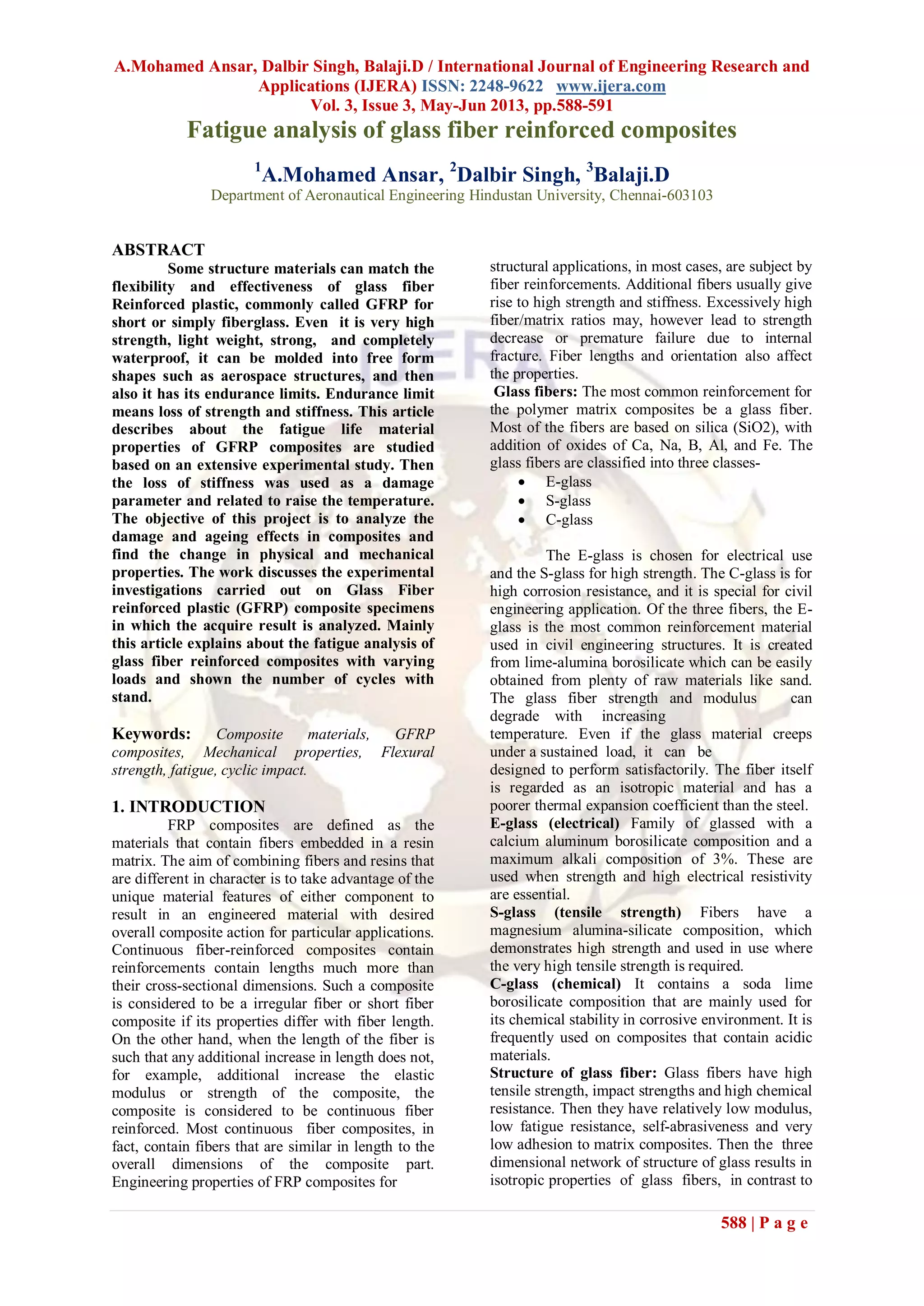
Material Cutting: Test coupons will be cut
according to the ASTM E 466-01 for Fatigue
testing by using water jet cutting technique. The
test coupon will have dimension of length 250mm
and width 25 mm and thickness 3mm as shown in
figure.
Test Coupons Preparation: After cutting the
material it’s should be cleaned then gripping
surface to attach the coupons as per the ASTM
E 466-01 standard. If the gripping material
should be rough in nature so will place the 1mm
aluminum plate on both sites. By using the
araldite nature so will place the 1mm aluminum
plate on both sites. By using the araldite resin and
hardener to paste the plates. Then it’s should de
A.Mohamed Ansar, Dalbir Singh, Balaji.D / International Journal of Engineering Research and
Applications (IJERA) ISSN: 2248-9622 www.ijera.com
Vol. 3, Issue 3, May-Jun 2013, pp.588-591
590 | P a g e
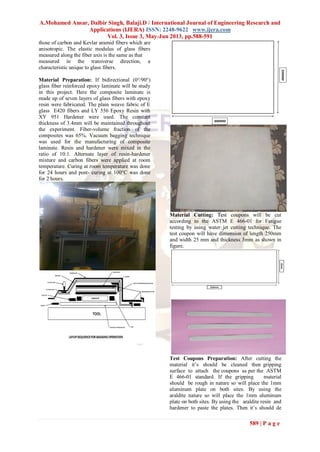
rough by using the fillet. And the test test coupons
are as shown in figure
.
Water Jut cutting machine:
Water jet cutting machine is a device which is used
for to cut the material in exact dimension and its
reduces the wastage. And its specification is
58000psi/4000 bar high pressure of stream water.
Its spraying value is 11 mach speeds. Then the
tolerance value is +/-0.1mm to +/-0.3mm.
Fatigue Testing Machine: In this testing machine,
materials are subjected to vibrating or oscillating
forces. The apply the materials
under such load conditions differs from the
behavior under a static load. Because the material
is subjected to repeated load cycles (fatigue) in
actual use, designers are faced with predicting
fatigue life.
ID MARKS AH/31876-
1
A
AH/31876-
2
B
AH/31876-
3
C
THICHNESS(mm) 2.03 2.03 2.03
BREATH(mm) 24.73 24.73 24.73
AREA(mm)2 50.20 50.20 50.20
LOAD(KN) 15.00 15.00 15.00
CYCLES 3293 3199 3196
FREQUENCY(HZ) 12 12 12
FRECTURE YES YES YES
ID MARKS AH/31875-
1
A
AH/31875-2
B
AH/31875-
3
C
THICHNESS(m
m)
2.03 2.03 2.03
BREATH(mm) 24.73 24.73 24.73
AREA(mm)2 50.20 50.20 50.20
LOAD(KN) 10.00 10.00 10.00
CYCLES 5193 5199 5180
FREQUENCY(H
Z)
12 12 12
FREACTURE YES YES YES
ID MARKS AH/31874-
1
A
AH/31874-
2
B
AH/31874-
3
C
THICHNESS (mm) 2.03 2.03 2.03
BREATH(mm) 24.73 24.73 24.73
AREA (mm)2 50.20 50.20 50.20
LOAD(KN) 5.00 5.00 5.00
CYCLES 11293 11354 11285
FREQUENCY(HZ) 12 12 12
FREACTURE YES YES YES
A.Mohamed Ansar, Dalbir Singh, Balaji.D / International Journal of Engineering Research and
Applications (IJERA) ISSN: 2248-9622 www.ijera.com
Vol. 3, Issue 3, May-Jun 2013, pp.588-591
591 | P a g e
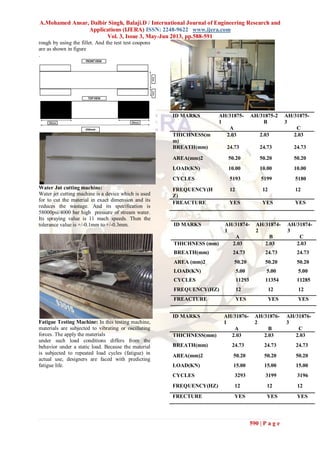
RESULT:
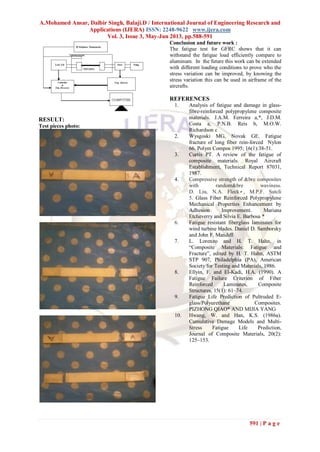
Test pieces photo:
Conclusion and future work :
The fatigue test for GFRC shows that it can
withstand the fatigue load efficiently compare to
aluminum. In the future this work can be extended
with different loading conditions to prove who the
stress variation can be improved, by knowing the
stress variation this can be used in airframe of the
aircrafts.
REFERENCES
1. Analysis of fatigue and damage in glass-
fibre-reinforced polypropylene composite
materials. J.A.M. Ferreira a,*, J.D.M.
Costa a, P.N.B. Reis b, M.O.W.
Richardson c
2. Wysgoski MG, Novak GE. Fatigue
fracture of long fiber rein-forced Nylon
66. Polym Compos 1995; 16(1):38-51.
3. Curtis PT. A review of the fatigue of
composite materials. Royal Aircraft
Establishment, Technical Report 87031,
1987.
4. Compressive strength of &bre composites
with random&bre waviness.
D. Liu, N.A. Fleck∗ , M.P.F. Sutcli
5. Glass Fiber Reinforced Polypropylene
Mechanical Properties Enhancement by
Adhesion Improvement. Mariana
Etcheverry and Silvia E. Barbosa *
6. Fatigue resistant fiberglass laminates for
wind turbine blades. Daniel D. Samborsky
and John F. Mandell
7. L. Lorenzo and H. T. Hahn, in
“Composite Materials: Fatigue and
Fracture”, edited by H. T. Hahn, ASTM
STP 907, Philadelphia (PA), American
Society for Testing and Materials, 1986.
8. Ellyin, F. and El-Kadi, H.A. (1990). A
Fatigue Failure Criterion of Fiber
Reinforced Laminates, Composite
Structures, 15(1): 61–74.
9. Fatigue Life Prediction of Pultruded E-
glass/Polyurethane Composites.
PIZHONG QIAO* AND MIJIA YANG
10. Hwang, W. and Han, K.S. (1986a).
Cumulative Damage Models and Multi-
Stress Fatigue Life Prediction,
Journal of Composite Materials, 20(2):
125–153.

Cv33588591

  • 1.
    A.Mohamed Ansar, DalbirSingh, Balaji.D / International Journal of Engineering Research and Applications (IJERA) ISSN: 2248-9622 www.ijera.com Vol. 3, Issue 3, May-Jun 2013, pp.588-591 588 | P a g e Fatigue analysis of glass fiber reinforced composites 1 A.Mohamed Ansar, 2 Dalbir Singh, 3 Balaji.D Department of Aeronautical Engineering Hindustan University, Chennai-603103 ABSTRACT Some structure materials can match the flexibility and effectiveness of glass fiber Reinforced plastic, commonly called GFRP for short or simply fiberglass. Even it is very high strength, light weight, strong, and completely waterproof, it can be molded into free form shapes such as aerospace structures, and then also it has its endurance limits. Endurance limit means loss of strength and stiffness. This article describes about the fatigue life material properties of GFRP composites are studied based on an extensive experimental study. Then the loss of stiffness was used as a damage parameter and related to raise the temperature. The objective of this project is to analyze the damage and ageing effects in composites and find the change in physical and mechanical properties. The work discusses the experimental investigations carried out on Glass Fiber reinforced plastic (GFRP) composite specimens in which the acquire result is analyzed. Mainly this article explains about the fatigue analysis of glass fiber reinforced composites with varying loads and shown the number of cycles with stand. Keywords: Composite materials, GFRP composites, Mechanical properties, Flexural strength, fatigue, cyclic impact. 1. INTRODUCTION FRP composites are defined as the materials that contain fibers embedded in a resin matrix. The aim of combining fibers and resins that are different in character is to take advantage of the unique material features of either component to result in an engineered material with desired overall composite action for particular applications. Continuous fiber-reinforced composites contain reinforcements contain lengths much more than their cross-sectional dimensions. Such a composite is considered to be a irregular fiber or short fiber composite if its properties differ with fiber length. On the other hand, when the length of the fiber is such that any additional increase in length does not, for example, additional increase the elastic modulus or strength of the composite, the composite is considered to be continuous fiber reinforced. Most continuous fiber composites, in fact, contain fibers that are similar in length to the overall dimensions of the composite part. Engineering properties of FRP composites for structural applications, in most cases, are subject by fiber reinforcements. Additional fibers usually give rise to high strength and stiffness. Excessively high fiber/matrix ratios may, however lead to strength decrease or premature failure due to internal fracture. Fiber lengths and orientation also affect the properties. Glass fibers: The most common reinforcement for the polymer matrix composites be a glass fiber. Most of the fibers are based on silica (SiO2), with addition of oxides of Ca, Na, B, Al, and Fe. The glass fibers are classified into three classes-  E-glass  S-glass  C-glass The E-glass is chosen for electrical use and the S-glass for high strength. The C-glass is for high corrosion resistance, and it is special for civil engineering application. Of the three fibers, the E- glass is the most common reinforcement material used in civil engineering structures. It is created from lime-alumina borosilicate which can be easily obtained from plenty of raw materials like sand. The glass fiber strength and modulus can degrade with increasing temperature. Even if the glass material creeps under a sustained load, it can be designed to perform satisfactorily. The fiber itself is regarded as an isotropic material and has a poorer thermal expansion coefficient than the steel. E-glass (electrical) Family of glassed with a calcium aluminum borosilicate composition and a maximum alkali composition of 3%. These are used when strength and high electrical resistivity are essential. S-glass (tensile strength) Fibers have a magnesium alumina-silicate composition, which demonstrates high strength and used in use where the very high tensile strength is required. C-glass (chemical) It contains a soda lime borosilicate composition that are mainly used for its chemical stability in corrosive environment. It is frequently used on composites that contain acidic materials. Structure of glass fiber: Glass fibers have high tensile strength, impact strengths and high chemical resistance. Then they have relatively low modulus, low fatigue resistance, self-abrasiveness and very low adhesion to matrix composites. Then the three dimensional network of structure of glass results in isotropic properties of glass fibers, in contrast to
  • 2.
    A.Mohamed Ansar, DalbirSingh, Balaji.D / International Journal of Engineering Research and Applications (IJERA) ISSN: 2248-9622 www.ijera.com Vol. 3, Issue 3, May-Jun 2013, pp.588-591 589 | P a g e those of carbon and Kevlar aramid fibers which are anisotropic. The elastic modulus of glass fibers measured along the fiber axis is the same as that measured in the transverse direction, a characteristic unique to glass fibers. Material Preparation: If bidirectional (0°/90°) glass fiber reinforced epoxy laminate will be study in this project. Here the composite laminate is made up of seven layers of glass fibers with epoxy resin were fabricated. The plain weave fabric of E glass E420 fibers and LY 556 Epoxy Resin with XY 951 Hardener were used. The constant thickness of 3.4mm will be maintained throughout the experiment. Fiber-volume fraction of the composites was 65%. Vacuum bagging technique was used for the manufacturing of composite laminate. Resin and hardener were mixed in the ratio of 10:1. Alternate layer of resin-hardener mixture and carbon fibers were applied at room temperature. Curing at room temperature was done for 24 hours and post- curing at 100°C was done for 2 hours. Material Cutting: Test coupons will be cut according to the ASTM E 466-01 for Fatigue testing by using water jet cutting technique. The test coupon will have dimension of length 250mm and width 25 mm and thickness 3mm as shown in figure. Test Coupons Preparation: After cutting the material it’s should be cleaned then gripping surface to attach the coupons as per the ASTM E 466-01 standard. If the gripping material should be rough in nature so will place the 1mm aluminum plate on both sites. By using the araldite nature so will place the 1mm aluminum plate on both sites. By using the araldite resin and hardener to paste the plates. Then it’s should de
  • 3.
    A.Mohamed Ansar, DalbirSingh, Balaji.D / International Journal of Engineering Research and Applications (IJERA) ISSN: 2248-9622 www.ijera.com Vol. 3, Issue 3, May-Jun 2013, pp.588-591 590 | P a g e rough by using the fillet. And the test test coupons are as shown in figure . Water Jut cutting machine: Water jet cutting machine is a device which is used for to cut the material in exact dimension and its reduces the wastage. And its specification is 58000psi/4000 bar high pressure of stream water. Its spraying value is 11 mach speeds. Then the tolerance value is +/-0.1mm to +/-0.3mm. Fatigue Testing Machine: In this testing machine, materials are subjected to vibrating or oscillating forces. The apply the materials under such load conditions differs from the behavior under a static load. Because the material is subjected to repeated load cycles (fatigue) in actual use, designers are faced with predicting fatigue life. ID MARKS AH/31876- 1 A AH/31876- 2 B AH/31876- 3 C THICHNESS(mm) 2.03 2.03 2.03 BREATH(mm) 24.73 24.73 24.73 AREA(mm)2 50.20 50.20 50.20 LOAD(KN) 15.00 15.00 15.00 CYCLES 3293 3199 3196 FREQUENCY(HZ) 12 12 12 FRECTURE YES YES YES ID MARKS AH/31875- 1 A AH/31875-2 B AH/31875- 3 C THICHNESS(m m) 2.03 2.03 2.03 BREATH(mm) 24.73 24.73 24.73 AREA(mm)2 50.20 50.20 50.20 LOAD(KN) 10.00 10.00 10.00 CYCLES 5193 5199 5180 FREQUENCY(H Z) 12 12 12 FREACTURE YES YES YES ID MARKS AH/31874- 1 A AH/31874- 2 B AH/31874- 3 C THICHNESS (mm) 2.03 2.03 2.03 BREATH(mm) 24.73 24.73 24.73 AREA (mm)2 50.20 50.20 50.20 LOAD(KN) 5.00 5.00 5.00 CYCLES 11293 11354 11285 FREQUENCY(HZ) 12 12 12 FREACTURE YES YES YES
  • 4.
    A.Mohamed Ansar, DalbirSingh, Balaji.D / International Journal of Engineering Research and Applications (IJERA) ISSN: 2248-9622 www.ijera.com Vol. 3, Issue 3, May-Jun 2013, pp.588-591 591 | P a g e RESULT: Test pieces photo: Conclusion and future work : The fatigue test for GFRC shows that it can withstand the fatigue load efficiently compare to aluminum. In the future this work can be extended with different loading conditions to prove who the stress variation can be improved, by knowing the stress variation this can be used in airframe of the aircrafts. REFERENCES 1. Analysis of fatigue and damage in glass- fibre-reinforced polypropylene composite materials. J.A.M. Ferreira a,*, J.D.M. Costa a, P.N.B. Reis b, M.O.W. Richardson c 2. Wysgoski MG, Novak GE. Fatigue fracture of long fiber rein-forced Nylon 66. Polym Compos 1995; 16(1):38-51. 3. Curtis PT. A review of the fatigue of composite materials. Royal Aircraft Establishment, Technical Report 87031, 1987. 4. Compressive strength of &bre composites with random&bre waviness. D. Liu, N.A. Fleck∗ , M.P.F. Sutcli 5. Glass Fiber Reinforced Polypropylene Mechanical Properties Enhancement by Adhesion Improvement. Mariana Etcheverry and Silvia E. Barbosa * 6. Fatigue resistant fiberglass laminates for wind turbine blades. Daniel D. Samborsky and John F. Mandell 7. L. Lorenzo and H. T. Hahn, in “Composite Materials: Fatigue and Fracture”, edited by H. T. Hahn, ASTM STP 907, Philadelphia (PA), American Society for Testing and Materials, 1986. 8. Ellyin, F. and El-Kadi, H.A. (1990). A Fatigue Failure Criterion of Fiber Reinforced Laminates, Composite Structures, 15(1): 61–74. 9. Fatigue Life Prediction of Pultruded E- glass/Polyurethane Composites. PIZHONG QIAO* AND MIJIA YANG 10. Hwang, W. and Han, K.S. (1986a). Cumulative Damage Models and Multi- Stress Fatigue Life Prediction, Journal of Composite Materials, 20(2): 125–153.