Hunting for Credentials
Dumping in Windows
Environment
Teymur Kheirhabarov
Who am I?
• Senior SOC Analyst @Kaspersky Lab
• SibSAU (Krasnoyarsk) graduate
• Ex- System admin
• Ex- Infosec admin
• Ex- Infosec dept. head
• Twitter @HeirhabarovT
• www.linkedin.com/in/teymur-kheirkhabarov-73490867/
What are we going to talks about?
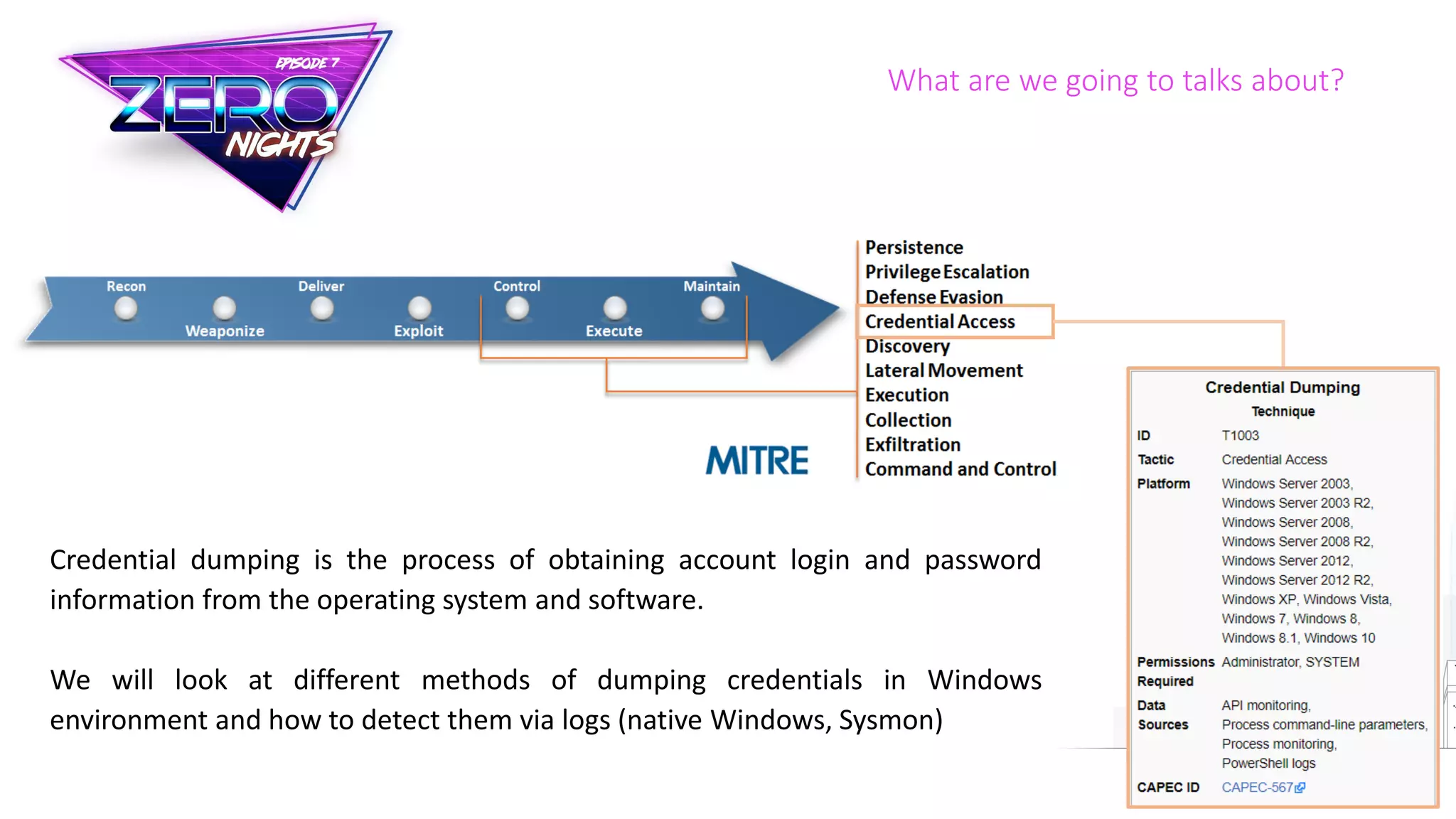
Credential dumping is the process of obtaining account login and password
information from the operating system and software.
We will look at different methods of dumping credentials in Windows
environment and how to detect them via logs (native Windows, Sysmon)
Why is it so important?
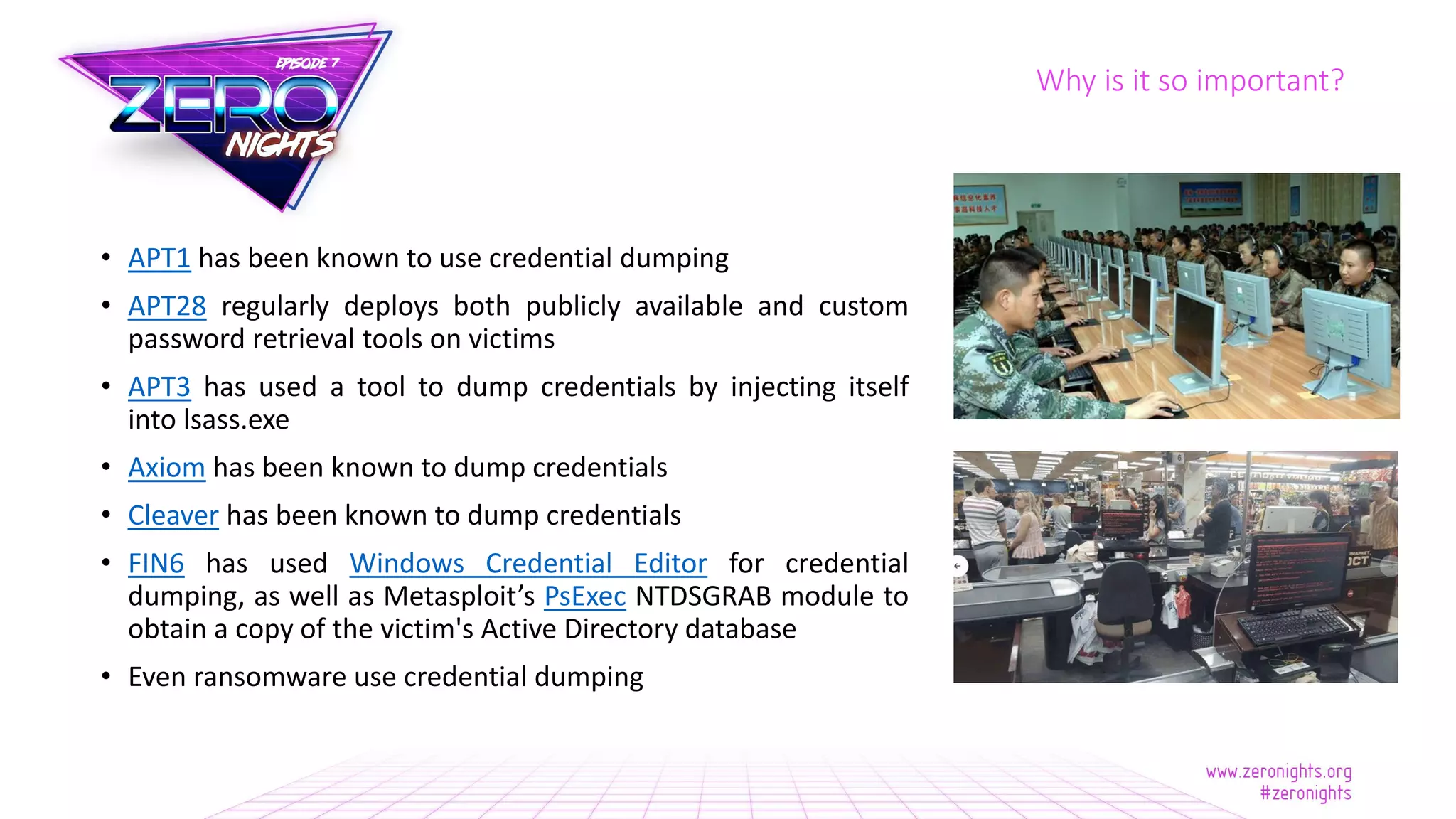
• APT1 has been known to use credential dumping
• APT28 regularly deploys both publicly available and custom
password retrieval tools on victims
• APT3 has used a tool to dump credentials by injecting itself
into lsass.exe
• Axiom has been known to dump credentials
• Cleaver has been known to dump credentials
• FIN6 has used Windows Credential Editor for credential
dumping, as well as Metasploit’s PsExec NTDSGRAB module to
obtain a copy of the victim's Active Directory database
• Even ransomware use credential dumping
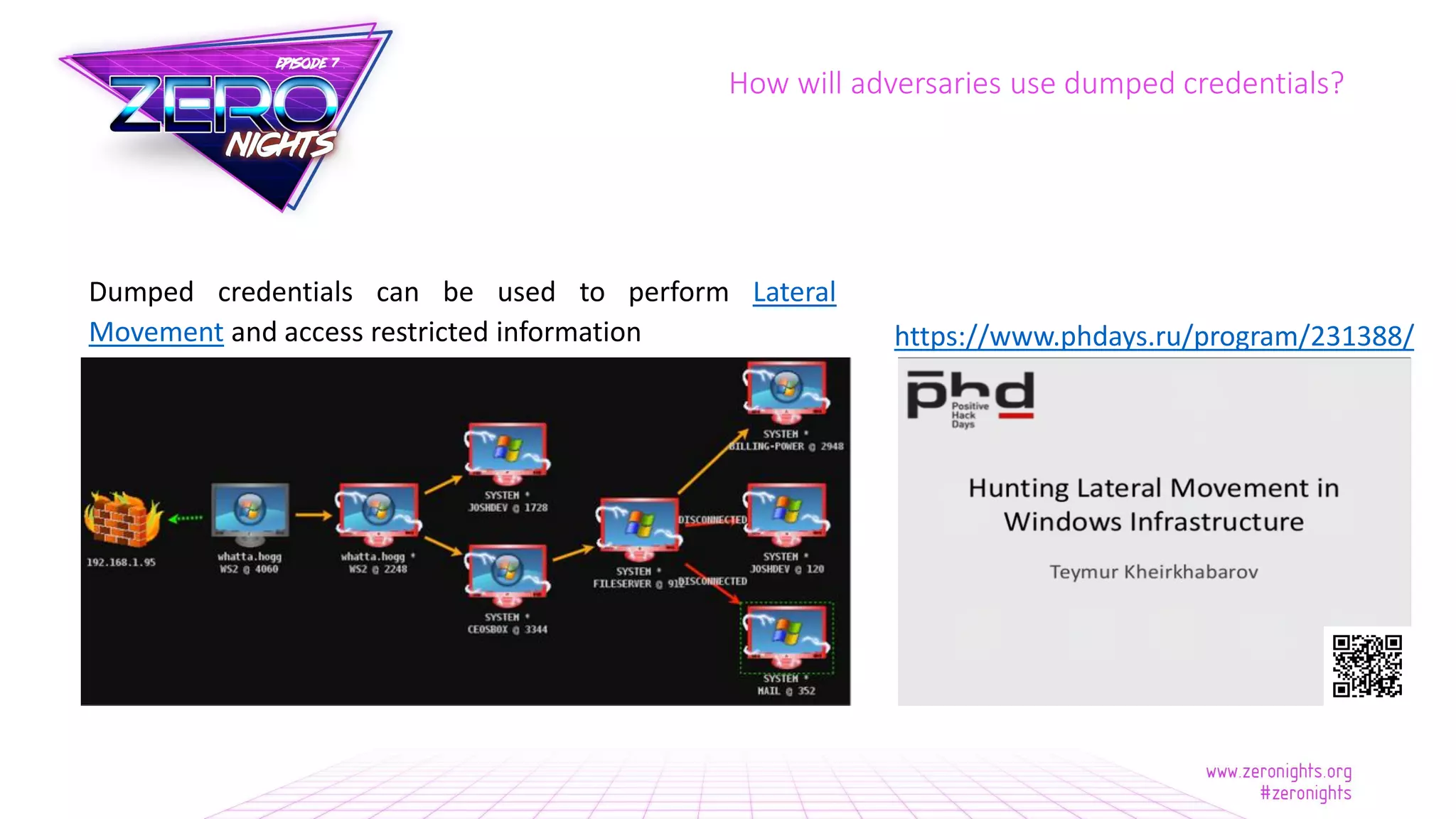
How will adversaries use dumped credentials?
Dumped credentials can be used to perform Lateral
Movement and access restricted information https://www.phdays.ru/program/231388/
LSASS memory: clear-text passwords of logged on users,
Kerberos tickets, Kerberos encryption keys, SmartCard/Token PIN
codes, LM/NTLM hashes, DPAPI Domain Backup Key, Domain
Trust Auth Information, cached DPAPI MasterKeys, cached SysKey
(need to decrypt SAM/LSA Secrets/Cached credentials/NTDS.dit),
clear-text passwords of accounts, stored in Credential Manager;
SAM registry hive/file: LM/NTLM hashes of local users;
SECURITY registry hive/file: cached credentials, LSA Secrets
(account passwords for services, password used to logon to
Windows if auto-logon is enabled);
NTDS.dit file: hashes of domain accounts, Domain Backup Key;
SYSTEM registry hive/file: SysKey, that need to decrypt SAM/LSA
Secrets/Cached credentials/NTDS.dit.
What can be dumped and where from?
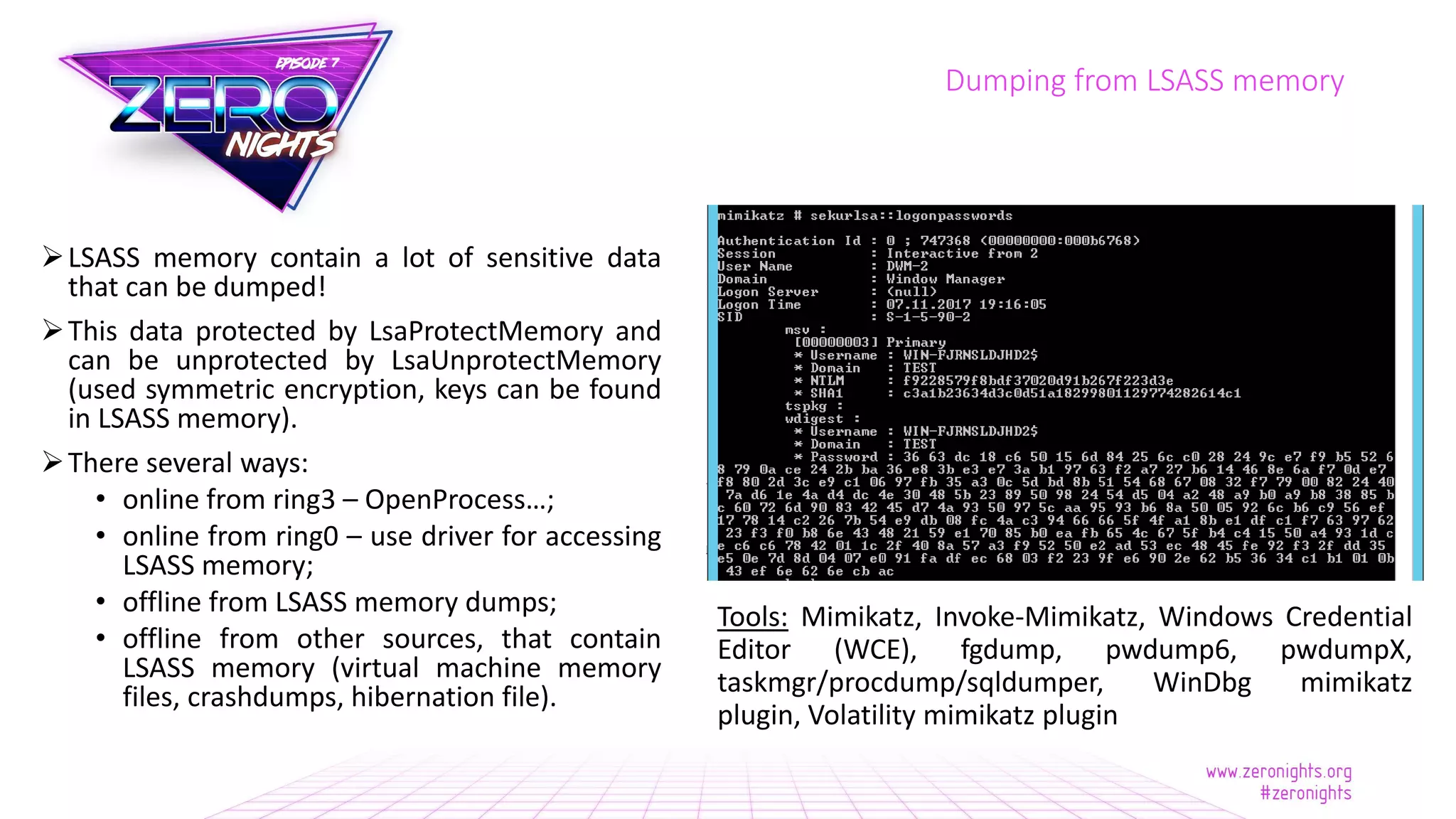
LSASS memory contain a lot of sensitive data
that can be dumped!
This data protected by LsaProtectMemory and
can be unprotected by LsaUnprotectMemory
(used symmetric encryption, keys can be found
in LSASS memory).
There several ways:
• online from ring3 – OpenProcess…;
• online from ring0 – use driver for accessing
LSASS memory;
• offline from LSASS memory dumps;
• offline from other sources, that contain
LSASS memory (virtual machine memory
files, crashdumps, hibernation file).
Dumping from LSASS memory
Tools: Mimikatz, Invoke-Mimikatz, Windows Credential
Editor (WCE), fgdump, pwdump6, pwdumpX,
taskmgr/procdump/sqldumper, WinDbg mimikatz
plugin, Volatility mimikatz plugin
Dumping from LSASS memory
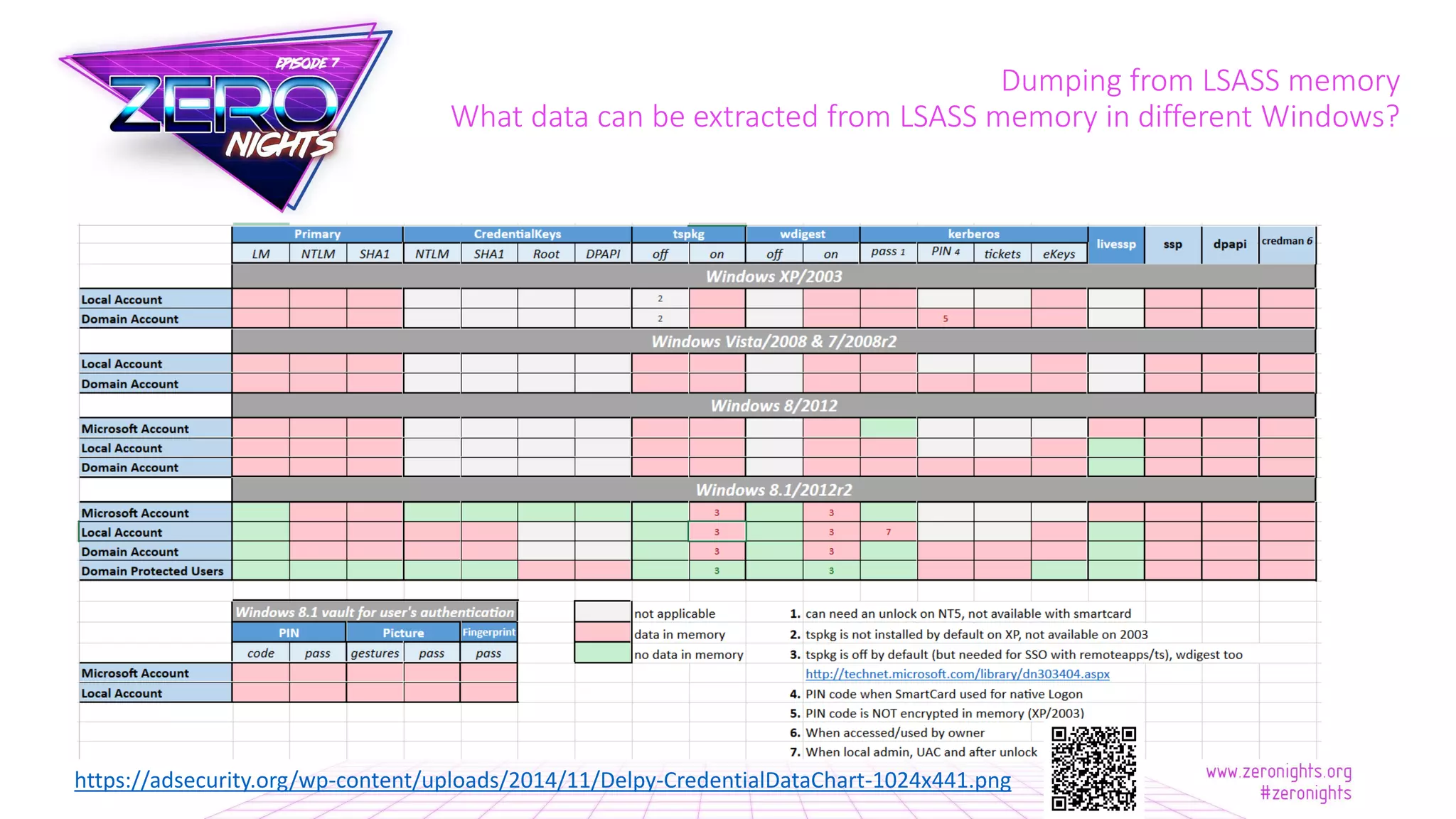
What data can be extracted from LSASS memory in different Windows?
https://adsecurity.org/wp-content/uploads/2014/11/Delpy-CredentialDataChart-1024x441.png
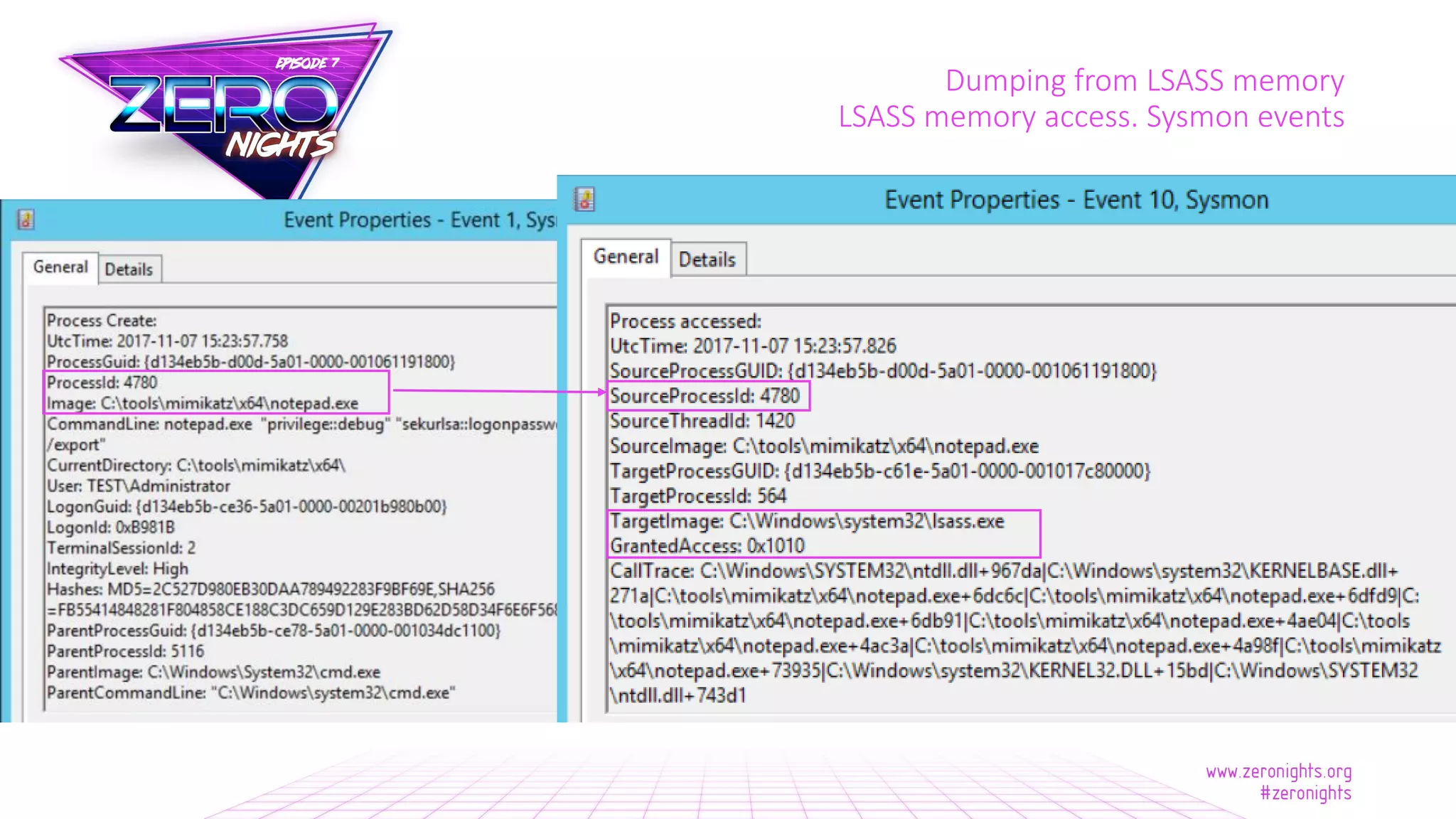
Dumping from LSASS memory
LSASS memory access. Sysmon events
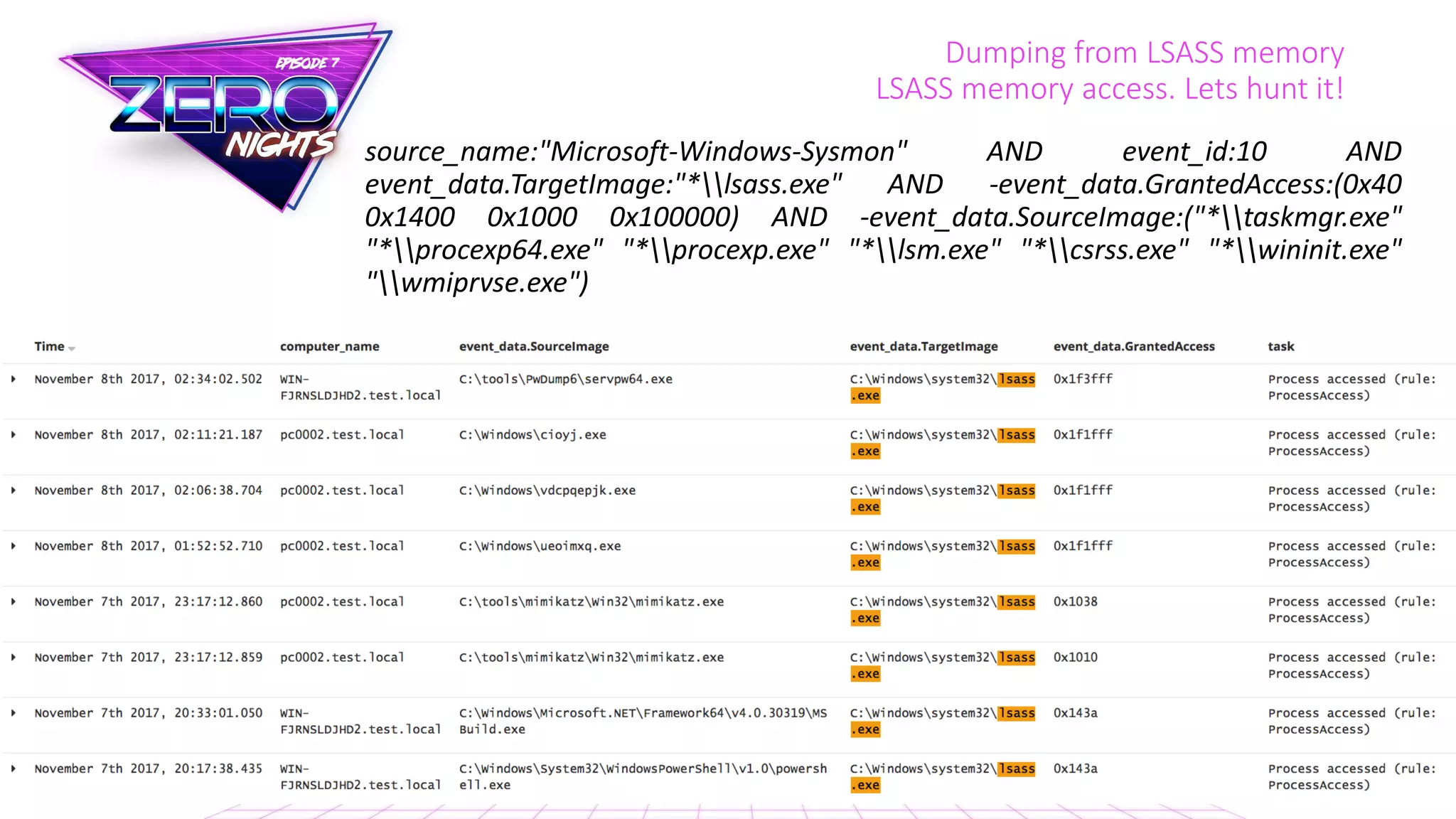
Dumping from LSASS memory
LSASS memory access. Lets hunt it!
source_name:"Microsoft-Windows-Sysmon" AND event_id:10 AND
event_data.TargetImage:"*lsass.exe" AND -event_data.GrantedAccess:(0x40
0x1400 0x1000 0x100000) AND -event_data.SourceImage:("*taskmgr.exe"
"*procexp64.exe" "*procexp.exe" "*lsm.exe" "*csrss.exe" "*wininit.exe"
"wmiprvse.exe")
Dumping from LSASS memory
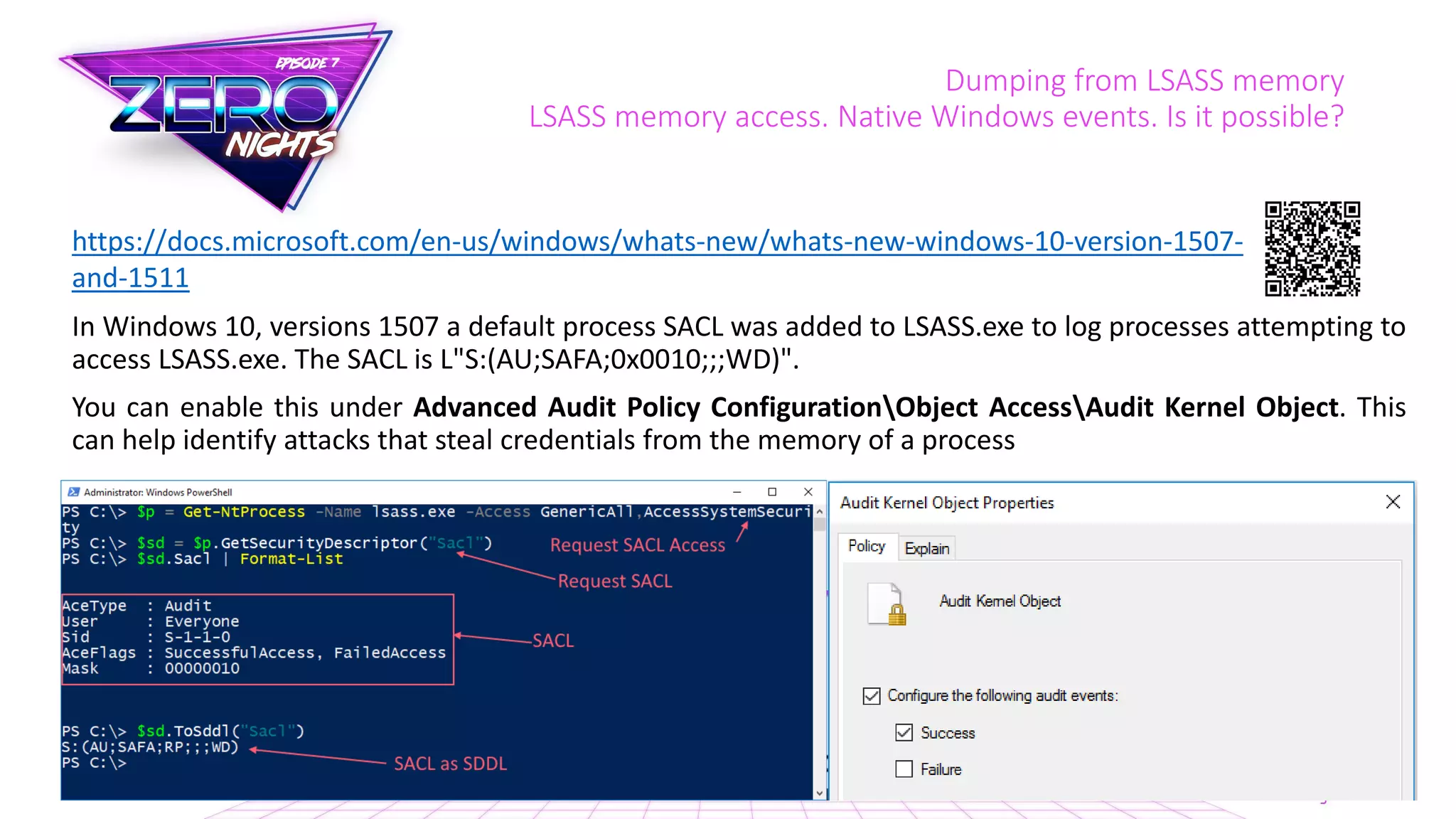
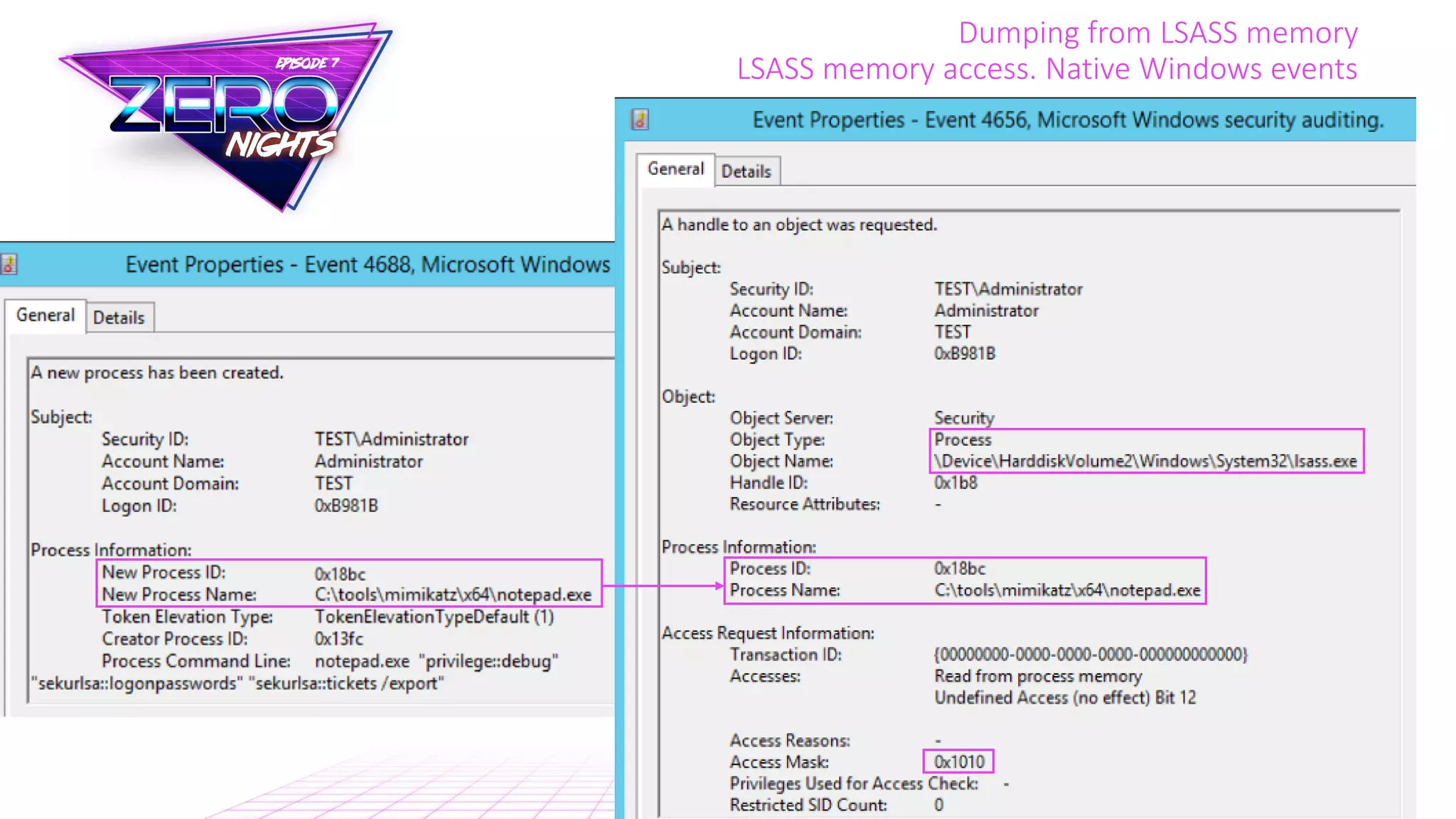
LSASS memory access. Native Windows events. Is it possible?
In Windows 10, versions 1507 a default process SACL was added to LSASS.exe to log processes attempting to
access LSASS.exe. The SACL is L"S:(AU;SAFA;0x0010;;;WD)".
You can enable this under Advanced Audit Policy ConfigurationObject AccessAudit Kernel Object. This
can help identify attacks that steal credentials from the memory of a process
https://docs.microsoft.com/en-us/windows/whats-new/whats-new-windows-10-version-1507-
and-1511
Dumping from LSASS memory
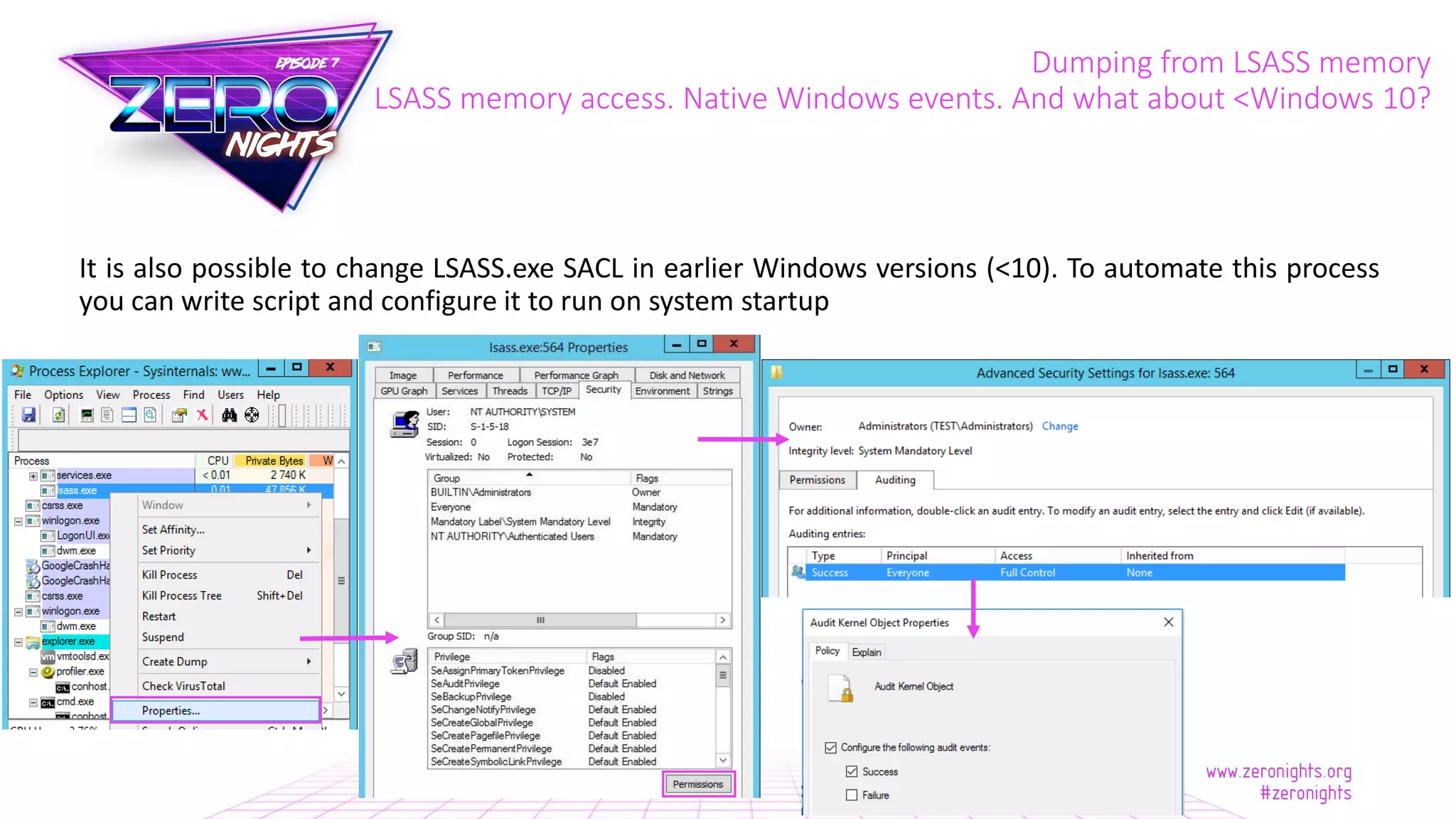
LSASS memory access. Native Windows events. And what about <Windows 10?
It is also possible to change LSASS.exe SACL in earlier Windows versions (<10). To automate this process
you can write script and configure it to run on system startup
Dumping from LSASS memory
LSASS memory access. Native Windows events
Dumping from LSASS memory
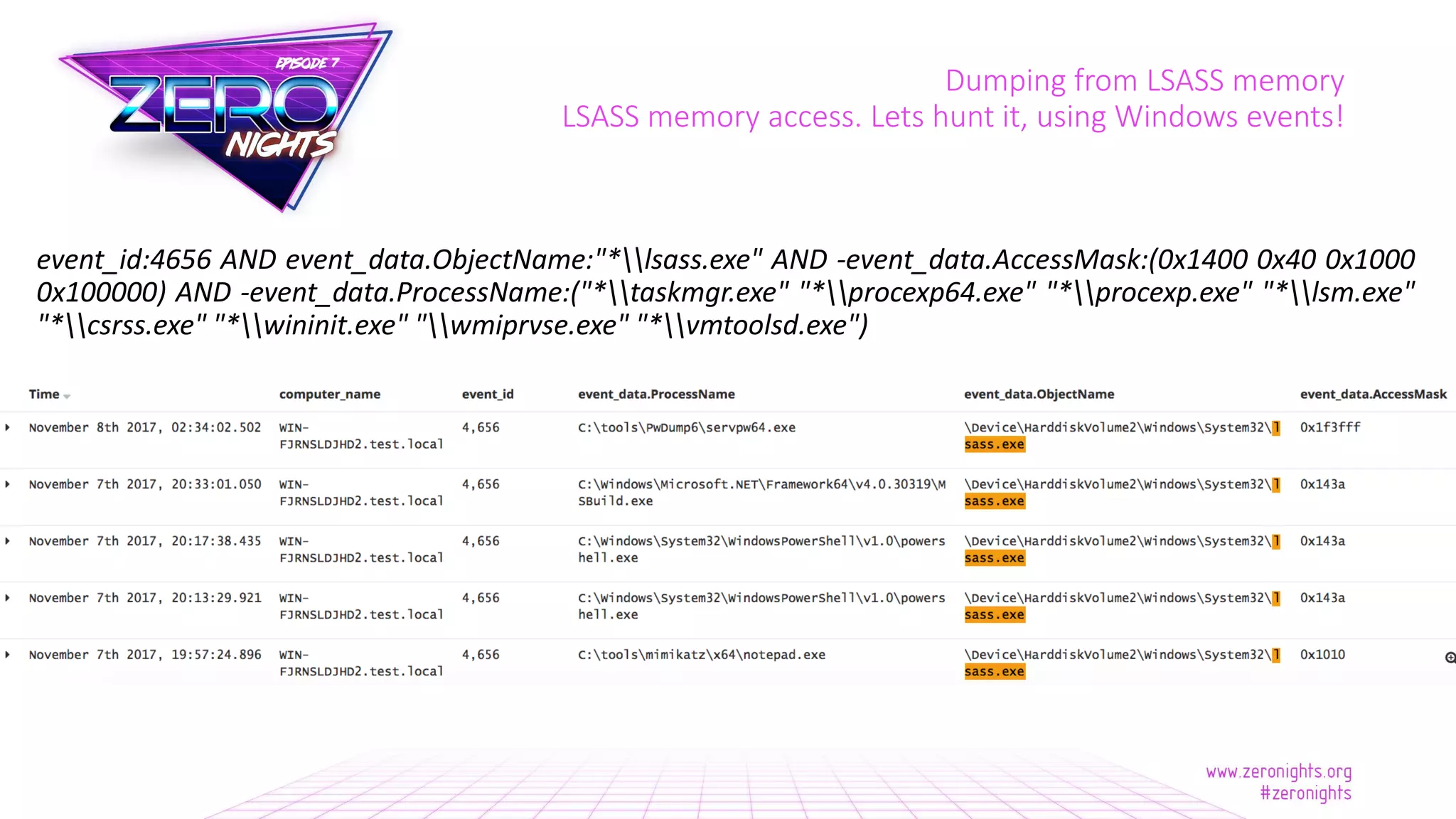
LSASS memory access. Lets hunt it, using Windows events!
event_id:4656 AND event_data.ObjectName:"*lsass.exe" AND -event_data.AccessMask:(0x1400 0x40 0x1000
0x100000) AND -event_data.ProcessName:("*taskmgr.exe" "*procexp64.exe" "*procexp.exe" "*lsm.exe"
"*csrss.exe" "*wininit.exe" "wmiprvse.exe" "*vmtoolsd.exe")
Dumping from LSASS memory
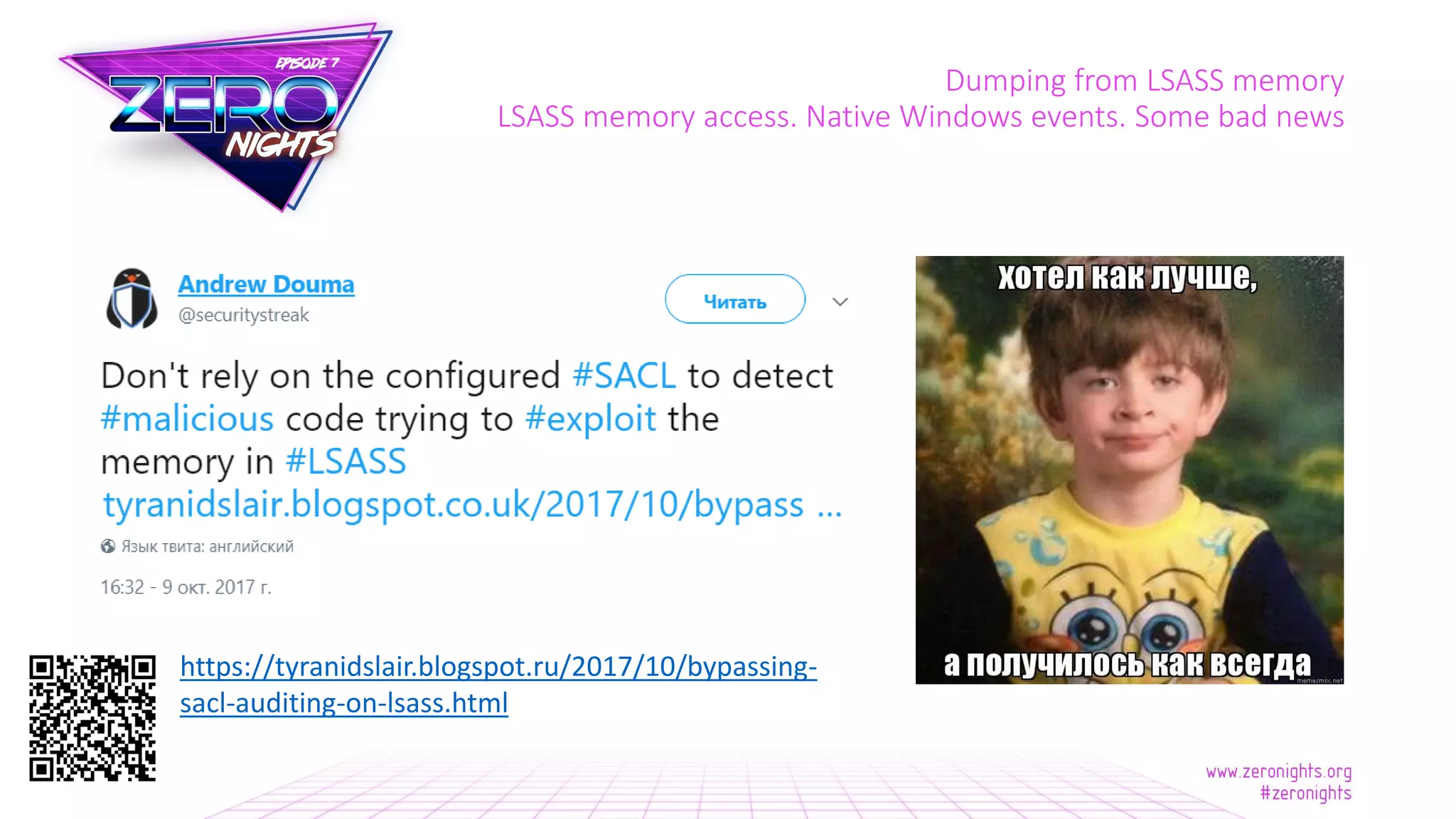
LSASS memory access. Native Windows events. Some bad news
https://tyranidslair.blogspot.ru/2017/10/bypassing-
sacl-auditing-on-lsass.html
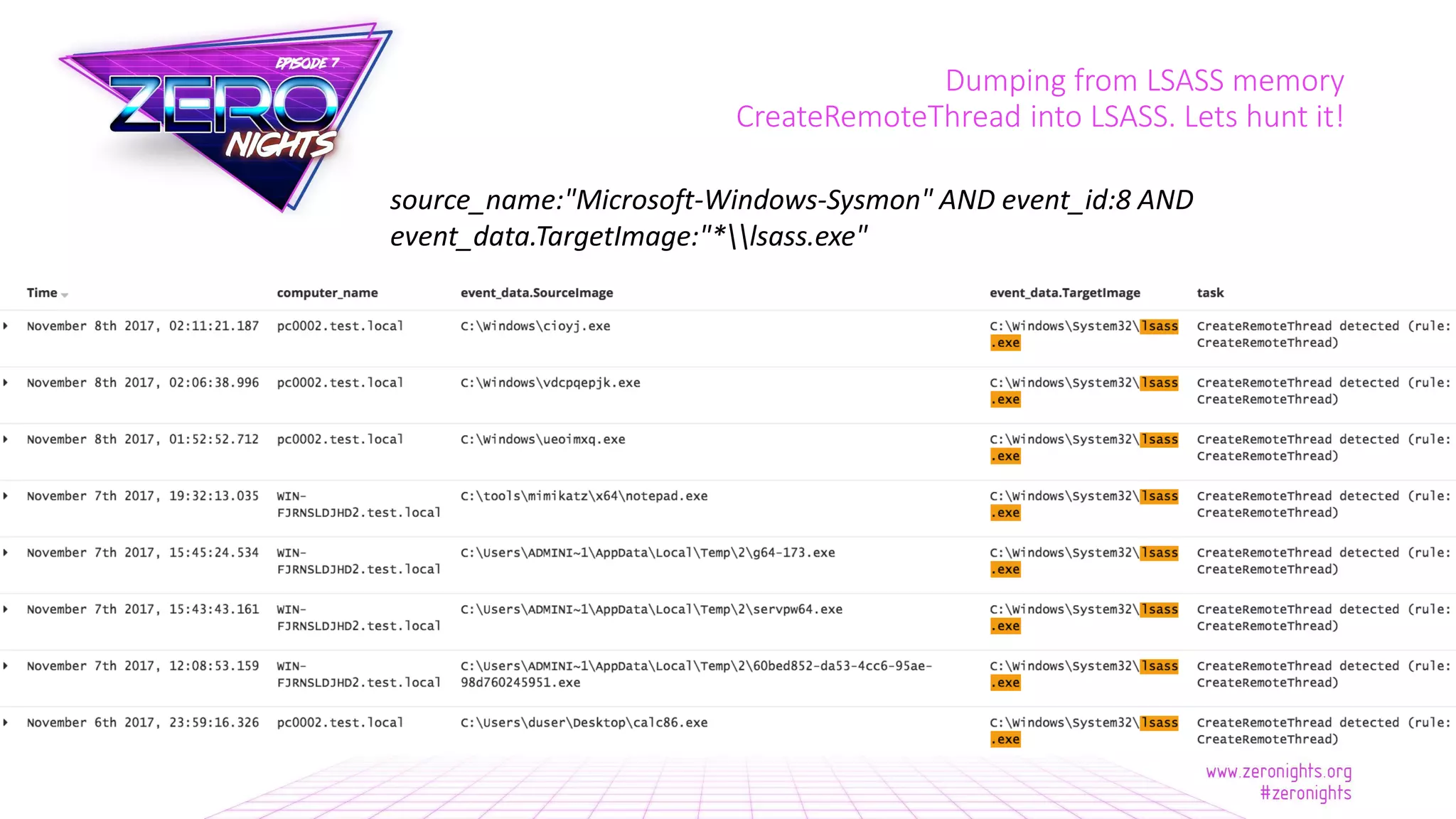
Dumping from LSASS memory
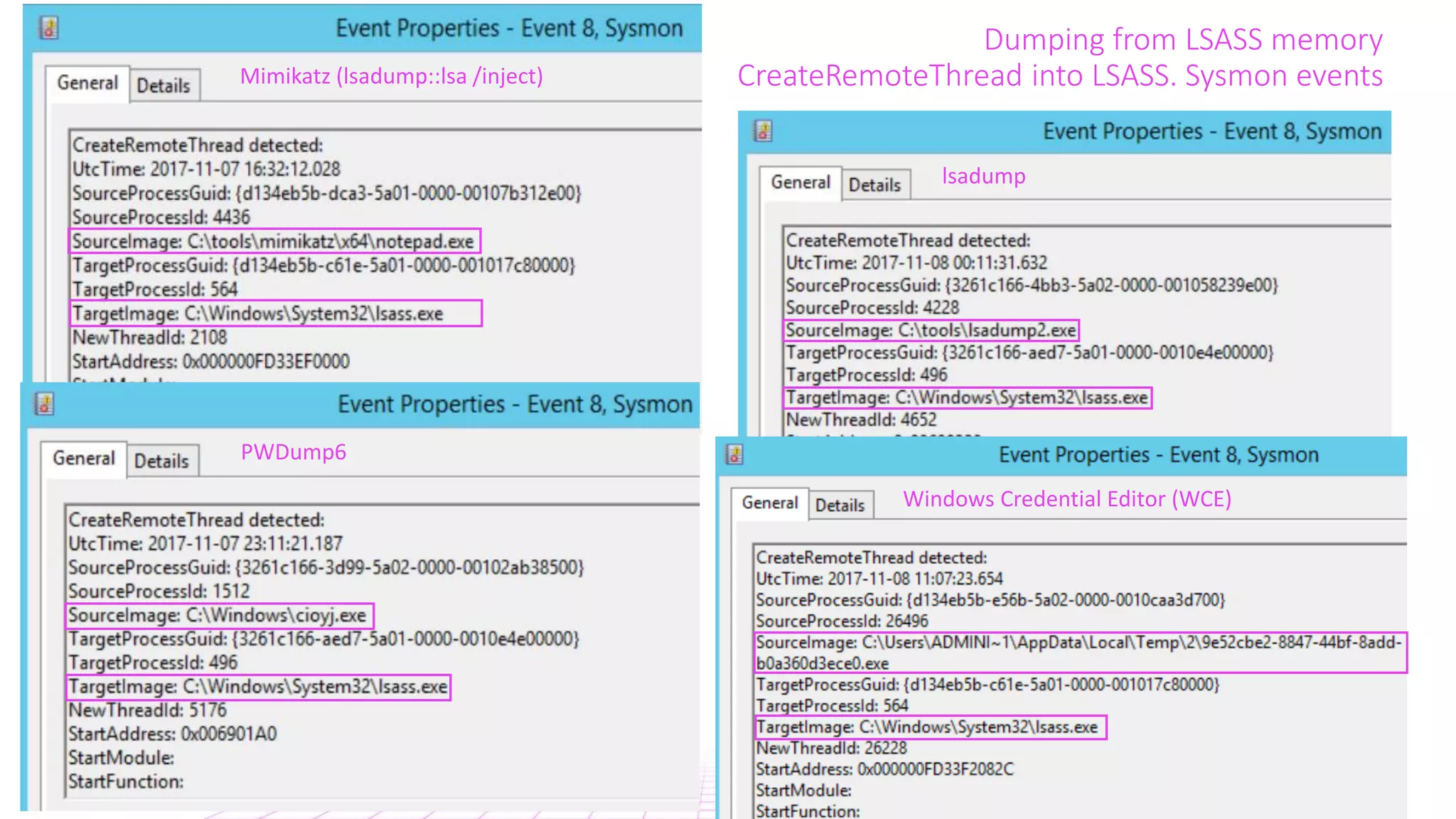
CreateRemoteThread into LSASS. Sysmon eventsMimikatz (lsadump::lsa /inject)
lsadump
PWDump6
Windows Credential Editor (WCE)
Dumping from LSASS memory
CreateRemoteThread into LSASS. Lets hunt it!
source_name:"Microsoft-Windows-Sysmon" AND event_id:8 AND
event_data.TargetImage:"*lsass.exe"
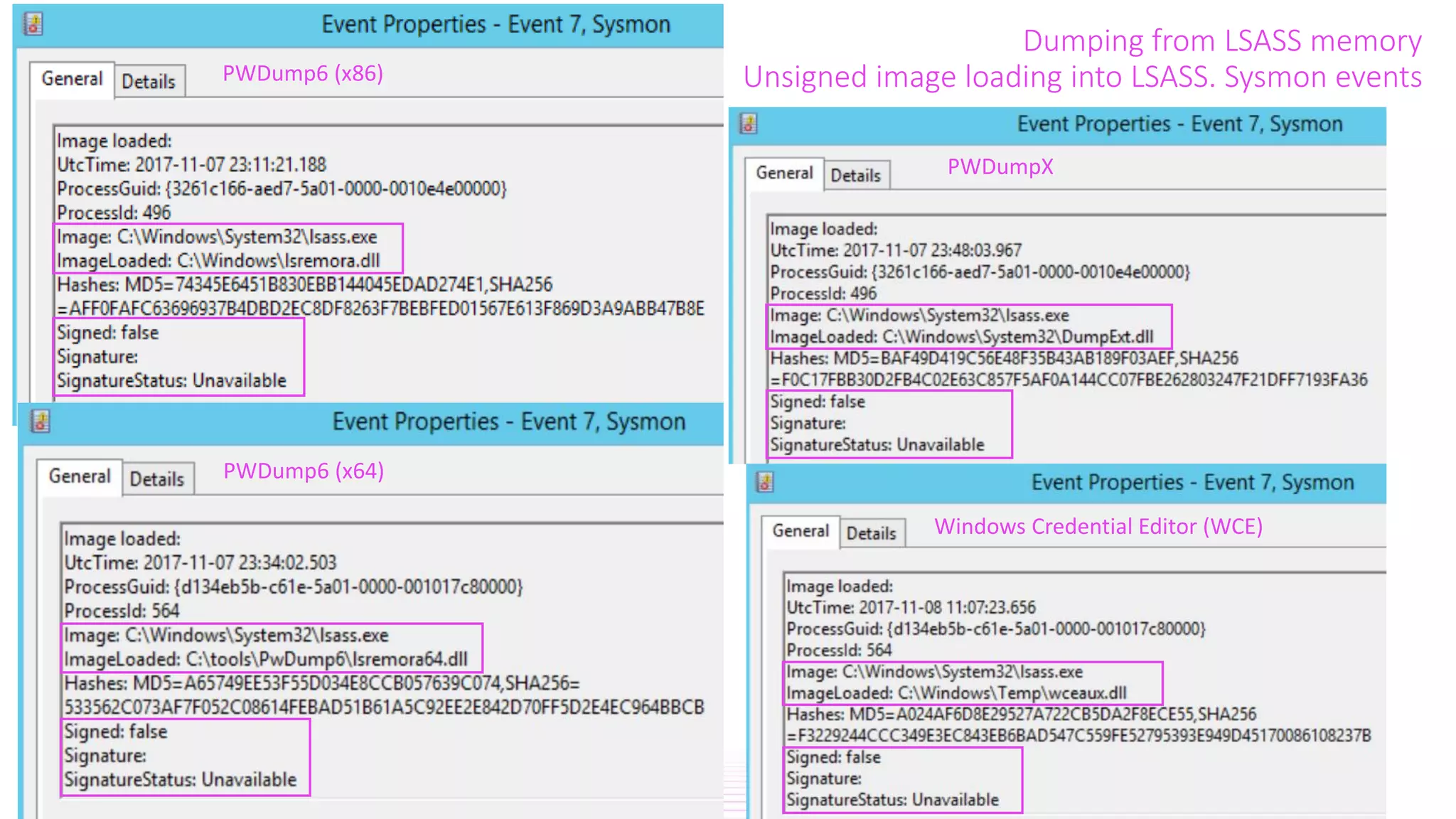
Dumping from LSASS memory
Unsigned image loading into LSASS. Sysmon eventsPWDump6 (x86)
PWDump6 (x64)
PWDumpX
Windows Credential Editor (WCE)
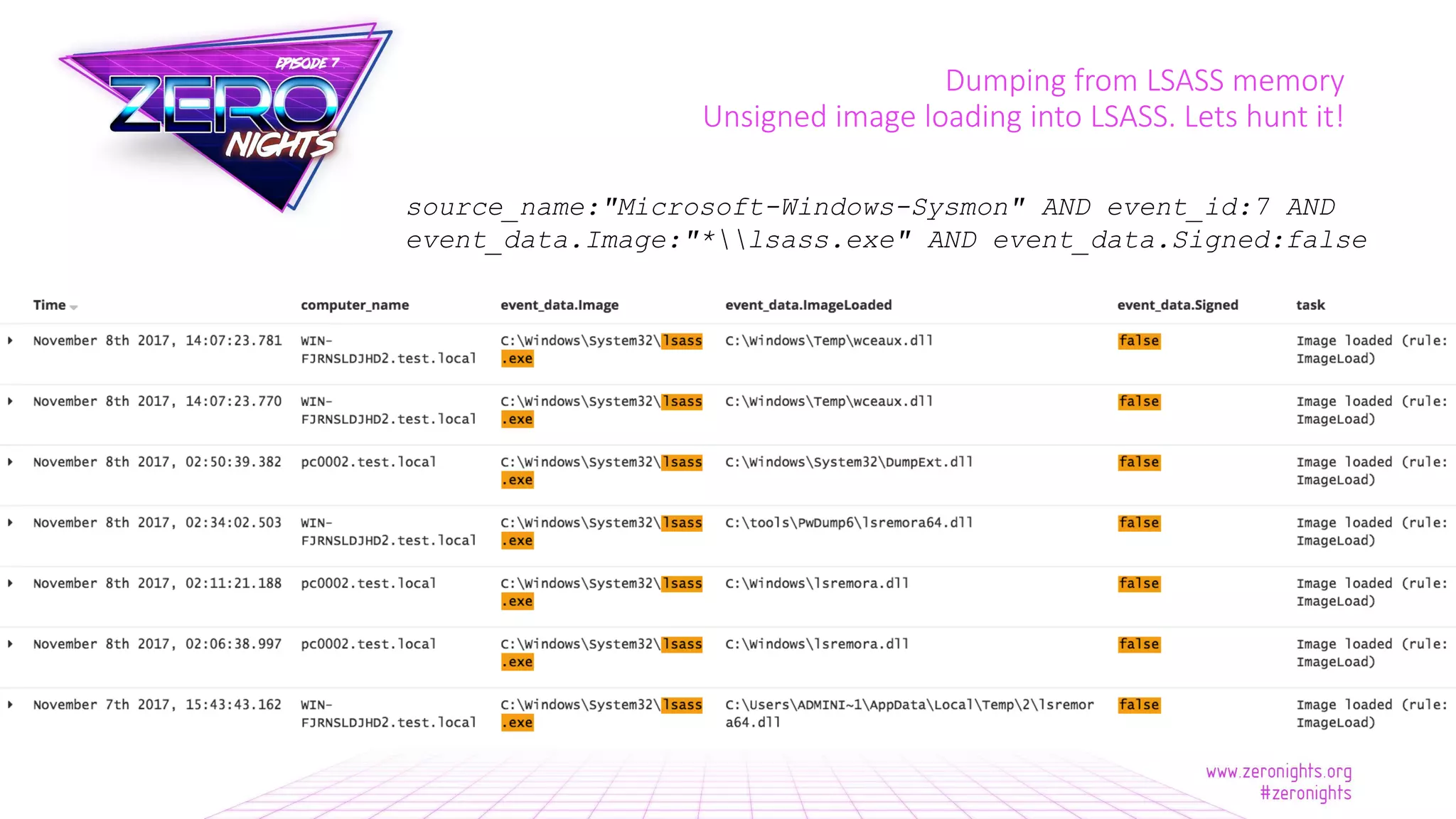
Dumping from LSASS memory
Unsigned image loading into LSASS. Lets hunt it!
source_name:"Microsoft-Windows-Sysmon" AND event_id:7 AND
event_data.Image:"*lsass.exe" AND event_data.Signed:false
Dumping from LSASS memory
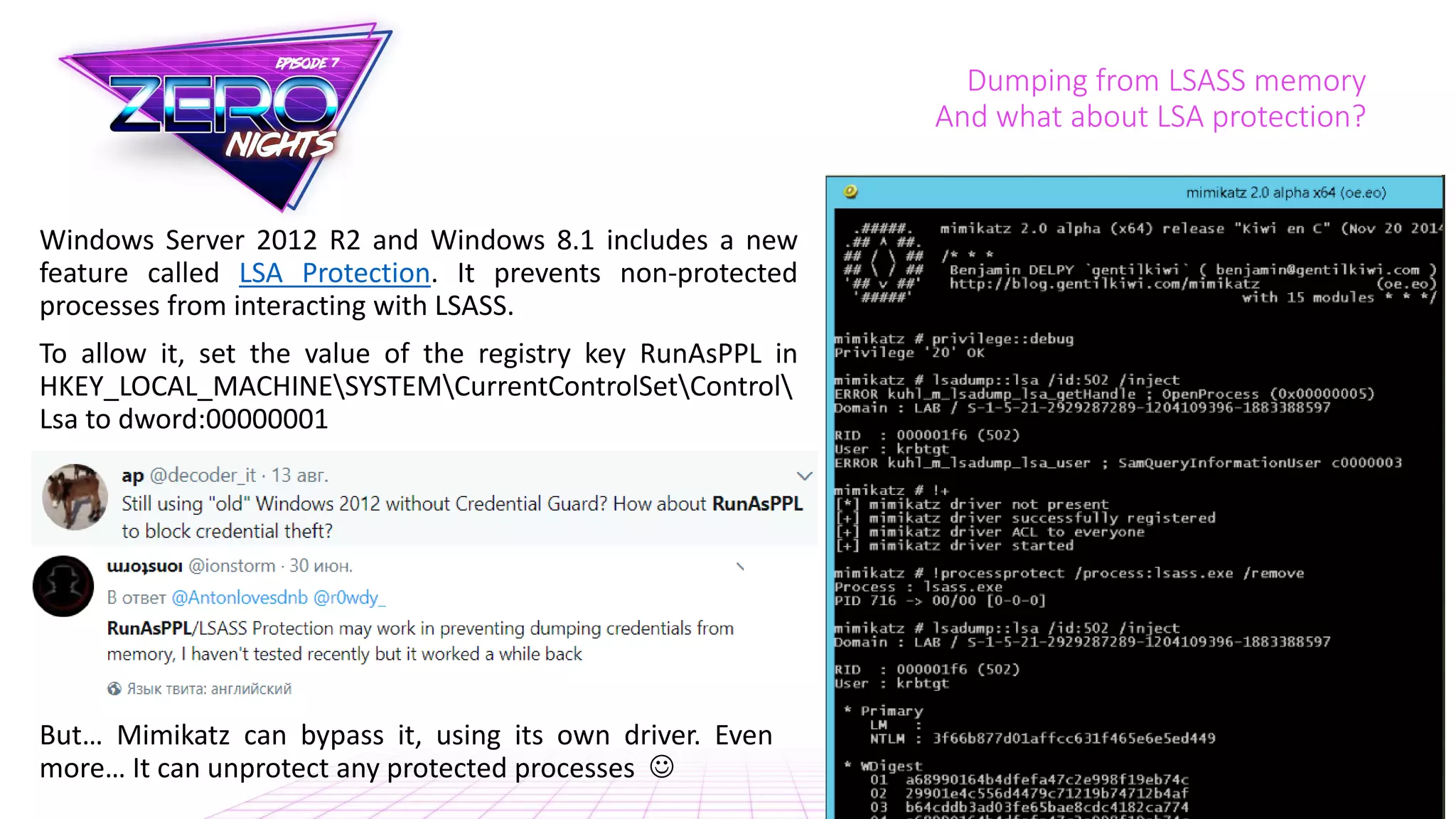
And what about LSA protection?
Windows Server 2012 R2 and Windows 8.1 includes a new
feature called LSA Protection. It prevents non-protected
processes from interacting with LSASS.
To allow it, set the value of the registry key RunAsPPL in
HKEY_LOCAL_MACHINESYSTEMCurrentControlSetControl
Lsa to dword:00000001
But… Mimikatz can bypass it, using its own driver. Even
more… It can unprotect any protected processes 
Dumping from LSASS memory
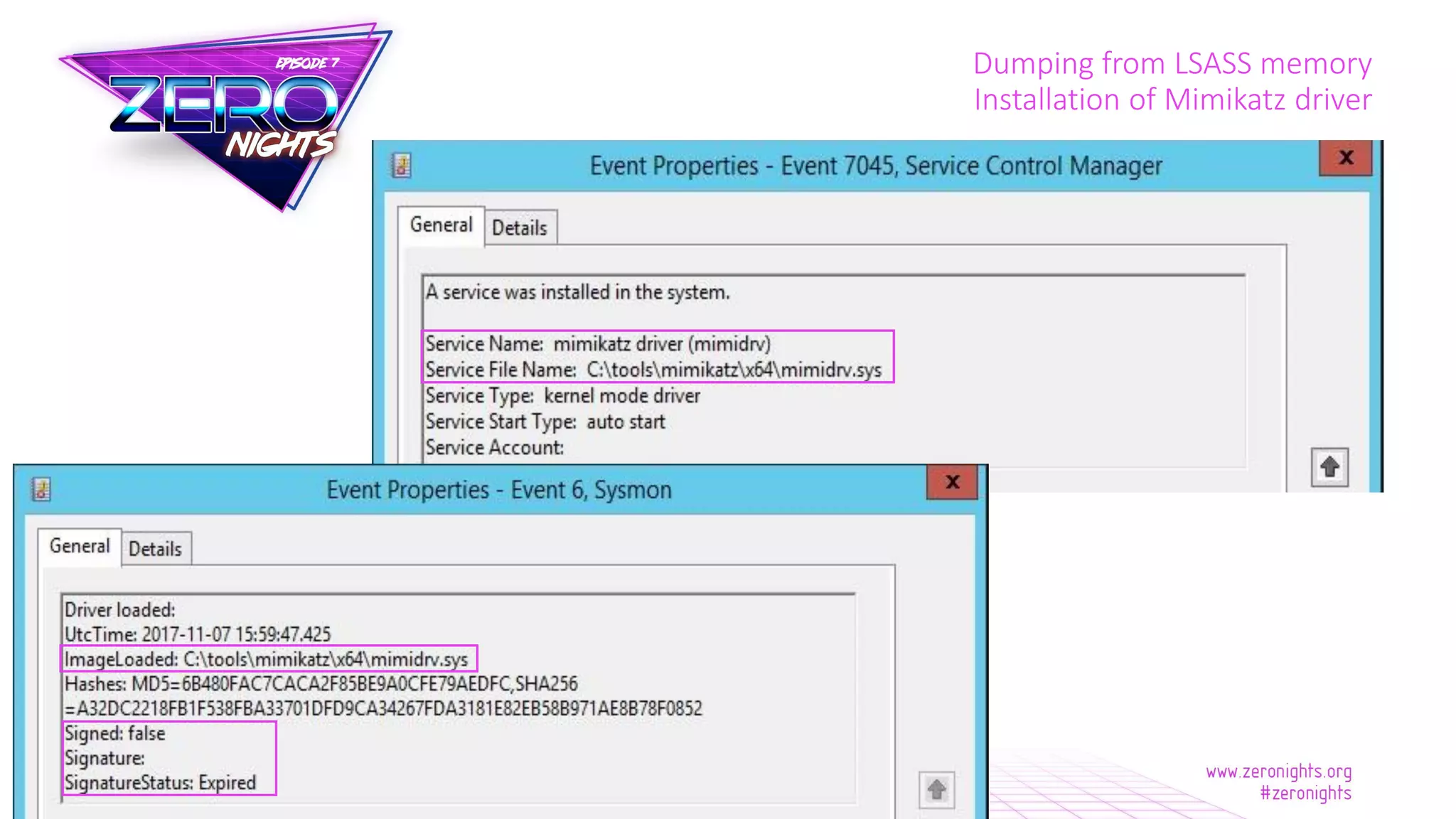
Installation of Mimikatz driver
Dumping from LSASS memory
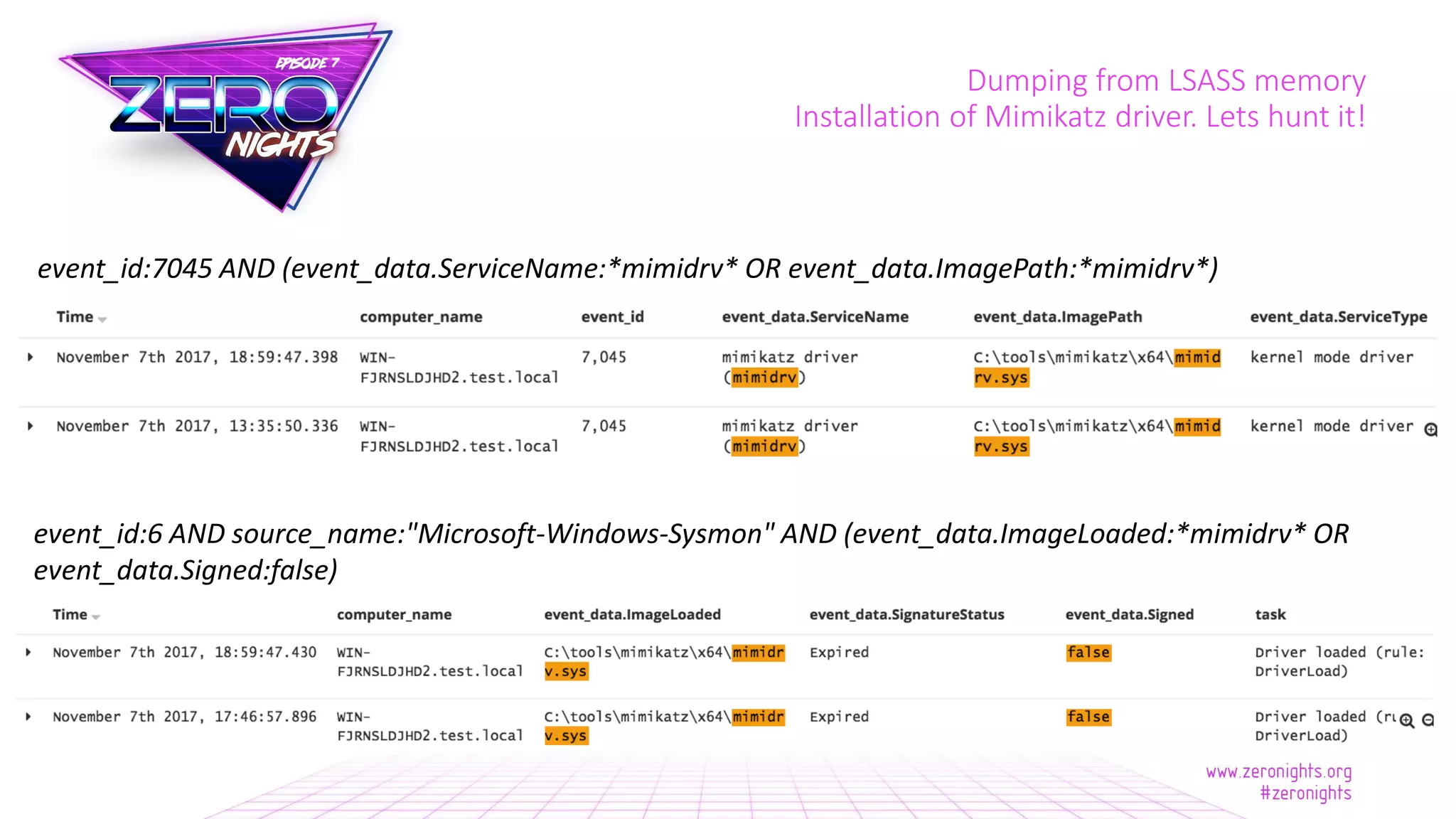
Installation of Mimikatz driver. Lets hunt it!
event_id:7045 AND (event_data.ServiceName:*mimidrv* OR event_data.ImagePath:*mimidrv*)
event_id:6 AND source_name:"Microsoft-Windows-Sysmon" AND (event_data.ImageLoaded:*mimidrv* OR
event_data.Signed:false)
Dumping from LSASS memory
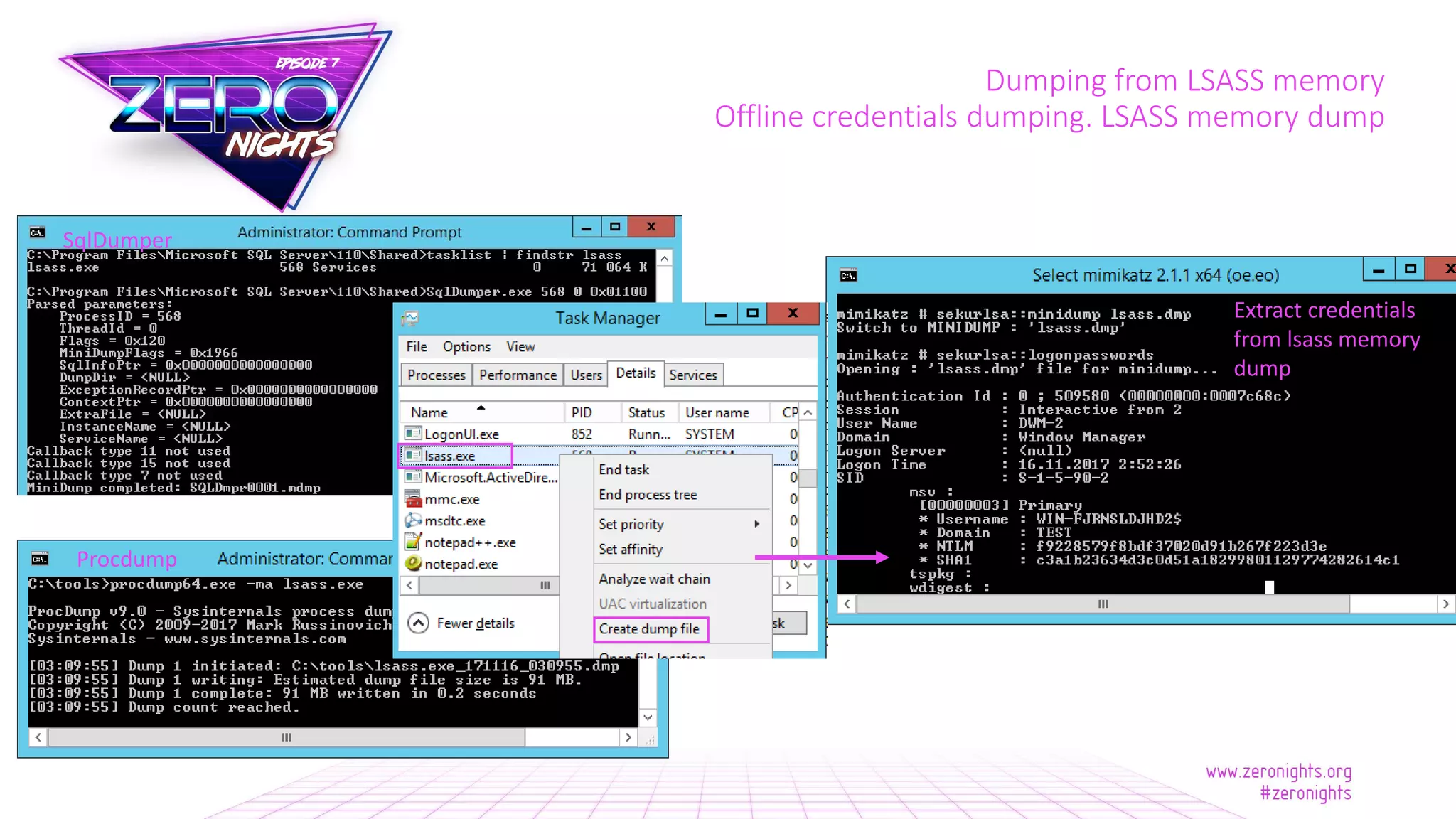
Offline credentials dumping. LSASS memory dump
SqlDumper
Procdump
Extract credentials
from lsass memory
dump
Dumping from LSASS memory
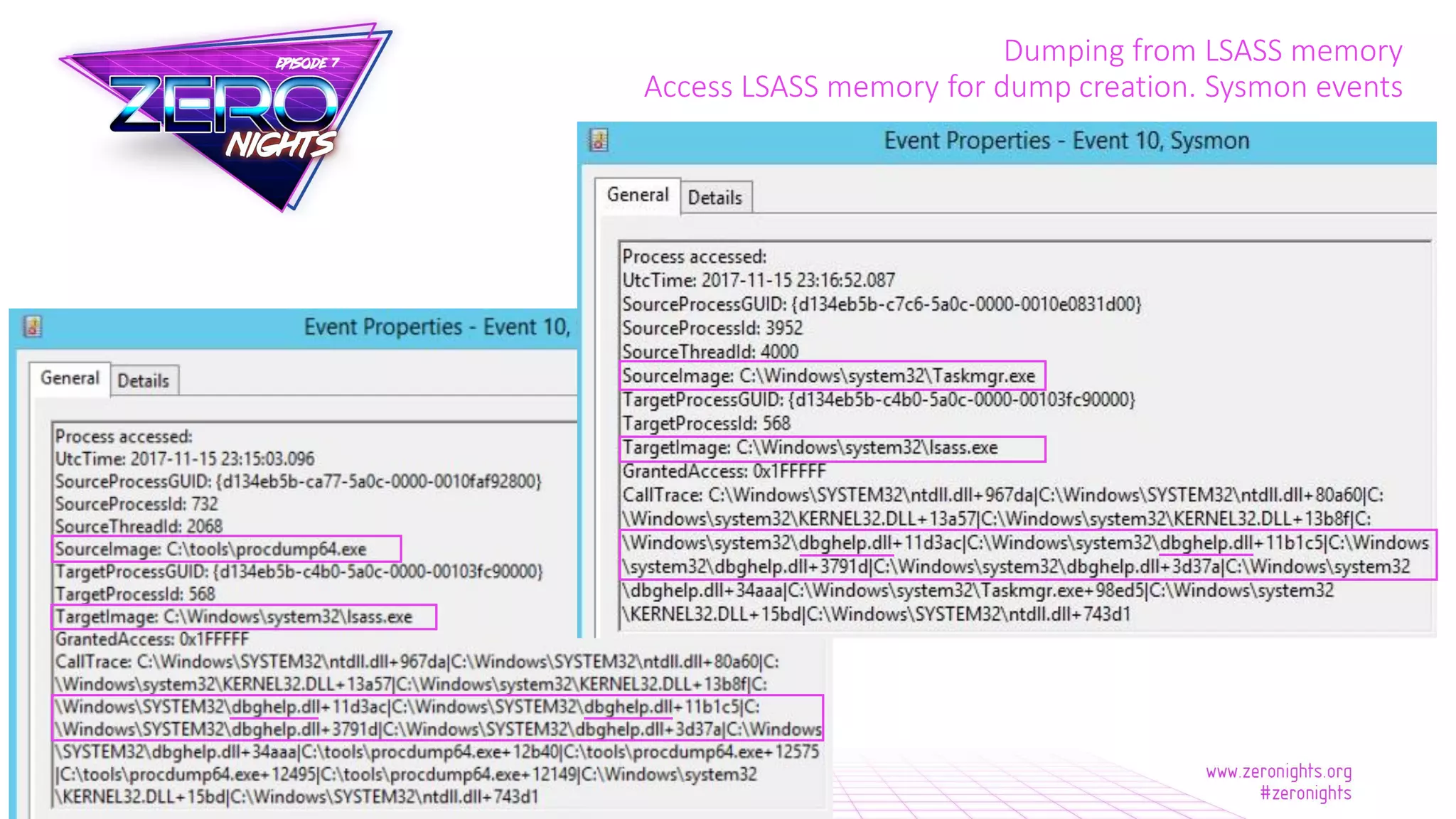
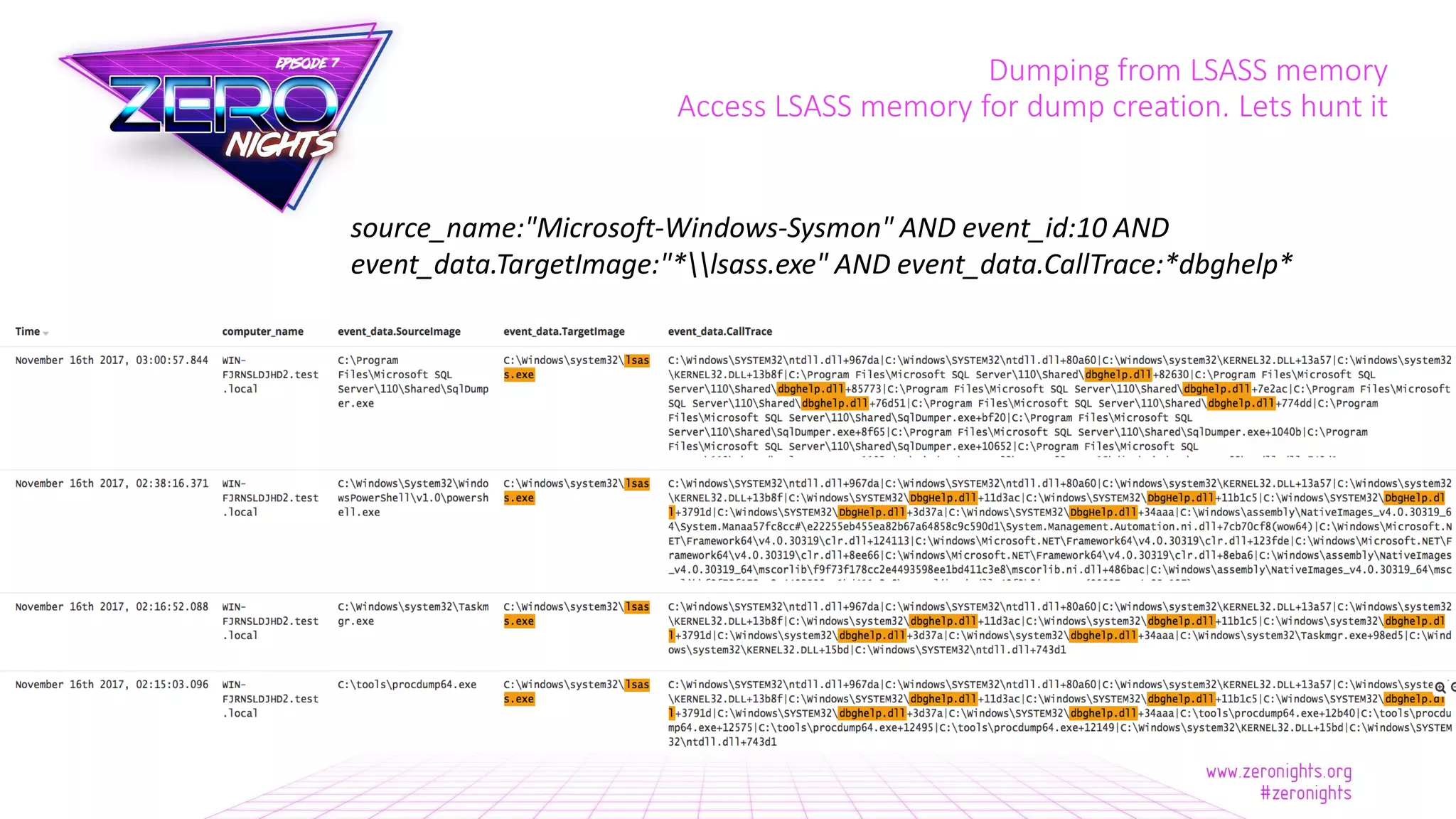
Access LSASS memory for dump creation. Sysmon events
Dumping from LSASS memory
Access LSASS memory for dump creation. Lets hunt it
source_name:"Microsoft-Windows-Sysmon" AND event_id:10 AND
event_data.TargetImage:"*lsass.exe" AND event_data.CallTrace:*dbghelp*
Dumping from LSASS memory
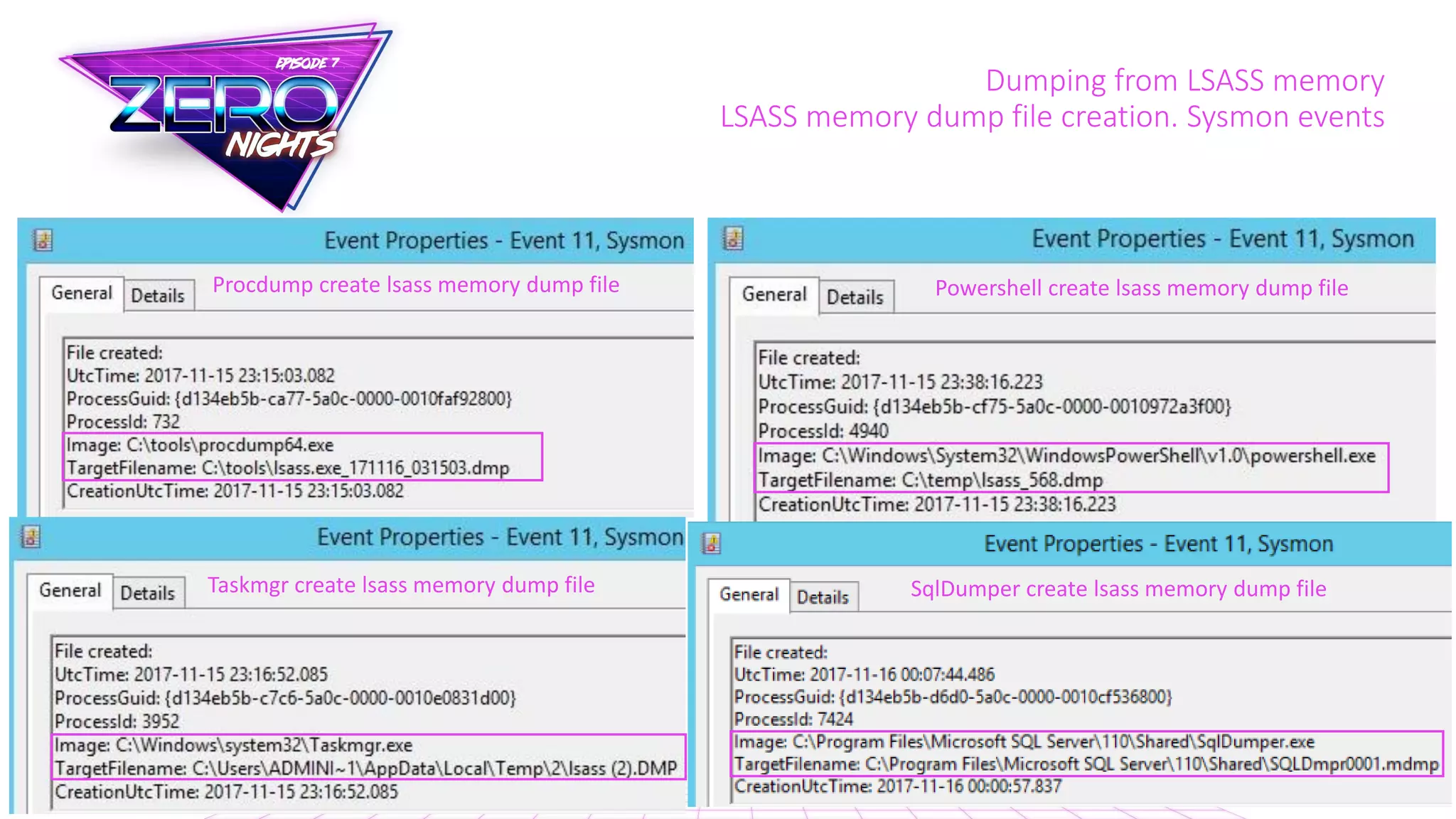
LSASS memory dump file creation. Sysmon events
Procdump create lsass memory dump file
Taskmgr create lsass memory dump file
Powershell create lsass memory dump file
SqlDumper create lsass memory dump file
Dumping from LSASS memory
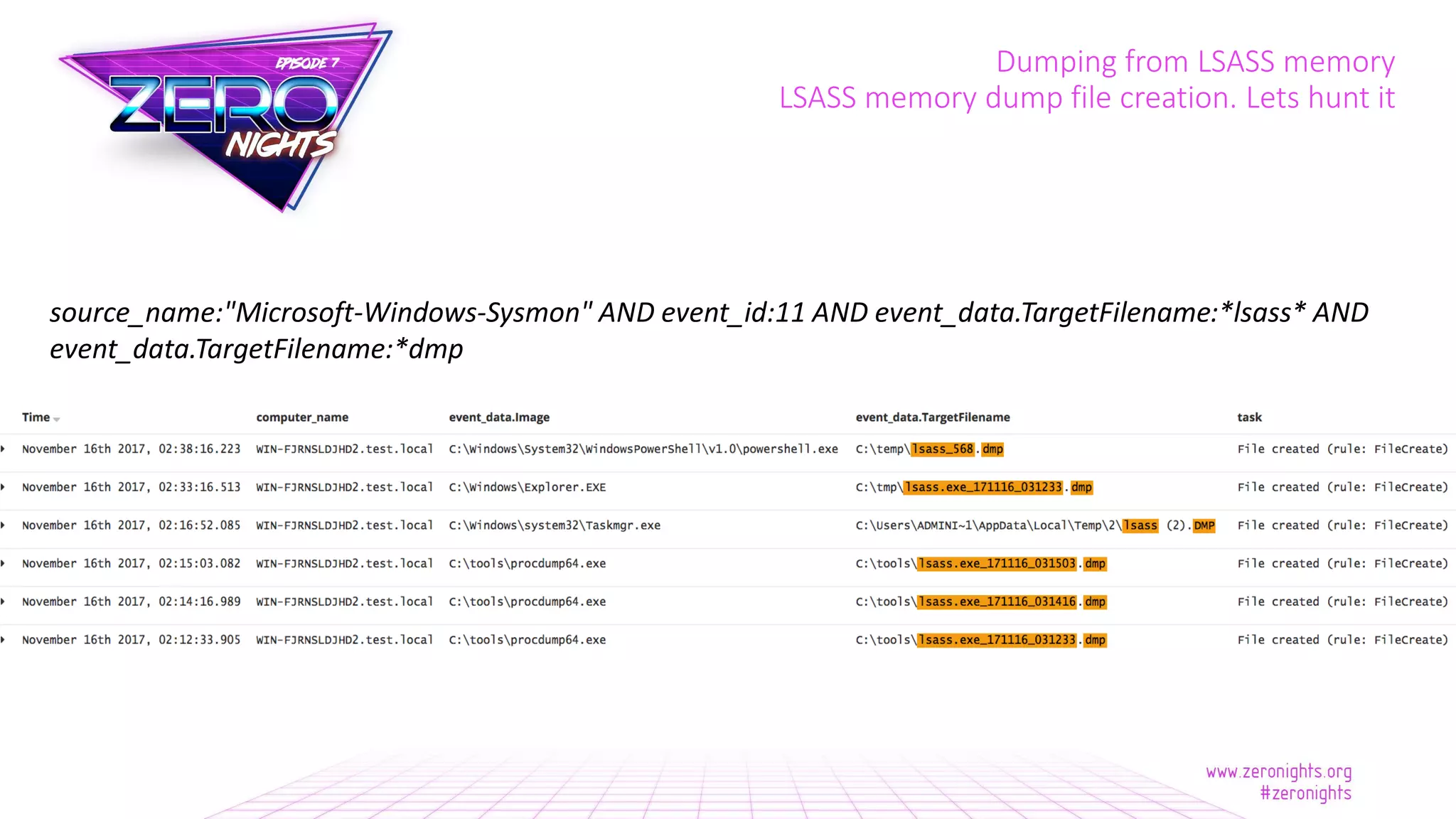
LSASS memory dump file creation. Lets hunt it
source_name:"Microsoft-Windows-Sysmon" AND event_id:11 AND event_data.TargetFilename:*lsass* AND
event_data.TargetFilename:*dmp
Dumping from LSASS memory
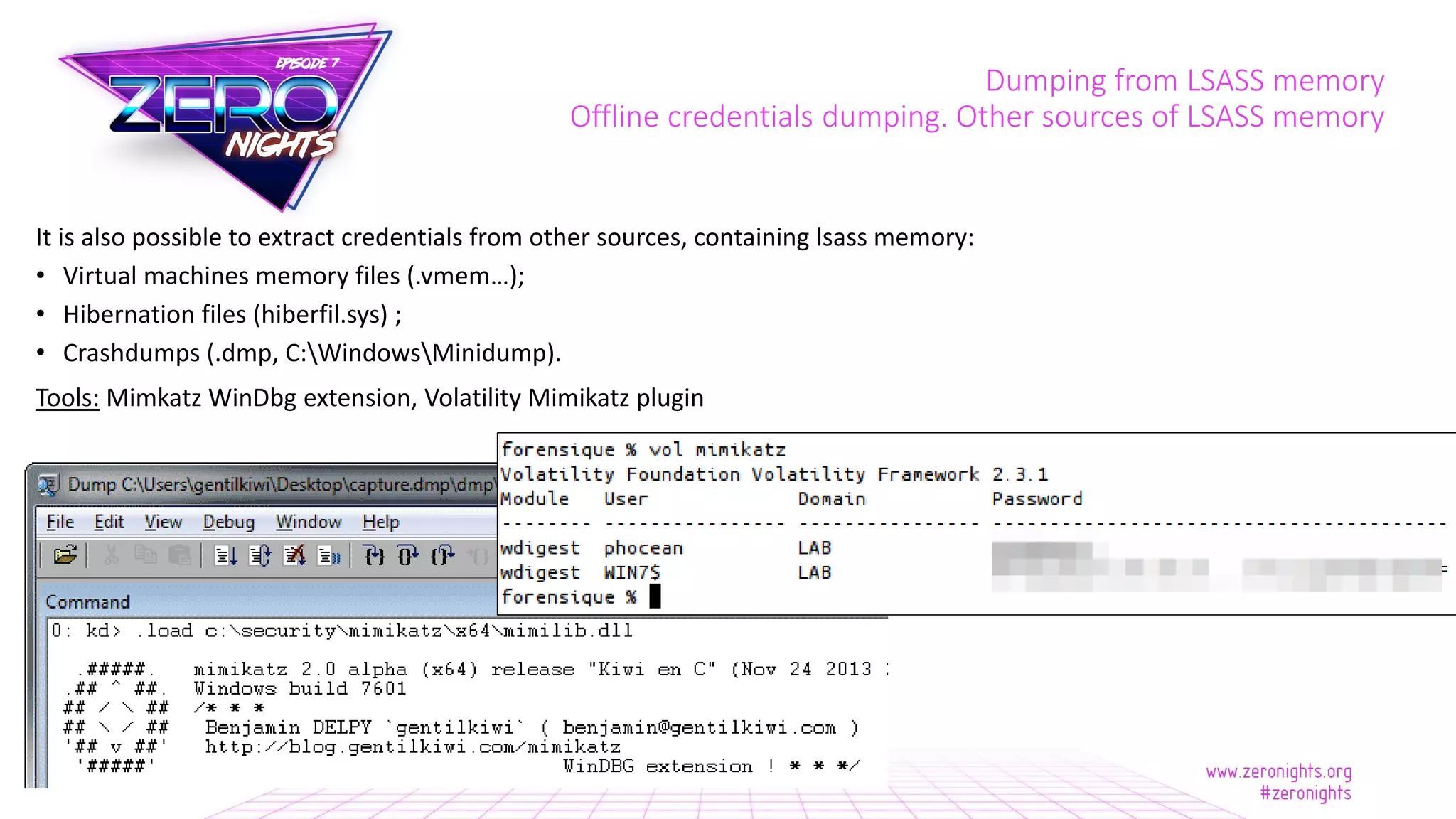
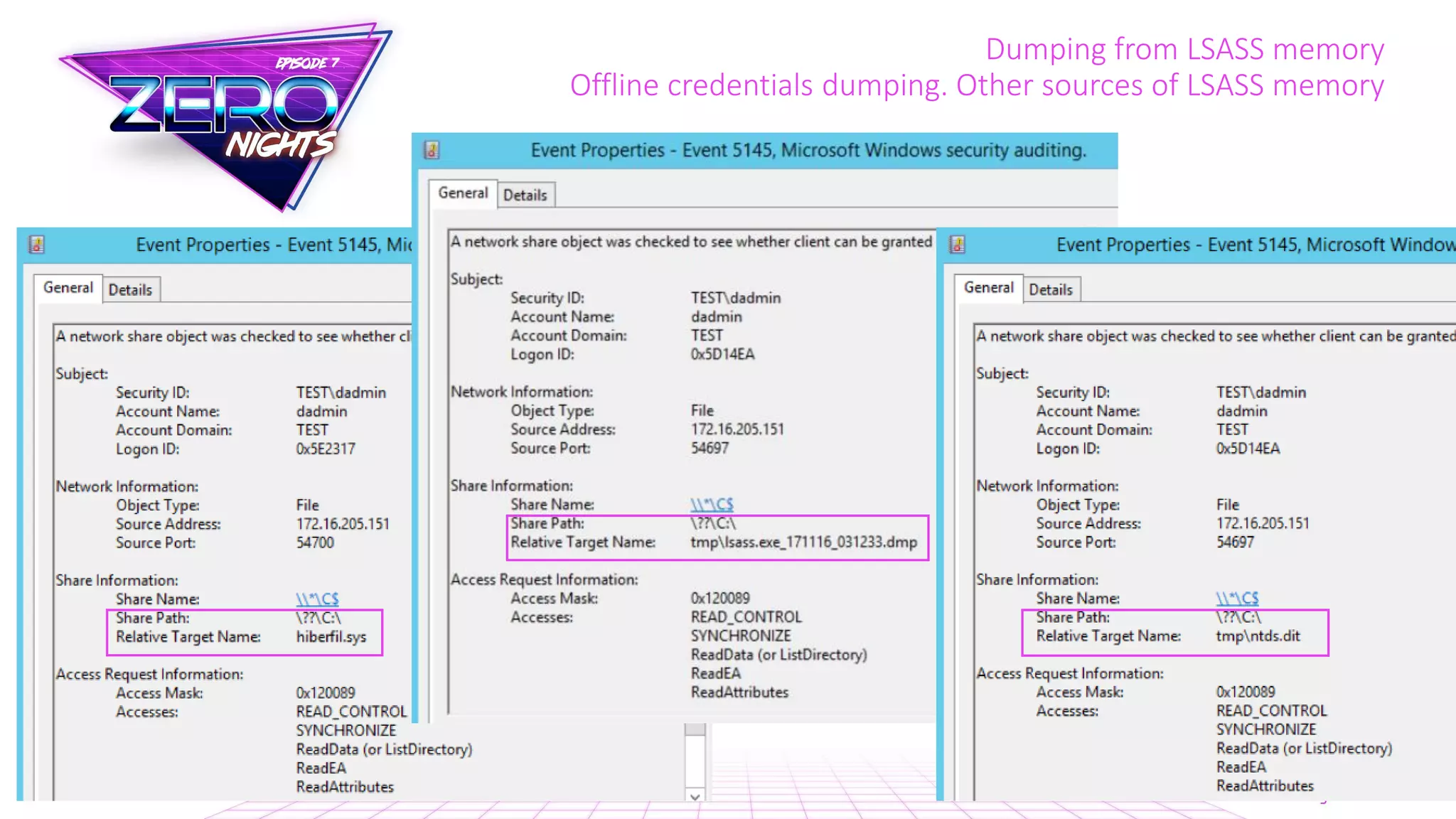
Offline credentials dumping. Other sources of LSASS memory
It is also possible to extract credentials from other sources, containing lsass memory:
• Virtual machines memory files (.vmem…);
• Hibernation files (hiberfil.sys) ;
• Crashdumps (.dmp, C:WindowsMinidump).
Tools: Mimkatz WinDbg extension, Volatility Mimikatz plugin
Dumping from LSASS memory
Offline credentials dumping. Other sources of LSASS memory
Dumping from LSASS memory
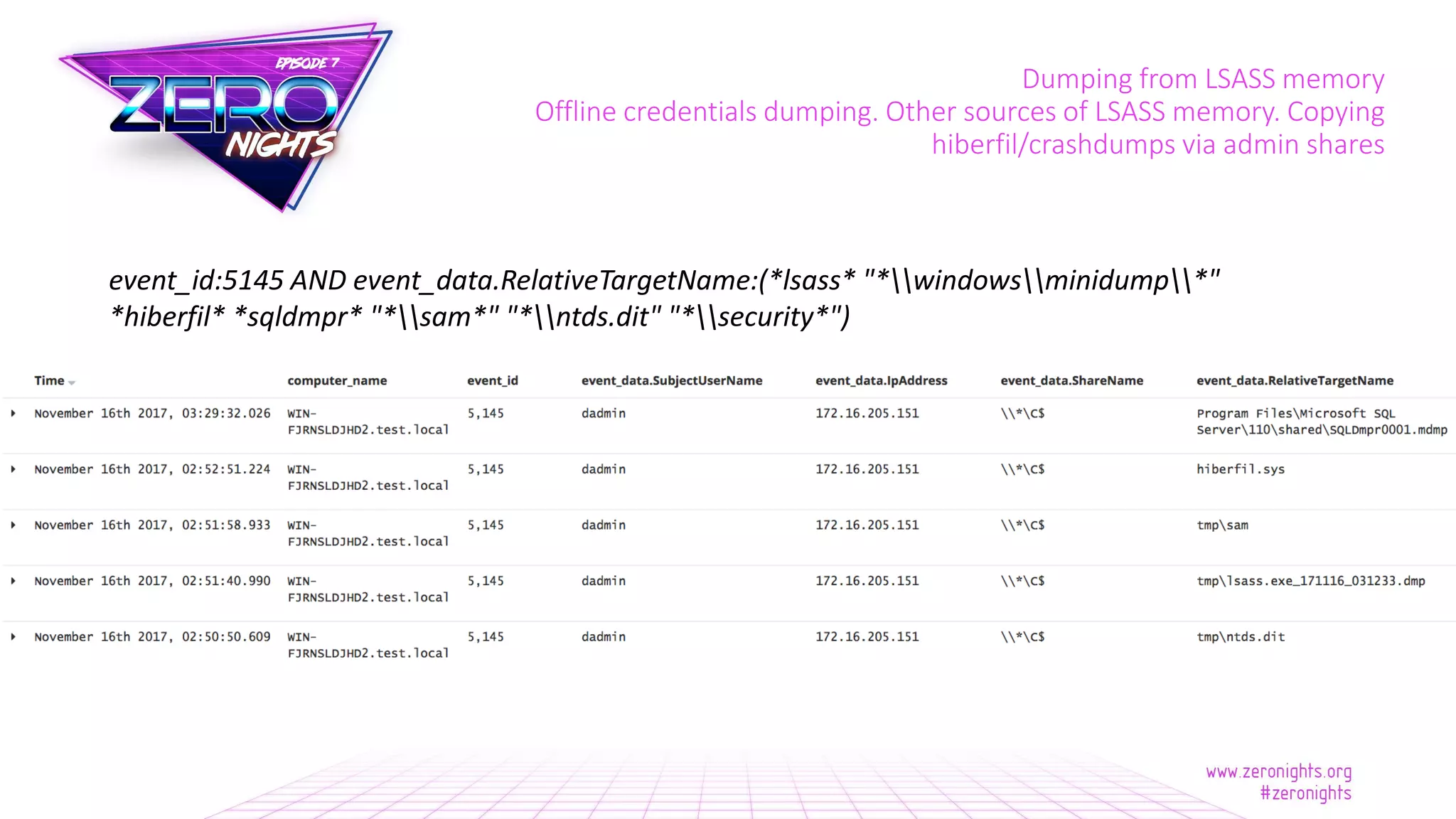
Offline credentials dumping. Other sources of LSASS memory. Copying
hiberfil/crashdumps via admin shares
event_id:5145 AND event_data.RelativeTargetName:(*lsass* "*windowsminidump*"
*hiberfil* *sqldmpr* "*sam*" "*ntds.dit" "*security*")
Dumping from SAM/SYSTEM/SECURITY/NTDS.dit
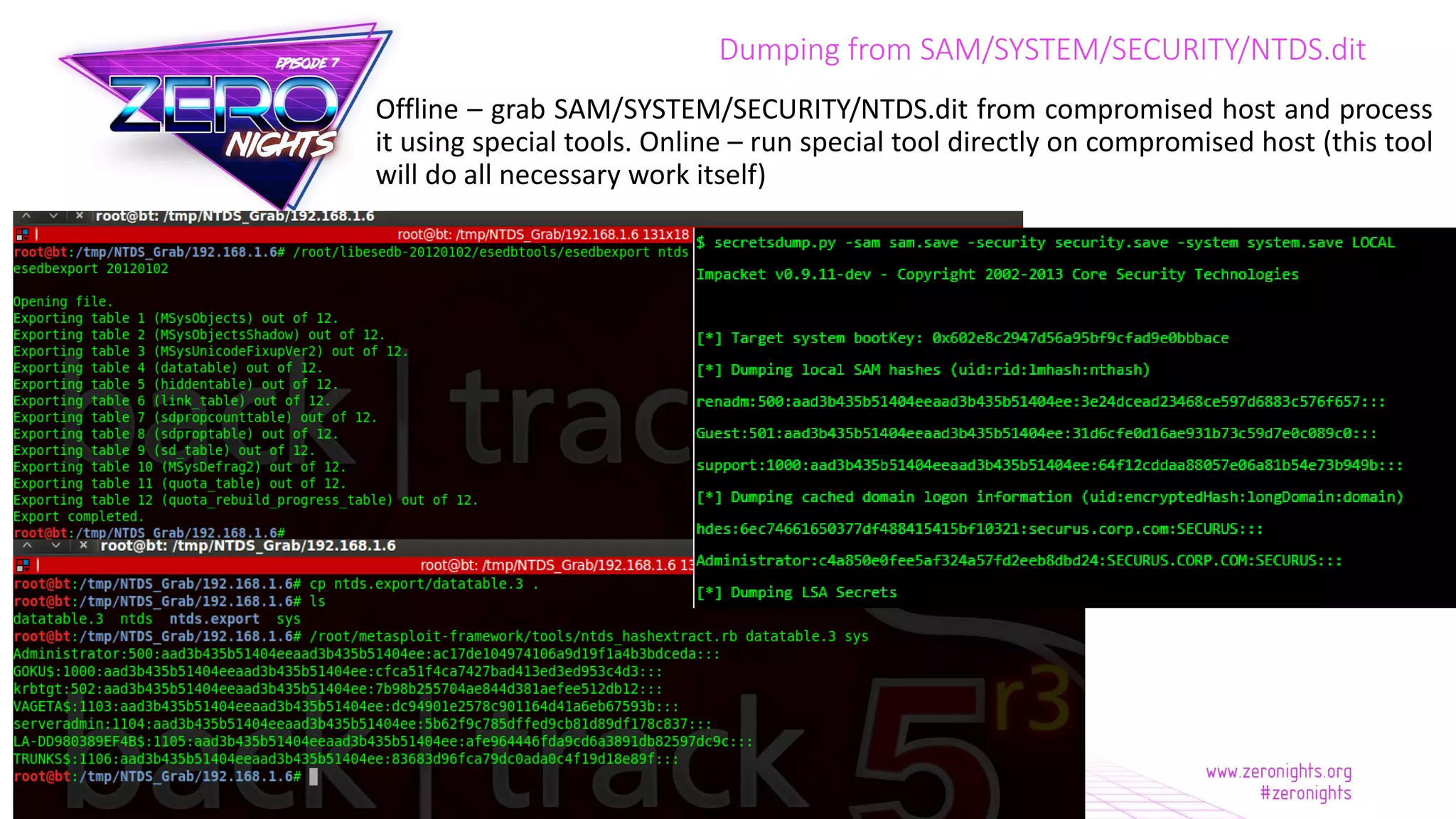
Offline – grab SAM/SYSTEM/SECURITY/NTDS.dit from compromised host and process
it using special tools. Online – run special tool directly on compromised host (this tool
will do all necessary work itself)
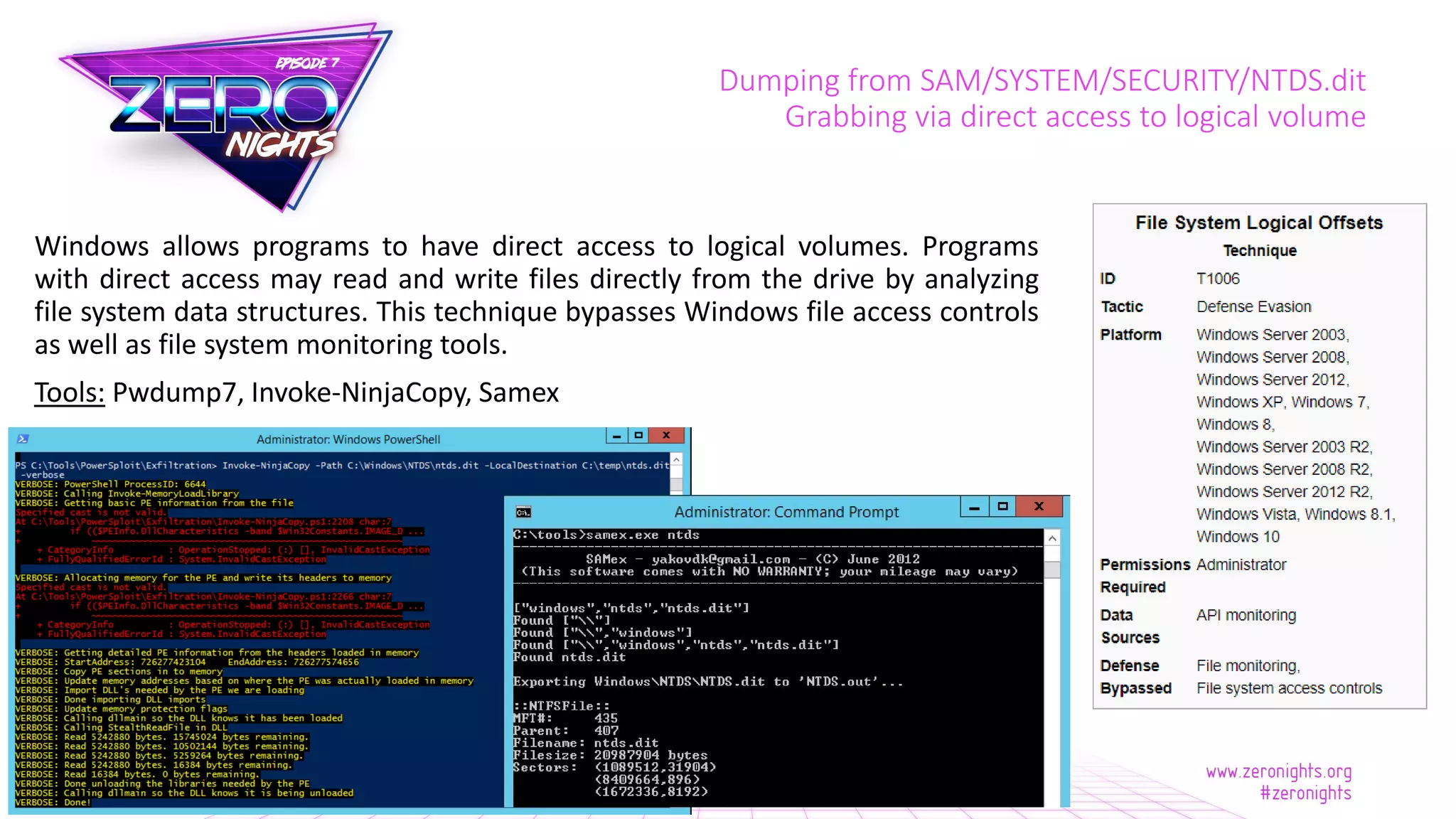
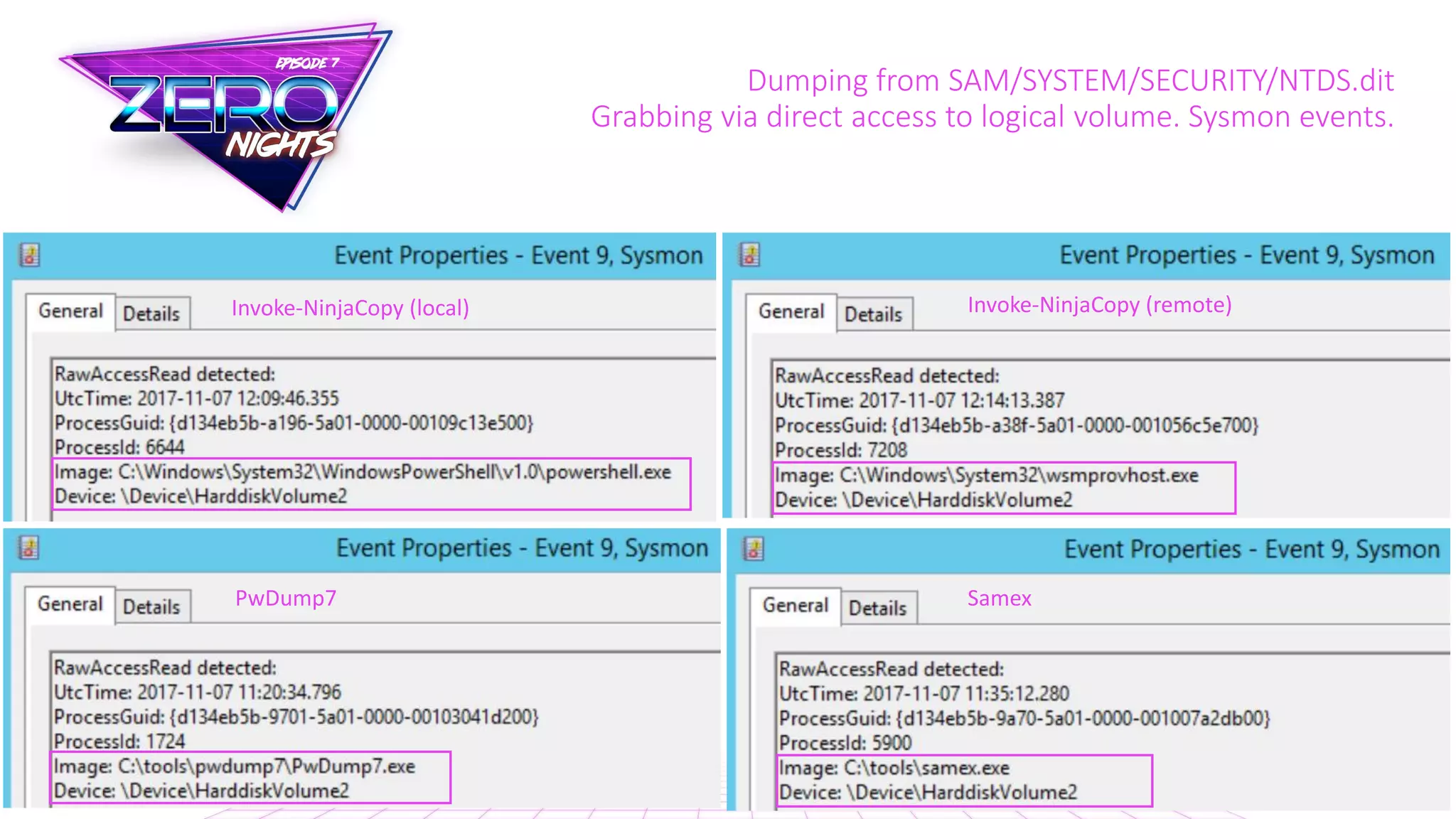
Windows allows programs to have direct access to logical volumes. Programs
with direct access may read and write files directly from the drive by analyzing
file system data structures. This technique bypasses Windows file access controls
as well as file system monitoring tools.
Tools: Pwdump7, Invoke-NinjaCopy, Samex
Dumping from SAM/SYSTEM/SECURITY/NTDS.dit
Grabbing via direct access to logical volume
Dumping from SAM/SYSTEM/SECURITY/NTDS.dit
Grabbing via direct access to logical volume. Sysmon events.
Invoke-NinjaCopy (local)
PwDump7 Samex
Invoke-NinjaCopy (remote)
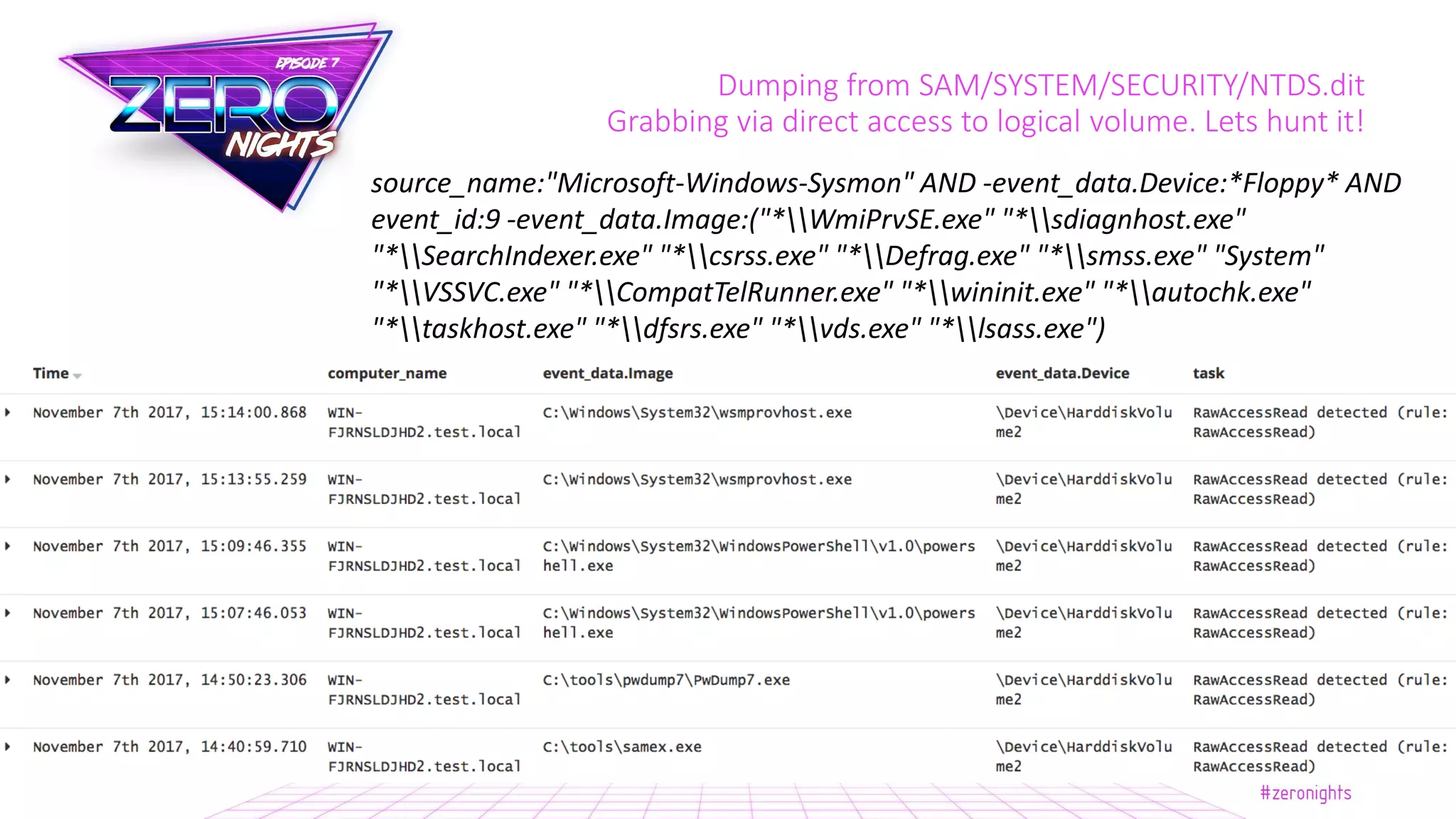
Dumping from SAM/SYSTEM/SECURITY/NTDS.dit
Grabbing via direct access to logical volume. Lets hunt it!
source_name:"Microsoft-Windows-Sysmon" AND -event_data.Device:*Floppy* AND
event_id:9 -event_data.Image:("*WmiPrvSE.exe" "*sdiagnhost.exe"
"*SearchIndexer.exe" "*csrss.exe" "*Defrag.exe" "*smss.exe" "System"
"*VSSVC.exe" "*CompatTelRunner.exe" "*wininit.exe" "*autochk.exe"
"*taskhost.exe" "*dfsrs.exe" "*vds.exe" "*lsass.exe")
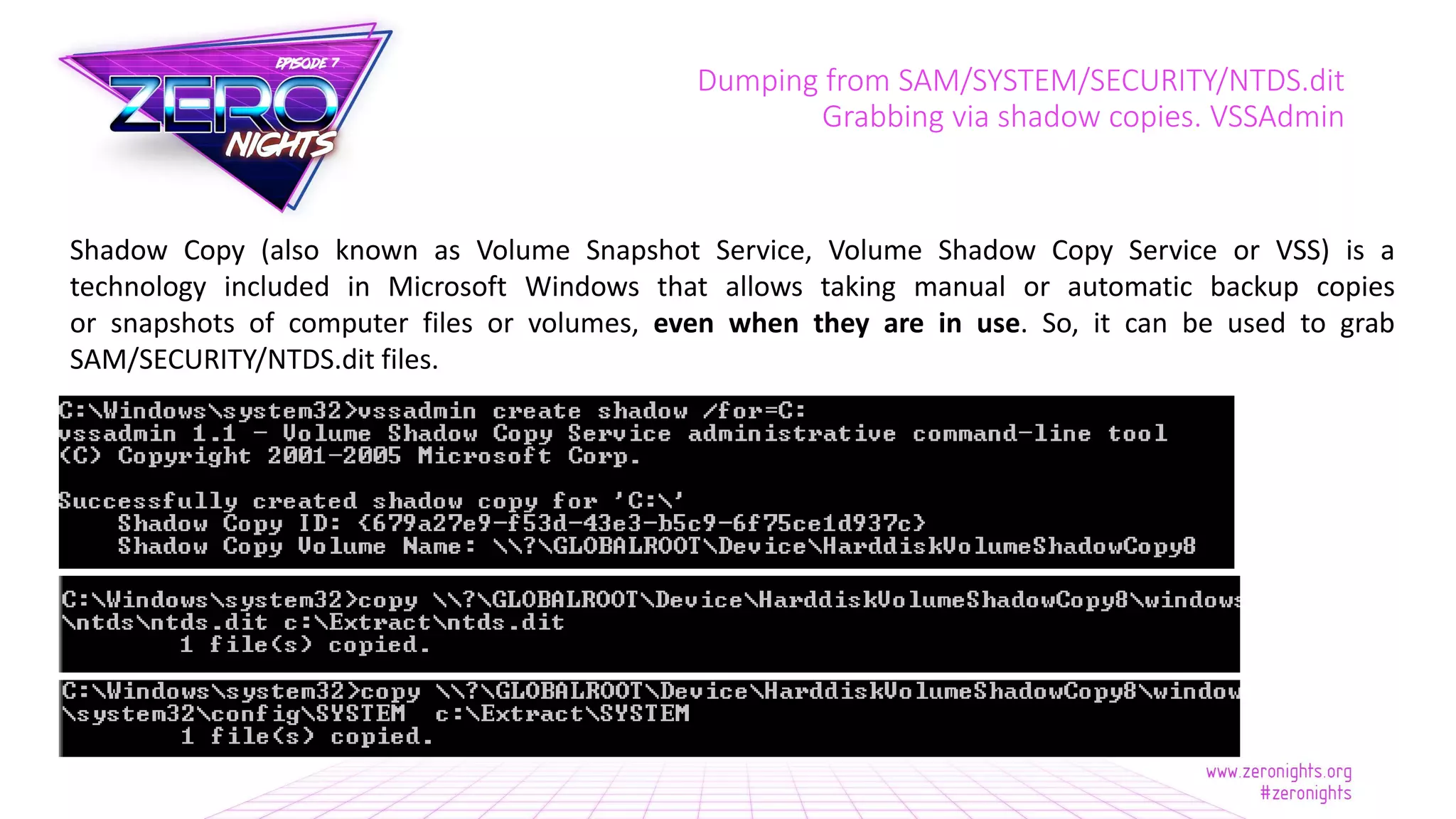
Dumping from SAM/SYSTEM/SECURITY/NTDS.dit
Grabbing via shadow copies. VSSAdmin
Shadow Copy (also known as Volume Snapshot Service, Volume Shadow Copy Service or VSS) is a
technology included in Microsoft Windows that allows taking manual or automatic backup copies
or snapshots of computer files or volumes, even when they are in use. So, it can be used to grab
SAM/SECURITY/NTDS.dit files.
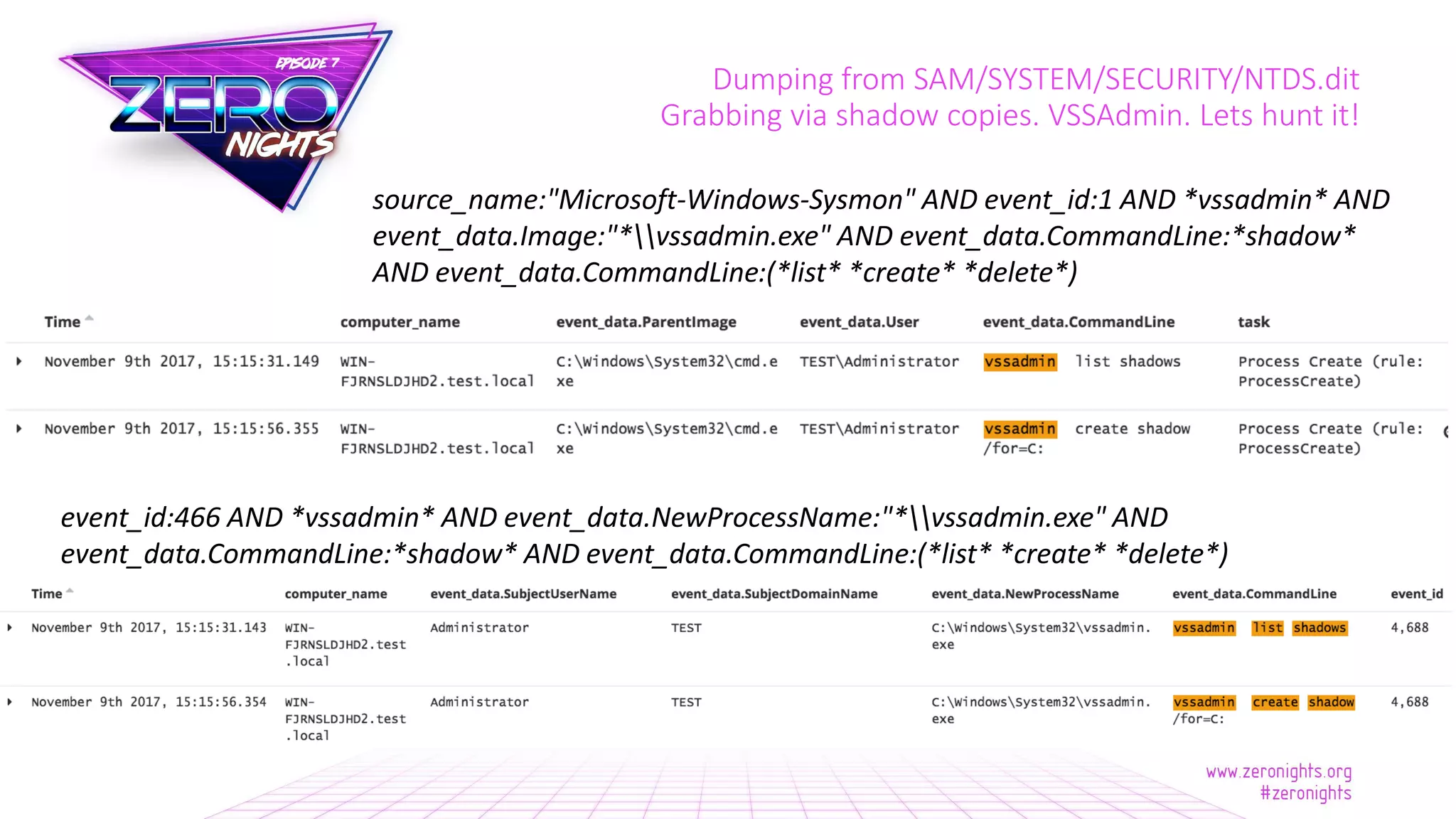
Dumping from SAM/SYSTEM/SECURITY/NTDS.dit
Grabbing via shadow copies. VSSAdmin. Lets hunt it!
source_name:"Microsoft-Windows-Sysmon" AND event_id:1 AND *vssadmin* AND
event_data.Image:"*vssadmin.exe" AND event_data.CommandLine:*shadow*
AND event_data.CommandLine:(*list* *create* *delete*)
event_id:466 AND *vssadmin* AND event_data.NewProcessName:"*vssadmin.exe" AND
event_data.CommandLine:*shadow* AND event_data.CommandLine:(*list* *create* *delete*)
Dumping from SAM/SYSTEM/SECURITY/NTDS.dit
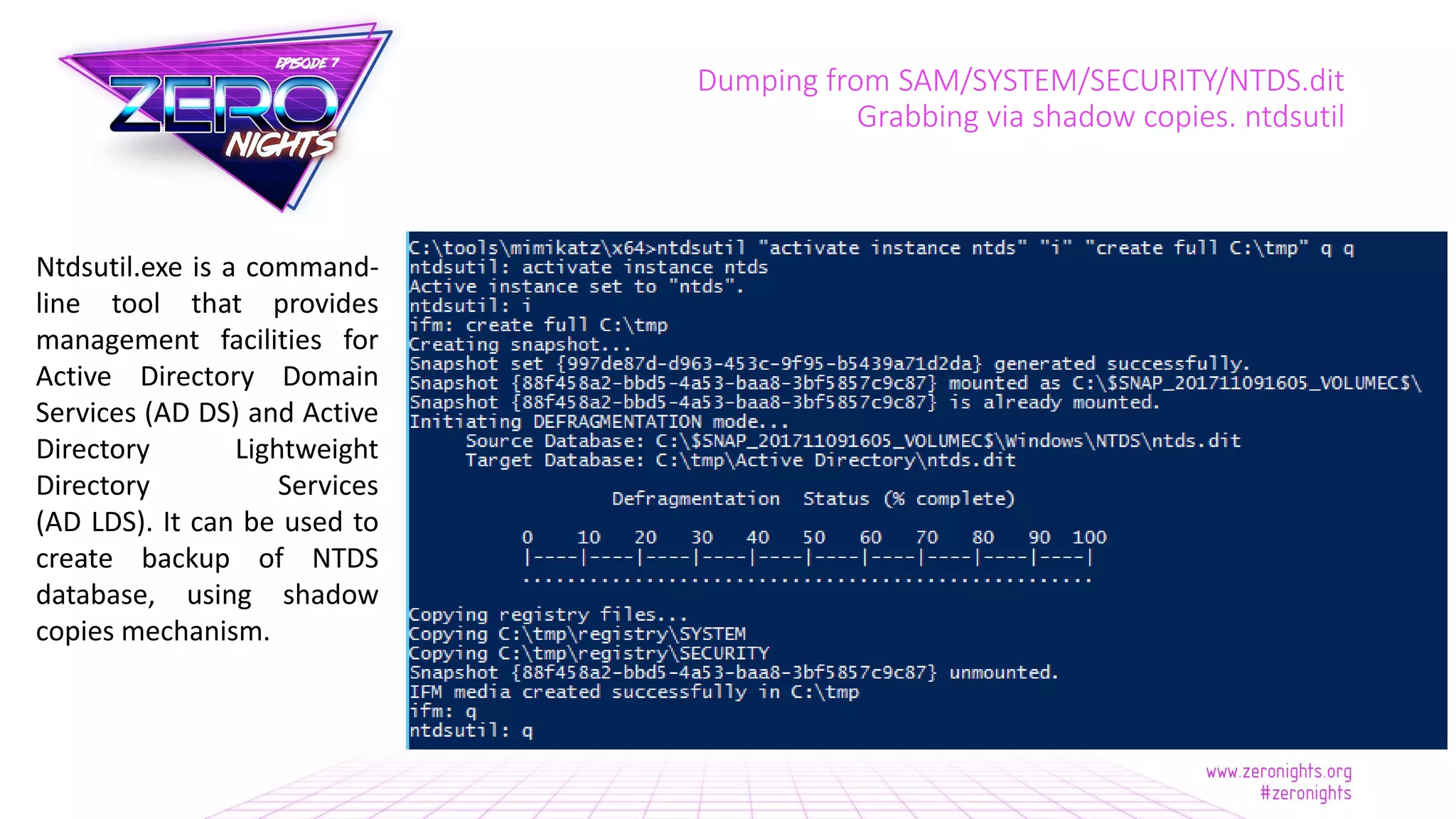
Grabbing via shadow copies. ntdsutil
Ntdsutil.exe is a command-
line tool that provides
management facilities for
Active Directory Domain
Services (AD DS) and Active
Directory Lightweight
Directory Services
(AD LDS). It can be used to
create backup of NTDS
database, using shadow
copies mechanism.
Dumping from SAM/SYSTEM/SECURITY/NTDS.dit
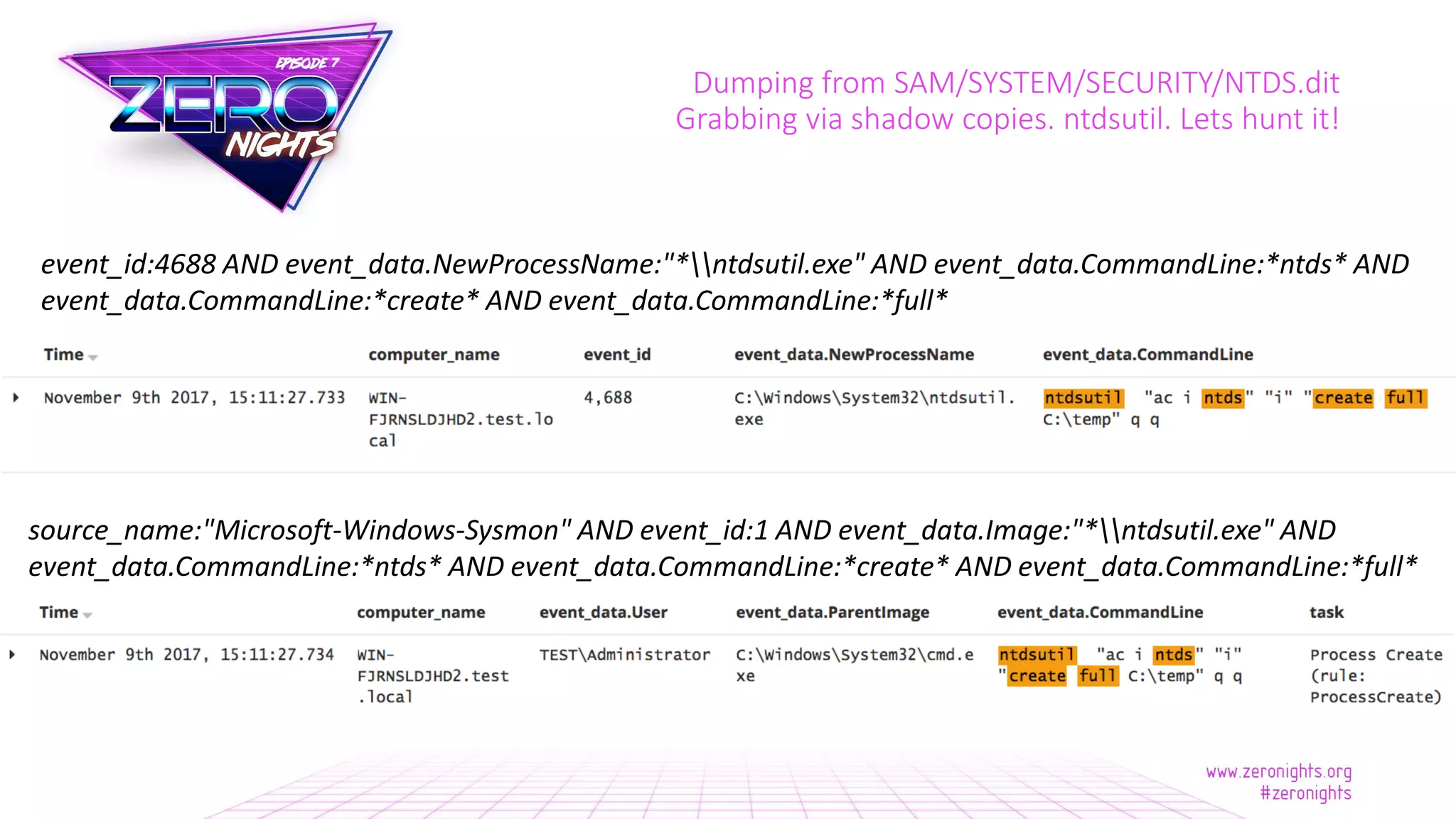
Grabbing via shadow copies. ntdsutil. Lets hunt it!
source_name:"Microsoft-Windows-Sysmon" AND event_id:1 AND event_data.Image:"*ntdsutil.exe" AND
event_data.CommandLine:*ntds* AND event_data.CommandLine:*create* AND event_data.CommandLine:*full*
event_id:4688 AND event_data.NewProcessName:"*ntdsutil.exe" AND event_data.CommandLine:*ntds* AND
event_data.CommandLine:*create* AND event_data.CommandLine:*full*
Dumping from SAM/SYSTEM/SECURITY/NTDS.dit
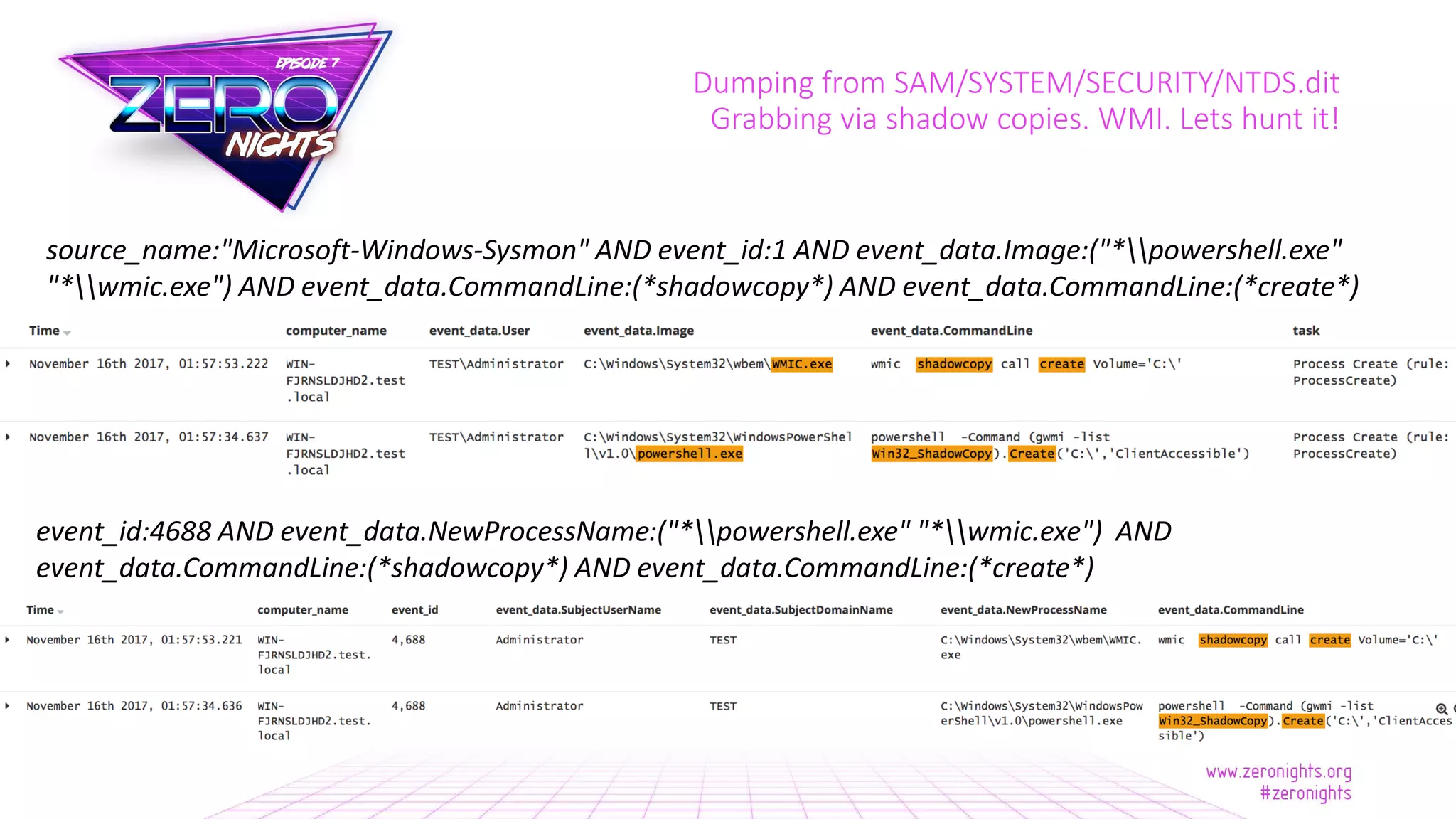
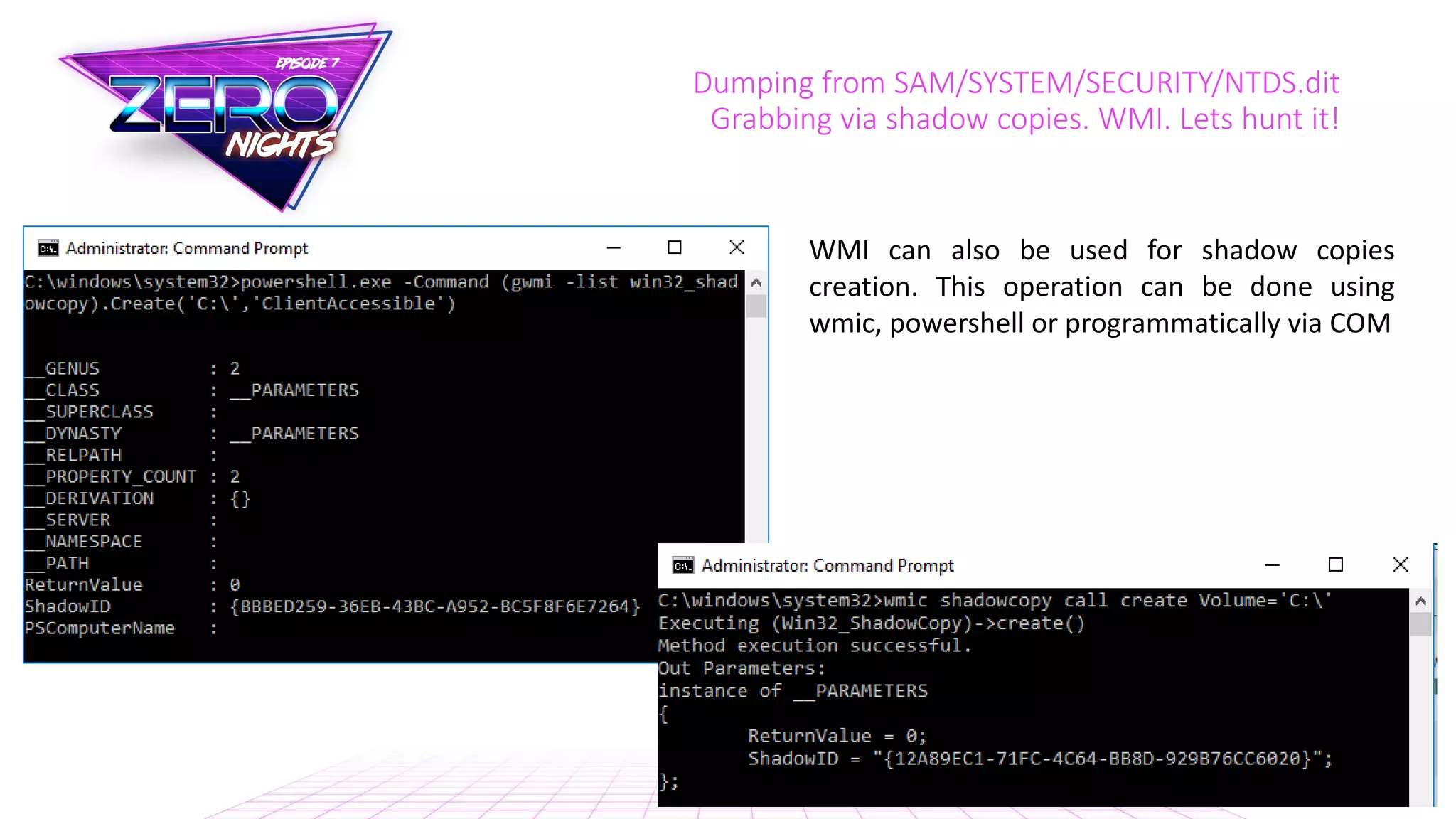
Grabbing via shadow copies. WMI. Lets hunt it!
WMI can also be used for shadow copies
creation. This operation can be done using
wmic, powershell or programmatically via COM
Dumping from SAM/SYSTEM/SECURITY/NTDS.dit
Grabbing via shadow copies. WMI. Lets hunt it!
source_name:"Microsoft-Windows-Sysmon" AND event_id:1 AND event_data.Image:("*powershell.exe"
"*wmic.exe") AND event_data.CommandLine:(*shadowcopy*) AND event_data.CommandLine:(*create*)
event_id:4688 AND event_data.NewProcessName:("*powershell.exe" "*wmic.exe") AND
event_data.CommandLine:(*shadowcopy*) AND event_data.CommandLine:(*create*)
Dumping from SAM/SYSTEM/SECURITY/NTDS.dit
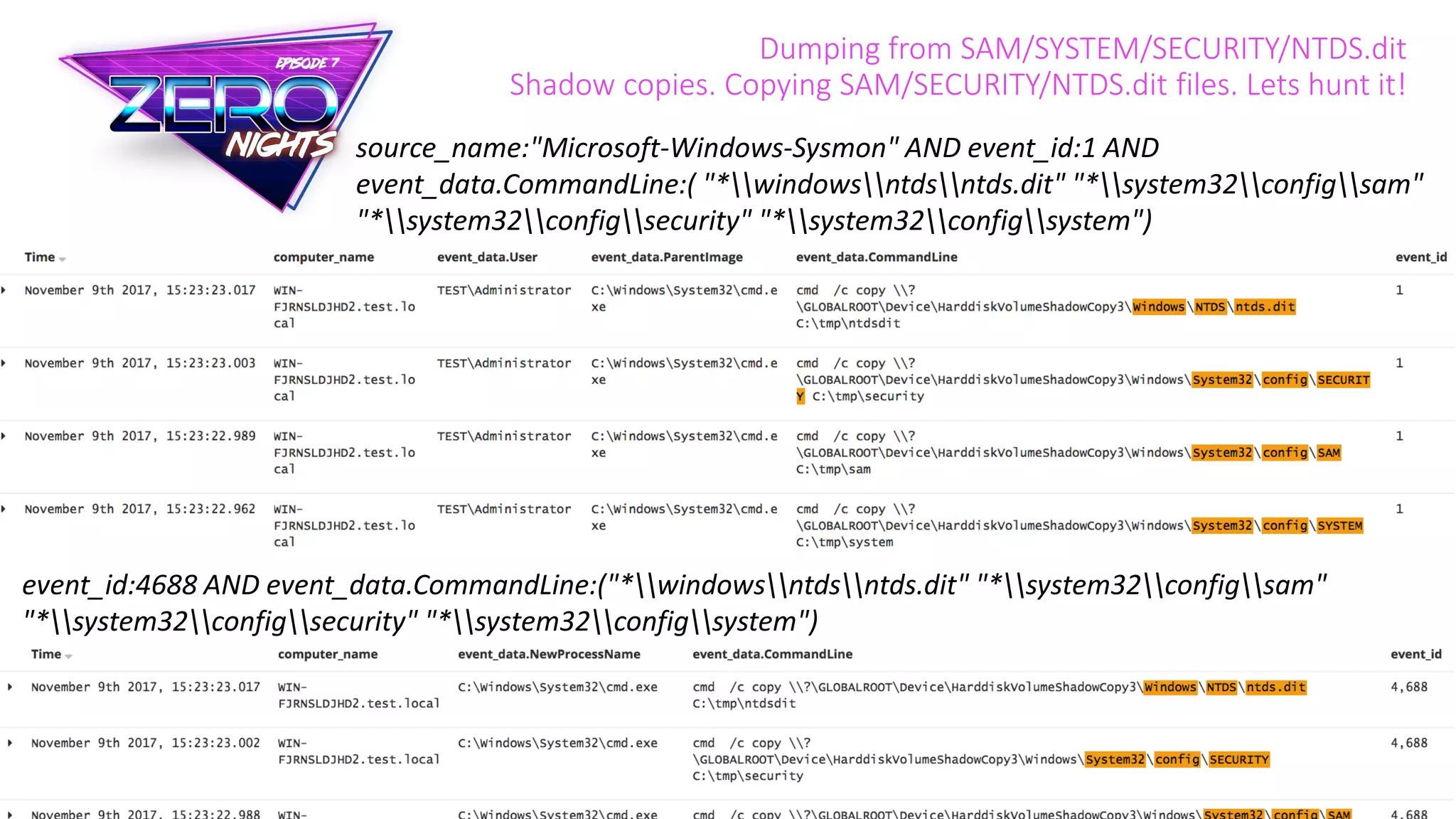
Shadow copies. Copying SAM/SECURITY/NTDS.dit files. Lets hunt it!
source_name:"Microsoft-Windows-Sysmon" AND event_id:1 AND
event_data.CommandLine:( "*windowsntdsntds.dit" "*system32configsam"
"*system32configsecurity" "*system32configsystem")
event_id:4688 AND event_data.CommandLine:("*windowsntdsntds.dit" "*system32configsam"
"*system32configsecurity" "*system32configsystem")
Dumping from SAM/SYSTEM/SECURITY/NTDS.dit
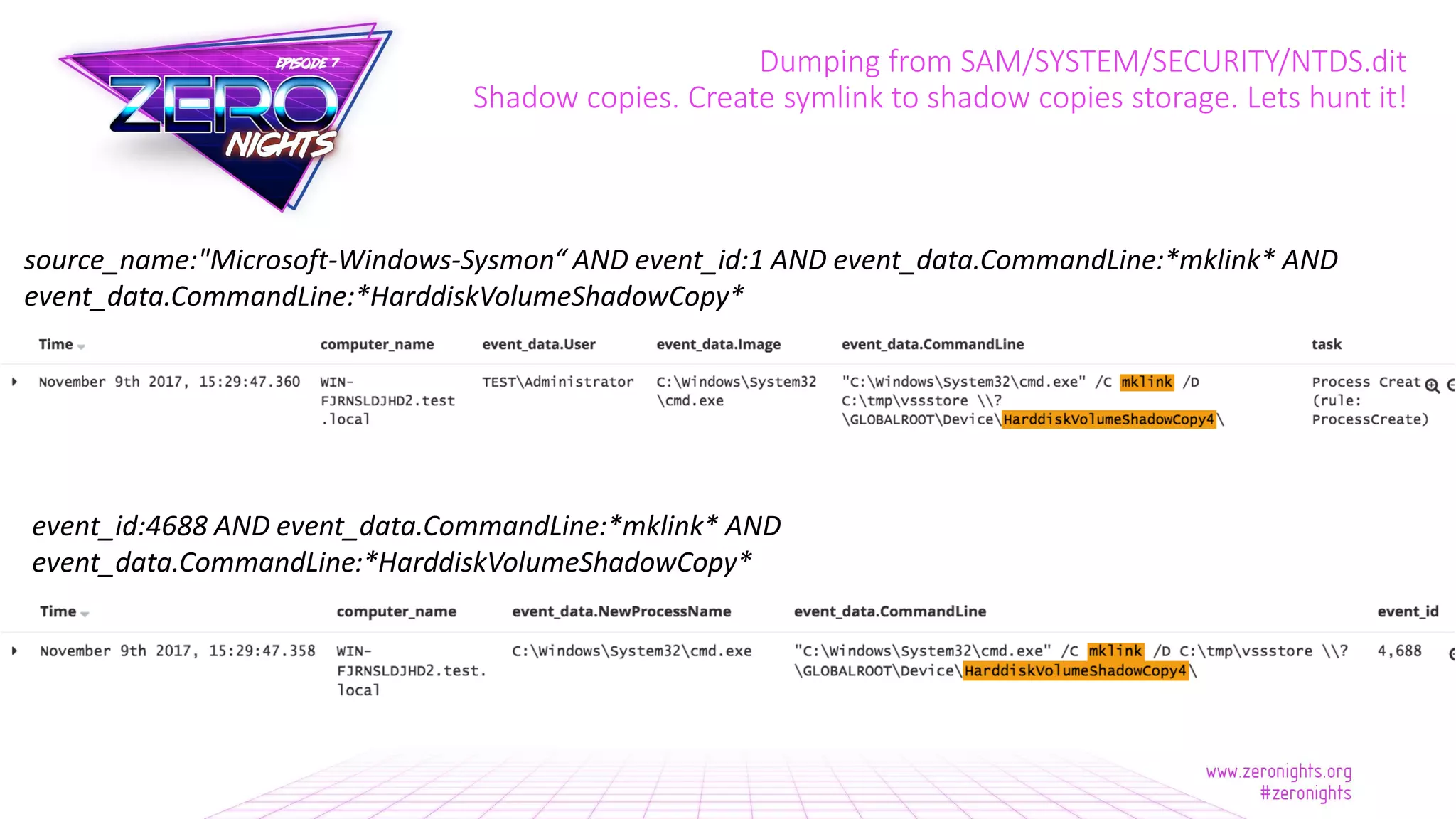
Shadow copies. Create symlink to shadow copies storage. Lets hunt it!
source_name:"Microsoft-Windows-Sysmon“ AND event_id:1 AND event_data.CommandLine:*mklink* AND
event_data.CommandLine:*HarddiskVolumeShadowCopy*
event_id:4688 AND event_data.CommandLine:*mklink* AND
event_data.CommandLine:*HarddiskVolumeShadowCopy*
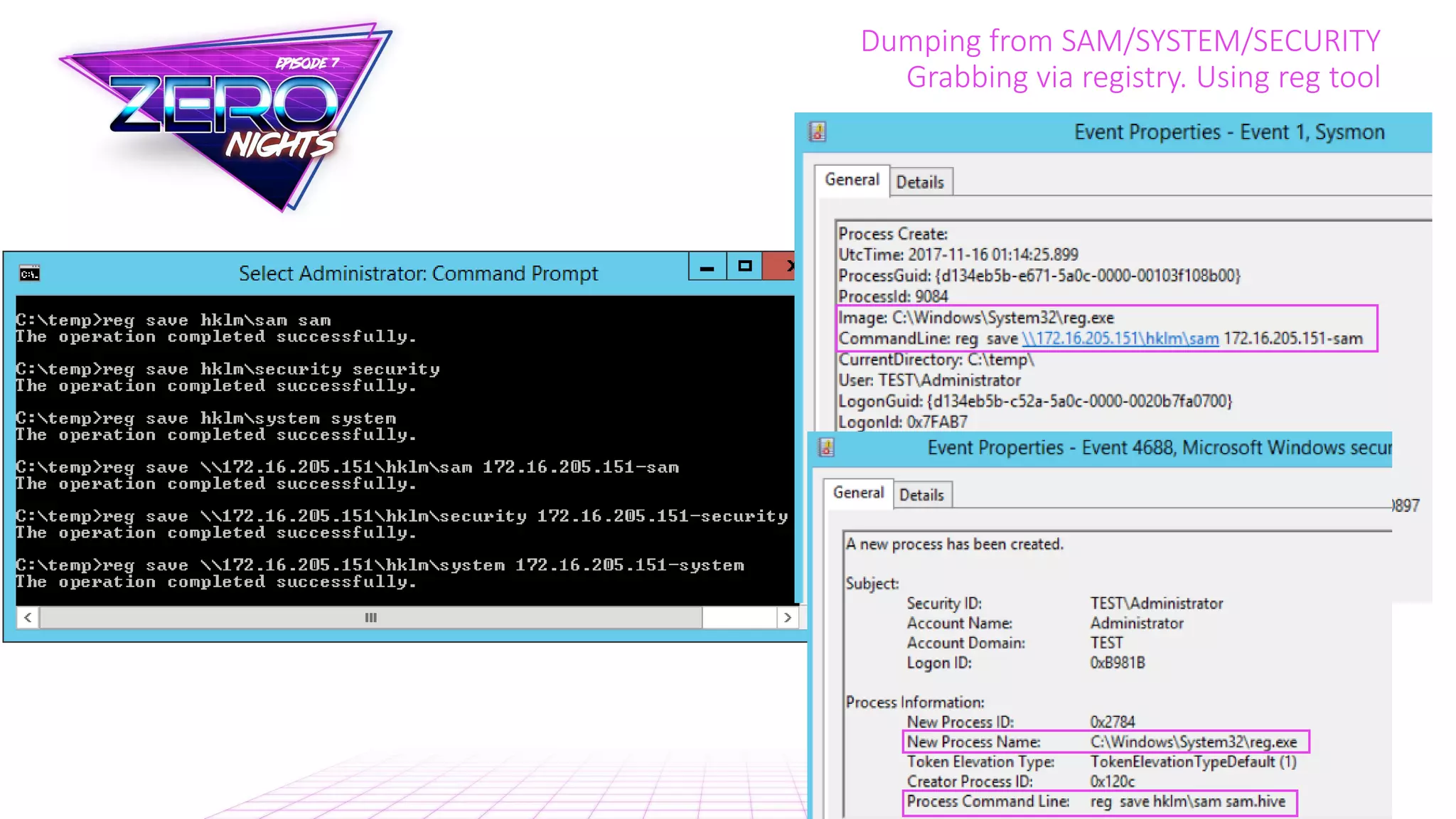
Dumping from SAM/SYSTEM/SECURITY
Grabbing via registry. Using reg tool
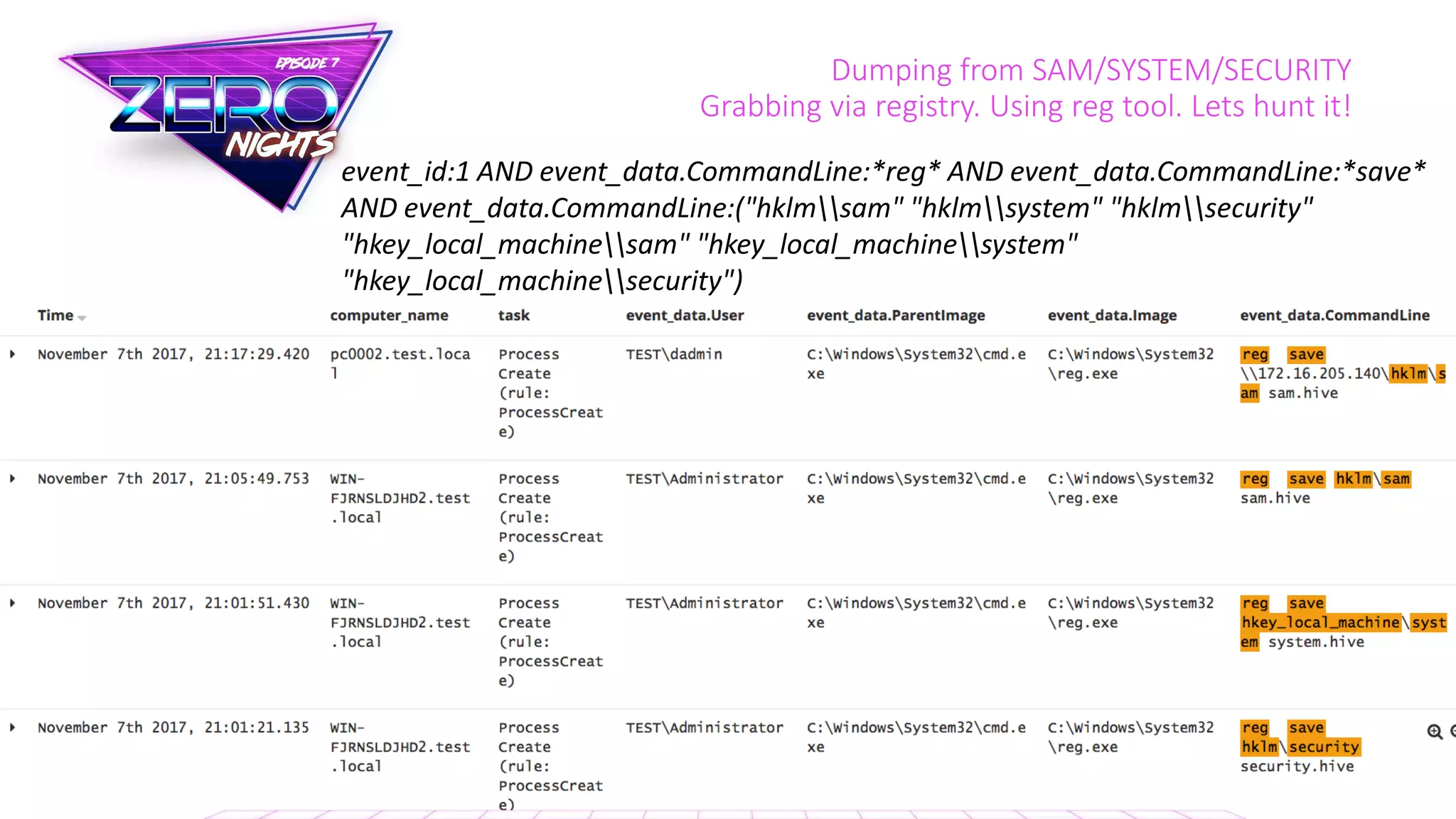
Dumping from SAM/SYSTEM/SECURITY
Grabbing via registry. Using reg tool. Lets hunt it!
event_id:1 AND event_data.CommandLine:*reg* AND event_data.CommandLine:*save*
AND event_data.CommandLine:("hklmsam" "hklmsystem" "hklmsecurity"
"hkey_local_machinesam" "hkey_local_machinesystem"
"hkey_local_machinesecurity")
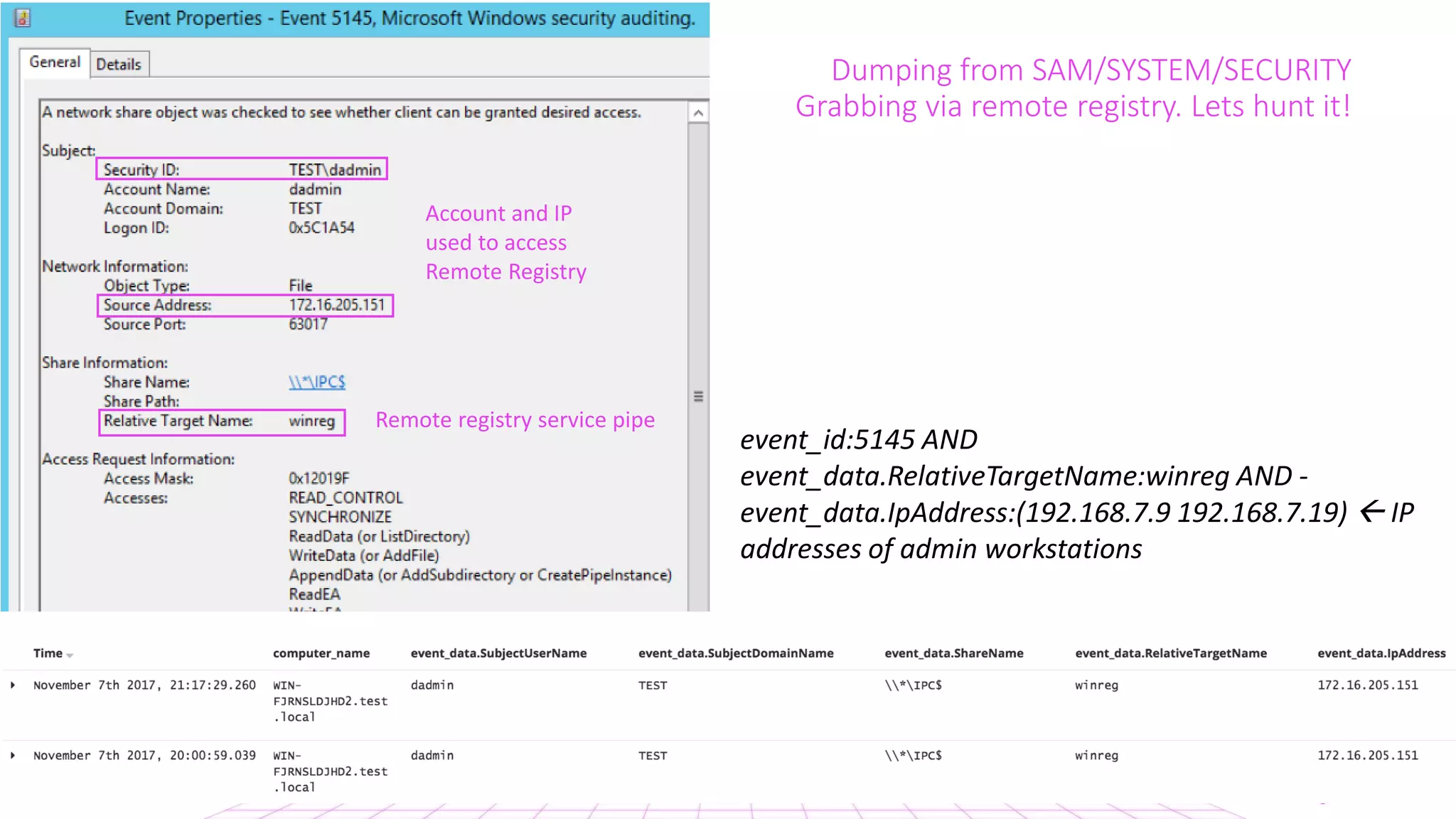
Dumping from SAM/SYSTEM/SECURITY
Grabbing via remote registry. Lets hunt it!
event_id:5145 AND
event_data.RelativeTargetName:winreg AND -
event_data.IpAddress:(192.168.7.9 192.168.7.19)  IP
addresses of admin workstations
Account and IP
used to access
Remote Registry
Remote registry service pipe
Dumping from NTDS.dit remotely
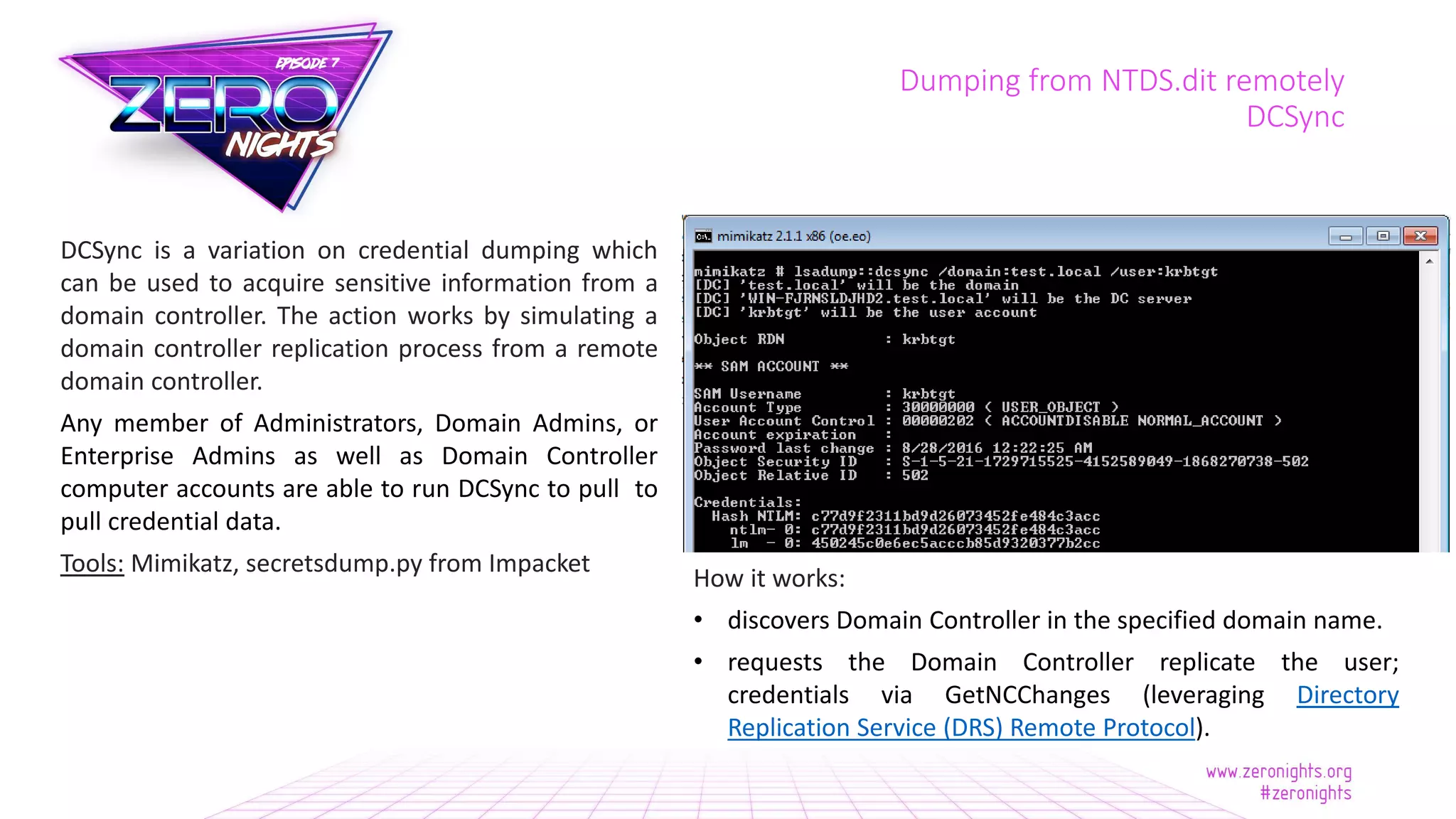
DCSync
DCSync is a variation on credential dumping which
can be used to acquire sensitive information from a
domain controller. The action works by simulating a
domain controller replication process from a remote
domain controller.
Any member of Administrators, Domain Admins, or
Enterprise Admins as well as Domain Controller
computer accounts are able to run DCSync to pull to
pull credential data.
Tools: Mimikatz, secretsdump.py from Impacket
How it works:
• discovers Domain Controller in the specified domain name.
• requests the Domain Controller replicate the user;
credentials via GetNCChanges (leveraging Directory
Replication Service (DRS) Remote Protocol).
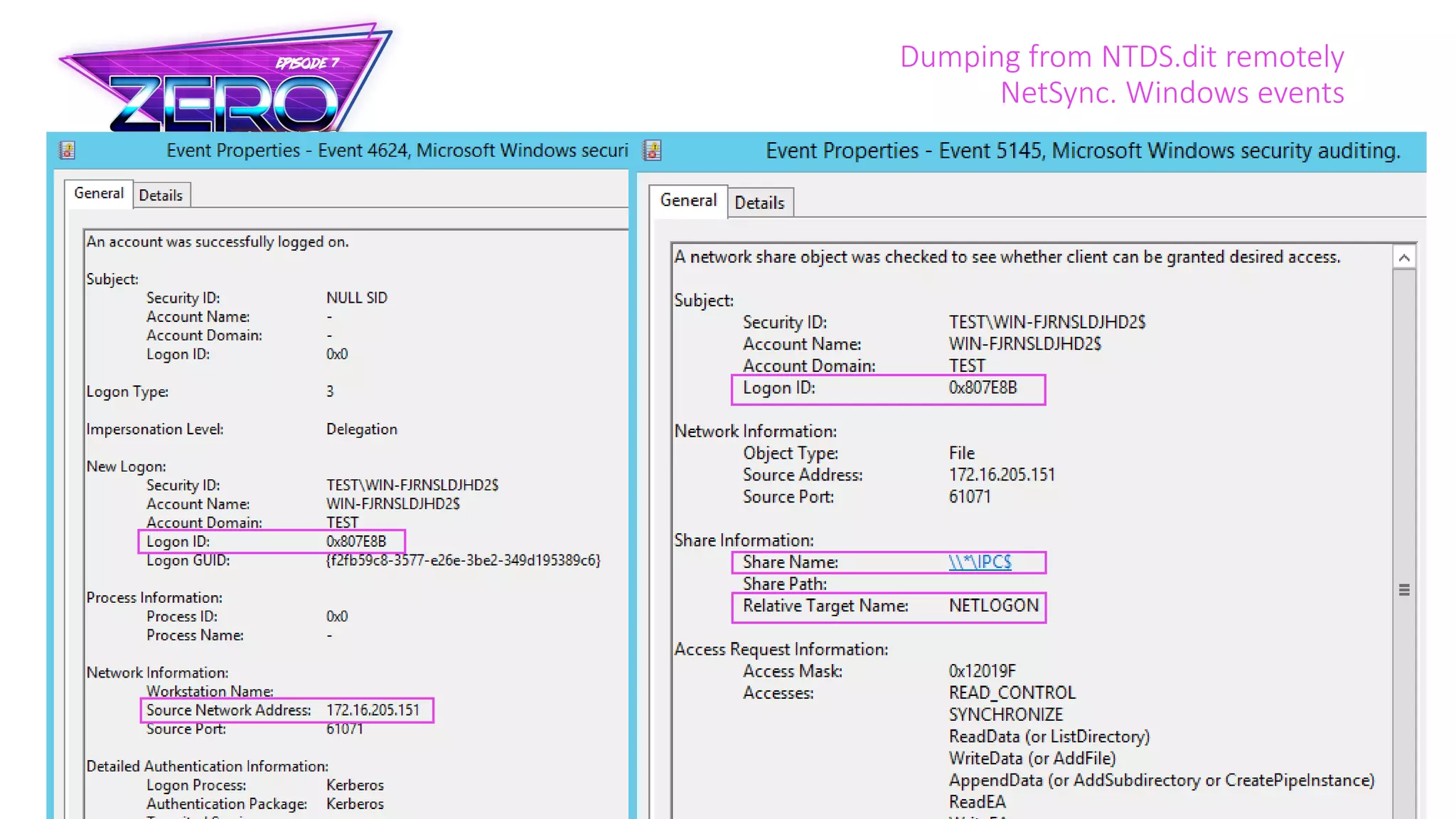
Dumping from NTDS.dit remotely
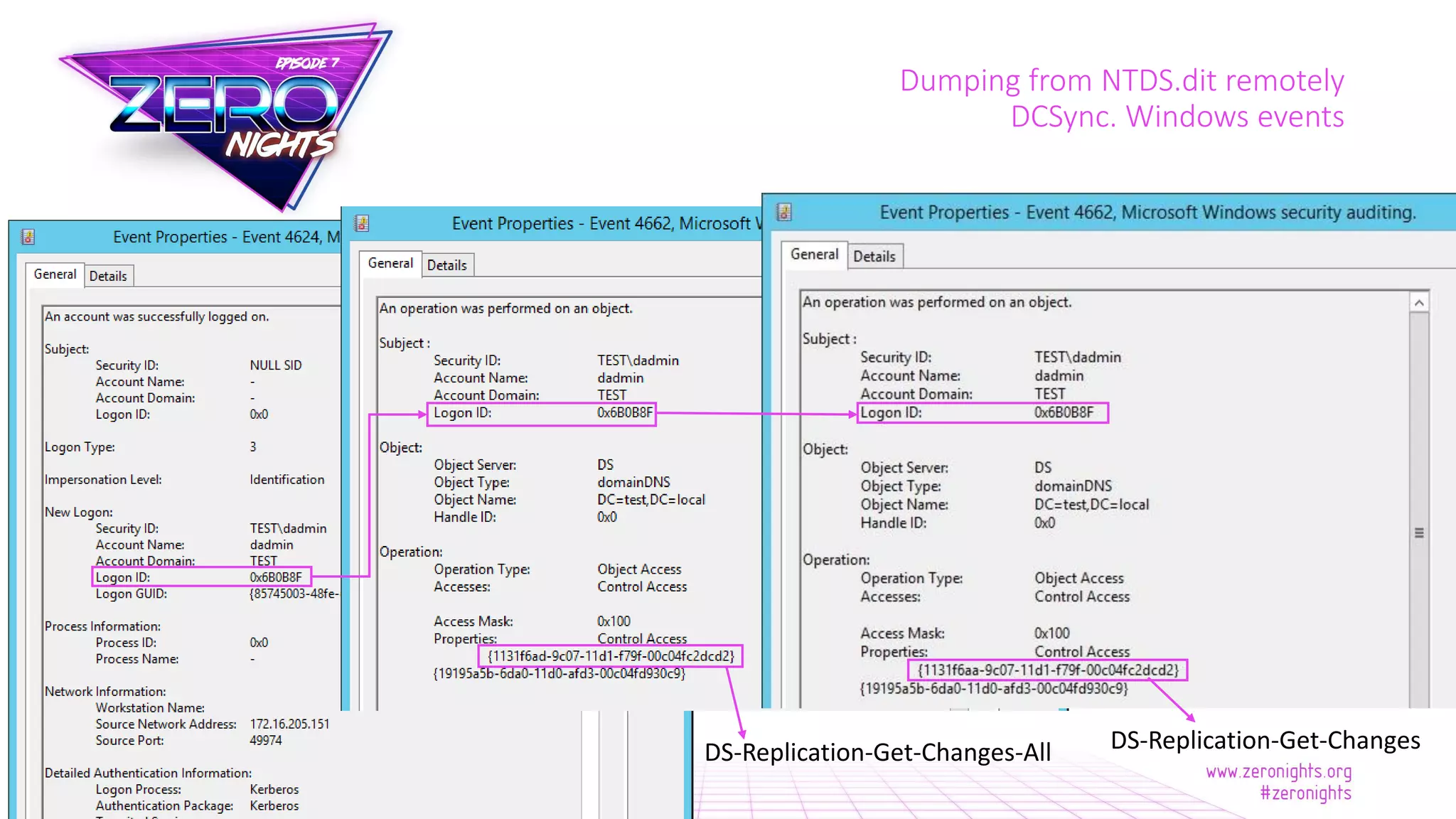
DCSync. Windows events
DS-Replication-Get-ChangesDS-Replication-Get-Changes-All
Dumping from NTDS.dit remotely
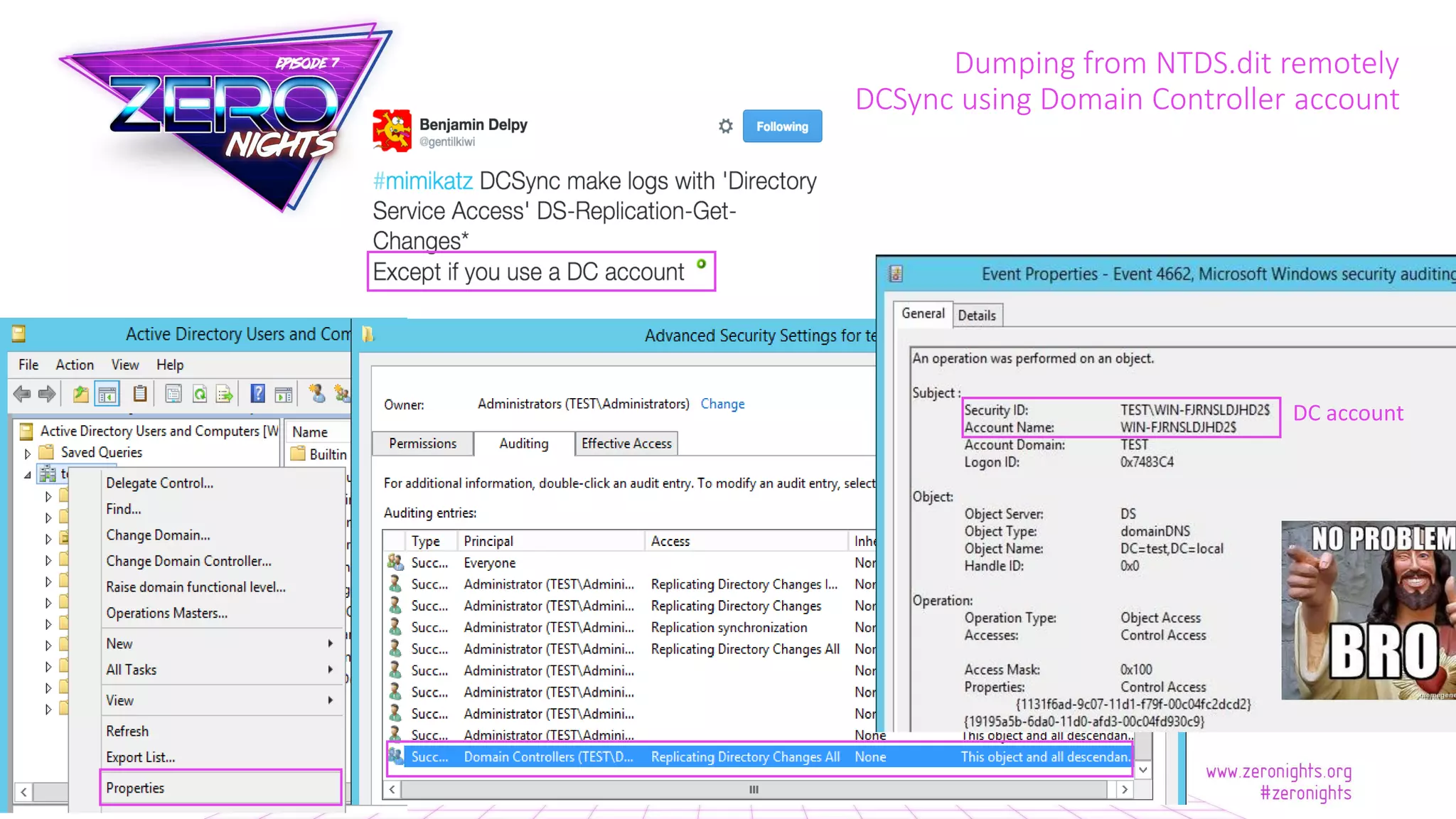
DCSync using Domain Controller account
DC account
Dumping from NTDS.dit remotely
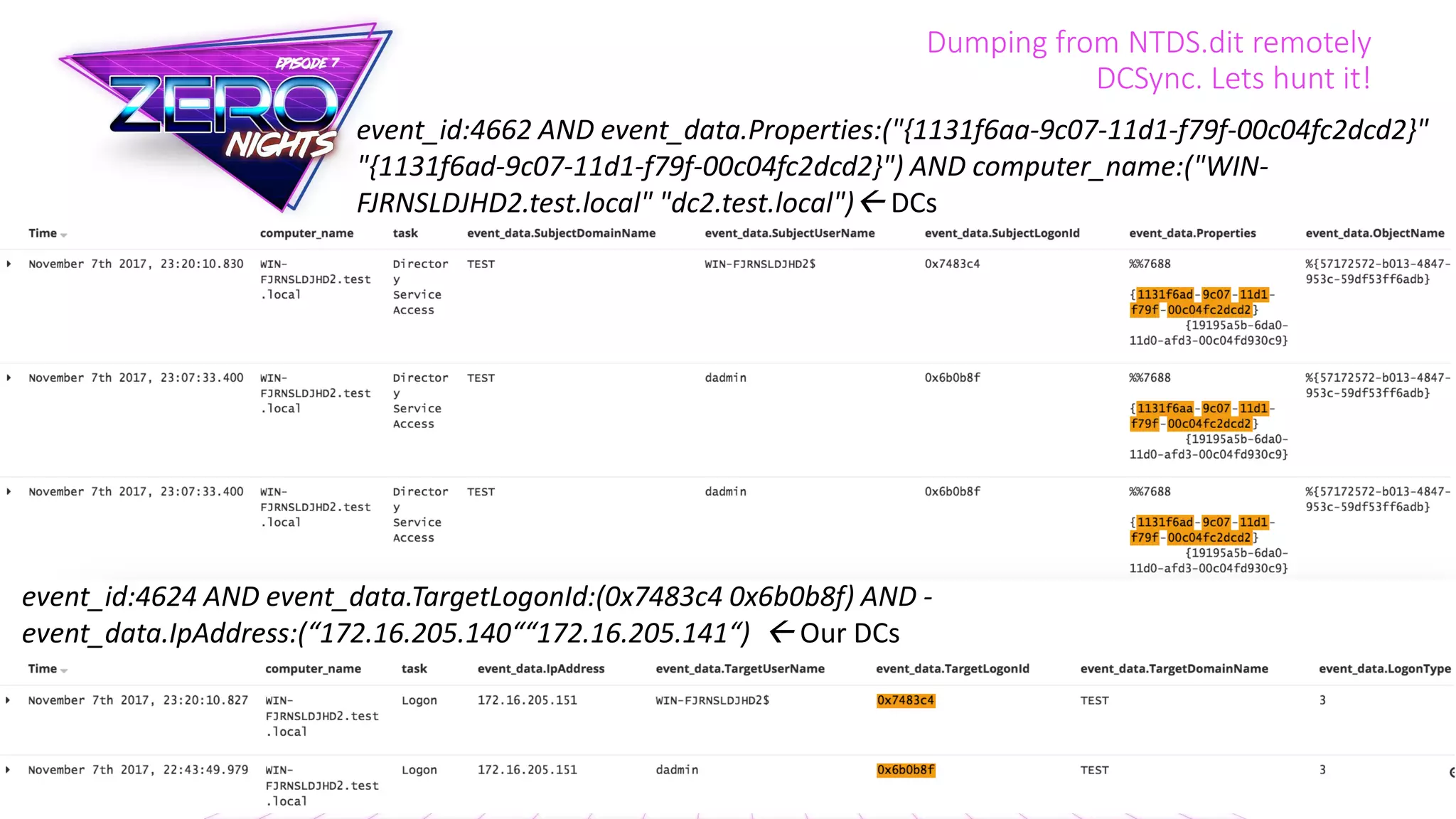
DCSync. Lets hunt it!
event_id:4624 AND event_data.TargetLogonId:(0x7483c4 0x6b0b8f) AND -
event_data.IpAddress:(“172.16.205.140““172.16.205.141“)  Our DCs
event_id:4662 AND event_data.Properties:("{1131f6aa-9c07-11d1-f79f-00c04fc2dcd2}"
"{1131f6ad-9c07-11d1-f79f-00c04fc2dcd2}") AND computer_name:("WIN-
FJRNSLDJHD2.test.local" "dc2.test.local") DCs
Dumping from NTDS.dit remotely
NetSync
Based on [MS-NRPC] - Netlogon Remote Protocol
Tools: Mimikatz
Dumping from NTDS.dit remotely
NetSync. Windows events
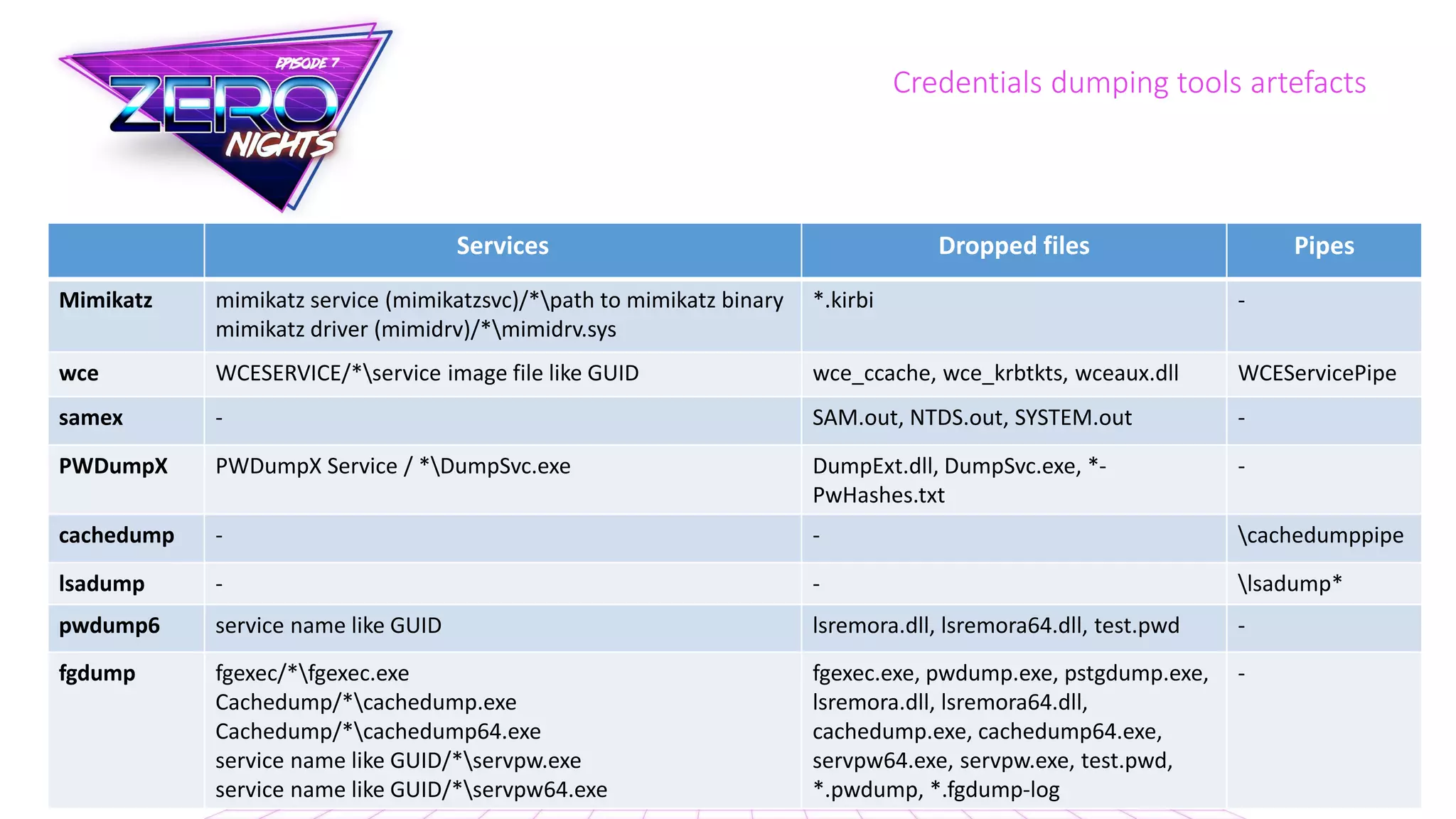
Credentials dumping tools artefacts
Services Dropped files Pipes
Mimikatz mimikatz service (mimikatzsvc)/*path to mimikatz binary
mimikatz driver (mimidrv)/*mimidrv.sys
*.kirbi -
wce WCESERVICE/*service image file like GUID wce_ccache, wce_krbtkts, wceaux.dll WCEServicePipe
samex - SAM.out, NTDS.out, SYSTEM.out -
PWDumpX PWDumpX Service / *DumpSvc.exe DumpExt.dll, DumpSvc.exe, *-
PwHashes.txt
-
cachedump - - cachedumppipe
lsadump - - lsadump*
pwdump6 service name like GUID lsremora.dll, lsremora64.dll, test.pwd -
fgdump fgexec/*fgexec.exe
Cachedump/*cachedump.exe
Cachedump/*cachedump64.exe
service name like GUID/*servpw.exe
service name like GUID/*servpw64.exe
fgexec.exe, pwdump.exe, pstgdump.exe,
lsremora.dll, lsremora64.dll,
cachedump.exe, cachedump64.exe,
servpw64.exe, servpw.exe, test.pwd,
*.pwdump, *.fgdump-log
-
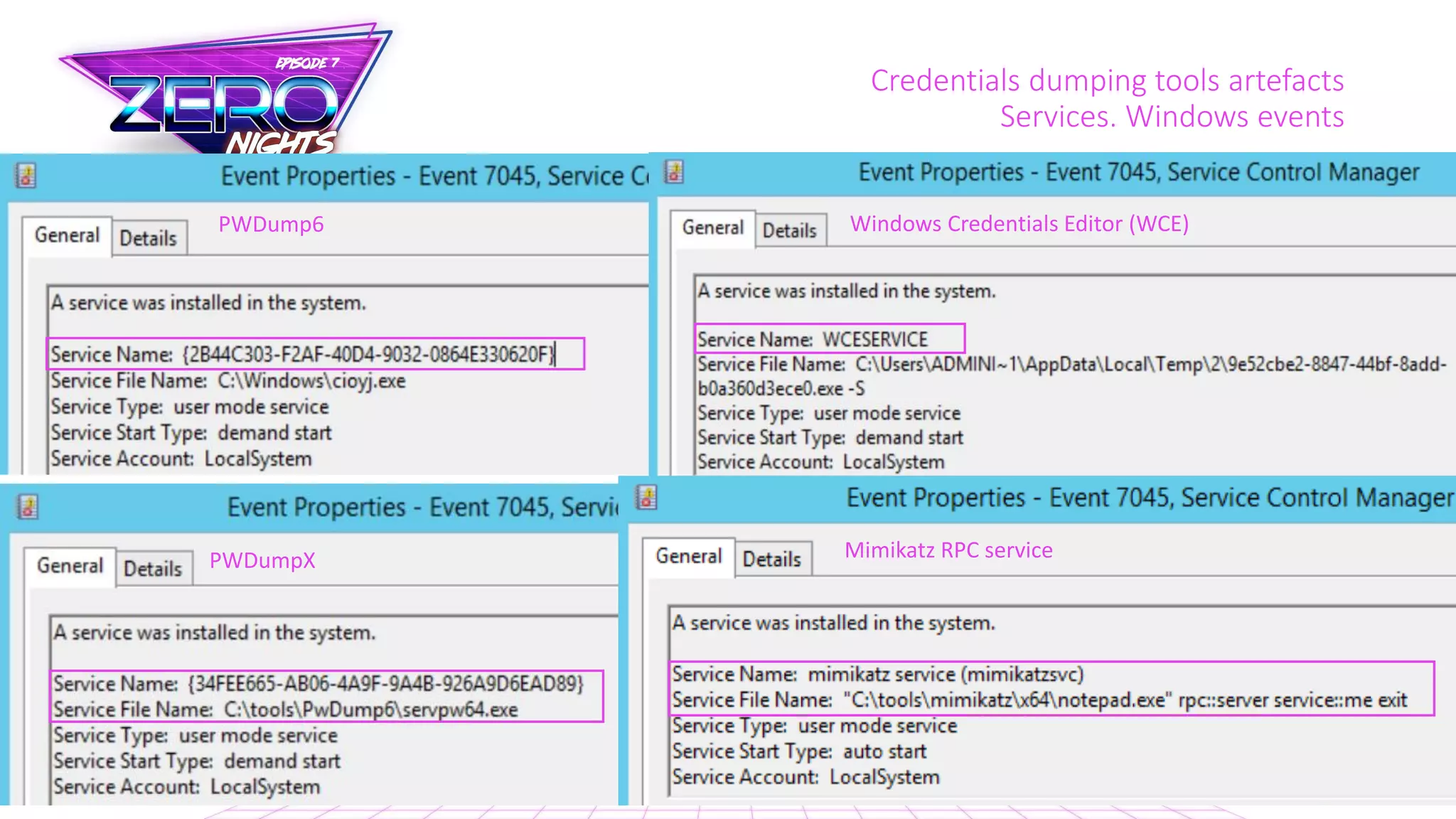
Credentials dumping tools artefacts
Services. Windows events
PWDumpX
PWDump6 Windows Credentials Editor (WCE)
Mimikatz RPC service
Credentials dumping tools artefacts
Services. Lets hunt it!
event_id:7045 AND (event_data.ServiceName:(fgexec cachedump *mimikatz*
*mimidrv* WCESERVICE *pwdump*) OR event_data.ImagePath:(*fgexec* *dumpsvc*
*mimidrv* *cachedump* *servpw* *gsecdump* *pwdump*) OR
event_data.ImagePath.raw:/(.*.*|.*[{]?[0-9A-Fa-f]{8}-[0-9A-Fa-f]{4}-[0-9A-Fa-
f]{4}-[0-9A-Fa-f]{4}-[0-9A-Fa-f]{12}[}]?.(exe|scr|cpl|bat|js|cmd|vbs).*)/)
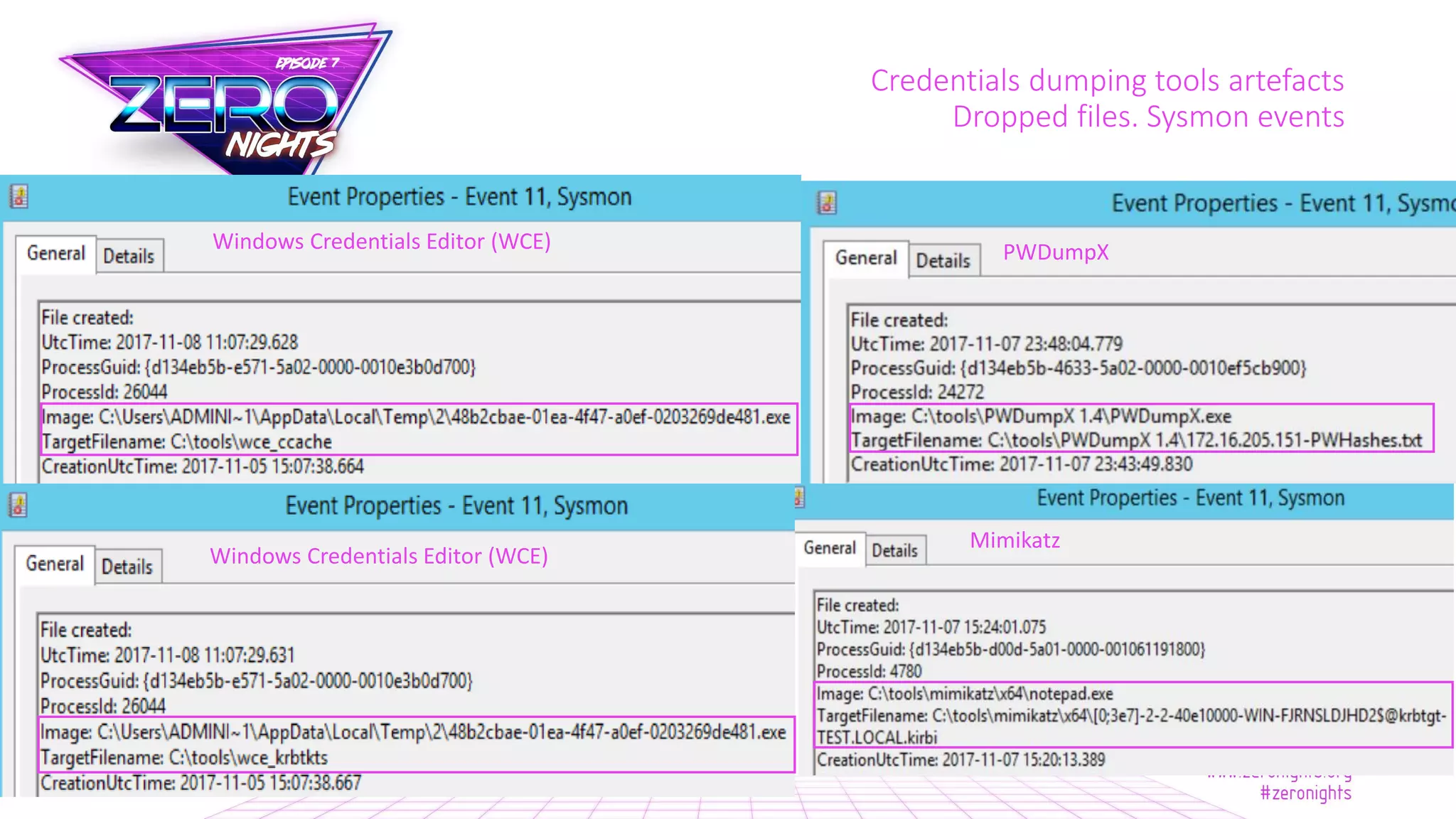
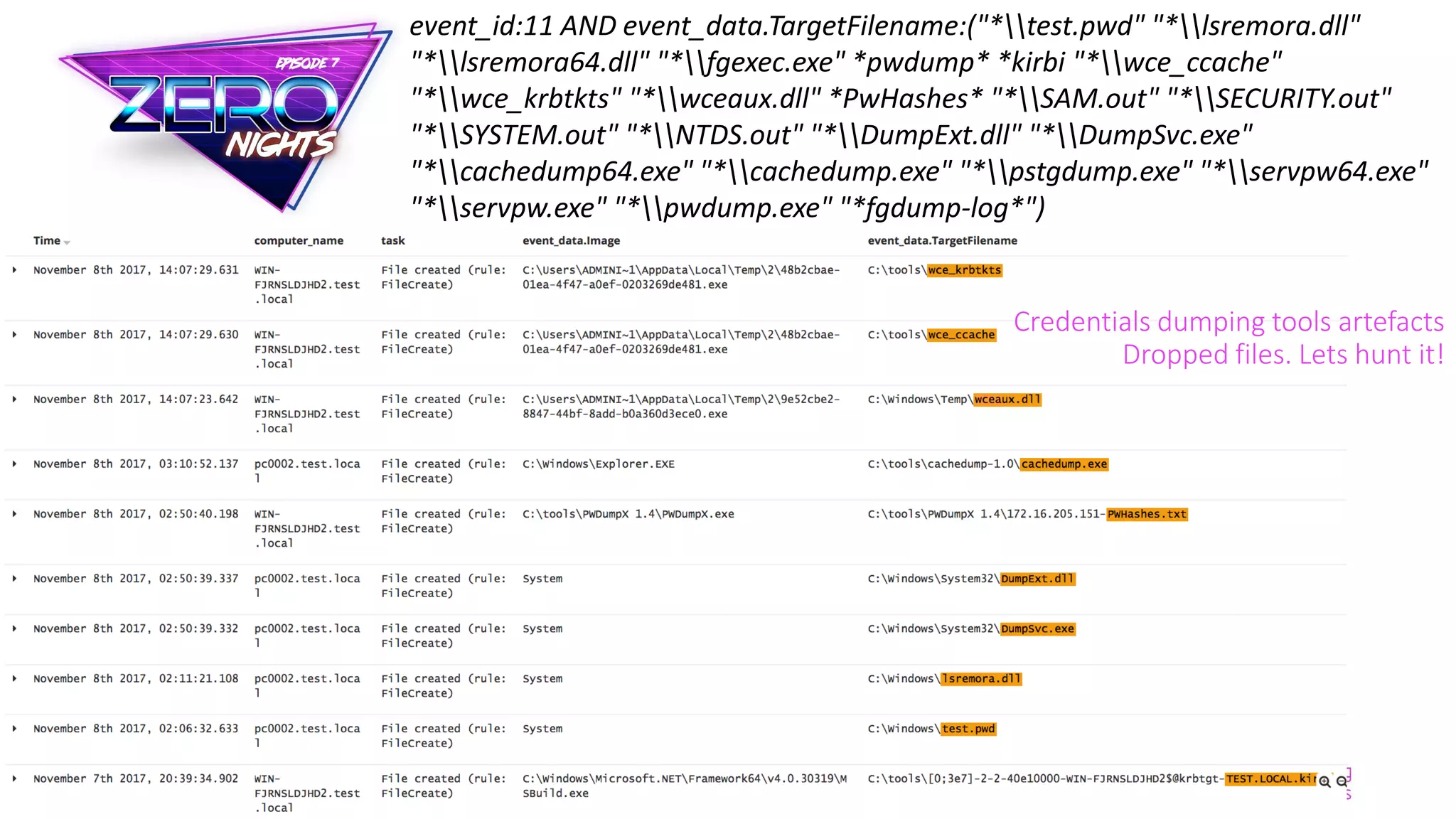
Credentials dumping tools artefacts
Dropped files. Sysmon events
Mimikatz
Windows Credentials Editor (WCE)
Windows Credentials Editor (WCE) PWDumpX
event_id:11 AND event_data.TargetFilename:("*test.pwd" "*lsremora.dll"
"*lsremora64.dll" "*fgexec.exe" *pwdump* *kirbi "*wce_ccache"
"*wce_krbtkts" "*wceaux.dll" *PwHashes* "*SAM.out" "*SECURITY.out"
"*SYSTEM.out" "*NTDS.out" "*DumpExt.dll" "*DumpSvc.exe"
"*cachedump64.exe" "*cachedump.exe" "*pstgdump.exe" "*servpw64.exe"
"*servpw.exe" "*pwdump.exe" "*fgdump-log*")
Credentials dumping tools artefacts
Dropped files. Lets hunt it!
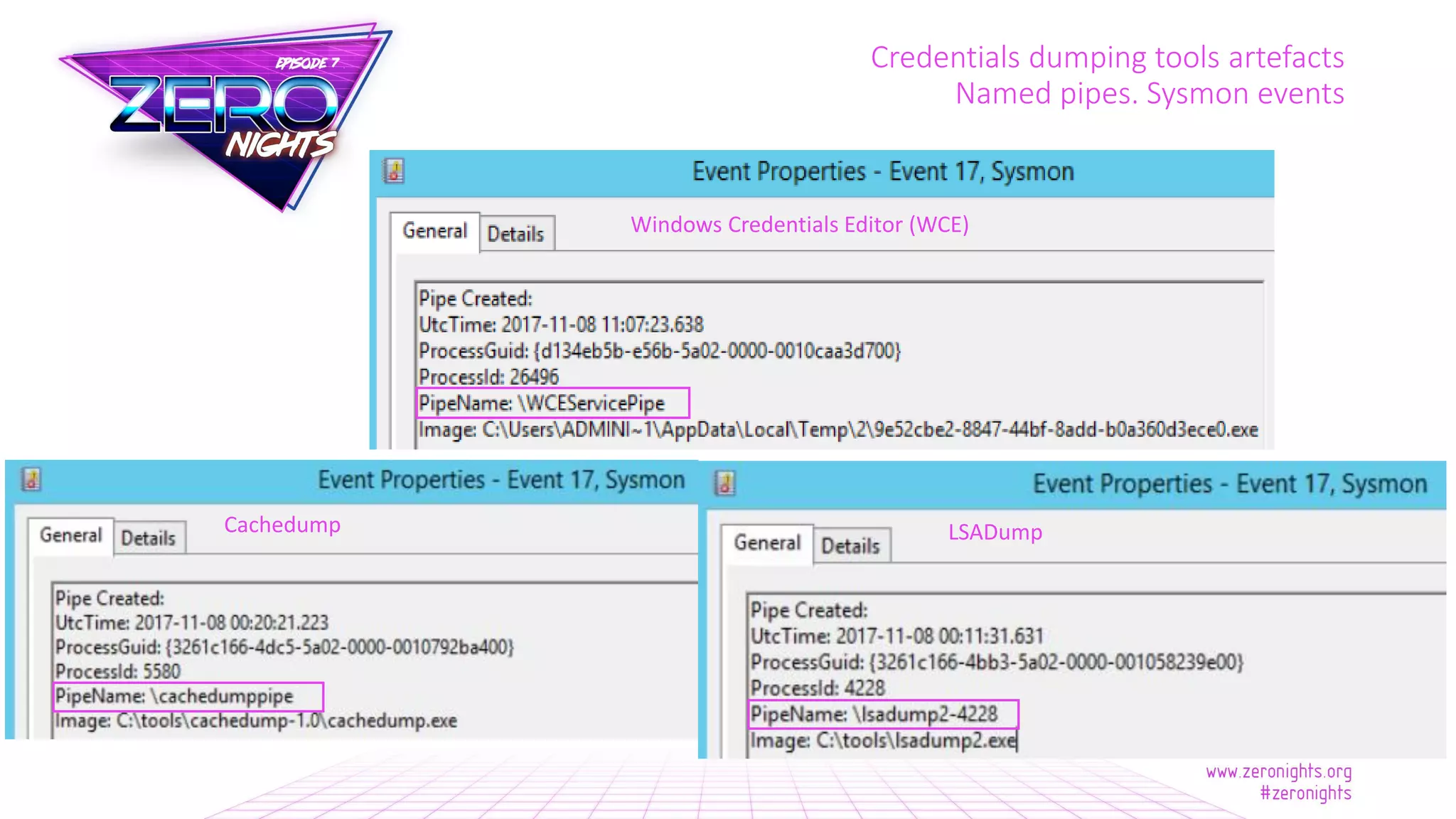
Credentials dumping tools artefacts
Named pipes. Sysmon events
Windows Credentials Editor (WCE)
Cachedump LSADump
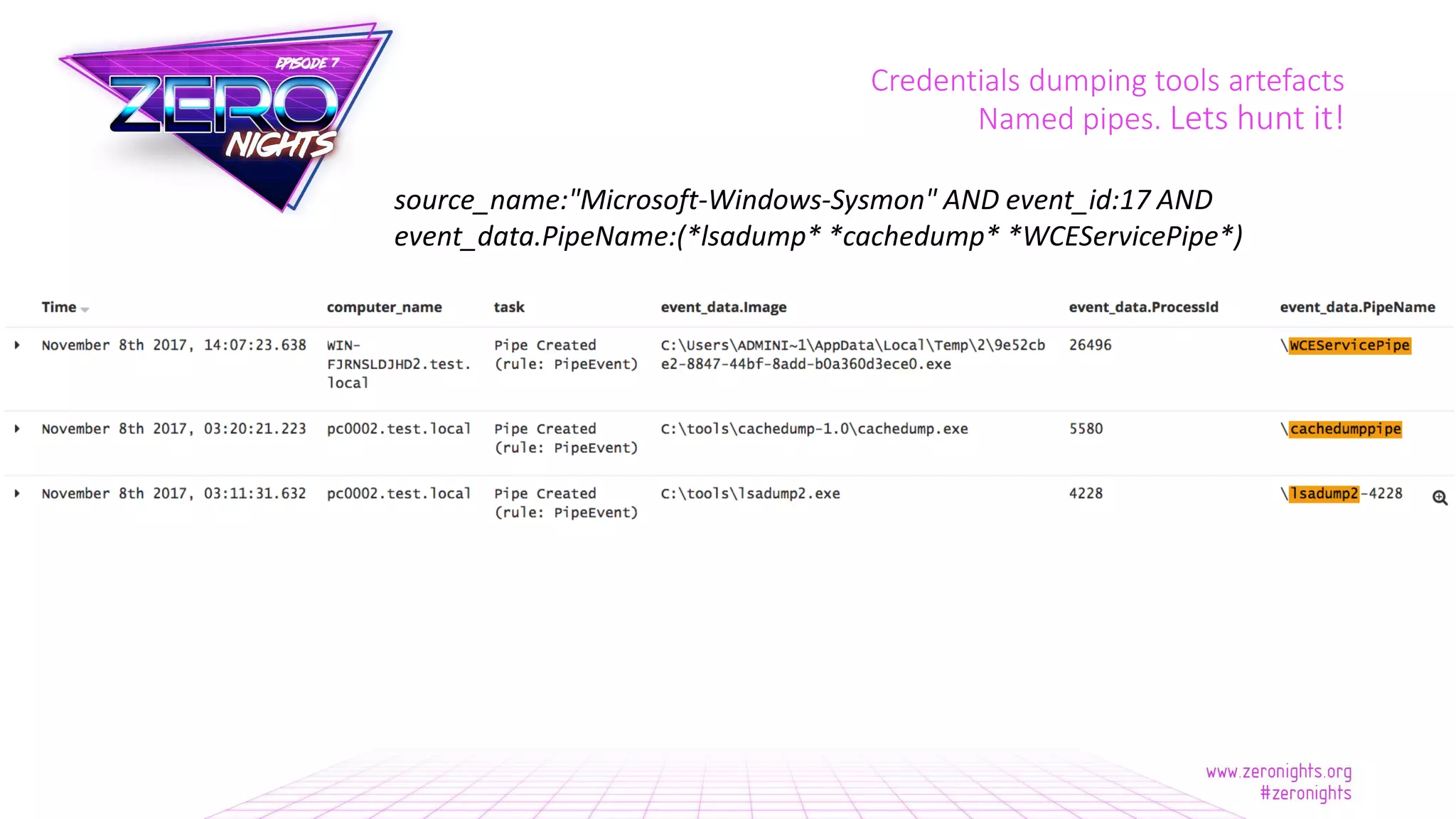
Credentials dumping tools artefacts
Named pipes. Lets hunt it!
source_name:"Microsoft-Windows-Sysmon" AND event_id:17 AND
event_data.PipeName:(*lsadump* *cachedump* *WCEServicePipe*)
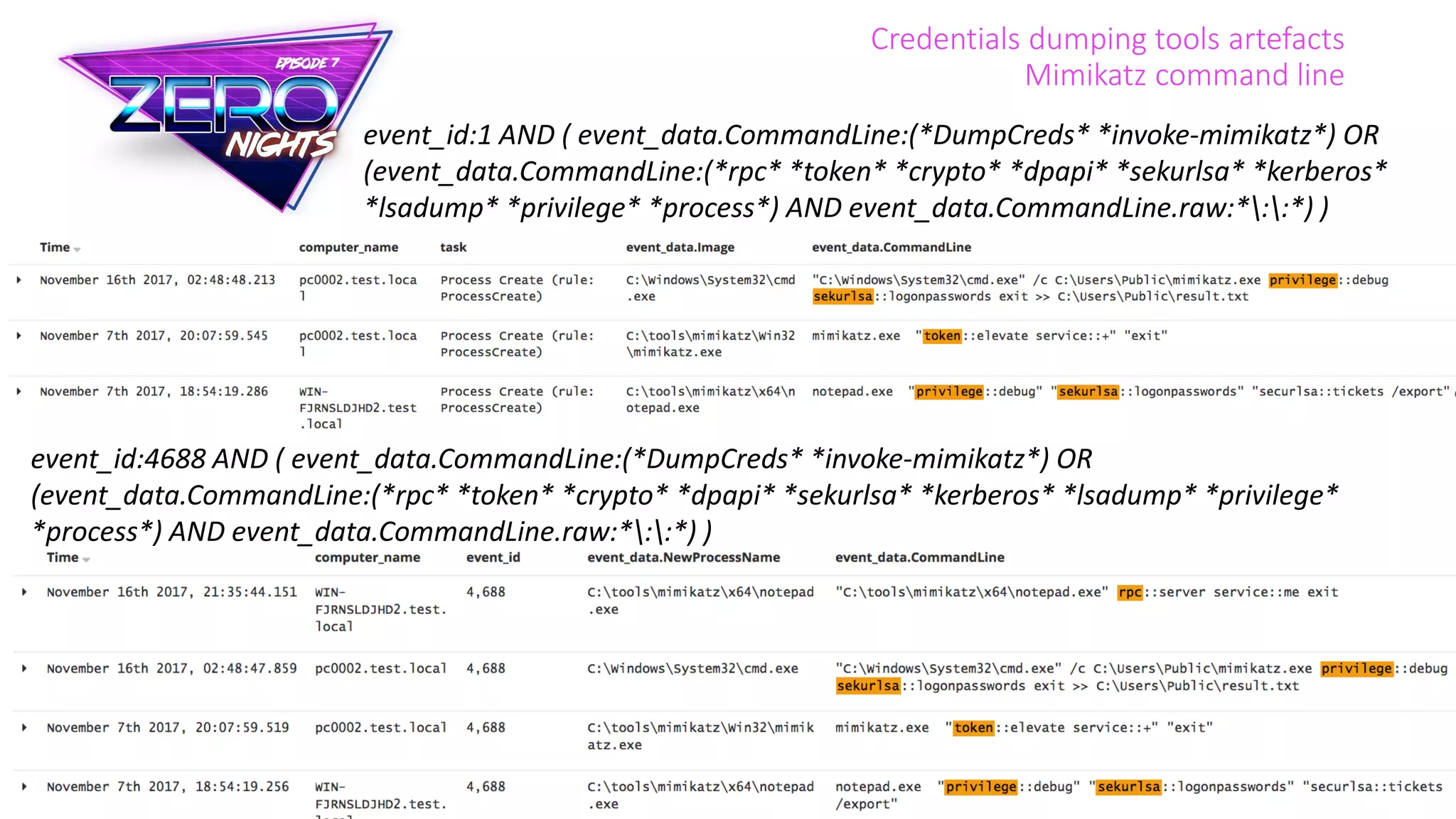
Credentials dumping tools artefacts
Mimikatz command line
event_id:1 AND ( event_data.CommandLine:(*DumpCreds* *invoke-mimikatz*) OR
(event_data.CommandLine:(*rpc* *token* *crypto* *dpapi* *sekurlsa* *kerberos*
*lsadump* *privilege* *process*) AND event_data.CommandLine.raw:*::*) )
event_id:4688 AND ( event_data.CommandLine:(*DumpCreds* *invoke-mimikatz*) OR
(event_data.CommandLine:(*rpc* *token* *crypto* *dpapi* *sekurlsa* *kerberos* *lsadump* *privilege*
*process*) AND event_data.CommandLine.raw:*::*) )
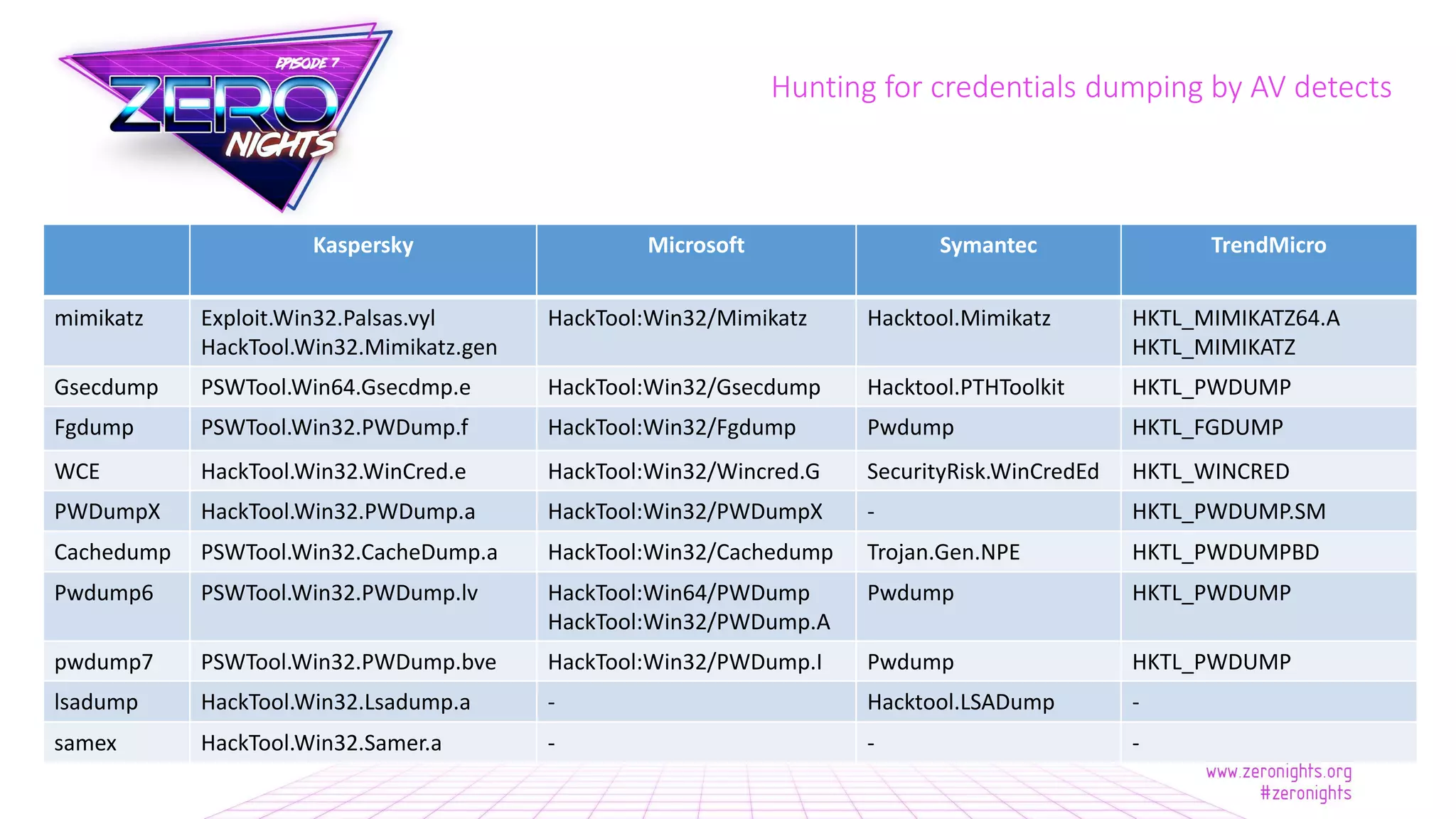
Hunting for credentials dumping by AV detects
Kaspersky Microsoft Symantec TrendMicro
mimikatz Exploit.Win32.Palsas.vyl
HackTool.Win32.Mimikatz.gen
HackTool:Win32/Mimikatz Hacktool.Mimikatz HKTL_MIMIKATZ64.A
HKTL_MIMIKATZ
Gsecdump PSWTool.Win64.Gsecdmp.e HackTool:Win32/Gsecdump Hacktool.PTHToolkit HKTL_PWDUMP
Fgdump PSWTool.Win32.PWDump.f HackTool:Win32/Fgdump Pwdump HKTL_FGDUMP
WCE HackTool.Win32.WinCred.e HackTool:Win32/Wincred.G SecurityRisk.WinCredEd HKTL_WINCRED
PWDumpX HackTool.Win32.PWDump.a HackTool:Win32/PWDumpX - HKTL_PWDUMP.SM
Cachedump PSWTool.Win32.CacheDump.a HackTool:Win32/Cachedump Trojan.Gen.NPE HKTL_PWDUMPBD
Pwdump6 PSWTool.Win32.PWDump.lv HackTool:Win64/PWDump
HackTool:Win32/PWDump.A
Pwdump HKTL_PWDUMP
pwdump7 PSWTool.Win32.PWDump.bve HackTool:Win32/PWDump.I Pwdump HKTL_PWDUMP
lsadump HackTool.Win32.Lsadump.a - Hacktool.LSADump -
samex HackTool.Win32.Samer.a - - -
The End

Hunting for Credentials Dumping in Windows Environment

  • 1.
    Hunting for Credentials Dumpingin Windows Environment Teymur Kheirhabarov
  • 2.
    Who am I? •Senior SOC Analyst @Kaspersky Lab • SibSAU (Krasnoyarsk) graduate • Ex- System admin • Ex- Infosec admin • Ex- Infosec dept. head • Twitter @HeirhabarovT • www.linkedin.com/in/teymur-kheirkhabarov-73490867/
  • 3.
    What are wegoing to talks about? Credential dumping is the process of obtaining account login and password information from the operating system and software. We will look at different methods of dumping credentials in Windows environment and how to detect them via logs (native Windows, Sysmon)
  • 4.
    Why is itso important? • APT1 has been known to use credential dumping • APT28 regularly deploys both publicly available and custom password retrieval tools on victims • APT3 has used a tool to dump credentials by injecting itself into lsass.exe • Axiom has been known to dump credentials • Cleaver has been known to dump credentials • FIN6 has used Windows Credential Editor for credential dumping, as well as Metasploit’s PsExec NTDSGRAB module to obtain a copy of the victim's Active Directory database • Even ransomware use credential dumping
  • 5.
    How will adversariesuse dumped credentials? Dumped credentials can be used to perform Lateral Movement and access restricted information https://www.phdays.ru/program/231388/
  • 6.
    LSASS memory: clear-textpasswords of logged on users, Kerberos tickets, Kerberos encryption keys, SmartCard/Token PIN codes, LM/NTLM hashes, DPAPI Domain Backup Key, Domain Trust Auth Information, cached DPAPI MasterKeys, cached SysKey (need to decrypt SAM/LSA Secrets/Cached credentials/NTDS.dit), clear-text passwords of accounts, stored in Credential Manager; SAM registry hive/file: LM/NTLM hashes of local users; SECURITY registry hive/file: cached credentials, LSA Secrets (account passwords for services, password used to logon to Windows if auto-logon is enabled); NTDS.dit file: hashes of domain accounts, Domain Backup Key; SYSTEM registry hive/file: SysKey, that need to decrypt SAM/LSA Secrets/Cached credentials/NTDS.dit. What can be dumped and where from?
  • 7.
    LSASS memory containa lot of sensitive data that can be dumped! This data protected by LsaProtectMemory and can be unprotected by LsaUnprotectMemory (used symmetric encryption, keys can be found in LSASS memory). There several ways: • online from ring3 – OpenProcess…; • online from ring0 – use driver for accessing LSASS memory; • offline from LSASS memory dumps; • offline from other sources, that contain LSASS memory (virtual machine memory files, crashdumps, hibernation file). Dumping from LSASS memory Tools: Mimikatz, Invoke-Mimikatz, Windows Credential Editor (WCE), fgdump, pwdump6, pwdumpX, taskmgr/procdump/sqldumper, WinDbg mimikatz plugin, Volatility mimikatz plugin
  • 8.
    Dumping from LSASSmemory What data can be extracted from LSASS memory in different Windows? https://adsecurity.org/wp-content/uploads/2014/11/Delpy-CredentialDataChart-1024x441.png
  • 9.
    Dumping from LSASSmemory LSASS memory access. Sysmon events
  • 10.
    Dumping from LSASSmemory LSASS memory access. Lets hunt it! source_name:"Microsoft-Windows-Sysmon" AND event_id:10 AND event_data.TargetImage:"*lsass.exe" AND -event_data.GrantedAccess:(0x40 0x1400 0x1000 0x100000) AND -event_data.SourceImage:("*taskmgr.exe" "*procexp64.exe" "*procexp.exe" "*lsm.exe" "*csrss.exe" "*wininit.exe" "wmiprvse.exe")
  • 11.
    Dumping from LSASSmemory LSASS memory access. Native Windows events. Is it possible? In Windows 10, versions 1507 a default process SACL was added to LSASS.exe to log processes attempting to access LSASS.exe. The SACL is L"S:(AU;SAFA;0x0010;;;WD)". You can enable this under Advanced Audit Policy ConfigurationObject AccessAudit Kernel Object. This can help identify attacks that steal credentials from the memory of a process https://docs.microsoft.com/en-us/windows/whats-new/whats-new-windows-10-version-1507- and-1511
  • 12.
    Dumping from LSASSmemory LSASS memory access. Native Windows events. And what about <Windows 10? It is also possible to change LSASS.exe SACL in earlier Windows versions (<10). To automate this process you can write script and configure it to run on system startup
  • 13.
    Dumping from LSASSmemory LSASS memory access. Native Windows events
  • 14.
    Dumping from LSASSmemory LSASS memory access. Lets hunt it, using Windows events! event_id:4656 AND event_data.ObjectName:"*lsass.exe" AND -event_data.AccessMask:(0x1400 0x40 0x1000 0x100000) AND -event_data.ProcessName:("*taskmgr.exe" "*procexp64.exe" "*procexp.exe" "*lsm.exe" "*csrss.exe" "*wininit.exe" "wmiprvse.exe" "*vmtoolsd.exe")
  • 15.
    Dumping from LSASSmemory LSASS memory access. Native Windows events. Some bad news https://tyranidslair.blogspot.ru/2017/10/bypassing- sacl-auditing-on-lsass.html
  • 16.
    Dumping from LSASSmemory CreateRemoteThread into LSASS. Sysmon eventsMimikatz (lsadump::lsa /inject) lsadump PWDump6 Windows Credential Editor (WCE)
  • 17.
    Dumping from LSASSmemory CreateRemoteThread into LSASS. Lets hunt it! source_name:"Microsoft-Windows-Sysmon" AND event_id:8 AND event_data.TargetImage:"*lsass.exe"
  • 18.
    Dumping from LSASSmemory Unsigned image loading into LSASS. Sysmon eventsPWDump6 (x86) PWDump6 (x64) PWDumpX Windows Credential Editor (WCE)
  • 19.
    Dumping from LSASSmemory Unsigned image loading into LSASS. Lets hunt it! source_name:"Microsoft-Windows-Sysmon" AND event_id:7 AND event_data.Image:"*lsass.exe" AND event_data.Signed:false
  • 20.
    Dumping from LSASSmemory And what about LSA protection? Windows Server 2012 R2 and Windows 8.1 includes a new feature called LSA Protection. It prevents non-protected processes from interacting with LSASS. To allow it, set the value of the registry key RunAsPPL in HKEY_LOCAL_MACHINESYSTEMCurrentControlSetControl Lsa to dword:00000001 But… Mimikatz can bypass it, using its own driver. Even more… It can unprotect any protected processes 
  • 21.
    Dumping from LSASSmemory Installation of Mimikatz driver
  • 22.
    Dumping from LSASSmemory Installation of Mimikatz driver. Lets hunt it! event_id:7045 AND (event_data.ServiceName:*mimidrv* OR event_data.ImagePath:*mimidrv*) event_id:6 AND source_name:"Microsoft-Windows-Sysmon" AND (event_data.ImageLoaded:*mimidrv* OR event_data.Signed:false)
  • 23.
    Dumping from LSASSmemory Offline credentials dumping. LSASS memory dump SqlDumper Procdump Extract credentials from lsass memory dump
  • 24.
    Dumping from LSASSmemory Access LSASS memory for dump creation. Sysmon events
  • 25.
    Dumping from LSASSmemory Access LSASS memory for dump creation. Lets hunt it source_name:"Microsoft-Windows-Sysmon" AND event_id:10 AND event_data.TargetImage:"*lsass.exe" AND event_data.CallTrace:*dbghelp*
  • 26.
    Dumping from LSASSmemory LSASS memory dump file creation. Sysmon events Procdump create lsass memory dump file Taskmgr create lsass memory dump file Powershell create lsass memory dump file SqlDumper create lsass memory dump file
  • 27.
    Dumping from LSASSmemory LSASS memory dump file creation. Lets hunt it source_name:"Microsoft-Windows-Sysmon" AND event_id:11 AND event_data.TargetFilename:*lsass* AND event_data.TargetFilename:*dmp
  • 28.
    Dumping from LSASSmemory Offline credentials dumping. Other sources of LSASS memory It is also possible to extract credentials from other sources, containing lsass memory: • Virtual machines memory files (.vmem…); • Hibernation files (hiberfil.sys) ; • Crashdumps (.dmp, C:WindowsMinidump). Tools: Mimkatz WinDbg extension, Volatility Mimikatz plugin
  • 29.
    Dumping from LSASSmemory Offline credentials dumping. Other sources of LSASS memory
  • 30.
    Dumping from LSASSmemory Offline credentials dumping. Other sources of LSASS memory. Copying hiberfil/crashdumps via admin shares event_id:5145 AND event_data.RelativeTargetName:(*lsass* "*windowsminidump*" *hiberfil* *sqldmpr* "*sam*" "*ntds.dit" "*security*")
  • 31.
    Dumping from SAM/SYSTEM/SECURITY/NTDS.dit Offline– grab SAM/SYSTEM/SECURITY/NTDS.dit from compromised host and process it using special tools. Online – run special tool directly on compromised host (this tool will do all necessary work itself)
  • 32.
    Windows allows programsto have direct access to logical volumes. Programs with direct access may read and write files directly from the drive by analyzing file system data structures. This technique bypasses Windows file access controls as well as file system monitoring tools. Tools: Pwdump7, Invoke-NinjaCopy, Samex Dumping from SAM/SYSTEM/SECURITY/NTDS.dit Grabbing via direct access to logical volume
  • 33.
    Dumping from SAM/SYSTEM/SECURITY/NTDS.dit Grabbingvia direct access to logical volume. Sysmon events. Invoke-NinjaCopy (local) PwDump7 Samex Invoke-NinjaCopy (remote)
  • 34.
    Dumping from SAM/SYSTEM/SECURITY/NTDS.dit Grabbingvia direct access to logical volume. Lets hunt it! source_name:"Microsoft-Windows-Sysmon" AND -event_data.Device:*Floppy* AND event_id:9 -event_data.Image:("*WmiPrvSE.exe" "*sdiagnhost.exe" "*SearchIndexer.exe" "*csrss.exe" "*Defrag.exe" "*smss.exe" "System" "*VSSVC.exe" "*CompatTelRunner.exe" "*wininit.exe" "*autochk.exe" "*taskhost.exe" "*dfsrs.exe" "*vds.exe" "*lsass.exe")
  • 35.
    Dumping from SAM/SYSTEM/SECURITY/NTDS.dit Grabbingvia shadow copies. VSSAdmin Shadow Copy (also known as Volume Snapshot Service, Volume Shadow Copy Service or VSS) is a technology included in Microsoft Windows that allows taking manual or automatic backup copies or snapshots of computer files or volumes, even when they are in use. So, it can be used to grab SAM/SECURITY/NTDS.dit files.
  • 36.
    Dumping from SAM/SYSTEM/SECURITY/NTDS.dit Grabbingvia shadow copies. VSSAdmin. Lets hunt it! source_name:"Microsoft-Windows-Sysmon" AND event_id:1 AND *vssadmin* AND event_data.Image:"*vssadmin.exe" AND event_data.CommandLine:*shadow* AND event_data.CommandLine:(*list* *create* *delete*) event_id:466 AND *vssadmin* AND event_data.NewProcessName:"*vssadmin.exe" AND event_data.CommandLine:*shadow* AND event_data.CommandLine:(*list* *create* *delete*)
  • 37.
    Dumping from SAM/SYSTEM/SECURITY/NTDS.dit Grabbingvia shadow copies. ntdsutil Ntdsutil.exe is a command- line tool that provides management facilities for Active Directory Domain Services (AD DS) and Active Directory Lightweight Directory Services (AD LDS). It can be used to create backup of NTDS database, using shadow copies mechanism.
  • 38.
    Dumping from SAM/SYSTEM/SECURITY/NTDS.dit Grabbingvia shadow copies. ntdsutil. Lets hunt it! source_name:"Microsoft-Windows-Sysmon" AND event_id:1 AND event_data.Image:"*ntdsutil.exe" AND event_data.CommandLine:*ntds* AND event_data.CommandLine:*create* AND event_data.CommandLine:*full* event_id:4688 AND event_data.NewProcessName:"*ntdsutil.exe" AND event_data.CommandLine:*ntds* AND event_data.CommandLine:*create* AND event_data.CommandLine:*full*
  • 39.
    Dumping from SAM/SYSTEM/SECURITY/NTDS.dit Grabbingvia shadow copies. WMI. Lets hunt it! WMI can also be used for shadow copies creation. This operation can be done using wmic, powershell or programmatically via COM
  • 40.
    Dumping from SAM/SYSTEM/SECURITY/NTDS.dit Grabbingvia shadow copies. WMI. Lets hunt it! source_name:"Microsoft-Windows-Sysmon" AND event_id:1 AND event_data.Image:("*powershell.exe" "*wmic.exe") AND event_data.CommandLine:(*shadowcopy*) AND event_data.CommandLine:(*create*) event_id:4688 AND event_data.NewProcessName:("*powershell.exe" "*wmic.exe") AND event_data.CommandLine:(*shadowcopy*) AND event_data.CommandLine:(*create*)
  • 41.
    Dumping from SAM/SYSTEM/SECURITY/NTDS.dit Shadowcopies. Copying SAM/SECURITY/NTDS.dit files. Lets hunt it! source_name:"Microsoft-Windows-Sysmon" AND event_id:1 AND event_data.CommandLine:( "*windowsntdsntds.dit" "*system32configsam" "*system32configsecurity" "*system32configsystem") event_id:4688 AND event_data.CommandLine:("*windowsntdsntds.dit" "*system32configsam" "*system32configsecurity" "*system32configsystem")
  • 42.
    Dumping from SAM/SYSTEM/SECURITY/NTDS.dit Shadowcopies. Create symlink to shadow copies storage. Lets hunt it! source_name:"Microsoft-Windows-Sysmon“ AND event_id:1 AND event_data.CommandLine:*mklink* AND event_data.CommandLine:*HarddiskVolumeShadowCopy* event_id:4688 AND event_data.CommandLine:*mklink* AND event_data.CommandLine:*HarddiskVolumeShadowCopy*
  • 43.
    Dumping from SAM/SYSTEM/SECURITY Grabbingvia registry. Using reg tool
  • 44.
    Dumping from SAM/SYSTEM/SECURITY Grabbingvia registry. Using reg tool. Lets hunt it! event_id:1 AND event_data.CommandLine:*reg* AND event_data.CommandLine:*save* AND event_data.CommandLine:("hklmsam" "hklmsystem" "hklmsecurity" "hkey_local_machinesam" "hkey_local_machinesystem" "hkey_local_machinesecurity")
  • 45.
    Dumping from SAM/SYSTEM/SECURITY Grabbingvia remote registry. Lets hunt it! event_id:5145 AND event_data.RelativeTargetName:winreg AND - event_data.IpAddress:(192.168.7.9 192.168.7.19)  IP addresses of admin workstations Account and IP used to access Remote Registry Remote registry service pipe
  • 46.
    Dumping from NTDS.ditremotely DCSync DCSync is a variation on credential dumping which can be used to acquire sensitive information from a domain controller. The action works by simulating a domain controller replication process from a remote domain controller. Any member of Administrators, Domain Admins, or Enterprise Admins as well as Domain Controller computer accounts are able to run DCSync to pull to pull credential data. Tools: Mimikatz, secretsdump.py from Impacket How it works: • discovers Domain Controller in the specified domain name. • requests the Domain Controller replicate the user; credentials via GetNCChanges (leveraging Directory Replication Service (DRS) Remote Protocol).
  • 47.
    Dumping from NTDS.ditremotely DCSync. Windows events DS-Replication-Get-ChangesDS-Replication-Get-Changes-All
  • 48.
    Dumping from NTDS.ditremotely DCSync using Domain Controller account DC account
  • 49.
    Dumping from NTDS.ditremotely DCSync. Lets hunt it! event_id:4624 AND event_data.TargetLogonId:(0x7483c4 0x6b0b8f) AND - event_data.IpAddress:(“172.16.205.140““172.16.205.141“)  Our DCs event_id:4662 AND event_data.Properties:("{1131f6aa-9c07-11d1-f79f-00c04fc2dcd2}" "{1131f6ad-9c07-11d1-f79f-00c04fc2dcd2}") AND computer_name:("WIN- FJRNSLDJHD2.test.local" "dc2.test.local") DCs
  • 50.
    Dumping from NTDS.ditremotely NetSync Based on [MS-NRPC] - Netlogon Remote Protocol Tools: Mimikatz
  • 51.
    Dumping from NTDS.ditremotely NetSync. Windows events
  • 52.
    Credentials dumping toolsartefacts Services Dropped files Pipes Mimikatz mimikatz service (mimikatzsvc)/*path to mimikatz binary mimikatz driver (mimidrv)/*mimidrv.sys *.kirbi - wce WCESERVICE/*service image file like GUID wce_ccache, wce_krbtkts, wceaux.dll WCEServicePipe samex - SAM.out, NTDS.out, SYSTEM.out - PWDumpX PWDumpX Service / *DumpSvc.exe DumpExt.dll, DumpSvc.exe, *- PwHashes.txt - cachedump - - cachedumppipe lsadump - - lsadump* pwdump6 service name like GUID lsremora.dll, lsremora64.dll, test.pwd - fgdump fgexec/*fgexec.exe Cachedump/*cachedump.exe Cachedump/*cachedump64.exe service name like GUID/*servpw.exe service name like GUID/*servpw64.exe fgexec.exe, pwdump.exe, pstgdump.exe, lsremora.dll, lsremora64.dll, cachedump.exe, cachedump64.exe, servpw64.exe, servpw.exe, test.pwd, *.pwdump, *.fgdump-log -
  • 53.
    Credentials dumping toolsartefacts Services. Windows events PWDumpX PWDump6 Windows Credentials Editor (WCE) Mimikatz RPC service
  • 54.
    Credentials dumping toolsartefacts Services. Lets hunt it! event_id:7045 AND (event_data.ServiceName:(fgexec cachedump *mimikatz* *mimidrv* WCESERVICE *pwdump*) OR event_data.ImagePath:(*fgexec* *dumpsvc* *mimidrv* *cachedump* *servpw* *gsecdump* *pwdump*) OR event_data.ImagePath.raw:/(.*.*|.*[{]?[0-9A-Fa-f]{8}-[0-9A-Fa-f]{4}-[0-9A-Fa- f]{4}-[0-9A-Fa-f]{4}-[0-9A-Fa-f]{12}[}]?.(exe|scr|cpl|bat|js|cmd|vbs).*)/)
  • 55.
    Credentials dumping toolsartefacts Dropped files. Sysmon events Mimikatz Windows Credentials Editor (WCE) Windows Credentials Editor (WCE) PWDumpX
  • 56.
    event_id:11 AND event_data.TargetFilename:("*test.pwd""*lsremora.dll" "*lsremora64.dll" "*fgexec.exe" *pwdump* *kirbi "*wce_ccache" "*wce_krbtkts" "*wceaux.dll" *PwHashes* "*SAM.out" "*SECURITY.out" "*SYSTEM.out" "*NTDS.out" "*DumpExt.dll" "*DumpSvc.exe" "*cachedump64.exe" "*cachedump.exe" "*pstgdump.exe" "*servpw64.exe" "*servpw.exe" "*pwdump.exe" "*fgdump-log*") Credentials dumping tools artefacts Dropped files. Lets hunt it!
  • 57.
    Credentials dumping toolsartefacts Named pipes. Sysmon events Windows Credentials Editor (WCE) Cachedump LSADump
  • 58.
    Credentials dumping toolsartefacts Named pipes. Lets hunt it! source_name:"Microsoft-Windows-Sysmon" AND event_id:17 AND event_data.PipeName:(*lsadump* *cachedump* *WCEServicePipe*)
  • 59.
    Credentials dumping toolsartefacts Mimikatz command line event_id:1 AND ( event_data.CommandLine:(*DumpCreds* *invoke-mimikatz*) OR (event_data.CommandLine:(*rpc* *token* *crypto* *dpapi* *sekurlsa* *kerberos* *lsadump* *privilege* *process*) AND event_data.CommandLine.raw:*::*) ) event_id:4688 AND ( event_data.CommandLine:(*DumpCreds* *invoke-mimikatz*) OR (event_data.CommandLine:(*rpc* *token* *crypto* *dpapi* *sekurlsa* *kerberos* *lsadump* *privilege* *process*) AND event_data.CommandLine.raw:*::*) )
  • 60.
    Hunting for credentialsdumping by AV detects Kaspersky Microsoft Symantec TrendMicro mimikatz Exploit.Win32.Palsas.vyl HackTool.Win32.Mimikatz.gen HackTool:Win32/Mimikatz Hacktool.Mimikatz HKTL_MIMIKATZ64.A HKTL_MIMIKATZ Gsecdump PSWTool.Win64.Gsecdmp.e HackTool:Win32/Gsecdump Hacktool.PTHToolkit HKTL_PWDUMP Fgdump PSWTool.Win32.PWDump.f HackTool:Win32/Fgdump Pwdump HKTL_FGDUMP WCE HackTool.Win32.WinCred.e HackTool:Win32/Wincred.G SecurityRisk.WinCredEd HKTL_WINCRED PWDumpX HackTool.Win32.PWDump.a HackTool:Win32/PWDumpX - HKTL_PWDUMP.SM Cachedump PSWTool.Win32.CacheDump.a HackTool:Win32/Cachedump Trojan.Gen.NPE HKTL_PWDUMPBD Pwdump6 PSWTool.Win32.PWDump.lv HackTool:Win64/PWDump HackTool:Win32/PWDump.A Pwdump HKTL_PWDUMP pwdump7 PSWTool.Win32.PWDump.bve HackTool:Win32/PWDump.I Pwdump HKTL_PWDUMP lsadump HackTool.Win32.Lsadump.a - Hacktool.LSADump - samex HackTool.Win32.Samer.a - - -
  • 61.