1
Business Humor
by Don L. F. Nilsen and
Alleen Pace Nilsen
2
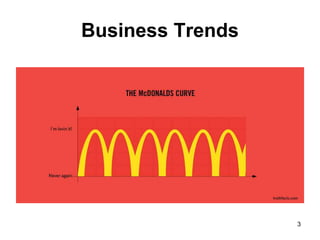
Business Trends
3
4
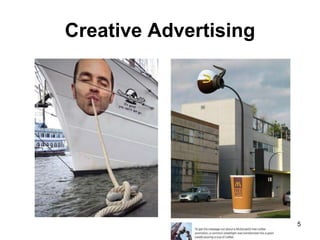
Creative Advertising
5
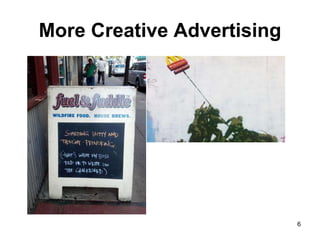
More Creative Advertising
6
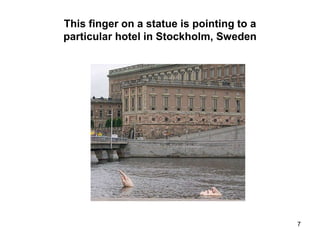
This finger on a statue is pointing to a
particular hotel in Stockholm, Sweden
7
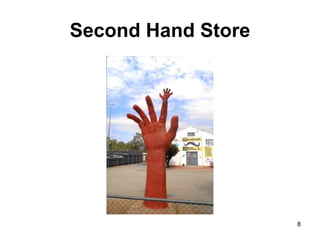
Second Hand Store
8
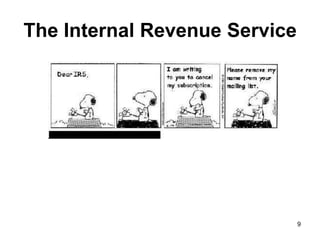
The Internal Revenue Service
9
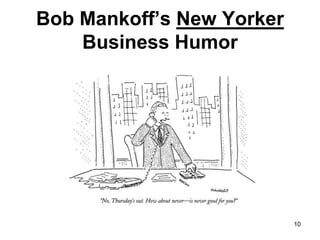
Bob Mankoff’s New Yorker
Business Humor
10
CREATIVE HONDA AD:
https://www.youtube-nocookie.com/embed/Dxy4n0UT82o?rel=0
11
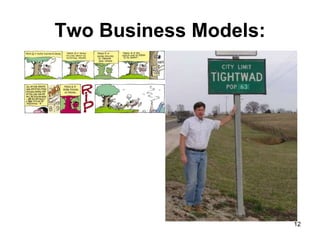
Two Business Models:
12
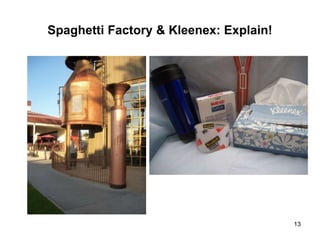
Spaghetti Factory & Kleenex: Explain!
13
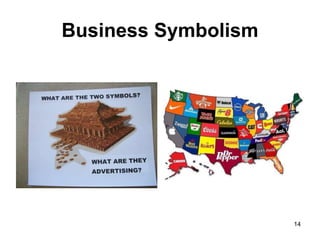
Business Symbolism
14
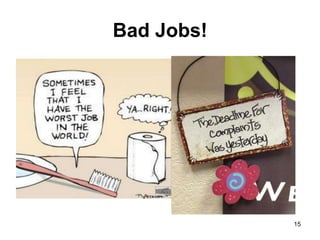
Bad Jobs!
15
BUSINESSES ARE NOW LOOKING FOR
NEW APPROACHES
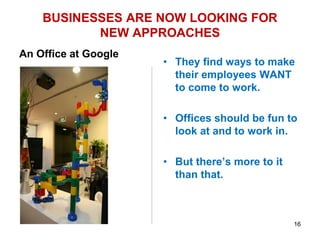
An Office at Google
• Humor consultant John
Morreall advises
businesses on how to
make employees “like”
to come to work.
• It is fine to decorate an
office or pin up
cartoons, but really, it i
much more complex
than that.
• They find ways to make
their employees WANT
to come to work.
• Offices should be fun to
look at and to work in.
• But there’s more to it
than that.
16
17
MOTIVATION: PROFIT VS. PURPOSE; LEVELING THE HIERARCHY
(e.g. Internet, Wikipedia, Skype, Facebook, Google, Southwest…):
http://www.youtube.com/watch?v=u6XAPnuFjJc&feature=relmfu
18
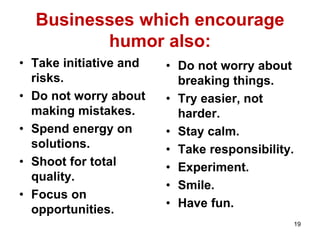
Businesses which encourage
humor also:
• Take initiative and
risks.
• Do not worry about
making mistakes.
• Spend energy on
solutions.
• Shoot for total
quality.
• Focus on
opportunities.
• Do not worry about
breaking things.
• Try easier, not
harder.
• Stay calm.
• Take responsibility.
• Experiment.
• Smile.
• Have fun.
19
20
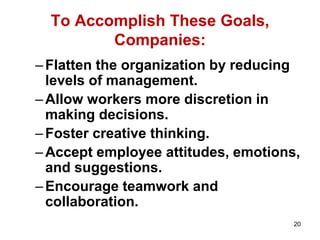
To Accomplish These Goals,
Companies:
–Flatten the organization by reducing
levels of management.
–Allow workers more discretion in
making decisions.
–Foster creative thinking.
–Accept employee attitudes, emotions,
and suggestions.
–Encourage teamwork and
collaboration.
Administrators’ Views of Humor-in-
Business :
• A sense of humor makes businesses more creative,
less rigid, and more willing to consider and embrace
new ideas and methods.
• In a survey of 737 CEO’s, 98% said that humor was
important in the conduct of business.
• They therefore gave preference to people with a
sense of humor.
• Soft skills are better predictors of success in
management than are hard skills.
21
22
More Support for Humor
• The director of human resources at Sun Microsystems watches
for how long it takes an interviewee to laugh or to find
something funny
• She says that humor is very important in their corporate
futures.

• One business created a “Grouch Patrol.” Whenever they see
someone with a sour expression, they respond by making a bat
face.
• This involves pushing the tip of their noses up, flicking their
tongues in and out, and making a high-pitched “Eeeee” sound.
23
24
When Humor “Bubbles-Up” from Employees,
There Will of Course Be Lots of Variety.
• Practical jokes we’ve recently heard:
– Putting foam packing bubbles in the cubicles of colleagues who
are absent.
– A boss going on a three-week trip, and coming back to find real
sod rolled out in his office just to prove that “grass does grow
under your feet.”
– A door-decorating contest on the cruise ship taking 12 of their
outstanding employees to Mexico, in which winners had photos of
their faces superimposed on pictures of jungle animals.
– Their slogan was “Where the Wild Things Are.”
25
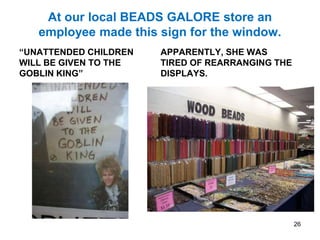
At our local BEADS GALORE store an
employee made this sign for the window.
“UNATTENDED CHILDREN
WILL BE GIVEN TO THE
GOBLIN KING”
APPARENTLY, SHE WAS
TIRED OF REARRANGING THE
DISPLAYS.
26
27
Other Examples of Workplace Humor
• A debt collector sent out a letter reading, “We appreciate
your business, but, please, give us a break. Your
account is overdue 10 months. That means we’ve carried
you longer than your mother did.”
• A business manager, who made a really bad mistake,
wore a T-shirt with a large red bulls-eye on it when he
went to a meeting about the problem.
• A large IBM sales team improved their record 30% when
they formed a pick-up orchestra and recorded their sales
in fun ways, e.g. by blowing a horn, smashing a gong.
More Examples
• Esther Blumenfield and Lynne Alpern told about how four
women conspired to get even with a male co-worker.
• At meetings, he would routinely drop his pencil on the floor so
that he could bend down under the table and look up their
skirts.
• One day before a scheduled meeting, they used a magic marker
to print on their kneecaps: H I (space) R A L P H.
• The CEO of a large Canadian bank appears in a monthly
corporate video shown to all employees to discuss recent
issues and plans.
• A hand puppet appears and begins poking fun and asking him
embarrassing questions about recent problems. 28
Southwest Airlines Boarding Information:
https://www.youtube.com/watch?v=TxNrizGdhtY&app=desktop
29
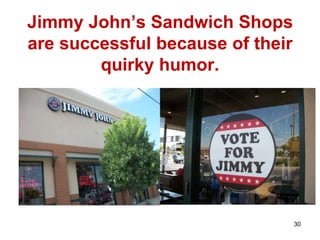
Jimmy John’s Sandwich Shops
are successful because of their
quirky humor.
30
Cartoonist Scott Adams draws “Dilbert”
cartoons which explore these business-
related themes:
• Downsizing
• Heavy work loads
• Micromanagement
• Humiliatingly small cubicles
• Accelerating pace of change
• Corporate gobbledygook
• Management fads
• Cruel bosses
• Annoying colleagues
• Red tape.
31
DILBERT STREAMING:
http://www.youtube.com/user/dilbert
32
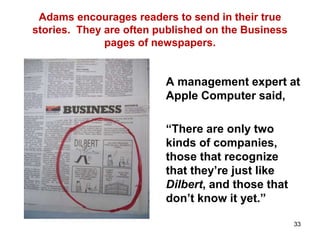
Adams encourages readers to send in their true
stories. They are often published on the Business
pages of newspapers.
A management expert at
Apple Computer said,
“There are only two
kinds of companies,
those that recognize
that they’re just like
Dilbert, and those that
don’t know it yet.”
33
Once employees incorporate humor in their
daily lives, it seems natural to extend humor to
their customers and potential customers.
• Volkswagen introduced the VW Rabbit into the U.S. with a
10-second commercial showing two rabbits looking into
the camera. One is saying, “In 1956 there were only two
VWs in America. . .”
• At a California traffic school named Lettuce Amuse U, the
teachers are comedians. They use humor to relax
students.
• One teacher explains that an extra reason for keeping
your baby safe in a backward-facing car seat is “If you
get rear-ended, you’ve got a witness.”
34
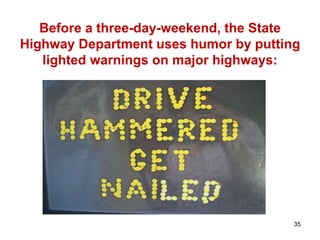
Before a three-day-weekend, the State
Highway Department uses humor by putting
lighted warnings on major highways:
35
Cheap Flights:
http://www.youtube.com/embed/HPyl2tOaKxM
36
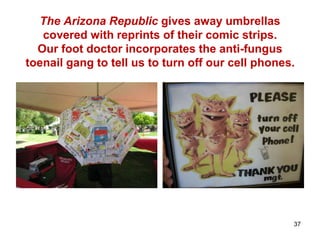
The Arizona Republic gives away umbrellas
covered with reprints of their comic strips.
Our foot doctor incorporates the anti-fungus
toenail gang to tell us to turn off our cell phones.
37
Connections between Humor
and Advertising
• They both require brevity.
• They open people’s minds to enable
them to have a new viewpoint.
• People get involved in processing the
message, and therefore remember it
longer.
38
An Advertisement for Coke (Coca Cola):
THE HAPPINESS MACHINE:
http://www.youtube.com/watch_popup?v=lqT_dPApj9U
39
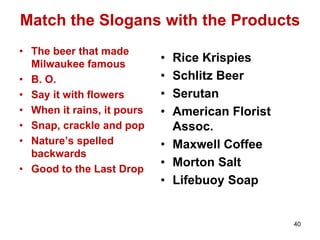
Match the Slogans with the Products
• The beer that made
Milwaukee famous
• B. O.
• Say it with flowers
• When it rains, it pours
• Snap, crackle and pop
• Nature’s spelled
backwards
• Good to the Last Drop
• Rice Krispies
• Schlitz Beer
• Serutan
• American Florist
Assoc.
• Maxwell Coffee
• Morton Salt
• Lifebuoy Soap
40
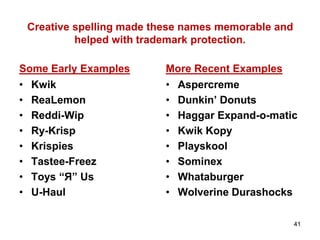
Creative spelling made these names memorable and
helped with trademark protection.
Some Early Examples
• Kwik
• ReaLemon
• Reddi-Wip
• Ry-Krisp
• Krispies
• Tastee-Freez
• Toys “Я” Us
• U-Haul
More Recent Examples
• Aspercreme
• Dunkin’ Donuts
• Haggar Expand-o-matic
• Kwik Kopy
• Playskool
• Sominex
• Whataburger
• Wolverine Durashocks
41
The Staying Power of Brand Names
Nineteen of the twenty-two companies that owned the
leading American brands in 1925 still own them.
• Campbells in soup
• Del Monte in canned
fruit
• Gillette in razors
• Ivory in soap
• Kellogg’s in
breakfast cereals
• Kodak in film
• Nabisco in cookies
• Sherwin Williams in
paint
• Singer in sewing
machines
• Wrigleys in chewing
gum
42
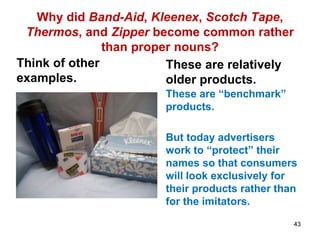
Why did Band-Aid, Kleenex, Scotch Tape,
Thermos, and Zipper become common rather
than proper nouns?
Think of other
examples.
These are relatively
older products.
These are “benchmark”
products.
But today advertisers
work to “protect” their
names so that consumers
will look exclusively for
their products rather than
for the imitators.
43
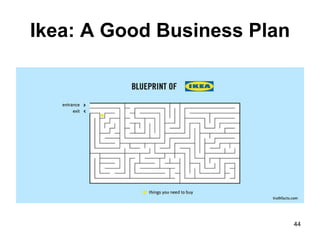
Ikea: A Good Business Plan
44
45
James Twitchell, used his own kind of humor
to criticize America’s market culture. He wrote:
• “If Greece gave the world philosophy, Britain gave
drama, Austria gave music, Germany gave politics,
and Italy gave art, then America has recently
contributed mass-produced and mass-consumed
objects.”
• He added that our materialism is a kind of
spiritualism, but instead of looking at the next life for
our rewards, we are looking for “The Nike swoosh,
the Polo pony, the Guess? label, and the DKNY
logo.”
Are we influenced by ads?
• People say that they don’t pay much attention to ads.
They just tune them out, believing they have no effect.
• In Nazi Germany, Joseph Goebbels said that the secret of
propaganda is that “those who are to be persuaded
should be completely immersed in the ideas of the
propaganda, without ever noticing that they are being
immersed in it.”
• This is where humor comes in. If we are amused or
laughing at a commercial or a program, our defenses are
down and we are more likely to want to buy whatever is
being shown.
46
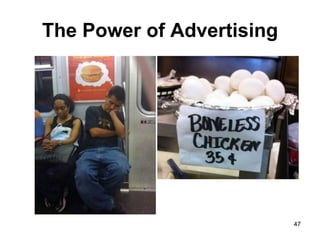
The Power of Advertising
47
Products are our friends.
• Alcoholics joke that Jack Daniels is their
constant lover, while smokers feel that
cigarettes are their friends. People are twice
seduced, first by the ads and then by the
substances.
• “Infiniti is an automobile; Hydra Zen is a
moisturizer, and Jesus is a brand of jeans.”
48
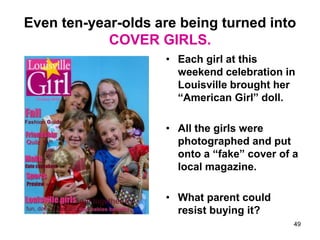
Even ten-year-olds are being turned into
COVER GIRLS.
• Each girl at this
weekend celebration in
Louisville brought her
“American Girl” doll.
• All the girls were
photographed and put
onto a “fake” cover of a
local magazine.
• What parent could
resist buying it?
49
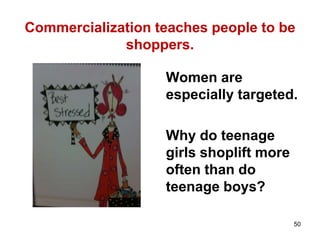
Commercialization teaches people to be
shoppers.
50
Women are
especially targeted.
Why do teenage
girls shoplift more
often than do
teenage boys?
51
Which of the following
statements are gender marked?
– A woman’s place is in the mall.
– But I can’t be overdrawn! I still have some checks.
– He who dies with the most toys wins.
– I’m spending my grandchildren’s inheritance.
– Nouveau riche is better than no riche at all.
– People who say money can’t buy happiness, don’t
know where to shop.
– Shop ‘til you drop.
– When the going gets tough, the tough go
shopping.
52
53
We will conclude with miscellaneous “Laws of
Business” developed over the years:
• MURPHY’S LAW: “If anything can go wrong,
it will,” extended to “When left to
themselves, things always go from bad to
worse,” and “If anything can go wrong, it
will, and even if it can’t it might.”
• O’TOOLE’S LAW: Murphy was an optimist.
• DAMON RUNYAN’S LAW: In all human
affairs, the odds are always six to five
against.
MORE LAWS . . .
• THE PETER PRINCIPLE: Each employee tends to
rise to their level of incompetence.
• PETER’S COROLLARY PRINCIPLE: When people are
doing well they will be promoted, which means that
everyone not upwardly mobile is incompetent.
• MARSHALL’S GENERALIZED ICEBERG THEOREM:
Seven-eights of everything cannot be seen.
• PAUL HERBIG’S PRINCIPLE OF BUREAUCRATIC
TINKERTOYS: If it can be understood, it’s not yet
finished.
54
55
THE FINAL RULES OF
BUSINESS
• RULE NUMBER 1:
The boss is always right.
• RULE NUMBER 2:
If the boss is wrong, see Rule
Number 1.
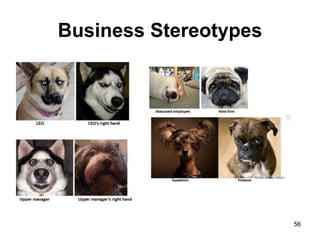
Business Stereotypes
56
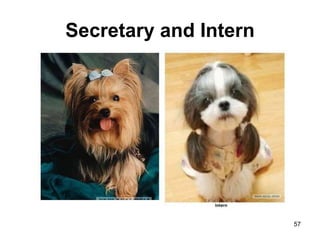
Secretary and Intern
57
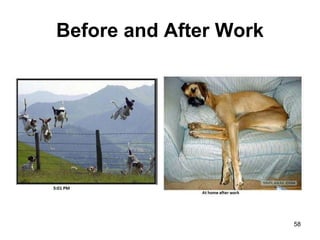
Before and After Work
58
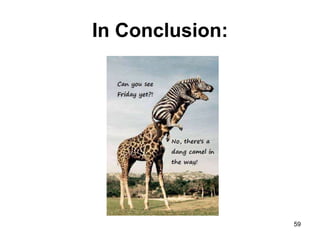
In Conclusion:
59

humor-business.ppt

  • 1.
    1 Business Humor by DonL. F. Nilsen and Alleen Pace Nilsen
  • 2.
  • 3.
  • 4.
  • 5.
  • 6.
  • 7.
    This finger ona statue is pointing to a particular hotel in Stockholm, Sweden 7
  • 8.
  • 9.
  • 10.
    Bob Mankoff’s NewYorker Business Humor 10
  • 11.
  • 12.
  • 13.
    Spaghetti Factory &Kleenex: Explain! 13
  • 14.
  • 15.
  • 16.
    BUSINESSES ARE NOWLOOKING FOR NEW APPROACHES An Office at Google • Humor consultant John Morreall advises businesses on how to make employees “like” to come to work. • It is fine to decorate an office or pin up cartoons, but really, it i much more complex than that. • They find ways to make their employees WANT to come to work. • Offices should be fun to look at and to work in. • But there’s more to it than that. 16
  • 17.
  • 18.
    MOTIVATION: PROFIT VS.PURPOSE; LEVELING THE HIERARCHY (e.g. Internet, Wikipedia, Skype, Facebook, Google, Southwest…): http://www.youtube.com/watch?v=u6XAPnuFjJc&feature=relmfu 18
  • 19.
    Businesses which encourage humoralso: • Take initiative and risks. • Do not worry about making mistakes. • Spend energy on solutions. • Shoot for total quality. • Focus on opportunities. • Do not worry about breaking things. • Try easier, not harder. • Stay calm. • Take responsibility. • Experiment. • Smile. • Have fun. 19
  • 20.
    20 To Accomplish TheseGoals, Companies: –Flatten the organization by reducing levels of management. –Allow workers more discretion in making decisions. –Foster creative thinking. –Accept employee attitudes, emotions, and suggestions. –Encourage teamwork and collaboration.
  • 21.
    Administrators’ Views ofHumor-in- Business : • A sense of humor makes businesses more creative, less rigid, and more willing to consider and embrace new ideas and methods. • In a survey of 737 CEO’s, 98% said that humor was important in the conduct of business. • They therefore gave preference to people with a sense of humor. • Soft skills are better predictors of success in management than are hard skills. 21
  • 22.
  • 23.
    More Support forHumor • The director of human resources at Sun Microsystems watches for how long it takes an interviewee to laugh or to find something funny • She says that humor is very important in their corporate futures. • One business created a “Grouch Patrol.” Whenever they see someone with a sour expression, they respond by making a bat face. • This involves pushing the tip of their noses up, flicking their tongues in and out, and making a high-pitched “Eeeee” sound. 23
  • 24.
  • 25.
    When Humor “Bubbles-Up”from Employees, There Will of Course Be Lots of Variety. • Practical jokes we’ve recently heard: – Putting foam packing bubbles in the cubicles of colleagues who are absent. – A boss going on a three-week trip, and coming back to find real sod rolled out in his office just to prove that “grass does grow under your feet.” – A door-decorating contest on the cruise ship taking 12 of their outstanding employees to Mexico, in which winners had photos of their faces superimposed on pictures of jungle animals. – Their slogan was “Where the Wild Things Are.” 25
  • 26.
    At our localBEADS GALORE store an employee made this sign for the window. “UNATTENDED CHILDREN WILL BE GIVEN TO THE GOBLIN KING” APPARENTLY, SHE WAS TIRED OF REARRANGING THE DISPLAYS. 26
  • 27.
    27 Other Examples ofWorkplace Humor • A debt collector sent out a letter reading, “We appreciate your business, but, please, give us a break. Your account is overdue 10 months. That means we’ve carried you longer than your mother did.” • A business manager, who made a really bad mistake, wore a T-shirt with a large red bulls-eye on it when he went to a meeting about the problem. • A large IBM sales team improved their record 30% when they formed a pick-up orchestra and recorded their sales in fun ways, e.g. by blowing a horn, smashing a gong.
  • 28.
    More Examples • EstherBlumenfield and Lynne Alpern told about how four women conspired to get even with a male co-worker. • At meetings, he would routinely drop his pencil on the floor so that he could bend down under the table and look up their skirts. • One day before a scheduled meeting, they used a magic marker to print on their kneecaps: H I (space) R A L P H. • The CEO of a large Canadian bank appears in a monthly corporate video shown to all employees to discuss recent issues and plans. • A hand puppet appears and begins poking fun and asking him embarrassing questions about recent problems. 28
  • 29.
    Southwest Airlines BoardingInformation: https://www.youtube.com/watch?v=TxNrizGdhtY&app=desktop 29
  • 30.
    Jimmy John’s SandwichShops are successful because of their quirky humor. 30
  • 31.
    Cartoonist Scott Adamsdraws “Dilbert” cartoons which explore these business- related themes: • Downsizing • Heavy work loads • Micromanagement • Humiliatingly small cubicles • Accelerating pace of change • Corporate gobbledygook • Management fads • Cruel bosses • Annoying colleagues • Red tape. 31
  • 32.
  • 33.
    Adams encourages readersto send in their true stories. They are often published on the Business pages of newspapers. A management expert at Apple Computer said, “There are only two kinds of companies, those that recognize that they’re just like Dilbert, and those that don’t know it yet.” 33
  • 34.
    Once employees incorporatehumor in their daily lives, it seems natural to extend humor to their customers and potential customers. • Volkswagen introduced the VW Rabbit into the U.S. with a 10-second commercial showing two rabbits looking into the camera. One is saying, “In 1956 there were only two VWs in America. . .” • At a California traffic school named Lettuce Amuse U, the teachers are comedians. They use humor to relax students. • One teacher explains that an extra reason for keeping your baby safe in a backward-facing car seat is “If you get rear-ended, you’ve got a witness.” 34
  • 35.
    Before a three-day-weekend,the State Highway Department uses humor by putting lighted warnings on major highways: 35
  • 36.
  • 37.
    The Arizona Republicgives away umbrellas covered with reprints of their comic strips. Our foot doctor incorporates the anti-fungus toenail gang to tell us to turn off our cell phones. 37
  • 38.
    Connections between Humor andAdvertising • They both require brevity. • They open people’s minds to enable them to have a new viewpoint. • People get involved in processing the message, and therefore remember it longer. 38
  • 39.
    An Advertisement forCoke (Coca Cola): THE HAPPINESS MACHINE: http://www.youtube.com/watch_popup?v=lqT_dPApj9U 39
  • 40.
    Match the Sloganswith the Products • The beer that made Milwaukee famous • B. O. • Say it with flowers • When it rains, it pours • Snap, crackle and pop • Nature’s spelled backwards • Good to the Last Drop • Rice Krispies • Schlitz Beer • Serutan • American Florist Assoc. • Maxwell Coffee • Morton Salt • Lifebuoy Soap 40
  • 41.
    Creative spelling madethese names memorable and helped with trademark protection. Some Early Examples • Kwik • ReaLemon • Reddi-Wip • Ry-Krisp • Krispies • Tastee-Freez • Toys “Я” Us • U-Haul More Recent Examples • Aspercreme • Dunkin’ Donuts • Haggar Expand-o-matic • Kwik Kopy • Playskool • Sominex • Whataburger • Wolverine Durashocks 41
  • 42.
    The Staying Powerof Brand Names Nineteen of the twenty-two companies that owned the leading American brands in 1925 still own them. • Campbells in soup • Del Monte in canned fruit • Gillette in razors • Ivory in soap • Kellogg’s in breakfast cereals • Kodak in film • Nabisco in cookies • Sherwin Williams in paint • Singer in sewing machines • Wrigleys in chewing gum 42
  • 43.
    Why did Band-Aid,Kleenex, Scotch Tape, Thermos, and Zipper become common rather than proper nouns? Think of other examples. These are relatively older products. These are “benchmark” products. But today advertisers work to “protect” their names so that consumers will look exclusively for their products rather than for the imitators. 43
  • 44.
    Ikea: A GoodBusiness Plan 44
  • 45.
    45 James Twitchell, usedhis own kind of humor to criticize America’s market culture. He wrote: • “If Greece gave the world philosophy, Britain gave drama, Austria gave music, Germany gave politics, and Italy gave art, then America has recently contributed mass-produced and mass-consumed objects.” • He added that our materialism is a kind of spiritualism, but instead of looking at the next life for our rewards, we are looking for “The Nike swoosh, the Polo pony, the Guess? label, and the DKNY logo.”
  • 46.
    Are we influencedby ads? • People say that they don’t pay much attention to ads. They just tune them out, believing they have no effect. • In Nazi Germany, Joseph Goebbels said that the secret of propaganda is that “those who are to be persuaded should be completely immersed in the ideas of the propaganda, without ever noticing that they are being immersed in it.” • This is where humor comes in. If we are amused or laughing at a commercial or a program, our defenses are down and we are more likely to want to buy whatever is being shown. 46
  • 47.
    The Power ofAdvertising 47
  • 48.
    Products are ourfriends. • Alcoholics joke that Jack Daniels is their constant lover, while smokers feel that cigarettes are their friends. People are twice seduced, first by the ads and then by the substances. • “Infiniti is an automobile; Hydra Zen is a moisturizer, and Jesus is a brand of jeans.” 48
  • 49.
    Even ten-year-olds arebeing turned into COVER GIRLS. • Each girl at this weekend celebration in Louisville brought her “American Girl” doll. • All the girls were photographed and put onto a “fake” cover of a local magazine. • What parent could resist buying it? 49
  • 50.
    Commercialization teaches peopleto be shoppers. 50 Women are especially targeted. Why do teenage girls shoplift more often than do teenage boys?
  • 51.
    51 Which of thefollowing statements are gender marked? – A woman’s place is in the mall. – But I can’t be overdrawn! I still have some checks. – He who dies with the most toys wins. – I’m spending my grandchildren’s inheritance. – Nouveau riche is better than no riche at all. – People who say money can’t buy happiness, don’t know where to shop. – Shop ‘til you drop. – When the going gets tough, the tough go shopping.
  • 52.
  • 53.
    53 We will concludewith miscellaneous “Laws of Business” developed over the years: • MURPHY’S LAW: “If anything can go wrong, it will,” extended to “When left to themselves, things always go from bad to worse,” and “If anything can go wrong, it will, and even if it can’t it might.” • O’TOOLE’S LAW: Murphy was an optimist. • DAMON RUNYAN’S LAW: In all human affairs, the odds are always six to five against.
  • 54.
    MORE LAWS .. . • THE PETER PRINCIPLE: Each employee tends to rise to their level of incompetence. • PETER’S COROLLARY PRINCIPLE: When people are doing well they will be promoted, which means that everyone not upwardly mobile is incompetent. • MARSHALL’S GENERALIZED ICEBERG THEOREM: Seven-eights of everything cannot be seen. • PAUL HERBIG’S PRINCIPLE OF BUREAUCRATIC TINKERTOYS: If it can be understood, it’s not yet finished. 54
  • 55.
    55 THE FINAL RULESOF BUSINESS • RULE NUMBER 1: The boss is always right. • RULE NUMBER 2: If the boss is wrong, see Rule Number 1.
  • 56.
  • 57.
  • 58.
  • 59.