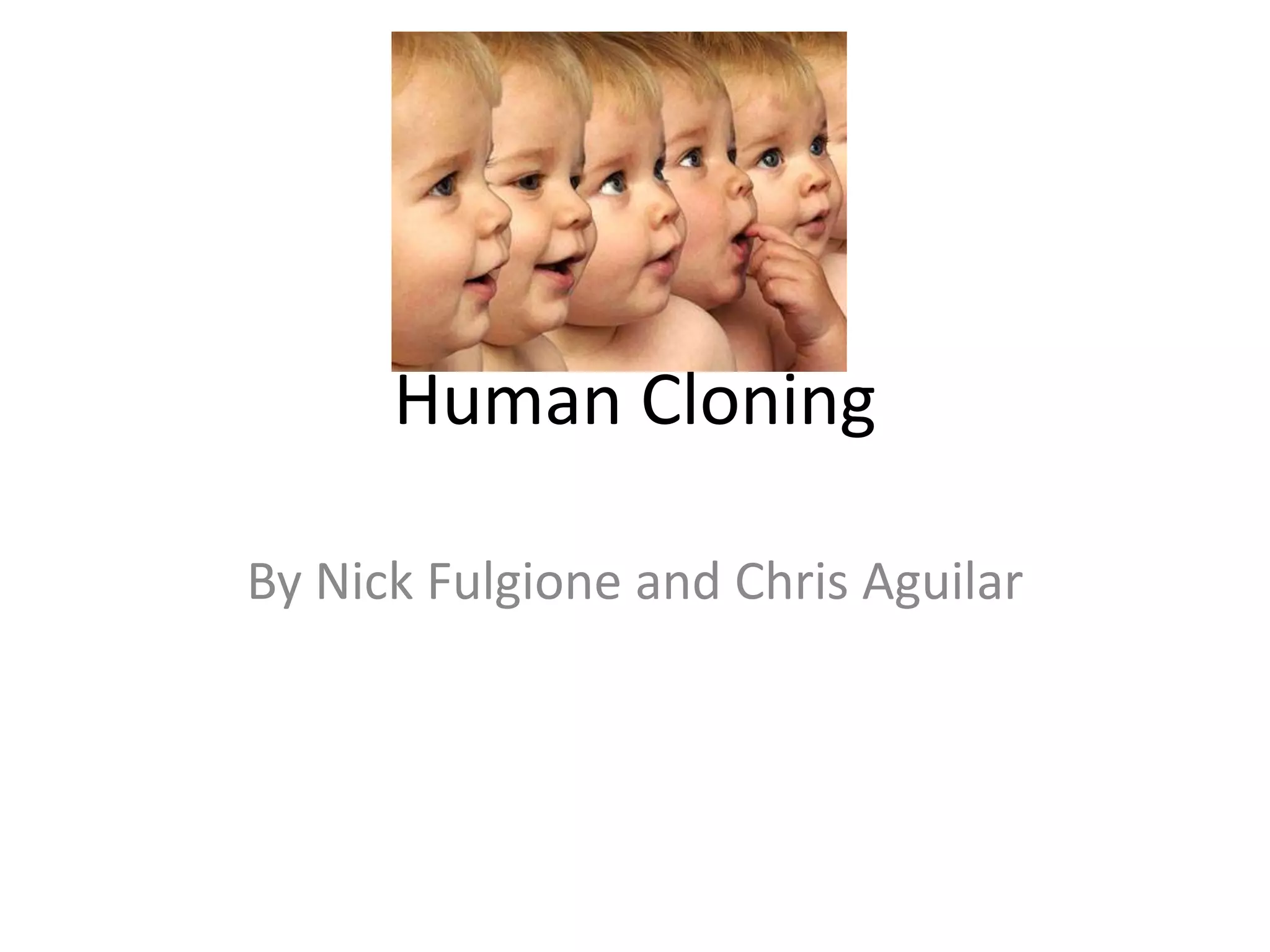
Human CloningBy Nick Fulgione and Chris Aguilar
Basic Principles of GeneticsTraits are controlled by dominant and recessive allelesTraits are controlled with co-dominant allelesThe alleles of two parents combine to express traits in offspring
Human Genome ProjectBegun formally in 1990, the U.S. Human Genome Project was a 13-year effort coordinated by the U.S. Department of Energy and the National Institutes of Health. The project originally was planned to last 15 years, but rapid technological advances accelerated the completion date to 2003.The reason why scientists wanted to use this information:
identify all the approximately 20,000-25,000 genes in human DNA,
determine the sequences of the 3 billion chemical base pairs that make up human DNA,
store this information in databases,
improve tools for data analysis,
transfer related technologies to the private sector, and
address the ethical, legal, and social issues (ELSI) that may arise from the project. Human Genome Part 2	A genome is all the DNA in an organism, including its genes.One ethical implication is fairness in the use of DNA is insured by employers, courts, schools, adoption agencies, and the military, among others. One legal implication is privacy and confidentiality of DNA . One social implication is psychological impact and stigmatization due to a person’s genetic differences. The law does not allow U.S.A insurance companies and employees from discriminating the basis of information.
Genetic DisordersSingle gene disorder- A disease caused by abnormality in one gene.
Chromosome abnormalities- abnormality or aberration reflects an a typical number of chromosomes or a structural abnormality in one or more chromosomes.
Multifactorial disorders- mutations in multiple genes, which may interact with environmental factors.
 counseling helps the information to people whose unborn children are at risk for certain genetic diseases and birth defects or if the parents are about  but not certain to have cancer and they wanted to adopt a child they would not let them because the parents might die and the child will be alone
 

Human cloning (2)

  • 1.
    Human CloningBy NickFulgione and Chris Aguilar
  • 2.
    Basic Principles ofGeneticsTraits are controlled by dominant and recessive allelesTraits are controlled with co-dominant allelesThe alleles of two parents combine to express traits in offspring
  • 3.
    Human Genome ProjectBegunformally in 1990, the U.S. Human Genome Project was a 13-year effort coordinated by the U.S. Department of Energy and the National Institutes of Health. The project originally was planned to last 15 years, but rapid technological advances accelerated the completion date to 2003.The reason why scientists wanted to use this information:
  • 4.
    identify all theapproximately 20,000-25,000 genes in human DNA,
  • 5.
    determine the sequencesof the 3 billion chemical base pairs that make up human DNA,
  • 6.
  • 7.
    improve tools fordata analysis,
  • 8.
    transfer related technologiesto the private sector, and
  • 9.
    address the ethical,legal, and social issues (ELSI) that may arise from the project. Human Genome Part 2 A genome is all the DNA in an organism, including its genes.One ethical implication is fairness in the use of DNA is insured by employers, courts, schools, adoption agencies, and the military, among others. One legal implication is privacy and confidentiality of DNA . One social implication is psychological impact and stigmatization due to a person’s genetic differences. The law does not allow U.S.A insurance companies and employees from discriminating the basis of information.
  • 10.
    Genetic DisordersSingle genedisorder- A disease caused by abnormality in one gene.
  • 11.
    Chromosome abnormalities- abnormalityor aberration reflects an a typical number of chromosomes or a structural abnormality in one or more chromosomes.
  • 12.
    Multifactorial disorders- mutationsin multiple genes, which may interact with environmental factors.
  • 13.
    counseling helpsthe information to people whose unborn children are at risk for certain genetic diseases and birth defects or if the parents are about but not certain to have cancer and they wanted to adopt a child they would not let them because the parents might die and the child will be alone
  • 14.