



HTTP Server PushHTTP Server Push
TechniquesTechniques
www.folio3.com@folio_3
Folio3 – OverviewFolio3 – Overview
www.folio3.com @folio_3
Who We Are
 We are a Development Partner for our customers
 Design software solutions, not just implement them
 Focus on the solution – Platform and technology agnostic
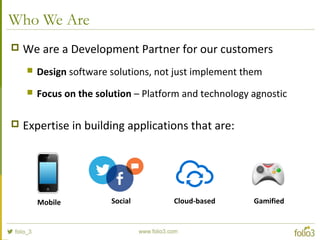
 Expertise in building applications that are:
Mobile Social Cloud-based Gamified
What We Do
 Areas of Focus
 Enterprise
 Custom enterprise applications
 Product development targeting the enterprise
 Mobile
 Custom mobile apps for iOS, Android, Windows Phone, BB OS
 Mobile platform (server-to-server) development
 Social Media
 CMS based websites for consumers and enterprise (corporate, consumer,
community & social networking)
 Social media platform development (enterprise & consumer)
Folio3 At a Glance
 Founded in 2005
 Over 200 full time employees
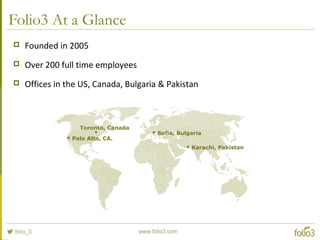
 Offices in the US, Canada, Bulgaria & Pakistan
 Palo Alto, CA.
 Sofia, Bulgaria
 Karachi, Pakistan
Toronto, Canada
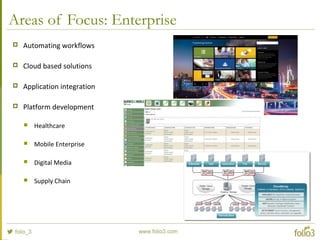
Areas of Focus: Enterprise
 Automating workflows
 Cloud based solutions
 Application integration
 Platform development
 Healthcare
 Mobile Enterprise
 Digital Media
 Supply Chain
Some of Our Enterprise Clients
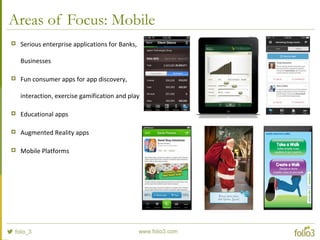
Areas of Focus: Mobile
 Serious enterprise applications for Banks,
Businesses
 Fun consumer apps for app discovery,
interaction, exercise gamification and play
 Educational apps
 Augmented Reality apps
 Mobile Platforms
Some of Our Mobile Clients
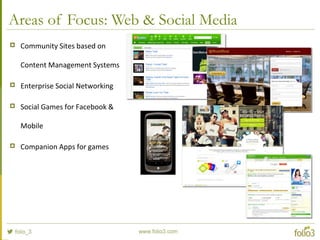
Areas of Focus: Web & Social Media
 Community Sites based on
Content Management Systems
 Enterprise Social Networking
 Social Games for Facebook &
Mobile
 Companion Apps for games
Some of Our Web Clients
HTTP Server PushHTTP Server Push
TechniquesTechniques
www.folio3.com @folio_3
Agenda
 Existing HTTP Protocol Architecture
 Traditional Methods for Server Push
 Polling
 Long Polling / Comet
 Pushlets / Streaming
 Comet in detail
 Possible issues with Comet and their solutions
 Comet Demonstration : MediaMorph
 Where does HTML5 fit-in?
 HTML 5 Server Sockets
Existing HTTP Protocol Architecture
 Existing HTTP
 Stateless protocol
 Request – Response … The end !
 Client initiated communication, Always !
 Server is forgetful
 AJAX comes for help
Traditional Methods : Polling
 Polling
 Periodic requests by the client
 Time between requests would always be N time units
Traditional Methods : Polling
 Merits
 Works better with very high frequency updates
 May suit a very fast / frequent updating system
 Very simple to implement, mostly easiest of all methods
 Works with ancient systems too
Traditional Methods : Polling
 De-Merits
 Too much network overhead
 At times slower than expected results
 The updates would always come after N time units
 Possibly too many unnecessary requests
 Possible browser performance degradation on the client
side
 Does not allow cross-domain access
Traditional Methods : Long Polling
 Long Polling / Comet
 Client requests and waits for the server to respond
 The server only responds back when there is any update or
data available
Traditional Methods : Long Polling
 Merits
 Behaves very similar to what a real server push
mechanism would do
 Immediate response in case of an update from the server
 Comparative to Polling very low network overhead and
request count
 Works with most old and new systems
 Works even with IE 6 !!!
Traditional Methods : Long Polling
 De-Merits
 Slightly more complex to implement than polling
 May not work well with very frequent updates
 Needs special server & client configurations
 Needs to take into account the Read Timeout
enforcements by intermediate gateway or proxies
 Does not allow cross-domain access
Traditional Methods : Streaming
 Streaming / Pushlet
 One request to the server
 Infinitely long response with continuous messages from
the server
 Client does not talk back unless with a new request
 Javascript <Script> tag enclosed code snippets
 Script tag’s URL would be a comet server side URL.
Sending Javascript code snippets time to time.
Traditional Methods : Streaming
 Merits
 Behaves very similar to what a real server push
mechanism would do
 Allows cross-domain implementations, since javascript
urls can be cross-domain
 Immediate response in case of an update from the server
 Possibly very low network overhead
 Negligible request count
Traditional Methods : Streaming
 De-Merits
 May not be supported by some old systems
 May cause browser memory overhead because of a long
list of script tags executed on the page
 Client is unable to send new request parameters in
normal scenarios
 All post-event logic needs to be written on the server side
 Proxy servers could buffer responses causing issues
Possible issues with Comet and their solutions
 Read timeout
 Orphaned requests
 Very frequent updates – Hybrid Poll – Push.
Comet DemonstrationComet Demonstration
www.folio3.com @folio_3
Where does HTML5 fit-in?
 HTML5 offers many solutions addressing issues with existing
architectures
 One of the solutions is WebSockets
 WebSockets address almost all issues with the existing
systems
HTML5 WebSockets
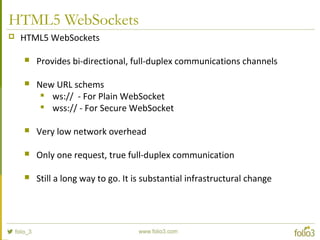
 HTML5 WebSockets
 Provides bi-directional, full-duplex communications channels
 New URL schems

ws:// - For Plain WebSocket

wss:// - For Secure WebSocket
 Very low network overhead
 Only one request, true full-duplex communication
 Still a long way to go. It is substantial infrastructural change
How HTML5 WebSockets Work ?
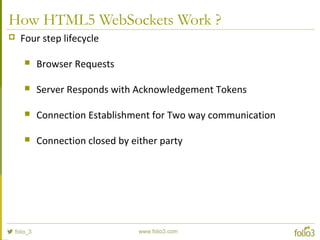
 Four step lifecycle
 Browser Requests
 Server Responds with Acknowledgement Tokens
 Connection Establishment for Two way communication
 Connection closed by either party
Contact
 For more details about our
services, please get in touch with
us.
contact@folio3.com
US Office: (408) 365-4638
www.folio3.com

HTTP Server Push Techniques

  • 1.
    HTTP Server PushHTTPServer Push TechniquesTechniques www.folio3.com@folio_3
  • 2.
    Folio3 – OverviewFolio3– Overview www.folio3.com @folio_3
  • 3.
    Who We Are We are a Development Partner for our customers  Design software solutions, not just implement them  Focus on the solution – Platform and technology agnostic  Expertise in building applications that are: Mobile Social Cloud-based Gamified
  • 4.
    What We Do Areas of Focus  Enterprise  Custom enterprise applications  Product development targeting the enterprise  Mobile  Custom mobile apps for iOS, Android, Windows Phone, BB OS  Mobile platform (server-to-server) development  Social Media  CMS based websites for consumers and enterprise (corporate, consumer, community & social networking)  Social media platform development (enterprise & consumer)
  • 5.
    Folio3 At aGlance  Founded in 2005  Over 200 full time employees  Offices in the US, Canada, Bulgaria & Pakistan  Palo Alto, CA.  Sofia, Bulgaria  Karachi, Pakistan Toronto, Canada
  • 6.
    Areas of Focus:Enterprise  Automating workflows  Cloud based solutions  Application integration  Platform development  Healthcare  Mobile Enterprise  Digital Media  Supply Chain
  • 7.
    Some of OurEnterprise Clients
  • 8.
    Areas of Focus:Mobile  Serious enterprise applications for Banks, Businesses  Fun consumer apps for app discovery, interaction, exercise gamification and play  Educational apps  Augmented Reality apps  Mobile Platforms
  • 9.
    Some of OurMobile Clients
  • 10.
    Areas of Focus:Web & Social Media  Community Sites based on Content Management Systems  Enterprise Social Networking  Social Games for Facebook & Mobile  Companion Apps for games
  • 11.
    Some of OurWeb Clients
  • 12.
    HTTP Server PushHTTPServer Push TechniquesTechniques www.folio3.com @folio_3
  • 13.
    Agenda  Existing HTTPProtocol Architecture  Traditional Methods for Server Push  Polling  Long Polling / Comet  Pushlets / Streaming  Comet in detail  Possible issues with Comet and their solutions  Comet Demonstration : MediaMorph  Where does HTML5 fit-in?  HTML 5 Server Sockets
  • 14.
    Existing HTTP ProtocolArchitecture  Existing HTTP  Stateless protocol  Request – Response … The end !  Client initiated communication, Always !  Server is forgetful  AJAX comes for help
  • 15.
    Traditional Methods :Polling  Polling  Periodic requests by the client  Time between requests would always be N time units
  • 16.
    Traditional Methods :Polling  Merits  Works better with very high frequency updates  May suit a very fast / frequent updating system  Very simple to implement, mostly easiest of all methods  Works with ancient systems too
  • 17.
    Traditional Methods :Polling  De-Merits  Too much network overhead  At times slower than expected results  The updates would always come after N time units  Possibly too many unnecessary requests  Possible browser performance degradation on the client side  Does not allow cross-domain access
  • 18.
    Traditional Methods :Long Polling  Long Polling / Comet  Client requests and waits for the server to respond  The server only responds back when there is any update or data available
  • 19.
    Traditional Methods :Long Polling  Merits  Behaves very similar to what a real server push mechanism would do  Immediate response in case of an update from the server  Comparative to Polling very low network overhead and request count  Works with most old and new systems  Works even with IE 6 !!!
  • 20.
    Traditional Methods :Long Polling  De-Merits  Slightly more complex to implement than polling  May not work well with very frequent updates  Needs special server & client configurations  Needs to take into account the Read Timeout enforcements by intermediate gateway or proxies  Does not allow cross-domain access
  • 21.
    Traditional Methods :Streaming  Streaming / Pushlet  One request to the server  Infinitely long response with continuous messages from the server  Client does not talk back unless with a new request  Javascript <Script> tag enclosed code snippets  Script tag’s URL would be a comet server side URL. Sending Javascript code snippets time to time.
  • 22.
    Traditional Methods :Streaming  Merits  Behaves very similar to what a real server push mechanism would do  Allows cross-domain implementations, since javascript urls can be cross-domain  Immediate response in case of an update from the server  Possibly very low network overhead  Negligible request count
  • 23.
    Traditional Methods :Streaming  De-Merits  May not be supported by some old systems  May cause browser memory overhead because of a long list of script tags executed on the page  Client is unable to send new request parameters in normal scenarios  All post-event logic needs to be written on the server side  Proxy servers could buffer responses causing issues
  • 24.
    Possible issues withComet and their solutions  Read timeout  Orphaned requests  Very frequent updates – Hybrid Poll – Push.
  • 25.
  • 26.
    Where does HTML5fit-in?  HTML5 offers many solutions addressing issues with existing architectures  One of the solutions is WebSockets  WebSockets address almost all issues with the existing systems
  • 27.
    HTML5 WebSockets  HTML5WebSockets  Provides bi-directional, full-duplex communications channels  New URL schems  ws:// - For Plain WebSocket  wss:// - For Secure WebSocket  Very low network overhead  Only one request, true full-duplex communication  Still a long way to go. It is substantial infrastructural change
  • 28.
    How HTML5 WebSocketsWork ?  Four step lifecycle  Browser Requests  Server Responds with Acknowledgement Tokens  Connection Establishment for Two way communication  Connection closed by either party
  • 29.
    Contact  For moredetails about our services, please get in touch with us. contact@folio3.com US Office: (408) 365-4638 www.folio3.com