HTML5
the whole new era of web development

Nitish K. Sharma (@Nitish_KSharma)
Microsoft Certified Specialist for
Programming in HTML5 with JavaScript and CSS3
Contents
 What is HTML
 What is XHTML
 HTML5
 A brief history
 HTML5 - New Features
 Minimum HTML5 Document
 Browser Support for HTML5
 Standardization process
 HTML5 development timeline

 Main features of HTML5
 HTML5 in mobile devices
What is HTML?
The classic HTML logo

 HyperText Markup Language (HTML) is the main markup language for
creating web pages and other information that can be displayed in a web
browser.
 HTML was proposed by Tim Berners-Lee at CERN in 1989.
 It was first shown as HTML in late 1990.

 It was made publicly available in late 1991 through a document ―HTML
Tags‖ by CERN.

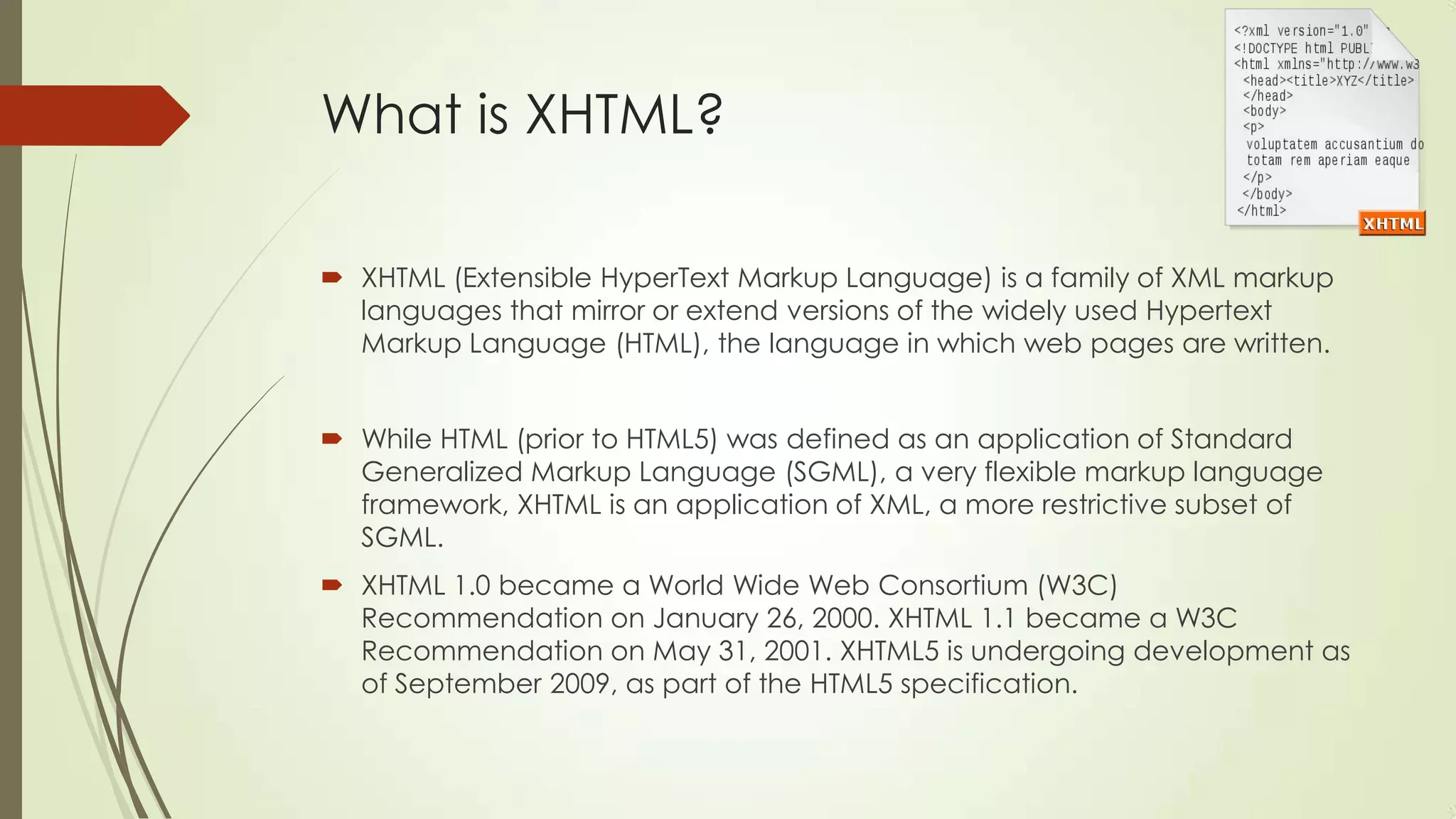
HTML was proposed by ―Tim Berners-Lee‖
What is XHTML?
 XHTML (Extensible HyperText Markup Language) is a family of XML markup
languages that mirror or extend versions of the widely used Hypertext
Markup Language (HTML), the language in which web pages are written.
 While HTML (prior to HTML5) was defined as an application of Standard
Generalized Markup Language (SGML), a very flexible markup language
framework, XHTML is an application of XML, a more restrictive subset of
SGML.
 XHTML 1.0 became a World Wide Web Consortium (W3C)
Recommendation on January 26, 2000. XHTML 1.1 became a W3C
Recommendation on May 31, 2001. XHTML5 is undergoing development as
of September 2009, as part of the HTML5 specification.
HTML5
 HTML5 will be the new standard for HTML.
 The previous version of HTML, HTML 4.01, came in 1999. The web has
changed a lot since then.
 HTML5 is still a work in progress. However, the major browsers support many
of the new HTML5 elements and APIs.

 It is the fifth revision of the HTML standard and, as of December 2012, is a
W3C Candidate Recommendation.
 Its core aims have been to improve the language with support for the
latest multimedia while keeping it easily readable by humans and
consistently understood by computers and devices (web
browsers, parsers, etc.).
 HTML5 is also intended for ―Cross-platform‖ programming.
A brief history
 HTML5 is a cooperation between the World Wide Web Consortium (W3C) and
the Web Hypertext Application Technology Working Group (WHATWG).
 WHATWG was working with web forms and applications, and W3C was working
with XHTML 2.0. In 2006, they decided to cooperate and create a new version
of HTML.
 Some rules for HTML5 were established:

•New features should be based on HTML, CSS, DOM, and JavaScript
•Reduce the need for external plugins (like Flash)
•Better error handling
•More markup to replace scripting
•HTML5 should be device independent

•The development process should be visible to the public
HTML5 - New Features
 Some of the most interesting new features in HTML5:
•The <canvas> element for 2D drawing
•The <video> and <audio> elements for media playback
•Support for local storage

•New content-specific elements, like
<article>, <footer>, <header>, <nav>, <section>
•New form controls, like calendar, date, time, email, url, search
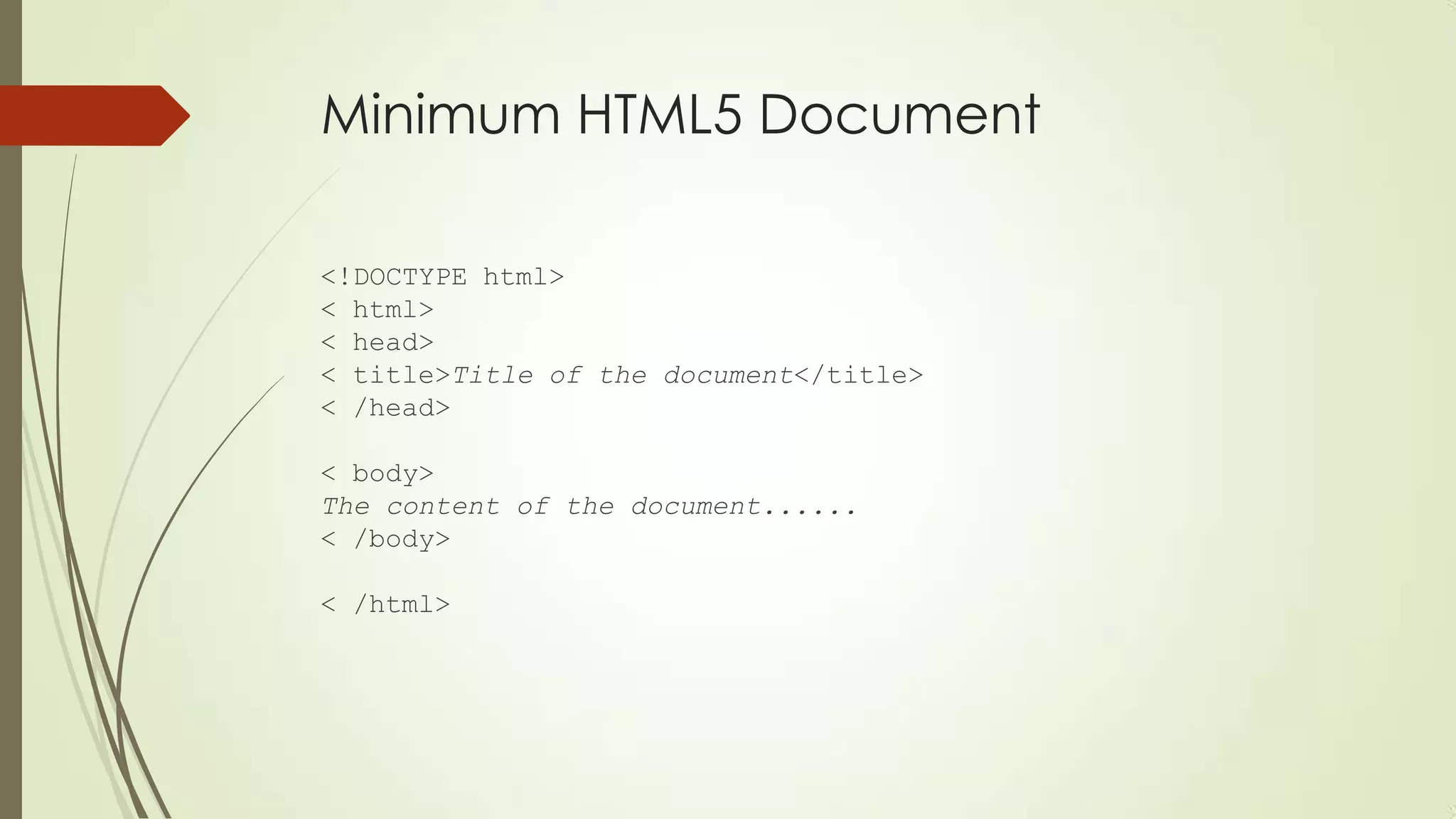
Minimum HTML5 Document
<!DOCTYPE html>
< html>
< head>
< title>Title of the document</title>
< /head>
< body>
The content of the document......
< /body>
< /html>
Browser Support for HTML5
 HTML5 is not yet an official standard, and no browsers have full HTML5
support.
 But all major browsers (Safari, Chrome, Firefox, Opera, Internet Explorer)
continue to add new HTML5 features to their latest versions.
 According to a report released on 30 September 2011, 34 of the world's top
100 Web sites were using HTML5 – the adoption led by search engines and
social networks.
Standardization process
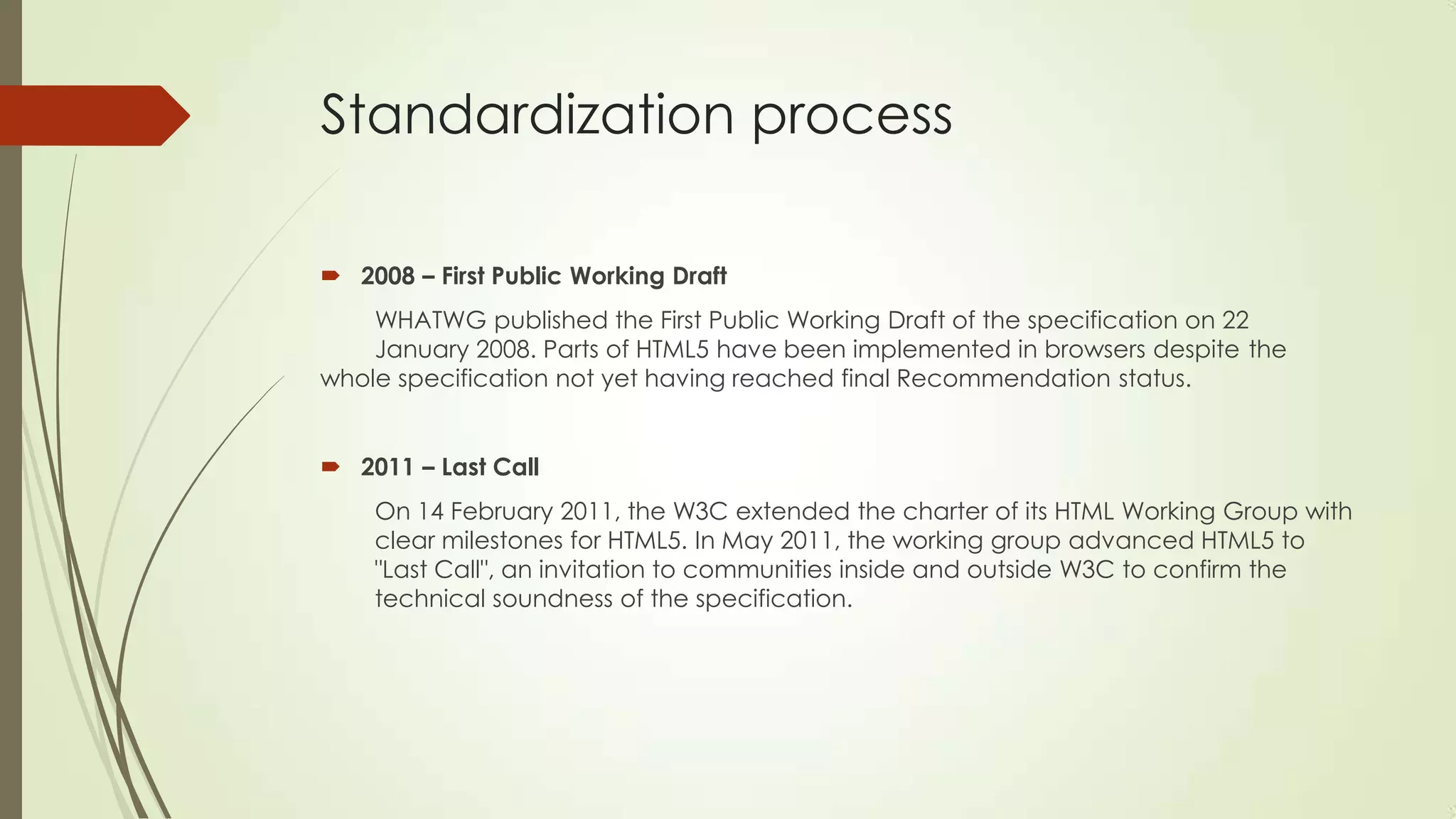
 2008 – First Public Working Draft
WHATWG published the First Public Working Draft of the specification on 22
January 2008. Parts of HTML5 have been implemented in browsers despite the
whole specification not yet having reached final Recommendation status.

 2011 – Last Call
On 14 February 2011, the W3C extended the charter of its HTML Working Group with
clear milestones for HTML5. In May 2011, the working group advanced HTML5 to
"Last Call", an invitation to communities inside and outside W3C to confirm the
technical soundness of the specification.
Standardization process (contd.)
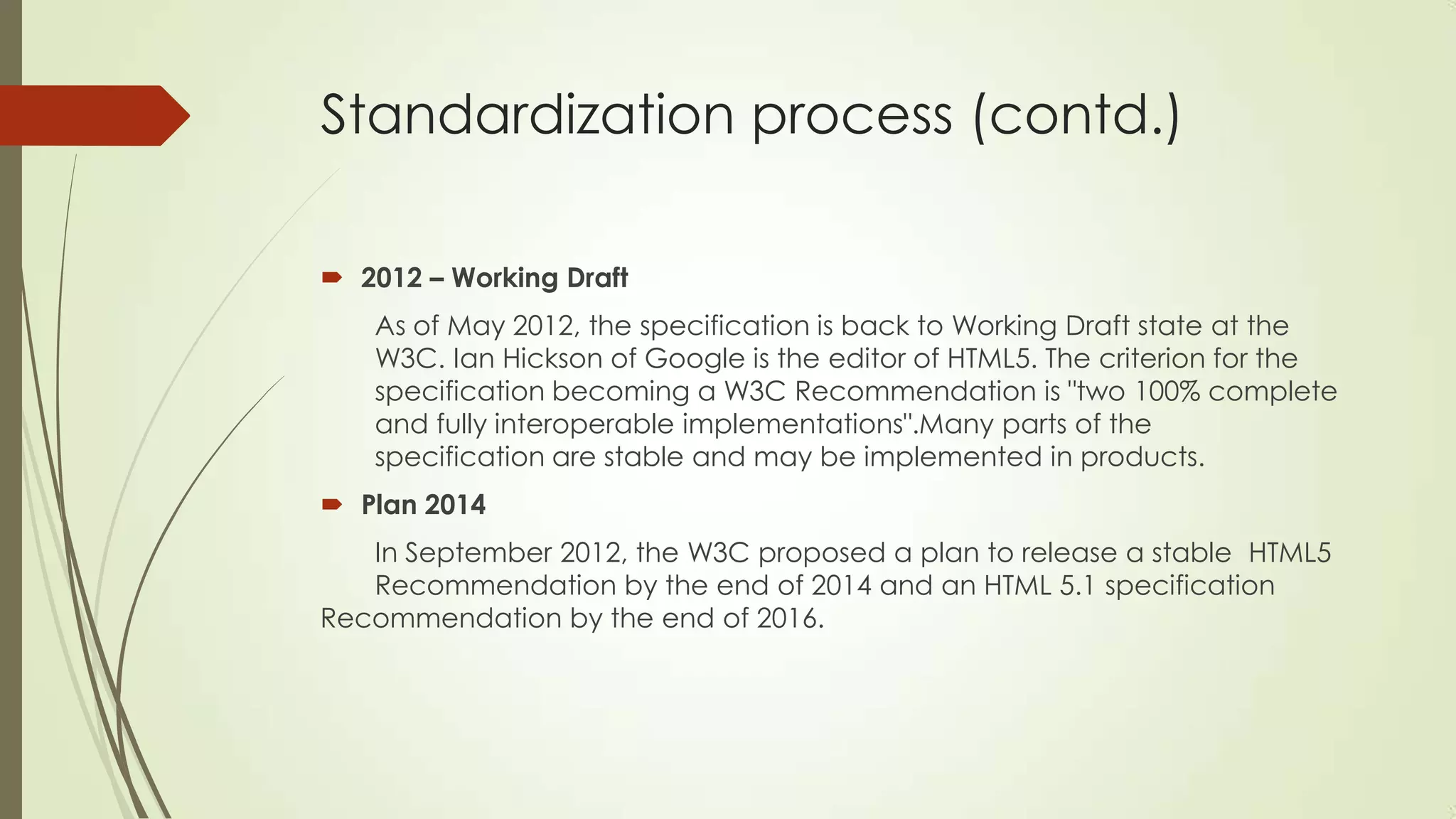
 2012 – Working Draft
As of May 2012, the specification is back to Working Draft state at the
W3C. Ian Hickson of Google is the editor of HTML5. The criterion for the
specification becoming a W3C Recommendation is "two 100% complete
and fully interoperable implementations".Many parts of the
specification are stable and may be implemented in products.
 Plan 2014
In September 2012, the W3C proposed a plan to release a stable HTML5
Recommendation by the end of 2014 and an HTML 5.1 specification
Recommendation by the end of 2016.
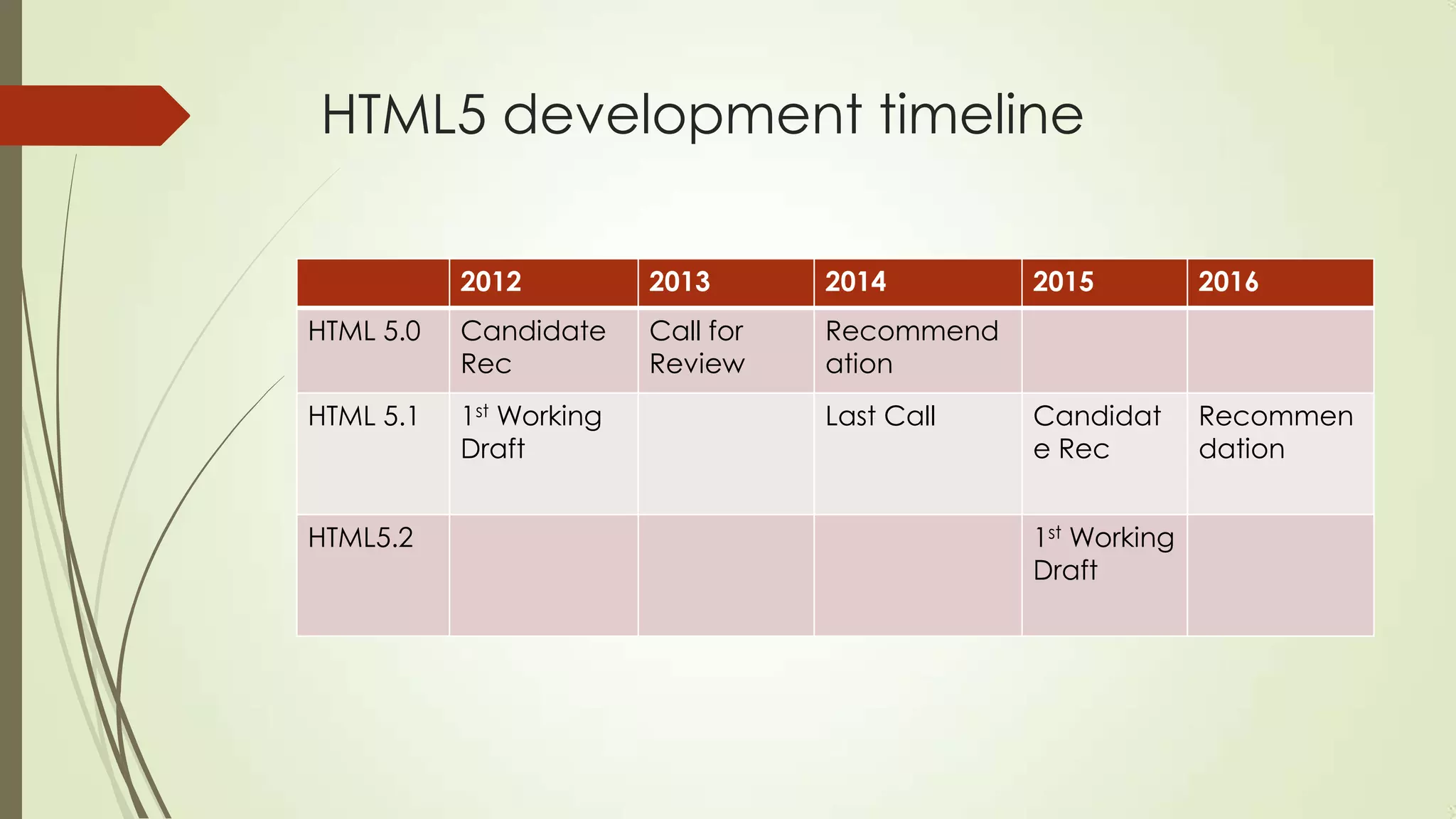
HTML5 development timeline
2012

2013

2014

HTML 5.0

Candidate
Rec

Call for
Review

Recommend
ation

HTML 5.1

1st Working
Draft

HTML5.2

Last Call

2015

2016

Candidat
e Rec

Recommen
dation

1st Working
Draft
Main features of
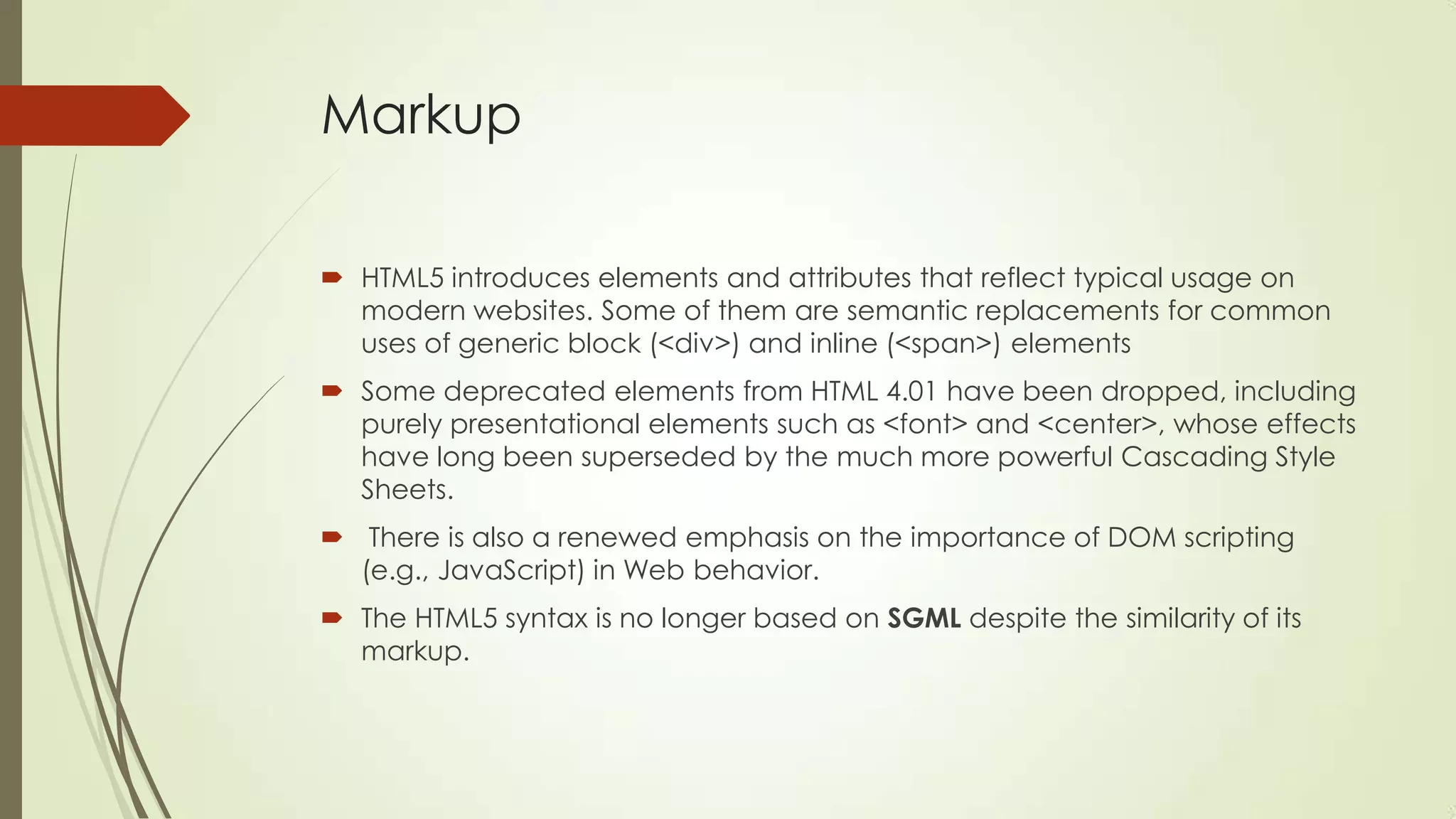
Markup
 HTML5 introduces elements and attributes that reflect typical usage on
modern websites. Some of them are semantic replacements for common
uses of generic block (<div>) and inline (<span>) elements
 Some deprecated elements from HTML 4.01 have been dropped, including
purely presentational elements such as <font> and <center>, whose effects
have long been superseded by the much more powerful Cascading Style
Sheets.
 There is also a renewed emphasis on the importance of DOM scripting
(e.g., JavaScript) in Web behavior.
 The HTML5 syntax is no longer based on SGML despite the similarity of its
markup.
New APIs
 In addition to specifying markup, HTML5 specifies scripting application programming
interfaces (APIs) that can be used with JavaScript. Existing document object model
(DOM) interfaces are extended and de facto features documented. There are also
new APIs, such as:
o

HTML5 related APIs. The canvas element for immediate mode 2D drawing. See Canvas
2D API Specification 1.0 specification

o

Timed media playback

o

Offline Web Applications

o

Document editing

o

Drag-and-drop

o

Cross-document messaging

o

Browser history management

o

MIME type and protocol handler registration

o

Microdata

o

Web Storage, a key-value pair storage framework that provides behaviour similar to
cookies but with larger storage capacity and improved API.
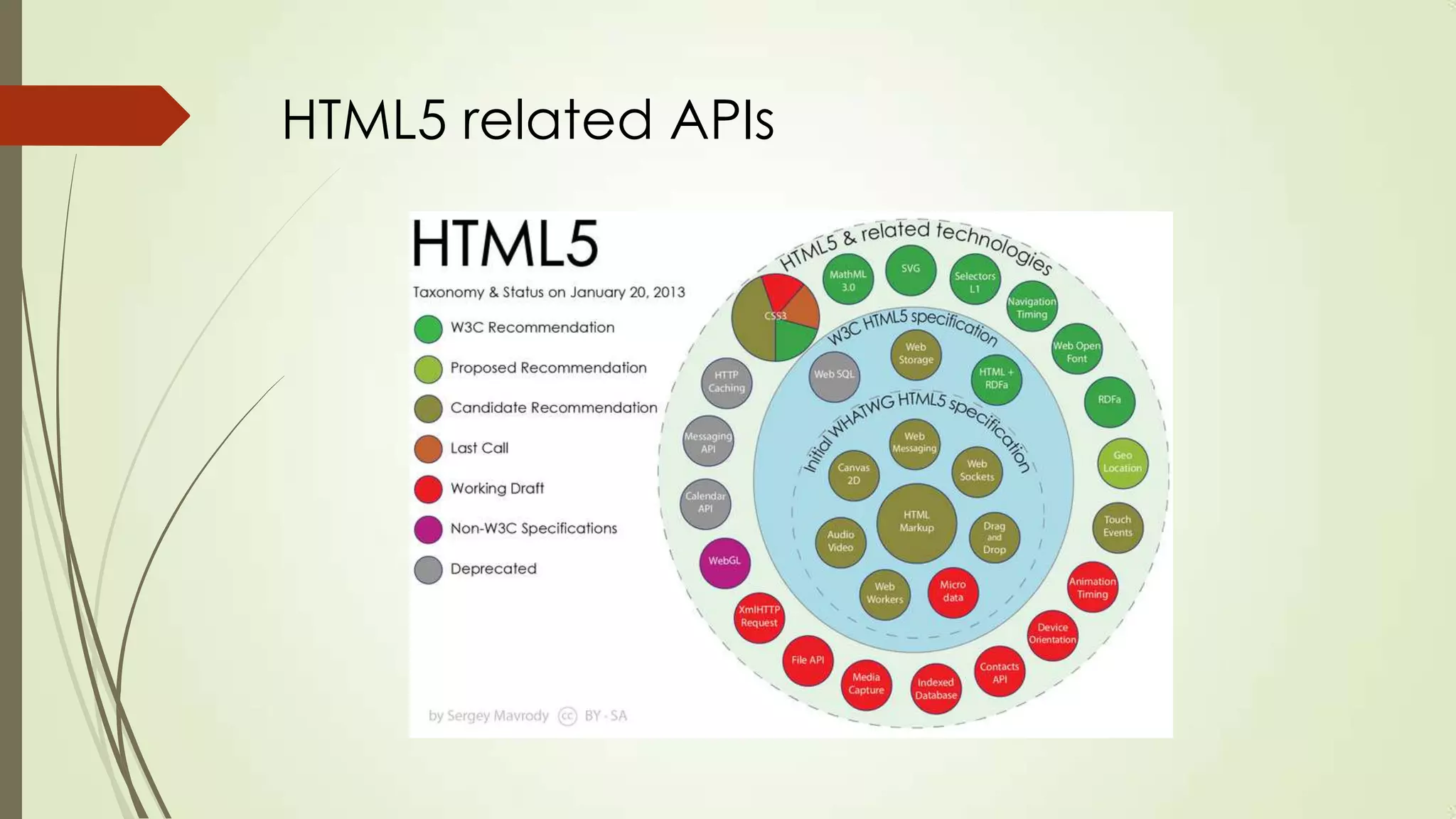
HTML5 related APIs
XHTML5
 XHTML5 is the XML serialization of HTML5. XML documents must be served
with an XML Internet media type such as application/xhtml+xml or
application/xml.
 XHTML5 requires XML's strict, well-formed syntax. The choice between HTML5
and XHTML5 boils down to the choice of a MIME/content type: the media
type one chooses determines what type of document should be used.
 In XHTML5, the HTML5 doctype html is optional and may simply be omitted.
HTML that has been written to conform to both the HTML and XHTML
specifications—and which will therefore produce the same DOM tree
whether parsed as HTML or XML—is termed "polyglot markup".
Differences from HTML 4.01 and XHTML
1.x
 New parsing rules: oriented towards flexible parsing and compatibility; not based on SGML
 Ability to use inline SVG and MathML in text/html
 New elements: article, aside, audio, bdi, canvas, command, data, datalist, details, embed,
figcaption, figure, footer, header, hgroup, keygen, mark, meter, nav, output, progress, rp, rt,
ruby, section, source, summary, time, track, video, wbr
 New types of form controls: dates and times, email, url, search, number, range, tel, color

 New attributes: charset (on meta), async (on script)
 Global attributes (that can be applied for every element): id, tabindex, hidden, data-* (custom
data attributes)
 Deprecated elements will be dropped altogether: acronym, applet, basefont, big, center, dir,
font, frame, frameset, isindex, noframes, strike, tt
 dev.w3.org provides the latest Editors Draft of "HTML5 differences from HTML 4", which provides a
complete outline of additions, removals and changes between HTML5 and HTML 4.
HTML5 in mobile devices
Cross-platform programming capabilities and off-line support of HTML5
HTML5 in app-development
 HTML5 provides developers with tools such as Offline Web Storage, GeoLocation
API, Canvas Drawing, CSS3, and many more.
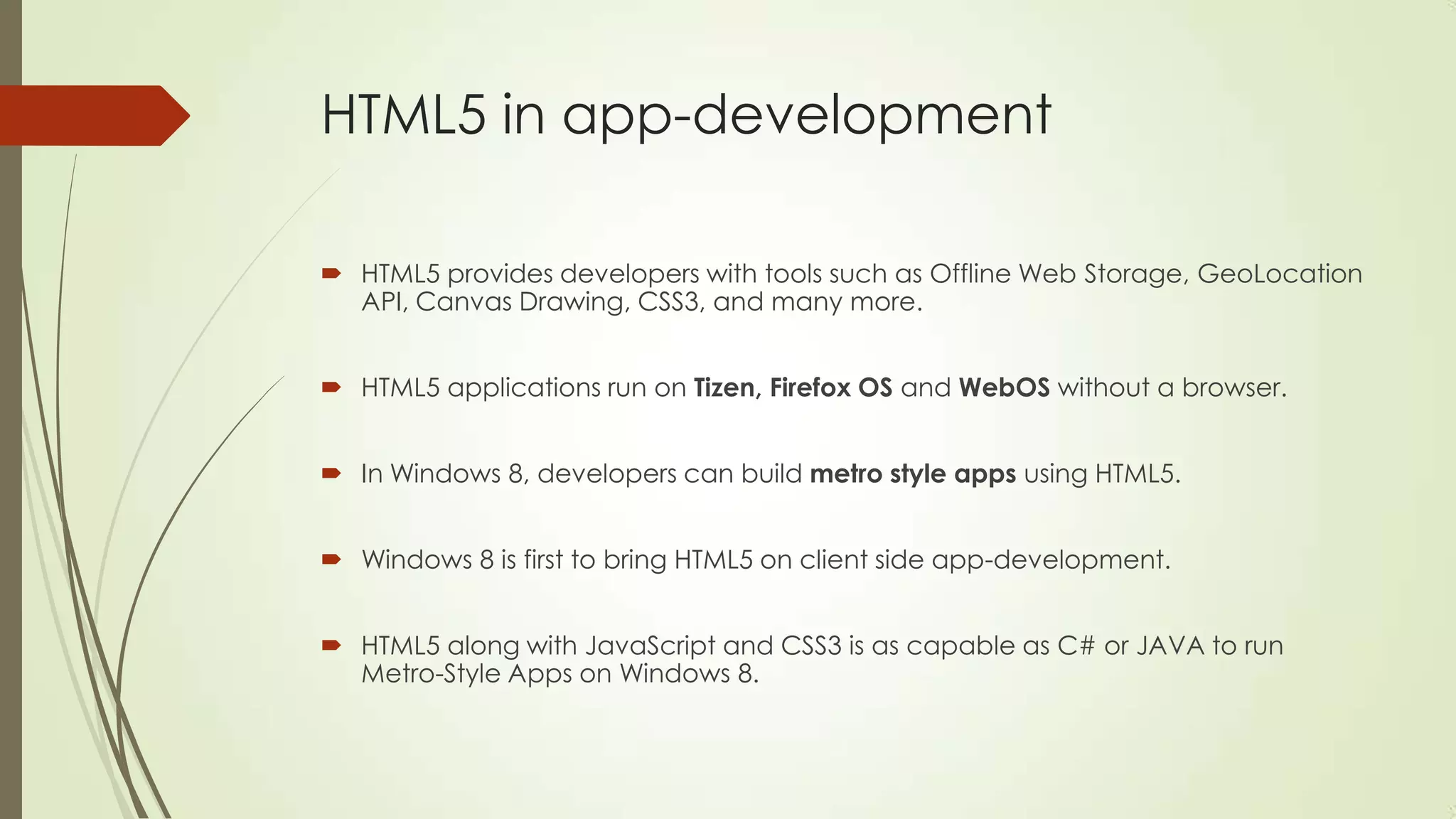
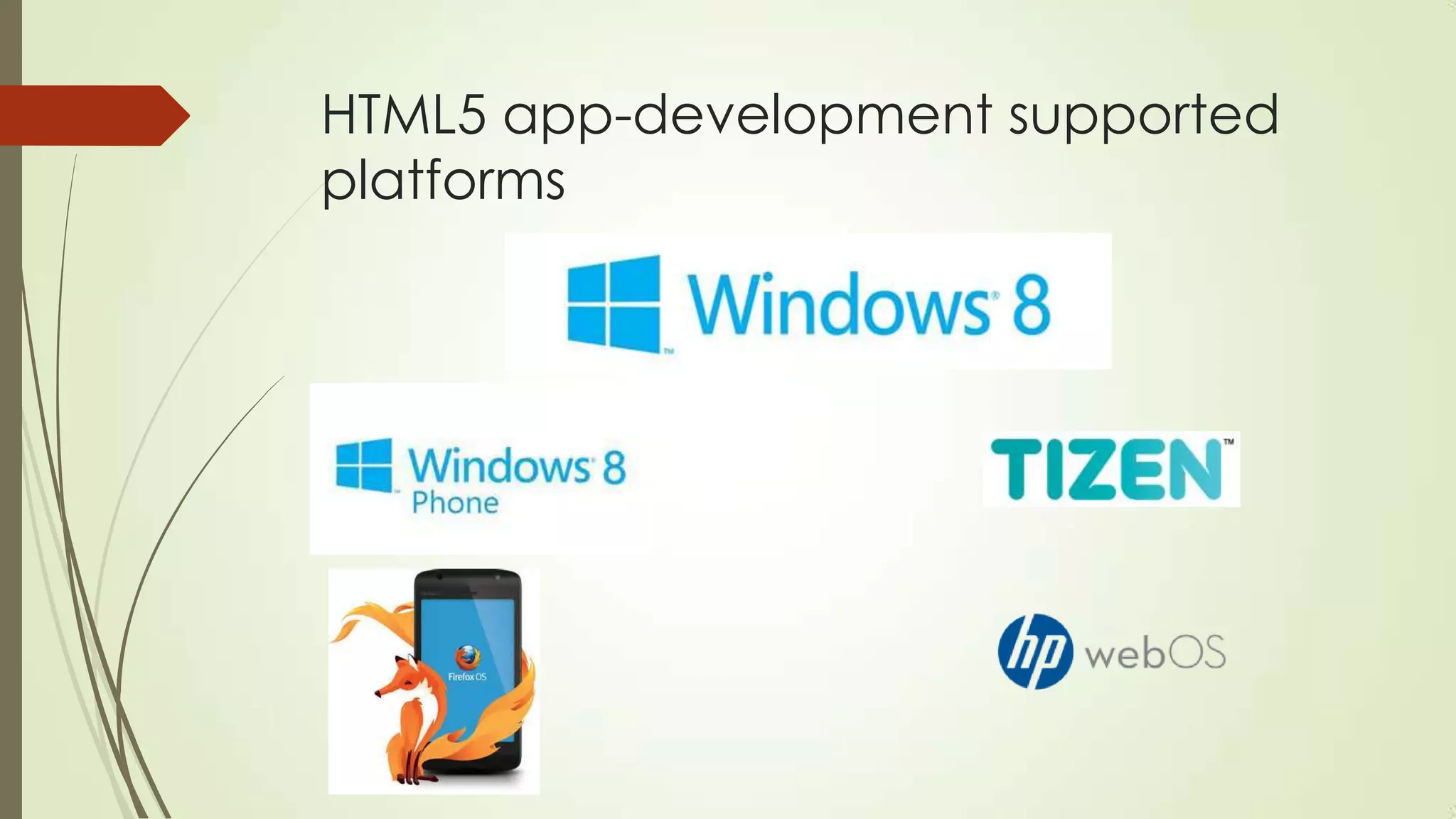
 HTML5 applications run on Tizen, Firefox OS and WebOS without a browser.

 In Windows 8, developers can build metro style apps using HTML5.
 Windows 8 is first to bring HTML5 on client side app-development.
 HTML5 along with JavaScript and CSS3 is as capable as C# or JAVA to run
Metro-Style Apps on Windows 8.
HTML5 app-development supported
platforms
A presentation by
Nitish K. Sharma

Html5

  • 1.
    HTML5 the whole newera of web development Nitish K. Sharma (@Nitish_KSharma) Microsoft Certified Specialist for Programming in HTML5 with JavaScript and CSS3
  • 2.
    Contents  What isHTML  What is XHTML  HTML5  A brief history  HTML5 - New Features  Minimum HTML5 Document  Browser Support for HTML5  Standardization process  HTML5 development timeline  Main features of HTML5  HTML5 in mobile devices
  • 3.
    What is HTML? Theclassic HTML logo  HyperText Markup Language (HTML) is the main markup language for creating web pages and other information that can be displayed in a web browser.  HTML was proposed by Tim Berners-Lee at CERN in 1989.  It was first shown as HTML in late 1990.  It was made publicly available in late 1991 through a document ―HTML Tags‖ by CERN. HTML was proposed by ―Tim Berners-Lee‖
  • 4.
    What is XHTML? XHTML (Extensible HyperText Markup Language) is a family of XML markup languages that mirror or extend versions of the widely used Hypertext Markup Language (HTML), the language in which web pages are written.  While HTML (prior to HTML5) was defined as an application of Standard Generalized Markup Language (SGML), a very flexible markup language framework, XHTML is an application of XML, a more restrictive subset of SGML.  XHTML 1.0 became a World Wide Web Consortium (W3C) Recommendation on January 26, 2000. XHTML 1.1 became a W3C Recommendation on May 31, 2001. XHTML5 is undergoing development as of September 2009, as part of the HTML5 specification.
  • 5.
    HTML5  HTML5 willbe the new standard for HTML.  The previous version of HTML, HTML 4.01, came in 1999. The web has changed a lot since then.  HTML5 is still a work in progress. However, the major browsers support many of the new HTML5 elements and APIs.  It is the fifth revision of the HTML standard and, as of December 2012, is a W3C Candidate Recommendation.  Its core aims have been to improve the language with support for the latest multimedia while keeping it easily readable by humans and consistently understood by computers and devices (web browsers, parsers, etc.).  HTML5 is also intended for ―Cross-platform‖ programming.
  • 6.
    A brief history HTML5 is a cooperation between the World Wide Web Consortium (W3C) and the Web Hypertext Application Technology Working Group (WHATWG).  WHATWG was working with web forms and applications, and W3C was working with XHTML 2.0. In 2006, they decided to cooperate and create a new version of HTML.  Some rules for HTML5 were established: •New features should be based on HTML, CSS, DOM, and JavaScript •Reduce the need for external plugins (like Flash) •Better error handling •More markup to replace scripting •HTML5 should be device independent •The development process should be visible to the public
  • 7.
    HTML5 - NewFeatures  Some of the most interesting new features in HTML5: •The <canvas> element for 2D drawing •The <video> and <audio> elements for media playback •Support for local storage •New content-specific elements, like <article>, <footer>, <header>, <nav>, <section> •New form controls, like calendar, date, time, email, url, search
  • 8.
    Minimum HTML5 Document <!DOCTYPEhtml> < html> < head> < title>Title of the document</title> < /head> < body> The content of the document...... < /body> < /html>
  • 9.
    Browser Support forHTML5  HTML5 is not yet an official standard, and no browsers have full HTML5 support.  But all major browsers (Safari, Chrome, Firefox, Opera, Internet Explorer) continue to add new HTML5 features to their latest versions.  According to a report released on 30 September 2011, 34 of the world's top 100 Web sites were using HTML5 – the adoption led by search engines and social networks.
  • 10.
    Standardization process  2008– First Public Working Draft WHATWG published the First Public Working Draft of the specification on 22 January 2008. Parts of HTML5 have been implemented in browsers despite the whole specification not yet having reached final Recommendation status.  2011 – Last Call On 14 February 2011, the W3C extended the charter of its HTML Working Group with clear milestones for HTML5. In May 2011, the working group advanced HTML5 to "Last Call", an invitation to communities inside and outside W3C to confirm the technical soundness of the specification.
  • 11.
    Standardization process (contd.) 2012 – Working Draft As of May 2012, the specification is back to Working Draft state at the W3C. Ian Hickson of Google is the editor of HTML5. The criterion for the specification becoming a W3C Recommendation is "two 100% complete and fully interoperable implementations".Many parts of the specification are stable and may be implemented in products.  Plan 2014 In September 2012, the W3C proposed a plan to release a stable HTML5 Recommendation by the end of 2014 and an HTML 5.1 specification Recommendation by the end of 2016.
  • 12.
    HTML5 development timeline 2012 2013 2014 HTML5.0 Candidate Rec Call for Review Recommend ation HTML 5.1 1st Working Draft HTML5.2 Last Call 2015 2016 Candidat e Rec Recommen dation 1st Working Draft
  • 13.
  • 14.
    Markup  HTML5 introduceselements and attributes that reflect typical usage on modern websites. Some of them are semantic replacements for common uses of generic block (<div>) and inline (<span>) elements  Some deprecated elements from HTML 4.01 have been dropped, including purely presentational elements such as <font> and <center>, whose effects have long been superseded by the much more powerful Cascading Style Sheets.  There is also a renewed emphasis on the importance of DOM scripting (e.g., JavaScript) in Web behavior.  The HTML5 syntax is no longer based on SGML despite the similarity of its markup.
  • 15.
    New APIs  Inaddition to specifying markup, HTML5 specifies scripting application programming interfaces (APIs) that can be used with JavaScript. Existing document object model (DOM) interfaces are extended and de facto features documented. There are also new APIs, such as: o HTML5 related APIs. The canvas element for immediate mode 2D drawing. See Canvas 2D API Specification 1.0 specification o Timed media playback o Offline Web Applications o Document editing o Drag-and-drop o Cross-document messaging o Browser history management o MIME type and protocol handler registration o Microdata o Web Storage, a key-value pair storage framework that provides behaviour similar to cookies but with larger storage capacity and improved API.
  • 16.
  • 17.
    XHTML5  XHTML5 isthe XML serialization of HTML5. XML documents must be served with an XML Internet media type such as application/xhtml+xml or application/xml.  XHTML5 requires XML's strict, well-formed syntax. The choice between HTML5 and XHTML5 boils down to the choice of a MIME/content type: the media type one chooses determines what type of document should be used.  In XHTML5, the HTML5 doctype html is optional and may simply be omitted. HTML that has been written to conform to both the HTML and XHTML specifications—and which will therefore produce the same DOM tree whether parsed as HTML or XML—is termed "polyglot markup".
  • 18.
    Differences from HTML4.01 and XHTML 1.x  New parsing rules: oriented towards flexible parsing and compatibility; not based on SGML  Ability to use inline SVG and MathML in text/html  New elements: article, aside, audio, bdi, canvas, command, data, datalist, details, embed, figcaption, figure, footer, header, hgroup, keygen, mark, meter, nav, output, progress, rp, rt, ruby, section, source, summary, time, track, video, wbr  New types of form controls: dates and times, email, url, search, number, range, tel, color  New attributes: charset (on meta), async (on script)  Global attributes (that can be applied for every element): id, tabindex, hidden, data-* (custom data attributes)  Deprecated elements will be dropped altogether: acronym, applet, basefont, big, center, dir, font, frame, frameset, isindex, noframes, strike, tt  dev.w3.org provides the latest Editors Draft of "HTML5 differences from HTML 4", which provides a complete outline of additions, removals and changes between HTML5 and HTML 4.
  • 19.
    HTML5 in mobiledevices Cross-platform programming capabilities and off-line support of HTML5
  • 20.
    HTML5 in app-development HTML5 provides developers with tools such as Offline Web Storage, GeoLocation API, Canvas Drawing, CSS3, and many more.  HTML5 applications run on Tizen, Firefox OS and WebOS without a browser.  In Windows 8, developers can build metro style apps using HTML5.  Windows 8 is first to bring HTML5 on client side app-development.  HTML5 along with JavaScript and CSS3 is as capable as C# or JAVA to run Metro-Style Apps on Windows 8.
  • 21.
  • 22.

Editor's Notes

  • #15 SGML= Standard Generalized Markup Language. An ISO standard markup language.