Become a HEARTSafe Community and save lives
Friends, family, and bystanders are more likely
to witness the onset of a cardiac event. Citizens
trained in CPR and AED can initiate care and
alert the EMS system. Publicly located AEDs
further increase the rate of survival.
It’s simple.
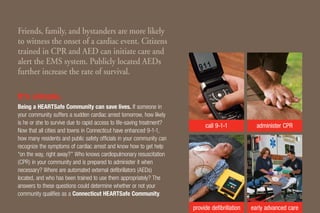
Being a HEARTSafe Community can save lives. If someone in
your community suffers a sudden cardiac arrest tomorrow, how likely
is he or she to survive due to rapid access to life-saving treatment?
Now that all cities and towns in Connecticut have enhanced 9-1-1,
how many residents and public safety officials in your community can
recognize the symptoms of cardiac arrest and know how to get help
“on the way, right away?” Who knows cardiopulmonary resuscitation
(CPR) in your community and is prepared to administer it when
necessary? Where are automated external defibrillators (AEDs)
located, and who has been trained to use them appropriately? The
answers to these questions could determine whether or not your
community qualifies as a Connecticut HEARTSafe Community.
call 9-1-1 administer CPR
provide defibrillation early advanced care
making your community HEARTSafe
The Connecticut Department of Public Health, through its Heart Disease
and Stroke Prevention Program, the Office of Emergency Medical Services
(OEMS), and in collaboration with the American Heart Association, aim to help
Connecticut’s cities and towns improve the chances that anyone suffering a
sudden cardiac arrest will have the best possible chance for survival.
why become a HEARTSafe community?
Cardiovascular disease is the leading cause of death in the nation and Connecticut.
Approximately 4,500 Connecticut residents die each year due to sudden cardiac
arrest. Most of these deaths occur out of the hospital, away from advanced medical
assistance and usually happen in the presence of a family member or friend. Would
you know what to do if it happened to one of your family or friends? The HEARTSafe
Community Program focuses on strengthening each link i­n the cardiac “Chain of
Survival.” By taking action bystanders can­­help save a life in their community by
starting the “Chain of Survival.”
qualifying as a HEARTSafe community
The number of Heartbeats required to become a HEARTSafe Community depends
on the size of your community. The larger the community, the greater the need,
and, therefore, the greater the number of Heartbeats required. HEARTBEATS are
allocated for a variety of activities to strengthen the cardiac “Chain of Survival.” To
become a HEARTSafe Community please review the following criteria; complete the
enclosed application; and mail the application to the Department of Public Health.
HEARTSafe is needed.
The sooner care is provided in a cardiac event,
the better the chance of survival.
Laurie Groh-Germain,
cardiac arrest survivor
& HEARTSafe Champion
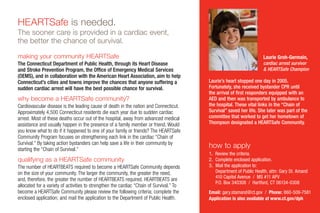
Laurie’s heart stopped one day in 2005.
Fortunately, she received bystander CPR until
the arrival of first responders equipped with an
AED and then was transported by ambulance to
the hospital. These vital links in the “Chain of
Survival” saved her life. She later was part of the
committee that worked to get her hometown of
Thompson designated a HEARTSafe Community.
how to apply
1. Review the criteria.
2. Complete enclosed application.
3. Mail the application to:
Department of Public Health, attn: Gary St. Amand
410 Capitol Avenue / MS #11 APV
P.O. Box 340308 / Hartford, CT 06134-0308
Email: gary.stamand@ct.gov / Phone: 860-509-7581
Application is also available at www.ct.gov/dph
placement of AEDs in the community. These requirements include a
minimum of 60 citizens currently trained in an accredited program and
twelve AED sites in public locations.
Communities of 50,001 to 100,000: If your community population
is between 50,001 and 100,000, 265 Heartbeats* are required
to become a designated HEARTSafe Community. A minimum of 225
Heartbeats is required for CPR or CPR/AED training and placement
of AEDs in the community. These requirements include a minimum of
75 citizens currently trained in an accredited program and fifteen AED
sites in public locations.
Communities of 100,001 to 150,000: If your community population
is between 100,001 and 150,000, 310 Heartbeats* are required
to become a designated HEARTSafe Community. A minimum of 270
Heartbeats is required for CPR or CPR/AED training and placement
of AEDs in the community. These requirements include a minimum of
90 citizens currently trained in an accredited program and eighteen
AED sites in public locations.
*This includes a minimum of 40 HEARTBEATS from the required
criteria of designated first responders, AED equipped first
responder vehicles, advanced life support personnel availability,
and an ongoing process to evaluate and improve the “Chain of
Survival” (see application).
determining your community’s status
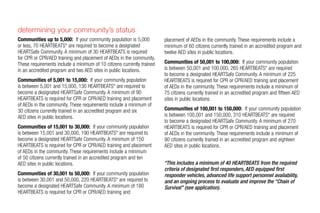
Communities up to 5,000: If your community population is 5,000
or less, 70 Heartbeats* are required to become a designated
HEARTSafe Community. A minimum of 30 Heartbeats is required
for CPR or CPR/AED training and placement of AEDs in the community.
These requirements include a minimum of 10 citizens currently trained
in an accredited program and two AED sites in public locations.
Communities of 5,001 to 15,000: If your community population
is between 5,001 and 15,000, 130 Heartbeats* are required to
become a designated HEARTSafe Community. A minimum of 90
Heartbeats is required for CPR or CPR/AED training and placement
of AEDs in the community. These requirements include a minimum of
30 citizens currently trained in an accredited program and six
AED sites in public locations.
Communities of 15,001 to 30,000: If your community population
is between 15,001 and 30,000, 190 Heartbeats* are required to
become a designated HEARTSafe Community. A minimum of 150
Heartbeats is required for CPR or CPR/AED training and placement
of AEDs in the community. These requirements include a minimum
of 50 citizens currently trained in an accredited program and ten
AED sites in public locations.
Communities of 30,001 to 50,000: If your community population
is between 30,001 and 50,000, 220 Heartbeats* are required to
become a designated HEARTSafe Community. A minimum of 180
Heartbeats is required for CPR or CPR/AED training and
hearbeats requirements - “The Chain of Survival”
CPR, CPR/AED training: The minimum number of citizens trained in CPR or CPR/AED is based upon
community population. The total number of citizens trained is used to accumulate Heartbeats.
Public Placement of AEDs: Permanent placements in public or private areas where many people are likely
to congregate or be at higher risk such as shopping malls, supermarkets, theaters, health clubs, schools,
libraries, town pools or beaches, town halls, sports complexes, convention sites, long-term care facilities, train
and bus stations, and senior centers. Ten (10) Heartbeats are awarded for each location. The minimum AED
Heartbeats total is dependent upon the community population.
Designated First Responders: Each community must have a designated first responder with AED
equipped vehicles and currently certified CPR/AED trained personnel. Ten (10) Heartbeats.
Advanced Life Support: Advanced life support (ALS) personnel (EMT-Intermediates or EMT-Paramedics)
will be dispatched to all ALS medical emergencies. Ten (10) Heartbeats.
Evaluation Process: The community must have an ongoing process to evaluate and improve the “Chain
of Survival.” This involves describing the process by which the community will continue to recruit and train
citizens in CPR and CPR/AED, monitor and maintain AEDs, and possibly expand the availability of training and
AED locations. Ten (10) Heartbeats.
Connecticut Department of Public Health — AIDS and Chronic Diseases Section
Heart Disease  Stroke Prevention Program
J. Robert Galvin, MD, MPH, MBA, Commissioner • www.ct.gov/dph
Community Distribution Center c/o CCfH
3580 Main Street, Building 11, Suite 115,
Hartford, CT 06120-1121 • Tel. 860-251-6620
Produced by Concerned Citizens for Humanity, Ltd. (CCfH)
Design: CCfH © 2009 ccfh	 HSBRO 11/09
program highlights
The HEARTSafe Community program is intended to encourage all communities to strengthen every link in
the cardiac “Chain of Survival” in their community. Heartbeats are earned for CPR training, AED availability,
and pre-hospital advanced life support.
Communities must apply through the Department of Public Health, Heart Disease and Stroke Prevention
Program, by filling out the appropriate Heartbeat Application enclosed. Community is defined as one of the
officially designated 169 municipalities in Connecticut. This application is available through the department
website (www.ct.gov/dph) or by calling the Heart Disease and Stroke Prevention Program at 860-509-7581.
Communities receiving recognition will be entitled to ten road signs (18” x 24”) promoting their community
as a HEARTSafe Community, a certificate and a press release. Stickers (4” x 4”) are also available for public
buildings with AEDs. This is a voluntary and community-driven program. Designation is for three years.
Most communities have citizens trained in CPR/AED and the required number AEDs in public locations.
They just need a Champion to gather the required documentation.
The DPH would like to thank the various fire and
emergency medical responders from Thompson, CT
who participated in the development of this brochure.

Hs brochure

  • 1.
    Become a HEARTSafeCommunity and save lives
  • 2.
    Friends, family, andbystanders are more likely to witness the onset of a cardiac event. Citizens trained in CPR and AED can initiate care and alert the EMS system. Publicly located AEDs further increase the rate of survival. It’s simple. Being a HEARTSafe Community can save lives. If someone in your community suffers a sudden cardiac arrest tomorrow, how likely is he or she to survive due to rapid access to life-saving treatment? Now that all cities and towns in Connecticut have enhanced 9-1-1, how many residents and public safety officials in your community can recognize the symptoms of cardiac arrest and know how to get help “on the way, right away?” Who knows cardiopulmonary resuscitation (CPR) in your community and is prepared to administer it when necessary? Where are automated external defibrillators (AEDs) located, and who has been trained to use them appropriately? The answers to these questions could determine whether or not your community qualifies as a Connecticut HEARTSafe Community. call 9-1-1 administer CPR provide defibrillation early advanced care
  • 3.
    making your communityHEARTSafe The Connecticut Department of Public Health, through its Heart Disease and Stroke Prevention Program, the Office of Emergency Medical Services (OEMS), and in collaboration with the American Heart Association, aim to help Connecticut’s cities and towns improve the chances that anyone suffering a sudden cardiac arrest will have the best possible chance for survival. why become a HEARTSafe community? Cardiovascular disease is the leading cause of death in the nation and Connecticut. Approximately 4,500 Connecticut residents die each year due to sudden cardiac arrest. Most of these deaths occur out of the hospital, away from advanced medical assistance and usually happen in the presence of a family member or friend. Would you know what to do if it happened to one of your family or friends? The HEARTSafe Community Program focuses on strengthening each link i­n the cardiac “Chain of Survival.” By taking action bystanders can­­help save a life in their community by starting the “Chain of Survival.” qualifying as a HEARTSafe community The number of Heartbeats required to become a HEARTSafe Community depends on the size of your community. The larger the community, the greater the need, and, therefore, the greater the number of Heartbeats required. HEARTBEATS are allocated for a variety of activities to strengthen the cardiac “Chain of Survival.” To become a HEARTSafe Community please review the following criteria; complete the enclosed application; and mail the application to the Department of Public Health. HEARTSafe is needed. The sooner care is provided in a cardiac event, the better the chance of survival. Laurie Groh-Germain, cardiac arrest survivor & HEARTSafe Champion Laurie’s heart stopped one day in 2005. Fortunately, she received bystander CPR until the arrival of first responders equipped with an AED and then was transported by ambulance to the hospital. These vital links in the “Chain of Survival” saved her life. She later was part of the committee that worked to get her hometown of Thompson designated a HEARTSafe Community. how to apply 1. Review the criteria. 2. Complete enclosed application. 3. Mail the application to: Department of Public Health, attn: Gary St. Amand 410 Capitol Avenue / MS #11 APV P.O. Box 340308 / Hartford, CT 06134-0308 Email: gary.stamand@ct.gov / Phone: 860-509-7581 Application is also available at www.ct.gov/dph
  • 4.
    placement of AEDsin the community. These requirements include a minimum of 60 citizens currently trained in an accredited program and twelve AED sites in public locations. Communities of 50,001 to 100,000: If your community population is between 50,001 and 100,000, 265 Heartbeats* are required to become a designated HEARTSafe Community. A minimum of 225 Heartbeats is required for CPR or CPR/AED training and placement of AEDs in the community. These requirements include a minimum of 75 citizens currently trained in an accredited program and fifteen AED sites in public locations. Communities of 100,001 to 150,000: If your community population is between 100,001 and 150,000, 310 Heartbeats* are required to become a designated HEARTSafe Community. A minimum of 270 Heartbeats is required for CPR or CPR/AED training and placement of AEDs in the community. These requirements include a minimum of 90 citizens currently trained in an accredited program and eighteen AED sites in public locations. *This includes a minimum of 40 HEARTBEATS from the required criteria of designated first responders, AED equipped first responder vehicles, advanced life support personnel availability, and an ongoing process to evaluate and improve the “Chain of Survival” (see application). determining your community’s status Communities up to 5,000: If your community population is 5,000 or less, 70 Heartbeats* are required to become a designated HEARTSafe Community. A minimum of 30 Heartbeats is required for CPR or CPR/AED training and placement of AEDs in the community. These requirements include a minimum of 10 citizens currently trained in an accredited program and two AED sites in public locations. Communities of 5,001 to 15,000: If your community population is between 5,001 and 15,000, 130 Heartbeats* are required to become a designated HEARTSafe Community. A minimum of 90 Heartbeats is required for CPR or CPR/AED training and placement of AEDs in the community. These requirements include a minimum of 30 citizens currently trained in an accredited program and six AED sites in public locations. Communities of 15,001 to 30,000: If your community population is between 15,001 and 30,000, 190 Heartbeats* are required to become a designated HEARTSafe Community. A minimum of 150 Heartbeats is required for CPR or CPR/AED training and placement of AEDs in the community. These requirements include a minimum of 50 citizens currently trained in an accredited program and ten AED sites in public locations. Communities of 30,001 to 50,000: If your community population is between 30,001 and 50,000, 220 Heartbeats* are required to become a designated HEARTSafe Community. A minimum of 180 Heartbeats is required for CPR or CPR/AED training and
  • 5.
    hearbeats requirements -“The Chain of Survival” CPR, CPR/AED training: The minimum number of citizens trained in CPR or CPR/AED is based upon community population. The total number of citizens trained is used to accumulate Heartbeats. Public Placement of AEDs: Permanent placements in public or private areas where many people are likely to congregate or be at higher risk such as shopping malls, supermarkets, theaters, health clubs, schools, libraries, town pools or beaches, town halls, sports complexes, convention sites, long-term care facilities, train and bus stations, and senior centers. Ten (10) Heartbeats are awarded for each location. The minimum AED Heartbeats total is dependent upon the community population. Designated First Responders: Each community must have a designated first responder with AED equipped vehicles and currently certified CPR/AED trained personnel. Ten (10) Heartbeats. Advanced Life Support: Advanced life support (ALS) personnel (EMT-Intermediates or EMT-Paramedics) will be dispatched to all ALS medical emergencies. Ten (10) Heartbeats. Evaluation Process: The community must have an ongoing process to evaluate and improve the “Chain of Survival.” This involves describing the process by which the community will continue to recruit and train citizens in CPR and CPR/AED, monitor and maintain AEDs, and possibly expand the availability of training and AED locations. Ten (10) Heartbeats.
  • 6.
    Connecticut Department ofPublic Health — AIDS and Chronic Diseases Section Heart Disease Stroke Prevention Program J. Robert Galvin, MD, MPH, MBA, Commissioner • www.ct.gov/dph Community Distribution Center c/o CCfH 3580 Main Street, Building 11, Suite 115, Hartford, CT 06120-1121 • Tel. 860-251-6620 Produced by Concerned Citizens for Humanity, Ltd. (CCfH) Design: CCfH © 2009 ccfh HSBRO 11/09 program highlights The HEARTSafe Community program is intended to encourage all communities to strengthen every link in the cardiac “Chain of Survival” in their community. Heartbeats are earned for CPR training, AED availability, and pre-hospital advanced life support. Communities must apply through the Department of Public Health, Heart Disease and Stroke Prevention Program, by filling out the appropriate Heartbeat Application enclosed. Community is defined as one of the officially designated 169 municipalities in Connecticut. This application is available through the department website (www.ct.gov/dph) or by calling the Heart Disease and Stroke Prevention Program at 860-509-7581. Communities receiving recognition will be entitled to ten road signs (18” x 24”) promoting their community as a HEARTSafe Community, a certificate and a press release. Stickers (4” x 4”) are also available for public buildings with AEDs. This is a voluntary and community-driven program. Designation is for three years. Most communities have citizens trained in CPR/AED and the required number AEDs in public locations. They just need a Champion to gather the required documentation. The DPH would like to thank the various fire and emergency medical responders from Thompson, CT who participated in the development of this brochure.