Grade 6

INTRODUCTION TO
BIBLIOGRAPHY
What is a Bibliography?

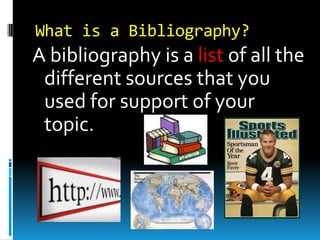
A bibliography is a list of all the
different sources that you
used for support of your
topic.
When do you use a Bibliography?
1. In a report with statistics to show

where you found those facts.
2. In a paper/report that uses a main
idea from an author.
3. In a research paper to show ALL the
different sources required by the
teacher.
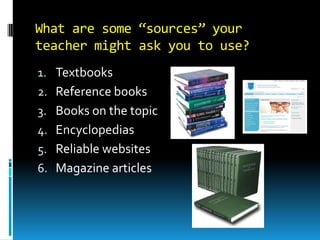
What are some “sources” your
teacher might ask you to use?
1. Textbooks
2. Reference books

3. Books on the topic
4. Encyclopedias
5. Reliable websites

6. Magazine articles
What does it mean to “cite” a
source?
If you “borrow” ideas from a source,
you must give the source credit, or it
is plagiarism.
You “cite” the source by writing it
down in the Bibliography
(or sometimes referred to as
Works Cited).
How many sources should
you use?
This often depends upon your
teacher.
Usually a teacher will give you a
limit such as, “You must use at
least 5 sources.”
What types of sources should be
used?

Once again this will probably
depend upon your teacher,
who will give requirement:
Use at least 1 encyclopedia
Use at least 2 books
Use at least 2 reliable websites
What information do you need
for a book?

Author’s last name, first name. Title of Book.
City of publication: Publishing company,
copyright date.
Preston, George. Fun with Helium. New York:
Watts Publishing Company, 2007.
Always check punctuation!
Double check that you have used correct
punctuation marks.
There is ALWAYS a period at the end of every
entry.
Be sure to indent the second line (if there is one)
of each entry.
What about a reliable website?
“Title of the topic.” Complete website
address. Date accessed. (when you
looked it up)

“Helium.”www.helium/sciencedigest/Loyola.
com. April 28, 2010.
What information is needed for
an encyclopedia?

“Topic Title.” Name of Entire
Encyclopedia. Year of
publication. volume, page(s).
“Helium.” The World Book Encyclopedia.
2008. 6, 98-107.
Other types of entries:
You may find that a book has no author.
Look back at the example for a book. You
would skip the author’s name and simply
begin with the title of the book. Then
continue the rest of the entry with the
information needed for a book.

The many uses of Helium. Boston:
Bradford Publishers, Inc., 2007.
Next Step!

After all resources have been
written down, they must be
alphabetized with the first
letter of the entry.
Alphabetize the following:
“Carbon.” www.sciencejournal.edu. January 28,
2010.
Barthel, Anne. Common Carbon. New York: Dell
Publishers, 2009.
Olson, Joseph. Carbon-dating in Science.
Mankato: Harcourt/Brace Publishing,
2008.
“Carbon.” The World Book Encyclopedia. 2005.
3, 78-91.
3. “Carbon.” www.sciencejournal.
edu.com. January 28, 2010.
1. Barthel, Anne. Common Carbon.
New York: Dell Publishers, 2009.
4. Olson, Joseph. Carbon-dating in
Science. Mankato: Harcourt/Brace
Publishing, 2008.
2.“Carbon.” The World Book
Encyclopedia. 2005. 3, 78-91.
Add correct punctuation:
Encyclopedia entry:

Silicon The Encyclopedia
Britannica 2007 20
118-132
“Silicon.” The Encyclopedia
Britannica . 2007. 20, 118132.
Reliable internet source:

Silicon www.science/
university of UCLA.edu
March 6 2010
“Silicon.” www.science/
university of UCLA.edu.
March 6, 2010.
Book with one author:

Setterberg John The Many
Uses of Silicon Chicago
Braxton Publishers , Inc.
2004
Setterberg, John. The Many
Uses of Silicon .Chicago:
Braxton Publishers , Inc.,
2004.

How to Write a Bibliography

  • 1.
  • 2.
    What is aBibliography? A bibliography is a list of all the different sources that you used for support of your topic.
  • 3.
    When do youuse a Bibliography? 1. In a report with statistics to show where you found those facts. 2. In a paper/report that uses a main idea from an author. 3. In a research paper to show ALL the different sources required by the teacher.
  • 4.
    What are some“sources” your teacher might ask you to use? 1. Textbooks 2. Reference books 3. Books on the topic 4. Encyclopedias 5. Reliable websites 6. Magazine articles
  • 5.
    What does itmean to “cite” a source? If you “borrow” ideas from a source, you must give the source credit, or it is plagiarism. You “cite” the source by writing it down in the Bibliography (or sometimes referred to as Works Cited).
  • 6.
    How many sourcesshould you use? This often depends upon your teacher. Usually a teacher will give you a limit such as, “You must use at least 5 sources.”
  • 7.
    What types ofsources should be used? Once again this will probably depend upon your teacher, who will give requirement: Use at least 1 encyclopedia Use at least 2 books Use at least 2 reliable websites
  • 8.
    What information doyou need for a book? Author’s last name, first name. Title of Book. City of publication: Publishing company, copyright date. Preston, George. Fun with Helium. New York: Watts Publishing Company, 2007.
  • 9.
    Always check punctuation! Doublecheck that you have used correct punctuation marks. There is ALWAYS a period at the end of every entry. Be sure to indent the second line (if there is one) of each entry.
  • 10.
    What about areliable website? “Title of the topic.” Complete website address. Date accessed. (when you looked it up) “Helium.”www.helium/sciencedigest/Loyola. com. April 28, 2010.
  • 11.
    What information isneeded for an encyclopedia? “Topic Title.” Name of Entire Encyclopedia. Year of publication. volume, page(s). “Helium.” The World Book Encyclopedia. 2008. 6, 98-107.
  • 12.
    Other types ofentries: You may find that a book has no author. Look back at the example for a book. You would skip the author’s name and simply begin with the title of the book. Then continue the rest of the entry with the information needed for a book. The many uses of Helium. Boston: Bradford Publishers, Inc., 2007.
  • 13.
    Next Step! After allresources have been written down, they must be alphabetized with the first letter of the entry.
  • 14.
    Alphabetize the following: “Carbon.”www.sciencejournal.edu. January 28, 2010. Barthel, Anne. Common Carbon. New York: Dell Publishers, 2009. Olson, Joseph. Carbon-dating in Science. Mankato: Harcourt/Brace Publishing, 2008. “Carbon.” The World Book Encyclopedia. 2005. 3, 78-91.
  • 15.
    3. “Carbon.” www.sciencejournal. edu.com.January 28, 2010. 1. Barthel, Anne. Common Carbon. New York: Dell Publishers, 2009. 4. Olson, Joseph. Carbon-dating in Science. Mankato: Harcourt/Brace Publishing, 2008. 2.“Carbon.” The World Book Encyclopedia. 2005. 3, 78-91.
  • 16.
    Add correct punctuation: Encyclopediaentry: Silicon The Encyclopedia Britannica 2007 20 118-132
  • 17.
  • 18.
    Reliable internet source: Siliconwww.science/ university of UCLA.edu March 6 2010
  • 19.
  • 20.
    Book with oneauthor: Setterberg John The Many Uses of Silicon Chicago Braxton Publishers , Inc. 2004
  • 21.
    Setterberg, John. TheMany Uses of Silicon .Chicago: Braxton Publishers , Inc., 2004.