How to
Win a DLA
appeal
Making sense of the law and your rights
How to win a DLA appeal  •  www.advicenow.org.uk2
Introduction
This guide is for parents and carers who think the Department
for Work and Pensions (DWP) have made the wrong decision
about their child’s claim for Disability Living Allowance (DLA).
We want to help you get what you are entitled to.
If you made a claim for DLA for a child and you didn’t get the
award that you think they were entitled to, you don’t have to
give up. This guide will help you challenge the decision by
asking the DWP to look at their decision again. This is called a
‘mandatory reconsideration’. If they don’t change the decision
straight away, this guide will show you how to appeal the
decision and win. (You must ask for a reconsideration before
you can appeal). We will also show you how to give yourself the
best chance and how to stop it from getting too stressful.
This guide looks long, but don’t be put off – you will only need
to read one of the coloured sections at each stage.
How to win a DLA appeal  •  www.advicenow.org.uk 3
Contents
How to decide what to do	 4
The process	 9
How to ask the DWP to look at their
decision again	 10
How to ask for an appeal	 15
What to do before the hearing	 18
What to expect at the hearing	 23
What to do on the day	 26
After the hearing	 29
What does it mean?	 30
Useful contacts	 32
How to write useful evidence for DLA	 33
How to write a statement	 35
How to
decide what
to do
How to win a DLA appeal  •  www.advicenow.org.uk4
If you made a claim for DLA, and you
didn’t get the result you had hoped for,
you don’t have to give up. There are
things you can do to challenge the
decision.
How to decide what to do
What is your situation?
You may feel that you
should just give up.
After all, the DWP has said that you
are not entitled, so maybe you’re not.
But they are often wrong. You may
be entitled to a lot more help than
you are getting – and everybody
should get what the law says they
are entitled to. Read How DLA
works on pages 7–8 (or, if you need
more detail, Contact a Family’s guide
to claiming DLA – www.cafamily.
org.uk/know-your-rights/benefits-
and-tax-credits/disability-living-
allowance) to check whether you
should qualify. If you think you
should, ask for a Mandatory
Reconsideration. See page 10 for
our advice. If they don’t change
their decision you should appeal.
You have nothing to lose.
We didn’t get
anything
Read How DLA works on
pages 7–8 (or, if you need
more detail, Contact a Family’s
guide to claiming DLA –
www.cafamily.org.uk/know-
your-rights/benefits-and-tax-
credits/disability-living-
allowance) to check you
understand the rules correctly
for the different rates. If you
think your child requires
enough additional
help to qualify for a
higher rate than
you’ve been given,
you should ask for
a Mandatory
Reconsideration. See page 10
for our advice. If they don’t
change their decision you
should ask for an appeal.
They’ve given us
less than I think
we should get
How to
decide what
to do
How to win a DLA appeal  •  www.advicenow.org.uk 5
You may still have a good case for the amount
you used to get, but you may not have.
It can be hard to tell because your child
may need less help than they did when they
were younger, but so of course do the
non-disabled children
of the same age that
they are being
assessed against.
Because you are
used to it, you may
be underestimating
the amount of extra
care the child needs. If you are in this
position, it is particularly useful to get
advice (and not from the DWP!) See How to
find an adviser on page 6.
If you can’t get to see an adviser, talk it
through with a friend who has a non-disabled
child of the same age. Often this will help
make it clear if you are continuing to provide
substantially more care and supervision
than other children of that age require.
Read How DLA works on pages 7–8 to
check if you are still entitled to the rate you
used to get. If you think you are, you should
ask for a Mandatory Reconsideration. See
page 10 for our advice. If they don’t change
their decision you should appeal.
We had to claim
again and they gave
us less than they
did before
When you ask for a Mandatory
Reconsideration or an Appeal they
look again at the whole award and,
in theory, could lower the award you
have. For example, if you’ve been
given a low rate, it is possible that they
will decide that an error was made and
that you are not entitled to any help
at all. However, this will only happen
if there is evidence that the child
needs less help than the DWP initially
thought. Read How DLA works on
pages 7–8 (or, if you need more detail,
Contact a Family’s guide to claiming
DLA – www.cafamily.org.uk/know-
your-rights/benefits-and-tax-
credits/disability-living-allowance)
to check you understand the rules
correctly for the different
rates. If you feel that your
child easily meets the
criteria for the award they
have received, you can
assume the risk of the
award being lowered is very small.
Usually if the panel is considering
reducing your award at the hearing,
then the chairperson will give you
warning and ask if you want a few
minutes to consider your options.
If this happens, you can ask to stop
the hearing and the Tribunal will not
be able to take away the benefit you
get at the moment.
Might I risk the
award I’ve got?
How to
decide what
to do
How to win a DLA appeal  •  www.advicenow.org.uk6
It is now much harder to find advice and
help with your children’s benefits than it
used to be. You should expect that you
will have to do most of the work yourself
(or with help from your friends or carers
– don’t worry, this guide will show you
what to do, and how to do it). But if you
can get a bit of advice to make sure you
know what rate you should be getting,
it will be really helpful.
Contact a Family run a free helpline
which can tell you what advice
services are available in your area –
0808 8083555. It is open 9.30am–5pm,
Monday–Friday. www.cafamily.org.uk/
our-helpline
If you have no success or can’t get
through, check if your local council has
a welfare rights service. In some cases
they will be able to represent you. Try
the advice services search on Shelter’s
website (see below), phone the council
and ask for ‘welfare rights’, check their
website, or ask in your local library.
There are sometimes services that you
can access through your GP, social
worker, or a service your child receives
support from. There’s no harm in asking
– so call your child’s GP, social worker,
or support service, and ask if there is a
service for you.
Shelter has a search facility of local
advice services on their website. Use
the tabs along the top of the results to
see the different kinds of advice
services. Only some agencies will
provide advice on benefits so check the
areas of law covered by each agency.
http://england.shelter.org.uk/get_
advice/advice_services_directory
Check if there is a Citizen’s Advice
Bureau that helps with benefits
problems near you. Many now offer
advice over the telephone.
www.citizensadvice.org.uk/about-us/
how-we-provide-advice/advice/
search-for-your-local-citizens-advice
You can see if there is an independent
advice agency in your area on Advice
UK’s site. www.adviceuk.org.uk/find-
a-member
Check if there is a Law Centre near you.
www.lawcentres.org.uk/about-law-
centres/law-centres-on-google-
maps/geographically
How to find an adviser
Don’t delay!
You need to act quickly as the time limits can be quite strict. You have one
month from the date of the letter they sent you to ask them to look at it again.
If one month has already passed, you can still ask but they don’t have to
accept it. If the delay was unavoidable or a result of your child’s disability (or
your own), it will help if you explain that. Longer delays will need better reasons.
You can also ask for a mandatory reconsideration or appeal after the deadline
if you have a good chance of winning, but they do sometimes say no. Your
request will only definitely not be accepted if 13 months have passed since
you were sent the decision.
How to
decide what
to do
How to win a DLA appeal  •  www.advicenow.org.uk 7
you have to look at what the criteria
actually are – not what you think would
be fair.
DLA is paid at different rates. What rate
you get depends on what additional
help they need with things like eating,
washing, dressing, learning,
communicating, doing fun things,
or sleeping, and how often.
To get the higher rate for
care, your child must need:
•	substantially more practical help,
encouragement or prompting with
daily living tasks than another child of
their age frequently throughout the
day, and
Whether or not your child is entitled to
DLA is decided on how much more help
they need than other children of their
age, as a result of their disability or
illness. This can be help that other
children of their age don’t need (for
example, if your 14 year old needs help
with getting dressed), or help that
children of their age do need but your
child needs more help or it takes much
longer (for example, if it takes you
30 minutes to get your 5 year old to
brush their teeth, or if you have to spend
long periods of time getting a 3 year old
to settle to sleep). It doesn’t depend on
their diagnosis and it doesn’t matter if
they don’t yet have a diagnosis.
When you are thinking about your case
and whether or not you want to appeal,
How DLA works
Some charities provide advice services
for particular groups – for example,
RNIB have a helpline for Blind and
partially sighted people. www.rnib.org.
uk/services-we-offer-advice-and-
support-services/advice-service
Similarly, the National Autistic Society
has a service for parents or carers of
children with autism. www.autism.org.
uk/services/helplines/welfare-rights.
aspx. Clic Sargent provides advice on
benefits for families of children with
cancer. www.clicsargent.org.uk/
content/understanding-benefits-
system. Check if there is a charity that
provides benefits advice to people with
your child’s illness or disability. If they
provide information on their website
about appealing or claiming DLA,
it may also be very useful as it will
usually show how people with similar
symptoms to your child’s have proven
their entitlement.
If you can’t find an adviser to help, don’t
worry. This guide will tell you everything
you need to know.
It may not be possible, but it is also
worth trying to get help from an
adviser to prepare for the appeal or
even represent you at the appeal.
It can be very upsetting to have to
explain all the difficulties your child
has in detail and so it is usually best
if you are helped by someone more
remote. If you cannot find an adviser
to help you prepare for the appeal,
ask a friend or relative and ask them
to read the relevant bits of this guide.
How to
decide what
to do
How to win a DLA appeal  •  www.advicenow.org.uk8
To get the high rate for
mobility your child must:
•	be at least 3 years of age, and
•	unable to walk or virtually unable to
(for example, if they struggle with
even very short journeys such as
walking around a school), or
•	blind or severely visually impaired, or
•	the exertion of walking would lead to a
serious deterioration of their health, or
•	have a severe mental impairment.
The rules for this category are very strict
and specific. If you are thinking of
challenging a decision because you
think your child is entitled to high rate
mobility, we suggest you either get
advice or look for information about how
children with the same condition have
proven entitlement. For example, The
National Autistic Society has information
about how some children with autism
may be entitled. www.autism.org.uk/
about/benefits-care/benefits/children/
dla-mobility-component.aspx
To get the lower rate for
mobility you child must:
•	be over the age of 5, and
•	need substantially more supervision
or help to go to places they don’t
know than other children their age.
For example, if your child needs to
be prevented from running into the
road (when other children their age
are aware of road dangers), or needs
extra prompting and encouragement
to walk and keep walking.
If you are not sure if your child’s needs
would count towards DLA, see an adviser
or look for information aimed at people
with the same disability or illness that
your child has. Information about how to
fill in a DLA claim form will be very useful,
as it will explain what is counted and the
sorts of things you should focus on.
•	for either at least 20 minutes at night,
or at least 3 times during the night, or
•	someone to keep an eye on them
during the day and night to make
sure they do not hurt themselves or
other people.
To get the middle rate for
care, they must need:
•	substantially more practical help,
encouragement or prompting with
daily living tasks than another child of
their age frequently throughout the
day, or
•	substantially more help than other
children their age for at least
20 minutes at night, or at least three
times at night, or
•	someone with them most of the time
during the day to help them stay
safe, or someone awake and
checking on them at night to help
them stay safe.
To get the lower rate for
care they must need:
•	substantially more practical help,
encouragement or prompting than
other children of their age for at least
one hour or more (in one go or
spread throughout the day).
To count as needing help at night, your
child needs to require a lot more help
than another child of their age at a time
when the rest of the household would
usually be asleep. For example, if you
usually go to bed from 11pm–7am, it
would only count as ‘night’ if it happens
between 11pm–7am. If you would
usually be up, it doesn’t count even
though it is after the child’s bedtime.
DLA also has a ‘mobility
component’ that deals with ability to
walk and go places.
The process
How to win a DLA appeal  •  www.advicenow.org.uk 9
Step 1
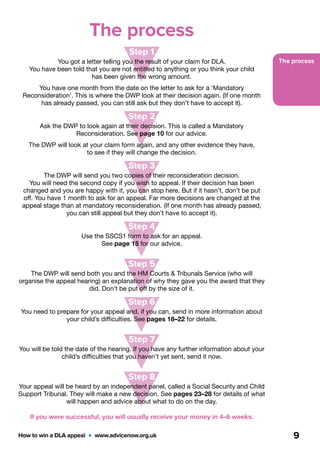
You got a letter telling you the result of your claim for DLA.
You have been told that you are not entitled to anything or you think your child
has been given the wrong amount.
You have one month from the date on the letter to ask for a ‘Mandatory
Reconsideration’. This is where the DWP look at their decision again. (If one month
has already passed, you can still ask but they don’t have to accept it).
Step 2
Ask the DWP to look again at their decision. This is called a Mandatory
Reconsideration. See page 10 for our advice.
The DWP will look at your claim form again, and any other evidence they have,
to see if they will change the decision.
Step 3
The DWP will send you two copies of their reconsideration decision.
You will need the second copy if you wish to appeal. If their decision has been
changed and you are happy with it, you can stop here. But if it hasn’t, don’t be put
off. You have 1 month to ask for an appeal. Far more decisions are changed at the
appeal stage than at mandatory reconsideration. (If one month has already passed,
you can still appeal but they don’t have to accept it).
Step 4
Use the SSCS1 form to ask for an appeal.
See page 15 for our advice.
Step 5
The DWP will send both you and the HM Courts & Tribunals Service (who will
organise the appeal hearing) an explanation of why they gave you the award that they
did. Don’t be put off by the size of it.
Step 6
You need to prepare for your appeal and, if you can, send in more information about
your child’s difficulties. See pages 18–22 for details.
Step 7
You will be told the date of the hearing. If you have any further information about your
child’s difficulties that you haven’t yet sent, send it now.
Step 8
Your appeal will be heard by an independent panel, called a Social Security and Child
Support Tribunal. They will make a new decision. See pages 23–28 for details of what
will happen and advice about what to do on the day.
If you were successful, you will usually receive your money in 4–6 weeks.
The process
How to ask
the DWP to
look at their
decision
again
How to win a DLA appeal  •  www.advicenow.org.uk10
How to ask the DWP to look
at their decision again
You need to ask the DWP to look at their
decision again (called a ‘mandatory
reconsideration’) within one month of
the date on the letter they sent you
about your DLA claim. If one month has
already passed, you can still ask but
they don’t have to accept it. If the delay
was unavoidable or a result of your
child’s disability, it will help if you explain
that. Longer delays will need better
reasons. (It will only definitely not be
accepted if 13 months has passed.)
You can ask for a mandatory
reconsideration over the phone but it is
better to do it in writing.
Try not to put it off. It doesn’t matter if
it’s typed or hand-written, it doesn’t
need to be long, and you don’t have to
use the ‘right language’. We know it’s
hard to know where to start so we’ve
included an example below so that you
can feel more confident about it. The
last two paragraphs (marked with a *)
are optional. The most important thing is
to ask for one within the one month time
limit (if at all possible).
Having said that, if you have access to a
computer and can find the time now, it
is helpful to write a detailed letter on the
computer and keep a copy. This will
mean you have the best chance of
getting the decision changed at this
stage, and you will be able to use the
letter again if you have to ask for an
appeal. This might be particularly useful
if you think you may not have put
enough detail or explained things well
enough on the claim form. Use the
example letter and the guidance in
‘What to put in a Mandatory Request
Letter or Appeal Form’.
If you have any more evidence that you
think will help (for example, a letter from
one of your child’s doctors, or a support
worker or teaching assistant at school)
send that too. It doesn’t have to be a
letter they wrote for this purpose – a
letter from one of your child’s doctors
updating another, or a copy of your
child’s EHCP will also be helpful.
How to ask
the DWP to
look at their
decision
again
How to win a DLA appeal  •  www.advicenow.org.uk 11
Example letter asking for a mandatory reconsideration
[Your address]
[Date]
[Address on the letter the DWP
sent you about your child’s claim]
Dear Sir/Madam
[Your child’s name]
[Date of birth]
Request for a Mandatory Reconsideration
I am writing to ask you to reconsider your decision dated
.................... [Insert the date on the letter the DWP sent you about
the DLA decision] about .................... [insert name of your child]’s
entitlement to DLA. I believe s/he should have got an award of
.................... [the rate you think they should have received].
.................... [insert name of child] has ...........................................
[insert names of any diagnoses or a short explanation of the main
difficulties s/he has day-to-day].
I believe the decision did not properly take into account how
much extra help s/he needs, compared to another child of his/her
age, because of his/her condition.
Please also send me copies of all the evidence used to make
the decision.
* S/he needs more help than another child their age with
.................... [insert details of the things s/he needs extra help
with. See below for guidance].
* I enclose a letter from .................... [insert name] as further
evidence of .................... [insert name of child]’s problems with
.................... [whatever the evidence helps to show].
Yours faithfully,
[Insert your name]
* Delete as appropriate
How to ask
the DWP to
look at their
decision
again
How to win a DLA appeal  •  www.advicenow.org.uk12
What to put in a Mandatory
Request letter or Appeal form
It is most helpful if you explain what your
child needs help with and why. Include
explanations of what happens if your
child doesn’t receive this help.
Remember to explain each time how
this is more help than other children
their age need. (You may find you have
to repeat yourself a lot.)
If your child’s condition varies, explain
what it is like on a bad day and a
better day, and explain how often they
have each.
If your child is on medication to help
with some of their difficulties, make it
clear what care they need even after
having taken the medication. The DWP
can sometimes assume that medication
solves everything. Equally if they are not
on medication because it didn’t work for
them or had awful side-effects, it can be
useful to explain that.
Parents sometimes want to explain the
impact on the rest of their family or their
own health of meeting their child’s
additional care needs. We advise you
not to do this as it is a distraction.
Just explain what extra help your child
needs, and why they need it.
Below we’ve included some of the
things lots of people have difficulty with
to help you think about what you need
to include.
• When they are out
Does your child need more supervision
or help than others of their age when out
and about? For example, this might be
because they need supervision to stop
them acting dangerously and running
into the road. Do you need to hold their
hand or keep them within ‘grabbing
distance’ to help keep them safe?
Do they need supervision because
something might happen (for example,
a seizure or a panic attack)? Do they
need prompting and encouragement to
start walking and keep going? Or do
they need continuous calming and
soothing because of anxious or
obsessive behavior? Or for older
children, do they need extra help and
supervision because they get easily
confused, and could not manage a
journey on their own that others of their
age could?
Do they need more physical help than
others of their age when out and about?
Do they need physical help to walk, or
keep walking or to get up steps?
• Daily care
Does your child need more help with
their daily care needs than other children
their age? This might mean physically
helping them, or encouraging them, or
reminding them, or calming their anxiety
enough so that they are able to get up
or go to bed, get dressed or undressed,
to wash, bathe or shower, or go to
the toilet.
Do they need more help with eating or
drinking?
Or if they need help to take their
medication or do their therapy (including
being encouraged to do it) explain what
help they need and how often they need
the mediation or to do their therapy.
How to ask
the DWP to
look at their
decision
again
How to win a DLA appeal  •  www.advicenow.org.uk 13
Bad day myth
Lots of people believe that you
should describe the help your child
needs on their worst days as if they
need this level of help every day.
This isn’t true. If you do this, it will
look like you are exaggerating and
they won’t believe you when you
are not exaggerating. Instead say
what it is like on a bad day and a
better day, and explain how
frequently your child has both.
• Playing and learning
Do they need extra help with playing or
learning? For example do you need to
spend more time describing things or
explaining everyday objects or ideas?
Do they need more guidance and
supervision to get around the school
and playground, and to take part in PE?
Do they need more encouragement to
take part in games or activities? Do they
need help to stay calm or focussed?
• At school or nursery
Do they need extra help at school or
nursery? What help do they get? If they
don’t get the help they need, explain the
problems this causes. For example, if
your child comes home from school
without having eaten lunch or without
having dressed properly after PE, you
should explain this.
• Having fun
Do they need substantially more help to
do fun things, whether that be a bit of
art and craft at home or going swimming
or to clubs like Brownies? This could be
• Moving about indoors
Do they need extra help moving about
indoors? For example, do they need
help to get in and out of a wheelchair,
or up and downstairs. Or do they need
help because of a visual impairment,
or emotional or behavioural problem?
Maybe they need prompting and
encouragement to move around or help
to move around safely, or maybe they
won’t go to another room unless you go
with them?
How to ask
the DWP to
look at their
decision
again
How to win a DLA appeal  •  www.advicenow.org.uk14
Don’t be put off!
Some people find that that, after
they have put a mandatory
reconsideration request in, they get
a phone call from someone at the
DWP who tries to explain why they
think they have made the right
award. If this happens to you, be
polite but don’t allow them to put
you off.
Some people are also told that they
need to provide further medical
evidence in order to have a chance
of getting the decision changed.
This isn’t true. Anything that gives
information about your child’s
support or care needs can be
relevant. It is also possible to win
an appeal even without any further
evidence or information.
Remember, any advice given to you
about your claims by the DWP may
be incorrect.
If they didn’t change their decision, or
they did but still didn’t give you the
amount you think your child is entitled
to, remember that you can appeal.
You need to tell them within one month.
If one month has already passed you
can still ask for an appeal if you have
good reasons for the delay, but they do
sometimes say no. Your request will only
definitely not be accepted if 13 months
have passed since you were sent the
mandatory reconsideration decision.
See How to ask for an appeal on
page 15.
Don’t be downhearted if they didn’t
change their minds – they often don’t,
even where it appears to be clear that
they are wrong. Most decisions aren’t
changed at this stage, but are changed
when you go to appeal.
help to stay focussed, communicate
with others, manage social interactions,
or to stay calm. Or physical help to get
changed for swimming, for example,
and to get into the pool.
• At night
Do they need substantially more help at
night (while you or the rest of the
household would otherwise be asleep)?
Do they need help calming down and
help to stay in bed? Do they need help
to get to the toilet or supervision to
make sure they don’t get up and do
something that puts them in danger?
Describe what help they need, how long
it takes and how often.
• Keeping safe
Have they ever hurt themselves or put
themselves in danger as a result of their
condition – perhaps because they fell or
had an accident, or hurt themself on
purpose? Or have they ever put
someone else in danger as a result of
their condition – for example, if they
have hurt other people during a
blackout, seizure, meltdown or
‘tantrum’? Have they ever been very
destructive? If they have, you need to
put this down too. It is important that
the DWP know because some of the
help the child needs may be in order to
prevent the same thing happening
again. If it has happened more than
once, tell them how many times similar
things have happened, and how having
somebody with them could have
stopped it happening or helped them
afterwards.
What next?
If you have not heard back after 6
weeks, you should ring them and find
out what is happening.
If they have changed their minds,
congratulations! Your benefit will be
backdated to the date you claimed.
How to
ask for an
appeal
How to win a DLA appeal  •  www.advicenow.org.uk 15
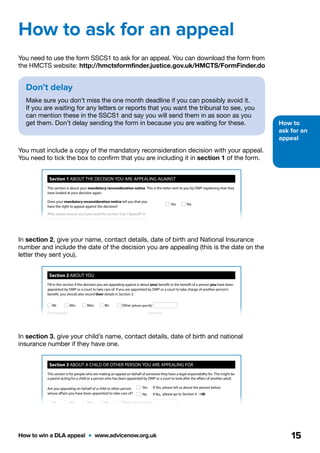
You need to use the form SSCS1 to ask for an appeal. You can download the form from
the HMCTS website: http://hmctsformfinder.justice.gov.uk/HMCTS/FormFinder.do
You must include a copy of the mandatory reconsideration decision with your appeal.
You need to tick the box to confirm that you are including it in section 1 of the form.
In section 2, give your name, contact details, date of birth and National Insurance
number and include the date of the decision you are appealing (this is the date on the
letter they sent you).
In section 3, give your child’s name, contact details, date of birth and national
insurance number if they have one.
How to ask for an appeal
Page 1
Social Security and Child Support
Notice of appeal against a decision of the
Department for Work and Pensions
You should use this form to appeal against a decision made by the Department for Work and Pensions (DWP) about social
security benefits. For decisions regarding child support or child maintenance, you should use form SSCS2. For appeals
regarding recovery of compensation you should use form SSCS3. If you need this form in an alternative format, please
see the note on page 6 of this form.
Further guidance to help you fill in this form is available in booklet SSCS1A 'How to appeal against a decision made by the
Department for Work and Pensions'. You can download the booklet or find out where it can be obtained from by visiting
the justice website www.justice.gov.uk
About this form
This form helps you provide all the information the tribunal requires to register your appeal. It will also ensure that your
appeal contains all the necessary details which the law requires.
How to fill in this form
Please use black ink to fill in this form and use BLOCK CAPITALS unless the form tells you not to.
You must complete Sections 1, 2, 5, 6 and 8
If you want to attend a hearing, you must also complete Section 7
If you are appealing on behalf of someone who a court or DWP has appointed you to act for, you must
also complete Section 3
If you have a representative, you must also complete Section 4
What to include with this form
You must include a copy of the mandatory reconsideration notice which shows the decision you are appealing
against. You do not need to include evidence/information you have already sent to DWP as they will send it to us as part
of their response.
Section 1 ABOUT THE DECISION YOU ARE APPEALING AGAINST
Does your mandatory reconsideration notice tell you that you
have the right to appeal against the decision?
If No, please ensure you have read the section ‘Can I Appeal?’ in
the booklet SSCS1A ‘How to appeal against a decision made by the
Department for Work and Pensions’ before continuing with this form.
Please tick this box to confirm that you have attached a copy of the
mandatory reconsideration notice with your appeal form.
Now go to Section 2
Yes No
SSCS1 - Notice of appeal against a decision of the Department for Work and Pensions (09.13) © Crown copyright 2013
SSCS1
This section is about your mandatory reconsideration notice. This is the letter sent to you by DWP explaining that they
have looked at your decision again.
Remember to include a copy of your mandatory reconsideration notice with your appeal form.
If you do not do so, we will be unable to register your appeal until this is provided.
Please write here the name of the benefit you are appealing about.
The name of the benefit will be shown on the letter giving you the
decision.
Reset form
Print form
Reset form
Print form
Section 2 ABOUT YOU
Mr Mrs Miss Ms Other (please specify)
First name(s) Surname
Now go to Section 3
Address
Postcode
Daytime phone number
Mobile phone number
National Insurance number*
letters numbers letter
Date of birth (DD/MM/YYYY)
/ /
* If you are appealing on behalf of a child or other person and
you have provided their National Insurance number in
Section 3, you do not need to provide your own National
Insurance number.
Section 3 ABOUT A CHILD OR OTHER PERSON YOU ARE APPEALING FOR
Are you appealing on behalf of a child or other person
whose affairs you have been appointed to take care of?
Yes If Yes, please tell us about the person below
No If No, please go to Section 4
Fill in this section if the decision you are appealing against is about your benefit or the benefit of a person you have been
appointed by DWP or a court to take care of. If you are appointed by DWP or a court to take charge of another person’s
benefit, you should also record their details in Section 3.
This section is for people who are making an appeal on behalf of someone they have a legal responsibility for. This might be
a parent acting for a child or a person who has been appointed by DWP or a court to look after the affairs of another adult.
Mr Mrs Miss Ms Other (please specify)
Section 2 ABOUT YOU
Mr Mrs Miss Ms Other (please specify)
First name(s) Surname
Now go to Section 3
Address
Postcode
Daytime phone number
Mobile phone number
National Insurance number*
letters numbers letter
Date of birth (DD/MM/YYYY)
/ /
* If you are appealing on behalf of a child or other person and
you have provided their National Insurance number in
Section 3, you do not need to provide your own National
Insurance number.
Section 3 ABOUT A CHILD OR OTHER PERSON YOU ARE APPEALING FOR
First name(s) Surname
Address (if the person’s address is different from your own)
Are you appealing on behalf of a child or other person
whose affairs you have been appointed to take care of?
Yes If Yes, please tell us about the person below
No If No, please go to Section 4
Fill in this section if the decision you are appealing against is about your benefit or the benefit of a person you have been
appointed by DWP or a court to take care of. If you are appointed by DWP or a court to take charge of another person’s
benefit, you should also record their details in Section 3.
This section is for people who are making an appeal on behalf of someone they have a legal responsibility for. This might be
a parent acting for a child or a person who has been appointed by DWP or a court to look after the affairs of another adult.
Mr Mrs Miss Ms Other (please specify)
National Insurance number
letters numbers letter
Date of birth (DD/MM/YYYY)
/ /
Don’t delay
Make sure you don’t miss the one month deadline if you can possibly avoid it.
If you are waiting for any letters or reports that you want the tribunal to see, you
can mention these in the SSCS1 and say you will send them in as soon as you
get them. Don’t delay sending the form in because you are waiting for these.
How to
ask for an
appeal
How to win a DLA appeal  •  www.advicenow.org.uk16
Page 4
Section 5 ABOUT YOUR APPEAL
Grounds for appeal
In this section we need to know why you are appealing. Please write down in your own words the reasons why you
disagree with DWP’s decision. You do not have to use BLOCK CAPITALS in this section if your handwriting is clear. If you
do not complete this section this will delay dealing with your appeal and the appeal form may be returned to you. For
more information on grounds for appeal please refer to the ‘About Your Appeal’ section of the guidance booklet SSCS1A.
Is your appeal in time?
According to the law, your appeal must be received by the tribunal no later than one calendar month after the date the
mandatory reconsideration notice was sent to you. If your appeal is received after this date, it is a late appeal and the
tribunal will need to know why it is late.
Is your appeal late? Yes If Yes, you must give reasons below why your appeal is late
No If No, please go to Section 6
If your appeal is late, you must give an explanation why. The tribunal will consider your reasons and can extend the time
limit for you. If you do not give reasons why your appeal is late your appeal form may be sent back to you. Please tell us
below why your apeal is late. You do not need to use BLOCK CAPITALS.
Now go to Section 6
(if necessary, continue on a separate sheet)
The Department for Work and Pensions has the right to object to a late appeal. The tribunal will consider any objection
they make and we will let you know the outcome.
Page 3
Section 4 ABOUT YOUR REPRESENTATIVE (If you have one)
Do you have a representative? Yes If Yes, please tell us about the person below
No If No, please go to Section 5
First name Surname
Name of organisation or of person representing
Address
Postcode
Now go to Section 5
Phone number
If you are being represented by an organisation and you know the
name of the person acting on your behalf, please tell us below
This section is about your representative (if you have one).
By representative we mean someone acting on your behalf in a formal capacity. This might be an organisation like
the Citizens Advice Bureau or a welfare rights service or it may be a friend or advisor who knows about social security
matters. If you name a representative here and give your signature at Section 8, this will authorise us to deal with your
representative about your appeal. If you are unsure about this, please read the section ‘About Your Representative’ in the
guidance booklet SSCS1A.
Mr Mrs Miss Ms Other (please specify)
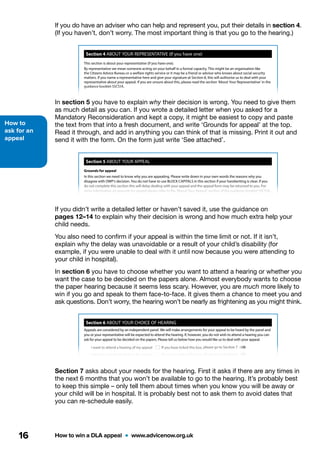
If you do have an adviser who can help and represent you, put their details in section 4.
(If you haven’t, don’t worry. The most important thing is that you go to the hearing.)
In section 5 you have to explain why their decision is wrong. You need to give them
as much detail as you can. If you wrote a detailed letter when you asked for a
Mandatory Reconsideration and kept a copy, it might be easiest to copy and paste
the text from that into a fresh document, and write ‘Grounds for appeal’ at the top.
Read it through, and add in anything you can think of that is missing. Print it out and
send it with the form. On the form just write ‘See attached’.
If you didn’t write a detailed letter or haven’t saved it, use the guidance on
pages 12–14 to explain why their decision is wrong and how much extra help your
child needs.
You also need to confirm if your appeal is within the time limit or not. If it isn’t,
explain why the delay was unavoidable or a result of your child’s disability (for
example, if you were unable to deal with it until now because you were attending to
your child in hospital).
In section 6 you have to choose whether you want to attend a hearing or whether you
want the case to be decided on the papers alone. Almost everybody wants to choose
the paper hearing because it seems less scary. However, you are much more likely to
win if you go and speak to them face-to-face. It gives them a chance to meet you and
ask questions. Don’t worry, the hearing won’t be nearly as frightening as you might think.
Section 7 asks about your needs for the hearing. First it asks if there are any times in
the next 6 months that you won’t be available to go to the hearing. It’s probably best
to keep this simple – only tell them about times when you know you will be away or
your child will be in hospital. It is probably best not to ask them to avoid dates that
you can re-schedule easily.
Section 6 ABOUT YOUR CHOICE OF HEARING
I want to attend a hearing of my appeal If you have ticked this box, please go to Section 7
I want my appeal decided on the papers If you have ticked this box, please go to Section 8
Section 7 THE HEARING — YOUR NEEDS AND REQUIREMENTS
You only need to answer these questions if you told us in Section 6 that you wanted to attend a hearing. If you have
asked for your appeal to be decided on the papers, please skip this section and go straight to Section 8.
In this section we need to ask you a number of questions to help us arrange a suitable hearing for you. We will try to
accommodate your needs and availability, but it may not always be possible to do this. Please answer questions 1 to 4 to
give us the information we require. If you do not answer some of the questions we will have to contact you again and this
may delay your appeal. You do not have to answer these questions using BLOCK CAPITALS.
Question 1 – Your availability
Tribunal hearings are held Monday to Friday from 10am to 5pm and in our larger hearing centres also on Saturday.
To allow you to attend your hearing, we will try to arrange a time and date in line with your availability. It is important
that you tell us here if there are any days of the week or times of the day when you cannot attend a tribunal or any dates
when you are unavailable because of things like booked holidays and hospital appointments. You should consider your
Appeals are considered by an independent panel. We will make arrangements for your appeal to be heard by the panel and
you or your representative will be expected to attend the hearing. If, however, you do not wish to attend a hearing you can
ask for your appeal to be decided on the papers. Please tell us below how you would like us to deal with your appeal.
If you change your mind about this, you must tell us as soon as possible as it may be too late to change this once the
hearing has been arranged. For more information, please refer to the ‘About Your Choice of Hearing’ section in the
guidance booklet SSCS1A.
How to
ask for an
appeal
How to win a DLA appeal  •  www.advicenow.org.uk 17
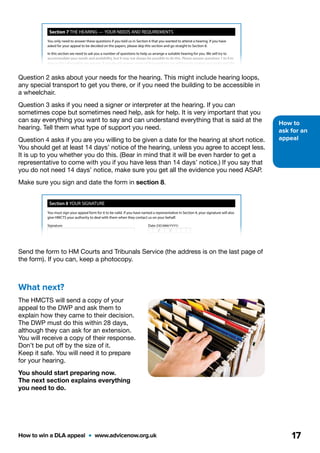
Question 2 asks about your needs for the hearing. This might include hearing loops,
any special transport to get you there, or if you need the building to be accessible in
a wheelchair.
Question 3 asks if you need a signer or interpreter at the hearing. If you can
sometimes cope but sometimes need help, ask for help. It is very important that you
can say everything you want to say and can understand everything that is said at the
hearing. Tell them what type of support you need.
Question 4 asks if you are you willing to be given a date for the hearing at short notice.
You should get at least 14 days’ notice of the hearing, unless you agree to accept less.
It is up to you whether you do this. (Bear in mind that it will be even harder to get a
representative to come with you if you have less than 14 days’ notice.) If you say that
you do not need 14 days’ notice, make sure you get all the evidence you need ASAP.
Make sure you sign and date the form in section 8.
Send the form to HM Courts and Tribunals Service (the address is on the last page of
the form). If you can, keep a photocopy.
What next?
The HMCTS will send a copy of your
appeal to the DWP and ask them to
explain how they came to their decision.
The DWP must do this within 28 days,
although they can ask for an extension.
You will receive a copy of their response.
Don’t be put off by the size of it.
Keep it safe. You will need it to prepare
for your hearing.
You should start preparing now.
The next section explains everything
you need to do.
Page 6
Question 4 – Your notice of hearing
We will usually give you at least 14 days’ notice of the date of the hearing. If you agree, we can also give you less than
14 days’ notice. This may allow the hearing to be arranged more quickly if, for example, another hearing is cancelled and
yours can replace it at short notice.
Do you agree to receiving less than 14 days’ notice of a hearing? Yes No
Now go to Section 8
Section 8 YOUR SIGNATURE
Signature Date (DD/MM/YYYY)
/ /
Name
If you are a representative signing this form on behalf of the person who is appealing, you must send their signed
authority for you to act on their behalf with this form.
You must sign your appeal form for it to be valid. If you have named a representative in Section 4, your signature will also
give HMCTS your authority to deal with them when they contact us on your behalf.
WHAT TO DO NOW
You need to send your appeal form and a copy of the mandatory reconsideration notice to HM Courts  Tribunals
Service.
If you live in England or Wales send your appeal to:
HMCTS SSCS Appeals Centre
PO Box 1203
BRADFORD
BD1 9WP
If you live in Scotland send your appeal to:
HMCTS SSCS Appeals Centre
PO Box 27080
GLASGOW
G2 9HQ
We will send you a letter to tell you we have received your appeal and explain what happens next.
CHECKLIST
You may find this checklist useful to help you make sure you have given all the information we need.
I have included a copy of the mandatory reconsideration notice (Section 1)
I have given grounds for my appeal (Section 5)
I have chosen the type of hearing I want (Section 6)
I or my representative have signed my appeal form (Section 8)
Alternative Formats
If you need this form in an alternative format, for example in large print or Welsh, please call
0300 123 1142 if you live in England or Wales and 0141 354 8400 if you live in Scotland
Reset form
Print form Reset form
Print form
Page 5
I want my appeal decided on the papers If you have ticked this box, please go to Section 8
Section 7 THE HEARING — YOUR NEEDS AND REQUIREMENTS
You only need to answer these questions if you told us in Section 6 that you wanted to attend a hearing. If you have
asked for your appeal to be decided on the papers, please skip this section and go straight to Section 8.
In this section we need to ask you a number of questions to help us arrange a suitable hearing for you. We will try to
accommodate your needs and availability, but it may not always be possible to do this. Please answer questions 1 to 4 to
give us the information we require. If you do not answer some of the questions we will have to contact you again and this
may delay your appeal. You do not have to answer these questions using BLOCK CAPITALS.
Question 1 – Your availability
Tribunal hearings are held Monday to Friday from 10am to 5pm and in our larger hearing centres also on Saturday.
To allow you to attend your hearing, we will try to arrange a time and date in line with your availability. It is important
that you tell us here if there are any days of the week or times of the day when you cannot attend a tribunal or any dates
when you are unavailable because of things like booked holidays and hospital appointments. You should consider your
availability for the six months ahead.
Are you available to attend a hearing at
any time?
Yes
No If No, please tell us when you cannot attend in the box below
Question 2 – Your needs
Please tell us here about any special needs you may have which we need to take into account when arranging your hearing.
This might be things such as hearing loops or disability access.
Do you have any special needs? Yes If Yes, please tell us about this in the box below
No
Question 3 – Your signer or interpreter and language requirements
Do you require an interpreter or signer to assist you at the hearing?
Yes If Yes, please tell us the language and dialect required below
No
Language or type of sign language interpreter Dialect
If you change your mind about this, you must tell us as soon as possible as it may be too late to change this once the
hearing has been arranged. For more information, please refer to the ‘About Your Choice of Hearing’ section in the
guidance booklet SSCS1A.
We will arrange for a professional interpreter to be present at the hearing. Please refer to the section ‘Completing
form SSCS1’ in the guidance booklet SSCS1A for more information about interpreters.
What to do
before the
hearing
How to win a DLA appeal  •  www.advicenow.org.uk18
What to do before
the hearing
There are a lot of things for you to do
over the next few months. It is important
to start preparing as soon as you can.
Some things can take a long time.
If you have not already tried to get help
and advice do so now (See How to find
an adviser on page 6). Some advisers
may be able to help do some of this
preparation for you. If you are lucky
enough to find someone who can help
with the preparation, make sure you are
clear which things your adviser is going
to do for you, and which you need to
do yourself.
When will the hearing be?
Usually you won’t get told the date of
the hearing until 2–3 weeks before (you
should be given at least 14 days’ notice
unless you agreed to be given less on
the form). However, it is useful to know
how long you have to prepare for your
appeal. You can phone the tribunal
centre dealing with your appeal and ask
them. They will be able to give you a
rough idea. You may get re-routed to a
call centre who then asks the tribunal
centre to call you back later.
Getting help
If you are not getting any professional
help to prepare for the hearing, you
might want to ask somebody else to
help you. You may not need any help,
but it might stop it from feeling too
stressful. This is particularly useful if you
are not very good with paperwork or
deadlines. If you do think it might be
useful, think about who you could ask
– do you have a family member, friend,
or someone who helps you who is good
with paperwork and organising things?
Support groups
Online and other support groups
can sometimes be very helpful.
There may be other people who
have had the same problems getting
DLA for their children, who can give
you emotional or practical help.
The papers from the DWP
Look at the big pack of papers that you
were sent by the DWP explaining why
they made the decision they did. Many
people get very confused by the
inclusion of test cases at the beginning.
Don’t let them put you off. If you don’t
have time to become an expert on all
the legal ins and outs of DLA decisions,
ignore these.
What to do
before the
hearing
How to win a DLA appeal  •  www.advicenow.org.uk 19
The best evidence will come from
people who know your child well and
who understand their situation. If your
child’s paediatrician or GP does not
know them well, you should still ask
them for evidence, but try to get
evidence from other professionals who
know them better. This could be another
doctor, or other healthcare professional,
or somebody who helps your child
at school.
The most useful evidence will explain
how your child’s illness or disability
affects them, and the help they need.
This is quite unusual, so your doctor or
therapist may not understand that. Look
at pages 33–34. This is a guide for your
child’s doctors, therapists, school staff,
or anybody else writing evidence for
them. When you ask them for evidence
to support the appeal, show them this
page. It will help them to write evidence
that will be really helpful to you.
Before you ask anybody
for evidence – read this!
You are appealing the decision
the DWP made on a particular date
(on the top of the letter). You need
to prove how your child’s condition
was at that time, not how it is now.
Write the date of the decision
you are appealing in the box on
page 33, before you ask anybody
for evidence. Then show them
pages 33–34.
The most important parts are the bits
about your child. Read through it and
look for anything you don’t agree with.
If your child had a medical assessment
did the assessor ask you the right
questions and listen to your answers?
If their illness or disability is better or
worse on different days, did the doctor
understand that? If there is a report from
your child’s school, does it give a fair
picture of your child? School staff tend
to be wonderfully positive about
children’s abilities and progress and
sometimes the DWP fail to understand
the context (for example, that your child
is making progress but that this is
because they receive one-to-one help or
are in a specialist school). School staff
have usually been accurate but the
limited nature of the form often leads to
the DWP giving the wrong award. Make
a note of all the things that are wrong.
If you can, say why they are wrong. You
can include this in your statement to the
tribunal. Also think about how you could
get further evidence (from the school for
example) that would give a fairer picture.
Check also that everything you want
the tribunal to read is in the papers.
If anything is missing, send in a copy
before the hearing. Don’t assume that
the appeal panel will have access to
evidence used in previous claims. If it
isn’t included in these papers from the
DWP, the appeal panel won’t see it
unless you send it in.
Getting evidence
For most people, the thing that is of
most help is written evidence from their
child’s paediatrician, support staff, or
school staff. If your child sees a
psychologist, physiotherapist, an
occupational or speech and language
therapist, other healthcare professional,
or has a social worker, evidence from
them will often be very useful too. If your
GP knows your child well, evidence from
them is likely to be very helpful too.
What to do
before the
hearing
How to win a DLA appeal  •  www.advicenow.org.uk20
Evidence you already have
Think too about what evidence you
already have. Do you have reports of
physiotherapy, occupational health, or
psychological assessments? Do you
have copies of letters that the different
doctors and therapists have sent to
each other? Does your child have an
Education, Health and Care Plan (EHCP
– this is the new name for a ‘Statement’)?
Did you have a needs assessment from
the local council? They are likely to be
very helpful.
Or is there other evidence you could get
easily? For example, if your child is
registered as blind or partially sighted,
you can get a copy of their registration
from the social services. These usually
detail how much your sight is impaired
and so are very useful.
Evidence from somebody
that helps your child
regularly
If there is somebody who helps your
child a lot (this might be someone who
helps them at school, a support worker,
or paid carer), they may be able to write
some very useful evidence too. Ask
them to write a letter to the tribunal
Paying for medical
evidence
GP’s and other medical professionals
are allowed to charge for evidence.
However, many won’t do this if they
know you cannot afford it.
If your doctor suggests that he or
she will charge you, tell them that
you only need a brief note from
them, and that it could be hand-
written if this is quicker. Reassure
them that it will only take the time
of an appointment. Show them
pages 33–34 – so that they are sure
of what you need from them.
If they insist on charging you, think
carefully about it. If it helps to get
you more benefit, it will have been a
good investment. But often the
reason they are insisting on
charging you is that they really
don’t want to do the letter, so if
they write one they may not try very
hard and it may not be very helpful.
If you are considering paying, ask
them to confirm that they will write
a genuinely helpful letter following
the guidance on pages 33–34.
What to do
before the
hearing
How to win a DLA appeal  •  www.advicenow.org.uk 21
For more advice on how to write a
statement and what to put in it, see
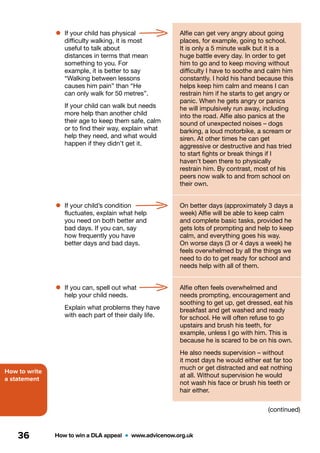
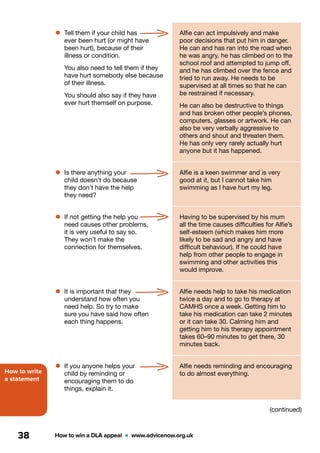
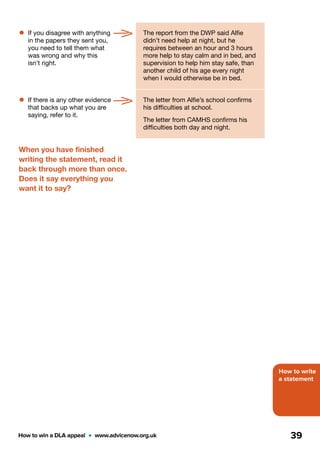
How to write a statement on page 35.
You can also read Andrea’s statement
about Alfie and see what she put in hers.
What to do with the
evidence
Read all the evidence through – does it
support your case? If it doesn’t, you
don’t have to send it to the panel (but if
they ask if you had any evidence you
didn’t send them, you have to tell the
truth). If you don’t think the evidence
is useful it may be worth going back to
the person who wrote it and discussing
it with them. Is there anything they
can add?
If you’ve got useful evidence, photocopy
it and send it into the HM Courts and
Tribunal Service before your hearing.
Ideally, send it at least a week in
advance. On the day of your hearing,
take your copies with you, and ask
the panel to confirm that they have
received them.
panel explaining what help they give
your child and how often. Show them
the guidance on pages 33–34 – it may
help them to remember everything.
If they would prefer they can keep a
diary of the help they give instead
(see below).
Diary
You should think about keeping a diary
of the extra help you give your child
each day. It will help the tribunal panel
to get a proper understanding of the
situation. It is particularly helpful if your
child’s condition isn’t the same every
day. Keep a diary for a month if you can
(but a shorter time will also be helpful). It
can be very brief. For example –
“Monday – Shaking very bad
today. She needed help to
fasten her clothes, and get
downstairs. Couldn’t walk to
school so had to take her in car.
Needed soothing and physical
help to get to car.”
If you are appealing a decision which
relates to your child’s ability to walk it is
a good idea to record how far they are
able to walk without severe discomfort,
and how long it takes them. The tribunal
will often ask quite specific questions
about how far they are able to walk.
Write a statement
If you (or someone who could help you)
are good with writing, you should think
about writing a statement. These can be
very useful as they set out all the points
you want to make, which means that
you don’t have to remember everything
to say on the day. They also give the
panel time to think about what you’ve
said and why your child should be
getting a higher rate, before they meet
you. If you can, send it in in advance.
What to do
before the
hearing
How to win a DLA appeal  •  www.advicenow.org.uk22
The clerk will help you fill in a claim form
when you go to the hearing. Make sure
you take receipts for your travel and
lunch. If you have lost earnings, make
sure you have a letter from your employer
confirming this.
Contact the tribunal before the hearing
if you need help.
Make notes of all the things
you want to say on the day
This is really useful and also stops the
hearing or the preparation for it from
getting too stressful. Every time you
think of something they got wrong or
you don’t think they properly
understood, make a quick note of it.
Remember to take these with you to the
hearing so that you can tick them off as
you say them. This might be particularly
useful if you haven’t written a statement.
Work out how you will get
to the hearing
Work out how you will get there and how
long it will take the day beforehand. The
last thing you need is to add to your
stress by getting lost, not being able to
park, or being late.
Arrange childcare
It is best not to take your children to the
hearing with you. In fact, if they are with
you, they will usually not be allowed into
the hearing. Organise childcare for the
time of the hearing, and try to leave
yourself plenty of time so that you don’t
have a problem if the hearing is delayed
(it often will be). If it will cost you,
get a note from the carer/childminder
confirming their rate – you will be able to
reclaim expenses up to the national
minimum wage.
Work out what you need to
claim expenses
You can claim travel expenses for the
day of the hearing if you use public
transport or travel by car. You can also
claim for a meal if you are away for more
than five hours. If you have to take time
off work, you may also be able to claim
expenses for loss of earnings. And if you
have had to pay a carer or childminder
you can claim expenses up to
the National Minimum Wage for the time
you have been away.
Before you go to your hearing, check
what the current rules on expenses are
on GOV.UK – www.gov.uk/social-
security-child-support-tribunal/what-
happens-at-the-hearing
What to
expect at
the hearing
How to win a DLA appeal  •  www.advicenow.org.uk 23
What to expect at
the hearing
You can go alone or take a friend or
family member with you for moral
support. It is best not to take the child
the hearing is about with you, indeed if
you do take them they often won’t be
allowed in to the hearing. (This is
because the panel want to be able to
frankly discuss the child’s needs without
worrying about the emotional impact on
the child of hearing it.)
When you arrive at the tribunal centre
you will usually be shown into a waiting
room. You might have to wait here for a
little while. When the panel is ready for
you, you will be called into the room.
Sometimes the tribunal will decide the
case in your favour just on the evidence,
statement, or your explanation on the
appeal form. If this happens they may
ring you the day before the hearing or
tell you when you arrive that they have
decided to give you the award that you
asked for and so don’t need the hearing
to go ahead.
When you go into the room (it looks like
a big, empty office) there will be a big
table in front of you. You (and anyone
who goes with you) will sit at one side of
the table and the panel will sit on the
other side.
The person that sits in the middle of
the panel is the Chair or Judge.
They are a solicitor who should know a
lot about benefits. One of the other
panel members is a doctor; the other is
someone who knows a lot about
disability. At least two of the three of
them have to agree to the decision.
The panel should introduce themselves
and explain what will happen.
Remember the panel does not work for
the DWP. They are here to see that you
get the benefit if you can show your
child is entitled to it.
Usually the three members of the panel
will be nice and easy to talk to, and will
just want to get a full picture of your
child’s disability and the help you need.
However, you might be very unlucky and
get a hostile panel member, or just one
having a bad day. If this happens, try to
keep calm. Don’t take it personally. Stick
to what you wanted to say, and answer
their questions fully. It is ok to tell them
that you feel they are acting a bit
aggressively – they might not realise
that it is upsetting you, and they might
stop if you tell them.
If you get upset at any point you can ask
for a short break.
The DWP has a right to send somebody
to your appeal to explain
why they made their
decision. Don’t worry
about this though. If they
do send someone, they
are usually very nice and
non-confrontational. It will
not be the person that
made the original decision
about your claim.
If you do get some of the
benefit already and are
asking for a higher rate,
you can ask for the
hearing to be stopped at
any time. If you do this, the Tribunal will
not be able to take away the benefit you
get at the moment. Usually if the panel
is considering a reduction of an existing
award then the chairperson will give you
warning and ask if you want a few
minutes to consider your options.
What to
expect at
the hearing
How to win a DLA appeal  •  www.advicenow.org.uk24
Your hearing might be
postponed or delayed
In some areas, hearings are often
postponed. This might be because
the panel are unexpectedly not
available to hear your appeal.
Hopefully this won’t happen to you,
but it is possible that you will
arrive to find that you have had a
wasted journey.
At other times appeals are delayed
in order to get more evidence. This
can be frustrating, but it is often
better in the long run as the tribunal
will have more information to base
their decision on. Sometimes it also
means that the Tribunal will pay for
expensive medical reports that you
have not been able to afford.
At the end of the hearing
The panel will usually make the decision
that day. You will be asked to go to the
waiting room while the panel discusses
your case. This usually takes between
10–30 minutes. You will then be asked
back into the room and told the
decision. They will give you a written
outline of their decision as well.
Sometimes the panel will not be able to
make a decision quickly. If this happens,
they will post it to you instead. It should
arrive within a week.
If you can’t
go on the
date they give you, contact the
tribunal centre and ask for another
date as soon as you can. Don’t put
it off or just do nothing about it
– they are usually extremely
helpful. You may have to explain
why you can’t go and you should
have a very good reason, like a
hospital appointment.
It is a good idea to follow up the
phone call with a letter and to keep
a copy – that way, if anything goes
wrong, you can prove you told them.
If you leave it until the last minute,
they may not change the day and
the appeal might happen whether
you are there or not. If they refuse
to change the date, you should do
everything you can to move your
other appointment.
You can ask for a postponement
but you’ll need to give a good
reason. For example if you are waiting for a particular letter
or report that you want to provide, explain why it is
important for the tribunal to see it and say when you think
you will be able to send it in.
I have been
sent a date for
the hearing –
I can’t go!
I’ve been given a
date for the hearing
but am not ready yet
What to
expect at
the hearing
How to win a DLA appeal  •  www.advicenow.org.uk 25
Rob’s story
I had to appeal my daughter’s DLA decision after it got put down
to only the low rate of care. Suzy has a visual impairment and
learning difficulties and needs help day and night.
I didn’t want to go to the hearing. I was nervous and I didn’t want
to take yet another day off work, but I’d been told we would have
a much better chance if I did.
It was quite a long wait but once it got started it was all right.
They introduced themselves and explained what was going to
happen. They were quite friendly.
They asked me what help Suzy had needed this morning.
I explained she had been really tired because she was up half the
night. She has night terrors and takes a long time to calm down.
I explained how I’d had to do most of her dressing for her, and
brushed her teeth but she can wash her face and brush her hair
herself. I explained the help she needs to have breakfast and
what a battle it is sometimes to get her to eat anything. I tried to
remember to explain why that was more than most nine year olds
need. I went into quite a lot of detail, even talking about helping
her put her seat belt on and the things I do to stop her taking it
off while we’re going along.
I’d made a list of all the things she needed extra help with and
kept it in my hand. At the end I asked them to wait for a few
seconds so I could check I’d said everything. When I had, they
asked me to go back to the waiting room.
When they called me back in, they told me that they had given
me high rate care and low rate mobility. We went out for pizza
and a new toy to celebrate!
Rob, 41
What to do
on the day
How to win a DLA appeal  •  www.advicenow.org.uk26
What to do on the day
What to take with you
on the day
•	If you have written a statement,
take a copy.
•	Any notes you have written of
the things you want to say.
•	Take copies of any evidence you
have sent in beforehand.
•	If you have any new evidence
that you think will be useful
that you haven’t already sent in,
take that and hand it in when
you arrive.
•	Receipts for your travel and
lunch, a letter from your
employer if you have lost
earnings, and proof of childcare
costs if you have had to pay for
childcare. See Work out what
you need to claim expenses
on page 22 for more details.
•	You can take a friend or relative
to the appeal with you. If you
have asked somebody to come
with you to give you support,
show them the information in
the box below. It explains what
they can do to help.
•	If you think it might help, ask a friend
or family member to come with you
for emotional support. They might
also be able to help by reminding you
of things you have forgotten. If you
do ask a friend, show them the box
‘For friends and relatives’ on page 28.
•	Make sure you arrive in plenty
of time.
•	The panel may be running late and
so you might have to wait. If you
have made any notes of what you
want to say, go over them. Try to
keep calm. Have a snack in your bag
in case you get hungry. There will
usually be water available.
•	Many people find they get very
emotional at the hearing. It doesn’t
matter if you get upset. It won’t make
any difference to your chances.
Remember, you can ask for a break
to calm down.
•	If you had asked for any help with
communication or translation and it
is not available, you should insist on
having the hearing another day.
What to do
on the day
How to win a DLA appeal  •  www.advicenow.org.uk 27
•	Try to answer every question as
broadly as you can. If you just give
short answers, the panel won’t be
able to get a better understanding of
your situation. So try to give longer
answers and be willing to explain
things. For example, if they ask if
your child needs extra help to get
washed in the morning, don’t just say
yes or no. Tell them if they do, what
they need help with, how long it
takes you, and if they need help with
anything else in the morning.
•	If you find you haven’t said
everything you want to say because
they haven’t asked the right question
– tell them anyway. It is important
that you say everything. A clever
tactic is to make notes about what
you want to tell them and tick them
off as you say them. Make sure that
they are all ticked off before you
leave. If you need to, you can ask
them to wait a moment while you
check your notes. If you have taken
somebody with you for moral
support, this is a very useful thing for
them to do.
•	If your child’s condition goes up and
down and they need different
amounts of help on different days,
you will need to make this clear.
It is best if you can say roughly how
often you need help with each thing,
rather than saying ‘sometimes’.
For example, ‘David’s condition is
bad for three weeks out of every four.
For those weeks his joints are very
painful and he cannot walk very far or
stand’. If you have kept a diary of the
help your child needs (see page 21)
you should be able to use that to
work out how often they need help
with different tasks.
•	If you sent them any evidence
before the hearing, check that they
received it.
•	If you don’t understand a question
ask them to repeat it or put it another
way. If you still don’t understand, tell
them that.
•	If they say something that isn’t right,
make it clear that it is not true. For
example, if they say “He doesn’t
have much trouble with walking does
he?” make it clear if your child does
have trouble with walking.
•	Don’t worry about using the ‘right’
language or ‘buzz words’. It is much
better to use your own words. If you
think they haven’t understood
something you have said, say it again
in a different way.
•	Don’t make light of the problem. It’s
tempting to gloss over the difficulties
your child has but you will only harm
your case if you do. Be as frank as
you can be.
•	Try to make sure you don’t
exaggerate the problems that your
child has either. If you do this, the
panel might not believe you when
you are not exaggerating.
•	Parents often want to explain the
impact of meeting the extra care
needs their child has on the rest of
their family or their own health. Try
not to do this as it is a distraction.
Just explain what extra help your
child needs and why they need it.
What to do
on the day
How to win a DLA appeal  •  www.advicenow.org.uk28
For friends or relatives
If someone has asked you to go
with them to the hearing to give
them support, there are several
things that you could do that would
be very useful.
•	Before the hearing, sit down
with your friend and write a list
of all the help their child needs.
Take it with you on the day and
tick them off as they are said.
If at the end of the hearing there
are still things that haven’t been
said – you can remind them.
•	Try not to answer questions on
your friend’s behalf. If you realise
that your friend has left bits out
when answering a question – try
to remind them, rather than say
it for them. However, if they are
finding it difficult or becoming
very emotional you can answer
the question yourself (although it
is best to ask the Tribunal Judge
if it is OK first, just to be polite).
•	If they get upset or stressed
you can try to calm them down.
If this doesn’t work, ask them if
they want a short break.
•	Read through this leaflet
(particularly the sections about
the hearing and what to do on
the day). This will help you to
know what will happen so that
you can help your friend.
After the
hearing
How to win a DLA appeal  •  www.advicenow.org.uk 29
After the hearing
The tribunal panel will tell the DWP their
decision and you’ll get an official notice
of the decision.
If you were successful, the DWP will
work out how much they owe you. You
will start receiving the new amount every
month, and a sum covering the amount
they should have been paying you all
along. You will usually receive your
money in about 4–6 weeks.
You should also check if you will now be
entitled to extra benefits like Carer’s
Allowance, extra Housing Benefit, and
the disabled child element of Tax
Credits. For some parents, these
additional benefits are worth more than
the DLA. Check if you are entitled to any
extra benefits now by speaking to an
adviser (see How to find an adviser on
page 6) or by using the benefits
calculator on the Turn 2 Us website:
www.turn2us.org.uk/Find-Benefits-
Grants
If you weren’t successful, you will be
sent a leaflet to explain your options.
Sometimes you might be able to appeal
to the Upper Tribunal. This is like a
higher court. However, this can only be
done if the panel did something wrong
with the law. It is very complicated, and
very few people can do this without an
experienced adviser. If you want to look
into this possibility, you need to move
quickly – you will need to ask for a copy
of the tribunal’s statement of reasons
within one month. See How to find an
adviser on page 6.
The DWP also has the right to appeal
to the Upper Tribunal if they think the
tribunal panel did something wrong.
This rarely happens. If it does happen,
they will write and tell you.
What does
it mean?
How to win a DLA appeal  •  www.advicenow.org.uk30
What does it mean?
Adviser – This is a benefit expert who can give you advice
about your claim. They may also be able to help you prepare for
the hearing. If you are lucky, you may be able to find an adviser
to be your representative at the hearing (see below).
Appeal – This means a panel of three experts who do not work
for the DWP will look at your claim and see if the right decision
was made. If they think the wrong decision was made, they will
change it.
Attention – The law specifies that one kind of help that counts
towards entitlement to DLA is ‘attention’. This can be physical
help such as spoon-feeding a child or doing buttons up (if they
are old enough for other children of the same age to be able to
do this without help). Or it can be non-physical help such as
prompting a child though the stages of getting dressed, or
encouraging a child to eat or stay focussed.
Bodily functions – The law specifies that entitlement to DLA
has to be based on needing extra help with ‘bodily functions’.
This is anything to do with the body and how it works, for
example eating, drinking, washing, dressing, going to the toilet,
sleeping, thinking and communicating.
Clerk to the Tribunal – This is the person who organises the
hearing and deals with the paper work.
Daily living activities or tasks – This means anything that
you reasonably need to do every day or most days. This includes
things like eating, washing, dressing, taking medication, sleeping
and so on, and also learning, communicating, and having fun.
Also referred to as ‘bodily functions’ by the DWP. We have used
this phrase because we think it is more easily understood.
Department for Work and Pension (DWP) –
This is the government department that deals with most benefits,
including Disability Living Allowance.
Social Security and Child Support Tribunal –
This is the name for the panel of three experts who do not work
for the DWP who will hear your appeal to see if the DWP made
the right decision.
HM Courts and Tribunal Service (HMCTS) –
This is the government department that organises the tribunal
and the hearing.
(continued)
What does
it mean?
How to win a DLA appeal  •  www.advicenow.org.uk 31
Hearing – This is when your appeal is looked at by the
Tribunal. You can either have a hearing in person (also called an
‘oral hearing’) when you go and speak to the Tribunal face to
face. Or you can have a written hearing (also called a ‘paper
hearing’) when they tribunal just look at the papers again on their
own. We strongly advise you to go to a hearing in person. You
have a much better chance of success if you do.
Mandatory Reconsideration – This means the DWP will
look at their decision again. You must ask for a mandatory
reconsideration before you can appeal a decision. See page 10.
Mandatory Reconsideration Decision Notice –
This is the letter the DWP sent you to tell you of the Mandatory
Reconsideration decision. You will have received two copies.
You must include a copy of the mandatory reconsideration
decision notice with your appeal form.
Representative – This is an expert in benefits who might help
you prepare for the hearing and may be able to come with you to
help you put your case.
SSCS1 – This is the form you must use to ask for an appeal.
See page 15 for advice on how to fill it in.
Supersession – This means having your child’s claim looked
at again because their illness or disability has changed since the
date of the decision.
Supervision – The law specifies that one kind of help that
counts towards entitlement to DLA is ‘supervision’. This means
where the child needs someone with them to avoid substantial
danger. This could be because the child might need to be
physically restrained to stop something from happening (for
example, running into a road) or where they need to be watched
in case something happens (for example, a seizure) and they
need help afterwards. All children need some degree of
supervision, so to entitle a child to DLA the child must need
a lot more supervision than other children their age.
Tribunal Judge – This is the person that sits in the middle of
the panel who will make a decision on your case. They are
legally qualified.
Upper Tribunal – This is like a higher court. If you weren’t
successful in your appeal, you might be able to appeal to the
Upper Tribunal, but you can only do this if the panel made a
mistake with the law.
Useful
contacts
How to win a DLA appeal  •  www.advicenow.org.uk32
Find the appeal form
Download from:
http://hmctsformfinder.justice.gov.uk/
HMCTS/GetForm.do?court_forms_
id=3038
Speak to the DWP
DWP Enquiry Line
Telephone: 0345 712 3456
Textphone: 0345 722 4433
Monday to Friday, 8am–6pm
Write to the DWP
Postal address for DLA for
children under 16
Disability Benefit Centre 4
Post Handling Site B
Wolverhampton
WV99 1BY
Find further information
about appeals
Benefit appeals come under the section
of HM Courts and Tribunals Service
known as the Social Security and Child
Support Tribunal. You can find details
about appeal venues and how to get to
them, how to reclaim expenses, and
information about the appeal process
on Gov.uk
www.gov.uk/social-security-child-
support-tribunal
Find further information
about DLA
Contact a family
Contact a Family is a charity working
with and for families with disabled
children. They have some really useful
information about claiming DLA for
children and how to cope with the
trickiest bits of the form which may help
with your appeal. www.cafamily.org.
uk/media/744270/claiming_dla_for_
children.pdf
Helpline: 0808 808 3555. Monday–
Friday, 9:30am–5pm
Textphone: 0808 808 3556
Find an adviser
See page 6 for help to find an adviser or
representative.
Useful contacts
How to
write useful
evidence
for DLA
How to win a DLA appeal  •  www.advicenow.org.uk 33
Show this section to the people you are asking for
evidence from
Guide to writing useful evidence for
Disability Living Allowance appeals
This section is written for doctors, social workers, support workers,
paid carers, teachers, occupational therapists, and other
professionals who might be able to tell the appeal panel what
they need to know. It explains how to write helpful evidence for
this kind of benefit appeal.
Evidence from doctors and other professionals helps the tribunal
to come to the right decision more than anything else. Your evidence
doesn’t need to be long or typed, but it would be most useful if it
included everything you are aware the child concerned needs
help with.
Whether a child is entitled to DLA is decided by how much help they
need. They may not get this help, many people ‘manage’, but these
benefits are based on help they should have in an ideal world.
This appeal is about a decision that was made on
............................... [parent to fill in]. Your evidence needs to
be about how their condition affected them at that time.
If you are a medical professional, start by confirming any diagnosis
and any treatment that they receive.
If you are not, start by saying what help you regularly provide for
the child.
Then you need to go into the detail. If they cannot walk even short
distances without discomfort, or if they are very slow, please say.
If they need help to walk around school for example, please explain
what difficulty they have and what help they need.
Equally, if they need more help than another child their age
to go further afield to places that are unfamiliar, please say that.
This might be help to stay safe or encouragement, prompting
or soothing.
(continued)
How to
write useful
evidence
for DLA
How to win a DLA appeal  •  www.advicenow.org.uk34
Next, look at the help they need in the home or at school. As far as
you know, do they need extra physical help, prompting, or
encouragement to:
•	get up or go to bed
•	eat meals and snacks
•	get washed and have a bath or shower
•	go to the toilet
•	get dressed and undressed
•	move about indoors
•	stay safe
•	communicate with other people (this includes reading, hearing,
and speaking)
•	take part in leisure activities (playing with friends, going
swimming, taking part in clubs or fun activities)
•	participate in all learning activities, including taking part in PE,
Art or Music.
If they can do any of these things on their own but it takes them a
very long time, causes them pain, or may put them (or somebody
else) in danger the law sees this as needing help.
Do they need help overnight, to stay in bed, go to the toilet, calm
down if they get distressed, etc? If you are aware that they often
have difficulty sleeping it will be useful to say that.
If you are aware that they have been hurt, or could have been hurt,
as a result of their condition, you should say so. Perhaps they have
fallen, had violent seizures, or self-harmed.
If you are aware of a time when they have hurt or posed a danger
to somebody else, it would be most useful to include this.
Can you explain what help they need to take their medication,
or do their therapy, and how often they have to take it/do it?
Lastly, does their condition fluctuate? If it is bad on some days but
better on others, it would be useful to make that clear.
How to write
a statement
How to win a DLA appeal  •  www.advicenow.org.uk 35
On the left, is information to help
you write your statement to the
panel. It tells you all the things you
should try to put in your statement
and how to begin.
On the right is the statement Andrea
sent to the panel looking at her son
Alfie’s appeal. We have included it to
show you what sorts of details about
your child’s illness or disability you
should include in your statement.
Information to help you
write your statement
Andrea’s Statement about her
son Alfie’s difficulties
•	Explain why you are
writing.
I am writing to you to explain my
reason for appealing the decision to
award my son Alfie Nowak the lower
rate of care of DLA.
•	Tell them what rate you
think your child should be
entitled to. If you don’t
know, just say “I believe
I am entitled to more”.
Go to pages 7–8 for more
information about the
different rates.
I am appealing the decision as I believe
that Alfie is entitled to the high rate of
care and low rate of mobility.
•	If your child has a
diagnosis or diagnoses
explain them here.
Alfie has been diagnosed as having
ADHD, Oppositional Defiance Disorder,
learning difficulties, and behavioural
problems.
•	Explain the main symptoms
or difficulties they have
because of their illness or
disability.
Remember to explain how it
affects them.
Alfie gets very distressed and finds
it impossible to follow rules. He is
sometimes violent and destructive.
He can be so impulsive that he can
put himself and others in danger.
How to write a statement for DLA
(continued)
How to write
a statement
How to win a DLA appeal  •  www.advicenow.org.uk36
•	If your child has physical
difficulty walking, it is most
useful to talk about
distances in terms that mean
something to you. For
example, it is better to say
“Walking between lessons
causes him pain” than “He
can only walk for 50 metres”.
If your child can walk but needs
more help than another child
their age to keep them safe, calm
or to find their way, explain what
help they need, and what would
happen if they didn’t get it.
Alfie can get very angry about going
places, for example, going to school.
It is only a 5 minute walk but it is a
huge battle every day. In order to get
him to go and to keep moving without
difficulty I have to soothe and calm him
constantly. I hold his hand because this
helps keep him calm and means I can
restrain him if he starts to get angry or
panic. When he gets angry or panics
he will impulsively run away, including
into the road. Alfie also panics at the
sound of unexpected noises – dogs
barking, a loud motorbike, a scream or
siren. At other times he can get
aggressive or destructive and has tried
to start fights or break things if I
haven’t been there to physically
restrain him. By contrast, most of his
peers now walk to and from school on
their own.
•	If your child’s condition
fluctuates, explain what help
you need on both better and
bad days. If you can, say
how frequently you have
better days and bad days.
On better days (approximately 3 days a
week) Alfie will be able to keep calm
and complete basic tasks, provided he
gets lots of prompting and help to keep
calm, and everything goes his way.
On worse days (3 or 4 days a week) he
feels overwhelmed by all the things we
need to do to get ready for school and
needs help with all of them.
•	If you can, spell out what
help your child needs.
Explain what problems they have
with each part of their daily life.
Alfie often feels overwhelmed and
needs prompting, encouragement and
soothing to get up, get dressed, eat his
breakfast and get washed and ready
for school. He will often refuse to go
upstairs and brush his teeth, for
example, unless I go with him. This is
because he is scared to be on his own.
He also needs supervision – without
it most days he would either eat far too
much or get distracted and eat nothing
at all. Without supervision he would
not wash his face or brush his teeth or
hair either.
(continued)
How to write
a statement
How to win a DLA appeal  •  www.advicenow.org.uk 37
(continued) Alfie is scared of baths and showers
and will avoid them at all costs. He has
a bath and a hairwash twice a week
and we have to go through a whole
rigmarole of calming and encouraging
and soothing to make that happen.
Even then, sometimes he will get
aggressive and cross about it and
physically prevent it from happening.
When we get to school Alfie often
refuses to go in. He needs help from
both me and his support worker to
calm down and get into the classroom
without running away or hurting
anybody.
At school he needs extra help and
supervision to keep him engaged,
soothed, and prevent him from getting
excited and destructive or violent.
He needs extra help to learn and to
communicate confidently with his
peers and teachers. He can be very
oppositional about changing clothes
and, to avoid difficulty, he doesn’t
change for PE or put an apron on
for Art.
Alfie particularly struggles with
transitions – for example when one
activity ends and another begins. He
needs extra help from his TA to cope
with this and keep calm, and he is
escorted round the school at these
times. Similarly he finds the beginning
and ending of school very hard and
needs a lot of support from both me
and his TA.
Alfie finds it hard to go to sleep and
wakes frequently. He requires a lot of
reassurance and soothing to go to
sleep and I am often still doing this at
midnight. If he wakes in the night, he
panics and anything can happen.
I need to check on him so many times
a night, it’s often easier for me to sleep
in the same room.
(continued)
How to write
a statement
How to win a DLA appeal  •  www.advicenow.org.uk38
•	Tell them if your child has
ever been hurt (or might have
been hurt), because of their
illness or condition.
You also need to tell them if they
have hurt somebody else because
of their illness.
You should also say if they have
ever hurt themself on purpose.
Alfie can act impulsively and make
poor decisions that put him in danger.
He can and has ran into the road when
he was angry, he has climbed on to the
school roof and attempted to jump off,
and he has climbed over the fence and
tried to run away. He needs to be
supervised at all times so that he can
be restrained if necessary.
He can also be destructive to things
and has broken other people’s phones,
computers, glasses or artwork. He can
also be very verbally aggressive to
others and shout and threaten them.
He has only very rarely actually hurt
anyone but it has happened.
•	Is there anything your
child doesn’t do because
they don’t have the help
they need?
Alfie is a keen swimmer and is very
good at it, but I cannot take him
swimming as I have hurt my leg.
•	If not getting the help you
need causes other problems,
it is very useful to say so.
They won’t make the
connection for themselves.
Having to be supervised by his mum
all the time causes difficulties for Alfie’s
self-esteem (which makes him more
likely to be sad and angry and have
difficult behaviour). If he could have
help from other people to engage in
swimming and other activities this
would improve.
•	It is important that they
understand how often you
need help. So try to make
sure you have said how often
each thing happens.
Alfie needs help to take his medication
twice a day and to go to therapy at
CAMHS once a week. Getting him to
take his medication can take 2 minutes
or it can take 30. Calming him and
getting him to his therapy appointment
takes 60–90 minutes to get there, 30
minutes back.
•	If you anyone helps your
child by reminding or
encouraging them to do
things, explain it.
Alfie needs reminding and encouraging
to do almost everything.
(continued)
How to write
a statement
How to win a DLA appeal  •  www.advicenow.org.uk 39
•	If you disagree with anything
in the papers they sent you,
you need to tell them what
was wrong and why this
isn’t right.
The report from the DWP said Alfie
didn’t need help at night, but he
requires between an hour and 3 hours
more help to stay calm and in bed, and
supervision to help him stay safe, than
another child of his age every night
when I would otherwise be in bed.
•	If there is any other evidence
that backs up what you are
saying, refer to it.
The letter from Alfie’s school confirms
his difficulties at school.
The letter from CAMHS confirms his
difficulties both day and night.
When you have finished
writing the statement, read it
back through more than once.
Does it say everything you
want it to say?
                    Advicenow is an independent, not for profit website providing helpful
information on rights and legal issues (www.advicenow.org.uk).
Advicenow is part of Law for Life. Law for Life is a charity dedicated to ensuring that
people have the knowledge, confidence and skills needed to deal with law-related issues.
Law for Life: the Foundation for Public Legal Education is a company limited by guarantee, registered in England  Wales
no. 07695486. Charity no. 1143589. Registered office: 33 Corsham St, London, N1 6DR.
This guide was funded as part of the Litigant in Person
Support Strategy by the Ministry of Justice.
Advicenow would like to thank all those who provided advice
and feedback on this guide, particularly Jane Owen-Pam
from The National Autistic Society, Rachel Ingleby, Jim
McKenny, and all the parents of child claimants of DLA who
made up our panel.
Published by Law for Life – May 2016
Can you help us?
We hope you found this guide helpful. Can you make a small donation to help us keep our
guides up-to-date and available? To donate just text the message: ADVN22 £3 (or any amount
between £1–10) to 70070.
We are always trying to make our guides more helpful. If you have any comments on this
guide, please go to www.advicenow.org.uk/guides/how-win-dla-appeal and take part in
our survey.
The information in this guide applies to England and Wales.
The law is complicated. We recommend you try and get advice from the
sources we have suggested.
The cases we refer to are not always real but show a typical situation. We have
included them to help you think about how to deal with your own situation.
If you would like this guide in another format
please email guides@lawforlife.org.uk

How to win_a_dla_appeal_final(lo)

  • 1.
    How to Win aDLA appeal Making sense of the law and your rights
  • 2.
    How to wina DLA appeal  •  www.advicenow.org.uk2 Introduction This guide is for parents and carers who think the Department for Work and Pensions (DWP) have made the wrong decision about their child’s claim for Disability Living Allowance (DLA). We want to help you get what you are entitled to. If you made a claim for DLA for a child and you didn’t get the award that you think they were entitled to, you don’t have to give up. This guide will help you challenge the decision by asking the DWP to look at their decision again. This is called a ‘mandatory reconsideration’. If they don’t change the decision straight away, this guide will show you how to appeal the decision and win. (You must ask for a reconsideration before you can appeal). We will also show you how to give yourself the best chance and how to stop it from getting too stressful. This guide looks long, but don’t be put off – you will only need to read one of the coloured sections at each stage.
  • 3.
    How to wina DLA appeal  •  www.advicenow.org.uk 3 Contents How to decide what to do 4 The process 9 How to ask the DWP to look at their decision again 10 How to ask for an appeal 15 What to do before the hearing 18 What to expect at the hearing 23 What to do on the day 26 After the hearing 29 What does it mean? 30 Useful contacts 32 How to write useful evidence for DLA 33 How to write a statement 35
  • 4.
    How to decide what todo How to win a DLA appeal  •  www.advicenow.org.uk4 If you made a claim for DLA, and you didn’t get the result you had hoped for, you don’t have to give up. There are things you can do to challenge the decision. How to decide what to do What is your situation? You may feel that you should just give up. After all, the DWP has said that you are not entitled, so maybe you’re not. But they are often wrong. You may be entitled to a lot more help than you are getting – and everybody should get what the law says they are entitled to. Read How DLA works on pages 7–8 (or, if you need more detail, Contact a Family’s guide to claiming DLA – www.cafamily. org.uk/know-your-rights/benefits- and-tax-credits/disability-living- allowance) to check whether you should qualify. If you think you should, ask for a Mandatory Reconsideration. See page 10 for our advice. If they don’t change their decision you should appeal. You have nothing to lose. We didn’t get anything Read How DLA works on pages 7–8 (or, if you need more detail, Contact a Family’s guide to claiming DLA – www.cafamily.org.uk/know- your-rights/benefits-and-tax- credits/disability-living- allowance) to check you understand the rules correctly for the different rates. If you think your child requires enough additional help to qualify for a higher rate than you’ve been given, you should ask for a Mandatory Reconsideration. See page 10 for our advice. If they don’t change their decision you should ask for an appeal. They’ve given us less than I think we should get
  • 5.
    How to decide what todo How to win a DLA appeal  •  www.advicenow.org.uk 5 You may still have a good case for the amount you used to get, but you may not have. It can be hard to tell because your child may need less help than they did when they were younger, but so of course do the non-disabled children of the same age that they are being assessed against. Because you are used to it, you may be underestimating the amount of extra care the child needs. If you are in this position, it is particularly useful to get advice (and not from the DWP!) See How to find an adviser on page 6. If you can’t get to see an adviser, talk it through with a friend who has a non-disabled child of the same age. Often this will help make it clear if you are continuing to provide substantially more care and supervision than other children of that age require. Read How DLA works on pages 7–8 to check if you are still entitled to the rate you used to get. If you think you are, you should ask for a Mandatory Reconsideration. See page 10 for our advice. If they don’t change their decision you should appeal. We had to claim again and they gave us less than they did before When you ask for a Mandatory Reconsideration or an Appeal they look again at the whole award and, in theory, could lower the award you have. For example, if you’ve been given a low rate, it is possible that they will decide that an error was made and that you are not entitled to any help at all. However, this will only happen if there is evidence that the child needs less help than the DWP initially thought. Read How DLA works on pages 7–8 (or, if you need more detail, Contact a Family’s guide to claiming DLA – www.cafamily.org.uk/know- your-rights/benefits-and-tax- credits/disability-living-allowance) to check you understand the rules correctly for the different rates. If you feel that your child easily meets the criteria for the award they have received, you can assume the risk of the award being lowered is very small. Usually if the panel is considering reducing your award at the hearing, then the chairperson will give you warning and ask if you want a few minutes to consider your options. If this happens, you can ask to stop the hearing and the Tribunal will not be able to take away the benefit you get at the moment. Might I risk the award I’ve got?
  • 6.
    How to decide what todo How to win a DLA appeal  •  www.advicenow.org.uk6 It is now much harder to find advice and help with your children’s benefits than it used to be. You should expect that you will have to do most of the work yourself (or with help from your friends or carers – don’t worry, this guide will show you what to do, and how to do it). But if you can get a bit of advice to make sure you know what rate you should be getting, it will be really helpful. Contact a Family run a free helpline which can tell you what advice services are available in your area – 0808 8083555. It is open 9.30am–5pm, Monday–Friday. www.cafamily.org.uk/ our-helpline If you have no success or can’t get through, check if your local council has a welfare rights service. In some cases they will be able to represent you. Try the advice services search on Shelter’s website (see below), phone the council and ask for ‘welfare rights’, check their website, or ask in your local library. There are sometimes services that you can access through your GP, social worker, or a service your child receives support from. There’s no harm in asking – so call your child’s GP, social worker, or support service, and ask if there is a service for you. Shelter has a search facility of local advice services on their website. Use the tabs along the top of the results to see the different kinds of advice services. Only some agencies will provide advice on benefits so check the areas of law covered by each agency. http://england.shelter.org.uk/get_ advice/advice_services_directory Check if there is a Citizen’s Advice Bureau that helps with benefits problems near you. Many now offer advice over the telephone. www.citizensadvice.org.uk/about-us/ how-we-provide-advice/advice/ search-for-your-local-citizens-advice You can see if there is an independent advice agency in your area on Advice UK’s site. www.adviceuk.org.uk/find- a-member Check if there is a Law Centre near you. www.lawcentres.org.uk/about-law- centres/law-centres-on-google- maps/geographically How to find an adviser Don’t delay! You need to act quickly as the time limits can be quite strict. You have one month from the date of the letter they sent you to ask them to look at it again. If one month has already passed, you can still ask but they don’t have to accept it. If the delay was unavoidable or a result of your child’s disability (or your own), it will help if you explain that. Longer delays will need better reasons. You can also ask for a mandatory reconsideration or appeal after the deadline if you have a good chance of winning, but they do sometimes say no. Your request will only definitely not be accepted if 13 months have passed since you were sent the decision.
  • 7.
    How to decide what todo How to win a DLA appeal  •  www.advicenow.org.uk 7 you have to look at what the criteria actually are – not what you think would be fair. DLA is paid at different rates. What rate you get depends on what additional help they need with things like eating, washing, dressing, learning, communicating, doing fun things, or sleeping, and how often. To get the higher rate for care, your child must need: • substantially more practical help, encouragement or prompting with daily living tasks than another child of their age frequently throughout the day, and Whether or not your child is entitled to DLA is decided on how much more help they need than other children of their age, as a result of their disability or illness. This can be help that other children of their age don’t need (for example, if your 14 year old needs help with getting dressed), or help that children of their age do need but your child needs more help or it takes much longer (for example, if it takes you 30 minutes to get your 5 year old to brush their teeth, or if you have to spend long periods of time getting a 3 year old to settle to sleep). It doesn’t depend on their diagnosis and it doesn’t matter if they don’t yet have a diagnosis. When you are thinking about your case and whether or not you want to appeal, How DLA works Some charities provide advice services for particular groups – for example, RNIB have a helpline for Blind and partially sighted people. www.rnib.org. uk/services-we-offer-advice-and- support-services/advice-service Similarly, the National Autistic Society has a service for parents or carers of children with autism. www.autism.org. uk/services/helplines/welfare-rights. aspx. Clic Sargent provides advice on benefits for families of children with cancer. www.clicsargent.org.uk/ content/understanding-benefits- system. Check if there is a charity that provides benefits advice to people with your child’s illness or disability. If they provide information on their website about appealing or claiming DLA, it may also be very useful as it will usually show how people with similar symptoms to your child’s have proven their entitlement. If you can’t find an adviser to help, don’t worry. This guide will tell you everything you need to know. It may not be possible, but it is also worth trying to get help from an adviser to prepare for the appeal or even represent you at the appeal. It can be very upsetting to have to explain all the difficulties your child has in detail and so it is usually best if you are helped by someone more remote. If you cannot find an adviser to help you prepare for the appeal, ask a friend or relative and ask them to read the relevant bits of this guide.
  • 8.
    How to decide what todo How to win a DLA appeal  •  www.advicenow.org.uk8 To get the high rate for mobility your child must: • be at least 3 years of age, and • unable to walk or virtually unable to (for example, if they struggle with even very short journeys such as walking around a school), or • blind or severely visually impaired, or • the exertion of walking would lead to a serious deterioration of their health, or • have a severe mental impairment. The rules for this category are very strict and specific. If you are thinking of challenging a decision because you think your child is entitled to high rate mobility, we suggest you either get advice or look for information about how children with the same condition have proven entitlement. For example, The National Autistic Society has information about how some children with autism may be entitled. www.autism.org.uk/ about/benefits-care/benefits/children/ dla-mobility-component.aspx To get the lower rate for mobility you child must: • be over the age of 5, and • need substantially more supervision or help to go to places they don’t know than other children their age. For example, if your child needs to be prevented from running into the road (when other children their age are aware of road dangers), or needs extra prompting and encouragement to walk and keep walking. If you are not sure if your child’s needs would count towards DLA, see an adviser or look for information aimed at people with the same disability or illness that your child has. Information about how to fill in a DLA claim form will be very useful, as it will explain what is counted and the sorts of things you should focus on. • for either at least 20 minutes at night, or at least 3 times during the night, or • someone to keep an eye on them during the day and night to make sure they do not hurt themselves or other people. To get the middle rate for care, they must need: • substantially more practical help, encouragement or prompting with daily living tasks than another child of their age frequently throughout the day, or • substantially more help than other children their age for at least 20 minutes at night, or at least three times at night, or • someone with them most of the time during the day to help them stay safe, or someone awake and checking on them at night to help them stay safe. To get the lower rate for care they must need: • substantially more practical help, encouragement or prompting than other children of their age for at least one hour or more (in one go or spread throughout the day). To count as needing help at night, your child needs to require a lot more help than another child of their age at a time when the rest of the household would usually be asleep. For example, if you usually go to bed from 11pm–7am, it would only count as ‘night’ if it happens between 11pm–7am. If you would usually be up, it doesn’t count even though it is after the child’s bedtime. DLA also has a ‘mobility component’ that deals with ability to walk and go places.
  • 9.
    The process How towin a DLA appeal  •  www.advicenow.org.uk 9 Step 1 You got a letter telling you the result of your claim for DLA. You have been told that you are not entitled to anything or you think your child has been given the wrong amount. You have one month from the date on the letter to ask for a ‘Mandatory Reconsideration’. This is where the DWP look at their decision again. (If one month has already passed, you can still ask but they don’t have to accept it). Step 2 Ask the DWP to look again at their decision. This is called a Mandatory Reconsideration. See page 10 for our advice. The DWP will look at your claim form again, and any other evidence they have, to see if they will change the decision. Step 3 The DWP will send you two copies of their reconsideration decision. You will need the second copy if you wish to appeal. If their decision has been changed and you are happy with it, you can stop here. But if it hasn’t, don’t be put off. You have 1 month to ask for an appeal. Far more decisions are changed at the appeal stage than at mandatory reconsideration. (If one month has already passed, you can still appeal but they don’t have to accept it). Step 4 Use the SSCS1 form to ask for an appeal. See page 15 for our advice. Step 5 The DWP will send both you and the HM Courts & Tribunals Service (who will organise the appeal hearing) an explanation of why they gave you the award that they did. Don’t be put off by the size of it. Step 6 You need to prepare for your appeal and, if you can, send in more information about your child’s difficulties. See pages 18–22 for details. Step 7 You will be told the date of the hearing. If you have any further information about your child’s difficulties that you haven’t yet sent, send it now. Step 8 Your appeal will be heard by an independent panel, called a Social Security and Child Support Tribunal. They will make a new decision. See pages 23–28 for details of what will happen and advice about what to do on the day. If you were successful, you will usually receive your money in 4–6 weeks. The process
  • 10.
    How to ask theDWP to look at their decision again How to win a DLA appeal  •  www.advicenow.org.uk10 How to ask the DWP to look at their decision again You need to ask the DWP to look at their decision again (called a ‘mandatory reconsideration’) within one month of the date on the letter they sent you about your DLA claim. If one month has already passed, you can still ask but they don’t have to accept it. If the delay was unavoidable or a result of your child’s disability, it will help if you explain that. Longer delays will need better reasons. (It will only definitely not be accepted if 13 months has passed.) You can ask for a mandatory reconsideration over the phone but it is better to do it in writing. Try not to put it off. It doesn’t matter if it’s typed or hand-written, it doesn’t need to be long, and you don’t have to use the ‘right language’. We know it’s hard to know where to start so we’ve included an example below so that you can feel more confident about it. The last two paragraphs (marked with a *) are optional. The most important thing is to ask for one within the one month time limit (if at all possible). Having said that, if you have access to a computer and can find the time now, it is helpful to write a detailed letter on the computer and keep a copy. This will mean you have the best chance of getting the decision changed at this stage, and you will be able to use the letter again if you have to ask for an appeal. This might be particularly useful if you think you may not have put enough detail or explained things well enough on the claim form. Use the example letter and the guidance in ‘What to put in a Mandatory Request Letter or Appeal Form’. If you have any more evidence that you think will help (for example, a letter from one of your child’s doctors, or a support worker or teaching assistant at school) send that too. It doesn’t have to be a letter they wrote for this purpose – a letter from one of your child’s doctors updating another, or a copy of your child’s EHCP will also be helpful.
  • 11.
    How to ask theDWP to look at their decision again How to win a DLA appeal  •  www.advicenow.org.uk 11 Example letter asking for a mandatory reconsideration [Your address] [Date] [Address on the letter the DWP sent you about your child’s claim] Dear Sir/Madam [Your child’s name] [Date of birth] Request for a Mandatory Reconsideration I am writing to ask you to reconsider your decision dated .................... [Insert the date on the letter the DWP sent you about the DLA decision] about .................... [insert name of your child]’s entitlement to DLA. I believe s/he should have got an award of .................... [the rate you think they should have received]. .................... [insert name of child] has ........................................... [insert names of any diagnoses or a short explanation of the main difficulties s/he has day-to-day]. I believe the decision did not properly take into account how much extra help s/he needs, compared to another child of his/her age, because of his/her condition. Please also send me copies of all the evidence used to make the decision. * S/he needs more help than another child their age with .................... [insert details of the things s/he needs extra help with. See below for guidance]. * I enclose a letter from .................... [insert name] as further evidence of .................... [insert name of child]’s problems with .................... [whatever the evidence helps to show]. Yours faithfully, [Insert your name] * Delete as appropriate
  • 12.
    How to ask theDWP to look at their decision again How to win a DLA appeal  •  www.advicenow.org.uk12 What to put in a Mandatory Request letter or Appeal form It is most helpful if you explain what your child needs help with and why. Include explanations of what happens if your child doesn’t receive this help. Remember to explain each time how this is more help than other children their age need. (You may find you have to repeat yourself a lot.) If your child’s condition varies, explain what it is like on a bad day and a better day, and explain how often they have each. If your child is on medication to help with some of their difficulties, make it clear what care they need even after having taken the medication. The DWP can sometimes assume that medication solves everything. Equally if they are not on medication because it didn’t work for them or had awful side-effects, it can be useful to explain that. Parents sometimes want to explain the impact on the rest of their family or their own health of meeting their child’s additional care needs. We advise you not to do this as it is a distraction. Just explain what extra help your child needs, and why they need it. Below we’ve included some of the things lots of people have difficulty with to help you think about what you need to include. • When they are out Does your child need more supervision or help than others of their age when out and about? For example, this might be because they need supervision to stop them acting dangerously and running into the road. Do you need to hold their hand or keep them within ‘grabbing distance’ to help keep them safe? Do they need supervision because something might happen (for example, a seizure or a panic attack)? Do they need prompting and encouragement to start walking and keep going? Or do they need continuous calming and soothing because of anxious or obsessive behavior? Or for older children, do they need extra help and supervision because they get easily confused, and could not manage a journey on their own that others of their age could? Do they need more physical help than others of their age when out and about? Do they need physical help to walk, or keep walking or to get up steps? • Daily care Does your child need more help with their daily care needs than other children their age? This might mean physically helping them, or encouraging them, or reminding them, or calming their anxiety enough so that they are able to get up or go to bed, get dressed or undressed, to wash, bathe or shower, or go to the toilet. Do they need more help with eating or drinking? Or if they need help to take their medication or do their therapy (including being encouraged to do it) explain what help they need and how often they need the mediation or to do their therapy.
  • 13.
    How to ask theDWP to look at their decision again How to win a DLA appeal  •  www.advicenow.org.uk 13 Bad day myth Lots of people believe that you should describe the help your child needs on their worst days as if they need this level of help every day. This isn’t true. If you do this, it will look like you are exaggerating and they won’t believe you when you are not exaggerating. Instead say what it is like on a bad day and a better day, and explain how frequently your child has both. • Playing and learning Do they need extra help with playing or learning? For example do you need to spend more time describing things or explaining everyday objects or ideas? Do they need more guidance and supervision to get around the school and playground, and to take part in PE? Do they need more encouragement to take part in games or activities? Do they need help to stay calm or focussed? • At school or nursery Do they need extra help at school or nursery? What help do they get? If they don’t get the help they need, explain the problems this causes. For example, if your child comes home from school without having eaten lunch or without having dressed properly after PE, you should explain this. • Having fun Do they need substantially more help to do fun things, whether that be a bit of art and craft at home or going swimming or to clubs like Brownies? This could be • Moving about indoors Do they need extra help moving about indoors? For example, do they need help to get in and out of a wheelchair, or up and downstairs. Or do they need help because of a visual impairment, or emotional or behavioural problem? Maybe they need prompting and encouragement to move around or help to move around safely, or maybe they won’t go to another room unless you go with them?
  • 14.
    How to ask theDWP to look at their decision again How to win a DLA appeal  •  www.advicenow.org.uk14 Don’t be put off! Some people find that that, after they have put a mandatory reconsideration request in, they get a phone call from someone at the DWP who tries to explain why they think they have made the right award. If this happens to you, be polite but don’t allow them to put you off. Some people are also told that they need to provide further medical evidence in order to have a chance of getting the decision changed. This isn’t true. Anything that gives information about your child’s support or care needs can be relevant. It is also possible to win an appeal even without any further evidence or information. Remember, any advice given to you about your claims by the DWP may be incorrect. If they didn’t change their decision, or they did but still didn’t give you the amount you think your child is entitled to, remember that you can appeal. You need to tell them within one month. If one month has already passed you can still ask for an appeal if you have good reasons for the delay, but they do sometimes say no. Your request will only definitely not be accepted if 13 months have passed since you were sent the mandatory reconsideration decision. See How to ask for an appeal on page 15. Don’t be downhearted if they didn’t change their minds – they often don’t, even where it appears to be clear that they are wrong. Most decisions aren’t changed at this stage, but are changed when you go to appeal. help to stay focussed, communicate with others, manage social interactions, or to stay calm. Or physical help to get changed for swimming, for example, and to get into the pool. • At night Do they need substantially more help at night (while you or the rest of the household would otherwise be asleep)? Do they need help calming down and help to stay in bed? Do they need help to get to the toilet or supervision to make sure they don’t get up and do something that puts them in danger? Describe what help they need, how long it takes and how often. • Keeping safe Have they ever hurt themselves or put themselves in danger as a result of their condition – perhaps because they fell or had an accident, or hurt themself on purpose? Or have they ever put someone else in danger as a result of their condition – for example, if they have hurt other people during a blackout, seizure, meltdown or ‘tantrum’? Have they ever been very destructive? If they have, you need to put this down too. It is important that the DWP know because some of the help the child needs may be in order to prevent the same thing happening again. If it has happened more than once, tell them how many times similar things have happened, and how having somebody with them could have stopped it happening or helped them afterwards. What next? If you have not heard back after 6 weeks, you should ring them and find out what is happening. If they have changed their minds, congratulations! Your benefit will be backdated to the date you claimed.
  • 15.
    How to ask foran appeal How to win a DLA appeal  •  www.advicenow.org.uk 15 You need to use the form SSCS1 to ask for an appeal. You can download the form from the HMCTS website: http://hmctsformfinder.justice.gov.uk/HMCTS/FormFinder.do You must include a copy of the mandatory reconsideration decision with your appeal. You need to tick the box to confirm that you are including it in section 1 of the form. In section 2, give your name, contact details, date of birth and National Insurance number and include the date of the decision you are appealing (this is the date on the letter they sent you). In section 3, give your child’s name, contact details, date of birth and national insurance number if they have one. How to ask for an appeal Page 1 Social Security and Child Support Notice of appeal against a decision of the Department for Work and Pensions You should use this form to appeal against a decision made by the Department for Work and Pensions (DWP) about social security benefits. For decisions regarding child support or child maintenance, you should use form SSCS2. For appeals regarding recovery of compensation you should use form SSCS3. If you need this form in an alternative format, please see the note on page 6 of this form. Further guidance to help you fill in this form is available in booklet SSCS1A 'How to appeal against a decision made by the Department for Work and Pensions'. You can download the booklet or find out where it can be obtained from by visiting the justice website www.justice.gov.uk About this form This form helps you provide all the information the tribunal requires to register your appeal. It will also ensure that your appeal contains all the necessary details which the law requires. How to fill in this form Please use black ink to fill in this form and use BLOCK CAPITALS unless the form tells you not to. You must complete Sections 1, 2, 5, 6 and 8 If you want to attend a hearing, you must also complete Section 7 If you are appealing on behalf of someone who a court or DWP has appointed you to act for, you must also complete Section 3 If you have a representative, you must also complete Section 4 What to include with this form You must include a copy of the mandatory reconsideration notice which shows the decision you are appealing against. You do not need to include evidence/information you have already sent to DWP as they will send it to us as part of their response. Section 1 ABOUT THE DECISION YOU ARE APPEALING AGAINST Does your mandatory reconsideration notice tell you that you have the right to appeal against the decision? If No, please ensure you have read the section ‘Can I Appeal?’ in the booklet SSCS1A ‘How to appeal against a decision made by the Department for Work and Pensions’ before continuing with this form. Please tick this box to confirm that you have attached a copy of the mandatory reconsideration notice with your appeal form. Now go to Section 2 Yes No SSCS1 - Notice of appeal against a decision of the Department for Work and Pensions (09.13) © Crown copyright 2013 SSCS1 This section is about your mandatory reconsideration notice. This is the letter sent to you by DWP explaining that they have looked at your decision again. Remember to include a copy of your mandatory reconsideration notice with your appeal form. If you do not do so, we will be unable to register your appeal until this is provided. Please write here the name of the benefit you are appealing about. The name of the benefit will be shown on the letter giving you the decision. Reset form Print form Reset form Print form Section 2 ABOUT YOU Mr Mrs Miss Ms Other (please specify) First name(s) Surname Now go to Section 3 Address Postcode Daytime phone number Mobile phone number National Insurance number* letters numbers letter Date of birth (DD/MM/YYYY) / / * If you are appealing on behalf of a child or other person and you have provided their National Insurance number in Section 3, you do not need to provide your own National Insurance number. Section 3 ABOUT A CHILD OR OTHER PERSON YOU ARE APPEALING FOR Are you appealing on behalf of a child or other person whose affairs you have been appointed to take care of? Yes If Yes, please tell us about the person below No If No, please go to Section 4 Fill in this section if the decision you are appealing against is about your benefit or the benefit of a person you have been appointed by DWP or a court to take care of. If you are appointed by DWP or a court to take charge of another person’s benefit, you should also record their details in Section 3. This section is for people who are making an appeal on behalf of someone they have a legal responsibility for. This might be a parent acting for a child or a person who has been appointed by DWP or a court to look after the affairs of another adult. Mr Mrs Miss Ms Other (please specify) Section 2 ABOUT YOU Mr Mrs Miss Ms Other (please specify) First name(s) Surname Now go to Section 3 Address Postcode Daytime phone number Mobile phone number National Insurance number* letters numbers letter Date of birth (DD/MM/YYYY) / / * If you are appealing on behalf of a child or other person and you have provided their National Insurance number in Section 3, you do not need to provide your own National Insurance number. Section 3 ABOUT A CHILD OR OTHER PERSON YOU ARE APPEALING FOR First name(s) Surname Address (if the person’s address is different from your own) Are you appealing on behalf of a child or other person whose affairs you have been appointed to take care of? Yes If Yes, please tell us about the person below No If No, please go to Section 4 Fill in this section if the decision you are appealing against is about your benefit or the benefit of a person you have been appointed by DWP or a court to take care of. If you are appointed by DWP or a court to take charge of another person’s benefit, you should also record their details in Section 3. This section is for people who are making an appeal on behalf of someone they have a legal responsibility for. This might be a parent acting for a child or a person who has been appointed by DWP or a court to look after the affairs of another adult. Mr Mrs Miss Ms Other (please specify) National Insurance number letters numbers letter Date of birth (DD/MM/YYYY) / / Don’t delay Make sure you don’t miss the one month deadline if you can possibly avoid it. If you are waiting for any letters or reports that you want the tribunal to see, you can mention these in the SSCS1 and say you will send them in as soon as you get them. Don’t delay sending the form in because you are waiting for these.
  • 16.
    How to ask foran appeal How to win a DLA appeal  •  www.advicenow.org.uk16 Page 4 Section 5 ABOUT YOUR APPEAL Grounds for appeal In this section we need to know why you are appealing. Please write down in your own words the reasons why you disagree with DWP’s decision. You do not have to use BLOCK CAPITALS in this section if your handwriting is clear. If you do not complete this section this will delay dealing with your appeal and the appeal form may be returned to you. For more information on grounds for appeal please refer to the ‘About Your Appeal’ section of the guidance booklet SSCS1A. Is your appeal in time? According to the law, your appeal must be received by the tribunal no later than one calendar month after the date the mandatory reconsideration notice was sent to you. If your appeal is received after this date, it is a late appeal and the tribunal will need to know why it is late. Is your appeal late? Yes If Yes, you must give reasons below why your appeal is late No If No, please go to Section 6 If your appeal is late, you must give an explanation why. The tribunal will consider your reasons and can extend the time limit for you. If you do not give reasons why your appeal is late your appeal form may be sent back to you. Please tell us below why your apeal is late. You do not need to use BLOCK CAPITALS. Now go to Section 6 (if necessary, continue on a separate sheet) The Department for Work and Pensions has the right to object to a late appeal. The tribunal will consider any objection they make and we will let you know the outcome. Page 3 Section 4 ABOUT YOUR REPRESENTATIVE (If you have one) Do you have a representative? Yes If Yes, please tell us about the person below No If No, please go to Section 5 First name Surname Name of organisation or of person representing Address Postcode Now go to Section 5 Phone number If you are being represented by an organisation and you know the name of the person acting on your behalf, please tell us below This section is about your representative (if you have one). By representative we mean someone acting on your behalf in a formal capacity. This might be an organisation like the Citizens Advice Bureau or a welfare rights service or it may be a friend or advisor who knows about social security matters. If you name a representative here and give your signature at Section 8, this will authorise us to deal with your representative about your appeal. If you are unsure about this, please read the section ‘About Your Representative’ in the guidance booklet SSCS1A. Mr Mrs Miss Ms Other (please specify) If you do have an adviser who can help and represent you, put their details in section 4. (If you haven’t, don’t worry. The most important thing is that you go to the hearing.) In section 5 you have to explain why their decision is wrong. You need to give them as much detail as you can. If you wrote a detailed letter when you asked for a Mandatory Reconsideration and kept a copy, it might be easiest to copy and paste the text from that into a fresh document, and write ‘Grounds for appeal’ at the top. Read it through, and add in anything you can think of that is missing. Print it out and send it with the form. On the form just write ‘See attached’. If you didn’t write a detailed letter or haven’t saved it, use the guidance on pages 12–14 to explain why their decision is wrong and how much extra help your child needs. You also need to confirm if your appeal is within the time limit or not. If it isn’t, explain why the delay was unavoidable or a result of your child’s disability (for example, if you were unable to deal with it until now because you were attending to your child in hospital). In section 6 you have to choose whether you want to attend a hearing or whether you want the case to be decided on the papers alone. Almost everybody wants to choose the paper hearing because it seems less scary. However, you are much more likely to win if you go and speak to them face-to-face. It gives them a chance to meet you and ask questions. Don’t worry, the hearing won’t be nearly as frightening as you might think. Section 7 asks about your needs for the hearing. First it asks if there are any times in the next 6 months that you won’t be available to go to the hearing. It’s probably best to keep this simple – only tell them about times when you know you will be away or your child will be in hospital. It is probably best not to ask them to avoid dates that you can re-schedule easily. Section 6 ABOUT YOUR CHOICE OF HEARING I want to attend a hearing of my appeal If you have ticked this box, please go to Section 7 I want my appeal decided on the papers If you have ticked this box, please go to Section 8 Section 7 THE HEARING — YOUR NEEDS AND REQUIREMENTS You only need to answer these questions if you told us in Section 6 that you wanted to attend a hearing. If you have asked for your appeal to be decided on the papers, please skip this section and go straight to Section 8. In this section we need to ask you a number of questions to help us arrange a suitable hearing for you. We will try to accommodate your needs and availability, but it may not always be possible to do this. Please answer questions 1 to 4 to give us the information we require. If you do not answer some of the questions we will have to contact you again and this may delay your appeal. You do not have to answer these questions using BLOCK CAPITALS. Question 1 – Your availability Tribunal hearings are held Monday to Friday from 10am to 5pm and in our larger hearing centres also on Saturday. To allow you to attend your hearing, we will try to arrange a time and date in line with your availability. It is important that you tell us here if there are any days of the week or times of the day when you cannot attend a tribunal or any dates when you are unavailable because of things like booked holidays and hospital appointments. You should consider your Appeals are considered by an independent panel. We will make arrangements for your appeal to be heard by the panel and you or your representative will be expected to attend the hearing. If, however, you do not wish to attend a hearing you can ask for your appeal to be decided on the papers. Please tell us below how you would like us to deal with your appeal. If you change your mind about this, you must tell us as soon as possible as it may be too late to change this once the hearing has been arranged. For more information, please refer to the ‘About Your Choice of Hearing’ section in the guidance booklet SSCS1A.
  • 17.
    How to ask foran appeal How to win a DLA appeal  •  www.advicenow.org.uk 17 Question 2 asks about your needs for the hearing. This might include hearing loops, any special transport to get you there, or if you need the building to be accessible in a wheelchair. Question 3 asks if you need a signer or interpreter at the hearing. If you can sometimes cope but sometimes need help, ask for help. It is very important that you can say everything you want to say and can understand everything that is said at the hearing. Tell them what type of support you need. Question 4 asks if you are you willing to be given a date for the hearing at short notice. You should get at least 14 days’ notice of the hearing, unless you agree to accept less. It is up to you whether you do this. (Bear in mind that it will be even harder to get a representative to come with you if you have less than 14 days’ notice.) If you say that you do not need 14 days’ notice, make sure you get all the evidence you need ASAP. Make sure you sign and date the form in section 8. Send the form to HM Courts and Tribunals Service (the address is on the last page of the form). If you can, keep a photocopy. What next? The HMCTS will send a copy of your appeal to the DWP and ask them to explain how they came to their decision. The DWP must do this within 28 days, although they can ask for an extension. You will receive a copy of their response. Don’t be put off by the size of it. Keep it safe. You will need it to prepare for your hearing. You should start preparing now. The next section explains everything you need to do. Page 6 Question 4 – Your notice of hearing We will usually give you at least 14 days’ notice of the date of the hearing. If you agree, we can also give you less than 14 days’ notice. This may allow the hearing to be arranged more quickly if, for example, another hearing is cancelled and yours can replace it at short notice. Do you agree to receiving less than 14 days’ notice of a hearing? Yes No Now go to Section 8 Section 8 YOUR SIGNATURE Signature Date (DD/MM/YYYY) / / Name If you are a representative signing this form on behalf of the person who is appealing, you must send their signed authority for you to act on their behalf with this form. You must sign your appeal form for it to be valid. If you have named a representative in Section 4, your signature will also give HMCTS your authority to deal with them when they contact us on your behalf. WHAT TO DO NOW You need to send your appeal form and a copy of the mandatory reconsideration notice to HM Courts Tribunals Service. If you live in England or Wales send your appeal to: HMCTS SSCS Appeals Centre PO Box 1203 BRADFORD BD1 9WP If you live in Scotland send your appeal to: HMCTS SSCS Appeals Centre PO Box 27080 GLASGOW G2 9HQ We will send you a letter to tell you we have received your appeal and explain what happens next. CHECKLIST You may find this checklist useful to help you make sure you have given all the information we need. I have included a copy of the mandatory reconsideration notice (Section 1) I have given grounds for my appeal (Section 5) I have chosen the type of hearing I want (Section 6) I or my representative have signed my appeal form (Section 8) Alternative Formats If you need this form in an alternative format, for example in large print or Welsh, please call 0300 123 1142 if you live in England or Wales and 0141 354 8400 if you live in Scotland Reset form Print form Reset form Print form Page 5 I want my appeal decided on the papers If you have ticked this box, please go to Section 8 Section 7 THE HEARING — YOUR NEEDS AND REQUIREMENTS You only need to answer these questions if you told us in Section 6 that you wanted to attend a hearing. If you have asked for your appeal to be decided on the papers, please skip this section and go straight to Section 8. In this section we need to ask you a number of questions to help us arrange a suitable hearing for you. We will try to accommodate your needs and availability, but it may not always be possible to do this. Please answer questions 1 to 4 to give us the information we require. If you do not answer some of the questions we will have to contact you again and this may delay your appeal. You do not have to answer these questions using BLOCK CAPITALS. Question 1 – Your availability Tribunal hearings are held Monday to Friday from 10am to 5pm and in our larger hearing centres also on Saturday. To allow you to attend your hearing, we will try to arrange a time and date in line with your availability. It is important that you tell us here if there are any days of the week or times of the day when you cannot attend a tribunal or any dates when you are unavailable because of things like booked holidays and hospital appointments. You should consider your availability for the six months ahead. Are you available to attend a hearing at any time? Yes No If No, please tell us when you cannot attend in the box below Question 2 – Your needs Please tell us here about any special needs you may have which we need to take into account when arranging your hearing. This might be things such as hearing loops or disability access. Do you have any special needs? Yes If Yes, please tell us about this in the box below No Question 3 – Your signer or interpreter and language requirements Do you require an interpreter or signer to assist you at the hearing? Yes If Yes, please tell us the language and dialect required below No Language or type of sign language interpreter Dialect If you change your mind about this, you must tell us as soon as possible as it may be too late to change this once the hearing has been arranged. For more information, please refer to the ‘About Your Choice of Hearing’ section in the guidance booklet SSCS1A. We will arrange for a professional interpreter to be present at the hearing. Please refer to the section ‘Completing form SSCS1’ in the guidance booklet SSCS1A for more information about interpreters.
  • 18.
    What to do beforethe hearing How to win a DLA appeal  •  www.advicenow.org.uk18 What to do before the hearing There are a lot of things for you to do over the next few months. It is important to start preparing as soon as you can. Some things can take a long time. If you have not already tried to get help and advice do so now (See How to find an adviser on page 6). Some advisers may be able to help do some of this preparation for you. If you are lucky enough to find someone who can help with the preparation, make sure you are clear which things your adviser is going to do for you, and which you need to do yourself. When will the hearing be? Usually you won’t get told the date of the hearing until 2–3 weeks before (you should be given at least 14 days’ notice unless you agreed to be given less on the form). However, it is useful to know how long you have to prepare for your appeal. You can phone the tribunal centre dealing with your appeal and ask them. They will be able to give you a rough idea. You may get re-routed to a call centre who then asks the tribunal centre to call you back later. Getting help If you are not getting any professional help to prepare for the hearing, you might want to ask somebody else to help you. You may not need any help, but it might stop it from feeling too stressful. This is particularly useful if you are not very good with paperwork or deadlines. If you do think it might be useful, think about who you could ask – do you have a family member, friend, or someone who helps you who is good with paperwork and organising things? Support groups Online and other support groups can sometimes be very helpful. There may be other people who have had the same problems getting DLA for their children, who can give you emotional or practical help. The papers from the DWP Look at the big pack of papers that you were sent by the DWP explaining why they made the decision they did. Many people get very confused by the inclusion of test cases at the beginning. Don’t let them put you off. If you don’t have time to become an expert on all the legal ins and outs of DLA decisions, ignore these.
  • 19.
    What to do beforethe hearing How to win a DLA appeal  •  www.advicenow.org.uk 19 The best evidence will come from people who know your child well and who understand their situation. If your child’s paediatrician or GP does not know them well, you should still ask them for evidence, but try to get evidence from other professionals who know them better. This could be another doctor, or other healthcare professional, or somebody who helps your child at school. The most useful evidence will explain how your child’s illness or disability affects them, and the help they need. This is quite unusual, so your doctor or therapist may not understand that. Look at pages 33–34. This is a guide for your child’s doctors, therapists, school staff, or anybody else writing evidence for them. When you ask them for evidence to support the appeal, show them this page. It will help them to write evidence that will be really helpful to you. Before you ask anybody for evidence – read this! You are appealing the decision the DWP made on a particular date (on the top of the letter). You need to prove how your child’s condition was at that time, not how it is now. Write the date of the decision you are appealing in the box on page 33, before you ask anybody for evidence. Then show them pages 33–34. The most important parts are the bits about your child. Read through it and look for anything you don’t agree with. If your child had a medical assessment did the assessor ask you the right questions and listen to your answers? If their illness or disability is better or worse on different days, did the doctor understand that? If there is a report from your child’s school, does it give a fair picture of your child? School staff tend to be wonderfully positive about children’s abilities and progress and sometimes the DWP fail to understand the context (for example, that your child is making progress but that this is because they receive one-to-one help or are in a specialist school). School staff have usually been accurate but the limited nature of the form often leads to the DWP giving the wrong award. Make a note of all the things that are wrong. If you can, say why they are wrong. You can include this in your statement to the tribunal. Also think about how you could get further evidence (from the school for example) that would give a fairer picture. Check also that everything you want the tribunal to read is in the papers. If anything is missing, send in a copy before the hearing. Don’t assume that the appeal panel will have access to evidence used in previous claims. If it isn’t included in these papers from the DWP, the appeal panel won’t see it unless you send it in. Getting evidence For most people, the thing that is of most help is written evidence from their child’s paediatrician, support staff, or school staff. If your child sees a psychologist, physiotherapist, an occupational or speech and language therapist, other healthcare professional, or has a social worker, evidence from them will often be very useful too. If your GP knows your child well, evidence from them is likely to be very helpful too.
  • 20.
    What to do beforethe hearing How to win a DLA appeal  •  www.advicenow.org.uk20 Evidence you already have Think too about what evidence you already have. Do you have reports of physiotherapy, occupational health, or psychological assessments? Do you have copies of letters that the different doctors and therapists have sent to each other? Does your child have an Education, Health and Care Plan (EHCP – this is the new name for a ‘Statement’)? Did you have a needs assessment from the local council? They are likely to be very helpful. Or is there other evidence you could get easily? For example, if your child is registered as blind or partially sighted, you can get a copy of their registration from the social services. These usually detail how much your sight is impaired and so are very useful. Evidence from somebody that helps your child regularly If there is somebody who helps your child a lot (this might be someone who helps them at school, a support worker, or paid carer), they may be able to write some very useful evidence too. Ask them to write a letter to the tribunal Paying for medical evidence GP’s and other medical professionals are allowed to charge for evidence. However, many won’t do this if they know you cannot afford it. If your doctor suggests that he or she will charge you, tell them that you only need a brief note from them, and that it could be hand- written if this is quicker. Reassure them that it will only take the time of an appointment. Show them pages 33–34 – so that they are sure of what you need from them. If they insist on charging you, think carefully about it. If it helps to get you more benefit, it will have been a good investment. But often the reason they are insisting on charging you is that they really don’t want to do the letter, so if they write one they may not try very hard and it may not be very helpful. If you are considering paying, ask them to confirm that they will write a genuinely helpful letter following the guidance on pages 33–34.
  • 21.
    What to do beforethe hearing How to win a DLA appeal  •  www.advicenow.org.uk 21 For more advice on how to write a statement and what to put in it, see How to write a statement on page 35. You can also read Andrea’s statement about Alfie and see what she put in hers. What to do with the evidence Read all the evidence through – does it support your case? If it doesn’t, you don’t have to send it to the panel (but if they ask if you had any evidence you didn’t send them, you have to tell the truth). If you don’t think the evidence is useful it may be worth going back to the person who wrote it and discussing it with them. Is there anything they can add? If you’ve got useful evidence, photocopy it and send it into the HM Courts and Tribunal Service before your hearing. Ideally, send it at least a week in advance. On the day of your hearing, take your copies with you, and ask the panel to confirm that they have received them. panel explaining what help they give your child and how often. Show them the guidance on pages 33–34 – it may help them to remember everything. If they would prefer they can keep a diary of the help they give instead (see below). Diary You should think about keeping a diary of the extra help you give your child each day. It will help the tribunal panel to get a proper understanding of the situation. It is particularly helpful if your child’s condition isn’t the same every day. Keep a diary for a month if you can (but a shorter time will also be helpful). It can be very brief. For example – “Monday – Shaking very bad today. She needed help to fasten her clothes, and get downstairs. Couldn’t walk to school so had to take her in car. Needed soothing and physical help to get to car.” If you are appealing a decision which relates to your child’s ability to walk it is a good idea to record how far they are able to walk without severe discomfort, and how long it takes them. The tribunal will often ask quite specific questions about how far they are able to walk. Write a statement If you (or someone who could help you) are good with writing, you should think about writing a statement. These can be very useful as they set out all the points you want to make, which means that you don’t have to remember everything to say on the day. They also give the panel time to think about what you’ve said and why your child should be getting a higher rate, before they meet you. If you can, send it in in advance.
  • 22.
    What to do beforethe hearing How to win a DLA appeal  •  www.advicenow.org.uk22 The clerk will help you fill in a claim form when you go to the hearing. Make sure you take receipts for your travel and lunch. If you have lost earnings, make sure you have a letter from your employer confirming this. Contact the tribunal before the hearing if you need help. Make notes of all the things you want to say on the day This is really useful and also stops the hearing or the preparation for it from getting too stressful. Every time you think of something they got wrong or you don’t think they properly understood, make a quick note of it. Remember to take these with you to the hearing so that you can tick them off as you say them. This might be particularly useful if you haven’t written a statement. Work out how you will get to the hearing Work out how you will get there and how long it will take the day beforehand. The last thing you need is to add to your stress by getting lost, not being able to park, or being late. Arrange childcare It is best not to take your children to the hearing with you. In fact, if they are with you, they will usually not be allowed into the hearing. Organise childcare for the time of the hearing, and try to leave yourself plenty of time so that you don’t have a problem if the hearing is delayed (it often will be). If it will cost you, get a note from the carer/childminder confirming their rate – you will be able to reclaim expenses up to the national minimum wage. Work out what you need to claim expenses You can claim travel expenses for the day of the hearing if you use public transport or travel by car. You can also claim for a meal if you are away for more than five hours. If you have to take time off work, you may also be able to claim expenses for loss of earnings. And if you have had to pay a carer or childminder you can claim expenses up to the National Minimum Wage for the time you have been away. Before you go to your hearing, check what the current rules on expenses are on GOV.UK – www.gov.uk/social- security-child-support-tribunal/what- happens-at-the-hearing
  • 23.
    What to expect at thehearing How to win a DLA appeal  •  www.advicenow.org.uk 23 What to expect at the hearing You can go alone or take a friend or family member with you for moral support. It is best not to take the child the hearing is about with you, indeed if you do take them they often won’t be allowed in to the hearing. (This is because the panel want to be able to frankly discuss the child’s needs without worrying about the emotional impact on the child of hearing it.) When you arrive at the tribunal centre you will usually be shown into a waiting room. You might have to wait here for a little while. When the panel is ready for you, you will be called into the room. Sometimes the tribunal will decide the case in your favour just on the evidence, statement, or your explanation on the appeal form. If this happens they may ring you the day before the hearing or tell you when you arrive that they have decided to give you the award that you asked for and so don’t need the hearing to go ahead. When you go into the room (it looks like a big, empty office) there will be a big table in front of you. You (and anyone who goes with you) will sit at one side of the table and the panel will sit on the other side. The person that sits in the middle of the panel is the Chair or Judge. They are a solicitor who should know a lot about benefits. One of the other panel members is a doctor; the other is someone who knows a lot about disability. At least two of the three of them have to agree to the decision. The panel should introduce themselves and explain what will happen. Remember the panel does not work for the DWP. They are here to see that you get the benefit if you can show your child is entitled to it. Usually the three members of the panel will be nice and easy to talk to, and will just want to get a full picture of your child’s disability and the help you need. However, you might be very unlucky and get a hostile panel member, or just one having a bad day. If this happens, try to keep calm. Don’t take it personally. Stick to what you wanted to say, and answer their questions fully. It is ok to tell them that you feel they are acting a bit aggressively – they might not realise that it is upsetting you, and they might stop if you tell them. If you get upset at any point you can ask for a short break. The DWP has a right to send somebody to your appeal to explain why they made their decision. Don’t worry about this though. If they do send someone, they are usually very nice and non-confrontational. It will not be the person that made the original decision about your claim. If you do get some of the benefit already and are asking for a higher rate, you can ask for the hearing to be stopped at any time. If you do this, the Tribunal will not be able to take away the benefit you get at the moment. Usually if the panel is considering a reduction of an existing award then the chairperson will give you warning and ask if you want a few minutes to consider your options.
  • 24.
    What to expect at thehearing How to win a DLA appeal  •  www.advicenow.org.uk24 Your hearing might be postponed or delayed In some areas, hearings are often postponed. This might be because the panel are unexpectedly not available to hear your appeal. Hopefully this won’t happen to you, but it is possible that you will arrive to find that you have had a wasted journey. At other times appeals are delayed in order to get more evidence. This can be frustrating, but it is often better in the long run as the tribunal will have more information to base their decision on. Sometimes it also means that the Tribunal will pay for expensive medical reports that you have not been able to afford. At the end of the hearing The panel will usually make the decision that day. You will be asked to go to the waiting room while the panel discusses your case. This usually takes between 10–30 minutes. You will then be asked back into the room and told the decision. They will give you a written outline of their decision as well. Sometimes the panel will not be able to make a decision quickly. If this happens, they will post it to you instead. It should arrive within a week. If you can’t go on the date they give you, contact the tribunal centre and ask for another date as soon as you can. Don’t put it off or just do nothing about it – they are usually extremely helpful. You may have to explain why you can’t go and you should have a very good reason, like a hospital appointment. It is a good idea to follow up the phone call with a letter and to keep a copy – that way, if anything goes wrong, you can prove you told them. If you leave it until the last minute, they may not change the day and the appeal might happen whether you are there or not. If they refuse to change the date, you should do everything you can to move your other appointment. You can ask for a postponement but you’ll need to give a good reason. For example if you are waiting for a particular letter or report that you want to provide, explain why it is important for the tribunal to see it and say when you think you will be able to send it in. I have been sent a date for the hearing – I can’t go! I’ve been given a date for the hearing but am not ready yet
  • 25.
    What to expect at thehearing How to win a DLA appeal  •  www.advicenow.org.uk 25 Rob’s story I had to appeal my daughter’s DLA decision after it got put down to only the low rate of care. Suzy has a visual impairment and learning difficulties and needs help day and night. I didn’t want to go to the hearing. I was nervous and I didn’t want to take yet another day off work, but I’d been told we would have a much better chance if I did. It was quite a long wait but once it got started it was all right. They introduced themselves and explained what was going to happen. They were quite friendly. They asked me what help Suzy had needed this morning. I explained she had been really tired because she was up half the night. She has night terrors and takes a long time to calm down. I explained how I’d had to do most of her dressing for her, and brushed her teeth but she can wash her face and brush her hair herself. I explained the help she needs to have breakfast and what a battle it is sometimes to get her to eat anything. I tried to remember to explain why that was more than most nine year olds need. I went into quite a lot of detail, even talking about helping her put her seat belt on and the things I do to stop her taking it off while we’re going along. I’d made a list of all the things she needed extra help with and kept it in my hand. At the end I asked them to wait for a few seconds so I could check I’d said everything. When I had, they asked me to go back to the waiting room. When they called me back in, they told me that they had given me high rate care and low rate mobility. We went out for pizza and a new toy to celebrate! Rob, 41
  • 26.
    What to do onthe day How to win a DLA appeal  •  www.advicenow.org.uk26 What to do on the day What to take with you on the day • If you have written a statement, take a copy. • Any notes you have written of the things you want to say. • Take copies of any evidence you have sent in beforehand. • If you have any new evidence that you think will be useful that you haven’t already sent in, take that and hand it in when you arrive. • Receipts for your travel and lunch, a letter from your employer if you have lost earnings, and proof of childcare costs if you have had to pay for childcare. See Work out what you need to claim expenses on page 22 for more details. • You can take a friend or relative to the appeal with you. If you have asked somebody to come with you to give you support, show them the information in the box below. It explains what they can do to help. • If you think it might help, ask a friend or family member to come with you for emotional support. They might also be able to help by reminding you of things you have forgotten. If you do ask a friend, show them the box ‘For friends and relatives’ on page 28. • Make sure you arrive in plenty of time. • The panel may be running late and so you might have to wait. If you have made any notes of what you want to say, go over them. Try to keep calm. Have a snack in your bag in case you get hungry. There will usually be water available. • Many people find they get very emotional at the hearing. It doesn’t matter if you get upset. It won’t make any difference to your chances. Remember, you can ask for a break to calm down. • If you had asked for any help with communication or translation and it is not available, you should insist on having the hearing another day.
  • 27.
    What to do onthe day How to win a DLA appeal  •  www.advicenow.org.uk 27 • Try to answer every question as broadly as you can. If you just give short answers, the panel won’t be able to get a better understanding of your situation. So try to give longer answers and be willing to explain things. For example, if they ask if your child needs extra help to get washed in the morning, don’t just say yes or no. Tell them if they do, what they need help with, how long it takes you, and if they need help with anything else in the morning. • If you find you haven’t said everything you want to say because they haven’t asked the right question – tell them anyway. It is important that you say everything. A clever tactic is to make notes about what you want to tell them and tick them off as you say them. Make sure that they are all ticked off before you leave. If you need to, you can ask them to wait a moment while you check your notes. If you have taken somebody with you for moral support, this is a very useful thing for them to do. • If your child’s condition goes up and down and they need different amounts of help on different days, you will need to make this clear. It is best if you can say roughly how often you need help with each thing, rather than saying ‘sometimes’. For example, ‘David’s condition is bad for three weeks out of every four. For those weeks his joints are very painful and he cannot walk very far or stand’. If you have kept a diary of the help your child needs (see page 21) you should be able to use that to work out how often they need help with different tasks. • If you sent them any evidence before the hearing, check that they received it. • If you don’t understand a question ask them to repeat it or put it another way. If you still don’t understand, tell them that. • If they say something that isn’t right, make it clear that it is not true. For example, if they say “He doesn’t have much trouble with walking does he?” make it clear if your child does have trouble with walking. • Don’t worry about using the ‘right’ language or ‘buzz words’. It is much better to use your own words. If you think they haven’t understood something you have said, say it again in a different way. • Don’t make light of the problem. It’s tempting to gloss over the difficulties your child has but you will only harm your case if you do. Be as frank as you can be. • Try to make sure you don’t exaggerate the problems that your child has either. If you do this, the panel might not believe you when you are not exaggerating. • Parents often want to explain the impact of meeting the extra care needs their child has on the rest of their family or their own health. Try not to do this as it is a distraction. Just explain what extra help your child needs and why they need it.
  • 28.
    What to do onthe day How to win a DLA appeal  •  www.advicenow.org.uk28 For friends or relatives If someone has asked you to go with them to the hearing to give them support, there are several things that you could do that would be very useful. • Before the hearing, sit down with your friend and write a list of all the help their child needs. Take it with you on the day and tick them off as they are said. If at the end of the hearing there are still things that haven’t been said – you can remind them. • Try not to answer questions on your friend’s behalf. If you realise that your friend has left bits out when answering a question – try to remind them, rather than say it for them. However, if they are finding it difficult or becoming very emotional you can answer the question yourself (although it is best to ask the Tribunal Judge if it is OK first, just to be polite). • If they get upset or stressed you can try to calm them down. If this doesn’t work, ask them if they want a short break. • Read through this leaflet (particularly the sections about the hearing and what to do on the day). This will help you to know what will happen so that you can help your friend.
  • 29.
    After the hearing How towin a DLA appeal  •  www.advicenow.org.uk 29 After the hearing The tribunal panel will tell the DWP their decision and you’ll get an official notice of the decision. If you were successful, the DWP will work out how much they owe you. You will start receiving the new amount every month, and a sum covering the amount they should have been paying you all along. You will usually receive your money in about 4–6 weeks. You should also check if you will now be entitled to extra benefits like Carer’s Allowance, extra Housing Benefit, and the disabled child element of Tax Credits. For some parents, these additional benefits are worth more than the DLA. Check if you are entitled to any extra benefits now by speaking to an adviser (see How to find an adviser on page 6) or by using the benefits calculator on the Turn 2 Us website: www.turn2us.org.uk/Find-Benefits- Grants If you weren’t successful, you will be sent a leaflet to explain your options. Sometimes you might be able to appeal to the Upper Tribunal. This is like a higher court. However, this can only be done if the panel did something wrong with the law. It is very complicated, and very few people can do this without an experienced adviser. If you want to look into this possibility, you need to move quickly – you will need to ask for a copy of the tribunal’s statement of reasons within one month. See How to find an adviser on page 6. The DWP also has the right to appeal to the Upper Tribunal if they think the tribunal panel did something wrong. This rarely happens. If it does happen, they will write and tell you.
  • 30.
    What does it mean? Howto win a DLA appeal  •  www.advicenow.org.uk30 What does it mean? Adviser – This is a benefit expert who can give you advice about your claim. They may also be able to help you prepare for the hearing. If you are lucky, you may be able to find an adviser to be your representative at the hearing (see below). Appeal – This means a panel of three experts who do not work for the DWP will look at your claim and see if the right decision was made. If they think the wrong decision was made, they will change it. Attention – The law specifies that one kind of help that counts towards entitlement to DLA is ‘attention’. This can be physical help such as spoon-feeding a child or doing buttons up (if they are old enough for other children of the same age to be able to do this without help). Or it can be non-physical help such as prompting a child though the stages of getting dressed, or encouraging a child to eat or stay focussed. Bodily functions – The law specifies that entitlement to DLA has to be based on needing extra help with ‘bodily functions’. This is anything to do with the body and how it works, for example eating, drinking, washing, dressing, going to the toilet, sleeping, thinking and communicating. Clerk to the Tribunal – This is the person who organises the hearing and deals with the paper work. Daily living activities or tasks – This means anything that you reasonably need to do every day or most days. This includes things like eating, washing, dressing, taking medication, sleeping and so on, and also learning, communicating, and having fun. Also referred to as ‘bodily functions’ by the DWP. We have used this phrase because we think it is more easily understood. Department for Work and Pension (DWP) – This is the government department that deals with most benefits, including Disability Living Allowance. Social Security and Child Support Tribunal – This is the name for the panel of three experts who do not work for the DWP who will hear your appeal to see if the DWP made the right decision. HM Courts and Tribunal Service (HMCTS) – This is the government department that organises the tribunal and the hearing. (continued)
  • 31.
    What does it mean? Howto win a DLA appeal  •  www.advicenow.org.uk 31 Hearing – This is when your appeal is looked at by the Tribunal. You can either have a hearing in person (also called an ‘oral hearing’) when you go and speak to the Tribunal face to face. Or you can have a written hearing (also called a ‘paper hearing’) when they tribunal just look at the papers again on their own. We strongly advise you to go to a hearing in person. You have a much better chance of success if you do. Mandatory Reconsideration – This means the DWP will look at their decision again. You must ask for a mandatory reconsideration before you can appeal a decision. See page 10. Mandatory Reconsideration Decision Notice – This is the letter the DWP sent you to tell you of the Mandatory Reconsideration decision. You will have received two copies. You must include a copy of the mandatory reconsideration decision notice with your appeal form. Representative – This is an expert in benefits who might help you prepare for the hearing and may be able to come with you to help you put your case. SSCS1 – This is the form you must use to ask for an appeal. See page 15 for advice on how to fill it in. Supersession – This means having your child’s claim looked at again because their illness or disability has changed since the date of the decision. Supervision – The law specifies that one kind of help that counts towards entitlement to DLA is ‘supervision’. This means where the child needs someone with them to avoid substantial danger. This could be because the child might need to be physically restrained to stop something from happening (for example, running into a road) or where they need to be watched in case something happens (for example, a seizure) and they need help afterwards. All children need some degree of supervision, so to entitle a child to DLA the child must need a lot more supervision than other children their age. Tribunal Judge – This is the person that sits in the middle of the panel who will make a decision on your case. They are legally qualified. Upper Tribunal – This is like a higher court. If you weren’t successful in your appeal, you might be able to appeal to the Upper Tribunal, but you can only do this if the panel made a mistake with the law.
  • 32.
    Useful contacts How to wina DLA appeal  •  www.advicenow.org.uk32 Find the appeal form Download from: http://hmctsformfinder.justice.gov.uk/ HMCTS/GetForm.do?court_forms_ id=3038 Speak to the DWP DWP Enquiry Line Telephone: 0345 712 3456 Textphone: 0345 722 4433 Monday to Friday, 8am–6pm Write to the DWP Postal address for DLA for children under 16 Disability Benefit Centre 4 Post Handling Site B Wolverhampton WV99 1BY Find further information about appeals Benefit appeals come under the section of HM Courts and Tribunals Service known as the Social Security and Child Support Tribunal. You can find details about appeal venues and how to get to them, how to reclaim expenses, and information about the appeal process on Gov.uk www.gov.uk/social-security-child- support-tribunal Find further information about DLA Contact a family Contact a Family is a charity working with and for families with disabled children. They have some really useful information about claiming DLA for children and how to cope with the trickiest bits of the form which may help with your appeal. www.cafamily.org. uk/media/744270/claiming_dla_for_ children.pdf Helpline: 0808 808 3555. Monday– Friday, 9:30am–5pm Textphone: 0808 808 3556 Find an adviser See page 6 for help to find an adviser or representative. Useful contacts
  • 33.
    How to write useful evidence forDLA How to win a DLA appeal  •  www.advicenow.org.uk 33 Show this section to the people you are asking for evidence from Guide to writing useful evidence for Disability Living Allowance appeals This section is written for doctors, social workers, support workers, paid carers, teachers, occupational therapists, and other professionals who might be able to tell the appeal panel what they need to know. It explains how to write helpful evidence for this kind of benefit appeal. Evidence from doctors and other professionals helps the tribunal to come to the right decision more than anything else. Your evidence doesn’t need to be long or typed, but it would be most useful if it included everything you are aware the child concerned needs help with. Whether a child is entitled to DLA is decided by how much help they need. They may not get this help, many people ‘manage’, but these benefits are based on help they should have in an ideal world. This appeal is about a decision that was made on ............................... [parent to fill in]. Your evidence needs to be about how their condition affected them at that time. If you are a medical professional, start by confirming any diagnosis and any treatment that they receive. If you are not, start by saying what help you regularly provide for the child. Then you need to go into the detail. If they cannot walk even short distances without discomfort, or if they are very slow, please say. If they need help to walk around school for example, please explain what difficulty they have and what help they need. Equally, if they need more help than another child their age to go further afield to places that are unfamiliar, please say that. This might be help to stay safe or encouragement, prompting or soothing. (continued)
  • 34.
    How to write useful evidence forDLA How to win a DLA appeal  •  www.advicenow.org.uk34 Next, look at the help they need in the home or at school. As far as you know, do they need extra physical help, prompting, or encouragement to: • get up or go to bed • eat meals and snacks • get washed and have a bath or shower • go to the toilet • get dressed and undressed • move about indoors • stay safe • communicate with other people (this includes reading, hearing, and speaking) • take part in leisure activities (playing with friends, going swimming, taking part in clubs or fun activities) • participate in all learning activities, including taking part in PE, Art or Music. If they can do any of these things on their own but it takes them a very long time, causes them pain, or may put them (or somebody else) in danger the law sees this as needing help. Do they need help overnight, to stay in bed, go to the toilet, calm down if they get distressed, etc? If you are aware that they often have difficulty sleeping it will be useful to say that. If you are aware that they have been hurt, or could have been hurt, as a result of their condition, you should say so. Perhaps they have fallen, had violent seizures, or self-harmed. If you are aware of a time when they have hurt or posed a danger to somebody else, it would be most useful to include this. Can you explain what help they need to take their medication, or do their therapy, and how often they have to take it/do it? Lastly, does their condition fluctuate? If it is bad on some days but better on others, it would be useful to make that clear.
  • 35.
    How to write astatement How to win a DLA appeal  •  www.advicenow.org.uk 35 On the left, is information to help you write your statement to the panel. It tells you all the things you should try to put in your statement and how to begin. On the right is the statement Andrea sent to the panel looking at her son Alfie’s appeal. We have included it to show you what sorts of details about your child’s illness or disability you should include in your statement. Information to help you write your statement Andrea’s Statement about her son Alfie’s difficulties • Explain why you are writing. I am writing to you to explain my reason for appealing the decision to award my son Alfie Nowak the lower rate of care of DLA. • Tell them what rate you think your child should be entitled to. If you don’t know, just say “I believe I am entitled to more”. Go to pages 7–8 for more information about the different rates. I am appealing the decision as I believe that Alfie is entitled to the high rate of care and low rate of mobility. • If your child has a diagnosis or diagnoses explain them here. Alfie has been diagnosed as having ADHD, Oppositional Defiance Disorder, learning difficulties, and behavioural problems. • Explain the main symptoms or difficulties they have because of their illness or disability. Remember to explain how it affects them. Alfie gets very distressed and finds it impossible to follow rules. He is sometimes violent and destructive. He can be so impulsive that he can put himself and others in danger. How to write a statement for DLA (continued)
  • 36.
    How to write astatement How to win a DLA appeal  •  www.advicenow.org.uk36 • If your child has physical difficulty walking, it is most useful to talk about distances in terms that mean something to you. For example, it is better to say “Walking between lessons causes him pain” than “He can only walk for 50 metres”. If your child can walk but needs more help than another child their age to keep them safe, calm or to find their way, explain what help they need, and what would happen if they didn’t get it. Alfie can get very angry about going places, for example, going to school. It is only a 5 minute walk but it is a huge battle every day. In order to get him to go and to keep moving without difficulty I have to soothe and calm him constantly. I hold his hand because this helps keep him calm and means I can restrain him if he starts to get angry or panic. When he gets angry or panics he will impulsively run away, including into the road. Alfie also panics at the sound of unexpected noises – dogs barking, a loud motorbike, a scream or siren. At other times he can get aggressive or destructive and has tried to start fights or break things if I haven’t been there to physically restrain him. By contrast, most of his peers now walk to and from school on their own. • If your child’s condition fluctuates, explain what help you need on both better and bad days. If you can, say how frequently you have better days and bad days. On better days (approximately 3 days a week) Alfie will be able to keep calm and complete basic tasks, provided he gets lots of prompting and help to keep calm, and everything goes his way. On worse days (3 or 4 days a week) he feels overwhelmed by all the things we need to do to get ready for school and needs help with all of them. • If you can, spell out what help your child needs. Explain what problems they have with each part of their daily life. Alfie often feels overwhelmed and needs prompting, encouragement and soothing to get up, get dressed, eat his breakfast and get washed and ready for school. He will often refuse to go upstairs and brush his teeth, for example, unless I go with him. This is because he is scared to be on his own. He also needs supervision – without it most days he would either eat far too much or get distracted and eat nothing at all. Without supervision he would not wash his face or brush his teeth or hair either. (continued)
  • 37.
    How to write astatement How to win a DLA appeal  •  www.advicenow.org.uk 37 (continued) Alfie is scared of baths and showers and will avoid them at all costs. He has a bath and a hairwash twice a week and we have to go through a whole rigmarole of calming and encouraging and soothing to make that happen. Even then, sometimes he will get aggressive and cross about it and physically prevent it from happening. When we get to school Alfie often refuses to go in. He needs help from both me and his support worker to calm down and get into the classroom without running away or hurting anybody. At school he needs extra help and supervision to keep him engaged, soothed, and prevent him from getting excited and destructive or violent. He needs extra help to learn and to communicate confidently with his peers and teachers. He can be very oppositional about changing clothes and, to avoid difficulty, he doesn’t change for PE or put an apron on for Art. Alfie particularly struggles with transitions – for example when one activity ends and another begins. He needs extra help from his TA to cope with this and keep calm, and he is escorted round the school at these times. Similarly he finds the beginning and ending of school very hard and needs a lot of support from both me and his TA. Alfie finds it hard to go to sleep and wakes frequently. He requires a lot of reassurance and soothing to go to sleep and I am often still doing this at midnight. If he wakes in the night, he panics and anything can happen. I need to check on him so many times a night, it’s often easier for me to sleep in the same room. (continued)
  • 38.
    How to write astatement How to win a DLA appeal  •  www.advicenow.org.uk38 • Tell them if your child has ever been hurt (or might have been hurt), because of their illness or condition. You also need to tell them if they have hurt somebody else because of their illness. You should also say if they have ever hurt themself on purpose. Alfie can act impulsively and make poor decisions that put him in danger. He can and has ran into the road when he was angry, he has climbed on to the school roof and attempted to jump off, and he has climbed over the fence and tried to run away. He needs to be supervised at all times so that he can be restrained if necessary. He can also be destructive to things and has broken other people’s phones, computers, glasses or artwork. He can also be very verbally aggressive to others and shout and threaten them. He has only very rarely actually hurt anyone but it has happened. • Is there anything your child doesn’t do because they don’t have the help they need? Alfie is a keen swimmer and is very good at it, but I cannot take him swimming as I have hurt my leg. • If not getting the help you need causes other problems, it is very useful to say so. They won’t make the connection for themselves. Having to be supervised by his mum all the time causes difficulties for Alfie’s self-esteem (which makes him more likely to be sad and angry and have difficult behaviour). If he could have help from other people to engage in swimming and other activities this would improve. • It is important that they understand how often you need help. So try to make sure you have said how often each thing happens. Alfie needs help to take his medication twice a day and to go to therapy at CAMHS once a week. Getting him to take his medication can take 2 minutes or it can take 30. Calming him and getting him to his therapy appointment takes 60–90 minutes to get there, 30 minutes back. • If you anyone helps your child by reminding or encouraging them to do things, explain it. Alfie needs reminding and encouraging to do almost everything. (continued)
  • 39.
    How to write astatement How to win a DLA appeal  •  www.advicenow.org.uk 39 • If you disagree with anything in the papers they sent you, you need to tell them what was wrong and why this isn’t right. The report from the DWP said Alfie didn’t need help at night, but he requires between an hour and 3 hours more help to stay calm and in bed, and supervision to help him stay safe, than another child of his age every night when I would otherwise be in bed. • If there is any other evidence that backs up what you are saying, refer to it. The letter from Alfie’s school confirms his difficulties at school. The letter from CAMHS confirms his difficulties both day and night. When you have finished writing the statement, read it back through more than once. Does it say everything you want it to say?
  • 40.
                        Advicenowis an independent, not for profit website providing helpful information on rights and legal issues (www.advicenow.org.uk). Advicenow is part of Law for Life. Law for Life is a charity dedicated to ensuring that people have the knowledge, confidence and skills needed to deal with law-related issues. Law for Life: the Foundation for Public Legal Education is a company limited by guarantee, registered in England Wales no. 07695486. Charity no. 1143589. Registered office: 33 Corsham St, London, N1 6DR. This guide was funded as part of the Litigant in Person Support Strategy by the Ministry of Justice. Advicenow would like to thank all those who provided advice and feedback on this guide, particularly Jane Owen-Pam from The National Autistic Society, Rachel Ingleby, Jim McKenny, and all the parents of child claimants of DLA who made up our panel. Published by Law for Life – May 2016 Can you help us? We hope you found this guide helpful. Can you make a small donation to help us keep our guides up-to-date and available? To donate just text the message: ADVN22 £3 (or any amount between £1–10) to 70070. We are always trying to make our guides more helpful. If you have any comments on this guide, please go to www.advicenow.org.uk/guides/how-win-dla-appeal and take part in our survey. The information in this guide applies to England and Wales. The law is complicated. We recommend you try and get advice from the sources we have suggested. The cases we refer to are not always real but show a typical situation. We have included them to help you think about how to deal with your own situation. If you would like this guide in another format please email guides@lawforlife.org.uk