How to Do JavaScript SEO?
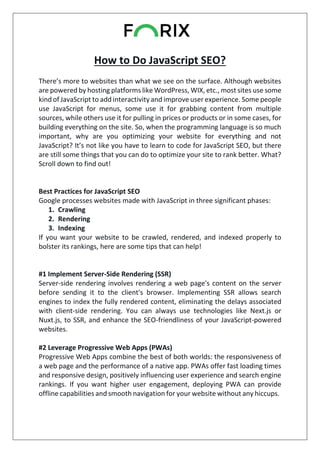
There’s more to websites than what we see on the surface. Although websites
are powered by hosting platforms like WordPress, WIX, etc., most sites use some
kind of JavaScript to add interactivity and improve user experience. Some people
use JavaScript for menus, some use it for grabbing content from multiple
sources, while others use it for pulling in prices or products or in some cases, for
building everything on the site. So, when the programming language is so much
important, why are you optimizing your website for everything and not
JavaScript? It’s not like you have to learn to code for JavaScript SEO, but there
are still some things that you can do to optimize your site to rank better. What?
Scroll down to find out!
Best Practices for JavaScript SEO
Google processes websites made with JavaScript in three significant phases:
1. Crawling
2. Rendering
3. Indexing
If you want your website to be crawled, rendered, and indexed properly to
bolster its rankings, here are some tips that can help!
#1 Implement Server-Side Rendering (SSR)
Server-side rendering involves rendering a web page's content on the server
before sending it to the client's browser. Implementing SSR allows search
engines to index the fully rendered content, eliminating the delays associated
with client-side rendering. You can always use technologies like Next.js or
Nuxt.js, to SSR, and enhance the SEO-friendliness of your JavaScript-powered
websites.
#2 Leverage Progressive Web Apps (PWAs)
Progressive Web Apps combine the best of both worlds: the responsiveness of
a web page and the performance of a native app. PWAs offer fast loading times
and responsive design, positively influencing user experience and search engine
rankings. If you want higher user engagement, deploying PWA can provide
offline capabilities and smooth navigation for your website without any hiccups.
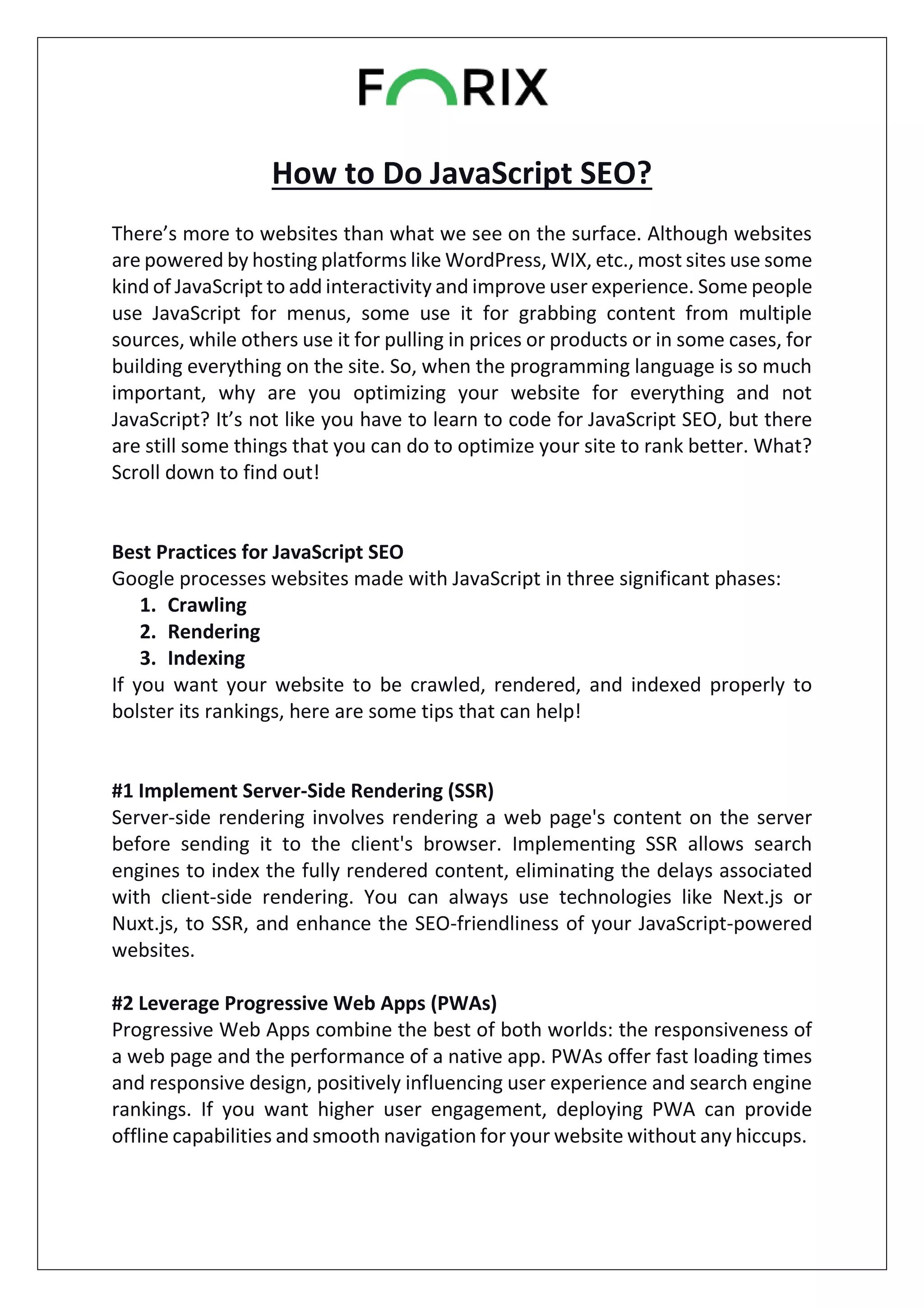
#3 Prioritize Content Accessibility
Ensuring that your JavaScript-powered content is accessible is not only an ethical
consideration but also a vital aspect of SEO. Use semantic HTML elements and
ARIA (Accessible Rich Internet Applications) attributes to enhance accessibility.
This allows search engines to understand the structure of your content and
provides a better experience for users with disabilities.
#4 Dynamic Rendering
Dynamic rendering involves serving different versions of your content to search
engines and users. While users receive the fully interactive JavaScript version,
search engines are provided with a pre-rendered, static HTML version. With
dynamic rendering, you can bridge the gap between SEO and user experience
and enable search engines to index content effortlessly.
#5 Optimize for Core Web Vitals
Google's Core Web Vitals have become a significant ranking factor in 2023.
These metrics measure aspects of web page performance, such as loading
speed, interactivity, and visual stability. By optimizing your JavaScript-powered
website to meet the Core Web Vitals standards, you not only improve user
experience but also enhance your chances of ranking higher in search engine
results.
#6 Leverage the "noscript" Tag
The "noscript" tag provides an alternative content version for users who have
disabled JavaScript in their browsers. This tag contains HTML content that
search engines can crawl and index, ensuring that your essential information is
accessible. When JavaScript is disabled, search engines and users without
JavaScript support can still view this content. By incorporating the "noscript" tag
effectively, you enhance the discoverability of your website's content, improving
its search engine ranking and overall visibility.
#7 Use Canonical URLs
Canonical URLs play a crucial role in JavaScript SEO by resolving duplicate
content issues caused by dynamically generated URLs. When search engines
encounter multiple URLs with similar content due to JavaScript interactions,
canonical URLs guide them to the preferred version. This ensures that search
engines understand which version to index, preventing content dilution and
potential ranking problems. Canonical URLs effectively consolidate link equity
and focus search engines on the correct page, enhancing the website's SEO
performance and maintaining its visibility in search results.
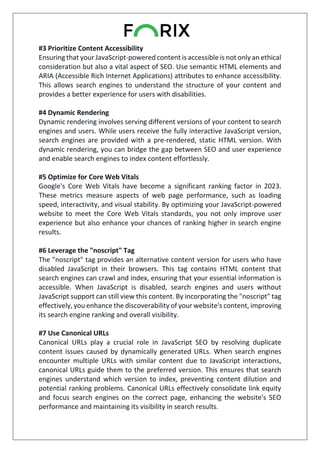
#8 Deploy the "PushState" Method
The "PushState" method enables clean URL updates without triggering full page
reloads. It aids in maintaining a user-friendly, single-page application while
allowing search engines to recognize different states of content. This method
dynamically changes the URL as users interact with the site, enhancing user
experience. Search engines can then crawl and index these state changes,
improving the visibility of dynamic content in search results. "PushState" strikes
a balance between user engagement and search engine accessibility, positively
impacting your website's performance and ranking potential on SERPs.
#9 Use Lazy Loading
Implement lazy loading for images and other non-essential elements. This defers
the loading of such content until users scroll to them, improving initial page load
times. Search engines consider this approach favorably, as it enhances user
experience and page performance without sacrificing SEO.
#10 Crawl Budget Optimization
JavaScript-heavy sites should manage crawl budget efficiently. Use tools like
Google Search Console to identify and fix crawl errors, remove duplicate
content, and block unnecessary pages from being crawled.
#11 Minimize Render Blocking
Reduce render-blocking JavaScript and CSS to improve page loading speed. Use
tools like "async" and "defer" attributes for scripts, and prioritize critical CSS to
display content faster. This positively affects both user experience and search
engine ranking.
#12 Use SEO-Friendly Frameworks
When you are using a JavaScript structure, choose one that is SEO-friendly and
allows for server-side rendering, or has good support for dynamic rendering.
This ensures better compatibility with search engine bots while maintaining
interactive user experiences.
#13 Mobile-Friendly Design:
Ensure your JavaScript-powered sites need to be responsive and mobile-friendly
just like any other website. Google prioritizes mobile-first indexing, which makes
mobile responsiveness essential for both user experience and SEO. Test your site
on various devices and use Google's Mobile-Friendly Test tool to make your site
cross-platform compatible.
The bottom line
Most people focus on the generic part of SEO, instead of going beyond the
conventional. But, if you are doing exactly what everyone’s doing in their quest
to rank #1 on SERPs, how can you reach the top? That’s where JavaScript SEO
comes into the big picture. Just ensure to go for professionals and your SEO will
be as seamless as anything.
Searching for the best Local services, you can reach us for:
Local SEO Portland
Local SEO Seattle
Local SEO Boise
Local SEO Salt Lake City
Local SEO Denver
Local SEO NYC
Local SEO Los Angeles
Local SEO Chicago
Local SEO Houston
Local SEO Phoenix
Want to get an estimate for JavaScript SEO, or need more details on Google
JavaScript SEO? Reach out to the seasoned SEO professionals at Forix SEO now!

How to Do JavaScript SEO? Forix

  • 1.
    How to DoJavaScript SEO? There’s more to websites than what we see on the surface. Although websites are powered by hosting platforms like WordPress, WIX, etc., most sites use some kind of JavaScript to add interactivity and improve user experience. Some people use JavaScript for menus, some use it for grabbing content from multiple sources, while others use it for pulling in prices or products or in some cases, for building everything on the site. So, when the programming language is so much important, why are you optimizing your website for everything and not JavaScript? It’s not like you have to learn to code for JavaScript SEO, but there are still some things that you can do to optimize your site to rank better. What? Scroll down to find out! Best Practices for JavaScript SEO Google processes websites made with JavaScript in three significant phases: 1. Crawling 2. Rendering 3. Indexing If you want your website to be crawled, rendered, and indexed properly to bolster its rankings, here are some tips that can help! #1 Implement Server-Side Rendering (SSR) Server-side rendering involves rendering a web page's content on the server before sending it to the client's browser. Implementing SSR allows search engines to index the fully rendered content, eliminating the delays associated with client-side rendering. You can always use technologies like Next.js or Nuxt.js, to SSR, and enhance the SEO-friendliness of your JavaScript-powered websites. #2 Leverage Progressive Web Apps (PWAs) Progressive Web Apps combine the best of both worlds: the responsiveness of a web page and the performance of a native app. PWAs offer fast loading times and responsive design, positively influencing user experience and search engine rankings. If you want higher user engagement, deploying PWA can provide offline capabilities and smooth navigation for your website without any hiccups.
  • 2.
    #3 Prioritize ContentAccessibility Ensuring that your JavaScript-powered content is accessible is not only an ethical consideration but also a vital aspect of SEO. Use semantic HTML elements and ARIA (Accessible Rich Internet Applications) attributes to enhance accessibility. This allows search engines to understand the structure of your content and provides a better experience for users with disabilities. #4 Dynamic Rendering Dynamic rendering involves serving different versions of your content to search engines and users. While users receive the fully interactive JavaScript version, search engines are provided with a pre-rendered, static HTML version. With dynamic rendering, you can bridge the gap between SEO and user experience and enable search engines to index content effortlessly. #5 Optimize for Core Web Vitals Google's Core Web Vitals have become a significant ranking factor in 2023. These metrics measure aspects of web page performance, such as loading speed, interactivity, and visual stability. By optimizing your JavaScript-powered website to meet the Core Web Vitals standards, you not only improve user experience but also enhance your chances of ranking higher in search engine results. #6 Leverage the "noscript" Tag The "noscript" tag provides an alternative content version for users who have disabled JavaScript in their browsers. This tag contains HTML content that search engines can crawl and index, ensuring that your essential information is accessible. When JavaScript is disabled, search engines and users without JavaScript support can still view this content. By incorporating the "noscript" tag effectively, you enhance the discoverability of your website's content, improving its search engine ranking and overall visibility. #7 Use Canonical URLs Canonical URLs play a crucial role in JavaScript SEO by resolving duplicate content issues caused by dynamically generated URLs. When search engines encounter multiple URLs with similar content due to JavaScript interactions, canonical URLs guide them to the preferred version. This ensures that search engines understand which version to index, preventing content dilution and potential ranking problems. Canonical URLs effectively consolidate link equity and focus search engines on the correct page, enhancing the website's SEO performance and maintaining its visibility in search results.
  • 3.
    #8 Deploy the"PushState" Method The "PushState" method enables clean URL updates without triggering full page reloads. It aids in maintaining a user-friendly, single-page application while allowing search engines to recognize different states of content. This method dynamically changes the URL as users interact with the site, enhancing user experience. Search engines can then crawl and index these state changes, improving the visibility of dynamic content in search results. "PushState" strikes a balance between user engagement and search engine accessibility, positively impacting your website's performance and ranking potential on SERPs. #9 Use Lazy Loading Implement lazy loading for images and other non-essential elements. This defers the loading of such content until users scroll to them, improving initial page load times. Search engines consider this approach favorably, as it enhances user experience and page performance without sacrificing SEO. #10 Crawl Budget Optimization JavaScript-heavy sites should manage crawl budget efficiently. Use tools like Google Search Console to identify and fix crawl errors, remove duplicate content, and block unnecessary pages from being crawled. #11 Minimize Render Blocking Reduce render-blocking JavaScript and CSS to improve page loading speed. Use tools like "async" and "defer" attributes for scripts, and prioritize critical CSS to display content faster. This positively affects both user experience and search engine ranking. #12 Use SEO-Friendly Frameworks When you are using a JavaScript structure, choose one that is SEO-friendly and allows for server-side rendering, or has good support for dynamic rendering. This ensures better compatibility with search engine bots while maintaining interactive user experiences. #13 Mobile-Friendly Design: Ensure your JavaScript-powered sites need to be responsive and mobile-friendly just like any other website. Google prioritizes mobile-first indexing, which makes mobile responsiveness essential for both user experience and SEO. Test your site on various devices and use Google's Mobile-Friendly Test tool to make your site cross-platform compatible.
  • 4.
    The bottom line Mostpeople focus on the generic part of SEO, instead of going beyond the conventional. But, if you are doing exactly what everyone’s doing in their quest to rank #1 on SERPs, how can you reach the top? That’s where JavaScript SEO comes into the big picture. Just ensure to go for professionals and your SEO will be as seamless as anything. Searching for the best Local services, you can reach us for: Local SEO Portland Local SEO Seattle Local SEO Boise Local SEO Salt Lake City Local SEO Denver Local SEO NYC Local SEO Los Angeles Local SEO Chicago Local SEO Houston Local SEO Phoenix Want to get an estimate for JavaScript SEO, or need more details on Google JavaScript SEO? Reach out to the seasoned SEO professionals at Forix SEO now!