1. How Micro ATMs Differ from Traditional ATMs
Size and Portability
Micro ATMs: Compact, handheld instruments that are efficiently mobile. They can be set up
anywhere, mainly in remote areas where setting up a full-fledged ATM is not possible.
Traditional ATMs: Large, standing appliances that are established in secure places such as
bank departments, shopping malls, and general sites.
Infrastructure Requirements
Micro ATMs: Require minimal infrastructure. They only require basic internet connectivity
(via mobile networks like GPRS or Wi-Fi) and energy supply, making them more appropriate
for rural and semi-urban locations.
Traditional ATMs: Require more comprehensive infrastructure, including a dedicated kiosk,
potent security, a uniform power reserve, and high-speed internet or committed rented tubes.
Cost of Setup and Maintenance
Micro ATMs: Much lower configuration and upkeep costs, as they are simple devices and
need less protection and real inheritance. Micro ATM service provider Banking
correspondents (BCs) can work them with low overhead.
Traditional ATMs: Expensive to establish and support due to the need for real inheritance,
Micro ATM machine software price, high-level safety, regular money refills, and
maintenance teams.
Services Provided
Micro ATMs: Offer essential benefits such as cash leaves Aadhaar Micro ATM price, credit
inquiries, fund transfers, and mini accounts. They typically concentrate on providing basic
banking operations in areas with narrow banking infrastructure.
Traditional ATMs: Provide a best Micro ATM API provider broader range of benefits,
including cash deposits, withdrawals, mini invoices, bill prices, and periodically even loans or
more additional bank-specific benefits.
User Authentication Methods
Micro ATMs: Primarily use Aadhaar-based authentication via biometric confirmation
(fingerprint or iris scan) or debit card-based authentication for transactions. This makes them
available to individuals who may not have a standard banking card but have an Aadhaar ID.
Traditional ATMs: Exploit PIN-based authentication via debit or acclaim cards. Biometric
confirmation is usually not available in traditional aeps micro atm machine, though some
advanced machines may help it.
Operation and Staffing
Micro ATMs: Operated by banking reporters (BCs) or merchandisers, who assist users with
their employment aeps swipe machine. This human interface allows in rustic areas where
someone may not be tech-savvy.
Traditional ATMs: These are self-service aeps micro atm price machines where the
customer interacts immediately with the ATM. No entourage or operator assistance is
needed for business.
Target Market
Micro ATMs: Target the unbanked and underbanked citizens in rustic or semi-urban regions.
They obtain basic monetary uses to people who otherwise have determined or no entry to
banking institutions.
Traditional ATMs: Primarily suit urban and suburban citizens where there is common entry
to formal banking and financial help.
Cash Availability
Micro ATMs: Cash is normally delivered by the banking correspondent (BC), who carries a
narrow cut. Cash availability may depend on how much the BC can carry or allow from their
tightest bank unit API for PAN verification.
Traditional ATMs: Cash is kept inside the device and regularly supplied by bank-authorized
personnel. Larger PAN Card Verification API amounts of cash are available due to secure
storage within the machine.
Internet Connectivity
Micro ATMs: Work on low-bandwidth mobile relations like GPRS or 3G, making them
appropriate for areas with poor web range.
Traditional ATMs: Need tough, high-speed internet associations, usually through wired
grids like broadband or rented lines, which may not be available in small dimensions.
Transaction Fees
Micro ATMs: Often come with lower or no marketing fees, primarily for basic services. They
are intended to make banking more NSDL API for PAN verification convenient and
affordable.
Traditional ATMs: May charge transaction fees after a certain number of free transactions,
especially when used across different bank networks.
Conclusion
Micro ATMs are an innovative solution developed to manage the economic inclusion gap by
delivering basic banking assistance to underserved provinces, while traditional PAN
verification API ATMs are more robust, feature-rich machines suited for well-established
urban settings. The flexibility and affordability of Micro ATMs make them a key tool in
creating banking access in rural India.
This should give your audience a precise knowledge of the distinctions between Micro ATMs
and traditional PAN Validation API. Let me know if you'd like to modify any piece of this
size!
2. Why PAN verification is needed (e.g., KYC, financial transactions, fraud prevention).
Why PAN Verification is Needed
The Permanent Account Number (PAN) is a vital identification number issued by the
Income Tax Department of India to individuals and entities. It serves as a universal
identification key for tracking financial transactions that might attract taxes. PAN verification
ensures the accuracy and authenticity of the information provided by individuals and
businesses, and it is increasingly important for a variety of reasons:
KYC (Know Your Customer) Compliance
KYC is a critical regulatory requirement for financial institutions, businesses, and other
entities. The Reserve Bank of India (RBI), Securities and Exchange Board of India
(SEBI), and other authorities have set stringent KYC norms that require entities to verify the
identity of their customers. PAN plays a key role in this process.
Identity Verification: PAN serves as a widely accepted proof of identity for individuals and
companies. Verifying the PAN ensures that the person or entity is legitimate and provides
accurate identity information.
Avoidance of Duplication: One unique PAN is assigned to every person or entity, and
verifying it ensures that multiple PANs aren’t being used by the same individual or
organisation to evade regulations or manipulate financial records.
Essential for Financial Institutions: Banks, insurance companies, and investment firms
are required by law to verify PAN before providing services such as opening bank accounts,
issuing loans, or selling financial products. PAN verification helps prevent accounts from
being opened under false pretences.
Monitoring Financial Transactions
PAN verification is crucial in monitoring high-value financial transactions and ensuring
compliance with tax regulations. The Indian government has made PAN mandatory for
certain financial activities to track financial movements and prevent misuse.
Mandatory for Specific Transactions: PAN is required for transactions above a specific
threshold, such as cash deposits exceeding ₹50,000 in a single day, property transactions
above ₹5 lakh, buying mutual funds over ₹50,000, and making high-value credit card
payments. PAN verification ensures that these transactions are correctly reported to tax
authorities.
Tracking Taxable Activities: By verifying PAN during significant transactions, the tax
authorities can track the financial activities of individuals and businesses. This helps ensure
that income is reported accurately and that individuals and entities pay the correct amount of
taxes.
Reduction of Black Money: The Indian government has been keen on curbing the use of
unaccounted money (black money). PAN verification helps trace large sums of money and
prevents under-the-radar financial activities by making transactions more traceable.
Fraud Prevention
PAN verification plays an important role in reducing fraud in both the financial sector and
beyond. Fraud, including identity theft and money laundering, can be detected and mitigated
with thorough PAN checks.
Identity Theft Protection: Fraudsters often use fake or stolen identities to commit financial
fraud, such as opening dishonest information or involving loans. PAN validation helps
guarantee the genuineness of the identity delivered, containing such moves.
Anti-Money Laundering (AML) Compliance: The Prevention of Money Laundering Act
(PMLA) mandates financial organizations to demonstrate PAN attributes for consumers to
control money laundering. By confirming the PAN, institutions can track the discharge of
funds and ensure that the money is standing employed for honest objectives.
Shell Company Detection: Scheming shell corporations often use fake PANs to conduct
illegal economic movements. Verifying PAN for corporate entities helps authorities and
companies identify and destroy these false commodities.
Legal and Regulatory Compliance
Businesses, financial institutions, and someone must demonstrate PAN to comply with
different legal and regulatory frameworks in India. Non-compliance with these requirements
can lead to damages, fines, or legal significances.
Income Tax Act: PAN verification is essential for complying with the Income Tax Act of India.
It is required for filing tax returns, claiming tax refunds, and ensuring that taxpayers meet
their tax obligations. PAN verification ensures the correct filing of tax recoveries and
underestimates the risk of tax evasion.
GST (Goods and Services Tax): Businesses must verify PAN when registering for Goods
and Services Tax (GST). PAN verification is used to generate the GSTIN (Goods and
Services Tax Identification Number), making it easier for tax authorities to track company
tax penalties.
Corporate Filings: Companies must verify PAN for directors, shareholders, and
stakeholders when proffering filings with the Ministry of Corporate Affairs (MCA). Accurate
PAN verification ensures compliance with corporate governance regulations and rules.
Streamlining Operations and Improving Customer Experience
PAN verification also improves operating efficiency for companies, permitting them to
facilitate operations, enhance consumer assistance, and maintain correct documents.
Faster KYC Processing: Automated PAN validation tools, such as the NSDL PAN
Verification API, make KYC operations faster and more efficient. Instead of manually
confirming equivalence documents, businesses can use automated verification to onboard
consumers fast.
Reducing Errors: Manual errors in uniqueness proof, such as typographical blunders or
record fraud, are reduced through automated best payout API provider PAN verification
systems. This raises exactness and minimizes disparities in consumer documents.
Digital Onboarding and Remote Services: With the rise of digital banking and remote
assistance, Payout Settlement API Solution is an important aspect of onboarding
customers remotely. It allows companies to verify customer identities without needing
material reality, making the process quicker and more customer-friendly.
Reducing Tax Evasion and Boosting Government Revenue
PAN verification aids in creating transparency in economic dealings, which helps authorities
identify tax evasion schemes and increase tax collection.
Matching Transactions with Income Tax Filings: Payout Service Provider allows
authorities to cross-check financial transactions against income reported in tax returns. This
makes it easier to detect underreported revenue or tax evasion activities.
Tracking High-Net-Worth Individuals: For people or groups employed in frequent
high-value commerce, pan api verification ensures that all trades are conveyed, permitting
the country to track their financial actions and prevent income leakage.
Conclusion
In conclusion, pan number verification api is essential for preserving clearness,
observation, and protection in monetary transactions in India. It allows companies and
economic organisations to comply with regulatory provisions, prevent scam, and secure that
all financial activities are conducted legally. Using tools like the NSDL PAN verification API
allows organisations to verify PAN details efficiently, ensuring that they adhere to
government norms while providing seamless service to consumers.
Read More Click Here:- What is the maximum salary of a Bartender?
Read More Click Here:- Key Factors Influencing Maximum Salary
Read More Click Here:- How to Become a CEO After 12th
Read More Click Here:- Path to Becoming a High-Earning Bartender
Read More Click Here:- Personal Fulfillment and Passion
Read More Click Here:- Seek Promotions and Take on More Responsibility:
Read More Click Here:- What is travel management software?
Read More Click Here:- What is the ERP system in school?
Read More Click Here:- How can I verify a person's PAN?
Read More Click Here:- Online Methods for PAN Verification
Read More Click Here:- Verification through PAN Card Copy
Read More Click Here:- Accuracy in Financial Transactions
Read More Click Here:- Which city is best for aviation?

How Micro ATMs Differ from Traditional ATMs.pdf

  • 1.
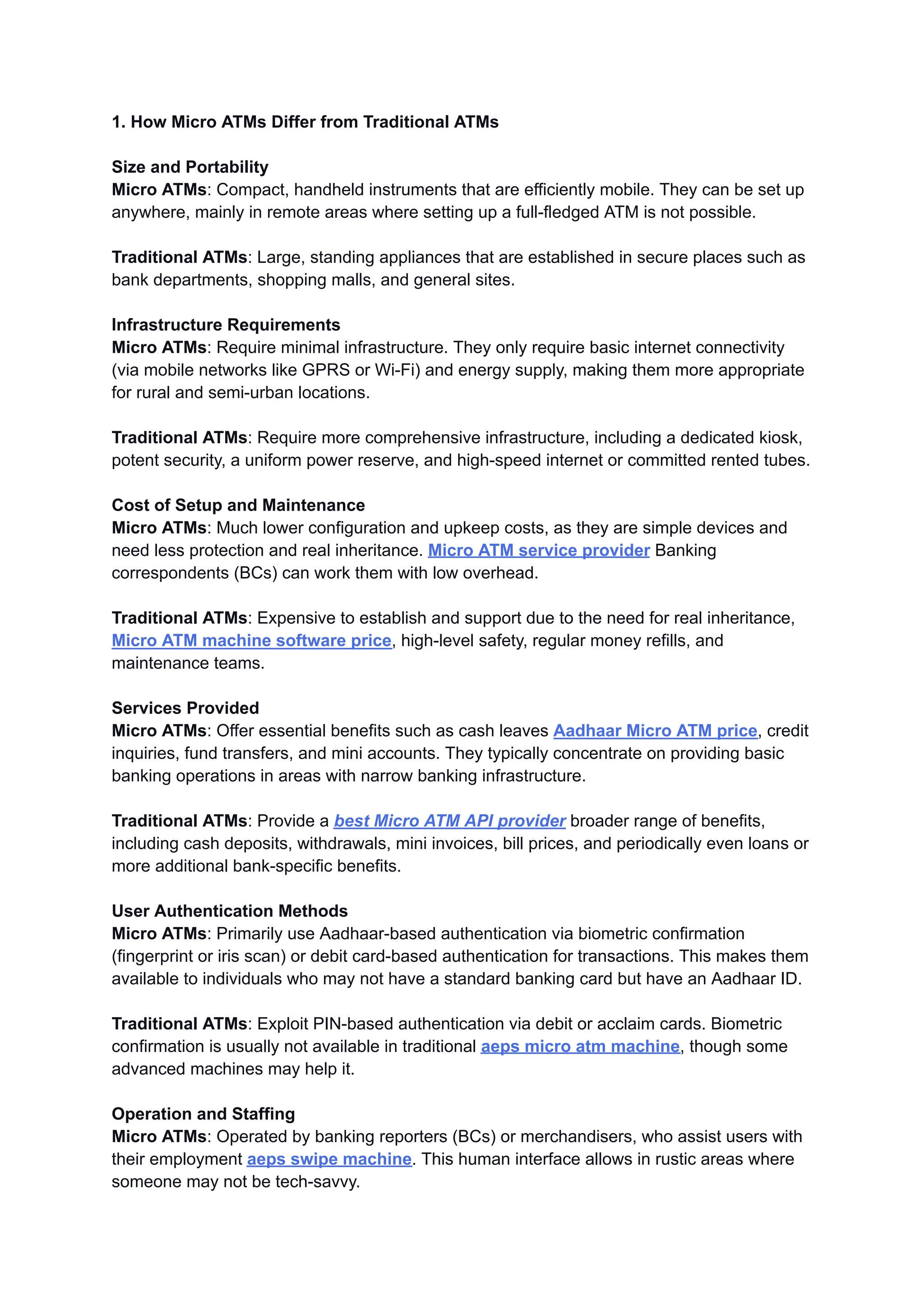
    1. How MicroATMs Differ from Traditional ATMs Size and Portability Micro ATMs: Compact, handheld instruments that are efficiently mobile. They can be set up anywhere, mainly in remote areas where setting up a full-fledged ATM is not possible. Traditional ATMs: Large, standing appliances that are established in secure places such as bank departments, shopping malls, and general sites. Infrastructure Requirements Micro ATMs: Require minimal infrastructure. They only require basic internet connectivity (via mobile networks like GPRS or Wi-Fi) and energy supply, making them more appropriate for rural and semi-urban locations. Traditional ATMs: Require more comprehensive infrastructure, including a dedicated kiosk, potent security, a uniform power reserve, and high-speed internet or committed rented tubes. Cost of Setup and Maintenance Micro ATMs: Much lower configuration and upkeep costs, as they are simple devices and need less protection and real inheritance. Micro ATM service provider Banking correspondents (BCs) can work them with low overhead. Traditional ATMs: Expensive to establish and support due to the need for real inheritance, Micro ATM machine software price, high-level safety, regular money refills, and maintenance teams. Services Provided Micro ATMs: Offer essential benefits such as cash leaves Aadhaar Micro ATM price, credit inquiries, fund transfers, and mini accounts. They typically concentrate on providing basic banking operations in areas with narrow banking infrastructure. Traditional ATMs: Provide a best Micro ATM API provider broader range of benefits, including cash deposits, withdrawals, mini invoices, bill prices, and periodically even loans or more additional bank-specific benefits. User Authentication Methods Micro ATMs: Primarily use Aadhaar-based authentication via biometric confirmation (fingerprint or iris scan) or debit card-based authentication for transactions. This makes them available to individuals who may not have a standard banking card but have an Aadhaar ID. Traditional ATMs: Exploit PIN-based authentication via debit or acclaim cards. Biometric confirmation is usually not available in traditional aeps micro atm machine, though some advanced machines may help it. Operation and Staffing Micro ATMs: Operated by banking reporters (BCs) or merchandisers, who assist users with their employment aeps swipe machine. This human interface allows in rustic areas where someone may not be tech-savvy.
  • 2.
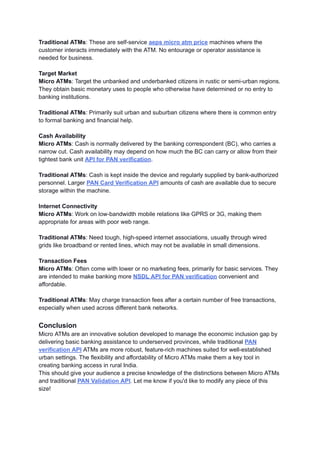
    Traditional ATMs: Theseare self-service aeps micro atm price machines where the customer interacts immediately with the ATM. No entourage or operator assistance is needed for business. Target Market Micro ATMs: Target the unbanked and underbanked citizens in rustic or semi-urban regions. They obtain basic monetary uses to people who otherwise have determined or no entry to banking institutions. Traditional ATMs: Primarily suit urban and suburban citizens where there is common entry to formal banking and financial help. Cash Availability Micro ATMs: Cash is normally delivered by the banking correspondent (BC), who carries a narrow cut. Cash availability may depend on how much the BC can carry or allow from their tightest bank unit API for PAN verification. Traditional ATMs: Cash is kept inside the device and regularly supplied by bank-authorized personnel. Larger PAN Card Verification API amounts of cash are available due to secure storage within the machine. Internet Connectivity Micro ATMs: Work on low-bandwidth mobile relations like GPRS or 3G, making them appropriate for areas with poor web range. Traditional ATMs: Need tough, high-speed internet associations, usually through wired grids like broadband or rented lines, which may not be available in small dimensions. Transaction Fees Micro ATMs: Often come with lower or no marketing fees, primarily for basic services. They are intended to make banking more NSDL API for PAN verification convenient and affordable. Traditional ATMs: May charge transaction fees after a certain number of free transactions, especially when used across different bank networks. Conclusion Micro ATMs are an innovative solution developed to manage the economic inclusion gap by delivering basic banking assistance to underserved provinces, while traditional PAN verification API ATMs are more robust, feature-rich machines suited for well-established urban settings. The flexibility and affordability of Micro ATMs make them a key tool in creating banking access in rural India. This should give your audience a precise knowledge of the distinctions between Micro ATMs and traditional PAN Validation API. Let me know if you'd like to modify any piece of this size!
  • 3.
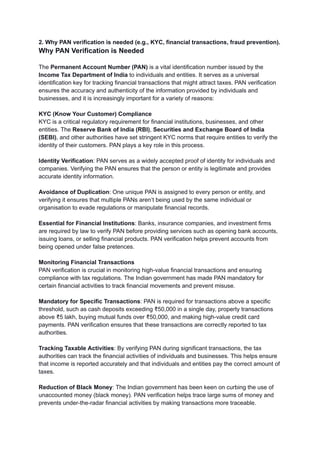
    2. Why PANverification is needed (e.g., KYC, financial transactions, fraud prevention). Why PAN Verification is Needed The Permanent Account Number (PAN) is a vital identification number issued by the Income Tax Department of India to individuals and entities. It serves as a universal identification key for tracking financial transactions that might attract taxes. PAN verification ensures the accuracy and authenticity of the information provided by individuals and businesses, and it is increasingly important for a variety of reasons: KYC (Know Your Customer) Compliance KYC is a critical regulatory requirement for financial institutions, businesses, and other entities. The Reserve Bank of India (RBI), Securities and Exchange Board of India (SEBI), and other authorities have set stringent KYC norms that require entities to verify the identity of their customers. PAN plays a key role in this process. Identity Verification: PAN serves as a widely accepted proof of identity for individuals and companies. Verifying the PAN ensures that the person or entity is legitimate and provides accurate identity information. Avoidance of Duplication: One unique PAN is assigned to every person or entity, and verifying it ensures that multiple PANs aren’t being used by the same individual or organisation to evade regulations or manipulate financial records. Essential for Financial Institutions: Banks, insurance companies, and investment firms are required by law to verify PAN before providing services such as opening bank accounts, issuing loans, or selling financial products. PAN verification helps prevent accounts from being opened under false pretences. Monitoring Financial Transactions PAN verification is crucial in monitoring high-value financial transactions and ensuring compliance with tax regulations. The Indian government has made PAN mandatory for certain financial activities to track financial movements and prevent misuse. Mandatory for Specific Transactions: PAN is required for transactions above a specific threshold, such as cash deposits exceeding ₹50,000 in a single day, property transactions above ₹5 lakh, buying mutual funds over ₹50,000, and making high-value credit card payments. PAN verification ensures that these transactions are correctly reported to tax authorities. Tracking Taxable Activities: By verifying PAN during significant transactions, the tax authorities can track the financial activities of individuals and businesses. This helps ensure that income is reported accurately and that individuals and entities pay the correct amount of taxes. Reduction of Black Money: The Indian government has been keen on curbing the use of unaccounted money (black money). PAN verification helps trace large sums of money and prevents under-the-radar financial activities by making transactions more traceable.
  • 4.
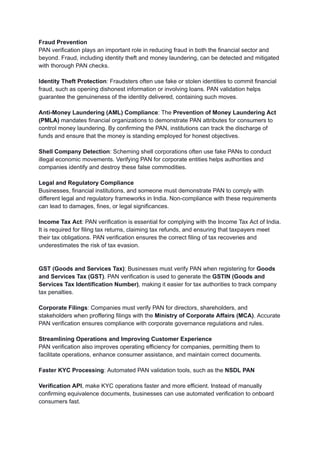
    Fraud Prevention PAN verificationplays an important role in reducing fraud in both the financial sector and beyond. Fraud, including identity theft and money laundering, can be detected and mitigated with thorough PAN checks. Identity Theft Protection: Fraudsters often use fake or stolen identities to commit financial fraud, such as opening dishonest information or involving loans. PAN validation helps guarantee the genuineness of the identity delivered, containing such moves. Anti-Money Laundering (AML) Compliance: The Prevention of Money Laundering Act (PMLA) mandates financial organizations to demonstrate PAN attributes for consumers to control money laundering. By confirming the PAN, institutions can track the discharge of funds and ensure that the money is standing employed for honest objectives. Shell Company Detection: Scheming shell corporations often use fake PANs to conduct illegal economic movements. Verifying PAN for corporate entities helps authorities and companies identify and destroy these false commodities. Legal and Regulatory Compliance Businesses, financial institutions, and someone must demonstrate PAN to comply with different legal and regulatory frameworks in India. Non-compliance with these requirements can lead to damages, fines, or legal significances. Income Tax Act: PAN verification is essential for complying with the Income Tax Act of India. It is required for filing tax returns, claiming tax refunds, and ensuring that taxpayers meet their tax obligations. PAN verification ensures the correct filing of tax recoveries and underestimates the risk of tax evasion. GST (Goods and Services Tax): Businesses must verify PAN when registering for Goods and Services Tax (GST). PAN verification is used to generate the GSTIN (Goods and Services Tax Identification Number), making it easier for tax authorities to track company tax penalties. Corporate Filings: Companies must verify PAN for directors, shareholders, and stakeholders when proffering filings with the Ministry of Corporate Affairs (MCA). Accurate PAN verification ensures compliance with corporate governance regulations and rules. Streamlining Operations and Improving Customer Experience PAN verification also improves operating efficiency for companies, permitting them to facilitate operations, enhance consumer assistance, and maintain correct documents. Faster KYC Processing: Automated PAN validation tools, such as the NSDL PAN Verification API, make KYC operations faster and more efficient. Instead of manually confirming equivalence documents, businesses can use automated verification to onboard consumers fast.
  • 5.
    Reducing Errors: Manualerrors in uniqueness proof, such as typographical blunders or record fraud, are reduced through automated best payout API provider PAN verification systems. This raises exactness and minimizes disparities in consumer documents. Digital Onboarding and Remote Services: With the rise of digital banking and remote assistance, Payout Settlement API Solution is an important aspect of onboarding customers remotely. It allows companies to verify customer identities without needing material reality, making the process quicker and more customer-friendly. Reducing Tax Evasion and Boosting Government Revenue PAN verification aids in creating transparency in economic dealings, which helps authorities identify tax evasion schemes and increase tax collection. Matching Transactions with Income Tax Filings: Payout Service Provider allows authorities to cross-check financial transactions against income reported in tax returns. This makes it easier to detect underreported revenue or tax evasion activities. Tracking High-Net-Worth Individuals: For people or groups employed in frequent high-value commerce, pan api verification ensures that all trades are conveyed, permitting the country to track their financial actions and prevent income leakage. Conclusion In conclusion, pan number verification api is essential for preserving clearness, observation, and protection in monetary transactions in India. It allows companies and economic organisations to comply with regulatory provisions, prevent scam, and secure that all financial activities are conducted legally. Using tools like the NSDL PAN verification API allows organisations to verify PAN details efficiently, ensuring that they adhere to government norms while providing seamless service to consumers. Read More Click Here:- What is the maximum salary of a Bartender? Read More Click Here:- Key Factors Influencing Maximum Salary Read More Click Here:- How to Become a CEO After 12th Read More Click Here:- Path to Becoming a High-Earning Bartender Read More Click Here:- Personal Fulfillment and Passion Read More Click Here:- Seek Promotions and Take on More Responsibility: Read More Click Here:- What is travel management software? Read More Click Here:- What is the ERP system in school? Read More Click Here:- How can I verify a person's PAN? Read More Click Here:- Online Methods for PAN Verification Read More Click Here:- Verification through PAN Card Copy Read More Click Here:- Accuracy in Financial Transactions Read More Click Here:- Which city is best for aviation?