


Mirela C. C. Ramacciotti
14th Braz Tesol International Convention
May 2014
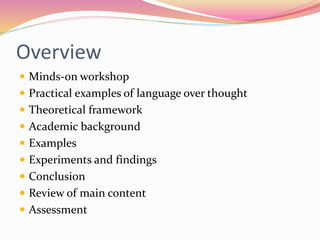
Overview
 Minds-on workshop
 Practical examples of language over thought
 Theoretical framework
 Academic background
 Examples
 Experiments and findings
 Conclusion
 Review of main content
 Assessment
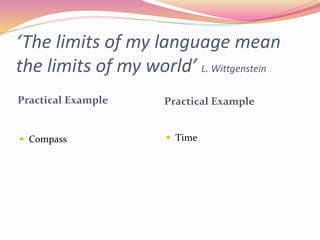
‘The limits of my language mean
the limits of my world’ L. Wittgenstein
Practical Example Practical Example
 Compass  Time
Theoretical Framework
Language habits create thinking habits (Sapir-Whorf hypotheses)
Thinking habits created via language operate independently of the
language used to think (ex.:there is/are)
The earlier one learns an L2, the less influenced his thinking
habits will be by his L1 (ex.: subj./verb)
Even without cultural differences, differences in language result in
differences in thought, i.e. language rules. (ex.:he/she/it)
In the absence of sensorial information, language rules over
thought (ex.:abstract concepts: time/ space/causality/
relationships)
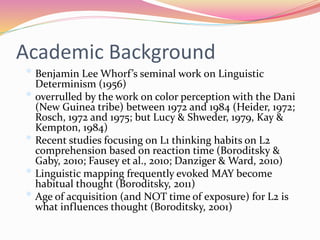
Academic Background
• Benjamin Lee Whorf’s seminal work on Linguistic
Determinism (1956)
• overrulled by the work on color perception with the Dani
(New Guinea tribe) between 1972 and 1984 (Heider, 1972;
Rosch, 1972 and 1975; but Lucy & Shweder, 1979, Kay &
Kempton, 1984)
• Recent studies focusing on L1 thinking habits on L2
comprehension based on reaction time (Boroditsky &
Gaby, 2010; Fausey et al., 2010; Danziger & Ward, 2010)
• Linguistic mapping frequently evoked MAY become
habitual thought (Boroditsky, 2011)
• Age of acquisition (and NOT time of exposure) for L2 is
what influences thought (Boroditsky, 2001)
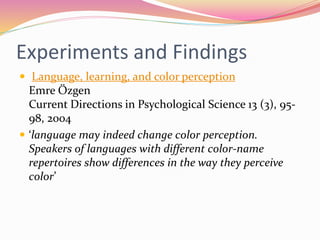
Experiments and Findings
 Language, learning, and color perception
Emre Özgen
Current Directions in Psychological Science 13 (3), 95-
98, 2004
 ‘language may indeed change color perception.
Speakers of languages with different color-name
repertoires show differences in the way they perceive
color’
Experiments and Findings
Constructing Agency: the Role of
Language
 Fausey, C. M., Long, B. L., Inamori, A., & Boroditsky,
L., Frontiers of Psychology, 2010; 1: 162.
 ‘English speakers remembered the agents of accidents
better than did Japanese speakers, as predicted from
patterns in language.’
 ‘Patterns in one’s linguistic environment may promote
and support how people instantiate agency in context.’
References
 Boroditsky, L. (2001). Does language shape thought?: Mandarin and English speakers'
conceptions of time. Cognitive psychology, 43(1), 1-22.
 Boroditsky, L. (2011). How language shapes thought. Scientific American, 304(2), 62-65.
 Fausey, C. M., Long, B. L., Inamori, A., & Boroditsky, L. (2010). Constructing agency: the
role of language. Frontiers in psychology, 1.
 Heider, E. (1972). Universals in color naming and memory. Journal of Experimental
Psychology,93, 10–20.
 Kaufeldt, M. (Ed.). (2009). Begin with the brain: Orchestrating the learner-centered
classroom. SAGE
 Kay, P., & Kempton, W. (1984). What is the Sapir–Whorf hypothesis? American
Anthropologist,86, 65–79.
 Lucy, J., & Shweder, R. (1979). Whorf and his critics: Linguistic and nonlinguistic
influences on color memory. American Anthropologist, 81, 581–618.
 Özgen, E. (2004). Language, learning, and color perception. Current Directions in
Psychological Science, 13(3), 95-98.
 Rosch, E. (1975). Cognitive representations of semantic categories. Journal of
Experimental Psychology: General, 104, 192–233.
 Rosch, E. (1978). Principles of categorization. In R. Rosch & B. B. Lloyd (Eds.), Cognition
and categorization. Hillsdale, NJ: Erlbaum.
 Whorf, B. L. (1956). The relation of habitual thought and behavior to language.
Language, thought and reality, 134-59.
Contact
 mirelaprof@uol.com.br
 Thank you!

How language shapes thought (abridged version)

  • 1.
    Mirela C. C.Ramacciotti 14th Braz Tesol International Convention May 2014
  • 2.
    Overview  Minds-on workshop Practical examples of language over thought  Theoretical framework  Academic background  Examples  Experiments and findings  Conclusion  Review of main content  Assessment
  • 3.
    ‘The limits ofmy language mean the limits of my world’ L. Wittgenstein Practical Example Practical Example  Compass  Time
  • 4.
    Theoretical Framework Language habitscreate thinking habits (Sapir-Whorf hypotheses) Thinking habits created via language operate independently of the language used to think (ex.:there is/are) The earlier one learns an L2, the less influenced his thinking habits will be by his L1 (ex.: subj./verb) Even without cultural differences, differences in language result in differences in thought, i.e. language rules. (ex.:he/she/it) In the absence of sensorial information, language rules over thought (ex.:abstract concepts: time/ space/causality/ relationships)
  • 5.
    Academic Background • BenjaminLee Whorf’s seminal work on Linguistic Determinism (1956) • overrulled by the work on color perception with the Dani (New Guinea tribe) between 1972 and 1984 (Heider, 1972; Rosch, 1972 and 1975; but Lucy & Shweder, 1979, Kay & Kempton, 1984) • Recent studies focusing on L1 thinking habits on L2 comprehension based on reaction time (Boroditsky & Gaby, 2010; Fausey et al., 2010; Danziger & Ward, 2010) • Linguistic mapping frequently evoked MAY become habitual thought (Boroditsky, 2011) • Age of acquisition (and NOT time of exposure) for L2 is what influences thought (Boroditsky, 2001)
  • 6.
    Experiments and Findings Language, learning, and color perception Emre Özgen Current Directions in Psychological Science 13 (3), 95- 98, 2004  ‘language may indeed change color perception. Speakers of languages with different color-name repertoires show differences in the way they perceive color’
  • 7.
    Experiments and Findings ConstructingAgency: the Role of Language  Fausey, C. M., Long, B. L., Inamori, A., & Boroditsky, L., Frontiers of Psychology, 2010; 1: 162.  ‘English speakers remembered the agents of accidents better than did Japanese speakers, as predicted from patterns in language.’  ‘Patterns in one’s linguistic environment may promote and support how people instantiate agency in context.’
  • 8.
    References  Boroditsky, L.(2001). Does language shape thought?: Mandarin and English speakers' conceptions of time. Cognitive psychology, 43(1), 1-22.  Boroditsky, L. (2011). How language shapes thought. Scientific American, 304(2), 62-65.  Fausey, C. M., Long, B. L., Inamori, A., & Boroditsky, L. (2010). Constructing agency: the role of language. Frontiers in psychology, 1.  Heider, E. (1972). Universals in color naming and memory. Journal of Experimental Psychology,93, 10–20.  Kaufeldt, M. (Ed.). (2009). Begin with the brain: Orchestrating the learner-centered classroom. SAGE  Kay, P., & Kempton, W. (1984). What is the Sapir–Whorf hypothesis? American Anthropologist,86, 65–79.  Lucy, J., & Shweder, R. (1979). Whorf and his critics: Linguistic and nonlinguistic influences on color memory. American Anthropologist, 81, 581–618.  Özgen, E. (2004). Language, learning, and color perception. Current Directions in Psychological Science, 13(3), 95-98.  Rosch, E. (1975). Cognitive representations of semantic categories. Journal of Experimental Psychology: General, 104, 192–233.  Rosch, E. (1978). Principles of categorization. In R. Rosch & B. B. Lloyd (Eds.), Cognition and categorization. Hillsdale, NJ: Erlbaum.  Whorf, B. L. (1956). The relation of habitual thought and behavior to language. Language, thought and reality, 134-59.
  • 9.