1/12
How Is AI Changing the Way Businesses Handle
Customer Service?
solulab.com/ai-in-customer-service
As customers, we all expect instant responses and 24/7 support. Don’t you?
For most businesses, delivering that level of service with limited human resources is a
constant struggle. When customer experience suffers, so does the brand reputation.
Delayed replies, missed queries, and inconsistent support can lead to frustration and lost
leads. No business wants that.
This is why modern businesses are leveraging AI to analyze large volumes of customer
data. This helps them anticipate customer needs, personalize services, and run targeted
marketing campaigns. With AI-driven insights, companies can make smarter decisions
and deliver more meaningful customer experiences.
According to Business Insider, companies like AT&T have implemented open-source AI
solutions, achieving 91% of ChatGPT’s accuracy while reducing processing time from 15
hours to under 5 hours daily.
In this blog, we’ll explore the role of AI in customer service and how you can use it to
boost efficiency, improve satisfaction, and stay ahead of the competition.
What is AI in Customer Service?
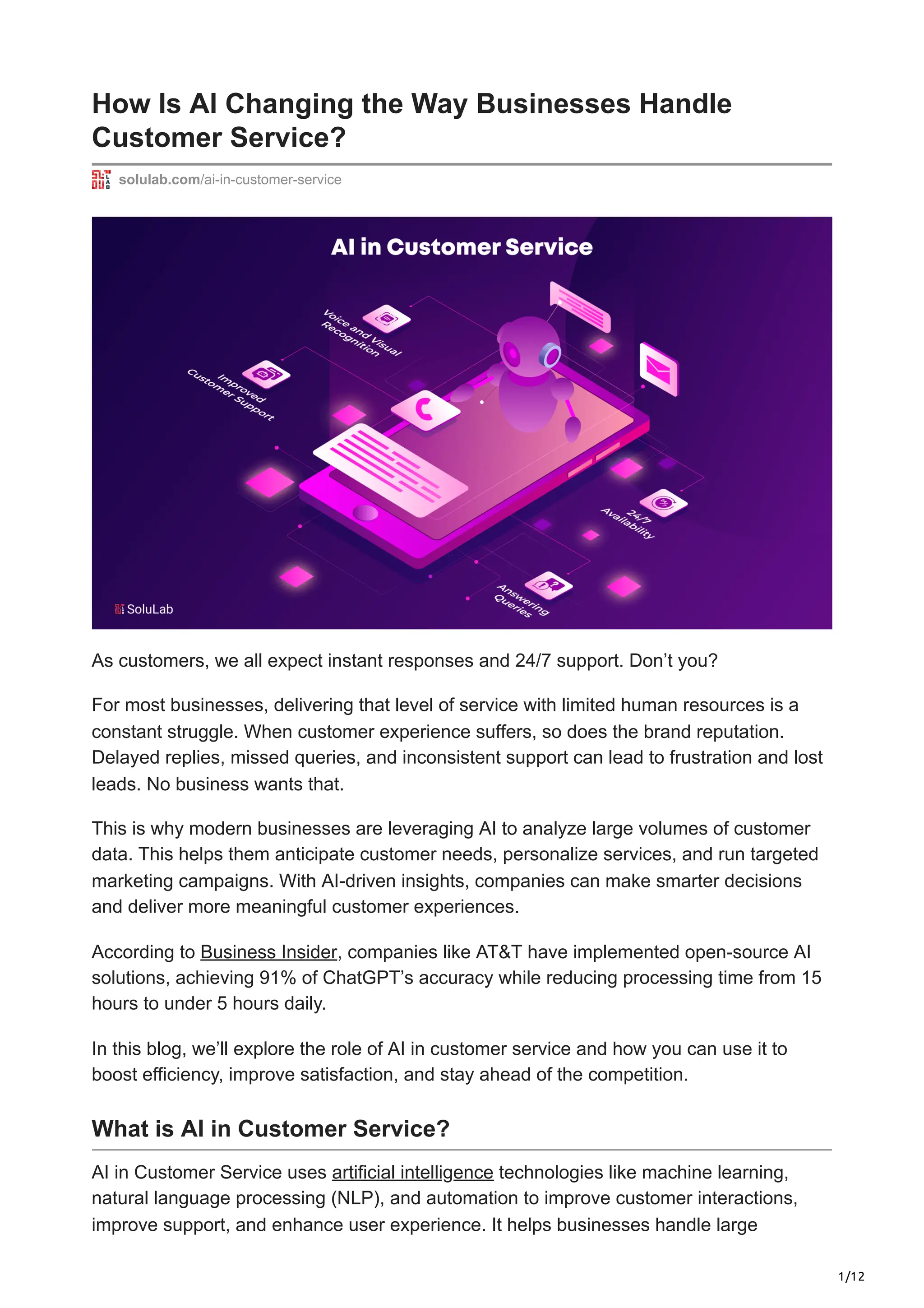
AI in Customer Service uses artificial intelligence technologies like machine learning,
natural language processing (NLP), and automation to improve customer interactions,
improve support, and enhance user experience. It helps businesses handle large
2/12
volumes of customer inquiries efficiently and offers faster, 24/7 support. Key applications
of AI and customer service are:
Chatbots and Virtual Assistants: Tools like Zendesk AI, Intercom, and Freshchat
can handle common queries instantly.
Sentiment Analysis: AI detects emotions in customer messages and routes them
to the right agent.
Predictive Analytics: Artificial intelligence identifies trends in customer behavior to
offer proactive support.
Voice Assistants: Platforms like Google Dialogflow or Amazon Lex support
conversational IVRs.
Auto-tagging and Ticket Routing: AI classifies and assigns tickets automatically
to reduce response time.
DO YOU KNOW?
AI chatbots can handle up to 80% of routine customer service tasks, freeing up human
agents to focus on more complex issues.
How Does AI in Customer Service Benefit Customers?
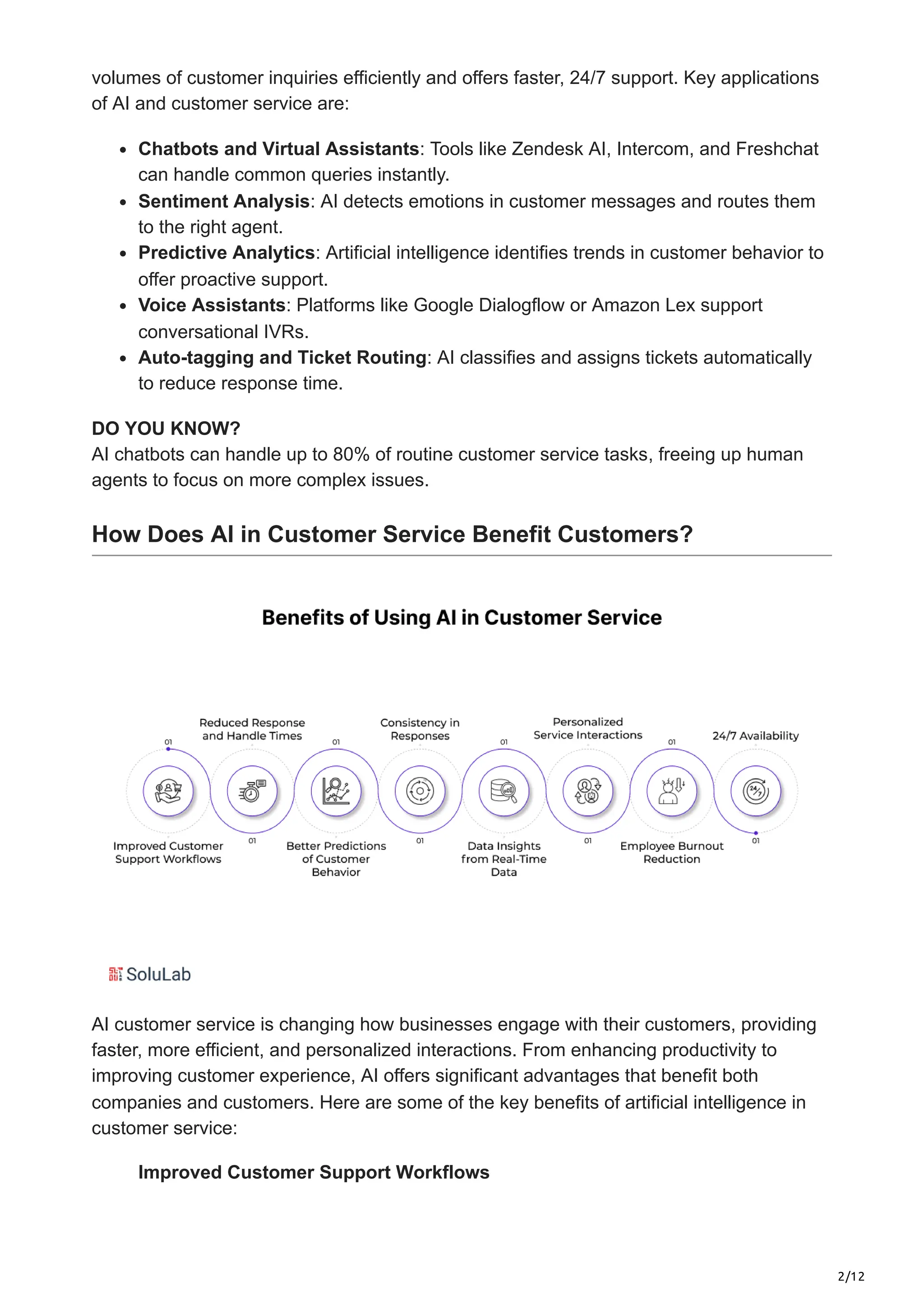
AI customer service is changing how businesses engage with their customers, providing
faster, more efficient, and personalized interactions. From enhancing productivity to
improving customer experience, AI offers significant advantages that benefit both
companies and customers. Here are some of the key benefits of artificial intelligence in
customer service:
Improved Customer Support Workflows
3/12
AI technology can minimize friction at almost any stage of the customer journey. Chatbots
allow you to quickly answer routine queries from new customers, while AI optimizes
internal workflows to enhance customer service interactions. For instance, a large
percentage of incoming work can be automatically completed and then effortlessly
transferred to a human representative as needed. This highlights how is AI used in
customer service to improve efficiency.
Reduced Response and Handle Times
AI-powered customer service improves response times by streamlining workflows.
According to research, 64% of service leaders say that the use of AI in customer support
reduces the time reps spend resolving tickets. Chatbots, for instance, can instantly
respond to live chat messages, significantly reducing your support team’s first response
time. This efficiency lowers your average handle time, allowing for quicker resolutions.
Better Predictions of Customer Behavior
Understanding customer expectations and addressing issues proactively are top
challenges for service leaders. AI can predict customer behavior using real-time data on
purchase history, buying habits, and preferences. Predictive AI identifies patterns, helping
you address potential issues before they arise and enhancing the overall customer
experience. This is a prime example of AI in customer service operations improving
service quality.
Consistency in Responses
Providing consistent and accurate responses throughout the customer journey is critical.
AI ensures that responses remain uniform and standardized, no matter the time or
context of the interaction. This consistency showcases how AI is used in customer
service to maintain a seamless experience.
Data Insights from Real-Time Data
AI tools can analyze customer service interactions to uncover trends, common issues,
and areas for improvement. These insights help companies refine their products,
services, and strategies based on real-time data. For instance, HubSpot’s Breeze
Intelligence, powered by advanced AI and LLMs, uses real-time data to enhance CRM by
improving form conversion rates and identifying buyer intent.
Personalized Service Interactions
Breeze Intelligence offers data enrichment that helps personalize customer service
interactions. By adding more detailed information to records, such as company details
and recent news, marketing and sales teams can create more personalized and relevant
email content. This personalization improves response rates and helps teams provide
tailored interactions before and after a purchase, ensuring customers receive the
attention they deserve.
Employee Burnout Reduction
4/12
Artificial Intelligence is a technology meant to make jobs easier, not harder. By
automating manual tasks like gathering information and managing repetitive customer
service requests, AI can reduce the mental strain on employees. This allows teams to
focus on complex problem-solving and strategic tasks without sacrificing quality or
efficiency. The use of artificial intelligence in customer service thus plays a key role in
reducing burnout.
24/7 Availability
One of the significant benefits of AI is its ability to operate beyond your company’s time
zone. Customers no longer need to wait for human support when chatbots can gather
basic information and begin addressing issues before they are transferred to a
representative. This ensures round-the-clock availability, which is crucial for customer
satisfaction and exemplifies the strength of AI in customer service automation operations.
💡Pro Tip:
To enhance your customer’s experience, use omnichannel chatbots that remember
customer details from all touchpoints along their journey. This eliminates the need for
customers to repeat themselves, leading to a more seamless and personalized brand
interaction.
Examples of AI For Customer Service
Whether you’re in a contact center or working in the field, applications offering a blend of
AI and customer service have the potential to enhance the customer experience
significantly. Here are some examples:
1. Content Generation: AI for content creation can analyze customer interactions,
extract key information, and create human-like responses to customer queries. This
speeds up response times and boosts customer satisfaction, especially when AI utilizes
CRM data and knowledge.
2. Chatbots: AI-powered chatbots manage routine customer inquiries, provide instant
responses, and assist with tasks such as tracking orders, recommending products, and
troubleshooting. Available 24/7, they reduce response times and improve the accessibility
of customer service.
3. Sentiment Analysis: AI-driven sentiment analysis tools assess customer feedback,
reviews, and social media interactions to gauge sentiment. This helps businesses identify
improvement areas, address concerns, and personalize experiences based on customer
preferences, showcasing AI use cases in customer service.
4. Recommendation Systems: AI-powered recommendation systems analyze behavior,
purchase history, and preferences to deliver personalized product or content
recommendations. This helps businesses enhance cross-selling and upselling
opportunities by understanding customer needs.
5/12
5. Predictive Analytics: AI-based predictive analytics leverage customer data to predict
needs, behavior patterns, and potential problems. This proactive approach helps optimize
resource allocation and personalize interactions, demonstrating how AI can be used in
customer service.
How AI in Customer Service Enhances Business Operations?
Here are several ways that AI and ML in customer service can enhance the overall
experience for both organizations and their customers:
Increase Productivity: With generative AI tools, agents can quickly generate
personalized replies to customer inquiries. These responses are not one-size-fits-
all; AI crafts trusted, natural language responses by pulling from customer data,
knowledge articles, or third-party data sources across any channel. This highlights
the use of AI in customer support to improve efficiency and personalization.
Create Work Summaries: AI can significantly boost agent productivity by
automating the creation of wrap-up summaries based on case history and data.
This feature is particularly useful in the field, allowing workers to receive
summarized, relevant data before starting tasks, saving time and improving service
quality.
Share Knowledge: By integrating AI into your service console, it can draft
knowledge base articles based on customer conversations and CRM data for
agents to review. This not only speeds up article creation but also empowers
customers to find their solutions through self-service portals, further underlining the
role of AI in customer service automation.
Search for Answers: As customers or agents seek answers, AI surfaces relevant
responses from the knowledge base directly onto the search page, saving time and
improving efficiency for both parties.
Use Cases of AI in Customer Service for Businesses
1. AI-Supported Human Customer Service
AI, when combined with human agents, can optimize customer service by taking care of
simpler tasks like case management and call routing. This allows human agents to focus
on more complex queries, enhancing the overall experience. AI plays a vital role by:
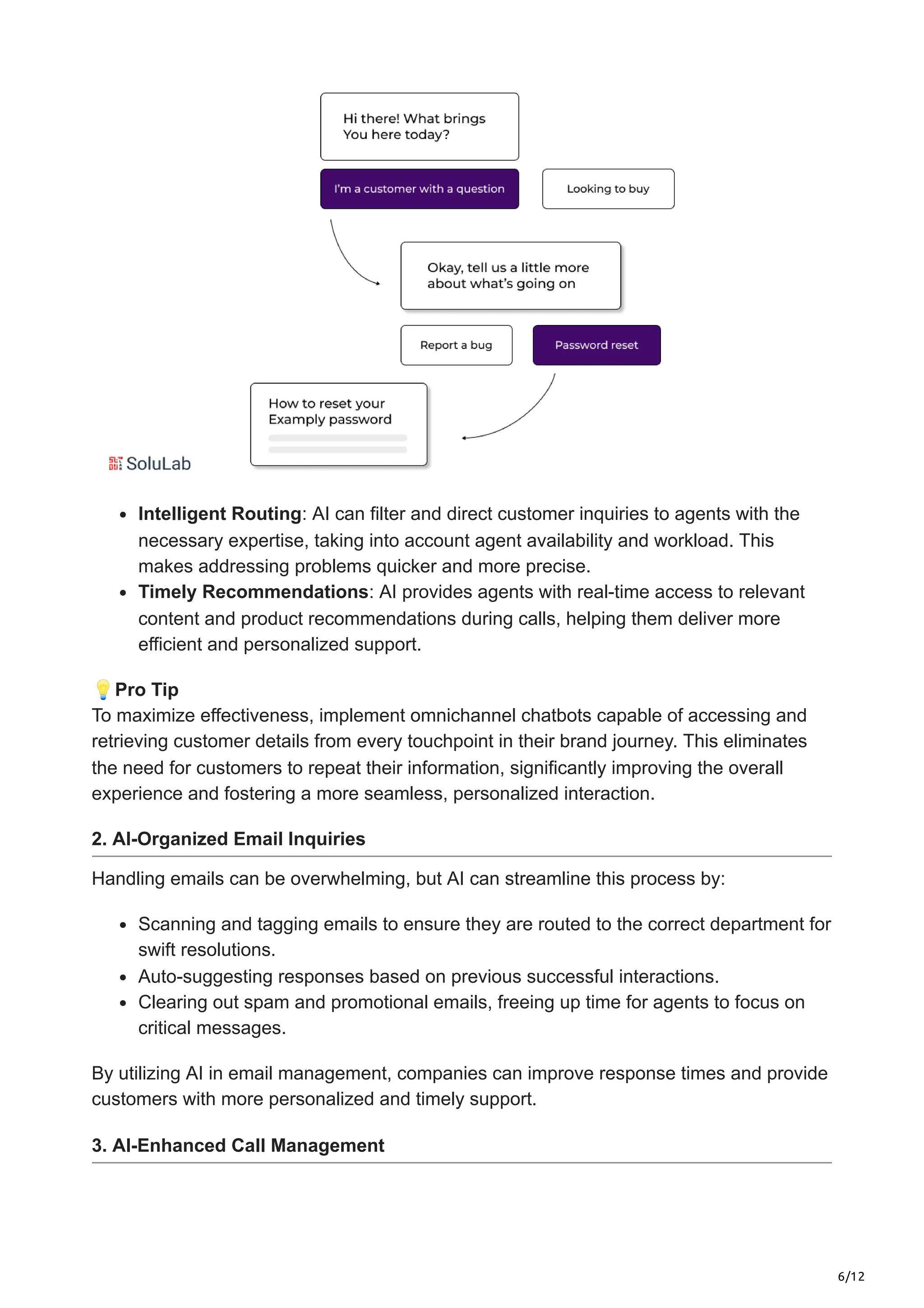
Maintaining Context: AI quickly retrieves customer data from CRM, sales, and
marketing records, enabling agents to continue conversations seamlessly. This
feature is especially useful with omnichannel AI chatbots in customer service, which
allow for a smooth flow of customer interactions across different platforms, ensuring
customers don’t need to repeat themselves.
Answering Routine Queries Independently: By diverting simple questions to AI-
powered FAQ chatbots, businesses can reduce call volume and help agents
prioritize more complex tasks. This use of AI chatbots in customer service improves
resolution time and reduces workload.
6/12
Intelligent Routing: AI can filter and direct customer inquiries to agents with the
necessary expertise, taking into account agent availability and workload. This
makes addressing problems quicker and more precise.
Timely Recommendations: AI provides agents with real-time access to relevant
content and product recommendations during calls, helping them deliver more
efficient and personalized support.
💡Pro Tip
To maximize effectiveness, implement omnichannel chatbots capable of accessing and
retrieving customer details from every touchpoint in their brand journey. This eliminates
the need for customers to repeat their information, significantly improving the overall
experience and fostering a more seamless, personalized interaction.
2. AI-Organized Email Inquiries
Handling emails can be overwhelming, but AI can streamline this process by:
Scanning and tagging emails to ensure they are routed to the correct department for
swift resolutions.
Auto-suggesting responses based on previous successful interactions.
Clearing out spam and promotional emails, freeing up time for agents to focus on
critical messages.
By utilizing AI in email management, companies can improve response times and provide
customers with more personalized and timely support.
3. AI-Enhanced Call Management
7/12
Although challenging, AI has been integrated into call centers through speech analytics
and AI-based voice technologies. This is crucial as customers still prefer phone support
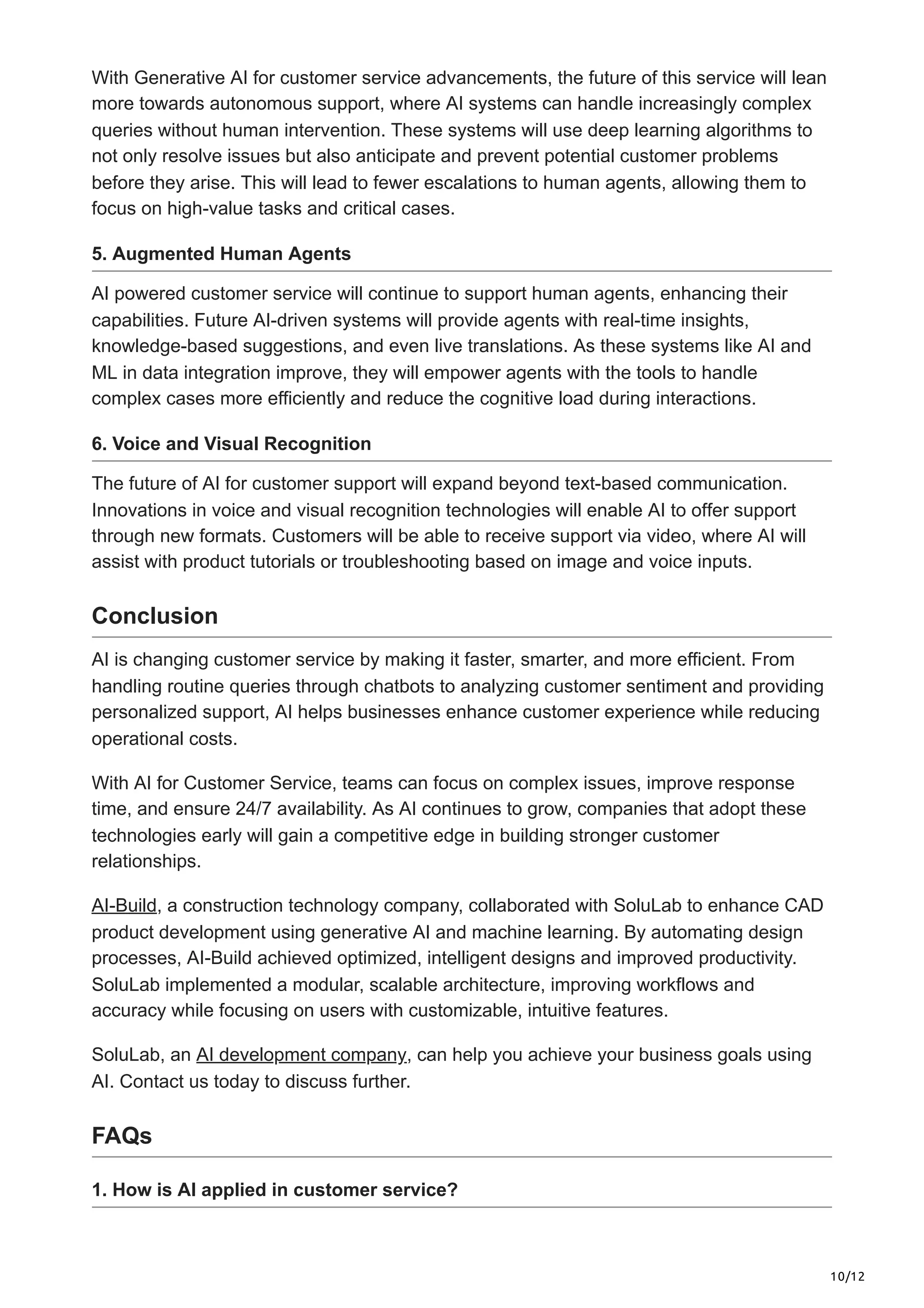
for complex issues. AI enhances call management by:
Capturing spoken input, using neural networks to filter out background noise.
Using NLP and NLU models to understand the intent behind customer queries.
Delivering accurate responses through text-to-speech technology, allows the AI to
communicate solutions audibly.
This AI-driven process enhances the customer experience in voice communications, a
key AI use cases in customer service.
4. Visual Recognition for Product Support
AI-powered visual recognition allows customers to share images or videos of product
issues, helping AI systems identify and diagnose problems more intuitively. Through
recognition algorithms, AI provides visual instructions, empowering customers to resolve
issues independently. This reduces reliance on text-based support and improves
accessibility for a more streamlined support process.
How to Integrate Artificial Intelligence and Customer Service?
Integrating generative AI in customer service using technologies like Machine Learning
(ML) and Computer Vision can significantly boost both efficiency and customer
satisfaction. Follow this seven-step process for a successful integration:
1. Understand Data Types
Data in customer service is derived from interactions, transactions, and feedback. It
includes text, images, videos, and numerical data, categorized as:
Structured data: Data like customer satisfaction scores (CSAT) and analytics that
can be efficiently processed for decision-making.
Unstructured data: This includes audio, video, and free-form responses that do not
follow a predefined format, making them harder to analyze.
Semi-structured data: Examples include CRM messages, which mix both
structured and unstructured elements, requiring specialized analysis techniques.
2. Perform Data Structuring and Labeling
8/12
Before inputting data into an AI model, ensure it’s structured properly. Use tools to clean,
format, and categorize data based on factors like customer demographics and purchase
history. This helps train the AI model effectively.
3. Best Practices for Data Collection
High-quality data is critical for AI training. Here are the key do’s and don’ts:
Do’s:
Focus on accurate, relevant data, prioritizing quality over quantity to ensure model
precision.
To protect client information, make sure that data privacy standards are followed.
Don’ts:
Avoid biased data collection to prevent inaccurate or skewed results.
Refrain from over-collecting data, which can lead to increased storage costs and
misuse of sensitive information.
4. Build Support-Specific Intents
To make AI effective, analyze customer queries for common themes. Build intents aligned
with recurring issues and customer journeys.
💡Pro Tip:
Platforms like Sprinklr AI+ offer pre-built intents across over 150 industries, accelerating
AI deployment for customer service.
5. Train the AI Model on Proprietary Data
Training the AI on proprietary data ensures it aligns with your business needs.
Focus on feature engineering, selecting relevant data features for optimal customer
service outcomes.
Use transfer learning techniques to fine-tune a pre-trained model based on your
proprietary data.
Employ human review during training to assess and improve the model’s
predictions.
6. Integrate the AI Model with Workflows
Once the AI model is trained, integrate it into existing customer service workflows.
Implement a data management system to organize and process customer queries
efficiently. Incorporate technologies like AI chatbots in customer service to deliver quick,
automated responses.
7. Test and Update AI Models Regularly
9/12
Continuously test both the agent-facing and customer-facing AI interfaces:
Agent-side Testing: Evaluate how well the AI assists agents with query handling
and data access. Gather feedback on usability to improve the interface.
Customer-side Testing: Assess how users interact with the AI, focusing on ease of
query submission and clarity of responses. Regularly update the AI model based on
customer feedback to improve performance and satisfaction.
By following these steps, you can effectively leverage AI use cases in customer service
and improve overall business operations through efficient, automated processes.
What Are The Latest Trends In AI For Customer Service?
The integration of AI in customer service is poised to redefine how businesses interact
with their customers. With rapid advancements in technologies like Generative AI, Natural
Language Processing (NLP), and Machine Learning (ML), the future of customer service
is set to become more efficient, personalized, and scalable.
1. Hyper-Personalization
As AI systems become more advanced, they will be able to deliver hyper-personalized
experiences. Future AI-powered platforms will analyze massive amounts of customer
data in real time to predict preferences and tailor interactions. This means that each
customer query will be addressed not just based on immediate input, but with a deeper
understanding of the customer’s entire history with the brand, enabling companies to
deliver tailored recommendations, personalized offers, and proactive support.
2. AI-Driven Omnichannel Support
The future will see AI systems managing customer queries across multiple channels
seamlessly. AI will continue to evolve to understand and manage communication across
platforms, from social media to voice calls, live chat, and even augmented reality (AR).
This omnichannel support will be backed by intelligent systems that offer consistent
service across every touchpoint, allowing customers to transition between channels
without repeating information.
3. AI-Powered Emotional Intelligence
One of the critical challenges AI currently faces is understanding emotional context.
However, future AI systems, enhanced by sentiment analysis and emotional AI, will be
able to assess customer emotions more accurately, adjusting their responses based on
mood and urgency. This emotional intelligence will lead to improved interactions where AI
responds empathetically, further narrowing the gap between human and machine
customer support.
4. Autonomous Support Systems
10/12
With Generative AI for customer service advancements, the future of this service will lean
more towards autonomous support, where AI systems can handle increasingly complex
queries without human intervention. These systems will use deep learning algorithms to
not only resolve issues but also anticipate and prevent potential customer problems
before they arise. This will lead to fewer escalations to human agents, allowing them to
focus on high-value tasks and critical cases.
5. Augmented Human Agents
AI powered customer service will continue to support human agents, enhancing their
capabilities. Future AI-driven systems will provide agents with real-time insights,
knowledge-based suggestions, and even live translations. As these systems like AI and
ML in data integration improve, they will empower agents with the tools to handle
complex cases more efficiently and reduce the cognitive load during interactions.
6. Voice and Visual Recognition
The future of AI for customer support will expand beyond text-based communication.
Innovations in voice and visual recognition technologies will enable AI to offer support
through new formats. Customers will be able to receive support via video, where AI will
assist with product tutorials or troubleshooting based on image and voice inputs.
Conclusion
AI is changing customer service by making it faster, smarter, and more efficient. From
handling routine queries through chatbots to analyzing customer sentiment and providing
personalized support, AI helps businesses enhance customer experience while reducing
operational costs.
With AI for Customer Service, teams can focus on complex issues, improve response
time, and ensure 24/7 availability. As AI continues to grow, companies that adopt these
technologies early will gain a competitive edge in building stronger customer
relationships.
AI-Build, a construction technology company, collaborated with SoluLab to enhance CAD
product development using generative AI and machine learning. By automating design
processes, AI-Build achieved optimized, intelligent designs and improved productivity.
SoluLab implemented a modular, scalable architecture, improving workflows and
accuracy while focusing on users with customizable, intuitive features.
SoluLab, an AI development company, can help you achieve your business goals using
AI. Contact us today to discuss further.
FAQs
1. How is AI applied in customer service?
11/12
AI is commonly used in customer service through chatbots, virtual assistants, and
automated ticketing systems. It helps companies respond to inquiries, automate routine
tasks, route queries to the appropriate departments, and even offer personalized
recommendations based on customer data. AI tools also assist in analyzing large
volumes of data for better decision-making.
2. Which industries benefit the most from AI in customer service?
Industries like retail, banking, healthcare, telecommunications, and e-commerce see
significant benefits from artificial intelligence customer care. AI-powered tools streamline
customer interactions, providing faster responses and personalized support. These
sectors, where customer satisfaction is crucial, need to improve efficiency, reduce
response time, and offer a better overall experience. By leveraging AI, businesses can
enhance their customer service operations and build stronger relationships with their
clients.
3. Will AI replace customer service?
AI is unlikely to fully replace human customer service but will act as a powerful tool to
complement it. While AI excels in handling routine inquiries and automating processes,
human agents are still needed for complex issues that require empathy, creativity, and
problem-solving. Together, they create a more efficient and balanced customer service
experience.
4. How can AI help businesses better understand their customers?
AI engages customers by offering personalized experiences, like recommending products
based on past purchases or predicting their needs before they even ask. Through AI
chatbots, natural language processing, and predictive analytics, businesses can interact
with customers in real time, providing relevant responses and support across multiple
channels.
5. What is the future of AI in customer service?
The future of AI in customer service involves more advanced personalization, predictive
support, and omnichannel experiences. With technologies like generative AI, companies
will be able to automate more complex tasks and offer proactive service. AI will continue
to assist in understanding customer behavior and preferences, driving seamless, intuitive
support systems.
6. How can companies secure data when using AI for customer service?
To keep data secure, businesses should implement encryption, strict access controls, and
regular security audits. Ensuring compliance with data privacy regulations, such as
GDPR, and using AI systems that follow best practices for handling sensitive information
can help safeguard customer data while benefiting from AI’s capabilities.
7. How can SoluLab enhance AI in your customer service?
12/12
SoluLab, an AI consulting company, specializes in developing custom AI solutions that
improve customer service efficiency. From implementing intelligent chatbots to integrating
machine learning for personalized experiences, SoluLab ensures that AI systems are
tailored to meet the unique needs of your business, delivering outstanding customer
experiences.

How Is AI Changing the Way Businesses Handle Customer Service.pdf

  • 1.
    1/12 How Is AIChanging the Way Businesses Handle Customer Service? solulab.com/ai-in-customer-service As customers, we all expect instant responses and 24/7 support. Don’t you? For most businesses, delivering that level of service with limited human resources is a constant struggle. When customer experience suffers, so does the brand reputation. Delayed replies, missed queries, and inconsistent support can lead to frustration and lost leads. No business wants that. This is why modern businesses are leveraging AI to analyze large volumes of customer data. This helps them anticipate customer needs, personalize services, and run targeted marketing campaigns. With AI-driven insights, companies can make smarter decisions and deliver more meaningful customer experiences. According to Business Insider, companies like AT&T have implemented open-source AI solutions, achieving 91% of ChatGPT’s accuracy while reducing processing time from 15 hours to under 5 hours daily. In this blog, we’ll explore the role of AI in customer service and how you can use it to boost efficiency, improve satisfaction, and stay ahead of the competition. What is AI in Customer Service? AI in Customer Service uses artificial intelligence technologies like machine learning, natural language processing (NLP), and automation to improve customer interactions, improve support, and enhance user experience. It helps businesses handle large
  • 2.
    2/12 volumes of customerinquiries efficiently and offers faster, 24/7 support. Key applications of AI and customer service are: Chatbots and Virtual Assistants: Tools like Zendesk AI, Intercom, and Freshchat can handle common queries instantly. Sentiment Analysis: AI detects emotions in customer messages and routes them to the right agent. Predictive Analytics: Artificial intelligence identifies trends in customer behavior to offer proactive support. Voice Assistants: Platforms like Google Dialogflow or Amazon Lex support conversational IVRs. Auto-tagging and Ticket Routing: AI classifies and assigns tickets automatically to reduce response time. DO YOU KNOW? AI chatbots can handle up to 80% of routine customer service tasks, freeing up human agents to focus on more complex issues. How Does AI in Customer Service Benefit Customers? AI customer service is changing how businesses engage with their customers, providing faster, more efficient, and personalized interactions. From enhancing productivity to improving customer experience, AI offers significant advantages that benefit both companies and customers. Here are some of the key benefits of artificial intelligence in customer service: Improved Customer Support Workflows
  • 3.
    3/12 AI technology canminimize friction at almost any stage of the customer journey. Chatbots allow you to quickly answer routine queries from new customers, while AI optimizes internal workflows to enhance customer service interactions. For instance, a large percentage of incoming work can be automatically completed and then effortlessly transferred to a human representative as needed. This highlights how is AI used in customer service to improve efficiency. Reduced Response and Handle Times AI-powered customer service improves response times by streamlining workflows. According to research, 64% of service leaders say that the use of AI in customer support reduces the time reps spend resolving tickets. Chatbots, for instance, can instantly respond to live chat messages, significantly reducing your support team’s first response time. This efficiency lowers your average handle time, allowing for quicker resolutions. Better Predictions of Customer Behavior Understanding customer expectations and addressing issues proactively are top challenges for service leaders. AI can predict customer behavior using real-time data on purchase history, buying habits, and preferences. Predictive AI identifies patterns, helping you address potential issues before they arise and enhancing the overall customer experience. This is a prime example of AI in customer service operations improving service quality. Consistency in Responses Providing consistent and accurate responses throughout the customer journey is critical. AI ensures that responses remain uniform and standardized, no matter the time or context of the interaction. This consistency showcases how AI is used in customer service to maintain a seamless experience. Data Insights from Real-Time Data AI tools can analyze customer service interactions to uncover trends, common issues, and areas for improvement. These insights help companies refine their products, services, and strategies based on real-time data. For instance, HubSpot’s Breeze Intelligence, powered by advanced AI and LLMs, uses real-time data to enhance CRM by improving form conversion rates and identifying buyer intent. Personalized Service Interactions Breeze Intelligence offers data enrichment that helps personalize customer service interactions. By adding more detailed information to records, such as company details and recent news, marketing and sales teams can create more personalized and relevant email content. This personalization improves response rates and helps teams provide tailored interactions before and after a purchase, ensuring customers receive the attention they deserve. Employee Burnout Reduction
  • 4.
    4/12 Artificial Intelligence isa technology meant to make jobs easier, not harder. By automating manual tasks like gathering information and managing repetitive customer service requests, AI can reduce the mental strain on employees. This allows teams to focus on complex problem-solving and strategic tasks without sacrificing quality or efficiency. The use of artificial intelligence in customer service thus plays a key role in reducing burnout. 24/7 Availability One of the significant benefits of AI is its ability to operate beyond your company’s time zone. Customers no longer need to wait for human support when chatbots can gather basic information and begin addressing issues before they are transferred to a representative. This ensures round-the-clock availability, which is crucial for customer satisfaction and exemplifies the strength of AI in customer service automation operations. 💡Pro Tip: To enhance your customer’s experience, use omnichannel chatbots that remember customer details from all touchpoints along their journey. This eliminates the need for customers to repeat themselves, leading to a more seamless and personalized brand interaction. Examples of AI For Customer Service Whether you’re in a contact center or working in the field, applications offering a blend of AI and customer service have the potential to enhance the customer experience significantly. Here are some examples: 1. Content Generation: AI for content creation can analyze customer interactions, extract key information, and create human-like responses to customer queries. This speeds up response times and boosts customer satisfaction, especially when AI utilizes CRM data and knowledge. 2. Chatbots: AI-powered chatbots manage routine customer inquiries, provide instant responses, and assist with tasks such as tracking orders, recommending products, and troubleshooting. Available 24/7, they reduce response times and improve the accessibility of customer service. 3. Sentiment Analysis: AI-driven sentiment analysis tools assess customer feedback, reviews, and social media interactions to gauge sentiment. This helps businesses identify improvement areas, address concerns, and personalize experiences based on customer preferences, showcasing AI use cases in customer service. 4. Recommendation Systems: AI-powered recommendation systems analyze behavior, purchase history, and preferences to deliver personalized product or content recommendations. This helps businesses enhance cross-selling and upselling opportunities by understanding customer needs.
  • 5.
    5/12 5. Predictive Analytics:AI-based predictive analytics leverage customer data to predict needs, behavior patterns, and potential problems. This proactive approach helps optimize resource allocation and personalize interactions, demonstrating how AI can be used in customer service. How AI in Customer Service Enhances Business Operations? Here are several ways that AI and ML in customer service can enhance the overall experience for both organizations and their customers: Increase Productivity: With generative AI tools, agents can quickly generate personalized replies to customer inquiries. These responses are not one-size-fits- all; AI crafts trusted, natural language responses by pulling from customer data, knowledge articles, or third-party data sources across any channel. This highlights the use of AI in customer support to improve efficiency and personalization. Create Work Summaries: AI can significantly boost agent productivity by automating the creation of wrap-up summaries based on case history and data. This feature is particularly useful in the field, allowing workers to receive summarized, relevant data before starting tasks, saving time and improving service quality. Share Knowledge: By integrating AI into your service console, it can draft knowledge base articles based on customer conversations and CRM data for agents to review. This not only speeds up article creation but also empowers customers to find their solutions through self-service portals, further underlining the role of AI in customer service automation. Search for Answers: As customers or agents seek answers, AI surfaces relevant responses from the knowledge base directly onto the search page, saving time and improving efficiency for both parties. Use Cases of AI in Customer Service for Businesses 1. AI-Supported Human Customer Service AI, when combined with human agents, can optimize customer service by taking care of simpler tasks like case management and call routing. This allows human agents to focus on more complex queries, enhancing the overall experience. AI plays a vital role by: Maintaining Context: AI quickly retrieves customer data from CRM, sales, and marketing records, enabling agents to continue conversations seamlessly. This feature is especially useful with omnichannel AI chatbots in customer service, which allow for a smooth flow of customer interactions across different platforms, ensuring customers don’t need to repeat themselves. Answering Routine Queries Independently: By diverting simple questions to AI- powered FAQ chatbots, businesses can reduce call volume and help agents prioritize more complex tasks. This use of AI chatbots in customer service improves resolution time and reduces workload.
  • 6.
    6/12 Intelligent Routing: AIcan filter and direct customer inquiries to agents with the necessary expertise, taking into account agent availability and workload. This makes addressing problems quicker and more precise. Timely Recommendations: AI provides agents with real-time access to relevant content and product recommendations during calls, helping them deliver more efficient and personalized support. 💡Pro Tip To maximize effectiveness, implement omnichannel chatbots capable of accessing and retrieving customer details from every touchpoint in their brand journey. This eliminates the need for customers to repeat their information, significantly improving the overall experience and fostering a more seamless, personalized interaction. 2. AI-Organized Email Inquiries Handling emails can be overwhelming, but AI can streamline this process by: Scanning and tagging emails to ensure they are routed to the correct department for swift resolutions. Auto-suggesting responses based on previous successful interactions. Clearing out spam and promotional emails, freeing up time for agents to focus on critical messages. By utilizing AI in email management, companies can improve response times and provide customers with more personalized and timely support. 3. AI-Enhanced Call Management
  • 7.
    7/12 Although challenging, AIhas been integrated into call centers through speech analytics and AI-based voice technologies. This is crucial as customers still prefer phone support for complex issues. AI enhances call management by: Capturing spoken input, using neural networks to filter out background noise. Using NLP and NLU models to understand the intent behind customer queries. Delivering accurate responses through text-to-speech technology, allows the AI to communicate solutions audibly. This AI-driven process enhances the customer experience in voice communications, a key AI use cases in customer service. 4. Visual Recognition for Product Support AI-powered visual recognition allows customers to share images or videos of product issues, helping AI systems identify and diagnose problems more intuitively. Through recognition algorithms, AI provides visual instructions, empowering customers to resolve issues independently. This reduces reliance on text-based support and improves accessibility for a more streamlined support process. How to Integrate Artificial Intelligence and Customer Service? Integrating generative AI in customer service using technologies like Machine Learning (ML) and Computer Vision can significantly boost both efficiency and customer satisfaction. Follow this seven-step process for a successful integration: 1. Understand Data Types Data in customer service is derived from interactions, transactions, and feedback. It includes text, images, videos, and numerical data, categorized as: Structured data: Data like customer satisfaction scores (CSAT) and analytics that can be efficiently processed for decision-making. Unstructured data: This includes audio, video, and free-form responses that do not follow a predefined format, making them harder to analyze. Semi-structured data: Examples include CRM messages, which mix both structured and unstructured elements, requiring specialized analysis techniques. 2. Perform Data Structuring and Labeling
  • 8.
    8/12 Before inputting datainto an AI model, ensure it’s structured properly. Use tools to clean, format, and categorize data based on factors like customer demographics and purchase history. This helps train the AI model effectively. 3. Best Practices for Data Collection High-quality data is critical for AI training. Here are the key do’s and don’ts: Do’s: Focus on accurate, relevant data, prioritizing quality over quantity to ensure model precision. To protect client information, make sure that data privacy standards are followed. Don’ts: Avoid biased data collection to prevent inaccurate or skewed results. Refrain from over-collecting data, which can lead to increased storage costs and misuse of sensitive information. 4. Build Support-Specific Intents To make AI effective, analyze customer queries for common themes. Build intents aligned with recurring issues and customer journeys. 💡Pro Tip: Platforms like Sprinklr AI+ offer pre-built intents across over 150 industries, accelerating AI deployment for customer service. 5. Train the AI Model on Proprietary Data Training the AI on proprietary data ensures it aligns with your business needs. Focus on feature engineering, selecting relevant data features for optimal customer service outcomes. Use transfer learning techniques to fine-tune a pre-trained model based on your proprietary data. Employ human review during training to assess and improve the model’s predictions. 6. Integrate the AI Model with Workflows Once the AI model is trained, integrate it into existing customer service workflows. Implement a data management system to organize and process customer queries efficiently. Incorporate technologies like AI chatbots in customer service to deliver quick, automated responses. 7. Test and Update AI Models Regularly
  • 9.
    9/12 Continuously test boththe agent-facing and customer-facing AI interfaces: Agent-side Testing: Evaluate how well the AI assists agents with query handling and data access. Gather feedback on usability to improve the interface. Customer-side Testing: Assess how users interact with the AI, focusing on ease of query submission and clarity of responses. Regularly update the AI model based on customer feedback to improve performance and satisfaction. By following these steps, you can effectively leverage AI use cases in customer service and improve overall business operations through efficient, automated processes. What Are The Latest Trends In AI For Customer Service? The integration of AI in customer service is poised to redefine how businesses interact with their customers. With rapid advancements in technologies like Generative AI, Natural Language Processing (NLP), and Machine Learning (ML), the future of customer service is set to become more efficient, personalized, and scalable. 1. Hyper-Personalization As AI systems become more advanced, they will be able to deliver hyper-personalized experiences. Future AI-powered platforms will analyze massive amounts of customer data in real time to predict preferences and tailor interactions. This means that each customer query will be addressed not just based on immediate input, but with a deeper understanding of the customer’s entire history with the brand, enabling companies to deliver tailored recommendations, personalized offers, and proactive support. 2. AI-Driven Omnichannel Support The future will see AI systems managing customer queries across multiple channels seamlessly. AI will continue to evolve to understand and manage communication across platforms, from social media to voice calls, live chat, and even augmented reality (AR). This omnichannel support will be backed by intelligent systems that offer consistent service across every touchpoint, allowing customers to transition between channels without repeating information. 3. AI-Powered Emotional Intelligence One of the critical challenges AI currently faces is understanding emotional context. However, future AI systems, enhanced by sentiment analysis and emotional AI, will be able to assess customer emotions more accurately, adjusting their responses based on mood and urgency. This emotional intelligence will lead to improved interactions where AI responds empathetically, further narrowing the gap between human and machine customer support. 4. Autonomous Support Systems
  • 10.
    10/12 With Generative AIfor customer service advancements, the future of this service will lean more towards autonomous support, where AI systems can handle increasingly complex queries without human intervention. These systems will use deep learning algorithms to not only resolve issues but also anticipate and prevent potential customer problems before they arise. This will lead to fewer escalations to human agents, allowing them to focus on high-value tasks and critical cases. 5. Augmented Human Agents AI powered customer service will continue to support human agents, enhancing their capabilities. Future AI-driven systems will provide agents with real-time insights, knowledge-based suggestions, and even live translations. As these systems like AI and ML in data integration improve, they will empower agents with the tools to handle complex cases more efficiently and reduce the cognitive load during interactions. 6. Voice and Visual Recognition The future of AI for customer support will expand beyond text-based communication. Innovations in voice and visual recognition technologies will enable AI to offer support through new formats. Customers will be able to receive support via video, where AI will assist with product tutorials or troubleshooting based on image and voice inputs. Conclusion AI is changing customer service by making it faster, smarter, and more efficient. From handling routine queries through chatbots to analyzing customer sentiment and providing personalized support, AI helps businesses enhance customer experience while reducing operational costs. With AI for Customer Service, teams can focus on complex issues, improve response time, and ensure 24/7 availability. As AI continues to grow, companies that adopt these technologies early will gain a competitive edge in building stronger customer relationships. AI-Build, a construction technology company, collaborated with SoluLab to enhance CAD product development using generative AI and machine learning. By automating design processes, AI-Build achieved optimized, intelligent designs and improved productivity. SoluLab implemented a modular, scalable architecture, improving workflows and accuracy while focusing on users with customizable, intuitive features. SoluLab, an AI development company, can help you achieve your business goals using AI. Contact us today to discuss further. FAQs 1. How is AI applied in customer service?
  • 11.
    11/12 AI is commonlyused in customer service through chatbots, virtual assistants, and automated ticketing systems. It helps companies respond to inquiries, automate routine tasks, route queries to the appropriate departments, and even offer personalized recommendations based on customer data. AI tools also assist in analyzing large volumes of data for better decision-making. 2. Which industries benefit the most from AI in customer service? Industries like retail, banking, healthcare, telecommunications, and e-commerce see significant benefits from artificial intelligence customer care. AI-powered tools streamline customer interactions, providing faster responses and personalized support. These sectors, where customer satisfaction is crucial, need to improve efficiency, reduce response time, and offer a better overall experience. By leveraging AI, businesses can enhance their customer service operations and build stronger relationships with their clients. 3. Will AI replace customer service? AI is unlikely to fully replace human customer service but will act as a powerful tool to complement it. While AI excels in handling routine inquiries and automating processes, human agents are still needed for complex issues that require empathy, creativity, and problem-solving. Together, they create a more efficient and balanced customer service experience. 4. How can AI help businesses better understand their customers? AI engages customers by offering personalized experiences, like recommending products based on past purchases or predicting their needs before they even ask. Through AI chatbots, natural language processing, and predictive analytics, businesses can interact with customers in real time, providing relevant responses and support across multiple channels. 5. What is the future of AI in customer service? The future of AI in customer service involves more advanced personalization, predictive support, and omnichannel experiences. With technologies like generative AI, companies will be able to automate more complex tasks and offer proactive service. AI will continue to assist in understanding customer behavior and preferences, driving seamless, intuitive support systems. 6. How can companies secure data when using AI for customer service? To keep data secure, businesses should implement encryption, strict access controls, and regular security audits. Ensuring compliance with data privacy regulations, such as GDPR, and using AI systems that follow best practices for handling sensitive information can help safeguard customer data while benefiting from AI’s capabilities. 7. How can SoluLab enhance AI in your customer service?
  • 12.
    12/12 SoluLab, an AIconsulting company, specializes in developing custom AI solutions that improve customer service efficiency. From implementing intelligent chatbots to integrating machine learning for personalized experiences, SoluLab ensures that AI systems are tailored to meet the unique needs of your business, delivering outstanding customer experiences.