Image
Annotation
How It Supports Autonomous Vehicles and Robotics
www.damcogroup.com +1 609 632 0350 info@damcogroup.com Plainsboro, New Jersey, USA
Introduction
The process of labeling images to provide detailed data for
training AI systems. It involves marking objects, shapes,
and features in images to help machines "see" and
"understand".
Importance in AI
Development
Key for developing machine learning models, especially in
autonomous systems like vehicles and robots.
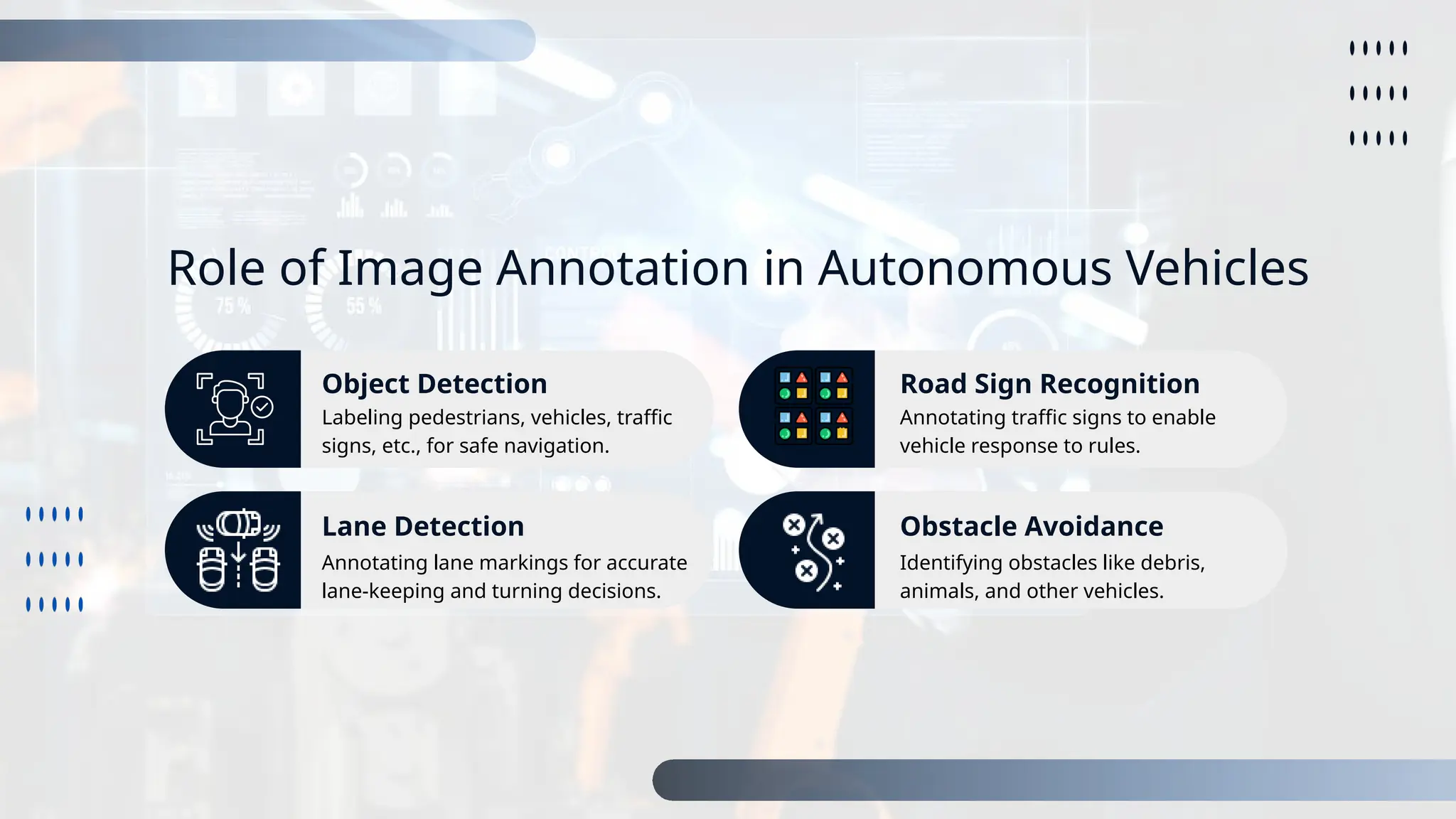
Role of Image Annotation in Autonomous Vehicles
Labeling pedestrians, vehicles, traffic
signs, etc., for safe navigation.
Annotating traffic signs to enable
vehicle response to rules.
Annotating lane markings for accurate
lane-keeping and turning decisions.
Identifying obstacles like debris,
animals, and other vehicles.
Object Detection Road Sign Recognition
Lane Detection Obstacle Avoidance
Role of Image Annotation in
Robotics
• Object Manipulation: Annotating objects for precise handling by
robots.
• Navigation: Annotating environments for robots to map and avoid
obstacles.
• Human-Robot Interaction: Identifying humans and understanding
their actions for safer interactions.
• Vision for Industrial Robots: Annotating parts on production lines for
automated assembly and quality control.
Key Types of Image
Annotation for Vehicles &
Robotics
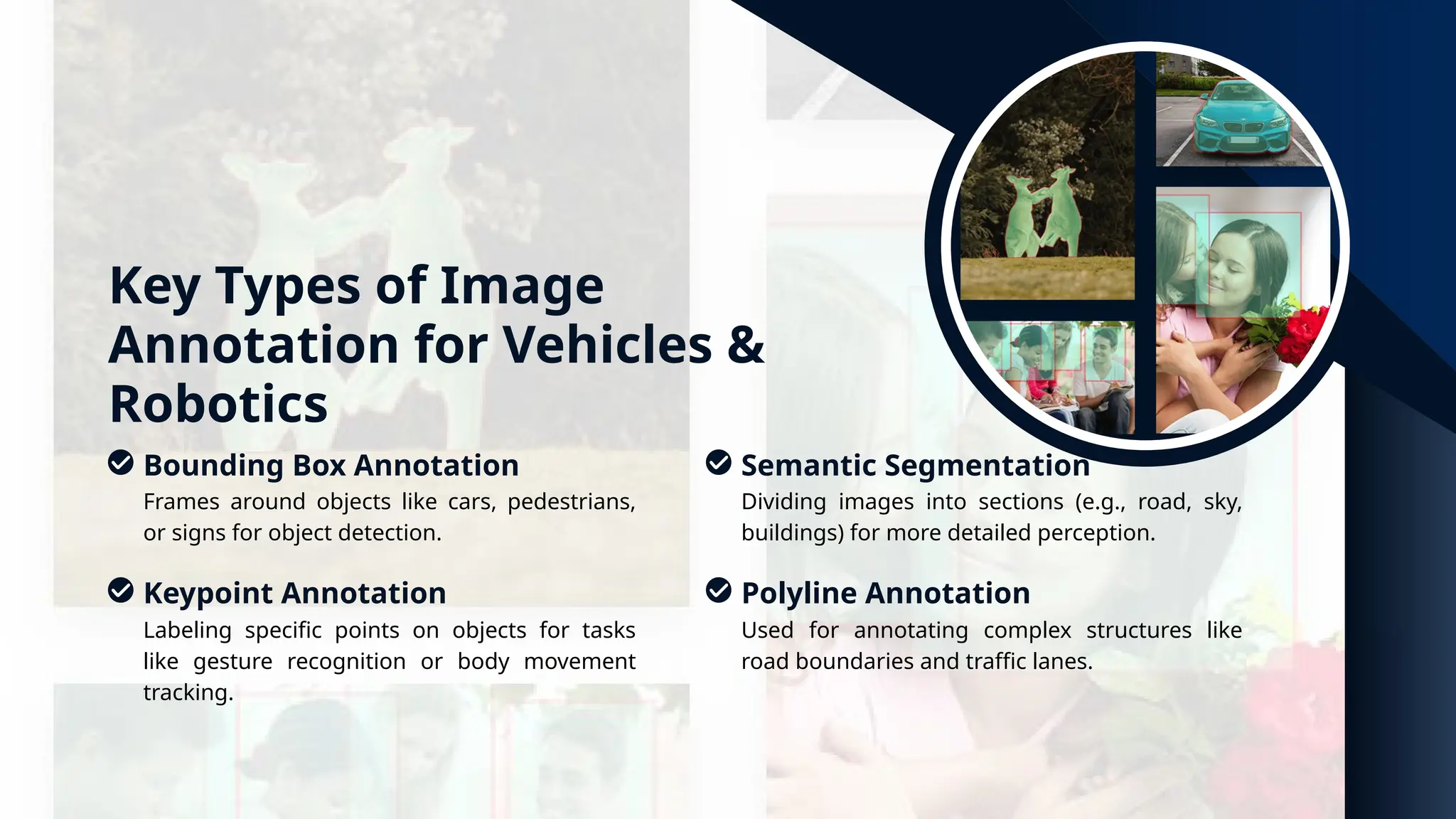
Semantic Segmentation
Frames around objects like cars, pedestrians,
or signs for object detection.
Dividing images into sections (e.g., road, sky,
buildings) for more detailed perception.
Labeling specific points on objects for tasks
like gesture recognition or body movement
tracking.
Used for annotating complex structures like
road boundaries and traffic lanes.
Bounding Box Annotation
Keypoint Annotation Polyline Annotation
Why High-Quality Image
Annotation is Crucial
• Accuracy in Decision-Making: Autonomous systems
must make quick, accurate decisions based on labeled
data.
• Training Robust AI Models: High-quality data ensures
AI systems are trained to handle diverse, real-world
scenarios.
• Scaling AI Models: Consistent and precise annotation
allows systems to scale and adapt to new
environments.
Challenges in Image
Annotation for AVs and
Robotics
Annotating images with diverse conditions (night, rain,
fog) requires high accuracy.
Autonomous vehicles and robots generate large volumes of visual
data, requiring efficient annotation systems.
Complexity of Real-World
Environments
Handling Large Data
Volumes
Consistent labeling is crucial to avoid discrepancies in the training
dataset.
Maintaining Annotation
Consistency
Real-World Use Cases
Waymo, Tesla, and other companies using image annotation
to train self-driving vehicles.
Amazon robots using annotated data for product picking and
packaging.
Autonomous Vehicles
Robotics in Warehousing
Surgical robots using annotated medical imagery for precise
operations.
Medical Robotics
Conclusion
Image annotation is the foundation for training
autonomous vehicles and robotics systems. It
enables accurate decision-making and smooth
operations in real-world scenarios. The importance
of high-quality, consistent data cannot be
overstated in ensuring safety and reliability.
Thank You
For your attention to this presentation.
www.damcogroup.com +1 609 632 0350 info@damcogroup.com Plainsboro, New Jersey, US
Explore how our Image Annotation Services can help power your AI
models for autonomous vehicles and robotics.

How Image Annotation Supports Autonomous Vehicles and Robotics

  • 1.
    Image Annotation How It SupportsAutonomous Vehicles and Robotics www.damcogroup.com +1 609 632 0350 info@damcogroup.com Plainsboro, New Jersey, USA
  • 2.
    Introduction The process oflabeling images to provide detailed data for training AI systems. It involves marking objects, shapes, and features in images to help machines "see" and "understand". Importance in AI Development Key for developing machine learning models, especially in autonomous systems like vehicles and robots.
  • 3.
    Role of ImageAnnotation in Autonomous Vehicles Labeling pedestrians, vehicles, traffic signs, etc., for safe navigation. Annotating traffic signs to enable vehicle response to rules. Annotating lane markings for accurate lane-keeping and turning decisions. Identifying obstacles like debris, animals, and other vehicles. Object Detection Road Sign Recognition Lane Detection Obstacle Avoidance
  • 4.
    Role of ImageAnnotation in Robotics • Object Manipulation: Annotating objects for precise handling by robots. • Navigation: Annotating environments for robots to map and avoid obstacles. • Human-Robot Interaction: Identifying humans and understanding their actions for safer interactions. • Vision for Industrial Robots: Annotating parts on production lines for automated assembly and quality control.
  • 5.
    Key Types ofImage Annotation for Vehicles & Robotics Semantic Segmentation Frames around objects like cars, pedestrians, or signs for object detection. Dividing images into sections (e.g., road, sky, buildings) for more detailed perception. Labeling specific points on objects for tasks like gesture recognition or body movement tracking. Used for annotating complex structures like road boundaries and traffic lanes. Bounding Box Annotation Keypoint Annotation Polyline Annotation
  • 6.
    Why High-Quality Image Annotationis Crucial • Accuracy in Decision-Making: Autonomous systems must make quick, accurate decisions based on labeled data. • Training Robust AI Models: High-quality data ensures AI systems are trained to handle diverse, real-world scenarios. • Scaling AI Models: Consistent and precise annotation allows systems to scale and adapt to new environments.
  • 7.
    Challenges in Image Annotationfor AVs and Robotics Annotating images with diverse conditions (night, rain, fog) requires high accuracy. Autonomous vehicles and robots generate large volumes of visual data, requiring efficient annotation systems. Complexity of Real-World Environments Handling Large Data Volumes Consistent labeling is crucial to avoid discrepancies in the training dataset. Maintaining Annotation Consistency
  • 8.
    Real-World Use Cases Waymo,Tesla, and other companies using image annotation to train self-driving vehicles. Amazon robots using annotated data for product picking and packaging. Autonomous Vehicles Robotics in Warehousing Surgical robots using annotated medical imagery for precise operations. Medical Robotics
  • 9.
    Conclusion Image annotation isthe foundation for training autonomous vehicles and robotics systems. It enables accurate decision-making and smooth operations in real-world scenarios. The importance of high-quality, consistent data cannot be overstated in ensuring safety and reliability.
  • 10.
    Thank You For yourattention to this presentation. www.damcogroup.com +1 609 632 0350 info@damcogroup.com Plainsboro, New Jersey, US Explore how our Image Annotation Services can help power your AI models for autonomous vehicles and robotics.