How Generational Preferences Are Shaping Payment Technologies
The way people approach financial transactions today reflects a distinct shift driven by
generational preferences. From Millennials and Gen Z, who prioritize speed and
convenience, to Baby Boomers who value security and familiarity, these preferences
are reshaping the payment technology landscape. Businesses must adapt to meet the
diverse expectations of their audiences or risk being left behind in an evolving
marketplace.
The Preferences of Younger Generations.
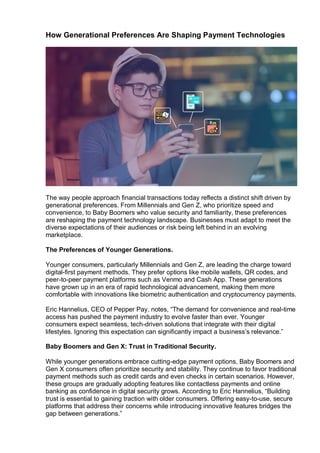
Younger consumers, particularly Millennials and Gen Z, are leading the charge toward
digital-first payment methods. They prefer options like mobile wallets, QR codes, and
peer-to-peer payment platforms such as Venmo and Cash App. These generations
have grown up in an era of rapid technological advancement, making them more
comfortable with innovations like biometric authentication and cryptocurrency payments.
Eric Hannelius, CEO of Pepper Pay, notes, “The demand for convenience and real-time
access has pushed the payment industry to evolve faster than ever. Younger
consumers expect seamless, tech-driven solutions that integrate with their digital
lifestyles. Ignoring this expectation can significantly impact a business’s relevance.”
Baby Boomers and Gen X: Trust in Traditional Security.
While younger generations embrace cutting-edge payment options, Baby Boomers and
Gen X consumers often prioritize security and stability. They continue to favor traditional
payment methods such as credit cards and even checks in certain scenarios. However,
these groups are gradually adopting features like contactless payments and online
banking as confidence in digital security grows. According to Eric Hannelius, “Building
trust is essential to gaining traction with older consumers. Offering easy-to-use, secure
platforms that address their concerns while introducing innovative features bridges the
gap between generations.”
Emerging Trends Across Generations.
One significant trend shaping payment technology is the rise of embedded finance,
where financial services are seamlessly integrated into non-financial platforms. Another
is the expansion of buy-now-pay-later (BNPL) options, appealing to consumers across
age groups. These innovations demonstrate how businesses are leveraging technology
to meet the diverse needs of their audiences. “The key to success lies in understanding
generational behaviors and designing payment systems that are flexible, accessible,
and secure,” says Eric Hannelius. “A one-size-fits-all approach no longer works in
today’s payment landscape.”
Designing for the Future.
To stay competitive, businesses must continue to monitor generational trends and
invest in flexible, adaptive payment technologies. Innovations such as voice-enabled
payments, blockchain applications, and advanced fraud detection systems will likely
shape the future of financial transactions. Eric Hannelius concludes, “The future of
payments depends on creating experiences that balance convenience and trust while
catering to the unique needs of each generation. Businesses that recognize and
respond to these dynamics will remain competitive and foster long-term customer
loyalty.”
Generational preferences are not static. They evolve alongside societal and
technological changes. Businesses that stay ahead by embracing these shifts and
implementing inclusive payment strategies will drive growth in an increasingly digital
economy.

How Generational Preferences Are Shaping Payment Technologies_Vocal.pdf

  • 1.
    How Generational PreferencesAre Shaping Payment Technologies The way people approach financial transactions today reflects a distinct shift driven by generational preferences. From Millennials and Gen Z, who prioritize speed and convenience, to Baby Boomers who value security and familiarity, these preferences are reshaping the payment technology landscape. Businesses must adapt to meet the diverse expectations of their audiences or risk being left behind in an evolving marketplace. The Preferences of Younger Generations. Younger consumers, particularly Millennials and Gen Z, are leading the charge toward digital-first payment methods. They prefer options like mobile wallets, QR codes, and peer-to-peer payment platforms such as Venmo and Cash App. These generations have grown up in an era of rapid technological advancement, making them more comfortable with innovations like biometric authentication and cryptocurrency payments. Eric Hannelius, CEO of Pepper Pay, notes, “The demand for convenience and real-time access has pushed the payment industry to evolve faster than ever. Younger consumers expect seamless, tech-driven solutions that integrate with their digital lifestyles. Ignoring this expectation can significantly impact a business’s relevance.” Baby Boomers and Gen X: Trust in Traditional Security. While younger generations embrace cutting-edge payment options, Baby Boomers and Gen X consumers often prioritize security and stability. They continue to favor traditional payment methods such as credit cards and even checks in certain scenarios. However, these groups are gradually adopting features like contactless payments and online banking as confidence in digital security grows. According to Eric Hannelius, “Building trust is essential to gaining traction with older consumers. Offering easy-to-use, secure platforms that address their concerns while introducing innovative features bridges the gap between generations.”
  • 2.
    Emerging Trends AcrossGenerations. One significant trend shaping payment technology is the rise of embedded finance, where financial services are seamlessly integrated into non-financial platforms. Another is the expansion of buy-now-pay-later (BNPL) options, appealing to consumers across age groups. These innovations demonstrate how businesses are leveraging technology to meet the diverse needs of their audiences. “The key to success lies in understanding generational behaviors and designing payment systems that are flexible, accessible, and secure,” says Eric Hannelius. “A one-size-fits-all approach no longer works in today’s payment landscape.” Designing for the Future. To stay competitive, businesses must continue to monitor generational trends and invest in flexible, adaptive payment technologies. Innovations such as voice-enabled payments, blockchain applications, and advanced fraud detection systems will likely shape the future of financial transactions. Eric Hannelius concludes, “The future of payments depends on creating experiences that balance convenience and trust while catering to the unique needs of each generation. Businesses that recognize and respond to these dynamics will remain competitive and foster long-term customer loyalty.” Generational preferences are not static. They evolve alongside societal and technological changes. Businesses that stay ahead by embracing these shifts and implementing inclusive payment strategies will drive growth in an increasingly digital economy.