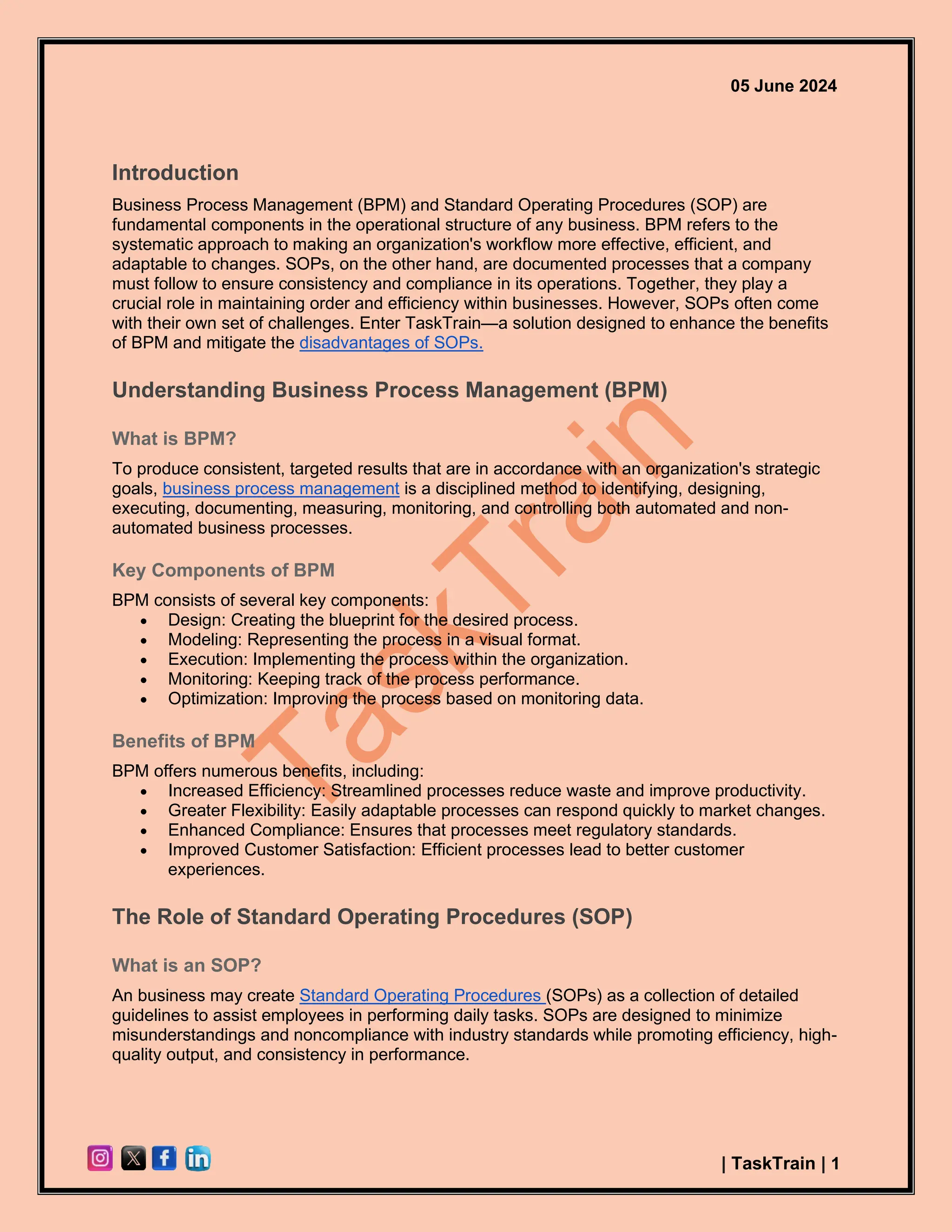
How Does TaskTrain
Enhance BPM Benefits
and Mitigate the
Disadvantages of SOP
05 June 2024
| TaskTrain | 1
Introduction
Business Process Management (BPM) and Standard Operating Procedures (SOP) are
fundamental components in the operational structure of any business. BPM refers to the
systematic approach to making an organization's workflow more effective, efficient, and
adaptable to changes. SOPs, on the other hand, are documented processes that a company
must follow to ensure consistency and compliance in its operations. Together, they play a
crucial role in maintaining order and efficiency within businesses. However, SOPs often come
with their own set of challenges. Enter TaskTrain—a solution designed to enhance the benefits
of BPM and mitigate the disadvantages of SOPs.
Understanding Business Process Management (BPM)
What is BPM?
To produce consistent, targeted results that are in accordance with an organization's strategic
goals, business process management is a disciplined method to identifying, designing,
executing, documenting, measuring, monitoring, and controlling both automated and non-
automated business processes.
Key Components of BPM
BPM consists of several key components:
• Design: Creating the blueprint for the desired process.
• Modeling: Representing the process in a visual format.
• Execution: Implementing the process within the organization.
• Monitoring: Keeping track of the process performance.
• Optimization: Improving the process based on monitoring data.
Benefits of BPM
BPM offers numerous benefits, including:
• Increased Efficiency: Streamlined processes reduce waste and improve productivity.
• Greater Flexibility: Easily adaptable processes can respond quickly to market changes.
• Enhanced Compliance: Ensures that processes meet regulatory standards.
• Improved Customer Satisfaction: Efficient processes lead to better customer
experiences.
The Role of Standard Operating Procedures (SOP)
What is an SOP?
An business may create Standard Operating Procedures (SOPs) as a collection of detailed
guidelines to assist employees in performing daily tasks. SOPs are designed to minimize
misunderstandings and noncompliance with industry standards while promoting efficiency, high-
quality output, and consistency in performance.
05 June 2024
| TaskTrain | 2
Key Elements of SOP
SOPs typically include:
• Purpose: Why the procedure is necessary.
• Scope: The boundaries of the procedure.
• Responsibility: Who is responsible for each step.
• Procedure: Detailed steps to follow.
Importance of SOP
SOPs are essential for:
• Consistency: Ensuring tasks are performed the same way every time.
• Training: Providing a reference for new employees.
• Compliance: Meeting legal and regulatory requirements.
Challenges Associated with SOPs
Rigidity and Inflexibility
One major drawback of SOPs is their rigidity. Once established, they can be difficult to change,
even if more efficient methods are discovered.
Time-Consuming to Create and Update
Developing and maintaining SOPs can be a lengthy process, consuming valuable resources
and time.
Potential for Human Error
Despite their detailed nature, SOPs are not foolproof. Human error can still occur, particularly if
employees do not follow the procedures correctly.
Introducing TaskTrain
What is TaskTrain?
TaskTrain is a workflow management tool designed to enhance the efficiency of BPM and
address the shortcomings of SOPs. It allows organizations to create, manage, and track
processes in real-time.
Features of TaskTrain
TaskTrain boasts several powerful features, including:
• Real-Time Updates: Instantly update procedures across the organization.
• Task Tracking: Monitor the progress of tasks and identify bottlenecks.
• Flexibility: Easily modify processes to adapt to changing needs.
05 June 2024
| TaskTrain | 3
How TaskTrain Works
TaskTrain operates by providing a digital platform where processes can be designed, shared,
and tracked. It integrates with existing systems to streamline workflows and improve efficiency.
Enhancing BPM with TaskTrain
Streamlining Processes
TaskTrain helps streamline processes by providing a clear, concise platform for task
management. This reduces redundancy and ensures that all steps are followed correctly.
Real-Time Updates
With TaskTrain, any changes to processes are instantly reflected across the organization.This
guarantees that the most recent information is constantly being used by all parties.
Enhanced Responsibility and Monitoring
The task accountability is improved by TaskTrain's tracking tools, which let managers
understand who is in charge of each assignment and watch their progress. This makes it easier
to find and quickly fix any problems.
Mitigating SOP Disadvantages with TaskTrain
Increasing Flexibility
TaskTrain increases the flexibility of SOPs by making it easy to update and modify processes.
This allows organizations to adapt quickly to new information or changing conditions.
Reducing Update Time
Updating SOPs can be a time-consuming process. TaskTrain simplifies this by allowing updates
to be made quickly and easily, saving valuable time and resources.
Minimizing Human Error
By providing clear, real-time instructions and tracking task progress, TaskTrain helps minimize
the potential for human error.
Benefits of TaskTrain Integration
Enhanced Efficiency
TaskTrain streamlines workflows and reduces redundancy, leading to enhanced efficiency and
productivity.
05 June 2024
| TaskTrain | 4
Better Compliance
With TaskTrain, organizations can ensure that their processes are always up-to-date and
compliant with industry regulations.
Employee Empowerment
By providing clear instructions and tracking progress, TaskTrain empowers employees to take
ownership of their tasks and perform them more effectively.
Implementing TaskTrain in Your Organization
Steps to Get Started
1. Assess Your Needs: Identify the processes that would benefit most from TaskTrain.
2. Choose a Plan: Select a TaskTrain plan that fits your organization’s size and needs.
3. Setup: Implement TaskTrain and integrate it with your existing systems.
4. Training: Provide training to employees on how to use TaskTrain effectively.
5. Monitor and Optimize: Regularly review TaskTrain’s performance and make necessary
adjustments.
Best Practices for Implementation
• Start Small: Begin with a few key processes and gradually expand.
• Engage Employees: Involve employees in the setup process to ensure buy-in and
smooth adoption.
• Regular Updates: Keep processes updated to reflect changes and improvements.
Conclusion
TaskTrain is a powerful tool that enhances the benefits of Business Process Management
(BPM) while mitigating the disadvantages of Standard Operating Procedures (SOPs). BPM aims
to improve an organization's workflow efficiency and adaptability, while SOPs ensure
consistency and compliance. However, SOPs can be rigid, time-consuming to update, and
prone to human error.
Accountability is another significant benefit of TaskTrain. The platform's tracking features enable
managers to monitor progress and assign responsibilities clearly. This level of transparency
ensures that tasks are completed on time and any bottlenecks are quickly identified and
resolved, leading to improved productivity and efficiency.
Furthermore, TaskTrain empowers employees by providing them with clear, up-to-date
instructions and an easy-to-use interface. This empowerment fosters a sense of ownership and
responsibility, motivating employees to perform their tasks more effectively and efficiently.
Visit: https://www.tasktrain.app/
05 June 2024
| TaskTrain | 5
Contact Us For Further
Inquiries
• Visit: https://www.tasktrain.app/

How Does TaskTrain Enhance BPM Benefits and Mitigate the Disadvantages of SOP.pdf

  • 1.
    How Does TaskTrain EnhanceBPM Benefits and Mitigate the Disadvantages of SOP
  • 2.
    05 June 2024 |TaskTrain | 1 Introduction Business Process Management (BPM) and Standard Operating Procedures (SOP) are fundamental components in the operational structure of any business. BPM refers to the systematic approach to making an organization's workflow more effective, efficient, and adaptable to changes. SOPs, on the other hand, are documented processes that a company must follow to ensure consistency and compliance in its operations. Together, they play a crucial role in maintaining order and efficiency within businesses. However, SOPs often come with their own set of challenges. Enter TaskTrain—a solution designed to enhance the benefits of BPM and mitigate the disadvantages of SOPs. Understanding Business Process Management (BPM) What is BPM? To produce consistent, targeted results that are in accordance with an organization's strategic goals, business process management is a disciplined method to identifying, designing, executing, documenting, measuring, monitoring, and controlling both automated and non- automated business processes. Key Components of BPM BPM consists of several key components: • Design: Creating the blueprint for the desired process. • Modeling: Representing the process in a visual format. • Execution: Implementing the process within the organization. • Monitoring: Keeping track of the process performance. • Optimization: Improving the process based on monitoring data. Benefits of BPM BPM offers numerous benefits, including: • Increased Efficiency: Streamlined processes reduce waste and improve productivity. • Greater Flexibility: Easily adaptable processes can respond quickly to market changes. • Enhanced Compliance: Ensures that processes meet regulatory standards. • Improved Customer Satisfaction: Efficient processes lead to better customer experiences. The Role of Standard Operating Procedures (SOP) What is an SOP? An business may create Standard Operating Procedures (SOPs) as a collection of detailed guidelines to assist employees in performing daily tasks. SOPs are designed to minimize misunderstandings and noncompliance with industry standards while promoting efficiency, high- quality output, and consistency in performance.
  • 3.
    05 June 2024 |TaskTrain | 2 Key Elements of SOP SOPs typically include: • Purpose: Why the procedure is necessary. • Scope: The boundaries of the procedure. • Responsibility: Who is responsible for each step. • Procedure: Detailed steps to follow. Importance of SOP SOPs are essential for: • Consistency: Ensuring tasks are performed the same way every time. • Training: Providing a reference for new employees. • Compliance: Meeting legal and regulatory requirements. Challenges Associated with SOPs Rigidity and Inflexibility One major drawback of SOPs is their rigidity. Once established, they can be difficult to change, even if more efficient methods are discovered. Time-Consuming to Create and Update Developing and maintaining SOPs can be a lengthy process, consuming valuable resources and time. Potential for Human Error Despite their detailed nature, SOPs are not foolproof. Human error can still occur, particularly if employees do not follow the procedures correctly. Introducing TaskTrain What is TaskTrain? TaskTrain is a workflow management tool designed to enhance the efficiency of BPM and address the shortcomings of SOPs. It allows organizations to create, manage, and track processes in real-time. Features of TaskTrain TaskTrain boasts several powerful features, including: • Real-Time Updates: Instantly update procedures across the organization. • Task Tracking: Monitor the progress of tasks and identify bottlenecks. • Flexibility: Easily modify processes to adapt to changing needs.
  • 4.
    05 June 2024 |TaskTrain | 3 How TaskTrain Works TaskTrain operates by providing a digital platform where processes can be designed, shared, and tracked. It integrates with existing systems to streamline workflows and improve efficiency. Enhancing BPM with TaskTrain Streamlining Processes TaskTrain helps streamline processes by providing a clear, concise platform for task management. This reduces redundancy and ensures that all steps are followed correctly. Real-Time Updates With TaskTrain, any changes to processes are instantly reflected across the organization.This guarantees that the most recent information is constantly being used by all parties. Enhanced Responsibility and Monitoring The task accountability is improved by TaskTrain's tracking tools, which let managers understand who is in charge of each assignment and watch their progress. This makes it easier to find and quickly fix any problems. Mitigating SOP Disadvantages with TaskTrain Increasing Flexibility TaskTrain increases the flexibility of SOPs by making it easy to update and modify processes. This allows organizations to adapt quickly to new information or changing conditions. Reducing Update Time Updating SOPs can be a time-consuming process. TaskTrain simplifies this by allowing updates to be made quickly and easily, saving valuable time and resources. Minimizing Human Error By providing clear, real-time instructions and tracking task progress, TaskTrain helps minimize the potential for human error. Benefits of TaskTrain Integration Enhanced Efficiency TaskTrain streamlines workflows and reduces redundancy, leading to enhanced efficiency and productivity.
  • 5.
    05 June 2024 |TaskTrain | 4 Better Compliance With TaskTrain, organizations can ensure that their processes are always up-to-date and compliant with industry regulations. Employee Empowerment By providing clear instructions and tracking progress, TaskTrain empowers employees to take ownership of their tasks and perform them more effectively. Implementing TaskTrain in Your Organization Steps to Get Started 1. Assess Your Needs: Identify the processes that would benefit most from TaskTrain. 2. Choose a Plan: Select a TaskTrain plan that fits your organization’s size and needs. 3. Setup: Implement TaskTrain and integrate it with your existing systems. 4. Training: Provide training to employees on how to use TaskTrain effectively. 5. Monitor and Optimize: Regularly review TaskTrain’s performance and make necessary adjustments. Best Practices for Implementation • Start Small: Begin with a few key processes and gradually expand. • Engage Employees: Involve employees in the setup process to ensure buy-in and smooth adoption. • Regular Updates: Keep processes updated to reflect changes and improvements. Conclusion TaskTrain is a powerful tool that enhances the benefits of Business Process Management (BPM) while mitigating the disadvantages of Standard Operating Procedures (SOPs). BPM aims to improve an organization's workflow efficiency and adaptability, while SOPs ensure consistency and compliance. However, SOPs can be rigid, time-consuming to update, and prone to human error. Accountability is another significant benefit of TaskTrain. The platform's tracking features enable managers to monitor progress and assign responsibilities clearly. This level of transparency ensures that tasks are completed on time and any bottlenecks are quickly identified and resolved, leading to improved productivity and efficiency. Furthermore, TaskTrain empowers employees by providing them with clear, up-to-date instructions and an easy-to-use interface. This empowerment fosters a sense of ownership and responsibility, motivating employees to perform their tasks more effectively and efficiently. Visit: https://www.tasktrain.app/
  • 6.
    05 June 2024 |TaskTrain | 5 Contact Us For Further Inquiries • Visit: https://www.tasktrain.app/