OBJECTS AND
INSTALLATION
SM1702 CREATIVE MEDIA STUDIO I

OBJECTS AND INSTALLATION L06 & L05
GOALS:
• To develop a strong sense of three-dimensional creation.

• To understand objects as sites of information.
• To consider the relationship between objects, locations and
people.
• To become resourceful and experimental when creating and
staging artworks.
SCHEDULE PER WEEK
1.

How do objects tell stories pt.1. Found objects and storytelling
(25%).

2.

How do objects tell stories pt.2. Making Chinese proverbs in clay
(25%).

3.

How do objects relate to space pt.1. Yarn bombing location hunt
& knitting with chopsticks.

4.

How do objects relate to space pt.2. Yarn bombing a Hong Kong
location (25%).

5.

How do objects relate to the body pt.1. Becoming a cyborg with
papier mache and found objects.

6.

How do objects relate to the body pt. 2: Final
exhibition/performance of cyborg works and final critique (25%)
ASSESSMENTS
1. Found object stories (25%)
2. Working in clay (25%)
3. Working with yarn and space (25%)
4. Papier mache and found objects (25%)

Each student must submit a PDF portfolio of all the above works
with captions and statements one week after the last lesson. (So
record everything that you see, do and make so you can show
your creative journey!)
COURSE WEBSITE
http://objectsandinstallation.digitalcritic.org/

This is where the course schedule, assignments and even
‘how to’ guides can be found.

REMEMBER THIS URL!
HOW DO OBJECTS
TELL STORIES?
Today we‘re going to think about how objects can tells stories.

One of the ways objects might do this is by containing valuable
information about our past.

Objects unearthed by archaeologists can show us how humans
lived hundreds or even thousands of years ago.
HOW DO OBJECTS
TELL STORIES?
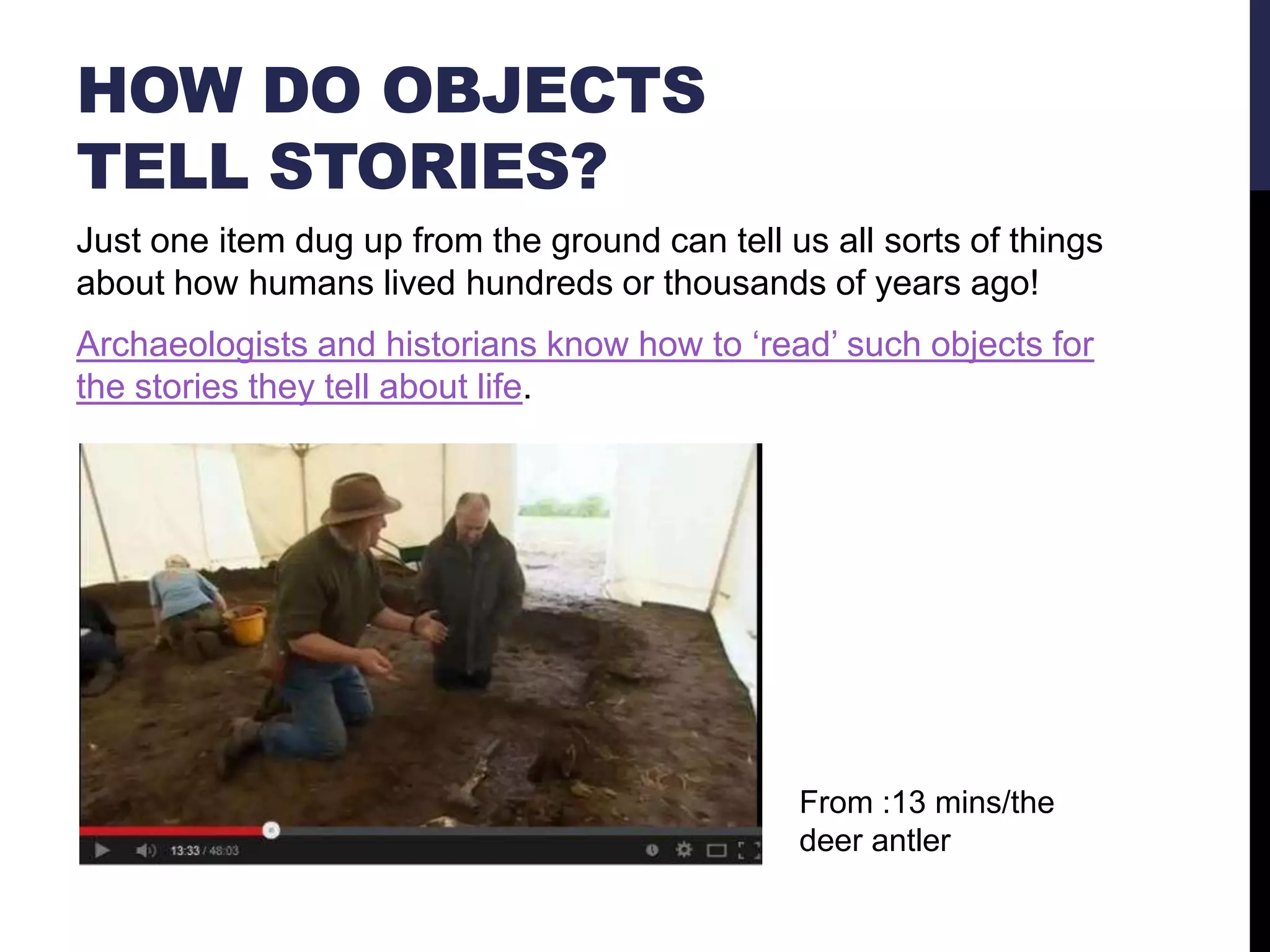
Just one item dug up from the ground can tell us all sorts of things
about how humans lived hundreds or thousands of years ago!
Archaeologists and historians know how to ‗read‘ such objects for
the stories they tell about life.

From :13 mins/the
deer antler
HOW DO OBJECTS
TELL STORIES?
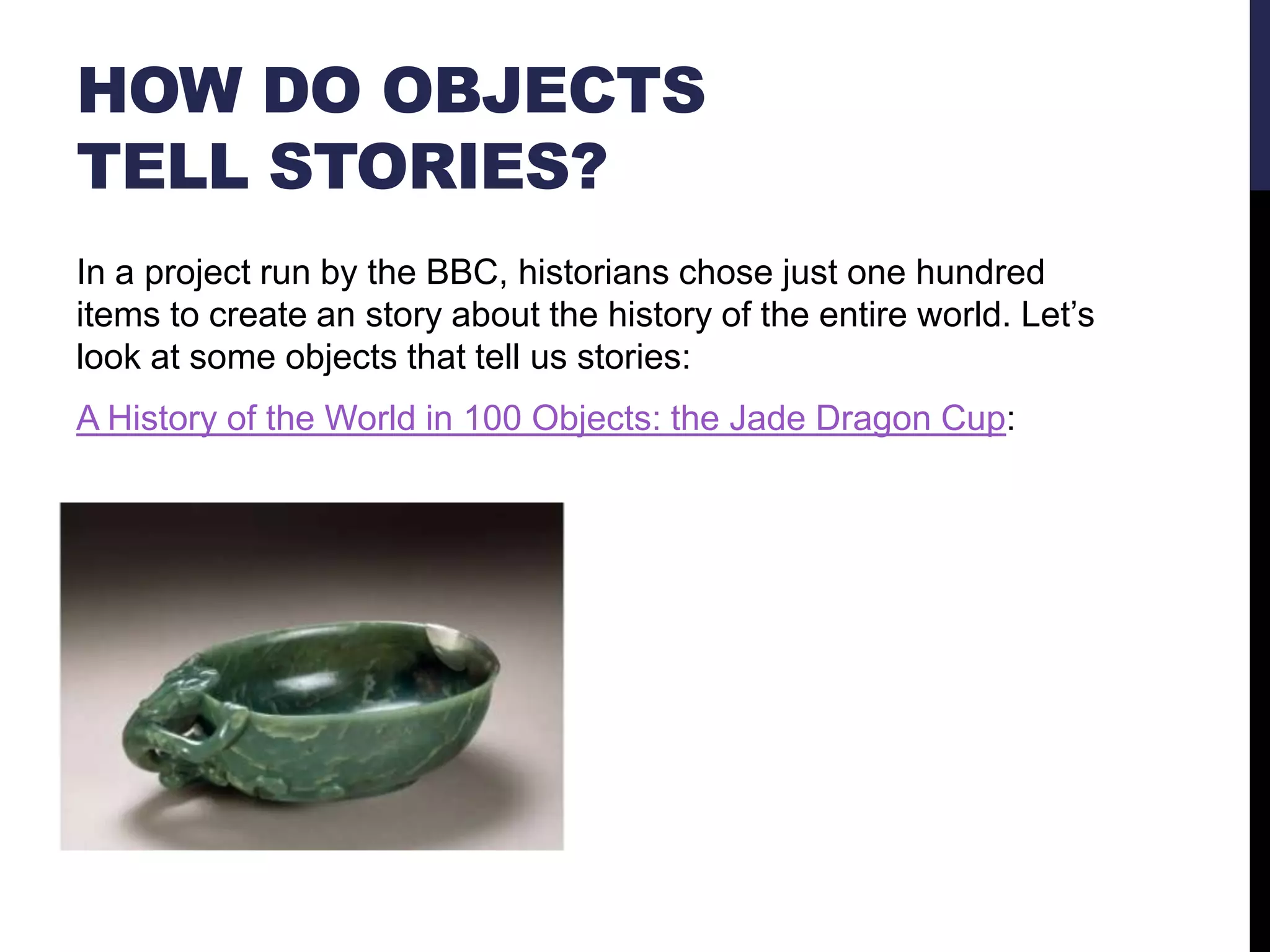
In a project run by the BBC, historians chose just one hundred
items to create an story about the history of the entire world. Let‘s
look at some objects that tell us stories:
A History of the World in 100 Objects: the Jade Dragon Cup:
HOW DO OBJECTS
TELL STORIES?
It wasn‘t just historians who contributed, the public were invited to
submit items that signified pivotal moments in the history of the
world and their own lives.
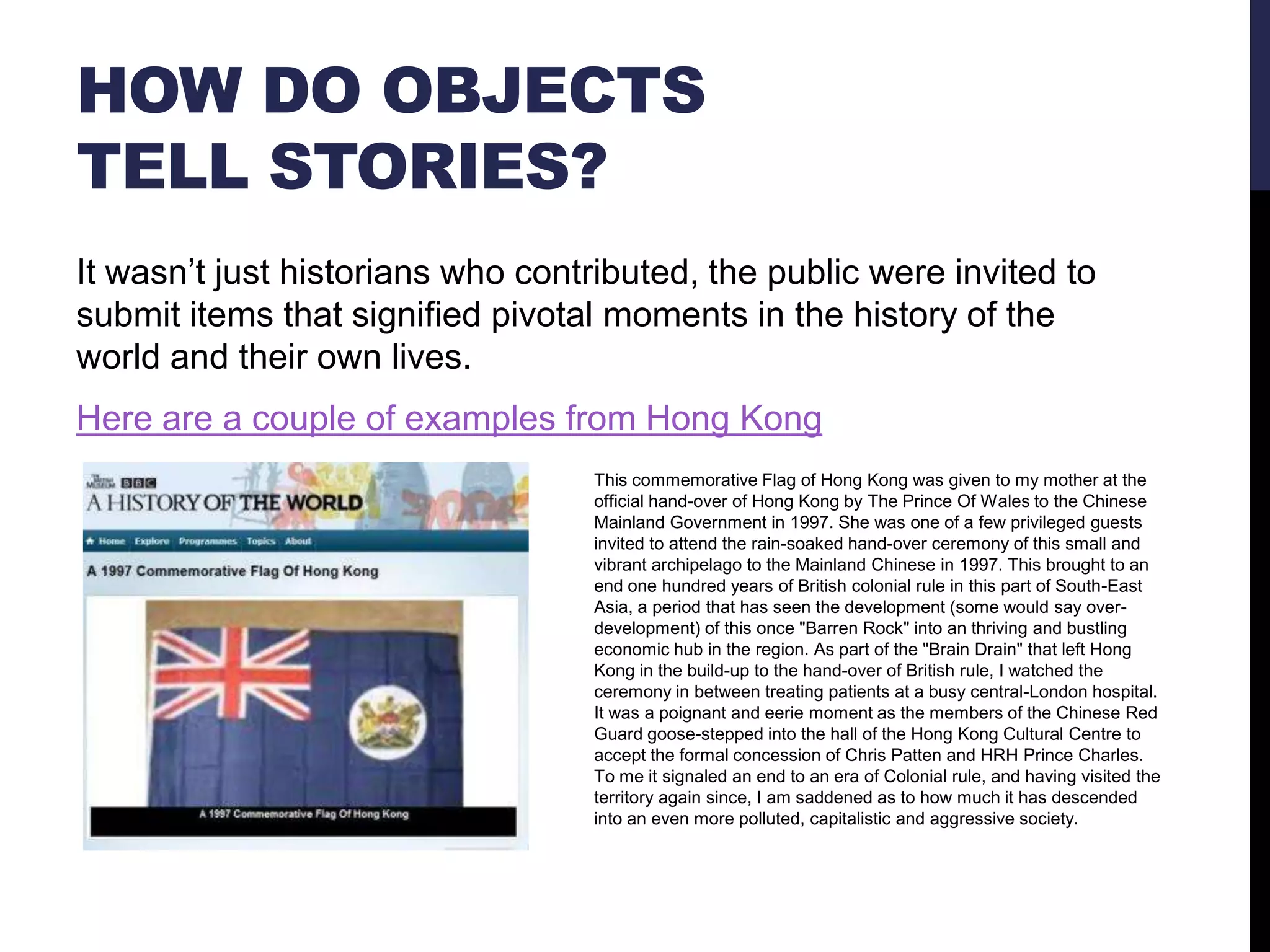
Here are a couple of examples from Hong Kong
This commemorative Flag of Hong Kong was given to my mother at the
official hand-over of Hong Kong by The Prince Of Wales to the Chinese
Mainland Government in 1997. She was one of a few privileged guests
invited to attend the rain-soaked hand-over ceremony of this small and
vibrant archipelago to the Mainland Chinese in 1997. This brought to an
end one hundred years of British colonial rule in this part of South-East
Asia, a period that has seen the development (some would say overdevelopment) of this once "Barren Rock" into an thriving and bustling
economic hub in the region. As part of the "Brain Drain" that left Hong
Kong in the build-up to the hand-over of British rule, I watched the
ceremony in between treating patients at a busy central-London hospital.
It was a poignant and eerie moment as the members of the Chinese Red
Guard goose-stepped into the hall of the Hong Kong Cultural Centre to
accept the formal concession of Chris Patten and HRH Prince Charles.
To me it signaled an end to an era of Colonial rule, and having visited the
territory again since, I am saddened as to how much it has descended
into an even more polluted, capitalistic and aggressive society.
HOW DO OBJECTS
TELL STORIES?
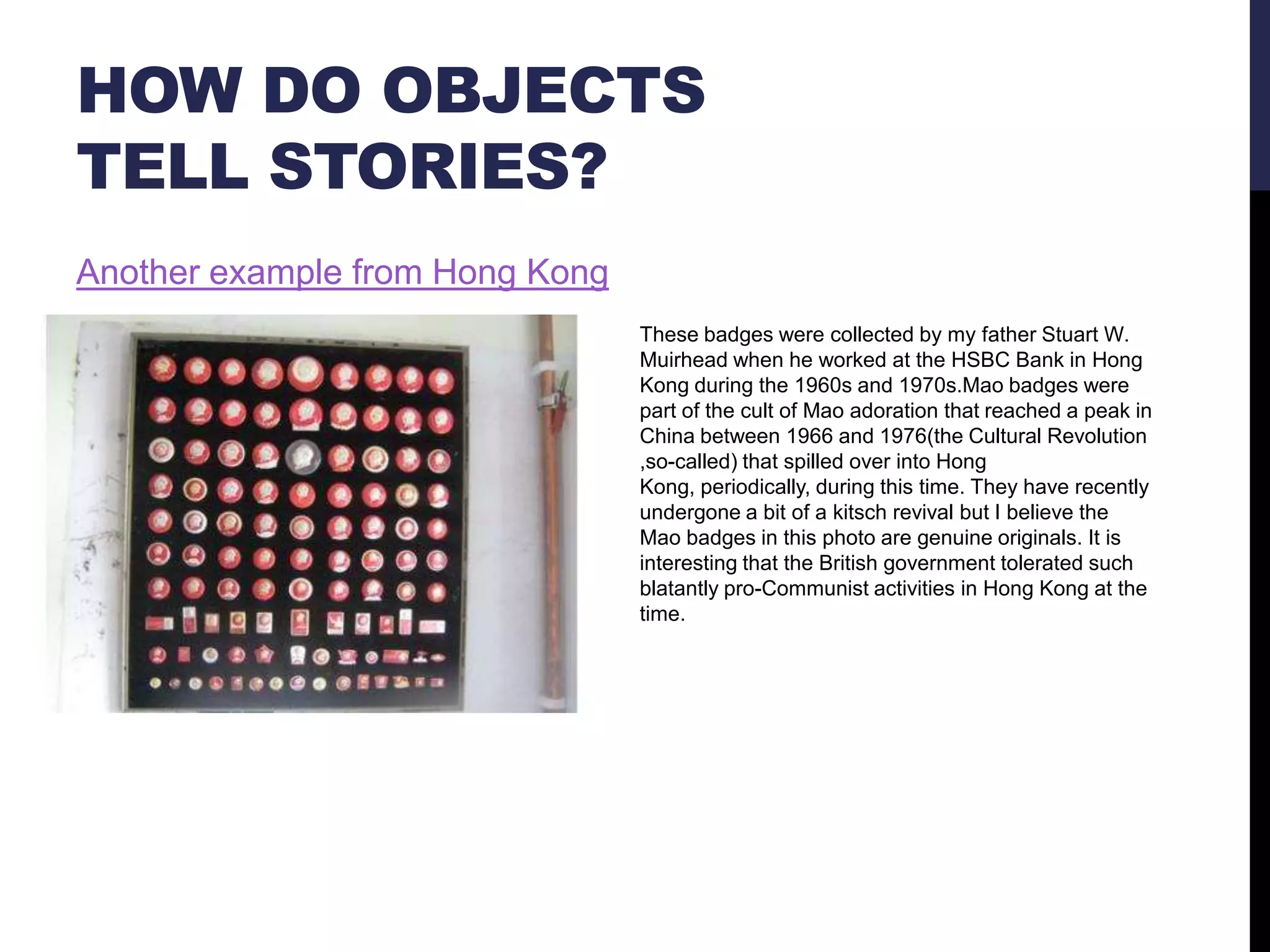
Another example from Hong Kong
These badges were collected by my father Stuart W.
Muirhead when he worked at the HSBC Bank in Hong
Kong during the 1960s and 1970s.Mao badges were
part of the cult of Mao adoration that reached a peak in
China between 1966 and 1976(the Cultural Revolution
,so-called) that spilled over into Hong
Kong, periodically, during this time. They have recently
undergone a bit of a kitsch revival but I believe the
Mao badges in this photo are genuine originals. It is
interesting that the British government tolerated such
blatantly pro-Communist activities in Hong Kong at the
time.
HOW DO OBJECTS
TELL STORIES?
Sometimes the story is not what we are looking for.

Objects can set us on the trail of all manner of stories.

From: start, 10mins
and 18 mins
HOW DO OBJECTS
TELL STORIES?
Bob was happier with the story he had invented

The archaeologists were happy to find an answer

And for Brennan, the stone faces will be part of his own life
story, representing his decision to become an archaeologist
HOW DO OBJECTS
TELL STORIES?
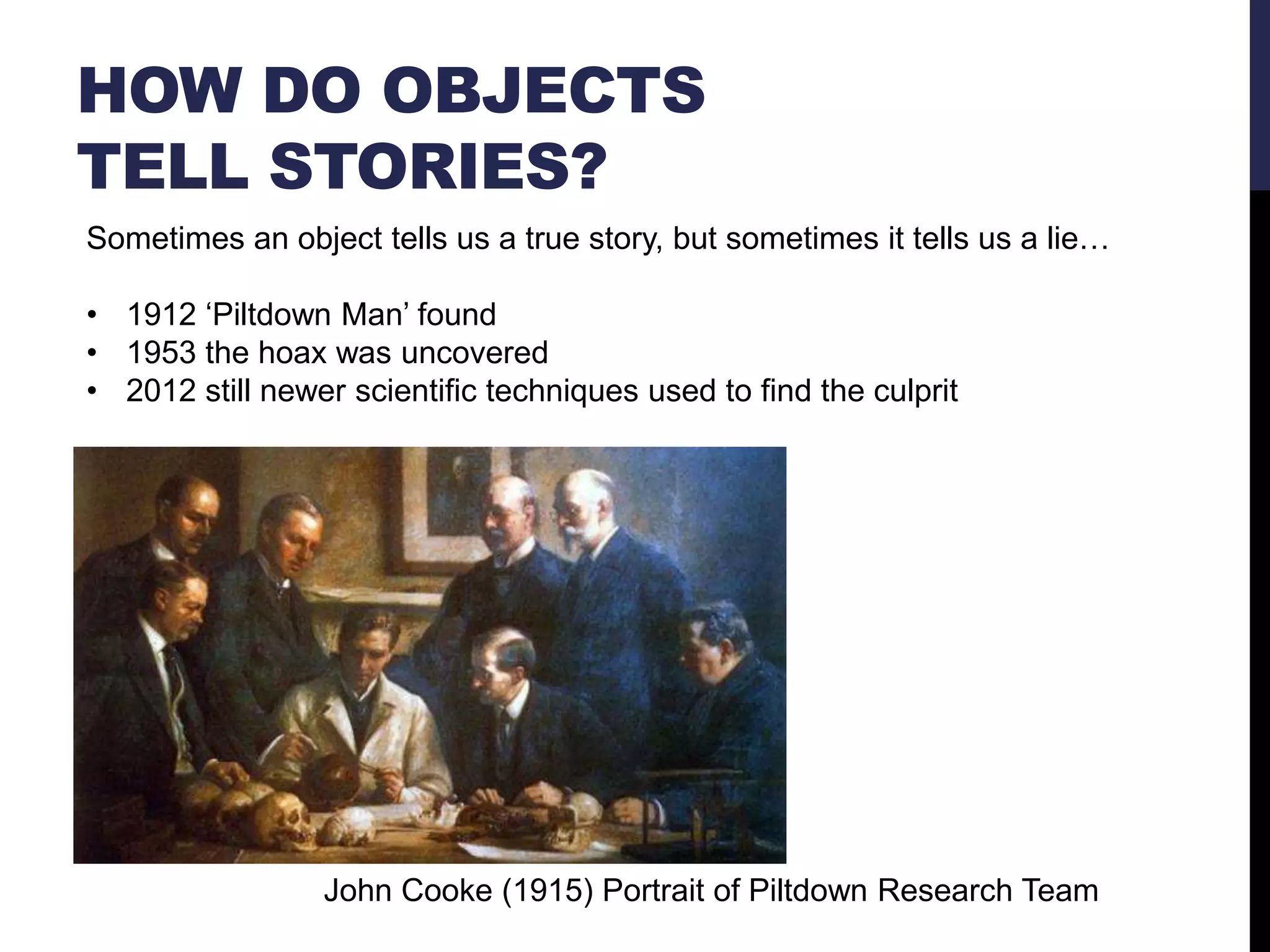
Sometimes an object tells us a true story, but sometimes it tells us a lie…

• 1912 ‗Piltdown Man‘ found
• 1953 the hoax was uncovered
• 2012 still newer scientific techniques used to find the culprit

John Cooke (1915) Portrait of Piltdown Research Team
HOW DO OBJECTS
TELL STORIES?
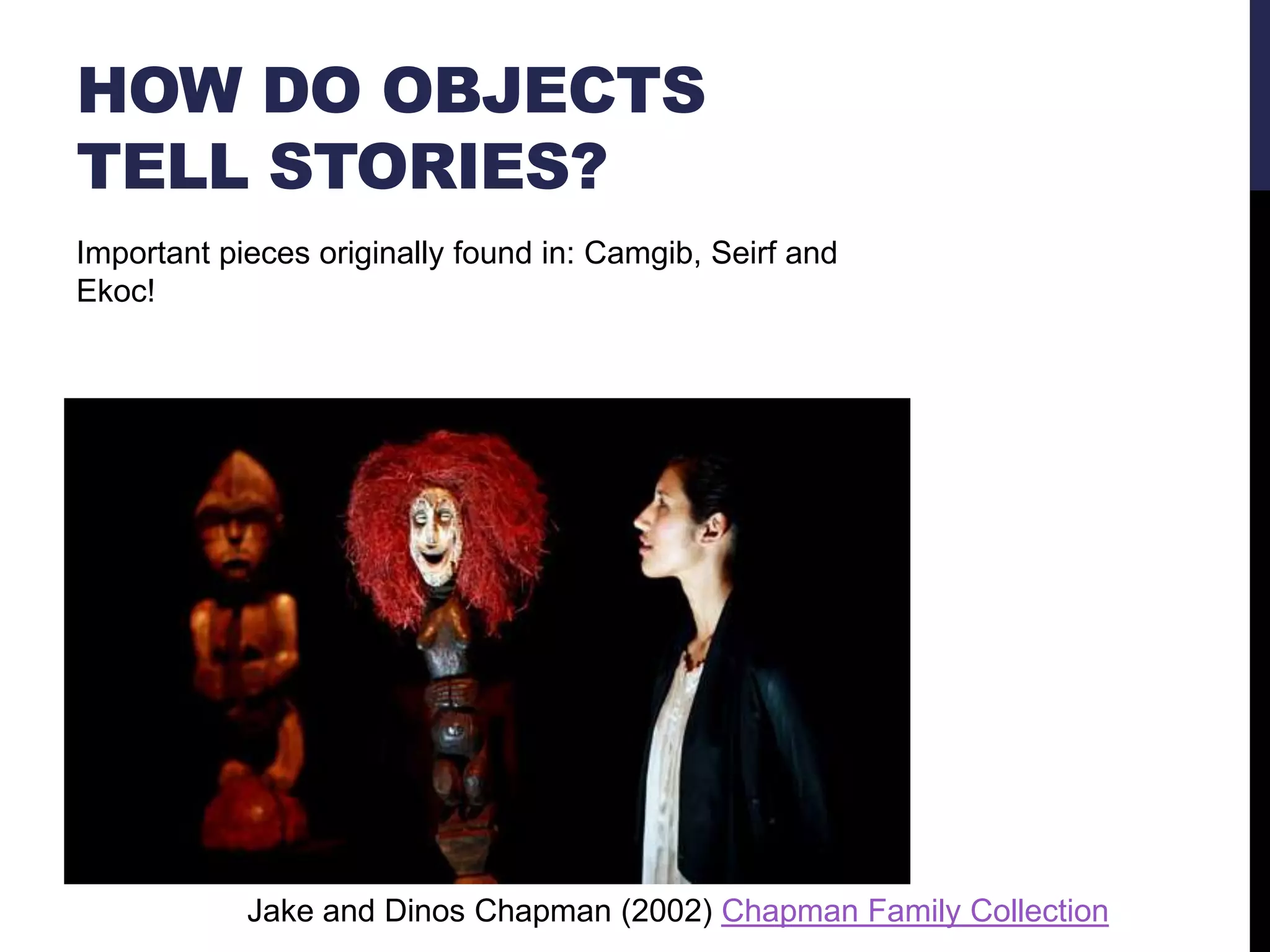
Important pieces originally found in: Camgib, Seirf and
Ekoc!

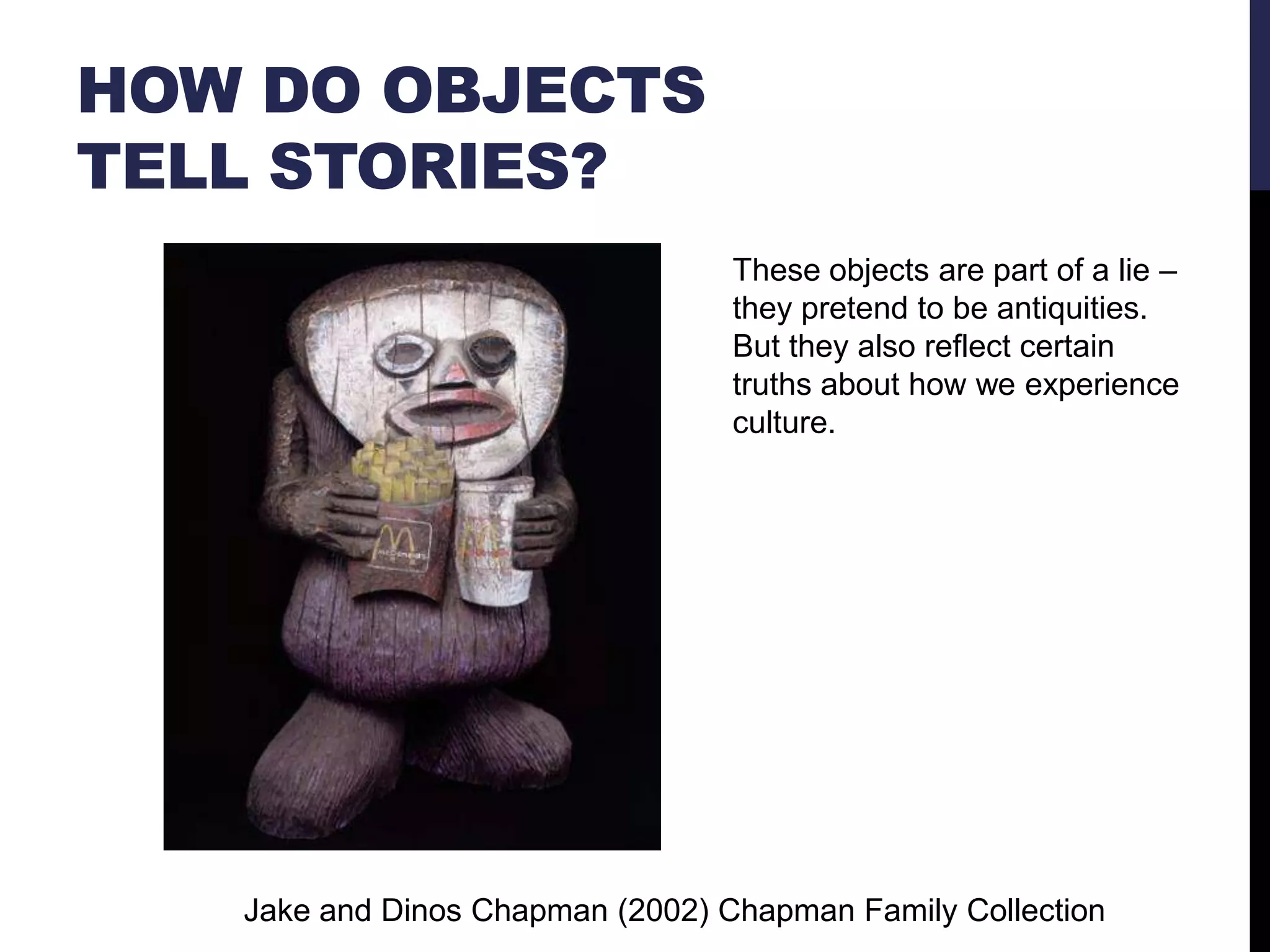
Jake and Dinos Chapman (2002) Chapman Family Collection
HOW DO OBJECTS
TELL STORIES?
These objects are part of a lie –
they pretend to be antiquities.
But they also reflect certain
truths about how we experience
culture.

Jake and Dinos Chapman (2002) Chapman Family Collection
HOW DO OBJECTS
TELL STORIES?
Are Artists Liars?
―Both liars and artists refuse to accept the tyranny of reality. Both
carefully craft stories that are worthy of belief—a skill requiring
intellectual sophistication, emotional sensitivity and physical
self-control (liars are writers and performers of their own work)‖
―The liar lies on behalf of himself; the artist tell lies on behalf of
everyone. If writers have a compulsion to narrate, they compel
themselves to find insights about the human condition. Mario Vargas
Llosa has written that novels ―express a curious truth that can only be
expressed in a furtive and veiled fashion, masquerading as what it is
not‖. Art is a lie whose secret ingredient is truth.‖
Ian Leslie, 2013
HOW DO OBJECTS
TELL STORIES?
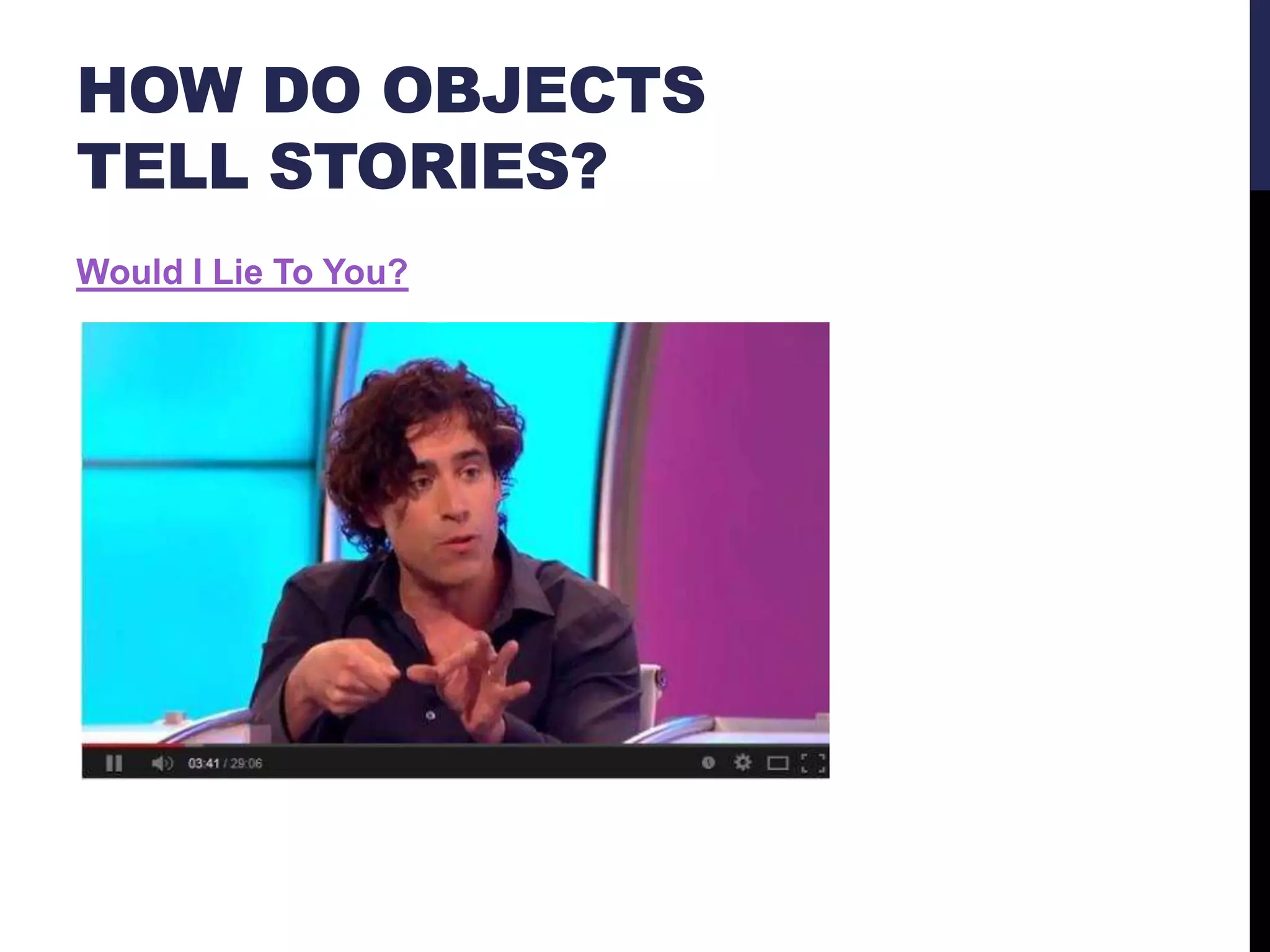
Would I Lie To You?
HOW DO OBJECTS
TELL STORIES?
Complete either Task A or Task B.
Task A:
Pretend you are an archaeologist hundreds/thousands of years in the
future. You find something from the year 2014. What is it? What was it
used for? And why? You have 1 hour to find an object, bring it back to
class and tell us a fantastical story about it’s origins. Remember, you
don’t really know what it’s for, so invent something!
Task B:
Bring an object to class and tell us a story about what it is and where
it’s from. You might choose to tell the class the truth, or you might lie,
and weave an inventive story about it’s origins.

Everyone will have 3-5 minutes to tell their story and then we will vote
for the BEST THREE STORIES!
PREPARATION FOR
SECOND WEEK
1. Think about a Chinese saying or proverb that you
like, dislike or has featured heavily in your life. Is there
something your mother or grandmother always say? Is there
a proverb that you think is particularly meaningful or even
ridiculous? Come to class next week prepared to share your
thoughts on one or two proverbs.

2. Read one of the following texts:
http://retnull.com/index.php?/texts/the-crit/
or
Chapter 2 ‘The Crit’ from Seven Days in the Art World

How Do Objects Tell Stories?

  • 1.
    OBJECTS AND INSTALLATION SM1702 CREATIVEMEDIA STUDIO I OBJECTS AND INSTALLATION L06 & L05
  • 2.
    GOALS: • To developa strong sense of three-dimensional creation. • To understand objects as sites of information. • To consider the relationship between objects, locations and people. • To become resourceful and experimental when creating and staging artworks.
  • 3.
    SCHEDULE PER WEEK 1. Howdo objects tell stories pt.1. Found objects and storytelling (25%). 2. How do objects tell stories pt.2. Making Chinese proverbs in clay (25%). 3. How do objects relate to space pt.1. Yarn bombing location hunt & knitting with chopsticks. 4. How do objects relate to space pt.2. Yarn bombing a Hong Kong location (25%). 5. How do objects relate to the body pt.1. Becoming a cyborg with papier mache and found objects. 6. How do objects relate to the body pt. 2: Final exhibition/performance of cyborg works and final critique (25%)
  • 4.
    ASSESSMENTS 1. Found objectstories (25%) 2. Working in clay (25%) 3. Working with yarn and space (25%) 4. Papier mache and found objects (25%) Each student must submit a PDF portfolio of all the above works with captions and statements one week after the last lesson. (So record everything that you see, do and make so you can show your creative journey!)
  • 5.
    COURSE WEBSITE http://objectsandinstallation.digitalcritic.org/ This iswhere the course schedule, assignments and even ‘how to’ guides can be found. REMEMBER THIS URL!
  • 6.
    HOW DO OBJECTS TELLSTORIES? Today we‘re going to think about how objects can tells stories. One of the ways objects might do this is by containing valuable information about our past. Objects unearthed by archaeologists can show us how humans lived hundreds or even thousands of years ago.
  • 7.
    HOW DO OBJECTS TELLSTORIES? Just one item dug up from the ground can tell us all sorts of things about how humans lived hundreds or thousands of years ago! Archaeologists and historians know how to ‗read‘ such objects for the stories they tell about life. From :13 mins/the deer antler
  • 8.
    HOW DO OBJECTS TELLSTORIES? In a project run by the BBC, historians chose just one hundred items to create an story about the history of the entire world. Let‘s look at some objects that tell us stories: A History of the World in 100 Objects: the Jade Dragon Cup:
  • 9.
    HOW DO OBJECTS TELLSTORIES? It wasn‘t just historians who contributed, the public were invited to submit items that signified pivotal moments in the history of the world and their own lives. Here are a couple of examples from Hong Kong This commemorative Flag of Hong Kong was given to my mother at the official hand-over of Hong Kong by The Prince Of Wales to the Chinese Mainland Government in 1997. She was one of a few privileged guests invited to attend the rain-soaked hand-over ceremony of this small and vibrant archipelago to the Mainland Chinese in 1997. This brought to an end one hundred years of British colonial rule in this part of South-East Asia, a period that has seen the development (some would say overdevelopment) of this once "Barren Rock" into an thriving and bustling economic hub in the region. As part of the "Brain Drain" that left Hong Kong in the build-up to the hand-over of British rule, I watched the ceremony in between treating patients at a busy central-London hospital. It was a poignant and eerie moment as the members of the Chinese Red Guard goose-stepped into the hall of the Hong Kong Cultural Centre to accept the formal concession of Chris Patten and HRH Prince Charles. To me it signaled an end to an era of Colonial rule, and having visited the territory again since, I am saddened as to how much it has descended into an even more polluted, capitalistic and aggressive society.
  • 10.
    HOW DO OBJECTS TELLSTORIES? Another example from Hong Kong These badges were collected by my father Stuart W. Muirhead when he worked at the HSBC Bank in Hong Kong during the 1960s and 1970s.Mao badges were part of the cult of Mao adoration that reached a peak in China between 1966 and 1976(the Cultural Revolution ,so-called) that spilled over into Hong Kong, periodically, during this time. They have recently undergone a bit of a kitsch revival but I believe the Mao badges in this photo are genuine originals. It is interesting that the British government tolerated such blatantly pro-Communist activities in Hong Kong at the time.
  • 11.
    HOW DO OBJECTS TELLSTORIES? Sometimes the story is not what we are looking for. Objects can set us on the trail of all manner of stories. From: start, 10mins and 18 mins
  • 12.
    HOW DO OBJECTS TELLSTORIES? Bob was happier with the story he had invented The archaeologists were happy to find an answer And for Brennan, the stone faces will be part of his own life story, representing his decision to become an archaeologist
  • 13.
    HOW DO OBJECTS TELLSTORIES? Sometimes an object tells us a true story, but sometimes it tells us a lie… • 1912 ‗Piltdown Man‘ found • 1953 the hoax was uncovered • 2012 still newer scientific techniques used to find the culprit John Cooke (1915) Portrait of Piltdown Research Team
  • 14.
    HOW DO OBJECTS TELLSTORIES? Important pieces originally found in: Camgib, Seirf and Ekoc! Jake and Dinos Chapman (2002) Chapman Family Collection
  • 15.
    HOW DO OBJECTS TELLSTORIES? These objects are part of a lie – they pretend to be antiquities. But they also reflect certain truths about how we experience culture. Jake and Dinos Chapman (2002) Chapman Family Collection
  • 16.
    HOW DO OBJECTS TELLSTORIES? Are Artists Liars? ―Both liars and artists refuse to accept the tyranny of reality. Both carefully craft stories that are worthy of belief—a skill requiring intellectual sophistication, emotional sensitivity and physical self-control (liars are writers and performers of their own work)‖ ―The liar lies on behalf of himself; the artist tell lies on behalf of everyone. If writers have a compulsion to narrate, they compel themselves to find insights about the human condition. Mario Vargas Llosa has written that novels ―express a curious truth that can only be expressed in a furtive and veiled fashion, masquerading as what it is not‖. Art is a lie whose secret ingredient is truth.‖ Ian Leslie, 2013
  • 17.
    HOW DO OBJECTS TELLSTORIES? Would I Lie To You?
  • 18.
    HOW DO OBJECTS TELLSTORIES? Complete either Task A or Task B. Task A: Pretend you are an archaeologist hundreds/thousands of years in the future. You find something from the year 2014. What is it? What was it used for? And why? You have 1 hour to find an object, bring it back to class and tell us a fantastical story about it’s origins. Remember, you don’t really know what it’s for, so invent something! Task B: Bring an object to class and tell us a story about what it is and where it’s from. You might choose to tell the class the truth, or you might lie, and weave an inventive story about it’s origins. Everyone will have 3-5 minutes to tell their story and then we will vote for the BEST THREE STORIES!
  • 19.
    PREPARATION FOR SECOND WEEK 1.Think about a Chinese saying or proverb that you like, dislike or has featured heavily in your life. Is there something your mother or grandmother always say? Is there a proverb that you think is particularly meaningful or even ridiculous? Come to class next week prepared to share your thoughts on one or two proverbs. 2. Read one of the following texts: http://retnull.com/index.php?/texts/the-crit/ or Chapter 2 ‘The Crit’ from Seven Days in the Art World

Editor's Notes

  • #12 From start of vidfrom 10.00and from 18.13
  • #18 From the start to after Charles Dance.