What is a modal verb? 
A modal verb (also modal, modal auxiliary 
verb, modal auxiliary) is a type of auxiliary 
verb that is used to indicate modality – that is, 
likelihood, ability, permission, and obligation. 
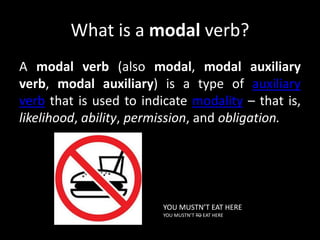
YOU MUSTN’T EAT HERE 
YOU MUSTN’T TO EAT HERE
The MODAL verbs you need to know in 
unit 3 are: 
COULD, MANAGED TO, CAN, WILL BE ABLE TO 
MAY/MIGHT/COULD, MUST, CAN’T 
SHOULD, MUST, HAVE TO
ABILITY AND ACHIEVEMENT: 
COULD, MANAGED TO, CAN, WILL BE ABLE TO 
Before the 19th century, doctors could operate, but without anaesthetic (general 
ability in the past) 
Scientists managed to clone an animal in the 1990s (specific achievement in the 
past)) 
Surgeons can now transplant human faces (present ability) 
In the future we will probably be able to transplant brains (future ability)
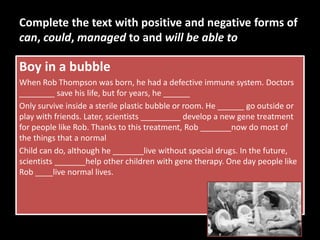
Complete the text with positive and negative forms of 
can, could, managed to and will be able to 
Boy in a bubble 
When Rob Thompson was born, he had a defective immune system. Doctors 
________ save his life, but for years, he ______ 
Only survive inside a sterile plastic bubble or room. He ______ go outside or 
play with friends. Later, scientists _________ develop a new gene treatment 
for people like Rob. Thanks to this treatment, Rob _______now do most of 
the things that a normal 
Child can do, although he _______live without special drugs. In the future, 
scientists _______help other children with gene therapy. One day people like 
Rob ____live normal lives.
POSSIBILITY AND CERTAINTY: 
may/might/could, must, can’t 
Your doctor may (not) ask you to give up smoking (possibility) 
That new medicine might (not) cure you (remote possibility)) 
It could be more effective for some skin problems (possibility) 
The stings must be painful (certainty) 
Zootherapy can’t be a fraud, I’m sure it works! (certainty) 
It may rain tomorrow. I may ask you to drive me to work. It might snow, but I don’t 
think it will. It could rain heavily, that’s all. It must be dangerous to drive in the snow. 
It can’t be true. No, I don’t think it will snow.
Choose the correct alternative 
James isn’t at school today. He ____ be ill. 
a) can’t b) may c) may not 
Sarah’s brother had a car accident. She ___be worried. 
a) must b) might c) can’t 
The children aren’t eating their vegetables. They 
___like them. 
a) can’t b) must c) might not
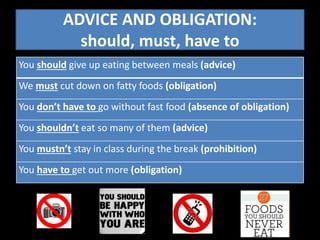
ADVICE AND OBLIGATION: 
should, must, have to 
You should give up eating between meals (advice) 
We must cut down on fatty foods (obligation) 
You don’t have to go without fast food (absence of obligation) 
You shouldn’t eat so many of them (advice) 
You mustn’t stay in class during the break (prohibition) 
You have to get out more (obligation)
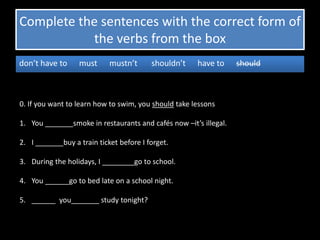
Complete the sentences with the correct form of 
the verbs from the box 
don’t have to must mustn’t shouldn’t have to should 
0. If you want to learn how to swim, you should take lessons 
1. You _______smoke in restaurants and cafés now –it’s illegal. 
2. I _______buy a train ticket before I forget. 
3. During the holidays, I ________go to school. 
4. You ______go to bed late on a school night. 
5. ______ you_______ study tonight?
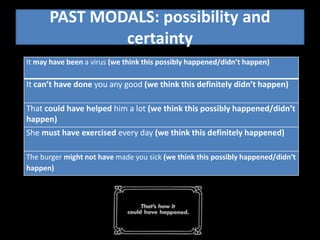
PAST MODALS: possibility and 
certainty 
It may have been a virus (we think this possibly happened/didn’t happen) 
It can’t have done you any good (we think this definitely didn’t happen) 
That could have helped him a lot (we think this possibly happened/didn’t 
happen) 
She must have exercised every day (we think this definitely happened) 
The burger might not have made you sick (we think this possibly happened/didn’t 
happen)
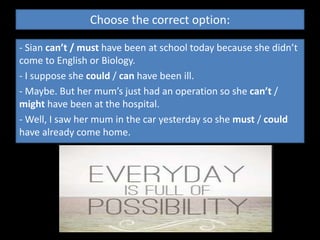
Choose the correct option: 
- Sian can’t / must have been at school today because she didn’t 
come to English or Biology. 
- I suppose she could / can have been ill. 
- Maybe. But her mum’s just had an operation so she can’t / 
might have been at the hospital. 
- Well, I saw her mum in the car yesterday so she must / could 
have already come home.
How do modal verbs work?

How do modal verbs work?

  • 2.
    What is amodal verb? A modal verb (also modal, modal auxiliary verb, modal auxiliary) is a type of auxiliary verb that is used to indicate modality – that is, likelihood, ability, permission, and obligation. YOU MUSTN’T EAT HERE YOU MUSTN’T TO EAT HERE
  • 3.
    The MODAL verbsyou need to know in unit 3 are: COULD, MANAGED TO, CAN, WILL BE ABLE TO MAY/MIGHT/COULD, MUST, CAN’T SHOULD, MUST, HAVE TO
  • 4.
    ABILITY AND ACHIEVEMENT: COULD, MANAGED TO, CAN, WILL BE ABLE TO Before the 19th century, doctors could operate, but without anaesthetic (general ability in the past) Scientists managed to clone an animal in the 1990s (specific achievement in the past)) Surgeons can now transplant human faces (present ability) In the future we will probably be able to transplant brains (future ability)
  • 5.
    Complete the textwith positive and negative forms of can, could, managed to and will be able to Boy in a bubble When Rob Thompson was born, he had a defective immune system. Doctors ________ save his life, but for years, he ______ Only survive inside a sterile plastic bubble or room. He ______ go outside or play with friends. Later, scientists _________ develop a new gene treatment for people like Rob. Thanks to this treatment, Rob _______now do most of the things that a normal Child can do, although he _______live without special drugs. In the future, scientists _______help other children with gene therapy. One day people like Rob ____live normal lives.
  • 6.
    POSSIBILITY AND CERTAINTY: may/might/could, must, can’t Your doctor may (not) ask you to give up smoking (possibility) That new medicine might (not) cure you (remote possibility)) It could be more effective for some skin problems (possibility) The stings must be painful (certainty) Zootherapy can’t be a fraud, I’m sure it works! (certainty) It may rain tomorrow. I may ask you to drive me to work. It might snow, but I don’t think it will. It could rain heavily, that’s all. It must be dangerous to drive in the snow. It can’t be true. No, I don’t think it will snow.
  • 7.
    Choose the correctalternative James isn’t at school today. He ____ be ill. a) can’t b) may c) may not Sarah’s brother had a car accident. She ___be worried. a) must b) might c) can’t The children aren’t eating their vegetables. They ___like them. a) can’t b) must c) might not
  • 8.
    ADVICE AND OBLIGATION: should, must, have to You should give up eating between meals (advice) We must cut down on fatty foods (obligation) You don’t have to go without fast food (absence of obligation) You shouldn’t eat so many of them (advice) You mustn’t stay in class during the break (prohibition) You have to get out more (obligation)
  • 9.
    Complete the sentenceswith the correct form of the verbs from the box don’t have to must mustn’t shouldn’t have to should 0. If you want to learn how to swim, you should take lessons 1. You _______smoke in restaurants and cafés now –it’s illegal. 2. I _______buy a train ticket before I forget. 3. During the holidays, I ________go to school. 4. You ______go to bed late on a school night. 5. ______ you_______ study tonight?
  • 10.
    PAST MODALS: possibilityand certainty It may have been a virus (we think this possibly happened/didn’t happen) It can’t have done you any good (we think this definitely didn’t happen) That could have helped him a lot (we think this possibly happened/didn’t happen) She must have exercised every day (we think this definitely happened) The burger might not have made you sick (we think this possibly happened/didn’t happen)
  • 11.
    Choose the correctoption: - Sian can’t / must have been at school today because she didn’t come to English or Biology. - I suppose she could / can have been ill. - Maybe. But her mum’s just had an operation so she can’t / might have been at the hospital. - Well, I saw her mum in the car yesterday so she must / could have already come home.