How DeepSeek Beats ChatGPT: Cost Comparison and Key Differences
Discover how DeepSeek offers better pricing and value than ChatGPT. Explore a clear cost comparison and find out which AI platform suits your needs and budget.
How DeepSeek Beats ChatGPT: Cost Comparison and Key Differences
1.
How is DeepSeekBetter Than
ChatGPT: Cost Comparison
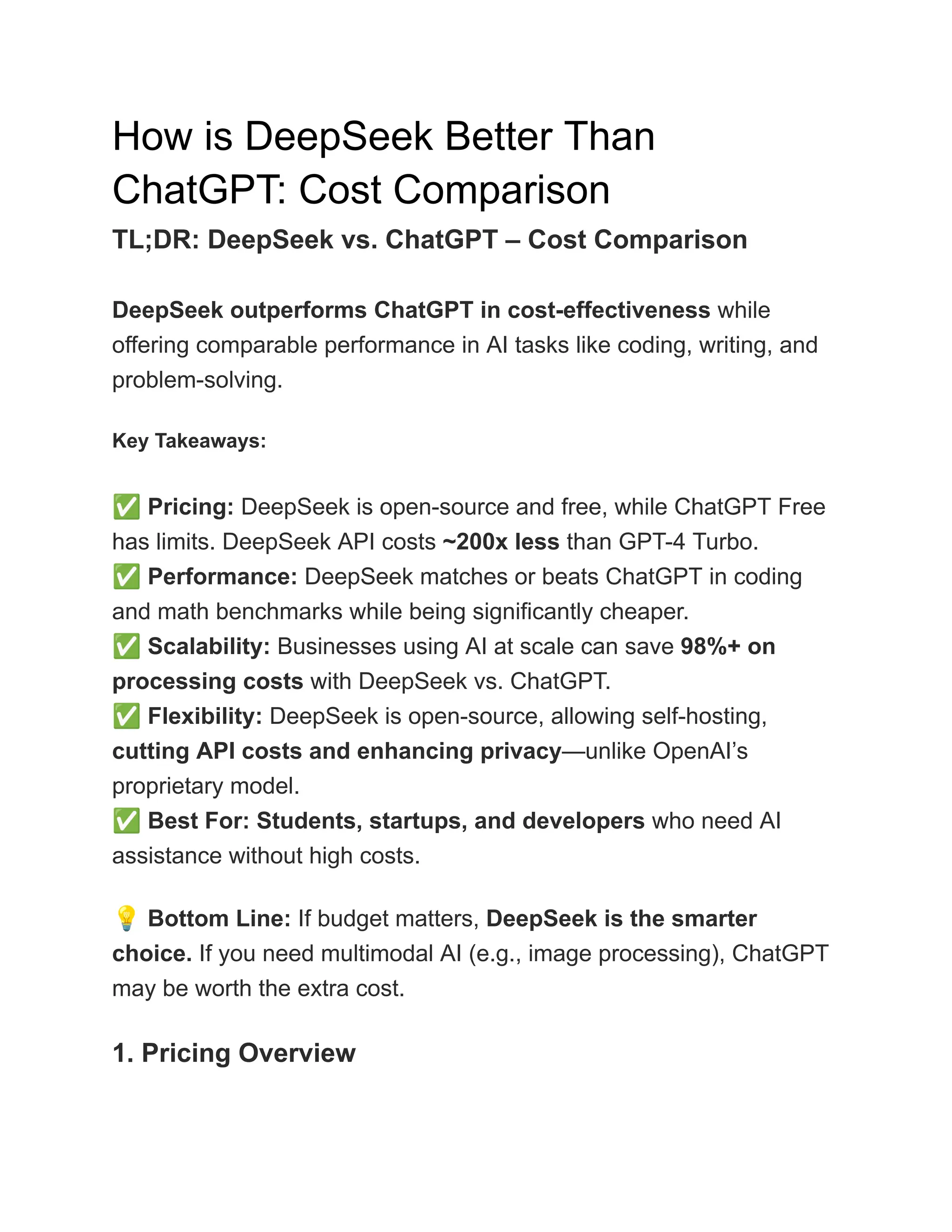
TL;DR: DeepSeek vs. ChatGPT – Cost Comparison
DeepSeek outperforms ChatGPT in cost-effectiveness while
offering comparable performance in AI tasks like coding, writing, and
problem-solving.
Key Takeaways:
✅Pricing: DeepSeek is open-source and free, while ChatGPT Free
has limits. DeepSeek API costs ~200x less than GPT-4 Turbo.
✅Performance: DeepSeek matches or beats ChatGPT in coding
and math benchmarks while being significantly cheaper.
✅Scalability: Businesses using AI at scale can save 98%+ on
processing costs with DeepSeek vs. ChatGPT.
✅Flexibility: DeepSeek is open-source, allowing self-hosting,
cutting API costs and enhancing privacy—unlike OpenAI’s
proprietary model.
✅Best For: Students, startups, and developers who need AI
assistance without high costs.
💡Bottom Line: If budget matters, DeepSeek is the smarter
choice. If you need multimodal AI (e.g., image processing), ChatGPT
may be worth the extra cost.
1. Pricing Overview
2.
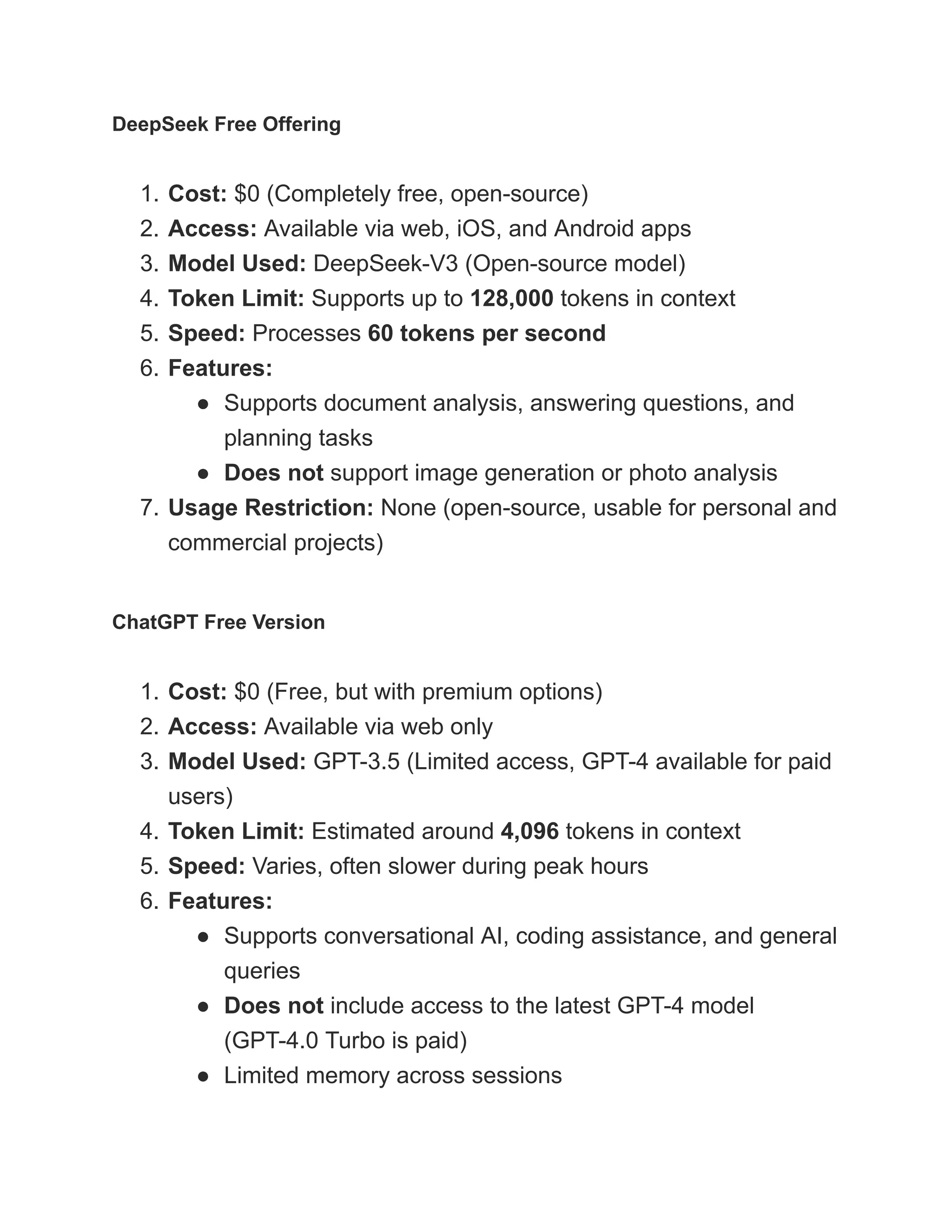
DeepSeek Free Offering
1.Cost:$0 (Completely free, open-source)
2.Access: Available via web, iOS, and Android apps
3.Model Used: DeepSeek-V3 (Open-source model)
4.Token Limit: Supports up to 128,000 tokens in context
5.Speed: Processes 60 tokens per second
6.Features:
● Supports document analysis, answering questions, and
planning tasks
● Does not support image generation or photo analysis
7.Usage Restriction: None (open-source, usable for personal and
commercial projects)
ChatGPT Free Version
1.Cost: $0 (Free, but with premium options)
2.Access: Available via web only
3.Model Used: GPT-3.5 (Limited access, GPT-4 available for paid
users)
4.Token Limit: Estimated around 4,096 tokens in context
5.Speed: Varies, often slower during peak hours
6.Features:
● Supports conversational AI, coding assistance, and general
queries
● Does not include access to the latest GPT-4 model
(GPT-4.0 Turbo is paid)
● Limited memory across sessions
3.
7.Usage Restriction: Ratelimits apply (number of free queries
per hour/day may be restricted)
Major AI Model Cost Comparison:
GPT-4o vs Claude 4 Cost Comparison
Top AI Reasoning Model Cost Comparison 2025
Comparing OpenAI Models
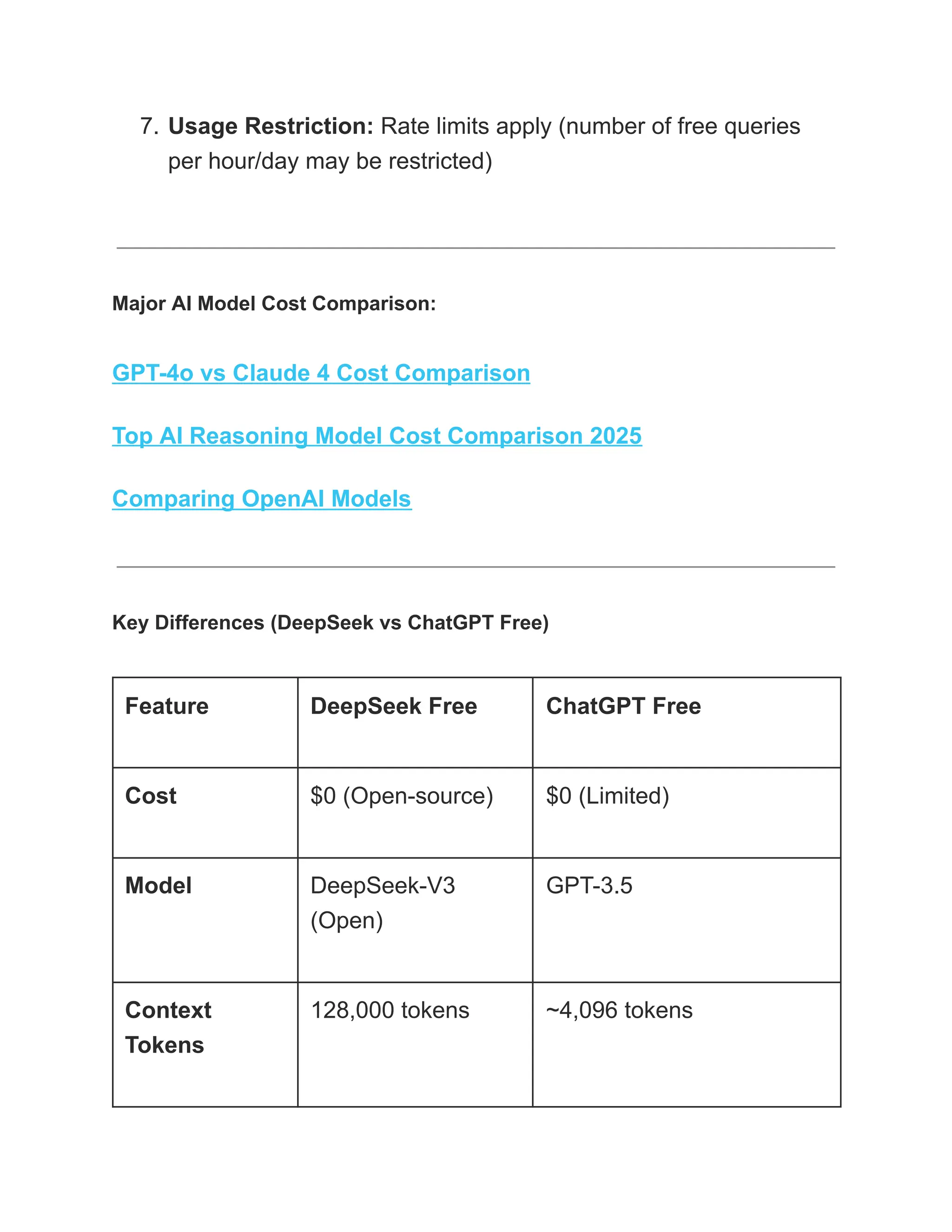
Key Differences (DeepSeek vs ChatGPT Free)
Feature DeepSeek Free ChatGPT Free
Cost $0 (Open-source) $0 (Limited)
Model DeepSeek-V3
(Open)
GPT-3.5
Context
Tokens
128,000 tokens ~4,096 tokens
4.
Speed 60 tokens/secVaries (slower at peak
hours)
Image Gen ❌No ❌No
Platform Web, iOS, Android Web only
Usage Limits No limit Limited queries per
hour/day
If you’re looking for longer context handling and open-source
flexibility, DeepSeek is a better free option. If you prefer ChatGPT’s
user experience and familiarity, its free version still provides good
conversational capabilities.
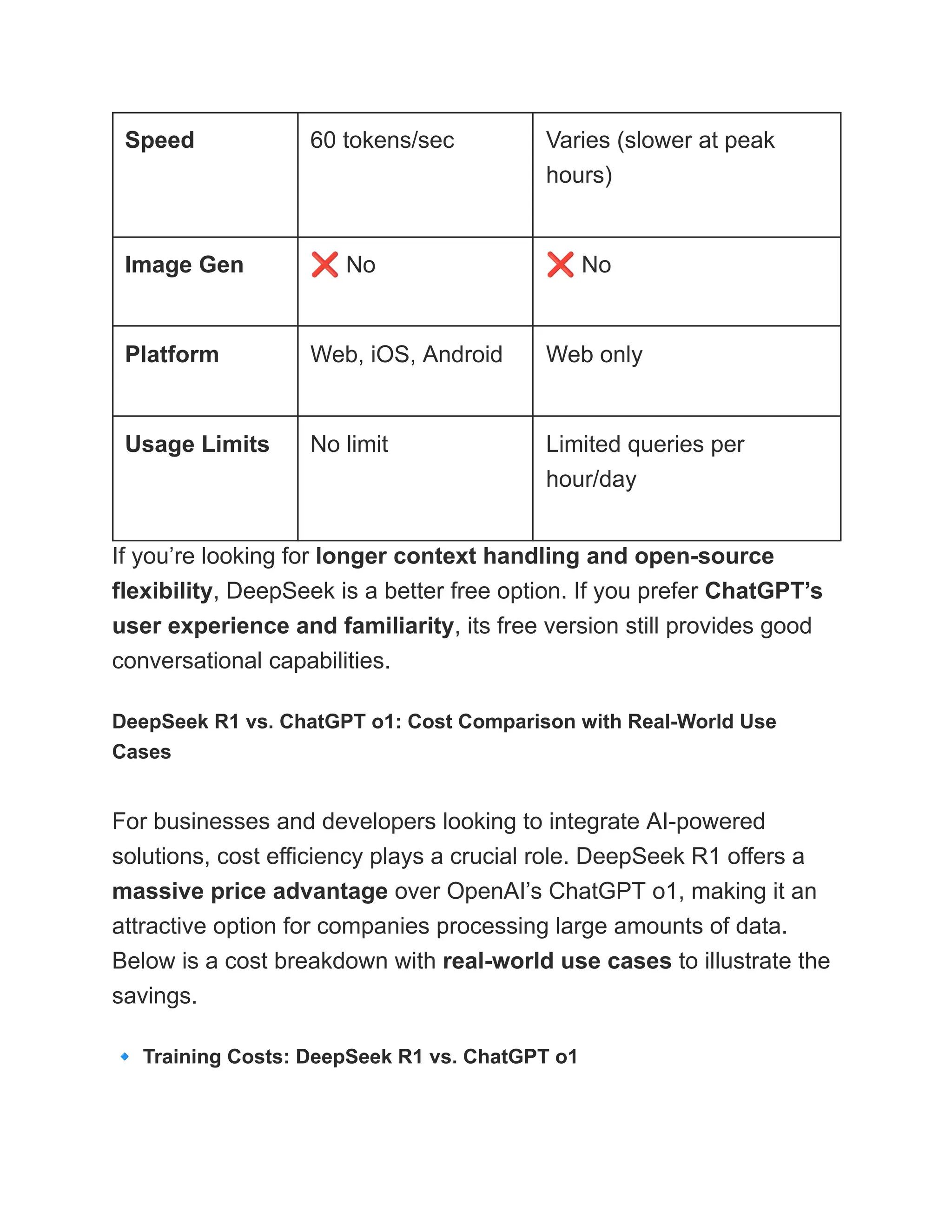
DeepSeek R1 vs. ChatGPT o1: Cost Comparison with Real-World Use
Cases
For businesses and developers looking to integrate AI-powered
solutions, cost efficiency plays a crucial role. DeepSeek R1 offers a
massive price advantage over OpenAI’s ChatGPT o1, making it an
attractive option for companies processing large amounts of data.
Below is a cost breakdown with real-world use cases to illustrate the
savings.
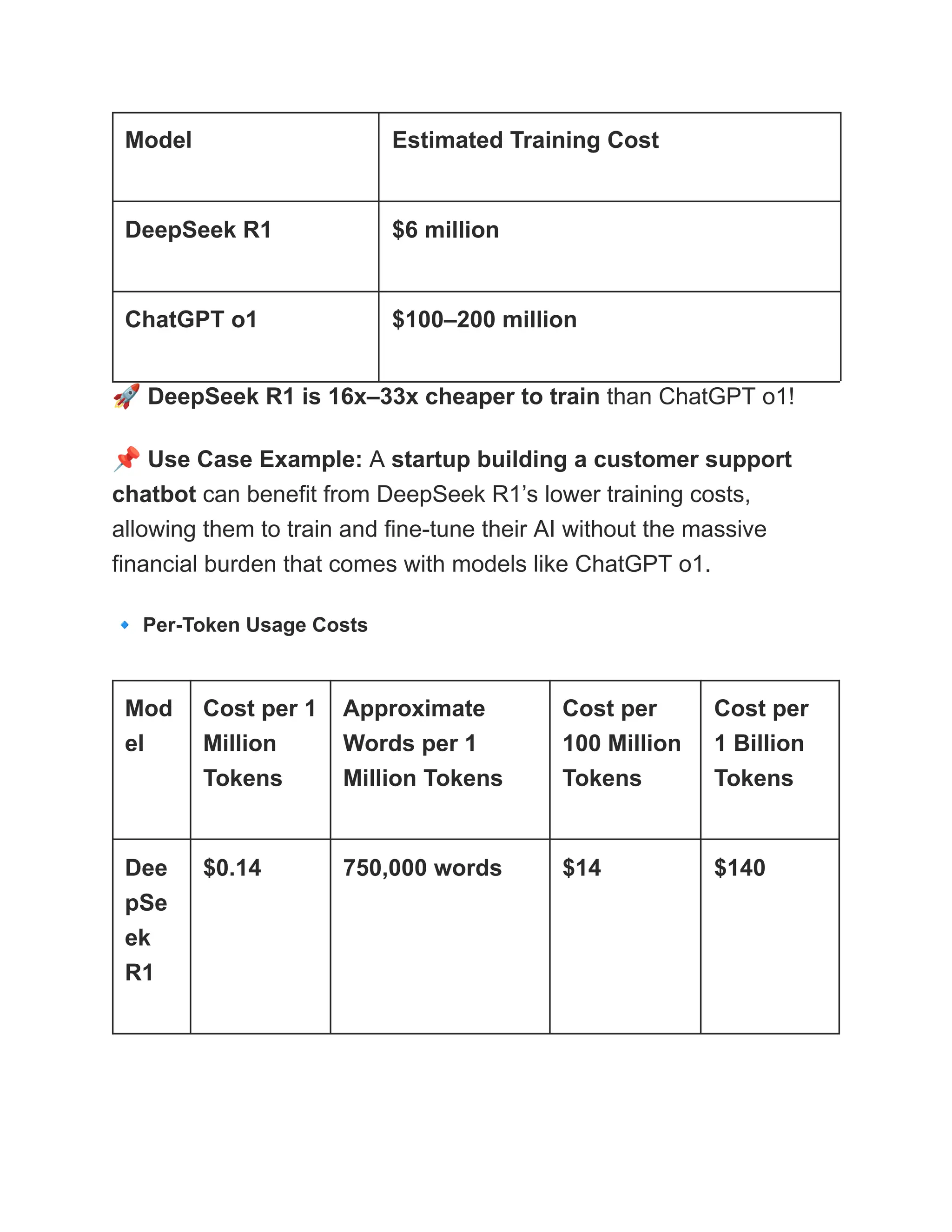
🔹Training Costs: DeepSeek R1 vs. ChatGPT o1
5.
Model Estimated TrainingCost
DeepSeek R1 $6 million
ChatGPT o1 $100–200 million
🚀DeepSeek R1 is 16x–33x cheaper to train than ChatGPT o1!
📌Use Case Example: A startup building a customer support
chatbot can benefit from DeepSeek R1’s lower training costs,
allowing them to train and fine-tune their AI without the massive
financial burden that comes with models like ChatGPT o1.
🔹Per-Token Usage Costs
Mod
el
Cost per 1
Million
Tokens
Approximate
Words per 1
Million Tokens
Cost per
100 Million
Tokens
Cost per
1 Billion
Tokens
Dee
pSe
ek
R1
$0.14 750,000 words $14 $140
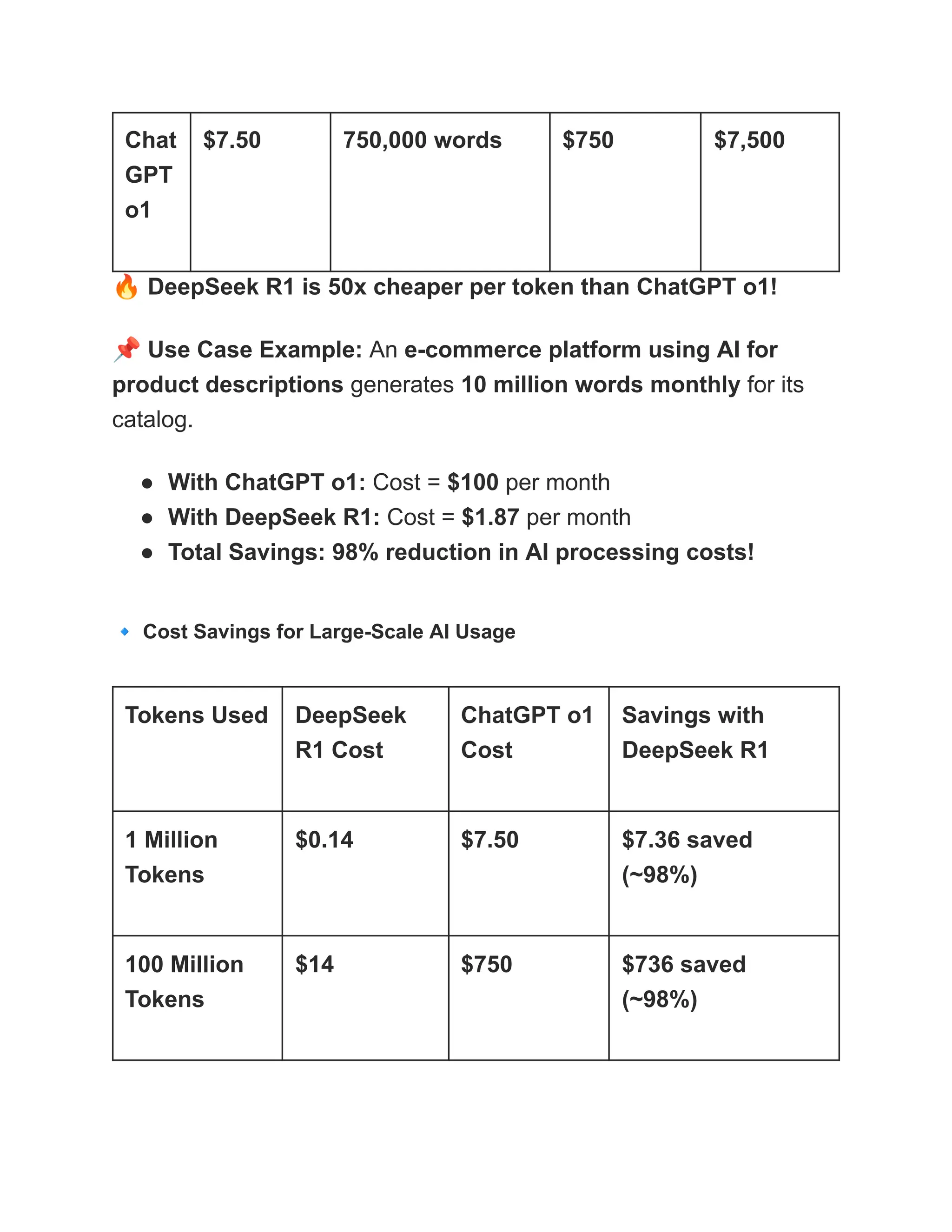
6.
Chat
GPT
o1
$7.50 750,000 words$750 $7,500
🔥DeepSeek R1 is 50x cheaper per token than ChatGPT o1!
📌Use Case Example: An e-commerce platform using AI for
product descriptions generates 10 million words monthly for its
catalog.
● With ChatGPT o1: Cost = $100 per month
● With DeepSeek R1: Cost = $1.87 per month
● Total Savings: 98% reduction in AI processing costs!
🔹Cost Savings for Large-Scale AI Usage
Tokens Used DeepSeek
R1 Cost
ChatGPT o1
Cost
Savings with
DeepSeek R1
1 Million
Tokens
$0.14 $7.50 $7.36 saved
(~98%)
100 Million
Tokens
$14 $750 $736 saved
(~98%)
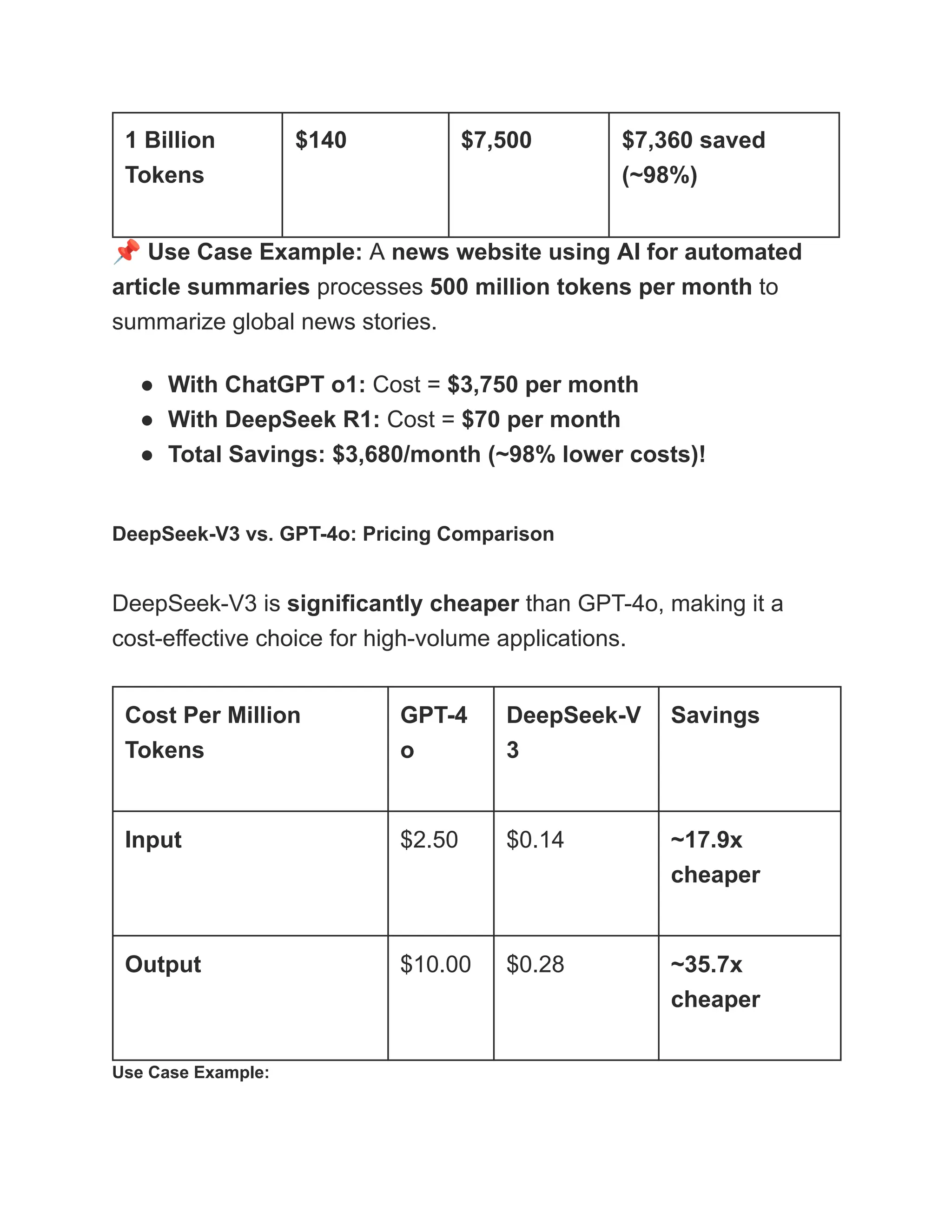
7.
1 Billion
Tokens
$140 $7,500$7,360 saved
(~98%)
📌Use Case Example: A news website using AI for automated
article summaries processes 500 million tokens per month to
summarize global news stories.
● With ChatGPT o1: Cost = $3,750 per month
● With DeepSeek R1: Cost = $70 per month
● Total Savings: $3,680/month (~98% lower costs)!
DeepSeek-V3 vs. GPT-4o: Pricing Comparison
DeepSeek-V3 is significantly cheaper than GPT-4o, making it a
cost-effective choice for high-volume applications.
Cost Per Million
Tokens
GPT-4
o
DeepSeek-V
3
Savings
Input $2.50 $0.14 ~17.9x
cheaper
Output $10.00 $0.28 ~35.7x
cheaper
Use Case Example:
8.
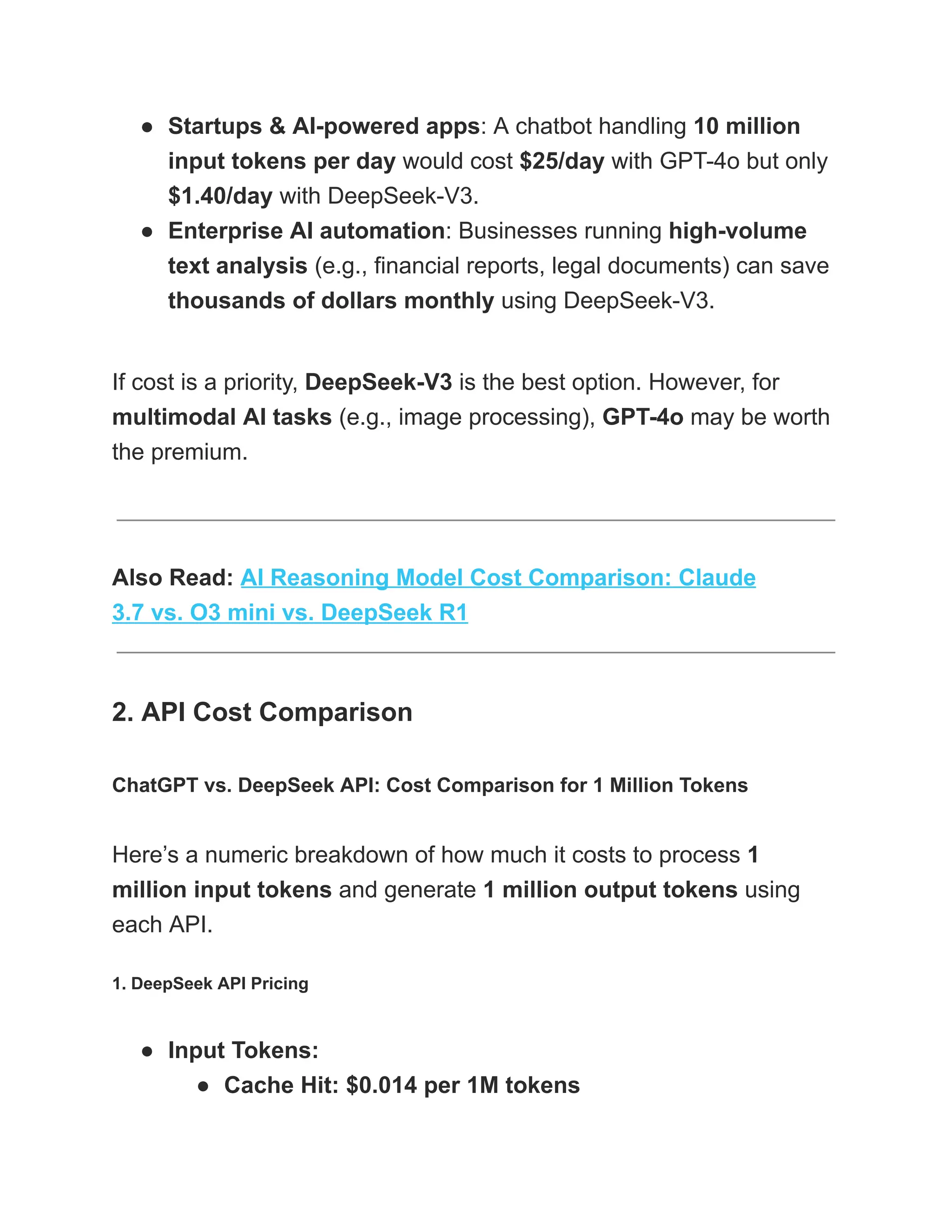
● Startups &AI-powered apps: A chatbot handling 10 million
input tokens per day would cost $25/day with GPT-4o but only
$1.40/day with DeepSeek-V3.
● Enterprise AI automation: Businesses running high-volume
text analysis (e.g., financial reports, legal documents) can save
thousands of dollars monthly using DeepSeek-V3.
If cost is a priority, DeepSeek-V3 is the best option. However, for
multimodal AI tasks (e.g., image processing), GPT-4o may be worth
the premium.
Also Read: AI Reasoning Model Cost Comparison: Claude
3.7 vs. O3 mini vs. DeepSeek R1
2. API Cost Comparison
ChatGPT vs. DeepSeek API: Cost Comparison for 1 Million Tokens
Here’s a numeric breakdown of how much it costs to process 1
million input tokens and generate 1 million output tokens using
each API.
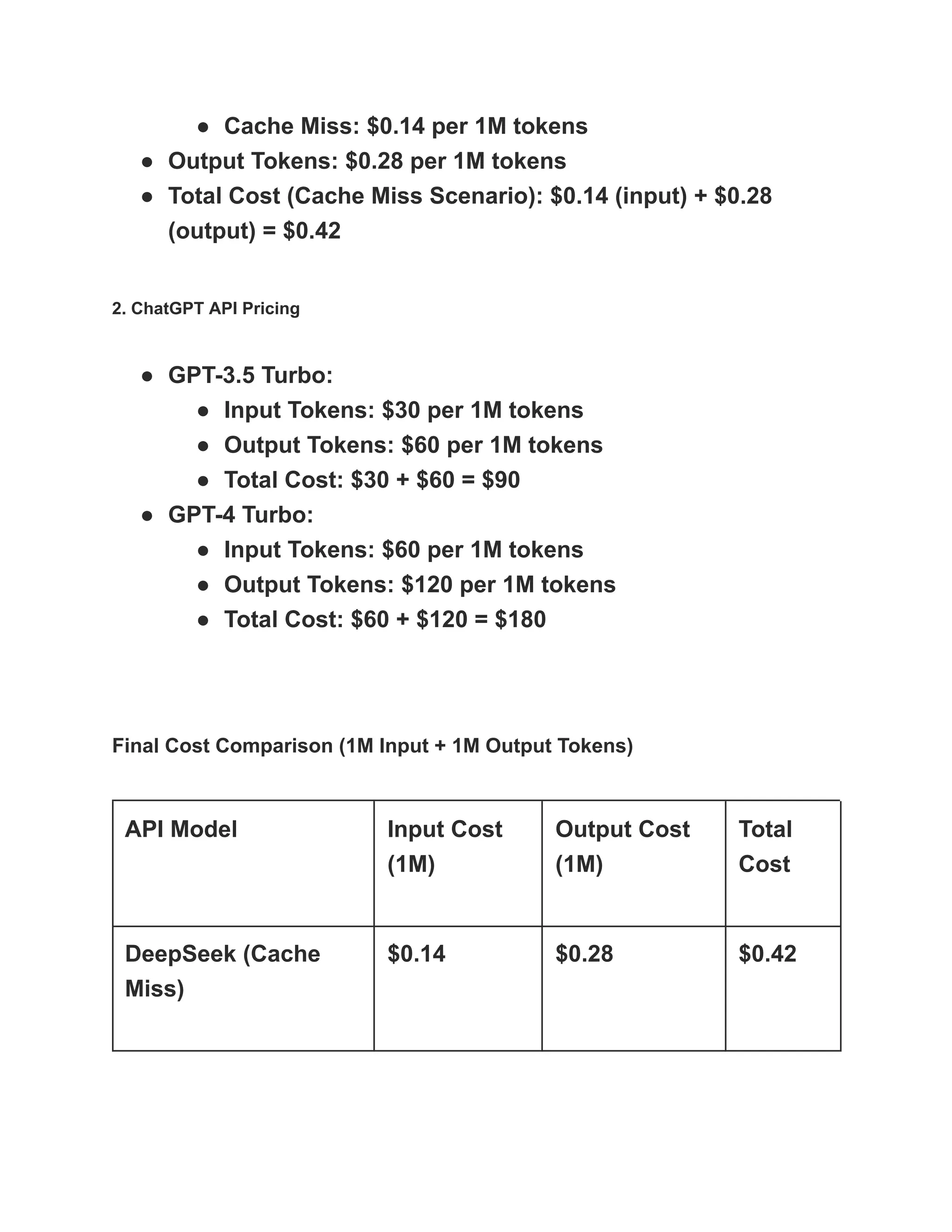
1. DeepSeek API Pricing
● Input Tokens:
● Cache Hit: $0.014 per 1M tokens
9.
● Cache Miss:$0.14 per 1M tokens
● Output Tokens: $0.28 per 1M tokens
● Total Cost (Cache Miss Scenario): $0.14 (input) + $0.28
(output) = $0.42
2. ChatGPT API Pricing
● GPT-3.5 Turbo:
● Input Tokens: $30 per 1M tokens
● Output Tokens: $60 per 1M tokens
● Total Cost: $30 + $60 = $90
● GPT-4 Turbo:
● Input Tokens: $60 per 1M tokens
● Output Tokens: $120 per 1M tokens
● Total Cost: $60 + $120 = $180
Final Cost Comparison (1M Input + 1M Output Tokens)
API Model Input Cost
(1M)
Output Cost
(1M)
Total
Cost
DeepSeek (Cache
Miss)
$0.14 $0.28 $0.42
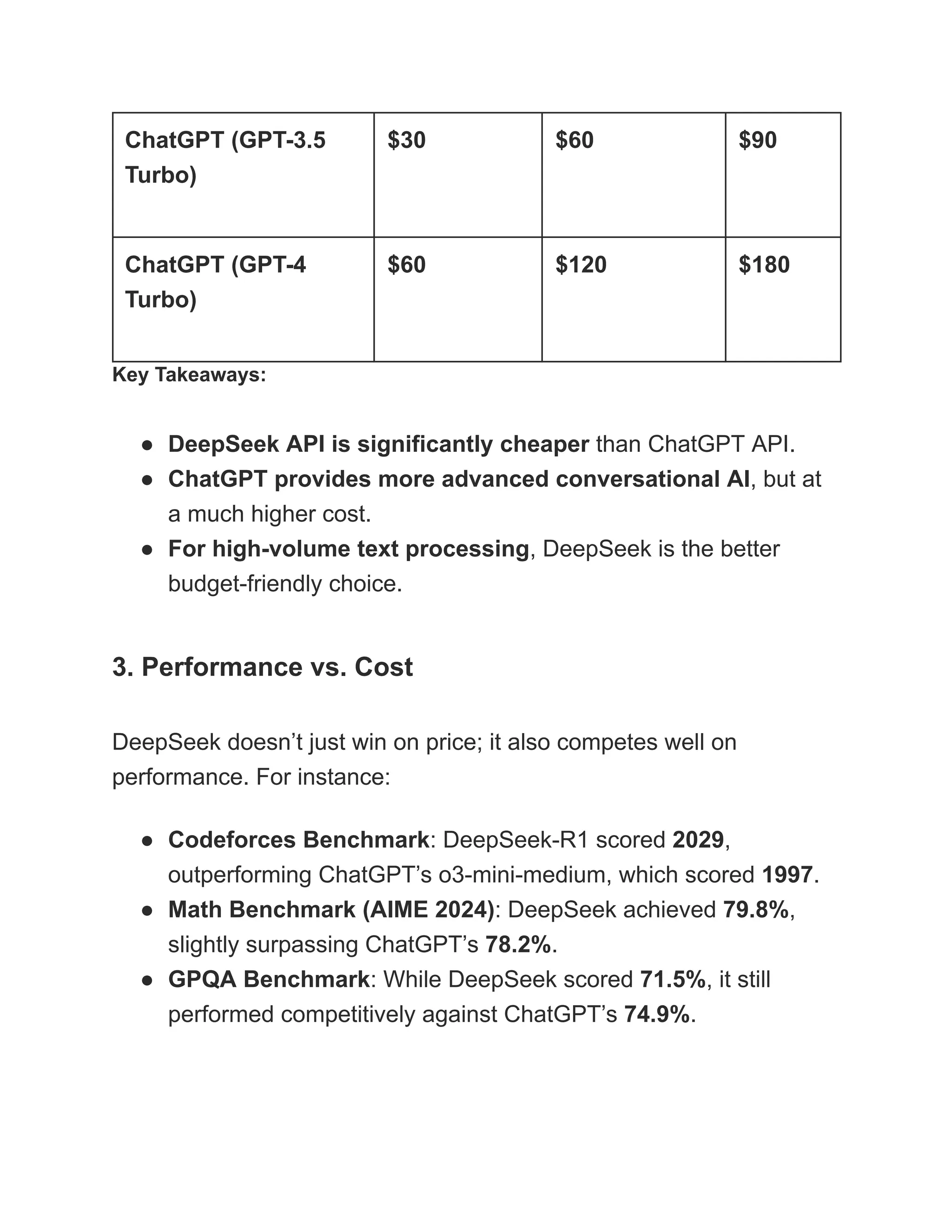
10.
ChatGPT (GPT-3.5
Turbo)
$30 $60$90
ChatGPT (GPT-4
Turbo)
$60 $120 $180
Key Takeaways:
● DeepSeek API is significantly cheaper than ChatGPT API.
● ChatGPT provides more advanced conversational AI, but at
a much higher cost.
● For high-volume text processing, DeepSeek is the better
budget-friendly choice.
3. Performance vs. Cost
DeepSeek doesn’t just win on price; it also competes well on
performance. For instance:
● Codeforces Benchmark: DeepSeek-R1 scored 2029,
outperforming ChatGPT’s o3-mini-medium, which scored 1997.
● Math Benchmark (AIME 2024): DeepSeek achieved 79.8%,
slightly surpassing ChatGPT’s 78.2%.
● GPQA Benchmark: While DeepSeek scored 71.5%, it still
performed competitively against ChatGPT’s 74.9%.
11.
These results highlightthat DeepSeek delivers comparable (and
sometimes better) performance at a fraction of the cost, especially
when factoring in its lower inference costs.
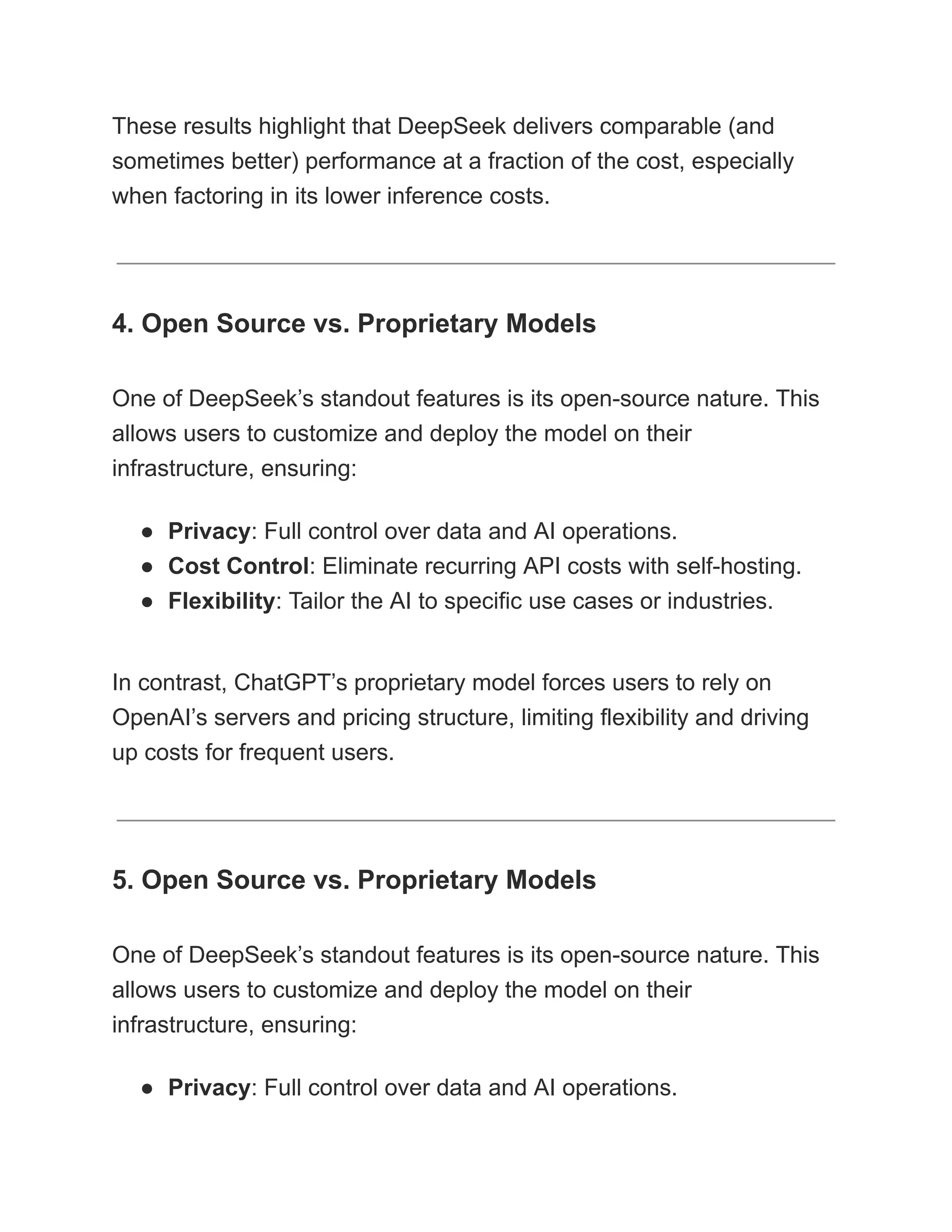
4. Open Source vs. Proprietary Models
One of DeepSeek’s standout features is its open-source nature. This
allows users to customize and deploy the model on their
infrastructure, ensuring:
● Privacy: Full control over data and AI operations.
● Cost Control: Eliminate recurring API costs with self-hosting.
● Flexibility: Tailor the AI to specific use cases or industries.
In contrast, ChatGPT’s proprietary model forces users to rely on
OpenAI’s servers and pricing structure, limiting flexibility and driving
up costs for frequent users.
5. Open Source vs. Proprietary Models
One of DeepSeek’s standout features is its open-source nature. This
allows users to customize and deploy the model on their
infrastructure, ensuring:
● Privacy: Full control over data and AI operations.
12.
● Cost Control:Eliminate recurring API costs with self-hosting.
● Flexibility: Tailor the AI to specific use cases or industries.
In contrast, ChatGPT’s proprietary model forces users to rely on
OpenAI’s servers and pricing structure, limiting flexibility and driving
up costs for frequent users.
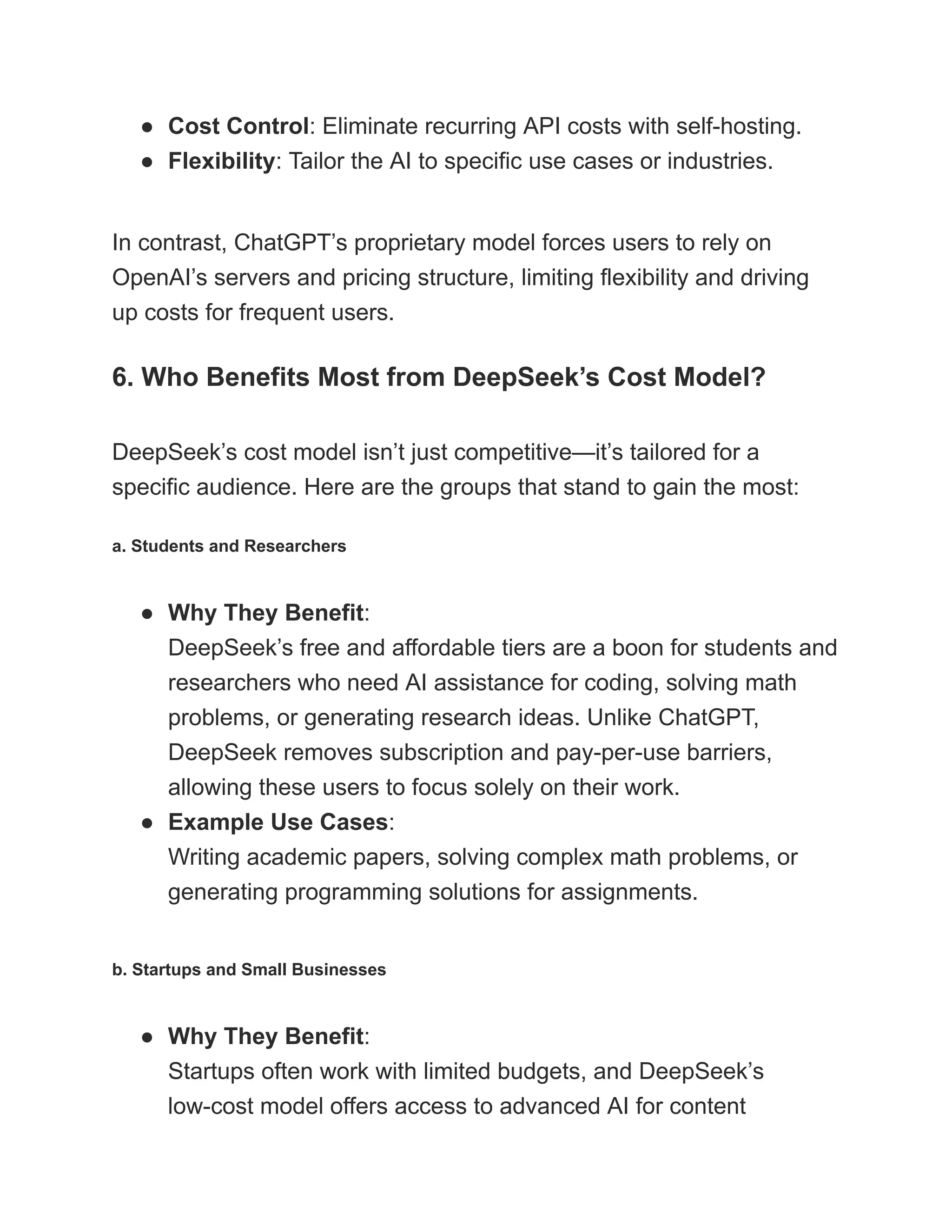
6. Who Benefits Most from DeepSeek’s Cost Model?
DeepSeek’s cost model isn’t just competitive—it’s tailored for a
specific audience. Here are the groups that stand to gain the most:
a. Students and Researchers
● Why They Benefit:
DeepSeek’s free and affordable tiers are a boon for students and
researchers who need AI assistance for coding, solving math
problems, or generating research ideas. Unlike ChatGPT,
DeepSeek removes subscription and pay-per-use barriers,
allowing these users to focus solely on their work.
● Example Use Cases:
Writing academic papers, solving complex math problems, or
generating programming solutions for assignments.
b. Startups and Small Businesses
● Why They Benefit:
Startups often work with limited budgets, and DeepSeek’s
low-cost model offers access to advanced AI for content
13.
creation, automation, andsupport. By using Bloggr.AI – AI blog
post generators, startups can build brand authority through
consistent, high-quality content, without overspending.
● ChatGPT Limitation:
Many small businesses find ChatGPT’s subscription costs and
API rates unsustainable as their AI needs scale. DeepSeek
provides a cost-effective alternative.
● Example Use Cases:
Automating repetitive tasks, setting up intelligent chatbots, or
analyzing customer data for insights.
c. Developers Building Scalable Applications
● Why They Benefit:
DeepSeek’s lower API costs enable developers to integrate AI
into apps and tools without worrying about skyrocketing
expenses. It also offers flexibility for experimentation in the
development phase.
● ChatGPT Limitation:
High per-token costs in ChatGPT’s API often discourage
extensive AI integration in resource-intensive projects.
● Example Use Cases:
Building conversational AI apps, creating recommendation
engines, or deploying personalized learning systems.
d. Education and Nonprofits
14.
● Why TheyBenefit:
Many educational institutions and nonprofits lack budgets for
advanced AI. DeepSeek’s free access ensures they can still
leverage cutting-edge AI tools to improve learning outcomes or
streamline their operations.
● ChatGPT Limitation:
The free tier’s limitations (like slower performance and GPT-3.5
access) make it less ideal for robust educational or nonprofit use
cases.
● Example Use Cases:
Creating virtual learning assistants, enabling automated donor
communication, or managing educational resources.
e. High-Volume API Users
● Why They Benefit:
DeepSeek’s pricing enables companies or developers handling
millions of queries daily to operate affordably.
● ChatGPT Limitation:
Heavy API users often experience budget constraints due to
ChatGPT’s expensive token rates.
● Example Use Cases:
Large-scale customer service operations or dynamic content
generation platforms.
Conclusion: Why DeepSeek is a Game-Changer
15.
DeepSeek is redefiningcost-effectiveness in the AI landscape. Its free
access, significantly cheaper APIs, and open-source flexibility make it
a compelling alternative to ChatGPT for a wide range of users.
Whether you’re a student, developer, or small business owner,
DeepSeek offers advanced AI capabilities without the financial
burden.
The next step? Try DeepSeek yourself and experience the
difference.
People Also Ask:
1. What’s better, DeepSeek or ChatGPT?
DeepSeek offers a more cost-effective alternative to ChatGPT,
especially for high-volume users. While both models perform well for
tasks like coding, writing, and problem-solving, DeepSeek stands out
with its free access and significantly lower API costs. Additionally,
DeepSeek’s open-source nature provides flexibility and privacy,
allowing users to customize and self-host the model, which ChatGPT
does not offer.
2. What is so special about DeepSeek?
DeepSeek’s key strengths lie in its affordability, open-source flexibility,
and scalable performance. Unlike ChatGPT, which has costly APIs
and usage limitations, DeepSeek offers free access to its core
functionality and lower pricing for larger applications. It also allows
users to deploy the model on their infrastructure, ensuring full control
over data and operations. These advantages make it a compelling
choice for students, startups, and high-volume API users.
16.
3. How isDeepSeek more efficient?
DeepSeek is more efficient due to its significantly lower cost per
token, allowing businesses and developers to scale without high
expenses. For example, generating the same amount of content with
DeepSeek costs a fraction of the price compared to ChatGPT.
Furthermore, DeepSeek’s open-source model provides users with
greater control and flexibility over their AI applications, reducing
dependency on third-party servers and improving overall efficiency.
4. Did DeepSeek use ChatGPT?
No, DeepSeek did not use ChatGPT. DeepSeek is an independent AI
model with its own architecture and functionality. While it may perform
similarly to models like GPT-4 in certain benchmarks, DeepSeek
distinguishes itself with lower costs, an open-source approach, and
greater flexibility for developers.