COST OF BUILDING
TEXT CLASSIFICATION MODEL
FOR AI-BASED CONTENT
CURATION
info@belitsoft.com
Our clients often ask us about the
cost of building an AI document
classification software that
automatically analyzes, scores,
selects, and prepares large volumes
of content for future business use.
The cost depends on the task, specifically on the business scenarios
they want to cover, the complexity of evaluation criteria (just
relevance or also structure, readability, value scoring), the volume of
training data (do they already have labeled data or do we need to
create it?), the choice between using commercial APIs (faster start,
but higher long-term usage costs) or building and tuning an
open-source model (more flexible, but longer and more expensive to
develop), the expected processing speed and cost per document,
whether they need manual score correction tools and continuous
retraining.
Let’s take a hypothetical example of a marketing company with a
request to build a text classification model for AI-based content
curation.
● They have 1 million pre-labeled documents.
● They want to achieve a goal of 90% accuracy.
● They have requirements for fast processing and low per-document
cost (processing time per document between 5–10 seconds, and
target processing cost per document $0.005).
They need the system to evaluate each document according to several
different, well-defined criteria, not just label documents as relevant or not,
but assign scores based on:
● Value (how important and useful the document is compared to
others)
● Relevance (how well the document fits the needed topic)
● Readability (how clear and easy the text is to read).
Cost estimation
The estimation includes:
● initial development
● setting up
● fine-tuning
● testing on a limited dataset
● calculating processing speed, accuracy, and costs
● providing the client with a working prototype and performance
results.
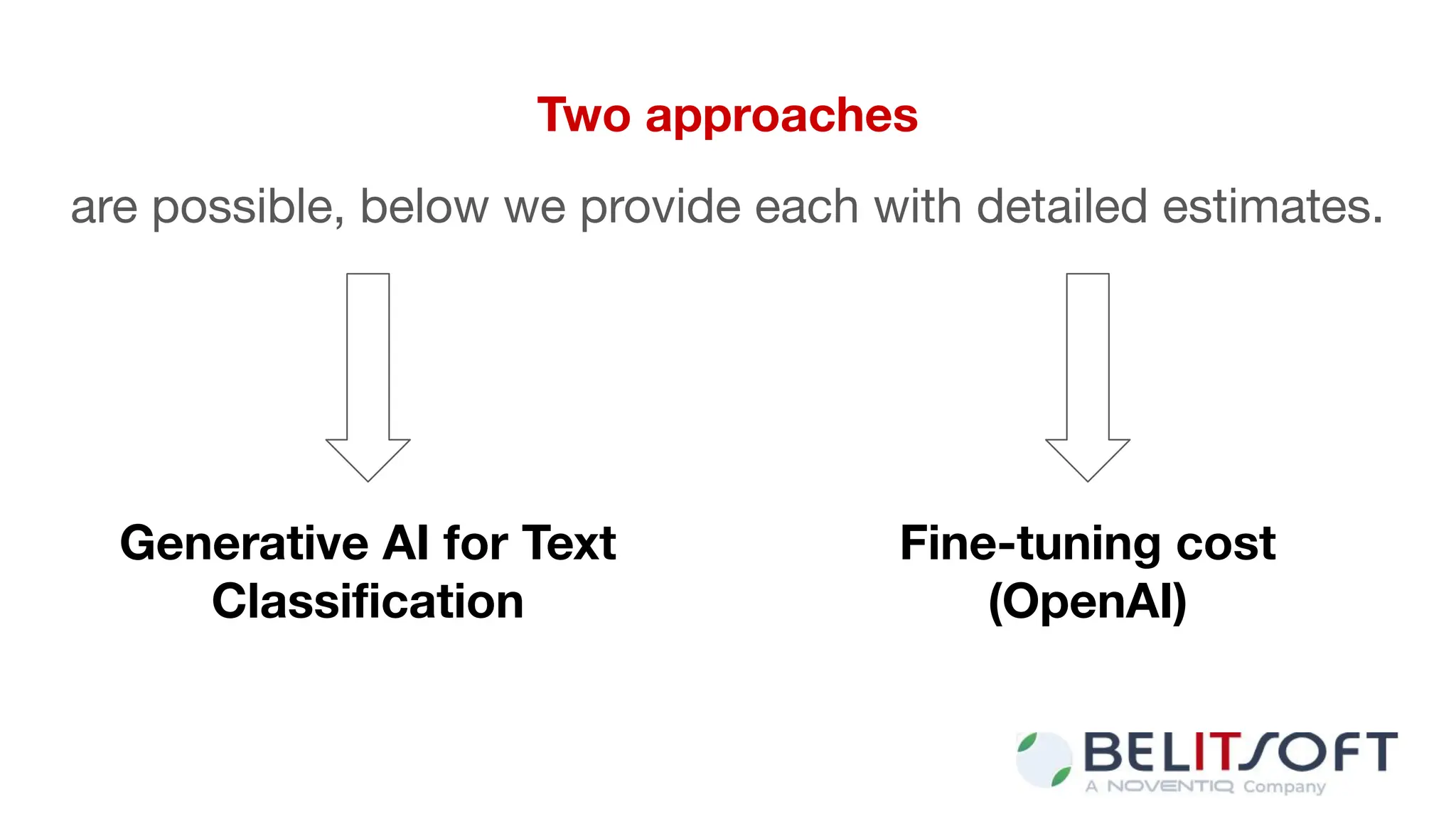
Generative AI for Text
Classification
Two approaches
are possible, below we provide each with detailed estimates.
Fine-tuning cost
(OpenAI)
1. Generative AI for Text Classification
Development time (393–510 hours)
Why this time?
Even if you use OpenAI’s pretrained model, you still need custom code to connect
your system to OpenAI API, logic for parsing and preparing those 1M PDFs,
preprocessing pipelines (tokenization, chunking, embeddings), writing scoring logic,
API integration for inference, testing, monitoring setup, fallback logic.
All of this takes serious development time.
That’s around 2.5–3 developers working full-time for 1.5–2 months, or 1
developer for 3 months.
1 million+ documents is huge. You need data ingestion logic for massive PDF
parsing, extracting text, tables, images (maybe using OCR for some parts),
storing and managing intermediate results, logging and error handling (there will
be broken files, encoding issues).
Scoring logic development (Value, Relevance, Structure, Readability). You can’t
just throw a PDF into GPT and get four perfect scores. Developers need to design
rules, add system prompts, and build a scoring framework.
System integration.
Testing. Before running on 1M docs, we test multiple times, adjust parameters,
fine-tune batch sizes, and score weights.
Delivery format + UI/Reporting.
For a project with 1M documents, complex evaluation, custom scoring, reliable
infrastructure, it’s a normal, reasonable estimate. A promise of “2 weeks” should
make you suspicious.
2. Fine-tuning cost (OpenAI)
Clients don’t just ask for a fixed model: they want a system that learns
and improves over time with manual corrections.
That’s exactly what fine-tuning is.
If OpenAI offers fine-tuning for $3 per million tokens, and we assume PDF
documents of 10 pages contain around 2,500–2,600 words each, that would be
approximately 3,300–3,400 tokens per document.
● If we fine-tune 100k documents, we have to pay OpenAI $1,000.
● If we fine-tune on the full 1 million documents, we have to pay them
$10,000+.
There are two variants within the OpenAI option: fine-tuning on 100k documents
and fine-tuning on 1M documents.
● 100k documents is partial fine-tuning: faster and cheaper, but less precise.
● 1M documents is a full fine-tuning: higher cost and effort, but maximum
alignment with client data.
➔ Why do we offer both partial and full tuning?
Because 1M documents is huge.
Processing and fine-tuning on all of them are expensive.
Clients may not want to spend $10k+ on fine-tuning right away without first
seeing value.
So we provide a smaller “entry” scenario: fine-tune on 100k documents for
$1k.
If that works well, they can scale up to 1M. This helps de-risk: start
small, validate quality, then invest more.
➔ The client requests 90% accuracy based on their labeled data.
To meet that accuracy goal with confidence, full fine-tuning (1M
documents) is best aligned.
But offering partial tuning is still reasonable as a pilot step or
fallback if the client wants to test results before scaling.
However, if the client demands “production-ready” 90% accuracy
from day one, partial tuning is not an option.
Ongoing Usage Costs after
Fine-tuning (OpenAI)
After the model is fine-tuned, each time you use it to classify new documents
through the OpenAI API, you pay based on the number of tokens processed.
The client says: "We have 1 million documents with known classification." That
means they already have labeled data (relevant/irrelevant). This labeled data is
used for fine-tuning the model.
What happens after fine-tuning?
The model is trained to understand what makes documents relevant or not. But
after training, the client still needs to run the model on new, incoming documents
— documents that are not yet classified.
The client wants to continuously process new batches of documents (potentially
millions more PDFs in the future) and automatically score, classify, and filter them.
How much would this cost at scale?
● To process (recognize/classify) 1 million documents, the estimated
cost starts at $600+.
● To process 5 million documents, the estimated cost starts at
$3,000+.
If you are looking to build generative AI product, our engineering
team deploys models that scale with your infrastructure. We at
Belitsoft connect APIs directly to your CRM, apps, websites or
data pipelines, pulling context from your existing databases to
ensure compliance with your software architecture.
Contact us today and we will discuss your project requirements.
info@belitsoft.com
Discriminative AI for Text
Classification
Learning from 1 million pre-classified documents (relevant vs. not
relevant) is a classic supervised machine learning classification task.
Document categorization is the dominant task for this project (40%),
however, the remaining 60% focuses on scoring, etc. so it's more than a
simple classifier.
The system uses machine learning for classification, and while it leverages
a generative model like OpenAI’s GPT for embeddings or fine-tuning, its
core function is not generative.
This is a discriminative AI system, not a generative one. It is about
building an AI application powered by discriminative machine learning
models. Generative models like GPT can be used in a discriminative way
through fine-tuning or prompting.
However, there are also specialized discriminative models such as SBERT
and CatBoost, which are open source. These should also be included in
the cost estimation process, especially because they offer long-term cost
savings.
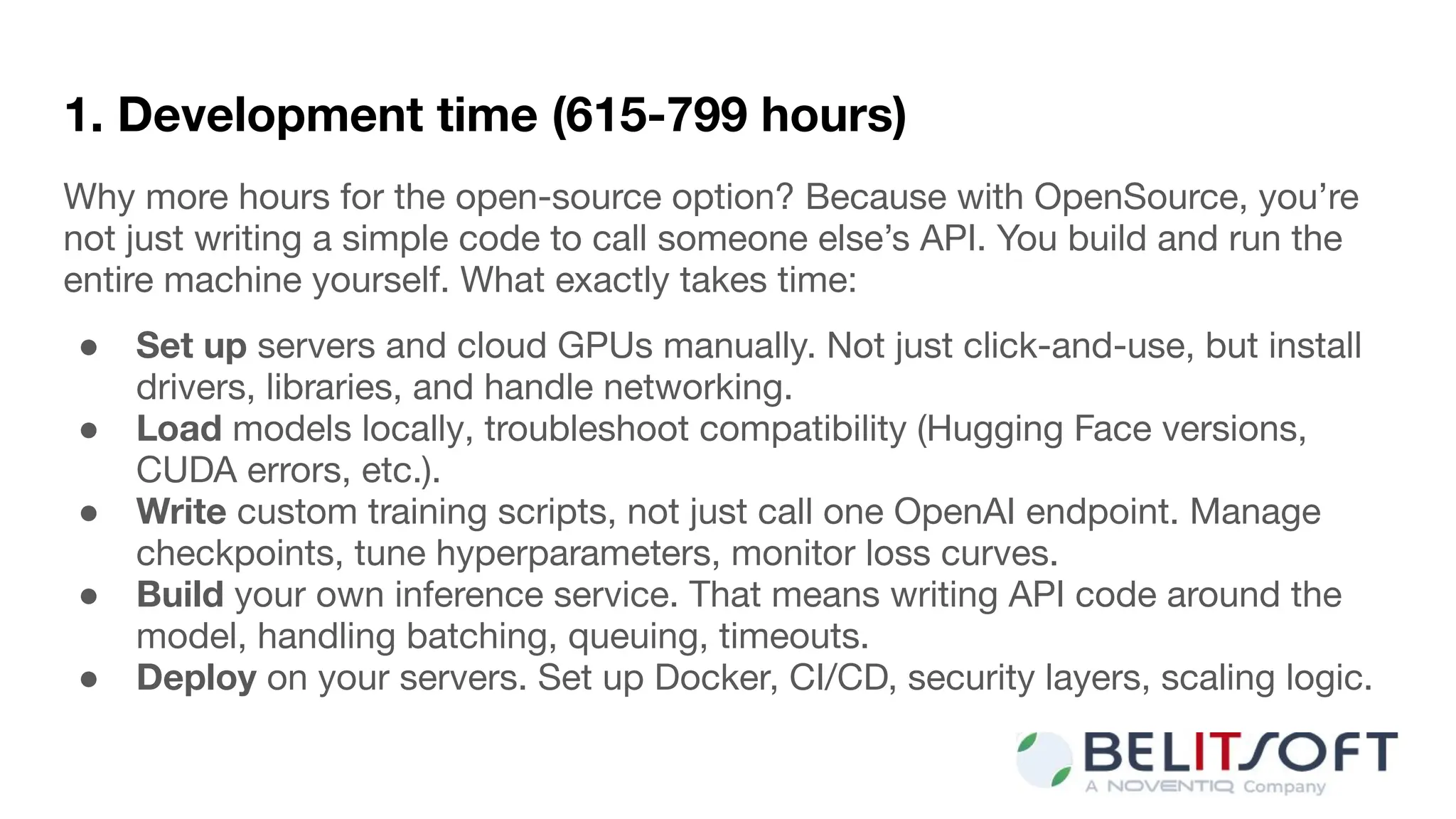
1. Development time (615-799 hours)
Why more hours for the open-source option? Because with OpenSource, you’re
not just writing a simple code to call someone else’s API. You build and run the
entire machine yourself. What exactly takes time:
● Set up servers and cloud GPUs manually. Not just click-and-use, but install
drivers, libraries, and handle networking.
● Load models locally, troubleshoot compatibility (Hugging Face versions,
CUDA errors, etc.).
● Write custom training scripts, not just call one OpenAI endpoint. Manage
checkpoints, tune hyperparameters, monitor loss curves.
● Build your own inference service. That means writing API code around the
model, handling batching, queuing, timeouts.
● Deploy on your servers. Set up Docker, CI/CD, security layers, scaling logic.
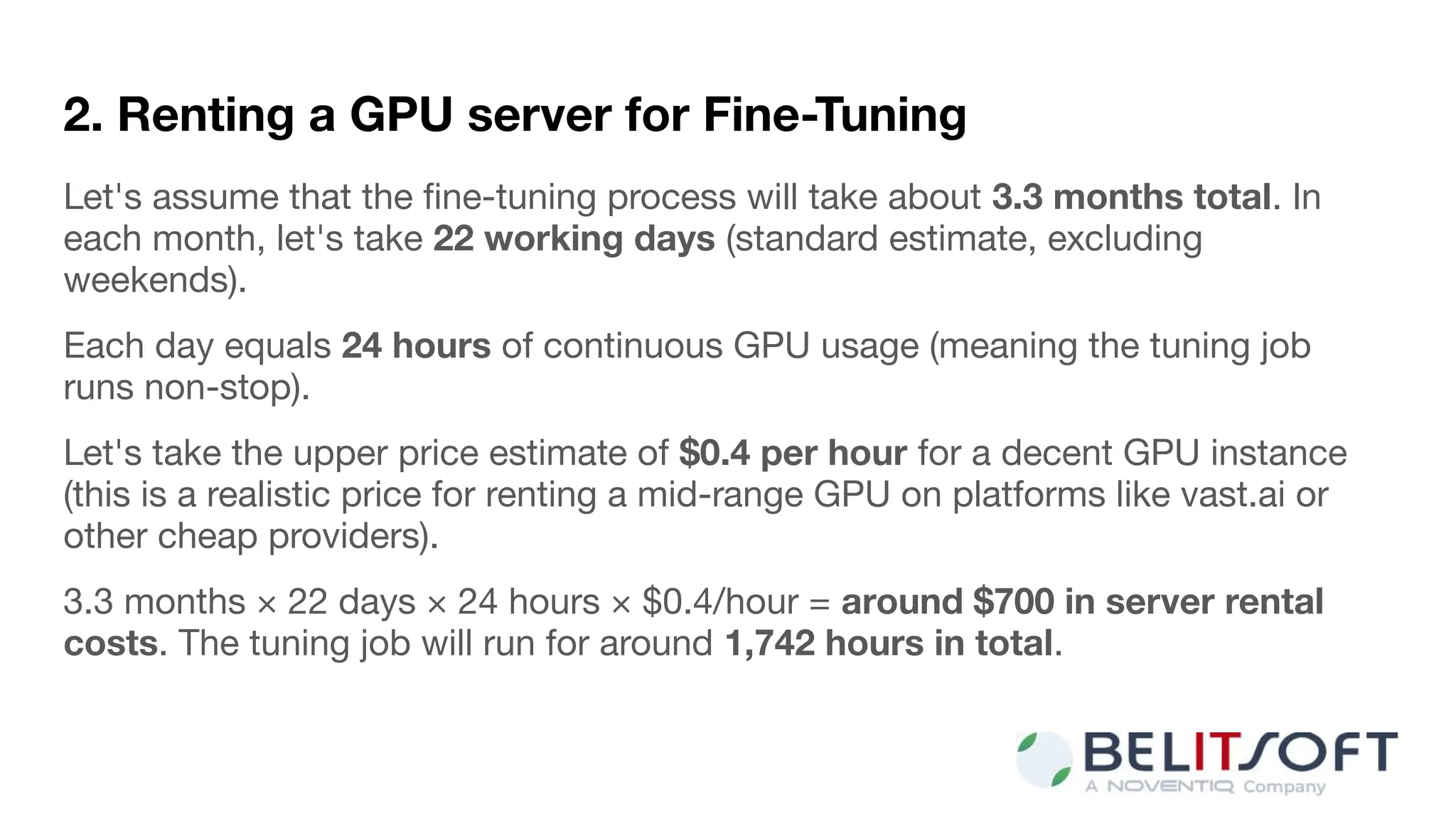
2. Renting a GPU server for Fine-Tuning
Let's assume that the fine-tuning process will take about 3.3 months total. In
each month, let's take 22 working days (standard estimate, excluding
weekends).
Each day equals 24 hours of continuous GPU usage (meaning the tuning job
runs non-stop).
Let's take the upper price estimate of $0.4 per hour for a decent GPU instance
(this is a realistic price for renting a mid-range GPU on platforms like vast.ai or
other cheap providers).
3.3 months × 22 days × 24 hours × $0.4/hour = around $700 in server rental
costs. The tuning job will run for around 1,742 hours in total.
Why this approach?
● You can’t fine-tune huge models instantly. It’s slow and runs for
weeks/months.
● This cost estimate reflects real compute time needed for large-scale
tuning.
● You pay here not for developer work but for compute time.
3. Ongoing Costs for Using the Model to Classify New
Documents in Production
After fine-tuning, the client has a trained model. But to actually use that
model to process new incoming documents, they need to run inference
(classification jobs) somewhere.
They have two hosting options.
➔ Rent servers and run inference jobs there
You pay per hour of usage. So, you have to estimate the workload: how many
documents you’ll process, how long it takes, and how many hours the server will
run.
More documents = more hours = more cost. It scales linearly. The final cost of
renting a server depends directly on model performance (speed per document).
Faster models (like CatBoost) process documents quicker, so total server hours
needed are lower (5M docs = 4166 hours × $0.45/hour = $1,875 but less
accuracy).
Slower but smarter models (like SBERT) process documents more carefully,
which takes more time, so you rent the server for more hours (5M docs = 5500
hours × $0.45/hour = $2,500, better quality results).
➔ Buy their own server
You pay a fixed one-time cost (around $3,000). After that, you don’t pay for hours,
the server is yours. Processing more documents just means it takes more time,
but no extra rental payments. The “cost” then is just electricity and maintenance,
not per-document fees. So the price is fixed upfront.
But the real question becomes: how much capacity and time do you have to
process big volumes?
If you need results fast (say, classify 5M documents in a few days), you’ll need
either multiple servers running in parallel (rented = more cost), or a very powerful
owned server (expensive upfront, but fast).
If the client has a large volume of new documents coming in regularly, they can
decide if they want to optimize for cost or quality.
How Belitsoft Can Help
Product Strategy Consulting
➔ We help companies build smart AI systems that classify, score, and filter
massive amounts of content, and advise on the right technology,
infrastructure, and cost strategy.
➔ We make complex ML processes simple to understand. We show you where
your money goes, why it matters, and what results you can expect.
➔ We explain what’s possible, what’s practical, and what’s cost-effective: a
quick start with commercial APIs (like OpenAI) or custom solutions with
open-source models.
➔ We calculate fine-tuning costs (based on data volume and pricing per token
or compute), inference costs at scale (depending on document flow and
model choice), and explain server rental vs. buying hardware trade-offs.
Full-Cycle Development
➔ We build small-scale working prototypes to demonstrate value before you
invest big.
➔ We cover all activities, including building data pipelines, tokenization,
embeddings, chunking, sliding window processing, custom business logic,
fine-tuning, testing, deployment, and integration into your business systems.
Contact us today and we will discuss your project requirements.
info@belitsoft.com

Cost of Building Text Classification Model for AI-based Content Curation.pdf

  • 1.
    COST OF BUILDING TEXTCLASSIFICATION MODEL FOR AI-BASED CONTENT CURATION info@belitsoft.com
  • 2.
    Our clients oftenask us about the cost of building an AI document classification software that automatically analyzes, scores, selects, and prepares large volumes of content for future business use.
  • 3.
    The cost dependson the task, specifically on the business scenarios they want to cover, the complexity of evaluation criteria (just relevance or also structure, readability, value scoring), the volume of training data (do they already have labeled data or do we need to create it?), the choice between using commercial APIs (faster start, but higher long-term usage costs) or building and tuning an open-source model (more flexible, but longer and more expensive to develop), the expected processing speed and cost per document, whether they need manual score correction tools and continuous retraining.
  • 4.
    Let’s take ahypothetical example of a marketing company with a request to build a text classification model for AI-based content curation. ● They have 1 million pre-labeled documents. ● They want to achieve a goal of 90% accuracy. ● They have requirements for fast processing and low per-document cost (processing time per document between 5–10 seconds, and target processing cost per document $0.005).
  • 5.
    They need thesystem to evaluate each document according to several different, well-defined criteria, not just label documents as relevant or not, but assign scores based on: ● Value (how important and useful the document is compared to others) ● Relevance (how well the document fits the needed topic) ● Readability (how clear and easy the text is to read).
  • 6.
  • 7.
    The estimation includes: ●initial development ● setting up ● fine-tuning ● testing on a limited dataset ● calculating processing speed, accuracy, and costs ● providing the client with a working prototype and performance results.
  • 8.
    Generative AI forText Classification Two approaches are possible, below we provide each with detailed estimates. Fine-tuning cost (OpenAI)
  • 9.
    1. Generative AIfor Text Classification Development time (393–510 hours) Why this time? Even if you use OpenAI’s pretrained model, you still need custom code to connect your system to OpenAI API, logic for parsing and preparing those 1M PDFs, preprocessing pipelines (tokenization, chunking, embeddings), writing scoring logic, API integration for inference, testing, monitoring setup, fallback logic. All of this takes serious development time. That’s around 2.5–3 developers working full-time for 1.5–2 months, or 1 developer for 3 months.
  • 10.
    1 million+ documentsis huge. You need data ingestion logic for massive PDF parsing, extracting text, tables, images (maybe using OCR for some parts), storing and managing intermediate results, logging and error handling (there will be broken files, encoding issues). Scoring logic development (Value, Relevance, Structure, Readability). You can’t just throw a PDF into GPT and get four perfect scores. Developers need to design rules, add system prompts, and build a scoring framework.
  • 11.
    System integration. Testing. Beforerunning on 1M docs, we test multiple times, adjust parameters, fine-tune batch sizes, and score weights. Delivery format + UI/Reporting. For a project with 1M documents, complex evaluation, custom scoring, reliable infrastructure, it’s a normal, reasonable estimate. A promise of “2 weeks” should make you suspicious.
  • 12.
    2. Fine-tuning cost(OpenAI) Clients don’t just ask for a fixed model: they want a system that learns and improves over time with manual corrections. That’s exactly what fine-tuning is.
  • 13.
    If OpenAI offersfine-tuning for $3 per million tokens, and we assume PDF documents of 10 pages contain around 2,500–2,600 words each, that would be approximately 3,300–3,400 tokens per document. ● If we fine-tune 100k documents, we have to pay OpenAI $1,000. ● If we fine-tune on the full 1 million documents, we have to pay them $10,000+. There are two variants within the OpenAI option: fine-tuning on 100k documents and fine-tuning on 1M documents. ● 100k documents is partial fine-tuning: faster and cheaper, but less precise. ● 1M documents is a full fine-tuning: higher cost and effort, but maximum alignment with client data.
  • 14.
    ➔ Why dowe offer both partial and full tuning? Because 1M documents is huge. Processing and fine-tuning on all of them are expensive. Clients may not want to spend $10k+ on fine-tuning right away without first seeing value. So we provide a smaller “entry” scenario: fine-tune on 100k documents for $1k. If that works well, they can scale up to 1M. This helps de-risk: start small, validate quality, then invest more.
  • 15.
    ➔ The clientrequests 90% accuracy based on their labeled data. To meet that accuracy goal with confidence, full fine-tuning (1M documents) is best aligned. But offering partial tuning is still reasonable as a pilot step or fallback if the client wants to test results before scaling. However, if the client demands “production-ready” 90% accuracy from day one, partial tuning is not an option.
  • 16.
    Ongoing Usage Costsafter Fine-tuning (OpenAI)
  • 17.
    After the modelis fine-tuned, each time you use it to classify new documents through the OpenAI API, you pay based on the number of tokens processed. The client says: "We have 1 million documents with known classification." That means they already have labeled data (relevant/irrelevant). This labeled data is used for fine-tuning the model. What happens after fine-tuning? The model is trained to understand what makes documents relevant or not. But after training, the client still needs to run the model on new, incoming documents — documents that are not yet classified. The client wants to continuously process new batches of documents (potentially millions more PDFs in the future) and automatically score, classify, and filter them.
  • 18.
    How much wouldthis cost at scale? ● To process (recognize/classify) 1 million documents, the estimated cost starts at $600+. ● To process 5 million documents, the estimated cost starts at $3,000+.
  • 19.
    If you arelooking to build generative AI product, our engineering team deploys models that scale with your infrastructure. We at Belitsoft connect APIs directly to your CRM, apps, websites or data pipelines, pulling context from your existing databases to ensure compliance with your software architecture. Contact us today and we will discuss your project requirements. info@belitsoft.com
  • 20.
    Discriminative AI forText Classification
  • 21.
    Learning from 1million pre-classified documents (relevant vs. not relevant) is a classic supervised machine learning classification task. Document categorization is the dominant task for this project (40%), however, the remaining 60% focuses on scoring, etc. so it's more than a simple classifier.
  • 22.
    The system usesmachine learning for classification, and while it leverages a generative model like OpenAI’s GPT for embeddings or fine-tuning, its core function is not generative. This is a discriminative AI system, not a generative one. It is about building an AI application powered by discriminative machine learning models. Generative models like GPT can be used in a discriminative way through fine-tuning or prompting. However, there are also specialized discriminative models such as SBERT and CatBoost, which are open source. These should also be included in the cost estimation process, especially because they offer long-term cost savings.
  • 23.
    1. Development time(615-799 hours) Why more hours for the open-source option? Because with OpenSource, you’re not just writing a simple code to call someone else’s API. You build and run the entire machine yourself. What exactly takes time: ● Set up servers and cloud GPUs manually. Not just click-and-use, but install drivers, libraries, and handle networking. ● Load models locally, troubleshoot compatibility (Hugging Face versions, CUDA errors, etc.). ● Write custom training scripts, not just call one OpenAI endpoint. Manage checkpoints, tune hyperparameters, monitor loss curves. ● Build your own inference service. That means writing API code around the model, handling batching, queuing, timeouts. ● Deploy on your servers. Set up Docker, CI/CD, security layers, scaling logic.
  • 24.
    2. Renting aGPU server for Fine-Tuning Let's assume that the fine-tuning process will take about 3.3 months total. In each month, let's take 22 working days (standard estimate, excluding weekends). Each day equals 24 hours of continuous GPU usage (meaning the tuning job runs non-stop). Let's take the upper price estimate of $0.4 per hour for a decent GPU instance (this is a realistic price for renting a mid-range GPU on platforms like vast.ai or other cheap providers). 3.3 months × 22 days × 24 hours × $0.4/hour = around $700 in server rental costs. The tuning job will run for around 1,742 hours in total.
  • 25.
    Why this approach? ●You can’t fine-tune huge models instantly. It’s slow and runs for weeks/months. ● This cost estimate reflects real compute time needed for large-scale tuning. ● You pay here not for developer work but for compute time.
  • 26.
    3. Ongoing Costsfor Using the Model to Classify New Documents in Production After fine-tuning, the client has a trained model. But to actually use that model to process new incoming documents, they need to run inference (classification jobs) somewhere. They have two hosting options.
  • 27.
    ➔ Rent serversand run inference jobs there You pay per hour of usage. So, you have to estimate the workload: how many documents you’ll process, how long it takes, and how many hours the server will run. More documents = more hours = more cost. It scales linearly. The final cost of renting a server depends directly on model performance (speed per document). Faster models (like CatBoost) process documents quicker, so total server hours needed are lower (5M docs = 4166 hours × $0.45/hour = $1,875 but less accuracy). Slower but smarter models (like SBERT) process documents more carefully, which takes more time, so you rent the server for more hours (5M docs = 5500 hours × $0.45/hour = $2,500, better quality results).
  • 28.
    ➔ Buy theirown server You pay a fixed one-time cost (around $3,000). After that, you don’t pay for hours, the server is yours. Processing more documents just means it takes more time, but no extra rental payments. The “cost” then is just electricity and maintenance, not per-document fees. So the price is fixed upfront. But the real question becomes: how much capacity and time do you have to process big volumes? If you need results fast (say, classify 5M documents in a few days), you’ll need either multiple servers running in parallel (rented = more cost), or a very powerful owned server (expensive upfront, but fast). If the client has a large volume of new documents coming in regularly, they can decide if they want to optimize for cost or quality.
  • 29.
  • 30.
    Product Strategy Consulting ➔We help companies build smart AI systems that classify, score, and filter massive amounts of content, and advise on the right technology, infrastructure, and cost strategy. ➔ We make complex ML processes simple to understand. We show you where your money goes, why it matters, and what results you can expect. ➔ We explain what’s possible, what’s practical, and what’s cost-effective: a quick start with commercial APIs (like OpenAI) or custom solutions with open-source models. ➔ We calculate fine-tuning costs (based on data volume and pricing per token or compute), inference costs at scale (depending on document flow and model choice), and explain server rental vs. buying hardware trade-offs.
  • 31.
    Full-Cycle Development ➔ Webuild small-scale working prototypes to demonstrate value before you invest big. ➔ We cover all activities, including building data pipelines, tokenization, embeddings, chunking, sliding window processing, custom business logic, fine-tuning, testing, deployment, and integration into your business systems. Contact us today and we will discuss your project requirements. info@belitsoft.com