God gives first.
How Can We Give?
Is it ever possible to give selflessly, generously, without any
hope of getting something good back in return?
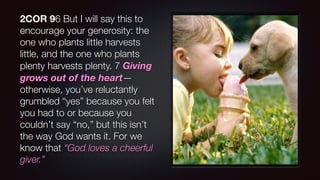
2COR 96 But I will say this to
encourage your generosity: the
one who plants little harvests
little, and the one who plants
plenty harvests plenty. 7 Giving
grows out of the heart—
otherwise, you’ve reluctantly
grumbled “yes” because you felt
you had to or because you
couldn’t say “no,” but this isn’t
the way God wants it. For we
know that “God loves a cheerful
giver.”
God gives to us first so that we too can be
givers, not just recipients.
Given the obvious poverty in the world, what’s
primarily at issue is not why God doesn’t give
more to the needy, but why we don’t give more
to them from what God has already given to us.
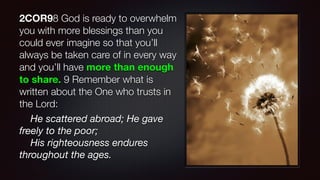
2COR98 God is ready to overwhelm
you with more blessings than you
could ever imagine so that you’ll
always be taken care of in every way
and you’ll have more than enough
to share. 9 Remember what is
written about the One who trusts in
the Lord:
He scattered abroad; He gave
freely to the poor;
His righteousness endures
throughout the ages.
Means that God is able to give abundantly
to everyone, not that God already has.
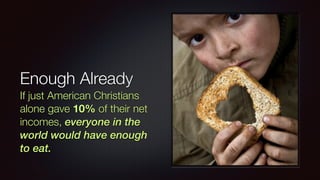
Enough Already
If just American Christians
alone gave 10% of their net
incomes, everyone in the
world would have enough
to eat.
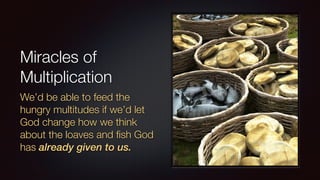
Miracles of
Multiplication
We’d be able to feed the
hungry multitudes if we’d let
God change how we think
about the loaves and fish God
has already given to us.
2COR 910 The same One who has put seed into the hands of the
sower and brought bread to fill our stomachs will provide and
multiply the resources you invest and produce an abundant harvest
from your righteous actions. 11 You will be made rich in everything
so that your generosity will spill over in every direction. Through us
your generosity is at work inspiring praise and thanksgiving to God.
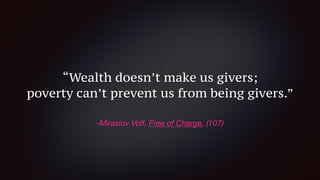
-Miraslov Volf, Free of Charge, (107)
“Wealth doesn’t make us givers;
poverty can’t prevent us from being givers.”
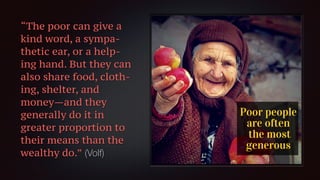
“The poor can give a
kind word, a sympa-
thetic ear, or a help-
ing hand. But they can
also share food, cloth-
ing, shelter, and
money—and they
generally do it in
greater proportion to
their means than the
wealthy do.” (Volf)
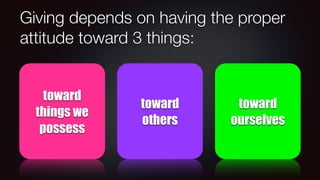
Giving depends on having the proper
attitude toward 3 things:
toward
things we
possess
toward
others
toward
ourselves
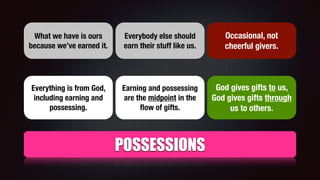
POSSESSIONS
What we have is ours
because we’ve earned it.
Everybody else should
earn their stuff like us.
Occasional, not
cheerful givers.
Everything is from God,
including earning and
possessing.
Earning and possessing
are the midpoint in the
flow of gifts.
God gives gifts to us,
God gives gifts through
us to others.
OTHERS
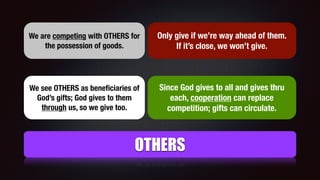
We are competing with OTHERS for
the possession of goods.
Only give if we’re way ahead of them.
If it’s close, we won’t give.
We see OTHERS as beneficiaries of
God’s gifts; God gives to them
through us, so we give too.
Since God gives to all and gives thru
each, cooperation can replace
competition; gifts can circulate.
OURSELVES
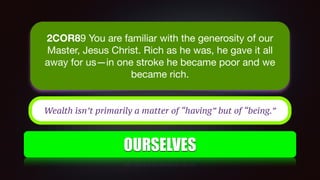
2COR89 You are familiar with the generosity of our
Master, Jesus Christ. Rich as he was, he gave it all
away for us—in one stroke he became poor and we
became rich.
Wealth isn’t primarily a matter of “having” but of “being.”
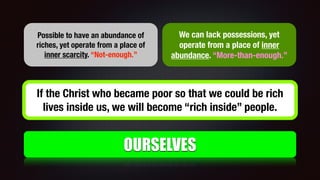
OURSELVES
Possible to have an abundance of
riches, yet operate from a place of
inner scarcity. “Not-enough.”
We can lack possessions, yet
operate from a place of inner
abundance. “More-than-enough.”
If the Christ who became poor so that we could be rich
lives inside us, we will become “rich inside” people.
No Loans, No Debt, No Clue
The miracle that remained a mystery until years later.
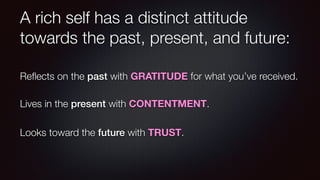
A rich self has a distinct attitude
towards the past, present, and future:
Reflects on the past with GRATITUDE for what you’ve received.
Lives in the present with CONTENTMENT.
Looks toward the future with TRUST.

How Can We Give?

  • 1.
  • 2.
    How Can WeGive? Is it ever possible to give selflessly, generously, without any hope of getting something good back in return?
  • 3.
    2COR 96 ButI will say this to encourage your generosity: the one who plants little harvests little, and the one who plants plenty harvests plenty. 7 Giving grows out of the heart— otherwise, you’ve reluctantly grumbled “yes” because you felt you had to or because you couldn’t say “no,” but this isn’t the way God wants it. For we know that “God loves a cheerful giver.”
  • 5.
    God gives tous first so that we too can be givers, not just recipients.
  • 6.
    Given the obviouspoverty in the world, what’s primarily at issue is not why God doesn’t give more to the needy, but why we don’t give more to them from what God has already given to us.
  • 7.
    2COR98 God isready to overwhelm you with more blessings than you could ever imagine so that you’ll always be taken care of in every way and you’ll have more than enough to share. 9 Remember what is written about the One who trusts in the Lord: He scattered abroad; He gave freely to the poor; His righteousness endures throughout the ages.
  • 8.
    Means that Godis able to give abundantly to everyone, not that God already has.
  • 9.
    Enough Already If justAmerican Christians alone gave 10% of their net incomes, everyone in the world would have enough to eat.
  • 10.
    Miracles of Multiplication We’d beable to feed the hungry multitudes if we’d let God change how we think about the loaves and fish God has already given to us.
  • 11.
    2COR 910 Thesame One who has put seed into the hands of the sower and brought bread to fill our stomachs will provide and multiply the resources you invest and produce an abundant harvest from your righteous actions. 11 You will be made rich in everything so that your generosity will spill over in every direction. Through us your generosity is at work inspiring praise and thanksgiving to God.
  • 12.
    -Miraslov Volf, Freeof Charge, (107) “Wealth doesn’t make us givers; poverty can’t prevent us from being givers.”
  • 13.
    “The poor cangive a kind word, a sympa- thetic ear, or a help- ing hand. But they can also share food, cloth- ing, shelter, and money—and they generally do it in greater proportion to their means than the wealthy do.” (Volf)
  • 14.
    Giving depends onhaving the proper attitude toward 3 things: toward things we possess toward others toward ourselves
  • 15.
    POSSESSIONS What we haveis ours because we’ve earned it. Everybody else should earn their stuff like us. Occasional, not cheerful givers. Everything is from God, including earning and possessing. Earning and possessing are the midpoint in the flow of gifts. God gives gifts to us, God gives gifts through us to others.
  • 16.
    OTHERS We are competingwith OTHERS for the possession of goods. Only give if we’re way ahead of them. If it’s close, we won’t give. We see OTHERS as beneficiaries of God’s gifts; God gives to them through us, so we give too. Since God gives to all and gives thru each, cooperation can replace competition; gifts can circulate.
  • 17.
    OURSELVES 2COR89 You arefamiliar with the generosity of our Master, Jesus Christ. Rich as he was, he gave it all away for us—in one stroke he became poor and we became rich. Wealth isn’t primarily a matter of “having” but of “being.”
  • 18.
    OURSELVES Possible to havean abundance of riches, yet operate from a place of inner scarcity. “Not-enough.” We can lack possessions, yet operate from a place of inner abundance. “More-than-enough.” If the Christ who became poor so that we could be rich lives inside us, we will become “rich inside” people.
  • 19.
    No Loans, NoDebt, No Clue The miracle that remained a mystery until years later.
  • 20.
    A rich selfhas a distinct attitude towards the past, present, and future: Reflects on the past with GRATITUDE for what you’ve received. Lives in the present with CONTENTMENT. Looks toward the future with TRUST.