From Prototype
to Production
via Kickstarter
How blink(1) was made
Hackaday 10th Anniversary
4 Oct 2014
todbot / Tod E. Kurt
Tuesday, June 23, 15
Alternate title of this talk
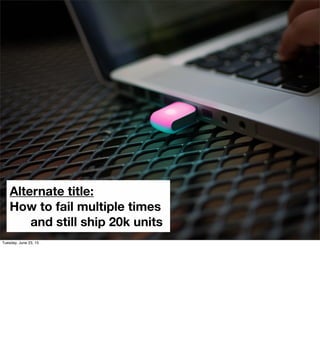
Alternate title:
How to fail multiple times
and still ship 20k units
Tuesday, June 23, 15
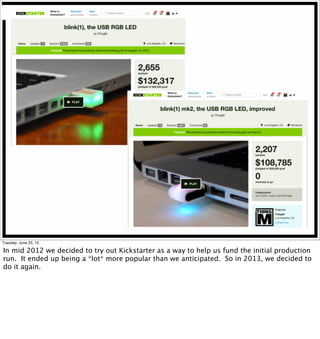
In mid 2012 we decided to try out Kickstarter as a way to help us fund the initial production
run. It ended up being a *lot* more popular than we anticipated. So in 2013, we decided to
do it again.
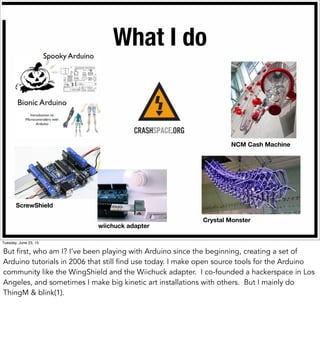
What I do
wiichuck adapter
ScrewShield
Crystal Monster
NCM Cash Machine
Spooky Arduino
Tuesday, June 23, 15
But first, who am I? I’ve been playing with Arduino since the beginning, creating a set of
Arduino tutorials in 2006 that still find use today. I make open source tools for the Arduino
community like the WingShield and the Wiichuck adapter. I co-founded a hackerspace in Los
Angeles, and sometimes I make big kinetic art installations with others. But I mainly do
ThingM & blink(1).
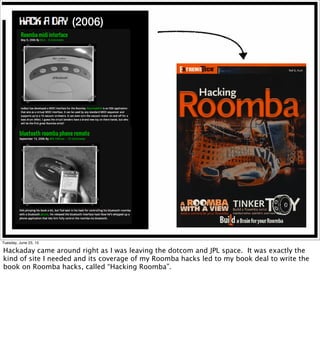
(2006)
Tuesday, June 23, 15
Hackaday came around right as I was leaving the dotcom and JPL space. It was exactly the
kind of site I needed and its coverage of my Roomba hacks led to my book deal to write the
book on Roomba hacks, called “Hacking Roomba”.
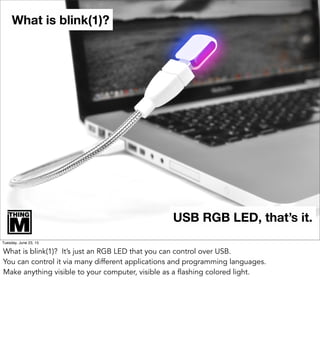
What is blink(1)?
USB RGB LED, that’s it.
Tuesday, June 23, 15
What is blink(1)? It’s just an RGB LED that you can control over USB.
You can control it via many different applications and programming languages.
Make anything visible to your computer, visible as a flashing colored light.
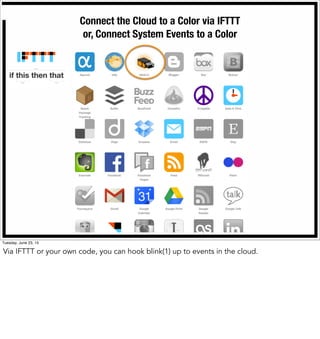
Connect the Cloud to a Color via IFTTT
or, Connect System Events to a Color
Tuesday, June 23, 15
Via IFTTT or your own code, you can hook blink(1) up to events in the cloud.
Pixar
Microsoft
Sharp
CBS Sports
fluke
PARC
Twitter
Facebook
Adobe
Shutterfly
Sony Pictures
Autodesk
Google
Disney
University of California
among others
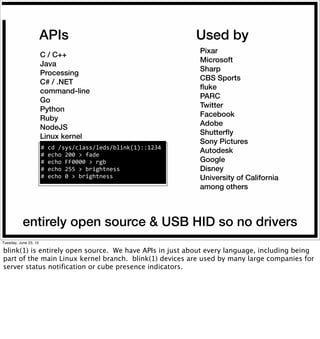
C / C++
Java
Processing
C# / .NET
command-line
Go
Python
Ruby
NodeJS
Linux kernel
APIs Used by
#	
  cd	
  /sys/class/leds/blink(1)::1234	
  
#	
  echo	
  200	
  >	
  fade	
  
#	
  echo	
  FF0000	
  >	
  rgb	
  
#	
  echo	
  255	
  >	
  brightness	
  
#	
  echo	
  0	
  >	
  brightness
entirely open source & USB HID so no drivers
Tuesday, June 23, 15
blink(1) is entirely open source. We have APIs in just about every language, including being
part of the main Linux kernel branch. blink(1) devices are used by many large companies for
server status notification or cube presence indicators.
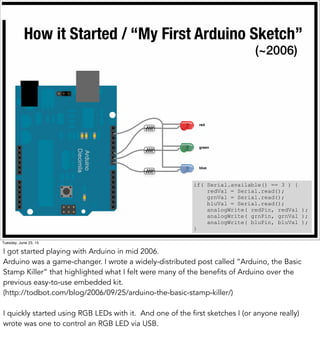
How it Started / “My First Arduino Sketch”
red
green
blue
if( Serial.available() == 3 ) {
redVal = Serial.read();
grnVal = Serial.read();
bluVal = Serial.read();
analogWrite( redPin, redVal );
analogWrite( grnPin, grnVal );
analogWrite( bluPin, bluVal );
}
(~2006)
Tuesday, June 23, 15
I got started playing with Arduino in mid 2006.
Arduino was a game-changer. I wrote a widely-distributed post called “Arduino, the Basic
Stamp Killer” that highlighted what I felt were many of the benefits of Arduino over the
previous easy-to-use embedded kit.
(http://todbot.com/blog/2006/09/25/arduino-the-basic-stamp-killer/)
I quickly started using RGB LEDs with it. And one of the first sketches I (or anyone really)
wrote was one to control an RGB LED via USB.
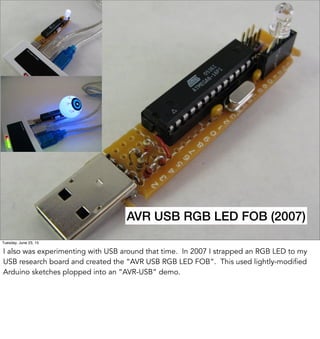
AVR USB RGB LED FOB
AVR USB RGB LED FOB (2007)
Tuesday, June 23, 15
I also was experimenting with USB around that time. In 2007 I strapped an RGB LED to my
USB research board and created the “AVR USB RGB LED FOB”. This used lightly-modified
Arduino sketches plopped into an “AVR-USB” demo.
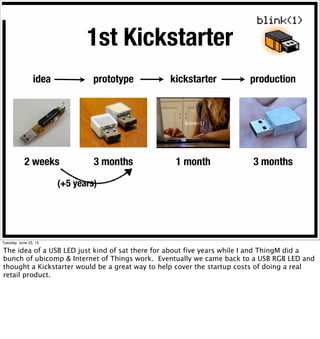
idea prototype kickstarter production
2 weeks 3 months 1 month 3 months
1st Kickstarter
(+5 years)
Tuesday, June 23, 15
The idea of a USB LED just kind of sat there for about five years while I and ThingM did a
bunch of ubicomp & Internet of Things work. Eventually we came back to a USB RGB LED and
thought a Kickstarter would be a great way to help cover the startup costs of doing a real
retail product.
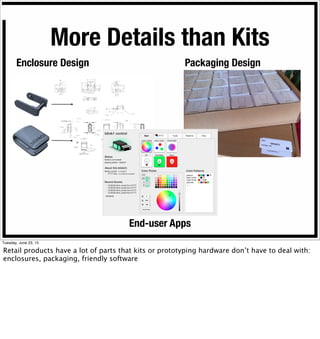
More Details than Kits
Enclosure Design Packaging Design
End-user Apps
Tuesday, June 23, 15
Retail products have a lot of parts that kits or prototyping hardware don’t have to deal with:
enclosures, packaging, friendly software
So of course we had problems
Tuesday, June 23, 15
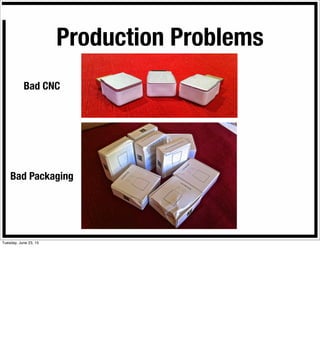
Production Problems
Bad CNC
Bad Packaging
Tuesday, June 23, 15
Production w/ Friends
We’re not a pizza-based economy. Don’t do this
Tuesday, June 23, 15
2nd Kickstarter
■ It’ll be so much easier!
■ Fix USB compatibility w/ awesome new PIC16F1455
■ Redesign to use WS2812
■ Hire proper dev team for GUI application
■ A slam dunk. We’ll be done in two months
Tuesday, June 23, 15
So of course we had new problems
Tuesday, June 23, 15
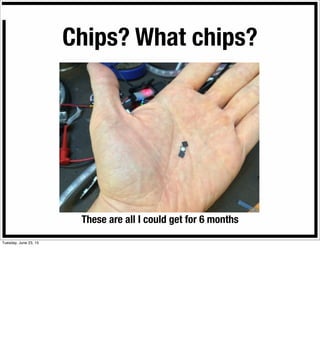
Chips? What chips?
These are all I could get for 6 months
Tuesday, June 23, 15
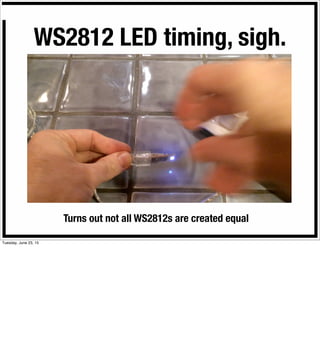
WS2812 LED timing, sigh.
Turns out not all WS2812s are created equal
Tuesday, June 23, 15
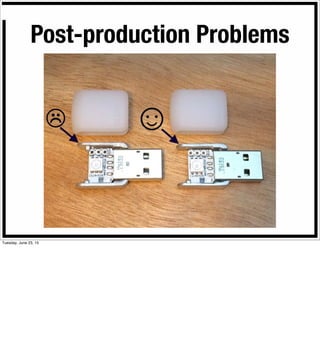
Post-production Problems
Tuesday, June 23, 15
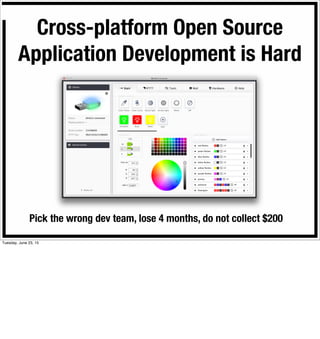
Cross-platform Open Source
Application Development is Hard
Pick the wrong dev team, lose 4 months, do not collect $200
Tuesday, June 23, 15
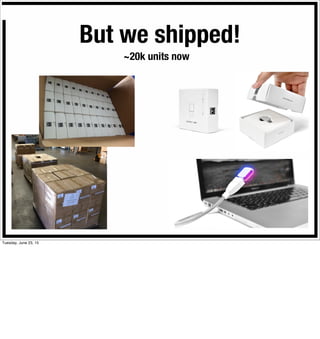
But we shipped!
~20k units now
Tuesday, June 23, 15
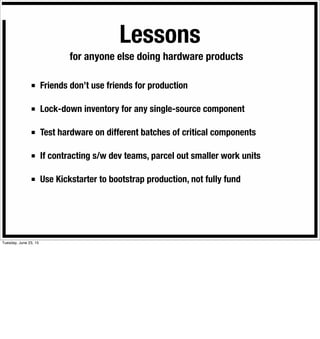
Lessons
■ Friends don’t use friends for production
■ Lock-down inventory for any single-source component
■ Test hardware on different batches of critical components
■ If contracting s/w dev teams, parcel out smaller work units
■ Use Kickstarter to bootstrap production, not fully fund
for anyone else doing hardware products
Tuesday, June 23, 15
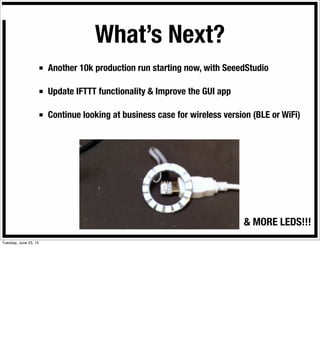
What’s Next?
■ Another 10k production run starting now, with SeeedStudio
■ Update IFTTT functionality & Improve the GUI app
■ Continue looking at business case for wireless version (BLE or WiFi)
& MORE LEDS!!!
Tuesday, June 23, 15
@todbot / @thingm
http://thingm.com/
http://todbot.com/blog/
Thank You
Tuesday, June 23, 15

How blink(1) was made – Hackaday 10th anniversary talk

  • 1.
    From Prototype to Production viaKickstarter How blink(1) was made Hackaday 10th Anniversary 4 Oct 2014 todbot / Tod E. Kurt Tuesday, June 23, 15
  • 2.
    Alternate title ofthis talk Alternate title: How to fail multiple times and still ship 20k units Tuesday, June 23, 15
  • 3.
    Tuesday, June 23,15 In mid 2012 we decided to try out Kickstarter as a way to help us fund the initial production run. It ended up being a *lot* more popular than we anticipated. So in 2013, we decided to do it again.
  • 4.
    What I do wiichuckadapter ScrewShield Crystal Monster NCM Cash Machine Spooky Arduino Tuesday, June 23, 15 But first, who am I? I’ve been playing with Arduino since the beginning, creating a set of Arduino tutorials in 2006 that still find use today. I make open source tools for the Arduino community like the WingShield and the Wiichuck adapter. I co-founded a hackerspace in Los Angeles, and sometimes I make big kinetic art installations with others. But I mainly do ThingM & blink(1).
  • 5.
    (2006) Tuesday, June 23,15 Hackaday came around right as I was leaving the dotcom and JPL space. It was exactly the kind of site I needed and its coverage of my Roomba hacks led to my book deal to write the book on Roomba hacks, called “Hacking Roomba”.
  • 6.
    What is blink(1)? USBRGB LED, that’s it. Tuesday, June 23, 15 What is blink(1)? It’s just an RGB LED that you can control over USB. You can control it via many different applications and programming languages. Make anything visible to your computer, visible as a flashing colored light.
  • 7.
    Connect the Cloudto a Color via IFTTT or, Connect System Events to a Color Tuesday, June 23, 15 Via IFTTT or your own code, you can hook blink(1) up to events in the cloud.
  • 8.
    Pixar Microsoft Sharp CBS Sports fluke PARC Twitter Facebook Adobe Shutterfly Sony Pictures Autodesk Google Disney Universityof California among others C / C++ Java Processing C# / .NET command-line Go Python Ruby NodeJS Linux kernel APIs Used by #  cd  /sys/class/leds/blink(1)::1234   #  echo  200  >  fade   #  echo  FF0000  >  rgb   #  echo  255  >  brightness   #  echo  0  >  brightness entirely open source & USB HID so no drivers Tuesday, June 23, 15 blink(1) is entirely open source. We have APIs in just about every language, including being part of the main Linux kernel branch. blink(1) devices are used by many large companies for server status notification or cube presence indicators.
  • 9.
    How it Started/ “My First Arduino Sketch” red green blue if( Serial.available() == 3 ) { redVal = Serial.read(); grnVal = Serial.read(); bluVal = Serial.read(); analogWrite( redPin, redVal ); analogWrite( grnPin, grnVal ); analogWrite( bluPin, bluVal ); } (~2006) Tuesday, June 23, 15 I got started playing with Arduino in mid 2006. Arduino was a game-changer. I wrote a widely-distributed post called “Arduino, the Basic Stamp Killer” that highlighted what I felt were many of the benefits of Arduino over the previous easy-to-use embedded kit. (http://todbot.com/blog/2006/09/25/arduino-the-basic-stamp-killer/) I quickly started using RGB LEDs with it. And one of the first sketches I (or anyone really) wrote was one to control an RGB LED via USB.
  • 10.
    AVR USB RGBLED FOB AVR USB RGB LED FOB (2007) Tuesday, June 23, 15 I also was experimenting with USB around that time. In 2007 I strapped an RGB LED to my USB research board and created the “AVR USB RGB LED FOB”. This used lightly-modified Arduino sketches plopped into an “AVR-USB” demo.
  • 11.
    idea prototype kickstarterproduction 2 weeks 3 months 1 month 3 months 1st Kickstarter (+5 years) Tuesday, June 23, 15 The idea of a USB LED just kind of sat there for about five years while I and ThingM did a bunch of ubicomp & Internet of Things work. Eventually we came back to a USB RGB LED and thought a Kickstarter would be a great way to help cover the startup costs of doing a real retail product.
  • 12.
    More Details thanKits Enclosure Design Packaging Design End-user Apps Tuesday, June 23, 15 Retail products have a lot of parts that kits or prototyping hardware don’t have to deal with: enclosures, packaging, friendly software
  • 13.
    So of coursewe had problems Tuesday, June 23, 15
  • 14.
    Production Problems Bad CNC BadPackaging Tuesday, June 23, 15
  • 15.
    Production w/ Friends We’renot a pizza-based economy. Don’t do this Tuesday, June 23, 15
  • 16.
    2nd Kickstarter ■ It’llbe so much easier! ■ Fix USB compatibility w/ awesome new PIC16F1455 ■ Redesign to use WS2812 ■ Hire proper dev team for GUI application ■ A slam dunk. We’ll be done in two months Tuesday, June 23, 15
  • 17.
    So of coursewe had new problems Tuesday, June 23, 15
  • 18.
    Chips? What chips? Theseare all I could get for 6 months Tuesday, June 23, 15
  • 19.
    WS2812 LED timing,sigh. Turns out not all WS2812s are created equal Tuesday, June 23, 15
  • 20.
  • 21.
    Cross-platform Open Source ApplicationDevelopment is Hard Pick the wrong dev team, lose 4 months, do not collect $200 Tuesday, June 23, 15
  • 22.
    But we shipped! ~20kunits now Tuesday, June 23, 15
  • 23.
    Lessons ■ Friends don’tuse friends for production ■ Lock-down inventory for any single-source component ■ Test hardware on different batches of critical components ■ If contracting s/w dev teams, parcel out smaller work units ■ Use Kickstarter to bootstrap production, not fully fund for anyone else doing hardware products Tuesday, June 23, 15
  • 24.
    What’s Next? ■ Another10k production run starting now, with SeeedStudio ■ Update IFTTT functionality & Improve the GUI app ■ Continue looking at business case for wireless version (BLE or WiFi) & MORE LEDS!!! Tuesday, June 23, 15
  • 25.