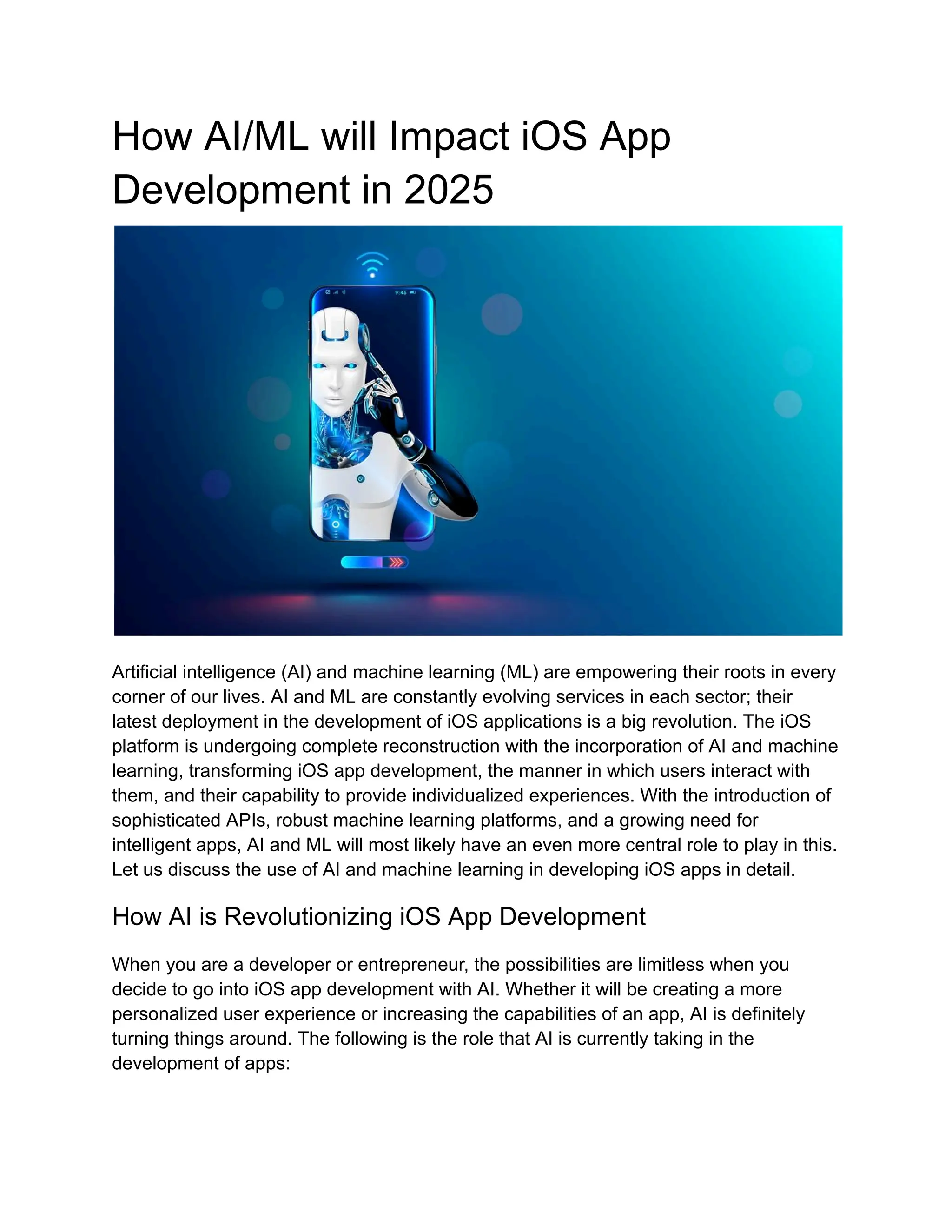
How AI/ML will Impact iOS App
Development in 2025
Artificial intelligence (AI) and machine learning (ML) are empowering their roots in every
corner of our lives. AI and ML are constantly evolving services in each sector; their
latest deployment in the development of iOS applications is a big revolution. The iOS
platform is undergoing complete reconstruction with the incorporation of AI and machine
learning, transforming iOS app development, the manner in which users interact with
them, and their capability to provide individualized experiences. With the introduction of
sophisticated APIs, robust machine learning platforms, and a growing need for
intelligent apps, AI and ML will most likely have an even more central role to play in this.
Let us discuss the use of AI and machine learning in developing iOS apps in detail.
How AI is Revolutionizing iOS App Development
When you are a developer or entrepreneur, the possibilities are limitless when you
decide to go into iOS app development with AI. Whether it will be creating a more
personalized user experience or increasing the capabilities of an app, AI is definitely
turning things around. The following is the role that AI is currently taking in the
development of apps:
1. Improved User Experience with AI
AI and user experience in apps have been one of the greatest features. It has reached
the point where the apps can learn about user behavior and adjust to their preferences,
providing a custom experience that is more natural and interesting.
Smart recommendations, voice assistants, and predictive text are AI-powered mobile
applications’ functionalities that have found their way into Android and iOS applications.
All these features help make apps smarter, but also more intuitive, which is key to
increasing user retention.
2. Machine Learning Algorithms for Apps
Apps’ machine learning algorithms assist in forecasting user behavior, which makes
mobile applications more receptive and customized. As an illustration, machine learning
in e-commerce applications suggests items in browsing history and personal
preferences. App personalization using machine learning allows apps to grow with the
user to provide personalized content, notifications, and experiences.
3. AI and App Development Trends to Watch Out For
In mobile applications integrated with the AI tool, trends are being developed daily.
Being in the sphere of app creation, I can assure you that the trends in AI and app
development are changing continuously. The following are some of the exciting trends
to witness:
AI on Android and iOS applications is paving the way, as both operating systems are
getting enhanced with the latest AI capabilities to make them perform more efficiently
and act intelligently.
AI mobile applications are getting widely utilized in such spheres as health, finance, and
entertainment. Whether it is disease diagnosis or enhanced financial services, AI’s
influence on app development is evident.
4. Enhancing App Security using AI
Another significant advantage of artificial intelligence in apps is security. AI is able to
identify aberrant patterns, mark out suspicious threats, and make the overall security of
mobile apps better. This is particularly important for apps handling sensitive information,
such as banking and healthcare apps.
AI and ML in iOS: Benefits That Developers Can’t Ignore
AI and ML are transforming the design, development, and experience of iOS apps.
From personalization to performance tuning, their combination provides smarter, faster,
and more intuitive mobile apps.
1. Personalized User Experience
One of the prominent usages of AI and ML in iOS app development is the capability to
offer a personalized user experience. Personalized user experience is undoubtedly very
crucial for businesses as it plays a vital role in success in this competitive world. AI
analyzes user behavior, preferences, and past actions deeply before offering tailored
suggestions, content, or functionality. Additionally, machine learning is widely used to
manage the layout or content of an iOS application based on user habits.
Moreover, AI may forecast when a user is most likely to engage with a notification,
leading to more effective communication. By offering personalization, businesses can
make their customers feel important, improving their loyalty and retention. Both these
factors are essential for driving sales and sustaining growth.
2. Image and Speech Recognition
AI and ML are constantly transforming the way iOS apps communicate with the physical
world, especially in terms of image and speech recognition. These capabilities can be
seamlessly integrated into iOS apps, enhancing user experiences with interactive
features that are powered by computer vision and natural language processing (NLP).
Using the CoreML framework of Apple, hire iOS developers to integrate powerful image
recognition models into your apps. This allows applications to detect objects, faces, or
text in images. For example, an app could scan a photo to identify landmarks or analyze
food items to estimate calories. This is made possible by pre-trained models like Google
Vision and Apple's Vision framework. With iOS providing a robust set of speech
recognition APIs, hiring iOS developers enables the integration of voice-controlled
functionality into your apps—such as voice commands, voice-to-text transcription, or
even conversational agents.
3. Natural Language Processing (NLP)
One of the fields of artificial intelligence is natural language processing, which enables
machines to process human language. iOS developers can apply NLP to add
interactivity to apps and enhance user interaction. NLP enables developers to create
chatbots or voice-based virtual assistants that can interpret user questions and reply
accordingly. These chatbots can respond to queries, book appointments, or even
facilitate e-commerce transactions. With NLP, developers are able to create systems
that read user opinions, reviews, or messages to identify sentiment.
A lot of iOS apps today are embedding real-time language translation through the use of
NLP and machine learning. This enables users to communicate freely regardless of the
languages spoken. iOS offers the Translate framework, which assists developers in
adding real-time translation capabilities to their applications.
4. Predictive Analytics and Forecasting
Artificial intelligence can go a long way in assisting you in understanding consumer
behavior and creating an app that lives up to their demands. Machine learning models
can analyze large data sets to determine patterns and make predictions. Predictive
analytics is commonly employed in iOS app development to improve user engagement
and monetization of an app and enhance user retention.
Companies can apply predictive analytics in anticipating sales patterns and better
managing stock. By understanding customer behavior and seasonal patterns, machine
learning algorithms can make predictions on which products will most likely be needed
by customers, allowing businesses to better optimize stock.
By observing the activity of the users in the app, machine learning algorithms can
anticipate what a user will do next. It enables the developers to create user interfaces or
push notifications that anticipate the needs of the user and navigate them through the
app with ease. Machine learning algorithms can assist iOS app development experts in
making predictions about usage patterns and building future app improvements or
features according to anticipated demand.
5. Enhancing iOS App Security
AI and ML can also be used to contribute to the security of iOS apps. With growing
concerns for data privacy and cybersecurity, integrating AI-powered security features in
an app is likely to identify and ward off threats better than conventional methods.
We can say that the algorithms used in machine learning play a wonderful role in
spotting unusual behavior in iOS apps. Prominently, if well-trained, they can easily catch
things such as anonymous login attempts, unusual behavior patterns, and unverified
access to sensitive data. Such algorithms optimize and adapt with time, ensuring to
keep pace with new threats, and helping the iOS app developers identify and handle
security issues as they occur. Integrating AI-powered facial recognition and fingerprint
scanning can improve the authentication process.
Final Words
AI and ML are changing the future of mobile app development by making apps more
intelligent, responsive, and user-focused. From providing personalized user experiences
to improving app security and performance, these technologies are emerging as integral
parts of future mobile applications. The capacity to handle big data, learn user actions,
and make changes in real time enables app developers to create apps that are not just
functional but also highly engaging. The role of AI and ML in iOS app development is
only set to increase in the future, as they continue to develop and create more intelligent
solutions aligned to what users anticipate. Adopting these technologies is no longer a
choice—it's becoming an industry norm in developing future-proof apps.

How AI/ML will Impact iOS App Development in 2025

  • 1.
    How AI/ML willImpact iOS App Development in 2025 Artificial intelligence (AI) and machine learning (ML) are empowering their roots in every corner of our lives. AI and ML are constantly evolving services in each sector; their latest deployment in the development of iOS applications is a big revolution. The iOS platform is undergoing complete reconstruction with the incorporation of AI and machine learning, transforming iOS app development, the manner in which users interact with them, and their capability to provide individualized experiences. With the introduction of sophisticated APIs, robust machine learning platforms, and a growing need for intelligent apps, AI and ML will most likely have an even more central role to play in this. Let us discuss the use of AI and machine learning in developing iOS apps in detail. How AI is Revolutionizing iOS App Development When you are a developer or entrepreneur, the possibilities are limitless when you decide to go into iOS app development with AI. Whether it will be creating a more personalized user experience or increasing the capabilities of an app, AI is definitely turning things around. The following is the role that AI is currently taking in the development of apps:
  • 2.
    1. Improved UserExperience with AI AI and user experience in apps have been one of the greatest features. It has reached the point where the apps can learn about user behavior and adjust to their preferences, providing a custom experience that is more natural and interesting. Smart recommendations, voice assistants, and predictive text are AI-powered mobile applications’ functionalities that have found their way into Android and iOS applications. All these features help make apps smarter, but also more intuitive, which is key to increasing user retention. 2. Machine Learning Algorithms for Apps Apps’ machine learning algorithms assist in forecasting user behavior, which makes mobile applications more receptive and customized. As an illustration, machine learning in e-commerce applications suggests items in browsing history and personal preferences. App personalization using machine learning allows apps to grow with the user to provide personalized content, notifications, and experiences. 3. AI and App Development Trends to Watch Out For In mobile applications integrated with the AI tool, trends are being developed daily. Being in the sphere of app creation, I can assure you that the trends in AI and app development are changing continuously. The following are some of the exciting trends to witness: AI on Android and iOS applications is paving the way, as both operating systems are getting enhanced with the latest AI capabilities to make them perform more efficiently and act intelligently. AI mobile applications are getting widely utilized in such spheres as health, finance, and entertainment. Whether it is disease diagnosis or enhanced financial services, AI’s influence on app development is evident. 4. Enhancing App Security using AI Another significant advantage of artificial intelligence in apps is security. AI is able to identify aberrant patterns, mark out suspicious threats, and make the overall security of mobile apps better. This is particularly important for apps handling sensitive information, such as banking and healthcare apps.
  • 3.
    AI and MLin iOS: Benefits That Developers Can’t Ignore AI and ML are transforming the design, development, and experience of iOS apps. From personalization to performance tuning, their combination provides smarter, faster, and more intuitive mobile apps. 1. Personalized User Experience One of the prominent usages of AI and ML in iOS app development is the capability to offer a personalized user experience. Personalized user experience is undoubtedly very crucial for businesses as it plays a vital role in success in this competitive world. AI analyzes user behavior, preferences, and past actions deeply before offering tailored suggestions, content, or functionality. Additionally, machine learning is widely used to manage the layout or content of an iOS application based on user habits. Moreover, AI may forecast when a user is most likely to engage with a notification, leading to more effective communication. By offering personalization, businesses can make their customers feel important, improving their loyalty and retention. Both these factors are essential for driving sales and sustaining growth. 2. Image and Speech Recognition AI and ML are constantly transforming the way iOS apps communicate with the physical world, especially in terms of image and speech recognition. These capabilities can be seamlessly integrated into iOS apps, enhancing user experiences with interactive features that are powered by computer vision and natural language processing (NLP). Using the CoreML framework of Apple, hire iOS developers to integrate powerful image recognition models into your apps. This allows applications to detect objects, faces, or text in images. For example, an app could scan a photo to identify landmarks or analyze food items to estimate calories. This is made possible by pre-trained models like Google Vision and Apple's Vision framework. With iOS providing a robust set of speech recognition APIs, hiring iOS developers enables the integration of voice-controlled functionality into your apps—such as voice commands, voice-to-text transcription, or even conversational agents. 3. Natural Language Processing (NLP) One of the fields of artificial intelligence is natural language processing, which enables machines to process human language. iOS developers can apply NLP to add interactivity to apps and enhance user interaction. NLP enables developers to create
  • 4.
    chatbots or voice-basedvirtual assistants that can interpret user questions and reply accordingly. These chatbots can respond to queries, book appointments, or even facilitate e-commerce transactions. With NLP, developers are able to create systems that read user opinions, reviews, or messages to identify sentiment. A lot of iOS apps today are embedding real-time language translation through the use of NLP and machine learning. This enables users to communicate freely regardless of the languages spoken. iOS offers the Translate framework, which assists developers in adding real-time translation capabilities to their applications. 4. Predictive Analytics and Forecasting Artificial intelligence can go a long way in assisting you in understanding consumer behavior and creating an app that lives up to their demands. Machine learning models can analyze large data sets to determine patterns and make predictions. Predictive analytics is commonly employed in iOS app development to improve user engagement and monetization of an app and enhance user retention. Companies can apply predictive analytics in anticipating sales patterns and better managing stock. By understanding customer behavior and seasonal patterns, machine learning algorithms can make predictions on which products will most likely be needed by customers, allowing businesses to better optimize stock. By observing the activity of the users in the app, machine learning algorithms can anticipate what a user will do next. It enables the developers to create user interfaces or push notifications that anticipate the needs of the user and navigate them through the app with ease. Machine learning algorithms can assist iOS app development experts in making predictions about usage patterns and building future app improvements or features according to anticipated demand. 5. Enhancing iOS App Security AI and ML can also be used to contribute to the security of iOS apps. With growing concerns for data privacy and cybersecurity, integrating AI-powered security features in an app is likely to identify and ward off threats better than conventional methods. We can say that the algorithms used in machine learning play a wonderful role in spotting unusual behavior in iOS apps. Prominently, if well-trained, they can easily catch
  • 5.
    things such asanonymous login attempts, unusual behavior patterns, and unverified access to sensitive data. Such algorithms optimize and adapt with time, ensuring to keep pace with new threats, and helping the iOS app developers identify and handle security issues as they occur. Integrating AI-powered facial recognition and fingerprint scanning can improve the authentication process. Final Words AI and ML are changing the future of mobile app development by making apps more intelligent, responsive, and user-focused. From providing personalized user experiences to improving app security and performance, these technologies are emerging as integral parts of future mobile applications. The capacity to handle big data, learn user actions, and make changes in real time enables app developers to create apps that are not just functional but also highly engaging. The role of AI and ML in iOS app development is only set to increase in the future, as they continue to develop and create more intelligent solutions aligned to what users anticipate. Adopting these technologies is no longer a choice—it's becoming an industry norm in developing future-proof apps.