Housekeeping
(aka 5S)
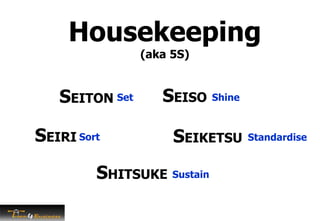
Housekeeping
(aka 5S)
SEIRI
SEITON
SHITSUKE
SEISO
SEIKETSUSort
Set Shine
Standardise
Sustain
 Clear Out
 Configure
 Clean and Check
 Conformity
 Custom and Practice
Housekeeping
(aka 5C)
Housekeeping: Overview
 The importance of Housekeeping
 How (poor) housekeeping affects our work
 How we can all help to keep our workplace
clean and organised
 Objectives:
Housekeeping
 A clean, organised workplace:
Has higher productivity
Has fewer defects
Has fewer accidents
Our customers expect it!
 Why?
What 5S isn’t
 A tidy up before the boss comes in showing a
major new customer (or the CEO) around!
 Just about tidying up other people’s rubbish
 A quick sweep of the floor and placing tools back in
the toolbox (until it all goes quiet again)
Consequences of poor housekeeping
Amount of defective product
Number of machine breakdowns
Material flow (excessive travel)
Inventory level
Lost time in looking for materials
Concealed problems
Accidents/Incidents/Near misses
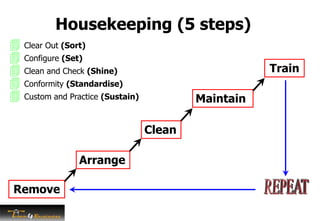
Housekeeping (5 steps)
Remove
Arrange
Clean
Maintain
Train
 Clear Out (Sort)
 Configure (Set)
 Clean and Check (Shine)
 Conformity (Standardise)
 Custom and Practice (Sustain)
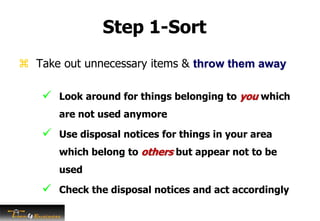
Step 1-Sort
 Take out unnecessary items & throw them away
 Look around for things belonging to you which
are not used anymore
 Use disposal notices for things in your area
which belong to others but appear not to be
used
 Check the disposal notices and act accordingly
Step 1-Sort
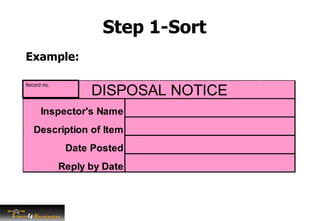
Example:
DISPOSAL NOTICE
Inspector's Name
Description of Item
Date Posted
Reply by Date
Record no.
Step 1-Sort
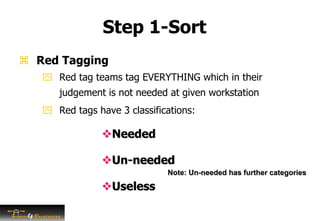
 Red Tagging
 Red tag teams tag EVERYTHING which in their
judgement is not needed at given workstation
 Red tags have 3 classifications:
Needed
Un-needed
Useless
Note: Un-needed has further categories
Step 1-Sort
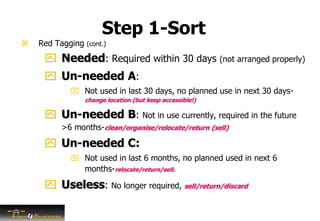
 Red Tagging (cont.)
 Needed: Required within 30 days (not arranged properly)
 Un-needed A:
 Not used in last 30 days, no planned use in next 30 days-
change location (but keep accessible!)
 Un-needed B: Not in use currently, required in the future
>6 months-clean/organise/relocate/return (sell)
 Un-needed C:
 Not used in last 6 months, no planned used in next 6
months-relocate/return/sell.
 Useless: No longer required, sell/return/discard
Step 1-Sort
 Red Tag Review:
 Record usage of anything in the area.
 TAKE ACTION ACCORDING TO RESULTS
Step 2-Set
 Arrange all NECESSARY items in a proper
order
 Look at the way things are arranged, remember
EVERYTHING should have a proper accurate &
RECORDED location
 Take the frequency of use into account
 Keep track of things by using lists or labels for
cupboards or drawers, use shadow boards for Tools
Step 2-Set
 After that:
 Implement painting/marking strategy:
 Clear markings:
 Traffic, hazards, storage, flow, usage
 Colour Coding:
 Waste disposal,
 Product/raw material segregation
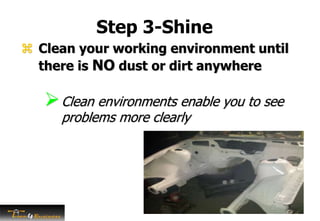
Step 3-Shine
 Clean your working environment until
there is NO dust or dirt anywhere
Clean environments enable you to see
problems more clearly
Step 3-Shine
Be conscious of maintaining a clean environment
Create a maintenance system for housekeeping
Hold inter-departmental competitions on
housekeeping
 Maintain a high standard of housekeeping at
all times:
Step 3-Shine
 Don’t wait for things to get dirty before you
clean them
 Put aside 5 minutes EVERY day to clean your
workplace
 Be responsible (with your colleagues) for the
area around your workstation
 Don’t create mess, you’ll only have to
clean it up!
 TIPS:
Step 4-Standardise
 Maintaining the standard gives everyone a
sense of involvement and pride in the job.
 HOW?
Hold inter-department inspections on
housekeeping
Review the results of these inspections and
appoint HOUSEKEEPING CHAMPIONS
Step 5-Sustain
 Training helps people to follow good
housekeeping independently
 HOW?
 Always remember the value of your own housekeeping
 Treat your workplace as your second home
 Be aware of your own attitudes & habits
 Don’t put up with bad housekeeping in other areas
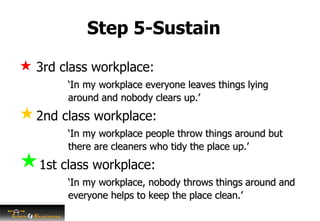
Step 5-Sustain
 3rd class workplace:
‘In my workplace everyone leaves things lying
around and nobody clears up.’
2nd class workplace:
‘In my workplace people throw things around but
there are cleaners who tidy the place up.’
1st class workplace:
‘In my workplace, nobody throws things around and
everyone helps to keep the place clean.’
Housekeeping
What do we gain from 5S?
√ 5S makes the workplace more pleasant
√ 5S makes work more efficient
√ 5S and safety go hand in hand
√ 5S helps deliver better quality products and
higher productivity
4-Steps to organising your workplace
 Separate things which are necessary EVERY day
from those which are not
 Use red-tag/disposal notices to identify each item
 Find a place for everything and put everything in
that place
 Always keep up the discipline of good
housekeeping
Your observations
 As a group visit your area(s) and look for the
following:
 2-3 Examples of GOOD Housekeeping
 2-3 Examples of BAD Housekeeping
 For each example:
 Take photo(s)
 Record WHY the example is good or bad
Discuss each example:
 Group into good or bad practice
 Place the pictures somewhere visible
 Record details next to the picture
 Discuss recommendations for improvement
Be prepared to feedback your findings
to everyone in your area
Actions
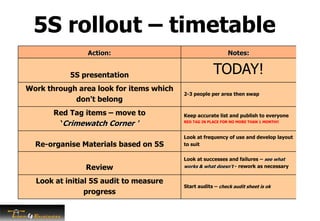
5S rollout – timetable
Action: Notes:
5S presentation TODAY!
Work through area look for items which
don't belong
2-3 people per area then swap
Red Tag items – move to
‘Crimewatch Corner '
Keep accurate list and publish to everyone
RED TAG IN PLACE FOR NO MORE THAN 1 MONTH!!
Re-organise Materials based on 5S
Look at frequency of use and develop layout
to suit
Review
Look at successes and failures – see what
works & what doesn’t - rework as necessary
Look at initial 5S audit to measure
progress
Start audits – check audit sheet is ok
Housekeeping - 5 step Programme

Housekeeping - 5 step Programme

  • 1.
  • 2.
  • 3.
     Clear Out Configure  Clean and Check  Conformity  Custom and Practice Housekeeping (aka 5C)
  • 4.
    Housekeeping: Overview  Theimportance of Housekeeping  How (poor) housekeeping affects our work  How we can all help to keep our workplace clean and organised  Objectives:
  • 5.
    Housekeeping  A clean,organised workplace: Has higher productivity Has fewer defects Has fewer accidents Our customers expect it!  Why?
  • 6.
    What 5S isn’t A tidy up before the boss comes in showing a major new customer (or the CEO) around!  Just about tidying up other people’s rubbish  A quick sweep of the floor and placing tools back in the toolbox (until it all goes quiet again)
  • 7.
    Consequences of poorhousekeeping Amount of defective product Number of machine breakdowns Material flow (excessive travel) Inventory level Lost time in looking for materials Concealed problems Accidents/Incidents/Near misses
  • 8.
    Housekeeping (5 steps) Remove Arrange Clean Maintain Train Clear Out (Sort)  Configure (Set)  Clean and Check (Shine)  Conformity (Standardise)  Custom and Practice (Sustain)
  • 9.
    Step 1-Sort  Takeout unnecessary items & throw them away  Look around for things belonging to you which are not used anymore  Use disposal notices for things in your area which belong to others but appear not to be used  Check the disposal notices and act accordingly
  • 10.
    Step 1-Sort Example: DISPOSAL NOTICE Inspector'sName Description of Item Date Posted Reply by Date Record no.
  • 11.
    Step 1-Sort  RedTagging  Red tag teams tag EVERYTHING which in their judgement is not needed at given workstation  Red tags have 3 classifications: Needed Un-needed Useless Note: Un-needed has further categories
  • 12.
    Step 1-Sort  RedTagging (cont.)  Needed: Required within 30 days (not arranged properly)  Un-needed A:  Not used in last 30 days, no planned use in next 30 days- change location (but keep accessible!)  Un-needed B: Not in use currently, required in the future >6 months-clean/organise/relocate/return (sell)  Un-needed C:  Not used in last 6 months, no planned used in next 6 months-relocate/return/sell.  Useless: No longer required, sell/return/discard
  • 13.
    Step 1-Sort  RedTag Review:  Record usage of anything in the area.  TAKE ACTION ACCORDING TO RESULTS
  • 14.
    Step 2-Set  Arrangeall NECESSARY items in a proper order  Look at the way things are arranged, remember EVERYTHING should have a proper accurate & RECORDED location  Take the frequency of use into account  Keep track of things by using lists or labels for cupboards or drawers, use shadow boards for Tools
  • 15.
    Step 2-Set  Afterthat:  Implement painting/marking strategy:  Clear markings:  Traffic, hazards, storage, flow, usage  Colour Coding:  Waste disposal,  Product/raw material segregation
  • 16.
    Step 3-Shine  Cleanyour working environment until there is NO dust or dirt anywhere Clean environments enable you to see problems more clearly
  • 17.
    Step 3-Shine Be consciousof maintaining a clean environment Create a maintenance system for housekeeping Hold inter-departmental competitions on housekeeping  Maintain a high standard of housekeeping at all times:
  • 18.
    Step 3-Shine  Don’twait for things to get dirty before you clean them  Put aside 5 minutes EVERY day to clean your workplace  Be responsible (with your colleagues) for the area around your workstation  Don’t create mess, you’ll only have to clean it up!  TIPS:
  • 19.
    Step 4-Standardise  Maintainingthe standard gives everyone a sense of involvement and pride in the job.  HOW? Hold inter-department inspections on housekeeping Review the results of these inspections and appoint HOUSEKEEPING CHAMPIONS
  • 20.
    Step 5-Sustain  Traininghelps people to follow good housekeeping independently  HOW?  Always remember the value of your own housekeeping  Treat your workplace as your second home  Be aware of your own attitudes & habits  Don’t put up with bad housekeeping in other areas
  • 21.
    Step 5-Sustain  3rdclass workplace: ‘In my workplace everyone leaves things lying around and nobody clears up.’ 2nd class workplace: ‘In my workplace people throw things around but there are cleaners who tidy the place up.’ 1st class workplace: ‘In my workplace, nobody throws things around and everyone helps to keep the place clean.’
  • 22.
    Housekeeping What do wegain from 5S? √ 5S makes the workplace more pleasant √ 5S makes work more efficient √ 5S and safety go hand in hand √ 5S helps deliver better quality products and higher productivity
  • 23.
    4-Steps to organisingyour workplace  Separate things which are necessary EVERY day from those which are not  Use red-tag/disposal notices to identify each item  Find a place for everything and put everything in that place  Always keep up the discipline of good housekeeping
  • 24.
    Your observations  Asa group visit your area(s) and look for the following:  2-3 Examples of GOOD Housekeeping  2-3 Examples of BAD Housekeeping  For each example:  Take photo(s)  Record WHY the example is good or bad
  • 25.
    Discuss each example: Group into good or bad practice  Place the pictures somewhere visible  Record details next to the picture  Discuss recommendations for improvement Be prepared to feedback your findings to everyone in your area Actions
  • 26.
    5S rollout –timetable Action: Notes: 5S presentation TODAY! Work through area look for items which don't belong 2-3 people per area then swap Red Tag items – move to ‘Crimewatch Corner ' Keep accurate list and publish to everyone RED TAG IN PLACE FOR NO MORE THAN 1 MONTH!! Re-organise Materials based on 5S Look at frequency of use and develop layout to suit Review Look at successes and failures – see what works & what doesn’t - rework as necessary Look at initial 5S audit to measure progress Start audits – check audit sheet is ok