+
    Homelessn
       ess
        &
     Poverty


                By: Briana Campbell
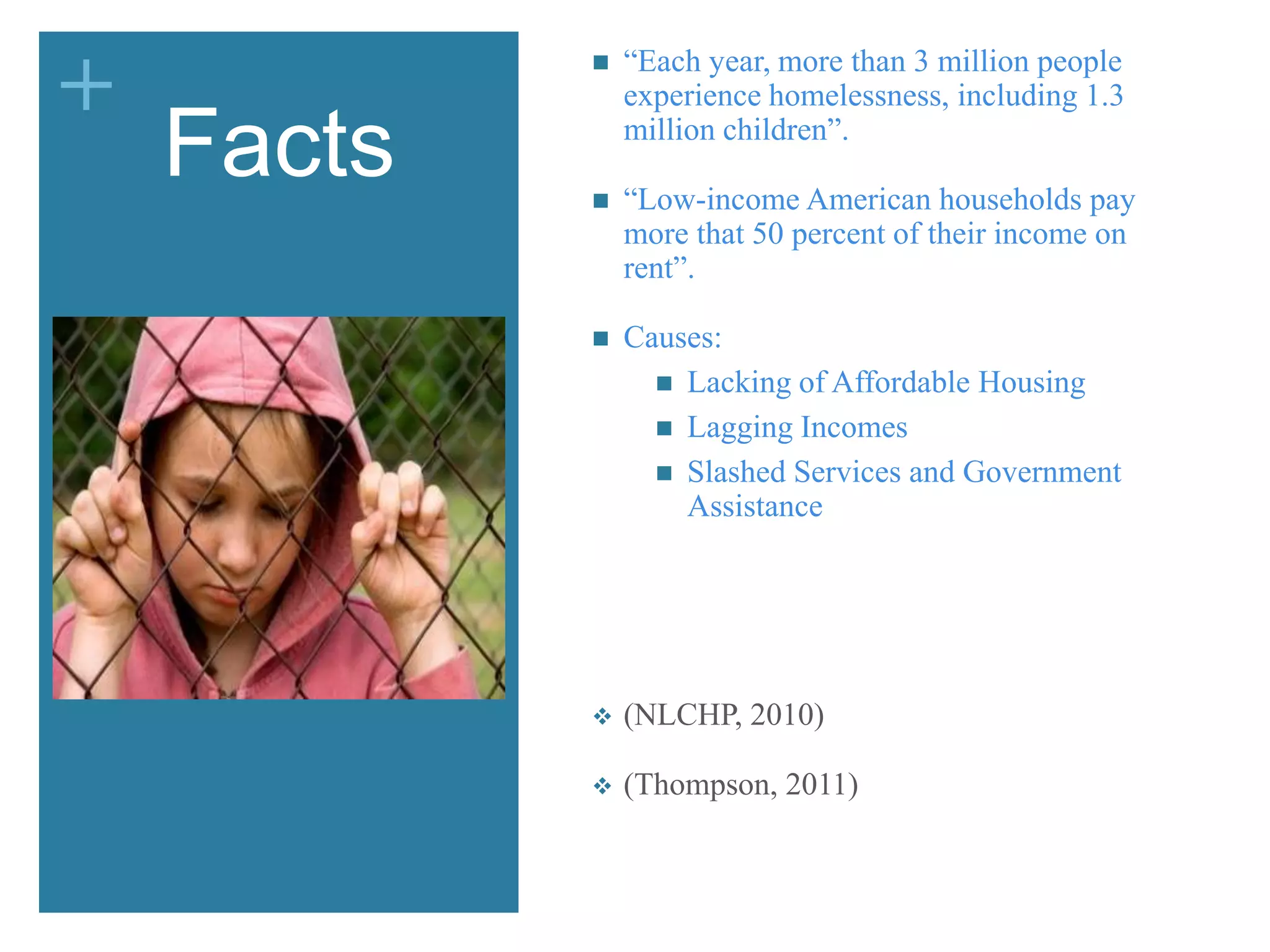
   “Each year, more than 3 million people
+               experience homelessness, including 1.3

    Facts   
                million children”.

                “Low-income American households pay
                more that 50 percent of their income on
                rent”.

               Causes:
                   Lacking of Affordable Housing
                   Lagging Incomes
                   Slashed Services and Government
                    Assistance


               (NLCHP, 2010)

               (Thompson, 2011)
+
    For children living in poverty…
       neural systems develop differently from middle-class children.

       Some display outward aggression

       Suffer from depression

       Increased risk of lead paint poisoning

       Growth stunting, or low height for age

       Physical health, cognitive ability, school achievement

       Teenage pregnancy

       Language Development is affected

       The ability to plan, remember and pay attention in school is affected

       (Toppo, 2008)

       (The connecticut commission, 2004)
+
    Teachers can help their students by…

        Building relationships and a sense of classroom community

        Utilizing events that “add new brain cells”

        Acknowledging their academic successes, not what they own or do not
         own.

         Reviewing classroom rules and routines because they may differ from how
         their life operates outside the classroom.

        “Have high expectations for your students”.

        (Thompson, 2011)
+ a teacher I will…
As

-Value my students for
their achievements, not
possessions

-Create relationships with
my students

-Create a safe classroom
environment

-Schedule snack time
close to the beginning of
the school day.              (Sawyer, 2011)
+
                               References

       NLCHP. (2010). National law center on homelessness & poverty.
              Retrieved from http://www.nlchp.org/hapia.cfm

       Sawyer, K. (2011, December 07). Blog post 3: "teaching tips".
               Retrieved from http://navigators.web.unc.edu/2011/12/07/blog-post-3-
               teaching-tips/

       The connecticut commission on children. (2004, June). Retrieved from
               http://www.cga.ct.gov/coc/pdfs/poverty/2004_poverty_report.pdf

       Thompson, J. (2011). What can you do for students in poverty. Retrieved from
              http://teaching.monster.com/counselors/articles/8164-what-you-can-do-
              for-students-living-in-poverty

       Toppo, G. (2008, Dec 10). http://www.usatoday.com. Retrieved from
               http://www.usatoday.com/news/health/2008-12-07-childrens-
               brains_N.htm

Homelessness and poverty

  • 1.
    + Homelessn ess & Poverty By: Briana Campbell
  • 2.
    “Each year, more than 3 million people + experience homelessness, including 1.3 Facts  million children”. “Low-income American households pay more that 50 percent of their income on rent”.  Causes:  Lacking of Affordable Housing  Lagging Incomes  Slashed Services and Government Assistance  (NLCHP, 2010)  (Thompson, 2011)
  • 3.
    + For children living in poverty…  neural systems develop differently from middle-class children.  Some display outward aggression  Suffer from depression  Increased risk of lead paint poisoning  Growth stunting, or low height for age  Physical health, cognitive ability, school achievement  Teenage pregnancy  Language Development is affected  The ability to plan, remember and pay attention in school is affected  (Toppo, 2008)  (The connecticut commission, 2004)
  • 4.
    + Teachers can help their students by…  Building relationships and a sense of classroom community  Utilizing events that “add new brain cells”  Acknowledging their academic successes, not what they own or do not own.  Reviewing classroom rules and routines because they may differ from how their life operates outside the classroom.  “Have high expectations for your students”.  (Thompson, 2011)
  • 5.
    + a teacherI will… As -Value my students for their achievements, not possessions -Create relationships with my students -Create a safe classroom environment -Schedule snack time close to the beginning of the school day. (Sawyer, 2011)
  • 6.
    + References  NLCHP. (2010). National law center on homelessness & poverty. Retrieved from http://www.nlchp.org/hapia.cfm  Sawyer, K. (2011, December 07). Blog post 3: "teaching tips". Retrieved from http://navigators.web.unc.edu/2011/12/07/blog-post-3- teaching-tips/  The connecticut commission on children. (2004, June). Retrieved from http://www.cga.ct.gov/coc/pdfs/poverty/2004_poverty_report.pdf  Thompson, J. (2011). What can you do for students in poverty. Retrieved from http://teaching.monster.com/counselors/articles/8164-what-you-can-do- for-students-living-in-poverty  Toppo, G. (2008, Dec 10). http://www.usatoday.com. Retrieved from http://www.usatoday.com/news/health/2008-12-07-childrens- brains_N.htm