Interactive Vote using History Flags
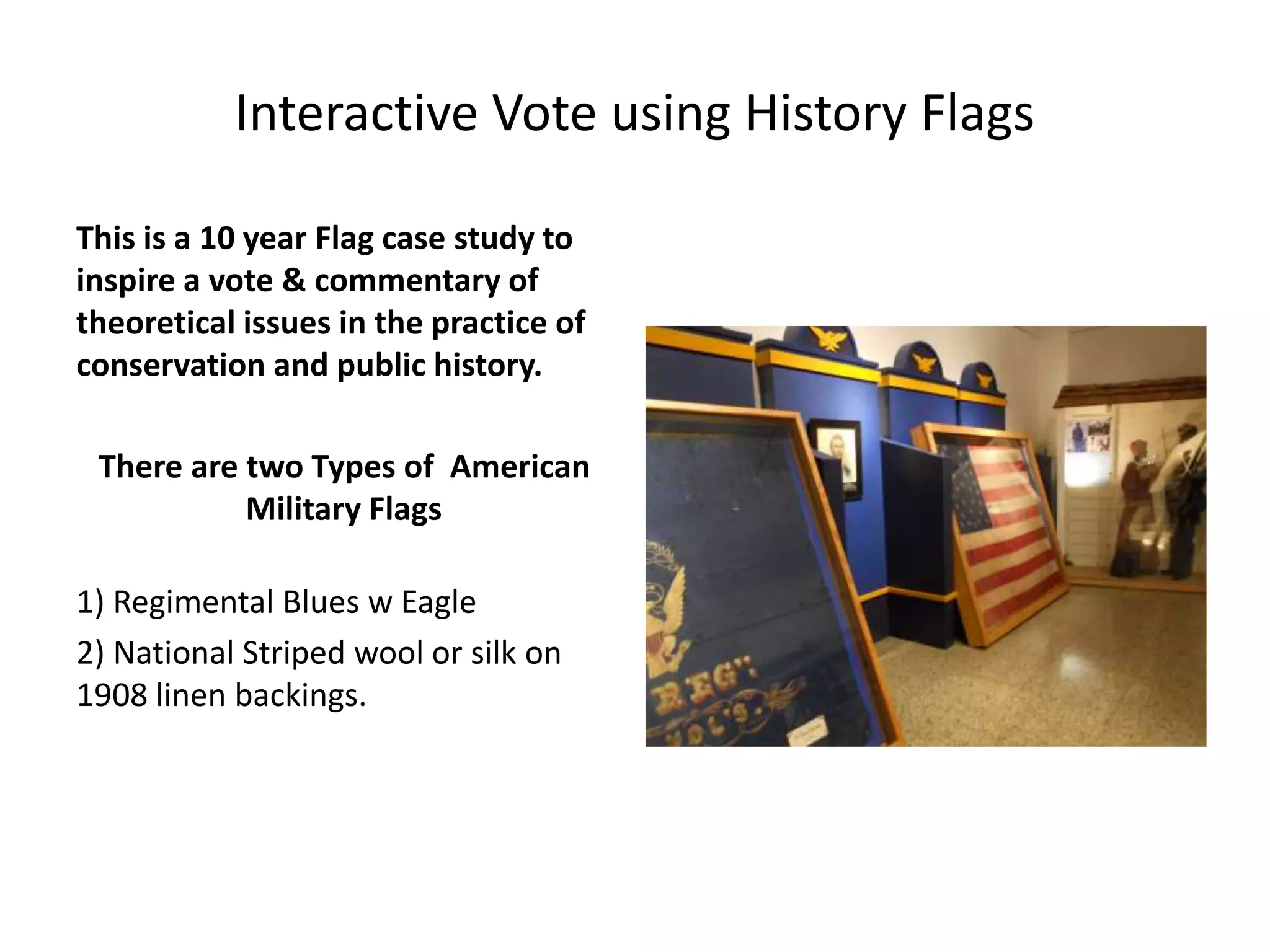
This is a 10 year Flag case study to
inspire a vote & commentary of
theoretical issues in the practice of
conservation and public history.
There are two Types of American
Military Flags
1) Regimental Blues w Eagle
2) National Striped wool or silk on
1908 linen backings.
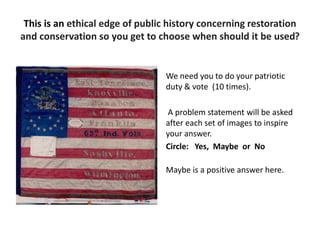
This is an ethical edge of public history concerning restoration
and conservation so you get to choose when should it be used?
We need you to do your patriotic
duty & vote (10 times).
A problem statement will be asked
after each set of images to inspire
your answer.
Circle: Yes, Maybe or No
Maybe is a positive answer here.
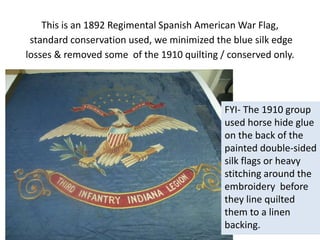
This is an 1892 Regimental Spanish American War Flag,
standard conservation used, we minimized the blue silk edge
losses & removed some of the 1910 quilting / conserved only.
FYI- The 1910 group
used horse hide glue
on the back of the
painted double-sided
silk flags or heavy
stitching around the
embroidery before
they line quilted
them to a linen
backing.
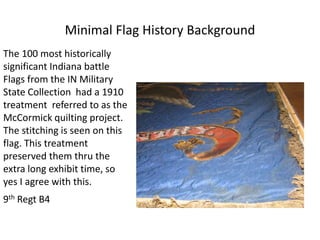
Minimal Flag History Background
The 100 most historically
significant Indiana battle
Flags from the IN Military
State Collection had a 1910
treatment referred to as the
McCormick quilting project.
The stitching is seen on this
flag. This treatment
preserved them thru the
extra long exhibit time, so
yes I agree with this.
9th Regt B4
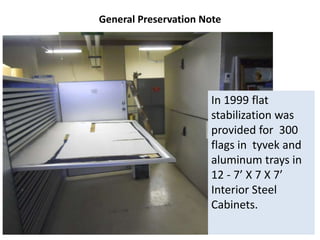
General Preservation Note
In 1999 flat
stabilization was
provided for 300
flags in tyvek and
aluminum trays in
12 - 7’ X 7 X 7’
Interior Steel
Cabinets.
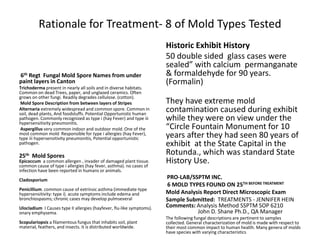
Rationale for Treatment- 8 of Mold Types Tested
6th Regt Fungal Mold Spore Names from under
paint layers in Canton
Trichoderma present in nearly all soils and in diverse habitats.
Common on dead Trees, paper, and unglazed ceramics. Often
grows on other fungi. Readily degrades cellulose. (cotton).
Mold Spore Description from between layers of Stripes
Alternaria extremely widespread and common spore. Common in
soil, dead plants, And foodstuffs. Potential Opportunistic human
pathogen. Commonly recognized as type i (hay Fever) and type iii
hypersensitivity pneumonitis.
Aspergillus very common indoor and outdoor mold. One of the
most common mold Responsible for type i allergies (hay Fever),
type iii hypersensitivity pneumonitis, Potential opportunistic
pathogen.
25th Mold Spores
Epicoccum a common allergen , invader of damaged plant tissue.
common cause of type i allergies (hay fever, asthma). no cases of
infection have been reported in humans or animals.
Cladosporium
Penicillium. common cause of extrinsic asthma (immediate-type
hypersensitivity: type i). acute symptoms include edema and
bronchiospasms; chronic cases may develop pulmseveral
Ulocladium I Causes type II allergies (hayfever, flu-like symptoms).
onary emphysema.
Scopulariopsis a filamentous fungus that inhabits soil, plant
material, feathers, and insects. it is distributed worldwide.
Historic Exhibit History
50 double sided glass cases were
sealed” with calcium permanganate
& formaldehyde for 90 years.
(Formalin)
They have extreme mold
contamination caused during exhibit
while they were on view under the
“Circle Fountain Monument for 10
years after they had seen 80 years of
exhibit at the State Capital in the
Rotunda., which was standard State
History Use.
PRO-LAB/SSPTM INC.
6 MOLD TYPES FOUND ON 25TH BEFORE TREATMENT
Mold Analysis Report Direct Microscopic Exam
Sample Submitted: TREATMENTS - JENNIFER HEIN
Comments: Analysis Method SSPTM SOP 6210
John D. Shane Ph.D., QA Manager
The following fungal descriptions are pertinent to samples
collected. General characterization of mold is made with respect to
their most common impact to human health. Many genera of molds
have species with varying characteristics
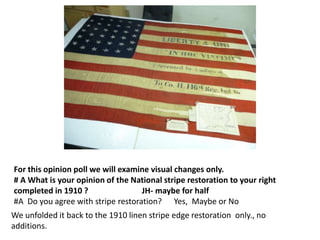
For this opinion poll we will examine visual changes only.
# A What is your opinion of the National stripe restoration to your right
completed in 1910 ? JH- maybe for half
#A Do you agree with stripe restoration? Yes, Maybe or No
We unfolded it back to the 1910 linen stripe edge restoration only., no
additions.
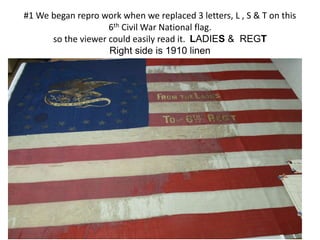
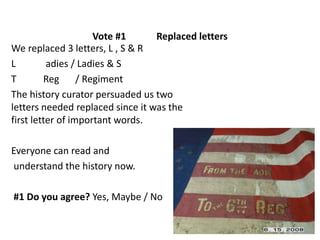
#1 We began repro work when we replaced 3 letters, L , S & T on this
6th Civil War National flag.
so the viewer could easily read it. LADIES & REGT
Right side is 1910 linen
Vote #1 Replaced letters
We replaced 3 letters, L , S & R
L adies / Ladies & S
T Reg / Regiment
The history curator persuaded us two
letters needed replaced since it was the
first letter of important words.
Everyone can read and
understand the history now.
#1 Do you agree? Yes, Maybe / No
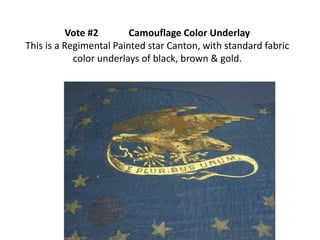
Vote #2 Camouflage Color Underlay
This is a Regimental Painted star Canton, with standard fabric
color underlays of black, brown & gold.
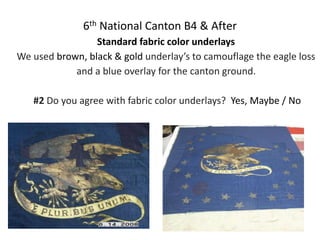
6th National Canton B4 & After
Standard fabric color underlays
We used brown, black & gold underlay’s to camouflage the eagle loss
and a blue overlay for the canton ground.
#2 Do you agree with fabric color underlays? Yes, Maybe / No
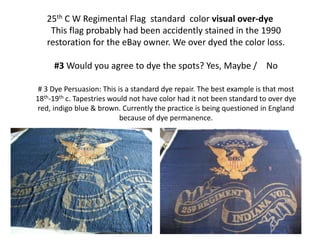
25th C W Regimental Flag standard color visual over-dye
This flag probably had been accidently stained in the 1990
restoration for the eBay owner. We over dyed the color loss.
#3 Would you agree to dye the spots? Yes, Maybe / No
# 3 Dye Persuasion: This is a standard dye repair. The best example is that most
18th-19th c. Tapestries would not have color had it not been standard to over dye
red, indigo blue & brown. Currently the practice is being questioned in England
because of dye permanence.
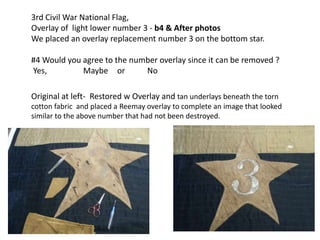
3rd Civil War National Flag,
Overlay of light lower number 3 - b4 & After photos
We placed an overlay replacement number 3 on the bottom star.
#4 Would you agree to the number overlay since it can be removed ?
Yes, Maybe or No
Original at left- Restored w Overlay and tan underlays beneath the torn
cotton fabric and placed a Reemay overlay to complete an image that looked
similar to the above number that had not been destroyed.
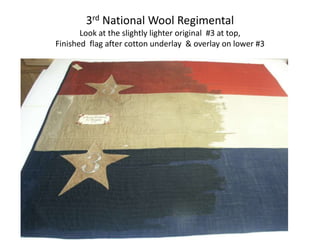
3rd National Wool Regimental
Look at the slightly lighter original #3 at top,
Finished flag after cotton underlay & overlay on lower #3
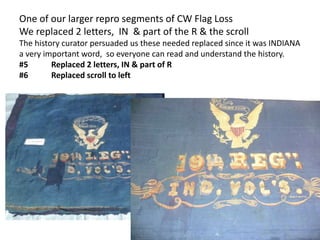
One of our larger repro segments of CW Flag Loss
We replaced 2 letters, IN & part of the R & the scroll
The history curator persuaded us these needed replaced since it was INDIANA
a very important word, so everyone can read and understand the history.
#5 Replaced 2 letters, IN & part of R
#6 Replaced scroll to left
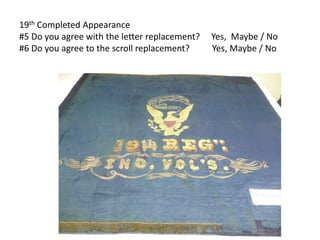
19th Completed Appearance
#5 Do you agree with the letter replacement? Yes, Maybe / No
#6 Do you agree to the scroll replacement? Yes, Maybe / No
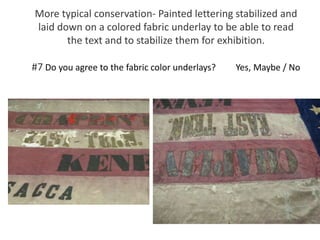
More typical conservation- Painted lettering stabilized and
laid down on a colored fabric underlay to be able to read
the text and to stabilize them for exhibition.
#7 Do you agree to the fabric color underlays? Yes, Maybe / No
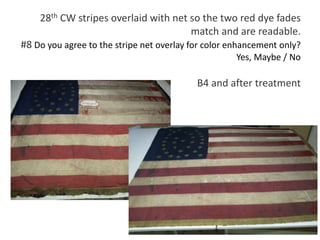
28th CW stripes overlaid with net so the two red dye fades
match and are readable.
#8 Do you agree to the stripe net overlay for color enhancement only?
Yes, Maybe / No
B4 and after treatment
The PHOTO Examples are mainly 1862 American Civil War Flags
that were treated in 1910.
The initial underlays and overlays are accepted conservation
practices but where do you draw the line. ? where new lettering
was added in?
Where does it become like the argument, Is it art or craft?
Is it just semantics? YES but….
Is it conservation or restoration? Why cant we use the “R” word?
I vote we use the “R” word a bit more .
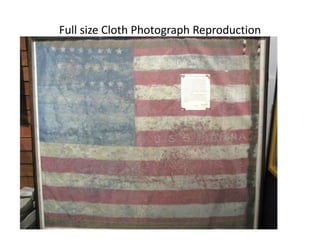
I persuaded the Indiana War Memorial group to produce
reproduction copies to display for those in very poor condition.
Very few visitors realize the difference, and we use signage.
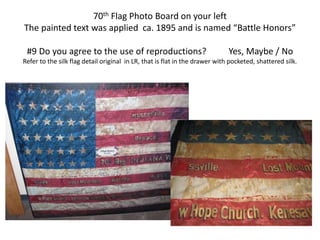
Full size Cloth Photograph Reproduction
70th Flag Photo Board on your left
The painted text was applied ca. 1895 and is named “Battle Honors”
#9 Do you agree to the use of reproductions? Yes, Maybe / No
Refer to the silk flag detail original in LR, that is flat in the drawer with pocketed, shattered silk.
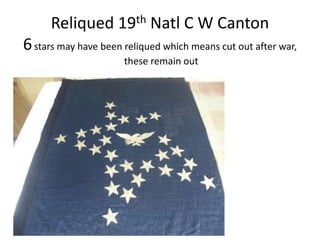
Reliqued 19th Natl C W Canton
6stars may have been reliqued which means cut out after war,
these remain out
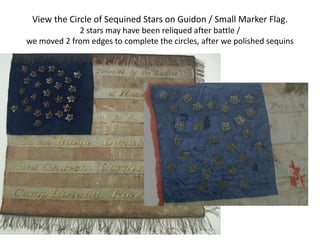
View the Circle of Sequined Stars on Guidon / Small Marker Flag.
2 stars may have been reliqued after battle /
we moved 2 from edges to complete the circles, after we polished sequins
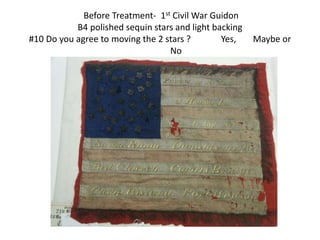
Before Treatment- 1st Civil War Guidon
B4 polished sequin stars and light backing
#10 Do you agree to moving the 2 stars ? Yes, Maybe or
No
Your vote counts, so tally up your results.
We will have a show of hands.
We can discuss it later privately or you may email me.
Jennifer Hein, http://www.linkedin.com/
conservatour@msn.com, 317-679-5405
In closing, I would like to address the
restoration & conservation question
Why is the word restoration, a historical issue and theme under-
represented? Why do we not use this word comfortably?
Historians prefer partial restorations. Is this “conservation” on
the edge? Or restoration?
Where do the ethical edges of public history concerning
restoration meet conservation?
Count the number of your
Yes No & Maybe ?
SHOW OF HANDS Yes >5 No >5 Maybe ?
Technical Flag Summary in MRCG News 2008
We can report that 25 Flags have been treated in
the last 10 years . Some of the most degraded
ones have chipping painted eagle imagery still to
be completed but several were stabilized with
Lascaux 360 & 480 PVA, cotton underlays, poly
microfiber thread & self fabric.
I am thankful to Serena Ury now at Cincinnati
Art Museum formerly Detroit DIA for a
discussion of the PVA Lascaux mixtures
recommended for use by the Canadians. I
completed the CCI Adhesives workshop and
continue to use these on the extremely
degraded long term fabric exhibition objects.
Technique: I prefer silkscreening the PVA
repeatedly on Reemay then it is able to be hand
held with less heat when tacking the loose silk or
paint layer to the linen backing.
15th that may not receive treatment
Jennifer Hein’s Bio
Bachelor of Fine Art, Weaving emphasis, leaded glass, ceramics - Ohio State, Columbus, OH
Internship at the Cooper-Hewitt Smithsonian in NYC, textile history classes at the Folk Art Institute,
Masters - Computer Weaving & Textile Design & Textile History - Montclair State, NJ
Museum Studies - Textile History, Construction & Costume, Fashion Institute of Technology, NY, NY
Dissertation - Textile & Leather Preservation, Exhibition & Storage Techniques
Indiana State Musem Preservation Conservator for a collection of 300,000 cultural history objects for 7 years ,
then in the next 10-15 years as a part-time advisor to several groups concurrently.
- IMLS - CAP Smithsonian Grant program, 35 Historic Sites in 8 states to produce long term conservation plans
-Purdue’s Construction Technology Interior Design Dept Textile Faculty- qualities of upholstery, drapery
& carpeting.
-Conservation Consultant of Indiana War Memorial Military History Museum
Jennifer has completed several Civil War flag restorations and more than 20 flag conservation
treatments.
http://www.slideshare.net/JenniferHein / Google- Jennifer Hein & textiles or flags and review my Linked In site.
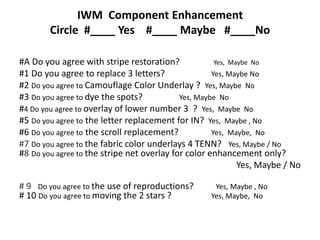
IWM Component Enhancement
Circle #____ Yes #____ Maybe #____No
#A Do you agree with stripe restoration? Yes, Maybe No
#1 Do you agree to replace 3 letters? Yes, Maybe No
#2 Do you agree to Camouflage Color Underlay ? Yes, Maybe No
#3 Do you agree to dye the spots? Yes, Maybe No
#4 Do you agree to overlay of lower number 3 ? Yes, Maybe No
#5 Do you agree to the letter replacement for IN? Yes, Maybe , No
#6 Do you agree to the scroll replacement? Yes, Maybe, No
#7 Do you agree to the fabric color underlays 4 TENN? Yes, Maybe / No
#8 Do you agree to the stripe net overlay for color enhancement only?
Yes, Maybe / No
# 9 Do you agree to the use of reproductions? Yes, Maybe , No
# 10 Do you agree to moving the 2 stars ? Yes, Maybe, No
IWM Component Enhancement
Circle #____ Yes #____ Maybe #____No
#A Do you agree with stripe restoration? Yes, Maybe No
#1 Do you agree to replace 3 letters? Yes, Maybe No
#2 Do you agree to Camouflage Color Underlay ? Yes, Maybe No
#3 Do you agree to dye the spots? Yes, Maybe No
#4 Do you agree to overlay of lower number 3 ? Yes, Maybe No
#5 Do you agree to the letter replacement for IN? Yes, Maybe , No
#6 Do you agree to the scroll replacement? Yes, Maybe, No
#7 Do you agree to the fabric color underlays 4 TENN? Yes, Maybe / No
#8 Do you agree to the stripe net overlay for color enhancement only?
Yes, Maybe / No
# 9 Do you agree to the use of reproductions? Yes, Maybe , No
# 10 Do you agree to moving the 2 stars ? Yes, Maybe, No

Historic Silk Textile Flags - partially restored components

  • 1.
    Interactive Vote usingHistory Flags This is a 10 year Flag case study to inspire a vote & commentary of theoretical issues in the practice of conservation and public history. There are two Types of American Military Flags 1) Regimental Blues w Eagle 2) National Striped wool or silk on 1908 linen backings.
  • 2.
    This is anethical edge of public history concerning restoration and conservation so you get to choose when should it be used? We need you to do your patriotic duty & vote (10 times). A problem statement will be asked after each set of images to inspire your answer. Circle: Yes, Maybe or No Maybe is a positive answer here.
  • 3.
    This is an1892 Regimental Spanish American War Flag, standard conservation used, we minimized the blue silk edge losses & removed some of the 1910 quilting / conserved only. FYI- The 1910 group used horse hide glue on the back of the painted double-sided silk flags or heavy stitching around the embroidery before they line quilted them to a linen backing.
  • 4.
    Minimal Flag HistoryBackground The 100 most historically significant Indiana battle Flags from the IN Military State Collection had a 1910 treatment referred to as the McCormick quilting project. The stitching is seen on this flag. This treatment preserved them thru the extra long exhibit time, so yes I agree with this. 9th Regt B4
  • 5.
    General Preservation Note In1999 flat stabilization was provided for 300 flags in tyvek and aluminum trays in 12 - 7’ X 7 X 7’ Interior Steel Cabinets.
  • 6.
    Rationale for Treatment-8 of Mold Types Tested 6th Regt Fungal Mold Spore Names from under paint layers in Canton Trichoderma present in nearly all soils and in diverse habitats. Common on dead Trees, paper, and unglazed ceramics. Often grows on other fungi. Readily degrades cellulose. (cotton). Mold Spore Description from between layers of Stripes Alternaria extremely widespread and common spore. Common in soil, dead plants, And foodstuffs. Potential Opportunistic human pathogen. Commonly recognized as type i (hay Fever) and type iii hypersensitivity pneumonitis. Aspergillus very common indoor and outdoor mold. One of the most common mold Responsible for type i allergies (hay Fever), type iii hypersensitivity pneumonitis, Potential opportunistic pathogen. 25th Mold Spores Epicoccum a common allergen , invader of damaged plant tissue. common cause of type i allergies (hay fever, asthma). no cases of infection have been reported in humans or animals. Cladosporium Penicillium. common cause of extrinsic asthma (immediate-type hypersensitivity: type i). acute symptoms include edema and bronchiospasms; chronic cases may develop pulmseveral Ulocladium I Causes type II allergies (hayfever, flu-like symptoms). onary emphysema. Scopulariopsis a filamentous fungus that inhabits soil, plant material, feathers, and insects. it is distributed worldwide. Historic Exhibit History 50 double sided glass cases were sealed” with calcium permanganate & formaldehyde for 90 years. (Formalin) They have extreme mold contamination caused during exhibit while they were on view under the “Circle Fountain Monument for 10 years after they had seen 80 years of exhibit at the State Capital in the Rotunda., which was standard State History Use. PRO-LAB/SSPTM INC. 6 MOLD TYPES FOUND ON 25TH BEFORE TREATMENT Mold Analysis Report Direct Microscopic Exam Sample Submitted: TREATMENTS - JENNIFER HEIN Comments: Analysis Method SSPTM SOP 6210 John D. Shane Ph.D., QA Manager The following fungal descriptions are pertinent to samples collected. General characterization of mold is made with respect to their most common impact to human health. Many genera of molds have species with varying characteristics
  • 7.
    For this opinionpoll we will examine visual changes only. # A What is your opinion of the National stripe restoration to your right completed in 1910 ? JH- maybe for half #A Do you agree with stripe restoration? Yes, Maybe or No We unfolded it back to the 1910 linen stripe edge restoration only., no additions.
  • 8.
    #1 We beganrepro work when we replaced 3 letters, L , S & T on this 6th Civil War National flag. so the viewer could easily read it. LADIES & REGT Right side is 1910 linen
  • 9.
    Vote #1 Replacedletters We replaced 3 letters, L , S & R L adies / Ladies & S T Reg / Regiment The history curator persuaded us two letters needed replaced since it was the first letter of important words. Everyone can read and understand the history now. #1 Do you agree? Yes, Maybe / No
  • 10.
    Vote #2 CamouflageColor Underlay This is a Regimental Painted star Canton, with standard fabric color underlays of black, brown & gold.
  • 11.
    6th National CantonB4 & After Standard fabric color underlays We used brown, black & gold underlay’s to camouflage the eagle loss and a blue overlay for the canton ground. #2 Do you agree with fabric color underlays? Yes, Maybe / No
  • 12.
    25th C WRegimental Flag standard color visual over-dye This flag probably had been accidently stained in the 1990 restoration for the eBay owner. We over dyed the color loss. #3 Would you agree to dye the spots? Yes, Maybe / No # 3 Dye Persuasion: This is a standard dye repair. The best example is that most 18th-19th c. Tapestries would not have color had it not been standard to over dye red, indigo blue & brown. Currently the practice is being questioned in England because of dye permanence.
  • 13.
    3rd Civil WarNational Flag, Overlay of light lower number 3 - b4 & After photos We placed an overlay replacement number 3 on the bottom star. #4 Would you agree to the number overlay since it can be removed ? Yes, Maybe or No Original at left- Restored w Overlay and tan underlays beneath the torn cotton fabric and placed a Reemay overlay to complete an image that looked similar to the above number that had not been destroyed.
  • 14.
    3rd National WoolRegimental Look at the slightly lighter original #3 at top, Finished flag after cotton underlay & overlay on lower #3
  • 15.
    One of ourlarger repro segments of CW Flag Loss We replaced 2 letters, IN & part of the R & the scroll The history curator persuaded us these needed replaced since it was INDIANA a very important word, so everyone can read and understand the history. #5 Replaced 2 letters, IN & part of R #6 Replaced scroll to left
  • 16.
    19th Completed Appearance #5Do you agree with the letter replacement? Yes, Maybe / No #6 Do you agree to the scroll replacement? Yes, Maybe / No
  • 17.
    More typical conservation-Painted lettering stabilized and laid down on a colored fabric underlay to be able to read the text and to stabilize them for exhibition. #7 Do you agree to the fabric color underlays? Yes, Maybe / No
  • 18.
    28th CW stripesoverlaid with net so the two red dye fades match and are readable. #8 Do you agree to the stripe net overlay for color enhancement only? Yes, Maybe / No B4 and after treatment
  • 19.
    The PHOTO Examplesare mainly 1862 American Civil War Flags that were treated in 1910. The initial underlays and overlays are accepted conservation practices but where do you draw the line. ? where new lettering was added in? Where does it become like the argument, Is it art or craft? Is it just semantics? YES but…. Is it conservation or restoration? Why cant we use the “R” word? I vote we use the “R” word a bit more . I persuaded the Indiana War Memorial group to produce reproduction copies to display for those in very poor condition. Very few visitors realize the difference, and we use signage.
  • 20.
    Full size ClothPhotograph Reproduction
  • 21.
    70th Flag PhotoBoard on your left The painted text was applied ca. 1895 and is named “Battle Honors” #9 Do you agree to the use of reproductions? Yes, Maybe / No Refer to the silk flag detail original in LR, that is flat in the drawer with pocketed, shattered silk.
  • 22.
    Reliqued 19th NatlC W Canton 6stars may have been reliqued which means cut out after war, these remain out
  • 23.
    View the Circleof Sequined Stars on Guidon / Small Marker Flag. 2 stars may have been reliqued after battle / we moved 2 from edges to complete the circles, after we polished sequins
  • 24.
    Before Treatment- 1stCivil War Guidon B4 polished sequin stars and light backing #10 Do you agree to moving the 2 stars ? Yes, Maybe or No
  • 25.
    Your vote counts,so tally up your results. We will have a show of hands. We can discuss it later privately or you may email me. Jennifer Hein, http://www.linkedin.com/ conservatour@msn.com, 317-679-5405
  • 26.
    In closing, Iwould like to address the restoration & conservation question Why is the word restoration, a historical issue and theme under- represented? Why do we not use this word comfortably? Historians prefer partial restorations. Is this “conservation” on the edge? Or restoration? Where do the ethical edges of public history concerning restoration meet conservation? Count the number of your Yes No & Maybe ?
  • 27.
    SHOW OF HANDSYes >5 No >5 Maybe ? Technical Flag Summary in MRCG News 2008 We can report that 25 Flags have been treated in the last 10 years . Some of the most degraded ones have chipping painted eagle imagery still to be completed but several were stabilized with Lascaux 360 & 480 PVA, cotton underlays, poly microfiber thread & self fabric. I am thankful to Serena Ury now at Cincinnati Art Museum formerly Detroit DIA for a discussion of the PVA Lascaux mixtures recommended for use by the Canadians. I completed the CCI Adhesives workshop and continue to use these on the extremely degraded long term fabric exhibition objects. Technique: I prefer silkscreening the PVA repeatedly on Reemay then it is able to be hand held with less heat when tacking the loose silk or paint layer to the linen backing. 15th that may not receive treatment
  • 28.
    Jennifer Hein’s Bio Bachelorof Fine Art, Weaving emphasis, leaded glass, ceramics - Ohio State, Columbus, OH Internship at the Cooper-Hewitt Smithsonian in NYC, textile history classes at the Folk Art Institute, Masters - Computer Weaving & Textile Design & Textile History - Montclair State, NJ Museum Studies - Textile History, Construction & Costume, Fashion Institute of Technology, NY, NY Dissertation - Textile & Leather Preservation, Exhibition & Storage Techniques Indiana State Musem Preservation Conservator for a collection of 300,000 cultural history objects for 7 years , then in the next 10-15 years as a part-time advisor to several groups concurrently. - IMLS - CAP Smithsonian Grant program, 35 Historic Sites in 8 states to produce long term conservation plans -Purdue’s Construction Technology Interior Design Dept Textile Faculty- qualities of upholstery, drapery & carpeting. -Conservation Consultant of Indiana War Memorial Military History Museum Jennifer has completed several Civil War flag restorations and more than 20 flag conservation treatments. http://www.slideshare.net/JenniferHein / Google- Jennifer Hein & textiles or flags and review my Linked In site.
  • 29.
    IWM Component Enhancement Circle#____ Yes #____ Maybe #____No #A Do you agree with stripe restoration? Yes, Maybe No #1 Do you agree to replace 3 letters? Yes, Maybe No #2 Do you agree to Camouflage Color Underlay ? Yes, Maybe No #3 Do you agree to dye the spots? Yes, Maybe No #4 Do you agree to overlay of lower number 3 ? Yes, Maybe No #5 Do you agree to the letter replacement for IN? Yes, Maybe , No #6 Do you agree to the scroll replacement? Yes, Maybe, No #7 Do you agree to the fabric color underlays 4 TENN? Yes, Maybe / No #8 Do you agree to the stripe net overlay for color enhancement only? Yes, Maybe / No # 9 Do you agree to the use of reproductions? Yes, Maybe , No # 10 Do you agree to moving the 2 stars ? Yes, Maybe, No
  • 30.
    IWM Component Enhancement Circle#____ Yes #____ Maybe #____No #A Do you agree with stripe restoration? Yes, Maybe No #1 Do you agree to replace 3 letters? Yes, Maybe No #2 Do you agree to Camouflage Color Underlay ? Yes, Maybe No #3 Do you agree to dye the spots? Yes, Maybe No #4 Do you agree to overlay of lower number 3 ? Yes, Maybe No #5 Do you agree to the letter replacement for IN? Yes, Maybe , No #6 Do you agree to the scroll replacement? Yes, Maybe, No #7 Do you agree to the fabric color underlays 4 TENN? Yes, Maybe / No #8 Do you agree to the stripe net overlay for color enhancement only? Yes, Maybe / No # 9 Do you agree to the use of reproductions? Yes, Maybe , No # 10 Do you agree to moving the 2 stars ? Yes, Maybe, No