By: Sara Montero
MUSIC IN FILM
AND ITS HISTORY
THE EARLY BEGINNINGS OF FILM
• Thomas Edison invented
the Kinetograph
• The first Kinetoscope
parlor opened on April 14,
1894
• Inspired by the
Kinetograph, the Lumiere
brothers invented the
Cinématographe
• The first public showing of
a Lumiere brothers film
took place on December
28, 1895
FUSION OF FILM AND MUSIC
1900S – 1920S
• Accompanists, either pianists
or entire orchestras, were
hired to drown out the noise
made by the projector during
silent film viewing
• Accompanists were either
given books of musical ideas
or suggestion lists for songs to
play
• Most historians believe that
Camille Saint-Saen’s score for
L’Assissinat du Duc de Guise
(1908) was the first original
score
• Joseph Carl Breil wrote the
first feature length musical
score for The Birth of a Nation
(1915)
THE DAWN OF THE TALKIES
1930S – 1940S
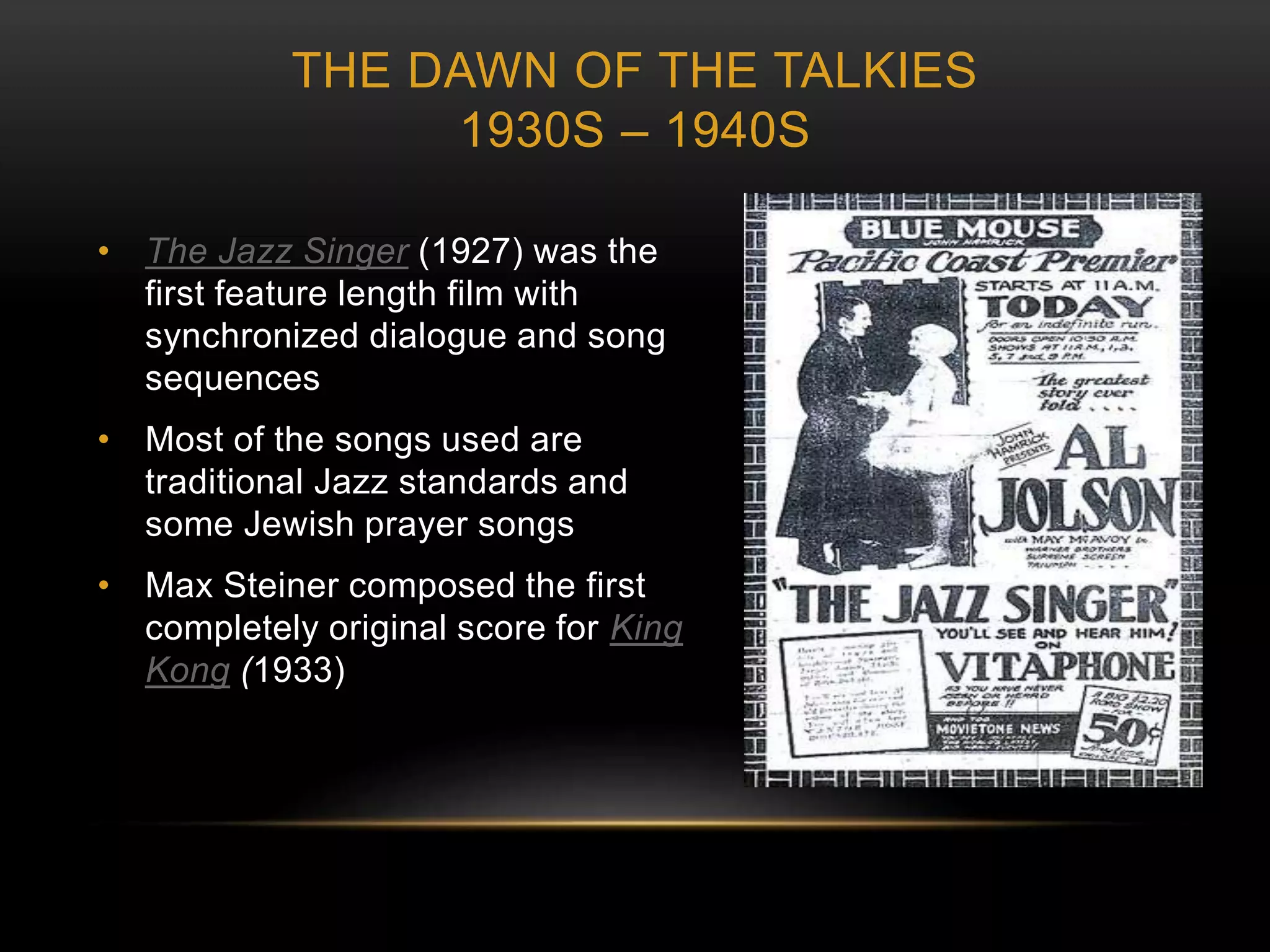
• The Jazz Singer (1927) was the
first feature length film with
synchronized dialogue and song
sequences
• Most of the songs used are
traditional Jazz standards and
some Jewish prayer songs
• Max Steiner composed the first
completely original score for King
Kong (1933)
THE JAZZ REVOLUTION
1950S
• The rising popularity of jazz music
revolutionized the way music for
film was written and the format of
orchestration
• Fewer musicians were required to
record scores
• One of the earliest films to use this
technique was A Streetcar Named
Desire (1951) whose score was
written by Alex North
• The score for the film Anatomy of a
Murder (1959) was written by Duke
Ellington and Billy Strayhorn and
performed by Ellington’s jazz
orchestra
THE EXPERIMENTAL TRADITION
1960S
• For Pyscho (1960), Alfred Hitchcock, the
director, wanted a jazz score, but
Bernard Hermann, the composer, chose
to write for a smaller string orchestra
• Hermann stated that the string
soundtrack would “reflect the black-and-
white cinematography “ of the film and
allow him to play with more tones and
dynamics
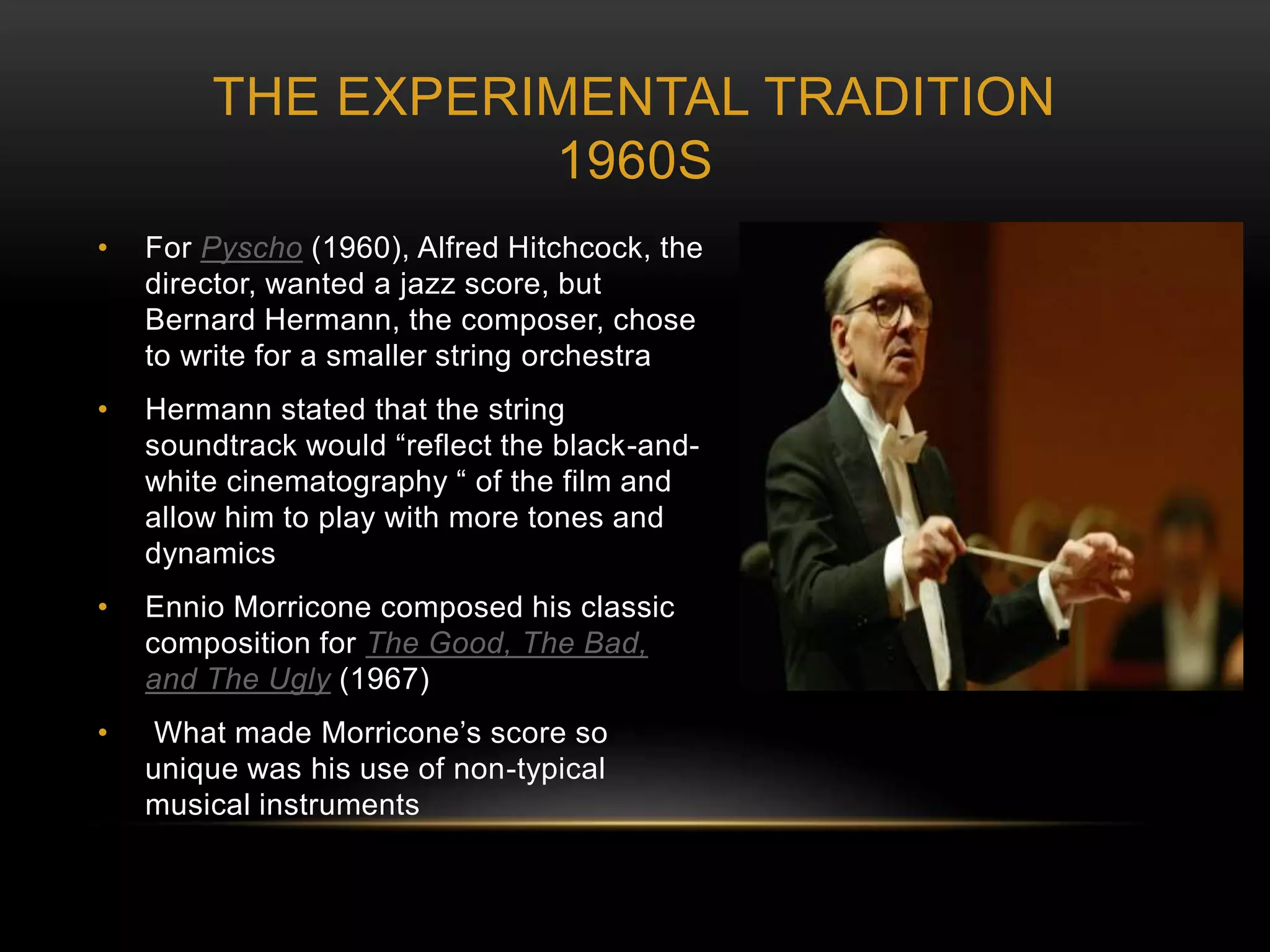
• Ennio Morricone composed his classic
composition for The Good, The Bad,
and The Ugly (1967)
• What made Morricone’s score so
unique was his use of non-typical
musical instruments
ADDITION OF ROCK MUSIC
1970S
• The 1970’s saw a shift towards
using rock music and very early
synthesizers in film soundtracks
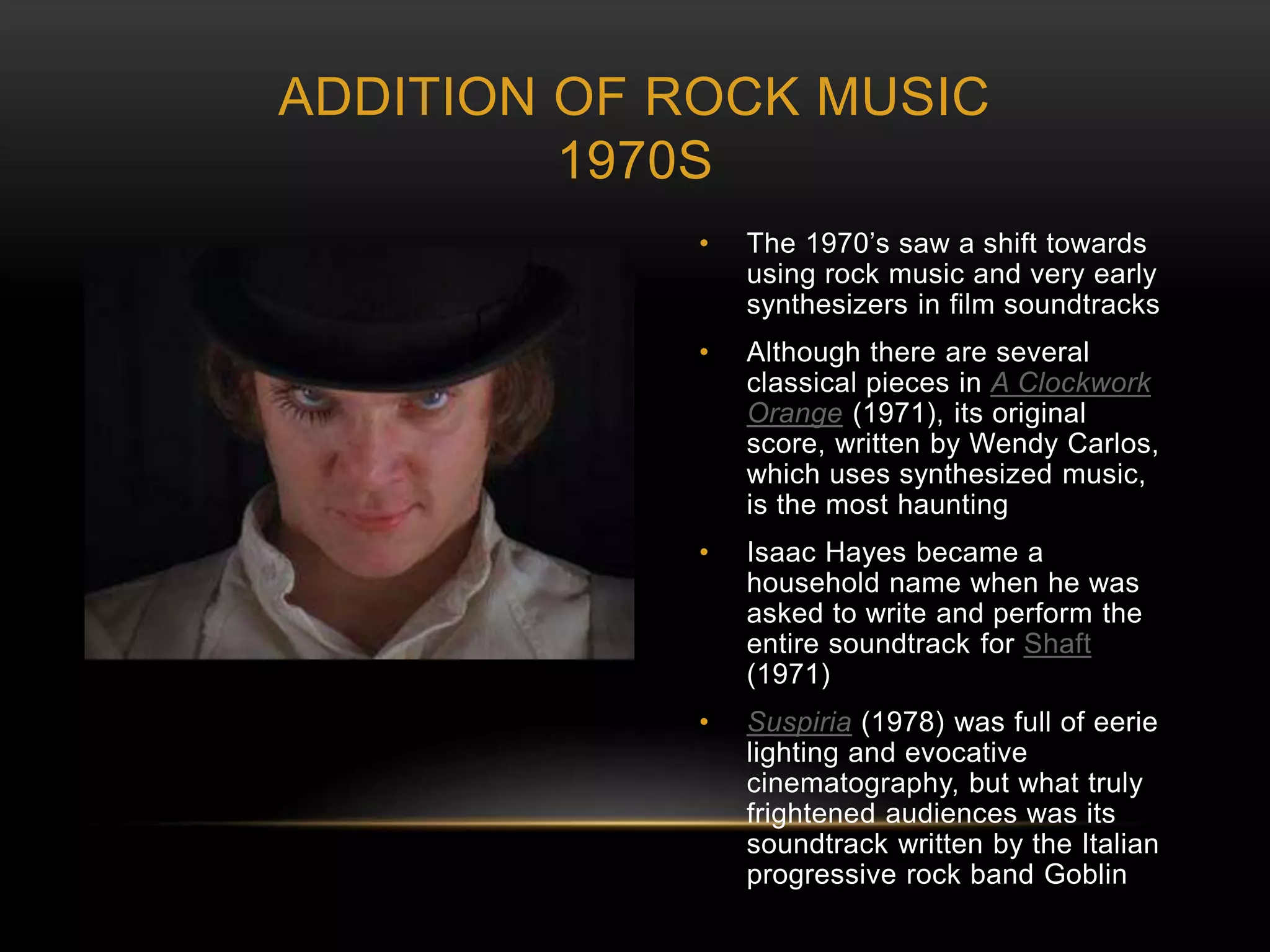
• Although there are several
classical pieces in A Clockwork
Orange (1971), its original
score, written by Wendy Carlos,
which uses synthesized music,
is the most haunting
• Isaac Hayes became a
household name when he was
asked to write and perform the
entire soundtrack for Shaft
(1971)
• Suspiria (1978) was full of eerie
lighting and evocative
cinematography, but what truly
frightened audiences was its
soundtrack written by the Italian
progressive rock band Goblin
THE RISE OF SYNTHESIZERS
1980S
• During the 1980s, the synthesizer
became a readily available instrument,
which allowed entire scores to be
written using just a synth
• Vangelis combined both classical,
melodic compositions with
synthesizers to create a dark, futuristic
score for Blade Runner (1982)
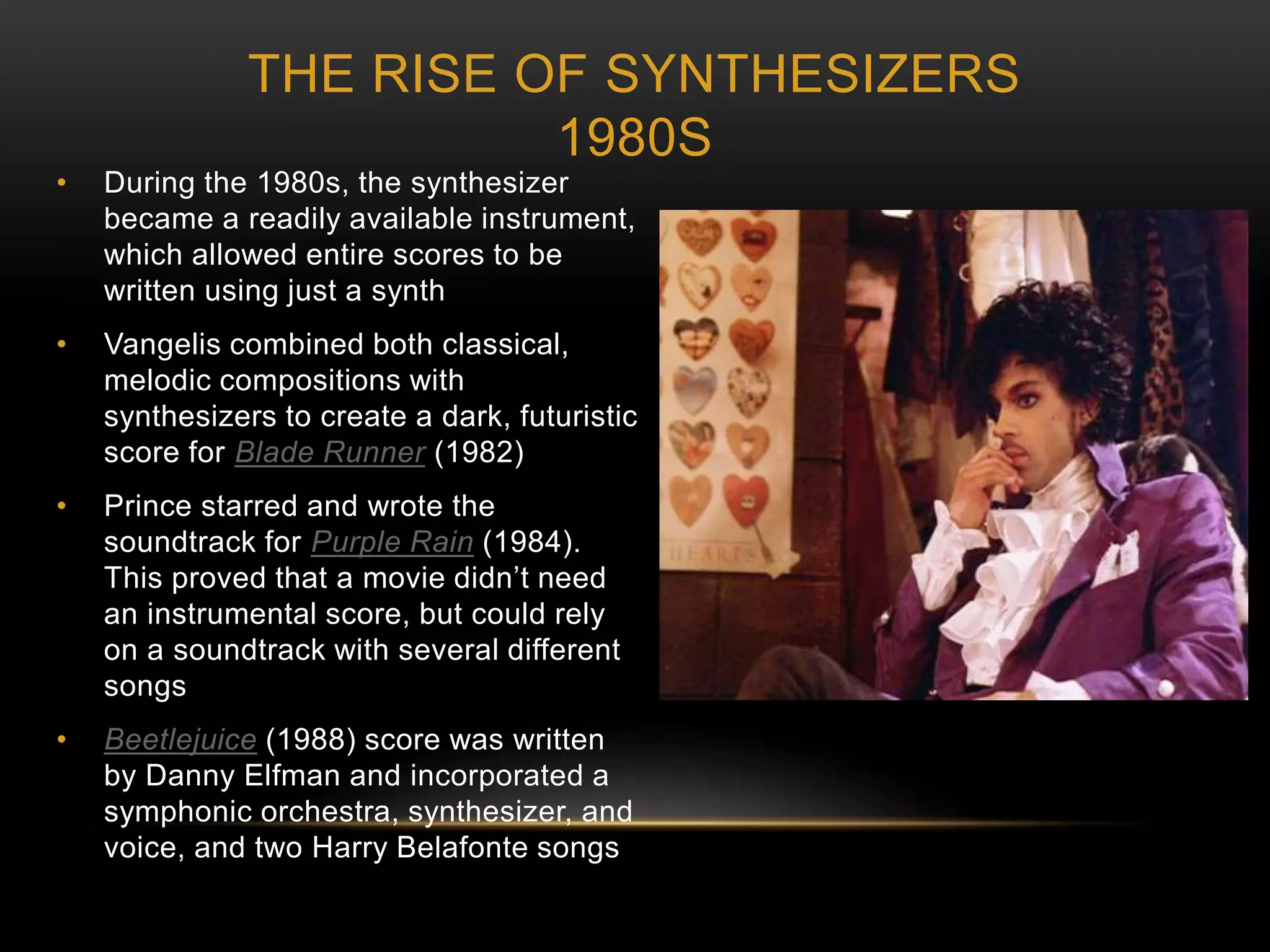
• Prince starred and wrote the
soundtrack for Purple Rain (1984).
This proved that a movie didn’t need
an instrumental score, but could rely
on a soundtrack with several different
songs
• Beetlejuice (1988) score was written
by Danny Elfman and incorporated a
symphonic orchestra, synthesizer, and
voice, and two Harry Belafonte songs
THE PREVALENCE OF POP AND ROCK
MUSIC
1990S
• Not much changed in terms of
film scoring techniques from the
1980s to the 1990s, but using
soundtracks with pop and rock
songs instead of orchestral
scores certainly became more
popular
• Quentin Tarantino chose solely
rock music from the 1960s
through the 1980s for the
soundtrack for his film Reservoir
Dogs (1992)
• John Williams went against the
trend of the time and stuck to his
orchestral roots for the Jurassic
Park (1993) score
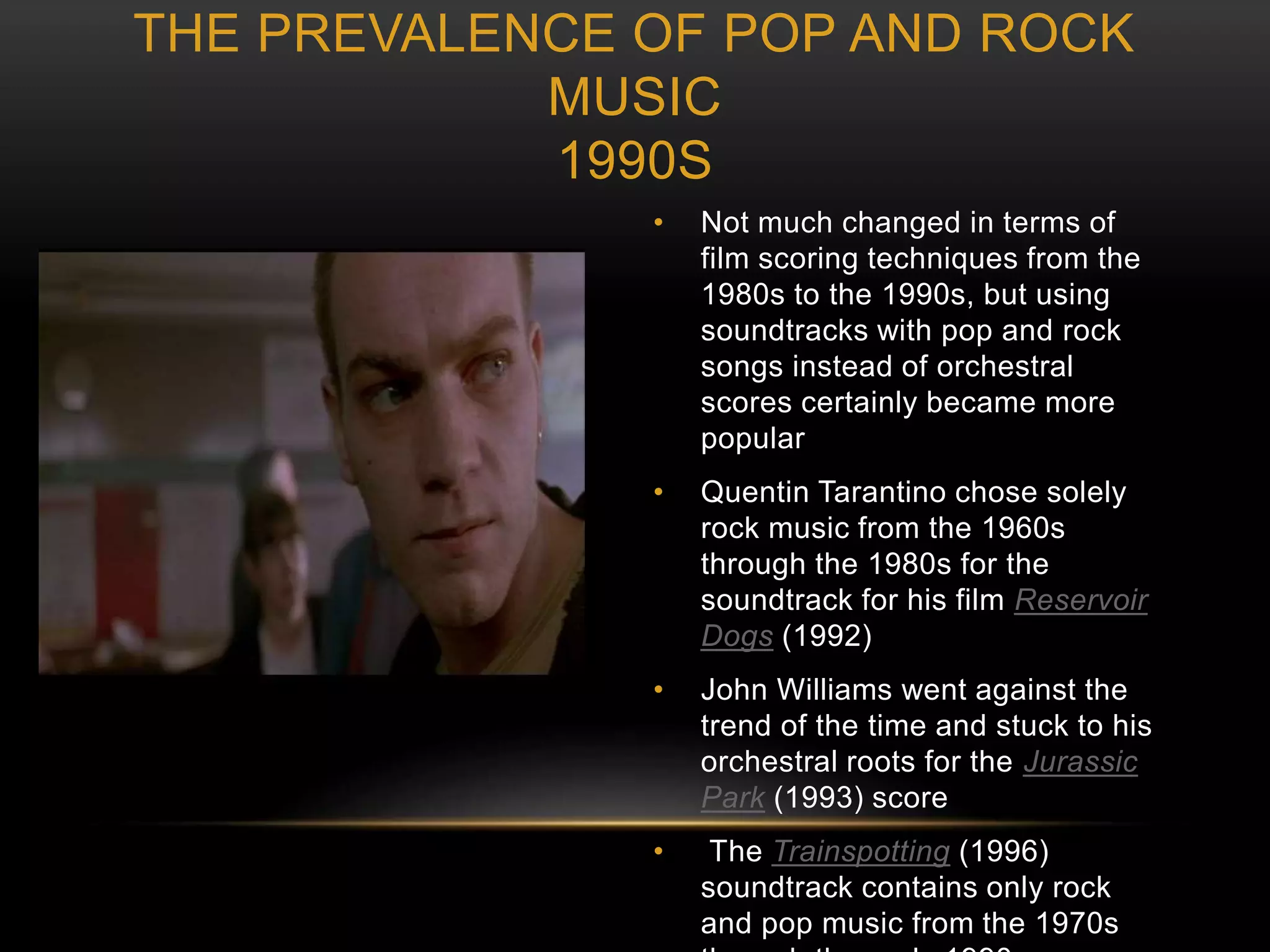
• The Trainspotting (1996)
soundtrack contains only rock
and pop music from the 1970s
ADVANCEMENT OF TECHNOLOGY
2000S
• As technology continued to
progress through the new
millennium, so did the sound of
synthesizers and the ability
create more extravagant scores
and soundtracks
• Yann Tiersen was chosen to
compose the Amélie (2001)
soundtrack. While the
soundtrack contains music that
Tiersen had already written, it
also includes several new
pieces as well as “Guilty,” a
single from 1931
• For The Royal Tenenbaums
(2001), the soundtrack contains
both an original orchestral score
written by Mark Mothersbaugh
and various rock songs from the
1960s through the 1990s
• There Will Be Blood’s (2007)
score was written by Jonny
Greenwood from Radiohead
THE PRESENT AND FUTURE
2010S
• Although there have been no major
differences in film scoring techniques
between the 2000s and 2010s, soundtracks
and scores continue to push the envelope
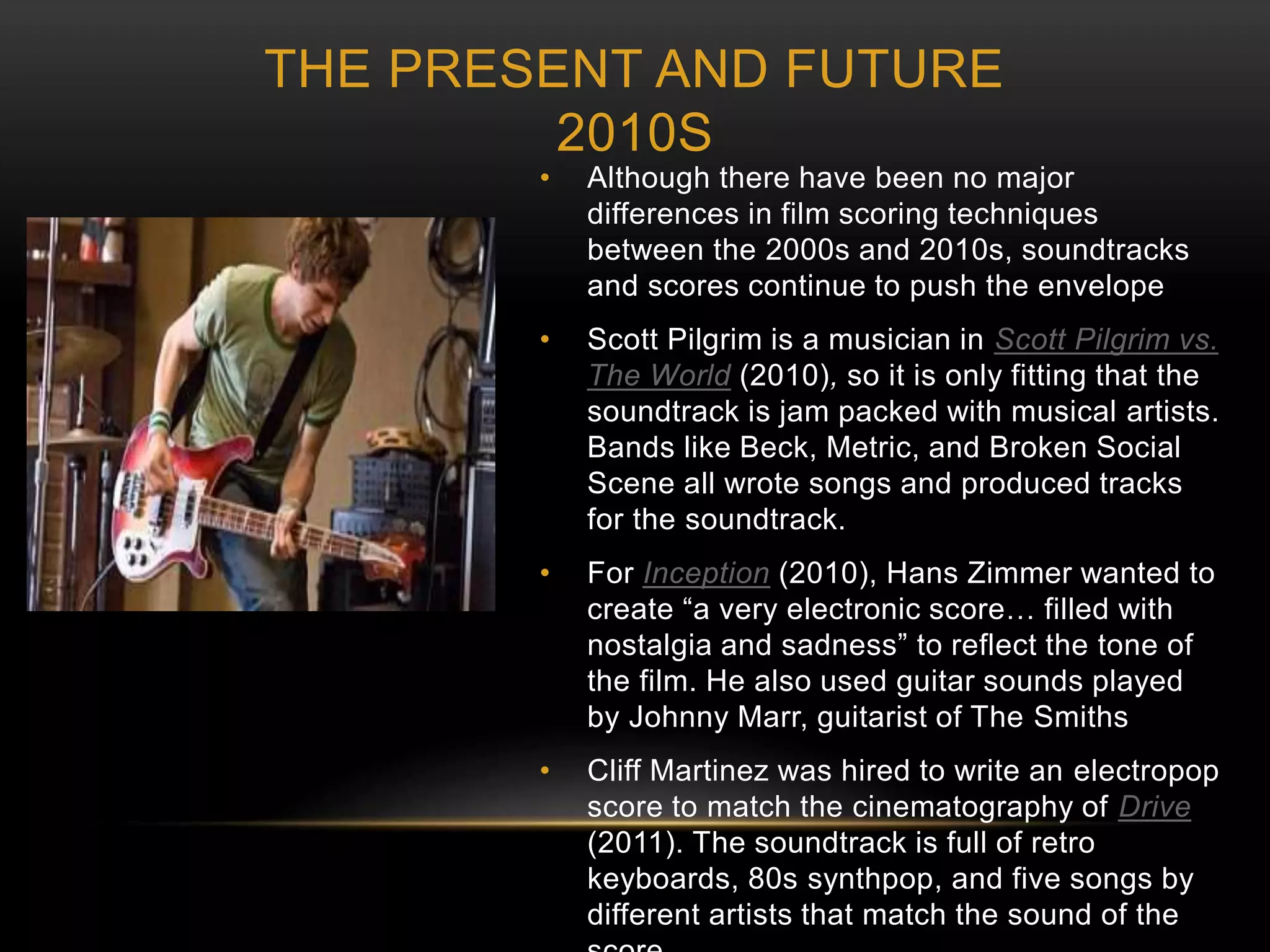
• Scott Pilgrim is a musician in Scott Pilgrim vs.
The World (2010), so it is only fitting that the
soundtrack is jam packed with musical artists.
Bands like Beck, Metric, and Broken Social
Scene all wrote songs and produced tracks
for the soundtrack.
• For Inception (2010), Hans Zimmer wanted to
create “a very electronic score… filled with
nostalgia and sadness” to reflect the tone of
the film. He also used guitar sounds played
by Johnny Marr, guitarist of The Smiths
• Cliff Martinez was hired to write an electropop
score to match the cinematography of Drive
(2011). The soundtrack is full of retro
keyboards, 80s synthpop, and five songs by
different artists that match the sound of the

History of Film Music

  • 1.
    By: Sara Montero MUSICIN FILM AND ITS HISTORY
  • 2.
    THE EARLY BEGINNINGSOF FILM • Thomas Edison invented the Kinetograph • The first Kinetoscope parlor opened on April 14, 1894 • Inspired by the Kinetograph, the Lumiere brothers invented the Cinématographe • The first public showing of a Lumiere brothers film took place on December 28, 1895
  • 3.
    FUSION OF FILMAND MUSIC 1900S – 1920S • Accompanists, either pianists or entire orchestras, were hired to drown out the noise made by the projector during silent film viewing • Accompanists were either given books of musical ideas or suggestion lists for songs to play • Most historians believe that Camille Saint-Saen’s score for L’Assissinat du Duc de Guise (1908) was the first original score • Joseph Carl Breil wrote the first feature length musical score for The Birth of a Nation (1915)
  • 4.
    THE DAWN OFTHE TALKIES 1930S – 1940S • The Jazz Singer (1927) was the first feature length film with synchronized dialogue and song sequences • Most of the songs used are traditional Jazz standards and some Jewish prayer songs • Max Steiner composed the first completely original score for King Kong (1933)
  • 5.
    THE JAZZ REVOLUTION 1950S •The rising popularity of jazz music revolutionized the way music for film was written and the format of orchestration • Fewer musicians were required to record scores • One of the earliest films to use this technique was A Streetcar Named Desire (1951) whose score was written by Alex North • The score for the film Anatomy of a Murder (1959) was written by Duke Ellington and Billy Strayhorn and performed by Ellington’s jazz orchestra
  • 6.
    THE EXPERIMENTAL TRADITION 1960S •For Pyscho (1960), Alfred Hitchcock, the director, wanted a jazz score, but Bernard Hermann, the composer, chose to write for a smaller string orchestra • Hermann stated that the string soundtrack would “reflect the black-and- white cinematography “ of the film and allow him to play with more tones and dynamics • Ennio Morricone composed his classic composition for The Good, The Bad, and The Ugly (1967) • What made Morricone’s score so unique was his use of non-typical musical instruments
  • 7.
    ADDITION OF ROCKMUSIC 1970S • The 1970’s saw a shift towards using rock music and very early synthesizers in film soundtracks • Although there are several classical pieces in A Clockwork Orange (1971), its original score, written by Wendy Carlos, which uses synthesized music, is the most haunting • Isaac Hayes became a household name when he was asked to write and perform the entire soundtrack for Shaft (1971) • Suspiria (1978) was full of eerie lighting and evocative cinematography, but what truly frightened audiences was its soundtrack written by the Italian progressive rock band Goblin
  • 8.
    THE RISE OFSYNTHESIZERS 1980S • During the 1980s, the synthesizer became a readily available instrument, which allowed entire scores to be written using just a synth • Vangelis combined both classical, melodic compositions with synthesizers to create a dark, futuristic score for Blade Runner (1982) • Prince starred and wrote the soundtrack for Purple Rain (1984). This proved that a movie didn’t need an instrumental score, but could rely on a soundtrack with several different songs • Beetlejuice (1988) score was written by Danny Elfman and incorporated a symphonic orchestra, synthesizer, and voice, and two Harry Belafonte songs
  • 9.
    THE PREVALENCE OFPOP AND ROCK MUSIC 1990S • Not much changed in terms of film scoring techniques from the 1980s to the 1990s, but using soundtracks with pop and rock songs instead of orchestral scores certainly became more popular • Quentin Tarantino chose solely rock music from the 1960s through the 1980s for the soundtrack for his film Reservoir Dogs (1992) • John Williams went against the trend of the time and stuck to his orchestral roots for the Jurassic Park (1993) score • The Trainspotting (1996) soundtrack contains only rock and pop music from the 1970s
  • 10.
    ADVANCEMENT OF TECHNOLOGY 2000S •As technology continued to progress through the new millennium, so did the sound of synthesizers and the ability create more extravagant scores and soundtracks • Yann Tiersen was chosen to compose the Amélie (2001) soundtrack. While the soundtrack contains music that Tiersen had already written, it also includes several new pieces as well as “Guilty,” a single from 1931 • For The Royal Tenenbaums (2001), the soundtrack contains both an original orchestral score written by Mark Mothersbaugh and various rock songs from the 1960s through the 1990s • There Will Be Blood’s (2007) score was written by Jonny Greenwood from Radiohead
  • 11.
    THE PRESENT ANDFUTURE 2010S • Although there have been no major differences in film scoring techniques between the 2000s and 2010s, soundtracks and scores continue to push the envelope • Scott Pilgrim is a musician in Scott Pilgrim vs. The World (2010), so it is only fitting that the soundtrack is jam packed with musical artists. Bands like Beck, Metric, and Broken Social Scene all wrote songs and produced tracks for the soundtrack. • For Inception (2010), Hans Zimmer wanted to create “a very electronic score… filled with nostalgia and sadness” to reflect the tone of the film. He also used guitar sounds played by Johnny Marr, guitarist of The Smiths • Cliff Martinez was hired to write an electropop score to match the cinematography of Drive (2011). The soundtrack is full of retro keyboards, 80s synthpop, and five songs by different artists that match the sound of the