The Beginning of the  Twentieth-Century Crisis:  War and Revolution 22
The Road to World War I Nationalism and Internal Dissent Rivalries over colonies Nationalism Socialist labor movements create fear nations on the eve of revolution Militarism Conscription Russia an army of 1.3 million;  France and Germany, 900,000 Influence of military leaders Complex military plans Inflexibility of military plans
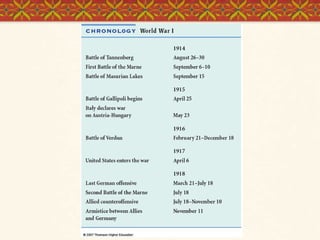
The Outbreak of War:  Summer of 1914 Serbia, supported by Russia, determined to create a large, independent Slavic state in the Balkans Assassination of Francis Ferdinand Bosnian activist working for a Serbian terrorist organization with an aim for a pan-Slavic kingdom Austria-Hungary sought German support for fear of Russia’s alliance with Serbia Austria declared war on Serbia July 28, 1914 Germany declared war on Russia August, 1, 1914
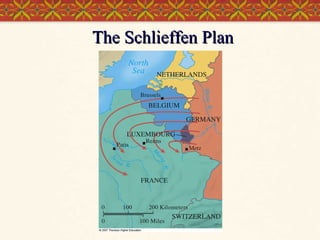
Impact of the Schlieffen Plan Because Russia and France had a military alliance since 1894, General Alfred von Schlieffen devised a two-front military plan on both countries First, invade and defeat France, then deploy German army to the east against Russia Germany declared war on France Britain declared war on Germany August 4 – all great powers of Europe were at war
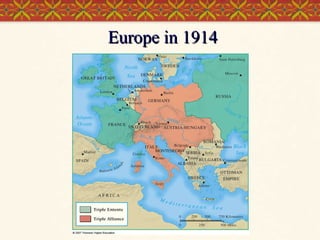
Europe in 1914
The Great War 1914-1915:  Illusions and Stalemate Visions of the war Failure of the Schlieffen Plan First Battle of the Marne, September 6-10, 1914 Russian failures Battle of Tannenberg, August 30, 1914 Battle of Masurian Lakes, September 15, 1914 Driven out of Galicia and Serbia Italy enters the war on the Allied side
The Schlieffen Plan
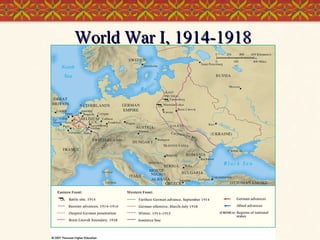
World War I, 1914-1918
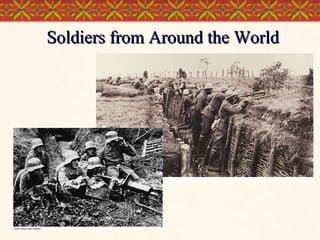
1916 – 1917:  The Great Slaughter Trench warfare “No man’s land” No plan for fighting a trench war Battle of Verdun, 1916, 700,000 killed Horrors of trench warfare
World War I, cont’d  Entry of the United States Sinking of the  Lusitania , May 7, 1915 German return to unrestricted submarine warfare United States enters the war, April 6, 1917 Bolshevik Revolution, 1917
The Widening of the War Ottoman Empire took Germany’s side Russia, Great Britain, and France declared war on Ottoman  Battle of Gallipoli, April 1915 Bulgaria entered the war, September 1915, on the side of the Central Powers (Germany, Austria-Hungary, Ottoman) A Global Conflict Italy enters the war, May 1915, against Austria-Hungary In the Middle East, Lawrence of Arabia incited Arab princes against Ottoman British mobilized forces from India, Australia, and New Zealand Allies seize German colonies in Africa -- Togoland, Cameroons, South West Africa, and German East Africa, Pacific Allied governments used Africans as soldiers and labor Chinese and Indochinese were used to work in European factories as laborers Japan joined Allies to seize control of German territories in Asia Japan took German territories in China, Marshall, Mariana, and Caroline Islands
Soldiers from Around the World
 
The Home Front:  The Impact of Total War Political Centralization and Economic Regimentation With great demands for men and material, governments extended their powers  Drafted tens of millions of young men Free market systems shelved so governments could test price, wage, and rent controls Food supplies and materials rationed Nationalized transportation systems and industries
Control of Public Opinion Casualties grew Patriotic enthusiasm waned Government took strenuous measures to fight opposition Expansion of police measures to stifle dissent Use of propaganda to arouse enthusiasm
Women in the War Effort New role for women Took over male jobs and responsibilities, even chimney sweeps and truck drivers Wages increased but never equaled men’s Jobs not secure After war, governments removed women from jobs Wages were lowered Positive impact:  women’s movement for political emancipation Right to vote (Britain in 1918, later in Germany and Austria) Women took jobs,  had apartments, smoked in public, wore shorter dresses, adopted radical hairstyles
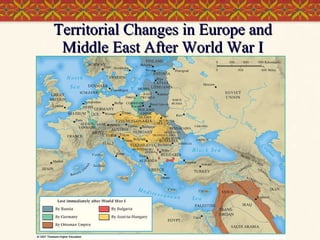
Territorial Changes in Europe and Middle East After World War I
Crisis in Russia and the End of the War The Russian Revolution Problems of Tsar Nicholas II Military problems Influence of Rasputin The March Revolution Strikes led by women with soldiers in Petrograd, March, 1917 Provisional government, Alexander Kerensky, continued war  Government faced soviets, or councils of workers’ and soldiers’ deputies, who sprang up in army units, factory towns, and rural areas Soviets were from the lower classes with radical interests and largely groups of socialists, including Bolsheviks
Lenin and the Bolshevik Revolution Vladimir  Ulianov Lenin (1870-1824) Bolsheviks a party dedicated to revolution which can destroy the capitalist system Exiled in Switzerland, German shipped Lenin to Russia to create disorder Bolsheviks promised masses:  redistribution of land to peasants, transfer of factories and industries from capitalists to workers, relegation of government power from Provisional Government to soviets Bolshevik program’s three slogans:  “ Peace, Land, Bread” “ Worker Control of Production “ All Power to the Soviets” Collapse of Provisional Government, November 6-7, 1917 Bolsheviks were renamed the Communists Treaty of Brest-Litovsk, March 3, 1918 giving up Poland, Ukraine, Finland, and Baltic Provinces Promised peace, but country sank into civil war
Civil War Opposition to Communist regime from groups loyal to tsar, bourgeois and aristocratic liberals, and anti-Leninst socialists Allied Troops sent to Russia to fight Communist (Red) Army White army from Siberia defeated Urkraine retaken, along with Caucasus:  Georgia, Russian Armenia, and Azerbaijan How the Bolsheviks won?  Leon Trotsky “ war communism”, “revolutionary terror”, Red secret police unleashed Red Terror,  chekka Allied intervention Communist regime transformed Russia into a bureaucratically centralized state with a single party
The Last Year of the War Last German offensive, March - July, 1918 Allied counterattack, Second Battle of the Marne, July 18, 1918 William II abdicated, November 9, 1918 Armistice, November 11, 1918 The Casualties of War Devastated European civilization 8-9 million soldiers dead, 22 million wounded Birthrate declined Lost generation of war veterans Civilians died from war injuries and starvation 600,000 Armenians killed, 500,000 deported with 400,000 dying on their way to safe haven
The Peace Settlement Palace of Versailles, January 1919, 27 Allied nations Woodrow Wilson, Fourteen Points Georges Clemenceau of France concerned with his nation’s security Clemenceau and Lloyd George determined to punish Germany Agreement to create the League of Nations
The Treaty of Versailles Five separate treaties (Germany, Austria, Hungary, Bulgaria, and Turkey), the most important being the Treaty of Versailles with Germany Treaty with Germany signed June 28, 1919 Article 231, War Guilt Clause Army reduced to 100,000 men, reduce navy, eliminate the air force Return to France Alsace and Lorraine and sections of Prussia given to Poland Demilitarized zone on the Rhine
The Other Peace Treaties Territorial changes in Europe Austro-Hungarian Empire disappears Germany and Russia lose territory Finland, Latvia, Estonia, Lithuania, Poland, Czechoslovakia, Austria, and Hungary As a result of compromises, virtually every eastern European state was left with a minorities problem Dismemberment of the Ottoman Empire Mandates France given control of Lebanon and Syria while Britain received Iraq and Palestine
The Search for Stability Uneasy Peace, Uncertain Security Weaknesses of the League of Nations Allied Reparations Commission, April 1921 Consequences of French occupation of the Ruhr valley Dawes Plan, August 1924 Treaty of Locarno, 1925 Kellogg-Briand pact, 1926 Disarmament
The Great Depression Two events set the stage for the depression Problems in domestic economies International financial crisis Problems of the 1920’s Crash of the American stock market, October 1929 World wide problems High unemployment Bank failures Governments relied on: Balanced budgets, lowering of wages, and raising tariffs Increased involvement of the government into economics Renewed interest in Marxist principles
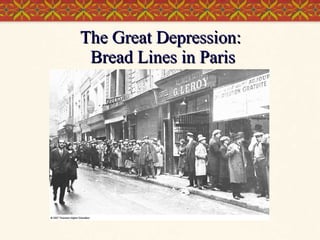
The Great Depression:  Bread Lines in Paris
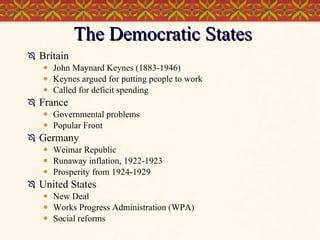
The Democratic States Britain John Maynard Keynes (1883-1946) Keynes argued for putting people to work  Called for deficit spending France Governmental problems Popular Front Germany Weimar Republic Runaway inflation, 1922-1923 Prosperity from 1924-1929 United States New Deal Works Progress Administration (WPA) Social reforms
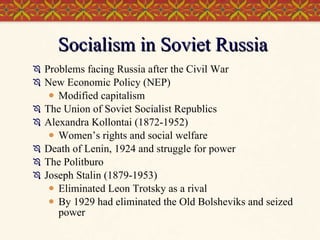
Socialism in Soviet Russia Problems facing Russia after the Civil War New Economic Policy (NEP) Modified capitalism The Union of Soviet Socialist Republics Alexandra Kollontai (1872-1952) Women’s rights and social welfare Death of Lenin, 1924 and struggle for power The Politburo Joseph Stalin (1879-1953) Eliminated Leon Trotsky as a rival By 1929 had eliminated the Old Bolsheviks and seized power

His 2002 Ch 22

  • 1.
    The Beginning ofthe Twentieth-Century Crisis: War and Revolution 22
  • 2.
    The Road toWorld War I Nationalism and Internal Dissent Rivalries over colonies Nationalism Socialist labor movements create fear nations on the eve of revolution Militarism Conscription Russia an army of 1.3 million; France and Germany, 900,000 Influence of military leaders Complex military plans Inflexibility of military plans
  • 3.
    The Outbreak ofWar: Summer of 1914 Serbia, supported by Russia, determined to create a large, independent Slavic state in the Balkans Assassination of Francis Ferdinand Bosnian activist working for a Serbian terrorist organization with an aim for a pan-Slavic kingdom Austria-Hungary sought German support for fear of Russia’s alliance with Serbia Austria declared war on Serbia July 28, 1914 Germany declared war on Russia August, 1, 1914
  • 4.
    Impact of theSchlieffen Plan Because Russia and France had a military alliance since 1894, General Alfred von Schlieffen devised a two-front military plan on both countries First, invade and defeat France, then deploy German army to the east against Russia Germany declared war on France Britain declared war on Germany August 4 – all great powers of Europe were at war
  • 5.
  • 6.
    The Great War1914-1915: Illusions and Stalemate Visions of the war Failure of the Schlieffen Plan First Battle of the Marne, September 6-10, 1914 Russian failures Battle of Tannenberg, August 30, 1914 Battle of Masurian Lakes, September 15, 1914 Driven out of Galicia and Serbia Italy enters the war on the Allied side
  • 7.
  • 8.
    World War I,1914-1918
  • 9.
    1916 – 1917: The Great Slaughter Trench warfare “No man’s land” No plan for fighting a trench war Battle of Verdun, 1916, 700,000 killed Horrors of trench warfare
  • 10.
    World War I,cont’d Entry of the United States Sinking of the Lusitania , May 7, 1915 German return to unrestricted submarine warfare United States enters the war, April 6, 1917 Bolshevik Revolution, 1917
  • 11.
    The Widening ofthe War Ottoman Empire took Germany’s side Russia, Great Britain, and France declared war on Ottoman Battle of Gallipoli, April 1915 Bulgaria entered the war, September 1915, on the side of the Central Powers (Germany, Austria-Hungary, Ottoman) A Global Conflict Italy enters the war, May 1915, against Austria-Hungary In the Middle East, Lawrence of Arabia incited Arab princes against Ottoman British mobilized forces from India, Australia, and New Zealand Allies seize German colonies in Africa -- Togoland, Cameroons, South West Africa, and German East Africa, Pacific Allied governments used Africans as soldiers and labor Chinese and Indochinese were used to work in European factories as laborers Japan joined Allies to seize control of German territories in Asia Japan took German territories in China, Marshall, Mariana, and Caroline Islands
  • 12.
  • 13.
  • 14.
    The Home Front: The Impact of Total War Political Centralization and Economic Regimentation With great demands for men and material, governments extended their powers Drafted tens of millions of young men Free market systems shelved so governments could test price, wage, and rent controls Food supplies and materials rationed Nationalized transportation systems and industries
  • 15.
    Control of PublicOpinion Casualties grew Patriotic enthusiasm waned Government took strenuous measures to fight opposition Expansion of police measures to stifle dissent Use of propaganda to arouse enthusiasm
  • 16.
    Women in theWar Effort New role for women Took over male jobs and responsibilities, even chimney sweeps and truck drivers Wages increased but never equaled men’s Jobs not secure After war, governments removed women from jobs Wages were lowered Positive impact: women’s movement for political emancipation Right to vote (Britain in 1918, later in Germany and Austria) Women took jobs, had apartments, smoked in public, wore shorter dresses, adopted radical hairstyles
  • 17.
    Territorial Changes inEurope and Middle East After World War I
  • 18.
    Crisis in Russiaand the End of the War The Russian Revolution Problems of Tsar Nicholas II Military problems Influence of Rasputin The March Revolution Strikes led by women with soldiers in Petrograd, March, 1917 Provisional government, Alexander Kerensky, continued war Government faced soviets, or councils of workers’ and soldiers’ deputies, who sprang up in army units, factory towns, and rural areas Soviets were from the lower classes with radical interests and largely groups of socialists, including Bolsheviks
  • 19.
    Lenin and theBolshevik Revolution Vladimir Ulianov Lenin (1870-1824) Bolsheviks a party dedicated to revolution which can destroy the capitalist system Exiled in Switzerland, German shipped Lenin to Russia to create disorder Bolsheviks promised masses: redistribution of land to peasants, transfer of factories and industries from capitalists to workers, relegation of government power from Provisional Government to soviets Bolshevik program’s three slogans: “ Peace, Land, Bread” “ Worker Control of Production “ All Power to the Soviets” Collapse of Provisional Government, November 6-7, 1917 Bolsheviks were renamed the Communists Treaty of Brest-Litovsk, March 3, 1918 giving up Poland, Ukraine, Finland, and Baltic Provinces Promised peace, but country sank into civil war
  • 20.
    Civil War Oppositionto Communist regime from groups loyal to tsar, bourgeois and aristocratic liberals, and anti-Leninst socialists Allied Troops sent to Russia to fight Communist (Red) Army White army from Siberia defeated Urkraine retaken, along with Caucasus: Georgia, Russian Armenia, and Azerbaijan How the Bolsheviks won? Leon Trotsky “ war communism”, “revolutionary terror”, Red secret police unleashed Red Terror, chekka Allied intervention Communist regime transformed Russia into a bureaucratically centralized state with a single party
  • 21.
    The Last Yearof the War Last German offensive, March - July, 1918 Allied counterattack, Second Battle of the Marne, July 18, 1918 William II abdicated, November 9, 1918 Armistice, November 11, 1918 The Casualties of War Devastated European civilization 8-9 million soldiers dead, 22 million wounded Birthrate declined Lost generation of war veterans Civilians died from war injuries and starvation 600,000 Armenians killed, 500,000 deported with 400,000 dying on their way to safe haven
  • 22.
    The Peace SettlementPalace of Versailles, January 1919, 27 Allied nations Woodrow Wilson, Fourteen Points Georges Clemenceau of France concerned with his nation’s security Clemenceau and Lloyd George determined to punish Germany Agreement to create the League of Nations
  • 23.
    The Treaty ofVersailles Five separate treaties (Germany, Austria, Hungary, Bulgaria, and Turkey), the most important being the Treaty of Versailles with Germany Treaty with Germany signed June 28, 1919 Article 231, War Guilt Clause Army reduced to 100,000 men, reduce navy, eliminate the air force Return to France Alsace and Lorraine and sections of Prussia given to Poland Demilitarized zone on the Rhine
  • 24.
    The Other PeaceTreaties Territorial changes in Europe Austro-Hungarian Empire disappears Germany and Russia lose territory Finland, Latvia, Estonia, Lithuania, Poland, Czechoslovakia, Austria, and Hungary As a result of compromises, virtually every eastern European state was left with a minorities problem Dismemberment of the Ottoman Empire Mandates France given control of Lebanon and Syria while Britain received Iraq and Palestine
  • 25.
    The Search forStability Uneasy Peace, Uncertain Security Weaknesses of the League of Nations Allied Reparations Commission, April 1921 Consequences of French occupation of the Ruhr valley Dawes Plan, August 1924 Treaty of Locarno, 1925 Kellogg-Briand pact, 1926 Disarmament
  • 26.
    The Great DepressionTwo events set the stage for the depression Problems in domestic economies International financial crisis Problems of the 1920’s Crash of the American stock market, October 1929 World wide problems High unemployment Bank failures Governments relied on: Balanced budgets, lowering of wages, and raising tariffs Increased involvement of the government into economics Renewed interest in Marxist principles
  • 27.
    The Great Depression: Bread Lines in Paris
  • 28.
    The Democratic StatesBritain John Maynard Keynes (1883-1946) Keynes argued for putting people to work Called for deficit spending France Governmental problems Popular Front Germany Weimar Republic Runaway inflation, 1922-1923 Prosperity from 1924-1929 United States New Deal Works Progress Administration (WPA) Social reforms
  • 29.
    Socialism in SovietRussia Problems facing Russia after the Civil War New Economic Policy (NEP) Modified capitalism The Union of Soviet Socialist Republics Alexandra Kollontai (1872-1952) Women’s rights and social welfare Death of Lenin, 1924 and struggle for power The Politburo Joseph Stalin (1879-1953) Eliminated Leon Trotsky as a rival By 1929 had eliminated the Old Bolsheviks and seized power