HINDUISM
Chapter 3
Section 2
Origins
Hinduism is a collection of religious
beliefs that developed slowly over a
long period of time.
Hindus believe that their religion helps
you free your soul from the sadness,
disappointments, and mistakes of
everyday life.
Unlike other major religions like
Buddhism, Islam, Christianity, &
Judaism, it cannot be traced back to a
single founder.
The main symbol of
Hinduism is called Om
(or Aum). It represents
the spirit of all things in
the world. The name
“Om” represents the
sound that was made
when the universe was
created.
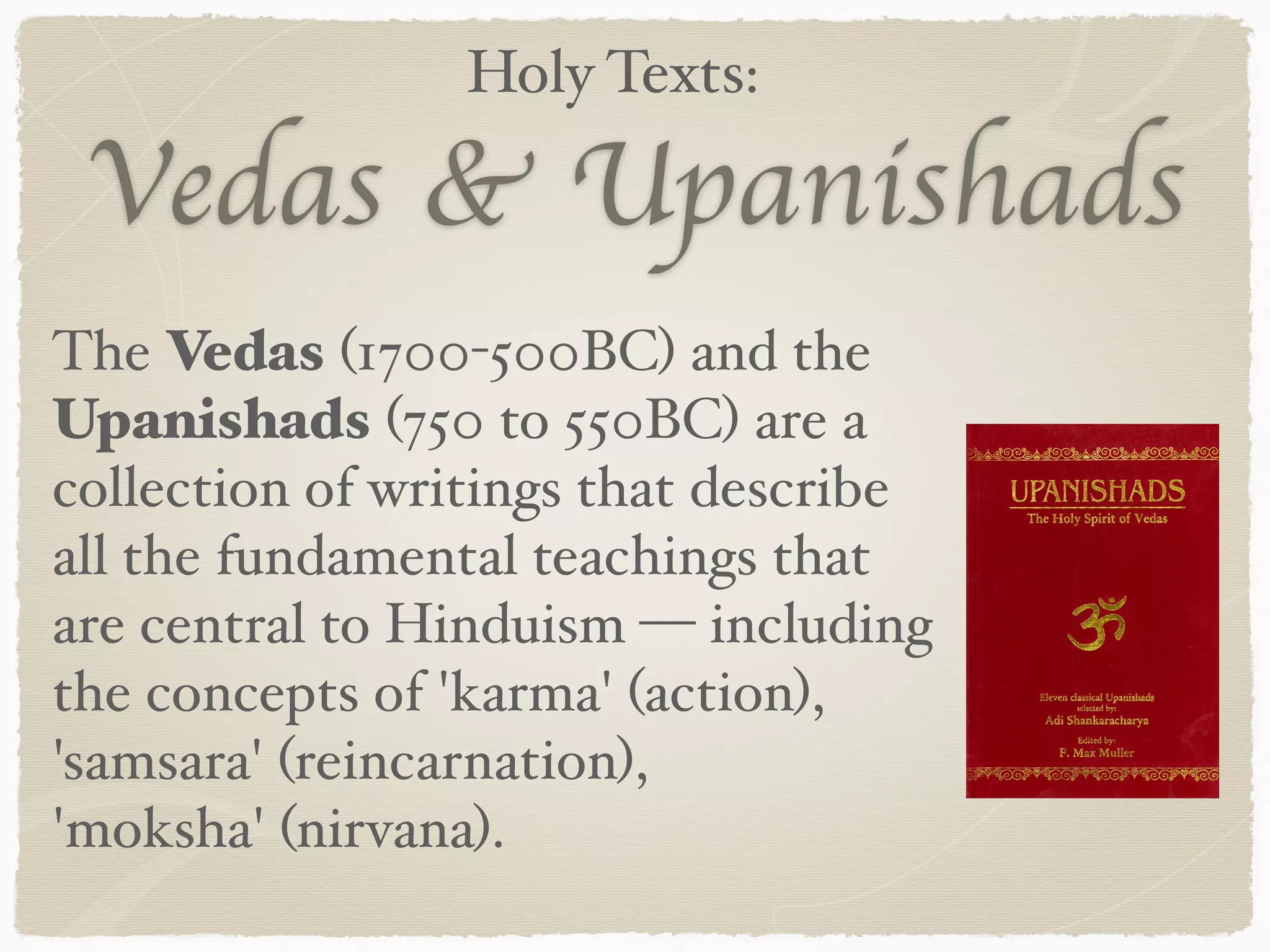
Vedas & Upanishads
The Vedas (1700-500BC) and the
Upanishads (750 to 550BC) are a
collection of writings that describe
all the fundamental teachings that
are central to Hinduism — including
the concepts of 'karma' (action),
'samsara' (reincarnation),
'moksha' (nirvana).
Holy Texts:
Reincarnation
This is the concept that the soul
is immortal, and all life forms are
reborn into a new entity after
death. The key word is entity: you
do not have a guarantee of being
reborn as a human being.
The soul travels from one body to
the next.
Belief:
The body is
temporary: it dies.
The soul is eternal
& indestructible.
Karma
Karma is the concept that if you
do good deeds, good things will
happen in your life. If you do bad
deeds, bad things will happen to
you in life.
Further, if you live a good life
(doing good deeds, being a spiritual
follower of Hinduism), you will be
reincarnated into a higher form, if
you live a bad life, you will be
reincarnated into a lower form.
Belief:
Do you believe in Karma?
MokshaMoksha is when your soul becomes free from the cycle of
rebirth, and is no longer reincarnated. This happens after you
reach the highest level of rebirth, and you can can’t be born
into a higher form. When you reach Moksha, it means you
have had all of life’s experiences, learned all of life’s lessons,
and reached a perfect understanding of the universe. Instead
of being reincarnated, your soul becomes one with god.
Belief:
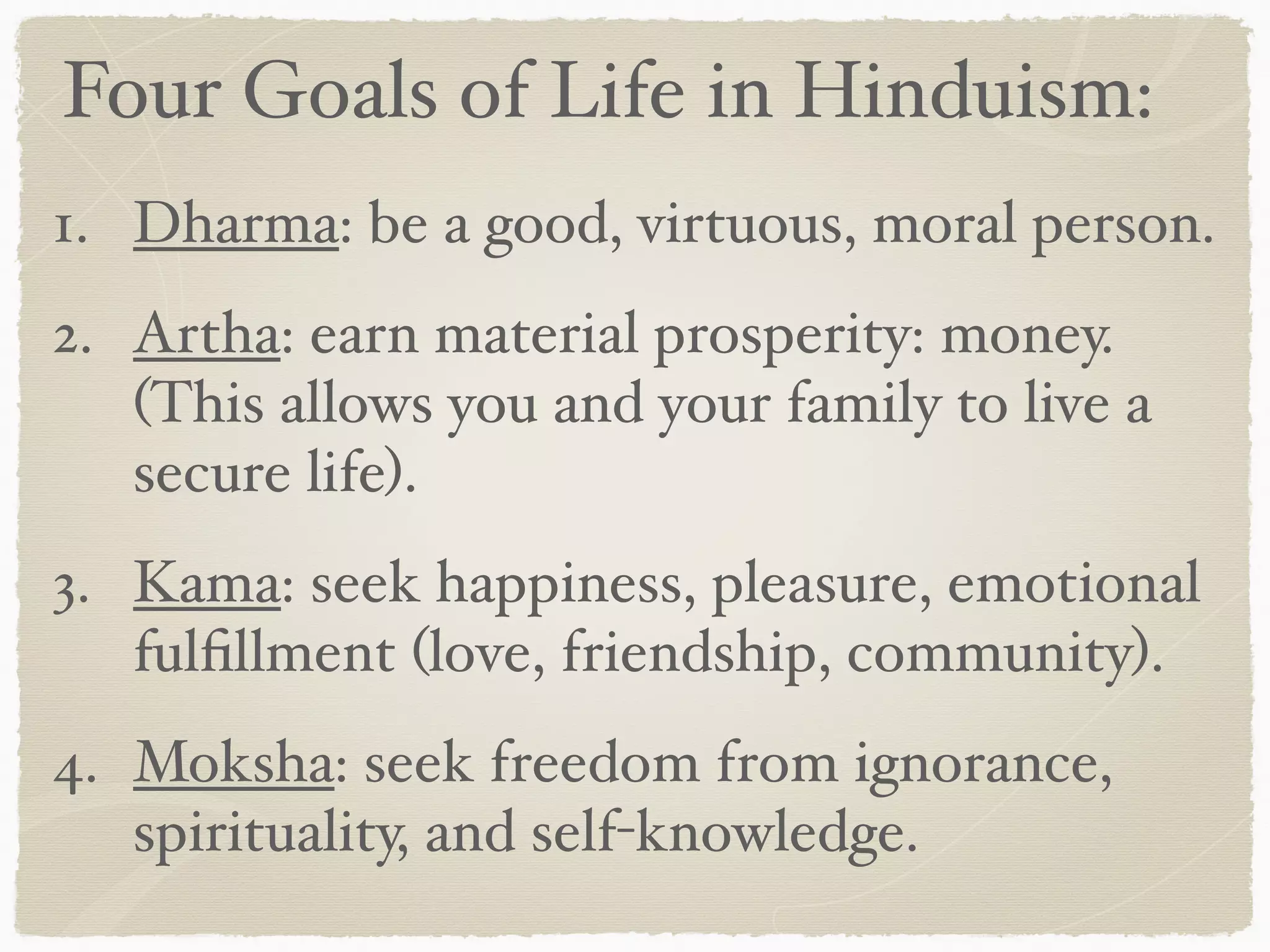
1. Dharma: be a good, virtuous, moral person.
2. Artha: earn material prosperity: money.
(This allows you and your family to live a
secure life).
3. Kama: seek happiness, pleasure, emotional
fulfillment (love, friendship, community).
4. Moksha: seek freedom from ignorance,
spirituality, and self-knowledge.
Four Goals of Life in Hinduism:
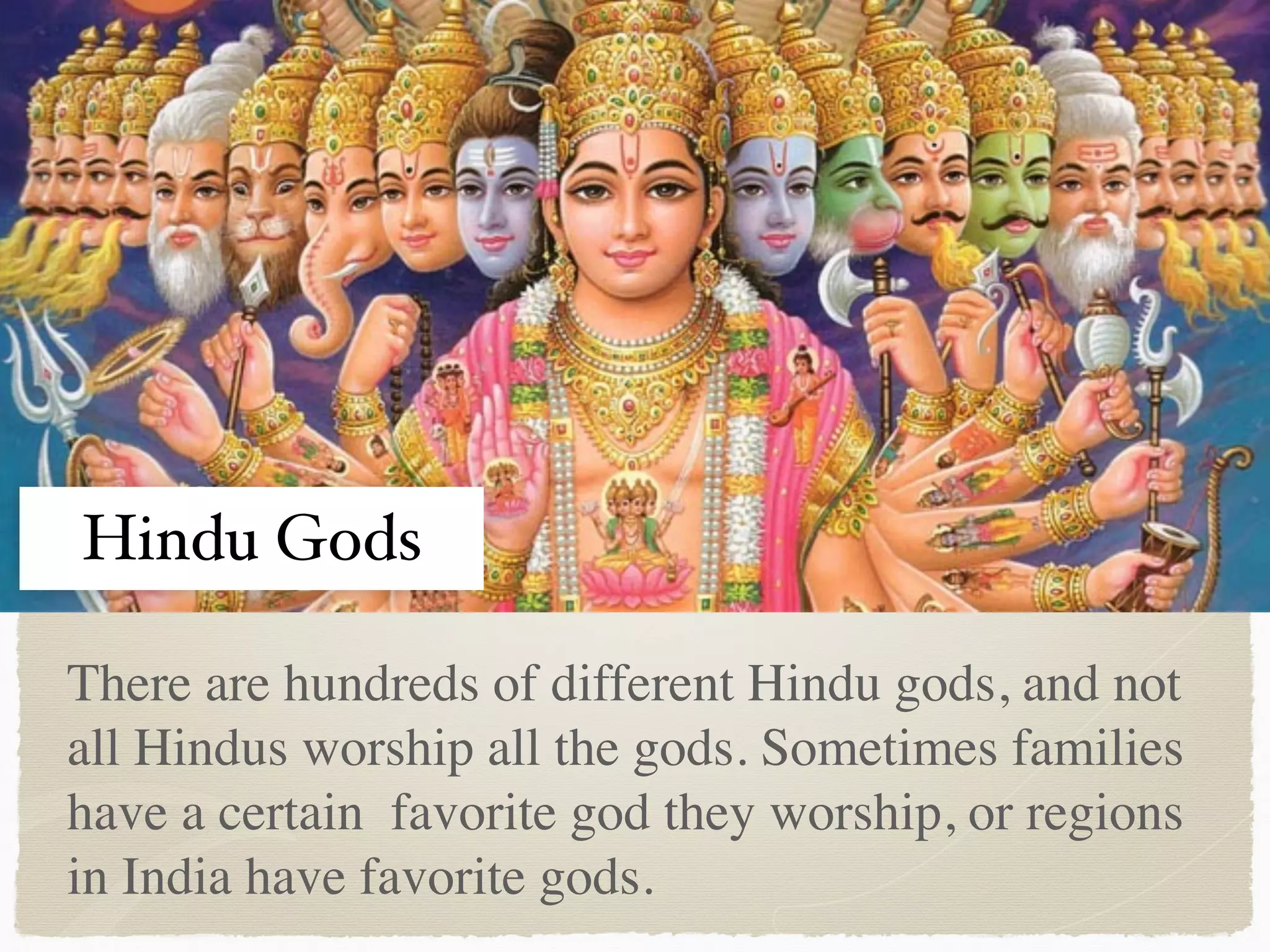
There are hundreds of different Hindu gods, and not
all Hindus worship all the gods. Sometimes families
have a certain favorite god they worship, or regions
in India have favorite gods.
Hindu Gods
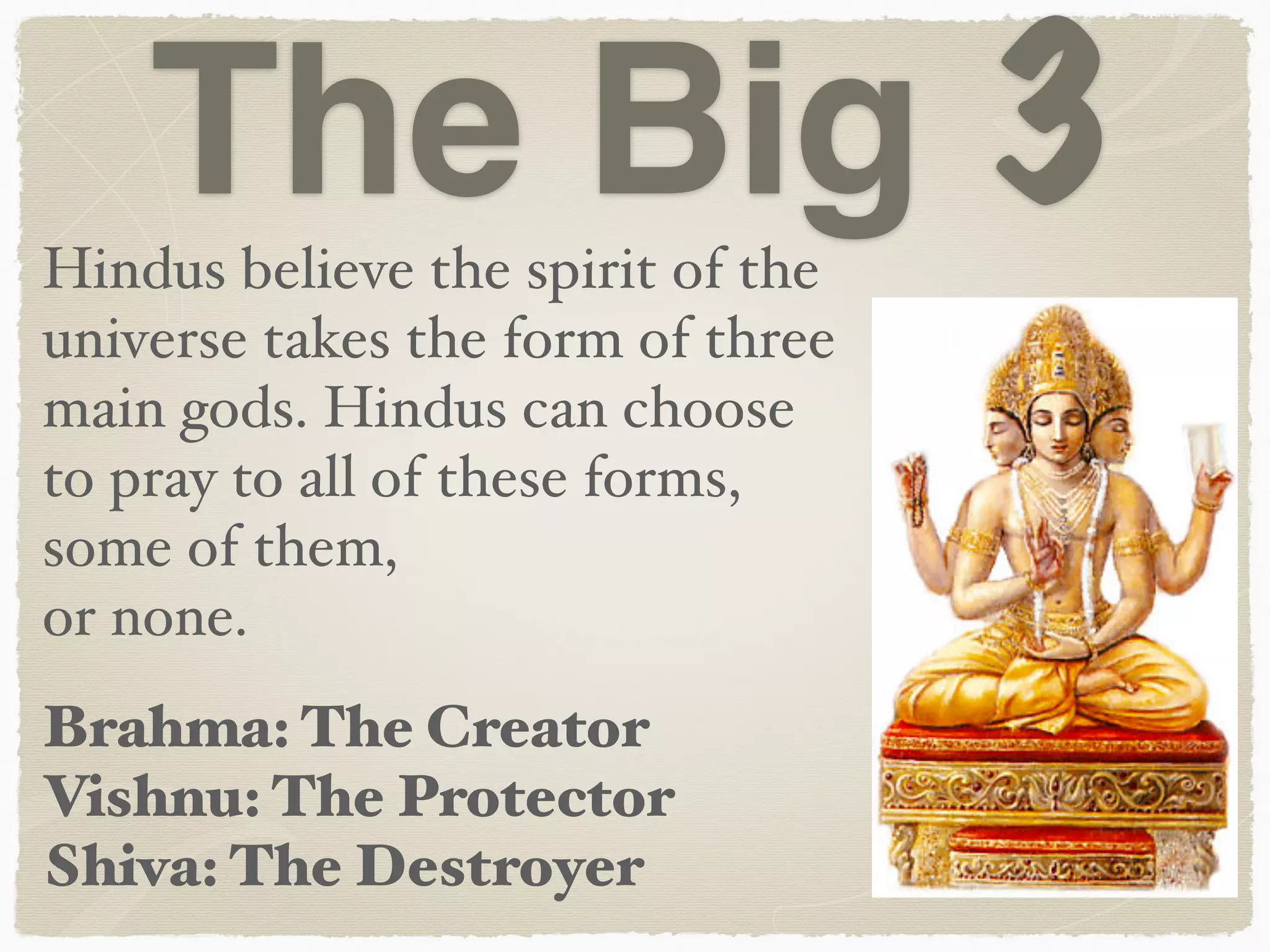
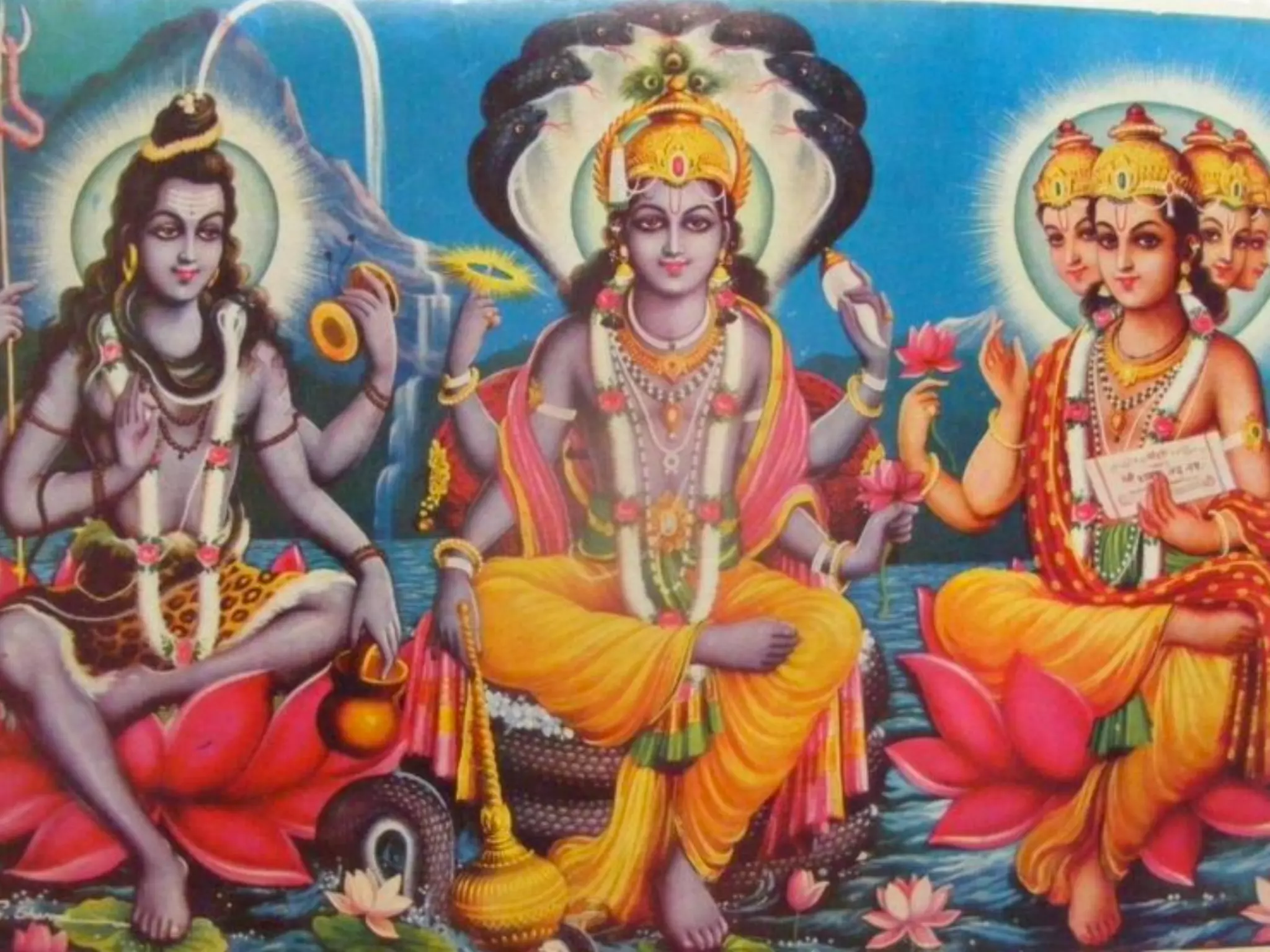
The Big 3Hindus believe the spirit of the
universe takes the form of three
main gods. Hindus can choose
to pray to all of these forms,
some of them, 

or none.
Brahma: The Creator

Vishnu: The Protector

Shiva: The Destroyer
Hindu Diet
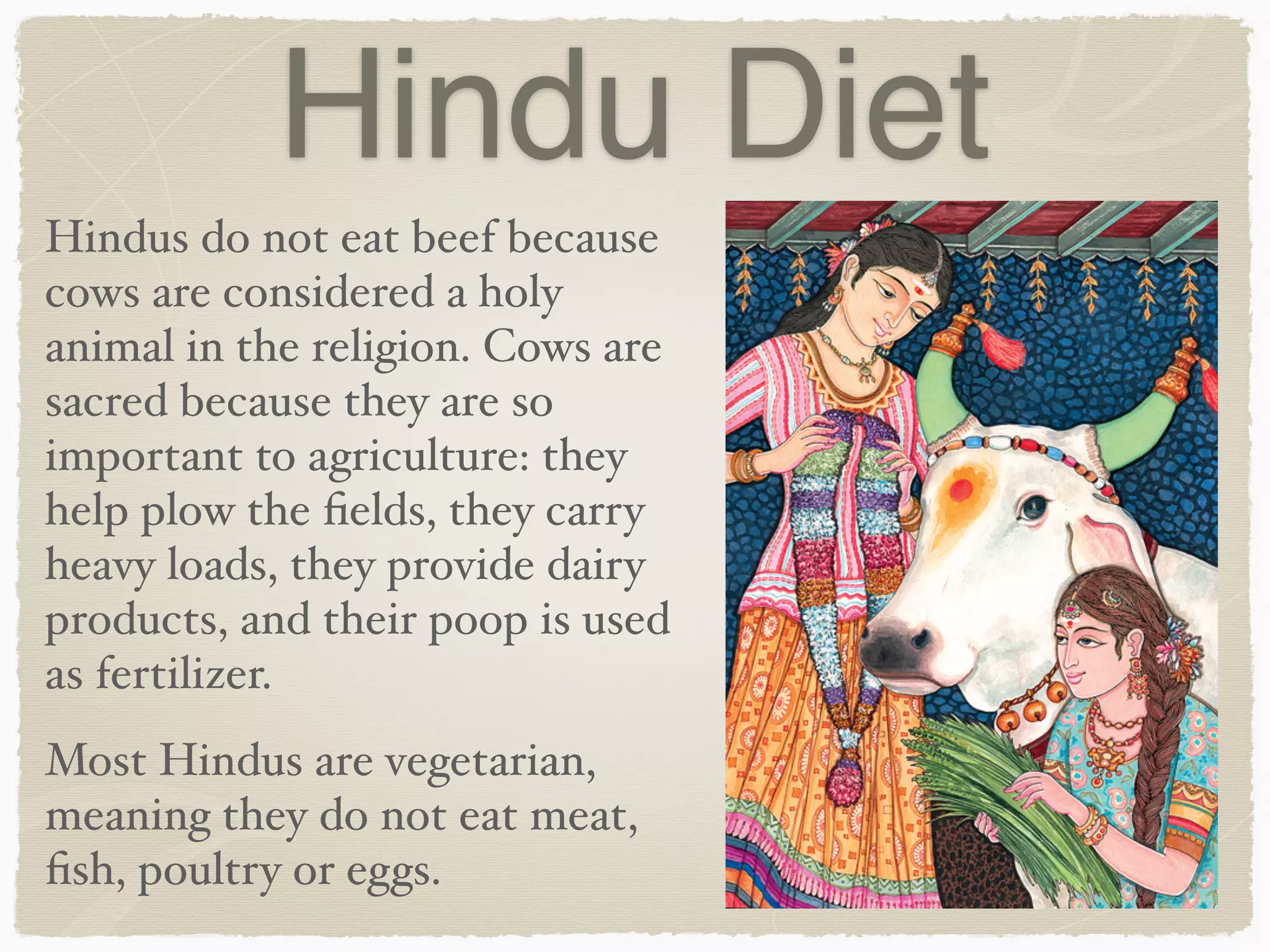
Hindus do not eat beef because
cows are considered a holy
animal in the religion. Cows are
sacred because they are so
important to agriculture: they
help plow the fields, they carry
heavy loads, they provide dairy
products, and their poop is used
as fertilizer.
Most Hindus are vegetarian,
meaning they do not eat meat,
fish, poultry or eggs.
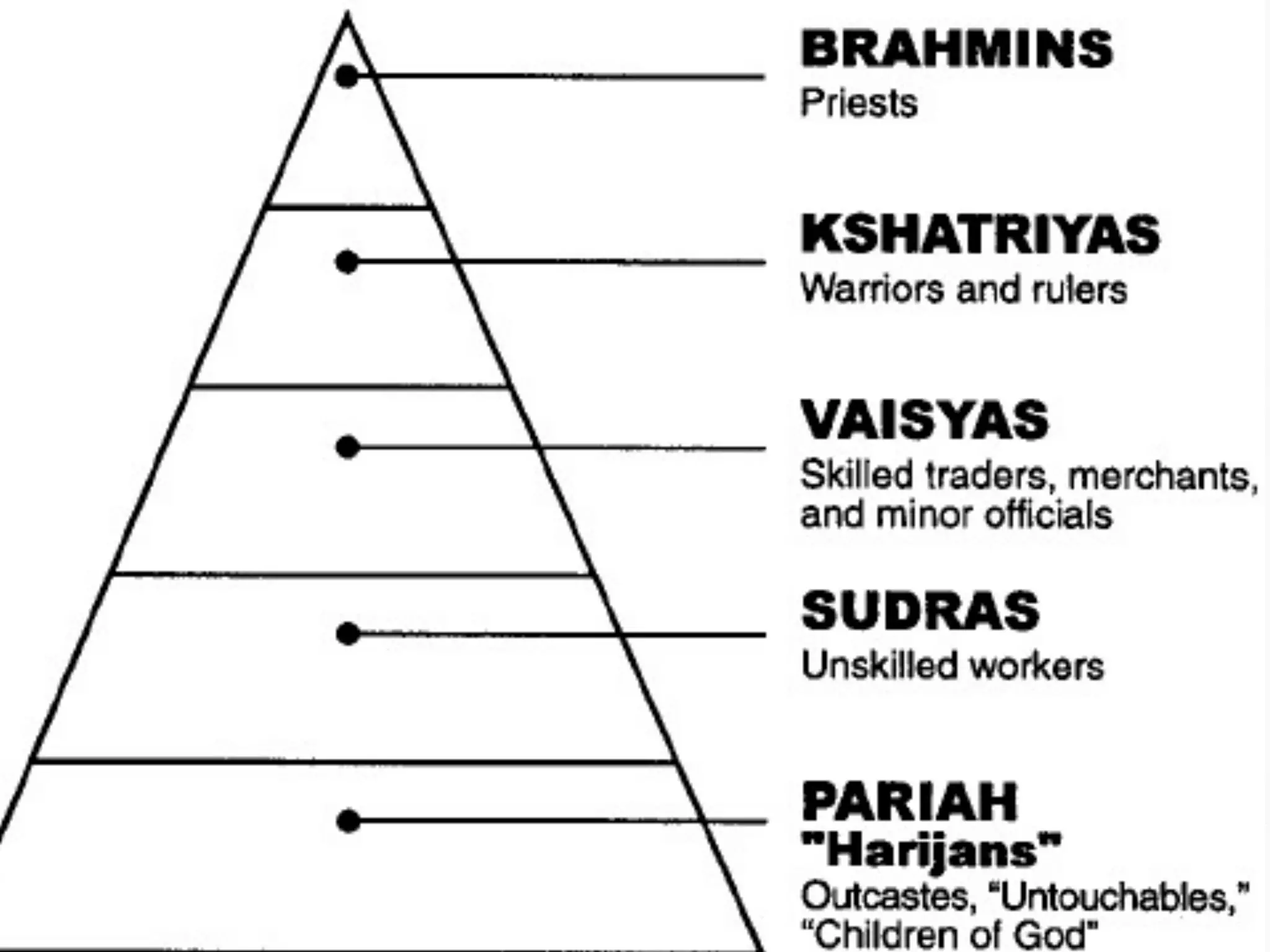
Caste System
The Caste System is a system where
people are born into certain social
classes, and they CANNOT change
their social class. Your social class is
determined by Karma: if you are a good
person you will be born into a higher
social class in your next life.
Under the Caste System, who you can
marry, what jobs you can have, and
where you can live are restricted by
your social class.
The system is less frequent than it was in the past, but still exists
in rural areas of India today.
Priests
Warriors
Merchants
Unskilled Laborers
-
Outcastes
Caste System Activity
Questions
1. How did you feel being a ____________?
(3-4 sentences).
2. Would you want to redraw your card? Why
or why not?
3. From the video, what did you find the most
interesting and/or shocking? Summarize with
your reactions in one paragraph.
RELIGIOUS CALENDAR
PROJECT
http://www.teacherharris.com/uploads/
2/3/7/0/23702810/religious_calendar_project.pdf

Hinduism Slides

  • 1.
  • 4.
    Origins Hinduism is acollection of religious beliefs that developed slowly over a long period of time. Hindus believe that their religion helps you free your soul from the sadness, disappointments, and mistakes of everyday life. Unlike other major religions like Buddhism, Islam, Christianity, & Judaism, it cannot be traced back to a single founder. The main symbol of Hinduism is called Om (or Aum). It represents the spirit of all things in the world. The name “Om” represents the sound that was made when the universe was created.
  • 5.
    Vedas & Upanishads TheVedas (1700-500BC) and the Upanishads (750 to 550BC) are a collection of writings that describe all the fundamental teachings that are central to Hinduism — including the concepts of 'karma' (action), 'samsara' (reincarnation), 'moksha' (nirvana). Holy Texts:
  • 6.
    Reincarnation This is theconcept that the soul is immortal, and all life forms are reborn into a new entity after death. The key word is entity: you do not have a guarantee of being reborn as a human being. The soul travels from one body to the next. Belief: The body is temporary: it dies. The soul is eternal & indestructible.
  • 7.
    Karma Karma is theconcept that if you do good deeds, good things will happen in your life. If you do bad deeds, bad things will happen to you in life. Further, if you live a good life (doing good deeds, being a spiritual follower of Hinduism), you will be reincarnated into a higher form, if you live a bad life, you will be reincarnated into a lower form. Belief:
  • 8.
    Do you believein Karma?
  • 9.
    MokshaMoksha is whenyour soul becomes free from the cycle of rebirth, and is no longer reincarnated. This happens after you reach the highest level of rebirth, and you can can’t be born into a higher form. When you reach Moksha, it means you have had all of life’s experiences, learned all of life’s lessons, and reached a perfect understanding of the universe. Instead of being reincarnated, your soul becomes one with god. Belief:
  • 10.
    1. Dharma: bea good, virtuous, moral person. 2. Artha: earn material prosperity: money. (This allows you and your family to live a secure life). 3. Kama: seek happiness, pleasure, emotional fulfillment (love, friendship, community). 4. Moksha: seek freedom from ignorance, spirituality, and self-knowledge. Four Goals of Life in Hinduism:
  • 11.
    There are hundredsof different Hindu gods, and not all Hindus worship all the gods. Sometimes families have a certain favorite god they worship, or regions in India have favorite gods. Hindu Gods
  • 12.
    The Big 3Hindusbelieve the spirit of the universe takes the form of three main gods. Hindus can choose to pray to all of these forms, some of them, 
 or none. Brahma: The Creator
 Vishnu: The Protector
 Shiva: The Destroyer
  • 14.
    Hindu Diet Hindus donot eat beef because cows are considered a holy animal in the religion. Cows are sacred because they are so important to agriculture: they help plow the fields, they carry heavy loads, they provide dairy products, and their poop is used as fertilizer. Most Hindus are vegetarian, meaning they do not eat meat, fish, poultry or eggs.
  • 17.
    Caste System The CasteSystem is a system where people are born into certain social classes, and they CANNOT change their social class. Your social class is determined by Karma: if you are a good person you will be born into a higher social class in your next life. Under the Caste System, who you can marry, what jobs you can have, and where you can live are restricted by your social class. The system is less frequent than it was in the past, but still exists in rural areas of India today.
  • 18.
  • 19.
    Caste System Activity Questions 1.How did you feel being a ____________? (3-4 sentences). 2. Would you want to redraw your card? Why or why not? 3. From the video, what did you find the most interesting and/or shocking? Summarize with your reactions in one paragraph.
  • 20.