Securing High Security Facility within the United Kingdom,
Requiring specialist High Security Fencing
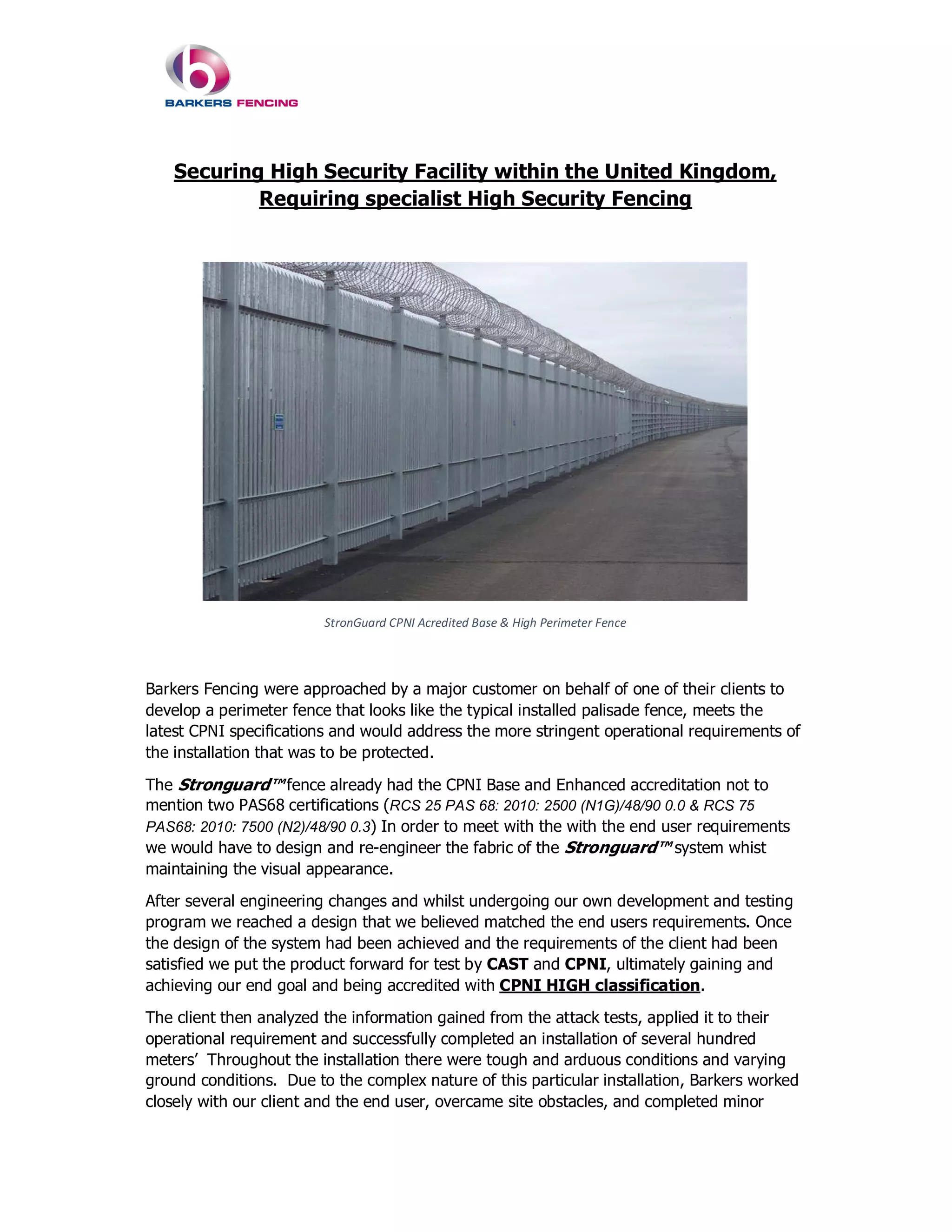
StronGuard CPNI Acredited Base & High Perimeter Fence
Barkers Fencing were approached by a major customer on behalf of one of their clients to
develop a perimeter fence that looks like the typical installed palisade fence, meets the
latest CPNI specifications and would address the more stringent operational requirements of
the installation that was to be protected.
The Stronguard™ fence already had the CPNI Base and Enhanced accreditation not to
mention two PAS68 certifications (RCS 25 PAS 68: 2010: 2500 (N1G)/48/90 0.0 & RCS 75
PAS68: 2010: 7500 (N2)/48/90 0.3) In order to meet with the with the end user requirements
we would have to design and re-engineer the fabric of the Stronguard™ system whist
maintaining the visual appearance.
After several engineering changes and whilst undergoing our own development and testing
program we reached a design that we believed matched the end users requirements. Once
the design of the system had been achieved and the requirements of the client had been
satisfied we put the product forward for test by CAST and CPNI, ultimately gaining and
achieving our end goal and being accredited with CPNI HIGH classification.
The client then analyzed the information gained from the attack tests, applied it to their
operational requirement and successfully completed an installation of several hundred
meters’ Throughout the installation there were tough and arduous conditions and varying
ground conditions. Due to the complex nature of this particular installation, Barkers worked
closely with our client and the end user, overcame site obstacles, and completed minor
changes within the boundaries of the design to enable the system to be completed safely on
time and to a high level of quality and within budget. The site has been provided with a
High Security Fence successfully installed and fully operational which has readily addressed
a significant potential vulnerability to an enhanced threat assumption.

High Security Instalation

  • 1.
    Securing High SecurityFacility within the United Kingdom, Requiring specialist High Security Fencing StronGuard CPNI Acredited Base & High Perimeter Fence Barkers Fencing were approached by a major customer on behalf of one of their clients to develop a perimeter fence that looks like the typical installed palisade fence, meets the latest CPNI specifications and would address the more stringent operational requirements of the installation that was to be protected. The Stronguard™ fence already had the CPNI Base and Enhanced accreditation not to mention two PAS68 certifications (RCS 25 PAS 68: 2010: 2500 (N1G)/48/90 0.0 & RCS 75 PAS68: 2010: 7500 (N2)/48/90 0.3) In order to meet with the with the end user requirements we would have to design and re-engineer the fabric of the Stronguard™ system whist maintaining the visual appearance. After several engineering changes and whilst undergoing our own development and testing program we reached a design that we believed matched the end users requirements. Once the design of the system had been achieved and the requirements of the client had been satisfied we put the product forward for test by CAST and CPNI, ultimately gaining and achieving our end goal and being accredited with CPNI HIGH classification. The client then analyzed the information gained from the attack tests, applied it to their operational requirement and successfully completed an installation of several hundred meters’ Throughout the installation there were tough and arduous conditions and varying ground conditions. Due to the complex nature of this particular installation, Barkers worked closely with our client and the end user, overcame site obstacles, and completed minor
  • 2.
    changes within theboundaries of the design to enable the system to be completed safely on time and to a high level of quality and within budget. The site has been provided with a High Security Fence successfully installed and fully operational which has readily addressed a significant potential vulnerability to an enhanced threat assumption.