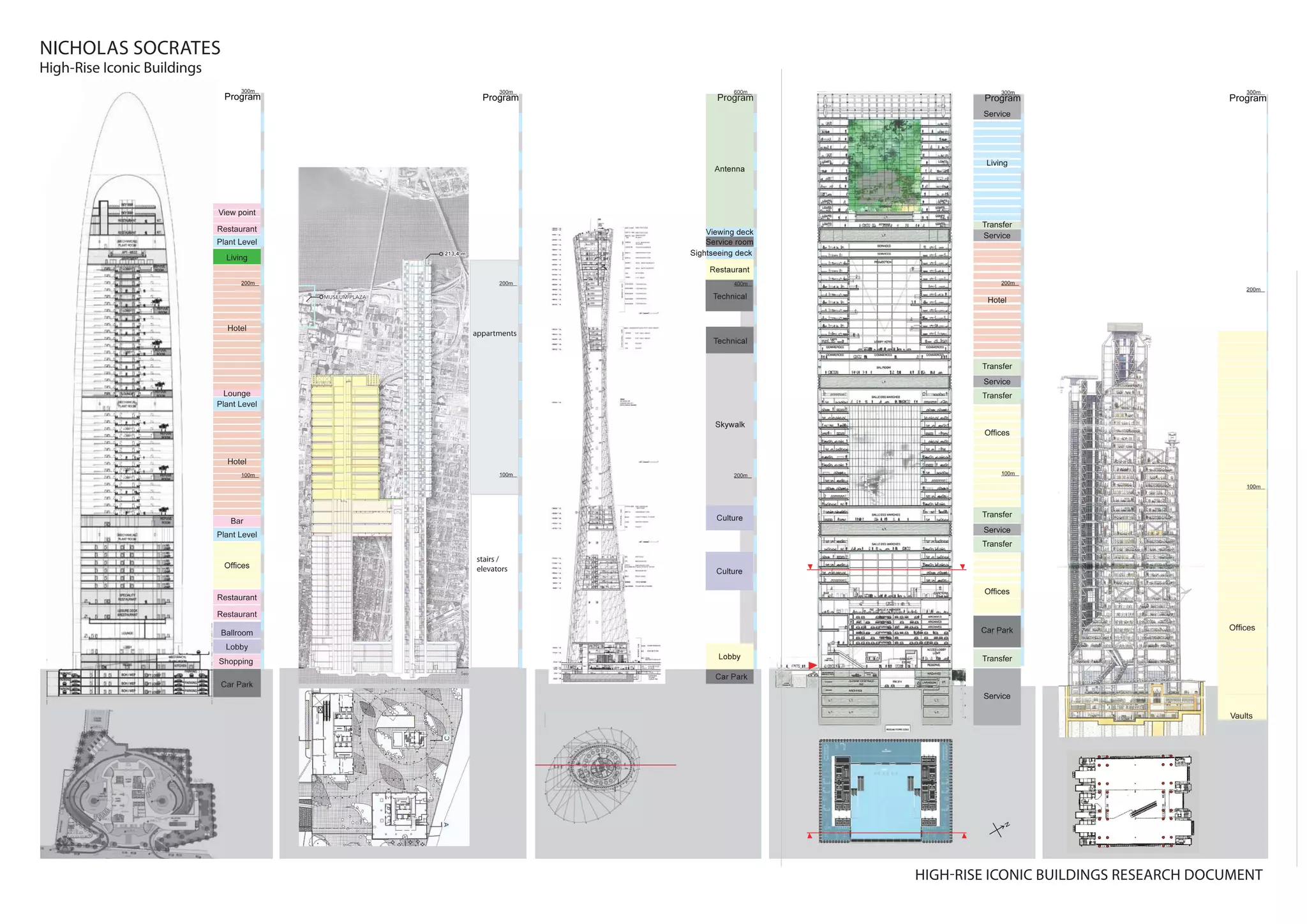
NICHOLAS SOCRATES
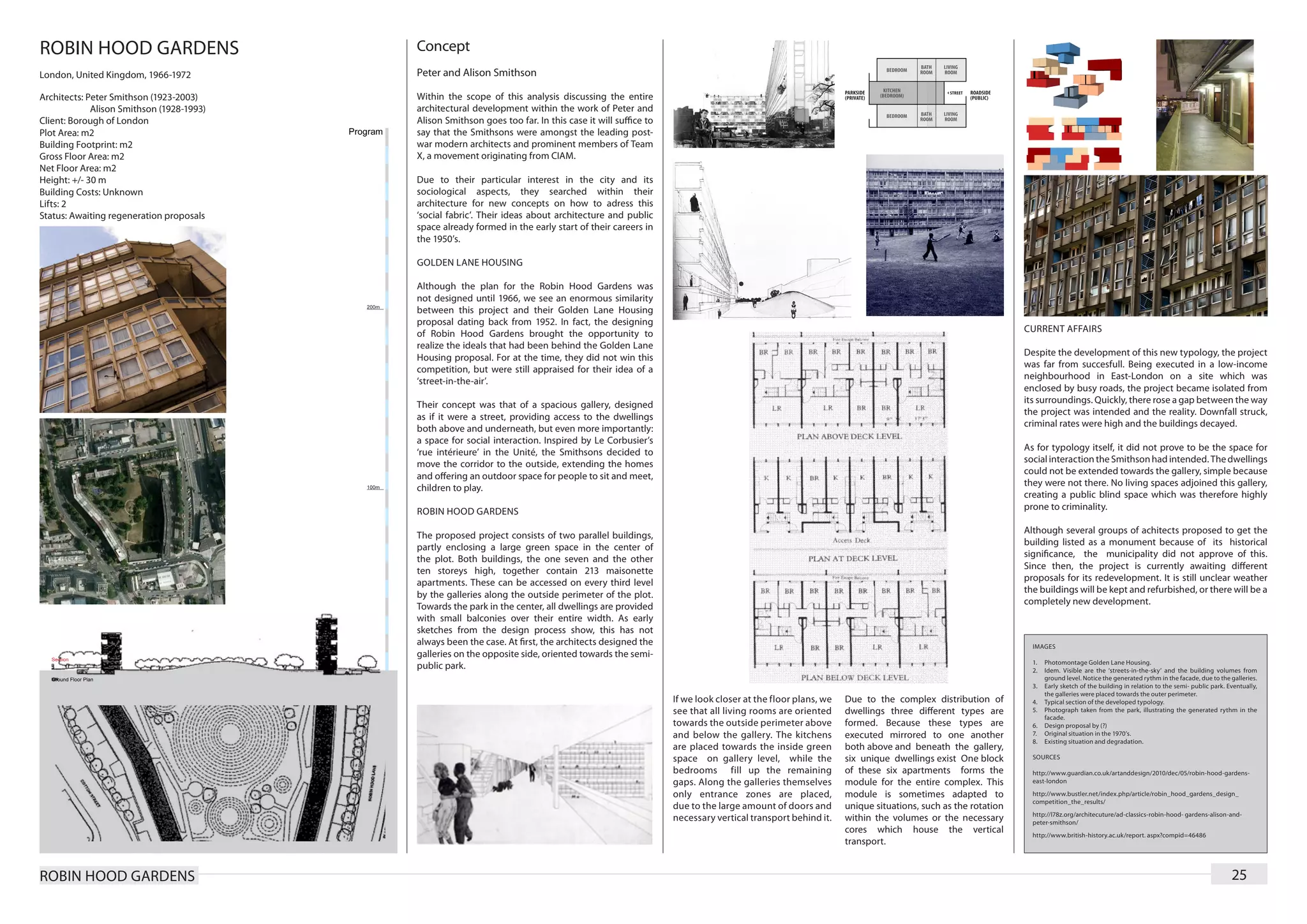
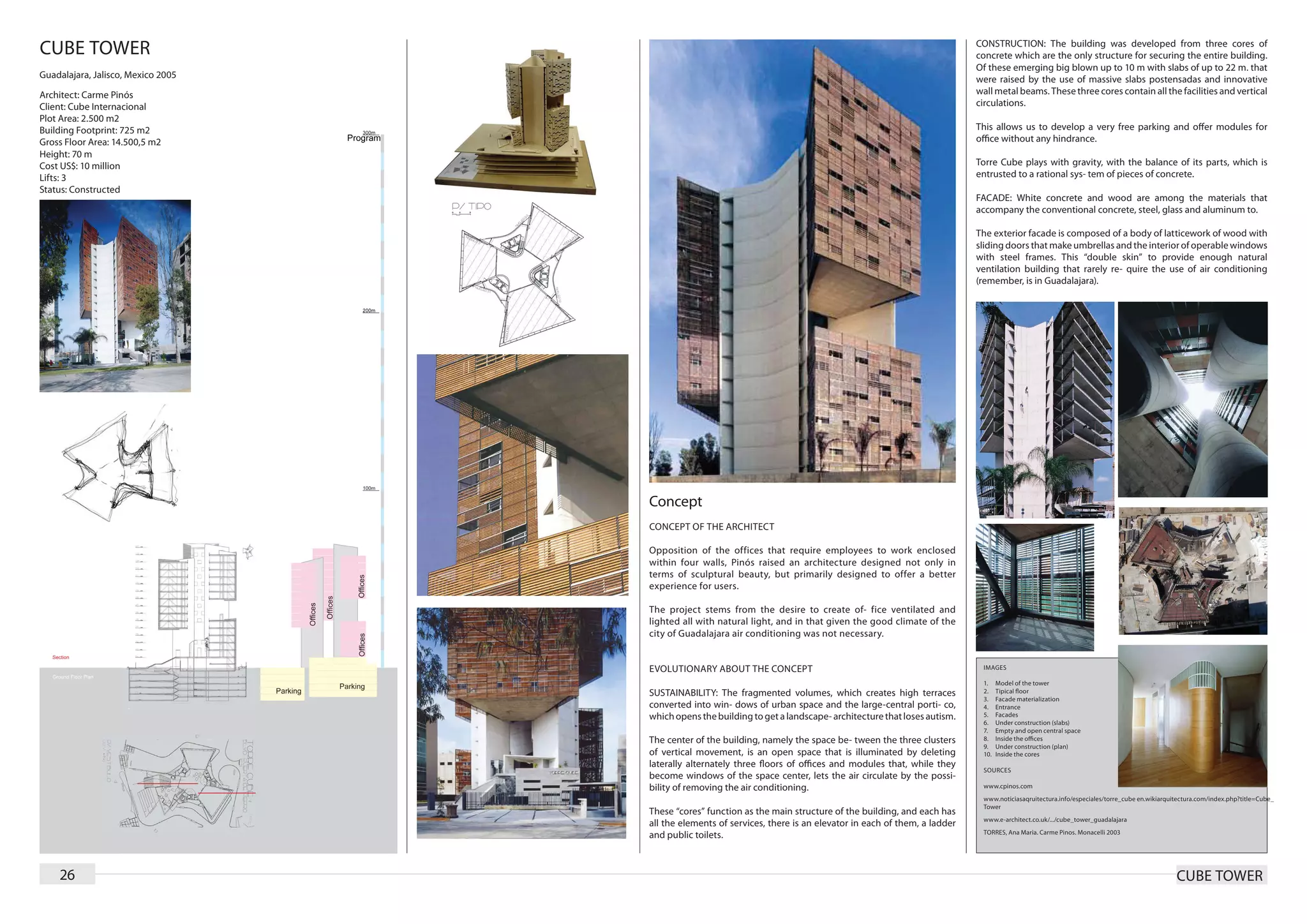
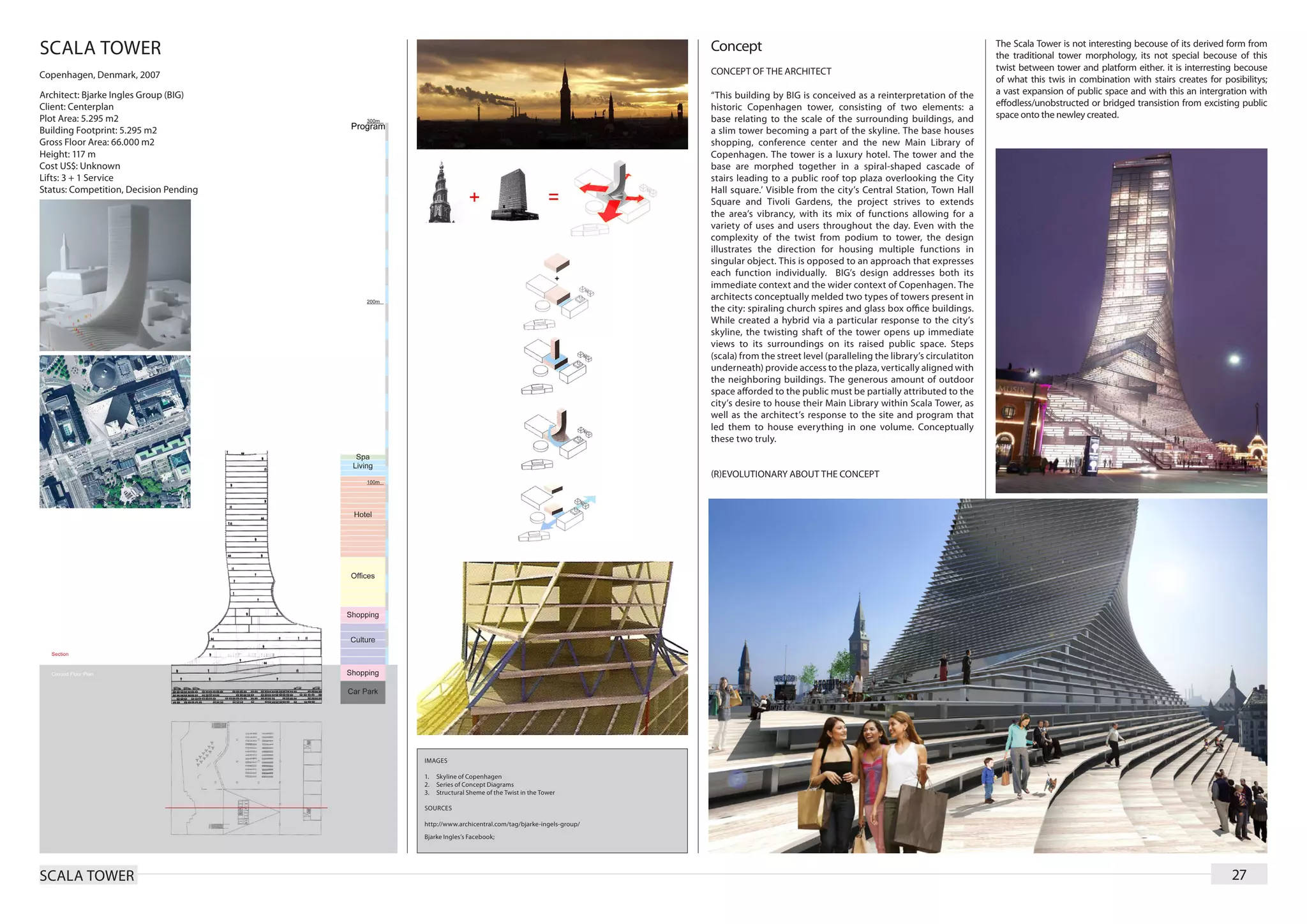
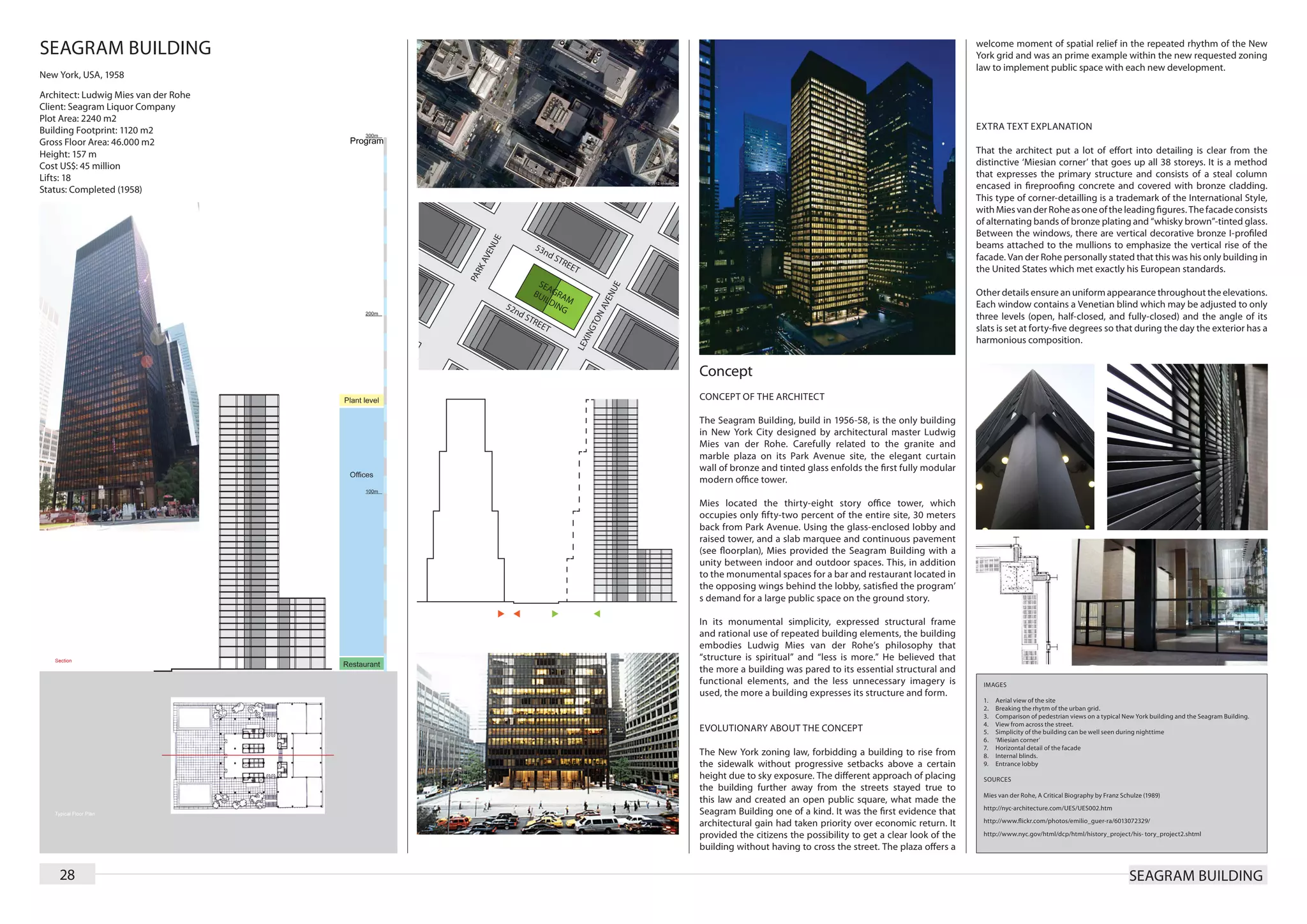
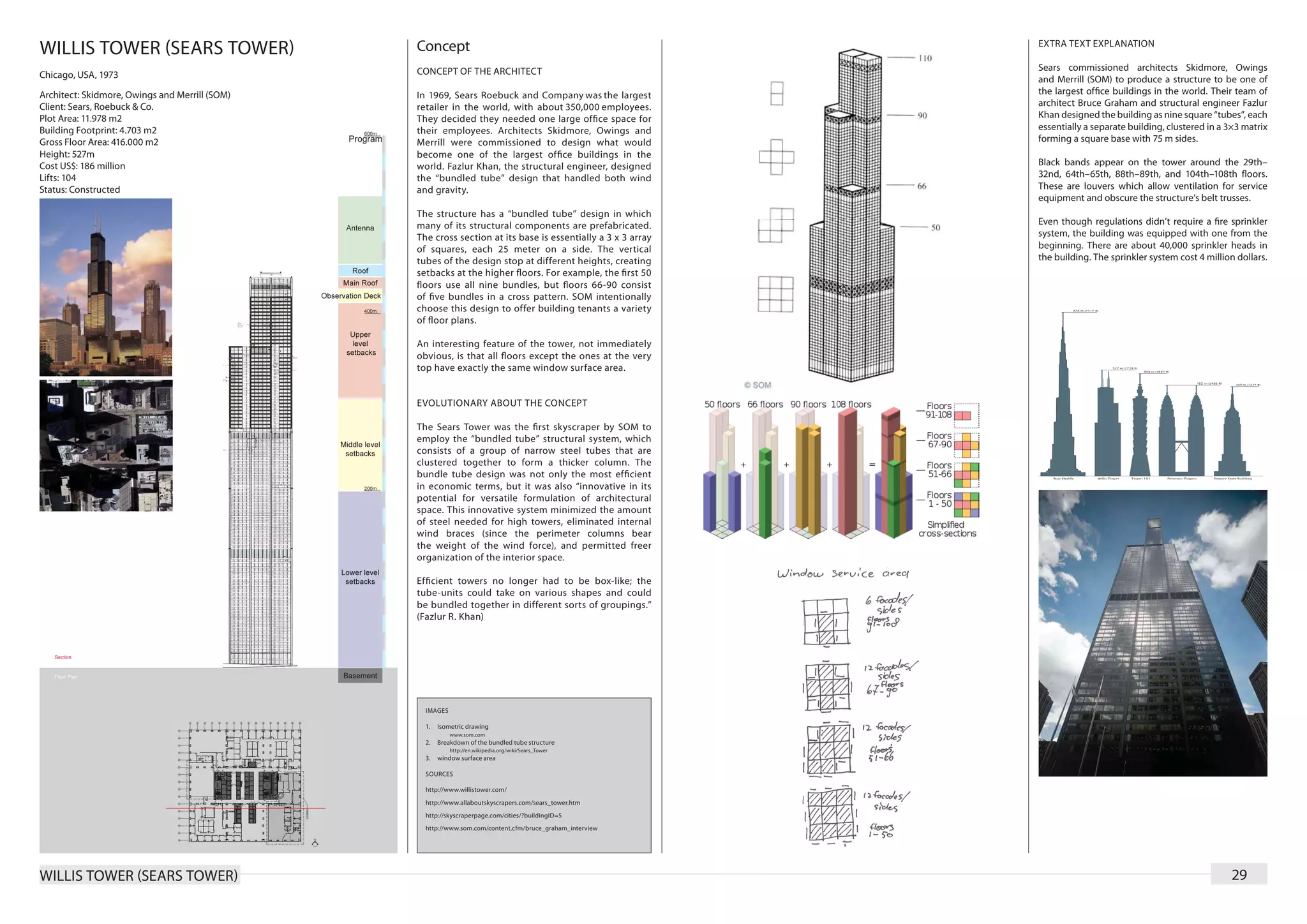
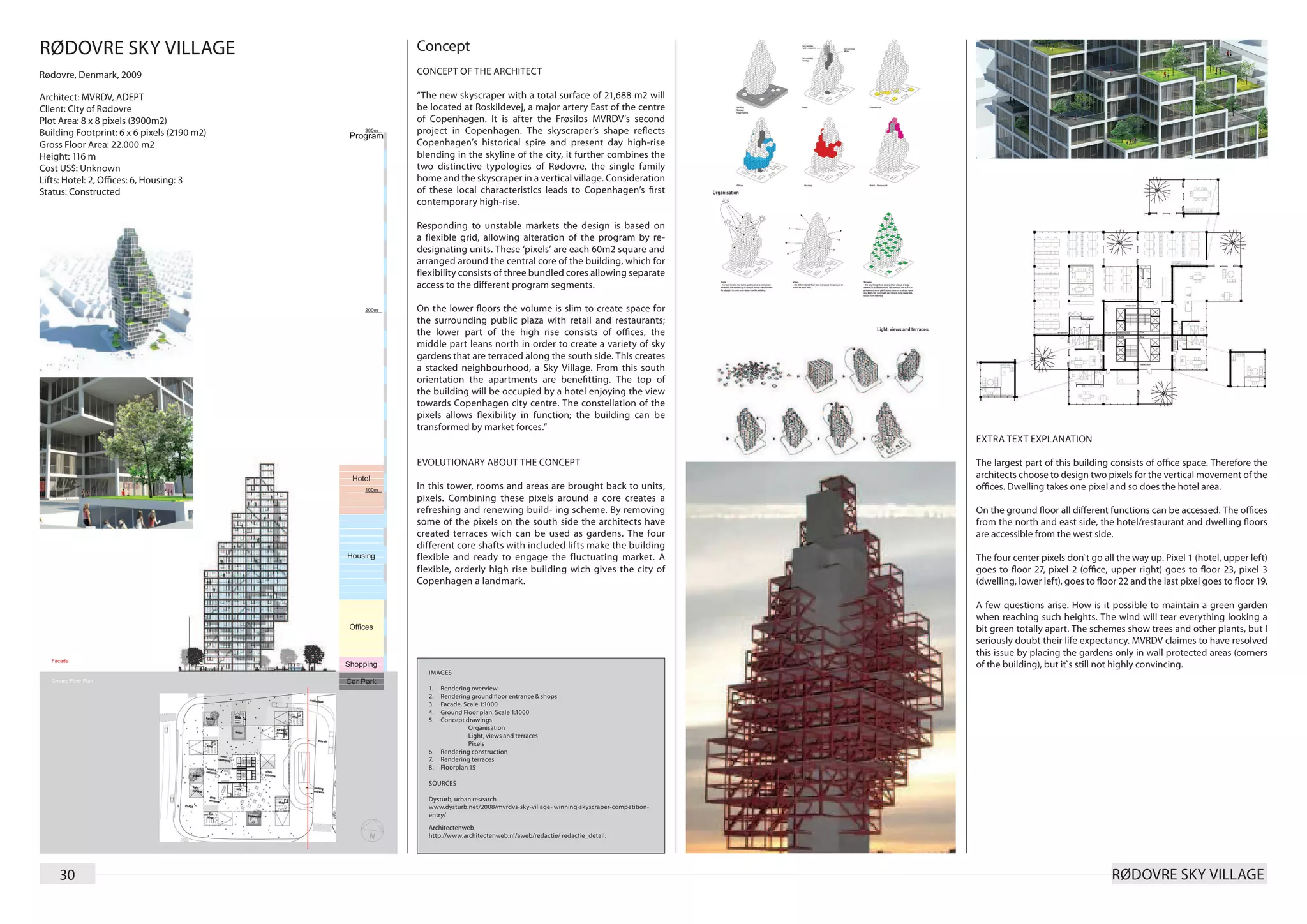
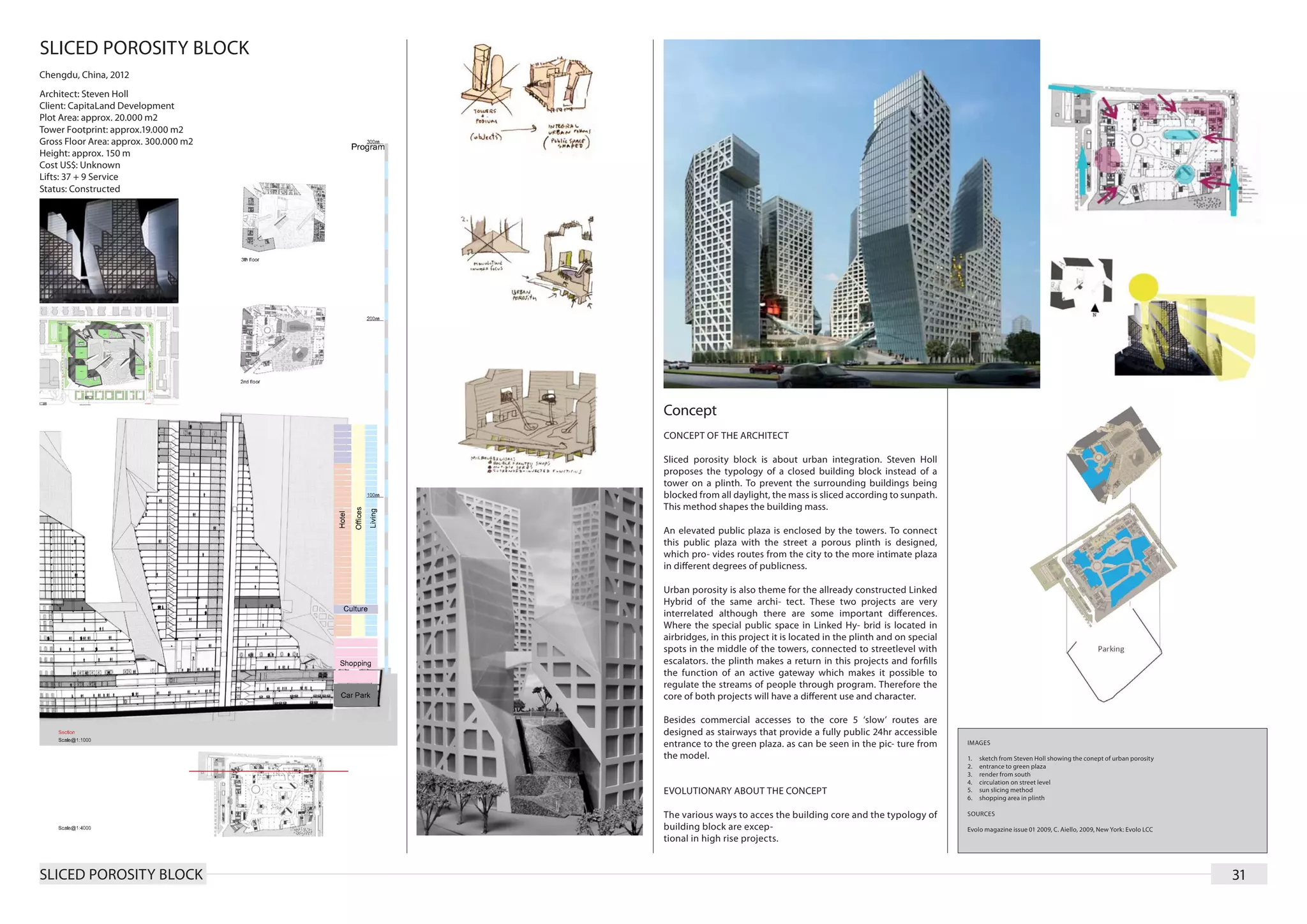
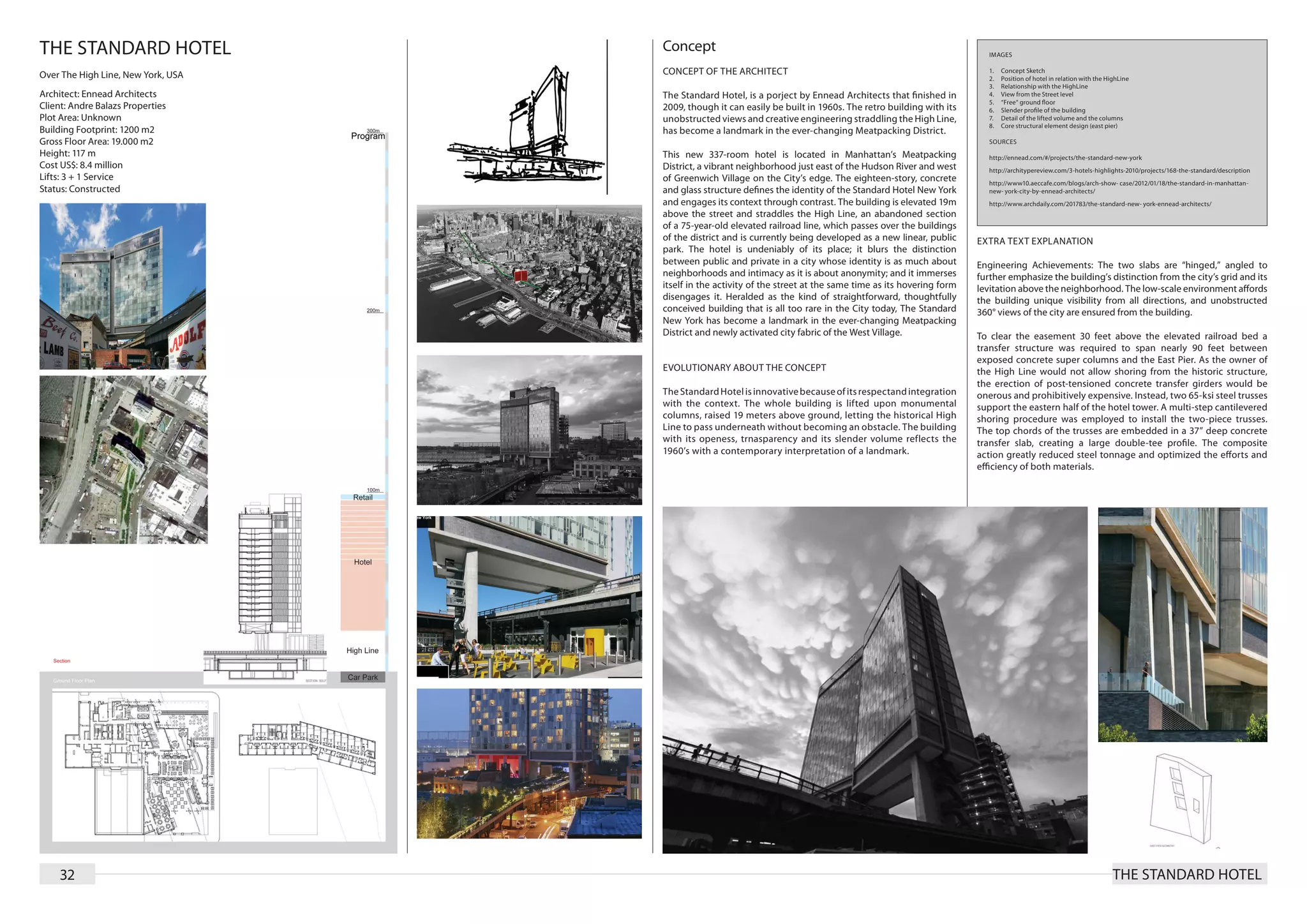
High-Rise Iconic Buildings


                             HIGH-RISE ICONIC BUILDINGS RESEARCH DOCUMENT
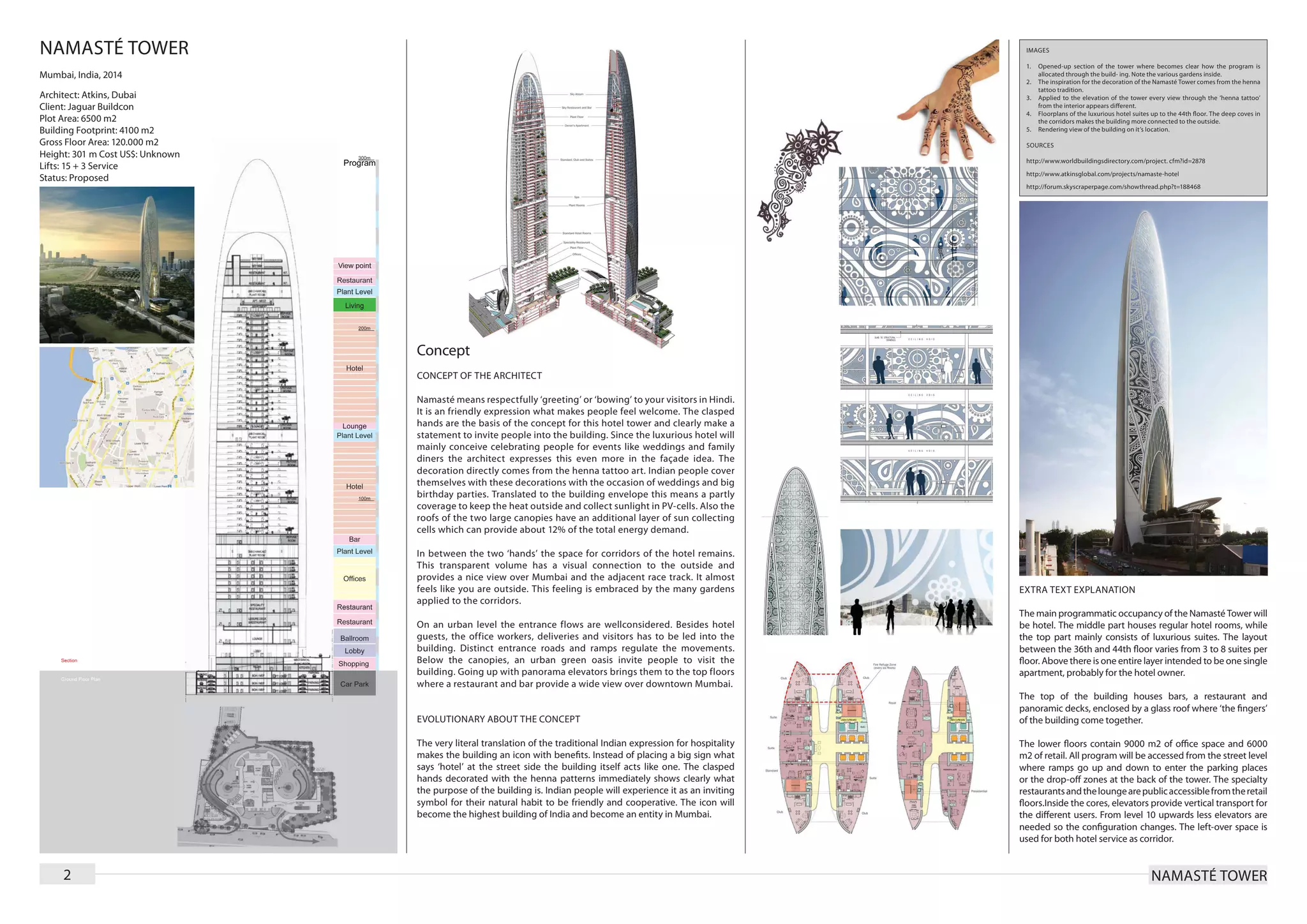
NAMASTÉ TOWER                                                                                                          IMAGES

                                                                                                                       1.	 Opened-up section of the tower where becomes clear how the program is
Mumbai, India, 2014                                                                                                        allocated through the build- ing. Note the various gardens inside.
                                                                                                                       2.	 The inspiration for the decoration of the Namasté Tower comes from the henna
                                                                                                                           tattoo tradition.
Architect: Atkins, Dubai                                                                                               3.	 Applied to the elevation of the tower every view through the ‘henna tattoo’
Client: Jaguar Buildcon                                                                                                    from the interior appears different.
                                                                                                                       4.	 Floorplans of the luxurious hotel suites up to the 44th floor. The deep coves in
Plot Area: 6500 m2                                                                                                         the corridors makes the building more connected to the outside.
Building Footprint: 4100 m2                                                                                            5.	 Rendering view of the building on it’s location.

Gross Floor Area: 120.000 m2                                                                                           SOURCES
Height: 301 m Cost US$: Unknown
                                                                                                                       http://www.worldbuildingsdirectory.com/project. cfm?id=2878
Lifts: 15 + 3 Service
                                                                                                                       http://www.atkinsglobal.com/projects/namaste-hotel
Status: Proposed
                                                                                                                       http://forum.skyscraperpage.com/showthread.php?t=188468


                                  Concept
                                  CONCEPT OF THE ARCHITECT

                                  Namasté means respectfully ‘greeting’ or ‘bowing’ to your visitors in Hindi.
                                  It is an friendly expression what makes people feel welcome. The clasped
                                  hands are the basis of the concept for this hotel tower and clearly make a
                                  statement to invite people into the building. Since the luxurious hotel will
                                  mainly conceive celebrating people for events like weddings and family
                                  diners the architect expresses this even more in the façade idea. The
                                  decoration directly comes from the henna tattoo art. Indian people cover
                                  themselves with these decorations with the occasion of weddings and big
                                  birthday parties. Translated to the building envelope this means a partly
                                  coverage to keep the heat outside and collect sunlight in PV-cells. Also the
                                  roofs of the two large canopies have an additional layer of sun collecting
                                  cells which can provide about 12% of the total energy demand.

                                  In between the two ‘hands’ the space for corridors of the hotel remains.
                                  This transparent volume has a visual connection to the outside and
                                  provides a nice view over Mumbai and the adjacent race track. It almost
                                  feels like you are outside. This feeling is embraced by the many gardens            EXTRA TEXT EXPLANATION
                                  applied to the corridors.
                                                                                                                      The main programmatic occupancy of the Namasté Tower will
                                  On an urban level the entrance flows are wellconsidered. Besides hotel              be hotel. The middle part houses regular hotel rooms, while
                                  guests, the office workers, deliveries and visitors has to be led into the          the top part mainly consists of luxurious suites. The layout
                                  building. Distinct entrance roads and ramps regulate the movements.                 between the 36th and 44th floor varies from 3 to 8 suites per
                                  Below the canopies, an urban green oasis invite people to visit the                 floor. Above there is one entire layer intended to be one single
                                  building. Going up with panorama elevators brings them to the top floors            apartment, probably for the hotel owner.
                                  where a restaurant and bar provide a wide view over downtown Mumbai.
                                                                                                                      The top of the building houses bars, a restaurant and
                                                                                                                      panoramic decks, enclosed by a glass roof where ‘the fingers’
                                  EVOLUTIONARY ABOUT THE CONCEPT                                                      of the building come together.

                                  The very literal translation of the traditional Indian expression for hospitality   The lower floors contain 9000 m2 of office space and 6000
                                  makes the building an icon with benefits. Instead of placing a big sign what        m2 of retail. All program will be accessed from the street level
                                  says ‘hotel’ at the street side the building itself acts like one. The clasped      where ramps go up and down to enter the parking places
                                  hands decorated with the henna patterns immediately shows clearly what              or the drop-off zones at the back of the tower. The specialty
                                  the purpose of the building is. Indian people will experience it as an inviting     restaurants and the lounge are public accessible from the retail
                                  symbol for their natural habit to be friendly and cooperative. The icon will        floors.Inside the cores, elevators provide vertical transport for
                                  become the highest building of India and become an entity in Mumbai.                the different users. From level 10 upwards less elevators are
                                                                                                                      needed so the configuration changes. The left-over space is
                                                                                                                      used for both hotel service as corridor.


     2                                                                                                                                                             NAMASTÉ TOWER
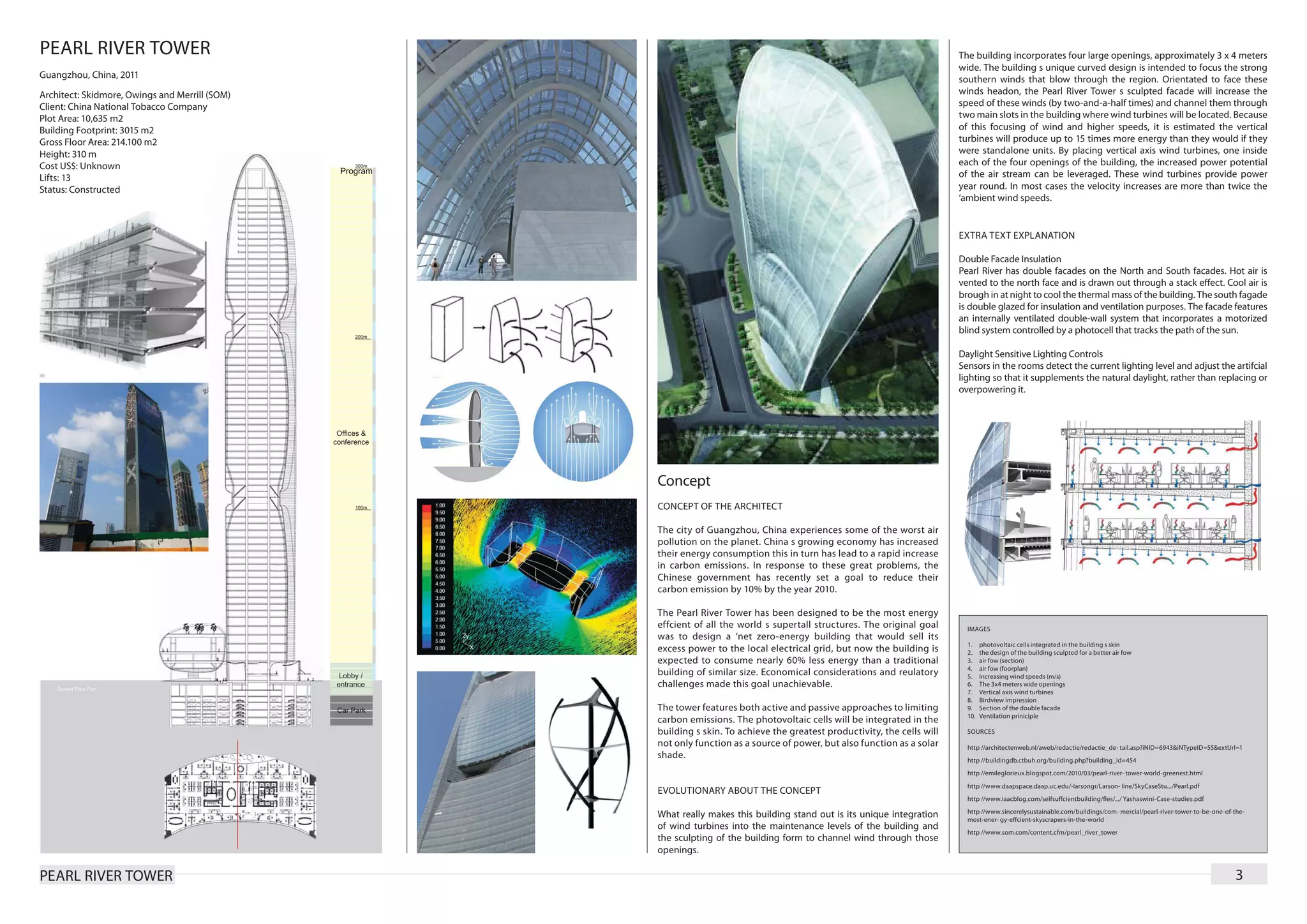
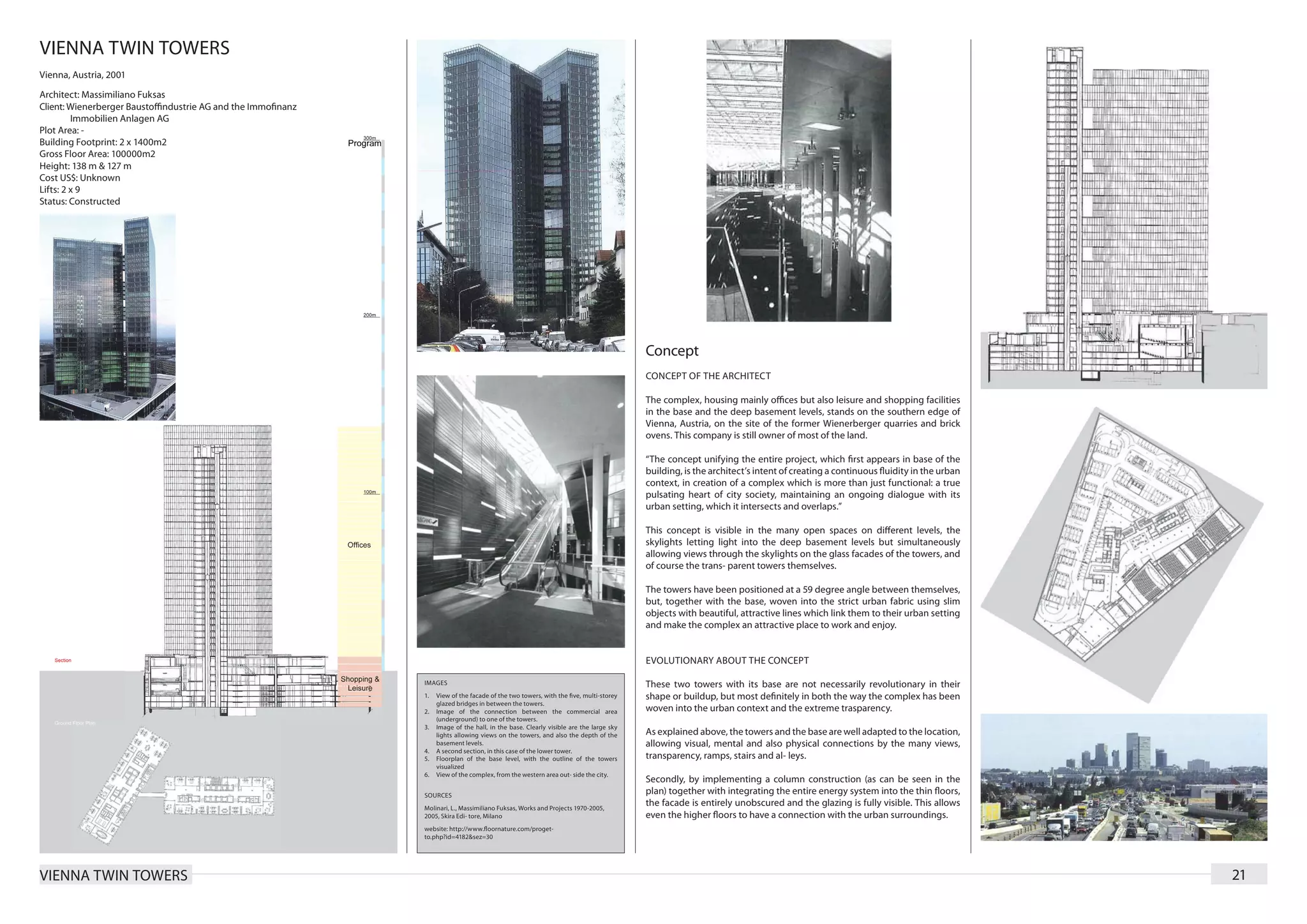
PEARL RIVER TOWER                                                                                                       The building incorporates four large openings, approximately 3 x 4 meters
                                                                                                                        wide. The building s unique curved design is intended to focus the strong
Guangzhou, China, 2011                                                                                                  southern winds that blow through the region. Orientated to face these
Architect: Skidmore, Owings and Merrill (SOM)                                                                           winds headon, the Pearl River Tower s sculpted facade will increase the
Client: China National Tobacco Company                                                                                  speed of these winds (by two-and-a-half times) and channel them through
Plot Area: 10,635 m2                                                                                                    two main slots in the building where wind turbines will be located. Because
Building Footprint: 3015 m2                                                                                             of this focusing of wind and higher speeds, it is estimated the vertical
Gross Floor Area: 214.100 m2                                                                                            turbines will produce up to 15 times more energy than they would if they
Height: 310 m                                                                                                           were standalone units. By placing vertical axis wind turbines, one inside
Cost US$: Unknown                                                                                                       each of the four openings of the building, the increased power potential
Lifts: 13                                                                                                               of the air stream can be leveraged. These wind turbines provide power
Status: Constructed                                                                                                     year round. In most cases the velocity increases are more than twice the
                                                                                                                        ‘ambient wind speeds.


                                                                                                                        EXTRA TEXT EXPLANATION

                                                                                                                        Double Facade Insulation
                                                                                                                        Pearl River has double facades on the North and South facades. Hot air is
                                                                                                                        vented to the north face and is drawn out through a stack effect. Cool air is
                                                                                                                        brough in at night to cool the thermal mass of the building. The south fagade
                                                                                                                        is double glazed for insulation and ventilation purposes. The facade features
                                                                                                                        an internally ventilated double-wall system that incorporates a motorized
                                                                                                                        blind system controlled by a photocell that tracks the path of the sun.

                                                                                                                        Daylight Sensitive Lighting Controls
                                                                                                                        Sensors in the rooms detect the current lighting level and adjust the artifcial
                                                                                                                        lighting so that it supplements the natural daylight, rather than replacing or
                                                                                                                        overpowering it.


                                                Concept
                                                CONCEPT OF THE ARCHITECT

                                                The city of Guangzhou, China experiences some of the worst air
                                                pollution on the planet. China s growing economy has increased
                                                their energy consumption this in turn has lead to a rapid increase
                                                in carbon emissions. In response to these great problems, the
                                                Chinese government has recently set a goal to reduce their
                                                carbon emission by 10% by the year 2010.

                                                The Pearl River Tower has been designed to be the most energy
                                                effcient of all the world s supertall structures. The original goal       IMAGES
                                                was to design a ‘net zero-energy building that would sell its
                                                                                                                          1.	    photovoltaic cells integrated in the building s skin
                                                excess power to the local electrical grid, but now the building is        2.	    the design of the building sculpted for a better air fow
                                                expected to consume nearly 60% less energy than a traditional             3.	    air fow (section)
                                                                                                                          4.	    air fow (foorplan)
                                                building of similar size. Economical considerations and reulatory         5.	    Increasing wind speeds (m/s)
                                                challenges made this goal unachievable.                                   6.	    The 3x4 meters wide openings
                                                                                                                          7.	    Vertical axis wind turbines
                                                                                                                          8.	    Birdview impression
                                                The tower features both active and passive approaches to limiting         9.	    Section of the double facade
                                                                                                                          10.	   Ventilation priniciple
                                                carbon emissions. The photovoltaic cells will be integrated in the
                                                building s skin. To achieve the greatest productivity, the cells will     SOURCES
                                                not only function as a source of power, but also function as a solar      http //architectenweb.nl/aweb/redactie/redactie_de- tail.asp?iNID=6943&iNTypeID=55&extUrl=1
                                                shade.                                                                    http //buildingdb.ctbuh.org/building.php?building_id=454
                                                                                                                          http //emileglorieux.blogspot.com/2010/03/pearl-river- tower-world-greenest.html
                                                                                                                          http //www.daapspace.daap.uc.edu/-larsongr/Larson- line/SkyCaseStu.../Pearl.pdf
                                                EVOLUTIONARY ABOUT THE CONCEPT
                                                                                                                          http //www.iaacblog.com/selfsuffcientbuilding/fles/.../ Yashaswini-Case-studies.pdf
                                                                                                                          http //www.sincerelysustainable.com/buildings/com- mercial/pearl-river-tower-to-be-one-of-the-
                                                What really makes this building stand out is its unique integration       most-ener- gy-effcient-skyscrapers-in-the-world
                                                of wind turbines into the maintenance levels of the building and
                                                                                                                          http //www.som.com/content.cfm/pearl_river_tower
                                                the sculpting of the building form to channel wind through those
                                                openings.

PEARL RIVER TOWER                                                                                                                                                                                                   3
TAIPEI PERFORMING ARTS CENTER                                   Concept                                                                                                                                                                  course- not freely accessible.

                                                                                                                                                                                                                                         At the basis lies a four legged table construction that is reinforced in the corners.
Taipei, Cheng De Road, Shilin District                                                                                                                                                                                                   Multiple variants of ‘stiffening’ are used to create a variety of identities for the legs.
                                                                CONCEPT OF THE ARCHITECT
Architect: Pieter Bannenberg, Walter van Dijk, Kamiel Klaasse                                                                                                                                                                            By expanding the legs towards the top automatically the spans are reduced. The
Client: Unkown                                                                                                                                                                                                                           structure in a way is an orthogonal version of a dome.
                                                                A building simple but sophisticated, elitist but accessible, simple but
Plot Area: Unknown                                              innovating. That was a challenge for NL Architects and it seems that they
Building Footprint: 110 x 80                                                                                                                                                                                                             The ground-level square bends up to allow cars and motor cycles to enter
                                                                managed to combine all the above elements by creating TPAC. The Taipei
Gross Floor Area: Unkown                                                                                                                                                                                                                 the parking garage. Here trucks can enter the basement. Heavy logistics will
                                                                Performing Arts Center could be considered a table with four legs each one
Height: 64 m                                                                                                                                                                                                                             be handled from here. Taxis will be able to drive up this ‘Hill’, culminating in
                                                                different from the others. If this sounds ordinary then you’d better have a
Cost US$: 124 million                                                                                                                                                                                                                    a glamorous drop off. Locally the square folds down to allow more spacious
                                                                look at the pictures as TPAC is far away more than that. An Urban cavity, a
Lifts: 25                                                                                                                                                                                                                                connections to the underpasses to Night Market and the Jiantan train station.
                                                                Proscenium Arch, an Upside-Down Skyline all in one.
Status: Not realized                                                                                                                                                                                                                     The act of lifting the building allows for a more or less unobstructed crossing
                                                                                                                                                                                                                                         of the square –an elegant feature, since most architecture tends to stand it the
                                                                The Taipei Performing Arts Center aspires to become accessible for everybody.
                                                                                                                                                                                                                                         way. Whether you are walking from Bai Lin Highschool to take the bus or you
                                                                The principal act performed by the building is to elevate a substantial part of
                                                                                                                                                                                                                                         are coming from Shinlin Market and are looking for a place to eat your lunch, the
                                                                its program. By doing so a public square is created underneath it. As such the
                                                                                                                                                                                                                                         square will provide everybody with a sheltered and exciting route or place to stay.
                                                                square fundamentally becomes part of the building: it is included inside it. This
                                                                could turn out to be a radical innovation…
                                                                                                                                                                                                                                         Balconies or terraces with several different programs activate the space.
                                                                                                                                                                                                                                         Sometimes they are open and public; sometimes exclusive or intimate. Ticketable,
                                                                                                                                                                                                                                         VIP or free. They act as swimming pool, skate area, public green, play ground,
                                                                EVOLUTIONARY ABOUT THE CONCEPT
                                                                                                                                                                                                                                         hotel garden, breakfast café, thus attracting many different ‘target groups’. The
                                                                                                                                                                                                                                         audience can take center stage.
                                                                In a way the building could be considered a Table: four ‘legs’ support a
                                                                horizontal slab. This ‘open’ block measures 110 x 80 meters with a total height of
                                                                                                                                                                                                                                         A Hotel could be a successful additional pro- gram. It might be beneficial for the
                                                                64 meters. The ‘tabletop’ is 14 meters high and can in principle accommodate
                                                                                                                                                                                                                                         exploitation of the complex as a whole. It is supportive also in a literal way, since
                                                                3 stories. Inside you’ll find a kind of Mall; a fragment of the city that is elevated, a
                                                                                                                                                                                                                                         it constitutes the fourth leg of ‘table’. The Performing Arts Hotel can comfortably
                                                                public ‘browsing space’ in the sky. This will be the domain for cultural facilities:
                                                                                                                                                                                                                                         feature 60 bedrooms and additional facilities. The bedrooms overlook the city
                                                                the multimedia library, music stores, galleries, lobbies, bars, restaurants and
                                                                                                                                                                                                                                         and the spectacular Urban Interior that it helps forming. The Revolving Bar
                                                                clubs. A gaming zone and a casino might be exciting additions.
                                                                                                                                                                                                                                         somewhere hangs from the ceiling.
                                                                The ‘legs’ are programmed as well; in fact they are small skyscrapers. All four
                                                                                                                                                                                                                                         In a way, the project is an Upside-Down Sky- line. The horizontal top layer helps
                                                                are different. One has a ‘waist’, with a large plan that narrows half way and
                                                                                                                                                                                                                                         to frame the space beneath. It is not so much the beauty of the form itself that is
                                                                widens again. One has an oversized foot; it contains the Proscenium Theater
                                                                                                                                                                                                                                         compelling, but the space in-between. With every step you take this urban cavity
                                                                at its base. And then becomes more slender. One is small at the bottom and
                                                                                                                                                                                                                                         changes shape. The structure could be understood as a Proscenium Arch in 4
                                                                expands towards the top -here you’ll find the Grand Theater. By lifting the main
                                                                                                                                                                                                                                         directions framing city life in many ways.
                                                                plateau of the building to a level slightly higher than the adjacent structures,
                                                                wonderful panoramas are created. It becomes possible to overlook the city
                                                                and the surrounding hills.

                                                                The additional asset of this gravity-defying operation is the urban void that
                                                                comes into being. This 3D urban square creates an informal foyer for the
                                                                building as a whole. There is no interface, no threshold. Come in, we’re open!
                                                                It is a place for interaction, for performances, for concerts, for markets. It is a
                                                                square with a ceiling. Rain and Sun automatically are kept out. It is open-air,
                                                                but covered! Surprisingly the building contains more void than mass; it’s a
                                                                space-container, a 3D Plaza.

                                                                The three main programmatic elements, the Theatres, are positioned on
                                                                different altitudes. The Proscenium Playhouse is placed at the base of the
                                                                southeast ‘Leg’. The Lobby is placed under this theater so that it is flush with
                                                                the square, activating the space around it. The Multiform Theatre however, is
                                                                connected to the southwest leg close to the top. The volume of the Grand                   IMAGES
                                                                Theater is suspended under the horizontal slab. It hovers over the square while
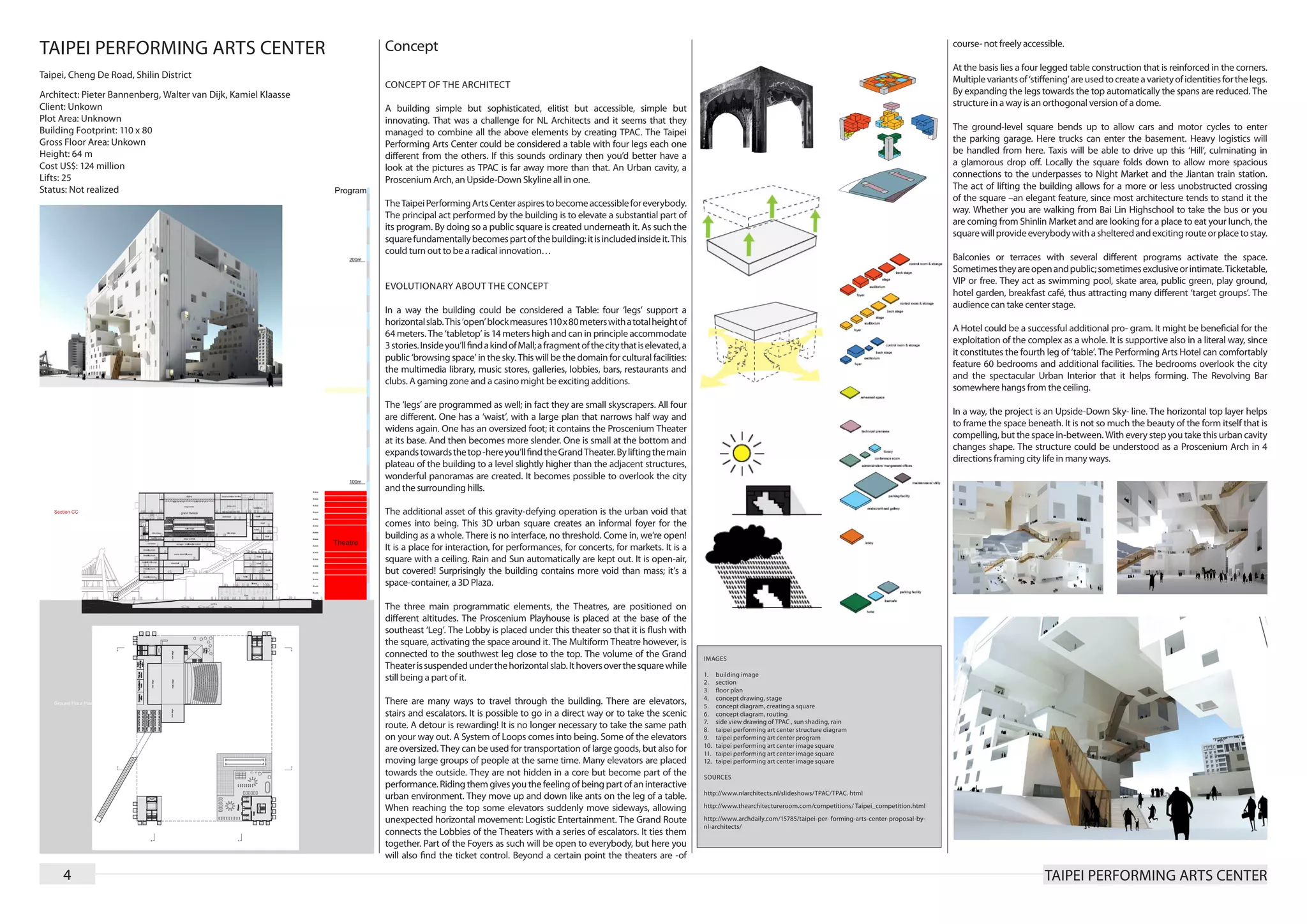
                                                                                                                                                           1.	    building image
                                                                still being a part of it.                                                                  2.	    section
                                                                                                                                                           3.	    floor plan
                                                                                                                                                           4.	    concept drawing, stage
                                                                There are many ways to travel through the building. There are elevators,                   5.	    concept diagram, creating a square
                                                                stairs and escalators. It is possible to go in a direct way or to take the scenic          6.	    concept diagram, routing
                                                                                                                                                           7.	    side view drawing of TPAC , sun shading, rain
                                                                route. A detour is rewarding! It is no longer necessary to take the same path              8.	    taipei performing art center structure diagram
                                                                on your way out. A System of Loops comes into being. Some of the elevators                 9.	    taipei performing art center program
                                                                                                                                                           10.	   taipei performing art center image square
                                                                are oversized. They can be used for transportation of large goods, but also for            11.	   taipei performing art center image square
                                                                moving large groups of people at the same time. Many elevators are placed                  12.	   taipei performing art center image square
                                                                towards the outside. They are not hidden in a core but become part of the                  SOURCES
                                                                performance. Riding them gives you the feeling of being part of an interactive
                                                                                                                                                           http://www.nlarchitects.nl/slideshows/TPAC/TPAC. html
                                                                urban environment. They move up and down like ants on the leg of a table.
                                                                When reaching the top some elevators suddenly move sideways, allowing                      http://www.thearchitectureroom.com/competitions/ Taipei_competition.html

                                                                unexpected horizontal movement: Logistic Entertainment. The Grand Route                    http://www.archdaily.com/15785/taipei-per- forming-arts-center-proposal-by-
                                                                                                                                                           nl-architects/
                                                                connects the Lobbies of the Theaters with a series of escalators. It ties them
                                                                together. Part of the Foyers as such will be open to everybody, but here you
                                                                will also find the ticket control. Beyond a certain point the theaters are -of

     4                                                                                                                                                                                                                                                             TAIPEI PERFORMING ARTS CENTER
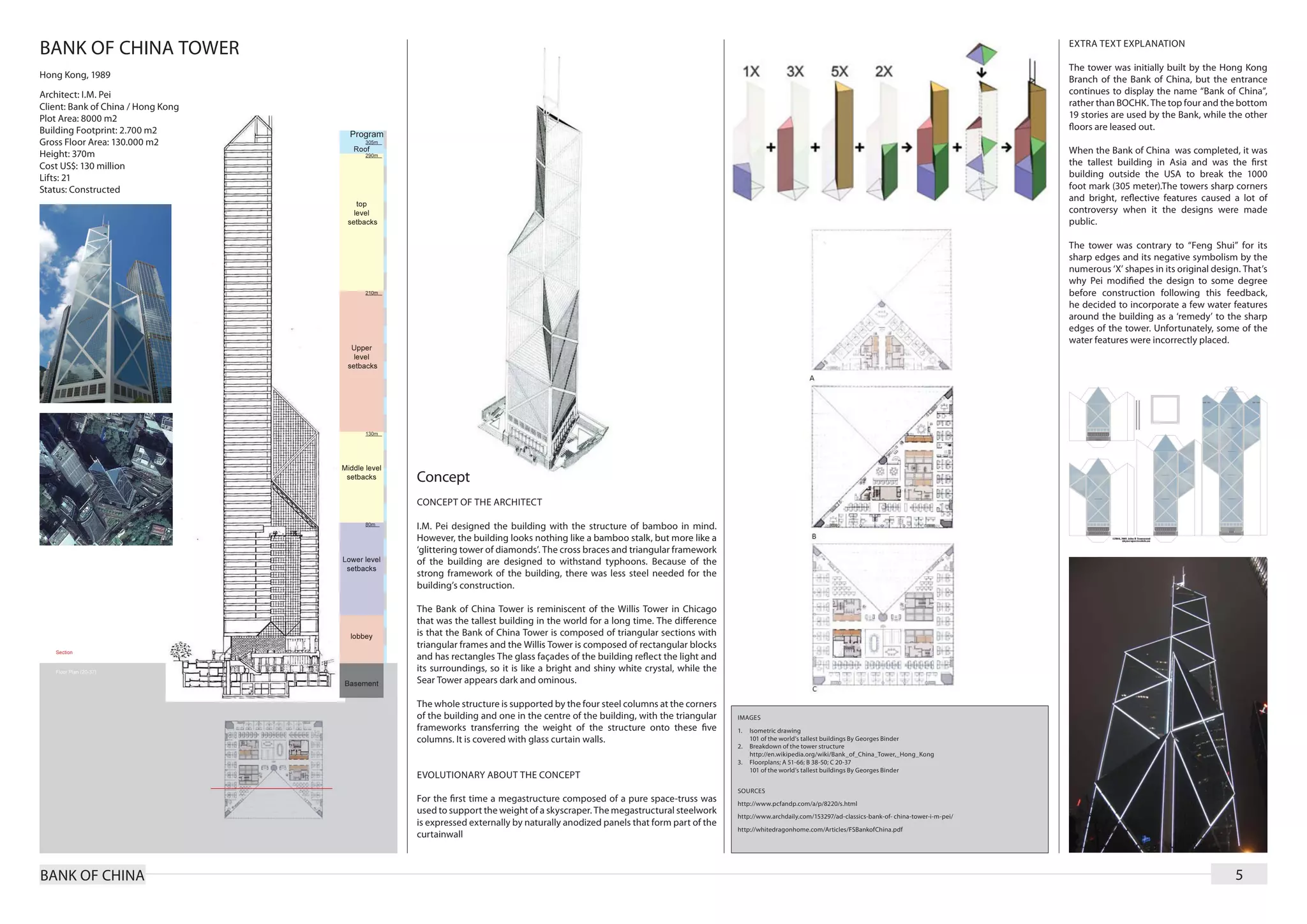
BANK OF CHINA TOWER                                                                                                                                                                           EXTRA TEXT EXPLANATION

                                                                                                                                                                                              The tower was initially built by the Hong Kong
Hong Kong, 1989                                                                                                                                                                               Branch of the Bank of China, but the entrance
Architect: I.M. Pei                                                                                                                                                                           continues to display the name “Bank of China”,
Client: Bank of China / Hong Kong                                                                                                                                                             rather than BOCHK. The top four and the bottom
Plot Area: 8000 m2                                                                                                                                                                            19 stories are used by the Bank, while the other
Building Footprint: 2.700 m2                                                                                                                                                                  floors are leased out.
Gross Floor Area: 130.000 m2
Height: 370m                                                                                                                                                                                  When the Bank of China was completed, it was
Cost US$: 130 million                                                                                                                                                                         the tallest building in Asia and was the first
Lifts: 21                                                                                                                                                                                     building outside the USA to break the 1000
Status: Constructed                                                                                                                                                                           foot mark (305 meter).The towers sharp corners
                                                                                                                                                                                              and bright, reflective features caused a lot of
                                                                                                                                                                                              controversy when it the designs were made
                                                                                                                                                                                              public.

                                                                                                                                                                                              The tower was contrary to “Feng Shui” for its
                                                                                                                                                                                              sharp edges and its negative symbolism by the
                                                                                                                                                                                              numerous ‘X’ shapes in its original design. That’s
                                                                                                                                                                                              why Pei modified the design to some degree
                                                                                                                                                                                              before construction following this feedback,
                                                                                                                                                                                              he decided to incorporate a few water features
                                                                                                                                                                                              around the building as a ‘remedy’ to the sharp
                                                                                                                                                                                              edges of the tower. Unfortunately, some of the
                                                                                                                                                                                              water features were incorrectly placed.


                                    Concept
                                    CONCEPT OF THE ARCHITECT

                                    I.M. Pei designed the building with the structure of bamboo in mind.
                                    However, the building looks nothing like a bamboo stalk, but more like a
                                    ‘glittering tower of diamonds’. The cross braces and triangular framework
                                    of the building are designed to withstand typhoons. Because of the
                                    strong framework of the building, there was less steel needed for the
                                    building’s construction.

                                    The Bank of China Tower is reminiscent of the Willis Tower in Chicago
                                    that was the tallest building in the world for a long time. The difference
                                    is that the Bank of China Tower is composed of triangular sections with
                                    triangular frames and the Willis Tower is composed of rectangular blocks
                                    and has rectangles The glass façades of the building reflect the light and
                                    its surroundings, so it is like a bright and shiny white crystal, while the
                                    Sear Tower appears dark and ominous.

                                    The whole structure is supported by the four steel columns at the corners
                                    of the building and one in the centre of the building, with the triangular    IMAGES
                                    frameworks transferring the weight of the structure onto these five            1.	 Isometric drawing
                                    columns. It is covered with glass curtain walls.                                  101 of the world’s tallest buildings By Georges Binder
                                                                                                                  2.	 Breakdown of the tower structure
                                                                                                                      http://en.wikipedia.org/wiki/Bank_of_China_Tower,_Hong_Kong
                                                                                                                  3.	 Floorplans; A 51-66; B 38-50; C 20-37
                                                                                                                      101 of the world’s tallest buildings By Georges Binder
                                    EVOLUTIONARY ABOUT THE CONCEPT
                                                                                                                  SOURCES
                                    For the first time a megastructure composed of a pure space-truss was          http://www.pcfandp.com/a/p/8220/s.html
                                    used to support the weight of a skyscraper. The megastructural steelwork
                                                                                                                  http://www.archdaily.com/153297/ad-classics-bank-of- china-tower-i-m-pei/
                                    is expressed externally by naturally anodized panels that form part of the
                                                                                                                  http://whitedragonhome.com/Articles/FSBankofChina.pdf
                                    curtainwall


BANK OF CHINA                                                                                                                                                                                                                          5
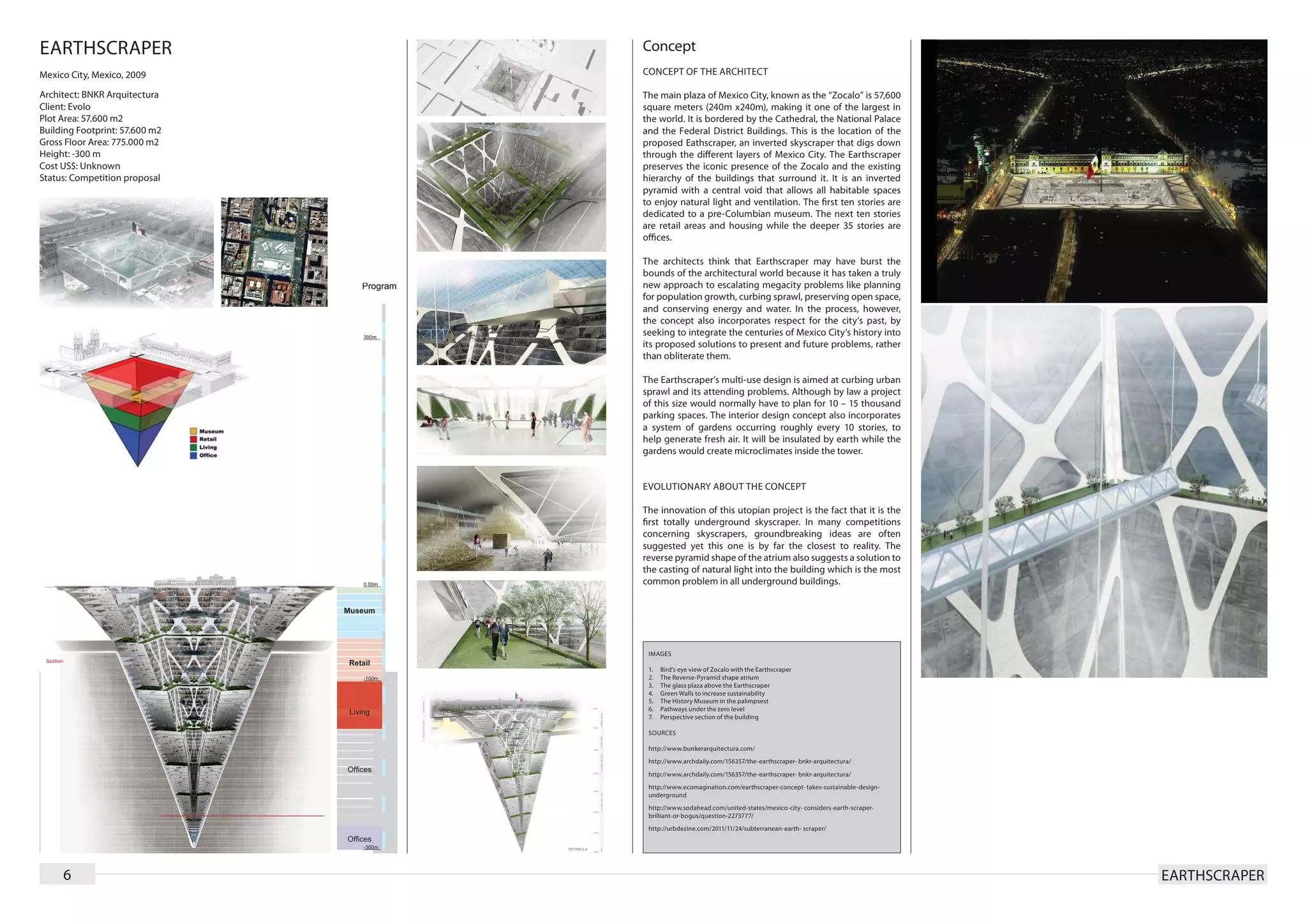
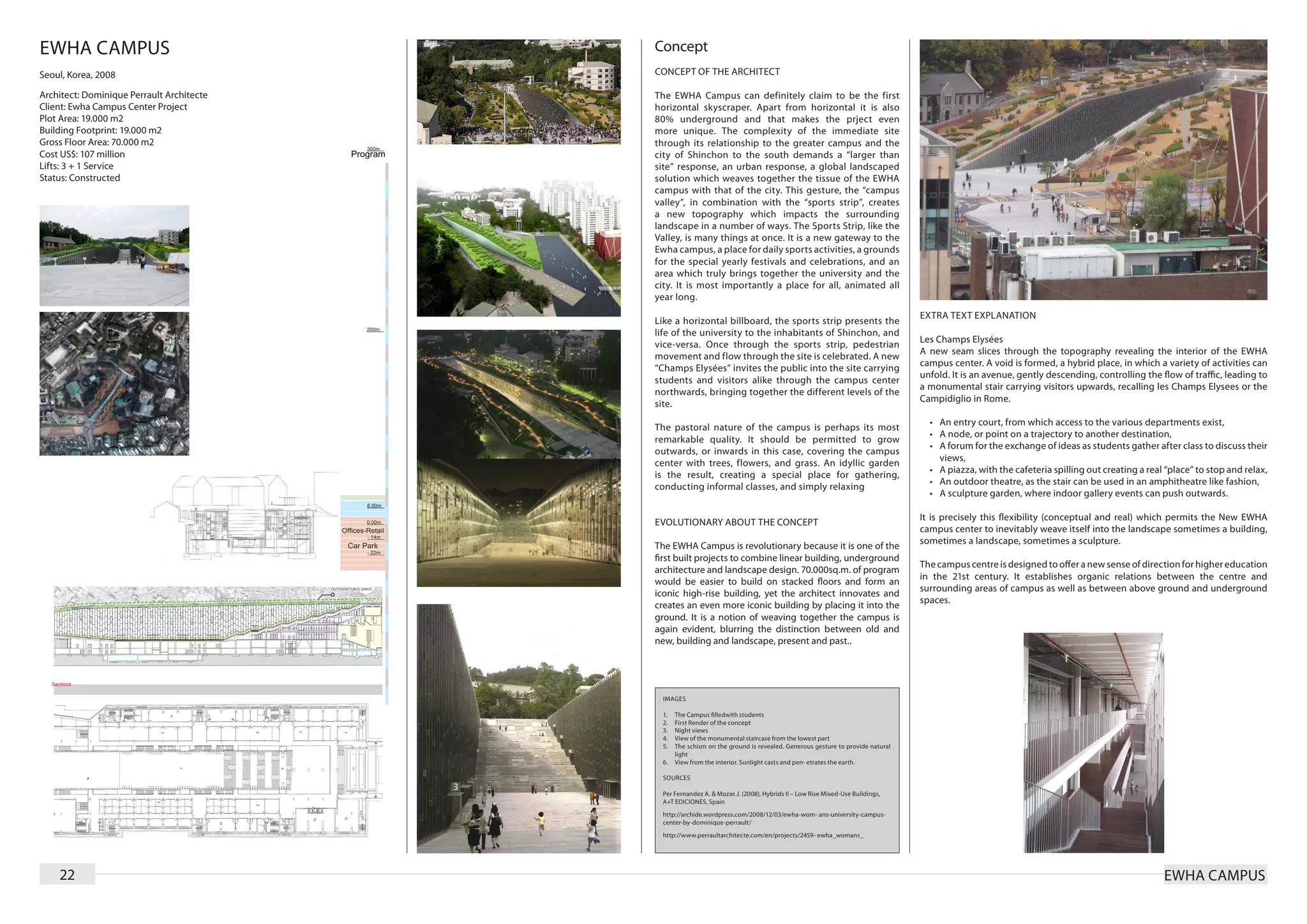
EARTHSCRAPER                    Concept
Mexico City, Mexico, 2009       CONCEPT OF THE ARCHITECT

Architect: BNKR Arquitectura    The main plaza of Mexico City, known as the “Zocalo” is 57,600
Client: Evolo                   square meters (240m x240m), making it one of the largest in
Plot Area: 57.600 m2            the world. It is bordered by the Cathedral, the National Palace
Building Footprint: 57.600 m2   and the Federal District Buildings. This is the location of the
Gross Floor Area: 775.000 m2    proposed Eathscraper, an inverted skyscraper that digs down
Height: -300 m                  through the different layers of Mexico City. The Earthscraper
Cost US$: Unknown               preserves the iconic presence of the Zocalo and the existing
Status: Competition proposal    hierarchy of the buildings that surround it. It is an inverted
                                pyramid with a central void that allows all habitable spaces
                                to enjoy natural light and ventilation. The first ten stories are
                                dedicated to a pre-Columbian museum. The next ten stories
                                are retail areas and housing while the deeper 35 stories are
                                offices.

                                The architects think that Earthscraper may have burst the
                                bounds of the architectural world because it has taken a truly
                                new approach to escalating megacity problems like planning
                                for population growth, curbing sprawl, preserving open space,
                                and conserving energy and water. In the process, however,
                                the concept also incorporates respect for the city’s past, by
                                seeking to integrate the centuries of Mexico City’s history into
                                its proposed solutions to present and future problems, rather
                                than obliterate them.

                                The Earthscraper’s multi-use design is aimed at curbing urban
                                sprawl and its attending problems. Although by law a project
                                of this size would normally have to plan for 10 – 15 thousand
                                parking spaces. The interior design concept also incorporates
                                a system of gardens occurring roughly every 10 stories, to
                                help generate fresh air. It will be insulated by earth while the
                                gardens would create microclimates inside the tower.


                                EVOLUTIONARY ABOUT THE CONCEPT

                                The innovation of this utopian project is the fact that it is the
                                first totally underground skyscraper. In many competitions
                                concerning skyscrapers, groundbreaking ideas are often
                                suggested yet this one is by far the closest to reality. The
                                reverse pyramid shape of the atrium also suggests a solution to
                                the casting of natural light into the building which is the most
                                common problem in all underground buildings.


                                 IMAGES

                                 1.	   Bird’s eye view of Zocalo with the Earthscraper
                                 2.	   The Reverse-Pyramid shape atrium
                                 3.	   The glass plaza above the Earthscraper
                                 4.	   Green Walls to increase sustainability
                                 5.	   The History Museum in the palimpsest
                                 6.	   Pathways under the zero level
                                 7.	   Perspective section of the building

                                 SOURCES

                                 http://www.bunkerarquitectura.com/
                                 http://www.archdaily.com/156357/the-earthscraper- bnkr-arquitectura/
                                 http://www.archdaily.com/156357/the-earthscraper- bnkr-arquitectura/
                                 http://www.ecomagination.com/earthscraper-concept- takes-sustainable-design-
                                 underground
                                 http://www.sodahead.com/united-states/mexico-city- considers-earth-scraper-
                                 brilliant-or-bogus/question-2273777/
                                 http://urbdezine.com/2011/11/24/subterranean-earth- scraper/


     6                                                                                                          EARTHSCRAPER
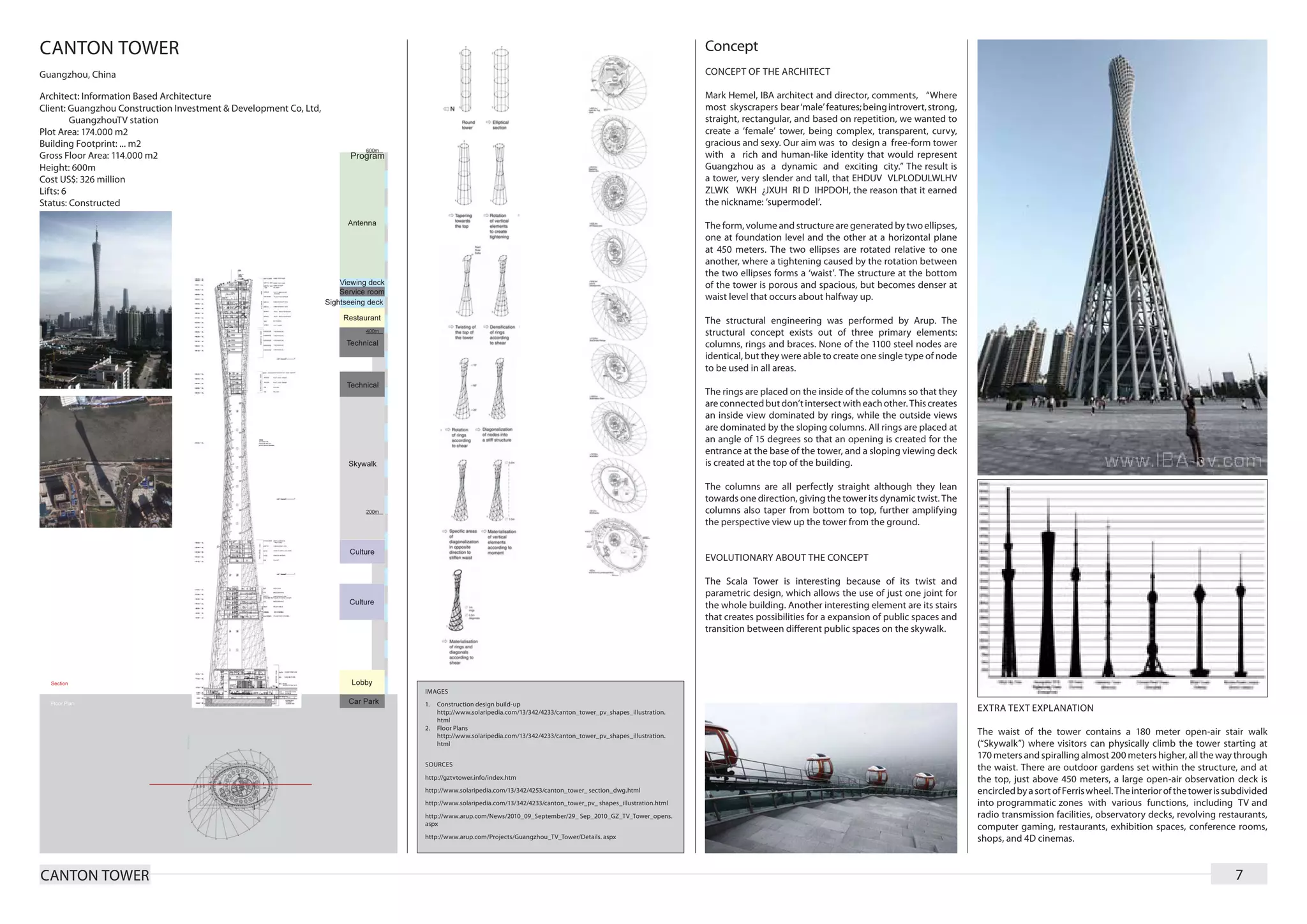
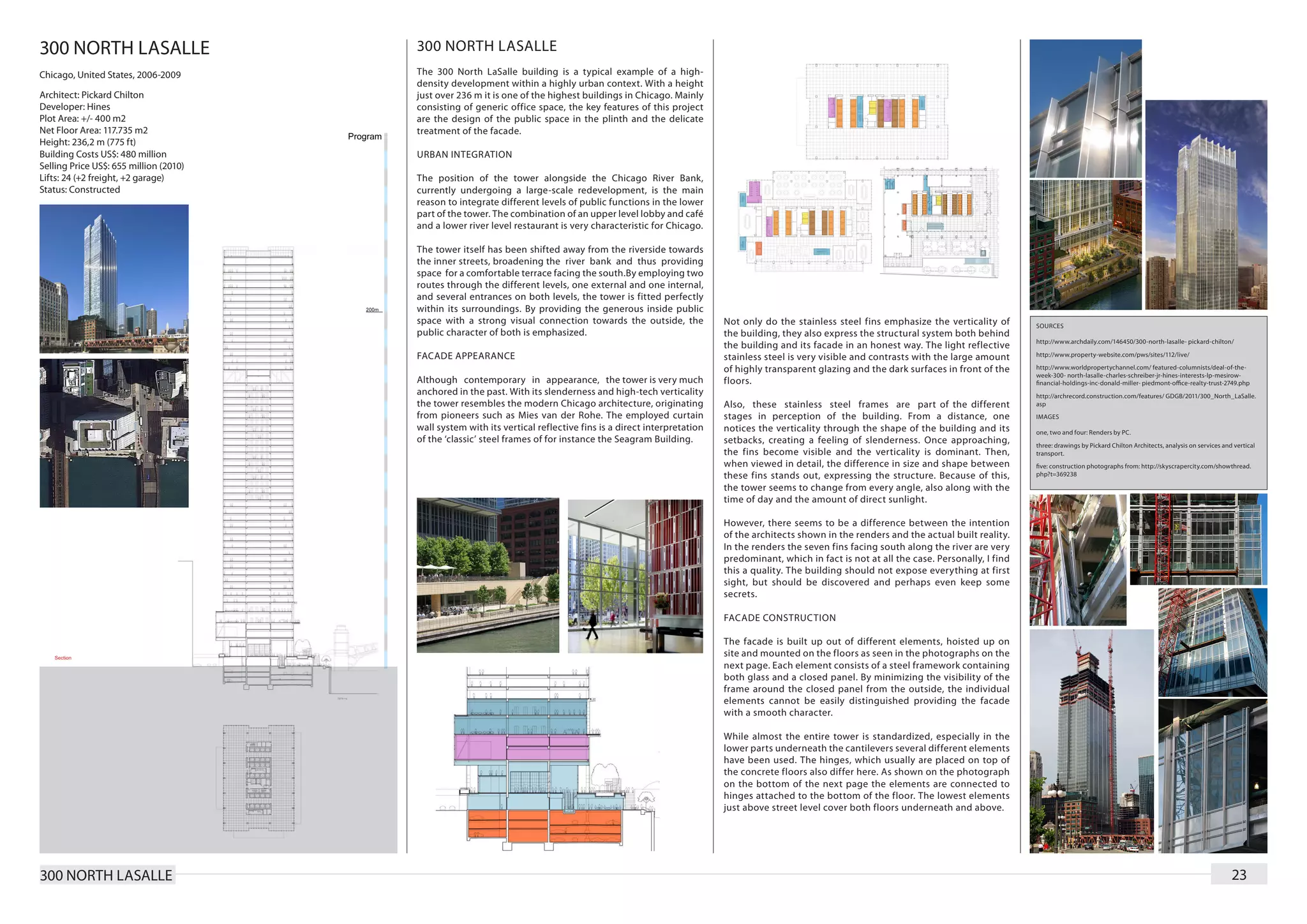
CANTON TOWER                                                                                                                                          Concept
Guangzhou, China                                                                                                                                      CONCEPT OF THE ARCHITECT

Architect: Information Based Architecture                                                                                                             Mark Hemel, IBA architect and director, comments, “Where
Client: Guangzhou Construction Investment & Development Co, Ltd,                                                                                      most skyscrapers bear ‘male’ features; being introvert, strong,
         GuangzhouTV station                                                                                                                          straight, rectangular, and based on repetition, we wanted to
Plot Area: 174.000 m2                                                                                                                                 create a ‘female’ tower, being complex, transparent, curvy,
Building Footprint: ... m2                                                                                                                            gracious and sexy. Our aim was to design a free-form tower
Gross Floor Area: 114.000 m2                                                                                                                          with a rich and human-like identity that would represent
Height: 600m                                                                                                                                          Guangzhou as a dynamic and exciting city.” The result is
Cost US$: 326 million                                                                                                                                 a tower, very slender and tall, that EHDUV VLPLODULWLHV
Lifts: 6                                                                                                                                              ZLWK WKH ¿JXUH RI D IHPDOH, the reason that it earned
Status: Constructed                                                                                                                                   the nickname: ‘supermodel‘.

                                                                                                                                                      The form, volume and structure are generated by two ellipses,
                                                                                                                                                      one at foundation level and the other at a horizontal plane
                                                                                                                                                      at 450 meters. The two ellipses are rotated relative to one
                                                                                                                                                      another, where a tightening caused by the rotation between
                                                                                                                                                      the two ellipses forms a ‘waist’. The structure at the bottom
                                                                                                                                                      of the tower is porous and spacious, but becomes denser at
                                                                                                                                                      waist level that occurs about halfway up.

                                                                                                                                                      The structural engineering was performed by Arup. The
                                                                                                                                                      structural concept exists out of three primary elements:
                                                                                                                                                      columns, rings and braces. None of the 1100 steel nodes are
                                                                                                                                                      identical, but they were able to create one single type of node
                                                                                                                                                      to be used in all areas.

                                                                                                                                                      The rings are placed on the inside of the columns so that they
                                                                                                                                                      are connected but don’t intersect with each other. This creates
                                                                                                                                                      an inside view dominated by rings, while the outside views
                                                                                                                                                      are dominated by the sloping columns. All rings are placed at
                                                                                                                                                      an angle of 15 degrees so that an opening is created for the
                                                                                                                                                      entrance at the base of the tower, and a sloping viewing deck
                                                                                                                                                      is created at the top of the building.

                                                                                                                                                      The columns are all perfectly straight although they lean
                                                                                                                                                      towards one direction, giving the tower its dynamic twist. The
                                                                                                                                                      columns also taper from bottom to top, further amplifying
                                                                                                                                                      the perspective view up the tower from the ground.


                                                                                                                                                      EVOLUTIONARY ABOUT THE CONCEPT

                                                                                                                                                      The Scala Tower is interesting because of its twist and
                                                                                                                                                      parametric design, which allows the use of just one joint for
                                                                                                                                                      the whole building. Another interesting element are its stairs
                                                                                                                                                      that creates possibilities for a expansion of public spaces and
                                                                                                                                                      transition between different public spaces on the skywalk.


                                                                   IMAGES
                                                                   1.	 Construction design build-up
                                                                       http://www.solaripedia.com/13/342/4233/canton_tower_pv_shapes_illustration.
                                                                                                                                                                                                                        EXTRA TEXT EXPLANATION
                                                                       html
                                                                   2.	 Floor Plans
                                                                       http://www.solaripedia.com/13/342/4233/canton_tower_pv_shapes_illustration.
                                                                                                                                                                                                                        The waist of the tower contains a 180 meter open-air stair walk
                                                                       html                                                                                                                                             (“Skywalk”) where visitors can physically climb the tower starting at
                                                                                                                                                                                                                        170 meters and spiralling almost 200 meters higher, all the way through
                                                                   SOURCES
                                                                                                                                                                                                                        the waist. There are outdoor gardens set within the structure, and at
                                                                   http://gztvtower.info/index.htm                                                                                                                      the top, just above 450 meters, a large open-air observation deck is
                                                                   http://www.solaripedia.com/13/342/4253/canton_tower_ section_dwg.html                                                                                encircled by a sort of Ferris wheel. The interior of the tower is subdivided
                                                                   http://www.solaripedia.com/13/342/4233/canton_tower_pv_ shapes_illustration.html                                                                     into programmatic zones with various functions, including TV and
                                                                   http://www.arup.com/News/2010_09_September/29_ Sep_2010_GZ_TV_Tower_opens.                                                                           radio transmission facilities, observatory decks, revolving restaurants,
                                                                   aspx
                                                                                                                                                                                                                        computer gaming, restaurants, exhibition spaces, conference rooms,
                                                                   http://www.arup.com/Projects/Guangzhou_TV_Tower/Details. aspx                                                                                        shops, and 4D cinemas.


CANTON TOWER                                                                                                                                                                                                                                                                               7
CHINA CENTRAL TELEVISION
HEADQUARTERS
Beijing, China, 2010
Architect: Office of Metropolitan Architecture (OMA)
Client: China Central Television (CCTV)
Plot Area: 75.000 m2
Building Footprint: 44.000 m2
Gross Floor Area: 473,000 m2
Height: 234 m
Cost US$: 1.13 billion
Lifts: 76
Status: Constructed


                                                       Concept
                                                       CONCEPT OF THE ARCHITECT

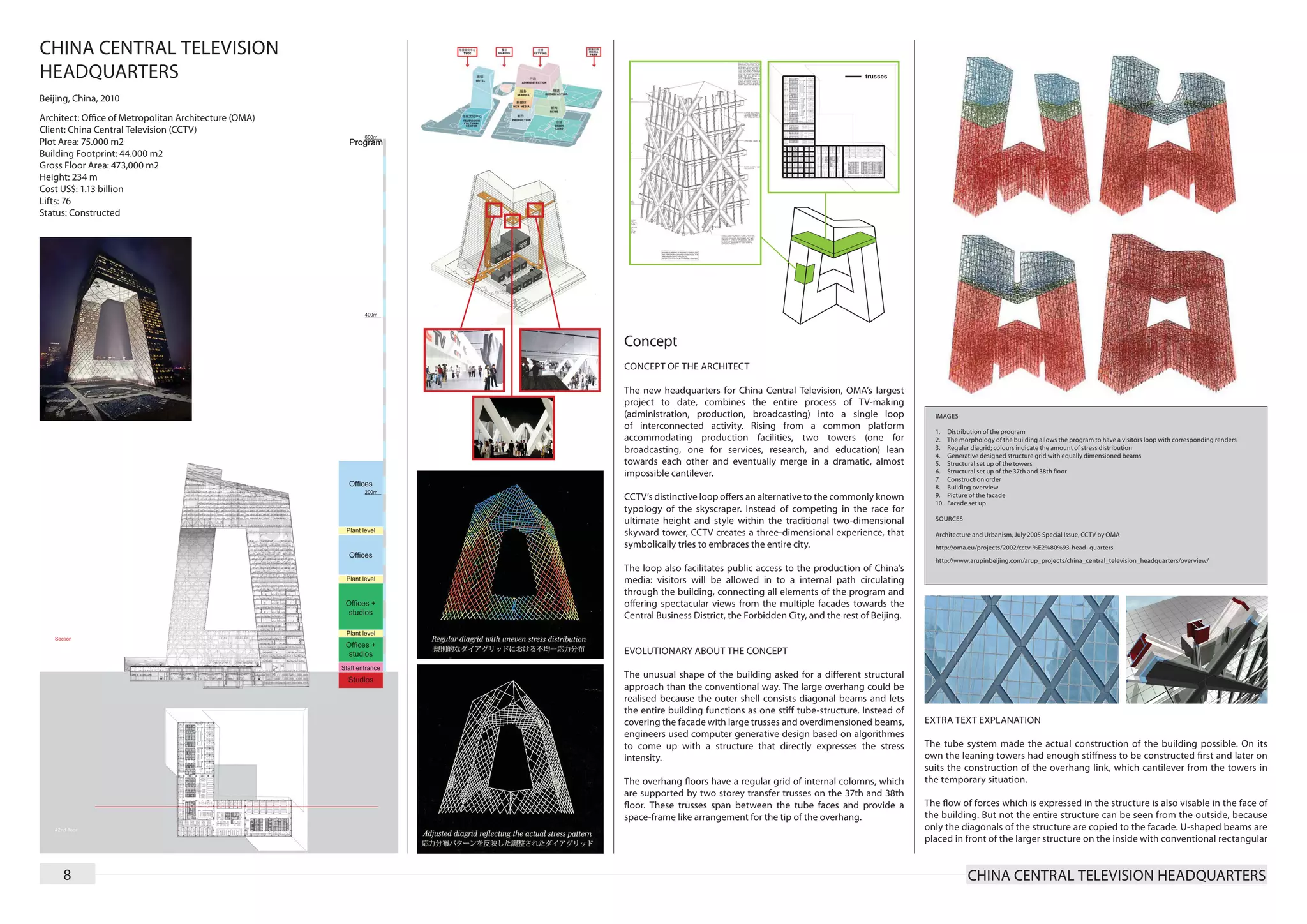
                                                       The new headquarters for China Central Television, OMA’s largest
                                                       project to date, combines the entire process of TV-making
                                                       (administration, production, broadcasting) into a single loop               IMAGES
                                                       of interconnected activity. Rising from a common platform
                                                                                                                                   1.	    Distribution of the program
                                                       accommodating production facilities, two towers (one for                    2.	    The morphology of the building allows the program to have a visitors loop with corresponding renders
                                                       broadcasting, one for services, research, and education) lean               3.	    Regular diagrid; colours indicate the amount of stress distribution
                                                                                                                                   4.	    Generative designed structure grid with equally dimensioned beams
                                                       towards each other and eventually merge in a dramatic, almost               5.	    Structural set up of the towers
                                                       impossible cantilever.                                                      6.	    Structural set up of the 37th and 38th floor
                                                                                                                                   7.	    Construction order
                                                                                                                                   8.	    Building overview
                                                       CCTV’s distinctive loop offers an alternative to the commonly known         9.	    Picture of the facade
                                                                                                                                   10.	   Facade set up
                                                       typology of the skyscraper. Instead of competing in the race for
                                                       ultimate height and style within the traditional two-dimensional            SOURCES

                                                       skyward tower, CCTV creates a three-dimensional experience, that            Architecture and Urbanism, July 2005 Special Issue, CCTV by OMA
                                                       symbolically tries to embraces the entire city.                             http://oma.eu/projects/2002/cctv-%E2%80%93-head- quarters
                                                                                                                                   http://www.arupinbeijing.com/arup_projects/china_central_television_headquarters/overview/
                                                       The loop also facilitates public access to the production of China’s
                                                       media: visitors will be allowed in to a internal path circulating
                                                       through the building, connecting all elements of the program and
                                                       offering spectacular views from the multiple facades towards the
                                                       Central Business District, the Forbidden City, and the rest of Beijing.


                                                       EVOLUTIONARY ABOUT THE CONCEPT

                                                       The unusual shape of the building asked for a different structural
                                                       approach than the conventional way. The large overhang could be
                                                       realised because the outer shell consists diagonal beams and lets
                                                       the entire building functions as one stiff tube-structure. Instead of
                                                       covering the facade with large trusses and overdimensioned beams,         EXTRA TEXT EXPLANATION
                                                       engineers used computer generative design based on algorithmes
                                                       to come up with a structure that directly expresses the stress            The tube system made the actual construction of the building possible. On its
                                                       intensity.                                                                own the leaning towers had enough stiffness to be constructed first and later on
                                                                                                                                 suits the construction of the overhang link, which cantilever from the towers in
                                                       The overhang floors have a regular grid of internal colomns, which        the temporary situation.
                                                       are supported by two storey transfer trusses on the 37th and 38th
                                                       floor. These trusses span between the tube faces and provide a            The flow of forces which is expressed in the structure is also visable in the face of
                                                       space-frame like arrangement for the tip of the overhang.                 the building. But not the entire structure can be seen from the outside, because
                                                                                                                                 only the diagonals of the structure are copied to the facade. U-shaped beams are
                                                                                                                                 placed in front of the larger structure on the inside with conventional rectangular


     8                                                                                                                                           CHINA CENTRAL TELEVISION HEADQUARTERS
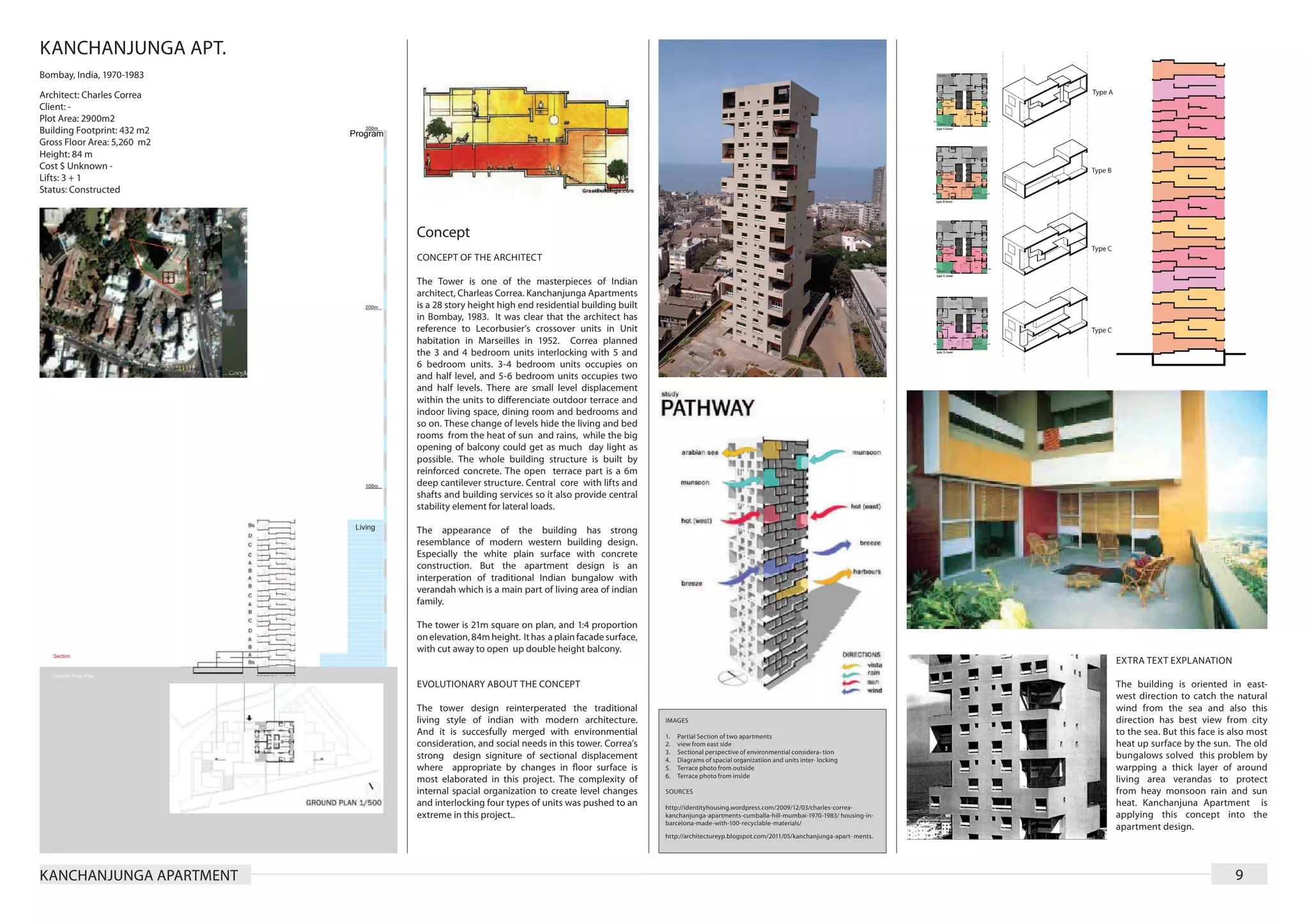
KANCHANJUNGA APT.
Bombay, India, 1970-1983

Architect: Charles Correa
Client: -
Plot Area: 2900m2
Building Footprint: 432 m2
Gross Floor Area: 5,260 m2
Height: 84 m
Cost $ Unknown -
Lifts: 3 + 1
Status: Constructed


                             Concept
                             CONCEPT OF THE ARCHITECT

                             The Tower is one of the masterpieces of Indian
                             architect, Charleas Correa. Kanchanjunga Apartments
                             is a 28 story height high end residential building built
                             in Bombay, 1983. It was clear that the architect has
                             reference to Lecorbusier’s crossover units in Unit
                             habitation in Marseilles in 1952. Correa planned
                             the 3 and 4 bedroom units interlocking with 5 and
                             6 bedroom units. 3-4 bedroom units occupies on
                             and half level, and 5-6 bedroom units occupies two
                             and half levels. There are small level displacement
                             within the units to differenciate outdoor terrace and
                             indoor living space, dining room and bedrooms and
                             so on. These change of levels hide the living and bed
                             rooms from the heat of sun and rains, while the big
                             opening of balcony could get as much day light as
                             possible. The whole building structure is built by
                             reinforced concrete. The open terrace part is a 6m
                             deep cantilever structure. Central core with lifts and
                             shafts and building services so it also provide central
                             stability element for lateral loads.

                             The appearance of the building has strong
                             resemblance of modern western building design.
                             Especially the white plain surface with concrete
                             construction. But the apartment design is an
                             interperation of traditional Indian bungalow with
                             verandah which is a main part of living area of indian
                             family.

                             The tower is 21m square on plan, and 1:4 proportion
                             on elevation, 84m height. It has a plain facade surface,
                             with cut away to open up double height balcony.
                                                                                                                                                                EXTRA TEXT EXPLANATION

                             EVOLUTIONARY ABOUT THE CONCEPT                                                                                                     The building is oriented in east-
                                                                                                                                                                west direction to catch the natural
                             The tower design reinterperated the traditional                                                                                    wind from the sea and also this
                             living style of indian with modern architecture.           IMAGES                                                                  direction has best view from city
                             And it is succesfully merged with environmential           1.	   Partial Section of two apartments
                                                                                                                                                                to the sea. But this face is also most
                             consideration, and social needs in this tower. Correa’s    2.	   view from east side                                               heat up surface by the sun. The old
                                                                                        3.	   Sectional perspective of environmential considera- tion
                             strong design signiture of sectional displacement          4.	   Diagrams of spacial organizatiion and units inter- locking
                                                                                                                                                                bungalows solved this problem by
                             where appropriate by changes in floor surface is            5.	   Terrace photo from outside                                        warpping a thick layer of around
                                                                                        6.	   Terrace photo from inside
                             most elaborated in this project. The complexity of                                                                                 living area verandas to protect
                             internal spacial organization to create level changes      SOURCES                                                                 from heay monsoon rain and sun
                             and interlocking four types of units was pushed to an      http://identityhousing.wordpress.com/2009/12/03/charles-correa-
                                                                                                                                                                heat. Kanchanjuna Apartment is
                             extreme in this project..                                  kanchanjunga-apartments-cumballa-hill-mumbai-1970-1983/ housing-in-     applying this concept into the
                                                                                        barcelona-made-with-100-recyclable-materials/
                                                                                                                                                                apartment design.
                                                                                        http://architectureyp.blogspot.com/2011/05/kanchanjunga-apart- ments.


KANCHANJUNGA APARTMENT                                                                                                                                                                       9
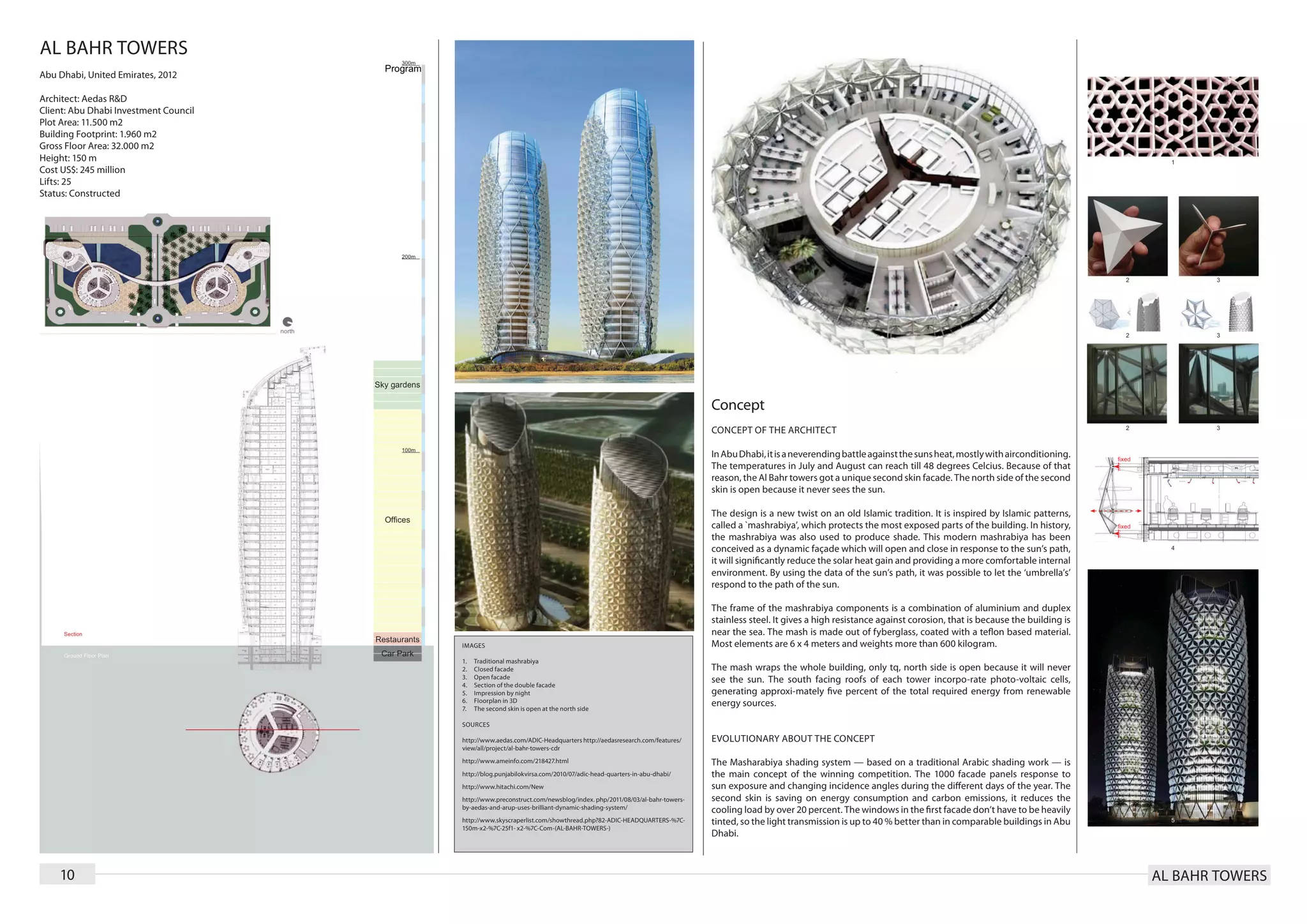
AL BAHR TOWERS
Abu Dhabi, United Emirates, 2012

Architect: Aedas R&D
Client: Abu Dhabi Investment Council
Plot Area: 11.500 m2
Building Footprint: 1.960 m2
Gross Floor Area: 32.000 m2
Height: 150 m
Cost US$: 245 million
Lifts: 25
Status: Constructed


                                                                                                                    Concept
                                                                                                                    CONCEPT OF THE ARCHITECT

                                                                                                                    In Abu Dhabi, it is a neverending battle against the suns heat, mostly with airconditioning.
                                                                                                                    The temperatures in July and August can reach till 48 degrees Celcius. Because of that
                                                                                                                    reason, the Al Bahr towers got a unique second skin facade. The north side of the second
                                                                                                                    skin is open because it never sees the sun.

                                                                                                                    The design is a new twist on an old Islamic tradition. It is inspired by Islamic patterns,
                                                                                                                    called a `mashrabiya’, which protects the most exposed parts of the building. In history,
                                                                                                                    the mashrabiya was also used to produce shade. This modern mashrabiya has been
                                                                                                                    conceived as a dynamic façade which will open and close in response to the sun’s path,
                                                                                                                    it will significantly reduce the solar heat gain and providing a more comfortable internal
                                                                                                                    environment. By using the data of the sun’s path, it was possible to let the ‘umbrella’s’
                                                                                                                    respond to the path of the sun.

                                                                                                                    The frame of the mashrabiya components is a combination of aluminium and duplex
                                                                                                                    stainless steel. It gives a high resistance against corosion, that is because the building is
                                                                                                                    near the sea. The mash is made out of fyberglass, coated with a teflon based material.
                                       IMAGES                                                                       Most elements are 6 x 4 meters and weights more than 600 kilogram.
                                       1.	   Traditional mashrabiya
                                       2.	   Closed facade                                                          The mash wraps the whole building, only tq, north side is open because it will never
                                       3.	
                                       4.	
                                             Open facade
                                             Section of the double facade
                                                                                                                    see the sun. The south facing roofs of each tower incorpo-rate photo-voltaic cells,
                                       5.	   Impression by night                                                    generating approxi-mately five percent of the total required energy from renewable
                                       6.	
                                       7.	
                                             Floorplan in 3D
                                             The second skin is open at the north side
                                                                                                                    energy sources.

                                       SOURCES

                                       http://www.aedas.com/ADIC-Headquarters http://aedasresearch.com/features/    EVOLUTIONARY ABOUT THE CONCEPT
                                       view/all/project/al-bahr-towers-cdr
                                       http://www.ameinfo.com/218427.html                                           The Masharabiya shading system — based on a traditional Arabic shading work — is
                                       http://blog.punjabilokvirsa.com/2010/07/adic-head-quarters-in-abu-dhabi/     the main concept of the winning competition. The 1000 facade panels response to
                                       http://www.hitachi.com/New                                                   sun exposure and changing incidence angles during the different days of the year. The
                                       http://www.preconstruct.com/newsblog/index. php/2011/08/03/al-bahr-towers-   second skin is saving on energy consumption and carbon emissions, it reduces the
                                       by-aedas-and-arup-uses-brilliant-dynamic-shading-system/                     cooling load by over 20 percent. The windows in the first facade don’t have to be heavily
                                       http://www.skyscraperlist.com/showthread.php?82-ADIC-HEADQUARTERS-%7C-       tinted, so the light transmission is up to 40 % better than in comparable buildings in Abu
                                       150m-x2-%7C-25f1- x2-%7C-Com-(AL-BAHR-TOWERS-)
                                                                                                                    Dhabi.


    10                                                                                                                                                                                                              AL BAHR TOWERS
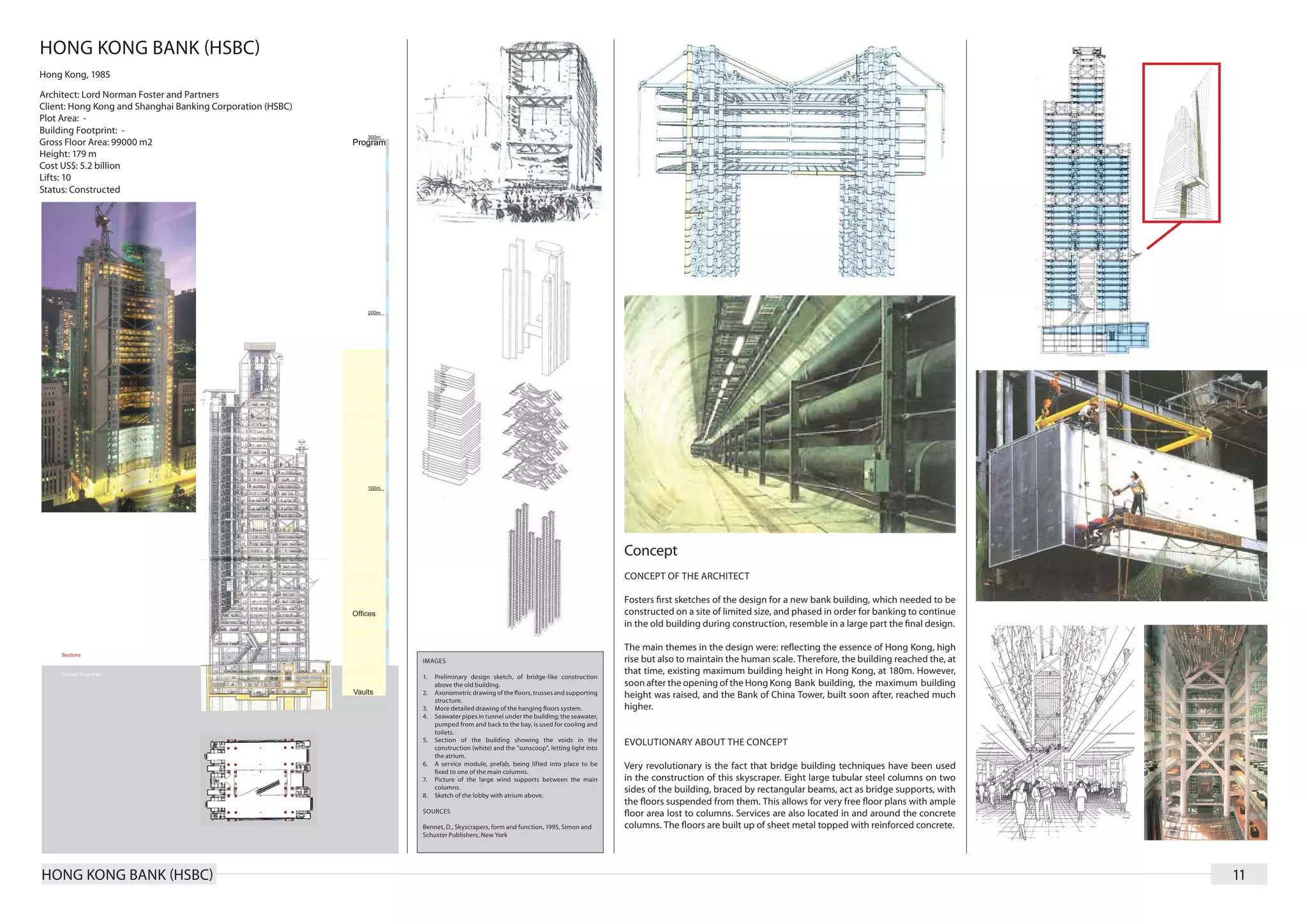
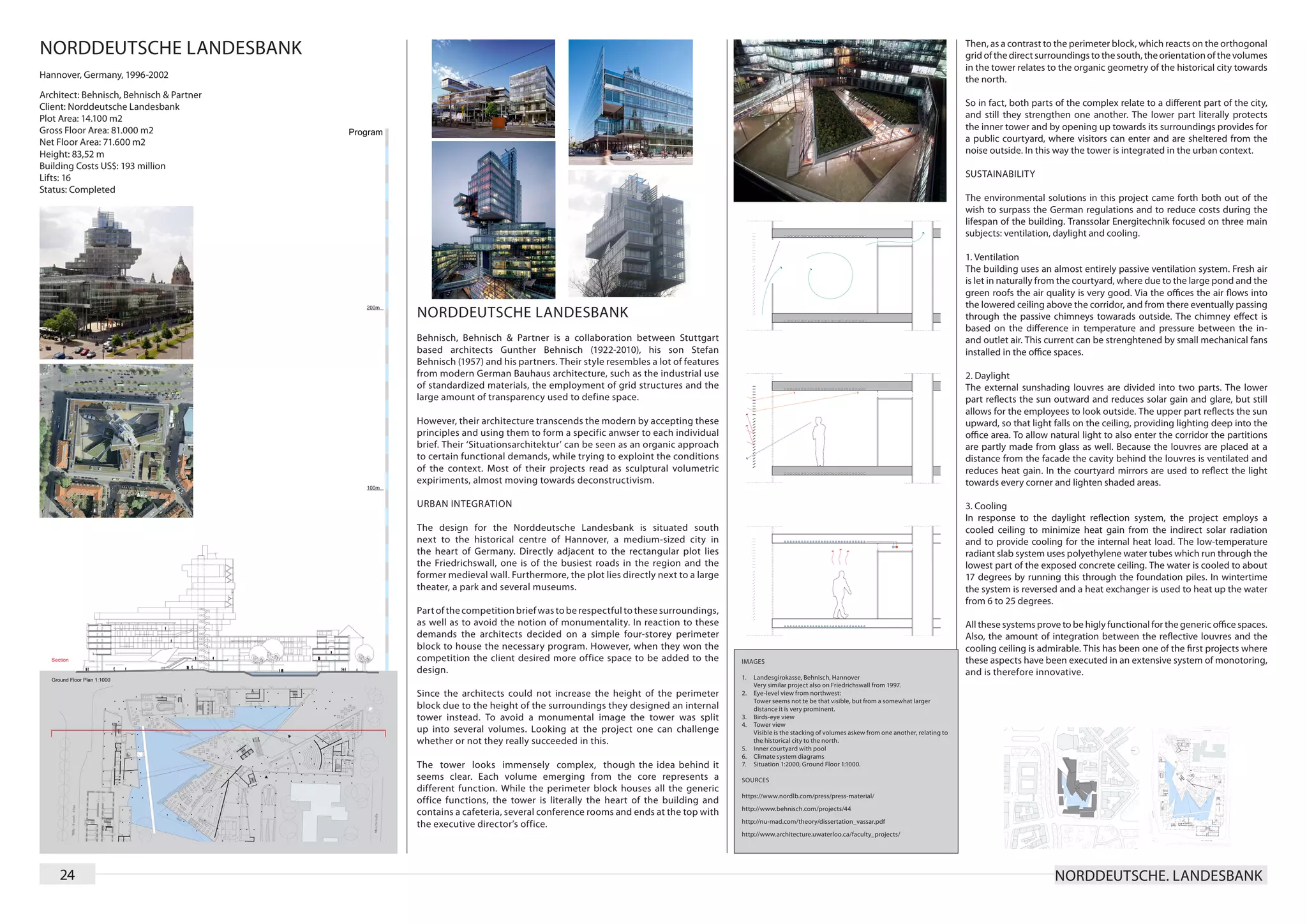
HONG KONG BANK (HSBC)
Hong Kong, 1985

Architect: Lord Norman Foster and Partners
Client: Hong Kong and Shanghai Banking Corporation (HSBC)
Plot Area: -
Building Footprint: -
Gross Floor Area: 99000 m2
Height: 179 m
Cost US$: 5.2 billion
Lifts: 10
Status: Constructed


                                                                                                                              Concept
                                                                                                                              CONCEPT OF THE ARCHITECT

                                                                                                                              Fosters first sketches of the design for a new bank building, which needed to be
                                                                                                                              constructed on a site of limited size, and phased in order for banking to continue
                                                                                                                              in the old building during construction, resemble in a large part the final design.

                                                                                                                              The main themes in the design were: reflecting the essence of Hong Kong, high
                                                            IMAGES                                                            rise but also to maintain the human scale. Therefore, the building reached the, at
                                                                                                                              that time, existing maximum building height in Hong Kong, at 180m. However,
                                                            1.	 Preliminary design sketch, of bridge-like construction
                                                                above the old building.                                       soon after the opening of the Hong Kong Bank building, the maximum building
                                                            2.	 Axonometric drawing of the floors, trusses and supporting     height was raised, and the Bank of China Tower, built soon after, reached much
                                                                structure.
                                                            3.	 More detailed drawing of the hanging floors system.           higher.
                                                            4.	 Seawater pipes in tunnel under the building; the seawater,
                                                                pumped from and back to the bay, is used for cooling and
                                                                toilets.
                                                            5.	 Section of the building showing the voids in the              EVOLUTIONARY ABOUT THE CONCEPT
                                                                construction (white) and the “sunscoop”, letting light into
                                                                the atrium.
                                                            6.	 A service module, prefab, being lifted into place to be       Very revolutionary is the fact that bridge building techniques have been used
                                                                fixed to one of the main columns.
                                                            7.	 Picture of the large wind supports between the main           in the construction of this skyscraper. Eight large tubular steel columns on two
                                                                columns.                                                      sides of the building, braced by rectangular beams, act as bridge supports, with
                                                            8.	 Sketch of the lobby with atrium above.
                                                                                                                              the floors suspended from them. This allows for very free floor plans with ample
                                                            SOURCES                                                           floor area lost to columns. Services are also located in and around the concrete
                                                            Bennet, D., Skyscrapers, form and function, 1995, Simon and       columns. The floors are built up of sheet metal topped with reinforced concrete.
                                                            Schuster Publishers, New York


HONG KONG BANK (HSBC)                                                                                                                                                                                               11
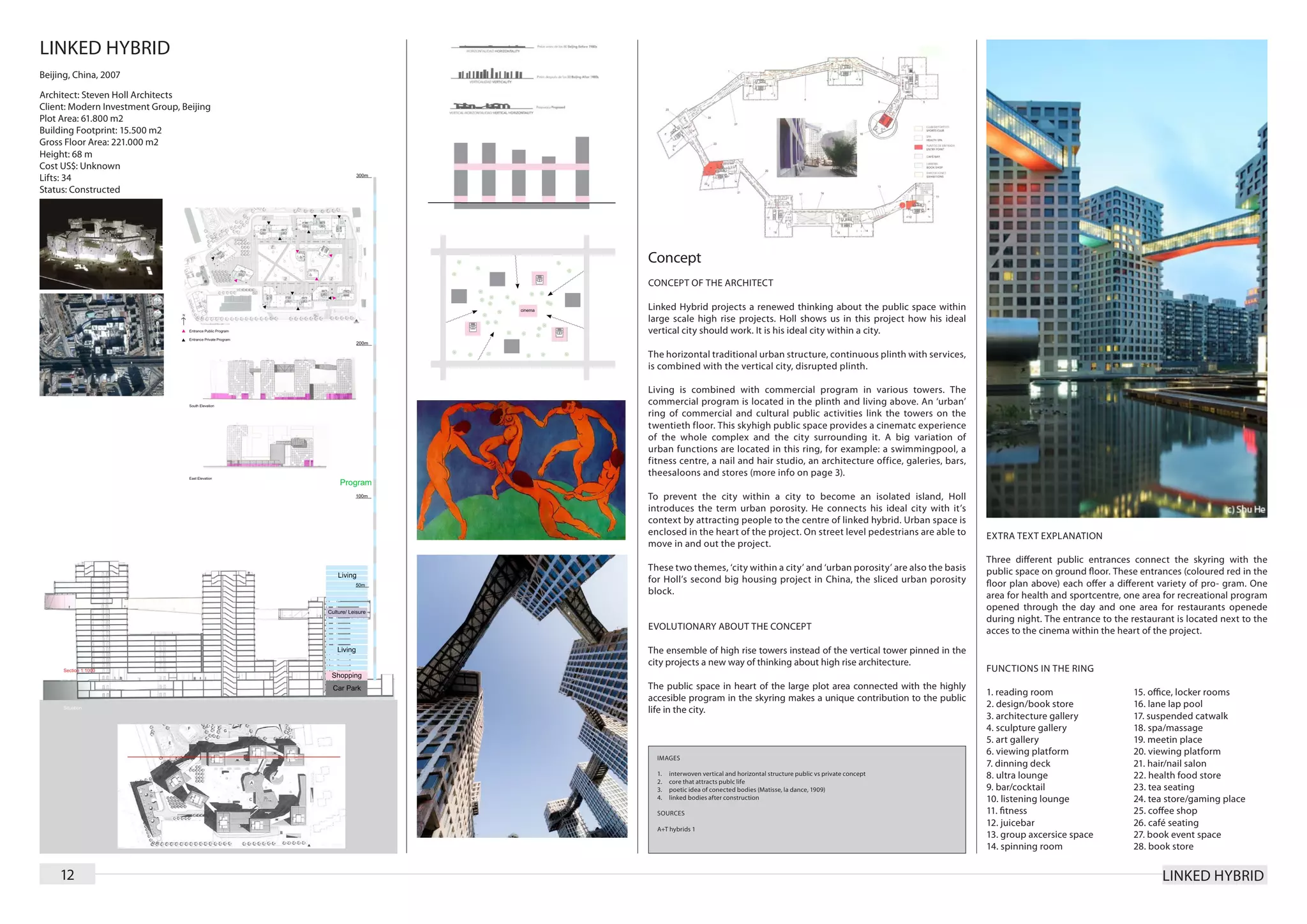
LINKED HYBRID
Beijing, China, 2007

Architect: Steven Holl Architects
Client: Modern Investment Group, Beijing
Plot Area: 61.800 m2
Building Footprint: 15.500 m2
Gross Floor Area: 221.000 m2
Height: 68 m
Cost US$: Unknown
Lifts: 34
Status: Constructed


                                           Concept
                                           CONCEPT OF THE ARCHITECT

                                           Linked Hybrid projects a renewed thinking about the public space within
                                           large scale high rise projects. Holl shows us in this project how his ideal
                                           vertical city should work. It is his ideal city within a city.

                                           The horizontal traditional urban structure, continuous plinth with services,
                                           is combined with the vertical city, disrupted plinth.

                                           Living is combined with commercial program in various towers. The
                                           commercial program is located in the plinth and living above. An ‘urban’
                                           ring of commercial and cultural public activities link the towers on the
                                           twentieth floor. This skyhigh public space provides a cinematc experience
                                           of the whole complex and the city surrounding it. A big variation of
                                           urban functions are located in this ring, for example: a swimmingpool, a
                                           fitness centre, a nail and hair studio, an architecture office, galeries, bars,
                                           theesaloons and stores (more info on page 3).

                                           To prevent the city within a city to become an isolated island, Holl
                                           introduces the term urban porosity. He connects his ideal city with it’s
                                           context by attracting people to the centre of linked hybrid. Urban space is
                                           enclosed in the heart of the project. On street level pedestrians are able to     EXTRA TEXT EXPLANATION
                                           move in and out the project.
                                                                                                                             Three different public entrances connect the skyring with the
                                           These two themes, ‘city within a city’ and ‘urban porosity’ are also the basis    public space on ground floor. These entrances (coloured red in the
                                           for Holl’s second big housing project in China, the sliced urban porosity         floor plan above) each offer a different variety of pro- gram. One
                                           block.                                                                            area for health and sportcentre, one area for recreational program
                                                                                                                             opened through the day and one area for restaurants openede
                                                                                                                             during night. The entrance to the restaurant is located next to the
                                           EVOLUTIONARY ABOUT THE CONCEPT                                                    acces to the cinema within the heart of the project.
                                           The ensemble of high rise towers instead of the vertical tower pinned in the
                                           city projects a new way of thinking about high rise architecture.
                                                                                                                             FUNCTIONS IN THE RING
                                           The public space in heart of the large plot area connected with the highly
                                                                                                                             1. reading room                    15. office, locker rooms
                                           accesible program in the skyring makes a unique contribution to the public
                                                                                                                             2. design/book store               16. lane lap pool
                                           life in the city.
                                                                                                                             3. architecture gallery            17. suspended catwalk
                                                                                                                             4. sculpture gallery               18. spa/massage
                                                                                                                             5. art gallery                     19. meetin place
                                                                                                                             6. viewing platform                20. viewing platform
                                             IMAGES
                                                                                                                             7. dinning deck                    21. hair/nail salon
                                             1.	   interwoven vertical and horizontal structure public vs private concept    8. ultra lounge                    22. health food store
                                             2.	   core that attracts publc life
                                             3.	   poetic idea of conected bodies (Matisse, la dance, 1909)                  9. bar/cocktail                    23. tea seating
                                             4.	   linked bodies after construction                                          10. listening lounge               24. tea store/gaming place
                                             SOURCES                                                                         11. fitness                        25. coffee shop
                                                                                                                             12. juicebar                       26. café seating
                                             A+T hybrids 1
                                                                                                                             13. group axcersice space          27. book event space
                                                                                                                             14. spinning room                  28. book store


     12                                                                                                                                                               LINKED HYBRID
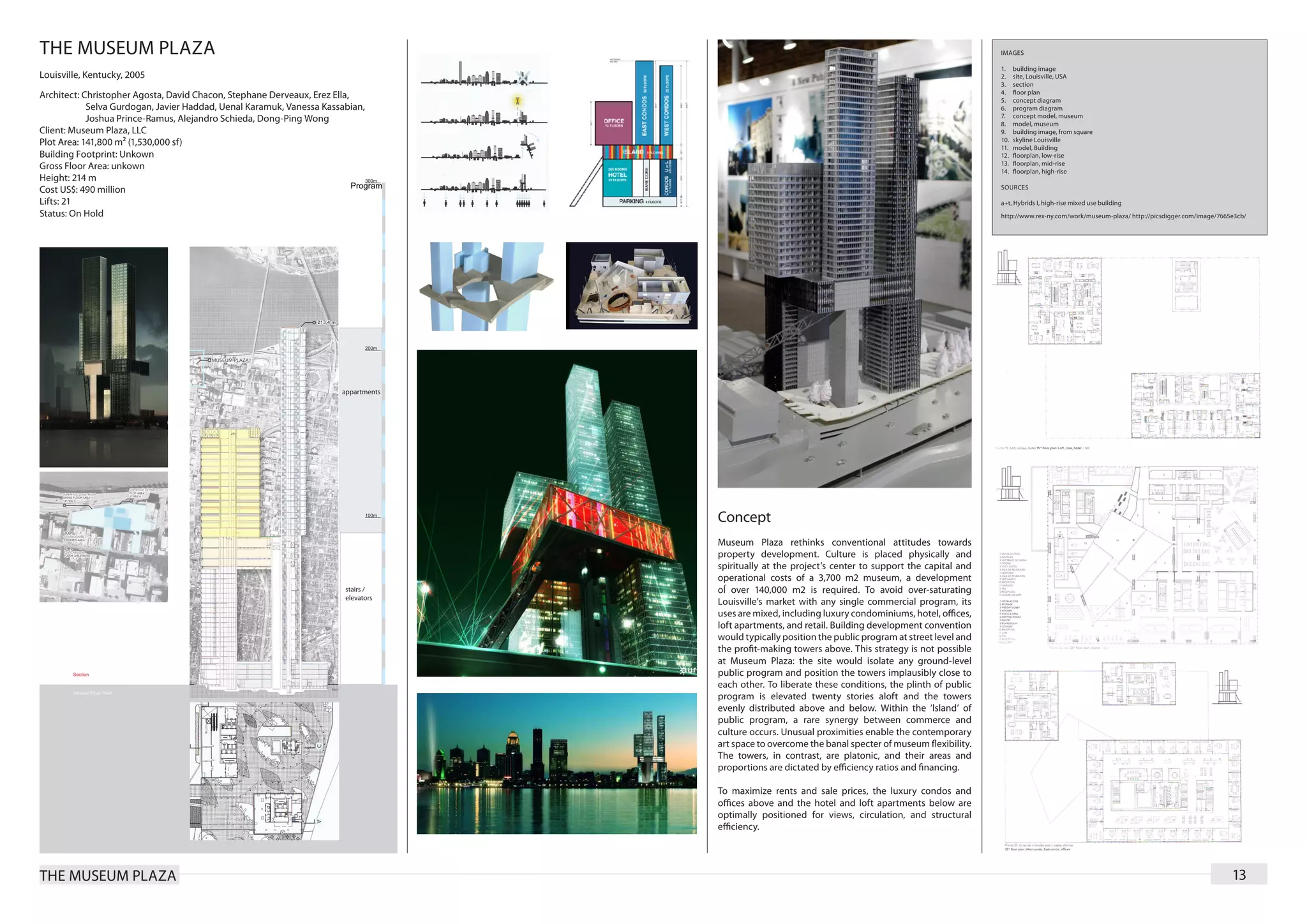
THE MUSEUM PLAZA                                                                                                                                 IMAGES

                                                                                                                                                 1.	    building image
Louisville, Kentucky, 2005                                                                                                                       2.	    site, Louisville, USA
                                                                                                                                                 3.	    section
                                                                                                                                                 4.	    floor plan
Architect: Christopher Agosta, David Chacon, Stephane Derveaux, Erez Ella,                                                                       5.	    concept diagram
	           Selva Gurdogan, Javier Haddad, Uenal Karamuk, Vanessa Kassabian,                                                                     6.	    program diagram
                                                                                                                                                 7.	    concept model, museum
	           Joshua Prince-Ramus, Alejandro Schieda, Dong-Ping Wong                                                                               8.	    model, museum
Client: Museum Plaza, LLC                                                                                                                        9.	    building image, from square
                                                                                                                                                 10.	   skyline Louisville
Plot Area: 141,800 m² (1,530,000 sf)                                                                                                             11.	   model, Building
Building Footprint: Unkown                                                                                                                       12.	   floorplan, low-rise
                                                                                                                                                 13.	   floorplan, mid-rise
Gross Floor Area: unkown                                                                                                                         14.	   floorplan, high-rise
Height: 214 m
                                                                                                                                                 SOURCES
Cost US$: 490 million
Lifts: 21                                                                                                                                        a+t, Hybrids I, high-rise mixed use building
Status: On Hold                                                                                                                                  http://www.rex-ny.com/work/museum-plaza/ http://picsdigger.com/image/7665e3cb/


                                                                               Concept
                                                                               Museum Plaza rethinks conventional attitudes towards
                                                                               property development. Culture is placed physically and
                                                                               spiritually at the project’s center to support the capital and
                                                                               operational costs of a 3,700 m2 museum, a development
                                                                               oÍ over 140,000 m2 is required. To avoid over-saturating
                                                                               Louisville’s market with any single commercial program, its
                                                                               uses are mixed, including luxury condominiums, hotel, offices,
                                                                               loft apartments, and retail. Building development convention
                                                                               would typically position the public program at street level and
                                                                               the profit-making towers above. This strategy is not possible
                                                                               at Museum Plaza: the site would isolate any ground-level
                                                                               public program and position the towers implausibly close to
                                                                               each other. To liberate these conditions, the plinth of public
                                                                               program is elevated twenty stories aloft and the towers
                                                                               evenly distributed above and below. Within the ’lsland’ of
                                                                               public program, a rare synergy between commerce and
                                                                               culture occurs. Unusual proximities enable the contemporary
                                                                               art space to overcome the banal specter of museum flexibility.
                                                                               The towers, in contrast, are platonic, and their areas and
                                                                               proportions are dictated by efficiency ratios and financing.

                                                                               To maximize rents and sale prices, the luxury condos and
                                                                               offices above and the hotel and loft apartments below are
                                                                               optimally positioned for views, circulation, and structural
                                                                               efficiency.


THE MUSEUM PLAZA                                                                                                                                                                                                          13
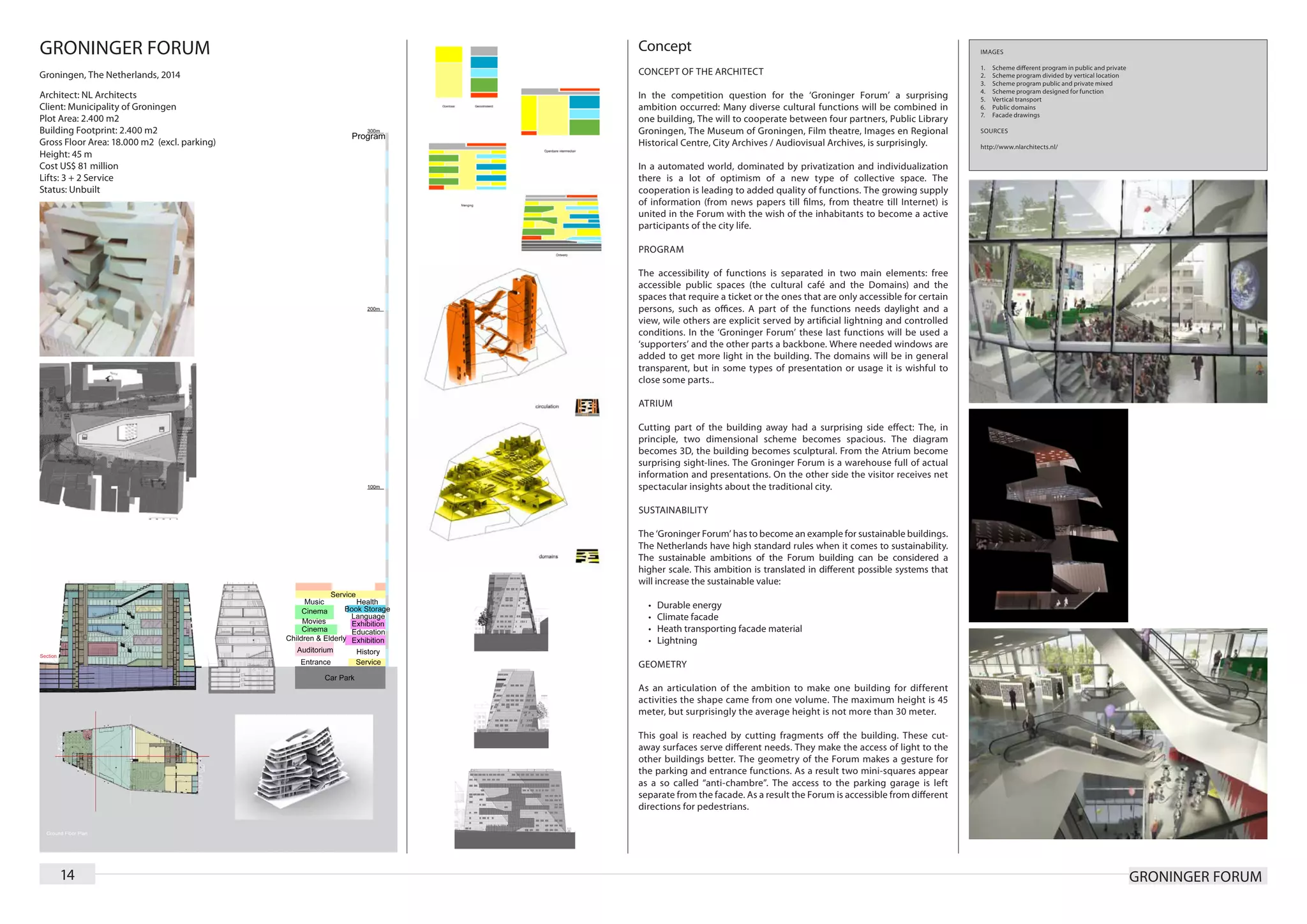
GRONINGER FORUM                               Concept                                                                         IMAGES

                                                                                                                              1.	   Scheme different program in public and private
Groningen, The Netherlands, 2014              CONCEPT OF THE ARCHITECT                                                        2.	   Scheme program divided by vertical location
                                                                                                                              3.	   Scheme program public and private mixed
                                                                                                                              4.	   Scheme program designed for function
Architect: NL Architects                      In the competition question for the ‘Groninger Forum’ a surprising              5.	   Vertical transport
Client: Municipality of Groningen             ambition occurred: Many diverse cultural functions will be combined in          6.	   Public domains
                                                                                                                              7.	   Facade drawings
Plot Area: 2.400 m2                           one building, The will to cooperate between four partners, Public Library
Building Footprint: 2.400 m2                  Groningen, The Museum of Groningen, Film theatre, Images en Regional            SOURCES
Gross Floor Area: 18.000 m2 (excl. parking)   Historical Centre, City Archives / Audiovisual Archives, is surprisingly.       http://www.nlarchitects.nl/
Height: 45 m
Cost US$ 81 million                           In a automated world, dominated by privatization and individualization
Lifts: 3 + 2 Service                          there is a lot of optimism of a new type of collective space. The
Status: Unbuilt                               cooperation is leading to added quality of functions. The growing supply
                                              of information (from news papers till films, from theatre till Internet) is
                                              united in the Forum with the wish of the inhabitants to become a active
                                              participants of the city life.

                                              PROGRAM

                                              The accessibility of functions is separated in two main elements: free
                                              accessible public spaces (the cultural café and the Domains) and the
                                              spaces that require a ticket or the ones that are only accessible for certain
                                              persons, such as offices. A part of the functions needs daylight and a
                                              view, wile others are explicit served by artificial lightning and controlled
                                              conditions. In the ‘Groninger Forum’ these last functions will be used a
                                              ‘supporters’ and the other parts a backbone. Where needed windows are
                                              added to get more light in the building. The domains will be in general
                                              transparent, but in some types of presentation or usage it is wishful to
                                              close some parts..

                                              ATRIUM

                                              Cutting part of the building away had a surprising side effect: The, in
                                              principle, two dimensional scheme becomes spacious. The diagram
                                              becomes 3D, the building becomes sculptural. From the Atrium become
                                              surprising sight-lines. The Groninger Forum is a warehouse full of actual
                                              information and presentations. On the other side the visitor receives net
                                              spectacular insights about the traditional city.

                                              SUSTAINABILITY

                                              The ‘Groninger Forum’ has to become an example for sustainable buildings.
                                              The Netherlands have high standard rules when it comes to sustainability.
                                              The sustainable ambitions of the Forum building can be considered a
                                              higher scale. This ambition is translated in different possible systems that
                                              will increase the sustainable value:

                                                •	   Durable energy
                                                •	   Climate facade
                                                •	   Heath transporting facade material
                                                •	   Lightning

                                              GEOMETRY

                                              As an articulation of the ambition to make one building for different
                                              activities the shape came from one volume. The maximum height is 45
                                              meter, but surprisingly the average height is not more than 30 meter.

                                              This goal is reached by cutting fragments off the building. These cut-
                                              away surfaces serve different needs. They make the access of light to the
                                              other buildings better. The geometry of the Forum makes a gesture for
                                              the parking and entrance functions. As a result two mini-squares appear
                                              as a so called “anti-chambre”. The access to the parking garage is left
                                              separate from the facade. As a result the Forum is accessible from different
                                              directions for pedestrians.


    14                                                                                                                                                                               GRONINGER FORUM
ELBPHILHARMONIE                 Concept
Hamburg, Germany, 2013          The new Philharmonic will be not only a site for music; it will
                                include an extensive complex of flats and adaptable facilities
Architect: Herzog & de Meuron   for a wealth of cultural activities. The core the major concert hall
Client: ReGe Hamburg            seating 2200 and a multipurpose hall for ca. 550 listeners will be
Plot Area: 5.885 m2             complemented by a 5-star hotel with a projected 220 rooms,
Building Footprint: 5.885 m2    with built-in services as restaurants, a health and fitness centre
Gross Floor Area: 120.000 m2    and conference facilities, as well as some 35 luxury flats.
Height: 100.0 m
Cost US$: 500 million           The Kaispeicher A has long been a relatively mute monument to
Lifts: 12                       the postwar era, through it is occasionally rented out for one-
Status: Constructed             off events; after its renovation, it will become a vital centre for
                                musicians and music lovers, attracting both tourists and the
                                world of business, the latter able to enjoy the use of state-of-
                                the-art technological facilities as well as the luxury of a first class
                                hotel in this centrally-located historical landmark.

                                The bold new Philharmonic will inject the surrounding
                                neighbourhood with energy and dynamism. Similar cultural
                                ‘implants’ in other cities provide impressive proof of the way in
                                which such projects contribute substantially to urban renewal,
                                                                                                          EXTRA TEXT EXPLANATION
                                enhancing the attraction of urban districts and, indeed,
                                functioning as agents of change. This will also be the crowning
                                                                                                          The lobby will be the overture or the echo of the large concert hall.
                                achievement of the ‘Hafencity Hamburg’, an ambitious project of
                                                                                                          Mounted under the belly of the great hall, a landscape of stairs an
                                urban expansion.
                                                                                                          Escherlike sculpture climbs in all directions.
                                The main entrance to the Kaispeicher complex lies to the east.
                                                                                                          The great hall and the lobby are stacked on top of each other like
                                A breathtakingly long escalator will run diagonally across the
                                                                                                          bowls; the floor of the hall doubles as the ceiling of the foyer, while
                                entire warehouse, transporting visitors from the way up to the
                                                                                                          the foyer in turn forms a vaulted ceiling stretching to the floor of the
                                plaza. Situated on top of the Kaispeicher and under the new
                                                                                                          Plaza and incorporating its visitors in an alien landscape that steadily
                                building, it will function as a gigantic joint between the old and
                                                                                                          climbs past several floors all the way up to the highest galleries of
                                new, forming a spacious public area with a unique panorama:
                                                                                                          the concert hall. Everything is stairs: floors, ceilings and walls become
                                to the north, downtown Hamburg and a view reaching beyond
                                                                                                          almost indistinguishable. Climbing the vast carpet of stairs, the visitor
                                the Aussenalster; to the east, west and south, the River Elbe and
                                                                                                          reaches horizontal areas that intersect at each level,using bars or
                                its vast, sprawling harbour.
                                                                                                          cloackrooms. The festive atmosphere already appararent in the foyer
                                                                                                          is heightened in the grand hall. There, the warm white of the foyer
                                                                                                          gives way to an intense amber; the surfaces shimmer and sparkle,
                                EVOLUTIONARY ABOUT THE CONCEPT
                                                                                                          reflecting the light. The orchestra and the conductor are placed in the
                                                                                                          midst of the audience; the galleries sweep into each other, overlap
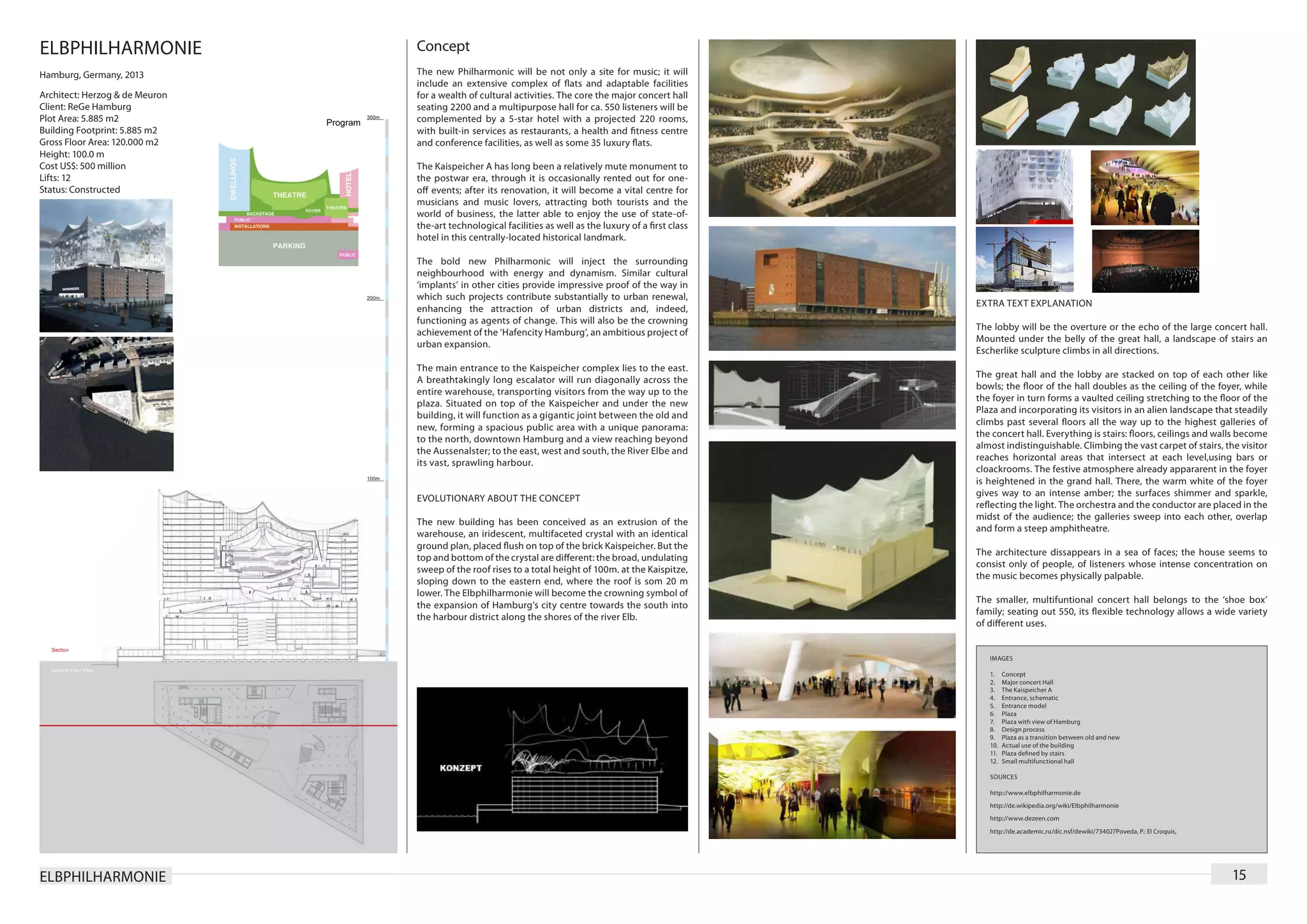
                                The new building has been conceived as an extrusion of the
                                                                                                          and form a steep amphitheatre.
                                warehouse, an iridescent, multifaceted crystal with an identical
                                ground plan, placed flush on top of the brick Kaispeicher. But the
                                                                                                          The architecture dissappears in a sea of faces; the house seems to
                                top and bottom of the crystal are different: the broad, undulating
                                                                                                          consist only of people, of listeners whose intense concentration on
                                sweep of the roof rises to a total height of 100m. at the Kaispitze,
                                                                                                          the music becomes physically palpable.
                                sloping down to the eastern end, where the roof is som 20 m
                                lower. The Elbphilharmonie will become the crowning symbol of
                                                                                                          The smaller, multifuntional concert hall belongs to the ‘shoe box’
                                the expansion of Hamburg’s city centre towards the south into
                                                                                                          family; seating out 550, its flexible technology allows a wide variety
                                the harbour district along the shores of the river Elb.
                                                                                                          of different uses.


                                                                                                             IMAGES

                                                                                                             1.	    Concept
                                                                                                             2.	    Major concert Hall
                                                                                                             3.	    The Kaispeicher A
                                                                                                             4.	    Entrance, schematic
                                                                                                             5.	    Entrance model
                                                                                                             6.	    Plaza
                                                                                                             7.	    Plaza with view of Hamburg
                                                                                                             8.	    Design process
                                                                                                             9.	    Plaza as a transition between old and new
                                                                                                             10.	   Actual use of the building
                                                                                                             11.	   Plaza defined by stairs
                                                                                                             12.	   Small multifunctional hall

                                                                                                             SOURCES

                                                                                                             http://www.elbphilharmonie.de
                                                                                                             http://de.wikipedia.org/wiki/Elbphilharmonie
                                                                                                             http://www.dezeen.com
                                                                                                             http://de.academic.ru/dic.nsf/dewiki/734027Poveda, P.: El Croquis,


ELBPHILHARMONIE                                                                                                                                                                   15
486 MINA EL HOSN
Beirut, Lebanon 2009

Architect: Lan Architect
Client: HAR Etudes, Bank Med
Plot Area: 9950 m2
Building Footprint: 625 m2
Gross Floor Area: 125,000 m2
Height: 142 m
Cost US$: 160 million
Lifts: 3 + 1 Service
Status: Competition proposal


                               Concept
                               CONCEPT OF THE ARCHITECT

                               T he project is located at Beirut, as architect said, the city is an
                               “unfinished” superposition of histories, contexts architectures
                               and situations. They want the project to be an interface to
                               generate new connections and create new view axis to observe
                               the history, the present and the future. The project is divide into
                               3 parts with 3 approaches corresponding to programme demand
                               and diverse scale in the project.

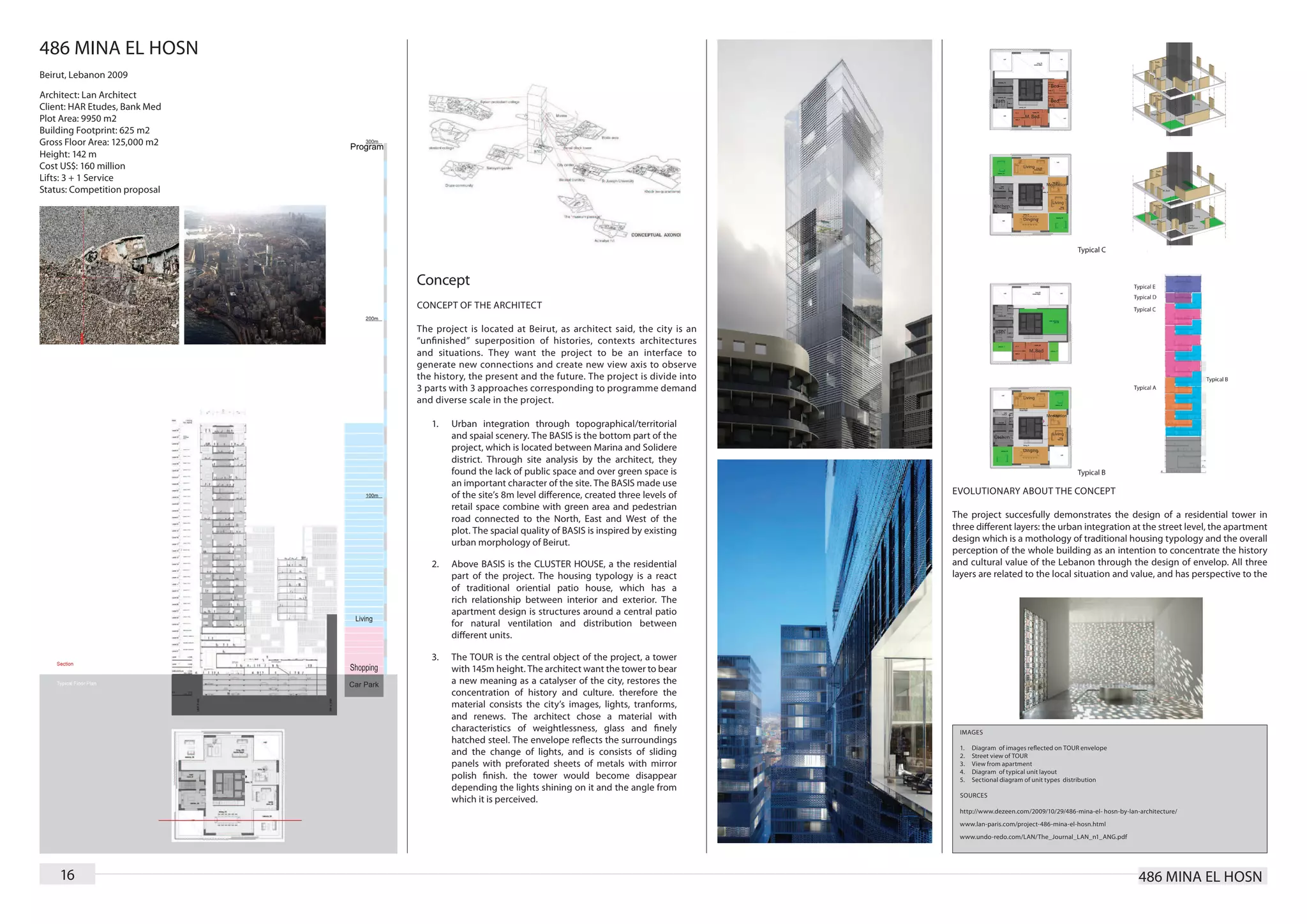
                                  1.	   Urban integration through topographical/territorial
                                        and spaial scenery. The BASIS is the bottom part of the
                                        project, which is located between Marina and Solidere
                                        district. Through site analysis by the architect, they
                                        found the lack of public space and over green space is
                                        an important character of the site. The BASIS made use
                                        of the site’s 8m level difference, created three levels of    EVOLUTIONARY ABOUT THE CONCEPT
                                        retail space combine with green area and pedestrian
                                        road connected to the North, East and West of the             The project succesfully demonstrates the design of a residential tower in
                                        plot. The spacial quality of BASIS is inspired by existing    three different layers: the urban integration at the street level, the apartment
                                        urban morphology of Beirut.                                   design which is a mothology of traditional housing typology and the overall
                                                                                                      perception of the whole building as an intention to concentrate the history
                                  2.	   Above BASIS is the CLUSTER HOUSE, a the residential           and cultural value of the Lebanon through the design of envelop. All three
                                        part of the project. The housing typology is a react          layers are related to the local situation and value, and has perspective to the
                                        of traditional oriential patio house, which has a
                                        rich relationship between interior and exterior. The
                                        apartment design is structures around a central patio
                                        for natural ventilation and distribution between
                                        different units.

                                  3.	   The TOUR is the central object of the project, a tower
                                        with 145m height. The architect want the tower to bear
                                        a new meaning as a catalyser of the city, restores the
                                        concentration of history and culture. therefore the
                                        material consists the city’s images, lights, tranforms,
                                        and renews. The architect chose a material with
                                        characteristics of weightlessness, glass and finely             IMAGES
                                        hatched steel. The envelope reflects the surroundings
                                                                                                       1.	   Diagram of images reflected on TOUR envelope
                                        and the change of lights, and is consists of sliding           2.	   Street view of TOUR
                                        panels with preforated sheets of metals with mirror            3.	   View from apartment
                                                                                                       4.	   Diagram of typical unit layout
                                        polish finish. the tower would become disappear                 5.	   Sectional diagram of unit types distribution
                                        depending the lights shining on it and the angle from
                                                                                                       SOURCES
                                        which it is perceived.
                                                                                                       http://www.dezeen.com/2009/10/29/486-mina-el- hosn-by-lan-architecture/
                                                                                                       www.lan-paris.com/project-486-mina-el-hosn.html
                                                                                                       www.undo-redo.com/LAN/The_Journal_LAN_n1_ANG.pdf


    16                                                                                                                                                           486 MINA EL HOSN
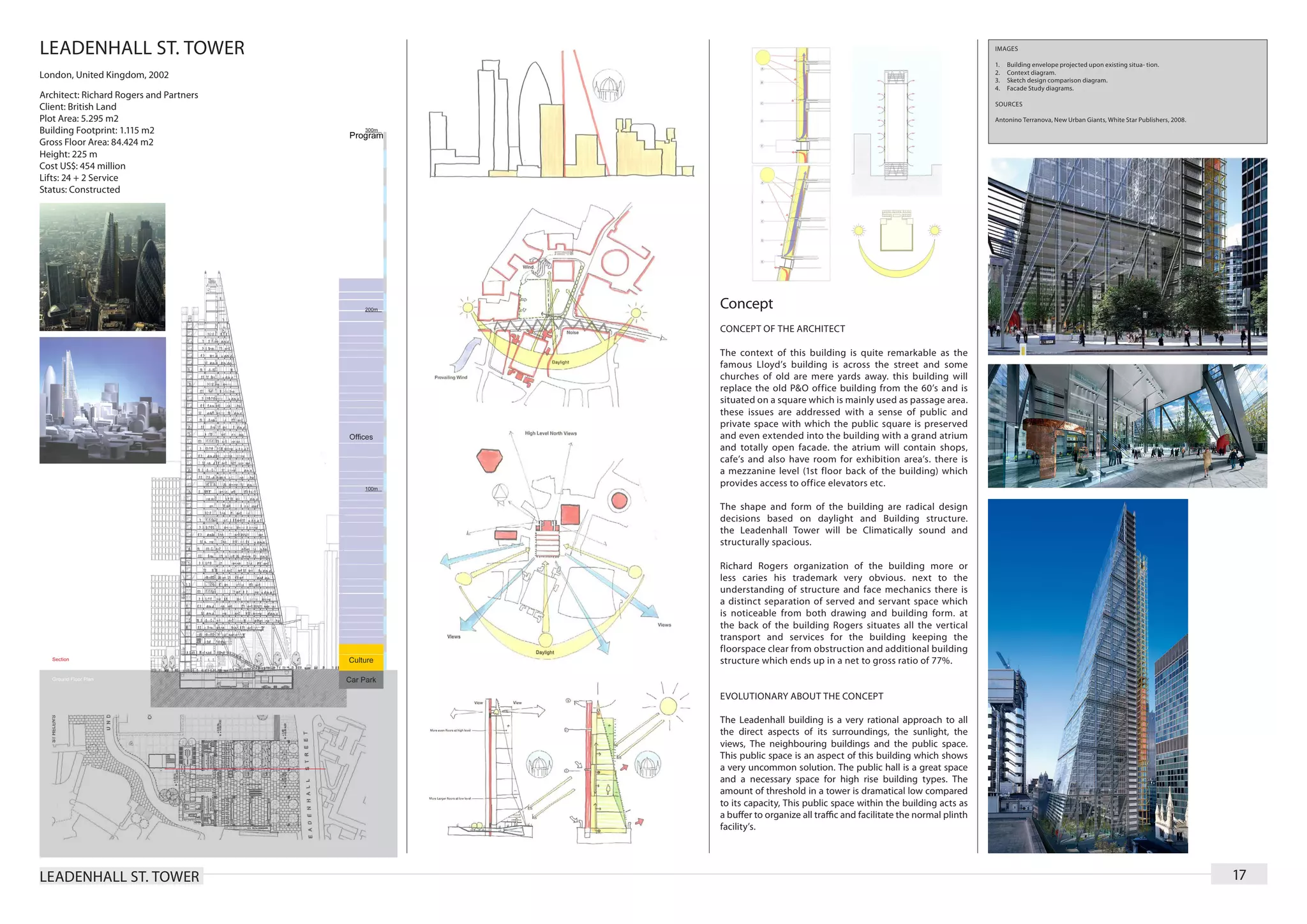
LEADENHALL ST. TOWER                                                                                         IMAGES

                                                                                                             1.	   Building envelope projected upon existing situa- tion.
London, United Kingdom, 2002                                                                                 2.	   Context diagram.
                                                                                                             3.	   Sketch design comparison diagram.
                                                                                                             4.	   Facade Study diagrams.
Architect: Richard Rogers and Partners
                                                                                                             SOURCES
Client: British Land
Plot Area: 5.295 m2                                                                                          Antonino Terranova, New Urban Giants, White Star Publishers, 2008.
Building Footprint: 1.115 m2
Gross Floor Area: 84.424 m2
Height: 225 m
Cost US$: 454 million
Lifts: 24 + 2 Service
Status: Constructed


                                         Concept
                                         CONCEPT OF THE ARCHITECT

                                         The context of this building is quite remarkable as the
                                         famous Lloyd’s building is across the street and some
                                         churches of old are mere yards away. this building will
                                         replace the old P&O office building from the 60’s and is
                                         situated on a square which is mainly used as passage area.
                                         these issues are addressed with a sense of public and
                                         private space with which the public square is preserved
                                         and even extended into the building with a grand atrium
                                         and totally open facade. the atrium will contain shops,
                                         cafe’s and also have room for exhibition area’s. there is
                                         a mezzanine level (1st floor back of the building) which
                                         provides access to office elevators etc.

                                         The shape and form of the building are radical design
                                         decisions based on daylight and Building structure.
                                         the Leadenhall Tower will be Climatically sound and
                                         structurally spacious.

                                         Richard Rogers organization of the building more or
                                         less caries his trademark very obvious. next to the
                                         understanding of structure and face mechanics there is
                                         a distinct separation of served and servant space which
                                         is noticeable from both drawing and building form. at
                                         the back of the building Rogers situates all the vertical
                                         transport and services for the building keeping the
                                         floorspace clear from obstruction and additional building
                                         structure which ends up in a net to gross ratio of 77%.


                                         EVOLUTIONARY ABOUT THE CONCEPT

                                         The Leadenhall building is a very rational approach to all
                                         the direct aspects of its surroundings, the sunlight, the
                                         views, The neighbouring buildings and the public space.
                                         This public space is an aspect of this building which shows
                                         a very uncommon solution. The public hall is a great space
                                         and a necessary space for high rise building types. The
                                         amount of threshold in a tower is dramatical low compared
                                         to its capacity, This public space within the building acts as
                                         a buffer to organize all traffic and facilitate the normal plinth
                                         facility’s.


LEADENHALL ST. TOWER                                                                                                                                                              17
SHENZHEN INTERNATIONAL ENERGY
MANSION
Shenzhen, China, 2016
Architect: Bjarke Ingles Group (BIG)
Client: Shenzhen Energy Company
Plot Area: ? m2
Building Footprint: ? m2
Gross Floor Area: 96.000 m2
Height: 200 m
Cost US$: Unknown
Lifts: 22 + 2 Service
Status: Unbuilt


                                       Concept
                                       CONCEPT OF THE ARCHITECT

                                       The Shenzhen Energy Company headquarters rises 200 meters
                                       creating a new landmark visible from the highway in the cultural,
                                       political and business center of Shenzhen. BIG envisions combining
                                       a practical and efficient floor plan layout with a sustainable façade
                                       that both, passively and actively reduce the energy consumption
                                       of the building. The façade is conceived as a folded skin that
                                       shades the office complex from direct sunlight and integrates solar
                                       thermal panels, reducing the overall energy consumption of the
                                       building. The folded structure of the facade also creates special
                                       niches and unique spaces inside the office floors as well as on the
                                       streets around the building.


                                       EVOLUTIONARY ABOUT THE CONCEPT
                                                                                                                 EXTRA TEXT EXPLANATION
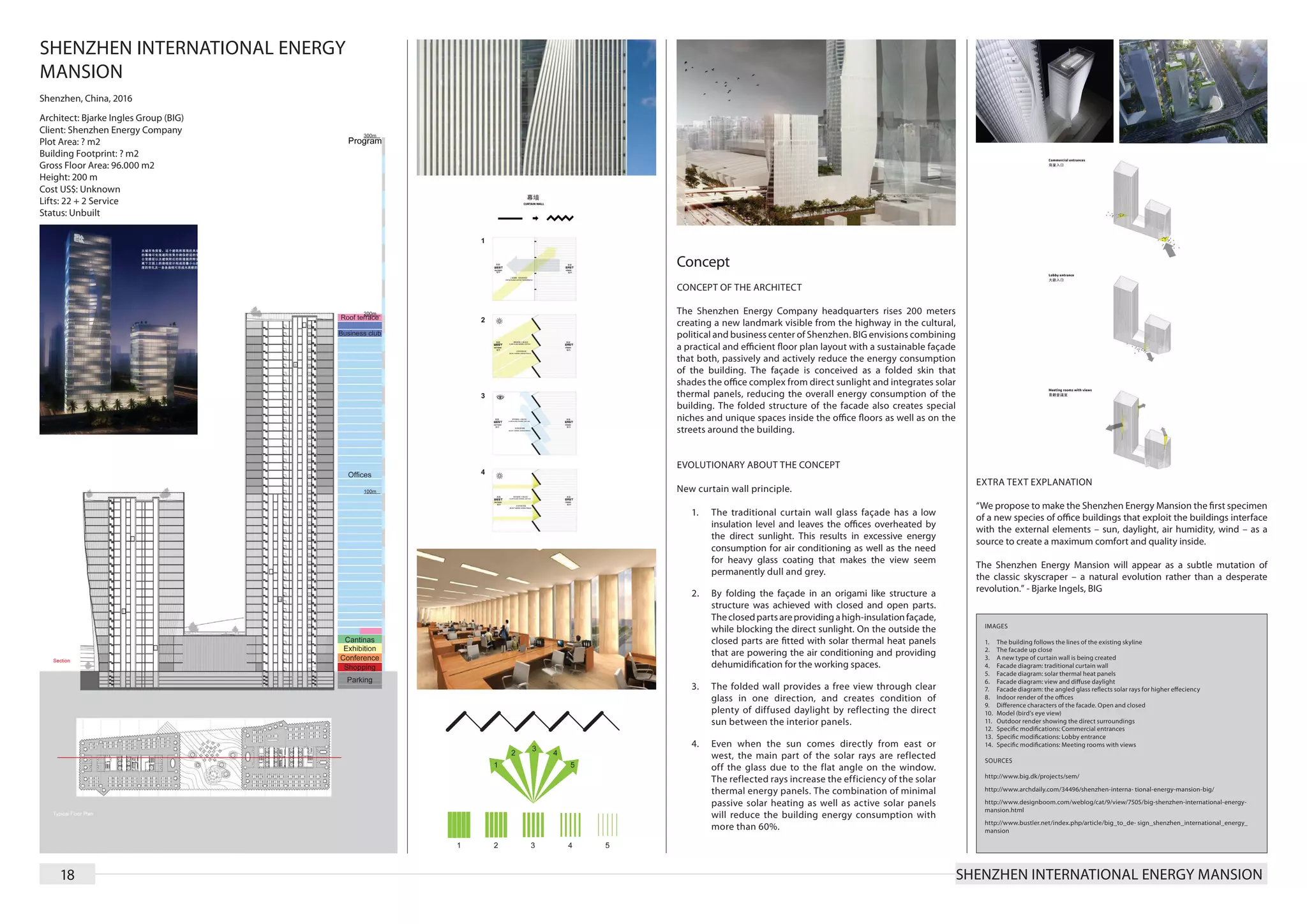
                                       New curtain wall principle.
                                                                                                                 “We propose to make the Shenzhen Energy Mansion the first specimen
                                          1.	   The traditional curtain wall glass façade has a low
                                                                                                                 of a new species of office buildings that exploit the buildings interface
                                                insulation level and leaves the offices overheated by
                                                                                                                 with the external elements – sun, daylight, air humidity, wind – as a
                                                the direct sunlight. This results in excessive energy
                                                                                                                 source to create a maximum comfort and quality inside.
                                                consumption for air conditioning as well as the need
                                                for heavy glass coating that makes the view seem
                                                                                                                 The Shenzhen Energy Mansion will appear as a subtle mutation of
                                                permanently dull and grey.
                                                                                                                 the classic skyscraper – a natural evolution rather than a desperate
                                          2.	   By folding the façade in an origami like structure a             revolution.” - Bjarke Ingels, BIG
                                                structure was achieved with closed and open parts.
                                                The closed parts are providing a high-insulation façade,
                                                                                                                   IMAGES
                                                while blocking the direct sunlight. On the outside the
                                                closed parts are fitted with solar thermal heat panels             1.	    The building follows the lines of the existing skyline
                                                                                                                   2.	    The facade up close
                                                that are powering the air conditioning and providing               3.	    A new type of curtain wall is being created
                                                dehumidification for the working spaces.                           4.	    Facade diagram: traditional curtain wall
                                                                                                                   5.	    Facade diagram: solar thermal heat panels
                                                                                                                   6.	    Facade diagram: view and diffuse daylight
                                          3.	   The folded wall provides a free view through clear                 7.	    Facade diagram: the angled glass reflects solar rays for higher effeciency
                                                glass in one direction, and creates condition of                   8.	    Indoor render of the offices
                                                                                                                   9.	    Difference characters of the facade. Open and closed
                                                plenty of diffused daylight by reflecting the direct               10.	   Model (bird’s eye view)
                                                sun between the interior panels.                                   11.	   Outdoor render showing the direct surroundings
                                                                                                                   12.	   Specific modifications: Commercial entrances
                                                                                                                   13.	   Specific modifications: Lobby entrance
                                          4.	   Even when the sun comes directly from east or                      14.	   Specific modifications: Meeting rooms with views
                                                west, the main part of the solar rays are reflected                SOURCES
                                                off the glass due to the flat angle on the window.
                                                                                                                   http://www.big.dk/projects/sem/
                                                The reflected rays increase the efficiency of the solar
                                                thermal energy panels. The combination of minimal                  http://www.archdaily.com/34496/shenzhen-interna- tional-energy-mansion-big/

                                                passive solar heating as well as active solar panels               http://www.designboom.com/weblog/cat/9/view/7505/big-shenzhen-international-energy-
                                                                                                                   mansion.html
                                                will reduce the building energy consumption with
                                                                                                                   http://www.bustler.net/index.php/article/big_to_de- sign_shenzhen_international_energy_
                                                more than 60%.                                                     mansion


     18                                                                                                        SHENZHEN INTERNATIONAL ENERGY MANSION
THE SHARD                                                                                                              Concept
Tower Bridge, London, 2012                                                                                             CONCEPT OF THE ARCHITECT

Architect: Renzo Piano                                                                                                 Because the Shard is the first really tall building and
Client: The Sellar Property Group                                                                                      has no reference with an existing skyline it has and
Plot Area: 15.000 m2                                                                                                   360 degree orientation. The form of the building is
Building Footprint: 4500 m2                                                                                            tapered with the smaller residential floor plans in the
Gross Floor Area: 130.000 m2                                                                                           top of the building and the big office floor plans at its
Height: 310m                                                                                                           base. The concept of Renzo Piano was to create a mixed
Cost US$: 1.9 billion                                                                                                  use vertical village where could be lived, worked and
Lifts: 36                                                                                                              for leisure. The shape of the building consists of eight
Status: Constructed                                                                                                    shards that are leaning towards each other. These shards
                                                                                                                       are made of double skin glass façades, with a cavity in
                                                                                                                       between them. The outer skin is made of single glazing
                                                                                                                       while the inner skin is made of double glazing. To reduce
                                                                                                                       heat gain the double skin façade is ventilated and has
                                                                                                                       roller blinds in the cavities to increase comfort levels and
                                                                                                                       allow the maximum level of natural daylight to entre. If
                                                                                                                       there is excess heat generated by the offices that will be
                                                                                                                       used to heat the hotel and apartments. Any additional
                                                                                                                       heat excess will be led outside. In between the ‘cracks’
                                                                                                                       of the shards there are (outside) gardens, where people
                                                                                                                       have access to.


                                                                                                                       EVOLUTIONARY ABOUT THE CONCEPT

                                                                                                                       This is the fist time a double skin façade is applied on
                                                                                                                       a building of this scale. A second-skin is literary a glass
                                                                                                                       layer around the entire building and contains a layer of
                                                                                                                       air that acts as a buffer in front of the interior façade.


                                                                                                                                                                                      EXTRA TEXT EXPLANATION

                                                                                                                                                                                      The Shard has multiple viewing galleries, the mid-level
                                                                                                                                                                                      public viewing galleries are approximately at the same
                                                                                                                                                                                      height as the London Eye (ferris wheel) and the top deck
                                                                                                                                                                                      at 310 meters will provide views from a height that will
                                                                                                                                                                                      be the highest in the UK, and Europe.For the first time
                                                                                                                                                                                      in the UK there was used a new type of elevator during
                                                                                                                                                                                      the construction of the building. There was a ‘Jump Lift’
                                                                                                                                                                                      installed. This is a self-climbing elevator that uses the
                                    URBAN INTEGRATION                                                                                                                                 building’s permanent/final elevator shaft and moves
                                                                                                                         IMAGES                                                       higher in the shaft as the building gets taller. With this
                                    The Shenzhen Energy Company headquarters rises 200 meters creating a new                                                                          system it is possible to continue construction at the levels
                                                                                                                         1.	 fragment of the façade
                                    landmark visible from the highway in the cultural, political and business center         	 renzo piano website                                    above while the lift is operating in the same shaft at the
                                    of Shenzhen. BIG envisions combining a practical and efficient floor plan layout     2.	 principle of a second-skin façade
                                                                                                                             	 by author
                                    with a sustainable façade that both, passively and actively reduce the energy        3.	 second-skin façade applied at the Shard
                                    consumption of the building. The façade is conceived as a folded skin that               	 by author

                                    shades the office complex from direct sunlight and integrates solar thermal          SOURCES
                                    panels, reducing the overall energy consumption of the building. The folded
                                                                                                                         http://www.rpbw.com/
                                    structure of the facade also creates special niches and unique spaces inside the     (renzo piano website)
                                    office floors as well as on the streets around the building.


THE SHARD                                                                                                                                                                                                                                19
TORRE VELASCA                                                Concept
Milan, Italy, 1958                                           CONCEPT OF THE ARCHITECT

Architect: Belgiojoso, Peressutti and Rogers (Studio BBPR)   The architecture trio BBPR (Banfi (who died before the
Client: -                                                    design process of the Torre Velasca started), Belgiojoso,
Plot Area: 1200m2                                            Peressutti and Rogers) formed a renowned Milanese
Building Footprint: 800m2                                    architecture partnership, founded in 1932.
Gross Floor Area: 9000m2
Height: 106 m                                                The moment of design came at a time when the first
Cost US$: Unknown                                            generation of Italian modernist architects were in
Lifts: 7                                                     a proces of reviewing the international rationalist
Status: Constructed                                          movement. Although the Torre Velasca in Milan follows
                                                             the strict rules of the modern movement, it is at the
                                                             same time reacting to its context, unlike the Pirelli tower,
                                                             built around the same time but in a different style.

                                                             Especially the “dialogue” with the cathedral, the towers
                                                             within the city and most importantly ‘Castello Sforzeso”,
                                                             also in the city center (image #1). The dialogue refers
                                                             to the colour of the facade and shape of the tower.
                                                             The colour is similar to that of medieval, especially
                                                             Lomabrdian, fortresses and towers. The shape is also
                                                             similar to older towers, which generally consisted of
                                                             small lower floors, providing storage and workspace,
                                                             and larger upper floors for living quarters. Exactly the
                                                             same division is used in this design, with shops and
                                                             offices on the lowers floors and housing on the upper
                                                             floors.


                                                             EVOLUTIONARY ABOUT THE CONCEPT

                                                             However, the traditional tower shape is not merely an
                                                             esthetical issue. The shape is largely defined by the
                                                             location and surrounding built volumes. Only in second
                                                             case is it inspired by traditional castle and tower shapes.

                                                             At the time of construction the plot (image #2) was
                                                             already surrounded on all sides by existing low building
                                                             blocks. This did not allow a wide base with a slim tower,
                                                             which would provide a strong connection with its
                                                             immediate surroundings, and provide a lot of space for
                                                             retail. The architects opted for the opposite, designing
                                                             a slim base with a wide upper part of the tower,
                                                             thereby reacting to the dense existing building blocks
                                                             surrounding the plot.

                                                             Also revolutionary in the high rise built environment for
                                                             the time is the combination of modern techniques with
                                                             traditional form.


                                                                                                                            IMAGES

                                                                                                                            1.	   Google Earth screenshot of the view of the Torre Velasca from the Castello Sforzeso.
                                                                                                                            2.	   Torre Velasca in its dense surroundings
                                                                                                                            3.	   Torre Velasca towers above the surrounding buildings.
                                                                                                                            4.	   Supports of the upper levels.

                                                                                                                            SOURCES

                                                                                                                            http://eng.archinform.net/projekte/553.htm (sections and plan drawings)
                                                                                                                            http://www.edilone.it/Torre-Velasca_opere_y_35.html
                                                                                                                            (Italian article)
                                                                                                                            http://www.exibart.com/notizia.asp/IDCategoria/208/ IDNotizia/6173
                                                                                                                            (Italian article, published on 17 dec 2007)
                                                                                                                            http://www.olivari.it/designers/bbpr.html
                                                                                                                            (Italian article)


     20                                                                                                                                                                                                     TORRE VELASCA
VIENNA TWIN TOWERS
Vienna, Austria, 2001

Architect: Massimiliano Fuksas
Client: Wienerberger Baustoffindustrie AG and the Immofinanz
	        Immobilien Anlagen AG
Plot Area: -
Building Footprint: 2 x 1400m2
Gross Floor Area: 100000m2
Height: 138 m & 127 m
Cost US$: Unknown
Lifts: 2 x 9
Status: Constructed


                                                                                                                                       Concept
                                                                                                                                       CONCEPT OF THE ARCHITECT

                                                                                                                                       The complex, housing mainly offices but also leisure and shopping facilities
                                                                                                                                       in the base and the deep basement levels, stands on the southern edge of
                                                                                                                                       Vienna, Austria, on the site of the former Wienerberger quarries and brick
                                                                                                                                       ovens. This company is still owner of most of the land.

                                                                                                                                       “The concept unifying the entire project, which first appears in base of the
                                                                                                                                       building, is the architect’s intent of creating a continuous fluidity in the urban
                                                                                                                                       context, in creation of a complex which is more than just functional: a true
                                                                                                                                       pulsating heart of city society, maintaining an ongoing dialogue with its
                                                                                                                                       urban setting, which it intersects and overlaps.”

                                                                                                                                       This concept is visible in the many open spaces on different levels, the
                                                                                                                                       skylights letting light into the deep basement levels but simultaneously
                                                                                                                                       allowing views through the skylights on the glass facades of the towers, and
                                                                                                                                       of course the trans- parent towers themselves.

                                                                                                                                       The towers have been positioned at a 59 degree angle between themselves,
                                                                                                                                       but, together with the base, woven into the strict urban fabric using slim
                                                                                                                                       objects with beautiful, attractive lines which link them to their urban setting
                                                                                                                                       and make the complex an attractive place to work and enjoy.


                                                                                                                                       EVOLUTIONARY ABOUT THE CONCEPT

                                                               IMAGES                                                                  These two towers with its base are not necessarily revolutionary in their
                                                               1.	 View of the facade of the two towers, with the five, multi-storey   shape or buildup, but most definitely in both the way the complex has been
                                                                   glazed bridges in between the towers.
                                                               2.	 Image of the connection between the commercial area                 woven into the urban context and the extreme trasparency.
                                                                   (underground) to one of the towers.
                                                               3.	 Image of the hall, in the base. Clearly visible are the large sky
                                                                   lights allowing views on the towers, and also the depth of the      As explained above, the towers and the base are well adapted to the location,
                                                                   basement levels.                                                    allowing visual, mental and also physical connections by the many views,
                                                               4.	 A second section, in this case of the lower tower.
                                                               5.	 Floorplan of the base level, with the outline of the towers         transparency, ramps, stairs and al- leys.
                                                                   visualized
                                                               6.	 View of the complex, from the western area out- side the city.
                                                                                                                                       Secondly, by implementing a column construction (as can be seen in the
                                                               SOURCES
                                                                                                                                       plan) together with integrating the entire energy system into the thin floors,
                                                               Molinari, L., Massimiliano Fuksas, Works and Projects 1970-2005,
                                                                                                                                       the facade is entirely unobscured and the glazing is fully visible. This allows
                                                               2005, Skira Edi- tore, Milano                                           even the higher floors to have a connection with the urban surroundings.
                                                               website: http://www.floornature.com/proget-
                                                               to.php?id=4182&sez=30


VIENNA TWIN TOWERS                                                                                                                                                                                                          21
EWHA CAMPUS                                Concept
Seoul, Korea, 2008                         CONCEPT OF THE ARCHITECT

Architect: Dominique Perrault Architecte   T he EWHA Campus can definitely claim to be the first
Client: Ewha Campus Center Project         horizontal skyscraper. Apart from horizontal it is also
Plot Area: 19.000 m2                       80% underground and that makes the prject even
Building Footprint: 19.000 m2              more unique. The complexity of the immediate site
Gross Floor Area: 70.000 m2                through its relationship to the greater campus and the
Cost US$: 107 million                      city of Shinchon to the south demands a “larger than
Lifts: 3 + 1 Service                       site” response, an urban response, a global landscaped
Status: Constructed                        solution which weaves together the tissue of the EWHA
                                           campus with that of the city. This gesture, the “campus
                                           valley”, in combination with the “sports strip”, creates
                                           a new topography which impacts the surrounding
                                           landscape in a number of ways. The Sports Strip, like the
                                           Valley, is many things at once. It is a new gateway to the
                                           Ewha campus, a place for daily sports activities, a grounds
                                           for the special yearly festivals and celebrations, and an
                                           area which truly brings together the university and the
                                           city. It is most importantly a place for all, animated all
                                           year long.
                                                                                                                             EXTRA TEXT EXPLANATION
                                           Like a horizontal billboard, the sports strip presents the
                                           life of the university to the inhabitants of Shinchon, and
                                                                                                                             Les Champs Elysées
                                           vice-versa. Once through the sports strip, pedestrian
                                                                                                                             A new seam slices through the topography revealing the interior of the EWHA
                                           movement and flow through the site is celebrated. A new
                                                                                                                             campus center. A void is formed, a hybrid place, in which a variety of activities can
                                           “Champs Elysées” invites the public into the site carrying
                                                                                                                             unfold. It is an avenue, gently descending, controlling the flow of traffic, leading to
                                           students and visitors alike through the campus center
                                                                                                                             a monumental stair carrying visitors upwards, recalling les Champs Elysees or the
                                           northwards, bringing together the different levels of the
                                                                                                                             Campidiglio in Rome.
                                           site.
                                                                                                                               •	 An entry court, from which access to the various departments exist,
                                           The pastoral nature of the campus is perhaps its most
                                                                                                                               •	 A node, or point on a trajectory to another destination,
                                           remarkable quality. It should be permitted to grow
                                                                                                                               •	 A forum for the exchange of ideas as students gather after class to discuss their
                                           outwards, or inwards in this case, covering the campus
                                                                                                                                  views,
                                           center with trees, flowers, and grass. An idyllic garden
                                                                                                                               •	 A piazza, with the cafeteria spilling out creating a real “place” to stop and relax,
                                           is the result, creating a special place for gathering,
                                                                                                                               •	 An outdoor theatre, as the stair can be used in an amphitheatre like fashion,
                                           conducting informal classes, and simply relaxing
                                                                                                                               •	 A sculpture garden, where indoor gallery events can push outwards.

                                                                                                                             It is precisely this flexibility (conceptual and real) which permits the New EWHA
                                           EVOLUTIONARY ABOUT THE CONCEPT
                                                                                                                             campus center to inevitably weave itself into the landscape sometimes a building,
                                                                                                                             sometimes a landscape, sometimes a sculpture.
                                           The EWHA Campus is revolutionary because it is one of the
                                           first built projects to combine linear building, underground
                                                                                                                             The campus centre is designed to offer a new sense of direction for higher education
                                           architecture and landscape design. 70.000sq.m. of program
                                                                                                                             in the 21st century. It establishes organic relations between the centre and
                                           would be easier to build on stacked floors and form an
                                                                                                                             surrounding areas of campus as well as between above ground and underground
                                           iconic high-rise building, yet the architect innovates and
                                                                                                                             spaces.
                                           creates an even more iconic building by placing it into the
                                           ground. It is a notion of weaving together the campus is
                                           again evident, blurring the distinction between old and
                                           new, building and landscape, present and past..


                                            IMAGES

                                            1.	 The Campus filledwith students
                                            2.	 First Render of the concept
                                            3.	 Night views
                                            4.	 View of the monumental staircase from the lowest part
                                            5.	 The schism on the ground is revealed. Generous gesture to provide natural
                                                light
                                            6.	 View from the interior. Sunlight casts and pen- etrates the earth.

                                            SOURCES

                                            Per Fernandez A. & Mozas J. (2008), Hybrids II – Low Rise Mixed-Use Buildings,
                                            A+T EDICIONES, Spain
                                            http://archide.wordpress.com/2008/12/03/ewha-wom- ans-university-campus-
                                            center-by-dominique-perrault/
                                            http://www.perraultarchitecte.com/en/projects/2459- ewha_womans_


    22                                                                                                                                                                                     EWHA CAMPUS
300 NORTH LASALLE                       300 NORTH LASALLE
Chicago, United States, 2006-2009       The 300 North LaSalle building is a typical example of a high-
                                        density development within a highly urban context. With a height
Architect: Pickard Chilton              just over 236 m it is one of the highest buildings in Chicago. Mainly
Developer: Hines                        consisting of generic office space, the key features of this project
Plot Area: +/- 400 m2                   are the design of the public space in the plinth and the delicate
Net Floor Area: 117.735 m2              treatment of the facade.
Height: 236,2 m (775 ft)
Building Costs US$: 480 million         URBAN INTEGRATION
Selling Price US$: 655 million (2010)
Lifts: 24 (+2 freight, +2 garage)       The position of the tower alongside the Chicago River Bank,
Status: Constructed                     currently undergoing a large-scale redevelopment, is the main
                                        reason to integrate different levels of public functions in the lower
                                        part of the tower. The combination of an upper level lobby and café
                                        and a lower river level restaurant is very characteristic for Chicago.

                                        The tower itself has been shifted away from the riverside towards
                                        the inner streets, broadening the river bank and thus providing
                                        space for a comfortable terrace facing the south.By employing two
                                        routes through the different levels, one external and one internal,
                                        and several entrances on both levels, the tower is fitted perfectly
                                        within its surroundings. By providing the generous inside public
                                        space with a strong visual connection towards the outside, the             Not only do the stainless steel fins emphasize the verticality of       SOURCES
                                        public character of both is emphasized.                                    the building, they also express the structural system both behind
                                                                                                                                                                                           http://www.archdaily.com/146450/300-north-lasalle- pickard-chilton/
                                                                                                                   the building and its facade in an honest way. The light reflective
                                        FACADE APPEARANCE                                                          stainless steel is very visible and contrasts with the large amount     http://www.property-website.com/pws/sites/112/live/

                                                                                                                   of highly transparent glazing and the dark surfaces in front of the     http://www.worldpropertychannel.com/ featured-columnists/deal-of-the-
                                                                                                                                                                                           week-300- north-lasalle-charles-schreiber-jr-hines-interests-lp-mesirow-
                                        Although contemporary in appearance, the tower is very much                floors.                                                                 financial-holdings-inc-donald-miller- piedmont-office-realty-trust-2749.php
                                        anchored in the past. With its slenderness and high-tech verticality                                                                               http://archrecord.construction.com/features/ GDGB/2011/300_North_LaSalle.
                                        the tower resembles the modern Chicago architecture, originating           Also, these stainless steel frames are part of the different            asp
                                        from pioneers such as Mies van der Rohe. The employed curtain              stages in perception of the building. From a distance, one              IMAGES
                                        wall system with its vertical reflective fins is a direct interpretation   notices the verticality through the shape of the building and its       one, two and four: Renders by PC.
                                        of the ‘classic’ steel frames of for instance the Seagram Building.        setbacks, creating a feeling of slenderness. Once approaching,          three: drawings by Pickard Chilton Architects, analysis on services and vertical
                                                                                                                   the fins become visible and the verticality is dominant. Then,          transport.
                                                                                                                   when viewed in detail, the difference in size and shape between         five: construction photographs from: http://skyscrapercity.com/showthread.
                                                                                                                   these fins stands out, expressing the structure. Because of this,       php?t=369238

                                                                                                                   the tower seems to change from every angle, also along with the
                                                                                                                   time of day and the amount of direct sunlight.

                                                                                                                   However, there seems to be a difference between the intention
                                                                                                                   of the architects shown in the renders and the actual built reality.
                                                                                                                   In the renders the seven fins facing south along the river are very
                                                                                                                   predominant, which in fact is not at all the case. Personally, I find
                                                                                                                   this a quality. The building should not expose everything at first
                                                                                                                   sight, but should be discovered and perhaps even keep some
                                                                                                                   secrets.

                                                                                                                   FACADE CONSTRUCTION

                                                                                                                   The facade is built up out of different elements, hoisted up on
                                                                                                                   site and mounted on the floors as seen in the photographs on the
                                                                                                                   next page. Each element consists of a steel framework containing
                                                                                                                   both glass and a closed panel. By minimizing the visibility of the
                                                                                                                   frame around the closed panel from the outside, the individual
                                                                                                                   elements cannot be easily distinguished providing the facade
                                                                                                                   with a smooth character.

                                                                                                                   While almost the entire tower is standardized, especially in the
                                                                                                                   lower parts underneath the cantilevers several different elements
                                                                                                                   have been used. The hinges, which usually are placed on top of
                                                                                                                   the concrete floors also differ here. As shown on the photograph
                                                                                                                   on the bottom of the next page the elements are connected to
                                                                                                                   hinges attached to the bottom of the floor. The lowest elements
                                                                                                                   just above street level cover both floors underneath and above.


300 NORTH LASALLE                                                                                                                                                                                                                                                 23
NORDDEUTSCHE LANDESBANK                                                                                                                                                                            Then, as a contrast to the perimeter block, which reacts on the orthogonal
                                                                                                                                                                                                   grid of the direct surroundings to the south, the orientation of the volumes
                                                                                                                                                                                                   in the tower relates to the organic geometry of the historical city towards
Hannover, Germany, 1996-2002                                                                                                                                                                       the north.
Architect: Behnisch, Behnisch & Partner
Client: Norddeutsche Landesbank                                                                                                                                                                    So in fact, both parts of the complex relate to a different part of the city,
Plot Area: 14.100 m2                                                                                                                                                                               and still they strengthen one another. The lower part literally protects
Gross Floor Area: 81.000 m2                                                                                                                                                                        the inner tower and by opening up towards its surroundings provides for
Net Floor Area: 71.600 m2                                                                                                                                                                          a public courtyard, where visitors can enter and are sheltered from the
Height: 83,52 m                                                                                                                                                                                    noise outside. In this way the tower is integrated in the urban context.
Building Costs US$: 193 million
Lifts: 16                                                                                                                                                                                          SUSTAINABILITY
Status: Completed
                                                                                                                                                                                                   The environmental solutions in this project came forth both out of the
                                                                                                                                                                                                   wish to surpass the German regulations and to reduce costs during the
                                                                                                                                                                                                   lifespan of the building. Transsolar Energitechnik focused on three main
                                                                                                                                                                                                   subjects: ventilation, daylight and cooling.

                                                                                                                                                                                                   1. Ventilation
                                                                                                                                                                                                   The building uses an almost entirely passive ventilation system. Fresh air
                                                                                                                                                                                                   is let in naturally from the courtyard, where due to the large pond and the
                                                                                                                                                                                                   green roofs the air quality is very good. Via the offices the air flows into
                                                                                                                                                                                                   the lowered ceiling above the corridor, and from there eventually passing
                                          NORDDEUTSCHE LANDESBANK                                                                                                                                  through the passive chimneys towarads outside. The chimney effect is
                                                                                                                                                                                                   based on the difference in temperature and pressure between the in-
                                          Behnisch, Behnisch & Partner is a collaboration between Stuttgart                                                                                        and outlet air. This current can be strenghtened by small mechanical fans
                                          based architects Gunther Behnisch (1922-2010), his son Stefan                                                                                            installed in the office spaces.
                                          Behnisch (1957) and his partners. Their style resembles a lot of features
                                          from modern German Bauhaus architecture, such as the industrial use                                                                                      2. Daylight
                                          of standardized materials, the employment of grid structures and the                                                                                     The external sunshading louvres are divided into two parts. The lower
                                          large amount of transparency used to define space.                                                                                                       part reflects the sun outward and reduces solar gain and glare, but still
                                                                                                                                                                                                   allows for the employees to look outside. The upper part reflects the sun
                                          However, their architecture transcends the modern by accepting these                                                                                     upward, so that light falls on the ceiling, providing lighting deep into the
                                          principles and using them to form a specific anwser to each individual                                                                                   office area. To allow natural light to also enter the corridor the partitions
                                          brief. Their ‘Situationsarchitektur’ can be seen as an organic approach                                                                                  are partly made from glass as well. Because the louvres are placed at a
                                          to certain functional demands, while trying to exploint the conditions                                                                                   distance from the facade the cavity behind the louvres is ventilated and
                                          of the context. Most of their projects read as sculptural volumetric                                                                                     reduces heat gain. In the courtyard mirrors are used to reflect the light
                                          expiriments, almost moving towards deconstructivism.                                                                                                     towards every corner and lighten shaded areas.

                                          URBAN INTEGRATION                                                                                                                                        3. Cooling
                                                                                                                                                                                                   In response to the daylight reflection system, the project employs a
                                          The design for the Norddeutsche Landesbank is situated south                                                                                             cooled ceiling to minimize heat gain from the indirect solar radiation
                                          next to the historical centre of Hannover, a medium-sized city in                                                                                        and to provide cooling for the internal heat load. The low-temperature
                                          the heart of Germany. Directly adjacent to the rectangular plot lies                                                                                     radiant slab system uses polyethylene water tubes which run through the
                                          the Friedrichswall, one is of the busiest roads in the region and the                                                                                    lowest part of the exposed concrete ceiling. The water is cooled to about
                                          former medieval wall. Furthermore, the plot lies directly next to a large                                                                                17 degrees by running this through the foundation piles. In wintertime
                                          theater, a park and several museums.                                                                                                                     the system is reversed and a heat exchanger is used to heat up the water
                                                                                                                                                                                                   from 6 to 25 degrees.
                                          Part of the competition brief was to be respectful to these surroundings,
                                          as well as to avoid the notion of monumentality. In reaction to these                                                                                    All these systems prove to be higly functional for the generic office spaces.
                                          demands the architects decided on a simple four-storey perimeter                                                                                         Also, the amount of integration between the reflective louvres and the
                                          block to house the necessary program. However, when they won the                                                                                         cooling ceiling is admirable. This has been one of the first projects where
                                          competition the client desired more office space to be added to the         IMAGES                                                                       these aspects have been executed in an extensive system of monotoring,
                                          design.                                                                                                                                                  and is therefore innovative.
                                                                                                                      1.	 Landesgirokasse, Behnisch, Hannover
                                                                                                                          Very similar project also on Friedrichswall from 1997.
                                          Since the architects could not increase the height of the perimeter         2.	 Eye-level view from northwest:
                                                                                                                          Tower seems not te be that visible, but from a somewhat larger
                                          block due to the height of the surroundings they designed an internal           distance it is very prominent.
                                          tower instead. To avoid a monumental image the tower was split              3.	 Birds-eye view
                                                                                                                      4.	 Tower view
                                          up into several volumes. Looking at the project one can challenge               Visible is the stacking of volumes askew from one another, relating to
                                          whether or not they really succeeded in this.                                   the historical city to the north.
                                                                                                                      5.	 Inner courtyard with pool
                                                                                                                      6.	 Climate system diagrams
                                          The tower looks immensely complex, though the idea behind it                7.	 Situation 1:2000, Ground Floor 1:1000.

                                          seems clear. Each volume emerging from the core represents a                SOURCES
                                          different function. While the perimeter block houses all the generic
                                                                                                                      https://www.nordlb.com/press/press-material/
                                          office functions, the tower is literally the heart of the building and
                                                                                                                      http://www.behnisch.com/projects/44
                                          contains a cafeteria, several conference rooms and ends at the top with
                                                                                                                      http://nu-mad.com/theory/dissertation_vassar.pdf
                                          the executive director’s office.
                                                                                                                      http://www.architecture.uwaterloo.ca/faculty_projects/


    24                                                                                                                                                                                                                   NORDDEUTSCHE. LANDESBANK
ROBIN HOOD GARDENS                         Concept
London, United Kingdom, 1966-1972          Peter and Alison Smithson

Architects: Peter Smithson (1923-2003)     Within the scope of this analysis discussing the entire
	            Alison Smithson (1928-1993)   architectural development within the work of Peter and
Client: Borough of London                  Alison Smithson goes too far. In this case it will suffice to
Plot Area: m2                              say that the Smithsons were amongst the leading post-
Building Footprint: m2                     war modern architects and prominent members of Team
Gross Floor Area: m2                       X, a movement originating from CIAM.
Net Floor Area: m2
Height: +/- 30 m                           Due to their particular interest in the city and its
Building Costs: Unknown                    sociological aspects, they searched within their
Lifts: 2                                   architecture for new concepts on how to adress this
Status: Awaiting regeneration proposals    ‘social fabric’. Their ideas about architecture and public
                                           space already formed in the early start of their careers in
                                           the 1950’s.

                                           GOLDEN LANE HOUSING

                                           Although the plan for the Robin Hood Gardens was
                                           not designed until 1966, we see an enormous similarity
                                           between this project and their Golden Lane Housing
                                           proposal dating back from 1952. In fact, the designing
                                                                                                                                                                                                CURRENT AFFAIRS
                                           of Robin Hood Gardens brought the opportunity to
                                           realize the ideals that had been behind the Golden Lane
                                                                                                                                                                                                Despite the development of this new typology, the project
                                           Housing proposal. For at the time, they did not win this
                                                                                                                                                                                                was far from succesfull. Being executed in a low-income
                                           competition, but were still appraised for their idea of a
                                                                                                                                                                                                neighbourhood in East-London on a site which was
                                           ‘street-in-the-air’.
                                                                                                                                                                                                enclosed by busy roads, the project became isolated from
                                                                                                                                                                                                its surroundings. Quickly, there rose a gap between the way
                                           Their concept was that of a spacious gallery, designed
                                                                                                                                                                                                the project was intended and the reality. Downfall struck,
                                           as if it were a street, providing access to the dwellings
                                                                                                                                                                                                criminal rates were high and the buildings decayed.
                                           both above and underneath, but even more importantly:
                                           a space for social interaction. Inspired by Le Corbusier’s
                                                                                                                                                                                                As for typology itself, it did not prove to be the space for
                                           ‘rue intérieure’ in the Unité, the Smithsons decided to
                                                                                                                                                                                                social interaction the Smithson had intended. The dwellings
                                           move the corridor to the outside, extending the homes
                                                                                                                                                                                                could not be extended towards the gallery, simple because
                                           and offering an outdoor space for people to sit and meet,
                                                                                                                                                                                                they were not there. No living spaces adjoined this gallery,
                                           children to play.
                                                                                                                                                                                                creating a public blind space which was therefore highly
                                                                                                                                                                                                prone to criminality.
                                           ROBIN HOOD GARDENS
                                                                                                                                                                                                Although several groups of achitects proposed to get the
                                           The proposed project consists of two parallel buildings,
                                                                                                                                                                                                building listed as a monument because of its historical
                                           partly enclosing a large green space in the center of
                                                                                                                                                                                                significance, the municipality did not approve of this.
                                           the plot. Both buildings, the one seven and the other
                                                                                                                                                                                                Since then, the project is currently awaiting different
                                           ten storeys high, together contain 213 maisonette
                                                                                                                                                                                                proposals for its redevelopment. It is still unclear weather
                                           apartments. These can be accessed on every third level
                                                                                                                                                                                                the buildings will be kept and refurbished, or there will be a
                                           by the galleries along the outside perimeter of the plot.
                                                                                                                                                                                                completely new development.
                                           Towards the park in the center, all dwellings are provided
                                           with small balconies over their entire width. As early
                                           sketches from the design process show, this has not
                                           always been the case. At first, the architects designed the                                                                                            IMAGES
                                           galleries on the opposite side, oriented towards the semi-
                                                                                                                                                                                                  1.	 Photomontage Golden Lane Housing.
                                           public park.                                                                                                                                           2.	 Idem. Visible are the ‘streets-in-the-sky’ and the building volumes from
                                                                                                                                                                                                      ground level. Notice the generated rythm in the facade, due to the galleries.
                                                                                                                                                                                                  3.	 Early sketch of the building in relation to the semi- public park. Eventually,
                                                                                                                                                                                                      the galleries were placed towards the outer perimeter.
                                                                                                           If we look closer at the floor plans, we   Due to the complex distribution of          4.	 Typical section of the developed typology.
                                                                                                           see that all living rooms are oriented     dwellings three different types are         5.	 Photograph taken from the park, illustrating the generated rythm in the
                                                                                                                                                                                                      facade.
                                                                                                           towards the outside perimeter above        formed. Because these types are             6.	 Design proposal by (?)
                                                                                                           and below the gallery. The kitchens        executed mirrored to one another            7.	 Original situation in the 1970’s.
                                                                                                                                                                                                  8.	 Existing situation and degradation.
                                                                                                           are placed towards the inside green        both above and beneath the gallery,
                                                                                                           space on gallery level, while the          six unique dwellings exist One block        SOURCES

                                                                                                           bedrooms fill up the remaining             of these six apartments forms the           http://www.guardian.co.uk/artanddesign/2010/dec/05/robin-hood-gardens-
                                                                                                           gaps. Along the galleries themselves       module for the entire complex. This         east-london

                                                                                                           only entrance zones are placed,            module is sometimes adapted to              http://www.bustler.net/index.php/article/robin_hood_gardens_design_
                                                                                                                                                                                                  competition_the_results/
                                                                                                           due to the large amount of doors and       unique situations, such as the rotation
                                                                                                                                                                                                  http://l78z.org/architecuture/ad-classics-robin-hood- gardens-alison-and-
                                                                                                           necessary vertical transport behind it.    within the volumes or the necessary         peter-smithson/
                                                                                                                                                      cores which house the vertical              http://www.british-history.ac.uk/report. aspx?compid=46486
                                                                                                                                                      transport.


ROBIN HOOD GARDENS                                                                                                                                                                                                                                                        25
CUBE TOWER                                                                                                         CONSTRUCTION: The building was developed from three cores of
                                                                                                                   concrete which are the only structure for securing the entire building.
                                                                                                                   Of these emerging big blown up to 10 m with slabs of up to 22 m. that
Guadalajara, Jalisco, Mexico 2005                                                                                  were raised by the use of massive slabs postensadas and innovative
Architect: Carme Pinós                                                                                             wall metal beams. These three cores contain all the facilities and vertical
Client: Cube Internacional                                                                                         circulations.
Plot Area: 2.500 m2
Building Footprint: 725 m2                                                                                         This allows us to develop a very free parking and offer modules for
Gross Floor Area: 14.500,5 m2                                                                                      office without any hindrance.
Height: 70 m
Cost US$: 10 million                                                                                               Torre Cube plays with gravity, with the balance of its parts, which is
Lifts: 3                                                                                                           entrusted to a rational sys- tem of pieces of concrete.
Status: Constructed
                                                                                                                   FACADE: White concrete and wood are among the materials that
                                                                                                                   accompany the conventional concrete, steel, glass and aluminum to.

                                                                                                                   The exterior facade is composed of a body of latticework of wood with
                                                                                                                   sliding doors that make umbrellas and the interior of operable windows
                                                                                                                   with steel frames. This “double skin” to provide enough natural
                                                                                                                   ventilation building that rarely re- quire the use of air conditioning
                                                                                                                   (remember, is in Guadalajara).


                                    Concept
                                    CONCEPT OF THE ARCHITECT

                                    Opposition of the offices that require employees to work enclosed
                                    within four walls, Pinós raised an architecture designed not only in
                                    terms of sculptural beauty, but primarily designed to offer a better
                                    experience for users.

                                    The project stems from the desire to create of- fice ventilated and
                                    lighted all with natural light, and in that given the good climate of the
                                    city of Guadalajara air conditioning was not necessary.


                                    EVOLUTIONARY ABOUT THE CONCEPT                                                  IMAGES

                                                                                                                    1.	    Model of the tower
                                    SUSTAINABILITY: The fragmented volumes, which creates high terraces             2.	    Tipical floor
                                                                                                                    3.	    Facade materialization
                                    converted into win- dows of urban space and the large-central porti- co,        4.	    Entrance
                                    which opens the building to get a landscape- architecture that loses autism.    5.	    Facades
                                                                                                                    6.	    Under construction (slabs)
                                                                                                                    7.	    Empty and open central space
                                    The center of the building, namely the space be- tween the three clusters       8.	    Inside the offices
                                                                                                                    9.	    Under construction (plan)
                                    of vertical movement, is an open space that is illuminated by deleting          10.	   Inside the cores
                                    laterally alternately three floors of offices and modules that, while they
                                                                                                                    SOURCES
                                    become windows of the space center, lets the air circulate by the possi-
                                    bility of removing the air conditioning.                                        www.cpinos.com
                                                                                                                    www.noticiasaqruitectura.info/especiales/torre_cube en.wikiarquitectura.com/index.php?title=Cube_
                                                                                                                    Tower
                                    These “cores” function as the main structure of the building, and each has
                                                                                                                    www.e-architect.co.uk/.../cube_tower_guadalajara
                                    all the elements of services, there is an elevator in each of them, a ladder
                                                                                                                    TORRES, Ana Maria. Carme Pinos. Monacelli 2003
                                    and public toilets.


    26                                                                                                                                                                              CUBE TOWER
SCALA TOWER                                                                                    Concept                                                                 The Scala Tower is not interesting becouse of its derived form from
                                                                                                                                                                       the traditional tower morphology, its not special becouse of this
                                                                                               CONCEPT OF THE ARCHITECT                                                twist between tower and platform either. it is interresting becouse
Copenhagen, Denmark, 2007                                                                                                                                              of what this twis in combination with stairs creates for posibilitys;
Architect: Bjarke Ingles Group (BIG)                                                           “This building by BIG is conceived as a reinterpretation of the         a vast expansion of public space and with this an intergration with
Client: Centerplan                                                                             historic Copenhagen tower, consisting of two elements: a                effodless/unobstructed or bridged transistion from excisting public
Plot Area: 5.295 m2                                                                            base relating to the scale of the surrounding buildings, and            space onto the newley created.
Building Footprint: 5.295 m2                                                                   a slim tower becoming a part of the skyline. The base houses
Gross Floor Area: 66.000 m2                                                                    shopping, conference center and the new Main Library of
Height: 117 m                                                                                  Copenhagen. The tower is a luxury hotel. The tower and the
Cost US$: Unknown                                                                              base are morphed together in a spiral-shaped cascade of
Lifts: 3 + 1 Service                                                                           stairs leading to a public roof top plaza overlooking the City
Status: Competition, Decision Pending                                                          Hall square.’ Visible from the city’s Central Station, Town Hall
                                                                                               Square and Tivoli Gardens, the project strives to extends
                                                                                               the area’s vibrancy, with its mix of functions allowing for a
                                                                                               variety of uses and users throughout the day. Even with the
                                                                                               complexity of the twist from podium to tower, the design
                                                                                               illustrates the direction for housing multiple functions in
                                                                                               singular object. This is opposed to an approach that expresses
                                                                                               each function individually. BIG’s design addresses both its
                                                                                               immediate context and the wider context of Copenhagen. The
                                                                                               architects conceptually melded two types of towers present in
                                                                                               the city: spiraling church spires and glass box office buildings.
                                                                                               While created a hybrid via a particular response to the city’s
                                                                                               skyline, the twisting shaft of the tower opens up immediate
                                                                                               views to its surroundings on its raised public space. Steps
                                                                                               (scala) from the street level (paralleling the library’s circulatiton
                                                                                               underneath) provide access to the plaza, vertically aligned with
                                                                                               the neighboring buildings. The generous amount of outdoor
                                                                                               space afforded to the public must be partially attributed to the
                                                                                               city’s desire to house their Main Library within Scala Tower, as
                                                                                               well as the architect’s response to the site and program that
                                                                                               led them to house everything in one volume. Conceptually
                                                                                               these two truly.


                                                                                               (R)EVOLUTIONARY ABOUT THE CONCEPT


                                        IMAGES

                                        1.	 Skyline of Copenhagen
                                        2.	 Series of Concept Diagrams
                                        3.	 Structural Sheme of the Twist in the Tower

                                        SOURCES

                                        http://www.archicentral.com/tag/bjarke-ingels-group/
                                        Bjarke Ingles’s Facebook;


SCALA TOWER                                                                                                                                                                                                                       27
SEAGRAM BUILDING                                                                                         welcome moment of spatial relief in the repeated rhythm of the New
                                                                                                         York grid and was an prime example within the new requested zoning
                                                                                                         law to implement public space with each new development.
New York, USA, 1958

Architect: Ludwig Mies van der Rohe
Client: Seagram Liquor Company
Plot Area: 2240 m2
Building Footprint: 1120 m2                                                                              EXTRA TEXT EXPLANATION
Gross Floor Area: 46.000 m2
Height: 157 m                                                                                            That the architect put a lot of effort into detailing is clear from the
Cost US$: 45 million                                                                                     distinctive ‘Miesian corner’ that goes up all 38 storeys. It is a method
Lifts: 18                                                                                                that expresses the primary structure and consists of a steal column
Status: Completed (1958)                                                                                 encased in fireproofing concrete and covered with bronze cladding.
                                                                                                         This type of corner-detailling is a trademark of the International Style,
                                                                                                         with Mies van der Rohe as one of the leading figures. The facade consists
                                                                                                         of alternating bands of bronze plating and “whisky brown”-tinted glass.
                                                                                                         Between the windows, there are vertical decorative bronze I-profiled
                                                                                                         beams attached to the mullions to emphasize the vertical rise of the
                                                                                                         facade. Van der Rohe personally stated that this was his only building in
                                                                                                         the United States which met exactly his European standards.

                                                                                                         Other details ensure an uniform appearance throughout the elevations.
                                                                                                         Each window contains a Venetian blind which may be adjusted to only
                                                                                                         three levels (open, half-closed, and fully-closed) and the angle of its
                                                                                                         slats is set at forty-five degrees so that during the day the exterior has a
                                                                                                         harmonious composition.


                                      Concept
                                      CONCEPT OF THE ARCHITECT

                                      The Seagram Building, build in 1956-58, is the only building
                                      in New York City designed by architectural master Ludwig
                                      Mies van der Rohe. Carefully related to the granite and
                                      marble plaza on its Park Avenue site, the elegant curtain
                                      wall of bronze and tinted glass enfolds the first fully modular
                                      modern office tower.

                                      Mies located the thirty-eight story office tower, which
                                      occupies only fifty-two percent of the entire site, 30 meters
                                      back from Park Avenue. Using the glass-enclosed lobby and
                                      raised tower, and a slab marquee and continuous pavement
                                      (see floorplan), Mies provided the Seagram Building with a
                                      unity between indoor and outdoor spaces. This, in addition
                                      to the monumental spaces for a bar and restaurant located in
                                      the opposing wings behind the lobby, satisfied the program’
                                      s demand for a large public space on the ground story.

                                      In its monumental simplicity, expressed structural frame
                                      and rational use of repeated building elements, the building
                                      embodies Ludwig Mies van der Rohe’s philosophy that
                                      “structure is spiritual” and “less is more.” He believed that
                                      the more a building was pared to its essential structural and
                                      functional elements, and the less unnecessary imagery is            IMAGES
                                      used, the more a building expresses its structure and form.
                                                                                                          1.	   Aerial view of the site
                                                                                                          2.	   Breaking the rhytm of the urban grid.
                                                                                                          3.	   Comparison of pedestrian views on a typical New York building and the Seagram Building.
                                                                                                          4.	   View from across the street.
                                      EVOLUTIONARY ABOUT THE CONCEPT                                      5.	   Simplicity of the building can be well seen during nighttime
                                                                                                          6.	   ‘Miesian corner’
                                                                                                          7.	   Horizontal detail of the facade
                                      The New York zoning law, forbidding a building to rise from         8.	   Internal blinds.
                                      the sidewalk without progressive setbacks above a certain           9.	   Entrance lobby
                                      height due to sky exposure. The different approach of placing       SOURCES
                                      the building further away from the streets stayed true to
                                                                                                          Mies van der Rohe, A Critical Biography by Franz Schulze (1989)
                                      this law and created an open public square, what made the
                                                                                                          http://nyc-architecture.com/UES/UES002.htm
                                      Seagram Building one of a kind. It was the first evidence that
                                      architectural gain had taken priority over economic return. It      http://www.flickr.com/photos/emilio_guer-ra/6013072329/

                                      provided the citizens the possibility to get a clear look of the    http://www.nyc.gov/html/dcp/html/history_project/his- tory_project2.shtml

                                      building without having to cross the street. The plaza offers a


    28                                                                                                                                                       SEAGRAM BUILDING
WILLIS TOWER (SEARS TOWER)                      Concept                                                      EXTRA TEXT EXPLANATION

                                                CONCEPT OF THE ARCHITECT                                     Sears commissioned architects Skidmore, Owings
Chicago, USA, 1973                                                                                           and Merrill (SOM) to produce a structure to be one of
Architect: Skidmore, Owings and Merrill (SOM)   In 1969, Sears Roebuck and Company was the largest           the largest office buildings in the world. Their team of
Client: Sears, Roebuck & Co.                    retailer in the world, with about 350,000 employees.         architect Bruce Graham and structural engineer Fazlur
Plot Area: 11.978 m2                            They decided they needed one large office space for           Khan designed the building as nine square “tubes”, each
Building Footprint: 4.703 m2                    their employees. Architects Skidmore, Owings and             essentially a separate building, clustered in a 3×3 matrix
Gross Floor Area: 416.000 m2                    Merrill were commissioned to design what would               forming a square base with 75 m sides.
Height: 527m                                    become one of the largest office buildings in the
Cost US$: 186 million                           world. Fazlur Khan, the structural engineer, designed        Black bands appear on the tower around the 29th–
Lifts: 104                                      the “bundled tube” design that handled both wind             32nd, 64th–65th, 88th–89th, and 104th–108th floors.
Status: Constructed                             and gravity.                                                 These are louvers which allow ventilation for service
                                                                                                             equipment and obscure the structure’s belt trusses.
                                                The structure has a “bundled tube” design in which
                                                many of its structural components are prefabricated.         Even though regulations didn’t require a fire sprinkler
                                                The cross section at its base is essentially a 3 x 3 array   system, the building was equipped with one from the
                                                of squares, each 25 meter on a side. The vertical            beginning. There are about 40,000 sprinkler heads in
                                                tubes of the design stop at different heights, creating      the building. The sprinkler system cost 4 million dollars.
                                                setbacks at the higher floors. For example, the first 50
                                                floors use all nine bundles, but floors 66-90 consist
                                                of five bundles in a cross pattern. SOM intentionally
                                                choose this design to offer building tenants a variety
                                                of floor plans.

                                                An interesting feature of the tower, not immediately
                                                obvious, is that all floors except the ones at the very
                                                top have exactly the same window surface area.


                                                EVOLUTIONARY ABOUT THE CONCEPT

                                                The Sears Tower was the first skyscraper by SOM to
                                                employ the “bundled tube” structural system, which
                                                consists of a group of narrow steel tubes that are
                                                clustered together to form a thicker column. The
                                                bundle tube design was not only the most efficient
                                                in economic terms, but it was also “innovative in its
                                                potential for versatile formulation of architectural
                                                space. This innovative system minimized the amount
                                                of steel needed for high towers, eliminated internal
                                                wind braces (since the perimeter columns bear
                                                the weight of the wind force), and permitted freer
                                                organization of the interior space.

                                                Efficient towers no longer had to be box-like; the
                                                tube-units could take on various shapes and could
                                                be bundled together in different sorts of groupings.”
                                                (Fazlur R. Khan)


                                                  IMAGES

                                                  1.	 Isometric drawing
                                                      	   www.som.com
                                                  2.	 Breakdown of the bundled tube structure
                                                      	   http://en.wikipedia.org/wiki/Sears_Tower
                                                  3.	 window surface area

                                                  SOURCES

                                                  http://www.willistower.com/
                                                  http://www.allaboutskyscrapers.com/sears_tower.htm
                                                  http://skyscraperpage.com/cities/?buildingID=5
                                                  http://www.som.com/content.cfm/bruce_graham_interview


WILLIS TOWER (SEARS TOWER)                                                                                                                                   29
RØDOVRE SKY VILLAGE                          Concept
Rødovre, Denmark, 2009                       CONCEPT OF THE ARCHITECT

Architect: MVRDV, ADEPT                      “The new skyscraper with a total surface of 21,688 m2 will
Client: City of Rødovre                      be located at Roskildevej, a major artery East of the centre
Plot Area: 8 x 8 pixels (3900m2)             of Copenhagen. It is after the Frøsilos MVRDV’s second
Building Footprint: 6 x 6 pixels (2190 m2)   project in Copenhagen. The skyscraper’s shape reflects
Gross Floor Area: 22.000 m2                  Copenhagen’s historical spire and present day high-rise
Height: 116 m                                blending in the skyline of the city, it further combines the
Cost US$: Unknown                            two distinctive typologies of Rødovre, the single family
Lifts: Hotel: 2, Offices: 6, Housing: 3      home and the skyscraper in a vertical village. Consideration
Status: Constructed                          of these local characteristics leads to Copenhagen’s first
                                             contemporary high-rise.

                                             Responding to unstable markets the design is based on
                                             a flexible grid, allowing alteration of the program by re-
                                             designating units. These ‘pixels’ are each 60m2 square and
                                             arranged around the central core of the building, which for
                                             flexibility consists of three bundled cores allowing separate
                                             access to the different program segments.

                                             On the lower floors the volume is slim to create space for
                                             the surrounding public plaza with retail and restaurants;
                                             the lower part of the high rise consists of offices, the
                                             middle part leans north in order to create a variety of sky
                                             gardens that are terraced along the south side. This creates
                                             a stacked neighbourhood, a Sky Village. From this south
                                             orientation the apartments are benefitting. The top of
                                             the building will be occupied by a hotel enjoying the view
                                             towards Copenhagen city centre. The constellation of the
                                             pixels allows flexibility in function; the building can be
                                             transformed by market forces.”
                                                                                                                          EXTRA TEXT EXPLANATION

                                             EVOLUTIONARY ABOUT THE CONCEPT                                               The largest part of this building consists of office space. Therefore the
                                                                                                                          architects choose to design two pixels for the vertical movement of the
                                             In this tower, rooms and areas are brought back to units,                    offices. Dwelling takes one pixel and so does the hotel area.
                                             pixels. Combining these pixels around a core creates a
                                             refreshing and renewing build- ing scheme. By removing                       On the ground floor all different functions can be accessed. The offices
                                             some of the pixels on the south side the architects have                     from the north and east side, the hotel/restaurant and dwelling floors
                                             created terraces wich can be used as gardens. The four                       are accessible from the west side.
                                             different core shafts with included lifts make the building
                                             flexible and ready to engage the fluctuating market. A                       The four center pixels don`t go all the way up. Pixel 1 (hotel, upper left)
                                             flexible, orderly high rise building wich gives the city of                  goes to floor 27, pixel 2 (office, upper right) goes to floor 23, pixel 3
                                             Copenhagen a landmark.                                                       (dwelling, lower left), goes to floor 22 and the last pixel goes to floor 19.

                                                                                                                          A few questions arise. How is it possible to maintain a green garden
                                                                                                                          when reaching such heights. The wind will tear everything looking a
                                                                                                                          bit green totally apart. The schemes show trees and other plants, but I
                                                                                                                          seriously doubt their life expectancy. MVRDV claimes to have resolved
                                                                                                                          this issue by placing the gardens only in wall protected areas (corners
                                                                                                                          of the building), but it`s still not highly convincing.
                                               IMAGES

                                               1.	 Rendering overview
                                               2.	 Rendering ground floor entrance & shops
                                               3.	 Facade, Scale 1:1000
                                               4.	 Ground Floor plan, Scale 1:1000
                                               5.	 Concept drawings
                                                   	Organisation
                                                   	        Light, views and terraces
                                                   	Pixels
                                               6.	 Rendering construction
                                               7.	 Rendering terraces
                                               8.	 Floorplan 15

                                               SOURCES

                                               Dysturb, urban research
                                               www.dysturb.net/2008/mvrdvs-sky-village- winning-skyscraper-competition-
                                               entry/
                                               Architectenweb
                                               http://www.architectenweb.nl/aweb/redactie/ redactie_detail.


     30                                                                                                                                                      RØDOVRE SKY VILLAGE
SLICED POROSITY BLOCK
Chengdu, China, 2012
Architect: Steven Holl
Client: CapitaLand Development
Plot Area: approx. 20.000 m2
Tower Footprint: approx.19.000 m2
Gross Floor Area: approx. 300.000 m2
Height: approx. 150 m
Cost US$: Unknown
Lifts: 37 + 9 Service
Status: Constructed


                                       Concept
                                       CONCEPT OF THE ARCHITECT

                                       Sliced porosity block is about urban integration. Steven Holl
                                       proposes the typology of a closed building block instead of a
                                       tower on a plinth. To prevent the surrounding buildings being
                                       blocked from all daylight, the mass is sliced according to sunpath.
                                       This method shapes the building mass.

                                       An elevated public plaza is enclosed by the towers. To connect
                                       this public plaza with the street a porous plinth is designed,
                                       which pro- vides routes from the city to the more intimate plaza
                                       in different degrees of publicness.

                                       Urban porosity is also theme for the allready constructed Linked
                                       Hybrid of the same archi- tect. These two projects are very
                                       interrelated although there are some important differences.
                                       Where the special public space in Linked Hy- brid is located in
                                       airbridges, in this project it is located in the plinth and on special
                                       spots in the middle of the towers, connected to streetlevel with
                                       escalators. the plinth makes a return in this projects and forfills
                                       the function of an active gateway which makes it possible to
                                       regulate the streams of people through program. Therefore the
                                       core of both projects will have a different use and character.

                                       Besides commercial accesses to the core 5 ‘slow’ routes are
                                       designed as stairways that provide a fully public 24hr accessible
                                       entrance to the green plaza. as can be seen in the pic- ture from        IMAGES

                                       the model.                                                               1.	   sketch from Steven Holl showing the conept of urban porosity
                                                                                                                2.	   entrance to green plaza
                                                                                                                3.	   render from south
                                                                                                                4.	   circulation on street level
                                       EVOLUTIONARY ABOUT THE CONCEPT                                           5.	   sun slicing method
                                                                                                                6.	   shopping area in plinth

                                       The various ways to acces the building core and the typology of          SOURCES

                                       building block are excep-                                                Evolo magazine issue 01 2009, C. Aiello, 2009, New York: Evolo LCC
                                       tional in high rise projects.


SLICED POROSITY BLOCK                                                                                                                                                                31
THE STANDARD HOTEL                  Concept                                                                         IMAGES


Over The High Line, New York, USA   CONCEPT OF THE ARCHITECT                                                        1.	   Concept Sketch
                                                                                                                    2.	   Position of hotel in relation with the HighLine
                                                                                                                    3.	   Relationship with the HighLine
Architect: Ennead Architects        The Standard Hotel, is a porject by Ennead Architects that finished in          4.	   View from the Street level
                                                                                                                    5.	   “Free“ ground floor
Client: Andre Balazs Properties     2009, though it can easily be built in 1960s. The retro building with its       6.	   Slender profile of the building
Plot Area: Unknown                  unobstructed views and creative engineering straddling the High Line,           7.	   Detail of the lifted volume and the columns
                                                                                                                    8.	   Core structural element design (east pier)
Building Footprint: 1200 m2         has become a landmark in the ever-changing Meatpacking District.
Gross Floor Area: 19.000 m2                                                                                         SOURCES
Height: 117 m                       This new 337-room hotel is located in Manhattan’s Meatpacking                   http://ennead.com/#/projects/the-standard-new-york
Cost US$: 8.4 million               District, a vibrant neighborhood just east of the Hudson River and west         http://architypereview.com/3-hotels-highlights-2010/projects/168-the-standard/description
Lifts: 3 + 1 Service                of Greenwich Village on the City’s edge. The eighteen-story, concrete           http://www10.aeccafe.com/blogs/arch-show- case/2012/01/18/the-standard-in-manhattan-
Status: Constructed                 and glass structure defines the identity of the Standard Hotel New York         new- york-city-by-ennead-architects/
                                    and engages its context through contrast. The building is elevated 19m          http://www.archdaily.com/201783/the-standard-new- york-ennead-architects/
                                    above the street and straddles the High Line, an abandoned section
                                    of a 75-year-old elevated railroad line, which passes over the buildings
                                    of the district and is currently being developed as a new linear, public     EXTRA TEXT EXPLANATION
                                    park. The hotel is undeniably of its place; it blurs the distinction
                                    between public and private in a city whose identity is as much about         Engineering Achievements: The two slabs are “hinged,” angled to
                                    neighborhoods and intimacy as it is about anonymity; and it immerses         further emphasize the building’s distinction from the city’s grid and its
                                    itself in the activity of the street at the same time as its hovering form   levitation above the neighborhood. The low-scale environment affords
                                    disengages it. Heralded as the kind of straightforward, thoughtfully         the building unique visibility from all directions, and unobstructed
                                    conceived building that is all too rare in the City today, The Standard      360° views of the city are ensured from the building.
                                    New York has become a landmark in the ever-changing Meatpacking
                                    District and newly activated city fabric of the West Village.                To clear the easement 30 feet above the elevated railroad bed a
                                                                                                                 transfer structure was required to span nearly 90 feet between
                                                                                                                 exposed concrete super columns and the East Pier. As the owner of
                                    EVOLUTIONARY ABOUT THE CONCEPT                                               the High Line would not allow shoring from the historic structure,
                                                                                                                 the erection of post-tensioned concrete transfer girders would be
                                    The Standard Hotel is innovative because of its respectand integration       onerous and prohibitively expensive. Instead, two 65-ksi steel trusses
                                    with the context. The whole building is lifted upon monumental               support the eastern half of the hotel tower. A multi-step cantilevered
                                    columns, raised 19 meters above ground, letting the historical High          shoring procedure was employed to install the two-piece trusses.
                                    Line to pass underneath without becoming an obstacle. The building           The top chords of the trusses are embedded in a 37” deep concrete
                                    with its openess, trnasparency and its slender volume reflects the           transfer slab, creating a large double-tee profile. The composite
                                    1960’s with a contemporary interpretation of a landmark.                     action greatly reduced steel tonnage and optimized the efforts and
                                                                                                                 efficiency of both materials.


    32                                                                                                                                                             THE STANDARD HOTEL
S-TRENUE TOWER                 Concept
Seoul, Korea, 2009             CONCEPT OF THE ARCHITECT

Architects: Mass Studies       Generally, the plan of this tower typology is determined by the
Client: SK Networks            maximum site coverage (60% in this case), and the maximum
Site Area: 2.931 m²            F.A.R. (Floor Area Ratio 800%), and is repeat- edly stacked vertically.
Project Area: 39.899 m²        Proportionately, this typology is usually on the stable, short side
Design Year: 2006              and thus referred to as a “stocky” tower. In this plan, a tower of 14
Construction Year: 2006-2009   floors (800% ÷ 60% = 13.333) is possible.
Height: 36 floors 154m
Cost US$: 454 million          PODIUM TOWER
Lifts: 3 + 1                   Prototype 1 (Standard): This type is possible when there is enough
Status: Constructed            vertical allowance. The lower four or five levels, mostly filled with
                               high-profit commercial entities, forming a podium of maximum site
                               coverage. Smaller (and therefore less efficient) floors are stacked
                               repeatedly on top of the podium, using extra vertical allowance to
                               reach its maximum height. The podium’s capacity maximizes value
                               and invigorates the neighborhood, while the slim- ness of the tower
                               improves lighting and views inside. In this project, the site is by a
                               100m-wide street that adds extra height allowance, for a possible
                               total of 36 floors. Prototype 2 (L-shaped): This is a variation of the
                               podium tower; The tower atop the podium faces the street and
                               horizontally forms an L-shape. The tower’s visibility increases from
                               the street, while increased distance from neighboring buildings to
                               the rear improves the overall environment.

                               BUNDLE MATRIX
                               The L-shaped podium tower is reorganized and transforms into
                               three vertical elements: three slimmer towers. The central core
                               tower, the adjoined street-side tower, the adjoined rear tower
                               and the podium form an “L” that con- tinues as one element. The
                               core tower is of reinforced concrete construction, the other two,
                               of steel construction. This will create as much distance as possible
                               between the three towers and add outdoor space between them.
                               Because of these spaces, there are many rooms inside the tower
                               with an unusual amount of access and exposure to the outside for
                               a more desirable residential/work environment.
                                                                                                         EXTRA TEXT EXPLANATION
                               Thirty-two bridges in the gaps connect all three towers functionally
                               and structurally. Each of these bridges has a balcony and greenery        The building is comprised of 7 basement levels and 36
                               on either side, creating pleas- ant gardens suspended in mid-air.         superstructure levels, totaling about 39.899 m² and 154.14m
                               The interstitial spaces extend to the commercial lower four floors        in height. Parking and mechanical rooms are located on
                               with an atrium garden, escalator hall and other common areas              basement levels 2-7, and community conveniences are on
                               for rest and transit that enliven the space. The design may have          basement levels one to superstructure level four, with the
                               started from a podium tower prototype, but with the divi- sion            remaining levels 5 to 36 being “officetels” (live/work space).
                               between the podium and tower vanished, the three slimmer                  Belt truss reinforcement is at levels 14-15 to strengthen the
                               towers and two resultant interstitial gaps create vertical urbanity.      highrise. Lev els 14-15, at the core of the building, contain
                               The site is a gateway into the district, and one can expect this          support facilities and central mechanical rooms and mark
                               urbanity to act as a new, vital catalyst.                                 the division of facilities.


                               EVOLUTIONARY ABOUT THE CONCEPT
                                                                                                           IMAGES
                               PERSPECTIVE: SKY GARDEN
                                                                                                           1.	   context elevation consept diagram sections
                               In the interstitial spaces on either side of the core tower, there are      2.	   consept diagram 1,2,3,4,5 facade
                               32 green spaces planned for “sky parks.” Over two stories high and          3.	   consept diagram sections / parti
                                                                                                           4.	   outside facade (interstitial spaces)
                               arranged to alternate on the right and left, long narrow gardens            5.	   outside facade (Stocky Tower)
                               effectively cross each other in an indeterminate outdoor space. The         6.	   Ground Floor space (entrance / garden)
                                                                                                           7.	   community conveniences
                               penthouse level (36th floor) has two outdoor spaces for every three         8.	   view from interstitial spaces
                               units, with 31 total outdoor spaces that complement the building’s          9.	   view from penthouse

                               exterior and help formulate the highrise’s identity.                        SOURCES

                                                                                                           magazine: MARK - another architecture - nr. 25 apil may 2010
                                                                                                           www.massstudies.com
                                                                                                           www.designboom.com


S-TRENUE TOWER                                                                                                                                                            33
TAIPEI 101
Taipei City, Taiwan, 2004
Architect: C.Y. Lee & partners
Client: Taipei Financial Center Corp
Plot Area: unknown
Building Footprint: 2500 m2
Gross Floor Area: 412.500 m2
Height: 508 m
Cost US$: 1.6 billion
Lifts: 61
Status: Constructed


                                       Concept
                                       CONCEPT OF THE ARCHITECT

                                       The unusual tower shape is an idea of the architect C.Y. Lee from
                                       Taipei. He was inspired by local culture, the building reflects the
                                       culture in which it functions. Lee was looking for balance between
                                       local culture and internationalism. The tall building symbolizes
                                       a broader understanding and anticipation of things to come:
                                       we “climb” in order to “see further”. The building rises from the
                                       ground like a bamboo, a symbol of everlasting strength in Chinese
                                       culture. In the section, the shape of a pagoda is recognizable.        EXTRA TEXT EXPLANATION
                                       Taipe 101 Tower rises in 8 modules, a design based on the Chinese
                                       lucky number “8”. In cultures that observe a seven-day week the        The Taipei 101, formerly known as the Taipei World Financial Center, is a
                                       number eight symbolizes a renewal of time (7+1). In cultures           landmark skyscraper located in the Hsinyi Distric of the city, the rapid-
                                       where seven is the lucky number, 8 represent 1 better than ‘lucky      growing “Manhattan” of Taipei. This is the future center of financial
                                       seven’. Each modue has 8 floors and flares wider t the top. There      power in Taiwan. Taipei 101 is owned by the Taipei Financial Center
                                       are 101 floors above the ground and 5 floors underground.              Corporation (TFCC).

                                       It’s more challenging to design and build a super-tal building         Taipei 101 has one of the fastest ascending elevator speed with 1010
                                       in Taipei than any other location in the world because typhoon         meters per minute, which is 16.83 m/s (60.6 km/h). These Toshiba
                                       winds, large potential earthquakes and weak soil conditions all        elevators are able to take visitors from the main floor to the observatory
                                       need to be overcome. A damping system was implemented to               on the 89th floor in under 39 seconds.
                                       reduce the excessive lateral accelerations from wind.
                                                                                                              Taipei 101’s own roof and facade recycled water system meets 20-30
                                       In the time it was build, the height of the Taipei 101 was             percent of the building’s water needs. Upgrades are currently under
                                       recordbreaking, previously held by the Petronas Towers with            way to make Taipei 101 “the world’s tallest green building” by LEED
                                       452 meters. It was the highest building in the world, build in an
                                       area with typhoons and earthquakes! The height of 101 floors
                                       commemorates the renewal of time: the new century that arrived
                                       as the tower was built (100+1) and all the new years that follow         IMAGES

                                       (January 1 = 1-01). It symbolizes high ideals by going one better        1.	 Construction drawings
                                       on 100, a traditional number of perfection.                              2.	 Elevators overview
                                                                                                                3.	 Taipei 101 as a landmark in the evening

                                       EVOLUTIONARY ABOUT THE CONCEPT                                           SOURCES

                                                                                                                Wells, M. (2003) Wolkenkrabbers. Alphen a/d Rijn, Atrium Uitgeverij
                                       A mega mass demper reduces the effect of wind. The pendulum              http://www.archinomy.com/case-studies/671/taipei-101-a-case-stud
                                       has a weight of 660.000 kilogram and is situated on the 88th floor.      http://www.architectureweek.com/2005/0330/building_2-2.html
                                       It sways to offset movements in the building caused by strong
                                                                                                                http://www.cnn.com/2003/WORLD/asiapcf/
                                       gusts. Its sphere, the largest damper sphere in the world, consists
                                                                                                                http://www.etaiwannews.com/etn/news_content.php?id=1147437&lang=eng_news
                                       of 41 circular steel plates. The structure has to be flexible enough
                                                                                                                http://www.skyscraperpicture.com/taipei101.htm
                                       to resist an earthquake, and stiff enough to resist a typhoon. Eight
                                                                                                                http://www.taipei-101.com.tw/
                                       mega columns giving the stiffness to the building.
                                                                                                                http://en.wikipedia.org/wiki/Taipei_101#cite_note-etaiwannews.com-15east/10/17/taiwan.tower/


     34                                                                                                                                                                                   TAIPEI 101
THE MET                               Concept
Bangkok, Thailand, 2009               CONCEPT OF THE ARCHITECT

Architect: WOHA                       WOHA’s design explores strategies of high-density living
Client: Pebble Bay Thailand Co. Ltd   in a high-rise tropical environment.
Site area: 11.361m²
Project area: 112.834 m²              The concept for The Met is to develop an advanced form of high-
Design Year: 2004 - 2005              rise living for the tropics, developed less from western temperate
Construction Year: 2005-2009          models than from research on possibilities of low-wind, tropical
                                                                                                                                                                                                 11
height: 69 floors 228m                climate in dense urban conditions. This project implemented
Cost US$: 132 million                 several ideas developed originally for a competition in Singapore
Lifts: 18 + 3                         for public housing.
Status: Constructed
                                      High-rise designs have traditionally followed temperate models,
                                      which were developed in New York or Chicago with cold weather
                                      and strong winds. This resulted in apartments that are compact,
                                      insulated from the exterior and without sun shading or overhangs.
                                      Buildings are protective shells designed to shield the inhabitants
                                      from the harsh weather.
                                                                                                                                                                                                 12
                                      By contrast, design for the tropics should take advantage of year-
                                      round warm weather, capture breezes, and be laid out for cross-
                                      ventilation, incorporating outdoor spaces, verandas and gardens.
                                      Buildings are framing devices of minimal environmental devices for
                                      an indoor-outdoor lifestyle.

                                      The orientation of the staggered blocks allows the sun to daily
                                      penetrate between the blocks on its regular tropical sun-path.

                                      The apartments’ interiors interact strongly with the exterior, with
                                      full height glazing, balconies, sky gardens and sky terraces. Sun
                                      shading and overhangs provide weather protection and screen
                                      and filter the strong tropical light. Walls of greenery provide sun-
                                      shading that convert heat into oxygen, improving local air quality.
                                                                                                                                                                      10
                                      Common areas are spread throughout the towers, offering
                                      inhabitants a variety of experiences, from the intricately designed      IMAGES
                                      carpet of water, stone and vegetation at ground level, to the
                                                                                                               1.	  4th-floor-plan
                                      extensive indoor-outdoor facilities at the pool level, to libraries,     2.	  9th-floor-plan
                                      barbecues, and function areas at sky terraces.                           3.	  20th-floor-plan
                                                                                                               4.	  28th-floor-plan
                                                                                                               5.	  30th-floor-plan
                                      The hotel block explores related ideas, providing guests with            6.	  54th-floor-plan
                                                                                                               7.	  Parti (Main structure: mass and void)
                                      huge outdoor balconies incorporating water features and trees,           8.	  Maquette total vieuw and sky gardens
                                      staggering up the façade to provide a layer of interlocking external     9.	  outside facade with sky gardens
                                                                                                               10.	 outside facade (outdoor balconies)
                                      spaces.                                                                  11.	 enhance the gentle breezes by funneling them
                                                                                                                    between towers
                                                                                                               12.	 extensive indoor-outdoor facilities at the pool
                                      EVOLUTIONARY ABOUT THE CONCEPT                                                level
                                                                                                               13.	 staggered arrangement of blocks that allow
                                                                                                                    cross ventilation
                                      WOHA’s design explores strategies of high-density living in a
                                      high-rise tropical environment. The Met was awarded in the               SOURCES

                                      World Architecture Festival as best housing.                             www.wohadesigns.com
                                                                                                               www.skyscrapercity.com www.archdaily.com
                                      It’s designed from first principles to create a better lifestyle for     www.flickr.com
                                      central city living in the tropics.                                      http://ms-my.facebook.com/note.php?note_


                                      It’s is an excellent attempt to open a skyscraper to the city and                                                                                          13
                                      to allow its inhabitants to use the building as much as possible.
                                      A system of pass ways, sky-parks and swimming pools on upper           EXTRA TEXT EXPLANATION
                                      levels forms a real vertical analogue of the city and creates a new
                                      quality of living. The wide use of greenery almost as an additional    This section is designed from first principles to create a better lifestyle for central
                                      facede material is also an effective way to unite horizontal           city living in the tropics. Going high in the tropics means cooler breezes, less dust,
                                      dimensions of the city with the verticality. The use of passive ways   more privacy, more security, less noise, better views. To take advantage of these
                                      to save energy is also an important aspect.                            conditions, the design incorporates a staggered arrangement of blocks that allow
                                                                                                             cross ventilation, views to both the city and the river, and enhance the gentle
                                                                                                             breezes by funneling them between towers. The gaps between the towers are
                                                                                                             bridged with sky gardens that provide exterior entertaining areas directly off living
                                                                                                             areas – pools and gardens.


THE MET                                                                                                                                                                                    35
TORRE PLAÇA EUROPA                 Concept
Barcelona, Spain, 2010             CONCEPT OF THE ARCHITECT

Architect: Roldan+Berengue Arqts   The building is located at new development area out
Client: INCASOL                    side Barcelona. Torre Placa Europa is a 20 story building
Plot Area: ~2880 m2                completed in 2010 in teh new central zone of the district
Building Footprint: 576 m2         called Placa Europa. The square will have 26 new towers
Gross Floor Area: 10,312 m2        in the future. Designed by Roldan + Berengue Arqts and
Height: 80 m                       the client was INCASOL, the building was a social housing
Cost US$: 10 million               qith 75 housing units which required to include a number
Lifts: 2 + 1 Service               of environmental design, such as natural ventiation, solar
Status: Constructed                design, use of recycle materials and prefabrication.

                                   According to the architects, they have five innovative
                                   design intention in this project.

                                      1.	   Each apartments have multiple              solar
                                            orientations and cross ventilation.

                                      2.	   The building have to include 100% recyclable
                                            materials, and 85% recycled materials.
                                            Materials are choosen base on life cycle and
                                            environmental impact.
                                                                                                     EXTRA TEXT EXPLANATION
                                      3.	   They want to include prefabricated elements
                                            during construction. The building’s facade is            On plan the building is set in two sides. For each
                                            made with prefbricated window systems and                side there are units of 69sqm at the coner, and
                                            recycled aluminum sun shading.                           54sqm unit at the middle. The com- position of
                                                                                                     unit types is set in group for each 3 floors. Every
                                      4.	   The facade system is able to natural
                                                                                                     3 floors the unit composition would shuffle
                                            ventialtion with no thermal brdges.
                                                                                                     together with building facade. This cre- ats
                                      5.	   Use austere materials          assembled      in         the randomized image of building facade by
                                            unconventional ways.                                     different building facade panel composition on
                                                                                                     each group.

                                   EVOLUTIONARY ABOUT THE CONCEPT
                                                                                                       IMAGES
                                   The innovative environmental ideas are not revolutionary,
                                                                                                       1.	 Over view of Placa Europa
                                   but how they realize the building is interesting. The architect     2.	 Street View Torra Placa Europa.
                                   wants the building to be perceive as a block of 5 floors in          3.	 Building Facade panels
                                                                                                       4.	 Building entrance
                                   height in a distance. Each 3 floors are grouped as a set of          5.	 Design drawing of architect for the intention of facade
                                   frame. And the scale of windows and panel modulars are                  design
                                                                                                       6.	 Building panels integration diagram from architect
                                   also a transformation of diamension of a door. The light            7.	 Building unit composition
                                   color aluminium panels and deep color set back windows
                                                                                                       SOURCES
                                   emphasized the image.
                                                                                                       http://www.roldanberengue.com/?p=project&id=12

                                   The selection of building facade elements is according to           http://inhabitat.com/torre-placa-europa-social-hous- ing-in-
                                                                                                       barcelona-made-with-100-recyclable-materials/
                                   a deep study of construction solution of recycled material
                                                                                                       http://www.dezeen.com/2011/05/18/social-housing- tower-in-
                                   and its capability of being recycle at the end of building’s
                                   lifecycle. Facade material is 8mm thick HPL pannels hanging
                                   by hidden aluminium perfiles.


    36                                                                                                                                                                TORRE PLAÇA EUROPA
TOUR SIGNAL
Paris, France, planned 2013
Architect: Jean Nouvel
Client: EPAD
Plot Area: unknown
Building Footprint: approx. 4000 m2
Gross Floor Area: 140.000 m2
Height: 301 m
Cost US$: 864 million (estimated)
Lifts: unknown
Status: Design Stage


                                                                                                                    Concept
                                                                                                                    CONCEPT OF THE ARCHITECT

                                                                                                                    The design of tour Signal by Jean Nouvel is also called the
                                                                                                                    loggia tower by the designer himself. Four enormous loggias
                                                                                                                    stacked upon each other expose the different functions
                                                                                                                    located in this tower to the city. The loggias function as
                                                                                                                    public space where the common utility of each function
                                                                                                                    (office, hotel and living) are located. These loggias connect
                                                                                                                    tower and city

                                                                                                                    Service and transfer levels are placed repeatedly in the same
                                                                                                                    way for each block. First a service level, then a transfer level,
                                                                                                                    then the loggia, with functional floor area surrounding it, a
                                                                                                                    second transfer level and again the service level and so on.

                                                                                                                    There are two main entrances for pedestrian. The most
                                                                                                                    public entrance on the east side of the building leads the
                                                                                                                    visitor from a plaza on a long escalator to the first loggia
                                                                                                                    located on the 12th level where a cafeteria welcomes them in
                                                                                                                    the building. The second entrance in the south facade leads
                                                                                                                    the visitor directly to the office transfer level. Vehicles enter
                                                                                                                    the building on a lower level as can be seen in the section on
                                                                                                                    the first page.

                                                                                                                    The floor space in the loggias is enlarged through balconies.
                                                                                                                    through the whole tower an area for vertical transport is
                                                                                                                    reserved on both sides of the loggia. This area is larger at
                                      IMAGES                                                                        the bottom, where office function requires less horizontal
                                                                                                                    transport area and more space is needed for elevatorshafts,
                                      1.	 north-south section
                                      2.	 floorplan of office block, cutted through loggia                          then in the top.
                                      3.	 schematic representation of east-west section with public spaces and
                                          transfer levels indicated
                                      4.	 render: view from hotel loggia                                            This design was the price winning design of a competition
                                      5.	 render: streetview on plaza entering the tower from the east              and remains still in the design fase
                                      6.	 floorplans with indicated area for vertical transport
                                      7.	 view on la Defence district after contruction tour Signal
                                      8.	 picture from model representing east facade

                                      SOURCES                                                                       EVOLUTIONARY ABOUT THE CONCEPT
                                      Bosser, J, La tour signal: un nouveau défi pour LaDéfense, Paris : Éditions
                                      de la Martinière, 2009                                                        The space reserved reserved for the loggia’s is extroardinary for
                                      Salmi, L., 2008. Nouvel takes pole position in Paris. World architecture      hig rise projects. The ratio between functional floor area and
                                      news, [internet] 2 June. Available at: http://www.worldarchitecturenews.      constructed area is very low. The loggia’s contribute to a very
                                      com/index. php?fuseaction=wanappln.projectview&upload_ id=2370
                                      [Accessed 20 Decembre 2009]                                                   high feeling of recognision with the surrounding city.


TOUR SIGNAL                                                                                                                                                                             37
WOLKENBUGEL                                                                                                             Concept
Moscow, Russia, 1924                                                                                                    CONCEPT OF THE ARCHITECT

Architect: Eliezer Marcovic Lissitzky                                                                                   Lizitsky derived the style and look of his building
Client: None                                                                                                            out of the artistic pieces he made called “prounen“.
Plot Area: Unknown                                                                                                      These pieces of art where for Lizitsky the transition
Building Footprint: 337,5 m2                                                                                            from art to architecture, it was his way of exploring
Gross Floor Area: 5.775 m2                                                                                              suprematism. the transition was made not only by
Height: 57 m                                                                                                            using elements of architecture like volume, mass,
Cost US$: Unknown                                                                                                       colour, space and rhythm, his works also grew from
Lifts: None                                                                                                             2d paintings to full 3 dimensional installations.
Status: Never Realize
                                                                                                                        The initial concept of the Wolkenbugel could be
                                                                                                                        seen in the abstract representation of proun 88. the
                                                                                                                        building was going to be a steel structured office
                                                                                                                        building which housed government functions. in
                                                                                                                        the plans of the Wolkenbugel there where 8 sites
                                                                                                                        chosen by Lisitsky as to where and how these
                                                                                                                        structures should have been placed within the city
                                                                                                                        of moscow. these 8 sites where on an infrastructure
                                                                                                                        ring around the city which formed portals towards
                                                                                                                        the inner city and with it the Kremlin. it is still
                                                                                                                        speculated if these 8 gateways next to labour end
                                                                                                                        Russian revolution are a symbolic reference to the
                                                                                                                        8 gateways of Jerusalem, as the Russian Lisitsky was
                                                                                                                        also Jewish.

                                                                                                                        Although the plan of the Wolkenbuggel doesn’t
                                                                                                                        emphasise on the matter it is not unrecognisable
                                                                                                                        that it was designed not onley on the ring
                                                                                                                        infrastructure but also a new way of transportation
                                                                                                                        of that time namely: the metro stations. the old
                                                                                                                        metro plan of 1922 resembles a lot of actual realized
                                                                                                                        stations in Moscow where Lisitsky decided to place
                                                                                                                        one of his Wolkenbugels.


                                                                                                                        EVOLUTIONARY ABOUT THE CONCEPT

                                                                                                                        The Wolkenbugel is one of the firs buildings which
                                                                                                                        created a landscape above the city, it also showed
                                                                                                                        that you could have a large floorspace with minimal
                                                                                                                        footprint. these are two design issues that greatly
                                                                                                                        effect the urban surrounding in terms of spacial
                                                                                                                        relationship with context like mass and form but also
                                                                                                                        on levels of circulation pedestrian, car and metro.

                                                                                                                        This urban plateau as we can call it creates new
                                                                                                                        possibility for cities to grow which was not accounted
                                                                                                                        for before.


                                        IMAGES

                                        1.	 Proun 88
                                        2.	 Map of Moscow City Centre with Wolkenbugels superimposed on todays Metro-
                                            stations.
                                        3.	 Map of the First Metro-line Plan of 1922
                                        4.	 Impression of the Wolkenbugel standing over a main road into the city

                                        SOURCES

                                        Boomgaard, Jeroen. Theorie en praktijk van de russiese avantgarde, Amsterdam;
                                        Kunsthistoriese Schriften, 1981
                                        Bürkle, J. Christoph. Der Traum vom Wolkenbügel, Zürich: GTA, 1991
                                        Lissitzky-Küppers, Sophie. El Lissitsky, Dresden: VEB, 1967
                                        http://www.ovion.de/blog/?page_id=5
                                        http://www.kunstbus.nl/kunst/el+lissitzky.html
                                        http://en.wikipedia.org/wiki/El_Lissitzky


     38                                                                                                                                                                          WOLKENBUGEL
QATAR NATIONAL LIBRARY
Doha, Qatar, 2003

Architect: Arata Isozaki
Client: Sheikh Suad bin Mohammed Ali A-Thani
Plot Area: 50.000 m2
Building Footprint: 30.000 m2
Gross Floor Area: 22.000 m2
Height: 120 m
Cost US$: Unknown
Lifts: 12 + 1 Service
Status: Under Construction, on Hold (2009)


                                               Concept
                                               CONCEPT OF THE ARCHITECT

                                               A constant regularity in the concepts of Iso saki is the
                                               Pillar to Heaven (ten-shu, Heavenly Column). Japanese
                                               mythology states that neo Platonic cubic and semi
                                               cylindrical forms are derived from this heavenly pillar
                                               which means all primary geometry followed from the
                                               Heaven ly Column. Ma (sense of Place) in japan can be
                                               achieved by a single column, it creates a sense of space
                                               in the japanese mind state, something the western
                                               world does not have an equivalent for.

                                               the Qatar national library is a realized project that clearly
                                               has a history of Isozaki’s city in the air idea’s. these sky
                                               city’s are a network of in one way or another bridged
                                               columns. these projects are trees of structure housing
                                               dwellings or offices and have a resemblance to ruins of
                                               doric temples.

                                               later on this concept evolved into more treelike
                                               structures which bridged with each other on dif ferent
                                               levels like intertwining tree branches.

                                               Qatar national library will house at the base a museum of
                                               contemporary art, a museum of sci ence and a national
                                               history museum. on top of the base there will be a public
                                               podium on top of which the 3 joint core cylinders begin.
                                               the cores will support the 5 story library and with on top
                                               a cafe and banquette hall with spectacular views.


                                               EVOLUTIONARY ABOUT THE CONCEPT

                                               Qatar national library like the Wolkenbugel of E.L. Lizitsky
                                               creates a new urban fabric above the existing one. the way
                                               of extending up and over (counter-leaver) creates a much
                                               more dynamic and usable building surface in con trast
                                               with normal high rise. in case of the Qatar library there is
                                               only one program type but, naturally it is understood that
                                               as a hybrid pro gram this building typology would have
                                               more potential than a traditional tower building type. once
                                               again like the Wolkenbugel this typology has a relatively
                                               small footprint compared to its capacity in other words         IMAGES
                                               it gives back public space. in this particular project the
                                                                                                               1.	   City in the Air, Shibuya
                                               public space is redesigned to be on top of the museum, so       2.	   Column of the Joint Core System
                                               one might conclude the public space is part of the building     3.	   Joint Core System, City in the Air II, Shinjuku
                                                                                                               4.	   Tetra Project, Marunouchi
                                               namely between the two public functions, the museum
                                               below and the library above.                                    SOURCES

                                                                                                               Yukio Futagawa, GA Architect 6, Arata Isozaki 1959-1978, Global Architecture, Year?.


QATAR NATIONAL LIBRARY                                                                                                                                                                                39

High Rise Building Research Document

  • 1.
    NICHOLAS SOCRATES High-Rise IconicBuildings HIGH-RISE ICONIC BUILDINGS RESEARCH DOCUMENT
  • 2.
    NAMASTÉ TOWER IMAGES 1. Opened-up section of the tower where becomes clear how the program is Mumbai, India, 2014 allocated through the build- ing. Note the various gardens inside. 2. The inspiration for the decoration of the Namasté Tower comes from the henna tattoo tradition. Architect: Atkins, Dubai 3. Applied to the elevation of the tower every view through the ‘henna tattoo’ Client: Jaguar Buildcon from the interior appears different. 4. Floorplans of the luxurious hotel suites up to the 44th floor. The deep coves in Plot Area: 6500 m2 the corridors makes the building more connected to the outside. Building Footprint: 4100 m2 5. Rendering view of the building on it’s location. Gross Floor Area: 120.000 m2 SOURCES Height: 301 m Cost US$: Unknown http://www.worldbuildingsdirectory.com/project. cfm?id=2878 Lifts: 15 + 3 Service http://www.atkinsglobal.com/projects/namaste-hotel Status: Proposed http://forum.skyscraperpage.com/showthread.php?t=188468 Concept CONCEPT OF THE ARCHITECT Namasté means respectfully ‘greeting’ or ‘bowing’ to your visitors in Hindi. It is an friendly expression what makes people feel welcome. The clasped hands are the basis of the concept for this hotel tower and clearly make a statement to invite people into the building. Since the luxurious hotel will mainly conceive celebrating people for events like weddings and family diners the architect expresses this even more in the façade idea. The decoration directly comes from the henna tattoo art. Indian people cover themselves with these decorations with the occasion of weddings and big birthday parties. Translated to the building envelope this means a partly coverage to keep the heat outside and collect sunlight in PV-cells. Also the roofs of the two large canopies have an additional layer of sun collecting cells which can provide about 12% of the total energy demand. In between the two ‘hands’ the space for corridors of the hotel remains. This transparent volume has a visual connection to the outside and provides a nice view over Mumbai and the adjacent race track. It almost feels like you are outside. This feeling is embraced by the many gardens EXTRA TEXT EXPLANATION applied to the corridors. The main programmatic occupancy of the Namasté Tower will On an urban level the entrance flows are wellconsidered. Besides hotel be hotel. The middle part houses regular hotel rooms, while guests, the office workers, deliveries and visitors has to be led into the the top part mainly consists of luxurious suites. The layout building. Distinct entrance roads and ramps regulate the movements. between the 36th and 44th floor varies from 3 to 8 suites per Below the canopies, an urban green oasis invite people to visit the floor. Above there is one entire layer intended to be one single building. Going up with panorama elevators brings them to the top floors apartment, probably for the hotel owner. where a restaurant and bar provide a wide view over downtown Mumbai. The top of the building houses bars, a restaurant and panoramic decks, enclosed by a glass roof where ‘the fingers’ EVOLUTIONARY ABOUT THE CONCEPT of the building come together. The very literal translation of the traditional Indian expression for hospitality The lower floors contain 9000 m2 of office space and 6000 makes the building an icon with benefits. Instead of placing a big sign what m2 of retail. All program will be accessed from the street level says ‘hotel’ at the street side the building itself acts like one. The clasped where ramps go up and down to enter the parking places hands decorated with the henna patterns immediately shows clearly what or the drop-off zones at the back of the tower. The specialty the purpose of the building is. Indian people will experience it as an inviting restaurants and the lounge are public accessible from the retail symbol for their natural habit to be friendly and cooperative. The icon will floors.Inside the cores, elevators provide vertical transport for become the highest building of India and become an entity in Mumbai. the different users. From level 10 upwards less elevators are needed so the configuration changes. The left-over space is used for both hotel service as corridor. 2 NAMASTÉ TOWER
  • 3.
    PEARL RIVER TOWER The building incorporates four large openings, approximately 3 x 4 meters wide. The building s unique curved design is intended to focus the strong Guangzhou, China, 2011 southern winds that blow through the region. Orientated to face these Architect: Skidmore, Owings and Merrill (SOM) winds headon, the Pearl River Tower s sculpted facade will increase the Client: China National Tobacco Company speed of these winds (by two-and-a-half times) and channel them through Plot Area: 10,635 m2 two main slots in the building where wind turbines will be located. Because Building Footprint: 3015 m2 of this focusing of wind and higher speeds, it is estimated the vertical Gross Floor Area: 214.100 m2 turbines will produce up to 15 times more energy than they would if they Height: 310 m were standalone units. By placing vertical axis wind turbines, one inside Cost US$: Unknown each of the four openings of the building, the increased power potential Lifts: 13 of the air stream can be leveraged. These wind turbines provide power Status: Constructed year round. In most cases the velocity increases are more than twice the ‘ambient wind speeds. EXTRA TEXT EXPLANATION Double Facade Insulation Pearl River has double facades on the North and South facades. Hot air is vented to the north face and is drawn out through a stack effect. Cool air is brough in at night to cool the thermal mass of the building. The south fagade is double glazed for insulation and ventilation purposes. The facade features an internally ventilated double-wall system that incorporates a motorized blind system controlled by a photocell that tracks the path of the sun. Daylight Sensitive Lighting Controls Sensors in the rooms detect the current lighting level and adjust the artifcial lighting so that it supplements the natural daylight, rather than replacing or overpowering it. Concept CONCEPT OF THE ARCHITECT The city of Guangzhou, China experiences some of the worst air pollution on the planet. China s growing economy has increased their energy consumption this in turn has lead to a rapid increase in carbon emissions. In response to these great problems, the Chinese government has recently set a goal to reduce their carbon emission by 10% by the year 2010. The Pearl River Tower has been designed to be the most energy effcient of all the world s supertall structures. The original goal IMAGES was to design a ‘net zero-energy building that would sell its 1. photovoltaic cells integrated in the building s skin excess power to the local electrical grid, but now the building is 2. the design of the building sculpted for a better air fow expected to consume nearly 60% less energy than a traditional 3. air fow (section) 4. air fow (foorplan) building of similar size. Economical considerations and reulatory 5. Increasing wind speeds (m/s) challenges made this goal unachievable. 6. The 3x4 meters wide openings 7. Vertical axis wind turbines 8. Birdview impression The tower features both active and passive approaches to limiting 9. Section of the double facade 10. Ventilation priniciple carbon emissions. The photovoltaic cells will be integrated in the building s skin. To achieve the greatest productivity, the cells will SOURCES not only function as a source of power, but also function as a solar http //architectenweb.nl/aweb/redactie/redactie_de- tail.asp?iNID=6943&iNTypeID=55&extUrl=1 shade. http //buildingdb.ctbuh.org/building.php?building_id=454 http //emileglorieux.blogspot.com/2010/03/pearl-river- tower-world-greenest.html http //www.daapspace.daap.uc.edu/-larsongr/Larson- line/SkyCaseStu.../Pearl.pdf EVOLUTIONARY ABOUT THE CONCEPT http //www.iaacblog.com/selfsuffcientbuilding/fles/.../ Yashaswini-Case-studies.pdf http //www.sincerelysustainable.com/buildings/com- mercial/pearl-river-tower-to-be-one-of-the- What really makes this building stand out is its unique integration most-ener- gy-effcient-skyscrapers-in-the-world of wind turbines into the maintenance levels of the building and http //www.som.com/content.cfm/pearl_river_tower the sculpting of the building form to channel wind through those openings. PEARL RIVER TOWER 3
  • 4.
    TAIPEI PERFORMING ARTSCENTER Concept course- not freely accessible. At the basis lies a four legged table construction that is reinforced in the corners. Taipei, Cheng De Road, Shilin District Multiple variants of ‘stiffening’ are used to create a variety of identities for the legs. CONCEPT OF THE ARCHITECT Architect: Pieter Bannenberg, Walter van Dijk, Kamiel Klaasse By expanding the legs towards the top automatically the spans are reduced. The Client: Unkown structure in a way is an orthogonal version of a dome. A building simple but sophisticated, elitist but accessible, simple but Plot Area: Unknown innovating. That was a challenge for NL Architects and it seems that they Building Footprint: 110 x 80 The ground-level square bends up to allow cars and motor cycles to enter managed to combine all the above elements by creating TPAC. The Taipei Gross Floor Area: Unkown the parking garage. Here trucks can enter the basement. Heavy logistics will Performing Arts Center could be considered a table with four legs each one Height: 64 m be handled from here. Taxis will be able to drive up this ‘Hill’, culminating in different from the others. If this sounds ordinary then you’d better have a Cost US$: 124 million a glamorous drop off. Locally the square folds down to allow more spacious look at the pictures as TPAC is far away more than that. An Urban cavity, a Lifts: 25 connections to the underpasses to Night Market and the Jiantan train station. Proscenium Arch, an Upside-Down Skyline all in one. Status: Not realized The act of lifting the building allows for a more or less unobstructed crossing of the square –an elegant feature, since most architecture tends to stand it the The Taipei Performing Arts Center aspires to become accessible for everybody. way. Whether you are walking from Bai Lin Highschool to take the bus or you The principal act performed by the building is to elevate a substantial part of are coming from Shinlin Market and are looking for a place to eat your lunch, the its program. By doing so a public square is created underneath it. As such the square will provide everybody with a sheltered and exciting route or place to stay. square fundamentally becomes part of the building: it is included inside it. This could turn out to be a radical innovation… Balconies or terraces with several different programs activate the space. Sometimes they are open and public; sometimes exclusive or intimate. Ticketable, VIP or free. They act as swimming pool, skate area, public green, play ground, EVOLUTIONARY ABOUT THE CONCEPT hotel garden, breakfast café, thus attracting many different ‘target groups’. The audience can take center stage. In a way the building could be considered a Table: four ‘legs’ support a horizontal slab. This ‘open’ block measures 110 x 80 meters with a total height of A Hotel could be a successful additional pro- gram. It might be beneficial for the 64 meters. The ‘tabletop’ is 14 meters high and can in principle accommodate exploitation of the complex as a whole. It is supportive also in a literal way, since 3 stories. Inside you’ll find a kind of Mall; a fragment of the city that is elevated, a it constitutes the fourth leg of ‘table’. The Performing Arts Hotel can comfortably public ‘browsing space’ in the sky. This will be the domain for cultural facilities: feature 60 bedrooms and additional facilities. The bedrooms overlook the city the multimedia library, music stores, galleries, lobbies, bars, restaurants and and the spectacular Urban Interior that it helps forming. The Revolving Bar clubs. A gaming zone and a casino might be exciting additions. somewhere hangs from the ceiling. The ‘legs’ are programmed as well; in fact they are small skyscrapers. All four In a way, the project is an Upside-Down Sky- line. The horizontal top layer helps are different. One has a ‘waist’, with a large plan that narrows half way and to frame the space beneath. It is not so much the beauty of the form itself that is widens again. One has an oversized foot; it contains the Proscenium Theater compelling, but the space in-between. With every step you take this urban cavity at its base. And then becomes more slender. One is small at the bottom and changes shape. The structure could be understood as a Proscenium Arch in 4 expands towards the top -here you’ll find the Grand Theater. By lifting the main directions framing city life in many ways. plateau of the building to a level slightly higher than the adjacent structures, wonderful panoramas are created. It becomes possible to overlook the city and the surrounding hills. The additional asset of this gravity-defying operation is the urban void that comes into being. This 3D urban square creates an informal foyer for the building as a whole. There is no interface, no threshold. Come in, we’re open! It is a place for interaction, for performances, for concerts, for markets. It is a square with a ceiling. Rain and Sun automatically are kept out. It is open-air, but covered! Surprisingly the building contains more void than mass; it’s a space-container, a 3D Plaza. The three main programmatic elements, the Theatres, are positioned on different altitudes. The Proscenium Playhouse is placed at the base of the southeast ‘Leg’. The Lobby is placed under this theater so that it is flush with the square, activating the space around it. The Multiform Theatre however, is connected to the southwest leg close to the top. The volume of the Grand IMAGES Theater is suspended under the horizontal slab. It hovers over the square while 1. building image still being a part of it. 2. section 3. floor plan 4. concept drawing, stage There are many ways to travel through the building. There are elevators, 5. concept diagram, creating a square stairs and escalators. It is possible to go in a direct way or to take the scenic 6. concept diagram, routing 7. side view drawing of TPAC , sun shading, rain route. A detour is rewarding! It is no longer necessary to take the same path 8. taipei performing art center structure diagram on your way out. A System of Loops comes into being. Some of the elevators 9. taipei performing art center program 10. taipei performing art center image square are oversized. They can be used for transportation of large goods, but also for 11. taipei performing art center image square moving large groups of people at the same time. Many elevators are placed 12. taipei performing art center image square towards the outside. They are not hidden in a core but become part of the SOURCES performance. Riding them gives you the feeling of being part of an interactive http://www.nlarchitects.nl/slideshows/TPAC/TPAC. html urban environment. They move up and down like ants on the leg of a table. When reaching the top some elevators suddenly move sideways, allowing http://www.thearchitectureroom.com/competitions/ Taipei_competition.html unexpected horizontal movement: Logistic Entertainment. The Grand Route http://www.archdaily.com/15785/taipei-per- forming-arts-center-proposal-by- nl-architects/ connects the Lobbies of the Theaters with a series of escalators. It ties them together. Part of the Foyers as such will be open to everybody, but here you will also find the ticket control. Beyond a certain point the theaters are -of 4 TAIPEI PERFORMING ARTS CENTER
  • 5.
    BANK OF CHINATOWER EXTRA TEXT EXPLANATION The tower was initially built by the Hong Kong Hong Kong, 1989 Branch of the Bank of China, but the entrance Architect: I.M. Pei continues to display the name “Bank of China”, Client: Bank of China / Hong Kong rather than BOCHK. The top four and the bottom Plot Area: 8000 m2 19 stories are used by the Bank, while the other Building Footprint: 2.700 m2 floors are leased out. Gross Floor Area: 130.000 m2 Height: 370m When the Bank of China was completed, it was Cost US$: 130 million the tallest building in Asia and was the first Lifts: 21 building outside the USA to break the 1000 Status: Constructed foot mark (305 meter).The towers sharp corners and bright, reflective features caused a lot of controversy when it the designs were made public. The tower was contrary to “Feng Shui” for its sharp edges and its negative symbolism by the numerous ‘X’ shapes in its original design. That’s why Pei modified the design to some degree before construction following this feedback, he decided to incorporate a few water features around the building as a ‘remedy’ to the sharp edges of the tower. Unfortunately, some of the water features were incorrectly placed. Concept CONCEPT OF THE ARCHITECT I.M. Pei designed the building with the structure of bamboo in mind. However, the building looks nothing like a bamboo stalk, but more like a ‘glittering tower of diamonds’. The cross braces and triangular framework of the building are designed to withstand typhoons. Because of the strong framework of the building, there was less steel needed for the building’s construction. The Bank of China Tower is reminiscent of the Willis Tower in Chicago that was the tallest building in the world for a long time. The difference is that the Bank of China Tower is composed of triangular sections with triangular frames and the Willis Tower is composed of rectangular blocks and has rectangles The glass façades of the building reflect the light and its surroundings, so it is like a bright and shiny white crystal, while the Sear Tower appears dark and ominous. The whole structure is supported by the four steel columns at the corners of the building and one in the centre of the building, with the triangular IMAGES frameworks transferring the weight of the structure onto these five 1. Isometric drawing columns. It is covered with glass curtain walls. 101 of the world’s tallest buildings By Georges Binder 2. Breakdown of the tower structure http://en.wikipedia.org/wiki/Bank_of_China_Tower,_Hong_Kong 3. Floorplans; A 51-66; B 38-50; C 20-37 101 of the world’s tallest buildings By Georges Binder EVOLUTIONARY ABOUT THE CONCEPT SOURCES For the first time a megastructure composed of a pure space-truss was http://www.pcfandp.com/a/p/8220/s.html used to support the weight of a skyscraper. The megastructural steelwork http://www.archdaily.com/153297/ad-classics-bank-of- china-tower-i-m-pei/ is expressed externally by naturally anodized panels that form part of the http://whitedragonhome.com/Articles/FSBankofChina.pdf curtainwall BANK OF CHINA 5
  • 6.
    EARTHSCRAPER Concept Mexico City, Mexico, 2009 CONCEPT OF THE ARCHITECT Architect: BNKR Arquitectura The main plaza of Mexico City, known as the “Zocalo” is 57,600 Client: Evolo square meters (240m x240m), making it one of the largest in Plot Area: 57.600 m2 the world. It is bordered by the Cathedral, the National Palace Building Footprint: 57.600 m2 and the Federal District Buildings. This is the location of the Gross Floor Area: 775.000 m2 proposed Eathscraper, an inverted skyscraper that digs down Height: -300 m through the different layers of Mexico City. The Earthscraper Cost US$: Unknown preserves the iconic presence of the Zocalo and the existing Status: Competition proposal hierarchy of the buildings that surround it. It is an inverted pyramid with a central void that allows all habitable spaces to enjoy natural light and ventilation. The first ten stories are dedicated to a pre-Columbian museum. The next ten stories are retail areas and housing while the deeper 35 stories are offices. The architects think that Earthscraper may have burst the bounds of the architectural world because it has taken a truly new approach to escalating megacity problems like planning for population growth, curbing sprawl, preserving open space, and conserving energy and water. In the process, however, the concept also incorporates respect for the city’s past, by seeking to integrate the centuries of Mexico City’s history into its proposed solutions to present and future problems, rather than obliterate them. The Earthscraper’s multi-use design is aimed at curbing urban sprawl and its attending problems. Although by law a project of this size would normally have to plan for 10 – 15 thousand parking spaces. The interior design concept also incorporates a system of gardens occurring roughly every 10 stories, to help generate fresh air. It will be insulated by earth while the gardens would create microclimates inside the tower. EVOLUTIONARY ABOUT THE CONCEPT The innovation of this utopian project is the fact that it is the first totally underground skyscraper. In many competitions concerning skyscrapers, groundbreaking ideas are often suggested yet this one is by far the closest to reality. The reverse pyramid shape of the atrium also suggests a solution to the casting of natural light into the building which is the most common problem in all underground buildings. IMAGES 1. Bird’s eye view of Zocalo with the Earthscraper 2. The Reverse-Pyramid shape atrium 3. The glass plaza above the Earthscraper 4. Green Walls to increase sustainability 5. The History Museum in the palimpsest 6. Pathways under the zero level 7. Perspective section of the building SOURCES http://www.bunkerarquitectura.com/ http://www.archdaily.com/156357/the-earthscraper- bnkr-arquitectura/ http://www.archdaily.com/156357/the-earthscraper- bnkr-arquitectura/ http://www.ecomagination.com/earthscraper-concept- takes-sustainable-design- underground http://www.sodahead.com/united-states/mexico-city- considers-earth-scraper- brilliant-or-bogus/question-2273777/ http://urbdezine.com/2011/11/24/subterranean-earth- scraper/ 6 EARTHSCRAPER
  • 7.
    CANTON TOWER Concept Guangzhou, China CONCEPT OF THE ARCHITECT Architect: Information Based Architecture Mark Hemel, IBA architect and director, comments, “Where Client: Guangzhou Construction Investment & Development Co, Ltd, most skyscrapers bear ‘male’ features; being introvert, strong, GuangzhouTV station straight, rectangular, and based on repetition, we wanted to Plot Area: 174.000 m2 create a ‘female’ tower, being complex, transparent, curvy, Building Footprint: ... m2 gracious and sexy. Our aim was to design a free-form tower Gross Floor Area: 114.000 m2 with a rich and human-like identity that would represent Height: 600m Guangzhou as a dynamic and exciting city.” The result is Cost US$: 326 million a tower, very slender and tall, that EHDUV VLPLODULWLHV Lifts: 6 ZLWK WKH ¿JXUH RI D IHPDOH, the reason that it earned Status: Constructed the nickname: ‘supermodel‘. The form, volume and structure are generated by two ellipses, one at foundation level and the other at a horizontal plane at 450 meters. The two ellipses are rotated relative to one another, where a tightening caused by the rotation between the two ellipses forms a ‘waist’. The structure at the bottom of the tower is porous and spacious, but becomes denser at waist level that occurs about halfway up. The structural engineering was performed by Arup. The structural concept exists out of three primary elements: columns, rings and braces. None of the 1100 steel nodes are identical, but they were able to create one single type of node to be used in all areas. The rings are placed on the inside of the columns so that they are connected but don’t intersect with each other. This creates an inside view dominated by rings, while the outside views are dominated by the sloping columns. All rings are placed at an angle of 15 degrees so that an opening is created for the entrance at the base of the tower, and a sloping viewing deck is created at the top of the building. The columns are all perfectly straight although they lean towards one direction, giving the tower its dynamic twist. The columns also taper from bottom to top, further amplifying the perspective view up the tower from the ground. EVOLUTIONARY ABOUT THE CONCEPT The Scala Tower is interesting because of its twist and parametric design, which allows the use of just one joint for the whole building. Another interesting element are its stairs that creates possibilities for a expansion of public spaces and transition between different public spaces on the skywalk. IMAGES 1. Construction design build-up http://www.solaripedia.com/13/342/4233/canton_tower_pv_shapes_illustration. EXTRA TEXT EXPLANATION html 2. Floor Plans http://www.solaripedia.com/13/342/4233/canton_tower_pv_shapes_illustration. The waist of the tower contains a 180 meter open-air stair walk html (“Skywalk”) where visitors can physically climb the tower starting at 170 meters and spiralling almost 200 meters higher, all the way through SOURCES the waist. There are outdoor gardens set within the structure, and at http://gztvtower.info/index.htm the top, just above 450 meters, a large open-air observation deck is http://www.solaripedia.com/13/342/4253/canton_tower_ section_dwg.html encircled by a sort of Ferris wheel. The interior of the tower is subdivided http://www.solaripedia.com/13/342/4233/canton_tower_pv_ shapes_illustration.html into programmatic zones with various functions, including TV and http://www.arup.com/News/2010_09_September/29_ Sep_2010_GZ_TV_Tower_opens. radio transmission facilities, observatory decks, revolving restaurants, aspx computer gaming, restaurants, exhibition spaces, conference rooms, http://www.arup.com/Projects/Guangzhou_TV_Tower/Details. aspx shops, and 4D cinemas. CANTON TOWER 7
  • 8.
    CHINA CENTRAL TELEVISION HEADQUARTERS Beijing,China, 2010 Architect: Office of Metropolitan Architecture (OMA) Client: China Central Television (CCTV) Plot Area: 75.000 m2 Building Footprint: 44.000 m2 Gross Floor Area: 473,000 m2 Height: 234 m Cost US$: 1.13 billion Lifts: 76 Status: Constructed Concept CONCEPT OF THE ARCHITECT The new headquarters for China Central Television, OMA’s largest project to date, combines the entire process of TV-making (administration, production, broadcasting) into a single loop IMAGES of interconnected activity. Rising from a common platform 1. Distribution of the program accommodating production facilities, two towers (one for 2. The morphology of the building allows the program to have a visitors loop with corresponding renders broadcasting, one for services, research, and education) lean 3. Regular diagrid; colours indicate the amount of stress distribution 4. Generative designed structure grid with equally dimensioned beams towards each other and eventually merge in a dramatic, almost 5. Structural set up of the towers impossible cantilever. 6. Structural set up of the 37th and 38th floor 7. Construction order 8. Building overview CCTV’s distinctive loop offers an alternative to the commonly known 9. Picture of the facade 10. Facade set up typology of the skyscraper. Instead of competing in the race for ultimate height and style within the traditional two-dimensional SOURCES skyward tower, CCTV creates a three-dimensional experience, that Architecture and Urbanism, July 2005 Special Issue, CCTV by OMA symbolically tries to embraces the entire city. http://oma.eu/projects/2002/cctv-%E2%80%93-head- quarters http://www.arupinbeijing.com/arup_projects/china_central_television_headquarters/overview/ The loop also facilitates public access to the production of China’s media: visitors will be allowed in to a internal path circulating through the building, connecting all elements of the program and offering spectacular views from the multiple facades towards the Central Business District, the Forbidden City, and the rest of Beijing. EVOLUTIONARY ABOUT THE CONCEPT The unusual shape of the building asked for a different structural approach than the conventional way. The large overhang could be realised because the outer shell consists diagonal beams and lets the entire building functions as one stiff tube-structure. Instead of covering the facade with large trusses and overdimensioned beams, EXTRA TEXT EXPLANATION engineers used computer generative design based on algorithmes to come up with a structure that directly expresses the stress The tube system made the actual construction of the building possible. On its intensity. own the leaning towers had enough stiffness to be constructed first and later on suits the construction of the overhang link, which cantilever from the towers in The overhang floors have a regular grid of internal colomns, which the temporary situation. are supported by two storey transfer trusses on the 37th and 38th floor. These trusses span between the tube faces and provide a The flow of forces which is expressed in the structure is also visable in the face of space-frame like arrangement for the tip of the overhang. the building. But not the entire structure can be seen from the outside, because only the diagonals of the structure are copied to the facade. U-shaped beams are placed in front of the larger structure on the inside with conventional rectangular 8 CHINA CENTRAL TELEVISION HEADQUARTERS
  • 9.
    KANCHANJUNGA APT. Bombay, India,1970-1983 Architect: Charles Correa Client: - Plot Area: 2900m2 Building Footprint: 432 m2 Gross Floor Area: 5,260 m2 Height: 84 m Cost $ Unknown - Lifts: 3 + 1 Status: Constructed Concept CONCEPT OF THE ARCHITECT The Tower is one of the masterpieces of Indian architect, Charleas Correa. Kanchanjunga Apartments is a 28 story height high end residential building built in Bombay, 1983. It was clear that the architect has reference to Lecorbusier’s crossover units in Unit habitation in Marseilles in 1952. Correa planned the 3 and 4 bedroom units interlocking with 5 and 6 bedroom units. 3-4 bedroom units occupies on and half level, and 5-6 bedroom units occupies two and half levels. There are small level displacement within the units to differenciate outdoor terrace and indoor living space, dining room and bedrooms and so on. These change of levels hide the living and bed rooms from the heat of sun and rains, while the big opening of balcony could get as much day light as possible. The whole building structure is built by reinforced concrete. The open terrace part is a 6m deep cantilever structure. Central core with lifts and shafts and building services so it also provide central stability element for lateral loads. The appearance of the building has strong resemblance of modern western building design. Especially the white plain surface with concrete construction. But the apartment design is an interperation of traditional Indian bungalow with verandah which is a main part of living area of indian family. The tower is 21m square on plan, and 1:4 proportion on elevation, 84m height. It has a plain facade surface, with cut away to open up double height balcony. EXTRA TEXT EXPLANATION EVOLUTIONARY ABOUT THE CONCEPT The building is oriented in east- west direction to catch the natural The tower design reinterperated the traditional wind from the sea and also this living style of indian with modern architecture. IMAGES direction has best view from city And it is succesfully merged with environmential 1. Partial Section of two apartments to the sea. But this face is also most consideration, and social needs in this tower. Correa’s 2. view from east side heat up surface by the sun. The old 3. Sectional perspective of environmential considera- tion strong design signiture of sectional displacement 4. Diagrams of spacial organizatiion and units inter- locking bungalows solved this problem by where appropriate by changes in floor surface is 5. Terrace photo from outside warpping a thick layer of around 6. Terrace photo from inside most elaborated in this project. The complexity of living area verandas to protect internal spacial organization to create level changes SOURCES from heay monsoon rain and sun and interlocking four types of units was pushed to an http://identityhousing.wordpress.com/2009/12/03/charles-correa- heat. Kanchanjuna Apartment is extreme in this project.. kanchanjunga-apartments-cumballa-hill-mumbai-1970-1983/ housing-in- applying this concept into the barcelona-made-with-100-recyclable-materials/ apartment design. http://architectureyp.blogspot.com/2011/05/kanchanjunga-apart- ments. KANCHANJUNGA APARTMENT 9
  • 10.
    AL BAHR TOWERS AbuDhabi, United Emirates, 2012 Architect: Aedas R&D Client: Abu Dhabi Investment Council Plot Area: 11.500 m2 Building Footprint: 1.960 m2 Gross Floor Area: 32.000 m2 Height: 150 m Cost US$: 245 million Lifts: 25 Status: Constructed Concept CONCEPT OF THE ARCHITECT In Abu Dhabi, it is a neverending battle against the suns heat, mostly with airconditioning. The temperatures in July and August can reach till 48 degrees Celcius. Because of that reason, the Al Bahr towers got a unique second skin facade. The north side of the second skin is open because it never sees the sun. The design is a new twist on an old Islamic tradition. It is inspired by Islamic patterns, called a `mashrabiya’, which protects the most exposed parts of the building. In history, the mashrabiya was also used to produce shade. This modern mashrabiya has been conceived as a dynamic façade which will open and close in response to the sun’s path, it will significantly reduce the solar heat gain and providing a more comfortable internal environment. By using the data of the sun’s path, it was possible to let the ‘umbrella’s’ respond to the path of the sun. The frame of the mashrabiya components is a combination of aluminium and duplex stainless steel. It gives a high resistance against corosion, that is because the building is near the sea. The mash is made out of fyberglass, coated with a teflon based material. IMAGES Most elements are 6 x 4 meters and weights more than 600 kilogram. 1. Traditional mashrabiya 2. Closed facade The mash wraps the whole building, only tq, north side is open because it will never 3. 4. Open facade Section of the double facade see the sun. The south facing roofs of each tower incorpo-rate photo-voltaic cells, 5. Impression by night generating approxi-mately five percent of the total required energy from renewable 6. 7. Floorplan in 3D The second skin is open at the north side energy sources. SOURCES http://www.aedas.com/ADIC-Headquarters http://aedasresearch.com/features/ EVOLUTIONARY ABOUT THE CONCEPT view/all/project/al-bahr-towers-cdr http://www.ameinfo.com/218427.html The Masharabiya shading system — based on a traditional Arabic shading work — is http://blog.punjabilokvirsa.com/2010/07/adic-head-quarters-in-abu-dhabi/ the main concept of the winning competition. The 1000 facade panels response to http://www.hitachi.com/New sun exposure and changing incidence angles during the different days of the year. The http://www.preconstruct.com/newsblog/index. php/2011/08/03/al-bahr-towers- second skin is saving on energy consumption and carbon emissions, it reduces the by-aedas-and-arup-uses-brilliant-dynamic-shading-system/ cooling load by over 20 percent. The windows in the first facade don’t have to be heavily http://www.skyscraperlist.com/showthread.php?82-ADIC-HEADQUARTERS-%7C- tinted, so the light transmission is up to 40 % better than in comparable buildings in Abu 150m-x2-%7C-25f1- x2-%7C-Com-(AL-BAHR-TOWERS-) Dhabi. 10 AL BAHR TOWERS
  • 11.
    HONG KONG BANK(HSBC) Hong Kong, 1985 Architect: Lord Norman Foster and Partners Client: Hong Kong and Shanghai Banking Corporation (HSBC) Plot Area: - Building Footprint: - Gross Floor Area: 99000 m2 Height: 179 m Cost US$: 5.2 billion Lifts: 10 Status: Constructed Concept CONCEPT OF THE ARCHITECT Fosters first sketches of the design for a new bank building, which needed to be constructed on a site of limited size, and phased in order for banking to continue in the old building during construction, resemble in a large part the final design. The main themes in the design were: reflecting the essence of Hong Kong, high IMAGES rise but also to maintain the human scale. Therefore, the building reached the, at that time, existing maximum building height in Hong Kong, at 180m. However, 1. Preliminary design sketch, of bridge-like construction above the old building. soon after the opening of the Hong Kong Bank building, the maximum building 2. Axonometric drawing of the floors, trusses and supporting height was raised, and the Bank of China Tower, built soon after, reached much structure. 3. More detailed drawing of the hanging floors system. higher. 4. Seawater pipes in tunnel under the building; the seawater, pumped from and back to the bay, is used for cooling and toilets. 5. Section of the building showing the voids in the EVOLUTIONARY ABOUT THE CONCEPT construction (white) and the “sunscoop”, letting light into the atrium. 6. A service module, prefab, being lifted into place to be Very revolutionary is the fact that bridge building techniques have been used fixed to one of the main columns. 7. Picture of the large wind supports between the main in the construction of this skyscraper. Eight large tubular steel columns on two columns. sides of the building, braced by rectangular beams, act as bridge supports, with 8. Sketch of the lobby with atrium above. the floors suspended from them. This allows for very free floor plans with ample SOURCES floor area lost to columns. Services are also located in and around the concrete Bennet, D., Skyscrapers, form and function, 1995, Simon and columns. The floors are built up of sheet metal topped with reinforced concrete. Schuster Publishers, New York HONG KONG BANK (HSBC) 11
  • 12.
    LINKED HYBRID Beijing, China,2007 Architect: Steven Holl Architects Client: Modern Investment Group, Beijing Plot Area: 61.800 m2 Building Footprint: 15.500 m2 Gross Floor Area: 221.000 m2 Height: 68 m Cost US$: Unknown Lifts: 34 Status: Constructed Concept CONCEPT OF THE ARCHITECT Linked Hybrid projects a renewed thinking about the public space within large scale high rise projects. Holl shows us in this project how his ideal vertical city should work. It is his ideal city within a city. The horizontal traditional urban structure, continuous plinth with services, is combined with the vertical city, disrupted plinth. Living is combined with commercial program in various towers. The commercial program is located in the plinth and living above. An ‘urban’ ring of commercial and cultural public activities link the towers on the twentieth floor. This skyhigh public space provides a cinematc experience of the whole complex and the city surrounding it. A big variation of urban functions are located in this ring, for example: a swimmingpool, a fitness centre, a nail and hair studio, an architecture office, galeries, bars, theesaloons and stores (more info on page 3). To prevent the city within a city to become an isolated island, Holl introduces the term urban porosity. He connects his ideal city with it’s context by attracting people to the centre of linked hybrid. Urban space is enclosed in the heart of the project. On street level pedestrians are able to EXTRA TEXT EXPLANATION move in and out the project. Three different public entrances connect the skyring with the These two themes, ‘city within a city’ and ‘urban porosity’ are also the basis public space on ground floor. These entrances (coloured red in the for Holl’s second big housing project in China, the sliced urban porosity floor plan above) each offer a different variety of pro- gram. One block. area for health and sportcentre, one area for recreational program opened through the day and one area for restaurants openede during night. The entrance to the restaurant is located next to the EVOLUTIONARY ABOUT THE CONCEPT acces to the cinema within the heart of the project. The ensemble of high rise towers instead of the vertical tower pinned in the city projects a new way of thinking about high rise architecture. FUNCTIONS IN THE RING The public space in heart of the large plot area connected with the highly 1. reading room 15. office, locker rooms accesible program in the skyring makes a unique contribution to the public 2. design/book store 16. lane lap pool life in the city. 3. architecture gallery 17. suspended catwalk 4. sculpture gallery 18. spa/massage 5. art gallery 19. meetin place 6. viewing platform 20. viewing platform IMAGES 7. dinning deck 21. hair/nail salon 1. interwoven vertical and horizontal structure public vs private concept 8. ultra lounge 22. health food store 2. core that attracts publc life 3. poetic idea of conected bodies (Matisse, la dance, 1909) 9. bar/cocktail 23. tea seating 4. linked bodies after construction 10. listening lounge 24. tea store/gaming place SOURCES 11. fitness 25. coffee shop 12. juicebar 26. café seating A+T hybrids 1 13. group axcersice space 27. book event space 14. spinning room 28. book store 12 LINKED HYBRID
  • 13.
    THE MUSEUM PLAZA IMAGES 1. building image Louisville, Kentucky, 2005 2. site, Louisville, USA 3. section 4. floor plan Architect: Christopher Agosta, David Chacon, Stephane Derveaux, Erez Ella, 5. concept diagram Selva Gurdogan, Javier Haddad, Uenal Karamuk, Vanessa Kassabian, 6. program diagram 7. concept model, museum Joshua Prince-Ramus, Alejandro Schieda, Dong-Ping Wong 8. model, museum Client: Museum Plaza, LLC 9. building image, from square 10. skyline Louisville Plot Area: 141,800 m² (1,530,000 sf) 11. model, Building Building Footprint: Unkown 12. floorplan, low-rise 13. floorplan, mid-rise Gross Floor Area: unkown 14. floorplan, high-rise Height: 214 m SOURCES Cost US$: 490 million Lifts: 21 a+t, Hybrids I, high-rise mixed use building Status: On Hold http://www.rex-ny.com/work/museum-plaza/ http://picsdigger.com/image/7665e3cb/ Concept Museum Plaza rethinks conventional attitudes towards property development. Culture is placed physically and spiritually at the project’s center to support the capital and operational costs of a 3,700 m2 museum, a development oÍ over 140,000 m2 is required. To avoid over-saturating Louisville’s market with any single commercial program, its uses are mixed, including luxury condominiums, hotel, offices, loft apartments, and retail. Building development convention would typically position the public program at street level and the profit-making towers above. This strategy is not possible at Museum Plaza: the site would isolate any ground-level public program and position the towers implausibly close to each other. To liberate these conditions, the plinth of public program is elevated twenty stories aloft and the towers evenly distributed above and below. Within the ’lsland’ of public program, a rare synergy between commerce and culture occurs. Unusual proximities enable the contemporary art space to overcome the banal specter of museum flexibility. The towers, in contrast, are platonic, and their areas and proportions are dictated by efficiency ratios and financing. To maximize rents and sale prices, the luxury condos and offices above and the hotel and loft apartments below are optimally positioned for views, circulation, and structural efficiency. THE MUSEUM PLAZA 13
  • 14.
    GRONINGER FORUM Concept IMAGES 1. Scheme different program in public and private Groningen, The Netherlands, 2014 CONCEPT OF THE ARCHITECT 2. Scheme program divided by vertical location 3. Scheme program public and private mixed 4. Scheme program designed for function Architect: NL Architects In the competition question for the ‘Groninger Forum’ a surprising 5. Vertical transport Client: Municipality of Groningen ambition occurred: Many diverse cultural functions will be combined in 6. Public domains 7. Facade drawings Plot Area: 2.400 m2 one building, The will to cooperate between four partners, Public Library Building Footprint: 2.400 m2 Groningen, The Museum of Groningen, Film theatre, Images en Regional SOURCES Gross Floor Area: 18.000 m2 (excl. parking) Historical Centre, City Archives / Audiovisual Archives, is surprisingly. http://www.nlarchitects.nl/ Height: 45 m Cost US$ 81 million In a automated world, dominated by privatization and individualization Lifts: 3 + 2 Service there is a lot of optimism of a new type of collective space. The Status: Unbuilt cooperation is leading to added quality of functions. The growing supply of information (from news papers till films, from theatre till Internet) is united in the Forum with the wish of the inhabitants to become a active participants of the city life. PROGRAM The accessibility of functions is separated in two main elements: free accessible public spaces (the cultural café and the Domains) and the spaces that require a ticket or the ones that are only accessible for certain persons, such as offices. A part of the functions needs daylight and a view, wile others are explicit served by artificial lightning and controlled conditions. In the ‘Groninger Forum’ these last functions will be used a ‘supporters’ and the other parts a backbone. Where needed windows are added to get more light in the building. The domains will be in general transparent, but in some types of presentation or usage it is wishful to close some parts.. ATRIUM Cutting part of the building away had a surprising side effect: The, in principle, two dimensional scheme becomes spacious. The diagram becomes 3D, the building becomes sculptural. From the Atrium become surprising sight-lines. The Groninger Forum is a warehouse full of actual information and presentations. On the other side the visitor receives net spectacular insights about the traditional city. SUSTAINABILITY The ‘Groninger Forum’ has to become an example for sustainable buildings. The Netherlands have high standard rules when it comes to sustainability. The sustainable ambitions of the Forum building can be considered a higher scale. This ambition is translated in different possible systems that will increase the sustainable value: • Durable energy • Climate facade • Heath transporting facade material • Lightning GEOMETRY As an articulation of the ambition to make one building for different activities the shape came from one volume. The maximum height is 45 meter, but surprisingly the average height is not more than 30 meter. This goal is reached by cutting fragments off the building. These cut- away surfaces serve different needs. They make the access of light to the other buildings better. The geometry of the Forum makes a gesture for the parking and entrance functions. As a result two mini-squares appear as a so called “anti-chambre”. The access to the parking garage is left separate from the facade. As a result the Forum is accessible from different directions for pedestrians. 14 GRONINGER FORUM
  • 15.
    ELBPHILHARMONIE Concept Hamburg, Germany, 2013 The new Philharmonic will be not only a site for music; it will include an extensive complex of flats and adaptable facilities Architect: Herzog & de Meuron for a wealth of cultural activities. The core the major concert hall Client: ReGe Hamburg seating 2200 and a multipurpose hall for ca. 550 listeners will be Plot Area: 5.885 m2 complemented by a 5-star hotel with a projected 220 rooms, Building Footprint: 5.885 m2 with built-in services as restaurants, a health and fitness centre Gross Floor Area: 120.000 m2 and conference facilities, as well as some 35 luxury flats. Height: 100.0 m Cost US$: 500 million The Kaispeicher A has long been a relatively mute monument to Lifts: 12 the postwar era, through it is occasionally rented out for one- Status: Constructed off events; after its renovation, it will become a vital centre for musicians and music lovers, attracting both tourists and the world of business, the latter able to enjoy the use of state-of- the-art technological facilities as well as the luxury of a first class hotel in this centrally-located historical landmark. The bold new Philharmonic will inject the surrounding neighbourhood with energy and dynamism. Similar cultural ‘implants’ in other cities provide impressive proof of the way in which such projects contribute substantially to urban renewal, EXTRA TEXT EXPLANATION enhancing the attraction of urban districts and, indeed, functioning as agents of change. This will also be the crowning The lobby will be the overture or the echo of the large concert hall. achievement of the ‘Hafencity Hamburg’, an ambitious project of Mounted under the belly of the great hall, a landscape of stairs an urban expansion. Escherlike sculpture climbs in all directions. The main entrance to the Kaispeicher complex lies to the east. The great hall and the lobby are stacked on top of each other like A breathtakingly long escalator will run diagonally across the bowls; the floor of the hall doubles as the ceiling of the foyer, while entire warehouse, transporting visitors from the way up to the the foyer in turn forms a vaulted ceiling stretching to the floor of the plaza. Situated on top of the Kaispeicher and under the new Plaza and incorporating its visitors in an alien landscape that steadily building, it will function as a gigantic joint between the old and climbs past several floors all the way up to the highest galleries of new, forming a spacious public area with a unique panorama: the concert hall. Everything is stairs: floors, ceilings and walls become to the north, downtown Hamburg and a view reaching beyond almost indistinguishable. Climbing the vast carpet of stairs, the visitor the Aussenalster; to the east, west and south, the River Elbe and reaches horizontal areas that intersect at each level,using bars or its vast, sprawling harbour. cloackrooms. The festive atmosphere already appararent in the foyer is heightened in the grand hall. There, the warm white of the foyer gives way to an intense amber; the surfaces shimmer and sparkle, EVOLUTIONARY ABOUT THE CONCEPT reflecting the light. The orchestra and the conductor are placed in the midst of the audience; the galleries sweep into each other, overlap The new building has been conceived as an extrusion of the and form a steep amphitheatre. warehouse, an iridescent, multifaceted crystal with an identical ground plan, placed flush on top of the brick Kaispeicher. But the The architecture dissappears in a sea of faces; the house seems to top and bottom of the crystal are different: the broad, undulating consist only of people, of listeners whose intense concentration on sweep of the roof rises to a total height of 100m. at the Kaispitze, the music becomes physically palpable. sloping down to the eastern end, where the roof is som 20 m lower. The Elbphilharmonie will become the crowning symbol of The smaller, multifuntional concert hall belongs to the ‘shoe box’ the expansion of Hamburg’s city centre towards the south into family; seating out 550, its flexible technology allows a wide variety the harbour district along the shores of the river Elb. of different uses. IMAGES 1. Concept 2. Major concert Hall 3. The Kaispeicher A 4. Entrance, schematic 5. Entrance model 6. Plaza 7. Plaza with view of Hamburg 8. Design process 9. Plaza as a transition between old and new 10. Actual use of the building 11. Plaza defined by stairs 12. Small multifunctional hall SOURCES http://www.elbphilharmonie.de http://de.wikipedia.org/wiki/Elbphilharmonie http://www.dezeen.com http://de.academic.ru/dic.nsf/dewiki/734027Poveda, P.: El Croquis, ELBPHILHARMONIE 15
  • 16.
    486 MINA ELHOSN Beirut, Lebanon 2009 Architect: Lan Architect Client: HAR Etudes, Bank Med Plot Area: 9950 m2 Building Footprint: 625 m2 Gross Floor Area: 125,000 m2 Height: 142 m Cost US$: 160 million Lifts: 3 + 1 Service Status: Competition proposal Concept CONCEPT OF THE ARCHITECT T he project is located at Beirut, as architect said, the city is an “unfinished” superposition of histories, contexts architectures and situations. They want the project to be an interface to generate new connections and create new view axis to observe the history, the present and the future. The project is divide into 3 parts with 3 approaches corresponding to programme demand and diverse scale in the project. 1. Urban integration through topographical/territorial and spaial scenery. The BASIS is the bottom part of the project, which is located between Marina and Solidere district. Through site analysis by the architect, they found the lack of public space and over green space is an important character of the site. The BASIS made use of the site’s 8m level difference, created three levels of EVOLUTIONARY ABOUT THE CONCEPT retail space combine with green area and pedestrian road connected to the North, East and West of the The project succesfully demonstrates the design of a residential tower in plot. The spacial quality of BASIS is inspired by existing three different layers: the urban integration at the street level, the apartment urban morphology of Beirut. design which is a mothology of traditional housing typology and the overall perception of the whole building as an intention to concentrate the history 2. Above BASIS is the CLUSTER HOUSE, a the residential and cultural value of the Lebanon through the design of envelop. All three part of the project. The housing typology is a react layers are related to the local situation and value, and has perspective to the of traditional oriential patio house, which has a rich relationship between interior and exterior. The apartment design is structures around a central patio for natural ventilation and distribution between different units. 3. The TOUR is the central object of the project, a tower with 145m height. The architect want the tower to bear a new meaning as a catalyser of the city, restores the concentration of history and culture. therefore the material consists the city’s images, lights, tranforms, and renews. The architect chose a material with characteristics of weightlessness, glass and finely IMAGES hatched steel. The envelope reflects the surroundings 1. Diagram of images reflected on TOUR envelope and the change of lights, and is consists of sliding 2. Street view of TOUR panels with preforated sheets of metals with mirror 3. View from apartment 4. Diagram of typical unit layout polish finish. the tower would become disappear 5. Sectional diagram of unit types distribution depending the lights shining on it and the angle from SOURCES which it is perceived. http://www.dezeen.com/2009/10/29/486-mina-el- hosn-by-lan-architecture/ www.lan-paris.com/project-486-mina-el-hosn.html www.undo-redo.com/LAN/The_Journal_LAN_n1_ANG.pdf 16 486 MINA EL HOSN
  • 17.
    LEADENHALL ST. TOWER IMAGES 1. Building envelope projected upon existing situa- tion. London, United Kingdom, 2002 2. Context diagram. 3. Sketch design comparison diagram. 4. Facade Study diagrams. Architect: Richard Rogers and Partners SOURCES Client: British Land Plot Area: 5.295 m2 Antonino Terranova, New Urban Giants, White Star Publishers, 2008. Building Footprint: 1.115 m2 Gross Floor Area: 84.424 m2 Height: 225 m Cost US$: 454 million Lifts: 24 + 2 Service Status: Constructed Concept CONCEPT OF THE ARCHITECT The context of this building is quite remarkable as the famous Lloyd’s building is across the street and some churches of old are mere yards away. this building will replace the old P&O office building from the 60’s and is situated on a square which is mainly used as passage area. these issues are addressed with a sense of public and private space with which the public square is preserved and even extended into the building with a grand atrium and totally open facade. the atrium will contain shops, cafe’s and also have room for exhibition area’s. there is a mezzanine level (1st floor back of the building) which provides access to office elevators etc. The shape and form of the building are radical design decisions based on daylight and Building structure. the Leadenhall Tower will be Climatically sound and structurally spacious. Richard Rogers organization of the building more or less caries his trademark very obvious. next to the understanding of structure and face mechanics there is a distinct separation of served and servant space which is noticeable from both drawing and building form. at the back of the building Rogers situates all the vertical transport and services for the building keeping the floorspace clear from obstruction and additional building structure which ends up in a net to gross ratio of 77%. EVOLUTIONARY ABOUT THE CONCEPT The Leadenhall building is a very rational approach to all the direct aspects of its surroundings, the sunlight, the views, The neighbouring buildings and the public space. This public space is an aspect of this building which shows a very uncommon solution. The public hall is a great space and a necessary space for high rise building types. The amount of threshold in a tower is dramatical low compared to its capacity, This public space within the building acts as a buffer to organize all traffic and facilitate the normal plinth facility’s. LEADENHALL ST. TOWER 17
  • 18.
    SHENZHEN INTERNATIONAL ENERGY MANSION Shenzhen,China, 2016 Architect: Bjarke Ingles Group (BIG) Client: Shenzhen Energy Company Plot Area: ? m2 Building Footprint: ? m2 Gross Floor Area: 96.000 m2 Height: 200 m Cost US$: Unknown Lifts: 22 + 2 Service Status: Unbuilt Concept CONCEPT OF THE ARCHITECT The Shenzhen Energy Company headquarters rises 200 meters creating a new landmark visible from the highway in the cultural, political and business center of Shenzhen. BIG envisions combining a practical and efficient floor plan layout with a sustainable façade that both, passively and actively reduce the energy consumption of the building. The façade is conceived as a folded skin that shades the office complex from direct sunlight and integrates solar thermal panels, reducing the overall energy consumption of the building. The folded structure of the facade also creates special niches and unique spaces inside the office floors as well as on the streets around the building. EVOLUTIONARY ABOUT THE CONCEPT EXTRA TEXT EXPLANATION New curtain wall principle. “We propose to make the Shenzhen Energy Mansion the first specimen 1. The traditional curtain wall glass façade has a low of a new species of office buildings that exploit the buildings interface insulation level and leaves the offices overheated by with the external elements – sun, daylight, air humidity, wind – as a the direct sunlight. This results in excessive energy source to create a maximum comfort and quality inside. consumption for air conditioning as well as the need for heavy glass coating that makes the view seem The Shenzhen Energy Mansion will appear as a subtle mutation of permanently dull and grey. the classic skyscraper – a natural evolution rather than a desperate 2. By folding the façade in an origami like structure a revolution.” - Bjarke Ingels, BIG structure was achieved with closed and open parts. The closed parts are providing a high-insulation façade, IMAGES while blocking the direct sunlight. On the outside the closed parts are fitted with solar thermal heat panels 1. The building follows the lines of the existing skyline 2. The facade up close that are powering the air conditioning and providing 3. A new type of curtain wall is being created dehumidification for the working spaces. 4. Facade diagram: traditional curtain wall 5. Facade diagram: solar thermal heat panels 6. Facade diagram: view and diffuse daylight 3. The folded wall provides a free view through clear 7. Facade diagram: the angled glass reflects solar rays for higher effeciency glass in one direction, and creates condition of 8. Indoor render of the offices 9. Difference characters of the facade. Open and closed plenty of diffused daylight by reflecting the direct 10. Model (bird’s eye view) sun between the interior panels. 11. Outdoor render showing the direct surroundings 12. Specific modifications: Commercial entrances 13. Specific modifications: Lobby entrance 4. Even when the sun comes directly from east or 14. Specific modifications: Meeting rooms with views west, the main part of the solar rays are reflected SOURCES off the glass due to the flat angle on the window. http://www.big.dk/projects/sem/ The reflected rays increase the efficiency of the solar thermal energy panels. The combination of minimal http://www.archdaily.com/34496/shenzhen-interna- tional-energy-mansion-big/ passive solar heating as well as active solar panels http://www.designboom.com/weblog/cat/9/view/7505/big-shenzhen-international-energy- mansion.html will reduce the building energy consumption with http://www.bustler.net/index.php/article/big_to_de- sign_shenzhen_international_energy_ more than 60%. mansion 18 SHENZHEN INTERNATIONAL ENERGY MANSION
  • 19.
    THE SHARD Concept Tower Bridge, London, 2012 CONCEPT OF THE ARCHITECT Architect: Renzo Piano Because the Shard is the first really tall building and Client: The Sellar Property Group has no reference with an existing skyline it has and Plot Area: 15.000 m2 360 degree orientation. The form of the building is Building Footprint: 4500 m2 tapered with the smaller residential floor plans in the Gross Floor Area: 130.000 m2 top of the building and the big office floor plans at its Height: 310m base. The concept of Renzo Piano was to create a mixed Cost US$: 1.9 billion use vertical village where could be lived, worked and Lifts: 36 for leisure. The shape of the building consists of eight Status: Constructed shards that are leaning towards each other. These shards are made of double skin glass façades, with a cavity in between them. The outer skin is made of single glazing while the inner skin is made of double glazing. To reduce heat gain the double skin façade is ventilated and has roller blinds in the cavities to increase comfort levels and allow the maximum level of natural daylight to entre. If there is excess heat generated by the offices that will be used to heat the hotel and apartments. Any additional heat excess will be led outside. In between the ‘cracks’ of the shards there are (outside) gardens, where people have access to. EVOLUTIONARY ABOUT THE CONCEPT This is the fist time a double skin façade is applied on a building of this scale. A second-skin is literary a glass layer around the entire building and contains a layer of air that acts as a buffer in front of the interior façade. EXTRA TEXT EXPLANATION The Shard has multiple viewing galleries, the mid-level public viewing galleries are approximately at the same height as the London Eye (ferris wheel) and the top deck at 310 meters will provide views from a height that will be the highest in the UK, and Europe.For the first time in the UK there was used a new type of elevator during the construction of the building. There was a ‘Jump Lift’ installed. This is a self-climbing elevator that uses the URBAN INTEGRATION building’s permanent/final elevator shaft and moves IMAGES higher in the shaft as the building gets taller. With this The Shenzhen Energy Company headquarters rises 200 meters creating a new system it is possible to continue construction at the levels 1. fragment of the façade landmark visible from the highway in the cultural, political and business center renzo piano website above while the lift is operating in the same shaft at the of Shenzhen. BIG envisions combining a practical and efficient floor plan layout 2. principle of a second-skin façade by author with a sustainable façade that both, passively and actively reduce the energy 3. second-skin façade applied at the Shard consumption of the building. The façade is conceived as a folded skin that by author shades the office complex from direct sunlight and integrates solar thermal SOURCES panels, reducing the overall energy consumption of the building. The folded http://www.rpbw.com/ structure of the facade also creates special niches and unique spaces inside the (renzo piano website) office floors as well as on the streets around the building. THE SHARD 19
  • 20.
    TORRE VELASCA Concept Milan, Italy, 1958 CONCEPT OF THE ARCHITECT Architect: Belgiojoso, Peressutti and Rogers (Studio BBPR) The architecture trio BBPR (Banfi (who died before the Client: - design process of the Torre Velasca started), Belgiojoso, Plot Area: 1200m2 Peressutti and Rogers) formed a renowned Milanese Building Footprint: 800m2 architecture partnership, founded in 1932. Gross Floor Area: 9000m2 Height: 106 m The moment of design came at a time when the first Cost US$: Unknown generation of Italian modernist architects were in Lifts: 7 a proces of reviewing the international rationalist Status: Constructed movement. Although the Torre Velasca in Milan follows the strict rules of the modern movement, it is at the same time reacting to its context, unlike the Pirelli tower, built around the same time but in a different style. Especially the “dialogue” with the cathedral, the towers within the city and most importantly ‘Castello Sforzeso”, also in the city center (image #1). The dialogue refers to the colour of the facade and shape of the tower. The colour is similar to that of medieval, especially Lomabrdian, fortresses and towers. The shape is also similar to older towers, which generally consisted of small lower floors, providing storage and workspace, and larger upper floors for living quarters. Exactly the same division is used in this design, with shops and offices on the lowers floors and housing on the upper floors. EVOLUTIONARY ABOUT THE CONCEPT However, the traditional tower shape is not merely an esthetical issue. The shape is largely defined by the location and surrounding built volumes. Only in second case is it inspired by traditional castle and tower shapes. At the time of construction the plot (image #2) was already surrounded on all sides by existing low building blocks. This did not allow a wide base with a slim tower, which would provide a strong connection with its immediate surroundings, and provide a lot of space for retail. The architects opted for the opposite, designing a slim base with a wide upper part of the tower, thereby reacting to the dense existing building blocks surrounding the plot. Also revolutionary in the high rise built environment for the time is the combination of modern techniques with traditional form. IMAGES 1. Google Earth screenshot of the view of the Torre Velasca from the Castello Sforzeso. 2. Torre Velasca in its dense surroundings 3. Torre Velasca towers above the surrounding buildings. 4. Supports of the upper levels. SOURCES http://eng.archinform.net/projekte/553.htm (sections and plan drawings) http://www.edilone.it/Torre-Velasca_opere_y_35.html (Italian article) http://www.exibart.com/notizia.asp/IDCategoria/208/ IDNotizia/6173 (Italian article, published on 17 dec 2007) http://www.olivari.it/designers/bbpr.html (Italian article) 20 TORRE VELASCA
  • 21.
    VIENNA TWIN TOWERS Vienna,Austria, 2001 Architect: Massimiliano Fuksas Client: Wienerberger Baustoffindustrie AG and the Immofinanz Immobilien Anlagen AG Plot Area: - Building Footprint: 2 x 1400m2 Gross Floor Area: 100000m2 Height: 138 m & 127 m Cost US$: Unknown Lifts: 2 x 9 Status: Constructed Concept CONCEPT OF THE ARCHITECT The complex, housing mainly offices but also leisure and shopping facilities in the base and the deep basement levels, stands on the southern edge of Vienna, Austria, on the site of the former Wienerberger quarries and brick ovens. This company is still owner of most of the land. “The concept unifying the entire project, which first appears in base of the building, is the architect’s intent of creating a continuous fluidity in the urban context, in creation of a complex which is more than just functional: a true pulsating heart of city society, maintaining an ongoing dialogue with its urban setting, which it intersects and overlaps.” This concept is visible in the many open spaces on different levels, the skylights letting light into the deep basement levels but simultaneously allowing views through the skylights on the glass facades of the towers, and of course the trans- parent towers themselves. The towers have been positioned at a 59 degree angle between themselves, but, together with the base, woven into the strict urban fabric using slim objects with beautiful, attractive lines which link them to their urban setting and make the complex an attractive place to work and enjoy. EVOLUTIONARY ABOUT THE CONCEPT IMAGES These two towers with its base are not necessarily revolutionary in their 1. View of the facade of the two towers, with the five, multi-storey shape or buildup, but most definitely in both the way the complex has been glazed bridges in between the towers. 2. Image of the connection between the commercial area woven into the urban context and the extreme trasparency. (underground) to one of the towers. 3. Image of the hall, in the base. Clearly visible are the large sky lights allowing views on the towers, and also the depth of the As explained above, the towers and the base are well adapted to the location, basement levels. allowing visual, mental and also physical connections by the many views, 4. A second section, in this case of the lower tower. 5. Floorplan of the base level, with the outline of the towers transparency, ramps, stairs and al- leys. visualized 6. View of the complex, from the western area out- side the city. Secondly, by implementing a column construction (as can be seen in the SOURCES plan) together with integrating the entire energy system into the thin floors, Molinari, L., Massimiliano Fuksas, Works and Projects 1970-2005, the facade is entirely unobscured and the glazing is fully visible. This allows 2005, Skira Edi- tore, Milano even the higher floors to have a connection with the urban surroundings. website: http://www.floornature.com/proget- to.php?id=4182&sez=30 VIENNA TWIN TOWERS 21
  • 22.
    EWHA CAMPUS Concept Seoul, Korea, 2008 CONCEPT OF THE ARCHITECT Architect: Dominique Perrault Architecte T he EWHA Campus can definitely claim to be the first Client: Ewha Campus Center Project horizontal skyscraper. Apart from horizontal it is also Plot Area: 19.000 m2 80% underground and that makes the prject even Building Footprint: 19.000 m2 more unique. The complexity of the immediate site Gross Floor Area: 70.000 m2 through its relationship to the greater campus and the Cost US$: 107 million city of Shinchon to the south demands a “larger than Lifts: 3 + 1 Service site” response, an urban response, a global landscaped Status: Constructed solution which weaves together the tissue of the EWHA campus with that of the city. This gesture, the “campus valley”, in combination with the “sports strip”, creates a new topography which impacts the surrounding landscape in a number of ways. The Sports Strip, like the Valley, is many things at once. It is a new gateway to the Ewha campus, a place for daily sports activities, a grounds for the special yearly festivals and celebrations, and an area which truly brings together the university and the city. It is most importantly a place for all, animated all year long. EXTRA TEXT EXPLANATION Like a horizontal billboard, the sports strip presents the life of the university to the inhabitants of Shinchon, and Les Champs Elysées vice-versa. Once through the sports strip, pedestrian A new seam slices through the topography revealing the interior of the EWHA movement and flow through the site is celebrated. A new campus center. A void is formed, a hybrid place, in which a variety of activities can “Champs Elysées” invites the public into the site carrying unfold. It is an avenue, gently descending, controlling the flow of traffic, leading to students and visitors alike through the campus center a monumental stair carrying visitors upwards, recalling les Champs Elysees or the northwards, bringing together the different levels of the Campidiglio in Rome. site. • An entry court, from which access to the various departments exist, The pastoral nature of the campus is perhaps its most • A node, or point on a trajectory to another destination, remarkable quality. It should be permitted to grow • A forum for the exchange of ideas as students gather after class to discuss their outwards, or inwards in this case, covering the campus views, center with trees, flowers, and grass. An idyllic garden • A piazza, with the cafeteria spilling out creating a real “place” to stop and relax, is the result, creating a special place for gathering, • An outdoor theatre, as the stair can be used in an amphitheatre like fashion, conducting informal classes, and simply relaxing • A sculpture garden, where indoor gallery events can push outwards. It is precisely this flexibility (conceptual and real) which permits the New EWHA EVOLUTIONARY ABOUT THE CONCEPT campus center to inevitably weave itself into the landscape sometimes a building, sometimes a landscape, sometimes a sculpture. The EWHA Campus is revolutionary because it is one of the first built projects to combine linear building, underground The campus centre is designed to offer a new sense of direction for higher education architecture and landscape design. 70.000sq.m. of program in the 21st century. It establishes organic relations between the centre and would be easier to build on stacked floors and form an surrounding areas of campus as well as between above ground and underground iconic high-rise building, yet the architect innovates and spaces. creates an even more iconic building by placing it into the ground. It is a notion of weaving together the campus is again evident, blurring the distinction between old and new, building and landscape, present and past.. IMAGES 1. The Campus filledwith students 2. First Render of the concept 3. Night views 4. View of the monumental staircase from the lowest part 5. The schism on the ground is revealed. Generous gesture to provide natural light 6. View from the interior. Sunlight casts and pen- etrates the earth. SOURCES Per Fernandez A. & Mozas J. (2008), Hybrids II – Low Rise Mixed-Use Buildings, A+T EDICIONES, Spain http://archide.wordpress.com/2008/12/03/ewha-wom- ans-university-campus- center-by-dominique-perrault/ http://www.perraultarchitecte.com/en/projects/2459- ewha_womans_ 22 EWHA CAMPUS
  • 23.
    300 NORTH LASALLE 300 NORTH LASALLE Chicago, United States, 2006-2009 The 300 North LaSalle building is a typical example of a high- density development within a highly urban context. With a height Architect: Pickard Chilton just over 236 m it is one of the highest buildings in Chicago. Mainly Developer: Hines consisting of generic office space, the key features of this project Plot Area: +/- 400 m2 are the design of the public space in the plinth and the delicate Net Floor Area: 117.735 m2 treatment of the facade. Height: 236,2 m (775 ft) Building Costs US$: 480 million URBAN INTEGRATION Selling Price US$: 655 million (2010) Lifts: 24 (+2 freight, +2 garage) The position of the tower alongside the Chicago River Bank, Status: Constructed currently undergoing a large-scale redevelopment, is the main reason to integrate different levels of public functions in the lower part of the tower. The combination of an upper level lobby and café and a lower river level restaurant is very characteristic for Chicago. The tower itself has been shifted away from the riverside towards the inner streets, broadening the river bank and thus providing space for a comfortable terrace facing the south.By employing two routes through the different levels, one external and one internal, and several entrances on both levels, the tower is fitted perfectly within its surroundings. By providing the generous inside public space with a strong visual connection towards the outside, the Not only do the stainless steel fins emphasize the verticality of SOURCES public character of both is emphasized. the building, they also express the structural system both behind http://www.archdaily.com/146450/300-north-lasalle- pickard-chilton/ the building and its facade in an honest way. The light reflective FACADE APPEARANCE stainless steel is very visible and contrasts with the large amount http://www.property-website.com/pws/sites/112/live/ of highly transparent glazing and the dark surfaces in front of the http://www.worldpropertychannel.com/ featured-columnists/deal-of-the- week-300- north-lasalle-charles-schreiber-jr-hines-interests-lp-mesirow- Although contemporary in appearance, the tower is very much floors. financial-holdings-inc-donald-miller- piedmont-office-realty-trust-2749.php anchored in the past. With its slenderness and high-tech verticality http://archrecord.construction.com/features/ GDGB/2011/300_North_LaSalle. the tower resembles the modern Chicago architecture, originating Also, these stainless steel frames are part of the different asp from pioneers such as Mies van der Rohe. The employed curtain stages in perception of the building. From a distance, one IMAGES wall system with its vertical reflective fins is a direct interpretation notices the verticality through the shape of the building and its one, two and four: Renders by PC. of the ‘classic’ steel frames of for instance the Seagram Building. setbacks, creating a feeling of slenderness. Once approaching, three: drawings by Pickard Chilton Architects, analysis on services and vertical the fins become visible and the verticality is dominant. Then, transport. when viewed in detail, the difference in size and shape between five: construction photographs from: http://skyscrapercity.com/showthread. these fins stands out, expressing the structure. Because of this, php?t=369238 the tower seems to change from every angle, also along with the time of day and the amount of direct sunlight. However, there seems to be a difference between the intention of the architects shown in the renders and the actual built reality. In the renders the seven fins facing south along the river are very predominant, which in fact is not at all the case. Personally, I find this a quality. The building should not expose everything at first sight, but should be discovered and perhaps even keep some secrets. FACADE CONSTRUCTION The facade is built up out of different elements, hoisted up on site and mounted on the floors as seen in the photographs on the next page. Each element consists of a steel framework containing both glass and a closed panel. By minimizing the visibility of the frame around the closed panel from the outside, the individual elements cannot be easily distinguished providing the facade with a smooth character. While almost the entire tower is standardized, especially in the lower parts underneath the cantilevers several different elements have been used. The hinges, which usually are placed on top of the concrete floors also differ here. As shown on the photograph on the bottom of the next page the elements are connected to hinges attached to the bottom of the floor. The lowest elements just above street level cover both floors underneath and above. 300 NORTH LASALLE 23
  • 24.
    NORDDEUTSCHE LANDESBANK Then, as a contrast to the perimeter block, which reacts on the orthogonal grid of the direct surroundings to the south, the orientation of the volumes in the tower relates to the organic geometry of the historical city towards Hannover, Germany, 1996-2002 the north. Architect: Behnisch, Behnisch & Partner Client: Norddeutsche Landesbank So in fact, both parts of the complex relate to a different part of the city, Plot Area: 14.100 m2 and still they strengthen one another. The lower part literally protects Gross Floor Area: 81.000 m2 the inner tower and by opening up towards its surroundings provides for Net Floor Area: 71.600 m2 a public courtyard, where visitors can enter and are sheltered from the Height: 83,52 m noise outside. In this way the tower is integrated in the urban context. Building Costs US$: 193 million Lifts: 16 SUSTAINABILITY Status: Completed The environmental solutions in this project came forth both out of the wish to surpass the German regulations and to reduce costs during the lifespan of the building. Transsolar Energitechnik focused on three main subjects: ventilation, daylight and cooling. 1. Ventilation The building uses an almost entirely passive ventilation system. Fresh air is let in naturally from the courtyard, where due to the large pond and the green roofs the air quality is very good. Via the offices the air flows into the lowered ceiling above the corridor, and from there eventually passing NORDDEUTSCHE LANDESBANK through the passive chimneys towarads outside. The chimney effect is based on the difference in temperature and pressure between the in- Behnisch, Behnisch & Partner is a collaboration between Stuttgart and outlet air. This current can be strenghtened by small mechanical fans based architects Gunther Behnisch (1922-2010), his son Stefan installed in the office spaces. Behnisch (1957) and his partners. Their style resembles a lot of features from modern German Bauhaus architecture, such as the industrial use 2. Daylight of standardized materials, the employment of grid structures and the The external sunshading louvres are divided into two parts. The lower large amount of transparency used to define space. part reflects the sun outward and reduces solar gain and glare, but still allows for the employees to look outside. The upper part reflects the sun However, their architecture transcends the modern by accepting these upward, so that light falls on the ceiling, providing lighting deep into the principles and using them to form a specific anwser to each individual office area. To allow natural light to also enter the corridor the partitions brief. Their ‘Situationsarchitektur’ can be seen as an organic approach are partly made from glass as well. Because the louvres are placed at a to certain functional demands, while trying to exploint the conditions distance from the facade the cavity behind the louvres is ventilated and of the context. Most of their projects read as sculptural volumetric reduces heat gain. In the courtyard mirrors are used to reflect the light expiriments, almost moving towards deconstructivism. towards every corner and lighten shaded areas. URBAN INTEGRATION 3. Cooling In response to the daylight reflection system, the project employs a The design for the Norddeutsche Landesbank is situated south cooled ceiling to minimize heat gain from the indirect solar radiation next to the historical centre of Hannover, a medium-sized city in and to provide cooling for the internal heat load. The low-temperature the heart of Germany. Directly adjacent to the rectangular plot lies radiant slab system uses polyethylene water tubes which run through the the Friedrichswall, one is of the busiest roads in the region and the lowest part of the exposed concrete ceiling. The water is cooled to about former medieval wall. Furthermore, the plot lies directly next to a large 17 degrees by running this through the foundation piles. In wintertime theater, a park and several museums. the system is reversed and a heat exchanger is used to heat up the water from 6 to 25 degrees. Part of the competition brief was to be respectful to these surroundings, as well as to avoid the notion of monumentality. In reaction to these All these systems prove to be higly functional for the generic office spaces. demands the architects decided on a simple four-storey perimeter Also, the amount of integration between the reflective louvres and the block to house the necessary program. However, when they won the cooling ceiling is admirable. This has been one of the first projects where competition the client desired more office space to be added to the IMAGES these aspects have been executed in an extensive system of monotoring, design. and is therefore innovative. 1. Landesgirokasse, Behnisch, Hannover Very similar project also on Friedrichswall from 1997. Since the architects could not increase the height of the perimeter 2. Eye-level view from northwest: Tower seems not te be that visible, but from a somewhat larger block due to the height of the surroundings they designed an internal distance it is very prominent. tower instead. To avoid a monumental image the tower was split 3. Birds-eye view 4. Tower view up into several volumes. Looking at the project one can challenge Visible is the stacking of volumes askew from one another, relating to whether or not they really succeeded in this. the historical city to the north. 5. Inner courtyard with pool 6. Climate system diagrams The tower looks immensely complex, though the idea behind it 7. Situation 1:2000, Ground Floor 1:1000. seems clear. Each volume emerging from the core represents a SOURCES different function. While the perimeter block houses all the generic https://www.nordlb.com/press/press-material/ office functions, the tower is literally the heart of the building and http://www.behnisch.com/projects/44 contains a cafeteria, several conference rooms and ends at the top with http://nu-mad.com/theory/dissertation_vassar.pdf the executive director’s office. http://www.architecture.uwaterloo.ca/faculty_projects/ 24 NORDDEUTSCHE. LANDESBANK
  • 25.
    ROBIN HOOD GARDENS Concept London, United Kingdom, 1966-1972 Peter and Alison Smithson Architects: Peter Smithson (1923-2003) Within the scope of this analysis discussing the entire Alison Smithson (1928-1993) architectural development within the work of Peter and Client: Borough of London Alison Smithson goes too far. In this case it will suffice to Plot Area: m2 say that the Smithsons were amongst the leading post- Building Footprint: m2 war modern architects and prominent members of Team Gross Floor Area: m2 X, a movement originating from CIAM. Net Floor Area: m2 Height: +/- 30 m Due to their particular interest in the city and its Building Costs: Unknown sociological aspects, they searched within their Lifts: 2 architecture for new concepts on how to adress this Status: Awaiting regeneration proposals ‘social fabric’. Their ideas about architecture and public space already formed in the early start of their careers in the 1950’s. GOLDEN LANE HOUSING Although the plan for the Robin Hood Gardens was not designed until 1966, we see an enormous similarity between this project and their Golden Lane Housing proposal dating back from 1952. In fact, the designing CURRENT AFFAIRS of Robin Hood Gardens brought the opportunity to realize the ideals that had been behind the Golden Lane Despite the development of this new typology, the project Housing proposal. For at the time, they did not win this was far from succesfull. Being executed in a low-income competition, but were still appraised for their idea of a neighbourhood in East-London on a site which was ‘street-in-the-air’. enclosed by busy roads, the project became isolated from its surroundings. Quickly, there rose a gap between the way Their concept was that of a spacious gallery, designed the project was intended and the reality. Downfall struck, as if it were a street, providing access to the dwellings criminal rates were high and the buildings decayed. both above and underneath, but even more importantly: a space for social interaction. Inspired by Le Corbusier’s As for typology itself, it did not prove to be the space for ‘rue intérieure’ in the Unité, the Smithsons decided to social interaction the Smithson had intended. The dwellings move the corridor to the outside, extending the homes could not be extended towards the gallery, simple because and offering an outdoor space for people to sit and meet, they were not there. No living spaces adjoined this gallery, children to play. creating a public blind space which was therefore highly prone to criminality. ROBIN HOOD GARDENS Although several groups of achitects proposed to get the The proposed project consists of two parallel buildings, building listed as a monument because of its historical partly enclosing a large green space in the center of significance, the municipality did not approve of this. the plot. Both buildings, the one seven and the other Since then, the project is currently awaiting different ten storeys high, together contain 213 maisonette proposals for its redevelopment. It is still unclear weather apartments. These can be accessed on every third level the buildings will be kept and refurbished, or there will be a by the galleries along the outside perimeter of the plot. completely new development. Towards the park in the center, all dwellings are provided with small balconies over their entire width. As early sketches from the design process show, this has not always been the case. At first, the architects designed the IMAGES galleries on the opposite side, oriented towards the semi- 1. Photomontage Golden Lane Housing. public park. 2. Idem. Visible are the ‘streets-in-the-sky’ and the building volumes from ground level. Notice the generated rythm in the facade, due to the galleries. 3. Early sketch of the building in relation to the semi- public park. Eventually, the galleries were placed towards the outer perimeter. If we look closer at the floor plans, we Due to the complex distribution of 4. Typical section of the developed typology. see that all living rooms are oriented dwellings three different types are 5. Photograph taken from the park, illustrating the generated rythm in the facade. towards the outside perimeter above formed. Because these types are 6. Design proposal by (?) and below the gallery. The kitchens executed mirrored to one another 7. Original situation in the 1970’s. 8. Existing situation and degradation. are placed towards the inside green both above and beneath the gallery, space on gallery level, while the six unique dwellings exist One block SOURCES bedrooms fill up the remaining of these six apartments forms the http://www.guardian.co.uk/artanddesign/2010/dec/05/robin-hood-gardens- gaps. Along the galleries themselves module for the entire complex. This east-london only entrance zones are placed, module is sometimes adapted to http://www.bustler.net/index.php/article/robin_hood_gardens_design_ competition_the_results/ due to the large amount of doors and unique situations, such as the rotation http://l78z.org/architecuture/ad-classics-robin-hood- gardens-alison-and- necessary vertical transport behind it. within the volumes or the necessary peter-smithson/ cores which house the vertical http://www.british-history.ac.uk/report. aspx?compid=46486 transport. ROBIN HOOD GARDENS 25
  • 26.
    CUBE TOWER CONSTRUCTION: The building was developed from three cores of concrete which are the only structure for securing the entire building. Of these emerging big blown up to 10 m with slabs of up to 22 m. that Guadalajara, Jalisco, Mexico 2005 were raised by the use of massive slabs postensadas and innovative Architect: Carme Pinós wall metal beams. These three cores contain all the facilities and vertical Client: Cube Internacional circulations. Plot Area: 2.500 m2 Building Footprint: 725 m2 This allows us to develop a very free parking and offer modules for Gross Floor Area: 14.500,5 m2 office without any hindrance. Height: 70 m Cost US$: 10 million Torre Cube plays with gravity, with the balance of its parts, which is Lifts: 3 entrusted to a rational sys- tem of pieces of concrete. Status: Constructed FACADE: White concrete and wood are among the materials that accompany the conventional concrete, steel, glass and aluminum to. The exterior facade is composed of a body of latticework of wood with sliding doors that make umbrellas and the interior of operable windows with steel frames. This “double skin” to provide enough natural ventilation building that rarely re- quire the use of air conditioning (remember, is in Guadalajara). Concept CONCEPT OF THE ARCHITECT Opposition of the offices that require employees to work enclosed within four walls, Pinós raised an architecture designed not only in terms of sculptural beauty, but primarily designed to offer a better experience for users. The project stems from the desire to create of- fice ventilated and lighted all with natural light, and in that given the good climate of the city of Guadalajara air conditioning was not necessary. EVOLUTIONARY ABOUT THE CONCEPT IMAGES 1. Model of the tower SUSTAINABILITY: The fragmented volumes, which creates high terraces 2. Tipical floor 3. Facade materialization converted into win- dows of urban space and the large-central porti- co, 4. Entrance which opens the building to get a landscape- architecture that loses autism. 5. Facades 6. Under construction (slabs) 7. Empty and open central space The center of the building, namely the space be- tween the three clusters 8. Inside the offices 9. Under construction (plan) of vertical movement, is an open space that is illuminated by deleting 10. Inside the cores laterally alternately three floors of offices and modules that, while they SOURCES become windows of the space center, lets the air circulate by the possi- bility of removing the air conditioning. www.cpinos.com www.noticiasaqruitectura.info/especiales/torre_cube en.wikiarquitectura.com/index.php?title=Cube_ Tower These “cores” function as the main structure of the building, and each has www.e-architect.co.uk/.../cube_tower_guadalajara all the elements of services, there is an elevator in each of them, a ladder TORRES, Ana Maria. Carme Pinos. Monacelli 2003 and public toilets. 26 CUBE TOWER
  • 27.
    SCALA TOWER Concept The Scala Tower is not interesting becouse of its derived form from the traditional tower morphology, its not special becouse of this CONCEPT OF THE ARCHITECT twist between tower and platform either. it is interresting becouse Copenhagen, Denmark, 2007 of what this twis in combination with stairs creates for posibilitys; Architect: Bjarke Ingles Group (BIG) “This building by BIG is conceived as a reinterpretation of the a vast expansion of public space and with this an intergration with Client: Centerplan historic Copenhagen tower, consisting of two elements: a effodless/unobstructed or bridged transistion from excisting public Plot Area: 5.295 m2 base relating to the scale of the surrounding buildings, and space onto the newley created. Building Footprint: 5.295 m2 a slim tower becoming a part of the skyline. The base houses Gross Floor Area: 66.000 m2 shopping, conference center and the new Main Library of Height: 117 m Copenhagen. The tower is a luxury hotel. The tower and the Cost US$: Unknown base are morphed together in a spiral-shaped cascade of Lifts: 3 + 1 Service stairs leading to a public roof top plaza overlooking the City Status: Competition, Decision Pending Hall square.’ Visible from the city’s Central Station, Town Hall Square and Tivoli Gardens, the project strives to extends the area’s vibrancy, with its mix of functions allowing for a variety of uses and users throughout the day. Even with the complexity of the twist from podium to tower, the design illustrates the direction for housing multiple functions in singular object. This is opposed to an approach that expresses each function individually. BIG’s design addresses both its immediate context and the wider context of Copenhagen. The architects conceptually melded two types of towers present in the city: spiraling church spires and glass box office buildings. While created a hybrid via a particular response to the city’s skyline, the twisting shaft of the tower opens up immediate views to its surroundings on its raised public space. Steps (scala) from the street level (paralleling the library’s circulatiton underneath) provide access to the plaza, vertically aligned with the neighboring buildings. The generous amount of outdoor space afforded to the public must be partially attributed to the city’s desire to house their Main Library within Scala Tower, as well as the architect’s response to the site and program that led them to house everything in one volume. Conceptually these two truly. (R)EVOLUTIONARY ABOUT THE CONCEPT IMAGES 1. Skyline of Copenhagen 2. Series of Concept Diagrams 3. Structural Sheme of the Twist in the Tower SOURCES http://www.archicentral.com/tag/bjarke-ingels-group/ Bjarke Ingles’s Facebook; SCALA TOWER 27
  • 28.
    SEAGRAM BUILDING welcome moment of spatial relief in the repeated rhythm of the New York grid and was an prime example within the new requested zoning law to implement public space with each new development. New York, USA, 1958 Architect: Ludwig Mies van der Rohe Client: Seagram Liquor Company Plot Area: 2240 m2 Building Footprint: 1120 m2 EXTRA TEXT EXPLANATION Gross Floor Area: 46.000 m2 Height: 157 m That the architect put a lot of effort into detailing is clear from the Cost US$: 45 million distinctive ‘Miesian corner’ that goes up all 38 storeys. It is a method Lifts: 18 that expresses the primary structure and consists of a steal column Status: Completed (1958) encased in fireproofing concrete and covered with bronze cladding. This type of corner-detailling is a trademark of the International Style, with Mies van der Rohe as one of the leading figures. The facade consists of alternating bands of bronze plating and “whisky brown”-tinted glass. Between the windows, there are vertical decorative bronze I-profiled beams attached to the mullions to emphasize the vertical rise of the facade. Van der Rohe personally stated that this was his only building in the United States which met exactly his European standards. Other details ensure an uniform appearance throughout the elevations. Each window contains a Venetian blind which may be adjusted to only three levels (open, half-closed, and fully-closed) and the angle of its slats is set at forty-five degrees so that during the day the exterior has a harmonious composition. Concept CONCEPT OF THE ARCHITECT The Seagram Building, build in 1956-58, is the only building in New York City designed by architectural master Ludwig Mies van der Rohe. Carefully related to the granite and marble plaza on its Park Avenue site, the elegant curtain wall of bronze and tinted glass enfolds the first fully modular modern office tower. Mies located the thirty-eight story office tower, which occupies only fifty-two percent of the entire site, 30 meters back from Park Avenue. Using the glass-enclosed lobby and raised tower, and a slab marquee and continuous pavement (see floorplan), Mies provided the Seagram Building with a unity between indoor and outdoor spaces. This, in addition to the monumental spaces for a bar and restaurant located in the opposing wings behind the lobby, satisfied the program’ s demand for a large public space on the ground story. In its monumental simplicity, expressed structural frame and rational use of repeated building elements, the building embodies Ludwig Mies van der Rohe’s philosophy that “structure is spiritual” and “less is more.” He believed that the more a building was pared to its essential structural and functional elements, and the less unnecessary imagery is IMAGES used, the more a building expresses its structure and form. 1. Aerial view of the site 2. Breaking the rhytm of the urban grid. 3. Comparison of pedestrian views on a typical New York building and the Seagram Building. 4. View from across the street. EVOLUTIONARY ABOUT THE CONCEPT 5. Simplicity of the building can be well seen during nighttime 6. ‘Miesian corner’ 7. Horizontal detail of the facade The New York zoning law, forbidding a building to rise from 8. Internal blinds. the sidewalk without progressive setbacks above a certain 9. Entrance lobby height due to sky exposure. The different approach of placing SOURCES the building further away from the streets stayed true to Mies van der Rohe, A Critical Biography by Franz Schulze (1989) this law and created an open public square, what made the http://nyc-architecture.com/UES/UES002.htm Seagram Building one of a kind. It was the first evidence that architectural gain had taken priority over economic return. It http://www.flickr.com/photos/emilio_guer-ra/6013072329/ provided the citizens the possibility to get a clear look of the http://www.nyc.gov/html/dcp/html/history_project/his- tory_project2.shtml building without having to cross the street. The plaza offers a 28 SEAGRAM BUILDING
  • 29.
    WILLIS TOWER (SEARSTOWER) Concept EXTRA TEXT EXPLANATION CONCEPT OF THE ARCHITECT Sears commissioned architects Skidmore, Owings Chicago, USA, 1973 and Merrill (SOM) to produce a structure to be one of Architect: Skidmore, Owings and Merrill (SOM) In 1969, Sears Roebuck and Company was the largest the largest office buildings in the world. Their team of Client: Sears, Roebuck & Co. retailer in the world, with about 350,000 employees. architect Bruce Graham and structural engineer Fazlur Plot Area: 11.978 m2 They decided they needed one large office space for Khan designed the building as nine square “tubes”, each Building Footprint: 4.703 m2 their employees. Architects Skidmore, Owings and essentially a separate building, clustered in a 3×3 matrix Gross Floor Area: 416.000 m2 Merrill were commissioned to design what would forming a square base with 75 m sides. Height: 527m become one of the largest office buildings in the Cost US$: 186 million world. Fazlur Khan, the structural engineer, designed Black bands appear on the tower around the 29th– Lifts: 104 the “bundled tube” design that handled both wind 32nd, 64th–65th, 88th–89th, and 104th–108th floors. Status: Constructed and gravity. These are louvers which allow ventilation for service equipment and obscure the structure’s belt trusses. The structure has a “bundled tube” design in which many of its structural components are prefabricated. Even though regulations didn’t require a fire sprinkler The cross section at its base is essentially a 3 x 3 array system, the building was equipped with one from the of squares, each 25 meter on a side. The vertical beginning. There are about 40,000 sprinkler heads in tubes of the design stop at different heights, creating the building. The sprinkler system cost 4 million dollars. setbacks at the higher floors. For example, the first 50 floors use all nine bundles, but floors 66-90 consist of five bundles in a cross pattern. SOM intentionally choose this design to offer building tenants a variety of floor plans. An interesting feature of the tower, not immediately obvious, is that all floors except the ones at the very top have exactly the same window surface area. EVOLUTIONARY ABOUT THE CONCEPT The Sears Tower was the first skyscraper by SOM to employ the “bundled tube” structural system, which consists of a group of narrow steel tubes that are clustered together to form a thicker column. The bundle tube design was not only the most efficient in economic terms, but it was also “innovative in its potential for versatile formulation of architectural space. This innovative system minimized the amount of steel needed for high towers, eliminated internal wind braces (since the perimeter columns bear the weight of the wind force), and permitted freer organization of the interior space. Efficient towers no longer had to be box-like; the tube-units could take on various shapes and could be bundled together in different sorts of groupings.” (Fazlur R. Khan) IMAGES 1. Isometric drawing www.som.com 2. Breakdown of the bundled tube structure http://en.wikipedia.org/wiki/Sears_Tower 3. window surface area SOURCES http://www.willistower.com/ http://www.allaboutskyscrapers.com/sears_tower.htm http://skyscraperpage.com/cities/?buildingID=5 http://www.som.com/content.cfm/bruce_graham_interview WILLIS TOWER (SEARS TOWER) 29
  • 30.
    RØDOVRE SKY VILLAGE Concept Rødovre, Denmark, 2009 CONCEPT OF THE ARCHITECT Architect: MVRDV, ADEPT “The new skyscraper with a total surface of 21,688 m2 will Client: City of Rødovre be located at Roskildevej, a major artery East of the centre Plot Area: 8 x 8 pixels (3900m2) of Copenhagen. It is after the Frøsilos MVRDV’s second Building Footprint: 6 x 6 pixels (2190 m2) project in Copenhagen. The skyscraper’s shape reflects Gross Floor Area: 22.000 m2 Copenhagen’s historical spire and present day high-rise Height: 116 m blending in the skyline of the city, it further combines the Cost US$: Unknown two distinctive typologies of Rødovre, the single family Lifts: Hotel: 2, Offices: 6, Housing: 3 home and the skyscraper in a vertical village. Consideration Status: Constructed of these local characteristics leads to Copenhagen’s first contemporary high-rise. Responding to unstable markets the design is based on a flexible grid, allowing alteration of the program by re- designating units. These ‘pixels’ are each 60m2 square and arranged around the central core of the building, which for flexibility consists of three bundled cores allowing separate access to the different program segments. On the lower floors the volume is slim to create space for the surrounding public plaza with retail and restaurants; the lower part of the high rise consists of offices, the middle part leans north in order to create a variety of sky gardens that are terraced along the south side. This creates a stacked neighbourhood, a Sky Village. From this south orientation the apartments are benefitting. The top of the building will be occupied by a hotel enjoying the view towards Copenhagen city centre. The constellation of the pixels allows flexibility in function; the building can be transformed by market forces.” EXTRA TEXT EXPLANATION EVOLUTIONARY ABOUT THE CONCEPT The largest part of this building consists of office space. Therefore the architects choose to design two pixels for the vertical movement of the In this tower, rooms and areas are brought back to units, offices. Dwelling takes one pixel and so does the hotel area. pixels. Combining these pixels around a core creates a refreshing and renewing build- ing scheme. By removing On the ground floor all different functions can be accessed. The offices some of the pixels on the south side the architects have from the north and east side, the hotel/restaurant and dwelling floors created terraces wich can be used as gardens. The four are accessible from the west side. different core shafts with included lifts make the building flexible and ready to engage the fluctuating market. A The four center pixels don`t go all the way up. Pixel 1 (hotel, upper left) flexible, orderly high rise building wich gives the city of goes to floor 27, pixel 2 (office, upper right) goes to floor 23, pixel 3 Copenhagen a landmark. (dwelling, lower left), goes to floor 22 and the last pixel goes to floor 19. A few questions arise. How is it possible to maintain a green garden when reaching such heights. The wind will tear everything looking a bit green totally apart. The schemes show trees and other plants, but I seriously doubt their life expectancy. MVRDV claimes to have resolved this issue by placing the gardens only in wall protected areas (corners of the building), but it`s still not highly convincing. IMAGES 1. Rendering overview 2. Rendering ground floor entrance & shops 3. Facade, Scale 1:1000 4. Ground Floor plan, Scale 1:1000 5. Concept drawings Organisation Light, views and terraces Pixels 6. Rendering construction 7. Rendering terraces 8. Floorplan 15 SOURCES Dysturb, urban research www.dysturb.net/2008/mvrdvs-sky-village- winning-skyscraper-competition- entry/ Architectenweb http://www.architectenweb.nl/aweb/redactie/ redactie_detail. 30 RØDOVRE SKY VILLAGE
  • 31.
    SLICED POROSITY BLOCK Chengdu,China, 2012 Architect: Steven Holl Client: CapitaLand Development Plot Area: approx. 20.000 m2 Tower Footprint: approx.19.000 m2 Gross Floor Area: approx. 300.000 m2 Height: approx. 150 m Cost US$: Unknown Lifts: 37 + 9 Service Status: Constructed Concept CONCEPT OF THE ARCHITECT Sliced porosity block is about urban integration. Steven Holl proposes the typology of a closed building block instead of a tower on a plinth. To prevent the surrounding buildings being blocked from all daylight, the mass is sliced according to sunpath. This method shapes the building mass. An elevated public plaza is enclosed by the towers. To connect this public plaza with the street a porous plinth is designed, which pro- vides routes from the city to the more intimate plaza in different degrees of publicness. Urban porosity is also theme for the allready constructed Linked Hybrid of the same archi- tect. These two projects are very interrelated although there are some important differences. Where the special public space in Linked Hy- brid is located in airbridges, in this project it is located in the plinth and on special spots in the middle of the towers, connected to streetlevel with escalators. the plinth makes a return in this projects and forfills the function of an active gateway which makes it possible to regulate the streams of people through program. Therefore the core of both projects will have a different use and character. Besides commercial accesses to the core 5 ‘slow’ routes are designed as stairways that provide a fully public 24hr accessible entrance to the green plaza. as can be seen in the pic- ture from IMAGES the model. 1. sketch from Steven Holl showing the conept of urban porosity 2. entrance to green plaza 3. render from south 4. circulation on street level EVOLUTIONARY ABOUT THE CONCEPT 5. sun slicing method 6. shopping area in plinth The various ways to acces the building core and the typology of SOURCES building block are excep- Evolo magazine issue 01 2009, C. Aiello, 2009, New York: Evolo LCC tional in high rise projects. SLICED POROSITY BLOCK 31
  • 32.
    THE STANDARD HOTEL Concept IMAGES Over The High Line, New York, USA CONCEPT OF THE ARCHITECT 1. Concept Sketch 2. Position of hotel in relation with the HighLine 3. Relationship with the HighLine Architect: Ennead Architects The Standard Hotel, is a porject by Ennead Architects that finished in 4. View from the Street level 5. “Free“ ground floor Client: Andre Balazs Properties 2009, though it can easily be built in 1960s. The retro building with its 6. Slender profile of the building Plot Area: Unknown unobstructed views and creative engineering straddling the High Line, 7. Detail of the lifted volume and the columns 8. Core structural element design (east pier) Building Footprint: 1200 m2 has become a landmark in the ever-changing Meatpacking District. Gross Floor Area: 19.000 m2 SOURCES Height: 117 m This new 337-room hotel is located in Manhattan’s Meatpacking http://ennead.com/#/projects/the-standard-new-york Cost US$: 8.4 million District, a vibrant neighborhood just east of the Hudson River and west http://architypereview.com/3-hotels-highlights-2010/projects/168-the-standard/description Lifts: 3 + 1 Service of Greenwich Village on the City’s edge. The eighteen-story, concrete http://www10.aeccafe.com/blogs/arch-show- case/2012/01/18/the-standard-in-manhattan- Status: Constructed and glass structure defines the identity of the Standard Hotel New York new- york-city-by-ennead-architects/ and engages its context through contrast. The building is elevated 19m http://www.archdaily.com/201783/the-standard-new- york-ennead-architects/ above the street and straddles the High Line, an abandoned section of a 75-year-old elevated railroad line, which passes over the buildings of the district and is currently being developed as a new linear, public EXTRA TEXT EXPLANATION park. The hotel is undeniably of its place; it blurs the distinction between public and private in a city whose identity is as much about Engineering Achievements: The two slabs are “hinged,” angled to neighborhoods and intimacy as it is about anonymity; and it immerses further emphasize the building’s distinction from the city’s grid and its itself in the activity of the street at the same time as its hovering form levitation above the neighborhood. The low-scale environment affords disengages it. Heralded as the kind of straightforward, thoughtfully the building unique visibility from all directions, and unobstructed conceived building that is all too rare in the City today, The Standard 360° views of the city are ensured from the building. New York has become a landmark in the ever-changing Meatpacking District and newly activated city fabric of the West Village. To clear the easement 30 feet above the elevated railroad bed a transfer structure was required to span nearly 90 feet between exposed concrete super columns and the East Pier. As the owner of EVOLUTIONARY ABOUT THE CONCEPT the High Line would not allow shoring from the historic structure, the erection of post-tensioned concrete transfer girders would be The Standard Hotel is innovative because of its respectand integration onerous and prohibitively expensive. Instead, two 65-ksi steel trusses with the context. The whole building is lifted upon monumental support the eastern half of the hotel tower. A multi-step cantilevered columns, raised 19 meters above ground, letting the historical High shoring procedure was employed to install the two-piece trusses. Line to pass underneath without becoming an obstacle. The building The top chords of the trusses are embedded in a 37” deep concrete with its openess, trnasparency and its slender volume reflects the transfer slab, creating a large double-tee profile. The composite 1960’s with a contemporary interpretation of a landmark. action greatly reduced steel tonnage and optimized the efforts and efficiency of both materials. 32 THE STANDARD HOTEL
  • 33.
    S-TRENUE TOWER Concept Seoul, Korea, 2009 CONCEPT OF THE ARCHITECT Architects: Mass Studies Generally, the plan of this tower typology is determined by the Client: SK Networks maximum site coverage (60% in this case), and the maximum Site Area: 2.931 m² F.A.R. (Floor Area Ratio 800%), and is repeat- edly stacked vertically. Project Area: 39.899 m² Proportionately, this typology is usually on the stable, short side Design Year: 2006 and thus referred to as a “stocky” tower. In this plan, a tower of 14 Construction Year: 2006-2009 floors (800% ÷ 60% = 13.333) is possible. Height: 36 floors 154m Cost US$: 454 million PODIUM TOWER Lifts: 3 + 1 Prototype 1 (Standard): This type is possible when there is enough Status: Constructed vertical allowance. The lower four or five levels, mostly filled with high-profit commercial entities, forming a podium of maximum site coverage. Smaller (and therefore less efficient) floors are stacked repeatedly on top of the podium, using extra vertical allowance to reach its maximum height. The podium’s capacity maximizes value and invigorates the neighborhood, while the slim- ness of the tower improves lighting and views inside. In this project, the site is by a 100m-wide street that adds extra height allowance, for a possible total of 36 floors. Prototype 2 (L-shaped): This is a variation of the podium tower; The tower atop the podium faces the street and horizontally forms an L-shape. The tower’s visibility increases from the street, while increased distance from neighboring buildings to the rear improves the overall environment. BUNDLE MATRIX The L-shaped podium tower is reorganized and transforms into three vertical elements: three slimmer towers. The central core tower, the adjoined street-side tower, the adjoined rear tower and the podium form an “L” that con- tinues as one element. The core tower is of reinforced concrete construction, the other two, of steel construction. This will create as much distance as possible between the three towers and add outdoor space between them. Because of these spaces, there are many rooms inside the tower with an unusual amount of access and exposure to the outside for a more desirable residential/work environment. EXTRA TEXT EXPLANATION Thirty-two bridges in the gaps connect all three towers functionally and structurally. Each of these bridges has a balcony and greenery The building is comprised of 7 basement levels and 36 on either side, creating pleas- ant gardens suspended in mid-air. superstructure levels, totaling about 39.899 m² and 154.14m The interstitial spaces extend to the commercial lower four floors in height. Parking and mechanical rooms are located on with an atrium garden, escalator hall and other common areas basement levels 2-7, and community conveniences are on for rest and transit that enliven the space. The design may have basement levels one to superstructure level four, with the started from a podium tower prototype, but with the divi- sion remaining levels 5 to 36 being “officetels” (live/work space). between the podium and tower vanished, the three slimmer Belt truss reinforcement is at levels 14-15 to strengthen the towers and two resultant interstitial gaps create vertical urbanity. highrise. Lev els 14-15, at the core of the building, contain The site is a gateway into the district, and one can expect this support facilities and central mechanical rooms and mark urbanity to act as a new, vital catalyst. the division of facilities. EVOLUTIONARY ABOUT THE CONCEPT IMAGES PERSPECTIVE: SKY GARDEN 1. context elevation consept diagram sections In the interstitial spaces on either side of the core tower, there are 2. consept diagram 1,2,3,4,5 facade 32 green spaces planned for “sky parks.” Over two stories high and 3. consept diagram sections / parti 4. outside facade (interstitial spaces) arranged to alternate on the right and left, long narrow gardens 5. outside facade (Stocky Tower) effectively cross each other in an indeterminate outdoor space. The 6. Ground Floor space (entrance / garden) 7. community conveniences penthouse level (36th floor) has two outdoor spaces for every three 8. view from interstitial spaces units, with 31 total outdoor spaces that complement the building’s 9. view from penthouse exterior and help formulate the highrise’s identity. SOURCES magazine: MARK - another architecture - nr. 25 apil may 2010 www.massstudies.com www.designboom.com S-TRENUE TOWER 33
  • 34.
    TAIPEI 101 Taipei City,Taiwan, 2004 Architect: C.Y. Lee & partners Client: Taipei Financial Center Corp Plot Area: unknown Building Footprint: 2500 m2 Gross Floor Area: 412.500 m2 Height: 508 m Cost US$: 1.6 billion Lifts: 61 Status: Constructed Concept CONCEPT OF THE ARCHITECT The unusual tower shape is an idea of the architect C.Y. Lee from Taipei. He was inspired by local culture, the building reflects the culture in which it functions. Lee was looking for balance between local culture and internationalism. The tall building symbolizes a broader understanding and anticipation of things to come: we “climb” in order to “see further”. The building rises from the ground like a bamboo, a symbol of everlasting strength in Chinese culture. In the section, the shape of a pagoda is recognizable. EXTRA TEXT EXPLANATION Taipe 101 Tower rises in 8 modules, a design based on the Chinese lucky number “8”. In cultures that observe a seven-day week the The Taipei 101, formerly known as the Taipei World Financial Center, is a number eight symbolizes a renewal of time (7+1). In cultures landmark skyscraper located in the Hsinyi Distric of the city, the rapid- where seven is the lucky number, 8 represent 1 better than ‘lucky growing “Manhattan” of Taipei. This is the future center of financial seven’. Each modue has 8 floors and flares wider t the top. There power in Taiwan. Taipei 101 is owned by the Taipei Financial Center are 101 floors above the ground and 5 floors underground. Corporation (TFCC). It’s more challenging to design and build a super-tal building Taipei 101 has one of the fastest ascending elevator speed with 1010 in Taipei than any other location in the world because typhoon meters per minute, which is 16.83 m/s (60.6 km/h). These Toshiba winds, large potential earthquakes and weak soil conditions all elevators are able to take visitors from the main floor to the observatory need to be overcome. A damping system was implemented to on the 89th floor in under 39 seconds. reduce the excessive lateral accelerations from wind. Taipei 101’s own roof and facade recycled water system meets 20-30 In the time it was build, the height of the Taipei 101 was percent of the building’s water needs. Upgrades are currently under recordbreaking, previously held by the Petronas Towers with way to make Taipei 101 “the world’s tallest green building” by LEED 452 meters. It was the highest building in the world, build in an area with typhoons and earthquakes! The height of 101 floors commemorates the renewal of time: the new century that arrived as the tower was built (100+1) and all the new years that follow IMAGES (January 1 = 1-01). It symbolizes high ideals by going one better 1. Construction drawings on 100, a traditional number of perfection. 2. Elevators overview 3. Taipei 101 as a landmark in the evening EVOLUTIONARY ABOUT THE CONCEPT SOURCES Wells, M. (2003) Wolkenkrabbers. Alphen a/d Rijn, Atrium Uitgeverij A mega mass demper reduces the effect of wind. The pendulum http://www.archinomy.com/case-studies/671/taipei-101-a-case-stud has a weight of 660.000 kilogram and is situated on the 88th floor. http://www.architectureweek.com/2005/0330/building_2-2.html It sways to offset movements in the building caused by strong http://www.cnn.com/2003/WORLD/asiapcf/ gusts. Its sphere, the largest damper sphere in the world, consists http://www.etaiwannews.com/etn/news_content.php?id=1147437&lang=eng_news of 41 circular steel plates. The structure has to be flexible enough http://www.skyscraperpicture.com/taipei101.htm to resist an earthquake, and stiff enough to resist a typhoon. Eight http://www.taipei-101.com.tw/ mega columns giving the stiffness to the building. http://en.wikipedia.org/wiki/Taipei_101#cite_note-etaiwannews.com-15east/10/17/taiwan.tower/ 34 TAIPEI 101
  • 35.
    THE MET Concept Bangkok, Thailand, 2009 CONCEPT OF THE ARCHITECT Architect: WOHA WOHA’s design explores strategies of high-density living Client: Pebble Bay Thailand Co. Ltd in a high-rise tropical environment. Site area: 11.361m² Project area: 112.834 m² The concept for The Met is to develop an advanced form of high- Design Year: 2004 - 2005 rise living for the tropics, developed less from western temperate Construction Year: 2005-2009 models than from research on possibilities of low-wind, tropical 11 height: 69 floors 228m climate in dense urban conditions. This project implemented Cost US$: 132 million several ideas developed originally for a competition in Singapore Lifts: 18 + 3 for public housing. Status: Constructed High-rise designs have traditionally followed temperate models, which were developed in New York or Chicago with cold weather and strong winds. This resulted in apartments that are compact, insulated from the exterior and without sun shading or overhangs. Buildings are protective shells designed to shield the inhabitants from the harsh weather. 12 By contrast, design for the tropics should take advantage of year- round warm weather, capture breezes, and be laid out for cross- ventilation, incorporating outdoor spaces, verandas and gardens. Buildings are framing devices of minimal environmental devices for an indoor-outdoor lifestyle. The orientation of the staggered blocks allows the sun to daily penetrate between the blocks on its regular tropical sun-path. The apartments’ interiors interact strongly with the exterior, with full height glazing, balconies, sky gardens and sky terraces. Sun shading and overhangs provide weather protection and screen and filter the strong tropical light. Walls of greenery provide sun- shading that convert heat into oxygen, improving local air quality. 10 Common areas are spread throughout the towers, offering inhabitants a variety of experiences, from the intricately designed IMAGES carpet of water, stone and vegetation at ground level, to the 1. 4th-floor-plan extensive indoor-outdoor facilities at the pool level, to libraries, 2. 9th-floor-plan barbecues, and function areas at sky terraces. 3. 20th-floor-plan 4. 28th-floor-plan 5. 30th-floor-plan The hotel block explores related ideas, providing guests with 6. 54th-floor-plan 7. Parti (Main structure: mass and void) huge outdoor balconies incorporating water features and trees, 8. Maquette total vieuw and sky gardens staggering up the façade to provide a layer of interlocking external 9. outside facade with sky gardens 10. outside facade (outdoor balconies) spaces. 11. enhance the gentle breezes by funneling them between towers 12. extensive indoor-outdoor facilities at the pool EVOLUTIONARY ABOUT THE CONCEPT level 13. staggered arrangement of blocks that allow cross ventilation WOHA’s design explores strategies of high-density living in a high-rise tropical environment. The Met was awarded in the SOURCES World Architecture Festival as best housing. www.wohadesigns.com www.skyscrapercity.com www.archdaily.com It’s designed from first principles to create a better lifestyle for www.flickr.com central city living in the tropics. http://ms-my.facebook.com/note.php?note_ It’s is an excellent attempt to open a skyscraper to the city and 13 to allow its inhabitants to use the building as much as possible. A system of pass ways, sky-parks and swimming pools on upper EXTRA TEXT EXPLANATION levels forms a real vertical analogue of the city and creates a new quality of living. The wide use of greenery almost as an additional This section is designed from first principles to create a better lifestyle for central facede material is also an effective way to unite horizontal city living in the tropics. Going high in the tropics means cooler breezes, less dust, dimensions of the city with the verticality. The use of passive ways more privacy, more security, less noise, better views. To take advantage of these to save energy is also an important aspect. conditions, the design incorporates a staggered arrangement of blocks that allow cross ventilation, views to both the city and the river, and enhance the gentle breezes by funneling them between towers. The gaps between the towers are bridged with sky gardens that provide exterior entertaining areas directly off living areas – pools and gardens. THE MET 35
  • 36.
    TORRE PLAÇA EUROPA Concept Barcelona, Spain, 2010 CONCEPT OF THE ARCHITECT Architect: Roldan+Berengue Arqts The building is located at new development area out Client: INCASOL side Barcelona. Torre Placa Europa is a 20 story building Plot Area: ~2880 m2 completed in 2010 in teh new central zone of the district Building Footprint: 576 m2 called Placa Europa. The square will have 26 new towers Gross Floor Area: 10,312 m2 in the future. Designed by Roldan + Berengue Arqts and Height: 80 m the client was INCASOL, the building was a social housing Cost US$: 10 million qith 75 housing units which required to include a number Lifts: 2 + 1 Service of environmental design, such as natural ventiation, solar Status: Constructed design, use of recycle materials and prefabrication. According to the architects, they have five innovative design intention in this project. 1. Each apartments have multiple solar orientations and cross ventilation. 2. The building have to include 100% recyclable materials, and 85% recycled materials. Materials are choosen base on life cycle and environmental impact. EXTRA TEXT EXPLANATION 3. They want to include prefabricated elements during construction. The building’s facade is On plan the building is set in two sides. For each made with prefbricated window systems and side there are units of 69sqm at the coner, and recycled aluminum sun shading. 54sqm unit at the middle. The com- position of unit types is set in group for each 3 floors. Every 4. The facade system is able to natural 3 floors the unit composition would shuffle ventialtion with no thermal brdges. together with building facade. This cre- ats 5. Use austere materials assembled in the randomized image of building facade by unconventional ways. different building facade panel composition on each group. EVOLUTIONARY ABOUT THE CONCEPT IMAGES The innovative environmental ideas are not revolutionary, 1. Over view of Placa Europa but how they realize the building is interesting. The architect 2. Street View Torra Placa Europa. wants the building to be perceive as a block of 5 floors in 3. Building Facade panels 4. Building entrance height in a distance. Each 3 floors are grouped as a set of 5. Design drawing of architect for the intention of facade frame. And the scale of windows and panel modulars are design 6. Building panels integration diagram from architect also a transformation of diamension of a door. The light 7. Building unit composition color aluminium panels and deep color set back windows SOURCES emphasized the image. http://www.roldanberengue.com/?p=project&id=12 The selection of building facade elements is according to http://inhabitat.com/torre-placa-europa-social-hous- ing-in- barcelona-made-with-100-recyclable-materials/ a deep study of construction solution of recycled material http://www.dezeen.com/2011/05/18/social-housing- tower-in- and its capability of being recycle at the end of building’s lifecycle. Facade material is 8mm thick HPL pannels hanging by hidden aluminium perfiles. 36 TORRE PLAÇA EUROPA
  • 37.
    TOUR SIGNAL Paris, France,planned 2013 Architect: Jean Nouvel Client: EPAD Plot Area: unknown Building Footprint: approx. 4000 m2 Gross Floor Area: 140.000 m2 Height: 301 m Cost US$: 864 million (estimated) Lifts: unknown Status: Design Stage Concept CONCEPT OF THE ARCHITECT The design of tour Signal by Jean Nouvel is also called the loggia tower by the designer himself. Four enormous loggias stacked upon each other expose the different functions located in this tower to the city. The loggias function as public space where the common utility of each function (office, hotel and living) are located. These loggias connect tower and city Service and transfer levels are placed repeatedly in the same way for each block. First a service level, then a transfer level, then the loggia, with functional floor area surrounding it, a second transfer level and again the service level and so on. There are two main entrances for pedestrian. The most public entrance on the east side of the building leads the visitor from a plaza on a long escalator to the first loggia located on the 12th level where a cafeteria welcomes them in the building. The second entrance in the south facade leads the visitor directly to the office transfer level. Vehicles enter the building on a lower level as can be seen in the section on the first page. The floor space in the loggias is enlarged through balconies. through the whole tower an area for vertical transport is reserved on both sides of the loggia. This area is larger at IMAGES the bottom, where office function requires less horizontal transport area and more space is needed for elevatorshafts, 1. north-south section 2. floorplan of office block, cutted through loggia then in the top. 3. schematic representation of east-west section with public spaces and transfer levels indicated 4. render: view from hotel loggia This design was the price winning design of a competition 5. render: streetview on plaza entering the tower from the east and remains still in the design fase 6. floorplans with indicated area for vertical transport 7. view on la Defence district after contruction tour Signal 8. picture from model representing east facade SOURCES EVOLUTIONARY ABOUT THE CONCEPT Bosser, J, La tour signal: un nouveau défi pour LaDéfense, Paris : Éditions de la Martinière, 2009 The space reserved reserved for the loggia’s is extroardinary for Salmi, L., 2008. Nouvel takes pole position in Paris. World architecture hig rise projects. The ratio between functional floor area and news, [internet] 2 June. Available at: http://www.worldarchitecturenews. constructed area is very low. The loggia’s contribute to a very com/index. php?fuseaction=wanappln.projectview&upload_ id=2370 [Accessed 20 Decembre 2009] high feeling of recognision with the surrounding city. TOUR SIGNAL 37
  • 38.
    WOLKENBUGEL Concept Moscow, Russia, 1924 CONCEPT OF THE ARCHITECT Architect: Eliezer Marcovic Lissitzky Lizitsky derived the style and look of his building Client: None out of the artistic pieces he made called “prounen“. Plot Area: Unknown These pieces of art where for Lizitsky the transition Building Footprint: 337,5 m2 from art to architecture, it was his way of exploring Gross Floor Area: 5.775 m2 suprematism. the transition was made not only by Height: 57 m using elements of architecture like volume, mass, Cost US$: Unknown colour, space and rhythm, his works also grew from Lifts: None 2d paintings to full 3 dimensional installations. Status: Never Realize The initial concept of the Wolkenbugel could be seen in the abstract representation of proun 88. the building was going to be a steel structured office building which housed government functions. in the plans of the Wolkenbugel there where 8 sites chosen by Lisitsky as to where and how these structures should have been placed within the city of moscow. these 8 sites where on an infrastructure ring around the city which formed portals towards the inner city and with it the Kremlin. it is still speculated if these 8 gateways next to labour end Russian revolution are a symbolic reference to the 8 gateways of Jerusalem, as the Russian Lisitsky was also Jewish. Although the plan of the Wolkenbuggel doesn’t emphasise on the matter it is not unrecognisable that it was designed not onley on the ring infrastructure but also a new way of transportation of that time namely: the metro stations. the old metro plan of 1922 resembles a lot of actual realized stations in Moscow where Lisitsky decided to place one of his Wolkenbugels. EVOLUTIONARY ABOUT THE CONCEPT The Wolkenbugel is one of the firs buildings which created a landscape above the city, it also showed that you could have a large floorspace with minimal footprint. these are two design issues that greatly effect the urban surrounding in terms of spacial relationship with context like mass and form but also on levels of circulation pedestrian, car and metro. This urban plateau as we can call it creates new possibility for cities to grow which was not accounted for before. IMAGES 1. Proun 88 2. Map of Moscow City Centre with Wolkenbugels superimposed on todays Metro- stations. 3. Map of the First Metro-line Plan of 1922 4. Impression of the Wolkenbugel standing over a main road into the city SOURCES Boomgaard, Jeroen. Theorie en praktijk van de russiese avantgarde, Amsterdam; Kunsthistoriese Schriften, 1981 Bürkle, J. Christoph. Der Traum vom Wolkenbügel, Zürich: GTA, 1991 Lissitzky-Küppers, Sophie. El Lissitsky, Dresden: VEB, 1967 http://www.ovion.de/blog/?page_id=5 http://www.kunstbus.nl/kunst/el+lissitzky.html http://en.wikipedia.org/wiki/El_Lissitzky 38 WOLKENBUGEL
  • 39.
    QATAR NATIONAL LIBRARY Doha,Qatar, 2003 Architect: Arata Isozaki Client: Sheikh Suad bin Mohammed Ali A-Thani Plot Area: 50.000 m2 Building Footprint: 30.000 m2 Gross Floor Area: 22.000 m2 Height: 120 m Cost US$: Unknown Lifts: 12 + 1 Service Status: Under Construction, on Hold (2009) Concept CONCEPT OF THE ARCHITECT A constant regularity in the concepts of Iso saki is the Pillar to Heaven (ten-shu, Heavenly Column). Japanese mythology states that neo Platonic cubic and semi cylindrical forms are derived from this heavenly pillar which means all primary geometry followed from the Heaven ly Column. Ma (sense of Place) in japan can be achieved by a single column, it creates a sense of space in the japanese mind state, something the western world does not have an equivalent for. the Qatar national library is a realized project that clearly has a history of Isozaki’s city in the air idea’s. these sky city’s are a network of in one way or another bridged columns. these projects are trees of structure housing dwellings or offices and have a resemblance to ruins of doric temples. later on this concept evolved into more treelike structures which bridged with each other on dif ferent levels like intertwining tree branches. Qatar national library will house at the base a museum of contemporary art, a museum of sci ence and a national history museum. on top of the base there will be a public podium on top of which the 3 joint core cylinders begin. the cores will support the 5 story library and with on top a cafe and banquette hall with spectacular views. EVOLUTIONARY ABOUT THE CONCEPT Qatar national library like the Wolkenbugel of E.L. Lizitsky creates a new urban fabric above the existing one. the way of extending up and over (counter-leaver) creates a much more dynamic and usable building surface in con trast with normal high rise. in case of the Qatar library there is only one program type but, naturally it is understood that as a hybrid pro gram this building typology would have more potential than a traditional tower building type. once again like the Wolkenbugel this typology has a relatively small footprint compared to its capacity in other words IMAGES it gives back public space. in this particular project the 1. City in the Air, Shibuya public space is redesigned to be on top of the museum, so 2. Column of the Joint Core System one might conclude the public space is part of the building 3. Joint Core System, City in the Air II, Shinjuku 4. Tetra Project, Marunouchi namely between the two public functions, the museum below and the library above. SOURCES Yukio Futagawa, GA Architect 6, Arata Isozaki 1959-1978, Global Architecture, Year?. QATAR NATIONAL LIBRARY 39