Art and Visual Perception: A PSYCHOLOGY OF THE CREATIVE EYE
1.
A PSYCHOLOGY OFTHE CREATIVE EYE
RUDOLF ARNHEIM
anniversary
printing
2.
RUDOLF ARNH EIM
ANDVISUAL
PERCEPTION
A Psychology of the Creative Eye
The New Version
UNIVERSITY OF CALIFORNIA PRESS
Berkeley, Los Angeles, London
3.
University of CaliforniaPress
Berkeley and Los Angeles, California
University of California Press, Led.
London, England
This is che 1974 expanded and revised edirion,
wirh some new illustrations,
of rhe original publication of 1954
Copyright 1954, 1974, byThe Rcgcms
of the University of California
ISBN: 0-520-24383-R
Library of Congress Catalog Card Number: 73-87587
Printed in the United States of America
12 ll 10 09 08 07 0605 04
8 7 65 43 z 1
The paper used in this publication meets the minimum
requirements of ANSI/NISO Z39'48-1992 (R 1997)
•
(P11-mant11tt ofPapa). EJ
CONTENTS
PREFACE TO THE NEW VERSION
INTRODUCTION
lX
I
I. BALANCE IO
The hidden structure of a square, 10. What are perceptual forces?
16. Two disks in a square, 18• Psychological and physical balance,
19· Why balance? 20. Weight, 23. Direction, 26. Patterns of bal
ance, 29. Top and bottom, 30. Right and left, 33. Balance and the
human mind, 36. Madame Cezanne in a yellow chair, 37.
II. SHAPE 42
Vision as active exploration, 42. Grasping the essentials, 43. Per
ceptual concepts, 44. What is shape? 47. The influence of the past,
48. Seeing shape, 51. Simplicity, 55. Simplification demonstrated,
63. Leveling and sharpening, 66. A whole maintains itself, 67. Sub
division, 69. Why the eyes often tell the truth, 73. Subdivision in
the arts, 74. What is a part? 76. Similarity and difference, 79. Ex
amples from art, 88. The structural skeleton, 92.
III. FORM 96
Orientation in space, 98. Projections, 103. Which aspect is best? 106.
The Egyptian method, u2. Foreshortening, n6. Overlapping, 120.
What good does overlapping do? 123. Interplay of plane and depth,
127. Competing aspects, 130. Realism and reality, 134· What looks
lifelike? 136. Form as invention, 139· Levels of abstraction, 144.
La source, 152. Visual information, 156.
4.
Vt
IV.
C O NT E N TS
GROWTH
Why do children draw that way? 163. The intellectualistic theory,
164. They draw what they see, 167. Representational concepts, r69.
Drawing as motion, r7i. The primordial circle, r74. The law of
differentiation, 179. Verticle and horizontal, 182. Obliqueness, 187.
The fusion of parts, 191. Size, 195. The misnamed tadpoles, 197.
Translation into two dimensions, 199. Educational consequences,
203. The birth of form in sculpture, 208. Sticks and slabs, 209. The
cube and the round, 215.
V. SPACE 218
Line and contour, 219. Contour rivalry, 223. Figure and ground,
227. Depth levels, 233. Application to painting, 234. Frames and
windows, 239. Concavity in sculpture, 24r. Why do we sec depth?
245. Depth by overlapping, 248. Transparency, 253. Deformations
create space, 258. Boxes in three dimensions, 26x. Help from physi
cal space, 269. Simple rather than truthful, 27r. Gradients create
depth, 275. Toward a convergence of space, 280. The two roots of
central perspective, 283. Not a faithful projection, 285. Pyramidal
space, 287. The symbolism of a focused world, 294. Centrality and
infinity, 297. Playing with the rules, 298.
·
VI. LIGHT 303
The experience of light, 303. Relative brightness, 305. Illumination,
309. Light creates space, 3u. Shadows, 315. Painting without light
ing, 320. The symbolism of light, 324.
VII. COLOR 330
From light to color, 330. Shape and color, 332. How colors come
about, 337. The generative primaries, 339. Addition and subtrac
tion, 34i. Generative complementaries, 342. A capricious medium,
344. The quest for harmony, 346. The elements of the scale, 350.
Syntax of combinations, 353. The fundamental complementaries,
357. Interaction of color, 362. Matisse and El Greco, 364. Reactions
to color, 368. Warm and cold, 369.
VIII. MOVEMENT 372
Happenings and time, 372. Simultaneity and sequence, 375. When
do we see motion? 378. Direction, 382. The revelations of speed,
C O N T E N T S tm
384. Stroboscopic movement, 387. Some problems of film editing,
392. Visible motor forces, 394. A scale of complexity, 398. The body
as instrument, 403. The kinesthetic body image, 406.
IX. DYNAMICS 410
Simplicity is not enough, 410. Dynamics and its traditional inter
pretations, 412. A diagram of forces, 416. Experiments on directed
tension, 419. Immobile motion, 423. The dynamics of obliqueness,
424. Tension in deformation, 428. Dynamic composition, 432.
Stroboscopic effects, 434. How docs dynamics come about? 437.
Examples from art, 440.
X. EXPRESSION 444
Traditional theories, 445. Expression embedded in structure, 449·
The priority of expression, 454. Symbolism in art, 457·
NOTES
BIBLIOGRAPHY
INDEX
5.
PREFACE TO THE
NEWVERSION
This book has been entirely rewritten. Such a revision may come more
naturally to a teacher than to other authors, for a teacher is accustomed to
being given another chance every year: to formulate his ideas more clearly, to
drop dead weight and add new facts and insights, to improve the arrangement
of his material, and in general to profit from the reception his presentation has
received.
About twenty years ago, the first version of this book was written at a
headlong pace. I had to do it in fifteen months if I wanted to do it at all. I
wrote it essentially in one long sitting, looking up only rarely to consult re
sources beyond those stored in my head, and I let the demonstrations and
arguments follow one another as they presented themselves to my mind. It
was an exhilarating effort and a very personal one. The friendly reception
the book has received may be due in part to this reckless verve of a lightly
shod man, uncommon in a systematic work of theoretical exposition.
However, some drawbacks of the procedure became apparent, as I con
tinued to teach the subject of the book and observed reactions to my presen
tation. Much of what I had described derived from a few basic principles, but
this derivation was not always made explicit in the text, nor were the princi
ples themselves spelled out with sufficient emphasis. This style was not averse
to the mentality of artists and art students who fastened on the visual specifics
and caught the general sense pervading the whole. But even they, I came to
feel, would be better served by a more unified organization. And certainly I
could do better by the scientists and thinkers who preferred something more
systematic.
Moreover, the underlying principles were not outlined in my mind two
decades ago as sharply as they are now. In the new version I endeavor to show
that the tendency toward the simplest structure, the development by stages of
6.
11 X PREFACE.
differentiation,the dynamic character of percepts, and other fundamentals
apply to each and every visual phenomenon. These principles do not seem to
me to have been superseded by more recent developments. On the contrary,
my impression is that they are slowly coming into their own, and I hope that
a more explicit insistence on their ubiquitous presence will let the reader see
the many aspects of shape, color, space, and movement more compellingly as
manifestations of one coherent medium.
In every chapter some passages have stood the test of time, and if the
judgment of my readers agrees at all with mine, they are likely not to miss too
many of the formulations to which, as faithful users, they may have become
accustomed and perhaps attached. They may find them, however, at a different
point in the chapter or even in a different chapter, and I can only hope that
these translocations. have made for more logical context.
While a sentence here, a whole page there, has been clipped or torn from
the first edition, most of the text is new, not only in the wording but in sub
stance as well. Twenty years of active concern with a subject will leave their
traces. Predictably also, the book has gone the way of all flesh toward increased
girth. New thoughts have accumulated, new examples have come my way,
and many pertinent studies have been published. Even so, the new version
makes no more claim than did the old to being an exhaustive survey of the
professional literature. I have continued to look for striking demonstrations
and confirmations of visual phenomena relevant to the arts. At the same time,
I have trimmed the book of certain intricacies and digressions, some of which
have been given separate treatment in essays now collected in my Toward
a Psychology of Art. If readers notice that the language of this book seems to
have been dusted, lubricated, and tighte.ned, I would like them to know that
these improvements are due to the efforts of an excellent editor, Muriel Bell.
I owe many thanks also to my wife, Mary, who deciphered and typed the
entire manuscript.
Most of the illustrations used in the first edition have been retained, al
though some have been replaced with more attractive ones. All in all, I can
only hope that the blue book with Arp's black eye on the cover will continue
to lie dog-eared, annotated, and stained with pigment and plaster on the tables
and desks of those actively concerned with the theory and practice of the arts,
and that even in its tidier garb it will continue to be admitted to the kind of
shoptalk the visual arts need in order to do their silent work.
Department of Visual and Environmental Studies
Harvard University
Cambridge, Mass. 02138
R.A.
INTRODUCTION
Art may seem to be in danger of being drowned by talk. Rarely arc we
presented with a new specimen of what we are willing to accept as genuine
art, yet we are overwhelmed by a flood of books, articles, dissertations, speeches,
lectures, guides-all ready to tell us what is art and what is not, what was done
by whom and when and why and because of whom and what.We are haunted
by the vision of a small, delicate body dissected by crowds of eager lay surgeons
and lay analysts.And we feel tempted to assume that art is unsure in our time
because we think and talk too much about it.
Probably such a diagnosis is superficial. True, the state of affairs seems
unsatisfactory to almost everyone; but if we seek its causes with some care,
we find we are heirs to a cultural situation that is both unsuited to the creation
of art and likely to encourage the wrong kind of thinking about it. Our ex
periences and ideas tend to be common but not deep, or deep but not common.
We have neglected the gift of comprehending things through our senses.
Concept is divorced from percept, and thought moves among abstractions.
Our eyes have been reduced to instruments with which to identify and to
measure; hence we suffer a paucity of ideas that can be expressed in images
and an incapacity to discover meaning in what we sec. Naturally we feel lost
in the presence of objects that make sense only to undiluted vision, and we
seek refuge in the more familiar medium of words.
The mere exposure to masterworks does not suffice. Too many persons
visit museums and collect picture books without gaining access to art. The
inborn capacity to understand through the eyes has been put to sleep and must
be reawakened. This is best accomplished by handling pencils, brushes, chisels,
and perhaps cameras. But here again, bad habits and misconceptions will
block the path of the unassisted. Often he is helped most effectively by visual
evidence: by being shown weak spots or presented with good examples. But
7.
I I
· 2I N T RODUCTI O N
such assistance rarely takes the form of silent pantomime. Human beings have
excellent reasons for talking to one another. I believe this is true also in the
field of the arts.
Here, however, we must heed the warnings of artists and art teachers
against the use of speech in the studio and art room, even though they them
selves may use many words to express their warning. They may assert, first of
all, that visual things cannot be conveyed by verbal language. There is a core
of truth in this. The particular qualities of the experience created by a Rem
brandt painting are only partly reducible to description and explanation. This
limitation, however, applies not only to art, but to any object of experience.
No description or explanation-whether a secretary's verbal portrait of her
employer or a physician's account of a patient's glandular system-can do more
than present a few general categories in a particular configuration. The scien
tist builds conceptual models, which, if he is fortunate, will reflect the essentials
of what he wants to understand about a given phenomenon. But he knows
that there is no such thing as the full representation of an individual instance.
He also knows that there is no need to duplicate what already exists.
The artist, too, uses his categories of shape and color to capture something
universally significant in the particular. He is neither intent on matching the
unique nor able to do so. To be sure, the outcome of his effort is a uniquely
particular object or performance. The world we approach when we look at a
picture by Rembrandt has never been presented by anybody else; and to enter
this world means to receive the particular mood and character of its lights
and shadows, the faces and gestures of its human beings, and the attitude
toward life conveyed by it all-to receive it through the immediacy of our
senses and feelings. Words can wait and must wait until our mind distills,
from the uniqueness of the experience, generalities that can be grasped by our
senses, conceptualized, and labeled. To derive such generalities from a work
of art is laborious, but not different in principle from trying to describe the
nature of other complex things, such as the physical or mental make-up of
living creatures. Art is the product of organisms and therefore probably
neither more nor less complex than these organisms themselves.
It often happens that we see and feel certain qualities in a work of art
but cannot express them in words. The reason for our failure is not that we
use language, but that we have not yet succeeded in casting those perceived
qualities into suitable categories. Language cannot do the job directly because
it is no direct avenue for sensory contact with reality; it serves only to name
what we have seen or heard or thought. By no means is it an alien medium,
unsuitable for perceptual things; on the contrary, .it refers to nothing but
I N T RODUCT I O N 3
eptual experiences. These experiences, however, must be coded by per-
perc
l 1 · ·
tual analysis before they can be named. Fortunately, perceptua ana ys1s is
cep
k f
.
very subtle and can go far. It sharpens our vision for the tas o penetrating a
work of art to the limits of the ultimately impenetrable.
. . . .
Another prejudice has it that verbal analysis paralyzes mtu1t1ve creation
and comprehension. Again there is a core of truth here. The history of the
past and the experience of the present provide many examples of t�e destruc
tion wrought by formulas and recipes. But are we to conclude th
.
at m th� arts
one power of the mind must be suspended so another may funct10n? Is it not
t ue that disturbances occur precisely when any one mental faculty operates
r
,
at the expense of another? The delicate balance of all a person s powers-
which alone permits him to live fully and to work well-is upset n�t on
.
ly
when the intellect interferes with intuition, but equally when sensation dis
lodges reasoning. Groping in vagueness is no more productive than blind
adherence to rules. Unchecked self-analysis can be harmful, but so can the
artificial primitivism of the person who refuses to understand how and why
he works. Modern man can, and therefore must, live with unprecedented self
awareness. Perhaps the task of living has become more difficult-but there is
no way around it.
It is the purpose of this book to discuss some of the virtues of vision and
thereby to help refresh and direct them. As long as I can remember I have
been involved with art, studied its nature and history, tried my eyes and hands
at it and sought the company of artists, art theorists, art educators. This in
tere:t has been strengthened by my psychological studies. All seeing is in the
realm of the psychologist, and no one has ever discussed the processes
.
of
creating or experiencing art without talking psychology. Some art th�onsts
use the findings of psychologists to advantage. Others apply them one-sidedly
or without admitting what they are doing; but inevitably they all use psy
chology, some of it up-to-date, some of it homegrown or left over from
theories of the past.
On the other side, some psychologists have taken a professional interest
in the arts. But it seems fair to say that for the most part they have contributed
only marginally to our understanding of what matte.rs. This is so, first of all,
because psychologists are often interested in artistic activity mainly as an
instrument for exploration of the human personality, as though art were little
different from a Rorschach inkblot or the answers to a questionnaire. Or they
limit their approaches to what can be measured and counted, and to concepts
they have derived from experimental, clinical, �r psychiatric pra�tice. Perhaps
this caution is well advised because the arts, like any other ob1ect of study,
8.
4 I NT RO DU C TI O N
require the kind of intimate knowledge that springs only from long love and
patient devotion. Good art theory must smell of the studio, although its lan
guage should differ from the household talk of painters and sculptors.
My own undertakix:ig here is limited in many ways. It refers only to the
visual media, and among them mostly to painting, drawing, and sculpture.
This emphasis, to be sure, is not altogether arbitrary. The traditional arts
have accumulated innumerable examples of the greatest variety and highest
quality. And they illustrate aspects of form with a precision obtainable only
from the handiwork of the mind. These demonstrations, however, point to
similar, though often less sharply manifest, phenomena in the photographic
and performing arts. In fact, the present study developed from a psychological
and aesthetic analysis of the film conducted in the twenties and thirties.
A further limitation of my work is psychological. All aspects of the mind
bear on art, be they cognitive, social, or motivational. The artist's place in the
community, the effect of his occupation on his relations with other human
beings, the function of creative activity in the mind's striving for fulfillment
and wisdom-none of these are the central focus of this book. Nor am I con
cerned with the psychology of the consumer. But I hope the reader will feel
compensated by the rich imagery of shapes, colors, and movements that will
meet him here. To establish some order in this lush overgrowth, to lay out a
morphology, and to derive some principles gives us plenty to do.
This will be the first task: a description of what sorts of things we see
and what perceptual mechanisms account for the visual facts. To stop at the
surface level, however, would leave the whole enterprise truncated and mean
ingless. There is no point to visual shapes apart from what they tell us. This is
why we shall constantly proceed from the perceived patterns to the meaning
they convey; and once we endeavor to look that far, we may hope to recapture
in depth what we lost in scope by deliberately narrowing our horizon.
The principles of my psychological thinking and many of the experiments
I shall cite below derive from gestalt theory-a psychological discipline, I should
probably add, which has no relation to the various forms of psychotherapy
that have adopted the name. The word gestalt, the common German noun for
shape or form, has been applied since the beginning of our century to a body
of scientific principles that were derived mainly from experiments in sensory
perception. It is generally admitted that the foundations of our present knowl
edge of visual perception were laid in the laboratories of the gestalt psycholo
gists, and my own development has been shaped by the theoretical and practical
work of this school.
More specifically, from its beginnings gestalt psychology had a kinship
I N T R O D U C T I O N 5
to art. Art pervades the writings of Max Wertheimer, Wolfgang Kohler, and
l(urt Koffka. Here and there the arts are explicitly mentioned, but what counts
more is that the spirit underlying the reasoning of these men makes the
artist feel at· home. Indeed, something like an artistic vision of reality was
needed to remind scientists that most natural phenomena are not described
adequately if they are analyzed piece by piece. That a whole cannot be at
tained by the accretion of isolated parts was not something the artist had
to be told. For centuries scientists had been able to say valuable things about
reality by describing networks of mechanical relations; but at no time could
a work of art have been made or understood by a mind unable to conceive the
integrated structure of a whole.
In the essay that gave gestalt theory its name, Christian von Ehrenfels
pointed out that if each of twelve observers listened to one of the twelve tones
of a melody, the sum of their experiences would not correspond to the experi
ence of someone listening to the whole melody. Much of the later experimen
tation of the gestalt theorists was designed to show that the appearance of any
element depends on its place and function in an overall pattern. A thoughtful
person cannot read these studies without admiring the active striving for
unity and order manifest in the simple act of looking at a simple pattern of
lines. Far from being a mechanical recording of sensory elements, vision
proved to be a truly creative apprehension of reality-imaginative, inventive,
shrewd, and beautiful. It became apparent that the qualities that dignify the
thinker and the artist distinguish all performances of the mind. Psychologists
also began to see that this fact was no coincidence: the same principles apply
to all the various mental capacities because the mind always functions as a
whole. All perceiving is also thinking, all reasoning is also intuition, all ob
servation is also invention.
The relevance of these views to the theory and practice of the arts is
evident. No longer can we consider what the artist does to be a self-contained
activity, mysteriously inspired from above, unrelated and unrelatable to other
human activities. Instead, we recognize the exalted kind of seeing that leads
to the creation of great art as an outgrowth of the humbler and more common
activity of the eyes in everyday life. Just as the prosaic search for information
is "artistic" because it involves giving and finding shape and meaning, so the
artist's conceiving is an instrument of life, a refined way of understanding
who and where we are.
As long as the raw material of experience was considered an amorphous
agglomeration of stimuli, the observer seemed free to handle it according to
his arbitrary pleasure. Seeing was an entirely subjective imposition of shape
9.
6 I NT R O D U C T I O N
and meaning upon reality; and in fact, n o student of the arts would deny that
individual artists or cultures form the world after their own image. The
gestalt studies, however, made it clear that more often than not the situations
we face have their own characteristics, which demand that we perceive them
appropriately. Looking at the world proved to require an interplay between
properties supplied by the object and the nature of the observing subject. This
objective element in experience justifies attempts to distinguish between ade
quate and inadequate conceptions of reality. Further, all adequate conceptions
could be expected to contain a common core of truth, which would make the
art of all times and places potentially relevant to all men. If it could be shown
in the laboratory that a well.organized line figure imposes itself upon all
observers as basically the same shape, regardless of the associations and fan
tasies it stirs up in some of them because of their cultural background and
individual disposition, one could expect the same, at least in principle, with
respect to people looking at works of art. This trust in the objective validity of
the artistic statement supplied a badly needed antidote to the nightmare of
unbounded subjectivism and relativism.
Finally, there was a wholesome lesson in the discovery that vision is not
a mechanical recording of elements but rather the apprehension of signifi
cant structural patterns. If this was true for the simple act of perceiving an
object, it was all the more likely to hold also for the artistic approach to reality.
Obviously the artist was no more a mechanical recording device than his in
strument of sight. The artistic representation of an object could no longer be
thought of as a tedious transcription of its accidental appearance, detail by
detail. In other words, here was a scientific analogy to the fact that images of
reality can be valid even though far removed from "realistic" semblance.
It was encouraging for me to discover that similar conclusions had been
reached independently in the field of art education. In particular Gustaf
Britsch, with whose work I had become acquainted through Henry Schaefer
Simmern, asserted that the mind in its struggle for an orderly conception of
reality proceeds in a lawful and logical way from the perceptually simplest
patterns to patterns of increasing complexity. There was evidence, then, that
the principles revealed in the gestalt experiments were also active genetically.
The psychological interpretation of the growth process advanced in Chapter
IV of the present book relies heavily on Schaefer·Simmern's theoretical formu
lations and lifelong experience as an educator. His work, The Unfolding of
Artistic Activity, has demonstrated that the capacity to deal with life artis
tically is not the privilege of a few gifted specialists, but is available to every
sane person whom nature has favored with a pair of eyes. To the psychologist
I N T R ODUCT I O N 7
this means that the study of art is an indispensable part of the study of man.
At the risk of giving my fellow scientists good reason for displeasure, I
am applying the principles in which I believe with a somewhat reckless one
sidedness, partly because the cautious installation of dialectic fire escapes, side
entrances, emergency closets, and waiting rooms would have made the struc
ture impractically large and orientation difficult, partly because in certain
cases it is useful to state a point of view with crude simplicity and leave the
refinements to the ensuing play of thrust and counterthrust. I must also
apologize to the art historians for using their material less competently than
might have been desirable. At the present time it is probably beyond the power
of any one person to give a fully satisfactory survey of the relations between
the theory of the visual arts and the pertinent work in psychology. If we try to
match two things which, although related, have not been made for each other,
many adjustments are necessary and many gaps have to be closed provision
ally. I had to speculate where I could not prove, and to use my own eyes where
I could not rely on those of others. I have taken pains to indicate problems
that await systematic research. But after all is said and done, I feel like ex
claiming with Herman Melville: "This whole book is but a draught-nay,
but the draught of a draught. Oh, Time, Strength, Cash, and Patience!"
The book deals with what can be seen by everybody. I rely on the
literature of art criticism and aesthetics only insofar as it has helped me and
my students to see better. I have tried to spare the reader a hangover caused
by reading many things that serve no good purpose. One of my reasons for
writing this book is that I believe many people to be tired of the dazzling
obscurity of arty talk, the juggling with catchwords and dehydrated aesthetic
concepts, the pseudoscientific window dressing, the impertinent hunt for
clinical symptoms, the elaborate measurement of trifles, and the charming
epigrams. Art is the most concrete thing in the world, and there is no justifica
tion for confusing the mind of anybody who wants to know more about it.
To some readers the approach may seem inappropriately sober and pe
destrian. They might be answered by what Goethe once wrote to a friend,
Christian Gottlob Heyne, professor of rhetoric in Gottingen: "As you can
see, my starting point is very down-to-earth, and it may seem to some that I
have treated the most spiritual matter in too terrestrial a fashion; but I may
be permitted to observe that the gods of the Greeks were not enthroned in the
seventh or tenth heaven but on Olympus, taking a giant-sized stride not from
sun to sun but, at most, from mountain to mountain." And yet, some caution
on how to use this book may be in order. Recently, a young instructor at
Dartmouth College exhibited an assemblage which, I am pleased to report,
10.
Ill
JI
I I
[ Ii
II
I
8I N T RODUC T I O N
was called Homage to Arnheim. I t consisted o f ten identical mousetraps, ar
ranged in a row. At the spot where the bait was to be affixed, he had written
the titles of this book's ten chapters, one on each contraption. If this artist's
work was fair warning, what was he warning against?
This book may indeed act as a trap if it is used as a manual on approaching
works of art. Anyone who has watched teachers guiding groups of children
through a museum knows that to respond to the works of the masters is diffi
cult at best. In the past, visitors could concentrate on the subject matter and
thereby avoid facing the art. Then a generation of influential critics taught
that even to consider the subject matter was a sure sign of ignorance. From
then on, interpreters of art began to preach formal relations. But since they
considered shapes and colors in a vacuum, theirs was nothing but a new way
of avoiding art. For, as I suggested earlier, there is no point to visual shapes
apart from what they tell us. Imagine now that a teacher used the method of
this book superficially as a guide to approaching a work of art. "Now, children,
let us sec how many spots of red we can find in this painting by Matisse!" We
proceed systematically, establishing an inventory of all the round shapes and
all the angular ones. We hunt for parallel lines and for examples of super
position and of figure and ground. In the higher grades we seek out systems
of gradients. When all the items are strung in order, we have done justice to
the whole work. It can be done, and it has been done, but it is the last approach
an adherent of gestalt psychology would want laid at his door.
If one wishes to be admitted to the presence of a work of art, one must,
first of all, face it as a whole. What is it that comes across? What is the mood
of the colors, the dynamics of the shapes? Before we identify any one element,
the total composition makes a statement that we must not lose. We look for a
theme, a key to which everything relates. If there is a subject matter, we learn
as much about it as we can, for nothing an artist puts in his work can be
neglected by the viewer with impunity. Safely guided by the structure of the
whole, we then try to recognize the principal features and explore their do
minion over dependent details. Gradually, the entire wealth of the work
reveals itself and falls into place, and as we perceive it correctly, it begins to
engage all the powers of the mind with its message.
This is what the artist works for. But it is also in the nature of man that
he wishes to define what he sees and to understand why he sees what he does.
Here the present book may be helpful. By making visual categories explicit,
by extracting underlying principles, and by showing structural relations at
work, this survey of formal mechanisms aims not to replace spontaneous in
tuition but to sharpen it, to shore it up, and to make its elements communi·
I N T R O DUCT I O N 9
cable. If the tools provided here kill the experience rather than enrich it,
something has gone wrong. The trap must be avoided.
My first attempt to write this book dates back to the years 1941-I943, when
I received a grant from the John Simon Guggenheim Memorial Foundation
for the purpose. In the course of my work I was driven to the conclusion that
the tools then available in the psychology of perception were inadequate for
dealing with some of the more important visual problems in the arts. Instead
of writing the book I had planned, I therefore undertook a number of specific
studies, mainly in the areas of space, expression, and movement, designed to
fill some of the gaps. The material was tested and expanded by my courses in
the psychology of art at Sarah Lawrence College and the New School for
Social Research in New York. When, in the summer of 1951, a fellowship
from the Rockefeller Foundation made it possible for me to take a year's leave
of absence, I felt ready to give a reasonably coherent account of the field.
Whatever the worth of this book, I am greatly indebted to the officers of the
Foundation's Humanities Division for enabling me to satisfy my need to put
my findings on paper. It should be understood that the Foundation assumed
no control over the project and has no responsibility for the result.
In 1968 I moved to Harvard University. The Department of Visual and
Environmental Studies, housed in a beautiful building by Le Corbusier, be
came a new inspiration. In the company of painters, sculptors, architects, pho
tographers, and film-makers I was able, for the first time, to devote all my
teaching to the psychology of art and to test my suppositions against what
I saw around me in the studios.The alert comments of my students continued
to act as a stream of water, polishing the pebbles that make up this book.
I wish to express my gratitude to three friends, Henry Schaefer-Simmern,
the art educator, Meyer Schapiro, the art historian, and Hans Wallach, the
psychologist, for reading chapters of the first edition in manuscript and mak
ing valuable suggestions and corrections. My thanks are due also to Alice B.
Sheldon for alerting me to a large number of technical flaws after the book
came out in 1954. Acknowledgments to the institutions and individual pro
prietors that permitted me to reproduce their works of art or to quote from their
publications appear in the captions and in the notes at the end of the volume. I
wish explicitly to thank the children, most of them unknown to me, whose
drawings I have used. In particular, I am happy that my book preserves some
of the drawings of Allmuth Laporte, whose young life of beauty and talent was
destroyed by illness at the age of thirteen years.
11.
11
I BALANCE
The HiddenStructure of a Square
Cut a disk out of dark cardboard and place it on a white square in the
position indicated by Figure r.
The location of the disk could be determined and described by measure
ment. A yardstick would tell in inches the distances from the disk to the
edges of the square. Thus it could be inferred that the disk lies off-center.
Figure I
This result would come as no surprise. We do not have to measure-we
saw at a glance that the disk lies off-center. How is such "seeing" done? Did
we behave like a yardstick by first looking at the space between the disk and
the left edge and then carrying our image of that distance across to the other
side to compare the two distances? Probably not. It would not be the most
efficient procedure.
Looking at Figure r as a whole, we probably noticed the asymmetrical
position of the disk as a visual property of the pattern. We did not see disk
B A L A N C E II
and square separately. Their spatial relation within the whole is part of what
we see. Such relational observations are an indispensable aspect of common
experience in many sensory areas. "My right hand is larger than the left."
"This flagpole is not straight." "That piano is out of tune." "This cocoa is
sweeter than the kind we had before."
Objects are perceived immediately as having a certain size, that is, as
lying somewhere between a grain of salt and a mountain. On the scale of
brightness values, our white square lies high, our black disk low. Similarly,
every object is seen as having a location. The book you are reading appears
at a particular spot, which is defined by the room about you and the objects
in it-among them notably you yourself. The square of Figure 1 appears
somewhere on the book page, and the disk is off-center in the square. No
object is perceived as unique or isolated. Seeing something involves assigning
it a place in the whole: a location in space, a score on the scale of size or
brightness or distance.
One difference between measurement with a yardstick and our visual
judgments has already been mentioned. We do not establish sizes, distances,
directions, singly and then compare them piece by piece. Typically we see
these characteristics as properties of the total visual field. There is, however,
another, equally important difference. The various qualities of the images
produced by the sense of sight are not static. The disk in Figure I is not simply
displaced with regard to the center of the square. There is something restless
about it. It looks as though it had been at the center and wished to return, or
as though it wants to move away even farther. And the disk's relations to the
edges of the square are a similar play of attraction and repulsion.
Visual experience is dynamic. This theme will recur throughout the
present book. What a person or animal perceives is not only an arrangement
of objects, of colors and shapes, of movements and sizes. It is, perhaps first of
all, an interplay of directed tensions. These tensions are not something the
observer adds, for reasons of his own, to static images. Rather, these tensions
are as inherent in any percept as size, shape, location, or color. Because they
have magnitude and direction, these tensions can be described as psychological
"forces."
Notice further that if the disk is seen as striving toward the center of the
square, it is being attracted by something not physically present in the picture.
The center point is not identified by any marking in Figure r; as invisible as
the North Pole or the Equator, it is nonetheless a part of the perceived pattern,
an invisible focus of power, established at a considerable distance by the out
line of the square. It is "induced," as one electric current can be, induced by
12.
11 12 BA L ANCE
another. There are, then, more things in the field of vision than those that
strike the retina of the eye. Examples of "induced structure" abound. An
incompletely drawn circle looks like a complete circle with a gap. In a picture
done in central perspective the vanishing point may be established by the
convergent lines even though no actual point of meeting can be seen. In a
melody one may "hear" by induction the regular beat from which a synco
pated tone deviates, as our disk deviates from the center.
Such perceptual inductions differ from logical inferences. Inferences are
thought operations that add something to the given visual facts by interpreting
them. Perceptual inductions are sometimes interpolations based on previously
acquired knowledge. More typically, however, they are completions deriving
spontaneously during perception from the given configuration of the pattern.
A visual figure such as the square in Figure r is empty and not empty at
the same time. Its center is part of a complex hidden structure, which we can
explore by means of the disk, much as we can use iron filings to explore the
lines of force in a magnetic field. If the disk is placed at various locations with
in the square, it looks solidly at rest at some points; at others it exhibits a pull
in a definite direction; and in others its situation seems unclear and wavering.
The disk is most stably settled when its center coincides with the center
of the square. In Figure 2 the disk may be seen as drawn toward the contour
Figure 2
to the right. If we alter the distance, this effect is weakened or even reversed.
We can find a distance at which the disk looks "too dose," possessed by the
urge to withdraw from the boundary. In that case the empty interval between
the boundary and the disk will appear compressed, as though more breathing
room were needed. For any spatial relation between objects there is a "correct"
distance, established by the eye intuitively. Artists are sensitive to this require
ment when they arrange the pictorial objects in a painting or the elements in
B A L A N C E lJ
a piece of sculpture. Designers and architects constantly seek the proper dis
tance between buildings, windows, and pieces of furniture. It would be
most desirable to examine the conditions for these visual judgments more
systematically..
Informal explorations show that the disk is influenced not only by the
boundaries and the center of the square, but also by the cross-shaped framework
of the central vertical and horizontal axes and by the diagonals (Fig. 3). The
center, the principal locus of attraction and repulsion, establishes itself through
the crossing of these four main structural lines. Other points on the lines are
less powerful than the center, but the effect of attraction can be established for
them as well. The pattern sketched in Figure 3 will be referred to as the
Figure3
structural skeleton of the square. It will be shown later that these skeletons
Vary from figure to figure.
. Wherever the disk is located, it will be affected by the forces of all the
hi�den structural factors. The relative strength and distance of these factors
Will determine their effect in the total configuration. At the center all the
13.
B A LA N C E
forces balance one another, and therefore the central position makes for rest.
Another comparatively restful position can be found, for example, by moving
the disk along a diagonal. The point of balance seems to lie somewhat closer
to the corner of the square than to the center, which may mean that the
center is stronger than the corner and that this preponderance has to be offset
by greater distance, as though corner and center were two magnets of unequal
power. In general, any location that coincides with a feature of the structural
skeleton introduces an element of stability, which of course may be counter
acted by other factors.
If influence from a particular direction predominates, there results a pull
in that direction. When the disk is put at the exact midpoint between center
and corner, it tends to strive toward the center.
An unpleasant effect is produced by locations at which pulls are so
equivocal and ambiguous that the eye cannot decide whether the disk is
pressing in any particular direction. Such wavering makes the visual statement
unclear and interferes with the observer's perceptual judgment. In ambiguous
situations the visual pattern ceases to determine what is seen, and subjective
factors in the observer, such as his focus of attention or his preference for a
particular direction, come into play. Unless an artist welcomes ambiguities of
this sort, they will induce him to search for more stable arrangements.
Our observations have been checked experimentally by Gunnar Goude
and Inga Hjortzberg at the Psychological Laboratory of the University of
Stockholm. A black disk of 4 cm. diameter was attached magnetically to a
white square of 46 x 46 cm. As the disk was moved to various locations, sub
jects were asked to indicate whether it exhibited a tendency to strive in
.
any
direction, and if so, how strong this tendency was with regard to the eight
principal directions of space. Figure 4 illustrates the results. The eight ve�tors
at each location summarize the movement tendencies observed by the subiects.
Obviously the experiment does not prove that visual dynamics is experienced
spontaneously; it shows only that when a directional tendency is suggested to
subjects, their responses do not distribute randomly but cluster along the
princ
ipal axes of our structural skeleton. Noticeable also is a strivin
.
g toward
the edges of the square. No clear attraction toward the center was evident, but
rather an area of relative stability around it.
When conditions are such that the eyes cannot clearly establish the actual
location of the disk, the visual forces discussed here may possibly produce
genuine displacement in the direction of the dynamic pull. If Figure I. is
.
seen
for only a split second, is the disk seen as closer to the center than it is
.
on
leisurely inspection? We shall have many occasions to observe that p�ys1cal
and psychological systems exhibit a very general tendency to change in the
B A LA N C E 15
Figure4
From Gunnar Goude and Inga Hjortzberg, En E:cperimentell Provning, etc. Stock
holm University, 1967.
direction of the lowest attainable tension level. Such a reduction of tension is
obtained when elements of visual patterns can give in to the directed per
ceptual forces inherent in them. Max Wertheimer has pointed out that an
angle of ninety-three degrees is seen not as what it is, but as a somehow inade
quate right angle. When the angle is presented tachistoscopically, i.e., at short
exposure, observers frequently report seeing a right angle, afflicted perhaps
with some undefinable imperfection.
The roving disk, then, reveals that a visual pattern consists of more than
the shapes recorded by the retina. As far as retinal input is concerned, the
black lines and the disk are all there is to our figure. In perceptual experience,
this stimulus pattern creates a structural skeleton, a skeleton that helps de
termine the role of each pictorial element within the balance system of the
whole; it serves as a frame of reference, just as a musical scale defines the
pitch value of each tone in a composition.
In still another way we must go beyond the black-and-white picture drawn
14.
16 B ALA N C E
on paper. The picture plus the hidden structure induced by it i s more than a
lattice of lines. As indicated in Figure 3, the percept is really a continuous field
of forces. It is a dynamic landscape, in which lines are actually ridges sloping
off in both directions. These ridges are centers of attractive and repulsive
forces, whose influence extends through their surroundings, inside and out
side the boundaries of the figure.
No point in the figure is free from this influence. Granted there are "rest
ful" spots, but their restfulness does not signify the absence of active forces.
"Dead center" is not dead. No pull in any one direction is felt when pulls
from all directions balance one another. To the sensitive eye, the balance of
such a point is alive with tension. Think of a rope that is motionless while two
men of equalstrengthare pullingit in opposite directions. It is still, but loaded
with energy.
In short, just as a living organism cannot be described by an account of its
anatomy, so the nature of a visual experience cannot be described in terms of
inches of size and distance, degrees of angle, or wave lengths of hue. These
static measurements define only the "stimulus," that is, the message sent to the
eye by the physical world. But the life of a percept-its expression and meaning
-derivesentirely from the activity of the perceptual forces. Any line drawn on
a sheet of paper, the simplest form modeled from a piece of clay, is like a rock
thrown into a pond. It upsets repose, it mobilizes space. Seeing is the percep
tion of action.
What Are Perceptual Forces?
The reader may have noted with apprehension the use of the term
"forces." Are these forces merely figures of speech, or are they real? And if
they are real, where do they exist ?
They are assumed to be real in both realms of existence-that is, as both
psychological and physical forces. Psychologically, the pulls in the disk exist
in the experience of any person who looks at it. Since these pulls have a point
of attack, a direction, and an intensity, they meet the conditions established by
physii::ists for physical forces. For this reason, psychologists speak of psycho·
logical forces, even though to date not many of them have app l
ied the term,
as I do here, to perception.
In what sense can it be said that these forces exist not only in experience,
but also in the physical world? Surely they are not contained in the objects we
are looking at, such as the white paper on which the square is drawn or the
dark cardboard disk. Of course, molecular and gravitational forces are active
B A L A N C E 17
in these objects, holding their microparticles together and preventing them
from flying away. But there arc no known physical forces that would tend to
push an eccentrically placed patch of printer's ink in the direction of the
center of a square. Nor will lines drawn in ink exert any magnetic power on
the surrounding paper surface. Where, then, are these forces?
In order to answer this question we must recall how an observer obtains
his knowledge of the square and the disk. Light rays, emanating from the
sun or some other source, hit the object and are partly absorbed and partly
reflected by it. Some of the reflected rays reach the lenses of the eye and are
projected on its sensitive background, the retina. Many of the small receptor
organs situated in the retina combine in groups by means of ganglion cells.
Through these groupings a first, elementary organization of visual shape is
obtained very close to the level of retinal stimulation. As the electrochemical
messages travel toward their final destination in the brain, they are subjected
to further shaping at other way stations until the pattern is completed at the
various levels of the visual cortex.
At which stages of this complex process the physiological counterpart of
our perceptual forcesoriginates, and by what particular mechanisms it comes
about, is beyond our present knowledge. If, however, we make the reasonable
assumption that every aspect of a visual experience has its physiological coun
terpart in the nervous system, we can anticipate, in a general way, the nature
of these brain processes. We can assert, for instance, that they must be field
processes. This means that whatever happens at any one place is determined
by the interaction between the parts and the whole. If it were otherwise, the
various inductions, attractions, and repulsions could not occur in the field of
visual experience.
An observer sees the pushes and pulls in visual patterns as genuine proper
ties of the perceived objects themselves. By mere inspection he can no more
distinguish the restlessness of the eccentric disk from what occurs physically
on the page of the book than he can tell the reality of a dream or hallucination
from the reality of physically exist
ing things.
Whether or not we choose to call these perceptual forces "illusions" mat
terslittle so long as we acknowledge them as genuine components of everything
seen. The artist, for example, need not worry about the fact that these forces
are not contained in the pigments on the canvas. What he creates with physi
cal materials arc experiences. The perceived image, not the paint, is the work
?f art. If a wall looks vertical in a picture, it is vertical; and if walkable space
is seen in a mirror, there is no reason why images of men should not walk
15.
B A LA N C E
right into it, as happens in some movies. The forces that pull our disk arc
"illusory" only to the man who decides to use their energy to run an engine.
Perceptually and artistically, they are quite real.
Two Disks in a Square
To move a bit closer to the complexity of the work of art, we now intro
duce a second disk into the square (Figure 5). What is the result? First of all,
•
•
•
•
Figure5
someofthepreviouslyobserved relations betwen disk andsquare recur. When
the two disks lie close together, they attract each other and may look almost
like one indivisible thing. At a certain distance they repel each other because
they are too close together. The distance at which these effects occur depends
on the size of the disks and the square, as well as on the location of the disks
within the square.
The locations of the disks may balance each other. Either ofthe two loca
tions in Figure 5a might look unbalanced by itself. Together they create a
symmetrically located pair at rest. The same pair, however, may look badly
unbalanced when moved to another location (Figure 5b). Our earlier analysis
of the structural map helps explain why. The two disks form a pair because
of their closeness and their similarity in size and shape, and also because they
are the only "content" of the square. As members of a pair they tend to be
seen as symmetrical; that is, they are given equal value and function in the
whole. This perceptual judgment, however, conflicts with another, deriving
F
B A L A N C E
from the location of the pair. The lower disk lies in the prominent and stable
position of the center. The upper one is at a less stable location. Thus location
creates a distinction between the two that conflicts with their symmetrical
pairness. Thi.s dilemma is insoluble. The spectator finds himself shifting be
tween two incompatible conceptions. The example shows that even a very
s
imple visual pattern is fundamentally affected by the structure of its spatial
surroundings,andthatbalancecan bedisturbinglyambiguouswhen shape and
spatial location contradict each other.
Psychological and Physical Balance
Itis time to state more explicitly what we mean by balance or equilibrium.
If we demand that in a work of art all elements be distributed in such a way
that a state of balance results, we need to know how balance can be attained.
Moreover, some readers may believe the call for balance to be nothing but
aparticular stylistic, psychological, or social preference.Some people like equi
librium, some don't. Why, then, should balance be a necessary quality of
visualpatterns?
To the physicist, balance is the state in which the forces acting upon a
body compensate one another. In its simplest form, balance is achieved by two
fo:ces of eq�al strength that pull in opposite directions. The definition is ap
plicable to visual balance. Like a physical body, every finite visual pattern has
a fulcrum or center of gravity. And just as the physical fulcrum of even the
mo�t ir:eg�larly shaped Aat object can be determined by locating the point at
which It will balance on the tip of a finger, so the center of a visual pattern
c�n be determined by trial and error. According to Denman W. Ross, the
simplest way to do this is to move a frame around the pattern until the frame
and pattern balance; then the center of the frame coincides with the weight
center of the pattern.
Except for the most regular shapes, no known method of rational calcu
lation can replace the eye's intuitive sense of balance. From our previous as
sumption it follows that the sense of sight experiences balance when the cor
responding physiological forces in the nervous system are distributed in such
a way that they compensate one another.
If, however, one hangs an empty canvas on a wall, the pattern's visual
center f · · ·d 1
o gravity comc1 es on y roughly with the physical center ascertained
�y balancing the canvas on a finger. As we shall see, the canvas's vertical posi
tion on the wall influences the distribution of visual weight, and so do colors
shape d . . 1 h
'
I
s, an p1ctona space w en the canvas has a picture painted on it. Simi-
ar!y th · 1
·
' e v1sua center of a piece of sculpture cannot be determined simply by
16.
20 B AL A N C E
suspendingit on a string. Here again, vertical orientation will matter. It also
makes a difference whether the sculpture hangs in midair or rests on a base,
stands in empty space or reposes in a niche.
There are other differences between physical and perceptual equilibrium.
On the one hand, the photograph of a dancer may look unbalanced even
though his body was in a comfortable position when the photograph was
taken. On the other, a model may finditimpossible to hold a pose that appears
perfectly poised in a drawing. A sculpture may need an internal armature to
hold it upright despite its being well balanced visually. A duck can sleep
peacefully standing on one oblique leg. These discrepancies occur because
factors such as size, color, or direct
ion contribute to visual balance in ways
not necessarily paralleled physically. A clown's costume-red on the left side,
blue on the right-may be asymmetrical to the eye as a color scheme, even
though the two halves of the costume, and indeed of the clown, are equal in
physical weight. In a painting, a physically unrelated object, such as a curtain
in the background, may counterbalance the asymmetrical position of a human
figure.
An amusing example is found in a fifteenth-century painting that repre
sents St. Michael weighing souls (Figure 6). By the mere strength of prayer,
one frail little nude outweighs four big devils plus two millstones. Unfor
tunately prayer carries only spiritual weight and provides no visual pull. As
a remedy, the painter has used a large dark patch on the angel's robe just
below the scale holding the saintly soul. By visual attraction, nonexistent in
the physical object, the patch creates the weight that adapts the appearance of
the scene to its meaning.
Why Balance?
Why is pictorialbalanceindispensable? It mustbe remembered that visual
ly as well as physically, balance is the state of distribution in which all action
has come to a standstill. Potential energy in the system, says the physicist, has
reached the minimum. In a balanced composition all such factors as shape,
direction, and location are mutually determined in such a way that no change
seems possible, and the whole assumes the character of "necessity" in all its
parts. An unbalanced composition looks accidental, transitory, and therefore
invalid. Its elements show a tendency to change place or shape in order to
reach a state that better accords with the total structure.
Under conditions of imbalance, the artistic statement becomes incom·
prehensible. The ambiguous pattern allows no decision on which of �he
possibleconfigurations is meant. We havethe sense that the process ofcreat'.on
has been accidentally frozen somewhere alongthe way. Since the configurat10n
B A L A N C E
Figure 6
St. Michael Weighing Souls. Austrian, c. 1470. Allen Memorial Museum, Oberlin
College.
calls for change, the stillness of the work becomes a handicap. Timelessness
�ives way to the frustrating sensation of arrested time. Except for the rare
instances in which this is precisely the effect the artist intends, he will strive
for balance in order to avoid such instability.
Ofcoursebalance does not requiresymmetry. Symmetry in which,forex-
21
17.
11 22 BA L A N C E
ample, the two wings of a composition are equal is a most elementary manner
of creating equilibrium. More often the artist works with some kind of in
equality. In one of El Greco's paintings of the Annunciation, the angel is
much larger than the Virgin. But this symbolic disproportion is compelling
only because it is fixated by counterbalancing factors; otherwise, the unequal
size of the two figures would lack finality and, therefore, meaning. It is only
seemingly paradoxical to assert that disequilibrium can be expressed only by
equilibrium, just as disorder can be shown only by order or separateness by
connection.
The following examples are adapted from a test designed by Maitland
Graves to determine the artistic sensitivity of students. Compare a and b in
Figure 7. The left figure is well balanced. There is enough life in this combi
nation of squares and rectangles of various sizes, proportions, and directions,
but they hold one another in such a way that every element stays in its
place, everything is necessary, nothing is seeking to change. Compare the
clearly established internal vertical of a with its pathetically wavering coun
terpart in b. In b, proportions are based on differences so small that they leave
the eye uncertain whether it is contemplating equality or inequality, sym
metry or asymmetry, square or rectangle. We cannot tell what the pattern
is trying to say.
Somewhat more complex, but no less irritatingly ambiguous, is Figure Sa.
Relations are neither clearly rightangular nor clearly oblique. The four
lines are not sufficiently different in length to assure the eye that they are
unequal. The pattern, adrift in space, approaches on the one hand the sym
metry of a crosslike figure of vertical-horizontal orientation, and on the other
the shape of a kind of kite with a diagonal symmetry axis. Neither interpreta-
Q,
Figure 7 Figure 8
B A L A N C E 23
. however is conclusive; neither admits of the reassuring clarity conveyed
uon, '
by Figure Sb.
. .
Disequilibrium does not always make the whole configuration fluid. In
Figure 9 the .symmetry of the Latin cross is so firmly established that the
deviating curve may be perceived as a flaw. Here
'.
t�en, a
.
balanced patt
�
rn
· so strongly established that it attempts to preserve its mtegnty by segregatmg
:ny departure as an intruder. Under such conditions, disequilibrium ca
�
ses
a local interference with the unity of the whole. It would be wort� studymg
in this respect the small deviations from symmetry in frontally oriented por
traits or in traditional representations of the crucifixion, i
n which the inclina
tion of Christ's head is often balanced by slight modulations of the otherwise
frontal body.
Weight
Two properties ofvisual objects have a particular influence on equilibrium:
weight and direction.
In the world of our bodies we call weight the strength of the gravitational
force pullingobjects downward. A similar downward pull can be observed in
pictorial and sculptural objects, but visual weight exerts itself in other direc
tions as well. For example, as we look at objects within a painting their weight
seems to produce tension along the axis connecting them with the eye of the
observer, and it is not easy to tell whether they pull away from or push toward
the person looking at them. All we can say is that weight is always a dynamic
effect, but the tension is not necessarily oriented along a direction within the
picture plane.
Weight is influenced by location. A "strong" position on the structural
framework (Figure 3) can support more weight than one lying off-center or
Figure 9
18.
B A LA N C E
away from the central vertical or horizontal. This means, e.g., that a pictorial
object in the center can be counterbalanced by smaller ones placed off-center.
The central group in paintings is often quite heavy, with weights petering out
toward the borders, and yet the whole picture looks balanced. Furthermore,
according to the lever princ
i ple, which can be applied to visual composition,
the weight of an element increases in relation to its distance from the center.
In any particular example, of course, all the factors determining weight must
be considered together.
Another factor influencing weight is spatial depth. Ethel Puffer has ob
served that "vistas," leading the glance to distant space, have great counter
balancing power. This rule can probably be generalized as follows: the greater
the depth an area of the visual field reaches, the greater the weight it carries.
We can only speculate why this should be so. In perception, distance and size
correlate so that a more distant object is seen as larger and perhaps as more
substantial than it would be if located near the picture's frontal plane. In
Manet's Dejeunersurl'herbe, the figure of a girl picking flowers at a distance
has considerable weight in relation to the group of three large figures in the
foreground. How much of the girl's weight derives from the increased size
that the distant perspective gives her? It is also possible that the volume of
empty space in front of a distant part of the scene carries weight. The phe
nomenon might be observable even in three-dimensional objects. Which fac
tors, for example, balance the weight of the protruding wings in some Ren
aissance buildings, such as the Palazzo Barberini or the Casino Borghese in
Rome, against the weight of the recessed central part and the cubic volume
of the enclosed court space created by such a plan?
Weight depends also on size. Other factors being equal, the larger object
will be the heavier. As to color, red is heavier than blue, and bright colors are
heavier than dark ones. The patch of a bright red bedcover in Van Gogh's
painting of his bedroom creates a strong off-center weight. A black area must
be larger than a white one to counterbalance it; this is due in part to irradia
tion, which makes a bright surface look relatively larger.
Puffer has also found that compositional weight is affected by intrinsic
interest. An area of a painting may hold the observer's attention either because
of the subject matter-for example, the spot around the Christ child in an
Adoration-or because of its formal complexity, intricacy, or other peculiarity.
(Note in this connection the multicolored bouquet of flowers in Manet's
Olympia.) The very tininess of an object may exert a fascination that com
pensates the slight weight it would otherwise have. Recent experiments have
B A LA N C E
suggested that perception may also be influenced by the observer's wishes and
fears. One could try to ascertain whether pictorial balance is changed by the
introduction of a highly desirable object or a frightening one.
Isolation-makes for weight. The sun or moon in an empty sky is heavier
than an object of similar appearance surrounded by other things. On the stage,
isolation for emphasis is an established technique. For this reason the star often
insists that others in the cast keep their distance during important scenes.
Shapeseems to influence weight. The regular shape of simple geometrical
figures makes them look heavier. This effect can be observed in abstract paint
ings, notably some of Kandinsky's works, in which circles or squares provide
remarkably strong accents within compositions of less definable shapes. Com
pactness-that is, the degree to which mass is concentrated around its center
also seems to produce weight. Figure 10, taken from the Graves .test, shows
0
Figure IO
a relatively small circle counterweighing a larger rectangle and triangle. Ver�
tically oriented forms seem to be heavier than oblique ones. Most of these rules,
however, await verification by exact experiment.
What about the influence of knowledge? In a picture, no knowledge on
the part of the observer will make a bundle of cotton look lighter than a lump
of lead of similar appearance. The problem has come up in architecture. Ac
cording to Mock and Richards: "We know from repeated experiences how
strong wood or stone is, for we frequently handled them in other contexts,
and when we look at a piece of wood or masonry construction we are imme
diately satisfied that it is able to do the job it has to do. But reinforced concrete
construct
ion is different; so is a building of steel and glass. We cannot see
the steel bars inside the concrete and reassure ourselves that it can safely span
several times the distance of the stone lintel it so much resembles, nor can we
see the steel columns behind a cantilevered store window, so that a buildi
ng
may appear to stand unsafely on a base of glass. It should be realized, how�
19.
I
' Ill
I
26 BA L A N C E
ever, that the expectation that we shall be able to understand at a glance why
a building stands up is a survival of the handicraft age that had disappeared
even in the days of William Morris."
This kind of reasoning is common nowadays, but seems open to doubt.
Two things must be distinguished. On the one hand there is the technical
understanding of the craftsman, who deals with such factors as methods of
construction and strength ofmaterials. Such information cannot ordinarily be
obtained by looking at the finished building, and there is no artistic reason
why it should be. Quite another matter is the visual relation between, say,
the perceived strength of columns and the weight of the roof they appear to
support. Technical information or misinformation has little influence on
visual evaluation. What perhaps does count is certain stylistic conventions
relating, for example, to the width of the span. Such conventions oppose
change everywhere in the arts, and may help explain the resistance to the
visual statics of modern architecture. But the main point is that the visual
discrepancy between a large mass and a thin supporting pole is in no way
alleviated by the architect's assurance that the structure will not collapse. In
some early buildings of Le Corbusier, solid cubes or walls, whose appearance
is a carry-over from abandoned construction methods, appear to rest precari
ously on slender pilotis. Frank Lloyd Wright called such buildings "big boxes
on sticks." When later the architects revealed the skeleton of girders and thus
drastically reduced the building's visual weight, style caught up with tech
nology and the eye ceased to be troubled.
Direction
Equilibrium, we noted, is attained when the forces constituting a system
compensate one another. Such compensation depends on all three properties of
forces: the location of their point of attack, their strength, and their direction.
The direction of visual forces is determined by several factors, among them
the attraction exe!"te<l by the weight of neighboring elements. In Figure I I the
horse is drawn backward because of the attraction exerted by the figure of
the rider, whereas in Figure 12 it is pulled forward by the other horse. In the
composition of Toulouse-Lautrec from which this sketch was made, the two
factors balance each other. Weight by attraction was demonstrated earlier, in
Figure 6.
The shape of objects also generates direction along the axes of their
structural skeletons. The triangular group of El Greco's Pieta (Figure 13) is
perceived dynamically as an arrow or wedge, rooted at its broad base and
B A L A N C E
Figure I I
Figure 12
20.
28 B AL A N C E
Figure 13
pointing upward. This vector counterbalances the gravitational downward
pull. In European art, the traditional standing figure of classical Greek sculp
ture or Botticelli's Venus owes its compositional variety to an asymmetrical
distribution of body weight. This allows a variety of directions at the various
levels of the body (see, for example, Figure n5), thus producing a complex
equilibrium of visual forces.
Subject matter also creates direction. It can define a human figure as ad
vancingor retreating. InRembrandt'sPortraitofa Young Girl,at the Chicago
Art Institute, the eyes of the girl are turned to the left, thus providing the
almost symmetrical shape of the front-face figure with a strong lateral force.
Spatial directions created by the actor's glance are known on the stage as
"visual lines."
In any particular work of art, the factors just enumerated may act with
and against one another to create the balance of the whole. Weight through
color may be counteracted by weight through location. The direction of shape
may be balanced by movement toward a center of attraction. The complexity
of these relations contributes greatly to the liveliness of a work.
When actual motion is used, as in the dance, the theater, and the film,
direction is indicated by movement. Balance may be obtained between events
that occur simultaneously-as when two dancers walk symmetrically toward
each other-or in succession. Film cutters often have a movement toward the
right followed, or preceded, by one toward the left. The elementary need for
such balancing compensation was shown clearly by experiments in which
B A L A N C E
b ers after fixat
ing a line bent at the middle into an obtuse angle, saw
0 serv , . . . . .
objectively straight line as bent m the opposite direction. In another ex-
an
riment when observers inspected a straight line that was moderately tilted
p
:a from the vertical or the horizontal, the objective vertical or horizontal
a y
· h
·
d
' ·
later appeared bent m t e opposite irect1on.
Speech creates visual weight at the place from which it issues. For exam
ple, in a duet between a dancer who speaks poetry and another who is silent
the asymmetry may be compensated for by the more active movement of the
silent dancer.
Patterns of Balance
Visual balance can be obtained in infinitely different ways. The mere
number of elements may vary from a s
ingle figure-say, a black square hold
ing the center of an otherwise empty surface-to a screen of innumerabl
.
e
particles covering the entire field. The distribution of weights may be domi
nated by one strong accent to which everything else is subservient, or by a
duet of figures, such as Adam and Eve, the angel of the Annunciation and
the Virgin, orthecombination ofred ball and feathery black mass that appears
in a seriesof paintings by Adolph Gottlieb. In works consisting of only one or
two units on a plain ground, the "hierarchic gradient" can be said to be very
steep. Moreoften, an assembly of many units leads in steps from the strongest
to the weakest. A single human figure may be organized around secondary
balance centers in the face, the lap, the hands. The same may hold for the
total composition.
The hierarchic gradient approaches zero when a pattern is composed of
many units of equal weight. The repetitive patterns of wallpaper or the
windowsofhigh-rise buildings obtain balance by homogeneity. In some works
by Pieter Brueghel, the rectangular space of the picture is filled with small
episodic groups, fairly equal in weight, which represent ch
ildren's games or
Flemish proverbs. This approach is better suited to interpreting the overall
character of a mood or mode of existence than to describing life as controlled
by central powers. Extreme examples of homogeneity can be found in Louise
Nevelson's sculptural reliefs, which are shelves of coordinated compartments,
or in Jackson Pollock's late paintings, evenly filled with a homogeneous tex
ture. Such works present a world in which one finds oneself in the same place
wherever one goes. They may also be termed atonal, in that any relation to
an underlying structural key is abandoned and replaced by a network of
connections among the elements of the composition.
21.
11111
111111
JO BALANCE
Top andBottom
The force of gravity dominating our world makes us live in anisotropic
space, that is, space in which dynamics varies with direction. To rise upward
means to overcome resistance-it is always a victory. To descend or fall is to
surrender to the pull from below, and therefore is experienced as passive com
p l
iance. It follows from this unevenness of space that different locations are
dynamically unequal. Here again, physics can help us, by pointing out that
because moving away from the center of gravity requires work, the potential
energy in a mass high up is greater than that in one low down. Visually an
object of a certain size, shape, or color will carry more weight when placed
higher up. Therefore, balance in the vertical direction cannot be obtained by
placing equal objects at different heights. The higher one must be lighter. An
experimental demonstration with regard to size is mentioned by Langfeld:
"If one is asked to bisect a perpendicular line without measuring it, one almost
invariably places the mark too high. If a line is actually bisected, it is with
difficulty that one can convince oneself that the upper half is not longer than
the lower half." This means that if one wants the two halves to look alike,
one must make the upper half shorter.
If we conclude that weight counts more in the upper part of perceived
space than in the lower, we must remember, however, that in the physical
world uprightness is defined unambiguously while in perceptual space it is
not. When we deal with a totem pole as a physical object we know what is
meant by top and bottom; but applied to what we see when we look at an
object, the meaning of the term is not obvious. To the sense of sight, upright
ness means more than one thing. When we stand upright or lie in bed or tilt
our heads we are at least approximately aware of the objective, physical verti
cal direction. This is "environmental orientation." However, we also speak of
the top and bottom of a bookpage or picture lying Aat on the table. As our
head bends over the table, the "top" of the page is in fact at the top of our
visual field. This is "retinal orientation." It is not yet known whether the dis
tribution of visual weight differs depending on whether we see a picture on
the wall or on the table.
Althoughweight counts more in the upperpart of visual space, we observe
in the world around us that many more things are generally assembled near
the ground than high up. Therefore we are accustomed to experiencing the
normal visual s
ituation as bottom-heavy. Modern painting, sculpture, and
even some architecture have tried to emancipate themselves from earthly
gravity by distributing visual weight evenly throughout the pattern. To this
B A L A NCE JI
end, the weight at the top must be slightly increased. Seen in the intended
upright position, a late Mondrian painting displays no more weight at the
bottom than at the top. But turn it upside down, and the picture will look
top-heavy. .
The stylistic preference for overcoming the downward pull is in keeping
with the artist's desire to liberate himself from the imitation of reality. Certain
particularly modern experiences may have contributed to this attitude, e.g.,
the experience of flying through the air and the upsetting of visual conven
tions in photographs taken from above. The motion picture camera does not
keep its sight line invariably parallel to the ground, and thus presents views in
which the gravitational axis is freely displaced and the lower part of the pic
ture is not necessarily more crowded than the upper. Modern dance has run
into an interesting inner conflict by stressing the weight of the human body,
which classical ballet tried to deny, and at the same time following the gen
eral trend in moving from realistic pantomime to abstraction.
A powerful tradition, however, still tends to make the bottom part of a
visual object look heavier. Horatio Greenough observed: "That buildings, in
rising from the earth, bebroadand simple at theirbases, that they grow lighter
notonly in fact but in expression as they ascend, is a principle established. The
laws of gravitation are at the root of this axiom. The spire obeys it. The obelisk
is its simplest expression." Here the architect confirms for his viewers what
they know from the muscle sensations in their bodies, namely, that things on
our planet are pulled downward. Enough weight at the bottom makes the
object look solidly rooted, reliable, and stable.
In realistic landscapes of the seventeenth and eighteenth centuries, the
bottom part tends to be clearly heavier. The center of gravity is placed below
the geometrical center. But the rule is observed even by typographers and lay
out designers. The number 3 in Figure 14 looks comfortably poised. Turn it
upside down, and it becomes macrocephalic. The same holds for letters like
Figure 14
22.
32 B AL A N C E
S or B; and book designers and picture framers leave customarily more space
at the bottom than at the top.
The strictly spherical building at the New York World's Fair in 1939
created the unpleasant impression of wanting to rise from the ground but
being tied to it. Whereas a securely balanced building points freely upward,
the contradiction between the symmetrical sphere and asymmetrical space
made for frustrated locomotion in this particular structure. The use of a com
pletely symmetrical form in an asymmetrical context is a delicate undertaking.
One successful solution is the positioning of the rose window in the fa�ade of
Notre Dame in Paris (Figure 15). Relatively small enough to avoid the
Figure 15
danger of drifting, it "personifies" the balance of vertical and horizontal ele
ments obtained around it. The window finds its place of rest somewhat above
the center of the square-shaped surface that represents the main mass of the
fa�ade.
As I mentioned earlier, there can be a discrepancy between orientation in
physical space and in the visual field, i.e., between environmental and retinal
orientation. A Roman floor mosaic may depict a realistic scene, the top and
bottomof which both lie in thehorizontal plane, but which is surrounded by
a square or circular ornamental border devoid of such asymmetry. Jackson
Pollock felt most at ease working on the floor: "I feel nearer, more a part of
the painting, since this way I can walk around it, work from the four sides,
and literally be in the painting." This, he said, was akin to the method of the
Indian sand painters of the western United States. A similar tradition pre-
B A L A N C E 33
vailed among Chinese and Japanese artists. Pollock's paintings were intended
to be viewed on the wall, but the difference in orientation seems not to have
disturbed his sense of balance.
In ceiling paintings, artists have adopted varying principles. When An
drea Mantegna painted on the ceiling of the Camera degli Sposi in the Ducal
Palace at Mantua a realistic "oculus" with a view of the open sky and with
ladies and winged children peeping downward over a railing, he treated
pictorial space as a direct extension of the room's physical space. He relied on
"environmental orientation." But when, some thirty-five years later, Michel
angelo depicted the story of the Creation on the ceiling of the Sistine Chapel,
the spaces of his scenes were totally independent of that of the chapel. The
viewer has to rely on "retinal orientation"; he has to match top and bottom
with the dimensions of his own visual field by facing in the proper direction
as he looks upward. Ceilings were pierced visually once again in the Baroque
churches; but whereas the painters of the fifteenth century extended physical
space to include that of the painting, those of the seventeenth can be said, on
the contrary, to have dematerialized the physical presence of the building by
making it a part of the pictorial vision.
Rightand Left
The anisotropy of physical space makes us distinguish between top and
bottom but less so between left and right. A violin standing upright looks
more symmetrical than one lying on its side. Man and animal are sufficiently
bilateral creatures to have trouble in telling left from right, b from d. Corballis
and Beale have argued that such a symmetrical response is biologically ad
vantageous so long as nervous systems are focused on movement and orien
tation in a world in which attack or reward are equally likely from either side.
However, as soon as man learned to use tools that are better operated by
one hand than by two, asymmetrical-handedness became an asset; and when
sequential thought began to be recorded in linear writing, one lateral direction
came to dominate the other. In the words of Goethe: "The more perfect the
creature, the more dissimilar its parts get to be."
Visually, lateral asymmetry manifests itself in an uneven distribution of
weight and in a dynamic vector leading from the left to the right of the visual
field. The phenomenon is unlikely to be noticeable in strictly symmetrical
patterns, e.g., the fa�ade of a building, but it is quite effective in paintings. The
art historian Heinrich Wolffiin has pointed out that pictures change appear
ance and losemeaning when turned into their mirror images. He realized that
this happens because pictures are "read" from left to right, and naturally the
23.
34 B ALANCE
sequence changes when the picture is inverted. Wolffiin noted that the di
agonal that runs from bottom left to top right is seen as ascending, the other
asdescending.Any pictorial object looks heavier at the right side of the picture.
Forexample, when the.figureof Sixtus in Raphael'sSistine Madonna is moved
to the right by inverting the painting, he becomes so heavy that the whole
composition seems to topple (Figure 16). This agrees with the experimental
Figure 16
observation that when two equal objects are shownin the left and right halves
of the visual field, the one on the right looks larger.For them to appearequal,
the oneon the left has to be increased in size.
The investigation was carried further by Mercedes Gaffron, notably in a
book which attempted to demonstrate that Rembrandt's etchings reveal their
true meaning only when we see them as the artist drew them on the plate,
and not in the inverted prints, to which we are accustomed. According to
Gaffron, the observer experiences a picture as though he were facing its left
side. He subjectively identifies with the left, and whatever appears there
assumes greatest importance. When one compares photographs with their
mirror images, a foreground object in an asymmetrical scene looks closer on
the left side than it does on the right. And when the curtain rises in the
theater, the audience is inclined to look to its left .first and to identify with
the characters appearing on that side. Therefore, according to Alexander
Dean, among the so-called stage areas the left side (from the audience's view-
B A L A N C E 35
oint) is considered the stronger. In a group of actors, the one farthest left
�ominates the scene. The audience identifies with him and sees the others,
from his position, as opponents.
Gaffron relates the phenomenon to the dominance of the left cerebral
Ortex which contains the higher brain centers for speech, writing, and read-
c ' .
h " h
ing. If this dominance applies equally .to the left. visual center, t en
.
t ere
exists a difference in our awareness of visual data m favor of those which are
perceived within the right visual field."
.
Vision to t�e right would be more
articulate, which would explain why obiects appearing there are more con
spicuous. Heightened attentiveness to what goes on at the left would com
pensate for that asymmetry, and the eye woul? move s.p�ntaneou�ly from.t�e
place of first attention to the area of most a
.
rt1culate v1S1on. If �his analysis 1s
correct, the right side is distinguished for bemgthe more conspicuous and for
increasing an object's visual weight-perhaps because when the center of
attention is on the left side of the visual field, the "lever effect" adds to the
weightof objects on the right. The left side, in turn, is distinguished for being
the more central, the more important, and the more emphasized by the view
er's identification with it. In Griinewald's Crucifixion of the Isenheim altar,
thegroup of Mary and the Evangelist to the left assumes gr�atest impo
.
rtan�e
next to Christ, who holds the center, whereas John the Baptist to the nght 1s
the conspicuous herald, pointing to the scene. If an actor comes on stage from
the viewers' right, he is noticed immediately, but the focus of the action re
mains at the left if it does not lie at the center. In traditional English panto·
mime the Fairy Queen, with whom the audience is supposed to identify,
always appears from the left, whereas the Demon King enters on the prompt
side, on the audience's right.
Since a picture is "read" from left to right, pictorial movement toward
the right is perceived as being easier, requiring less effort. If, on the contr�ry,
we see a rider traverse thepicture from right to left, he seems to be overcoming
more resistance, to be investing more effort, and therefore to be going more
slowly. Artists prefer sometimes the one effect, sometimes the other. The
phenomenon, readily observed when one compares pictures to the
ir mirror
images, may be related to findings by the psychologist H. C. van der Meer
that "spontaneous movements of the head are executed more quickly from
left to right than in the opposite direction," and that when subjects are asked
to compare the speeds of two locomotions, one going from left to right, the
other from right to left, the movement to the left is seen as faster. One may
speculate that the movement to the left is seen as overcoming stronger re
sistance; it pushes against the current instead of drifting with it.
24.
B A LA N C E
It should be noted that the directional vector, which makes compositions
asymmetrical, has little to do with eye movements. From tracings of eye
movements we know that viewers explore a visual scene by roaming about
irregularly and concentrating on the centers of major interest. The left-right
vector results from this exploration, but it does not derive from the direction
of eye movements themselves. Nor is there any hard evidence that lateral bias
is related to handedness or eye dominance. Van der Meer claims that scholastic
training may have some influence: she found that persons of limited education
are less inclined than university students to perceive directed tension toward
the right in pictorial objects. She also reports, however, that sensitivity to the
left-right vectors appears rather suddenly at the age of fifteen-strangely late
if training in reading and writing is decisive.
Balance and the Human Mind
We have noted that weight is distributed unevenly in visual patterns and
that these patterns are pervaded by an arrow pointing to "movement" from left
to right. This introduces an element of imbalance, which must be compensated
if balance is to prevail.
Why should artists strive for balance? Our answer thus far has been that
by stabilizing the interrelations between the various forces in a visual system,
the artist makes his statement unambiguous. Going a step further, we realize
that man strives for equilibrium in all phases of his physical and mental
existence, and that this same tendency can be observed not only in all organic
life, but also in physical systems.
In physics the principle of entropy, also known as the Second Law of
Thermodynamics, asserts that in any isolated system, each successive state
represents an irreversible decrease of activeenergy. The universe tends toward
a state of equilibrium in which all existing asymmetries of distribution will be
eliminated, and the same holds true for narrower systems if they are suffi
ciently independent of external influences. According to the physicist L. L.
Whyte's "unitary principle," which he believes to underlie all natural activity,
"asymmetry decreases in isolable sy.stems." Along the same lines, psychologists
have defined motivation as "the disequilibrium of the organism which leads
to action for the restoration of stability." Freud, in particular, interpreted his
"pleasure principle" to mean that mental events are activated by unpleasant
tension, and follow a course that leads to reduction of tension. Artistic activity
can be said to be a component of the motivational process in both artist and
consumer, and as such participates in the striving for equilibrium. Equilibrium
achieved in the visual appearance not only of paintings and sculpture, but also
B A L A N C E 37
of buildings, furniture, and pottery is enjoyed by man as an image of his
broader aspirations.
The quest for balance, however, is not sufficient to describe the controlling
tendencies in human motivation generally or in art particularly. We end up
with a one-sided, intolerably static conception of the human organism if we
picture it as resembling a stagnant pool, stimulated to activity only when a
pebble disturbs the balanced peace of its surface and limiting its activity to the
reestablishment of that peace. Freud came closest to accepting the radical
consequences of this view. He described man's basic instincts as an expression
of the conservatism of all living matter, as an inherent tendency to return to
a former state. He assigned a fundamental role to the "death instinct," the
striving for a return to inorganic existence. According to Freud's economy
principle, man constantly tries to expend as little energy as possible. Man is
lazy by nature.
But is he? A human being in good physical and mental health finds
himself fulfilled not in inactivity, but in doing, moving, changing, growing,
forging ahead, producing, creating, exploring. There is no justification for the
strange notion that life consists of attempts to put an end to itself as rapidly
as possible. Indeed, the chief characteristic of the live organism may well
be that it represents an anomaly of nature in waging an uphill fight against
the universal law of entropy by constantly drawing new energy from its
environment.
This is not to deny the importance of balance. Balance remains the final
goal of any wish to be fulfilled, any task to be accomplished, any problem to
be solved. But the race is not run only for the moment of victory. In a later
chapter, on Dynamics, I shall have occasion to spell out the active counter
principle. Only by looking at the interaction between the energetic life force
and the tendency toward balance can we reach a fuller conception of the
dynamics activating the human mind and reflected in the mind's products.
Madame Cezanne in a Yellow Chair
It follows from the foregoing discussion that an artist would interpret
human experience quite one-sidedly if he allowed balance and harmony to
monopolize his work. He can only enlist their help in his effort to give form
to a significant theme. The meaning of the work emerges from the interplay
ofactivatingand balancing forces.
cezanne's portrait of his wife in a yellow chair (Figure 17) was painted
in 1888-1890. What soon strikes the observer is the combination of external
tranquillity and strong potential activity. The reposing figure is charged with
25.
B A LA N C E
Figure 17
Paul Cezanne. Mme. Cezanne in a Yellow Chair, r888-sio. Art Institute, Chicago.
energy, which presses in the direction of her glance. The figure is stable and
rooted, but at the same time as light as though it were suspended in space. It
rises, yet it rests in itself. This subtle blend of serenity and vigor, of firmness
and disembodied freedom, may be described as the particular configuration of
forces representing the theme of the work. How is the effect achieved?
B A L A N C E 39
The picture has an upright format, the proportion being approximately
5:4. This stretches the whole portrait in the direction of the vertical and re
inforces the upright character of the figure, the chair, the head. The chair is
somewhat slimmer than the frame, and the figure slimmer than the chair.
This createsa scale of increasing slimness, which leads forward from the back
ground over the chair to the foreground figure. Correspondingly, a scale of
increasing brightness leads from the dark band on the wall by way of chair
and figureto the light face and hands, the two focal points of the composition.
At the same time the shoulders and arms form an oval around the middle
section of the picture, a centric core of stability that counteracts the pattern
of rectangles and is repeated on a smaller scale by the head (Figure r8).
The dark band on the wall divides the background into two horizontal
rectangles. Both are more elongated than the whole frame, the lower rectangle
being 3:2 and the upper :2 :1. This means that these rectangles are stressing the
horizontal more vigorously than the frame stresses the vertical. Although the
rectangles furnish a counterpoint to the vertical, they also enhance the upward
movement of the whole by the fact that vertically the lower rectangle is taller
than the upper. According to Denman Ross, the eye moves in the direction of
diminishing intervals-that is, in this picture, upward.
The three main planes of the picture-wall, chair, figure-overlap in a
movement going from far left to near right. This lateral movement toward
the right is counteracted by the location of the chair, which lies mainly in the
left half of the picture and thus establishes a retarding countermovement. On
the other hand, the dominant rightward movement is enhanced by the asym
metrical placement of the figure in relation to the cha
ir: the figure presses
forward by occupying mainly the right half of the cha
ir. Moreover, the figure
itself is not quitesymmetrical, the left side being slightly larger and thus again
emphasizing the sweep toward the right.
Figure and chair are tilted at about the same angle relative to the frame.
The chair, however, has its pivot at the bottom of the picture and therefore
tilts to the left, whereas the pivot of the figure is its head, which tilts it to the
right. The head is firmly anchored on the central vertical. The other focus of
the composition, the pair of hands, is thrust slightly forward in an attitude of
potential activity. An additional secondary counterpoint further enriches the
theme: the head, although at rest, contains clearly directed activity in the
watchful eyes and the dynamic asymmetry of the quarter profile. The hands,
although moved forward, neutralize each other's action by interlocking.
The free rising of the head is checked not only by its central location but
also by its nearness to the upper border of the frame. It rises so much that it is
26.
li
I
B A LA N C E
I
I
I
'
'
'
'
I
I
I
I
.__...,,,
Figure 18
I
I
I
� ,
I
'
caught by a new base. Just as the musical scale rises from the base of the key
tone only to return to a new base at the octave, so the figure rises from the
bottom base of the frame to findnew repose at the upper edge. (There is, then,
a similarity between the structure of the musical scale and the framed com
position. They both combine two structural principles : a gradual heightening
of intensity with the ascension from bottom to top; and the symmetry of bot
tom and top that finally transforms ascension from the base into an upward
fall toward a new base. Withdrawal from a state of rest turns out to be the
mirror image of the return to a state of rest.)
B A L A N C E
If the foregoing analysis of Cezanne's painting is correct, it will not only
hint at the wealth of dynamic relations in the work, it will also suggest how
these relations establish the particular balance of rest and activity that im
pressed us as the theme or content of the picture. To realize how this pattern
of visual forces reflects the content is helpful in trying to appraise the artistic
excellence of the painting.
Two general remarks should be added. First, the subject matter of the
picture is an integral part of the structural conception. Only because shapes
are recognized as head, body, hands, chair, do they play their part
icular com
positional role. The fact that the head harbors the mind is at least as important
as its shape, color, or location. As an abstract pattern, the formal elements of
the picture would have to be quite different to convey similar meaning. The
observer's knowledge of what is signified by a seated, middle-aged woman
contributes strongly to the deeper sense of the work.
Second, it will have been noticed that the composition rests on point and
counterpoint-that is, on many counterbalancing elements. But these antago
nistic forces are not contradictory or conflicting. They do not create ambiguity.
Ambiguity confuses the artistic statement because it leaves the observer hover
ing between two or more assertions that do not add up to a whole. As a rule,
pictorial counterpoint is hierarchic-that is, it sets a dominant force against a
subservientone. Each relation is unbalanced in itself; together they all balance
one another in the structure of the whole work.
27.
11
II SHAPE
I seean object. I see the world around me. What do these statements
imply? For the purposes of everyday life, seeing is essentially a means of
practical orientation, of determining with one's eyes that a certain thing is
present at a certain place and that it is doing a certain thing. This is identi
fication at its bare minimum. A man entering his bedroom at night may
perceive a dark patch on the white pillow and thus "see" that his wife is in
the familiar place. Under better lighting conditions he will see more, but in
principle orientation in a familiar setting requires only a minimum of cues. A
person suffering from visual agnosia because of brain damage may lose
the ability to recognize at a glance even such basic shapes as a circle or a
triangle. He may nonetheless hold a job and get along in daily life. How does
he manage in the street? "On the sidewalk all things are slim-those are
people; in the middle of the street, everything is very noisy, bulky, tall-that
can be busses, cars." Many people use their unimpaired sense of sight to no
better advantage during much of the day.
Vision as Active Exploration
Obviously, seeing can mean more than that. What does it involve ? The
physicists' description of the optical process is well known. Light is emitted
orreflected by objects in the environment. The lenses of the eye project images
of these objects onto the retinas, which transmit the message to the brain. But
what about the corresponding psychological experience? One is tempted to
rely on analogies to the physiological events. The optical image on the retina
stimulates some 130 million microscopically small receptors, each of which
responds to the wavelength and intensity of the light it receives. Many of these
receptors do not do their work independently. Teams of receptors are estab
lished by neural wiring. In fact, it is known at least from the eyes of certain
S H A P E 43
animals that such teams of retinal receptors cooperate in reacting to certain
movements, edges, kinds of objects. Even so, some ordering principles are
needed to transform the infinity of individual stimuli into the objects we see.
From this description of the physiological mechanisms one may be
tempted to infer that the correlated processes of shape perception are almost
wholly passive and proceed in linear fashion from the registering of the small
est elements to the compounding of larger units. Both these assumptions are
misleading. First, the world of images does not simply imprint itself upon a
faithfully sensitive organ. Rather, in looking at an object, we reach out for it.
With an invisible finger we move through the space around us, go out to the
distant places where things are found, touch them, catch them, scan their
surfaces, trace their borders, explore their texture. Perceiving shapes is an
eminently active occupation.
Impressed by this experience, early thinkers described the physical process
ofvision accordingly. For example, Plato asserts in his Timaeus that the gentle
fire that warms the human body flows out through the eyes in a smooth,
dense stream of light. Thus a tangible bridge is established between the ob
server and the thing observed, and over this bridge the impulses of light
emanating from the object travel to the eyes and thereby to the soul. Primitive
optics has had its day, but the experience from which it sprang remains alive
and may still become explicit in poetical description. T. S. Eliot, for example,
wrote: "And the unseen eyebeam crossed, for the roses had the look of flowers
that are looked at."
GraspingtheEssentials
If vision is an active grasp, what does it take hold of? All the innumerable
elements of information? Or some of them? If an observer intently examines
an object, he finds his eyes well equipped to see minute detail. And yet, visual
perception does not operate with the mechanical faithfulness of a camera,
which records everything impartially : the whole set of tiny bits of shape and
color constituting the eyes and mouth of the person posing for the photograph
as well as the corner of the telephone protruding accidentally behind his or her
head. What do we see when we see?
Seeing means grasping some outstanding features of objects-the blueness
of the sky, the curve of the swan's neck, the rectangularity of the book, the
sheen of a piece of metal, the straightness of the cigarette. A few simple lines
and dots are readily accepted as "a face," not only by civilized Westerners,
who may be suspected of having agreed among one another on such "sign
language," but also by babies, savages, and animals. Kohler terrified his
28.
I
44 S HA P E
chimpanzees by showing them "most primitive stuffed toys" with black
buttons for eyes. A clever caricaturist can create the speaking likeness of a
person through a few well-chosen lines. We identify an acquaintance at long
distance by nothing more than the most elementary proportions or motions.
A few outstandingfeatures not only determine the identity of a perceived
object, but also make it appear as a complete, integrated pattern. This applies
not only to our image of the object as a whole, but also to any particular part
on which our attention is focused. A human face, just l
ike the whole body, is
grasped as an overall pattern of essential components-eyes, nose, mouth-into
which further detail can be fitted. And if we decide to concentrate on a per
son's eye, that eye, too, will be perceived as a whole pattern: the circular iris
with its central dark pupil, surrounded by the boat-shaped, flagellate frame
of the lids.
By no means am I saying that the sense of sight neglects detail. On the
contrary, even young children notice slight changes in the appearance of
things they know. The minute modifications of muscle tension or skin color
that make a face look tired or alarmed are quickly observed. The viewer may,
however, be unable to pinpoint what has caused the change in overall ap
pearance because the telltale signs fit smoothly into an integrated framework.
When the thing observed lacks this integrity, i.e., when it is seen as an ag
glomeration of pieces, the details lose their meaning and the whole becomes
unrecognizable. This is often true of snapshots in which no pattern of salient
shapes organizes the mass of vague and complex nuances. Anthropologists
have been surprised to find that in groups unfamiliar with photography peo
ple have trouble identifying human figures in the kind of picture that looks so
"realistic" to us because we have learned to decipher the
ir devious shapes.
Perceptual Concepts
There is good evidence that in organic development, perception starts
with the grasping of outstanding structural features. For example, when two
year-old children and chimpanzees had learned that of two boxes presented
to them the one with a triangle of a particular size and shape always contained
attractive food, they had no difficulty applying their tra
ining to triangles of
very different appearance. The triangle was made smaller or larger or turned
upside down. A black triangle on white ground was replaced by a white tri
angle on black ground, or an outlined triangle by a solid one. These changes
seemed not to inhibit recognition. Similar results were obtained with rats.
Lashley has asserted that simple transpositions of this type "are universal from
the insects to primates."
S H A P E 45
The perceptual process revealed by this kind of behavior is still referred
to as "generalization" by psychologists. The term is a vestige of a theoretical
approach refuted by the very experiments to which it was applied. It was
assumed that perception starts with the recording of individual cases, whose
common properties could be realized only by creatures capable of forming
concepts intellectually. Thus the similarity of triangles different in size, orien
tation, and color was thought to be discoverable only by observers whose brain
was refined enough to have drawn the general concept of triangularity from
a variety of individual observations. That young children and animals, un
trained in logical abstraction, performed such tasks without difficulty came
as a puzzling surprise.
The experimental findings demanded a complete turnabout in the theory
of perception. It seemed no longer possible to think of vision as proceeding
from the particular to the general. On the contrary, it became evident that
overall structural features are the primary data of perception, so that triangu
larity is not a late product of intellectual abstraction, but a direct and more
elementary experience than the recording of individual detail. The young
child sees "doggishness" before he is able to distinguish one dog from another.
I shall presently show that this psychological discovery is of decisive impor
tance for the understanding of artistic form.
The new theory poses a peculiar problem. The overall structural features
of which the percept is thought to consist are obviously not furnished explicitly
by any particular stimulus pattern. If, forexample, a human head-or a number
of heads-is seen as round, that roundness is not a part of the stimulus. Every
head has its particular complex outline, which approaches roundness. If that
roundness is not just distilled out intellectually but actually seen, how does it
get into the percept? One plausible answer is that the stimulus configuration
enters the perceptual process only in the sense that it awakens in the brain a
specific pattern of general sensory categories. This pattern "stands for" the
stimulation, much as, in a scientific description, a network of general concepts
"stands for" an observed phenomenon. Just as the very nfture of scientific
concepts excludes the possibility of their ever seizing the phenomenon "itself,"
percepts cannot contain the stimulus material "itself," either totally or par
tially. The nearest a scientist can get to an apple is to measure its weight, size,
shape, location, taste. The nearest a percept can get to the stimulus "apple" is
to represent it through a specific pattern of such general sensory qualities as
roundness, heaviness, fruity taste, greenness.
As long as we look at a si
mple, regular shape-a square, say-this forma
tive activity of perception does not become apparent. The squareness seems
29.
46 S HA P 'E
1. 11 · · the stimulus But if we leave the world of well-defined, man-
1tera y given m ·
made shapes and look around a real landscape, what do we see? Perhaps a
rather chaotic mass of trees and brushwood. Some of the tree trunks and
branches may show definite directions, to which the eyes can cling, and the
whole of a tree or bush often presents a fairly comprehensible sphere or cone
shape. We may also take in an overall texture of leafiness and greenness, but
there is much in the landscape that the eyes are simply unable to grasp. And
it is only to the extent that the confused panorama can be seen as a configura
tion of clear-cut directions, sizes, geometric shapes, colors, or textures that it
can be said to be truly perceived.
If this description is valid, we are compelled to say that perceiving consists
in the formation of "perceptual concepts." By usual standards this is uncom
fortable terminology, because the senses are supposed to be limited to the
concrete whereas concepts deal with the abstract. The process of vision as it
was described above, however, seems to meet the conditions of concept for
mation. Vision deals with the raw material of experience by creating a corre
sponding pattern of general forms, which are applicable not only to the indi
vidual case at hand but to an indeterminate number of other, similar cases
as well.
In no way is the use of the word "concept" intended to suggest that
perceiving is an intellectual operation. The processes in question must be
thought of as occurring within the visual sector of the nervous system. But
the term concept is intended to suggest a striking similarity between the ele
mentary activities of the senses and the higher ones of thinking or reasoning.
So great is this similarity that many psychologists attributed the achievements
of the senses to secret aid supposedly rendered them by the intellect. Those
psychologists spoke of unconscious conclusions or computations because they
assumed that perception itself could do no more than mechanically register
the impingements of the outer world. It seems now that the same mechanisms
operate on both the perceptual and the intellectual level, so that terms like
concept, judgment, logic, abstraction, conclusion, computation, are needed in
describing the work of the senses.
Recent psychological thinking, then, encourages us to call vision a creative
activity of the human mind. Perceiving accomplishes at the sensory level what
in the realm of reasoning is known as understanding. Every man's eyesight
anticipates in a modest way the justly admired capacity of the artist to produce
patterns that validly interpret experience by means of organized form. Eye
sight is insight.
What Is Shape?
S H A P 'E 47
The physical shape of an object is determined by its boundaries-the rec
tangular edge of a piece of paper, the two surfaces delimiting the sides and
the bottom of a cone. Other spatial aspects are not generally considered prop
erties of physical shape: whether the object is placed right-side-up or upside
down, or whether other objects are present nearby. Perceptual shape, by con
trast, may change considerably when its spatial orientation or its environment
changes. Visual shapes influence one another. In addition, we shall see later
(Figure 72) that the shape of an object is determined not only by its bound
aries; the skeleton of visual forces created by the boundaries may, in turn,
influence the way the boundaries are seen.
Perceptual shape is the outcome of an interplay between the physical
object, the medium of light acting as the transmitter of information, and the
conditions prevailing in the nervous system of the viewer. Light does not
traverse objects, except for those we call translucent or transparent. This means
that the eyes receive information only about outer, not inner, shapes. More
over, light travels in straight lines, and therefore the projections formed on
the retinas correspond only to those parts of the outer surface that are linked
to the eyes by straight lines. A ship looks different from the front than from
the side.
The shape of an object we see does not, however, depend only on its
retinal projection at a given moment. Strictly speaking, the image is deter
mined by the totality of visual experiences we have had with that object, or
with that kind of object, during our lifetime. If, for examp.le, we are shown
a melon that we know to be a mere hollow leftover, a half shell whose missing
part is not visible, it may look quite different from a complete melon that on
the surface presents us with the identical sight. A car known to contain no
motor may actually look different from one known to contain one.
Correspondingly, if someone makes an image of something he has ex
perienced, he can choose how much of the shape he wishes to include. The
Western style of painting, created by the Renaissance, restricted shape to
what can be seen from a fixed point of observation. The Egyptians, the Ameri
can Indians, and the cubists ignore this restriction. Children draw the baby
in the mother's belly, bushmen include inner organs and intestines in depict
ing a kangaroo, and a blind sculptor may hollow out the ocular cavities in a
clay head and then place round eyeballs in them. It also follows from what I
saidthatone may omit the boundaries of an object and yet draw a recognizable
30.
48 S HA P E
picture of it (Figure 19). When a person who ��s bee� asked
.
what a
.
w
.
inding
staircase looks like describes with his finger a nsmg spiral, he is not g1vmg the
outline but the characteristic main axis, actually nonexistentin the object. Thus
the shape of an object is depicted by the spatial features that are considered
essential.
The Infiuence of the Past
Every visual experience is embedded in a context of space and time. Just
as the appearance of objects is influenced by that of neighboring objects in
space, so also is it influenced by sights that precede� it in time. �ut to ac
knowledge these influences is not to say that everythmg surroundmg an ob
ject automatically modifies its shape and color or, to pursue the argument to
its extreme, that the appearance of an object is merely the product of all the
influences exerted upon it. Such a view applied to spatial relations would be
patently absurd, and yet it has frequently been applied to relations in time.
What a person sees now, we are told, is simply the outcome of what he
.
h�s
seen in the past. If I perceive the four dots of Figure 26 as a square now, it 1s
because I have seen many squares in the past.
The shape relations between present and former times must be consid
ered in a less naive way. Fi
rst, we cannot go on passing the buck to bygone
days without admitting that there must have been a beginning at some p�i�t.
Gaetano Kanizsa puts it this way: "We have been able to become fam1har
with the things of our environment precisely because they have constituted
themselves for us through forces of perceptual organization acting prior to,
and independent of, experience, thereby allowing us to experience them."
Second, the interaction between the shape of the present object and that of
things seen in the past is not automatic and ubiquitous, but dependson whether
a relation is perceived between them. For example, Figure zod, taken by itself,
looks like a triangle attached to a vertical line. But in the company of Figures
r
• •
, �
a
Figure 19
S H A P E 49
0
Figure 20
2oa, b,and c, it will probably be seen as a corner of a square about to disappear
behind a wall. This effect is brought about by spatial context, as in Figure 20,
or even more compellingly by temporal context, e.g., if a, b, c, d follow one
another as phases of an animated film. The effect comes about because a suf
ficiently strong structural resemblance ties the figures together. Similarly,
Figure 21 may change its shape abruptly when we are told that it represents a
Figure 21
giraffe passing behind a window. Here the verbal description stirs up a visual
memory trace that rl!sembles the drawing sufficiently to establish contact
with it.
In an experiment familiar to all students ofpsychology, the perception and
reproduction of ambiguous shapes was shown to be influenced by verbal
instruction. For example, Figure 22a was reproduced as 22b when the subject
had been told an hourglass would appear briefly on the screen, whereas c
resulted when the subject expected a table. Such experiments do not prove
that what we see is determined entirely by what we have seen before, let
alone that such a determination is brought about by language. They do show
that memory traces of familiar objects may influence the shape we perceive,
and that they may make it appear to us in quite different ways if its structure
31.
50 S HA P E
c
Figure 22
permits. Moststimulus patterns are ambiguous in some way. Figure 2w can be
read in different ways because it offers a range of freedom within wh
ich past
experience and expectation can determine whether an hourglass or a table is
seen. But no power of the past will make us see Figure 22a as a giraffe.
Other experiments have shown that even if a given figure is shown to
observers hundreds of times, it may nevertheless remain invisible when pre
sented in a new context. For example, after Figure 23a has been learned
Figure23
thoroughly, b still appears spontaneously as a rectangle and a square, and not
as the familiar hexagon surrounded by other shapes, as shown in c. The ob
server is also unlikely to see the well-known number 4 in Figure 24 spon
taneously. In such cases camouflage is obtained by putting old connections
out of action and introducing new ones, by changing angles into crossings,
and by manipulating correspondences, structural axes, and symmetries. Even
an overdose of past experience cannot counteract such tricks. To be sure,
squares and rectangles are just as familiar as hexagons and fours. What mat
ters is which structures are favored by the given configuration.
The influence of memory is heightened when a strong personal need
makes the observer want to see objects of given perceptual properties. Gorn-
S H A P E
Figure 24
brich says: "The greater the biological relevance an object has to us, the more
will we be attuned to its recognition-and the more tolerant will therefore be
our standards of formal correspondence." A man waiting at a street corner
for his girl friend will see her in almost every approaching woman, and this
tyranny of the memory trace will get stronger as the minutes pass on the
clock. A psychoanalyst will discover genitals and wombs in every work of art.
The stress that needs exert on perception is exploited by psychologists in the
Rorschach test. The structural ambiguity of the ink blots used in this test
allows a great variety of interpretations, so that the individual observer is likely
to spontaneously choose one that points to his own mental state.
Seeing Shape
How can the spatial features that represent shape be described? The most
accurate way might seem to be to determine the locations of all the points that
make up these features. In his treatise Della Statiia, Leon Battista Alberti
highly recommended to the sculptors of the Renaissance the procedure illus
trated in Figure 25. By means of ruler, protractor, and plumb line, any point
of the statue can be described in terms ofangles and distances. With a sufficient
number of such measurements, one could make a duplicate of the statue. Or,
says Alberti, half the figure can be made on the island of Paros and the other
in the Carrara Mountains, and still the parts will fit together. It is characteristic
of this method that it allows reproduction of an individual object, but that the
result comes as a surprise. In no way can the nature of the statue's shape be
gleaned from the measurements, which must be applied before the result is
known.
The procedure is very similar to what happens in analytic geometry when,
in order to determine the shape of a figure, the points of which the figure
consists ::.re defined spatially by their distances from a vertical (y) and a hori-
32.
52 S HA !' E
Figure 25
S H A P E 53
zontal (x) Cartesian coordinate. Here, too, a sufficient number of measure
ments will permit construction of the figure. Whenever possible, however, the
geometrician will go beyond the mere accumulation of unrelated data. He
will try to find a formula that indicates the location of any and every point of
the figure-that is, he looks for an overall law of construction. For example,
the equation for a circle with the radius r is:
(x - a)2 + (y - b)2 = r2
i
f the center of the circle lies at the distance a from the y-axis and at the dis
tance b from the x-axis. Even a formula of this kind, however, does l
ittle more
than summarize the locations of an infinite number of points, which happen
to add up to a circle. It does not tell us much about the nature of the resulting
figure.
How does the sense of sight take hold of shape? No person blessed with
a healthy nervous system apprehends shape by patching it together through
the tracing of its parts. Visual agnosia, to which I referred earlier, is a patho
logical incapacity to grasp a pattern as a whole. Someone suffering from this
condition can follow an outline with head or finger motions and then con
clude from the sum of his explorations that the whole must be, say, a triangle.
But he is unable to see a triangle. He can do no better than the tourist who, by
reconstructing his meandering path through the maze of an unfamiliar town,
concludes that he has walked in a kind of circle.
The normal sense of sight does nothing of the sort. Most of the time it
grasps shape immediately. It seizes an overall pattern. But how is this pattern
determined? At the meeting of the stimulus projected on the retinas and the
nervous system processing that projection, what makes for the shape that
appears in consciousness? When we look at a simple outline figure, there
seems to be no problem, not much of a choice. And yet, why do we tend to
see the four dots of Figure 26 as a square like Figure 27a, but hardly as a
leaning diamond or a profile face (Figures 27b, c), even though the latter
shapes contain the four points as well?
If four more dots are added to Figure 26, the square disappears from the
nowoctagonal orevencircular pattern (Figure 28). White circles or-for some
observers-squares appear in the centers of the crosses shown in Figure 29,
even though there is no trace of a circular or square-shaped contour. Why
circles and squares rather than any other shape?
Phenomena of this kind find their explanation in what gestalt psycholo
gists describe as the basic law of visual perception: Any stimuluspattern tends
to beseen in such a way that the resulting structure is as simple as the given
conditionspermit.
33.
54 S HA P E
I
- -
1
• •
• e
Figure 26
Figure 27
•
•
•
• •
•
•
•
Figure 28
I
- -
I
Figure 29
I
I
-
S H A P E 55
Simplicity
What do we mean by simplicity ? First, it may be described as the subjec
tive experience and judgment of an observer who feels no difficulty in under
standing what is presented to him. What Spinoza said about order can be ap
plied to simplicity. According to a passage in the Ethics, we firmly believe that
there is order in things themselves even though we know nothing about these
things or their nature. "For,when things are arranged in such a way that when
they are represented to us by the senses we can easily imagine and, in conse
quence, easily remember them, we call them well ordered and, in the opposite
case, call them badly ordered or confused." An experimenter can use objective
criteria to determine how easy or hard certain patterns are on observers. Chris
topher Alexander and Susan Carey asked the following questions: In a collec
tion of patterns, which pattern can be recognized most quickly ? How do the
patterns rank in order of seeming simplicity? Which patterns are the easiest to
remember? Which are the most likely to be confused with others ? Which are
the easiest to describe in words?
The subjective reactions explored in such experiments are only one aspect
of our problem. We must also determine the objective simplicity of visual
objects by analyzing their formal properties. Objective and subjective sim
plicity do not always run parallel. A listener may find a sculpture simple be
cause he is unaware of its intricacy; or he may find it confusingly complex
because he has little acquaintance with even moderately elaborate structures.
Or he may be puzzled only because he is not accustomed to a new, "modern"
style of shaping things, simple though that style may be in itself. Regardless
of how particular viewers react, we may ask: How can simplicity be de
termined by analysis of the shapes constituting a pattern? A temptingly ele
mentary and exact approach would be that of merely counting the number of
elements: Of how many lines or colors does this picture consist ? Such a cri
terion, however, is misleading. Granted, the number of elements has an in
fluence on the simplicity of the whole, but as the musical examples of Figure
30 show, the longer sequence may be simpler than the shorter. The seven ele
ments of the full-tone scale (a) are combined in a pattern that grows in a
consistent direction and by equal steps. If we consider this sequen·ce by itself
-not, for example, in relat
ion to the.diatonic mode-it is surely simpler than
the four-tone theme of Figure 3ob, which consists of a descending fourth, an
ascending sixth, and an ascending third. The theme uses two different direc
tions and three different intervals. Its structure is more complex.
An elementary visual example can be found in the above-mentioned ex-
34.
S H AP E
Figure 30
pcrimcnt by Alexander and Carey, for which a horizontal row of three black
and four white squares was used. The smallest number of parts obtainable
is two: a bar of three black squares adjacent to a bar of four white ones (Fig
ure 31). Actually, the subjects judged this arrangement the second simplest
Figure 31
among the 35 possible combinations if the black bar was on the left, and the
fourth simplest when the white bar was on the left. Regarded as simpler than
both was the arrangement that contained thelargestpossible number of units:
the regular alternation ofblackand white squares was considered the simplest
possible structure.
If we proceedfroma linear sequencetothe second dimension we find, for
example, that the regularsquare, with its four edges and four angles, i
s simpler
than the irregular triangle (Figure 32). In the square all four edges arc equal
Figure32
......L _ _ _ _ ,L
. ,
. ,
. ,,
. ,
•
.
Figure 33
in length andlie at thesame distance from the center. Only two directions are
used, the vertical and the horizontal, and all angles are the same. The whole
pattern is highly symmetrical around four axes. The triangle has fewer ele·
S H A P E 57
ments, but they vary in size and location, and there is no symmetry.
A straight line is simple because it uses one unchangeable direction.
Parallel lines are simpler than lines meeting at an angle because their relation
is defined by one constant distance. A right angle is simpler than other angles
because it produces a subdivision of space based on the repetition of one and
thesame angle (Figure 33). Figures 34a and b are made up of identical parts,
Figure 34
but b is the simpler pattern because the parts have a common center. An addi
tionalsimplifyingfactor is conformity to the spatial framework of vertical and
horizontal orientation. In Figure 32 the square conforms to this framework
with all its edges, the triangle with none.
These examples suggest that we may arrive at a good approximate defi
nition of simplicity by counting not the elements, but the structural features.
Such features, as far as shape is concerned, can be described by distance and
angle. If I increase the number of equally spaced radii drawn i
n a circle from
ten to twenty, the number of elements has increased but the number of struc
tural features is unchanged; for whatever the number of radii, one distance
and one angle are sufficient to describe the build of the whole.
Structural features must be determined for the total pattern. Fewer fea
tures in a limited area will often make for more features in the whole, which
is another way of saying that what makes a part simpler may make the whole
more complex. In Figure 35 the straight line is the simplest connection be
tween points a and b qnly as long as we overlook the fact that a curve will
make for a simpler total pattern.
Julian Hochberg has attempted to define simplicity (he preferred the
value-laden term "figural goodness") by means of information theory: "The
smaller the amount of information needed to define a given organization as
compared to the other alternatives, the more likely that the figure will be so
perceived." Later he specified the needed information by three quantitative
features: the number of angles enclosed within the figure, the number of dif
ferent angles divided by the total number of angles, and the number of con-
35.
I '
S HA P E
a,
- - -·
,
, ,
,
,
,
,
,
,
I '
I ,
I ,
·
-'
J.
Figure 35
tinuous lines. It should be noted that the features in question are not those
actually drawn on paper, but those perceived in the drawing. For example, a
wire cube drawn in central perspective contains only one size of angle and
one size of edge when perceived as a regular cube, but at least nine sizes of
angle and ten sizes of edge in the actual drawing. For precisely this reason,
the three-dimensional cube is considered simpler than its two-dimensional
projection.
If some such method of counting structural features correlates sufficiently
with the simplicity level of perceived patterns, it will suffice for scientific
measurement. However, both the psychologist and the artist must come to
realize that the perceptual experience of looking at a figure cannot be
described as the sum of the perceived components. The character of a sphere,
for example, resides in its concentric symmetry and the constant curvature of
its surface, even though a sphere can be constructed, identified, and commis
sioned over the telephone by the length of its radius alone. Moreover, simple
geometrical figures are obviously a far cry from the intricate kind of pattern
we commonly meet in art and nature. But then, theoretical constructs never do
pretend to more than approximate the complexities of reality.
So far I have discussed absolute simplicity. In an absolute sense, a folk
song is simpler than a symphony and a child's drawing is simpler than a paint
ing by Tiepolo. But we must also consider relative simplicity, which applies to
every complexity level. When someone wishes to make a statement or needs
to fulfill a function he must concern himself with two questions: What is the
simplest structure that will serve the purpose (parsimony), and what is the
simplest way of organizing this structure (orderliness) ?
Compositions by adults are rarely as simple as the conceptions of children;
when they are we tend to doubt the maturity of the maker. This is so because
S H A P E 59
the human brain is the most complex mechanism in nature, and when a per
son fashions a statement that is to be worthy of him, he must make it rich
enough to reflect the richness of his mind. Simple objects may please and
satisfy us by serving limited functions appropriately, but all true works of art
are quite complex even when they look "simple." If we examine the surfaces
of a good Egyptian statue, the shapes that make up a Greek temple, or the
formal relations in a good piece of African sculpture, we find that they are
anything but elementary. The same holds true for the bisons of the prehistoric
caves, the Byzant
ine saints, or the paintings of Henri Rousseau and Mon
drian. The reason why we may hesitate to describe the average child's draw
ings or an Egyptian pyramid or some high-rise office buildings as "works of
art" is prec
isely that a minimum of complexity, or richness, seems to be in
dispensable. Some time ago, the architect Peter Blake wrote: "In another year
or so there will be only one type of industrial product in the U.S.-a shiny,
smoothly finished lozenge. The small lozenges will be vitamin capsules; the
bigger ones will be television sets or typewriters; and the big ones will be
automobiles, planes or trains." Blake was not suggesting that in his opinion
we were moving toward a peak of artistic culture.
Relative simplicity, I have said, implies parsimony and orderliness what
ever the level of complexity. Charlie Chaplin once said to Jean Cocteau that
after completing a film, one must "shake the tree" and keep only what holds
fast to the branches. The principle of parsimony, adopted by scientists, de
mands that when several hypotheses fit the facts, the simplest one should be
accepted. AccordingtoCohen and Nagel,"one hypothesis is said to be simpler
than another if the number of independent types of elements in the first is
smaller than in the second." The chosen hypothesis must permit the sc
ientist
to explain all aspects of the phenomenon under investigation with the mini
mum number of assumptions, and if possible should explain not only a
particular set of things or events, but the whole range of phenomena in the
same category.
The principle of parsimony is valid aesthetically in that the artist must
notgo beyond what is needed for his purpose. He follows the example of na
ture, which, in the words of Isaac Newton, "does nothing in vain, and more
is in vain when less will serve; for Nature is pleased with simplicity, and
affects not the pomp of superfluous causes." To say too much is as bad as to
say too little, and to make one's point too complicatedly is as bad as to make
it too simply. The writings of Martin Heidegger and the poems of Wallace
Stevens are no more intricate than they need to be.
The great works of art are complex, but we also praise them for "having
36.
60 S HA P E
simplicity," by which we mean that they organize a wealth of meaning and
form in an overall structure that clearly defines the place and function of every
detail in the whole. This way of organizing a needed structure in the simplest
possible way may be called its orderliness. It may seem paradoxical for Kurt
Badt to say that Rubens is one of the simplest of all artists. He explains, "It is
true that in order to grasp his simp l
icity, one must be able to understand an
order that dominates an enormous worldofactive forces." Badt defines artistic
s
implicity as "the wisestorderingof means based on insight into the essentials,
to which everything else must be subservient." As examples of artistic sim
plicity he mentions Titian's method of creating a painting from a tissue of
short brushstrokes. "The double system of surfaces and outlines is abandoned.
A new degree of simplicity is achieved. The entire picture is accomplished
by one procedure only. Until then, line was determined by the objects; it was
used only for boundaries or shadows or, perhaps, highlights. Now line also
represents brightness, space, and air, thus fulfilling a demand for greater sim
plicity, which requires that the lasting stability of form be identified with the
ever-changingprocess of life." Similarly, at a certain point in his development,
Rembrandt for simplicity's sake renounced the use of the color blue, because
it did not fit his chords of golden brown, red, ocher, and olive green. Badt also
cites the graphic technique of Diirer and his contemporaries, who represented
shadow and volume by the same curved strokes they used to outline their
figures, thus again achieving simplicity by a unification of means.
In a mature work of art all things seem to resemble one another. Sky, sea,
ground, trees, and human figures begin to look as though they were made of
the same substance, which falsifies the nature of nothing but recreates every
thing by subjecting it to the unifying power of the great artist. Every great
artist gives birth to a new universe, in which fami l
iar things look as they have
never before looked to anyone. This new appearance, rather than being dis
tortion or betrayal, reinterprets the ancient truth in a grippingly fresh, en
lightening way. The unity of the artist's conception leads to a simplicity that,
far from being incompatible with complexity, shows its virtue only in master·
ing the abundance of human experience rather than escaping to the poverty
of abstinence.
Subtle complexity can be obtained by combining geometrically simple
shapes; and the combinations, in turn, may be held together by a simplifying
orderliness. Figure 36 shows the compositional scheme of a relief by Ben
Nicholson. Its elements are as simple as can be found anywhere in a work of
art. The composition consists of one regular and complete circle plus a num·
ber of rectangular figures, which lie parallel to one another and to the frame.
S H A P E 61
l c
A
0
J>
E
Figure 36
Yet even without the differences in depth that in the original relief play the
various planes against one another, the total effect is not elementary. Most of
the form units do not interfere with one another, but rectangle B overlaps D
and E (Figure 37). The three outermost rectangles, which frame the compo
sition, are roughly but not exactly of the same proportion, and their centers,
though close, do not coincide. The close approximation of proportion and lo
cation produces considerable tension by compelling the observer to make
subtle dist
inctions. This holds true for the entire composit
ion. Two of the
/
,
.
Figure 37
'
'
'
'
37.
II
S H AP E
inner units,A and C, are clearly rectangular; D, when completed, is perceived
as a square (since it is a little broader than high, which compensates for the
familiar overestimation of the vertical) ; B and the completed E look marginal
ly rectangular, but their proportions flirt with squareness. The center of the
whole pattern does not coincide with any point in the composition, nor does
the central horizontal touch any corner. The central vertical axis comes close
enough to the center of B to create an element of simplicity in the relation
between that rectangle and the total area of the work. The same is true for
the circle, and yet both B and the circle deviate enough from the central verti
cal to look clearly asymmetrical in relation to each other. The circle lies neither
in the center of B nor in the center of the whole pattern; and the overlapping
corners of B have no simple relation to the structures of the rectangles D and
E, into which they intrude.
Why does the whole pattern hold together nevertheless? Some of the
simplifying factors have already been mentioned. In addition, the prolonga
tion of the bottom edge of C would touch the circle; and if A were enlarged
to a square, the corner of that square would touch the circle also. These coin
cidences help to keep the circle in place. And, of course, there is the overall
balance of proportions, distances, and directions, less easily analyzed but
equally important for the unity of the whole.
Every painting or sculpture carries meaning. Whether representational
or "abstract," it is "about something"; it is a statement about the nature of
our existence. Similarly, a useful object, such as a building or a teapot, inter
prets itsfunction to the eyes. The simplicity of such objects, therefore, involves
not only their visual appearance in and by itself, but also the relation between
the image seen and the statement it is intended to convey. In language, a
sentence whose intricate verbal structure exactly corresponds to the intricate
structureof thethoughtto be expressed has a welcome simplicity; whereas any
discrepancy between form andmeaninginterferes with simplicity. Short words
in short sentences do not necessarily make for a simple statement-popular
prejudice to the contrary notwithstanding.
In the arts, a shaped mass of clay or an arrangement of lines may be
meantto represent a human figure. An abstract paintingmay be called Victory
Boogie-Woogie. The meaning or content can be relatively simple (Reclining
Nude), or quite complex (Rebellion Tamed by Wise Government). The
character of the meaning and its relation to the visible form intended to ex
press it help to determine the degree of simplicity of the whole work. If a per
cept that is quite simple in itself is employed to express something complex,
the result is not simple. If a deaf mute who wants to tell a story utters a groan,
S H A P E
the structure of the sound is simple enough; but the total result involves as
rnuch tension between the audible form and what it is meant to convey as the
squeezing of a human body into a cylindrical corset.
'fhe discrepancy between complex meaning and simple form may pro
duce somethirig quite complicated. Suppose a painter represented Cain and
Abel by two figures that looked exactly alike and faced each other symmet
rically in the identical attitude. Here the meaning would involve the differ
ences between good and evi
l, murderer and victim, acceptance and rejection,
whereas thepicture would convey the similarity of the two men. The effect of
the pictorial statement would not be simple.
These examples show that simplicity requires a correspondence in struc
ture between meaning and tangible pattern. Gestalt psychologists call such
structural correspondence "isomorphism." It is a requirement for design in
the applied arts as well. To return to an example I used earlier: if a television
set and a typewriter looked exactly alike, we would be deprived of a de
sirably simple correspondence between form and function. The simplification
ofform would diminish communication-not to mention the impoverishment
of our visual world.
Simplification Demonstrated
According to the basic law of visual perception, any stimulus pattern
tends to be seen in such a way that the resulting structure is as simple as the
given conditions permit. This tendency will be less apparent when the stimu
lus is so strong that it exerts a compelling control. Under such conditions the
receptor mechanism is free only to arrange the given elements in the simplest
possible way. When the stimulus is weak, the organiz
ing power of perception
can assert itself more fully. According to Lucretius, "when far off we see the
foursquare towers of a city, they often appear to be round," and Leonardo da
Vinci observes that when the figure of a man is seen from afar, "he will seem
a very small round dark body. He will appear round because distance di
minishes the various parts so much as to leave nothing visible except the
greater mass." Why does the reduction make the beholder see a round shape?
The answer is that distance weakens the stimulus to such an extent that the
perceptual mechanism is left free to impose upon it the simplest possible
shape-namely, the circle. Such weakening of the stimulus also occurs under
other conditions, for example, when the perceived pattern is dimly illumi
nated or exposed for only a split second. Distance in time has much the same
effect as distance in space; when the actual stimulus has disappeared, the re
maining memory trace weakens.
38.
S H AP E
Experimenters have investigated the effects of weakened stimuli on per
ception. The results of these experiments may look confusing and even con
tradictory. In the first place, percepts and memory traces are not directly
accessible to the experimenter. They must be communicated to him by the ob
server in some indirect way. The observer gives a verbal description, or makes
a drawing, or chooses from a number of patterns the one most resembling
the figure he saw. None of these methods is very satisfactory, since there is no
telling how much of the result is due to the primary experience itself and how
much to the medium of communication. For our purposes, however, this dis
tinction is not essential.
In considering drawings made by the observers, one must take into ac
count their technical ability as well as their personal standards of exactness. A
person may consider a rather irregular scrawl a sufficiently exact image of the
remembered form, in which case the details of his drawings cannot be taken
literally. Unless some leeway between the actual drawing and the intended
image is provided for, the interpretation of results will lead to confusion. Fur
thermore, the perceiving and remembering of a pattern is not an isolated
process. It is subject to the influence of the innumerable potentially active
memory traces in the observer's mind. Under these conditions we cannot
expect the underlying tendencies clearly to manifest themselves in all cases.
It is best, therefore, to base an interpretation on examples that illustrate some
clear-cut effect.
Traditionally it was assumed that with the passing of time memory traces
slowly fade out. They dissolve, become less distinct, and drop their individual
characteristics, thus looking more and more like everything and nothing. This
amounts to a gradual loss of articulate structure. Later invest
igators raised
the question whether this process did not involve more tangible modifications
from one structural form to another, changes that could be described in con
crete terms. Indeed such changes have been identified. As a simple demonstra
tion, Figure 38 is exposed for a split second to a group of persons who were
asked beforehand to keep paper and pencil ready, and to draw without much
Figure38
S H A P E
reflection but as accurately as possible what they have seen. The examples in
Figure 39 schematically illustrate the kind of result that is typically obtained.
The samples give an idea of the impressive variety of reactions, which is
duepartly to individual differences and partly to such factors as differences in
Symmetry enhanced
Nonfi.tting detail isolated
Over-all shape simplified
Closing of boundaries
Repetition of similar shape
•
Subdivision enhanced
§Change from oblique ro vertkal
Figure 39
39.
I
66 S HA P E
exposure time and the distance of the observer. All the samples represent sim
plificationsofthestimuluspattern. Oneadmiresthe ingenuity ofthe solutions,
the imaginative power ofvision, which reveals itself even though the drawings
are done quickly, spontaneously, and with no other pretense than faithfully
to record what hasbeen seen. Some aspects of the figures may be graphic inter
pretations of thepercept rather than properties of thepercept itself. Neverthe
less, such an experimentgives sufficientevidence that seeing and remembering
involves the creation of organized wholes.
Levelingand Sharpening
Although the observers reveal in their drawings (Figure 39) a tendency
to reduce the number of structural features and thereby to simplify the pat
tern, other tendencies are active as well. For example, the fourth drawing in
the row "Subdivision enhanced" is more complex than the model in that it
breaks the central horizontal line and thereby intensifies rather than reduces
the dynamics of the model. This countertendency manifested itself more
clearly in experiments first performed by Friedrich Wulf. He used figures
containing slight ambiguities, such as Figure 4oa and d. The two wings of a
are almost but not quite symmetrical, and the small rectangle in d is slightly
off-center. When such figures are presented under conditions that keep the
stimulus control weak enough to leave observers with a margin of freedom,
two principal types of reaction follow. In making drawings of what they have
seen, some subjects perfect the symmetry of the model (b, e) and thereby in
crease its simplicity; they reduce the number of structural features. Others
exaggerate the asymmetry (c, f). They, too, simplify the model, but in the
Figure40
S H A P E
pasite way. Instead of reducing the number of structural features, they
�scriminate thegivenones more clearly from one another. By eliminating the
ambiguities, they certainly make the task of the viewer simpler.
Both tendencies, the one toward "leveling" and the one toward "sharpen
. " arc applications of one superordinate tendency, namely, the tendency to
1ng, .
make perceptual structure as clear-cut as possible. Gestalt psychologists ha:e
called this tendency "the law of pragnanz," and unfortunately have not dis
tinguished it sufficiently from the tendency toward simplest structur�. (To
compound the confusion, translators have rendered the Germa� Pragnanz
with the English pregnance, which means very nearly the opposite.)
Leveling is characterized by such devices as unification, enhancement of
symmetry, reduction of structural features, '.cpetition, drop�ing of nonfitting
detail, elimination of obliqueness. Sharpenmg enhances differences, stresses
obliqueness. Leveling and sharpening frequently occur in the same drawing,
just as in a person's memory large things may be recalled as larger, small ones
assmaller, than they actually were, but atthe same time the total situation may
survive in a simpler, more orderly form.
It will have become evident that leveling and sharpening differ not only
in the shapes they create, but in their effect on dynamics. Leveling involves
also a reduction of the tension inherent in the visual pattern. Sharpening in
creases that tension. This will be evident from the examples in Figure 40. Art
historians will be reminded here of the difference between classicistic and
expressionisticstyles.Classicism tends towardsimplicity,symmetry, normality,
andthereductionof tension. Expressionism heightens the irregular,the asym
metrical, the unusual, and the complex, and strives for the increase of
tension. The two types of style epitomize two tendencies whose i
nterplay, i
n
varying ratio, constitutes the structure of any work of visual art and indeed
of any visual pattern. More will be said about this later.
A Whole Maintains Itself
It appears that the things we sec behave as wholes. On the one hand, what
is seen in a particular area of thevisualfield depends strongly on its place and
function in the total context. On the other hand, the structure of the whole
may be modified by local changes. This interplay between whole and part is
not automatic and universal. A part may or may not be influenced noticeably
by a change in the total structure; and a change in shape or color may have
little effect on the whole when the change lies, as it were, off the structural
track. All these are aspects of thefact that any visual field behaves as a gestalt.
This is not necessarily true for the physical objects that serve as stimuli
40.
68 S HA P E
to the sense of sight. A body of water is a gestalt since what happens in one
place has an effect on the whole. But a rock is not, and in a countryside trees
and clouds and water interact only within the limits of severe constraints.
Moreover, whatever physical interaction occurs in the world we see does
not necessarily have a visual counterpart. An electric radiator has a strong but
unseen effect on a nearby violin, whereas a pale human face made to look
green by contrast with an adjacent red dress suffers from a perceptual effect
that has no physical counterpart.
It did not matter to the marble torso of Michelangelo's Madonna that a
deranged man broke one of her arms with a hammer; nor does the pigment
on a canvas undergo any physical change when half the picture is cut off. The
interactions we observe visually must be due to processes in our nervous
system.Thearchitect Eduardo Torroja observes:"The total vision ofa straight
line, a curve, or a volume is influenced by the other surrounding lines and
planes. So, for example, the straight line of the tie member of a flattened arch
may appear as a curve, whose convexity is opposite to that of the arch. A rec
tangle placed within an ogive has a deformed shape."
Earlier I suggested that interactions within the visual field are controlled
by the law of simplicity, which asserts that the perceptual forces constituting
such a field will organize themselves in the simplest, most regular, most sym
metrical pattern available under the circumstances. The extent to which this
law can impose itself depends in each case on the constraints prevailing in the
system. As long as an articulate stimulus pattern is projected upon the retinas
oftheeyes,perceptualorganization must accept thisgiven shape; it must limit
itself to grouping or subdividing the existing shape in such a way that the
simplest possible structure results. As Figures 38 and 39 have shown, further
simplification becomes possible when the effect of the stimulus input is weak
ened by short exposure, dim light, or some similar condition.
In visual experience weobserveonly the results of this organizing process.
Its causes must be sought in the nervous system. Of the exact nature of such
physiological organization, next to nothing is known. By inference from what
occurs in vision onecan tell that the organization must involve field processes.
Wolfgang Kohler has pointed out that field processes are frequently observed
in physics and therefore can occur in the brain as well, since the nervous
system belongs to the physical world. "As a familiar example," Kohler wrote,
"take the stat
ionary distribution of water current in a network of pipes. By
mutual influence throughout the system, the extended process maintains itself
as a whole."
Three examples will suffice to illustrate the strength and ubiquity of the
S H A P E
t ndency in a visual whole to maintain or re-establish its simplest state. The
e .
sychologist Ivo Kohler has been working with distorting goggles. His cun-
;sity was aroused by the fact that, considering the defects of man's visual ap
paratus, "the image is better than it should be." For example, the lens of the
eye is not corrected for spherical aberration, and yet straight lines do not look
curved. Kohler used prismatic lenses, which create a "rubber world": when
thehead is turned right or left, objects becomebroader or narrower; when the
head is moved up or down, objects seem to slant first one way, then the other.
After the goggles have been worn for several weeks, however, the distortions
disappear and the usual stable simplicity of visual shapes re-establishes itself.
Other observations show that when brain injuries cause blind areas in the
visual field, incomplete figures are seen as complete, provided their shape is
sufficiently simple and enough of it appears in the sighted area. An extensive
injury to one of the cortical lobesin the back of the brain may black out either
the right or left half of the visual field completely, a condition known as
hemianopia. If the patient is made to fixate the center of a circle for one tenth
of a second, even though only half of it actually stimulates the visual centers
in his brain, he reports seeing a complete circle. On being shown a smaller
portion of the circle he will report seeing "a kind of bow," and the same is
true for half an ellipse. The patient is not merely guessing by inference from
past experience, but actually secs either the complete or the incomplete figure.
In fact, even the afterimages of completed figures are perceived as complete.
Apparently, when enough of the projected figure is received by the visual cor
tex, the electrochemical process caused by the projection can complete itself in
the brain and thereupon produces the percept of a complete whole in
consciousness.
Finally, the psychologist Fabio Metelli has contributed a particularly ele
gant reference to an elementary phenomenon, one likely to be taken for
granted. If one rotates a black disk around its center, no locomot
ion will be
perceived although every spot of the entire surface is actually moving. If,
however,one rotatesa black square around its center, the entire surface is seen
as rotating, including any circular surface (Figure 41), which by itself would
show no locomotion at all. Whether a moving spot is perceived as being in
motion or at rest depends on the simplest visual situation available for the
total pattern: for the square it is rotation, for the disk it is repose.
Subdivision
Even though well-organized figures cling to their integrity and complete
themselves when mutilated or distorted, we should not assume that such fig-
41.
70 S HA P E
_ ... - - - ...
,, '
,, '
,
'
, I
I
I
I
I
I
,
,,
' ,,
_,
Figure 41
ures are always perceived. as undivided, compact masses. To be sure, a black
disk is seen as one unbroken thing rather than, say, as two halves. This is so
because undivided unity is the simplest way of perceiving the disk. But what
about Figure 42? Although on paper it is a continuous mass, an observer has
Figure 42
great difficulty seeing it that way. At first glance, the figure may look awk
ward, strained, not in its final shape. As soon as it appears as a combination of
rectangle and triangle, tension ceases, the figure settles down and looks com
fortable and definitive. It has assumed the simplest possible structure com
patible with the given stimulus.
. .
The
. rule is readily derived from Figure 43. When the square (a) is
divided into two halves, the whole pattern prevails over its parts because the
I :r symmetry of the square is simpler than the shapes of the two x :2 rec
tangles. Even so, we can manage at the same time to single out the two halves
without much effort. If now we divide a r :2 rectangle (b) in the same man
ner, the figure breaks apart quite readily because the simplicity of the two
squares imposes itself against the less compact shape of the whole. If, on the
other hand, we wish to obtain a particularly coherent rectangle, we may apply
p
S H A P E 71
rn rn rn
c
Figure 43
our subdivision to the rectangle of the golden section (c), in which the longer,
horizontal side is related to the shorter, vertical side as the sum of both is to the
longer. Traditionally and psychologically, this proportion of 1 : .618 . . . has
been considered particularly satisfying becauseof its combination of unity and
dynamic variety. Whole and parts are nicely adjusted in strength so that the
whole prevails without being threatened by a split, but at the same time the
parts retain some self-sufficiency.
If subdivision depends on the simplicity of the whole as compared to that
of the parts, we can study the relation between the two factors by leaving the
shapes of the parts constant while varying their configuration. In Figure 44
Figure 44
we move from the maximum coherence of the cross shape to the virtual dis
appearance of any integrated pattern at all. We also notice in the two central
examples a distinct visual tension: greater simplicity and a corresponding
relaxation of tension would be obtained if the two bars came apart, either in
the depth dimension-and in fact the two bars seem to lie in slightly different
planes-or sideways. This tension is absent in the two outer figures, in which
the two components either fit in a tightly symmetrical whole or are removed
from interfering with each other.
42.
S H AP E
What holds true for subdivision in isolated figures must be applied to the
entire visual field. In complete darkness or when we watch a cloudless sky,
we are presented with unbroken unity. Most of the time, however, the visual
world is made up of more or less distinct units. A given area of the field stands
out amidst its surroundings insofar as its shape is both clear and simple in
itself and independent of the structure of the surrounding area. Conversely,
an area of the field is hard to isolate when its own shape is quite irregular
or when, in part or as a whole, it fits snugly into a larger context. (Figure
23a disappears in the context b, whereas it retains much of its identity in
Figure 45.)
Figure 45
Shape is not the only factor determining subdivision. Similarities and
differences in brightness and color can be even more decisive, and so can
differences between motion and repose. An example involving the perception
of movement can be taken from Metell
i's experiments. Figure 46 is perceived
spontaneously as a combination of a white bar and a complete or incomplete
Figure 46
S H A P E 73
disk or circle. If subsequently the figure is rotated slowly around the center of
the circle, it subdivides even more radically. The black disk seizes the pos
sibility of remaining still, whereas thewhite bar circles around it, uncovering
different portions of the immobile disk.
Why the Eyes Often Tellthe Truth
Subdivision of shape is of the greatest biological value because it is a
principal condition for discerning objects. Goethe has observed that "Erschei
nung und Entzweien sind synonym," meaning that appearance and segre
gation are one and the same. But to see shapes is not enough. If visual shapes
are to be useful, they must correspond to the objects out there in the physical
world. What is it that enables us to see an automobile as one thing and the
person in it as another, rather than paradoxically unifying part of the auto·
mobile and part of the person into one misleading monster? Sometimes our
eyes fool us. Wertheimer has cited the example of a bridge that forms a
compelling whole with its own mirror image in the water (Figure 47). Con-
Figure 47
stellations are seen in the sky that do not correspond to the actual locations of
the stars in physical space. In military camouflage the unity ofobjects is broken
up into parts that fuse with the environment, a technique used also by nature
for the protection of animals. The eyes of frogs, fishes, birds, and mammals
tend to betray the presence of an otherwise well-protected animal by the
striking simplicity and independence of their round shape, and are therefore
frequently concealed by dark stripes crossing the head. Modern artists have
experimented with reorganizing objects in ways that contradict everyday ex
perience. Gertrude Stein reports that when, during the First World War,
Picasso saw the camouflage paint of guns he exclaimed in surprise: "We are
the ones who made this-it's cubism!"
Why, then, do our eyes serve us well most of the time? It is more than a
lucky coincidence. For one thing, the man-made part of the world is fitted to
human needs. Only the secret doors in old castles and modern automobiles
43.
74
S H AP E
blend with the walls. The letter boxes in London are painted a bright red to
make them stand out from their surroundings. However, not only the mind
of man but physical nature as well must obey the law of simplicity. The
outer shape of natural things is as simple as conditions permit; and this
simplicity of shape favors visual segregat
ion. The redness and roundness of
apples, as distinct from the different colors and shapes of leaves and branches,
exist not as a convenience to pickers, but are external manifestations of the
fact that apples grow differently and separately from leaves and branches.
Separate internal processes and different materials create, as a by-product,
segregated appearance.
A third factor favoring perceptual subdivision is not independent of the
other two, but is worth explicit mention. Simple shape, notably symmetry,
contributes to physical equilibrium. It keeps walls and trees and bottles from
falling, and is therefore favored in construction work by nature as well as by
man. In the last analysis, then, the useful correspondence between the way we
see things and the way they actually are comes about because vision, as a re
flection of physical processes in the brain, is subject to the same basic law of
organization as the things of nature.
Subdivision in the Arts
In the work of painters, sculptors, or architects, the subdivision of visual
shape is particularly necessary and apparent. Here again, most of all in the
case of architecture, it may facilitate practical orientation. Principally, how
ever, subdivision conveys visual statements for their own sake. In his sculpture
The Lovers (Figure 48), Constantin Brancusi has fitted the two embracing
figures into a regularly shaped square block so tightly that the unity of the
whole dominates the subdivision, the two human beings. The obvious sym
bolism of this conception contrasts strikingly with, for instance, Auguste
Rodin's well-known representat
ion of the same subject, in which the futile
struggle for union is conveyed by the indomitable independence of the two
figures. Here the parts are made to jeopardize the unity of the whole.
For the artist's purposes, subdivision tends to be much more complex than
it is in the schematic figures I have used to demonstrate basic principles. In
the arts, subdivision is rarely limited to one level as it is in a checkerboard, but
proceeds at hierarchic levels, subordinated to one another.
A primary segregation establishes the main features of the work. The
larger parts are again subdivided into smaller ones, and it is the task of the
artist to adapt the degree and kind of the segregations and connections to his
S H A P E 75
Figure 48
intended meaning. In Manet'spainting The Guitarist (Figure 49) the primary
subdivision distinguishes the entire foreground scene from the neutral back
drop. Within the frontal scene the musician, the bench, and the small still life
with the jug amount to a secondary division. The separation of man and
bench is partly compensated by a countergrouping, which unites
_
the bench
and the similarly colored trousers and sets them off against the dark top part
of the man. This halving of the man by means of brightness and color gives
added weight to the guitar, which is placed between the upper and lower
sections of his body. At the same time the endangered unity of the figure is
reinforced by several devices, notably the all-around distribution of the white
areas, knitting together the shoes, the sleeves, the kerchief, and the shirt; of
the shirt a tiny but important bit appears below the left elbow.
Each of the painting's major parts is in turn subdivided, and on each level
one or several local concentrations of more densely organized form appear in
relatively empty surroundings. Thus the strongly articulated figure stands
againsttheempty ground, and, similarly,the face and the shirt, the hands and
the fingerboard, the shoes and the still life, are islands of heightened activity
on a secondary level of the hierarchy. The various focuses tend to be seen
togetheras a kind ofconstellation; they represent the significant high spots and
carry much of the meaning.
44.
S H AP E
Figure 49
Edouard Manet. The Guitarist, 1961, Metropolitan Museum of Art, New York.
Whatls a Part?
.
Chuang Tzu tells of a master cook whose cleaver remained sharp for
nineteen years because when he carved an ox, he did not cut arbitrarily but
respected the natural subdivision of the animal's bones, muscles, and organs;
S H A P E 77
in response to the barest tap at the right interstices, the parts seemed almost to
detach themselves. The Chinese prince, listening to his cook's explanation,
said it had taught him how to proceed successfully in life.
To know how to distinguish between pieces and parts is indeed a key to
success in most human occupations. In a purely quantitative sense, any section
of a whole can be called a part. Sectioning may be imposed on an object from
the outside, by the whim of the carver or the mechanical force of a slicing
machine. To partition by mere amount or number is to ignore structure. No
other procedure is available, of course, when structure is absent. Any section
of the blue sky is as good as any other. But the subdivision of a sculpture is
not arbitrary, even though as a physical object it may be dismantled into any
kind of section for shipping purposes.
The parts of most simple shapes are easily determined. A square is seen
as consisting of four straight lines with divisions at the corners. But when
shapes are less clear-cut and more complex, the structural components are not
so obvious. Mistakes in the comprehension of an artistic structure are easily
made when a viewer judges by relations within narrow limits rather than
taking into account the overall structure. The same mistake may also lead to
faulty phrasing in the performance of a musical passage, or to an actor's
misinterpretation of a scene. The local situation suggests one conception, the
total context prescribes another. Max Wertheimer used Figure 50 to show
Figure 50
that in restricted local terms the horizontal base slides as an undivided whole
into the right wing of the curve, although the total structure breaks the same
line into two sections, belonging to different subwholes. Is the swastika of
Figure 5rn a part of Figure 5rb? Obviously not, because the local connections
and segregations that form the swastika are overruled by others in the context
45.
S H AP E
Figure 51
of the square. It is necessary therefore to distinguish between "genuine parts"
-that is, sections representing a segregated subwhole within the total context
and mere portions or pieces-that is, sections segregated only in relation to a
l
imited local context or to no inherent breaks in the figure at all.
When in this book I speak of parts, I always mean genuine parts. The
statement "the whole is greater than the sum of its parts" refers to them. The
statement is, however, misleading because it suggests that in a particular con
text the parts remain what they are, but are joined by a mysterious additional
quality, which makes the difference. Instead, the appearance of any part de
pends, to a greater or lesser extent, on the structure of the whole, and the
whole, in turn, is influenced by the nature of its parts. No portion of a work
of art is ever quite self-sufficient. The broken-off heads of statues often look
disappointingly empty. If they carried too much expression of their own, they
would have marred the unity of the whole work. This is why dancers, who
speak through their bodies, often wear deliberately blank facial expressions;
and it is why Picasso, after experimenting with sketches of rather complex
hands and figures for his mural Guernica, made them much simpler in the
final work.
The same is true for completeness. A truly self-contained subwhole is
very hard to accommodate, as I have mentioned in reference to circular win
dows (Figure 15). Good fragments are neither surprisingly complete nor
distressingly incomplete; they have the particular charm of revealing un
expected merits of parts while at the same time pointing to a lost entity beyond
themselves. A similar coherence of the total structure exists in organic shape.
The geneticist Waddington says that although whole skeletons have a "quality
of completeness," which resists additions or omissions, the single bones have
only "a certain degree of completeness." Their shape carries implications about
the other parts to which they are attached, and when isolated they are "like a
tune which breaks off in the middle."
S H A P E 79
Similarity and Difference
Once it is understood that relations between parts depend on the structure
of the whole,. we may safely and profitably isolate and describe some of these
piecemeal relations. In his pioneering study of 1923, Wertheimer described
several of the properties that tie visual items together. A few years later, Cesare
L. Musatti showed that Wertheimer's rules could be reduced to one, the rule
of homogeneity or similarity.
Similarity and subdivision are opposite poles. Whereas subdivision is one
of the prerequisites of sight, similarity can make things invisible like a pearl
on a white forehead-"perla in bianca fronte"-to use Dante's image. Homoge
neity is the limiting case, in which, as some modern painters have demon
strated, vision approaches or attains the absence of structure. Similarity acts as
a structural principle only in conjunction with separation, namely, as a force
of attraction among segregated things.
Groupingby similarity occurs in time as well as in space. Aristotle thought
of similarity as one of the qualities creating mental associations, a condition
of memory linking the past with the present. To demonstrate similarity in
dependently of other factors, one must select patterns in which the influence
of the total structure is weak, or at least does not directly affect the particular
rule of grouping to be demonstrated.
Any aspect of percepts-shape, brightness, color, spatial location, move
ment, etc.-can cause grouping by similarity. A general principle to be kept
in mind is that although all things are different in some respects and similar in
others, comparisons make sense only when they proceed from a common
base. Under most circumstances there is no point in comparing Michelangelo's
David with the Mare Tranquillitatis on the moon, although the logician will
let us say that the statue is smaller and looks larger than the Mare. Western
adults can be coaxed into senseless comparisons, young children cannot. In
an experiment with preschool children, Giuseppe Mosconi showed six pic
tures, of which five represented large mammals, one a warship. The subjects
were asked to tell which ofthese pictures was "most different" from a seventh,
representing sheep. Although adults and older children pointed to the warship
without hesitation, only four out of 51 preschoolers did the same. If asked why
they did not pick the ship, they responded: "Because it is not an animal!"
The same sensible attitude prevails in perception. Comparisons, connec
tions, and separations will not be made between unrelated things, but only
when the setup as a wholesuggests a sufficient basis. Similarity is a prerequisite
for the noticing of differences.
46.
Bo S HA P E
II
•
II
Figure 52
In Figure 52, shape, spatial orientation, and brightness are kept constant.
These similarities knit all the squares together and at the same time forcefully
point to their difference in size. The size difference, in turn, results in a sub
division, by which the two large squares, as against the four small ones, are
connected at a secondary level. This is an example of grouping by similarity
of size.
Groupings and separations are produced by other perceptual features in
Figures 53 to 56. Grouping by difference of shape is seen in Figure 53. Dif
ferenceof brightnesscollects the black disks as against the white ones in Figure
54. We observe that similarities of size, shape, or color will unite items distant
in space from one another. But spatial location by itself is also a grouping
factor; Figure 55 illustrates "proximity" or "nearness," in Wertheimer's ter
minology; we prefer to speak, with Musatti, of grouping by the similarity and
difference of spatial location, which produces visual clusters. Finally, Figure
56 shows the effect of spatial orientation.
Movement introduces the additional factors of di
rection and speed. If in
a group of five dancers three move in one direction, two in another, they will
segregate, much more strikingly than the immobile Figure 57 can show. The
same holds true for differences in speed (Figure 58). If in a film an excited
man plows his way through a crowd he attracts attention; in a still photograph
he might not stand out at all. Subjective speed differences intensify depth
perception when a landscape is observed from a train or automobile or photo
graphed by a traveling camera. This is so because the apparent speed of things
rushing by the moving vehicle depends on their distance from the viewer. The
telegraph poles along the tracks are moving faster than the houses and trees
seen a few hundred feet away. Thus similarity and difference in speed help
define distance.
S H A P E 81
•
•
Figure 53
0 0
0
Figure 54
47.
82 S HA P E
•
• •
••
=·
Figure 55
Figure 56
Figure57 Figure 58
S H A P E
Admittedly, the effects of grouping and separation in our examples are
not particularly strong.Thisis so because in orderto show what similarity and
difference can do by themselves, I kept the various elements from forming
patterns as much as possible. Actually, the similarity factors are most effective
when they support patterns. The approach "from below," one senses, is quite
limited, and must be supplemented by the approach "from above." Wertheimer
used these terms to describe the difference between starting the analysis of a
patternwithits components and proceeding to their combinations-the method
I just used with the rules of grouping-and beginning with the overall struc
ture of the whole and descending from there to more and more subordinated
parts.
Grouping from below and subdivision from above are reciprocal concepts.
An important difference between the two procedures is that in starting from
below we can apply the principle of simplicity only to the similarity that ob
tains between unit and unit, whereas when we apply it from above, the same
principle accounts for overall organization as well. The Vienna Kunsthis
torisches Museum owns a group of paintings by the sixteenth-century painter
Giuseppe Arcimboldo, in which Summer, Winter, Fire, and Water are rep
resented symbolically by profile portraits. Each figure is composed of objects,
e.g., Summer of fruits, Fire of burning logs, candles, lamp, fiintstone, etc.
When the viewer proceeds from the components of one of these paint
ings, he
recognizes the objects and appreciates how artfully they are fitted together.
But he will never arrive in this way at the profile figure, constituted by the
structure as a whole.
One step beyond the mere similarity of separate units is the grouping
principle of consistent shape. This principle relies on the intrinsic similarity
of the elements constituting a line, surface, or volume. Figure 59 is a rough
tracing from a painting by Picasso. Why do we see the right leg of the woman
as a continuous shape, despite its interruption by the left leg? Even though
we know what a woman is expected to look like, the two shapes representing
the leg would not unite into one if the contour lines were not related by
similarity of direction and location.
What makes us combine the seven stars of the Big Dipper in the particular
continuous sequence to which we are accustomed? We could see them as
separate luminous dots or connect them in some other fashion. Figure 6o
shows the result of an experiment in which the biologist Paul Weiss used
seven drops of silver salt on a gelatin plate that had been soaked in a chromate
solution. As the drops slowly diffuse, periodic concentric rings of insoluble
silver chromate connect the seven dots in the same order spontaneously pro-
48.
I
ii
Figure 59
duced inthe perception of star gazers. Asks Weiss, does not this unequivocal
correspondence suggest that "a similar dynamic interaction pattern in man's
brain has guided his interpretation" of the constellation?
In this last example, consistent shape was not produced by lines but by
a mere sequence of dots. There are other ways of creating compelling con
sistency. In a drawing by the Italian artist Pio Semproni (Figure 61), the
outlines of the white figure, so clearly visible, are rendered indirectly by the
Figure6o
111111111111111111•""
Figure61
Pio Semproni. Analisi de/lo Spazio, 1971.
49.
�·1111 86 SH A P E
endings of the vertical background lines, each of which contributes a point.
sized element to the virtual boundary.
The more consistent the shape of the unit, the more readily will it detach
itself fromits environment. Figure 62 shows that the straight line is moreeas
ily
Figure62
identifiable than the irregular ones-an effect that would be intensified if the
lines were tracks of actual movements. When there is a choice between several
possible continuations of lines (Figures 63), the spontaneous preference is for
the one that carries on the intrinsic structure most consistently. Figure 63a
will be seen more easily as a combination of the two parts indicated in b than
of the two i
ndicated in c, because b provides the simpler structure.
-
·
. .
.
.. .,·
.
. .
. . '
# . - ,
'
.
•
� !
..·
. . ·
...
.,.c.-- ----.
;�
ir r
?
Figurc63
S H A P E
'fhe principle of consistent shape finds interesting applications in what is
known as harmonic progression in music. Here the problem consists in main-
'ning the "horizontal" unity of the melodic l
ines against the "vertical" har
ta
�niccoherence of the chords. This is achieved by keeping the melodic lines
m
simple and consistent as the musical task permits. For the progression from
::e chord to the next this means, for example, the use of grouping by "simi
larity of location." Walter Piston writes: "If two t�iads have o�e
.
or m�re
notes in common, these are repeated in the same voice, the remaining voice
or voices moving to the nearest available condition" (Figure 64).
'
-.. -
-
- -
•
�-
A
'• �
,..
-..
. 77
�
l Figure 64
By going beyond the relations between parts one arrives at similarities
definable only in reference to the whole pattern. Similarity of location can
be extended to apply not only to units lying together, but also to similar po
sition within the whole. Symmetry is such a similarity (Figure 65). In the
same way, similarity of direction can go beyond mere parallelism-for in
stance, when dancers move along symmetrical paths (Figure 66).
Figure 65
50.
88 S HA P E
Figure 66
The limiting case of similarity of location is contiguity. When there are
no intervals between units, a compact visual object results. It may seem arti
ficial to think of a line or area as an agglomeration of units, and the need for
explaining why a red cherry is seen as one coherent object may not be im
mediately apparent. The problem is more readily apprec
iated if one thinks of
the halftone screen by which the printer succeeds in representing continuous
shades of varying brightness and color as well as readable outlines even when
the dots composing the picture are quite coarse. It must also be remembered
that the images formed by the lenses of the eyes arc picked up point by point
by millions of tiny retinal receptors, whose messages, although bunched to
some extent before they reach the brain centers, must be grouped into objects
for the purpose of perception. Object formation is accomplished through the
principle of simplicity, of which the rules of similarity are a particular appli
cation. A visual object is the more unitary the more strictly similar its elements
are in such factors as color, brightness, and speed and direction of movement.
Examples from Art
All works of art have to be looked at "from above," that is, with a primary
grasp of the total organization. At the same time, however, relations among
the parts often play an important compositional role. Similarity and dissimi
larity shape the principal theme, for example, of Pieter Brueghel's famous
Parable of the Blind Men, illustrating the biblical saying that "if the blind
lead the blind,both shall fall into the ditch." A group of si
x coordinated figures
is tied together by the principle of consistent shape (Figure 6'J). The heads
form a descending curve, connecting the six .figures into a row of bodies, which
slopes downward and finally falls rapidly. The painting represents successive
stages ofone process: unconcerned walking, hesitation, alarm, stumbling, fall
ing. The similarity of the figures is not one of strict repetition but of gradual
change, and the eye of theobserver is made to follow the course of the action.
The principle of the motion picture is applied here to a sequence of simul-
S H A P E
Figure 67
taneous phases in space. It will be shown later that the illusory film motion is
based on the application of the rules of similarity to the time dimension.
In other works, a group of dispersed items is held together by similarity.
In Gri.inewald's Crucifixion of the Iscnheim altar, the figures of John the
Baptist and John the Evangelist, placed at opposite sides of the panel, are both
clad in bright red; white is reserved for the coat of the Virgin, the lamb, the
Bible, the loincloth of Christ, and the inscription on the top of the cross. In
this way the various symbolic carriers of spiritual values-virginity, sacrifice,
revelation, chastity, and kingship-which are distributed over the ent
ire panel,
are not only united compositionally but also interpreted to the eye as having
a common meaning. In contrast, the symbol of the flesh is suggested in the
pink dress of Mary Magdalene, the sinner, who in this way is associated with
the naked limbs of the men. Gombrich has pointed out that there is also in
this picture an unrealistic but symbolically significant scale of sizes, leading
from the gigantic figure of Christ down to the undersized Mary Magdalene.
The unifying power of consistent form is used symbolically in Cezanne's
UncleDominic (Figure 68). The crossed arms seem chained in their position
as though they could never come apart. This effect is achieved partly by fasten
ingtheborder of the sleeve to the central vertical establishedby the symmetry of
the face and the cross. Thus the powerful connection between a man's mind
and the symbol of the faith to which his thought is dedicated constrains the
physical activity of his body and creates the stillness of collected energy.
By connecting two or more spots through similarity, a painter may estab
lish a significant visual movement. El Greco's Expulsion from the Temple
(Figure 69) is painted in drab yellowish and brownish shades. A bright red is
reserved for the clothes of Christ and those of one of the money changers, who
bends down in the lower left corner of the picture. As the beholder's attention
is caught by the central figure of Christ, similarity of color makes his glance
51.
90 S HA P E
Figure 68
Figure 69
sweep to the left and downward to the second red spot. This movement dupli
cates the stroke of Christ's whip, the path of which is emphasized further by
the raised arms of the two interposed figures. Thus the eye truly performs
the action that represents the main subject of the picture.
Perceptual comparison requires, as we saw earlier, some kind of similarity
as a base. Just as the size differences in Figure 52 showed up clearly because
52.
Plate I. PabloPicasso. Seated Woman. Gouache, r9r8.
Museum of Modern Art, New York.
S H A P E 91
shape and spatial orientation were kept constant, sothe size difference between
the two chairs in Van Gogh's painting The Bedroom (Figure 70) is empha
sized by the same means. The difference in size, which helps create depth, is
underlined by the striking similarity of color, shape, and spatial orientation.
The s
imilarity and difference of parts contribute conspicuously to the
compositionofPicasso's small gouache Seated Woman (Plate r).The similari
ty of the geometric shapes throughout the picture emphasizes the unity of the
whole and understates, in the cubist manner, the dist
inction between the
woman and the screen-like background. The distinction, however, is made
clear by other means. Essentially a left slant is used for the figure, a right slant
fortheground; the factor of orientat
ion, that is, serves to subdivide the picture
into its two main subjects. As to shape, the circular units are limited to the
figure of the woman, and are distributed in such a way that they emphasize
the figure's pyramidal structure. The one curved form outside the woman's
body is the elbow rest of the green chair-an intermediary between the angu
lar setting and the organic body.
Color supports the subdivision produced by orientation and shape, but at
the same time adds variety to the composition by counteracting these struc
tural tendencies to some extent. With the exception of the dark brown shades,
used outside as well as inside the figure, every color belongs either to the
figure or to the background. The vertical chain of the yellows gives unity and
distinction to the woman. The step-like head-shoulder-body progression at
the left is unifiedby the light browns, and orangeholds the right side together
Figure 70
53.
S H AP E
and connects it with the egg-shaped patch at the bottom. The continuity of
the background, interrupted by the figure, is re-established by similarity of
color. The greens "mend" the split-up chair, and on the right side a darkish
brown connects two parts of the background that are separated by the wom
an's protruding arm. The interplay of similarities and corresponding dissimi
larities in this picture creates a tight-knit relational network.
Two general points are well illustrated by the Picasso example. First,
similarity and difference are relative judgments. Whether objects look alike
depends on how different they are from their environment. Thus the round
shapes resemble each other compellingly despite their differences because they
are surrounded by angular, straight-lined shapes. Second, in the complexity
of artistic composition the factors ofgrouping are often set against one another.
Broken shapes are mended across spatial distance by s
imilarity of color. Dif
ference of color is counteracted by similarity of shape. This counterpoint of
connection and segregation enhances the richness of the artist's conception.
The Structural Skeleton
Although the visual shape of an object is largely determined by its outer
boundaries, the boundaries cannot be said to be the shape. When a man in the
street is asked to take· the route indicated in Figure 71a: "Walk two blocks,
turn left, walk two more blocks, turn right, walk one block. . . ." he will end
up back where he started. This will probably surprise him. Although he has
moved along the entire contour, his experience is unlikely to have contained
the essentials of the image he will suddenly form in his mind when he grasps
the cross shape hecoveredon his walk (Figure 71b). The pair of axes, although
not coincident with the actual physical boundaries, determines the character
and identity of the shape. Similarly, in Figure 67 it was possible to present the
basic compositional theme of Brueghel's painting by means of straight lines,
Figure71
S H A P E 93
which in no way resembled the actual outlines of the figures. We conclude that
in speaking of "shape" we refer to two quite different properties of visual ob
jects: (r) the actual boundaries produced by the artist: the lines, masses,
volumes, and (2) the structural skeleton created in perception by these ma
terial shapes, but rarely coinciding with them.
Delacroix said that in drawing an object, the first thing to grasp about it
is thecontrastof its princ
ipal lines: "one must be well aware of this before one
sets pencil to paper." All through a piece of work, the artist must bear in mind
the structural skeleton he is shaping while at the same time paying attention
to the quite different contours, surfaces, volumes, he is actually making. By
necessity, human handiwork proceeds in sequence; what shall be seen as a
whole in the final work is created piece by piece. The guiding image in the
artist's mind is not so much a faithful preview of what the completed painting
or sculpture will look like, but mainly the structural skeleton, the configura
tion of visual forces that determines the character of the visual object. When
ever that guiding image is lost sight of, the hand goes astray.
A similar discrepancy between physical action and physical shape on the
one side, and the image obtained on the other, exists in what the viewer does
when he looks at an object. In recent years, exact recordings of eye movements
have shown which parts of a picture observers look at, how often and how
long they fixate each place, and in what time sequence. Not surprisingly, fix
ations are found to cluster in the areas of greatest interest to the viewer. Other
wise, however, there is little relation between the tracks and directions of eye
movements and the perceptual structure of the final image that emerges from
the scanning. The structural skeleton is no more due to the movements of the
viewer's eyes than it is to those of the artist's hands.
Different triangles have distinctly different visual charatters, which can
not be inferred from their actual shape, but only from the structural skeleton
their shape creates by induction. The five triangles in Figure 72 are obtained
by vertically displacing one corner point while leaving the other two constant.
Figure 72
54.
94 S HA P E
Wertheimer noted that as the moving point continuously slides downward,
chances occur in the triangle that are not continuous.Rather, there is a series of
transformations culminating in the five shapes shown. Although caused by
changes in the contour, the structural differences between the triangles cannot
be described in terms of the
ir contour.
Triangle a (Figure 73) is characterized by a main vertical and a secondary
Figure 73
horizontal axis, which meet at right angles. In b the main axis is slanted to
the right and divides the whole into two symmetrical halves. The edge to the
left, although objectively still a vertical, now looks hardly vertical at all. It
has become an oblique deviation from the main axis of the pattern. In c the
obliqueness of the whole has disappeared, but now the shorter, horizontal axis
has become dominant because it is the center of a new symmetrical division.
Triangle d reverts to obliqueness, and so on.
The structural skeleton of each trianglederivesfrom its contours through
the law ofsimplicity: the resultingskeleton is the simplest structure obtainable
with the given shape. It takes a distinct effort to visualize less simple struc
tures-for example, c as an irregular oblique triangle or d as a deviation from
the right-angled type e (Figure 74). Symmetry is used wherever it is available
I�
Figure 74
S H A P E 95
(b, c, d): in a and e rightangularity provides the simplest available pattern.
The structural skeleton consists primarily of the framework of axes, and
the axes create characteristic correspondences. For instance, in the three isos
celes triangles of Figure 72, the two equal edges correspond to each other; they
become the "legs," whereas the third is seen as the base. In the other two
triangles the right angle makes for a correspondence between the two s
ides
that oppose the hypotenuse.
From what has been said it follows, first, that the same structural skeleton
can be embodied by a great variety of shapes. Looking ahead to Figure 95,
we see three of the innumerable versions of the human figure produced by
artists of different cultures. One is surprisingly ready to recognize the human
body in the most primitive stick figure or the most elaborate paraphrase-if
only the basic axes and correspondences are respected.
It follows second that if a given visual pattern can yield two different
structural skeletons, it may be perceived as two totally different objects. Lud
wig Wittgenstein's discussion of the famous duck-rabbit, a drawing that can
be seen as the head of a duck looking to the left or as that of a rabbit looking
to the right, shows what puzzles one must face if one assumes that the actual
outlines on paper contain everything there is to the percept. This particular
drawing allows for two contradictory, but equally applicable structural skele
tons, pointing in opposite directions. Wittgenstein, an acute observer, realized
that this was not a matter of two different interpretations applied to one per
cept, but of two percepts. That two percepts could derive from one stimulus
struck him as a cause of wonder.
55.
III FORM
"Form isthe visible shape of content," wrote the painter Ben Shahn, and
this is as good a formula as any to describe the distinction between shape and
form I am observing in these chapters. Under the heading "Shape" I discussed
some of the principles by which visual material, received by the eyes, organizes
itself so it can be grasped by the human mind. Only for the sake of extrinsic
analysis, however, can shape be separated from what it stands for. Whenever
we perceive shape, consciously or unconsciously we take it to represent some
thing, and thereby to be the form of a content.
Most practically, shape serves, first of all, to inform us about the nature
of things through their external appearance. What we see of the shape, color,
and external behavior of a rabbit tells us much about the nature of a rabbit,
and the difference in appearance between a teacup and a knife indicates which
object is suited to containing a liquid and which to cutting a cake. Further
more, while the rabbit, the cup, and the knife tell us about their individual
selves, each of them teaches us automat
ically about whole categories of things
-rabbits in general, cups, and knives-and, by extension, about animals, con
tainers, cutting tools. Thus, a shape is never perceived as the form of just one
particular thing, but always as that of a kind of thing. Shape is a concept in
two different ways: first, because we see every shape as a kind of shape (com
pare what was said about perceptual concepts on p. 44) ; second, because each
kind of shape is seen as the form of whole kinds of objects. To use an example
of Wittgenstein's: the line drawing of a triangle can be seen as a triangular
hole, a solid, a geometrical figure; as standing on its base or hanging by its
top corner; as a mountain, a wedge, an arrow, a pointer, etc.
Not all objects concentrate on telling by their shape about their own
physical nature. A painted landscape has little reference to a flat piece of
canvas covered with traces of pigment. A figure carved in stone reports about
F O R M 97
living creatures, creatures that differ so much from inert pieces of marble.
Such objects are made for vision only. But they, too, serve as form for whole
categories of things: the painted view of the Grand Canyon reports about
landscapes, the bust of Lincoln speaks of thoughtful men.
In addition, form always goes beyond the practical function of things by
finding in their shape the vi
sual qualities of roundness or sharpness, strength
or frailty, harmony or discord. It thereby reads them symbolically as images
of the human condition. In fact, these purely visual qualities of appearance
are the most powerful of all. It is they that reach us most directly and deeply.
All this will come up repeatedly in this book. But one further point needs to
be made before we proceed to details. All shape, I implied, is semantic; that
is, merely by being seen it makes statements about kinds of subjects. In doing
so, however, it does not simply present replicas of its subjects. Not all the
shapes recognized as rabbits arc identical, and Diirer's picture of a rabbit is
not strictly identical with any rabbit anybody has ever seen.
This fundamental condition of all imagery would not have had to be
pointed out to a peasant living in the Maya's Classic age-at least, not as far
as pictorial and sculptural likenesses are concerned, because the woven and
ceramic images of his time differed all too obviously from the subjects they
represented. The fact is less evident in our own tradition, based on centuries
ofmore or less realistic art. Diirer's rabbit looks in fact so strikingly like a real
animal that it takes enlightened inspection to discover the fundamental dif�
ference. "He was a very skillful artist," says Goethe of a painter friend of his,
"and he was among the few who know how to transform artifice ent
irely into
natureand nature entirely intoart.They are exactly the ones whose misunder
stood merits keep giving rise to the doctrine of false naturalness."
The doctrine to which Goethe referred long ago held, and still holds, that
art aims at a deceitful illusion, and that any deviation from this mechanical
ideal needs to be explained, excused, justified. It is an approach developed
from some of the principles underlying Renaissance art from the fifteenth
century on. If a style of picture-making fails to fit this standard-and all styles
of art, modern or ancient, in practice fail more or less conspicuously to do so
the discrepancy is explained in one of thefollowing ways. The draftsman lacks
the skill to accomplish what he wants to do; he depicts what he knows rather
than what he sees; he blindly adopts the pictorial conventions of his peers; he
perceives wrongly because of defects in his eyes or his nervous system; he
applies the correct principle from an abnormal point of view; he deliberately
violates the rules of correct representation.
This illusionistic doctrine, as I would call it, continues to produce a great
56.
FORM
dealof misleading interpretation.Therefore it cannot be said strongly enough,
or often enough, that image-making, artistic or otherwise, does not simply
derivefrom theopticalprojection oftheobjectrepresented,butisan equivalent,
rendered with the properties of a particular medium, of what is observed in
the object.
The illusionistic doctrine springs from a double application of what is
known in philosophy as "naive rea l
ism." According to this view, there is no
difference between the physical object and the image of it perceived by the
mind; the mind sees the object itself. Simi
larly, the work of a painter or
sculptor is considered simply a replica of the percept. Just as the table seen by
the eye is supposed to be identical with the table as a physical object, so the
pictureof thetableon the canvas simply replicates the table the artist saw. At
best, the artist is able to "improve" reality or enrich it with creatures of fan
tasy, by omitting or adding details, selecting suitable examples, rearranging
thegivenorderof things.Asan example, we may cite Pliny's famous anecdote,
so widely quoted in Renaissance treatises. The Greek painter Zeuxis, unable
to find any one woman beautiful enough to serve as a model for his painting
ofHelenof Troy, "inspected the maidensof the city naked and chose out five,
whose peculiar beauties he proposed to reproduce in his picture."
The manipulations ascribed to the artist by this theory might be called
"cosmetic," because in principle they could be performed just as well on the
model object itself. The procedure reduces art to a kind of plastic surgery.
Illusionists are oblivious to the fundamental difference between the world of
physical reality and its image in paint or stone.
Orientation in Space
What I have just said about the form ofimages refers specifically to repre
sentation in particular media, whether two-dimensional or three-dimensional.
However,therearecharacteristicsofformthatcomeinto play even in ordinary
perception when we recognize or fail to recognize an object as itself or as one
of its kind. The appearance of a particular object does not remain always the
same, andan individual specimen does not look exactly like all other members
of the same species. We therefore have to ask: what conditions must visual
form meet for an image to be recognizable?
To start with a relatively simple factor, how important is spatial orienta·
tion? What happens when we see an object not right-side-up, but in an un·
familiar position?
The identity of a visual object depends, as was previously shown, not so
much on its shape as such as on the structural skeleton created by the shape.
F O R M 99
A lateral tilt may not interfere with such a skeleton, but then again it may.
When a triangle or rectangle is tilted (Figure 75a), it does not become a dif
ferent object. One sees it merely as deflected from its more normal position.
This was strikingly demonstrated many years ago in experiments by Louis
Gellermanri, in which young children and chimpanzees wereconfronted with
variations of a familiar triangle. When the triangle was turned sixty degrees,
the children as well as the animals turned their heads by the same angle to
re-establish the "normal" orientation of the figure.
If, however, one tilts a square by a similar angle it changes into a com
pletely different figure, so different that it acquires a name of its own-dia
mond or rhombus (Figure 75b). This is so because the structural framework
has not shifted with the figure. A new symmetry lets the vertical and hori
zontal axespass through the corners, thereby placing the accents of the figure
on the four points and transforming the edges into oblique roof shapes. Visu
ally we are dealing with a new figure, a pointed, more dynamic, less stably
rooted thing.
This may lead to misunderstandings when an experimenter unquestion
ingly bases his evaluations on a materialistic definition of sameness. He may
cut a square from a piece of cardboard and show it to children in different
positions, asking: Is this the same square? Until about age seven, children
deny that the tilted figure is the same square. The rash experimenter may
concludethat the child, misled by mere appearance, has failed to acknowledge
the correct state of affairs. But was the child referring to the piece of card
board or to the visual object? And who has decreed that sameness is to be
based on material rather than visual criteria? Certainly any artist would
protest.
Spatial orientat
ion presupposes a frame of reference. In empty space,
pervaded by no forces of attraction, there would be no up and down, no
straightness or tilt. Our visual field provides such a framework-"retinal orien-
'
'
Figure 75a
! �
· ·EB· · ·- - �- -
1 ,8
Figure 75b
57.
IOO F OR M
tation," I called it earlier. When the children and chimpanzees cocked their
heads, they eliminated the tilt of the figure in relation to their visual field. But
there is also "environmental orientation." When a painting on the wall hangs
crookedly, we see the tilt even though we may tilt our heads correspondingly,
as long as we refer the picture to the framework of the walls. Within the
narrower world of the paintingitself, however, the verticals and horizontals of
the frame determine the two basic axes. In Figure 76, taken from an investi-
Figure 76
gation of space perception by Hertha Kopfermann, the inner figure, under
the influence of the tilted frame, tends to look like a tilted square, although by
itself or within a vertical or horizontal frame, it looks like an upright diamond.
In Figure77, whichcomes from the ornamentation of a tablecloth in a Picasso
still life, the diamonds have a tendency to look parallel to one another although
objectively they differ in orientation. Children often draw the chimney per
pendicular to the inclined edge of the roof even though this adherence to the
more specific framework puts the chimney in an oblique position. As a rule,
then, the spatial orientation of units in a picture is determined by a number of
Figure 77
F O R M IOI
different influences. If a face is turned sideways, the nose will be perceived as
upright in relation to the face but as tilted relative to the entire picture. The
artist must see to it not only that the desired effect prevails, but also that the
strength of.the various local frames of reference is clearly proportioned; they
must either compensate one another or be subordinated to one another hier
archically. Otherwise the viewer will be confronted with a confusing cross
fire. Note the disturbingly indeterminate orientation of the central line in
Figure 78.
Figure 78
In addition to the coordinates of the retinal field and those of the visual
environment, a third framework of spatial orientation is provided kinesthetic
ally, by the muscular sensations in the body and the organ of equilibrium in
the inner ear. In whatever position our body or head or eyes may be, we
sense the direct
ion of gravitational pull. In daily life these kinesthetic sensa
tions are usually in harmony with those derived from the visual framework of
the environment. But when one looks up at a tall building, even the awareness
of the tilted head may not be quite sufficient to compensate for the apparent
backward tilt of the facade; and when the same view appears on a movie
screen, the observer's upright posture together with the upright picture frame
make the photographed world look tilted.
Experiments by Herman Witkin have shown that people vary markedly
in howmuch their spatial orientation relies on the visual sense and how much
on the kinesthetic. The more visually responsive persons, taking their cues
from the outside world, were found to be more generally outer-directed, more
dependent on standards of the environment, whereas the more kinesthetically
58.
11 102 FO R M
responsive persons, listening to the signals from within their bodies, seemed
to be more inner-directed, following the
ir own judgment rather than the
tenets of the world.
So far I have referred to examples of moderate tilt, which often leaves the
structural skeleton essentially unaltered. A turn of ninety degrees tends to
interfere with the character of visual shapes more drastically by causing the
vertical and the horizontal to exchange places. When a violin or sculpted
figure is seen lying on its side, the symmetry axis loses much of its compelling
strength, and the shape points in a lateral direction like a boat or arrow. Even
more radical is the change when the object is turned upside down. The two
figures in Figure 79 are both triangular but their shapes differ. Version a rises
Figure79
from a stable basis to a sharp peak; in version b a broad top balances heavily
and precariously on a pointed foot.
These are dynamic changes, due to the direction of gravitational pull. The
effect is greatest in objects for which dynamic expression determines visual
identity most strongly, notably the human face. In surrealist films, faces are
sometimes shown upside-down. The effect is frightening: even though we
know better, visual evidence ·insists that we are seeing a new kind of face, a
monstrous variation dominated by the blind opening of the mouth, thrusting
forward with the raised prow of the nose, and displaying at the base two
rolling eyes, cradled in baggy lids, which close upward.
To be able to recognize objects regardless of their spatial position is, of
course, advantageous. Young children seem to handle picture books with little
consideration of whether the illustrations are right-side-up or upside-down;
and it used tobe assumed that quite generally the spatial orientation of objects
did not matter either to children or to primitive tribesmen. Recentexperiments
have indicated, however, that under certain conditions pictures projected on
the wall are more easily recognized by the young child when they arc right
side-up, and that this difference tends to become irrelevant when the child
F O R M 103
reaches school age. At this point we cannot be certain just how much the
recognition of visual objects is influenced by the modifications of perceptual
appearance accompanying change of spatial orientation.
In any case, to observe the spatial orientation of objects in the physical
world is one thing; to draw pictures of them is quite another. This is particu
larly true for young children. In the physical world they observe buildings,
trees, and cars rooted to the ground, and they would be surprised to see people
or animals standing on their heads. The empty space of the drawing paper,
however, imposes no such constraints, and in the beginning one spatial orien
tation seems tobe asgood as any other, e.g., for the depicting of human figures.
Spatial orientation is not yet differentiated. Only gradually does the "correct"
upright position impose itself, for reasons yet to be explorec;L One of them
must surely be that under normal conditions, the retinal projection obtained
from the upright picture corresponds to the one received when the child looks
at the physical model. Furthermore, it is true even for the simple pictures pro
duced by children that the one-sidedness of the gravitational pull introduces
the distinction between up and down, which enriches our visual world both
physically and symbolically. When modern painters or sculptors create works
that can be looked at validly in any spatial position, they pay for this freedom
by settling for a relatively undifferentiated homogeneity.
Projections
In the examples of spatial orientation thus far discussed one might have
expected no change of visual identity since geometric shape had remained
unaltered. Instead we noted that under certain conditions a new orientation
will bring to the fore a new structural skeleton, which gives the object a dif
ferent character. Turning now to deviations that involve a modification of
geometric shape we find that "non-rigid" change may or may not interfere
with the identity of the pattern, depending on what it does to the structural
skeleton.
Cut a fairly large rectangle of cardboard and observe its shadow cast by
a candle or other small light source. Innumerable projections of the rectangle
can be produced, some of them looking like the examples of Figure So.
Figure 8oa, obtained by placing the rectangle exactly at right angles to the
direction of the light source, resembles the object very closely. Allother angles
of projection lead to more or less drastic deviations of appearance. Figure Sob,
though devoid of symmetry and right angles, is readily seen as an undistorted
rectangle, tilted in space. Here again the principle of simplicity is at work.
Whenever a three-dimensional version of a figure is sufficiently stabler and
59.
104 F OR M
Figure 80
more symmetrical than the flat projection, the observer will tend to see the
simpler shape, extended in depth. Figure Soc is much less likely to be seen as
the project
ion of the rectangle which i
n fact it is. As a flat upright, it has a
vertical symmetry of its own. It is a rather simply shaped regular trapezoid,
and the tension created by the unequal angles is compensated within the plane.
Its structural skeleton does not point to a rectangle.
Figure Sod, finally, is no longer a projection of the rectangle at all, but
rather one of the thickness of the piece of cardboard. One can understand
intellectually that this view, too, is derived from our object, but the deviation
can no longer be seen. This problem, specific to the perception of three
dimensional objects, will be taken up again shortly.
Looki
ng at projections has confronted us with the phenomenon known
as the constancy ofshape and size. More often than not, perceptual constancy
is interpreted by textbooks of psychology in a misleadingly simplified fashion.
It is pointed out, correctly, that if we saw physical objects the way they are
projected on the retinas of the eyes, they would undergo dreadful amoebic
transformations of shape and size every time the objects changed their position
toward us or we changed our position toward them. Fortunately this does not
happen. The percept produced by the brain from the retinal projection is such
that we see the object as it is physically. Asked what he sees when shown the
shadow of our t
ilted cardboard rectangle, a person will tell us that he sees a
rectangle of constant, stable shape. Asked to draw a picture of it, he may well
draw a rectangle.
All this is true enough, but the impression often given is that this particu
lar "correction" of the stimulus pattern occurs automatically and universally,
although not quite completely, and that it is due either to an inborn mech
anism, which requires no further explanation, or to accumulated experience,
which corrects the faulty retinal input on the basis of better knowledge. Ex
periments such as those by T. G. R. Bower have shown that infants between
F O R M 105
two and twenty weeks of age discriminate among test objects, e.g., cubes,
accordingto their objective size, and see tilted rectangles as rectangles and not
accord
ing to the shape of their retinal projection. This shows that at least the
elements of shape and size constancy are already present at an early age. How
ever, this is not really the main point of interest.
Another glance at Figure 80 reminds us that by no means all projections
are perceived according to objective shape, and the same is true for size. All
depends on the particular nature of the projection and the other conditions
prevailing in the given situation. Depending on these conditions, there may
becompelling constancy, ornone at all, or some intermediate effect. No matter
whether constancy processing is inherent in the nervous system or acqui
red
by experience, there must be in either case an intricate mechanism equipped
to deal with the input data appropriately. We need to know two things: (1)
what kind of projection leads to what kind of percept, and (2) by what prin
ciples operate the mechanisms that do the processing?
What matters to the artist in particular is to know which shapes will
produce which effect. He can acquire this knowledge by studying the prin
ciples at work in shape perception. To be sure, the visual conditions prevailing
in daily life are by no means identical to those prevailing in a drawing or
painting. Instead of the isolated projections picked out in Figure 80, for ex
ample, in the physical environment one more commonly experiences whole
sequences of continuously changing projections, and this increases the con
stancy effect considerably. When the cardboard square shifts gradually from
position to position, momentary projections support and interpret one another.
In this respect, immobile media such as drawing, painting, or photography
are quite different from the mobile ones. A projection that, frozen in its
momentary aspect, looks compelling, mysterious, absurd, or unrecognizable
passes by unnoticed as a mere phase in a sequence of changes when an actor
moveson the stage or in a film, orwhen the camera or a human observer moves
around a piece of sculpture. In experiments on the shape and depth perception
of infants, a most influential factor proved to be the motion parallax, i.e., the
changes of spatial appearance caused by the movements of the viewer's head.
Figure 8oa indicated that as long as we deal with a flat object, such as a
cardboard rectangle, there exists one projection that does such complete justice
to the visual concept of the object that the two can be considered identical
namely, the orthogonal projection, obtained when the plane of the object is
hit by the line of sight at a right angle. Under this condition, the object and
its retinal projection have roughly the same shape.
The situation is much more complicated with truly three-dimensional
60.
1o6 F OR M
things, because their shapes cannot be reproduced by any two-dimensional
projection. It will be recalled that.the projection on the retina is created by light
rays that travel from the object to the eye along straight lines, and that con
sequently, the projection renders only those areas of the object whose straight
lineconnectionwith the eyes is unobstructed. Figure 81 shows howthe selection
and relative position of these areas change in the example of a cube (b, c, d),
depending on the angle at which the observer (a) sees it. The corresponding
projections are indicated approximately in b', c', d'.
Here again, as the project
ion changes, the observer should be expected to
see the shape of the object change accordingly. The sickening sensation pro
duced by a distorting mirror should be the normal visual reaction to most
objects most of the time. This would interfere with the practical business of
life since the immutable physical object would be represented by a constantly
changing image. Once more, "constancy of shape" comes to the rescue. We
must ask, however, what is it that remains constant since a three-dimensional
solid cannot be truly represented by any fl.at projection ?
Which AspectisBest?
The visual concept of the object derived from perceptual experiences
has three important properties. It conceives of the object as being three-
'·
,
I
I
I
c-'
Figure 81
_ , ,
'
'
F O R M IO'J
dimensional, of constant shape, and not limited to any particular projective
aspect. Examples can be found in Francis Galton's investigations of visual
imagery. He asserts that "a few persons can, by what they often describe as a
kind of touch-sight, visualize at the same moment all round the image of a
solid body.Manycandoso nearly, but not altogether round that of a terrestrial
globe. An eminent mineralogist assures me that he is able to imagine simul
taneously all the sidesofa crystalwith whichhe is fami
liar." Galton's examples
serve to show what is meant by a three-dimensional concept, which is not
bound to any one aspect. If a person has an all-around concept of a crystal or
a globe, no one point of observation predominates. This is so because a per
son's visual concept of an object is generally based on the totality of observa
tions from any number of angles. Yet it is a visual concept, and not a verbal
definition obtained by intellectual abstraction. Intellectual knowledge some
times helps form a visual concept, but only to the extent that it is translatable
into visual attributes.
Visual concepts must be distinguished also from so-called eidetic memory
images, which make it possible for some persons to project upon an empty
surface an exact replica of a scene they have perceived before, e.g., to read
details on a geographic map as though the map were still in front of their
eyes. Eidetic images can be described as physiological vestiges of direct stimu
lation. In that sense one can compare them with afterimages, although they
can be scanned by eye movements, which is not true for afterimages. Eidetic
images are substitute percepts and as such mere raw material for active vision;
they are not constructs of the formative mind like visual concepts.
Strictly speaking, the visual concept of anything that has volume can be
represented only in a three-dimensional medium, such as sculpture or archi
tecture. If we wish to make pictures on a plane surface, all we can hope to do
is to produce a translation-that is, to present some structural essentials of the
visual concept by two-dimensional means. The pictures achieved in this way
may look flat like a child's drawing or have depth like those obtained with
a stereoscope or holograph, but in both the problem remains that the all
aroundness of the visual conception cannot be reproduced directly in a single
plane.
If we look at a human head from some particular angle we realize that
any aspect, however well-selected, is arbitrary in two ways: it creates contours
where none exist in the object, and it excludes some parts of the surface while
displaying others. An art student, drawing from the model, grapples with the
problem of how to convey the continuity of roundness. He is tempted to take
the arbitrary contour literally and to produce the image of a shield rather than
61.
108 P OR M
a volume. William Hogarth, in his Analysis ofBeauty, describes the dilemma
eloquently: "But in the common way of taking the view of any opaque object,
that part of its surface which fronts the eye is apt to occupy the mind alone,
and the opposite, nay even every other part of it whatever is left unthought of
at that time; and the least motion we make to reconnoiter any other side of
theobject confounds our first idea, for want of the connexion of the two ideas,
which the complete knowledge of the whole would naturally have given us, if
we had considered it in the other way before."
How arbitrarily any view selects the portions visible in the projective
image becomes most evident when we learn how much trouble the "hidden
surface problem" gives the practitioners of computer graphics. The image of
a wire frame model of a solid can be rotated and distorted by the computer
with relative case. If the solid's transparent body is given in a certain position,
the computer can show it from the back or from the top, thus saving today's
architects much labor. But when it comes to simulating the actual look of the
opaque solid from a given viewpoint, it is no longer sufficient to manipulate
the properties of the solid itself. Arbitrary effects are always hard to calculate.
The computer must determine the interaction between the spatial system of
the object and the projective system imposed upon it-an expensive, timc
consuming operation.
Once we put up with reducing a volume to one of its aspects, we must
decide which view to select for any particular purpose. For some objects all
aspects are equal or equally good-for example, a sphere or an irregularly
shaped piece of rock. Usually, however, there are definite distinctions. In a
cube the orthogonal projection of any surface dominates. In fact, oblique as
pects of the surface are seen as mere deviations from the square-shaped one.
This distinction is based on the law of simplicity. The dominant projections
are those which produce patterns of the simplest shape.
Arc these simplest and perceptually preferred aspects best suited to convey
the visual concept of the three-dimensional object? Some of them are. Our
visual concepts of many objects are characterized by structural symmetries,
which arc brought out most directly by certain aspects of the object. Thus a
straight front view of a human figure displays this striking feature. But an
undistorted sidcfacc of a cube can be shown only at the price of hiding all the
others. Or consider Figure 82. It is surely the simplest possible representation
of a Mexican wearing a large sombrero. Yet such a view would be used only
as a joke, which results precisely from the contradiction between the repre
sentation's indisputable correctness and its patent inadequacy. The picture is
F O R M
certainly faithful-a similar view can be obtained photographically from a
third-floor hotel window-but it is inadequate for most purposes because it
doesnotdistinguish a Mexican from a millstone or a doughnut. The structural
skeletonofFigure 82is too slightly related to the structure of the visual concept
to be conveyed; instead it creates other, misleading associations.
The example reminds us that for some special purpose, the draftsman
may deliberately choose a view that misleads and hides rather than informs.
Early stagesof pictori
al representation avoid any such concealment. They aim
for the dearest and most direct sight, and so do all illustrations a
imed at
straight instruction. At levels of higher sophistication, back views, tilted
heads, and the like are admitted for the enrichment they bring to the spatial
conception.
The elementary task of depicting on a surface the main properties of an
object's shape is a difficult one. Should the portrait of a given person show
the front-face view or the profile? G. K. Chesterton speaks of "one of those
women whom one always thinks of in profile, as of the clean-cut edge of
some weapon." Police records require both views, as do anthropometric studies,
because important characteristics often show up in one view and not in the
other. Alberto Giacometti once said jokingly to a man whose portrait he was
painting: "Full face you go to jail, and in profile you go to the asylum." A
further complication is introduced when some parts of an object show best
from one angle whereas others do so from another. The typical shape of a
bull is con:veyed by a side view, which, however, hides the characteristic lyre
patternof thehorns.The wingspread of a flying duck does not show in profile.
The angle that must be chosen to identify the goblet and stem of a wineglass
destroys the circularity of the mouth and foot. The problems multiply with
combinationsofobjects: how can a pond, whose undistorted outline is revealed
0
Figure82
62.
II
110 F OR M
only through a birdseye view, and trees, which display thei
r typical shape in
profile, be shown in the same picture?
Take an apparently simple object-a chair (Figure 83). Thetop view (a)
does justice to the shape oftheseat.The front view (b) shows the shape of the
D
l
_
_
,
c
Figure83
chair's back and its symmetrical relation to the front legs. The side view (c)
hides almost everything, but gives the important rectangular arrangement of
back, seat, and legs more clearly than any other view. Finally, the bottom
view (d) is the only one to reveal the symmetrical arrangement of the four
legs attached to the corners of the square seat. All this information is in
dispensable and feeds into the normal visual conception of the object. How
can it be conveyed in one picture? No more eloquent demonstration of the
difficulty can be given than the drawings of Figure 84, derived from findings
by Georg Kerschensteiner. These drawings schematically present types of
solutions worked out by school children who had been asked to reproduce
from memory "a three-dimensional picture of a chair drawn in correct
perspective."
Figure 84
F O R M Ill
11
D
-
63.
I 1111
112 FO R M
TheEgyptian Method
One solution of the problem is best exemplified in the wall paintings and
reliefsofthe Egyptians and in the drawings of children. It consists in choosing
for each part of an object or combination of objects the aspect that best suits
the pictorial purpose. The pictures obtained by this procedure were formerly
condemned, or at best tolerated, as the inferior creations of people who were
incapable of doing better or who drew what they knew rather than what they
saw. In 186'], Ernst Mach ina popular lecture on "Why Has Man Two Eyes?"
observedthat the principle employed by the Egyptians might bestbe described
by saying that their figures are pressed in the plane of the drawing like plants
in a herbarium. Only when similar methods were adopted by artists of our
own century did theorists begin hesitantly to realize that deviations from
correct projection are not due to such operations as twisting or squashing the
faithfully perceived object, but are freely i
nvented equivalents of the observed
shape in the two-dimensional medium.
The Egyptians-as well as the Babylonians, early Greeks, and Etruscans,
who used a similar style of representation-were commonly thought to have
avoided foreshortening because it was too difficult. This argument was dis
posed of by Heinrich Schafer, who showed that the side view of the human
shoulder occurs in a few examples as early as the Sixth Dynasty, although it
continued to remain an exception throughout the history of Egyptian art. He
cites two examples of reliefs that represent workmen chiseling or towing a
stone statue; the shoulders of the living men are given in the conventional
front view, but the statue has the perspectively "correct" side view (Figure
85). Thus, in order to express lifeless rigidity the Egyptians had recourse to a
procedure that, in the opinion of the average nineteenth-century art teacher,
created the much more lifelike effect. Schafer further points out that, for the
Figure 85
F O R M 113
purpose of carving a sphinx, elevations were drawn on the sides of the rec
tangular block at least as early as 1500 B.c. and probably earlier. Naturally,
projective drawing was required for these elevations.
It is evident, therefore, that the Egyptians used the method of orthogonal
projection riot because they had no choice, but because they preferred it. This
method permitted them to preserve the characteristic symmetry of chest and
shoulders and the front view of the eye in the profile face.
Pictorial representation is based on the visual concept of the total three
dimensional object.Themethodofcopying an object or arrangement ofobjects
from one fixed point of observation-roughly the procedure of the photo
graphic camera-is not truer to that concept than the method of the Egyptians.
Drawingor paint
ingdirectly from the model is quite rare in the history of art.
Even in the epoch of Western art that began with the Italian Renaissance,
work from the model is often limited to preparatory sketches and does not
necessarily result in mechanically faithful projection. When the figures in
Egyptian art look "unnatural" to a modern observer, it is not because the
Egyptians fail to present the human body the way it "really is," but because
theobserver judges their work by the standards of a different procedure. Once
freed of this distorting prejudi.ce, one finds it quite difficult to perceive the
products of the "Egyptian method" as wrong.
What is requ
ired of the viewer is much more than enlightened tolerance
for a method that has been "superseded by the discovery of correct perspec
tive." Rather he must realize that there are different solutions to the problem
of representing three-dimens
ional objects in a two-dimensional plane. Each
method has its virtues and its drawbacks, and which is preferable depends
on the visual and philosophical requirements of a particular time and place.
It is a matter of style. Compare Figures 86 and 87. Figure 87 is a tracing after
a painting of Oskar Schlemmer. Drawn in rough accordance with the rules
of central perspective, it corresponds in that respect to what a camera would
set down if such a scene were taken from a particular station point. In this
sense the picture is quite realistic.
An advocate of the traditional realistic method would object to Figure 86,
which indicates schematically how a similar scene would be represented in
children's drawings and early forms of art. He would point out that the table
is upright rather than horizontal, that foreground and background figures
are the same size, and that one figure is lying sideways and another is upside
down. However, a partisan of this early method would object to Figure 87,
deploring the representation of a rectangular table as a crooked trapezoid. He
would point out that the three figures, objectively of equal size, vary in the
64.
F O RM
Figure 86
I
Figure 87
F O R M II5
picture from giant to dwarf. Although all three should be in the same relation
to the table, one is shown frontally, the second in profile, the third from the
back; two figures are intersected by the table, whereas the third covers much
of the tab!� top with his own body and rubs shoulders with his neighbor,
supposed to be seated at some distance. Nothing could be less realistic than
such a crazily distorted picture.
Our naif will show little appreciation for the fact that the distortion of
size and shape makes possible a strong depth effect, or that the projection
offers an interpretation of the scene from the viewpoint of one particular
spatial location. Nor will he acknowledge that the alteration of sizes, angles,
and shapes creates a witty and fascinating variation of the objective situation.
Instead, he will tell the practitioner of perspective distortion that deplorably
hehas lost all the natural sensitivity to the requ
irements of the two-dimensional
medium he had possessed as a child.
The apparently modest request that a picture reproduce the structural
skeleton of a visual conception apparently has disturbing consequences. The
na'iffulfills this demand to the letter by matching squareness with squareness,
symmetry with symmetry, location with location.
Now it is true that the perspectively distorted drawing of the square looks
like a square not only to the grown-up Westerner, but also to his child and to
a "primitive" if he is able to look at the perspective drawing not as a surface
decoration but as the real object. Schafer reports the experience of an art
ist
who was sketching the house of a German peasant while the owner watched
him. As he was drawing the oblique lines required by perspective, the peasant
protested: "Why are you making my roof so crooked-my house is quite
straight!" But when he later saw the picture finished, he admitted with sur
prise: "Pain
t
ing is a strange business! Now it is my house, just the way it isl"
Thepuzzleofperspective representation is that it makes things look right
by doing them wrong. There is an important difference between the two pro
cedures discussed here. The primitive or child accounts for the squareness he
sees in reality with an actual square in the picture, a method that greatly
strengthens the direct impact of the shape. He actually makes it be what it
suggests it is. Perspective distortion, to be sure, is compensated in perception
by the "constancy" of size and shape, but there is a weakening indirectness
about this method. The distorted stimulus pattern, which gives rise to the
experience, inAuences the percept even though the viewer may not be aware
of it and be unable to realize or copy it. This is particularly true for flat pictures
-even the most "lifelike" ones-because the depth effect is diminished and
therefore constancy of shape is quite incomplete.
65.
II6 F OR M
The power of all visual representation derives primarily from the proper
ties inherent in the medium and only secondarily from what these properties
suggest by indirection. Thus the truest and most effective solution is to repre
sent squareness by a square. There is no question that in relinquishing this
directness, Western art has suffered a serious loss. It has done so in favor of
new virtues of realism and expression, which were more important to the
men who developed perspective art than the qualities they had to relinquish.
Foreshortening
Both methods, Egyptian and Western, make particular two-dimensional
aspects represent complete solids. Whether perspectively distorted or rec
tangular, the table top stands for a whole table. In order to fulfill this function
an aspect should meet two conditions. It should indicate that in itself it is not
the complete thing but only a part of something larger; and the structure of
the whole it suggests should be the correct one. When we look at a cube head
on, there is nothing in the perceived square to show that it is part of a cubic
body. This may make it unsatisfactory as a projection, although it may be
acceptable as a pictorial equivalent.
According to a rule in perception-again an application of the principle of
simplicity-the shape of the perceived aspect (i.e. the projection) is taken
spontaneously to embody the structure of the whole object. If we are shown
a flat square, we see it as one aspect of a flat board. The same is true for a disk,
which we see as part of a disk-shaped board. If the circular object is rounded,
however-for example, by means of shading-we see it as part of a sphere.
This may very well be misleading. The rounded object may be the bottom of
a l
ight bulb. Even so, perception automatically completes the whole body
according to the simplest shape compatible with the perceived projection.
. This perceptual tendency often produces satisfactory results. A sphere is
in fact what any of its aspects promise it to be. To some extent this is true also
for the human body. The whole volume roughly bears out what the front
view suggests. No basic surprises emerge when the body is
'
turned; nothing
essential is hidden. Within obvious limits, the shape of the projection embodies
the law of the whole.
This was not true for the drawing of the Mexican (Figure 82), where the
law of completion suggested a disk-shaped object. Nor is it true in a straight
front view of a horse, like the one in Figure 88, taken from a Greek vase.
Knowledge may tell us that this is a horse, but contrary perceptual evidence
overrules-and should always overrule in the arts-such knowledge, and tells
us that this is a penguin-shaped creature, a monstrous horse-man. Atypical
FORM IIJ
Figure 88
front views of this kind are artistically risky, though they are sought out
sometimes precisely for this reason.
The term "foreshortening" can be used in three different ways: (I) It
may mean that the projection ofthe object is not orthogonal-that is, its visible
part does not appear in its full extension but projectively contracted. In this
sense, a head-on front view of the human body would not be considered fore
shortened. (2) Even though the visible part of the object is given in its full
extension, an image can be described as foreshortened when it does not
provide a characteristic 't'iew of the whole. In this sense, the bird's-eye-view
of both the Mexican and the Greek horse are foreshortenings, but not in a
truly perceptual and pictorial sense. It is only our knowledge of what the
model object looks like that makes us regard these orthogonal views as devia
tions from a differently shaped object. The eye does not see it. (3) Geometri
cally, every projection involves foreshortening, because all parts of the body
that do not run parallel to the projection plane are changed in their proportions
or disappear partly or completely. Delacroix notes in his journals that there is
66.
�' I
u8 FO R M
alwaysforeshortening, even in an upright figure with its arms hanging down
ward. "The arts of foreshortening and of perspective are one and the same
thing. Some schools of painting have avoided foreshortenings, truly believing
that they did not use any because they were using no violent ones. In a profile
head, the eye, the forehead, etc., are foreshortened, and so it goes everywhere."
Projective contraction always involves an oblique posit
ion in space. What
Max Wertheimer used to call the Dingfront, or "fapde," of the object is seen
as turned, and the given projection appears as a deviation from that "fa�ade."
Obliqueness provides visual evidence that different parts of the object lie at
different distances from the observer. At the same time it preserves direct
perception of the structural pattern from which the projection deviates. The
foreshorteningof a face,broughtaboutby a turn to an oblique position, is not
perceived as a pattern in its own right but as a mere variation of the frontal
symmetry. No trace of that symmetry is left in a straight profile view, which
is why the profile is not generally thought of as a foreshortening. The profile
has a structure of its own.
It seems best, then, to call a pattern foreshortened when it is perceived as
a deviation from a structurally simpler pattern, from which it is derived by a
change of orientation in the depth dimension. Not all projective contractions
succeed in making clear the structural pattern from which they deviate. A
number of perceptual problems are involved here, of which I shall mention
only a few. If, for example, the projective pattern has a simple shape, this
simplicity will tend to interfere with its function because the simpler the
shape of a two-dimensional pattern, the more it resists be
ing perceived three
dimensionally-it tends to look flat. It is difficult to see a circle as a fore
shortened ellipse or a square as a foreshortened rectangle. In Figure 89 the top
viewof a sitting man is foreshortened into a square-shaped projection. Owing
to its squareness, the figure displays great stability in the plane and resists
Figure 89
F O R M
decomposition into a three-dimensional object. The conditions for subdivision
in plane figures apply also to the third dimension.
Contractions along symmetry axes must be handled with caution. A face
seen from below (Figure 90) produces a much more compelling distortion
than an oblique view from the side. This is so because the symmetrical view
looks "frozen," much more stable in itself. The asymmetrical side view clearly
implies the "normal" front view from which it deviates, whereas the fore
shortened front view has a dangerous tendency to look like a squashed crea
ture in its own right. The same holds true for symmetrical bird's-eye and
worm's-eye views of whole figures. Such "abnormal" views are rare in the
arts, and in the most famous of them-Mantegna's picture of the dead Christ
the fossilizing effect of the symmetry is mitigated by the sideward leaning of
head and feet.
Another problem comes up frequently in the foreshortening of inward
bent forms, when the continuity of the body is replaced in the projection by
discontinuous, overlapping units. The dropping out of the hidden parts,
Figure 90
Fernand Leger. From Ballt:tMecanique, 1924.
67.
120 FORM
together withthe change from continuity to discontinuity, produces a strong
interference with the underlying visual concept. In Figure 91b, one of two
figures roughly traced from Picasso drawings, a contour line leads without
interruption from the left buttock to the foot. This same outline is interrupted
in Figure 91a. More like a fugue than a linear melody, the drawing presents
a sequence of overlaps, held together by the artist's skill in such a way that
despite localleaps,the eye fuses the steps into a coherent whole. In bad draw
ing, it is precisely at these seams that the unity of the figure breaks down. Ex
treme examples of such risky discontinuity are found in fists that reach out
of the picture toward the observer and often look quite detached from their
arms, and in the back views of horses that show their buttocks cutting across
their necks. Here visual comprehensibility approaches its limits. A sculptor,
used to the continuity of his three-dimensional surfaces, may dislike such
projective disruptions. Ernst Barlach writes: "I do not represent what I for
my part see, or how I see it from here or there, but what is, the real and
the truthful, which I have to extract from what I see in front of me. I prefer
this kind of representation to drawing because it eliminates all artificiality.
Sculpture, I would say, is a healthy art, a free art, not afflicted by such neces
sary evils as perspective, expansion, foreshortening, and other artificialities."
Overlapping
In spite of the visual acrobatics it entails, overlapping cannot be avoided
since objects and parts of objects block one another's access to sight every
where; and indeed, once the relations of shapes in pictorial compositions are
carried beyond the simple array of coordinated units, there is great visual de-
Figure 9ra Figure 91b
FORM 121
light in the interferences and paradoxical juxtapositions produced by the
stacking of things in space.
A requirement for the adequate perception of overlap-or superposition
is that the units which, because of projection, touch each other in the same
plane must·be seen as: (a) separate from each other and (b) belonging to
different planes. The two drawings of Figure 92, again derived from Picasso,
Figure 92a Figure 92b
show that overlapping is perceived when the frontal shape-in this case, the
breast-renders the other, the arm, clearly incomplete (a). In b, by contrast,
both elements, arm and breast, are undisturbedly complete and therefore are
seen as placed ambiguously side by side rather than behind each other. I shall
discuss the more specific problems of "figure and ground" in Chapter V.
When the overlapping units together form a particularly simple shape,
theytend tobe seen as one and the same thing. Thus in Figure 93 the shoulder
and arm ofthe woman may be taken to belong to the man-a misinterpretation
strengthened by the fact that the resulting simple symmetry also fits the basic
visual concept of a human body.
Since in every example of overlapping one unit is partly covered by an
other, thecurtailed unit must not only bemade to look incomplete, it must also
evoke the right kind of completion. When frames or other impediments cut
across limbs at the joints (shoulders, elbows, knees), visual amputation rather
68.
122 FORM
Figure93
than overlappingis the result, because the stump looks complete in itself.
Again, when the di
rection of the cut is in a simple relation to the structure
of thevisible unit, the fragment is more likely to show an inorganic complete
ness. See, for example, in Michelangelo's LastJudgment, the famous figure of
the damned man (Figure 94) whose face is divided along the sagittal axis by
Figure94
thehandshieldingoneof hiseyes from the horrors before him, while theother
eye dominates the visible half of the face like a monstrous thing with a shape
of its own. Oblique cuts tend to prevent such effects. When the border of a
picture cuts across a figure, the painter or photographer generally avoids the
effectofamputatedstumpsor torsos byplacingthe cutsothattheshapeis seen
as continued beyond the border.
These rules are by no means limited to the images of objects known from
nature, such as animals or humans. The segment of a disk will or will not
appear as a part of a circular shape depending on whether the curvature, at
the points of interruption, suggests continued extension or an inward turn
toward closure. It is not our anatomical knowledge but the nature of the
F O R M 12]
shapes in which the body is cast that determines whether an organic object
js perceived as complete, transformed, or mutilated.
What Good Does Overlapping Do?
The simplest kind of visual representation, as it is found, for example, in
the drawings of young children and Mesolithic draftsmen,and in the Chinese
ideogram for man (Figure 95), closely resembles in its structure the norm
Figure 95
images we create in our minds. These norm images serve as "key tones" for
overlappings, which deviate from the base in two ways. First, the norm ar
rangement, which presents a surveyable deployment of all limbs in their typi
cal interrelation, gives way to intricate crossings as soon as the artist under
takes to depict the actions of working, gesticulating, sitting, climbing, falling.
This transformation is inevitable wherever the artist wishes to present more
than mere unmodified existence. Second, the body is subjected to alterations
resultingfrom projection. It is this sort of transformation that requires a more
detailed justification.
If one compares Figure 96a with a drawing of two ducks walking in
single file without overlapping (Figure 96b), one realizes that the parallelism
of the two birds, which conveys their togetherness to the eye, is brought out
more compellingly when it occurs within one visual unit. Similarly, in Figure
Figure96
69.
F O RM
97 the contrast between the vertical body and the oblique arm imposes itself
more forcefully when the two directions cross within one unit (a), rather
than unfold in the looser lateral succession of b. In music the effect of harmony
or disharmony is similarly more compelling when several tones are combined
in one chord rather than played in succession. Overlapping intensifies the
formal relation by concentrating it within a more tightly integrated pattern.
The connection is not only closer but also more dynamic. It represents to
getherness as interference through mutual modification of shape.
Strictly speaking, the interference caused by overlapping is not mutual.
One unit always lies on top,unimpaired,violating the wholeness of the other.
In Figure 98 the effect is rather one-sided. King Sethos is in front and com
plete, whereas Isis, who gives his majesty the support of her godship, endures
all the inconveniences that befall a seat. Thus, overlapping establishes a hier
archy by creating a distinction between dominating and subservient units. A
scale of importance leads, by way of two or more steps, from foreground to
background.
The relationship is one-sided, however, only in the specific instance. In a
complex whole the dominance-subservience relation at one place may be
counteracted by its reversal at another, so that each partner is shown as both
active and passive. A comparison of Figure 98 with the compositional scheme
ofa Rubens painting (Figure 99) illustrates the difference between the simple,
one-sided relations in the Egyptian composition and the baroque counterpoint
of overlapping and overlapped elements in the Rubens, which adds up to a
complex intertwining of the two lovers.
Overlapping shows hiding and being hidden in a particularly expressive
way. Dress is seen as coveri
ng or exposing the body. When the motion picture
camera shows a prisoner behind bars, it makes all the difference for the mean
ing of the scene whether the shot is taken from inside or outside the cell, even
Figure 97
F O R M 125
Figure 98 Figure 99
though the objective spatial situation is unchanged. If the scene is shot from
inside the cell, we see the margin of freedom that remains to the man against
the background of the prison; from outside, we see the bars shut him off
visually by striking across his body. Alschuler and Hattwick found that young
children who in their "abstract" easel paintings overlaid one patch of color
on another tended to be "repressed" and (when cold colors were overlaid on
warm ones) "of a passive nature," as distinguished from others who preferred
side-by-side placement. Assuming that such a correspondence between per
sonal attitude and pictorial expression in fact exists, it would be interesting to
know to what extent the children were motivated by the physical act of hiding
through overlay rather than the visual effect of the result.
Overlappingoffers a convenient solution to the problem of how to repre
sent symmetry in relation to a figure within the picture. Suppose a painter
wants to depict the Judgment of Paris. The three goddesses are to be pre
sented as having equal chances of being chosen, which means in visual terms
that they should be placed symmetrically in relation to their judge. It is simple
enough to show a symmetrical arrangement of the three women to the person
who looks at the picture (Figure rooa), because his glance meets the plane
perpendicularly. This, however, is not possible with the same means when
70.
n.6 FORM
��� ���J
Q; t
�
� J
� e
� l � �
d ,t
Figure 100
the beholder (Paris) is located in the picture plane (b). The three women do
not face him symmetrically; one is closest to him, the second is farther away,
and the third has the poorest chance. This arrangement undercuts the theme.
The painter may show the situation in ground plan (c). This restores the
symmetry but piles the goddesses awkwardly one on the other in totem-pole
fashion. To display the pattern on the ground plane the picture space must be
expanded into the third dimension by oblique arrangement, which often
(though not necessarily) involves overlapping (d). The tilt may also be ap
plied vertically (e).
The charioteer with his horses on the Greek vases and coins is another
illustration of the same problem. The visual concept of the Horatii and the
Curatiicallsfortwogroupsofthree, setagainst each other symmetrically. The
FORM 127
task is even more difficult when the group to be related to another party in the
picture is not linear but, for example, circular. Figure IOI shows the compo
sitional scheme of a twelfth-century calendar illustration. St. Ursula, sur
rounded by her maidens, is attacked by an archer. The group is symmetrical
to the beholder but not to the archer. Only overlapping could overcome the
spatial inconsistency.
The same dilemma arises from the spatial confrontation of individual
objects. Medieval painters were plagued by the problem of how to make the
evangeli
st write in his book. Thespatial concept callsfor the book to be facing
the writer, whereas the picture requires that both writer and book be shown
in revealing frontality.
Interplay of Plane and Depth
The third dimension enriches pictorial possibilities in somewhat the same
way as the additionofmorevoicestothe monophonyofthe simplemelodic line
created new opportunities in music.Thereare striking parallels in the develop
ment of the two arts. In music, the several voices are at first relatively inde
pendent of each other. With the passage of time, they become interrelated in
an integrated composition; finally, the separate voices fuse in modern homo
phony (compare Figures 186 and 187). Rather similarly, pictorial depth is
represented at early stages by separate horizontal strips, one on top of the
other. At a later stage, overlapping is employed to obtain a three-dimensional
stacking of foreground, middle ground, and background, more or less inter
related. Later still, the whole depth dimension fuses into one indivisible con
tinuum, leading from front to back, from back to front.
When pictorial compositions are meant to occupy three-dimensional
Figure 101
71.
F O RM
space, they are at a midpoint between two extreme spatial conceptions,
to both of which they must be related. The two conceptions are those of zero
percent constancy and one hundred percent constancy. At zero percent con
stancy, the picture is a total projection squashed in a flat frontal plane; at one
hundred percent it occupies a fully three-dimensional stage. In practice, no
picture occupies either of these extreme positions. Any picture has intermediate
spatiality, tending to one or the other extreme in accordance with its style; it
derives its meaning precisely from the interplay of both views.
Figure rn2
Hui Tsung. The Silk Beaters. Detail ofa scroll, c. 1100. Boston Museum of Fine
Arts.
F O R M
The three-dimensional arrangement of the Silk Beaters (Figure 102) has
four women standing around the table in a rectangular group, which is an
oblique variation of the shape of the table itself (Figure 103). Three of the
figures face one another symmetrically (II, III, IV); the fourth, getting her
self ready to work, stands turned away. Thus the group of four is subdivided
into a triangle and an outsider, woman IV being the connecting link between
the two who are working already and the one who is not. The connections
betweenthe two dark robes andthe two light robes correspond to the diagonals
of the rectangular group. The two dark .figures establish the lateral limits of
the group. The light ones do the same for the depth dimension, woman II
dominating in the foreground and III being removed to the greatest distance.
The arrangement in the projective pattern of the picture plane is quite
different. The women are not located around the table. Two of them flank it,
and of the other two one overlaps it and the other is overlapped by it. The
group now subdivides more clearly into two pairs, each knitted together by
overlapping and separated from the other by empty space. The triangular
symmetry of II, III, IV has disappeared; the fourth figure is no longer separate.
Instead there is something like a sequence of four lunar phases that leads in a
decrescendo from the dominating full face of I over the obliqueness of III to
the pro.file of II and finally the almost hidden face of IV. Th
is establishes a
linear zigzag connection, which does not exist in the three-dimensional com
position. There are now two outer figures (dark) and two inner figures
(light)-an approximate lateral symmetry around a central axis formed by
the two sticks. The four heads are the corners of a flat parallelogram, in which
women I and III dominate theother two by thehigherpositionoftheirheads,
but are overlapped by them if the whole figures are considered.
• 1[
:t • . 11?
Figure rn3
72.
130 F OR M
A wealth of form and meaning springs from the interaction of the two
compositional structures, which partly support and partly oppose each other
contrapuntally. It would be worthwhile to study the relative functions of the
two patterns moreprecisely. Obviously, the three-dimensional grouping always
describes more accurately the factual or "topographic" situation (for example,
Christ surrounded by his disciples), whereas its expressive or symbolic func
tion may well be weaker than that of the visually more direct projective pat
tern. Since the relative strength of the two depends on the strength of the depth
effect in the particular picture, however, an investigation of their functions may
lead to different results for different styles.
Competing Aspects
No more than one aspect of any three-dimensional object is visible at any
place and time. In thecourseof his life and in fact during almost any particular
episode of his daily experience, a person overcomes this limitation of visual
projection by looking at things from all sides and thereby forming a com
prehensive image from the totality of partial impressions. I have mentioned
the difficulty arising when such all-around visual concepts are to be represented
on a pictorial surface.
Inevitably, some aspects are selected, to the derogation of others. The
tradition established by Renaissance art admitted of only one solution for this
dilemma. The painter had to choose the one aspect best suited for his purpose
and had to pur up with whatever was hidden, foreshortened, or <listor.ted from
that particular point of view. We have noted that early forms of art are
unaffected by this rule and freely combine the most informative aspects of
each part of an object or spatial situation, disregarding the concomitant dis
crepancy of viewpoints. Such styles of representation are committed to the
object or situation as such, not to any one of its views.
There is one rule, however, that these early styles tend to respect. In
general, they do not use more than one aspect of an object or part of an object
in the same picture. They would not, for example, show both a front view and
a back view of the same object. However, occasional transgressions of the rule
are found even at fairly primitive levels. In children's drawings the combina
tion of a frontal nose with a profile nose in the same face may occur at stages
of transition from one form of representation to another.
Genuine examples of such dual-aspect representation occur here and there
as local inventions of limited range, often for playful, decorative purposes. The
American Indians solvedthe problem of presenting the characteristic side view
and the frontal symmetry of an animal at the same time by splitting the body
F O R M I]I
into two side views. These were combined in a symmetrical whole and kept
precarious contact with each other by sharing either the middle line of the
back or the head or by cohering at the tip of the nose or the tail (Figure 104).
Morin-Jeap has shown that similar forms, which he misinterprets as "monsters
Figure 104
73.
132 FORM
with adouble body and single head," occur in Oriental decorative art, on
Greek vases and coins, and again on Romanesque capitals. All these examples,
however, are fanciful exceptions from the general rule.
Some modern art, especially cubism, also resorted to combining views
from several angles in the same whole, but it did so in a characteristically
different way. The modern artist was heir to a tradition that had come to
identify an object with its pictorial projection. The correctness of the pro
ject
ion seemed to guarantee the validity of the image. Later, in the nineteenth
century, such representation was found to be one-sided, subjective, accidental
-which at first occasioned applause, and then apprehension. Although the
fleetingimages aptly reflected the passing and superficial experiences that had
come to typify the life of Western man, the world represented by these images
began to look alarmingly insubstantial. Artists were exposing the fact that
in his relation to reality, modern man was sentenced to catching nothing but
glimpses. When the following generations, in reaction to this trend, struggled
to recover the stable world of the more innocent eye, they resorted to the
"primitive" procedure of combining aspects, but in a significantly modern
way.
At early stages of representation, aspects are always put together in such
a manner that, despite inherent spatial contradictions, there results an or
ganic and characteristic whole. Since the intention is to reproduce things as
correctly, clearly, and completely as possible, the aspects are fitted together
harmoniously, organically, and often symmetrically. The most characteristic
aspects are chosen, especially front views and side views; head and neck are
placed symmetrically between the shoulders; and a frontal eye can be located
in a profile head because it represents a relatively independent entity. In a
child's drawing of a glass of water (Figure 105a), the combination of side
view andtop view in a symmetrical pattern expresses the solid completeness of
a trustworthy reality, whereas in Picasso's rendering of a saucepan (Figure
105b), front view and side view, roundness and angularity, left tilt and right
tilt, all coincide in a clashing contradiction.
The cubist procedure has sometimes been interpreted as if the artist
wanted simply to give a more complete view of an object by combining vari
ous aspects. To appreciate the result, the beholder is presumably to fly on the
wings of his mind from one perspective view to the other, or to find himself
at different locations simultaneously. By such mental acrobatics the viewer
himself would perform the dynamics actually inherent in the work. In
fact, of course, he is looking not at the three-dimensional object but at a flat
picture of it, in which the aspects clash in deliberate contradiction. The tension
F O R M 133
Figure 105
created by visual incompatibility is heightened when different, mutually ex
clusive views appear together, e.g., a profile view fitted into a frontal view.
The more intimately fused the two views, the stronger the tension, as for
example in Figure 106, a tracing after the head of a bull by Picasso. Even in
sculpture, where no need exists to collect incompatible aspects in the interest
of realistic completeness, the cubist artist practices the same violent interpene
trat
ion of units. He presents the image of a world in which interaction is
possible only as the mutual invasion of self-contained units, each intent on
its own purpose. The whole is kept in balance by no higher principle than
that of a multiplicity of pushes compensating one another by the variety of
their directions. The contradictions of which the Marxists speak are made
visual.
Figure rn6
74.
134 F OR M
Realism and Reality
In dealing with the two-dimensional representation of three-dimensional
space we have encountered a peculiar paradox. The example of three persons
sitting at a table (Figures 86, 87) showed that when such a scene is presented
as a mechanically correct projection, it leads to awkward distortions in the
frontalplane. Conversely, when thesceneistranslated into itstwo-dimensional
equ
ivalent, it can be read as the projection of a physically absurd scene, in
which the table top stands upright and the three persons are attached to it like
flaps. It follows that there are appropriate and inappropriate ways of reading
pictorial representations of space, and that the proper way is determined in
each case by the style of a given period or developmental stage.
It is in keeping with this paradoxical situation that when the influence of
scientific optics made pictorial representation move toward mechanical pro·
jection, the objective correctness of this procedure authorized an unheard-0f
freedom from the structural norm. It gave license to radical distortions of the
simple visual skeletons by which people understood and continue to under
stand the build of a human body, an animal, a tree. Protected by the "cor
rectness" of their foreshortenings, artists twisted the axes of objects, destroyed
the symmetrical correspondence of parts, altered proportions, and rearranged
the relative location of things. In a realistic painting, a human figure could
reach above the trees into the sky, the feet could adjoin the face, and the out
line of the body could assume almost any shape. Heinrich Wolffiin writes
about the Slaves Michelangelo painted on the Sistine ceiling: "The devia
tion from the norm in the structure of the bodies is insignificant by compar·
ison with the way Michelangelo arranges the limbs. In their relations he dis
covers entirely new effects. Here he brings an arm and the two lower legs
tightly together as a set of three parallels; there he crosses the thigh with the
downward-reaching arm so that they form almost a right angle; then again
he comprehends the whole figure from head to heels in one unitary sweep of
line. And these are not mathematical vari
ations that he sets himself as an
exercise. Even the most outlandish posture looks convincing." For a similar
example see the figure of Abias in Figure 107.
Evidently, the Renaissance artists practiced the new skill of faithful pro
jection not only in tribute to the ideal of scientifically authenticated realism,
but because of the inexhaustible variety of appearances derivable from nat
ural objects in this fashion and the corresponding wealth of individual inter
pretation. It is not surprising that this extreme exploitation of projective
distortion eventually led to a radical countermovement, a return to ele-
F O R M 135
Figure 107
mentary shapes and the elementary schemata of permanent structural norms.
The reaction became conspicuous in the geometrical simplifications of Seurat
and CCzanne and the primitivism pervading much art of the early twentieth
century.
At the same time, however, that art sought refuge from complexities of
distortions that the human eye could no longer organize, an expressionist
trend took advantage of the new freedom from the basic norm and adopted
all the licenses of projective art without any longer bothering to justify them
as the mechanically correct projections of physical objects. The realists had
initiated the destruction of organic integrity. They had made objects incom
plete or separated their parts with intervening foreign bodies. Modern artists
did the same without the requirements of overlapping as an excuse. Oblique
ness had been introduced to represent depth. Modern artists distorted the
orientation of axes without that justification. The destruction of local color
had been carried to its extreme by the impressionists, who had used reflections
to apply the green of a meadow to the body of a cow or the blue of the sky to
the stones of a cathedral. In consequence, modern artists became free not only
to make a red object blue, but also to replace the unity of one local color with
any combination of different colors. In the past, artists had learned to reor
ganize organic subdivisions with paradoxical results. They fused several hu
man figures into one triangle,or detached an arm from the mass of the body
and united it with thearm ofanother figure tomake a new, continuous whole.
75.
l 136 F.O R M
This enabled the modern artist, for example, to split up a face and fuse part
of it with the background. By illuminating objects from a particular direction,
artists had come to cast shadows across them, subdividing them in ways that
had little organic justification. Carrying this device still further, Braque made
one female figure consist of two-a black profile woman and a light front-face
woman (see Figure 233).
What Looks Lifelike?
We have come a longway from the narrow belief that only mechanically
faithful replication is true to nature. We realize that the whole range of in
finitely different styles of representation is acceptable, not only to those who
share the particular attitude that created it, but also to those of us who can
adapt to it. However, mere tolerance for different approaches to the same goal
is not good enough. We must go further and realize that just as persons of our
own civilization and century may perceive a particular manner of representa
tion as lifelike even though it may not look lifelike at all to the adherents of
another approach, so do the adherents of those other approaches find their
preferred manner of representation not only acceptable, but entirely lifelike.
This would be hard to believe had we not documents to prove it. Stories
about paintings or statues so lifelike that they dece
ived man and beast have
come to us from periods of Chinese and Greek art whose style would by no
means deceive us into believing that we were facing rea l
ity rather than man
made images. We do not know exactly what the paintings of Zeuxis looked
like, but we have reason to doubt that his painted grapes really made sparrows
peck at them in the belief that they were real. More probably these stories
express the visual experiences of contemporary viewers, to whom the pictures
looked most lifelike.
Boccaccio tells in the Decamerone that the painter Giotto "was a genius
of such excellence that there was no thing of nature . . . that he did not depict
with the pencil or the pen or the brush in a manner so similar to the object
that it seemed to be the thing itself rather than merely resembling it; so
much so that many times the visual sense·of men was misled by the things he
made, believing tobe true whatwas only painted." The highly stylized pictures
of Giotto could have hardly deceived his contemporaries if they had judged
lifelikeness by direct comparison with reality. Compared with the work of his
immediate predecessors, however, Giotto's rendering of expressive gestures,
depth, volume, and scenery could indeed be considered very lifelike, and it
was this deviation from the prevailing norm level of pictorial representation
that produced the astonishing effect on Giotto's contemporaries.
F O R M 137
The principle of adaptation level, introduced into psychology by Harry
Helson, indicates that a given stimulus is judged not according to its absolute
qualities, but in relation to the norm level established in the person's mind. In
the case of. pictorial representation, this norm level seems to be '
derived not
directly from perception of the physical world itself, but from the style
of the pictures known to the observer.
Reactions to photography and film have shown that progress in pictorial
l
ifelikeness creates the illusion of life itself. The first motion pictures, shown
about 1890, were so crude technically that they give us little illusion of reality
today, but the mere addition of movement to the black-and-white image suf
ficed to make the first spectators scream with fear when the train rushed
headlongtoward them. Curiously enough, the advent of color produced hardly
any additional increment; but the spatial resonance of sound temporarily in
creased the visual depth and volume of the picture considerably. And the first
life-size holographs, which added the powerful motion parallax to the still
image, were so shockingly real that the absence of live motion made the
portrayed person look like a corpse.
Actual illusions are, of course, rare; but they are the extreme and most
tangible manifestation of the fact that, as a rule, in any given cultural context
the familiar style of pictorial representation is not perceived as that at all-the
image looks simply like a faithful reproduction of the object itself. In our
civilization this is true for "realistic" works; they look "just like nature" to
many persons who are unaware of their highly complicated and specific style.
However, this "artistic reality level" may shift quite rapidly. Today we can
hardly imagine that less than a century ago the paintings of Cezanne and
Renoir were rejected not only because of their unusual style, but because they
in fact looked offensively unreal. It was not merely a matter of different judg
ment or taste, but of different perception. Our forefathers saw on those can
vases incoherent patches of paint that we are no longer able to see, and they
based their judgment on what they saw.
Those of us who live with the art of our century find it increasingly
difficult to see what "the man in the street" means when he takes exception to
deviations from realistic rendition in the Picassos, the Braques, the Klees. In
Picasso's portrait of a schoolgirl we see the elementary liveliness of the young
creature, the girlish repose, the shyness of the face, the straightly combed hair,
the burdensome tyranny of the big textbook. The strongly colored, wildly
overlapping geometrical shapes do not detract from the subject but carry its
expression with suchmastery that we no longer see them as mere shapes: they
arc consumed in the task of representation. In fact, it seems safe to assert that
76.
F O RM
every successful work of art, no matter how stylized and remote from me
chanical correctness, conveys the full natural flavor of the object it represents.
Picasso's painting not only depicts a schoolgirl; it is a schoolgirl. "I always
aim at resemblance," said Picasso in 1966. And he exclaimed that an artist
should observe nature, but never confuse it with painting. "It is only trans
latable into painting by signs."
If someone sees the shapes instead of the subject, something may be
wrong with the picture. Or the observer may be perceiving from an inap
propriate adaptation level. (In fact, the "man in the street" is often fixated at a
style level established by the painters of the seventeenth century.) It is also
true that for informational illustrations in anthropology textbooks or biology
manuals, a different style, perhaps the linear classicism of the Ingres school, is
takenforgranted; a painting by Matisse, perceived as though it were intended
as such a textbook illustration, will necessarily show its shapes rather than
its subject.
As far as the artists themselves are concerned, there seems to be little
doubt that they see in their work the embodiment of the intended object. The
sculptor Jacques Lipchitz tells of admiring one of Juan Gris' pictures while
it was still on the easel. It was the kind of cubistic work in which many a
layman even today d
iscovers little but an agglomeration of abstract shapes.
Lipchitz exclaimed : "This is beautiful! Do not touch it any more! It is
complete." At which Gris, flying into a rage, shouted in reply : "Complete?
Don't you see that I have not finished the moustache ?" To him the picture
contained the image of a man so clearly that he expected everyone to see it
immediately in all its detail.
The utterances of artists make it clear that they think of "style" simply
as a means of giving reality to their image. "Originality" is the unsought and
unnoticed product of a gifted artist's successful attempt to be honest and
truthful, to penetrate to the origins, the roots, of what he sees. The deliberate
search for a personal style inevitably interferes with the validity of the work,
because it introduces an element of arbitrariness into a process that can be
governed only by necessity. Picasso once said: "Always strive for perfection.
For instance, try to draw a perfect circle; and since you can't draw a perfect
circle, the involuntary flaw will reveal your personality. But if you want to
reveal your personality by drawing an imperfect circle-your circle-you will
bungle the whole thing."
One misunderstandmg must be avoided. When I assert that in a successful
work of art one perceives the subject rather than the shapes, I may seem to be
suggesting that form does not matter. Nothing could be further from my
FORM 139
intention. In fact, the same suggestion holds for "abstract" or nonmimetic art.
It makes all the difference whether in an "abstract" painting we see an ar
rangement ofmere shapes, i.e., visual objects that can be completely described
by their area, outline, color, location, etc., or see instead the organized action of
expressive visual forces. In the latter case, the shapes vanish in the dynamic
play; and it is only this dynamic play that conveys the meaning of the work.
The bulging, twisting columns, the swinging scrolls and roofs of a Baroque
fa�ade leave the geometry of their shapes and the material substance of the
stone behind as the total architectural composition transfigures itself into a
symphony of movement. Similarly, in a representational work of painting or
sculpture, the shapes made by the artist and the pigment or metal or wood of
the medium are transformed into visual action, which gives life to the subject
matter. Good form does not show.
Form as Invention
Many ofour examples will have helped to illustrate what I suggested early
in this chapter, namely that image-making, artistic or otherwise, does not start
from the optical projection of the object represented, but is an equivalent,
rendered with the properties of a particular medium, of what is observed in
the object. Visual form can be evoked by what is seen, but cannot be taken
over directly from it. It is well known that the death masks and plaster casts
of actual persons, which are mechanically lifelike, nevertheless often have a
purely material presence and tend to let us down when we expect them to
interpret character through visual appearance. They are essentially shapeless
and therefore cannot serve as form. Any beginner, drawing from the model,
discovers that the shapes he expects to find by looking carefully at a face, a
shoulder, a leg, are not really there. The same problem, however, seems to
have caused the tragic struggle that Alberto Giacometti never overcame. It
started in 1921, when he wanted to portray a figure and found that tout
m'echappait, la tete du modele devant moi devenait comme un nuage, vague
et illimite-"everything escaped me, the head of the model in front of me
became like a cloud, vague and limitless." He tried to represent this unreach
ability of the model in the evasive surfaces of his sculpted and painted
figures, while insisting at the same time upon the pursuit of the shapes he
thought had to exist objectively in those human heads and bodies.
The attempt to find representational form in the model was doomed to
failure because all form must be derived from the particular medium in which
the image is executed. The elementary act of drawing the outline of an object
in the air, in the sand, or on a surface of rock or paper means a reduction of
77.
.I F OR M
the thing to its contour, which does not exist as a line in nature. This transla
tion is a very elementary accomplishment of the mind-there are indications
that young children and monkeys recognize the outline pictures of familiar
objects almost spontaneously. But to grasp the structural similarity between a
thing and any depiction of it is a tremendous feat of abstraction nevertheless.
Each medium prescribes the way in which the features of a model are
best rendered. For example, a round object may be represented as a circular
lineby meansofa penc
il. A brush, which can make broad spots, may produce
anequivalentofthesameobjectby a d
isk-shapedpatchofpaint. Inthe medium
of clay or stone, the best equivalent of roundness is a sphere. A dancer will
create it by running a circular course, spinning around his own axis, or ar
ranginga group of dancers in a circle. In a medium that does not yield curved
shape, roundness may be expressed by straightness. Figure 108 shows a snake
Figure 108
pursuing afrogas represented in a basketrypattern by the Indians of Guyana.
A shapeexpressingroundness best in one medium may not do so in another.
A circle or disk may be the perfect solution in the flat picture plane. In three
dimensional sculpture, however, circle and disk combine roundness with
flatness and thus represent roundness imperfectly. A black-and-white apple
becomes "colorless" when transferred from a monochromatic lithograph to
an oil painting. In a painting by Degas a motionless dancer is a suitable repre
sentation ofa moving dancer, but in a filmor on the stage a motionless dancer
would not be in motion but paralyzed.
Form is determined not only by the physical properties of the material,
but also by the style of representation of a culture or an individual artist. A
flat-looking patch of color may be a human head in the essentially two·
dimensional world of Matisse; but the same patch would look flat instead of
round in one of Caravaggio's strongly three-dimensional paintings. In a
cubist statue by Lipchitz a cube may be a head, but the same cube would be
a block of inorganic matter in a work of Rodin. Figure 109 shows Picasso's
drawing The End of a Monster. The way in which the head of the monster is
drawn serves in other works by the same artist to represent undistorted, non
monstrous shape (compare the bull of Figure 106). There is no paradox here.
F O R M
,<.� f
?'
Figure 109
Pablo Picasso. La Fin d'un Monstre. Coll. Roland Penrose, London.
A pattern that produces a monster in a relatively realistic picture may stand
for "straight" anatomy in a work that applies the same manner of distortion
toeverything.
Such translations of the appearance of physical objects into the form
appropriate to particular media are not esoteric conventions thought up by
artists. They are in common usage everywhere in life. Scale models, line
drawings onblackboards, and road mapsall deviatemarkedlyfromtheobjects
they depict. We easily discover and accept the fact that a visual object on
paper can stand for a quite different one in nature, provided it is presented to
us in its structural equivalent for the given medium. In the next chapter I
shalldemonstrate theunerringlogicand consistency of children in this matter.
The psychological reason for this striking phenomenon is, first, that in
human perception and thinking, similarity is based not on piecemeal identity
but on the correspondence of essential structural features; second, that an
unspoiled mind spontaneously understands any given object according to the
laws of its context.
It takes a greatdeal of "spoiling" before we come to think that representa
tion is not only an imitation of the object but also of its medium, so that we
expect a painting not to look like a painting but like physical space, and a
statue notlike a piece of stone but like a living body of flesh and blood. This
78.
142 FORM
unquestionably lessintelligent concept of representation, far from being nat
ural to man, is a late product of theparticularcivilization in which we happen
to have lived for a while.
As one walks through a museum and looks at the shapes given by sculp
tors of different ages and cultures to the human head, one realizes that the
same simple prototype can be reflected in an infinity of equally valid repre
sentations. The head may be fitted to a very few overall shapes or subdivided
into many small ones; the shapes may be straight or curved, edged or volumi
nous, clearly separated or fused; they may derive from cubes or spheres, el
lipsoids or paraboloids; they may employ deep cavities or slight depressions.
Each has its validity, and each makes its point.
This capacity to invent a striking pattern, especially when applied to such
familiar shapes as a head or a hand, is what is known as artistic imagination.
Imagination is by no means first of all the invention of new subject matter,
and not even the production of just any kind of new shape. Artistic imagina
tion can be more nearly described as the finding of new form for old content,
or-if the handy dichotomy of form and content is eschewed-as a fresh con
ception of an old subject. The invention of new things or situations is valuable
only to the extent that they serve to interpret an old-that is, universal-topic
of human experience. There is more imagination in the way Titian paints a
handthanin hundredsofsurrealist nightmares depicted in a dull, conventional
manner.
Visual imagination is a universal gift of the human mind, a gift that in
the average person demonstrates itself at an early age. When children start to
experiment with shape and color, they are faced w
ith the task of inventing a
way to represent in a given medium the objects of their experience. Occasion
ally they arc helped by watching others, but essentially they are on their own.
The wealth of original solutions they produce is all the more remarkable
because their subject matter is so elementary. Figure uo shows representations
of the human figure copied from drawings by children at early stages of de
velopment. Certainly these children were not trying to be original, and yet the
attempt to put down on paper what he sees makes each of them discover a
new visual formula for the old subject. Every one of these drawings, which
could easily be multiplied by the hundreds, respects the basic visual concept
of the human body-as witnessed by the fact that it is understood by the
beholder-and at the same time offers an interpretation that distinguishes it
from the other drawings.
It is evident that the object itself dictates only a bare minimum of struc
tural features, thus calling for "imagination" in the literal sense of the word-
FORM 143
n
Figure 110
79.
144 FORM
that is,the activity of making things into images. If we examine the drawings
more closely, we find broad variations in many formal factors. The consider
able differences in absolute size do not show in Figure 1ro. The relative size
of parts, for example, that of the head in comparison with the rest of the body,
varies considerably. Many different solutions are found for the subdivision of
the body. Notonly the number of parts but also the placing of boundary lines
varies. There is much detail and differentiation in some, little in others. Round
shapes and angular shapes, thin sticks and solid masses, juxtapositions and
overlappings, all are used to represent the same object. What is more, the
simple enumeration of geometric differences does not do justice to the indi
viduality evident in the overall appearance of these drawings. Some of the
figures look stable and rational, others are carried away in reckless action.
There are sensitive ones and crude ones, simple ones and subtly complex ones,
plump ones and frail ones. Every one of them expresses a way of living, of
being a person. The differences are due partly to the stage of development,
partly to the individual character of the child, partly to the purpose of the
drawing. Together these pictures demonstrate the abundant resources of
pictorial imagination that are found in the average child until lack of en
couragement, unsuitable teaching, and an uncongenial environment suppress
them in all but a fortunate few.
A successful artistic solution is so compelling that it looks like the only
possible realization of the subject. Different renditions of the same theme
must be compared before the role of i
magination can be truly appreciated.
Systemat
ic accounts of the various ways in which a particular subject can be
represented have been given much too rarely. A good example is Lucien
Rudrauf's analysis of Annunciations as "variations of a plastic theme." He
shows how differently the famous encounter has been interpreted, depending
on which moment of the event the artist chose and how his imagination dis
tributed active and passive function, dominance and submission, and so on.
Historic surveys, which follow a given theme through the ages, are more
frequent. Among other things they show how on occasion an artist comes.
upon an image that embodies some basic subject with a spellbinding validity.
The same story, the same composition, or the same posture lives on for cen
turies as an indelible contribution to the way man visualizes his world.
Levels of Abstraction
One dimension in which the artist can exercise his freedom is the degree
of abstraction he uses to render his subject. He can replicate the appearance of
the physical world with the meticulous faithfulness ofthe trompe l'oeilpainter,
FORM 145
or, like Mondrian and Kandinsky, he can work with completely nonmimetic
shapes, which reflect human experience by pure visual expression and spatial
relations. Within the representational realm, many styles of picture-making
limit themselves to portraying the things of nature with just a very few struc
tural features. This highly abstract mode is prom
inent in early stages of art,
i.e., in the work of children and "primitives," but also in certain aspects of the
Byzantine style of Christian art, modern Western art, and the artwork of
schizophrenics. These are strange bedfellows, but if we assume that similarity
ofform points to some corresponding similarity of mental state, we shall have
to resort to bold generalization.
Thepatterns that resultfrom limiting representation to just a few features
of the object are often simple, regular, and symmetrical. Offhand there would
seem to be no compelling reason for this. Shape may be made more compli
cated by omissions. The theorists of the last century, who were inclined to
derive all propertiesof images fromobserved aspects of reality, tried to account
for this tendency by pointing to regular shapes in nature that man was sup
posed to have imitated-the disk of the sun, the symmetrical build of plant,
animal, and man himself. As an extreme example, Wilhelm Worringer cites
an anthropologist who undertook to show by means of snapshots that the
shape of the cross was derived from the pattern made by flying storks. Obvi
ously, this approach does not take us very far, since it cannot explain why man
should have picked the regularly shaped percepts among the immensely more
frequent irregular ones. Occasionally the simple form of an image can be
derived in part from the medium in which it was executed-for example, in
basketry-but nothing like a generally valid principle can be obtained from
such an observation.
More plausibly, we might observe that when by some circumstance the
mind is freed from its usual allegiance to the complexities of nature, it will
organize shapes in accordance with the tendencies that govern its own func
tioning. We have much evidence that the principal tendency at work here is
thattoward simpleststructure,i.e., toward the mostregular, symmetrical, geo
metrical shape attainable under the circumstances.
It should be noted that although in the instances under discussion the
representational features derived from the physical world are few, the artist
may nevertheless develop those few features into an elaborate play of shapes,
which may be described variously as geometric, ornamental, formalistic, styl
ized, schematic, or symbolic.
As a first step toward the understanding ofsuch highly abstract styles, we
note that under certain cultural conditions more realistic art would not serve
80.
F O RM
the artist's purpose better, but on the contrary interfere with it. Primitive
images, for example, do spring neither from detached curiosity about the
appearance of the world nor from the "creative" response for its own sake.
They are not made to produce pleasurable illusions. Primitive art is a practical
instrument for the important business of daily life; it gives body to super
human powers so that they may become partners in concrete undertakings.
It replaces real objects, animals, or humans, and thus takes over their jobs of
rendering all kinds of services. It records and transmits information. It makes
it possible to exercise "magic influences" on creatures and things that are
absent.
What counts in all these operations is not the material existence of things,
but the effects they exert or submit to. Modern natural science has accustomed
us to thinking of many of these effects as physical events that reflect the
composition and behavior of matter. This view is of relatively recent origin,
and is quite different from a simpler notion that finds its purest expression in
primitive science. We think food is necessary because it contains certain
physical substances that our bodies absorb and utilize. To the primitive, food
is the carrier of immaterial powers or forces whose vitalizing virtue is trans
ferred to the eater. Disease is caused not by the physical action of germs,
poisons, or temperature, but by a destructive "fluid" emitted by some hostile
agency. For the primitive it follows that the specific appearance and behavior
of natural things, from which we derive information about probable physical
effects, are as irrelevant to their function as a book's shape and color are to
the content we find in it. Thus, for example, in depicting animals the primi
tive limits himself to the enumeration of such features as limbs and organs,
and uses geometrically clear-cut shape and pattern to identify their kind, func
tion, importance, and mutual relations as precisely as possible. He may use
pictorial means also to express "physiognomic" qualities, such as the ferocity
or friendliness of the animal. Realistic detail would obscure rather than clarify
these relevant characteristics. (Similar principles of representation are found
in our own civilization, in the illustrations for medical treatises written before
the advent of modern natural science.)
Early stages of development produce highly abstract shapes because close
contact with the complexities of the physical world is not, or not yet, pertinent
to the task of picture making. It is not possible, however, to turn this statement
around and assume that highly abstract shape is always the product of an
early mental stage. People often create elementary images, not because they
have so far to go, but because they have so far withdrawn. An example may
be found in Byzantine art, which was a withdrawal from the most realistic
F O R M 147
style of representation the world had then seen. Art became the servant of a
state of mind that, in its extreme manifestations, condemned the use of images
altogether. Life on earth was considered a mere preparation for life in
Heaven. The material body was the vessel of sin and suffering. Thus visual
art, instead·of proclaiming the beauty and importance of physical existence,
used the body as a visual symbol of the spirit; by eliminating volume and
depth, by simplifying color, posture, gesture, and expression, it succeeded in
dematerializing man and world. The symmetry of the composition repre
sented the stability of the hierarchic order created by the Church. By elimi
nating everything accidental and ephemeral, elementary posture and gesture
emphasized lasting validity. And straight, simple shape expressed the strict
discipline of an ascetic faith.
The art of our own century offers another striking example of high ab
straction obtained through withdrawal. Like Byzantine art, it renounced the
skillful illusionism of its forebears. Here, a specific psychological reason can
be found in the changed position of the artist. The craftsman who had ful
filled an established need in the affairs of government and religion was grad
ually transformed into an outsider-the producer of surplus luxury goods to
be stored in museums or used to demonstrate the wealth and refined taste of
the rich and privileged. This exclusion from the economic mechanism of sup
ply and demand tended to transform the artist into a self-centered observer.
Such a detachment from the give and take of civic existence has its pros
and cons. On the positive side, a spectator can stand back, and thus see better
and more independently. At a distance, personal commitments lose their
power; accidental detail drops out and essence reveals its broad shape. The
detached artist, like the sc
ientist, withdraws from individual appearance to
seize more directly upon fundamental qualities. An immediate grasp of the
pure essentials, for which Schopenhauer praised music as the highest of the
arts, is attempted through the abstractness of the best modern painting and
sculpture. Pure form aims more directly at the hidden clockwork of nature,
which more realistic styles represent indirectly by its manifestations in ma
terial things and events. The concentrated statement of these abstractions is
valid as long as it retains the sensory appeal that distinguishes a work of art
from a scientific diagram.
Negatively, high abstraction risks detaching itself from the wealth of
actual existence. The great works of art and science have always avoided this
limitation; they have encompassed the whole range of human experience by
applying the most general forms or principles to the greatest variety of phe
nomena. We need only think of the teeming variety of creatures that a Giotto,
81.
ll 148 FO R M
Rembrandt, or Picasso subordinates to the overall princ
iples determining his
view of l
ife and thereby his style. When contact with a full range of human
experience is lost, there results not art, but formalistic play with shapes or
empty concepts.
Extreme instances of this danger can be studied in certain types of schizo
phrenic art, in which ornamental geometric patterns are elaborated with as
much precision and care as the disorganization of the patient's mental state
permits. Striking examples are the drawings made by the dancer Nijinsky
during his years of confinement in a mental institution. If we inquire about
the corresponding state of mind, we find a freezing of feeling and passion
accompanied by a withdrawal from reality. A shell of glass seems to surround
the schizophrenic. Life around him appears as an alien and often threatening
spectacle on a stage, which can be watched, but which permits no give and
take. The secluded intellect weaves fantastic cosmologies, systems of ideas,
visions, grandiose missionary projects. Since the sensory sources of natural
form and meaning are clogged and the vital passions dried up, formal organi
zation remains, as it were, unmodulated. The tendency to simple shape oper
ates unhampered in the void. The result is order as such, with little life to be
ordered. Remnants of thoughts and experiences are organized not according
to their meaningful interaction in the world or in reality, but by purely formal
similarities and symmetries. Patterns are built around visual "punning"-the
fusion ofheterogeneouscontents on the basis of external resemblance. In some
of Van Gogh's last paintings, pure form overpowered the nature of the objects
he depicted. The violence of his disturbed mind transformed the world into
a tissue of flames, so that the trees ceased to be trees and the cottages and
farmers became calligraphic brush strokes. Instead of being submerged in
the content, form interposed itself between the viewer and the theme of the
work.
An example of schizoid art is "Dance of the Swan Dolls" (Figure I Ir),
one of many pictures executed in colored crayon by Friedrich Schroder, who
called himself the "Sun Star." After spending much of his life in prisons and
mental hospitals, this alcoholic vagrant, a faith healer and leader of a religious
sect, began to paint systematically at the age of fifty-seven. All the traits of
alienated art are strikingly present. A rigidly symmetrical, ornamental pattern
is placed on a landscape of reduced depth. The shapes of nature, devoid of
their organic complexity and imperfection, have the smooth regularity of an
unmodulated carrier wave. Extricated from their natural context, the limbs
and trunks of animal and man combine without restraint on the basis of
purely formal affinities: arms are fitted with birds' heads instead of hands,
Figure I I I
FORM 149
Friedrich Schrodcr-Sonnenstcrn. The Swan-Doll's Dance of Death. Color crayon.
Coll.Siegfried Poppe, Hamburg.
swans' necks lead into human buttocks.
Not by accident, similar formalistic characteristics are found in the
"doodles" of persons whose minds are empty or concentrated on some other
train of thought while their sense of visual organization, uncontrolled by
guiding idea or experience, directs the eyes and hands. Geometric shapes
generate one another, sometimes combining to form well-structured wholes,
but more often just chance agglomerations of elements (Figure 112).
Finally, there is a significant relation between formalism and ornament.
When we speak of ornament, we mean, first of all, visual form subordinated
to a larger whole, which it completes, characterizes, or enriches. Thus scepter,
crown, or wig serve as ornaments of king or judge, and wooden scrolls or
lion's paws enrich the appearance of traditional furniture. Second, we call a
pattern ornamental when it is organized by a simple formal principle. In
works of art, such ornamental features are used with caution. Strict sym
metry, for example, is as rare in painting and sculpture as it is frequent in
decorations and the applied arts, such as ceramics or architecture. Figure 113
82.
r50 F OR M
I I
III
' {£-
Figure rr2
F O R M 151
Figure u3
gives the main outlines of a landscape by Ferdinand Hodler depicting moun
tains reflected in a lake. The basic composition is completely symmetrical
around a horizontal axis, and almost symmetrical around the central vertical.
By turning nature into ornament, the art
ist has obtained a chilly preponder
ance oforder. William Hogarth was aware of this danger when he wrote: "It
may be imagined that the greatest part of the effects of beauty results from
the symmetry of parts in the object, which is beautiful: but I am very well
persuaded this prevailing notion will soon appear to have little or no founda
tion." He said it was a constant rule of composition in painting to avoid
regularity.In fact, even in works in which an overall symmetry is appropriate
to the subject, its severity is always mitigated by enlivening deviations.
Strict symmetry and repetition are frequently used to obtain a comic
effect. Symmetrically arranged action occurs in comedy on the stage. As an
example from literature, the humorous opening scene in Flaubert's novel
Bouvard et Pecuchet may be cited. Two men of the same profession walk at
the same moment to the same park bench from opposite directions and in
sitting down discover that they both have the habit of inscribing their names
in their hats. The use of twins, the repetition of situations, the persistent man
nerisms in a person'sbehavior,are all favorite "ornamental" devices in comedy
83.
F O RM
because they uncover mechanical order-that is, lifelessness-in life, which is
precisely what Henri Bergson has described as the function of all humor.
If we look at an ornamental design as though it were a work of art, the
one-sidedness of its content and form makes it look empty and silly. If, on
theotherhand,a work ofart is usedfor decoration, it will overstep its function
and disturb the unity of the whole it has been asked to serve. The late ab
stractions of Mondrian, although composed of a few elementary formal fea
tures, are by no means ornaments. An ornament, as we can now define it,
presents an easy order, undisturbed by the vicissitudes of life. Such a view is
quite justified when the pattern is not intended as an independent whole but
as a mere component of a larger context, in which an easy harmony has a
legit
imate place. The patterns of wallpaper or dress material fulfill such a
limited function. Architectural design has in all cultures so insistently relied
on symmetry because buildings serve as an element of stability and order in
themidstofhuman existence, which ispervadedby struggle,accident, discord,
change, and irrationality.The same is true for jewelry, pottery, and furniture,
but not for works of art in the more restricted sense of the term.
Paintings or sculpture are self-contained statements about the nature of
human existence, and therefore they refer to thi
s existence in all its essential
aspects. An ornament presented as a work of art becomes a fool's paradise, in
which tragedy and discord are ignored and an easy peace reigns. A work of
art displays the interaction between underlying order and the irrational variety
of clashes. Nostra res agitur.
La Source
In a work of art, an abstract pattern organizes the visual matter in such
a way that the intended expression is directly conveyed to the eyes. This is
perhaps moststrikingly demonstrated by analyzing in somedetail a work that
at first glance seems to offer little more than pretty triteness displayed in a
standard naturalistic manner.
La Source, painted by Ingres at the age of seventy-six in the year 1856,
represents a girl standing upright in a frontal position and holding a water
jug (Figure u4). At first sight it shows such qualities as lifelikeness, sensu
ousness, simplicity. Richard Muther notes that Ingres' nudes make the ob
server almost forget that he is looking at works of art. "An artist who was
a god seems to have created naked human beings." We may well share this
experience and at the same time ask: How lifelike is, for example, the posture
of the figure? If we judge the girl as a person of flesh and blood, we find that
she is holding the jug in a painfully artificial way. This discovery comes as a
p
Figure 114
Jean Auguste Dominique Ingres. LA Source, 1856. Louvre, Paris.
84.
154 F OR M
surprise because to the eye her attitude was and is rather natural and simple.
Within the two-dimensional world of the picture plane it presents a clear and
logical solution. Thegirl, the jug, and the act ofpouring are shown completely.
They are lined up side-by-side in the plane with a thoroughly "Egyptian"
passion for clarity and neglect of realistic posture.
Thus the basic arrangement of the figure turns out to be anything but
an obvious solution. To make the right arm take such a detour around the
head and "get away with it" required imagination and mastery. Moreover, the
location, shape, and funct
ion of the jug evoke significant associations. The
body of the jug can be seen as an inverted likeness of its neighbor, the head of
the girl. Not only are they similar in shape, but both have one free, unob
structed flank, which carries an ear (handle), and one flank that is slightly
overlapped. Both are tilted to the left, and there is a correspondence between
the flowing water and the flowing hair. This formal analogy serves to under
score the faultless geometry of the human shape, but by inviting comparison
-it also stresses the differences. In contrast to the empty "face" of the jug, the
features of the girl establish a more conspicuous contact with the observer. At
the same t
ime, the jug openly permits the flow of the water, whereas the girl's
mouth is all but closed. This contrast is not limited to the face. The jug with
its uterine connotations rhymes also with the body, and again the resemblance
serves to emphasize that whereas the vessel openly releases the stream, the
pelvic area of the body is locked. In short, the picture plays on the theme of
withheld but promised femininity.
Both aspects of this theme are developed in further formal invent
ions.
The virginal refusal in the compression of the knees, the tight adherence of
the arm to the head, and the grip of the hands are counteracted by the full
exposure of the body. A similar antagonism can be found in the posture of the
figure. Its overall shape indicates a straight vertical axis of symmetry; but the
symmetry is nowhere strictly fulfilled, except in the face, wh
ich is a small
model of completed perfection. The arms, the breasts, the hips, the knees, and
the feet are merely swinging variations on a potential symmetry (Figure
115). Similarly, the vertical is not actually realized anywhere; it merely results
from the obliquities of smaller axes, which compensate one another. The di
rection changes at least five times in the axes of the head, the chest, the pelvis,
the calves, and the feet. The straightness of the whole is made up of oscillating
parts. It offers us the serenity of life, not of death. There is in this undulating
movement of the body something truly waterlike, which puts the straight flow
from the jug to shame. The still girl is more alive than the running water. The
potential is stronger than the actual.
F O R M 155
Figure 115
Looking further at the oblique central axes on which the body is built, we
notice that these axes are short at the extremities and get larger toward the
center. A crescendo of size leads from the head over the chest to the long
expanse of belly and thighs, and the same is true for the approach from the
feet over the calves to the center. This symmetry between top and bottom is
enhanced by a decrescendo of pictorial "action" from the extremities toward
the center. In both the top and the bottom areas there is an abundance of small
units and angular breaks, a crowding of detail and forward and backward
movement in the depth dimension. This action dies gradually as the units
grow in size, until beyond the gateways of the breasts and knees all small
motion is hushed, and in the center of the silent plane lies the closed sanctuary
of sex.
In the left contour of the figure from the shoulder downward, there are
small curves leading to the large arc of the hip, followed again by curves of
decreasing size in the calf, the ankle, and the foot. This left contour strongly
contrasts with the right, which is nearly a straight perpendicular. The vertical
85.
F O RM
is lengthened and strengthened by the raised right arm. This combined trunk
and arm contour is a good example of formal reinterpretation of a subject,
because it is a discovery, a new line, not foreseen in the basic visual concept
of the human body. The right contour spells out the vertical that is only
implied in the zigzag of the central axis. It embodies rest and approximates
geometry, and thus fulfills a function similar to that of the face. The body,
then, lies between pure statements of the two principles it unites in itself: the
perfect calm of its right contour, and the undulat
ing action of the left.
The symmetry of top and bottom that the artist invented for his figure
is not derived from organic structure. It is also checked by the overall outline
of the figure. The figure is inscribed in a slim, tilted triangle, formed by the
raised elbow, the left hand, and the feet as corners. The triangle establishes a
secondary, oblique central axis, which teeters unstably on a narrow base. Its
sway adds subtly to the life of the figure without disturbing its basic verti
cality. It relieves the plumb line of the right contour of some of its rigidity
because the vertical contour is read as a slanted deviation from this secondary
axis ofthe triangle (compare Figure 72b).Finally, the ob l
iquesymmetryof the
two elbows should be observed because here is an element of angularity that
is quite important in giving the "salt" of sharpness to a composition that
otherwise might have suffered from the monotony of sweet curves.
A few of the features described above follow simply from the objective
shape and construction of the human body, but a comparison of La Source
with a Venus by Titian or Michelangelo's David will demonstrate how little
thebodies artists create have in common. The remarkablefact about a painting
likeLa Source is that in looking at it we sense the effect of theformal devices
that make it represent life so fully, even though we may not be conscious of
these devices at all.So smoothly are they blended into a whole of great overall
simplicity, so organically is the compositional pattern derived from the sub
ject and the pictorial medium, that we seem to see simple nature at the same
time that we marvel at the intelligence of the interpretat
ion it conveys.
Visual Information
What has been said against the mechanical replication of physical things
and about the visual interpretation of meaning through organized abstract
form may haveseemed to apply only to art. When it comes to images intended
to convey factual information for scientific texts, dictionaries, technical man
uals, etc., mechanical exactness of representation would seem to be the one
obvious requirement. And yet this is not so.
Recording by photography, the most faithful method of image-making,
F O R M 157
has not really superseded the human craftsman, and for good reasons. Pho
tography is indeed more authentic i
n the rendering of a st
.
reet seen�, a �atur�l
habitat, a texture, a momentary expression. What counts m �hese situations 1s
the accidental inventory and arrangement, the overall quality, and the com-
lete detail rather than formal precision. When pictures are to serve techno-
p
f h'
.
logical or scientific purposes-for example, illustration� o mac i�es, micro-
scopic organisms, surgical operations-the preference 1s for d�awmgs,
.
or at
least for photographs retouched by hand. The reason is that pictures g1v� �s
the thing "itself" by telling us about some of its properties: the charactensuc
outline of a bird, the color of a chemical, the number of geological layers. A
medicalillustration ismeanttodistinguishbetween smooth and rough texture,
to show the relative size and position of organs, the network of blood vessels,
the mechanism ofa joint. A technologicalpicture must give exact proportions
andangles,establish the concavity or convexity of a given part, and di�tinguish
between units. Properties of this kind are all we need to know. This �eans
not only that the better picture is one that omits unnecessary detail and
chooses telling characteristics, but also that the relevant facts must be unam
biguously conveyed to the eye. This is done by means of perceptual factors,
some of which are discussed in this book: simplicity of shape, orderly group
ing, clear overlapping, distinction of figure and ground, use of lighting and
perspective to interpret spatial values. Precision of form is needed to com
municate the visual characteristics of an object.
A draftsman charged with producing a faithful likeness of an electric
clockwork or a frog's heart must invent a pattern that fits the object-:-exactly
as the artist must do. And since producing a likeness means nothing but
bringing out the relevant traits, it is not surprising that the dra�tsman
.
m
.
ust
understand what these traits are. Biological, medical, technological trammg
may be needed to make a usable reproduction of an object. Such kno":'ledge
will suggest to the artist an adequate perceptual pattern to be found m
.
the
object and applied to the picture. All reproductien is visual i�terpretatton.
The interpretations ofthe uninformed draftsman, based on nothing but what
he can see at the moment, are likely to be misleading or too vague. Leonardo
da Vinci's scientific drawings are remarkable because he thoroughly under
stood the structure and function of the things he was depicting and at the
same time couldorganize complex perceptual patterns with the utmost clarity
(Figure 116). . .
The relation between intellectual knowledge and visual representation 1s
frequently misunderstood. Some theorists talk as though an a�stract concept
couldbe directly rendered in a picture; others deny that theoretical knowledge
86.
F O RM
Figure u6
F O R M 159
can do anything but disturb a pictorial conception. The truth would seem to
be that any abstract proposition can be translated into some kind of visual
form and as such become agenuine part of a visual concept. Leonardo's state
ment,"The.neck has four movements, of which the first consists of raising, the
second of lowering, the face, the third of turning right or left, the fourth of
bending the head right or left" does not in itself dictate a particular image.
But it is based on a visual conception, and anybody can use this bit of theory
to look for the mechanisms of the four movements in the human body and
articulate a visual idea of his own.
Although temporarily out offashion, the study of anatomy is valuable to
the artist because it permits him to acquire a visual concept of things that
cannotbeseendirectly but that help shape what can be seen.The human body
is like a Christmas stocking stuffed with objects whose shapes, though they
produce conspicuous bulges, cannot be discerned clearly because the bag
smooths over the contours and hides everything that does not emerge on the
outside. Thus the shape of the bag is likely to look chaotic and elusive. A pat
tern of form must be imposed upon it, and, as I pointed out earlier, there are
aninfinitevariety of ways to do it. Some of them can be derived from knowl
edge of how the muscles and tendons and bones beneath the skin are shaped
and how they fit together. With the memory image of this internal structure
in his mind, an artist can invent patterns that interpret the outside in ways
that accord with the inside. Something very similar is true for the illustrator
of anatomical, physiological, or biological material.
Since representing an object means showing some of its particular prop
erties, one can often achieve the purpose best by deviating markedly from
"photographic" appearance. This is most evident in diagrams. The pocket
map of subway lines issued by the London Transport Corporation gives the
needed information with utmost clarity, and at the same time delights the
eye with the harmony of its design (Figure n7). This is achieved by re
nouncing all geographic detail except for the pertinent topological features
that is, the sequence of stops and interconnections. All roads are reduced to
straightlines; allangles tothe two simplest, ninety andforty-five degrees. The
map omits and distorts a greatdeal, and because it does so is thebest possible
picture of what it wants to show. Still another example may be taken again
from Leonardo, who suggests: "When you have represented the bones of the
hand and you wish to represent above this the muscles which are joined with
these bones, make threads in place of muscles. I say threads and not lines in
order to make known what muscle passes below or above the other muscle,
which thing cannot be shown with simple lines." Nothing but the points of
87.
160 F OR M
I i I i I I
Figure 117
F O R M
attack andthecrossings in space is considered. Renditionof the size and shape
of the muscles would distract and obstruct the view.
'fhe expression conveyed by any visual form is only as clear-cut as the
perceptual. features that carry it. A clearly curved line expresses its swing or
gentleness with corresponding clarity; but a line whose overall structure is
confusingto the eye cannot carry any meaning. An artist may paint a picture
in which aferocious tiger is easily recognizable; but unless there is ferocity in
the colors and lines, the tiger will look taxidermic, and there can be ferocity
in the colors and lines only if the pertinent perceptual qualities are brought
out with precision. Figure u8 is taken from a Di.ircr woodcut that shows
Christ's head crowned with thorns. Direction, curvature, brightness, and
spatial position are defined in such a way that each perceptual element helps
to convey to the eyes a precise expression of anguish, which rests on such fea
tures as the heavy lid overhanging the staring pupil. Not often does visual
form offer such a simple weaveof simple elements; but however complex the
pattern of color, mass, or contour, it can deliver its message only if in its own
way it has the precision of Di.irer's lines.
Figure u8
88.
1 1
IV GROWTH
Muchof what is said about visual perception and representation in this
book applies to human behavior quite in general. The tendency toward sim
plest shape, for example, governs the activities of the organism at so basic a
physiological and psychological level that thecountry or historical period from
which we take our human examples makes little difference. However, even a
survey of such generality cannot ignore certain characteristic differences in
the handling of visual patterns, differences that reflect the successive stages
of mental development.
These stages of development are displayed in their purest, most complete
form in the artwork of children. But we find striking analogies to children's
art in the early phases of so<alled primitive art all over the world, and indeed
in what happens when a beginner of whatever age or place first tries his hand
at an artistic medium. Obviously, there are important differences between the
attitudes and products ofWestern children and those of Eskimo children, of
clever children and dull ones, well-cared-for and neglected ones, educated
town dwellers and wild hunters, but here again it will be useful for our pur
pose to emphasize the similarities rather than the differences.
Early formsof visual representation invite our attention not only because
they are of obvious educational interest, but also because all the fundamental
features that operate in refined, complicated, and modified ways in mature
art show up with elementary clarity in the pictures of a child or a bushman.
This is true for the relations between observed and invented form, for space
perception in relation to the two-dimensional and three-dimensional media,
for the interaction of motor behavior and visual control, for the close connec·
tion between perception and knowledge, and so forth. There is, therefore, no
more enlightening introduction to the art of the adult than a look at the early
r
G R O W T H
manifestations of the principles and tendencies that forever govern visual
creation.
Why Do Children Draw That Way?
From·the outset I have insisted that we cannot hope to understand the
nature of visual representation if we try to derive it directly from optical
projections of the physical objects that constitute our world. Pictures and
sculptures of any style possess properties that cannot be explained as mere
modifications of the perceptual raw material received through the senses.
This is true also for the sequence of stages in which representational form
typically develops. If we assumed that the point of departure for visual ex
perience was the optical projections supplied by the lenses of the eyes, we
would expect that the earliest attempts at imagery would cleave most closely
to these projections. To be sure, they would resemble their models no more
faithfully than a limited power of observation and limited technical dexterity
would permit, but the intended image, transpiring through those clumsy en
deavors,should surelybethatoftheopticalprojection.Any deviation from that
model, we would expect, would be a later development, reserved for the free
dom of mature sophistication. But instead, the opposite is true.
The early drawings of children show neither the predicted conformity to
realistic appearance nor the expected spatial projections. What is the explana
tion? Since it was assumed that for normal human beings, visual percepts
could only be faithful projections, a reason for the deviation had to be found.
It was suggested, for example, that children are technically unable to repro
duce what they perceive. Just as they cannot hit the bull's-eye with a gun
because they lack the concentrated glance and steady hand of an adult marks
man, so their eyes and hands lack the skill to hit the right lines with a pencil
or brush. Now it is quite true that the drawings of young children show in
complete motor control. Their lines sometimes steer an erratic zigzag course
and do not meet exactly where they should. Much of the time, however, the
lines are accurate enough to indicate what the drawing is supposed to be like,
particularly to the observer who compares many drawings of the same kjnd.
Moreover,at an early age the former imprecision ofthe stroke gives way to an
exactness that is more than sufficient to show what the child is trying to do.
Compare these early forms with the drawings of an unskilled amateur who
tries to copy photographs or realistic pictures, and you will notice the funda
mentaldifference.The reader is invitedto puta pencilin hismouthor between
histoes and copy a realistic picture of a human ear. The lines may turn out to
89.
G R OW T H
be so crooked as to be totally unrecognizable; but if the drawing i s at all suc
cessful, it will still differ fundamentally from the usual child's drawing of an
ear as two concentric circles, one for the outer border and one for the hole
inside. No lack of motor skill can explain this difference in principle.
.
Ot
_
her theorists have maintained that children aim at making straight
lines, circles, and ovalsbecause these simple shapes are relatively easy to draw.
This is perfectly true, but does not indicate what mental process induces
children to identify complex objects with geometric patterns that we cannot
interpret as simplified projective images.
Nor can lack of interest or carelessness ofobservation be adduced. Children
observe with an acuteness that puts many adults to shame; and no one who
has seen the expression of breathless fascination in their eyes or the intense
concentration with which they draw or paint will accept an explanation based
on negligence or indifference. It is true that up to a certain age if the child
is asked to draw a picture of his father, he will makelittle use of the particular
man standing before him as a model. This behavior, however, does not prove
that the child is unwilling or unable to observe his environment; the child
ignores the model simply because fresh information is neither needed nor
usable for what he regards as a proper drawing of a man.
Then there are explanations that are little more than wordplay, such as
the assertion that children's pictures look the way they do because they are
not copies but "symbols" of real things. The term "symbol" is used so indis
criminately nowadays that it can be applied whenever one thing stands for
another. For this reason it has no explanatory value and should be avoided.
There is no way of telling whether such a statement is right, wrong, or no
theory at all.
The Intellectualistic Theory
The oldest-and even now most widespread-explanation of children's
drawings is that since children do not depict what one assumes they see, some
mental activity other than perception must intervene. It is evident that children
limit themselves to representing the overall qualities of objects, such as the
straightness of legs, the roundness of the head, the symmetry of the human
body. These are facts of generalized knowledge; hence the famous theory
which holds that "the child draws what he knows rather than what he sees."
�ow knowledge has more than one meaning. Much picture-making does
not m fact rely on what the eyes happen to see at the moment the picture is
produced. Instead the draftsman relies on a synthesis of his many previous
observations of a certain kind of thing, whetherhorses, trees,or human figures.
GROWTH
This process can indeed be described as drawing from knowledge; but it is
a knowledge that cannot be taken to be an alternative to seeing.
The intellectualistic theory asserts that the drawings of children as well
as other art at early stages are derived from a non-visual source, namely from
"abstract'
�
concepts. The term abstract is meant to describe non-perceptual
knowledge. But, we must ask, in what other realm of mental activity can a
concept dwell if it is banned from the realm of images? Is the child relying on
purely verbal concepts? Such concepts exist-for example the fiven�ss in the
statement "a hand has five fingers." The child does in fact possess this knowl
edge verbally; and when he draws the picture of a hand, he counts the fingers
to make sure he gets the right number.
This is what happens, that is, when a child has been alerted to the proper
number of fingers. His usual procedure is precisely the opposite. Normally in
hiswork the child indeed relies on concepts, but on visual concepts. The visual
concept of a hand consists of a round base, i.e. the palm, from which fingers
sprout as straight spikes in sunbeam fashion, their number being determined,
as we shall see, by purely visual considerations.
The mental life of children is intimately bound up with their sensory ex
perience. To the young mind, things are what they look like, sound like, move
like, or smell like. If the child's m
ind contains any nonperceptual concepts at
all, they must be very few, and their influence on pictorial representation can
only be negligible. But even if the child had nonperceptual concepts of round�
ness, straightness, or symmetry-and who is willing to tell us the stuff such
concepts might be made of?-how would they be translated into visual shape?
We must also ask: where would such concepts come from in the first
place? If they are derived from visual experiences, are we expected to believe
that the primarily visual raw material is processed into a nonvisual "abstrac
tion," only to be translated back into visual shape for the purpose of picture
making ? Or, if these concepts are transmitted to children by their elders, and
to primitives by cultural convention, how can this be done nonvisually?
Psychological speculation has put a good deal of stock in the sense of
touch. On the assumption that visual perception is based on optical projection,
the sense of sight was deemed incapable of conveying a truthful image of what
three-dimensional things really look like. Such knowledge therefore had to
come from the sense of touch. One reasoned: Touch is not dependent on pro
jections transmitted by light across empty space; touch relies on direct contact
with the object; it applies from all sides. Touch can be trusted to provide ob
jective information.
The hypothesis sounded good; and in fact there is no doubting the effec-
90.
166 G RO W T H
tive interaction of touch and sight at all stages of human development. But the
priority of touch or "motor behavior" is another matter. It seems to be a mere
assumption, unsupported by evidence. The child psychologist Arnold Gesell
asserted years ago that "ocular prehension precedes manual." He wrote:
"Nature has given top priority to the sense of sight. Six months before birth
the eyes of the fetus move sketchily and independently beneath their sealed
lids. In
.
time
.
the eyes move in unison, so the child is born with two eyes partly
yoked m a smgle organ. . . . The infant takes hold of the world with his eyes
long befo:e he does so with his hands-an extremely significant fact. During
the first eight weeks of life the hands remain predominantly fisted, while the
eyes and brain are busy with looking, staring, seeking and, in a rudimentary
man�er,apprehe
�
ding." Recently, T. G. R. Bower has suggested by ingenious
expenme�ts that mf�nts come to know physical objects as solid and tangible
through visual experience, and not through a primary reliance on touch.
.
This is not surprising once we realize that to apprehend the shape of an
o
.
b1ectby touch is in no way simpler or more direct than apprehension by vi
sion. To be sure, there is a physical distance between the eyes and a box they
see, whereas hands are in immediate contact with the box. But the mind does
not partake in the directness of the contact out there. It depends entirely on
the sensations aroused in the sense organs. As the hands explore the box, the
so-called "touch spots," independent of one another are stimulated in the
skin. T�e �ouch i�age of a surface, a shape, or an angie must be composed by
the brain, JUst as it must create the visual image from a multitude of ret
inal
stimulations. Neither physical size nor distance aregiven directly to the sense
of touch. All the brain receives are messages about the muscular extensions
and contractions that occur when a hand reaches out or around a corner. As a
pers�n moves through space, his brain is notified of a series of successive leg
motions
.'
These
.
sensations do not in themselves include space. To experience
space kmestheucally, the brain must create that experience from sensory
messages that arenot spatial. That is, kinesthesia involves the same kind of task
as vision, except th�t the way it is acco�plished seems immensely more diffi
cult to understand m the case of kinesthesia-so much so that, to my knowl
edge, no psychologist has attempted to describe the process. It cannot be
doubted that the sensations deriving from the organs of touch from muscles
joints, and tendons, contribute enormously to our awarenes; of shape and
s�ace.But anyone whotriesto avoid the problems in visual perception by refer
rmg to kinesthesia is leaping from the frying pan into the fire.
The intellectualistic theory has been applied not only to children's draw
ings but to all kinds of highly formalized, "geometric" art, particularly that
G R O W T H
of primitive peoples. And since it could not very well be asserted th�t all art
was derived from nonvisual concepts, the theory led to the contention that
there existed two artistic procedures, different in principle from each other.
Children, Neolithic painters, American Indians, and African tribesmen
worked from intellectual abstractions; they practiced "conceptual art." Paleo
lithic cave dwellers, Pompeian muralists, and Europeans during and after the
Renaissance represented what they saw with their eyes; they practiced "per
ceptual art." This absurd dichotomy was one of the mai� drawbacks of the
theory, for it obscured the essential fact that the same kmd of well-defined
form so prominent in the work of many primitives is indi�pe
�
sable to
.
any
"realistic" representation that deserves the name of art. A child s figure ts no
more a "schema" than one by Rubens. It is only less differentiated. And, as I
have pointed out, Albrecht Di.irer's highly naturalistic studies of hands, faces,
and birds' wings are works of art only because the innumerable strokes and
shapes form well-organized, even though complex, patterns that interpret the
subject. .
.
On the other hand, the theory neglects the important contnbuuon of per-
ceptual observation even to highly stylized work. When a South Sea Islander
paints the sea stirred by the wind as a rectangle striped wi�h ob�ique
.
parallel
lines, essentials of the model's visual structure are rendered m a simplified but
entirely un-"symbolic" manner.
They Draw What They See
A theory so palpably in conflict with the facts could never have
.
been
widely accepted had an alternative been available. None was, so long as it was
believed that percepts can refer only to particular, individual instances: a
particular person, a particular dog, a particular tree. Any general notion about
persons, dogs, or trees as kinds of things had to derive necessarily from a non
perceptual source.
This artificial distinction between perception and conception has been
superseded by evidence that perception does not start from particulars,
.
�ec
ondarily processed into abstractions by the intellect, but from generahues.
"Triangularity" is a primary percept, not a secondary concept. The distinction
between individual triangles comes later, not earlier. Doggishness is perceived
earlier than the particular character of any one dog. If this is true we can
expect early artistic representations, based on naive observation, to be con
cerned with generalities-that is, with simple, overall structural features.
Which is exactly what we find.
Children and primitives draw generalities and nonprojective shape pre-
91.
168 G RO W T H
· 1 b h draw what they see. But this is not the whole answer.
c1se y ecause t ey
Unquestionably children see more than they draw. At an age when they
easily tell one person from another and notice the smallest change in a fa
miliar object, their pictures arc still quite undifferent
iated. The reasons must
lie in the nature and function of pictorial representation.
Here again we have to get a superannuated but hardy prejudice out of the
way. Just as it was assumed that all visual perception apprehended the totality
of individual appearance, so pictures and other images were assumed to aim
at the faithful replication of everything the draftsmen can see in his model.
This is by no means true. What an acceptable image of an object looks like
depends on the draftsman's standards and on the purpose of his picture. Even
in adult practice, a mere circle or dot may suffice to depict a city, a human
figure, a planet; in fact, it may serve a given function much better than a more
detailed likeness. Therefore, when a child portrays himself as a simple pattern
of circles, ovals, and straight lines, he may do so not because this is all he sees
when he looks in a mirror, and not because he is incapable of producing a
more faithful picture, but because his simple drawing fulfills all the conditions
he expects a picture to meet.
Another fundamental difference between percept and picture must be
considered here. If perception consists not in "photographically" faithful re
cording but in the grasping of global structural features, it seems evident that
such visual concepts possess no explicit shape. For example, seeing the shape
of a human head may involve seeing its roundness. But obviously this round
ness is not a tangible perceptual thing. It is not materialized in any one head
or in any number of heads. There are shapes that represent roundness to per
fection, such as circles or spheres. However, even these shapes stand for round
ness rather than being it, and a head is neither a circle nor a sphere. In other
words, if I want to represent the roundness of an object such as the head, I
cannot rely on any shape actually given in it but must find or invent a shape
that will satisfactorily embody the visual generality "roundness" in the world
of tangible things. If the child makes a circle stand for a head, that circle is
not given to him in the object. It is a genuine invention, an impressive achieve
ment, at which the child arrives only after laborious experimentation.
Something similar is true for color. The color of most objects is anything
but uniform in space or time; nor is it identical in different specimens of the
same group of things. The color the child gives to the trees in his pictures is
hardly a specific shade of green selected from the hundreds of hues to be found
in trees. It is a color that matches the overall impression given by trees. Again
we are dealing not with an imitation but with an invention, the discovery of
G R O W T H l&j
an equivalent that represents the relevant features of the model with the re
sources of a particular medium.
Representational Concepts
We can express the same fact more sharply by saying that image-making
of any kind requires the use of representational concepts. Representational
conceptsfurnish the equivalent, in a particular medium, of the visual concepts
one wishes to depict, and they find their external manifestation in the work of
the pencil, the brush, the chisel.
The formation of representational concepts, more than anything else,
distinguishes the artist from the nonartist. Does the artist experience world
and life differently from the ordinary man? There is no good reason to think
so. To be sure, he must be deeply concerned with-and impressed by-his ex
periences. He also must have the wisdom to find significance in individual
occurrences by understanding them as symbols of universal truths. These
qualities are indispensable, but they are not limited to artists. The artist's
privilege is the capacity to apprehend the nature and meaning of an experience
in the terms of a given medium, and thus to make it tangible. The nonartist
is left "speechless" by the fruits of his sensitive wisdom. He cannot g
ive them
adequate material form. He can express himself, more or less articulately, but
not his experience. During the moments in which a human being is an artist,
he finds shape for the bodiless structure of what he has felt. "For rhyme can
beat a measure out of trouble."
Why do some landscapes, anecdotes, or gestures "ring the bell"? Because
they suggest, in some particular medium, a significant form for a relevant
truth. In search of such telling experiences, the artist will look around with
the eyes of the painter, the sculptor, the dancer, or the poet, responding to what
fits his form. On a walk through the fields a photographer may look at the
world with camera eyes and react only to what will "come" photographically.
But the artist is not always an artist. Matisse was once asked whether a tomato
looked to him when he ate it as it did when he painted it. "No," he replied,
"when I eat it I see it like everybody else." The ability to capture the "sense" of
the tomato in pictorial form distinguishes the response of the painter from
the frustrating, shapeless gasping by which the nonartist reacts to what may
be a very similar experience.
Experiments with children have helped us realize the importance of rep
resentational concepts by pointing up the difference between recognizing and
imitating. David Olson has done pioneering work on the problem of why, at
a certain stage in their development, children can recognize a diagonal and
92.
I'� 170 GR O W T H
· ·
·
h · £ t'cal or horizontal but cannot imitate a model diag-
disungu1s 1t rom a ver 1 '
onal either by drawing one or by arranging chec
.
kers on a checkerboard. In
one of his experiments, children were shown a diagonal array on the model
board, except that the bottom right checker was moved over one space to the
left. All the children immediately said the arrangement was not a "criss-cross,"
but none of them was able to say or show how they knew this, or to correct
the deviation by moving the checker to the right place.
The only effective way of making the children succeed was by attracting
their attention to the formal components involved in making a diagonal: Start
at one bottom corner, go straight across, end up at the opposite top corner, do
not move in the vertical or horizontal direction, etc. In other words, what the
children had to learn was not just the visual concept of the diagonal but the
formalfeatures of which it is composed. "The difference," I have stated in this
connection, "is not primarily between perception and representation, but be
tween perception of effect and perception of form, the latter being needed
for representation."
Whether taught or not, children eventually acquire the art of making
diagonals. As we shall see, during the development of spontaneous drawing
children first master the relation between horizontal and vertical and then
proceed from there to oblique directions. That is, they attain the representa
tional concepts needed to handle increasingly complex shapes and shape
relations.
The kinds of shapes the novice can control are sometimes described as
"schemata." Not much would be wrong with this term if, as I said earlier, it
were applied to all art and did not carrynegative connotations. Unfortunately,
the term often implies that the child is bound by rigid conventions which bind
his eyes and hands to primitive templates and which must be broken like
eggshells if the fledgling is to acquire his freedom of expression. Such a view
canonly block understanding and lead toharmful educational practices. When
someone climbs a staircase, he must overcome the first step in order to reach
the second; however, the first step was not an obstacle to the second, but rather
a prerequisite for reaching it. In the same way, early representational concepts
are not strait-jackets but the indispensable forms of early conceptions. Their
simplicity is appropriate to the level of organization at which the mind of the
young draftsman operates. As the mind becomes more refined, the patterns it
creates become more complex, and the two growth processes constantly rein
force each other. At levels of high complexity, representational concepts are no
longer as easily detected as they are in early work, but, far from being over
come or cast aside by the mature artist, they remain-at a level appropriate to
G R O W T H 171
the richness of his thought-the indispensable forms that alone enable him
to express what he has to say.
Credit is due to Gustaf Britsch for having been the first to demonstrate
systematically that pictorial form grows organically according to definite rules,
from the·simplest to progressively more complex patterns, in a process of
gradual differentiation. Britsch showed the inadequacy of the "realistic" ap
proach, which found in children's drawings nothing but charming imper
fection and which could deal with the phases of their development only in
terms of increasing "correctness." An art educator, Britsch did not avail him
self of the psychology of perception, but his findings support and are sup
ported by the more recent trends in that field. Like many pioneers, in attacking
the realistic approach Britsch seems to have carried his revolutionary ideas
to the opposite extreme. As far as can be determined from the writings pub
lished under his name, his analysis leaves little room for the influence of the
perceived object upon pictorial form. To him the development of form was a
self-contained mental process, an unfolding similar to the growth of a plant.
But this one-sidedness makes his presentation all the more impressive; and I
acknowledge that as I try to describe some phases of formal development as
an interplay of perceptual and representational concepts, I am proceeding from
the base laid by Britsch.
Drawing as Motion
The eye and the hand are the father and mother of artistic activity. Draw
ing, painting, and modeling are kinds of human motor behavior, and they
may be assumed to have developed from two older and more general kinds of
such behavior-expressive and descriptive movement.
The first scribbles of a child are not intended as representation. They are
a form of the enjoyable motor activity in which the child exercises his limbs,
with the added pleasure of having visible traces produced by the vigorous back
and-forth action of the arms. It is an exciting experience to bring about some
thingvisible that was not there before. This interest in the product for its own
sake can be obser.ved even in chimpanzees whitewashing their cages with
lumps of white clay or wielding a paint brush. It is a simple sensory pleasure,
which remains undiminished even in the adult artist.
Children have a need for abundant movement, and thus drawing starts
as gamboling on paper. The shape, range, and orientation of the strokes are
determined by the mechanical construction of arm and hand as well as by
the child's temperament and mood. Here are the beginnings of expressive
movement, i.e., the manifestations of the draftsman's momentary state of
93.
172 G RO W T H
mind as well as his more permanent personality traits. These mental qua l
ities
are constantly reflected in the speed, rhythm, regularity or irregularity, and
shape of bodily movements, and thus leave their mark on the strokes of pencil
or brush. The expressive characteristics of motor behavior have been studied
systematically in handwriting by graphologists, but they also contribute im
portantly to the style of painters and sculptors, as will be discussed later.
In addition to being expressive, movement is also descriptive. The spon
taneity of action is controlled by the intent to imitate properties of actions or
objects. Descriptive gestures use the hands and arms, often supported by the
entire body, to show how large or small, fast or slow, round or angular, far or
close something is or was or could be. Such gestures may refer to concrete
objects or events-such as mice or mountains or the encounter between two
people-but also figuratively to the bigness of a task, the remoteness of a
possibility, or a clash of opinions. Deliberate pictorial representation probably
has its motor source in descriptive movement. The hand that traces the shape
of an animal in the air during a conversation is not far from fixating this trace
in the sand or on a wall.
We used to take it for granted that the motor behavior of the artist is
merely a means to the end of producing painting or sculpture and that it
counts no more in and by itself than the act
ion of saw and plane in a cabinet
maker's work. In our own time, however, the so-called action painters have
stressed the artistic quality of the motion performed while producing a work
of art, and there probably has never been an artist for whom some of the
expressive properties of stroke and body motion did not count as part of his
"statement."
This representational aspect of motor behavior is quite apparent in young
children. Jacqueline Goodnow reports that when kindergarten children are
asked to match a series of sounds with a series of dots, they draw the dots in
a line from left to right but do not leave blank spaces on the paper to match
the intervals between groups of sounds. Instead they often use motor pauses :
make two dots, pause, make another two dots, etc. For them, this does justice
to the soundmodel eventhoughthe intervals do not show up on paper. Figure
u9 is a four-year-old girl's drawing of a man mowing the lawn. The mower,
on the right, is depicted by a whirl not only because the rotating lines render
the characteristic motion of the machine visually, but also because the child's
arm re-enacted the motion as a gesture during the drawing.
In the same way the seque.nce in which different parts of an object are
drawn is significant for the child even though nothing of it may show in the
completed picture. At early stages the figure is often drawn first and then
'-.... .....__
---
Figure u9
G R O W T H 173
later dressed with suitable coat and pants. Feeble-m
inded and weak-sighted
children in particular are sometimes satisfied with the mere time connection,
in the act of drawing, of items that belong together. They do not bother to
render this connection visually on paper, but spread the eyes, the ears, the
mouth, and the nose of the face over the paper in almost random disorder.
The order in which children produce the various parts of their drawings is
most relevant to the psychological meaning of the work and should not be
neglected in research.
This reminds us of one of the most fundamental features of visual art,
namely, that all manual picture-making-as distinguished from photography
-comes about sequentially, whereas the final product is to be seen all at once.
At the most elementary level this shows in the difference between the experi
ence of drawing a line, of seeing it wind its way across the paper, like a grow
ing line in an animation film, and the static final product, from which much
of this dynamics has vanished. The circular path of a line is very different in
nature from the centric symmetry of the two-dimensional circle, which re
mains as the final product.
94.
174 G RO W T H
The artist's task is made harder not only by the fact that he cannot count
on the live motion he felt while he drew or sculpted, but also by the difficulty
of having to keep in mind a whole, partly present and partly to be completed
as the work proceeds, while producing a small part. How is one to draw the
left contour of a leg without being able to correlate it to the right contour,
which is not yet there?
As a matter of general strategy, the sequence in which an artist produces
a work is important and characterist
ic. For example, if the whole composition
is to depend on the basic structural skeleton, this skeleton is preferably laid out
first in its overall features and gradually perfected as a whole. Charles Baude
laire writes: "A good painting, faithful and equal to the dream that gave birth
to it, must be created like a world. Just as the Creation we see is the result of
several creations, of which the earlier ones were always made more complete
by the next, so a painting, if handled harmoniously, consists of a series of
superposed pictures, where each new layer gives more reality to the dream
and makes it rise another step toward perfection. On the contrary, however, I
remember having seen in the studios of Paul Delaroche and Horace Vernet
huge paintings not sketched in but partly done, that is, absolutely finished in
certain areas while others were indicated only by a black or white outline. One
could compare this sort of work with a purely manual job that must cover a
certain amount of space in a certain time or with a long route divided into
many stages. When one section is done it is done, and when the whole route
has been run through, the artist is delivered of his picture."
The Primordial Circle
To see organized form emerge in the scribbles of children is to watch one
of the miracles of nature. Indeed the observer cannot help being reminded of
that other process of creation, the shaping of cosmic whirls and spheres from
amorphous matter in the universe. Circular shapes gradually appear in the
clouds of zigzag strokes. At first they are rotations, traces of the corresponding
arm movement. They show the smoothing or simplification of curves that
alwayscomes with motor training. Any manual operation arrives after a while
at fluent motions of simple shape. Horses will turn the familiar corner of the
barnyard gate in a perfect curve. The rounded paths of rats running angular
mazes and the beautiful spirals described by a swarm of pigeons in the air are
further examples of such motor skill. The history of writing shows that curves
replace angles and continuity replaces discontinuity as the slow production of
inscriptions gives way to rapid cursive. The lever construction of the human
limbs favors curved motion. The arm pivots around the shoulder joint, and
G R O W T H 175
subtler rotation is provided by the elbow, the wrist, the fingers. Thus the first
rotations indicate organization of motor behavior according to the principle
of simplicity.
The same principle also favors the visual priority of circular shape. The
circle, which with its centric symmetry does not single out any one direction, is
the simplest vi
sual pattern. It is common knowledge that objects too far away
to reveal their particular outline are perceived as round rather than as any
other shape. The perfection of circular shape attracts attent
ion. I noted that
the roundness of the pupil makes the animal's eye one of the most striking
visual phenomena in nature. A dummy eyeon the wing of a butterfly simulates
the presence of a strong adversary, and in reptiles, fish, and birds elaborate
camouflage devices hide the revealing disks of the pupils. Experiments by
Charlotte Rice have shown that young children often pick the circles from a
collection of different shapes even though they have been asked to look for
diamonds, and Goodnow reports that when children draw human figures they
begin with the circle of the head. In fact, as we shall see, the human figure
develops genetically from the "primordial circle," which originally represents
the whole figure.
The circle is the first organized shape to emerge from the more or less
uncontrolled scribbles. Of course, we must not look forgeometrical perfection
in these drawings. Not only is the child's motor and eye control insufficient to
produce exact shape, but more important, from the child's viewpoint there is
no need for it. As Piaget and Inhelder put it, early shapes are topological rather
than geometrical, i.e., they aim at such general, nonmetric properties as round
ness, closedness, straightness, not at specific, ideal embodiments. Much of the
time these shapes resemble circles or balls sufficiently to make us understand
what is intended; and as one studies children's drawings in large numbers one
learns to distinguish intended circles from aimless scribbles or other shapes,
such as ovals or rectangles. In particular, one notices a clear difference between
the mere motor product of rotation and the intentionally round and closed
shape, controlled by the eye of the draftsman. We can also assume that quite
soon in the child's experience the linear curve traced by pencil or brush trans
forms itself into a two-dimensional visual object, a disk that is perceived as
a "figure" lying on a ground. More on the perceptual nature of figure and
grnund will be said in the chapter on "Space." Here it suffices to note that this
phenomenon is responsible for the transformation of the one-dimensional
pencil line into the perceived contour of a solid object.
This perceptual transformation favors another fundamental event in the
genesis of picture-making: the recognition that shapes drawn on paper or
95.
G R OW T H
madeofclay can stand for other objects in the world, to which they are related
as the signifier to the signified. This discovery of the young mind is so spe
cifically human that the philosopher Hans Jonas has described picture-making
as the most decisive and unique attribute of man. We have no way of telling
with certainty at which point in a child's development he first takes his shapes
to be representational. Probably this occurs before he confirms the fact for the
adult observer by pointing to his scribble and saying "Doggie!'' Even after
the stage has demonstrably been reached, there is no reason to assume that
all the shapes he makes from then on will be perceived by the child as
representational.
It has been maintained that the child receivesthe inspiration for his earliest
shapes from various round objects observed in the environment. The Freudian
psychologist derives them from the mother's breasts, the Jungian from the
mandala; others point to the sun and the moon. These speculations are based
on the conviction that every form quality of pictures must somehow be de
rived from observations in the physical world. Actually the fundamental
tendency toward simplest shape in motor and visual behavior is quite suffi
cient to explain the priority of circular shapes. The circle is the simplest shape
available in the pictorial medium because it is centrically symmetrical in all
directions.
However, once the circular shape emerges in pictorial work, it establishes
contact with the similar shape of objects perceived in the environment. This
similarity rests at first on a very broad, unspecific basis. In order to understand
this early use of round shapes we must remember that even adults use circles
or balls to represent any shape or all shapes or none in particular. Being the
most unspecific, universal shape, spheres, disks, and rings figure prominently
in early models of the earth and the universe, not so much on the basis of
observation as because unknown shape or unknown spatial relations are rep·
resented in the simplest way possible. After a god had separated the heavens,
the waters, and the dry land from one another, teports Ovid in the Meta
morphoses, "his first care was to shape the earth into a great ball, so that it
might be the same in all directions."
In the molecular models of the chem'ists, particles are represented as balls;
and ball-shapedwere the atoms of which, according to the Greek atomists, the
worldwas made. Just as the adult uses this mostgeneralshape when no further
specification is needed or available, a young child in his drawings uses circular
shapes to represent almost any object at all: a human figure, a house, a car, a
book, and even the teeth of a saw, as can be seen in Figure 120, a drawing by
a five-year-old. It would be a mis t
ake to say that the child neglects or mis-
G R O W T H 177
Figure 120
represents the shape of these objects. Only to adult eyes is he picturing them
as round. Actually, intended roundness does not exist before other shapes,
such as straightness orangularity, are available to the child. At the stage when
he begins to draw circles, shape is not yet differentiated. The circle does not
stand for roundness but for the more general quality of "thingness"-that is,
for the compactness of a solid object as distinguished from the nondescript
ground.
In the course of enriching the early shapes, sooner or later the child de
velops the primordial circle in two directions. One is the combination of
several circles in a more complex pattern. Figure 121 is an example of how
the childexperiments with placing circles concentrically or a number of small
ones into a larger one. "Containing" is probably the simplest spatial relation
between pictorial units that the child learns to master. At the most elementary
level, two concentric circles may be used to represent an ear with its hole or a
head with its face. Later elaborations of the container theme serve to show
people in a houseor train, food on a plate, bodies surrounded by dress.
96.
G R OW T H
'
9
1!2 �
& A /1
Figure 121
,,.
'
/�-
- -
·
-
r'
; .- .,
.
The other elaboration of the circle makes its radii explicit and leads to
sunburst patterns, in which straight lines or oblongs radiate from a central
circle or a combination of concentric circles. Whereas mere roundness indi
cates no spatial direction at all, every radius does; but since the family of radii
G R O W T H 179
covers all directions more or less evenly, the sunburst figure as a whole still
operates at a stage prior to that of differentiated direction. The sunburst
pattern may be used as a free design (Figure 122a) ; at various levels of dif
ferentiation it may recur as a Bower (b), a tree with leaves (c), the headdress
of an Indian (d), a pond surrounded by plants (e), a tree with branches (/),
a head surrounded by hair (g), a hand with its fingers (h), the sun with a
core offire or a lamp with its bulb in the center (i), a running man (k).
Hereis a good illustrationofhowa formal pattern, onceithas been added
to a child's repertory, will be used-in a more or less identical fashion
to describe different objects of corresponding structure. For example, Figure
122i, the inner circle painted red, the outer yellow, was used by one child to
depict the sun as well as a lamp. Figures 122g, h, and k show that, to maintain
the structurally simple all-around symmetry, considerable violence may be
done to the model. Hair, fingers, and legs are made to sprout from all around
the central base in order to preserve the centric symmetry of the whole. Such
application of an acquired pattern to a great variety of subjects, often at the
expense of verisimilitude, may be found even at the highest levels of human
thinking-forexample, in the shapes characteristic of an artist's style or in the
key concepts of a scientific theory.
The Law of Differentiation
In dealing with the primordial circle I have already referred to differen
tiation. In its most elementary form this principle indicates that organic de
velopment always proceeds from the simple to the more complex. In the
nineteenth century, which gave rise to the idea of biological evolution, this
principle came to mean the splitting up of a unitary organization into more
specific functions. Herbert Spencer presents this notion in his First Principles
of 1862 and reports that he found it in Karl von Baer's treatise on the evolution
of animals, published in 1828. In Spencer's view, differentiation involves also
a development from the indefinite to the definite, from confusion to order. In
our own time, the concept is used by Piaget to describe, for example, how the
self and the external world, originally undifferentiated, become separate at a
certain stage of mental development. Prior to this differentiation, explains
Piaget, "impressions that are experienced and perceived are not attached to a
personal consciousness sensed as a 'self' nor to objects conceived as external
to the self. They simply exist in a dissociated block or are spread out on the
same plane, which is neither internal nor external, but midway between these
two poles."
For our particular purpose it will be useful to combine the princ
iple of
97.
180 G RO W T H
Figure 122
G R O W T H 181
differentiation with the gestalt principle of simplicity. In keeping with our
premise that perceiving and conceiving proceed from the general to the specific,
we state first of all that any shape willremain as undifferentiatedas thedrafts
man's conception of his goal obiect permits. If, for example, the purpose of a
drawing is limited to describing the triangularity of a pyramid as distinguished
from the roundness of a cloud, the drawing may show nothing more specific
than triangularity vs. roundness.
Second, the law of differentiation states that untila visualfeature becomes
differentiated, the total range of its possibilities will be represented by the
structurally simplest among them. For example, I mentioned that the circle,
being the simplest of all possible shapes, stands for the totality of all shapes
until shape becomes differentiated. It follows that at the stage preceding dif
ferentiation, the circle does not yet .represent roundness-the saw teeth in
Figure 120 are not intended as round-but merely includes roundness in the
undifferentiated array of all possible shapes. Only when other shapes, e.g.,
straight lines or squares, have become articulated, do round shapes begin to
stand for roundness : heads, the sun, palms of hands. We can also express this
principle by saying, with E. H. Gombrich, that the meaning of a particular
visual feature depends on the alternatives considered by the draftsman. A
circle is a circle only when triangles are available as an alternative.
In this connection it is useful to refer to a distinction made by linguists
between marked and unmarked units. As an example John Lyons uses the
words "dog" and "bitch." He says that "dog" is semantically unmarked (or
neutral) since it can be applied to either males or females ("that's a lovely
dog you've got there: is it a he or a she?") But "bitch" is marked (or positive)
since it is restricted to females. It may be used in contrast with the unmarked
word to determine the sense of the latter as negative rather than neutral ("Is it
a dog or a bitch?"). Lyons concludes that "the unmarked term has a more
general sense, neutral with respect to a certai
n contrast; its more specific
negative sense is derivative and secondary, being a consequence of its con
textual opposition with the positive (non-neutral) term."
The parallel to the differentiation of visual shapes is very close. The circle
is an unmarked or neutral shape, which stands for any shape at all until it is
explicitly opposed to other, marked shapes, such as squares or triangles. In
response to their opposition, the circle assumes the specific semantic function
of designating roundness. Nevertheless, it still should be called "unmarked"
because even amidst the other differentiated shapes, the circle retains a gen
eraiity and simpl
icity not found in the others.
Only for the purpose of systematic theory can the development of form
98.
G R OW T H
be presented as a standard sequence of neatly separated steps. It is possible
and useful to isolate various phases and to arrange them in order of increasing
complexity. However, thi
s ideal sequence corresponds only roughly to what
happens in any particular case. Different children will cling to different phases
for different periods of time. They may skip some and combine others in
individual ways. The personality of the child and the influences of the en
vironment will account for these variations. The development of perceptual
structure is only one factor, overlaid and modified by others, in the total
process of mental growth. Furthermore, earlier stages remain in use when
later ones have already been reached; and when confronted with a difficulty,
the child may regress to a more primitive solution. Figure 121 shows experi
mentation with concentric circles; but at the same time a higher level is
indicated by the singling out of the horizontal direction in the oblong figure
that contains a row of c
ircles. The s
imple sunburst patterns of Figure 122
occur in drawings that contain fairly advanced forms of human figures, trees,
and houses.
It should also be mentioned that there is no fixed relation between the age
of a child and the stage of his drawings. Just as children of the same chrono
logical age vary in their so-called mental age, so their drawings reflect indi
vidual variat
ions in thei
r rate of artistic growth. An attempt to correlate
intelligence and drawing ability has been initiated by Goodenough on the
basis of fairly mechanical criteria of realism and completeness of detail. It
would be worthwhile to follow up this lead, using structural criteria for the
evaluation of drawings and some more adequate means than I.Q. tests for the
determination of general cognitive maturity.
Vertical and Horizontal
The variety of shapes produced by young children in their drawings is of
course limitless. An extensive morphology has been worked out by Rhoda
Kellogg. I shall confine my description to the few most fundamental features,
which are at the same time those found not only in the work of children but
wherever shapes are handled at early stages of visual conception.
The visually simplest line is the straight line. If we think of the circle as
the boundary of a surface rather than a line, the straight line is the earliest
shape of a line conceived by the mind. This is somewhat obscured by the fact
that for the arm and the hand, which must execute the lines in practice, the
straight line is by no means the simplest. On the contrary, a complex muscular
arrangement must be activated to produce straightness, the reason being that
upper arms, lower arms, hands, and fingers are levers, which naturally pursue
G R O W T H
curvedpaths. Figure 123 schematically indicates the intricate changes of speed,
angle, anddirection that are necessary if a jointed lever (pivoting around point
C) is totrace a straight line (L) ateven speed.To produce a reasonably straight
line is difficult, especially for a child. If nevertheless straight lines occur fre
quently in early art, this proves how highly they arc valued.
.
The straight line is an invention of the human sense of sight under the
mandate of theprinciple ofsimplicity. It is characteristic of man-made shapes
but occurs rarely in nature, because nature is so complex a configuration of
forces that straightness, the product of a single, undisturbed force, seldom has
a chance to come about. Delacroix notes in his journal that the straight line,
theregular serpentine, and parallels, straight or curved, "neveroccur in nature;
they existonly in the brain of man. Where men do employ them, the elements
h
,,
gnaw t em away.
Being the simplest, thestraight line stands for all elongated shapes before
differentiation of this feature takes place. It represents arms, legs, and tree
trunks. The so-called stick men, however, seem to be an invention of adults.
Kerschensteiner, who examined large numbers of children's drawings, claims
never to have found a stick man whose trunk consisted of a mere line. Appar
ently a drawing must preserve the so l
idity of "thingness" at least in one two
dimensional unit in order to satisfy the child. Oval oblongs are used early to
combine solidity with "directedness"-for example, in representations of the
human or animal body.
Figure 123
99.
G R OW T H
Straight lines look stiff in comparison with curved ones. For this reason
adults, who view straightness as one line shape among many, sometimes mis·
read the straight legs, arms, or fingers of early drawings as "rigid" and proceed
to use them diagnostically as symptoms of a rigid personality or a means of
expressing a momentary sensation of "freezing up," for example, in fear. Such
misinterpretations show how indispensable it is to keep the law of differentia
tion in mind and to avoid taking straightness as a specific shape before it has
abandoned its function of representing all elongated shapes. In the history of
art, Heinrich Wolffiin has warned that the "rigidity" of archaic representations
must not be judged as though later "Formmoglichkeiten" (possibilities of
form) were already known. "All effects are relative. The same form does not
mean the same thing at all times. The meaning of the vertical in Renaissance
portraits differs from that in the portraits of the primitives. Here it is the only
form of representation; there it is set off from other possibilities and thus
acquires its particular expression."
The straight line introduces linear extension in space and thereby the
notion of direction. In keeping with the law of differentiation, the first relation
between directions to be acquired is the simplest one, that of the right angle.
The rightangular crossing stands for all angular relations until obliqueness is
explicitly mastered and differentiated from rightangularity. The right angle
is the simplest because it creates a symmetrical pattern, and it is the basis for
the framework of vertical and horizontal, on which rests our entire conception
of space.
In fact, when spatial relations are first practiced they are limited to the
rightangular one between horizontal and vertical. I mentioned earlier that a
square tilted at 45 degrees completely changes its character. The objectively
right angle at the corners is perceived as a roof-shaped, peaked pattern, whose
two legs deviate obliquely from a central symmetry axis. Visually, this angle
is not identical with the right angle; and because of its more complex relation
to the vertical and horizontal framework, it is mastered only later, together
with obliqueness of direction quite in general. The Stanford-Binet Intelligence
Test indicates that the average five-year-old can copy a square, whereas only
the average seven-year-old can successfully cope with the diamond.
The fundamental difference between horizontal and vertical is introduced
by gravitational pull. This does not mean, however, that kinesthetic sensations
alone account for the dominant role of these spatial directions in vision. It is
now known that in the visual cortex of the cat, special teams of cells respond
only to vertical stimuli, others only to horizontal ones, and still others again
to oblique ones. More cells are concerned with the horizontal and vertical
G R O W T H
directions than with the oblique ones. If the same situation prevails in the
human brain, it would mean that under the influence of gravity, evolution has
builtthedominance ofthetwofundamental directions into the human nervous
system.
The perceptual preference for the vertical and the horizontal exists even
at a very elementary level. Fred Attneave reports that when four lights are
arranged in a square and the diagonal ones are flashed on together, the ob
server sees lights move back and forth either horizontally or vertically; he does
not see switching diagonals.
The introduction of the basic framework goes a long way toward estab
lishing a solid spatial trellis. Figure 124 shows this newly acquired order,
imposed on a pattern of circles,oblong, and straight lines in the drawing of a
four-year-old. The simple "dog" of Figure 125 is built entirely in this spatial
system. Figure 126, Mother and Daughter, illustrates the consistency with
which an intricate theme is subjected to a given law of form. The overall
construction of the two figures clings strictly to the two main directions, and
the design of dress, socks, and shoes, as well as the teeth and the dignified
wrinkles that distinguish theforehead of the mother from that of the daughter,
obey the law with equally strict visual logic. Many an artist might justly envy
the incorruptible discipline imposed by the child upon reality and the clarity
with which he interprets an involved subject. The drawing can also serve to
show how earlier stages survive when higher ones are already attained. To
represent the hair the child has fallen back on the disorganized motions of
the scribble stage, using half-controlled zigzag and spiral forms. Circles and
sunbursts appear in cheeks, eyes, and the mother's right hand, and the right
arm seems to indicate the transition from rightangularity to the higher level
of bent shapes, which is not yet attained otherwise. Finally, Figure 127, copied
from a more complex drawing in colored crayon, demonstrates how a single
formal device-the vertical�horizontal T pattern-is used ingeniously to render
two very different things: the body and skirt of the girl, and the traffic-light
pole. Only a large number of examples could indicate the inexhaustible wealth
of formal inventions that children derive from the simple vertical-horizontal
relation, every one of them surprisirigly new and at the same time faithful to
the basic concept of the object.
Like all pictorial devices, the vertical-horizontal relation is at first worked
out within isolated units and then applied at a later stage to the total picture
space. In early drawings an internally well-organized figure may float in space,
totally unrelated to other figures or the picture plane; whereas in Figure 127
theentirepicture, includingtherectangular boundaries of the sheet of drawing
100.
186 G RO W T H
'
!
I I
Figure 124
Figure 125
G R O W T H
Figure 126
paper, is spatially integrated. The uprights of .figures, plants, and poles are
seen in relation to the horizontal ground. The picture has become a unified
visual entity, inwhich every detailoccupies a clearly defined place in the whole.
The vertical-horizontal framework remains inherent in visual composi
tion, just as the measured beat does in music. Even when no one shape em
bodies either direction explicitly, all the shapes that are present in a picture are
perceived as deviations from them. Piet Mondrian in his late paintings reduced
his conception of the world to the dynamic relation between the vertical as the
dimension of aspiration and the horizontal as the stable base.
Obliqueness
The deliberate use of obliqueness must be carefully distinguished from
the random distribution of spatial directions in the earliest work. We are now
concerned with a controlled enrichment of the vertical-horizontal framework.
This framework must have been mastered first, and it remains the base of
reference that alone makes obliqueness possible. Obliqueness is always per
ceived as a deviation, hence its strongly dynamic character. It introduces into
the visual medium the vital difference between static and dynamic shapes,
101.
188 G RO W T H
Figure 127
still undifferentiated in the earlier phase. As we look back from this new
standpoint at Figure 126, we may be tempted to perceive the outstretched arms
of the mother as a gesture of despair, a declaration of bankruptcy. This would
be a misinterpretation because at the earlier level the rightangular relation,
the maximal directional difference, serves to clarify the functional distinction
between body and arms. Only when the divergence of limbs and torso has
been understood through its greatest contrast can it be handled in subtler
deviations.
In thinking about why artwork proceeds from the simpler to the more
complex level, we realize that internal as well as external factors must be
considered. Internally, the organism matures, and as it becomes capable of
more differentiated functioning, it develops an urge to apply this capacity.
This development, however, is not conceivable without the external world,
which offers the whole variety of directional relations and which is better
understood especially through the distinction between things at rest and things
in motion. Motion is of such vital importance to the child that he derives great
pleasure from making things visibly move in his pictures.
Oblique relations are applied gradually to everything the child draws.
They help to make his representation richer, more alive, more lifelike, and
more specific. This can be seen by a comparison of Figures 128 and 129. They
are traced from two drawings made by the same child-one about a year earlier
G R O W T H
than the other. Figure 128 shows two separate details of the earlier drawing;
figure 129, a part of the later. The earlier tree and flower are done with the
limited means of vertical-horizontal angularity, clearly and consistently. But
the later tree is more interesting to the eye; it looks more like a tree, and the
constant application of oblique angles conveys the impression of a live, grow
ing th
ing. In the earlier giraffe the main relations between head, neck, and
body are rendered by right angles. There is the beg
inning of obliqueness, in
the legs, but it looks as though this refinement is due not so much to the girl's
observation of the animal as it is to lack of space. (As often happens, her
spatial planning had been insufficient, so that by the time she came to the legs
she found that she had to squeeze them in sideways if they were not to cross
the base line of the ground.) A year later the animal walks freely, in a more
lively, more specifically giraffe-like attitude. Differentiation serves not only to
distinguish between separate parts but also makes for a more subtle rendering
of shape. Undulating ground has replaced the straight base line.
In all these respects the later drawing makes the earlier look stiff and
schematic; but the later stage could not have been truly mastered if the earlier
had not preceded it. For this reason it is inadvisable to teach the child how to
Figure 128 Figure 129
102.
G R OW T H
make more complex shapes-which can easily be done and flatters the social
ambitions of the child, even though it disturbs his cognitive development.
Once the earlier stage has been sufficiently explored, the urge to attain higher
complexity leads to progress in its own good time without outside help.
If we adults find it hard to imagine that so simple a matter as the angular
relation between shapes could offer so much difficulty, we may be sobered by
the perceptual puzzles created by a piece of furniture, a table that has angles
of 120° in addition to the usual ones, which we call the right ones (Figure
130). These tables are designed to be more versatile in seat
ing people and
relating them to their work and to each other. Combined in clusters, they pro
duce surprising new shapes. To predict how they will look in a certain position
or even simply to remember their shape requires considerable visual skill. In
practical matters, such as furniture, we tend to cling to the elementary right
angular shapes and relations.
Figure 130
G R O W T H
The Fusion of Parts
Throughout the early stages differentiation of shape is accomplished
mainly by the adding up of self-contained elements. For example, the child
proceeds from the earliest representation of the human figure as a mere c
ircle
by adding straight lines, oblongs, or other units. Each of these units is a
geometrically simple,well-defined form. They are connected by equally simple
directionalrelations, at first vertical-horizontal, later oblique. The construction
of relatively complex whole patterns is made possible by the combination of
several simple ones.
This does not mean that, at the earlier stage, the child has no integrated
conceptof thetotal object. The symmetry and unity of the whole and the plan
ningofproportions show that-within limits-the child shapes the parts with a
view to their final place in the total pattern. But the analytic method makes it
possible for him to deal at every particular moment with a simple shape or
direction. Some children extend this procedure to highly intricate combina
tions, building the whole on a hierarchy of detail, which reveals careful ob
servation. The result is anything but poor.
In time, however, the child begins to fuse several units by a common,
more differentiated contour. Both the eye and the hand contribute to this
development. The eye familiarizes itself with the complex form that results
from the combination of elements until it is able to conceive of the compound
whole as a unit. When this is achieved, the eye safely guides the continuously
moving pencil around the uninterrupted outline of an entire human figure,
including arms and legs. The more differentiated the concept, the greater the
skill required to work in this fashion. At the highest levels, masters of the
"linear style," such as Picasso or Matisse, move with unswerving precision
along a contour that captures all the subtleties of muscle and bone. But con
sidering the basis on which the child operates, even the earliest applications
of the method require courage, virtuosity, and a differentiated sense of shape.
Contour fusion also accords with the motor act of drawing. At the scribble
stage, the child's hand often pendulates rhythmically for some time without
lifting the pencil from the paper. As he develops visually controlled form, he
begins to make neatly separate units. Visually, the subdivision of the whole
into clearly defined parts makes for simplicity; but to the moving hand, any
interruption i
s an obstacle. In the history of writing, there was a change from
the detached capital letters of monumental inscr'iptions to the fluently con
nected curves of cursive script, in which the hand took precedence over the
eye for the sake of speed. Similarly the child, with increasing facility, favors
103.
1I
192 G RO W T H
the continuous Aow of line. Figure 131, a horse drawn by a five-year-old boy,
has the elegance of a businessman's signature. The extent to which the indi
vidual draftsman permits the motor factor to influence shape depends con
siderably on the relation between spontaneously expressed temperament and
rational control in his persona l
ity. (This can be shown convincingly in graphol
ogical analyses of handwriting.)
The two fishes (Figure 132 and 133) are taken from drawings made
by one child at different times. In the earlier picture only a first hint of fusion
can be observed in the jagged fins. Otherwise the body is constructed from
geometrically simple elements in vertical-horizontal relation. Later the entire
outline is given in one bold, uninterrupted sweep. It will be seen that this
procedure enhances the effect of unified movement, favors oblique direction,
and smoothes corners-for example, in the tail of the fish. It also tends to
produceshapes more complex than those the eye can truly control and under
stand at this stage; thus the earlier fish, although relatively less interesting and
sprightly, is the more successfully organized.
The snowball fight of Figure 134, drawn even later by the same child,
shows how in time the experimentation with more differentiated shape en
ables him to modify the basic static shape of individual body units. Movement
is no longer limited to the relative spatial orientation of different parts, but
the trunk itself is bent. At this stage, the child copes more convincingly with
figures sitting on chairs, riding horseback, or climbing trees. Beyond bending
lies the deformation of shape that isemployed in foreshortening. This final dif
ferentiation, however, is so sophisticated that it is rarely accomplished spon
taneously, except in the simple cases of circles, squares, or rectangles.
Thedifferencebetween the combination of basicelements and the shaping
of more complexly structured units has parallels in other activities of the mind.
Figure 131
G R O W T H 193
Figure 132
Figure 133
104.
I1
I
194
-
u
()
G R OW T H
'
·;.)· (j
-7
71
,,
?
j ,
Figure 134
·)
') ,;
.,.I ,.
:)>
""
/}
�
.'!
7
0
()
In language, for example, it marks the difference between the English system
of declension, which adds prepositions to unchangeable nouns, and the more
complex Latinsystemof inflectingthenoun within its own body,even though
in language the former does not necessarily precede the latter. Or, to cite an
example from the psychology of concept-formation, primitive thinking con
ceives of soul, passion, or disease as separate entities added to, or subtracted
from, the unchangeable unit of the body or mind; whereas more highly dif
ferentiated reasoningdescribes them as fused with or produced by the internal
functioningof the body or mind itself. In our own science and philosophy we
are witnessing the transition from more primitive "atomistic thinking," which
interprets natural phenomena through interrelations between constant ele
ments, to the gestalt conception of integrated field processes. The musician
might be reminded of the development from constant tones, which change
only in pitch as they move along the melodic line, to integrated chords, which
modify their internal structure during harmonic progression.
In a broader sense, the development here described must probably be
viewed as a phase ofanongoing process in which subdivision and fusion alter
nate dialectically. An early global shape is differentiated by subdivision, e.g.,
when an oval figure breaks down into separate head and torso. This new
combination of simple units calls for a more thorough integration at a higher
level, which, in turn, will be in need of subdivision for further refinement at
a later stage; and so on.
G R O W T H 195
Size
The "illusionistic" approach to visual representation leads us to expect
that any picture will represent the sizes of objects the way they look or the
way they' arc or the way the draftsman chooses them to be. Lack of skill or
carelessness in observation are cited to account for deviations from the "true"
size. Reproachful terms such as "incorrect size" or "exaggerated size" are
typical of such evaluations.
From the developmental point of view, we recognize that as a general
rule the sizes of pictori;il objects are likely to be equal before they are differ
entiated. We expect that sizes will not be differentiated unless there are good
reasons for it. Thus our question should not be, "Why do the size relations in
some pictures or sculptures not correspond to reality?" but rather, "What
makes children and other image-makers give different sizes to the objects in
their pictures?"
Hierarchy based on importance is certainly a factor. In Egyptian reliefs,
kings and gods are often more than twice as large as their inferiors. Child
psychologists and educators assert that children draw things large when they
are important to them. However, this leads to doubtful interpretations; e.g.,
when Viktor LOwenfeld asserts that in a drawing of a horse bothered by flies,
the fly is given roughly the size of the horse's head because of its importance
for the child. Such explanations come easy, but often hide the more decisive
cognitive factors.
Consider Figure 135, an illustration from a Venetian edition of the Fables
of Aesop, published in 149r. The hungry fox tries to induce the crow to drop
the desirable morsel by flattering him. The visual logic of the story calls for
two coordinated principals, fox and crow, comparable to horse and fly in
Lowenfeld's example. Because the two are of equal importance in the story,
there is no reason to give them different sizes in the world of the picture. In
fact, any such difference would make it difficult to read the story as a dialogue
between equals. We have reason to admire the appropriateness of the form
chosen by the draftsman, who is not deflected from his task by a mechanical,
visually unjustified imitation of sizes in nature.
Similarity of size ties items together. It is almost impossible to establish a
direct visual relation between, say, a human figure and a tall building if both
are drawn to scale. Where such great size differences are desirable, artists gen
erally bridge the gap between the large and small units of their compositions
by others of intermediate size.
In medieval painting, not committed to mechanical natura l
ism, a man
105.
G R OW T H
Figure 135
may be the size of a building. At the same time, a bishop may carry in his
hand the church he built. It is not the "model" of a church but the church
itself; just as the small tower always depicted next to St. Barbara is not a
"symbol" but a tower, even though it has symbolic meaning. These examples
show how size differences arise in response to considerations of meaning, e.g.,
when the relation between creator and creature or saint and emblem is to be
expressed. More technically : if a man is to stand in a doorway or look out of
a window, his size must be reduced appropriately. If, in a child's drawing, a
face is to accommodate explicit eyes, a mouth with teeth, and a nose with
nostrils, it must be made large-just as Marc Chagall enlarges a cow's head to
make room inside it for another cow and a milkmaid. If, on the other hand,
size is not yet differentiated, the various parts of the body-head, trunk, and
limbs-are given roughly the same order of magnitude (Figure 136).
What is true for the size of objects holds also for the intervals between
G R O W T H I97
Figure 136
them. The need for clear presentation makes the child leave sufficient empty
space between objects-a sort of standard distance which, from the realistic
point of view, looks sometimes too large and sometimes too small, depending
on the subject matter. An overlong arm may be required to connect a human
figure with an apple on a tree, from which the figure is kept at suitable dis
tance. Realistic closeness between items remains visually uncomfortable for
some time.
Realistic size is only marginally relevant to the size of things in pictures
because perceptual identity does not rely much on size. The shape and the
spatial orientation of an object remain unimpaired by a change in size, just
as in music a moderate augmentation or diminution of temporal size through
a change of speed does not interfere with the recognition of a theme. The basic
irrelevance of visual size is shown moststrikingly byour habitual ob l
iviousness
to the constant change.in sizeof the objects in our environmentbrought about
bychanges in distance. As far as images are concerned, nobody protests against
an inch-high photograph of a human being or against a gigantic statue. A
television screen looks small in the living room, but we needonly concentrate
on it for a short time and it becomes an acceptable frame for "real" persons
and buildings.
The Misnamed Tadpoles
Perhaps the most striking case of misinterpretation due to illusionistic
bias is that of the "tadpole" figures, called hommes t�tards by the French and
Kopffussler by the Germans. The popular view is that in these very common
drawings the child leaves out the trunk entirely, and that he erroneously at
taches the arms to the head or the legs. Figures 137 and 138, drawn by four
year-olds, show some of these mysterious creatures. Various theories have been
offered. The child was believed to overlook or forget the body or even to
106.
I
I
G R OW T H
Figure 137
Figure 138
"repress" it for reasons of modesty. If we look at the developmental process,
we discover that no such explanation is pertinent, since in these drawings the
trunk actually is not left out.
At the earliest stage the circle stands for the total human figure, just as it
stands for so many other complete objects. Later, its shape is differentiated
through the addition of appendages. For example, in Figure 139, an eight-
Figure 139
G R O W T H 199
year-<>ld boy's drawing of a church, the original circle is still clearly discernible.
In the human figure the original meaning of the circle is gradually limited by
the additions. There arc essentially two types. In Figure 137 the circle func
tions as an undifferentiated representation of head and trunk. Therefore the
child is·cntirely consistent in attaching legs and arms to it. Only to adults docs
the picture look as though something is left out. The circle is often extended to
an egg-shaped oblong, which may contain the features of a face in its upp�r
part or indications of clothing in the lower. Figure 138 illustrates the other
type. In the center is a house with two fish in it, at the right a cowboy, and at
the left a cow.Thecowboy has one stomach in his body, and the cow has two.
Thesestomachsare useful for our purpose,becausethey show that here the two
parallel vertical lines are an undifferentiated representation of trunk and legs,
whereas the circle is now limited to being a head. The arms are attached where
they belong-to the verticals. The double function of the line as self-contained
unit and as contour is not yet clearly differentiated; the two verticals are con
tours (trunk) and object lines (legs) at the same time. It may be added that
a similar lack of differentiation is often evident in the way other parts of the
body are represented. The features of the face may be drawn as a single circle,
contained in the larger circle of the head, before they split up into eyes, nose,
and mouth; and in Figure 136 the limbs are not yet articulated, so that to the
adult observer the fingers may seem to be attached to the arms, and the toes
to the legs.
Translation into Two Dimensions
The law of differentiation leads us to expect that the distinction between
two-dimensional and three-dimensional views in pictures does not ex
ist from
the beginning. Instead, the two-dimensional view, as the simpler one, is "un
marked" and serves indiscriminately for both. Nothing distinguishes at first
between depthlessness and depth, or between a .Rat object and a voluminous
one. The spatial qualities of a dinner plate aretreated no differently from those
of a football, and all things lie at the same distance from the observer.
A good way of coming to understand how children represent space is to
read E. A. Abbott's fantastic novel Flatland. Flatland is a two-dimensional
country in which, as compared with our own world, everything is reduced by
one dimension. The walls of houses are mere outlines of plane figures; but
they serve their purpose, because in a Aat world there is no way of penetrating
a closed outline.The inhabitants are planimetric shapes. Their bodies, too, are
satisfactorily bounded by a line. A visitor from three-dimensional Spaceland
makes a nuisance of himself by telling them that thei
r houses are open: he
107.
200 G RO W T H
can see them inside and outside at the same time. He also proves that he can
touch a Flatlander's intestines, producing a shooting pain in the Square's
stomach. To the Flatlanders their houses are neither closed nor open at the
top since they have no such dimension; and their intestines are kept properly
invisible and untouchable by the surrounding contour line.
Those who assert that children draw open houses and X-rayed stomachs
resemble the inopportune Spacelander. They are unaware of the admirable
logic by which the child adapts his pictures to the conditions of the two
dimensional medium. It is not enough to say that children draw the insides of
things because they are interested in them. With all their interest they would
be horrifiedby thepictureofa man with anopen stomach. An Australian bark
painting comes to mind in which the outline of a kangaroo's body is visibly
filled with the anatomy of bones, organs, and intestines. The picture does not
represent a "section" through the animal's body, as a zoology textbook might.
It also shows the figure of a hunter, who shoots his prey with bow and arrow;
and obviously one does not hunt a section, but a whole, live animal. This
proves that the kangaroo's body i.s not meant to be open or "transparent."
Similarly, a child's drawing of a gorilla that has eaten his dinner (Figure 140)
is neither a section nor an X-ray view.
The same point is made in the schematic diagram of Figure 141. The
drawing of the house is neither a transparent front view nor a section. It is
Figure 140
G R O W T H 201
Figure 141
the two-dimensional equivalent of a house. The rectangle stands for cubic
space, and its outline for the six boundary surfaces. The figure stands inside,
completely surrounded by walls. Only a gap in the contour could provide an
opening. The child's invention lingers on through the ages, so that even in
the highly realisticartofa Diirer or Altdorfer theHoly Family is housed in a
building without front wall, camouflaged unconvincingly as a broken-down
ruin. And of course in our modern theater, the stage is accepted without hes
i
tationby the same people who accuse the child of "X-ray pictures."
As indicated in Figure 141, pictures of this kind present hair as a single
rowof lir�s, all touching the contour of the head. This is quite correct in that
thecircularhead linestands for the complete surface of the head, which is thus
shown as being covered with hair all over. Yet there is in this method an am
biguity deriving from the fact that inevitably the child is using it for two
different andincompatible purposes atthe same time. Obviously the face is not
meant tolieinside thehead, buton its outer surface; and the two oblique lines
represent arms, and not an open cape hanging down from the shoulders and
surrounding the entire body. That is, the two-dimensional units of the draw
ings are equivalents of solids, of two-dimensional aspects of the outside of
solids,orboth, depending on what is needed. The relation between flatness and
depth is undifferentiated, so that by purely visual means there is no way of
tellingwhether a circular line stands for a ring, a disk, or a ball. It is because of
this ambiguity thatthe method is used mostly atprimitive levels and is quickly
abandoned by the Western child.
The process was well documented in an experiment by Arthur B. Clark,
in which children of different ages were asked to draw an apple with a hatpin
stuck horizontally through it and turned at an angle to the observe.i:. Figure
142d illustrates the position in which the children saw the model. Figure l42a
108.
202 G RO W T H
Figure 142
shows the earliest solution of the problem. It is logical in that the pin goes
uninterruptedly through the inside of the circle, which stands for the inside
of theapple. But it is ambiguous in that the straight line inevitably depicts a
one-dimensional object (pin) and not a surface. At the next stage, b, the
child makes a first concession to projective representat
ion by showing the
center part of the pin hidden inside the apple. (To the younger child this
would look like a picture of two pins touching the apple at the outside.) But
thecontourofthecirclestill standsfor the entire surfaceof the apple, as shown
by the way the pin stops at the contour. At c the contour has become the
horizon line, and the area of the circle represents the front face of the apple.
With some refinement of shape, this leads to the realistic solution, d. This
final picture is spatially consistent, but it sacrifices the striking visual clarity
with which the essentials of the three-dimensional conception were rendered
in the two-<limensional medium at stage a. The differentiation between two
dimensional and three-dimensional form has been achieved, but only through
the suspect trick of making the picture plane appear as an image of three
dimensional space.
As long as the two-dimensional view is not differentiated from the pro
jective view, the flat pictorial plane serves to represent them both. This can be
done in two ways. The child can use the vertical dimension of his picture
plane to distinguish between top and bottom and the horizontal for right and
left and thus obtain "vertical space" (elevation). Or he can use his two di
mensions to show the directions of the compass in a ground plan, which pro
duces "horizontal space" (Figure 143). Upright objects, such as human beings,
trees, walls, table legs, appear clearly and characteristically in vertical space,
whereas gardens, streets, table tops, dishes, or carpets ask for horizontal space.
To further complicate matters, in vertical space only one among the innumer
able vertical planes can be represented directly, so that the picture can take
care of the front face of a house but not, at the same time, of the side faces
withoutrecourse to some trick ofindirect representation. Similarly, horizontal
GRO WT Ii 203
Figure 143
space can show the dishes on the table top but not, in the same picture, the
dog lying under the table.
In dealing with the "Egyptian method" we showed how at an early level
of spatial representation the artist chooses for each object, or part of an object,
the aspect presenting it most characteristically. It may be mentioned here that
the highly sophisticated and realistic technique of the motion picture has re
captured some of the striking effects of elementary representation. By decom
posing the visual world into a succession of partial views, the film has been
able, for example, to return to the principle that the units of a visual statement
arebasically ofequal size. If a person is shown watching a butterfly, a close-up
may make the insect as large as the person. Similarly, a change in camera
angle will make the screen picture switch from vertical to horizontal space, so
that the spectator may see a side view ofpeople sitting at the dinner table and,
a second later, a top viewof the food.This procedure is "justified" realistically
through the succession of the shots in time, which sanctions a change in dis
tanceor angle.Inthe actualexperienceofthe spectator, however, these changes
in observation point are not clearly perceived as such. Essentially, he accepts
thingsasbeing presented at a size and anglethat fits them best without worry
ing whether or not such visual correctness is "true-to-life." In much modern
art, of course, all realistic pretense has been frankly dropped: objects are
clearly given whatever size and angle accords with the visual purpose.
Educational Consequences
In discussing some of the earliest features of visual form, I have tried to
show, in their pristine clarity,someof the elements on which image-making is
forever built. But an understanding of this early development should also
help theeducatorevaluate and assist in the work ofhis students. The principal
message is, ofcourse, that the work of children, "pri
mitives," etc., is not to be
regarded negatively as something below standard, something to be overcome,
the sooner the better, on the road to "competent" art. The preceding sections
of this chapter will have suggested that visual form, when permitted to grow
109.
204 G RO W T H
undisturbed, moves from stage to stage lawfully, and that each stage has its
own justification, its own capacities for expression, its own beauty. Since these
early stages depend on one another and lay the foundation for any mature
achievement, they must be worked through unhurriedly. This is true not only
for children but for any developi
ng artist. "An artist does not skip steps," said
Jean Cocteau; "if he does, it is a waste of time because he has to climb them
later."
In our discussion it will have become evident also that deviations from
lifelike representation are not due to deficiencies, but to a remarkable, spon
taneous sensitivity for the requirements of the medium. As the teacher watches
the manifestation of this enviable native endowment, the sureness of intuitive
decision, the logical progression from the simple to the complex, he will ask
himself whether the best thing to do is not to leave his pupils alone, entrusted
to their own guidance. Is art not one of those skills that one can and should
learn by oneself? To some extent this is surely so. Every untoward intervention
on the part of the teacher may disorient the student's own visual judgment or
cheat him out of a discovery he would more profitably have made himself. In
this respect, the old-fashioned teacher who hands out the tricks of central per
spective is no more guilty than his progressive colleague who makes the child
fill the accidental loops of his scribbles with paint, or the new-styled primitivist
who admonishes him: "This is a nice picture, but in second grade we do not
make noses yeti" To insist on a child's doing "abstractions" is as harmful as
forcing him to draw lifelike representations.
This is true at any level of education. The art student who copies the
manner of an impressive teacher is in danger of losing his intuitive sense of
right and wrong in the struggle with a form of representation that he can
imitate but not master. His work, instead of being convincing and congenial,
is puzzling to him. He has lost the honesty of the child, which every successful
artist preserves and which gives the simplest possible shape to any statement,
complicated as the result may be objectively. Arnold Schonberg, the composer
of some of the most intricate music ever written, told his students that their
pieces should be as natural to them as their hands and feet. The simpler they
seemed to them, the better they would be. "If something you have written
looks very complicated to you, you do well to doubt its genuineness right
away!"
·And yet there is much the art teacher can do. Like his colleagues in other
areas, he must steer a course somewhere between the two easy escape routes:
to teach everything and to teach nothing. Themost helpful suggestion deriving
G R O W T H 205
from the study of the developmental stages is that all teaching should be based
on an awareness that the student's visual conception is growing in accordance
with principles of its own, and that the teacher's interventions should be
guided by what the individual process of growth calls for at any given time.
The best example I can find comes from the history of art. The discovery
of the geometrical formula for central perspective came in the fifteenth cen
tury, after many painters had attempted intuitively to unify pictorial space by
maki
ng depth l
ines converge. It is fascinating to observe how in the paintings
and woodcuts of the time those perspective lines reach for a common center,
attain it approximately, or create separate foci for different sections of the
picture. The geometrical formula, which prescribes a common vanishing point,
merely codified the solution to a problem that had been thoroughly researched
by intuition. The time was ripe for it.
At any earlier historical period, the teaching of thegeometrical trick might
have been disruptive or useless. Something very similar holds for the develop
ment of the individual. The teacher feels tempted to communicate his knowl
edge in order to satisfy his own aspirations along with those of the student,
who begs his instructor to show him how one makes things "go back" into
space. However, these are merely social urges, not deriving from the demands
of the work itself. Out of ambition the student wishes to equal the standards
of some prestigious accomplishment, and would as soon reach that pleasant
goal with a minimum of effort. Such social motives must be distinguished
from the cognitive motives that arise from the state of the student's visual
development. The former must not begratified at the expense of the latter.
In recent years, art teachers have legitimately striven to go beyond the
trad
i tional drawing and modeling and acquaint their students with many
materials and techniques. Not only does this accord with the practices of our
modern artists, it also keeps the attention of students alive and makes legiti
mate use oftheir love ofgadgetry. Adolescents in particulargrant more prestige
to technology than to art. It is essential, however, that materials be selected
and employed in such a way that they challenge the student to work on tasks
of visual organization at his own level of conception and make it possible for
him to do so. Techniques inviting visual confusion or creating excessive diffi
culty or complexity are destructive; so is the practice of changing tasks so often
that the student cannot explore the visual characteristics of a particular medium
thoroughly. There is enough unproductive distraction outside the schoolroom.
It is natural for the artist and art educator to think of his field as self
contained, governed by its own rules and dedicated to its own purpose. How-
110.
2o6 G RO W T H
ever, one cannot hope to cultivate the sense of visual form in one area of the
curriculumifthissenseis neglectedorevenabusedelsewhere.Inanotherbook
I havemadethepointasfollows:"At a level ofdevelopment at which the free
art work of the child still employs relatively simple geometrical shapes, the
art teacher may respect his pupils' early stageofvisualconception,butin geog
raphy class the samechildren may be compelled,perhapsby the same teacher,
totracethe coastlinesof the American continent or the irrational windings of
rivers-shapes that can be neither perceived nor understood nor remembered.
Whenacollegestudent is asked to copy what hesees under the microscope,
.
he
cannot aim, mechanically, for mere accuracy and neatness. He must decide
what matters and what types of relevant shapes are represented in the acci
dental specimen. Therefore, his drawing cannot possibly be a reprod�ction; it
will be an image of what he sees and understands,more or less actively and
intelligently. The discipline of intelligent vision cannot be confined to the
art studio; it cansucceedonly if the visual sense is not blunted and confused
in other areas of the curriculum. To try to establish an island of visual liter
acy in an ocean of blindness is ultimately self-defeating. Visual thinking is
indivisible."
Finally, it is necessary to point to a limitation of the present book. It dis-
cusses visual organization andinvention as derivingfrom the cognitive fu�c
tions of the mind: the sensory perception of the outer world, the elaboration
of experience in visual and intellectual thinking, the conservation of experi
ence and thought in memory. From this standpoint,pictorial work is a tool
for the task of identifying, understanding, and defining things, for investi
gating relations, and creating order of increasing complexit!. We must not
forget, however, that the cognitive functions are �t the service of t�e whole
personality. They reflect attitudes and fulfill desires, as psycholog1st
.
s have
emphasized in using visual experiences for diagnostic or therapeutic pur
poses. Some art educators have followed suit, interpreting as "em�tional"
many features that are derived from the conditions of visual perception and
representation. .
Examplesabound intheliterature; I willlimit myselftoone. In h1.s b?ok
on art education Herbert Read comments on a drawing done by a girl JUSt
under five years old. A tiger isrepresented very simply by a horizontal stroke
for the body and two verticals for the legs. The lines are crossed with short
stripes, meant to depict the tiger's skin. Read speaks of the "wholly introvert,
inorganic" basis of the picture. The child, he says, has shown.�o regard �or
whatever image of a tiger she may have had; she has created an expressive
G R O W T H 207
symbol which [does not) correspond . . . to her perceptual awareness or
conceptual knowledge of the tiger." Actually, the picture is a typical example
of the horizontal-vertical stage, at which the average child will represent an
animal in just this way. Very often no differentiation between organic and
inorganic�hapeispossibleatthisstage; straightlinesstand forboth.Suchpic
tures are meager in content not because the child is unable or unwilling to
observeandtousehis observations, but because the elementary stage ofrepre
sentation does not permit him to use much of what he has seen. Whether or
not this particular child is a withdrawn introvert cannot be determined on
thebasisofherdrawingandagealone. Introversionmayretarddifferentiation
ofform,butundifferentiatedformin itself does notsuggestintroversion. The
same drawing could come from a bubbling extrovert, passionately interested
in the way animals look and behave.
Here, then, aone-sided emphasis on personality factors leads to a misin
terpretation of traits that in fact arise from the stage of the child's cognitive
developmentandthepropertiesofthepictorialmedium. Conversely,however,
an equally one-sided concentration on the cognitive aspects may create the
impression that the young organism is occupied with nothing but perceptual
and intellectual growth, and that the mind is merely a kind of processing
mechanism tackling the shapes of the outer world at a continuously more
complex level. The present book, by trying to fill some of the gaps left by
others,meanstocontributeto a broader conception.Theeducatoroftomorrow
should be able to view the thinking and perceiving mind in interaction with
the aspirations, passions, and fears of the total human being.
The emphasis on personality factors has induced some art educators to
regard techniques that favor precision of form with suspicion. They have
replaced the old-fashioned pencil with materials that foster the spontaneous
stroke, the impulsive flash, the raw effect of amorphous color. Spontaneous
expression is certainlydesirable,butexpressionbecomeschaoticwhen itinter
fereswith visualorganization. Broad brushes and drippingeaselpaints com
pel the child to create a one-sided picture of his state of mind, and the possi
bilitycannotbeexcludedthatthekindofpictureheispermittedtomakemay,
inturn,influencethestateofmind heis in. Unquestionably,modern methods
have given an outlet to aspects of the child's mind that were hobbled by the
traditional procedure of having him copy models with a sharpened pencil.
Butthereisequaldangerinpreventingthechild fromusinghispictorialwork
for clarifying his observation of reality and for learning to concentrate and
tocreateorder.Shapeless emotion is not the desirable end result of education
111.
I
' I
208 GR O W T H
and therefore cannot be used as its means. The equipment of the art room
and the mind of the art teacher should be comprehensive and variable enough
to let each child act as a whole person at any time.
The Birth of Form in Sculpture
The principles of visual development described in this chapter are so
fundamental that they do not apply only to shapes in drawing and paint
ing.
Probably they control the use of color as well. Early art does best with a few
simple colors, especially the three fundamental primaries, which serve to
separate shapes from one another but do not connect them. Mixed colors in
troduce the more complex interrelations. Similarly, the homogeneous coloring
of objects and areas belongs to an earlier stage than do composites of variously
colored parts or deliberate color modulation within a shape. More precise
knowledge in this field awaits further research.
More directly, our principles can be applied to the visual arts of the theater,
choreography, film, and architecture. In the history of styles as well as in the
development of the individual stage director or choreographer, are there early
compositional forms, distinguished perhaps by symmetrical arrangements and
a preference for frontal and rectangular spatial orientations, or groupings ac
cording to simple geometric figures? Can differentiation be shown to proceed
step by step from these to more and more complex conceptions? In archi
tecture it would be possible to show the changes from simple circular and
rectangular plans to more intricate ones, thegradual breaking up of the unified
block and wall, the deviation from the symmetrical fa�ade, the introduction
of oblique orientation and curves of an increasingly high order.
Sculpture certainly lends itself to the same kind of description, although
three-dimensionality makes for more complex relations. For technical reasons
it is difficult to document the early stages of children's sculptural work. The
mechanical problems involved in handling clay and similar materials and in
keeping constructions from collapsing make it harder for the child to produce
the shapes he has in mind; and the rough surfaces of children's work photo
graph badly. The following analyses are therefore illustrated with the early
sculptural work of adults.
It might be supposed that the three-dimensional objects of nature are
more easily represented in sculpture than on paper or canvas, because the
sculptor works in volumes and therefore is not faced with the problem of
rendering three dimensions in a two-dimensional medium. Actually this is
trueonly to a limited degree, because the lump of clay or piece of stone presents
the sculptor with three dimensions only materially. He still has to acquire the
G R O W T H 209
conceptionofthree-dimensional organization step by step, and it might well be
maintained that the task of mastering space is more difficult in sculpture than
in the pictorial arts for the same reason that playing three-dimensional tick
tacktoe �equires a higher level of visual intelligence than the two-dimensional
version.
When the child draws his first circle, he has not mastered two-dimensional
space but merely annexed a bit of territory on paper. We have seen that he
must go through the slow process of differentiating the various angular rela
tions before he can be said to be truly in command of the medium's formal
possibilities. Similarly, modeling a first ball of clay does not mean the conquest
ofthree-dimensional organization. It merely reflects the most elementary kind
of form concept, which differentiates neither shape nor direction. If we may
judge by analogy with what happens in drawing, the "primordial ball" will
represent any compact object-a human figure, an animal, a house. I cannot
tell whether this stage exists in the work of children, nor have I found any
example in the history of art. The examples that come closest seem to be the
small Paleolithic stone figures of fat women, the best-known of which is the
"Venus of Willendorf." These figures, with their round heads, bellies, breasts,
and thighs, indeed look as though they had been conceived as combinations of
spheres modified to fit the human shape. One may wonder whether their
obesity is to be explained only by the subject matter-symbols of motherhood
and fertility, a preference on the part of prehistoric man for fat women-or
also as a manifestation of early form conception at the spherical stage.
Sticks and Slabs
The simplest way of representing one direction in sculpture, correspond
ing to the straight line in drawing, is by means of a stick. A stick is of course
always a three-dimensional object physically; but just as the breadth of a brush
strokedoes not"count" in early drawing and painting, so the st
ick in sculpture
is the product of one-dimensional conception, counting mainly in its direction
and length. Good examples can be found among the terra-cotta figures made
on Cyprus and at Mycenae during the second millennium s.c. (Figure 144).
The bodies of menand animals-legs, arms, snouts, tails, and horns-are made
of stick-like units of roughly identical diameter. Stick elements are found also
in the small bronzes of the Geometric period in Greece, around the eighth
century s.c. Children make sausage-like sticks for their clay and plasticine
figures. Probably this stage exists universally at the beginnings of modeling.
It has also produced very re.fined constructions of modern sculpture, in which
metal rods are combined in spatially intricate arrangements.
112.
210 G RO W T H
Figure 144
Mycenaeanterra cotta figureof an ox. 1400-1 roo B.c. Metropolitan Museumof Art,
NewYork.
To describe further differentiation in a three-dimensional medium we
need two terms. The spatial dimensions of an object refer to its own shape
(object dimensions) and to thepattern it creates in space (spatialdimensions).
Thus a wire ring is stick-like or one-dimensional as an object, but two
dimensional as a pattern in space.
The simplest combination of sticks leads to pacterns of two spati
al di
mensions-that is, an arrangement within one plane, limited at first to the
rightangular relation (Figure 145a). Later the third dimension is added in
patterns that occupy more than one plane (b). Here again the earliest relation
is the right angle. Further differentiation of orientation yields oblique con
nections between units in two or three dimensions (d) and bending and
twisting (c). The length of the units is probably at first undifferentiated, just
as we have found it to be in drawing (compare Figure l36). Distinctions of
length are worked outonly gradually.
In the foregoing examples, the object dimension was kept constant while
G R O W T H �II
Figure r45
only the spatial dimensions were modified. In Figure 145e the shape of the
object itself has been changed in the simplest possible way by introducing a
difference in girth: the trunk is thicker than the legs. Figure 145/ introduces
slabs, a two-dimensional shape, and in the cubic forms of g the third object
dimension becomes an active part of the visual conception rather than just
beingphysically present. Finally, in h there is a differentiation of shape within
the two-dimensional or three-dimensional unit. It will be understood that the
variations in spatial orientation and size ind
icated for the undifferentiated
objects in a-e can also be applied to these more complex objects, which leads
to compositions of considerable intricacy.
Object dimensions offer some difficult, specifically sculptural problems.
113.
1 1 212G R O W T H
h f all sides because it is symmetrical in relation toone
A ball looks t e same rom . . . .
I · t A sti
'ck a cylinder, or a cone is symmetrical m relation to a
centra pom · '
central axis, and therefore does not change aspect when rotated around the
axis. But such simple shapes do not satisfy the sculptor's need for long. The
human figure in particular soon requires the representation of patterns that
are symmetrical in two dimensions and are therefore most simply rendered
on a flat surface. Consider the example of the face. If the head is rendered by
a sphere, features of the face may be scratched on its surface. This solution,
however, can look quite unsatisfactory. In the first place, one aspect is singled
out on the surface of the sphere, whose shape makes such a distinction quite
arbitrary; also, the two-dimensional symmetry of the face is rendered on a
curved surface rather than on the simpler flat one. The same is true for the
human body as a whole. What can be done? With regard to the face, the
simplest solution is to leave it out altogether. Examples can be found among
the Paleolithic "Venus" figures. For example, the Willendorf woman has a
head symmetrically surrounded by plaits of hair, but no face. Again we may
speculate that this was done, partly or wholly, to avoid interfering with the
logic of visual simplicity.
There are other solutions. One can cut a slice off the sphere and place
the face on the resulting segmental plane. Flat, mask-like faces of this kind
are frequent in early styles of sculpture, in African figures and the Japanese
haniwa terra-cotta, as well as in the first attempts at sculptural portraiture by
Western artstudents.Picassohas sometimes rendered a head as a combination
of two pieces: a spherical volume attached to a flat vertical shield bearing the
face. The problem can be solved more radically by reducing the whole head
or figure to flatness. Figure 146 illustrates an Indian figurine in which the
frontal symmetry of the body is given the simplest, two-dimensional form.
The most primitive variety of the small stone idols found in Troy and on
the Cycladic Islands were madefrom rectangular slates of marble and shaped
like a violin. Even where the front and the back views have developed some
relief, there is not yet a side view that can be considered an active part of a
three-dimensional concept. In the same culture are combinations of two- and
one-dimensional form; for example, the trunk of the body is a flat, frontal
shield, whereas head and legs have the vaselike, undifferentiated roundness of
an earlier stage.
Some parts of the body do not fit into the frontal plane: noses, breasts,
penises, feet. One radical solution of this problem can be found in the head
of the baby, held by the figure to the left in Figure 147. The head is wedged
Figure 146
GROWTH 213
Indian figurine. Boston Museum of Fine Arts.
like the blade of an ax-nothing but nose, so to speak, with the eyes scratched
in laterally.
At the stage of rectangular connections, noses and breasts stick out per
pendicularly from the frontal plane. Figure 148a shows the section of a flat
head with a nose protruding at a right angle. When, in the course of further
differentiation, this pattern is smoothed to more organic shape (b), we arrive
quite logically at the curious bird-like heads of the Cyprian statuettes in
Figure 147-a solution found also, perhaps quite independently, in the early
sculpture of other cultures.
The strict frontal symmetry of primitive sculpture is abandoned grad
ually. Even in Egyptian and early Greek art, however, symmetry is still evi
dent to such an extent that Julius Lange described it as the basic }aw of
sculptural composition in these archaic styles.
As in drawing, the differentiation of the figure comes about not only by
114.
214 G RO W T H
I 11
I
Figure 147
Statuettes from Cyprus. Metropolitan Museum of Art, New York.
Q, LI
Figure 148
G R O W T H 215
the addition of units to the main base but also through internal subdivision.
In Figures 146 and 147 clothing is represented by scratched-in lines. At the
same time these early figures show how subdivision develops from scratching
to a more sculptural, three-dimensional procedure. The scratched-in lines,
remnants of the technique of drawing, are replaced with moldings. Ribbons
are applied to the surface to outline the eyes. In the archaic Greek statues of
young men (sixth century s.c.), such ribbons are used, for example, to mark
the dividing line between the belly and the thigh. Angular steps, rather than
meredividinglines,distinguish the protruding chestfrom the stomach. These
moldings become gradually smoother and fuse with the ground plane; the
scratched-in lines develop into cavities representing such things as the mouth
or the hollow of the eye. From a combination of separate units a continuous
relief gradually evolves. Figure 149 illustrates this development by two sche
matic sections.
The Cube and the Round
The flat figure, of which the Cycladic marble idols served as examples,
conce
ives the human body in two object dimensions. Further differentiation
adds the third object dimension. The simplest realization of this shape is the
three-dimensional cube, in which the three directions of space meet at right
angles. In addition to the front and back planes, there are now two side views.
The visual construction of the figure out of four main views that lie at right
angles to one another was first formulated by Emanuel Lowy as a law for
archaic Greek sculpture. It can be applied more generally, however, to all
sculpture at this particular stage of early development. The continuous round
ness of the human body or animal is broken down into independent and
relatively self-contained partial views, i.e., front face, profiles, back-the per
ceptually simplest aspects. This makes it possible for the sculptor to concen
trate at any particular moment upon a relatively closed partial composition,
which he can survey without changing his point of observation. He may work
Figure 149
115.
216 G RO W T H
first on the front view, later on the side view, and so forth. The combining of
the views is left to a secondary phase of the process.
The independence of the four views is most strikingly illustrated by the
winged bulls and the lionsserving as gatekeepers of Assyrian palaces (Figure
150). Viewed from the front, such an animal showstwosymmetricalfrontlegs
standing still. The side view has four legs walking. This means that from an
oblique angle of vision we count five legs. But to add up unrelated elements
this way is to violate the intended concept. The important thing for the As
syrians was the completeness of each view in itself.
Every beginner in the art of sculpture finds that the simplicity of the
cubic concept imposes itself upon his work. When he tries to abandon it in
favor of the kind of roundness that was achieved during the Renaissance, he
hastoovercome the "Egyptian" in himself. Furthermore, he will be tempted
constantly to finish one aspect of the work as it appears from a given observa
tion point, only to discover that when he turns his figure the horizon of his
previous view is no longer valid as a boundary. In consequence he will find
himself with unexpected breaks and ridges and with incomplete planes that
shoot into outer space instead of turning around the figure. The ability to
think of the total volume as a continuous whole marks a late mastery of three
dimensional space. It would be a mistake to assume that this had been ac
complished already in the shaping of the primordial ball. Rather, it took the
gradual development from the one-dimensional stick and the step-by-step
differentiation by way of flat and cubic bodies to arrive at the genuine round
ness of Michelangelo's or Bernini's figures.
Figure 150
G R O W T H 217
In baroque sculpture the subdivision into well-defined aspects is aban
doned, and sometimes it is impossible to find one main view. Every aspect is
an inseparable part of constantly changing form. Emphasis on oblique fore
shortening prevents theglancefrom stopping. From any point of observation,
planes lead beyond the given view and demand an endless change of position.
The screw is the underlying structural pattern, which is applied most simply
in thebandsofpictorialreliefsspiraling around theRomancolumns ofTrajan
or Marcus Aurelius. A characteristic example i
s Michelangelo's Christ in the
Church of Santa Maria Sopra Minerva in Rome. Every segment of the figure
is set obliquely against the next, so that at any given aspect the frontality of
one of the segments is counteracted by the obliqueness of others. This adds up
to a screw-like rotation of the whole body. According to Lomazzo, Michel
angelo advised his students to make their figures "serpent-like."
Needless to say, the style of such figures is not of higher artistic quality
than the simpler cubes of the Egyptian or African carver. It is merely more
complex; and although the richness of the unending symphonic flow may
enchant the educated eye, the artist who strives for it risks losing control and
ending up with visually incomprehensible multiformity or amorphous imita
tions of nature. The danger diminishes when the artist has gradually arrived
atcomplexform through the organic sequence of stages, never going beyond
what his eye has learned to organize, and being accustomed to accepting noth
ing he cannot master. The danger is greatest when a highly different
iated
style, whether realism or cubism, is sprung prematurely on the unprepared
student. There are no short cuts on the road to the refined manifestations of
a late culture.
Ofother late stagesof complexity, I shall mention only one. Throughout
thehistory ofsculpture there is a clear distinction between the solid block and
surroundi
ngempty space. The figure is bounded by straight or convex planes,
and the holes that detach arms from the body or legs from each other do not
impair the compactness of the main volume. In the next chapter I will have
occasion to show how the introduction of concave form draws space into the
realm of the figure and thereby overcomes the elementary distinction between
figure and empty space. The block begins to disintegrate, until in our century
we find sculpture that surrounds empty space in addition to being surrounded
by it.
116.
v SPACE
Geometry tellsus that three dimensions suffice to describe the shape of
any solid and the locations of objects relative to one another at any given
moment. If changes in shape and location are also to be considered, the di
mension of time must be added to the three dimensions of space. Psychologi
cally we can say that although we move freely in space and time from the be
ginning of consciousness, the artist's active grasp of these dimensions develops
step by step, in accordance with the law of differentiation.
At the stageof the first dimension, spatial conception is limited to a linear
track. There is no specification of shape. Disembodied entities, defined only
by their relative location, can be conceived in terms of their distance, their
relative speeds, and the differencebetween two directions, coming and going.
� mind limited to this elementary conception of space would be primitive
mdeed. It would apprehend no more than what we can perceive going on
behind a narrow slot.
A two-dimensional conception brings two great enrichments. First, it
offers extension in space and therefore the varieties of size and shape: small
things and large things, round and angular and most irregular ones. Second,
it adds to mere distance the differences in direction and orientation. Shapes
can be distinguished according to the many possible directions they point in,
and their placement in relation to one another can be endlessly varied. Motion
in the whole range of directions can now be conceived, as can the curves
an imaginative skater might execute.
Three-dimensional space, finally, offers complete freedom: shape ex
tending in any perceivable direction, unlimited arrangements of objects,
and the total mobility of a swallow. Beyond these three spatial dimensions
visual imagery cannot reach; the range can be extended only by intellectual
construction.
S P A C E 219
If for our particular purpose we apply these facts to visual representation,
we find, first of all, that a purely one-dimensional performance seems not to
be realizable for the normal human mind. Even a mere spot of light moving
back and forth in the dark, or a single animated dot moving on an empty
screen, is p�rceived as acting in full space and in relation to that space. In the
same way, a single line drawn on a piece of paper cannot be seen simply as
itself. First of all, it is always related to the two-dimensional extent around it.
Depending on the range and also the shape of this empty environment, the
appearance of the line changes. Furthermore, there also seems to be no way
0£ seeing the line strictly in a flat plane. Instead, it is seen as lying in front of
(or within) an uninterrupted ground. Figure 151 shows an assortment of dots
and lines active in front of empty space.
Our first, surprising discovery, then, is that there is no such thing as a
strictly flat, two-dimensional image. We are reminded here of the struggles of
the painter Piet Mondrian, who during the last years of his life renounced all
references to physical subject matter, even to any shape, except for undifferen
tiated straight bands. But there was one remnant of the visual world he could
not overcome: the distinction between objects and surrounding empty space.
However he tried, this basic trait of physical reality remained.
Line and Contour
Line presents itself in three basically different ways: as object line, hatch
line, and contour line. In the painting by Klee (Figure 151) the lines are per
ceived as one-dimensional objects, as though they were wrought in iron or
made of some other solid material. If they cross one another, they either re
main independentobjects like sticks piled up for a wood fire or fuse into more
complex objects, whose branchings resemble the limbs of animals or trees.
The visual combination of lines is controlled by the law of simplicity.
When the combination produces a simpler figure than the mere sum of sep-
Figure 151
Paul Klee. The Script, :g40. Courtesy Curt Valentin.
117.
220 S PA C E
arate lines would, it is seen as one integrated whole. One extreme case of such
simplicity is obtained by what is called shading: a group of closely packed
parallel lines create so simple an overall pattern that they combine to form a
coherent surface. The lines cease to be individual objects and act as hatch lines.
Thi
s way of creating surfaces in a linear medium is used in drawing, en
graving, and woodcuts. The detail of the Di.irer woodcut in Figure u8 shows
how the curvature of parallel hatch lines is used to represent the bending of a
surface in depth. Several families of parallels can be made to cross one another
in order to show bending in more than one direction, e.g., in a saddle shape.
Hatch lines can also be used in sculpture. Naum Gabo and Antoine
Pevsner have created transparent shells from surfaces composed of parallel
strings, and Picasso and Henry Moore have occasionally done the same. In
the eighteenth century, William Hogarth, in his Analysis of Beauty, recom
mended the interpretation of volumes through systems of lines: "Hollow
forms, composed of such lines, are extremely beautiful and pleasing to the
eye; in many cases more so than those of solid bodies." Moholy-Nagy has
pointed in this connection to the skeletons of certain technological construc
tions, for example, zeppelins and radio towers. The natural grain of wood
helps the eye interpret sculptural shapes. In the physical environment, alleys
of trees or telegraph poles, fences, venetian blinds and their shadows, as well
as various architectural grids, combine linear units in similar patterns.
Now to the third kind of line-the contour line. If we draw a closed loop,
e.g. a circle, the result will be variously perceived, but especially in one of the
following two ways. The shape may look like a piece of wire, lying on a
ground; i.e., we see it as an object line. As our Klee example shows, such
empty loops will be perceived fairly readily when they are seen in company
with other object lines. Even under such favorable conditions, however, this
view tends to be uncomfortable and hard to hold. This is so because the empty
loop requires us to see the surface of the paper as a continuous background, or,
to put it differently, to see the spaces on both sides of the line as related to it
symmetrically. This works well as long as we are dealing with a straight line,
but the symmetry is not supported by the shape of the loop, which creates a
distinct difference between the small, closed, surrounded space inside (Figure
152a), and the unbounded, large, surrounding space outside. The total visual
experience gains in simplicity when this difference in shape is logically sup
ported by a difference in spatial quality. This is accomplished when the
surrounded shape is perceived as a substantial object and its surroundings as
empty ground. In the process, the line changes function: from an independent
S P A C E 221
Figure 152
one-dimensionalobject it is transformed into the contourof a two-dimensional
object. It becomes a part of a whole.
The area surrounded by the loop line gives the impression of greater
density than the area outside it, it is more solid-looking; whereas the ground
is looser, less limited to a given stable plane. This impression may seem to be
nothing but a carry-over from our experience with physical objects, which are
seen against the empty space of their surroundings. Experiments suggest, how
ever, that it probably derives from physiological factors underlying the per
ceptual process itself, quite independently of previous experience. Some of
these studies have shown that in comparison to the outer ground, the area
within the contour offers greater resistance to the appearance of a visual object
projected upon it with gradually increasing strength-that is, it takes stronger
light to make the object barely visible inside the contour. Other experiments
have proved that visual objects shrink in size when their image falls on an
area ofthe retina upon which an outlinefigurehad been projected earlier. Thus
the perceived density or cohesiveness of the surrounded area does not seem to
be due to mere assumptions based on past experience.
When the loop line functions as a contour, it is seen as the boundary of a
c
ircular or spherical object. If we wish to relate drawings to situations in the
physicalworld we can say that contour lines (to use a formulation of John M.
Kennedy) stand for spatial discontinuities, either of depth or direction of
slant, or of texture, brightness, or color. Even taken simply by itself, the out
line drawing produces, as we just noted, such discontinuities-a spatial leap
from foreground to background, a difference in the density of the surfaces
to which a painter can add differences of color, brightness, or texture and
thereby strengthen the action of the line.
A line embracing an area creates a visual object; e.g., a circular line
creates a flat disk. We tend to take this perceptual phenomenon for granted
until we ask ourselves why the contour induces a flat surface (see the section
in Figure 153a) instead of any of the myriad other surfaces of which the draw-
118.
222 S PA C E
Figure 153
ing could serve as a projection, such as b or c. The straightness of a drumhead
is only one of the innumerable shapes we could obtain if, instead of the taut
skin, we draped a tablecloth over the drum. Here again the law of simplicity
is at work. Since the surface comes about by indirection only, perceptual or
ganization takes advantage of the freedom from stimulation and produces the
simplest available surface. The straight plane is the simplest surface by which
the circle can be filled. With any change of the contour the inner surface
changes accordingly, always assuming the simplest available shape. We are
reminded of experiments in physics designed to solve Plateau's problem: how
to find thesurfaceof smallest area bounded by a given closed contour in space.
If we dip wire contours into a soap solution, the resulting soap film will show
the smallest possible surface-which, however, is by no means always the
perceptually simplest.
The influence of the contour on the induced inner surface varies with
the distance. The larger the enclosed area, the weaker the influence of the
boundary· line, and the effect decreases toward the center with increasing
distance from the outline. Also relevant is the size of the area in comparison
to other nearby shapes. If one looks at the line drawings of Rembrandt along
side those by Matisse or Picasso, one will notice that the older master obtains
solidity by keeping the outlined units relatively small. Rembrandt further
reinforces the enclosed surfaces by inner design, such as folds of clothing. In
the modern drawings, by contrast, the units are often so large that the contour
all but loses its capacity to modulate space. The borderline character of the
Matisse contours is weak; they have much of the quality of self-contained
object lines. The bodies look loose, and tend to reveal that they are nothing
but pieces of empty paper surface. The drawing lies like a transparent web of
lines on the ground. The three-dimensional effect is reduced to a minimum.
Of course, this is done deliberately. Whereas the older artists wished to stress
solid volume and clearly discernible depth, the moderns wanted to dematerial
ize objects and minimize space. The modern drawings are meant as light
weight products, obvious creations of man, figments of the imagination, rather
S P A C E 223
than illusions of physical reality. They are meant to stress the surface from
which they spring.
To some extent this is true not only for outline drawings but also for
painted surfaces. They, too, are determined largely by the shape of their
boundaries.- A large, unmodulated stretch of color tends to look loose and
empty. In the older paintings this effect is reserved for the representation of
empty space, as in the gold ground of Byzantine mosaics or the blue ground
of Holbein's portraits or the skies of landscapes; in modern paintings it is
often applied to so l
id objects also.
Contour Rivalry
One structural problem created by the one-sidedness of contours has not
yet been discussed. If the contour is monopolized by one of the surfaces bor
dering on it, in our example the circular disk, what happens to the other ? The
surrounding ground is left in a predicament; it reaches the border, which pre
vents it from expanding farther, but it has no demarcation since the border
belongs to the internal shape. The situation is visually paradoxical. A way out
is suggested by what we observe even for the single object line: the ground is
not seen as divided by theline but continues uninterrupted underneath ii:. This
is indicated in Figure 154a, where the dot represents a section of the line.
Similarly the ground continues also beneath the outlined surface (Figure
154b). In this way the structural problem obtains a stable solution.
A further question arises. What happens when two similarly qualified
competing surfaces both claim the contour? In Figure 155 we observe what
is known as contour rivalry. Perceived as a whole, the figure looks stable
enough, but when we concentrate on the common central vertical we not
ice
a tug-of-war. The sharing of borders is uncomfortable, and the two hexagons
exhibit an urge to pull apart, since each figure has a simple, independent shape
of its own.
Under special conditions the separation can actually be seen to happen.
• • •
Figure 154
119.
S P AC E
Figure r55
When the control of the stimulus over the organizing forces in the brain is
weakened-for example, by the exposure of dim figures for a split second-it
is sometimes found that a pattern like Figure 156a is rendered by the observer
as one like b, showing a tendency to give each unit its own contour. When
young children were asked by Piaget to copy geometric designs in which
circles or triangles touched each other, they often eliminated the contact in
their reproductions. In an ability test developed by Rupp, people were asked
to draw a honeycomb pattern (Figure 157a). They often made the hexagons
independent of one another by leaving space between them (b), and even
emphasized the interstices by shading the figures (d); or they introduced over
lapping, which interfered with the shape of one figure in order to free its
neighbor (c).
The ambiguity of the common contour is aggravated by the fact that,
althoughphysically unchangeable, its shapeoften looks different, depending on
which of the two adjoining surfaces it is seen as belonging to. This has been
shown strikingly by Edgar Rubin, the author of the first and fundamental
book on the phenomenon of .figure and ground. He gives examples in which
the .figure-ground situation is ambiguous and therefore reversible. Everyone
I
Figure 156
S P ACE 225
Figure 157
is familiar with the goblet whose outlines can be seen alternatively as two
profile faces confronting each other. When one sees the goblet, the outlines
look so completely different from those of the faces that the identity can only
be understood intellectually, not acknowledged visually. Nor can the two
versions be seen at the same time.
The shared contour is perceptually ambiguous because the dynamics,
which determines the visual identity of shapes, is reversed. Recognition is
always based on dynamics, not on the dead shapes as such, which are per
ceptually nonexistent. For example, the c
ircular line in Figure 152 is convex
in relation to the inner surface, concave with regard to the outer. Convexity
and concavity are not only mutually exclusive, they are also opposites dynam
ically, the one actively expanding, the other passively withdrawing. Consider
Figure 158a. Characterized by several protrusions, it is vaguely reminiscent
perhaps of the prehistoric "Venus" figures. In Figure 158b, which is adapted
from a detail of Picasso's painting La Vie, the same pattern-now a part of a
larger whole-has lost most of its identity. The unity of the outline has been
torn asunder, its left side now belonging to the woman, its right side to the
man. What is more, the left side has become an overlap; it no longer confines
120.
S P AC E
Figure 158
the surface, which continues underneath instead. Most dec
isively, however,
the dynamics of the shapes has been reversed. For example, the concave interval
between the two most active protrusions in a becomes the actively protrusive
elbow of the woman in b.
Perhaps the example of Figure 159, derived from a painting by Braque,
Figure 159
S P ACE 227
is even more instructive. The shape of the profile line changes entirely, de
pending on which face it is seen to belong to. What was empty becomes full;
what was active, passive. Some surrealist artists, such as Dali, Tchelitcheff,
and particularly Maurice Escher, have used the phenomenon to play hide
and-seek with the beholder, producing ambiguous pictures, susceptible to
different, mutually exclusive views. This technique, which originated his
torically with some painters of the Mannerist school, is designed to shock the
observer out of his complacent trust of reality. Painted in the trompe l'oeil
manner, the objects create the illusion of being materially present, only
to change without notice into something completely different but equally
convincing.
Aubrey Beardsley's drawing Madame Rejane (Figure 160) may be used
as an exercise in the study of figure-ground factors. Beardsley manipulates
them in a way that tends to make the spatial relations ambiguous almost
everywhere in the picture.
Figure and Ground
As I said earlier, there is no such thing as a truly flat two-dimensional
picture. There are many examples, however, in which two-dimensionality
prevails in the sense that the image consists of two or more planes or shallow
Figure 160
121.
228 S PA C E
spaces extending parallel to the frontal plane and appearing a t different dis
tances from the observer.
Two-dimensionality as a system of frontal planes is represented in its most
elementary form by the figure-ground relation. No more than two planes
are considered. One of them has to occupy more space than the other and in
fact has to be boundless; the directly visible part of the other has to be smaller
and confined by a rim. One of them lies in front of the other. One is the
figure, the other the ground.
The numerous investigations of the figure-ground phenomenon have
mostly been designed to explore the conditions determining which of the two
shapes lies in front. The situation is more often ambiguous than one might
suspect. In the old cosmologies the stars were sometimes seen as pinholes in
the curtain of the night sky, through which glimpses of a brighter, heavenly
world are received; thus, according to Kant, the French scientist Maupertuis
interpreted the nebulae as openings in the firmament, through which the
empyrean is seen. I have already referred to the goblet that can be perceived as
empty space between two profiles-a trick that recently found a new applica
tion when someone discovered that the red maple leaf of the new Canadian
flag could be seen as the empty ground between two white angry profiles,
Liberal and Conservative, yakking at each other. Such ambiguous patterns
approach a state of "multistability," as Fred Attneave has called it, in which
various figure-ground factors balance one another in opposite directions.
As we consider some of these factors, we must keep in mind that even
the simplest example contains more than one of them, and that the percept
derives from the pooled contributions of all of them. Edgar Rubin identified a
number of such factors. He found, for example, that the surrounded surface
tends to be seen as figure, the surrounding, unbounded one as ground. If we
perceive the stars as sparkling in front of the dark sky, they conform to
Rubin's rule. 1£ we see them as pinholes, the sky becomes the figure and the
bright heavens assumed to exist beyondbecome the ground. We note that when
the surrounded shapes are seen as ground, both planes involved in the figure
ground situation become boundless.
Rubin's first rule implies a second one, according to which the relatively
smaller areas tend to be seen as figure. In Figure 161 the figure plane is repre
sented by the narrower bands or sectors. This presupposes the "rule of simi
larity of location" (page 80), which ·holds that the more closely located lines
are grouped together. Note here that, strictly speaking, these examples fall
beyond the range of the figure-ground phenomenon : the ground is not
S P ACE 229
boundless but outlined like the figure, and it lies on a third plane, the surface
of the book page.
If we try to reverse the spatial situation in Figure 16! by making the
larger bands or sectors come forward, we experience a strong resistance and
succeed only for brief moments. The two patterns remind us that in a figure
ground situation, all shapes belonging to the ground plane tend to be seen
as parts of acontinuous backdrop. In the present examples, this backdrop takes
the shape of a large rectangle or disk lying in front of the ground plane. In
Figure 162 the situation is reversed. The larger units lie in front because the
small squares and sectors are perceived as the visible portions of a strongly
coherent horizontal bar or small disk.
It will be remembered that even in a simple line drawing, the surrounded
figure possesses greater density than the looser ground. We may say that the
two areas have different textures. Following this lead, we find that when the
dens
ity of texture is increased by graphic means, the figure-ground situation
created by the contour can be either strengthened (Figure 163a) or reversed
(b). Texture makes for figure. In the Matisse woodcut (Figure 164) the
factors of enclosed shape and texture are pitted against each other. The rela
tively empty body of the woman looks almost like a hole torn in the tissue of
the environment. The artist deliberately dematerializes the body-a specifically
modern effect, to which I referred earlier.
In his chapter on "Rules for the probability that a surface will be per
ceived as figure," Rubin reports that i
f the field consists of two horizontally
divided areas (see, e.g., Figure 165) the lower one tends to be seen as figure.
He relates this to the typical situation in the physical world, where "trees,
tower, persons, vases, lamps are often perceived under circumstances in which
the ground, e.g., the sky or the wall, occupies more or less the upper part of the
Figure 16r Figure 162
122.
230 S PA C E
Figure 163
Figure 164
Henri Matisse. Reclining Nude. Woodcut, 1906.
S P A C E 2JI
Figure 165
field." This goes with our earlier observation that the lower part of the picture
carriesmore weight.
Note also that Rubin's rule holds for Figure 165 even when it is turned
upside-down and the black part appears at the bottom. This is the case even
though in general, brighter areas seemingly tend to be figure when other
factors are kept equal. As far as colors are concerned we are not surprised to
find that a saturated red makes forfigure more strongly than a saturated blue;
this corresponds to the general tendency of red to advance and of blue to
recede.
Simplicity of shape, especially symmetry, predisposes an area to function
as figure. The simplerfigure will prevail. In the magic banisters of Figure 166,
thecontradictionbetweentherightand left sidesofeachofthedrawingsmakes
it impossible to obtain a stable image. But in this fluctuation we rather vividly
experience the effect of the various perceptual factors. In a, both versions yield
symmetrical patterns. For most people the convex columns are more often
seen as figure, because, as one of Rubin's rules maintains, convexity tends to
win out over concavity. But in b, the concave units clearly prevail, because
they give the picture more symmetry.
Simplicity affects notonly the shape of a pattern, but also its spatial orien
tation. The two Maltese crosses in Figure 167 are identical except for their
Figure 166
123.
S P AC E
Figure 167
orientation to the framework of the visual field. Under these conditions the
cross whose main axes coincide with the vertical and horizontal coordinates
of the visual field tends to become the figure, whereas the other more often
vanishes into the ground.
Of particular interest for the artist is the fact that convexity makes for
figure, concavity forground. Figure 168a tends to look like a hole in the plane,
although both a and b are enclosed areas and are thus more likely to be seen
as figure. The phenomenon varies somewhat, depending on which part of
the pattern holds the observer's attent
ion. If he looks at the bulges, a will be
more clearly a hole, and b a solid patch on top of the ground. The opposite
effect is usual when he fixates the pointed angles between the bulges because
the
ir narrowness makes for figure character. The examples of Figure 168 also
show strikingly that figure-ground is not just a matter of static spatial location
but involves a difference of dynamics. Bulges and pointed angles are like
wedges pushing forward. Thus the "figure" has the character of active ad
vance. In a, the surrounding figure closes in actively on the central hole from
all sides; in b the central rosette expands vigorously across the ground. Since
the ground has no shape, it lacks a dynamics of its own.
0 J,
Figure 168
S P A C E 2JJ
Finally, relative movement can strongly enhance the figure-ground effect.
In accord with what I said earlier about motion as a factor of grouping (p.
80), a barely noticeable figure may become conspicuous when it moves across
the ground. What is more, James J. Gibson has pointed out that relative mo
tion also"helps to clarify which area is figure and which ground. As motion
occurs in the field, the figure maintains its integrity whereas the ground
undergoes deletion on the one side, accretion on the other, thereby revealing
itself as the area that is submitting to interference. Stereoscopy also will make
a figure-ground effect visible even when it is not seen in the two images singly
and when, as Bela Julesz has shown, no contour but merely a slight displace
ment of texture distinguishes the two areas.
Depth Levels
The terms "figure" and "ground" are suitable only as long as we are
dealing with an enclosed, homogeneous pattern in an equally homogeneous,
endless environment. But conditions are rarely so simple. Even in most of our
elementary examples, more than two levels were involved. For example, in
Figure 167 the cross appears on a ground that is not endless but circular, and
in turn lies like a disk on top of the surrounding empty plane. The disk is
ground for the cross but figure for the surrounding surface. This is awkward
terminology. Also, some of the more interest
ing organizational factors do not
come into play as long as we are dealing with only two planes, one of which
must be boundless and therefore shapeless. It seems more adequate to speak
of patterns distributed over a number of depth levels, the basic figure-ground
pattern be
ing a special case, namely an organization of only two levels.
If we consult the principles so far described, Figure 1� should be seen as
a disk on top of a square base, which in turn rests on the ground. Instead the
figure is perceived more stably, as a square with a circular opening in it. This
is seemingly due to a tendency to simplificat
ion by economy, which means
that the number of depth levels in a given pattern is as small as conditions
0
Figure 169
124.
234
S P AC E
permit. If the circle produces a disk that lies on top of the square, the result
is a three-level distribution, whereas the perforated square makes for a total
of only two levels. This leaves us with a smaller number of planes-that is,
witha spatially simplerpattern. We conclude thatwhenthe perforation (inter
rupt
ion) of the square is weighed against the three-level arrangement, th�
former represents the simpler solution. The physiological reasons for this
preference are not known.
A somewhat more complex example may further illustrate the point.
Figure 170 is a woodcut by Hans Arp. The artist has balanced the perceptual
factors against one another in such a way that several spatial conceptions are
equally possible. We may see a four-plane arrangement (Figure 171a) : a
pyramid, consisting of a small black patch on top, a larger white one under
neath, this resting in turn on a black patch, and the whole lying on an endless
white ground. Figure 171 b illustrates a three-plane solution, in which a white
ring lies on a black patch. Two two-plane solutions are given in c and d: a
large black ring with a black patch in the center lies on a white ground; or
everything white lies in front, and a black background is seen through the
cutouts. The principle of economy would of course favor a one-plane solution
as the simplest (e); but this would involve a series of interruptions, which is
avoided by a three-dimensional conception. The only solution that has the
advantage of avoiding all interruptions is the pyramid (a), which is also
favoredby therule ofenclosedness. Thepyramid, however, requires the largest
number of planes. If brightness makes for figure character, d will be favored;
this version is also enhanced by the two narrow bridges in the white ring.
Finally, similarity of brightness tends to group all whites as against all blacks
in two separate planes (c and d).
Application to Painting
There are, then, definite rules according to which perceptual factors de
termine the depth location of frontally oriented planes in pictorial space.
Artists apply these rules intuitively or consciously to make depth relations
visible. In looking at photographs or representational paintings, the viewer is
helped somewhat by what he knows about physical space from his own ex
perience. He knows that a large human figure is meant to be closer by than a
small house. The artist, however, cannot rely much on mere knowledge. If he
wants a figure to stand out against the background, he must use the direct
visual effect of perceptual factors such as the ones we have just discussed. He
may also choose to reverse the way these same factors are usually employed
to obtain a paradoxical effect, as exemplified in the works of Matisse and
S P A C E 235
Figure 170
Jean Arp. From Eleven Configurations. Woodcut. Courtesy of the artist.
D D
- -
c
D D
Figure 171
125.
S P AC E
Lipchitz reproduced here (Figures 164 and 172). Lipchitz's drawing contains
white areas bounded mostly by concavities. The contradiction between the
solidity of the organic bodies suggested by the subject matter and the percep
tual emptiness of the white spaces due to the cavities and the absence of texture
intensifies the conflict that the drawing is meant to express.
Actually there is a basic difference in this respect between the vision of
the artist and everyday behavior. In practical orientation we concentrate on
identifying objects. How prone we are to overlook the background is known
to every amateur photographer who, to his chagrin, discovers in looking at
his prints that some unnoticed branches or street signs distract attention from
the figure of the lady portrayed in the foreground. A. R. Luria showed by an
experiment in which children aged three to five had to discriminate between
differently colored patterns that the children reacted to the colors of the fore
ground figures, but ignored changes of color in the back. Similarly, when
adults were asked to copy the pattern of Figure 173 as accurately as possible,
many of them reproduced the shape and size of the crosses and squares quite
well, but entirely neglected the fact that the inner edges of the squares lie on
the same lines as the outer edges of the crosses. This relationship was not seen
as part of the pattern. Even in the Rorschach ink blots, in which figure-ground
reversal is facilitated by structural ambiguity, positive use of the interstices is
said to suggest a diagnosis of negativism, stubbornness, doubt, suspiciousness,
or even incipient paranoia. Such a clinical criterion, however, is hardly appli
cable to artists, who are trained to perform perceptual reversals routinely.
A painter cannot treat the interstices between figures as nondescript be
cause the relations between the figures can be understood only if the spaces
separating them are as carefully defined as the figures themselves. If, for ex
ample, the distance between the two women on the Attic red-figured cup by
Douris (Figure 174) were not precisely controlled, the subtle relations between
the richly modulated figures would lose the quality of a musical chord. This
means that the negative spaces, as many painters call them, must be given
sufficient figure quality to be perceivable in their own right. If ambiguity is to
be avoided they remain subdominant; but the narrow, enclosed, and partially
convex black spaces on the Greek cup are strong enough to fit into a continu
ous surface of playfully alternating red and black shapes, which constantly
define each other. A similar effect is obtained in Jacques Lipchitz's drawing
(Figure i72). Here the areas of the bodies of man and vulture arc held back
by strong concavities in the contours, which make the dark background in
trude actively into the figures.
Pictorial space, therefore, is best described as a continuous relief in which
S P A C E 237
Figure 172
JacquesLipchitz.PrometheusStranglingthe Vulture, 1936. Courtesy Curt Valentin.
126.
S P AC E
Figure 173
Figure 174
Douris. Red-figured cup, c. 470 B.c. Metropolitan Museum of Art, New York.
S P A C E 239
areas at different distances border upon one another. In a relatively simple
case, such as that of the Greek decoration, the content of the picture is accom
modated essentially in two frontal planes. In more differentiated works the
pictorial relief may give little emphasis to frontality. It may be shaped like a
concave funnel,with the objects in the center lying at the greatest distance; or,
on the contrary, a convex protrusion may come forward in the center. The
relief may be deep or shallow, it may work with very few distance values or
with many, with steep intervals, e.g., between foreground and background, or
with "chromatic" scales of very small steps. Such an analysis of depth relief
could be applied to sculpture and architecture as well, and could serve as a
means of describing differences between styles.
Concerning the more specific problem of the negative spaces, it may be
added that the delicate task of determining the proper distances between pic
torial objects probably requires a sensitive attention to physiologically de
termined attractions and repulsions in the visual field. The biologist Paul
Weiss has pointed to a similarly subtle balancing of objects and interstices
under physical or physiologicalfield conditions, e.g., in the branching networks
of electrostatic discharges, the blood capillaries in organic tissue, and the ve
nation of leaves. The interaction between the separate elements creates a sys
temic order that keeps the distances between the branches all nearly constant,
even though the individual details of ramification are totally unpredictable.
Frames and Windows
The function of picture frames is also related to the psychology of figure
and ground. The frame as we know it today developed during the Renaissance
from the fa�ade-like construction of lintels and pilasters that surrounded the
altarpieces. As pictorial space emancipated itself from the wall and created
deep vistas, a clear visual distinction became necessary between the physical
spii.ce of the room and the world of the picture. This world came to be con
ceived as boundless-not only in depth, but also laterally-so that the edges of
the picture designated the end of the composition, but not the end of repre
sented space. The frame was thought of as a window, through which the
observer peeped into an outer world, confined by the opening of the peephole
but unbounded in itself. In our present discussion this means that the frame
was used as figure, with the picture space supplying an underlying borderless
ground. This trend was brought to a climax in the nineteenth century, when
(for example, in the work of Degas) the frame was made to cut across human
bodies and objects much more ostentatiously than ever before. Th
is empha-
127.
S P ACE
sizedthe accidental character of the boundary and therefore the figure char
acter ofthe frame.
Atthe sametime, however,paintersbegan to reduce the depth of pictorial
space and to stress flatness. Instead of representing a pictorial world, quite
detached from the physical space of canvas and beholder, they began to think
of the picture as an elaboration of the surface of the canvas. Pictorial space
was no longer boundless but tended to end at the edges of the composition.
This meant that the boundary line between frame and canvas was no longer
the inner contour of the frame, but the outer contour of the picture. The
picture was no longer ground behind the frame, but figure. Under th�se
cond
itions the figure character of the traditional heavy frame and the spatial
interval between the window in front and the pictorial world in back became
unsuitable. The frame adapted itself to its new function by either narrowing
to a thin strip, a mere contour, or even slanting backward ("reverse section")
and thus establishing the picture as a bounded surface-a "figure," lying well
in front of the wall.
A somewhat similar problem exists in architecture in the perceptual ap
pearance of windows. Originally the window is a hole in the wall-a relatively
small areaof simple outline within the large surface of the wall. This involves
a peculiar visual paradox, in that a small enclosed area on a ground plane is
dest
ined to be"figure." At the same timeit isphysicallya holein the wall and
is meant to look like one.
Perhaps this is why there is something perceptually disturbing about mod
ern windows that are mere cutouts. The naked edges of the wall around the
window look unconvincing. This is not surprising if we remember that be
cause perceptually the contour belongs to the figure, the ground is borderless
and tends to continue beneath the figure without interruption. This solution
is not feasible, however, when the figure is a deep hole, which bars the con
tinuation ofthe ground. Thus the wall must stop but has no boundary. There
arevarious means ofdealingwith this dilemma. One is the traditional cornice.
The cornice is not just decoration; it is a way of framing the window. It
confirms thefigure character of the opening and provides a protrusion beneath
which the ground surface of the wall can end. Another solution consists in
enlarging theareaof thewindows so that the wall is reducedto narrow ribbons
or strips, both vertical and horizontal. In Gothic architecture, where .
the
remnants of the wall are often further disguised by relief work, the typical
effectis analternation ofopen and solid units, neither of which is clearly figure
or ground. An even more radical transformation is found in modern archi
tecture, where by an actual reversal of the perceptual situation, the walls be-
S P A C E
come grids of horizontal and vertical bars through which the inside of the
building can beseen as an empty cube. The network of crossingbars, a visible
counterpartofsteelconstruction, has becomethedominantfigure,in possession
of the contours, whereas the windows are parts of the underlying continuous
and empty ground, Figure 175 schematically illustrates the three principles.
Concavity in Sculpture
The rules governing the relation of figure and ground can be applied to
three-dimensional volume, notably to sculpture. This will be attempted here
only for convexity and concavity.
Even in painting and drawing, convexity and concavity are found not
only in the linear contours of surfaces, but also in the surface boundaries of
volumes. The human body is represented mainly through shapes that bulge
forward, whereas a cave is rendered, appropriately, as concave. What I called
the depth relief of a picture may be concave, as in the hollow box space of a
Dutch interior, or convex, as in some cubist pictures that build up from the
sides toward a protrusion in the center.
Obviously, figure-ground relations between volumes can be perceived
visually only when the outer volume is transparent or empty. We cannot see
I I I
I I I
1 1 1 1
1 1 1 1
Figure 175
128.
S P AC E
the hollow of the cavity that harbors the eyeball in a human head, although as
mentioned earlier blind sculptors, not bound to the surface perception of
vision, have been known to model the ocular cavity first and then insert a ball
of clay to represent the eye. Visually, a statue and the surrounding space can
be considered as two adjoining volumes-if indeed we are willing to think of
the environment as a volume rather than mere vacancy, since the statue seems
to monopolize all the figure qualities. The statue is the enclosed, smaller
volume, and it has texture, density, solidity. To these perceptual qualities
practically all sculpture throughout the history of art has added convexity.
The statue is conceived as an agglomeration of spherical or cylindrical shapes
that bulge outward. Intrusions into the block, and even perforations, are
treated as interstices, that is, as empty space between solids that monopolize
the outer surface. It is true that like the painter, the sculptor has kept an eye
on these negative spaces, but traditionally they play a lesser role in sculpture
than they do in painting, where even the ground is part of a· substantial and
bounded surface.
Concavities occur now and then, particularly in Hellenistic, medieval,
baroque, and African sculpture. In Bernini's horseback-riding Louis XIV,
the sweeping locks and folds collect air in hollow pockets. In these examples,
however, the concavities are so thoroughly subordinated to the convexity of
larger units that at most they contribute a minor enrichment. It was only
after 1910 that sculptors like Archipenko and Lipchitz, and later particularly
Henry Moore, introduced concave boundaries and volumes to rival the tra
ditionalconvexities.The effect can be predicted from what is found in patterns
like Figure r68a. The cavities and holes assume the character of positive
though empty-bulges, cylinders, cones. In fact it seems not even correct to
call them empty. Their inside looks peculiarly substantial, as though space
had acquired quasi-solidity. The hollow containers seem filled with air pud
dles, an observation that agrees with the rule that figure character makes for
increased density.
As a result the sculpture reaches beyond the limits of its material body.
The surrounding space, instead of passively consenting to being displaced
by the statue, assumes an active role. It invades the body and seizes the con
tour surfaces of the concave units. This description indicates that, just as we
observed in two-dimensional .figure-ground relations, space and sculpture
interact here in an eminently dynamic way. The aggressiveness of convex
shape and the passive compression in concavity are symbolized by arrows in
Figure 176. What could be the section of a piece of modern sculpture is repre-
S P A C E 243
Figure 176
sented schematically in c, showing how the protruding bulges push outward
whereas the surrounding space invades the concavities.
It is tempting to speculate that this daring extension of the sculptural
universe may have been made possible by the advent of the passenger plane.
We live at a time when vivid kinesthetic experience has taught us that air is a
material substance like earth or wood or stone, a medium that not only carries
heavy bodies but pushes them hard and can be bumped into like a rock.
Traditionally, the statue was the image of a self-contained entity, isolated
in a nonexistent environment and in sole possession of all activity. A com
parison of Maillol's and Moore's treatment of a similar subject (Figure 177)
shows that the convexity of all form in the Maillol preserves an active element
in spite of the essentially passive subject matter. The figure seems to expand
and to rise. In Moore's work a passive and receptive quality is obtained not
only through the attitude ofthe woman, but even more compellingly through
the hollowness of shape. In this way the figure comes to embody the effect of
an outer force, which intrudes and compresses material substance. A feminine
element has been added to the traditional masculinity of the sculptural form
a particular aspect of the more universal theme of activity and passivity.
It was noted that convexity renders a statue essentially self-contained and
independent. This creates a problem for any combination of a piece of sculp
ture with others of its kind or with architecture. Sculptural groups of human
figures, except for those fused in one block, have never gone much beyond
rows of isolated units or the kind of loose grouping achieved by dancers or
actors. Similarly, in order to fit sculpture to buildings at all intimately, the
buildings had to provide the concavity of niches.
The use of concavity in modern sculpture seems to permit a more com
plete fitting of one unit to another. A family group by Henry Moore shows a
man and a woman sitting beside each other, holding an infant. Hollow ab-
129.
S P AC E
Figure 177
Aristide Maillol. Resting Nude, 1912. Henry Moore. RecliningFigure. 1945. Cour-
tesy Curt Valentin.
S P A.CE 245
domens make the two seated figures into one large lap or pocket. In this
shadowed cavity space seems tangible, stagnant, warmed by body heat. In
its center the suspended infant rests safely, as though contained in a softly
padded womb. The convexity of the child's body dovetails with the concavity
of the container.
The empty volume as a legitimate element of sculpture has led to works
in which the material block is reduced to a shell surrounding a central body
of air. Moore's Helmet, an empty head, would offer a mouse-sized visitor the
experience of being inside a work of sculpture. More recently, sculptors have
experimented with providing such experiences for the full-grown viewer.
Architecture, of course, has always been concerned with hollow interiors. The
concavity of vaults and arches makes the internal space assume positive figure
funct
ion as though it were a powerful extension of the human visitor, who
then feels able to fill the room with a rising and expanding presence. The
portals of medieval churches seem to draw in the parishioners by their con
verging shape. Figure 178 shows how the baroque architect Borromini used
the Counterpoint of convexity and concavity to animate architectural form.
Above the hollow round of the courtyard wall rises the cupola, whose pro
truding bulges are in turn compensated on a smaller scale by the receding
niches in the lantern. Outer space seems to react to the vigorous expansion of
the building by nipping playfully into the compact solid here and there.
Why Do We See Depth?
As we proceed from the limited figure-ground relation between two planes
to the stacking of frontal visual objects more generally, we realize that we are
dealing with a special case of subdivision. In the organization of plane figures,
it was found that subdivision occurs when a combination of self-contained
parts yields a structurally simpler pattern than the undivided whole. This rule
holds true not only for the second dimension but also for the third. Areas
physically loca�ed in the same picture plane split apart in depth and assume
a figure-ground configuration because simplicity increases when the one
sidedness of the contour is uncontested and when the ground can be seen as
continuing beneath the figure without interruption.
In Figure 179, a looks like a circle fitted into a square although the pattern
could be the projection of two figures, one located at some distance from the
other.Thepattern clings to the second dimension because it is strongly unified:
the centers of circleand square coincide, and the diameter of the circle is equal
to the side of the square. The situation is quite different in b and d, where the
130.
S P AC E
Figure 178
Francesco Borrotnini. St. Ivo's Chapel, Rome, c. 1650. Photo Ernest Nash.
S P AC E 247
Figure 179
two components are much more independent of each other. In fact, they tend
to detach themselves from each other in depth because this divorce frees them
from the stressful combination that exists in the flat projection. The tendency
is weaker in c, where the projective structure has some simplicity: the center
of the circle lies on one of the corners of the square and thereby produces sym
metry around a diagonal of the square. In e the divorce has become complete:
both shapes display their simplicity without interference from the other. With
the diminution of tension,the urge to separatein depth is no longer observable.
Ifanything,the relative location in depth of squareand circle is now undefined.
As long as the eye looks at these figures, their location within the frontal
plane is unchangeable; it is controlled by the stimulus pattern on the retina.
This pattern does not, however, prescribe location in the depth dimension. As
a projection it may represent figures or parts of figures at any apparent distance
from the eye. The third dimension is therefore an "avenue of freedom,"which
allows for changes in the interest of simplification of structure. If detachment
increases simplicity, the segregation in depth can be accomplished without any
modification of the projective pattern.
We are now ready for an answer to the question Why do wesee depth?
The answer may seem strange. As long as we look at the physical world, the
three-dimensionality of vision seems to offer no problem-until we recall that
the optical input for all our visual experience consists in the two-dimensional
projection on the retina. This does not mean that visual experience is pri
marily two-dimensional. It is not, but why it is not requires explanation.
The usefulness of three-dimensional perception is obvious for humans
and animals that need to find their way around in the physical world. How
ever, the final cause is one thing, the efficient cause another. Our question is:
How does depth perception come about? The answer is particularly relevant
for the artist who is concerned with visual representation on a flat plane; be
cause in his case all physically derived cues, of whose efficiency we shall have
131.
l'I
I
I
S P AC E
occasion to speak, proclaim that the eyes are faced with a surface. Therefore,
the experience of depth must be provided by the picture itself.
The artist realizes that he cannot simply rely on what the viewer knows
about the physical world. Such knowledge must always be restated with visual
means in order to be artistically effective, and it is easily undercut by percep
tual counterevidence. When welook at a map of the United States we see that
a corner of Wyoming lies on top of a corner of Utah, and that a corner of
Colorado lies on top of Nebraska. No knowledge that this is not so prevents
us from seeing what we see. Which are the visual factors that promote depth?
The basic principle of depth perception derives from the lawof simp l
icity
and indicates that apattern will appearthree-dimensional when it can be seen
as the projection of a three-dimensional situation that is structurally simpler
than the two-dimensional one. In Figure 179 we watched this principle in
action.
Depth by Overlapping
As long as the contours touch or cross but do not interrupt one another
the spatial effect is absent or weak. However, when one of the components
actually cuts off a part of the other, as in Figure 18oa, the perceptual urge to
see a superposition becomes compelling because it serves to complete the in
complete shape.
This statement implies an important assumption. It presupposes that in
Figure 18oa the upper shape is seen as an incomplete rectangle. But why
should this be so? By itself, it would be seen as an L-shape; and a could be
the projection of a physical situation in which an L-shape lies next to a rec
tangle or in front or in back of one. Instead, we have trouble seeing anything
but an interrupted rectangle. In order to explain this we must understand
under what conditions a shape looks incomplete.
If one of two contiguous visual objects is as simply shaped as is possible
under the given circumstances while the other can be made simpler by com
pletion, the first will annex the boundary line between them. In Figure 18oa,
the rectangle cannot become simpler, but theL-shape can. When the rectangle
annexes the boundary, the other shape is left borderless. It is forced to con
tinue beneath its neighbor. Therefore it is seen as partially occluded, i.e., as
incomplete. The occlusion provides the incomplete figure with a range of
freedom: a cover behind which it can complete itself.
It is tempting to seek the criterion for superposition in the local conditions
under which the visual objects meet. The two contours of Figure 18oa meet
at two points, at which one line continues while the other stops. Is this differ-
S P AC E
~
� ¢ 9-9'
in �+ �}Lj
Figure 180
249
ence alone not sufficient grounds for designating the latter as occluded, the
former as superposed? Helmholtz thought so. In 1866 he wrote: "The mere
fact that the contour line of the covering object does not change its direction
where it joins the contour of the one behind it, will generally enable us to
decide which is which." More recently Philburn Ratoosh formulated this con
dition in mathematical terms, asserting that it is decisive in all cases. "Inter
position can provide a cue only at the points where the outlines of two objects
meet." The object with the continuous contour will be seen as lying in front.
Ratoosh also said, "What happens at one point of intersection is independent
of what happens at the other."
We are dealing here with what is in fact an influential structural feature.
The rule predicts correctly that the unit whose contour is interrupted will take
the back position in Figure 18oa, whereas in b conflicting conditions will pro
duce a correspondingly ambiguous situation, each unit overlapping the other
at one place and being overlapped by it at the other. An instructive example
(c) has been contributed by James J. Gibson. Here both spatial versions could
produce a complete rectangle in the back and a broken one in front; yet the
132.
250 S PA C E
unit whosecontours continue uninterrupted at the point of intersection is seen
in front.
It is quite true that the factor of "consistent shape" is the decisive one in
most cases, but it seems unlikely that what happens at two independent points
should alone determine the spatial situation of the whole pattern. In the
somewhat related Figures 18od-gwe notice that what happens at the points of
intersection depends on the context. In d and e the interrupted line shows no
spontaneous desire to continue underneath the obstacle. In f there is a weak
tendency to three-dimensionality, directly related to the fact that the two
interrupted lines are not independent of each other but can be seen as parts of
an angular whole. In g, where the rule of consistent shape strengthens the
connection between the two lines, they clearly fuse into one line that continues
beneath the rectangle.
Of course Figures 18od-g do not meet Ratoosh's condition, but h and i
do. According to the rule, the contradictory situation at the points of inter
section should create spatial ambiguity, as in b. Instead there is no trace of
three-dimensionality. Ifsomeone asserted that these examples have no bearing
on the problem at hand because they show no superposition, he would be
begging the question because the problem consists prec
isely in defining the
conditions under which superposition is perceived to occur. Figure 18oh could
very well be brought about by two interlocking cutouts of the shape k·
Figures l, m, and n show that it is possible to construct patterns in which
the unit whose contours are interrupted tends to lie on top. Significantly, the
effect is least convincing when one concentrates on the common contour and
strongest when one looks at the pattern as a whole, thereby giving the total
structure a chance to exert its influence. The Helmholtz-Ratoosh effect is
strongly counteracted by the complete, simple shape of the unit theoretically
dest
ined for occlusion by the interruption of its contours. The point of this
demonstration is that the structure of the whole may reverse the effect of a
local configuration.
In general, however, the rule of intersecting contours is quite useful in
predictingthe perceptual effect, especially if, as in the tracing after Paul Klee's
The Vigilant Angel (Figure 181), it is strengthened by other figure-ground
factors acting in the same direction. We notice, however, that the convexity of
a opposes occlusion by d. Other ambiguities can be studied in b and c.
Overlappingisparticularly useful in creatinga sequenceofvisualobjects in
the depth dimension when the spatial construction of the picture does not rely
onothermeansofperspective.Thiswasobserved even in antiquity. The Greek
sophist Philostratus notes in the description of a painting: "The clever artifice
S P A CE
Figure 181
of the painter is delightful. Encompassing the walls with armed men, he de
picts them so that some are seen in full figure, others with the legs hidden,
others from the waist up, then only the busts of some, heads only, helmets
only, and finally just spear-points. This, my boy, can be accomplished by
analogy, since the problem is to deceive the eyes as they travel back alongwith
the proper receding planes of the picture." (By analogy the author apparently
means the art of completing the hidden parts of an object through their simi
larity to what is visible.) The guidance of the eyes on their path from the
front to the back is evident in Figure i82, where judicious overlaps assign
each object its place in the scale of spatial locations,from the man and his arm
with the oar to the child, the mother, the stern of the boat, the water, and the
coastline. The space-building role of superposition in Chinese landscape paint
ing is well known. The relative location of mountain peaks or clouds is es
tablishedvisuallyby overlaps, and the volume ofa mountain is oftenconceived
as a skeleton of echelons or slices in staggered formation. The complex curva
ture of the solid is thus obtained through a kind of "integral" based on the
summation of frontal planes.
The perceptual effect of overlapping is strong enough to overrule actual
physical differences in distance. Hertha Kopfermann drew the components of
a pattern on different glass plates and arranged them in front of each other
133.
252 S PA C E
Figure 182
so that observers saw the total pattern through a peephole. If plate a (Figure
183), about 5 inches high, is viewed from a distance of about 80 inches and b
liesone inch in frontof a,the combination one sees does not correspond to the
physical facts; instead, the larger triangle is seen as overlapping the smaller
(c). This happens even though the observer readily perceives the correct physi
cal situation when the two items are shown separately on the two plates.
Finally,itshould bementionedthatocclusionalwayscreates visual tension.
We sense the occluded figure's striving to free itself from the i
nterference with
its integrity. It is one of the devices used by the artist to give his work the
intended dynamics. When tension is undesirable, occlusions are avoided; and
since every superposition produces structural complication, in early levels of
visual conception objects typically are lined up in the plane without mutual
interference. Similarly, when in experiments observers are asked to copy from
Figure r83
S P A C E 253
memory a picture they have been shown, they tend to eliminate the overlaps
and thereby to simplify the pattern.
Transparency
A special case of superposition is transparency. Here the occlusion is only
partial in that visual objects are seen as overlap?ing each �ther, yet the oc
cluded object remains visible behind the occludmg one. It is necessary, first
of all, to distinguish between physical and perceptual transparency. Physically,
transparency is obtained when a covering surface lets sufficient light pass
through to keep the pattern underneath visible. Veils, filters, vapors, are
physically transparent. However, physical transparency is by no means a guar
antee of perceptual transparency. If we put on tinted eyeglasses, which cover
the entire visual field, we do not see a transparent surface in front of a normally
colored world, but a pink or green world. Nor do we see a transparent layer
covering a painting when a coat of varnish has been evenly applied. In
women's wear, transparent nylon hose is not seen as such, but its color and
texture merge with those of the leg.
We conclude that if the shape of a physically transparent surface coincides
with the shape of the ground, no transparency is seen. Nor is transparency
visible when a piece of transparent material is laid on a homogeneous ground.
It takes three planes to create transparency. On the other hand, perceptual
transparency effects such as those in Figure 184 can be obtained without any
physicallytransparent materials. Art students learn to obtain compelling trans
parency by means of opaque colored papers or opaque paint. Josef Albers in
his Interaction of Color offers striking examples. Our question is therefore:
under what conditions does perceptual transparency come about?
By means of three colored papers-red, blue, and purple-we construct the
patterns of Figure 185 on a piece of white paper. We observe strong transpar
ency in c, none in a, and perhaps some in b. It will be evident that the formal
cond
itions are the same as those controlling superposition: c produces a strong
separation of the two objects in depth, a produces none, b perhaps some. There
fore, superposition of shapes is a prerequisite of transparency-a necessary,
though not a sufficient, perceptual condition.
In Figure 185c, the rule of simplicity predicts that we shall see two rec
tangles crossing each other instead of two quite irregular hexagons bordering
on an equally irregular quadrilateral. Subdivision will here produce two, not
three, components because the rectangles are the simplest, most regular figures
available. So far we are on home territory. However, the presence of three
different colors opposes this solution and will in fact prevent it, unless the
134.
254 S PA C E
Figure 184
B B
-p
"R
Figure 185
c
S P A C E 255
relationship between colors satisfies another condition. The color of the over
lap must be seen as a combination of the other two, or at least as a fairly close
approximation of such a combination. In fact, purple is a combination of red
and blue. If this condition is met, the area of the overlap will split into the
two components corresponding to the two other colors, thereby makingpossi
ble a subdivision according to simplest shape.
When we look at the areaof theoverlap through a peephole that excludes
the rest of the pattern, we see no transparency. Thus transparency is entirely
induced by the context; it is the device by which color meets the exigencies
created by a conflict of shapes. The structural mechanism at work here may
become more evident if we cite a similar application in music. All the sounds
reaching the ear at a given moment are processed by the eardrum into one
complex vibration, which must be teased apart by the analyzing mechanism
in the inner ear when this is necessary. In polyphonic music, such as the
example from Adrian Willaert (Figure 186), the parts must be heard as
separate melodic lines; therefore at every moment the unitary sound input is
,4C/ii
itK�
4
11
w
t l'tf6-lS'itO
P.ic.u"r itt 3 par+� ('loi"-')
Figure 186
135.
S P ACE
splitinto its components in order to satisfy the structural demands imposed by
the horizontal context. In harmonic music, by contrast, e.g. the passage from
Wagner (Figure 187), similar clusters of sounds are heard as a sequence of
complex chords because no splitting up into single tones is required by the
context. Thus, in music the structure of shape in the time dimension will de
termine whether sound emitted at a given point will be subdivided into its
elements or not. The spatial context will do the same in the visual realm.
We noted that the color of the overlap must approximate a visual combi
nation of the other two. However, there is some leeway to this rule. Modern
artists have experimented with pitting shape against color to see how much
deviation from the optimal color condition can be overcome by the shape de
mand for subdivision, and vice versa. This holds true not only for hue but
also, notably,forbrightness. Depending on the brightness of the transparency
area, we obtain the effect of either an additive or a subtractive light mixture
(cf. p. 341). If the area is rather bright we see something similar to two col
ored patches of light projected upon a screen and partially overlapping each
other: the area of the overlap reflects roughly as much light as the other two
added together. On the other hand, in the situation depicted by the designer
in Figure 184, the black numerals subtract more whiteness from the projector
beam than does the gray background.
The brightness of the transparency area is also one of the factors deter
mining which of the competing shapes is seen as lying in front. Experiments
by Oyama and Morinaga suggestthat when subjects view a white bar crossed
by a black one, the white bar tends to be seen in front when the transparency
Figure 187
S P A C E 257
areaislight gray, whereas theblack bar appears in front when the central area
is dark gray. This means that the smaller brightness step promotes an un
broken, frontal shape. It may be mentioned here that transparency is not
necessarily limited to two shapes. In Figure 184, the transparency relation
betweenblack letters and white light beam creates, by induction, an additional
transparency of the beam in relation to the gray ground.
Finally, a weak transparency effect can be obtained without any help
fromcolororbrightnessby thesheerstrengthof theshapes. In theline drawing
of a "wire cube" (Figure 188), for example, we perceive a distinct double
representation of surfaces, a glassy front face lying in each case transparently
in frontof a back face. This can be studied in some of the outline drawi
ngs of
JosefAlbers.
Transparency basedpurely on shape relations is perceived also in painting
and sculpture when the volumes of the human body are "seen through" the
folds of a covering garment. Two systems of shapes, the relief of the limbs
and the relief of the folds cross each other, and this interference pattern pro
duces a subdivision of the unitary relief actually offered by the painter or
sculptor. The two systems are sufficiently organized within themselves and
sufficiently discordant with each other to bring about the split in depth as a
resolution of the conflict of shapes. When one looks at th� marble relief of
some ofthe classical Greek sculpture,onecan hardly believe that one sees one
surface only, not a body covered by a pliable fabric of stone.
To avoid confusion, the term "transparency" should be applied only when
the effect of "showing through" is intended by the artist. The notion of two
things appearing in the same place is sophisticated and found only at refined
stages of art, e.g. in the Renaissance. Modern artists, including the cubists and
especially LyonelFeininger and Paul Klee, have used the device to dematerial
ize physical substance and break up the continuity of space. Such a mentality
is worlds away from that of paleolithic cave dwellers or Australian aborigines,
Figure 188
136.
S P AC E
whose paintings have been compared with those of modern artists by Sieg
fried Giedion. He misinterpreted two features, the superposition of bodies
orlines and the simultaneous portrayal of inside and outside-neither of which
has anything to do with transparency.
Deformations Create Space
So far, the third dimension of space has been discussed essentially as a
variable of distance for the location of visual objects. The objects lay behind
or in front of one another, but by themselves they did not truly participate in
the third dimension. Although some of them were reliefs rather than flat sur
faces, they conformed to frontally oriented planes, perpendicular to the ob
server's line of sight.
Objects can partake of the third dimension in two ways: by tilting away
from the frontal plane and by acquiring volume or roundness. This further
di.fferentiation of spatial conception can be observed in all the visual arts, in
sculpture, in architecture, and in stage design and choreography, but it repre
sents a particularly decisive step in the pictorial medium. In the flat plane,
three-dimensionality can be represented only indirectly, and all indirection
weakens theimmediacy of the visual statement. When we compared two ways
of representing persons sitting around a table (Figures 86 and 87), we noted
that one of these procedures translated physical space into a two-dimensional
array. Although this method means forgoing the third dimension entirely, it
achieves great directness and immediacy. The other procedure must distort
sizes, shapes, and spatial distances and angles in order to convey depth, thus
doing considerable violence not only to the character of the two-dimensional
medium but also to the objects in the picture. We understand why the film
critic Andre Bazin has called perspective "the original sin of Western paint
ing." In manipulating objects to foster the illusion of depth, picture-making
relinquishes its innocence.
Figure 189 tends to lean backward, away from the observer. This inclina-
Figure 189
S P A C E 259
tion is weak in a drawing on paper, stronger when the outline figure is re
placed with a colored surface; it is also stronger when a figure is projected on
a screen, or when a luminous shape is viewed in a dark room. Freed from the
texture of the paper surface, the figure may tilt forward as well as backward.
What makes the pattern deviate from the plane in which it is located
physically? With some effort we can indeed force it into the frontal plane.
When we do so we observe that the parallelogram is not perceived as a figure
in its own right, but as a deviation from another, simpler, more regular figure:
it is seen as a leaning rectangle or square. Instead of a parallelogram we see a
deformed rectangular figure.
Deformation is the key factor in depth perception because it decreases
simplicity and increases tension in the visual field and thereby creates an urge
toward simplification and relaxation. This urge can be satisfied under certain
conditions by transferring shapes into the third dimension.
But what exactly is deformation? Not just any alteration of shape. If I
clip a corner from a square and add it at some otherplace in the outline, there
results a change of shape but no deformation. If I enlarge the entire square, I
get no deformation. But if I look at the square or at my own body in a curved
mirror, deformation occurs. A deformation always conveys the impression
that some mechanical push or pull has been applied to the object, as though it
had been stretched or compressed, twisted or bent. In other words, the shape
of the object (or of part of the object) as a whole has undergone a change in
its spatial framework.
Deformation always involves a comparison of what is with what ought to
be. The deformed object is seen as a digression from something else. How is
this "something else" conveyed? At times only by previously acquired knowl
edge. Alice's long neck is perceived as a deformation, whereas the stem of a
flower is not. When the peasant on his first visit to the zoo said of the gira.ffe,
"There is no such animal!" he was comparing it to some vague norm of animal
shape.
Alberto Giacometti relates that after he had spent a good deal of time
with a Japanese friend, whom he also used as a model, he was appalled to find
one day that his Caucasoid friends looked unhealthily pink and pu.ffy. Here
the deformation was not inherent in the given shape, but arose from the inter
action between what was seen at a given moment and the norm image stored
in the artist's memory. Such deformations are used, for example, in caricature.
On the otherhand, the effectof Figure 189 does not depend on past knowledge.
For anybody used to seeing depth in a pictorial surface, the rectangle or square
137.
S P AC E
is directly visible as a projection of the leaning parallelogram, and under the
pressure of the tendency toward simplest structure, the opportunity is spon
taneously seized.
Not all deformations of simpler shape serve our purpose. Many of the
so-called anamorphic images do not. The best-known example is the death's
head in Holbein's Ambassadors. It looks as though it had been painted on a
rubber sheet and then stretched beyond recognition. To see this long streak of
paint as a projection of a normal death's-head is beyond the power of human
perception; furthermore, its spatial environment in the painting supports no
such view. John Locke has said of such pictures that they are "not discernible
in that state to belong more to the name man, or Caesar, than to the name
baboon, or Pompey." A rectangle can be described technically as a distorted
square, but it is not seen as such because it is a stable, symmetrical figure in
its own right.
As long as the leaning parallelogram is recorded on the retinas of the eyes,
it cannot bestraightenedout into a rectangle or square in the frontal plane. But,
as I observed earlier, the depth dimension is an avenue of freedom since the
same projection holds for the whole range of distances. We can think of the
processing center in the brain as a kind of three-dimensional abacus (Figure
190), in which the various components of the stimulus can move freely back
and forth like beads but are held to their rods by the configuration of the
retinal projection. Thus the leaning parallelogram can be changed into a rec
tangular figure by being seen as tilted backward. It therefore obeys our princi
ple that "a pattern will appear three-dimensional when it can be seen as the
projection of a three-dimensional situation that is structurally simpler than
the two-dimensional one" (p. 248).
Remember that any visual pattern can be the projection of an infinity of
shapes. This is indicated by the abacus model. While our parallelogram is a
projection of a tilted rectangle, a rectangle or square is, by the same token, a
projection of an infinity of tilted parallograms. (I am leaving aside for the
cortex
Figure 190
S P A C E
moment the additional modification due to the dependence of size on dis
tance.) However, no one sees a frontal square as a tilted parallelogram or a
frontal circle as a tilted ellipse. The frontal figure is seen as a projection only
when the resulting three-dimensional shape is structurally simpler.
Note· furthermore that by seeing a parallelogram as a tilted square or
rectangle, we not only gain simplicity, we also lose some. For although the
square is surely the simpler shape, frontality is a structurally simpler spatial
orientat
ion than an oblique tilt toward the back, which enlists the third di
mension. What occurs here is actually a trade-off between the simplicity factors
of the two versions. When we call the three-dimensional version the simpler
one, we mean that it wins the trade-off. This is true for all applications of the
simplicity principle. Much experimentation is still needed before we can es
tablish the comparative weight of the various simplicity factors, and not
without much greater knowledge of the physiology of vision shall we be able
to understand why their powers compare in just this way. For the time being
we must be content to state that when visua.l perception has the choice between
simpler shape and simpler spatial orientation, it chooses the former.
Boxes in Three Dimensions
What has been said about tilted plane figures can be applied to geometric
solids. Figure r91a, which we see as a cube, is a combination of three oblique
parallelograms, each of which tends to straighten out into a rectangular figure
receding in depth. The resulting solid is seen either as a cube or, if the three
central edges withdraw into depth, as an open interior, composed of ceiling,
back wall, and side face. The cube version, which lets the object rest on the
ground, is the stabler one.
Figure l9I
138.
S P AC E
However, we cannot treat these more complex figures simply as a three
fold application of what we have learned from Figure 189. In Figure 191b,
the depth effect is much reduced because the three planes combine to form
a symmetricalfigure, which enjoys considerable stability in the frontal orienta
tion. Even so, it is difficult to see b as a flat hexagon, whereas c can hardly
be seen as anything but a hexagon even though this figure is a more complete
projection of a cube than the others. In c, all edges are present, but the sym
metry of the figure not only serves to make its simplicity irresistibly stable, it
also destroys the relations between elements necessary to a cube: the central
corners of the square faces are dissolved into crossings, front edges and back
edges fuse into continuous lines, etc. Here again three-dimensionality comes
about only when the frontal figure is seen as the projection of a simpler shape
in the third d
imension.
It is rather remarkable that Figures 189 and 191 look reasonably convinc
ing. If we take photographs of a rectangular board or a wooden cube tilted in
space, no two edges will look strictly parallel. All surfaces will be trapezoids
converging toward depth. The same is truefor the projections received by the
retina. Therefore our line drawings should look quite unnatural. To some
extent they do. In Figure 191a, the back edges of the cube look somewhat
longer than the front edges, so that the top and side faces seem to diverge
toward distance. The effect is strong enough to have created the belief that in
Japanese and Chinese paintings parallel edges diverge, although measure
ments show no such principle to· be operative.
We can interpretthis phenomenon to mean that our eyes expect parallel
ism toberepresented by converginglines. However, it took the introduction of
centralperspective to supply such convergence in pictures, whereas the repre
sentation of parallels by parallels remains the more common and the more
natural procedure. It is used spontaneously at early stages of art, wherever
the representation of space goes beyond the flatness of the "Egyptian" pro
cedure-in children's drawings, in the work of Sunday painters and other
"primitives"-but it is also common in the highly refined art of the Far East.
Furthermore, it is universally preferred by mathematicians, architects, engi
neers-wherever unambiguous representations of geometrical solids are re
quired. What are the virtues of this "unnatural" procedure?
It is true thatthe converging lines in a photograph or in a drawing done
in central perspective yield a more compelling depth effect. But it is equally
true that the cube done with parallel lines looks more cube-like. This is so be
cause parallelism preserves an essential objective property of the cube. The
advantage is even more striking in technological applications. If a carpenter
S P A C E
or builder were askedto constructan exact replica of the objects in Figure 192,
hewouldbe ata loss to know whether the irregular angles and oblique shapes
were intended as properties of the objects themselves or only as perspective
convergences. Both factors in any ratio could contribute to the effect.
The method of spatial representation we are considering now is known
by several names; Iprefer to call it isometricperspective. Inorder to evaluate it
properly we need to keep in mind that pictorial form does not develop from
the faithful imitation of nature. The objects of the physical world are not
squashed in the picture like a honey bee on the windshield. Pictorial form
derives instead from the conditions of the two-dimensional medium. The rule
that controls the rendering of depth in the plane prescribes that no aspect of
visual structure will be deformed unless spaceperception requires it-regard
less of what a mechanically correct projection would call for.
A brief look at developmentalstages willclarify matters. At an early level,
a child represents a cubic object, e.g., the body of a house, as a simple square
or rectangle (Figure 193a). This is not a front face but the two-dimensional
"unmarked" equivalent of the cube as a whole. The next step toward dif
ferent
iation derives from the need to subdivide the cube into several faces. The
original square or rectangle now assumes the more particular function of the
fa�ade, to which side faces are added symmetrically, at first within the frontal
plane (b). Next comes the need to differentiate between frontal dimension
and depth dimension. This is achieved by the discovery that under certain
conditions obliqueness is perceived as recession into depth-a most conse
quential invent
ion.
Deformation, I said earlier, is the principal device by which depth is rep-
Figure 192
139.
S P AC E
D
Figure 193
resented in the plane. Now obliqueness is the most elementary deformation of
shape resulting in d�pth perception. To be sure, not all oblique shapes produce
depth; only those do that can be read as deviations from the normal framework
of thevertical and horizontal. When this condition is met, obliqueness vanishes
in favor of a reversion to the simpler framework. This is what the child has
discovered when he produces Figure 193c. In all applications of isometric
perspective, obliqueness alone is deemed sufficient to represent depth.
IfFigure 193cis not understood as alogical derivation from the conditions
of the two-dimensional medium, it is easily misinterpreted as "inverted per
spective." It then appears as theoppositeof what the imitation of nature would
suggest. Instead of converging toward distance, the shapes diverge. This sort
of �nterpretation can 0nly confound the issue. The divergent shapes do not
comeabout as a deviation from an earlier adherence to convergent perspective,
but are worked out as an elementary device of spatial representation, long be
fore the sophisticated artifice of central perspective is conceived.
Figure 194 is an illustrat
ion to Vitruvius's treatise on architecture in the
Cesariano edition, p1,1blished at Como in 1521. To the modern eye, the wood
cut may represent a prismatic building with side walls obliquely receding
toward the back. But both the ground plan of the building and the text illus
trated by the picture assure us that cubic shape was indeed intended. ("The
Greeks lay out their forums in the form of a square surrounded by very
spacious double colonnades . . .") . In fact, the illustration fulfills its purpose.
The obliqueness of the side walls defines their spatial position sufficiently.
These side walls would be invisible if the frontal view of the building were
drawn in convergent perspective.
This makes us realize that divergent perspective is one of the devices
employed by the draftsman to cope with a characteristic trait of the pictorial
medium: Except for the special case of transparency, no morethan one thingat
a timecan ever be directly visible in any one spot of the surface. Now, when
S P A C E
Figure 194
From Cesare Cesariano's edition of Vitruvius, Ten Books of At·chitecture, Como,
1521.
physical space is projected upon a surface, each location of the projective plane
corresponds inevitably to more than one object or portion of an object. Fore
ground hides background; front side hides back side. Convergent perspective
hides side faces; divergent perspective reveals them.
Consider Figure 195a, a detail from a Spanish altarpiece of the fourteenth
century; b shows the same subject drawn in convergent perspective. We note
that a clearly reveals the lateral wings of the cubic object and thereby gives it
more volume. In addition, the obtuse angles of the front corners in a cause the
top surface to broaden toward the back and embrace the Christ child with a
Figure 195
140.
S P ACE
kind of semicircular enclosure, whereas the convergent base cuts into the
child in b. The visual conveniences of the device are so obvious that not sur
prisingly it was used again by modern artists as soon as Western art had freed
itself from the compulsion of "realistic" perspective. Examples can be found
in the work of Picasso (Figure 196). In some architectural styles, a preference
for hexagonal and semi-hexagonal shapes (of
.
the bay window type) is also
directly related to the fact that divergent side faces reveal the volume of the
structure much more directly than those of rectangular cubes.
Since the pictorial representation of cubic solids derives from the pri
mordial square (Figure 193a), there are good reasons for the un
iversal use of
shapes such as those in Figure 197· The original square is still visible, and in
the course of differentiation it has now assumed the function of the front face.
As such it need not be deformed because it represents no deviation from the
frontal plane. Added to it are top face and side face, which express depth by
obliqueness. Allthis is logical enough,and infactmostpeople will look at this
sort of drawing for a lifetime without ever seeing it as anything but a correct
and convincing picture of a cube. We have been accustomed from childhood
toperceivingspatial representations in the termsof the two-dimensional medi
um. In the realm of that medium, the drawing is correct.
And yet it is violently wrong from the point of view of optical projection.
When the front face of a cube is seen head-on, the side faces cannot possibly
be seen at the same time. The drawing gives the project
ion of an asymmetri
cally bent hexahedron, which would contain oblique angles. Even so, the
Figure 196
S P A C E
Figure 197
visual economy and logic of this combination of frontal view and isometric
obliqueness makes us see a coherent, faithfully portrayed cube.
The undeformed frontal square has the advantage of offering the eye a
stable base, a "tonic" in the musical senseof the term, from whicheverything
else can be perceived as a clearly defined deviation. For this reason, the reced
ing faces produce a more compelling depth effect than they would if they
were not connected with a norm base from which to deviate. The frontal
rightangular shape also helps attune the picture space to the framework of the
observer by being oriented perpendicularly to his line of sight. And finally,
if used as an architectual setting in a painting, the frontal fa1?de provides a
stabilizing backdrop for displays within thefrontal plane, suchas pageants or
other figural scenes.
Figure 198isa black-and-whitereproductionofa paintingby Horst Scheff
ler. It uses isometric perspective in combination with frontality to study the
ambiguous interplay between flatness and depth. The short oblique edge in
the center is seen as a part of the isometric tilt into depth when approached
from theleft, butasa leaningedge in the frontal plane when approached from
below. The parallelism maintained in isometric perspective lends itself to
being forced back into the frontal plane, at least for brief moments, and the
instability of the balance between second and third dimensions produces a
particularly modern, teasing dynamics.
At the same time, the anchoring to the frontal plane can be experienced as
an obstacle to free movement in space. This is illustrated in Figure 199. Iso
metric perspective in two directions is used in b. Having abandoned every
clement of frontality, the pictorial object moves much more freely, and al
though it is anchored in the spatial framework of pictorial space, it seems to
float in relation to the viewer, to whose orthogonal coordinates it is no longer
141.
S P AC E
Figure 198
Horst SchefBer. Gegenwinkt:l-Modulation, 1971.
...
Figure 199
...
S P ACE
tied. This is the compositional pattern of traditional Japanese paintings, such
as the ancient illustrations for the Taleof Genji, and also the Ukiyo-e wood
cuts of the eighteenth century. The observer, instead of being directly related
to the pi�torial world, peeps into it obliquely. He sees a world that would seem
totally independent of him if the vertical dimension did not maintain its full
frontality. This inconsistency comes out most clearly in the human figures,
which are neitherforeshortened nor seen fromabove as the spatial construction
would require, but meet the observer's line of sight perpendicularly in their
full extension.
Finally, I will mention a practice found in isometric drawings, e.g. by
Theo van Doesburg. Since the angle between the two directions for represen
tations of the type of F.igure 199b can be selected at will, it can be made
ninety degrees. Such a right angle produces a new t
ie to the otherwise aban
doned frontal plane-a subtly paradoxical device, this being one of those hard
to-obtain instances in which the spatial setting asks us to read right angles as
the projection of acute ones.
Help From PhysicalSpace
It will have become clear that all depth effects in visual experience must
be created by the nervous system and the mind. This is particularly evident
when we are dealing with two-dimensional pictures, but it is equally true
when we are looking at objects or images in physical space, e.g., works of archi
tecture or sculpture. To be sure, the depth effect produced by objects in physi
cal space or holograms is much more compelling than that created by pictures.
This is so because the light input from these sources permits the use of addi
tional powerful criteria of depth and almost none that counteract depth.
These additional indicators are generally referred to as "physiological
clues" in textbooks of psychology-an unfortunate term because it obscures the
fact that all input of depth perception has a physiological basis. It also creates
the misleading impression that these factors are somehow different in principle
from those inherent in the shapes, brightnesses, and colors recorded on the
retina. Actually, the indicators that may be called "depth-determined" are by
no means purely physiological; they are based on visual perception just as
much as the ones not so determined.
The most effective of these depth-determined indicators is binocular vi
sion, which produces stereoscopy. As Wittgenstein pointed out, it is by no
means self-evidentthatthe cooperation of the twoeyes should lead to depthper
ception; it could alsoproduce a blurred image. Figure 200 shows schematically
that when the two eyes look at the same objects, e.g., two spots located at dif-
142.
270 S PA C E
�
/ ....
/
'
/
........
I
(..
I e
•l
• J
I
. - ./
.
...... /
e f
Figure 200
ferent distances, they will receive different images. In the present case the two
spots will be farther apart for the left eye a than for the �ight ey� b, the two
images being indicated in e and f. Confronted by two different 1mag�s, t�e
sense of sight faces a dilemma. The stimulus pattern recorded by the retinas is
invariable, but here again, just as in the case of figure and ground and super·
position, the third dimension offers an avenue of freedom, which permits the
fusion of the two flat images into one three-dimensional image. Thus once
again, three-dimensionality is brought about by the tendency toward simpli
fication and tension reduction.
In stereoscopy, the conflict between images derives from spatial parallax,
i.e., from the difference between images due to the different locations of the
two eyes. A similar mechanism is operative in time parallax, when different
images result because the viewer changes location. When one moves one's
head from side to side one receives different images, which again can be fused
into a unitary three-dimensional image. Experiments, such as those by Eleanor
J. Gibson on the "visual cliff," suggest that this depth indicator already func·
tions in infants and young animals. In the arts it is employed when the eyes
of the viewer or the motion picture camera move from one station point to
another, thereby strongly increasing the depth effect of the
.
solids perceived.
A corresponding effect is brought about when a sculpture is made to rotate
on a turntable.
Neither spatial nor temporal parallax can be employed to increase depth
S P A C E 271
in flat pictures. On the contrary, it serves to reveal the flatness of the surface.
The depth effect of a picture is increased when one eliminates parallax by
looking with one eye from a strictly immobile position. In holography, how
ever, parallax works exactly as it does in real space because this technique
does not produce flat pictures; it reconstructs the light input of the original
situation.
Finally, two depth indicators may be mentioned that derive informat
ion
from kinesthetic perception. In order to record images of the same object, the
two eyes must make the lines of sight converge. The angle formed by the eye
axes is large when the object is dose by and becomes smaller with increasing
distance. The changing tension in the muscles that hold and move the eyeballs
is correlated to distance by the nervous system. The convergence is activated,
of course, by the tendency to make the two images coincide and thereby to
simplify the perceptual situation.
Similarly, the kinesthetic sensations from the ciliary muscle that controls
the curvature of the crystalline lens in the eye, are used by the nervous system
as an indirect indicator of distance. This focusing device is steered by die
gradient from blurred to sharp image in the visual field.
Simple Rather Than Truthful
When we abandon the parallelism of isometric perspective and add size
variation as a further indicator of the third dimension, we obtain a correspond
ingly stronger depth effect (Figure 192). In this case the more distant edges
of the figure are shorter than the closer ones. Even so, we may be able to
perceive a more or less convincing rectangle or cube. This ability of the sense
of sight to straighten out the deformed projection and to perceive it as an
obliquelyoriented, rightangular object is commonly ascribed to the "constancy
of size and shape."
This term has some misleading connotations. It is often taken to mean
that despite the projective deformations, visual objects are seen according to
their objective physical shape. The objects are said to remain "constant." There
is some truth to this observation, but it does not hold as universally as it pre
tends to, and it substitutes a secondary principle of explanation for the primary
one. It is essential for the artist to realize that the constancy of size and shape
depends on the tendency to simplest shape, which may or may not produce a
"truthful" percept.
Suppose a luminous trapezoid is set up on the floor of a dark room at some
distance from the observer in such a way that it produces a square-shaped
projection in the observer's eyes (Figure 201). If the observer looks at the
143.
1
1
1
11 11
S PA C E
I
I
I
'
'
I
I
I
' I
I ' I
I I
------ ------- ---- - - - - _ _ _ ,
Figure zor
figure through a peephole (not indicated in the illustration) he will probably
see a frontal square. This will happen not because the projection is square
shaped,butbecausethefrontalsquareis thesimplest percept theprojectionwill
yield. As far as the physical object on the floor is concerned, he sees the wrong
thing, which means that in this case the constancy principle does not produce
a truthful image. We conclude that the percept will correspond to the shape
of a foreshortened physical object when, and only when, this shape happens
to be the simplest figure of which the projective pattern can be seen as a
deformation. Fortunately this occurs quite often. In the man-made world,
parallels, rectangles, squares, cubes, and circles are frequent, and in nature
also there is a tendency toward simple shape.
The kind of deception illustrated in Figure 202 is welcome in the world
of visual illusion, e.g., on the stage and in certain styles of architecture. It is
often desirable to create the impression of greater depth than is available
physically. Ifa stagedesigner builds a regular room with level floor and right
angular walls (Figure 2ow, ground plan), the spectator will receive the pro
jective pattern b and consequently see the room approximately the way it is
(c). If, however, the floor slants upward, the ceiling downward, and trape
zoidal walls converge toward the back (d), the physical slant will combine
with the perspective slant and projection e will result. Owing to the larger size
difference between the frontal opening and the back wall, a much deeper
cubic room will be seen (/).
This contradicts the principle of constancy, but corresponds exactly to
what the principle of simplicity would lead us to expect. A striking example
S·PACE
n n
n
cl f
Figure :20:2
can be found in the Palazzo Spada in Rome. When Francesco Bonomini re
built thePalazzoaround 1635, it was his intention to have a deep architectural
vista tapering off in a vaulted colonnade. As an observer stands in the court
yard and looks into the colonnade, he sees a long tunnel, flanked by columns
and leading to an open space in which he notices the fairly large statue of a
warrior. But as soon as he walks into the colonnade he experiences a strong
sensation of seasickness, caused by a loss of spatial orientation. Bonomini had
only a limited site at his disposal, and the colonnade is actually short. It
measures about twenty-eight feet from the frontmost arch to the back one.
The front arch is almost nineteen feet high and ten feet wide. The back arch
is reduced to a height of eight feet and a width of about three feet. The side
walls converge, the floor rises, the ceiling slants downward, and the intervals
between the columns diminish. As the observer reaches the statue of the war
rior, he is surprised to find it quite small.
Thereareotherexamples.St. Mark's Square in Venice isninetyyardswide
at the east end, bµt only sixty-one at the west. The lateral buildings, the Pro
curatie, diverge toward the church. Thus, standing in front of the church on
the east side and looking at the 192-yard-long piazza, the observer finds the
vista much deeper than from the west side. Medieval architects increased the
depth effect in many churches by making the sides converge slightly toward
the choir and gradually shortening the intervals between columns.
The opposite device maintains regular shape against the distorting in-
144.
274
S P AC E
fluence of perspective and shortens apparent distance. This is true for the
quadrangle formed by Bernini's colonnades on St. Peter's Square in Rome
and Michelangelo's square in front of the Capitol. Both converge toward the
approaching observer. According to Vitruvius, the Greeks increased the thick
ness of columns at the top in relation to that at the bottom in a ratio that
increased with the height of the columns. "For the eye is always in search of
beauty, and if we do not gratify its desire for pleasure by a proportionate en
largement in these measures and thus make compensation for ocular deception,
a clumsy and awkward appearance will be presented to the beholder."
Plato mentions a similar practice among sculptors and painters. "For if
artists were to give the true proportions of their fair works, the upper part,
which is farther off, would appear to be out of proportion in comparison with
the lower, which is nearer; and so they give up the truth in their images and
make only the proportions which appear to be beautiful, disregarding the
real ones." During the Renaissance, Vasari said: "When statues are to be in
a high position, and there is not much space below to enable one to go far
enough off to view them at a distance, but one is forced to stand almost under
them, they must be made one head or two taller." If this is done, "that which
i
s added in height comes to be consumed in the foreshortening, and they turn
out when looked at to be really in proportion, correct and not dwarfed, nay
rather full of grace."
Adalbert Ames has given striking examples of discrepancies between
physical and psychological space. In the best known of these demonstrations
(Figure 203), the observer looks through a peephole (o) into a room that
seems to havenormal rectangular shape (e-f-c-d). The actual plan of the room
'
-'
p ,
'
f c:
'r------ - - - · - -
• o f .,. ,
I
' I
' I
I
'
I
I
I
--------"
Figure 203
S P AC E
is a-b-c-d. The room is constructed in such a way that it gives the observer a
retinal image identical to that of a regular cubic room. For this purpose walls,
floor, and ceiling are appropriately slanted and deformed, and so is the furni
ture. Mysterious things happen in such a room. A person standi
ng at p is
perceived as being at q, and therefore looks like a midget in comparison to
another person standing at r; a six-foot man at p looks smaller than his young
son at r. There are two windows in the back wall. The face of a person looking
through the window at the left appears much smaller than a face in the right
window.
The phenomenon is puzzling only if we forget that, for an observer who
looks with one eye through a peephole, vision depends mainly upon the
projective pattern on his retina. Whether this pattern comes from a deformed
or a rectangular room or from a photograph of either does not make any
difference. If the deformed room is seen as rectangular, this needs no more
and no less of an explanation than the fact that a physically rectangular room
is seen as what it is; for the projection of such a room corresponds to an infinite
number of more or less deformed cubic shapes, among which the simplest,
most symmetrical and regular one is chosen. Ames himself used this demon
stration to assert that we see what we expect to see: nobody expects to see a
crooked room. This may be true, but who expects a father to be smaller than
his child or a person to shrink to a fraction of his size as he walks from the
right to the left? What the demonstration does show is that when vision has
to choose between a deformed cubic room populated by normal-sized people
and a regular rightangular room with people of weirdly unnatural size, it
chooses the latter. "Past experience" would not seem to take kindly to either
sight.
Gradients Create Depth
Obliqueness, we noted, creates depth when it is perceived as a deviation
from the vertical-horizontal framework because tension can be reduced and
simplicity increased when the frontal obliqueness straightens out in the third
dimension. For our next step we must treat obliqueness as a special case of an
even broader perceptual feature, by asserting that obliqueness creates depth
because it is a gradient. When we relate an oblique visual object to the stan
dard coordinates (Figure 204a) we observe that the distance from the vertical
or horizontal increases or decreases gradually. If the principle of convergence
is employed, e.g., in central perspective, an additional size gradient, a tapering
from broader to narrower shape, obtains in the figure itself (Figure 204b).
A gradient is the gradual increase or decrease of some perceptual quality
145.
S P AC E
Figure 204
in space and time. James J. Gibson was the first to draw attention to the depth
creating power of gradients. He emphasized texture gradients, such as the
gradually changing density of grain or shading, the coarser texture being
correlated with nearness, the finer with distance. Although he realized that
gradients create depth in line figures as well, he thought of these as "ghostly
abstractions" of what is observed in daily experience. Since he assumed that
gradients create depth in pictures because they do so in the perception of the
physical world, he believed that the most realistic texture gradients, e.g., in
the photograph of a pebbly beach, create depth most effic
iently. Actually, the
opposite is more nearly correct. Purely geometrical line drawings such as con
verging checkerboard floors or the highly abstract constructions of the painter
Vasarely contain most powerful depth gradients. This is so because the ef
fectiveness of a perceptual gradient depends on the visual articulation of the
pattern. The more explicitly the gradient is presented in shape, color, or move
ment, the more compelling is the depth effect. Fide l
ity to the physical world
is not a crucial variable.
When in an animated film a small disk expands, perception has to choose
between keeping the distance constant and recording a change of size, or
keeping the size constant and changing the distance. In weighing these sim
plicity factors against each other, perception opts for the latter alternative. It
transforms the projective gradient of size into a gradient of distance. Any
�er�eptual feature at all can serve to form gradients. Figure 205 schematically
111d1cates a few of them: distance from the horizontal-vertical framework, size
of objects, size of intervals. Since in this example they all act in the same di
rection, they reinforce one another. Such gradients are the principal cause of
our seeing rows of telegraph poles, fences, trees, or columns recede into depth.
S P ACE 277
Figure205
The more regular the gradient, the stronger its effect. A row of equal
cardboard squares produces a convincing gradient, in the manner of Figure
:205. If, however, the squares are made to vary in size irregularly, there will be
confusion between size due to projection and size due to the physical measure
ments of the objects, and therefore the gradient will be impaired or even
destroyed or reversed. (One can experiment with a row of squares whose
physical size grows more quickly than their projective size diminishes.) A
field strewn with rocks ofvaryingsizemay produce this sortofpartial gradient,
whereas Van Gogh's two chairs in Figure 206 display a strong depth effect
because they vary in nothing but size and location.
Figure 206
146.
278 S PA C E
The size gradient is one of the early devices to represent depth in pictures.
Children soon learn that when figures arc made larger they look closer. This
device, together with a height gradient that correlates depth with vert
ical dis
tance from the base line of the picture, goes a long way toward satisfying spa
tial needs. Georges Seurat in his best-known painting, An Afternoon on the
Grande fatte, organizes the distance dimension by distributing figures of de
creasing size over the entire field. These figures are not ordered in rows but
spread irregularly across the surface. The various sizes are represented rather
comprehensively, however, so that a continuous scale leads from the front to
the back.
Gradients create depth because they give unequal things a chance to look
equal. If the gradients in Figure 205 are completely successful, we see squares
of equal size lined up at cquai intervals. Furthermore, by creating depth the
gradients transform the oblique slope of the row into a more stable arrange
ment on a horizontal plane. Thus there is a great gain in visual simplicity.
Thesteepness of the gradient determines the range of perceived depth: if
we construct two equally long rows of squares, the one in which the size
difference between the first and last squares is the greater will produce the
deeper vista. As we shall see, steepgradients were preferred by Baroque artists
such as Piranesi. Optically, they can be obtained in photography and film with
the help of short-focus lenses.
Whenever size changes at a constant rate, the observer sees a correspond
ingly steady increase in depth. Thus, Figure 207a can be seen as a straight-line
fence. However, when the rate of the gradient changes, the rate of increasing
distance changes accordingly. In Figure 207b the gradient Battens out and
results perceptually in a curved fence (even though in these figures the neglect
of all other gradients, such as the thickness of the bars, the intervals between
them, and the orientation in space, militates against the depth effect).
Similarly, as James J. Gibson has shown, a sudden change in rate will
IIII IIIIII
Figure 207
S P AC E 279
create an edge between two surfaces of different inclination, and a gap in the
continuum of the gradient will create a hiatus or leap in the depth dimension.
Some painters and photographers prefer a fairly dense continuum of space,
leading without interruption from the front to the back. They thereby obtain
a steady recession in an obliquely oriented composition. Others, with a greater
stake in frontality, employ large leaps-for exampl�, between foreground and
background-thereby retaining the simple duality of figure and ground. In
traditional portraits, such as Leonardo's Mona Lisa, the eye must jump from
the frontal figure directly to the distant landscape.
We noted that gradients support constancy of size. If there are gaps in
the gradient, constancy tends to break down since it does not come about by
itself but must be created by visual factors. The figures in a distant landscape
do notlook the same size as the person portrayed in the foreground; and when
we peer down from a tower or airplane things are by no means their natural
size. "A little cloud out of the sea, like a man's hand,'' says the Bible.
What· has been shown for size gradients holds true for other perceptual
factors as well, e.g. for motion gradients. Just as the spatial intervals between
the squares or telegraph poles diminish, so the speed of an object in an ani
mated film must diminish if the object is to be seen as moving away at a
constant speed. A motion gradient also adds to the depth effect in a landscape
as we observe it from a car. Buildings and trees in the foreground race past us
much faster than distant ones, and the difference in apparent speed correlates
with our distance from what we see.
Aerial perspective relies on gradients of brightness, saturation, sharpness,
texture, and to some extent of hue. In nature, the phenomenon is due to the
increasing body of air through which objects are seen. However, aerial per
spective is effective in painting not mainly because we know that it indicates
distant expanses in nature. On the contrary, those vistas in nature are so deep
because of the perceptual gradients they produce. Photographers know that
the focus scale from blur to sharp image shapes the volume of an object con
vincingly even though the zoom lenses of our eyes have prepared us for no
such experience. In portraits, for example, the relief of the head may be
heightened when the eyes of the sitter are in focus but his ears and the tip of
his nose arc slightly blurred.
Not all gradients create depth. In the paintings of Rembrandt one can see
that a scale of light, leading from the brightness near the source to complete
darkness will not produce its usual strong depth effect when it extends like a
halo in all directions around a center. In such a case the frontal pattern is not
seenasthe projection of a s
impler one in depth. The same is true, for example,
147.
S P ACE
for the gradient of obliqueness. In one of Rene Magritte's trick paintings,
"Euclidean Promenades," the oblique outlines of an avenue arc placed next
to a conic steeple of the same shape, and whereas the avenue recedes in depth
the steeple does not.
Sizegradients such as that of Figure 205 lead eventually to a point of con
vergence, which our pattern would reach if the squares and the intervals be
tween them became smaller and smaller. This point of convergence stands for
infinity in pictorial space. It is the vanishing point of central perspective and
lies mostly on the horizon. In fact, our scale of squares is a narrow sector of a
pictorial world constructed according to the principle of central perspective.
Toward a Convergence of Space
Isometric perspective, which we discussed earlier, i
s one of the great
systems for unifying three-dimensional pictorial space. It accommodates the
entire matter of the picture in systems of parallel lines, which enter at one
side, run diagonally through the picture, and leave it again on the other side.
This conveys the sense of a world thatdoes not confront us at a stable location
but moves past us like a train. Almost always the picture is asymmetrically
oriented toward one side and seems destined to extend endlessly in both direc
t
ions.It has nocenterbut presentsa segmentof a ribbon-likesequence.As such,
it is particularly well-suited to the Japanese hand scrolls, which in fact run
endlessly in a horizontal panorama and could not accommodate the image of
a centeredworld.
There is something curiously paradoxical about the world presented in
isometric perspective, which moves away into depth because of its obliqueness
but at the same time remains at an unchanging distance because size stays
constant throughout. Although tilted, this world never seems to really leave
the frontal plane of the picture-a property that recommends it for a style
basically committed to the pictorial surface. But it is too confining for an urge
toward the unbound infinity of space.
Furthermore, in a picture constructed isometrically everything is seen
from the same side. This is an asset when the represented world conforms
within itself to such parallelism, as does, for example, the orderly arrangement
of the Japanese living quarters into which the Gcnji painters let us peep from
above. But it is an obstacle for an artist in whose world things occupy
three-dimensional space in various directions and therefore call for different
viewpoints.
Figure 208, reproducing the main contours of a silver relief done in Ger
many around A.D. 1000
, shows a world i
n which the unity of isometric paral-
S P A C E zBr
Figure 208
lelism has been abandoned. The profile figure of the evangelist Matthew is
displayed in the frontal plane, but it is surrounded by elements of furniture
andarchitecture,each ofwhich has its own system ofperspective presentation.
There are frontal towers, variously t
ilted roofs, footstool, scat, and lectern
jabbing at one another at different angles. Each element is spatially unified
within itself-most of them are organized isometrically-but the unity of the
total space has been abandoned. If the effect is nevertheless not chaotic, it is
because contrasting elements are delicately balanced. This cannot but remind
us of cubist compositions; however, the deliberate enjoyment of clash, contra
diction, and mutual interference, which the art of the early twentieth century
cultivated, did not exist in the centuries preceding the Renaissance. Instead,
what we are faced with in examples such as Figure 208 is the struggle that
ensues when a simpler principle of spatial unity has been outgrown and the
search for a new one at a level of higher complexity is still in progress.
It isfascinatingtoobservethegropingfor spatialconvergencein European
paintings of the fourteenth and fifteenth centuries. In a transition from iso
metric perspective, the convergence of a ceiling or floor is represented first by
symmetrical arrangements of parallel edges meeting awkwardly along a cen
tral vertical (Figure 209). An early reference to this principle is contained in
Euclid's Optics; the procedure was known to Renaissance artists from the
Pompeian murals of antiquity and is described, for example, in Cennino
Cenni
ni's treatise on the techniques of painting: "And put in the buildings
148.
S P AC E
Figure 209
by this uniform system: that the moldings which you make at the top of the
building should slant downward from the edge next to the roof; the molding
in the middle of the building, halfway up the face, must be quite level and
even; themolding at thebaseofthebuilding underneath mustslant upward,
in the opposite sense to the upper molding, which slants downward." Later
this system differentiates into a fan-shaped family of edges, which converges
in a vanishing point more or less exactly, depending on whether they are
constructed witha ruler or drawn freehand intuitively. The gradual change in
direction among the edges unifies the plane of the floor or ceiling spatially.
However, a separate vanishing point is often employed for each orthogonal
surface, mainly in order to avoid the excessive foreshortening demanded by
a common focus.
This intuitive search for spatial unity, supported by locally applied sys
temsofconstruction, found its final geometrical codification in the principle of
central perspective, which was formulated for the first time in the history of
mankind in Italy by artists and architects such as Alberti, Brunelleschi, and
Piero della Francesca.
S P A C E
The Two Roots of Central Perspective
It is significant for the visual characteristics of central perspective that it
was discovered at only one time and place in man's entire history. The more
elementary procedures for representing pictorial space, the two-dimensional
"Egyptian" method as well as isometric perspective, were and are discovered
independently all over the world at early levels of visual conception. Central
perspective, however, is so violent and intricate a deformation of the normal
shapeofthings that it came about only as thefinal resultofprolonged explora
tion and in response to very particular cultural needs. Paradoxically, central
perspect
ive is at the same time by far the most realistic way of rendering opti
cal space, and therefore should be expected to be not an esoteric refinement
reservedto the happy few, but the method suggested most naturally to every
one by the evidence of visual experience.
This paradoxical nature of central perspective manifests itself in the two
radically different roots from which it springs historically. On the one hand
it is, as I have mentioned, the final solution to a long struggle for a new inte
gration of pictorial space. In this respect, the search for the principle of con
vergence is a strictly intrapictorial matter, recommending itself to the artist by
its elegant simplicity. It is a geometrical construct, involving elaborate rules on
how to represent stereometric solids of various shapes and spatial locations.
In principle, this mathematical game of how to unify, by means of the
straightedge, the subject matter of an entire picture in a simply and logically
organized whole required no look at reality, no validation by the visual prop
erties of the actual physical world. In fact, of course, no such independence
existed. Central perspective came about as one aspect of the search for ob
jectively correct descriptions of physical nature-a search that sprang during
the Renaissancefrom a new interest in the wonders of the sensory world, and
led to thegreat voyages of exploration as well as to the development of experi
mentalresearchand the scientific standards of exactitude and truth. This trend
of the European mind generated the desire to find an objective basis for the
depiction of visual objects, a method independent of the idiosyncrasies of the
draftsman's eye and hand.
The striving for mechanically correct reproduction received its theoretical
basis from the notion of the visual pyramid adopted by Alberti in his treatise
on painting of the year 1435. The optical relation between the eye of the
observer and the object at which he looks can be represented by a system of
straight lines issuing from each point of the object's frontal surface and meet-
149.
S P AC E
ing in the eye. The result is a kind of pyramid or cone, whose apex is a t the
point of the eye. If this pyramid of light rays is intersected by a pane of
glass perpendicular to the line of sight, the image on the glass will be a pro
jection of the object, so that by trac
ing on theglass the outlines of the object as
seen from the point of observation, the viewer can record an exact duplicate
of his image.
If this procedure is applied to a geometrically simple environment, such
as the interior of a church, the resulting image will conform roughly to the
rules of central perspective. It is obtained, however, without the help of any
geometrical construct, just as the photographic camera by applying a similar
method to the same subject will produce a picture in which all orthogonals of
cornices, arches, floor and ceiling converge precisely in a vanishing point,
located perhaps·at the altar. However, th
is method of mechanical projection is
by no means limited to geometrical solids. It will deliver the outlines of any
object whatever, and therefore can be used, for example, to obtain a correct
projection of intricate foreshortenings in the human figure.
Figure 210 shows the mechanism put into practice by Albrecht Diirer in
his treatise on measurement. The draftsman staring through a peephole in
order to guarantee an unchanging point of observation traces the outlines of
his sitter on the vertical plate. In this primitive fashion the device has found
little use, but it became popular as an application of the camera obscura. The
pinhole camera was invented, it seems, by Leonardo da Vinci, and was sup
plied later with a lens and a mirror construction by which a painter could
view his subject on a horizontal ground glass. There is good evidence that
this device was used by painters such as Vermeer and in more recent times by
others. The crowning achievement of this technological development was, of
course, photography, which records the image with no manual help whatever.
In its more primitive form, the method of tracing faithful images on a
transparent surface would have been certainly within the range of any
reasonably advanced civilization. If nevertheless we have no other evidence of
this kind than,say,the tracing of the outlines of human hands in the pa
intings
of Australian aborigines and other early artists, the reason is surely that there
was no demand for such mechanical exactness.
The discovery of central perspective bespoke a dangerous development in
Western thought. It marked a scientifically oriented preference for mechani
cal reproduction and geometrical constructs in place of creative imagery.
William Ivins has pointed out that, by no mere coincidence, central per
spective was discovered only a few years after the first woodcuts had been
printed in Europe. The woodcut established for the European mind the al-
S P ACE
Figure 210
most completely new principle of mechanical reproduction. It is to the credit
of Western artists and their public that despite the lure of mechanical repro
duction, imagery has survived as a creation of the human spirit. Even in the
ageofphotography it was imaginationthatengaged the service of the machine,
not the machine that expelled imagination. Nevertheless, the lure of mechani
calfaithfulness has ever since the Renaissance tempted European art, especially
in the mediocre standard output for mass consumption. The old notion of
"illusion" as an artistic ideal became a menace to popular taste with the be
ginnings of the industrial revolution.
Not a Faithful Projection
Although the rules of central perspective produce pictures that closely
resemble the mechanical projections yielded by the lenses of eyes and cameras,
150.
286 S PA C E
thereare significantdifferences. Even in this more realistic mode ofspatial rep
resentation, the rule prevails that no feature of the visual image will be de
formed unless the task of representing depth requires it. In the earliest and
simplest applications of one-point perspective, objects are placed frontally
whenever possible. Only the orthogonals submit to convergence and meet in a
single vanishingpoint (Figure 21l).The othertwo spatial dimensions are ac
commodated in the frontal plane and remainundeformed.At a higherlevel of
differentiation, two-point perspective defines the cubic object through the
intersection oftwo families of convergingedges (Figure 212). But even in this
more refined system, all verticals remain undifferentiated parallels to the
pictureframe. In photographs of tall buildings we see the verticaledges devi
atefromparallelism in waysthatcanbecodifiedapproximatelyby introducing
a third van
ishing point, towardwhich they all converge.
VP
Figure 2u
Figure 212
J>P
- -::::
_ _ _
,....
-
S P A.C E
But even three vanishing points are only a geometrical simplification of
the fact that all shapes get smaller in all directions with increasing distance
from the eye. Consider a large frontal rectangle, perhaps the fa¥ade of a
building. Such frontal shapes are represented in pictures as undeformed; we
are shown a regular rectangle. However, since all areas of the surface, with
increasing distance from the viewpoint of the observer's eyes, should become
smaller, this should express itself, for example, in convex contours. This con
vexity is in fact observed in photographs taken at a sufficiently wide angle.
It is not used by the draftsman because such a deformation is not translatable
into recession, and therefore would be read by the eye as a distortion of the
frontal object.
The geometrical construct of central perspective approximates the pro
jectionthat would be received by the eye at one particular station point. There
fore, in order to see the picture "correctly," the viewer would have to assume
the corresponding position of standing opposite the vanishing point with his
eyes at the level of the horizon. He would also have to be at the proper relative
distance, which in the example of Figure 21l would be equal to the distance
between VP and the distance point DP. In fact, when the viewer assumes this
position (which is possible if the drawing is sufficiently enlarged), he will find
the depth effect most convincing and the shape of objects least distorted. In
practice,however, we wander unconcernedly back and forth in front of, say,
a Venetian cityscape by Guardi or Canaletto, and we change the viewing dis
tanceat will. Theconstancy of shape helps us somewhat to compensatefor the
lateral distortion, and the perspective construction is one of the invariants that
survive the change of proportions.
Insistence on the "correct" viewing position can actually interfere with
theperception of a painting. If the painter has placed the vanishing point out
side of the picture, even the rigorist is not likely to take his stand to the side
of the picture and fixate the wall. But when the perspective focus is inside the
frame although placed laterally (Figure 217), he may be tempted to face that
focusorthogonally.However,in doing so he willcompletely miss the picture,
which is composed for a viewer standing in front of its center. The balance
will be destroyed; the perspective focus, intended as a lateral dynamic accent,
will assume the function of the center, and the depth effect will become so
strong as to diga crater into the spatial relief.
Pyramidal Space
The notion of perceptual constancy has led many theorists to assume that
whenlookingaround in thephysicalworld, we see things attheirrealsize and
151.
I I
288 SP A C E
their real distance. This is not necessarily so. Although within a considerable
range of distance observers can, under favorable conditions, see the size and
shape of things correctly, this does not mean that when they actually compare
objects close by with objects far away they perceive physically equal things as
equal. This confusing situation is of some importance for our purposes.
The depth effect depends, we recall, on the relation between the structure
of the two-dimensional projection and the structure available in the third di
mension. If the frontal pattern has much simplicity it will influence the per
cept in the d
irection of flatness. Assume that Figures 213a and b were the
outlines of a stage seen from two different seats on the main floor. The stage
will look flatter for the person seeing a from a center seat because its projection
is symmetrical and therefore tends to prevail, whereas the view from the left
(b) is asymmetrical in the projection but can be straightened out into sym
metry by a three-dimensional version. Similarly, as we look into a traditional
church from the entrance we see a symmetricalpattern, which tends to reduce
the depth effect.
Moreover, experiments have shown that the viewer's mental attitude can
strongly influence the degree of the depth effect he secs. He can be asked to
concentrate on the situation "as it really is" as distinguished from the way it
looks, or inversely to pull the scene into the frontal plane as though it were a
flat picture. His attitude will emphasize certain spatial features and play down
others. An art student, trained in perspective drawing, has an easier time
seeing rows of buildings projectively than the "man in the street"; the psy
chologist Robert Thoulcss has found that students from India, less familiar
with perspective representation, saw tilted objects more nearly in their "real"
shape and size than British students.
Now distance and size are strictly correlated. By staring at a black spot
one can create a white afterimage, which then can be projected upon various
a
Figure 213
S P A C E 289
places in the room. One will notice that when the white spot is seen on a
nearby piece of furniture it will look small, whereas on the more distant
ceiling it will look large (Emmert's law). This will also happen when one
projects the afterimage on close or distant areas of a painting that displays a
convincing depth effect. We conclude that size and distance define each other.
When two shapes arc of objectively equal size, one of them will look larger
if it is seen aslocated farther away; and two shapes of objectively unequal size
will be perceived as located at correspondingly different distances if they are
seen as equally large.
Convergence never straightens out entirely. When we look into the can
yon of a city street we see parallel rows of buildings extending into depth, but
we also see convergence. The buildings close to us look larger than the ones
farther away on the distance gradient, but they also look the same size. Or we
stand before a Renaissance painting: the figures in the foreground look larger
than the ones in the background, but we also see them as alike. This confusing
contradiction is not due to the difference between seeing one thing and know
ing another. No, it is a genuine visual paradox: thoseobjects look different and
alike at the same time.
The situation is puzzling and paradoxical only as long as we apply the
standards of Euclidean space. We are accustomed to thinking of the world as
an infinitely large cube whose space is homogeneous, in the sense that th
ings
andtherelations between them do notchange when their location changes. But
now imagine one side of the cube shrinking to the size of a point. The result
will be an infinitely large pyramid. (It should be understood that I am not
talking about an interior of pyramidal shape contained in the usual "cubic"
world of our reasoning, but of a world which is itself pyramidal.) Such a world
wouldbenon-Euclidean.All the usual geometricconcepts would hold, but they
would apply to startlingly different phenomena. Parallels issuing from the
side that had shrunk to a point would diverge in all directions while remaining
parallels at the same time. Objects of very different size would be equal never
theless, if their distances from the peak were proportional to the
ir sizes. An
object moving toward the peak would shrink without becoming smaller and
slow down while maintaining a constant speed. If an object changed its spatial
orientation it would change its shape but remain the same shape nevertheless.
All these crazy contradictions are resolved when we realize that size,
shape, and speed are perceived in relation to the spatial framework in which
they appear. In Euclidean space lines of equal size are seen as equal (Figure
:21¥) ; in pyramidal space the components of a gradient of size are seen as
equal (b). The rules governing this anisotropic space are less simple than those
152.
:I '
S PA C E
---------
I I ---
--- k
Figure 2r4
--
, ,
... -
- -
of Euclidean space, but they are nevertheless simple and consistent enough
that, for example, a computer can produce a picture in central perspective of
any set ofgeometric solids as seen from any point of observation by imposing
upon the data a fairly simple principle of convergence.
The human sense of sight is presented with such a pyramidal space by
virtue of the fact that in perception, convergent projections straighten out
only partially. We see depth, but we see convergence at the same time. And the
perceptual phenomena occurring in that convergent world are processed by
the nervous system, in relation to the spatial framework, with the efficiency of
a computer. James J. Gibson has pertinently remarked: "Scale, not size, is
actually what remains constant in perception." And the nature of the scale is
determined by the spatial framework.
There are what might be called "Newtonian oases" in perceptual space.
Within a frontal plane, space is approximately Euclidean; and up to a few
yards from the observer, shape and size are actually seen as unchangeable. It is
from these areas that our visual reasoning obtains confirmation when, at an
elementary levelofspatial differentiation, it conceivesofsize, shape, and speed
as independent of location. But even in the more clearly pyramidal world, the
relations to the framework are perceived so directly that it is all but impossible
for the naive observer to "see in perspective"; because seeing in perspective
means perceiving the inhomogeneous world as a distorted homogeneous one,
in which the effect of depth appears as the same kind of crookedness that we
observe whena twisted thing is seen in a frontal plane.
Perhapstheperceptual influenceofthe spatial framework on visual objects
is more easily understood if we consider the convergent space of central per
spective as one of the "optical illusions," which, as Edwin Rausch has shown,
are deformations caused by inhomogeneous spatial systems. Even in the flat
plane it isalmostimpossible to see thetwo vertical lines in Figure 215 as equal.
In this version of the so-called Ponzo illusion, the two lines look unequal
S P AC E
Figure2r5
because we remain outside the deformation created by the spatial system in
the drawing, whereas in a successful example of central perspective we enter
the spatial system sufficiently to see such shapes as equal and unequal at the
same time.
So far I have described the dynamics of central perspective one-sidedly, as
an effect of the spatial framework upon particular visual objects. But, of
course, the framework is nothing but a constellation of such objects, and what
we are really dealing with is the interaction among visual things. The de
termining influence can be exerted by a single object. This is seen most con
vincingly when an isolated shape creates its own spatial surroundings. If the
trapezoid of Figure 216 is shown on an empty surface, it may be perceived as
a bird's-eye viewofa rectangle flat on the ground. In that case the shape ofthe
rectangle establishes the surrounding space by spontaneous induction as
bounded by an horizon; and it is to the credit of the simplicity principle that
among the infinity of such spatial settings available, the one most simply re
lated to the figure is automatically perceived in the empty surroundings. In
principle we could also see an irregular trapezium in a spatial system defined
VP' VP"
Figurc 216
153.
'1!1 '111111 SP A C E
by vanishing points at different locations, or a rectangle tilted upward with
vanishing points located above the horizon, etc. These versions would be
less simple.
When the spatial frameworks of setting and object contradict each other,
an interesting battle can be observed. There are three possible solutions: (1)
the setting imposes itself and the object complies by assuming a deformation;
(2) the object asserts itself and the spatial context becomes distorted; (3)
neither contestant yields and the image splits apart into independent spatial
systems. In the Amesroom (Figure 203) the setting tends to win out over the
size of the figures.Some more complex examples will be discussed at the end
of this chapter.
Among the dynamic effects of pyramidal space is that of compression.
Because the deformations of the receding shapes are only partially compen
sated, allobjects appear compressed in the third dimension. This experience is
particularly strongbecause the compression is seen not only as an accomplished
fact but as developing gradually. At the periphery, as Figure 217 shows, dis
tances are large, and decrease in size occurs at a slow speed. As the eye moves
toward the center, neighboring lines approach one another faster and faster,
until an almost intolerable degree of compression is reached. This effect is
exploited in those periods and by those artists who favor a high pitch of ex
citement. In the baroque style even architectural vistas are subjected to this
dramaticprocedure.In Piranesi's etchings thelongfa:adesoftheRoman streets
are sucked into the focus of space with a breathtaking crescendo. Among
modern artists, Van Gogh favored strong convergence; and an example by
Henry Moore (Figure 218) shows how the objectively static theme of two
Figure217
S P A C E
Figure218
Henry Moore. Tube Shelter Perspective. Watercolor, 1941. Tate Gallery, London.
rowsofsleepers in an underground tube acquires through perspective contrac
tion the dramatic impact appropriate to the representation of an air-raid
shelter. Other artists avoided the effect of receding lines. Cezanne used them
rarely, and when they did occur in his work he often downplayed their effecl
by modifying them in the direction of the horizontal or vertical.
Among film directors Orson Wdies is known for the dramatic use of
short-focus lenses in his early films. Lenses do not modify perspect
ive, but a
154.
294 S PA C E
lens of strong curvature will embrace a wider angle of space from a short
distance. This produces steep gradients between foreground and background,
resulting in a baroque tension as characters shrink and expand rapidly when
moving away from or toward the camera.
The Symbolism of A Focused World
The early, two.dimensional method of spatial representation, found in
the art of children and in Egyptian painting, makes the picture face the
viewer like a flat wall, generously exposing all its content to his exploration
but at the same time excluding him. It is a self-contained, closed world. lso·
metric perspective expands pictorial space into the third dimension, but this
space, too, i
s self-contained. Its strong lateral movement takes place in a realm
beyond the frontal plane.
With central perspective, the relation to the viewer changes. Its principal
structural lines are a system of beams that issue from a focus within the picture
space and deny the existence of the frontal plane as they rush forward and
break through it. Although it takes strong optical devices to give a viewer the
actual illusion of being enveloped by this expanding funnel of space, even an
ordinary paintingdone in central perspective will establish a rather direct con
nection between the events in the picture space and the viewer. Instead of fac
ing the viewer perpendicularly or obliquely, the funnel of central perspective
opens like a flower toward the observer, approaching him directly and, when
desired, symmetrically, by making the picture's central axis coincide with
the viewer's line of sight.
This explicit acknowledgment of the viewer is at the same time a violent
imposition upon the world represented in the picture. The perspective distor
tions are not caused by forces inherent in the represented world itself. They
are the visual expression of the fact that this world is being sighted. And the
construct of geometrical optics determines and prescribes the viewer's station
point.
To thi
s extent we can agree with the commonly accepted interpretation
of central perspective as a manifestation of Renaissance individualism. The
image presents a world as seen from the viewpoint of an individual observer,
and in doing so raises the pictorial conception of space to a new level of differ
entiation. However, we have observed that in practice the viewer is quite
independent of the prescribed station point. Within considerable limits he can
freely move sideways and back and forth. And what he sees is-in partial
contradiction of what I have just said-a world that contains within and by
itself, i.e., quite independently of the viewer, a convergence toward a center.
S P A C E 295
The vanishing point is not only the reflection of the location from which the
ideal viewer is looking at the picture; it is also and mainly the apex of the
pyramidal world portrayed in the picture. "Perspective employs in distances
two oppositepyramids," wrote Leonardo da Vinci, "one of which has its apex
in the eye and its base as far away as the horizon. The other has the base
towards the eye and the apex on the horizon."
Symbolically, such a centered world suits a hierarchical conception of
human existence. It would hardly fittheTaoist or Zen philosophies of the East,
which express themselves in the centerless continuum of the Chinese and
Japanese landscapes shaped by isometric perspective.
In the West, quite apart from perspective, the altarpieces of medieval art
create a religious hierarchy by the arrangement of their subject matter. The
princ
ipal figure is large and central, surrounded by smaller secondary figures.
Convergent perspective can be used for the same purpose. In Leonardo's Last
Supper (Figure 219) the figure of Christ is placed in the center of the compo·
sition, which is at the same time the vanishing point. The frontally oriented
table and back wall support the majestic stability of the principal figure,
whereas the side walls and ceiling swing outward in a gesture of revelation.
All the shapes and edges of the room emanate like a bundle of rays from the
center; and conversely the enti
re setting points in unison toward the center.
The depth effect is reduced and the solemnity of the scene is increased by the
symmetry of the total composit
ion.
Erwin Panofsky cites the architect Palladio as saying that the vanishing
point should be placed in the center in order to give the picture maesta e
grandezza. As the stylistic outlook changes, so does the use of perspective.
Figure 217 indicates schematically the effect of an eccentric focus. Tension is
created by the distance of the vanishing point from the center of the picture.
The asymmetry of the pattern produces a much stronger depth effect. Instead
of the world represented by Leonardo, in which the law of the whole har-
Figure 219
155.
111
S P AC E
manically determines everything down to the smallest detail, we now see a
tilted spatial system presented in the frontal framework of the picture. The
pictorial and philosophical task is that of showing a world in which a life
center with needs, demands, and values of its own challenges the law of the
whole and in turn is challenged by it.
How can these contrasting ways of existence be balanced in an organized
whole? Figure 217 shows how the perspective system itself provides for some
such balance, in that the strong compression on the left goes with a smaller
area whereas the large space on the right goes with less tension. It suggests a
kind of formula by which the product of tension and area remains constant
throughout the picture.
The theme of a composition based on such an eccentric pattern can be
said to be the search for a more complex law that permits contradictory ways
of existence to get along with each other. The price of unity and harmony has
been raised. Dramatic conflict has been introduced into the image of reality.
Such a conception could suit neither the philosophy of a Taoist nor the doc
trines of the medieval Church. It did suit a period in the history of Western
thought in which man took his stand against God and nature, and the indi
vidual began to assert his rights against authorities of any kind. The exciting
discord that we usually consider a principal theme of modern art is sounded
here at an early date.
To the twocentersof the formal pattern-the center of the canvas and the
focal point of the perspective-the content of the picture can add a third. In
one of Tintoretto's representations of the Last Supper (Figure 220), painted
some sixty years after Leonardo's, the focus of the room, as established by the
lines of the table, the floor, and the ceiling, lies in the upper right corner. But
the center of the story is the figure of Christ (encircled). The eccentricity of
space indicates that the law of the world has lost its absolute validity. It is
presented as one mode of existence among many other, equally possible ones.
Its particular "slant" is revealed to the eye, and the action that takes place in
this framework claims its own center and standards in defiance of the ways of
the whole. Individual action and governing authority have become antagon
istic partners enjoying equal rights. In fact, here the figure of Christ holds the
center of the frame, as far as the horiwntal plane is concerned, so that by
deviating from the demands of the surrounding world the individual ap
proaches a position of absolute validity-a turnabout that reflects the spirit of
the new age. Other variations of this interplay among the three centers can be
studied in other compositions of Tintoretto and his contemporaries.
S P A C E
Figure 220
Centrality and Infinity
Central perspective involves a significant paradox. On the one hand it
shows a centralized world. The focus of this world is an actual point on the
canvas,on which the observer can put his finger. In the complete projection of
two-dimensional space this center lies in the frontal plane. With increasing
depth, the center withdraws into the distance, and in totally straightened-out
space of xoo percent constancy it would lie in the infinite.
In an actual pictorial composition, therefore, the perceptual status of the
focal point is ambiguous. The tangible center of the spatial framework at
which the draftsman aims with his ruler is at the same time the vanishing
point,which bydefinitionlies in the infinite, where the parallels meet. Neither
two-dimensional nor isometric perspective had explicitly faced the problem of
the boundaries of space. They implied that space continues forever in its tangi
ble concreteness. With the introduction of central perspective the artist in
cludes a statement on the nature of infinity for the first time. It is hardly a
coincidence that this happened in the same century in which Nicolas Cusanus
and Giordano Bruno raised the problem for modern philosophy.
Centrality and infinity had been contradictory ideas since antiquity. A
centralized world of Aristotelian conception called for a finite system of con-
156.
S P AC E
centric shells. The infinite world of the atomists Democritus and Epicurus, on
the other hand, excluded the possibility of a center; their follower Lucretius
wrote: "All around us in every direction and on both sides and above and
below through the universe there is no limit, even as I have shown; the fact
itself cries aloud, and the nature of the unfathomable deep elucidates it." The
notion that not only God is infinite, as the philosophers of the Middle Ages
had maintained, but that the world is infinite as well is a conception of the
Renaissance age. Cusanus attempted to reconcile centrality and infinity by
describing God and world as infinite spheres, whose boundaries and centers
were everywhere and nowhere. In central perspective the precarious relation
between the two spatial conceptions is fully visible. Artists tend to hide the
conflict by seeking to avoid spelling out the vanishing point. Its location is
implied by the converging directions of the orthogonal lines and shapes, but
their actual meeting place is usually kept under a cloud. Only in the ceiling
paintings and landscapes of the baroque do we receive the image of a frankly
open world that goes on forever.
Finally, it should be observed that central perspective portrays space as a
flow oriented toward a specified end. It thereby transforms the timeless simul
taneity of traditional, undeformed space into a happening in time-that is, a
directed sequence of events. The world of being is redefined as a process of
happening. In this way also, central perspective foreshadows and initiates a
fundamental development in the Western conception of nature and man.
Playing With the Rules
Central perspective continues to interest the artist in three respects. It offers
a strikingly realistic image of physical space; it supplies a rich and refined
compositional pattern; and the conception of a converging world imparts its
own characteristic expression.
As far as the compositional pattern is concerned, it will be sufficient to
point out that the two-dimensional space of early art presented essentially a
framework of verticals and horizontals located parallel to the frontal plane
with a minimum of tension (Figure 22xa). Isometric perspective overlays
these fundamental coordinates with one or two sets of parallels, oriented
obliquely toward the coordinates: This produces a wealth of new relations
and angles and also introduces depth through obliqueness (Figure 221b).
Central perspective, finally, overlays the frontal verticals and horizontals with
a system of converging beams, which create a focal center and provide a com
plete range of angles (Figure 221c).
The realistic effect of central perspective was foremost in the minds of the
S P A C E 299
" I I v
......._ I I
" I /
,
L--
[/, -
--
v VI "
�
v
v I
v I
v J
c
Figure 22r
artists who worked out its system in the fifteenth century. Note, however, that
from the beginning artists were willing to deviate from the rules because they
led to unsightly distortions and unwelcome coercion of subject matter and
expression when applied mechanically. The various parts of an architectural
setting in a painting are not always made to conform to the same vanishing
point. More technically, the psychologist Zajac has suggested that convergence
above eye level acts more strongly than convergence below eye level and that
therefore the former should be reduced, the latter increased.
Modifications of this kind are applied intuitively in order to make the
picture fit the intended expression or look more natural. In our own century,
the surrealists have manipulated the spatial framework to heighten the sense
of the uncanny. Giorgio de Chirico, in particular, did this by smuggling per
spective contradictions into his architectural landscapes. Figure 222 is taken
from a de Chirico painting, The Lassitude of the Infinite. The mysterious,
dreamlike quality of what at first glance looks like a straight realistic compo
sition is obtained essentially by deviating from perspective rules. The setting
as a whole is drawn in focused perspective, whereas the statue rests on an
isometric cube. Owing to this conflict between two incompatible spatial sys
tems,the statue looks like an apparition, projected onto the ground rather than
materially resting on it. At the same time the pedestal of the statue, with its
simpler, more compelling structure, tends to make the convergences appear
as actual distortions, rather than as projections of receding parallels. The set
ting has little strength to resist such an attack, because it is full of internal
contradictions. The edges of the piazza meet far above the horizon in A. Thus
either the world comes abruptly to an end and the empty universe begins
beyond the small railway train and tower in the background, or, if the horizon
is accepted as the frame of reference, the piazza which ought to converge
157.
�I I 300S P A C E
• E
A ,''
.
I •
I
' '
, '
,'
'�
..J>
J ,' ',, '
Figure 222
there, appears as immensely stretched sideways-a magic expanse, created
where none could be and therefore all the emptier. In consequence the two
colonnades seem to have been moved apart by the flat abyss. Or, if the eye
accepts the shape of the piazza, the colonnades, which converge at points on or
slightly below the upper margin of the picture (B, C), shrink paradoxically.
Viewed in isolation from the rest of the setting, these colonnades look quite
normal, except for the frontal arch at the extreme left, which strangely adapts
its height to the flight of the receding fa�ade. Finally, the shadow of the right
colonnade produces two more vanishing points (D, E) incompatible with
the others. Thus, a number of inherent inconsistencies create a world that
looks tangible but unreal, and changes shape depending upon where we look
and which element we accept as the basis for judging the rest.
The same dreamlike unreality pervades another of de Chirico's paintings,
Melancholy and Mystery of a Street (Figure 223). At first glance the scene
looks solid enough, and yet we feel that the unconcerned girl with the hoop is
endangered by a world about to crack along invisible seams or to drift apart
in incoherent pieces. Again a roughly isometric solid, the wagon, denounces
the convergences of the buildings as actual distortions. Furthermore, the per
spectives of the two colonnades negate each other. If the one to the left, which
defines the horizon as lying high up, is taken as the basis of the spatial organi
zation, the one to the right pierces the ground. Under the opposite condition
the horizon lies invisibly somewhere below the center of the picture, and
S P A C E 301
Figure 223
Giorgio de Chirico. Melancholy and Mystery of a Street, 1914. Coll. Stanley R.
Resor.
the rising street with the bright colonnade is only a treacherous mirage guiding
the child to a plunge into nothingness.
In order to make their illusions convincing, surrealists like de Chirico
fitted their disparate spatial systems into a seamless, trustworthy-looking real-
158.
J02 S PAC"£
istic whole. The cubists used a different procedure for a different purpose.
They attempted to portray the modern world as a precarious interplay of inde
pendent units, each coherent and lawful in itself, but unrelated to the spatial
coordinates governing its neighbors. I mentioned the cubists earlier, in com
parison with the transitional stages between central and isometric perspectives
(Figure 208), and I pointed out that the resulting visual clashes, contradic
tions, and mutual interferences were deliberately sought by artists such as
Braque and Picasso. What they wanted to show was not a chaotic accumula
tion of objects, comparable to a mountain slope strewn with boulders, since
this would be an instance of disorder in a perfectly coherent spatial setting.
They were after a much more fundamental disorder, namely, the incompati
bility inherent in total space itself. Each of the small units that together consti
tute a cubist still life or figure obeys its own spatial framework. Often these
units are simple isometric rectangles. However, their spatial interrelation is
deliberately irrational. They are not to be seen as parts of a continuous whole
but as small, self-contained individualities, blindly crossing one another.
In order to show that these superpositions do not occur in coherent space,
the cubists used the device of making the units render one another transparent
or fade out into the neutral ground of the painting. The psychological effect
becomes evident if we remember that the same means are used in motion
pictures to represent discontinuity of space. If the scene shifts from the living
room to the hotel lobby, the room fades out into spacelessness-that is, for a
moment pictorial space gives way to the physical surface of the screen, after
which the opposite process introduces the new space of the lobby. Or, in a
lap dissolve, both scenes appearfor a moment as overlaying each other, thereby
indicating their spatial independence to the eye. But whereas in the conven
tional film story, fade and dissolve represent only leaps within homogeneous
and orderly space, experimental films and cubist paintings use them as part of
their attempts to obtain an integration of discordant orders.
Being forced into spatial simultaneity, the individual units cannot replace
one another like film scenes but must refute one another's solidity. From the
point of view of any one of them, the others are unreal. Only a delicate balanc
ing of the innumerable forces meeting one another at innumerable angles can
provide a semblance of unity. Perhaps this is the only kind of order available
to modern man in his social relations and in dealing with the contradictory
powers of his mind.
VI- LIGHT
If we had wished to begin with the first causes of visual perception, a dis
cussionof light should have preceded all others, for without light the eyes can
observe no shape, no color, no space or movement. But light is more than
just the physical cause of what we see. Even psychologically it remains one of
the most fundamental and powerful of human experiences, an apparition
understandably worshiped, celebrated, and importuned in religious ceremo:
nies. To man as to all diurnal animals, it is the prerequisite for most activities.
It is the visual counterpart of that other animating power, heat. It interprets to
the eyes the life cycle of the hours and the seasons.
Yet, since man's attention is directed mostly toward objects and their
actions, the debt owed to light is not widely acknowledged. We deal visually
with human beings,buildings, or trees, not with the medium generating their
images. Accordingly even artists have been much more concerned with the
creatures oflightthan with light itself. Under special cultural conditions light
enters the scene of art as an active agent, and only our own time can be sa
id to
have generated artistic experiments dealing with nothing but the play of
disembodied light.
The Experience of Light
Physicists tell us that we live on borrowed light. The light that brightens
the sky is sent through a dark universe to a dark earth from the sun over a
distance of ninety-three million miles. Very little in the physicist's description
accords with our perception. To the eye, the sky is luminous by its own power
and the sun is nothing but the sky's brightest attribute, affixed to it and per
haps generated by it. According to the Book of Genesis, the creation of light
produced the first day, whereas the sun, the moon, and the stars were added
only on the third. In Piaget's interviews with children, a seven-year-old as-
159.
L I GH T
sertcd that it is the sky that provides light. "The sun is not like the light. Light
illuminates everything, but the sun only where it is." And another child ex
plained : "Sometimes when the sun gets up in the morning, he secs that the
weather is bad, so he goes to where it's good."
Since the sun appears as nothing but a shiny object, light must reach the
sky from somewhere else. S. R. Driver, in his comment on Genesis, says: "It
seems thus that, according to the Hebrew conception, light, though gathered
up and concentrated in the heavenly bod
ies, is notconfined to them; day arises,
not solely from the sun, but because the matter of light issues forth from its
place and spreads over the earth, at night it withdraws, and darkness comes
forth from its place, each in a hidden, mysterious way." This is more clearly
expressed in the Lord's question to Job: "Where is the way were light dwell
eth? And as for darkness, where is the place thereof, that thou shouldst take
it to the bound thereof, and that thou shouldst know the paths to the house
thereof?"
Instead of being an effect exerted by a few sources upon all other objects,
"day" here is a bright thing which arrives from the beyond and moves over
the vault of the sky. In the same way the brightness of objects on earth is seen
basically as a property of their own rather than as a result of reflection. Apart
from special conditions to be discussed below, the luminosity of a house, a
tree, or a book on the table does not appear to the eye as a gift from a distant
source. At most, the light of the day or of a lamp will seem to call forth the
brightness of things, as a match ignites a pile of wood. Things arc less bright
than the sun and the sky, but not different in principle. They are weaker
luminaries.
It follows that darkness is seen either as the extinction of the object's
inherentbrightnessor as the effect of dark objects hiding bright ones. Night is
not the negative result of withdrawn light, but the positive arrival of a dark
cloak that replaces or covers the day. Night, according to children, consists
of black clouds, which move close together so that none of the white can
shine through. Some artists, such as Rembrandt or Goya, at least part of the
time show the world as an inherently dark place, brightened here and there
by light. They happen to endorse the findings of the physicists. But the pre
vailing view throughout the world seems to have been and to be that light,
although originally born from primordial darkness, is an inherent virtue of
the sky, the earth, and the objects that populate them, and that their brightness
is periodically hidden or extinguished by darkness.
To assert that these are children's and primitives' misconceptions eradi-
L I G H T
cated by modern science would be to close our eyes to universal visual experi
ences, which are reflected in artistic presentations. Knowledge has made us
stop talking like children, ancient chroniclers, or Polynesian islanders. Our
image of the world, however, is all but unchanged, because it is dictated by
compellirig perceptual conditions that prevail everywhere and always. Even
so, we have trained ourselves to rely on knowledge rather than our sense of
sight to such an extent that it takes accounts by the naive and the artists to
make us realize what we see.
RelativeBrightness
Another discrepancy between physical and perceptual facts is uncovered
when we attempt to answer the question: How bright are things? It has often
been observed that a handkerchief at midnight looks white, like a handkerchief
at noon, although it may send less light to the eyes than a piece of charcoal
under the mid-day sun. Here again, as in the case of the perception of size or
shape, we cannot account for the facts by talking about the "constancy" of
brightness, certainly not in the simple sense of asserting that objects are seen
"as bright as they really are." The brightness we see depends, in a complex
manner, on the distribution of light in the total situation, on the optical and
physiological processes in the observer's eyes and nervous system, and on an
object's physical capacity to absorb and reflect the light it receives.
This physical capacity is called luminance or reflectance. It is a constant
property of any surface. Depending on the strength of the illumination, an
object will reflect more or less light, but its luminance, i.e., the percentage of
the light it throws back, remains the same. A piece of black velvet, which ab
sorbs much of the light it receives, may under strong illumination send out as
muchlight as a dimly lit piece of white silk, which reflects most of the energy.
Perceptually, there is no direct way of distinguishing between reflecting
power and illumination, since the eye receives only the resulting intensity of
light but no information about the proportion in which the two components
contribute to this result. If a dark disk, suspended in a dimly lit room, is hit
by a light in such a way that the disk is illuminated but not its environment,
the disk will appear brightly colored or luminous. Brightness or luminosity
will appear as properties of the object itself. The observer cannot distinguish
between thebrightness oftheobject and that of the illumination. Indeed, under
such conditions he sees no ilrumination at all, though he may know that the
light source is in action and may even see it. 1£, however, the room is made
brighter,the disk appears correspondingly darker. In other words, the observed
160.
I
300 L IG H T
brightness of the object depends upon the distribution of brightness values in
the total visual field.
Whether or not a handkerchief looks white is determined not by the
absolute amount of light it sends to the eye, but by its place in the scale of
brightness values provided by the total setting. Leon Battista Alberti said:
"Ivory and silver are white, which, when placed near swan's down, seem pale.
For this reason things seem very bright in painting when there is a good pro
portion of white and black as there is from lighted to shadowy in the objects
themselves; thus all things are known by comparison."
The phenomenon of glow illustrates the relativity of brightness values.
Glow lies somewhere between the bright sources of light (sun, fire, lamps)
and the subdued luminosity of everyday objects. A glowing object is seen as
a source sending out light energy of its own. This view, however, may not
match the physical condition. Mere reflected light may produce the perception
of glow. To do so the object must display a brightness well above that which
corresponds to its expected place in the scale established by the rest of the
field. Its absolute brightness may be quite low, as we know from Rembrandt's
famous glowing gold tones, which shine through the dust of three centuries.
In a blacked-out street a piece of newspaper glows like a light. If glow were
not a relational effect, realistic painting would have never been able convinc
ingly to represent the sky, candlelight, fire and even lightning, the sun, and
the moon.
We can tell the difference between a dark place and a brightly lit one
even when no direct comparison is available. But within certain limits we
transpose the brightness level of a whole setting in such a way that the differ
ence is not perceived. We may get so accustomed to the d
imness of the light
in a room that after a while we notice it no more than we do a constant odor.
We can also immerse ourselves in an old painting or a television program to
such an extent that we are surprised to find how dark the canvas or the image
on the tube actually is. To some extent such transposition is due to adaptive
mechanisms in the nervous system. The pupils of the eyes enlarge automatical
ly when brightness decreases, thus admitting a greater amount of light. The
receptor organs of the retina also adapt their sensitivity to the intensity of the
stimulus.
The relative brightness of objects is perceived most reliably when the
whole setting is subjected to equal illumination. Under such conditions, the
nervous system can treat the illumination level as a constant and credit each
object simply with the brightness it exhibits on the total scale leading from
the darkest to the brightest object in the setting. Remarkably enough, how-
L I G H T
JO'J
ever,the mechanism works quite well even when the lighting is not homogene
ous but ranges, for example, from intense brightness near the light source to
dark shadow. If I compare a white envelope on the window sill with one
lying in theback ofthe room, I do nothave to rely on knowledge or intellectual
calculation· to realize that they are both the same white. I see it directly and
spontaneously because I see each envelope in relation to the brightness gradient
of the whole setting.
Thisperceptualaccomplishment corresponds directly to what we observed
about the perception of size in three-dimensional space. Brightness at even
illumination can be compared to a spatial situation in which all objects are at
equal distance from the observer. A brightness gradient, on the other hand,
corresponds to pyramidal space, where the size of any object has to be deter
mined in relation to its position within that space. However, in the case of
brightness as well as of size the nervous system can accomplish its remarkable
computations only if the perceived unevenness of the total setting is both
simple enough in itself and clearly distinguishable from the condition of the
objects. Regular gradients are simple enough to be generated by a computer.
The computer can impose upon the drawing of a cylinder the gradual cres
cendo and decrescendoof brightness that imitates the distribution of light and
shade and thereby gives the cylinder its three-dimensional roundness.
When objects are of physically identical luminance, as in the example of
the white envelopes, their brightness is most easily discriminated from that of
the gradient. But if we cunningly painted a black-to-white gradient on a long
strip ofpaper and viewed it in a setting pervaded by a light gradient of similar
steepness, the painted gradient would either strengthen or neutralize the
gradient of the lighting, depending on how it were placed. This sort of trick
is used by stage designers to convey the illusion of lighting or to counteract the
effect of light. The same device is operative in both man-made and natural
camouffage. "In innumerable animals, belonging to groups as diverse as
caterpillars and cats, mackerel and mice, lizards and larks, countershading
forms the basis of their coloration. Such animals are colored darkest above,
lightest beneath, with graded tones on the flanks. . . . Viewed under diffused
lighting from the sky such animals seem to lack solidity." When in a room the
walls containing windows are painted a shade lighter than those struck by
daylight, the one-sided effect of illumination is partly compensated and the
brightness of the room looks more even-which may be soothing or upsetting
to the observer, depending on whether he tends to ignore or to consider the
world outside the windows.
Another parallel to depth perception relates to the degree of constancy.
161.
3o8 L IG H T
Even when the pattern of the �llumination is clearly seen, constancy does not
eliminate the effect 0£ illumination. We can report with ass�rance t�at the
two envelopes are both white, but we observe that they look different JU�t the
same. In the Rembrandt painting reproduced in Figure 224 we see Pot1phar
Figure 224
Rembrandt. Joseph and Potipha1·, 1655. National Gallery, Washington, o.c.
L I G H T 309
as darker than his wife. This is essential to the function of light in the compo
sition. To this end, however, it is just as necessary that we see the effect as
deriving from the light
ing, not from a difference in complexion between
husband and wife.
Illumination
The term "illumination" is not self-explanatory. At first thought it might
seem as though illumination must be involved whenever we see anything,
because unless light falls on an object it remains invisible. This, however, is
physicists' reasoning. The psychologist and the artist can speak of illumina
tion only if and when the word serves to name a phenomenon that is directly
discerned by the eyes. Is there such a thing, and under what conditions is it
observed ?
An evenly lighted field shows no sign of receiving its brightness from
somewhere else. Its luminosity, as I said earlier, appears as a property inherent
in the thing itself. The same is true for a uniformly lighted room. It even seems
justifiable to say that a stage viewed from a darkened theater does not neces
sarily give the impression of being illuminated. When the light is evenly dis
tributed, the stage may appear as a very bright world, a large luminary. But
illumination is something else.
I look at the small wooden barrel on the shelf. Its cylindrical surface dis
plays a rich scale of brightness and color values. Next to the left contour there
is a dark brown, almost a black. As my glance moves across the surface, the
color gets lighter and more clearly brown, until it begins to become paler and
paler, approaching a climax at which whiteness has all but replaced brown.
Beyond the climax the color reverts back to brown.
But this description is correct only as long as I examine the surface inch
by inch, or better, if I scan it through a small hole in a piece of paper. When
I look atthe barrel more freely and naturally, the result is quite different. Now
the whole object looks uniformly brown. On the one side it is overlaid with
a film of darkness, wh{ch thins out and disappears while an ever thicker layer
of brightness begins to replace it. Over most of its surface the barrel shows
a double value of brightness and color, one belonging to the object itself and
another, as it were, draped over it-a transparency effect. This happens even
though the eye receives one unitary stimulation from each point of the object.
Perceptually, the unity is split up into the two layers. Here is a phenomenon
that requ
ires a name. Thebottom layer will be called the object brightness and
object color of the barrel. The top layer is the illumination.
162.
310 L lG HT
Just as in central perspective a system of convergence is imposed upon a
setting of shapes, illumination is the perceivable imposition of a light gradient
upon the object brightness and object colors in the setting. The superposition
observed on the surface of illuminated things is, as I have said, a transparency
effect. Such transparency can be obtained in painting by actual glazes and
superposition. Around 1500, artists often used sheets of colored paper for their
drawings as a ground of medium brightness, to which they added highlights
by applying white ink, shadows by black hatching. Painters often started with
a monochromatic underpainting, which laid out the shadows and was then
covered with transparent glazes of local color. This separation of illumination
and object color reflected the perceptual split observed by the painter as he
looked at things in the physical world; it also manifested a practical, object
oriented attitude, intent on distinguishing properties of the objects themselves
from transitory effects momentarily imposed upon them.
Quite a different attitude is expressed by painters of the nineteenth cen
tury who represented the sum of local brightness, local color, and the bright
ness and color of the illumination through a single shade of pigment. This
technique not only confirmed the purely visual sensation as the finaly reality;
it also asserted philosophically that the being of things is not untouchably
permanent. Accidentals are seen as participating in the essence of things just
as much as their invariant properties. This pictorial procedure also defined the
individual as beingpartly the creature of its environment, subject to influences
that cannot simply be shed like veils.
As in other instances of transparency, the illumination effect is brought
about by the tendency toward simplest structure. When illumination is per
ceived as a superposition, the illuminated object is able to maintain a constant
brightness and color, while shading and highlights are attributed to a light
gradient, which has a simple structure of its own. It should be noted that there
is no obvious answer to the question how the object's brightness-color value
is determined. Thinking back to the example of the wooden barrel grazed by
light, we realize that what the eyes actually receive is a gamut of shades. Is
one of them designated as the "true" color of the object, perhaps because it is
the most saturated, the least contaminated by grayness? Delacroix assumed
the existence of such a true tone (le ton vrai de l'objet) and noted that it is
found next to the "luminous point," i.e. the highlight. But perhaps no such
tone is actually present in the percept, and object brightness and object color
are instead medium values, which serve as common denominators of the
various shades.
L I G H T JII
Light Creates Space
All gradients have the power to create depth, and gradients of brightness
are among the most efficient. This is true for spatial settings, such as interiors
and landscapes, but also for single objects. In an experiment by Gehrcke and
Lau, a wooden, whitewashed cone, whose base had a diameter of about five
inches was viewed from a distance of thirteen yards. The cone was placed
with its vertex toward the observer, whose line of sight coincided with the
main axis of the cone. When the cone was lighted evenly from all sides the
observer saw no cone, simply a flat white disk. The cone became visible when
the light fell from only one side. Evidently a three-dimensional view could
provide no structural simplification as long as the lighting was even. When
lateral illumination was used, however, it introduced a gradient of shading,
which resulted in a strong three-dimensional effect revealing the shape of the
cone.
The increase in relief produced by lateral lighting is well known. Goethe
says of the sun that it receives an immaculate view of the world "because it
never saw the shadow," and the amateur photographer obtains flat pictures
when he mounts the flash bulb on his camera. When the moon is full, its
mountains and depressions appear as mere spots, but they stand out in bold
relief as soon as the light strikes the crescent laterally.
Overwhelming is the testimony of the scanning electron microscope,
which has introduced the world of the infinitely small into our common visual
experience by providing strong illumination effects. The flat sections supplied
by the light microscope or the transmission electron microscope have their
own beauty and informative value, but they can hardly be experienced as
belong
ing to the same world as the animals and plants known to the naked
eye. Under the scanning microscope, the tiny cones and rods of the retina look
like the withered trunks of a petrified forest, and the red cells of human blood
look like a field of densely grown fungi or a junkyard of discarded tires. By
giving these small objects the tangible volume of things as we know them, the
scanning microscope has extended the continuum of visual experience to the
limits of the organic and inorganic worlds.
Curved surfaces are obtained by accelerating brightness gradients, which
correspond to the fact that the curvature of an object is almost flat where the
line of sight strikes it at a right angle but increases ever more rapidly from
the center toward the boundary (Figure 225). By varying the steepness of the
gradient, one can control the shape of the curvature perceived. A gradient
163.
312 L IG H T
A B
Figure 225
changing at a constant rate produces the effect of an inclined plane by re
flecting the physical fact that the angle of inclination is constant throughout
the surface.
In Figure 225, the gradient ofa tends to create more compelling perceptual
volume than that of bbecause in b the shading is as symmetrical as the spheri
cal shape itself. Not much structural gain is obtained by perceiving such a
symmetrical pattern as three-dimensional. Nor, in this case, does the object
convey a strong impression of being lit by an outer light source. In 225a, by
contrast, the gradient introduces an asymmetry, which can be detached from
the object when the pattern is seen as a sphere struck obliquely by a light.
As we look at an object by itself, it is not always clear whether any bright
ness differences it shows in itself are due to illumination or to actual physical
differences between white, black, and gray paint. This was nicely demon
strated long ago by Ernst Mach. When we look at Figure 226, we probably see
a white and a dark wing regardless of whether we see a flat pattern or a
folded one, and the central edge as in front or in back. If one then takes an
actual piece of folded white cardboard and places it on the table, with its
central edge toward the viewer and thelight falling from the right, thepercept
will correspond to the physical facts: one sees a white card, shaded on one
side by being turned away from the light source. Constancy of brightness is at
work. However, if one closes one eye and forces the object to reverse so that
it looks something like an open book with the central edge forming a distant
groove, the situation changes radically. Now the left wing looks darkly
colored, all the more dark because the light should strike it directly, and the
rightwingis white, allthemorebrightbecause it should be in the shadow. Thus
illumination effects are strongly influenced by the light distribution perceived
in the total spatial setting.
L I G H T JI3
Figure 226
In whole settings as well as in single objects, steady gradients of bright
ness, like steady gradients of size, make for a continuous increase or decrease
in depth. Brightness leaps help to produce distance leaps. The so-called
repoussoirs,large objects in the foreground intended to make the background
look farther away, are reinforced in painting, in photography and film, and
on the stage if there is a strong brightness difference between foreground and
background.
Since brightness of illumination means that a given surface is turned
toward the light source whereas darkness means that it is·turned away, the
distribution of brightness helps to define the orientation of objects in space.
At the same time it shows how various parts of a complex object are related to
one another. Areas of similar spatial orientation are correlated visually by
their similar brightness. The closer they come to meeting the incident light
perpendicularly, the brighter they appear. We know that units of similar
brightness are grouped together in perception. Thus a grouping by similarity
of brightness indirectly produces a grouping by similarity of spatial orienta
tion. Parallel surfaces are knitted together by the eye at whatever place in the
relief they may occur, and this network of relations is a powerful means of
creating spatial order and unity. Whereas a fly walking across an object would
experience nothing but a bewildering irregular sequence of ups and downs,
the surveying eye organizes the whole by correlating all areas of like spatial
orientation.
A judicious distribution of light serves to give unity and order not only
to the shape of single objects, but equally to that of a whole setting. The totality
of the objects appearing within the frame of a painting or on a stage can be
treated as one or several large objects, of which all the smaller elements are
parts. The strong lateral light used by painters such as Caravaggio simplifies
and coordinates the spatial organization of the picture.RogerdePiles,a French
164.
I
I I
JI4 LI G H T
writer of the seventeenth century, said that if objects are arranged in such a
way thatallthelights are together on oneside and their darkness on theother,
thi
s collection of lights and shades will keep the eye from wandering. "Titian
called it the bunch of grapes because the grapes, being separated, would have
each its light and shade equally, and thus dividing the sight into many rays,
would cause confusion; but when collected into one bunch, and becoming
thus but one mass of light and one of shade, the eye embraces them as a single
object."
The neat analogy between brightness and spatial orientation is interfered
with by cast shadows, because they may darken an area that would be bright
otherwise, and by reflections that light up dark places. Differences in local
brightness will also interact with the lighting scheme. In sculpture, dirt spots
on themarbleor irregularitiesofbrightness in thegrain ofthe wood will often
distort shape by being subject to misinterpretation as effects of shading.
We are again up againstthe problem that arises from the eye's inability to
distinguish directly between reflecting power and strength of illumination.
Roger de Piles writes in a discussion of claro-obscuro: "Claro implies not only
anything exposed to a direct light, but also all such colors as are luminous in
their natures; and obscuro, not only all the shadows directly caused by the
incidence and privation of light, but likewise all the colors which are naturally
brown, such as, even when they are exposed to light, maintain an obscurity,
and are capable ofgrouping with the shades of other objects."
In order to avoid the confusion between brightness produced by illumi
nation and brightness due to the coloring of the object itself, the spatial dis
tribution of light in the setting must be understandable to the eyes of the
viewer. This is most .easily achieved when no more than one light source is
used. But often in photography or on the stage several light sources are com
bined in order to avoid excessively dark shadows.
Such dark shadows, it may be mentioned in passing, will destroy shape
not only by hiding relevant portions of the object but also by cutting across
the continuity of the curvature with sharp boundary lines between brightness
and darkness. In recent years museums and art galleries have taken to mur
dering sculpture by illuminating it with focused spotlights to create a dra
matic effect. Experiments have shown that attached shadows maintain their
character of a transparent film only when their borders are blurred gradients.
Hering observed: "A small shadow, thrown upon the surface of one's writing
paper, appears as a casual spot of blurred gray superimposed upon the white
paper. Under normal circumstances the white paper is seen through the
shadow. There is no suggestion that itforms in any way a part of the genuine
L I G H T 315
color of the paper. If, now, a heavy black line is drawn around the shadow so
as to coinc
ide exactly with its outli
ne, a striking change may be observed to
takeplace.The shadow ceases to appear as a shadow and becomes a dark gray
spot on the surface of the paper, no longer a casual spot superimposed upon
the paper but an actual part of the color of the paper." The focused spotlight
creates the same sharp contours as Bering's black lines and therefore slashes
the continuity of the sculptural surface mercilessly and produces a senseless
arrangement of white and black shapes. Daylight, on the other hand, makes
sculpture so beautifully visible because its diffuseness supplements the direct
incidence of the sunlight and creates mellow gradients.
For lighting in art galleries or film studios or on the stage to avoid harsh
one-s
idedness, it must combine l
ight sources in an organized whole. Several
lights may add up to an even illumination, or each of them may create a
clearly self-contained gradient of brightness values. The overall result can
convey visual order. But the light sources may also interfere with one another
by .partly increasing or reversing the others' effects. This will make the shape
of objects as well as their spatial interrelations incomprehensible. If several
light sources are to cooperate, the photographer endeavours to organize them
in a hierarchy, giving one of them the leading part of the "motivating source"
and clearly weaker supporting roles to the others.
Shadows
Shadows may be either attached or cast. Attached shadows lie directly on
the objects by whose shape, spatial orientation, and distance from the light
source they are created. Cast shadows are thrown from one object onto an
other, or from one part onto another of the same object. Physically both kinds
of shadow are of the same nature; they come about in those places of the set
ting where light is scarce. Perceptually they are quite different. The attached
shadow is an integral part ofthe object, so much so that in practical experience
it is generally not noted but simply serves to deflne volume. A cast shadow,
on theotherhand,is an impositionbyone object upon another, an interference
with the recipient's integrity.
By means of a cast shadow one house reaches across the street to streak its
opposite number, and a mountain may darken the villages in the valley with
an image ofits own shape. Thus cast shadows equip objects with the uncanny
power of sending out darkness. But this symbolism becomes artistically active
only when the perceptual situation is made comprehensible to the eye. There
are two things the eye must understand. First, the shadow does not belong to
the object on which it is seen; and second, it does belong to another object,
165.
]I6 L IG H T
which it does not cover. Often the situation is understood intellectually but
not visually. Figure 227 indicates the outlines of the two main figures of
Rembrandt's Night Watch. On the uniform of the lieutenant we see the
shadow of a hand. We can understand that it is cast by the gesticulat
ing hand
of the captain, but to the eyes the relation is not obvious. The shadow hand
has no meaningful connection to the object on which it appears. It may look
like an apparition from nowhere, because it acquires meaning only when
related to the captain's hand. That hand is some distance away; it is not
directly connected to the shadow, and, because of its foreshortening, is quite
different in shape. Only if (1) the beholder has a clear awareness, conveyed
to him by the picture as a whole, of the direction from which the light
is falling, and (2) the projection of the hand evokes its objective three
dimensional shape, can the hand and its shadow be truly correlated by the
eyes. Of course Figure 227 is unfair to Rembrandt in singling out two figures
and show
ing one shadow in isolation from the impressive display of light of
which it is a part. Nevertheless, shadow effects of this kind strain the capacity
for visual comprehension to its limit.
Cast shadows have to be used with caution. In the simplest cases they are
directly connected to the object from which they derive. The shadow of a man
meets his feet on the ground; and when the ground is even and the rays of
the sun fall at an angle of about forty-five degrees, the shadow will produce
an undistorted image of its master. This duplication of a living or dead thing
Figure 227
L I G H T JI7
by an object that is tied to it and imitates its motions and at the same time is
curiously transparent and immaterial has always attracted attention. Even
under optimal perceptual conditions, shadows are not spontaneously under
stood as an effect of lighting. It is reported that certain tribesmen of western
Africa avoid walking across an open square or clearing at noontime be
cause they are afraid of "losing their shadow," that is, of seeing themselves
without one. Their knowledge that shadows are short at noon does not imply
understanding of the physical situation. When asked why they are not equally
afraid when the darkness of the evening makes shadows invisible, they may
reply that there is no such danger in darkness, because "at night all shadows
repose in the shadow of the great god and gain new power." After the
nightly "refill" they appear strong and big in the morning-that is, daylight
feeds on the shadow rather than creating it.
Human thinking, perceptual as well as intellectual, seeks the causes of
happenings as close to the place of their effects as possible. Throughout the
world the shadow is considered an outgrowth of the object that casts it. Here
again we find that darknessdoes notappear as absence oflight but as a positive
substance in its own right. The second, filmy self of the person is identical
with or related to his soul or vital power. To step on a person's shadow is a
serious offense, and a man can be murdered by having his shadow pierced
with a knife. At a funeral, care must be taken to avoid having a living person's
shadow caught by the lid of the coffin and thus buried with the corpse.
Such beliefs must not be ignored as superstitions but accepted as indica
tions of what the human eye spontaneously perceives. The sinister appearance
of the ghostly darker self in the movies, on the stage, or in surrealist painting
keeps exercising its visual spell even on people who have studied optics in
school; and Carl Gustav Jung uses the term "shadow" for "the inferior and
less commendable part of a person."
As to the soberer properties of cast shadows, we note that, like attached
shadows, they define space. A shadow cast across a surface defines it as plane
and horizontal or perhaps as crooked and sloping; thereby it indirectly creates
space around the object by which it is cast. It operates like an additional object
creating a ground by lying on it. In Figure 228 the rectangle a lies flat on a
frontal plane or at least creates no articulate space around itself. In b there is
a clearer detachment from the ground, partly because of the contrast created
by the black bar and partly because the obliqueness of the small edge suggests
depth. But on the whole, b shows much less three-dimensionality than c or d,
for the reason thatthe rectangular pattern formed by the bar and its shadow is
simple and stable and can hardly be further simplified by more depth. In c
166.
I
I
]18 L IG H T
Figure228
the three-dimensional version eliminates an oblique angle and allows the black
bar to be seen as a complete rectangle. In d the shadow converges-an addi
tional distortion, which makes straightening-out by depth even more com
pelling. In other words, the solid and its shadow function as one object, to
which the rules for the spatial appearance of objects apply. Figure 229 shows
how effectively shadows create space by defining the difference between ver
tical and horizontal and by contributing to the size gradients of convergent
perspective.
A word about the convergence of shadows. Since the sun is so far away
that within a narrow range of space its rays are practically parallel, its light
produces an isometric shadow projection; that is, lines that are parallel in the
object are also parallel in the shadow. But like any perceived thing a shadow
is subject to perspective distortion, and therefore will be seen as converging
from its base of contact with the object when it lies behind the object and as
diverging when it lies in front of it. In add
ition, a near source of light, such as
a lamp or a fire, will produce a pyramidal family of rays and consequently
shadows of divergent physical shape. This objective divergence will be either
increased, or compensated by perspective, depending upon the position of the
shadow in relation to the observer.
Figure 230 shows that illumination adds the effects of another pyramidal
system to those resulting from the convergence of shape. Just as the shape of
the cube is deformed because itsphysically parallel edges meet in a vanishing
point, so the shape of its cast shadow is deformed by converging toward an
other focusing point, created by the location of the light source. Illumination
also distorts the homogeneous local brightness of the cube by darkening parts
of its surface with attached shadows. In both perspective and illumination the
structure of the distorting system is simple enough in itself to be distinguished
by the eye from the constant properties of the object. The result is a two-fold
visual subdivision. Both the shape and the local brightness of the object are
L I G H T 319
Figure 230
Figure229
167.
rI !I
]20 LI G H T
distinguished by the eyes from modifications imposed by spatial orientation
and illumination.
Not only do the brightness patterns of shading get entangled with the
brightness and darkness values of the object itself, but they also interfere with
the clarity of the object's local colors and their interrelations. When painters
began to create volume and space by means of illumination effects, this tech
nique of chiaroscuro was soon found to disturb color composition. As long as
shadows were conceived as app l
ications of monochromatic darkness, they
inevitably muddied and obscured the colors and thereby not only tampered
unattractively with the saturation of the colors, but also dulled their identity.
A blue coat shaded with black no longer looked truly blue and lost the simple
homogeneity of its local color; an arm or leg underlaid with dark paint neither
looked the color of skin nor presented a good, clear hue of pink.
It is quite possible that Leonardo da Vinci, whom Heinrich Wolfflin has
called the father of chiaroscuro, was unable to complete some of his paintings
becausethe desire to producestrong spatial relief by shading coincided in time
with a new sensitivity to color organization. The unification of the two com
peting systems of pictorial form came gradually. Shadow was redefined as a
modification of hue-a development that led from Titian by way of Rubens
and Delacroix to Cezanne. "Light does not exist for the painter," wrote
Cezanne to Emile Bonnard. In our own century, the color style of the Fauves
often eliminated the problem by omitting all shading and by composing with
saturated hues.
Painting without Lighting
Although the painter who uses effects of illumination is very much aware
of their power, the influence of light and shadow is experienced in everyday
life mostly in very practical ways. The seeking or avoidance of light is com
mon at all levels of the animal world, and in the same way man seeks the
light when he wants to see or be seen and avoids it otherwise. For these practi
cal purposes, however, light is merely a means of dealing with objects. Light
and shadow are observed, but hardly consciously for their own sake. They
define the shape and spatial position of things and are consumed in this
service. The naive observer is unlikely to mention them when asked to give
a carefully detailed description of what he sees; he assumes that he is being
asked about objects and their adherent characteristics.
Ernst Mach reports: "In my earliest youth the shadows and lights on
pictures appeared to me as spots void of meaning. When I began to draw I
regarded shading as a mere custom of artists. I once drew the portrait of our
L I G H T ]21
pastor, a friend of the family, and shaded, from no necessity, but simply from
having seen something similar in other pictures, the whole half of his face
black. I was subjected for this to a severe criticism on the part of my mother,
and my deeply offended artist's pride is probably the reason that these facts re
mained so strongly impressed upon my memory." Early art everywhere repre
sents objects by their outlines, local brightness and local color, and some cul
tures have retained this practice even at high levels of refinement. In the art
work of young children, brightness values serve mostly to mark differences.
Dark hair may be set off against a bright face. Light sources, such as the sun
or a lamp, are often shown as sending out rays, but no indication is given
that it is these rays which make objects visible. The same is true for early
Egyptian painting. On Greek vases figures are detached from the background
by strong contrast, but these differences appear as the result of object brightness
or darkness, not of illumination. Literary sources indicate that in the course
of the centuries Greek painters learned the use of shadows, and the results of
these discoveries can be seen in the Hellenistic wall pictures or the Egyptian
mummy portraits around the second and first centuries B.c. Here the chiaros
curo was handled with a virtuosity not rediscovered until the late Renaissance.
As the need to convey the roundness of solids arises, shading is introduced,
later complemented by heightening. In physical space these effects are pro
duced by illumination. But the use of shading does not necessarily originate
from the observation of nature, and certainly is not always used in accordance
with the rules of illumination. Rather, we can assume that after working for
a while with the perceptually simpler means of line contour and homogene
ously colored surfaces, the painter will discover the spatial virtues of unevenly
distributed brightness. The perceptual effect of gradients becomes apparent
to the eyes. Dark shading will make the surface recede toward the contours.
Highlights will make it protrude. These variations are used to create round
ness or hollowness; they do not necessarily imply a relation to a light source.
Often the distribution of "shadows" follows different principles. Shading may
issue from the contour all around the pattern, and give way gradually to
lighter values toward the center. In the symmetrical compositions of medieval
painters the figures at the left often have their highlights on the left side, those
on the right on the right side; or in the laterally foreshortened faces the larger
half may always appear bright, the narrower dark. Thus, in adapting itself to
the requirements of composition and shape, brightness is often distributed in
a way that would be termed incorrect if judged by the laws of illumination.
The same is true when brightness differences are used to detach over
lapping objects from each other. When a depth interval between objects of
168.
322 L IG H T
nearly identical brightness is to be shown, shading is often introduced. As
Figure 231 indicates, the brightness contrast obtained in this manner serves to
enhance the overlapping, and there is no need to justify the result as an effect
of illumination. In fact, Henry Schaefer-Simmern has pointed out that a
genuine pictorial conception of illumination can develop only after the formal
properties of shading have been mastered. Following a lead by Britsch, he
gives examples from Eastern paintings and European tapestries in which the
principle of Figure 231 is applied to overlapping scales of rocks, buildings, and
trees. To speak here simply of "shadows" is to overlook the main pictorial
function of the device.
Such an interpretation of shading and contrast becomes particularly com
pelling when we find that even after the art of rendering illumination realis
tically has been acquired, some painters will use brightness values in a way
that is not derived from the rules, and at time even contradicts them. James
M. Carpenter has pointed out that Cezanne separated planes in space "by a
gradual lightening or darkening of the further plane where the two overlap."
Using an example similar to that of Figure 232, he showed that Titian had the
same technique. Particularly striking are the darkening of the buildings next
to the sky and the brightening of the castle-like structure in the back, which
is thereby set off against the roofs. Carpenter also demonstrates that Cezanne
sometimes darkened the ground behind a light figure and rounded a cheek in
a portrait by applying a gradient of darkness, which is an "abstract" use of the
perceptual device rather than the rendition of an effect of lighting; illustra
tions from Filippino Lippi and Rembrandt are given to prove that here, too,
Figure231
L I G H T 323
Figure 232
Titian. Noli Me Tangere (detail), 1511. National Gallery, London.
Cezannewas following a tradition. Somewhat later the cubists, as I mentioned
earlier, used brightness gradients to show the mutual spat
ial independence of
overlapping shapes.
Goethe once drew his friend Eckermann's attention to an inconsistency of
the lighting in an engraving after Rubens. Most objects in the landscape were
seen as illumined from in front and therefore as turning the
ir brightest side
toward the observer. In particular, the bright light falling on a group of
laborers in the foreground was set off effectively against a dark foil. This
contrast was achieved, however, by means of a large shadow, which fell from
a group of trees toward the observer, in contradiction to the other light effects
in the picture. "The double light," comments Goethe, "is indeed forced and,
you might say,againstnature. But if it is against nature, I will say at the same
time that it is higher than nature."
169.
324 L IG H T
The Symbolism of Light
During the early Renaissance, light was still used essentially as a means of
modeling volume. The world is bright, objects are inherently luminous, and
shadows are applied to convey roundness. A different conception is observable
in the Last Supper of Leonardo da Vinci. Here the light falls as an active
power from a given direction into a dark room, applying strokes of brightness
to each figure, to the table top, and to the walls. The effect is pitched to the
highest key in paintings by Caravaggio or Latour, who prepare the eyes for
the electric spotlights of the twentieth century. This sharply focused light
animates space with directed motion. It sometimesfractures the unity of bodies
by tracing the boundary lines of darkness across the surfaces. It stimulates the
sense of sight by playfully disfiguring familiar shape and excites it by violent
contrast. A comparison with Hollywood movies is not entirely out of place,
because in the one case as in the other, the impact of the dazzling rays, the
dance of shadows, and the secret of darkness give tonic thrills to the nerves.
The symbolism of light, which finds such moving pictorial expression in
the work of Rembrandt, probably goes as far back as the history of man. I
mentioned earlier that in perception darkness does not appear as the mere
absence of light, but as an active counterprinciple. The dualism of the two
antagonistic powers is found in the mythology and philosophy of many cul
tures-for example, China and Persia. Day and night become the visual image
of the conflict between good and evil. The Bible identifies God, Christ, truth,
virtue, and salvation with light, and godlessness, sin, and the Devil with
darkness. The influential philosophy of Neoplatonism, based entirely on the
metaphor of light, found its visual expression in the use of illumination by
daylight and candles in·the churches of the Middle Ages.
The religious symbolism of light was, of course, familiar to the painters
of the Middle Ages. However, the gold·grounds, halos, and geometric star
patterns-symbolic representations of the divine light-appeared to the eye
not as effects of lighting, but as shiny attributes; on the other hand, the cor
rectly observed light effects of the fifteenth and sixteenth centuries were es
sentially the products of curiosity, research, and sensory refinement. Rembrandt
personifies the final confluence of the two sources. Divine light is no longer an
ornament but the realistic experience of radiant energy, and the sensuous
spectacle of highlights and shadows is transformed into a revelation.
Rembrandt's pictures typically present a narrow, dark scene, into which
the beam of light carries the animating message of a beyond, unknown and
invisible in itself but perceivable through its powerful reflection. As the light
L I G H T 325
falls from above, life on earth is no longer in the center of the world but at
its dark bottom. The eyes are made to understand that the human habitat is
nothing but a valley of shadows, humbly dependent upon the true existence
on the heights.
When thesourceoflightis located inside the picture, the meaningchanges.
Now the life-giving energy establishes the center and the range of a narrow
world. Nothing exists beyond the corners to which the rays reach. There is a
Holy Family by Rembrandt in which the light seems to originate in the bril
liantly lighted book from which Mary is reading, because the candle itself is
hidden. The light of the Bible reveals the sleeping child in the cradle, and the
listening Joseph is dwarfed by his own towering shadow, which is cast on the
wall behind andabovehim. In another painting byRembrandt, the light, again
hidden, brightens the body of Christ, which is being taken down from the
cross. The ceremony is performed in a dark world. But as the light falls from
below, it heightens the limp body and imparts the majesty of life to the image
of death. Thus the light source within the picture tells the story of the New
Testament-that is, the story of the divine light transferred to the earth and
ennobling it by its presence.
In Rembrandt's paintings, the objects receive light passively as the impact
of an outer force, but at the same time they become light sources themselves,
actively radiating energy. Having become enlightened, they hand on the mes
sage. The hiding of the candle is a means of eliminating the passive aspect of
what is happening-the illuminated object becomes the primary source. In this
way Rembrandt enables a book or a face to send out light without violating
the requirements of a realistic style of painting. By this pictorial device he
copes with the central mystery of the Gospel story, the light that has become
matter.
How does Rembrandt obtain his glowing luminosity ? I have already
mentioned some of the perceptual conditions. An object appears luminous not
simply by virtue of its absolute brightness, but by surpassing the average
brightness established for its location by the total field. Thus the uncanny
glow of rather dark objects comes about when they are placed in an even
darker environment. Furthermore, luminosity results when brightness is not
perceived as an effect of illumination. To this end, shadows must be eliminated
or kept to a minimum. And the strongest light must appear within the con
fines of the object. Rembrandt frequently places a bright object in a dark field,
keeps it almost free of shadow, and partially lights the objects around it. Thus
in his Wedding ofSamson Delilah is enthroned as a pyramid of light in front
of a dark curtain, and the reflection of her splendor is seen on the table and the
170.
326 L IG H T
people around her. Similarly, in a Toilet of Bathshebah the body of the
woman is singled out by a strong light, whereas the environment, including
the two maids who minister to her, remains in the dark.
Glow is also associated with a lack of surface texture. Objects appear
opaque and solid by means of texture, which establishes the frontal surface. A
glowing object does not stop the glance by such an outer shell. Its limits are
not clearly defined for the eyes. In David Katz's terms, it has "film color"
rather than "surface color." Light seems to originate within the object at an
indefinite distance from the observer. Rembrandt enhances luminosity by
giving little detail to the areas of highest brightness. The indefiniteness of the
outer surface endows his glowing objects with a transfigured, immaterial
quality.
In a more didactic sense, illumination tends to guide attention selectively,
in accordance with the desired meaning. An object can be singled out without
having to be large or colorful or situated in the center. Similarly, secondary
features of the scene can be subdued at will. All this without "surgical inter
ventions," which would alter the inventory of the scene itself. Light can be
made to fall on, or be withheld from, any object A given arrangement of
dancers on the stage can be interpreted to the audience in different ways de
pending upon the scheme of lighting. Rembrandt uses this means of interpre
tation constantly without being much concerned about a realistic justification
oftheeffect. In the aforementioned Descentfrom the Cross brilliant light falls
on the fainting Mary, whereas the bystanders next to her remain relatively
dark. Or we see Samson's hands brightly lighted as they explain a riddle to the
wedding guests, while his face is kept in the dark because its contribution is
secondary. In hisrepresentat
ionof thePotipharstory Rembrandt translates the
accusing words of the woman into visual language by throwing the strongest
light on the bed (Figure 224).
In styles of painting that do not conceive of illumination, the expressive
and symbolic character of brightness and darkness is rendered through prop
erties adherent to theobjects themselves. Death may appear as a figure clothed
in black, or the whiteness of the lily may depict innocence. When illumina
tion is represented, light and shadow tend to assume the task of producing
these moods. An instructive example can be found in Di.irer's engraving
Melencolia. Traditionally the melancholic was given a black face, because it
was assumed that a darkening of the blood-the word "melancholy" means
literally "black bile"-was responsible for a depressed state of mind. Di.irer
places his melancholy woman with her back against the light so that her face
L I G H T J27
is in the shadow. In this way the darkness ofher face is at least partially justi
fied by the absence of light.
For the realistic painter this method has the advantage of giving an
object the degree of brightness that suits his purpose without interfering with
its "objettive" appearance. He can make a white thing dark without sug
gest
ing that it is dark in itself. The procedure is used constantly in Goya's
etchings. In the movies also, back lighting serves to give a figure the sinister
qual
ity of darkness. The uncanny sensation obtained in this manner occurs
in partbecausethe dark figure is not visible positively as a solid material body
with observable surface texture, but only negatively as an obstacle to light,
neither round nor tangible. It is as though a shadow were moving in space
like a person.
When darkness is so deep that it provides a foil of black nothingness, the
beholder receives the compelling impression of things emerging from a state
ofnon-beingandlikely to return to it. Instead ofpresenting a static world with
a constant inventory, the artist shows life as a process of appearing and disap
pearing. The whole is only partly present, and so are most objects. One part of
a figure may be visible while the rest is hidden in darkness. In the film The
Third Man the mysterious protagonist stands unseen in a doorway. Only the
tips of his shoes reflect a street light, and a cat discovers the invisible stranger
and sniffs at what the audience cannot sec. The frightening existence of things
that are beyond the reach of our senses and yet exercise their power on us is
represented by means of darkness.
Pictorialobjects vanish not only into darkness but also into whiteness. In
Far Eastern landscapes, most brilliantly in the "spattered ink" or haboku
technique of the Japanese painter Sesshu, we see mountains emerge from a
basehidden in fog. It wouldbe quite misleading to say that in such instances
"imagination completes" what the painter omitted. On the contrary, the
meaning of the presentation depends precisely on the spectacle of objects
emergingfrom nothingness to develop more and more articulate shape as they
rise toward the peak. The heaviness of the mountain base is paradoxically re
placed by the ethereal lightness of the white silk or paper, which acts as figure
rather than ground but looks immaterial nevertheless. Thus the most gigantic
formations on earth are made into apparitions.
Finally, two modern reinterpretations of illumination in painting should
be mentioned. The impressionists played down the difference between light
and shadowand blurred thecontours ofobjects. They also replaced the variety
of realistic textures with the uniform surface quality of small brushstrokes,
171.
328 L IG H T
which made the material differences between stone walls, trees, water, and
sky vanish into uniformity. All these devices tend to replace the illumination
of solid objects with a world of insubstantial luminosity. The effect is par
ticularly strong in pointillism, the extreme form of the impressionist style.
Here the pictorial unit is not the represented object. The picture consists of
self-contained dots, each of which possesses only one brightness and color
value. This even more thoroughly excludes the concept of an external, govern
ing light source. Instead, each dot is a light source of its own. The picture is
like a panel of radiant bulbs, each one equally strong and independent of the
others.
In a very different way, painters like Georges Braque went beyond illumi
nation, not by creating a universe of light, but by translating the darkness of
shadows back into a property of the object. Figure 233a shows schematically
an image ofantagonism, in whichblack and white share as equal partners. We
cannot tell whether we are seeing a black bottle hit by strong light from the
right or a white bottle partly in the shade. Instead we see a dematerialized,
flat object, independent of any outside source, maintaining its precarious unity
againstthepowerfulcontrastof thetwoextremebrightnessvalues. The ancient
interplay of the powers of light and darkness is made to seize the single ob
ject, in which the conflict between oneness and duality creates a high level
of dramatic tension, the clash of two opposites in an unconsummated union.
Light and shadow are no longer applied to the objects but constitute them.
In the tracing after Braque's Painter and Model (Figure 233b), the dark self
of the woman is thin, bounded by many concavities, actively presenting the
profile of her face and stretching forth her arm. The bright woman is large,
rounded by convexit
ies, poised in a more static frontal position, and hiding her
arm. In the man the dark self is dominant; his bright self is nothing but a
broadening of the subordinate back contour. Both figures are tense, in them
selves as well as in their relation to each other, with the antagonism of con
trasting forces, which reflects a modern interpretation of the human com
munity and the human mind.
L I G H T
Figure 233a
Figure 233b
172.
VII COLOR
Ifitis truethatcats and dogs do notsee colors, whatis it theyare m
issing?
Of one thing we can be certain: the absence of color will deprive them of a
mostefficient dimension of discrimination. A ball rolling across a lawn can be
spotted and caught much more surely if it is identified not only by its move
ment, shape, texture, and perhaps brightness, but also by the intense red color
that sets it apart from the green grass. In addition, it is possible that animals
who possess color vision are impressed by the powerfully enlivening quality
that for us distinguishes a colorful world from a monochromic one.
This latter difference must have been foremost in the mind of the painter
Odilon Redon when, after three decades devoted almost entirely to what he
called "his blacks," i.e., hundreds of charcoal drawings and lithographs, his
work suddenly burst into paintings of full color. He had written: "One must
respect black. Nothing prostitutes it. It does not please the eye or awaken an
other sense. It is the agent of the mind even more than the beaut
iful color of
the palette or prism." But when in the 189o's he abandoned the chilly purity
of monochromatic light and darkness, he must have deeply appreciated the
possibility of defining,say, thefigure of a cyclopean giant not just by a fantastic
shape, but by the particular color quality of an earthy brown lurking above a
landscape of purple rocks; or the chance to create a green figure of death
propelled through a world of burning orange-so profoundly different from
the sober health of the spring colors he could use for the portrait of his young
son.
From Light to Color
No one will ever be sure that his neighbor sees a particular color exactly
the same way he himself does. We can only compare color relations, and even
that raises problems. One can ask subjects to group colors that belong together
C O L O R ]JI
or to match a certain nuance with an identical sample. Such procedures can
avoid any reference to color names, but we cannot assume that different per
sons of similar background, let alone members of different cultures, have the
same standards for what they consider "alike" or "the same" or "different."
Within these limits, however, it is safe to state that color perception is the
same forpeople of different ages, different backgrounds, or different cultures.
Exceptfor individual pathology, such as color blindness, we all have the same
kind of retina, the same nervous system.
It is true, however, that when observers are asked to point out certain
colors in the spectrum the results vary somewhat. This is so because the spec
trum is a sliding scale, a continuum of gradations, and also because people
mean different sensations by different color names.
Color names are somewhat indeterminate because the conceptualization
ofcolors themselves is problematic. To be sure, the world of color is not simply
an assortment of innumerable hues; it is clearly structured on the basis of the
three fundamental primaries and their combinations. However, it takes a
particular mental attitude to organize one's world of color according to these
purely perceptual characteristics. Instead, a person's world is a world of ob
jects, whose given perceptual properties matter in varying degrees. A par
ticular culture may distinguish the colors of plants from those of the soil or
water, but have no use for any other subdivision of hues-a perceptual classi
fication that will be reflected in the vocabulary. An agricultural tribe may
possess many words to describe subtle differences in the colors of cattle, but
none to distinguish blue from green. In our own environment, certain occu
pations call for refined color distinctions and a correspondingly sophisticated
vocabulary. Others call for none at all.
For ourpresent purpose the most interesting difference in the conceptual
izing of color relates to cultural development. Recent studies have suggested
that the basic color names, relatively few in number, are common to all lan
guages, but also that they cover different ranges of hues and that not all
languages possess all these names. Anthropological research by Brent Ber
lin and Paul Kay indicates that color names do not occur in arbitrary selec
tion. The most elementary nomenclature distinguishes only between darkness
and lightness, and all colors are classified according to this simple dichotomy.
When a language contains a third color name, it is always red. This new
category absorbs the reds and oranges and most yellows, pinks, and purples,
including violet. The remainder is divided between darkness and lightness
(black and white).
If these data, gathered from twenty languages, are reliable, they tell us
173.
332 C OL O R
that the law of differentiation, which we applied to the development of form
conception, holds also for color. At the earliest level only the simplest distinc
tions are made, and with each advance in differentiation the broader cate
gories are limited to more specific ranges. Just as the rightangular relation of
shapes stands at first for all angles but is confined later to the particular angle
as one among others, so darkness and brightness at first embrace the whole
realm of colors but eventually designate only the blacks, whites, and grays.
Shape is differentiated gradually, from the simplest structure to increas
ingly complex patterns. This seems to be true for color only in the quantitative
sense. It is certainly simpler to divide the world of colors into only two cate
gories than to employ six or eight. But no such rationale is evident in the
sequence of colors discovered by Berlin and Kay. Why should red always be
the first to modify the dark-light dichotomy ? Is it the most conspicuous or the
most practically relevant hue? Why should the next addition always be green
or yellow? The languages of the six-color level were found to have names for
dark, bright, red, green, yellow, and blue. Further differentiation completes
the set of basic colors with brown, purple, pink, orange, gray.
Thefindingsof Berlin and Kay support theobservations of earlier writers,
who discovered on the basis of such literature as the poems of Homer and
of anthropological reports, that some civilizations seemed to lack certain color
names. Red was well represented, but there was a deficiency of greens and
blues. Some of those early explorers even suggested that in biological evolution,
the human retina was responsive at first only to the long-wave colors and ex
tended its range gradually-an untenable theory. We realize now that while
the physiological mechanism of sight enables every unimpaired human being
to distinguish thousands of nuances, the perceptual categories by which we
grasp and conceptualize the sensory world develop from the simple to the
complex.
Shape and Color
Strictly speaking, all visual appearance owes its existence to brightness
and color. The boundaries determining the shape of objects derive from the
eyes' capacity to distinguish between areas of different brightness and color.
This is true even for the lines that define shape in drawings; they are visible
only when the ink differs in color from the paper. Nevertheless, we can speak
of shape and color as separate phenomena. A green disk on a yellow ground
is just as circular as a red disk on a blue ground, and a black triangle is as
black as a black square.
Since shape and color can be distinguished from each other, they can
C O L O R 333
also be compared as perceptual media. If we look, first of all, at their power of
discrimination, we acknowledge that shape lets us distinguish an almost infi
nite number of different individual objects. This is especially true for the
thousands of human faces we can identify with considerable certainty on the
basis of minute differences in shape. By objective measurement we can identify
the fingerprints of one specific person among millions of others. But if we
tried to construct an alphabet of twenty-six colors rather than shapes, we would
find the system unusable. The number of colors we can recognize reliably and
with ease hardly exceeds six, namely the three primaries plus the secondaries
connecting them, even though the standard color systems contain several
hundreds of hues. We are quite sens
itive in distinguishing subtly different
shades from one another, but when it comes to identifying a particular color
by memory or at some spatial distance from another, our power of discrimina
tion is severely limited.
This is so mainly because differences in degree are much harder to keep
in mind than differences in kind. The four dimensions of color we can dis
tinguish with confidence are redness, blueness, yellowness, and the gray scale.
Even the secondaries can generate confusion because of their kinship to the
primaries, for example, between a green and a blue or yellow; and by the time
we try to tell a purple from a violet, only immediate juxtaposition allows as
surance. This is evident in the color keying used for maps, charts, and other
tools of orientation. On the other hand, when added to distinctions of shape,
even a few crudely applied color dimensions will greatly enrich visual dis
crimination. An audience looking at a black-and-white film is often at a loss
to identify the strange food the actors have on their plates. In signals, flags,
uniforms, color extends the range of communicable differences.
By itself, shape is a better means of identification than color not only
because it offers many more kinds of qualitative difference, but also because
the distinctive characteristics of shape are much more resistant to environ
mental variations. Although the so-called constancy of shape is by no means
as foolproof as is often thought, we have noted that people are remarkably
capable of recognizing an object even though the angle from which they
perceive it may present quite a different projection of it. We identify a human
figure from almost every point of observation. What is more, shape is almost
entirely unaffected by changes of brightness or color in the environment,
whereas the local color of objects is most vulnerable in this respect.
Constancy of color does exist to some extent, not only for human beings
but also for animals endowed with color vision. In a famous experiment by
Katz and Revesz, chickens were trained to peck only white grains of rice and
174.
334 C OL O R
to reject them when they were stained various colors. Presented with white
grains that were illuminated by a strong blue light, the birds pecked without
hesitation. Color constancy is aided by the physiological fact that the retina
adapts to the given illumination. Just as sensitivity to light decreases auto
matically when theeyes are looking at a verybrightfield, so the different kinds
of color receptors adapt their responses selectively when one particular color
dominates the visual field. Confronted with a green light, the eyes decrease
their response to greenness.
This compensation amounts to a leveling, which reduces the effect of
colored lighting on the local color of objects. By the same token, however, we
also perceive the color of the lighting itself incorrectly. An adaptation effect,
described by Kurt Koffka and also by Harry Helson, makes us perceive the
dominant color as "normal," that is, as more nearly colorless, and all the colors
in the field as transposed in relation to this norm level. Adapted to red il-
1umination, we see a gray surface in fact asgray, but only as long as its bright
ness equals thebrightness prevailing in the field. If the gray surface is brighter,
it is seen as red; if it is darker, it is seen as green.
In this connection I must also refer to the effect of light intensity on
color. Under strong illumination the reds look particularly bright because the
cones of the retina do most of the work and are most responsive to the longer
wavelengths. Dim light will bring the greens and blues to the fore but also
make them appear more whitish because now the retinal rods, which are
more responsive to light of shorter wavelength, share in the work, although
they do not contribute to the perception of hue. (This phenomenon is named
after Johannes E. Purkinje, who first described it.)
For all these reasons, an artist's colors are very much at the mercy of the
prevailing illumination, whereas his shapes are little affected by it. Wolfgang
Schone has pointed out that the color scheme of medieval murals is entirely
altered when the original windows are replaced with modern colorless glass.
The church windows of the early Middle Ages had a greenish or yellowish
tinge and were translucent but not transparent. Needless to say, the stained
glass of later centuries influenced illumination spectacularly, and not only
muralpainting but also book illustrations were adapted to the prevailing light
conditions.
When a painting by Monet or Van Gogh done at strong daylight is seen
under the color of tungsten lamps, we cannot pretend to perceive the hues
intended by the artist; and as the colors change, so does their expression and
organization. Artistsofour time who assertthat their pictures,produced under
C O L O R 335
electric light, can be viewed in daylight without loss imply that color qualities
and colorrelations matterto the
irworkonly in thecrudest, mostgeneralsense.
We conclude that for practical purposes shapes are a more reliable means
of identification and orientation than color, unless color discrimination is
limited to ihe fundamental primaries. When a person is called upon to choose
between shape relations and color relations, his behavior will be influenced by
a variety of factors. In an experimental setup used by several investigators,
childrenwerepresented,for example, with a blue square and a red circle. They
were asked whether a red square was more like the square or like the circle.
Under such conditions, children up to three years of age chose more often on
the basis of shape,whereas those between three and six selected by color. Chil
dren over six were disturbed by the ambiguity of the task, but more often
opted for shape as their criterion. In reviewing the evidence, Heinz Werner
suggested that the reaction of the youngest children is determined by motor
behavior and thus by the "graspable" qualities of the objects. Once the visual
characteristics have become dominant, the majority of preschool children are
directed by the strong perceptual appeal of the colors. But as culture begins to
train the children in practical skills, which rely on shape much more heavily
than on color, they turn increasingly to shape as the decisive means of
identification.
More recent work by Giovanni Vicario has shown that the outcome of
suchexperimentsdepends partly on which shapesare used. Forexample, when
a child has to choose between a triangle and a circle rather than between a
square and a circle, attributions on the basis of shape rather than color will
increase. Apparently it is easier to neglect the difference between square and
circle than that between triangle and circle.
Choices between color and shape can also be studied in the inkblot test.
Some of the Rorschach cards give the observer an opportunity to base his
description of what he sees on color at the expense of shape, or vice versa.
One person may identify a pattern by its contour, even though the color con
tradicts the interpretation; another may describe two symmetrically placed
blue rectangles as "the sky" or "forget-me-nots," thus neglecting shape in
favor ofcolor. Rorschach and his followers, whose observations were originally
made on mental patients, assert that this difference in reaction is related to
one in personality. Rorschach found that a cheerful mood makes for color
responses, whereas depressed people more often react to shape. Color domi
nance indicated an openness to external stimuli. Such people are said to be
sensitive, easily influenced, unstable, disorganized, given to emotional out-
175.
C O LO R
bursts. A preference for shape reactions in patients goes with an introverted
disposition, strong control over impulses, a pedantic, unemotional attitude.
Rorschach offered no theoretical explanation for the relationship he pos
ited between perceptual behavior and personality. Ernest Schachtel, however,
has suggested that the experience of color resembles that of affect or emotion.
In both cases we tend to be passive receivers of stimulation. An emotion is not
the product of the actively organizing mind. It merely presupposes a kind of
openness, which, for example, a depressed person may not have. Emotion
strikes us as color does. Shape, by contrast, seems to require a more active
response. We scan the object, establish its structural skeleton, relate the parts
to the whole. Similarly, the controlling mind acts upon impulses, applies
principles, coordinates a variety of experiences, and decides on a course of
action. Broadly speaking, in color vision action issues from the object and
affects the person; but for the perception of shape the organizing mind goes
out to the object.
A literal application of this theory might lead to the conclusion that color
produces an essentially emotional experience, whereas shape corresponds to
intellectual control. Such a formulation seems too narrow, particularly with
referenceto art. It is probablytrue that receptivity and immediacy ofexperience
are more typical for color responses, whereas active control characterizes the
perceptionofshape. But a picture canbe painted or understood only by actively
organizing the totality of color values; on the other hand, we passively sur
render in the contemplation of expressive shape. Instead of speaking of color
responses andshaperesponses,wemay moreappropriatelydistinguish between
a receptive attitude to visual stimuli, which is encouraged by color but applies
also to shape, and a more active attitude, which is prevalent in the perception
ofshapebutapplies also to color composition. Moregenerally, it is probably the
expressive qualities (primarily of color, but also of shape) that spontaneously
affect the passively receiving mind, whereas the tectonic structure of pattern
(characteristic of shape, but found also in color) engages the actively organiz
ing mind.
It is tempting to explore these correlations between perceptual behavior
and personality structure in the arts. The first attitude might be called a ro
mantic one; the second, classicist. In painting, we might think, for example,
of the approach of Delacroix, who not only bases his compositions on striking
color schemes but also stresses the expressive qualities of shape, as against
Jacques Louis David, who conceives mainly in terms of shape, employed for
the relatively static definition of objects, and subdues and schematizes color.
Matisse has said: "If drawing is of the spirit and color of the senses, you
C O L O R 337
mustdraw first, to cultivate the spirit and to be able to lead color into spiritual
paths." He isvoicing a tradition which holds that shape is more important and
moredignified than color.Poussin said: "The colors in painting are, as it were,
blandishments to lure the eyes, as the beauty of the verses in poetry is a lure
for the ears." A Germanic version of this view can be found in the writings of
Kant: "In painting, sculpture, and indeed in all the visual arts, in architecture,
horticulture, to the extent to which they are fine arts, design is essential, for
design serves as the foundation of taste only by the pleasures deriving from
shape, not by the entertainment of sensation. The colors, which illuminate the
pattern of outlines,belong to the stimulation. They may animate the sensation
of theobject but cannotmake it worthy ofcontemplation and beautiful. Rather
they are often greatly constrained by the requirements of beautiful shape and,
even where stimulation is admitted, ennobled only by shape."
Given such views, it is not surprising that we find shape identified with
the traditional virtues of the male sex, color with the temptations of the fe
male.According to Charles Blanc, "the union of design and color is necessary
tobegetpaintingjust as is the union ofman and woman to beget mankind, but
design must maintain its preponderance over color. Otherwise painting speeds
to its ruin: it will fall through color just as mankind fell through Eve."
How Colors Come About
There is no need here to describe in detail the principles of optics and
neurophysiologyby which color perceptionhas been explained in the past and
is explained today. However, some general features, helpful in clarifying the
overall characterof the colorphenomenon, are easily overlooked as the student
of the arts tries to pick his way through the technicalities of atomic particles
and wavelengths, cones and rods, lights and pigments. Moreover, certain key
concepts have commonly been presented in a misleading manner.
The names of three of the early pioneers of color theory can stand for the
three principal components of the process to be explained. Newton described
colors as due to properties of the rays that compose light sources; Goethe pro
claimed the contribution of the physical media and surfaces encountered by
the light as it travels from its source to the eyes of the viewer; and Schopen
hauer foresaw in a fanciful though uncannily prophetic theory the function
of retinal responses in the eyes.
"As the rays of light differ in degrees of refrangibility," wrote Newton in
his report of 1672 to the Royal Society, "so they also differ in their disposition
to �xhibit this or that particular color. Colors are not qualifications of light,
denved from refractions, or reflections of natural bodies (as it is generally be-
176.
338 C OL O R
lieved) but original and connate properties, which in divers rays are divers.
Some rays are disposed to exhibit a red color and no other; some a yellow and
no other, some a green and no other, and so the rest. Nor are there only rays
proper and particular to the more eminent colors but even to all their inter
mediategradations."
This meant that whatNewton recognized to be primary for the purposes
of the physicist was not the undivided and essentially colorless light source,
acknowledged by direct experience, but the many inherently different kinds
of rays, which he characterized and teased apart by means of their different
degrees of refrangibility. Color was not what came about in vision when the
original white light was deformed or mutilated by contingent circumstances.
It was a sensation corresponding to a constituent attribute of any kind of light.
It was hidden from sight only because different kinds of light were thrown
together and thereby neutralized one another's particular character.
To assert that the "white" daylight was composed of the colors of the
rainbow was against all visual evidence, and therefore Newton's theories en
countered opposition. A century after Newton, the poet Goethe, accustomed to
putting his trust in the direct testimony of the senses, rose in defense of the
purity of sunlight. To him this was a distinctly moral issue. He also could not
free himself ofthe Aristotelian prejudice that since all colors were darker than
light, they could not be contained in it. I have mentioned before that to the
naive observer darkness is not the absence of light but a substantial, physically
real opponent. Goethe referred with approval to the Jesuit father Athanasius
Kircher, who in the seventeenth century had described color as lumen opaca
tum, i.e. shaded light; and he adopted the Aristotelian notion that colors origi
nate from the interaction of light and darkness. Colors, he said, are the "deeds
and affiictions of light," and the affiictions were what took place when the
virginal purityoflightwas subjected to somewhat opaque and hazy media and
to partial absorption by reflecting surfaces.
There is anendearing poetic truth to Goethe's optic fantasies, and nobody
has spoken more eloquently than he of the vicissitudes suffered by light as it
wends its way through the world of physical impediments, penetrating and
bouncing back and changing its nature in the process. But it was the young
philosopher Schopenhauer who, having devoted himself to color theory at
Goethe's suggestion, went beyond the master by speculating about the de
cisive role of the retina in the creation of color experience. Pleading the impor
tanceof the subjective, by which alone the object
ive exists, Schopenhauer pro
posed that the sensation of white comes about when the retina responds with
full action,whereas black results from the absence of action. And pointing to
the complementary colors produced by afterimages, he proposed that pairs of
C O L O R 339
con:iplementary colors come about by qualitative bipartitions of retinal func
tion. Thus red andgreen, being of equal intensity, divided retinal activity into
equal halves, whereas yellow and violet were produced by a ratio of three to
one and
.
orange and blue in the ratio of two to one. This led to the following
scale:
Black Violet Blue Green
Yi
Red
YiI
Orange
% /
111
Yellow
�,
White
0
1�
I
Schopenhauer was unable tooffer even the germof a physiological theory. He
admitted that "for the time being these ratios cannot be proved but must put
up with being called hypothetical." But his scale of quantitative differences is
of interest to us even now, and his basic conception of complementary pairs
in retinal functioning strikingly anticipates the color theory of Ewald Hering.
Heringproposed that "the visual system embodied three qualitatively distinct
processes, and that each of these physiological processes is capable of two op
ponent modes of reaction. By analogy with plant metabolism, he described
the opponent modes of response as catabolism and anabolism, respectively"
(Hurvich and Jameson).
Inhis treatise on the theory of the light sense, Hering stated: "All rays of
the visible spectrum have a dissimilating effect on the black-white substance,
but the different rays to a different degree. But only certain rays have a dis
similating effect on the blue-yellow or the green-red substance, certain others
have an assimilating effect, and certain rays none at all." In the opinion of
color specialists, Hering's opponent-process theory is needed to complement
the triple-receptor theory of Thomas Young, to which I shall refer in a mo
ment, in order to account for the facts observed in color vision.
The Generative Primaries
For ourpresent purpose we must be concerned with two principles under
lying the optics, physiology, and psychology of the various color theories,
namely the primary colors and complementarity. A great deal of confusion
has been perpetua_ted by the term "primaries," which has been applied to two
totally different concepts. One must draw a clear-cut distinction between
generative primaries and fundamental primaries. By generative primaries I
shall mean the colors needed to produce a large range of colors physically or
physiologically; whereas fundamental primaries are the basic pure colors on
which thesenseofsightbuildsthe organization of color patterns perceptually.
177.
C O LO R
Generativeprimariesrefer to theprocesses by which colorscome about; funda
mental primaries are the elements of what we see once colors appear in the
visualfield. The latter will be discussed when I deal with color composition in
visual art; only the former are at issue now.
All systemsof color theory and all practical procedures for the generation
of colors are based on theprinciple that a small number of hues is sufficient to
produce by combination a full or sufficiently large number of them. Neither
man nor nature could afford to use a mechanism that would provide a special
kind of receptor or generator for each color shade.There is nothing inviolable
about either the number or the nature of generative primaries. As I have men
tioned, the Hering theory of color vision calls for sensitivity to six basic colors:
black and white,blue and yellow, green and red. Helmholtz, in endorsing the
trichromatic theory of Thomas Young, warned against the popular conviction
that the basic pure colors, red, yellow, and blue, were the ones naturally best
suited for the job. He pointed out, for example, that green could not be ob
tained by combining a pure blue and a pure yellow light. In fact, Young had
concluded from his experiments with colored lights, which he combined by
projecting them on a screen, that white light could be composed of "a mixture
of red, green, and violet only, in the proportion of about two parts red, four
green, and one violet."
These same three colors, red, green, and violet, were proposed by Young
and later by Helmholtz as being the most likely generative primaries for color
vision. Neither scientist could attempt to prove anatomically that this was so.
Only in the 196o's, experiments established that "color vision in vertebrates is
mediated by three light-sensitive pigments segregated in three different kinds
of receptor cells in the retina, and that one of these pigments is primarily re
sponsible for sensing blue light, one for sensing green, and one for red" (Mac
Nichol). Note here that color names such as "blue" or "violet" mean little
unless we know exactly which shade of color they refer to. Only by measuring
the corresponding spectral wavelengths can oneget objective descriptions. The
experiments indicate that the three kinds of color receptor are most sensitive
to lightofabout447millimicrons (blue-violet), 540 (green), and 577 (yellow).
Each of these numerical values represents the peak of a sensitivity curve that
covers a fairly wide range of the spectrum and overlaps with the other two.
Thus the curve peaking in the yellow extends far enough into the red region
of the spectrum to let the corresponding type of receptor cell sense red as
well. The exact wavelengths obtained vary somewhat from experimenter to
experimenter.
These particular three generative primaries have proved their worth in
C O L O R 341
biological evolution. In principle, however, any three colors will serve, ac
cording toJames Clerk Maxwell, as long as no one ofthemcan be matched by
a mixture of the other two. Two primaries will suffice if a crude result is
sufficient; more primaries will produce a more subtly faithful image. It is a
matter of·balancing economy against quality.
Addition and Subtraction
Which colors will best generate the whole range depends also on whether
colors are combined by additionor by subtraction. Here again, misinformation
is rampant. Particularly misleading is the statement that lights mix additively
whereaspigmentsmix subtractively. Actuallyone can combinelights additively
by superimposing them on aprojection screen; but the colored light filters one
may use toobtain themact subtractively upon the lightpassingthrough them.
Similarly, two or three colored filters arranged in sequence subtract from the
light. On the other hand, the particles ofthe pigments mixed by the painter or
the color spots used in color printing are partly juxtaposed and partly super
posed in so intricate a combination of addition and subtraction that the result
is difficult to predict.
In additive combination, the eye receives the sum of the light energies
that gather in one place, e.g., on a projection screen. Therefore the result is
brighter than each of its components. Under ideal conditions a suitable com
binationofcomponentsproduces whiteor lightgray. For example, an additive
combination of blue and yellow elements will do so. If one arranges segments
of different color and brightness on a rotating disk, they will combine in pro
portion to the size of the surface they cover on the disk. The colors received
bythesense ofsightaretheresultof anadditive process because the three kinds
of color receptors, placed side by side in the central area of the retinal surface,
pool the stimuli they receive. Thus, light stimulating all three kinds of re
ceptor in the proper ratio will cause the sensation of white.
Subtraction produces color sensations by whatis left over after absorption.
Stained-glass windows are colored filters, which diminish the light passing
through them from the outside. The local colors of objects result from the
light they reflect after their surfaces have swallowed their share of the illumi
nation; a red surface swallows everything but the wavelengths corresponding
to red. The three generative primaries best suited for subtractive filters are a
greenish blue (cyan), a yellow, and a magenta, any two of which combine by
subtraction to blue, red, and green, respectively. Thus the colors that finally
make the picture are more or less the same as the generative primaries of the
additive process.
178.
l ' 342C O L O R
Additive color combination comes about according to a few simple rules,
which depend entirely on the kind of stimulus produced in the eye by the
participating colors. The result of subtraction, on the other hand, depends not
just on how the colors look, but on their spectral constitution. As Manfred
Richter has pointed out, if two colors that look alike are made up of different
spectral components, they may yield different results when combined subtrac
tively with the same third color. And whereas the outcome of addition corre
sponds lo the sum of the spectra of the individual lights, that of subtraction
derivesfrom the product of the transmissivities for the filters involved. In view
of this fact, George Biernson has suggested that the subtractive color combina
tion might more aptly be called "multiplicat
ive."
Generative Complementaries
If the reader is still with me, I would like now to point out that because the
addition and subtraction of colors are such different processes, they involve
different conditions for complementarity. When this difference is overlooked,
one easily makes faulty assumptions or is confounded by apparent contradic
tions between statements that actually are referring to different facts. In a
noteworthy article on the technique of the impressionists, J. Carson Webster
has scored the widespread but mistaken belief that these painters obtained the
effect of bright green by placing dabs of blue and yellow side by side and
lettingthemfusein the eye oftheviewer. Webster findsthatthe impressionists
did no such thing, for the good reason that the juxtaposition of blue and
yellow would produce the additive effect of white or gray. Only by mixing
blue and yellow pigments will one obtain green.
We distinguished between generative and fundamental primaries. The
same distinction must now be applied to complementary colors. Generative
complementaries are colors that in combination produce a monochromatic
white or gray. Fundamentalcomplementariesare colors that, in the judgment
of theeye, require and complete each other. To confuse these two notions is to
invite unnecessary trouble. Thus a diagrammatic color circle derived from the
results of the optical superposition of lights will designate yellow and blue as
a complementary pair by presenting them in diametrical opposition. This will
arouse protest from the painters, who will assert that in their color system the
pairing of yellow and blue produces a partial and incomplete effect; for the
painter, yellow is complementary to a violet or purple, and blue to orange.
There is no contradiction here. The two parties are talking about different
things.
Generative complementaries can be verified by various methods. Offhand
C O L O R 343
one would not necessarily expect that the colors that add up to white or gray
in the combination of lights are the same that do so when colored surfaces are
rotated on a wheel. However, as far as one can tell from the published results,
the different additive methods all yield the same results. Woodworth and
Schlosberg ·give the following complementary pairs:
red and blue green
orange and green blue
yellow and blue
yellow green and violet
green and purple.
The results seem to agree also with the complementary pairs obtained by
physiological mechanisms operating in the nervous system. This is true for
simultaneous contrast, by which, for example, a small piece of gray paper
placed on a green ground looks purple, and for afterimages, which according
to Helmholtz yield the following complementary pairs:
red and blue green
yellow and blue
green and pink red.
Minor differences may be obscured by the fact that color names point only
approximately to the exact hues observed in experiments.
It is remarkable that the results for generative complementaries should
be in such consistent agreement since in at least one obvious respect they fail
to correspond to the system of fundamental complementaries on which artists
have insisted for good reasons. As I mentioned before, in that system the
colors blue and yellow are by no means acceptable as complementaries, be
cause red, the third fundamental primary, is missing from the combination.
Apparently we are dealing here with a principle of visual relations which does
not simply reflect the basic physiological opposites, manifest in the coatrast
phenomena, and which is not even disturbed by them.
For simplicity's sake I have spoken mostly of complementary pairs. But
of course any number of colors, if suitably chosen, can combine to produce a
monochromatic effect. The triplets operating in color vision, color printing,
color television, are complementaries: any two of the three colors are comple
mentary to the third. And Newton's principal discovery amounts to saying
that every hue of the spectrum is complementary to all the rest of them to
gether. Finally, it must be noted that complementarity holds not only for hue
but also for brightness. A black square will produce a white one as its after
image; and a light green will be contrasted by a dark red.
179.
344 C OL O R
A Capriciou1Medium
Remarkably little has been written about color as a means of pictorial or
ganization. There are descriptions of the palette used by particular painters;
there are critical judgmentspraising or condemning an artist's use of color. But
on the whole, one can only agree that, in the words of the art historian Allen
Pattillo, "a large part of what has been written about painting, it is fair to say,
has been written almost as if paintings were works in black and white." In
some university art departments, black-and-white slides are preferred, either
because colors "distract attention" from the shapes or, more sensibly, because
the reproductions cannot be trusted.
Anyone working with color slides knows that no two slides of the same
objectlook alike and that the differences are often far from subtle. Even under
optimal conditions, the projection of transparencies on the screen transforms
the subdued surface colors of painti
ngs into rhapsodies of luminous jewelry,
and the change in size also influences appearance as well as composition. The
color reproductions in art books and magazines vary from excellent to miser
able. Most of the time the viewer cannot judge how much of a truth or a lie
he is being told.
Apart from false test
imony, the originals themselves let us down. Most
masterpieces of painting can be seen only through layers of darkened varnish,
which has absorbed the dirt of the ages. We can have a more reliable view of
fishes swimming i
n the muddy green water of an aquarium than we can of
the Mona Lisa. No one has seen the Titians and Rembrandts for centuries, and
the cleaning and restoring of paintings lead to notoriously unreliable results.
Moreover, pigments arc known to change chemically. By the time one has
seen aggressive blues play havoc with the compositions of a Bellini or Raphael,
or has seen a Harunobu print or Cezanne watercolor bleached beyond recog
nition by sunlight, one realizes that our knowledge of the pictures we possess
is based to a considerable extent on hearsay and imagination.
I mentioned how thoroughly coloris modi
fied by illumination. Such mod
ifications are not mere transpositions: light of a givencolor will affect different
colors in a picture differently. Even more fundamental is the constant percep
tual interact
ion among colors by contrast or assimilation. Place a triangle next
to a rectangle, and you will find that they remain what they are, although the
shapes influence each other somewhat. But a blue color placed next to a strong
red veers toward the green, and two paintings hang
ing side by side on a wall
may profoundly modify each other's colors.
A green hue that looked conservatively restrained in the sample booklet
C O L O R 345
at the paint shop will overwhelm you when it covers the walls. The color trees
and cones de
.
signed by Munsell and Ostwald as systematic presentations of
colors according to hue, brightness, and saturation serve admirably to make
us understand the complex interaction of the three dimensions· but a color
see� in the context of its neighbors will change when placed i� a different
environment.
In
.
no relia�le sense can we speak of a color "as it really is"; it is always
determined by its context. A white background is by no means a zero back
ground b�t has strong idiosyncrasies of its own. Wolfgang Schone has pointed
out that m European paintings of the sixteenth to e
ighteenth centuries the
light '.s mo�e important than the color and that therefore they are badly s:rvcd
by being displayed on white or very bright walls. Such mistreatment occurs,
he says, at museums such as the Louvre, the Uffizi, the National Gallery in
�ondon
:
and the Hamburg Kunsthalle under the influence of modern paint
mg, which stresses color rather than light-an effect enhanced by light-colored
walls.
T� all t
.
hese
.
uncertainties we must add the problems of perceptual and
verbal 1dentificat1on. When observers are presented with a conti
nuum of the
ra'.nb?w colors, e.g. with a light spectrum, they do not agree on where the
pnnc1pal colors appear at their purest. This is true even for the fundamental
primaries, especially for pure red, which may be located by observers any
where between 66o and 76o millimicrons. Accordingly, any color name refers
to a range of possible hues, so that verbal communication in the absence of
direct perception is quite imprecise. Newton, for example used "violet" and
" l " . h bl
'
purp e interc angea y-not a negligible matter since according to modern
�sage, v
.
io�ct is contained in thespectrum of light but purple is not. In our own
time Hilaire Hiler has compiled a chart of color names which indicates, for
example, that the colorcorresponding to the wavelength of 6oo millimicrons is
described
.
by various authors as orange chrome, golden poppy, spectrum
orange, bittersweet orange, oriental red, Saturn red, cadmium red orange, or
red orange.
It will be evident why the discussion of color problems is fraught with
obstacles and why so little useful discussion therefore takes place. However,
these facts should not be taken to mean that what we see when we look at a
painti�g is elusive, accidental, or arbitrary. On the contrary, in any successfully
�rga�1zed composition, the hue, place, and size of every color area as well as
its bnghtncss and saturation are established in such a way that all the colors
toge�her stabilize one another in a balanced whole. Ambiguities resulting from
relations between parts compensate one another in the total context, and the
180.
·1 �11 CO L O R
complete work, when adequately perused, represents an objectively defined
statement.
Individual colors resist abstractive generalization. They are tied to their
particular place and time. But within any given order they behave lawfully
and obey structural rules, which we sense intuitively, but about which we so
far know much too little.
The Questfor Harmony
How are colors related to one another? Most theorists have dealt with
this question as though it meant: Which colors go together harmoniously?
They have tried to determine the assortments of colors in which all items
blend readily and pleasantly. Their prescriptions were derived from the at
temptstoclassify allcolorvalues in a standardized, objective system. The earli
est of these systems were two-dimensional, depicting the sequence and some
interrelations of hues by a circle or polygon. Later, when it was realized that
color is determined by at least three dimensions-hue, brightness, and satura
tion-three-dimensional models were introduced. J. H. Lambert's color pyra
mid da,tes back to 1772. The painter Philipp Otto Runge published in 1810 an
illustrated description of a spherical model, of which he wrote: "It will be
impossible to think of any nuance produced by a mixture of the five elements
(blue, yellow, red, white, and black) and not contained in this framework;
nor can the whole system be represented by any other correct and complete
figure. And since each nuance is given its correct relation to all the pure ele
ments as well as to all mixtures, this sphere must be considered a universal
chart,enabling anybody toorienthimselfas totheoverall contextof all colors."
Later the psychologist Wilhelm Wundt also proposed a color sphere, as well
as the kind of double cone developed after him by Ostwald. The color tree
devised by the painter Albert Munsell in 1915 is also spherical in principle. A
particularly attractive design ofthe overall system was done by Paul Klee for
his students at the Bauhaus. He called it "Canon of Color Totality."
Although differing in shape, the various models of color classification are
all based on the same principle. The central vertical axis presents the scale of
achromatic brightness values from the lightest white at the top to the darkest
black at the bottom. The equator, or the polygonal contour corresponding to
it, contains the scale of hues at a medium brightness level. Each horizontal
section through the solid presents all available degrees of saturation for all
the hues at a given brightness level. The closer to the outer border of the
section, the more saturated the color; the closer to the central axis, the greater
its admixture with a gray of the same brightness.
C O L O R 347
Double pyramids, double cones, and spherical color solids, all agree in
having their maximum girth at medium height and tapering off toward the
pales.Theseidealizationsneglectthefactthat different hues reach their highest
intensity of saturation at different brightness levels; thus yellow is purest at
a relatively high level of brightness, purple blue at a lower one.
The cone and the pyramid on the one hand and the sphere on the other
imply different theories of the rate at which the range of saturation changes
with changing brightness. Again, the difference between the roundness of
cone andsphere and the angularity of the pyramid distinguishes between the
ories that present the sequence of hues as a continuously gliding scale and
others that emphasize three or four elementary colors as cornerstones of the
system. Finally, there is a difference between regularly shaped color models,
which provide space for all colors considered possible in principle, and ir
regularly shaped ones-like, for example, the Munsell color tree-which ac
·commodateonly the colors obtainable with the pigments at our disposal today.
These systems are supposed to serve two purposes: to allow an objective
identification of any color, and to indicate which colors harmonize with one
another. I am concerned here with thesecond function. Ostwald proceeded on
the basic assumption that "two or more colors in order to harmonize must be
equal with regard to essential elements." Uncertain whether brightness could
be cons
idered an essential element, he based his rules of harmony on identity
either of hue or of saturation. Thi
s implied that all hues were consonant as
long as they were equal in saturation. Even so, Ostwald believed certain hues
fitted each other particularly well, notably those that faced each other in the
color circle and represented a pair of complementaries. Any regular tripar
tition of the circle was also expected to yield an especially harmonious combi
nation,because such triads too were complementary; that is, they added up to
gray when mixed at equalparts. We note here the underlying assumption that
colors which generate an achromatic color by their combination will also be
perceived as fundamental complementaries.
Munsell, too, based his theory of harmony on the principle of common
elements. Any horizontal circle around the axis of his color model represented
a set of harmonious colors because it contained all the hues of equal brightness
and saturation.Anyvertical line defined harmony as the set ofall colors differ
ingonly in brightness. And since every horizontal radius groups all the shades
of saturation for a hue of given brightness, these gradients, too, were consid
eredharmonious.However,Munsell went further, suggesting that "the center
of the sphere is the natural balancing point for all colors," so that any straight
line through the center would connect harmonizing colors. This meant that
181.
C O LO R
two complementary hues could be combined in such a way t�at the greater
brightness of the one would be compensated by the lower brightness of the
other. Munsell also admitted colors lying on a spherical surface "in a straight
line," meaning presumably on a great circle.
Now harmony is indeed necessary, in the broad sense that all the colors
of a composition must fit together in a unified whole if they are to be relatable
to one another. It may also be true that all the colors used in a successful
painting or by a good painter keep within certain limits, which exclude some
hues, brightness values, or saturation levels. Since we now possess fairly re
liable standards of objective identification, it would be valuable to measure
the palette of specific works of art and specific artists. One such attempt has
been made by Egbert Jacobson. What is much less probable is that the colors
used by artists will in many cases be found to fit any such simple rules as
those suggested by the systems of color harmony.
For one thing, the interrelation of colors is strongly modified by other
pictorial factors. Both Ostwald and Munsell recognized the influence of size
and suggested that large surfaces should have subdued colors whereas highly
saturated colors should be used only in small patches. But it seems that even
this one additional factor would so complicate the proposed rules of harmony
as to render them practically useless-and there are many other relevant fac
tors, which cannot be cont.rolled by quantitative measurement as comfortably
as size: The influential teacher Adolf Holze! suggested at the beginning of the
century that "a painting attains harmony only when all its colors, introduced
in the proper artistic variety and arrangement, add up to white." If an ap
proximation of this condition were tested experimentally by means of a color
wheel, the results could be expected not to confirm the theory.
There are, however, more fundamental objections to the principle on
which the rules of color harmony are based. This principle conceives of a color
composition as a whole in which everything fits with everything else. All local
relations between neighbors show the same pleasant conformity. Obviously
this is the most primitive kind of harmony, suitable at best for the color
schemes of nurseries and baby cloth
ing. The art historian Max J. Friedlander
has spoken of the "cheapest kind of harmony" in painting, obtained by the
exaggerated warmth and darkness of colors as they are seen through layers of
varnish. A color composition based on nothing but such a common denomi
nator could describe only a world of absolute peace, devoid of action, static in
mood. It would represent that state of deadly serenity at which, to borrow
the physicist's language, entropy approaches an absolute maximum.
A glance at music may drive the argument home. If musical harmony
C O L O R 349
were concerned only with the rules determining which sounds go well to
gether, it would be limited to a kind of aesthetic etiquette for dinner entertain
ment. Instead of telling the music
ian by which means he can express what, it
would teach him only how to be unobtrusive. Actually, this aspect of musical
harmony.has proved to be of no permanent validity because it is dependent on
the taste of the period. Effects forbidden in the past are welcome today. Some
times such rules are outmoded even as they are uttered. This has happened to
certain norms of color harmony as well. For example, Wilhelm Ostwald, com
menting in 1919 on a rule which held that saturated colors should be presented
only in small bits, asserted that large-sized surfaces of pure vermilion, as found
in Pompeii, are crude, "and all the blindly superstitious belief in the artistic
superiority of the 'ancient' has been unable to keep attempts at the repet
ition of
such atrocities alive." In reading this today, we may recall a painting by
Matisse in which six thousand square inches of canvas are covered almost
completely and quite satisfactorily with a strong red, and we note that the
painting was done in 1911.
But-to return to music-the rules of suitable form are hardly concerned
with such matters. Arnold Schonberg says in his Theory of Harmony: "The
subject matter of the doctrine of musical composition is usually divided into
three areas: harmony, counterpoint, and the theory of form. Harmony is the
doctrine of the chords and their possible connections with regard to their
tectonic, melodic, and rhythmic values and relative weight. Counterpoint is
the doctrine of the movement of voices with regard to motivic combination.
. . . The theory of form deals with the disposition for the construction and
development of musical thoughts." In other words, musical theory is not con
cerned with which sounds go nicely together, but with the problem of giving
adequate shape to an intended content. The need for everything to add up to
a unified whole is only one aspect of this problem, and it is not satisfied in
music by drawing the composition from an assortment of elements that blend
smoothly in any combination.
To state that all the colors contained in a pictorial composition are part
of a simple sequence derived from a color system would mean no more
and probably much less-than to say that all the tones of a certain piece of
music fit together because they belong to the same key. Even if the statement
were correct, still next to nothing would have been said about the structure of
the work. We would not know what the component parts were, or how these
parts were related to one another. Nothing would be known about the par
ticular arrangement of the elements in space and time; and yet it is true that
the same assortment of tones will make a comprehensible melody in one
182.
I 'Ill '
CO L O R
sequence and a chaos of sounds when shuffled at random, just as the same
group of colors will produce a senseless jumble in one arrangement and an
organized whole in another. Furthermore, it goes without saying that separa
tions are as essential to composition as connections. When there are no segre
gated parts there is nothing to connect, and the result is an amorphous mash.
It is useful to remember that the musical scale can serve as the composer's
"palette" precisely because its tones do not all fit together in easy consonance
but also provide discords of various degrees. The traditional theory of color
harmony deals only with obtain
ing connections and avoiding separations, and
is therefore at best incomplete.
The Elementsof the Scale
How much do we know about the syntax of color-that is, about the per
ceptual properties that make organized patterns of color possible? First of all,
what are the elementary units of color composition, and how many of them are
there ? The raw material comes in continuously gliding scales. The scale of
hues is best known from the spectrum of sunlight. Brightness and saturation
also produce scales, which lead from the lowest to the highest degrees of these
properties. The maximum number of shades of gray the average observer can
distinguish on the scale between black and white is, according to some sources,
about 200. It is worth noticing that the number of hues distinguishable in a
spectrum of pure colors between the two extremes of violet and purplish red
is apparently somewhat smaller, about r6o.
In music the number of tones used is considerably smaller than the num
ber of pitch levels distinguishable by the human ear. Hence the familiar as
sertion that the musical medium is limited to a number of standardized ele
ments, whereas the painter ranges freely through the entire continuum of
colors: inthe language of Nelson Goodman, that music has a disjoint notation
whereas painting is syntactically dense. In a purely mechanical sense it is true,
of course, that a painter can work with continuous gradations of color shades.
However,if instead of scanning the surface with a colorimeter we consider the
picture as it is actually perceived, we find that no visual organization is read
able unless it is based on a limited number of perceptual values, which consti
tute theskeleton of the structure into which the finer gradations are fitted. The
subtler mixtures appear as secondary inflections or variations of this funda
mental scale, or they form a variety of chords in which the common elements
remain discernible. Thus the color of a tablecloth may modulate in nuances
composed of dozens of hues without relinquishing its basic whiteness, or a
C O L O R 35r
triad of green, violet, and yello� may combine in any number of proportions
and yet remain visible in every spot of the picture as the underlying key.
The same kind of gradation is, of course, found in music if one listens to
actual performance and does not confuse the music one hears with its nota
tion. Especially in the practice of singers and string players, in the freely
elaborating improvisations and harmonizing of jazz bands, in primitive and
folk music, deviating intonation, slides, and glissandi are quite common and
quite proper.
If we examine the raw material of color gradations, for example, in a
spectrum, we observe that even though the sequence leads seamlessly from
one hue to the next, certain colors are distinguished by their purity. By purity
I intend two qualities, which need to be kept distinct: (1) an orange or a
green looks pure when it is only itself, e.g., without an admixture that would
make us speak of a reddish orange or a yellowish green; (2) a blue or yellow
or red is pure because it is an irreducible element, i.e., it does not look like a
mixture in the sense in which green lookslike a combination of blue and yellow
or purple like one of red and blue.
Such perceptual purity has nothing to do with physical or spectral purity.
In the spectrum a single wavelength may produce a greenish blue that looks
very much like a mixture, or a straight red may be obtained from the super
position of yellow and magenta filters. Nor does the distinction of the pure
hues seem to be reflected in the wavelengths corresponding to them physically
or in the way they are compounded by the additive cooperation of the retinal
receptors.
The three indivisible, pure colors-blue, yellow, red-are the fundamental
primaries. Whether green should be added as a fourth primary has been a
matter ofcontroversy, partly because the difference between fundamental and
generative primaries was overlooked. For example, Hering presented a color
circle, divided into four equal quadrants, in which blue and yellow opposed
each other diametrically as a complementary pair. Although he warns against
confusing "color as sensory quality and the materials to which the color seems
to belong," he seems to have been influenced by the way colors are generated
in additive combinations of lights, such as the opponent process of retinal
receptors described in his own physiological theory. It may be true that a con
tinuous scale of hues has a definite turning point in the pure green, whereas
red may shift more smoothly in a continuous change of ratio through orange
to yellow. If, on the other hand, a green is placed between a blue and a yellow,
it behaves quite differently from a red in the same position. It will look inter-
183.
352 C OL O R
mediate between the two, whereas red will not. Perhaps green looks ele
mentary under certain conditions and like a combination of yellow and blue
under others.
Artists, from the English painter Moses Harris in the eighteenth century
to Turner and Delacroix, Goethe, Van Gogh, and Albers, have been in agree
ment that the color system of the painter is based on the triad of red, blue, and
yellow. "This really hurts!" said Paul Klee of the color c
ircle based on four
fundamentals.
Since the three fundamental primaries are indivisibly pure, they cannot
berelated to one another on the basis of a commondenominator. Each of them
completely excludes the other two. The only way in which they can be said to
attract one another is by their roles as members of a complementary triad. This
will be discussed shortly. Otherwise they can be related only through their
brightness or saturation, not as hues.
However, a bridge can be established between any two of these funda
mental primaries by means of mixtures. Orange will provide such a bridge
between yellow and red. All mixtures of yellow and red can be ordered and
compared according to their particular ratios of the two components. Green
performs the same service for blue and yellow, and purple for red and blue.
The pure hues can never serve as such transitions. They are the poles.
They stand isolated, or appear at the beg
inning or end of a sequence of color
values; or they mark a climax at which the sequence turns in another direction.
The red spots in Corot's landscapes are in contrast to, and in balance with, the
colors surrounding them, but they are not connected with them by any path.
Cezanne often indicates the highest point of a convexity-a cheek or an apple
-by a pure red spot. Or he may put a pure blue in the depth of a hollow-for
example, the corner of an eye. Unmixed hues also provide the composition
with places of rest, with keynotes, serving as a stable frame of reference for
mixtures. In Cezanne's late watercolors, which avoid unmixed hues, the
anchorless violets, greens, and reddish yellows seem to move in a constant
flux, with no rest anywhere except in the supreme balance of the picture as
a whole.
The secondaries and other mixtures of the primaries derive their character
from being perceived as hybrids. They have a vibrating duality, straining
toward the stronger of their two poles or trying, by a constant dynamic inter
play, to maintain the balance between their two parent hues. In a pictorial
composition based on the secondary triad of orange, purple, and green, there
is unceasinginteraction amongthethree. Each color has a primary in common
C O L O R
353
�ith �ach of the other two, so that each of them is pulled in two different
d1rect10ns. For exan:iple, the orange is pulled toward the yellow in the green
and toward the red m the purple. Because of this common element h ·
. , eac pair-
ing ov�rlaps the other, and they can be said to slide into each other. At the
same time, however, both neighbors of orange contain the third fundamental,
namely blue, from which orange is excluded but toward which it strives for
complementary completion (Figure 234). Hence the highly dynamic pattern
of attractions and repulsions in such a scheme.
Ofll'IN";
l+Y
7
�!'�!/--�.
...
fl
�
,:-
</Ji
Figure 234
When the pure primaries act as subordinate elements in a composition
based on the three secondaries, they function like the basic triad of the musical
scale: they supply the framework for the various combinations and also in
crease tension by spelling out the foundation from which the mixtures deviate.
When, on the contrary, the three primaries constitute the dominant theme, a
classic
ist stability is obtained, as favored for instance by Poussin. In this case,
the secondaries in a subordinate position help to enliven the static chord of the
theme.
Syntax of Combinations
More specifically, I will refer again to the difference between mixtures
that keep the two fundamentals in balance and those in which one of the
f�ndamentals dominates. If for the sake of simplicity we exclude the addi
tional hues resulting from combinations with black or white-such as the
shades of brown-we obtain a system of nine principal mixtures:
BLUE
kED
YELLOW
violet
yellow red
green yellow
blue + red
orange
green
purple
red yellow
green blue
RED
YELLOW
BLUB
184.
354 COLOR
These mixturescan serve as stages of transition between the fundamentals.
Compared with the first and third columns of mixtures, the balanced mix
tures in the center column are fairly stable and self-contained, in spite of the
interrelations mentioned above. The other six mixtures, in which one funda
mental dominates the other, have the dynamic properties of "leading tones,"
that is, they appear as deviations from the dom
inant fundamental and exhibit
a tension toward the purity of that fundamental. Just as in the key of C the B
presses toward becoming C, so in the red-yellow scale a red yellow presses
toward yellow, and a yellow red towards red.
We have observed that mixtures connect because of their common ele
ments but may repel each other at the same time. Here we must consider the
role of the constituents in each mixture. Compare the juxtaposition of a red
dish yellow and a reddish blue with that of a reddish yellow and a bluish red.
The first pair will be found to combine smoothly, whereas the second often
seems to produce mutual repulsion. What is the difference? Both contain a
common element-red. But in the first pair the red holds the same structural
position in both colors; it is subordinate. In the second pair the structural
positions are reversed; red is subordinate in one color, dominant in the
other. Apparently this structural contradiction often produces a conflict or
clash and therefore mutual repulsion, whereas in the first pair the corre
spondence of structural similarity lets the red establish a bridge between
yellow and blue.
The two pairs of colors exemplify two types of mixture. The first type
may be named "Similarity of the Subordinate" {Figure 235), the second,
"Structural Contradiction in One Common Element" (Figure 236). It will be
seen that in Figure 235, every pair lies equidistant from-that is, in sym
metrical relation to-the poles determining the color of the subordinates. The
two dominants of each pair are also equidistant from their poles. In Figure
236 there is no such simple structure. Each pair of mixtures is placed asym
metrically in relation to the three poles. The color shared by the two mixtures
ofeach pair lies close to its pole for one mixture (dominant) and distant from
it for the other (subordinate).
Let us carry this speculation a little further. What happens when we pair
mixtures by "Similarity of the Dominant" (Figure 237) ? For example, we
place a yellow red in relation to a blue red. Here again each pair is placed sym
metrically in relation to one pole, but this time the two mixtures lie close to
that pole, that is, they share the dominant. The difference from the type il
lustrated in Figure 235 is that whereas similarity of the subordinate produces
COLOR
355
two esse�tially different colors rel�ted by the same admixture, similarity of
the domm�nt produces two essentially identical colors distinguished by dif
ferent admixtures. One color is torn into two different scales, for example, red
into t�e red-yellow scale and the red-blue scale. The effect seems to be jarring
and to produce some mutual repulsion.
"Structural Inversion" (Figure 238) takes place when the two elements
exchange positions, that is, when the color that serves as subordinate in one
mixture is the dominant of the other and vice versa. For instance, we combine
a red blue and a blue red. At first glance one might expect that the double
contradiction will lead here to a doubly strong repulsion. It should be ob
served, however, that in structural contradiction for one common element
(Figure 236) the two m
ixtures always lie in two different scales, whereas here
they lie in the same. Moreover, there is an element of symmetry in the ex
change of structural places. Experiments may show that this leads to a har
monious relationship.
What about the juxtaposition of a pure fundamental with a leading tone
that contains it? There are two possibilities. The fundamental may appear as
the dominant in the mixture, for example, when one combines yellow and
blue yellow (Figure 239). Or the fundamental may appear as the subordinate,
for example, when yellow is combined with a yellow blue (Figure 240). In
both circumstances the two colors to be combined lie on the same scale. Fur
thermore, in the first they are essentially alike. One hue dominates the pair.
But when two such colors are coordinated, some disturbance arises from the
fact that one of them is a pure fundamental whereas the other has an admix
ture of another color.They are asymmetrical. In the second pair there is even
greater cause for a clash. The pure fundamental reappears as the subordinate
in the mixture, which produces structural contradiction in addition to asym
metry. Here again, systematic experiments are needed to tell us how viewers
react. Other combinations, such as those involving the three balanced mixtures
(orange, green, and purple), should also be tested.
The effect of clash or mutual repulsion is not "bad," forbidden. On the
contrary, it is a precious tooi for the artist who wishes to make an articulate
statement in color. It can help him detach the foreground from the background
or the leaves of a tree from its trunk and branches, or keep the eye from
traveling a compositionally undesirable road. However, the discord must fit
the overall structure of the work as established by the other perceptual factors
and the subject matter. If a discord occurs where a connection is required, or
if the juxtaposition seems arbitrary, the result is confusion.
185.
C O LO R
y y
Figure 235
y y
YR
� --.
_
_
___. B
Figure237 Figure 238
y
I
Figure 239 Figure240
C O L O R
357
The Fundamental Complementaries
In most writ
ings on our subject, complementary colors are defined by
their c�pacity to generate an achromatic gray or white. Combined additively
or subtractively, certain pairs or groups of colors will produce this effect op
tically, chemically, or physiologically. It is quite likely that these mechanisms
have a bearing on the purely perceptual affinities I am about to discuss. After
all, we assume that whatever is observed in experience must have its counter
part somewhere in the nervous system. Particularly since nothing in our con
scious awareness accounts for the curious effect of mutual completion that we
experience whencertaincolorsareplaced next to eachother,this phenomenon
isbound to be ofphysiological origin. As I have already pointed out, however,
there are striking differences between the complementary pairs obtained, for
example, through afterimages and those established by pa
inters through their
visual experience. There is, then, no simple relation between generative and
fundamental complementaries, and in talking about the latter we do best to
ignore the former.
It is merely by sensitive inspection that we notice the effect of mutual
completion when certainpairsortripletsor larger groupsofhuesarepresented.
Any number of such combinations produce the same effect, but all of them
can be ultimately reduced to one, namely the triplet of red, yellow, and blue.
These three fundamental primaries behave like the three legs of a stool.
All three are needed to create complete support and balance. When only two
of them are given they demand the third. The tension aroused by incom
pleteness of the triplet subsides as soon as the gap is filled. This encourages us
even now to generalize and to conclude that there is something incomplete
about any particular color whatever. Such incompleteness can be said to upset
the equilibrium of the visual field as soon as a color appears by itself. The
unique character of that color, its coldness or warmth, obtrusiveness or re
moteness,affectsus one-sidedly andpointsbyits merepresence to the existence
of a counterpart, which could re-establish balance in our visual experience.
Among all the groups of colors producing completeness the three funda
mental primaries are unique. They are the only set of complementaries in
which all constituents are pure hues and therefore totally exclude the other
two. There is nothing yellow in the pure blue, nothing blue in the pure red,
and so forth. At the same time the three colors require one another. This par
ticular structural combination of mutual exclusion and attraction is the basis
of all color organization-much as the particular structure of the diatonic
scale is the basis of traditional Western music.
186.
COLOR
We see thiscolor structure evolve from its base when we find that at the
next higher level of organization, it groups each two primaries against the
third (Figure 241). This produces a symmetrical system of three intertwining
pairs of complementaries. Each pair consists of a pure hue and the balanced
mixture of the other two: blue and orange, yellow and purple (or violet
whichever word one prefers for describing a balanced red-blue), blue and
orange. This amounts to a two-level hierarchy, consisting of the three primary
pure hues and three secondary balanced mixtures. Goethe describes the inter
relation of these six hues in his Theory of Color: "Single colors affect us, as it
were, pathologically, carrying us away to particular sentiments. Vividly striv
ing or softly longing, we feel elevated toward nobility or lowered toward the
ordinary. However, the need for totality inherent in our organ guides us
beyond this limitation. It sets itself free by producing the opposites of the par
ticulars forced upon it and thus brings about a satisfying completeness."
This is the painter's system of the three basic complementary pairs, per
haps most clearly visualized in the triangular pattern that Delacroix drew in
one of his sketchbooks (Figure 242). Whatever its physiological basis in the
nervous system, the system recommends itself to the artist by the simplicity of
its visual logic. Descartes observed that a person blind from birth could not
arrive by any train of reasoning at perceiving colors in his mind; "but if a
man has indeed once perceived the primary colors, though he has never seen
the intermediate or mixed tints, it is possible for him to construct the images
of those which he has not seen from their likeness to the others, by a sort of
deduction."
When we listen to artists describing their use of complementaries, we
notice that there are two apparently quite contradictory applications. On the
Figure 241
COLOR 3'i9
/!
41 ') ����1r� c,.,
� C,·"4«...'V? • - /� � � /.,� ....'
'I.A- tl>C-r
Figure 242
Eugene Delacroix. From a sketchbook ofhis journey to Morocco, r832.
one hand, complementary pairs depict the peaceful unity of opposites. Thus
Van Gogh thought of express
ing the moods of the four seasons through four
pairs: red and green (the apple blossoms and young corn of spring), blue and
orange (the summer sky and the golden bronze of the ripe grain), yellow and
violet (the autumn leaves), and the black and white of winter. He also wrote
in 1888 that the affection of two lovers could be depicted by "the marriage of
two complementary colors, their mixture, their mutual completion, and the
mysterious vibration of the affined tones."
But the same Van Gogh said that in his Night Cafehe tried to express the
terriblepassionof men by means of red and green. He was probably influence9
by Delacroix, who frequently used the contrast of red and green as a symbol
ofviolence and terror. In fact, Van Gogh describes Delacroix's Christ on Lake
Genezareth as follows: "Christ with his halo of pale lemon yellow, asleep,
luminous in a setting of dramatic violet, somber blue, and blood-red, formed
by the group of frightened disciples, on the terrifying emerald sea, which
rises, rises all the way up to the frame."
The contradiction between two such different applications of the same
device will seem less puzzling if we remember that the completion attained by
complementarity involves not only maximum contrast but also mutual neutral�
ization. Contrast is most evident when large areas of the colors are pitted
187.
C O LO R
against each other. When the same colors are combined in many small doses,
as for example in the brushstrokes of divisionist paintings, or when viewed
from a distance, they combine by addition to a silvery gray.
The variety of vital forces, displayed in many gentle steps, produces rich
ness rather than contrast. Instead of being divided in large opposing camps,
the colors show their total range in each area of the picture. The resulting
overall grayness is loaded with life but serene. Kurt Bade has written: "In the
late works of the great masters every particularity of feeling is extinguished
by a unity of all opposites. Such pictures have neither grace nor grandeur nor
splendor. They possess everything but are beyond any limitation. In these late
works the details dissolve, the melodies dissipate, and even the accomplish
ments ofmiddle life,namely clarity, richness, beauty of color, disappear. There
remains an ultimate simplicity of effect and countereffect, of the spiritual and
the material, of surface and space, ofcolor and line. Nothing i
s any longer by
itself, nothing predominant."
The antagonistic relationship of complementary pairs is beautifully ex
pr.essed in Denise Levertov's poem A Vision, in which two angels, one with
�ed wings, the other with green, are "poised on the brink of dispute" because
they sense the threat of revealing each other's incompleteness. The conflict is
solved when each angel gazing
on the angelic wings of the other,
the intelligence proper to great angels flew into their wings,
the intelligence called intellectual love, which,
understanding the perfections of scarlet,
leapt up among blues and green strongshafted,
and among amber down illum
ined the sapphire bloom,
so that each angel was iridescent with the strange newly-seen
hues he watched, and their discovering pause
and the speech their silent interchange of perfection was
never became a shrinking to opposites,
and they remained free in the heavenly chasm,
remained angels, but dreaming angels,
each imbued with the mysteries of the other.
Since the eye spontaneously seeks out and links complementary colors,
they are often used to establish connect
ions within a painting between areas
that lie at some distance from one another. However, a strong complementary
C O L O R
duo or triad tends to be so self-contained and self-sufficient that it not only
helps to hold a picture together but also poses a compositional problem. Like
perfect circular shape, which does not fit easily into a context and therefore is
often given a central or frankly isolated position, the complementary pattern
subordinates itself only with difficulty to a larger color scheme. It functions
best as a relativelyindependent subwhole, or as a central core or theme around
which further color values are arranged.
Finally, the completion attainable by means of complementary pairs has
served the colorists among the painters to make the three-dimensional volume
ofobjects, such as fruits or human bodies, more salient. I have pointed out that
the awkward competition between the local colors of objects on the one
hand and the lights and shadows introduced by chiaroscuro on the other was
resolved in Western painting by the introduction of colored shadows. This
technique, in the work of Rubens or Delacroix, not only serves to create a
unitary mediumof representation that renders local coloration and the bright
ness values of illumination by the same device; it also shapes the roundness of
a pictorial object in a particularly compelling way. Monochromatic shading is
certainly effective in expressing volume by scales of gray. But the gray scale
cannot mark the antagonistic poles of light and darkness by two strongly con
trastingcolors, as the colorist does when he opposes a pink in the illuminated
area of a thigh or apple with a green in the shadow, or when yellow light goes
with violet darkness. Also, the completeness of the complementary pair of
colors confirms the boundaries of the object, whereas the gray scale is, as it
were, boundless: there could be a brighter white and a darker shadow than
those used for gradation in the object, and therefore the modeling by shading
gives less finality to the volume.
Although it takes complementary colors to produce maximum contrast,
there are other confrontations, such as blue and yellow, which also present
mutually exclusive hues. There is no yellow in pure blue, no blue in pure
yellow, and therefore the two colors articulate their difference neatly, even
harshly. However, there is no real polarity in such opposition because it takes
place within a limited sector of the color system. Both colors possess the same
partial expression : a metalliccoldnessperhaps in blue and yellow, or a sweetish
warmth in red and blue. I suggested earlier that there is something one-sided
about any particular color. A similarly one-sided mood pervades a picture
based on a palette that excludes one of the primaries. The absence of blue in
the late works of Rembrandt presents the human experience through a par
ticular temperament.
188.
C O LO R
Interaction of Color
I referred earlier to the perplexing instability of colors. They are the most
impressivedemonstration of the factthat the samepart in two differentwholes
is not the same thing. The same color in two differentcontexts is not the same
color. John Ruskin warned the painter: "Every hue throughout your work is
altered by every touch that you add in other places; so that what was warm a
minute ago, becomes coldwhen you have put a hotter color in another place,
and what was in harmony when you left it, becomes discordant as you set
other colors beside it." Because of this extreme instability and reciprocal de
pendence, it is not surprising thatpsycholog
ical experiments in which random
series of isolated colors or pairs of colors were presented to observers led to
chaotic results. It is significant, however, that Johannes von Allesch, whose
investigation brought out this ambiguity most clearly, remarks that the preg
nancy or variability of any ·color is reduced when it is put in a context. We
mustemphasizehere once more that the order of a pictorial composition stabi
lizes the character of each color, making it as unequivocal as is necessary for
the artistic statement to be valid.
This means that the identity of a color does not reside in the color itself
but is established by relation. We are aware of this mutual transfiguration,
which makes every color dependent on the support of all the others, just as
thestones of an arch hold one another in place. But whereas the stones coun
terbalance one anotl-.er's weight physically, the web of interacting colors is
createdonly by the eye, and this subjectivity-quite different from the sturdy
objectivity of shapes-gives them the quality of apparitions. Kandinsky wrote
in his Reminiscences: "I saw that there was nothing magical about any large
surface by itself and that any such surface revealed at once its derivation from
the palette; but through another surface, opposed to it, this surface acquired
indeed a magic power, so that its origin on the palette seemed unbelievable at
first impression."
The most prominent among the phenomena of interaction is, of course,
colorcontrast. The principle received its classical formulation by Michel Eu
gene Chevreul, the French chemist and director of the Gobelin tapestry works.
He described simultaneous contrast as follows: "Ifone views at the same time
two areasofdifferent brightness but of the same hue, or of the same brightness
but of different hue, in juxtaposition, i.e., bordering on each other, the eye
will observe (provided the areas are not too large) modifications that bear in
thefirst case on the intensity of the color and in the second on the optical com
position of the two juxtaposed colors."
C O L O R
Since the effect of color contrast operates in the direction of physiological
complementarity, it serves to heighten it where it already exists, e.g., in the
relation between blue and yellow, or to modify colors in the direction of
such complementarity if they are reasonably close to it. Von Allesch ex
perimented with a greenish yellow and a reddish yellow whose admixtures
were so slight that when inspected separately both colors looked like pure
yellows. Brought together they tended to emphasize their distinctness, looking
dearly greenish and reddish and presumably producing the kind of clash al
ready discussed as the effect of "Similarity of the Dominant." But if a third
yellow of intermediate hue was placed between the two, the contrast dimin
ished and the total arrangement showed a more unified yellow. Such effects of
assimilation are also observed when, for example, one strongly red patch in a
painting brings out subtly red components in the colors around it.
Much attention has been paid to color contrast. It has been superbly dem
onstrated in Josef Albers's Interaction of Color. The countere.ffect, namely
assimilation, is rather neglected, although the antagonism of the two percep
tual mechanisms makes it imperative that the one should not be considered
without the other. Since perceptual patterns tend toward the most clear-cut
organization available, a configuration of colors will strive either toward con
trast or toward assimilation, depending on which is closer to the given stimu
lus information. We also can apply the concepts of sharpening and leveling,
which served us to describe modifications of shapes.
Assimilation is closelyrelated to the additivecombinationof colors. When
the hues bordering on each other are sufficiently similar or when the areas
carrying the hues are sufficiently small, the colors will approach each other
ratherthan emphasize contrast. Jameson and Hurvich have proposed a physio
logicaltheory that accounts for at least someaspectsof the phenomenon. They
remind us that the microscopically small receptors in the retina do not act
singly but as constituents of receptive fields,each of which combines the action
of a large number of receptors and reports as a unit to a single gang l
ion cell.
Within each field, the receptors respond antagonistically: in the central area
the response to the intensity and color of light is positive, in the surrounding
receptors it is negative. When these receptor fields are relatively small they
discriminate sharply between stimulus areas of reasonably large size and em
phasize the contrast between them.
When the stimulus areas are small, e.g., when they form a fine-grained
dot pattern, as would reach the eye from a divisionist painting, there will be
no resolution and the result will be a true additive mixture. When the units
are somewhat larger, however, assimilation (sometimes called the Bezold
189.
COLOR
Spreading Effect) mayresult, owing to the fact that the receptor fields vary
in size. Some are more than six times the size of others. In consequence, the
narrower fields will be discriminating enough to tell the difference between
areas of different colors, whereas the broader ones will encompass the different
areas and thus reduce the brightness and color difference between them
through additive interaction.
Relations between hues cannot be described adequately without reference
to saturation and brightness. Experiments have shown that the dist
inctness of
color depends more upon brightness than upon hue. Susanne Liebmann
found that when, for example, a red figure is put on a green background of
exactly equal brightness, the boundaries become fluid, soft, colloidal. The
figure-ground distinction vanishes, objects look incorporeal, and differences of
distance are hard to distinguish; shape tends to melt, the points of stars
disappear, triangles look rounded, rows of dots merge. Therefore it is not
surprisingthat painters usually re
inforce differinghues by differing brightness.
When they do entrust distinction between neighboring areas to hue alone, they
rely mostly on what I have called clash or mutual repulsion. For example,
there may be a blue-green background bordering on a reddish-blue coat of
approximately identical brightness and saturation. This would seem to con
firmthe view that the most effective distinction between hues is brought about
by clash.
Matisse and El Greco
A brief analysis of the color schemes in two paintings may serve to il
lustrate some ofour syntactic principles. One example is taken from Matisse's
painting Luxury (Figure 243), which shows three women in a landscape. Two
of the figures are in the near foreground, the third is farther back. A slight
overlap connects the frontal figures and also defines their spatial relation. The
third is smaller; but in order to play down the difference in depth, overlapping
is eschewed for this figure. Their identical coloring also tends to place all three
women in the same plane. The environment is divided into three main areas:
the orange foreground with the white drapery, the green water in the center,
and the background with its slightly violet sky, white cloud, and two moun
tains, one bluish red, the other orange. There is, then, a kind of color sym
metry between top and bottom. The white garment in the nearest foreground
corresponds to the white cloud in the farthest background; the orange appears
in both areas, and so does the yellow of the nude bodies. The approximate
center of this symmetry is indicated by the bouquet of flowers. We cannot help
feeling that the small woman is expending all her surprising energy and
COLOR
Figure 243
�oncentratio� in holding the pivot of the picture in her hands. The bouquet
is sn:iall, �ut it attracts attention because its shape has the simplicity of a circle,
outlmed m a pure dark blue that is unique in the painting. The bouquet
parallels thenavel of the tall figure, thus making it clear thac the center of that
figure helps to establish the symmetry axis of the total composition.
The symmetry serves to counteract the depth of the landscape created by
190.
366 C OL O R
the superpositions of shape. The two whites, at the extremes of the total r;rnge
of space, tend to l
ie in the same plane and thereby to compress the three
dimensional expanse. The orange areas do the same. The three yellow figures
overlap the entire landscape and lie in front of it. But they are brought back
into the spatial context by the distribution of the brightness values. The two
white areas, being the brightest spots in the picture, protrude most strongly
that is, they move the somewhat darker human figures back to a place inside
the distance scale, enclosing them between the brightest and darkest tones.
Except for the whites and the small spots of black and blue, there are no
pure primaries in the picture. The yellow of the bodies is warmed by a reddish
tinge. Yellow, established as the dominant color of the composition by the
three figures, is also contained in the orange and the green, but is probably ab
sent from the sky and the bluish-red mountain. Thus in the upper left corner
the common color element is limited to red, which, however, is weak in the sky
and quiet faint in the figure. Essentially the colors in that area are distinct to
the point of being mutually exclusive.
Just as yellow is excluded from the upper corner of the background land
scape,so blue, most clearly expressed in the sky and contained in the bluish-red
mountain and the green water, is absent from the lower part of the picture.
The two colors meet in balanced proportion in the central green. The only
clash of hues seems to occur between the yellow red of the mountain and the
blue red next to it (Similarity of the Dominant). Is this conflict j ustified by
its function in the total composition or is it an unresolved problem?
The only example of an approximately exclusive distinction occurs, as I
said before, between the sky and the yellow face and shoulders. Here is also
the greatest depth interval. The figures are most intimately connected with
the landscape at the bottom of the pict11re, where yellow and, to a slight ex
tent, red are shared. The hair of the kneeling figure even picks up the orange.
In the middle ground there is greater distinction. The bodies and the water
contain yellow as one common fundamental, but the reddish admixture of
the skin and the blue contained in the green emphasize mutual exclusion. The
black hair of the small figure and the colors of the bouquet add to the feeling
of detachment. The crescendo of separation reaches its climax in the upper
left corner. The spat
ial leap between the head and shoulders and the sky is
compensated, however, by an approximate complementarity between the red
dish yellow of the human skin and the violet blue of the sky. The colors pro
duce strong cleavage and at the same time bridge the gap by the harmony of
their mutual completion.
As a second example I have chosen El Greco's The Virgin with Santa
191.
Plate II. ElGreco. The Virgin with Sta. Ines and
Sta. Tecla, i597-99. National Gallery,
¥ashington, o.c.
C O L O R
367
Ines and Santa Tee/a (Plate 2). The basic skeleton of the composition is
symmetrical. The Virgin, flanked by two angels, holds the center in the
upper half of the picture; the two saints face each other in the lower half. The
basic symmetry of the shapes is enlivened, however, by deviations, of which
the following are relevant here. The attitudes of the Virgin and the child
create a slanted axis. The tilt from the upper right toward the lower left links
the figure in the clouds more directly to the saint on the left. This connection
is stressed further by the closer contact of the coat of the Virgin with the head
of the woman at the left, who looks upward and makes an outgoing gesture
with her hand. In contrast, the woman on the right is farther from the central
figure,her eyes are downcast as though she were wrapped in thought, and her
hand points toward herself.
The color scheme of the picture echoes the compositional motif. The self
contained oval shape of the Virgin is subdivided into four main sections, which
produce a kind of central symmetry around the Christ child. The two parts of
the bluecoatoppose each other, and so do those of her red dress. The blue and
the red are clearly distinct from each other, but also connected by a suggestion
of what I have called structural inversion, since the red is somewhat bluish
and the blue somewhat reddish. The color range of the Virgin is kept within
the areas of red and blue and therefore requires completion. The missing
yellow is supplied by the hair of the child. The child has the role of a keystone,
not only because of his central location, but also because he holds the color that
is needed to create the triad of primaries.
The yellow hair of the four child angels at Mary's feet is related by simi
larity to the yellow coat and hair of the saint at the left, the palm branch, and
the lion. The blue of the Virgin's coat ispicked up bythe blue sleeve. The blue
and red of the upper figure add up to a purple; the blue and yellow of the
lower are the components of a green; and purple and green approach com
plementarity. Hence the easy union between the central figure and the woman
at the left. Compare this with the clash between the orange coat of the woman
at the right and the purple scheme of the Virgin. The red, dominant in both
areas, is torn into the conflicting scales of red-blue and red-yellow, and the
barrier created by this clash prevents the eye from gliding across the interval
between the two figures.
In the original painting, there is enough of a golden tinge in the shadows
of the yellow coat at the left to prevent a true clash between it and the orange
red of the coat at the right. The eye can connect the two colors by structural
inversion, just as the contact of the two frontal hands, the parallelism of the
other two hands, the symmetrical shape of the two-woman group, and the
192.
C O LO R
peaceable-kingdom theme of lion and lamb all strengt�en t�e
.
horizontal tie.
In sum, we find that in the lower half of El Grecos painting, shape and
color combine in representing two united aspects of the religious attitude, in
spiration and contemplation, receiving and meditating, dependence upon
grace and freedom of will. The overall symmetry of the work makes the con
trast of the two-fold human attitude fit into the greater harmony of godhead
and man, dominance on high and submission on earth.
Reactions to Color
Nobody denies that colors carry strong expression, but nobody knows
how such expression comes about. To be sure, expression is widely believed to
be based on association. Red is said to be exciting because it reminds us of
fire blood and revolution. Green calls up the refreshing thought of nature,
andblue i�cooling like water. But the theory of association is no more illumi
nating here than it is in other areas. The effect of color is much too direct and
spontaneous to be only the product of an interpretation attached to the percept
by learning.
On the other hand, we have not even a hypothesis to offer about the kind
of physiologicalprocess that might account for the influence of color. Strong
brightness, high saturation, and the hues of long-wave vibration produce ex
citement. A bright, pure red is more active than a subdued, grayish blue. But
we have no information on what intense light energy does to the nervous
system or why the wavelength of vibrations should matter. Some experiments
have demonstrateda bodily response to color. Fere found that muscular power
and blood c
irculation are increased by colored light "in the sequence from
blue (least), through green, yellow, orange, and red." This accords with
psychological observations on the effects of these colors, but there is no telling
whether we are dealing here with a secondary consequence of the perceptual
experience or a more direct nervous influence of light energy on motor be
havior and blood circulation.
The same is true for observations by Kurt Goldstein, who found in his
neurological practice, for example, that a patient with a cerebellar disease
suffered disruption of her sense of balance, became dizzy, and was in danger
of falling when she wore a red dress-symptoms that disappeared when she
wore green. Goldstein inv:.stigated the phenomenon by experiments that
deserve to be followed up. He asked patients with similar brain defects to
look at a sheet of colored paper while holding their arms stretched out in
front. The arms were hidden from view by a horizontal board. When the
C O L O R
patient looked at a yellow paper his arms, controlled by the defect
ive brain
center, would deviate about 55 centimeters from the midline. The deviation
was 50 centimeters for red, 45 centimeters for white, 42 centimeters for blue,
40 centimeters for green. When he closed his eyes the deviation was 70 centi
mete�s. Goldstein c
.
oncluded that the colors corresponding to long wavelengths
go with an expansive reaction, whereas the short wavelengths make for con
striction. "The whole organism . . . through different colors is swung toward
the outer world or withdrawn from it and concentrated toward the center of
the organism."
This physical reaction is paralleled by Kandinsky's remarks on the ap
pearance of colors. He asserted that a yellow circle will reveal "a spreading
movement outwards from the center which almost markedly approaches the
spectator"; a blue circle "develops a concentric movement (like a snail hiding
in its shell) and moves away from the spectator."
Warm and Cold
Hardly any attempt has been made to group the various colors in terms of
their general expressive qualities. The distinction between warm and cold
colors is fairly common. Artists use these terms, and references to them are
f?u�d in b�ks on the theory of color. But sketchy remarks based on subjec
tiveimpressionsdo notget us very far.Von Allesch'sexperimental observations
on this
_
Poi�t seem to have led to inconclusive results, so far as can be judged
fr�� his bnef references to the subject. Under these conditions it may be per
miSSlble for me to put forward a suggestion of my own. It has not been tested
systematically and may turn out to be quite wrong; but at least it is something
to shoot at.
The pure fundamental primaries can hardly be called either warm or
cold. Is a pure red clearly more warm than a pure blue of equal saturation? Is
� pure yellow cold or warm? But temperature quality seems to be more mean
mgful when applied to the admixture of a color. A bluish yellow or red tends
to look cold, and so does a yellowish red or blue. On the contrary, a reddish
yellow or blue seems warm. My suggestion is that not the main color but the
color toward which it deviates may determine the effect. This would lead to
the perhaps unexpected result that a reddish blue looks warm whereas a bluish
red looks cold. Johannes Itten has designated the complementary pair of red
�rang
� and blue green as the temperature poles. This would support our ob-
e�vation that an admixture of red will warm the color whereas a t
inge of blue
will chill it. Mixtures of two evenly balanced colors should not show the effect
193.
37° C OL O R
clearly, although a blend of yellow and blue might be closest to coldness.
Balanced combinations of red and blue or red and yellow might tend to be
neutral or ambiguous.
Naturally, the instability of colors will influence their temperature. As a
color changes its hue in response to the hues of its neighbors, its temperature
may change as well. Brightness and saturation may also have a bearing on the
phenomenon. In Albers's color circle the realms of cold and warm coincide
roughly with those of dark and bright, and lttcn associates cold with shady,
warm with sunny.
If my approach is viable it may apply more generally to the expressive
qualities of colors. Perhaps it is not so much the dominant hue but its "affiic
tions" that give a color its character. We noted that the pure fundamental pri
maries lack the dynamic qualities of mixtures; they may also be more neutral
in expression, whereas a color producing a dynamic tension effect by leaning
toward another color may be more expressive. Reddishness, yellowishness,
bluishness, by drawing another color away from its own fundamental charac
ter, may produce the tension without which no expression is possible. Here,
then, are suggestions that invite verification by experiment.
Finally, let us puzzle for a moment over the habit of using temperature
sensations to describe colors. What is the common denominator? We are
hardly reminded of a hot bath or summer heat when we perceive the dark
red of a rose. Rather the color brings about a reaction also provoked by heat
stimulation, and the words "warm" and "cold" are used to describe colors
simply because the expressive quality in question is strongest and biologically
most vital in the realm of temperature.
We arc describing a quality emanating from the object as well as our
reaction to that quality. The experience need not be perceptual. We also speak
of a cold person, a warm reception, a heated debate. A cold person makes us
withdraw. We feel like defending ourselves against an unwholesome power
we close up and shut the gates. We are ill at ease, inhibited in venting our
thoughts and impulses. A warm person is one who makes us open up. We are
attracted, willing to expose freely whatever we have to give. Our react
ions to
physical chill or warmth are obviously similar. In the same way, warm colors
seem to invite us whereas cold ones keep us at a distance. Warm colors are
outgoing, cold ones draw back. For the purposes of the artist, of course, both
are welcome. They express different properties of reality calling for different
responses.
If we wanted to discuss the expression of colors beyond what has been
said so far, we would have to report on the character attributed to particular
C O L O R 371
colors by various artists, writers, civilizations. In the earlier version of this
book I gave samples of such attributions. It is an entertaining subject, and the
observations of Goethe or Kandinsky on the character of red or yellow are
attractively poetical. But no sufficiently good purpose seems to be served by
such anecdotes. For one thing, these characterizations are so heavily overlaid
with personal or cultural factors that they cannot claim much general validity.
When Kandinsky taught in his Bauhaus seminar that the color yellow was
akin to the shape of a triangle, blue to a circle, and red to a square, was he
voicing more than a personal impression ? And when yellow symbolized im
perial splendor in China but indicated shame and contempt in the European
Middle Ages, can we be sure that, as Goethe assumes, the Chinese referred to
a golden yellow, whereas the color of the prostitutes and the persecuted Jews
had a mean, greenish tinge?
If it is our task to search the perceived object for the formal factors that
determine what the eyes see, we may claim to have examined the factors of
color structure at least sketchily. But just as in the chapter on the expression
of shape I shall refrain from lengthy speculation on the state of mind that
takes to certain shapes, I propose not to rehearse here the facts of color prefer
ence. In the case of shape, we can analyze formal characteristics with consid
erable precision. The analogies between what shapes look like and what they
express can therefore be explored with some confidence. We would accordingly
be on relatively firm ground if we asked, as art historians have done, why
Raphael's shapes differ from those of Diirer. But when it comes to color, can
we do better than reflect vaguely on why Picasso preferred blue in the early
years of our century or let Van Gogh tell us what he meant by yellow?
Quantitative studies on the color preferences of various populations have
been numerous, partly because passing fashions are of interest to market re
searchers, partly because reactions to unanalyzed stimuli are easier for the
experimenter to handle than studies requiring structural analysis. It is also
true that the notion of "aesthetic pleasure," considered important in the tradi
tional philosophy of art, has been impressed upon psychologists by philoso
phers. It was thought relevant to find out who was pleased by whkh colors.
The results have been singularly unrewarding. Nothing of general validity
emerged. Besides, preference has little bearing on art. "What a miserable fate
for a painter who adores blondes," said Picassoto Christian Zervos "to have to
stop himself from putting them into a picture because they don't �o with the
basket of fruit!"
194.
VIII MOVEMENT
Motion isthe strongest visual appeal to attention. A dog or cat may be
resting peacefully, unimpressed by all the lights and shapes that make up the
immobile setting around him; but as soon as anything stirs, his eyes will tum
to the spotandfollow the courseofthe motion. Young kittens seem completely
at the mercy ofany moving thing, as though their eyes were tied to it. Human
beingsaresimilarlyattracted by movement; I needonly mention the effective
ness ofmobile advertising, whether it be flashing neon signs or television com
mercials, or the much greater popular appeal of performances in motion, as
compared to immobile photography, painting, sculpture, or architecture.
Itis understandable thata strong and automaticresponse to motion should
have developed in animal and man. Motion implies a change in the conditions
of the environment, and change may require reaction. It may mean the ap
proach of danger, the appearance of a friend or of desirable prey. And since
the sense of vision has developed as an instrument of survival, it is keyed to
its task.
Happenings and Time
We distinguish between things and happenings, immobility and mobility,
time and timelessness, being and becoming. These distinctions are crucial to
all visual art, but their meaning is far from obvious. We call the airport a
thing, but the arrival of a plane a happening. Happenings are almost always
activities of things. Pure, unattached action is rare; but it exists. Wertheimer
found in his experiments with stroboscopic motion that what his observers
perceived under certain conditions was not an object moving from one posi
tion toanother, butrather"pure movement," takingplace between twoobjects
and unrelated to either. When we dist
inguish the flight patterns of a distant
swallow from that of an airplane, the object is reduced to a shapeless dot and
M O V E M E N T 373
we c
.
an be sai�to be seeing pure movement-an experience similar to that of
heanng a musical so.und move along the rises and falls of a melody.
. �ostly we
.
are m the presence of objects, which appear to us as stable
entities, and actions performed by them. The gestures of a speaker are actions,
but the s�e
.
aker himself is perceived as a persistent thing, whatever biologists
and physicists may say to the contrary. Even a cloud is experienced not as an
event, but as an object in transformation; and the same is true for examples in
which change does not depend on movement-a lobster turning red, a potato
getting tender.
Physically all things and events are located in time. Nowadays, when
sculptureis attacked by air pollution, we notice with dismay that even marble
or bronze moves on a lifelineof its own, which distinguishes its state of being
todayfromthatofyesterday. Psychologically,however,a statue is outsidetime.
I do not perceive it as busy persisting the way the pedestrians and cars are
busy moving past it. At any given moment the pedestrian is in a particular
phase of his walk across the square. For the statue no such comparison of its
states at different moments occurs; it does not "remain the same" or "stand
still." Similarly, the figures depicted on the Grecian urn of John Keats are not
stopped in their tracks. This is so because in each of theseexamples the setting
as a whole-thecity, the room, the vase-is perceived as being outside.the time
dimension. Within the setting certain changes or actions may occur. How do
we describe those? Do we experience them as occurring in time?
The distinction between immobile and mobile things is clear enough. But
is it identical with the distinction between timelessness and time? Is it really
the experience of time's passing that distinguishes the performance of a dancer
from thepresence of a painting? When the dancer leaps across the stage, is it
an aspect of our experience, let alone the most significant aspect, that time
passes during that leap? Does she arrive out of the future and jump through
the present into the past? And exactly which part of her performance belongs
to the present? The most recent second of it, or perhaps a fraction of that sec
ond? And if the whole leap belongs in the present, at what point of the per
formance before the leap does the past stop?
The questions turn out to be absurd. Of course, we perceive the dancer's
action as a sequence of phases. The performance contains an arrow, as the
painting does not. But the performance cannot really be said to occur in time.
Let us compare the following two events in an adventure film. From a heli
c
o
�te� the d�tective observes the gangster's car speeding along the highway.
W1ll 1t turn mto the side road or continue straight ahead? This episode, like
the dancer's leap, is experienced as an event in space, not in time-except for
195.
374 M OV E M E N T
our own feeling of suspense, which is not a part of the situation observed. All
its relevant aspects are spatial. But now we see the rescuer racing toward the
victim's cottage. Will he arrive "in time" to prevent the villainous deed? Here
the time element is of the essence. Two independent spatial systems, the ap
proach of the rescuer and the events in the cottage, are related solely by their
placement in time, which will or will not lead to the desired coincidence.
When we watch a man exploring a cave, his progress is experienced as a
happening in space. New aspects of the cave reveal themselves in succession.
Such an event, in which a phys
ical setting provides the framework, is not
really different in principle from others in which no such framework exists.
In a spirited discussion the argument also moves along a path, with one
thought leading to the next in a logical sequence. Do we perceive the step-like
progress of the argument as occurring in time, any more than the exploration
of the cave? Not unless "time is running out" and the outcome of the discus
sion is anxiously awaited.
Our puzzling discovery has serious consequences for the apprehension of
artistic performances. Evidently, in order to create or to understand the struc
ture of a film or a symphony, one has to grasp it as a whole, exactly as one
would the composition of a painting. It must be apprehended as a sequence,
but this sequence cannot be temporal in the sense that one phase disappears as
the next occupies our consciousness. The whole work must be simultaneously
present in the mind if we are to understand its development, its coherence,
the interrelations among its parts. We are tempted to call the object of this
synopsis a spatial structure. In any case, it requi
res simultaneity and therefore
is hardly temporal.
In a letter of 1789, attributed to Mozart but probably not written by him
in this form, the phenomenon of musical simultaneity is admirably described.
When a theme has caught the composer's attention, "it becomes larger and
larger, and I spread it out more and more widely and clearly, and the thing
really gets to be almost completed in my head, even if it is long, so that there
after I survey it in my mind at one glance, like a beautiful picture or handsome
person. And I hear it in my imagination not in sequence, as it will have to
unfold afterward, but, at it were, right away all together (wie gleich alles
zusammen)."
Something very similar is required for true understanding of a symphony,
a film, or a dance. At any particular moment we may not know what will
come next, but we must not dismiss from our consciousness what we have
heard or seen before. The work grows step by step into a whole, and as we
accompany its progress we must constantly hark back to what has disappeared
M O V E M E N T 375
from direct perception by ear or eye, but survives in memory. The past as such
is never available to the mind. The percepts and feelings, not only of yesterday
but of a second ago, are gone. They survive only to the extent that within us
they have left remnants, i.e. memory traces. Whatever the nature of these
traces i
n the brain, they certainly persist in spatial simultaneity, i
nfluence one
another, and are modified by new arrivals. The introductory measures of a
dance are no longer the same once we have seen the rest of the composition.
What happens while theperformance is in progress is not simply the addition
of new beads to the chain. Everything that came before is constantly modified
by what comes later.
Thus every newly arriving percept finds its place in the spatial structure of
memory. In the brain every trace has an address, but no date. The structure of
a performance derives from the interaction of the traces it leaves within us.
We realize now that what distinguishes the perception of happenings
from that of objects is not that the former involves the experience of passing
time, but that during a happening we witness an organized sequence in which
phases follow one another in a meaningful one-dimensional order. When the
event is disorganized or incomprehensible, the sequence breaks down into a
mere succession. It loses its main characteristic; and even the succession lasts
only as long as its elements are being squeezed through the gorge of immediate
presence. The performance becomes kaleidoscopic: there is constant changebut
no progression, and there is no reason to remember past phases of the spec
tacle, except perhaps to admire its variety. No time bond connects these mo
mentary phases,because time by itself can create succession, but not order. On
the contrary, any experience of time presupposes some kind of order.
Simultaneity and Sequence
We are trying to describe the difference between two kinds of media. In
one ofthem the sequence in which the parts ofa composit
ion are apprehended
is prescribed by the work itself, whereas in the other it is immaterial. I remem
ber a discussion between two students, a painter and a musician. The painter
said: "I cannot understand how you can keep the parts of a piece of music
together since they are never given to you at the same time!" The musician
assured him that this was not much of a difficulty, but, he said, "what I don't
understand is how you find your way in a painting, not knowing where to
start and where to end, nor
'
where to turn next at any point!"
The difference between the two kinds of media does not coincide with
that between mobility and immobility. There are pictures that must be read
in a prescribed sequence, e.g., from left to right like writing. Comic strips are
196.
376 M OV E M E N T
of this kind, and so were certain narrative paintings, popular in the fifteenth
century, in which one saw, from left to right, how Eve was created from the
rib of Adam, how she presented him with the apple, how they were repri
manded by God and finally thrown out of paradise by the angel.
Conversely, there are mobile works that are not sequential. A dance
composition is likely to unfold logically from its beginning to its end, but a
waltz in the ballroom is not. Similarly, certain kinds of music, intended to
establish a particular mood, are stationary, without a beginning, end, or de
velopment. The movements of a sculptural mobile have no progression. They
reveal the varieties of spatial relation within a set of jointed elements. The
order and coordination of the displacements at the various levels are left to
chance, and the surprises of the unprescribed configurations are what we enjoy.
When sequence is confused with mobility, misinterpretations result. For
example, it has been asserted that painting and sculpture are as much "time
art" as music and the drama because the viewer must move with his eyes all
over the surface of the work and therefore perceives its parts in succession.
Actually, the order of a picture exists only in space, in simultaneity. The pic
ture contains one or several dominant themes to which all the rest is sub
ordinated. This hierarchy is valid and comprehensible only when all the rela
tions it involves are grasped as being coexistent. The observer scans the various
areas of the picture in succession because neither the eye nor the mind is
capable of taking in everything simultaneously, but the order in which the
explorationoccurs does not matter. The path of the glance need not adhere to
the vectorial directions created by the composition. A compositional "arrow"
leading from left to right may be perceived correctly even if the eye moves in
the opposite direction, or indeed crosses the tract in an arbitrary zigzag. Bar
riers erected in the picture by contours or color conflict do not stop the eye. On
the contrary, they are noticed and experienced while they are traversed. I
have already mentioned the many recent studies of eye movements. They
show, not surprisingly, that the viewer spends most of his fixations on the
items of prime interest. But the order of the fixations is largely accidental and
irrelevant.
In a play or musical composition, by contrast, sequence is of the essence.
To change the order of events means to change, and probably destroy, the
work. It is imposed upon the viewer and listener and must be obeyed. In a
dance there areone or several dominant themes, just as in a painting; but the
order of their appearance is linked to definite phases of the total development,
and different meanings adhere to different locations in the perceptual sequence.
A theme may be presented at the very beginning and then demonstrated and
M O V E M E N T
377
explored by a number of changes or variations. Or it may be subjected to en
counters with other themes and deploy its nature through the resulting at
tract
ions or repulsions, victories or defeats. But the theme, perhaps embodied
in the principal dancer, may also make a late appearance, after a slow buildup
that leads through a crescendo to the climax. This different order in time
produces a completely different structure.
Even the objective movement of a piece of sculpture differs in principle
from the change of aspects we experience in walking around it; otherwise
sculptors would not bother, as some do, to mount their works on motorized
turntables. In such cases, the pace and direction of the rotation are prescribed
properties of the sculptural display itself. Moreover, we shall find that it makes
all the difference for perception and expression whether one sees a thing in
motion or walks past, around, or across it.
When a work based on linear succession narrates a story, it actually
contains two sequences, that of the events to be portrayed and the path of dis
closure. In a simple fairy tale the two coincide. The account duplicates the
or�er of the events. In more complex works the journey that the author pre
scribes for the spectator or reader may differ considerably from the objective
sequence of the plot. For example, in Hamlet the inherent sequence leads from
the murder of the king through· the wedding of his queen and brother to
Hamlet's discovery of the crime, and so to the end. The path of disclosure
starts somewhere in the middle of that sequence, and moves first backward
and then forward. It proceeds from the periphery of the problem toward its
center, introducing first the watchmen, then Hamlet's friend, then the mysteri
ousghost. Thus, while unfolding the dramatic conflict, the play also deals with
man's ways of discovering the facts of life-a secondary plot, of which the
spectatoris the protagonist. And just as a traveler's route toward an unknown
city w
ill influence the notion of it he receives, so the path of disclosure will
encourage a particular response to the subject of a work by giving precedence
to certain of its aspects and withholding others. Shakespeare's indirect ap
proach to the Hamlet story stresses the effects of the crime before presenting
the crime itself, and sets the initial accents of night, disturbance of the peace,
mystery, and S1:Jspense.
We must take a further step and realize that in the last analysis even a
work based on sequence p,resents not only an event but, through the event, a
state of being. To use the formula offered by Lessing in his Laocoon: whereas
narrative painting or sculpture presents action by means of objects, the drama
tist or novelist uses action to present states of affairs. ("Things that exist next
to one another or whose parts do so, are called objects. Therefore objects with
197.
378 M OV E M E N T
their visible properties are the true conte.nt of painting. Thing� that follow one
another or whose parts do so are called actions. Therefore actions are the true
content of literature.")
The Hamlet drama reveals an underlying configuration of antagonistic
forces, love and hatred, loyalty and treachery, order and crime. The pattern
could be represented in a diagram that would contain no reference to the se
quence of the story. This pattern is gradually uncovered by the play, explored
in its various relations, tested by the introduction of crucial situations. A man's
biography, which describes his life from his birth to the grave, must add up
to the presentation of a character, a state of being and behaving in its constant
i
nterplay with the polarity of life and death. And just as the young Michelan
gelo's Pieta in St. Peter's shows a mother holding her child and at the same
time a man leaving his mother behind, so does the story of the Gospel, like
every great narrative, contain its end in its beginning and its beginning in
its end.
Together, the sequential and the nonsequential media interpret existence
in its twofold aspect of permanence and change. This complementarity ex
presses itself in a reciprocal relation between space and force. The forces rep
resented in a painting are defined pr
imarily by space. The direction, shape,
size, and location of the shapes that carry these forces determine where they
apply, where they go, how strong they are. The expanse of space and its struc
tural features-for example, its center-serve as a frame of reference for the
characterization of forces. Conversely, the space of a theater or dance stage is
defined by the motor forces that populate it. Expanse becomes real when the
dancer runs across it; distance is created by actors withdrawing from each
other; and the particular quality of central location is brought to light when
embodied forces strive for it, rest at it, rule from it. In short, the interaction
of space and force is interpreted with different emphasis.
When Do We See Motion?
Under what conditions do we perceive movement? A caterpillar crawls
across the street. Why do we see it in motion and the street at rest rather than
seeing the entire landscape, including ourselves, displaced in the opposite
direction, with the caterpillar alone remaining at the same spot ? The phe·
nomenon is not explained simply by learning or knowledge because against
ourbetterknowledge we see the sun move across thesky and the moon through
the clouds. Dante notes that when a person looks up to one of Bologna's lean
ing towers from "beneath its leaning" while a cloud moves in the opposite
direction, the tower seems to topple over. Sitting in a rocking chair, we find
M O V E M E N T 379
ourselves in motion and the room standing still But h
·
.
· w en an experiment
makes the whole
_
room revolve
�
like a rolling barrel, and the observer's chair
stand perfectly st1l�, the sensation
.
th�t the chair is turning is so compelling
that the
.
�bs
�rver w1�l fall un�ess h�1s
.
tied down. This happens even though the
observer s kmesthetic sensat10ns md1cate the true state of affairs.
We can clarify at least a few elements of this complicated situation by
noting that the visual experience of movement can be due to three factors:
physical movement, optical movement, perceptual movement. T0 these we
must add the kinesthetic factors, which can produce the sensation of motion
all by themselves under certain conditions, e.g., by vertigo.
I see the caterpillar in motion because it is actually crawling; this is motion
perception based on physical movement. But, as our examples show, physical
movement does not necessarily correspond to what happens in the eyes or in
perception. We can speak of optical motion when the projections of objects or
of the entire visual field are displaced on the retina. Such optical displacement
occurs when the observer's eyes do not follow the movements of the perceived
objects. But physical motion may be recorded as optical standstill, e.g., when
my eyes are locked on the caterpillar while it crawls across the street or when I
see thecabin ofthe airplane surround me in perfect stillness even though both
the plane and I are moving. On the other hand, the projection of my immobile
workroom sweeps across the retinas optically as soon as I move my eyes or my
head or get up from my chair. If someone could observe what goes on in my
eyes while I examine the various parts of a painting on the wall, he would find
that each time I change the fixation of my glance, the entire picture moves on
the retinas in the opposite direction. And yet, most of the time such faulty op
tical information is not reflected in perceptual experience. I see the insect crawl
although my eyes are locked onto it, and the painting remains unmoved even
though my eyes scan it.
The most powerful factor compensating for such misleading input is
kinesthetic perception. Any movement by eyes, head, or body is reported to
the sensory motor center of the brain, and in fact the mere impulse to move is
a brain event. The feedback from these motor processes influences visual per
ception. Theinformation that I am moving my head induces the sense of sight
to attribute themotion to the head visually as well, and to perceive the environ
ment as immobile. In a film, however, the setting photographed by the travel
ing camera is seen as moving across the screen, mostly because the viewer
receives the kinesthetic information that his body is at rest. Only in extreme
cases, e.g., when enough of the entire environment is seen as moving, will the
visual input overrule the kinesthetic.
198.
380 M 0V E M E N T
. . .fi ll
·
l f ctors at work within the percep-
In add1t1on, there are spec1 ca y visua a . .
.
tual field that determine how the sense of sight handles motor ambigui�ies.
Karl Duncker has pointed out that in the visual field, objects are seen in a
hierarchic relation of dependence. The mosquito is attached to the e�ephant,
not the elephant to the mosquito. The dancer is a part of the sta�
e semng, not
the stage setting the outer rim of the dancer. In other words, q
�
1te apart fro�
motion, the spontaneous organization of the visual field assigns to certam
objects the role of framework, on which others are seen to depend. The field
represents a complex hierarchy of such dependences. Th
�
room serves as frame
work for the table, the table for the fruit bowl, the fruit bowl for the apples.
Duncker's rule indicates that in motor displacement, the framework tends to
be perceived as immobile and the dependent object as moving. When �
o de
pendence exists, the two systems may both be seen to move symmemcally,
approaching or withdrawing from each
.
other.
.
Duncker and later Erika Oppenheimer, established some of the factors
that produce
'
dependence. Enclosedness is one of them. The "figu.
re" tends to
Ve the "ground" to stand still. Variability is another. If one obiect chan
.
ges
mo
' r "
.
inshapeandsizeand theother remains constant-for ex
�
mple, a me growing
out of" a square-the variable object assumes the motion. The o�server s
_
ees
the line stretching away from the square, rather than the square withdr
.
awrng
from an immobile line. Size difference is effecti
.
ve in the case o� conuguo�
s
objects: when two objects lie close toeach othe�
, either lat�
rally or m superposi
tion, the smaller object will assume the mouon. Inte�
s1ty also pl
.
ays a role.
Since the dimmer object is seen as dependent on the bnghter,
.
the �immer one
moves when displacement occurs and the brighter one remains sull.
The observer himself acts as a frame of reference. When he stands on a
bridge and looks at the moving water, his perception will be "
�
orrect"; but
when he fixates the bridge, he and the bridge may be seen as moving along
.
the
river. Duncker explains this phenomenon by pointing out that the obiect
fixated assumes the character of the "figure," whereas the nonfixated par� of
the field tends to become ground. Since as a rule the "figure" does the movrng,
fixation makes for motion. .
In any particular instance, the interaction of the various �actors w
�
ll de-
termine the final perceptual effect. Physical motion of th
.
e obiect contr
'
.butes
only to the extent that it produces optical motion on the retina. T�e exper
:
ment
by Metelli mentioned earlier (Figure 46) sh�
wed that t�e rotatrng
.
section of
the disk is not seen to be moving because opucally there is a successive uncov
ering of segments but no displacem��t of the disk as a whole. Under such
conditions perception reports immobility.
M O V E M E N T 38I
On the stage the actors are usually seen in motion against the foil of an
immobile setting. This happens because the setting is large and enclosing and,
in addition, anchored to the even larger environment of the theater in which
the spec�ator is seated. It serves as frame of reference for the actors. Conse
quently the stage presents a concept of life that invests most of the physical
and mental activity in man as opposed to the world of things, which serves
mainly as the base and target of such action and in fact, as I mentioned earlier,
is defined by the motor forces populating it. A different concept can be con
veyed by the film. The picture taken by a camera that travels along a street
does not produce the same experience we have when we walk in the street our
selves. Then the street surrounds us as a large environment, and our muscular
experiences tell us that we are in motion. The street on the screen is a rela
tivelysmall,framedpartof a largersetting, in which the spectator finds himself
at rest. Therefore the street is seen as moving. It appears to be actively en
countering the spectator as well as the characters in the film, and assumes the
role of an actor among actors. Life appears as an exchange of forces between
man and the world of things, and things often play the more energetic part.
This is so alsobecause the film represents with ease such natural motion
as that of street traffic or the ebb and flow of the ocean, which is hardly possible
on the stage. In a film like Robert Flaherty's Man ofAran the natural motion
of the waves is reinforced by the cinematographic motion imposed on the
scene by the moving camera. The film gives the world of things an opportunity
to manifest its inherent powers and to act with or against man. In addition,
things on the screen can be made to appear and disappear at will, which is also
perceived as a kind of motion and which permits any object, large or small, to
enter and leave the scene like an actor. For example, a dance film may be
organized in such a way that the dancers do not monopolize movement. In
stead, they interact with the setting and with other objects, the movement
being created by camera motion and editing. This has been attempted in ex
perimental films, e.g. by Maya Deren, and also in the choreographed scenes
of some film "musicals." In such a visual composition, the part of the dancer
is no more independent or complete than that of an instrument in an orches
tra. The screen image as a whole presents a complex interplay of moving
spaces, settings, objects, and human figures, whose motions come across only
as integrated elements of the whole. Some television shows, intended simply to
record what happens objectively on the stage, are not only dull but distorted
to the point of being incomprehensible because the performance being shown
was composed for the stage, not for the screen.
As long as the dominant framework stands still, any immobile object is
199.
382 M OVE M E N T
perceived as being "outside time," just as the framework itself is. A moving
framework, however, imparts action to the whole setting and the objects it
contains, andit can translate timelessness into active resistance to motion. Just
as a rock in the middle of a rushing stream exhibits stubborn opposition to
motion, so a person standing still in a surrounding stream of walking or run
ningpeople will not be perceived as outside the dimension of motion, but will
appear, in terms of motion, as arrested, petrified, resistant. The same phe
nomenon is observed when stills are inserted into a film sequence. They look
frozen, stopped in their tracks. Or a dancer stopping for a moment during a
run looks arrested rather than at rest. The musician is familiar with the dif
ference between dead and live intervals of silence. The pause between two
movements of a symphony is not pervaded by movement, because it is ex
cluded from the context. But when the structure of a piece is interrupted by
silence, the heartbeat of the music seems to have stopped and the immobility
of what should be motion creates suspense.
Direction
The more specific aspects of movement, such as direction and speed, arc
also perceived according to the conditions prevailing in the visual field. I
mentioned that under certain conditions the objective direction of motion is
reversed in perception. Although physically clouds may be moving east, we
may see the moon speeding west instead. A movie shot taken through the rear
window of the gangster's car may show his pursuer's car moving backward
even though it is actually going forward, but more slowly than the car it is
chasing.
On a dark screen in a dark room, Erika Oppenheimer projected two
luminous lines in the position shown in Figure 244. Objectively the vertical
moved to the right and the horizontal moved upward, so that after a while
they assumed the positions indicated by the dotted lines. The observers, how-
.
•
I
... .I
..., '
<···-
---
-
-
Figure 244
M O V E MENT 383
ever, saw the vertical line move downward and the horizontal move to the
left (dotte�.
arrows). App�rently it is structurally simpler for a line under
these cond1t1ons to be perceived as moving in the direction of its own extension
rather than at a right angle to it.
The relation of perceived direction to the context in which the movement
occurs has also been demonstrated in studies on the rotation of wheels. The
hub of a wheel will of course move along a path parallel to that of the whole
wheel. Any other point of the wheel will be subjected to two motions : the
translatory path and the rotation around the hub. The combination of the two
motions will result physically in a wavy path, as indicated in Figure 245. This
is in factwhat is seenwhen thewheelmoves in a dark room and nothing of it is
visible but one luminous point somewhere off center. If, however, the hub can
be seen, the whole motion pattern will subdivide into two structurally simpler
ones: the wheel spins around itself and travels along its path at the same time.
This shows that the rule of simplicity governs not only the subdivision of
shape, but that of motion as well.
If the rule of simplicity did not operate, audiences would receive weird
experiences from many dance movements. When the dancer turns somer
saults, his body is seen as movingacross the floor and at the same time rotating
around its center. Any but the simplest movement is a combination of sub
systems, which function independently and add up to a whole. When the arms
are moved up and down while the body runs forward, the two themes must
be, and are, distinguishable. The partial movements, however, do not seem to
be strictly independent all the time. Figure 246 shows in a schematic way
what happens physically when a bow is combined with a run. It would seem
that something of the resulting curve comes through in perception. The struc
tural principles that determine segregation and fusion could be studied fruit
fully by comparing film shots of dance movements with others obtained from
the same movements executed in the dark with only one point of the body
marked by an attached flashlight-a technique first developed by the French
physiologist Jules-Etienne Marey. The path traversed physically by any part
of the body can be traced approximately in stroboscopic photography.
Figure 245
200.
M O VE M E N T
Figure 246
TheRevelations of Speed
Motion, like any other kind of change, is perceivable only within a limited
range of speed. The sun and the moon travel so slowly that they seem to stand
still; a flash of lightning is so fast that its entire course appears simultaneously
as a line. A glance at our watch tells us that the lower limit ofperceivable speed
is somewhere between that of the minute hand, whose movement remains
unnoticed, and the second hand, which is visibly on the march. On Mark
Twain's watch, which raced through whole seasons in one day after it had
been treated by the watch-repair man, the motion of thehands must have been
blurred like that of the blades of an electric fan. We cannot see a child grow
up or a man grow old; but if we meet an acquaintance after a lapse of time, we
can in a split second see him grow tall or shrivel in a kind of stroboscopic mo
tion between a memory trace and the percept of the present moment.
Evidently the speed of change to which our sense organs respond has been
keyed during evolution to that of the kind of event whose observation is vital
to us. It is biologically essential that we see people and animals move from one
place to another; we do not need to see the grass grow.
Does a turtle, which leads a slow life, see things move at greater speed
than we do? The traffic of a big city does look faster after we have been in
the country a while. Music and dance also establish adaptation levels for speed;
a movement sounds or looks fast when it appears in a slow context, and vice
versa. Some experiments suggest that the rate of the body's chemical processes
may influence the perception of time. Thus Pieron asked people to press a
Morse key three times a second as nearly as they could estimate this unit of
time. When he slightly raised the body temperature of the observers dia
thermically, they pressed the key faster, thus indicating that the speed of sub
jective time had increased. Lecomte du Noiiy, in c
iting these and other experi
ments, speculates that the slowing down of the "chemical clock" during a
person's lifetimemay account for the well-known fact that as one grows older,
the years seem to fly faster. It seems doubtful, however, that chemical rather
than psychological factors are responsible for this phenomenon.
M O V E M E N T
The motion picture has broadened not only our knowledge but also our
experience of life, by enabling us to see motion that is otherwise too fast or too
slow for our perception. l£ the rate of shooting is lower than that of projection,
for example, ifonly one frameis shot every hour, theaction on the screen speeds
up, and we can actually see what otherwise we could only reconstruct intel
lectually. If, however, the film moves through the camera at high speed, the
audience can see a drop of milk bounce back from a surface in the shape of a
beautiful white crown, or a bullet slowly break up a wooden panel.
The acceleration of natural motion, in particular, has impressed our eyes
with a unity of the organic world of which we had at best only theoretical
knowledge. The possibility of seeing a plant grow and die within one minute
accomplished more than merely making the process surveyable. The single
frame camera has revealed that all organic behavior is distinguished by the
expressive and meaningful gestures we formerly considered a privilege of
man and animal. The activity of a climbing plant does not appear merely as a
displacement in space. We see the vine searching around, fumbling, reaching,
and finally taking hold of a suitable support with exactly the kind of motion
indicative of anxiety, desire, and happy fulfillment. Sprouts, covered by a glass
plate, remove the obstacle by action that does not resemble the mechanical
labor of machines. There is a desperate struggle-a visible effort, a proud and
victorious escape from oppression to freedom. Organic processes exhibit these
"human" traits even at the microscopic level. Sherrington quotes a physiolo
gist's description of a film showing a cell mass making bone. "Teamwork by
the cell masses. Chalky spicules of bone-in-the-making shot across the screen,
as if laborers were raising scaffold-poles. The scene suggested purposive be
havior by individual cells, and still more by colonies of cells arranged as tissues
and organs."
Even where the particular appeal of organic movement is lacking, the
transformation of long-term changes into visible motion brings the forces of
nature to life and thus impresses their impact on the mind. We know that the
sun changes its place in the sky; but when a film, in condensing a day to a
minute, shows the play of rapidly moving shadows interpret the plastic relief
of architectural shape, we are made to think of light as a happening that as
sumes its place among the other productive motions of daily life.
When the film camera was still cranked by hand, the cameraman was
accustomed to increasing his speed somewhat when he photographed rapid
action. This slowed down the movements on the screen so that they could be
perceived more comfortably. Conversely, a slow scene shot with a slightly re
duced cranking movement condensed the action on the screen and thereby
201.
386 M OV E M E N T
made the overall structure of the visible changes more compelling. However,
the change of speed not only served to adapt visual
.
movem��t to the rang
�
of
human perception, but also changed the expressive qualities of an action.
When streetscenes were photographed at subnormal speed for the early slap
stick comedies, cars did not simply move faster. They dashed around in an
aggressive panic-a mood hardly suggested by their normal behavior. Con
versely, high-speed shots make the movements of a sportsman or dancer not
only slower, but wooly and soft.
In addition to the expressive qualities of the moving object, those of the
invisible medium are affected. The slowed-down football player seems to be
moving through water-that is, through a denser medium, which puts up
resistance to motion and cushions the effect of gravity. Even to the naked eye
a school of fast-moving fish makes the water look as thin as air, whereas a
lazy goldfish seems to move through oil. This phenomenon is the result of an
ambiguity of visual dynamics. The high speed of an object may be perceived
as being caused by great motor power in the object, weak resistance of the
medium, or both. Slowness is seen as weakness of effort on the part of the
object, great resistance of the medium, or both.
This effect of movimento frenato has been investigated by Gian Franco
Minguzzi, who had a black disk travel across a field, half of which was white,
the other gray. As the disk reached the gray area, its velocity was abruptly
slowed to about one-seventh its previous rate. Most observers saw the disk
braked by the stronger friction encountered in the gray zone, which appeared
"more viscous, dense, gelatinous." Interestingly enough, when Minguzzi re
versed the situation by making the disk start out slowly in the gray area and
increase its speed abruptly upon entering the white area, the effect was quite
different. Only one out of ten subjects attributed the increase in speed to re
duced friction in the white area. Four subjects saw no relation between the
change of speed and the change of background brightness; and five reported
positively that the disk "started to run." Speeding up was more compellingly at
tributed to the initiative of the object than slowing down.
Visual speed also depends on the size of the object. Large objects seem
to move more slowly than small ones. A smaller surrounding field makes for
faster motion. J. F. Brown had rows of figures move through rectangular
frames. When the size of the frame as well as that of the figures was doubled,
velocity seemed reduced by one half. In order to appear equal, velocities had to
be in exact proportion to the size dimensions. This leads us to expect that on
a narrow stage, dancers will seem to move faster, and that the larger the
M OV E M E NT
human figures or other objects on the movie screen, the slower their move
ment will seem, if their images move across the observer's retina at an ob
jectively identical speed.
StroboscopicMovement
All motion perception is basically stroboscopic. When a bird flies through
my field of vision, its physical displacement is cont
inuous. What I see of the
flight, however, derives from a sequence of recordings by the individual re
ceptors or "receptive fields," in the retina. As the bird arrives from the left, the
receptors on the retinas' right side will be activated first, the ones to the
left, last. The nervous system creates the sensation of continuous movement
by integrating the sequence of these momentary stimulations, none of which
records anything but a static change. H. L. Teuber reports that with certain
brain injuries a moving motorcycle is seen as a string of overlapping cycles,
each standing still. Whether the integration occurs at the retinal or the cortical
level, the basic fact is that the experience of mobility derives from a sequence
of immobile inputs.
Therefore, when the physical event is itself discontinuous, we have a dif.
ference in magnitude, but not in principle. The most obvious example is the
motion picture. With exposure to a minimum of about twenty frames per
second, we can see continuous motion. The same is true for the luminous
panels of advertising signboards, on which the flashing on and off of light
bulbs produces the moving images of letters, geometrical shapes, or human
figures, even though objectively nothing moves.
The pioneering experiments on stroboscopic movement were done by
Max Wertheimer. He investigated the perceptual effects i
nduced by the suc
cessive flashing of two luminous objects, e.g. two lines, in the dark-a phe
nomenon familiar to us from the signal lights of airplanes and from traffic
lights. When the two stimuli are close together in space or flash at a very short
time interval, they look simultaneous. When the space or time distances are
large, one sees two separate objects appearing one after the other. But when
conditions are favorable, one sees a single object move from the first position
to the second. For example, a vertical line is seen as tipping over and coming
to rest in a horizontal position. In such cases, therefore, observers see motion
even though physically there is a mere succession of immobile stimuli. This
p�esupposes that the two stimuli produced an integrated process of sweeping
displacement somewhere in the brain. Wertheimer concluded that in such
cases the two stimulations, occurring close together in time and space, cause a
202.
388 M OV E M E N T
kind of physiological short circuit, which makes the excitation
.
flow from �he
first spot to the second. The psychological counterpart of this hypothetical
brain process is the perceived movement.
. , .
Wertheimer's experiments were suggested by a children s toy invented
and first described in 1834 by W. G. Horner. A series of pictures representing
successive phases of th� movement of some object, for example a jumpi
�g
horse, wereinserted in a tambour and viewed in succession through slots while
the cylinder rotated. This device, called a Daedaleum by its i
nventor, and
others of the same kind eventually led to the motion picture. The fusion of
images in any of these devices is often attributed merely to the tendency of
retinal stimulations to persist for a moment after their occurrence and thereby
to blend with later stimulations in a coherent flow. However, film-makers
know that under suitable conditions, even one-frame cutting may be experi
enced as a sequence of discrete, although not clearly distinguishable images.
As Wertheimer's experiments show, we are dealing here not so much with
fusion as with the creation of coherent shape in the time dimension. The rules
of structural organization apply.
Why do the stimuli created by two luminous shapes in the dark blend into
a unitary flow of excitation? We notice, first of all, that the phenomenon oc
curs only when the two shapes lie fairly close together, and we remember that
similarity of location produces a visual link between neighbors. Second, the
two stimuli are alone in an empty field. They play a similar part in the whole.
And since similarity was found to relate elements in space, we are led to
suspect that it does so also in time.
Consider a flying ball. The ball's successive positions in the visual field are
represented in Figure247 as though they were photographed on the frames of
a film. l£ in this way we eliminate the time dimension, we clearly realize that
the object describes a simply shaped path; and we tentatively conclude that
the principle of consistent shape, which groups the elements of motionless
patterns, may also be instrumental in preserving the identity of the moving
object in time.
Experiments by Albert Michotte on the "tunnel effect" have shown that
perceptual identity may also be preserved when the path ?f the m?vemen� is
interrupted, e.g., when a moving object drops from sight while passmg
through a tunnel or behind a wall. Under favorable space and time conditions
the observer sees the identical object pursue a unitary, though temporarily
concealed, path-an experience quite different from simply knowing or as
suming that the object emerging from behind the obstacle has remained the
same.
•
•
•
t
•
•
•
•
•
•
•
Figure 247
M O V E M E N T 389
The other familiar princ
iples of grouping also play their parts. An object
in motion is the more likely to preserve its identity the less it changes in size,
shape, brightness, color, or speed. Identity is threatened if a moving object
changes direction-for example, if the ball of Figure 247 suddenly turns back
ward. As usual, in any particular instance these factors will either reinforce
or counteract one another, and the result will depend on their relat
ive strength.
If a hunted hare suddenly doubles back on his path, the change in direction
may not prevent us from seeing him still as the same animal. If at the moment
of turning he changes into a turkey, identity may break down and we may
see a second animal taking offfrom the spot where the first disappeared. But
if the transformation of shape and color takes place without a change in course,
the consistency of path and speed may be strong enough to make us see one
and the same animal transforming itself during the chase.
The interaction ofshape and motion has been investigated by W. Metzger,
who wished to find out what happens when two or more moving objects cross
each other's path (Figure 248a). At the meeting point, each object can be seen
either as sharply changing its direction and turning back or as continuing its
203.
II 390 MO V E M E N T
•
• •
• • • •
• • • •
• • •
• • • •
• • • •
• • •
• • • •
• ' • •
• • •
• • • •
• • • •
• • •
course consistently by crossing over to the other side. It was found that the
latter version generally prevailed-a result that accords with the principle of
grouping by consistent shape. Among other things, the experiments showed
that when the objects move in a strictly symmetrical manner (Figure 248b),
the result is less clear-cut. In that case many observers see the objects back up
at thepoint of encounter and remain in their own wing of the field. This indi
cates that in movement, just as in motionless patterns, symmetry creates a
subdivision along its axis, which tends to discourage crossings even where
local consi
stenciesofthe path favor it.
Wertheimer's experiments had shown that under favorable structural
conditions, objects appearing at successive moments in time at different loca
tions will be perceived as two states of one identical object. His basic setup
involved only two stimuli. What happens when the number of stimuli is
increased and a more complex configuration offers a choice among several
possible connections? Figures 249-251 give three examples from a study of
this problem by Josef Ternus. Suppose three luminous spots in the position
indicated by the upper row of Figure 249" are replaced by those of the lower
• • •
• • •
a,
Q, ,$. c,
• • •
.! �/�
• • •
riv .t f
,8.
Figure 249
M O V E M E N T
391
•
• • •
•
•
• • •
•
Figure 250
row, appearing at the samelevel in space. Since the locations coincide for two
of thedots, wemightexpect that b and c (Figure 249b) will be identified with
d and e-that '.s
�
remain immobile-while a will be replaced by f or perhaps
leap to.the pos1t1on f. Instead, all three dots move in the manner indicated by
t�e obliquearrows:a becomesd, b becomes e, c becomes/.Or rather, the entire
tnpletmoves t
.
o.the.right. In other words, the pattern moves to the structurally
analogous pos1t1on m the second configuration. Each point identifies with its
structural counterpart. This is the simplest change available within the total
organization of the field.
For the sam
·
e
·
reason the entire cross in the initial phase of Figure 25o
moves to the pos1t1on of the cross in the second phase, even though again two
• • • •
•
•
• • • •
•
•
Figure 251
•
•
• • •
•
• • •
•
•
•
204.
392 M OV E M E N T
of the dots could remain in place were their behavior not affected �y the de
mands of the whole pattern. A useful comparison is afforded by Figure 25�.
The six dots of a form a strongly unified arc. Consequently the whole arc is
seen as moving to the right on a curved track. In b the angular break produces
a subdivision that leaves the two triplets somewhat independent of each other.
Under these conditions the horizontal triplet is free to adopt the comfort
able solution of staying put while the left triplet leaps across to become its own
counterpart on the right side.
Stroboscopic movement in vision has a direct parallel in the sequence of
tones in music, as Victor Zuckerkandl has pointed out. The progression of a
melody is made up of tones, each of which dwells without motion at one level
of pitch; there is no physical equivalent to the upward and downward steps of
movement we hear as one tone replaces another. In fact, musical notation,
wh
ich reports each tone to the eye as a separate entity, belies the psychological
fact that what we hear is actually only one tone moving up and down along the
profile of the melody.
Some Problems of Film Editing
Visual identity is not problematic as long as an object remains in the same
place and does not alter its appearance-for example, when the film camera,
without changing its location, takes a shot of a building. Similarly an actor
walking across the screen will be seen as persisting in his identity when he
moves along a simple path (Figure 247) and does not change his shape or size
noticeably. Trouble starts when visual conditions suggest identity where none
is intended, or vice versa.
The film editor, like the comic strip artist, faces two problems in stringing
together scenes referring to different points in time and space. He must pre
serve identity across the leaps, and he must make sure that different items are
seen as different. The spectator knows only what he sees. Rapid succession
suggests unity, and therefore strong means are needed to make a break ap
parent. Stroboscopic movement ignores the physical origin of the visual ma
terial. If a policeman in the stationhouse appears on the left side of the screen,
and immediately afterward a lady of a similar general shape and stance appears
in her living room on the same side of the screen, the policeman may be seen
as changing into the lady. When their positions are not quite the same but
other conditions are sufficiently similar, the policeman will perform a strobo
scopic jump and change into the lady. This phenomenon c�n �e used for magic
tricks, as George Melies did early in the century. Contmu1ty of perceptual
M O V E M E N T 393
factors will bridge the space-time gap. In one of Maya Deren's experimental
films, a dancer's leap starts in one setting and is completed in another. The two
phases of the leap integrate so perfectly that one unified motion is seen in spite
of the change in setting. Usually, however, it is desirable that no such cross
connection between shots should be seen.
The opposite problem is just as great. If a scene is composed of shots taken
at different camera angles, the same objects, characters, and settings will look
different; and it is necessary to make the audience see that the front-face figure
at the left in the first shot is identical with the figure shown from the back at
the right in the second shot. Similarly, if the first shot presents a corner of a
room with a window and a piano, it must be apparent that the corner with
thedoo�and the table in the next shot belongs to the same place. A perceptual
connect10n must be established, which, however, must not be so intimate as
to produce stroboscopic jumps.
.
Here, as in so m�ny other areas,the rulesof thumb developedby practicing
artists should be subjected to systematic experimentation by psychologists. The
results would benefit both parties. In the meantime a few examples may serve.
No s�robos
.
copic short circuit is likely to occur as long as objects appear at
sufficient distance from each other on the screen. If their location is identical
or s
imilar, only a considerable change of appearance will prevent fusion. A
merechange of size, obtained when the object is photographed at two different
distan�es from the camera, is insufficient: the object will be seen magically
to shnnk or expand. A turn of the head of, say, thirty degrees is likely to
produce motion; but a cut from front face to profile involves such a strong
changeof what I have called the "structural skeleton" that the transition may be
a little safer.
If a man walks across the screen from left to right and in the next shot
from right to left, the movement will be visually discontinuous. Therefore
other means of identification must come into play to ensure a correct reading.
Strong differences in lighting may also disrupt identity. A seagull is white
when lit frontally, black when taken against the light. The similarity of the
flight pattern may suffice to make us see the same bird, although the sudden
change in mood remains.
A final example illustrating the problems of location may be taken from
an article by Rudy Bretz. If a sports match is covered by two television
cameras located on opposite sides of the arena, a cut from one camera to the
other will naturally invert the picture. The boxer on the left will suddenly be
on the right, and vice versa. The obstacle is best overcome by havi
ng the cut
205.
394 M OVE M E N T
occur during a pronounced action, which defines the roles of the antagonists
so clearly that correct identification is preserved despite the paradoxical loca
tion and movement.
VisibleMotor Forces
Geometrically, locomotion can be defined as a mere change of location,
but for the naive observer, justas for the physicist, displacements are dynamic.
The behavior of forces is always the more important part of the story. Artisti
cally it is these forces that give an event visual expression and endow it with
life. However, such forces are not visible in and by themselves; they are em
bodied only in the actions of the objects we see. The conditions that produce
these effects require exploration.
Frequently, when watchedfrom some distance, the motion of automobiles
or airplanes has a "dead" quality. The vehicles show no sign of being pos
sessed by forces. Magically and incomprehensibly propelled, they exhibit pure,
uninspiring locomotion-the exception that confirms the rule. In comparison,
horses galloping on distant fields or swallows cruising through the air are
visibly active, and, in all fairness, so are cars in automobile races and slapstick
comedies, or .fighter planes in dogfights.
When it comes to human behavior, the expressive qualities of motion are
entangled with what we know about its meaning. Perhaps the spectator is
moved by Orpheus's gesture of wringing his hands only because he has known
people to do the same when they were in despair and because the story has
told him that Orpheus has lost Eurydice. It is therefore most desirable to
observe expressive movement devoid of attached meaning. Good material can
be found in nonmimetic ("abstract") animation films.Systematicexperimenta
tion has been initiated by Albert Michotte, whose work will be described here
in some detail. In what follows I have selected the material and rephrased the
theory somewhat to fit our particular purpose.
Michotte, limited by a primitive technique, worked with very simple pat
terns, mostly with squares moving along straight lines. Some of the experi
ments illustrate the problem of identity. As I mentioned, the unifying power
of a consistent motion is such that the moving object is seen as remaining the
same even when its shape changes abruptly. In one of Michotte's experiments
-which puts my earlier example of the hare and the turkey to the test-a
small, black square appears on the left side of a white field and moves hori
zontally toward the center. At a given moment it disappears and is replaced
by a red square of the same size, which appears next to it and immediately
moves on in the same direction and at the same speed. In this case the ob-
M O V E M E N T 395
�ervers see one object, which in the course of a unitary movement changes
m color.
A different effect results from the following demonstration (Figure 252).
�he black square A, again at the left, starts moving horizontally and stops
d
�re
ctly above or beneath the red square B, which has been present but immo
bile. At the moment of A's arrival, B begins to move in the same di
rection. In
this experiment, observers see two objects performing two movements, which
are all butindependent ofeachother. The same is true for the setup of Figure
253, in which B moves at right angles to A.
Between the extremes of undivided, unitary movement on the one hand
and somewhat or completely independent movements on the other, various
kinds ofinteraction, which are perceived as causal relations, can occur between
the visual objects. Michotte's basic experiment on perceptual causality is the
following. The red square (B) is in the center of the field; the black one (A)
is some distance from it, to the left. At a given moment, A begins to move
toward B. When the two touch, A stops and B starts moving. The observers
see A give B a push that makes it move. In other words, the occurrence appears
toinvolve cause and effect.
Of course no physical causality is there. The two squares are drawn or
projected on a screen. Why, then, do observers see a causal process ? According
to Hume's well-known view, the percept itself contains nothing but a neutral
succession of events. Accustomed to the fact that one kind of happening is
followed by another, the mind assumes the connection to be necessary and
expects it to be made every time. The quality of cause and effect is thus added
secondarily to the percept by an association formed over a lifetime.
Inoppositiontothis view,Michotte demonstrates that causality is as much
an aspectof the percept itself as the shape, color, and movement ofthe objects.
Whether and to what extent causality is seen depends exclusively upon the
perceptual conditions. Strong causality results even in situations where prac
tical experience must call it absurd-for example, when a wooden ball is seen
·---·;
--- - - - - - - -it-:
I
A
Figure252
206.
M OV EM E N T
A •·---------+ --·�
.
�
.,
. 1)
/
:'!�
• .u
Figure253
I
I
..,
.
----.
' '
I I
!,._ _ _,!
givingapushto a luminousdiskprojectedon a screen. Causality may also be
observed when a familiar situation is turned into its opposite, as in the follow
ing experiment. The red square B is moving fairly rapidly toward the right.
A, moving evenfaster, catches up with B. At the moment oftheir contact, B
suddenly slows down considerably and continues its course at the reduced
speed. Underthese paradoxical conditions, perceived causality is particularly
compelling.
The kind of causal relation observed in these demonstrations consists in
thevisible transmission of energy from one object to another. At contact, the
force animating the prime mover is seen leaping across to the secondary ob
ject, thereby setting it in motion. Thistypeof causality comes about when the
objectsaresufficiently distinguishedfromeachothertoappear asnotidentical,
and when at the same time the sequence of their activities is sufficiently inte
grated toappear asoneunitary process. Aslightintervalofrest atthemoment
of contact will break the continuity of the movement and eliminate the ex
perience of causality.
Whentheunity ofthemovementis diminished butsufficient,other forms
ofcausality result. If., for example, at the moment when A reaches its immo
bile partner, B starts to move at a velocity considerably greater than that
previously seen in A, B's motor energy no longer seems acquired from A.
Bstartstomoveunderitsownpower.There isstillcausality,but it islimitedto
A's "givingthe starting signal" toB. Michotte's observers describe this release
effectinvariousways. "A'sarrivalistheoccasion forB's departure." "Athrows
an electric switch, which makes B go." "B is frightened by A's arrival and
escapes." This last description is an example of the humorous effect often
produced by the release phenomenon. Michotte explains it by the dispropor
tionbetweenthesmallantecedentandthebigconsequence.When,ontheother
M O V E M E N T 397
hand the sequence ofsp d ·
.
. ' . ee s is reversed,1.e., when A movesfaster than B,the
acavepushmgeffectisstro B . . d . .
. ng. isperceive asacqumngsomeofA'senergy.
. When an obiectenters the field at a constant velocity, this is seen as the
actionofsome kind ofe b . f . 1
. .
. . .
nergy, utm a air yneutral, mexpress1veway.There
Isnowayoftellmgwhetherthe object moves under itsown steam or is being
push�d or pull�d. A different effect is obtained when, as in Michotte's basic
experiment,Ais atrestforamomentbeforeit begins to movetoward B. With
no othe
_
r so�rce of energy in sight, A is then seen as "taking off," that is, as
generatmg its own motor energy. Hence the expression of inherent initiative
convey�dbyA.WecouldimaginethatAmightalso beseen asbeingattracted
mag.n�ucallyby B.!his,however,doesnot happen, evidently becauseB is not
explicitly characterized as an object equipped with the kind of energy that
wouldattractothers.
The
"
�ssen�i�l resultofthe experiments is thatall properties of the objects
m�stbe Implicitlydefined"bywhat can?e seen. Theobjects conveynoprop
ernesbuttheonesrevealedperceptuallybytheirbehavior.A square atrestwill
not see� a center of at�raction just because an observer, for some reason, as
sumesitto be such. This rule holds good even for situations in which knowl
edge supplem�nts what is directly perceived. When a pretty girl is seen to
attractan�dmirer,thescenewill"work"onlyiftheexpressivetraitsofbehavior
andsh�p
em �othactorsconveythedynamicsofattractingandbeingattracted.
M
ic
hottes technique can also be used to show that the dynamic effect
depends not onlyon thelocalconditions at themoment ofcontact, but on the
�road.ercont.extof the total episode. Inoneofhisexperiments, B is seen to set
itself m
.
mot10n. It moves back and forth horizontally and repeats this action
se�eralt�mes.ThenAtakesoff,meetingBatthemomentwhenB has returned
�o itsp�mtofdeparture for a last trip. Unless the observers focus on themeet
mg pomt, they see no pushing under these conditions, even though the last
pha�e of �he �erformance duplicates the basic experiment, described earlier.
�y Its os�1llat1ons � has defined itself as moving under its own power, and
Its last tnp to the nght appears simply as a continuation of this autonomous
movement, even though A has now made contact.
This experiment can be said to translate into action one of Wertheimer's
demonstrations (Figure 254).
_
w�en the eye moves along the zigzag line
upward �rom t�e bottom, the !me 1s seen as continuing its own path beyond
the �eetmg pomt even though there is a straight-line continuation in one of
thesides of the?ctagon.Both experiments show that the inner consistency of
twoclementswillbepreventedfrommakingthem fuse if thestructureof the
wholepatternseparates the elementsfrom each other.
207.
398 M OVE M E N T
A Scale of Complexity
Figure 254
An object is perceived as generating its own motor
��
wer wh
�
n after a
· d £ · mobi
'lity it suddenly takes off without any v1s1ble outside cause.
peno o im
bT
·
This effect is greatly heightened when the change from immo
.
1 tty to motion
does notoccur for the whole object simultaneously but a part of it starts the mo
tion and impartsit to the rest. In that case, the action is seen as �enerated by an
internal change. Michotte used a horizontal bar of the proportion� 2:1.' located
at the field's left (Figure 255). The bar starts getting longer a
�
its nght end
until it has reached about four times its original length. As the nght end stops,
a contraction begins at the left end and continues until the bar has become as
short as it was originally. Now the leftendstops, the whole performance starts
-
-
-
Figure 255
M O V E M E NT
399
all over again and is repeated three or four times, which carries the b h
right side of the
_
field. Figure 255 shows the main stages for two full ;
�a:�s� e
The effect is very strong. The observers exclaim· "It 1
·s a t ·11 I 1
. ,,
. .
· ca erp1 ar t
m�ves by 1ts
�l£! A notab.le
. featu
�
e is the internal elasticity exhibited by the
bar. The entire bod
� part1c1pates m the change imposed upon it by the dis
p�acement of one ?f its ends. There is no rigid distinction between the immo
bile a
�
d the movm
�
parts. The body begins to stretch at one end, and the
extens10n gradually mvolves more and more of it The same ha · h
. . ·
ppens m t e
con
�
ract10�. This purely perceptual inner flexibility produces a strikingly or
ganic quality.
A very diff
�
rent effect is obtained by the following modification (Figure
256). The experiment starts as before with the 2:1 rectangle at the left side of
the .field; but instead of getting longer the rectangle now splits up into two
squares, the left one remaining immobile, the right one moving forward to
the place occupied by the front end of the caterpillar in the preceding experi
ment. B stops there,only to be followed by A, until the two join and again form
a rectangle of the original size. Now the whole action is repeated. Although the
motions of the two squares equal those of the caterpillar's head and tail, the
effect on the observer is quite different. A is seen as running after B and
pushing it forward. The two squares are rigid, and the whole process looks
mechanical rather than organic.
These experiments raise the question: Are there precise perceptual cri
teri
a for the distinction between organic and inorganic behavior? Offhand we
might assume that such a distinction will depend simply upon whether an
observed motion reminds us more of machines or of animals. Thi
s explanation,
however, would neglect the most relevant aspect of the phenomenon.
-
� 1111-----------------11 )
-
A 11------------------11 B
-
Figure 256
208.
II
"[Ii 400 MO V E M E N T
Iti swell known that the distinction between inorganic and organic things
comes fairly late. At early stagesof development primitives as well as child
_
ren,
guided by what they see, do not dist
inguish in principle between dead things
andliving ones. Stones are believed by some primitives to be male or female,to
have offspring and to grow. They live forever, whereas animals and humans
die. To the artist also the distinction is artificial. The painter sees no difference
in principle between the sweep of a coastline and the undul�tio
.
n of a sn�ke.
Ordinary perception suggests no split in nature; it rather md1cates vanous
degrees of liveliness. Spring water looks more alive than a flower.
What is observed here is not just a difference in the amount or speed of
motion. There is also a scale that leads from simpler to more complex behavior·
And here it must be realized that the distinction between things that have
consciousness, feelings, desires, intentions, and others that do not is equally
alien to a world view based on spontaneous perception. There is a difference
in degree between the rain that falls without much consideration of what it is
hitting and a crocodile going after his prey. But this is not a difference between
having or not having a mind or soul. It concerns the extent to which behavior
seems directed by external goals as well as the complexity of the observable re
actions. A Westerner living in the twentieth century is supposed to make a
fundamental distinction between a man walking along a hotel corridor in
search of bis room number and a wooden cart, steered by a pair of photo
electric cells, that will set itself in motion and run after any bright light. But
even the Westerner is strongly impressed by the "human" qualities of the
phototropic robot.
There are good reasons for the comparison. The behavior of both the
hotel guest and the wooden cart is distinguished by a visible striving toward
specific aims, which is quite different from what we observe when the pendu
lum ofa clock moves to and froor when a bored museum guard strolls through
the rooms assigned to his care. It might well be maintained that the difference
between high-leyel and low-level performance is more essential than the fact
that the hotelguestand the guard are supposed to have consciousness whereas
the robot and the pendulum are not.
In his interviews with children, Jean Piaget studied their criteria for con
sidering something alive and endowed with consciousness. At the lowes� age
level anything involved in some action is considered alive and c�nsc10us,
whether it moves or not. At the second stage, movement makes the difference.
A bicycle has consciousness, a table has not. At the third level, the child bases
its distinction on whether the object generates its own movement or is moved
from the outside. Older children consider only animals both alive and in pos-
M O V E M E N T 401
session of consciousness, although they may count plants among the living
creatures.
Itwill be seen that the modern scientist's way of separating the inanimate
from the animate and the mindless from the mindful, does not hold for spon
taneous perception. To repeat, it does not hold for the artist either. To a film
dire�tor, a thunderstorm can be more alive than the passengers sitting im
passively on the benches of a streetcar. A dance is not a means of conveying
to us the feelings or intentions of the person represented by the dancer. What
we ex?erience is much more direct. When we see agitation or calm, escape or
p�r�uit,
_
we watch the behavior of forces whose perception does not require a
d
1st10ction between a physical outside and a mental inside.
What counts is the level of complexity in the observed behavior. If we
attemptinformally to sketch some of the pertinent criteria, we find the follow
ing. In agreement with the opinions of children, there is first the difference
between what moves and what does not move. Second, flexible movement
which �nvolves internal change, is at a higher level of complexity than th�
mer� �isp�acement of rigid objects or parts of objects. Third, an object that
�obihzes its own power and determines its own course is higher than one that
is moved and steered-that is, passively submits to being pushed, pulled, re
pelled
�
attr�ct
_
ed�by an external agent. Fourth, among the "active" objects
there 1s a d
tstrncuon between those that move merely on an internal impulse
and others whose behavior is influenced by external centers of reference. With
in this latter groupthere is lower-level behavior, which requires direct contact
b� the outer agent (e.g., object B's "taking off" when touched by A), and
higher-level behavior, which involves response to the object of reference across
some distance in space (e.g., A is seen as moving "toward" B, or B escapes
while A is approaching) .
The level of the fourth group does not presuppose that the objects "have
awareness." All we are implying is that the behavior pattern of the observed
�orces �s more complex when it involves an interplay between the object and
its e�vironn:ient. Such interplay may occur even though the forces are purely
physical, as m the phototropic robot; on the other hand, the obtuse "blindness"
of the l
_
ower ievel may be found in a sophisticated dreamer, who pursues his
path without regard for events around him.
When an object moves along a complex path at varying speed it seems to
b� controlled by correspondingly complex forces. Compare, for example, the
difference between A's moving toward B in a straight line and at constant
speed :'itb the following hypothetical situations. A slows down while ap
proachmg and suddenly "leaps at" B, with a sharp increase in speed. Or A
209.
M O VE M E N T
slows down, stops, proceeds again, stops again, and suddenly turns around
and withdraws very quickly. Or A starts out in the "wrong" direction, moves
slowly along the zigzag path indicated in Figure 257, and after the last turn
quickly joins B. Presumably these demonstrations would give �he impre
.
ssio�
of sneaking up, hesitating and escaping, and searching. Their dynamics is
more complex than that of the straight movement at constant speed, because
we observe the effect of an interplay of force and counterforce, of contradictory
forces taking over at different times, of changes in course because of what is
found or not found at a given place, and so on.
These expressive qualities appear not only in the behavior of visible ob
jects, but also i
n the indirectly perceived movements of the film camera. As
long as these movements arc relatively simple-for example, when the camera
travels forward or backward in a straight line and at constant speed, or when
it rotates on the tripod for a horizontal or verticalpanorama shot-they appear
as fairly neutral displacements. The spectator's attention is concentrated on
the new aspects of the setting uncovered by the camera. But the path of t�e
camera can describe curves of a higher order. Its motions can become qmte
irregular, particularly when it is controlled by hand. Its speed can vary. It can
search and hesitate, explore, turn its attention suddenly to some event or ob
ject, leap at its prey. Such complex motions are not neutral. They portray an
invisible self, which assumes the act
ive role of a character in the plot. The
strivings and reactions of this character are conveyed by a pattern of forces,
which becomes manifest in the motor behavior of the camera.
It should be noted here that these camera motions fulfill their function
only when they convey expressive impulses and responses rather than merely
the mechanical effect of physical action. Just as pictures of sexual intercourse
tend to look ludicrous rather than passionate when they reduce man to a toil
ing machine, so the rhythmical rocking of pictures taken by a walking camera
man produces more nausea than meaning.
., ..
I ' , 4"
I ' .,... , ,
:,,"''' ,'
....': ,,,
...
... ' /
�
II ...... ' ,, ' �
,,
....
�, ' ,
.., ....
' (
' '
' ' '1>
A
Figure257
.J)
' '
' '
',
'�
�,
M O VE M E N T
At an even more complex level, we may observe "feedback" effects of
what happened before upon what happens after. For example, while A ap
proach�, B suddenly runs toward A and pushes it back. A approaches again;
but while B starts for a new attack, A withdraws "in time." A short film in
which a lar�e tria�gle, a small triangle, and a circle act out a story was pre
pared by Fntz Heider and Marianne Simmel for experimental purposes. It
was fo�nd that�he observers spontaneously endowed the geometric figures, on
t�e basis of their motions, with "human" properties. For example, the larger
t�iangle :vas described by 97 percent of the observers as: "Aggressive, war
like, belligerent, pugnacious, quarrelsome, troublesome, mean, angry, bad
tempered, temp
.
era�ent�l, i�ritable, quick to take offense, bully, villain, taking
advant�ge.�f his size'. �1ckmg on smaller people, dominating, power-loving,
possessive. The surpnsmgly strong expression of geometrical .figures in move
ment has been demonstrated in the more elaborate "abstract" films of Oskar
Fischinger, Norman MacLaren, Walt Disney, and others.
The more complex the pattern of forces that manifests itself in motor
behavior, the more "human" the performance looks. But we cannot indicate a
particular le
.
vel of complexity at which behavior begins to look human, ani
mate,
.
conscious. Human behavior is often strikingly mechanical. In fact,
Hen
.
n B�rgson �aintained in his book on laughter that what impresses us as
comical is the discovery of mechanical aspects in human behavior. Moreover
w�thin ��same organic or inorganic mechanism, motor behavior may var;
widely in its complexity and subtlety. Among the organs of the human body
�he hand has the most refined motor behavior to be encountered anywhere
m nature, whereas a knee can accomplish little more than the ball-and-socket
joint of a machine.
.
These cons�derations hold also for shape. Some artists-for example, the
cubists-have given the human figure the angularity of inorganic objects,
wh�reas Van �o�h represented trees and even hills and clouds by means of
flexible, humamzmg curves. In the work of Picasso or Henry Moore we find
the whole range of complexity, from rigid cubes to subtly inflected curves of
high order.
TheBody as Instrument
A dancer �as a body of flesh and blood, whose physical weight is con
trolled b! ph�s1cal forces. He has sensory experiences of what happens inside
and outside his body, and also feelings, wishes, goals. As an artistic instrument
however, the d�ncer �onsists-at least for his audience-of nothing but wha:
can be seen of him. His properties and actions, like those of Michotte's squares,
210.
404 • M0V E M E NT
d hat he does. One hundred and
are implicitly defined by how he looks �n w
. 'f to the eye he has the
d £ . h h ales will not exist I
sixty poun s o we1g t on t e sc
. . e limited co what appears in
winged lightness of a dragonfly· His yearnings ar
posture and gesture.
fi . the same as an abstract pat-
This does not mean that the human gure
.
is K d' k to translate a
h b the painter an ins y
tern Figure 258a s ows an attempt y
Sb
. 1'1ne pat
·
hl l'k Figure 25 , mto a -
Photograph of the dancer Palucca, roug y i e
. 'fi certain
. ·
erhaps even mtensi es,
tern It will be seen that the design retams, p . h d'
. .
b d its s mmetry its squat proporuon, t e ra i-
propertie� of the dancmg
.
o y
; �ut it lacks other characteristics, some of
ation of limbs from a m
k
ass1ve
l d
ase.
£ the human body. The photographof the
h
.
h 'ngfromour now e ge o
w ic spn
. . f our perceiving the pose as a
d . dynamic properties rom
dancer enves strong
. . Th legs are not just a flat circular
deviation from a normal or k�y
;�:
i
��:sar:not just directed upward; they
curve; they are stretc�ed apar
h
.
f th ee dots· it is the seat of the sense
. d Th h d s more t an one o r · '
are raise . e e
�n�-that is, the center of incoming and outgoing for�es.
organs and the
fi.
m
. ropelled off the ground rather than reposmg
And the whole gure isseen as p
on a neutral piece of drawing paper.
. nd functions of the body are an in-
Thus some of the known properties a . h
£
. .
'ble character. This poses a peculiar problem for t e
separable part o its v1s1
.···
:·. ••
•
•
Figure 258
M O V E M E N T 405
dancer. The center of the nervous system, which receives all information and
directs all action, is located not in the visible center of the body, but in the
head, a relatively small and detached appendage. Only in a limited way can
activity be shown as issuing from this appendage-for example, by facial ex
pression,·or by making the head turn toward an object of interest or nod or
shake. But even these motions are difficult to coordinate with the rest of the
body. In daily life the head alone performs a good deal of action while the
body rests, an essentially unconcerned base. The same is true for the hands.
The dancer can frankly exclude the body, as in Hindu dances, which can be
performed even when the dancer is seated; they consist of stories told by the
hands while the head and face supply a responsiveaccompaniment. But if the
whole body is to be involved, action must issue from its visible and motor
centers in the torso rather than from the center of the nervous system. If man
were constructed like a starfish, there would be no trouble. But the peculiar
discrepancy of the human build moves the appropriate center of the dancer's
action away from the visible locus of the mind.
It is true that since antiquity the sections of the body have been identified
with the principal functions of the organism. The French dance teacher
Frarn;:ois Delsarte maintained that the human body as an instrument of ex
pression is "divided into three zones: the head and neck being the mental
zone; the torso, the spiritual-emotional zone; the abdomen and hips, the
physical zone. The arms and legs are our contact with the outer world-but
the arms, being attached to the torso, take on a predominantly spiritual
emotional quality; the legs, being attached to the heavy lower trunk, take on
a predominantly physical quality. Each part ofthe body subdivides again into
the same three zones; in the arm, for instance, the heavy upper arm, physical;
the forearm, spiritual-emotional; the hand, mental. In the leg: thigh, physical;
foreleg, spiritual-emotional; foot, mental." This description blends what we
know about the mental and physical functions and their location in the body
with the spontaneous symbolism of the body as a visual image.
Isadora Duncan reasoned as a dancer when she asserted that the solar
plexus was the bodily habitation of the soul because the visual and motor
center of dance movement is the torso. But her statement hides the fact that
when movement issues from the torso, human activity is represented as di
rected by the vegetativefunctions rather than by the cognitive capacities of the
mind. The torso-centereddanceshows man primarily as a child of nature, not
as acarrierof the spirit. Many a young dancer's difficulties involve a conscious
or unconscious resistance to shifting from the safe control of reason to an
"immodest" acknowledgment of instinct. It would be tempting to follow up
211.
11 406 MO V E M E N.T
the parallel with sculpture, where the compositional theme is frequently de
veloped from the center of the body and sometimes limited to a headless and
limbless torso.
Just as in other forms of art, all movement in dancing and acti
_
ng must be
subordinated to a dominant theme. In daily life the body accomphshes motor
coordination with little difficulty, once the initial stages of training are over
come. When a child first learns to walk, each step is innervated deliberately and
separately. The same lack of integration can be observe� whenever
.
a new
motor skill is being acquired. For the purposes of danc111g and acu�g, all
motor behavior must be learned afresh until it becomes spontaneous again at a
higher level of form and control.
. . .
When one feels self-conscious, the smooth submission to the dominant
theme of a motion is disturbed by the sudden conscious control of secondary
centers of action. In an essay on the puppet theater the poet Hein
_
ric� vo�
Kleist recommended to the dancer the example of the marionette, which 111 his
opinion has the negative advantage of never being affected. "For a�ectation,
as.you know, appears when the soul (vis matrix) fi�<ls itself at a point other
than that of the center of gravity of the movement. Since the puppeteer, ':hen
he holds this wire, has no other point in his power but this one, all other limbs
are what they should be, dead; they are only pendula and just follow the law
of gravitation; an excellent quality, which we seek in vain with most of our
dancers. . . . Look at young F. when, as Paris, he stands among the th�ee god
desses and hands the apple to Venus; his soul-it is awful to look at-1s seated
in his elbow. Such mistakes . . . are unavoidable since we have eaten of the
tree of knowledge. But Paradise is bolted, and the cherub is behind us; we
must make the voyage around the world and see whether, perhaps, it
_
is
.
open
again somewhere at the back." To be sure, Kleist simplified the c�ndmon
.
of
grace. No model of perfection is produced at the lowest l�vel of integrauon
when dead limbs drag behind the motion of a central point. Even the pup
peteer is faced with the delicate task of organizing the various centers of mo
tion in accordance with their functions in the whole.
The Kinesthetic Body Image
In dancing and acting, the artist, his tool, and his work ar� fused into one
physical thing: the human body. One c�rious c�n�equence is that the
.
per
formance is essentially created in one medium while 1t appears to the audience
in another. The spectator receives a strictly visual work of art. The �anc�r uses
a mirror occasionally; he also has at times a more or less vague visual image
M O V E M E NT 407
ofhisown performance; and of course as a memberof a group or as a choreog
rapher, he sees the work of other dancers. But as far as his own body is con
cerned, he creates mainly in the medium of the kinesthetic sensations in his
muscles, tendons, and joints. This fact is worth noting, if only because some
aestheticianshave maintained that only the higher senses of vision and hearing
yield art
istic media.
All kinesthetic shape is dynamic. Michotte has observed that "movement
seems to be essential to the phenomenal existence of the body, and posture is
probably experienced only as the terminal phase of motion." Merleau-Ponty
points out that "my body appears to me as posture"; and that, in contrast to
visually observed objects, it does not have a spatiality of position but one of
situation. "When I stand in front of my desk and lean on it with both hands,
the accent is all on my hands, while my entire body trails behind them like the
tail of a comet.Not that I am unaware of the locations of my shoulders or hips,
but they are only implied in that of my hands, and my entire posture is, as it
were, readable through the hands' leaning on the desk."
The dancer builds his work from the feelings of tension and relaxation,
the sense of balance, which distinguishes the proud stability of the vertical
from the risky adventures of thrusting and falling. The dynamic nature of
kinesthetic experience is the key to the surprising correspondence between
what the dancer creates by his muscular sensations and the image of his body
seen by the audience. The dynamic quality is the common element uniting the
two different media. When the dancer lifts his arm, he primarily experiences
the tension of raising. A similar tension is visually conveyed to the spectator
through the image of the dancer's arm.
When dancers and actors coordinate the kinesthetic with the visual medi
um, learning how much to give is a major problem. The performer's initial
uncertainty in this matter may be partly the result of the fact that, as Michotte
has pointed out, our dynamic body image has poorly defined limits. It is a
"kinesthetic amoeba"; it has no contour. Michotte explains that this is true
because the body is the one and only content of the kinesthetic field. There is
nothing beyond and around it, no "ground" from which it could detach itself
as the figure. Thus we can judge the size and strength of our motions in rela
tion to one another, but we have little concept of their impact as a visual image
in the surrounding field. The dancer must learn how large or fast a gesture
should be in order to achieve the desired effect.
Of course the proper dimensions depend also on the function of the
movement pattern in the whole performance and on the size of the image
212.
408 M OV E M E N T
received by the spectator. The movement of the dancer can be more extensive
than that of the actor, whose visual behavior is subservient to speech. For the
same reason gestures had to be toned down when the sound film added dia
logueto the picture. Stage acting requireslarger movement than screen acting,
and the slight raising of an eyebrow in a close-up will equal an intensive
gesture of surprise in a long shot. To meetthese requirements the dancer and
the actor have to develop appropriate kinesthetic scales of size and speed.
Finally, it is essential for the performance of the dancer and the actor that
visual dynamics be clearlydistinguishedfrom mere locomotion. I noted earlier
that movement looks dead when it gives the impression of mere displacement.
Of course, physically all motion is caused by some kind of force. But what
counts for artistic performance is the dynamics conveyed to the audience
visually; for dynamics alone is responsible for expression and meaning.
The difference between mere displacement of body and limbs and the
visual expression obtained through dynamic action is clearly spelled out in
Rudolf von Laban's system of dance analysis. In the earlier version of this
system, a movement was defined simply by the attributes of physical vectors,
namely, by Path (its direction in space), Weight (its point of application),
and Duration (its speed). This purely metric description left out the most im
portant property of human motor behavior: the nature of the impulse or
effort, called Antrieb by Laban. The shape of the movement in space had to be
related to the impulse giving rise to it, because only the proper impulse could
create the proper movement. Irmgard Bartenieff, in explaining this Effort
Shape Analysis, has pointed, for instance, to the followingdifference. A purely
gestural displacement of a part of the body i
s generated by a narrow local im
pulse, as distinguished from a postural action, which spreads from the center
through the entire body, visibly affecting all parts and reaching its final mani
festation in the particular gesture of pointing, pushing, or stretching. Laban's
earlier system might describe these two examples of behavior in identical
terms, whereas his later categories emphasize the crucial difference.
The three variables of the later system are qualitative: Space refers to the
path of the movement, which may be straight and direct or flexible and indi
rect; Force indicates the difference between vigorous strength and delicate
weightlessness; Time distinguishes between slow lingering and a sudden
start. In conceiving of his or her activities in these terms the student learns,
not by imitating bodily positions from the outside but by understanding the
impulses that produce the desired effect. What the dancer or actor wishes to
obtain is not like the sign language of a semaphore transmitting its coded
M OV E M E N T
409
mes�age to the intellect �f the recipient by gesticulation. It is rather a pattern
of v1su
�l forces, whose impact is immediately felt. This example leads us to
thesubject of the final chapters of this book: the dynamics of directed tension
and the expression inherent in it.
213.
IX DYNAMICS
In tryingto discover what makes a visual object or event look the way it
looks, we have so far been safely directed by what I have called the principle of
simplicity. Thisprinciple, a basic guideline ofgestalt psychology, holds that any
visual pattern will tend toward the simplest configuration available to the
sense of sight under the given circumstances. It has explained to us why cer
tain shapes or colors fuse into units or come apart, why some things look flat
while others have volume and depth; it has enabled us to understand the
rationale of completeness and incompleteness, whole and part, solidity and
transparency, motion and standstill. If one basic principle elucidates so many
different phenomena, we owe it gratitude. However, at this point it is neces
sary to acknowledge that the tendency toward simplicity alone cannot do jus
tice to what we see; it leads to one-sided descriptions unless it is counterbal
anced by a second, equally influential principle.
Simplicity lsNot Enough
If simplicity were the one overriding goal of art, evenly stained canvases
or perfect cubes would be the most desirable art objects. In recent years, artists
have in fact provided us with such examples of "minimal art." Historically,
they were needed to soothe the eyes of a generation that had gotten lost in
complexity and disorder, but they also served to prove that once it has fulfilled
its therapeutic function, so bland a diet does not satisfy.
The lesson has been most useful, if only because a tradition of classicist
aesthetics had taught us to describe and evaluate artistic form in terms of
harmony and equilibrium alone-that "noble simplicity and quiet grandeur"
which Johann Joach
im Winckelmann had proclaimed in the eighteenth cen
tury as the ideal of ancient Greek art and the abiding standard for the present.
We have begun to realize that the description of any visual object, be it Greek
D Y N A M I CS 4II
or minimal orot�erwise, r�mains fatally incomplete if it limits itself to pointing
out tha� ev
_
erythmg fits �1cely together. The analysis of balance and unity,
thou�h 1�d1spensable, avoids the question without which any visual statement
remains incomprehensible: What is it that is being balanced and unified ?
This question cannot be answered by reference to subject matter alone. It
refers first of all to the form we see.
In the physical world, the simplicity principle rules unopposed only in
closed systems. When no new energy can enter, the forces constituting the
system rearrange themselves until equilibrium is reached and no further
chan�e is possible. T�is final state demonstrates itself visually by exhibiting
the simplest shape available under the circumstances. Thus, water poured into
a system of communicating upright pipes will come to reach the same level
in eac�pipe. The organ
ism, however, is by no means a closed system. Physi
cally, 1t counteracts the running-down of usable energy within itself by con
stantly drawing resources of heat, oxygen, water, sugar and salt, and other
nutr�ents
_
from its environment. Psychologically, too, the living creature re
plemsh:s Its fuel for action by absorbing information through the senses and
processing
_
and transf�rming it internally. Brain and mind envisage change
and crave 1t; they stnve for growth, invite challenge and adventure. Man
�refers life to death
'.
activity to inactivity. Laziness, far from being a natural
impulse, generally 1s caused by infirmity, fear, protest, or some other dis
turbance. At the same time, the tendency toward simplicity is constantly at
work. It creates the most harmonious and unified organization available for
the giv�n �onstella
_
tion of forces, thereby ensuring the best possible functioning
bot�w1th10 the mmd and body and in their relation to the social and physical
environment.
_
We envis
_
age th� �uman mind as an interplay of tension-heightening and
tens10n-reducmg stnvmgs. The tendency toward tension-reduction cannot
run its course unopposed, except in the final desintegration of death. It is
checked �y what I have called elsewhere the anabolic or constructive tendency,
the creat10n of a structural theme. This structural theme constitutes what the
mind
_
is about, what it is after. The same is true for all of the mind's particular
fu�ct�on� and wor�s. Not even the most elementary act of seeing could ma
tenahze 1£ the bram were ruled only by the simplicity tendency. The result
"."ould be a homogeneous field, in which every particular input would dissolve
ltk� salt cr�sta�s in water. Instead, as the eye is directed toward an object, the
optical pro1ect1on of that object imposes itself upon the field of vision as a
constr�int, a str�ctural theme. If this stimulus pattern offers some leeway, the
forces mherent m the visual field will organize or even modify it to give it as
214.
412 D YN A M I C S
much simplicity as attainable. Here again, an interplay between tensio�
heightening and tension-reducing tendencies is at work. The result of this
highly dynamic process is the visual object as we see it.
The same twofold dynamics is reflected in every work of visual design.
There is a structural theme, suggested perhaps by the subject matter, but
constituted first of all by a configuration of perceived forces. This theme is
given the simplest form compatible with the character of the statement. De
pending on the message and style of the work, tension
.
may be lo;' and t�e
order simple, as, for example, in a row of frontal figures 10 a Byzantine mosaic
or the stillness of a Greek profile; or tension may be high and the order com
plex, as in the jagged profiles of Daumier's burghers or the swinging, �n
torted, violently foreshortened figures of a Tiepolo. One could try to assign
every particular style of art its place on a scale leading from a minimum to a
maximumofvisualtension. In elementary perceptual situations, we saw these
varying ratios of tension-reduction and tension-heightening at work when we
discussed the phenomena of visual leveling and sharpening.
Dynamics and Its Traditional Interpretations
It turns out that every visual object is an eminently dynamic affair. This
fact, fundamental to all perception, is easily overlooked when we �dhere to
thecommonpracticeofdescribing sensory phenomena bypurely metncproper
ties. What is an equilateral triangle? A combination of three straight lines of
equal length, meeting one another at angles of sixty degrees. Wh
.
at
.
a�e reds
and oranges meeting on a canvas? Wavelengths of 700 and 610 m1lhm1crons.
And a movement? It is defined by its speed and direction. Although useful
for practical and scientific purposes, such metric descriptions overlook the
primary quality of all perception, the aggressive outward pointing of the tri
angle, the dissonant clash of the hues, the onrush of the movement.
These dynamic properties, inherent in everything our eyes perceive, are
so fundamental that we can say: Visualperception consistsin the experiencing
ofvisualforces. This is true even in the mostpractical sense. A rock that blocks
my way is not primarily defined by the dimensions of its shape,
.
size, a�d color,
but as a brusque interruption of the forward flow, the dynamic expenence of
the road leading me on. Any observer not hopelessly spoiled by the practice
of static measurements, which dominates our civilization, will confirm Henri
Bergson's observation: "C'est que la forme est pour nous le <lessin d'un
mouvement."
Poetic vision focuses on the dynamics of perception as the carrier of ex-
pression. For example, Howard Nemerov writes:
D Y N A M I C S
The painter's eye attends to birth and death
Together, seeing a single energy
Momently manifest in every form,
As in the tree the growing of the tree
Exploding from the seed not more nor less
Than from the void condensing down and in,
Summoning sun and rain.
413
Similarly loaded with dynamic words is any adequate description of works of
art. Nikolaus Pevsner discusses the purpose of the Gothic style in architecture:
"This purpose was to enliven inert masses of masonry, to quicken spatial
motion, to reduce a buildingto a seemingsystem of innervated lines of action."
The language is metaphoric. It describes the visual forces as though they were
mechanical forces acting upon physical matter. Yct no more appropriate termi
nology is available to describe what we see when we look at a Gothic building.
And only by pointing to the dynamics can one make it clear that a building is
more than an agglomeration of variously shaped stones.
It is natural enough that the term "movement" or "motion" has been used
consistently to describe visual dynamics. T. S. Eliot says of a Chinese jar that
it "moves perpetually in its stillness." Artists attribute great importance to this
quality. A painted figure that lacks it is, according to Leonardo da Vinci,
"doubly dead, since it is dead because it is a figment and dead again when it
shows movement neither of the mind nor of the body."
Since, however, to speak of movement is obviously metaphorical when
one refers to painting, sculpture, architecture, or photography, where nothing
moves physically, what precisely is the nature of the visual phenomenon thus
described? The one theory prevalent among philosophers and psychologists
avoids the challenge by asserting that in such cases the observer is under the
illusion that actual locomotion is taking place, or, more subtly but less clearly,
that the image feels as though it were in motion-perhaps because the viewer
generates within his own body appropriate kinesthetic reactions. This latter
theory can be found,for example, in Hermann Rorschach's discussion of move
ment responses to his inkblots.
The assumption underlying the theory is that the image, issuing as it does
from an immobile physical object, cannot itself possess dynamic properties,
and that these properties therefore must be added to the percept from some
other resource of the viewer. This resource is supposedly the viewer's past ac
quaintance with things in actual locomotion. Looking at the bronze figure of
a dancer, the observer remembers what a dancer in motion looks like. This
215.
D Y NA M I C S
knowledge fools him into seeing motion where there is none, or at least into
endowing the immobile object with a vague mobility.
It is a pedestrian theory, which conflicts with the facts in several ways.
Snapshot photography proves every day that although some action pictures
show a dancer or football player in vivid motion, others have the human
figure awkwardly arrested in mid-air as though struck by sudden paralysis. In
a good picture or sculpture, bodies swing freely. In bad ones, they may be stiff
and rigid. These differences occur even though good and bad photographs,
paintings, or statues have equal chances of being associated by the observer
with past experiences. In bad ones, we understand that motion is represented;
but notonly do we not see it, we find it painfully absent.
This objection can be met by another, more refined version of the same
theory, which might maintain that the association is based not on the
objects assuch (running man, waterfall), but on the shapes, directions, bright
ness values, with which objects are represented. From everyday experience
certain perceptual properties are known to be associated with motion and
with objects that move. For example, movement through water leaves a
wedge-shaped trace. Fish, boats, arrows, birds, airplanes, motorcars have con
vergent, pointed shapes. Similarly, an oblique position on the part of objects
suggests potential or actual motion because it deviates from the positions of
rest, i.e., from hanging perpendicularly or lying on the ground horizontally.
Again, blur or scalesof shading are observed in fast-moving wheels, cars, flags,
arms, legs.Therefore, according to this version of the traditional theory, it can
be assumed that any visual image that presents objects by means of such per
ceptual qualities as wedge shape, oblique direction, shaded or blurred surface,
will give the impression of movement; whereas the same objects will look
stiff in pictures that do not fulfill the perceptual conditions.
The perceptual properties enumerated by this version of the empiricist
theory tend in fact to produce visual dynamics. Moreover, by using formal cri
teria rather than referring to subject matter, the theory avoids limiting the
effect to images of mobile objects. It can explain why pictures of trees or
mountains may look strongly dynamic and why this may also be true for
wholly "abstract" shapes in art or architecture.
Both versions of the theory, however, derive visual dynamics from the
experience of locomotion and assume that the quality perceived in the image
is a full or partial re-enactment of such actual locomotion. This assumption is
incorrect. Paradoxically enough, when immobile shapes come closest to giving
the impression of actual displacement in space, they do not look dynamic but,
on the contrary, painfully paralyzed. In imperfectly balanced compositions, for
D Y N A M I C S
example, the various shapes do not stabilize one another's locations, but look
as though
.
they wanted to move to more suitable places. This tendency, far
from makmg the work appear more dynamic, turns "movement" into inhi
bition. Shapes look frozen, arrested in arbitrary positions. The dimension of
time, which does not belong in the immobile arts, has been introduced, and it
creates a false interpretation.
In El Greco's St. Jerome (Figure 259) the slight movement of the beard
to the right counterbalances the location of the hands and the book at the left.
Figure 259
El Greco. St. Jerome. 1594-1600. Frick Coll., New York.
216.
D Y NA M I C S
If the section below the dotted line is covered, balance is destroyed. The beard
now looks as though it were being blown sideways by an electric fan and
wanted to return to a vertical state of rest. Does this tendency make it appear
more dynamic? On the contrary, whereas the beard flows freely in the com
plete picture, it is awkwardly kept from motion in the incomplete composi
tion. Thequality that painters and sculptors call the "movement" of immobile
form does not appear unless any indication that the object might actually
change or move is carefully checked.
A Diagram ofForces
If we want to do justice to visual dynamics, we had better speak of
"movement" as little as possible. Wassily Kandinsky, analyzing theproperties
of point, line, surface, declared: "I replace the almost universally accepted
concept 'movement' with 'tension.' The prevalent concept is imprecise and
therefore leads to incorrect approaches, which in turn cause further termi
nological misunderstandings. Tension is the force inherent in the element; as
such it is only one component of active movement. To this must be added
direction."
Directed tension, then, is what we are talking about when we discuss
visual dynamics. It is a property inherent in shapes, colors, and locomotion,
not something added to the percept by the imagination of an observer who
relies on his memories. The conditions creating dynamics have to be sought
in the visual object itself.
Considering that dynamics is the very essence of perceptual experience
and so readily acknowledged by poets, artists, and critics, it is remarkable that
so little attention hasbeen paid to itby theorists and experimentalists. Even so
perceptive an observer as the philosopher Hans Jonas asserts that "no force
experience, no character of impulse and transitive causality, enters into the
nature of the image." Such blindness to a conspicuous fact is probably due to
what psychologists call the "stimulus error," namely the assumption that if a
property cannot be found in the physical stimulus object, it cannot exist in
the perceptual image either.
Let us approach the phenomenon step by step. Natural objects often
possess strong visual dynamics because their shapes are the traces of the
physical forces that created the objects. Motion, expansion, contraction, the
processes ofgrowth-they all can manifest themselves as dynamic shapes. The
highly dynamic curve of an ocean wave is the result of the upward thrust of
the water bent by the counterpull of gravity. The traces of waves on the wet
sand of a beach owe their sweeping contours to the motion of the water; and
D Y N A M I C S 417
in the expansive convexities of clouds and the rising and breaking outlines of
mountains, we directly perceive the nature of the mechanical forces that
generated them.
The winding, twisting swelling shapes of tree trunks, branches, leaves,
and flowers retain and repeat the motions ofgrowth. The biologist Paul Weiss
points out that "what we perceive as static form is but the product, transitory
or lasting, of formative processes"; and the work of D'Arcy Thompson is
based on the fact that the form of an object is "a diagram of forces." Max
Burchartz usesthe following illustration. "Snails in building their shells offer
an example of rhythmical construction. The shells are made from excretions
ofliquid chalk paste, which is shaped by rhythmical motions of the body and
then crystallizes. Snails' shells are fixated expressive movements of the first
order." Thus nature is alive to our eyes partly because its shapes are fossils of
the events that gave rise to them. The past history is not merely inferred in
tellectually from clues, but directly experienced as fortes and tensions present
and active in visible shape.
Works of art are seldom produced physically by the forces we perceive in
their shapes. The spiral twist of a baroque figure was not created by the same
sort of twisting of physical materials that is responsible for the spiraling of a
rope or a ram's horns. No spiraling forces shaped or inhabit the marble. The
work of art is created by external forces applied by the artist's arms and body,
and the chisel strokes of the sculptor have rarely any formal affinity to the
shape of the statue.
Thesemotor acts, however, leave their imprint by what we may call their
graphologicalqualities. The motionsof thehand can be sensed in the traces of
the pen on paper in writing. Here the standardized shapes of letters are re�
created by motor activity, and the graphologist is accustomed to weighing the
contribution of motion against the effect of the intention to copy the model
pattern visually. When the motor factor is strong, it tilts the letter obliquely in
thedirectionofthemovement-that is,mostly toward the right-to cut corners,
slur angles,omit detail. The line shows an unbroken overall flow, which often
r:duces the intended patter.ns to illegibility. In this way the graphologist in
directly gauges the strength of temperament and vital impulses in their rela
tion to the controlling will, which tends to guide activity in accordance with
theprescribed task. Handwriting is a live diagram of psychophysical forces.
In some works ofthe visual arts also, we can evaluate the relative strength
of the two factors. Drawings that Picasso executed by moving a flashlight in a
dark room were recorded photographically. The swinging curves clearly
showed dominance of the motor factor over visual organization, and thus dif-
217.
11 11'
I
D YN A M I C S
fered from what is seen in most of Picasso's drawings on paper. Quick sketches
are similarly distinguished from careful elaboration, and the style of any indi
vidual artist or period reveals a characteristic state of mind in the extent to
which the motor factor is given free play. When during and after the Renais
sance there developed a tendency to consider and appreciate the work of art as
a product of individual creation, the plainly visible brush stroke became a
legitimate element of artistic form, and the imprints of the sculptor's fingers
were preserved, somewhat paradoxically, even in the bronze casts of clay
figures. Drawings, formerly mere preparatory stages of the workshop process,
were now collected as works of art in their own right. The dynamics of the
act of creation had become a valued addition to whatever action was contained
in the created shapes themselves.
Graphologically significant differences can be discovered between the un
inhibited, spontaneous strokes of a Velazquez or Frans Hals, the violently
twisted ones of Van Gogh, the carefully but lightly applied layers of touches
in the paintings of the impressionistsor Cezanne. There is something painfully
mechanical about the uniform stipples of the pointillists; and the careful level
ing of any personal trace in the texture and line of Mondrian, Vasarely, or
other hard-edge painters goes with the absence of curves in their patterns and
the remoteness from the subject matter of life and nature in their themes.
Artists know that the dynamic traits of the physical motor act leave re
flections in their work and show up as dynamic qualities of corresponding
character.Not only do artists practicerelaxed wrist and arm motion, which will
translate itself into fluent, life-giving line, but many will even attempt to put
their body in a kinesthetic state appropriate to the nature of the subject to be
represented. Bowie discusses the principle of "living movement" (Sei Do)
in Japanese painting: "A distinguishing feature in Japanese painting is the
strength of the brushstroke,technicallycalled fude no chikara or fude no ikioi.
When representing an object suggesting strength, such, for instance, as rocky
cliffs, the beak or talons of a bird, the tiger's claws, or the limbs and branches of
a tree, the moment the brush is applied the sentiment of strength must be in
voked and felt throughout the artist's system and imparted through his arm
and hand to the brush, and so transmitted into the object painted." The dead
quality of many printed reproductions and plaster casts is due partly to t�e
fact that the strokes, touches, lines, and edges have been produced not, as is
true in the originals, by forces active along the trails of movement, but by the
perpendicular pressure of the printing press or the shapeless liquid of the
plaster.
.
At the end of the preceding chapter, I pointed out that dancers and actors
D Y N A M I C S
also must make a special effort to endow their movements with the appropriate
visual dynamics; and it is known that some film-makers practice the techniques
of karate and Chinese gymnastics for the purpose of guiding the hand-held
camera with the kind of smooth andconcentrated motion that will come across
on the screen.
Experiments on Directed Tension
By no means are all the dynamic qualities in works of art created by cor
responding physical forces. Michelangelo carefully smoothed the volumes of
his figures, thereby eliminating the marks of his chisel, which are still visible
in some of his unfinished works; and no physical expansion from the inside of
the marble accounts for the swelling muscles of his Moses.
But even if all visual dynamics were due to the direct manifestation of
physical forces, this would not account for the perceptual effect of the final.
product on the mind of the observer. This effect is not due to the observer's
knowledge of its cause. Rather, we must look for the visible properties of the
percept that are responsible for the phenomenon.
Inthe present stateofresearch,the physiological counterpart of perceptual
dynamics cannot be traced directly in the nervous system. However, there is
tangible evidence that the visual field is pervaded by active forces. When the
size or shape of patterns we see differs from that of the projection on the
retina, dynamic processes in the nervous system must be at work to modify
the stimulus input. So-called optical illusions are the most conspicuous demon
strations of the more universal fact that, to adopt the language of Edwin
Rausch, in perception the phenogram often does not duplicate the ontogram.
What we see is not identical with what is imprinted upon the eye.
Earlier, in discussing balance, we noted that visual space is anisotropic;
e.g., the same line looks longer in the vertical direction, shorter in the hori
zontal. Similar distortions of what is objectively given are brought about by
certai
n patterns within the visual field. Rausch cites the well-known Muller
Lyer illusion (Figure 26o). In the ontogram of this figure, the two horizontal
>..._-<
< >
Figure 260
218.
II
420 D YN A M I C S
lines are of equal length; in the phenogram, which we see, they are unequal.
Dynamically, the arrowheads in the upper figure can be said to compress the
pattern, whereas the ones in the lower figure expand it. This creates tension,
to which the horizontal bars yield: "To the degree that the figure gives in to
the tendency toward undoing the tension (Entzerrungstendenz), the effect
manifests itself in the shortening or lengthening of the principal line." The
perceptual "gain" of the modification is a reduction of visual tension.
The Poggendorf illusion (Figure 26ia) is c
ited by Rausch as another
example of the same mechanism. Any obliquely oriented shape creates tension,
which produces a striving toward orthogonality. To the extent that the two
oblique lines give in to this tendency by making the angle with the verticals
somewhat more like one of 90 degrees (Figure 26ib shows an exaggeration of
the effect), they run parallel rather than looking like two sections of the same
line. Again the deviation from the ontogram accomplishes a diminution of
tension.
A slightly more complex situation is illustrated by the Hering illusion
(Figure 262a). An objectively straight line crossing a sunburst of radii bends
toward the center. In this case the centric, expanding pattern creates an in
homogeneous field, in which objective straightness is no longer as devoid of
tension as it would be in a homogeneous field (b). Its equivalent in the cen
tric field would be a circular line (Figure 262c) because all sections of such a
line would be in the same relation to the field and to its center. The straight
line in a, on the other hand, changes angle, size, and distance from the center
in each of its sections. To the extent that the line gives in to the tendency
toward tension-reduction we see it curving, although the stimulus quality of
straightness is too strong to yield to a complete transformation of a into c.
Similar effects can be obtained, as the experiments of Kohler and Wallach
on the so-called figural aftereffect have shown, when a part of such a pattern
is fixated by itself and the remainder looked at afterward.
Still another set of experiments illustrates the directional tendency in-
Ov
Figure 261
D Y N A M I C S 421
herent in certain simple shapes. Werner and Wapner found that when, in a
dark room, they placed a luminescent square before an observer in such a way
that the median plane coincided objectively with the left or right edge (Figure
263a), the observer tended to displace the median plane toward the center of
the figure", thereby reducing the tension created by the asymmetrical place
ment of the square. If a triangle (20 cm. high and 20 cm. wide) was then
substituted for the square, the apparent sagittal plane was again displaced
toward the center of the figure, but the displacement toward the left was 6.4
cm. forFigure 263b and only 3.8 cm. forFigure 263c. This resultseems to dem
onstrate that inherent in the triangle was a lateral push, which demanded a
stronger compensation when it pointed to the right than in the opposite case.
Theseexperiments bring to mind certain earlier findings in the studies on
locomotion by Oppenheimer and Brown, mentioned in the foregoing chapter.
Straight lines or rectangles were seen to move faster through the field when
they were oriented with the direction of the movement than they did when at
right angles to it. It was also found that visual objects preferred to move with
the direction of their main axis, their second choice being the direction per-
Figure 262a Figure 262b Figure 262c
219.
422 D YN A M I C S
I
I
II
I •
� �
I I I
I I I
I I I
I
I I
I
I
� ·
I
� c
Figure 263
pendicular to that of the main axis. These results suggest that perceived loco
motion is intensified when it conforms to the directed tensions within the
object. J. F. Brown also observed that disks seemed to move much faster up
ward than they did laterally.
In the experiments cited thus far, the effect of visual dynamics was evi
denced indirectly but measurably by changes of shape, orientation, or location
in the phenogram. Such changes must be common in works of art or design
as well, but they cannot generally be pinned down with precision in the more
complex patterns created by the artist. Instead, directed tension is observed as
an intrinsic property of every visual object. Here I shall refer once more to
the-work of Rausch, who used line figures of rectangles, tilted parallelograms,
and rhombs to ask his subjects: "What kind of change in these figures would
seem arbitrary or forced? Which other changes might seem natural, compati
ble, appropriate, or even potentially inherent in the figure?"
As in the experiments referred to earlier, a tendency to undo distortion
and thereby to reduce tension was noted in the reactions of the subjects. It
seemed natural to them to turn parallelograms such as Figure 264a to an up
right position or to compress rhombs (b) along their more extended axis to
make them into squares. Many subjects seemed to feel that in making these
changes they merely restored the figures to their original shape. They saw the
parallelogram as a tilted rectangle, the rhomb as an expanded square. On the
other hand, the observers were quite reluctant to propose changes for regular
D Y N A M I C S 423
squa�es or rectangles. "They are all right the way they are," was the typical
react10n.
Immobile Motion
Directed tension is as genuine a property of visual objects as size, shape,
andcolor.Thenervous system oftheobservergeneratesitat the same timethat
it prod
.
uces t�e experience of size, shape, and color from the st
imulus input.
Thereisnothmgarbitrary orwillful in these dynamiccomponents ofpercepts,
althoug� they can be ambiguous. They are strictly determined by the nature
ofthe visual pattern, even in the rangeof their ambiguities.
Per�aps �he diffe�ence between visual dynamics and the perception of
�oc�mot10� will be clarifiedby a few examples of the way motion is represented
m immobile media. The most simple-minded suggestion on how this feat can
be accomplished is to assume that the artist picks a momentary phase from the
process of movement-a single frame, as it were from the filmstrip depicting
the sequence in the time dimension. This view is neatly expressed in a state
�ent made by Alexander Archipenko when he attempted in 1928 to launch a
kmd of kinetic painting: "Static painting must, in order to interpret move
ments, resort to symbols and conventions. It did not advance further than the
.fixation of a single 'moment' in the series of moments that constitute a move
ment; and all the other 'moments' situated hitherto and beyond the fixed
movement are left to the imagination and to the fantasy of the spectator." I
have already noted that snapshots, authentic though they are, often fail badly
to
.
�nvey a sense of action. No imagination or fantasy will supply what is
m1ssmg.
Furthermore, sometimes the most effective representation does not cor
respond to any phase of the depicted event. An amusing illustrat
ion has been
offeredby Salomon Reinach, who observes that "of the four attitudes in which
Eu
:
ope�n art had represented the galloping horse during the various periods
of its history, only one was confirmed by photographic snapshots, and this
one, used by the Attic artists of the fifth century s. c., had been almost com
pletely abandoned by Roman art and remained unknown to medieval and
modern art up to the discovery of the Parthenon frieze." The three others
turned �ut to be entirely "wrong." The conventional attitude of the galloping
horse with outs�retched legs, as seen in Gericault's Derby at Epsom (Figure
265) w�s used 1 '.
1 . Mycenaea�, Persian, and Chinese art, and reappeared in
Eu�ope 10 the Bnt1sh color prmts of the late eighteenth century, possibly under
Chinese influence.
When photography gave the lie to this ancient pattern, painters main-
220.
D Y NA M I C S
Figure 265
tained with good reason that the snapshots were wrong and the artists right;
foronly the maximumspread ofthe legs translates the intensity of the physical
motion into pictorial dynamics, although no running horse can ever assume
that position except during a leap. Even in the twentieth century we find, for
example in the work of Kandinsky, galloping animals which, unabashed by
therevelations ofphotography, continue to exhibit the full stretch of their legs.
Action pictures portray motion precisely to the degree displayed by the
figure. In one of Muybridge's serial photographs, a sequence showing a black
smith at work, the full impact of the blow appears only in those pictures in
whichthehammer is lifted high. In-between phasesarenot seen as transitional
stages of the smashingblow,but as a more or less quiet lifting of the hammer,
the intensity depending upon the angle represented. In snapshots of a man
walking, the step will look small or large depending upon the given angle
between the legs. Myron's discus-thrower and Bernini's David show the de
flection of the arm at the extreme of intensity.
The most important fact to remember, however, is that in a successful
work of photography, painting, or sculpture, the artist synthesizes the repre
sented action as a whole in a way that translates the temporal sequence into
a timeless pose. Consequently, the immobile image is not momentary, but
outside the dimension of time. It can combine different phases of an event in
the same image without committ
ing an absurdity. Wolffiin has pointed out
that, quite legitimately, Donatello's David "still" holds the rock in his hand,
although Goliath's head "already" lies at the feet of the victor. And when the
same sculptor's Judith raises her sword, she is not about to decapitate Holo
fernes, who is already dead, but is making a gesture of defiance and triumph
independent of momentary motion.
The Dynamics of Obliqueness
Oblique orientation is probably the most elementary and effective means
of obtaining directed tension. Obliqueness is perceived spontaneously as a
D Y N A M I C S
dynamic straining toward or away from the basic spatial framework of the
vertical and horizontal. With the mastery of oblique orientation the child as
well as the primitive artist acquires the main device for distinguishing action
from rest-for example, a walking figure from a standing one. Auguste Rodin
state� that in order to indicate movement in his busts, he often gave them "a
certam slant, a certain obliquity, a certain expressive direction, which would
emphasize the meaning of the physiognomy."
A most dramatic demonstration of what obliqueness does for the artist
occurr�d whenin the mid-r92os Theo Van Doesburg, a leader of the De Stijl
group m Holland, overrode Piet Mondrian's stern doctrine, which held that
vertical and horizontal shapes were the only ones admissible in painting. Van
Doesbu�gasserted that the modern spirit felt a need toexpress a sharp contrast
to the nghtangular framework prevalent in architecture as well as in the
forest and thelandscape. In thedrawingreproduced in Figure 266, he demon
strated how this contrast was to be expressed through the oblique direction.
Thewindmills in Dutch landscapes stand still if their arms are painted in
a vertical-horizontal position (Figure 267). The arms show a little more dy-
Figure 266
namics when they are a pair of symmetrically oriented diagonals (b). The
effect is strongest in an asymmetrical, unbalanced position (c), although all
three kinds of orientation are known to be phases of possible actual motion or
221.
426 D YN A M I C S
rest. Sometimes the effect of obliquity is reinforced by the spectator's knowl
edge of the object's norm position, from which the perceived position deviates.
A Y-shaped pattern shows more tension when it represents a man with raised
arms than when it stands for a tree; for the branches are seen in a "normal"
position, while the arms arc known to be momentarily raised. (Compare here
my remarks on Kandinsky's drawing after the photograph of a dancer.) In
the latter case the perce
ived position is in a relat
ion of tension not only to the
framework directly inherent in the picture but also to the memory trace of
the object's normal attitude (arms hanging at rest) .
The tension created by obliqueness is a principal impulse toward depth
perception. Under certain conditions the tension can be diminished by an
escape into the third dimension, which straightens out the obliqueness to
some degree. We have observed how converging rails approach parallelism
when we see them in depth. However, this release of tension is only partial,
and therefore some of the perspective compression persists. This explains why
the pictorial depth obtained by an oblique orientation of shapes always retains
some of its dynamic character-a quality particularly congenial to the baroque
style. Wolffiin describes how, during the transition from Renaissance to ba
roque painting, oblique views become more and more dominant. At first only
single figures and objects are shown in diagonal position. "Finally, the axis of
the entire picture, architectonic space and group composition, is directed
obliquely toward the observer." The result may be studied, for example, in
Tintoretto's work (cf. Figure 220).
The wedge shape, noticed in the convergence of rails or the edges of a
street, makes for active dynamics even when no such depth effect is involved.
A characteristic remark on the dynamic quality of such wedge shapes is
contained in a treatise by Lomazzo, a painter and writer of the sixteenth
century. Speaking about the proportions of the human figure in paintings, he
said: "For the greatest grace and life that a picture can have is that it express
motion, which the painters call the spirit of a picture. Now there is no form so
fit to express this motion as that of the flame of fire, which according to Aris
totle and the other philosophers is the element most active among all others
because the form of the flame is more apt for motion. It has a cone or sharp
point with which it seems to divide the air so that it may ascend to its proper
sphere." Lomazzo concludes that a human figure having this shape will be
most beautiful.
A flame, though pointed, does not generally present itself, either in nature
or in pictures, as a wedge shape in the strict geometrical sense. It curves and
twists, and these complications of the basic shape add greatly to its visual
D Y N A M I C S
Figure 268
dynamics. As long as the sides of a wedge are straight, we see a gradient of
breadth that decreases at a constant rate; and there is no change of cl' t'
F' 68 ·1
JfeC !On.
1gure 2 . a 1 lustrates the rigidity of a crescendo or decrescendo proceeding
alo
�g straight edges. The
.
dynamics is increased if the rate of the gradient
va
�
1es. �hen we watch Figure 268b rising from the ground we experience a
q�1ckenmg of expansion as the profile of the vase bends outward. Conversely,
Figure 268c shows a gradual slowing down, ending in standstill at the rim.
In both examples the dynamics is livelier, more flexible; and the more com
plex formu�a makes for a more "organic" appearance (cf. Chapter VIII). The
movement 1� even freer when, in leaves or vases (d, e), the orientation turns,
from expans10n to contraction or vice versa. (By covering the drawings with
Figure 269
222.
428 D YN A M I C S
a piece of paper and then slowly uncovering them vertically, one can nicely
observe the full effect of the swelling and converging.)
Baroque architecture used the dynamics of curved shapes to increase
tension. Figures 269tz and b, taken from Wolffiin, compare the profile of a
typical foot from a building of the early Renaissance withone by Michelangelo.
The festoons of fruit and leaves, so popular with baroque architects, combine
the curve of the crescent with a swelling of breadth, and the oblique spiral
volutes add a growing expansion to the step-like enlargement of the fapde.
Finally, examples should be mentioned in which obliqueness is not limited
to particular shapes, but applies to the total field of the image. We saw that in
isometric perspective, a grid of tilted parallel edges underlies the composition
and thereby imparts a sense of overall action to what is often an otherwise
peaceful scene. Similar dynamic effects are obtained by photographers when
they tilt the camera or change the angle of the original negative in order to add
an element of heightened life or excitement. The cubists and expressionists
gave violent action to their subjects by building Eiffel Towers, churches, trees,
or human figures out of piles of oblique units.
Tension in Deformt1tion
By now it will be evident that all tension derives from deformat
ion.
Whether we are dealing with a bent steel blade, a sheet ofrubber, a funhouse
mirror, an expanding bubble, or the rising emotion of a heated argument,
there is always a forceful deviation from a state of lower tension in the direction
of tension increase. The effect comes about only when the base of departure
remains implicitly present, just as the dynamics inherent in the varying
pitches of a diatonic melody is perceived only when we hear the notes as
rising above the zero base (tonic) or as straining away from it downward. In
Rausch's examples (Figure 264) the parallelogram acquires its dynamics by
being seen as pulling away from a rectangular base, and the rhomb appears as a
deformation of a more squarish figure.
Architectural proportions furnish us with simple examples. As the Renais
sance develops into the baroque, preference shifts from circular forms to oval
ones, from the square to the rectangle, thus creating "tension in the propor
tions." This can be observed particularly in the ground plans of rooms, court·
yards, churches. In a circular area the visual forces radiate symmetrically in
all directions, whereas in the oval or rectangle there is directed tension along
the greater axis.
Wolffiin points out that when the square yields to the rectangle, the favor
ite proportions of the rectangle are rarely those of the golden section, whose
D YN A M I CS 429
character is relatively harmonious and stable. The baroque prefers the slimmer
or squatter propor�
ions.They contain more tension; they appear as compressed
or draw�-o�t ve�s10ns of more simply proportioned oblongs. Moreover, the
:haractenstic
.
swmg of the fa¥ade invests the entire building with tension.
The fa�crde is somewhat curved inward at the ends while its center exhibits
a vivid forward movement, directed toward the observer." This forward and
backward movement is so strong because it seems to derive from a lateral com
pression of the building. In resisting this compression, the fa¥a<le dramatizes
for the eye the symmetrical outward pushes from the center of the building
toward its flanks.
Not only the shape of objects, but also that of the intervals between them
is dynamic. !he empty space that separates objects or parts of objects frorr:
�ne another m sculpture, painting, and architecture is compressed by the ob
iects, and
.
compres�es them in turn. According to rules that are entirely unex
plo�ed,this dynamics depends not only upon the size,shape, and proportion of
the mterv
.
als themselves, but also upon those of the neighboring objects. Given
a set of ':"'mdows of a particular dimension and shape, the wall spaces between
them will look too large and therefore oppressive, too small and therefore
squeezed, or just right. The same phenomenon can be studied in the mats of
framed pictures, the white margins of the printed page, or, under much more
comple�
.
conditions, in the relations between figure and ground in pictorial
comp�s1t1ons. In baroque architecture, says Wolffiin, "the quickening of the
�ulse is clearly indicated in the changed proportions of the arches and the
i�tervals between pilasters. The intervals keep getting narrower, the arches
slimmer, the speed of succession increases."
':"hen the artist represents familiar shapes he can rely on the norm image
the viewer har
.
bors w�thin himself. By deviating from this norm image one
can c�eate tens10n. Wilhelm Lehmbruck's late figure sculptures and the oval
face� m Modiglia
.
ni's portraits owe their tense slimness not only to the pro
port10ns of the visual pattern as such, but also to their deviations from the
f�miliar shapes of the human body. In order to read such shapes correctly, the
viewer must obey the rules of
.
the game, spelled out by the totalimageor indeed
by th
.
e style of the �eriod. A caricature distorts everything and thereby notifies
the viewer that he 1s not se�ing cripples, in the manner of Velasquez's dwarfs,
�ut more normally �roport1oned persons subjected to interpretative exaggera
tio�. At the same time, however, caricaturists often vary the proportions of
their characters, P?rtraying one man as skinny, the other as plump, which
tells us that they aim at the particular traits of individuals. This differs from
the message delivered when a single property, e.g., elongation in the work of
223.
4JO D YN A M I C S
El Greco, is imposed upon the image as a whole. In such a case a statement on
the human condition guite in general is being conveyed. In the Gothic style,
the asthenic character of elongated shapes expresses itself in the proportions
of architecture and statuary alike.
When such dynamic variations pervade all manifestations of a given
style, they tend to vanish from the consciousness of the population immersed
in that style even though they constantly reflect and confirm a way of life. In
our own civilization, the grotesguely elongated women of fashion designs
look normal to us, not simply because we are used to them, but because their
slender bodies conform to an image of the desirable woman deeply rooted in
modern man. There are, however, limits beyond which the frame of reference
will not stretch. It is probable that for many a beholder the flagpole-shaped
figures of the sculptor Giacometti or the obese nudes of Gaston Lachaise are
not fully relatable to the human body; these figures appear as creatures of
theirown kind, whose visual dynamics is perceived only in part with reference
to the human norm and otherwise in accordance with their own inherent
shape and proportion, as happens when we look at a giraffe or a pig.
The directed tensions in visual shapes are displayed most directly when
the total expanse of the shapes is made visible. However, Henry Moore has
warned that "only to make relief shapes on the surface of the block is to forgo
the full power of expression of sculpture." What Moore has in mind was
spelled out more explicitly before him by Auguste Rodin, who tells that one
of his teachers admonished him never to view shapes in extension but always
in depth: "Never consider a surface as anything but the extremity of a volume,
as its more or less broad point, directed toward you." It takes more than an
intellectual inference, however, to make the observer see the volumes of a
sculpture as pushing outward from a center i
nside the block. The visible part
of the volume must be defined by the artist in such a way that its continuation
in depth is seen as an integral part of the shape.
When the incompleteness of a well-structured pattern is displayed to the
eye, a tension toward closure is created. Thus in Moslem architecture the
horseshoe arch, which presents circular shape beyond the halfway mark, clear
ly contains forces in the direction of the completed circle (Figure 270). Incom
pleteness is frequently brought about by overlapping. As discussed earlier, the
overlapped pattern tends to break free from the intruder by detaching itself
from it in depth. Nevertheless the superposition remains visible, and it makes
the interlocking units strive to pull apart. In the baroque style this device is
used to reinforce the movement toward freedom by the pressure of imprison
ment. In the library of San Lorenzo in Florence, Michelangelo buries the back
D Y N A M I C S
43I
Figure270
of the columns in the wall· a d · £ h' .
, n m some o IS unfimshed statues notabl .
::�s�calle����ves,�e body
.
remains partly embedded in the blo
c
k of ma��l:
t us ex l I
.
ts an impressive struggle for completeness, for liberty.
Often arc?ttectural units are made to overlap one another in fu ue-like
�
cal
.
es, an? pamted or sculptured figures and ornaments reach bey!nd the
d
m'.ts assigned to them by the architectural skeleton of the building Such
d
ev1ce
�
·
are sought after or avoided by individual artists and cultural p�riods
T
�en ��g on
b
w�ether �hey welcome or reject the tension created in this way�
f
e �u ists o tamed highly dynamic compositions by building up volumes
h
rom
irregularly crowded units, which constantly interfere with one another'
s ape. s
.
In Chapter VII I had occasion to refer to the dynamic aspects of color ex-
periences, e.g., to the attraction between opposites so cha t
. .
f l
. . ' rac enst1c o comp e-
mentanes. Here� will only point out an analogy to what we observed .ust now
about the dyna�ucs.g.enerated by the deformation ofshape. Tension i;created
I noted, by the implicit presence of the norm base from wh1
'ch a sh d
.
'
So h' · ·1
. ape eviates.
met mg s1m1 ar can be seen m colors guite close to a simple h i:
Ple a d ff!. d
. ue, i
or exam-
' pure re a icte with a subordinate admixture of blue ] h
All h · h· h
· o annes von
1 csc ' m �s p enomenological study of color experiences, pointed out that
c? or pe;cept1on can be dynamic in a twofold sense: certain colors leave the
�
11ewer .ree to �elect one of the hues contained in it as the base, so that the
impression received of the same color may cl.ff f cl.ff
1 er or i erent observers; at th(
224.
4J2 D YN A M I C S
same time the color itself may exhibit a striving either toward or away from a
pure hue to which it is related much as the leading tone in music is to the
tonic. We found earlier that the pure fundamental primaries seem to lack
tension. They are basic norms, such as circles or squares.
Dynamic Composition
The dynamics inherent in any particular shape, color, or movement can
make its presence felt only if it fits the comprehensive dynamics of the total
composition. To supply a single line, a single shape, with directed tension is,
of course, much easier than to accomplish this for a complex pattern as a whole.
Hence one can often observe visual elements that, although quite dynamic
within themselves, undo one another and add up to a frustrating blockage.
Similar conditions prevail in music. Victor Zuckerkandl, who has described
musical dynamics most convincingly, writes: "An order in which every point
reveals its position in the whole must be called a dynamic order. The dynamic
qualities of tones can be understood only as manifestations of ordered forces.
The notes of our tonal system are events in a field of forces, and the sounding
of each tone expresses the precise constellation of forces existent at the point of
the field in which the tone is located. The sounds of music are carriers of
active forces. To hear music means to hear the effects of forces." Thus, the
particular dynamic quality of each element is defined and sustained by the
context. The elements stabilize one another.
The dynamics of a composition will be successful only when the "move
ment" of each detail fits logically in the movement of the whole. The work of
arr is organized around a dominant dynamic theme, from which movement
radiates throughout the entire area. From the mai
n arteries the movement
flows into the capillaries of the smallest detail. The theme struck up at the
higher level must be carried through at the lower level, and elements at the
same level mustgo together. The eye perceives the finished pattern at a whole
together with the interrelationsof its parts, but the process of making a picture
or statue requires each part to be made separately. For this reason the artist is
tempted to concentrate on the part at hand in isolation from its context.
More clearly perhaps than in any other period of history, the shortcomings
of the piecemeal approach showed up in the minor artists of the nineteenth
century who concentrated on carefully copying models from nature. The
lack of integration carries over even to their free inventions. Examples such
as the picture by Hans Thoma reproduced in Figure 271 make us marvel how
dynamics can be so completely absent even from subjects eminently suited to
convey it. If we examine the figure of the angel more closely, we observe first
D Y N A M ICS
433
Figure 271
Hans Thoma. Illustration from Quickborn, 1898.
225.
434 D YN A M I C S
of all a number of rigid breaks in the hips, the elbows, and the knees. Angular
breaks as such do not interfere with movement, as can be easily seen in Gothic
art. In the etchings of Martin Schongauer angularity dominates the entire
picture, the relations of the figures to one another, the posture of each figure,
and every detail of fold or finger. In Thoma's drawing there is no such unified
conception of form. The breaks in the joints stop the dynamics because they
conflict with the soft flow of the outlines. Furthermore, the front line of the
chest and the contour of the shoulder and upper left arm show a halfhearted
wavering rather than a consistently swinging shape because they are con
structed piece by piece. Their elements stop one another rather than being
fitted to an overall flow of directed tension. 1£ we consider the shape of the
volumes, we find that most of them show complex, irregular relations among
the contours. Once this high level of complexity is set, the simplicity of the
horn-shaped lower arms produces inorganic stiffness. In the left leg the front
and back contours do not add up to volumes of understandable form or move
ment, and the sudden simpe parallelism between the cap and the back of the
knee stops the intended rhythm of the entire leg. Examples of mechanical
ly realistic and therefore visually incomprehensible shape interfering with
integrated dynamics can also be found in the lines of the trees, mountains,
and clouds.
Such instances of failure make it clear why artists consider directed tension
so fundamental. If "movement" is absent, the work is dead; none of the other
virtues it may possess will make it speak to the beholder. The dynamics of
shape presupposes that the artist conceives of every object or part of an object
as a happening rather than a static bit of matter, and that he thinks of the
relations between objects not as geometric configurations but as mutual inter
action. Sometimes this dynamic nature of vision is expressed in the way artists
talk about their work; thus Matisse, discussing a series of self-portraits, points
to "the way in which the nose is rooted in the face, the ear screwed into the
skull, the lower jaw hung; the way in which the glasses are placed on the
nose and ears; the tension of the gaze and its uniform density in all the
drawings."
Stroboscopic Effects
Strong dynamic effects result from what may be called the immobile
equivalent of stroboscopic motion. Stroboscopic motion occurs between visual
objects that are essentially alike in their appearance and function in the whole
field, but differ in some perceptual feature-for example, location, size, or
shape. Under suitable conditions such constellations produce a dynamic effect
D Y N A M I C S
435
Figure 272
also in si�ultaneity, the most obvious example being stroboscopic photo
graphs, w�1ch sh�w the same object at a number of locations in the same pic
ture
.
or series of pictures
.
The sequence of the locations forms a simply shaped,
�ons1stent path,an�the mternal changes of the object-for example, the change
m posture of a leaping athlete-also occur gradually. Figure 272 shows a series
of shapes, c�nstructed by Franz Rudolf Knubel on the basis of a suggestion by
Theodor Fischer. The central block is a cube; the others have the ratios of
elementary musical intervals : 2/1, 3/2, 5/4, r/r, 4/5, 213, 1/2. The similarity
o�shape and the gradualness of the changes in height and width induce the
�1ewer to see a coherent event of transformation rather than a sequence of
mdep�ndent shapes. The event is compellingly dynamic: the object contracts
and r�ses, thereby changing its character from solid repose on the ground to
towenng strength.
The visual action of such a sequence is particularly convincing when
the elez:nents overlap. The effect has been used by artists, notably the futurists,
who tned to render motion through the multiplication of figures or parts of
figures. Duchamp's Nude Descending a Staircase and Balla's many-legged
dog are well-known examples. In a less obvious way other artists have used
the
.
same device throughout the ages. Brueghel's blind men have been cited
earlier. Auguste Rodin, in his conversations with Paul Gsell, maintains that
"move�e�t is the transition from one position to another," and that therefore
the artist, m order to express movement, often represents successive phases of
an action in different parts of a figure.
In many pi�tures, different figures are arranged in such a way that they
can als�be perceived as the same figure indifferentpositions. Thus the weeping
angels m the sky of Giotto's Lamentation represent gestures of despair in such
a way tha� t
.
he gr�up as a wholelooks like a highly dynamic composite picture
of on� activity (Figure 276) . Riegl has pointed out that Michelangelo's figures
of Night and Day, at the monument for Giuliano de' Medici in Florence
together create an effect of rotation. The eye combines them because of thei:
symmetrical positions in the whole and because of their similar outlines. yet
226.
D Y NA M I CS
Figure 273
the two figures are inversions of each other. Night is seen from the front and
seems to approach, whereas Day shows its back and seems to recede. Hence
the rotation of the group.
A useful study of these "stroboscopic" phenomena could be based on the
practice of some modern painters, particularly Picasso, of duplicating parts of
figures or objects. Figure 273a shows a double profile head. The two heads are
placed obliquely. They are clearly distinguished from each other, but at the
same time they prevent each other from being complete, and together also
form a unified perceptual whole. The intimate connection of the incompati�le,
along with the similarity and fugue-like parallelism of the two overlapping
units, produces tension in the oblique direction established by the analogous
features of the two heads, particularly the two eyes. This forward and upward
thrust enhances the vigorous activity of the profile. It will also be noticed that
the transition from the lower to the higher head involves an increase in articu
lation and directed action. The lower head has no profile line, and the pupil of
D Y N A M I C S 437
its eye rests in a central position. A pulpy front develops into a sharply defined
profile, and a dreamingly inactive eye into the intensely directed forward
glance of the upper head. We experience a crescendo of increasing keenness,
entirely in keeping with the subject of the painting.
The �pposite procedure leads to a rather terrifying result in Figure 273b.
In the pamtmg from which this detail is taken, Picasso makes an articulate
profile, equipped with an explicit eye, change into a flat mask, in which a
glanceless circle represents the eye. Here intense l
ife is seen as degenerating
into a dead hull.
In Figure 273c the device is limited to a pair of eyes, which stand for the
two eyes of the human face but at the same time are a duplication of one
profile eye. Again this serves to strengthen the forward movement of the
head-the expression of an active, exploring mind (Figure 273c is the head
of a woman painter at work).
Picasso's figures demonstrate also that the dynamic effect of such dis
placements does not depend primarily upon what the observer knows about
the "correct" spatial position of the elements involved, but rather upon the
str�cture of the perceptual pattern. The combination of profile and front face,
as 1t can be seen, for example, in the Girlbeforea Mirror (Figure 273d), makes
for a fairly static subst
itution effect rather than movement as we switch from
one version to the other. This happens even though the observer knows that
in physical space either hehimselfor the perceived object would have to make
a turn of ninety degrees in order to bring about the change. The two versions,
however, are so smoothly integrated, and the pattern as a whole rests so stably
on an essentially vertical-horizontal skeleton, that little tension results. Simi
larly, when two eyes in a profile face are placed horizontally rather than
obliquely, there is hardly any movement. The same is true for vertically ori
ented eyes or mouths (e). Past experience would require a switch from
the familiar horizontal, but the perceptual stability of the vertical excludes
movement.
How DoesDynamics Come About?
�f
.
in every visual experience shape, color, and movement possess dynamic
qualities, we must ask more explicitly: how does the dynamics get into the
percept? I hope to have made it evident that we are not dealing simply with
�n ob�erver's subjective and arbitrary additions to what he sees. The dynamics
is an '.ntegral part of what an observer sees as long as his natural sensory re
sponsiveness has not been repressed by an education geared to the static
metrics of inch and foot, wavelength, and miles per hour. The dynamics is not
227.
438 D YN A M I C S
a property of the physical world, but the stimulus patterns pro!�cte? upon o�r
retinas can be shown to determine the range of dynamic qualities inherent m
the percept. . . . . .
The stimulus material reaching our eyes acquires dynamics while 1t 1s
being processed by the nervous system. How are �
e
_to understand this? R�
member, first of all, that the perceptual raw matenal is not stam�ed mechani
cally upon a passive receptor surface, as inked typefaces imprint letters
_
on
paper. Perception reflects an invasion of the organism by
_
extern�l force�, which
upset the balance of the nervous system. A hole is to�n i� a resistant t1ssu�. A
struggle must result as the invading forces try to m
�1�tain the
�selves against
the physiological field forces, which endeavor to el1mmate
_
the intruder or at
least to reduce it to the simplest possible pattern. The relative strength of the
antagonistic forces determines the resulting percept.
At no time does stimulation congeal into a static arrangement. As long
as light affects the brain centers of vision, the pushing and pulling keep go'.ng
on, and the relative stability of the result is nothing but the balance of opposm
�
forces. Is there any reason to assume that only the outcome of the struggle is
reflected in visual experience ? Why should the play of the physiological forces
itself not also find its counterpart in perception ? I suggest that it is these forces
which we perceive as "directed tension" or "movement" in immobile patterns.
In other words we are dealing with the psychological counterpart of the
physiological p:ocesses that result in the organiza_tion of �er�eptual stimul
�
.
These dynamic aspects belong to any visual experience as intimately and di
rectly as the static qualities of shape, size, or color. To the sensitive eye, even
the simplest picture-a dark spot on a l
ight ground-presents the spectacle of
an object expanding from its center, pushing outward, and �eing checked �y
the counterforces of the environment. The fact that all visual presence 1s
visual action brings about expression, thus making it possible to use percepts
as an artistic medium.
Earlier I cited experiments indicating the tangible action of field forces in
visual experience. I will mention here still another group
.
of obser
�atio
�s,
which have a particularly close affinity to the directed tensions perceive� m
geometrical figures. The so-called gamma motion comes about when obiects
suddenly appear or disappear. A traffic light flashing on at night seems to
expand from its center toward the outside in all directio
�s. �imilarly, '.ts dis
appearance is seen as a centripetal shrinking toward the msi�e. E
�penments
have shown that this motion varies with the shape and onentat1on of the
object. It occurs essentially along the axes of what I called the structural skele-
D Y N A M I C S
439
'_ l / r "' /
+-- --+ +-- ----+
.j.
/ �
GV c
f
Figurc 274
ton of the pattern or, to use Edwin B. Newman's language, along the li
nes of
force. It issues from a vaguely circular central spot and, in a disk-shaped ob
ject, radiates in all directions (Figure 274a). A square or rectangle unfolds in
the directions of its sides (b), but there is also motion toward the corners (c).
A star appears through the outward shooting of its corners (d). When an
equilateral triangle stands on one of its sides, the base remains quiet, whereas
the other two sides strike energetically outward and upward as though they
were hinged on the apex (e). The same figure will come about by a violent
upward thrust of the apex from the base if the exposure time is very short (!).
When the square or triangle stands on edge,the corners push outward more or
less symmetrically (g, h). There is, however, a tendency of the motion to be
strongest in the horizontal directions, and in the vertical there is more upward
228.
440 D YN A M I C S
than downward push. This is demonstrated in the square (b). The lateral
motion is most pronounced, the upward one weaker, the downward one al
most absent.
The gamma motion permits us to observe the perceptual forces at work
in the creation of patterns. And perhaps we may assume that it also furnishes
a kind of anatomy of the forces or tensions characterizing patterns when they
are at rest. Up to now the procedure seems to have been applied experimentally
only to a very few, elementary patterns. It would be in the interest of psy
chologists and artists alike if these studies were continued with more complex
shapes and configurations.
Examples from Art
Directed tension is so universal a property of perception that it goes far
beyond the visual portrayal of objects engaged in locomotion. In a painted
landscape no difference in principle exists between the movement perceived
in the sinuous contour of a coastline and in the shape of the waves. The
swinging contour of a beret in a Rembrandtportrait can be just as dynamic as
the skirt of a dancer drawn by Toulouse-Lautrec, even though the beret is
known to be motionless and the skirt known to be moving.
In fact, the meaning of a work may be conveyed through a complete re
versal of the dynamics suggested by physical action. In Piero della Francesca's
Figure 275
D Y N A M I C S 441
Resurrection (Figure 275) the figure of the risingChrist is given a minimum
of pictorial movement. He is located in the center of the picture, and his po
sition is frontal and symmetrical. The posture of his body, the flag he holds
in his hand, the tomb from which he emerges-all conform to a vertical
horizonta1 framework. The resurrection is not interpreted literally as a transi
tion from death to life. Christ is given a permanent existence, which contains
the aspects of both death and life, represented in the bare trees to the left and
those full of leaves to the right. These trees also lack all indication of transition.
They are vertical, like the figure of Christ, which they flank symmetrically.
Perceptually as well as symbolically they appear as his attributes The motif of
rising is indicated only as a secondary theme in the folds of the robe, whose
convergence forms a wedge pointing to the right-the direction of life.
Forceful pictorial movement is reserved to the four Roman soldiers, who
are physically at rest. Many perceptual devices are used to obtain the dynamic
effect. The main axes of the bodies run obliquely. The heads and arms offer
varying phases of posture, almost adding up to the picture of one man tossing
in uneasy sleep. The figures strongly interfere with one another by overlap
ping; together they form a triangle, whose left side bulges outward, is burst
like a bubble by the tread of Christ's foot, and peaks obliquely in the head of
the man with the spear. Evidently, Piero's picture sets the unrest of temporal
material life in opposition to the monumental serenity of Christ, who, as the
top of the pyramid, rules between life and death.
The dynamic configuration of a picture and its relation to its content will
now be examined in more detail for a particular example. In one of Giotto's
frescoes in Padua, the subject of the Lamentation (Figure 276) is interpreted
by the painter as a story of death and resurrection, which in formal terms calls
for an interplay between the horizontal and the vertical. The horizontal of
death is indicated but left behind by the body of Christ, which has been lifted
and thus endowed with the dynamic quality of oblique position. The arms, in
turn, are made to deviate obliquely from the body-a further element of ani
mation. This motif of revival is taken up and developed into one of the two
dominant themes of movement by the diagonal ridge of the hill. Just broad
enough for a man to walk upward, it leads through the entire picture, from
the horizontal of death to the verticals of the two upright men, the vertical
edge of the picture frame, and the tree. The tree takes over where the diagonal
of the hill is about to end and turns the oblique climbing into straight rising.
The intense vertical of the tree trunk is gently dispersed in all directions by
the branches. As the movement rises, it dematerializes, spreads throughout
space, becomes universal, and gradually disappears from sight.
229.
442 D YN A M I C S
But, owing to the ambiguity ofdirection in all movement, the diagonalof
thehill alsopoints downward, indicating the great fall that has occurred. This
descending arrow is directed significantly from right to left. The viewer follows
it only reluctantly because it runs against the direction of the glance. A man
who was upright like the two standing men has been felled. There is "stro
boscopic movement" between the two standing male figures and the dead
bodyon theground. The ninety-degree turn of the fall is just being completed
by the dead body. The descent toward death occurs from the right to the left,
and is superseded by the rising movement toward resurrection from left to
right.
The angels are spread irregularly about the sky like a swarm of birds
st
irred upinpanic. Themotionofdespairenacted by themis notgiven ingrad
ualstages, but in its extremephases; thus, in shifting fromthe central angel to
Figure276
Giotto. Lamentation. Fresco from the Arena Chapel, Padua, 1303-5.
D Y N A M I C S 443
his neighbors and back, we see the body convulsively flapping up and down.
Similarly in the group of humans to the left, the standing woman with
the clasped hands is placed next to one with outstretched arms-again a leap
from one extreme to the other. With equal abruptness the outburst is hushed
by the two motionless and faceless women squatting on the ground. But from
this nadir, at which distress has paralyzed action and left the mind blank,
feeling rises again; and the face, distorted by grief, reappears in the seated
woman to the right. Yet the posture is still passive. It serves as a base for the
forward thrust of the next woman. The arms, no longer reposing in the lap,
now reach out to hold the hands of Christ. And finally, in another violent
contrast of movement, the arms are spread apart desperately in the figure of
John rising above and behind the crouching woman.
Cons
ider the second dominant theme of movement-the expressive curve
formed by the row of mourners. It starts on the left with the praying woman,
moves backward to her neighbor; then, by a tensely stretched interval, it ar
rives at its extreme and turning point in the hooded woman crouching in the
corner. The curve is "taken aback" and brought to a standstill by the fall of
Christ. Broken by the figure of the dead man, but resumed in the second
hooded woman, it now swings upward in a release of emotion to the standing
figure with the outstretched arms. It reminds me of the curve of the melodic
line in the recitative that tells of Peter's weeping in Bach's Passion According
to St. Matthew (Figure 277).
But next to the climax of emotion stands the concluding vertical. We see
the two men watching in quiet contemplation. Beyond the temporal tragedy
they indicate the positive aspect of the sacrifice, the stability of the doctrine to
be carried on, and-in their visible relation to the tree of resurrection above
their heads-the immortality of the spirit.
Figure 277
230.
x EXPRESSION
If thepreceding chapters have done their work properly, not very much
should remain to be said about visual expression. From the beginning it was
evident that one could not do justice to what we see by describing it only with
the measurements of size, shape, wavelength, or speed. The dynamic qualities
of shapes, colors, and events have proved to be an inseparable aspect of all
visual experience. In acknowledging the direct and universal presence of such
dynamics we not only made our description of natural and man-made things
more complete, we also gained access to what now remains to be discussed
explicitly as "expression." As long as one talks about the mere measurements
or practical earmarks of visual objects, it is possible to ignore their direct ex
pression. One notes: this is a hexagon, a digit, a chair, a pileated woodpecker,
a Byzantine ivory. But as soon as we open our eyes to the dynamic qualities
conveyed by any such thing, inevitably we see them as carrying expressive
meaning.
This can be observed, for example, when a writer chooses to limit himself
strictly to the dynamic features of something he is describing. In his little essay
"The Theory of Gaits," Balzac reports on a passerby: "He walked with his
hands crossed behind his back, the shoulders effaced and intense, the shoulder
blades close together; he looked like a roasted baby partridge on a piece of
toast. He seemed to move forward only with his neck, and his whole body
received its impulse from the chest." Vaguely but unavoidably, one senses the
kind of character expressed in thesemovements. The same is true for pictorial
shapes. In many of the examples referred to in earlier chapters of this
book, expressive characteristics came to the fore explicitly or by implication, as
soon as we focused on the dynamics of the image.
All perceptual qualities have generality. We see redness, roundness, small
ness, remoteness, swiftness, embodied in individual examples, but conveying
E X P R E S S I 0 N 445
a kind of expe:ience, rather than a uniquely particular one. This is equally
true for d��am1cs
:
We see compactness, striving, twisting, expanding, yielding
-ge��ralities agam, but in this case not limited to what the eye sees. Dynamic
qualit'.es are structural; they are experienced in sound, in touch, in muscular
sensation$, as well as in vision. What is more, they also describe the nature
and �ehavior of
.
the �uman mind, and they do so quite compellingly. The ag
?ress1veness o�hghtnmg comes with the swift zigzag of its descent, and sneak
mess comes with the locomotions of a snake whenever these motions are seen
as more than geometrically definable curves. Colors serve to symbolize human
temp�raments, as they have done in many cultures, only when these colors are
perce�ved as ?ynamic. And the dynamic differences between Romanesque and
Gothic architecture translate themselves automatically into states of mind
characterizing the corresponding cultural periods.
.
Thus,
.
we define expression as modes of organic or inorganic behavior
displayed zn the dynamic appearance of perceptual objects or events. The
structural properties of these modes are not limited to what is grasped by the
external senses; they are conspicuously active in the behavior of the human
mind, and they are used metaphorically to characterize an infinity of non
se�sory phen��ena: low morale or the high cost of Jiving, the spiraling of
pnces, the lucidity of argument, the compactness of resistance.
Traditi'onal Theories
I
.
t is
..
necessary to distinguish the particular way I am using the term "ex
pression for perceptual and aesthetic purposes from both narrower and
broader meanings ascribed to it in common usage. In the narrower sense
expression is said to exist only where there is a mind to be expressed. The fac:
and the gestures of a human being express what is going on inside, and the
same may be acknowledged for the bodily behavior of animals. But rocks,
waterf�lls, and thunderclouds are supposed to carry expression only in a
figurative sense, by mere analogy to human behavior.
For our purposes, this limitation to living creatures is unacceptable. The
concept beco
.
n:ies at once to�narrow and too broad because it goes beyond per
ceptual qualities. Information about a person's mind can be gathered not only
f�om his face and gestures, but also from the way he talks, dresses, and keeps
his room, not to mention the opinions he holds or the way he reacts to events.
Much of this information can be interpreted only by intellectual inference, as,
for example, when a man's way of spending his money tells me that he is
generous or stingy.
Facial and gestural expression plays an important role in the visual media
231.
E X PR E S S I O N
of art, film, and the theater, and although it represents a special case, I shall
discuss it first. When humans deal with humans, animals with animals, or
when a cat and his owner try to get along with each other, they constantly read
their partner's external behavior and control their own. This seems a remark
able achievement once we realize that the eyes of the person or of the cat see
nothing but a relief of muscles and bones covered with skin and subjected to
various displacements, contractions, and expansions. What can such purely
physical patterns have in common with states of mind, which offer no per
ceivable shape? What makes us see pleasure in a smiling face?
Physiognomies as a method of direct cognition has been earnestly sus
tained and strongly attacked since antiquity, when Aristotle wrote a treatise
on the subject. We read of an edict under the first Queen Elizabeth, which
decreed that "all persons fayning to have knowledge of Phisiognomic or like
Fantasticall Ymaginacions" were liable to "be stripped naked from the middle
upwards and openly whipped until his body be bloudye." The art of telling
people's character from the form of their faces, especially the profile, flourished
in the eighteenth century. The traditional explanation of how this was to be
accomplished can be gathered from a playful review of Johann Kaspar Lava
ter's Physiognomic Fragments for the Advancement of the Knowledge and
Loveof Our Fellow Man, written by thepoet Matthias Claudius around 1775.
"Physiognomies is a science of faces. Faces are concreta for they are related
generaliter to natural reality and specialiter are firmly attached to people.
Therefore the question arises whether the famous trick of the 'abstractio' and
the 'methodus analytica' should not be applied here, in the sense of watching
out whether the letter i, whenever it appears, is furnished with a dot and
whether the dot is never found on top of another letter; in which case we
should be sure that the dot and the letter are twin brothers, so that when we
run into Castor we can expect Pollux notbe to be far away. For an example we
posit that there be one hundred gentlemen, all of whom are very quick on
their feet, and they had given sample and proof of this, and all of these hun
dred gentlemen had a wart on their noses. I am not saying that gentlemen
with a wart on their noses are cowards but am merely assuming it for the
sake of the example. . . . Now ponamus there comes to my house a fellow who
calls me a wretched scribbler and spits me into theface. Suppose I am reluctant
to get into a fist fight and also cannot tell what the outcome would be, and I
am standingthere and considering the issue. At that moment I discover a wart
on his nose, and now I cannot refrain myself any longer. I go after him cou
rageously and, without any doubt, get away unbeaten. This procedure would
E X P R E S S I O N 447
represent, as it were, the royal road in this field. The progress might be slow
but just as safe as that on other royal roads."
In a more serious vein, the theory was stated early in the eighteenth cen
tury by the philosopher Berkeley. In his essay on vision he speaks about the
way an ·observer reads shame or anger in a man's looks. "Those passions are
themselves invisible: they are nevertheless let in by the eye along with colors
and alterations of countenance, which are the immediate object of vision, and
which signify them for no other reason than barely because they have been
observed to accompany them: without which experience, we should no more
have taken blushing for a sign of shame for gladness." Charles Darwin, in his
book on the expression of emotions, devoted a few pages to the same problem.
He believed that external manifestations and their psychical counterparts are
connected by the observer on the basis either of an inborn instinct or of learn
ing. "Moreover, when a child cries or laughs, he knows in a general manner
what he is doing and what he feels; so that a very small exertion of reason
would tell him what crying or laughing meant in others. But the question is,
do our children acquire their knowledge of expression solely by experience
through the power of association and reason? As most of the movements of
expression must have been gradually acquired, afterwards becoming instinc
tive, there seems to be some degree of aprioriprobability that their recognition
would likewise have become instinctive."
A more recent version of the traditional theory developed from a curious
tendency on thepart of some social scientists to assume that when people agree
on some fact, it is probably based on an unfounded convention. According to
this view, judgments of expression rely on "stereotypes," which individuals
adopt ready-made from their social group. For example, they have been told
that aquiline noses indicate courage and that protruding lips betray sensuality.
Thepromoters ofthe theorygenerally imply that suchjudgmentsarewrong,as
though information not drawn from a person's firsthand experience could
never be trusted. Actually the danger lies not in the social origin of the infor
mation, but rather in the fact that people tend to acquire simply structured
concepts on the basis of insufficient evidence, which may have been gathered
firsthand or secondhand, and to preserve these concepts unchanged despite
contrary experience. Although this may make for many one-sided or entirely
wrongevaluations of individuals and groups of people, the existence of stereo
types does not explain the origin of physiognomic judgments. If these judg
ments stem from tradition, what is the tradition's source? Even though often
misapplied, traditional interpretations of physique and behavior may still be
232.
E X PR E S S I O N
based on sound observation. They may even be so hardy because they are so
true.
Within the framework of associationist thinking, a step forward was made
by Lipps, who pointed out that the perception of expression involves the
activity of forces. His theory of "empathy" was designed to explain why we
find expression even in inanimate objects, such as the columns of a temple.
The reasoning went asfollows. When I look at the columns I know from past
experience the kind of mechanical pressure and counterpressure that occurs
in them. Equally from past experience, I know how I should feel myself if I
were in the place of the columns and if those physical forces acted upon and
within my own body. I project my own kinesthetic feelings onto the columns.
Furthermore, the pressures and pulls called up from the stores of memory by
the sight tend also to provoke responses in other areas of the mind. "When I
project my strivings and forces into nature I do so also as to the way my
strivings and forces make me feel, that is, I project my pride, my courage, my
stubbornness, my lightness, my playful assuredness, my tranquil complacence.
Only thus my empathy with regard to nature becomes truly aesthetic empathy."
Common to all the varieties of traditional theorizing was the disavowal
of any intrinsic kinship between perceived appearance and the expression it
conveyed. How the two belonged together had to be learned, as a language is
learned. The letters I' A 1 N mean suffering in English and bread in French;
nothing in the letters suggests the one rather than the other meaning. Similar
ly, one has to learn which expression goes with which state of mind because
one could perhaps comprehend how the one was generated by the other, but
one could not perceive expression as d
irectly as one does colors and shapes.
Even according to empathy theory, the visual information served only
to apprise the viewer of the situation, from which he had to draw his infer
ences. "The column is carrying a load"-this knowledge sufficed to endow the
sight with all the feelings about load-bearing that the viewer could marshal
from his own past experience. There was no explicit awareness of how much
depended on the particular dynamic qualities of the percept. The art historian
Max J. Friedlander has observed : "A bad column looks as though it had been
drawn with the ruler. For a good architect, a column is an animated, suffering,
victorious, supporting, and burdened being. The hardly measurable gentle
swelling of the contour expresses strength, tension, pressure, and resistance."
Depending on whether or not these dynamic qualities register with the viewer,
he will or will not experience the architectural expression, regardless of how
he interprets the statics of the building or what loads he himself has carried in
former years.
E X P R E S S I O N 449
I shall mention in passing that the theory of empathy has afflicted genera
tions of aestheticians with a host of pseudoproblems. One asked : Are the feel
ings expressed in sights and sounds those of the artist who created them or
those of the recipient? Does one have to be in a melancholy mood in order to
produce,·perform, or apprehend a melancholy composition? Can "emotions"
be expressed in a Bach fugue or a painting by Mondrian? These and other
similar questions become incomprehensible once one has understood that
expression resides in perceptual qualities of the sti
mulus pattern.
Expression Embeddedin Structure
William James was less certain that body and mind have nothing intrin
sically in common. "I cannot help remarking that the disparity between mo
tions and feelings, on which these authors lay so much stress, is somewhat less
absolute than at first sight it seems. Not only temporal succession, but such
attributes as intensity, volume, simplicity or complication, smooth or impeded
change, rest or agitation, are habitually predicated of both physical facts and
mental facts." Evidently James reasoned that although body and mind are
different media-the one being material, the other not-they might still re
semble each other in certain structural properties.
This point was insisted upon by gestalt psychologists. Max Wertheimer in
particular asserted that the perception of expression is much too immediate
and compelling to be explainable merely as a product of learning. When we
watch a dancer, the sadness of happiness of the mood seems to be directly in
herent in the movements themselves. Wertheimer concluded that this was
true because formal factors in the dance reproduced identical factors in the
mood. Whathe meantmay be illustrated by reference to anexperiment by Jane
Binney. Members of a college dance group were asked individually to give
improvisations of such subjects as sadness, strength, or night. The dancers'
performances showed much agreement. For example, in the representation of
sadness the movement was slow and confined to a narrow range. It was mostly
curved in shape and showed little tension. The direction was indefinite, chang
ing, wavering; and the body seemed to yield passively to the force of gravity
rather than being propelled by its own initiative. It will be admitted that the
psychical mood of sadness has a similar pattern. In a depressed person·the men
tal processes are slow and rarely go beyond matters closely related to imme
diate experiences and momentary interests. All his thinking and striving dis
plays softness and lack of energy. He shows little determination, and activity is
often controlled by outside forces.
To be sure, there is a traditional way of representing sadness in a dance,
233.
450 E XP R E S S I O N
and the performances of the students may have been influenced �y it. What
counts however, is that the movements, whether spontaneously mvented or
copied
'
fromother dancers, exhibited a formal structure so strikingly similar to
that of the intended mood. And since such visual qualities as speed, shape, or
direction are immediately accessible, it seems legitimate to assume that they
are the carriers of an expression directly comprehensible to the eye.
"Isomorphism," that is, the structural kinship between the stimulus pat
tern and the expression it conveys, can be shown most neatly in simple curves.
If we compare a section of a circle with a section of a parabola, we fin� that
thecircularcurvelooksmorerigid, rhe parabolic one more gentle. What is the
cause of this difference? It derives from the geometric structure. The constant
curvature of the circle obeys a single condition: it is the locus of all points
equidistant from one center. A parabola satisfies two such conditions
:
It is
.
the
locus of all points that are equidistant from one point and one strai�ht lme.
Because of this twofold dependence the curvature of the parabola vanes; that
of the circle is constant. The parabola may be called a compromise between
two structural demands. Either condition yields to the other. In other words,
the rigid hardness of the circular line and the gentle flexibility of the parabola
can be derived from the inherent make-up of the two curves.
Now for an analogous example from architecture. In the outlines of the
dome that Michelangelo designed for St. Peter's in Rome, we admire the syn
thesis of massive heaviness and free rising. This expressive effect is obtained
in the following way. The two contours that make up the section of the out
.
er
cupola (Figure 278) are parts of circles, and thus possess the firmness of cir
cular curves. But they are not parts of the same circle. They do not form a
hemisphere. The right contour is described around the center
.
�' the left
around b. In a Gothic arch the crossing of the curves would be v1s1ble at the
apex. Michelangelo hides it with the lantern. In consequence both contours
appear as part of one and the same curve, which, however, does not have the
rigidity ofa hemisphere. It compromises between two different curv
.
at�res and
thus appears flexible as a whole while preserving circular hardness in its co�
ponents. The total contour of the dome appears as a deviation from a he
�
m
sphere, one that has been stretched upward. Hence the effect of vertical
striving.
It will also be seen that at level A, the curvature of the cupola reaches the
vertical. This would make it look quite static. Perhaps for this reason, the
verticality is hidden by the drum between A and B. The cupola is seen as
resting on B rather than on A. Consequently the c�ntours �eet the base at
an oblique rather than a right angle. Instead of movmg straight upward, the
II
E X P R E S S I O N
45r
Figure 278
cupola tilts inward, which produces an oblique sagging, a heaviness. The deli
catebalancingof all thesedynamicfactors creates the complex and at the same
time unified expression of the whole. "The symbolic image of weight," says
Wolffiin, "is maintained, yet dominated by the expression of spiritual libera
tion." Michelangelo's dome thus embodies "the paradox of the baroque spirit
in general."
We are beginning to see that perceptual expression does not necessarily
relate toa mind "behind it." This is true evenfor responsesto human behavior.
Kohler has pointed out that people normally respond to external behavior in
itself, rather than thinking of it explicitly as a mere reflection of mental atti
tudes. People perceive the slow, listless, "droopy" movements of one person as
contrasted to the brisk, straight, vigorous movements of another, but do not
necessarily go beyond the appearance to think of psychic weariness or alert
ness behind it. Weariness and alertness are contained in the physical be
havior itself; they are notdistinguished in anyessential wayfrom the weariness
of slowly floating tar or the energetic ring of the telephone bell. It is true, of
course, thatduring a crucial conversation oneperson may be greatly concerned
with tryingto read the other's thoughts and feelingsthrough what can be seen
in his face andgestures. "What is he up to? How is he taking it?" But in such
circumstances one clearly goes beyond what is apparent in the perception of
expression itself.
From here it takes only one small further step to acknowledge that visual
expression resides in any articulately shaped object or event. A steep rock, a
234.
452 E XP R E S S I O N
willow tree, the colors ofa sunset, the cracks in a wall, a tumbling leaf, a flow
ing fountain, and in fact a mere line or color, or the dance of an abstract shape
on the movie screen have as much expression as the human body, and may
serve the artist equally well. In some ways they serve him even better, for the
human body is a particularly complex pattern, not easily reduced to the
simplicity of shape and motion that transmits compelling expression. In addi
tion, it is overloaded with non-visual assoc
iations. Vincent Van Gogh once
made two drawings, one called Sorrow and representing a nude girl sitting
with her head buried in her arms, theother a sketch ofbare trees with gnarled
roots. In a letter to hisbrotherTheo he explained that he tried to put the same
sentiment in both, "clinging to the earth convulsively and passionately and
yet being half torn up by the storm. I wanted to express something of the
struggle for life, in that pale, thin woman's figure as well as in the black,
gnarled, and knotty roots." Actually, the almost abstract shapes of the roots
carry themessage more successfully than the conventionally drawn figure. The
humanbody is not the easiest, butthe most difficult vehicleof visual expression.
If one thinks of expression as something reserved for human behavior,
one can account for the expression perceived in nature only as the result of
the "pathetic fallacy"-a notion apparently introduced by John Ruskin and
intended to describe, say, the sadness of weeping willows as a figment of em
pathy, anthropomorphism, primitive animism. However, if expression is an
inherent characteristic of perceptual patterns, its manifestations in the human
figure are but a special case of a more general phenomenon. The comparison
of an object's expression with a human state of mind is a secondary process.
The willow is not "sad" because it looks like a sad person. Rather, because the
shape,direction,and flexibility ofthe branches convey passive hanging, a com
parison with the structurally similar state of mind and body that we call sad
ness imposes itself secondarily.
Once expression has been anthropomorphized, it is natural to use words
derived from human states of mind to describe objects, processes, or the dy
namics of music. Actually it would be instructive and appropriate to do the
opposite, and describe human behavior and expression by the more general
properties pertaining to nature as a whole. Goethe once remarked: "It is our
conviction that the quest for adjectives to express diversities of character has
by no means exhausted the possibilities. For instance, one may attempt to use
metaphorically the differences pointed up in the physical theory of cohesion;
there would be strong, firm, dense, elastic, flexible, agile, rigid, tough, fluid,
and who knows what other characters." In following Goethe's advice, one
E X P R E S S I O N 453
would get a better sense of human expression as a special case of organic and
inorganic behavior, instead of insisting on man as the center and standard
of nature. With regard to such phenomena, science is still waiting for its
Copernicus.
When we go by the perceived patterns of forces, some objects and events
resemble each other; others do not. On the basis of their expressive appear
ance, our eye spontaneously creates a kind of Linnean classification of all ex
isting things. This perceptual classification cuts across the order suggested by
otherkinds of categories. Particularly in our modern Western civilization we
are accustomed to distinguishing between animate and inanimate things, hu
man and nonhuman creatures, the mental and the physical. But in terms of
expressive qualities, the character of a given person may resemble that of a
particulartree more closely than that of another person. The state of affairs in
a human society may be similar to the tension in the skies just before the
outbreak of a thunderstorm. Poets use such analogies, and so do other un
spoiled people.
So-called primitive languages give us an idea of the kind of world that
derives from a classification based on perception. Instead of restricting itself
to the verb "to walk," which rather abstractly refers to locomotion, the lan
guage of the African Ewe takes care to specify for every kind of walking the
particularexpressive qualities of the movement. There are expressions for "the
gaitofalittlemanwhoselimbs shake very much, to walk with a dragging step
l
ikeafeebleperson,thegaitof a long-legged man who throws his legs forward,
of a corpulent man who walks heavily, to walk in a dazed fashion without
lookingahead,anenergeticandfirm step," and manyothers.Thesedistinctions
are made not as an aesthetic exercise, but because the expressive properties of
the gait are believed toreveal important and useful informat
ion on the kind of
man who is walking and his intent at the t
ime.
Although such languages often surprise us by their wealth of subdivisions
for which we see no need) they also reveal generalizations that to us may seem
unimportant or absurd. For example, the languageof the Klamath Indians has
prefixes for words referring to objects of similar shape or movement. Such a
prefix may describe "the outside of a round or spheroidal, cylindrical, discoid
or bulbed object, or a ring; also voluminous; or again, an act accomplished
with an object which bears such a form; or a circular or semi-circular or wav
ing movement of the body, arms, hands, or other parts. Therefore this prefix
is to be found connected with clouds, celestial bodies, rounded slopes on the
earth's surface,fruits rounded or bulbed in shape, stones and dwellings (these
235.
454 E X·PRE S S I 0 N
last being usually circular in form). It is employed, too, for a crowd of ani
mals, for enclosures, social gatherings (since an assembly usually adopts the
form of a circle), and so forth."
Such a classification groups things together that to our way of thinking
belong in very different categories and have little or nothing in common. At
the same time, thesefeatures of primitive language remind us that the poetical
habit of uniting practically disparate objects by metaphor is not a sophisticated
invention of artists, but derives from and relies on the universal and spon
taneous way of approaching the world of experience.
Georges Braque advises the artist to seek the common in the dissimilar.
"Thus the poet can say : The swallow knifes the sky, and thereby makes a
knife out of a swallow." It is the function of the metaphor to make the reader
penetrate the conventional shell of the world of things by juxtaposing objects
that have little in common but the underlying pattern. Such a device, however,
works only if the reader of poetry is still alive, in his own daily experience, to
the symbolic or metaphoric connotation of all appearance and activity. For
example, hitting or breaking things normally evokes, if ever so slightly, the
overtone of attack and destruction. There is a tinge of conquest and achieve
ment to all rising-even to climbing a staircase. If the shades are pulled up in
the morning and the room is flooded with light, more is experienced than a
simple change ofillumination.
One aspect of the wisdom that belongs to a genuine culture is the constant
awareness of the symbolic meaning expressed in a concrete happening, the
sensing of the universal in the particular. This gives significance and dignity
to all daily pursuits and prepares the ground on which the arts can grow. At
its pathological extreme such spontaneous symbolism manifests itself in what
is known to the psychiatrist as the "organ speech" of psychosomatic and other
neurotic symptoms. There are people who cannot swallow because there is
something in their lives they "cannot swallow," or whom an unconscious sense
of guilt compels to spend hours every day on washing and cleaning.
ThePriorityofExpression
Let me emphasize once more that in our particular civilization we have
come to think of perception as the recording of shapes, distances, hues, mo
tions. The awareness of these measurable characteristics is actually a fairly late
accomplishmentof the human mind. Even in twentieth-century Western man,
it presupposes special conditions. It is the attitude of the scientist and the
engineer, or of the salesman who estimates the size of a customer's waist, the
shade of a lipstick,theweightofa suitcase. Butwhen I sit infront of a fireplace
E X P RE S S I O N 455
and watch the Rames, I do not normally register certain shades of red, various
degrees of brightness, geometrically defined shapes moving at such and such
a speed. I sec the graceful play of aggressive tongues, flexible striving, lively
color. The face of a person is more readily perceived and remembered as being
alert, tense, and concentrated than it is as being triangularly shaped, having
slanted eyebrows, straightlips, and so on. This priority of expression, although
�ome
�
vhat modified in adults by a scientifically oriented education, is striking
m children and primitives, as has been shown by Werner and Kohler. The
profile of a mountain is soft or threateningly harsh; a blanket thrown over a
chair is twisted, sad, tired.
The priority of physiognomic properties should not come as a surprise.
Our senses are not self-contained recording devices operating for their own
sake. They have been developed by the organism as an aid in reacting to the
environment, and the organism is primarily interested in the forces active
around it-their place, strength, direction. Hostility and friendliness arc attri
butes of forces. And the perceived impact of forces makes for what we call
expression.
If expression is the primary content of vision in daily life, the same should
be all the more true of the way the artist looks at the world. The expressive
qualities arc his means of communicat
ion. They capture his attention, they
enable him to understand and interpret his experiences, and they determine the
form patterns he creates. Therefore the training of art students should be ex
pected to consist basically in sharpening their sense of these qualities, and in
teac
hing them to look to expression as the guiding criterion forevery stroke of
the pencil, brush, or chisel. In fact many good art teachers do precisely this.
But in other cases the student's spontaneous sensitivity to expression not only
is not developed further, it is even impaired and suppressed. There is, for ex
ample, an old-fashioned but not extinct way of teaching students to draw from
the model by asking them to establish the exact length and direction of con
tour lines, the relative position of points, the shape of masses. In other words,
students are to concentrate on the geometric-technical qualities of what they
see. In its modern version this method consists in urging the young artist to
think of the model or of a freely invented design as a configuration of masses,
planes, direction. Again interest is focused on geometric technical qualities.
Such teaching follows principles of description often employed in mathe
matics or physical science rather than those of spontaneous vision. There arc,
however, teachers who will proceed differently. With a model sitting on the
Aoor in a h
�nched-up position, such a teacher will not begin by making the
students nottce that the whole figure can be inscribed in a triangle. Instead he
236.
E X PRE S S I O N
will ask about the expression of the figure; he may be told that the person on
the floor looks tense, tied together, full of potential energy. He will suggest,
then, that the student try to render this quality. In doing so the student will
watch proportions and directions, but not as static geometric properties, "cor
rect'' for correctness's sake. These formal features will be understood as means
of making the primarily observed expression come across on paper, and the
correctness and incorrectness of each stroke will be judged on the basis of
whether or not it captures the dynamic "mood" of the subject.
Equally,in a lesson on design, it will bemade clear that to the artist just as
to any unspoiled human being, a circle is not a line of constant curvature
whosepoints are all equidistant from a center, but first of all a compact, hard,
stable thing. Once the student has understood that roundness is not identical
with circularity, he may try for a design whose structural logic will be con
trolled by the primary concept of something to be expressed. An artificial con
centration on mere shapes and colors as such will leave the student at a loss
as to which pattern to select among innumerable and equally acceptable ones.
An expressive theme will serve him as a natural guide to forms that fit his
purpose.
It will be evident that what is advocated here is not so-called "self
expression." The method of self-expression plays down, or even annihilates,
thethemetoberepresented. It recommendsa passive, "projective" pouring-out
of what i
s felt inside. On the contrary, the method discussed here requires
active, disciplinedconcentration of all organizing powers upon the expression
found in one's vision of the world.
Itmight bearguedthatan artist mustpractice thepurely formal technique
before he can hope to render expression successfully. But this notion reverses
the natural order of the artistic process. In fact all good practicing is highly
expressive. This first occurred to me many years ago when I watched the
dancer Gret Palucca perform one of her most popular program pieces, which
she called "Technical Improvisations." This number was nothing but the
systematic exercise that the dancer practiced every day in her studio to loosen
up the joints of her body. She would start out by doing turns of her head, then
move her neck, then shrug her shoulders, ending up wriggling her toes. This
purelytechnicalpractice succeeded with the audiencebecause it was thorough
ly expressive. Forcefully precise and rhythmical movements presented quite
naturally the entire repertoire of human pantomime. They passed through all
the moods from lazy happiness to impertinent satire.
In order toachieve technically precisemovements,a capable dance teacher
may ask students not to perform "geometrically" defined positions, but to
E X P RE S S I O N 457
strive for the muscular experience of uplift, or attack, or yielding, that will be
created by correctly executed movements. Comparable methods are nowadays
applied in physical therapy. For example, the patient is asked to concentrate
not on the meaningless, purely formal exercise of flexing and stretching his
arm, but on a game or piece of work that involves suitable motions of the
limbs as means to a sensible end.
Symbolism in A1't
All perceptual qualities have generality. I mentioned this earlier, and I
intended the statement to mean that to some extent we see redness in every
red spot or speed in every fast movement. The same is true for expression.
When Picasso conveys to us in a paint
ing the gemle ways in which a mother
guidesthefirst stepsofher unsteadily walkingchild, weseegentlenessas a gen
eral quality exemplified in a particular case. In this sense it is valid to say that
Picasso's picture symbolizes gentleness. In fact, for our purpose, the terms ex
pression and symbolization can be used interchangeably. The example also
suggests that the task of expressingor symbolizing a universal content through
a particular image is carried out not only by the formal pattern, but by the
subject matter as well, if there is one.
Only with regard to subject matter can the term symbolism be used in a
more restricted sense. When Rembrandt depicts Aristotle contemplating the
bust of Homer, it makes sense to ask whether the artist intended to narrate a
scene thathas taken place or might have taken place in a world of history or
fable, or whether the scene is meant as purely "symbolic." In the latter case
the subject matter and its arrangement are designed to embody an idea, and
they may indicate this purpose by the unlikelihood of their occurrence in any
real or imagined world. A clear instance of such symbolism is the painting by
Titian commonly referred to as "Sacred and Profane Love"; it will hardly be
taken by anyone as a genre scene, in which a clothed and a nude woman sit
together on a well. The same is true for the engraving of Diirer's in which
a winged woman with agobletinherhand stands on a spheremoving through
the clouds.
The correct reading of such a picture depends heavily on conventions.
Theseconventions tend to standardize the way a certain idea is to be depicted,
so that,for example, in Christian art a lily is known to symbolize the virginity
of Mary, lambs are disciples, and two deer drinking from a pond show the
recreation of the faithful.
However, the more an artistic experience depends on knowledge, the less
direct it is likely to be. Therefore symbolism in this sense is hardly relevant to
237.
458 '£ XP R '£ S S I 0 N
the subject of the present book. Of minor interest also is "symbolism" in the
sense of Freudian psychoanalysis. Freud's interpretation differs in a crucial
way from what is considered here as the natureof art. He treats symbolism not
as the relation between a concrete image and an abstract idea, but rather as a
relation between equally concrete objects, e.g., between a dagger and the erect
male genital. If after penetrating the work of a great artist we were left with
nothing but references toorgans and functions of the human body, we would
rightly wonder what makes art such a universal and supposedly vital creation
of the human mind.
A moment of reflection shows that sex, like any other particular subject
matter, can never be the ultimate content of a valid artistic experience. It can
only serve as formal material, employed by the artist to point to the ideas at
which his work ultimately aims. This formal material is constituted by the
entirety of the visual facts presented in the work. In this sense, we find sym
bolism even in works that, at first sight, seem to be little more than arrange
ments of fairly neutral objects. We need only glance at the bare outlines of the
two still lifes sketched in Figure 279 to experience two different conceptions
of reality. Cezanne's picture (a) is dominated by the stable framework of
verticals and horizontals in the background, the table, and the axes of bottles
and glass. This skeleton is strong enough to g
ive support even to the sweeping
folds of the fabric. A simple order is conveyed by the upright symmetry of
each bottle and that of the glass. There is abundance in the swelling volumes
and emphasis on roundness and softness even in the inorganic matter. Com
pare this image of prosperous peace with the catastrophic turmoil in Picasso's
work (b). Here we find little stability. The vertical and horizontal orienta
tions are avoided. The room is slanted, the right angles of the table, which
is overturned, are either hidden by oblique position or distorted. The four legs
do not run parallel. The bottle topples, the desperately sprawling corpse of the
bird is about to fall off the table. The contours tend to be hard, sharp, and
lifeless, even in the body of the chicken.
In great works of art the deepest significance is transmitted to the eye with
powerful directness by the perceptual characteristics of the compositional pat
tern. The "story" of Michelangelo's Creation of Man, on the ceiling of the
Sistine Chapel in Rome (Figure 280), is understood by every reader of the
book of Genesis. But even the story is modified in a way that makes it more
comprehensible and impressive to the eye. The Creator, instead of breathing a
living soul into the body of clay-a motif not easily translatable into an ex
pressive pattern-reaches out toward the arm of Adam as though an animating
spark, leaping from fingertip to fingertip, were transmitted from the maker
E X P R E S S I O N
459
Figure 279
to the creature. The bridge of the arm visually connects two separate worlds.
the self-cont�ined compactness of the mantle that encloses God and is give�
forward motion by th� �iagonal of his body; and the incomplete, flat slice of
the ear�h, w�o�e pass1v1ty is expressed in the backward slant of its contour.
There is pass1v1ty also in the concave curve over which the body of Ad
·
Id d I . 1 .
am is
mo e · t 1s yrng on the ground and enabled partly to rise by the attractive
power of the �pp
.
roaching creator. The desire and potential capacity to get up
and walk are indicated as a subordinate theme in the left leg h' h l
, w ic a so serves
as a support of Adam's arm, unable to maintain itself freely like the energy
charged arm of God.
238.
E X PR ES S I O N
Figure 280
Our analysis shows that the ultimate theme of the i1'.1age, the idea
.
of
creation, is conveyed by what strikes the eye first and continues to organize
the composition as we examine its details. The structural skel
.
eton r�veal
.
s :he
dynamic theme of the story. And since the pattern of transmitted, hfe-g1ving
energy is not simply recorded by the sense of vision but presum�bly ar
.
ous
�s
in the mind a corresponding configuration of forces, the observer s reaction is
more than a mere taking cognizance of an external object. The forces that
characterize the meaning of the story come alive in the observer and produce
the kind of stirring participation that distinguishes artistic experience from
the detached acceptance of information.
What matters most is that the image does not just elucidate the meaning
of the individual story presented in the work. The dynamic theme revealed by
the compositional pattern is not limited to the biblical episode �t hand, but i
.
s
valid for any number of situations that may occur in the psychical and physi
cal world. Not only is the perceptual pattern a means of understanding the
story of the creation of man, but the story becomes a means of ill�strating a
kind ofevent that is universal and therefore abstract and therefore in need of
being clad with flesh and blood so that the eye may see it.
Consequently, the visual form of a work of art is neither arbitrary nor a
mereplay of shapes and colors. It is indispensable as a precise interpreter of the
idea the work is meant to express. Similarly, the subject matter is neither
arbitrary nor unimportant. It is exactly correlated with the formal pattern to
supply a concrete embodiment of an abstract theme. The kind of conno
.
isseur
who looks only for the pattern does as little justice to the work as the kind of
layman who looks only for the subject matter. When Whistler cal
.
led
.
the por
trait of his mother Arrangement in G1·ay and Black, he treated his picture as
E X P R E S S I O N
one
:
sided�y as someone who sees nothing in it but a dignified lady sitting in a
chair. Neither the formal pattern nor the subject matter is the final content of
the work of art. Both are instruments of artistic form. They serve to give body
to an invisible universal.
Viewed in this fashion, traditional representational art leads without a
break to the nonmimetic, "abstract" art of our century. Anyone who has
grasped the abstraction in representational art will see the continuity, even
though art ceases to depict objects of nature. In its own way, nonmimetic art
does what art has always done. Each successful work presents a skeleton of
forces whose meaning can be read as directly as that inherent in Michelangelo's
story of the first man. Such "abstract" art is not "pure form," because we have
discovered that even the simplest line expresses visible meaning and is there
fore symbolic. It does not offer intellectual abstractions, because there is noth
ing more concrete than color, shape, and motion. It does not limit itself to the
inner life of man, or to the unconscious, because for art the distinctions between
the outer and the inner world and the conscious and the unconscious mind
are artificial. The human mind receives, shapes, and interprets its image of
the outer world with all its conscious and unconscious powers, and the realm
of the unconscious could never enter our experience without the reflection of
perceivable things. There is no way of presenting the one without the ocher.
Butthe natureof theouter and inner worlds can be reduced to a play of forces,
and this "musical" approach is attempted by the misnamed abstract artists.
We do not know what the art of the future will look like. No one par
ticular style is art's final climax. Every style is but one valid way of looking at
the world, one view of the holy mountain, which offers a different image from
every place but can be seen as the same everywhere.
239.
N
O TE S
NOTESTO CHAPTER I. BALANCE
The Hidden Structure of a Square (pp. 10-16)
Preliminary testing of the "magnetic" effects described here was done by one of
my students, Toni Cushing. See also Goude (163). (Numbers in parentheses refer
to the Bibliography.)
The repulsion of the disk from the edge of the square brings to mind experiments
by Kohler and Wallach (249) on the visual aftereffect. A line figure was fixated by
observers for a few minutes, after which a new figure was introduced for inspection
i
n order to test che influence of the previously fixated pattern. It was found that
vi
sual ob
jects recede from areas previ
ously occupied by other visual objects. The
effect was weak when che objects were close together; it approached a climax at a
certain distance, and it weakened again as distance increased further. A physiological
explanation is offered by the authors.
Wertheimer (445), p. 79.
What Are Perceptual Forces? (pp. 16-18)
Compare Kepes (232), p. 29: "The actual visual elements are only che focal points
of th
i
s field; chey are che concentrated energy."
On the physiology of shape perception see, e.g., Lettvin (266) and Hubel (203).
Psychological and Physical Balance (pp. 19-20)
Ross (376), p. 23.
Why Balance? (pp. 20-23)
Compare Ross (376), p. 25: "In any unsymmetrical relation of positions (directions,
distances, intervals), in which the balance-center is not clearly and sufficiently indi
cated, there is a suggestion of movement. The eye, not being held by any balance,
read
ily follows this suggestion." See also Arnheim (18), p. 76.
Figs.7-10arcadapted from Figs. 21, 24, 1, and 9 of Graves (165), by permission of
the Psychological Corporation, New York.
Weight (pp. 23-26)
For tl1e lever principle and other factors of balance sec Langfeld (261), chs. 9 and
10, and the earlier literature cited there.
Puffer (356) on the vista effect.
On emphasis by isolation on the stage see Dean (91), p. 146.
Direction (pp. 26-29)
Toulouse-Lautrec's Atthe Circu1: The Tandem, painted in 1899, is i
n the Knoedler
Collection, New York.
240.
N O TE S
Forperceptual aftereffects found in experiments by James J. Gibson and others, see
Kohler and Wallach (249), p. 269.
Patterns of Balance (p. 29)
A systematic study of compositional patterns has been made by Rudrauf (379)· He
distinguishes between compositions diffuses, in which units are evenly and ho�o
geneously distributed with no center of radiation or accent (Bosch, Brueghel'
.
Persian
miniatures), and compositions scandees, which have spatial rhythm and a hierarchy
of accents. He divides the latter into (1) axial compositions, organized around �he
pivotofaprincipal figureor group; (2) centered compositions, radiati
n� from a pornt
of gravitation; and (3) polarized compositions, made up of two opposmg figures or
groups, between which there is a dynamic relation.
Top and Bottom (pp. 30-33)
Interferences with the correct perception of verticality have been demonstrated by
Witkin (456) and Wapner (433).
Langfeld (261), p. 223.
Greenough (167), p. 24.
One of my students, Charlotte Hannaford, presented subjects randon:ily '"'.ith
abstract paintings in their four spatial posit
ions, asking them to find the orientation
(A) intended by the artist. The following results were obtained from twenty
observers:
A B c D
Bauer I 15 3
Bauer II 4 3 3 IO
Bauer II1 IO 5 3 2
Mondrian II 4 4
Kandinsky IO 2 8 0
50 14 19 r7
The overall result showed exactly 50 percent correct judgments. The result was nega
tive for Bauer II (notice, however, the high agreement on one "wrong" j��gment),
weak for Kandinsky, and clearly posit
ive for the other three. Mere pro�ab1hty would
have made for only 25 percent correct judgments. The comments obtamed from ob
servers in such experiments are enlightening and deserve more srudy.
Kanizsa and Tampieri (223), p. 52, show letters and numbers in which upper and
lower parts look "almost equal" in their upright position but quite different when
viewed upside-down.
If one turns the picture of a reclining woman by 90°, one suddenly sees her as
pressed violently in the direction of her support. Downward pressure, unobserved
under normal conditions, becomes noticeable as lateral pressure.
Jackson Pollock painting on the floor: O'Connor (329), p. 40.
Right and uft (pp. 3
3
-
3
6)
On left-right discrimination see Corballis and Beale (85, 86) and Olson (332)
p. 10; also the richly documented book by Fritsch (123), who quotes the Goethe
statement.
Wolftlin published two papers on the right-left problem (466). Ga�ron's first o?
servations appear in a book on Rembrandt's etchings (r27). An article of hers m
English cites the earlier literature (126).
Nearness in photographs: Bartley (43).
During the controversy on whether R�phael intended the compcsit
ions for .
his
tapestries as they are in the cartoons, or inverted as they appear 1n the tapestries,
N O T E S
A. P. Oppc pointe? out that the left-right effect is all but reversed when a picture is
approached and viewed obliquely from the right side. See Oppe (334) and White
and Shearman (449).
Dean (9r), p. 132.
�othing decisive is known so far on the neurology of visual asymmetry. Cf. Gaz
zamga
.
(I31) and Geschwind (l36, I37).
On size discrimination and lateral movement see Van der Meer (424).
Eye movements: Buswell (71) and Yarbus (474).
Balanceand the Human Mind (pp. 36-37)
Freud (rr8), p. 1.
On the relations of entropy to art sec Arnheim (15).
Whyte (451).
The definition of motivation is quoted from Freeman (n7), p. 239. Compare also
Krech and Crutchfield (255), ch. 2, and Weber (434).
Regarding the organism and the law of entropy sec Kohler (243), ch. 8.
Madame Cezanne in a Yellow Chair (pp. 37-41)
Ross (376), p. 26.
For the analysis of a similar portrait by Cezanne see Loran (279), plate r7.
NOTES TO CHAPTER II. SHAPE
Agnosia: Gelb an� Goldstein on experiments with brain-injured patients in (134),
pp. 324fI; also Gelbs more recent paper (133).
Vition as Active Exploration (pp. 42-43)
On collective mechani
sms in perception see Lettvin (266).
Plato, Timaeu1, �45; T. S. Eliot (103), p. 4.
Gra1ping the Esuntials (pp. 43-44)
Kohler's chimpanzees (244), p. 320.
Recognizing o
f snapshots: Segall et al. (395), p. 32.
Perceptual Concept1 (pp. 44-46)
On stimulus equiv�lence see Gellcrmann (135); also Hebb (177), pp. r2fI., who
asserts that the graspmg of perceptual features develops gradually.
Lashley quoted by Adr
ian (2) p. 85.
Perceptual concepts are discussed in more detail in Arnheim (18), pp. 27-50 and
(16).
The Influence of the Past (pp. 48-51)
Kanizsa (224), p. 31.
Effect of verbal instruction: Carmichael (72).
.
Gotts�haldt (162). �ig. 23 is not one of Gottschaldt's patterns. I found it sketched
m pencil on the margm of Gottschaldt's paper by the late Max Wertheimer in his
personal copy of the Psychologische Forschung.
.
Gombrich (158), p. 216. Sec also Bruner and Krech (6'), pp.·15-31.
Seeing Shape (pp. 51-54)
Fig. 25 is reproduced from an engraving in Leon Battista Alberti Della Pittura e
de/la Sta�ua, Milan, Soc
ieta Tipografica De' Classici Italiani, 1804, �. 123.
Agnos1a: Gelb and Goldstein in (134), p. 317.
Fig. 29 is after Berliner (49), p. 24.
Simplicity (pp. 55�3)
Simp l
icity and order are not the same thing, but certain observations on the
natureoftheone apply also to the other. Spinoza'sremark on the subjectivity oforder
241.
N O TE S
(Ethics, appendix to Part I) is cited in a paper by Hartmann and Sickles on the
theory of order (173). These authors, who seem to think of order mainly, or perhaps
exclusively, as a characteristic of grouping-that is, as a relationship between discrete
objects-assert that "order is the term applied to any subjective quality or sensation
which is produced by, and dependent upon, the number of straight lines which can
be drawn through three or more actual or supplied points or centers of the sensory
field; it varies directly with the degree to which these lines tend t
o become parallel
with each other and with the vertico-horizontal coordinate system natural to the
organism." This definition, applicable also to simp l
icity, points correctly to the i
m
portance of the spatial frame of reference and of parallel orientation. But it describes
the effect of parallelism in terms of a summation of clements and is inadequate also
i
n consider
ing only two specific factors. For example, circles, which contain no
parallels, have a high degree of order. In a second paper Sickles (401) realizes that
a circular arrangement of objects would possess order, but maintains that no such
arrangement is ever perceived, because "the eyes never see curves save when these
are objectively present-all subjective intervals being straight lines." This assertion
is based on insufficient observation (see, e.g., our Fig. 28).
Alexander and Carey (4).
Hochberg et al. on simplicity (195 and 197).
Peter Blake, in a review of the book The Road ls Yours by R. M. Cleveland and
S. T. Williamson, published in the New York Times, 1951.
Chaplin: Cocteau (79), p. 16.
Parsimony: Cohen and Nagel (So), pp. 212, 384.
Newton: Mathematical Pri11ciples, Book III, rule 1.
Badt on simplicity (36).
Ben Nicholson's relief is illustrated in Circle (297), plate 6.
Victory Boogie-Woogie, apainting by Piet Mondrian (312), p. 55. Rebellion Tamed
by Wise Government is the title of a painting by Rubens, c. 163r.
Isomorphi
sm: Koffka (250), pp. 56-68.
Simplification Demonstrated (pp. 63-66)
Lucretius: De Rerum Natura, Book IV, 353. Leonardo (291), vol. 2, p. 238.
A detailed survey of experiments on the reactions to subdued stimuli can be found
in the first edition of Woodworth (469), ch. IV, "Memory for Form." Consult also
Koffka (250), pp. 493-505. Considerable controversy has been aroused by experi
ments based on the effect of memory. The pioneering study by Wulf (472) was
done under the guidance of Koffka. Among the more recent publications, that of
Goldmeier (153) is particularly relevant. Hebb and Foord (178) interpreted their
results as being contrary to gestalt predictions. The examples of reactions to Fig. 38,
which is adapted from Wohlfahrt in Neue Psychologische Studien 1928/32, derives
from demonstrations in my classes. Fig. 4oa is based on Wulf, Fig. 4od on Allport
(6). See also Arnheim (r6), pp. 81-84.
Leveling and Shm·pening (pp. 66-67)
On Pragnanz see Rausch (364), pp. 904ff. An example of the confusion created
by pregnance: Woodworth and Schlosberg (470), p. 419.
On leveling and sharpening in the transmission of rumors see Allport and Postman
(7), reprinted in Katz ct al. (225), pp. 394-404.
A Whok MaintainsItself (pp. 67-69)
On the principles of Gestalt psychology see the books of Kohler (241) and Koffka
(250), as well as the anthologies edited by Ellis (ro4) and Henle (188).
Torroja (42r) p. 285.
N O TE S
T
�
1e law of simpl'.city, as I prefer to call it, has often been called the law of the
goo gestalt or of pragn�11z. The notion of "goodness" suggests subjective value judg
men
.
� rat�er than obiective fact. On priignanz see p. 67 and the note relating to it.
Kohl�r s book on physical gestalten (246) has not been translated, but references to
the subiect abound in his later writings. The quotation is from (240), p. 242.
Ivo.�ohle� on experiments with goggles (253).
�em1anop1a: Gelb (r33) and Teuber (415), pp. 16r4f.
. �•
.
gs. 41 and 46 are taken from Metelli (303) by permission of the author.
S11bd111111011 (pp. 69-73)
Fig. 42 is after Arnheim, in Whyte (452), p. 202.
On the golden section see Arnheim (18), pp. ro2-119, and the literature cited there.
Why the Eyes Often Tell tlie Truth (pp. 73-'74)
W�rth�
ime�'s example of the bridge on p. 336 of the German original (444). The
drawrng 1s mme.
Stein (407) �- 1r. On camouRagc in nature see Cott (87).
Compare Kohler (241), pp. 156-r6o. Wertheimer explains the correspondence
between perceptual and physical organization as an evolutionary adaptation of the
nervous system to th� environment; p. 336 of the German original (444), omitted in
the summary by Ellis (104).
S11bdivision in the At-ts (pp. 74-'76)
Brancusi's stone sculpture of 1908 is in the Philadelphia Museum.
What ls a Part? (pp. 76-]8)
Fig. 50 on p. 323 of Wertheimer's original paper (444).
" Early form
_
ula
.
�ions of the gestalt principle assumed the existence of an additional
gestalt qu
.
aht
�
. Cf. Ehrenfels (102), reprinted in Weinhandl (436), pp. rr-43;
also Arnhe1m Ill Henle (188) pp. 9�6.
In � "gestalt" the structure of the whole is determined by the structure of the parts
and
_
vice versa. For a list of definitions of "gestalt" see Katz (226), p. 9r. For an intro
:
duc�1on t? the theory see Wertheimer (446), Kohler (241), and Koffka (250).
Picassos sketches for Guernica: Arnheim ( 19).
Wad�i?gton's article on biological shape in Whyte (452), pp. 44-56. Waddington
. .
als
�
cnuc1zes
_
modern sculpture from the anatomist's point of view.
Stmt!anty and Difference (pp. 79-88)
�ules of grouping: Werthe
imer (445), Musatti (321). On exper
iments with
animals see Ellis (104), selections 18-21.
Dante: Paradiso III, 14.
Aristotle on similarity: On Memory and Remi11isce11ce, 451b. See also Plato's
Phaedo, 74.
�osconi in the Rivista di Psicologia, 1965.
Figs. �2-56 are adapted from my paper in Whyte (452), p. 200.
.The piecemeal character of the rules of grouping is often overlooked. Wertheimer
himself
_
wa
�
.
well a
_
w
_
are o
_
f it. After introducing his rules he called them "a poor
a
.
bs�rac�1on, �hus g1vmg his paper a dramatic turning point. He described the law of
similarity as a special case ?f the law �! good gestalt," and asserted that visual pat
tern
_
s shou�d not be treated Ill terms of distances and relations between pieces."
Fig. 59 is traced from a reproduction in Duncan (98), p. 54. The painting dates
from 1908.
Big Dipp_er: reproduced by permission of Prof. Weiss from (437).
Walter �1ston (3?3), p. 20.Other principles found in visual organization could also
be beneficially applied to music.
242.
468 N OT E S
Examples from ht (pp. 88--g2) .
.
d . 68 · ·n the Naples Museum.
Brueghel's Parable of the Blind Men, patnte tn 15 , is 1
The biblical reference is to Matthew
_
15
_
:14.
f C 1 Gombrich (156),
Gri.inewal<l's altar, finished c. 1515, 1s m the Museum o o mar.
p. 259. . / k own I am referring
Five versions of El Greco's Expulsion f1·om the Temp e arc n ·
to the one in the Frick Collectio�, New yark.
. . · Art Institute.
Van Gogh's Bedroom, painted m Aries m 1888, is m the Chicago
The Structural Skeleton (pp. 92--g5)
Delacroix (9J), I, Etudes Esthetiques, p. 69.
Eye movements: Yarbus (474) and Buswell (7r).
th
.
318 of the
Fig. 72 is derived from a procedure suggested by Wer e1mer on P·
originaI paper (444)·
Wittgenstein (458)
'
part II, sect XI.
NOTES TO CHAPTER III. FORM
Ben Shahn (398), p. 61.
Wittgenstein (458), P· 235. .
Goethe Dichtung und Wahrhe1t, Book IJ .
Jllusio;istic doctrine: cf. Arnheim (14), P· 125
·
Pliny on Zeuxis: Panofsky (339)
'
P· 99·
Orientation in Space (pp. 98-103)
Gellcrmann (135).p· (
8) The influence of orientation on the shape of the
Tilted square: e.g., 1aget 34 ·
( ) 6
square was first pointed out in 1896 by Mach 293 'P· ro ·
Kopfermann (254), P· 35
2
·
bl l h
.
t d ·n 1924 is reproduced as plate 187
Picasso's still life The Red Ta ec ot ' pain c I •
by Barr (42).
Witkin (457).
· · Stern (408) and
For two early studies on children's responses to onentat1on see
Rice (370); more recently Ghent (139).
Pro;ections (pp. 103-io6)
h d . nd interpretation of works of art (464),
PP
�6
��
�
�·
c�r:
p
f
:
i
�
�
r
a�.�t ��;
p
;i
�t;��
n
°
;
:
ff
ect
�
f
�
l
;
o
���:�h
h
�is�:
�
�i��o
;c���
c
;0�!
sculpture from inappropnat� vi
�
wpomts: In a p
���!i:Ota.
ted aspect under conditions
easily than in direct pcrcc�uon .
e
ca�se it prese
sha e of a statue is rather complex,
of greatly reduced thr�e-d1mens1onah
d
. Whe� the
d .front"-that is, the impression
an obliquely take.
n picture may pro .
uce a
:
:��at�e. Hence the distortion.
that the observer is facing the f�ont v1�w.
�
f t
bl by determining the structural
Projective geometry deals with a s1m1 a� pro. cm
'ection See Courant
"invariants," which remain untouched by d1stort1on through prOJ .
and Robbins (88), pp. 165ff.
Bower on constancy in infants
.
(60).
Depth perception in infants: Gibson (140) ·
Which Aspect is Best? (pp. 106-111)
Galton (129), p. 68.
Eidetic images: Haber (170).
Hogarth's Analysis of Beauty, lntrod.
Computer graphics: Sutherland (411).
Chesterton in "The Eye of Apollo," one of his Father Brown stories. On Giaco
metti sec Lord (280), p. 14.
Kerschensteiner (236), pp. 22g-230.
The Egyptian Method (pp. n2-u6)
Mach (292).
Schafer (386), p. 254, fig. 199; elevations of the sphinx, p. 202.
Oskar Schlcmmer's Tischgesellschaft, painted in 1923, is in the Stroher Collection,
Darmstadt.
Foreshortening (pp. u6-120)
If we think of the sections of the foreshortened bodies, we realize moreeasily how
a partially given simple shape tends toward its completion.
Fig. 88 is drawn after a detail from an Attic amphora of the early sixth century, in
the possession of the Metropolitan Museum of Art in New York (illustrated in
Greek Painting [166]. p. 8). The compelling power of structurally simple patterns
is demonstrated by the fact that such monsters can be produced in a period when the
sense of the visually significant was otherwise so str
ict that even mild forcshortenings,
e.g., of heads or feet, were avoided. The symmetry of the front view is so inviting
that its inadequacy is overlooked. It also affords a simple solution to the problem of
representing a set of four horses (cf. p. 125). Rathe (360), p. 37, mentions similar
cases in Far Eastern art as examples of the impact ("Durchschlagskraft") of such
projections.
Delacroix, fournal (94), vol. 3, p. 13, entry of Jan. 13, 1857.
Fig. go is enlarged from Fernand Leger's film Ballet Mecanique (1924). I am in-
debted for the photograph toGuido Aristarco, editor of Cinema Nuovo.
Andrea Mantegna's foreshortened figure of Christ is in the Brera, Milan.
Figs. 91a and b are sketched after pp. 9 and 36 of Cooper (84).
The Barlach quotation is translated from a letter of June, 1889 (41), p. 17.
Overlapping (pp. 120-123)
The Picasso examples ofFig. 92 are sketched from Cooper (84), pp. 13 and 14.
Apologies are due Rockwell Kent, a detail of whose woodcut The Lovers gave me
the idea for Fig. 93.
Michelangelo's Last Judgment in the Sistine Chapel of the Vatican was painted in
1536-1541.
Low-cut dresses that end in a horizontal line slice the shoulders from the rest of
thebody, whereas the oblique V-shapcd cutdeviates from the axes of the body strongly
enough not to interfere with its uRity.
What Good Does Overlapping Do? (pp. 123-127)
Fig. 98 is taken from an Egyptian reliefat Abydos (c. 1300 B.c.) representing King
Sethos I and the goddess Isis.
Rubens' Shepherd Embracing a Young Woman of 1636-1638 is in the Munich
Pinakothek.
For further examples of how superposition is used to convey meaning in films sec
Arnhcim (20) pp. 47ff.
Alschulcr and Hattwick (8), vol. 2, p. 129.
The picture of St.Ursula from a calendar manuscript in Stuttgart is reproduced by
Gombrich (156), p. 129.
The parallel noted in the development of music and the visual arts refers mainly
to the sequence of comparable steps, not to coinc
idence in history. It may be men
tioned, however, that although in Western culture visual overlapping precedesmusical
harmony by thousands of years, the arrangement of pictures in horizontal rows
243.
470 N O'.l' 'E. S
gives way to an integrated organization of the depth dimension only in the Renais
sance. Sec Bunim (69) and White (448).
Interplay of Plane and Depth (pp. 127-130)
.
Thegroup in Fig. 102is a detail from a scroll painted by a Sung emperor HuiTsung
(1082-u35). The scroll is a copy of a work done i
n the Tang period.
.
My presentation of the relation between perspective projection and visual concep
tion has profited greatly from conversations with Henry Schaefer-Simmern.
Competing Aspectt (pp. 130-133)
Fig. 104 is taken from Boas (54), pp. 224-225.
Morin-Jean (315), pp. 86, 87, 138, 139, 152.
Fig. xo5a is taken from a drawing by a five.and-a-half-year old child, 105b from
Picasso's StillLife wi
th an Enamel Saucepan, painted in 1945 {Musee d'Art Moderne,
Paris).
On interpretations of the cubist procedure see, e.g., Paul Laporte's article (262).
Picasso's head of a bull is sketched from his Mise a Mort of 1934·
Realism and Reality (pp. 134-136)
Wolffiin (468), p. 63. Fig. 107 gives the outlines of the figure of Abias from the
lunettes of the Sistine Chapel.
What Looks Lifelike? (pp. 136-139)
Boccaccio on Giotto in the fifth story on the sixth day of the Decamerone.
Adaptation level: Helson (184).
On holography see
, e.g., Pennington (344).
Picasso on lifelikeness, cf. Ashton (33) p. 67; on or
iginality, Couturier (89).
Form as Invention (pp. 139""144)
Giacometti: Selz (3¢), p. 17.
Hochberg and Brooks (1g6) on picture perception of infants.
Rudrauf on Annunciations (379).
Levels of Abstraction (pp. 144-152)
Parts of the following discussion are adapted from Arnheim (28). A pertinent
analysis can be found in Worringcr's book on abstraction and empathy (471). See
also Blanshard (53).
Worringer (471), p. 68, quoting Von den Steinen without specifying the reference.
I am not concerned here with the special problem of realism in paleolithic or
bushman art. Although the animal pictures of the Altamira type have the earmarks
of a late, mature style, as Meyer Schapiro pointed out many years ago (390), the
question remains whether highly realistic pictures arc ever produced at a primitive
level of development by a kind of spontaneous "photographic" recording of momen
tary visual impressions-that is, whether under special conditions the visual concep
t
ion of the object may be overruled by the impact of a specific percept. At present I
know of no evidence to support this assertion.
On primitive thinking consult Levy-Bruh! (269) and Radin (358).
A survey of the literature on "artistic behavior in the abnormal" has been published
by Anastasi and Foley (10). Many examples can be found in the American Journal of
Art Therapy, formerly the Bulletin of Art Therapy. Nijinsky's drawings arc repro
duced in his diary (327). A good characterization of the schizoid temperament is
given in ch. IO of Kretschmer's book on physique and character (257). Alfred Bader
(35) has published a monograph on Friedrich SchrOdcr-Sonnenstern.
Coomaraswamy (82), pp. 85-99, has pointed out that tradit
ionally an ornament or
decoration is an integral part of the wo�k of art and not "millinery," as it is consid
ered today. Etymologically the Latin "ornate" means primarily to "fit out, furnish,
provide with necessaries," and even in the sixteenth century one reads of the "tack-
N O TE S 471
ling or ornaments of a sh' " s· ·1 1
, ·
.. 1p. 1m1 ar y asserts Coomaraswamy "decor" 1s related to
decorous" "d . " · ,. . '
,
d "d
or e
c
ent, meanmg suitable to a character or time, place, and occasion"
an to ecorum," that is, "what is befitting."
Hodler's painting Silvaplanersee of 1907 is in the Kunsthaus, Zurich.
Hogarth (199) chs. III and VII.
.
For the observation that symmetry is frequent in the staging of comedies I am
indebted to my student Toni Cushing. '
Bergson in his book on laughter (47).
Tua res agitur: "This concerns you." Horace, Epistles, I, 18, 84.
Lo Source (pp. 152-156)
.
Muther (?22), vol. III, p. r63.
Vuual lnformat1on (pp. r56-r61)
Leonardo da Vinc�'s Notebooks (291), vol. I, p. ro5.
The subway map is reproduced by permission of London Transport.
Notebooks (291), vol. I, p. 107.
NOTES TO CHAPTER IV. GROWTH
. The main ide�s presented in the first section of this chapter were developed earlier
m a pa�
er of mine on perceptual abstraction and art (28).
T?e lit
erature on comparisons between children's art and primitive art is sum
manzed by Anastasi �nd Foley (10), vol. II, pp. 48-65. In particular see Levi
nstein
(268), Eng (105), Bntsch (64), and Lowenfeld (284).
The lntellectualistic Theory (pp. 164-167)
.
Compare Herbert Read's remarks on the '"conceptual fallacy" (365), p. 134. Read
d1�usses many of .
the most important among the books and papers that had been
wntten on the sub1ect of the present chapter until then.
. Luqu
.
et (287) asserr_s t�at the child's drawings go through three main stages:
incapacity for synthesis, intellectual realism, and visual realism. See also Good
enough (159).
Gesell (138) and Bower (59).
They Draw What They See (pp. 167-169)
<?n percei�ing and performing in children see Olson and Pagliuso (333). The sym
pos1um
.
cons1sts of papers by Maccoby, McNeill, Olson, Staats, and Arnheim.
Representational Concepts (pp. 169""171)
The Matiss
� anecdote i
s reported by Gertrude Stein (407), p. 17.
Olson on diagonals (332). Quotation from Arnheim in Olson, p. 200.
We often read that children endlessly repeat "stereotyped schemas" they have
worked
?ut.
.
The adult
.
rends to pay more attention to the basic patterns that keep
reappearing
.
m the d�aw1_ngs than to the variations obtained with these patterns. It is
tru: t�at �hlldren will chng to a formal discovery and experiment with its capacities
unt1I
.
1ts virtues are exhaust�d
.
and some�ing new is needed. This, however, is good
pract
�
ce, fortunately not hm1ted to children. The question whether or not the
dra�mgs and paintings of children are "art" may be safely left to the philosophers.
Little of Gustaf Britsch's teaching is available in his own words. The book Theorie
�er
.
Kunst (64
�, published in 1926 under his name with his student Egon Kornmann
indicated as ed
u
o
r,was actually written by Kornmann after Britsch's death. He relied
on ora
.
1 co
.
mmunication and on Britsch's notes and papers, some of which are quoted
verb
.
aum m �e last part of the book. The main ideas arc summarized in English in
the mtroductJon to (388) by Britsch's disciple, Henry Schaefer-Si
mmern, who ap-
244.
472 N OT E S
plied and developed them. Frequent conversations with Professor Schaefer-Simmern
have been of the greatest value to me in writing the present chapter.
Drawing as Moti()TI (pp. 171-174)
On the paintings of apes see Morris (316); also Kohler (244) p. ¢.
The basic texts on graphology, still untranslated, arc by Klages (237) and Pul-
ver (357). .
Goodnow (16l). For an example of a disconnected drawing by a weak-sighted
child see Lliwenfeld (284), p. 155, fig. 3. Occasionally such drawings occur also in
normal children, but they are not frequent enough to represent a ty�ical pha�e
("incapacity for synthesis"), as Luquet has maintained (287). Luque� arnved at �1s
conclusion by including in this category the so-called "tadpole" drawmgs. He rehed
here on the common erroneous view that in these drawings arms are attached to the
head or the legs. Compare also Piaget (350), p. 65.
. . .
Baudelaire in his report on the Salon of 1859. The passage is repeated m his
"L'oeuvre ct la vie d'Eugenc Delacroix" of 1863. Sec (44), pp. 1043 and II21. The
translation is mine.
The Primordial Circle (pp. 174-179)
The example of the·horses was sometimes used by Max Wertheimer in his lectures.
Cott (87) on animal camouflage.
.
Charlotte Rice (370) p. 133. Also Goodenough (159) and Spears (403), who hsts
recent literarure on shape preference in infants.
Piaget and lnheldcr (350).
Jonas (211) contains his two essays on sight and image-making.
Experiments in which children arc asked to copy geometrical figures have shown
that between the ages of three and four they often employ, e.g., two concentric
circles to represent a triangle inscribed in a circle. Pi
aget (350), p. 75, and Bender
(46) chs. 2 and 4.
F
i
g
. 122'{ is ·drawn after Werner (440) p. 122; a and g are originals; the other
examples are copied from originals.
The Law of Differentiation (pp. l79""I82)
On biological differentiation see Arnheim ( 15), p. 40.
Piaget (349), p. 12.
Gombrich (157), ch. XI.
On marked and unmarked concepts see Lyons (289), p. 79·
Goodenough (159) and more recently Harris (172).
Vertical and Horizontal (pp. 182-187)
Kellogg (230).
Delacroix's remark is quoted after (92), p. 8, where it is dated 1843.
Kerschenste
iner's statement (236), p. 17, is substantially-but not entirely-correct,
since the very first two samples he reproduces show a linear trunk, misinterpreted by
him as "one leg, to which feet arc attached." However, even in these samples, heads,
fingers, and feetarc given as outline figures, which keep the whole pattern, as it were,
visually afloat.
Wolfflin (464), p. 79·
On the copying of figures in intelligence tests see Terman and Merrill (413), pp.
92, 98, 219, 230. Also Piaget (350), ch. 2: the drawing of geometrical figures.
Hubel and Wiesel (203) on feature analyzers in the cat's brain.
Attneave (34); Mondrian (312).
Obliqueness (pp. 187-190)
Olson's monograph on children's conception of the diagonal (332). See also The
Structurist, 1!)69, #9, a special i
ssue on the oblique in art.
N O T E S 473
The office furniture of Fig. 130 is manufactured by the Oxford Pendaflex Corpora
tion in Garden City, N.Y., as "The Cluster 120 Work Station."
The Fusion ofParts (pp. 191-194)
For an early drawing of a person s
itting on a chair see Eng (105), p. 69.
Five-year-old children who have become aware of the perspective effect but arc
not yet able to tackle the deformation of shape will sometimes draw a tilted disk as
a smaller but perfectly round circle rather than as an ellipse. Piaget (350), p. 214.
Size (pp. 195-197)
Lliwenfeld (284), pp. 25-31, and (282), fig. 26, p. 167. For distances between
objects see pp. 41, 47, 49, 77, 127, in Lowenfeld (284), who is inclined to explain the
long arms as an expression of the muscular feeling of stretching experienced in such
siruations. There seemsto be noneedfor resorting to a specific k
inesthetic factor when
a universal visual factor provides a full explanation.
The Misnamed Tadpoles (pp. 97-199)
A characteri
stic in-between position on the interpretation of the tltards is assumed
by Luquet (287). He realizes that the omission of the trunk may be only apparent,
but attributes it to lack of importance for the child.
Fig. 139 is traced from Kerschensteiner (236), table 82.
Translation into Two Dimensions (pp. 199-203)
Abbott on Flatland (r). The Australian bark painting of the kangaroo is in the
National Museum of Victoria in Melbourne.
Clark (76).
Educational Consequences (pp. 203-208)
Cocteau (78), p. 19.
On Arnold Schonberg as a teacher see Wellesz (439), pp. 49ff.
On the forerunners of central perspective sec White (448) and Buni
m (69).
Quotation from Arnheim (16), pp. 3o6-J.
Herbert Read (365), plate 18b.
Sticks and Slabs (pp. 209-215)
A curious solution of the head-face problem may be seen in the small Sumerian
bronzes that show divinities with four faces symmetrically arranged around the
head, Examples arc in the Oriental Instirute, Chicago. Illustrated in Master Bronzes
(299), plates l and 2. On the flatness of early faces in the work of beginners sec
e.g., Schaefer-Simmern (388), pp. 98-99·
'
Examples of early sculpture on plates 83, 86, 404-409, in Bossert's book on ancient
Crete (58).
Lange's law of frontality (260).
The fusion of units in sculpture may be compared with the analogous development
in drawings described earlier in the section "The Fusion of Parts."
The Cube and the Round (pp. 215-217)
Lliwy (285).
Fig. 150 is drawn after plate viii of Perrot and Chipiez (345), vol. II, p. 130.
For the quote from Lomazzo see Holt (200), p. 260.
NOTES TO CHAPTER v. SPACE
Line and Contour (pp. 21sr223)
Hogarth in the Introduction to his Analysis of Beauty (199).
Moholy-Nagy (3n).
Experimentson density in figure-ground situations by Gelb and Granit are discussed
in Koffka (250), p. 187.
245.
474 N OTE S
Kennedy on discontinuity (231).
The soap-film experiments arc described by Courant and Robbins (88), pp. 386ff.
It would be mistaken to assume that in physics simplest possible shape and shortest
connection always go together. For example, thesolut
ion of Plateau's problem for the
edges of a cube docs not lead to a cube. Sim
ilarly, the shortest connections b
.
ctween
three or four points do not necessarily form triangles or quadrilaterals. See Fig. 281,
taken fromCourant and Robbins (88), pp. 355 and 361.
x
Contour Rivalry (pp. 223-227)
Fig. 281
Fig. 156 is after Hempstead (187). . .
For the copying of geometric figures see Piaget (350), pp. 72ff. The experiment by
Rupp (381). . . . . .
Rubin's goblet with the two faces in (377). Picasso's LA Vte, pamted m 1903, is m
the Cleveland Museum.
Figure and Ground (pp. 227-233) .
A thorough analysis of the figure-ground phenomenon m Koffka (250), ch. 5·
Perception of the stellar sky: Munitz (318), p. 236.
On the Canadian flag see Gardner (130). Attneave on multistability (34).
Prominence of the lower area: Rubin (377), p. 83. The evidence on the spatial
distance and density of color is discussed by Argelander (12), pp. 106-109. See also
the figure-ground experiment of Goldhamer (152), who tentatively suggests that
the brighter surface is likely to be the ground.
On the effect of symmetry sec Bahnsen (39), discussed by Koffka (250), p. 195·
Figure.ground effect of motion: Gibson (146).
Stereoscopy: Julesz (212).
Application to Painting (pp. 234-239) . .
Luria's experiment is cited by Olson (332), p. 88. Fig. 157 is from Rupp (381),
p. 277.
Weiss (437), pp. 8o6, 807.
Frames and Windows (pp. 239-241)
The framing of modern paint
ings is discussed by Kahnweilcr (216), p. 86.
Concavity in Sculpture (pp. 241-245) . . .
The section on concavity in sculpture is based on Arnhc1m (26), reprinted in (18).
A useful series of photographs illustrating five stages of sculpture (l. blocklike;
2. modeled or scooped out; 3. perforated; 4. suspended; 5. mobile) can be found in
Moholy-Nagy (3II). .
Gibson (143), p. 183, notes the underestimation of interspaces and the overestl-
mation of solids.
For a psychoanalytic interpretation of Moore's "holes" see Wight (454).
Henry Moore's Family Group exists in a small version done in 1946 as well as a
life-sized one of 1949· Bronze casts of both are in the Museum of Modern Art,
New York.
On the internal spaces of architecture see Arnheim (21). St. Ivo's chapel in the
N O T E S 475
courtyard of the Sapienza in Rome was built by Borromini c. 1650. The photograph
by Ernest Nash is reproduced here with his permission.
Why Do We See Depth? (pp. 245-248)
Gestalt psychology of depth perception: Kopfermann (254) and Koffka (252).
Depth by Overlapping (pp. 248-253)
Compare Aristotle's remarkable passage on the mutilation of shape i
n Meta
physics, Book 5, ch. 27.
Gibson on occlusion (146); also Dinnerstein (96).
Helmholtz on Perception of Depth in (181), part III, 1j30, pp. 281, 282. Quoted
by Ratoosh (361), whose mathemat
ical formulation asserts that "continuity of the
first derivative of the object's contour at the points of i
ntersection i
s the sole de
terminer of relative distance."
Gibson (143), p. 142.
The film director Josef von Sternberg once told me that to him space was most
visible when crowded with objects. For the eyes of others an empty expanse may
perform the same service.
Klee's gouache, dated 1939 and owned by Douglas Cooper, is illustrated in (83),
plate 26.
Philostratus: Imagines, Book I, 4. For the interpretation of the term analogy I am
indebted to Prof. Wolfgang M. Zucker.
Mary Cassatt's painting of 1893 is in the Chester Dale Collection, New York.
Kopfermann (254), pp. 344-349.
Transparency (pp. 253-258)
For the examples of polyphonic and harmonic music, I am indebted to Jan
Meyerowitz.
Fig. 184 is taken from a publicity folder of Cinema 16, New York.
Oyama (337, 338) and Morinaga (314).
Kanizsa (222) comments on transparency by induction.
Giedion on transparency (148), p. 50.
Deformations Create Space (258-261)
Bazin on perspective (45), p. 12.
On perception of deformations see Rausch (363).
Giac-0metti: Lord (28o), p. 22.
Holbein's Ambassadorsof 1533 is in the National Gallery, London. On anamorphi
c
images see Gombr
ich (157), p. 252.
John Locke: An Essay Concerning Human Understanding, Book 2, ch. 29, sect. 8.
Boxes in Three Dimensions (pp. 261-269)
Koffka (252), p. 166, formulates: "When simple symmetry is achievable in two
dimensions, we shall see a plane figure; if it requires three dimensions, then we shall
see a solid."
Inverted perspective: Arnheim (14).
For the reference to the Vitruvius illustration I am indebted to Arthur Wheelock.
A monograph on children's drawings of houses by Kerr (235).
Figure 195a is taken from a Spanish altarpiece of 1396 at the Chicago Art Institute.
The Window, a 1919 gouache by Picasso, is in the collection Alice Paalen, Mexico.
Fig. 196 is a tracing of a detail.
An i
sometric view of Walter Gropius's office at the Bauhaus was executed in 1922
by Herbert Bayer. A flat symmetry is obtained by the use of the same angle for both
directions. For one of Van Doesburg's "axiomatic drawings" see, e.g., The Struc
turist, 1969, #9, p. 18 (57).
246.
N O TE S
Help From Physical Space (pp. 269-271)
Wittgenstein (458), p. 248.
Visual cliff: Gibson (140).
A survey of depth-determined factors in space perception is given by Woodworth
and Schlosberg (470), ch. 16.
Simple Rather Than Tmthful (pp. 271-275)
On Borromini consult Hempel (186).
Vitruvius (428), Book 3, ch. 3. Plato's Sophist, 1!236. Vasari, On Sculpture,
ch. 1, 1j36.
Ames demonstrations: Lawrence (264) and Blake and Ramsay (51), pp. 99-103.
Gradient1 Create Depth (pp. 275-280)
Gibson on gradients (143).
Van Gogh's chairs are from hi
s Bedroom, painted in Aries in 1888. The painting is
in the Art Institute, Chicago. So is Seurat's Afternoon on the Grande Jatte of 1886.
The Bible on "a little cloud": I Kings, ch. 18:44.
In his work for the Army Air Forces (141) Gibson showed that the point of the
environment toward which an airplane or car is directed becomes the center of a
centrifugal expansion imparted to the entire surroundings. The world seems to fly
apart. In looking backward, we find that the point from which the vehicle is moving
away marks the center of a constriction or centripetal movement.
Magritte's painting "Euclidean Promenades" is in the Minneapolis Institute of Art.
Toward a Convergence of Space (pp. 280-282)
The scroll paintings for the Tale of Genji are of the twelfth century. The surviving
fragments arc in the Tokugawa Collection and the Goto Museum in Tokyo.
The silver relief of St. Matthew is in the museum of Aachen cathedral.
On the development of central perspective consult White (448), Bunim (69),
Kern (233, 234), and Panofsky (340). The quotation from Ccnnini is in ch. 87 of
his 11 Libro dell'Arte o Trattato de/la Pittura, written before 1437.
The Two RootI of Central Per1pective (pp. 283-285)
The first treatise on central perspect
ive, Della Pittura Libri Tre, was written by
Leon Battista Alberti in 1435·
Diirer's treatise Undaweysung der Me11ung was first published in Nuremberg
in 1525.
On Vermeer and the camera obscura see Seymour (397) and Fink (u2).
Ivins (2o6), p. 9.
Pyramidal Spac
e (pp. 287-z94)
Thouless (418).
Afterimages and depth: on Emmert's lawseeWoodworth (470), p. 486, and Koffka
(250), ch. 6.
Gibson (143), p. 18r.
Optical illusions: Rausch (362).
Cczannc's perspective: Novotny (328).
On perspective in film see Spottiswoode (406) pp. 40-43, and Arnheim (20), PP·
II, 58.
The Symbolism of a Focused World (pp. 294-296)
Leonardo in (291), vol. 2, p. 376.
Panofsky (340), p. 161.
Tintoretto's Last Supper, c. 1560, i
s in the church of San Giorgio Maggiore in
Venice.
Centrality and Infinity (pp. 297-298)
Lucretius: De Rerum Natura, Book 2: 1048.
N O T E S 477
On infinity see, e.g., Weizsackcr (438) pp. u8ff. Spengler (404) pp. 175ff., dis
cusses the presence of the infinite in definitions of the finite as characteristic of
modern European thinking.
Playing With the Rulu (pp. 298-302)
Zajac on perspective (477).
Gi
orgio de Chirico's LaIIitude of the Infinite, painted in 1912, is i
n the Collection
P
ierre Matisse, New York.
NOTEs To CHAPTER vr. LIGHT
The Experience of Light (pp. 303-305)
Piaget (351), chs. 8 and 9.
Driyer (97), p. 6. Job 38: 19-20.
Relative Bright'leIS (pp. 305-309)
On the relativity of brightness sec Wallach (430) and MacLeod (294). The Alberti
quotation is from his treatise on painting. See also Helson on adaptation level
(183, 184).
On the three-dimensional effect of brightness gradients sec Turhan (422) and
Gibson (143), pp. 94ff. For "obliterative shading," see Cott (87), p. 124.
I
llumination (pp. 309-310)
On light and illumination in the history of painting see the fundamental treatise
by Schone (392).
Delacroix on the true color (94), Jan. 13, 1857.
Light Creates Space (pp. 311-315)
Gehrke and Lau (132).
Goethe, Faust, Part II, Act 3.
On the use of lighting in film sec Arnhcim (20), pp. 65ff.
Scanning microscope: Everhart (107) and Gilmore (150).
Mach's lecture, "Why Man Has Two Eyes?" in (292) and (293), ch. IO, sect. 6.
Roger d� Piles quoted after Holt (200), pp. 412-413.
Quotation from Hering by Macleod (294), pp. u-12, who later investigated the
"penumbra" effect systematically (295).
Shadow1 (pp. 315-320)
On the spatial effect of shadows: Laucnstein (263).
Rembrandt's Night Watch, painted in 1642, i
s in the Rijksmuseum i
n Amsterdam.
A detailed analysis of the use of light in this picture is in Froment
in (124), chs.
21 and 22.
On the primitive view of shadows consult LCvy-Bruhl (269), pp. 54-:;6, and (270),
pp. 136ff.
Jung (213), p. I7J.
Fig. 229 is taken from an advertisement for Eleven Came Back, a novel by Mabel
Seeley (New York: Doubleday, 1943).
Cezanne's letter to Bernard of Dec. 23, 1904.
Pa
inting Without Lighting (pp. 320-323)
Mach (292).
Bunim (69), p. 27, notes that Apollodorus, a painter of the fifth century B.c., was
famous for his effects of light and shade. The evidence is of course indirect since
no works of the early Greek painters have survived.
Britsch (64), pp. 34-35, and Schacfcr-Simmern (388), pp. 22-z5.
A striking example is provided by the dark cloud behind the face in Piero di
Cosimo's portrait of Simonetta in Chantilly.
247.
N O TE S
Carpenter (73). Fig. 232 is a detail from Tit
ian's Noli Me Tangere in the National
Gallery, London.
Goethe's conversations with Eckermann, Apr. 18, 1827. The description of the
picture matches best, though not perfectly, with Rubens's Return from the Labor in
the Fields, painted c. 1640, in the Palazzo Pitti in Florence. Perhaps the engraving was
made after this landscape. See also Lindsay's and HuppC's observation that in Brue
ghel's Le Monde Renversc (Netherlandish Proverbs) of the Berlin Museum the
buildings and human figures arc illuminated from the front although the sun is
visible at the far distance above the horizon (276).
The Symbolism of Light (pp. 324-329)
Woltllin (467).
See the art
icle on "Light and Darkness" in Hastings (174), vol. 8.
Rembrandt's Holy Family, painted c. 1644,is in the Lennox Collection in Scotland.
The Descent from the Cross of 1634 is in Hermitage, Leningrad.
The Wedding of Samson of 1638 belongs to the Dresden Gallery. The Toilet of
Bathshebah of 1643 is in the Metropolitan Museum of Art, New York.
Katz (227), pp. 7ff., on the appearance of colors. The relation between luminosity
and surface quality is discussed by Wallach (430).
Interpretations of Diirer's Melencolia are given by Panofsky and Saxl (341) and
by Wolfflin (465), pp. 96-105.
Wolffiin (467), ch. 1.
The Third Man is a British film, directed by Carol Reed in 1949·
Georges Braque's Painter and Model of 1939 i
s in the collection of Walter P.
Chrysler, Jr.
On the "antagonism of contrasting forces" cf. Freud's doctrine of the ego and the
id or the dialectic process in Marxism.
NOTES TO CHAPTER VII. COLOR
Color perception in animals: Ash (32).
Odilon Redon: Rewald (369).
From Light to Color (pp. 330-332)
On anthropological aspects of color vision see Segall (395), pp. 37-48, and Ber-
lin (48).
Law of differentiation is discussed in Ch. IV.
Shape and Color (pp. 332-337)
Color constancy: Katz and Revesz (229) and Wallach (431).
Helson (185) and Koffka (250), p. 254.
Experiments with children: Werner (440), pp. 234-237, and Vicario (427).
Rorschach (375) and Schachtel (384).
Kretschmer (257), ch. 13 ("Experimentelle Typenpsychologie"), pp. 1go-191,
refers to experiments that show cyclothymes to be more sensitive to color, schizo
thymes to shape. The former group comprises people whose temperament is repre
sented in its pathological extreme by manic.depressives. The chapter, added to
Kretschmer's book in the seventh edition, is not included in the English translation.
However, the translation does contain Kretschmer's reference to the way the two
types express themselves in the visual arts (257), PP· 23sr241.
Mat
isse (300), p. 15.
Poussin quoted from Holt (200), p. 369.
Kant, Critique of fudgment, part I, sect. I, Book I, �14.
Charles Blanc (52), p. 23.
How Colors Come About (pp. 337-339)
N O T E S 479
Newton: Philos. Transactions of the Royal Society #So, 1672, p. 131.
Goethe (151). Schopenhauer: Ueber das Sehen und die Farben, 1815. Helmholtz
on Goethe's theory of color (182), also Deane Judd's introduction to (151). For a
visualization of Schopenhauer's quantification of hues see the section on "quantity
contrast" in Itten (205), who mistakenly attributes the principle to Goethe.
On Hering see (190) and the introduction therein by Jameson and Hurvich.
Ttevan and Birney (4r2) have edited agoodreader on the historical theories of color.
The Generative himaries (pp. 33g-341)
Helmholtz on trichromatic theory: Teevan and Birney (412), p. ro; also Young
in ( 412), p. 7.
Color receptors in the retina: MacNichol (296).
Maxwell's principle: Rushton (382).
The Generative Complementaries (pp. 342-343)
Webster on impressionism (435).
Woodworth and Schlosberg (470), p. 39r.
Helmholtz on afterimages (181), vol. 2, pp. 240, 267.
On the theory of complementary colors see Parsons (342), pp. 38ff., Woodworth
(469), pp. 552-553. Boring (56), pp. 141-145.
A Capr·icious Medium (pp. 344-346)
Pattillo, Art Bulletin, Sept. 1954, vol. 36.
Schone (392), p. 109.
Newton's color names: Biernson (50). Hiler (193), p. 2rr.
The Quest for Harmony (pp. 346-350)
Runge (380).
Klee's "canon of color totality" in (238).
Jacobson (207).
The history of color diagrams is described by Boring (56), pp. 145-154. Charac
teristic attempts at color classification are described by Wilhelm Ostwald in his
introduction to the theory of color and by Munsell in his work on color nota
tion (319).
Ostwald, Einfuhrung in die Farbenlehre, pp. 137, 146-148. Munsell (319).
The influence of subject matter on coloris discussedby Kandinsky (220), pp. 82-85.
Holze! (198), p. 124.
Friedlander (122) in the section on picture restoring.
Schonberg (391), p. 8. Retranslated from the German original.
Matisse's The Studio of r9n is in the Museum of Modern Art, New York.
The Elements of the Scale (pp. 350-353)
Chandler (74), pp. 6no, maintains that an average of 214 gradations of gray can
be discriminated. Freeman (rr7), p. 380, speaks of 700 such gradations.
Goodman (16o), pp. l33ff.
Hering (190), plate I.
On the controversy about the nature of green consult Boring (56), p. 13r.
Turner's color system was based on Moses Harris's Natural System of Colors,
published in 1766. See Gowing (164), p. 23.
Syntax of Combinations (pp. 353-356)
I am indebted to Meyer Schap
iro for suggesting that I illustrate my discussion of
color pairs with triangular diagrams.
The Fundamental Complementaries (pp. 357-361)
248.
N O TE S
Goethe in his Theory of Colors (Der Farbenlehre didaktischer Tei!), part 6, sect.
812. Translation mine.
Delacroi
x's sketchbook is in the Museum of Chantilly and reproduced by Gui
f.
frey (169).
Descartes: Rules for the Direction of the Mind, rule 14.
Van Gogh on the colors of the seasons cited after Badt (37), pp. 125, 124. The
description of Delacroix's painting is in a letter to Emile Bernard of 1888.
In experiments by H. and S. Kreitler (256), p. 36, 83% of the colors called
"tension-laden" were found to be complementary pairs. Cf. also the discussion on
their p. 374.
Badt on late works of masters (36), p. 13.
Denise Levertov's lines are quoted from The Sorrow Dance, p. 73, by permission
of New Directions.
McCandless (290), p. 56, talking about stage lighting says: "By using warm and
cool colors on opposite sides and varying the intensity between the two, it is possible
to retain a considerable amount of the plastic quality." Carpenter (73), p. 180, main
tains that there is no such thing as modeling without gradation of brightness, "and
Cezanne rarely tries to model form just with changes of hue." He concludes that
modeling with change of color alone does not work. Compare, however, Delacroix
in his Journals (July 10, 1847). Speaking of the head of Magdalen in the Chr
ist in the
Tomb (Boston Museum), he says that "it was sufficient to color the whole shaded
area with warm, reflected tones, and although the bright and shaded areas are almost
of the same brightness value, the cold tones of the one and the warm ones of the
other are sufficient to set the accents in the whole."
lnteraction of Color (pp. 362-364)
Ruskin (383), p. 138. Von Allesch (5), p. 46.
Kandinsky (221), p. 17. Translation mine. See also Herbert (18g), p. 28.
Chevreul on contrast (75).
Albers (3).
Sharpening and leveling: Wulf (472).
Assimilation: Jameson and Hurvich (209).
Liebmann (273), pp. 308 ff.
Matisse and El Gl'eco (pp. 364-368)
Matisse's Le Luxe II (1907 or 1908), is in the Copenhagen Statens Museum for
Kunst. A sketchier version, Le Luxe I, is at the Musee National d'Art Moderne in
Paris. Given the considerable inaccuracies of color reproductions, the reader should
not be surprised to find discrepancies between the descriptions given here and his
own impressions of a work. In the present case, a color print may reproduce the
foreground and the hill to the right as a rusty brown rather than orange; the left
hill may appear violet rather than purple.
Reactions to Color (pp. 368-369)
Fen: (IIo), pp. 43-47, as quoted by Schachtel (384), p. 403.
Goldstein (154). Vol. 1942 of "Occupational Therapy and Rehabilitation" contains
several other articles on color therapy.
Kandinsky (220), pp. 61-62.
Warm and Cold (pp. 369-371)
Von Allesch (5), pp. 234-235.
ltten (205). Albers (3), sect. 21.
On expressive qualities shared by different sensory media see Hornbostel (201).
On the expressiveness of color see Kreitler (256), pp. 67ff. Also Chandler (74),
ch. 6. Goethe's classical treatment of the subject appears in the sixth section of h
i
s
N 0 T E S
Theory of Colors (151). Kandinsky on the "language of form and color" (220),
pp. 63-JZ.
Coloryr
e
.
feren�es: Kreitler (256), p. 64. Chandler (74), pp. 7off., characteri
stically
opens his d1sc�ss1on of the subject with the remark, "The first efforts in the experi
mental aesthetics of color were naturally directed to the problem of the pleasantness
and unpleasantness of color." Such an approach is "natural" only when a hedonistic
theory of art is taken for granted.
Picasso after Ashton (33), p. 35.
NOTES TO CHAPTER VIII. MOVEMENT
On eye movements: Thomas (416).
Retinal receptors for movement: Lettvin (266).
Happenings and Time (pp. 372-375)
Werthe
imer (443) p. 63.
My di
scussion of time is influenced by Merleau-Ponty's treatment of the subject
(302), pp. 469ff.
<?n the spatialization of time in memory see Kotika (250), p. 446. For the psycho
log1cal concept of the past as an aspect of the present see Lewin (272). Compare also
Freud's assertion in his Interpretation of Dreams that the dream translates temporal
relations into spatial ones.
For the text of the letter attributed to Mozart sec, e.g., Storck (409), Jetter no.
179. Translation mine.
Simultaneity and Sequence (pp. 375-378)
Persons who maintain that motion and time are just as inherent in painting and
sculpture as they are in the dance or film, because the eyes and the legs of the
spectators move, may find their thinking clarified by Gregory's remark (168), pp.
25-:z6, that t
ime is involved in applied geometry "in the first degree only, i.e., in the
purely qualitative sense that to observe, to test, to measure, to advance, to retreat, to
rotate a line about a point, a plane about a line, etc., all take time, and change of
some kind is involved. The important thing is, however, that the amount of time
taken is of no consequ�nce, (whereasJ with rotating and revolving bodies, swinging
pendulums, wave motion generally, and changing currents in electric circuits, the
rate of motion is an additional quantity to be determined." That is in the latter
cases, motion is an integral part of the phenomenon itself.
'
On eye movements: Buswell (71), Yarbus (474), Thomas (416).
For
.
examples of "exposition" in film and literature see Aroheim (16), p. 248.
Lessmg, Laocoon, sect. 16.
�chelangelo's early Pieta of 1498-1500 is in St. Peter's, Rome. Firestone (II3)
pomts out that die motif of the sleepi
ng Christ child was intended and understood
during the Renaissance as a prefiguration of the death of Christ.
When Do We Su Motion? (pp. 378-382)
Dante, Inferno, canto 31, verses 136-138.
On the perception of motion: Gibson (145).
Kinesthetic feedback: Teuber (415), p. 198.
Duncker (100), p. 170. Oppenheimer (335).
Metelli (303).
Direction (pp. 382-383)
On the rotation of wheels see Rubin (378) and Duncker (100), pp. 168-169.
The Revelations of Speed (pp. 384-387)
Pieron cited byLecomte du Noiiy (265), ch. 9, pp. 145-177.
249.
N OT ES
Spott
iswoode (4o6), pp. 120-122, on synthesizing space and time. . .
In T. H. White's The Sword in the Stone the young son of King Arthur 1s intro
duced by his tutor, the owl Archimedes, t
o the goddess Athene, who, divinely inde
pendent of human time perception, shows him the moving life of the trees and the
geological ages (450), pp. 244-25r.
Dru Drury quoted by Sherrington (400), p. 120. On accelerated motion see also
Arnheim (20).
Pirandello (352) describes theworkof a cameraman in the days of the silent film.
Minguzzi (309).
Brown (65, 66) discussed by Koffka (250), pp. 288ff.
Stroboscopic Movement (pp. 387-392)
Teuber (415), p. 191.
Stroboscopic movement: Boring (56), pp. 588-602.
Wertheimer (443). Horner's Daedaleum (202).
Michotte's tunnel effect (308), part 2.
Fig. 248 adapted from Metzger (305), p. 12. To produce the effect of movement,
the reader may cuta.narrow horizontal slot in a piece of white cardboard and make
the drawing slide vert
ically underneath it.
Figs. 24l)-251 are adapted from Ternus (414), pp. 150 and 159·
Zuckerkandl on progression in music (478), ch. 4.
Some Problems of Film Editing (pp. 392-394)
On editing: Reisz (367).
Maya Deren's film Pas de Deux (Choreographies for Camera) was made in 1945·
Bretz (63).
Visible Motor Forces (pp. 394-397)
Michotte on perception of causality (307). He distinguishes the pushing effect
(etfet lancement) from the release effect (etfet declenchement).
Fig. 254 after Werthcimer's drawing (444), p. 323 of the German original. Not
included in the English summary by Ellis (445).
A Scale of Complexity (pp. 398-403)
Primitive perception of life: Uvy-Bruhl (270), Introduction. Also Piaget (351),
part 2; and Kohler (240), pp. 376-397, also reprinted in Henle (188), pp. 203-z2r.
Heider and Simmel (179).
Focillon's essay on the human hand (u6).
The Body as Instrument (pp. 403-4o6)
Psychology of the dance: Arnheim (18), pp. 261-265.
Fig. 258 is adapted from Kandinsky (219).
Hindu dance: La Meri (259).
Description of Delsarte's system after Shawn (399), p. 14.
Kleist (239). Translation revised.
The Kinesthetic Body Image (pp. 406-409)
Mcrleau--Ponty (302), p. u6.
Michotte (307), p. 196.
The writings of Irmgard Bartenicff on the Laban method arc available through
the Dance Notation Bureau, New York.
NOTES TO CHAPTER IX. DYNAMICS
Simplicity ls Not Enough (pp. 410-412)
For a more explicit treatment of the interplay between the reduction and the
N O T E S
heightening o
f tension see my essay on entropy and art (15). Also Kohler (243)
ch. 8.
Dynamics and !ts Traditional Interpretations (pp. 412-416)
Bergson (47), p. 21.
The.
��otation fr�m Howard Nemerov's "The Painter Dreaming in the Scholar's
House, m (324), is used by permission of the author.
Pevsner (346), p. go.
Eliot (103), p. 7.
Leonardo, quoted by Justi (215), vol. 3, p. 48o.
Rorschach on M-responses in (375). See .also Arnheim (27), pp. 74-101, and
Schachtel (385).
A Diagram of Forces (pp. 4r6-4r9)
Kandinsky (219), p. 5r.
Jonas (211), p. 147.
Weiss (437), Thompson (4r7).
Burchartz (70), p. 156.
On graphology see Klages (237) and Pulver (357); in English: Klara G. Roman
(374).
.
Bowie (61), pp. 35, 77"'19, quoted by Langfeld (261), p. 129.
Experiment/ on Directed Tension (pp. 41l)-423)
Rausch (362) and (363).
Kohler and Wallach (249).
�erner and Wapner (442) ; Oppenheimer (335); Brown (66).
lmmob
tle Motion (pp. 423-424)
Archipenko (u).
Rein
.
ach (366)· Rodin (373), p. 77, justifies the outstretched legs of the galloping
hor�
e m a �a� differing from mine. Ogden (330) pp. 213-215, reproduces the
9encau�� pamtmg of 1824 (in the Louvre, Paris), and compares it with a more
correct . but grotesquely motionless drawing of a r
unning horse.
Muybndge (323).
Wolffiin (462), pp. 72"'16.
The Dynamics of Obliqueness (pp. 424-428)
A sp�cial issue of The Structurist devoted to the oblique in art was edited by
Bornstem (57).
Rodin (373), pp. 66.
.
Fig. 2�is from a statement by Van Docsburg on "contra-composit
ion " published
m De St11l, 1926.
'
Wolffiin (467), ch. 2.
T
_
he Lomazzo quotation i�.
ad�pted from the translation in Holt (200), p. 261.
Figs. 2691J and b after Wolffiin (460), p. 47; a is from the Cancelleria b from
the Palazzo Farnese, both in Rome.
'
Tension in Deformation (pp. 42s-432)
Rausch (363).
Henry Moore in "The Sculptor's Aims."
Rodin (373), p. 46.
Von Allesch (5).
Dynamic Composition (pp. 432_434)
Zuckerkandl (479), p. 39. Translation mine.
Von Allcsch (5).
Ha�s Thoma's picture is reproduced from Quickborn vol. l Oct. 15 1898
Matisse (300), p. 33.
' ' ' ·
250.
N O TE S
Stroboscopic Effects (pp. 434-437)
Fig. 272, reproduced by courtesy of Rudolf Knubel, is based on Fischer (l 14), p. 78.
Rodin (373), ch. 4. It would seem, however, that in the examples from sculpture
c
ited by Rodin, "movement" is obtai
ned not so much because the figure represents
different phases of a time sequence as because there is a gradual change of visual
dynamics-for examp e, in the Age of Iron-from the relaxed posture of the legs to
the high charge of tension in the chest, the neck, and the arms.
Riegl (372), p. 33-
Figs. 273a-e are tracings from works by Picasso reproduced as numbers 249, 209,
268, 246, 216, by Barr (42).
How Does Dynamics Come About? (pp. 437-440)
Cf. Arnheim (18), p. 62.
Newman (325) and Lindemann (275) investigated gamma motion.
Examples from Art (pp. 440-443)
Piero della Francesca's Resurrection of c. 1450 is in the town hall of Borgo San
Sepolcro.
Bach, St. Matthew Passion, no. 46, recitative.
NOTES TO CHAPTER x. EXPRESSION
Balzac on expression of gait (40), p. 166.
A more theoret
ical treatment of the psychology of expression is given in Arn
heim (24).
Traditional Theo1·ies (pp. 445-449)
Article on "physiognomies" in Encyclopedia Britannica, uth edition, vol. 21,
p. 550.
Quotation translated from Claudius (77}, vol. 1, p. 177.
Berkeley, An Essay Towards a New Theory of Vis
ion, ,65.
Darwin (90).
The quotation by Lipps is translated from (278), p. 359. Compare also his (277)
and Langfeld's presentation of empathy (261), pp. IJ3ff. Lipps's rather complex
theoretical position is discussed in Arnhei
m (24), pp. l59-16o, and (17).
Friedlander on columns (122), p. 155·
Aesthetic theories of expression are discussed by Osborne (336), chs. 4 and 5·
Expression Embedded in Structure (pp. 449-454)
James (208), ch. 6, p. 147. He is referring to a somewhat different subject-the
relat
ions between the nervous system and psychical experience-but his reasoning
applies to the problem of expression as well.
On the gestalt psychology of expression see Wertheimer (446), pp. 94-96, Kohler
(241), pp. 216-247, Koffka (250), pp. 654-661, Arnheim (24), and Asch (31),
chs. 5-'7·
Jane Binney, a student of mine, performed the experiment at Sarah Lawrence
College in 1946. It is discussed in more detail in (24).
In terms of projective geometry the parabola as a conic section is intermediate
between the horizontal section of the cone, i.e. the circle, and the vertical section,
i.e. the straight-edged triangle.
Wolffiin on St. Peter's cupola (46o), p. 3o6.Note, however, that after Michelangelo,
the mannerist architect Giacomo dclla Porta modified the external contour and the
lantern somewhat, in the direction of more weightlessness; cf. Frey (121), p. 66.
Fig. 278 is derived from Wolffiin (460), p. 297. I have corrected a mechanical
N O T E S
error in Wolffiin's drawing, which resulted in the centers of the circles being placed
slightly too high.
Van Gogh's letter is dated May 8, 1882.
Ruskin on "pathetic fallacy" in Modern P
a
inters
, vol. 3, ch. 12.
.
Goethe remarks on character description in an essay on Newton, contained in
his Theory of Color.
On physiognomic perception cf. Werner (440), pp. 67-82, and Kohler (245).
The examples from primitive languages after Uvy-Bruhl (269).
Braque (62). On metaphors sec Arnheim (29).
Schizophrenics �eem to revert to a primitive kind of logic. E. von Domarus, in his
study ?n the
.
re�auons between normal and schizophrenic thinking, formulates the
foll
.
owm� pn�c1ple: ''.Whereas the normal person accepts identity only upon the
basis of 1dent1cal subiects, the palcologician accepts identity based upon identical
predicates." See Arieti (13).
Symholism in Art (pp. 457-461)
�n Freudian symbolism in art cf. Arnheim (18), pp. 215-2zr.
.
Fig.
�79=
.
cezanne'
.
s still life of c. 1�90 is in the National Gallery in Washington.
Picasso s S
t
ill Ltfe with Fowl of 1942 1s reproduced in Boeck (55), p. 81.
251.
B
IB
LIO G
RAPHY
I Abbott,Edwin A. Flatland. A romanceof many dimensions by A. Square. New York,
19µ
2 Adrian, E. D. The physical background of perception. Oxford, 1947.
3 Albers, Josef. Interaction of color. New Haven, Conn., 1963.
4 Alexander, Christopher and SusanCarey. Subsymmetries. Perception and Psychophysics
1968, vol. 4, pp. 73-?7·
5 Allesch, G. J. von. Die aesthetische Erscheinungswcise der Farben. Psycho!. Forschung
1925, vol. 6, pp. l-91, 215-281. .
6 Allport, Gordon W. Change and decay in the visual memory image. Brit. Journal
Psych. 1930, vol. 21, pp. 133-148.
7 -- and Leo J. Postman. The basic psychology of rumor. Transact. New York Acad.
&iences 1945, Series 11, pp. 61-81.
8 Alschuler, Rose H. and La Berta Weiss Hartwick. Painting and personality. Chicago,
1947·
9 Ames, Adalbert, Jr., C. A. Proctor, and Blanche Ames. Vision and the technique of
art. Proc. Amer. Acad. Arts and Sciences 1923, vol. 58, #1.
10 Anastasi, Anne and John P. Foley, Jr. A survey of the ljtcrature on artistic behavior
in the abnormal. I. Journal General Psych., 1941, vol. 25, pp. nr-142; II. Annals
New York Acad. Science 1941, vol. 42, pp. l-II2; III. Psycho!. Monogr. 1940, vol.
52, #6; IV. Journal General Psych. 1941, vol. 25, pp. 187-237.
11 Archipenko, Alexander. Archipentura-a new development in painting. Catalogue.
New York: Anderson Gall., 1928.
12 Argelander, Annelies. Das Farbenhoren und der synaesthetische Faktor der Wahr
nehmung. Jena, 1927.
13 Arieti, Silvano. Spec
ial logic of schizophrenic and other autistic thought. Psychiatry
1948, vol. Ir, pp. 325-338.
14 Arnheim, Radolf. Inverted perspective in art: di
splay and expression. Leonardo,
Spring 1972, vol. 5, pp. 125-135.
15 --. Entropy and art: an essay on order and disorder. Berkeley and Los Angeles,
1971.
16 --. Visual Thinking. Berkeley and Los Angeles, 1969.
17 --
. Abstraction and empathy in retrospect. Confinia Psychiatrica 1967, vol. rn,
pp. 1-15.
18 --. Toward a psychology of arc. Berkeley and Los Angeles, 1966.
252.
B I BL I O G R A P H Y
1 9 --. Picasso's Guernica. Bcrkdcy and Los Angeles, 1962. (Re-issued in 1973 as:
The genesis of a painting.)
20 --. Film as art. Berkeleyand Los Angeles, 1957.
21 -- ct al. Inside and outside in architecture. Journal Aesth. Art Critic. 1966, vol.
25, pp. 3-15.
22 --. The priority ofexpression. JournalAesth. Art Crit. 1949, vol. 8,pp. 106-109.
23 --. Concerning the dance. In Arnheim (18) pp. 261-265.
24 --.Thegestalt theoryofexpression.In Arnhcim (18) pp. 51-n
25 --. Gestalt psychology and artistic form. In Whyte (452) pp. 196-208.
26 --. The holes of Henry Moore. In Arnheim (18) pp. 245-255.
27 --. Perceptual and aesthetic aspects of the movement response. In Arnheim (18)
pp. 74-89.
28 --. Perceptual abstraction and art. In Arnheim (18) pp. 27-50.
29 --. Psychological notes on the poetical process. In Arnheim et al. Poets at Work.
New York, 1948.
30 -- and Abraham Kle
in. Perceptual analysis of a Rorschach card. In Arnhcim (18)
pp. go--101.
31 Asch, Solomon E. Social psychology. New York, 1952.
32 Ash, Philip. Sensory capacities of infrahuman mammals. Psych. Bull. 1951, vol. 48.
33 Ashton, Dore, ed. Picasso on art. New York, 1972.
34 Attneavc, Fred. Multistability in perception. Scient. Amer., Dec. 1971, vol. 225, pp.
6J-?2.
35 Bader, Alfred. Geisteskranker oder Kiinstler? Bern, 1972.
36 Badt, Kurt. Einfachheit in dcr Malerei. In Badt. Kunstthcoret
ische Versuche. Cologne,
1968.
37 --. Die Farbenlehre Van Goghs. Cologne, 1961.
38 --. Eugene Delacroix' drawings. Oxford, r946.
39 Bahnsen, Poul. Eine Untersuchung iiber Symmetric und Asymmetric bei visuellen
Wahrnehmungen. Zeitschr. Psych. 1928, vol. 108, pp. 129-154·
40 Balzac, Honore de. Traitc de la vie e!Cgante, suivi de la theorie de la dcmarche.
Paris, 1922.
41 Barlach, Ernst. Aus seinen Briefen. Munich, 1949·
42 Barr, Alfred H., ed. Picasso--40 years of hisart. New York, 1939.
43 Bartley, S. Howard and H. J. Adair. Comparisons of phenomenal distance in photo-
graphs of various sizes. Journal Psych. 1959, vol. 47, pp. 289-295.
44 Baudelaire, Charles. Oeuvres completes. Paris, 1961.
45 Bazin, Andre. What is cinema? Berkeley and Los Angeles, 1967.
46 Bender, Lauretta. A visual motor gestalt test and its clinical use. New York, 1938.
47 Bergson, Henri. Le rire. Paris, 1940. (Engl.: Laughter, Gloucester, Mass., n.d.)
48 Berlin, Brent and Paul Kay. Basic color terms: their universality and evolution. Berke
ley and Los Angeles, 1!)69.
49 Berliner, Anna. Lectures on visual psychology. Chicago, 1948.
50 Biernson, George. Why did Newton see indigo in the spectrum? Amer. Journal
Physics 1972,vol. 40, pp. 526-533.
51 Blake, Robert R. and Glenn V. Ramsay, eds. Perception, an approach to personality.
New York, 1951.
52 Blanc, Charles. Grammaire desarts du dessin. Paris, 1870.
53 Blanshard, Frances Bradshaw. Retreat from likeness in the theory of painting. New
York, 1945.
54 Boas, Franz. Primitive art. Cambridge, Mass., 1927.
B I B L I O G R A P H Y
55 Boe�k, Wilh�lm and Jaime Sabartes. Picasso. New York, 1961.
56 Boring, Edwin G. Sensation and perception in the history of experimental psychology.
New York, 1942.
57 Bornstein, Eli, ed. The oblique in art. Special issue of The Structurist 1969, #9.
58 Bossert, Helmuth Theodor. The art of anc
ient Crete. London, 1937.
59 Bower, T. G. R. The object in the world of the infant. Scicnt. Amer., Oct. 1971, vol.
225,pp. 30-38.
6o --
.
· The visual world of infants. Scient. Amer., Dec. 1!}66, vol. 215, pp. 8Q-92.
61 Bowie, Henry P. On the laws of Japanese painting. New York, 1911.
62 Braque, Georges. Notebook 1917-1947. New York, n.d.
63 Bretz, Rudy. Television cutting technique. Journal Soc. Motion Pict. Eng
ineers 1950,
vol. 54, pp. 247-267.
64 Britsch, Gustaf. Theorie der bildenden Kunst. Munich, 1926.
65 Brown. J. F. Ueber geschene Geschwindigkeiten. Psycho!. Forschung 1928, vol. 10,
pp. 84-101.
66 --.The vi
sual perception of velocity. Psycho!. Forschung 1931,vol. 14, pp. 199-232.
67 Bruner, Jerome S. and David Krech, eds. Perception and personality. Durham, N.C.,
1950.
68 Bru�swik'. �gon. T?e psychology of objective relations. In Marx (298) pp. 386-391.
69 Bumm, Mmam Schild. Space in medieval painting and the forerunners of perspective.
New York, 1940.
70 Burchartz, Max Albrecht. Gleichnis der Harmonie. Munich, 1949·
71 Busw�ll, G. Th. How people look at pictures. Chicago, 1935.
72 Carmichael, Leonard, H. P. Hogan, and A. A. Walter. An experimental study of
the effect of language on the reproduct
ion of visually perceived form. Journal Exper.
Psych. 1932, vol. 15, pp. 73-86.
n Carpenter, James M. Cezanne and tradition. Art Bull. 1951, vol. 33, pp. 174-186.
74 Chandler, Al
.
bert R. Beauty and human nature. New York, 1934.
75 C�ev:eul, Michel Eugene. De Ia loi du contraste simultanc, etc. Paris, 1899. (Engl.:
Pnnc1ple of harmony and contrasts of color. New York, 1967.)
76 Clark, Arthur B. The child's attitude towards perspective problems. Studies in Edu-
cation 1897, vol. 1.
77 Claudius, Matthias. Siimtliche Wcrke des Wandsbecker Boten. Dresden, 1938.
78 Cocteau, Jean. Le rappel a l'ordre. Paris, 1918.
79 --. La di�cutc d'etre. Monaco. 1957. (Engl.: Difficulty of being. New York. 1967.)
80 Cohen, Moms R. and Ernest Nagel. An introduction to logic and scientific method.
New York, 1934.
81 Coomaraswamy, Ananda K.
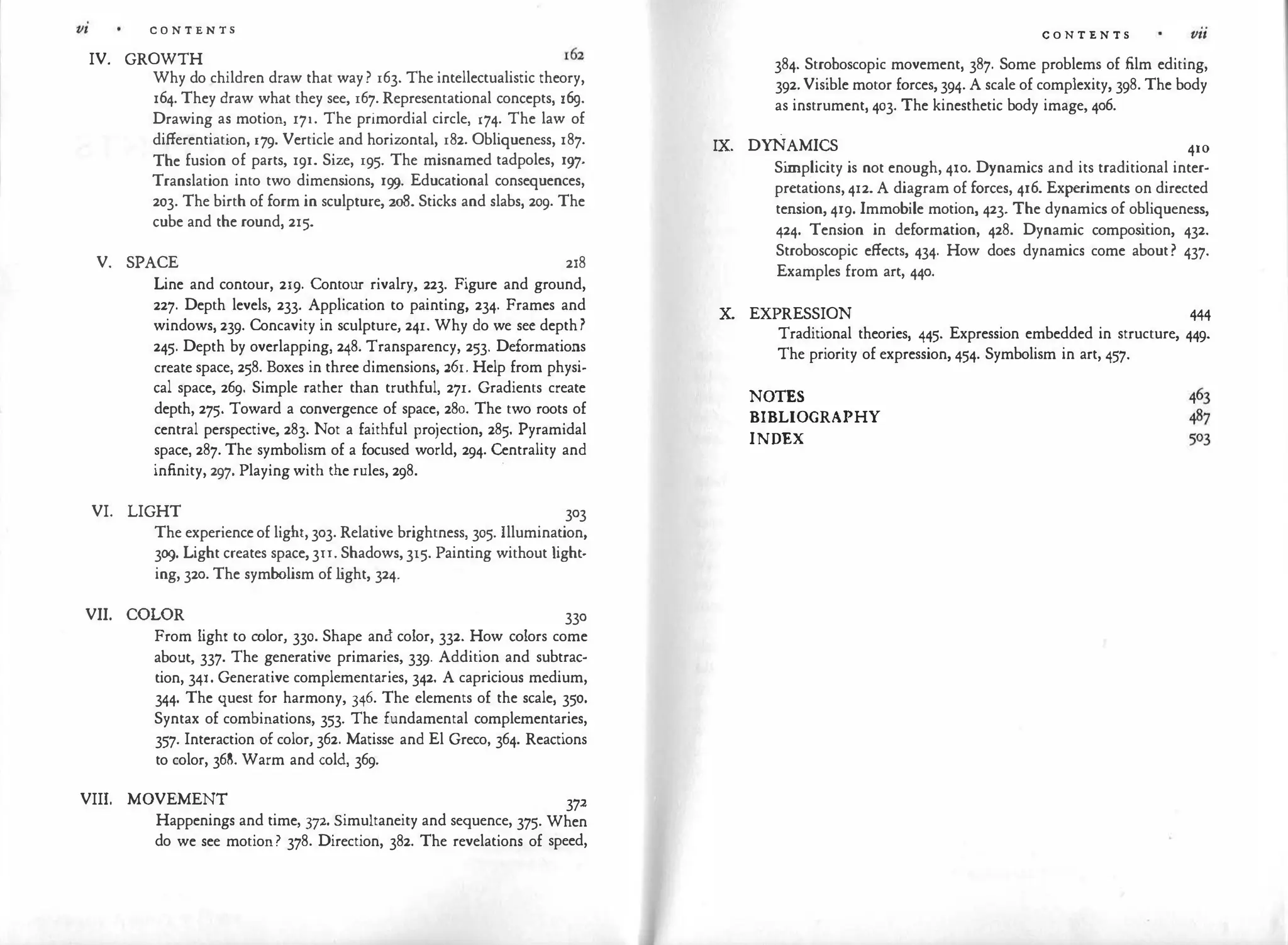
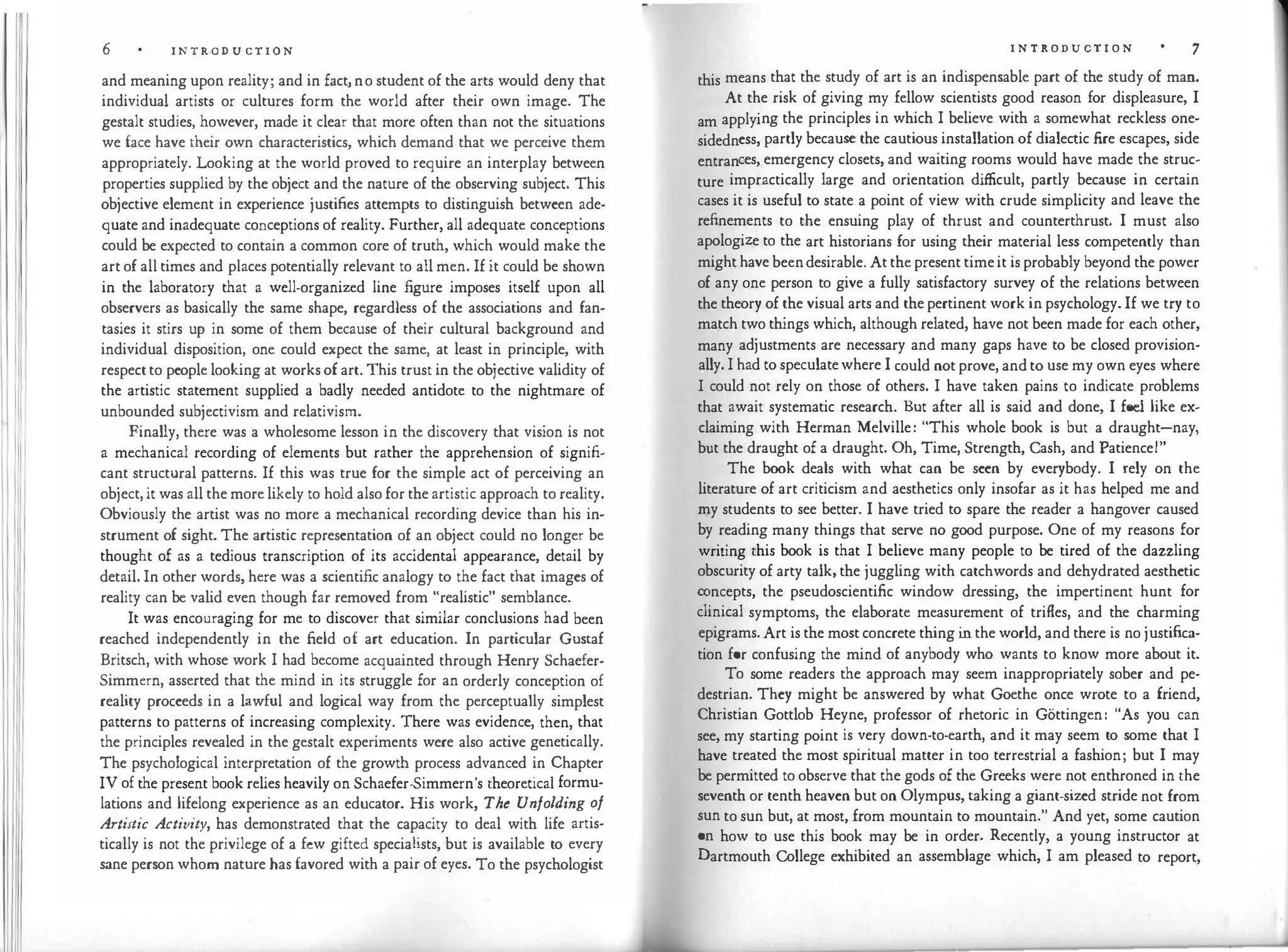
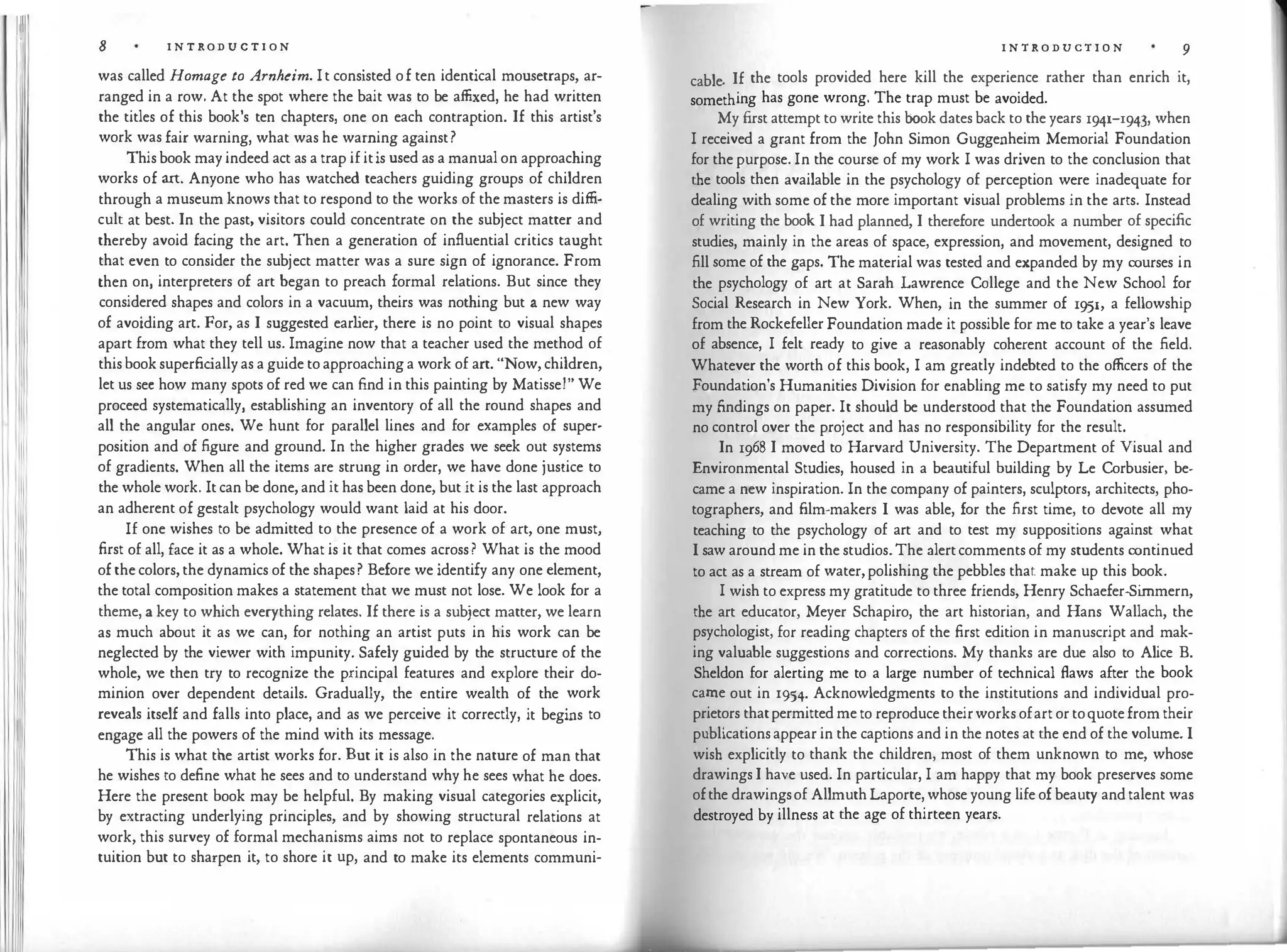
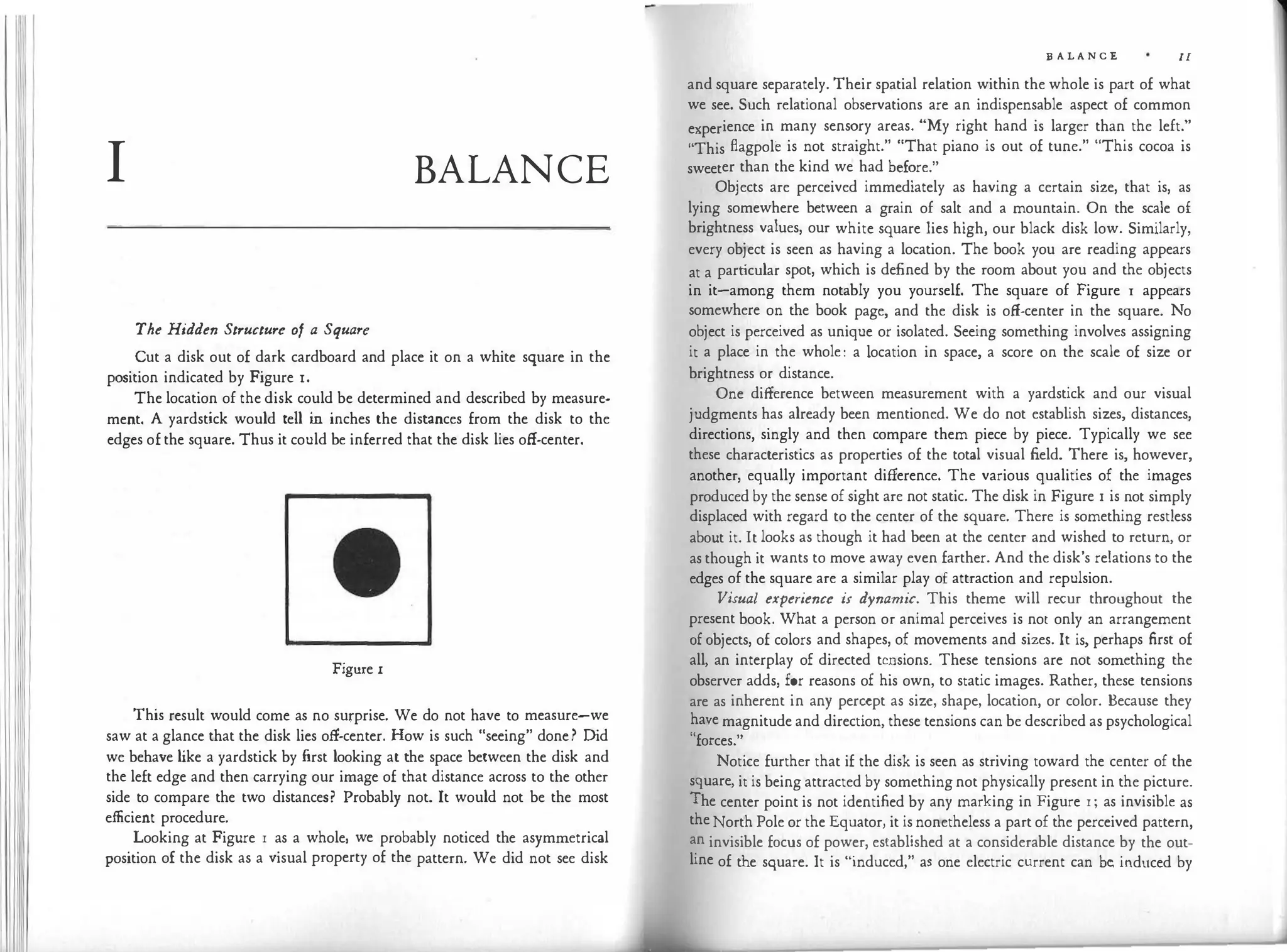
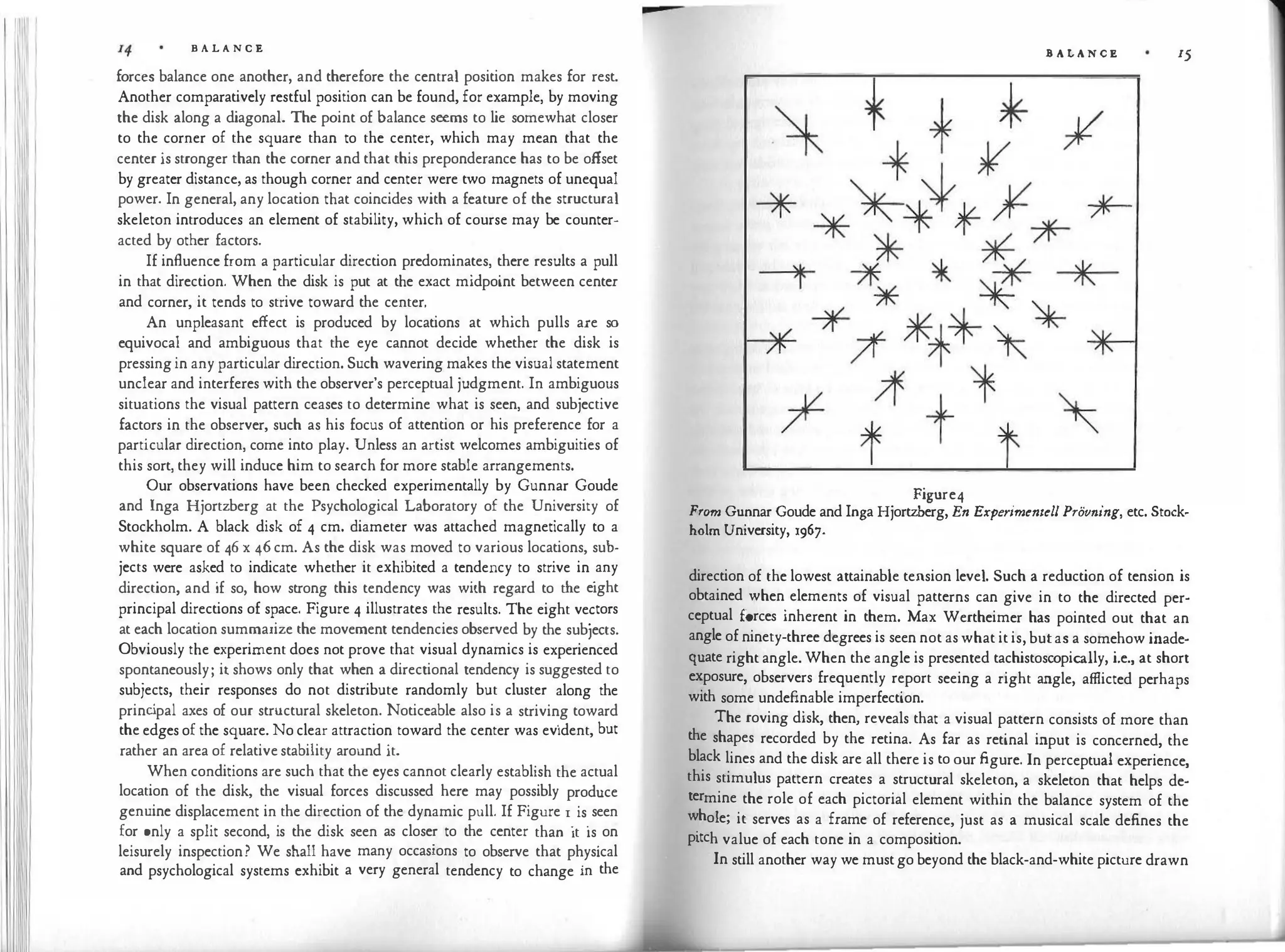
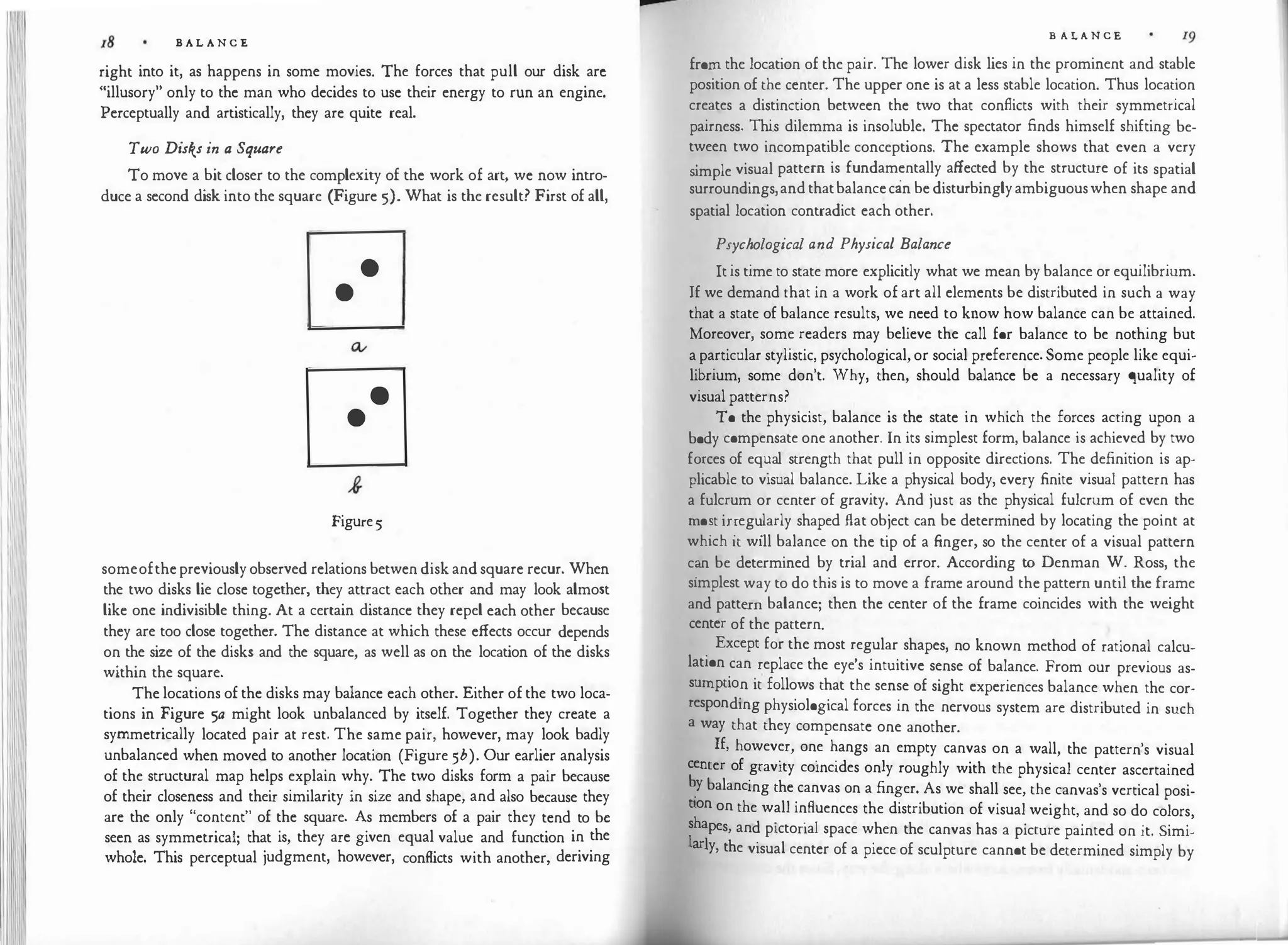
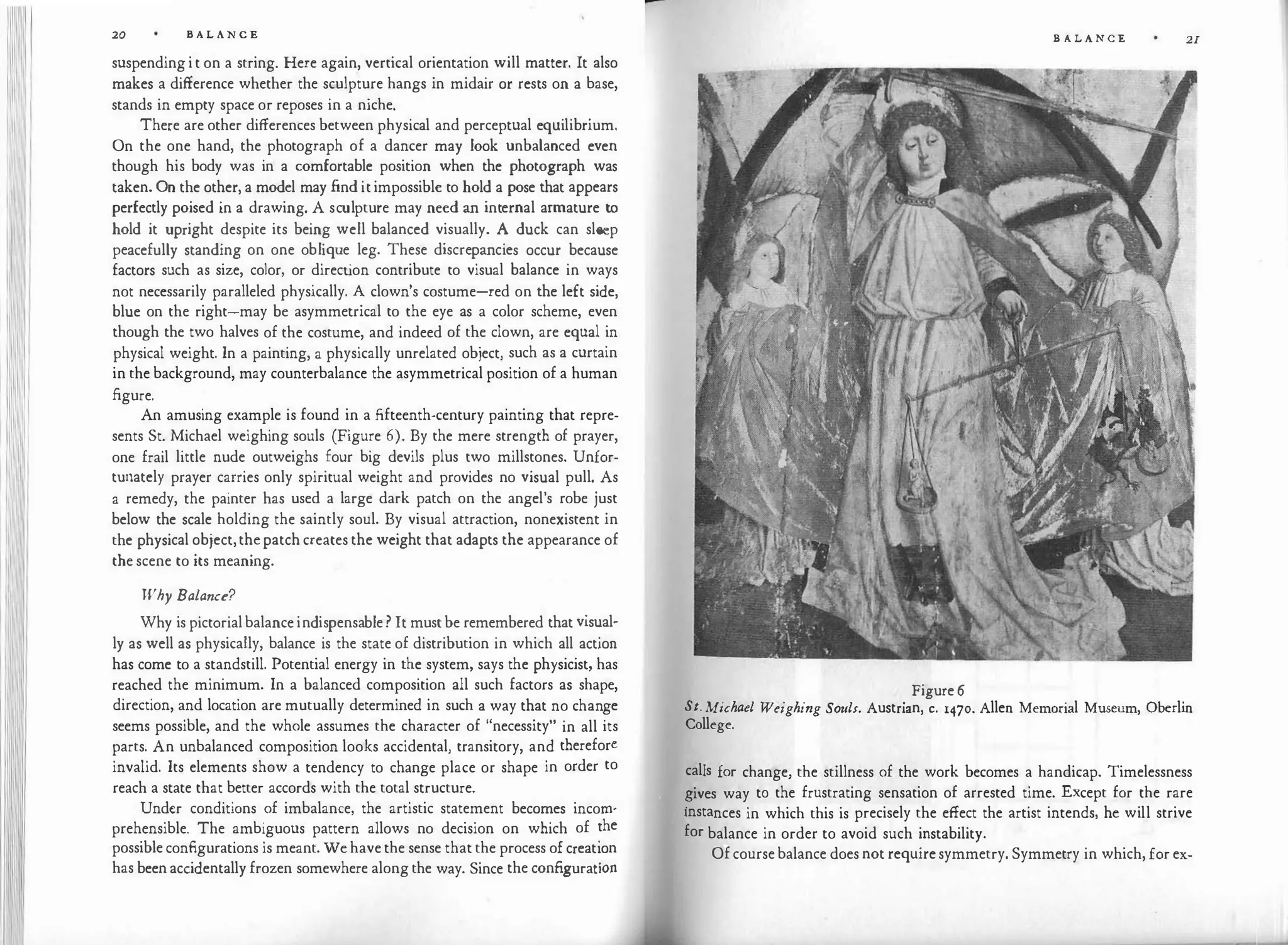
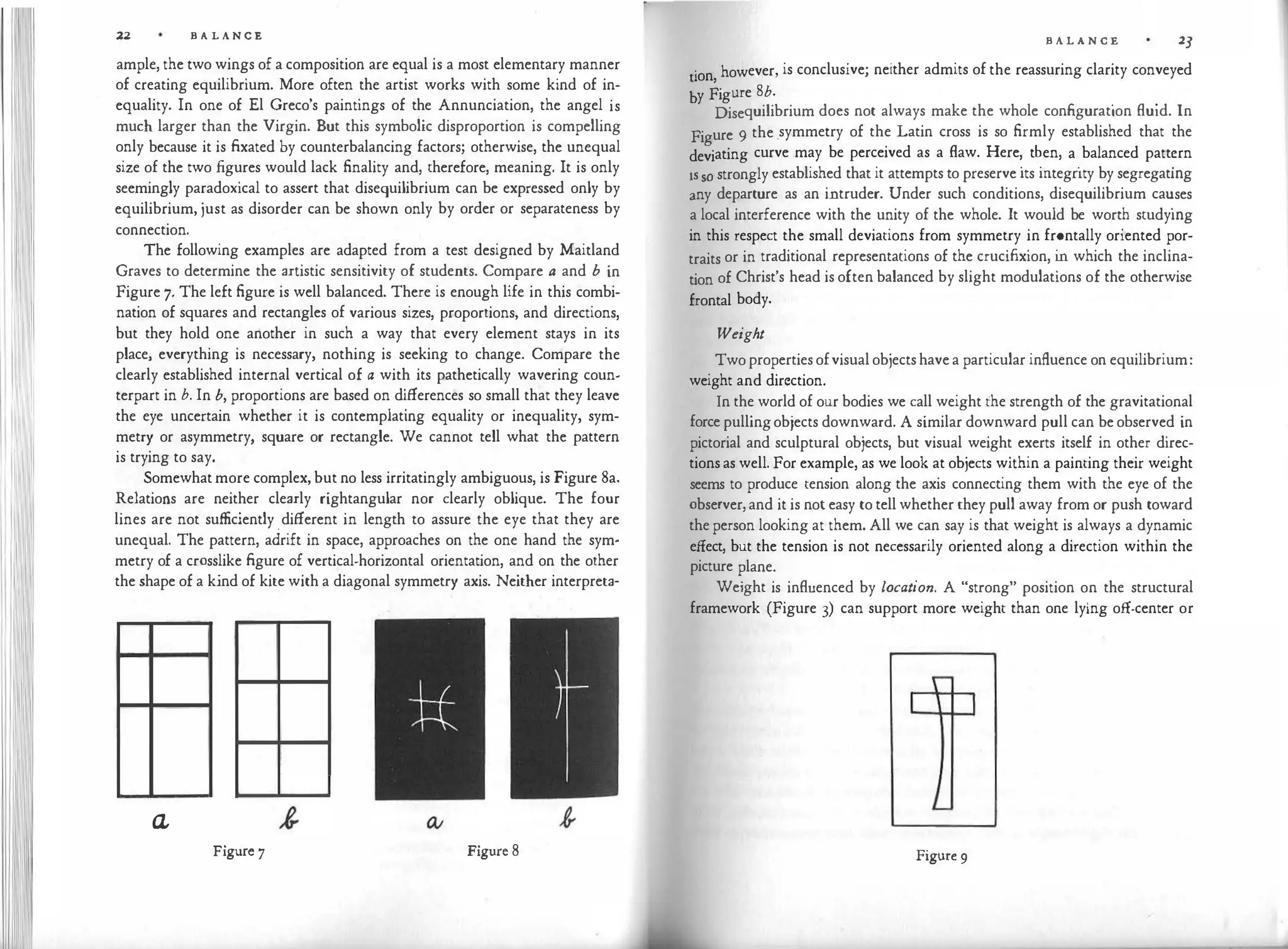
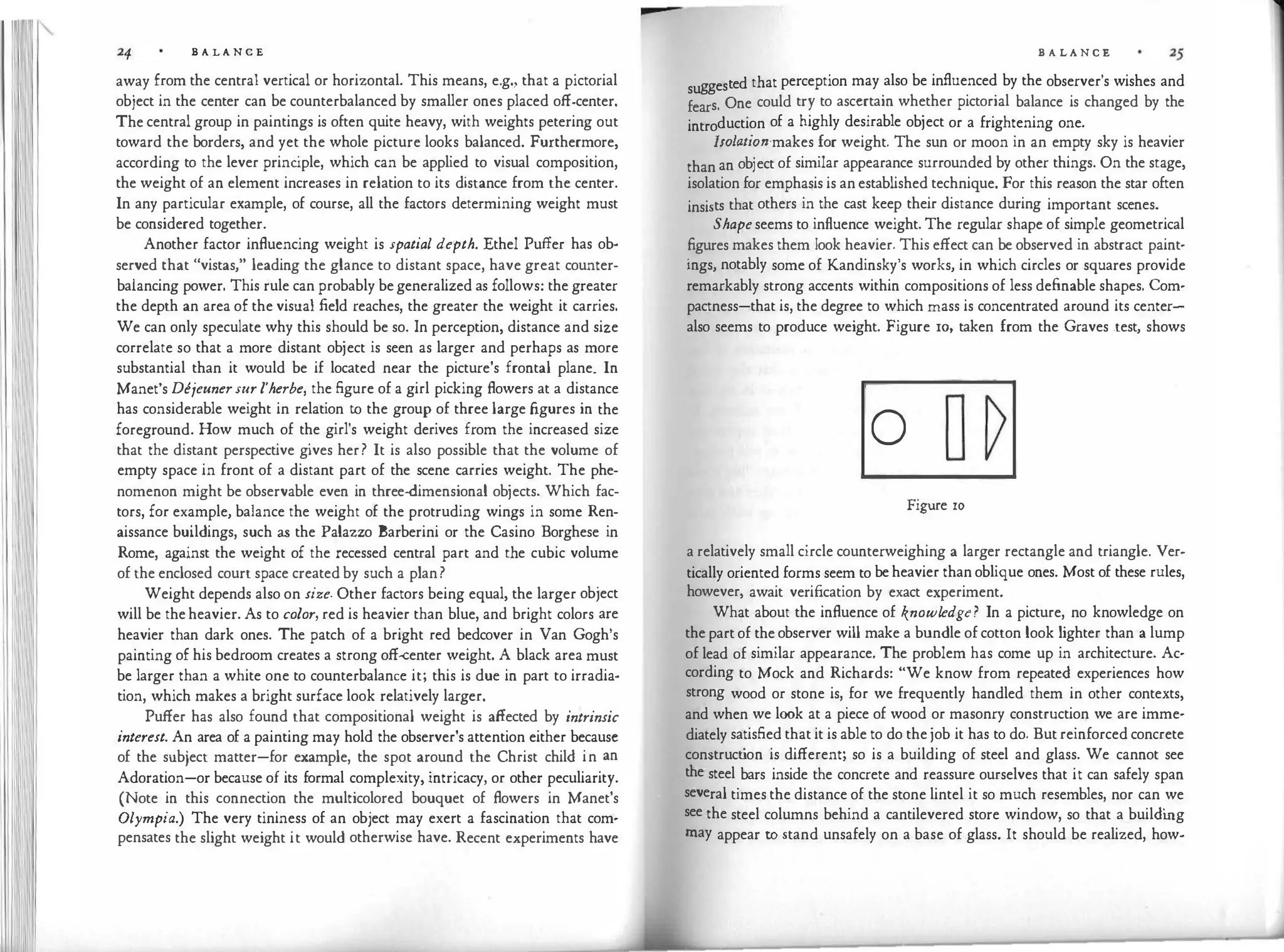
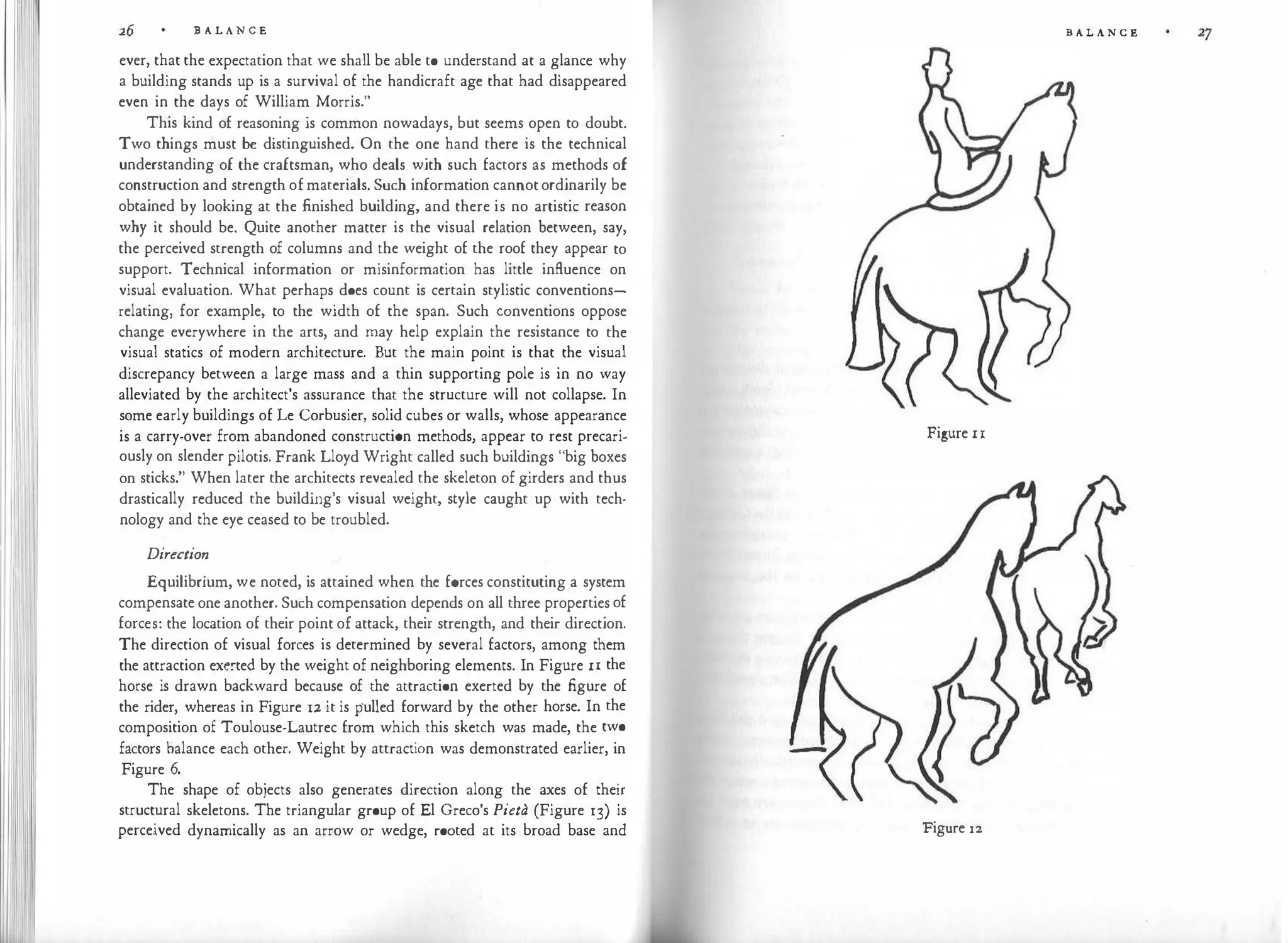
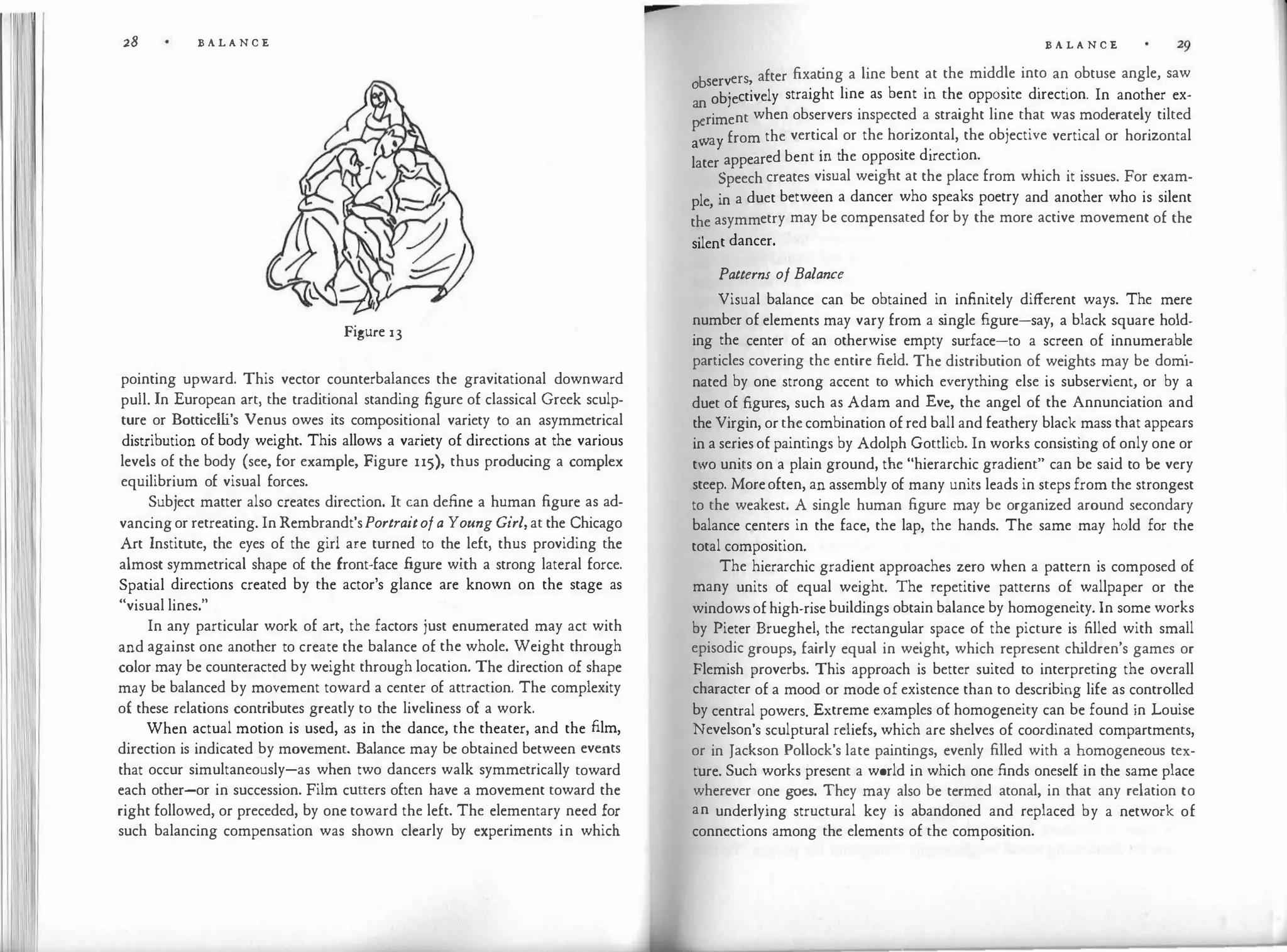
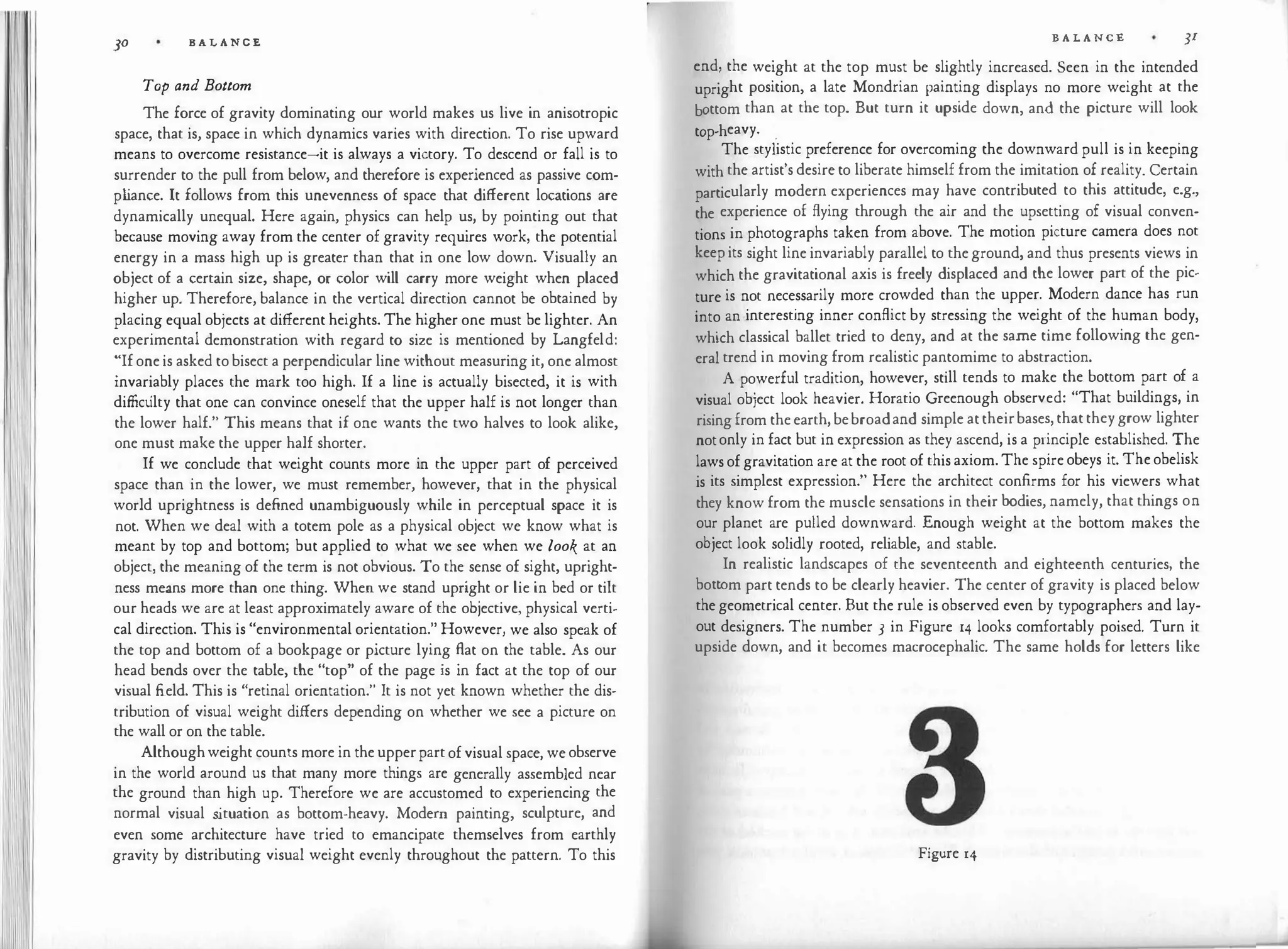
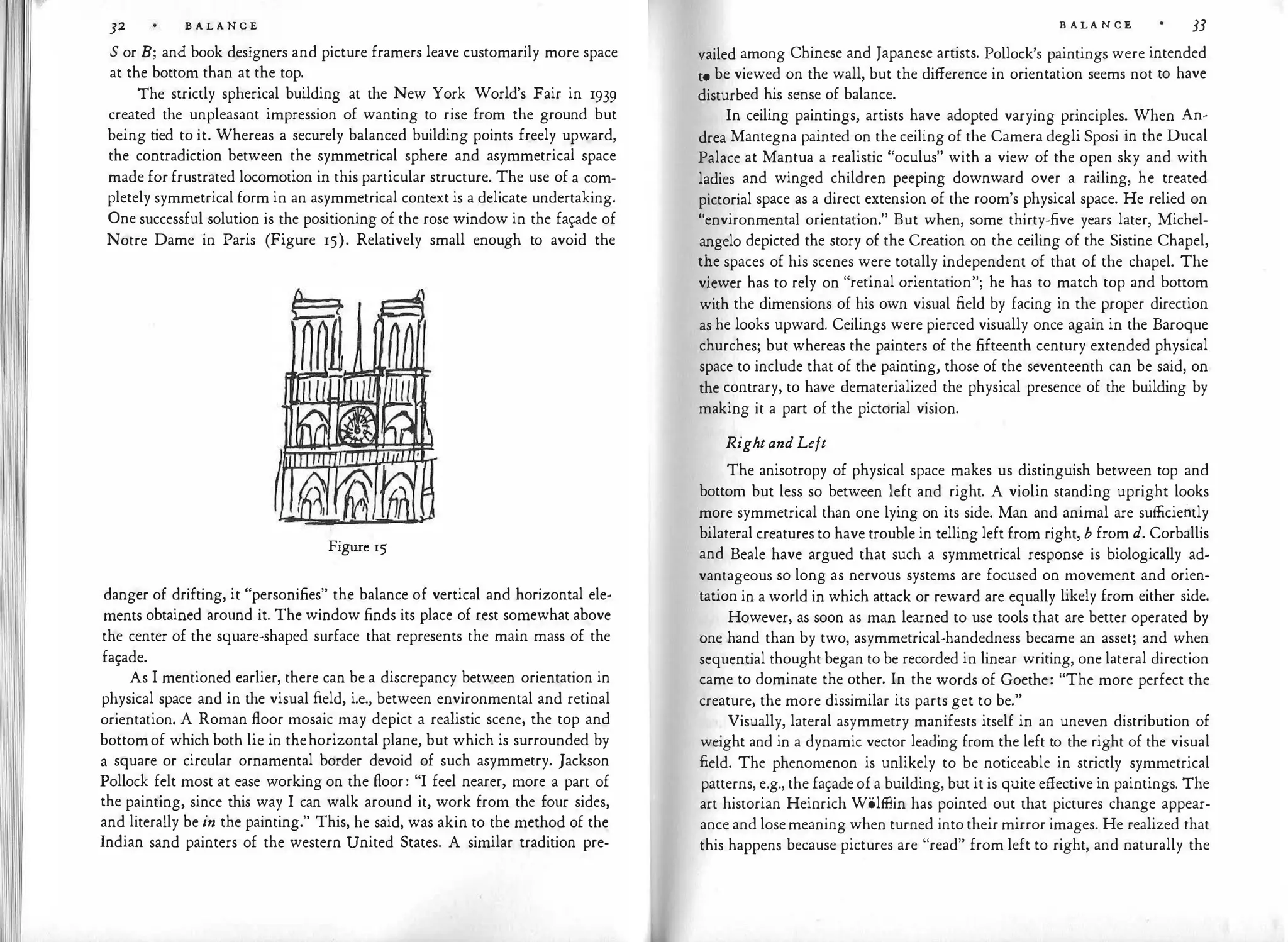
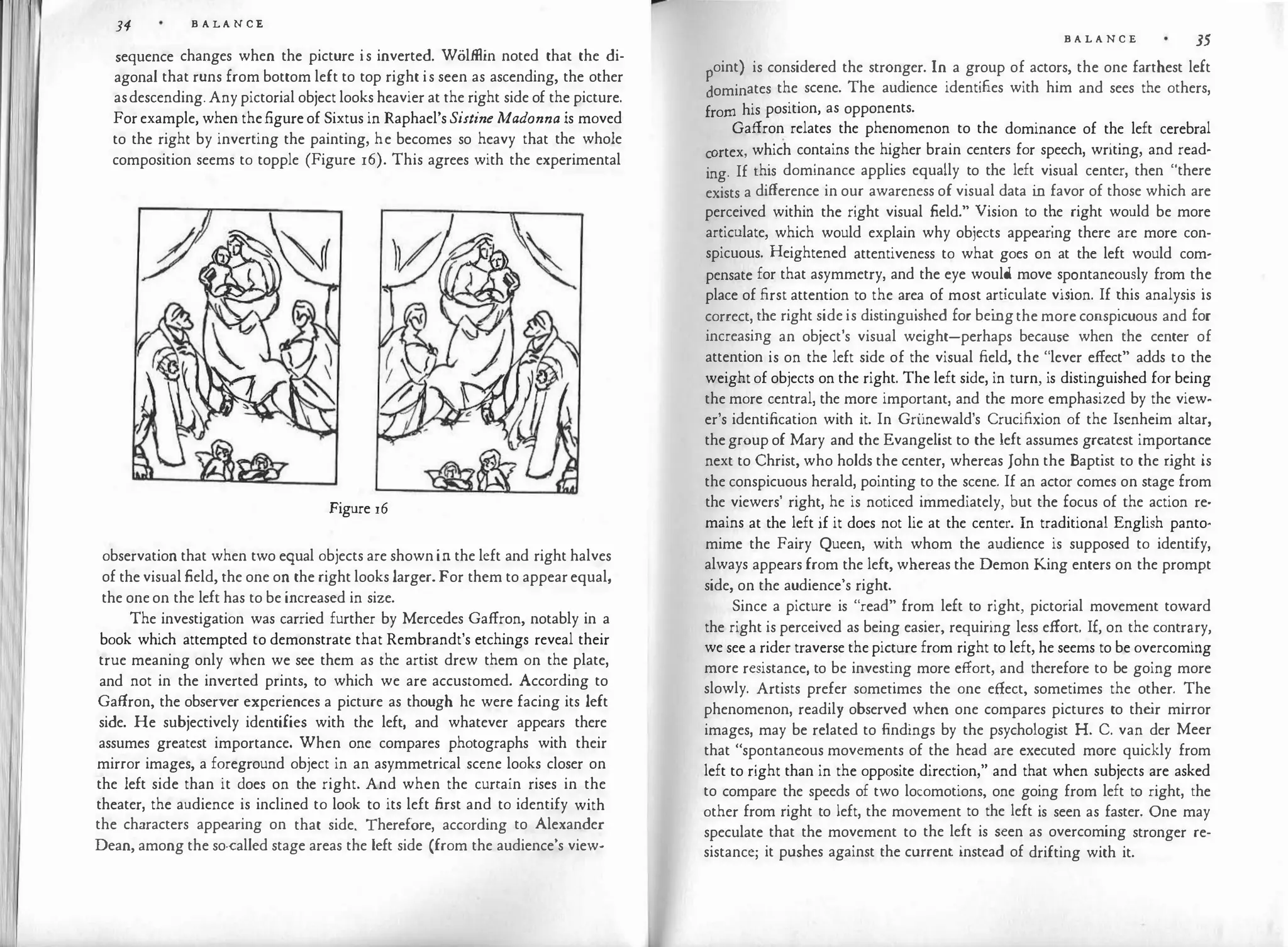
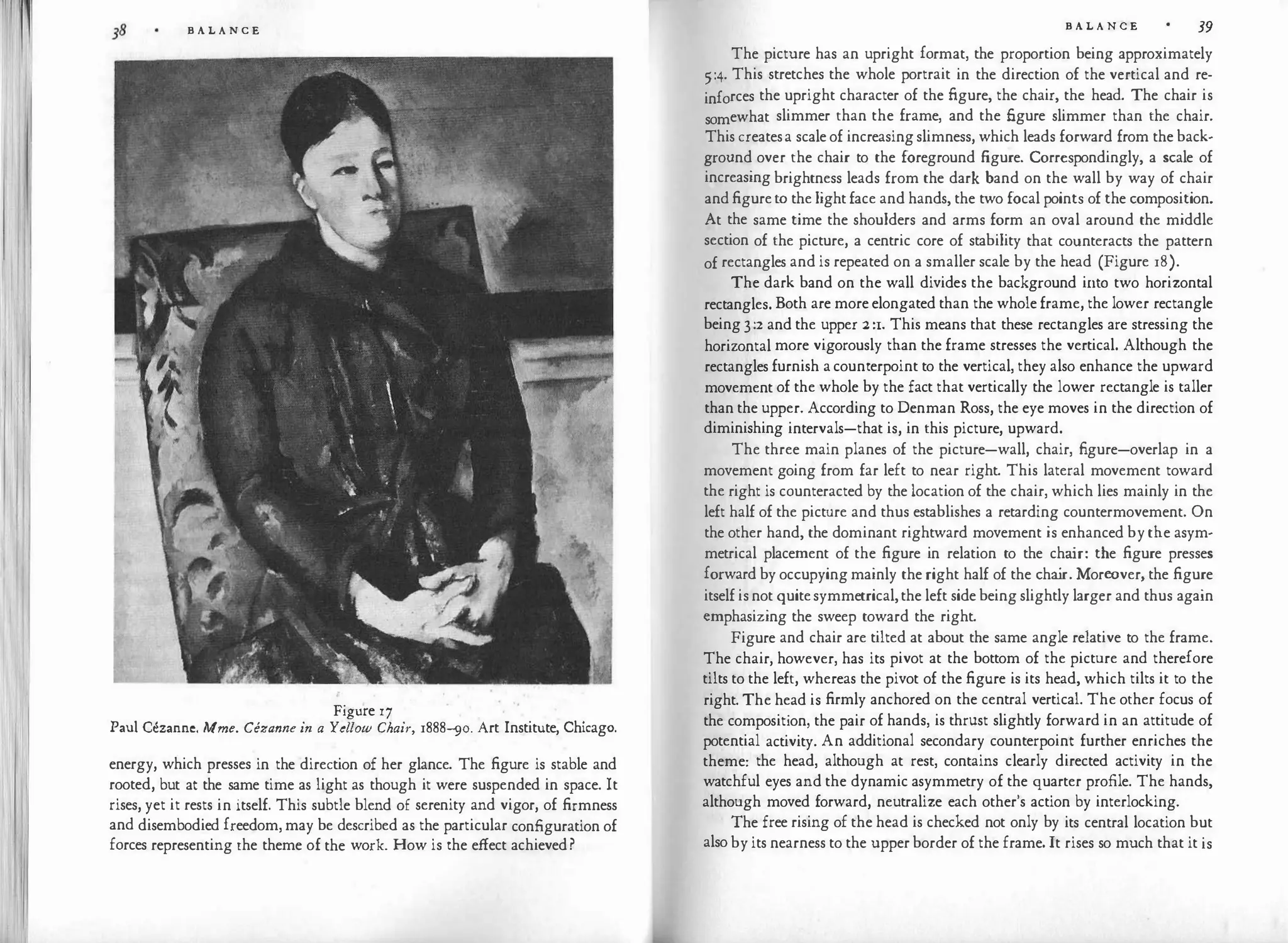
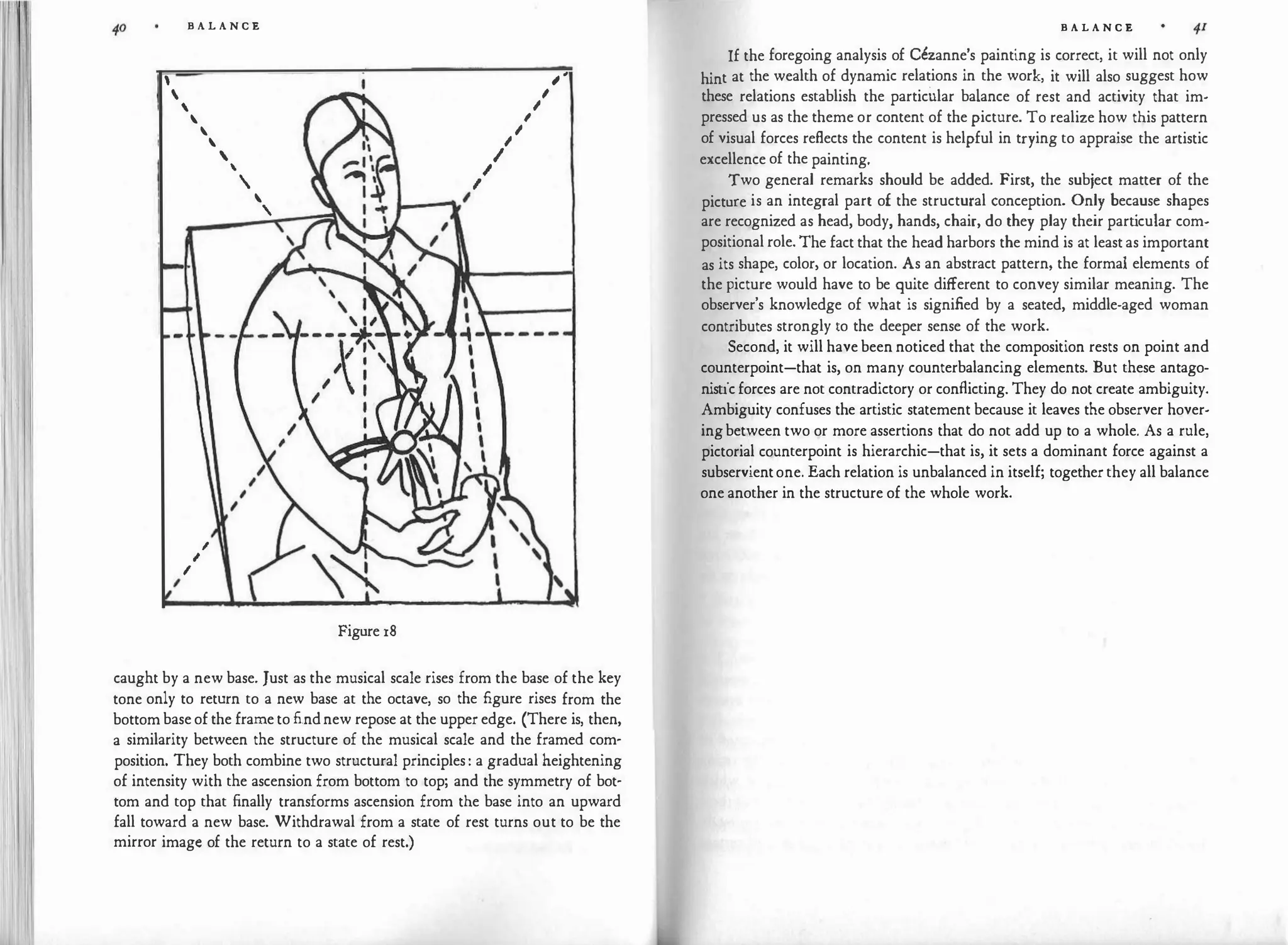
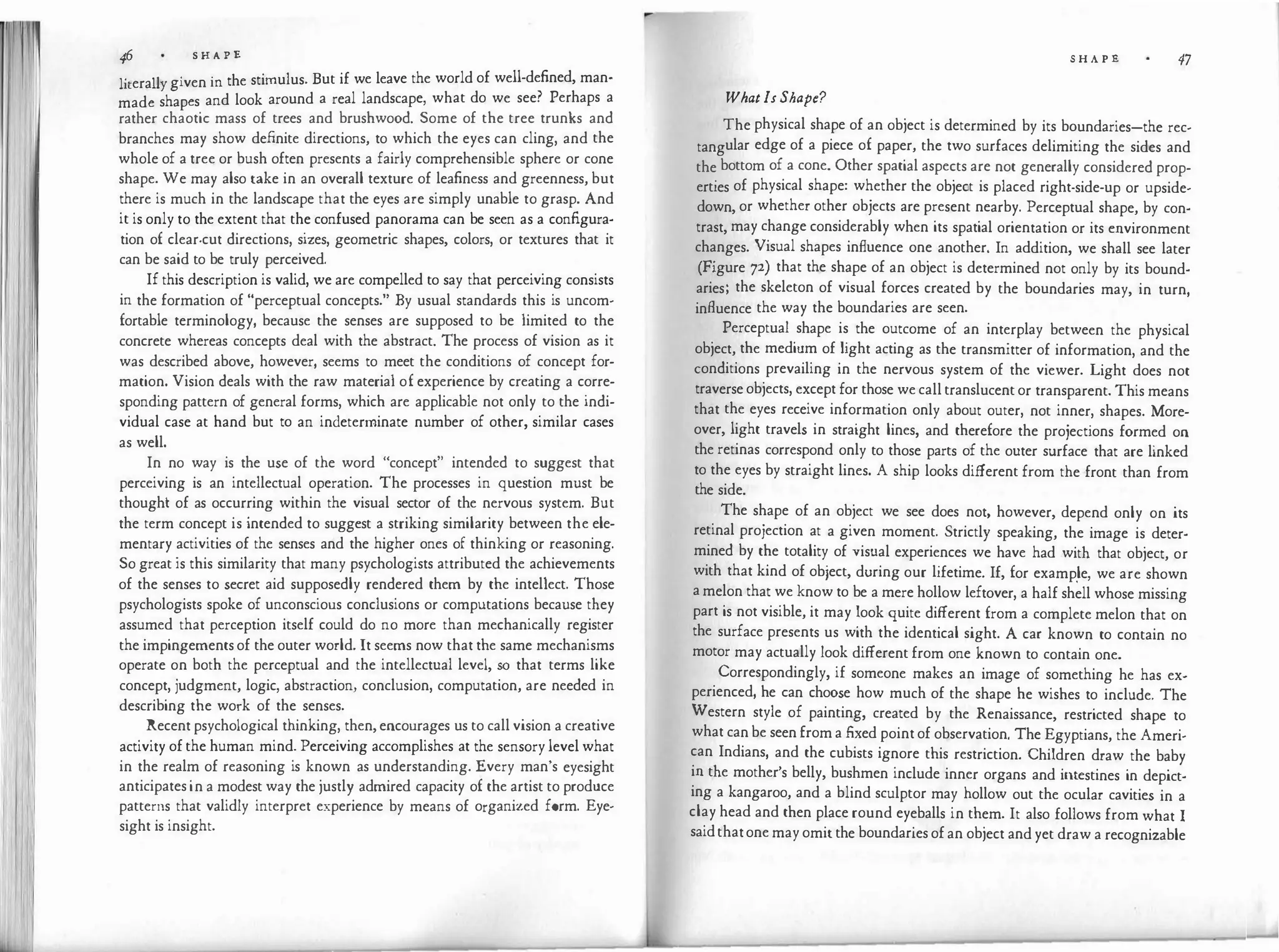
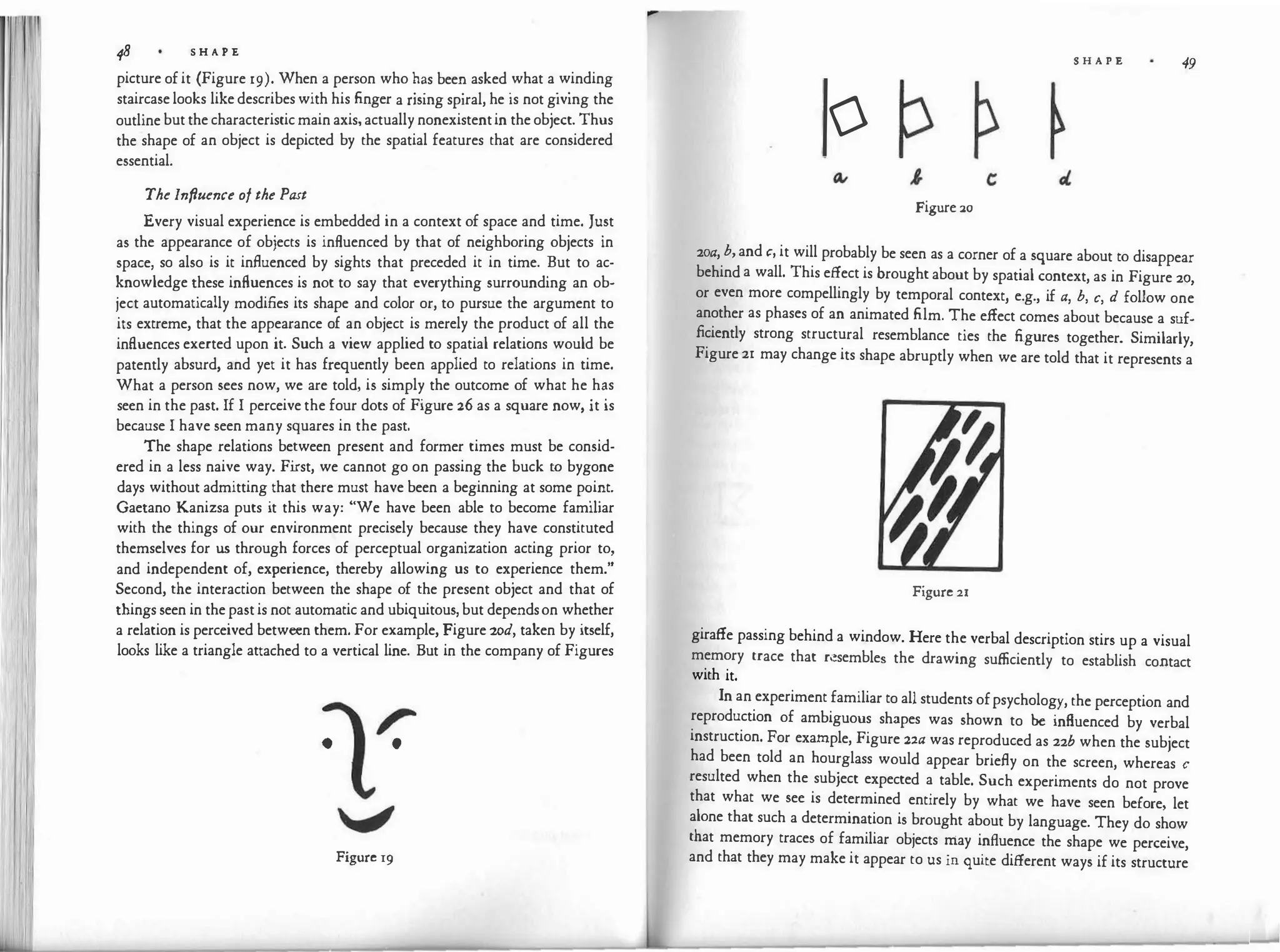
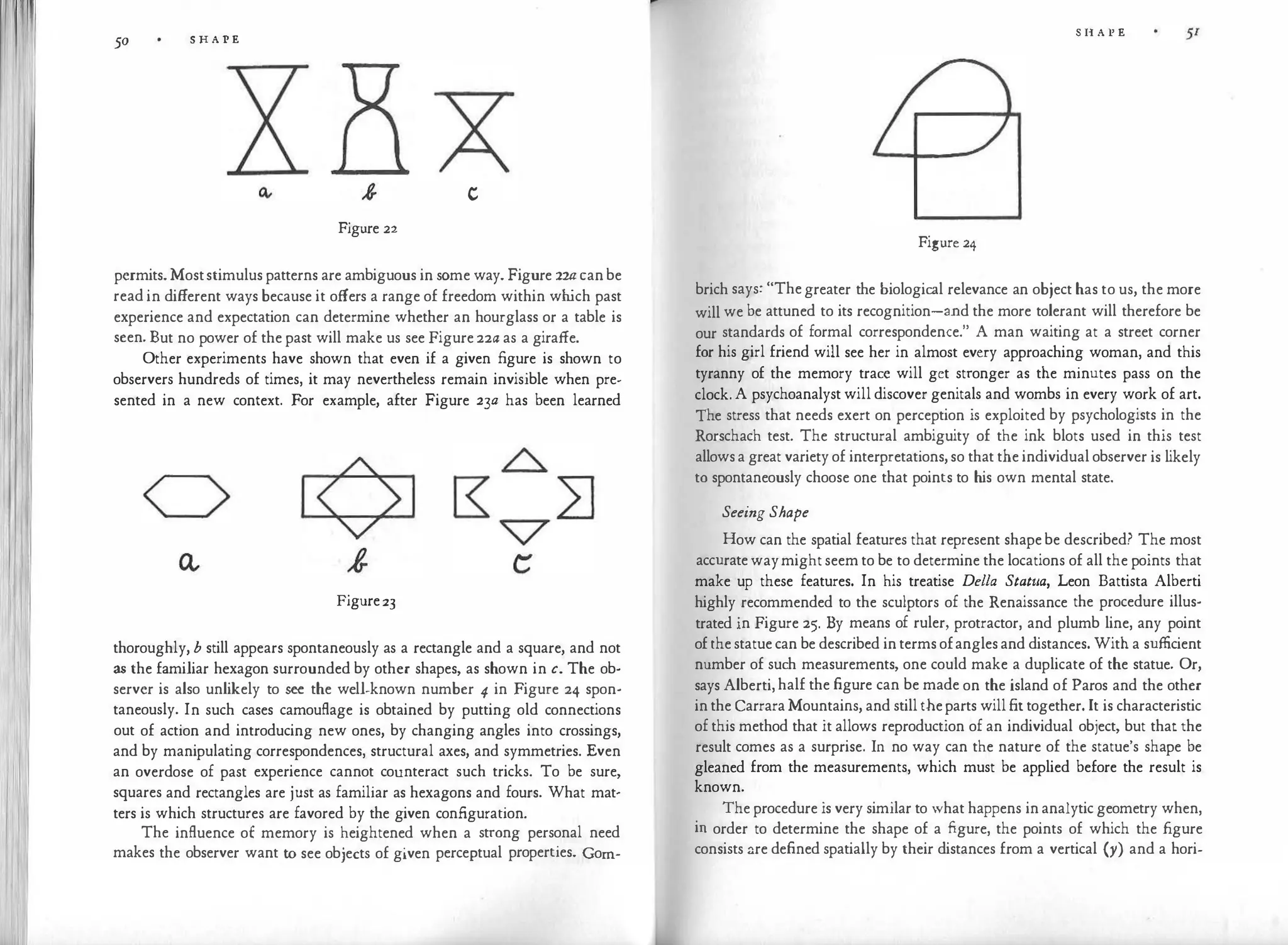
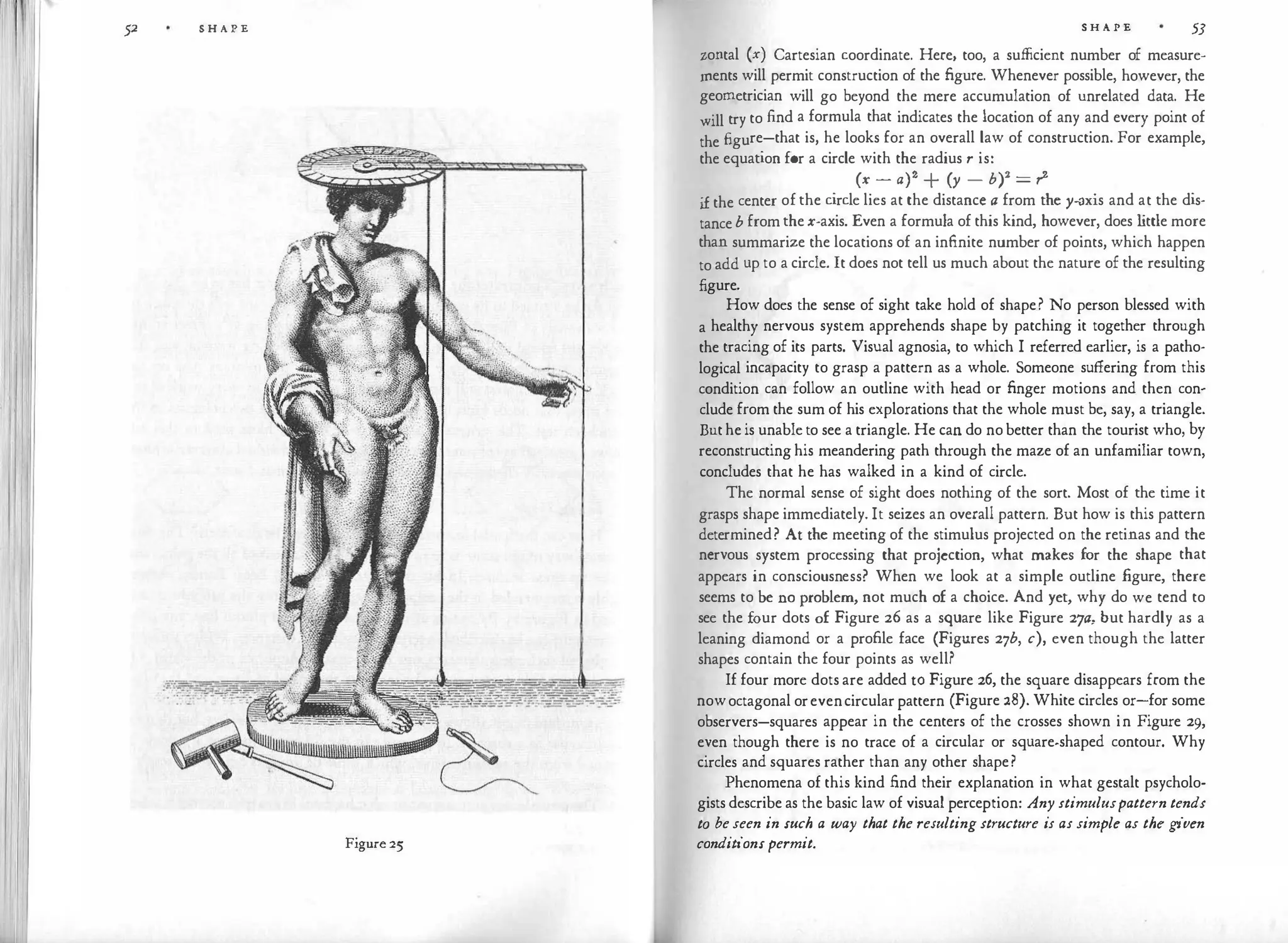
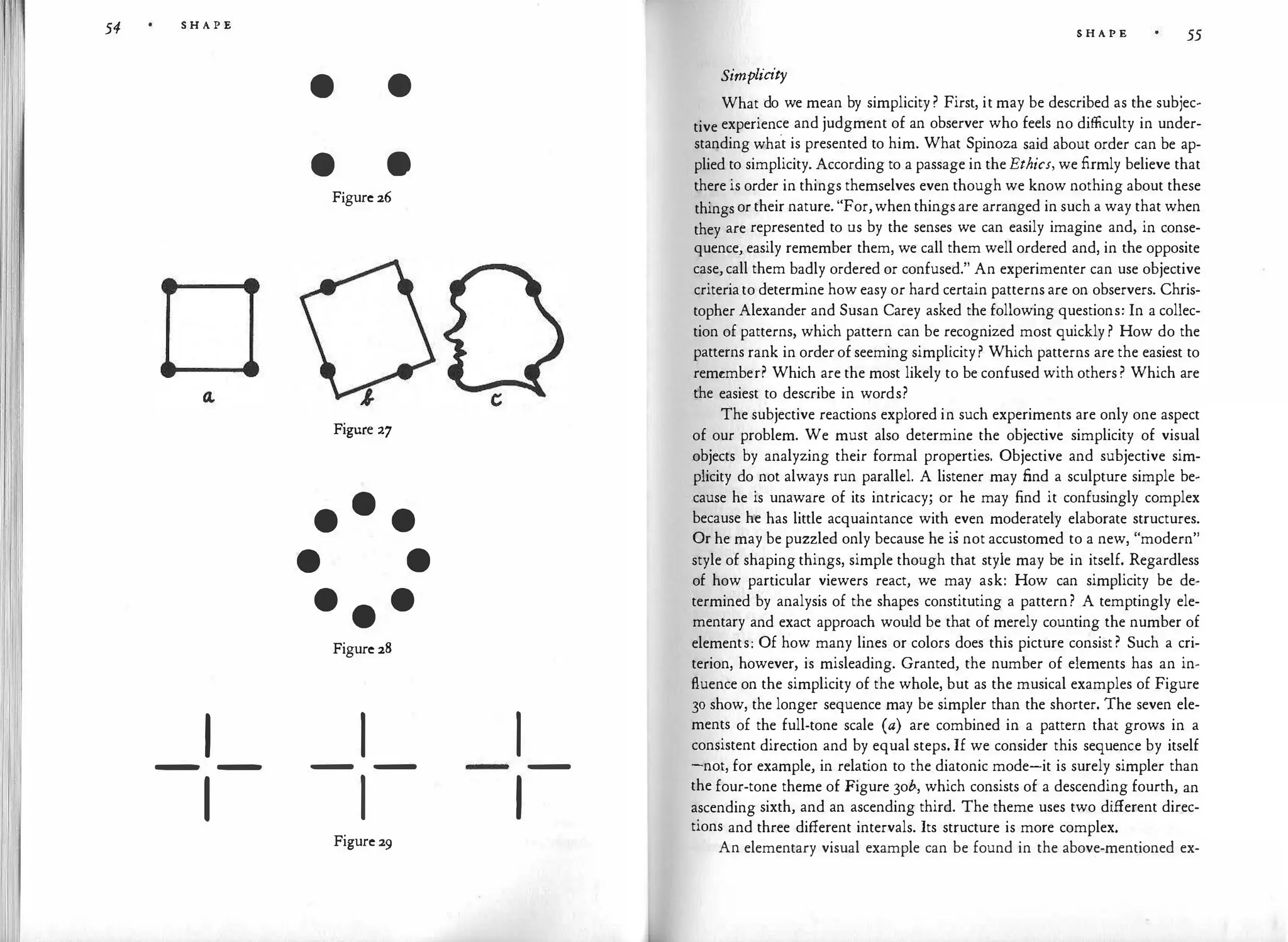

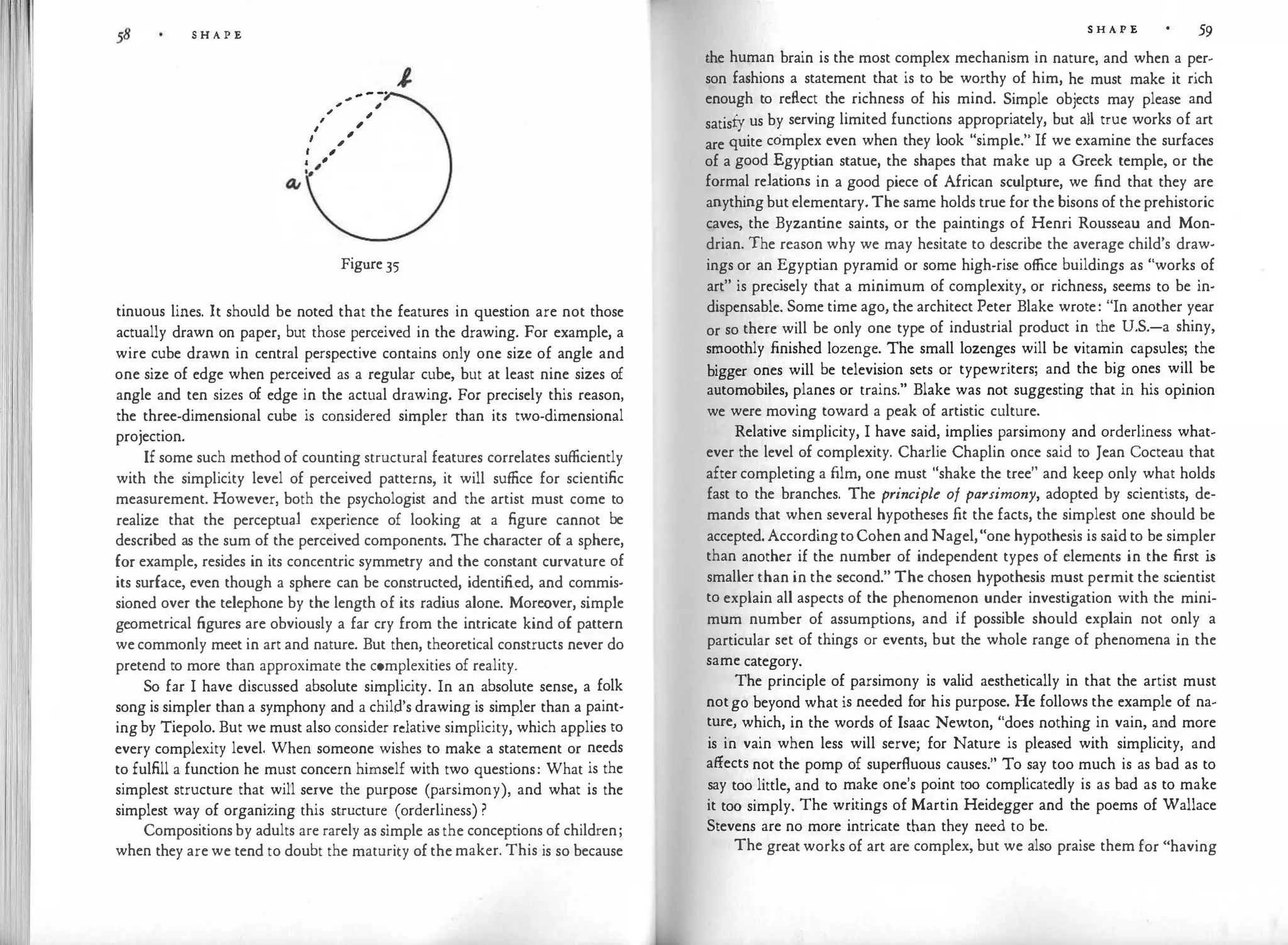
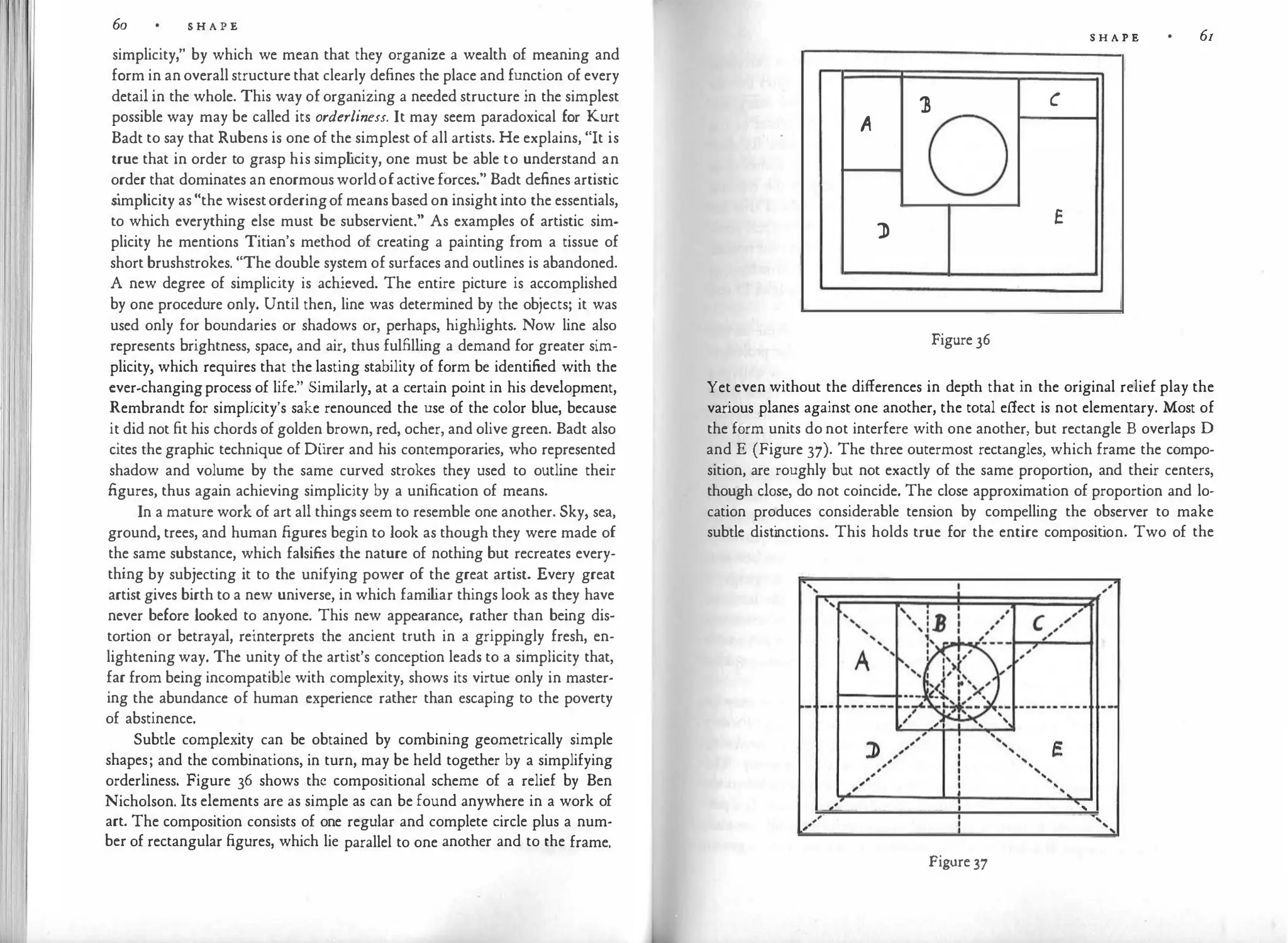
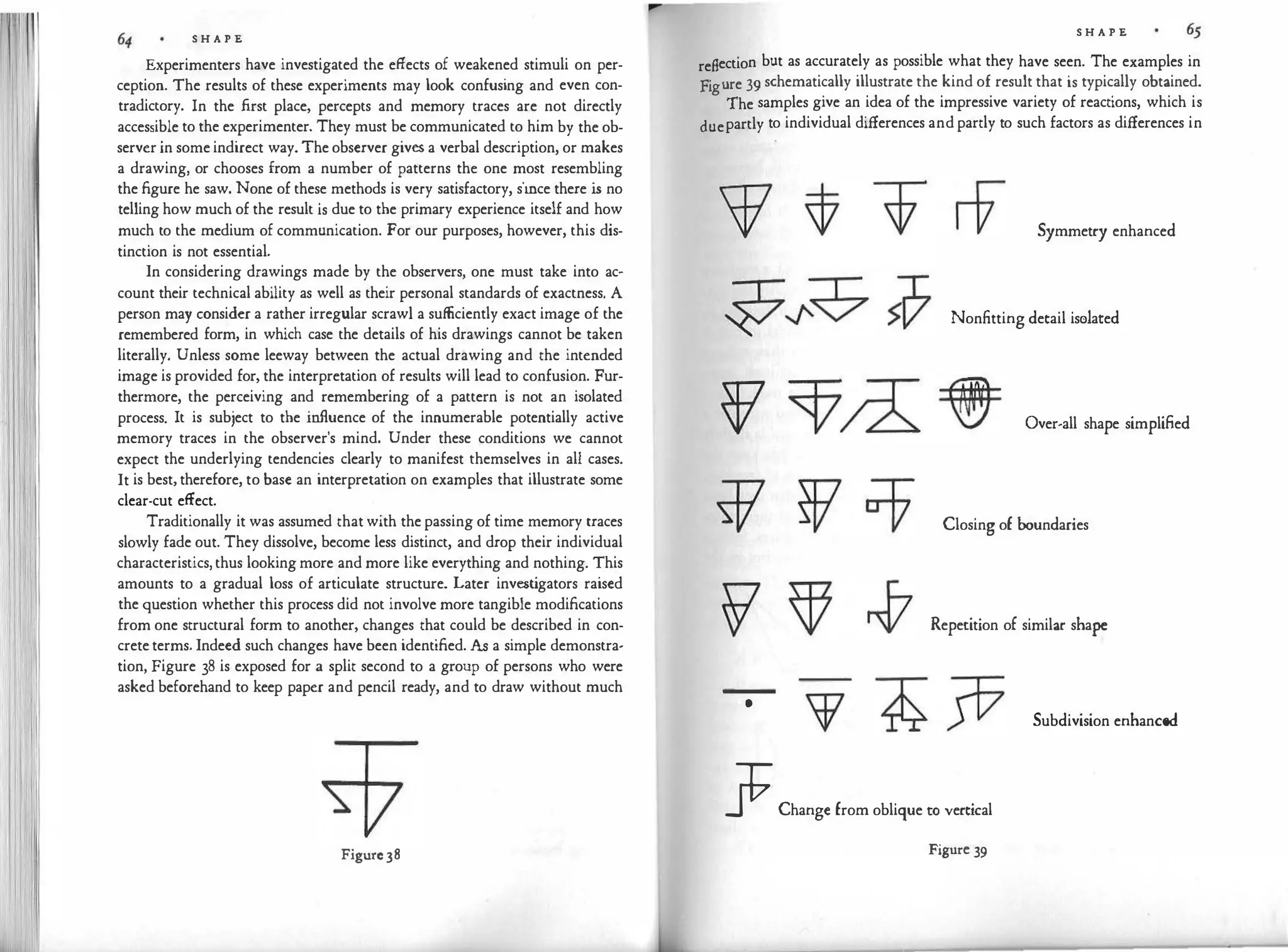
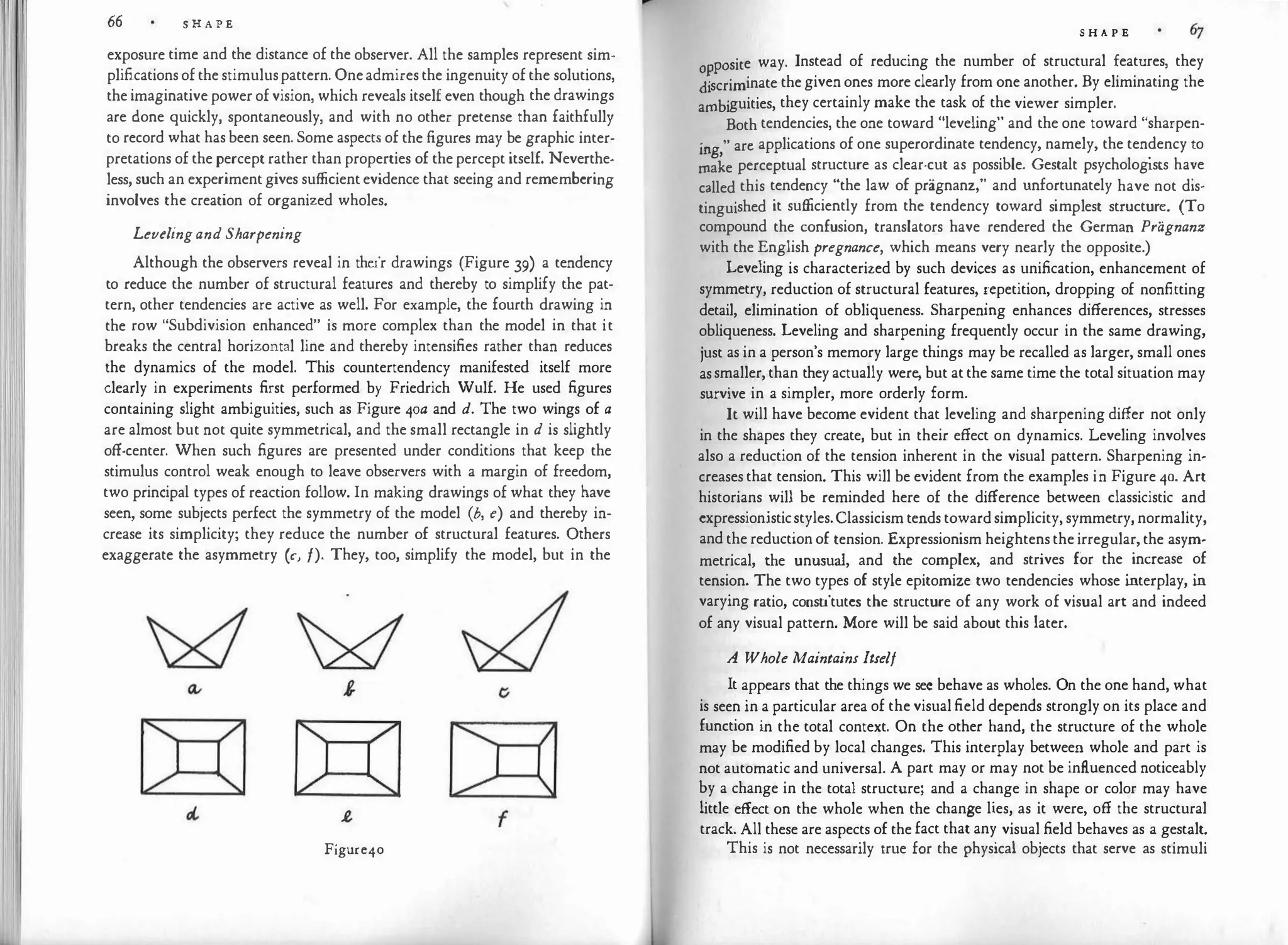
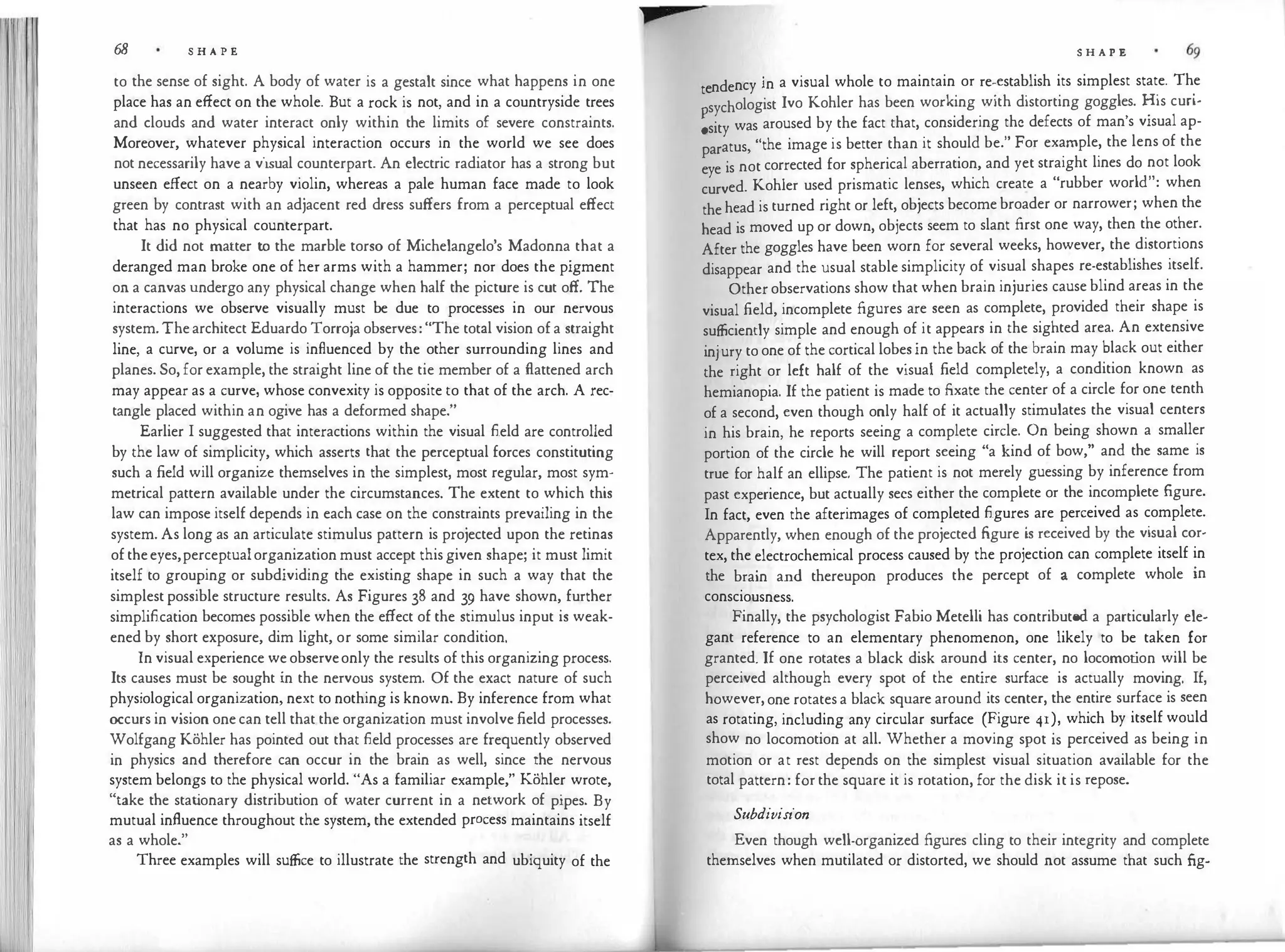
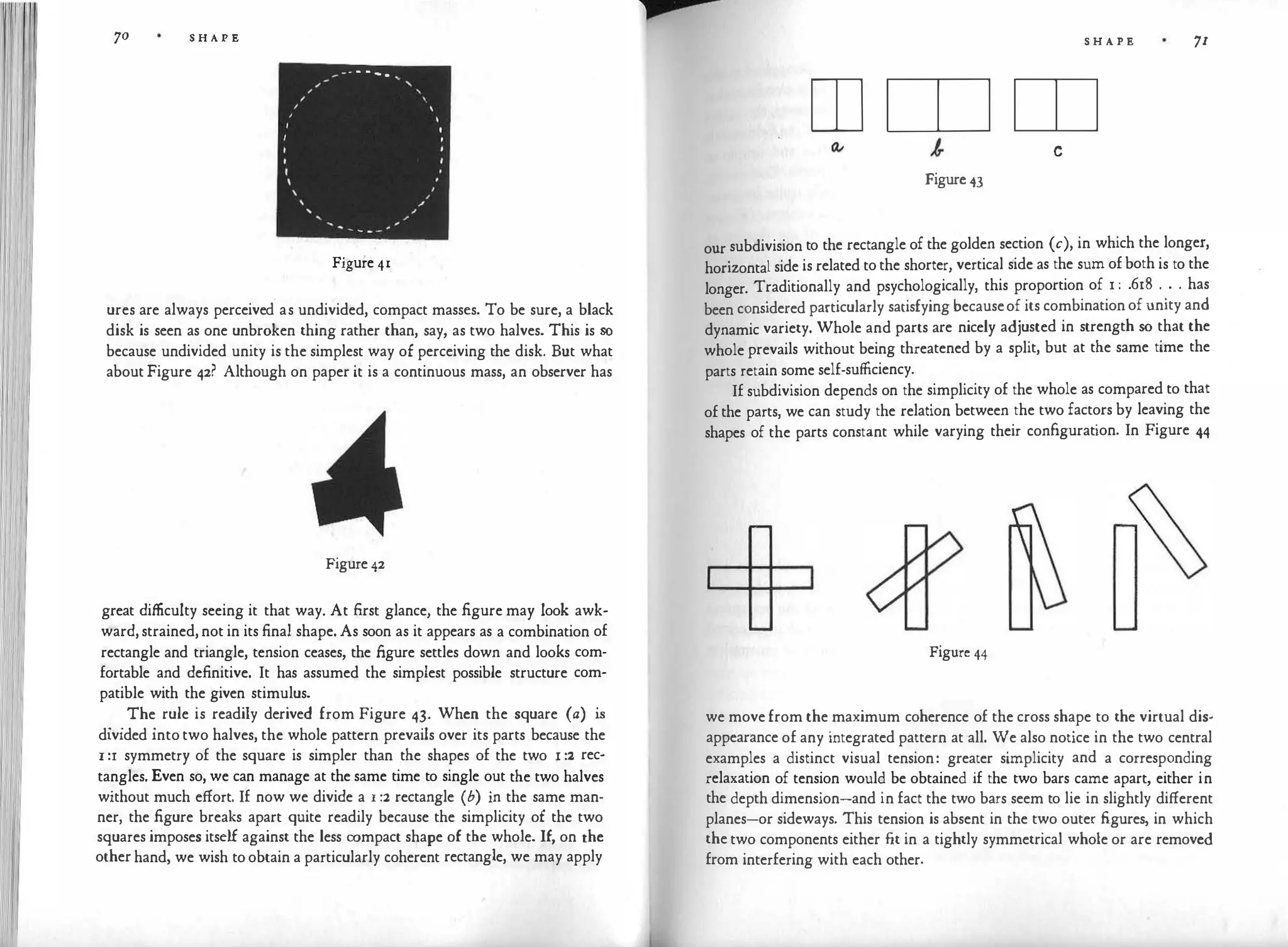
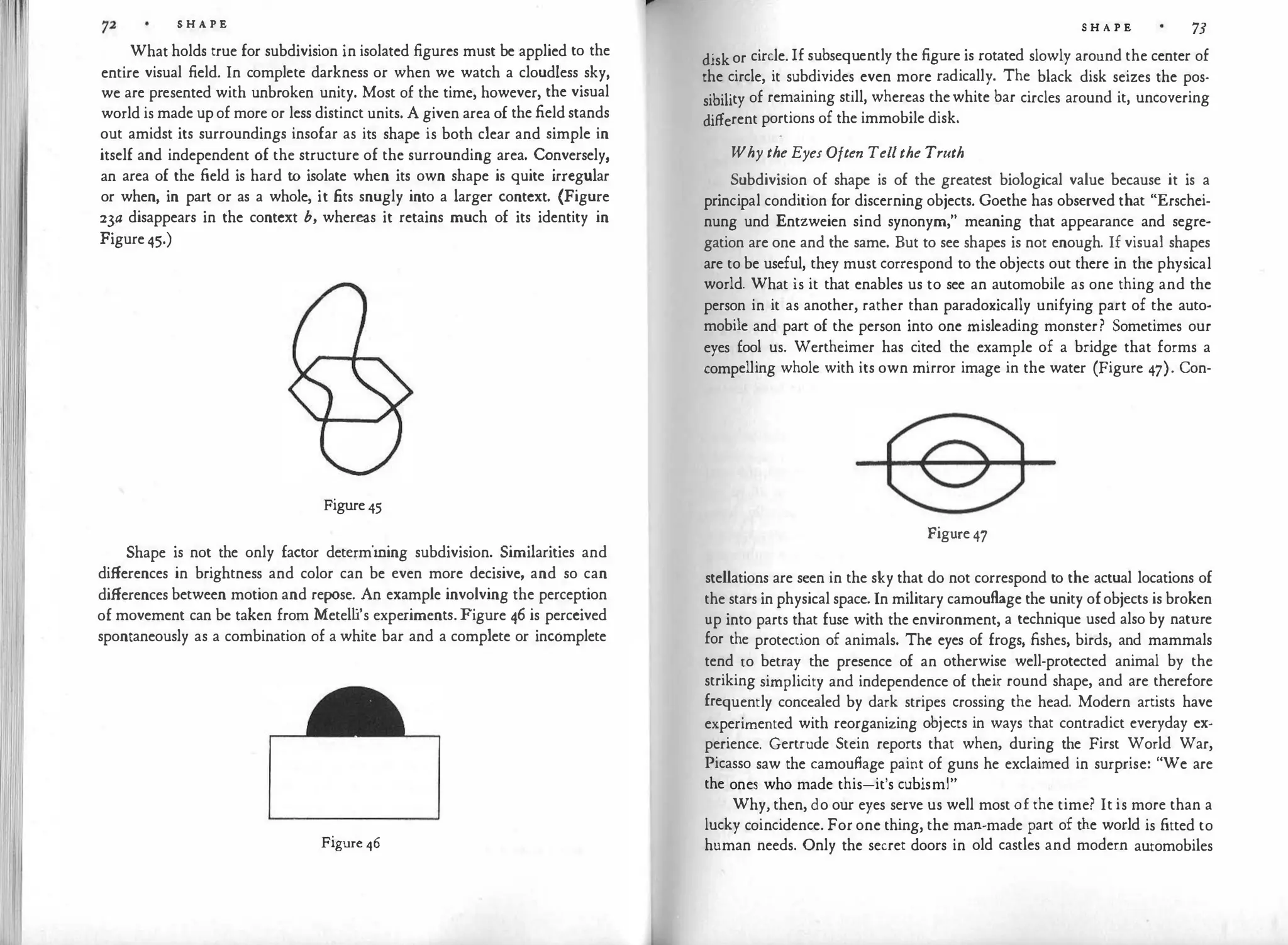
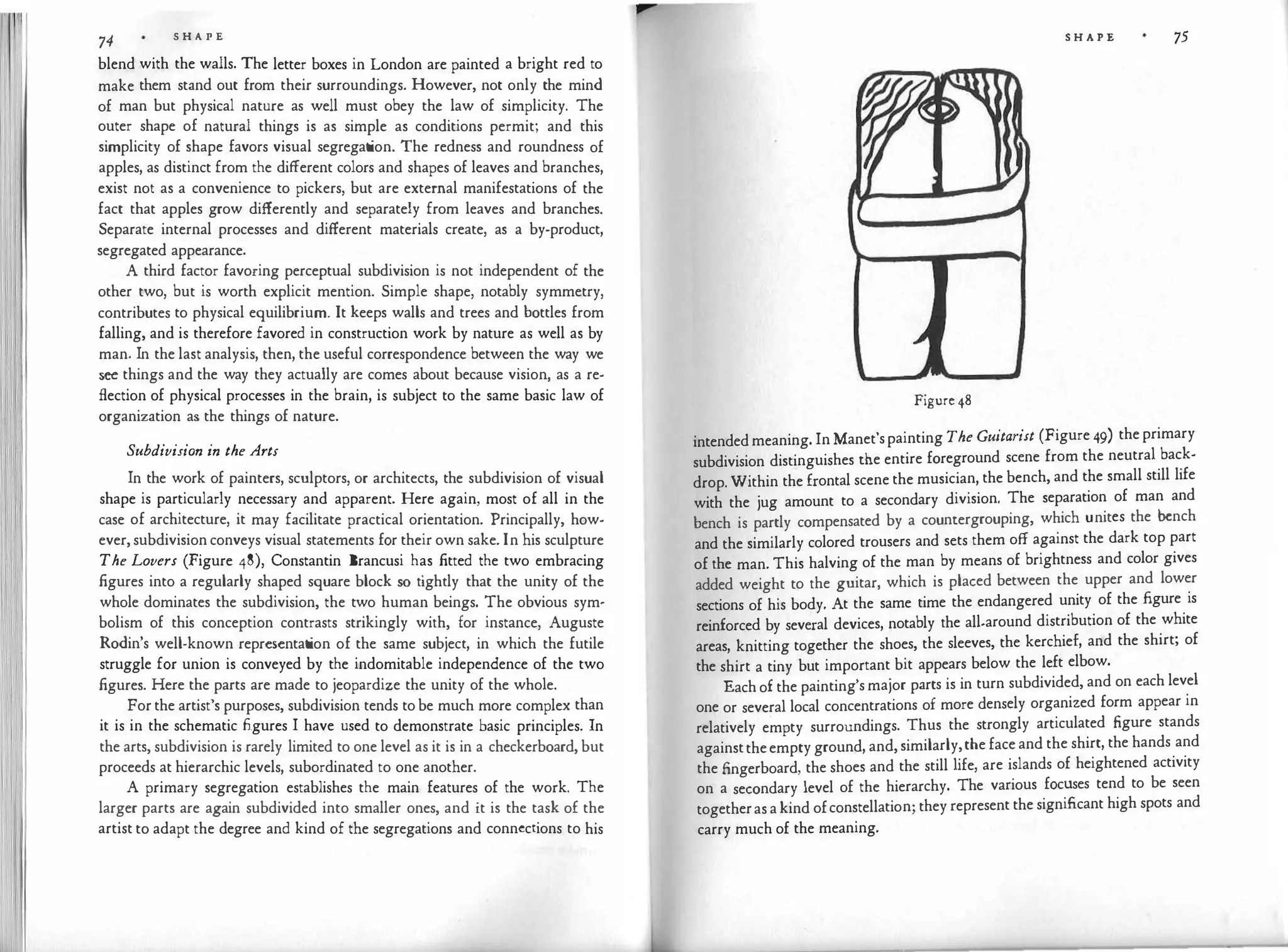
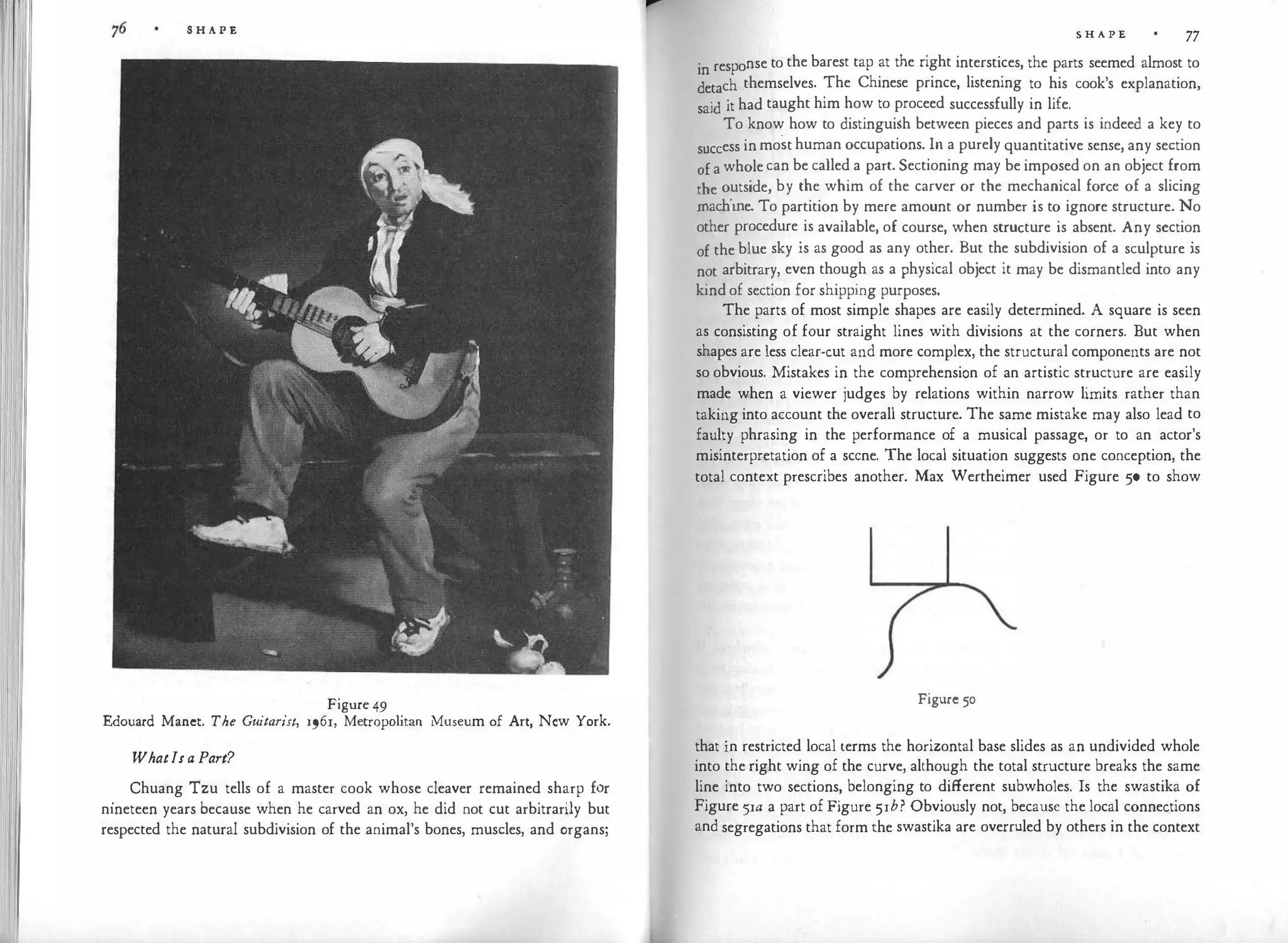
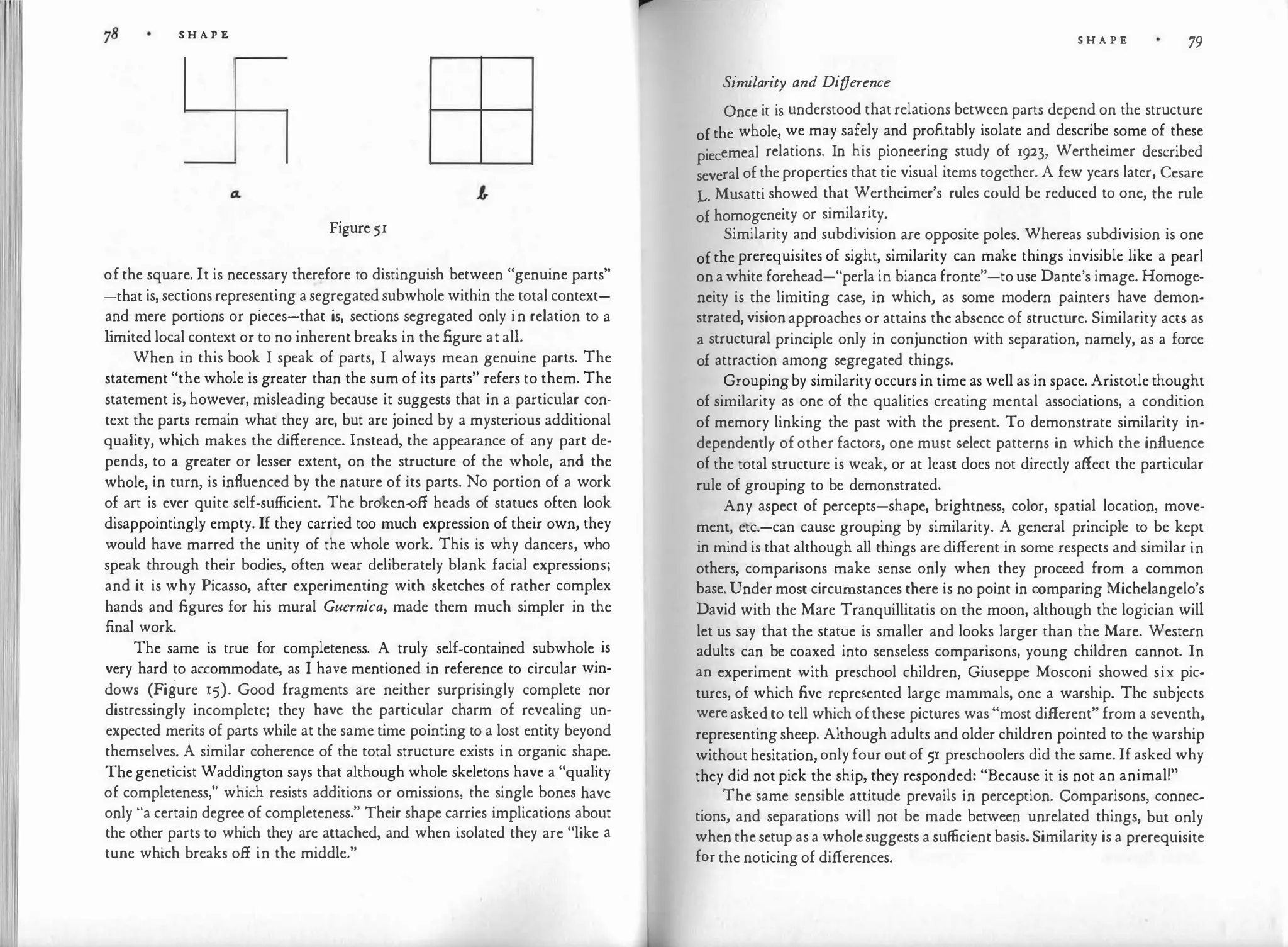
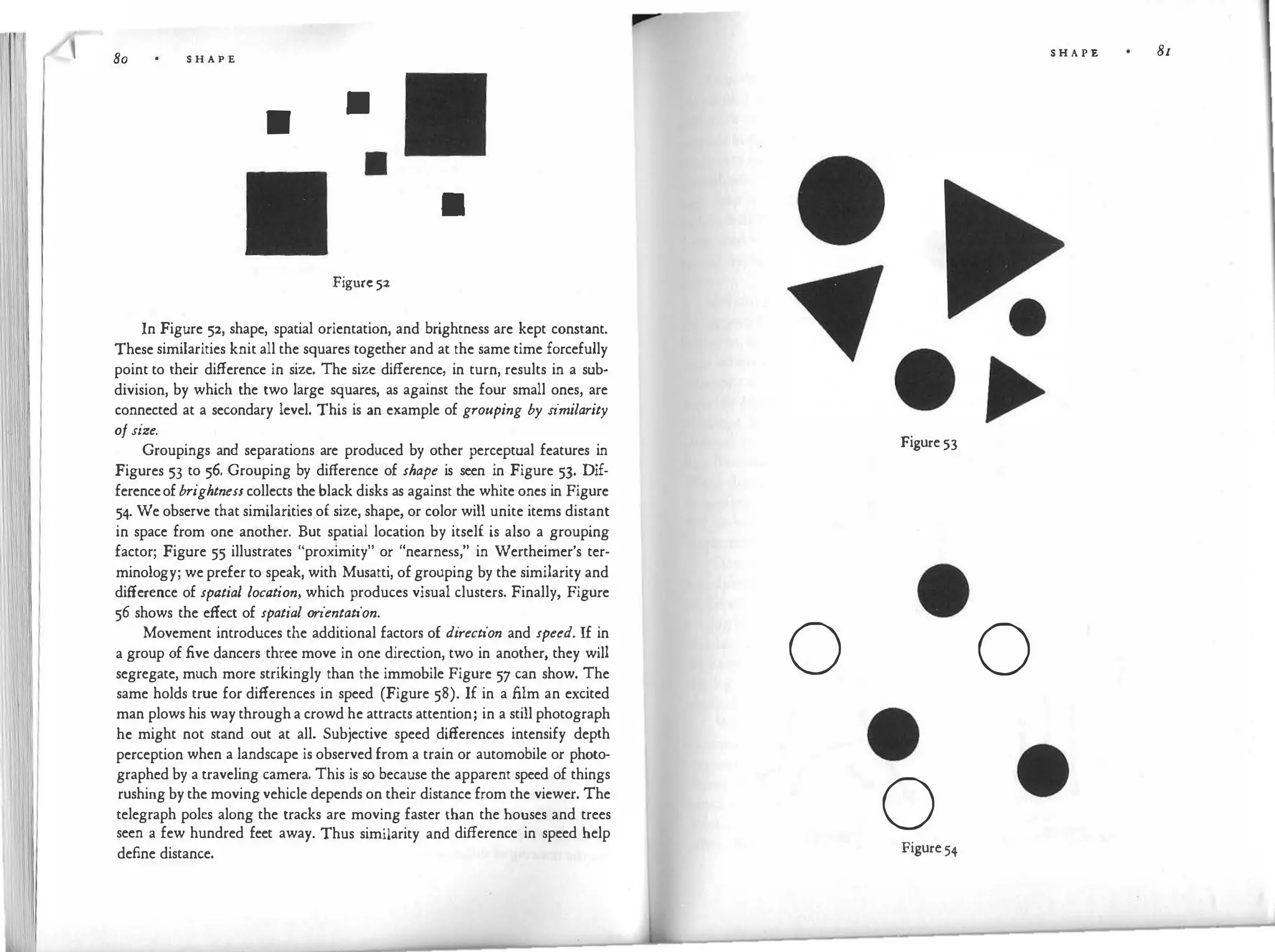
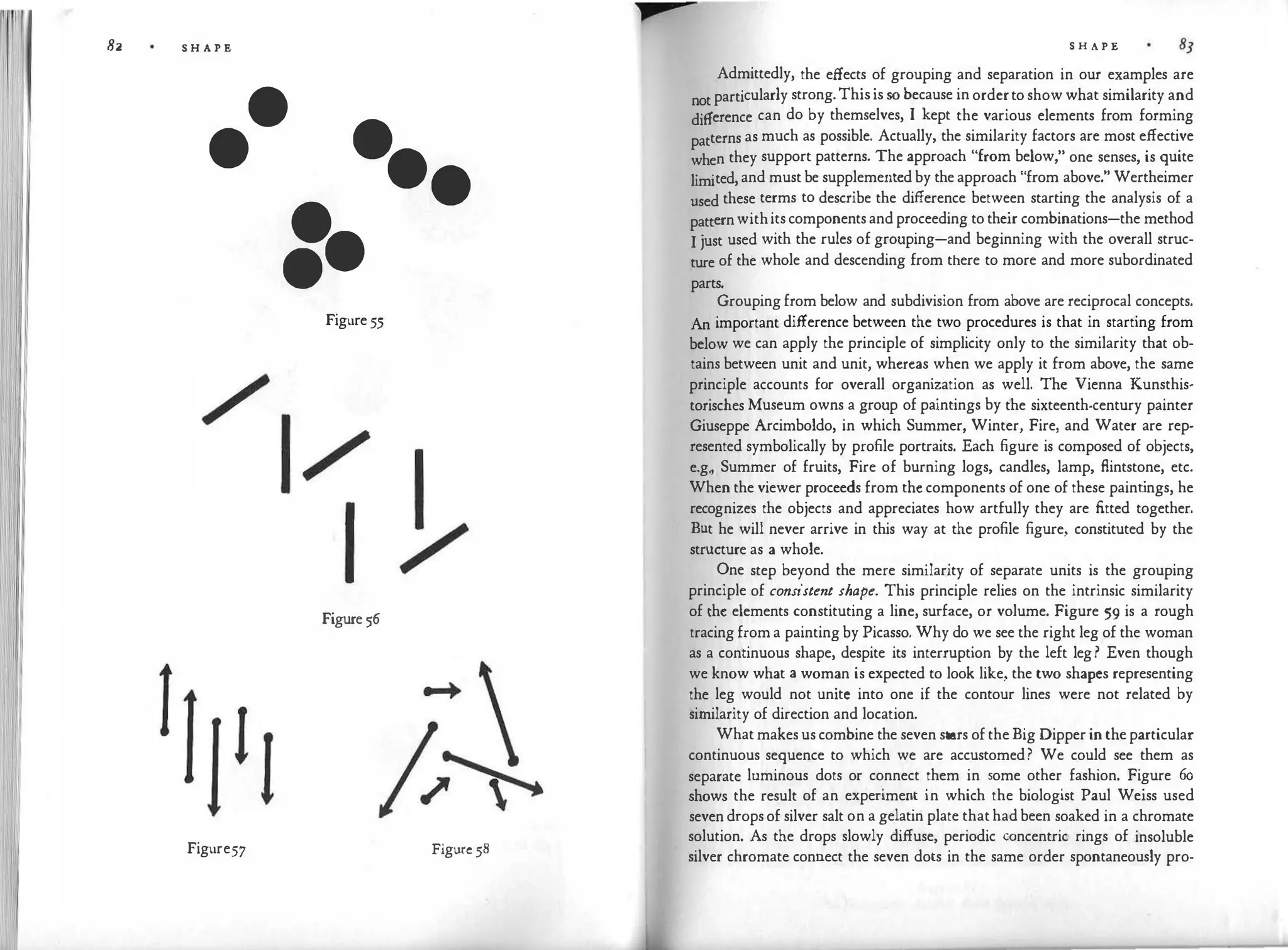
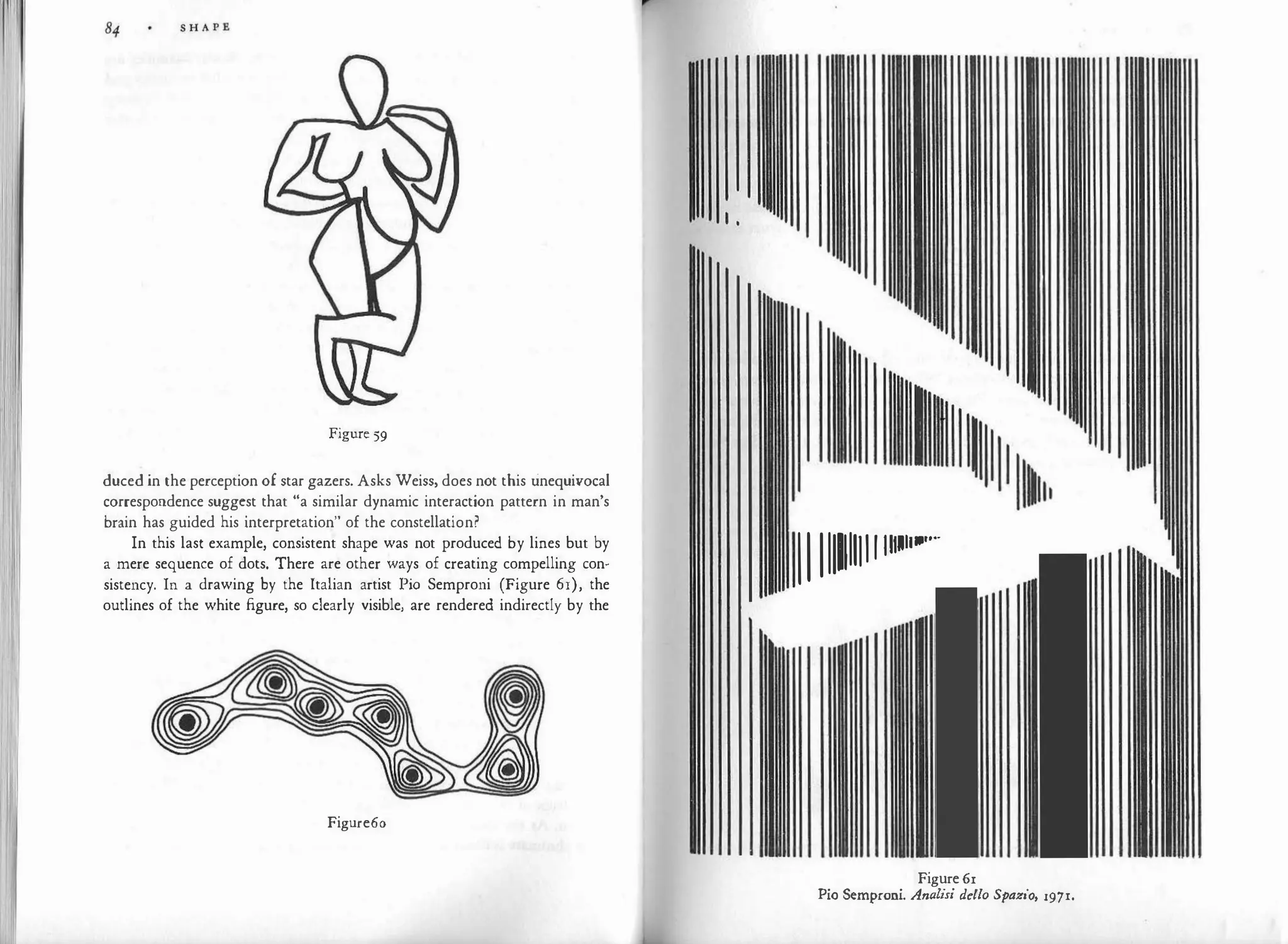
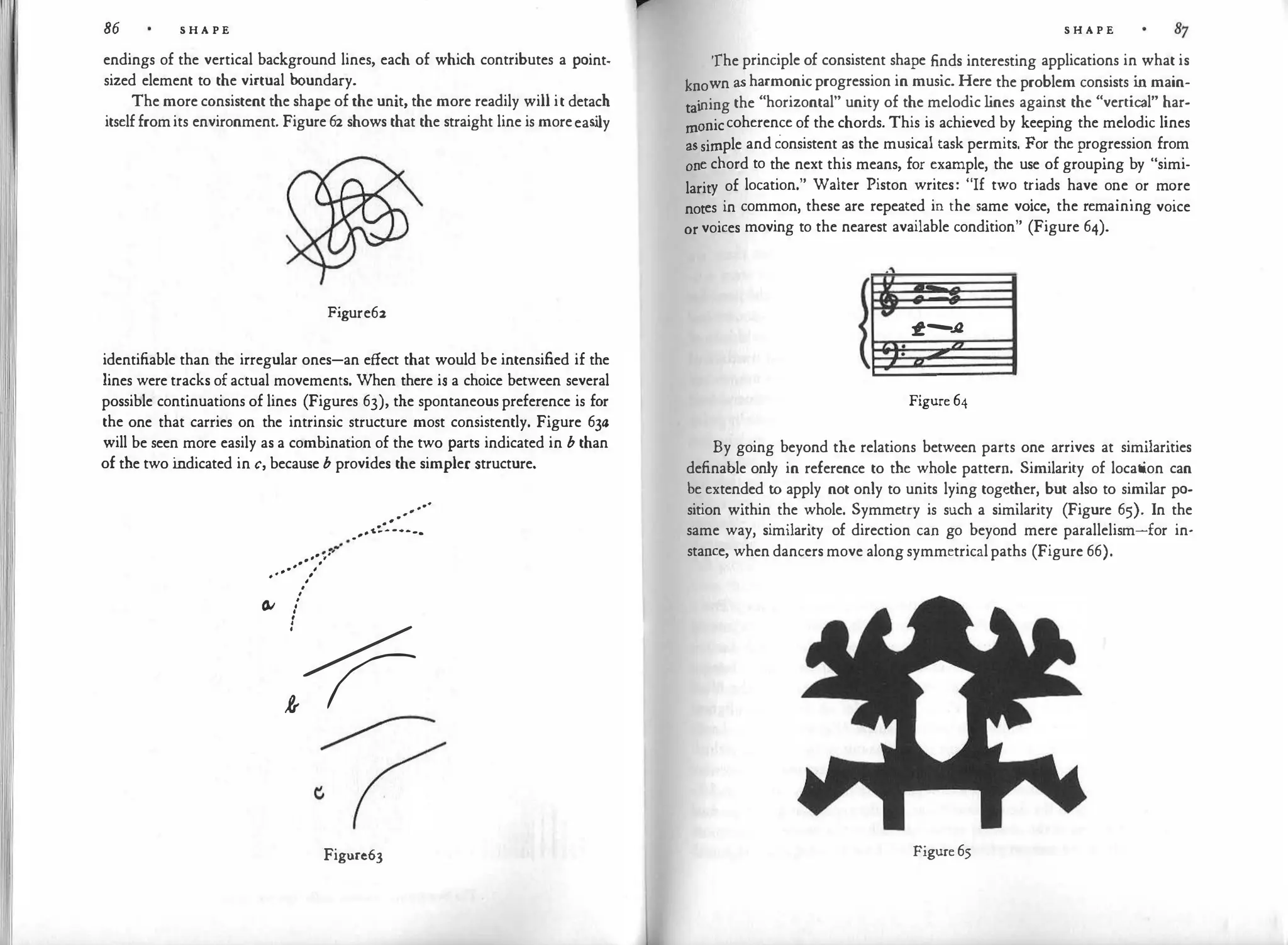
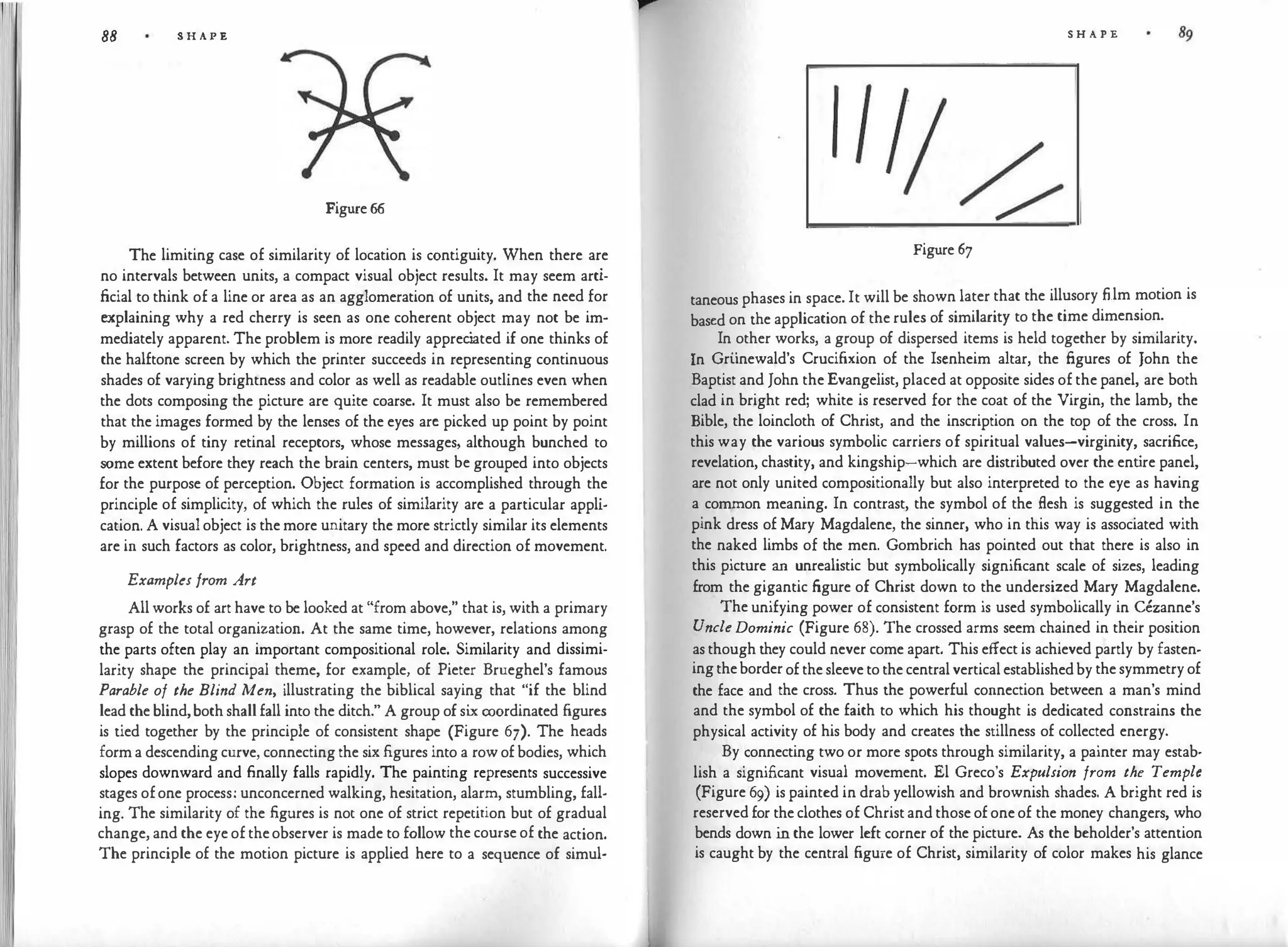
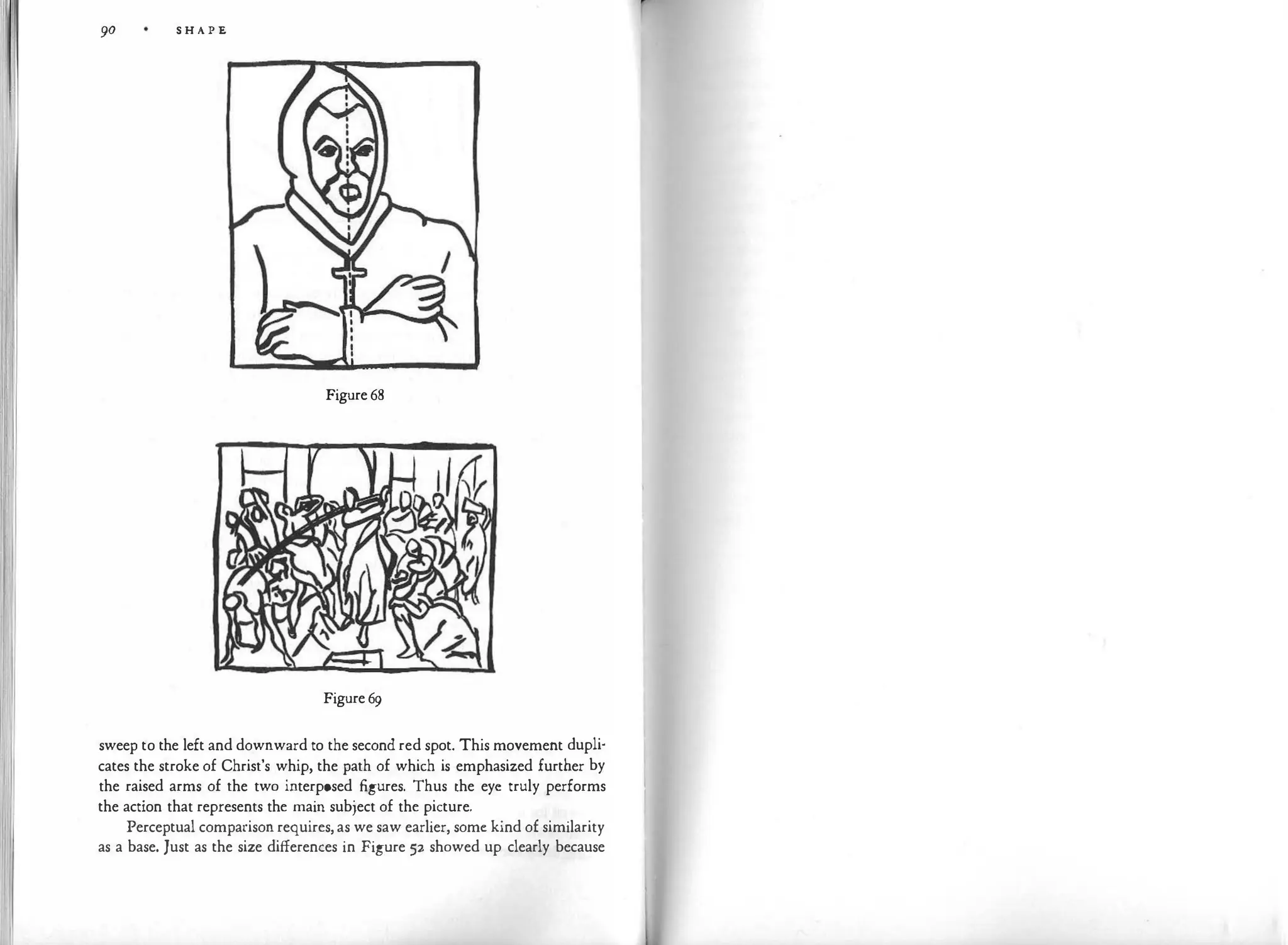
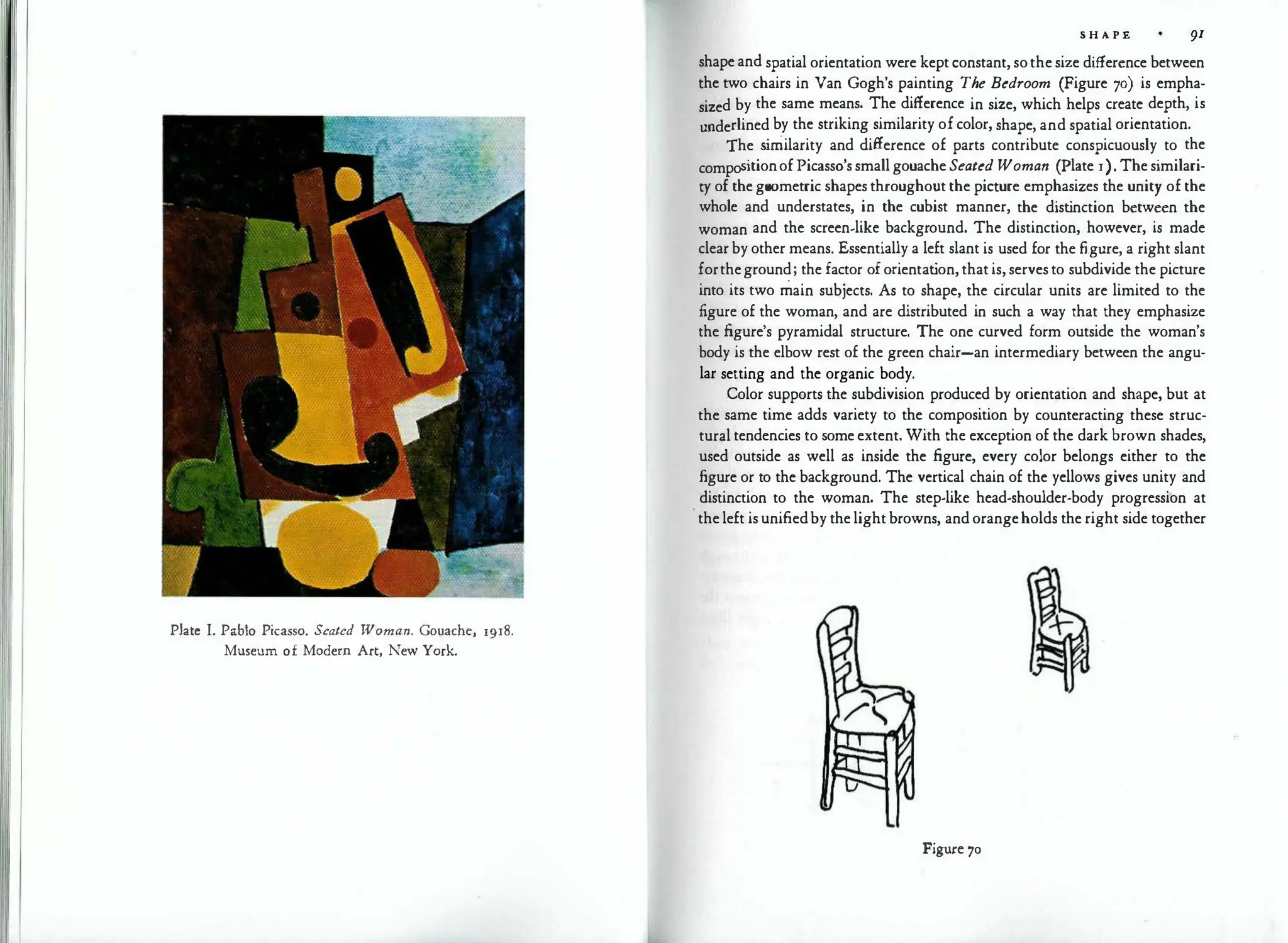
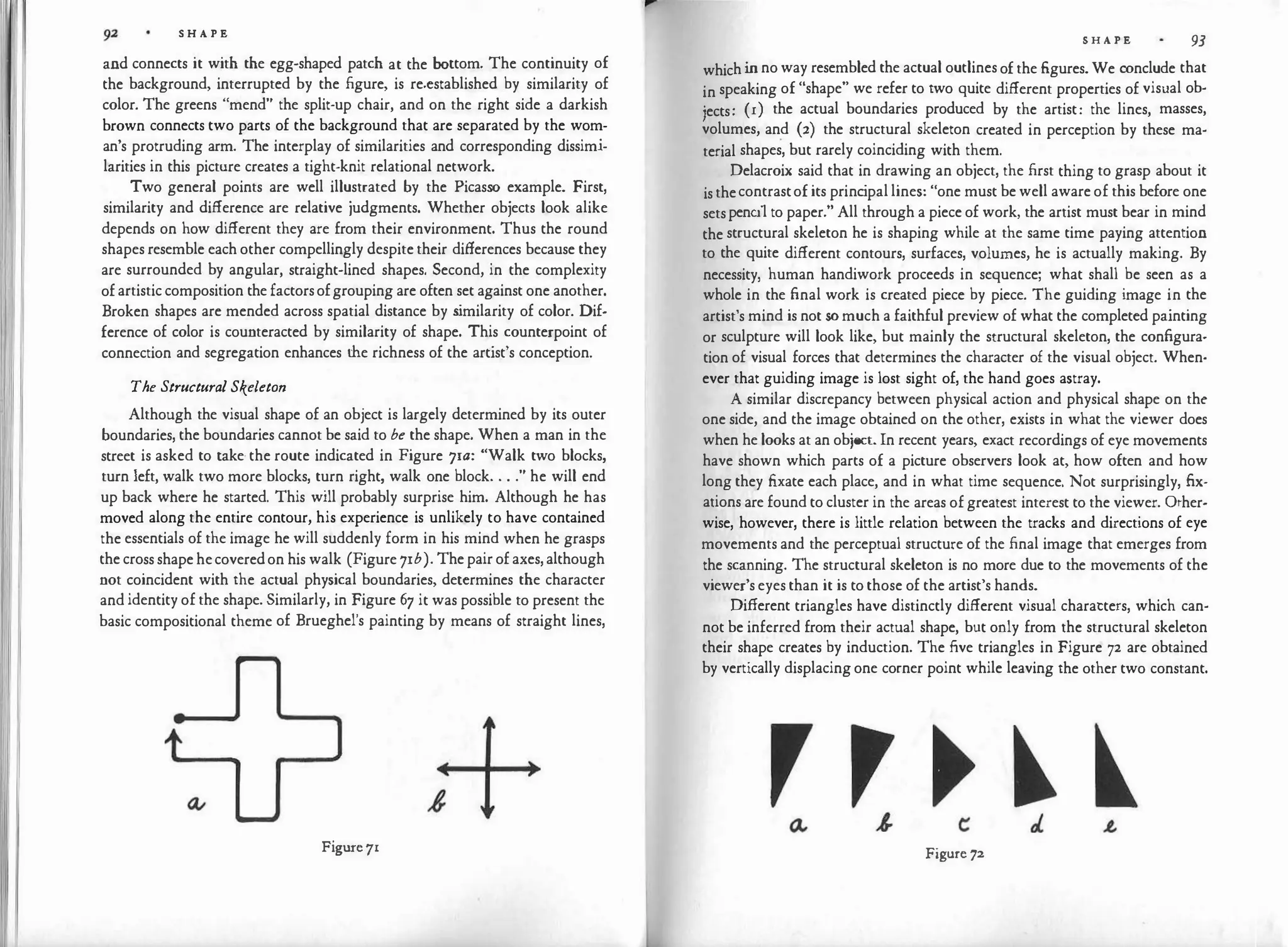
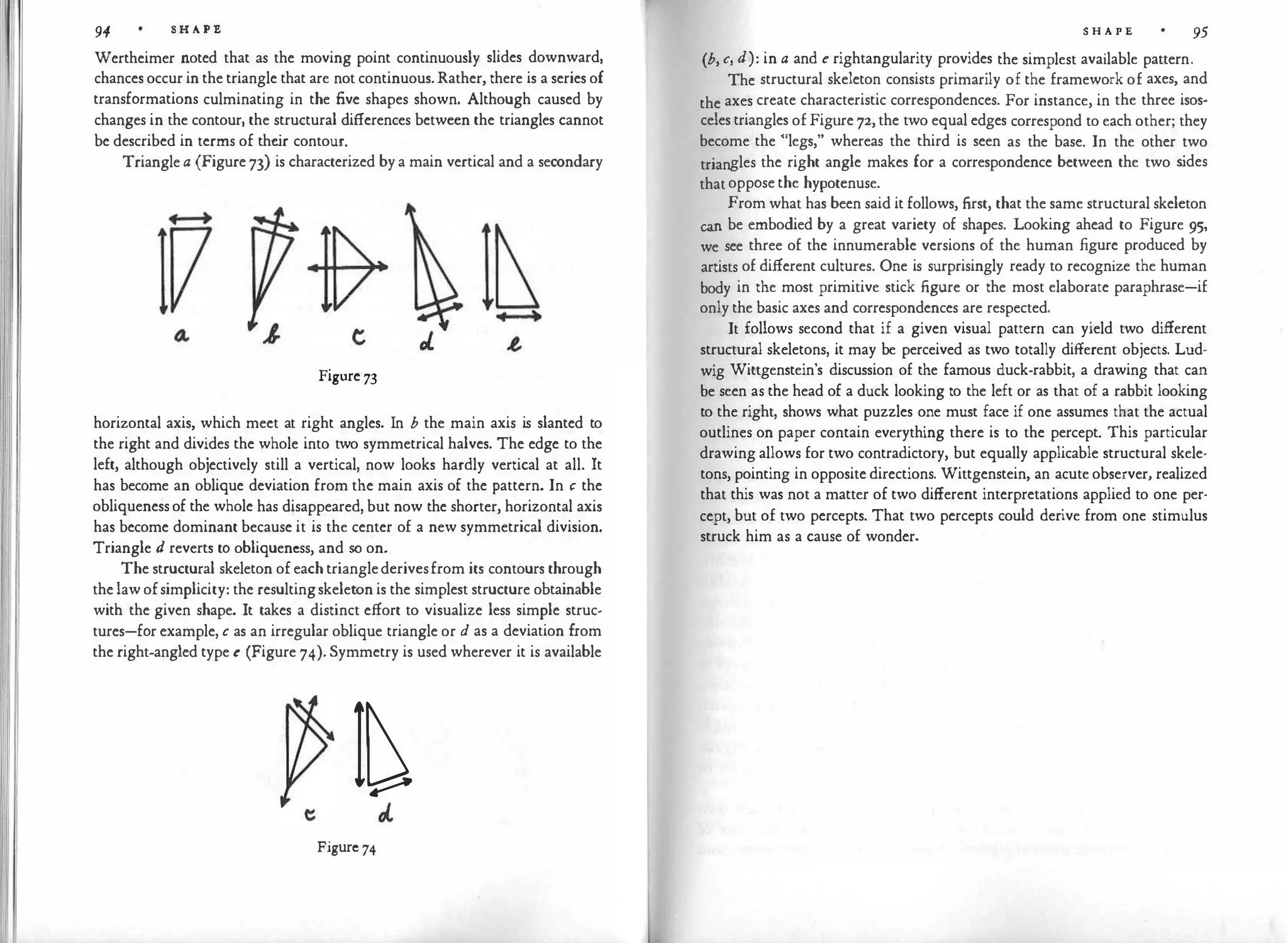
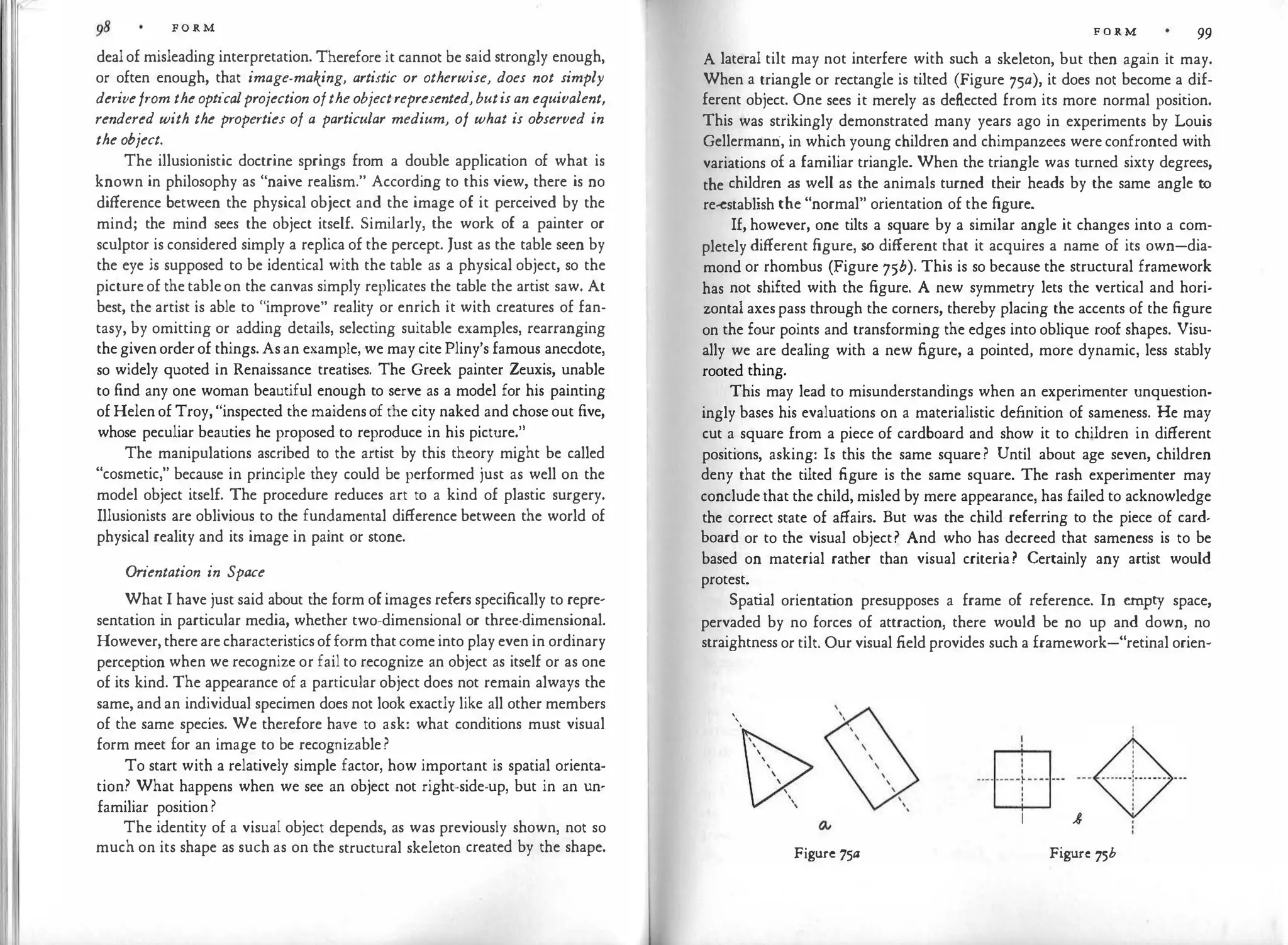
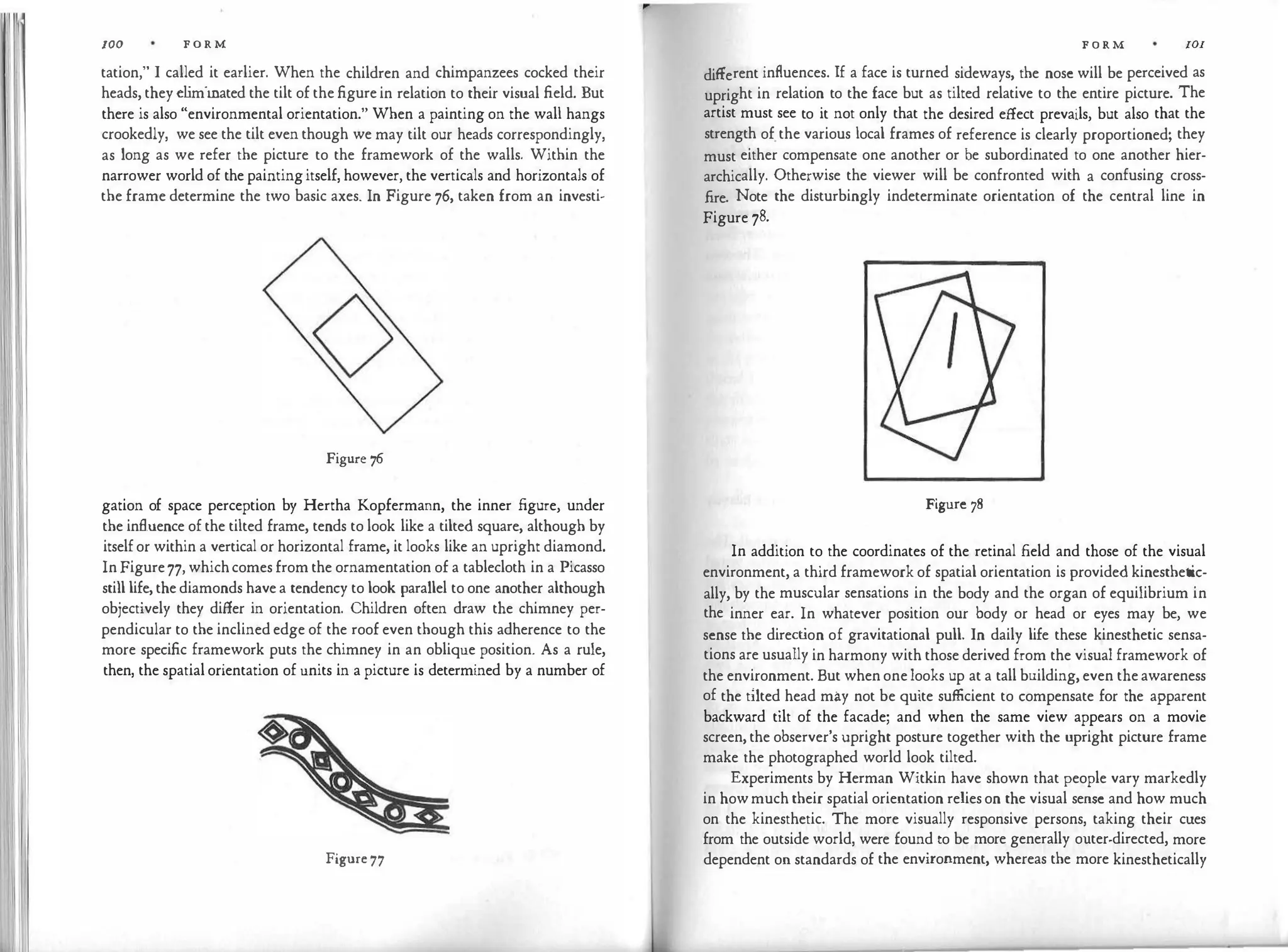
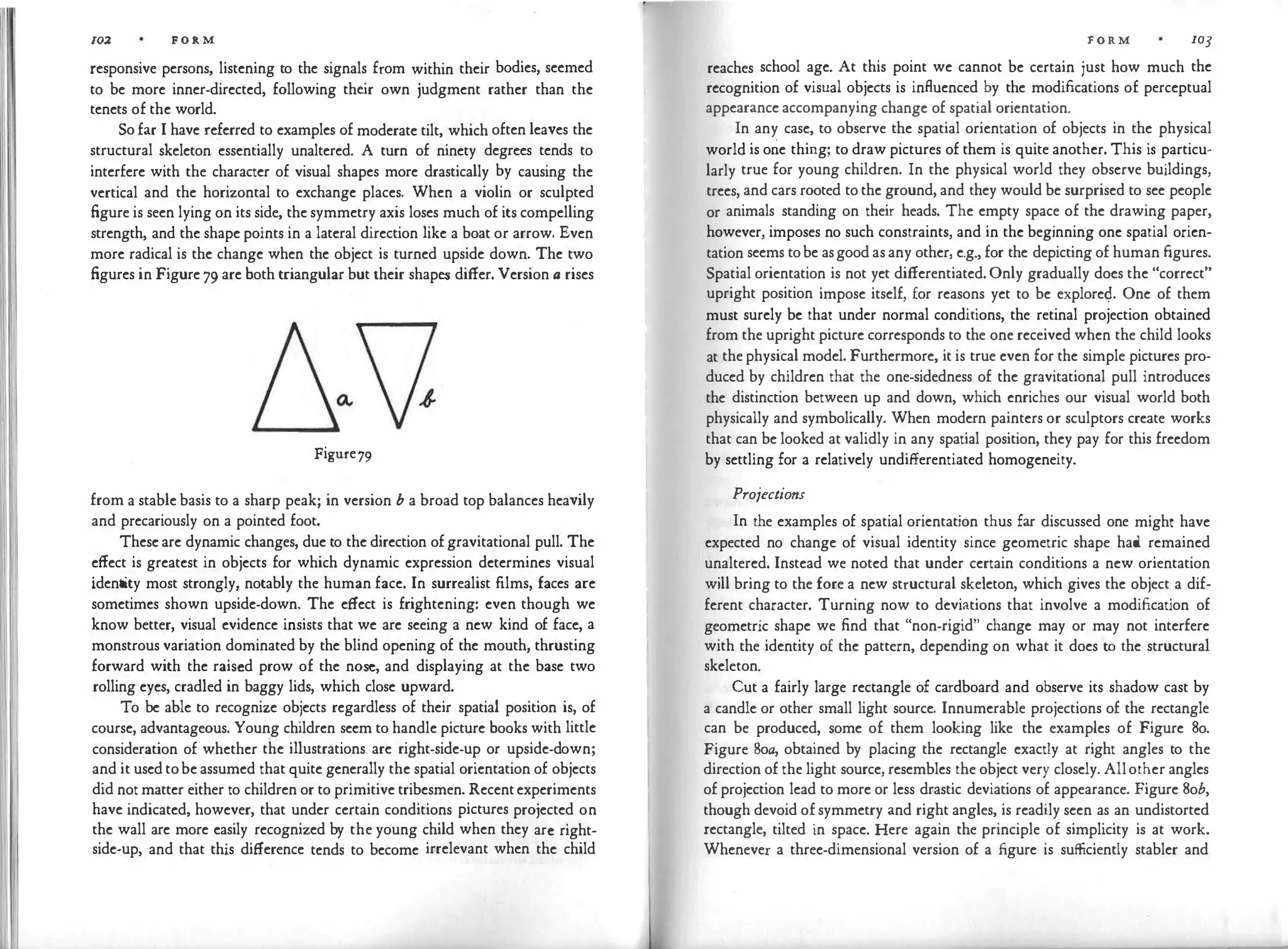
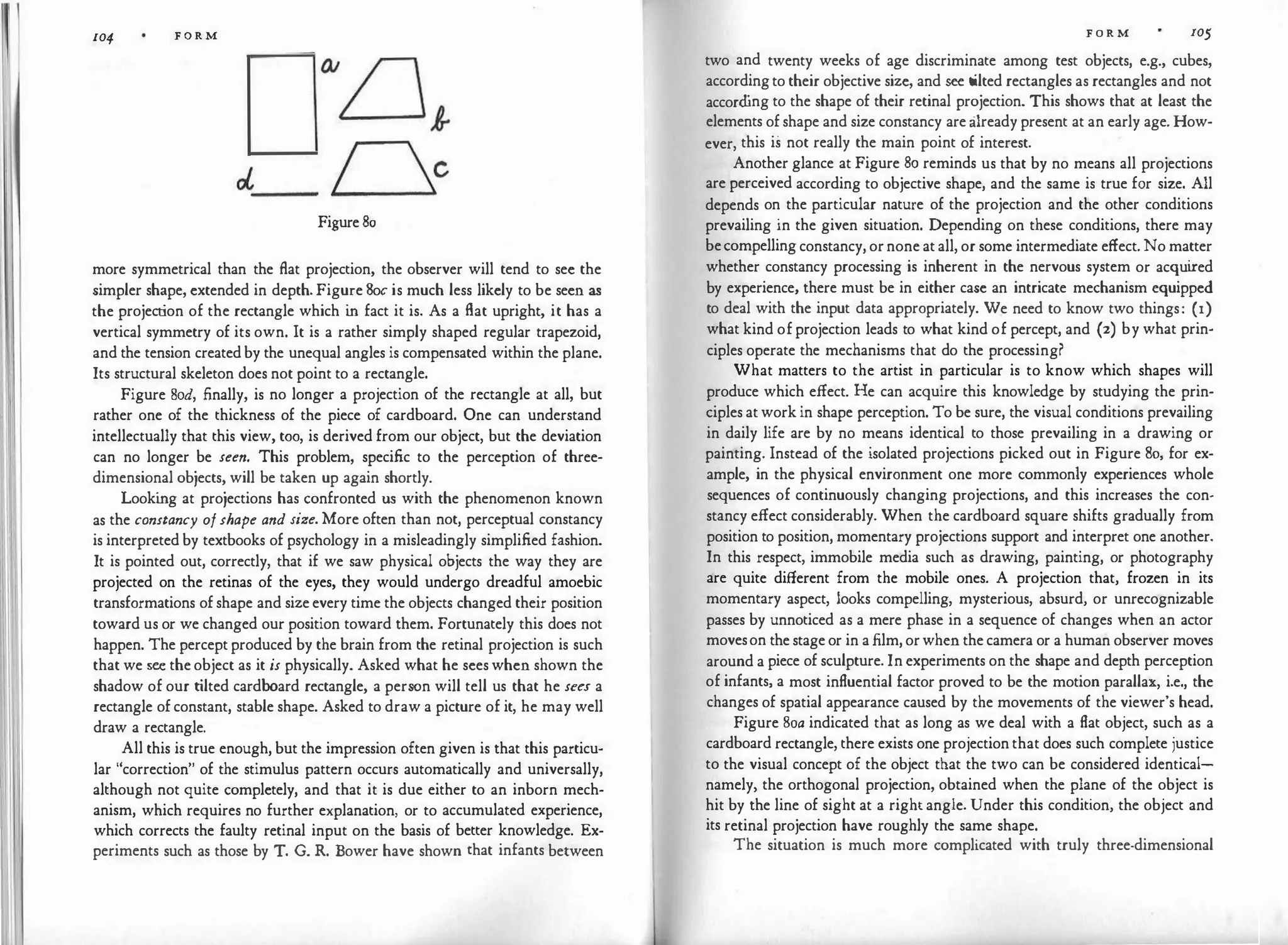
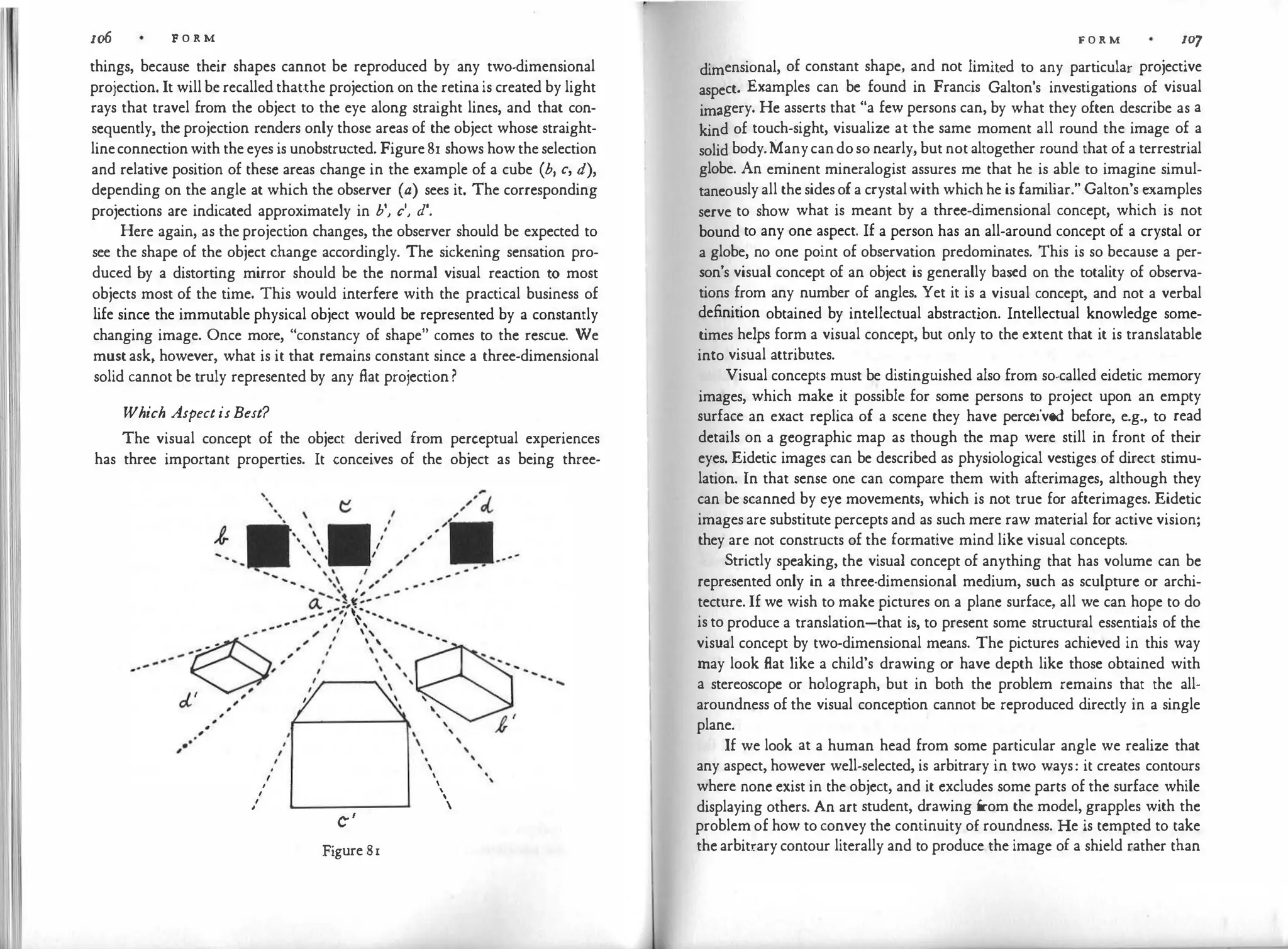
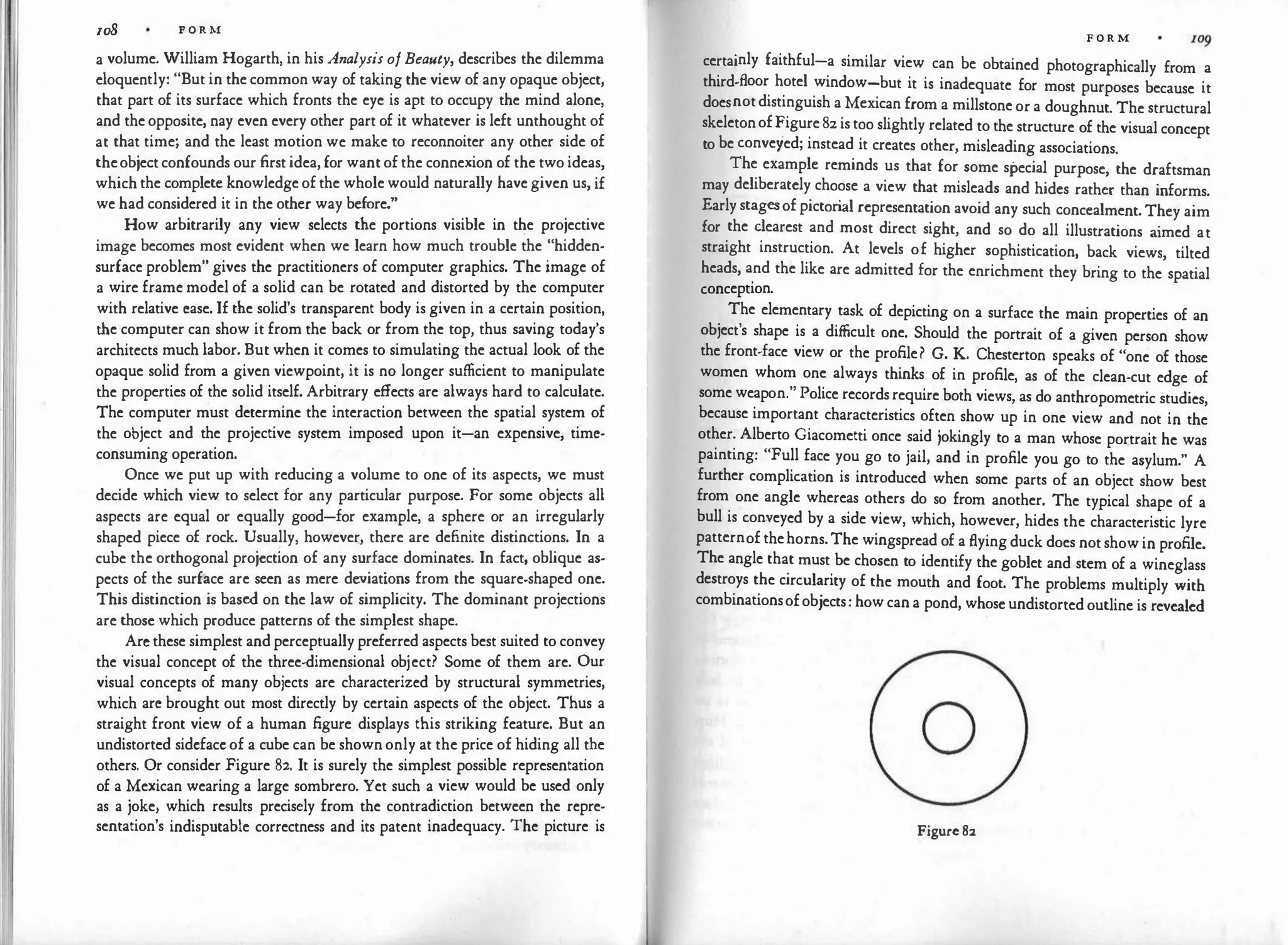
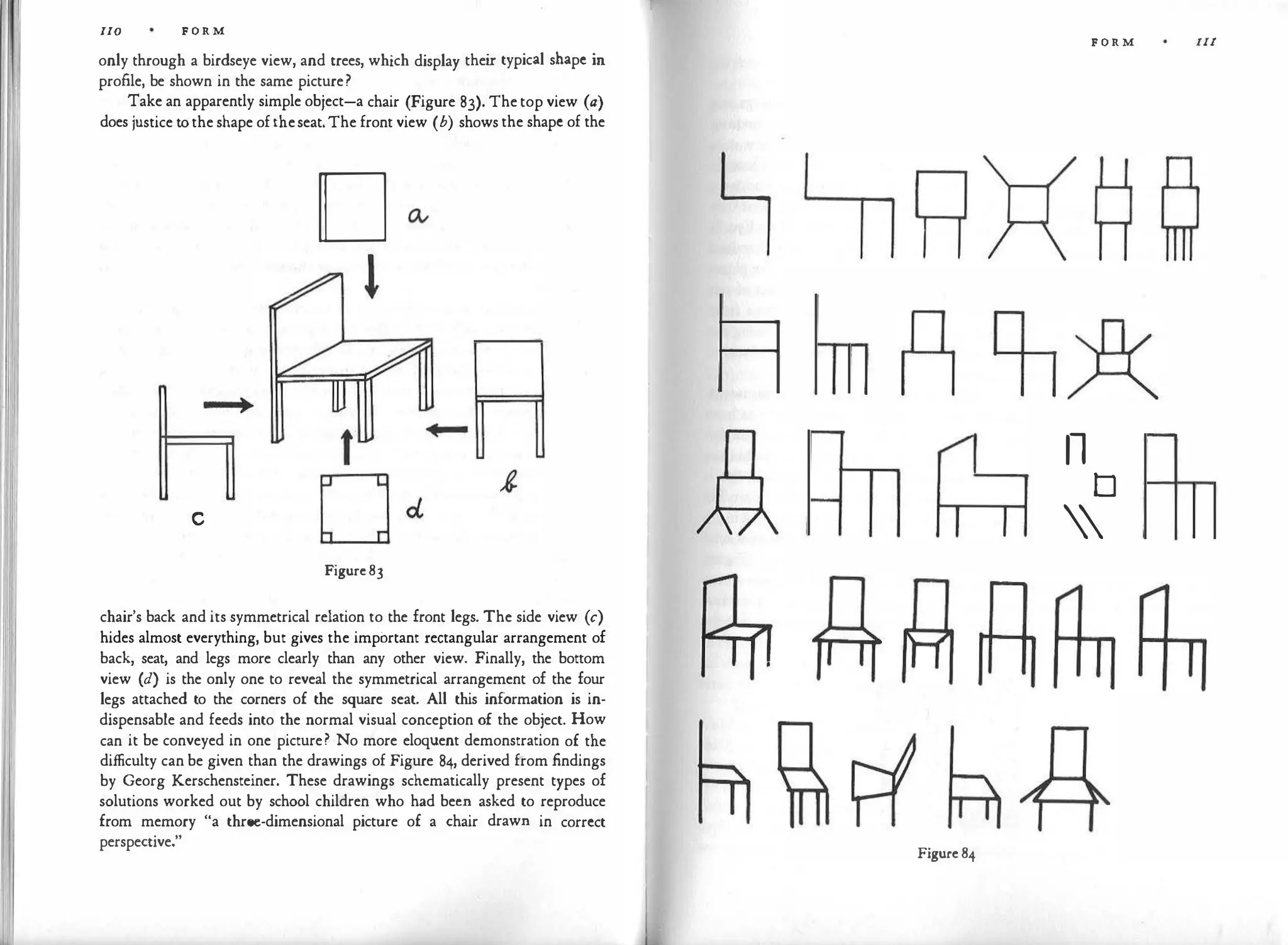
![I 1111
112 F O R M
TheEgyptian Method
One solution of the problem is best exemplified in the wall paintings and
reliefsofthe Egyptians and in the drawings of children. It consists in choosing
for each part of an object or combination of objects the aspect that best suits
the pictorial purpose. The pictures obtained by this procedure were formerly
condemned, or at best tolerated, as the inferior creations of people who were
incapable of doing better or who drew what they knew rather than what they
saw. In 186'], Ernst Mach ina popular lecture on "Why Has Man Two Eyes?"
observedthat the principle employed by the Egyptians might bestbe described
by saying that their figures are pressed in the plane of the drawing like plants
in a herbarium. Only when similar methods were adopted by artists of our
own century did theorists begin hesitantly to realize that deviations from
correct projection are not due to such operations as twisting or squashing the
faithfully perceived object, but are freely i
nvented equivalents of the observed
shape in the two-dimensional medium.
The Egyptians-as well as the Babylonians, early Greeks, and Etruscans,
who used a similar style of representation-were commonly thought to have
avoided foreshortening because it was too difficult. This argument was dis
posed of by Heinrich Schafer, who showed that the side view of the human
shoulder occurs in a few examples as early as the Sixth Dynasty, although it
continued to remain an exception throughout the history of Egyptian art. He
cites two examples of reliefs that represent workmen chiseling or towing a
stone statue; the shoulders of the living men are given in the conventional
front view, but the statue has the perspectively "correct" side view (Figure
85). Thus, in order to express lifeless rigidity the Egyptians had recourse to a
procedure that, in the opinion of the average nineteenth-century art teacher,
created the much more lifelike effect. Schafer further points out that, for the
Figure 85
F O R M 113
purpose of carving a sphinx, elevations were drawn on the sides of the rec
tangular block at least as early as 1500 B.c. and probably earlier. Naturally,
projective drawing was required for these elevations.
It is evident, therefore, that the Egyptians used the method of orthogonal
projection riot because they had no choice, but because they preferred it. This
method permitted them to preserve the characteristic symmetry of chest and
shoulders and the front view of the eye in the profile face.
Pictorial representation is based on the visual concept of the total three
dimensional object.Themethodofcopying an object or arrangement ofobjects
from one fixed point of observation-roughly the procedure of the photo
graphic camera-is not truer to that concept than the method of the Egyptians.
Drawingor paint
ingdirectly from the model is quite rare in the history of art.
Even in the epoch of Western art that began with the Italian Renaissance,
work from the model is often limited to preparatory sketches and does not
necessarily result in mechanically faithful projection. When the figures in
Egyptian art look "unnatural" to a modern observer, it is not because the
Egyptians fail to present the human body the way it "really is," but because
theobserver judges their work by the standards of a different procedure. Once
freed of this distorting prejudi.ce, one finds it quite difficult to perceive the
products of the "Egyptian method" as wrong.
What is requ
ired of the viewer is much more than enlightened tolerance
for a method that has been "superseded by the discovery of correct perspec
tive." Rather he must realize that there are different solutions to the problem
of representing three-dimens
ional objects in a two-dimensional plane. Each
method has its virtues and its drawbacks, and which is preferable depends
on the visual and philosophical requirements of a particular time and place.
It is a matter of style. Compare Figures 86 and 87. Figure 87 is a tracing after
a painting of Oskar Schlemmer. Drawn in rough accordance with the rules
of central perspective, it corresponds in that respect to what a camera would
set down if such a scene were taken from a particular station point. In this
sense the picture is quite realistic.
An advocate of the traditional realistic method would object to Figure 86,
which indicates schematically how a similar scene would be represented in
children's drawings and early forms of art. He would point out that the table
is upright rather than horizontal, that foreground and background figures
are the same size, and that one figure is lying sideways and another is upside
down. However, a partisan of this early method would object to Figure 87,
deploring the representation of a rectangular table as a crooked trapezoid. He
would point out that the three figures, objectively of equal size, vary in the](https://image.slidesharecdn.com/arnheimrudolfartandvisualperception1974-251210161854-a75a3f61/75/Art-and-Visual-Perception-A-PSYCHOLOGY-OF-THE-CREATIVE-EYE-63-2048.jpg)
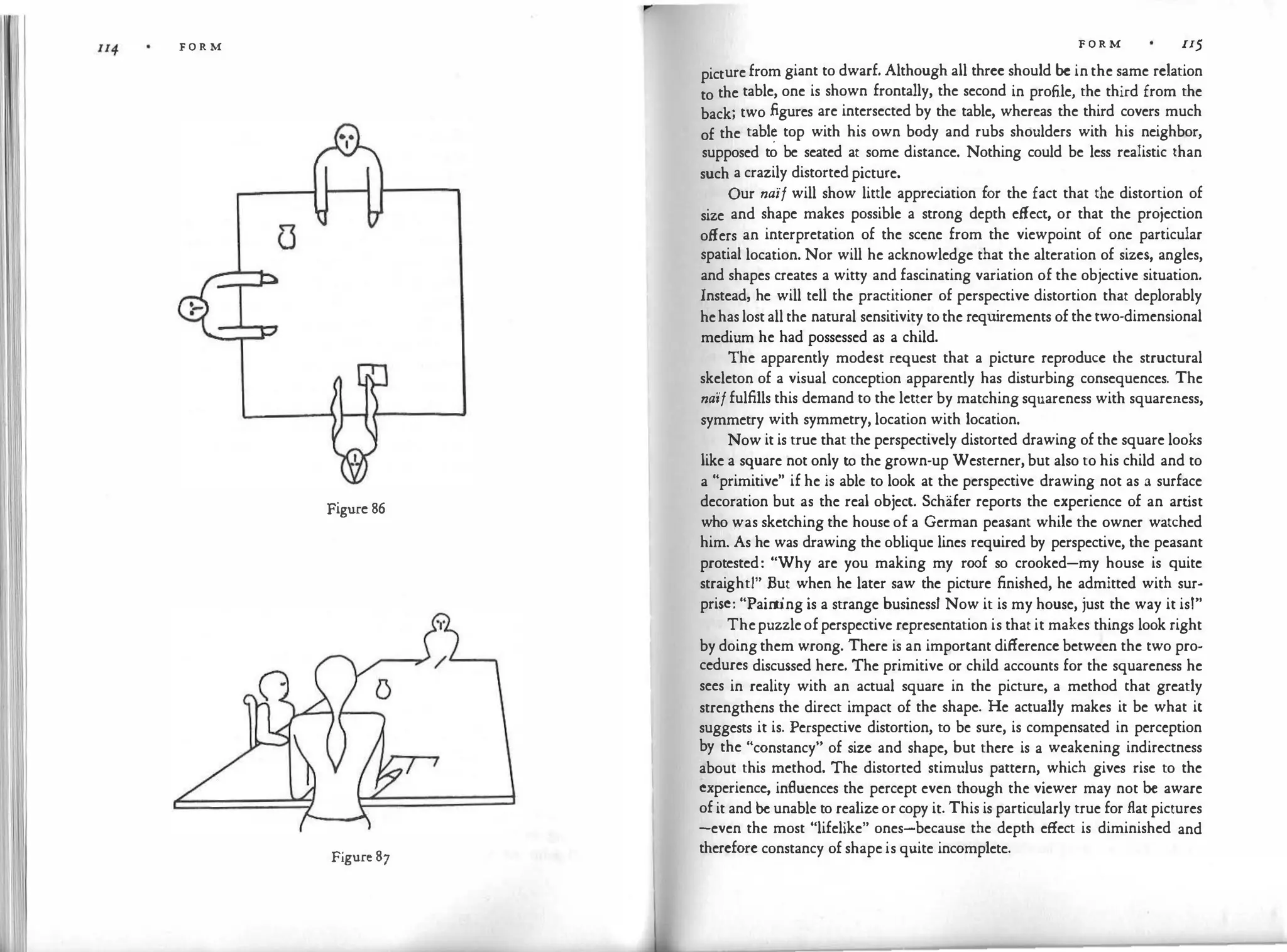
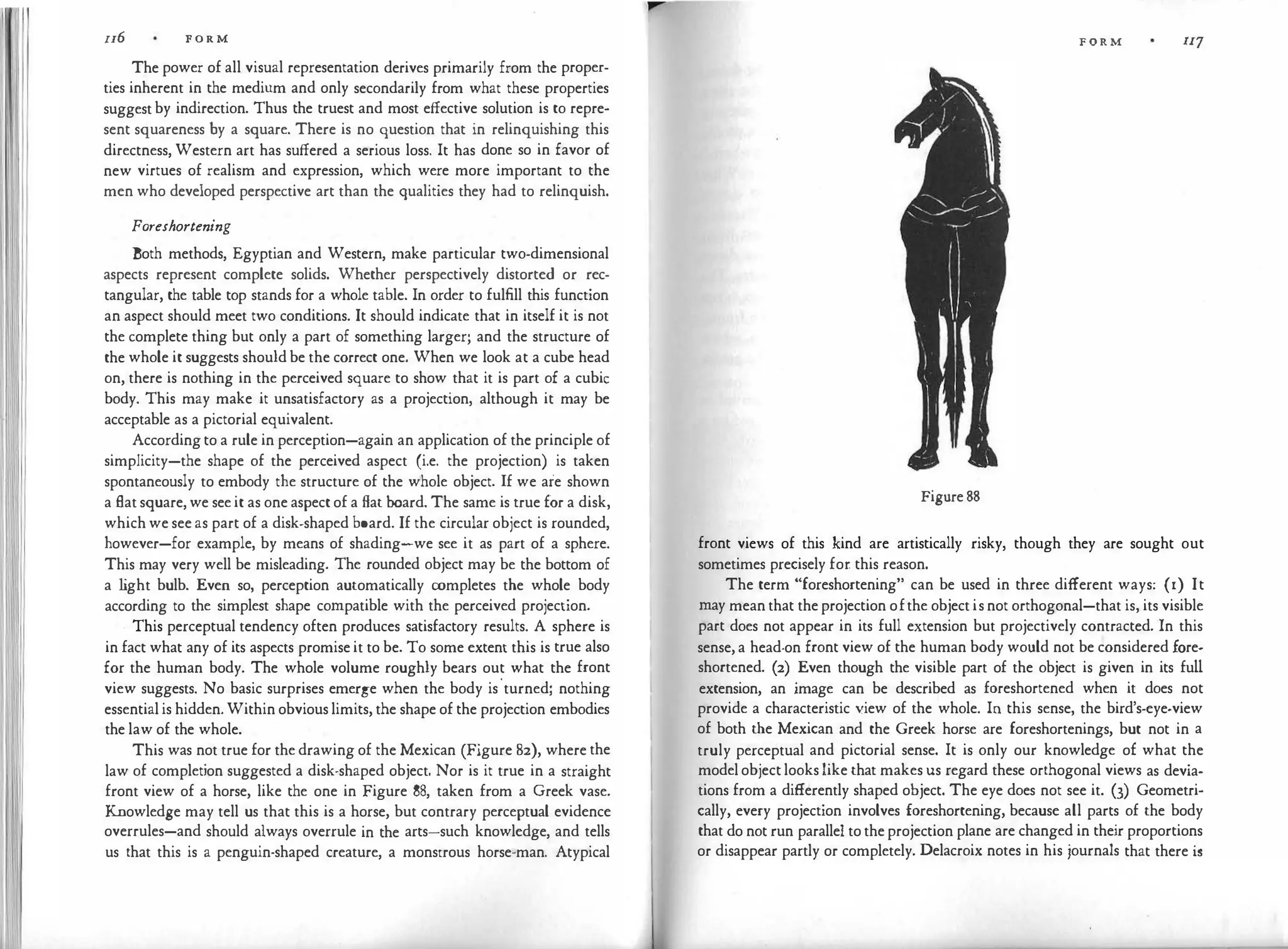
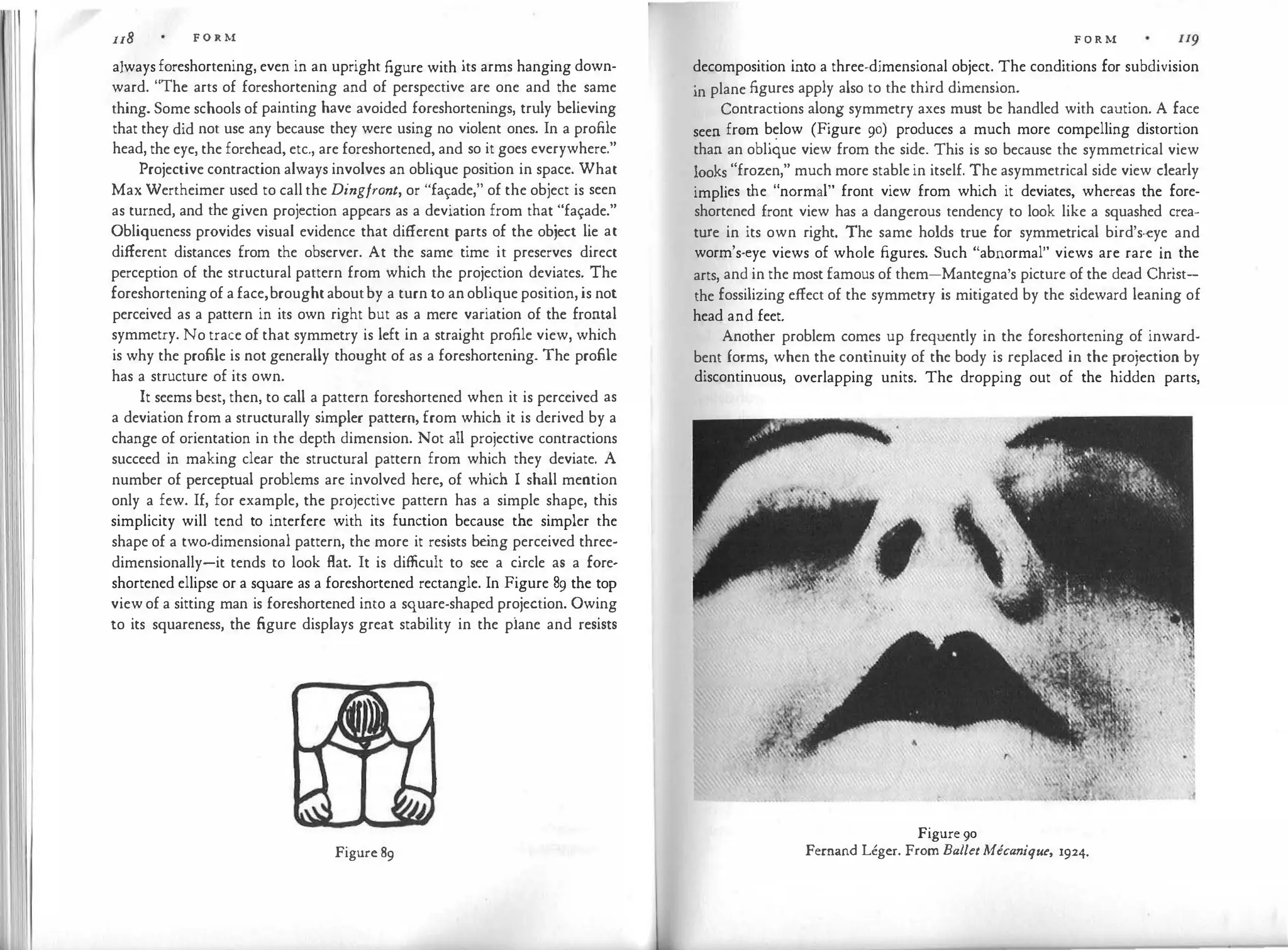
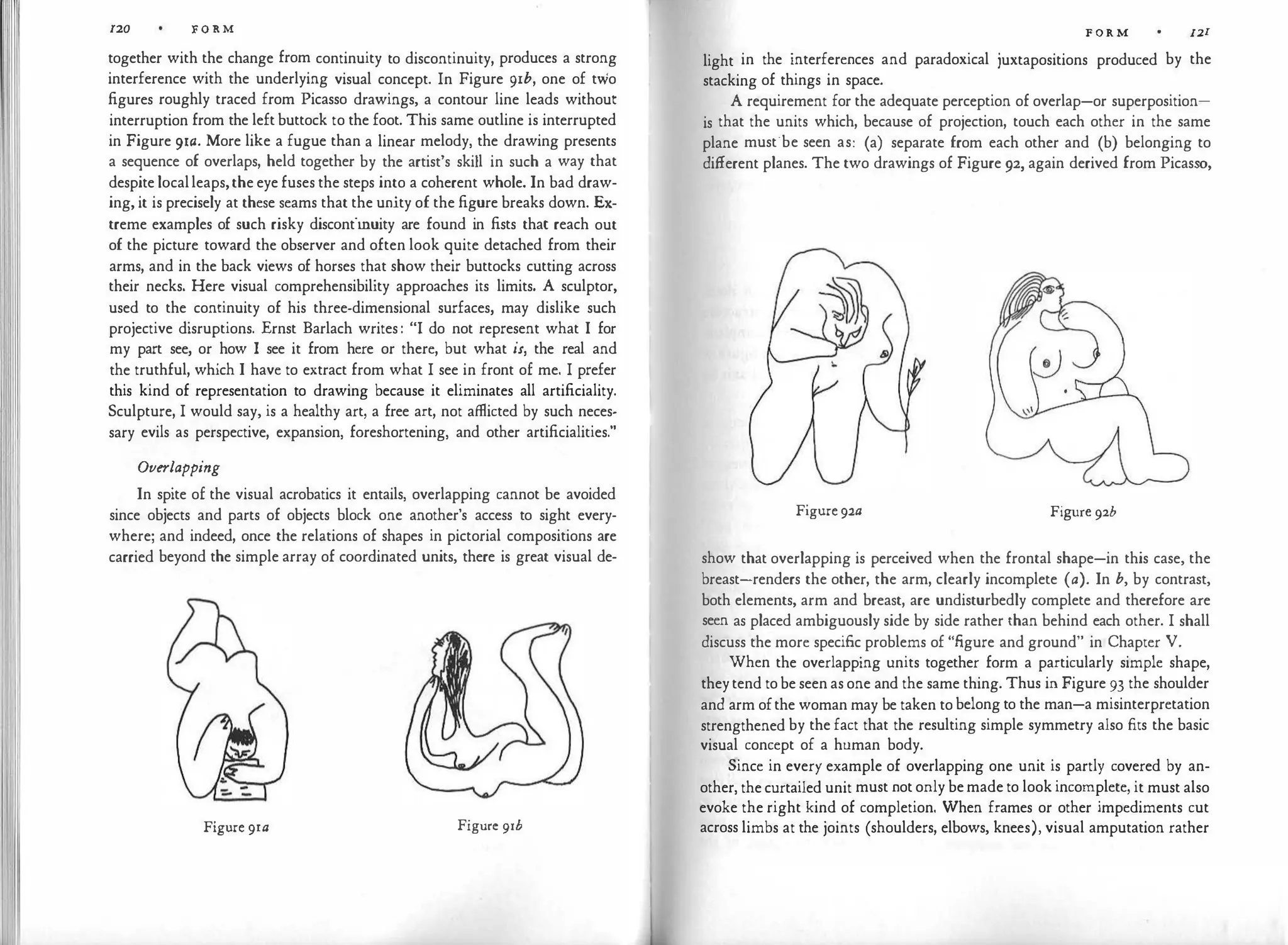
![122 FORM
Figure93
than overlapping is the result, because the stump looks complete in itself.
Again, when the di
rection of the cut is in a simple relation to the structure
of thevisible unit, the fragment is more likely to show an inorganic complete
ness. See, for example, in Michelangelo's LastJudgment, the famous figure of
the damned man (Figure 94) whose face is divided along the sagittal axis by
Figure94
thehandshieldingoneof hiseyes from the horrors before him, while theother
eye dominates the visible half of the face like a monstrous thing with a shape
of its own. Oblique cuts tend to prevent such effects. When the border of a
picture cuts across a figure, the painter or photographer generally avoids the
effectofamputatedstumpsor torsos byplacingthe cutsothattheshapeis seen
as continued beyond the border.
These rules are by no means limited to the images of objects known from
nature, such as animals or humans. The segment of a disk will or will not
appear as a part of a circular shape depending on whether the curvature, at
the points of interruption, suggests continued extension or an inward turn
toward closure. It is not our anatomical knowledge but the nature of the
F O R M 12]
shapes in which the body is cast that determines whether an organic object
js perceived as complete, transformed, or mutilated.
What Good Does Overlapping Do?
The simplest kind of visual representation, as it is found, for example, in
the drawings of young children and Mesolithic draftsmen,and in the Chinese
ideogram for man (Figure 95), closely resembles in its structure the norm
Figure 95
images we create in our minds. These norm images serve as "key tones" for
overlappings, which deviate from the base in two ways. First, the norm ar
rangement, which presents a surveyable deployment of all limbs in their typi
cal interrelation, gives way to intricate crossings as soon as the artist under
takes to depict the actions of working, gesticulating, sitting, climbing, falling.
This transformation is inevitable wherever the artist wishes to present more
than mere unmodified existence. Second, the body is subjected to alterations
resultingfrom projection. It is this sort of transformation that requires a more
detailed justification.
If one compares Figure 96a with a drawing of two ducks walking in
single file without overlapping (Figure 96b), one realizes that the parallelism
of the two birds, which conveys their togetherness to the eye, is brought out
more compellingly when it occurs within one visual unit. Similarly, in Figure
Figure96](https://image.slidesharecdn.com/arnheimrudolfartandvisualperception1974-251210161854-a75a3f61/75/Art-and-Visual-Perception-A-PSYCHOLOGY-OF-THE-CREATIVE-EYE-68-2048.jpg)
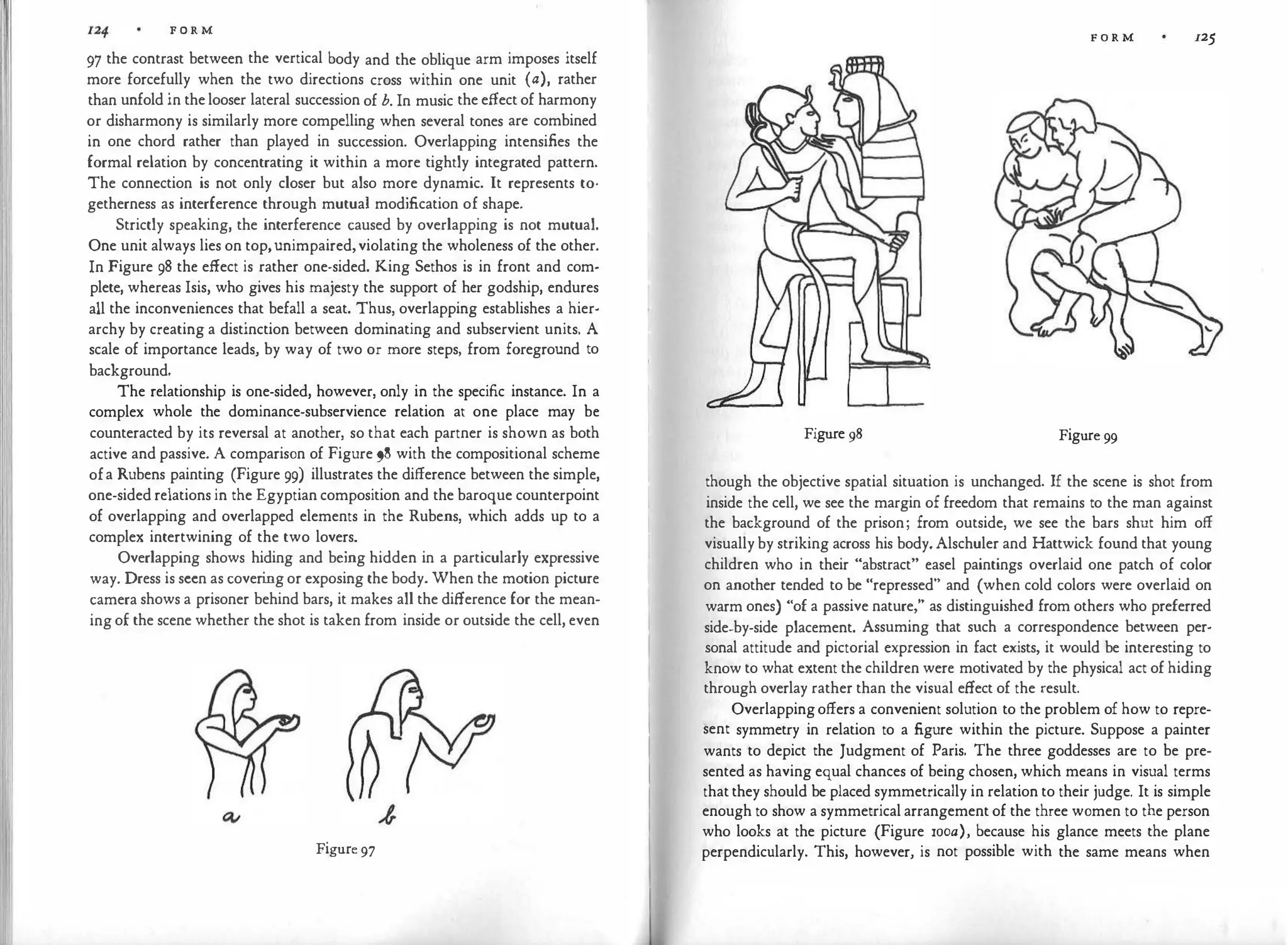
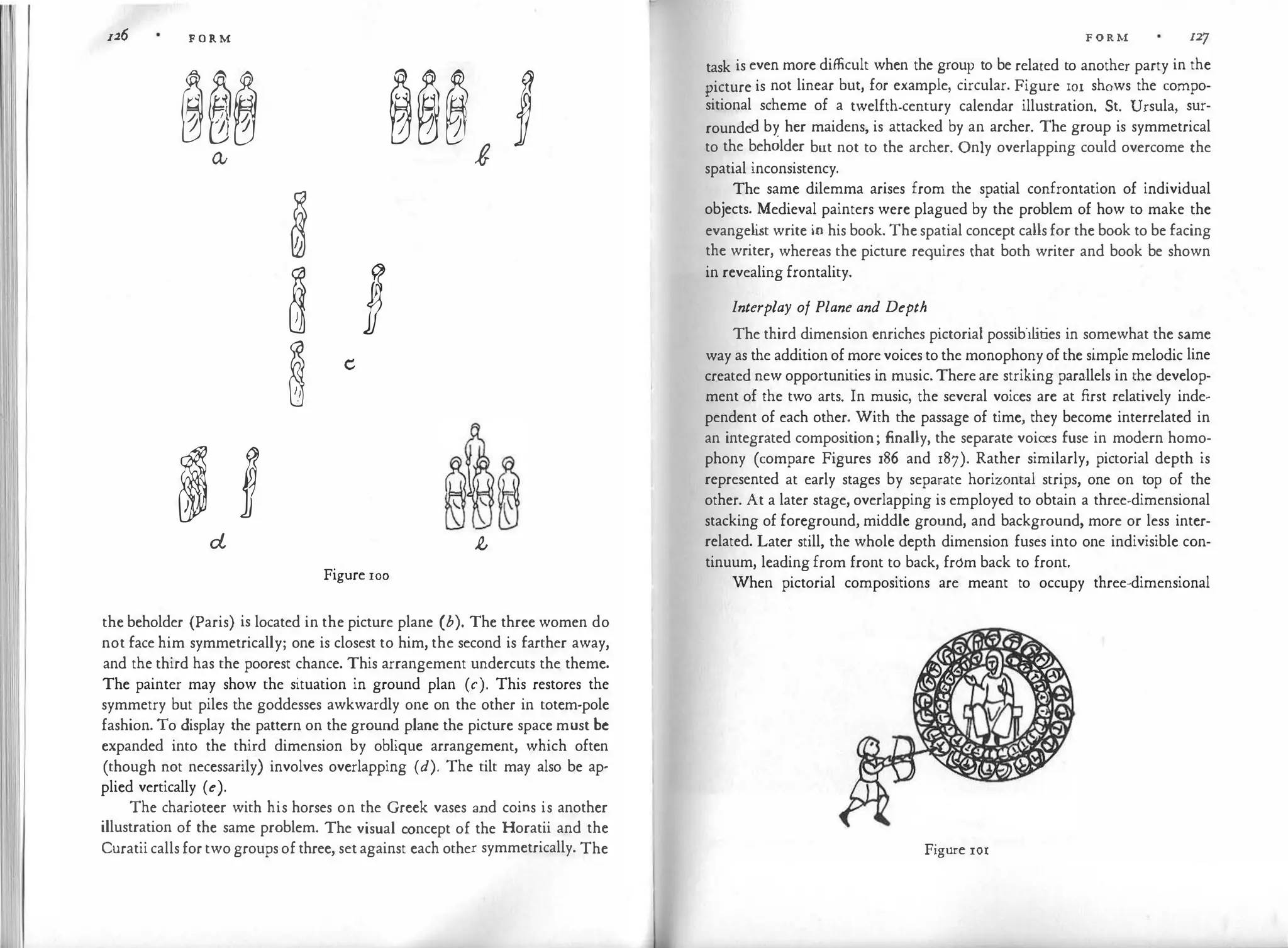
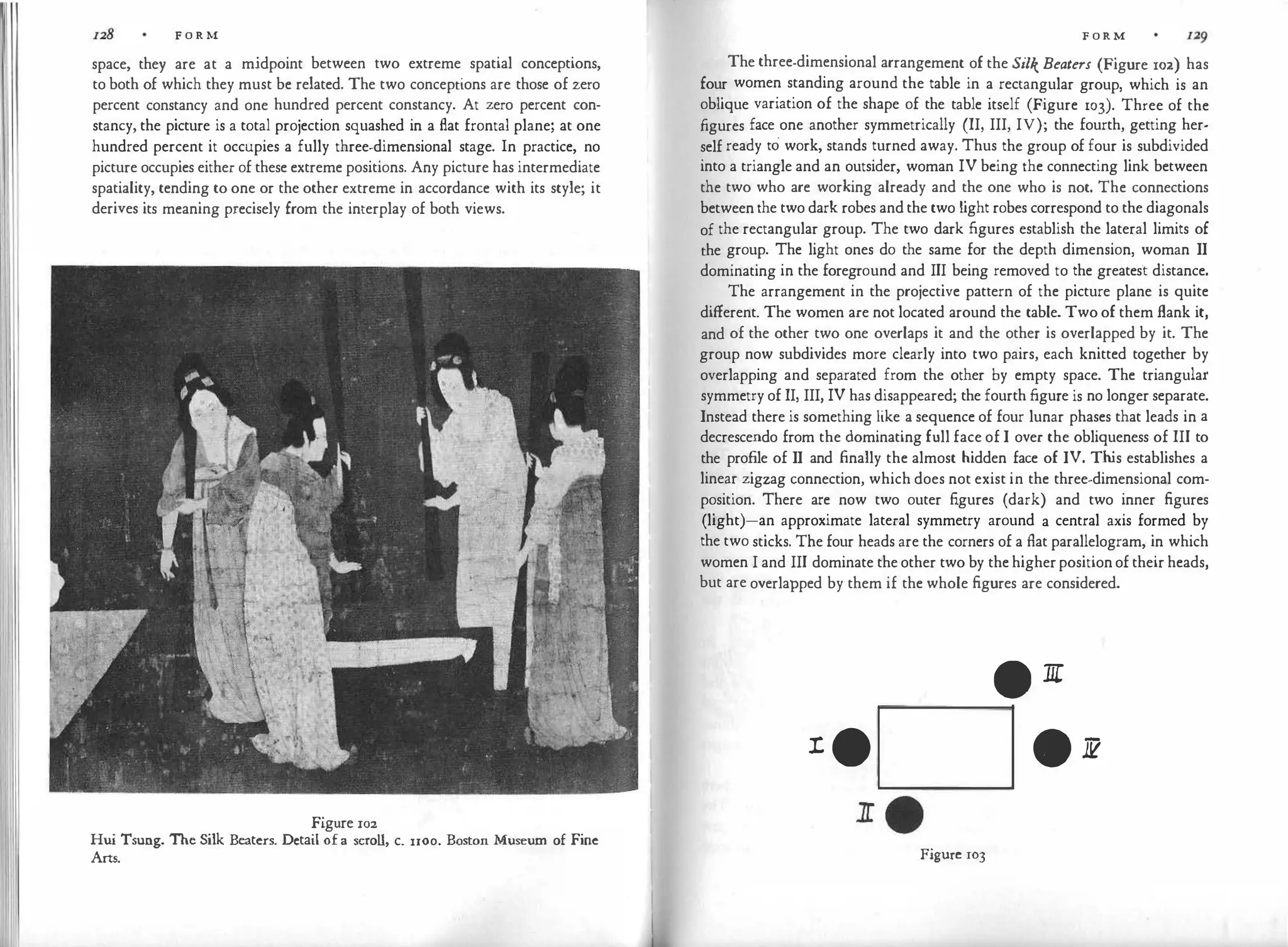
![130 F O R M
A wealth of form and meaning springs from the interaction of the two
compositional structures, which partly support and partly oppose each other
contrapuntally. It would be worthwhile to study the relative functions of the
two patterns moreprecisely. Obviously, the three-dimensional grouping always
describes more accurately the factual or "topographic" situation (for example,
Christ surrounded by his disciples), whereas its expressive or symbolic func
tion may well be weaker than that of the visually more direct projective pat
tern. Since the relative strength of the two depends on the strength of the depth
effect in the particular picture, however, an investigation of their functions may
lead to different results for different styles.
Competing Aspects
No more than one aspect of any three-dimensional object is visible at any
place and time. In thecourseof his life and in fact during almost any particular
episode of his daily experience, a person overcomes this limitation of visual
projection by looking at things from all sides and thereby forming a com
prehensive image from the totality of partial impressions. I have mentioned
the difficulty arising when such all-around visual concepts are to be represented
on a pictorial surface.
Inevitably, some aspects are selected, to the derogation of others. The
tradition established by Renaissance art admitted of only one solution for this
dilemma. The painter had to choose the one aspect best suited for his purpose
and had to pur up with whatever was hidden, foreshortened, or <listor.ted from
that particular point of view. We have noted that early forms of art are
unaffected by this rule and freely combine the most informative aspects of
each part of an object or spatial situation, disregarding the concomitant dis
crepancy of viewpoints. Such styles of representation are committed to the
object or situation as such, not to any one of its views.
There is one rule, however, that these early styles tend to respect. In
general, they do not use more than one aspect of an object or part of an object
in the same picture. They would not, for example, show both a front view and
a back view of the same object. However, occasional transgressions of the rule
are found even at fairly primitive levels. In children's drawings the combina
tion of a frontal nose with a profile nose in the same face may occur at stages
of transition from one form of representation to another.
Genuine examples of such dual-aspect representation occur here and there
as local inventions of limited range, often for playful, decorative purposes. The
American Indians solvedthe problem of presenting the characteristic side view
and the frontal symmetry of an animal at the same time by splitting the body
F O R M I]I
into two side views. These were combined in a symmetrical whole and kept
precarious contact with each other by sharing either the middle line of the
back or the head or by cohering at the tip of the nose or the tail (Figure 104).
Morin-Jeap has shown that similar forms, which he misinterprets as "monsters
Figure 104](https://image.slidesharecdn.com/arnheimrudolfartandvisualperception1974-251210161854-a75a3f61/75/Art-and-Visual-Perception-A-PSYCHOLOGY-OF-THE-CREATIVE-EYE-72-2048.jpg)
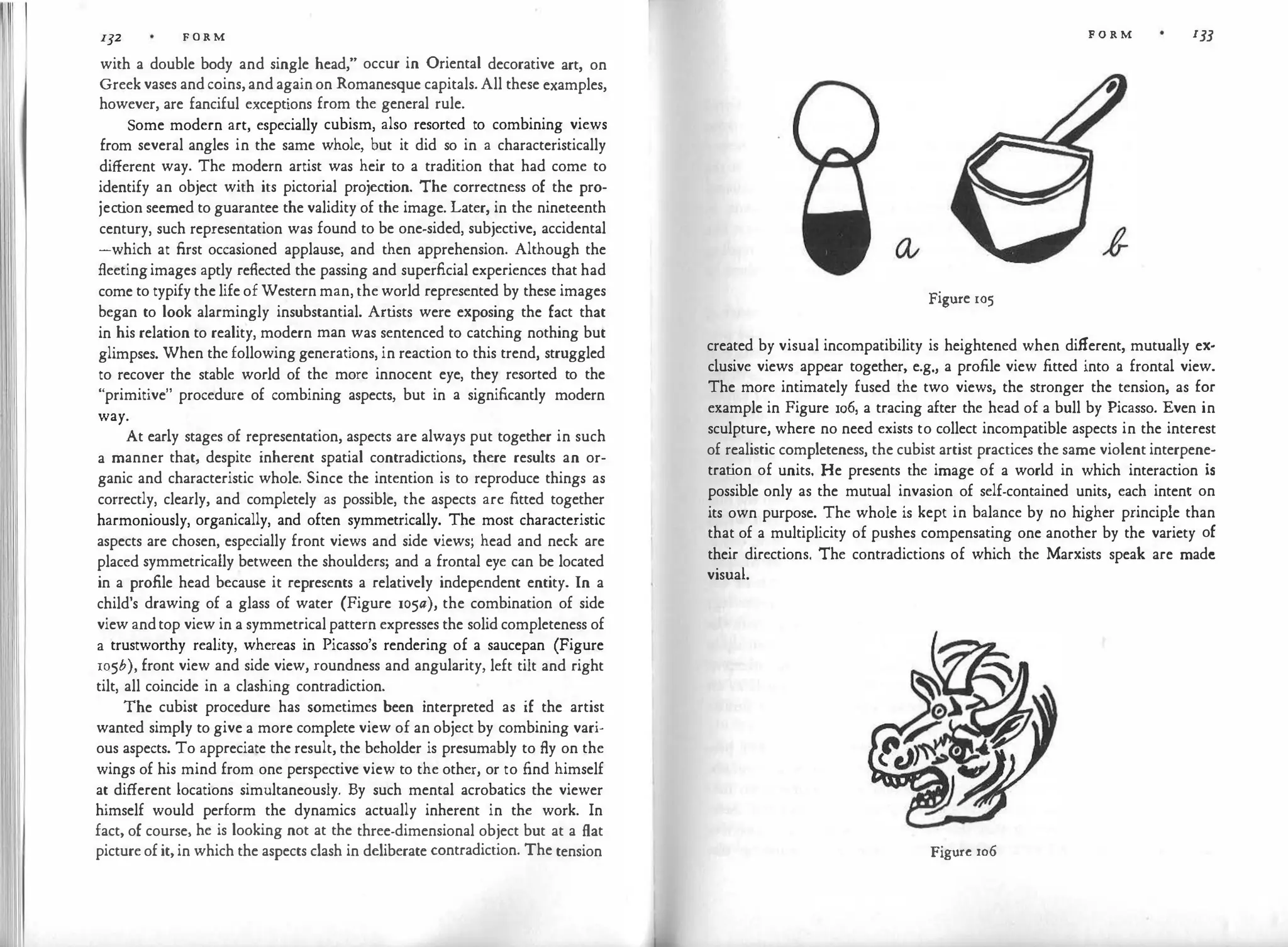
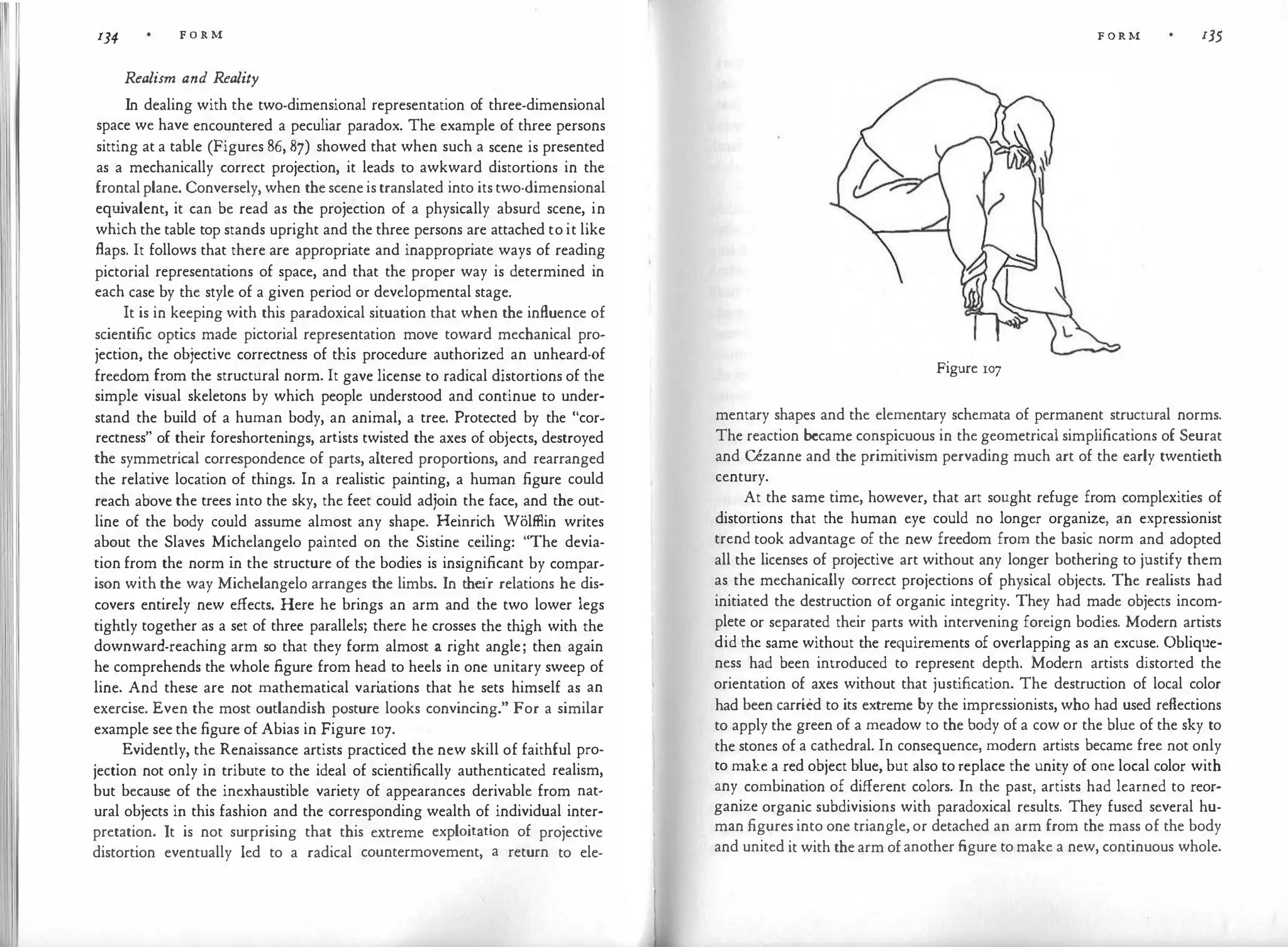
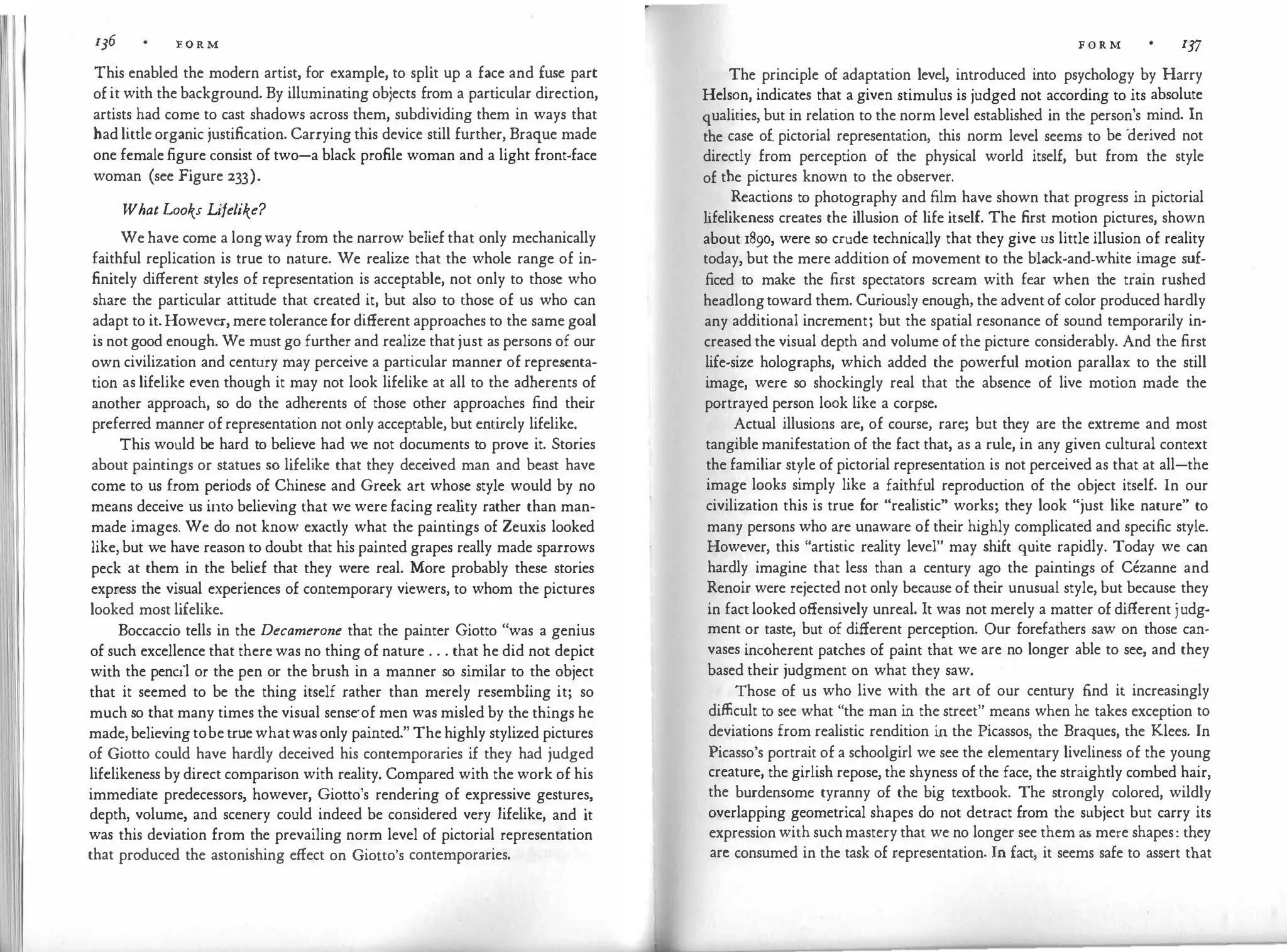
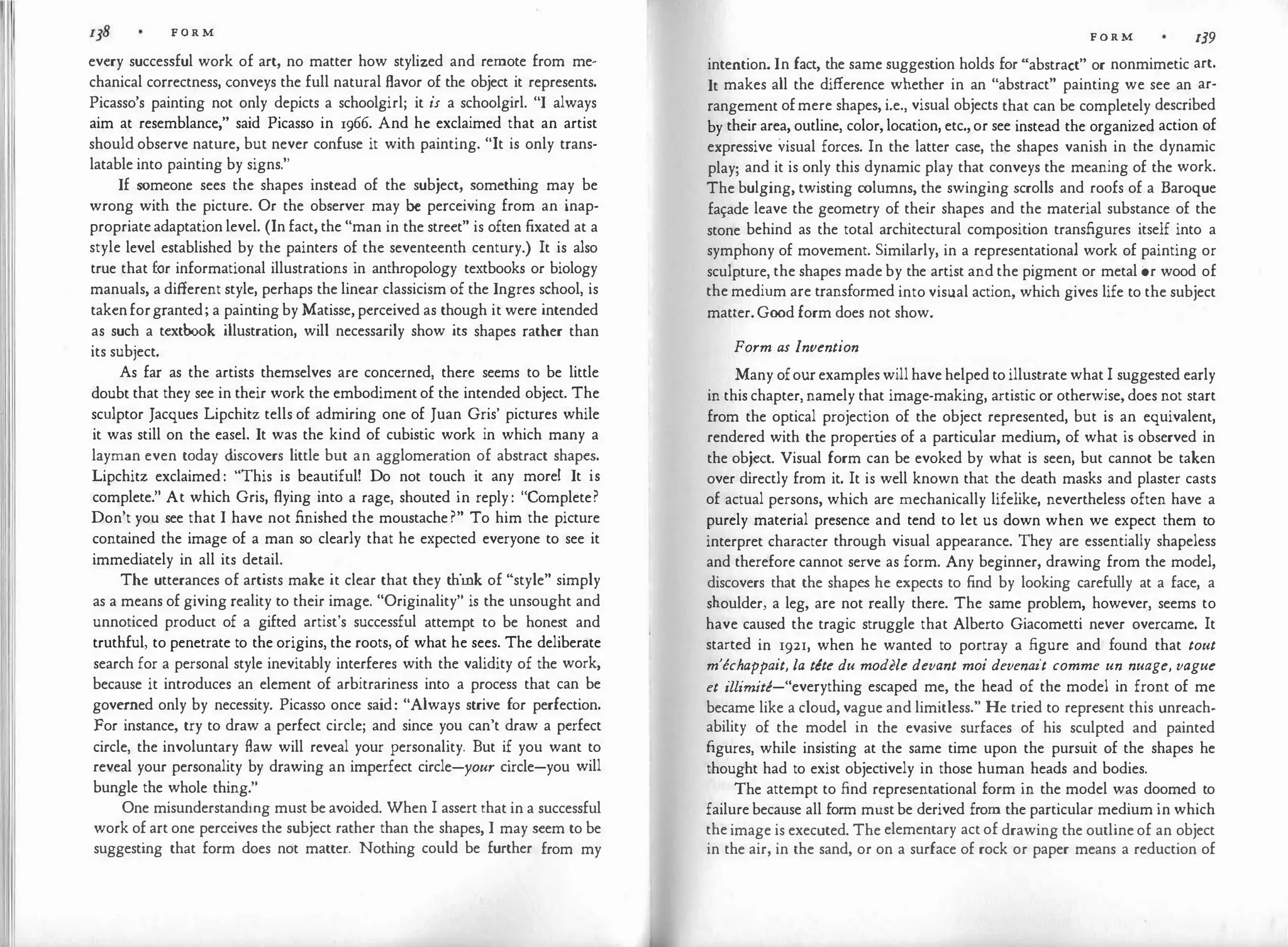
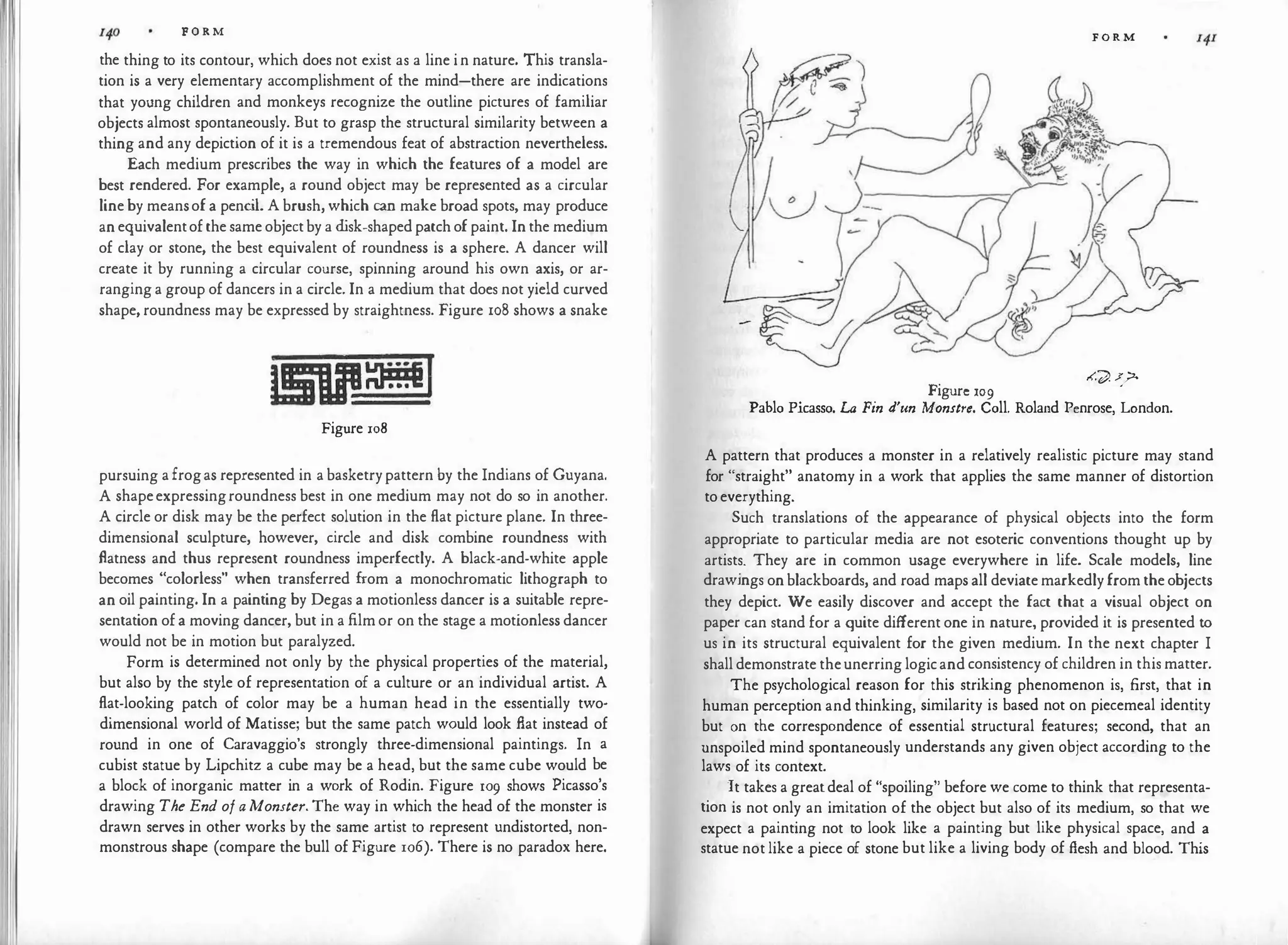
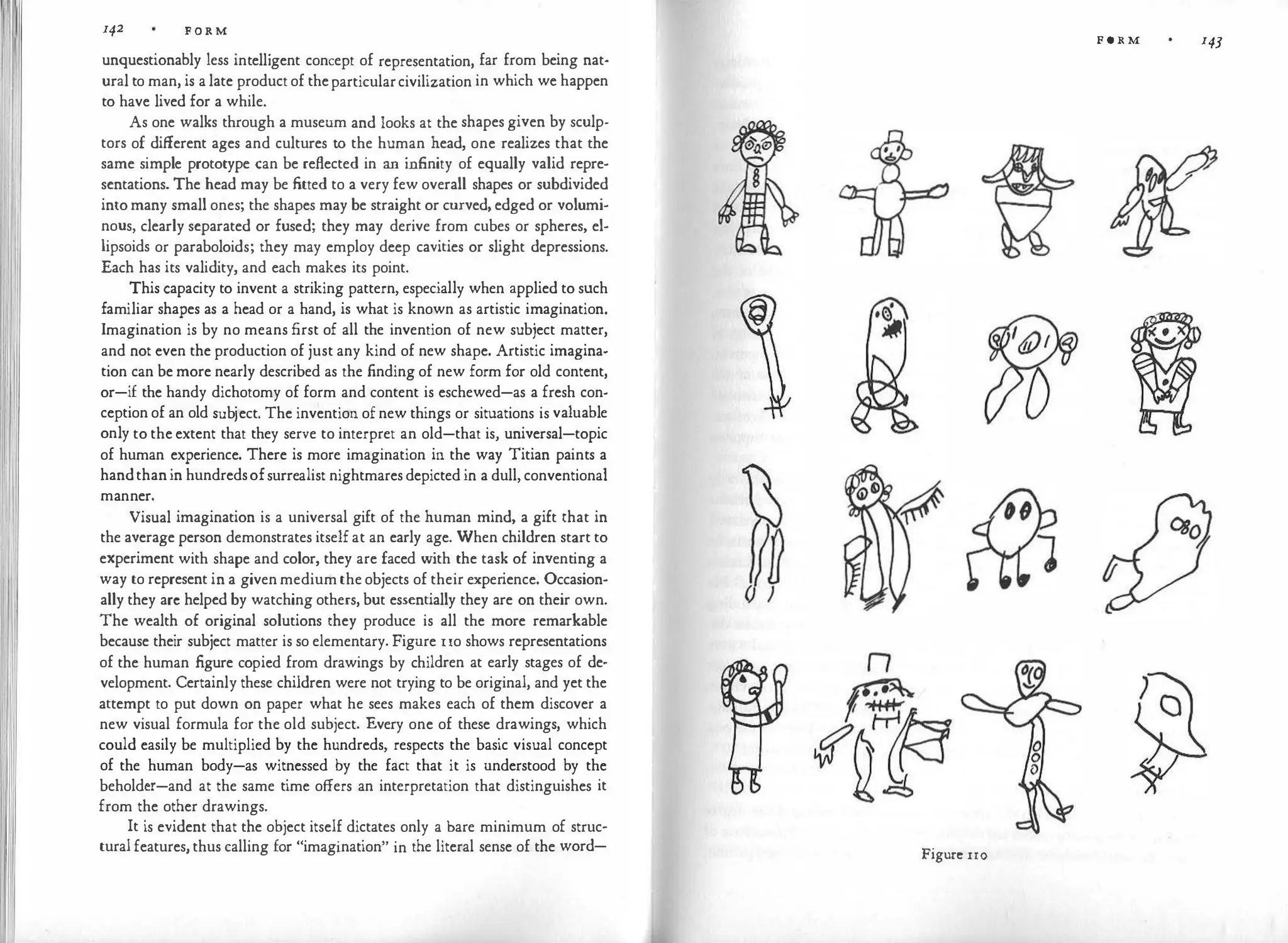
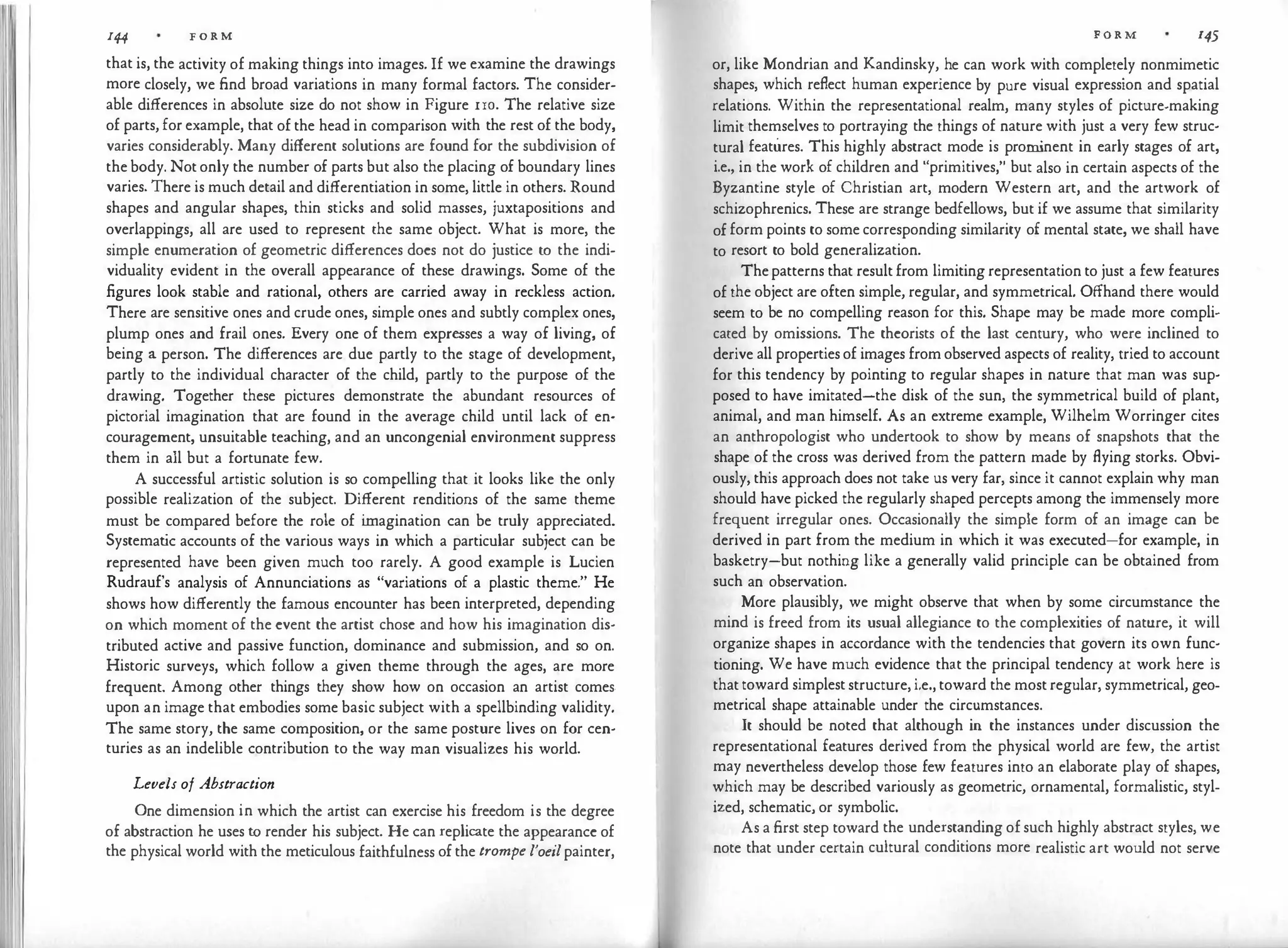
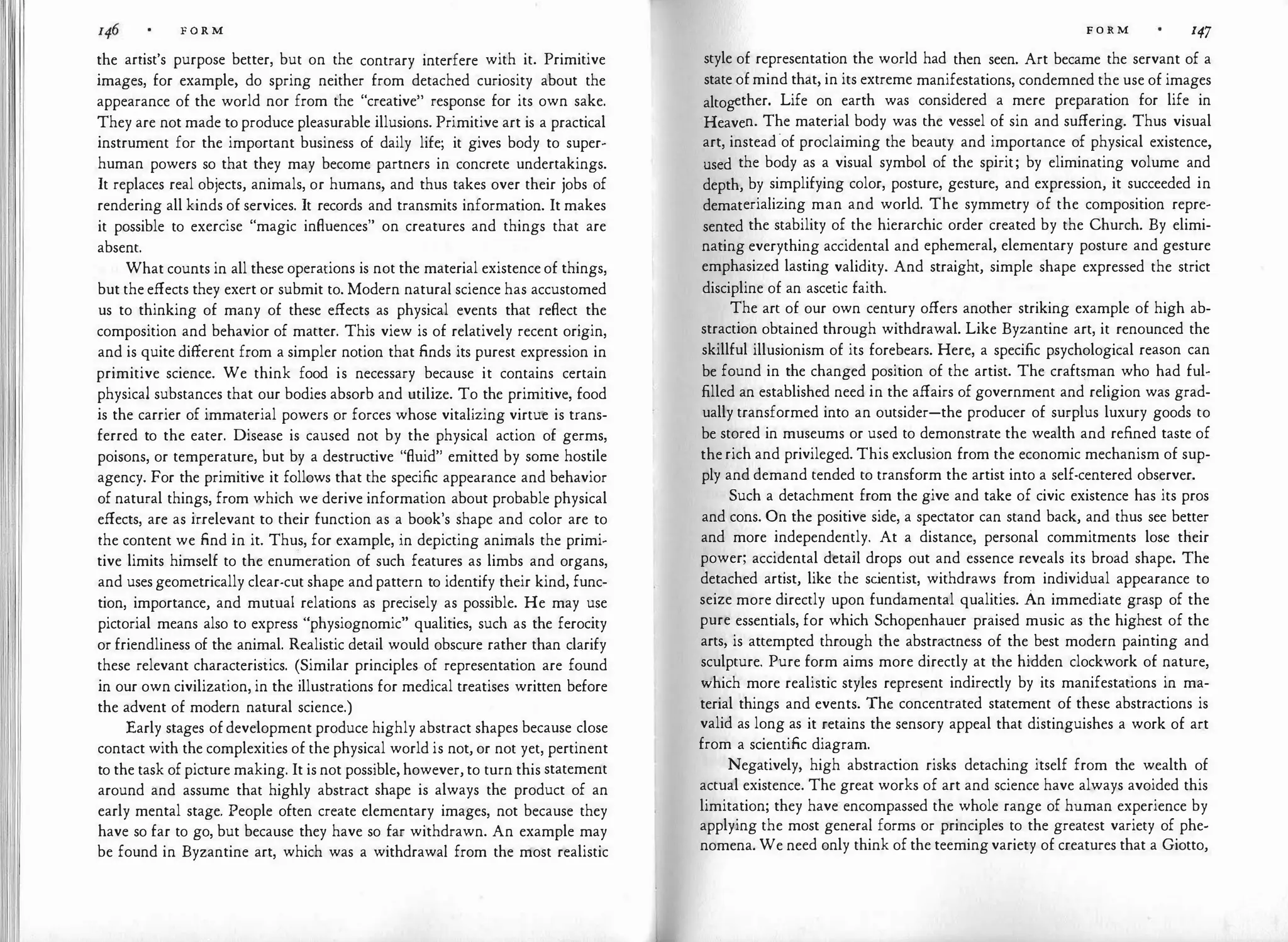
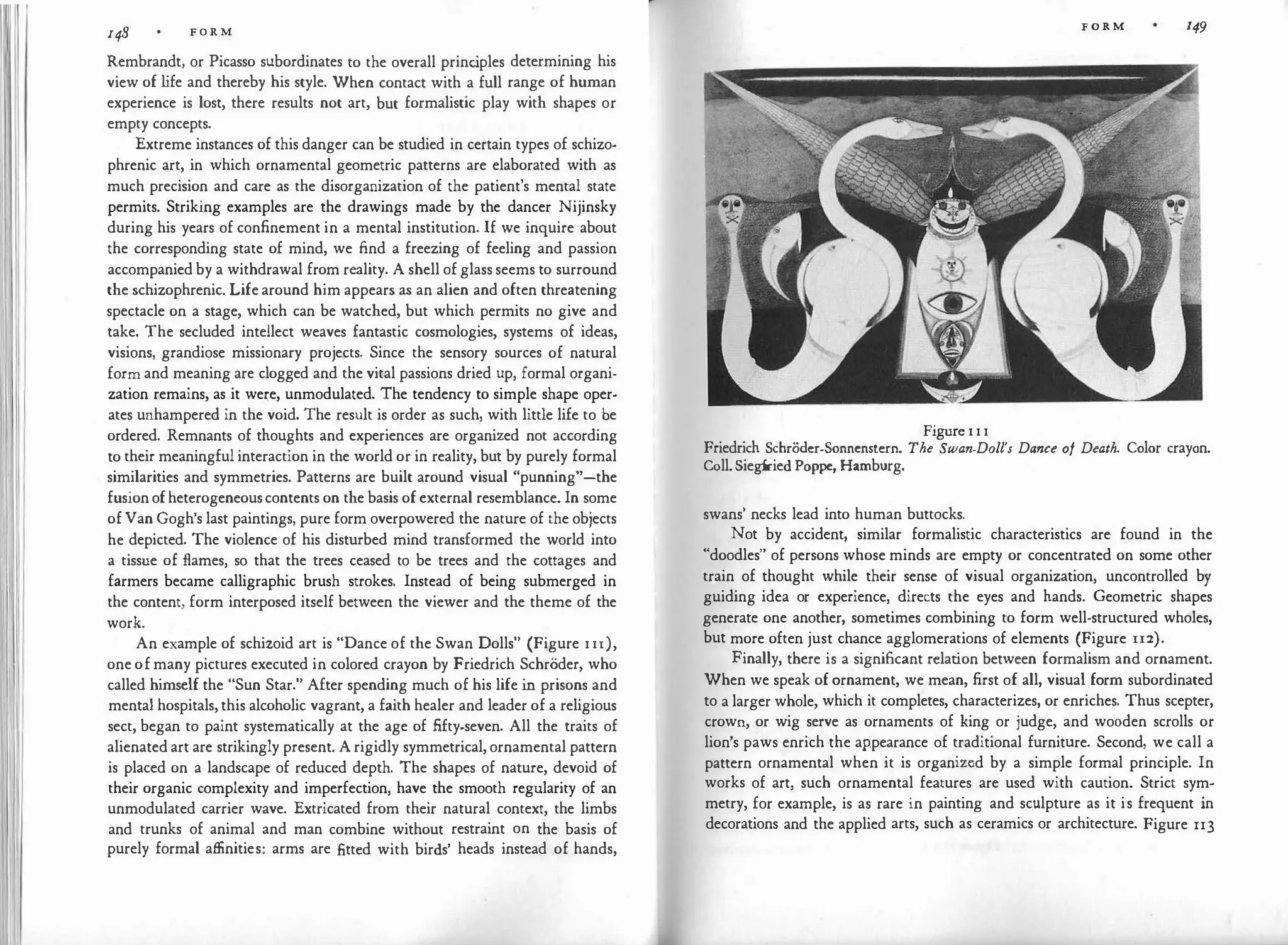
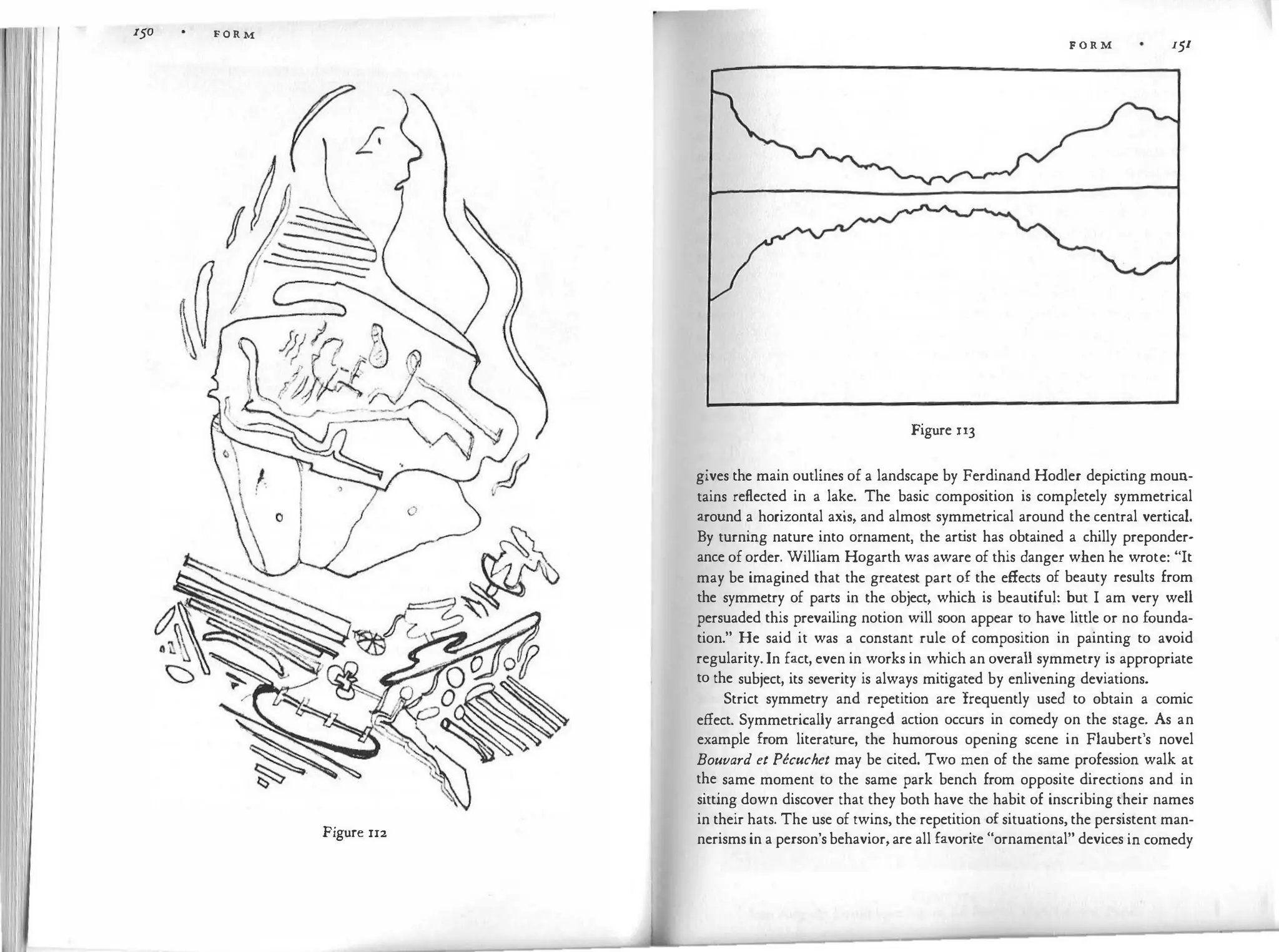
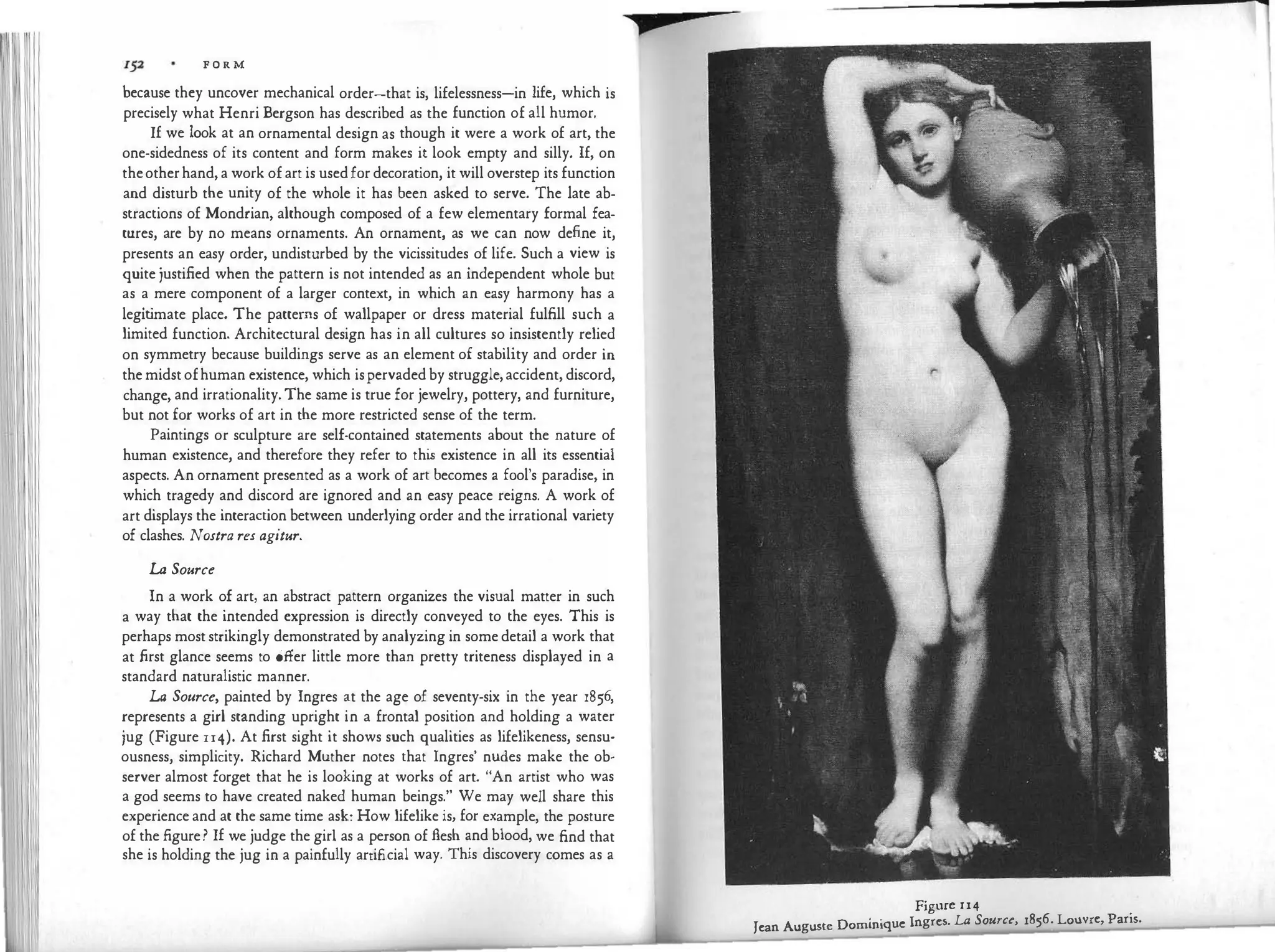
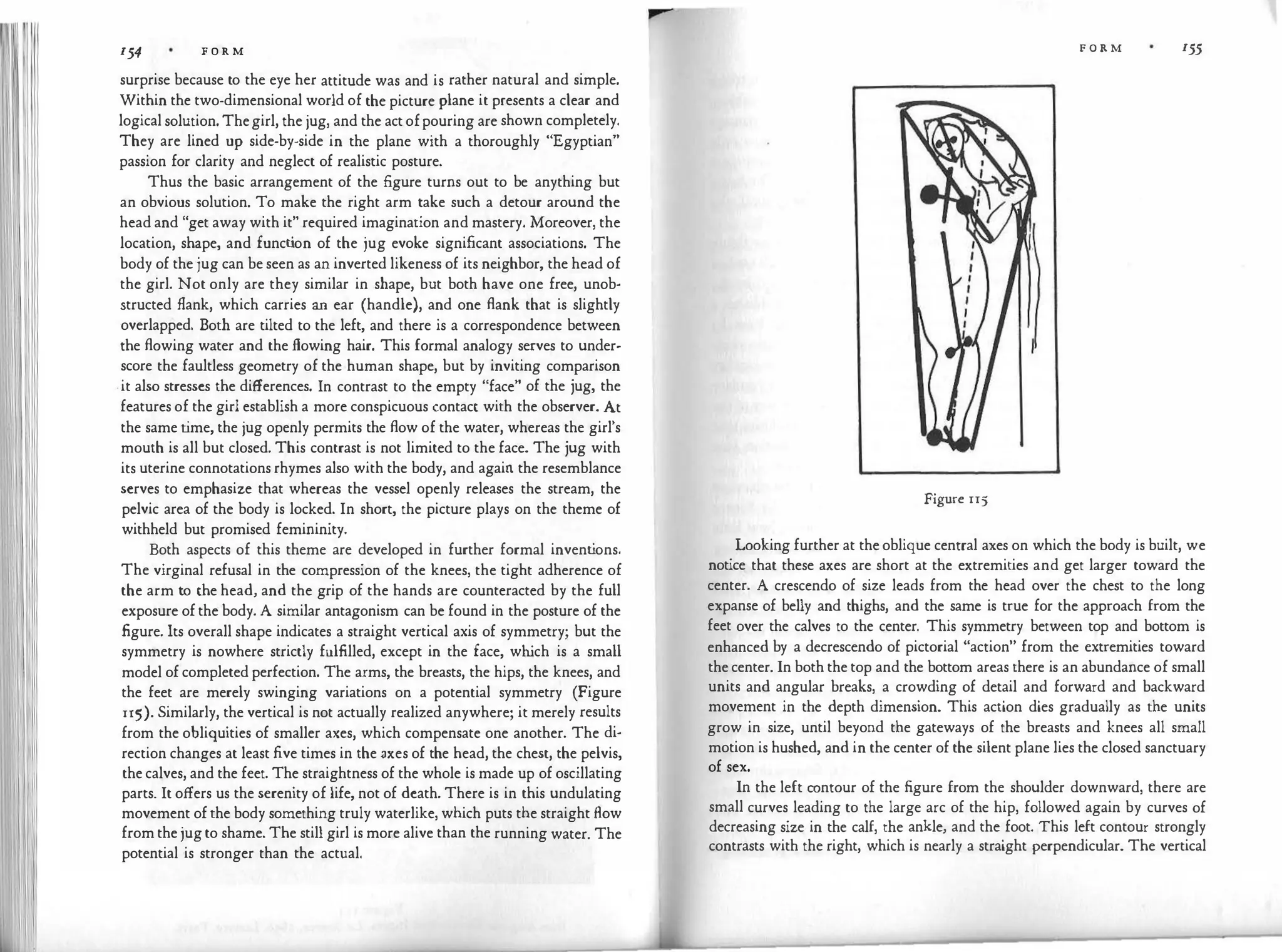
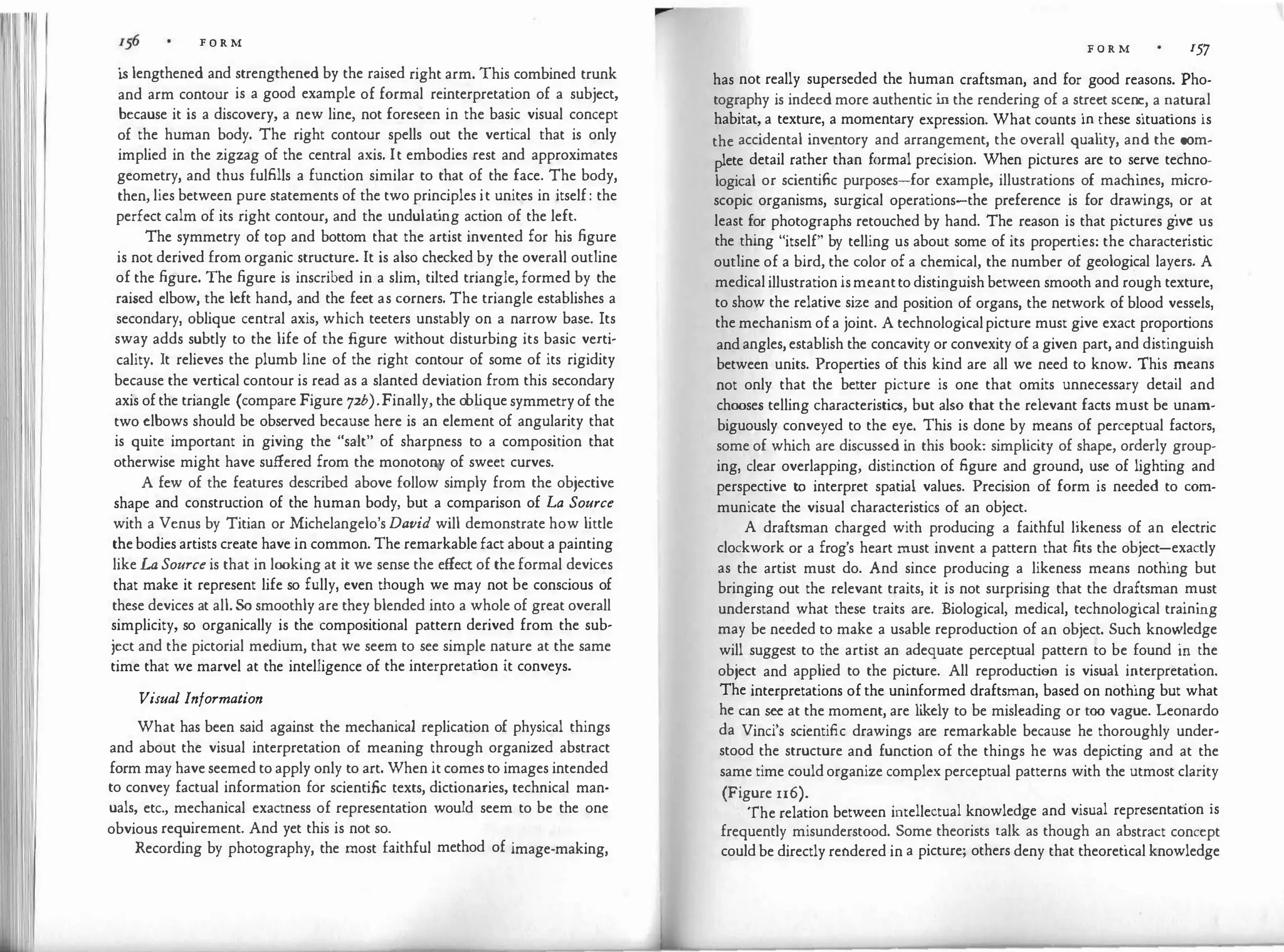
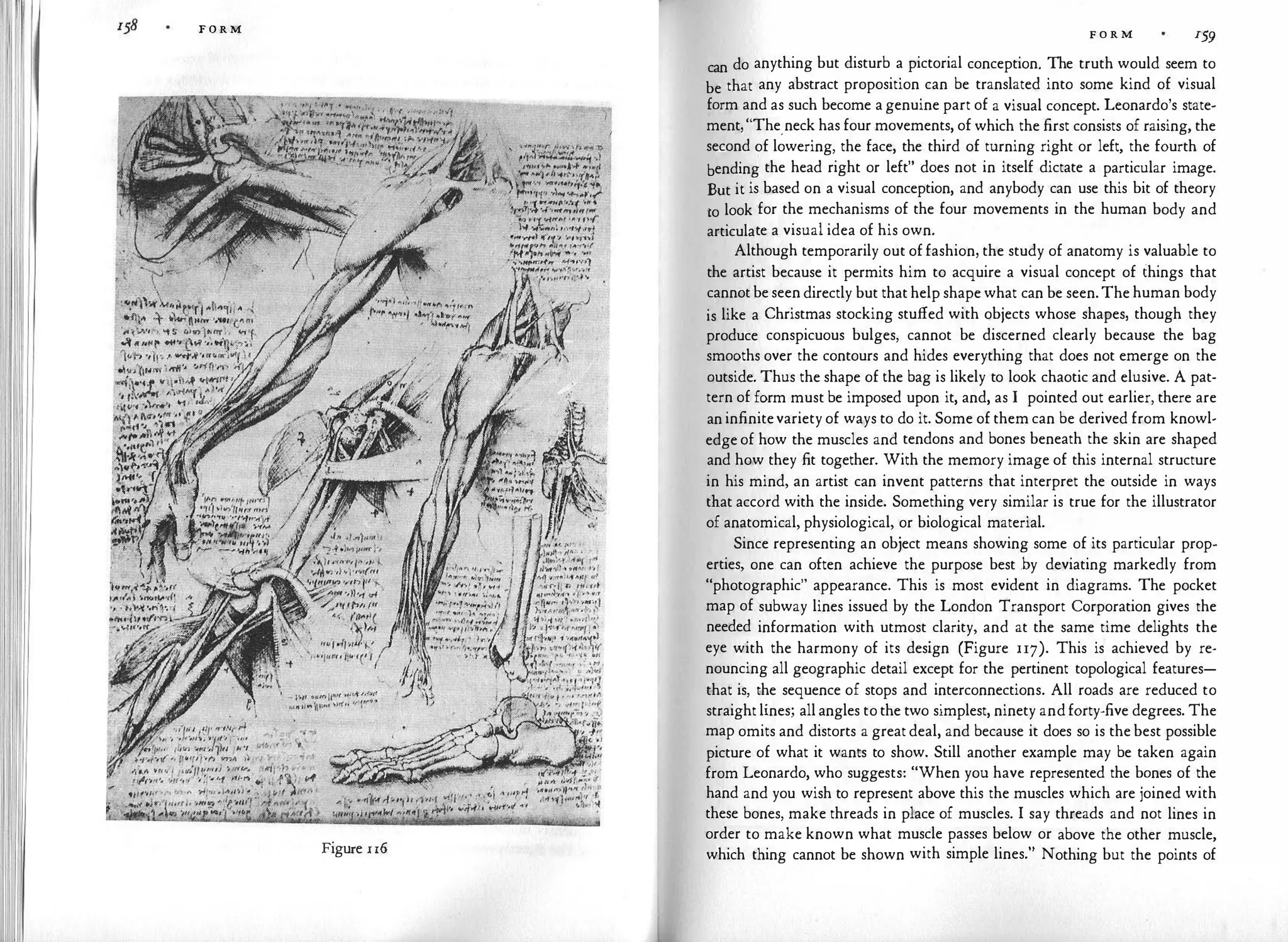
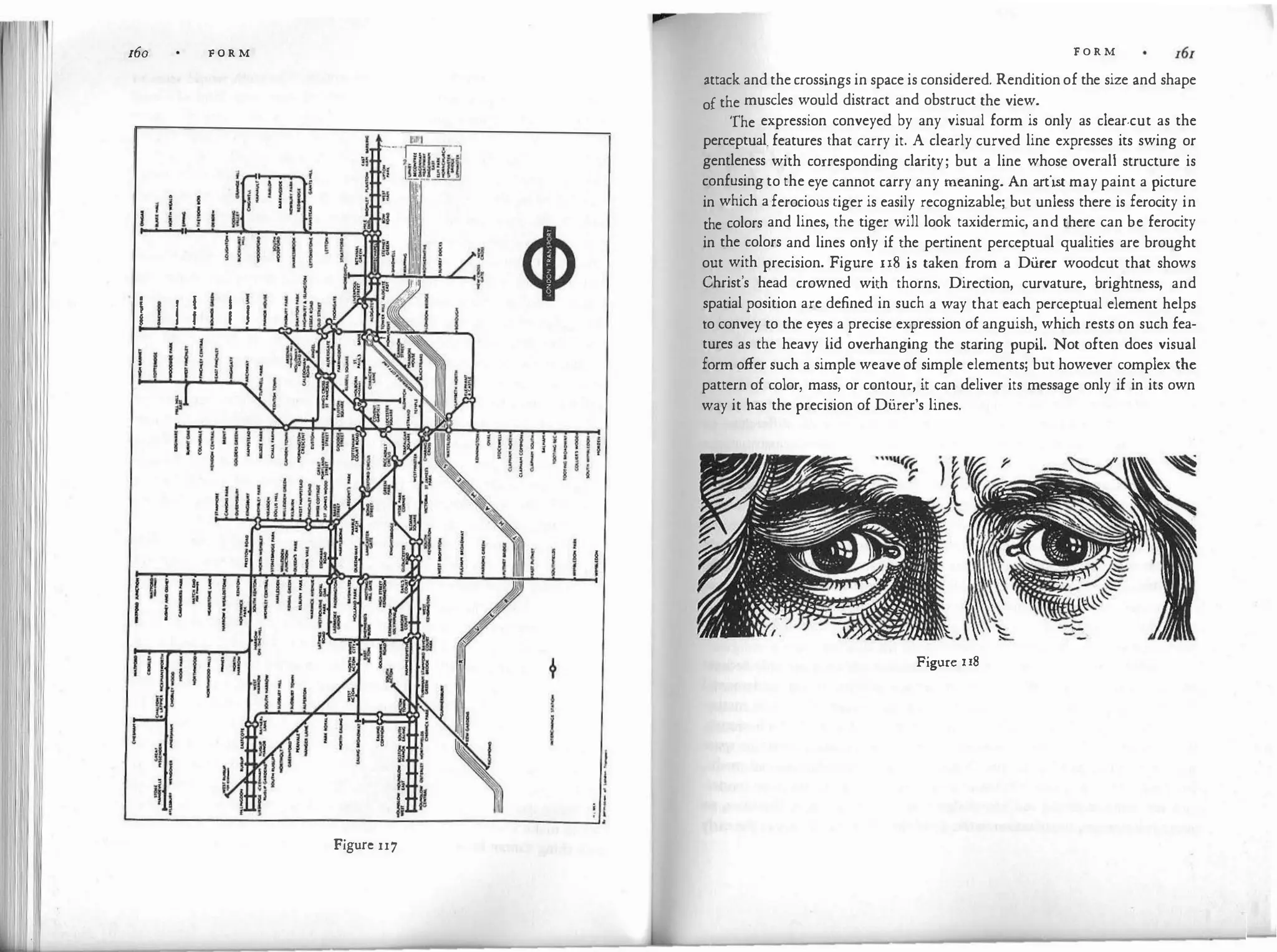
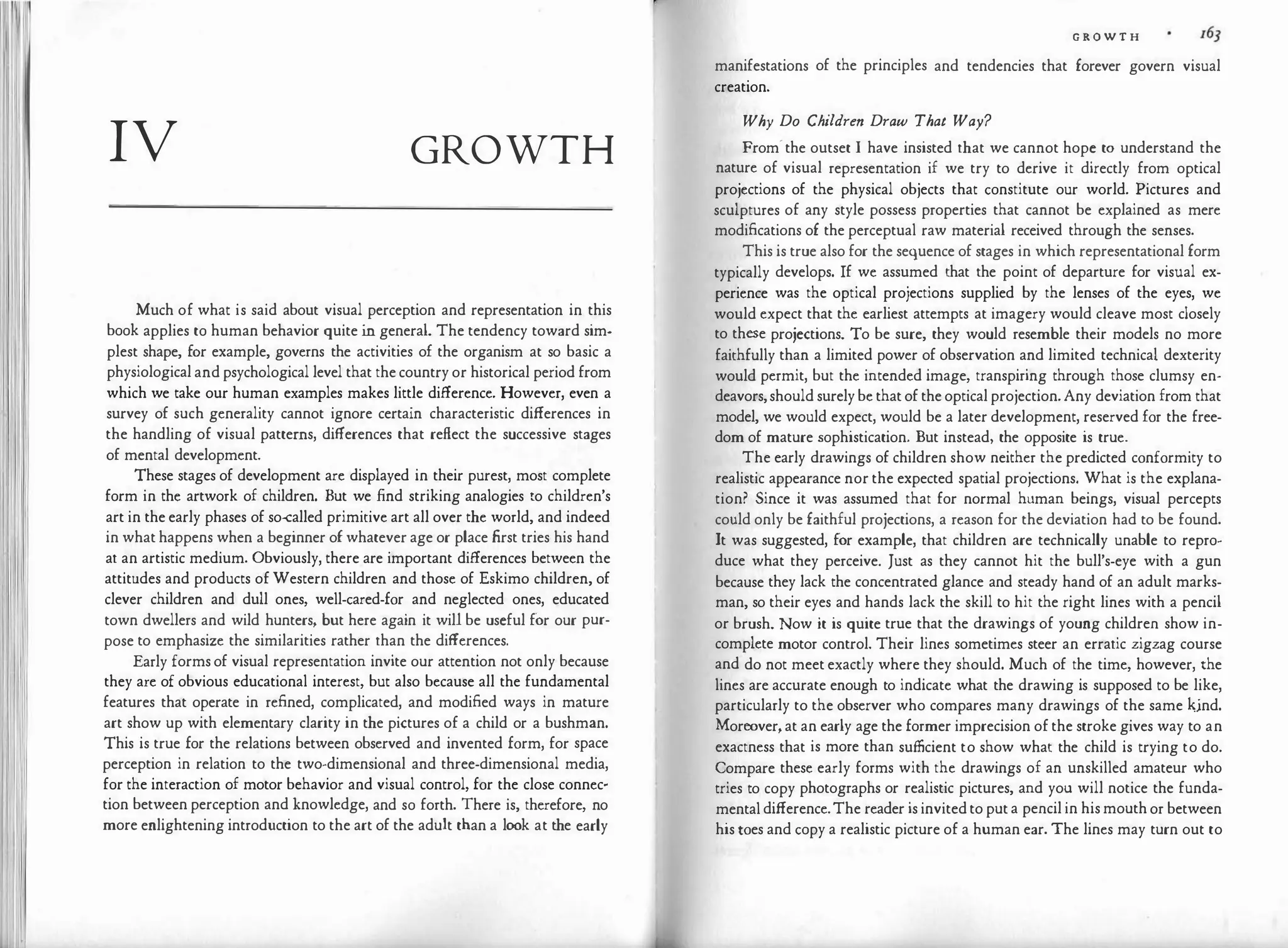
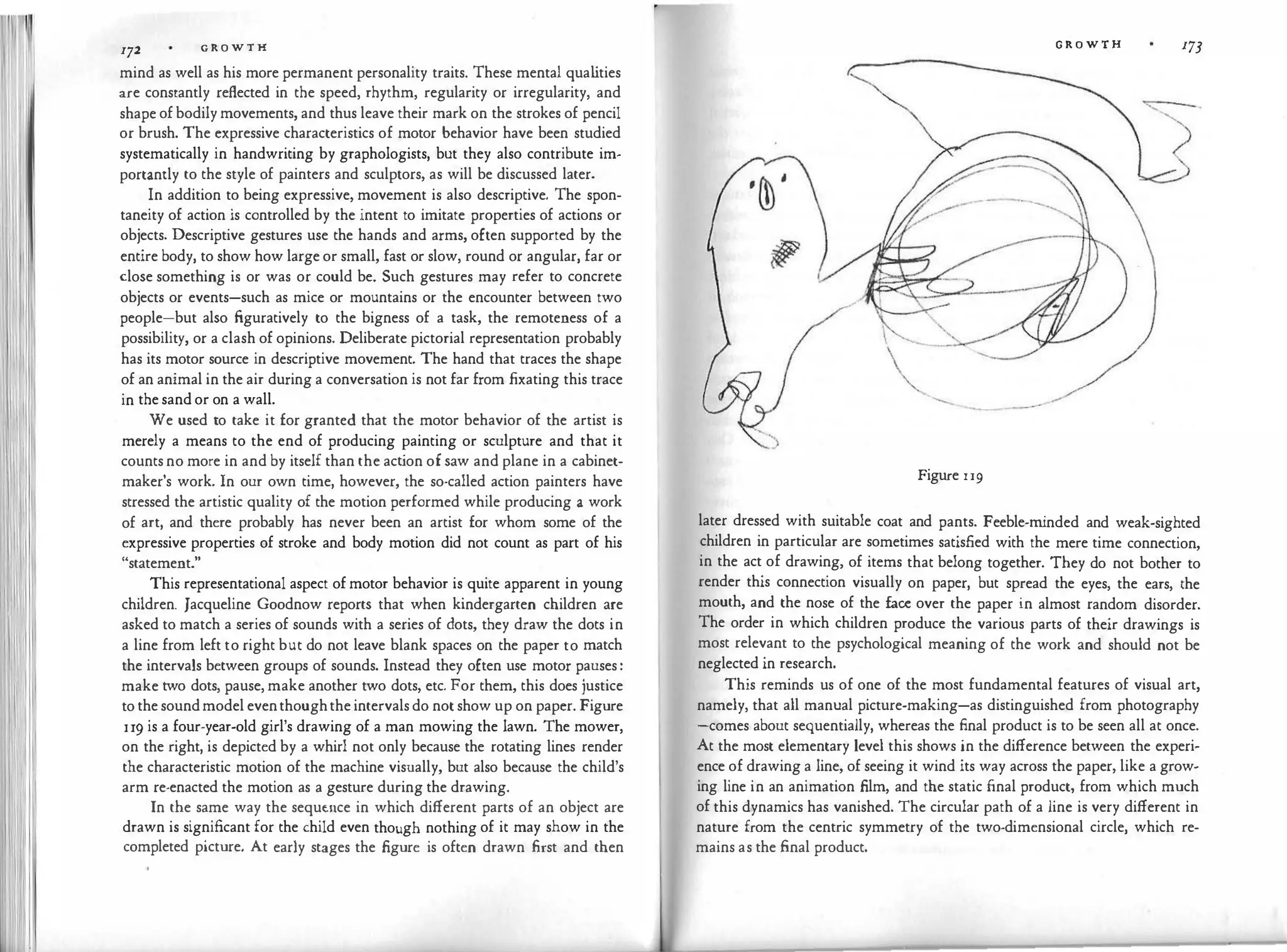
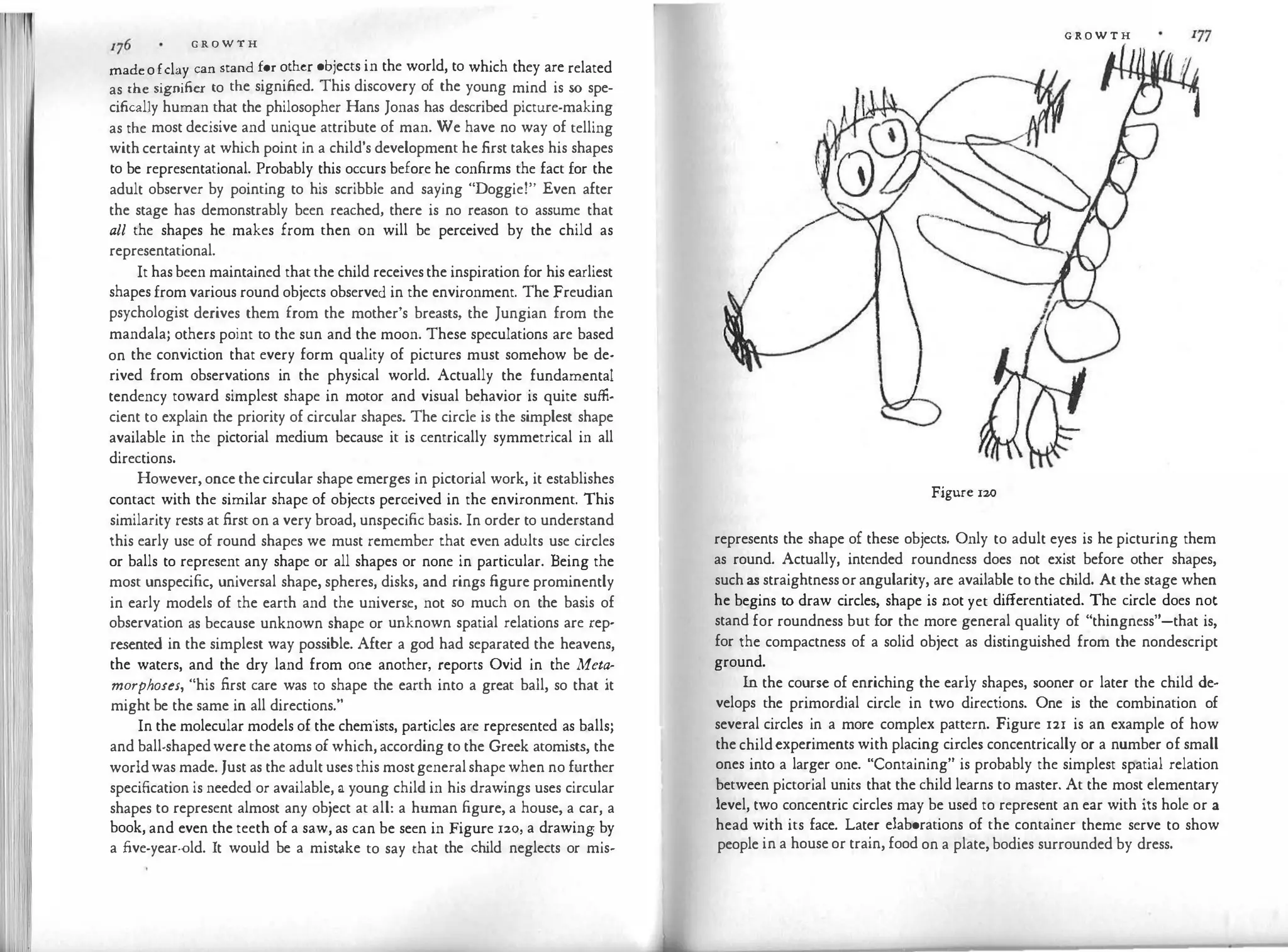
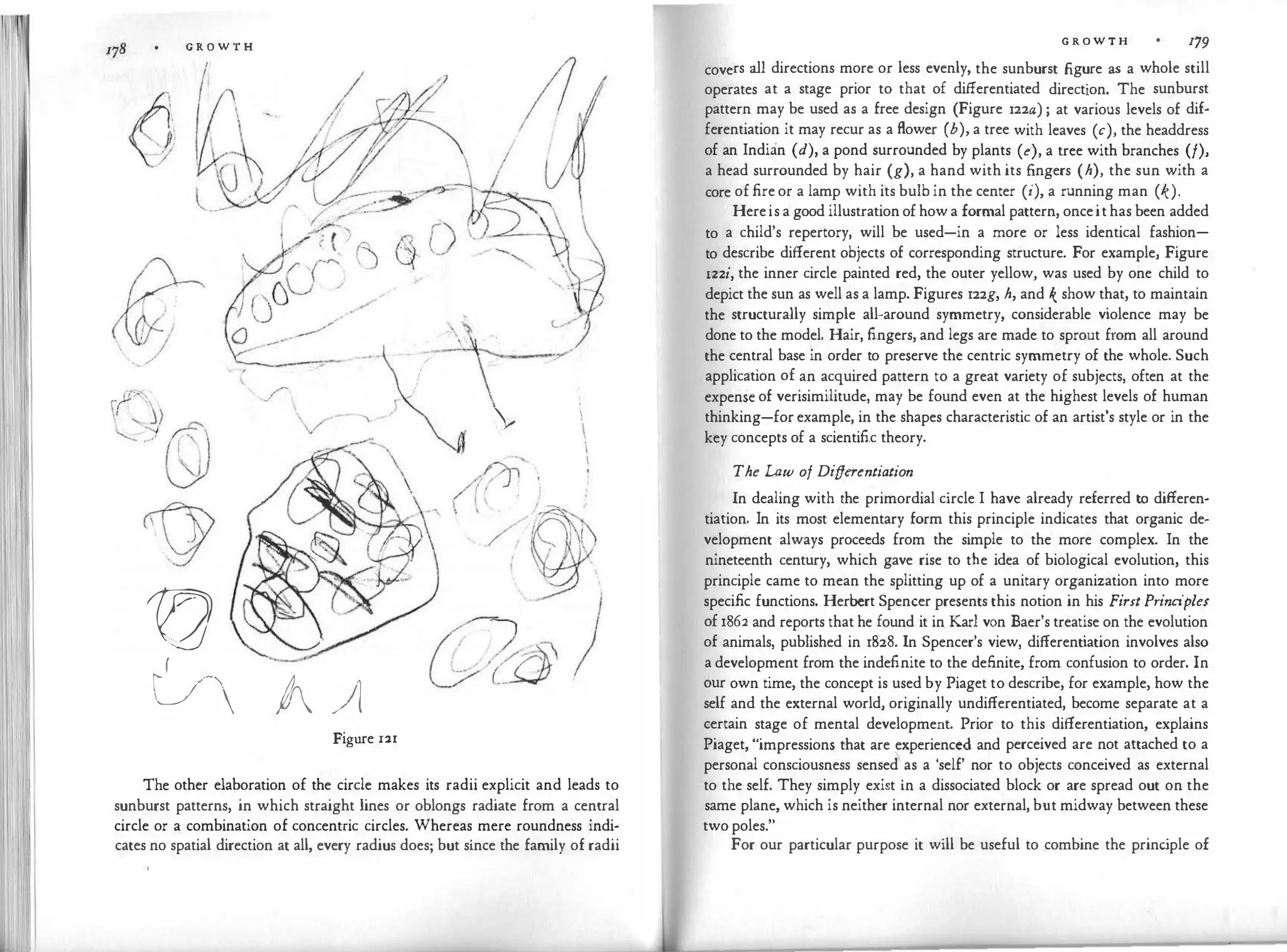
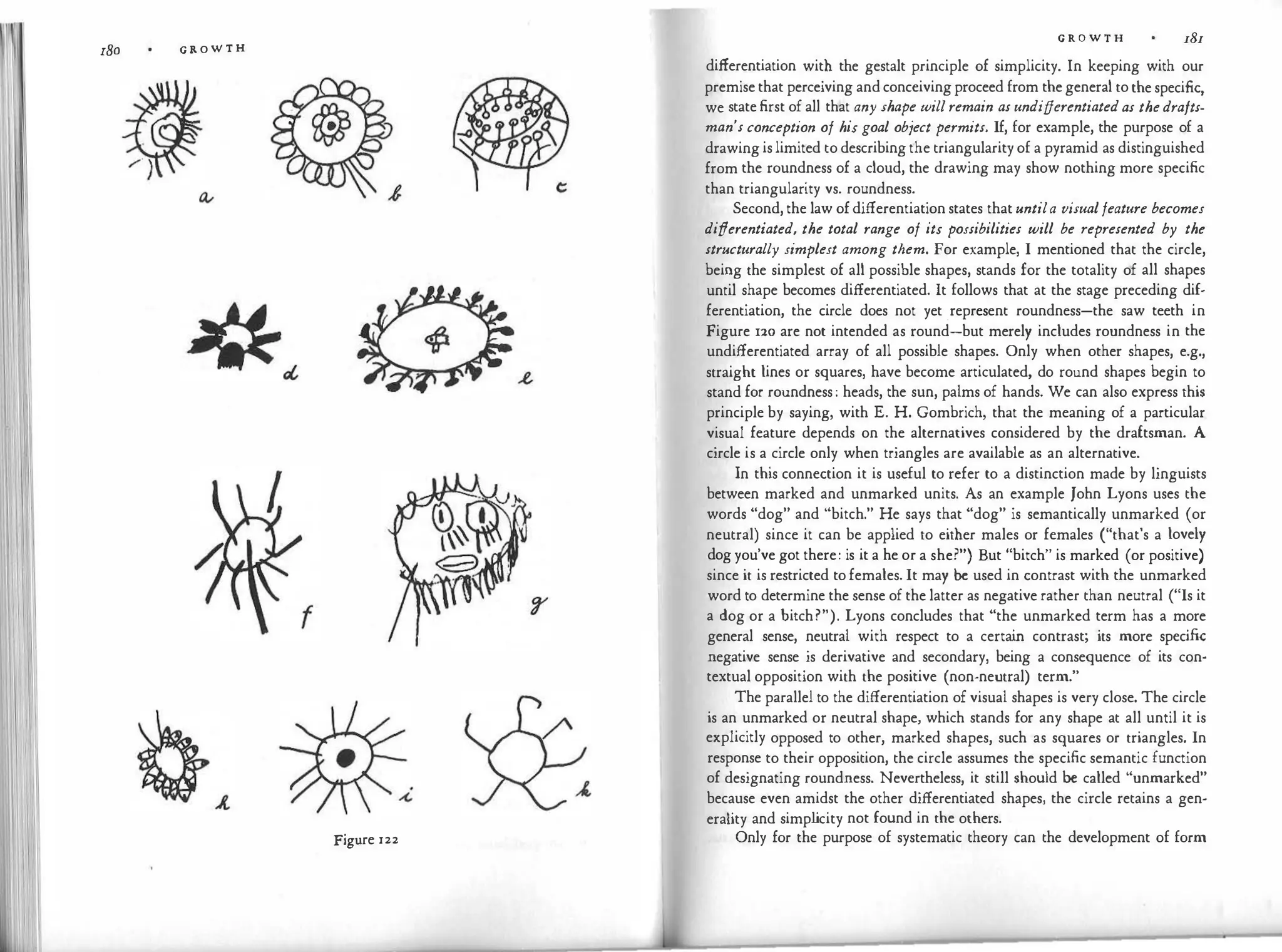
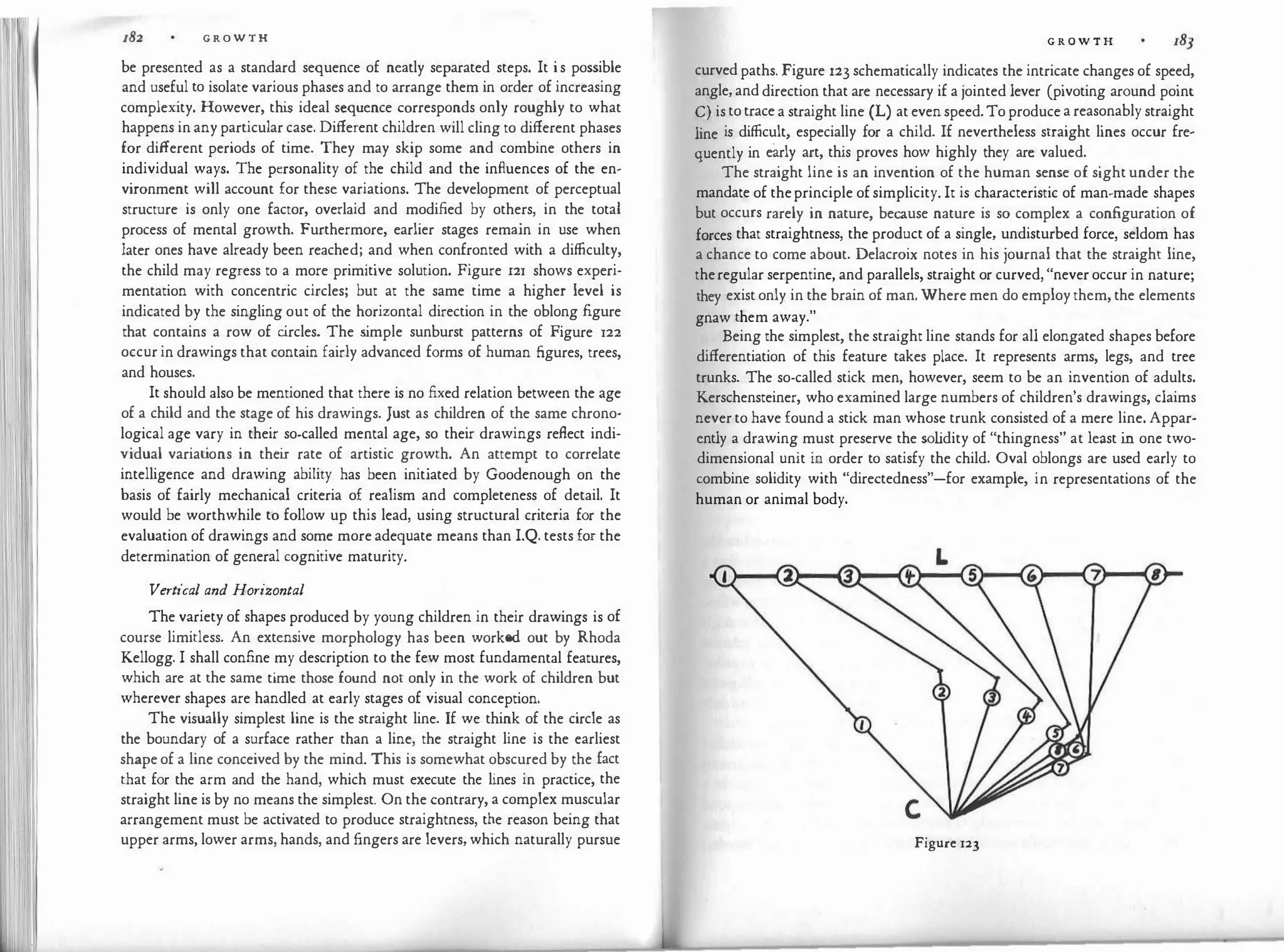
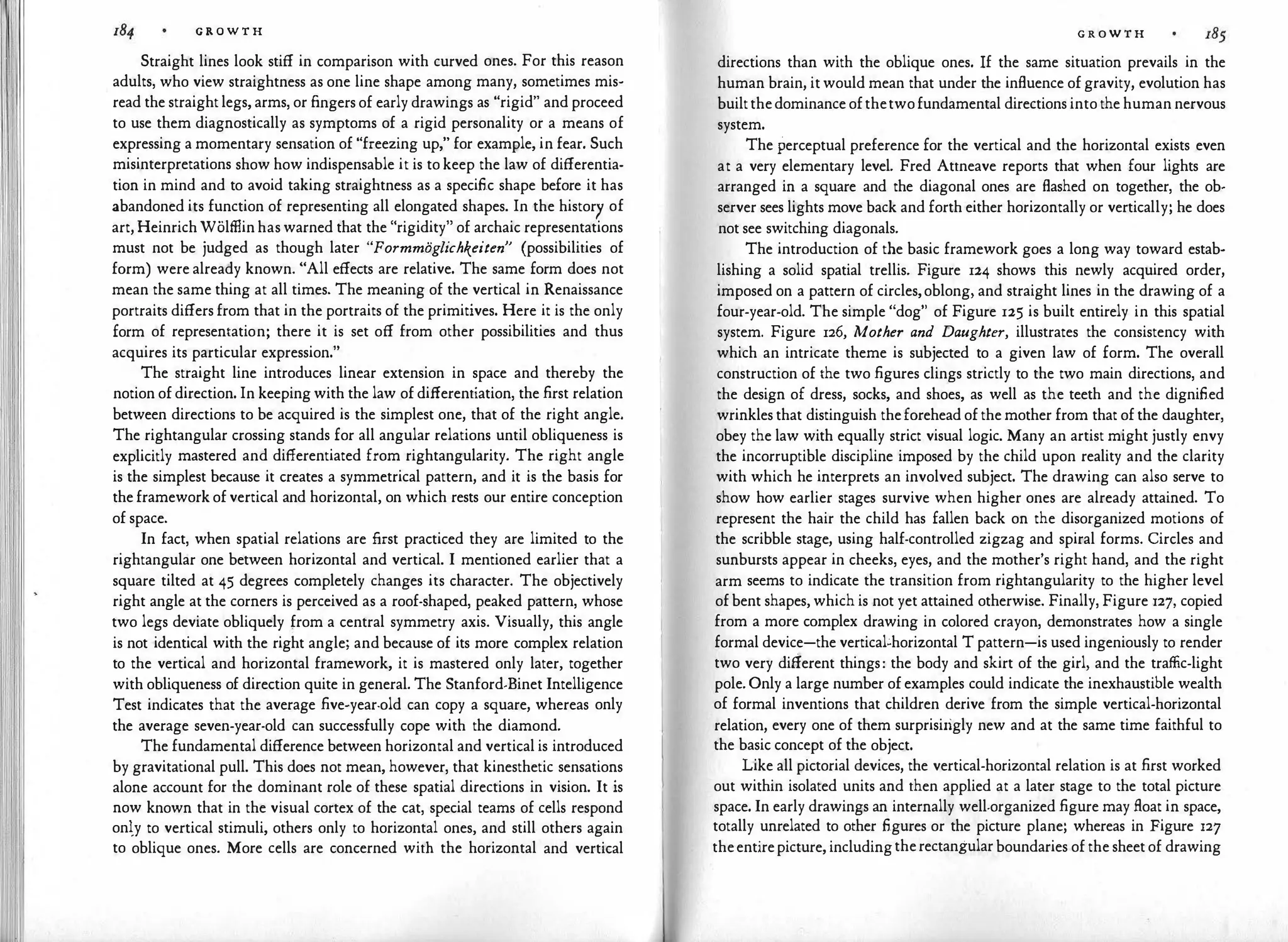
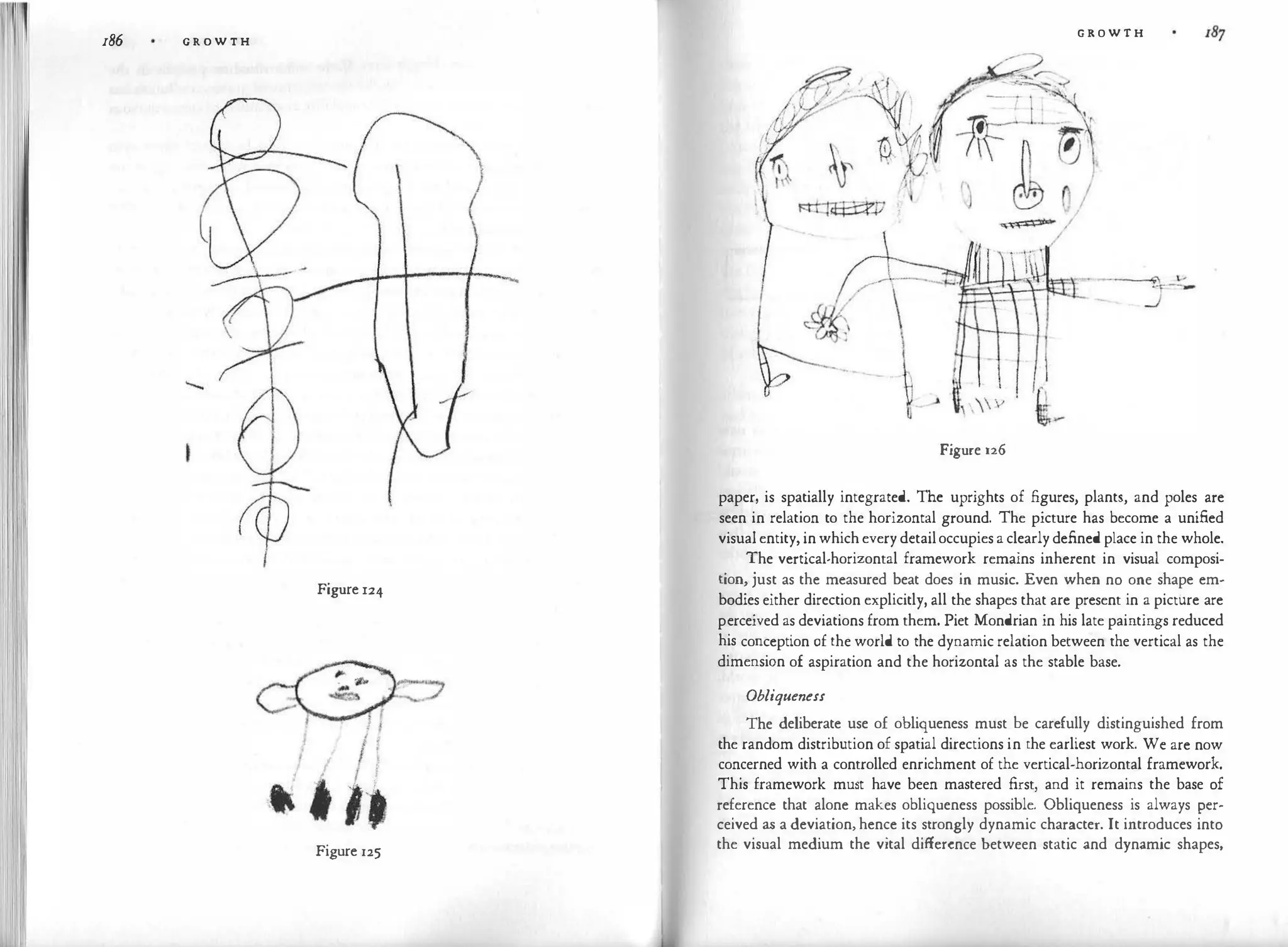
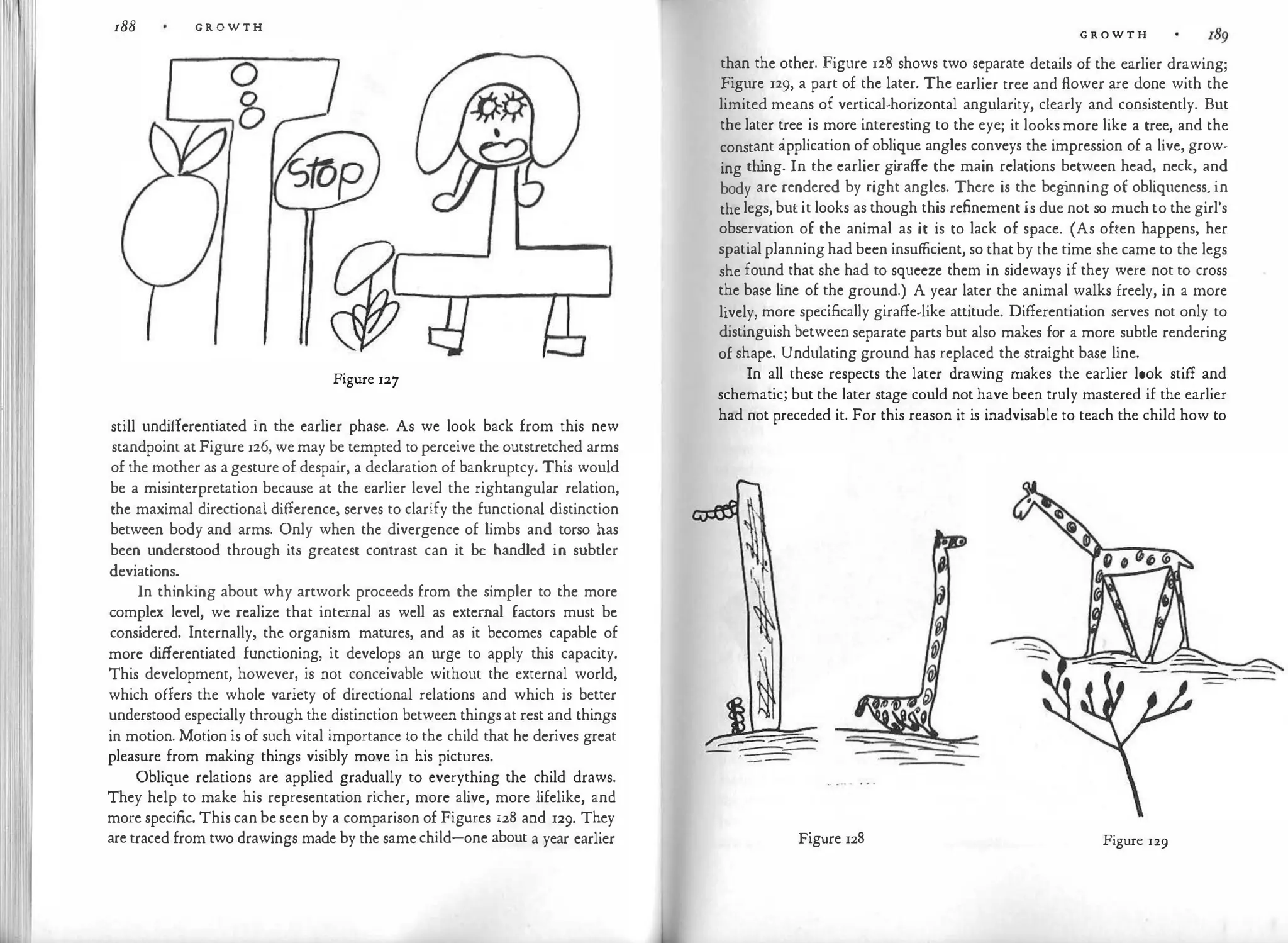
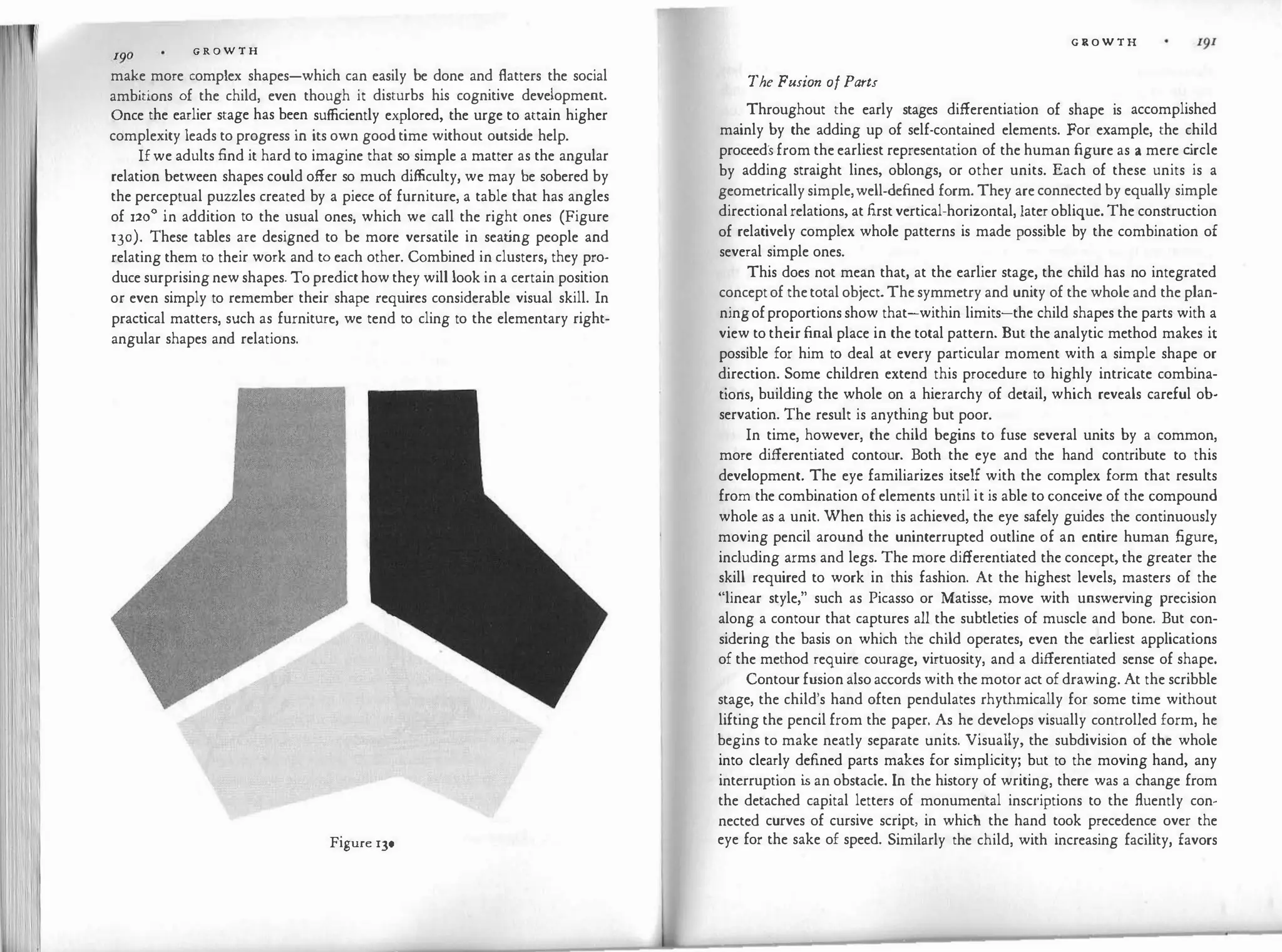
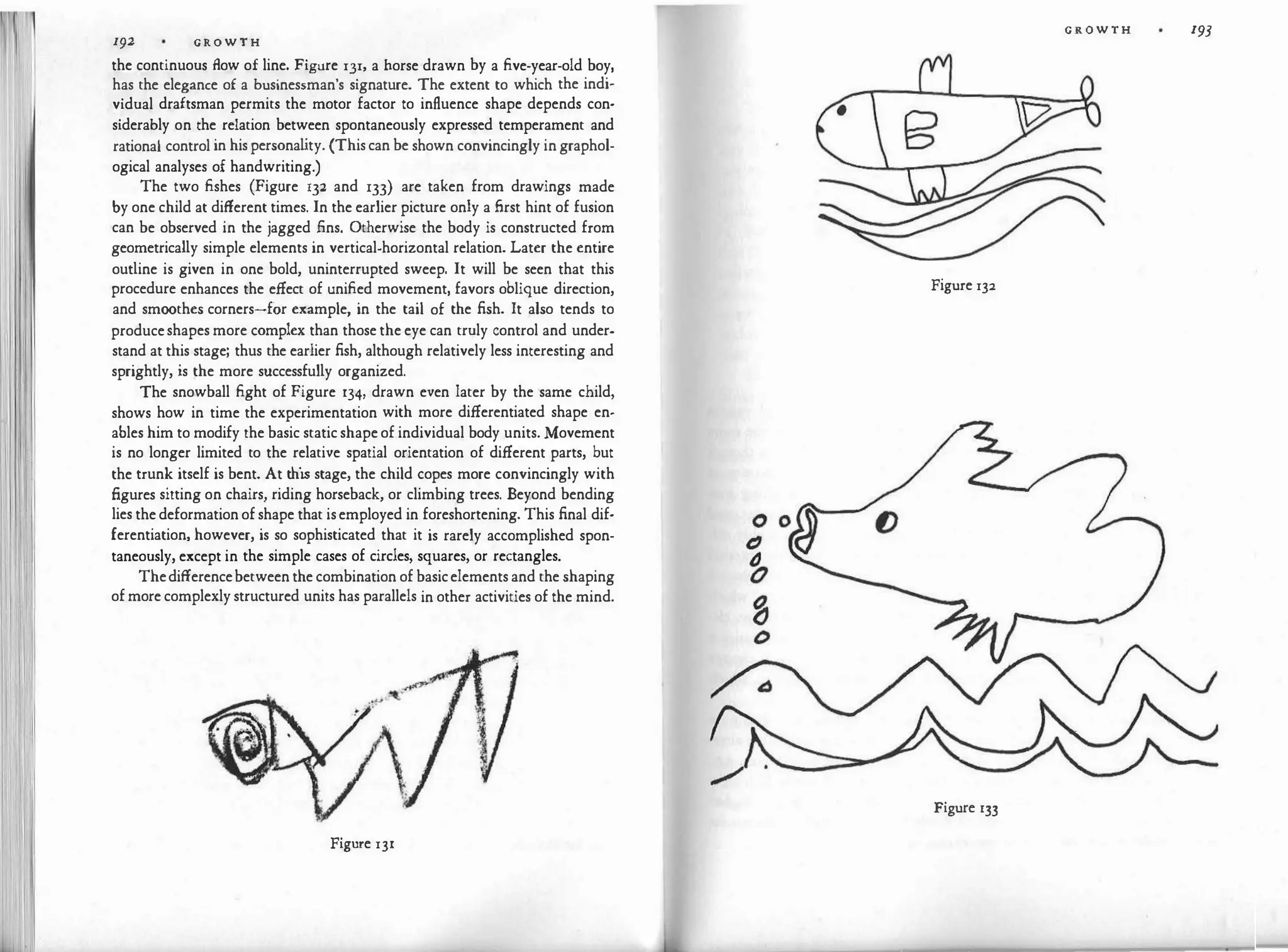
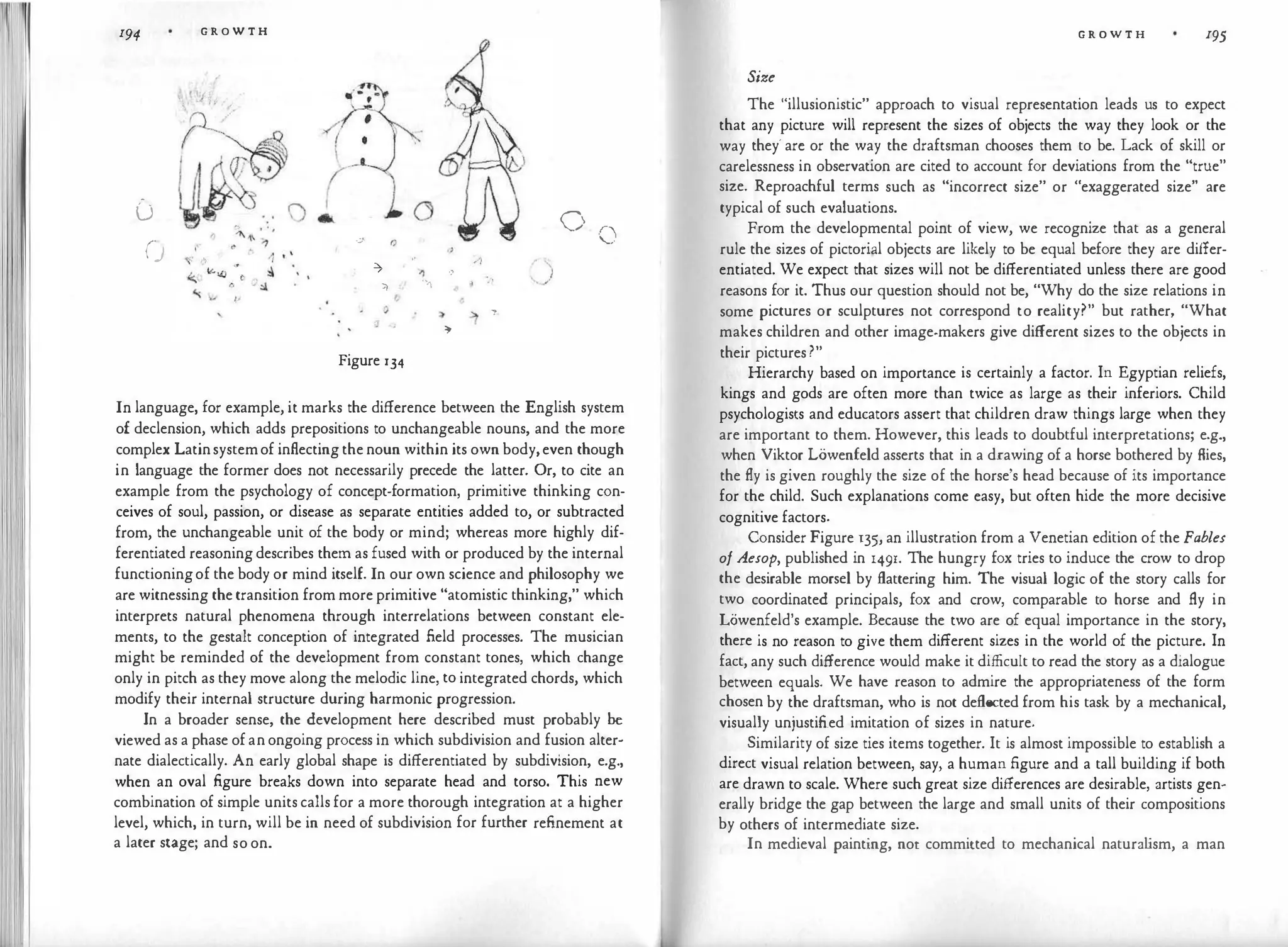
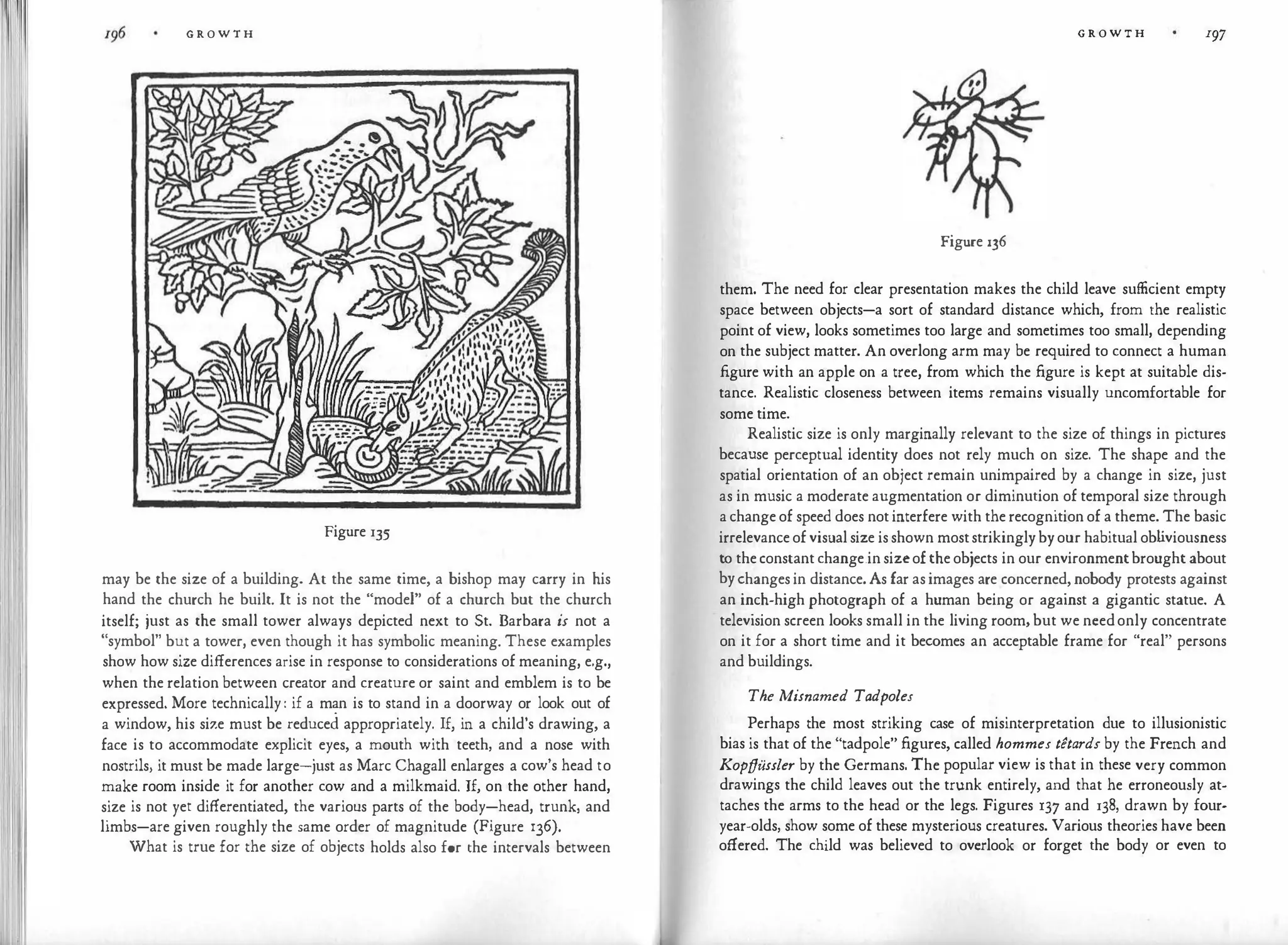
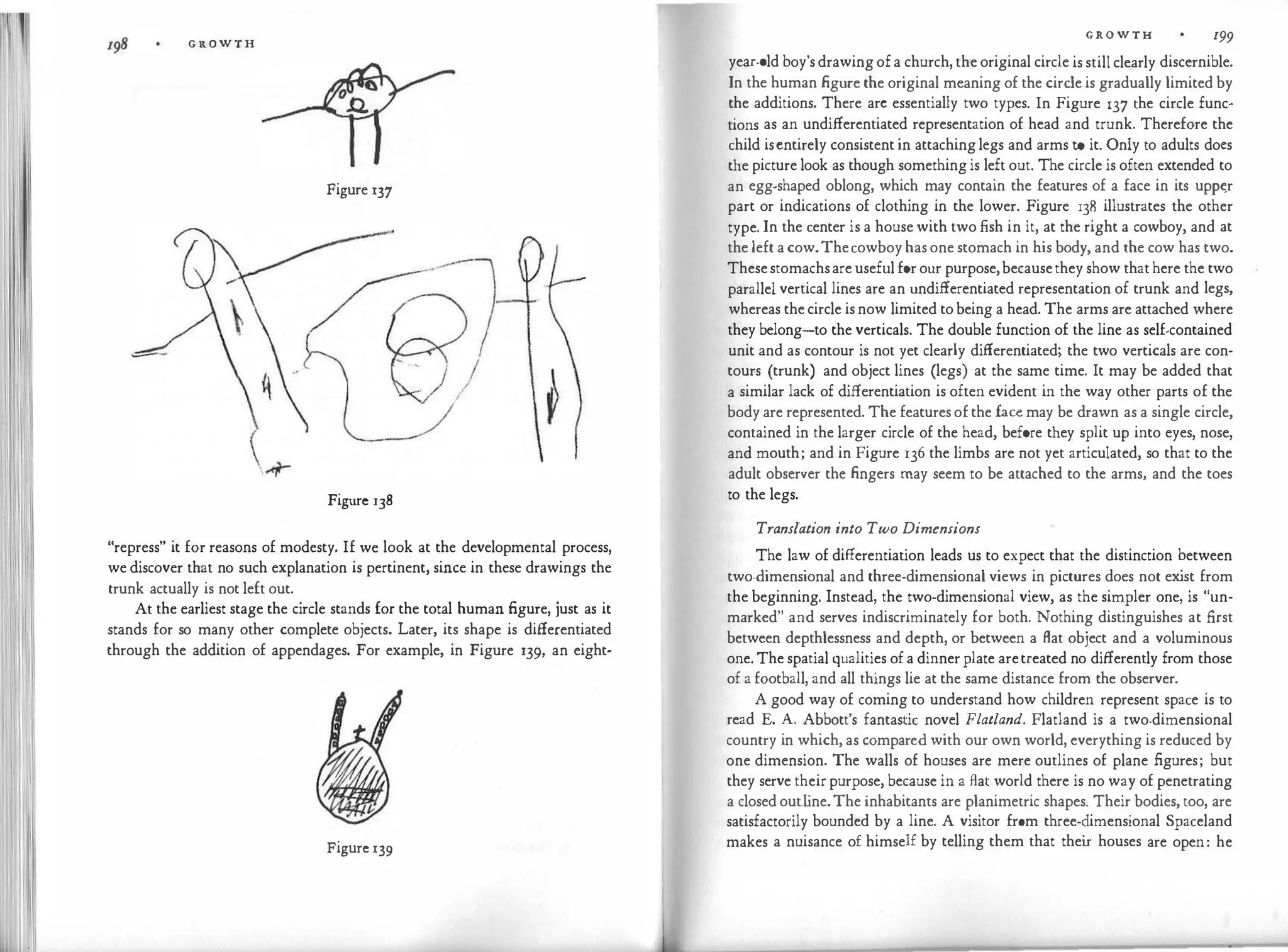
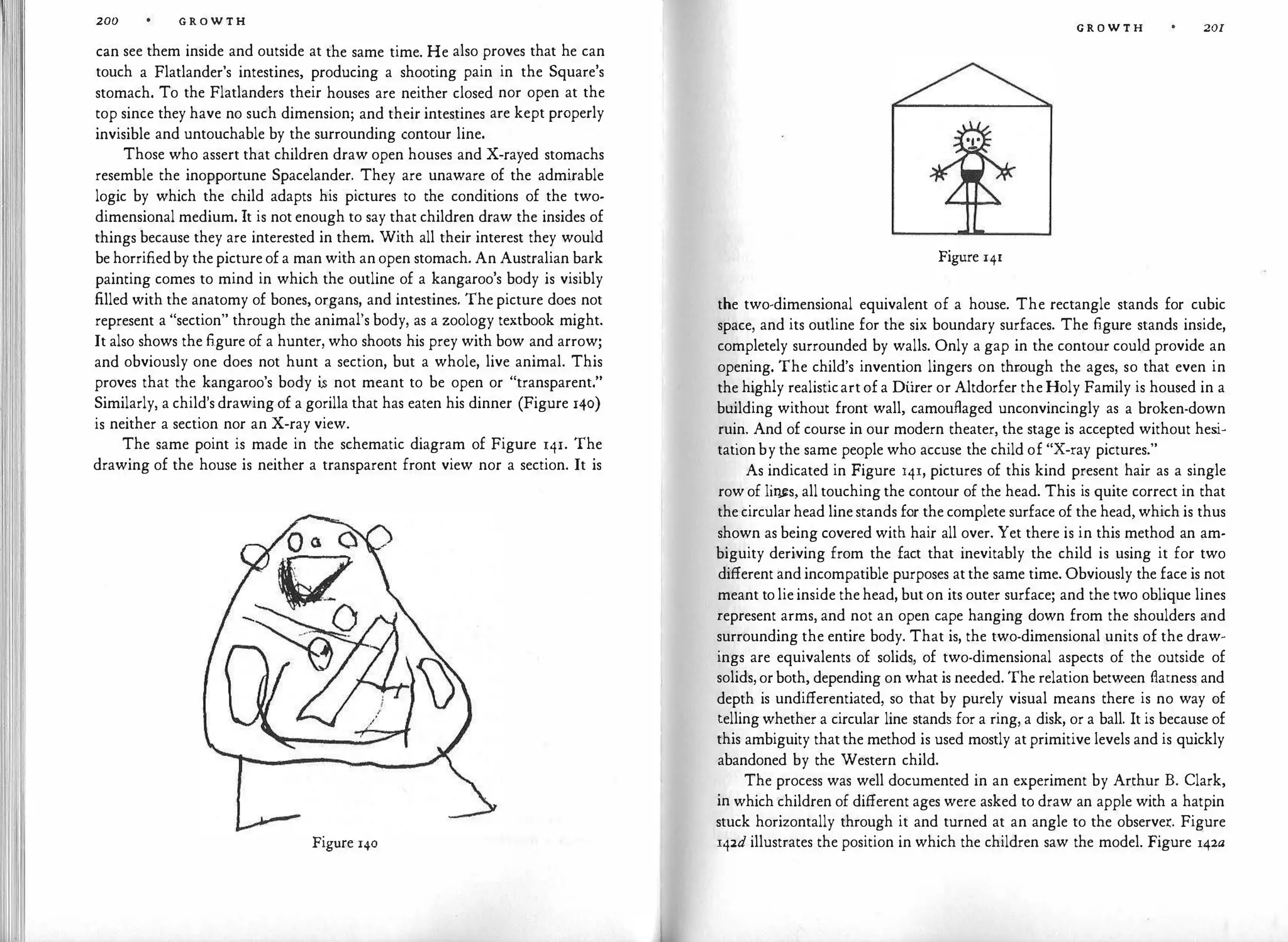
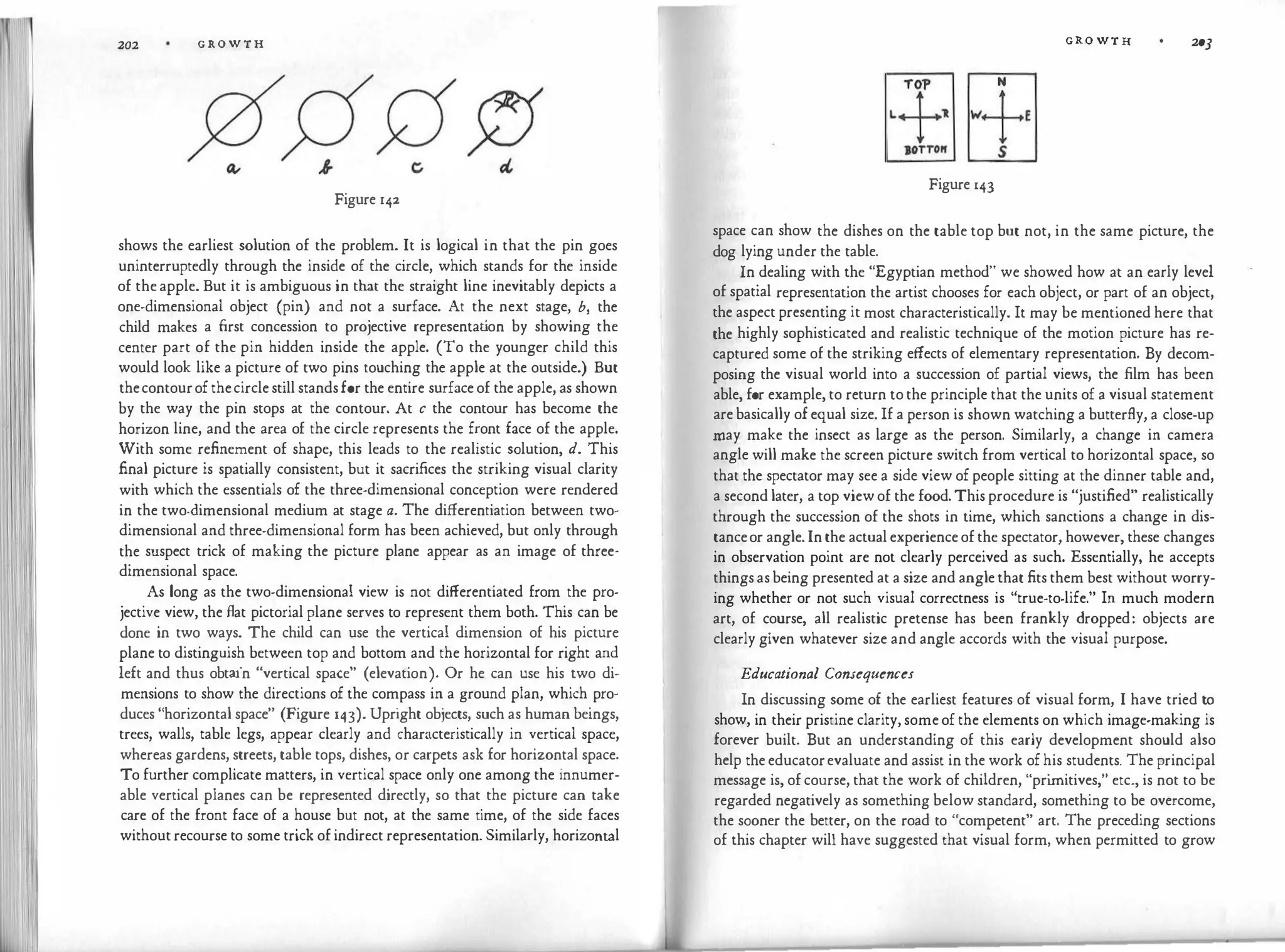
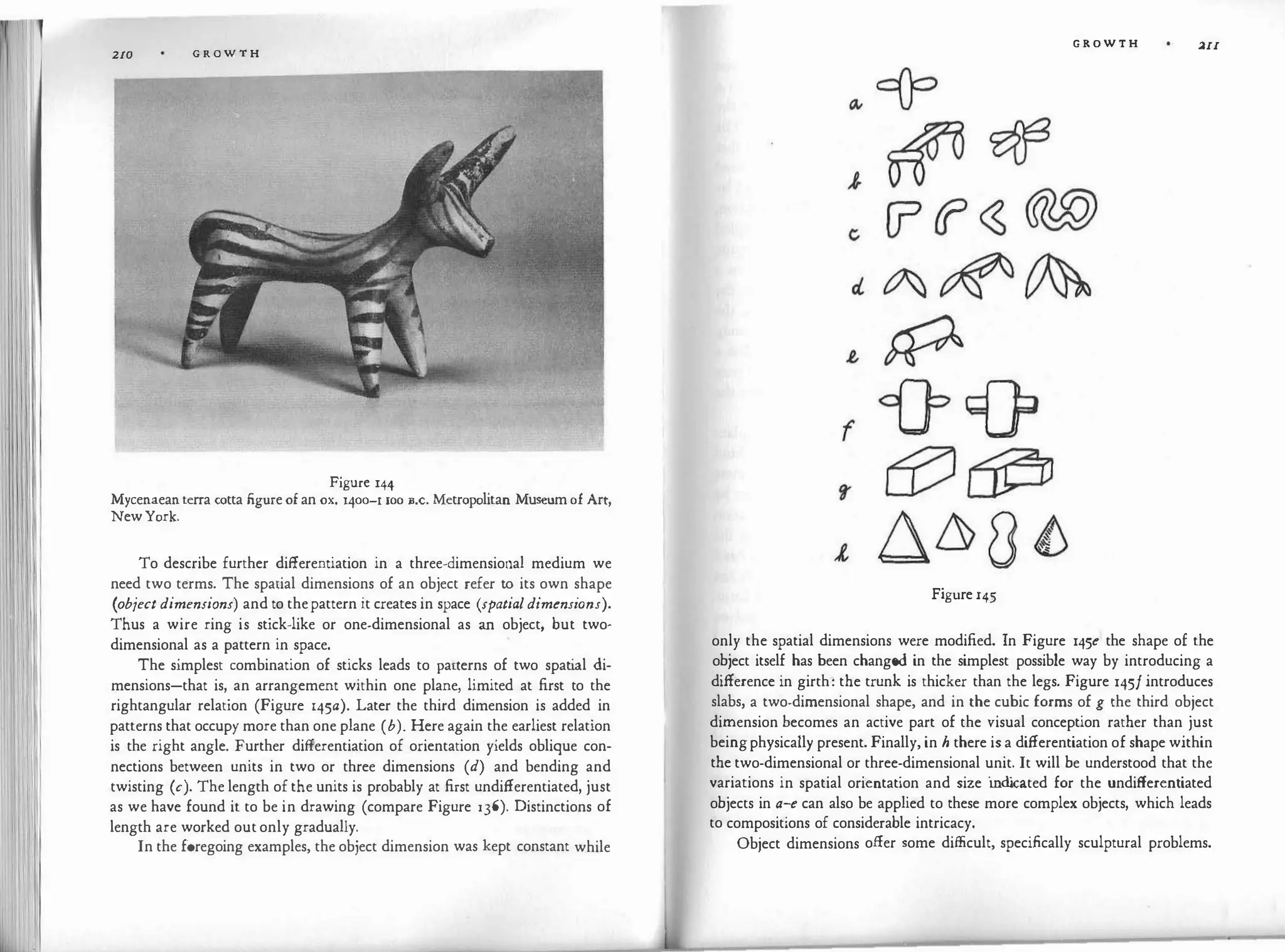
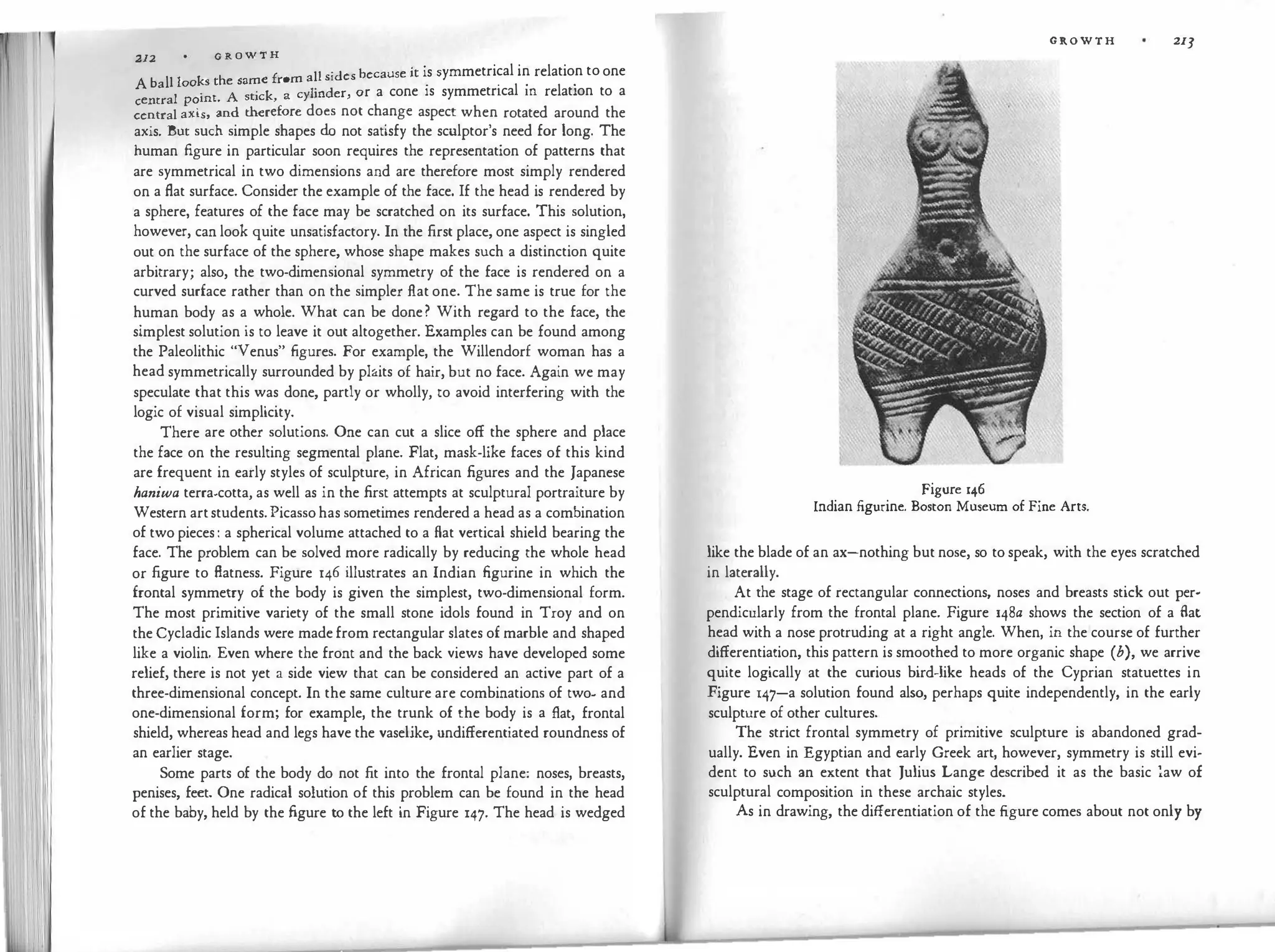
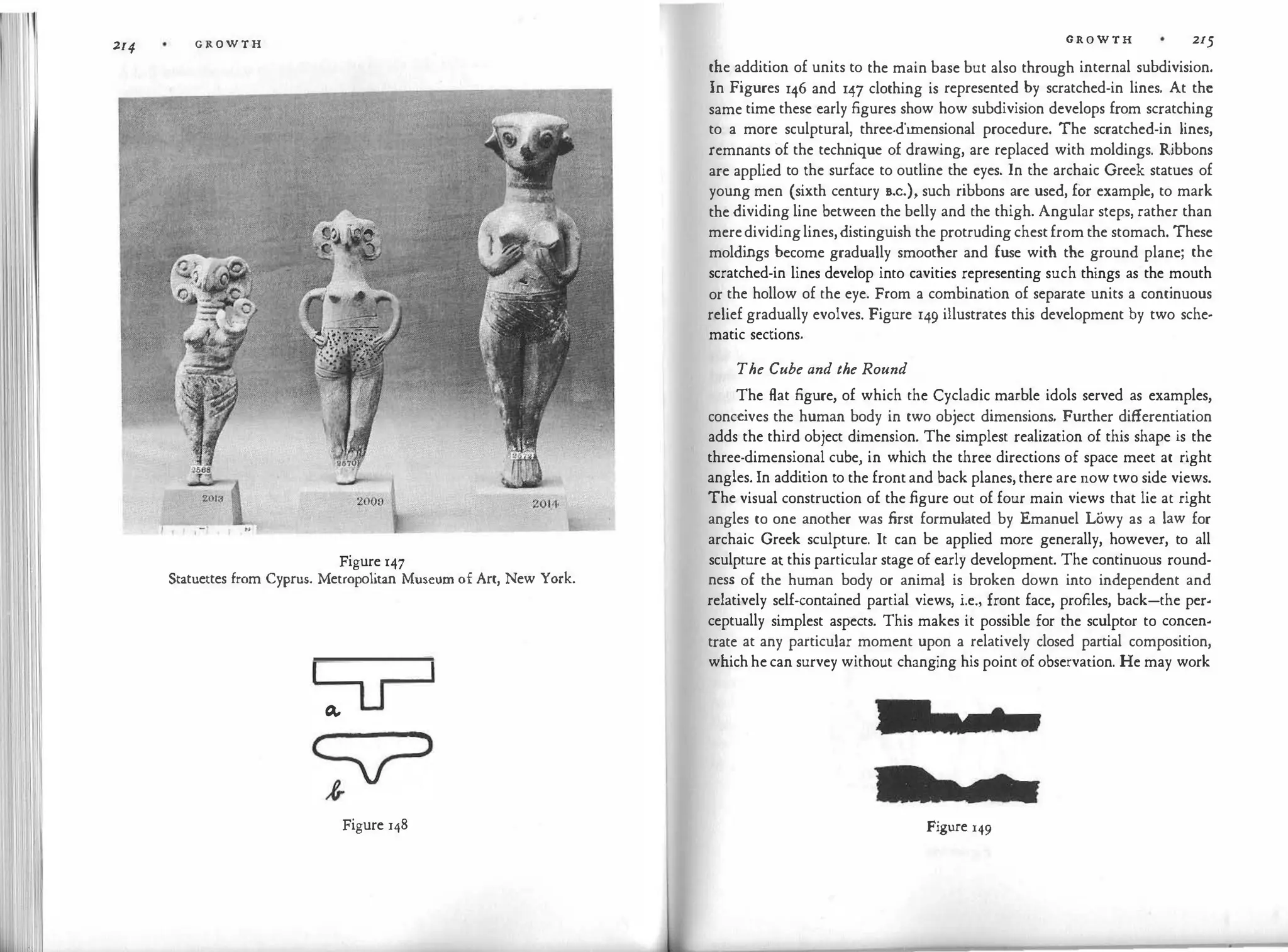
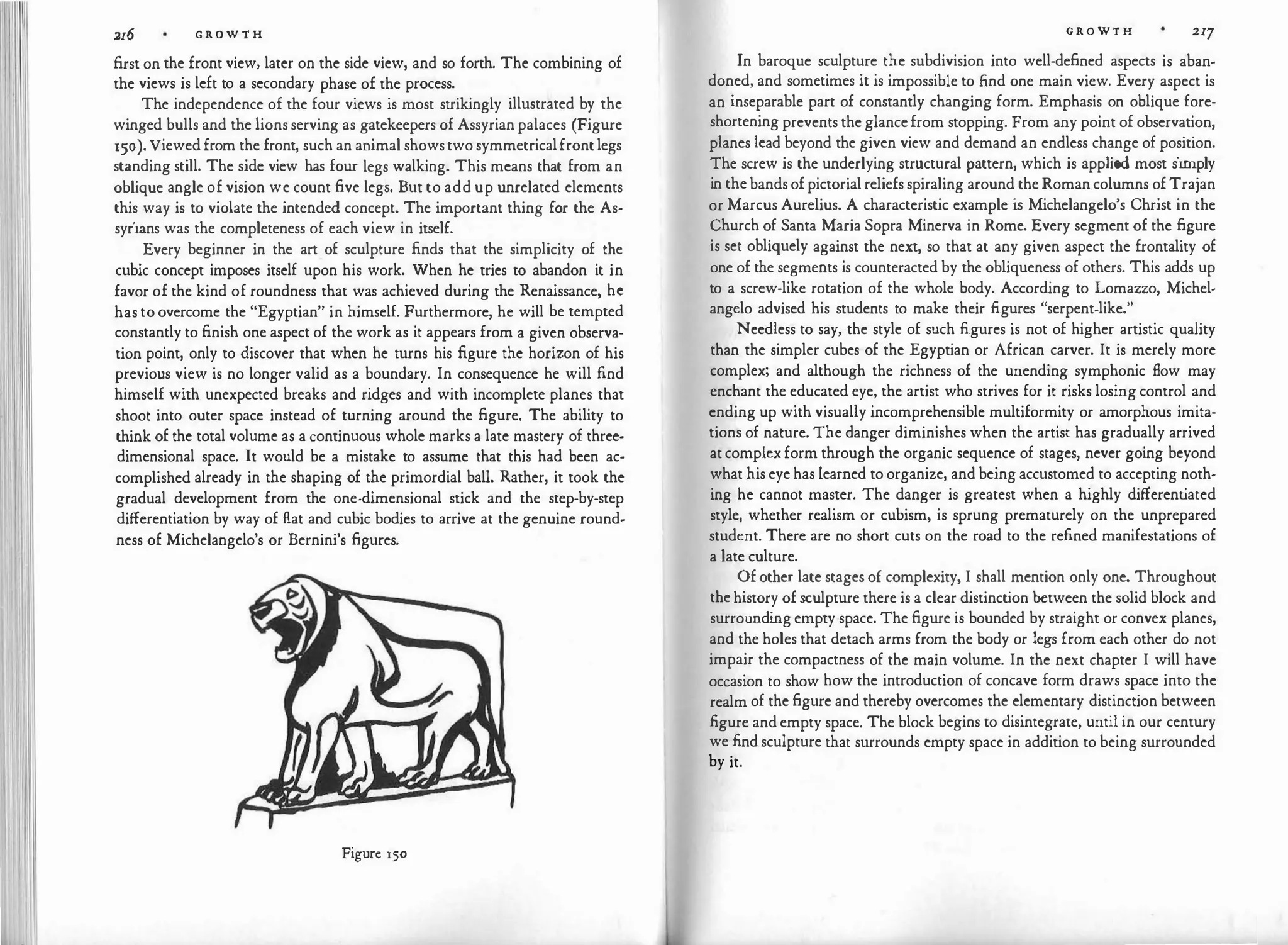
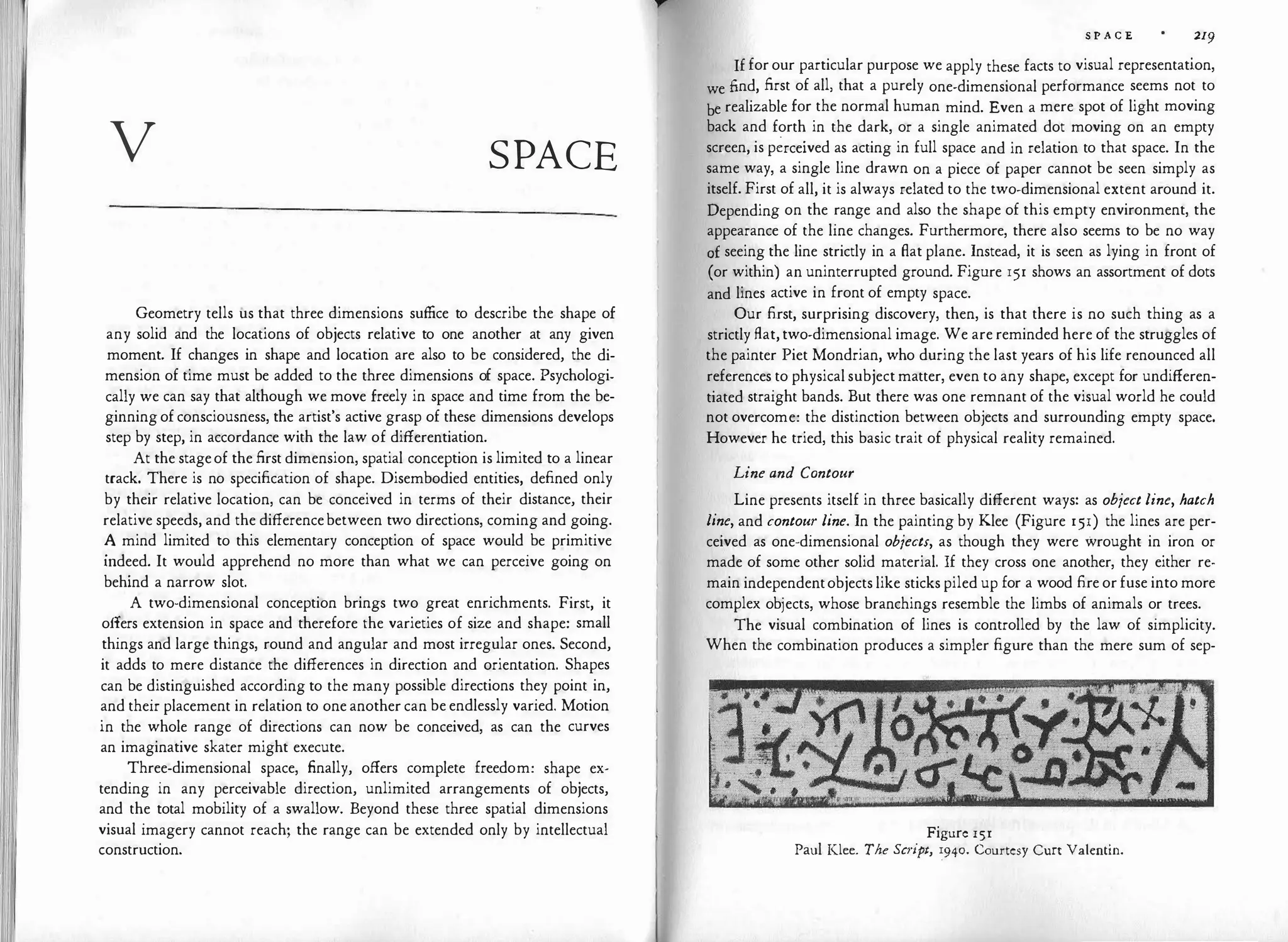
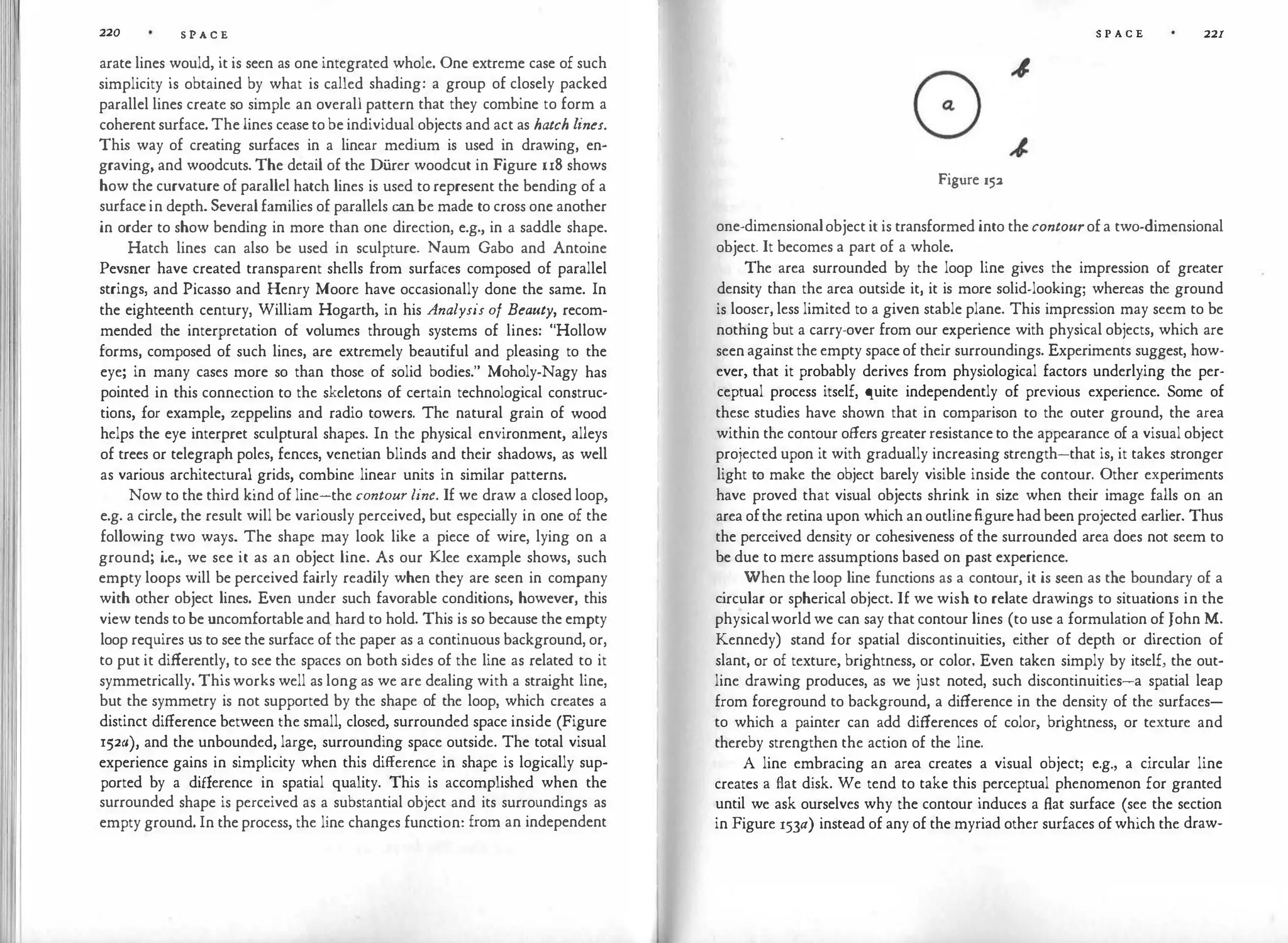
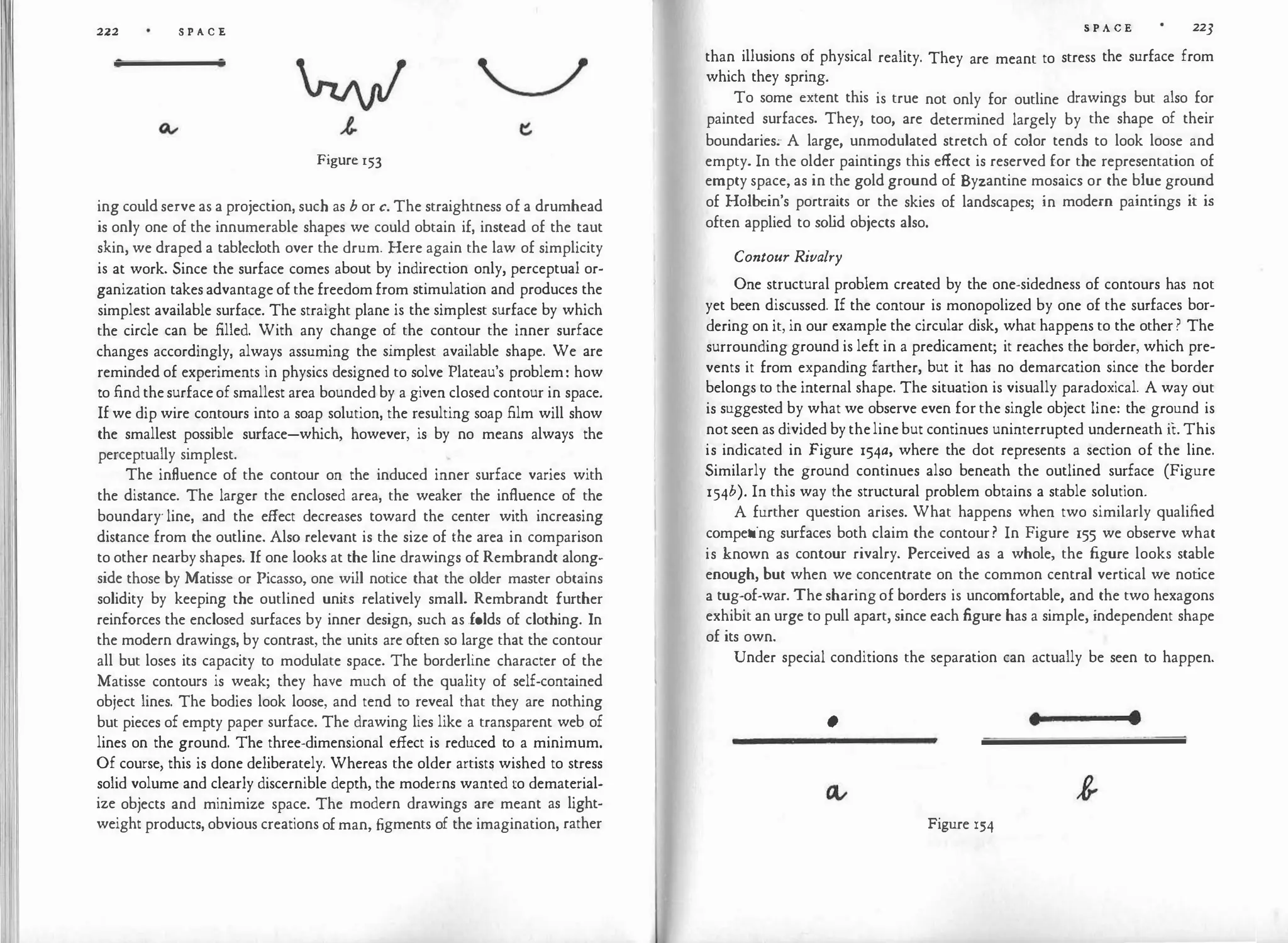
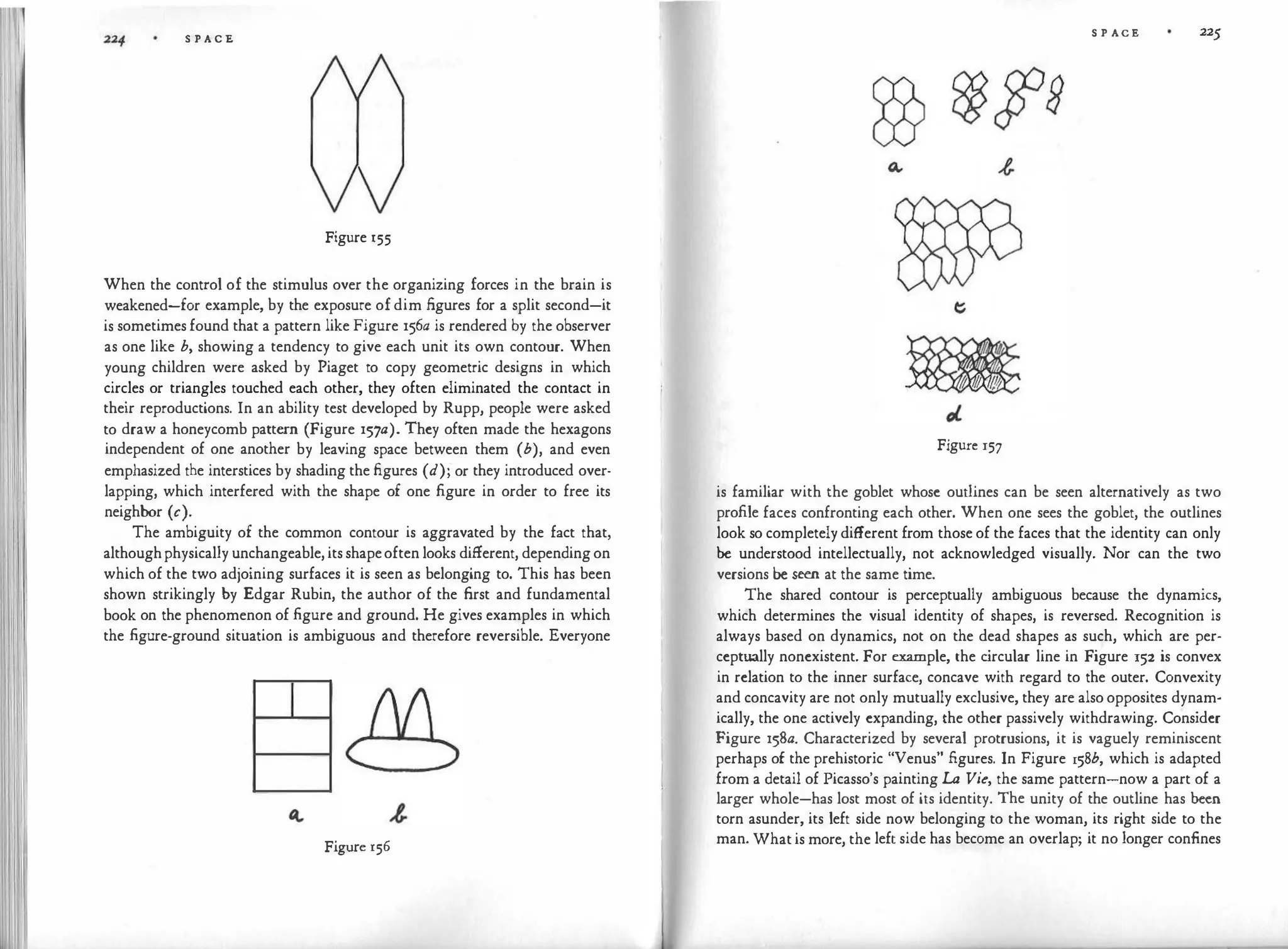
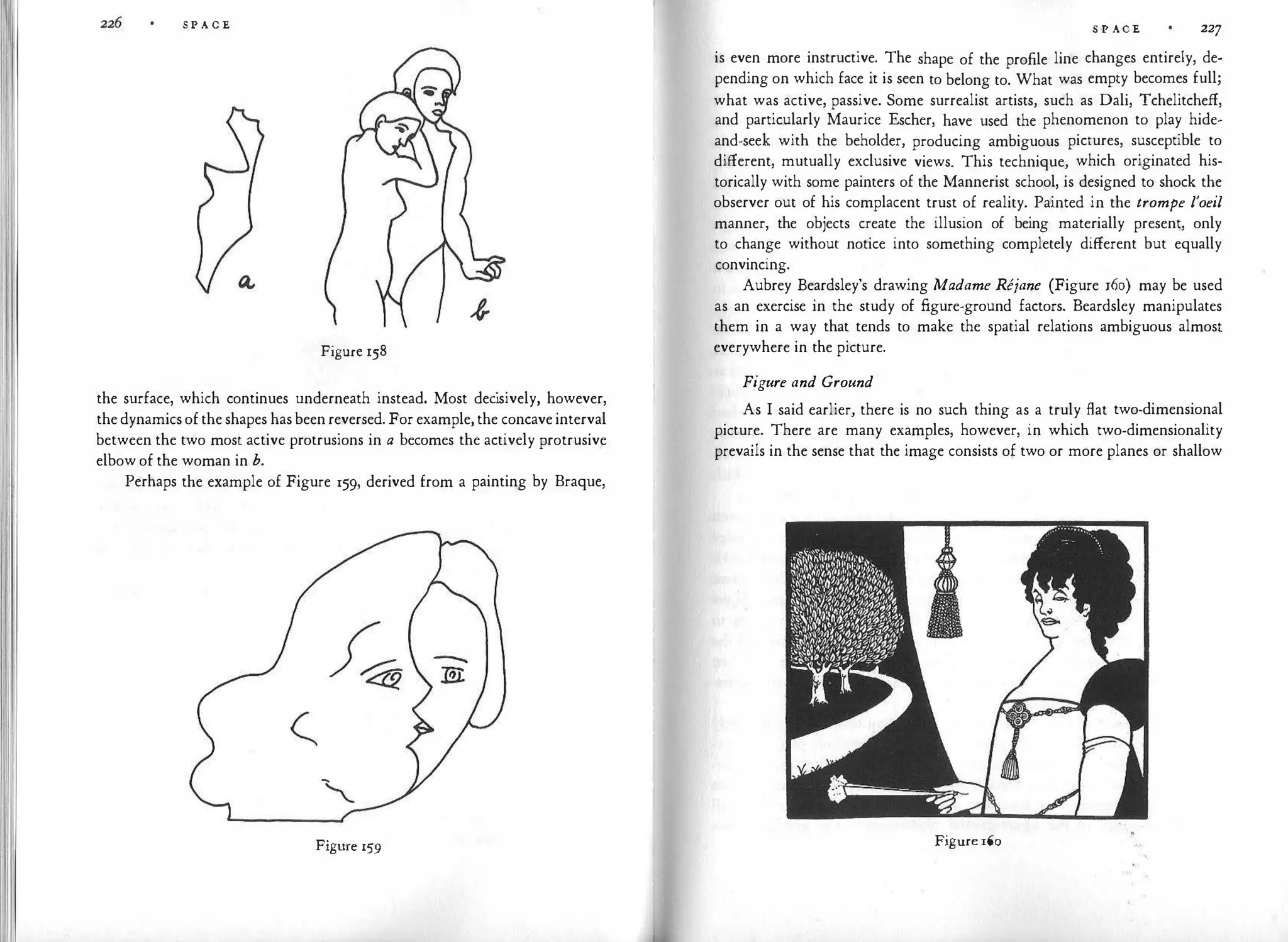
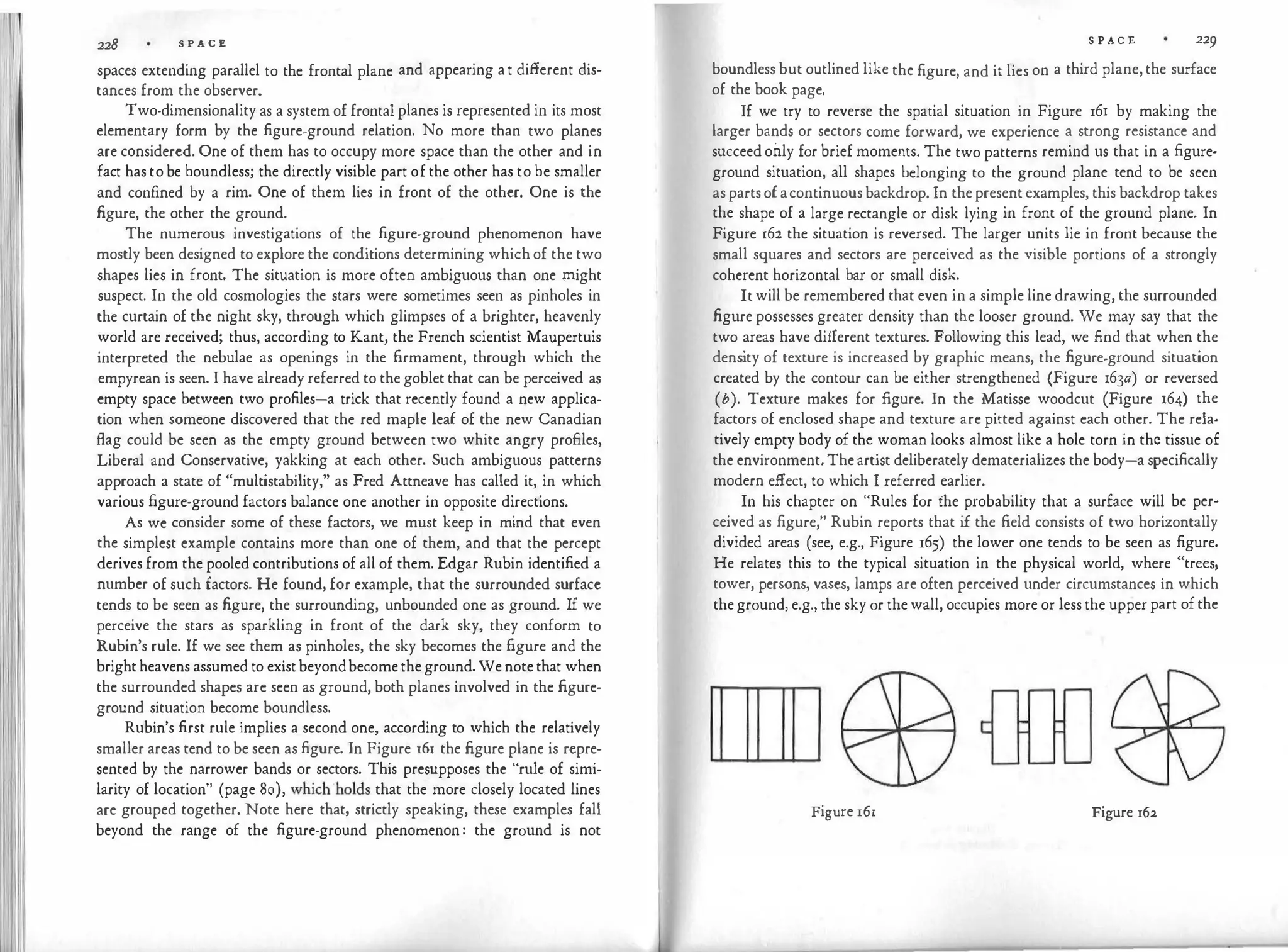
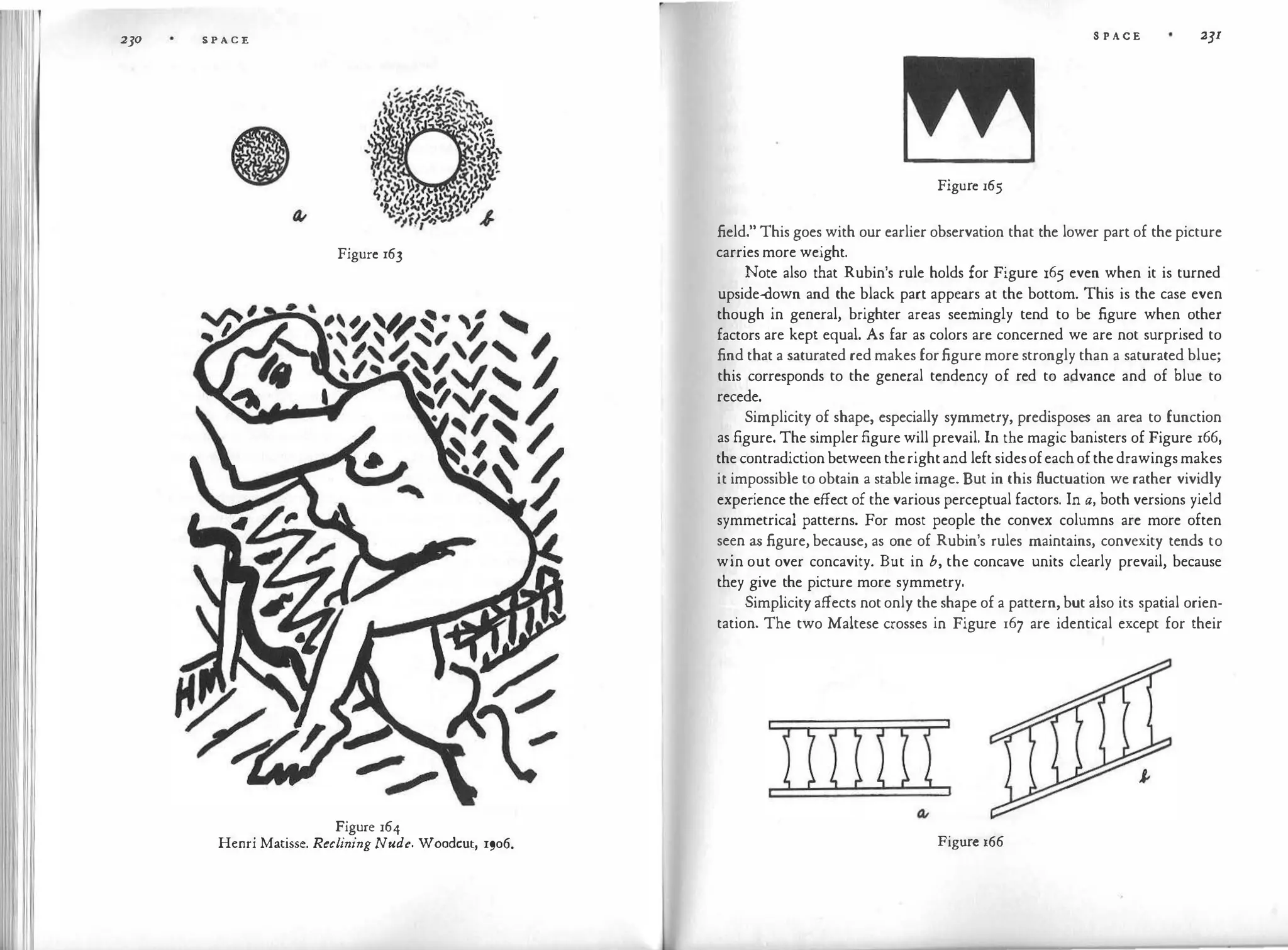
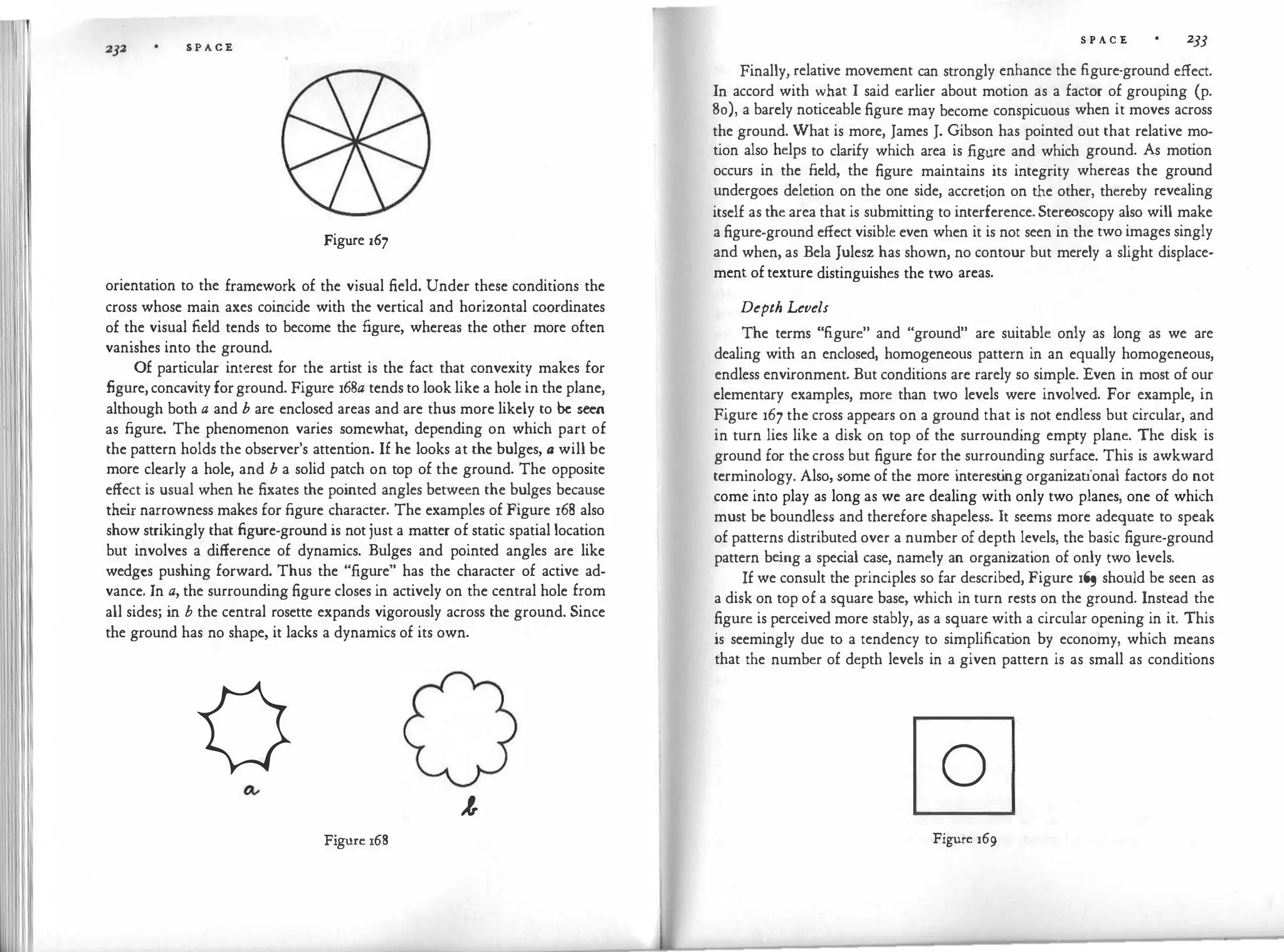
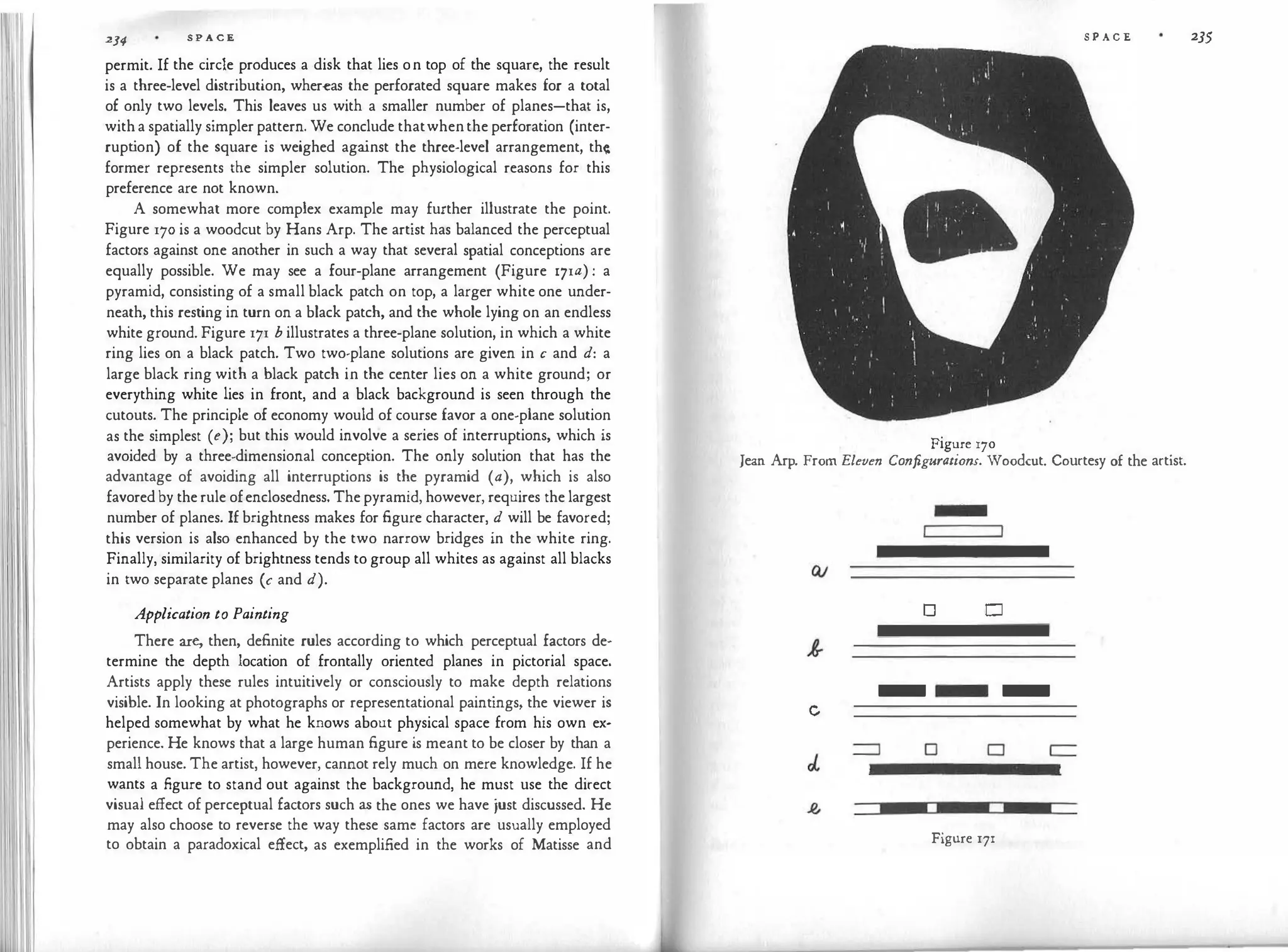
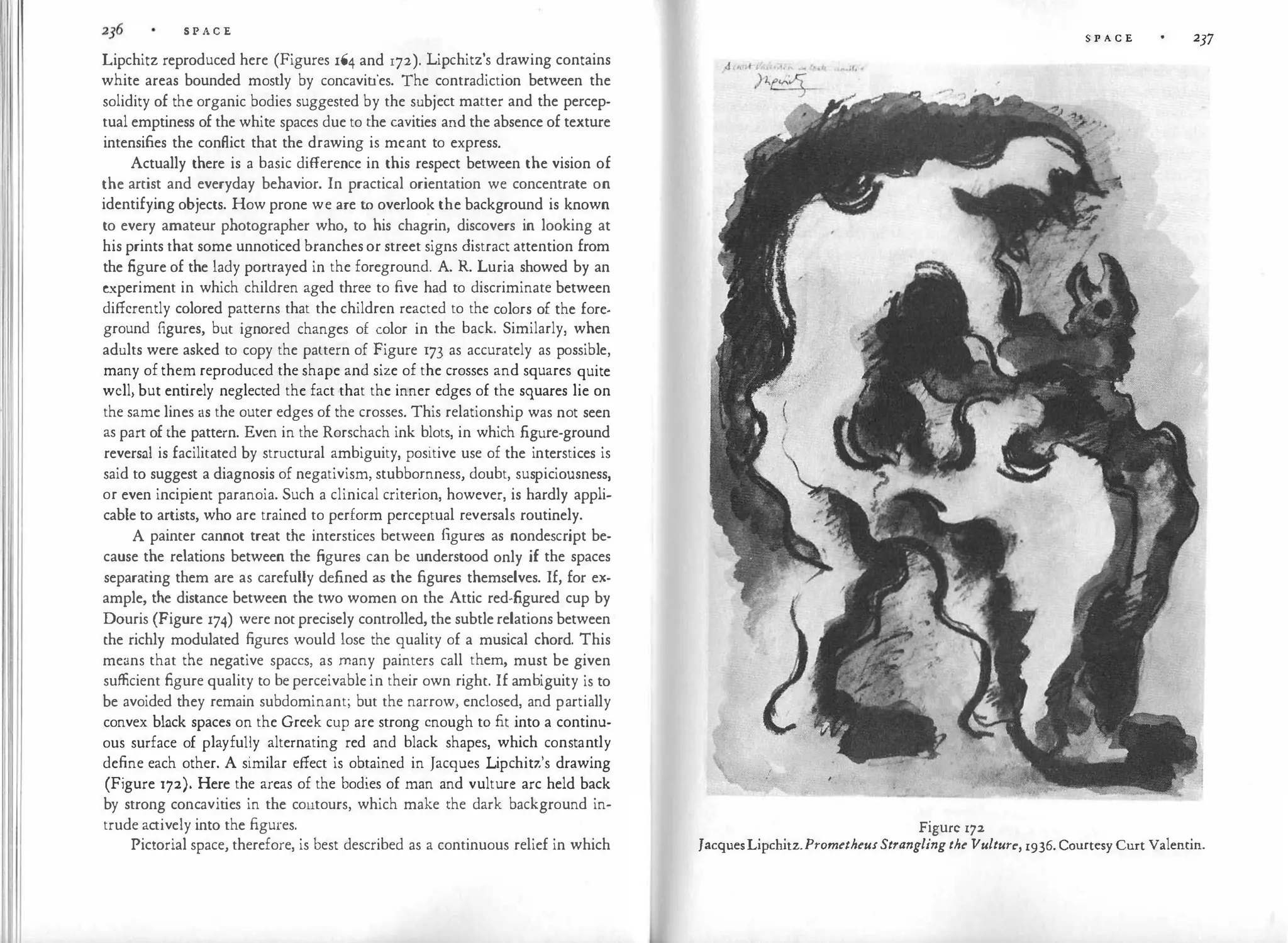
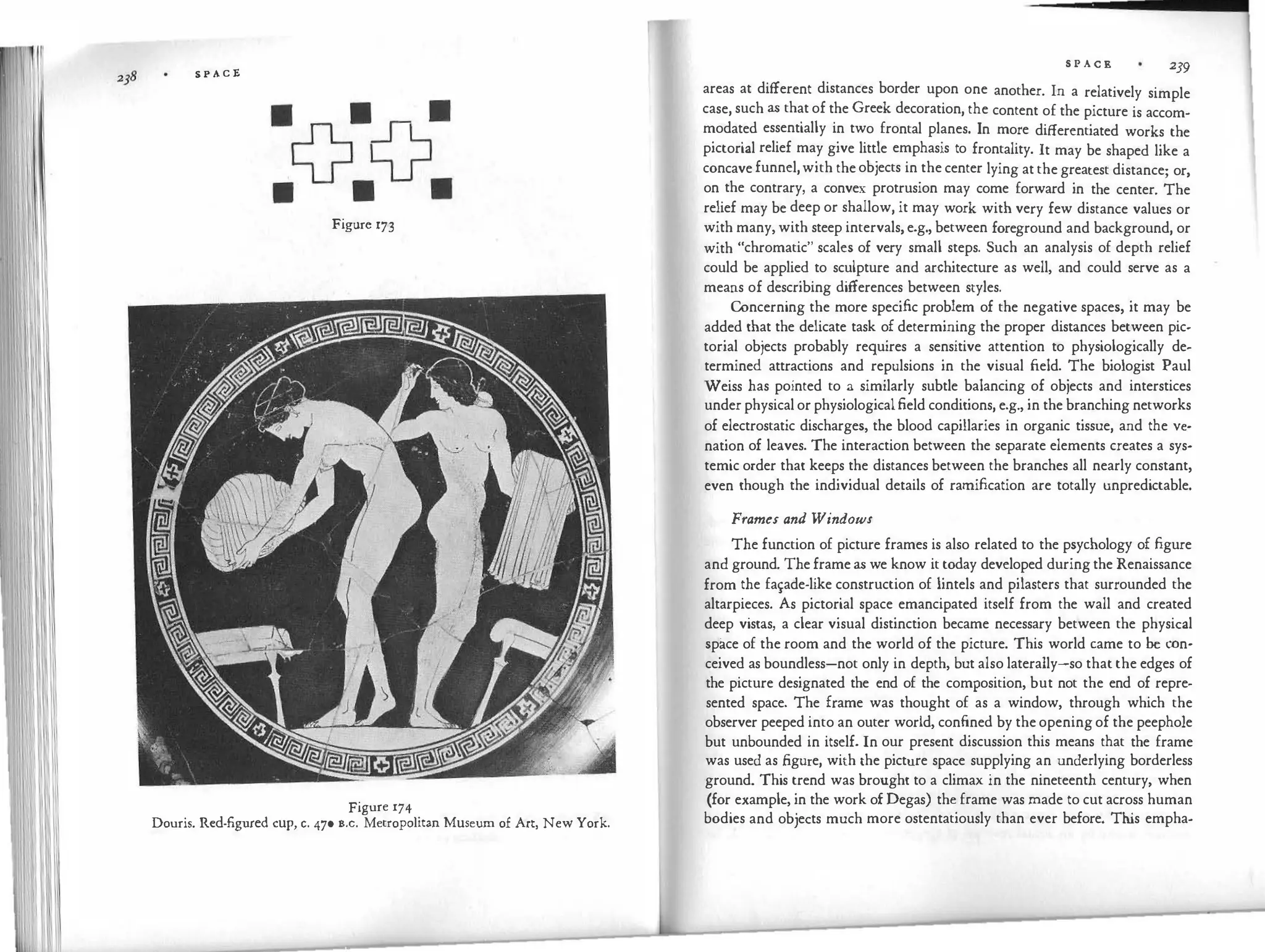
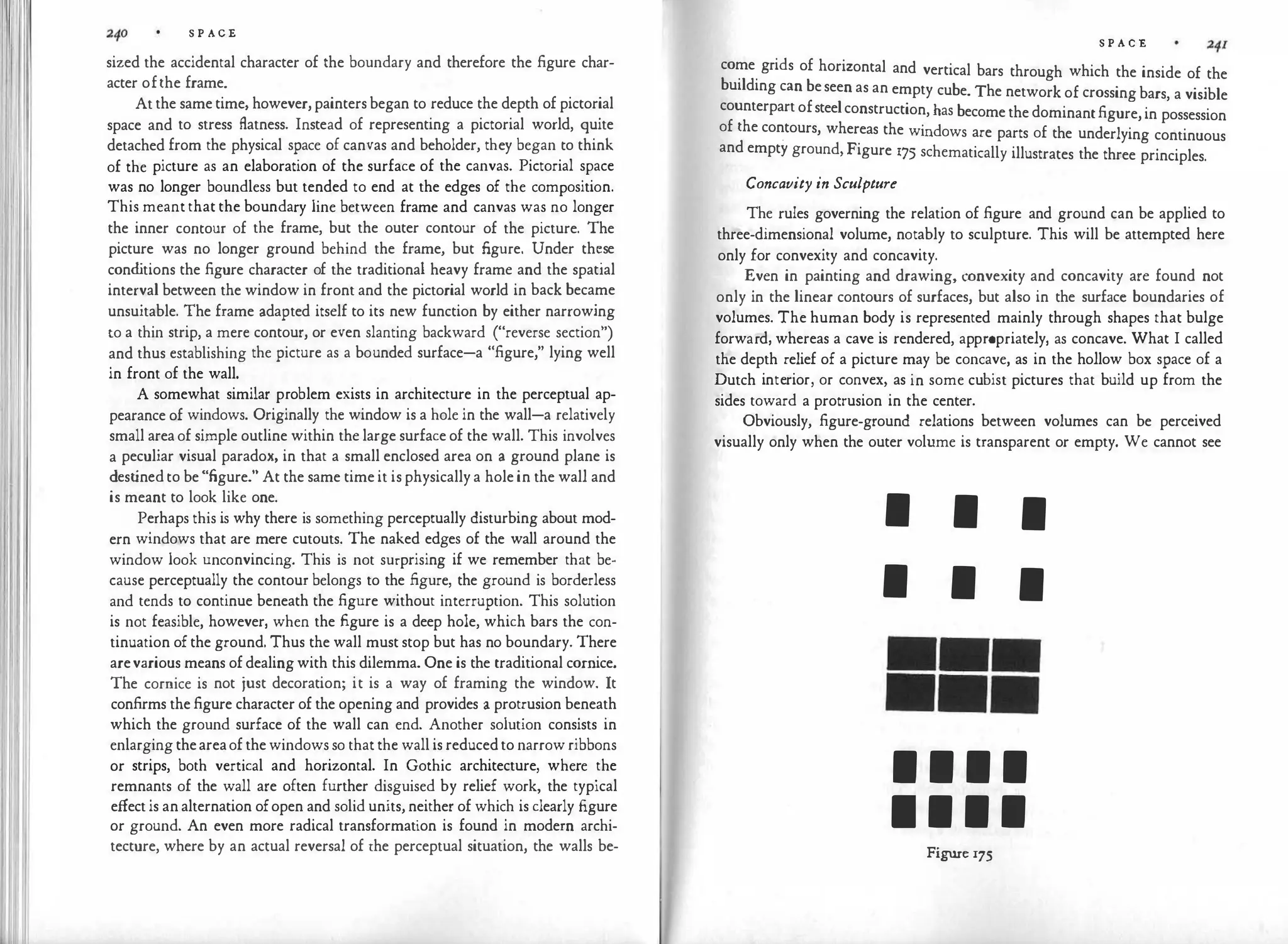
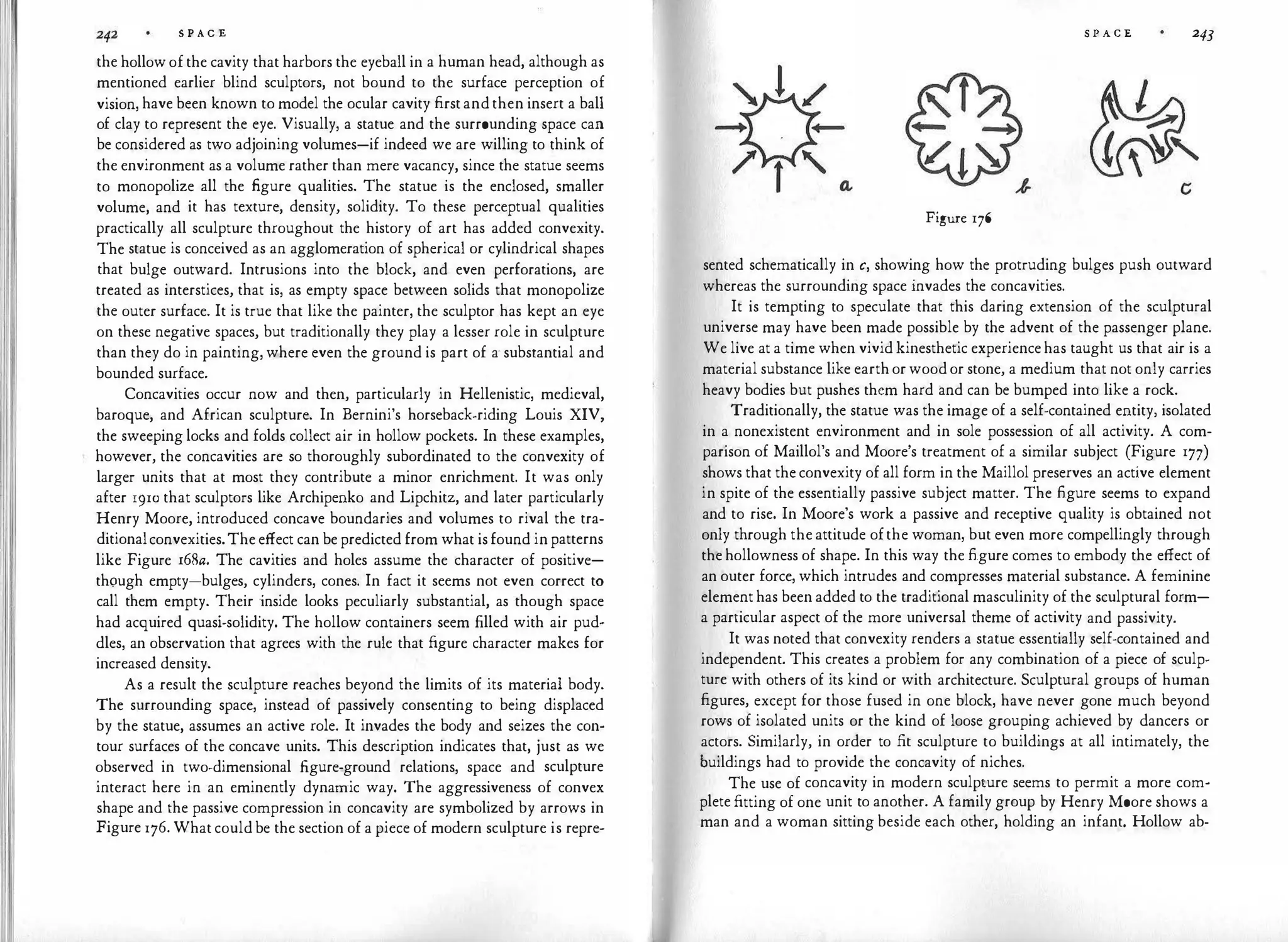
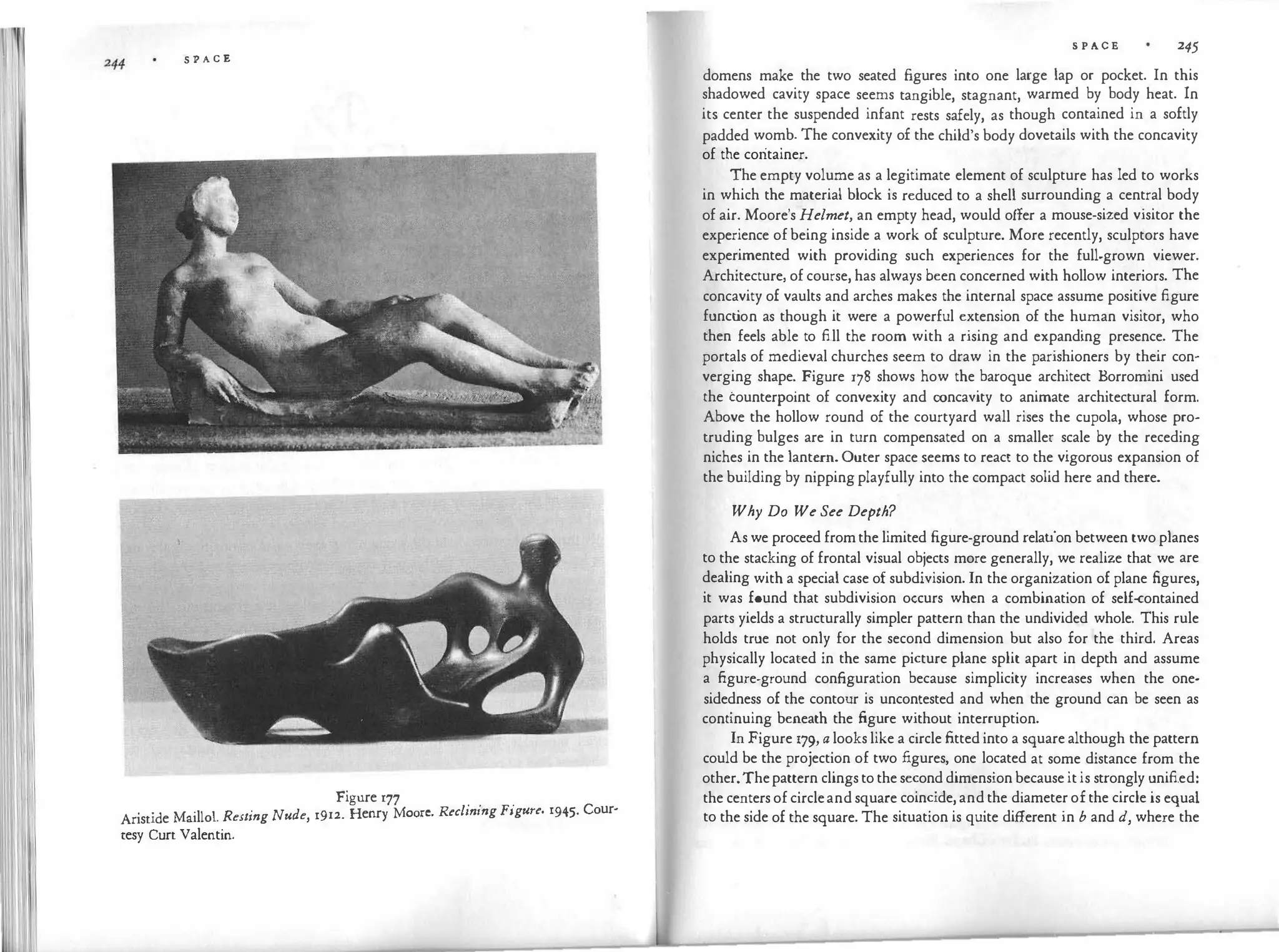
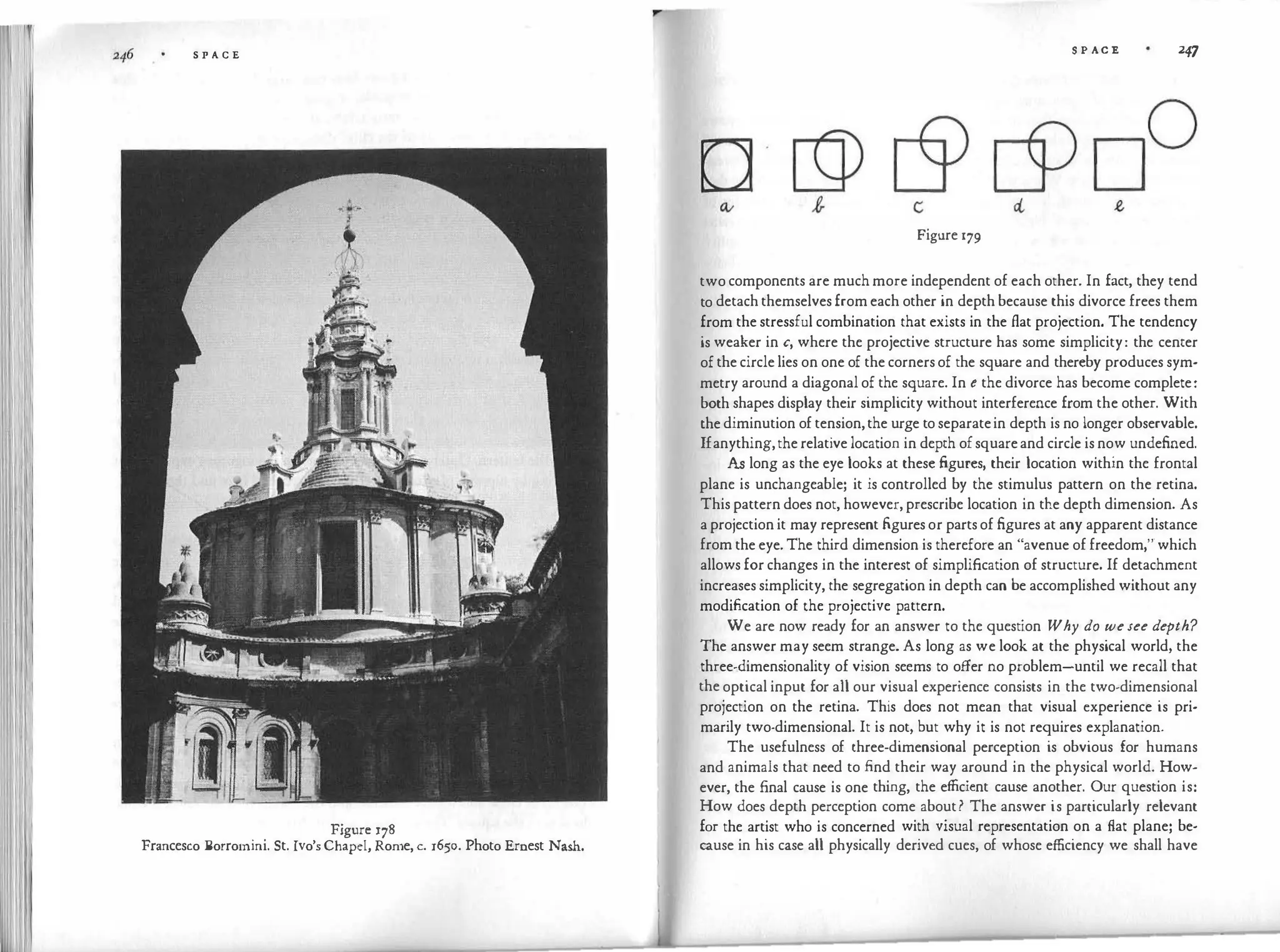
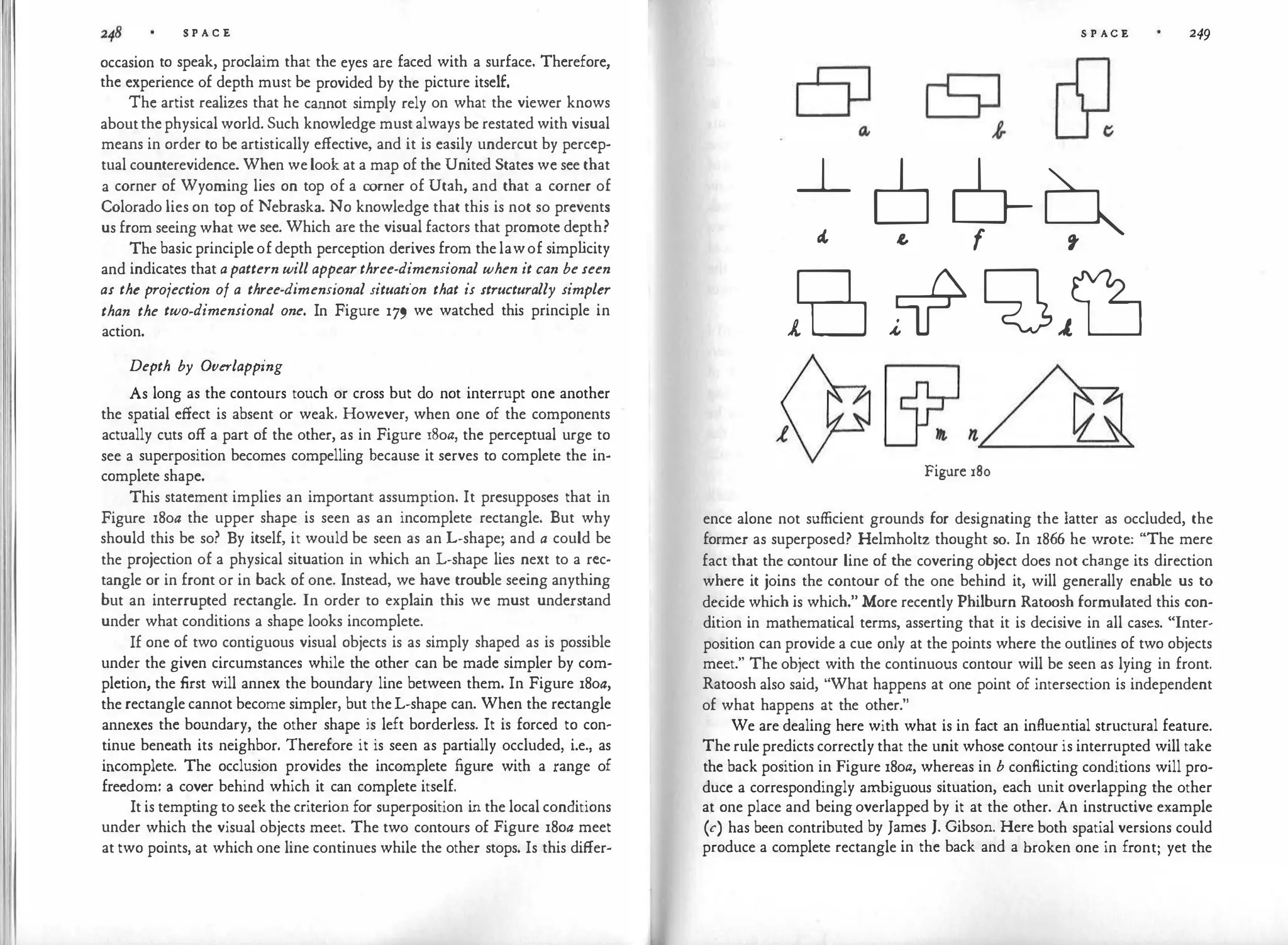
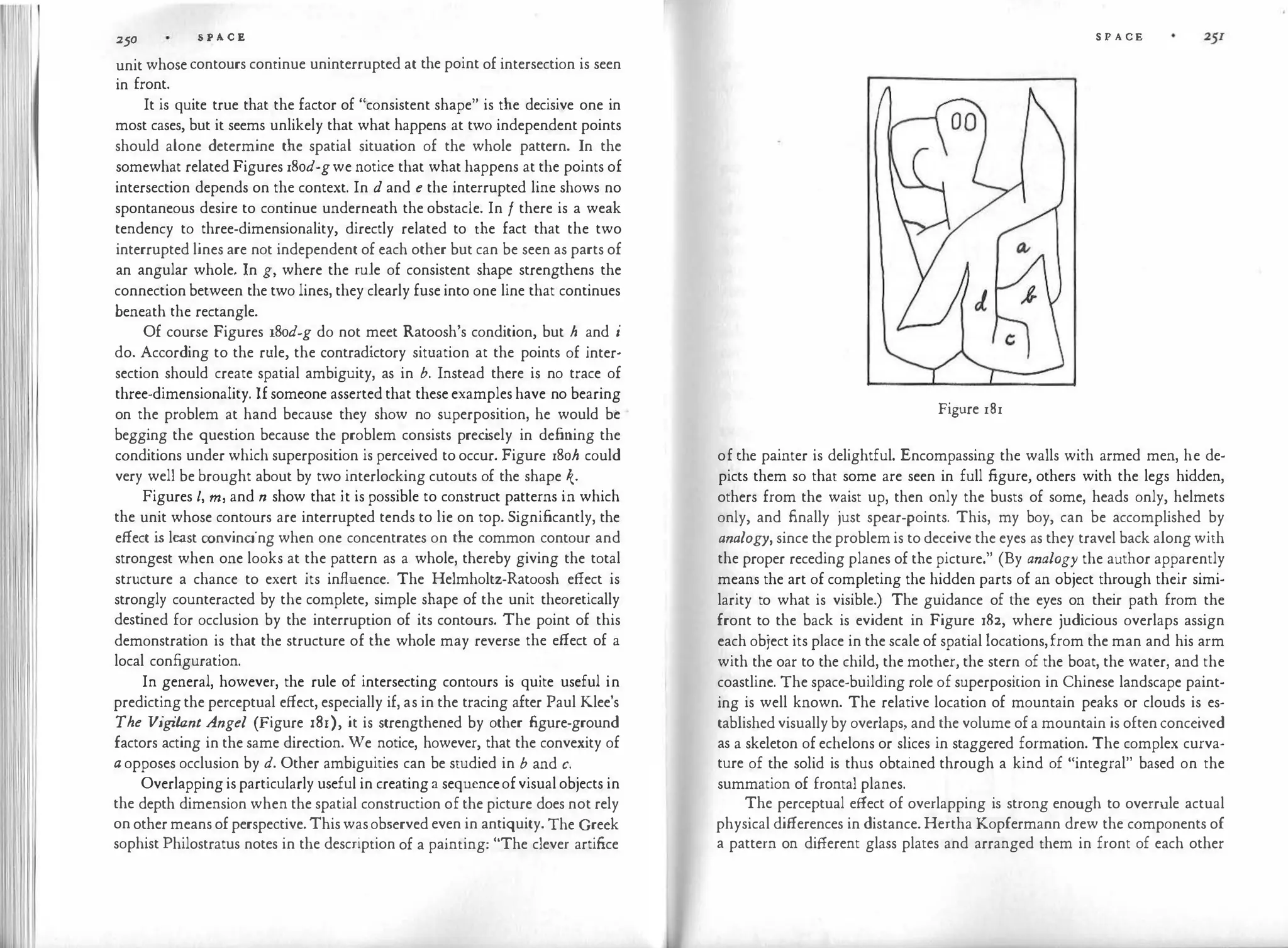
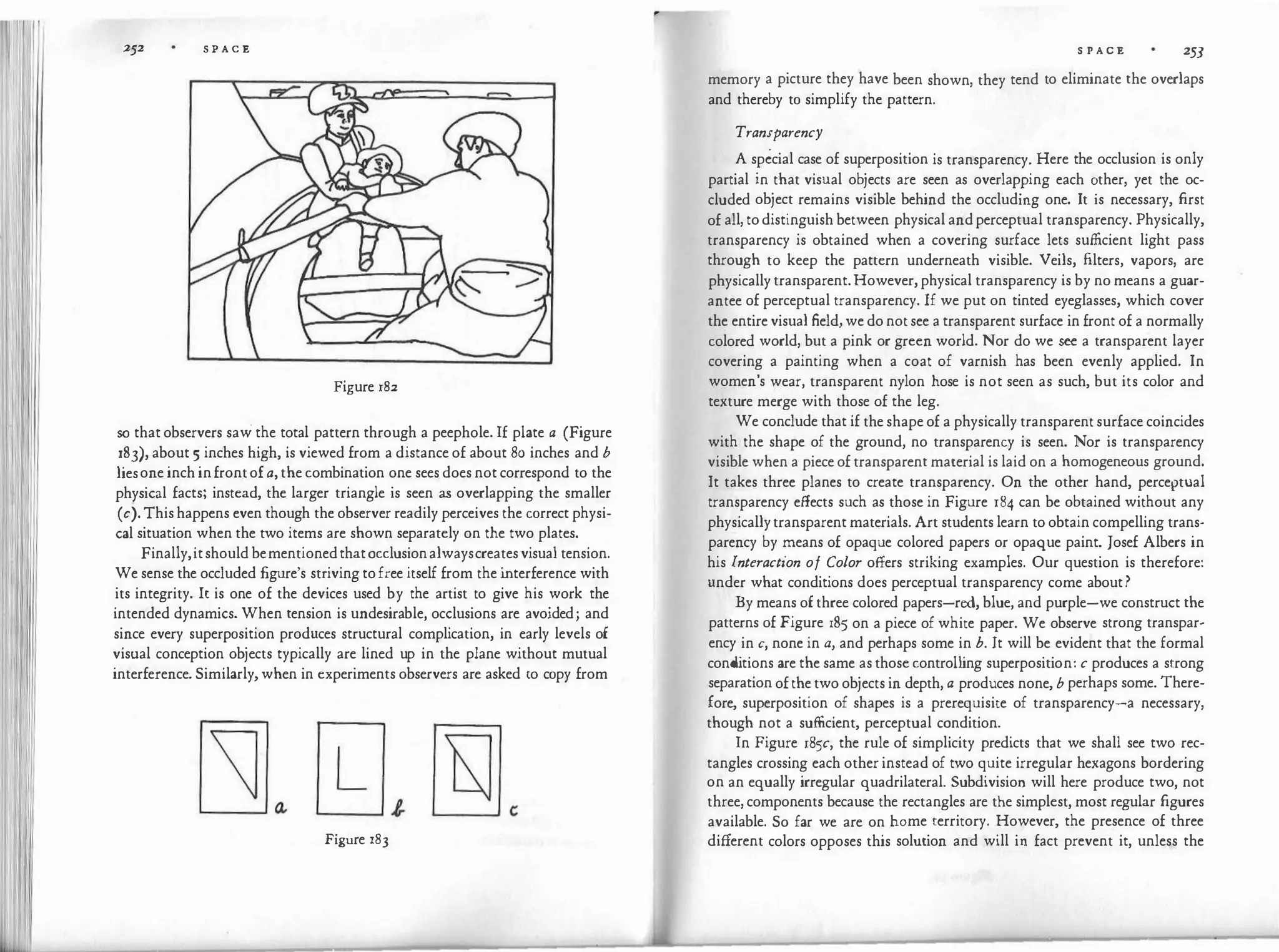
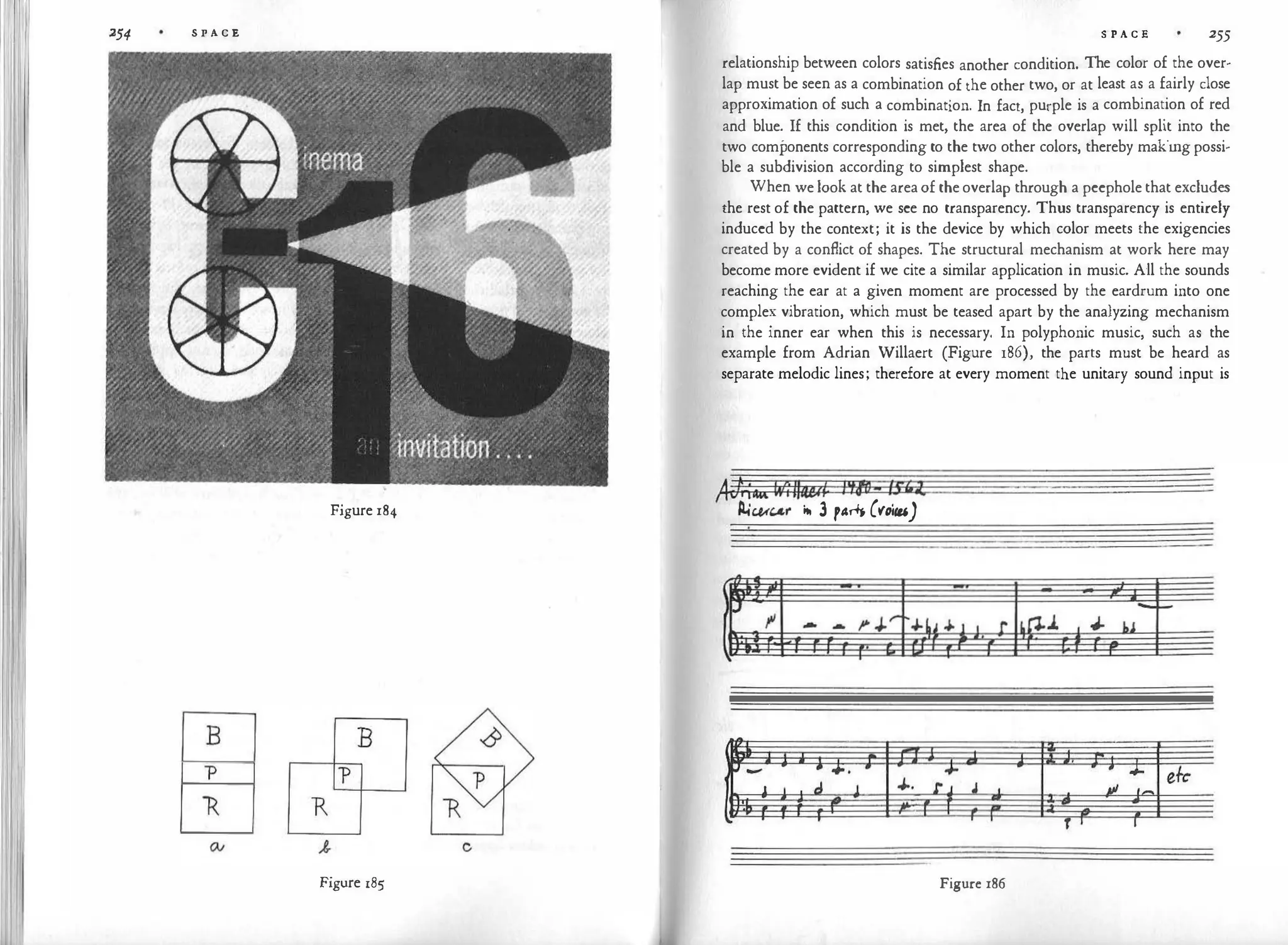
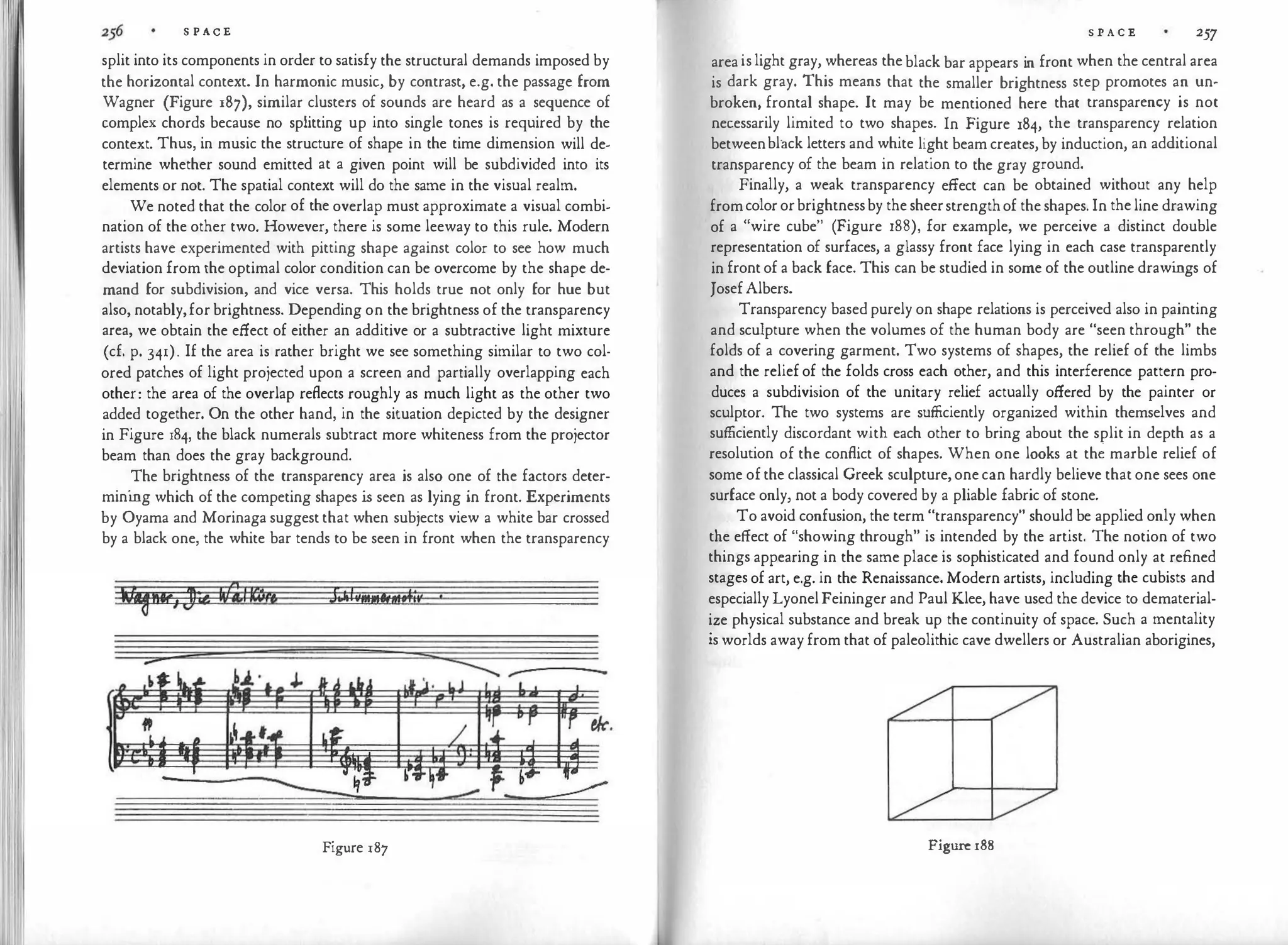
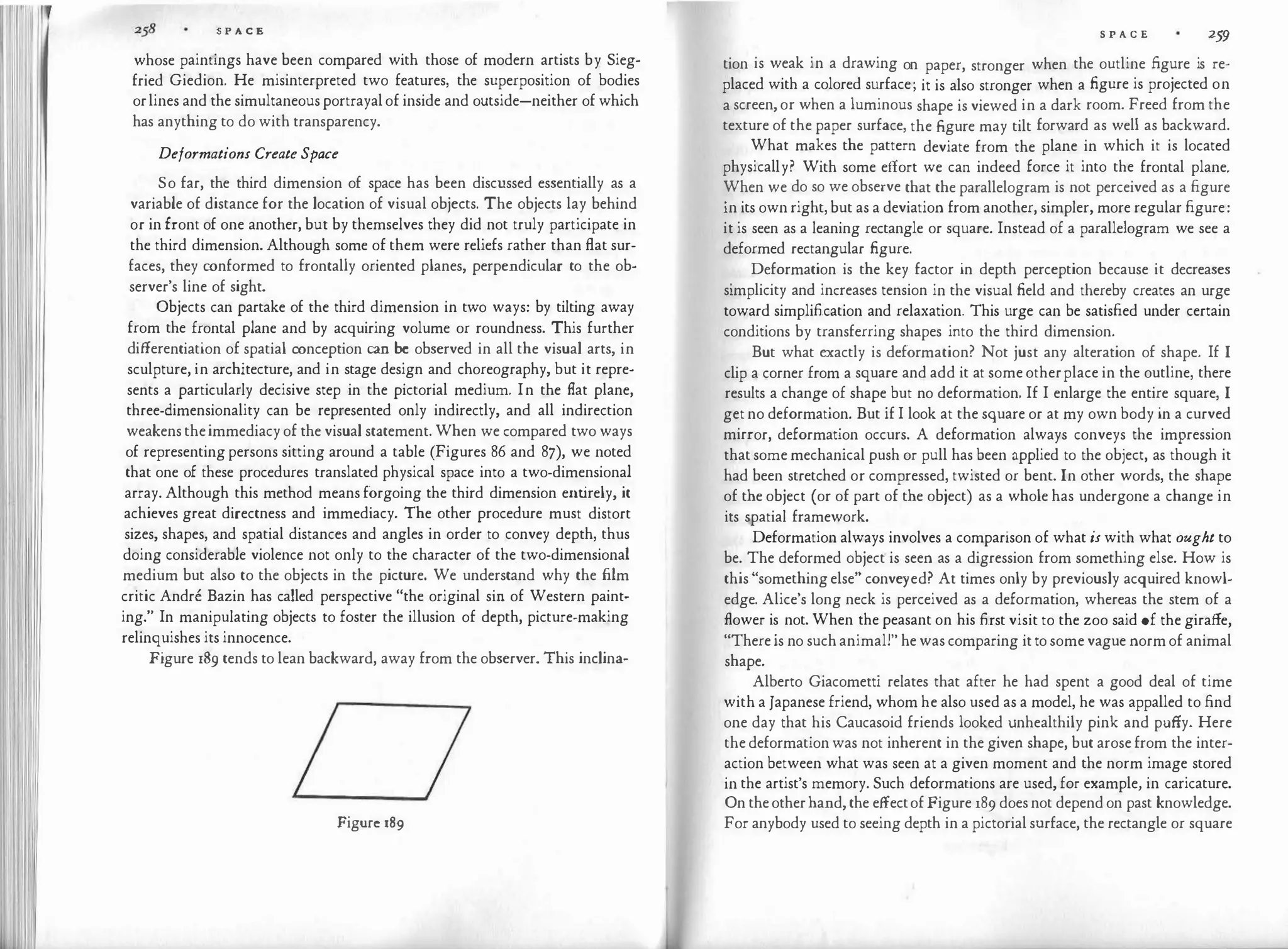
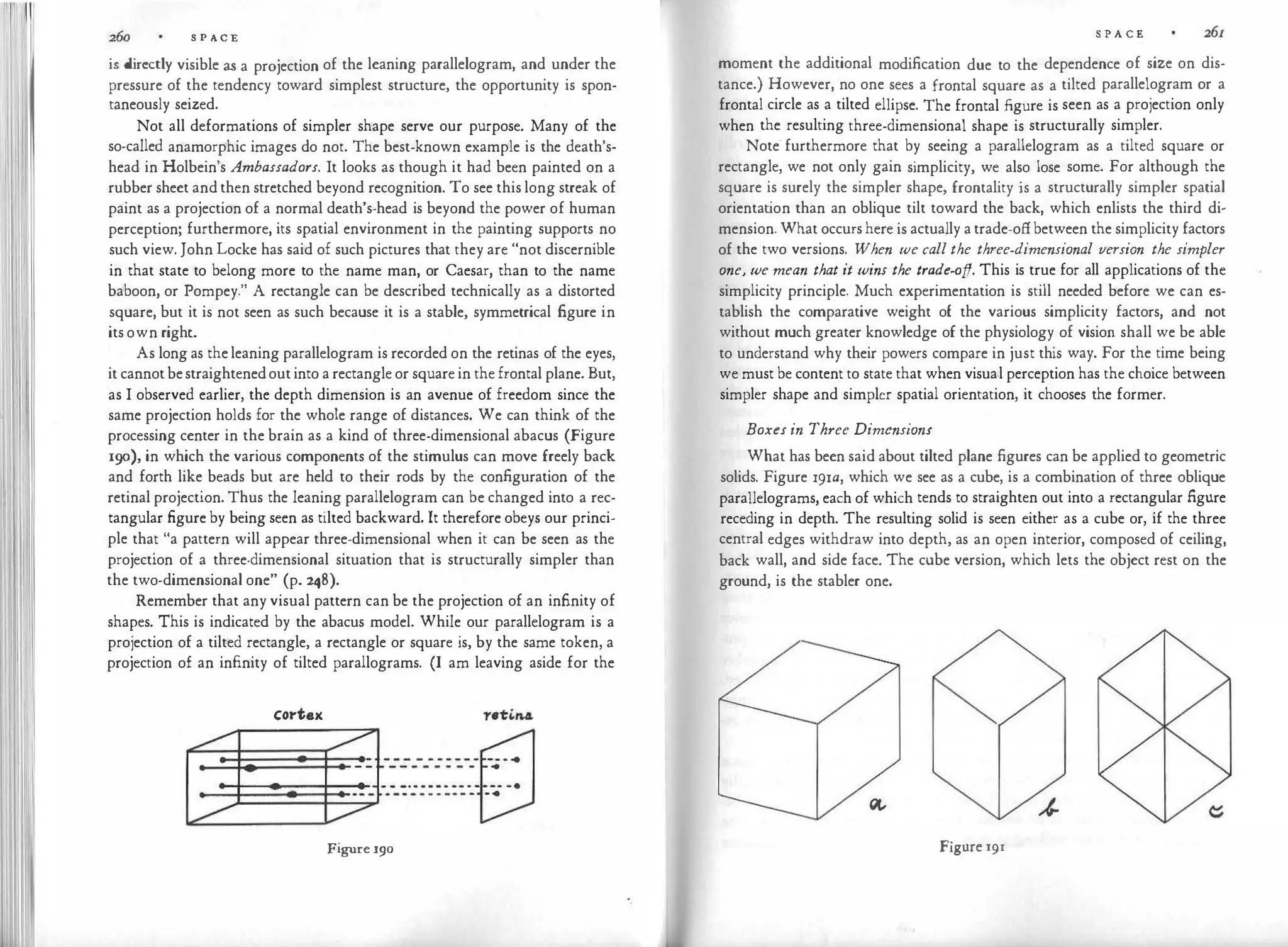
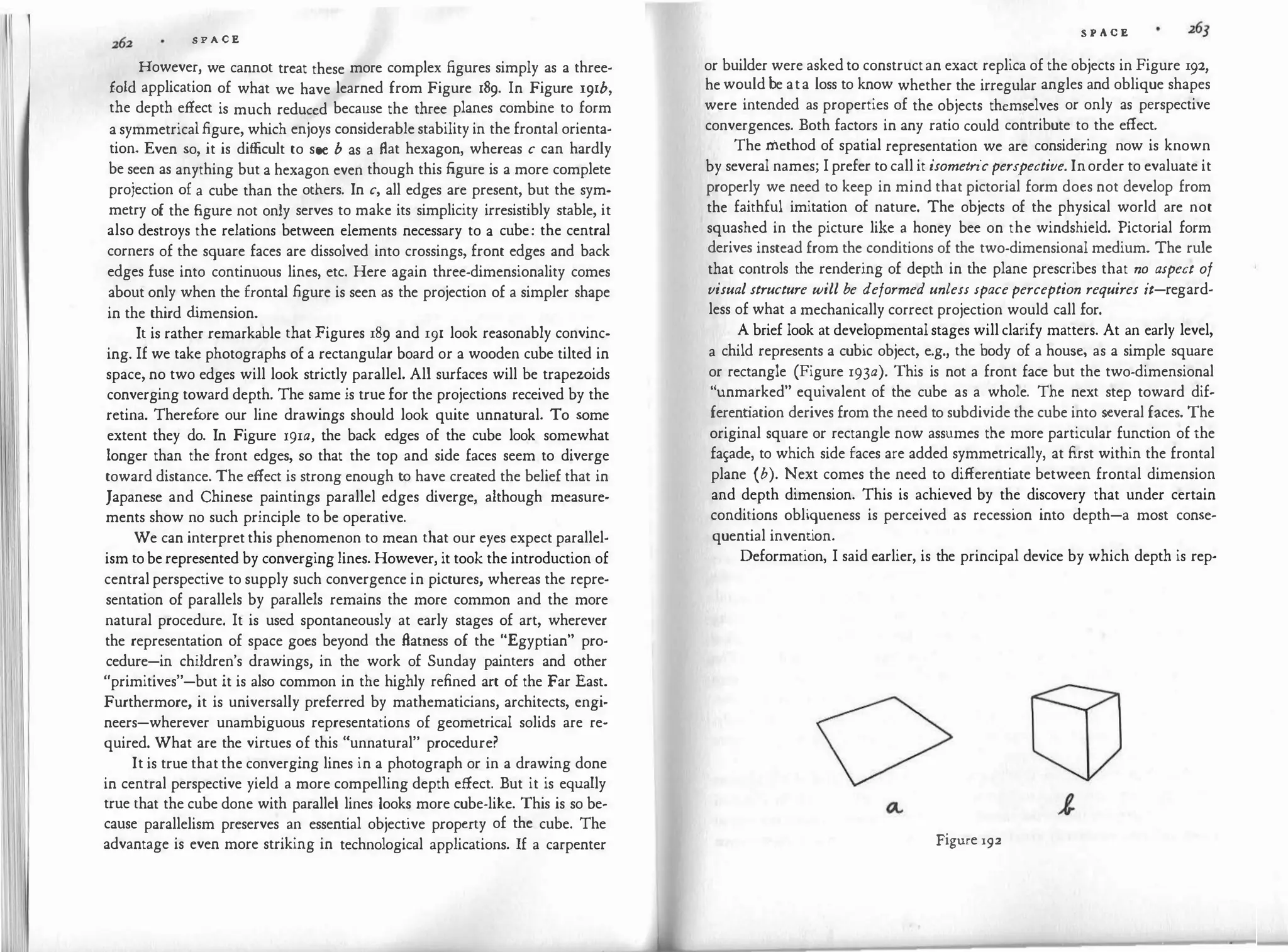
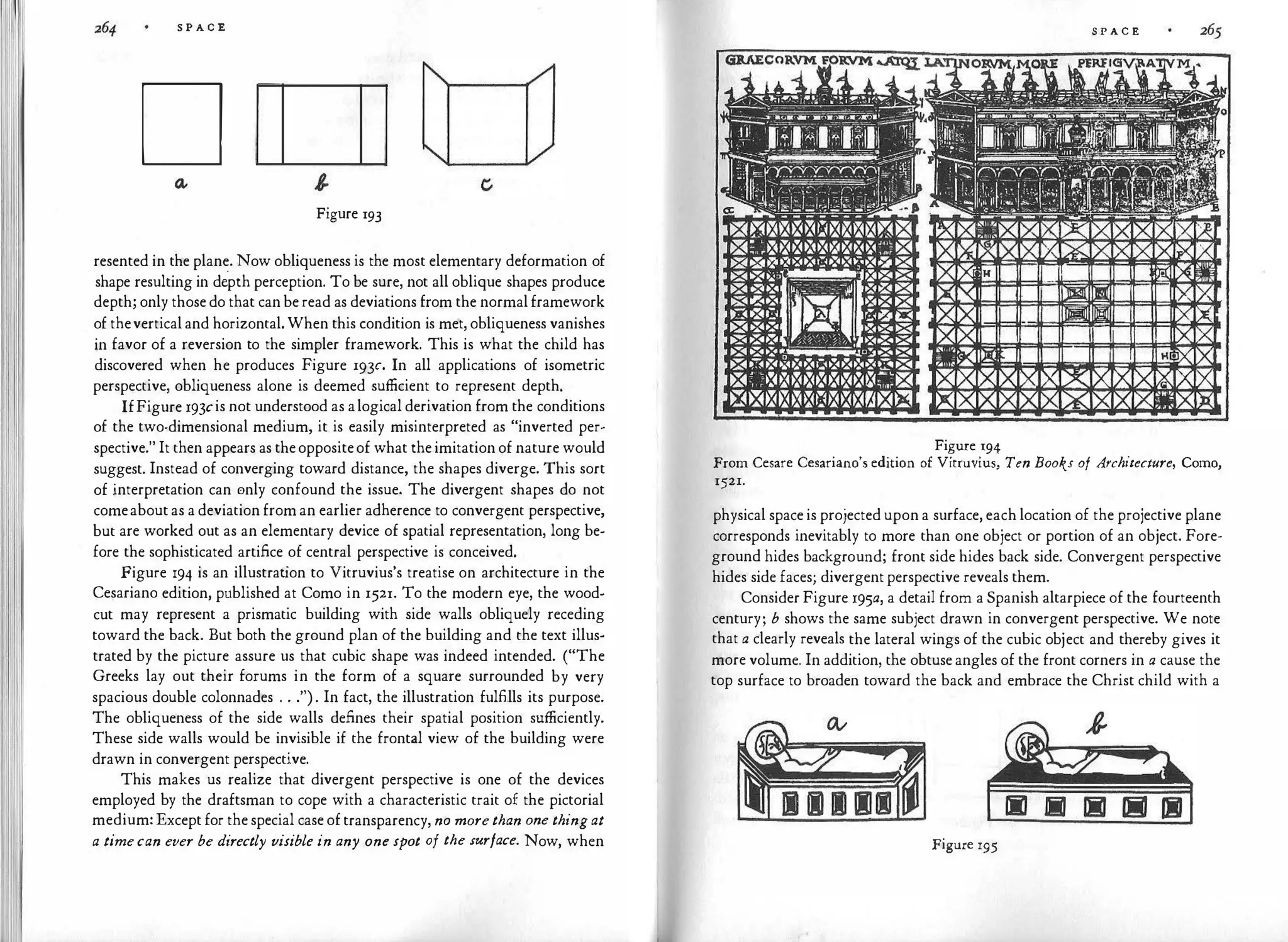
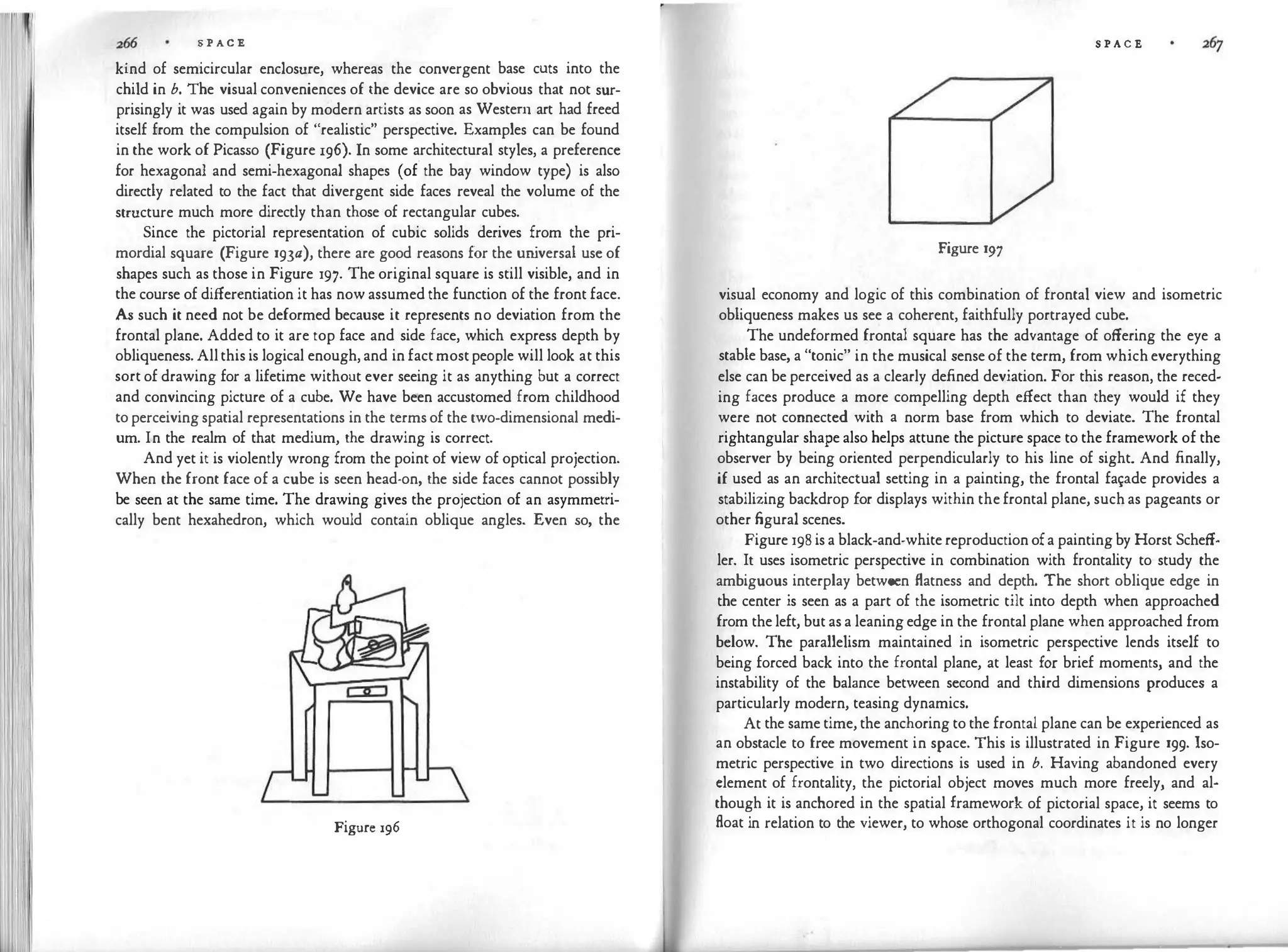
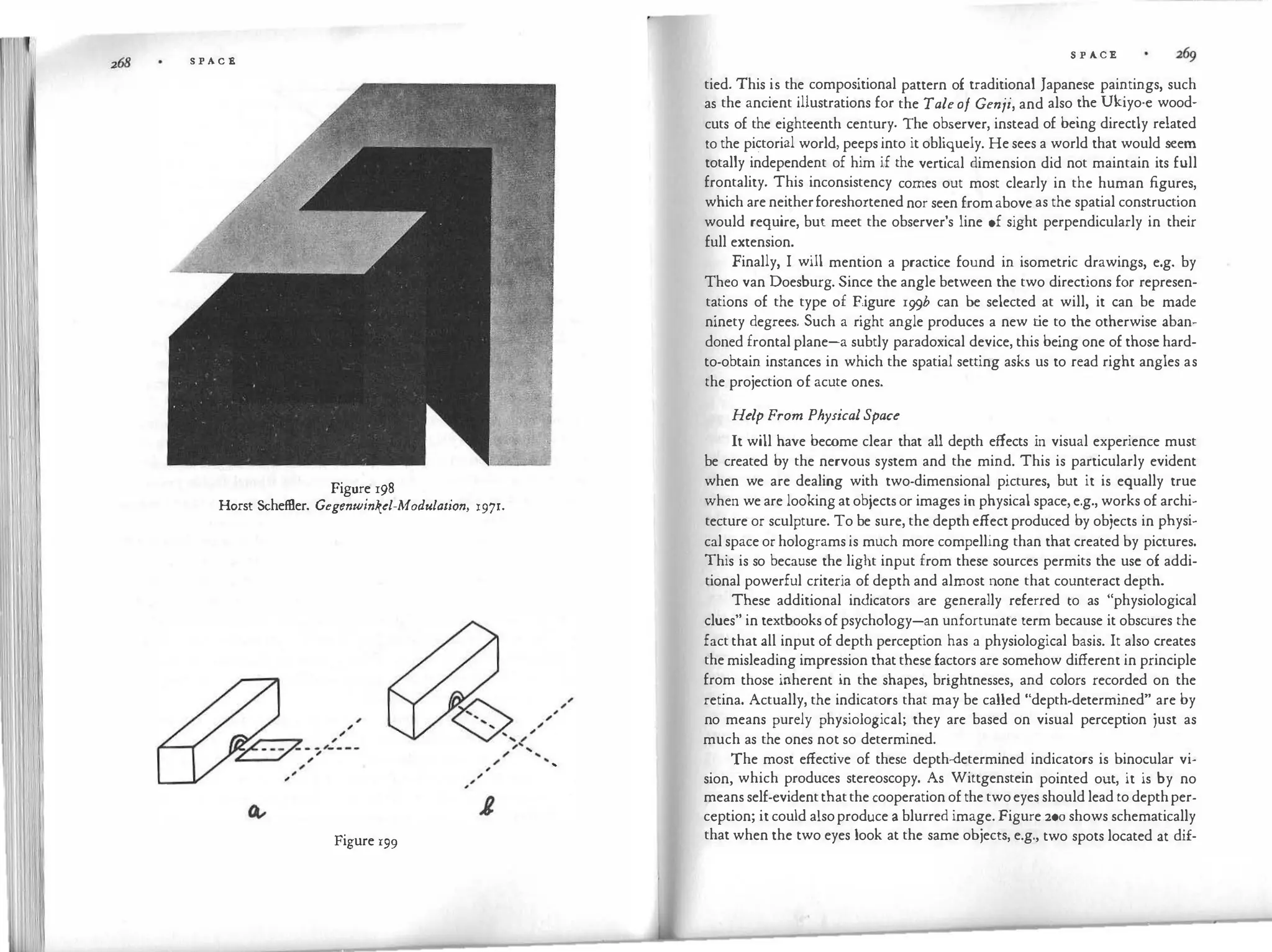
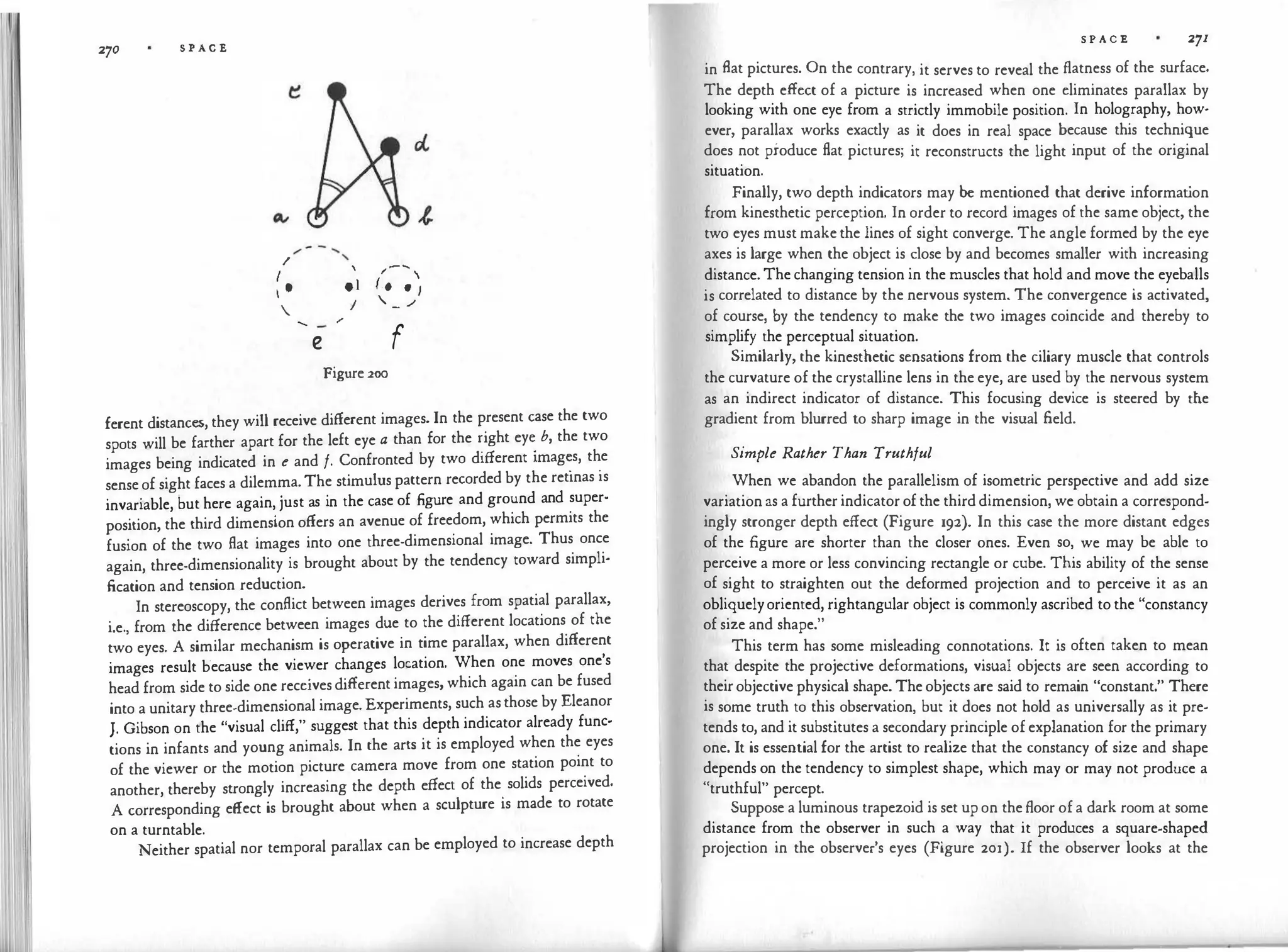
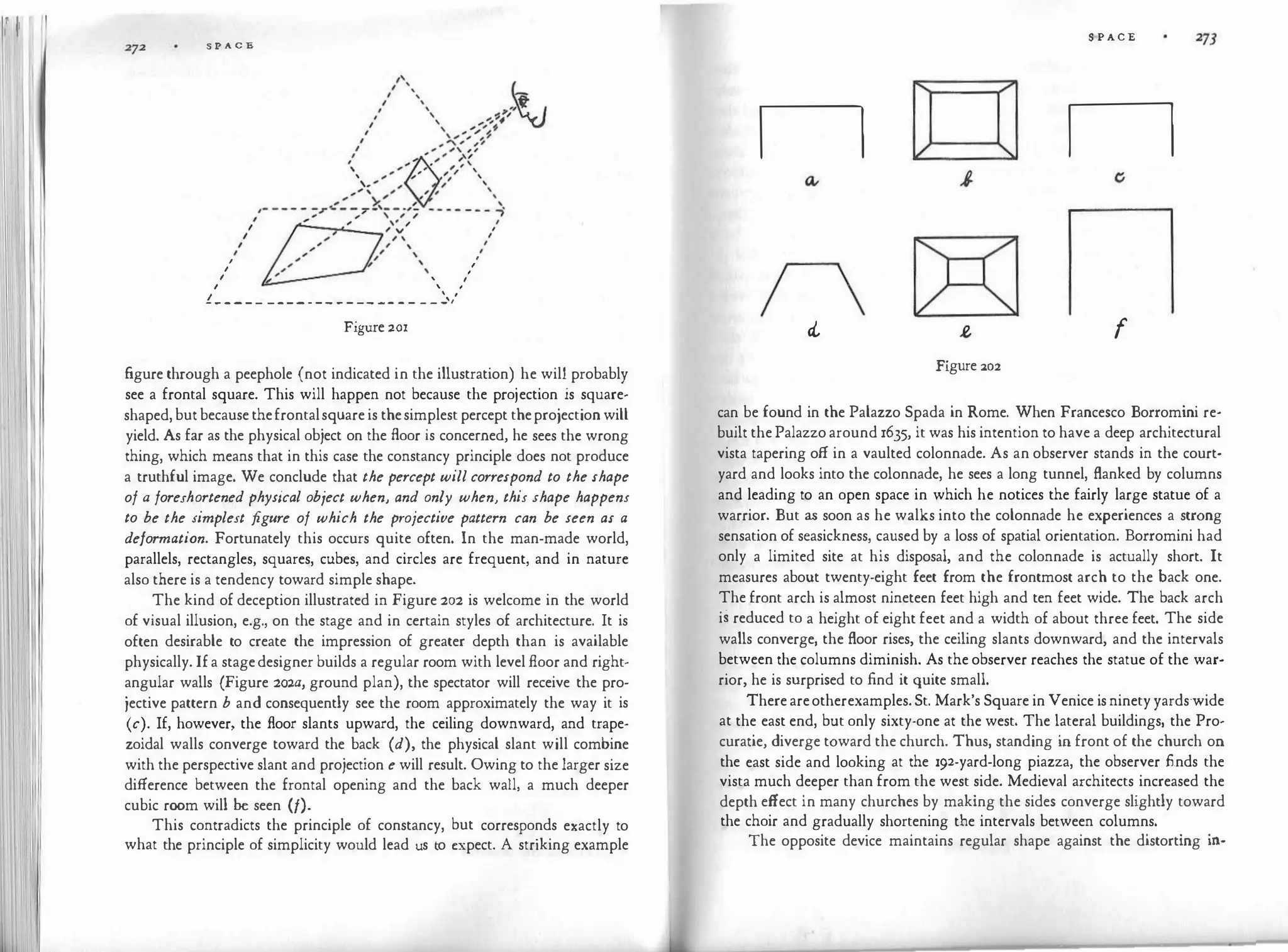
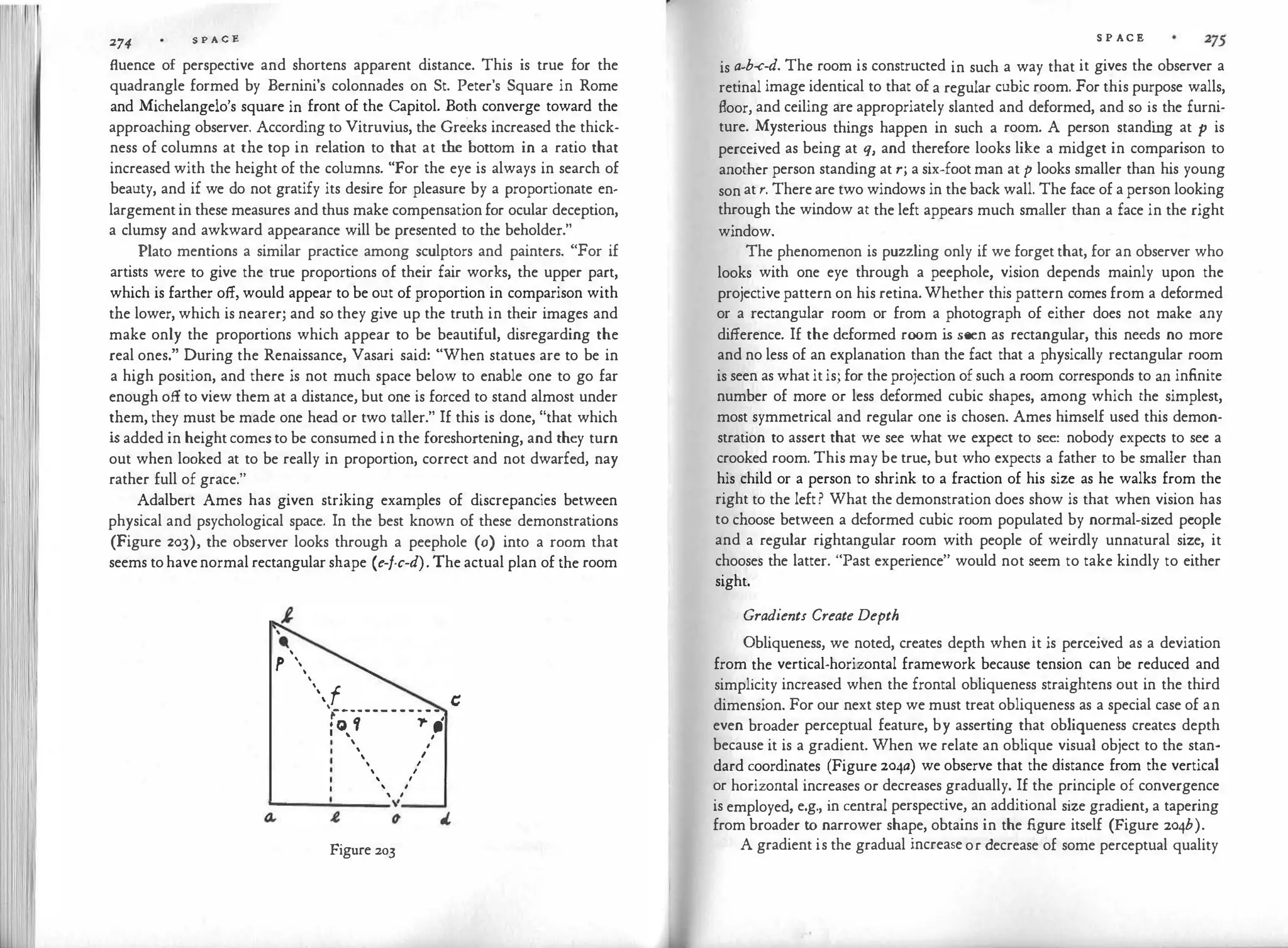
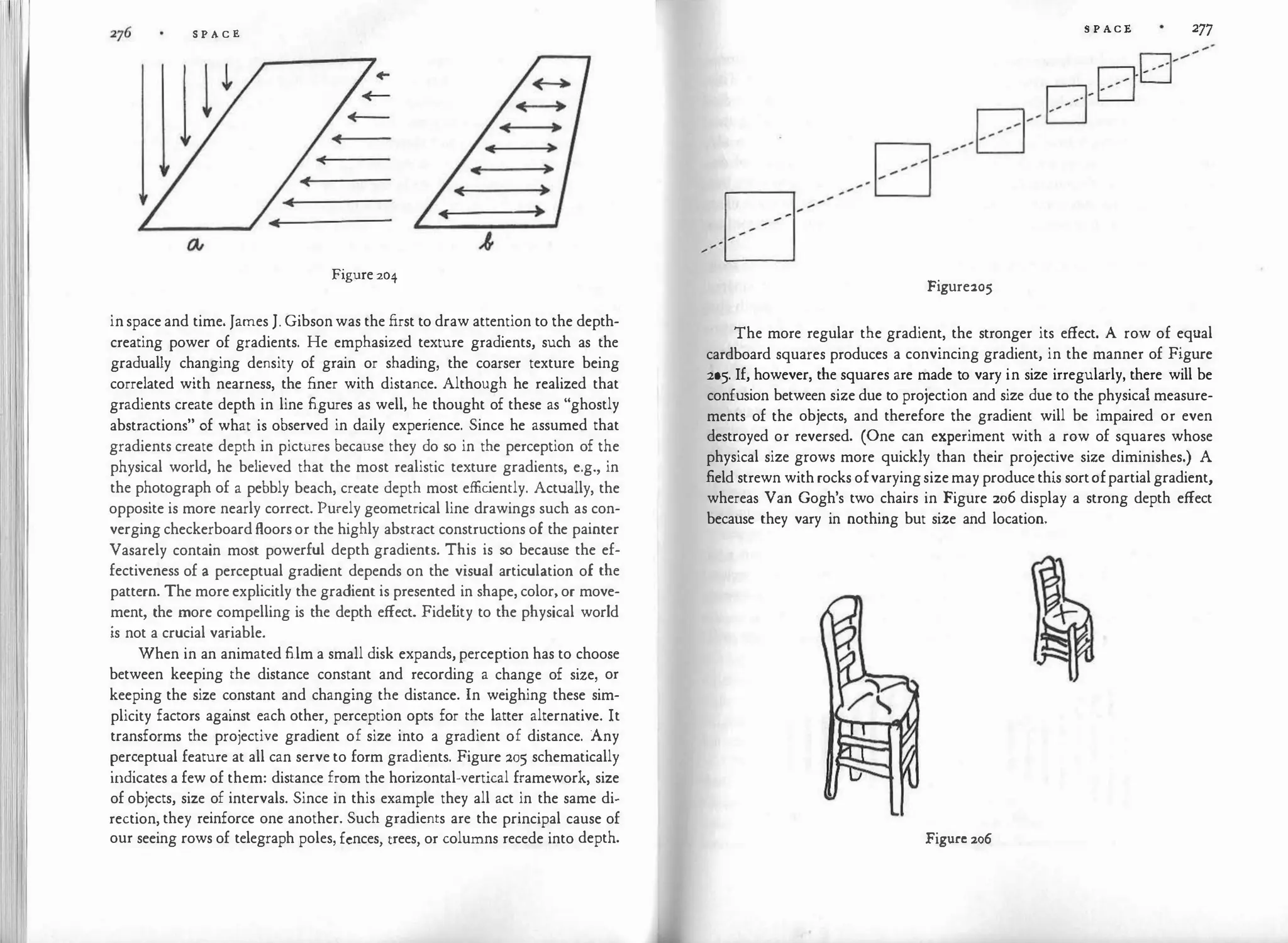
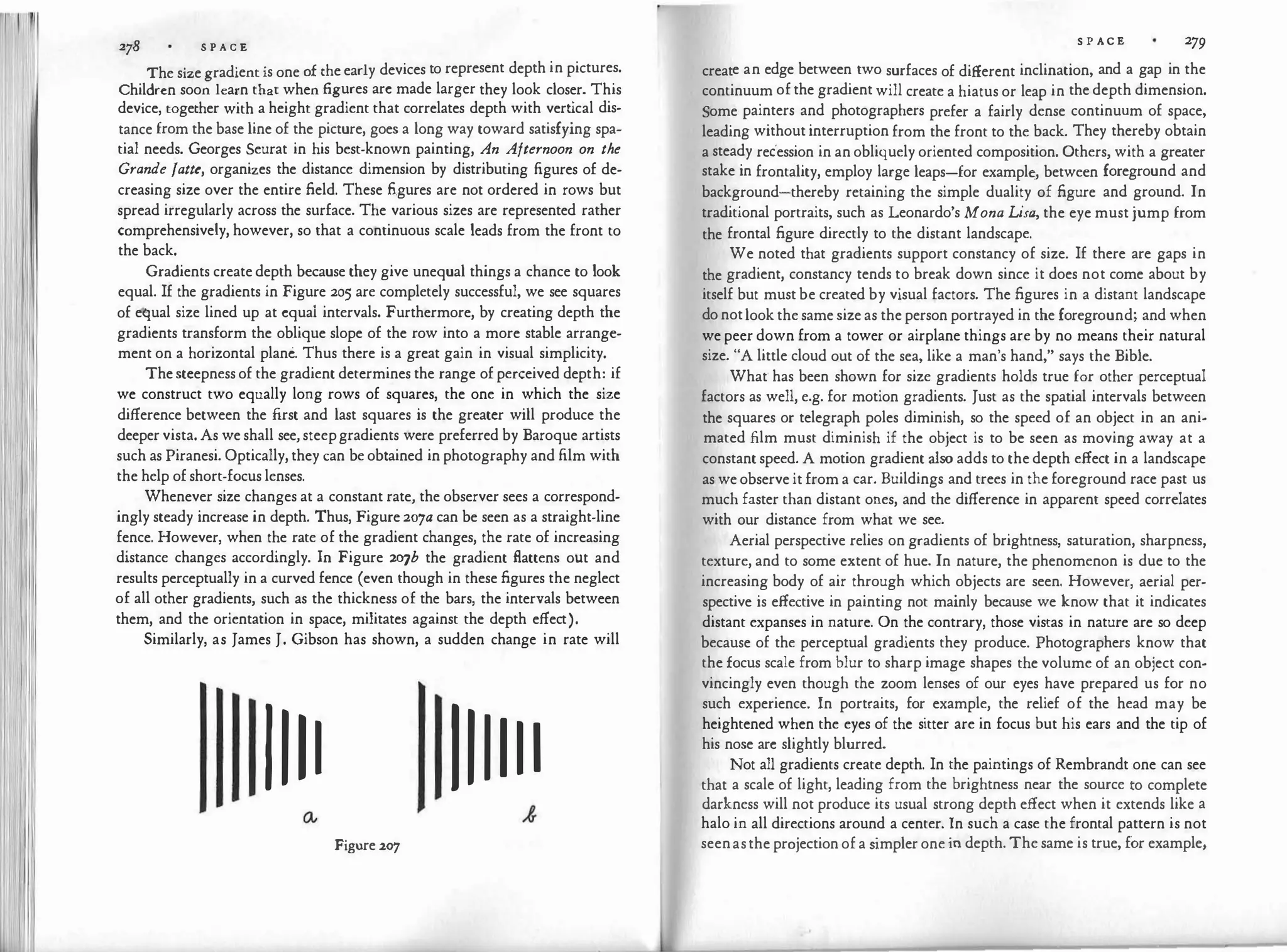
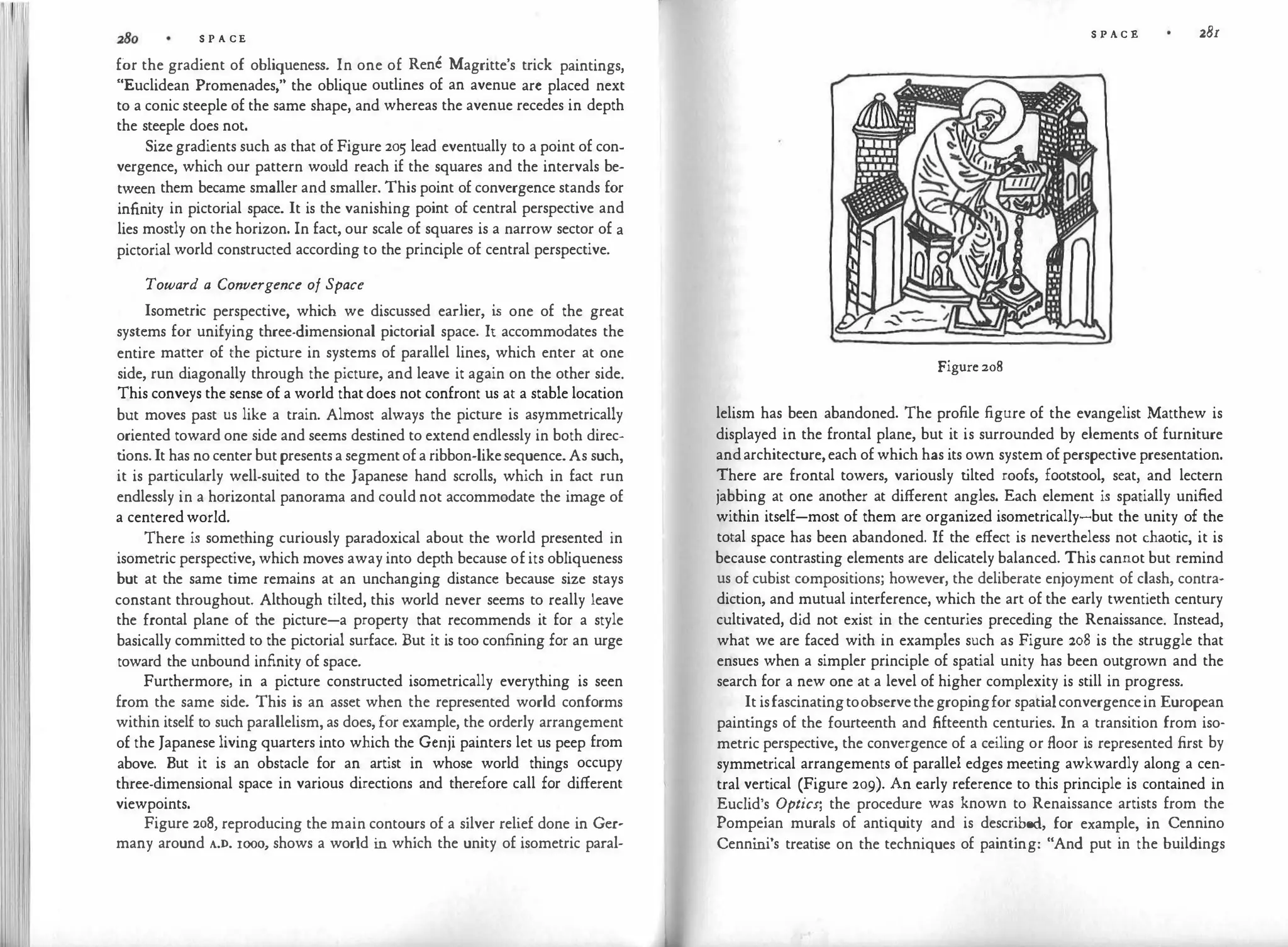
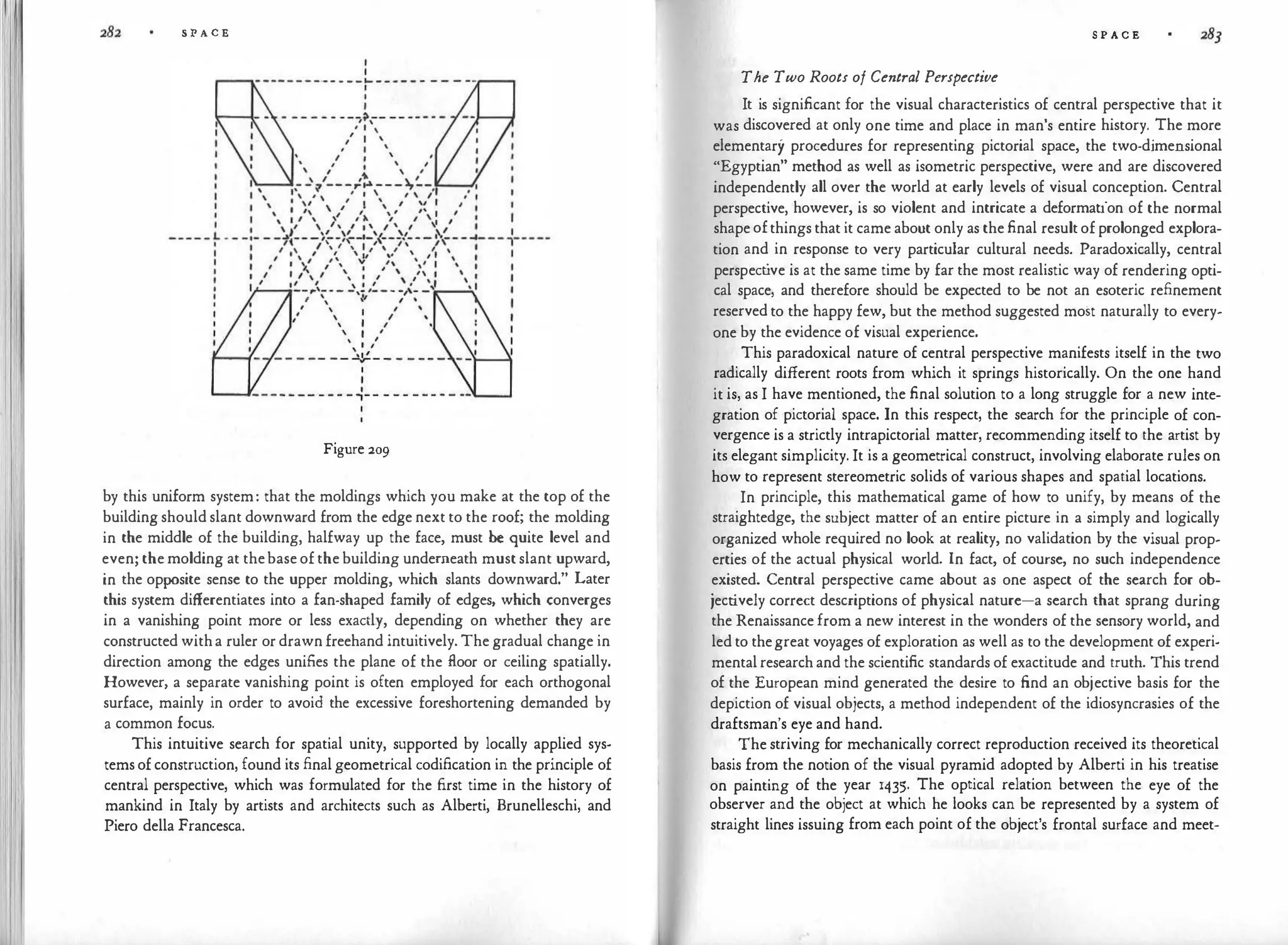
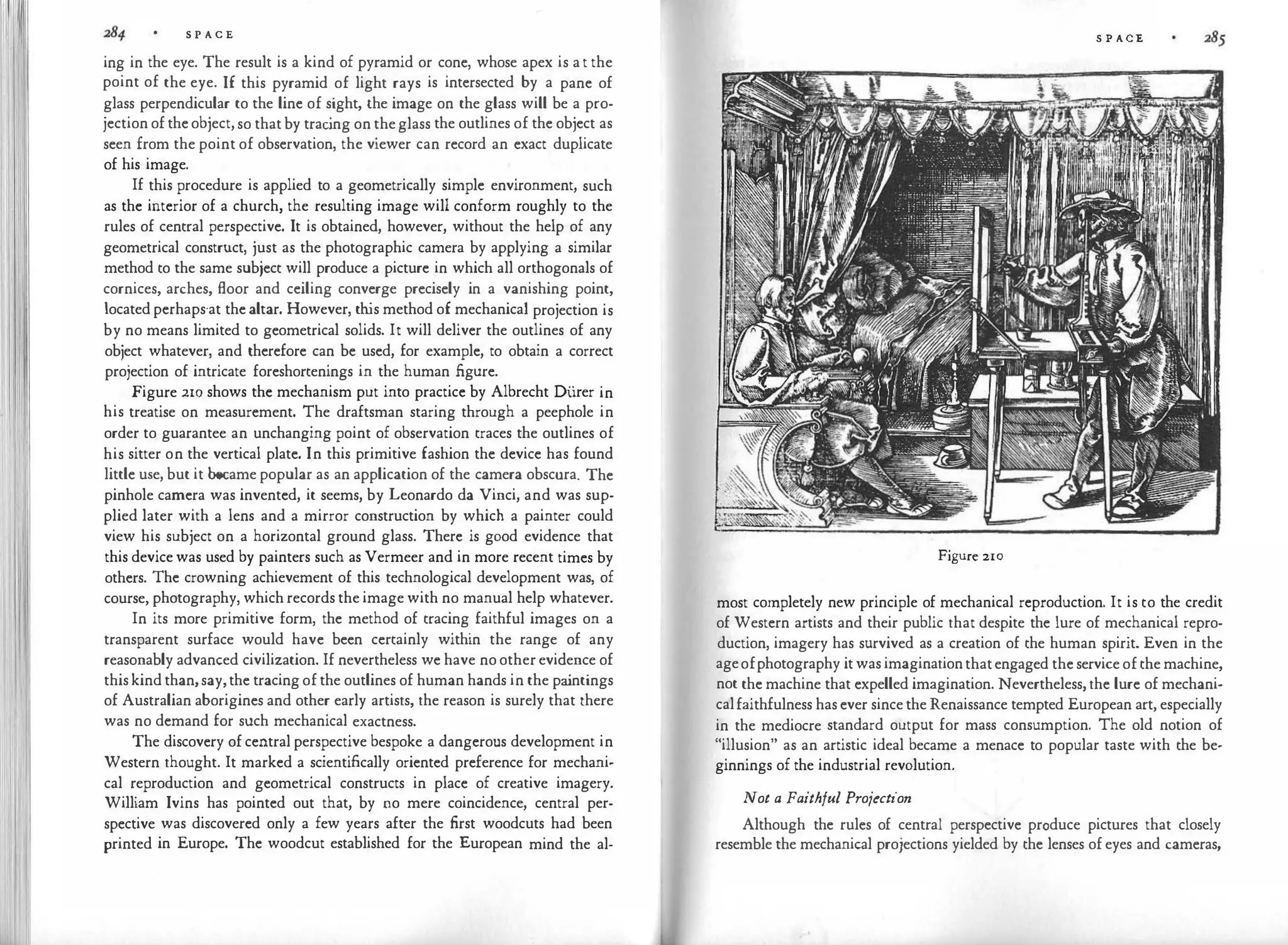
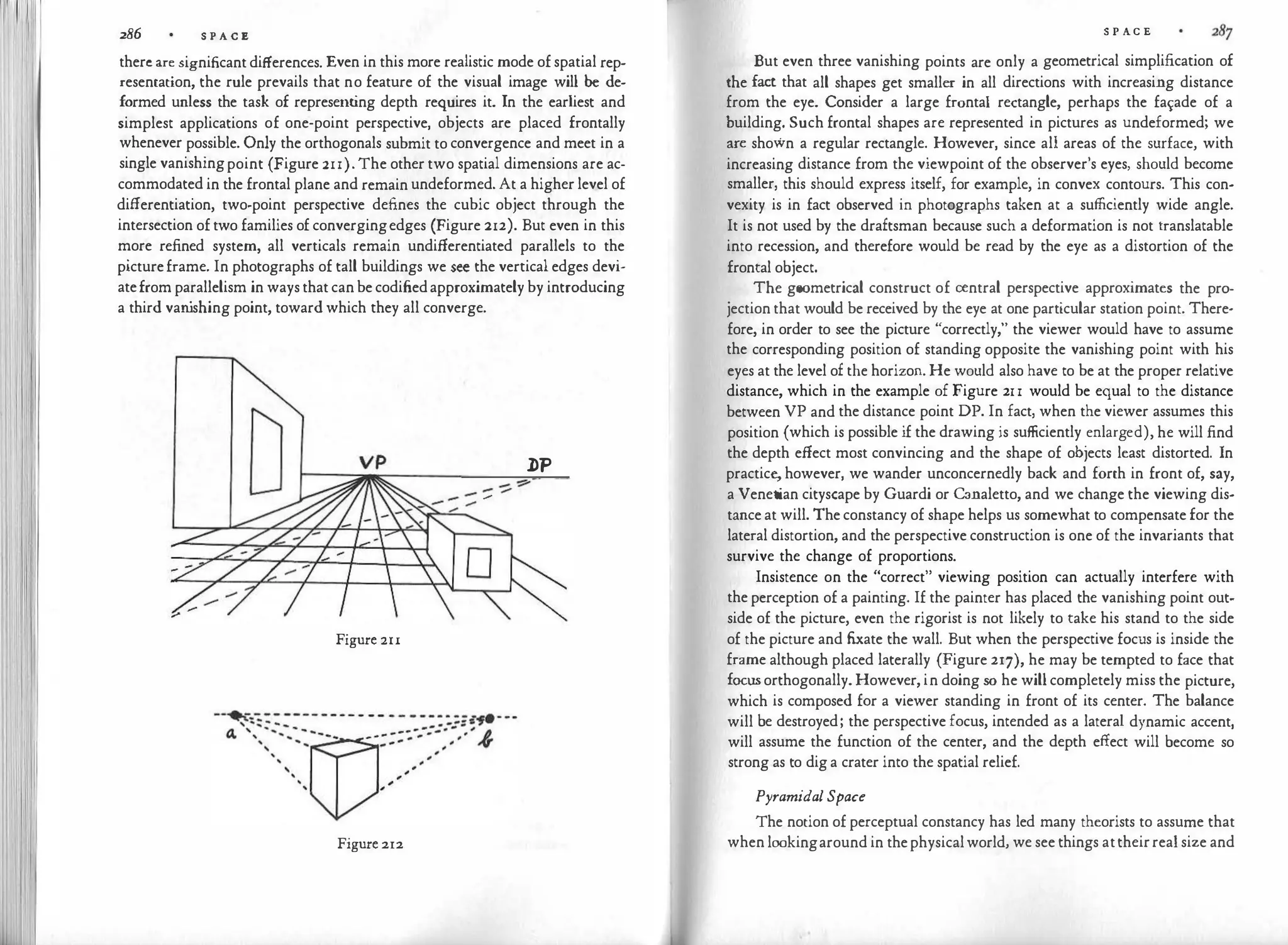
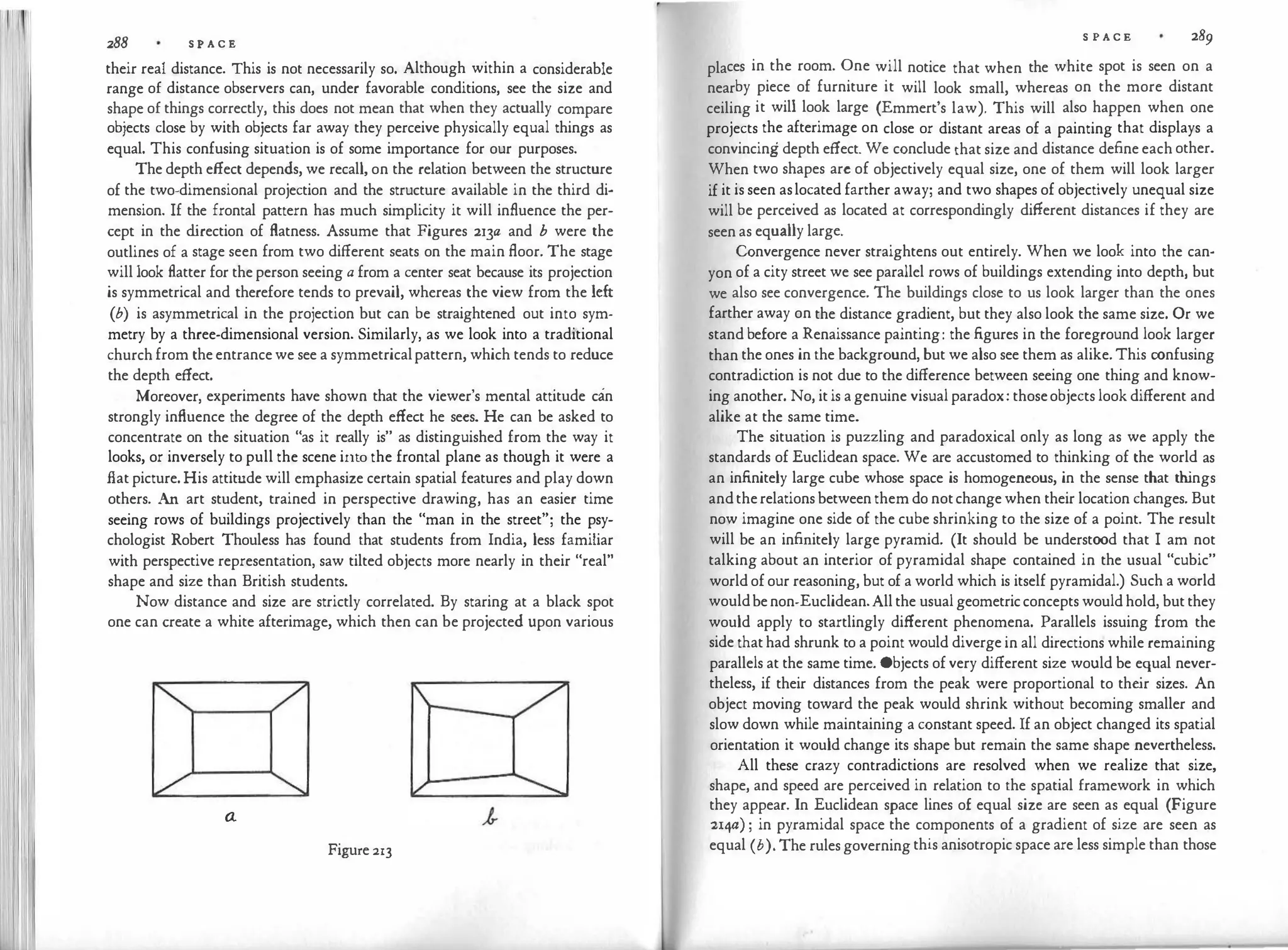
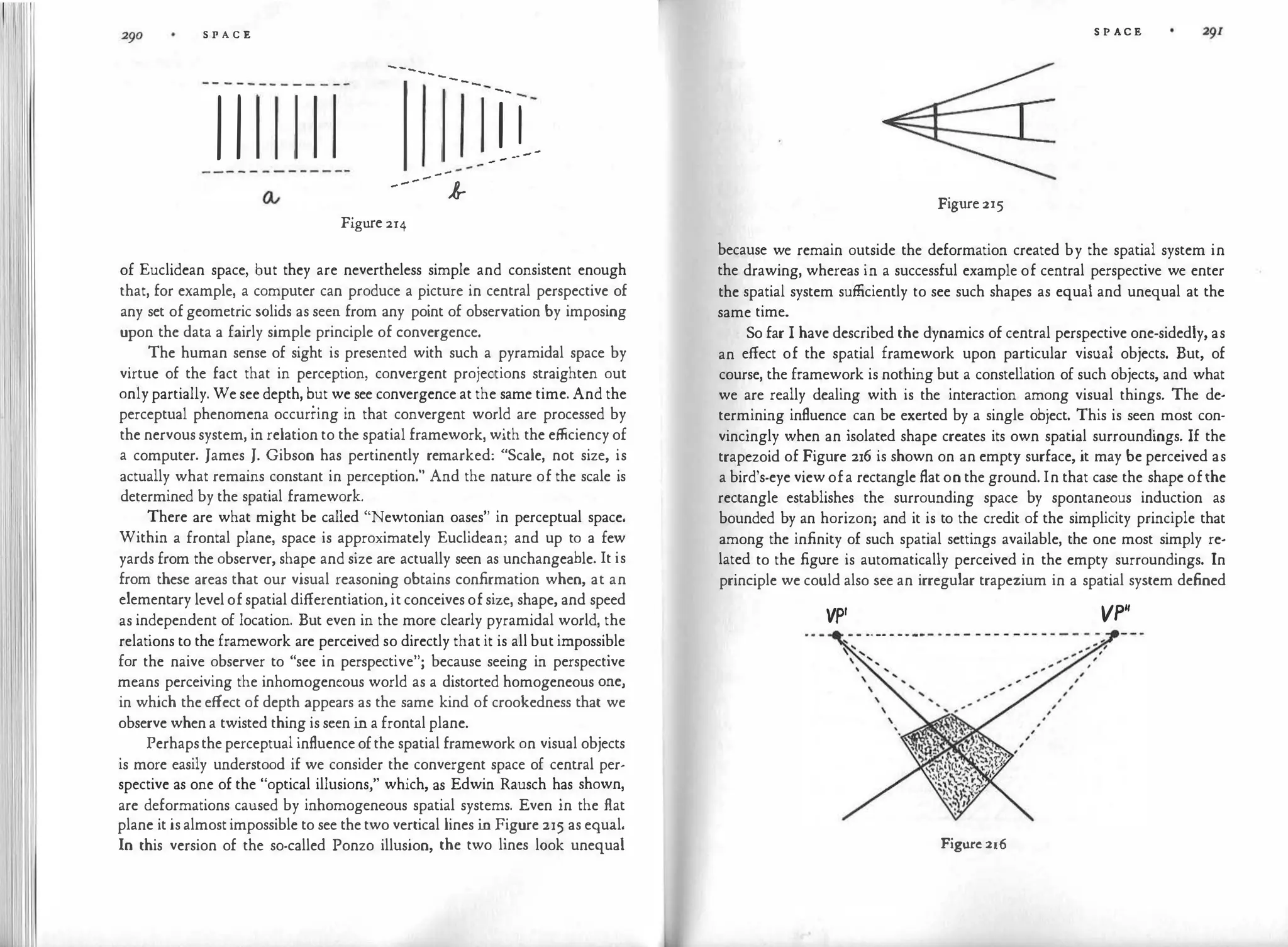
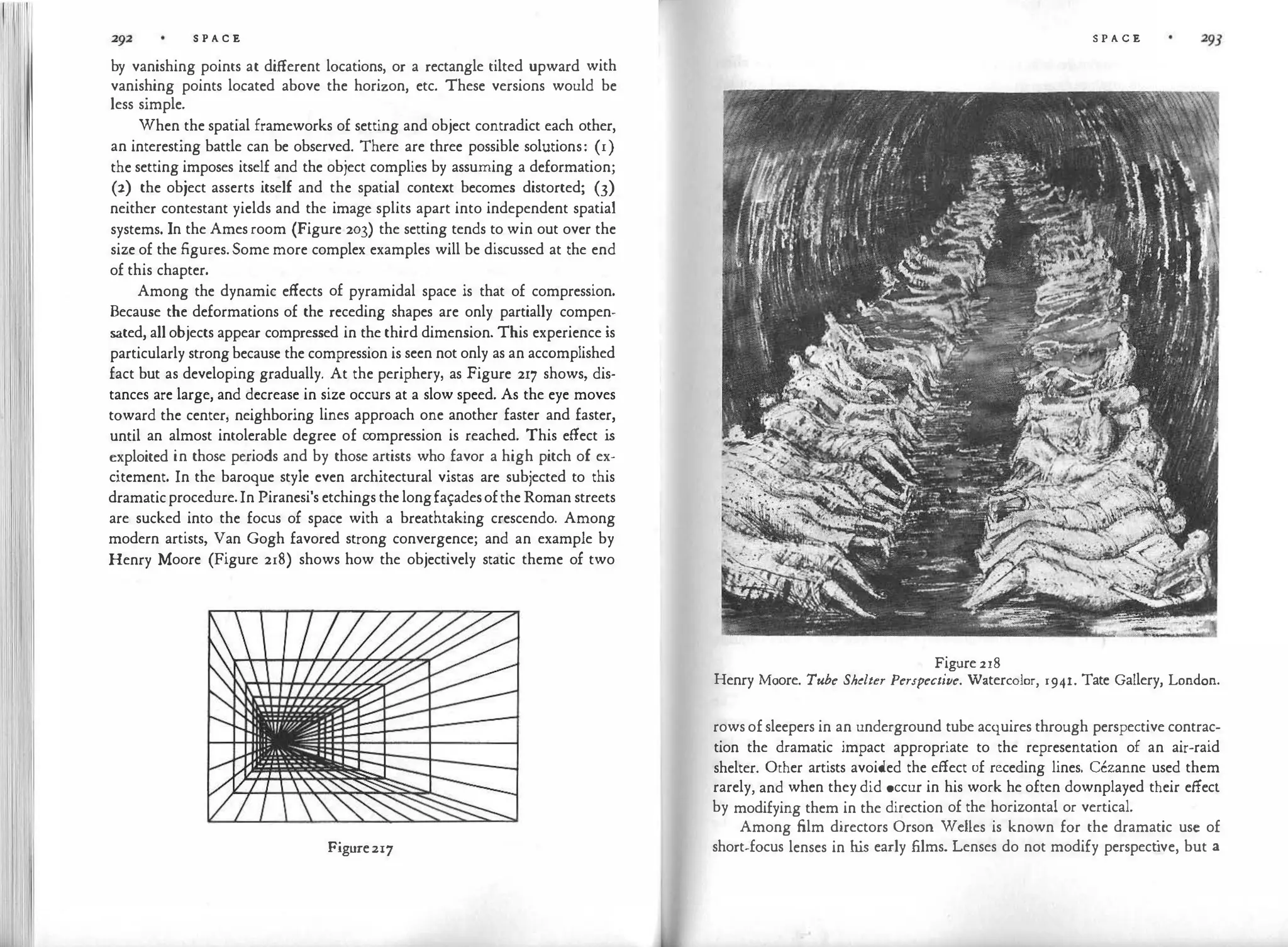
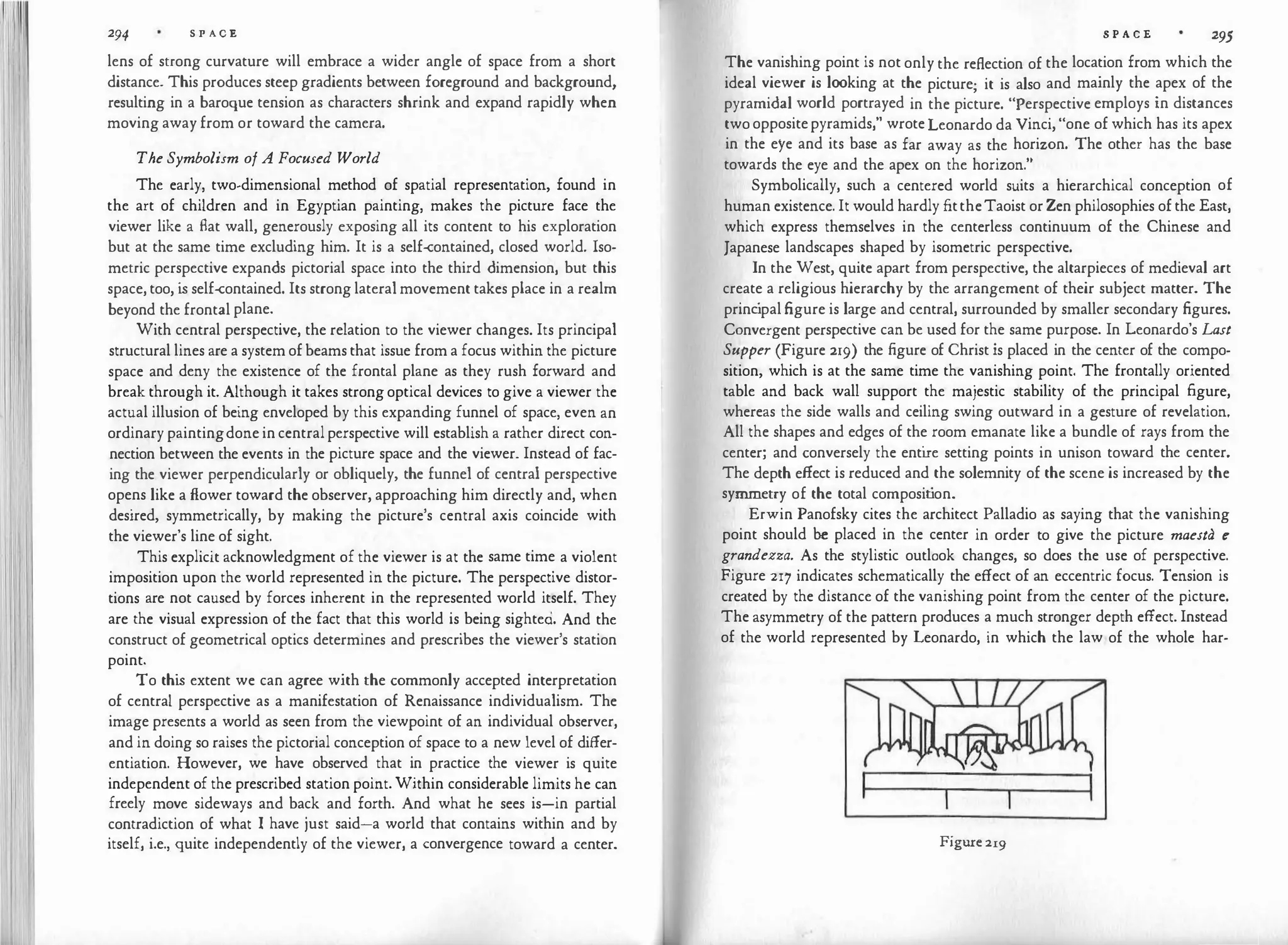
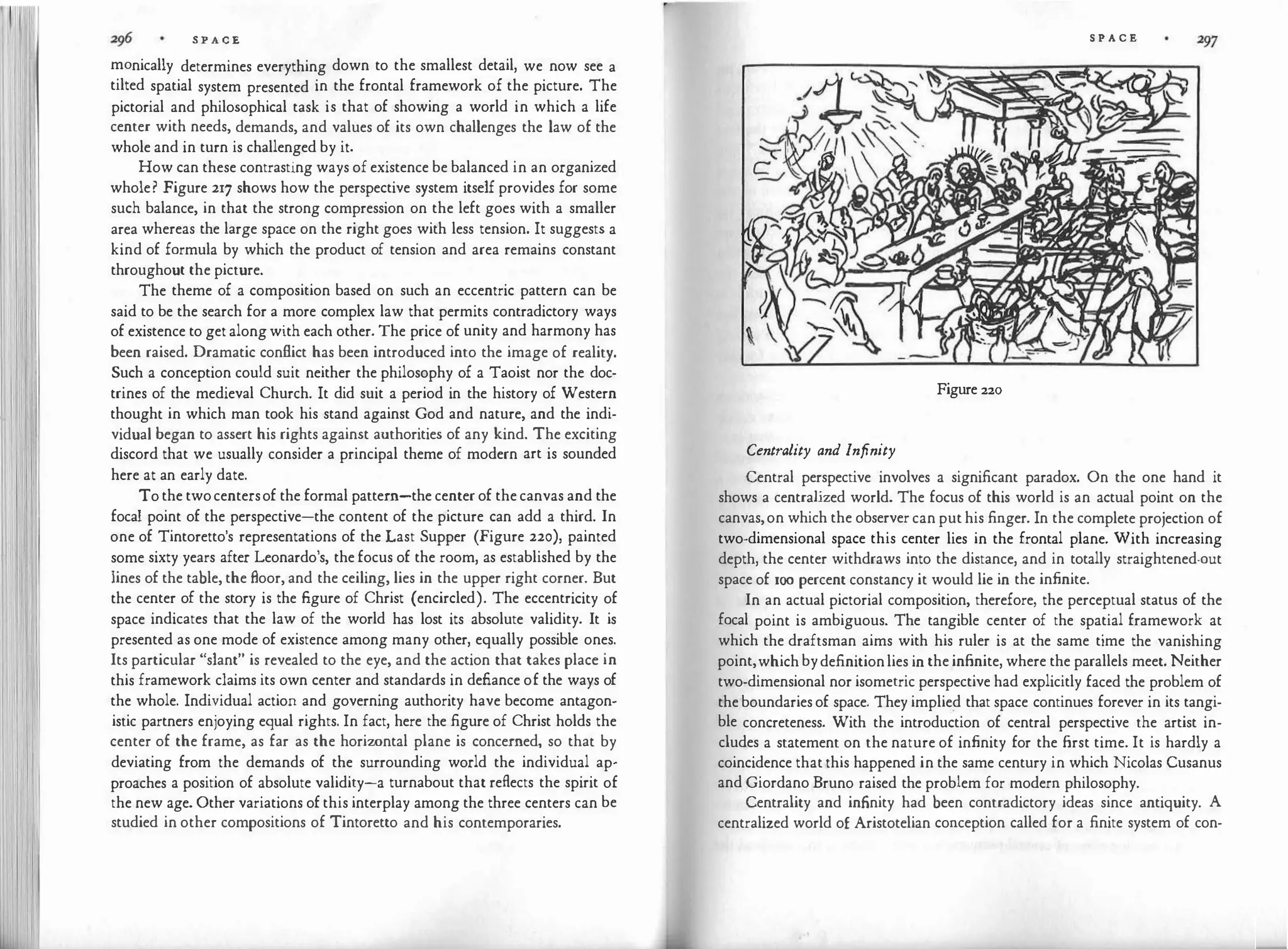
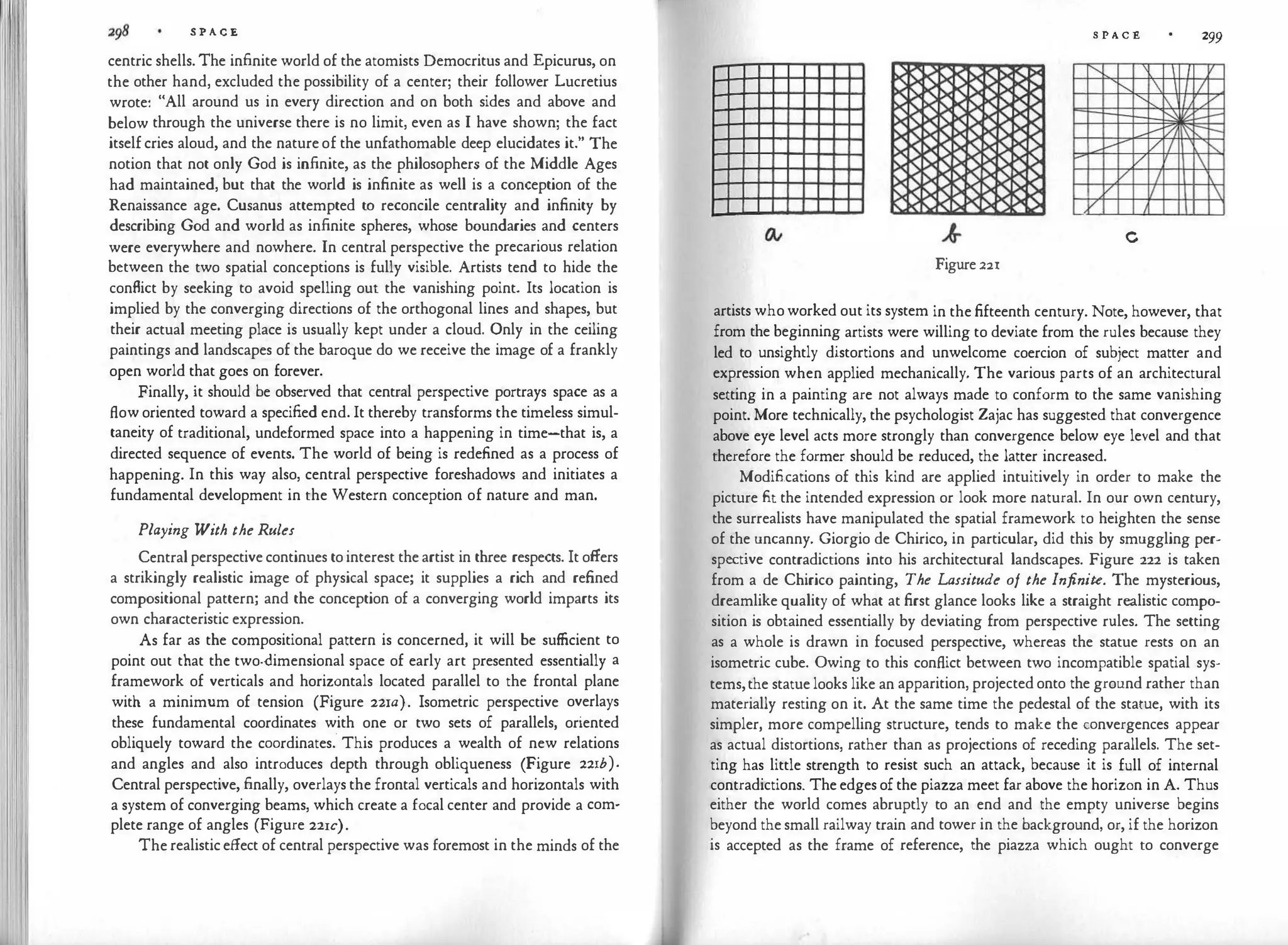
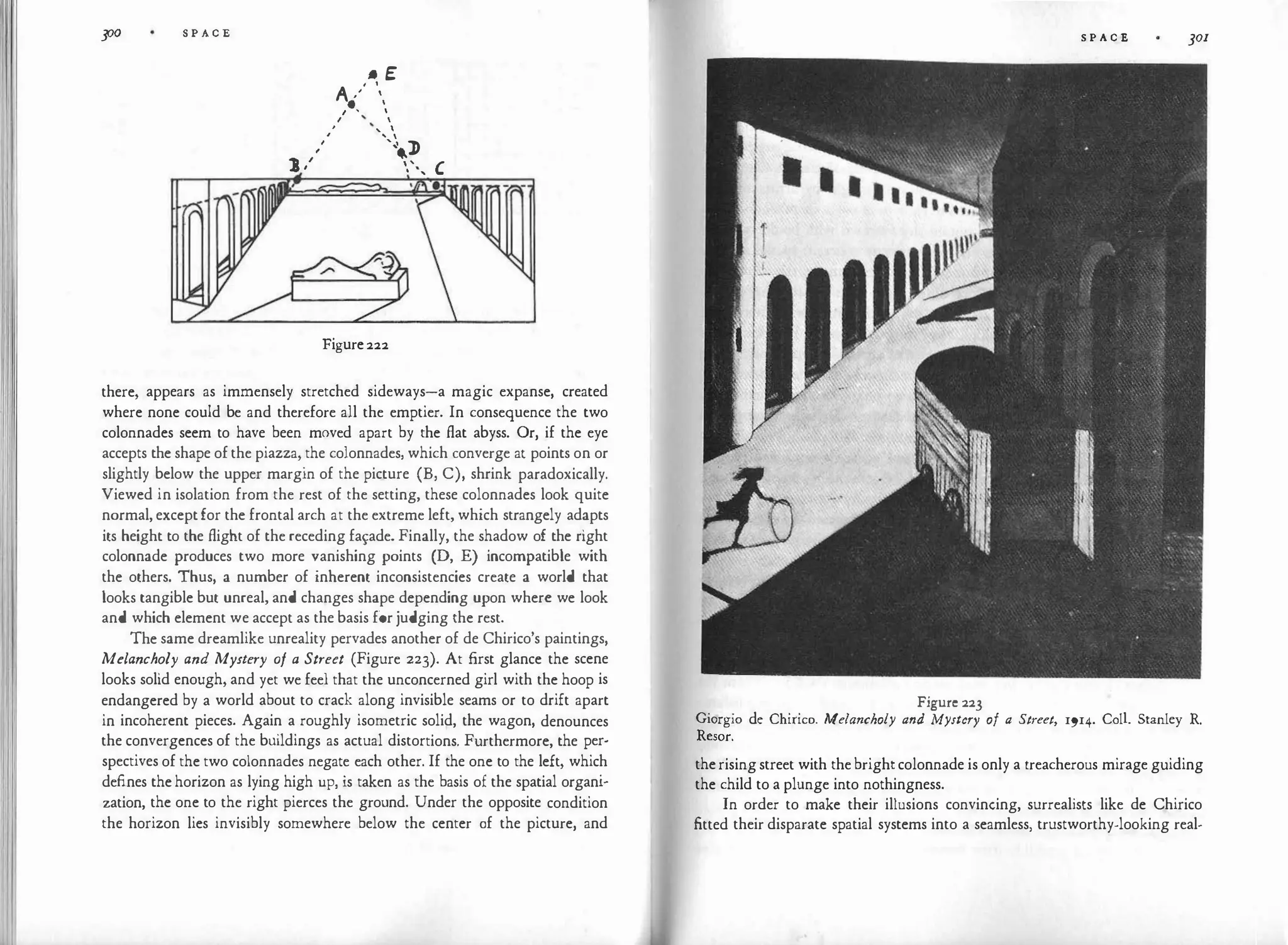
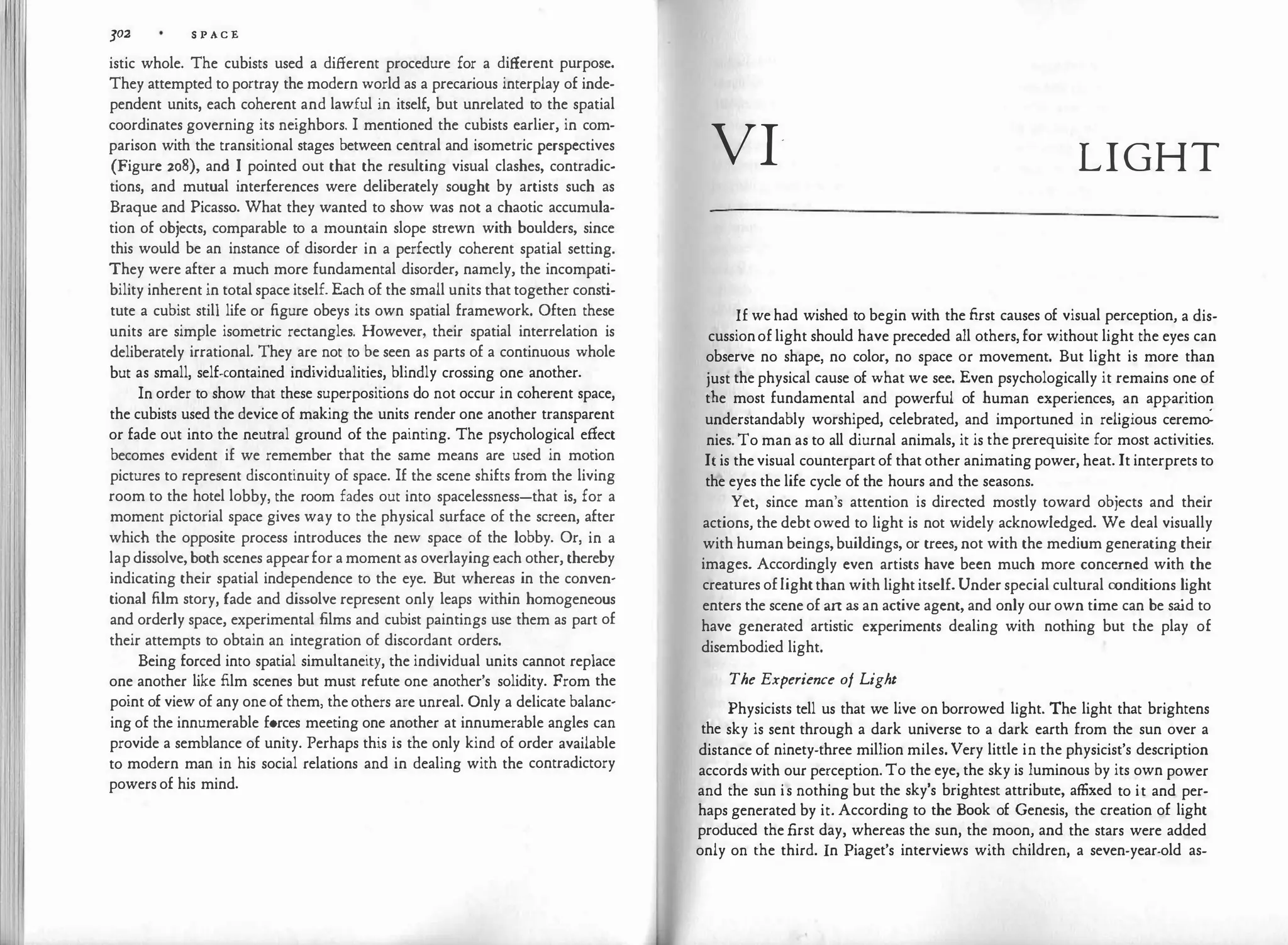
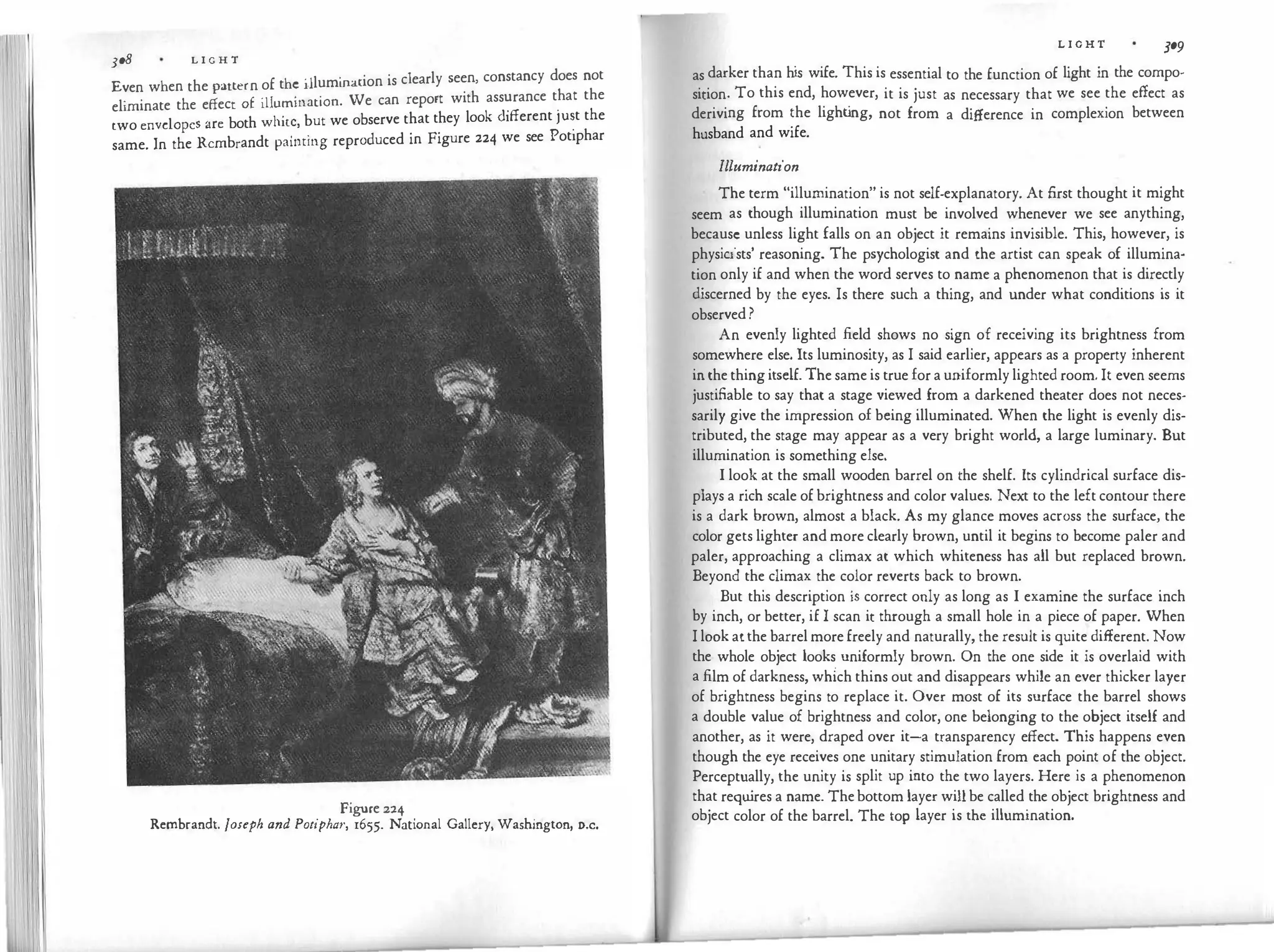
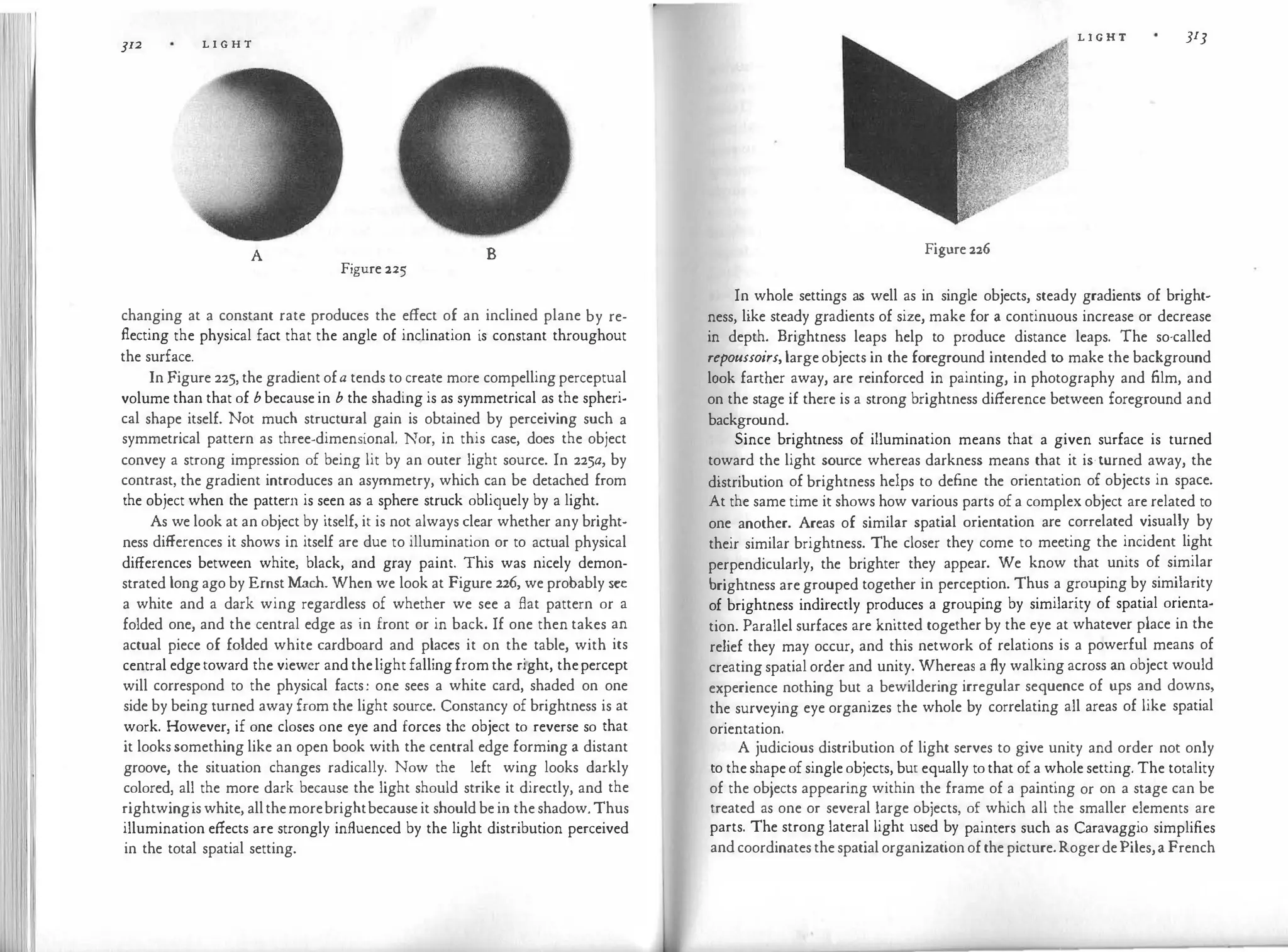
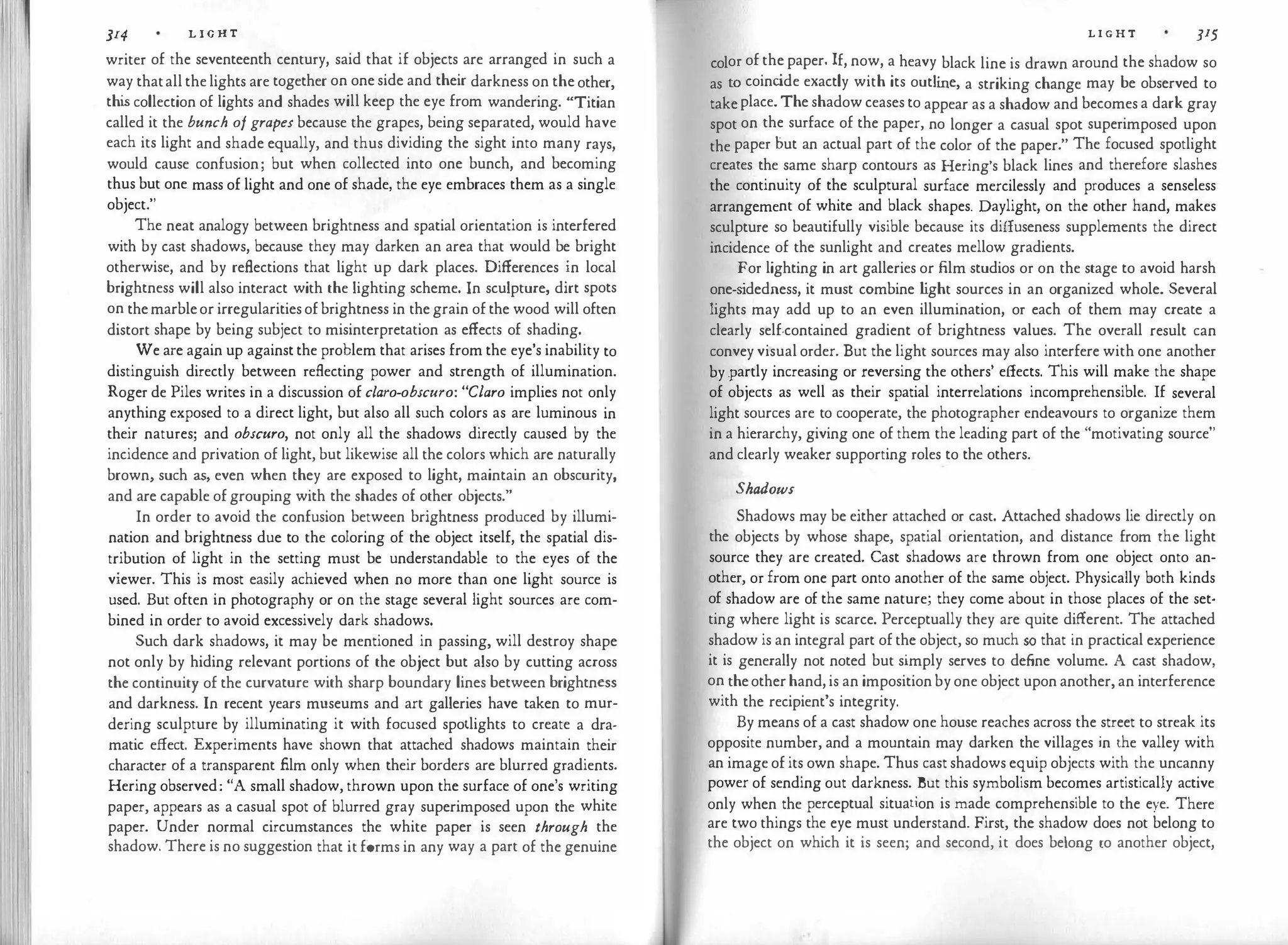
![]I6 L I G H T
which it does not cover. Often the situation is understood intellectually but
not visually. Figure 227 indicates the outlines of the two main figures of
Rembrandt's Night Watch. On the uniform of the lieutenant we see the
shadow of a hand. We can understand that it is cast by the gesticulat
ing hand
of the captain, but to the eyes the relation is not obvious. The shadow hand
has no meaningful connection to the object on which it appears. It may look
like an apparition from nowhere, because it acquires meaning only when
related to the captain's hand. That hand is some distance away; it is not
directly connected to the shadow, and, because of its foreshortening, is quite
different in shape. Only if (1) the beholder has a clear awareness, conveyed
to him by the picture as a whole, of the direction from which the light
is falling, and (2) the projection of the hand evokes its objective three
dimensional shape, can the hand and its shadow be truly correlated by the
eyes. Of course Figure 227 is unfair to Rembrandt in singling out two figures
and show
ing one shadow in isolation from the impressive display of light of
which it is a part. Nevertheless, shadow effects of this kind strain the capacity
for visual comprehension to its limit.
Cast shadows have to be used with caution. In the simplest cases they are
directly connected to the object from which they derive. The shadow of a man
meets his feet on the ground; and when the ground is even and the rays of
the sun fall at an angle of about forty-five degrees, the shadow will produce
an undistorted image of its master. This duplication of a living or dead thing
Figure 227
L I G H T JI7
by an object that is tied to it and imitates its motions and at the same time is
curiously transparent and immaterial has always attracted attention. Even
under optimal perceptual conditions, shadows are not spontaneously under
stood as an effect of lighting. It is reported that certain tribesmen of western
Africa avoid walking across an open square or clearing at noontime be
cause they are afraid of "losing their shadow," that is, of seeing themselves
without one. Their knowledge that shadows are short at noon does not imply
understanding of the physical situation. When asked why they are not equally
afraid when the darkness of the evening makes shadows invisible, they may
reply that there is no such danger in darkness, because "at night all shadows
repose in the shadow of the great god and gain new power." After the
nightly "refill" they appear strong and big in the morning-that is, daylight
feeds on the shadow rather than creating it.
Human thinking, perceptual as well as intellectual, seeks the causes of
happenings as close to the place of their effects as possible. Throughout the
world the shadow is considered an outgrowth of the object that casts it. Here
again we find that darknessdoes notappear as absence oflight but as a positive
substance in its own right. The second, filmy self of the person is identical
with or related to his soul or vital power. To step on a person's shadow is a
serious offense, and a man can be murdered by having his shadow pierced
with a knife. At a funeral, care must be taken to avoid having a living person's
shadow caught by the lid of the coffin and thus buried with the corpse.
Such beliefs must not be ignored as superstitions but accepted as indica
tions of what the human eye spontaneously perceives. The sinister appearance
of the ghostly darker self in the movies, on the stage, or in surrealist painting
keeps exercising its visual spell even on people who have studied optics in
school; and Carl Gustav Jung uses the term "shadow" for "the inferior and
less commendable part of a person."
As to the soberer properties of cast shadows, we note that, like attached
shadows, they define space. A shadow cast across a surface defines it as plane
and horizontal or perhaps as crooked and sloping; thereby it indirectly creates
space around the object by which it is cast. It operates like an additional object
creating a ground by lying on it. In Figure 228 the rectangle a lies flat on a
frontal plane or at least creates no articulate space around itself. In b there is
a clearer detachment from the ground, partly because of the contrast created
by the black bar and partly because the obliqueness of the small edge suggests
depth. But on the whole, b shows much less three-dimensionality than c or d,
for the reason thatthe rectangular pattern formed by the bar and its shadow is
simple and stable and can hardly be further simplified by more depth. In c](https://image.slidesharecdn.com/arnheimrudolfartandvisualperception1974-251210161854-a75a3f61/75/Art-and-Visual-Perception-A-PSYCHOLOGY-OF-THE-CREATIVE-EYE-165-2048.jpg)
![I
I
]18 L I G H T
Figure228
the three-dimensional version eliminates an oblique angle and allows the black
bar to be seen as a complete rectangle. In d the shadow converges-an addi
tional distortion, which makes straightening-out by depth even more com
pelling. In other words, the solid and its shadow function as one object, to
which the rules for the spatial appearance of objects apply. Figure 229 shows
how effectively shadows create space by defining the difference between ver
tical and horizontal and by contributing to the size gradients of convergent
perspective.
A word about the convergence of shadows. Since the sun is so far away
that within a narrow range of space its rays are practically parallel, its light
produces an isometric shadow projection; that is, lines that are parallel in the
object are also parallel in the shadow. But like any perceived thing a shadow
is subject to perspective distortion, and therefore will be seen as converging
from its base of contact with the object when it lies behind the object and as
diverging when it lies in front of it. In add
ition, a near source of light, such as
a lamp or a fire, will produce a pyramidal family of rays and consequently
shadows of divergent physical shape. This objective divergence will be either
increased, or compensated by perspective, depending upon the position of the
shadow in relation to the observer.
Figure 230 shows that illumination adds the effects of another pyramidal
system to those resulting from the convergence of shape. Just as the shape of
the cube is deformed because itsphysically parallel edges meet in a vanishing
point, so the shape of its cast shadow is deformed by converging toward an
other focusing point, created by the location of the light source. Illumination
also distorts the homogeneous local brightness of the cube by darkening parts
of its surface with attached shadows. In both perspective and illumination the
structure of the distorting system is simple enough in itself to be distinguished
by the eye from the constant properties of the object. The result is a two-fold
visual subdivision. Both the shape and the local brightness of the object are
L I G H T 319
Figure 230
Figure229](https://image.slidesharecdn.com/arnheimrudolfartandvisualperception1974-251210161854-a75a3f61/75/Art-and-Visual-Perception-A-PSYCHOLOGY-OF-THE-CREATIVE-EYE-166-2048.jpg)
![rI !I
]20 L I G H T
distinguished by the eyes from modifications imposed by spatial orientation
and illumination.
Not only do the brightness patterns of shading get entangled with the
brightness and darkness values of the object itself, but they also interfere with
the clarity of the object's local colors and their interrelations. When painters
began to create volume and space by means of illumination effects, this tech
nique of chiaroscuro was soon found to disturb color composition. As long as
shadows were conceived as app l
ications of monochromatic darkness, they
inevitably muddied and obscured the colors and thereby not only tampered
unattractively with the saturation of the colors, but also dulled their identity.
A blue coat shaded with black no longer looked truly blue and lost the simple
homogeneity of its local color; an arm or leg underlaid with dark paint neither
looked the color of skin nor presented a good, clear hue of pink.
It is quite possible that Leonardo da Vinci, whom Heinrich Wolfflin has
called the father of chiaroscuro, was unable to complete some of his paintings
becausethe desire to producestrong spatial relief by shading coincided in time
with a new sensitivity to color organization. The unification of the two com
peting systems of pictorial form came gradually. Shadow was redefined as a
modification of hue-a development that led from Titian by way of Rubens
and Delacroix to Cezanne. "Light does not exist for the painter," wrote
Cezanne to Emile Bonnard. In our own century, the color style of the Fauves
often eliminated the problem by omitting all shading and by composing with
saturated hues.
Painting without Lighting
Although the painter who uses effects of illumination is very much aware
of their power, the influence of light and shadow is experienced in everyday
life mostly in very practical ways. The seeking or avoidance of light is com
mon at all levels of the animal world, and in the same way man seeks the
light when he wants to see or be seen and avoids it otherwise. For these practi
cal purposes, however, light is merely a means of dealing with objects. Light
and shadow are observed, but hardly consciously for their own sake. They
define the shape and spatial position of things and are consumed in this
service. The naive observer is unlikely to mention them when asked to give
a carefully detailed description of what he sees; he assumes that he is being
asked about objects and their adherent characteristics.
Ernst Mach reports: "In my earliest youth the shadows and lights on
pictures appeared to me as spots void of meaning. When I began to draw I
regarded shading as a mere custom of artists. I once drew the portrait of our
L I G H T ]21
pastor, a friend of the family, and shaded, from no necessity, but simply from
having seen something similar in other pictures, the whole half of his face
black. I was subjected for this to a severe criticism on the part of my mother,
and my deeply offended artist's pride is probably the reason that these facts re
mained so strongly impressed upon my memory." Early art everywhere repre
sents objects by their outlines, local brightness and local color, and some cul
tures have retained this practice even at high levels of refinement. In the art
work of young children, brightness values serve mostly to mark differences.
Dark hair may be set off against a bright face. Light sources, such as the sun
or a lamp, are often shown as sending out rays, but no indication is given
that it is these rays which make objects visible. The same is true for early
Egyptian painting. On Greek vases figures are detached from the background
by strong contrast, but these differences appear as the result of object brightness
or darkness, not of illumination. Literary sources indicate that in the course
of the centuries Greek painters learned the use of shadows, and the results of
these discoveries can be seen in the Hellenistic wall pictures or the Egyptian
mummy portraits around the second and first centuries B.c. Here the chiaros
curo was handled with a virtuosity not rediscovered until the late Renaissance.
As the need to convey the roundness of solids arises, shading is introduced,
later complemented by heightening. In physical space these effects are pro
duced by illumination. But the use of shading does not necessarily originate
from the observation of nature, and certainly is not always used in accordance
with the rules of illumination. Rather, we can assume that after working for
a while with the perceptually simpler means of line contour and homogene
ously colored surfaces, the painter will discover the spatial virtues of unevenly
distributed brightness. The perceptual effect of gradients becomes apparent
to the eyes. Dark shading will make the surface recede toward the contours.
Highlights will make it protrude. These variations are used to create round
ness or hollowness; they do not necessarily imply a relation to a light source.
Often the distribution of "shadows" follows different principles. Shading may
issue from the contour all around the pattern, and give way gradually to
lighter values toward the center. In the symmetrical compositions of medieval
painters the figures at the left often have their highlights on the left side, those
on the right on the right side; or in the laterally foreshortened faces the larger
half may always appear bright, the narrower dark. Thus, in adapting itself to
the requirements of composition and shape, brightness is often distributed in
a way that would be termed incorrect if judged by the laws of illumination.
The same is true when brightness differences are used to detach over
lapping objects from each other. When a depth interval between objects of](https://image.slidesharecdn.com/arnheimrudolfartandvisualperception1974-251210161854-a75a3f61/75/Art-and-Visual-Perception-A-PSYCHOLOGY-OF-THE-CREATIVE-EYE-167-2048.jpg)
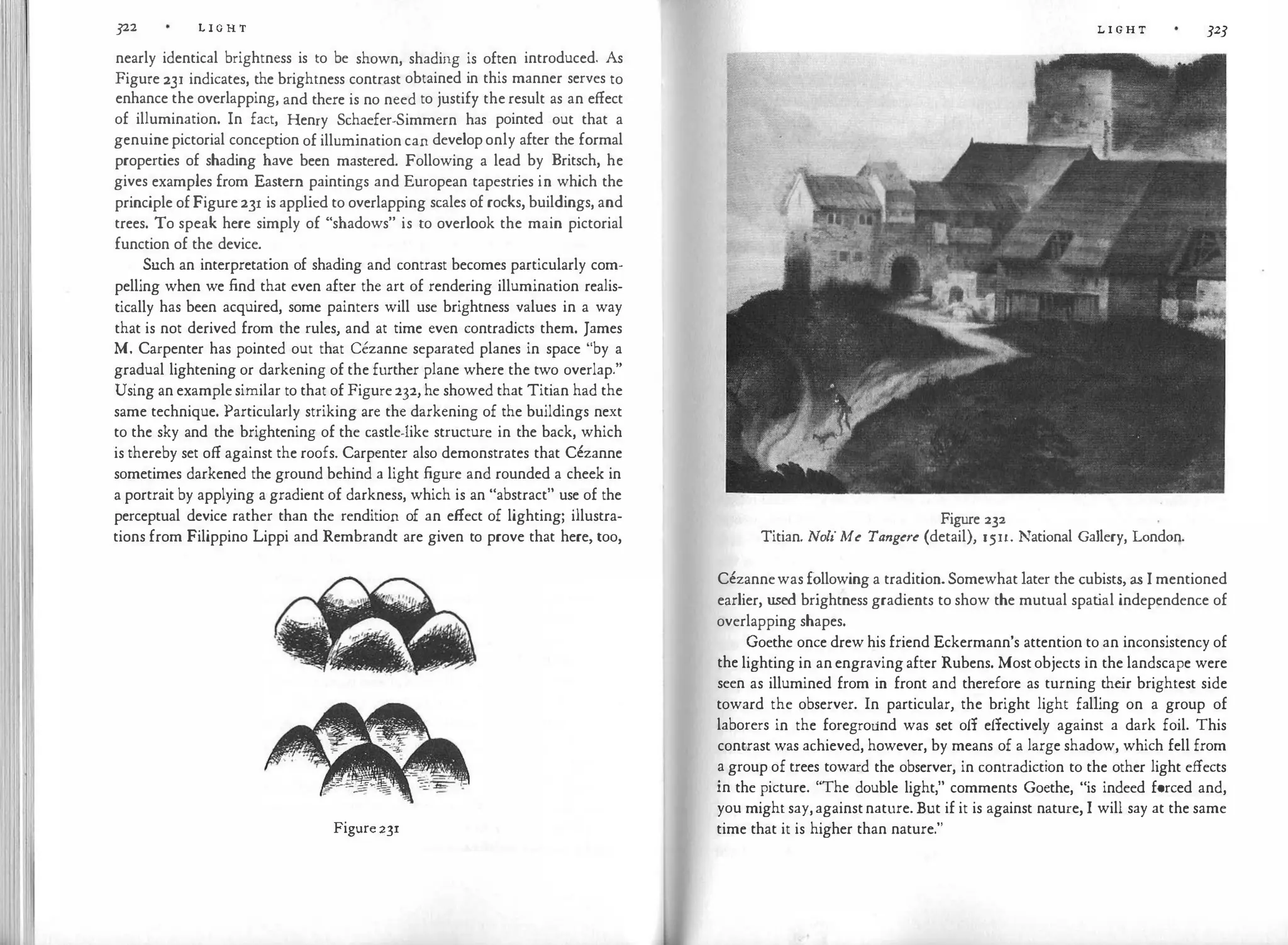
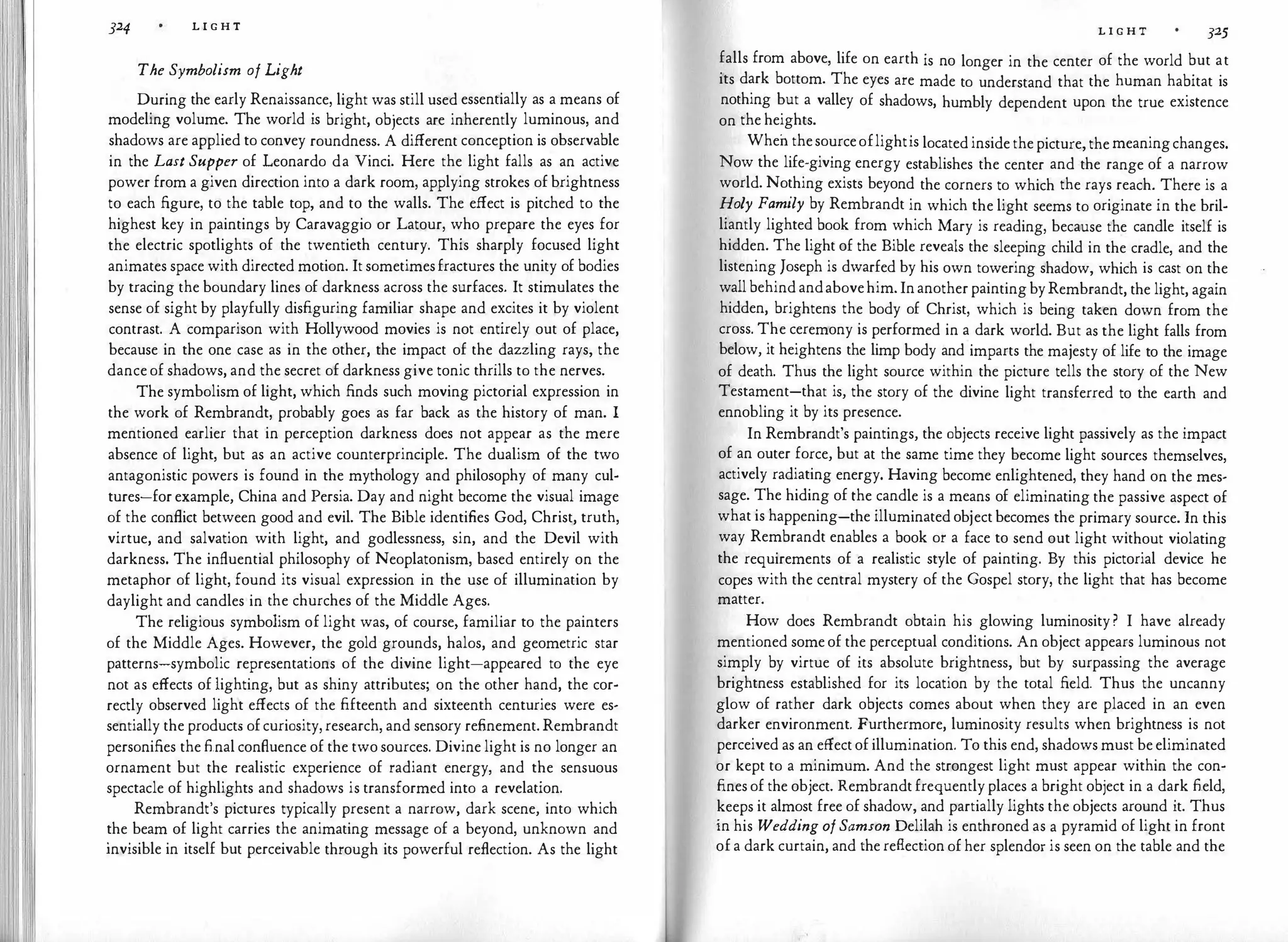
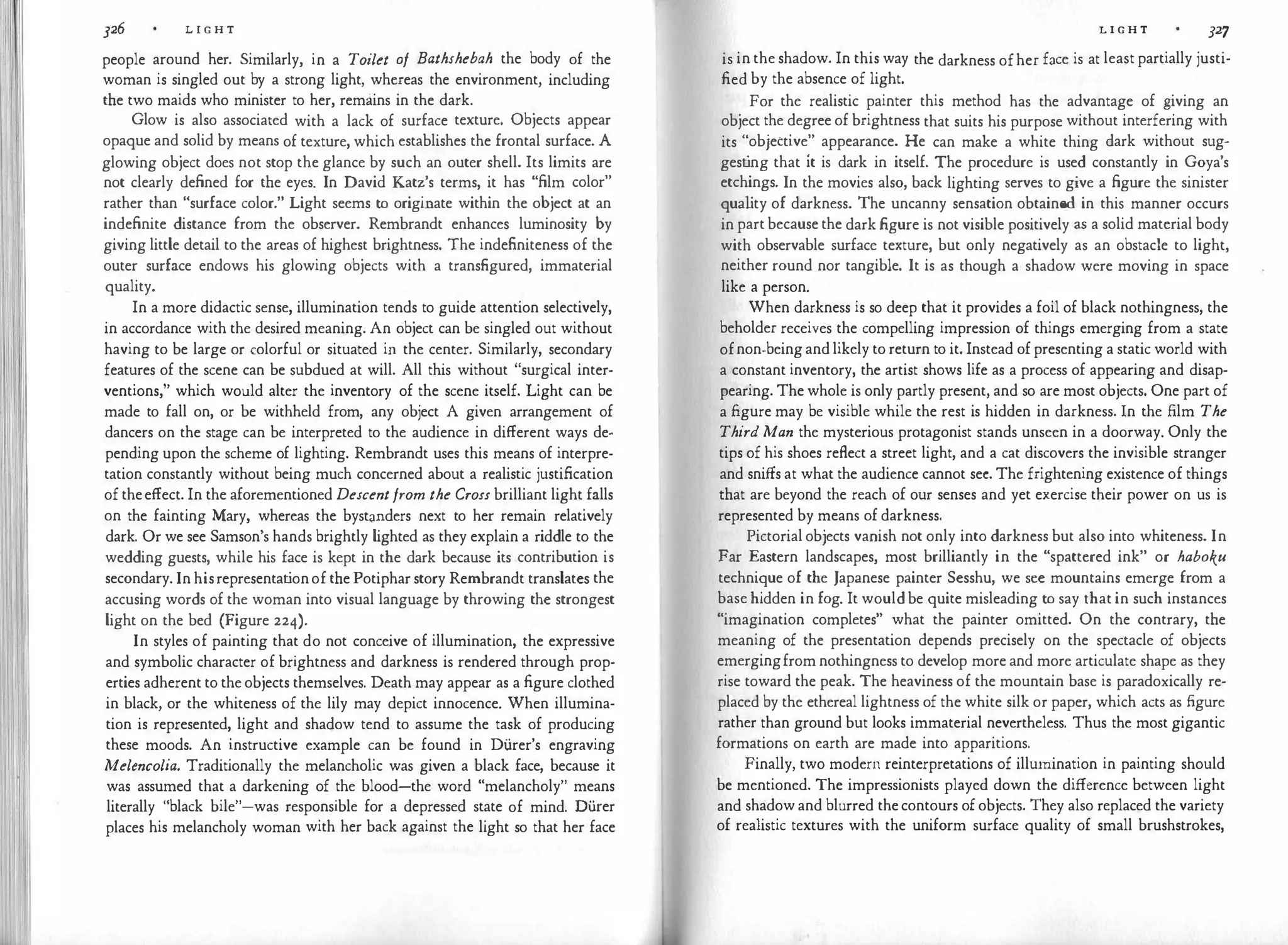
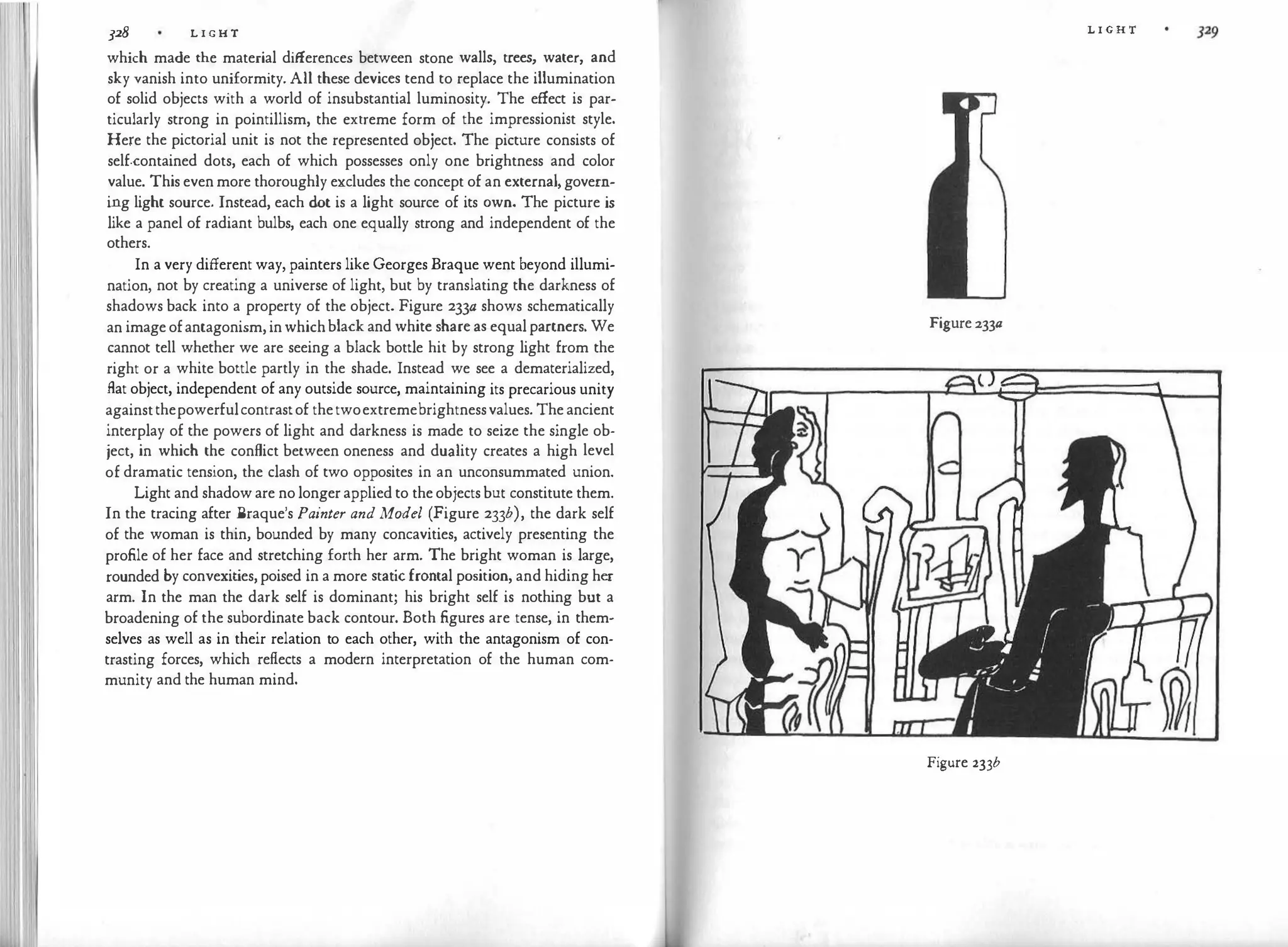
![VII COLOR
Ifitis true thatcats and dogs do notsee colors, whatis it theyare m
issing?
Of one thing we can be certain: the absence of color will deprive them of a
mostefficient dimension of discrimination. A ball rolling across a lawn can be
spotted and caught much more surely if it is identified not only by its move
ment, shape, texture, and perhaps brightness, but also by the intense red color
that sets it apart from the green grass. In addition, it is possible that animals
who possess color vision are impressed by the powerfully enlivening quality
that for us distinguishes a colorful world from a monochromic one.
This latter difference must have been foremost in the mind of the painter
Odilon Redon when, after three decades devoted almost entirely to what he
called "his blacks," i.e., hundreds of charcoal drawings and lithographs, his
work suddenly burst into paintings of full color. He had written: "One must
respect black. Nothing prostitutes it. It does not please the eye or awaken an
other sense. It is the agent of the mind even more than the beaut
iful color of
the palette or prism." But when in the 189o's he abandoned the chilly purity
of monochromatic light and darkness, he must have deeply appreciated the
possibility of defining,say, thefigure of a cyclopean giant not just by a fantastic
shape, but by the particular color quality of an earthy brown lurking above a
landscape of purple rocks; or the chance to create a green figure of death
propelled through a world of burning orange-so profoundly different from
the sober health of the spring colors he could use for the portrait of his young
son.
From Light to Color
No one will ever be sure that his neighbor sees a particular color exactly
the same way he himself does. We can only compare color relations, and even
that raises problems. One can ask subjects to group colors that belong together
C O L O R ]JI
or to match a certain nuance with an identical sample. Such procedures can
avoid any reference to color names, but we cannot assume that different per
sons of similar background, let alone members of different cultures, have the
same standards for what they consider "alike" or "the same" or "different."
Within these limits, however, it is safe to state that color perception is the
same forpeople of different ages, different backgrounds, or different cultures.
Exceptfor individual pathology, such as color blindness, we all have the same
kind of retina, the same nervous system.
It is true, however, that when observers are asked to point out certain
colors in the spectrum the results vary somewhat. This is so because the spec
trum is a sliding scale, a continuum of gradations, and also because people
mean different sensations by different color names.
Color names are somewhat indeterminate because the conceptualization
ofcolors themselves is problematic. To be sure, the world of color is not simply
an assortment of innumerable hues; it is clearly structured on the basis of the
three fundamental primaries and their combinations. However, it takes a
particular mental attitude to organize one's world of color according to these
purely perceptual characteristics. Instead, a person's world is a world of ob
jects, whose given perceptual properties matter in varying degrees. A par
ticular culture may distinguish the colors of plants from those of the soil or
water, but have no use for any other subdivision of hues-a perceptual classi
fication that will be reflected in the vocabulary. An agricultural tribe may
possess many words to describe subtle differences in the colors of cattle, but
none to distinguish blue from green. In our own environment, certain occu
pations call for refined color distinctions and a correspondingly sophisticated
vocabulary. Others call for none at all.
For ourpresent purpose the most interesting difference in the conceptual
izing of color relates to cultural development. Recent studies have suggested
that the basic color names, relatively few in number, are common to all lan
guages, but also that they cover different ranges of hues and that not all
languages possess all these names. Anthropological research by Brent Ber
lin and Paul Kay indicates that color names do not occur in arbitrary selec
tion. The most elementary nomenclature distinguishes only between darkness
and lightness, and all colors are classified according to this simple dichotomy.
When a language contains a third color name, it is always red. This new
category absorbs the reds and oranges and most yellows, pinks, and purples,
including violet. The remainder is divided between darkness and lightness
(black and white).
If these data, gathered from twenty languages, are reliable, they tell us](https://image.slidesharecdn.com/arnheimrudolfartandvisualperception1974-251210161854-a75a3f61/75/Art-and-Visual-Perception-A-PSYCHOLOGY-OF-THE-CREATIVE-EYE-172-2048.jpg)
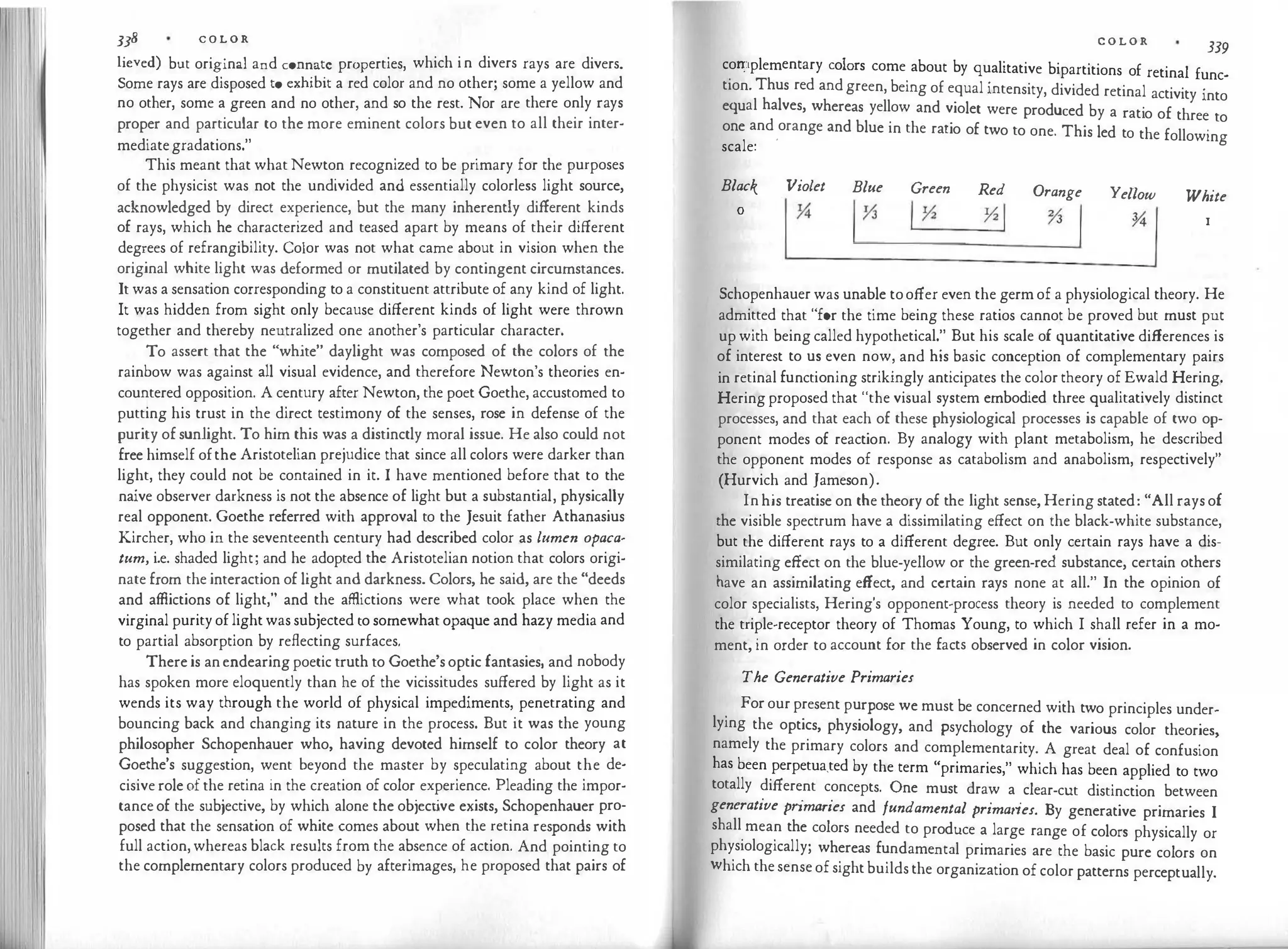
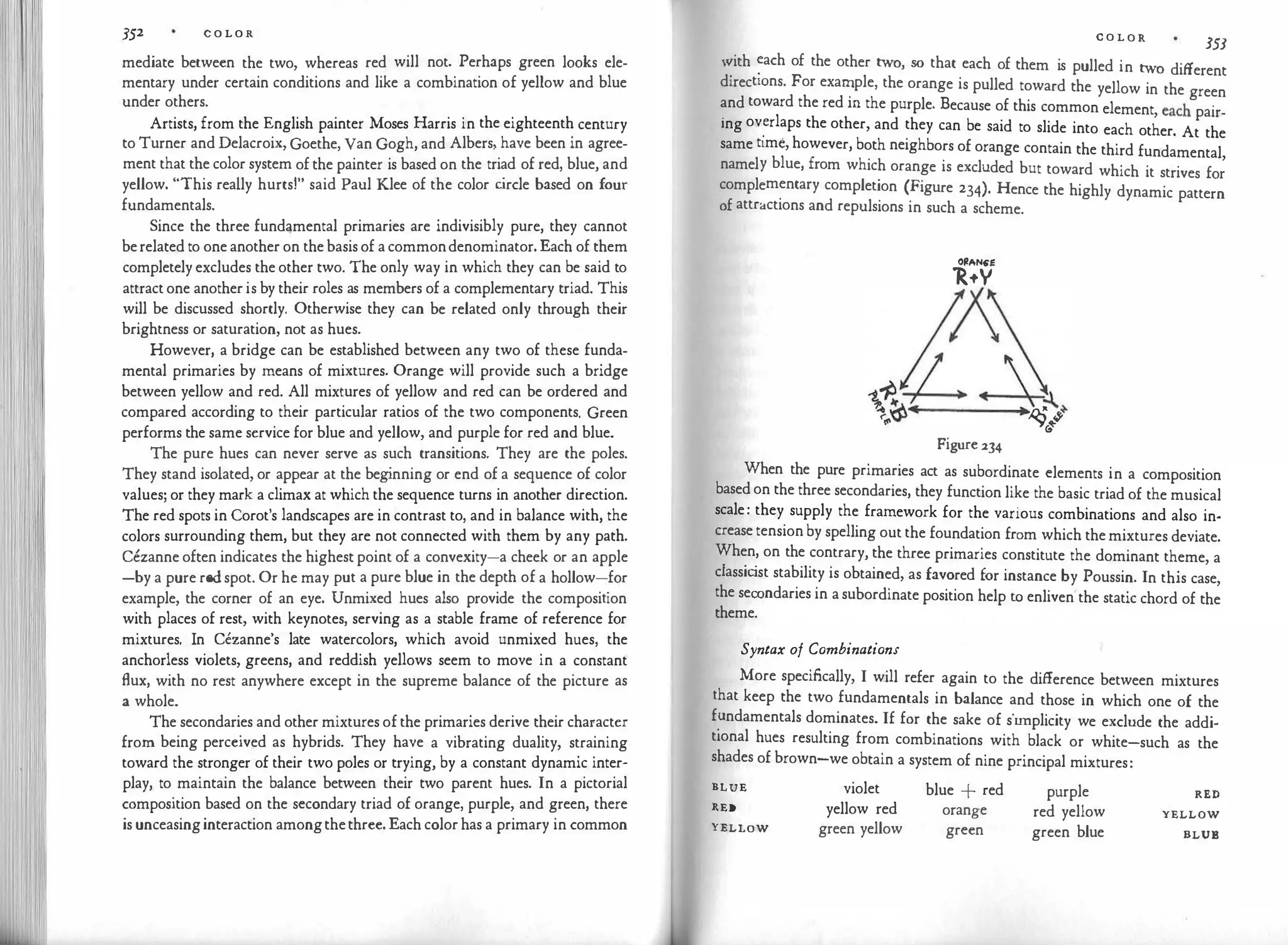
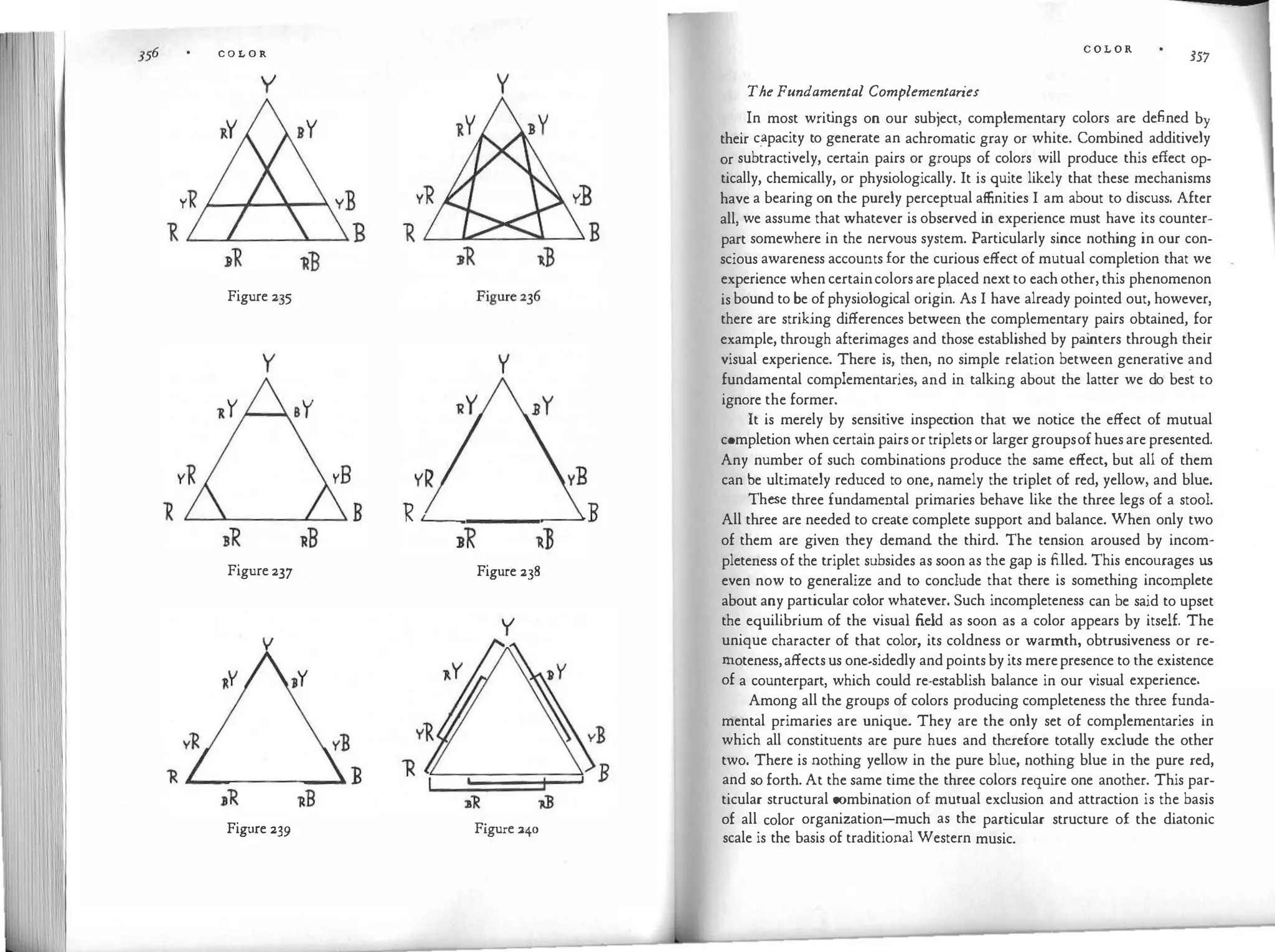
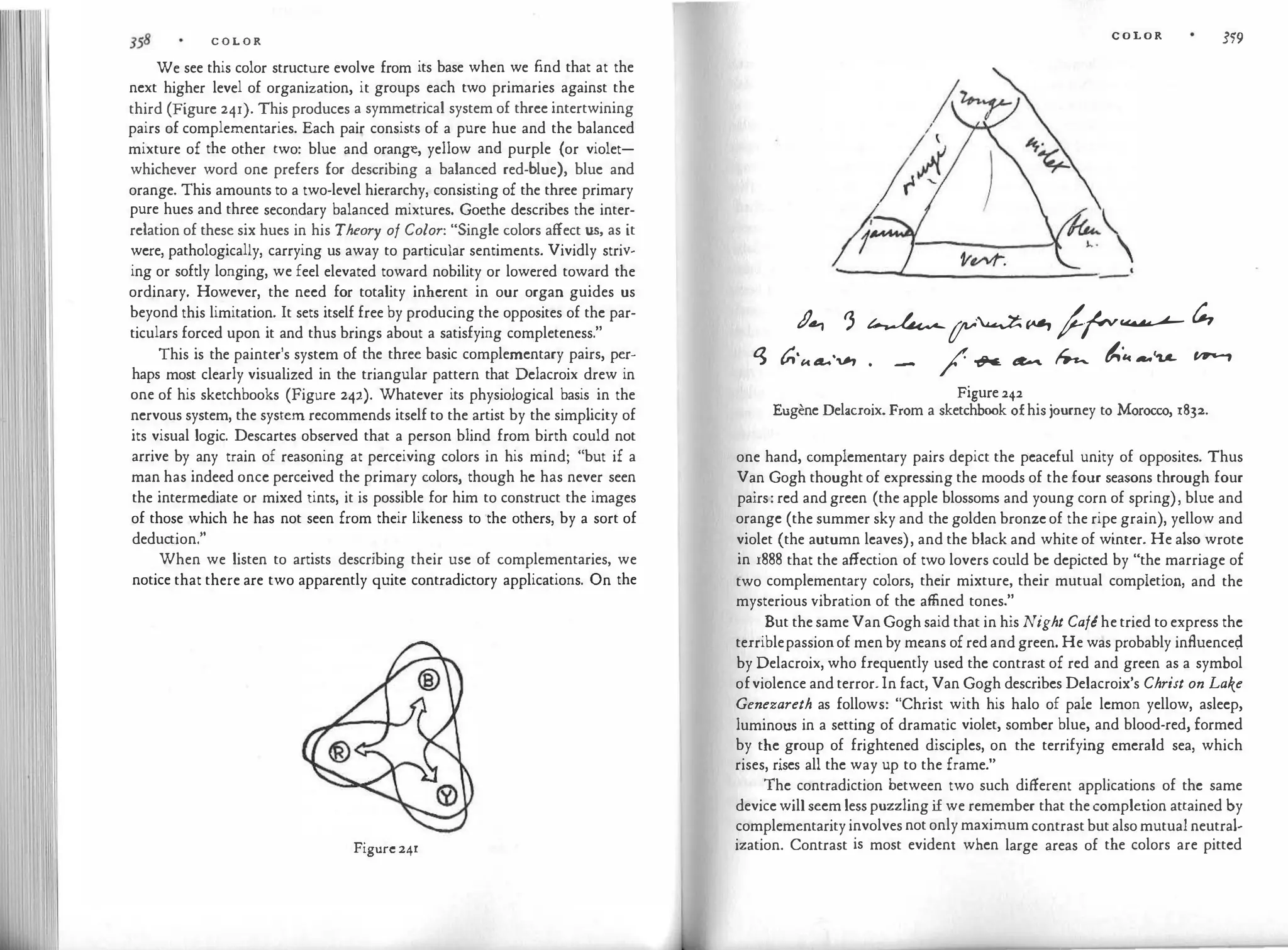
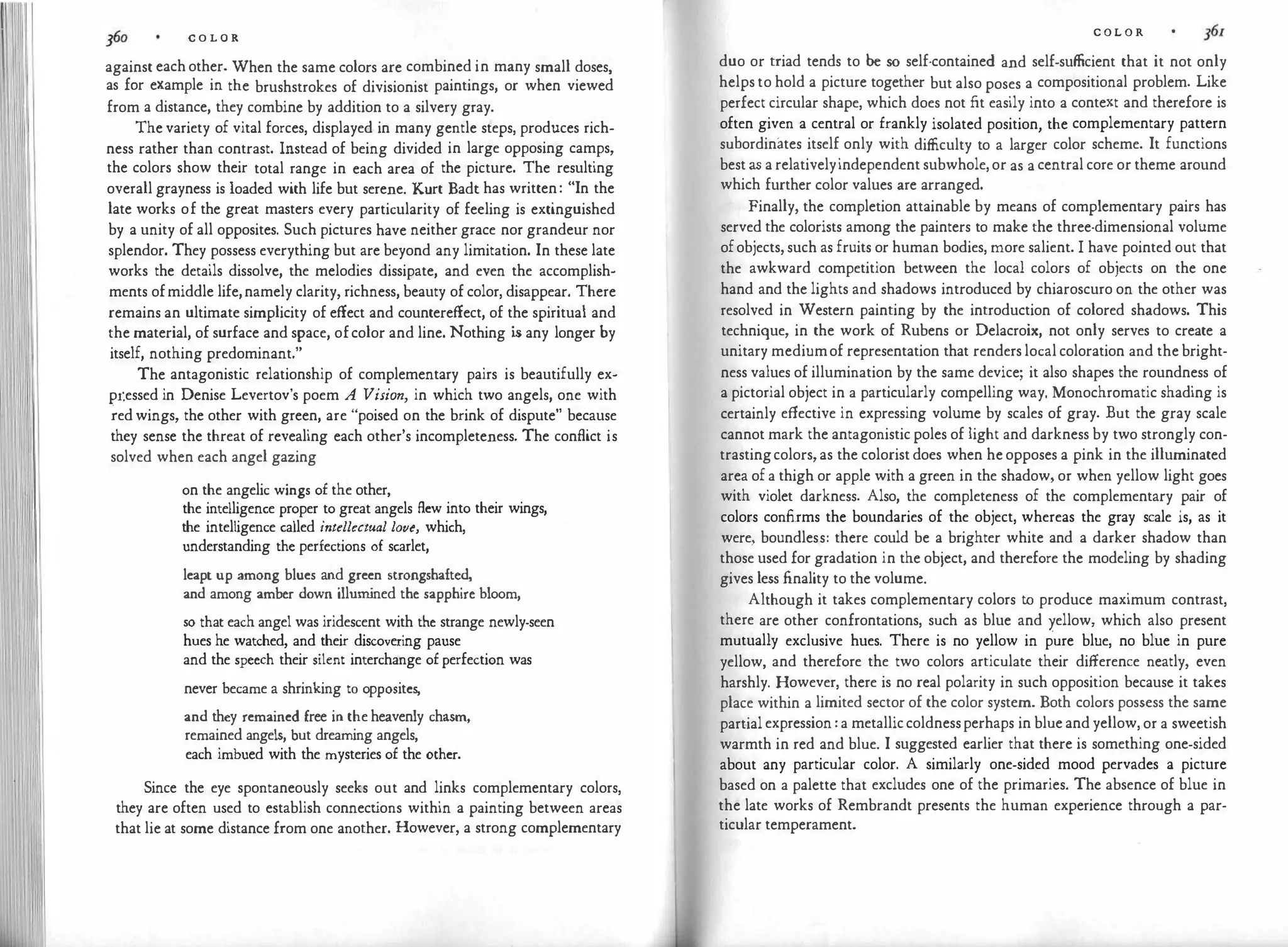
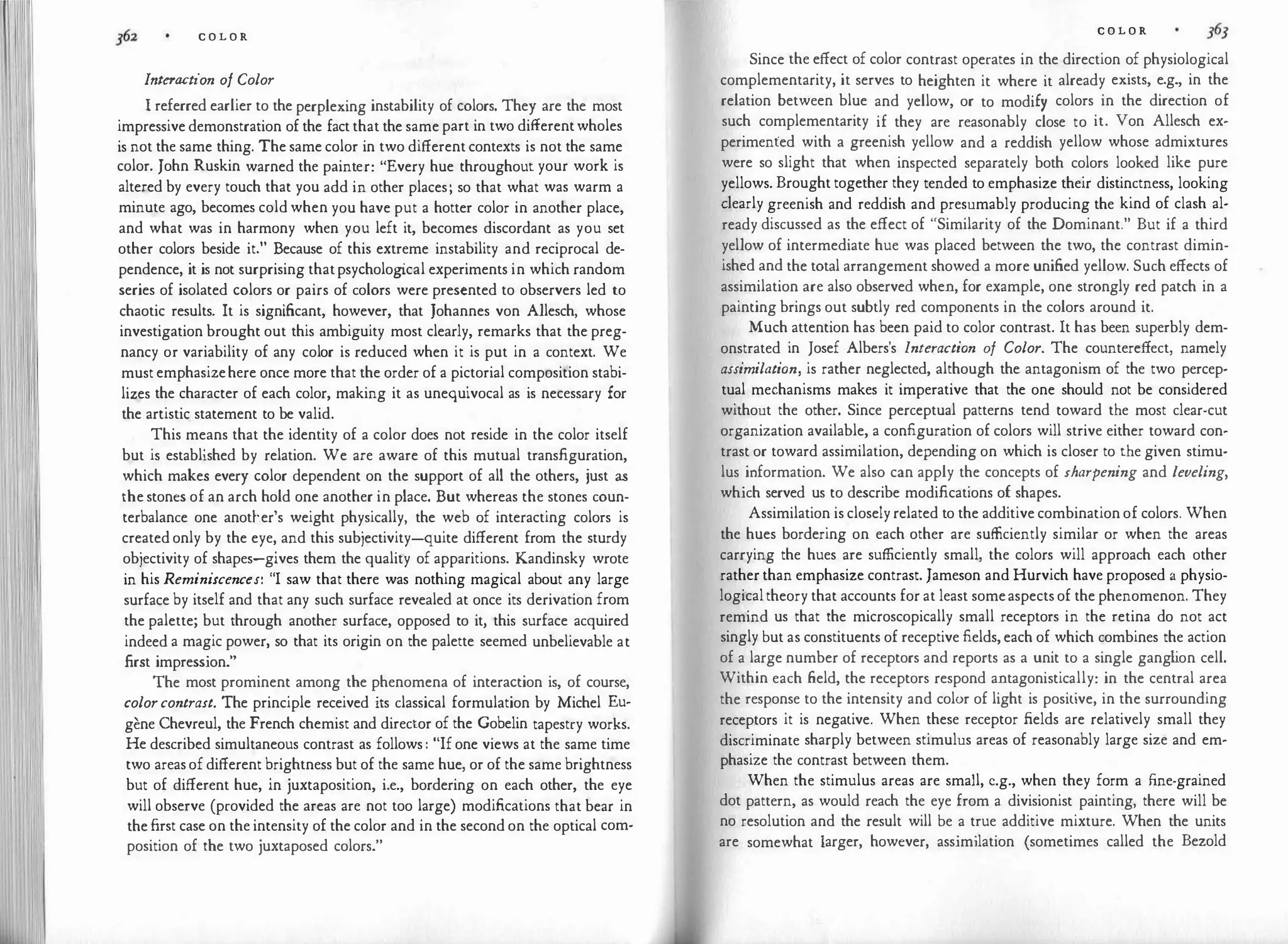
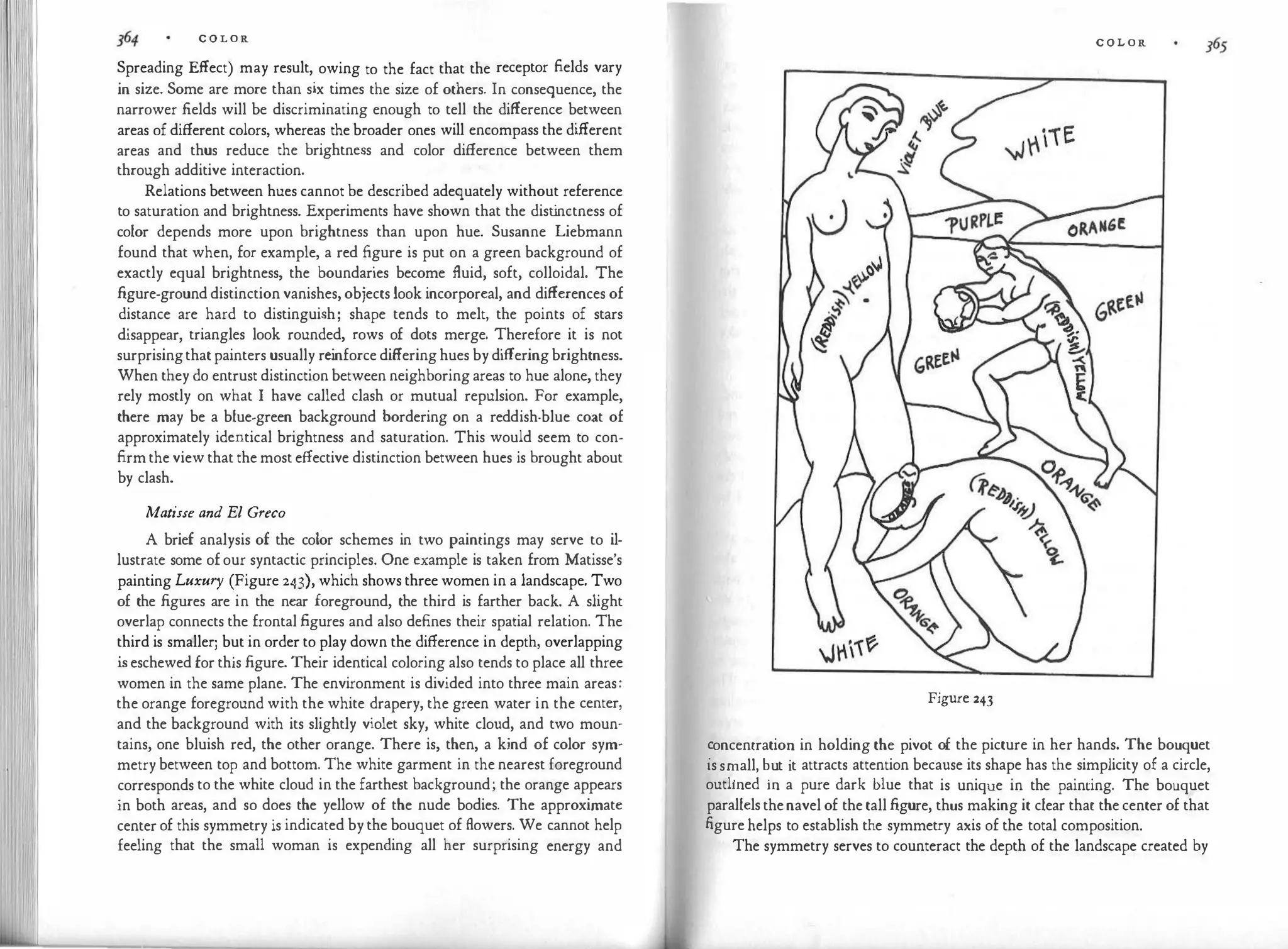
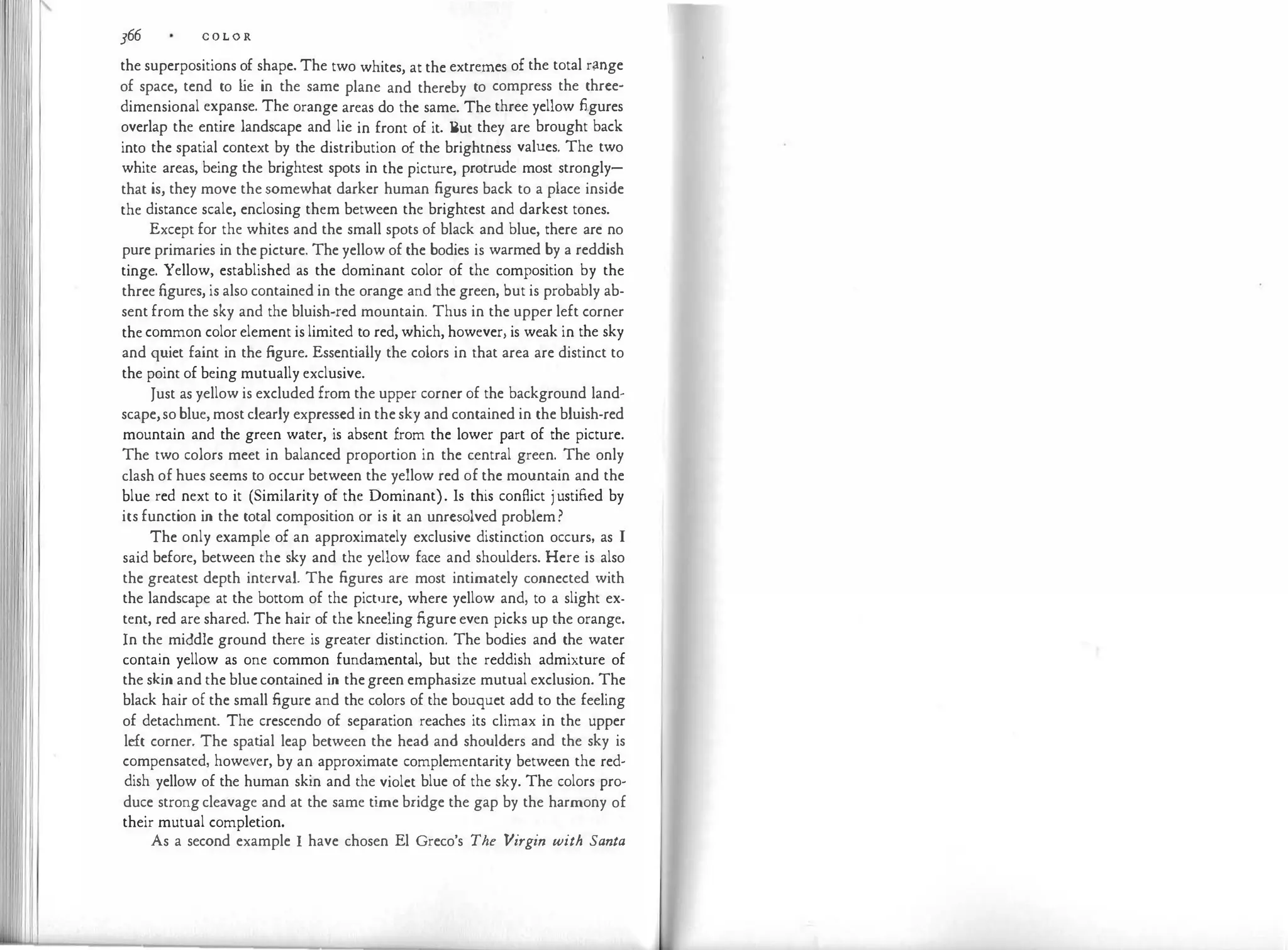
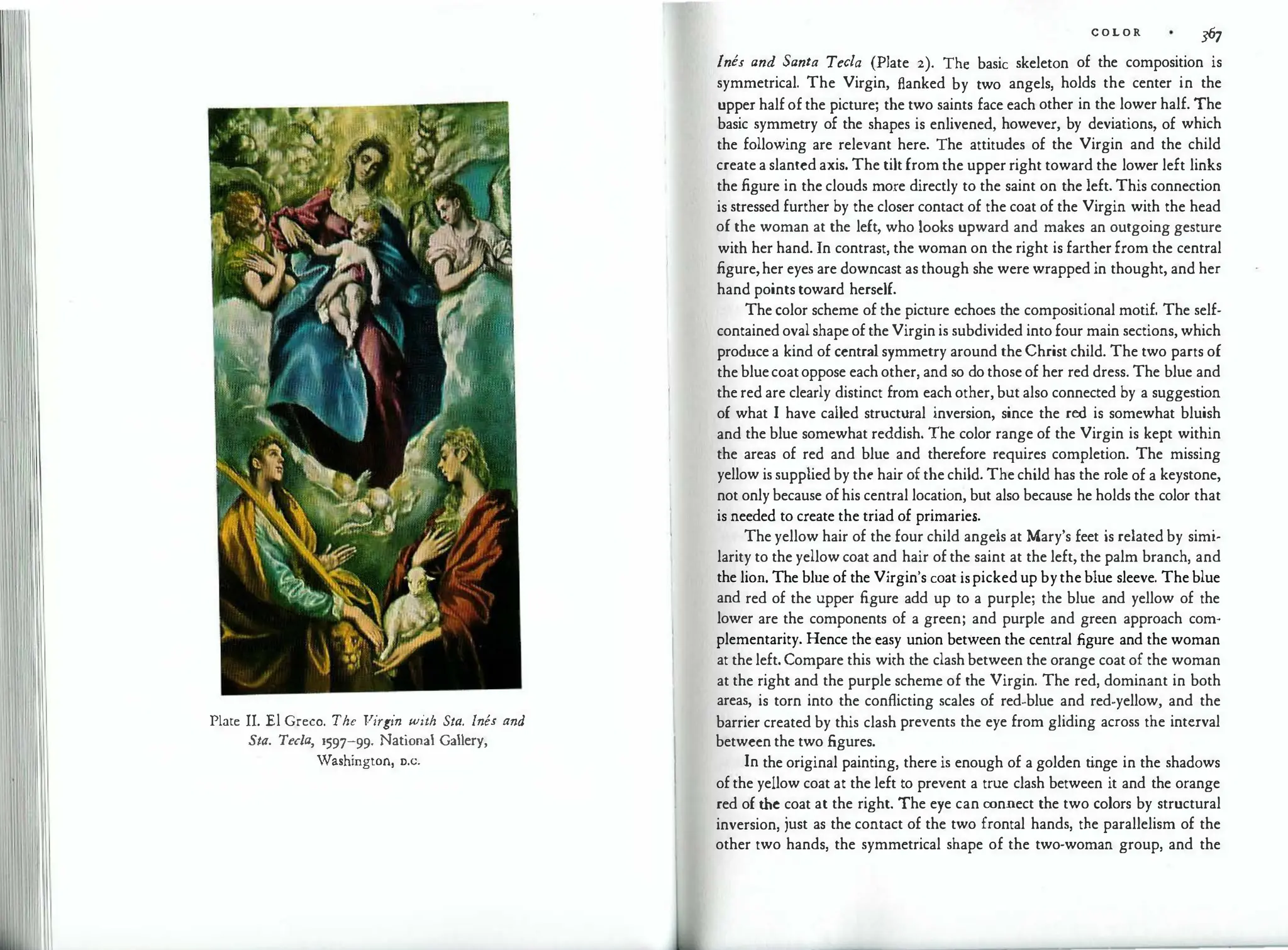
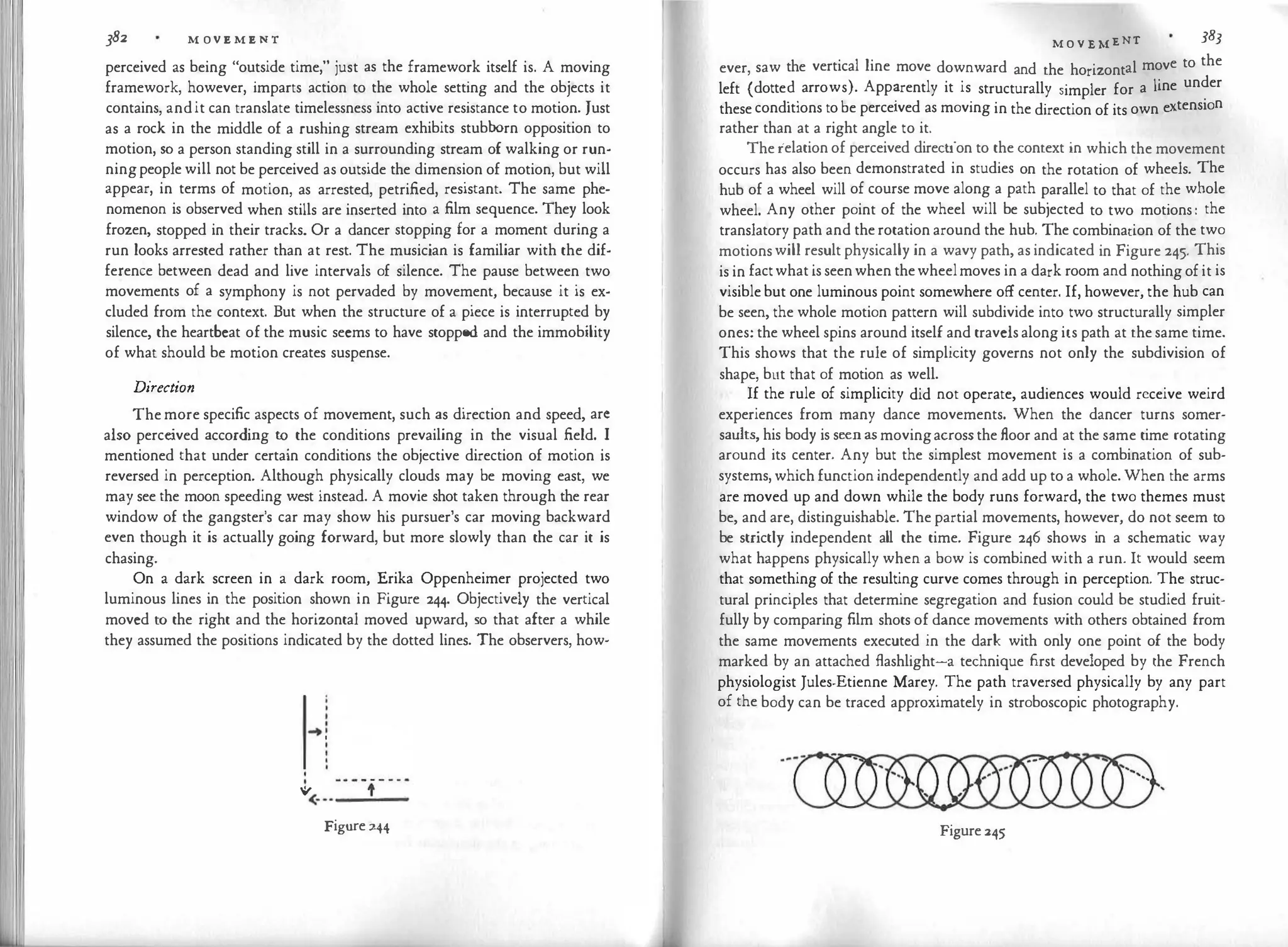
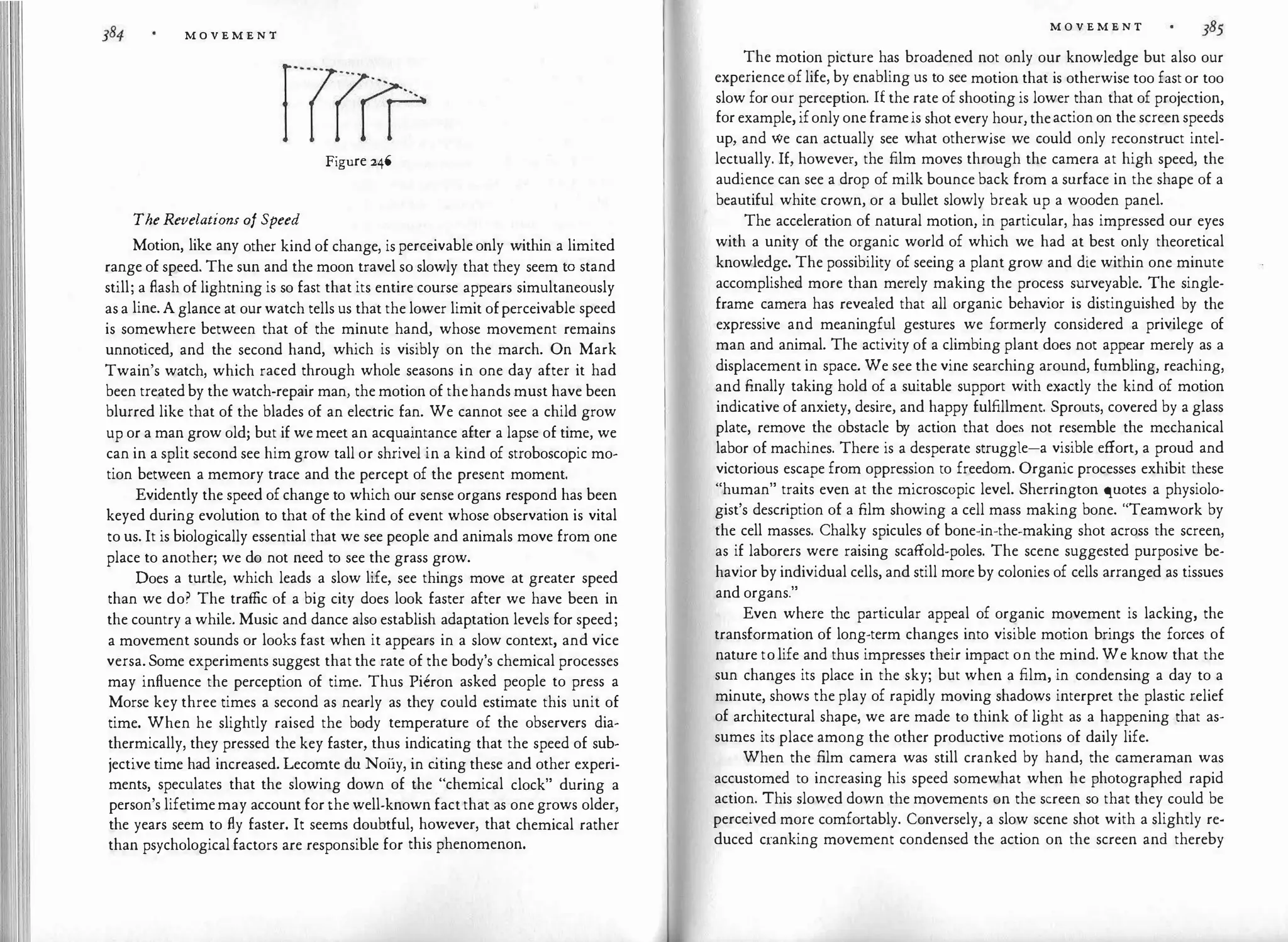
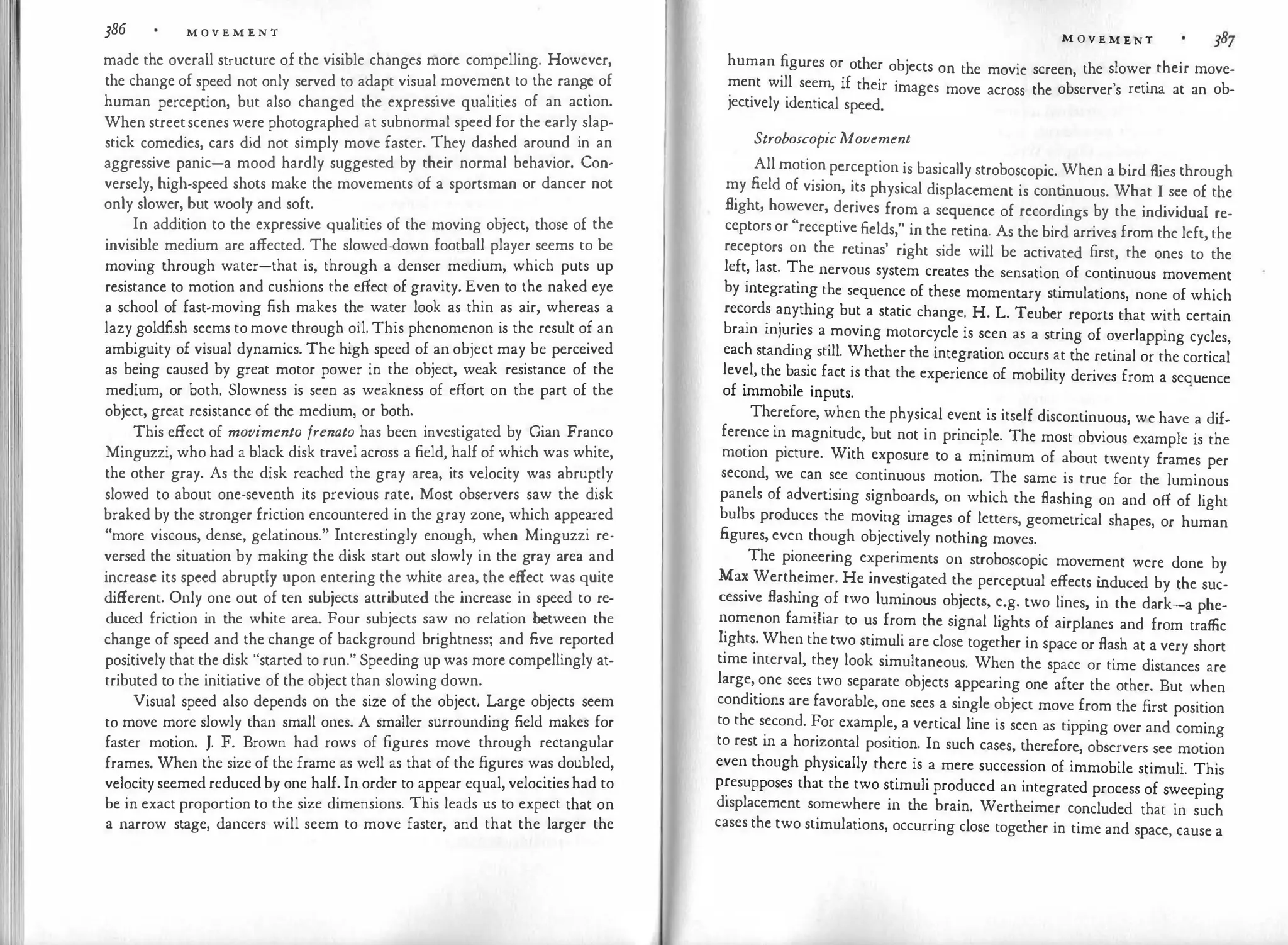
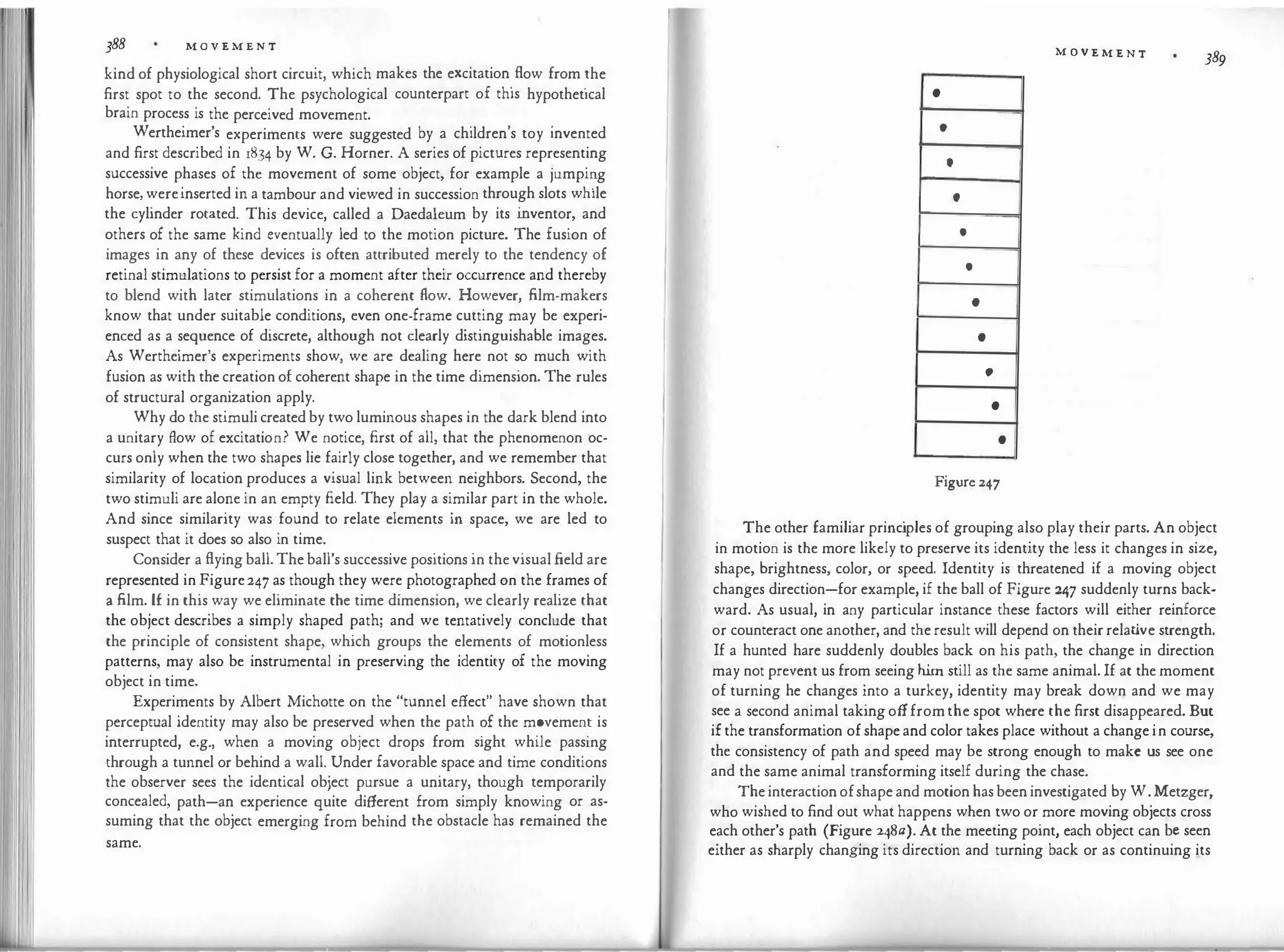
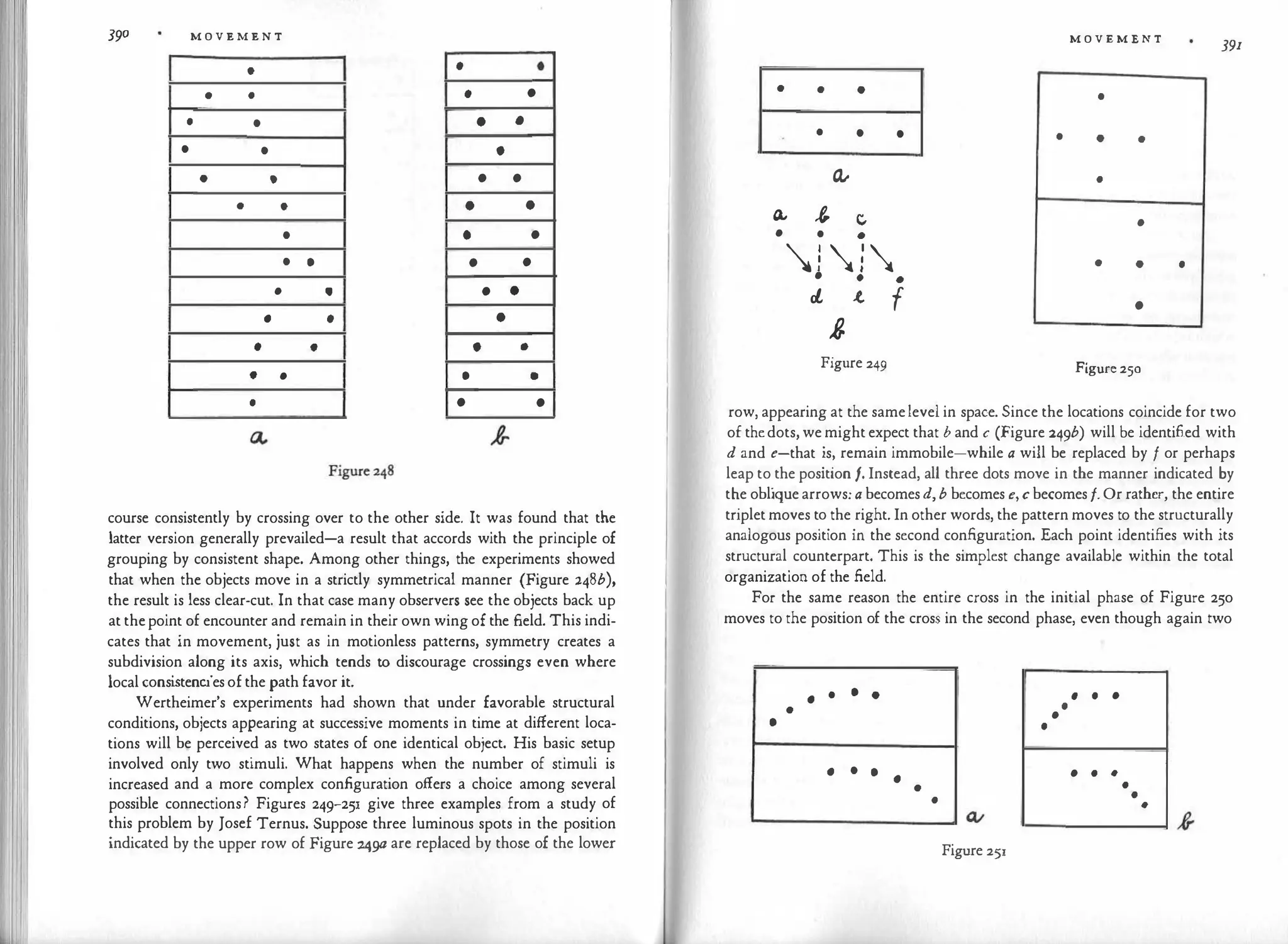
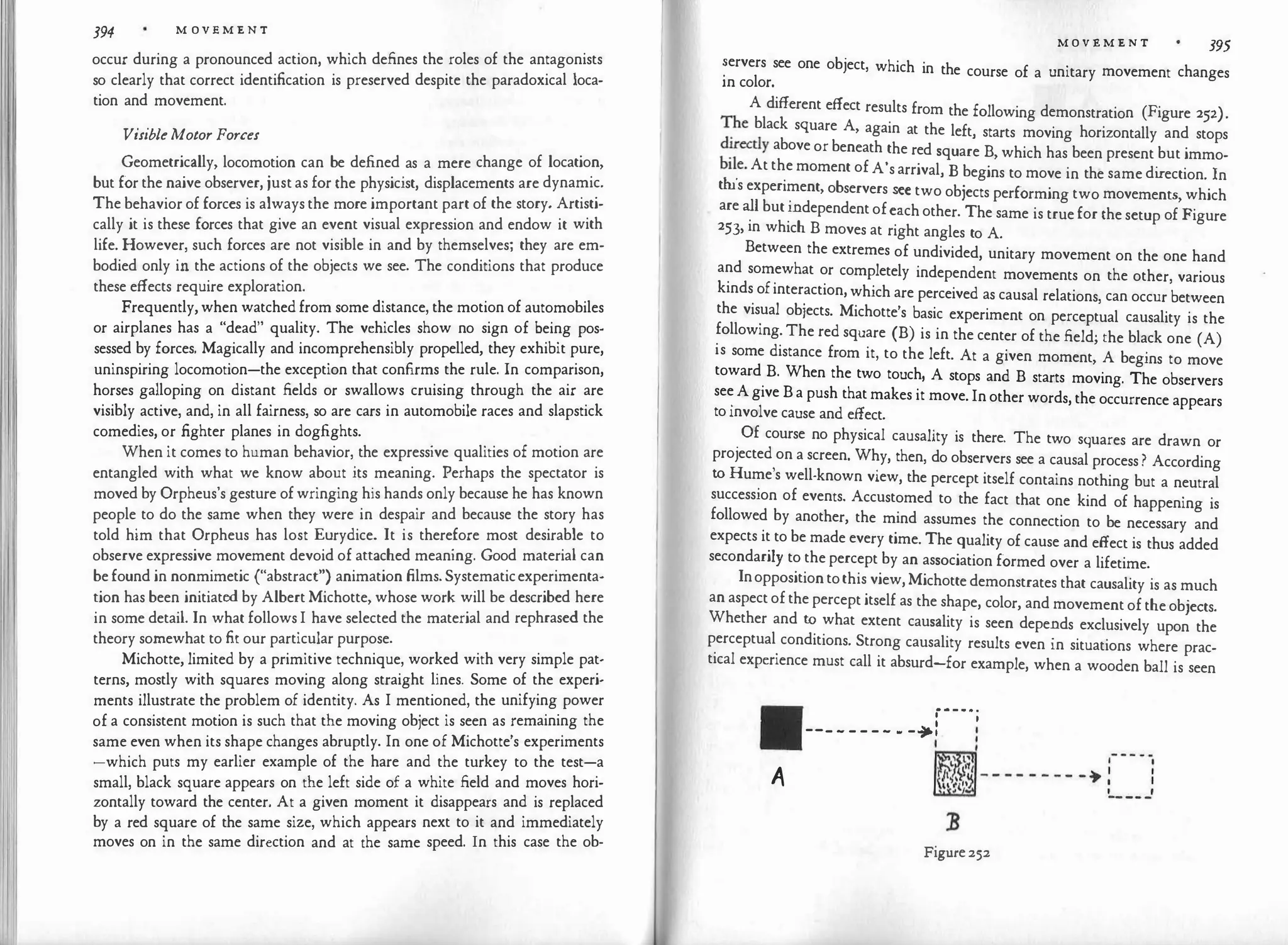
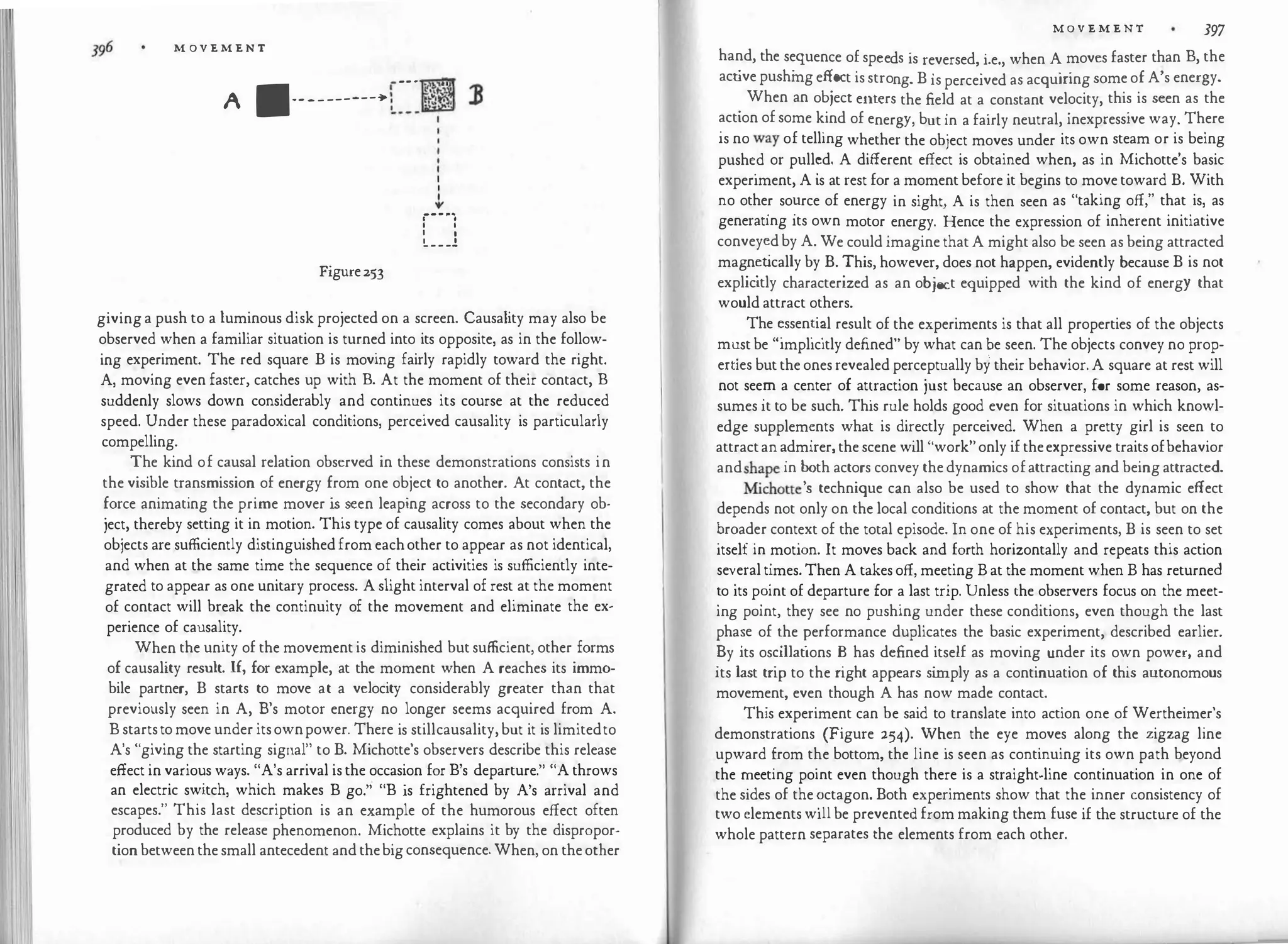
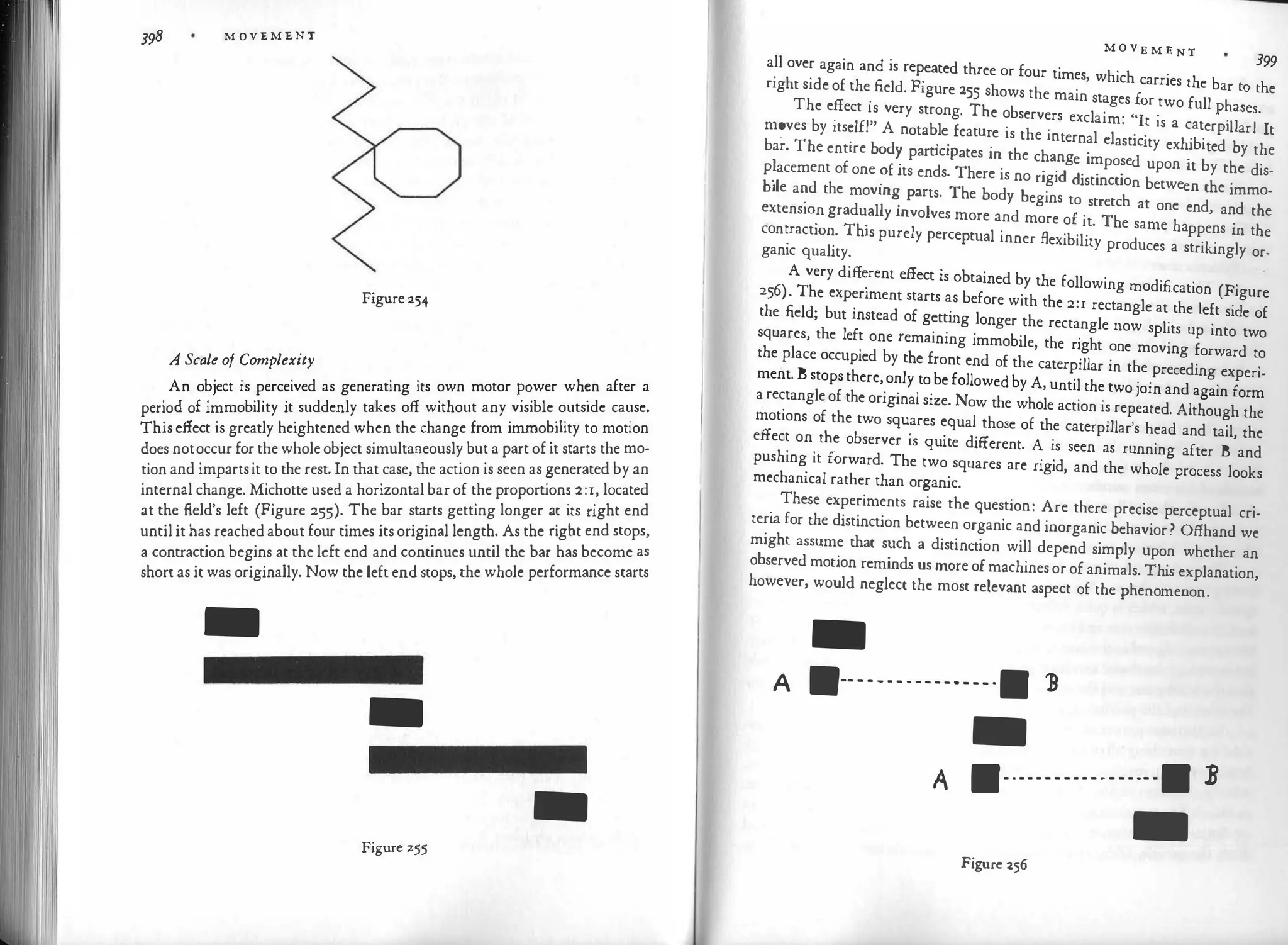
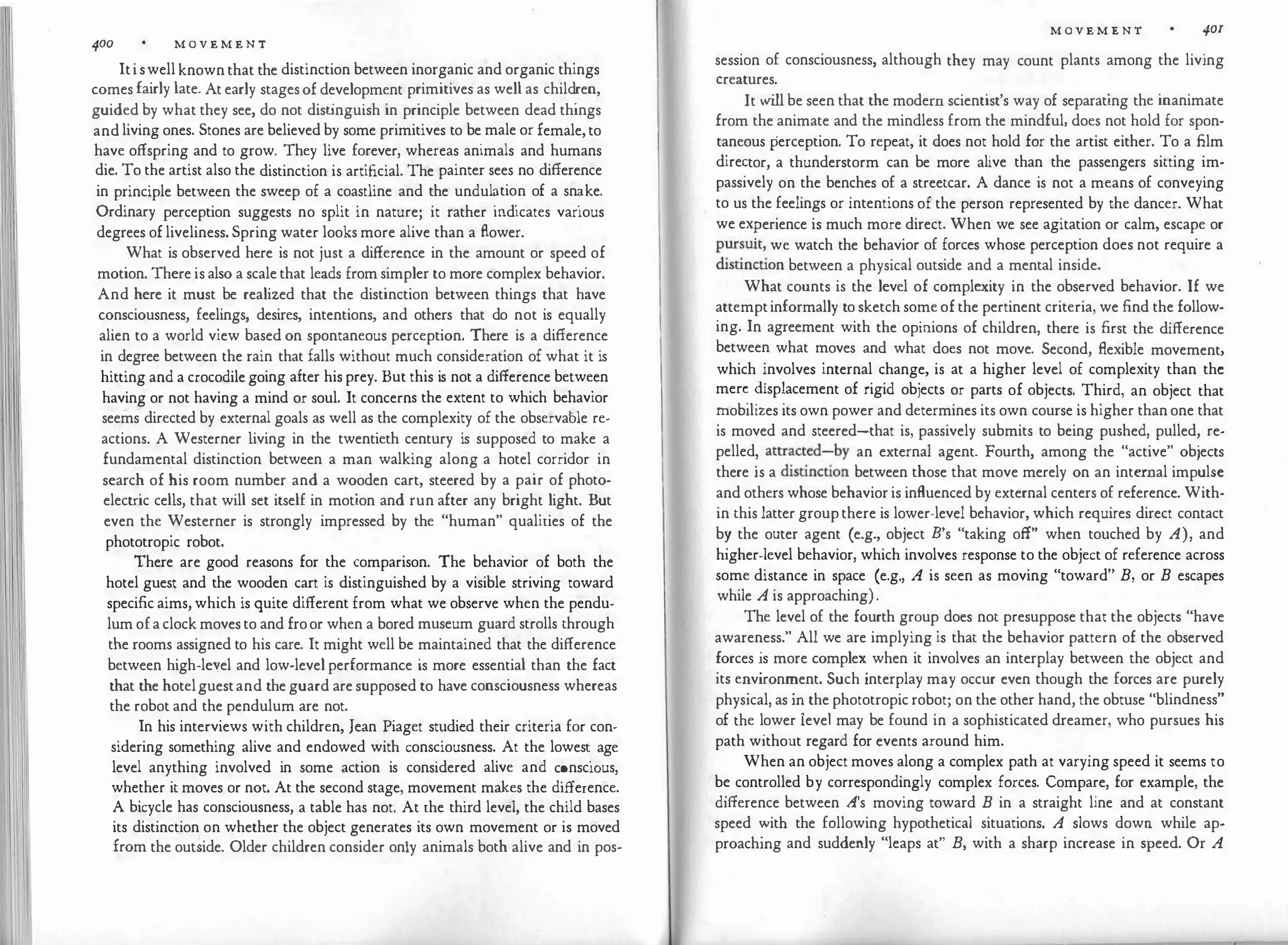
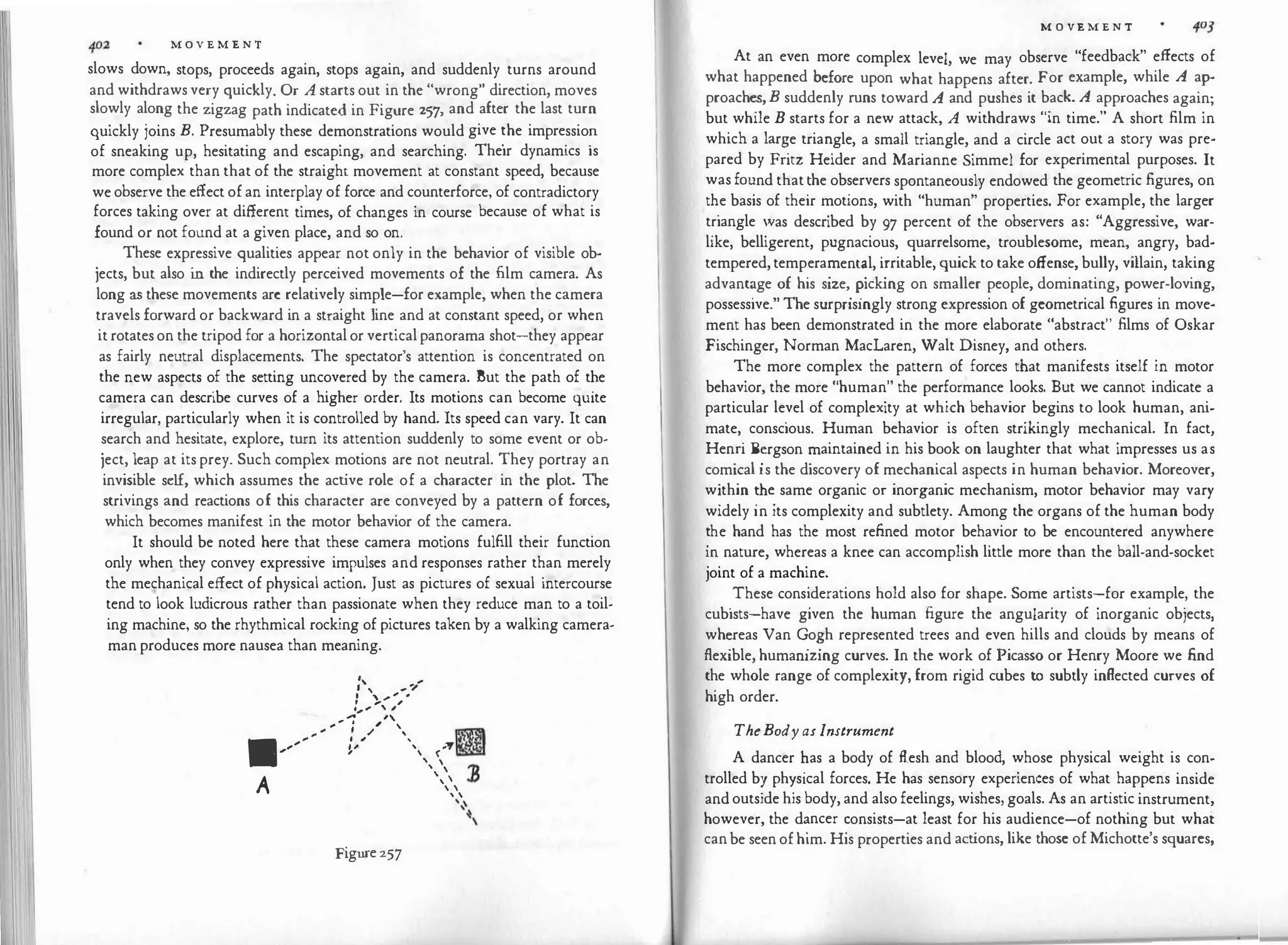
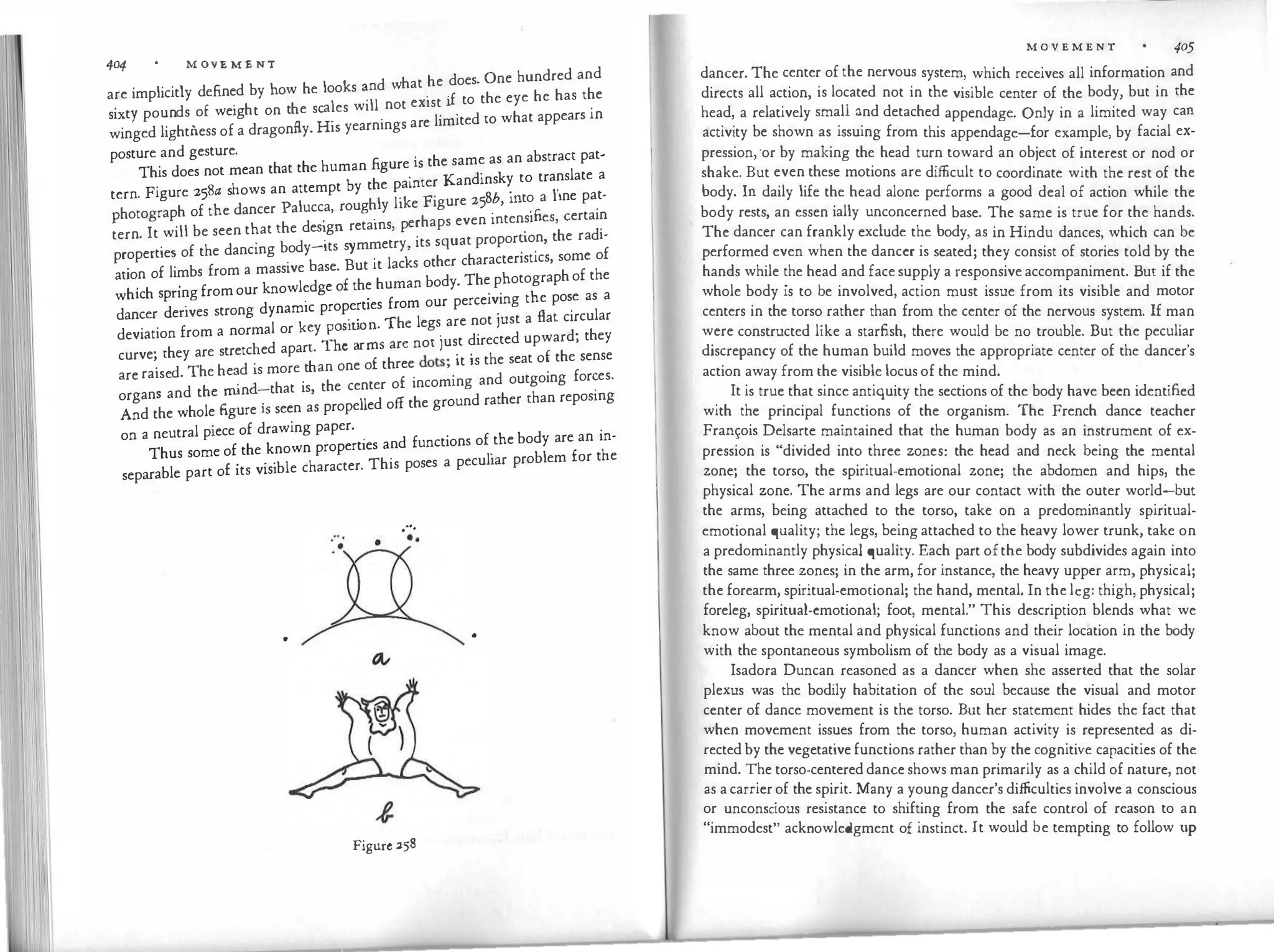
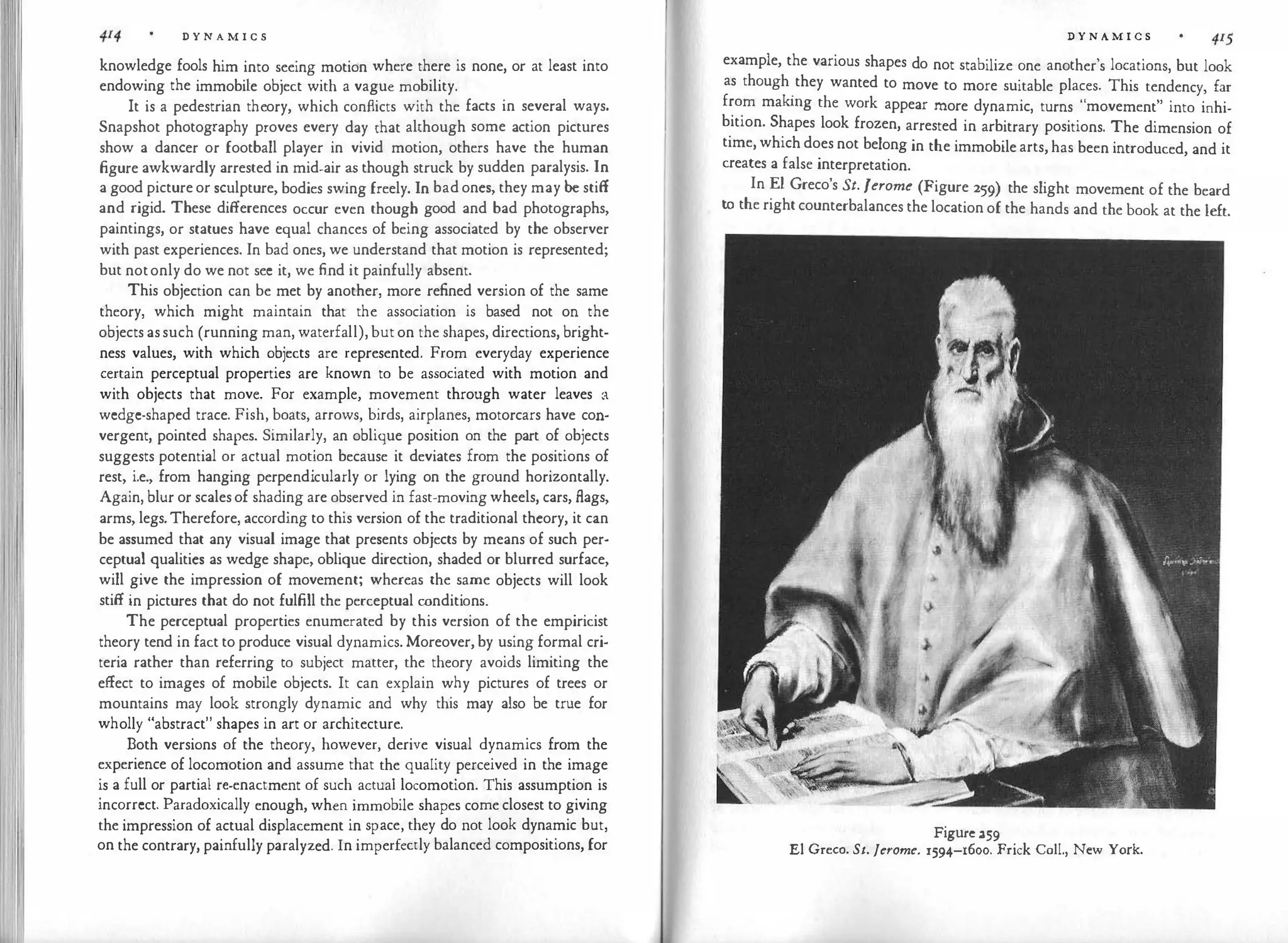
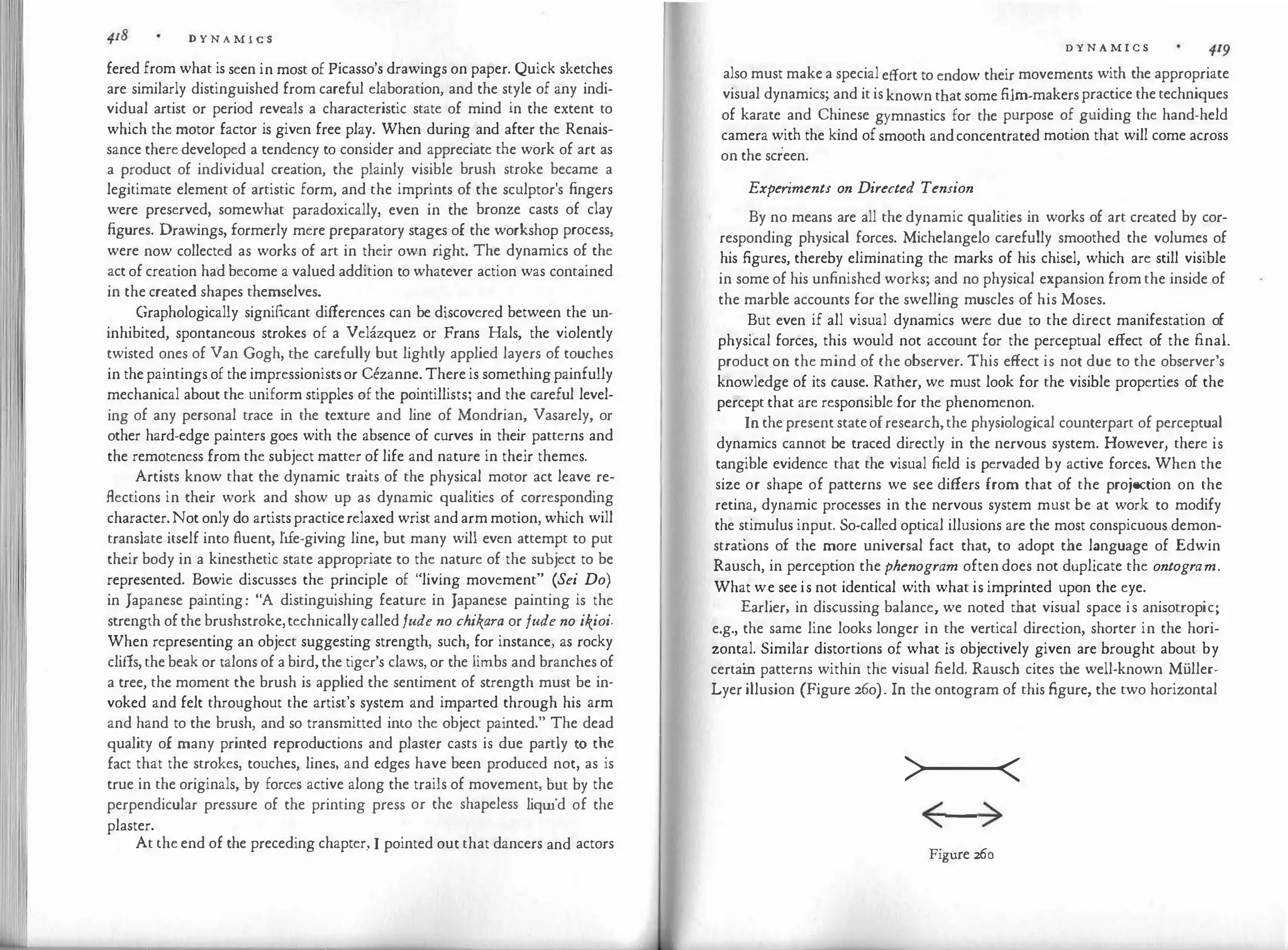
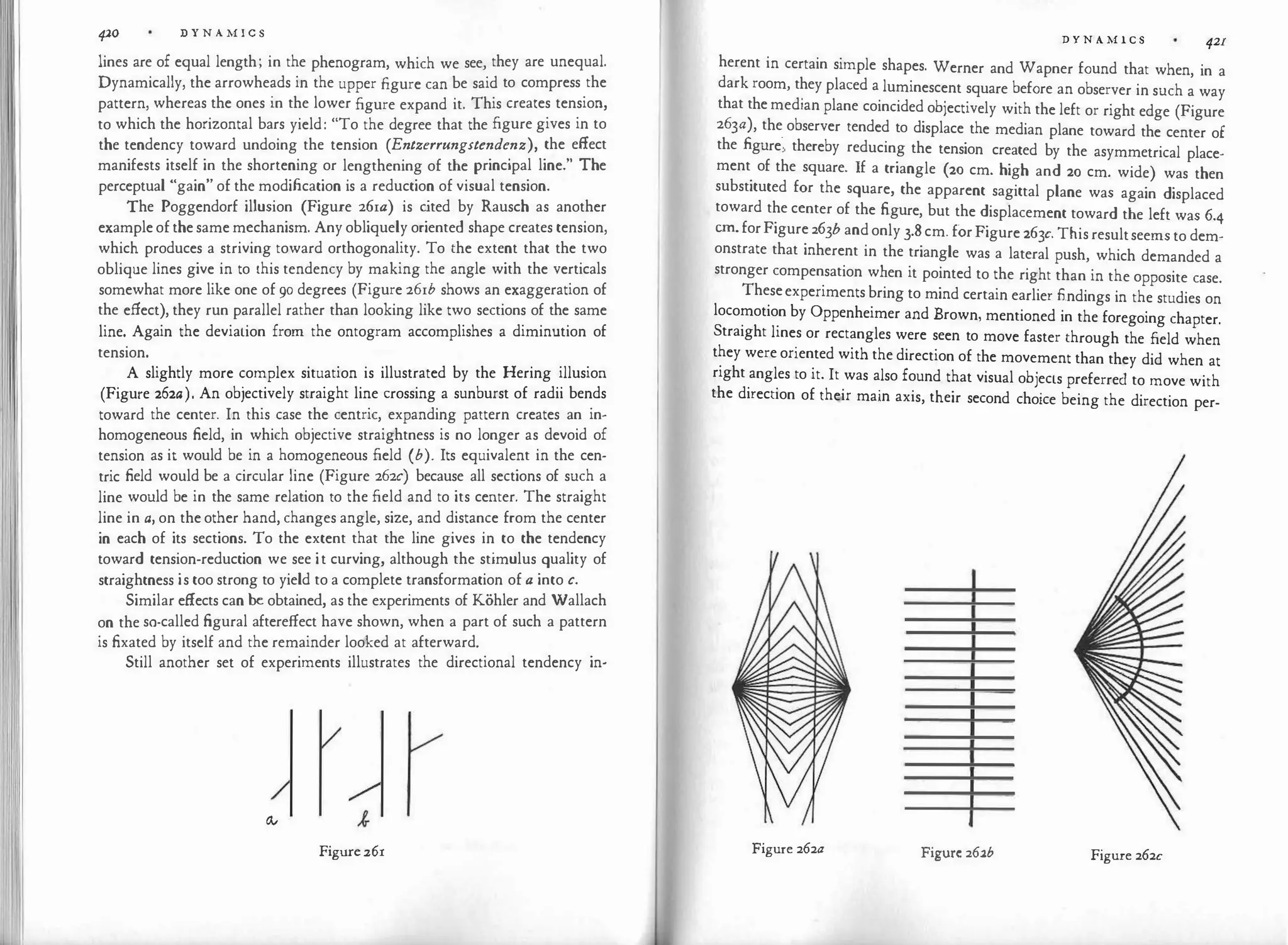
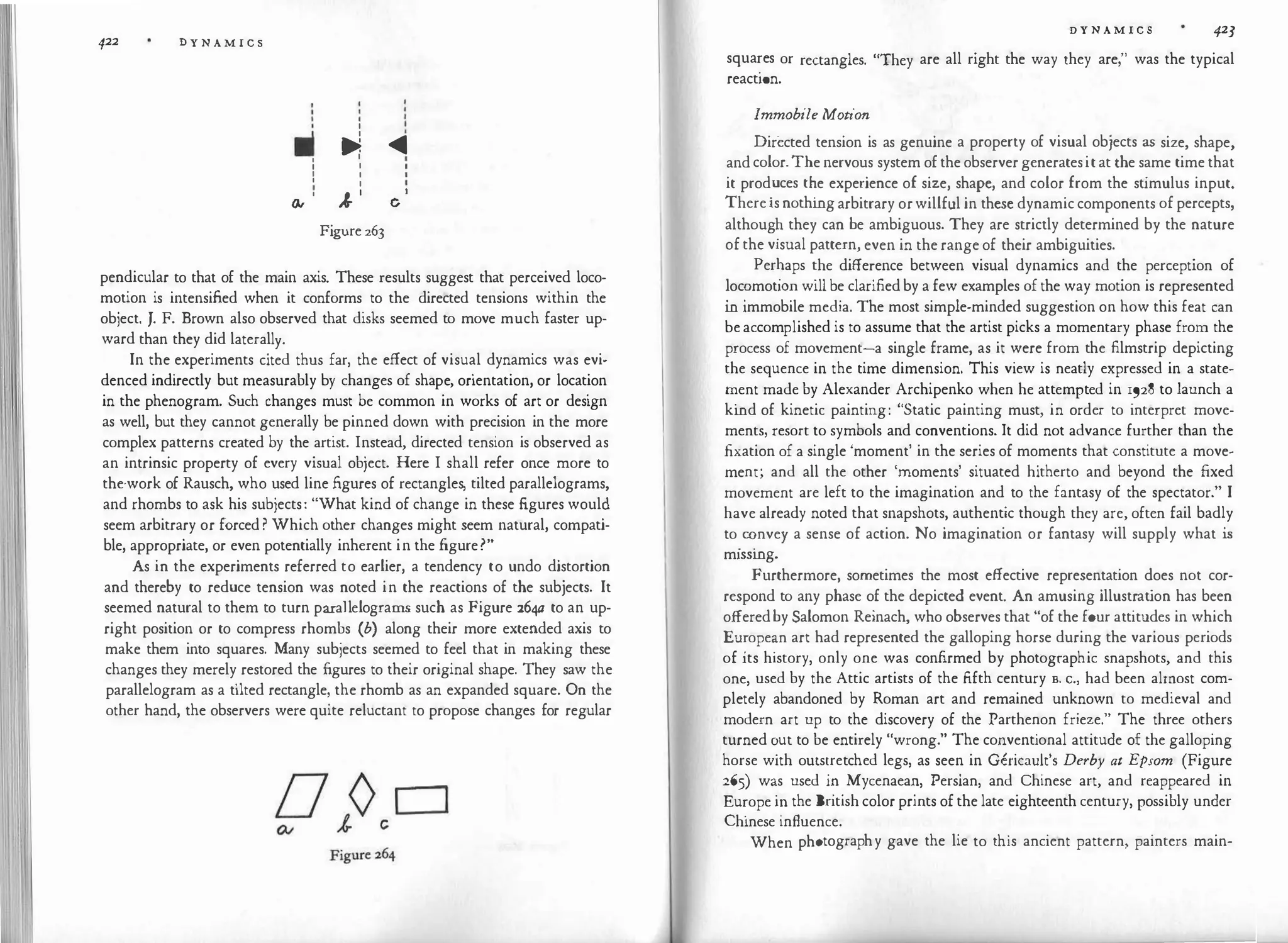
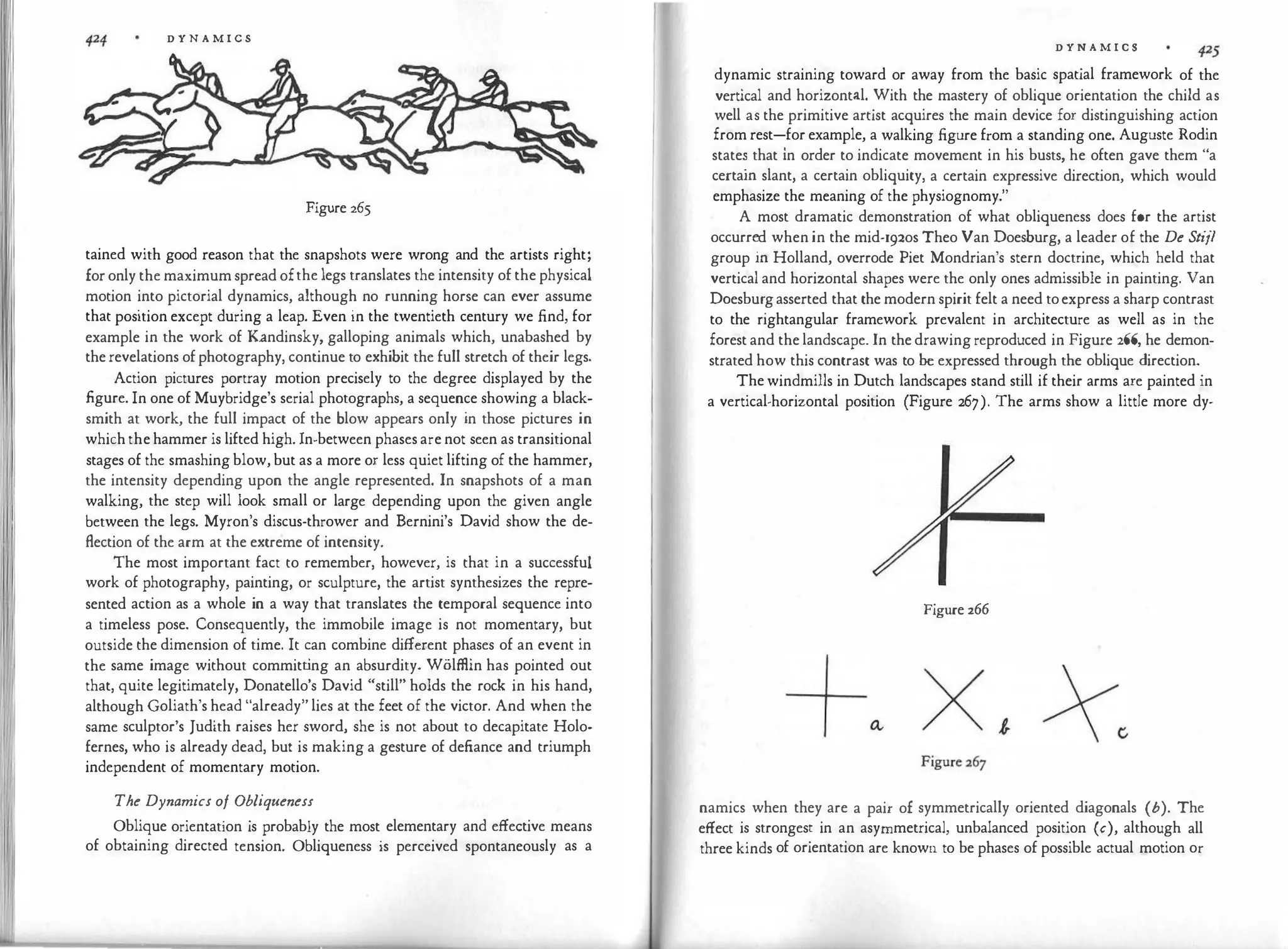
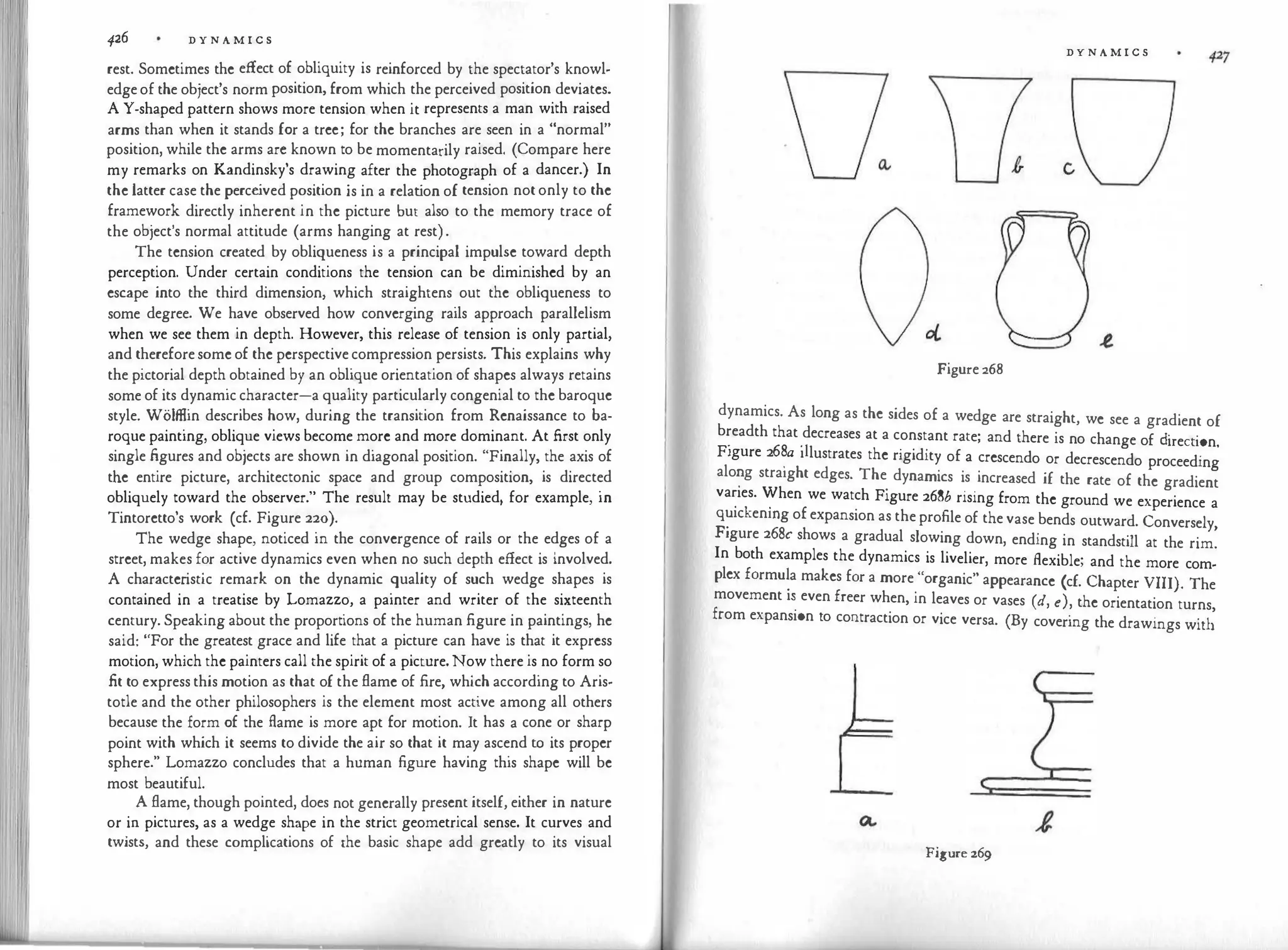
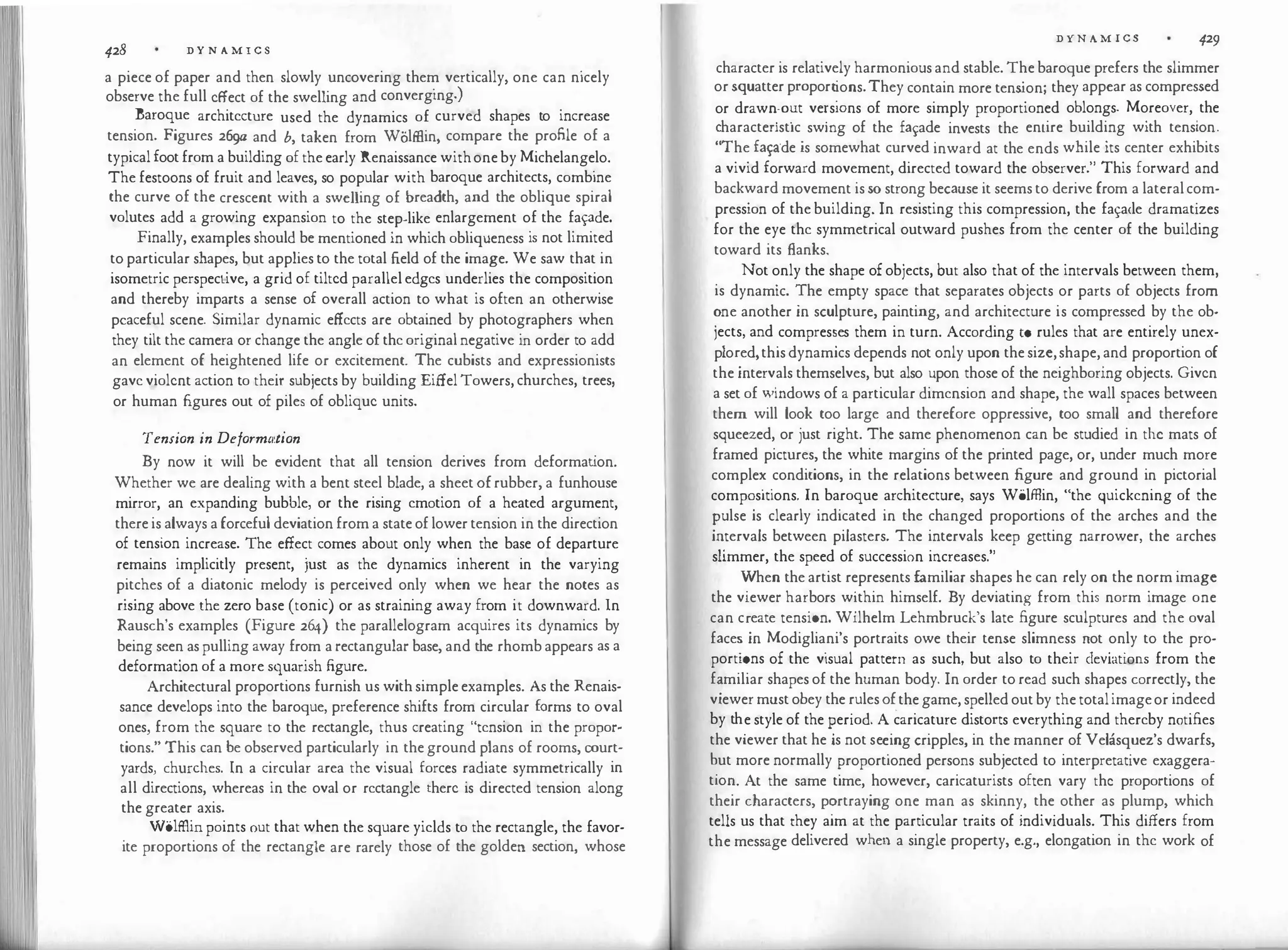
![4JO D Y N A M I C S
El Greco, is imposed upon the image as a whole. In such a case a statement on
the human condition guite in general is being conveyed. In the Gothic style,
the asthenic character of elongated shapes expresses itself in the proportions
of architecture and statuary alike.
When such dynamic variations pervade all manifestations of a given
style, they tend to vanish from the consciousness of the population immersed
in that style even though they constantly reflect and confirm a way of life. In
our own civilization, the grotesguely elongated women of fashion designs
look normal to us, not simply because we are used to them, but because their
slender bodies conform to an image of the desirable woman deeply rooted in
modern man. There are, however, limits beyond which the frame of reference
will not stretch. It is probable that for many a beholder the flagpole-shaped
figures of the sculptor Giacometti or the obese nudes of Gaston Lachaise are
not fully relatable to the human body; these figures appear as creatures of
theirown kind, whose visual dynamics is perceived only in part with reference
to the human norm and otherwise in accordance with their own inherent
shape and proportion, as happens when we look at a giraffe or a pig.
The directed tensions in visual shapes are displayed most directly when
the total expanse of the shapes is made visible. However, Henry Moore has
warned that "only to make relief shapes on the surface of the block is to forgo
the full power of expression of sculpture." What Moore has in mind was
spelled out more explicitly before him by Auguste Rodin, who tells that one
of his teachers admonished him never to view shapes in extension but always
in depth: "Never consider a surface as anything but the extremity of a volume,
as its more or less broad point, directed toward you." It takes more than an
intellectual inference, however, to make the observer see the volumes of a
sculpture as pushing outward from a center i
nside the block. The visible part
of the volume must be defined by the artist in such a way that its continuation
in depth is seen as an integral part of the shape.
When the incompleteness of a well-structured pattern is displayed to the
eye, a tension toward closure is created. Thus in Moslem architecture the
horseshoe arch, which presents circular shape beyond the halfway mark, clear
ly contains forces in the direction of the completed circle (Figure 270). Incom
pleteness is frequently brought about by overlapping. As discussed earlier, the
overlapped pattern tends to break free from the intruder by detaching itself
from it in depth. Nevertheless the superposition remains visible, and it makes
the interlocking units strive to pull apart. In the baroque style this device is
used to reinforce the movement toward freedom by the pressure of imprison
ment. In the library of San Lorenzo in Florence, Michelangelo buries the back
D Y N A M I C S
43I
Figure270
of the columns in the wall· a d · £ h' .
, n m some o IS unfimshed statues notabl .
::�s�calle����ves,�e body
.
remains partly embedded in the blo
c
k of ma��l:
t us ex l I
.
ts an impressive struggle for completeness, for liberty.
Often arc?ttectural units are made to overlap one another in fu ue-like
�
cal
.
es, an? pamted or sculptured figures and ornaments reach bey!nd the
d
m'.ts assigned to them by the architectural skeleton of the building Such
d
ev1ce
�
·
are sought after or avoided by individual artists and cultural p�riods
T
�en ��g on
b
w�ether �hey welcome or reject the tension created in this way�
f
e �u ists o tamed highly dynamic compositions by building up volumes
h
rom
irregularly crowded units, which constantly interfere with one another'
s ape. s
.
In Chapter VII I had occasion to refer to the dynamic aspects of color ex-
periences, e.g., to the attraction between opposites so cha t
. .
f l
. . ' rac enst1c o comp e-
mentanes. Here� will only point out an analogy to what we observed .ust now
about the dyna�ucs.g.enerated by the deformation ofshape. Tension i;created
I noted, by the implicit presence of the norm base from wh1
'ch a sh d
.
'
So h' · ·1
. ape eviates.
met mg s1m1 ar can be seen m colors guite close to a simple h i:
Ple a d ff!. d
. ue, i
or exam-
' pure re a icte with a subordinate admixture of blue ] h
All h · h· h
· o annes von
1 csc ' m �s p enomenological study of color experiences, pointed out that
c? or pe;cept1on can be dynamic in a twofold sense: certain colors leave the
�
11ewer .ree to �elect one of the hues contained in it as the base, so that the
impression received of the same color may cl.ff f cl.ff
1 er or i erent observers; at th(](https://image.slidesharecdn.com/arnheimrudolfartandvisualperception1974-251210161854-a75a3f61/75/Art-and-Visual-Perception-A-PSYCHOLOGY-OF-THE-CREATIVE-EYE-223-2048.jpg)
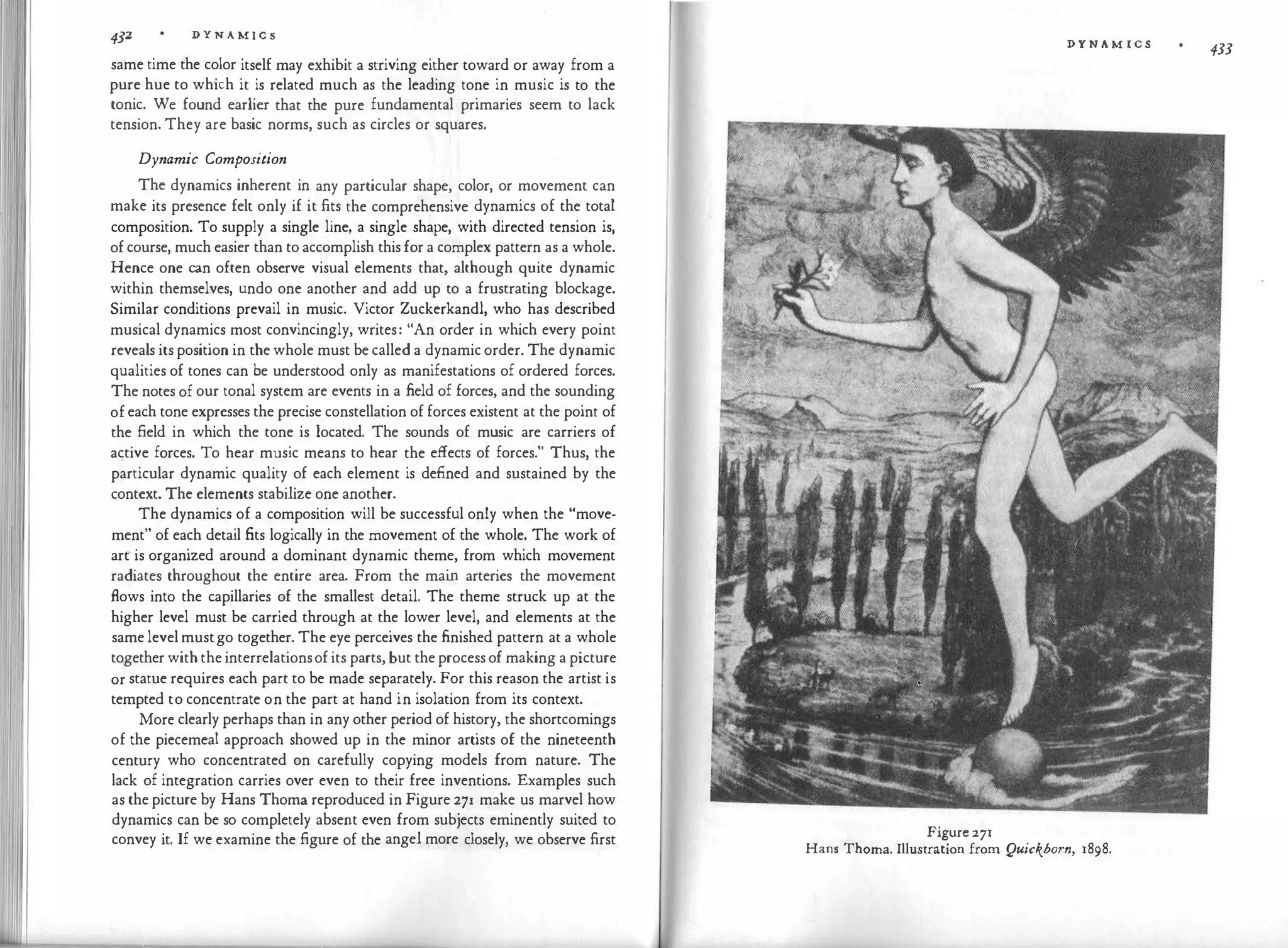
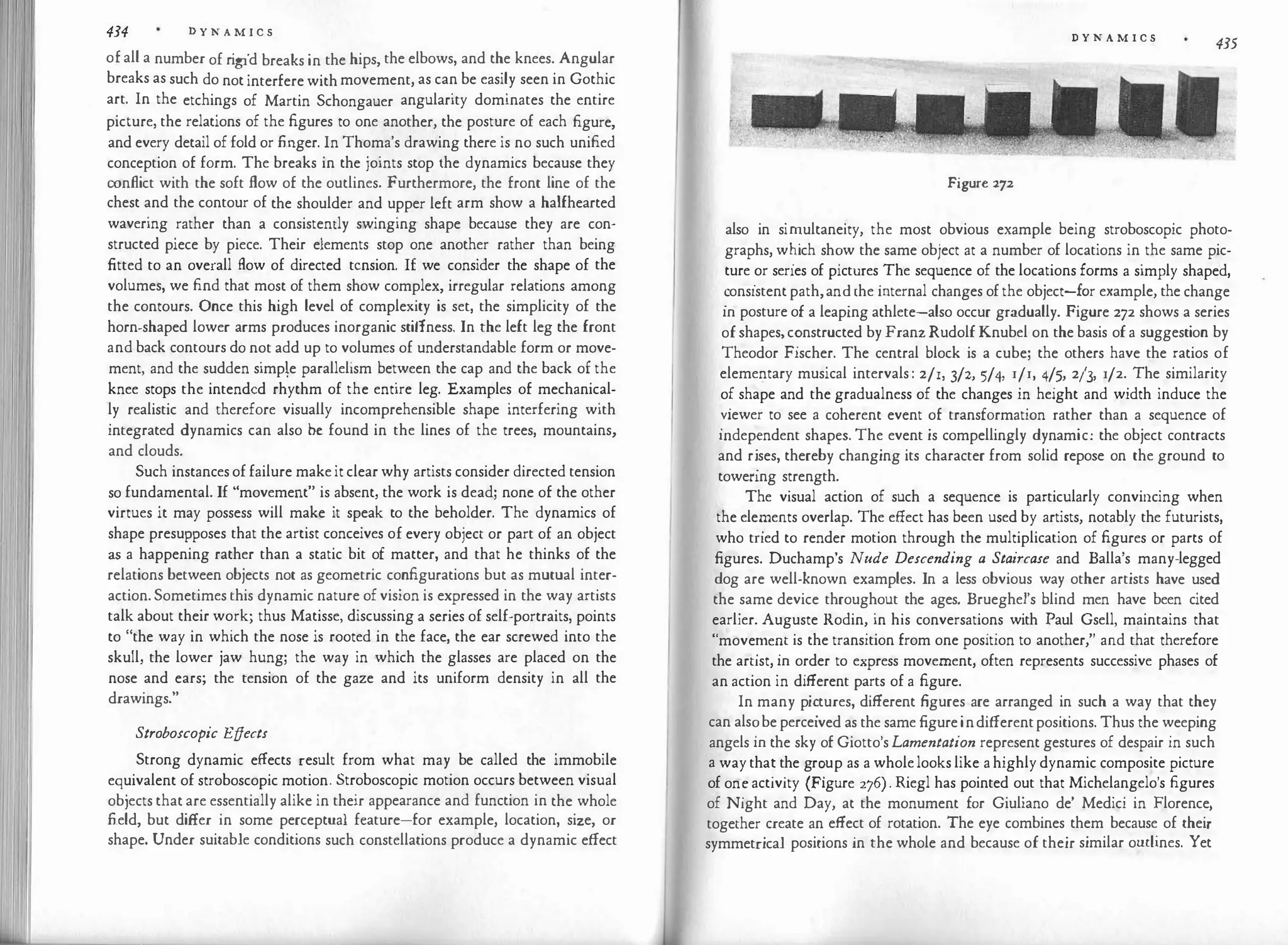
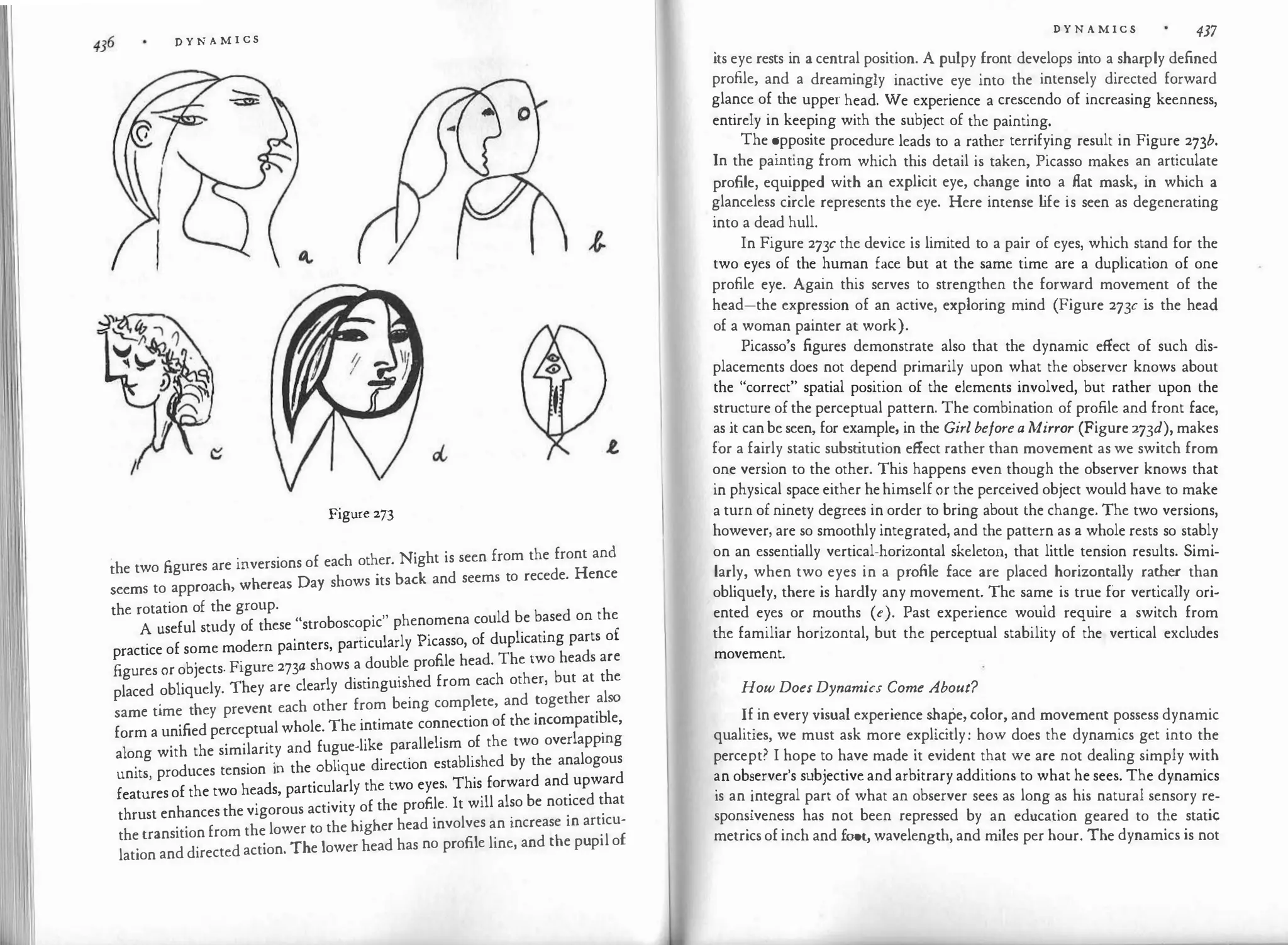
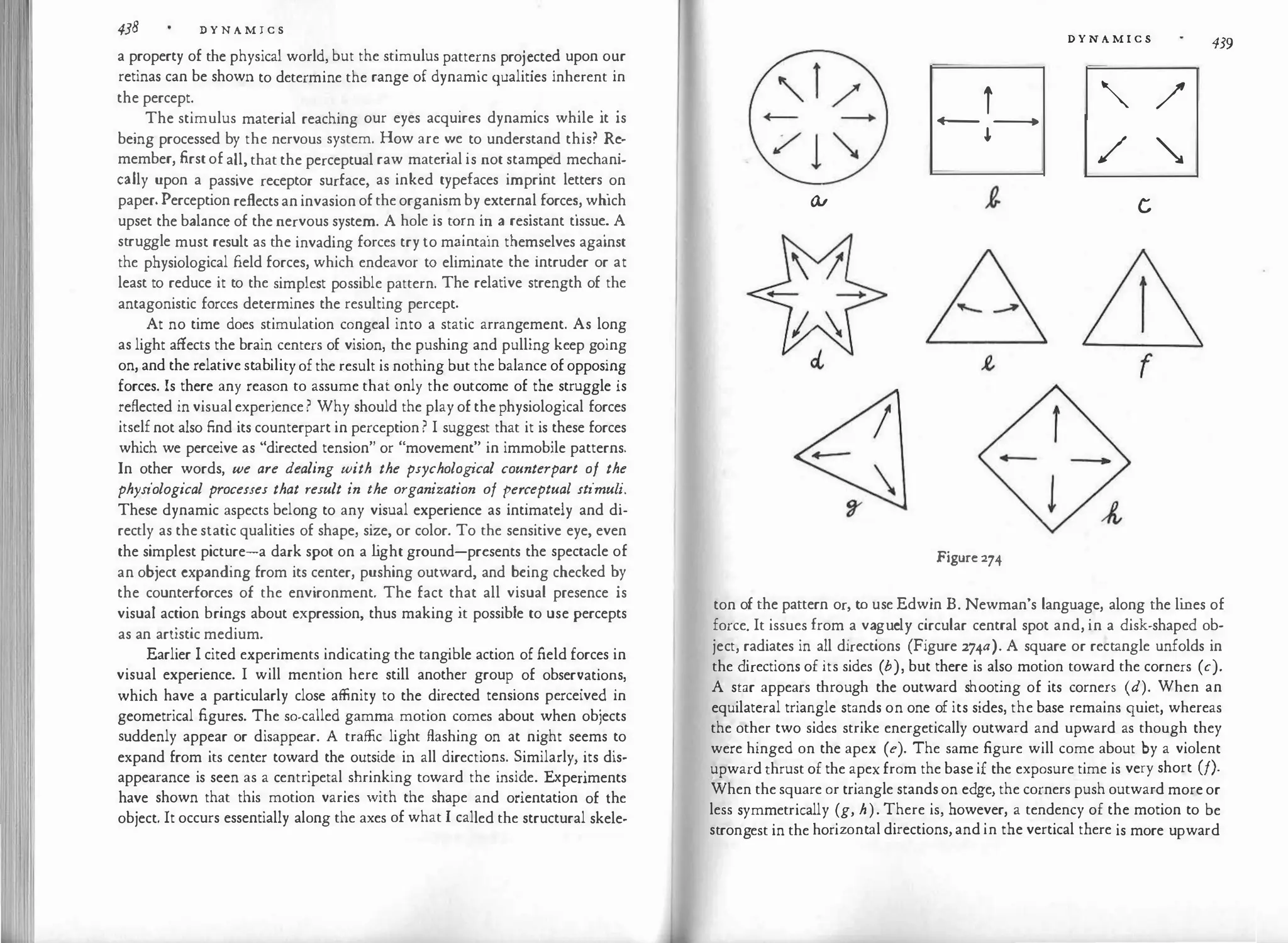
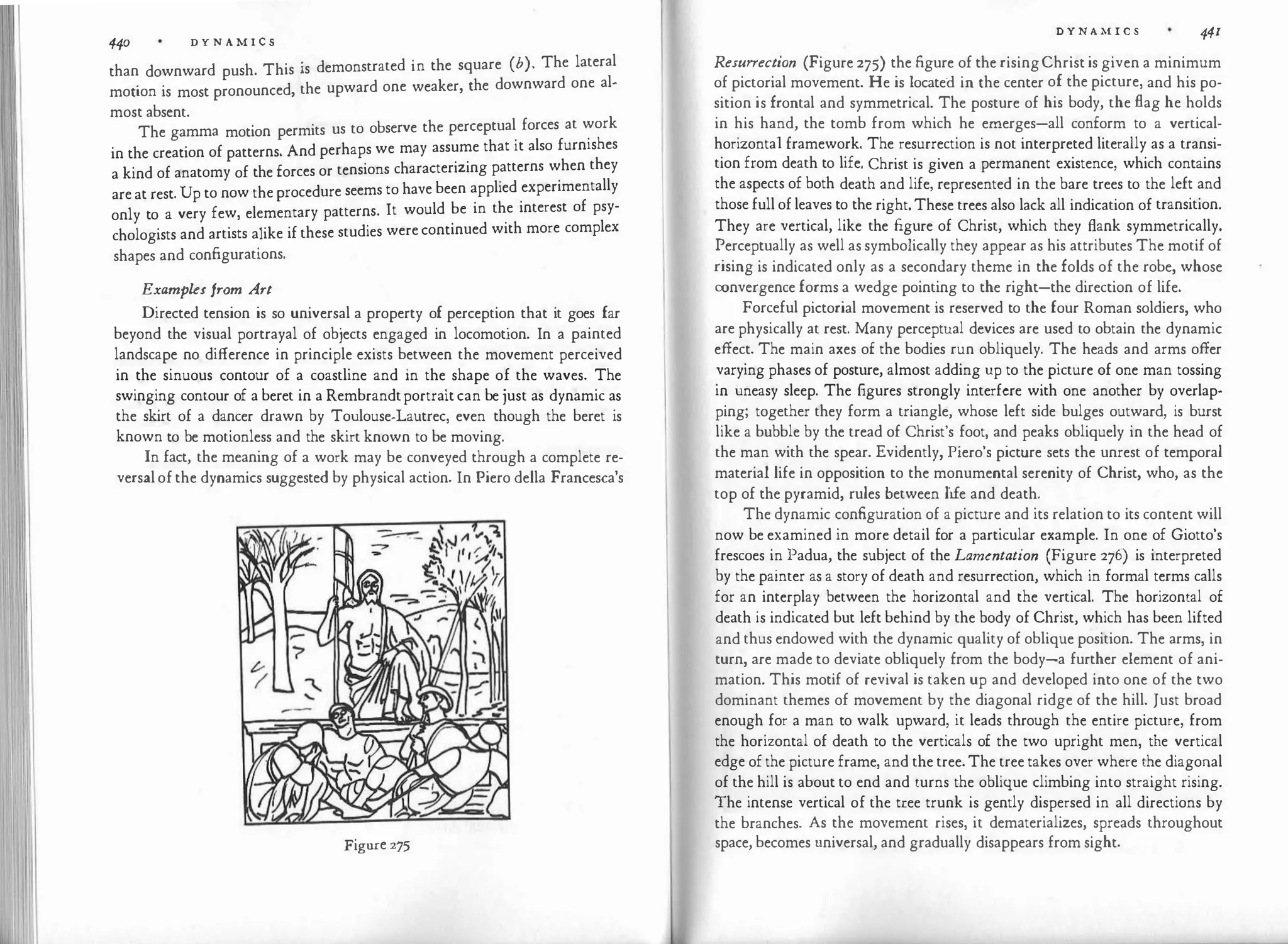
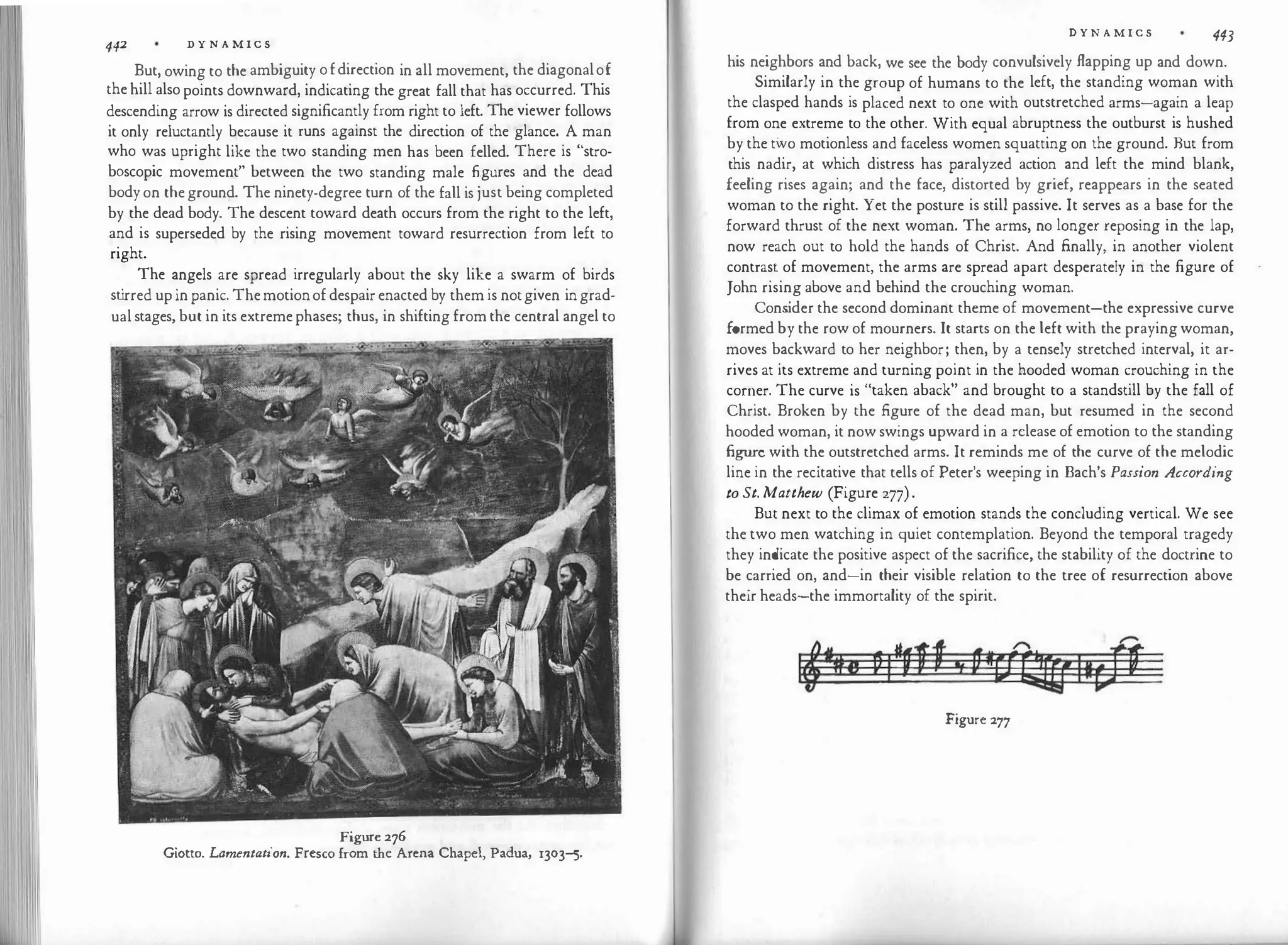
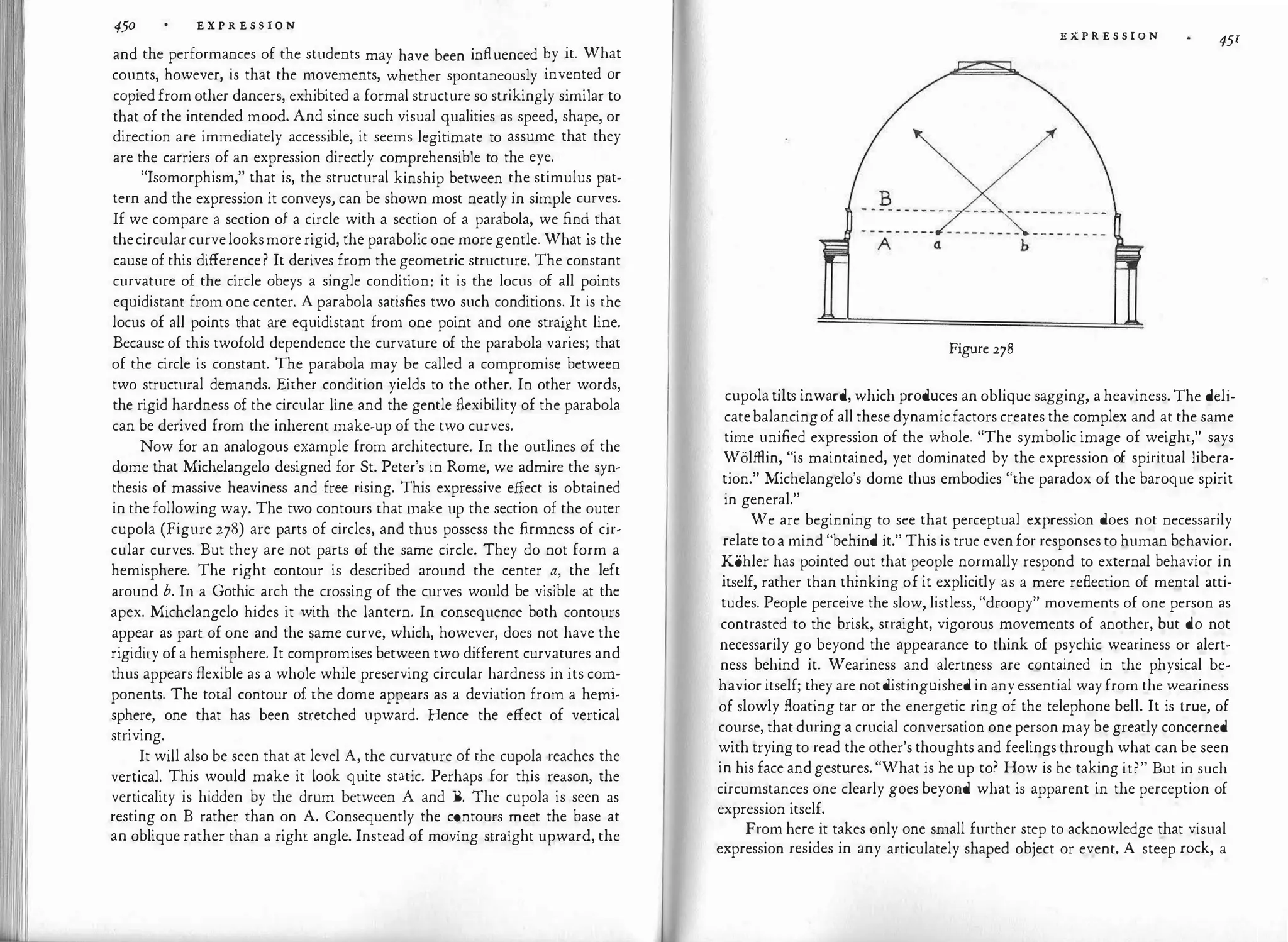
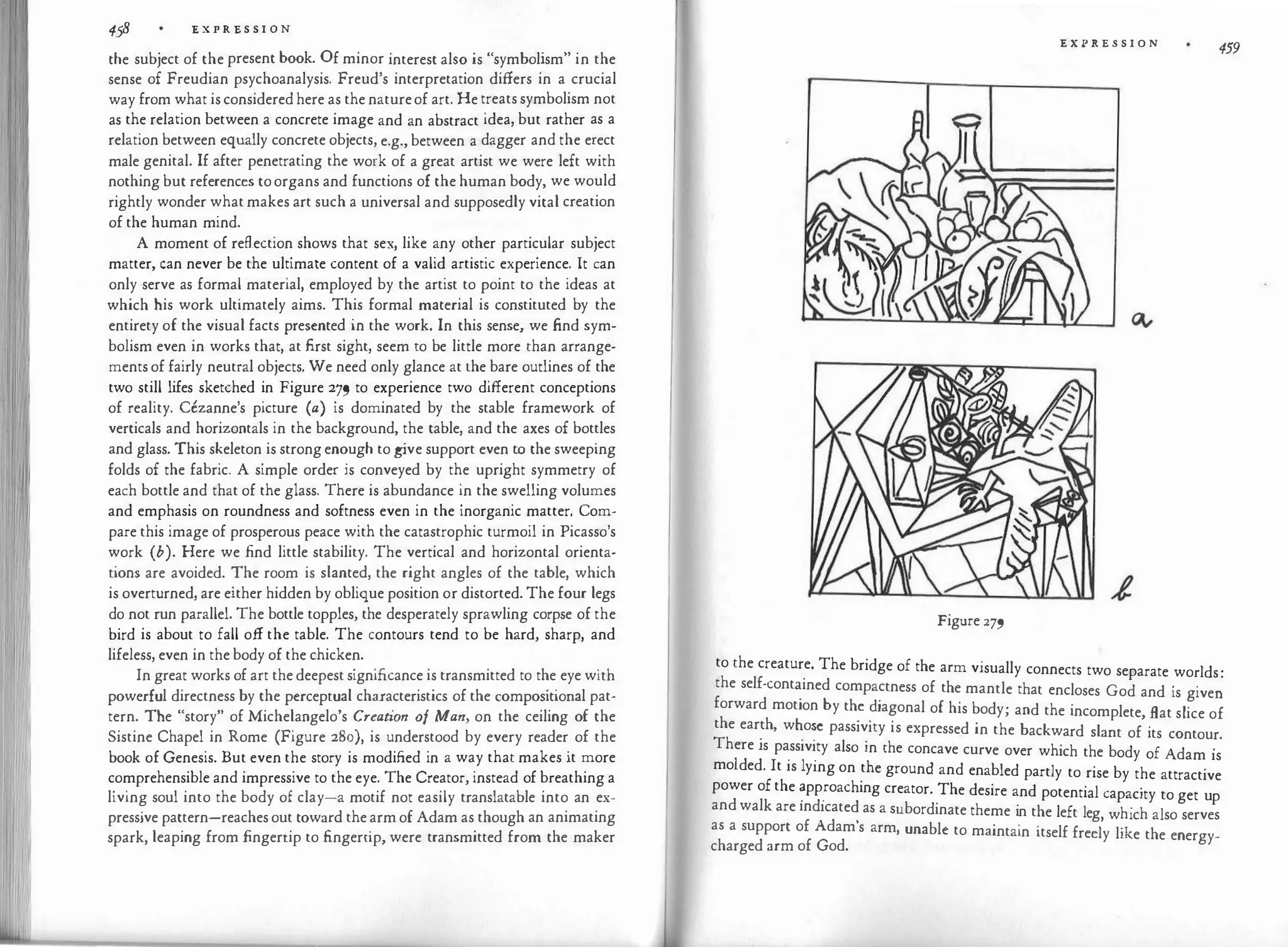
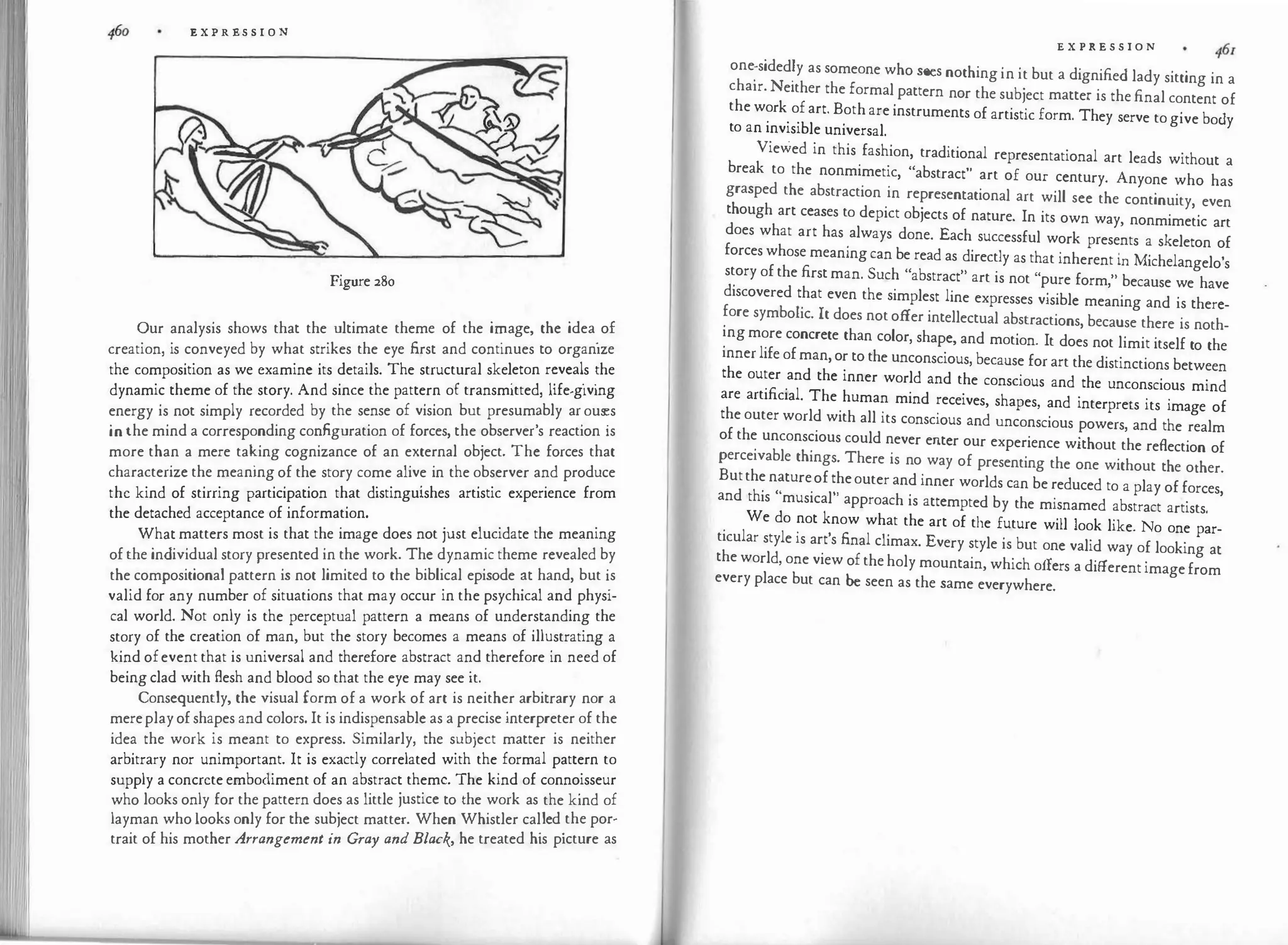
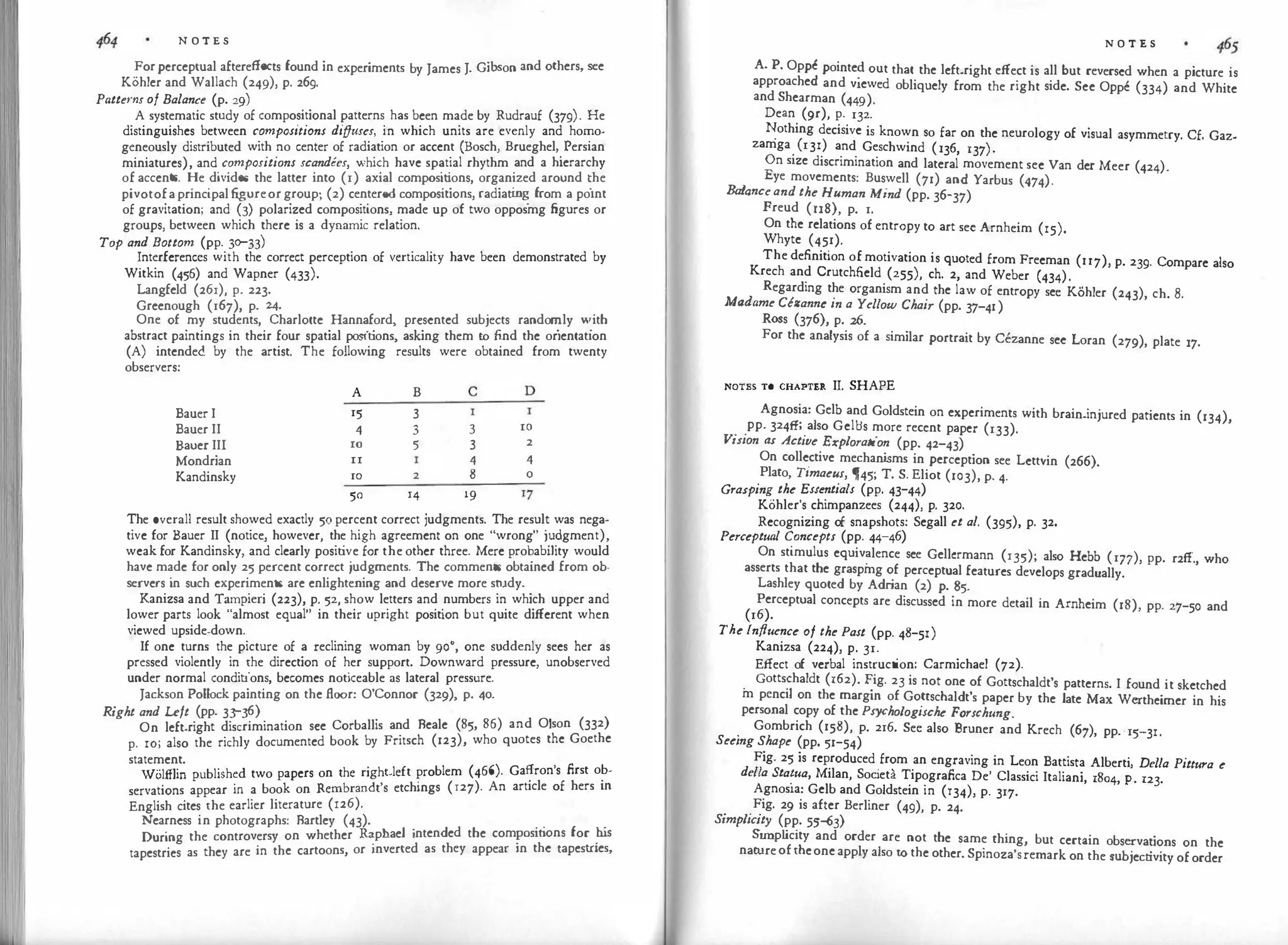
![N O T E S
(Ethics, appendix to Part I) is cited in a paper by Hartmann and Sickles on the
theory of order (173). These authors, who seem to think of order mainly, or perhaps
exclusively, as a characteristic of grouping-that is, as a relationship between discrete
objects-assert that "order is the term applied to any subjective quality or sensation
which is produced by, and dependent upon, the number of straight lines which can
be drawn through three or more actual or supplied points or centers of the sensory
field; it varies directly with the degree to which these lines tend t
o become parallel
with each other and with the vertico-horizontal coordinate system natural to the
organism." This definition, applicable also to simp l
icity, points correctly to the i
m
portance of the spatial frame of reference and of parallel orientation. But it describes
the effect of parallelism in terms of a summation of clements and is inadequate also
i
n consider
ing only two specific factors. For example, circles, which contain no
parallels, have a high degree of order. In a second paper Sickles (401) realizes that
a circular arrangement of objects would possess order, but maintains that no such
arrangement is ever perceived, because "the eyes never see curves save when these
are objectively present-all subjective intervals being straight lines." This assertion
is based on insufficient observation (see, e.g., our Fig. 28).
Alexander and Carey (4).
Hochberg et al. on simplicity (195 and 197).
Peter Blake, in a review of the book The Road ls Yours by R. M. Cleveland and
S. T. Williamson, published in the New York Times, 1951.
Chaplin: Cocteau (79), p. 16.
Parsimony: Cohen and Nagel (So), pp. 212, 384.
Newton: Mathematical Pri11ciples, Book III, rule 1.
Badt on simplicity (36).
Ben Nicholson's relief is illustrated in Circle (297), plate 6.
Victory Boogie-Woogie, apainting by Piet Mondrian (312), p. 55. Rebellion Tamed
by Wise Government is the title of a painting by Rubens, c. 163r.
Isomorphi
sm: Koffka (250), pp. 56-68.
Simplification Demonstrated (pp. 63-66)
Lucretius: De Rerum Natura, Book IV, 353. Leonardo (291), vol. 2, p. 238.
A detailed survey of experiments on the reactions to subdued stimuli can be found
in the first edition of Woodworth (469), ch. IV, "Memory for Form." Consult also
Koffka (250), pp. 493-505. Considerable controversy has been aroused by experi
ments based on the effect of memory. The pioneering study by Wulf (472) was
done under the guidance of Koffka. Among the more recent publications, that of
Goldmeier (153) is particularly relevant. Hebb and Foord (178) interpreted their
results as being contrary to gestalt predictions. The examples of reactions to Fig. 38,
which is adapted from Wohlfahrt in Neue Psychologische Studien 1928/32, derives
from demonstrations in my classes. Fig. 4oa is based on Wulf, Fig. 4od on Allport
(6). See also Arnheim (r6), pp. 81-84.
Leveling and Shm·pening (pp. 66-67)
On Pragnanz see Rausch (364), pp. 904ff. An example of the confusion created
by pregnance: Woodworth and Schlosberg (470), p. 419.
On leveling and sharpening in the transmission of rumors see Allport and Postman
(7), reprinted in Katz ct al. (225), pp. 394-404.
A Whok MaintainsItself (pp. 67-69)
On the principles of Gestalt psychology see the books of Kohler (241) and Koffka
(250), as well as the anthologies edited by Ellis (ro4) and Henle (188).
Torroja (42r) p. 285.
N O TE S
T
�
1e law of simpl'.city, as I prefer to call it, has often been called the law of the
goo gestalt or of pragn�11z. The notion of "goodness" suggests subjective value judg
men
.
� rat�er than obiective fact. On priignanz see p. 67 and the note relating to it.
Kohl�r s book on physical gestalten (246) has not been translated, but references to
the subiect abound in his later writings. The quotation is from (240), p. 242.
Ivo.�ohle� on experiments with goggles (253).
�em1anop1a: Gelb (r33) and Teuber (415), pp. 16r4f.
. �•
.
gs. 41 and 46 are taken from Metelli (303) by permission of the author.
S11bd111111011 (pp. 69-73)
Fig. 42 is after Arnheim, in Whyte (452), p. 202.
On the golden section see Arnheim (18), pp. ro2-119, and the literature cited there.
Why the Eyes Often Tell tlie Truth (pp. 73-'74)
W�rth�
ime�'s example of the bridge on p. 336 of the German original (444). The
drawrng 1s mme.
Stein (407) �- 1r. On camouRagc in nature see Cott (87).
Compare Kohler (241), pp. 156-r6o. Wertheimer explains the correspondence
between perceptual and physical organization as an evolutionary adaptation of the
nervous system to th� environment; p. 336 of the German original (444), omitted in
the summary by Ellis (104).
S11bdivision in the At-ts (pp. 74-'76)
Brancusi's stone sculpture of 1908 is in the Philadelphia Museum.
What ls a Part? (pp. 76-]8)
Fig. 50 on p. 323 of Wertheimer's original paper (444).
" Early form
_
ula
.
�ions of the gestalt principle assumed the existence of an additional
gestalt qu
.
aht
�
. Cf. Ehrenfels (102), reprinted in Weinhandl (436), pp. rr-43;
also Arnhe1m Ill Henle (188) pp. 9�6.
In � "gestalt" the structure of the whole is determined by the structure of the parts
and
_
vice versa. For a list of definitions of "gestalt" see Katz (226), p. 9r. For an intro
:
duc�1on t? the theory see Wertheimer (446), Kohler (241), and Koffka (250).
Picassos sketches for Guernica: Arnheim ( 19).
Wad�i?gton's article on biological shape in Whyte (452), pp. 44-56. Waddington
. .
als
�
cnuc1zes
_
modern sculpture from the anatomist's point of view.
Stmt!anty and Difference (pp. 79-88)
�ules of grouping: Werthe
imer (445), Musatti (321). On exper
iments with
animals see Ellis (104), selections 18-21.
Dante: Paradiso III, 14.
Aristotle on similarity: On Memory and Remi11isce11ce, 451b. See also Plato's
Phaedo, 74.
�osconi in the Rivista di Psicologia, 1965.
Figs. �2-56 are adapted from my paper in Whyte (452), p. 200.
.The piecemeal character of the rules of grouping is often overlooked. Wertheimer
himself
_
wa
�
.
well a
_
w
_
are o
_
f it. After introducing his rules he called them "a poor
a
.
bs�rac�1on, �hus g1vmg his paper a dramatic turning point. He described the law of
similarity as a special case ?f the law �! good gestalt," and asserted that visual pat
tern
_
s shou�d not be treated Ill terms of distances and relations between pieces."
Fig. 59 is traced from a reproduction in Duncan (98), p. 54. The painting dates
from 1908.
Big Dipp_er: reproduced by permission of Prof. Weiss from (437).
Walter �1ston (3?3), p. 20.Other principles found in visual organization could also
be beneficially applied to music.](https://image.slidesharecdn.com/arnheimrudolfartandvisualperception1974-251210161854-a75a3f61/75/Art-and-Visual-Perception-A-PSYCHOLOGY-OF-THE-CREATIVE-EYE-241-2048.jpg)
![468 N O T E S
Examples from ht (pp. 88--g2) .
.
d . 68 · ·n the Naples Museum.
Brueghel's Parable of the Blind Men, patnte tn 15 , is 1
The biblical reference is to Matthew
_
15
_
:14.
f C 1 Gombrich (156),
Gri.inewal<l's altar, finished c. 1515, 1s m the Museum o o mar.
p. 259. . / k own I am referring
Five versions of El Greco's Expulsion f1·om the Temp e arc n ·
to the one in the Frick Collectio�, New yark.
. . · Art Institute.
Van Gogh's Bedroom, painted m Aries m 1888, is m the Chicago
The Structural Skeleton (pp. 92--g5)
Delacroix (9J), I, Etudes Esthetiques, p. 69.
Eye movements: Yarbus (474) and Buswell (7r).
th
.
318 of the
Fig. 72 is derived from a procedure suggested by Wer e1mer on P·
originaI paper (444)·
Wittgenstein (458)
'
part II, sect XI.
NOTES TO CHAPTER III. FORM
Ben Shahn (398), p. 61.
Wittgenstein (458), P· 235. .
Goethe Dichtung und Wahrhe1t, Book IJ .
Jllusio;istic doctrine: cf. Arnheim (14), P· 125
·
Pliny on Zeuxis: Panofsky (339)
'
P· 99·
Orientation in Space (pp. 98-103)
Gellcrmann (135).p· (
8) The influence of orientation on the shape of the
Tilted square: e.g., 1aget 34 ·
( ) 6
square was first pointed out in 1896 by Mach 293 'P· ro ·
Kopfermann (254), P· 35
2
·
bl l h
.
t d ·n 1924 is reproduced as plate 187
Picasso's still life The Red Ta ec ot ' pain c I •
by Barr (42).
Witkin (457).
· · Stern (408) and
For two early studies on children's responses to onentat1on see
Rice (370); more recently Ghent (139).
Pro;ections (pp. 103-io6)
h d . nd interpretation of works of art (464),
PP
�6
��
�
�·
c�r:
p
f
:
i
�
�
r
a�.�t ��;
p
;i
�t;��
n
°
;
:
ff
ect
�
f
�
l
;
o
���:�h
h
�is�:
�
�i��o
;c���
c
;0�!
sculpture from inappropnat� vi
�
wpomts: In a p
���!i:Ota.
ted aspect under conditions
easily than in direct pcrcc�uon .
e
ca�se it prese
sha e of a statue is rather complex,
of greatly reduced thr�e-d1mens1onah
d
. Whe� the
d .front"-that is, the impression
an obliquely take.
n picture may pro .
uce a
:
:��at�e. Hence the distortion.
that the observer is facing the f�ont v1�w.
�
f t
bl by determining the structural
Projective geometry deals with a s1m1 a� pro. cm
'ection See Courant
"invariants," which remain untouched by d1stort1on through prOJ .
and Robbins (88), pp. 165ff.
Bower on constancy in infants
.
(60).
Depth perception in infants: Gibson (140) ·
Which Aspect is Best? (pp. 106-111)
Galton (129), p. 68.
Eidetic images: Haber (170).
Hogarth's Analysis of Beauty, lntrod.
Computer graphics: Sutherland (411).
Chesterton in "The Eye of Apollo," one of his Father Brown stories. On Giaco
metti sec Lord (280), p. 14.
Kerschensteiner (236), pp. 22g-230.
The Egyptian Method (pp. n2-u6)
Mach (292).
Schafer (386), p. 254, fig. 199; elevations of the sphinx, p. 202.
Oskar Schlcmmer's Tischgesellschaft, painted in 1923, is in the Stroher Collection,
Darmstadt.
Foreshortening (pp. u6-120)
If we think of the sections of the foreshortened bodies, we realize moreeasily how
a partially given simple shape tends toward its completion.
Fig. 88 is drawn after a detail from an Attic amphora of the early sixth century, in
the possession of the Metropolitan Museum of Art in New York (illustrated in
Greek Painting [166]. p. 8). The compelling power of structurally simple patterns
is demonstrated by the fact that such monsters can be produced in a period when the
sense of the visually significant was otherwise so str
ict that even mild forcshortenings,
e.g., of heads or feet, were avoided. The symmetry of the front view is so inviting
that its inadequacy is overlooked. It also affords a simple solution to the problem of
representing a set of four horses (cf. p. 125). Rathe (360), p. 37, mentions similar
cases in Far Eastern art as examples of the impact ("Durchschlagskraft") of such
projections.
Delacroix, fournal (94), vol. 3, p. 13, entry of Jan. 13, 1857.
Fig. go is enlarged from Fernand Leger's film Ballet Mecanique (1924). I am in-
debted for the photograph toGuido Aristarco, editor of Cinema Nuovo.
Andrea Mantegna's foreshortened figure of Christ is in the Brera, Milan.
Figs. 91a and b are sketched after pp. 9 and 36 of Cooper (84).
The Barlach quotation is translated from a letter of June, 1889 (41), p. 17.
Overlapping (pp. 120-123)
The Picasso examples ofFig. 92 are sketched from Cooper (84), pp. 13 and 14.
Apologies are due Rockwell Kent, a detail of whose woodcut The Lovers gave me
the idea for Fig. 93.
Michelangelo's Last Judgment in the Sistine Chapel of the Vatican was painted in
1536-1541.
Low-cut dresses that end in a horizontal line slice the shoulders from the rest of
thebody, whereas the oblique V-shapcd cutdeviates from the axes of the body strongly
enough not to interfere with its uRity.
What Good Does Overlapping Do? (pp. 123-127)
Fig. 98 is taken from an Egyptian reliefat Abydos (c. 1300 B.c.) representing King
Sethos I and the goddess Isis.
Rubens' Shepherd Embracing a Young Woman of 1636-1638 is in the Munich
Pinakothek.
For further examples of how superposition is used to convey meaning in films sec
Arnhcim (20) pp. 47ff.
Alschulcr and Hattwick (8), vol. 2, p. 129.
The picture of St.Ursula from a calendar manuscript in Stuttgart is reproduced by
Gombrich (156), p. 129.
The parallel noted in the development of music and the visual arts refers mainly
to the sequence of comparable steps, not to coinc
idence in history. It may be men
tioned, however, that although in Western culture visual overlapping precedesmusical
harmony by thousands of years, the arrangement of pictures in horizontal rows](https://image.slidesharecdn.com/arnheimrudolfartandvisualperception1974-251210161854-a75a3f61/75/Art-and-Visual-Perception-A-PSYCHOLOGY-OF-THE-CREATIVE-EYE-242-2048.jpg)
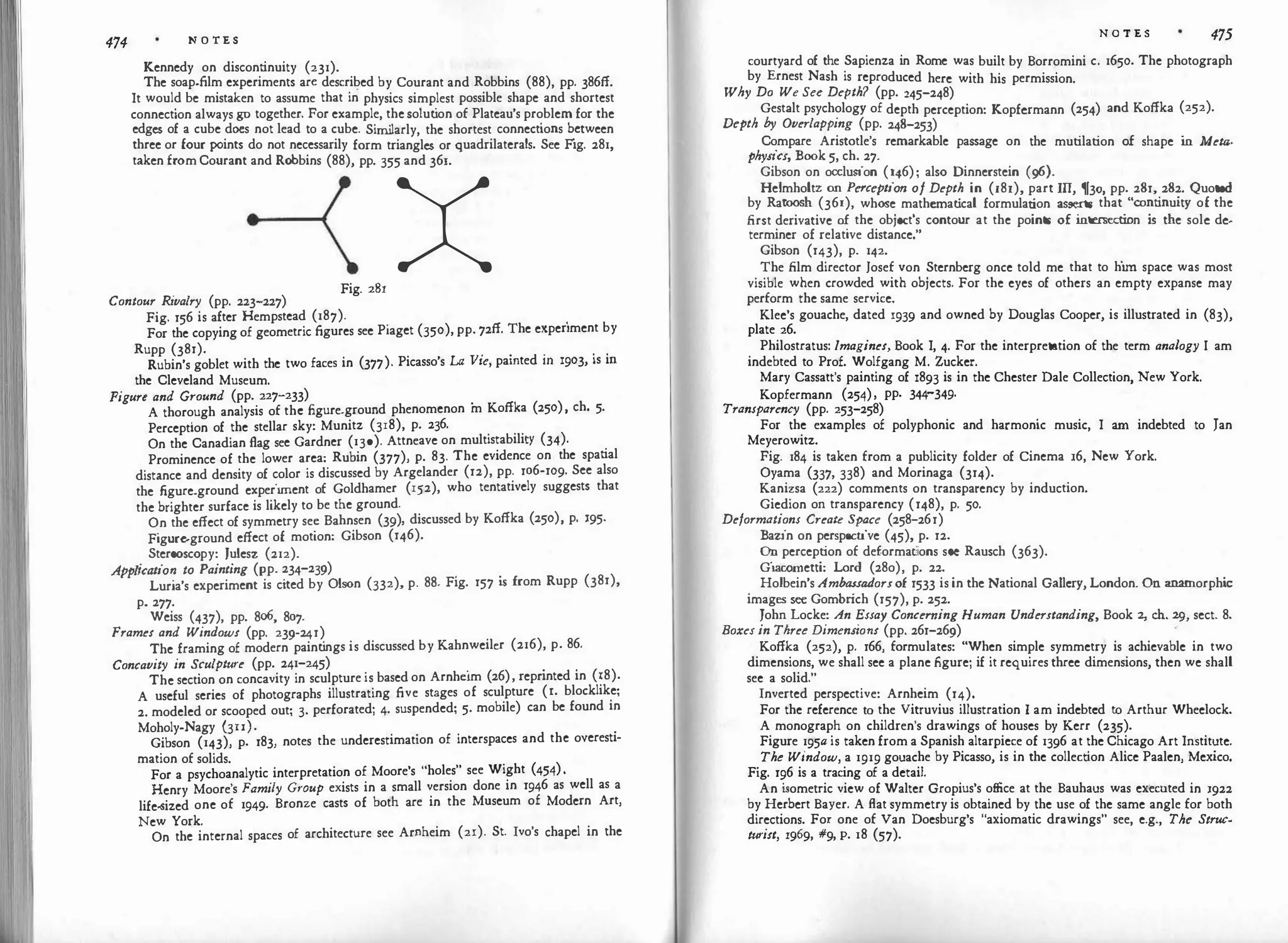


![iStat Menus 7.20 Crack for MacOS 2026 Full Version [Latest] pptx](https://cdn.slidesharecdn.com/ss_thumbnails/softwareoverview-251207191544-22b737dc-thumbnail.jpg?width=640&height=640&fit=bounds)


![PowerISO 9.2 Mac Crack + Serial Key Free Download 2026 [Latest] Software.pptx](https://cdn.slidesharecdn.com/ss_thumbnails/software-251207185653-5d5700e6-thumbnail.jpg?width=640&height=640&fit=bounds)

![WinRAR Crack 7.13 Final Mac Keygen 2026 Download [Latest] Software.pptx](https://cdn.slidesharecdn.com/ss_thumbnails/software-251207185858-eb450678-thumbnail.jpg?width=640&height=640&fit=bounds)


