Hemorrhoid
• Prepared by Laxmi Bhatta
Objectives
• At the end of this presentation the student will be
able to:
Define hemorrhoids.
Describe Pathophysiology of hemorrhoids.
Identify types of hemorrhoids.
Enlist signs, symptoms and causes of hemorrhoids.
Explain medical diagnosis and treatment.
Discuss nursing diagnosis and nursing intervention
for hemorrhoids.
•
•
•
•
•
•
Hemorrhoids
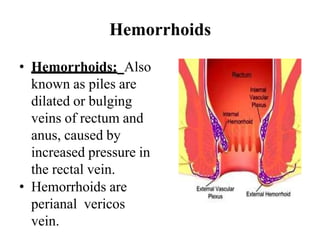
• Hemorrhoids: Also
known as piles are
dilated or bulging
veins of rectum and
anus, caused by
increased pressure in
the rectal vein.
• Hemorrhoids are
perianal vericos
vein.
Condt..
• Hemorrhoids are painful, swollen veins in the
lower portion of the rectum or anus which
involves the blood vessels that line the anus.
• Pressure on the walls of the rectum weakens the
muscle that supports the hemorrhoid vessels.
• These can be situated externally and internally in
and around the rectum.
• When hemorrhoid vessels become enlarged and
their support in a sack like structure protrusion
inside the rectal canal called internal
hemorrhoids. Under the skin around the anus
called external hemorrhoids.
Risk Factor
• Chronic diarrhea.
• Coughing
• Sneezing.
• Vomiting.
• Prolonged sitting.
• Pregnancy (pressure on the lower abdomen caused by uterus).
• Sedentary life style.
• Eating a low fiber diet.
• Over weight Standing or lifting too much.
• Cirrhosis of the liver(due to venous swelling from poor
venous drainage related to scarring of normal liver tissue).
• Anal intercourse .
• Anal or rectal infection.
Incidence of hemorrhoid
• A cross sectional survey study among 1483
people on The Prevalence of Anorectal
Disorders among Residents of Kirtipur
Municipality in Nepal (Ram, A, Yadav ., R. ,
Shrestha, S. ,Shrestha, J. , Joshi, M,A. 2021)
found that Haemorrhoids (31.2%) and anal
fissure (28.7%) were the most prevalent
anorectal disorders.
Contd…
• A study on Prevalence and risk factors of hemorrhoids: a
study in a semi-urban centre (G, G. Ravindranath., B, G.
Rahul. 2018) in India among 63 patients between the ages
20 year and 80 year who had come to the outpatient ward
with hemorrhoids found that 66.67% were males and
33.33% were females, with the most common age group
affected was below 40 years of age. Less than 40% of the
patients were vegetarians, with more than half of the
patients having a mixed diet. More number of women had
history of hemorrhoids in their family (47.6%). Straining
and constipation was seen in majority of the patients.
Bleeding and mass through the rectum was seen in majority
of the patients (96.8% and 93.7% respectively.
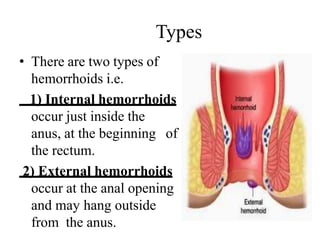
Types
• There are two types of
hemorrhoids i.e.
1) Internal hemorrhoids
occur just inside the
anus, at the beginning of
the rectum.
2) External hemorrhoids
occur at the anal opening
and may hang outside
from the anus.
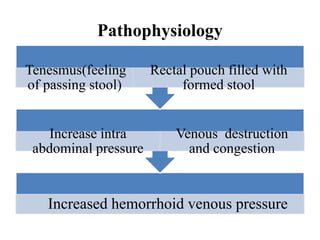
Pathophysiology
Increased hemorrhoid venous pressure
Increase intra
abdominal pressure
Venous destruction
and congestion
Tenesmus(feeling
of passing stool)
Rectal pouch filled with
formed stool
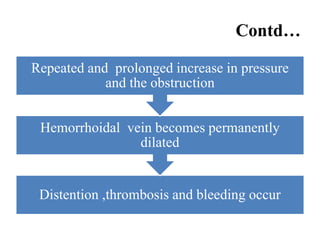
Contd…
Distention ,thrombosis and bleeding occur
Hemorrhoidal vein becomes permanently
dilated
Repeated and prolonged increase in pressure
and the obstruction
Symptom of hemorrhoid
• Local pain on anorectal area.
• Bleeding on defecation (small amount of blood
in the stool or on the toilet paper after wiping)
• Incomplete bowel movements.
• Rectal itching .
• Soft lump felt at the anal opening.
• Constipation.
• Iron deficiency anemia.
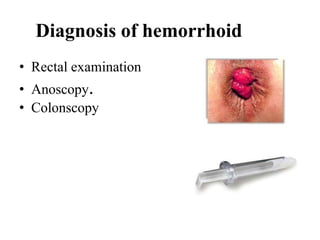
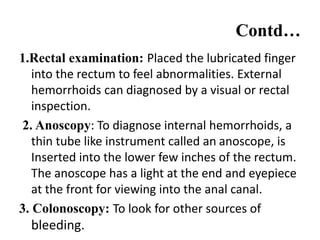
Diagnosis of hemorrhoid
• Rectal examination
• Anoscopy.
• Colonscopy
Contd…
1.Rectal examination: Placed the lubricated finger
into the rectum to feel abnormalities. External
hemorrhoids can diagnosed by a visual or rectal
inspection.
2. Anoscopy: To diagnose internal hemorrhoids, a
thin tube like instrument called an anoscope, is
Inserted into the lower few inches of the rectum.
The anoscope has a light at the end and eyepiece
at the front for viewing into the anal canal.
3. Colonoscopy: To look for other sources of
bleeding.
Complication
• Bleeding.
• Thrombosis .
• Hemorrhoid strangulation( due to cut off
circulation from compression of blood vessel) .
• Infection
• Stricture formation as the lesion heals.
• Stool incontinence.
Treatment and management
1.Conservative Management
• Increase dietary fiber Oral fluids.
• NSAID to relief pain and discomfort.
• Sitz bath.
• Rest .
• Steroids ointments or creams.
2.Medical management:
Used to treat mild, small and uncomplicated, hemorrhoids. Aim is to
relieve symptoms. Measures to reduce symptoms include:
 Warm tube or mini sitz baths several times a day in plain warm
water for about 10 minutes will be helpful.
 Ice packs to help reduce swelling.
 Application of petroleum jelly, cortisone cream hemorrhoidal
cream or suppositories to the affected area.
 Wearing cotton underwear and loose clothing.
 Clean the anus after each bowel movement by putting gently with
moist toilet paper or moistened pads.
 Taking analgesic( acetaminophen ) or aspirin.
3. Surgical management
• For hemorrhoid that doesn't respond to
conservative and medical management are
treated by surgery. For internal hemorrhoids,
one of the 5 methods is usually used.
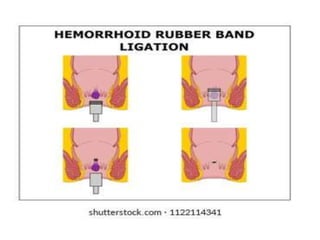
• Rubber band ligation:This procedure involves
placing a small rubber band at the base of the
internal hemorrhoid. The band cuts off blood
supply to the hemorrhoids, causing it to shrivel
up and fall off in about four to seven days.
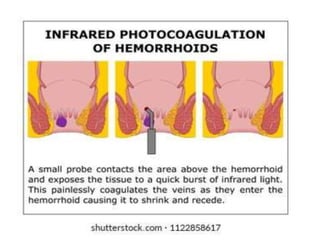
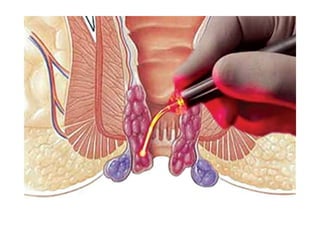
B. Infrared electromagnetic
photocoagulation
• This procedure involves directing an infrared
light to coagulate (Clot) the dilated veins of the
hemorrhoids. This causes the hemorrhoids to
shrink, since the blood does not flow through
coagulated blood vessels.
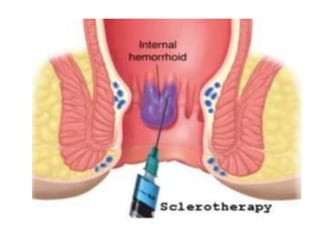
C. Injecting sclerotherapy
• This procedure involves injecting a chemical
solution into the mucous membranes near the
hemorrhoids. This chemical causes
inflammation and closure of the veins, thereby
shrinking the hemorrhoids (injection of a
scleroting agent, a substant that causes
formation of scar tissue). Need one to 4
injections 5 to 7 days apart.
D. Laser coagulation
• Involves the application of an electrical current to
the hemorrhoids. The electric current, emitted by
an electrode probe, triggers a chemical reaction
that shuts down the blood supply in the
hemorrhoids and causes the inflamed tissue to
shrink.
E. Hemorrhoidectomy: This procedure
involves surgically removing the hemorrhoids
group in the anal canal and is performed with a
scalpel, cautery device or laser. The vein is
excised and the area either left open to heal by
granulation or is closed with sutures.
Self care
Most hemorrhoids heal on their own in a week or two. The
most effective preventive measures are:
 Eat between 25-30 gram of fiber a day.
 Drink at least 8 glasses of water a day.
 Increased daily physical activity.
 Lose weight (wt . reduction).
 Add stool softeners or laxatives to diet.
 Avoid straining on defecation.
 Practice the buttocks muscles exercise (to make strengthen
the pelvic muscle and to improve circulation).
 Practice good personal hygiene, clean and keep the anal
area clean.
Prevention
•
•
Drink plenty of water, at least eight glasses per
day.
Eat high fiber diet of fruits, vegetables, and
whole grains.
• Empty bowels as soon as possible after the
urge occurs.
• Regular exercise.
Nursing Diagnosis for Hemorrhoids
• Pain (acute or chronic) related to rectal
swelling.
• Constipation related to ignore the urge to
defecate due to pain during defecation.
• Anxiety related to plan surgery.
• Impaired Urinary Elimination related to the fear
of postoperative pain.
• Risk for infection related to inadequate primary
defenses for infection.
• Deficient knowledge related to the lack of
information about home care.
Nursing management
1. Prevent constipation:
 Encourage patient to take laxatives, stool
softeners as prescribed to promote stool passage.
 Monitor stool for consistency and blood.
 Advice patient to eat fiber containing foods and
ample drinks to prevent strainers.
 Remind patient not to sit on the toilet longer than
necessary.
2.Pain management
• Encourage 15 minutes warm sitz bath 3-4 times a day.
3. Promote healing: After surgery, stress to the
importance of keeping the area clean and stool soft.
 Encourage patient to wash the area after defecation
and pat it dry.
Encourage to apply local moist heat to the anal
opening for few minutes which clean, soothes and
promote healing.
Begin sitz bath after 12 hours of surgery 3-4 times a
day and after each bowel movement.
3.Prevent complications
• Assess for hemorrhage and urinary retention.
• Provide instruction on the relationship of
proper diet and adequate fluid intake to bowel
regularity, the physiology of defecation and
important of regular bowel habit.
4. Relieve Pain
• Parenteral and oral analgesics are given.
• Give stool softener and oil or mineral softener
to soften and lubricate the first stool.
• Warn patients that fainting may occur, from
pain and vagal stimulation during first post
operative bowel movements.
References
• Dozois EJ, Pemberton JH (2006). Hemorrhoids
and other anorectal disorders. In MM Wolfe et al.,
eds., Therapy of Digestive Disorders, 2nd ed., pp.
945-958. Philadelphia: Saunders Elsevier.
Hull TL (2006). Hemorrhoids section of Diseases of
the anorectum. In M Feldman et al., eds., Sleisenger
and Fordtran's Gastrointestinal and Liver Disease,
8th ed., vol. 2, pp. 2833-2852. Philadelphia: Saunders
Elsevier.
•
Contd…
• Sharma ,M. Poudel ,K(2020) Comprehensive
Textbook of Medical Surgical Nursing. 3rd
edition,Samikshya Publication Pvt.Ltd .
• Smeltzer, S. Bare, B.(2008)Textbook of
Medical- Surgical Nursing.11th edition )
lipppincott Publications, New Delhi.
• Mandal, G.N.(2015) Medical Surgical
Nursing, 8th edition, Elsevier. Medical
surgical Nursing, Makalu Publication.
Contd….
• Silvestri ,A. Linda(2017) Comprehensive
Review for the NCLEX-RN(2nd) south
edition) Sounders.
• Lewis’s Medical - Surgical Nursing.
Edited by subodh k chauhan. A division
of Reed Elsevier India Private
Limited: Elsevier.
• Janice,L.Hinkle,Kerry H.Cheever Medical
Surgical Nursing. Edited by
hemorrhoid.pptx

hemorrhoid.pptx

  • 1.
  • 2.
    Objectives • At theend of this presentation the student will be able to: Define hemorrhoids. Describe Pathophysiology of hemorrhoids. Identify types of hemorrhoids. Enlist signs, symptoms and causes of hemorrhoids. Explain medical diagnosis and treatment. Discuss nursing diagnosis and nursing intervention for hemorrhoids. • • • • • •
  • 3.
    Hemorrhoids • Hemorrhoids: Also knownas piles are dilated or bulging veins of rectum and anus, caused by increased pressure in the rectal vein. • Hemorrhoids are perianal vericos vein.
  • 4.
    Condt.. • Hemorrhoids arepainful, swollen veins in the lower portion of the rectum or anus which involves the blood vessels that line the anus. • Pressure on the walls of the rectum weakens the muscle that supports the hemorrhoid vessels. • These can be situated externally and internally in and around the rectum. • When hemorrhoid vessels become enlarged and their support in a sack like structure protrusion inside the rectal canal called internal hemorrhoids. Under the skin around the anus called external hemorrhoids.
  • 5.
    Risk Factor • Chronicdiarrhea. • Coughing • Sneezing. • Vomiting. • Prolonged sitting. • Pregnancy (pressure on the lower abdomen caused by uterus). • Sedentary life style. • Eating a low fiber diet. • Over weight Standing or lifting too much. • Cirrhosis of the liver(due to venous swelling from poor venous drainage related to scarring of normal liver tissue). • Anal intercourse . • Anal or rectal infection.
  • 6.
    Incidence of hemorrhoid •A cross sectional survey study among 1483 people on The Prevalence of Anorectal Disorders among Residents of Kirtipur Municipality in Nepal (Ram, A, Yadav ., R. , Shrestha, S. ,Shrestha, J. , Joshi, M,A. 2021) found that Haemorrhoids (31.2%) and anal fissure (28.7%) were the most prevalent anorectal disorders.
  • 7.
    Contd… • A studyon Prevalence and risk factors of hemorrhoids: a study in a semi-urban centre (G, G. Ravindranath., B, G. Rahul. 2018) in India among 63 patients between the ages 20 year and 80 year who had come to the outpatient ward with hemorrhoids found that 66.67% were males and 33.33% were females, with the most common age group affected was below 40 years of age. Less than 40% of the patients were vegetarians, with more than half of the patients having a mixed diet. More number of women had history of hemorrhoids in their family (47.6%). Straining and constipation was seen in majority of the patients. Bleeding and mass through the rectum was seen in majority of the patients (96.8% and 93.7% respectively.
  • 8.
    Types • There aretwo types of hemorrhoids i.e. 1) Internal hemorrhoids occur just inside the anus, at the beginning of the rectum. 2) External hemorrhoids occur at the anal opening and may hang outside from the anus.
  • 9.
    Pathophysiology Increased hemorrhoid venouspressure Increase intra abdominal pressure Venous destruction and congestion Tenesmus(feeling of passing stool) Rectal pouch filled with formed stool
  • 10.
    Contd… Distention ,thrombosis andbleeding occur Hemorrhoidal vein becomes permanently dilated Repeated and prolonged increase in pressure and the obstruction
  • 11.
    Symptom of hemorrhoid •Local pain on anorectal area. • Bleeding on defecation (small amount of blood in the stool or on the toilet paper after wiping) • Incomplete bowel movements. • Rectal itching . • Soft lump felt at the anal opening. • Constipation. • Iron deficiency anemia.
  • 12.
    Diagnosis of hemorrhoid •Rectal examination • Anoscopy. • Colonscopy
  • 13.
    Contd… 1.Rectal examination: Placedthe lubricated finger into the rectum to feel abnormalities. External hemorrhoids can diagnosed by a visual or rectal inspection. 2. Anoscopy: To diagnose internal hemorrhoids, a thin tube like instrument called an anoscope, is Inserted into the lower few inches of the rectum. The anoscope has a light at the end and eyepiece at the front for viewing into the anal canal. 3. Colonoscopy: To look for other sources of bleeding.
  • 14.
    Complication • Bleeding. • Thrombosis. • Hemorrhoid strangulation( due to cut off circulation from compression of blood vessel) . • Infection • Stricture formation as the lesion heals. • Stool incontinence.
  • 15.
    Treatment and management 1.ConservativeManagement • Increase dietary fiber Oral fluids. • NSAID to relief pain and discomfort. • Sitz bath. • Rest . • Steroids ointments or creams.
  • 16.
    2.Medical management: Used totreat mild, small and uncomplicated, hemorrhoids. Aim is to relieve symptoms. Measures to reduce symptoms include:  Warm tube or mini sitz baths several times a day in plain warm water for about 10 minutes will be helpful.  Ice packs to help reduce swelling.  Application of petroleum jelly, cortisone cream hemorrhoidal cream or suppositories to the affected area.  Wearing cotton underwear and loose clothing.  Clean the anus after each bowel movement by putting gently with moist toilet paper or moistened pads.  Taking analgesic( acetaminophen ) or aspirin.
  • 17.
    3. Surgical management •For hemorrhoid that doesn't respond to conservative and medical management are treated by surgery. For internal hemorrhoids, one of the 5 methods is usually used. • Rubber band ligation:This procedure involves placing a small rubber band at the base of the internal hemorrhoid. The band cuts off blood supply to the hemorrhoids, causing it to shrivel up and fall off in about four to seven days.
  • 19.
    B. Infrared electromagnetic photocoagulation •This procedure involves directing an infrared light to coagulate (Clot) the dilated veins of the hemorrhoids. This causes the hemorrhoids to shrink, since the blood does not flow through coagulated blood vessels.
  • 21.
    C. Injecting sclerotherapy •This procedure involves injecting a chemical solution into the mucous membranes near the hemorrhoids. This chemical causes inflammation and closure of the veins, thereby shrinking the hemorrhoids (injection of a scleroting agent, a substant that causes formation of scar tissue). Need one to 4 injections 5 to 7 days apart.
  • 23.
    D. Laser coagulation •Involves the application of an electrical current to the hemorrhoids. The electric current, emitted by an electrode probe, triggers a chemical reaction that shuts down the blood supply in the hemorrhoids and causes the inflamed tissue to shrink. E. Hemorrhoidectomy: This procedure involves surgically removing the hemorrhoids group in the anal canal and is performed with a scalpel, cautery device or laser. The vein is excised and the area either left open to heal by granulation or is closed with sutures.
  • 25.
    Self care Most hemorrhoidsheal on their own in a week or two. The most effective preventive measures are:  Eat between 25-30 gram of fiber a day.  Drink at least 8 glasses of water a day.  Increased daily physical activity.  Lose weight (wt . reduction).  Add stool softeners or laxatives to diet.  Avoid straining on defecation.  Practice the buttocks muscles exercise (to make strengthen the pelvic muscle and to improve circulation).  Practice good personal hygiene, clean and keep the anal area clean.
  • 26.
    Prevention • • Drink plenty ofwater, at least eight glasses per day. Eat high fiber diet of fruits, vegetables, and whole grains. • Empty bowels as soon as possible after the urge occurs. • Regular exercise.
  • 27.
    Nursing Diagnosis forHemorrhoids • Pain (acute or chronic) related to rectal swelling. • Constipation related to ignore the urge to defecate due to pain during defecation. • Anxiety related to plan surgery. • Impaired Urinary Elimination related to the fear of postoperative pain. • Risk for infection related to inadequate primary defenses for infection. • Deficient knowledge related to the lack of information about home care.
  • 28.
    Nursing management 1. Preventconstipation:  Encourage patient to take laxatives, stool softeners as prescribed to promote stool passage.  Monitor stool for consistency and blood.  Advice patient to eat fiber containing foods and ample drinks to prevent strainers.  Remind patient not to sit on the toilet longer than necessary.
  • 29.
    2.Pain management • Encourage15 minutes warm sitz bath 3-4 times a day. 3. Promote healing: After surgery, stress to the importance of keeping the area clean and stool soft.  Encourage patient to wash the area after defecation and pat it dry. Encourage to apply local moist heat to the anal opening for few minutes which clean, soothes and promote healing. Begin sitz bath after 12 hours of surgery 3-4 times a day and after each bowel movement.
  • 30.
    3.Prevent complications • Assessfor hemorrhage and urinary retention. • Provide instruction on the relationship of proper diet and adequate fluid intake to bowel regularity, the physiology of defecation and important of regular bowel habit.
  • 31.
    4. Relieve Pain •Parenteral and oral analgesics are given. • Give stool softener and oil or mineral softener to soften and lubricate the first stool. • Warn patients that fainting may occur, from pain and vagal stimulation during first post operative bowel movements.
  • 32.
    References • Dozois EJ,Pemberton JH (2006). Hemorrhoids and other anorectal disorders. In MM Wolfe et al., eds., Therapy of Digestive Disorders, 2nd ed., pp. 945-958. Philadelphia: Saunders Elsevier. Hull TL (2006). Hemorrhoids section of Diseases of the anorectum. In M Feldman et al., eds., Sleisenger and Fordtran's Gastrointestinal and Liver Disease, 8th ed., vol. 2, pp. 2833-2852. Philadelphia: Saunders Elsevier. •
  • 33.
    Contd… • Sharma ,M.Poudel ,K(2020) Comprehensive Textbook of Medical Surgical Nursing. 3rd edition,Samikshya Publication Pvt.Ltd . • Smeltzer, S. Bare, B.(2008)Textbook of Medical- Surgical Nursing.11th edition ) lipppincott Publications, New Delhi. • Mandal, G.N.(2015) Medical Surgical Nursing, 8th edition, Elsevier. Medical surgical Nursing, Makalu Publication.
  • 34.
    Contd…. • Silvestri ,A.Linda(2017) Comprehensive Review for the NCLEX-RN(2nd) south edition) Sounders. • Lewis’s Medical - Surgical Nursing. Edited by subodh k chauhan. A division of Reed Elsevier India Private Limited: Elsevier. • Janice,L.Hinkle,Kerry H.Cheever Medical Surgical Nursing. Edited by