Heat Transfer
Heat
Heat isa form of energy. According to the principle of
thermodynamics whenever a physical or chemical transformation.
occurs heat flow into or leaves the system. A number of sources of
heat are used for industrial scale operations steam and electric power
is the chief sources to transfer Heat.
Applications of heat transfer:
1. Evaporation 2. Drying 3. Distillation 4. Crystallization
5. Sterilization.
3.
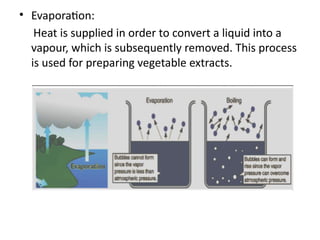
• Evaporation:
Heat issupplied in order to convert a liquid into a
vapour, which is subsequently removed. This process
is used for preparing vegetable extracts.
4.
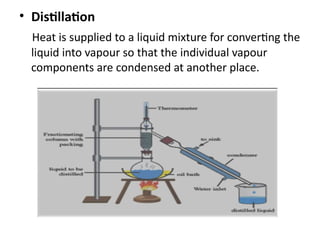
• Distillation
Heat issupplied to a liquid mixture for converting the
liquid into vapour so that the individual vapour
components are condensed at another place.
5.
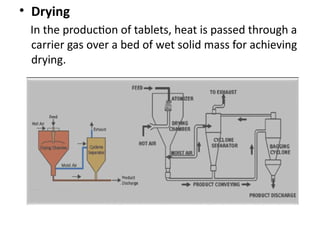
• Drying
In theproduction of tablets, heat is passed through a
carrier gas over a bed of wet solid mass for achieving
drying.
6.
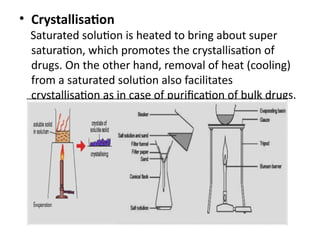
• Crystallisation
Saturated solutionis heated to bring about super
saturation, which promotes the crystallisation of
drugs. On the other hand, removal of heat (cooling)
from a saturated solution also facilitates
crystallisation as in case of purification of bulk drugs.
7.
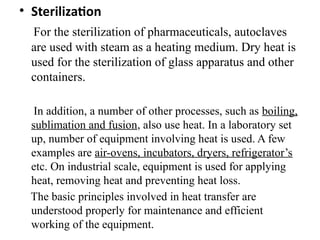
• Sterilization
For thesterilization of pharmaceuticals, autoclaves
are used with steam as a heating medium. Dry heat is
used for the sterilization of glass apparatus and other
containers.
In addition, a number of other processes, such as boiling,
sublimation and fusion, also use heat. In a laboratory set
up, number of equipment involving heat is used. A few
examples are air-ovens, incubators, dryers, refrigerator’s
etc. On industrial scale, equipment is used for applying
heat, removing heat and preventing heat loss.
The basic principles involved in heat transfer are
understood properly for maintenance and efficient
working of the equipment.
8.
• MECHANISMS OFHEAT FLOW
Heat flows from a region of high temperature to a region of
low temperature. Heat may flow by one or more of the three
basic mechanisms.
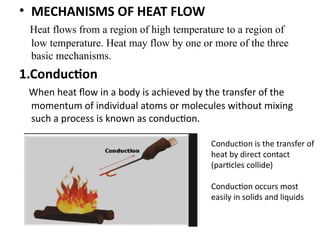
1.Conduction
When heat flow in a body is achieved by the transfer of the
momentum of individual atoms or molecules without mixing
such a process is known as conduction.
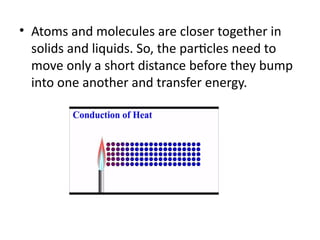
Conduction is the transfer of
heat by direct contact
(particles collide)
Conduction occurs most
easily in solids and liquids
9.
• Atoms andmolecules are closer together in
solids and liquids. So, the particles need to
move only a short distance before they bump
into one another and transfer energy.
10.
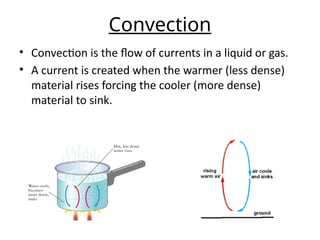
Convection
• Convection isthe flow of currents in a liquid or gas.
• A current is created when the warmer (less dense)
material rises forcing the cooler (more dense)
material to sink.
11.
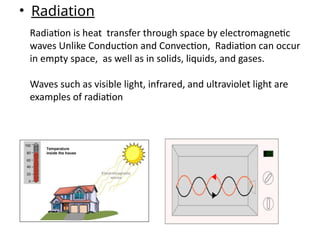
• Radiation
Radiation isheat transfer through space by electromagnetic
waves Unlike Conduction and Convection, Radiation can occur
in empty space, as well as in solids, liquids, and gases.
Waves such as visible light, infrared, and ultraviolet light are
examples of radiation
12.
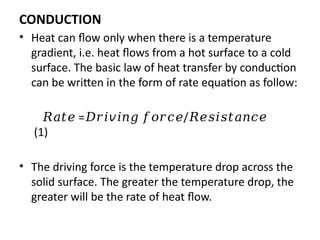
CONDUCTION
• Heat canflow only when there is a temperature
gradient, i.e. heat flows from a hot surface to a cold
surface. The basic law of heat transfer by conduction
can be written in the form of rate equation as follow:
𝑅𝑎𝑡𝑒 = /
𝐷𝑟𝑖𝑣𝑖𝑛𝑔 𝑓𝑜𝑟𝑐𝑒 𝑅𝑒𝑠𝑖𝑠𝑡𝑎𝑛𝑐𝑒
(1)
• The driving force is the temperature drop across the
solid surface. The greater the temperature drop, the
greater will be the rate of heat flow.
13.
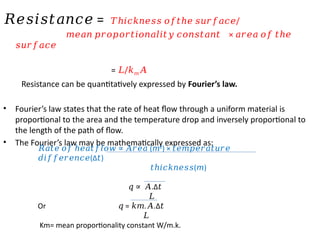
𝑅𝑒𝑠𝑖𝑠𝑡𝑎𝑛𝑐𝑒 = /
𝑇ℎ𝑖𝑐𝑘𝑛𝑒𝑠𝑠𝑜𝑓𝑡ℎ𝑒 𝑠𝑢𝑟𝑓𝑎𝑐𝑒
𝑚𝑒𝑎𝑛 𝑝𝑟𝑜𝑝𝑜𝑟𝑡𝑖𝑜𝑛𝑎𝑙𝑖𝑡𝑦 𝑐𝑜𝑛𝑠𝑡𝑎𝑛𝑡 × 𝑎𝑟𝑒𝑎 𝑜𝑓 𝑡ℎ𝑒
𝑠𝑢𝑟𝑓𝑎𝑐𝑒
= /
𝐿 𝑘𝑚𝐴
Resistance can be quantitatively expressed by Fourier’s law.
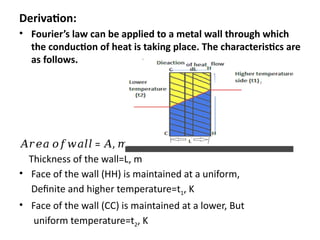
• Fourier’s law states that the rate of heat flow through a uniform material is
proportional to the area and the temperature drop and inversely proportional to
the length of the path of flow.
• The Fourier’s law may be mathematically expressed as:
𝑅𝑎𝑡𝑒 𝑜𝑓 ℎ𝑒𝑎𝑡𝑓𝑙𝑜𝑤 ∝ 𝐴𝑟𝑒𝑎 (𝑚2
) × 𝑡𝑒𝑚𝑝𝑒𝑟𝑎𝑡𝑢𝑟𝑒
(
𝑑𝑖𝑓𝑓𝑒𝑟𝑒𝑛𝑐𝑒 Δ )
𝑡
𝑡ℎ𝑖𝑐𝑘𝑛𝑒𝑠𝑠( )
𝑚
𝑞 ∝ 𝐴.Δ𝑡
𝐿
Or = . .
𝑞 𝑘𝑚 𝐴 Δ𝑡
𝐿
Km= mean proportionality constant W/m.k.
14.
Derivation:
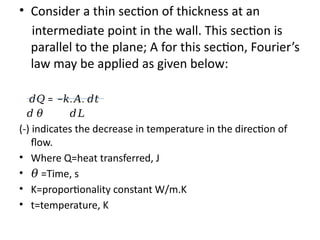
• Fourier’s lawcan be applied to a metal wall through which
the conduction of heat is taking place. The characteristics are
as follows.
𝐴𝑟𝑒𝑎 𝑜𝑓𝑤𝑎𝑙𝑙 = , 2
𝐴 𝑚
Thickness of the wall=L, m
• Face of the wall (HH) is maintained at a uniform,
Definite and higher temperature=t1, K
• Face of the wall (CC) is maintained at a lower, But
uniform temperature=t2, K
15.
• Consider athin section of thickness at an
intermediate point in the wall. This section is
parallel to the plane; A for this section, Fourier’s
law may be applied as given below:
𝑑𝑄 = − . .
𝑘 𝐴 𝑑𝑡
𝑑 𝜃 𝑑𝐿
(-) indicates the decrease in temperature in the direction of
flow.
• Where Q=heat transferred, J
• 𝜃 =Time, s
• K=proportionality constant W/m.K
• t=temperature, K
16.
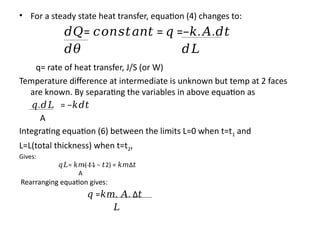
• For asteady state heat transfer, equation (4) changes to:
𝑑𝑄= = =− . .
𝑐𝑜𝑛𝑠𝑡𝑎𝑛𝑡 𝑞 𝑘 𝐴 𝑑𝑡
𝑑𝜃 𝑑𝐿
q= rate of heat transfer, J/S (or W)
Temperature difference at intermediate is unknown but temp at 2 faces
are known. By separating the variables in above equation as
𝑞. = −
𝑑𝐿 𝑘𝑑𝑡
A
Integrating equation (6) between the limits L=0 when t=t1 and
L=L(total thickness) when t=t2,
Gives:
𝑞𝐿= ( 1 − 2) =
𝑘𝑚 𝑡 𝑡 𝑘𝑚Δ𝑡
A
Rearranging equation gives:
𝑞 = . .
𝑘𝑚 𝐴 Δ𝑡
𝐿
17.
Applications:
Coefficient of thermalconductivity is quantity of heat that flows
across a unit surface area in unit time, when the temperature
drop is unity. It depends on material and temperature.
Thermal conductivity is reciprocal of thermal resistance used in
selecting suitable material during construction of equipment.
For the construction of evaporators and tubular heat exchangers
thermal conductivity values are helpful. Thermal conductivity
is very sensitive to changes in chemical composition and
temperature.
18.
Heat flow througha cylinder-conduction
• In a heat exchanger, hot fluid or steam is passed
through the circular pipe. The hot fluids transfer the
heat to the inner surface of the pipe wall. Further heat
transfer takes place by conduction through the pipe
wall. The rate of heat transfer by conduction through
a cylinder may be obtained as follows.
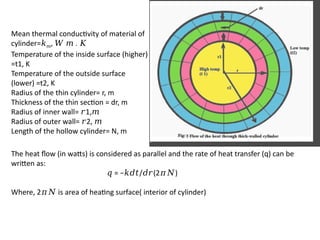
• Consider a hollow cylinder as shown in figure 5-3.
The heat is flowing from inside to outside the
cylinder. Consider a very thin cylinder at the centre of
the pipe. The following characteristics may be
enumerated.
19.
Mean thermal conductivityof material of
cylinder=𝑘𝑚, .
𝑊 𝑚 𝐾
Temperature of the inside surface (higher)
=t1, K
Temperature of the outside surface
(lower) =t2, K
Radius of the thin cylinder= r, m
Thickness of the thin section = dr, m
Radius of inner wall= 1,
𝑟 𝑚
Radius of outer wall= 2,
𝑟 𝑚
Length of the hollow cylinder= N, m
The heat flow (in watts) is considered as parallel and the rate of heat transfer (q) can be
written as:
𝑞 = − / (2 )
𝑘𝑑𝑡 𝑑𝑟 𝜋𝑁
Where, 2 is area of heating surface( interior of cylinder)
𝜋𝑁
20.
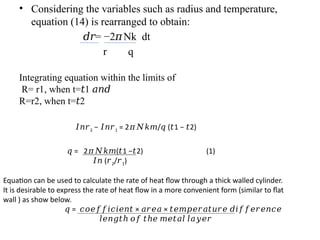
• Considering thevariables such as radius and temperature,
equation (14) is rearranged to obtain:
𝑑𝑟= −2 Nk dt
𝜋
r q
Integrating equation within the limits of
R= r1, when t= 1
𝑡 𝑎𝑛𝑑
R=r2, when t= 2
𝑡
𝐼𝑛𝑟2 − 𝐼𝑛𝑟1 = 2 / ( 1 − 2)
𝜋𝑁𝑘𝑚 𝑞 𝑡 𝑡
𝑞 = 2 ( 1 − 2) (1)
𝜋𝑁𝑘𝑚 𝑡 𝑡
𝐼𝑛 (𝑟2/𝑟1)
Equation can be used to calculate the rate of heat flow through a thick walled cylinder.
It is desirable to express the rate of heat flow in a more convenient form (similar to flat
wall ) as show below.
𝑞 = × ×
𝑐𝑜𝑒𝑓𝑓𝑖𝑐𝑖𝑒𝑛𝑡 𝑎𝑟𝑒𝑎 𝑡𝑒𝑚𝑝𝑒𝑟𝑎𝑡𝑢𝑟𝑒 𝑑𝑖𝑓𝑓𝑒𝑟𝑒𝑛𝑐𝑒
𝑙𝑒𝑛𝑔𝑡ℎ 𝑜𝑓 𝑡ℎ𝑒 𝑚𝑒𝑡𝑎𝑙 𝑙𝑎𝑦𝑒𝑟
21.
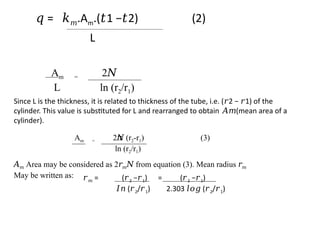
𝑞 = 𝑘𝑚.Am.(1 − 2) (2)
𝑡 𝑡
L
Am = 2𝑁
L ln (r2/r1)
Since L is the thickness, it is related to thickness of the tube, i.e. ( 2 − 1) of the
𝑟 𝑟
cylinder. This value is substituted for L and rearranged to obtain (mean area of a
𝐴𝑚
cylinder).
Am = 2 (r
𝜋
𝑁 2-r1) (3)
ln (r2/r1)
𝐴𝑚 Area may be considered as 2𝑟𝑚 from equation (3). Mean radius
𝑁 𝑟𝑚
May be written as: 𝑟𝑚 = (𝑟2 −𝑟1) = (𝑟2 −𝑟1)
𝐼𝑛 (𝑟2/𝑟1) 2.303 (
𝑙𝑜𝑔 𝑟2/𝑟1)
22.
CONVECTION
• When heatflow is achieved by actual mixing of
warmer portions with cooler portion of the same
material, the process is known as convection.
• Forced convection: Mixing of fluid may be obtained
by the use of a stirrer of agitator or pumping the fluid
for recirculation. Such a process in heat transfer is
designated as forced convection.
For example, in some type of tube evaporators, the
evaporating liquid is forced through the tubes under
pressure. Therefore forced convection is observed.
23.
• Natural convection:Mixing of fluid may be
accomplished by the currents set up, when body of
fluid is heated, such a process is known as natural
convection. For example, In pan evaporator,
convection currents are set up in the evaporating
liquid.
24.
• Forced convection
Temperaturevariation-Individual Heat Transfer
Coefficients
• Mixing of a fluid may be obtained by the use of a stirrer
or agitator or pumping the fluid for recirculation. Such a
process in heat transfer is designated as forced
convection.
• Forced convection is obtained in some types of tube
evaporators where in the evaporating liquid is forced
through the tubes under pressure.
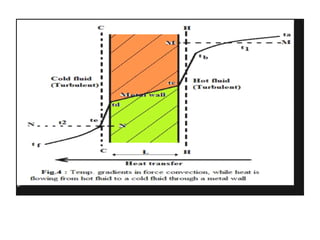
• Consider a case of heat flowing from a hot fluid through a
metal wall into a cold fluid. At a specific point the
variation of temperature on each side of the metal wall is
as listed below.
26.
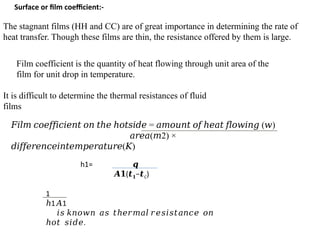
Surface or filmcoefficient:-
The stagnant films (HH and CC) are of great importance in determining the rate of
heat transfer. Though these films are thin, the resistance offered by them is large.
Film coefficient is the quantity of heat flowing through unit area of the
film for unit drop in temperature.
It is difficult to determine the thermal resistances of fluid
films
𝐹𝑖𝑙𝑚 𝑐𝑜𝑒𝑓𝑓𝑖𝑐𝑖𝑒𝑛𝑡 𝑜𝑛 𝑡ℎ𝑒 ℎ𝑜𝑡𝑠𝑖𝑑𝑒 = ( )
𝑎𝑚𝑜𝑢𝑛𝑡 𝑜𝑓 ℎ𝑒𝑎𝑡 𝑓𝑙𝑜𝑤𝑖𝑛𝑔 𝑤
𝑎𝑟𝑒𝑎( 2) ×
𝑚
( )
𝑑𝑖𝑓𝑓𝑒𝑟𝑒𝑛𝑐𝑒𝑖𝑛𝑡𝑒𝑚𝑝𝑒𝑟𝑎𝑡𝑢𝑟𝑒 𝐾
h1= 𝒒
𝑨𝟏(𝒕𝟏−𝒕C)
1
ℎ1 1
𝐴
𝑖𝑠 𝑘𝑛𝑜𝑤𝑛 𝑎𝑠 𝑡ℎ𝑒𝑟𝑚𝑎𝑙 𝑟𝑒𝑠𝑖𝑠𝑡𝑎𝑛𝑐𝑒 𝑜𝑛
ℎ𝑜𝑡 𝑠𝑖𝑑𝑒.
27.
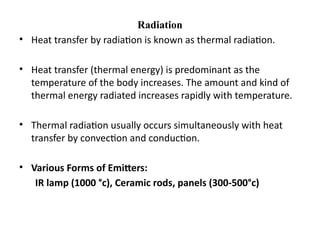
Radiation
• Heat transferby radiation is known as thermal radiation.
• Heat transfer (thermal energy) is predominant as the
temperature of the body increases. The amount and kind of
thermal energy radiated increases rapidly with temperature.
• Thermal radiation usually occurs simultaneously with heat
transfer by convection and conduction.
• Various Forms of Emitters:
IR lamp (1000 °c), Ceramic rods, panels (300-500°c)
28.
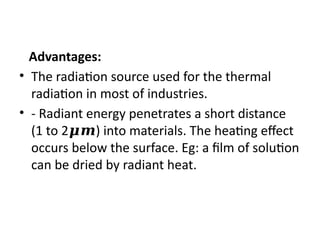
Advantages:
• The radiationsource used for the thermal
radiation in most of industries.
• - Radiant energy penetrates a short distance
(1 to 2 ) into materials. The heating effect
𝝁𝒎
occurs below the surface. Eg: a film of solution
can be dried by radiant heat.
29.
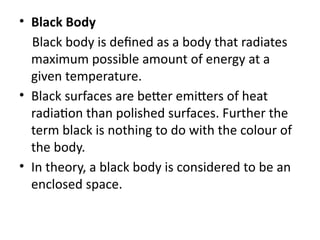
• Black Body
Blackbody is defined as a body that radiates
maximum possible amount of energy at a
given temperature.
• Black surfaces are better emitters of heat
radiation than polished surfaces. Further the
term black is nothing to do with the colour of
the body.
• In theory, a black body is considered to be an
enclosed space.
30.
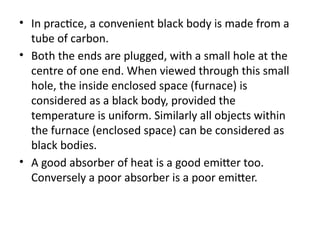
• In practice,a convenient black body is made from a
tube of carbon.
• Both the ends are plugged, with a small hole at the
centre of one end. When viewed through this small
hole, the inside enclosed space (furnace) is
considered as a black body, provided the
temperature is uniform. Similarly all objects within
the furnace (enclosed space) can be considered as
black bodies.
• A good absorber of heat is a good emitter too.
Conversely a poor absorber is a poor emitter.
31.
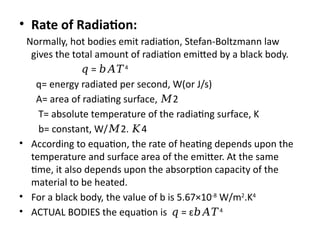
• Rate ofRadiation:
Normally, hot bodies emit radiation, Stefan-Boltzmann law
gives the total amount of radiation emitted by a black body.
𝑞 = 𝑏𝐴𝑇4
q= energy radiated per second, W(or J/s)
A= area of radiating surface, 2
𝑀
T= absolute temperature of the radiating surface, K
b= constant, W/ 2. 4
𝑀 𝐾
• According to equation, the rate of heating depends upon the
temperature and surface area of the emitter. At the same
time, it also depends upon the absorption capacity of the
material to be heated.
• For a black body, the value of b is 5.67×10⁻⁸
W/m2
.K4
• ACTUAL BODIES the equation is = ɛ
𝑞 𝑏𝐴𝑇4
32.
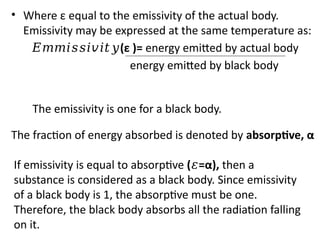
• Where εequal to the emissivity of the actual body.
Emissivity may be expressed at the same temperature as:
𝐸𝑚𝑚𝑖𝑠𝑠𝑖𝑣𝑖𝑡𝑦(ε )= energy emitted by actual body
energy emitted by black body
The fraction of energy absorbed is denoted by absorptive, α
The emissivity is one for a black body.
If emissivity is equal to absorptive ( =α),
𝜀 then a
substance is considered as a black body. Since emissivity
of a black body is 1, the absorptive must be one.
Therefore, the black body absorbs all the radiation falling
on it.
33.
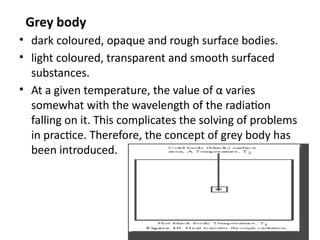
Grey body
• darkcoloured, opaque and rough surface bodies.
• light coloured, transparent and smooth surfaced
substances.
• At a given temperature, the value of α varies
somewhat with the wavelength of the radiation
falling on it. This complicates the solving of problems
in practice. Therefore, the concept of grey body has
been introduced.
34.
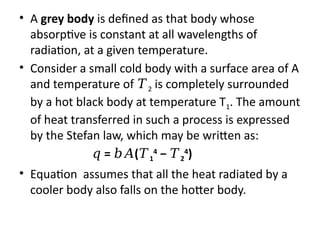
• A greybody is defined as that body whose
absorptive is constant at all wavelengths of
radiation, at a given temperature.
• Consider a small cold body with a surface area of A
and temperature of 𝑇2 is completely surrounded
by a hot black body at temperature T1. The amount
of heat transferred in such a process is expressed
by the Stefan law, which may be written as:
𝑞 = (
𝑏𝐴 𝑇1
4
− 𝑇2
4
)
• Equation assumes that all the heat radiated by a
cooler body also falls on the hotter body.
35.
HEAT EXCHANGERS ANDHEAT INTERCHANGERS
• Heat exchangers: Heat exchangers are the devices
used for transferring heat from one fluid (hot gas or
steam) to another fluid (liquid) through a metal wall.
• Heat interchangers: Heat interchangers are the
devices used for transferring heat from one liquid to
another or from one gas to another gas through a
metal wall.
• Some heat transfer (or heaters) equipment are:
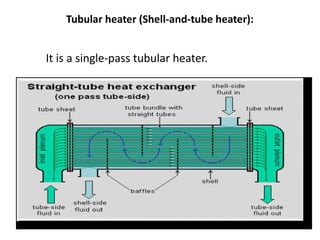
(1) tubular heater (shell-and-tube heater)
(2) multipass heater
(3) two pass floating head heater
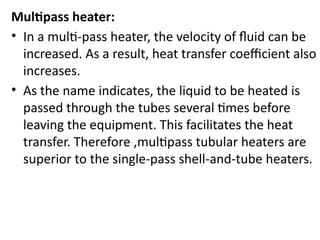
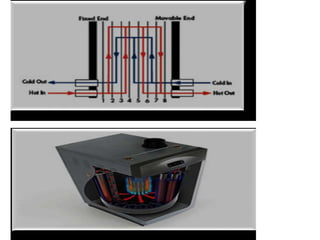
Multipass heater:
• Ina multi-pass heater, the velocity of fluid can be
increased. As a result, heat transfer coefficient also
increases.
• As the name indicates, the liquid to be heated is
passed through the tubes several times before
leaving the equipment. This facilitates the heat
transfer. Therefore ,multipass tubular heaters are
superior to the single-pass shell-and-tube heaters.
39.
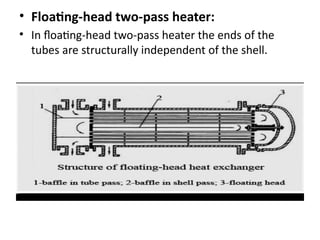
• Floating-head two-passheater:
• In floating-head two-pass heater the ends of the
tubes are structurally independent of the shell.
40.
• Heat Interchangers
•Heat interchangers are the devices used for transferring heat
from one liquid to another or from one gas to another gas
through a metal wall.
• In heat interchangers, the heating medium is a hot liquid. The
liquid to be heated is the cold liquid.
• In this case, the film coefficients both outside and inside the
tubes are nearly of same magnitude.
• The film coefficient can be enhanced by
increasing the velocity of flow. From the point of
construction, if is difficult to increase the velocity of the hold
fluid outside the tubes.
surface area of contact can be increased, by introducing
baffles in the construction.
41.
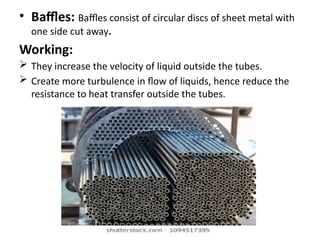
• Baffles: Bafflesconsist of circular discs of sheet metal with
one side cut away.
Working:
They increase the velocity of liquid outside the tubes.
Create more turbulence in flow of liquids, hence reduce the
resistance to heat transfer outside the tubes.
42.
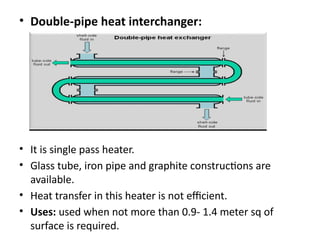
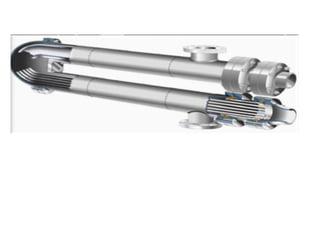
• Double-pipe heatinterchanger:
• It is single pass heater.
• Glass tube, iron pipe and graphite constructions are
available.
• Heat transfer in this heater is not efficient.
• Uses: used when not more than 0.9- 1.4 meter sq of
surface is required.