HEAPS
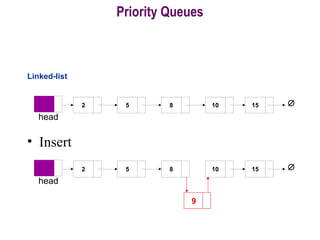
Priority Queues
Linked-list
2 5 8 10 15 ∅
head
• Insert
2 5 8 10 15 ∅
head
9
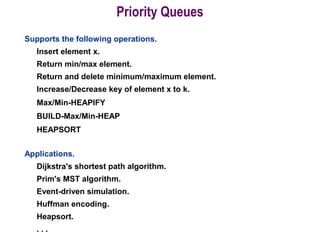
Priority Queues
Supports the following operations.
Insert element x.
Return min/max element.
Return and delete minimum/maximum element.
Increase/Decrease key of element x to k.
Max/Min-HEAPIFY
BUILD-Max/Min-HEAP
HEAPSORT
Applications.
Dijkstra's shortest path algorithm.
Prim's MST algorithm.
Event-driven simulation.
Huffman encoding.
Heapsort.
. . .
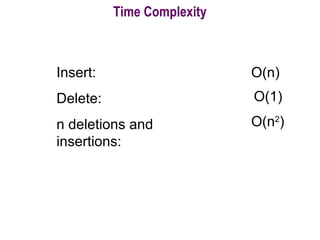
Time Complexity
Insert:
Delete:
n deletions and
insertions:
O(n)
O(n2
)
O(1)
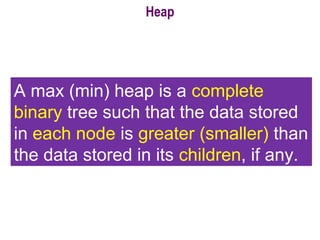
Heap
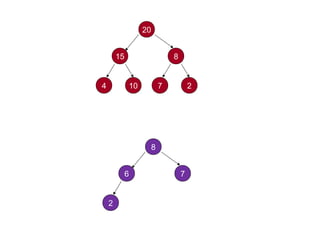
A max (min) heap is a complete
binary tree such that the data stored
in each node is greater (smaller) than
the data stored in its children, if any.
Heap Types
Max-heaps (largest element at root), have the max-heap property:
for all nodes i, excluding the root:
A[PARENT(i)] ≥ A[i]
Min-heaps (smallest element at root), have the min-heap property:
for all nodes i, excluding the root:
A[PARENT(i)] ≤ A[i]
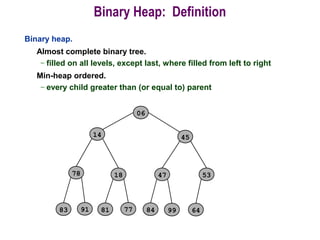
Binary Heap: Definition
Binary heap.
Almost complete binary tree.
– filled on all levels, except last, where filled from left to right
Min-heap ordered.
– every child greater than (or equal to) parent
06
14
78 18
81 7791
45
5347
6484 9983
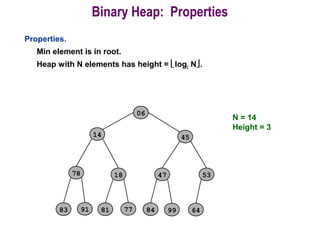
Binary Heap: Properties
Properties.
Min element is in root.
Heap with N elements has height = log2 N.
06
14
78 18
81 7791
45
5347
6484 9983
N = 14
Height = 3
20
815
4 10 7 2
8
76
2
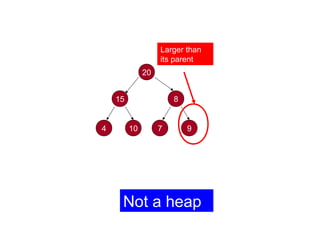
20
815
4 10 7 9
Larger than
its parent
Not a heap
25
1210
59 711
1 6 3 8
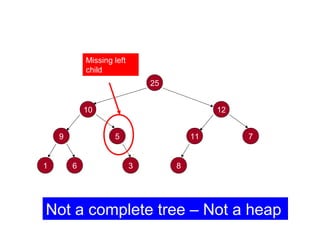
Missing left
child
Not a complete tree – Not a heap
1
32
54 76
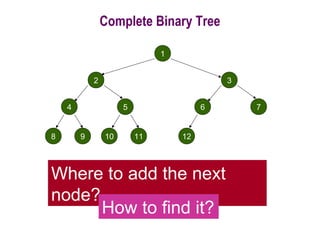
8 9 10 11 12
Where to add the next
node?
How to find it?
Complete Binary Tree
1
32
54 76
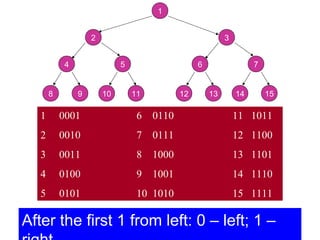
8 9 10 11 12 13 14 15
1 0001 6 0110 11 1011
2 0010 7 0111 12 1100
3 0011 8 1000 13 1101
4 0100 9 1001 14 1110
5 0101 10 1010 15 1111
After the first 1 from left: 0 – left; 1 –
1
32
54 76
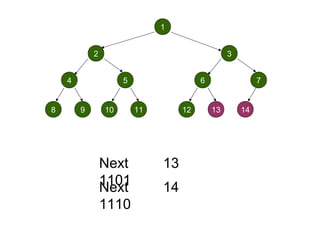
8 9 10 11 12
Next 13
1101
1
3
1
6
3
13
6
1
3
1
7
3
14
7
Next 14
1110
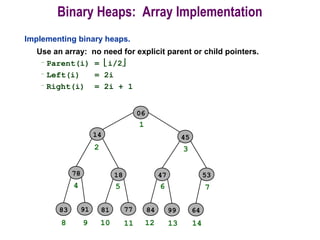
Binary Heaps: Array Implementation
Implementing binary heaps.
Use an array: no need for explicit parent or child pointers.
– Parent(i) = i/2
– Left(i) = 2i
– Right(i) = 2i + 1
06
14
78 18
81 7791
45
5347
6484 9983
1
2 3
4 5 6 7
8 9 10 11 12 13 14
1
32
54 76
8 9 10 11 12
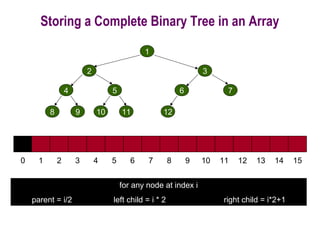
Storing a Complete Binary Tree in an Array
1 2 3 4 5 6 7 8 9 10 11 12 13 14 15
0 1 2 3 4 5 6 7 8 9 10 11 12 13 14 15
for any node at index i
parent = i/2 left child = i * 2 right child = i*2+1
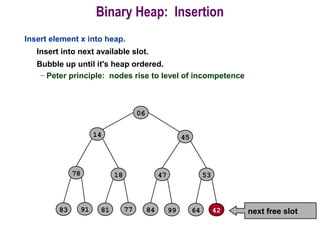
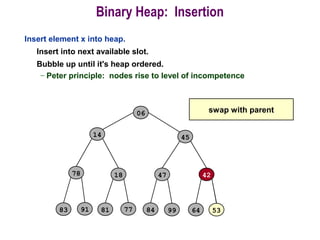
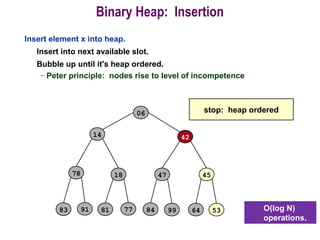
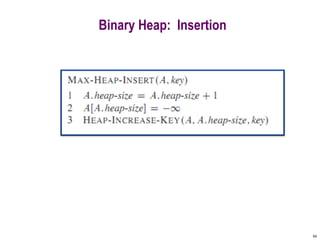
Binary Heap: Insertion
Insert element x into heap.
Insert into next available slot.
Bubble up until it's heap ordered.
– Peter principle: nodes rise to level of incompetence
06
14
78 18
81 7791
45
5347
6484 9983 42 next free slot
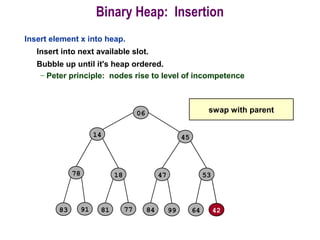
Binary Heap: Insertion
Insert element x into heap.
Insert into next available slot.
Bubble up until it's heap ordered.
– Peter principle: nodes rise to level of incompetence
06
14
78 18
81 7791
45
5347
6484 9983 4242
swap with parent
Binary Heap: Insertion
Insert element x into heap.
Insert into next available slot.
Bubble up until it's heap ordered.
– Peter principle: nodes rise to level of incompetence
06
14
78 18
81 7791
45
4247
6484 9983 4253
swap with parent
Binary Heap: Insertion
Insert element x into heap.
Insert into next available slot.
Bubble up until it's heap ordered.
– Peter principle: nodes rise to level of incompetence
06
14
78 18
81 7791
42
4547
6484 9983 53
stop: heap ordered
O(log N)
operations.
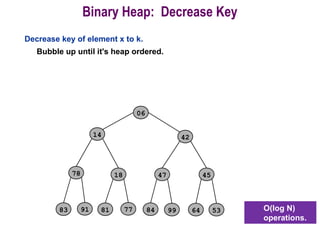
Binary Heap: Decrease Key
Decrease key of element x to k.
Bubble up until it's heap ordered.
06
14
78 18
81 7791
42
4547
6484 9983 53 O(log N)
operations.
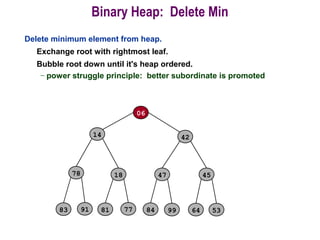
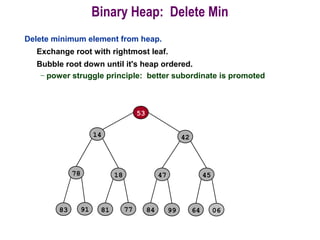
Binary Heap: Delete Min
Delete minimum element from heap.
Exchange root with rightmost leaf.
Bubble root down until it's heap ordered.
– power struggle principle: better subordinate is promoted
06
14
78 18
81 7791
42
4547
6484 9983 53
Binary Heap: Delete Min
Delete minimum element from heap.
Exchange root with rightmost leaf.
Bubble root down until it's heap ordered.
– power struggle principle: better subordinate is promoted
53
14
78 18
81 7791
42
4547
6484 9983 06
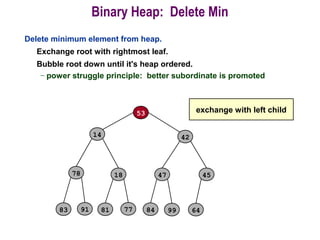
Binary Heap: Delete Min
Delete minimum element from heap.
Exchange root with rightmost leaf.
Bubble root down until it's heap ordered.
– power struggle principle: better subordinate is promoted
53
14
78 18
81 7791
42
4547
6484 9983
exchange with left child
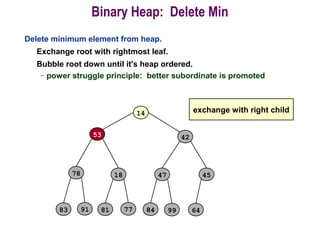
Binary Heap: Delete Min
Delete minimum element from heap.
Exchange root with rightmost leaf.
Bubble root down until it's heap ordered.
– power struggle principle: better subordinate is promoted
14
53
78 18
81 7791
42
4547
6484 9983
exchange with right child
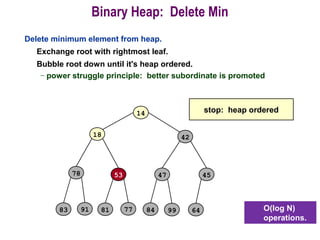
Binary Heap: Delete Min
Delete minimum element from heap.
Exchange root with rightmost leaf.
Bubble root down until it's heap ordered.
– power struggle principle: better subordinate is promoted
14
18
78 53
81 7791
42
4547
6484 9983
stop: heap ordered
O(log N)
operations.
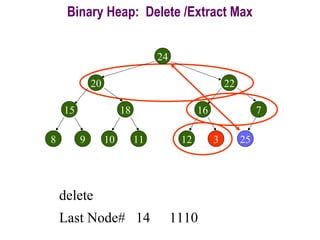
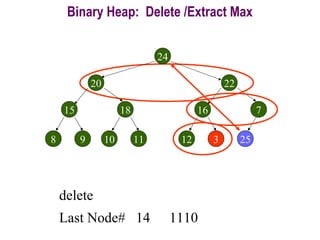
delete
Last Node# 14 1110
25
2420
1815 716
8 9 10 11 12 16
22
3
7
3
25
3
24
22
3
3
16
25
Binary Heap: Delete /Extract Max
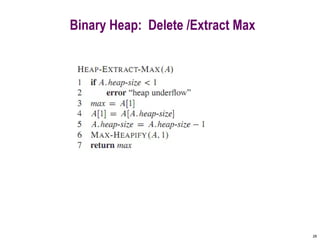
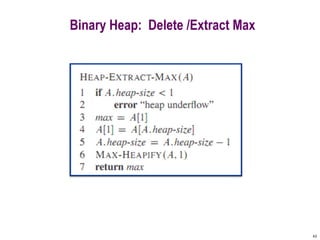
28
Binary Heap: Delete /Extract Max
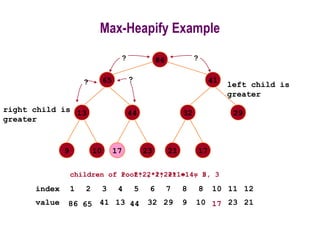
Max-Heapify Example
98
4186
13 65
9 10
32 29
44 23 21 17
index 1 2 3 4 5 6 7 8 8 10 11 12
value 98 86 41 13 65 32 29 9 10 44 23 2117
17
17
children of root: 2*1, 2*1+1 = 2, 3
17
86
86
left child is
greater
??
? ?
right child is
greater
17
65
children of 2: 2*2, 2*2+1 = 4, 5
17
44
1765 1744
Procedure MaxHeapify
MaxHeapify(A, i)
1. l = left(i);
2. r = right(i);
3. if (l ≤ heap-size[A] && A[l] > A[i])
4. largest = l;
5. else largest = I;
6. if (r ≤ heap-size[A] && A[r] > A[largest])
7. largest = r;
8. if (largest != i)
9. Swap(A[i], A[largest])
10. MaxHeapify(A, largest)
MaxHeapify(A, i)
1. l = left(i);
2. r = right(i);
3. if (l ≤ heap-size[A] && A[l] > A[i])
4. largest = l;
5. else largest = I;
6. if (r ≤ heap-size[A] && A[r] > A[largest])
7. largest = r;
8. if (largest != i)
9. Swap(A[i], A[largest])
10. MaxHeapify(A, largest)
Assumption:
Left(i) and Right(i) are
max-heaps.
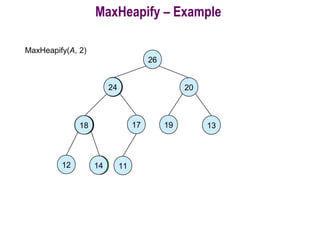
MaxHeapify – Example
26
14 20
24 17 19 13
12 18 11
14
14
2424
14
14
1818
14
MaxHeapify(A, 2)
Running Time for MaxHeapify
Time to fix node i
and its children =
Θ(1)
Time to fix the
subtree rooted at
one of i’s children =
T(size of subree at
largest)
PLUS
MaxHeapify(A, i)
1. l = left(i);
2. r = right(i);
3. if (l ≤ heap-size[A] && A[l] > A[i])
4. largest = l;
5. else largest = I;
6. if (r ≤ heap-size[A] && A[r] > A[largest])
7. largest = r;
8. if (largest != i)
9. Swap(A[i], A[largest])
10. MaxHeapify(A, largest)
MaxHeapify(A, i)
1. l = left(i);
2. r = right(i);
3. if (l ≤ heap-size[A] && A[l] > A[i])
4. largest = l;
5. else largest = I;
6. if (r ≤ heap-size[A] && A[r] > A[largest])
7. largest = r;
8. if (largest != i)
9. Swap(A[i], A[largest])
10. MaxHeapify(A, largest)
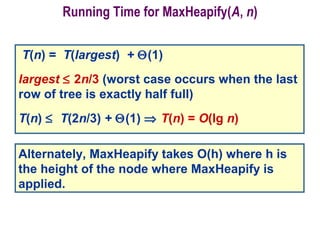
Running Time for MaxHeapify(A, n)
T(n) = T(largest) + Θ(1)
largest ≤ 2n/3 (worst case occurs when the last
row of tree is exactly half full)
T(n) ≤ T(2n/3) + Θ(1) ⇒ T(n) = O(lg n)
Alternately, MaxHeapify takes O(h) where h is
the height of the node where MaxHeapify is
applied.
Building a heap
Use MaxHeapify to convert an array A into a max-heap.
How?
Call MaxHeapify on each element in a bottom-up
manner.
BuildMaxHeap(A)
1. heap-size[A] = length[A]
2. for i = length[A]/2 down to 1
3. do MaxHeapify(A, i)
BuildMaxHeap(A)
1. heap-size[A] = length[A]
2. for i = length[A]/2 down to 1
3. do MaxHeapify(A, i)
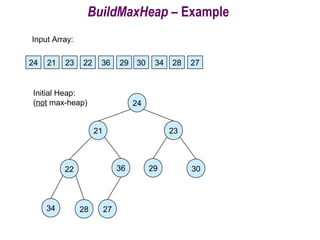
BuildMaxHeap – Example
24 21 23 22 36 29 30 34 28 27
Input Array:
24
21 23
22 36 29 30
34 28 27
Initial Heap:
(not max-heap)
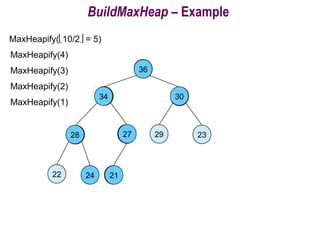
BuildMaxHeap – Example
24
21 23
22 36 29 30
34 28 27
MaxHeapify(10/2 = 5)
3636
MaxHeapify(4)
2234
22
MaxHeapify(3)
2330
23
MaxHeapify(2)
2136
21
MaxHeapify(1)
2436
2434
2428
24
21
21
27
Running Time of BuildMaxHeap
Cost of a MaxHeapify call × No. of calls to MaxHeapify
O(lg n) × O(n) = O(nlg n)
BuildMaxHeap(A)
1. heap-size[A] = length[A]
2. for i = length[A]/2 down to 1
3. do MaxHeapify(A, i)
BuildMaxHeap(A)
1. heap-size[A] = length[A]
2. for i = length[A]/2 down to 1
3. do MaxHeapify(A, i) Θ(logn) Θ(n logn)
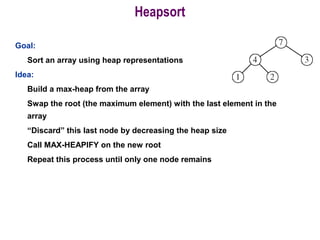
Heapsort
Goal:
Sort an array using heap representations
Idea:
Build a max-heap from the array
Swap the root (the maximum element) with the last element in the
array
“Discard” this last node by decreasing the heap size
Call MAX-HEAPIFY on the new root
Repeat this process until only one node remains
Example: A=[7, 4, 3, 1, 2]
MAX-HEAPIFY(A, 1, 4) MAX-HEAPIFY(A, 1, 3) MAX-HEAPIFY(A, 1, 2)
MAX-HEAPIFY(A, 1, 1)
Heapsort(A)
HeapSort(A)
1. Build-Max-Heap(A)
2. for i = length[A] downto 2
3. swap( A[1], A[i] );
4. heap-size[A] = heap-size[A] – 1;
5. MaxHeapify(A, 1);
HeapSort(A)
1. Build-Max-Heap(A)
2. for i = length[A] downto 2
3. swap( A[1], A[i] );
4. heap-size[A] = heap-size[A] – 1;
5. MaxHeapify(A, 1);
Algorithm Analysis
In-place
Not Stable
Build-Max-Heap takes O(n) and each of the n-1 calls to Max-Heapify
HeapSort(A)
1. Build-Max-Heap(A)
2. for i = length[A] downto 2
3. swap( A[1], A[i] );
4. heap-size[A] = heap-size[A] – 1;
5. MaxHeapify(A, 1);
HeapSort(A)
1. Build-Max-Heap(A)
2. for i = length[A] downto 2
3. swap( A[1], A[i] );
4. heap-size[A] = heap-size[A] – 1;
5. MaxHeapify(A, 1);
Θ(logn)
Θ(n)
Θ(n -1)
Θ(n logn)
delete
Last Node# 14 1110
25
2420
1815 716
8 9 10 11 12 16
22
3
7
3
25
3
24
22
3
3
16
25
Binary Heap: Delete /Extract Max
43
Binary Heap: Delete /Extract Max
44
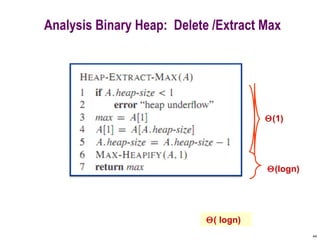
Analysis Binary Heap: Delete /Extract Max
Θ(1)
Θ(logn)
Θ( logn)
45
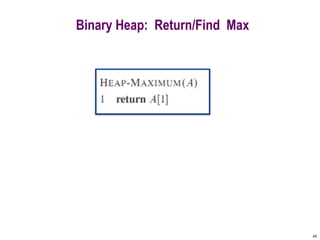
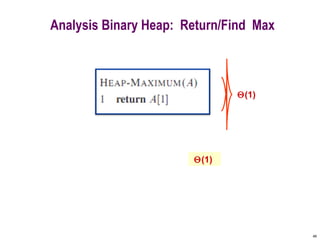
Binary Heap: Return/Find Max
46
Analysis Binary Heap: Return/Find Max
Θ(1)
Θ(1)
47
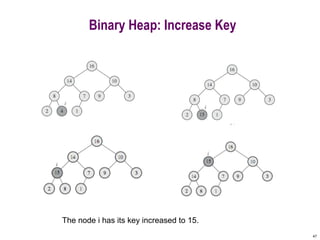
Binary Heap: Increase Key
The node i has its key increased to 15.
48
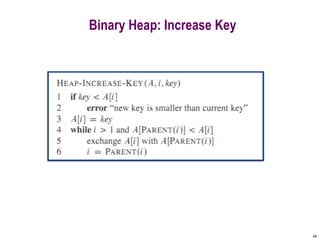
Binary Heap: Increase Key
49
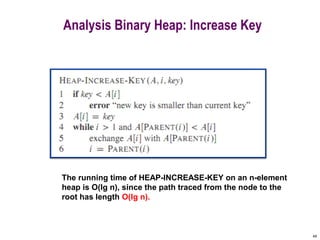
Analysis Binary Heap: Increase Key
The running time of HEAP-INCREASE-KEY on an n-element
heap is O(lg n), since the path traced from the node to the
root has length O(lg n).
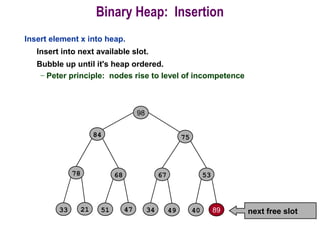
Binary Heap: Insertion
Insert element x into heap.
Insert into next available slot.
Bubble up until it's heap ordered.
– Peter principle: nodes rise to level of incompetence
98
84
78 68
51 4721
75
5367
4034 4933 89 next free slot
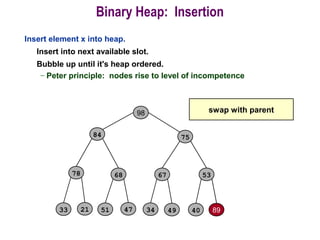
Binary Heap: Insertion
Insert element x into heap.
Insert into next available slot.
Bubble up until it's heap ordered.
– Peter principle: nodes rise to level of incompetence
98
84
78 68
51 4721
75
5367
4034 4933 4289
swap with parent
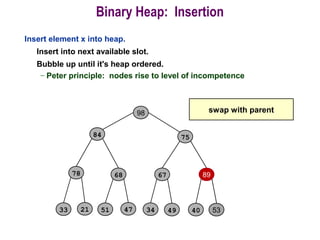
Binary Heap: Insertion
Insert element x into heap.
Insert into next available slot.
Bubble up until it's heap ordered.
– Peter principle: nodes rise to level of incompetence
swap with parent98
84
78 68
51 4721
75
8967
4034 4933 4253
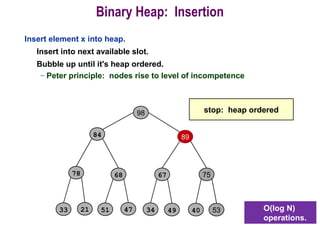
Binary Heap: Insertion
Insert element x into heap.
Insert into next available slot.
Bubble up until it's heap ordered.
– Peter principle: nodes rise to level of incompetence
stop: heap ordered
O(log N)
operations.
98
84
78 68
51 4721
89
7567
4034 4933 4253
54
Binary Heap: Insertion
55
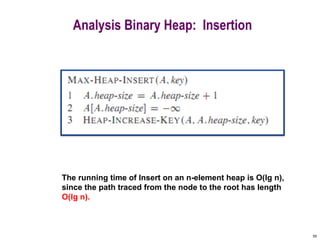
Analysis Binary Heap: Insertion
The running time of Insert on an n-element heap is O(lg n),
since the path traced from the node to the root has length
O(lg n).
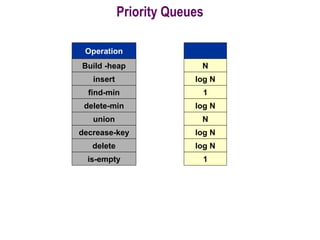
Priority Queues
Build -heap
Operation
insert
find-min
delete-min
union
decrease-key
delete
N
log N
1
log N
N
log N
log N
is-empty 1

Heaps

  • 1.
  • 2.
    Priority Queues Linked-list 2 58 10 15 ∅ head • Insert 2 5 8 10 15 ∅ head 9
  • 3.
    Priority Queues Supports thefollowing operations. Insert element x. Return min/max element. Return and delete minimum/maximum element. Increase/Decrease key of element x to k. Max/Min-HEAPIFY BUILD-Max/Min-HEAP HEAPSORT Applications. Dijkstra's shortest path algorithm. Prim's MST algorithm. Event-driven simulation. Huffman encoding. Heapsort. . . .
  • 4.
    Time Complexity Insert: Delete: n deletionsand insertions: O(n) O(n2 ) O(1)
  • 5.
    Heap A max (min)heap is a complete binary tree such that the data stored in each node is greater (smaller) than the data stored in its children, if any.
  • 6.
    Heap Types Max-heaps (largestelement at root), have the max-heap property: for all nodes i, excluding the root: A[PARENT(i)] ≥ A[i] Min-heaps (smallest element at root), have the min-heap property: for all nodes i, excluding the root: A[PARENT(i)] ≤ A[i]
  • 7.
    Binary Heap: Definition Binaryheap. Almost complete binary tree. – filled on all levels, except last, where filled from left to right Min-heap ordered. – every child greater than (or equal to) parent 06 14 78 18 81 7791 45 5347 6484 9983
  • 8.
    Binary Heap: Properties Properties. Minelement is in root. Heap with N elements has height = log2 N. 06 14 78 18 81 7791 45 5347 6484 9983 N = 14 Height = 3
  • 9.
    20 815 4 10 72 8 76 2
  • 10.
    20 815 4 10 79 Larger than its parent Not a heap
  • 11.
    25 1210 59 711 1 63 8 Missing left child Not a complete tree – Not a heap
  • 12.
    1 32 54 76 8 910 11 12 Where to add the next node? How to find it? Complete Binary Tree
  • 13.
    1 32 54 76 8 910 11 12 13 14 15 1 0001 6 0110 11 1011 2 0010 7 0111 12 1100 3 0011 8 1000 13 1101 4 0100 9 1001 14 1110 5 0101 10 1010 15 1111 After the first 1 from left: 0 – left; 1 –
  • 14.
    1 32 54 76 8 910 11 12 Next 13 1101 1 3 1 6 3 13 6 1 3 1 7 3 14 7 Next 14 1110
  • 15.
    Binary Heaps: ArrayImplementation Implementing binary heaps. Use an array: no need for explicit parent or child pointers. – Parent(i) = i/2 – Left(i) = 2i – Right(i) = 2i + 1 06 14 78 18 81 7791 45 5347 6484 9983 1 2 3 4 5 6 7 8 9 10 11 12 13 14
  • 16.
    1 32 54 76 8 910 11 12 Storing a Complete Binary Tree in an Array 1 2 3 4 5 6 7 8 9 10 11 12 13 14 15 0 1 2 3 4 5 6 7 8 9 10 11 12 13 14 15 for any node at index i parent = i/2 left child = i * 2 right child = i*2+1
  • 17.
    Binary Heap: Insertion Insertelement x into heap. Insert into next available slot. Bubble up until it's heap ordered. – Peter principle: nodes rise to level of incompetence 06 14 78 18 81 7791 45 5347 6484 9983 42 next free slot
  • 18.
    Binary Heap: Insertion Insertelement x into heap. Insert into next available slot. Bubble up until it's heap ordered. – Peter principle: nodes rise to level of incompetence 06 14 78 18 81 7791 45 5347 6484 9983 4242 swap with parent
  • 19.
    Binary Heap: Insertion Insertelement x into heap. Insert into next available slot. Bubble up until it's heap ordered. – Peter principle: nodes rise to level of incompetence 06 14 78 18 81 7791 45 4247 6484 9983 4253 swap with parent
  • 20.
    Binary Heap: Insertion Insertelement x into heap. Insert into next available slot. Bubble up until it's heap ordered. – Peter principle: nodes rise to level of incompetence 06 14 78 18 81 7791 42 4547 6484 9983 53 stop: heap ordered O(log N) operations.
  • 21.
    Binary Heap: DecreaseKey Decrease key of element x to k. Bubble up until it's heap ordered. 06 14 78 18 81 7791 42 4547 6484 9983 53 O(log N) operations.
  • 22.
    Binary Heap: DeleteMin Delete minimum element from heap. Exchange root with rightmost leaf. Bubble root down until it's heap ordered. – power struggle principle: better subordinate is promoted 06 14 78 18 81 7791 42 4547 6484 9983 53
  • 23.
    Binary Heap: DeleteMin Delete minimum element from heap. Exchange root with rightmost leaf. Bubble root down until it's heap ordered. – power struggle principle: better subordinate is promoted 53 14 78 18 81 7791 42 4547 6484 9983 06
  • 24.
    Binary Heap: DeleteMin Delete minimum element from heap. Exchange root with rightmost leaf. Bubble root down until it's heap ordered. – power struggle principle: better subordinate is promoted 53 14 78 18 81 7791 42 4547 6484 9983 exchange with left child
  • 25.
    Binary Heap: DeleteMin Delete minimum element from heap. Exchange root with rightmost leaf. Bubble root down until it's heap ordered. – power struggle principle: better subordinate is promoted 14 53 78 18 81 7791 42 4547 6484 9983 exchange with right child
  • 26.
    Binary Heap: DeleteMin Delete minimum element from heap. Exchange root with rightmost leaf. Bubble root down until it's heap ordered. – power struggle principle: better subordinate is promoted 14 18 78 53 81 7791 42 4547 6484 9983 stop: heap ordered O(log N) operations.
  • 27.
    delete Last Node# 141110 25 2420 1815 716 8 9 10 11 12 16 22 3 7 3 25 3 24 22 3 3 16 25 Binary Heap: Delete /Extract Max
  • 28.
  • 29.
    Max-Heapify Example 98 4186 13 65 910 32 29 44 23 21 17 index 1 2 3 4 5 6 7 8 8 10 11 12 value 98 86 41 13 65 32 29 9 10 44 23 2117 17 17 children of root: 2*1, 2*1+1 = 2, 3 17 86 86 left child is greater ?? ? ? right child is greater 17 65 children of 2: 2*2, 2*2+1 = 4, 5 17 44 1765 1744
  • 30.
    Procedure MaxHeapify MaxHeapify(A, i) 1.l = left(i); 2. r = right(i); 3. if (l ≤ heap-size[A] && A[l] > A[i]) 4. largest = l; 5. else largest = I; 6. if (r ≤ heap-size[A] && A[r] > A[largest]) 7. largest = r; 8. if (largest != i) 9. Swap(A[i], A[largest]) 10. MaxHeapify(A, largest) MaxHeapify(A, i) 1. l = left(i); 2. r = right(i); 3. if (l ≤ heap-size[A] && A[l] > A[i]) 4. largest = l; 5. else largest = I; 6. if (r ≤ heap-size[A] && A[r] > A[largest]) 7. largest = r; 8. if (largest != i) 9. Swap(A[i], A[largest]) 10. MaxHeapify(A, largest) Assumption: Left(i) and Right(i) are max-heaps.
  • 31.
    MaxHeapify – Example 26 1420 24 17 19 13 12 18 11 14 14 2424 14 14 1818 14 MaxHeapify(A, 2)
  • 32.
    Running Time forMaxHeapify Time to fix node i and its children = Θ(1) Time to fix the subtree rooted at one of i’s children = T(size of subree at largest) PLUS MaxHeapify(A, i) 1. l = left(i); 2. r = right(i); 3. if (l ≤ heap-size[A] && A[l] > A[i]) 4. largest = l; 5. else largest = I; 6. if (r ≤ heap-size[A] && A[r] > A[largest]) 7. largest = r; 8. if (largest != i) 9. Swap(A[i], A[largest]) 10. MaxHeapify(A, largest) MaxHeapify(A, i) 1. l = left(i); 2. r = right(i); 3. if (l ≤ heap-size[A] && A[l] > A[i]) 4. largest = l; 5. else largest = I; 6. if (r ≤ heap-size[A] && A[r] > A[largest]) 7. largest = r; 8. if (largest != i) 9. Swap(A[i], A[largest]) 10. MaxHeapify(A, largest)
  • 33.
    Running Time forMaxHeapify(A, n) T(n) = T(largest) + Θ(1) largest ≤ 2n/3 (worst case occurs when the last row of tree is exactly half full) T(n) ≤ T(2n/3) + Θ(1) ⇒ T(n) = O(lg n) Alternately, MaxHeapify takes O(h) where h is the height of the node where MaxHeapify is applied.
  • 34.
    Building a heap UseMaxHeapify to convert an array A into a max-heap. How? Call MaxHeapify on each element in a bottom-up manner. BuildMaxHeap(A) 1. heap-size[A] = length[A] 2. for i = length[A]/2 down to 1 3. do MaxHeapify(A, i) BuildMaxHeap(A) 1. heap-size[A] = length[A] 2. for i = length[A]/2 down to 1 3. do MaxHeapify(A, i)
  • 35.
    BuildMaxHeap – Example 2421 23 22 36 29 30 34 28 27 Input Array: 24 21 23 22 36 29 30 34 28 27 Initial Heap: (not max-heap)
  • 36.
    BuildMaxHeap – Example 24 2123 22 36 29 30 34 28 27 MaxHeapify(10/2 = 5) 3636 MaxHeapify(4) 2234 22 MaxHeapify(3) 2330 23 MaxHeapify(2) 2136 21 MaxHeapify(1) 2436 2434 2428 24 21 21 27
  • 37.
    Running Time ofBuildMaxHeap Cost of a MaxHeapify call × No. of calls to MaxHeapify O(lg n) × O(n) = O(nlg n) BuildMaxHeap(A) 1. heap-size[A] = length[A] 2. for i = length[A]/2 down to 1 3. do MaxHeapify(A, i) BuildMaxHeap(A) 1. heap-size[A] = length[A] 2. for i = length[A]/2 down to 1 3. do MaxHeapify(A, i) Θ(logn) Θ(n logn)
  • 38.
    Heapsort Goal: Sort an arrayusing heap representations Idea: Build a max-heap from the array Swap the root (the maximum element) with the last element in the array “Discard” this last node by decreasing the heap size Call MAX-HEAPIFY on the new root Repeat this process until only one node remains
  • 39.
    Example: A=[7, 4,3, 1, 2] MAX-HEAPIFY(A, 1, 4) MAX-HEAPIFY(A, 1, 3) MAX-HEAPIFY(A, 1, 2) MAX-HEAPIFY(A, 1, 1)
  • 40.
    Heapsort(A) HeapSort(A) 1. Build-Max-Heap(A) 2. fori = length[A] downto 2 3. swap( A[1], A[i] ); 4. heap-size[A] = heap-size[A] – 1; 5. MaxHeapify(A, 1); HeapSort(A) 1. Build-Max-Heap(A) 2. for i = length[A] downto 2 3. swap( A[1], A[i] ); 4. heap-size[A] = heap-size[A] – 1; 5. MaxHeapify(A, 1);
  • 41.
    Algorithm Analysis In-place Not Stable Build-Max-Heaptakes O(n) and each of the n-1 calls to Max-Heapify HeapSort(A) 1. Build-Max-Heap(A) 2. for i = length[A] downto 2 3. swap( A[1], A[i] ); 4. heap-size[A] = heap-size[A] – 1; 5. MaxHeapify(A, 1); HeapSort(A) 1. Build-Max-Heap(A) 2. for i = length[A] downto 2 3. swap( A[1], A[i] ); 4. heap-size[A] = heap-size[A] – 1; 5. MaxHeapify(A, 1); Θ(logn) Θ(n) Θ(n -1) Θ(n logn)
  • 42.
    delete Last Node# 141110 25 2420 1815 716 8 9 10 11 12 16 22 3 7 3 25 3 24 22 3 3 16 25 Binary Heap: Delete /Extract Max
  • 43.
  • 44.
    44 Analysis Binary Heap:Delete /Extract Max Θ(1) Θ(logn) Θ( logn)
  • 45.
  • 46.
    46 Analysis Binary Heap:Return/Find Max Θ(1) Θ(1)
  • 47.
    47 Binary Heap: IncreaseKey The node i has its key increased to 15.
  • 48.
  • 49.
    49 Analysis Binary Heap:Increase Key The running time of HEAP-INCREASE-KEY on an n-element heap is O(lg n), since the path traced from the node to the root has length O(lg n).
  • 50.
    Binary Heap: Insertion Insertelement x into heap. Insert into next available slot. Bubble up until it's heap ordered. – Peter principle: nodes rise to level of incompetence 98 84 78 68 51 4721 75 5367 4034 4933 89 next free slot
  • 51.
    Binary Heap: Insertion Insertelement x into heap. Insert into next available slot. Bubble up until it's heap ordered. – Peter principle: nodes rise to level of incompetence 98 84 78 68 51 4721 75 5367 4034 4933 4289 swap with parent
  • 52.
    Binary Heap: Insertion Insertelement x into heap. Insert into next available slot. Bubble up until it's heap ordered. – Peter principle: nodes rise to level of incompetence swap with parent98 84 78 68 51 4721 75 8967 4034 4933 4253
  • 53.
    Binary Heap: Insertion Insertelement x into heap. Insert into next available slot. Bubble up until it's heap ordered. – Peter principle: nodes rise to level of incompetence stop: heap ordered O(log N) operations. 98 84 78 68 51 4721 89 7567 4034 4933 4253
  • 54.
  • 55.
    55 Analysis Binary Heap:Insertion The running time of Insert on an n-element heap is O(lg n), since the path traced from the node to the root has length O(lg n).
  • 56.

Editor's Notes

  • #4 Event driven simulation: generate random inter-arrival times between customers, generate random processing times per customer, Advance clock to next event, skipping intervening ticks
  • #16 parent and children formula require only simple bit twiddling operations