Healthcare software development made easy:
A step-by-step guide
Since the discovery of the internet, industries across the globe have gone
through a major transformation of digitization, and to no surprise the
healthcare industry is not behind.
In the past few years, the healthcare and medical industry has undergone a
significant digital transformation and all the credit goes to medical software
apps. Important factors and events such as the pandemic have increased the
desire among patients for an updated infrastructure that accelerates the
current offline process, resulting in the demand for a more secure and smart
software solution.
While plenty of solutions are present in the market, the need for a customized
solution that resonates with your business is important for smoother
functioning. So if you’re a healthcare startup looking for an instruction manual
for developing a custom-made software solution to support your patients and
provide them with the best solutions, then this blog post is for you.
In this blog, you’ll learn all about healthcare software development,types of
healthcare software and a comprehensive guide to development of healthcare
software.
But before that, first have a look at some eye-opening stats on the growing
trend of healthtech market worldwide.
Global healthtech market overview
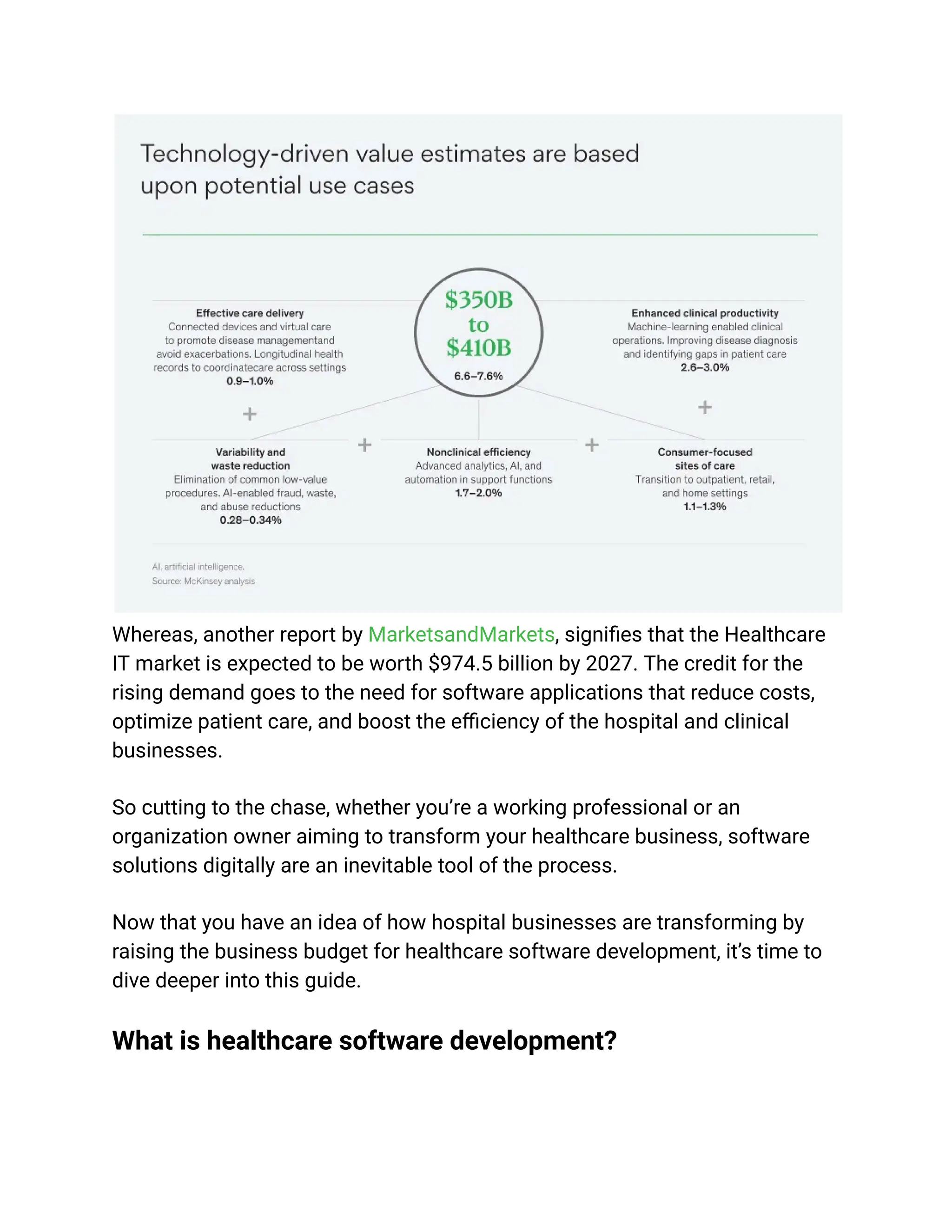
After Covid-19 the demand for healthcare software development has
exponentially increased. McKinsey has stated that technology-driven
innovation will lead to an annual value of $350-$410 billion in the healthcare
industry by 2025.
Whereas, another report by MarketsandMarkets, signifies that the Healthcare
IT market is expected to be worth $974.5 billion by 2027. The credit for the
rising demand goes to the need for software applications that reduce costs,
optimize patient care, and boost the efficiency of the hospital and clinical
businesses.
So cutting to the chase, whether you’re a working professional or an
organization owner aiming to transform your healthcare business, software
solutions digitally are an inevitable tool of the process.
Now that you have an idea of how hospital businesses are transforming by
raising the business budget for healthcare software development, it’s time to
dive deeper into this guide.
What is healthcare software development?
In simple words, healthcare software development is the sophisticated
process of creating tailored computer programs for the healthcare industry
that can offer better efficiency and accuracy.
The goal of this process is to establish an ecosystem for your healthcare
organization in which the patients get accurate clinical services. Here’s how
you can reap the benefits of software applications specifically speaking for
the medical and healthcare industry -
For doctors, nurses, and other medical professionals
Medical professionals can take the help of software applications to
effortlessly track the status of their patients, schedule appointments, and
manage their staff as well.
For example- Epic is an electronic health records software (EHR) that provides
a central repository for patient data, including medical history, family history,
lab results, medication history, etc. It offers medical professionals the
automation of information flow resulting in improved quality of patient care.
For patients
Patients can take the help of a software application to book appointments
with just a few clicks without even having to visit the hospital. Also, they can
get instant healthcare advice if the application has an inbuilt chat option by
simply uploading the reports.
For example: Zocdoc is a medical booking software that offers valuable
healthcare by connecting patients with top-rated primary care doctors. Some
of the innovative features that Zocdoc offers include video consulting,
instantly finding on-demand doctors, and finding the best healthcare facility
that resonates with patients' insurance parameters.
So this is how the ecosystem set with healthcare software development can
be fruitful for both the patients and doctors. While these are just a few ways in
which technology is helping the medical industry, there is a vast array of
different types of healthcare software catering to different requirements.
Moving ahead I’ll be sharing with you the different types of healthcare
software applications available in the market.
Types of healthcare software apps
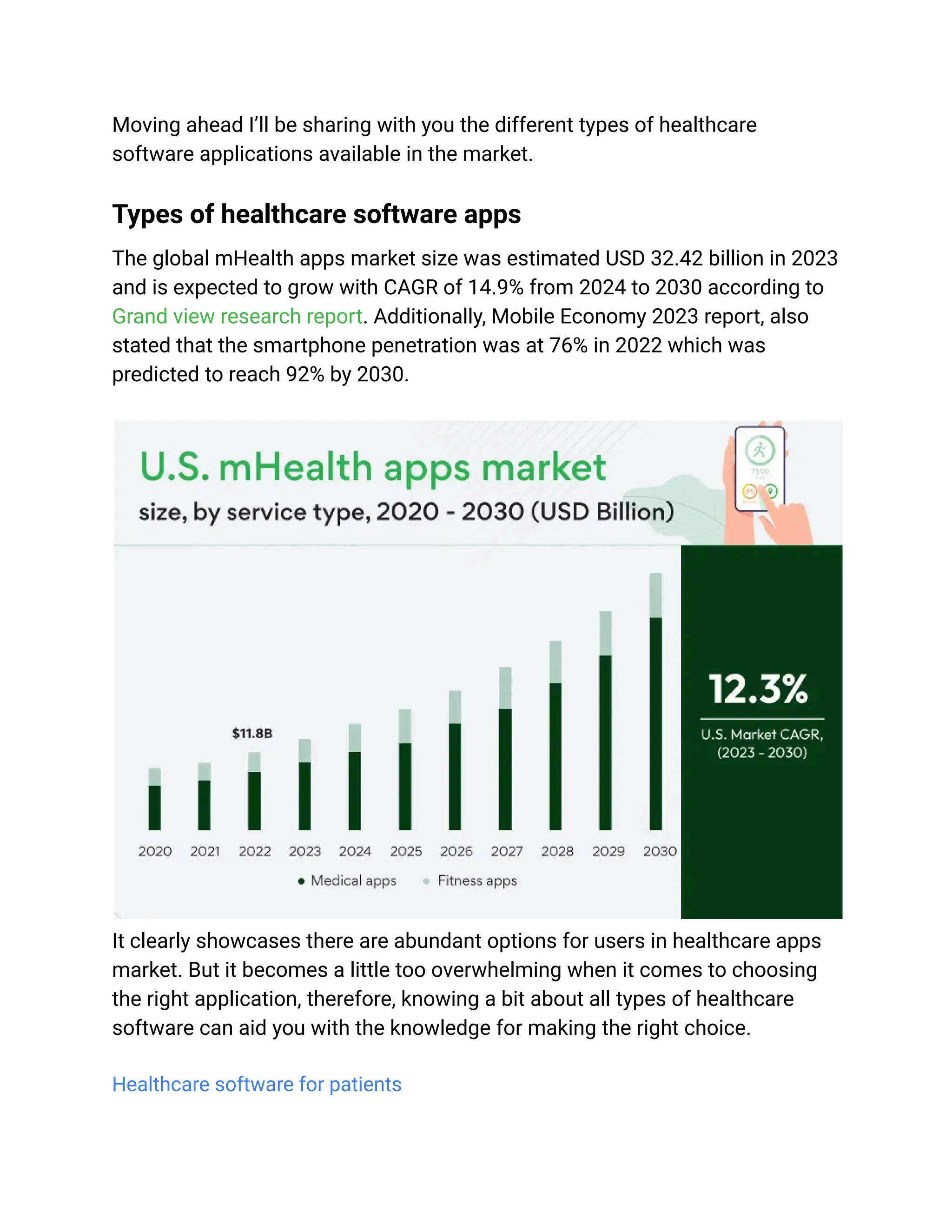
The global mHealth apps market size was estimated USD 32.42 billion in 2023
and is expected to grow with CAGR of 14.9% from 2024 to 2030 according to
Grand view research report. Additionally, Mobile Economy 2023 report, also
stated that the smartphone penetration was at 76% in 2022 which was
predicted to reach 92% by 2030.
It clearly showcases there are abundant options for users in healthcare apps
market. But it becomes a little too overwhelming when it comes to choosing
the right application, therefore, knowing a bit about all types of healthcare
software can aid you with the knowledge for making the right choice.
Healthcare software for patients
As the name suggests, these are software applications that make patients’
(users) lives a lot easier. These are easy-to-use apps that are designed to help
patients seek medical help instantly by pressing a few buttons.
Here are a few examples of healthcare software application types that are
developed for patients:
● Health monitoring software app: These apps help patients with tasks
like checking symptoms, taking proper healthcare advice and more.
Healthcare monitoring software applications are one of the primary
examples of practical implementation. Overall, these are multifunctional
apps that provide personalized medical consultations, thereby saving
time and money even for patients with chronic diseases.
● Mental health software: These apps have expanded access to virtual
healthcare and are responsible for creating a lucrative business
opportunity for the healthcare sector. These apps use a ton of user
engagement features such as gamification elements to help patients
suffering from anxiety, depression, stress, sleeping disorders, etc.
● Medical education software: This particular application type enables
patients to access the authentic and well-grounded database of
medicinal documentation. Not only patients but doctors benefit from
medical education software applications. Overall, the apps provide
knowledge about everything whether it is a specific drug or symptoms
for specific diseases.
● Healthy lifestyle software: Lifestyle application software applications
are one of the common software applications nowadays, especially
after COVID-19. These applications guide users towards living a healthy
life by sharing knowledge on subjects like healthy eating tips and
health-promoting activities.
● Medicine and pharmaceutical services: In the world of eCommerce
where consumers can order from a needle to favorite food at their
doorsteps, medicines are nothing different. Software applications falling
under medicine and pharmaceutical services allow users to order
medicines virtually by simply uploading prescriptions to the app. Also,
users get offers on subscriptions for ongoing treatments and reminders
for medication schedules.
Healthcare software for healthcare professionals
So we have talked about the application types that ease the lives of patients
and now, let’s explore the app type for people working and operating inside the
healthcare businesses. The goal of all the apps falling under this umbrella is
to facilitate overall healthcare operations and simplify the lives of doctors,
physicians, nurses, and other staff at medical institutions.
Let’s see the different types of apps in this category -
● Patient monitoring software: Patient monitoring apps help healthcare
providers keep a check on their patients and track their progress
regularly. These apps store important and personal data of patients
such as test reports, as a result, doctors can provide timely and
accurate treatment.
● Hospital management software: Another important innovation for the
healthcare industry is hospital management software. These software
applications are integrated into hospital systems to streamline
administration, support data management, workaround insurance and
payment processing, and access patient information and health
records.
● E-Prescription software: E-prescription apps help physicians and
healthcare workers generate and send prescriptions directly to labs and
pharmacies. These apps simplify the procedure of sharing medicine
orders with patients.
● Telehealth: Telehealth services allow healthcare institutions to offer
services remotely. These include features like telemedicine and booking
doctor appointments. Today, almost 70% of providers use some sort of
telehealth or telemedicine tool, and 71% of people prefer to search for
health-related information using a voice assistant.
● Health record software: Medical or health record software apps help in
maintaining a database by collecting and maintaining patients’
historical health data electronically. These offer ease and convenience
of accessing data whenever needed and stay away from the fear of
losing information. This real-time information helps physicians to keep a
close eye on entire treatment procedure of the patient.
These are the important categories of healthcare software applications,
however, this article, is all about creating one for your business and patients.
Not to forget there are plenty of solutions that are already available but a few
of them offer the flexibility of customizations. Therefore, the last resort is to
develop one for yourself. Now, let’s go through the extensive blueprint for
healthcare software development.
Blueprint to healthcare software development - A
step-by-step guide
Now we will explore all the crucial steps one must follow for the medical
software development process.
Step 1 - Defining target audience
This is the very first step towards developing a custom healthcare solution. To
grap the evolving need in the medical management market, you have to
research to understand your target audience's needs and preferences.
Defining the target audience will help you in selecting the right technology
such as virtual reality, cloud computing, Internet of Things, artificial
intelligence, etc. Overall defining a target audience lets you improve relations
with your clients and as a result, better relations allow software developers to
create superior products.
Step 2 - Designing a prototype
As you know, a prototype is an interactive working model of your ideal finished
product. The prototype of your healthcare software will comprise a wireframe
developed using a computer interface and allow users to interact with the
product.
Prototyping is a very important step that cannot be missed in the medical
device software development process for the following reasons -
● Firstly, this is a great way to test the product before creating it.
● Secondly, it helps you estimate that you’re on the right track by
collecting feedback.
● Lastly, it allows you to make changes and improve your software on the
go.
Step 3 - Develop your final prototype
Once you've crafted your initial prototype, it's time to construct your ultimate
prototype for healthcare app development. As a developer in the medical field,
it's crucial to grasp the procedure of crafting software tailored for the
healthcare sector and to stay abreast of technological advancements. The key
aspect of this step is to maintain a precise vision of the final appearance of
your software.
Step 4 - Writing the code
So this is the fun part, where you start building your healthcare software
brick-by-brick. To be honest, building an app from scratch takes time and
effort, but it does not mean that you need months, years, or ages to create
your product. In this step, you can take the help of a software development kit
or a third-party development environment.
If you’ve performed the first step of defining your target audience accurately
then, the insights collected will make it easy for you to choose the best
programming languages.
Step 5 - Collect feedback from users and deliver final product
Launching software before running it through multiple quality checks and user
reviews is not advisable especially when you're creating something to serve a
noble industry. Therefore, you must collect feedback from users and make a
list of improvements for your medical software applications.
Once you’ve implemented the feedback after the testing phase you’re ready
for the deliverables. Before launching your software ensure that it has all the
necessary feature updates, bug fixes, and most importantly includes
necessary documentation for the users.
Voila, your healthcare software is ready to be launched!
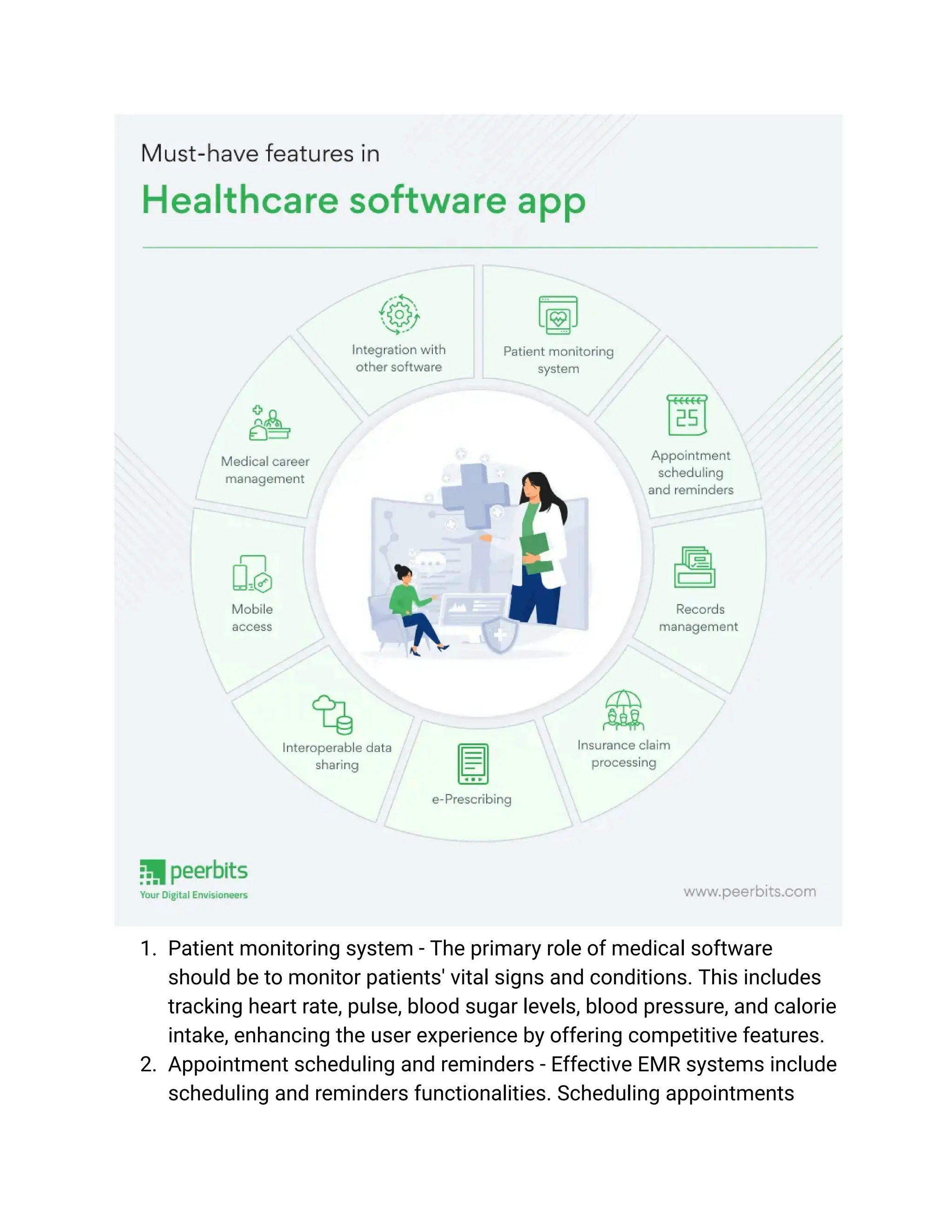
Healthcare software development can be accomplished by taking these five
straightforward steps. Just make sure the final product should have the
following features -
1. Patient monitoring system - The primary role of medical software
should be to monitor patients' vital signs and conditions. This includes
tracking heart rate, pulse, blood sugar levels, blood pressure, and calorie
intake, enhancing the user experience by offering competitive features.
2. Appointment scheduling and reminders - Effective EMR systems include
scheduling and reminders functionalities. Scheduling appointments
streamlines the process for healthcare providers to arrange follow-ups
and appointments, while reminders help users stay on track with
scheduling patient follow-ups.
3. Records management - Medical software should facilitate document
management, allowing for the retrieval and organization of patient
information from various documents such as lab results and
prescriptions.
4. Insurance claim processing - A critical feature of medical software is the
ability to process insurance claims in accordance with the healthcare
provider's contract requirements.
5. Electronic prescribing (e-Prescribing) - An emerging feature in the
medical industry is e-prescribing, which enables physicians and
prescribers to electronically send prescriptions directly to patients'
chosen pharmacies.
6. Interoperable data sharing - Enterprise healthcare software should
prioritize data sharing among different institutions like hospitals and
clinics within the same geographic area, necessitating interoperability
protocols between healthcare facilities and software vendors.
7. Mobile access - The popularity of mobile computing in healthcare is
increasing, driven by advancements in mobile devices. Medical software
can now be accessed from anywhere, improving accessibility and
convenience.
8. Medical career management - Advancements in medical software
include systems for managing medical careers, allowing users to track
contacts, reviews, practice history, and professional achievements in
their field.
9. Integration with other software - Many medical software solutions are
being developed, but compatibility with other technologies is often
lacking due to specific features or functions tailored to each application
or solution.
In short, by following the aforementioned steps and adding the necessary
modules you can develop a perfect healthcare app that -
1. Keeps track of all the important patient information related to their
health and recovery.
2. Provides timely treatment and consultation.
3. Helps patients access important medicines and
4. Automates the entire healthcare business.
While these steps seem like a five-finger exercise, the development team still
needs to have some technical acumen. In short, you need a team of highly
skilled coders. If you lack the development skills then the best approach is to
outsource a work that has this technical acumen.
Before selecting a custom healthcare app development firm it is imperative to
assess that the agency has technical proficiency, industry acumen, and room
for growth and scalability. Well, your search can end at Peerbits!
Why choose Peerbits for custom healthcare software
development?
Peerbits is a custom software development firm that has been in the market
for over a decade. Our strength lies in 180+ in-house skilled talent that has
delivered over 750 projects successfully that have received 120+ admirable
reviews on Clutch, GoodFirms & Google.
Peerbits has trusted clients from a vast array of industries including finance,
healthcare, transportation, and logistics. Specifically, speaking of the
healthcare sector, Peerbits has delivered projects that required custom
solutions for the industry. To back this statement, you can check out the
following success stories of beloved clients -
1. Bridging gaps between patients & healthcare
This case study is about a native iOS app which is a customized solution to
bridge gaps between the patients and healthcare facilities. The challenges
that were resolved with this solution include -
● Collecting mobile phones with medical devices and fetching patient
data in real-time on the devices.
● Video calling features for patients and doctors to foster a strong
relationship.
The solution created by Peerbits resulted in increased patient engagement
and enhanced patient satisfaction.
2. COVID-19 tracker & self-assessment
It was a tough time for all of us during the COVID-19 pandemic outbreak,
however, Peerbits contributed as a savior. We delivered a COVID-19 tracker
app where we partnered with world-class physicians and used data provided
by the WHO and CDC.
This app resolved the following challenges -
● Ensure an accurate flow of AI-based COVID-19 questions that will help
patients take a self-assessment and take timely treatment.
● Make sure the self-assessment questions are in proper order and are in
accordance with users’ responses.
● Integrate a group calling feature among doctors, patients, and family
members during the difficult times of lockdown and social distancing.
We used a plethora of sophisticated technologies such as Swift, Angular,
MongoDB, and many more to develop a custom healthcare software solution
to successfully complete this project.
Here are some of our many noteworthy solutions that our skilled tech team at
Peerbits has delivered to the clients:
● Remote patient monitoring software
● A single app for all medical activities
● REPD fitness app
● Blucheck BMI calculator
● NurseAlert -a cohesive nursing solution
● Smart bluetooth-powered fitness bottle app
● Women exclusive fitness & healthcare app
As you can see whether you need a fitness tracker, BMI calculator, or an app
for consulting doctors online, Peerbits has experience of it all.
Wrapping Up!
Healthcare software solutions are the perfect approach with which patient can
have access to global medical facilities at their fingertips. It brings medical
professionals closer to their patients without having to charter hundreds and
thousands of miles, therefore, the key to developing any successful healthcare
software solution is understanding your audience and their needs.
The journey to creating an ideal healthcare solution is straightforward but as
mentioned earlier requires technical expertise. This is where the role of a
development agency comes into play. Peerbits has a proven record of
delivering projects that are built on the SOLID principles of software design.
If you’re looking forward to developing a custom healthcare software solution
to make patients’ lives easier and improve their healthcare system, make sure
to Schedule A Call today!

Healthcare software development made easy_ A step-by-step guide.pdf

  • 1.
    Healthcare software developmentmade easy: A step-by-step guide Since the discovery of the internet, industries across the globe have gone through a major transformation of digitization, and to no surprise the healthcare industry is not behind. In the past few years, the healthcare and medical industry has undergone a significant digital transformation and all the credit goes to medical software apps. Important factors and events such as the pandemic have increased the desire among patients for an updated infrastructure that accelerates the current offline process, resulting in the demand for a more secure and smart software solution. While plenty of solutions are present in the market, the need for a customized solution that resonates with your business is important for smoother functioning. So if you’re a healthcare startup looking for an instruction manual for developing a custom-made software solution to support your patients and provide them with the best solutions, then this blog post is for you. In this blog, you’ll learn all about healthcare software development,types of healthcare software and a comprehensive guide to development of healthcare software. But before that, first have a look at some eye-opening stats on the growing trend of healthtech market worldwide. Global healthtech market overview After Covid-19 the demand for healthcare software development has exponentially increased. McKinsey has stated that technology-driven innovation will lead to an annual value of $350-$410 billion in the healthcare industry by 2025.
  • 2.
    Whereas, another reportby MarketsandMarkets, signifies that the Healthcare IT market is expected to be worth $974.5 billion by 2027. The credit for the rising demand goes to the need for software applications that reduce costs, optimize patient care, and boost the efficiency of the hospital and clinical businesses. So cutting to the chase, whether you’re a working professional or an organization owner aiming to transform your healthcare business, software solutions digitally are an inevitable tool of the process. Now that you have an idea of how hospital businesses are transforming by raising the business budget for healthcare software development, it’s time to dive deeper into this guide. What is healthcare software development?
  • 3.
    In simple words,healthcare software development is the sophisticated process of creating tailored computer programs for the healthcare industry that can offer better efficiency and accuracy. The goal of this process is to establish an ecosystem for your healthcare organization in which the patients get accurate clinical services. Here’s how you can reap the benefits of software applications specifically speaking for the medical and healthcare industry - For doctors, nurses, and other medical professionals Medical professionals can take the help of software applications to effortlessly track the status of their patients, schedule appointments, and manage their staff as well. For example- Epic is an electronic health records software (EHR) that provides a central repository for patient data, including medical history, family history, lab results, medication history, etc. It offers medical professionals the automation of information flow resulting in improved quality of patient care. For patients Patients can take the help of a software application to book appointments with just a few clicks without even having to visit the hospital. Also, they can get instant healthcare advice if the application has an inbuilt chat option by simply uploading the reports. For example: Zocdoc is a medical booking software that offers valuable healthcare by connecting patients with top-rated primary care doctors. Some of the innovative features that Zocdoc offers include video consulting, instantly finding on-demand doctors, and finding the best healthcare facility that resonates with patients' insurance parameters. So this is how the ecosystem set with healthcare software development can be fruitful for both the patients and doctors. While these are just a few ways in which technology is helping the medical industry, there is a vast array of different types of healthcare software catering to different requirements.
  • 4.
    Moving ahead I’llbe sharing with you the different types of healthcare software applications available in the market. Types of healthcare software apps The global mHealth apps market size was estimated USD 32.42 billion in 2023 and is expected to grow with CAGR of 14.9% from 2024 to 2030 according to Grand view research report. Additionally, Mobile Economy 2023 report, also stated that the smartphone penetration was at 76% in 2022 which was predicted to reach 92% by 2030. It clearly showcases there are abundant options for users in healthcare apps market. But it becomes a little too overwhelming when it comes to choosing the right application, therefore, knowing a bit about all types of healthcare software can aid you with the knowledge for making the right choice. Healthcare software for patients
  • 5.
    As the namesuggests, these are software applications that make patients’ (users) lives a lot easier. These are easy-to-use apps that are designed to help patients seek medical help instantly by pressing a few buttons. Here are a few examples of healthcare software application types that are developed for patients: ● Health monitoring software app: These apps help patients with tasks like checking symptoms, taking proper healthcare advice and more. Healthcare monitoring software applications are one of the primary examples of practical implementation. Overall, these are multifunctional apps that provide personalized medical consultations, thereby saving time and money even for patients with chronic diseases. ● Mental health software: These apps have expanded access to virtual healthcare and are responsible for creating a lucrative business opportunity for the healthcare sector. These apps use a ton of user engagement features such as gamification elements to help patients suffering from anxiety, depression, stress, sleeping disorders, etc. ● Medical education software: This particular application type enables patients to access the authentic and well-grounded database of medicinal documentation. Not only patients but doctors benefit from medical education software applications. Overall, the apps provide knowledge about everything whether it is a specific drug or symptoms for specific diseases. ● Healthy lifestyle software: Lifestyle application software applications are one of the common software applications nowadays, especially after COVID-19. These applications guide users towards living a healthy life by sharing knowledge on subjects like healthy eating tips and health-promoting activities. ● Medicine and pharmaceutical services: In the world of eCommerce where consumers can order from a needle to favorite food at their doorsteps, medicines are nothing different. Software applications falling under medicine and pharmaceutical services allow users to order medicines virtually by simply uploading prescriptions to the app. Also,
  • 6.
    users get offerson subscriptions for ongoing treatments and reminders for medication schedules. Healthcare software for healthcare professionals So we have talked about the application types that ease the lives of patients and now, let’s explore the app type for people working and operating inside the healthcare businesses. The goal of all the apps falling under this umbrella is to facilitate overall healthcare operations and simplify the lives of doctors, physicians, nurses, and other staff at medical institutions. Let’s see the different types of apps in this category - ● Patient monitoring software: Patient monitoring apps help healthcare providers keep a check on their patients and track their progress regularly. These apps store important and personal data of patients such as test reports, as a result, doctors can provide timely and accurate treatment. ● Hospital management software: Another important innovation for the healthcare industry is hospital management software. These software applications are integrated into hospital systems to streamline administration, support data management, workaround insurance and payment processing, and access patient information and health records. ● E-Prescription software: E-prescription apps help physicians and healthcare workers generate and send prescriptions directly to labs and pharmacies. These apps simplify the procedure of sharing medicine orders with patients. ● Telehealth: Telehealth services allow healthcare institutions to offer services remotely. These include features like telemedicine and booking doctor appointments. Today, almost 70% of providers use some sort of telehealth or telemedicine tool, and 71% of people prefer to search for health-related information using a voice assistant. ● Health record software: Medical or health record software apps help in maintaining a database by collecting and maintaining patients’
  • 7.
    historical health dataelectronically. These offer ease and convenience of accessing data whenever needed and stay away from the fear of losing information. This real-time information helps physicians to keep a close eye on entire treatment procedure of the patient. These are the important categories of healthcare software applications, however, this article, is all about creating one for your business and patients. Not to forget there are plenty of solutions that are already available but a few of them offer the flexibility of customizations. Therefore, the last resort is to develop one for yourself. Now, let’s go through the extensive blueprint for healthcare software development. Blueprint to healthcare software development - A step-by-step guide Now we will explore all the crucial steps one must follow for the medical software development process. Step 1 - Defining target audience This is the very first step towards developing a custom healthcare solution. To grap the evolving need in the medical management market, you have to research to understand your target audience's needs and preferences. Defining the target audience will help you in selecting the right technology such as virtual reality, cloud computing, Internet of Things, artificial intelligence, etc. Overall defining a target audience lets you improve relations with your clients and as a result, better relations allow software developers to create superior products. Step 2 - Designing a prototype As you know, a prototype is an interactive working model of your ideal finished product. The prototype of your healthcare software will comprise a wireframe
  • 8.
    developed using acomputer interface and allow users to interact with the product. Prototyping is a very important step that cannot be missed in the medical device software development process for the following reasons - ● Firstly, this is a great way to test the product before creating it. ● Secondly, it helps you estimate that you’re on the right track by collecting feedback. ● Lastly, it allows you to make changes and improve your software on the go. Step 3 - Develop your final prototype Once you've crafted your initial prototype, it's time to construct your ultimate prototype for healthcare app development. As a developer in the medical field, it's crucial to grasp the procedure of crafting software tailored for the healthcare sector and to stay abreast of technological advancements. The key aspect of this step is to maintain a precise vision of the final appearance of your software. Step 4 - Writing the code So this is the fun part, where you start building your healthcare software brick-by-brick. To be honest, building an app from scratch takes time and effort, but it does not mean that you need months, years, or ages to create your product. In this step, you can take the help of a software development kit or a third-party development environment. If you’ve performed the first step of defining your target audience accurately then, the insights collected will make it easy for you to choose the best programming languages. Step 5 - Collect feedback from users and deliver final product
  • 9.
    Launching software beforerunning it through multiple quality checks and user reviews is not advisable especially when you're creating something to serve a noble industry. Therefore, you must collect feedback from users and make a list of improvements for your medical software applications. Once you’ve implemented the feedback after the testing phase you’re ready for the deliverables. Before launching your software ensure that it has all the necessary feature updates, bug fixes, and most importantly includes necessary documentation for the users. Voila, your healthcare software is ready to be launched! Healthcare software development can be accomplished by taking these five straightforward steps. Just make sure the final product should have the following features -
  • 10.
    1. Patient monitoringsystem - The primary role of medical software should be to monitor patients' vital signs and conditions. This includes tracking heart rate, pulse, blood sugar levels, blood pressure, and calorie intake, enhancing the user experience by offering competitive features. 2. Appointment scheduling and reminders - Effective EMR systems include scheduling and reminders functionalities. Scheduling appointments
  • 11.
    streamlines the processfor healthcare providers to arrange follow-ups and appointments, while reminders help users stay on track with scheduling patient follow-ups. 3. Records management - Medical software should facilitate document management, allowing for the retrieval and organization of patient information from various documents such as lab results and prescriptions. 4. Insurance claim processing - A critical feature of medical software is the ability to process insurance claims in accordance with the healthcare provider's contract requirements. 5. Electronic prescribing (e-Prescribing) - An emerging feature in the medical industry is e-prescribing, which enables physicians and prescribers to electronically send prescriptions directly to patients' chosen pharmacies. 6. Interoperable data sharing - Enterprise healthcare software should prioritize data sharing among different institutions like hospitals and clinics within the same geographic area, necessitating interoperability protocols between healthcare facilities and software vendors. 7. Mobile access - The popularity of mobile computing in healthcare is increasing, driven by advancements in mobile devices. Medical software can now be accessed from anywhere, improving accessibility and convenience. 8. Medical career management - Advancements in medical software include systems for managing medical careers, allowing users to track contacts, reviews, practice history, and professional achievements in their field. 9. Integration with other software - Many medical software solutions are being developed, but compatibility with other technologies is often lacking due to specific features or functions tailored to each application or solution. In short, by following the aforementioned steps and adding the necessary modules you can develop a perfect healthcare app that -
  • 12.
    1. Keeps trackof all the important patient information related to their health and recovery. 2. Provides timely treatment and consultation. 3. Helps patients access important medicines and 4. Automates the entire healthcare business. While these steps seem like a five-finger exercise, the development team still needs to have some technical acumen. In short, you need a team of highly skilled coders. If you lack the development skills then the best approach is to outsource a work that has this technical acumen. Before selecting a custom healthcare app development firm it is imperative to assess that the agency has technical proficiency, industry acumen, and room for growth and scalability. Well, your search can end at Peerbits! Why choose Peerbits for custom healthcare software development? Peerbits is a custom software development firm that has been in the market for over a decade. Our strength lies in 180+ in-house skilled talent that has delivered over 750 projects successfully that have received 120+ admirable reviews on Clutch, GoodFirms & Google. Peerbits has trusted clients from a vast array of industries including finance, healthcare, transportation, and logistics. Specifically, speaking of the healthcare sector, Peerbits has delivered projects that required custom solutions for the industry. To back this statement, you can check out the following success stories of beloved clients - 1. Bridging gaps between patients & healthcare This case study is about a native iOS app which is a customized solution to bridge gaps between the patients and healthcare facilities. The challenges that were resolved with this solution include -
  • 13.
    ● Collecting mobilephones with medical devices and fetching patient data in real-time on the devices. ● Video calling features for patients and doctors to foster a strong relationship. The solution created by Peerbits resulted in increased patient engagement and enhanced patient satisfaction. 2. COVID-19 tracker & self-assessment It was a tough time for all of us during the COVID-19 pandemic outbreak, however, Peerbits contributed as a savior. We delivered a COVID-19 tracker app where we partnered with world-class physicians and used data provided by the WHO and CDC. This app resolved the following challenges - ● Ensure an accurate flow of AI-based COVID-19 questions that will help patients take a self-assessment and take timely treatment. ● Make sure the self-assessment questions are in proper order and are in accordance with users’ responses. ● Integrate a group calling feature among doctors, patients, and family members during the difficult times of lockdown and social distancing. We used a plethora of sophisticated technologies such as Swift, Angular, MongoDB, and many more to develop a custom healthcare software solution to successfully complete this project. Here are some of our many noteworthy solutions that our skilled tech team at Peerbits has delivered to the clients: ● Remote patient monitoring software ● A single app for all medical activities ● REPD fitness app ● Blucheck BMI calculator
  • 14.
    ● NurseAlert -acohesive nursing solution ● Smart bluetooth-powered fitness bottle app ● Women exclusive fitness & healthcare app As you can see whether you need a fitness tracker, BMI calculator, or an app for consulting doctors online, Peerbits has experience of it all. Wrapping Up! Healthcare software solutions are the perfect approach with which patient can have access to global medical facilities at their fingertips. It brings medical professionals closer to their patients without having to charter hundreds and thousands of miles, therefore, the key to developing any successful healthcare software solution is understanding your audience and their needs. The journey to creating an ideal healthcare solution is straightforward but as mentioned earlier requires technical expertise. This is where the role of a development agency comes into play. Peerbits has a proven record of delivering projects that are built on the SOLID principles of software design. If you’re looking forward to developing a custom healthcare software solution to make patients’ lives easier and improve their healthcare system, make sure to Schedule A Call today!