Healthcare Operations management.
Sabu V U.
DMS,(HMA), MBA ,
sabuvayalarikil@gmail.com
Introduction
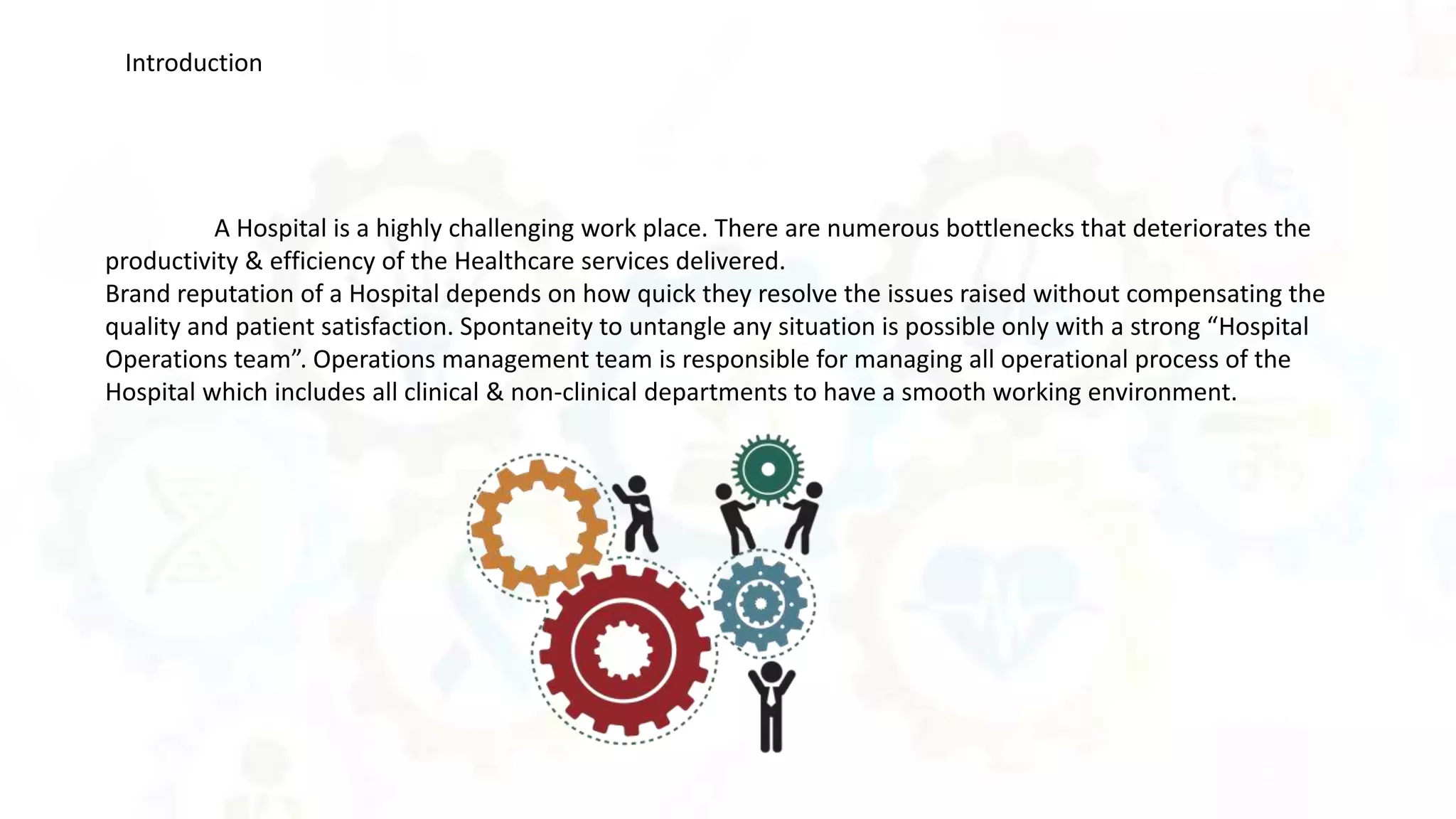
A Hospital is a highly challenging work place. There are numerous bottlenecks that deteriorates the
productivity & efficiency of the Healthcare services delivered.
Brand reputation of a Hospital depends on how quick they resolve the issues raised without compensating the
quality and patient satisfaction. Spontaneity to untangle any situation is possible only with a strong “Hospital
Operations team”. Operations management team is responsible for managing all operational process of the
Hospital which includes all clinical & non-clinical departments to have a smooth working environment.
Health care operations are certain administrative, financial, legal, and quality
improvement activities of a covered entity that are necessary to run its business and
to support the core functions of treatment and payment. These activities, which are
limited to the activities listed in the definition of health care operations, include case
management and care coordination and business management and general
administrative activities.
Health Care Operations
“Operations management is essential for the efficient
functionality and provision of health services.”
Operations management is the design, operation, and improvement of the processes
and systems that create and deliver the organization’s Health care services. The goal of
operations management is to more effectively and efficiently provide the Health care services.
What is operations management?
 Improve and optimize planning and scheduling.
 Maximization of bed management and usage of hospital facilities.
 Understanding of Inpatient diagnosis and procedures with their cost.
 Streamlining and optimizing utilization of operation theatre.
 Streamlining and optimizing utilization of various assets including high-tech equipment.
 Wait time for patients at various departments and processes.
 Medication error.
 Average length of Stay vis-à-vis cost for the patient.
 Improved and efficient processes.
 Waste, fraud and abuse of resources.
Challenges:
Efficient operation of hospitals is one of the major concern areas for the management team of any
organization as it involves multiple departments, numerous activities, intertwined processes, involvement of staff
at different levels and more importantly efficient use of scarce resources. As a result of such diversity, the
challenges are also diverse and of varied intensity, which requires detailing and working at various levels of the
organization. These challenges have a high impact on the productivity, employee morale and patient satisfaction.
Some of the operational challenges that need to be addressed on a priority basis.
Today’s Hospitals Facing Major Challenges
Maintaining
patient safety
Technology
upgradation
Hospital
security
Hospitals are the second most energy-intensive buildings after restaurants, and globally, healthcare costs are on
the rise. These financial challenges— in addition to an aging world population and increasing energy costs—are
putting pressure on healthcare organizations to do more with less without compromising quality of care.
Financial challenges and hospital productivity:
Reducing the risk of infection, as well as other potential risks, such as power failures, is crucial in ensuring a high
quality of care and maintaining the organization’s reputation.
Maintaining patient safety:
Noncompliance with regulatory standards can lead to a disruption in operations, poor quality of care, safety
issues, and substantial fines. At the same time, as energy demand rises, many countries are requiring healthcare
facilities to reduce carbon output and meet mandates for energy reductions.
Regulatory standards
Healthcare facilities are often open 24/7, and those visiting are often under a great deal of stress when life and
health are at stake. Violence, infant abductions, patient wanderings, and theft of drugs and hospital assets are
major concerns.
Hospital security:
The well-being of patients is a key to reducing length of stay and preventing readmissions. In green hospitals,
patients are discharged an average of 2.5 days earlier compared to traditional hospitals. Additionally, patient
satisfaction can also affect a hospital’s revenue. If the systems are operating poorly or not at all, quality metrics
such as Hospital Consumer Assessment of Healthcare Providers and Systems can be adversely affected.
Patient satisfaction:
Technology has brought about many improvements in health care that have a positive impact on the patient
experience in hospitals. Some facilities are using tracking technology originally designed for supply chain
management to make a big difference in lowering wait times and improving treatment across the continuum of
care.
Technology upgradation
More hospitals are seeing their operations suffer as the number of insured patients grows, and the number of
Specialty Doctors and staff dwindle. And the demands from the changing healthcare industry are taking their toll on
the clinical staff.
Personal shortages
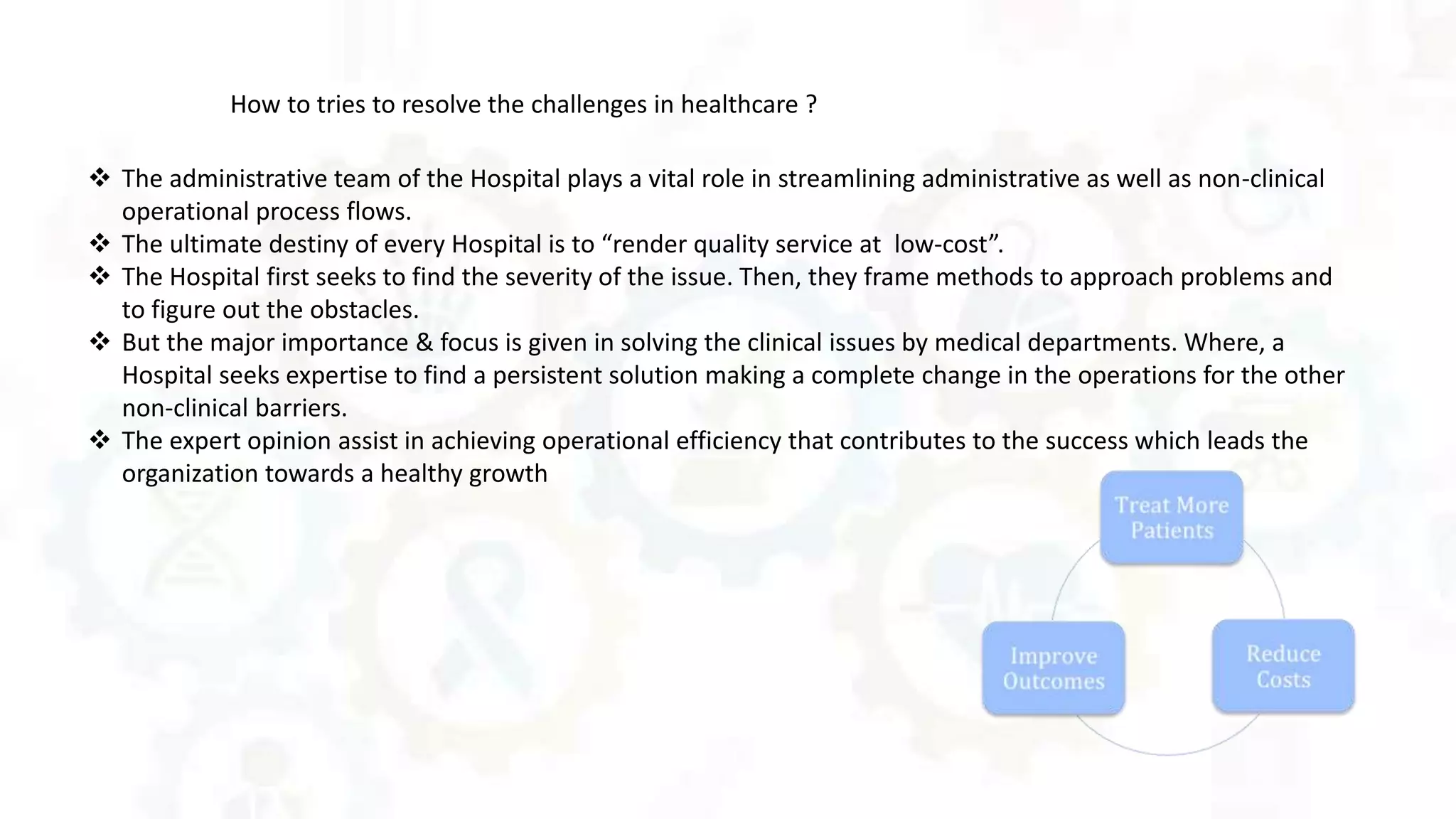
How to tries to resolve the challenges in healthcare ?
 The administrative team of the Hospital plays a vital role in streamlining administrative as well as non-clinical
operational process flows.
 The ultimate destiny of every Hospital is to “render quality service at low-cost”.
 The Hospital first seeks to find the severity of the issue. Then, they frame methods to approach problems and
to figure out the obstacles.
 But the major importance & focus is given in solving the clinical issues by medical departments. Where, a
Hospital seeks expertise to find a persistent solution making a complete change in the operations for the other
non-clinical barriers.
 The expert opinion assist in achieving operational efficiency that contributes to the success which leads the
organization towards a healthy growth
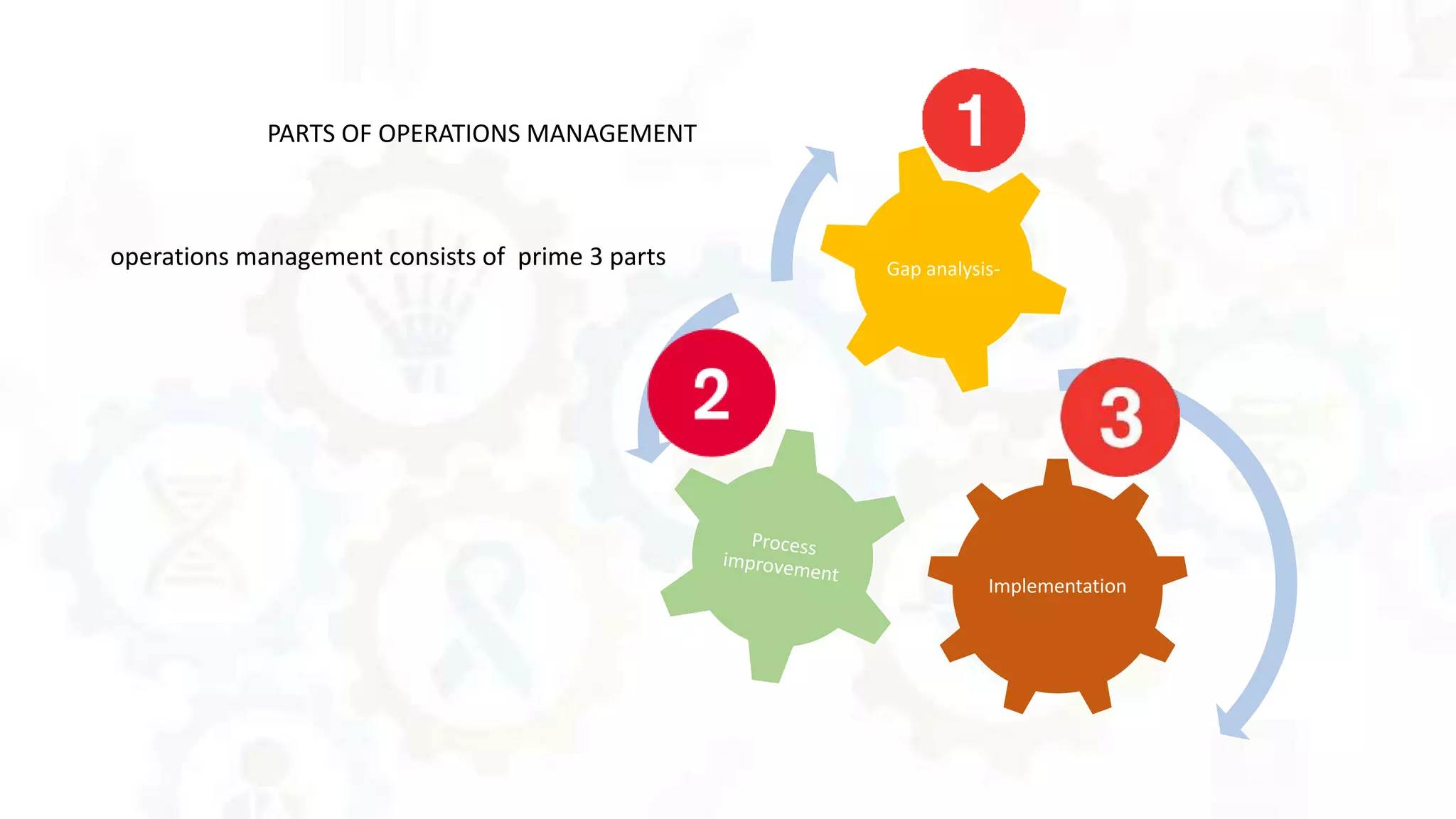
PARTS OF OPERATIONS MANAGEMENT
operations management consists of prime 3 parts
Implementation
Gap analysis-
The process entails the assessment of the present condition and tally the same with the
projected stage making the Hospital system more effective.
Gap analysis-
Gap analysis is a useful tool for all active organizations to examine the running system judiciously, for
finding out the probable areas where more attention is required so that the organization becomes
more dynamic.
Process improvement
Implementation –
The process of implementing the new strategy into the Hospital system to vanish the gaps (includes
knowledge sharing, training & setting quality indicators) and checking its efficiency
1
3
2
Operational (Healthcare) Goals
The private sector entrepreneurs operating healthcare facilities are focused on effectively achieving following key
goals to manage the healthcare infrastructure efficiently. Achievement of these goals is more critical for the public
healthcare sector facilities operator given the higher % of public sector spending globally.
 Improve Operational Effectiveness
 Improve the quality of services in a time bound manner
 Reduce medication Errors
 Improve clinical effectiveness
 Use Business Intelligence and Data Analytics
 Improve financial and administrative performance
 Reduce readmissions
 Enhance member/ patient satisfaction
Efficiency of healthcare facilities is a relative term and has multiple, domain specific definitions. Efficiency
ultimately translates to added value and improved performance outcomes. Revisiting the importance of
infrastructure and facility management in healthcare organization, it is more often the forgotten information which
can play an important role in operational continuity, optimization and continuous improvement.
4 ways for efficiency in healthcare operations
fficiency of Process
fficient people
fficiency of technology
fficiency of solutions implementation
Incorporates the planning and operational practices that significantly reduce or eliminate the negative impact on
clinical service continuity in healthcare facilities. The analysis of infrastructure data and its contribution to
decision making will result in better understanding of cause and effect scenarios affecting the environment of
care. When measured against tangible criteria such as cost and quality, appropriately weighted against the
potential severity of impact from infrastructure failure to patient care and patient experience, the process and its
outcomes become enablers to change management initiatives, people efficiency and productivity gains. This
level of complexity, and the number of variables involved in determining the right process and reaction under
certain conditions, can no longer be contained without the aid of technology.
Efficiency of Process
It can make the most important difference to cost and quality of healthcare facility management service
delivery. The challenge to deliver better service quality at lower cost is driving the need to adopt
innovative ways in communication and people interaction with technology. Analyzing and collaboratively
managing patterns of infrastructure behavior creates visibility for potential issues and strengthens
engagement with all stakeholder groups in the organization. It turns a potentially daunting experience
into a positive, proactive risk mitigation approach, allowing for wide recognition, shared commitment
and support in required resolution. This information can also be used to continuously tune building
systems to facilitate the seamless interaction between services, enabling their logical connectivity and
response to uniquely complex and critical environment’s inputs
Efficient people
Efficiency of technology and end-users’ adoption are key success factors. The
challenge remains to balance cost and complexity in implementation of intelligent
solutions with a measurable performance output by choosing the appropriate
technology to deliver the right process with an optimal utilization level.
Efficiency of technology
Efficiency of solutions implementation implies the decision to implement the right
solution in the right place, at the right time, for the right outcome. An efficient
implementation will support all other key considerations discussed thus far, providing
demonstrable ways to meet business objectives, offering ease-of-use for all stakeholders
and providing an environment that supports people-centric processes with near-term
Efficiency of solutions implementation
Call to Action
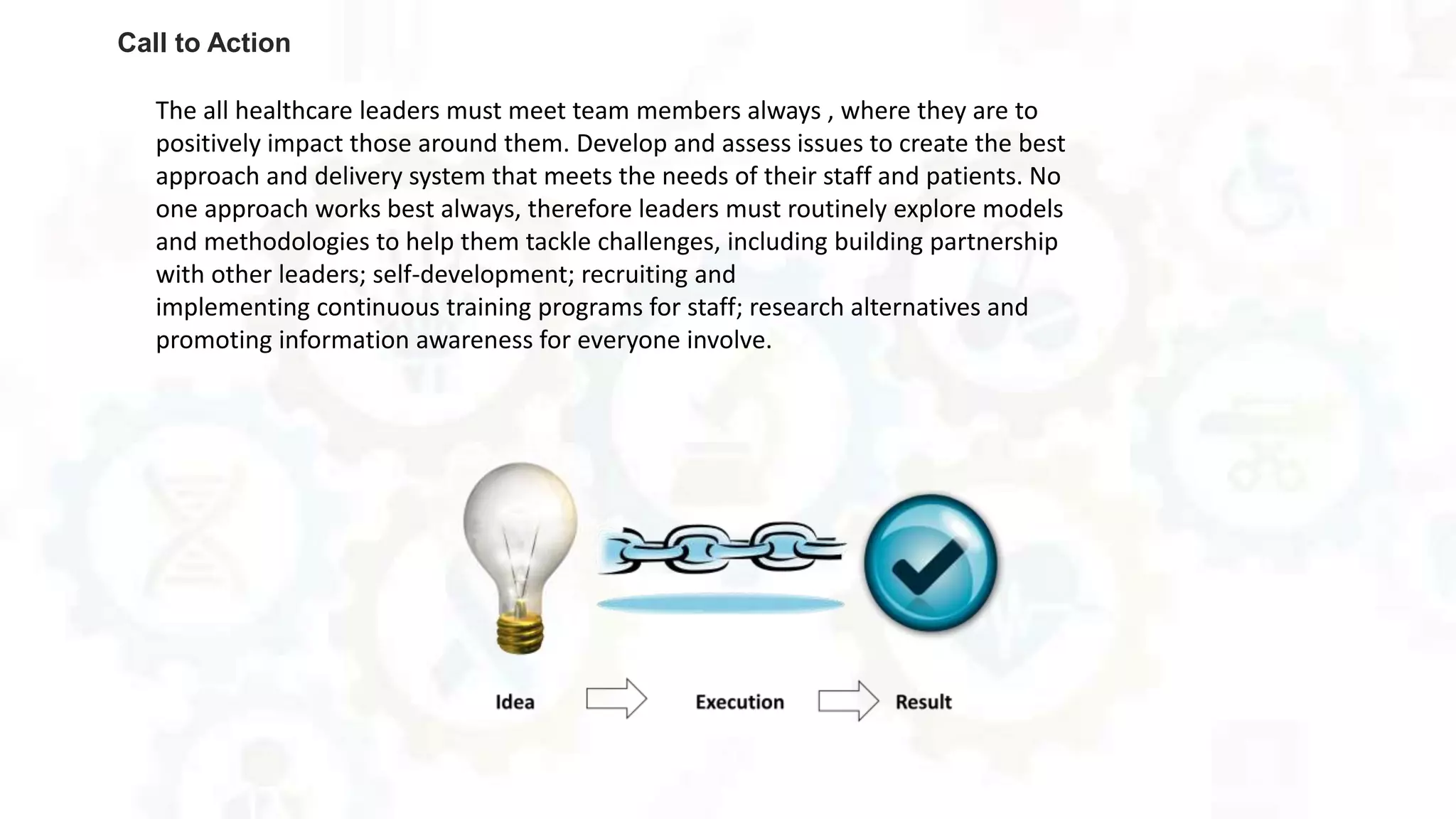
The all healthcare leaders must meet team members always , where they are to
positively impact those around them. Develop and assess issues to create the best
approach and delivery system that meets the needs of their staff and patients. No
one approach works best always, therefore leaders must routinely explore models
and methodologies to help them tackle challenges, including building partnership
with other leaders; self-development; recruiting and
implementing continuous training programs for staff; research alternatives and
promoting information awareness for everyone involve.
The healthcare Operations team must be able to provide direction and guidance to organizations about roles,
responsibilities, and functions The leader must devise and revise strategies everyone can understand and
follow.
“Decisions made by healthcare managers not only focus on ensuring that the patient receives the most
appropriate, timely, and effective services possible, but also address achievement of desired performance
targets.”
Ultimately, decisions made by an individual manager affect the organization’s overall performance so, work
with a team
Conclusion
Healthcare operations management

Healthcare operations management

  • 1.
    Healthcare Operations management. SabuV U. DMS,(HMA), MBA , sabuvayalarikil@gmail.com
  • 2.
    Introduction A Hospital isa highly challenging work place. There are numerous bottlenecks that deteriorates the productivity & efficiency of the Healthcare services delivered. Brand reputation of a Hospital depends on how quick they resolve the issues raised without compensating the quality and patient satisfaction. Spontaneity to untangle any situation is possible only with a strong “Hospital Operations team”. Operations management team is responsible for managing all operational process of the Hospital which includes all clinical & non-clinical departments to have a smooth working environment.
  • 3.
    Health care operationsare certain administrative, financial, legal, and quality improvement activities of a covered entity that are necessary to run its business and to support the core functions of treatment and payment. These activities, which are limited to the activities listed in the definition of health care operations, include case management and care coordination and business management and general administrative activities. Health Care Operations
  • 4.
    “Operations management isessential for the efficient functionality and provision of health services.” Operations management is the design, operation, and improvement of the processes and systems that create and deliver the organization’s Health care services. The goal of operations management is to more effectively and efficiently provide the Health care services. What is operations management?
  • 5.
     Improve andoptimize planning and scheduling.  Maximization of bed management and usage of hospital facilities.  Understanding of Inpatient diagnosis and procedures with their cost.  Streamlining and optimizing utilization of operation theatre.  Streamlining and optimizing utilization of various assets including high-tech equipment.  Wait time for patients at various departments and processes.  Medication error.  Average length of Stay vis-à-vis cost for the patient.  Improved and efficient processes.  Waste, fraud and abuse of resources. Challenges: Efficient operation of hospitals is one of the major concern areas for the management team of any organization as it involves multiple departments, numerous activities, intertwined processes, involvement of staff at different levels and more importantly efficient use of scarce resources. As a result of such diversity, the challenges are also diverse and of varied intensity, which requires detailing and working at various levels of the organization. These challenges have a high impact on the productivity, employee morale and patient satisfaction. Some of the operational challenges that need to be addressed on a priority basis.
  • 6.
    Today’s Hospitals FacingMajor Challenges Maintaining patient safety Technology upgradation Hospital security
  • 7.
    Hospitals are thesecond most energy-intensive buildings after restaurants, and globally, healthcare costs are on the rise. These financial challenges— in addition to an aging world population and increasing energy costs—are putting pressure on healthcare organizations to do more with less without compromising quality of care. Financial challenges and hospital productivity: Reducing the risk of infection, as well as other potential risks, such as power failures, is crucial in ensuring a high quality of care and maintaining the organization’s reputation. Maintaining patient safety: Noncompliance with regulatory standards can lead to a disruption in operations, poor quality of care, safety issues, and substantial fines. At the same time, as energy demand rises, many countries are requiring healthcare facilities to reduce carbon output and meet mandates for energy reductions. Regulatory standards
  • 8.
    Healthcare facilities areoften open 24/7, and those visiting are often under a great deal of stress when life and health are at stake. Violence, infant abductions, patient wanderings, and theft of drugs and hospital assets are major concerns. Hospital security: The well-being of patients is a key to reducing length of stay and preventing readmissions. In green hospitals, patients are discharged an average of 2.5 days earlier compared to traditional hospitals. Additionally, patient satisfaction can also affect a hospital’s revenue. If the systems are operating poorly or not at all, quality metrics such as Hospital Consumer Assessment of Healthcare Providers and Systems can be adversely affected. Patient satisfaction: Technology has brought about many improvements in health care that have a positive impact on the patient experience in hospitals. Some facilities are using tracking technology originally designed for supply chain management to make a big difference in lowering wait times and improving treatment across the continuum of care. Technology upgradation More hospitals are seeing their operations suffer as the number of insured patients grows, and the number of Specialty Doctors and staff dwindle. And the demands from the changing healthcare industry are taking their toll on the clinical staff. Personal shortages
  • 9.
    How to triesto resolve the challenges in healthcare ?  The administrative team of the Hospital plays a vital role in streamlining administrative as well as non-clinical operational process flows.  The ultimate destiny of every Hospital is to “render quality service at low-cost”.  The Hospital first seeks to find the severity of the issue. Then, they frame methods to approach problems and to figure out the obstacles.  But the major importance & focus is given in solving the clinical issues by medical departments. Where, a Hospital seeks expertise to find a persistent solution making a complete change in the operations for the other non-clinical barriers.  The expert opinion assist in achieving operational efficiency that contributes to the success which leads the organization towards a healthy growth
  • 10.
    PARTS OF OPERATIONSMANAGEMENT operations management consists of prime 3 parts Implementation Gap analysis-
  • 11.
    The process entailsthe assessment of the present condition and tally the same with the projected stage making the Hospital system more effective. Gap analysis- Gap analysis is a useful tool for all active organizations to examine the running system judiciously, for finding out the probable areas where more attention is required so that the organization becomes more dynamic. Process improvement Implementation – The process of implementing the new strategy into the Hospital system to vanish the gaps (includes knowledge sharing, training & setting quality indicators) and checking its efficiency 1 3 2
  • 12.
    Operational (Healthcare) Goals Theprivate sector entrepreneurs operating healthcare facilities are focused on effectively achieving following key goals to manage the healthcare infrastructure efficiently. Achievement of these goals is more critical for the public healthcare sector facilities operator given the higher % of public sector spending globally.  Improve Operational Effectiveness  Improve the quality of services in a time bound manner  Reduce medication Errors  Improve clinical effectiveness  Use Business Intelligence and Data Analytics  Improve financial and administrative performance  Reduce readmissions  Enhance member/ patient satisfaction
  • 13.
    Efficiency of healthcarefacilities is a relative term and has multiple, domain specific definitions. Efficiency ultimately translates to added value and improved performance outcomes. Revisiting the importance of infrastructure and facility management in healthcare organization, it is more often the forgotten information which can play an important role in operational continuity, optimization and continuous improvement. 4 ways for efficiency in healthcare operations fficiency of Process fficient people fficiency of technology fficiency of solutions implementation
  • 14.
    Incorporates the planningand operational practices that significantly reduce or eliminate the negative impact on clinical service continuity in healthcare facilities. The analysis of infrastructure data and its contribution to decision making will result in better understanding of cause and effect scenarios affecting the environment of care. When measured against tangible criteria such as cost and quality, appropriately weighted against the potential severity of impact from infrastructure failure to patient care and patient experience, the process and its outcomes become enablers to change management initiatives, people efficiency and productivity gains. This level of complexity, and the number of variables involved in determining the right process and reaction under certain conditions, can no longer be contained without the aid of technology. Efficiency of Process It can make the most important difference to cost and quality of healthcare facility management service delivery. The challenge to deliver better service quality at lower cost is driving the need to adopt innovative ways in communication and people interaction with technology. Analyzing and collaboratively managing patterns of infrastructure behavior creates visibility for potential issues and strengthens engagement with all stakeholder groups in the organization. It turns a potentially daunting experience into a positive, proactive risk mitigation approach, allowing for wide recognition, shared commitment and support in required resolution. This information can also be used to continuously tune building systems to facilitate the seamless interaction between services, enabling their logical connectivity and response to uniquely complex and critical environment’s inputs Efficient people
  • 15.
    Efficiency of technologyand end-users’ adoption are key success factors. The challenge remains to balance cost and complexity in implementation of intelligent solutions with a measurable performance output by choosing the appropriate technology to deliver the right process with an optimal utilization level. Efficiency of technology Efficiency of solutions implementation implies the decision to implement the right solution in the right place, at the right time, for the right outcome. An efficient implementation will support all other key considerations discussed thus far, providing demonstrable ways to meet business objectives, offering ease-of-use for all stakeholders and providing an environment that supports people-centric processes with near-term Efficiency of solutions implementation
  • 16.
    Call to Action Theall healthcare leaders must meet team members always , where they are to positively impact those around them. Develop and assess issues to create the best approach and delivery system that meets the needs of their staff and patients. No one approach works best always, therefore leaders must routinely explore models and methodologies to help them tackle challenges, including building partnership with other leaders; self-development; recruiting and implementing continuous training programs for staff; research alternatives and promoting information awareness for everyone involve.
  • 17.
    The healthcare Operationsteam must be able to provide direction and guidance to organizations about roles, responsibilities, and functions The leader must devise and revise strategies everyone can understand and follow. “Decisions made by healthcare managers not only focus on ensuring that the patient receives the most appropriate, timely, and effective services possible, but also address achievement of desired performance targets.” Ultimately, decisions made by an individual manager affect the organization’s overall performance so, work with a team Conclusion