Healthcare Analytics Emergency Preparedness For Covid19 Edward M Rafalski
Healthcare Analytics Emergency Preparedness For Covid19 Edward M Rafalski
Healthcare Analytics Emergency Preparedness For Covid19 Edward M Rafalski
Healthcare Analytics Emergency Preparedness For Covid19 Edward M Rafalski
Healthcare Analytics Emergency Preparedness For Covid19 Edward M Rafalski
1.
Healthcare Analytics EmergencyPreparedness For
Covid19 Edward M Rafalski download
https://ebookbell.com/product/healthcare-analytics-emergency-
preparedness-for-covid19-edward-m-rafalski-48800982
Explore and download more ebooks at ebookbell.com
2.
Here are somerecommended products that we believe you will be
interested in. You can click the link to download.
Healthcare Analytics And Advanced Computational Intelligence 1st
Sushruta Mishra Meshal Alharbi Hrudaya Kumar Tripathy Biswajit Sahoo
Ahmed Alkhayyat
https://ebookbell.com/product/healthcare-analytics-and-advanced-
computational-intelligence-1st-sushruta-mishra-meshal-alharbi-hrudaya-
kumar-tripathy-biswajit-sahoo-ahmed-alkhayyat-58493896
Healthcare Analytics For Quality And Performance Improvement 1st
Edition Trevor L Stromeauth
https://ebookbell.com/product/healthcare-analytics-for-quality-and-
performance-improvement-1st-edition-trevor-l-stromeauth-4714622
Healthcare Analytics From Data To Knowledge To Healthcare Improvement
1st Edition Hui Yang
https://ebookbell.com/product/healthcare-analytics-from-data-to-
knowledge-to-healthcare-improvement-1st-edition-hui-yang-5677590
Healthcare Analytics Foundations And Frontiers Ross M Mullner
https://ebookbell.com/product/healthcare-analytics-foundations-and-
frontiers-ross-m-mullner-11742542
3.
Healthcare Analytics MadeSimple Techniques In Healthcare Computing
Using Machine Learning And Python Vikas Vik Kumar
https://ebookbell.com/product/healthcare-analytics-made-simple-
techniques-in-healthcare-computing-using-machine-learning-and-python-
vikas-vik-kumar-43733852
Handbook On Intelligent Healthcare Analytics A Jaya K Kalaiselvi
https://ebookbell.com/product/handbook-on-intelligent-healthcare-
analytics-a-jaya-k-kalaiselvi-48746658
Handbook Of Healthcare Analytics 1st Edition Dai Tinglong Tayur
https://ebookbell.com/product/handbook-of-healthcare-analytics-1st-
edition-dai-tinglong-tayur-9980750
Application Of Advanced Optimization Techniques For Healthcare
Analytics Mohamed Abdelbasset
https://ebookbell.com/product/application-of-advanced-optimization-
techniques-for-healthcare-analytics-mohamed-abdelbasset-49158408
Demystifying Big Data Machine Learning And Deep Learning For
Healthcare Analytics Pradeep N Phd Editor
https://ebookbell.com/product/demystifying-big-data-machine-learning-
and-deep-learning-for-healthcare-analytics-pradeep-n-phd-
editor-33377482
6.
The first COVID-19case in the United States was reported on January 20,
2020. As the first cases were being reported in the United States, Washington
State became a reliable source not just for hospital bed demand based on
incidence and community spread but also for modeling the impact of skilled
nursing facilities and assisted living facilities on hospital bed demand.
Various hospital bed demand modeling efforts began in earnest across the
United States in university settings, private consulting and health systems.
Nationally, the University of Washington Institute of Health Metrics and
Evaluation seemed to gain a footing and was adopted as a source for many
states for its ability to predict the epidemiological curve by state, including
the peak.
This book therefore addresses a compelling need for documenting what
has been learned by the academic and professional healthcare communities
in healthcare analytics and disaster preparedness to this point in the pan-
demic. What is clear, at least from the US perspective, is that the healthcare
system was unprepared and uncoordinated from an analytics perspective.
Learning from this experience will only better prepare all healthcare systems
and leaders for future crisis.
Both prospectively, from a modeling perspective and retrospectively, from
a root cause analysis perspective, analytics provide clarity and help explain
causation and data relationships. A more structured approach to teaching
healthcare analytics to students, using the pandemic and the rich dataset
that has been developed, provides a ready-made case study from which to
learn and inform disaster planning and preparedness. The pandemic has
strained the healthcare and public health systems. Researchers and practi-
tioners must learn from this crisis to better prepare our processes for future
pandemics, at minimum. Finally, government officials and policy makers
can use this data to decide how best to assist the healthcare and public
health systems in crisis.
Healthcare Analytics
Special thanks to:Asif Alauddin, Bob Costello, Ashish Jain, Zak
Hanano, Muyuan Li, Michael Mana, Deborah Pergolizzi, Jeffrey Thiel
and AlanWeiss for their insightful observations regarding pandemic
data analytics.
12.
vii
Contents
Foreword xi
Contributors xiii
Introduction1
EDWARD M. RAFALSKI
SECTION 1
Epidemiology and analytics 7
1 What is an epidemic, a pandemic? 9
JONATHAN A. MCCULLERS
2 A brief history of pandemics 17
JONATHAN A. MCCULLERS
3 The healthcare continuum 25
EDWARD M. RAFALSKI
4 The fog of war and data 35
EDWARD M. RAFALSKI AND ROBERT MARKSTHALER
5 Sources of data/modeling 43
EDWARD M. RAFALSKI AND ROBERT MARKSTHALER
6 Quantifying and responding to COVID’s financial
and operational impact 61
MARK GRUBE AND ROB FROMBERG
13.
viii Contents
SECTION 2
Statecase studies 71
7 Measuring and addressing healthcare employee well-being
in an Alabama health system during COVID-19 73
KATHERINE A. MEESE, ALEJANDRA COLON-LOPEZ, ASHLEIGH M. ALLGOOD
AND DAVIS A. ROGERS
8 Colorado state case study 89
ADOM NETSANET, SERA SEMPSON AND WILLIAM CHOE
9 Case study: A Florida COVID-19 dashboard 107
ZACHARY PRUITT AND JASON L. SALEMI
10 State case study: Illinois 143
HELEN MARGELLOS-ANAST, FERNANDO DE MAIO, C. SCOTT SMITH,
PAMELA ROESCH, EMILY LAFLAMME AND EVE SHAPIRO
11 Tennessee case study 161
CORI COHEN GRANT, DAVID SCHWARTZ AND ARASH SHABAN-NEJADO
12 Regional modeling 177
MADELEINE MCDOWELL, MEGHAN ROBB AND JIM JACOBSOHN
SECTION 3
Topics 193
13 Healthcare analytics: The effects of the pandemic on
behavioral health 195
KASEY KNOPP AND NAAKESH (NICK) DEWAN
14 Digital transformation in healthcare: How COVID-19
was an agent for rapid change 219
BALA HOTA AND OMAR LATEEF
15 Telehealth 235
RICHARD FINE
16 The COVID-19 pandemic and development of drugs
and vaccinations 243
PRADEEP S. B. PODILA
14.
Contents ix
17 Valueof health information exchanges to support
public health reporting 263
PRADEEP S. B. PODILA
Conclusion 279
EDWARD M. RAFALSKI AND ROSS M. MULLNER
Epilogue 281
EDWARD M. RAFALSKI
Index 285
16.
xi
Foreword
Contemporary management isall about getting the proper arrangement and
alignment of your organization’s internalities and the externalities that you
face at any given moment. Internalities are, of course, the business condi-
tions that are generally under your control, while externalities are the condi-
tions that are generally beyond your control.
At times you find that internalities are ascendant, and at other times
externalities are ascendant. The healthcare CEO must constantly tinker with
and adjust his or her organization’s operating style and strategy: Be more
aggressive when internalities are ascendant, and show more care when
externalities have the upper hand.
Today, the external business conditions have never been more formidable.
Consider just a few elements of the unpredictable environment:
• The unknown post-COVID care and economic environment
• Unprecedented business technological changes
• Rapidly evolving consumer demand
• The demands of the social justice movement
• The fast developing business demands of climate change
• A divisive political/business environment
• An American culture that is increasingly difficult to both interpret and
navigate
In the thoughtful, practical book Healthcare Analytics: Emergency
Preparedness for COVID-19, Edward Rafalski and his co-authors do a
great service to an industry that is struggling to quantify the effects of roil-
ing externalities. The chapters in this book present a detailed examination of
how to assess COVID-19 and other external forces, measure their effects on
hospital and health system performance, and translate that understanding
into strategy for the uncertain post-COVID-19 period.
The stubbornly persistent effects of the COVID-19 pandemic remind us
that the organizational goal today for hospitals and health systems is not to
find the way back to a pre-COVID comfort zone, but rather to negotiate and
17.
xii Foreword
navigate towardbeing the best performing healthcare organization possible
within a fast-changing and uncertain post-COVID business environment. As
this book reminds us, when developing strategy in such an environment, a
basis of solid and sophisticated analytics is more important than ever.
Kenneth Kaufman,
Managing Director and Chair,
Kaufman Hall
18.
xiii
Ashleigh M. Allgood
TheUniversity of Alabama at
Birmingham
Birmingham, Alabama
William Choe
South Denver Cardiology
Associates
Littleton, Colorado
Alejandra Colon-Lopez
The University of Alabama at
Birmingham
Birmingham, Alabama
Fernando De Maio
American Medical Association
DePaul University
Chicago, Illinois
Naakesh (Nick) Dewan
GuideWell-Florida Blue
Jacksonville, Florida
Richard Fine
Zocdoc
New York, New York
Robert Fromberg
Kaufman Hall, Chief
Communications Officer
Chicago, Illinois
Cori Cohen Grant
University of Tennessee Health
Science Centner
Memphis, Tennessee
Mark Grube
JMP Ventures
Delray Beach, Florida
Bala Hota
Tendo Systems
Chicago, Illinois
Jim Jacobsohn
SG2
Chicago, Illinois
Kasey Knopp
University of Maryland School of
Medicine
Baltimore, Maryland
Emily Laflamme
American Medical Association
Chicago, Illinois
Omar Lateef
Rush University Medical Center
Chicago, Illinois
Helen Margellos-Anast
Sinai Urban Health Institute
Chicago, Illinois
Contributors
19.
xiv Contributors
Robert Marksthaler
EpicSystems
Verona, Wisconsin
Jonathan A. McCullers
Department of Pediatrics, College
Medicine
University of Tennessee Health
Science Centner
Memphis, Tennessee
Madeleine McDowell
Sg2/Vizient
Carbondale, Colorado
Katherine A. Meese
The University of Alabama at
Birmingham
Birmingham, Alabama
Ross M. Mullner
University of Illinois School of
Public Health (retired)
Chicago, Illinois
Adom Netsanet
University of Colorado School of
Medicine
Denver, Colorado
Pradeep S. B. Podila
Clinical Research Assistant
Methodist Le Bonheur Healthcare
Memphis, Tennessee
Zachary Pruitt
College of Public Health University
of South Florida
Tampa, Florida
Edward M. Rafalski
University of Illinois School of
Public Health
Chicago, Illinois
and
University of South Florida College
of Public Health
Tampa, Florida
Meghan Robb
Vizient
Annapolis, Maryland
Pamela Roesch
Sinai Urban Health Institute
Chicago, Illinois
Davis A. Rogers
The University of Alabama at
Birmingham
Birmingham, Alabama
Jason L. Salemi
College of Public Health University
of South Florida
Tampa, Florida
David Schwartz
University of Tennessee Health
Science Centner
Memphis, Tennessee
Sera Sempson
University of Colorado School of
Medicine
Denver, Colorado
Arash Shaban-Nejado
University of Tennessee Health
Science Centner
Memphis, Tennessee
Eve Shapiro
West Side United
Chicago, Illinois
C. Scott Smith
DePaul University
Chicago, Illinois
20.
1
DOI: 10.1201/9781003204138-1
Introduction
Edward M.Rafalski
University of Illinois School of Public Health
Chicago, IL, USA
University of South Florida College of Public Health
Tampa, FL, USA
CONTENTS
What would Alexis de Tocqueville have observed?..................................... 2
What did we learn from the last flu pandemic in 1918, or not?.................. 2
Section 1: Epidemiology and analytics............................................... 3
Section 2: State case studies............................................................... 4
Section 3: Topics................................................................................ 4
References.................................................................................................. 6
As we are writing this book the pandemic is still with us. We have learned,
and continue to learn, from the experience but the story is not yet over
and there will be significantly more to learn. COVID-19, the disease caused
by the severe acute respiratory syndrome coronavirus 2 (SARS-CoV-2), has
placed a severe strain on the United States (U.S.) healthcare system. It has
been observed to have done the same in other countries around the world
that preceded the pandemic arriving in the United States. With the discovery
of SARS-CoV-2, there are now seven types of coronaviruses known to infect
humans, four of which regularly circulate among humans and mostly cause
mild to moderate upper respiratory tract infections or common colds. The
remaining three jumped from animal hosts to humans, resulting in more
serious disease.
The outbreak of COVID-19 was officially announced as a pandemic by
the World Health Organization (WHO) on March 11, 2020. The first case
was reported by the Chinese Center for Disease Control and Prevention on
December 8, 2019, and then quickly spread throughout the Wuhan City
and Hubei Province.1 There is some current research taking place that may
show that the virus was spreading in the general population earlier than
initially reported as the variant observed in Wuhan was not the ordinal
strain.
21.
2 Edward M.Rafalski
WHAT WOULD ALEXIS DE TOCQUEVILLE HAVE
OBSERVED?
When Alexis de Tocqueville visited the United Sates in 1831 he observed,
among many other things, the delicate balance between federal and state
approaches to legal and policy issues. While observing the strengths of
township government in New England he made the broader case that local
government is particularly strong in the United States. He further argued
that Americans corrected their laws and saved the country by adopting a
federal system with clearly defined responsibilities for the state and national
government.2 Had he jumped into a time machine and travelled to 2020 he
may have noted that the contrasting strengths and weaknesses observed in
the past were still playing out in the present, namely that the federal, state
and township responses to the pandemic were a complex quilt of different
textures, materials and styles not all of which were aligned in an organized
fashion. One may observe, as did de Tocqueville, that this may be both a
strength and a weakness of our Republic. Data and analytics have provided
lessons to be learned regarding our response to one of the greatest public
health challenges in recent memory. How may we apply these lessons for
future public health disasters?
WHAT DID WE LEARN FROM THE LAST FLU
PANDEMIC IN 1918, OR NOT?
The last world-wide pandemic occurred in 1918 and hit the shores of the
United States with a fury not unlike COVID-19, the disease caused by the
severe acute respiratory syndrome coronavirus 2 (SARS-CoV-2) which has
again placed a severe strain on the U.S. public health and healthcare sys-
tems.3 There is a marked difference between the two systems.The distinction
is that the public health system is funded and managed largely by govern-
ment at the local, state and federal levels whereas the healthcare system
is largely privately managed and partially funded by government through
the Medicare and Medicaid programs. In the former, insurance coverage is
provided to the disabled and those over the age of 65 by the Federal gov-
ernment. In the latter, insurance coverage is provided to the poor largely by
the states. Neither program existed in the last pandemic as both came into
existence in 1965 as a legislative effort made by the Great Society during
President Lyndon Johnson’s administration. Public health agencies, as we
know them today, were much smaller in both scope and funding at the turn
of the last century. In 1918 public health represented less than 5% of the
Federal budget and in the recent decade it represents approximately 8%
of GDP. In 1918, the healthcare system represented 3% of GDP and cur-
rently it is estimated to represent approximately 18% of the GDP heading
into the pandemic. Clearly, the United States has added significant resources
22.
Introduction 3
to thenation’s public health and health systems in the last 100 years. It is
estimated that approximately 292,000 people or .27% of the population
died from the pandemic between 1918 and 1920 in four waves. To date,
639,000 people have died of COVID-19 to date or.19% of the population
has died to date from the COVID-19 pandemic in four waves. If we were to
calculate a very crude return on investment (ROI), the United States spent
approximately $118 per life lost in 1918 dollars (roughly $3,074 in 2020
dollars) and $8,631 per life lost to date in 2020. While the United States
has invested heavily in the healthcare industrial complex, our investment
in analytics has largely been driven by the private sector. In the chapters
that follow, we highlight some observations on analytics that have resulted
because of the pandemic and the need to thoughtfully react to a crisis in
preparation for future healthcare disasters. We have organized the material
into three primary sections: 1) epidemiology and analytics, 2) case studies
and 3) topics.
Section 1: Epidemiology and analytics
We begin by discussing the difference between epidemics and pandemics
and provide some context for the current pandemic when observed in the
context of the history. We then shift to an overview on the healthcare con-
tinuum, its structure and general level of preparedness and evolution during
the pandemic. There is a distinction between the public health and health-
care systems in the United States. However, there is an even broader level of
distinction in the latter beginning with screening and testing through, pri-
mary care, urgent care, emergency care, hospital acute care, field hospitals,
transition hotel to home, post-acute care, hospital at home, home health,
the physician house call, palliative care and hospice care. Some portions of
the continuum existed prior to the pandemic (i.e. emergency room (ER)/
emergency department (ED), others had been out of use and re-instituted
anew (i.e. field hospital) and yet others were created (i.e. triage chat bots).
The pandemic created new levels of analytics across the continuum and cre-
ated a deeper understanding of the interconnectedness of the care of health
ecosystem.
Sources of data for modeling are reviewed. Early in the pandemic, little was
known about how the incidence of disease would place demands on health
system resources. This chapter will explore the art of assumptions, leveraging
data as it becomes available and the analytics of early warning signs in addi-
tion to modeling approaches. We evolve the dialogue to discuss modeling
techniques. Various modeling resources became available as the pandemic
progressed and datasets became richer. This chapter will catalog various
modeling approaches that became publicly available and how they were used
to predict demand for health system resources. A variety of techniques and
approaches were developed, and this body of work has arguably advanced
the art and science of modeling and predictive analytics in healthcare.
23.
4 Edward M.Rafalski
Section 2: State case studies
Federalist vs antifederalist analytics and what we have learned from the
United States? This series of chapters will review state responses to the pan-
demic, provide the local flavor & richness of data analytics and summarize
how health systems were affected. Each contributing author brings to bear
their professional experience and area of subject matter expertise to the dis-
cussion. For example, those that are in academia discuss the value of analyt-
ics from the research and teaching point of view. Others discuss healthcare
disparity and the impact of the pandemic on discrete populations and their
access to health services. Health system executives and physicians provide
a perspective on how the pandemic strained hospital resources and affected
care. We present case studies from states around the Union to provide some
level of context of how regional responses led to lessons learned from each
part of the country. Attempting to provide a sample from each CDC Census
region, we review lessons from Alabama, California, Colorado, Illinois,
Florida, New York, Tennessee and Texas (see Figure I.1).
Section 3:Topics
We shift to discuss the effects of the pandemic on behavioral health. The
poor mental and behavioral health of the population have been sequelae of
the pandemic and are not well understood. There are many more sequelae,
Figure I.1 Census regions and divisions of the United States.
24.
Introduction 5
such asclinical comorbidities, and more longitudinal data is needed to
understand these changes in patient acuity. In the case of behavioral health,
how has physical distancing affected the childhood development of children
who were required to stay at home and learn online? We make the distinc-
tion between social distancing and physical distancing. Unfortunately, our
public health leaders used the former when speaking without perhaps not-
ing the behavioral health effects of socially distancing. Did they really mean
we should not provide moral support to our senior neighbors or virtual
support to our families at the time of death? There are some early indicators
of the effects of the pandemic on behavioral health and those are shared in
this chapter.
We discuss the evolution of technology and the digital landscape. The
digitization of healthcare has provided an opportunity to discuss how tech-
nology can be used to analyze and manage through a pandemic. We cover
the opportunity technology presents to prepare society for the next public
health crisis in the context of innovation. Necessity is the mother of inven-
tion and the pandemic created an opportunity to stand up new solutions
and bolster others.4 This chapter will highlight areas of innovation, how
cycle time was reduced and the data it created for analytics.
We discuss the development of drugs and vaccines shedding light on
the importance of computational modeling toward the development of
drugs and vaccines, as well as highlight a general overview of the different
categories related to the development of vaccine candidates, their challenges
and the progress made to date. We follow this conversation with an over-
view of health information exchanges. The HHS Office of the National
Coordinator for Health Information Technology (ONC) is the principal fed-
eral entity charged with coordination of health IT efforts and work on the
strategic efforts to propel the adoption of health information technology
(HIT) and promotion of nationwide health information exchange to improve
healthcare. The creation of ONC back in 2004 has popularized the terms
“Health Information Exchange (HIE or HIX) and Regional Health
Information Organization (RHIO).” The goal of a HIE is to provide the
medical staff with access to a patient’s clinical data and enable the coopera-
tion between the care providers across organizations from both healthcare
and non-healthcare domains. In addition to that, the utilization of Master
Patient Index (MPI) to accurately resolve the identity of individuals by fill-
ing in the missing details and their ability to protect the privacy and security
of Personal Health Information (PHI) places the HIEs in a unique position
to develop a more realistic picture of health outcomes in the community. In
addition to their role in population health management, HIEs also play a
crucial role within the overall healthcare ecosystem. The COVID-19 pan-
demic has stressed the importance of timely, accurate and complete report-
ing to enable quick response to outbreaks that threaten the health of the
public. The Health and Human Services (HHS) requires labs to report
patients’ sex, race and ethnicity with COVID-19 tests in order to combat
disparities. This is where HIEs can help in empowering the public health
25.
6 Edward M.Rafalski
infrastructure by (a) filling in the missing data on key demographic identi-
fiers, (b) attaching the lab results and (c) merging pre-existing data to enrich
the information and for elevating the real burden by means of data visual-
izations at the community level. This chapter sheds light on the importance
of HIEs, issues with interoperability and how they can aid with public health
reporting during the pandemics.
Finally, we conclude with some final observations in the midst of the
fourth wave of the pandemic in the United States and provide an epilogue
with any new information coming to light. Healthcare analytics have
evolved in the last 2 years and sharing observations will advance adminis-
trative knowledge in preparation for the next pandemic/health disaster in
the United States.
REFERENCES
1 Wu, Z. and McGoogan, J.M. 2020. Characteristics of and Important Lessons
from the Coronavirus Disease 2019 (COVID-19) Outbreak in China. JAMA.
Downloaded from: https://jamanetwork.com on 3/16/2020.
2 De Tocqueville, A. 1835 and 1840. De La Democratie en Amerique, Volumes 1
and 2. Translated by Reeve, H. New York. George Dearborn & Co.
3 Barry, J. 2005. The great influenza: the story of the deadliest pandemic in history.
New York. Penguin Books.
4 Wycherley, William. 1671. Love in a Wood. London.
9
DOI: 10.1201/9781003204138-3
Chapter 1
Whatis an epidemic, a pandemic?
Jonathan A. McCullers
University of Tennessee Health Science Center
Memphis, TN, USA
CONTENTS
Definition(s) of epidemics and pandemics................................................... 9
Why do pandemics occur?........................................................................ 11
Perspective for the healthcare system........................................................ 14
References................................................................................................ 15
DEFINITION(S) OF EPIDEMICS AND PANDEMICS
On March 11, 2020, the World Health Organization (WHO) declared the
novel coronavirus outbreak (COVID-19) a global pandemic. The WHO
describes a pandemic on its website as “the worldwide spread of a new dis-
ease” [1]. The first known usage of the term pandemic appears to have been
in the mid-17th century [2], a relatively recent development compared to the
history of the term epidemic, which dates to at least 5th century BCE [3].
Epidemic derives from the Greek epi meaning“on”and demos meaning“the
people” or “place of the people,” interpreted later as “country.” Hippocrates
first gave epidemic its disease connotation around 400 BCE in his seven-
volume work titled Epidemics, which described various diseases and used
the term epidemic to mean outbreaks that had spread over a large part of
a country. The later introduction of pandemic then substituted the prefix
pan, meaning “all,” describing pandemics as disease outbreaks that spanned
all known countries. Pandemic and epidemic were used interchangeably in
many texts and dictionaries throughout the 17th through 19th centuries,
until the striking global emergence of the influenza pandemics of 1889 and
1918 solidified the usage of pandemic for worldwide disease outbreaks.
Despite its seeming simplicity, the WHO definition “the worldwide spread
of a new disease” has its controversies. First, does a pandemic need to be
worldwide? Many authors in the scientific and popular press use pandemic
in the sense of a very large epidemic, one that covers much of a country, or
multiple countries or regions, but is not truly worldwide. Reports of
historical pandemics such as the bubonic plague are limited to the author’s
29.
10 Jonathan A.McCullers
context; the disease may have spread across the “known” world, but much
of the world was unknown at that time. Attempts have been made to codify
types of pandemic, e.g., “trans-regional,” “inter-regional,” and “global” [2]
to add precision, but no nomenclature is widely accepted. In the declaration
of COVID-19 as a pandemic, the WHO used the term “pandemic” alone,
but many of the reports on this event added the (potentially redundant)
modifier “global” describing it as a global pandemic.
Second, must the disease be new to be described as a pandemic? The
recent confirmation by DNA sequencing of materials from victims of the
Plague of Justinian (541–543 ACE) demonstrates that Yersinia pestis was
the cause of this ancient pandemic [4], adding to its toll as the agent of the
Black Death (14th century) and the Third Plague (ca. 1855–1960). Each
outbreak began in a different century and spread across the known world,
but all were caused by the same pathogen. The strains causing the Black
Death and the Third Plague are near identical by DNA sequencing, so the
most recent pandemic from the Plague is not even from a new strain of
Y. pestis, just a new incursion in time. Similarly, influenza viruses cause peri-
odic pandemics without being a new virus entirely; typically one of the sur-
face proteins changes by swapping its encoding gene segment with an animal
strain, but many other parts of the virus are identical to circulating strains
[5]. These viruses can thus be characterized as a new strain, but not a new
virus, or a new disease.
Finally, must a pandemic be an infectious disease, or can any disease be
characterized as a pandemic? Since the time of Hippocrates, the terms epi-
demic and pandemic have typically referred to widespread outbreaks of
infectious agents. However, the lay press and practitioners in certain fields
such as public health increasingly refer to the ubiquitous nature of certain
chronic diseases (e.g., diabetes) or lifestyle choices, such as obesity or smok-
ing, as pandemics. [2] The WHO and the Centers for Disease Control and
Prevention (CDC) both refer to the worldwide (at least in westernized coun-
tries) increase in obesity as an epidemic, but not a pandemic, perhaps adding
additional confusion. In the scientific literature, a pandemic is usually
described as being contagious and spreading between persons, such that the
term’s usage is confined to infectious agents.
Much of our current worldview on pandemics is due to the devastation
wrought by the 1918 influenza pandemic and the current parallels of that
worldwide disaster to the COVID-19 pandemic. The overwhelming nature
of the 1918 pandemic led to a discussion of the differences between pan-
demic and epidemic influenza. The most compelling framework came from
Dr. Edwin D. Kilbourne following the swine influenza outbreak at Fort Dix,
New Jersey, which caused great fear of a repeat of 1918 but never attained
global or even significant regional spread. His answer to this question of
“What is a pandemic?” framed the general criteria scientists who study
influenza and other viruses have used to distinguish pandemic strains from
epidemic strains since that time. According to Kilbourne, a pandemic strain
30.
What is anepidemic, a pandemic? 11
must be antigenically novel, cause severe illness, and spread easily through
the susceptible population. [5] Antigenic novelty for influenza viruses has
typically meant the spread of a virus with an antigenically distinct hemag-
glutinin (HA) protein, the surface glycoprotein that is most targeted by the
human immune system. Antigenically distinct in this context means it would
not be recognized by the immune systems of most people of the world.
There has been significant concern that the H5N1 strains infecting humans
in Asia and Europe over the last two decades could develop into pandemic
viruses, since they meet two of these three criteria, lacking only ease of
transmission to qualify (Table 1.1).
The WHO caused great consternation in 2009 when an antigenically
novel H1N1 strain began to circulate globally. This new strain spread easily
from person to person, had an HA protein descended from the 1918 strain
to which few globally had immunity, but did not cause severe disease. In the
decade prior the WHO had developed a pandemic warning system that
relied on the novelty of the agent and its proven spread across multiple
regions, but at the time of the 2009 outbreak it did not take severity into
account [6]. Earlier versions of the WHO phases of a potential pandemic
included language about “enormous numbers of deaths and illness,” but this
language had been removed by the time of the declaration. The result was
WHO declaring a pandemic that did not meet Kilbourne’s criteria (Table 1.1).
This declaration led to aggressive activation of pandemic plans by numerous
countries with measures that differed from their responses to annual epi-
demics, engendering significant public confusion and concern. The fallout
from this controversy has been an erosion in trust for public health agencies,
which has undergirded a number of problems with the ongoing COVID-19
response.
WHY DO PANDEMICS OCCUR?
Ultimately, pandemics are the end result of human activity. The needs of a
burgeoning population now approaching 8 billion, together with techno-
logical advances that enable massive changes to how humanity works, lives,
Table 1.1 The Kilbourne framework for defining a pandemic
Disease Novel? Worldwide spread? Deadly? Pandemic?
Seasonal Influenza No Yes Yes No
Common human coronaviruses No Yes No No
1918 H1N1 Influenza Yes Yes Yes Yes
2009 H1N1 Influenza Yes Yes No No
2003 SARS Yes No Yes No
2019 COVID-19 Yes Yes Yes Yes
31.
12 Jonathan A.McCullers
and plays, have resulted in disruption of pathogen and vector ecosystems
and increasing contact with humans. Global climate change, the alteration
of pathogen and vector habitats by human activity, and changes to civiliza-
tion itself have all contributed to this new paradigm in which the risk of
pandemics is as great or greater than it has ever been (Table 1.2). Regardless
of the precise method of ingress of severe acute respiratory syndrome coro-
navirus 2 (SARS-CoV-2), the cause of COVID-19, into humans, environ-
mental and societal changes that brought humans into closer proximity to
bats are the underlying cause.
Climate change in the modern era is the result of increased release of
carbon dioxide (CO2) into the atmosphere from human activities such as
large-scale industry, travel, and agriculture. Multiple mass-extinction events
occurred in prior eras due to disruption of the worldwide carbon cycle by
climate change. These were from non-human events, however, such as mas-
sive meteorite strikes or increased activity by mega-volcanoes [7]. Climate
change today increases the risk of disease in several ways. A rise in global
CO2 emissions allows greater growth of foliage, increased longevity for a
greater mass of foliage, and an expanded range in latitude and altitude,
resulting in increased sites for breeding of disease-causing vectors such as
Table 1.2
Contributions of global changes in climate and environment to
human epidemics and pandemics
Global change Relevant environmental impact Disease impact
Increased CO2 Increased density and
longevity of foliage
Greater range in latitudes and
altitude of disease vectors such
as mosquitoes, ticks, rodents
Increased
temperature
Fewer frosts, more extreme
weather events such as
floods
Increased range, better overnight
and over-winter survival, and
faster cycle times of disease
vectors; more frequent
contamination of water
sources during flooding
Deforestation Overlap of human and
disease vector ranges/
habitats, decreased
bio-diversity
Increased contact and disease
transmission to both humans
and domesticated animals;
proliferation of disease vectors
with a decrease in predation
Urbanization Increased density and
poorer sanitation
Higher rate of disease
transmission at same vector
density; more water-borne
disease outbreaks, more vector
breeding sites
Technological
advances
Increased worldwide trade
and travel
Geographic dispersion and
homogenization of vectors;
more rapid spread of infectious
diseases worldwide
32.
What is anepidemic, a pandemic? 13
mosquitoes, ticks, and mice and rats. The rising average global tempera-
tures that accompany higher atmospheric CO2 levels lead to decreased sta-
bility of weather patterns due to the injection of more energy into these
systems. The result is decreased extreme cold events, which would typically
have suppressed or killed pathogens and vectors, and increased warm
events, which allow more generations of pathogens and vectors to occur
before any die off. The net effect plays out on a local and regional level with
increased density and geographic range of the agents that cause epidemics
and pandemics and the vectors that might shepherd them to humans [8].
Associated extreme weather events (e.g., Hurricane Katrina) may also lead
to flooding, disruptions and contamination of water supplies, and increased
exposure to pathogens such as mosquito-vectored diseases or Vibrio chol-
erae, the agent of cholera.
The population of the world has been growing explosively for much of
the last four centuries. It would take around 700 years to double the popu-
lation a mere 1500 years ago, e.g., from 250 million in the year 837 to 500
million in 1534, but doubling times were as short as 37 years from 1950 to
1987. [9] Although population growth has been slowing since 1962, there
are nearly eight-fold more people on the planet now than in the year 1800.
This has led to massive deforestation to make room both for living spaces
for humans and for the agriculture to support them [8]. The impact of
deforestation can be seen in two ways. First, encroachment by humans and
domesticated farm animals into the native habitats of potential disease vec-
tors presents more opportunities for exposure to zoonotic illnesses. An
example is the Nipah virus epidemic in Southeast Asia – Nipah first
emerged in 1998 in pig farmers in Malaysia, causing devastating outbreaks
of viral encephalitis. The disease was transmitted to them from fruit bats
who had lived in forests that were cleared for farms and orchards, and now
had an overlapping range with humans and more frequent contact [10].
Because bats are the source of many zoonotic pathogens with significant
risk for pandemic spread, including SARS-CoV-2, the cause of COVID-19,
continued deforestation is a worldwide concern. A linked issue is the
decreased biodiversity that is coupled to elimination of natural habitats; if
the predators responsible for controlling disease vectors such as mosqui-
toes, mice, or rats are displaced or extinct, diseases can proliferate along
with their vectors.
The changing face of civilization as the human population has increased
from about 1 billion in 1800 to nearly 8 billion today has altered our inter-
actions with pathogen vectors in numerous other ways. In 1800 only 3% of
the world’s population lived in cities, compared to 56% now. In 1950 there
were only two mega-cities (urban areas with more than 10 million inhabit-
ants), compared to 34 today. Increased urbanization and density as human-
ity have clustered in cities have several negative impacts on the spread of
epidemic and pandemic diseases. Sanitation becomes more difficult, aiding
proliferation of vectors and increasing exposure to deadly diseases, and a
33.
14 Jonathan A.McCullers
pathogen such as SARS-CoV-2 can infect many more hosts much more rap-
idly at the same relative level of infectivity than in non-urban settings. In
addition, urbanization has increasingly led to the industrialization of the
poultry industry – consumption of chicken meat has increased six-fold in
the last century, and chickens and other domestic fowl are now the leading
source of human protein worldwide. Zoonotic pathogens such as avian
influenza have ever-increasing opportunities to “cross-over” into humans
both due to the large-scale nature of poultry factories and due to increased
contact of humans with poultry as utilization rises.
Increased air travel and the accompanying increases in worldwide trade
allow rapid transit of not only people and goods, but vectors and diseases as
well. Trade has increased more than forty-fold in the last century alone, and
passenger air travel has increased five-fold in the last 40 years. This has led
not only to the obvious problem of expanding geography of pathogens and
their vectors to new geographies as they hitch-hike on planes, trains, and
boats but also to homogenization of vector populations and resultant
decreased barriers for disease spread. Numerous mosquito-borne diseases
such as Chikungunya fever, West Nile virus, and Zika virus disease have
spread worldwide over the last several decades not only because infected
humans transported the causative agents during travel allowing introduc-
tion into mosquitoes in a new geography but also because the particular
mosquito species that can host these viruses had also spread across a wider
geography through increased opportunities for travel and ever-increasing
connectivity. Indigenous mosquito species that may not have been able to
serve as hosts for these viruses have been, in many cases, competed out or
now co-exist with the relevant vectors.
PERSPECTIVE FOR THE HEALTHCARE SYSTEM
In the aftermath of the COVID-19 pandemic, it is now abundantly clear that
pandemics are not a relic of the past that can be easily handled with tech-
nological advances in medicine and healthcare delivery. Indeed, technology
and outgrowths of technology like global warming are likely accelerating
the pace and scope of pandemics and making it more urgent that hospitals
and healthcare systems be well prepared. The precise definition of a pan-
demic is one of academic interest that is perhaps not of urgent importance
to the healthcare sector, but this designation does drive government-level
responses. When the WHO or CDC declares an outbreak to be the next
pandemic, it will trigger a different and more aggressive level of response
than is expected during routine seasonal epidemics, as has been seen dur-
ing the COVID-19 experience. Hospitals and healthcare systems should
be aware of State and Federal disaster plans for upcoming pandemics and
should have their own disaster plans that specifically include pandemic plan-
ning. Pandemic planning needs cover a gamut of areas within a hospital,
34.
What is anepidemic, a pandemic? 15
including facility planning, staffing, policies and procedures, government
relations, and supply chain concerns (particularly for PPE). It will not be
a full century before the next pandemic as severe as the 1918 influenza or
COVID-19 strikes, and hospitals and healthcare systems need to be better
prepared the next time.
REFERENCES
[1] World Health Organization (WHO) Pandemic Definition. 7 May 2022.
[Online].Available: https://www.who.int/csr/disease/swineflu/frequently_asked_
questions/pandemic/en/
[2] D. M. Morens, G. K. Folkers and A. S. Fauci, “What is a pandemic?,” J Infect
Dis, vol. 200, pp. 1018–1021, 2009.
[3] P. M. Martin and E. Martin-Granel,“2500-year evolution of the term
epidemic,”
Emerg Inf Dis, vol. 12, no. 6, pp. 976–980, 2006.
[4] D. M. Wagner, J. Klunk, M. Harbeck and et al.,“Yesrsinia pestis and the Plague
of Justinian 541-542 AD: a genomic analysis,” Lancet Infect Dis, vol. 14,
pp. 319–326, 2014.
[5] J. A. McCullers, “Preparing for the next influenza pandemic,” Ped Infect Dis J,
vol. 27, pp. S57–S59, 2008.
[6] P. Doshi, “The elusive definition of pandemic influenza,” Bull World Health
Org, vol. 89, pp. 532–538, 2011.
[7] P. Brannen, The ends of the world: volcanic apocalypses, lethal oceans, and our
quest to understand Earth’s past mass extinctions, New York City: Ecco Press,
2017.
[8] R. W. Sutherst, “Global climate change and human vulnerability to vector-
borne diseases,” Clin Microbiol Rev, vol. 17, no. 1, pp. 136–173, 2004.
[9] M. Roser, H. Ritchie and E. Ortiz-Ospina,“World population growth,”Online,
https://ourworldindata.org/world-population-growth, 2013.
[10] V. S. Pillai, G. Krishna and M.V.Vettil,“Nipah virus: past outbreaks and future
containment,” Viruses, vol. 12, no. 465, pp. 1–15, 2020.
36.
17
DOI: 10.1201/9781003204138-4
Chapter 2
Abrief history of pandemics
Jonathan A. McCullers
University of Tennessee Health Science Center
Memphis, TN, USA
CONTENT
References................................................................................................ 23
Pre-history likely claims many pandemics that have not survived into the
written record. Diseases such as smallpox, measles, and typhoid fever
achieved worldwide spread millennia ago and have re-emerged many times,
so have likely caused pandemics lost to human knowledge. As one example,
the mummy of the Pharaoh Ramesses V (ca. 1196–1145 BCE) clearly shows
evidence of smallpox lesions [1], speaking to the antiquity of that disease.
Thus, dating the first pandemic, well before the word was in use and in
acknowledgment of how fraught with difficulties defining the word is (c.f.
Chapter 1), seems an exercise in futility. Nevertheless, most historians point
to the “Plague of Athens” as the first recorded pandemic [2].
The Peloponnesian War, a 27-year-long conflict between the ancient Greek
civilizations of Athens and Sparta, broke out in 431 BCE. The 4-year-long
Plague of Athens erupted in 430 BCE and was estimated by the Athenian
general Thucydides to have killed one-quarter of the population occupying
Athens during the war, including the city-state’s leader, Pericles. The death of
Pericles and loss of the war is generally considered by historians to mark the
end of the “Golden Age” of Ancient Greece [2]. Thucydides suffered from
the plague himself and wrote down careful observations in his History of
the Peloponnesian War that have been used by modern scholars in attempts
to ascribe a pathogen to the plague, paleobiological remains being absent.
Thucydides described the disease as having a sudden onset, accompanied by
a high fever, sore throat, and a red rash that descended from the head down
the body. Later disease signs including cough, vomiting, copious diarrhea,
small blisters and sores, and sleeplessness followed, before recovery or death
around day eight or nine of the illness.
Possible causes of this first pandemic have been debated, including
anthrax, the bubonic plague, typhoid fever, epidemic typhus, smallpox, or
measles. No one disease fits the descriptions of Thucydides precisely, leaving
37.
18 Jonathan A.McCullers
doubt as to the real cause and laying open the question of whether there
were multiple causes [1]. As Sparta was carrying out an assault by land and
laying siege to the city, citizens who would normally have lived in the coun-
tryside outside the walls were now forced to shelter inside for multiple years
in very poor living conditions. It is conceivable that contaminated and over-
burdened sanitation systems led to one or more waterborne outbreaks,
while, simultaneously, the crowding encouraged spread of both gastrointes-
tinal and respiratory diseases. At least one disease must have predominated
at some point, however, as the outbreak spread out of the city and across the
Mediterranean and into North Africa in three distinct waves, thus encom-
passing most of the known world and earning the distinction of being a
pandemic as defined in Chapter 1 [2].
There are several obvious parallels between the Plague of Athens and the
COVID-19 pandemic. The environment clearly played a role in both pan-
demics – disease spread was aided by close, indoor conditions, while improv-
ing sanitation and ventilation has been shown to slow the spread of
COVID-19. Doctors were among the first to die in Athens as they tended the
sick, leaving others as caretakers who also became ill more readily than the
general population [1, 3]. During COVID-19, healthcare workers were
among the groups at highest risk for contracting the disease, and inter-famil-
ial spread was common, particularly in crowded living situations linked to
poverty and multi-generational housing [4]. Despair during the Plague of
Athens led citizens to abandon social mores, disobeying orders intended to
protect the public health in a “lawless extravaganza,” as Thucydides
described it [3]. This finds parallels today in those who opposed masking
during the pandemic on political grounds, in the “COVID-deniers,” and the
“anti-vaxxers” who follow opinion rather than science and reject public
health directives as infringing on personal autonomy.
Many further epidemics and pandemics have occurred in the two and a
half millennia since the Plague of Athens. These can be broadly classified by
mode of transmission, which is useful when considering infection control
measures in the context of government policy or in healthcare delivery set-
tings. Common modes of transmission for significant (region-, country-, or
world-wide) spread of infections include vector-borne, airborne, and oral
ingestion from a common source (Table 2.1). Other modes of transmission,
such as direct person-to-person contract and fomite spread, may account for
local or (rarely) regional spread, but do not lend themselves to pandemic
spread. Ebola is an example of a disease which is spread directly person-to-
person; it is acquired by contact with infected bodily fluids from an ill indi-
vidual. Because persons who are contagious with Ebola exhibit significant
signs of infection including hemorrhage from mucus membranes, outbreaks
can be limited through education, community engagement, and standard
infection control measures. The 2014–2016 Ebola outbreak in West Africa
encompassed Guinea, Sierra Leone, and Liberia and was the largest in scope
to this point. Fomite spread of organisms is a concern in hospitals, where
38.
A brief historyof pandemics 19
spread from an infected person to another patient via the intermediary of
contaminated objects can occur for many viral and bacterial organisms, but
this is a limited mode of transmission.
Prior to our understanding of the germ theory of disease, diseases such as
the plague were thought to be caused by “miasmas” or pockets of unclean
air, and the role of insect and rodent vectors was unappreciated. The
Justinian Plague, named after the Byzantine Emperor Justinian I, began in
Southeast Asia, spread to Constantinople, capital of the Byzantine Empire
and the major trading port linking Asia and Europe, and spread in waves
throughout Europe, North Africa, and the Middle East in 8–12 year inter-
vals from 541 to 750 CE [5]. The plague is caused by a bacterium, Yersinia
pestis, which is carried by fleas and lice.These vectors live on rodents includ-
ing black rats but can pass the disease on to humans when the rats are in
close proximity. The grain ships traveling to Constantinople were a rich
environment for these rats and brought the plague with them.
Three forms of the plague are recognized – the bubonic plague, character-
ized by buboes or infected and swollen lymph nodes, septicemic plague,
often occurring if the bubonic plague was untreated with the infected person
progressing to sepsis, and pneumonic plague, which can be transmitted by
respiratory droplets person-to-person (Table 2.1) and caused rapid and
almost certain mortality. Overall, mortality during the Justinian Plague was
estimated at between 15 and 40%. Two subsequent plague pandemics
occurred; the Black Death spread out of Asia and through Europe from
1347 to 1351 and is thought to have killed as much as one-third of all
Europeans living at the time. It recurred in Europe five times between 1351
and 1400. The Third Plague also originated in China in 1855 and spread
worldwide. The last major outbreak of the plague was in Cuba and Puerto
Rico in 1912, but it remains endemic today in Africa and the Americas.
Most cases in the United States are confined to the “four corners” states of
the Southwest, where Y. pestis is endemic in rats and prairie dogs. From
molecular typing we know that the Black Death and the Third Plague were
caused by the same strain of Y. pestis that is extant today; the Justinian
Plague was caused by a strain that is now extinct.
History’s second most deadly pandemic after the Black Death was caused
by an avian influenza virus that emerged in 1918 and spread around the
globe, carried initially on troop ships engaged in World War I [6]. Influenza
viruses also caused the pandemics of 1889, 1957, 1968, 2009, and likely
others in history prior to the discovery of viruses. Influenza is spread by
respiratory droplets (Table 2.1), but depending on the host and environmen-
tal conditions, it can also spread via aerosol or fomites. Smallpox, caused by
the variola virus, is spread in a similar manner and has been causing epidem-
ics since prehistoric times. In modern history, smallpox caused many regional
epidemics at the level of a city or country. One example was the introduc-
tion into the island nation of Japan in 735; smallpox spread rapidly and is
estimated to have killed up to one-third of the population [7]. Recurrences
39.
20
Jonathan
A.
McCullers
Table 2.1 Significantpandemics and epidemics
Agent Disease Transmission Years Extent
Pan-/
Epi-demic Notes
Vector-Borne Transmission
Yersinia pestis Bubonic
Plague
Fleas and
lice
541–750 Known World Pandemic Named the Justinian Plague after the
Byzantium Emperor Justinian I
1347–1667 European spread during 1337–1351 known
as the Black Death
1855–present “Third” Plague is now endemic; last major
outbreak was in Cuba and Puerto Rico
in 1912
Yellow Fever
virus
Yellow Fever Mosquitos 1793–1905 Americas Epidemic Major outbreaks in US cities on the East
Coast and Mississippi valley, as well as
in Cuba and Panama during US military
incursions
Zika virus Zika virus
disease
Mosquitos 2013–present Worldwide in
tropical climes
Pandemic Mild infections unless exposed congenitally
Chikungunya
virus
Chikungunya Mosquitos 2014–present Worldwide in
tropical climes
Pandemic From the Makonde language meaning “that
which bends up”; rarely fatal
Airborne person-to-person transmission
Variola
major
Smallpox Droplet,
direct
contact,
and fomite
spread
Prehistory Worldwide Pandemic Multiple major epidemics throughout
known history (e.g., Japan in 735)
1520–? South and
Central
America
Epidemic Introduced into the Americas by the
Spanish - killed half the population of
Mexico in the first year
Yersinia pestis Pneumonic
plague
Respiratory
droplets
Intermittent Known World
and Worldwide
Pandemic Pneumonic plague was a more deadly form
of transmission that occurred alongside
the more common vector-borne illnesses
40.
A
brief
history
of
pandemics
21
Mycobacterium
tuberculosis
Tuberculosis Respiratory
droplets
Prehistoric WorldwidePandemic Endemic throughout recorded history
Influenza A
virus
Influenza Respiratory
droplets
1889, 1918,
1857, 1968,
2009
Worldwide Pandemic
and
Epidemic
Causes seasonal epidemics with periodic
zoonotic incursions leading to
pandemics. Controversy over whether
2009 H1N1 was a pandemic. May have
been responsible for multiple other
pandemics prior to 1889.
Ingestion from a common source
Vibrio
cholerae
Cholera Waterborne 1817–1824
and multiple
recurrences
Worldwide Pandemic
and
Epidemic
Seven major pandemics from 1817–1961;
significant epidemics continue to occur
almost annually
Salmonella
typhi
Typhoid
Fever
Waterborne Multiple Regional to
countrywide
Epidemics May have been responsible for the Plague
of Athens and for wiping out the
Jamestown colony; significant epidemics
continue to occur almost annually
41.
22 Jonathan A.McCullers
were common until 1206, occurring 5–32 years apart. Smallpox was also
the centerpiece of what is known in history as the “Columbian Exchange”
where the ships of Spanish explorers including Columbus carried syphilis
from Central America back to Europe in 1494 and seeded smallpox and
other diseases in Mexico in 1520 [8]. Syphilis spread rapidly through Europe
following invasions during the Italian Wars, killing an estimated 50,000 per-
sons [1]. Smallpox is thought to have killed half the population of Mexico
City in the first year after introduction, and it may have wiped out as much
as 95% of the indigenous populations of South and Central America in
subsequent decades.
The third major mode of transmission, oral ingestion from a common
source, is best exemplified by the cholera pandemics of the 19th century
(Table 2.1). Cholera, a disease characterized by acute watery diarrhea, is
caused by the bacterium Vibrio cholerae. It had been endemic for centuries
in the Ganges basin of India, but first spread globally beginning in 1817
through Asia, and thence into India, Russia, Europe, and the Americas. Six
subsequent pandemics occurred over the next 130 years, and it continues to
cause epidemics worldwide affecting millions annually [9]. The third chol-
era pandemic is best known for the observations of the epidemiologist John
Snow in England, who demonstrated the waterborne nature of the illness by
removing the pump handle on a well in one district, and comparing disease
there to other city districts. The current strain causing epidemics, known as
the “El Tor biotype,” first arose in “quarantine stations” in El Tor, Egypt
where travelers back from Mecca after attending the Hajj were kept in
squalid conditions for weeks or months prior to being allowed into European
countries [9].
Many other pandemics have afflicted the world throughout history, and
doubtless many more will emerge from animal reservoirs and cause signifi-
cant morbidity, mortality, and societal disruption. Understanding the past is
a vital key to preparing for the future, as our recent experience with COVID-
19 has demonstrated. There are numerous examples from past pandemics
that could have informed many of the so-called controversies that arose in
2020 had world and local leaders been better educated. The uneven and
sometimes defiant response to authority has been a staple of pandemics
since the Plague of Athens and was amply documented in the 1918 influenza
pandemic; public resistance by a minority of citizens to public health mea-
sures such as business closures, mask mandates, and vaccination should
have been anticipated. The heavy burden on frontline healthcare workers
and the resulting stress and burnout have been well appreciated throughout
history. The roles of over-crowding, poor ventilation, and close living spaces
linked to poverty have likewise been seen as important factors in the ease of
spread and severity of pandemics for millennia. Finally, the impact on the
economy and on disease spread of school closures, limitations on businesses,
banning of mass gatherings, and mask mandates have all been studied dur-
ing previous pandemics and epidemics, and the utility of these measures
42.
A brief historyof pandemics 23
should not be controversial [6]. Health systems likewise should use this
knowledge from past history and lived experience from the COVID-19
pandemic to revise and update disaster and pandemic plans.
REFERENCES
[1] B. A. Cunha, “The cause of the plague of Athens: plague, typhoid, typhus,
smallpox, or measles?,” Infect Dis Clin N Amer, vol. 18, pp. 29–43, 2004.
[2] D. M. Morens, P. Daszak, H. Markel and J. K. Taubenberger, “Pandemic
COVID-19 joins history’s pandemic legion,” mBio, vol. 11, no. 3, pp. 1–9,
2020.
[3] J. J. Fins, “Pandemics, protocols, and the Plague of Athens: Insights from
Thucydides,” Hastings Cent Rep, vol. 50, no. 3, pp. 50–53, 2020.
[4] N. Truong and A. O. Asare, “Assessing the effect of socio-economic features of
low-income communities and COVID-19 related cases: An empirical study of
New York City,” Glob Publ Health, vol. 16, no. 1, pp. 1–16, 2021.
[5] D. M. Wagner, J. Klunk and M. Harbeck, “Yersinia pestis and the Plague
of Justinian 541–543 AD: A genomic analysis,” Lancet Infect Dis, vol. 14,
pp. 319–326, 2014.
[6] J. M. Barry, The Great Influenza: The Story of the Deadliest Pandemic in
History, New York: Viking, 2004.
[7] A. Suzuki, “Smallpox and the epidemiologic heritage of modern Japan:
Towards a total history,” Med Hist, vol. 55, no. 3, pp. 313–318, 2011.
[8] N. Nunn and N. Qian, “The columbian exchange: A history of disease, food,
and ideas,” J Econ Perspect, vol. 24, no. 2, pp. 163–188, 2010.
[9] J. D. Clemons, G. B. Nair, T. Ahmed, F. Qadri and J. Holmgren, “Cholera,”
Lancet, vol. 390, pp. 1539–1549, 2017.
44.
25
DOI: 10.1201/9781003204138-5
Chapter 3
Thehealthcare continuum
Edward M. Rafalski
University of Illinois School of Public Health
Chicago, IL, USA
University of South Florida College of Public Health
Tampa, FL, USA
CONTENTS
Introduction............................................................................................. 25
Public health............................................................................................ 27
Healthcare systems................................................................................... 27
The evolution of the healthcare continuum.............................................. 28
Screening and testing....................................................................... 28
Primary care.................................................................................... 29
Urgent and emergent care................................................................ 29
Hospital acute care and the re-establishment of the field hospital.... 30
Post-acute care................................................................................. 30
Transition hotel to home, Hospital at Home®, home health
and the physician house call.................................................. 31
Palliative care and hospice care........................................................ 32
Conclusion............................................................................................... 32
References................................................................................................ 33
INTRODUCTION
The last world-wide pandemic, The Great Influenza, occurred in 1918 and
hit the shores of the United States with a fury not unlike COVID-19, the dis-
ease caused by the severe acute respiratory syndrome coronavirus 2 (SARS-
CoV-2) which has again placed a severe strain on the United States (U.S.)
public health and healthcare systems.1 Both systems are distinct and, for the
most part, uncoordinated in the United States. The public health system is
funded and managed largely by government at the local, state and federal
levels whereas the healthcare system is largely privately managed and par-
tially funded by government through the Medicare and Medicaid programs,
the insurance programs for primarily the elderly and poor, respectively.
In the former, insurance coverage is provided to the disabled and those over
the age of 65 by the Federal government. In the latter, insurance coverage
45.
26 Edward M.Rafalski
is provided to the poor largely by the states. Neither program existed in in
the last pandemic as both came into being in 1965 during President Lyndon
Johnson administration’s Great Society legislative effort.
Public health agencies, as we know them today, were much smaller in
both scope and funding at the turn of the last century. For example, in 1920
public health expenditures as a percentage of GDP were .40% and 8.28%
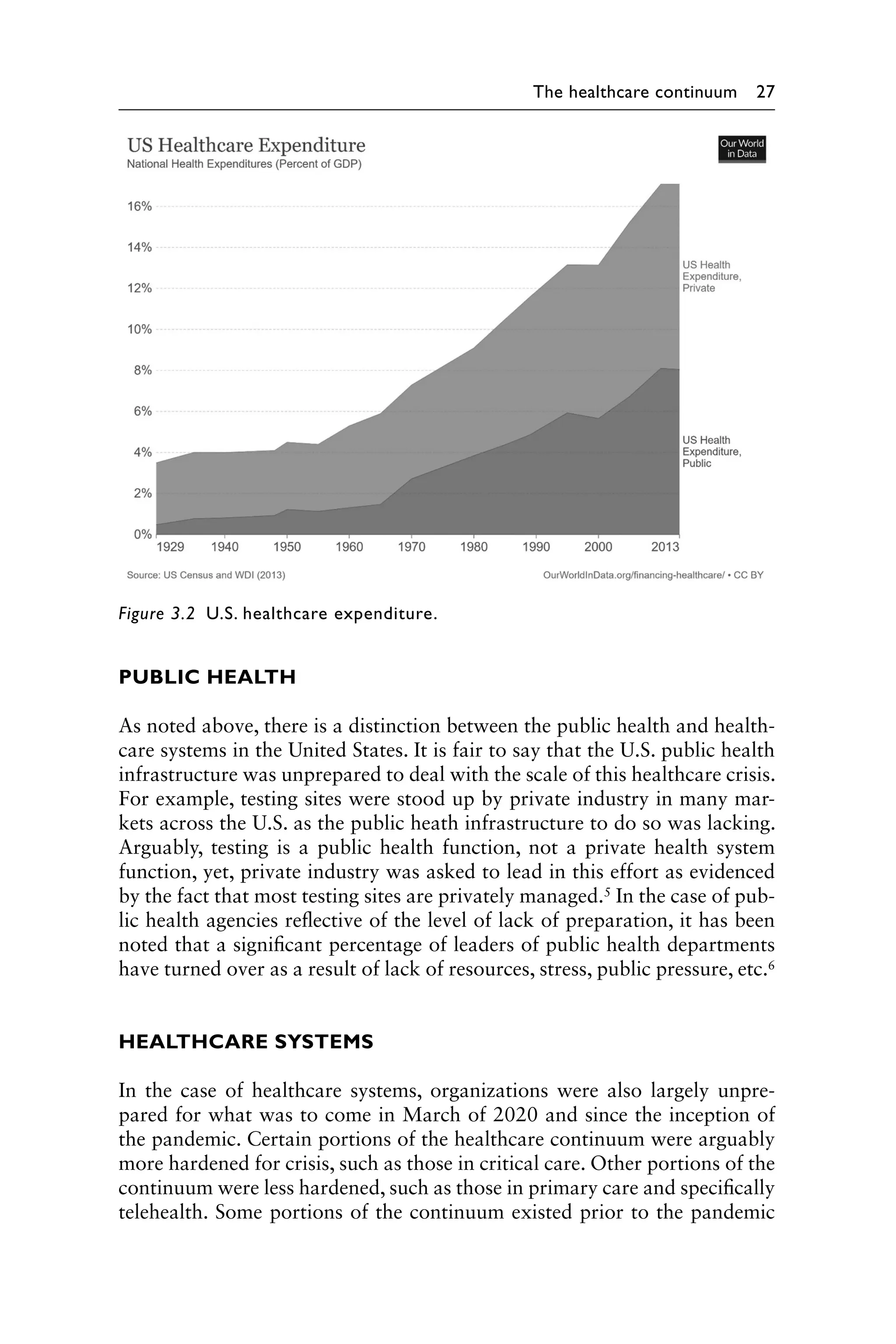
in 2014 (see Figure 3.1).2 In contrast, overall healthcare system spending
was 3.03% at the end of the 1920s and grew to 8.98% of total GDP by the
mid-2010s (see Figure 3.2).3 Recent estimates are that the United States has
spent 18% of its GDP on overall healthcare, inclusive of public health and
health system expenditures, at the beginning of this decade heading into the
pandemic.4
Once the pandemic has subsided/ended and more data becomes available,
it will be a worthwhile exercise to update funding of efforts to fight the
pandemic and isolate which portions of the overall U.S. healthcare enter-
prise used resources to combat COVID-19. One question left to be answered
will be, was the U.S. effective and efficient in our mixed use of public and
private resources or could they have been used more effectively and effi-
ciently? Further, comparisons of the U.S. approach vs those of other devel-
oped nations around the world will further provide insights for public health
policy formulation in preparation of future pandemics and healthcare
disasters.
Figure 3.1 Public health expenditure.
46.
The healthcare continuum27
PUBLIC HEALTH
As noted above, there is a distinction between the public health and health-
care systems in the United States. It is fair to say that the U.S. public health
infrastructure was unprepared to deal with the scale of this healthcare crisis.
For example, testing sites were stood up by private industry in many mar-
kets across the U.S. as the public heath infrastructure to do so was lacking.
Arguably, testing is a public health function, not a private health system
function, yet, private industry was asked to lead in this effort as evidenced
by the fact that most testing sites are privately managed.5 In the case of pub-
lic health agencies reflective of the level of lack of preparation, it has been
noted that a significant percentage of leaders of public health departments
have turned over as a result of lack of resources, stress, public pressure, etc.6
HEALTHCARE SYSTEMS
In the case of healthcare systems, organizations were also largely unpre-
pared for what was to come in March of 2020 and since the inception of
the pandemic. Certain portions of the healthcare continuum were arguably
more hardened for crisis, such as those in critical care. Other portions of the
continuum were less hardened, such as those in primary care and specifically
telehealth. Some portions of the continuum existed prior to the pandemic
Figure 3.2 U.S. healthcare expenditure.
47.
28 Edward M.Rafalski
such as the emergency room (ER)/emergency department (ED), others had
been out of use and re-instituted anew such as the field hospital, and still
others were created such triage chat bots (an automated form of self-triage
based on clinical criteria and algorithms). In all cases, care shifted closer to
the home as a result of the pandemic and quickened the pace of a process
that was underway prior to the pandemic with a projected shift of 15% by
the end of the decade (see Figure 3.3). The pandemic created new levels of
analytics across the continuum and created a deeper understanding of the
interconnectedness of the care of health ecosystem.
THE EVOLUTION OF THE HEALTHCARE CONTINUUM
Screening and testing
Screening is used as a primary public health prevention technique focused
on avoiding disease altogether, generally by preventing disease develop-
ment.7 National screening guidelines have been developed for a variety of
disease states such as breast cancer, hypertension and diabetes drawing on
the expertise of such groups as the United States Preventative Services Task
Force (USPSTF).8 In the case of COVID-19, testing, a form of screening
for the disease and a prevention measure used in the Swiss cheese defense
model, standardization of process and requirements evolved during the
pandemic. The Swiss cheese model of accident causation was updated to
address the need for defense against respiratory infection prevention, such
as SARS-CoV-2, the virus that causes COVID-19.9 Specific and sensitive
testing and tracing is a critical component of the model. Other compo-
nents include physical distancing, masking, hand hygiene/cough etiquette,
Figure 3.3 Healthcare continuum.
48.
The healthcare continuum29
avoiding touching your face, limiting crowds, ventilation/air filtration, gov-
ernment messaging/financial support, quarantine/isolation and vaccines (see
Figure 3.4). Private organizations, mostly healthcare systems, took it upon
themselves to develop an approach to testing in the broader community.
Access was provided to established patients and new patients alike, at a
cost born not by public health but by private institutions. This was done for
the public good and acted as the first line of defense and gathering of early
knowledge of the extent of community spread of the virus.
Primary care
Primary care evolved in the pandemic. Telehealth, healthcare provided using
video, audio and diagnostic technology, was available prior to the pandemic
but not widely adopted by providers and consumers. It is estimated that
between 5% and 15% of all primary care encounters were being delivered
prior to the pandemic. At the height of the first wave when the United States
was in shutdown, there were instances where telehealth was representing
upward of 80% of all clinical visits. While not sustained nationally as shut-
down measures were eased, the industry has settled back to slightly higher
than pre-pandemic levels estimated at approximately 22%, but this varies
by system, region and specialty. For example, behavioral health utilization
has maintained higher than average utilization as high as 68% nationally. It
is projected that the industry will reach a tipping point where 40%–50% of
all visits will be delivered using telehealth technology.10
Urgent and emergent care
Urgent care (UC), care provided in a clinical setting other than an emer-
gency room, has been one of the areas that has struggled with maintain-
ing volumes during the pandemic, arguably given the evolution and wider
Figure 3.4 Swiss cheese (public health) model.
49.
30 Edward M.Rafalski
adoption of telehealth. Patients can now access physician services from the
convenience of their home and in effect, self-triage their next level of care.
This is also true of emergent care provided in the hospital-based emergency
room/department (ER/ED). Urgent care providers, hospital-based ERs
and non-hospital-based free-stranding ERs have had to rethink their busi-
ness models and perhaps right-size their operations given softer demand.
However, it has been long documented that consumers over-utilize emer-
gency rooms as a default location for ongoing care.11 Perhaps a silver lining
within the pandemic is a right-sizing of access points delivering care at the
right place, at the right time and at the right cost.
Hospital acute care and the re-establishment of the
field hospital
Hospital-based acute care has been transformed. Infection control and
clinical treatment methods have evolved during the pandemic. It is both
the simplest steps – handwashing – and the most sophisticated of mecha-
nisms – clinical excellence guidance – that contribute to good medical care.
Throughout the pandemic health systems reminded healthcare personnel of
basic infection control measures while simultaneously working to assimi-
late public health data and research to learn best practices and to plan for
optimal patient care. Clinical techniques evolved to treat patients including
lying patients prone to prevent the onset of pneumonia. The field hospital,
the first of which was created at the battle of Shiloh in the U.S. Civil War,
was employed to create additional capacity during the worst peaks of the
pandemic.12 In New York the field hospital constructed in Central Park was
the first time a field hospital was stood up since the Civil War.13
Post-acute care
Post-acute care includes: assisted living, skilled nursing, long-term care and
most recently super skilled nursing facilities (Super-SNFs) a new designation
created by certain states to accommodate the most skilled post-acute care for
COVID-19 patients.14 Assisted living is housing for the elderly or disabled
that provides nursing care, housekeeping and prepared meals as needed.
Skilled care is nursing and therapy care that can only be safely and effec-
tively performed by, or under the supervision of, professionals or technical
personnel. It is healthcare given when skilled nursing or skilled therapy to
treat, manage, and observe the condition, and evaluation of care is needed.
Long-term care involves a variety of services designed to meet a person’s
health or personal care needs during a short or long period of time. These
services help people live as independently and safely as possible when they
can no longer perform everyday activities on their own. Long-term care is
provided in different places by different caregivers, depending on a person’s
needs. Most long-term care is provided at home by unpaid family members
50.
The healthcare continuum31
and friends. It can also be given in a facility such as a nursing home or in the
community, for example, in an adult day care center.15
The coordination between hospitals and the post-acute portions of the con-
tinuum proved challenging, particularly early in the pandemic as COVID-19
spread through this population of elderly patients.16 Arguably, this segment of
the healthcare continuum was overwhelmed and unprepared. Opportunities
for improved communication, a review of infection control practices and a
centralized process for tracking and testing the target population were identi-
fied.17 Telemonitoring was deployed to assist in monitoring patients in this
environment and projects such as The Project for Extension of Community
Healthcare Outcomes (ECHO) were employed as a best practice.18
The super skilled nursing facility (Super-SNF) was created as a result of
the pandemic and the need to create a higher level of infection prevention,
care and safety for COVID-19 patients. These facilities were designated cen-
ters for congregating patients and were put in place temporarily early in the
pandemic to deal with surges in hospital admissions and discharges among
the elderly. As vaccination rates improved in this population, the need for
these units subsided.
Transition hotel to home, Hospital at Home®, home
health and the physician house call
As bed capacity was constrained, new locations for care to decompress
the hospital setting were created. Transition hotel to home was an offer-
ing whereby traditional hotel space was leased and staffed by clinical per-
sonal to observe patients in transition to home. The clinical acuity of these
patients was between that required for observation in a hospital setting and
that provided by home care health nursing in the home.
Hospital at Home®, first named by Johns Hopkins Medicine, was already
a concept in place prior to the pandemic, but largely in the early stages of
adoption across the United States. It is an innovative care model for adop-
tion by healthcare organizations that provides hospital-level care in a
patient’s home as a full substitute for acute hospital care. The program has
been implemented at numerous sites around the United States by Veterans
Administration (VA) hospitals, health systems, home care providers and
managed care programs as a tool to cost-effectively treat acutely ill older
adults, while improving patient safety, quality and satisfaction. The pan-
demic afforded an opportunity for health systems around the country to
establish their own nascent programs enabling the discharge of stable
COVID-19 patients to home with the ability to monitor remotely with tele-
health and provide at home health visits with clinical personnel thereby
freeing up beds for more acutely ill patients.
Home healthcare, a service delivered primarily by licensed home health
registered nurses (RNs), is an offering where the patient must require skilled
qualifying services, the care needed must be intermittent (part time) and the
51.
32 Edward M.Rafalski
care must be a medical necessity (must be under the supervision of a physi-
cian). Home healthcare is a wide range of healthcare services that can be
given in your home for an illness or injury. Home healthcare is usually less
expensive, more convenient, and just as effective as care one receives in a
hospital or skilled nursing facility (SNF).19 This mature offering has been
part of the healthcare continuum in the United States since 1909 when the
first home health insurance policy was offered by Metropolitan Life. Home
health services supported both the transition hotel to home and Hospital at
Home® during the pandemic.
For as long as physicians have been practicing the art and science of medi-
cine they have visited the home of the patient to provide care. House calls
used to make up 40% of U.S. doctors’ visits in the 1940s before going into
decline in the 1960s. By 1980, house calls accounted for only 0.6% of
encounters. The financial pressures for gaining efficiency following the cre-
ation of the Medicare and Medicaid programs arguably led to the decline of
visits to the home in addition to other developments such as the growth of
biomedical knowledge and technology, a growing medical care system and
liability concerns.20 While the same pressures existed during the pandemic,
the home visit may still have a place in the healthcare continuum given the
risk of acquiring disease by congregating in clinic waiting rooms. Companies
such as Dispatch Health were created pre-pandemic and provided yet
another safe access point for patients.21
Palliative care and hospice care
At the end of the healthcare continuum we find palliative and hospice care.
Palliative care is specialized medical care that focuses on providing patients
relief from pain and other symptoms of a serious illness, no matter the diag-
nosis or stage of disease. Palliative care teams aim to improve the quality of
life for both patients and their families.This form of care is offered alongside
curative or other treatments you may be receiving. Like palliative care, hos-
pice provides comprehensive comfort care as well as support for the family,
but, in hospice, attempts to cure the person’s illness are stopped. Hospice
is provided for a person with a terminal illness whose doctor believes he
or she has six months or less to live if the illness runs its natural course.22
In the experience of some health systems, the nature of end of life care for
COVID-19 patients was such that hospice care was not an option given the
rapid nature of the progression of the disease and the highly critical acuity.
CONCLUSION
Some aspects of healthcare continuum, such as primary, urgent, emergency,
acute, skilled and home care, were well established prior to the pandemic
and were essential in serving as the last line of defense and care in the
52.
The healthcare continuum33
pandemic. Other aspects, such as the field hospital and physician home visit
were old concepts that found a useful place of service. Yet other aspects,
such as telehealth and Hospital at Home®, were in existence but still not
widely adopted. It may be that we have reached the tipping point at which
these services become ubiquitous in the wake of the pandemic, although in
this case it was a very big thing that made a difference.23
REFERENCES
1 Barr, J.M. 2005. The Great Influenza: The epic story of the deadliest pandemic in
history. New York, Penguin Books.
2 https://ourworldindata.org/grapher/public-health-expenditure-share-gdp-owid.
Accessed August 30, 2021.
3 https://ourworldindata.org/grapher/public-health-expenditure-share-gdp-owid.
Accessed August 30, 2021.
4 https://www.statista.com/statistics/184968/us-health-expenditure-as-percent-of-
gdp-since-1960/. Accessed August 30, 2022.
5 https://www.hhs.gov/coronavirus/community-based-testing-sites/index.html#fl.
Accessed August 30, 2021.
6 Axe Files Podcast.
7 Mayzell, G. 2016. Population health: An implementation guide to improve out-
comes and lower costs. Boca Raton, FL, CRC Press.
8 https://www.uspreventiveservicestaskforce.org/uspstf/. Accessed August 30,
2021.
9 https://www.infectioncontroltoday.com/view/wiss-cheese-model-how-infection-
prevention-really-works Accessed August 30. Accessed August 30, 2021.
10 https://www.sg2.com/media-center/press-releases/vizient-analysis-telehealth-
data-visits-trend-above-prepandemic-levels/. Accessed August 30, 2021.
11 Ho V. et al. 2017. Comparing utilization and costs of care in freestanding emer-
gency department, hospital emergency departments, and urgent care centers.
Annals of Emergency Medicine. Vol. 70(6): pp. 846–857.
12 Fahey J.H. Bernard. 2006. John Dowling Irwin and the development of the
field hospital at Shiloh. Mil Med. May; Vol. 171(5): pp. 345–351. doi: 10.7205/
milmed.171.5.345. PMID: 16761879.
13 Cunningham, O.E. 2007. Shiloh and the western campaign of 1862. New York:
Savas Beatie.
14 https://www.nia.nih.gov/health/what-long-term-care. Accessed August 30, 2021.
15 https://www.nia.nih.gov/health/what-long-term-care. Accessed August 30, 2021.
16 Lavery, A. et al. 2020. Characteristics of hospitalized COVID-19 patients dis-
charges and experiencing same-hospital readmission. Morbidity and mortality
weekly report. Vol. 69(45): pp. 1695–1699.
17 Kim, G. et al. 2020. A health system response to COVID-19 in long-term care
and post-acute care: a three-phase approach. Journal of the American Geriatrics
Society. Vol. 68(6): pp. 1155–1161.
18 Gleason, L.J. et al. 2020. Using telemonitoring to share best practices on COVID-
19 in post-acute and long- term care facilities. Journal of the American Geriatrics
Society. Vol. 68(11): pp. E58–E60.
53.
34 Edward M.Rafalski
19 https://www.medicare.gov/what-medicare-covers/whats-home-health-care.
Accessed August 30, 2021.
20 Leff, B. and Burton, J.R. 2001. The future history of home care and physi-
cian house calls in the United States. Journal of Gerontology. Vol. 56A(10),
pp. M603–M608.
21 https://www.dispatchhealth.com/. Accessed August 30, 2021.
22 https://www.nia.nih.gov/health/what-are-palliative-care-and-hospice-care.
Accessed August 30, 2021.
23 Gladwell, M. 2002. The tipping point: How little things can make a big differ-
ence. Boston. Little, Brown and Company.
54.
35
DOI: 10.1201/9781003204138-6
Chapter 4
Thefog of war and data
Edward M. Rafalski
University of Illinois School of Public Health
Chicago, IL, USA
University of South Florida College of Public Health
Tampa, FL, USA
Robert Marksthaler
Epic Systems
Verona, WI, USA
CONTENT
References................................................................................................ 40
A phrase now much used to describe the complexity of military conflicts,
the fog of war is often attributed to Carl Philipp Gottfried Clausewitz, a
Prussian general and military theorist, but is in fact a paraphrase of what he
said: “War is the realm of uncertainty; three quarters of the factors on which
action in war is based are wrapped in a fog of greater or lesser uncertainty.”1
The Fog of War was also the title of Errol Morris’s 2004 award-winning
documentary about Robert S. McNamara, US Secretary of State during the
Vietnam War. In that conflict, data on casualties and deaths were signifi-
cantly understated during the war. This lack of clarity led to assumptions
about where the United States stood in the conflict which then led to policy
decisions that may have been incorrect in retrospect. The fog of data created
by the COVID-19 pandemic, which some have referred to as a war, has had
arguably similar policy results.
COVID-19, the disease caused by the severe acute respiratory syndrome
coronavirus 2 (SARS-CoV-2), has placed a severe strain on the United States
(U.S.) healthcare system. It has been observed to have done the same in
other countries around the world that preceded the pandemic arriving in the
United States. With the discovery of SARS-CoV-2, there are now seven types
of coronaviruses known to infect humans, four of which regularly circulate
among humans and mostly cause mild to moderate upper respiratory tract
infections or common colds. The remaining three jumped from animal hosts
to humans, resulting in more serious disease.
scoundrels are creatingdepartments for flowers, bonnets,
perfumery, boots and shoes, all sorts of things. Grognet, the
perfumer in the Rue de Grammont can clear out, and I wouldn't give
ten francs for Naud's boot-shop in the Rue d'Antin. The cholera's
even spread as far as the Rue Sainte-Anne. Lacassagne, at the
feather and flower shop, and Madame Chadeuil, whose bonnets are
so well-known, will be swept away in less than a couple of years.
And after those will come others and still others! All the businesses
in the neighbourhood will collapse. When counter-jumpers start
selling soap and goloshes, they are quite capable of dealing in fried
potatoes. 'Pon my word, the world is turning upside down!
The hearse had just then crossed the Place de la Trinité, and from
the corner of the gloomy coach Denise, who lulled by the funereal
march of the procession still listened to the old man's endless
complaints, could see the coffin ascending the steep Rue Blanche as
they emerged from the Rue de la Chaussée d'Antin. Behind her
uncle, who was plodding along with the blind, mute face of an ox
about to be poleaxed, she seemed to hear the tramping of a flock of
sheep likewise being led to the slaughter-house. It was the downfall
of the shops of an entire district, all the small traders dragging their
ruin, amidst the thud of damp shoes, through the black mud of
Paris. Bourras, however, still continued, in a fainter voice, as if
fatigued by the difficult ascent of the Rue Blanche:
As for me, I'm settled. But I still hold on all the same, and won't let
him go. He's just lost his appeal case. Ah! that's cost me something:
nearly two years' pleading, and the solicitors and the barristers!
Never mind, he won't pass under my shop, the judges have decided
that such work as that could not be considered legitimate repairing.
Just fancy, he talked of creating underneath my place a saloon
where his people might judge the colours of the stuffs by gas-light, a
subterranean room which would have joined the hosiery to the
drapery departments! And he can't get over it; he can't swallow the
fact that an old wreck like me should stop his progress, when all the
others are on their knees before his money. But never! I won't have
it! that's understood. Very likely I may be worsted. Since I have had
57.
to fight againstthe process-servers, I know that the villain has been
buying up my bills in the hope of playing me some villainous trick.
But that doesn't matter; he says 'yes,' and I say 'no,' and I shall still
say 'no' even when I get between two boards like that poor child we
are following.
When they reached the Boulevard de Clichy, the coach rolled on at a
quicker pace and one could hear the heavy breathing, the
unconscious haste of the followers, anxious to get the sad ceremony
over. What Bourras did not openly mention, was the frightful misery
into which he himself had fallen, bewildered by the worries which
besiege the small trader who is on the road to ruin and yet remains
obstinate even under a shower of protested bills. Denise, well
acquainted with his position, at last broke the silence by saying, in a
voice of entreaty:
Pray don't stand out any longer, Monsieur Bourras. Let me arrange
matters for you.
But he interrupted her with a violent gesture. You be quiet. That's
nobody's business. You're a good little girl, and I know you lead him
a hard life, that man who thought you were for sale just like my
house. But what would you answer if I advised you to say 'yes?'
You'd send me about my business, eh? And so, when I say 'no,'
don't you interfere in the matter.
Then, the coach having stopped at the cemetery gate, he alighted
from it with the young girl. The Baudus' vault was reached by the
first path on the left. In a few minutes the ceremony was over. Jean
drew away his uncle, who was looking into the grave all agape. The
mourners spread about amongst the neighbouring tombs, and the
faces of all these shopkeepers, their blood impoverished by living in
damp, unhealthy shops, assumed an ugly, suffering look under the
leaden sky. When the coffin gently slipped down, their blotched and
pimpled cheeks paled, and their bleared eyes, blinded by the
constant contemplation of figures, turned away.
58.
We ought allto jump into that hole, said Bourras to Denise, who
had kept close to him. In burying that poor girl they're burying the
whole district. Oh! I know what I say, the old style of business may
go and join the white roses they're throwing on her coffin.
Denise brought her uncle and brother back in a mourning coach.
The day was for her dark and melancholy. In the first place, she
began to get anxious at seeing Jean so pale; and when she
understood that it was on account of another sweetheart she tried to
quiet him by opening her purse; but he shook his head and refused,
saying it was a serious matter this time, the niece of a very rich
pastry-cook, who would not accept even a bunch of violets.
Afterwards, in the afternoon, when Denise went to fetch Pépé from
Madame Gras', the latter declared that he was getting too big for her
to keep any longer; and this was another annoyance, for it would be
necessary to find him a school, perhaps send him away. And to
crown all, on bringing Pépé to kiss his aunt and uncle, Denise's heart
was rent by the gloomy sadness of The Old Elbeuf. The shop was
closed, and the old couple were sitting in the little dining-room,
where they had forgotten to light the gas, notwithstanding the
complete obscurity in which it was plunged that winter's day. They
were now quite alone, face to face, in the house which ruin had
slowly emptied, and their daughter's death filled the dark corners
with a deeper gloom, and seemed like the beginning of that final
dismemberment which would break up the old rafters, preyed upon
by damp. Beneath the crushing blow, her uncle, unable to stop
himself, still kept walking round and round the table, with his
funeral-like step, seeing nothing and silent; whilst her aunt who said
nothing either, remained huddled together on a chair, with the white
face of one who is wounded and whose blood is running away drop
by drop. They did not even weep when Pépé covered their cold
cheeks with kisses. For her part Denise was choking with tears.
That same evening Mouret sent for the young woman to speak to
her about a child's garment which he wished to launch, a mixture of
the Scotch and Zouave costumes. And, still trembling with pity,
shocked by so much suffering, she could not contain herself; and, to
59.
begin with, venturedto speak of Bourras, that poor old man who
was down and whom they were about to ruin. But, on hearing the
umbrella maker's name, Mouret flew into a rage. The old madman,
as he called him, was the plague of his life, and spoilt his triumph by
his idiotic obstinacy in not giving up his house, that ignoble hovel
which was a disgrace to The Ladies' Paradise, the only little corner of
the vast block that had escaped conquest. The matter was becoming
a perfect nightmare; any one else but Denise speaking in favour of
Bourras would have run the risk of immediate dismissal, so violently
was Mouret tortured by the sickly desire to kick the old hovel down.
In short, what did they wish him to do? Could he leave that heap of
ruins sticking to The Ladies' Paradise? It would have to go, the shop
must pass along. So much the worse for the old fool! And he spoke
of his repeated proposals; he had offered him as much as a hundred
thousand francs. Wasn't that fair? He never higgled, he gave
whatever money was required; but in return he expected people to
be reasonable, and allow him to finish his work! Did any one ever try
to stop engines on a railway? To all this Denise listened with
drooping eyes, unable on her side to find any but purely sentimental
reasons. The poor fellow was so old, they might have waited till his
death; a bankruptcy would kill him. Then Mouret added that he was
no longer able to prevent things following their course. Bourdoncle
had taken the matter up, for the board had resolved to put an end
to it. So she could say nothing more, notwithstanding the grievous
pity which she felt for her old friend.
After a painful silence, Mouret himself began to speak of the Baudus,
by expressing his sorrow at the death of their daughter. They were
very worthy and very honest people but had been pursued by the
worst of luck. Then he resumed his arguments: at bottom, they had
really brought about their own misfortunes by obstinately clinging to
the old customs in their worm-eaten place. It was not astonishing
that their house should be falling about their heads. He had
predicted it scores of times; she must even remember that he had
told her to warn her uncle of a fatal disaster, if he should still cling to
his stupid old-fashioned ways. And the catastrophe had arrived; no
60.
one in theworld could now prevent it. People could not reasonably
expect him to ruin himself to save the neighbourhood. Besides, if he
had been foolish enough to close The Ladies' Paradise, another great
establishment would have sprung up of itself next door, for the idea
was now starting from the four corners of the globe; the triumph of
these manufacturing and trading centres was sown by the spirit of
the age, which was sweeping away the falling edifices of ancient
times. Little by little as he went on speaking, Mouret warmed up,
and with eloquent emotion defended himself against the hatred of
his involuntary victims, against the clamour of the small moribund
businesses that he could hear around him. They could not keep their
dead above ground, he continued, they must bury them; and, with a
gesture, he consigned the corpse of old-fashioned trading to the
grave, swept into the common hole all those putrifying pestilential
remains which were becoming a disgrace to the bright, sun-lit
streets of new Paris. No, no, he felt no remorse, he was simply doing
the work of his age, and she knew it, she who loved life, who had a
passion for vast transactions settled in the full glare of publicity.
Reduced to silence, she listened to him for some time longer and
then went away, her soul full of trouble.
That night Denise slept but little. Insomnia, interspersed with
nightmare, kept her turning over and over in her bed. It seemed to
her that she was again quite a little girl and burst into tears, in their
garden at Valognes, on seeing the blackcaps eat up the spiders,
which themselves devoured the flies. Was it then really true that it
was necessary for the world to fatten on death, that it was
necessary there should be this struggle for existence whereby
humanity drew even increase of life from the ossuaries of eternal
destruction? And afterwards she again found herself before the
grave into which they had lowered Geneviève, and then she
perceived her uncle and aunt alone in their gloomy dining-room. A
dull sound as of something toppling sped through the still
atmosphere; it was Bourras's house giving way, as if undermined by
a high tide. Then silence fell again, more sinister than ever, and a
fresh crash was heard, then another, and another; the Robineaus,
61.
the Bédorés, theVanpouilles, were cracking and falling in their turn;
all the small shops of the Saint-Roch quarter were disappearing
beneath an invisible pick, with the sudden, thundering noise of
bricks falling from a cart. Then intense grief awoke her with a start.
Heavens! what tortures! There were families weeping, old men
thrown into the street, all the poignant dramas of ruin! And she
could save nobody; and even felt that it was right, that all this
compost of misery was necessary for the health of the Paris of the
future. When day broke, she became calmer, but a feeling of
resigned sadness still kept her awake, turned towards the window
whose panes were brightening. Yes, it was the needful meed of
blood, every revolution required martyrs, each step forward is taken
over the bodies of the dead. Her fear of being a wicked girl, of
having helped to effect the ruin of her kindred, now melted into
heartfelt pity, in face of these evils beyond remedy, which are like
the labour pangs of each generation's birth. She finished by trying to
devise some possible comfort, her kindly heart dreaming of the
means to be employed in order to save her relations at least from
the final crash.
And now Mouret appeared before her with his impassioned face and
caressing eyes. He would certainly refuse her nothing; she felt sure
that he would accord all reasonable compensations. And her
thoughts strayed, seeking to judge him. She knew his life and was
aware of the calculating nature of his former affections, his continual
exploitation of woman, his intimacy with Madame Desforges—the
sole object of which had been to get hold of Baron Hartmann—and
with all the others, such as Clara and the rest. But these Lothario-
like beginnings, which were the talk of the shop, gradually
disappeared in presence of the man's genius and victorious grace.
He was seduction itself. What she could never have forgiven was his
former deception: real coldness hidden beneath a gallant affectation
of affection. But she felt herself to be entirely without rancour now
that he was suffering through her. This suffering had elevated him.
When she saw him tortured by her refusal, atoning so fully for his
62.
former disdain forwoman, he seemed to her to make amends for
many of his faults.
That very morning Denise obtained from Mouret a promise of
whatever compensation she might consider reasonable on the day
when the Baudus and old Bourras should succumb. Weeks passed
away, during which she went to see her uncle nearly every
afternoon, escaping from her department for a few minutes and
bringing her smiling face and girlish courage to enliven the dark
shop. She was especially anxious about her aunt, who had fallen into
a dull stupor ever since Geneviève's death; it seemed as if her life
was quitting her hourly; though, when people questioned her, she
would reply with an astonished air that she was not suffering, but
simply felt as if overcome by sleep. The neighbours, however, shook
their heads, saying she would not live long to regret her daughter.
One day Denise was coming from the Baudus, when, on turning the
corner of the Place Gaillon, she heard a loud cry. A crowd rushed
forward, a panic arose: that breath of fear and pity which suddenly
brings all the people in a street together. It was a brown omnibus,
belonging to the Bastille-Batignolles line, which had run over a man,
at the entrance of the Rue Neuve-Saint-Augustin, just opposite the
fountain. Standing up in his seat, the driver whilst furiously holding
in his two black horses which were rearing cried out, in a great
passion:
Confound it! Confound it! Why don't you look out, you idiot!
The omnibus had now been brought to a standstill. The crowd had
surrounded the injured man, and a policeman happened to be on
the spot. Still standing up and invoking the testimony of the outside
passengers who had also risen, to look over and see the blood-
stains, the coachman, with exasperated gestures and choked by
increasing anger, was explaining the matter.
It's something fearful, said he. Who could have expected such a
thing? That fellow was walking along quite at home and when I
called out to him he at once threw himself under the wheels!
63.
Then a house-painter,who had run up, brush in hand, from a
neighbouring shop-front, exclaimed in a sharp voice, amidst the
clamour: Don't excite yourself! I saw him, he threw himself under!
He jumped in, head first, like that. Another one tired of life, no
doubt!
Others spoke up, and all agreed that it was a case of suicide, whilst
the policeman pulled out his note-book and made an entry. Several
ladies, all very pale, quickly alighted and ran away without looking
back, filled with horror by the sudden shaking which had stirred
them when the omnibus passed over the body. Denise, however,
drew nearer, attracted by a practical pity, which prompted her to
interest herself in the victims of all sorts of street accidents, such as
wounded dogs, horses down, and tilers falling off roofs. And she
immediately recognised the unfortunate fellow who had fainted away
there in the road, his clothes covered with mud.
It's Monsieur Robineau! she exclaimed, in her grievous
astonishment.
The policeman at once questioned the young woman, and she gave
the victim's name, profession, and address. Thanks to the driver's
energy, the omnibus had swerved, and thus only Robineau's legs
had gone under the wheels; however, it was to be feared that they
were both broken. Four men carried him to a chemist's shop in the
Rue Gaillon, whilst the omnibus slowly resumed its journey.
My stars! said the driver, whipping up his horses, I've done a
famous day's work.
Denise followed Robineau into the chemist's. The latter, pending the
arrival of a doctor who was not to be found, declared that there was
no immediate danger, and that the injured man had better be taken
home, as he lived in the neighbourhood. A man then started off to
the police-station for a stretcher, and Denise had the happy thought
of going on in front so as to prepare Madame Robineau for this
frightful blow. But she had the greatest trouble in the world to get
into the street again through the crowd, which was struggling before
64.
the door ofthe chemist's shop. This crowd, attracted by death, was
every minute increasing; men, women, and children stood on tip-
toe, and held their own amidst brutal pushing; and each new-comer
had his version to give of the accident, so that at last the victim was
said to be a husband who had been pitched out of window by his
wife's lover.
In the Rue Neuve-des-Petits-Champs, Denise perceived, from a
distance, Madame Robineau on the threshold of the silk warehouse.
This gave her a pretext for stopping, and she talked on for a
moment, trying to find a means of breaking the terrible news. The
place wore the disorderly, neglectful aspect of a shop in the last
agony, one whose business is fast dying. It was the inevitable end of
the great battle of the rival silks; the Paris Delight had destroyed
competition by a fresh reduction of a sou; it was now sold at four
francs nineteen sous the mêtre, and Gaujean's silk had found its
Waterloo. For the last two months Robineau, reduced to all sorts of
shifts, had been leading a fearful life, trying to avert a declaration of
bankruptcy.
I saw your husband crossing the Place Gaillon, murmured Denise,
who had ended by entering the shop.
Thereupon Madame Robineau, whom a secret anxiety seemed to be
continually attracting towards the street, said quickly: Ah, a little
while ago, wasn't it? I'm waiting for him, he ought to be back by
now. Monsieur Gaujean came this morning, and they went out
together.
She was still charming, delicate, and gay; but was in a delicate state
of health and seemed more frightened, more bewildered than ever
by those dreadful business matters, which she did not understand,
and which were all going wrong. As she often said, what was the
use of it all? Would it not be better to live quietly in some small
lodging, and be contented with modest fare?
My dear child, she resumed with her pretty smile, which was
becoming sadder, we have nothing to conceal from you. Things are
65.
not going well,and my poor darling is worried to death. Again to-
day this man Gaujean has been tormenting him about some overdue
bills. I was dying with anxiety at being left here all alone.
And she was once more returning to the door when Denise stopped
her, having heard the noise of a crowd and guessing that it was the
injured man being brought along, surrounded by a mob of idlers
anxious to see the end of the affair. And thereupon with her throat
parched, unable to find the consoling words she would have liked to
say, she had to explain the matter.
Don't be anxious, there's no immediate danger. I've seen Monsieur
Robineau, he has met with an accident. They are just bringing him
home, pray don't be frightened.
The young woman listened to her, white as a sheet, and as yet not
clearly understanding her. The street was full of people, and cab-
drivers, unable to get along, were swearing, while the bearers set
the stretcher before the shop in order to open both glass doors.
It was an accident, continued Denise, determined to conceal the
attempt at suicide. He was on the pavement and slipped under the
wheels of an omnibus. Only his feet are hurt. They've sent for a
doctor. Don't be frightened.
A great shudder shook Madame Robineau. She gave vent to a few
inarticulate cries; then said no more but sank down beside the
stretcher, drawing its covering aside with her trembling hands. The
men who had brought it were waiting to take it away as soon as the
doctor should arrive. They dared not touch Robineau, who had now
regained consciousness, and whose sufferings became frightful at
the slightest movement. When he saw his wife big tears ran down
his cheeks. She embraced him, and stood looking at him fixedly, and
weeping. Out in the street the tumult was increasing; the people
pressed forward as with glistening eyes at a theatre; some girls,
fresh from a workshop, were almost pushing through the windows in
their eagerness to see what was going on. Then Denise in order to
avoid this feverish curiosity, and thinking, moreover, that it was not
66.
right to leavethe shop open, decided to let the metal shutters down.
She went and turned the winch, whose wheels gave out a plaintive
cry whilst the sheets of iron slowly descended, like the heavy
draperies of a curtain falling on the catastrophe of a fifth act. And
when she went in again, after closing the little round door in the
shutters, she found Madame Robineau still clasping her husband in
her arms, in the vague half-light which came from the two stars cut
in the sheet-iron. The ruined shop seemed to be gliding into
nothingness, those two stars alone glittered on this sudden and
brutal catastrophe of the streets of Paris.
At last Madame Robineau recovered her speech. Oh, my darling!—
oh, my darling! my darling!
This was all she could say, and he, half choking, confessed himself, a
prey to keen remorse now that he saw her kneeling thus before him.
When he did not move he only felt the burning weight of his legs.
Forgive me, I must have been mad. But when the lawyer told me
before Gaujean that the posters would be put up to-morrow, I saw
flames dancing before my eyes as if the walls were on fire. After that
I remember nothing. I was coming down the Rue de la Michodière—
and I fancied that The Paradise people were laughing at me—that
big rascally house seemed to crush me—so, when the omnibus came
up, I thought of Lhomme and his arm, and threw myself under the
wheels.
Madame Robineau had slowly fallen on to the floor, horrified by this
confession. Heavens! he had tried to kill himself. She caught hold of
the hand of Denise who was leaning towards her, also quite
overcome. The injured man, exhausted by emotion, had just fainted
away again. The doctor had still not arrived. Two men had been
scouring the neighbourhood for him; and the doorkeeper belonging
to the house had now gone to seek him in his turn.
Pray, don't be anxious, Denise kept on repeating mechanically,
herself also sobbing.
67.
Then Madame Robineau,seated on the floor, with her head on a
level with the stretcher, her cheek resting against the sacking on
which her husband was lying, relieved her heart. Oh! I must tell
you. It's all for me that he wanted to die. He's always saying, 'I've
robbed you; it was your money.' And at night he dreamed of those
sixty thousand francs, waking up covered with perspiration, calling
himself an incompetent fellow and saying that those who have no
head for business ought not to risk other people's money. You know
that he has always been nervous, and apt to worry himself. He
finished by conjuring up things that frightened me. He pictured me
in the street in tatters, begging—me whom he loved so dearly,
whom he longed to see rich and happy. The poor woman paused;
on turning her head she saw that her husband had opened his eyes;
then she continued stammering: My darling, why have you done
this? You must think me very wicked! I assure you, I don't care if we
are ruined. So long as we are together, we shall never be unhappy.
Let them take everything, and we will go away somewhere, where
you won't hear any more about them. You can still work; you'll see
how happy we shall be!
She let her forehead fall near her husband's pale face, and both
remained speechless, in the emotion of their anguish. Silence fell.
The shop seemed to be sleeping, benumbed by the pale twilight
which enveloped it; whilst from behind the thin metal shutters came
the uproar of the street, the life of broad daylight passing along with
the rumbling of vehicles, and the hustling and pushing of the crowd.
At last Denise, who went every other minute to glance through the
door leading to the hall of the house came back: Here's the doctor!
It was a young fellow with bright eyes, whom the doorkeeper had
found and brought in. He preferred to examine the injured man
before they put him to bed. Only one of his legs, the left one, was
broken above the ankle; it was a simple fracture, no serious
complication appeared likely to result from it. And they were about
to carry the stretcher into the back-room when Gaujean arrived. He
came to give them an account of a last attempt to settle matters, an
68.
attempt moreover whichhad failed; the declaration of bankruptcy
was unavoidable.
Dear me, murmured he, what's the matter?
In a few words, Denise informed him. Then he stopped, feeling
awkward, while Robineau said, in a feeble voice: I don't bear you
any ill-will, but all this is partly your fault.
Well, my dear fellow, replied Gaujean, it wanted stronger men
than ourselves. You know I'm not in a much better position than you
are.
They raised the stretcher; Robineau still found strength to say: No,
no, stronger fellows than us would have given way as we have. I can
understand such obstinate old men as Bourras and Baudu standing
out; but for you and I, who are young, who had accepted the new
style of things, it was wrong! No, Gaujean, it's the last of a world.
They carried him off. Madame Robineau embraced Denise with an
eagerness in which there was almost a feeling of joy at having at
last got rid of all those worrying business matters. And, as Gaujean
went away with the young girl, he confessed to her that Robineau,
poor devil, was right. It was idiotic to try to struggle against The
Ladies' Paradise. Personally he felt he would be lost, if he did not get
back into its good graces. The night before, in fact, he had secretly
made a proposal to Hutin, who was just leaving for Lyons. But he
felt very doubtful, and tried to interest Denise in the matter, aware,
no doubt, of her powerful influence.
Upon my word, said he, so much the worse for the
manufacturers! Every one would laugh at me if I ruined myself in
fighting for other people's benefit, when those fellows are struggling
as to who shall make at the cheapest price! As you said some time
ago, the manufacturers have only to follow the march of progress by
a better organization and new methods. Everything will come all
right; it is sufficient that the public are satisfied.
Denise smiled and replied: Go and tell that to Monsieur Mouret
himself. Your visit will please him, and he's not the man to display
69.
any rancour, ifyou offer him even a centime profit per yard.
Madame Baudu died one bright sunny afternoon in January. For a
fortnight she had been unable to go down into the shop which a
charwoman now looked after. She sat in the centre of her bed,
propped up by some pillows. Nothing but her eyes seemed to be
alive in her white face; and with head erect, she obstinately gazed
upon The Ladies' Paradise opposite, through the small curtains of
the windows. Baudu, himself suffering from the same obsession,
from the despairing fixity of her gaze, sometimes wanted to draw
the larger curtains. But she stopped him with an imploring gesture,
obstinately desirous of looking and looking till the last moment
should come. The monster had now robbed her of everything, her
business, her daughter; she herself had gradually died away with
The Old Elbeuf, losing some part of her life as the shop lost its
customers; the day it succumbed, she had no more breath left.
When she felt she was dying, she still found strength to insist on her
husband opening both windows. It was very mild, a bright ray of
sunshine gilded The Ladies' Paradise, whilst the bed-room of the old
house shivered in the shade. Madame Baudu lay there with eyes
fixed, full of that vision of the triumphal monument, those clear,
limpid windows, behind which a gallop of millions was passing. But
slowly her eyes grew dim, invaded by darkness; and when their last
gleam had expired in death, they remained wide open, still gazing,
and wet with tears.
Once more all the ruined traders of the district followed the funeral
procession. There were the brothers Vanpouille, pale at the thought
of their December bills, met by a supreme effort which they would
never be able to repeat. Bédoré, accompanying his sister, leant on
his cane, so full of worry and anxiety that his liver complaint was
getting worse every day. Deslignières had had a fit, Piot and Rivoire
walked on in silence, with downcast looks, like men entirely played
out. And they dared not question each other about those who had
disappeared, Quinette, Mademoiselle Tatin, and others, who, in the
space of a day, sank, ruined, swept away by the flood of disasters:
without counting Robineau, still in bed, with his broken leg. But they
70.
pointed with anespecial air of interest to the new tradesmen
attacked by the plague: Grognet the perfumer, Madame Chadeuil the
milliner, Lacassagne the flower-maker, and Naud the boot-maker
who were still on their legs, but full of anxiety at thought of the evil
which would doubtless sweep them away in their turn. Baudu
walked behind the hearse with the same heavy, stolid step as when
he had followed his daughter; whilst in the first mourning coach
could be seen Bourras's eyes sparkling under his bushy eyebrows
and hair of a snowy whiteness.
Denise was in great trouble. For the last fortnight she had been
worn out with fatigue and anxiety; she had been obliged to put Pépé
to school, and had been running about on account of Jean, who was
so stricken with the pastrycook's niece, that he had implored his
sister to go and ask her hand in marriage. Then her aunt's death,
this fresh catastrophe, had quite overwhelmed the young girl,
though Mouret had again offered his services, giving her leave to do
what she liked for her uncle and the others. One morning she had
yet another interview with him, at the news that Bourras had been
turned into the street, and that Baudu was going to shut up shop.
Then, she went out after lunch in the hope of at least comforting
these two.
In the Rue de la Michodière, Bourras was standing on the foot
pavement opposite his house, whence he had been evicted on the
previous day by a fine trick, a discovery of the lawyers. As Mouret
held several bills, he had easily obtained an order in bankruptcy
against the umbrella-maker and then had given five hundred francs
for the expiring lease at the sale ordered by the court; so that the
obstinate old man had for five hundred francs allowed himself to be
deprived of what he had refused to surrender for a hundred
thousand. The architect, who came with his gang of workmen, had
been obliged to employ the police to get him out. The goods had
been taken and sold, the rooms cleared; however, he still obstinately
remained in the corner where he slept, and from which out of pity
they did not like to drive him. The workmen even attacked the
roofing over his head. They took off the rotten slates, the ceilings fell
71.
in and thewalls cracked, and yet he remained there, under the bare
old beams, amidst the ruins. At last when the police came, he went
away. But on the following morning he again appeared on the
opposite side of the street, after passing the night in a lodging-
house of the neighbourhood.
Monsieur Bourras! said Denise, kindly.
He did not hear her for his flaming eyes were devouring the
workmen who were attacking the front of the hovel with their picks.
Through the glassless windows you could see the inside of the
house, the wretched rooms, and the black staircase, to which the
sun had not penetrated for the last two hundred years.
Ah! it's you, he replied at last, when he recognised her. A nice bit
of work they're doing, eh? the robbers!
She no longer dared to speak; her heart was stirred by the
lamentable wretchedness of the old place; she was unable to take
her eyes off the mouldy stones that were falling. Up above on a
corner of the ceiling of her old room, she once more perceived that
name—Ernestine—written in black and shaky letters with the flame
of a candle; and the remembrance of her days of misery came back
to her, inspiring her with a tender sympathy for all suffering.
However, the workmen, in order to knock one of the walls down at a
blow, had attacked it at its base. It was already tottering.
If only it could crush them all, growled Bourras, in a savage voice.
There was a terrible cracking noise. The frightened workmen ran out
into the street. In falling, the wall shook and carried all the rest with
it. No doubt the hovel, with its flaws and cracks was ripe for this
downfall; a push had sufficed to cleave it from top to bottom. It was
a pitiful crumbling, the razing of a mud-house soddened by rain. Not
a partition remained standing; on the ground there was nothing but
a heap of rubbish, the dung of the past cast, as it were, at the street
corner.
My God! the old man had exclaimed as if the blow had resounded
in his very entrails.
72.
He stood theregaping; he would never have imagined that it would
have been so quickly over. And he looked at the gap, the hollow at
last yawning beside The Ladies' Paradise, now freed of the wart
which had so long disgraced it. The gnat was crushed; this was the
final triumph over the galling obstinacy of the infinitely little; the
whole block was now invaded and conquered. Passers-by lingered to
talk to the workmen, who began crying out against those old
buildings which were only good for killing people.
Monsieur Bourras, repeated Denise, trying to draw him on one
side, you know that you will not be abandoned. All your wants will
be provided for.
He raised his head. I have no wants. You've been sent by them,
haven't you? Well, tell them that old Bourras still knows how to use
his hands and that he can find work wherever he likes. Really, it
would be a fine thing to offer charity to those whom they
assassinate!
Then she implored him: Pray accept, Monsieur Bourras; don't cause
me this grief.
But he shook his bushy head. No, no, it's all over. Good-bye. Go and
live happily, you who are young, and don't prevent old people from
sticking to their ideas.
He cast a last glance at the heap of rubbish, and then went painfully
away. She watched him disappear, elbowed by the crowd on the
pavement. He turned the corner of the Place Gaillon, and all was
over.
For a moment, Denise remained motionless, lost in thought. Then
she went over to her uncle's. The draper was alone in the dark shop
of The Old Elbeuf. The charwoman only came in the morning and
evening to do a little cooking, and help him take down and put up
the shutters. He spent hours in this solitude, often without being
disturbed during the whole day, and bewildered and unable to find
the goods when a stray customer chanced to venture in. And there
in the silence and the half-light he walked about unceasingly, with
73.
the same heavystep as at the two funerals; yielding to a sickly
desire, to regular fits of forced marching, as if he were trying to rock
his grief to sleep.
Are you feeling better, uncle? asked Denise.
He only stopped for a second and then started off again, going from
the pay-desk to an obscure corner.
Yes, yes. Very well, thanks.
She tried to find some consoling subject, some cheerful remark, but
could think of nothing. Did you hear the noise? The house is down.
Ah! it's true, he murmured, with an astonished look, that must
have been the house. I felt the ground shake. Seeing them on the
roof this morning, I closed my door.
Then he made a vague gesture, to intimate that such things no
longer interested him. Each time he arrived in front of the pay-desk,
he looked at the empty seat, that well-known velvet-covered seat,
where his wife and daughter had grown up. Then, when his
perpetual walking brought him to the other end, he gazed at the
gloom-enveloped shelves, on which a few pieces of cloth were
growing more and more mouldy. It was a widowed house; those he
loved had disappeared; his business had come to a shameful end;
and he was left alone to commune with his dead heart and fallen
pride, amidst all these catastrophes. He raised his eyes to the black
ceiling, he listened to the sepulchral silence which reigned in the
little dining-room, that family nook which he had formerly loved so
well, even to its stuffy odour. Not a breath was now heard in the old
house, his regular heavy tread made the ancient walls resound, as if
he were walking in the tomb of his affections.
At last Denise approached the subject which had brought her.
Uncle, said she, you can't stay like this. You must come to a
decision.
Without stopping he replied: No doubt; but what would you have
me do? I've tried to sell, but no one has come. One of these
74.
mornings, I shallshut up shop and go off.
She was aware that a failure was no longer to be feared. The
creditors had preferred to come to an understanding in presence of
such a long series of misfortunes. Everything paid, the old man
would simply find himself in the street, penniless.
But what will you do, then? she murmured, seeking some
transition in order to arrive at the offer which she dared not make.
I don't know, he replied. They'll pick me up all right. He had now
changed his route, going from the dining-room to the windows; and
every time he came to these windows he cast a mournful glance on
the wretchedness of the old show-goods forgotten there. His eyes
did not even turn towards the triumphal façade of The Ladies'
Paradise, whose architectural lines ran right and left, to both ends of
the street. He was thoroughly annihilated, and had not even the
strength left him to get angry.
Listen, uncle, said Denise at last, greatly embarrassed; perhaps
there might be a situation for you. And after a pause she
stammered, Yes, I am charged to offer you a situation as inspector.
Where? asked Baudu.
Why, over the road, she replied; at our place. Six thousand francs
a year; a very easy berth.
He stopped suddenly in front of her. But instead of getting angry as
she feared he would, he turned very pale, succumbing to a grievous
emotion, a feeling of bitter resignation.
Over the road, over the road, he stammered several times. You
want me to go there?
Denise herself was affected by his emotion. She recalled the long
struggle of the two shops, again saw herself at the funerals of
Geneviève and Madame Baudu, and beheld The Old Elbeuf
overthrown, utterly ruined by The Ladies' Paradise. And the idea of
her uncle taking a situation over the road, and walking about there
in a white neck-tie, made her heart leap with pity and revolt.
75.
Come, Denise, mygirl, is it possible? he asked simply, crossing his
poor trembling hands.
No, no, uncle! she exclaimed, in a sudden outburst of her just and
excellent nature. It would be wrong. Forgive me, I beg of you.
He resumed his walk and again his step resounded amidst the
funereal emptiness of the house. And, when she left him, he was still
and ever marching up and down, with the obstinate locomotion
peculiar to great despairs which turn and turn, unable to find an
outlet.
That night also proved a sleepless one for Denise. She had
discovered she really was powerless. Even in favour of her own
people she was unable to find any consolation or relief. She must to
the bitter end remain a witness of the invincible work of life which
requires death as its continual seed. She no longer struggled, she
accepted this law of combat; still her womanly soul filled with tearful
pity, with fraternal tenderness at the idea of humanity's sufferings.
For years past she herself had been caught in the wheel-work of the
machine. Had she not bled in it? Had she not been bruised,
dismissed, overwhelmed with insults? Even now she was frightened,
when she felt herself chosen by the logic of facts. Why should it be
she, who was so puny? Why should her small hand suddenly
become so powerful amidst the monster's work? And the force which
swept everything away, carried her along in her turn, she, whose
coming was to be revenge. It was Mouret who had invented this
world-crushing mechanism whose brutal working shocked her; he
had strewn the neighbourhood with ruins, despoiled some, killed
others; and yet despite everything she loved him for the grandeur of
his work, loved him still more at each fresh excess of power,
notwithstanding the flood of tears which overcame her in presence
of the hallowed wretchedness of the vanquished.
CHAPTER XIV.
76.
The Rue duDix-Décembre, quite new with its chalk-white houses
and the last remaining scaffoldings of a few unfinished buildings,
stretched out beneath a clear February sun; a stream of vehicles
was passing at a conquering pace through this gap of light,
intersecting the damp gloom of the old Saint-Roch quarter; and,
between the Rue de la Michodière and the Rue de Choiseul, there
was quite a tumult, the crush of a crowd of people who had been
excited by a month's advertising, and with their eyes in the air, were
gaping at the monumental façade of The Ladies' Paradise,
inaugurated that Monday, on the occasion of a grand display of
white goods.
There was a vast development of bright, fresh polychromatic
architecture enriched with gilding, symbolical of the tumult and
sparkle of the business inside, and attracting attention like a gigantic
window-display flaming with the liveliest colours. In order not to
bedim the show of goods, the ground-floor decoration was of a
sober description; the base of sea-green marble; the corner piers
and bearing pillars covered with black marble, the severity of which
was brightened by gilded modillions; and all the rest was plate-glass,
in iron sashes, nothing but glass, which seemed to throw the depths
of the halls and galleries open to the full light of day. However, as
the floors ascended, the hues became brighter. The frieze above the
ground-floor was formed of a series of mosaics, a garland of red and
blue flowers, alternating with marble slabs on which was cut an
infinity of names of goods, encircling the colossus. Then the base of
the first floor, of enamelled brickwork, supported large windows,
above which came another frieze formed of gilded escutcheons
emblazoned with the arms of the chief towns of France, and designs
in terra-cotta, in whose enamel one again found the light coloured
tints of the base. Then, right at the top, the entablature blossomed
forth like an ardent florescence of the entire façade, mosaics and
faience reappeared with yet warmer colourings, the zinc of the eaves
was cut and gilded, while along the acroteria ran a nation of statues,
emblematical of the great industrial and manufacturing cities, their
delicate silhouettes profiled against the sky. The spectators were
77.
Welcome to ourwebsite – the perfect destination for book lovers and
knowledge seekers. We believe that every book holds a new world,
offering opportunities for learning, discovery, and personal growth.
That’s why we are dedicated to bringing you a diverse collection of
books, ranging from classic literature and specialized publications to
self-development guides and children's books.
More than just a book-buying platform, we strive to be a bridge
connecting you with timeless cultural and intellectual values. With an
elegant, user-friendly interface and a smart search system, you can
quickly find the books that best suit your interests. Additionally,
our special promotions and home delivery services help you save time
and fully enjoy the joy of reading.
Join us on a journey of knowledge exploration, passion nurturing, and
personal growth every day!
ebookbell.com















![9
DOI: 10.1201/9781003204138-3
Chapter 1
What is an epidemic, a pandemic?
Jonathan A. McCullers
University of Tennessee Health Science Center
Memphis, TN, USA
CONTENTS
Definition(s) of epidemics and pandemics................................................... 9
Why do pandemics occur?........................................................................ 11
Perspective for the healthcare system........................................................ 14
References................................................................................................ 15
DEFINITION(S) OF EPIDEMICS AND PANDEMICS
On March 11, 2020, the World Health Organization (WHO) declared the
novel coronavirus outbreak (COVID-19) a global pandemic. The WHO
describes a pandemic on its website as “the worldwide spread of a new dis-
ease” [1]. The first known usage of the term pandemic appears to have been
in the mid-17th century [2], a relatively recent development compared to the
history of the term epidemic, which dates to at least 5th century BCE [3].
Epidemic derives from the Greek epi meaning“on”and demos meaning“the
people” or “place of the people,” interpreted later as “country.” Hippocrates
first gave epidemic its disease connotation around 400 BCE in his seven-
volume work titled Epidemics, which described various diseases and used
the term epidemic to mean outbreaks that had spread over a large part of
a country. The later introduction of pandemic then substituted the prefix
pan, meaning “all,” describing pandemics as disease outbreaks that spanned
all known countries. Pandemic and epidemic were used interchangeably in
many texts and dictionaries throughout the 17th through 19th centuries,
until the striking global emergence of the influenza pandemics of 1889 and
1918 solidified the usage of pandemic for worldwide disease outbreaks.
Despite its seeming simplicity, the WHO definition “the worldwide spread
of a new disease” has its controversies. First, does a pandemic need to be
worldwide? Many authors in the scientific and popular press use pandemic
in the sense of a very large epidemic, one that covers much of a country, or
multiple countries or regions, but is not truly worldwide. Reports of
historical pandemics such as the bubonic plague are limited to the author’s](https://image.slidesharecdn.com/24400491-250511175451-a7522781/75/Healthcare-Analytics-Emergency-Preparedness-For-Covid19-Edward-M-Rafalski-28-2048.jpg)
![10 Jonathan A. McCullers
context; the disease may have spread across the “known” world, but much
of the world was unknown at that time. Attempts have been made to codify
types of pandemic, e.g., “trans-regional,” “inter-regional,” and “global” [2]
to add precision, but no nomenclature is widely accepted. In the declaration
of COVID-19 as a pandemic, the WHO used the term “pandemic” alone,
but many of the reports on this event added the (potentially redundant)
modifier “global” describing it as a global pandemic.
Second, must the disease be new to be described as a pandemic? The
recent confirmation by DNA sequencing of materials from victims of the
Plague of Justinian (541–543 ACE) demonstrates that Yersinia pestis was
the cause of this ancient pandemic [4], adding to its toll as the agent of the
Black Death (14th century) and the Third Plague (ca. 1855–1960). Each
outbreak began in a different century and spread across the known world,
but all were caused by the same pathogen. The strains causing the Black
Death and the Third Plague are near identical by DNA sequencing, so the
most recent pandemic from the Plague is not even from a new strain of
Y. pestis, just a new incursion in time. Similarly, influenza viruses cause peri-
odic pandemics without being a new virus entirely; typically one of the sur-
face proteins changes by swapping its encoding gene segment with an animal
strain, but many other parts of the virus are identical to circulating strains
[5]. These viruses can thus be characterized as a new strain, but not a new
virus, or a new disease.
Finally, must a pandemic be an infectious disease, or can any disease be
characterized as a pandemic? Since the time of Hippocrates, the terms epi-
demic and pandemic have typically referred to widespread outbreaks of
infectious agents. However, the lay press and practitioners in certain fields
such as public health increasingly refer to the ubiquitous nature of certain
chronic diseases (e.g., diabetes) or lifestyle choices, such as obesity or smok-
ing, as pandemics. [2] The WHO and the Centers for Disease Control and
Prevention (CDC) both refer to the worldwide (at least in westernized coun-
tries) increase in obesity as an epidemic, but not a pandemic, perhaps adding
additional confusion. In the scientific literature, a pandemic is usually
described as being contagious and spreading between persons, such that the
term’s usage is confined to infectious agents.
Much of our current worldview on pandemics is due to the devastation
wrought by the 1918 influenza pandemic and the current parallels of that
worldwide disaster to the COVID-19 pandemic. The overwhelming nature
of the 1918 pandemic led to a discussion of the differences between pan-
demic and epidemic influenza. The most compelling framework came from
Dr. Edwin D. Kilbourne following the swine influenza outbreak at Fort Dix,
New Jersey, which caused great fear of a repeat of 1918 but never attained
global or even significant regional spread. His answer to this question of
“What is a pandemic?” framed the general criteria scientists who study
influenza and other viruses have used to distinguish pandemic strains from
epidemic strains since that time. According to Kilbourne, a pandemic strain](https://image.slidesharecdn.com/24400491-250511175451-a7522781/75/Healthcare-Analytics-Emergency-Preparedness-For-Covid19-Edward-M-Rafalski-29-2048.jpg)
![What is an epidemic, a pandemic? 11
must be antigenically novel, cause severe illness, and spread easily through
the susceptible population. [5] Antigenic novelty for influenza viruses has
typically meant the spread of a virus with an antigenically distinct hemag-
glutinin (HA) protein, the surface glycoprotein that is most targeted by the
human immune system. Antigenically distinct in this context means it would
not be recognized by the immune systems of most people of the world.
There has been significant concern that the H5N1 strains infecting humans
in Asia and Europe over the last two decades could develop into pandemic
viruses, since they meet two of these three criteria, lacking only ease of
transmission to qualify (Table 1.1).
The WHO caused great consternation in 2009 when an antigenically
novel H1N1 strain began to circulate globally. This new strain spread easily
from person to person, had an HA protein descended from the 1918 strain
to which few globally had immunity, but did not cause severe disease. In the
decade prior the WHO had developed a pandemic warning system that
relied on the novelty of the agent and its proven spread across multiple
regions, but at the time of the 2009 outbreak it did not take severity into
account [6]. Earlier versions of the WHO phases of a potential pandemic
included language about “enormous numbers of deaths and illness,” but this
language had been removed by the time of the declaration. The result was
WHO declaring a pandemic that did not meet Kilbourne’s criteria (Table 1.1).
This declaration led to aggressive activation of pandemic plans by numerous
countries with measures that differed from their responses to annual epi-
demics, engendering significant public confusion and concern. The fallout
from this controversy has been an erosion in trust for public health agencies,
which has undergirded a number of problems with the ongoing COVID-19
response.
WHY DO PANDEMICS OCCUR?
Ultimately, pandemics are the end result of human activity. The needs of a
burgeoning population now approaching 8 billion, together with techno-
logical advances that enable massive changes to how humanity works, lives,
Table 1.1 The Kilbourne framework for defining a pandemic
Disease Novel? Worldwide spread? Deadly? Pandemic?
Seasonal Influenza No Yes Yes No
Common human coronaviruses No Yes No No
1918 H1N1 Influenza Yes Yes Yes Yes
2009 H1N1 Influenza Yes Yes No No
2003 SARS Yes No Yes No
2019 COVID-19 Yes Yes Yes Yes](https://image.slidesharecdn.com/24400491-250511175451-a7522781/75/Healthcare-Analytics-Emergency-Preparedness-For-Covid19-Edward-M-Rafalski-30-2048.jpg)
![12 Jonathan A. McCullers
and plays, have resulted in disruption of pathogen and vector ecosystems
and increasing contact with humans. Global climate change, the alteration
of pathogen and vector habitats by human activity, and changes to civiliza-
tion itself have all contributed to this new paradigm in which the risk of
pandemics is as great or greater than it has ever been (Table 1.2). Regardless
of the precise method of ingress of severe acute respiratory syndrome coro-
navirus 2 (SARS-CoV-2), the cause of COVID-19, into humans, environ-
mental and societal changes that brought humans into closer proximity to
bats are the underlying cause.
Climate change in the modern era is the result of increased release of
carbon dioxide (CO2) into the atmosphere from human activities such as
large-scale industry, travel, and agriculture. Multiple mass-extinction events
occurred in prior eras due to disruption of the worldwide carbon cycle by
climate change. These were from non-human events, however, such as mas-
sive meteorite strikes or increased activity by mega-volcanoes [7]. Climate
change today increases the risk of disease in several ways. A rise in global
CO2 emissions allows greater growth of foliage, increased longevity for a
greater mass of foliage, and an expanded range in latitude and altitude,
resulting in increased sites for breeding of disease-causing vectors such as
Table 1.2
Contributions of global changes in climate and environment to
human epidemics and pandemics
Global change Relevant environmental impact Disease impact
Increased CO2 Increased density and
longevity of foliage
Greater range in latitudes and
altitude of disease vectors such
as mosquitoes, ticks, rodents
Increased
temperature
Fewer frosts, more extreme
weather events such as
floods
Increased range, better overnight
and over-winter survival, and
faster cycle times of disease
vectors; more frequent
contamination of water
sources during flooding
Deforestation Overlap of human and
disease vector ranges/
habitats, decreased
bio-diversity
Increased contact and disease
transmission to both humans
and domesticated animals;
proliferation of disease vectors
with a decrease in predation
Urbanization Increased density and
poorer sanitation
Higher rate of disease
transmission at same vector
density; more water-borne
disease outbreaks, more vector
breeding sites
Technological
advances
Increased worldwide trade
and travel
Geographic dispersion and
homogenization of vectors;
more rapid spread of infectious
diseases worldwide](https://image.slidesharecdn.com/24400491-250511175451-a7522781/75/Healthcare-Analytics-Emergency-Preparedness-For-Covid19-Edward-M-Rafalski-31-2048.jpg)
![What is an epidemic, a pandemic? 13
mosquitoes, ticks, and mice and rats. The rising average global tempera-
tures that accompany higher atmospheric CO2 levels lead to decreased sta-
bility of weather patterns due to the injection of more energy into these
systems. The result is decreased extreme cold events, which would typically
have suppressed or killed pathogens and vectors, and increased warm
events, which allow more generations of pathogens and vectors to occur
before any die off. The net effect plays out on a local and regional level with
increased density and geographic range of the agents that cause epidemics
and pandemics and the vectors that might shepherd them to humans [8].
Associated extreme weather events (e.g., Hurricane Katrina) may also lead
to flooding, disruptions and contamination of water supplies, and increased
exposure to pathogens such as mosquito-vectored diseases or Vibrio chol-
erae, the agent of cholera.
The population of the world has been growing explosively for much of
the last four centuries. It would take around 700 years to double the popu-
lation a mere 1500 years ago, e.g., from 250 million in the year 837 to 500
million in 1534, but doubling times were as short as 37 years from 1950 to
1987. [9] Although population growth has been slowing since 1962, there
are nearly eight-fold more people on the planet now than in the year 1800.
This has led to massive deforestation to make room both for living spaces
for humans and for the agriculture to support them [8]. The impact of
deforestation can be seen in two ways. First, encroachment by humans and
domesticated farm animals into the native habitats of potential disease vec-
tors presents more opportunities for exposure to zoonotic illnesses. An
example is the Nipah virus epidemic in Southeast Asia – Nipah first
emerged in 1998 in pig farmers in Malaysia, causing devastating outbreaks
of viral encephalitis. The disease was transmitted to them from fruit bats
who had lived in forests that were cleared for farms and orchards, and now
had an overlapping range with humans and more frequent contact [10].
Because bats are the source of many zoonotic pathogens with significant
risk for pandemic spread, including SARS-CoV-2, the cause of COVID-19,
continued deforestation is a worldwide concern. A linked issue is the
decreased biodiversity that is coupled to elimination of natural habitats; if
the predators responsible for controlling disease vectors such as mosqui-
toes, mice, or rats are displaced or extinct, diseases can proliferate along
with their vectors.
The changing face of civilization as the human population has increased
from about 1 billion in 1800 to nearly 8 billion today has altered our inter-
actions with pathogen vectors in numerous other ways. In 1800 only 3% of
the world’s population lived in cities, compared to 56% now. In 1950 there
were only two mega-cities (urban areas with more than 10 million inhabit-
ants), compared to 34 today. Increased urbanization and density as human-
ity have clustered in cities have several negative impacts on the spread of
epidemic and pandemic diseases. Sanitation becomes more difficult, aiding
proliferation of vectors and increasing exposure to deadly diseases, and a](https://image.slidesharecdn.com/24400491-250511175451-a7522781/75/Healthcare-Analytics-Emergency-Preparedness-For-Covid19-Edward-M-Rafalski-32-2048.jpg)

![What is an epidemic, a pandemic? 15
including facility planning, staffing, policies and procedures, government
relations, and supply chain concerns (particularly for PPE). It will not be
a full century before the next pandemic as severe as the 1918 influenza or
COVID-19 strikes, and hospitals and healthcare systems need to be better
prepared the next time.
REFERENCES
[1] World Health Organization (WHO) Pandemic Definition. 7 May 2022.
[Online].Available: https://www.who.int/csr/disease/swineflu/frequently_asked_
questions/pandemic/en/
[2] D. M. Morens, G. K. Folkers and A. S. Fauci, “What is a pandemic?,” J Infect
Dis, vol. 200, pp. 1018–1021, 2009.
[3] P. M. Martin and E. Martin-Granel,“2500-year evolution of the term
epidemic,”
Emerg Inf Dis, vol. 12, no. 6, pp. 976–980, 2006.
[4] D. M. Wagner, J. Klunk, M. Harbeck and et al.,“Yesrsinia pestis and the Plague
of Justinian 541-542 AD: a genomic analysis,” Lancet Infect Dis, vol. 14,
pp. 319–326, 2014.
[5] J. A. McCullers, “Preparing for the next influenza pandemic,” Ped Infect Dis J,
vol. 27, pp. S57–S59, 2008.
[6] P. Doshi, “The elusive definition of pandemic influenza,” Bull World Health
Org, vol. 89, pp. 532–538, 2011.
[7] P. Brannen, The ends of the world: volcanic apocalypses, lethal oceans, and our
quest to understand Earth’s past mass extinctions, New York City: Ecco Press,
2017.
[8] R. W. Sutherst, “Global climate change and human vulnerability to vector-
borne diseases,” Clin Microbiol Rev, vol. 17, no. 1, pp. 136–173, 2004.
[9] M. Roser, H. Ritchie and E. Ortiz-Ospina,“World population growth,”Online,
https://ourworldindata.org/world-population-growth, 2013.
[10] V. S. Pillai, G. Krishna and M.V.Vettil,“Nipah virus: past outbreaks and future
containment,” Viruses, vol. 12, no. 465, pp. 1–15, 2020.](https://image.slidesharecdn.com/24400491-250511175451-a7522781/75/Healthcare-Analytics-Emergency-Preparedness-For-Covid19-Edward-M-Rafalski-34-2048.jpg)

![17
DOI: 10.1201/9781003204138-4
Chapter 2
A brief history of pandemics
Jonathan A. McCullers
University of Tennessee Health Science Center
Memphis, TN, USA
CONTENT
References................................................................................................ 23
Pre-history likely claims many pandemics that have not survived into the
written record. Diseases such as smallpox, measles, and typhoid fever
achieved worldwide spread millennia ago and have re-emerged many times,
so have likely caused pandemics lost to human knowledge. As one example,
the mummy of the Pharaoh Ramesses V (ca. 1196–1145 BCE) clearly shows
evidence of smallpox lesions [1], speaking to the antiquity of that disease.
Thus, dating the first pandemic, well before the word was in use and in
acknowledgment of how fraught with difficulties defining the word is (c.f.
Chapter 1), seems an exercise in futility. Nevertheless, most historians point
to the “Plague of Athens” as the first recorded pandemic [2].
The Peloponnesian War, a 27-year-long conflict between the ancient Greek
civilizations of Athens and Sparta, broke out in 431 BCE. The 4-year-long
Plague of Athens erupted in 430 BCE and was estimated by the Athenian
general Thucydides to have killed one-quarter of the population occupying
Athens during the war, including the city-state’s leader, Pericles. The death of
Pericles and loss of the war is generally considered by historians to mark the
end of the “Golden Age” of Ancient Greece [2]. Thucydides suffered from
the plague himself and wrote down careful observations in his History of
the Peloponnesian War that have been used by modern scholars in attempts
to ascribe a pathogen to the plague, paleobiological remains being absent.
Thucydides described the disease as having a sudden onset, accompanied by
a high fever, sore throat, and a red rash that descended from the head down
the body. Later disease signs including cough, vomiting, copious diarrhea,
small blisters and sores, and sleeplessness followed, before recovery or death
around day eight or nine of the illness.
Possible causes of this first pandemic have been debated, including
anthrax, the bubonic plague, typhoid fever, epidemic typhus, smallpox, or
measles. No one disease fits the descriptions of Thucydides precisely, leaving](https://image.slidesharecdn.com/24400491-250511175451-a7522781/75/Healthcare-Analytics-Emergency-Preparedness-For-Covid19-Edward-M-Rafalski-36-2048.jpg)
![18 Jonathan A. McCullers
doubt as to the real cause and laying open the question of whether there
were multiple causes [1]. As Sparta was carrying out an assault by land and
laying siege to the city, citizens who would normally have lived in the coun-
tryside outside the walls were now forced to shelter inside for multiple years
in very poor living conditions. It is conceivable that contaminated and over-
burdened sanitation systems led to one or more waterborne outbreaks,
while, simultaneously, the crowding encouraged spread of both gastrointes-
tinal and respiratory diseases. At least one disease must have predominated
at some point, however, as the outbreak spread out of the city and across the
Mediterranean and into North Africa in three distinct waves, thus encom-
passing most of the known world and earning the distinction of being a
pandemic as defined in Chapter 1 [2].
There are several obvious parallels between the Plague of Athens and the
COVID-19 pandemic. The environment clearly played a role in both pan-
demics – disease spread was aided by close, indoor conditions, while improv-
ing sanitation and ventilation has been shown to slow the spread of
COVID-19. Doctors were among the first to die in Athens as they tended the
sick, leaving others as caretakers who also became ill more readily than the
general population [1, 3]. During COVID-19, healthcare workers were
among the groups at highest risk for contracting the disease, and inter-famil-
ial spread was common, particularly in crowded living situations linked to
poverty and multi-generational housing [4]. Despair during the Plague of
Athens led citizens to abandon social mores, disobeying orders intended to
protect the public health in a “lawless extravaganza,” as Thucydides
described it [3]. This finds parallels today in those who opposed masking
during the pandemic on political grounds, in the “COVID-deniers,” and the
“anti-vaxxers” who follow opinion rather than science and reject public
health directives as infringing on personal autonomy.
Many further epidemics and pandemics have occurred in the two and a
half millennia since the Plague of Athens. These can be broadly classified by
mode of transmission, which is useful when considering infection control
measures in the context of government policy or in healthcare delivery set-
tings. Common modes of transmission for significant (region-, country-, or
world-wide) spread of infections include vector-borne, airborne, and oral
ingestion from a common source (Table 2.1). Other modes of transmission,
such as direct person-to-person contract and fomite spread, may account for
local or (rarely) regional spread, but do not lend themselves to pandemic
spread. Ebola is an example of a disease which is spread directly person-to-
person; it is acquired by contact with infected bodily fluids from an ill indi-
vidual. Because persons who are contagious with Ebola exhibit significant
signs of infection including hemorrhage from mucus membranes, outbreaks
can be limited through education, community engagement, and standard
infection control measures. The 2014–2016 Ebola outbreak in West Africa
encompassed Guinea, Sierra Leone, and Liberia and was the largest in scope
to this point. Fomite spread of organisms is a concern in hospitals, where](https://image.slidesharecdn.com/24400491-250511175451-a7522781/75/Healthcare-Analytics-Emergency-Preparedness-For-Covid19-Edward-M-Rafalski-37-2048.jpg)
![A brief history of pandemics 19
spread from an infected person to another patient via the intermediary of
contaminated objects can occur for many viral and bacterial organisms, but
this is a limited mode of transmission.
Prior to our understanding of the germ theory of disease, diseases such as
the plague were thought to be caused by “miasmas” or pockets of unclean
air, and the role of insect and rodent vectors was unappreciated. The
Justinian Plague, named after the Byzantine Emperor Justinian I, began in
Southeast Asia, spread to Constantinople, capital of the Byzantine Empire
and the major trading port linking Asia and Europe, and spread in waves
throughout Europe, North Africa, and the Middle East in 8–12 year inter-
vals from 541 to 750 CE [5]. The plague is caused by a bacterium, Yersinia
pestis, which is carried by fleas and lice.These vectors live on rodents includ-
ing black rats but can pass the disease on to humans when the rats are in
close proximity. The grain ships traveling to Constantinople were a rich
environment for these rats and brought the plague with them.
Three forms of the plague are recognized – the bubonic plague, character-
ized by buboes or infected and swollen lymph nodes, septicemic plague,
often occurring if the bubonic plague was untreated with the infected person
progressing to sepsis, and pneumonic plague, which can be transmitted by
respiratory droplets person-to-person (Table 2.1) and caused rapid and
almost certain mortality. Overall, mortality during the Justinian Plague was
estimated at between 15 and 40%. Two subsequent plague pandemics
occurred; the Black Death spread out of Asia and through Europe from
1347 to 1351 and is thought to have killed as much as one-third of all
Europeans living at the time. It recurred in Europe five times between 1351
and 1400. The Third Plague also originated in China in 1855 and spread
worldwide. The last major outbreak of the plague was in Cuba and Puerto
Rico in 1912, but it remains endemic today in Africa and the Americas.
Most cases in the United States are confined to the “four corners” states of
the Southwest, where Y. pestis is endemic in rats and prairie dogs. From
molecular typing we know that the Black Death and the Third Plague were
caused by the same strain of Y. pestis that is extant today; the Justinian
Plague was caused by a strain that is now extinct.
History’s second most deadly pandemic after the Black Death was caused
by an avian influenza virus that emerged in 1918 and spread around the
globe, carried initially on troop ships engaged in World War I [6]. Influenza
viruses also caused the pandemics of 1889, 1957, 1968, 2009, and likely
others in history prior to the discovery of viruses. Influenza is spread by
respiratory droplets (Table 2.1), but depending on the host and environmen-
tal conditions, it can also spread via aerosol or fomites. Smallpox, caused by
the variola virus, is spread in a similar manner and has been causing epidem-
ics since prehistoric times. In modern history, smallpox caused many regional
epidemics at the level of a city or country. One example was the introduc-
tion into the island nation of Japan in 735; smallpox spread rapidly and is
estimated to have killed up to one-third of the population [7]. Recurrences](https://image.slidesharecdn.com/24400491-250511175451-a7522781/75/Healthcare-Analytics-Emergency-Preparedness-For-Covid19-Edward-M-Rafalski-38-2048.jpg)
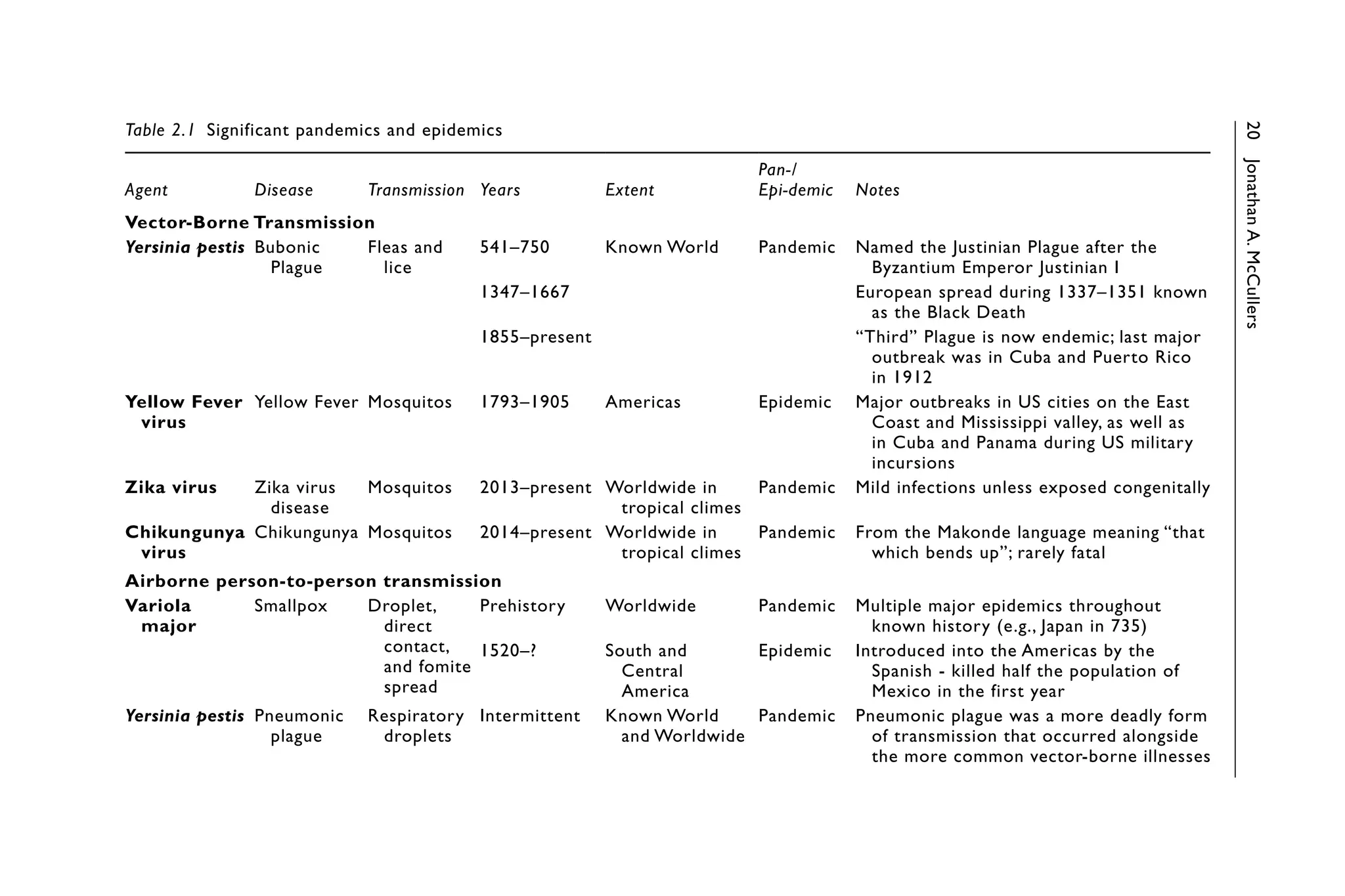
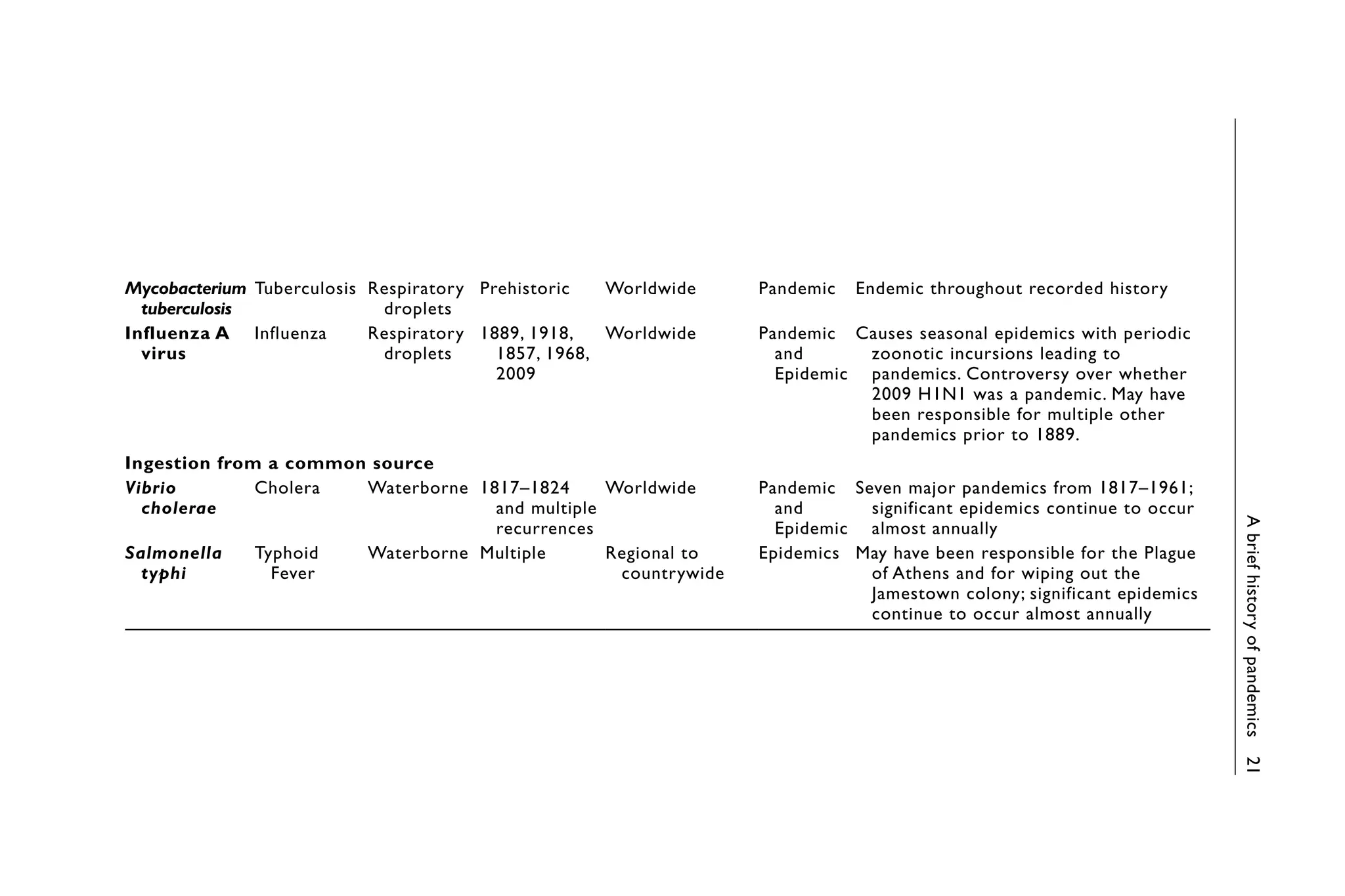
![22 Jonathan A. McCullers
were common until 1206, occurring 5–32 years apart. Smallpox was also
the centerpiece of what is known in history as the “Columbian Exchange”
where the ships of Spanish explorers including Columbus carried syphilis
from Central America back to Europe in 1494 and seeded smallpox and
other diseases in Mexico in 1520 [8]. Syphilis spread rapidly through Europe
following invasions during the Italian Wars, killing an estimated 50,000 per-
sons [1]. Smallpox is thought to have killed half the population of Mexico
City in the first year after introduction, and it may have wiped out as much
as 95% of the indigenous populations of South and Central America in
subsequent decades.
The third major mode of transmission, oral ingestion from a common
source, is best exemplified by the cholera pandemics of the 19th century
(Table 2.1). Cholera, a disease characterized by acute watery diarrhea, is
caused by the bacterium Vibrio cholerae. It had been endemic for centuries
in the Ganges basin of India, but first spread globally beginning in 1817
through Asia, and thence into India, Russia, Europe, and the Americas. Six
subsequent pandemics occurred over the next 130 years, and it continues to
cause epidemics worldwide affecting millions annually [9]. The third chol-
era pandemic is best known for the observations of the epidemiologist John
Snow in England, who demonstrated the waterborne nature of the illness by
removing the pump handle on a well in one district, and comparing disease
there to other city districts. The current strain causing epidemics, known as
the “El Tor biotype,” first arose in “quarantine stations” in El Tor, Egypt
where travelers back from Mecca after attending the Hajj were kept in
squalid conditions for weeks or months prior to being allowed into European
countries [9].
Many other pandemics have afflicted the world throughout history, and
doubtless many more will emerge from animal reservoirs and cause signifi-
cant morbidity, mortality, and societal disruption. Understanding the past is
a vital key to preparing for the future, as our recent experience with COVID-
19 has demonstrated. There are numerous examples from past pandemics
that could have informed many of the so-called controversies that arose in
2020 had world and local leaders been better educated. The uneven and
sometimes defiant response to authority has been a staple of pandemics
since the Plague of Athens and was amply documented in the 1918 influenza
pandemic; public resistance by a minority of citizens to public health mea-
sures such as business closures, mask mandates, and vaccination should
have been anticipated. The heavy burden on frontline healthcare workers
and the resulting stress and burnout have been well appreciated throughout
history. The roles of over-crowding, poor ventilation, and close living spaces
linked to poverty have likewise been seen as important factors in the ease of
spread and severity of pandemics for millennia. Finally, the impact on the
economy and on disease spread of school closures, limitations on businesses,
banning of mass gatherings, and mask mandates have all been studied dur-
ing previous pandemics and epidemics, and the utility of these measures](https://image.slidesharecdn.com/24400491-250511175451-a7522781/75/Healthcare-Analytics-Emergency-Preparedness-For-Covid19-Edward-M-Rafalski-41-2048.jpg)
![A brief history of pandemics 23
should not be controversial [6]. Health systems likewise should use this
knowledge from past history and lived experience from the COVID-19
pandemic to revise and update disaster and pandemic plans.
REFERENCES
[1] B. A. Cunha, “The cause of the plague of Athens: plague, typhoid, typhus,
smallpox, or measles?,” Infect Dis Clin N Amer, vol. 18, pp. 29–43, 2004.
[2] D. M. Morens, P. Daszak, H. Markel and J. K. Taubenberger, “Pandemic
COVID-19 joins history’s pandemic legion,” mBio, vol. 11, no. 3, pp. 1–9,
2020.
[3] J. J. Fins, “Pandemics, protocols, and the Plague of Athens: Insights from
Thucydides,” Hastings Cent Rep, vol. 50, no. 3, pp. 50–53, 2020.
[4] N. Truong and A. O. Asare, “Assessing the effect of socio-economic features of
low-income communities and COVID-19 related cases: An empirical study of
New York City,” Glob Publ Health, vol. 16, no. 1, pp. 1–16, 2021.
[5] D. M. Wagner, J. Klunk and M. Harbeck, “Yersinia pestis and the Plague
of Justinian 541–543 AD: A genomic analysis,” Lancet Infect Dis, vol. 14,
pp. 319–326, 2014.
[6] J. M. Barry, The Great Influenza: The Story of the Deadliest Pandemic in
History, New York: Viking, 2004.
[7] A. Suzuki, “Smallpox and the epidemiologic heritage of modern Japan:
Towards a total history,” Med Hist, vol. 55, no. 3, pp. 313–318, 2011.
[8] N. Nunn and N. Qian, “The columbian exchange: A history of disease, food,
and ideas,” J Econ Perspect, vol. 24, no. 2, pp. 163–188, 2010.
[9] J. D. Clemons, G. B. Nair, T. Ahmed, F. Qadri and J. Holmgren, “Cholera,”
Lancet, vol. 390, pp. 1539–1549, 2017.](https://image.slidesharecdn.com/24400491-250511175451-a7522781/75/Healthcare-Analytics-Emergency-Preparedness-For-Covid19-Edward-M-Rafalski-42-2048.jpg)