SHEBA SUSAN BENNY
2nd yr PBBSC Nursing
TOPICS FOR TODAY……
 Introduction
 Prevalence
 Burden due to headache
 Causes for sensing headache
 Path physiology
 Classification
 Diagnosis
 Management
INTRODUCTION
 Most common of all human physical complaints
 Despite regional variations, headache disorders are a
worldwide problem, affecting people of all ages, races,
income levels, & geographical area
 Headache is a painful and disabling feature , and are
the most common disorder of the nervous system
PREVALENCE
 90% of population in the world experiences headache
in any given year.
 Prevalence among adults of current headache disorder
is 47%
 More than 10% of the reported headache were
Migraine
 1.7-4% of world’s adult population experiences
headache on 15 or more days every month
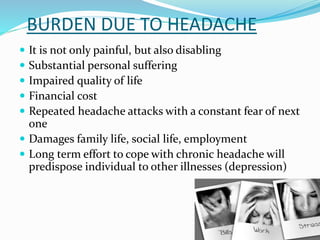
BURDEN DUE TO HEADACHE
 It is not only painful, but also disabling
 Substantial personal suffering
 Impaired quality of life
 Financial cost
 Repeated headache attacks with a constant fear of next
one
 Damages family life, social life, employment
 Long term effort to cope with chronic headache will
predispose individual to other illnesses (depression)
CAUSES FOR SENSING HEADACHE
 Traction
 Pressure
 Deformation
 Displacement
 Inflammation
 Dilatation
Of the structures which has
nociceptors
PATH PHYSIOLOGY
 The brain tissue itself is not sensitive to pain as it lacks
pain receptors
 But the pain-sensitive structures that are around the
brain causes the sensation of pain
 Extra cranial: skin, s/c tissue, muscles, fascia,
periosteum, part of eye, ears, nasal cavities, & paranasal
sinuses
 Intracranial venous sinuses and large related vessels
 Meninges and the arteries surrounding it
 Cranial and cervical nerves
PATH PHYSIOLOGY contd…..
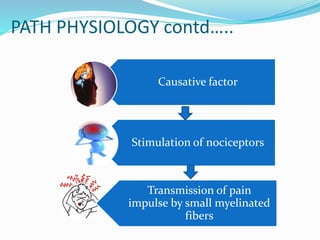
Causative factor
Stimulation of nociceptors
Transmission of pain
impulse by small myelinated
fibers
PATH PHYSIOLOGY
contd…..
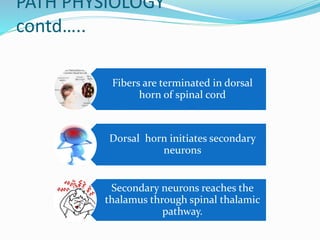
Fibers are terminated in dorsal
horn of spinal cord
Dorsal horn initiates secondary
neurons
Secondary neurons reaches the
thalamus through spinal thalamic
pathway.
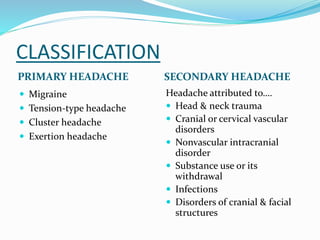
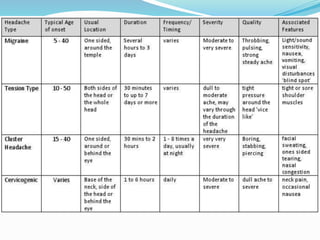
CLASSIFICATION
PRIMARY HEADACHE SECONDARY HEADACHE
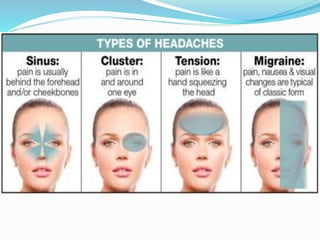
 Migraine
 Tension-type headache
 Cluster headache
 Exertion headache
Headache attributed to….
 Head & neck trauma
 Cranial or cervical vascular
disorders
 Nonvascular intracranial
disorder
 Substance use or its
withdrawal
 Infections
 Disorders of cranial & facial
structures
MIGRAINE
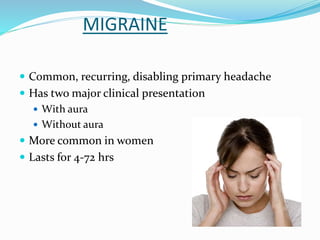
 Common, recurring, disabling primary headache
 Has two major clinical presentation
 With aura
 Without aura
 More common in women
 Lasts for 4-72 hrs
MIGRAINE
contd….
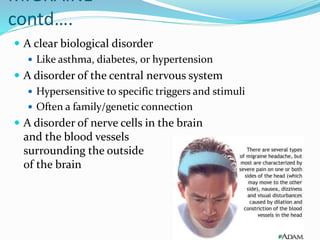
 A clear biological disorder
 Like asthma, diabetes, or hypertension
 A disorder of the central nervous system
 Hypersensitive to specific triggers and stimuli
 Often a family/genetic connection
 A disorder of nerve cells in the brain
and the blood vessels
surrounding the outside
of the brain
Migraine..features.
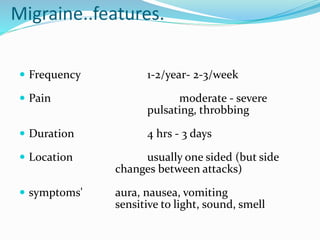
 Frequency 1-2/year- 2-3/week
 Pain moderate - severe
pulsating, throbbing
 Duration 4 hrs - 3 days
 Location usually one sided (but side
changes between attacks)
 symptoms' aura, nausea, vomiting
sensitive to light, sound, smell
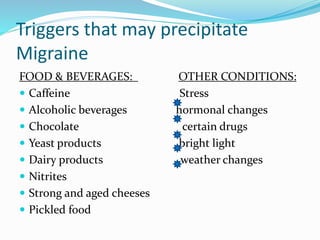
Triggers that may precipitate
Migraine
FOOD & BEVERAGES: OTHER CONDITIONS:
 Caffeine Stress
 Alcoholic beverages hormonal changes
 Chocolate certain drugs
 Yeast products bright light
 Dairy products weather changes
 Nitrites
 Strong and aged cheeses
 Pickled food
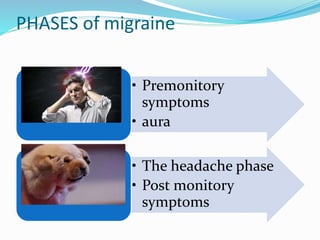
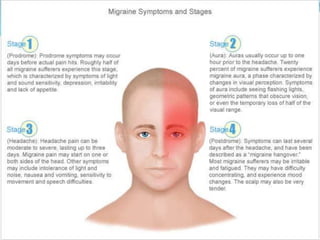
PHASES of migraine
• Premonitory
symptoms
• aura
• The headache phase
• Post monitory
symptoms
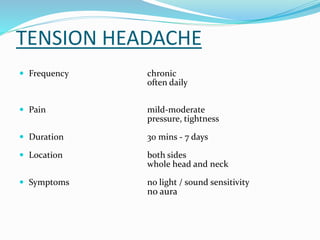
TENSION HEADACHE
 Frequency chronic
often daily
 Pain mild-moderate
pressure, tightness
 Duration 30 mins - 7 days
 Location both sides
whole head and neck
 Symptoms no light / sound sensitivity
no aura
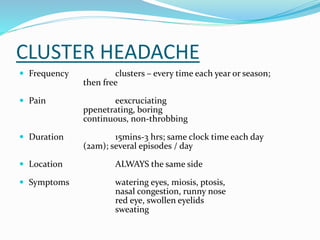
CLUSTER HEADACHE
 Frequency clusters – every time each year or season;
then free
 Pain eexcruciating
ppenetrating, boring
continuous, non-throbbing
 Duration 15mins-3 hrs; same clock time each day
(2am); several episodes / day
 Location ALWAYS the same side
 Symptoms watering eyes, miosis, ptosis,
nasal congestion, runny nose
red eye, swollen eyelids
sweating
DIAGNOSIS
 Entirely related to patients history
 If dangerous symptoms, neuroimaging studies will b
performed
 Neurological assessment
MANAGEMENT
Main part include:-
 Analgesics
 Anti-emetics
 Anti-migraine medicine
 Prophylactic medication
Migraine:-
 Preventive medications are generally recommended
when people have more than 4 attacks per month
 Possible therapies include B blockers, antidepressants,
anticonvulsants and NSAIDs
TENSION HEADACHE
 This can usually be managed with NSAID,
Acetaminophen,Aspirin
 Amitryptilin is a medication proven to help chronic
tension headache
NEW TREND IN MANAGING
HEADACHE Biofeedback- electronic sensors, monitor muscle
tension, temp, heart rate, blood pressure, to teach
people how to control bodily response
 Massage : for temp relief, try rubbing your temples or
neck, back, head or shoulder massage
 Stretching : neck ROM-chin forward, upward, &
towards each shoulder. Shoulder shrugs( up, dwn,
forward & backward.
Managing headache…contd….
 Aerobics – regular brisk walking, biking or swimming
 Meditation – focus attention & quiet mind from
distraction
 Yoga – balances mind, body, spirit
 Relaxation – deep breathing, relaxing to music,
guided imagery
 Heat & cold-
 Avoid nitrates and nitrites
Managing headache
contd…
 Botox – wrinkle reducer, given around the head &
neck every 12 weeks
 Transcranial magnetic stimulation- delivering
magnetic pulses to brain.
 Electrode implants- electrodes are placed in neck or
brain
Headache
Headache

Headache

  • 1.
    SHEBA SUSAN BENNY 2ndyr PBBSC Nursing
  • 2.
    TOPICS FOR TODAY…… Introduction  Prevalence  Burden due to headache  Causes for sensing headache  Path physiology  Classification  Diagnosis  Management
  • 3.
    INTRODUCTION  Most commonof all human physical complaints  Despite regional variations, headache disorders are a worldwide problem, affecting people of all ages, races, income levels, & geographical area  Headache is a painful and disabling feature , and are the most common disorder of the nervous system
  • 4.
    PREVALENCE  90% ofpopulation in the world experiences headache in any given year.  Prevalence among adults of current headache disorder is 47%  More than 10% of the reported headache were Migraine  1.7-4% of world’s adult population experiences headache on 15 or more days every month
  • 5.
    BURDEN DUE TOHEADACHE  It is not only painful, but also disabling  Substantial personal suffering  Impaired quality of life  Financial cost  Repeated headache attacks with a constant fear of next one  Damages family life, social life, employment  Long term effort to cope with chronic headache will predispose individual to other illnesses (depression)
  • 6.
    CAUSES FOR SENSINGHEADACHE  Traction  Pressure  Deformation  Displacement  Inflammation  Dilatation Of the structures which has nociceptors
  • 7.
    PATH PHYSIOLOGY  Thebrain tissue itself is not sensitive to pain as it lacks pain receptors  But the pain-sensitive structures that are around the brain causes the sensation of pain  Extra cranial: skin, s/c tissue, muscles, fascia, periosteum, part of eye, ears, nasal cavities, & paranasal sinuses  Intracranial venous sinuses and large related vessels  Meninges and the arteries surrounding it  Cranial and cervical nerves
  • 8.
    PATH PHYSIOLOGY contd….. Causativefactor Stimulation of nociceptors Transmission of pain impulse by small myelinated fibers
  • 9.
    PATH PHYSIOLOGY contd….. Fibers areterminated in dorsal horn of spinal cord Dorsal horn initiates secondary neurons Secondary neurons reaches the thalamus through spinal thalamic pathway.
  • 10.
    CLASSIFICATION PRIMARY HEADACHE SECONDARYHEADACHE  Migraine  Tension-type headache  Cluster headache  Exertion headache Headache attributed to….  Head & neck trauma  Cranial or cervical vascular disorders  Nonvascular intracranial disorder  Substance use or its withdrawal  Infections  Disorders of cranial & facial structures
  • 13.
    MIGRAINE  Common, recurring,disabling primary headache  Has two major clinical presentation  With aura  Without aura  More common in women  Lasts for 4-72 hrs
  • 14.
    MIGRAINE contd….  A clearbiological disorder  Like asthma, diabetes, or hypertension  A disorder of the central nervous system  Hypersensitive to specific triggers and stimuli  Often a family/genetic connection  A disorder of nerve cells in the brain and the blood vessels surrounding the outside of the brain
  • 15.
    Migraine..features.  Frequency 1-2/year-2-3/week  Pain moderate - severe pulsating, throbbing  Duration 4 hrs - 3 days  Location usually one sided (but side changes between attacks)  symptoms' aura, nausea, vomiting sensitive to light, sound, smell
  • 18.
    Triggers that mayprecipitate Migraine FOOD & BEVERAGES: OTHER CONDITIONS:  Caffeine Stress  Alcoholic beverages hormonal changes  Chocolate certain drugs  Yeast products bright light  Dairy products weather changes  Nitrites  Strong and aged cheeses  Pickled food
  • 19.
    PHASES of migraine •Premonitory symptoms • aura • The headache phase • Post monitory symptoms
  • 21.
    TENSION HEADACHE  Frequencychronic often daily  Pain mild-moderate pressure, tightness  Duration 30 mins - 7 days  Location both sides whole head and neck  Symptoms no light / sound sensitivity no aura
  • 22.
    CLUSTER HEADACHE  Frequencyclusters – every time each year or season; then free  Pain eexcruciating ppenetrating, boring continuous, non-throbbing  Duration 15mins-3 hrs; same clock time each day (2am); several episodes / day  Location ALWAYS the same side  Symptoms watering eyes, miosis, ptosis, nasal congestion, runny nose red eye, swollen eyelids sweating
  • 23.
    DIAGNOSIS  Entirely relatedto patients history  If dangerous symptoms, neuroimaging studies will b performed  Neurological assessment
  • 24.
    MANAGEMENT Main part include:- Analgesics  Anti-emetics  Anti-migraine medicine  Prophylactic medication
  • 25.
    Migraine:-  Preventive medicationsare generally recommended when people have more than 4 attacks per month  Possible therapies include B blockers, antidepressants, anticonvulsants and NSAIDs
  • 26.
    TENSION HEADACHE  Thiscan usually be managed with NSAID, Acetaminophen,Aspirin  Amitryptilin is a medication proven to help chronic tension headache
  • 27.
    NEW TREND INMANAGING HEADACHE Biofeedback- electronic sensors, monitor muscle tension, temp, heart rate, blood pressure, to teach people how to control bodily response  Massage : for temp relief, try rubbing your temples or neck, back, head or shoulder massage  Stretching : neck ROM-chin forward, upward, & towards each shoulder. Shoulder shrugs( up, dwn, forward & backward.
  • 28.
    Managing headache…contd….  Aerobics– regular brisk walking, biking or swimming  Meditation – focus attention & quiet mind from distraction  Yoga – balances mind, body, spirit  Relaxation – deep breathing, relaxing to music, guided imagery  Heat & cold-  Avoid nitrates and nitrites
  • 29.
    Managing headache contd…  Botox– wrinkle reducer, given around the head & neck every 12 weeks  Transcranial magnetic stimulation- delivering magnetic pulses to brain.  Electrode implants- electrodes are placed in neck or brain